Vol. 11 No. 2
Fall 2015
Walker Hearne Ranch: Conservancy Awarded $1 Million Grant Toward Purchase
T
he Ventura Hillsides Conservancy held a press conference on March 27th to announce that it has been awarded a $1 million grant from the California Natural Resources Agency to purchase roughly 300 acres of the 2,123-acre Walker-Hearne Ranch property. The land, located directly east of the Clearpoint neighborhood in East Ventura, represents the first purchase of hillside land for the 12 year-old land trust. It includes oak woodland, riparian and coastal sage habitat types and stunning views of the Channel Islands and Santa Clara River Valley. The grant, awarded through CNRA’s Environmental Enhancement and Mitigation Program, serves to mitigate some of the environmental impacts to coastal sage scrub and riparian habitats associated with the U.S. Highway 101 widening project along the Rincon. State Senator Hannah-Beth Jackson said “I am very pleased that the Ventura Hillsides Conservancy has received critical funding that will go toward the
acquisition. This will preserve wetlands and wildlife habitat, provide nature trails for our residents, and protect this land for generations to come.” Ventura County Supervisor Steve Bennett said “This million-dollar grant from the State recognizes the importance of preserving the Ventura Hillsides and reflects the strength and capacity of the Ventura Hillsides Conservancy. This is a keystone acquisition which will hopefully be the first of many to preserve the Ventura Hillsides and open them for public recreation. All of the Board members and supporters of the Hillsides Conservancy deserve our thanks and congratulations for bringing our community to this historic point.” David Hadlen, managing partner of the property, said "The WalkerHearne Ranch is owned by the eight great grandchildren of William Sexton, who, along with his brother Joseph, purchased the land grant property in 1883 (it was Joseph who planted the 13 eucalyptus trees above Ventura in
Saturday, September 26, 2015
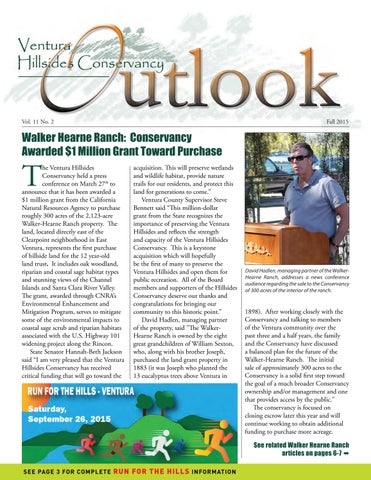
David Hadlen, managing partner of the WalkerHearne Ranch, addresses a news conference audience regarding the sale to the Conservancy of 300 acres of the interior of the ranch.
1898). After working closely with the Conservancy and talking to members of the Ventura community over the past three and a half years, the family and the Conservancy have discussed a balanced plan for the future of the Walker-Hearne Ranch. The initial sale of approximately 300 acres to the Conservancy is a solid first step toward the goal of a much broader Conservancy ownership and/or management and one that provides access by the public." The conservancy is focused on closing escrow later this year and will continue working to obtain additional funding to purchase more acreage. See related Walker Hearne Ranch articles on pages 6-7 ➡
SEE PAGE 3 FOR COMPLETE RUN FOR THE HILLS INFORMATION
President’s Message
VHC News Briefs
T
he Spring and Summer of 2015 have been a busy time for your conservancy. Our annual Wild & Scenic Film Festival was again a hit, selling out both nights and bringing together a group of like minded people who share their love of the great outdoors. The films were great and helped us make this fundraiser a success. Our annual meeting in May was a time to catch up on our progress with members as well and make new friends. One such person was Tracey Wariner, who, after expressing an interest in what we do, stepped up to help. Soon after the meeting, we were greeted with the news that the conservancy had been awarded a $1 million grant to purchase 300 acres of land on the Ventura Hillsides. While this news may be known to many of our members and friends by now, we included a series of stories in this issue because of the importance of this opportunity. The National Trails Day event in June was our chance to have volunteers help us repair and build new trails on our Willoughby Preserve. In a matter of hours, overgrowth had been groomed into clear paths, allowing visitors to enjoy the land more easily. This includes trails to the Ventura River, which, despite our severe drought, still has beautiful waterways with fish, birds and footprints showing that mammals use it for drinking water. This fall, over 500 California Lutheran University incoming freshman will be working with the conservancy on habitat restoration work (Arundo removal and trail work) in the estuary. With that many hands, we’re sure to see marked progress. This is a pivotal transition in restoring this valuable natural and recreational resource. As always, I invite you to stay in touch: Feel free to ask questions, get involved and make suggestions. It’s important that we know what our members and community are thinking.
This bridge abutment will be the location of a new grant-funded, estuary-themed mural. This will be the second VHC-mural along the Ventura River Parkway. The first is adjacent to the Big Rock Preserve south of Foster Park.
— David Comden, President Ventura Hillsides Conservancy email: president@venturahillsides.org
VENTURA HILLSIDES CONSERVANCY 2015 CALENDAR
Saturday, September 26 Saturday, October 3 Saturday, October 17 Saturday, November 21 Saturday, December 19
Run for the Hills Event – San Buenaventura State Beach United Way Day of Caring 2015 – Willoughby Preserve California Conservation Corps Workday – Big Rock Preserve Volunteer Fieldwork Morning 9 AM to Noon Volunteer Fieldwork Morning 9 AM to Noon
Ventura Hillsides Conservancy Outlook
Tel: 805-643-8044 • P.O. Box 1284, Ventura, CA 93002 www.venturahillsides.org Stephen Svete, Editor / email: editor@venturahillsides.org Contributors: Brooke Ashworth, Karen Bednorz, David Comden, Dashiell Dunkell, Dr. Anthony J. Giordano, Derek Poultney, Nikos Valance Layout/Design Frank Boross Media Services
q Outlook is published semi-annually by the Ventura Hillsides Conservancy, a 501 (c) (3) California nonprofit organization. Story submissions and ideas welcomed. Copyright ©2015 Ventura Hillsides Conservancy. All rights reserved.
2
Ventura Hillsides Conservancy Outlook
River Parkway Art Project in very early stage of development The Conservancy is in the process of obtaining permits from Caltrans and the City of Ventura to engage artists to create an an estuary-themed mural on the U.S. Highway 101 bridge abutment facing the popular bike path along the lower Ventura River. The bridge abuts VHC’s Willoughby Preserve and lies just north of the Ventura River Estuary.
Ask / Wish List:
n $250 for a plaque in your name for a newly planted tree n $500 for printed bilingual brochureversions of our kiosk and other signage and/or materials n $1,000 Trailhead Signage n $1,500 toward the Public Art mural project along the bike path under the 101 FWY n $2,500 New Website n $3,500 2nd Kiosk at Big Rock n $5,000 for a bench n $5,000+ toward management endowment for existing and future properties n $5,000+ to kickstart an Accreditation Fund n $10,000 W-H Trail in donor’s name DONATED ITEMS Desired / Needed: n Work truck, water tank, water pump n New/used desktop computer n New/used laptop computer n New monitor Fall 2015
“Run for the Hills Ventura” Course to Feature Willoughby Preserve, Enviro Themes Run for the Hills Ventura, a new seven kilometer fun run and festival designed to build support for the Conservancy will be held Saturday, September 26, 2015. The event will be staged at San Buenaventura State Beach to celebrate our region’s picturesque landscapes. “We are proud to welcome this exciting new event to Ventura. We hope it will raise awareness for the many environmental issues that are challenging our local resources and encourage people to make a concerted effort to protect our environment,” said David Comden, President of the Board of Trustees. The Run for the Hills Ventura race course will incorporate various environmentally-themed obstacles, including a “water bottle pit,” and an “urban sprawl maze.” It will begin and end at San Buenaventura State Beach,
traveling along the coast then through the Ventura riverbed property owned by the Conservancy. Additional event elements include exhibitor booths, food trucks, a beer garden and a stage featuring performances by local talent. Run for the Hills Ventura is co-owned and operated by IMG, a global leader in sports, fashion and media. “As a longtime resident of Ventura County, I am excited to produce this event with the Ventura Hillsides Conservancy. It is a great way to celebrate the community and to raise funds that will go towards the preservation of our environment,” said Chris Conrad, Vice President/Event Director at IMG. For more info and to register go to http://www.active.com/ventura-ca/ running/distance-running-races/runfor-the-hills-ventura-2015 .
N
Kiosk to mark Ventura River Trail
ow that the Willoughby property in the Ventura River Parkway is looking more and more like a nature preserve, having been cleaned of many tons of trash and non-native arundo reed, it is time to invite the community back to this wild and scenic open space. To aid visitors in their understanding of the area, the first interpretive kiosk is being designed and will be installed at the Main Street crossroads with the Ventura River Trail later this summer. The Conservancy, in collaboration with Friends of the Ventura River – most notably Surfrider Foundation and Ventura Citizens for Hillside Preservation — are cooperating to purchase, design and install the kiosk. Patrick Johnston, who produced the Ventura River Parkway map, is designing the three-panel kiosk. The panels will showcase the history of the river, illustrate local flora and fauna and will present the future vision for the area. This will be the first of three
3
An interpretive kiosk like the one pictured will soon be installed at the Willoughby Preserve, near the Main Street Bridge along the Ventura River Trail.
Ventura Hillsides Conservancy Outlook
proposed kiosks to appear throughout the Parkway corridor in the future. Such visual interpretive monuments help visitors gain knowledge of the area, mark the location as a public space, and enhance the visitor experience. The Ventura River Parkway was designated a National Recreation Trail in June 2013, joining more than 1,200 other significant trails throughout the U.S. The 16.5-mile long trail includes two major segments: the Ventura River Trail and the Ojai Valley Trail. From the Ventura River estuary in Ventura to the heart of Ojai, the contiguous corridor of pedestrian and cycling trails, tributary crossings, public access points, and public art installations reconnects neighborhoods and rural communities to the river, and provides a visitor amenity for outdoor-oriented tourists. For more information about the Ventura River Parkway visit www. FriendsofVenturaRiver.org Fall 2015
REI Supports Creation of Volunteer Trail Crew Photos and Story by Dashiell Dunkell
S
ince opening a store in Oxnard in 2013, outdoor retailer REI has generously supported the Conservancy’s efforts on the Ventura River Parkway, our Wild & Scenic Film Festival, and our volunteer program. This year when we were approached by REI’s Central Coast Outdoor Programs and Outreach Market Coordinator Sylvia Schnopp to apply for a grant from REI’s Stewardship program, Conservancy staff saw a perfect opportunity to start a new effort in the Ventura River. After successful removal of illegal camps, much of the invasive giant reed, and the vast majority of trash from the estuary and surrounding areas, the next big step in reclaiming the area for community use is to provide safe and easy access. With this
idea in mind, we approached REI with a grant proposal to create a volunteer Trail Crew, based on a similar effort at the Ojai Valley Land Conservancy, to help maintain and build trails in the estuary and larger Ventura River Parkway area. REI notified the Conservancy in May that they awarded $10,000 for our trail crew effort, which will include tools, equipment, supplies, and staff time. “Preserving and protecting our local natural landscape is of great importance to REI members and employees- so we’re grateful for our partnership with VHC and the good work being done” said Matthew Wheat, Manager of REI Oxnard. As part of the Stewardship program, each store connects with local groups that create access and nurture outdoor 4
spaces used by REI’s customers. In 2014 alone, the program donated $4.6 million to more than 300 nonprofit organizations caring for outdoor places. Our plan was to start work in the estuary this summer, but with the lack of rainfall over the last year, much of the area has been flooded since December. Though this sounds counterintuitive at first, the reason is that the sandbar at the mouth of the river was never truly breached, resulting in a large backup of water in the estuary. Therefore, the trail crew’s first project was upriver at our Big Rock Preserve for National Trails Day in June. A dozen trail volunteers came out and had a great time clearing three overgrown access points to the preserve, as well as a long stretch of trail leading to the Ventura River and the beautiful “Stronghold Beach.”
Our dedicated volunteer stewardship crews are instrumental in VHC’s watershed restoration efforts. Every month, teams gather to remove invasive cane stands and build trails. Here, crews work at the Willoughby Preserve.
Building trails allows the community access to the estuary, a crucial part of the Ventura River Parkway project goals.
We will be holding monthly trail days as well as our normal “3rd Saturday” restoration events, anyone interested should email volunteer@venturahillsides. org. Trail crew volunteers are trained in proper tool use and trail building techniques, and will receive a special REI Steward 2015 t-shirt. Ventura Hillsides Conservancy Outlook
Fall 2015
Three Questions: Outlook asks the two newest Trustees what’s on their minds The Board of Trustees has appointed two new members of our community to join their governing board: longtime Advisor Karen Bednorz, and newly-arrived Venturan Nikos Valance. We asked them what drives them to lead VHC. Karen works in Creative Services at Patagonia, and Nikos is an attorney. Karen, what got you interested in working for a local land trust? I didn’t pick VHC, it picked me! I moved to Santa Barbara and then to Ventura County from Hacienda Heights in the 70s. In truth, I was moving away from the serial cookie-cutter development I found suffocating. After a childhood of running through orange & pomegranate orchards, and building forts in grazing pastures, it pained me to see subdivisions and strip malls systematically swallowing up picturesque landscape that one would seek as inspiration for a day of water or oil painting. This is long before I become more educated, aware and sensitive to the ecological balances needed to sustain all life, not just human. What accomplishment of VHC are you most proud of so far? From its inception, a small group cared enough about this special place to organize and inspire more to join in on this beautiful mission to conserve and protect these hillsides, corridors, and water ways. I love that those involved carry this torch passionately. I’m proud of the arduous, dedicated work that has gone into past successful events such as educational events, tabling, the music festival, the river parkway, 5
and film festival. All leading us up our soon-to-be-purchased hillside property. I’ve always said, when looking up at the hills and Two Trees, someday this place will be protected, and I’m proud to know I did my part to make that happen. What’s even more amazing is that it’s going to happen in my lifetime. What are your plans for the Conservancy for the next five years? My hope is to triple our membership, making an unambiguous case of community support for policy and extensive grant funding. Work toward expanding hillside protection through acquisitions, with eventual structure in place for public access.
NIKOS VALANCE
Nikos, what drew you to become involved with the Conservancy? Someone I knew in Tucson said she was moving her business to Ventura and that piqued my interest. So while in L.A. for a business trip I decided to stay in Ventura. It was a Saturday afternoon in January and I stood out on the balcony of my hotel room. I saw the ocean in one direction, the hills covered with lemon groves in the opposite direction and people below on the promenade walking their dogs (I'm a dog lover), riding bikes and just walking. It suddenly became clear that Ventura was where I wanted to be. Nine months later I was living here. I've always been active in the communities in which I've lived, especially so in NYC, and I wanted to become active in the Ventura community. The biggest draw for living here for me is Ventura Hillsides Conservancy Outlook
the quality of life, especially the natural environment. When I became aware of the Conservancy and its efforts to preserve that quality of life, it was obvious to me that it was one place I wanted to put my energies. Tell us about your professional or personal background. Professionally I'm a lawyer and an economist and I have a long resume as an activist and an organizer working on issues of social justice and environmental issues. I spent many years working on housing issues as an organizer and policy analyst in some very poor, neglected neighborhoods in New York City. Another highlight was the work I did as a national coordinator in the effort to include labor and environmental concerns in the drafting of NAFTA. I had responsibility for one of the most diverse coalitions of labor, environmental, religious and community based coalitions in New York State's history. Where would you like to see the land trust go in the next 5 years? I would like to see the Conservancy become more diverse in terms of its leadership and I am actively recruiting leaders in Ventura's Latino community to encourage them to consider joining the Board of Trustees. While primarily a land trust I would like to see the Conservancy expand its programmatic efforts to include much more education, especially among young people in the schools focusing not only on the value of conservancy but of sustainability, habitat restoration, natural resource conservation, especially water, and overall respect for the environment. We'll need to raise funds to support the additional staff required for this, and I've been advocating at Board meetings to hire someone on a contractual basis to do the kind of development work that would support the funding to do this kind of programmatic expansion. nnn Fall 2015
Ventura’s History is Embodied in the Walker-Hearne Ranch By Brooke Ashworth
T
here are really two stories to the Walker-Hearne Ranch. The first is the story of the land itself; the other is the story of the family who now owns it. The ranch was part of the 48,823-acre Rancho Ex-Mission San Buenaventura, running from the Ventura River nearly to Santa Paula and from the ocean to Sulfur Mountain. First claimed from the resident Chumash by the Catholic Church upon establishment of Mission San Buenaventura, the mission lands were seized and separated from the mission after secularization of the California missions in 1833. In 1846, under Mexican rule, Alta California governor Pio Pico granted the Rancho Ex-Mission San Buenaventura to José de Arnaz. While title to the land was unclear during the Mexican-American War, after the war Arnaz sold the Rancho Ex-Mission to Manuel Antonio Rodriguez de Poli who successfully took his ownership claim all the way to the U.S. Supreme Court. Division of the extensive ranch occurred after de Poli’s death in 1856 with title confusingly transferred, often without true ownership or payment. In 1878 two investors purchased the rights of all outstanding claimants and, after years of litigation to clear title, sold 6,000 acres to brothers William and Joseph Sexton in 1883 for $14,000 in gold coins.
Family gathering at the ranch cabin, circa May 1944. Elizabeth Sexton Walker (third from left) and her brother George Sexton (second from right) on the ranch.
6
Sisters Agnes Lydia Sexton Hearne and Elizabeth Sexton Walker
Here the story of the land merges with the story of the family. William and Joseph Sexton were born in Ohio and moved with their parents and siblings to California in 1852, arriving in San Francisco by steamer after having crossed Nicaragua by mule. The two brothers and their father were nurserymen and farmers, starting out growing peaches from pits gathered in the streets of San Francisco according to family lore. The brothers were partners in many land purchases around the state, including the 6,000 acres of Rancho Ex-Mission San Buenaventura. Upon the death of William Sexton in 1892, family friend (and Joseph Sexton’s brother-in-law) E. P. Foster was called upon to divide the brothers’ properties. The William Sexton Estate retained ownership of what is today called WalkerHearne Ranch. When William Sexton’s wife Hattie passed in 1904, the ranch was bequeathed to her five living children, three brothers and two sisters. The brothers remained single and by 1927 all three had died, leaving their shares of the ranch to sisters Elizabeth Sexton Walker and Agnes Lydia Sexton Hearne, hence the appellation Walker-Hearne Ranch. It is interesting to imagine what Ventura was like in 1927 when the sisters became full owners of the ranch. Their childhood home stood at the site of present-day Barrelhouse 101 restaurant on what was then Meta Street (now Thompson Boulevard) and the sisters had their own homes, Elizabeth on Ventura Avenue in a house that is still standing and Lydia on Santa Clara Street just east of Fir Street. There was no freeway of course, although automobiles had passed from curiosity to commonplace. Present day City Hall was still the Ventura County Courthouse. There was a bathhouse with a saltwater plunge at the foot of California Street. The First National Bank of Ventura (now known as the Erle Stanley Gardner Building) had been completed and the Ventura Theatre was under construction as an oil boom brought prosperity to the city. The Ventura FreePress reported regularly on arrests for sale or possession of alcohol and avocados were touted as “a coming fruit” for California agriculture.
Ventura Hillsides Conservancy Outlook
Fall 2015
Walker-Hearne: A Wealth of Conservation Resources
P
Photo of the oak grove today, where the WalkerHearne Ranch family cabin once stood.
Sisters Elizabeth and Lydia, each raising a family, were always close despite a 10-year age difference. The ranch was then far outside of town, and was the site of a rustic cabin where the families gathered for leisure time together, picnicking, playing cards (poker was a favorite) and horseback riding. Today the ranch is much the same as it was in 1927, retaining pristine examples of local flora and fauna in a variety of native habitats. The property is owned by descendants of the sisters who hope that the City and greater community of Ventura will be able to enjoy the recreational opportunities afforded by the Walker-Hearne Ranch under the stewardship of the Ventura Hillsides Conservancy.
www
Same Internet space, new format. Please visit our new website at the same address
www.venturahillsides.org
and let us know what you think! The revamped site is supported by internal databases and tracking software to help us keep better track of our projects and community engagement.
7
By Dashiell Dunkell
ulling off Foothill Road to the dirt turnout surrounded by avocado trees that marks the entrance to the Walker-Hearne Ranch feels like an immediate step back in time. The rusting farm equipment and corral fencing are a visual reminder of Ventura’s strong agricultural heritage, and the dirt road winding back into Harmon Canyon seems unchanged during the past century. Passing through a series of gates, the road follows ephemeral Harmon Creek upslope and the traffic noise quickly dies away. The barranca here is studded with willows, and lizards scatter across the sandy soils and cobbles of the dry creek bed. Ancient groves of coast live oak peak out between sage covered hills, and the road climbs steeply upward, eventually reaching a lookout where the upper canyon opens wide. From here the value of this land truly becomes clear: spreading across the hillsides is over 2,000 acres of some of the best-preserved Ventureno sage scrub habitat left in the region. Coastal sage scrub is one of the more endangered plant communities in the United States. One recent study called coastal sage scrub the single most endangered habitat type in the United States, and it’s no wonder. Estimates are that as little as 10 to 15 percent of California’s original coastal sage scrub has survived from its historic levels, due mainly to the fact that this unique habitat is located on very desirable and valuable oceanfront and ocean-view real estate. Decades of development in Southern California have meant that what small percent of coastal sage scrub that is left is often fragmented and degraded. Even more worrisome, the projected impacts of climate change suggest that California’s chaparral and coastal sage scrub habitats would be reduced between 38
Ventura Hillsides Conservancy Outlook
percent to 40 percent by 2070. Conservancy members and the larger Ventura community will surely benefit from the preservation of the Walker-Hearne Ranch. The land is perfect for hiking and running, birding, and simply enjoying nature. However, we are not the only residents here. Reptiles such as the orange-throated whiptail and San Diego horned lizard only live in coastal sage scrub habitats. Birds such as the endangered California coastal gnatcatcher, rufous-crowned sparrow, and coastal cactus wren need these areas to survive. As the Conservancy works towards the purchase and preservation of this iconic property, we will strive to fulfill the needs of all of our constituencies; the people, plants, and animals that call this amazing area home. The area in blue comprises the entire WalkerHearne Ranch. The 300 acre acquisition would make up about 20% of the area. The access would be near Foothill and Kimball roads.
Fall 2015
IN THE SPOTLIGHT:
THE AMERICAN BLACK BEAR
surprised to learn that the bear had to climb a fence in order to camp out in this family’s yard, a yard also near a busy road. Though a behavior more characteristic of coyotes, bobcats, and a host of smaller critters across the state, we can now also add black bears to the ranks of the state’s carnivores that engage in this behavior. With P-22, the famous mountain lion of Griffith Park, recently holed up under the porch of an LA family’s house at around the same time, the list of carnivores engaging in not-so-stealthy behavior has now grown.
In the early 1980s, as few as 10,000 black bears occurred in the Golden State; today that number is likely closer to 30,000.
(Ursus americanus) in Ventura County By Dr. Anthony J. Giordano
I
n late April of this year, a family in east Ventura was surprised to find a large and seemingly out-of-place guest in their yard. The family’s dogs, after barking in that familiar way dogs do when they know something the rest of us don’t, finally alerted them to the presence of a 175-pound black bear in their bushes. Yes…I did say east Ventura. Ultimately staff from the California Department of Fish and Wildlife resolved the issue without incident, and the bear was tranquilized, tagged, and released into the Los Padres National Forest. I wasn’t a bit 8
In truth, black bears, like the other species mentioned, are competing for Ventura County’s premium real estate. In the early part of the 20th century, following the extinction of the California grizzly bear, the black bear began to colonize the central coast and transition mountain ranges, a region which its larger cousin likely excluded it from for much of their shared history. Today, National Parks and Forests like the Santa Monica Mountains, the Angeles National Forest, and the Los Padres, the last a likely source population for bears that turn up in Ventura’s hillsides, are essential to the long-term viability of regional black bear populations. But with expanding urban development around cites like Santa Barbara, Ventura, Ojai, and Thousand Oaks, where do young adult black bears go when they are encouraged to leave home by their parents and neighbors and look for new territories? Some settle for suboptimal habitat along the fringes of National Forests and Parks; others push through valleys and canyons for quite long distances looking for a new place to call home. Increasingly however, black bears Ventura Hillsides Conservancy Outlook
around the country appear to be ending up in our own backyards. While the east coast has long led the way in this category, scenes such as these are on the rise in California, and this trend can be expected to continue. In line with a nationwide increase in black bear numbers, the state black bear population is growing. In the early 1980s, as few as 10,000 black bears occurred in the Golden State; today that number is likely closer to 30,000. Higher bear densities, and the fact that individual black bears (many of which are actually more tan or cinnamon-colored) in the Los Padres might range over a territory as large as 30 square miles, are bringing them into contact with more people more frequently. Though encounters like these haven’t previously been common in the city of Ventura, the incident back in April wasn’t the first close encounter in the County. Recent years have even seen these encounters more typical of Ojai, where an attack by a mother bear with a cub occurred on a woman walking her dogs. Although female black bears are largely shy and retiring by nature (my own appearance in one area years ago caused a female with cubs to high tail-it up a tree), big predatory males are becoming increasingly common around the United States, and attacks on humans are on the rise. The good news? American black bears evolved in North America with a diversity of much larger predators. This means if you encounter one while on a hike, they’d much prefer to retire, or at least give you the opportunity to leave the scene. Given all of this, is it possible to coexist with bears? Of course! Having bears among us make for an exciting and rewarding society, but a little precautionary wisdom certainly goes a long way in this department. On the home front, it’s possible that Venturans may one day need to learn what many on the east coast already know as gospel. For those in particular with Fall 2015
yards and property near the foothills, it is never too early for residents to begin bear-proofing their garbage and recycling containers. Getting in the habit of keeping doors and windows to housing and cars shut or even locked when no one is present is certainly advisable (yes, there is at least one recent account of a black bear that got into someone’s car, knocked it into neutral, and then proceeded to roll away with it!). As bears have noses that make a dog’s nose seem like ours, storing dry food in re-sealable containers within cupboards, and not leaving food out with doors or windows open, is always a reasonable precaution. If you’re on a hike where bears have been spotted recently, or know of their general presence in an area, always be observant (i.e., “bear aware”). If encountering a bear, particularly a mother with cubs, give it space by slowly backing away from it. It would be a good idea to end the hike right there by turning back the way you came, as the hike will likely not get better than a bear encounter up
ahead! This also will help avoid triggering further anxiety in the bear, and any defensive behavior. If you are unfortunate enough to encounter a more predatory male black bear which decides to move aggressively towards you, shout loudly and continuously at the bear. Wave your arms about your head as you do so, or throw rocks in its general direction (there is no shortage of these in the Padres). It isn’t a bad idea to go on a hike with a few such rocks in your pocket (or bear spray with a 15-20 foot range) and forget about them, as you are extremely unlikely to have such an encounter. Regardless, chance favors the prepared mind, and most of these precautions will help to keep you and your home safe from injury, or the need to have an insurance claims adjuster believe your story. Dr. Anthony J. Giordano is a carnivore and endangered species biologist living in Ventura. He was recently appointed to the Ventura Hillside Conservancy’s Stewardship Committee.
HOW YOU CAN HELP
There are a number of ways you can help us continue to do great work:
Ventura Hillsides Conservancy Board of Trustees
VOLUNTEER
Whether in the office or out in the field, the conservancy thrivesbecause of the work of our volunteers! From helping out for a day or becoming an advisor, there are lots of choices.
MAKE A DONATION
We have a Wish List of items that we could use – help us by making a donation of money or items that can be converted into funds – And get a tax write off to boot!
PLANNED GIVING
We’re fortunate to have forward thinking members who have make arrangements to help us in the future. You could be one too!
David Comden, President Paul Meehan Vice-President Jennifer Montoya, Secretary Lynn Bartosh Karen Bednorz Richard Francis Gerhardt Hubner Jens Reddeman Nikos Valance — OUR MISSION — The Ventura Hillsides Conservancy is a land trust operating in the Ventura region to protect and conserve open space resources through acquisition of land and easements, stewardship of protected lands, and public education about local natural resources.
VHC is a proud member of the Land Trust Alliance — Visit www.lta.org and the California Council of Land Trusts — www.callandtrusts.org
9
Ventura Hillsides Conservancy Outlook
Fall 2015
Members of the Ventura Hillsides Conservancy ARE YOU A MEMBER? HELP US PRESERVE VENTURA’S HILLSIDES. — JOIN US TODAY. $1000 - GUARDIAN Gary and Karen Bednorz J. F. Peddie D.V.M. and L. R. Peddie D.V.M. Michael Vivian Tracey Warriner
$100 - PATRON Gavin Arnold Brooke Ashworth Ventura Audobon Society Wayne and Jean Bartel Lynn Bartosh Philip and Maureen Basile $500 - CHAMPION Beatrice Battier Lamar and MarLynn Bushnell Jerry & Donna Beatty Paul and Jean Finnegan Ellen and Jon Becker Jamie King and Eric Smith Peter, Laura and Matthew Berson Paul and Claire Meehan Richard & Robin Birney Paul Mithra Kathy C. Bremer Chris and Suzy Reinhart Michael and Mary Lou Brown Mike and Dana Stoneking Lloyd Properties/Gary W. Brummet Lori Bruno $250 - STEWARD William and Patricia Bullough Mr. & Mrs. James Abing James Capito Dr. Jeff Baarstad Craig Carlyle Carol Ann Gillian Bishop Trust Elizabeth Charas Susan and Gregory Brown Carolyn & Doug Chase Charles and Deborah Clark Philip and Lora Clarke David & Tina Comden Todd J. and Cheryl M. Collart Mindy Cooper-Smith and Robert James Joe Connet Nathaniel Cox John Cook Mrs. Joann Cunningham Michael and Laura Cook M Bruce Fitzgerald Joann D. Cunningham Daniel Glassman Wolf Breiman & Debbie Diamond Craig Ichinose Peter C Dowler Jamie King Kenneth and Nancy Dressler Kate Larramendy Nancy L. Dressler Geoff & Nancy Loman Tracy Duffey Kevin & Megan Marble Anika Dunkell Peter W. and Rebecca Percy Linda & John Edison Pat and Diane Perkins Teri Elliot Jamie A. Rens Fred & Lynda Evans Daniel Richards Bill and Kate Faulkner Norman Schiele Kenneth Finger and Lynn Rockney Denise Stennette Jill Forman Mike Stoneking/United Way Greg and Lori Frank Hank & Sue Stoutz Gregory Frank James Strong Michael Gialketsis James Susha Kay Lesley Giles & Michael E. Mariani Steve Svete and Malinda Lawrence Dr. Joel Goldenberg Girl Scout Troop 60385 Kristine & Ed Guzman Kirk & Karen Waln Barbara and Richard Harison Edward Wehan Kevin T. Hartigan & Terrence C. Foley Keith York Larry & Michelle Heinlein 10
Cara Hill Gerhardt Hubner Bruce Hunter John Connor and Estelle Ichino Ramsey and Florence Jay Ruth O. Johnson Linda Jones Thomas & Rose Ann Jones Kristie Katsumata Edward and Diane Keay Ed and Andi Kish John and Susan Knapp Cora Lanzisero Grace Lin Cindy Luff Miriam Mack Lawrence Manson and Delia Gorey Dena Mercer Donal F. Mills Pam Monaco Kathi Mottram Tom and Sally Mueller Colleen Newkirk Steven and Anne Offerman Nancy Ogle & Andre Dunkell Mark O’Keefe Fred Ortiz Judith Owen Marvin and Pamela Dixon David Payne and J. Fowell Roanna & Ted Prell Michael Putman and Marge Karney Julie Reiss Marlayn M Riley Rincon Consultants David & Hilary Romero Edward Rose Greg & Robin Rose Donna Santo Sam and Mary Saputo David Satnick Kent Schmidt Bruce & Joyce Schoppe Phil Simon & Gwyer Schuyler Kevin Seelos Carrol Ann Smith William, Rose & Natalie Smith Marjorie Staley
Ventura Hillsides Conservancy Outlook
Jim and Janice Susha Billye & Bill Thieman Rob and Liz Thomaier James Uphold Nancy Vaniotis Joe & Kathy Vaughan Ventura Citizens for Hillside Preservation (VCHP) Ventura Wild Laverne L. Venus Joseph Weyers and Julie Scorsatto Mel & Dani Willis Ms. Carolyn Wood Leslie Anne Young and Charles Johnson George & Dinny Zinckgraf $50 - DONOR Roger & Laurie Adams Jane Advani Jay Ansama and Debbie Hyde Kurt and Claudia Armann Howard Asher and Jan Helfrich Russ Bishop Donald and Marie Bleier Linda Bogart Frank & Linda Boross Terry Brenner-Farrel Mike & Mary Lou Brown Randall Butler Deborah H. Bylo John and Deborah Bylo Douglas & Christine Campbell Debra Cavaletto Lisa Cerrotta Ms. Norene M. Charnofsky Robert and Paula Chianese Mr. Gilbert Clarin Stephen Clark Dakota Corey Dorene Cowart Dan & Janet Crotty Kathryn Cryer Terrel & MaryAnn Cryer John and Theresa Darling Carol F. Davies Donna & Fred Davies Kathleen and Dave Diermier John Drake and Debra Salem-Drake Fall 2015
Dennis and Jane Dwire Cheryl Endo Gary Evans Ben Faber Stacy Fausset Patrick and Rose Forrest Rodney E. Frykholm Robert & Dierdre Gallagher Janeen Gaul Cinnamon Good Frank Hansen Barbara Harison Pamela S Hazard Mr. Jim Heller and Carol Ecklund Heather Hendren Paul and Joanne Hilbun Hongola Family Ralph Hoover Michael and Karen Houston Patti & Scott Johnson Brock and Margaret Jones Joanne and Monroe Kaplan Steve Kennedy Angela Kirwin Marc and Sue Landgraf David and Connie Lantrip John and Pamela Leonard C.D. Lindberg Geri LeVine Loe Dan and Karen Long James and Brenda Loree Sharon McGahan Calvin and Margaret Meuser Jen Montoya Carl Morehouse and Janna Minsk Melissa Navarro Bob and Sherry O’Hollaren Cathy Olson Steven Oppenheimer Wayne Overton Albert & Susan Owens Vera Pampalone Jim Parkhill Patagonia Carol Pedersen William Raymond 11
Gary Reeder and Marla Burg Sandra Ross Ms. Sandra Rush Debra Salem-Drake Carl & Nancy Schorsch Robert Shakman Mark and Patricia Stanifer Steve and Inge Stoll Ed Summers Lindsey Svete Gail Taback Will Thompson Lee VanHouten Chuck Vinson and Nynda Blue JoAnne Wallis Pete Dibble & K. Warner James Whitney Robert and Victoria Willard Blair and Sara Winner Scott and Patricia Wynn Robert Yenney Deloria Zabriskie Judy & Vince Salvador Mike Stoneking/United Way $35 - MEMBER Tania Al-Awar Betty Ann Anear Wanda Bagnall John Baker Mimi Baranowski Debra Barringer Sheldon Brown Suzette Brown Steve & Melinda Burkhart Patricia Butler Richard L. Butolph Karen Clench Minnie Collier James Collins Sue and Gary Conklin Donald and Caroline Cook Joan Cook Joseph Cruz and Margarita Aragon-Cruz Michelle & Steve Dabbs
Arthur C Darin Amy M. Davis Jackie Davis Lisa A. Davis Ms. Lisa Davis Dennis Donley James Koert DuBois Deborah Elwell Janice Endo Mrs. Velma Everton Judith Farrell Martha Fast Celeste and Richard Field Sharon & Mark Franck Warren Freeman Victoria Gagnon Patrick Gallagher Ms. Wendy Gayner David Goldstein Juan Gonzales Ernie and Laura Gulovsen Clay Hanel Kevin Hanson and Susie Tramel Dennis Hawkins Roger Henggeler Annie D Hollins Jane Home LLC Jim Houp Ronald J. Hudoba Nona Belle Jensen Linda & Michael Kapala Marty Kinsey Robin Kirsch Arthur and Barbara Kroon David Lee Christopher Leslie Ellen Lewis Jayne Lewis Ms Lilith Joyce Lombard Krista Magallon Charlotte Marchetti Jim and Janet Marcoux David Martinsson Karen McMahon Leo T. Molitor PhD.
Ventura Hillsides Conservancy Outlook
Ann L. Palmer Farion Pearce Gary & Lois Perry Kimberly Perry Denese Petrillo Laura Powell Glenn and Suky Reilly Mike Reily Barbara Rex Mr. Joseph Richardson Russell Richardson Mike and Louise Roberts Catherine Rossbach Jason Rowley Karen Ruiz Victor & Carmen Sanchez Monica Sanchez Joyce Sattler Donna Schuepbach Judy Scott Michael Shaffer Debbie and Jerry Smith Casey Stevens and The Refill Shoppe Paul and Gonnie Stouthamer Benjamin J. Tapia Laura L. Thomas Mary Travis Jayne Turcotte Daniel Uhlar Roy & Jill Webb Guy, Karin, Lauren & Robin Weber Jeff and Kathleen Wiens Eleanor M. Wilson
Ventura Hillsides Conservancy NOTE: We have just moved our entire database to a new system – if you are a member and your name does not appear here, please let us know so we can correct in future editions.
Fall 2015
www.venturahillsides.org • Printed on recycled paper.
Ventura Hillsides Conservancy PO Box 1284 • Ventura, CA 93002 ADDRESS SERVICE REQUESTED
VISIT OUR FACEBOOK PAGE — for up to the minute information facebook/venturahills
O
ver the past several months, the Conservancy has been fielding calls from members wondering if there’s anything we or anyone can do save the dying half of the City’s iconic two-tree backdrop. One even asked if we could go water it. But since that would be trespassing, we called the Lloyd Properties representatives instead to share how much public interest there is in preserving the landmark and learned that they are planning on replacing the dying tree. Drought, disease and vandalism are likely causes of the tree’s demise, but both trees in fact are very old. Commonly mistaken for native live oak (Quercus agrifolia), the trees are actually a species of Tasmanian blue gums (eucalyptus globulus) The easternmost tree is thought to be one of the original 13, planted in 1898 by Joseph Sexton, a horticulturist, who thought they would look nice. The other was planted to replace trees that were felled by a group of teenagers. According to the San Buenaventura Conservancy, the Ventura-based historic preservation group, former
All Eyes and Ears on Two Trees By Derek Poultney
owner Joseph Sexton planted 13 trees on the hill in 1898, and they stood for five years before a fire burned the lot. Five trees survived, and that number dropped to two in the 1950s after vandals struck. Three were replanted, the conservancy notes, but “two of these trees soon disappeared and later a third tree died as well, leaving us with the two we see today.” Dave Hadlen is the great grandson of William Sexton who, along with
William’s brother Joseph, purchased the land on which the original trees were planted. Hadlen is now the managing partner of the WalkerHearne Ranch, which sits adjacent to the hill. Hadlen says that “it’d be a shame” if Ventura were to lose the trees. “They are iconic, they are symbolic of the city, and they’ve been there since 1898, 32 years after the city was incorporated. The trees have been there for 80 percent of the time the city has been in existence.” Richard Atmore, property manager of the Dabney-Lloyd property, said the tree probably has another two years of life but they’re planning to replace it sometime in the next year. “We’re formulating a plan to put in a replacement tree,” he said. The tree’s demise has been a slow process according to Rich Atmore: “It’s over 100 years old. It’s just kind of had it.” According to Atmore, the property owners have received several offers of help from the community, “but if the public wants to help, it would be by enjoying the trees from a distance and not trespassing on the property.
w w w.ventu rah illsid es.o rg 12
Ventura Hillsides Conservancy Outlook
Fall 2015