We believe that better understanding of the HFLC% and its relationship to dengue, and its reliability in identifying cases of dengue, could aid in the early evaluation of cases of acute febrile illnesses, especially in resource limited settings, where the first sample sent for cell counts can also point toward a probable diagnosis, leading to prompt and timely initiation of supportive therapy and an overall improved outcome.
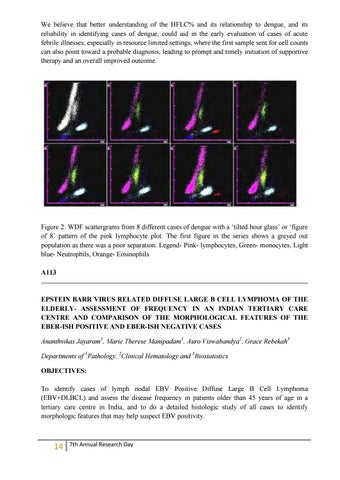
Figure 2: WDF scattergrams from 8 different cases of dengue with a ‘tilted hour glass’ or ‘figure of 8’ pattern of the pink lymphocyte plot. The first figure in the series shows a greyed out population as there was a poor separation. Legend- Pink- lymphocytes, Green- monocytes, Light blue- Neutrophils, Orange- Eosinophils A113
EPSTEIN BARR VIRUS RELATED DIFFUSE LARGE B CELL LYMPHOMA OF THE ELDERLY- ASSESSMENT OF FREQUENCY IN AN INDIAN TERTIARY CARE CENTRE AND COMPARISON OF THE MORPHOLOGICAL FEATURES OF THE EBER-ISH POSITIVE AND EBER-ISH NEGATIVE CASES Ananthvikas Jayaram1, Marie Therese Manipadam1, Auro Viswabandya2, Grace Rebekah3 Departments of 1Pathology, 2Clinical Hematology and 3Biostatistics OBJECTIVES: To identify cases of lymph nodal EBV Positive Diffuse Large B Cell Lymphoma (EBV+DLBCL) and assess the disease frequency in patients older than 45 years of age in a tertiary care centre in India, and to do a detailed histologic study of all cases to identify morphologic features that may help suspect EBV positivity.
14
7th Annual Research Day