EXPLANATORY BOOK
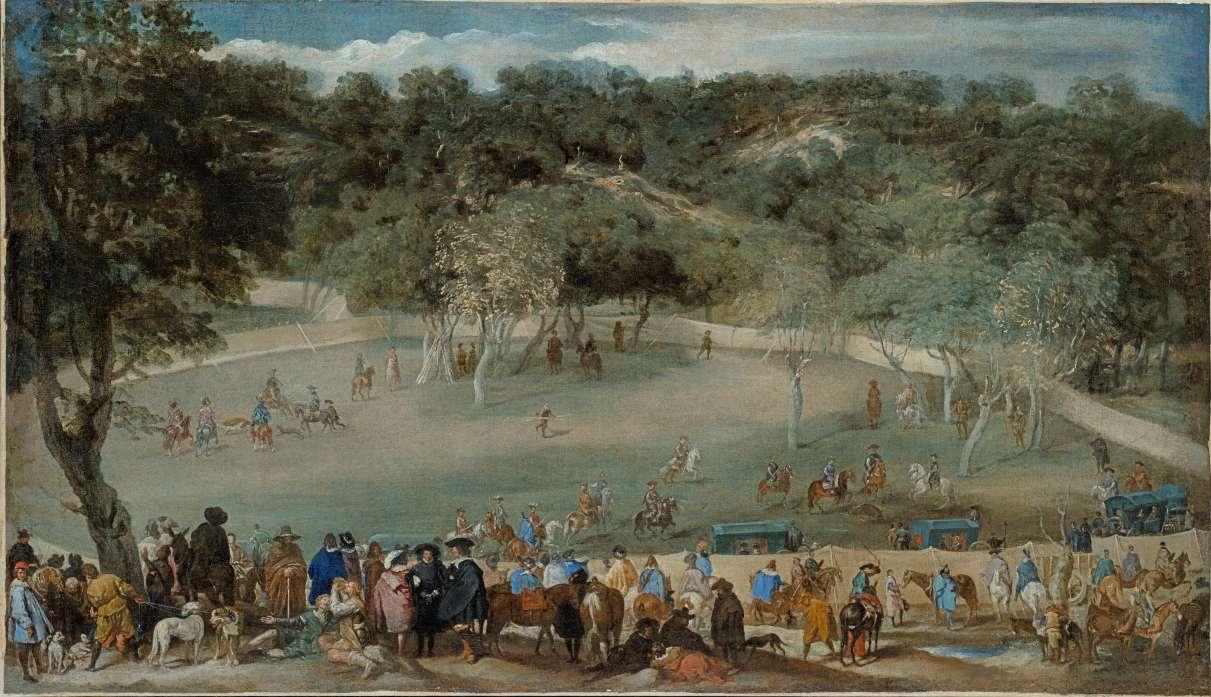
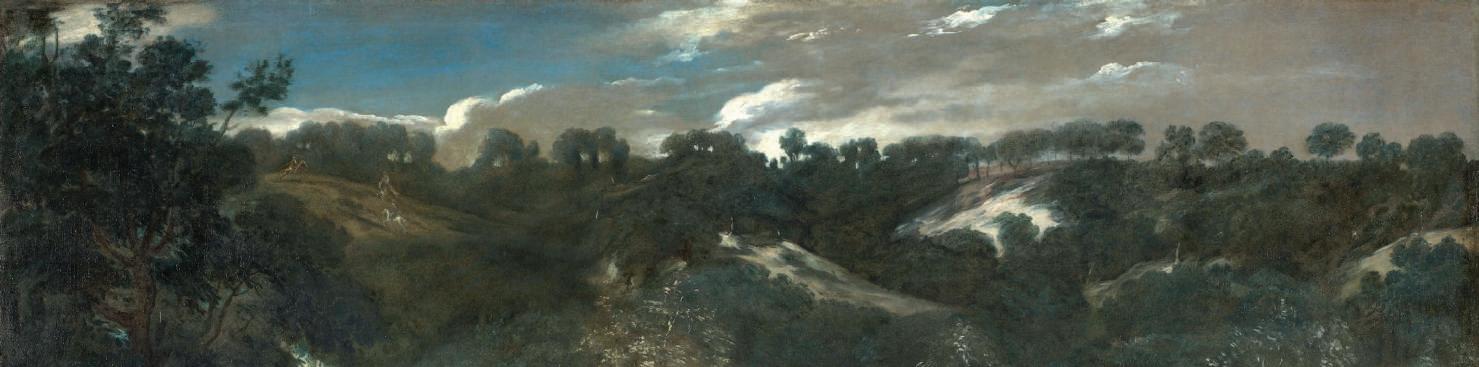
DIEGO VELÁZQUEZ ( 1599 - 1660) Philip IV hunting Wild Boar, c.1634 - 1635, The preparatory study
Oil on canvas, 61, 5 cm x 106,5 cm / 24,2 in. x 41,9 in.
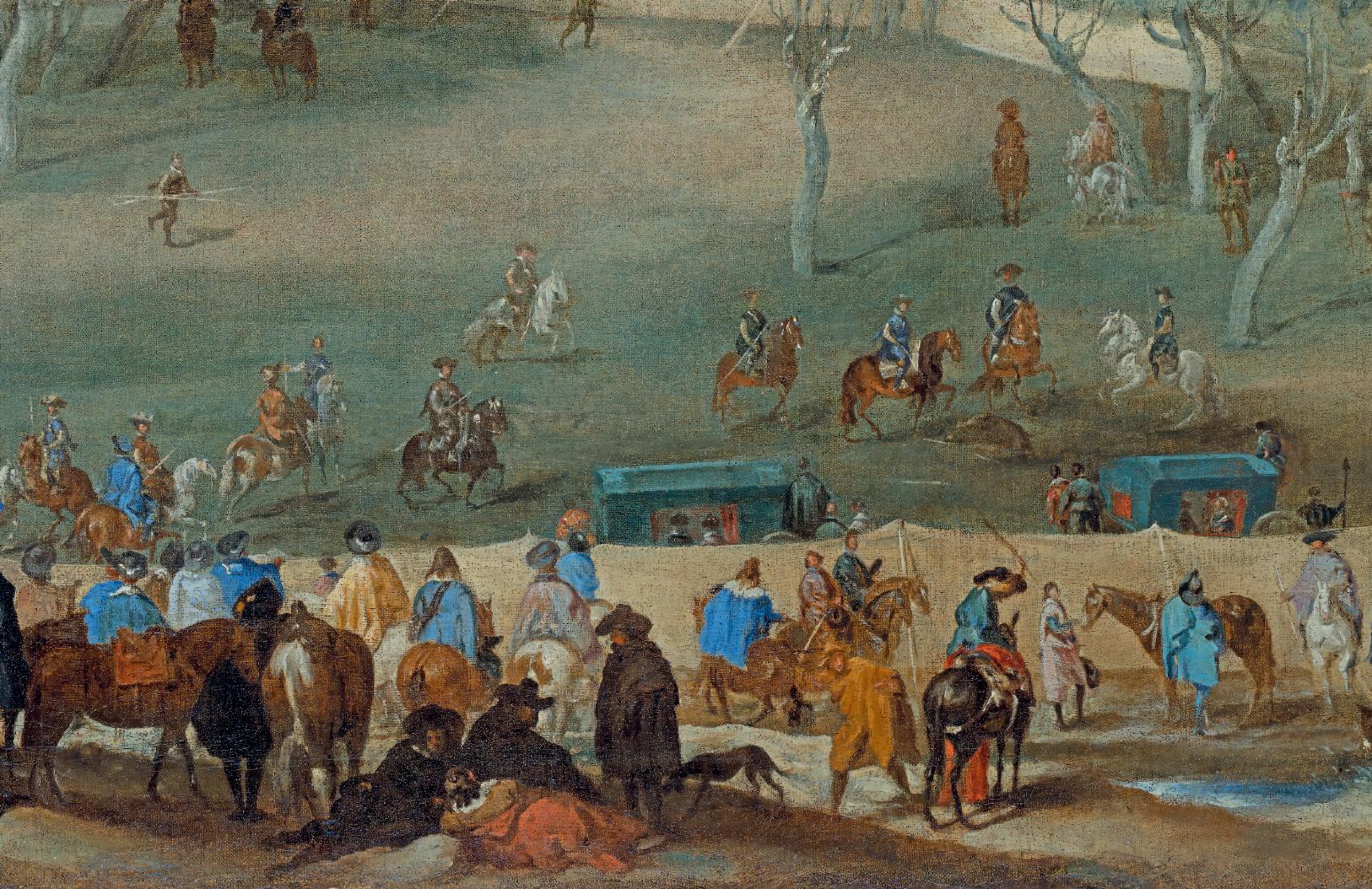

DIEGO VELÁZQUEZ ( 1599 - 1660) Philip IV hunting Wild Boar, c.1634 - 1635, The preparatory study
Oil on canvas, 61, 5 cm x 106,5 cm / 24,2 in. x 41,9 in.
Philip IV hunting Wild Boar, c. 1634 - 1635
Preparatory study for Velázquez’s painting Philip IV hunting Wild Boar (« La Tela Real ») National Gallery, London
Technical information ... pp. 6 - 7
Introduction ... pp. 8 - 10
Photo details and UV details ... pp. 11 - 32
Comparison between the preparatory study and the fnal version of Philip IV hunting Wild Boar (« La Tela Real ») at the National Gallery in London ... pp. 33 - 53
Other versions ... pp. 54 - 57
Technical and Scientifc analysis ... pp. 58 - 83
Conclusion ... p. 84 - 85
Appendix ... pp. 86 - 97
Philip IV hunting Wild Boar c. 1634 - 1635
Preparatory study for the painting Philip IV hunting Wild Boar, (« La Tela Real ») at the National Gallery in London Oil on canvas
H. 61, 5 cm / 24, 2 in.
L. 106,5 cm / 41,9 in.
1 - RELATED WORK
-Diego Velázquez, Philip IV hunting Wild Boar, oil on canvas, H. 182 cm / 71,7 in, L. 302 cm / 118,9 in ; London, National Gallery.
2 - HISTORY
- coll. Emil Hultmark
- coll. Dr. Carl David Moselius, Stockholm during the 1950s
3 - EXHIBITIONS
- Stora Spanska Mästare, National Museum, Stockholm, 1959-60, n°110
- Velázquez y lo Velazqueño, Madrid, 1961, n°108
4 - MAJOR COPIES OF THE PREPARATORY STUDY AND OF THE NATIONAL GALLERY VERSION
- Anonymous, A Royal Boar Hunt, oil on canvas, H. 69,5 cm / 27,4 in, L. 121,1 cm / 47,7 in ; London, Wallace Collection
- Anonymous, 17th or 18th century, Philip IV hunting Wild Boar, oil on canvas, H. 188 cm / 74 in, L. 303 cm / 119,3 in; Madrid, Prado Museum
- Spanish anonymous, 17th century, the Boar Hunt, oil on canvas, H. 91 cm / 35, 8 in, L. 126 cm / 49,6 in ; London, National Gallery
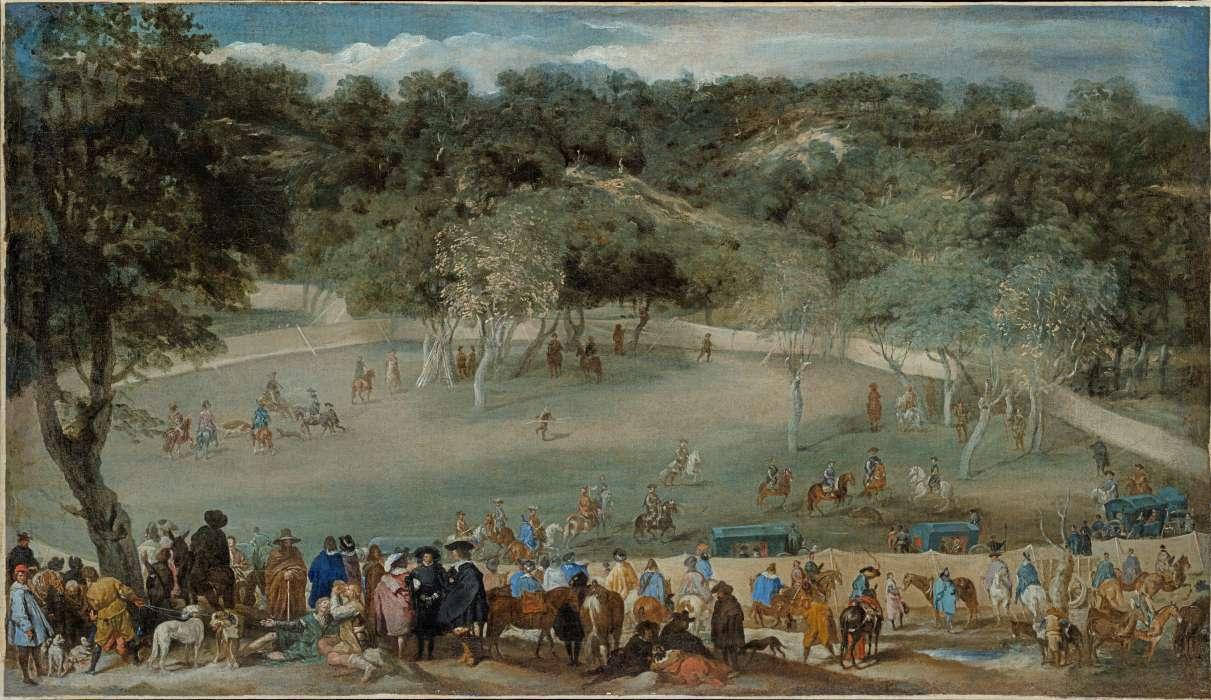
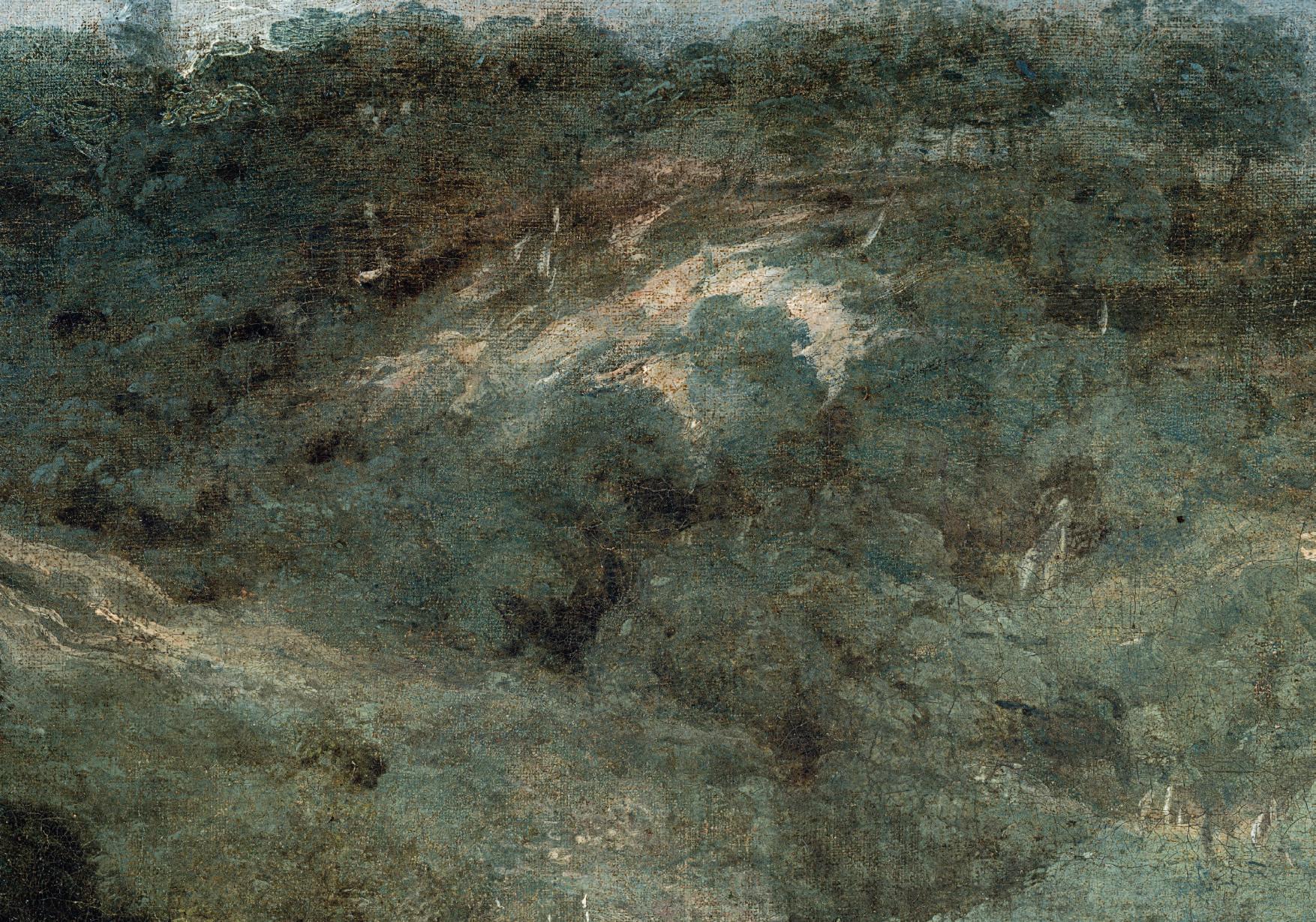
Velázquez made preparatory studies for important compositions as part of his artistic practice.
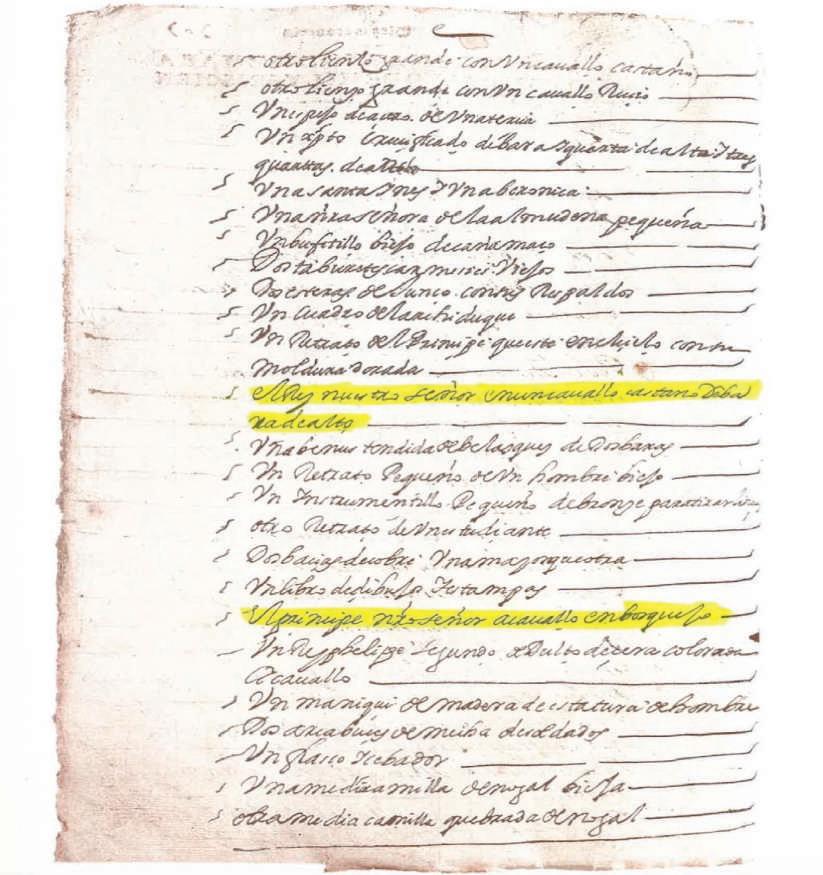
In the inventory of Velázquez’s (fg.1) possessions, drawn up after his death on August 11, 1660, preparatory studies are mentioned:
One depicting as « El rey nuestro señor en un cavallo castaño, de bara de alto » (The king, our lord on a chestnut horse, one vara tall1 ) referring to the painting Philip IV on horseback, and another depicting « El principe nuestro señor a cavallo, en bosquejo » (The prince, our lord on horseback, as a sketch) referring to the painting of Prince Baltasar Carlos. They were used for both large versions commissioned in 1634 - 1635 to glorify the monarchy for the Sala de los Reinos at the Buen Retiro Palace and now in the Prado museum.
We also know that Velázquez made preparatory studies, today lost, for the painting « The Surrender of Breda », commissioned also for the Buen Retiro on the same dates.
1 « Vara », is on an old Spanish unit of lenght, roughly 0.83 meters or 33 inches
Fig. 1 : Inventory of Velázquez’s possessions, drawn up after his death on August 11, 1660. In yellow : « El rey nuestro señor en un cavallo castaño, de bara de alto » (The king our lord on a chestnut horse, one vara tall) referring to the painting Philip IV on horseback, and another depicting « El principe nuestro señor a cavallo, en bosquejo » (The prince, our Lord on horseback, as a sketch) referring to the painting of Prince Baltasar Carlos in 25 documentos de Velázquez en el archivo historico de protocolos de Madrid. Communidad de Madrid. Publicaciones Ofciales; Primera edición (1 December 1999), p. 79.
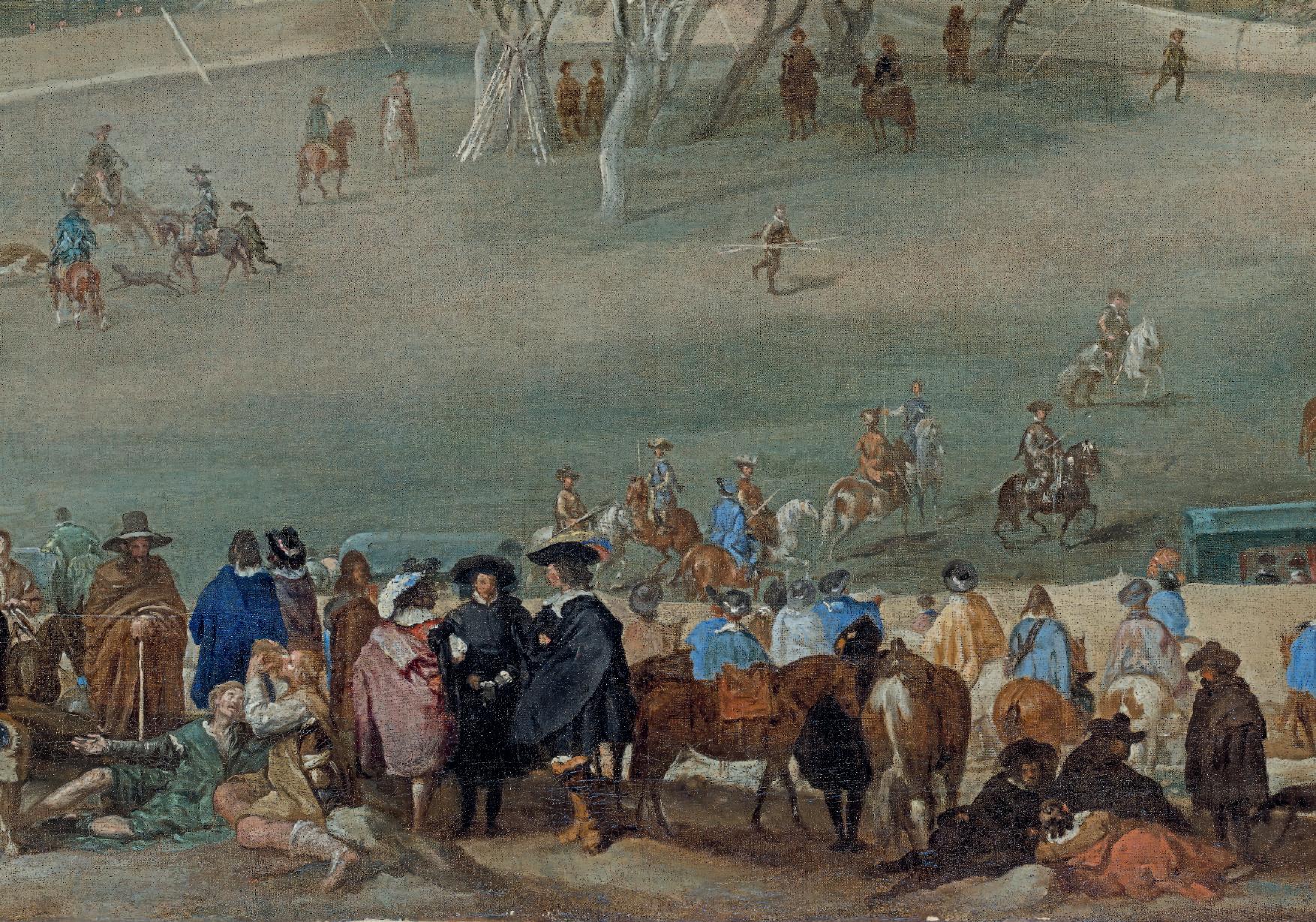
Our painting, executed also circa 1634 - 1635, precede the same composition as Philip IV hunting Wild Boar (« La Tela Real »), painted by Velázquez and now at the National Gallery in London.
The impressionistic brushwork, particularly visible in the landscape, the pictorial quality, and the underlying preparation are all consistent with Velázquez’s technique around 1634 - 1635.
This is supported by scientifc examinations, which confrm that its technique, execution, and materials align with Velázquez’s known working methods at this time. Numerous corrections, fuid brushwork, and adjustments suggest that our painting is a preparatory study. These elements highlight Velázquez’s creative process and confrm that this version played a key role in shaping the fnal masterpiece at the National Gallery in London.
Isolated head studies are also known, such as the one for the portrait of Philip III, in the lost Expulsion of the Moriscos and donated by William B. Jordan to the American Friends of the Prado Museum, as well as the Study for the Head of Apollo in Vulcan’s Forge, in a Private collection.
« The coloring, notably the blues diluted like watercolour, is typical of Velázquez in 1634 - 1635 after his return from Rome. » Carmen Garrido Pérez, Técnica y Evolución, published by the Prado in 1992.
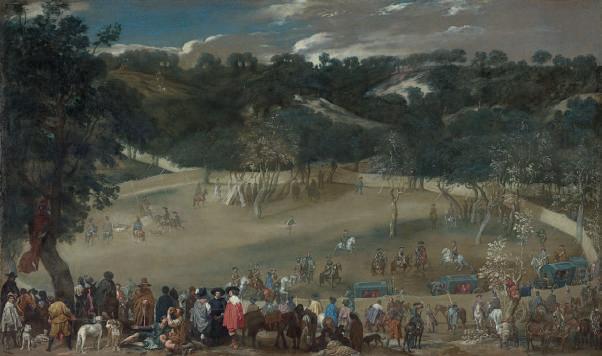
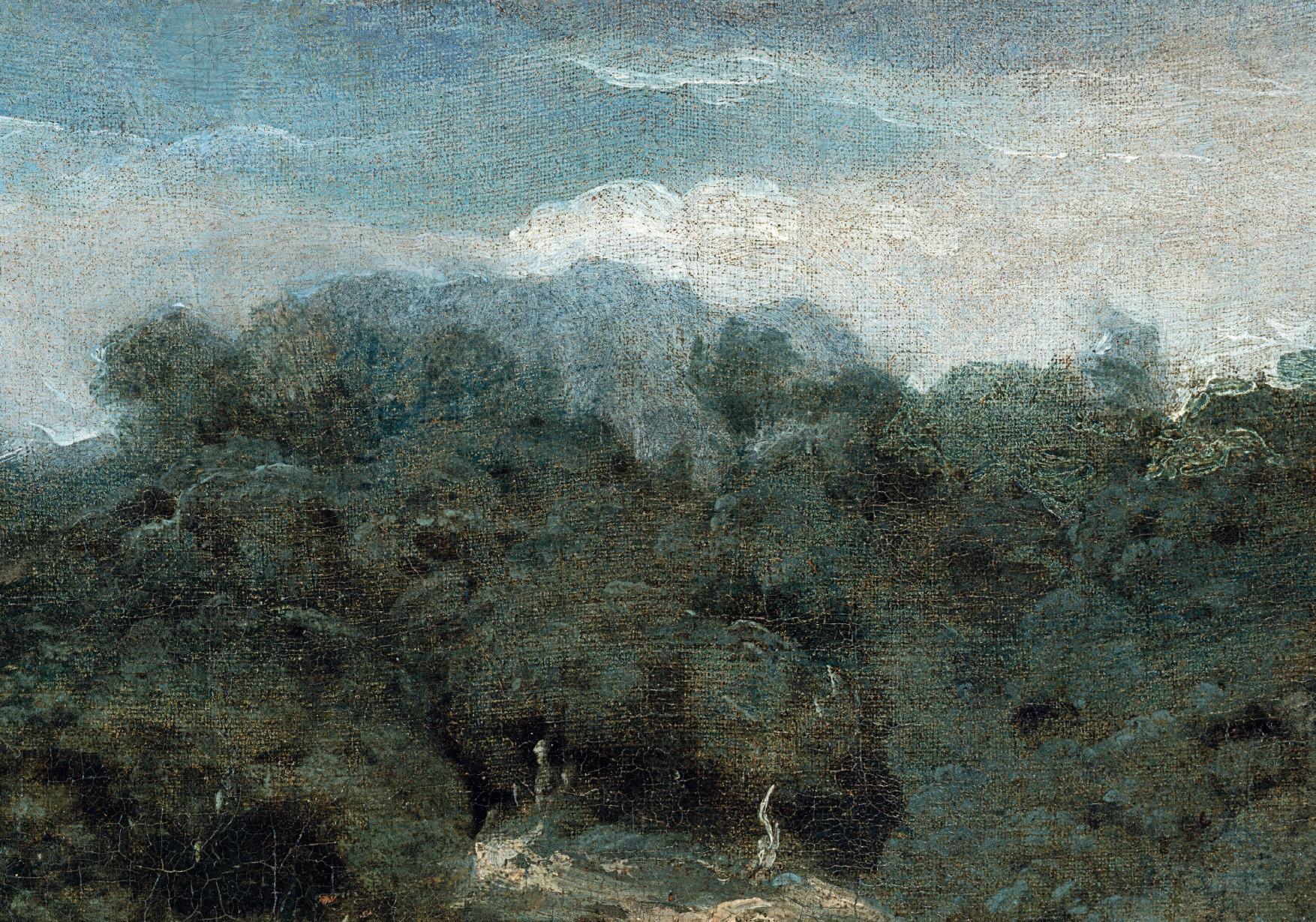
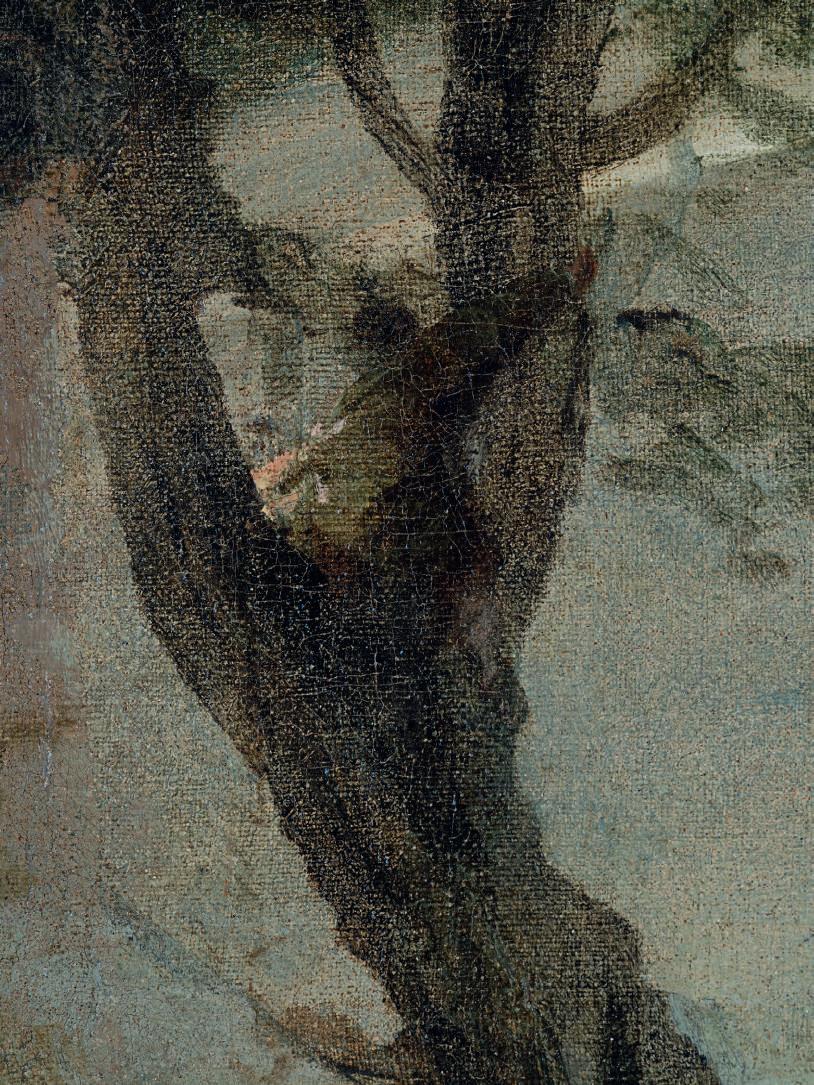
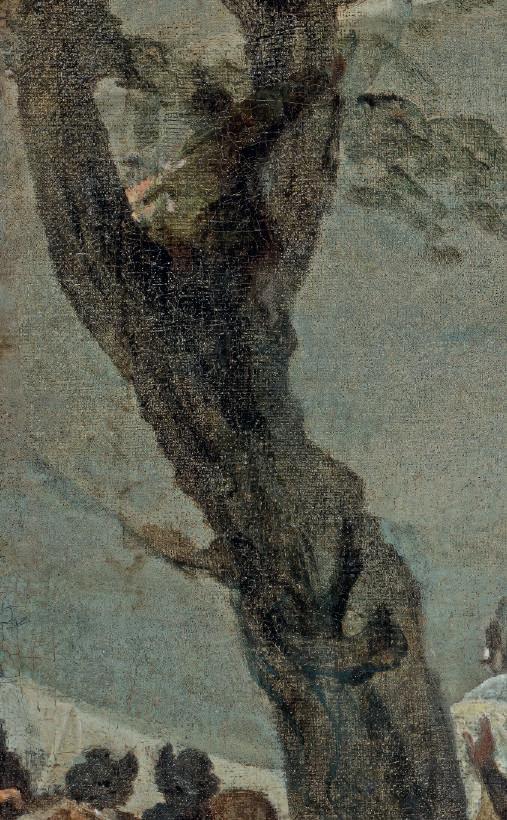
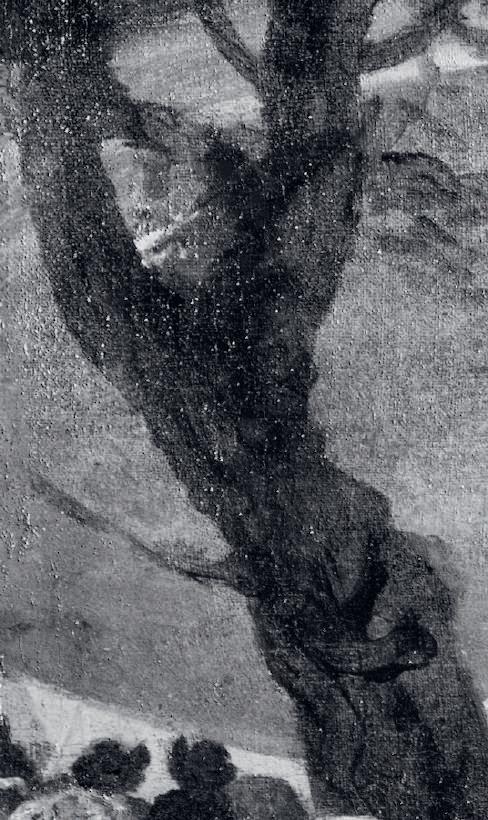
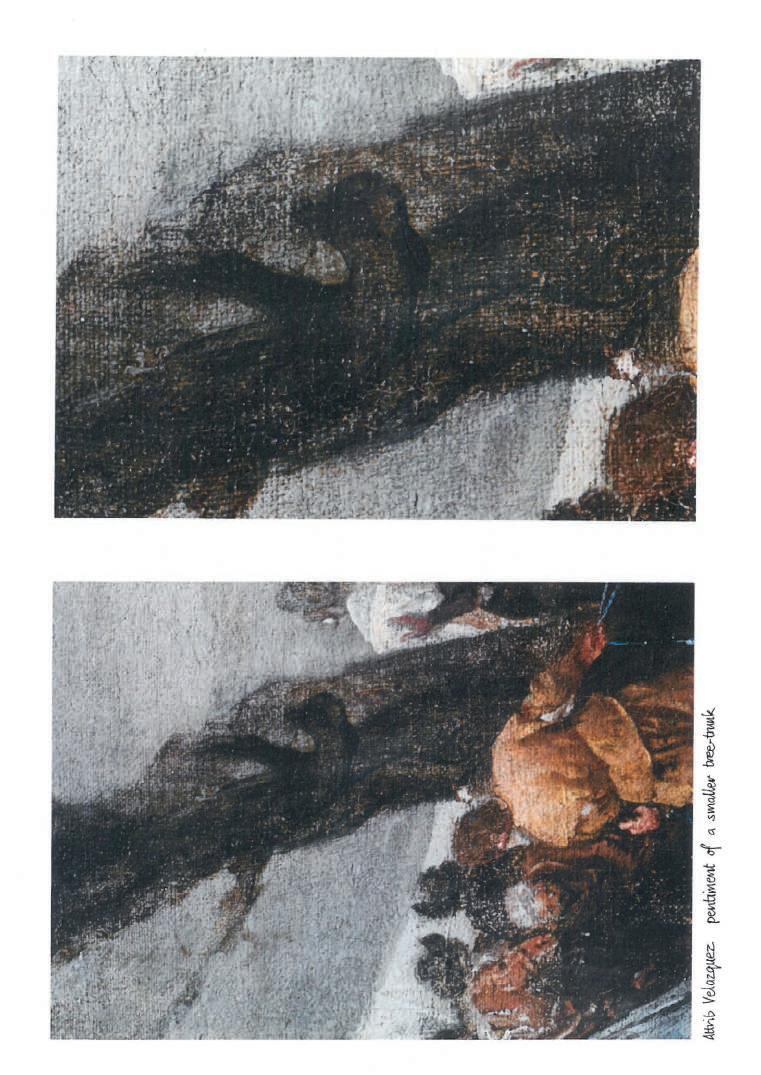
Figs. 4 and 5 : Pentimento of the tree trunk and the man climbing the tree, visible to the naked eye and under infrared imaging.
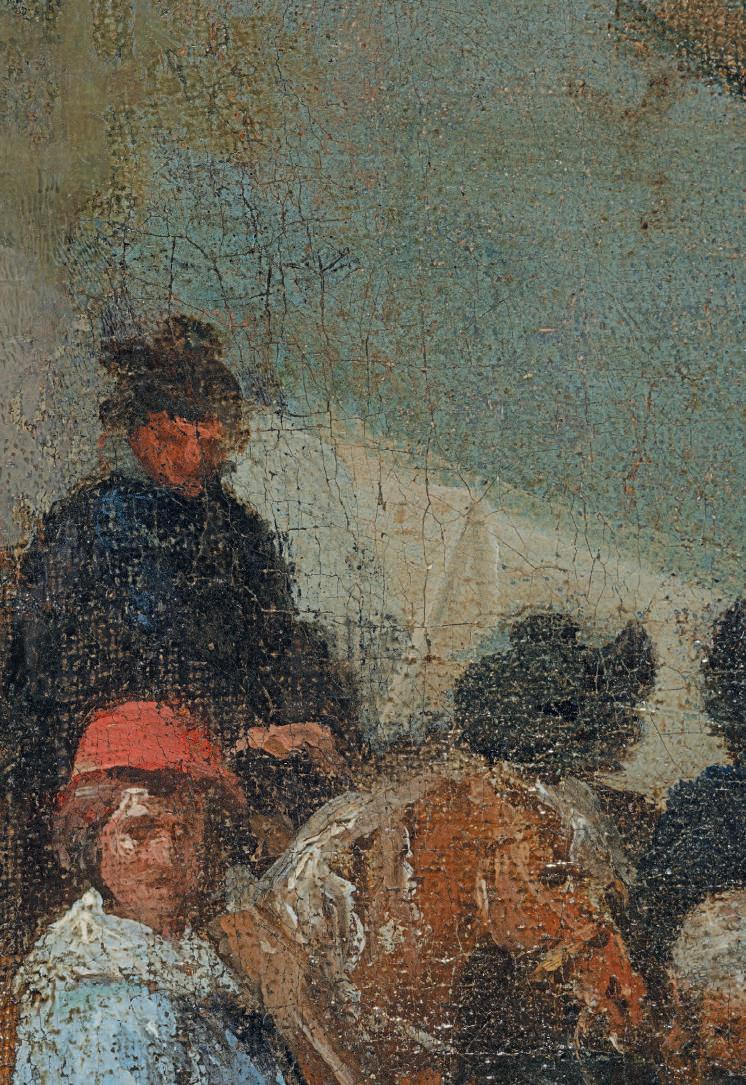
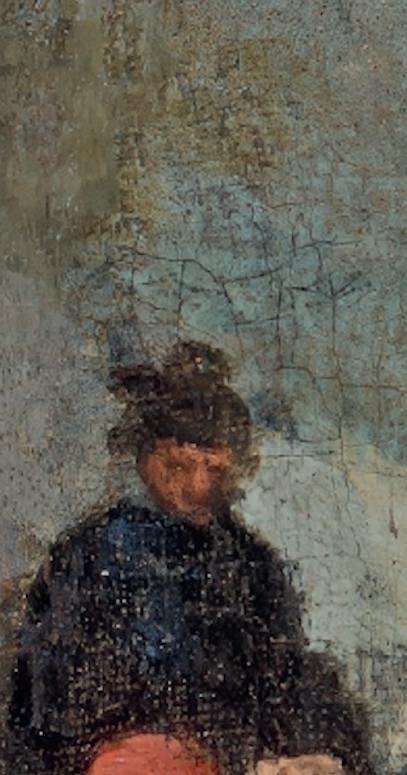
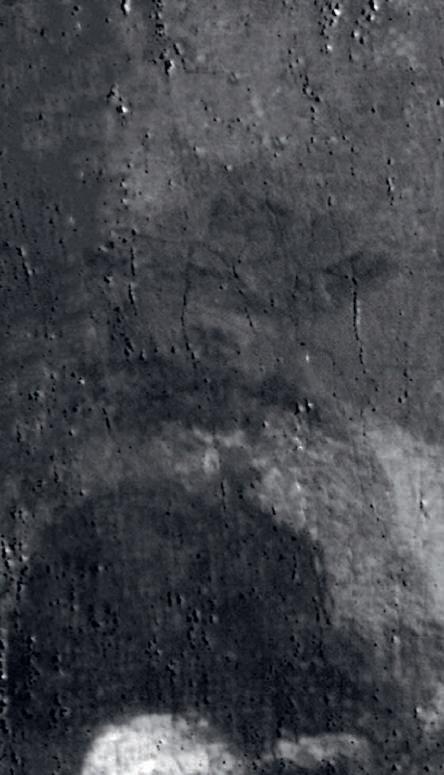
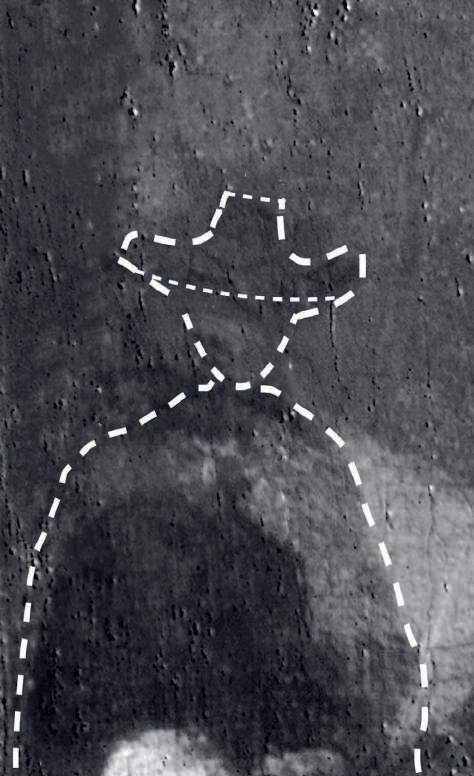
A signifcant pentimento is visible on the left side of the painting. Initially, the man in black was taller and wider. A important halo around his silhouette can be seen with the naked eye and is confrmed by infrared imaging.
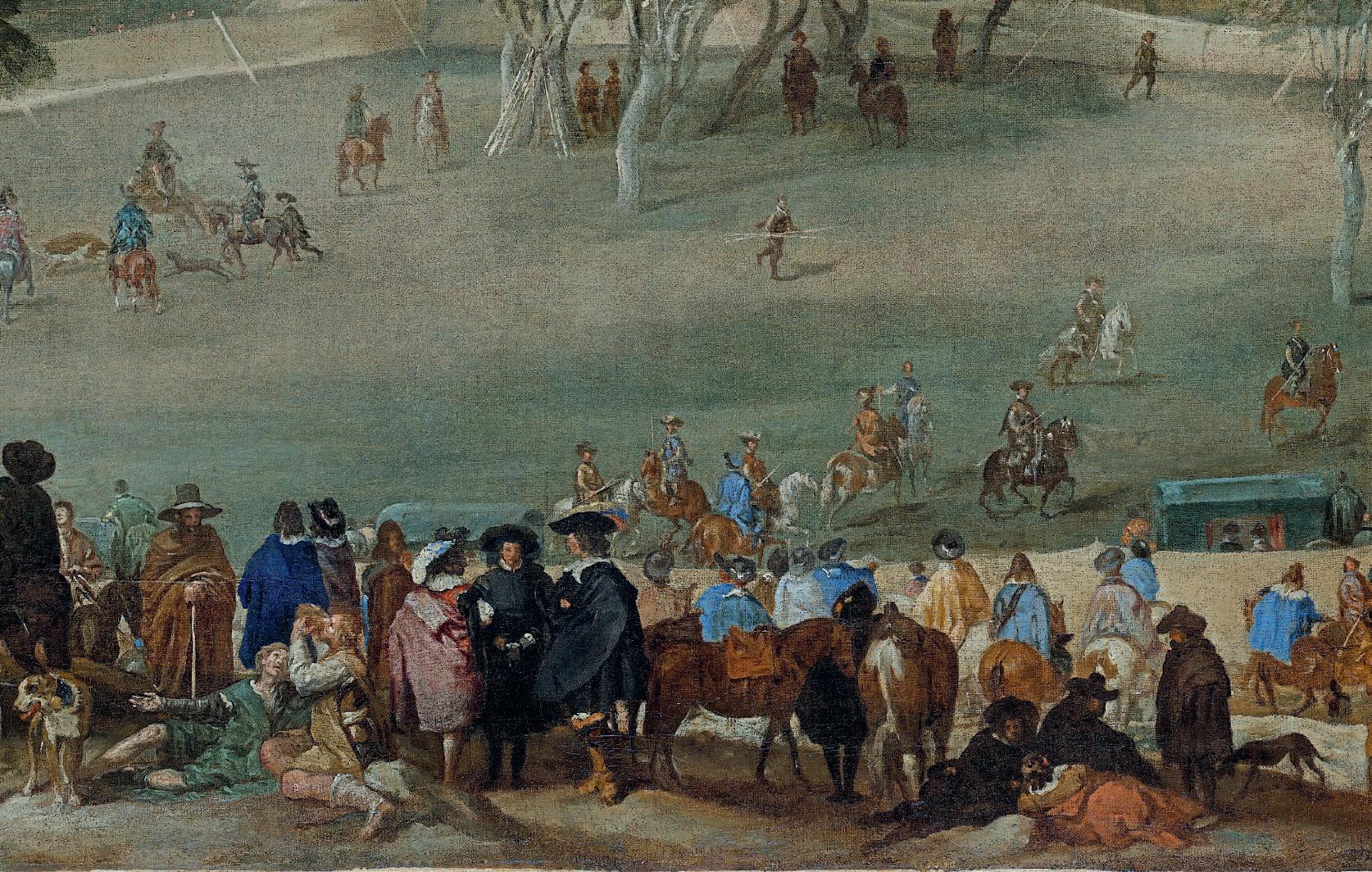
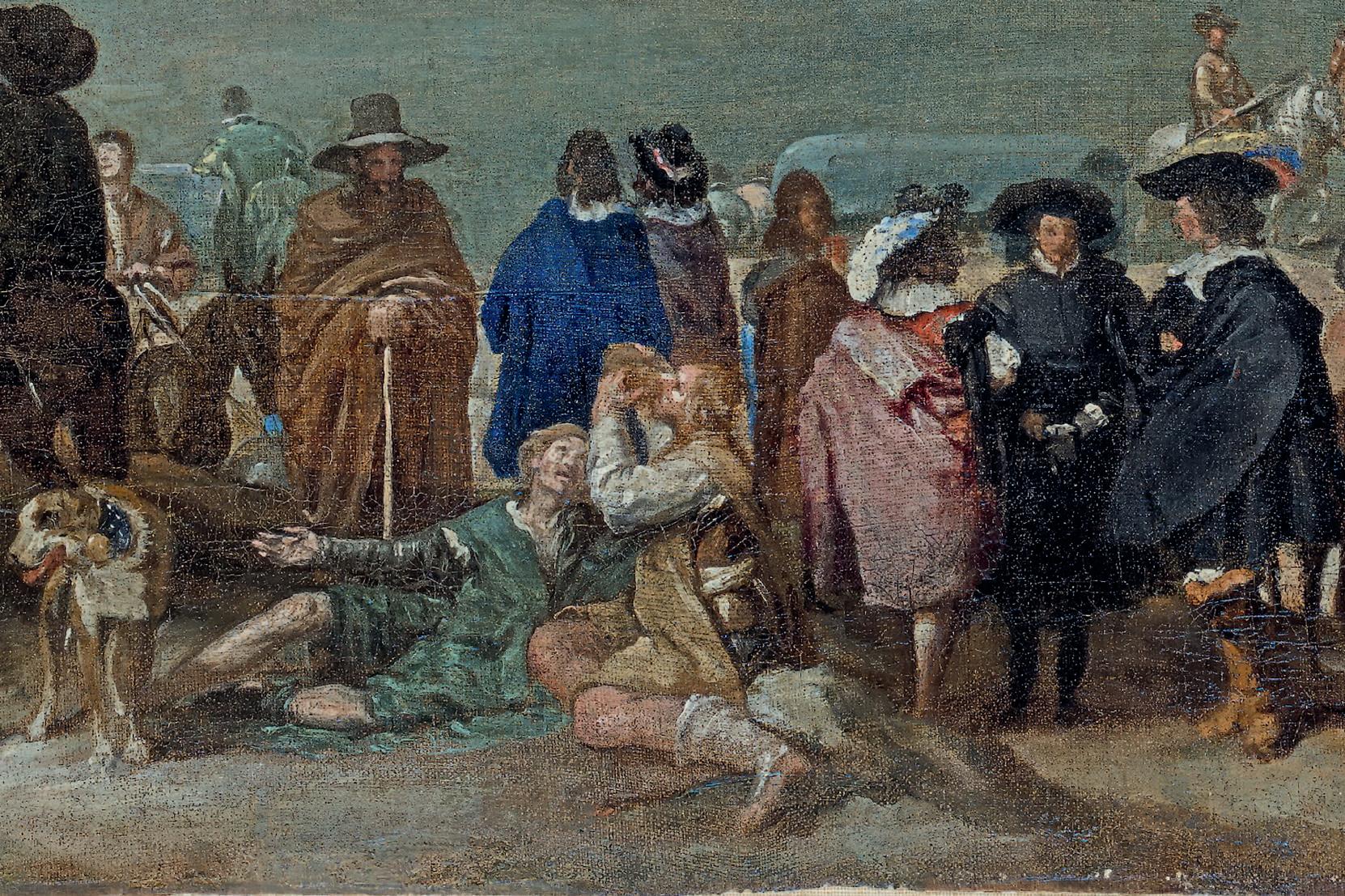
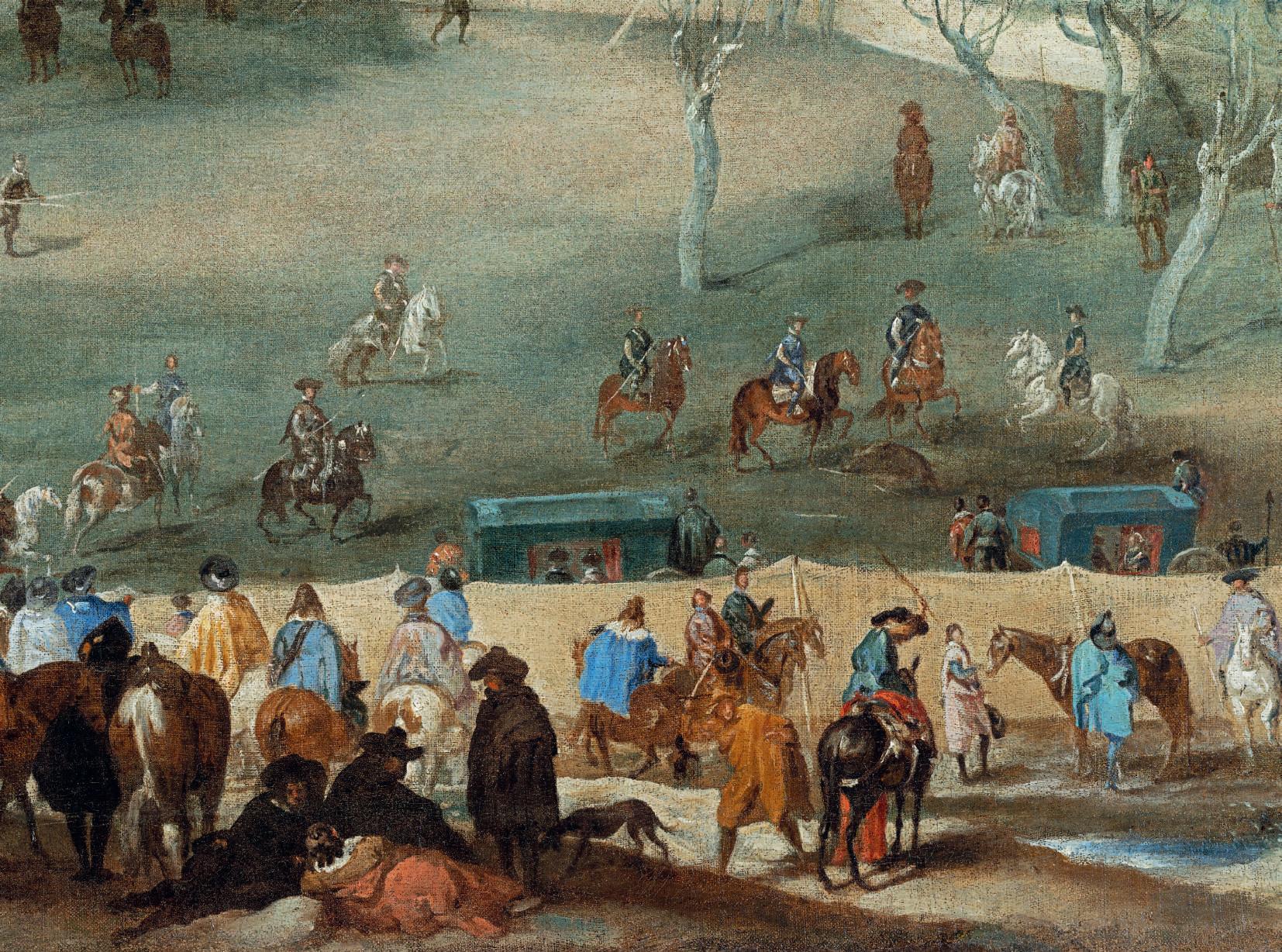
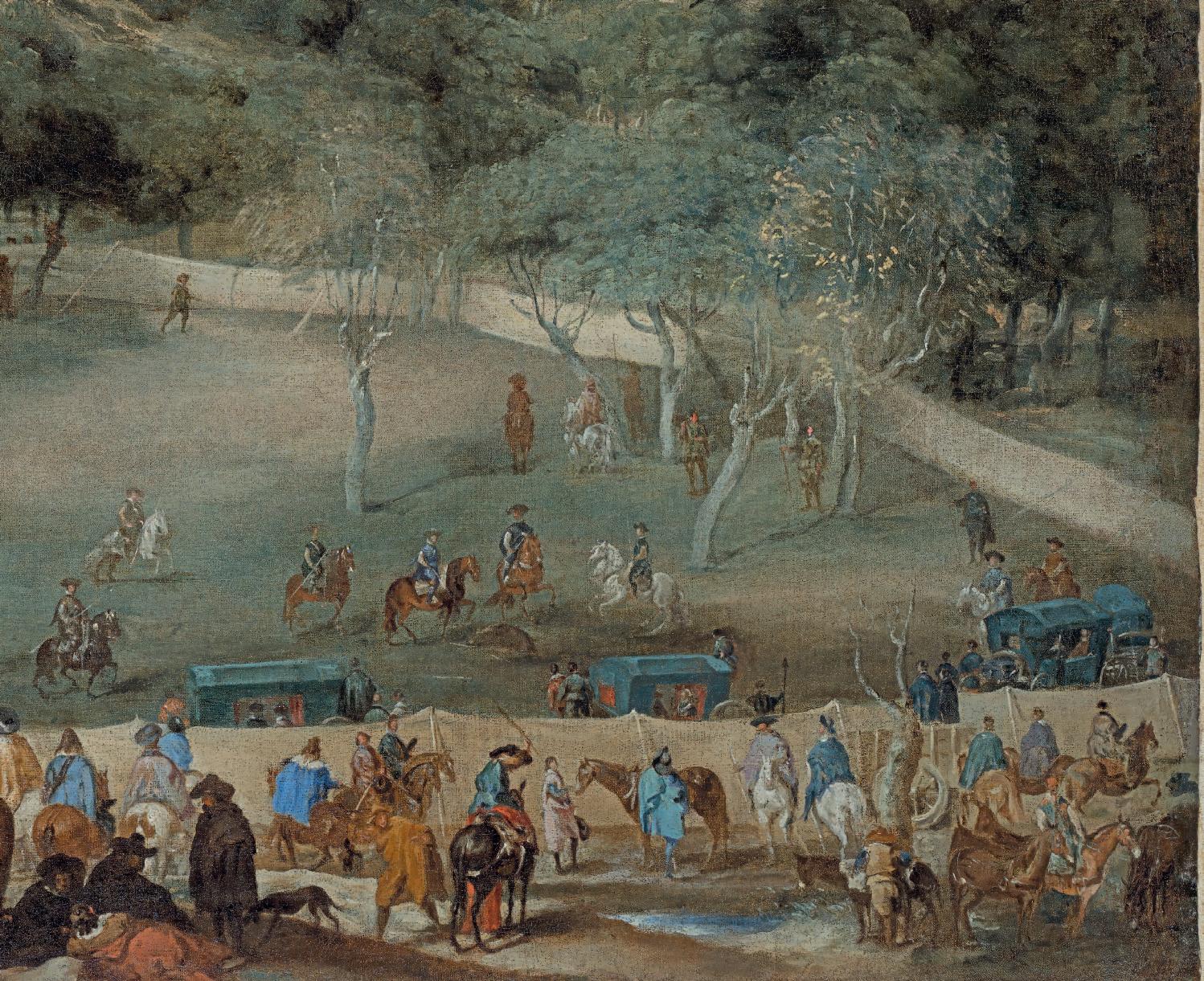
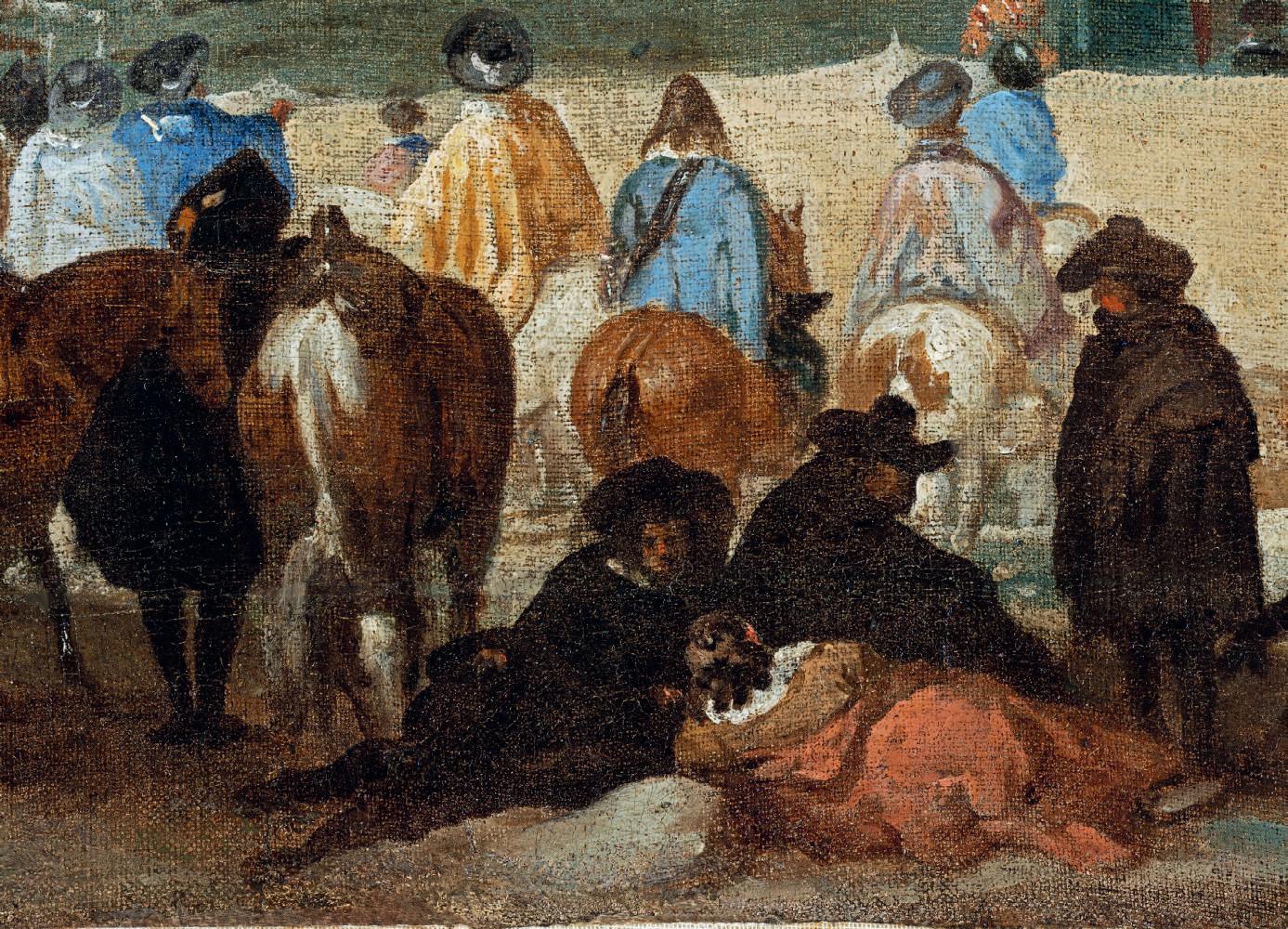
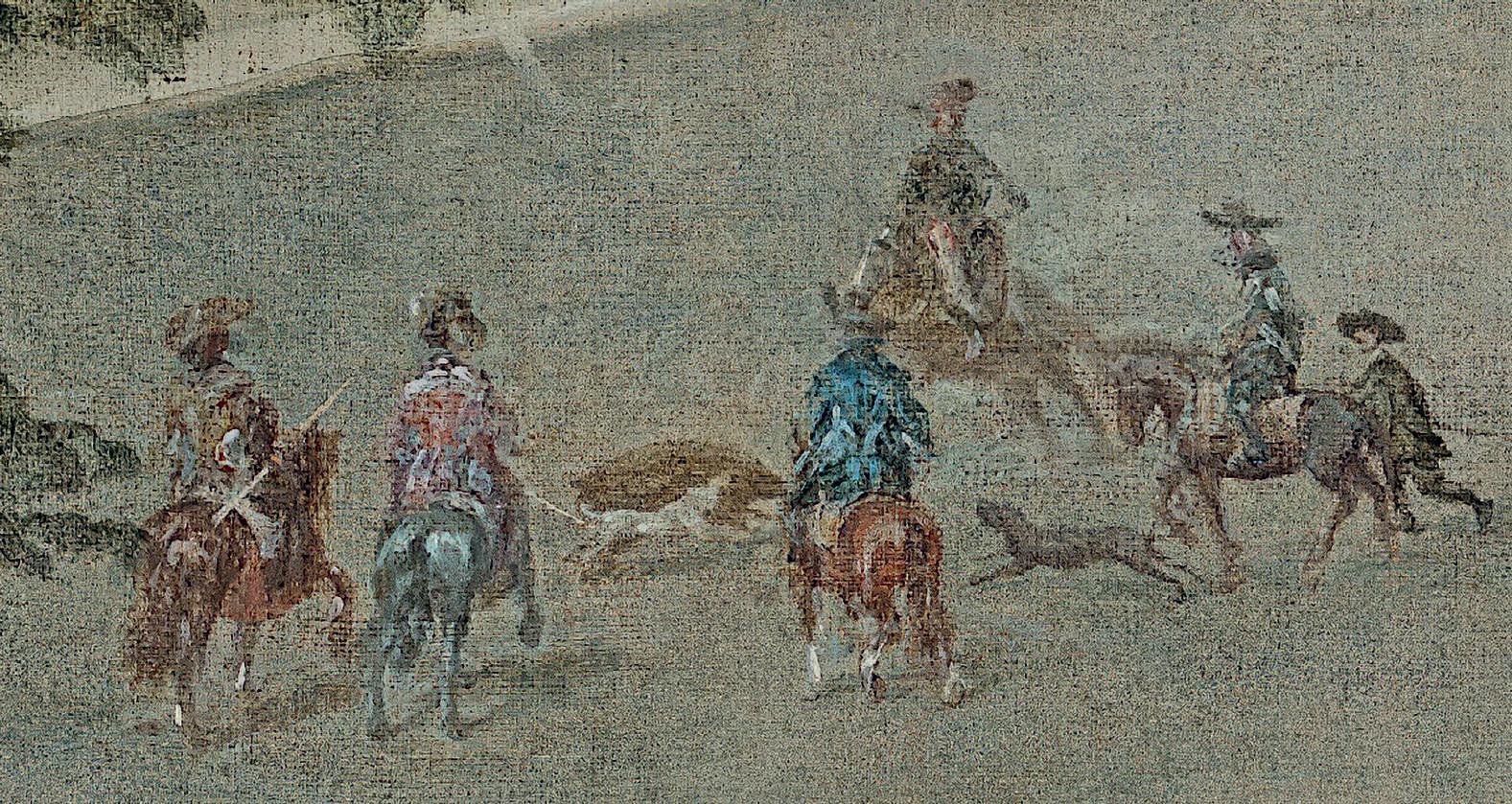
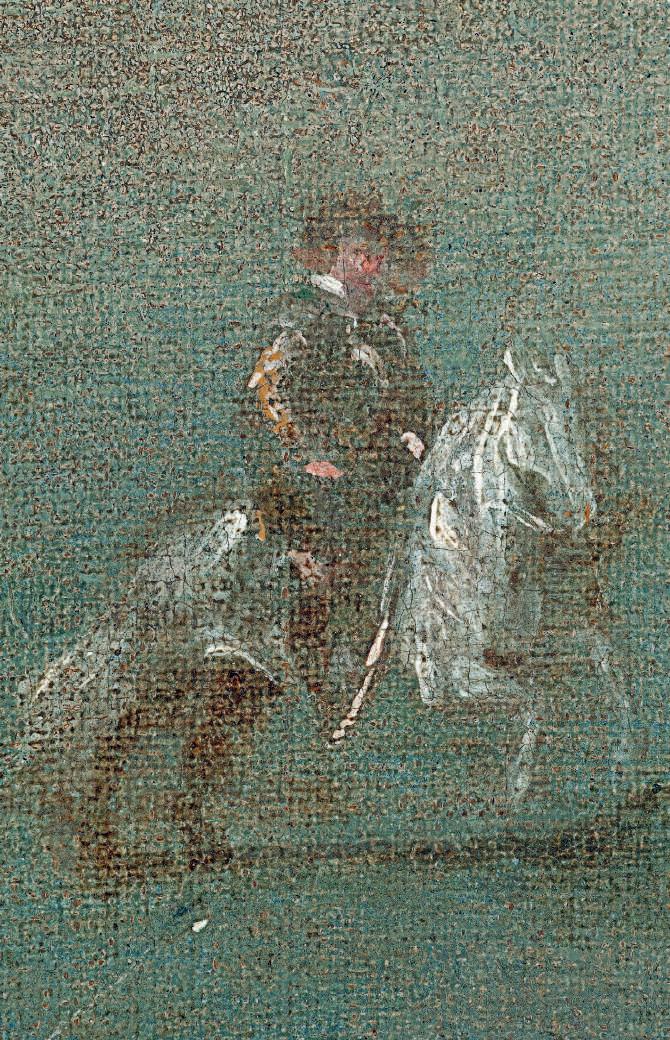
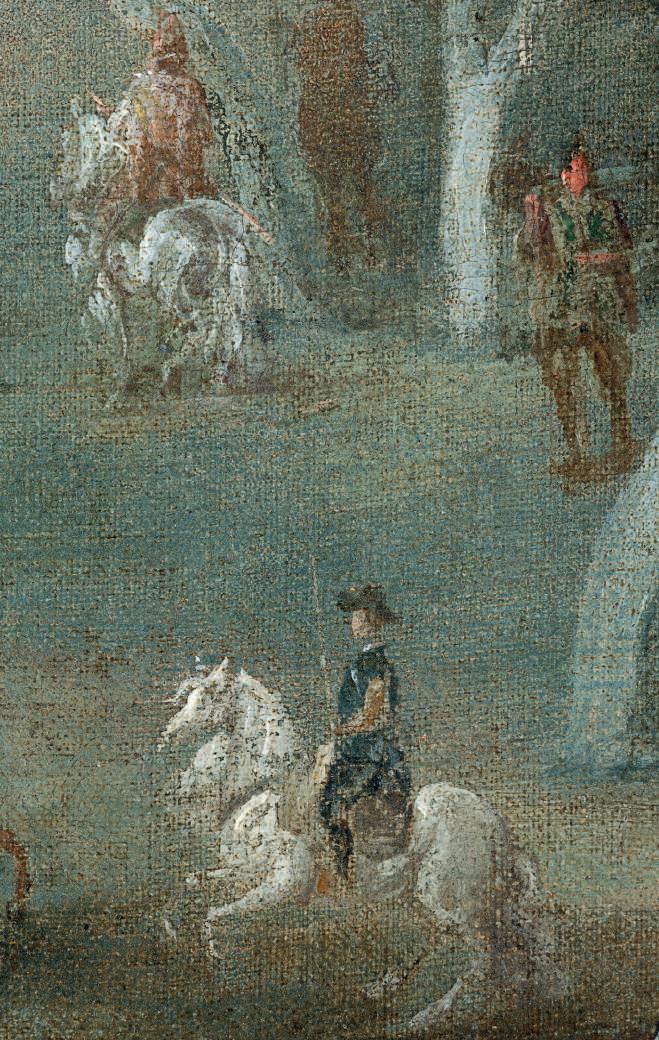
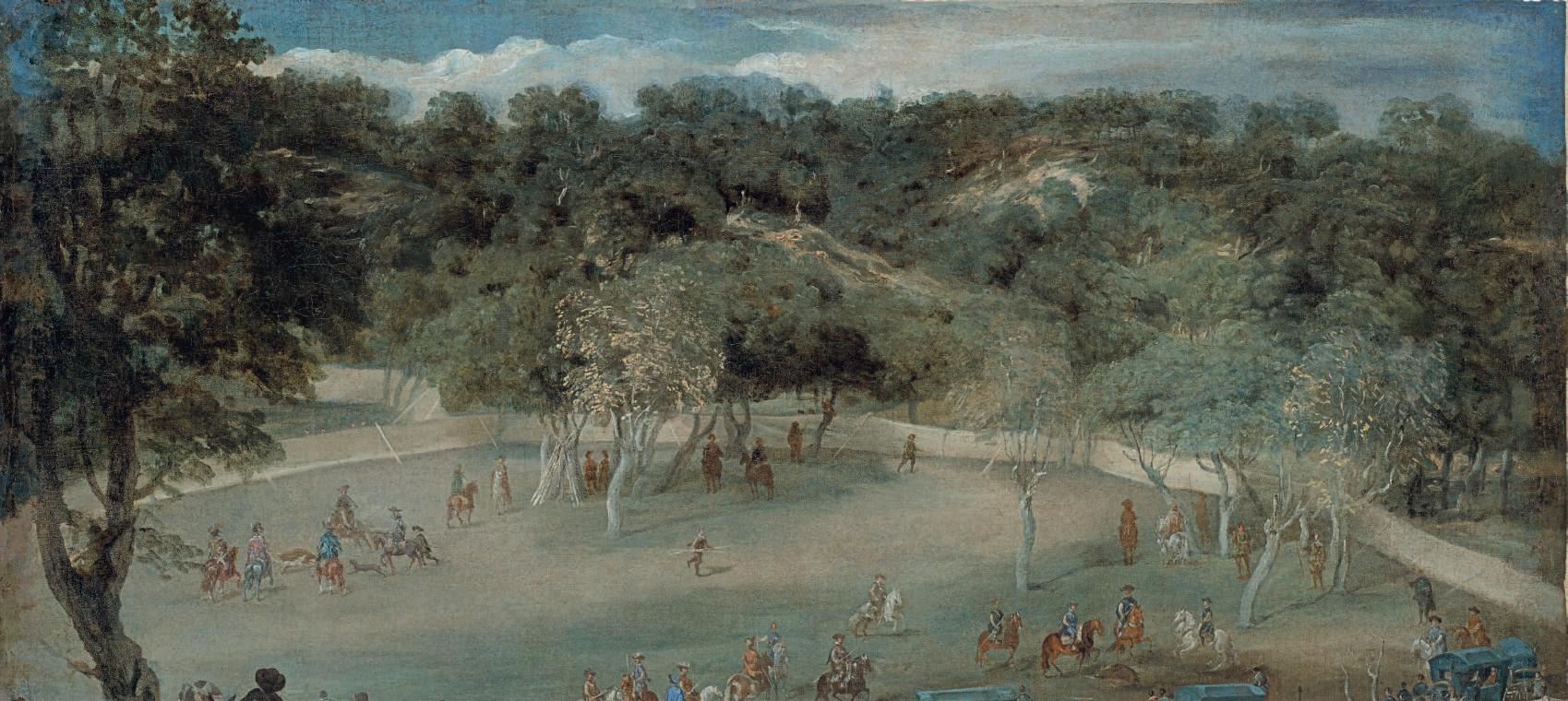
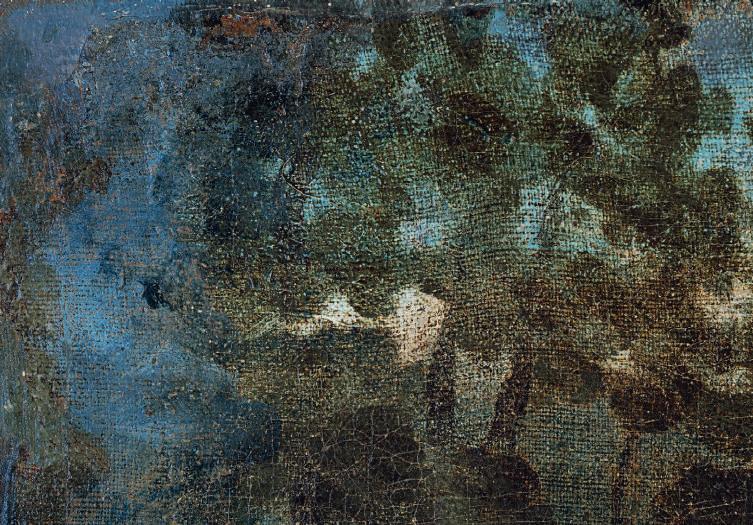
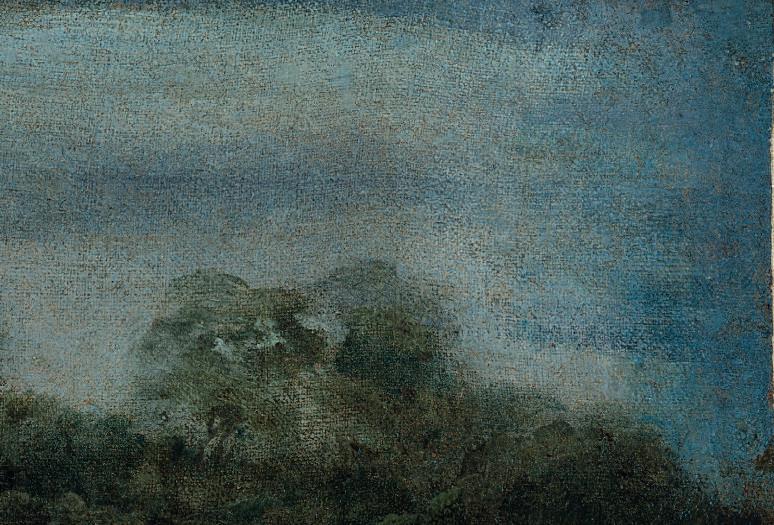
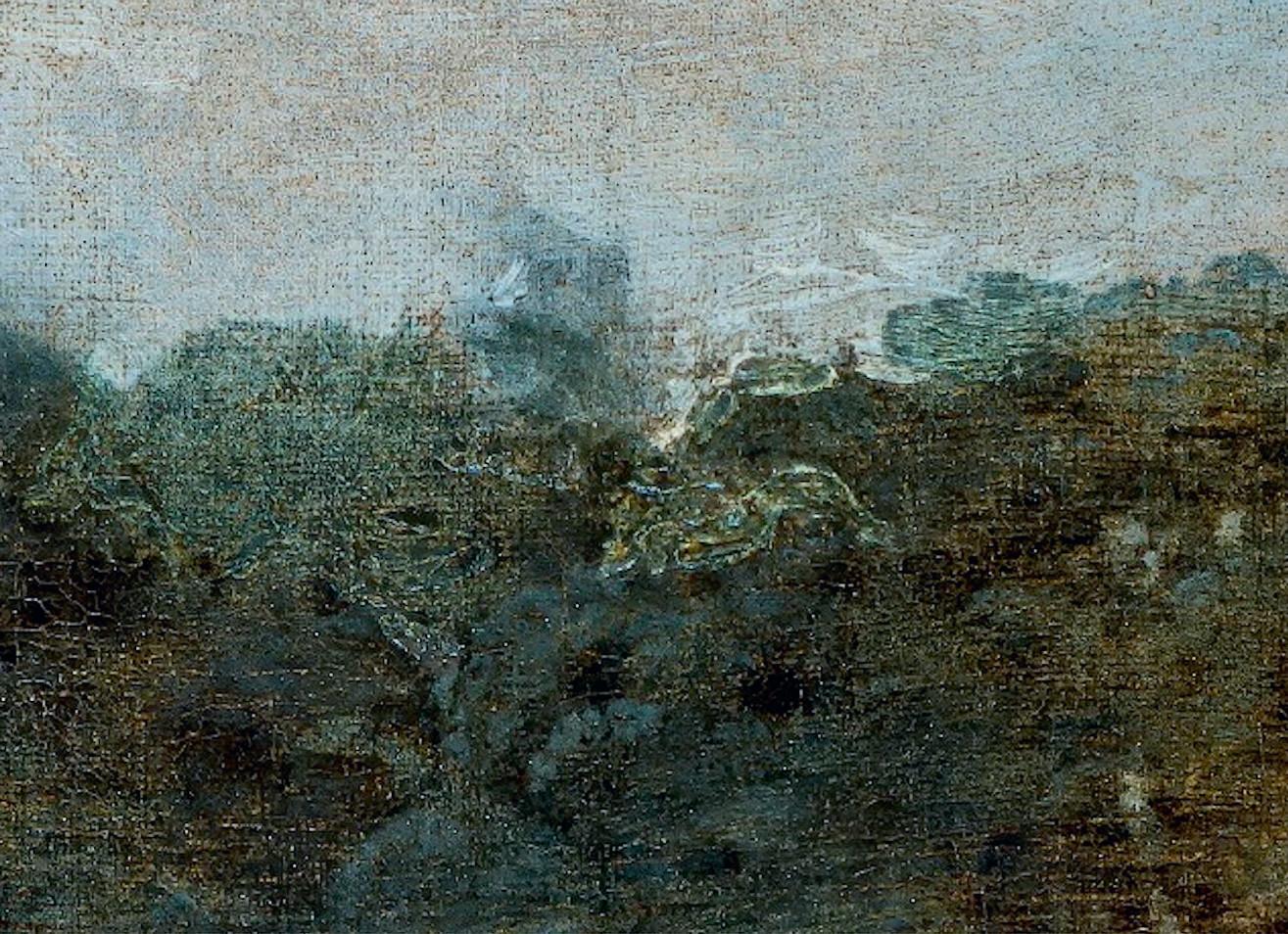
Figs 20 - 21 : After the sky, the central landscape was painted and then extended approximately 1.5 cm on each side over the unprimed fabric. The effect is to produce a distint texture and color in these areas. Comparable canvas extensions can be observed, among others, in the painting Baltasar Carlos on Horseback (1635, oil on canvas, 209 × 173 cm, Museo del Prado, Madrid), as noted by Carmen Garrido Pérez in Velázquez – Técnica y evolución (Museo del Prado, 1992, pp. 344–345).
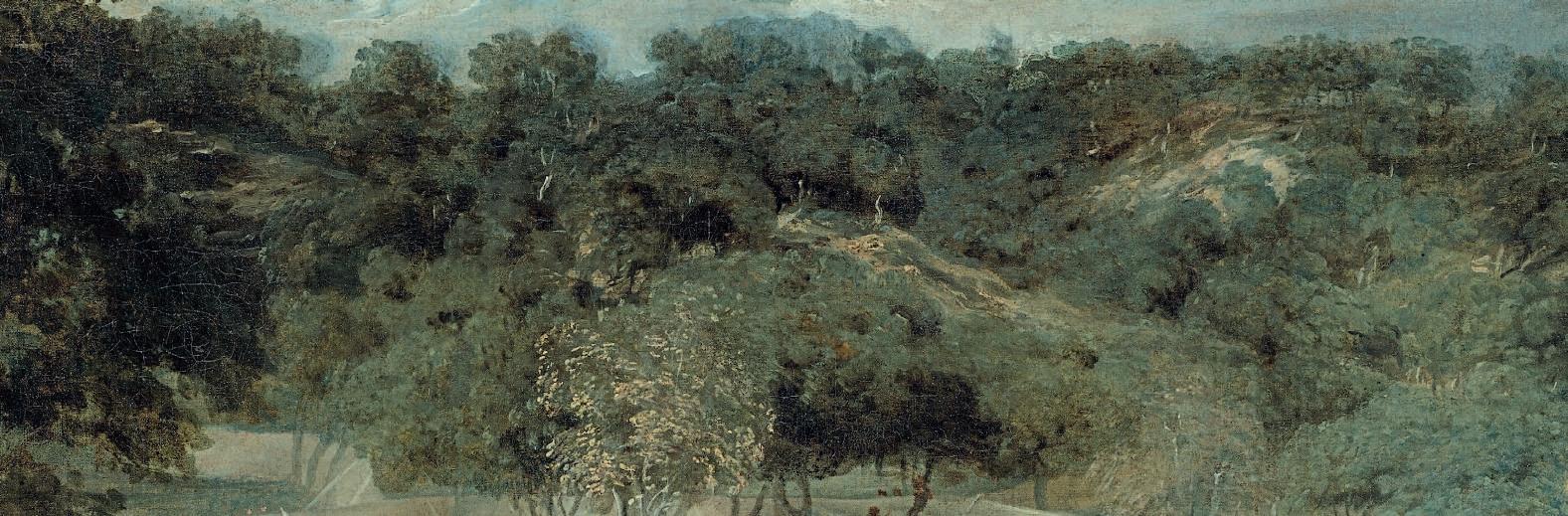
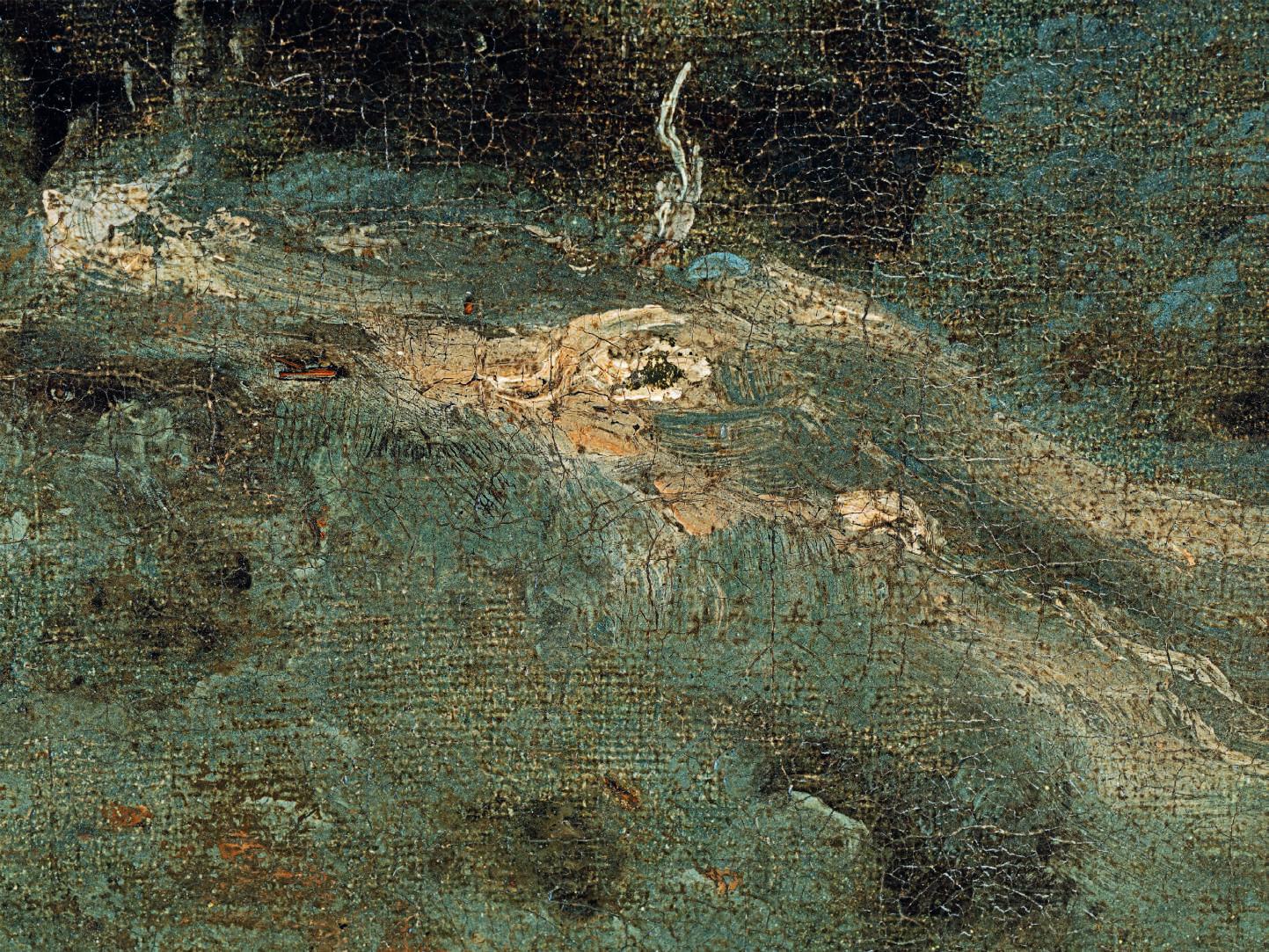
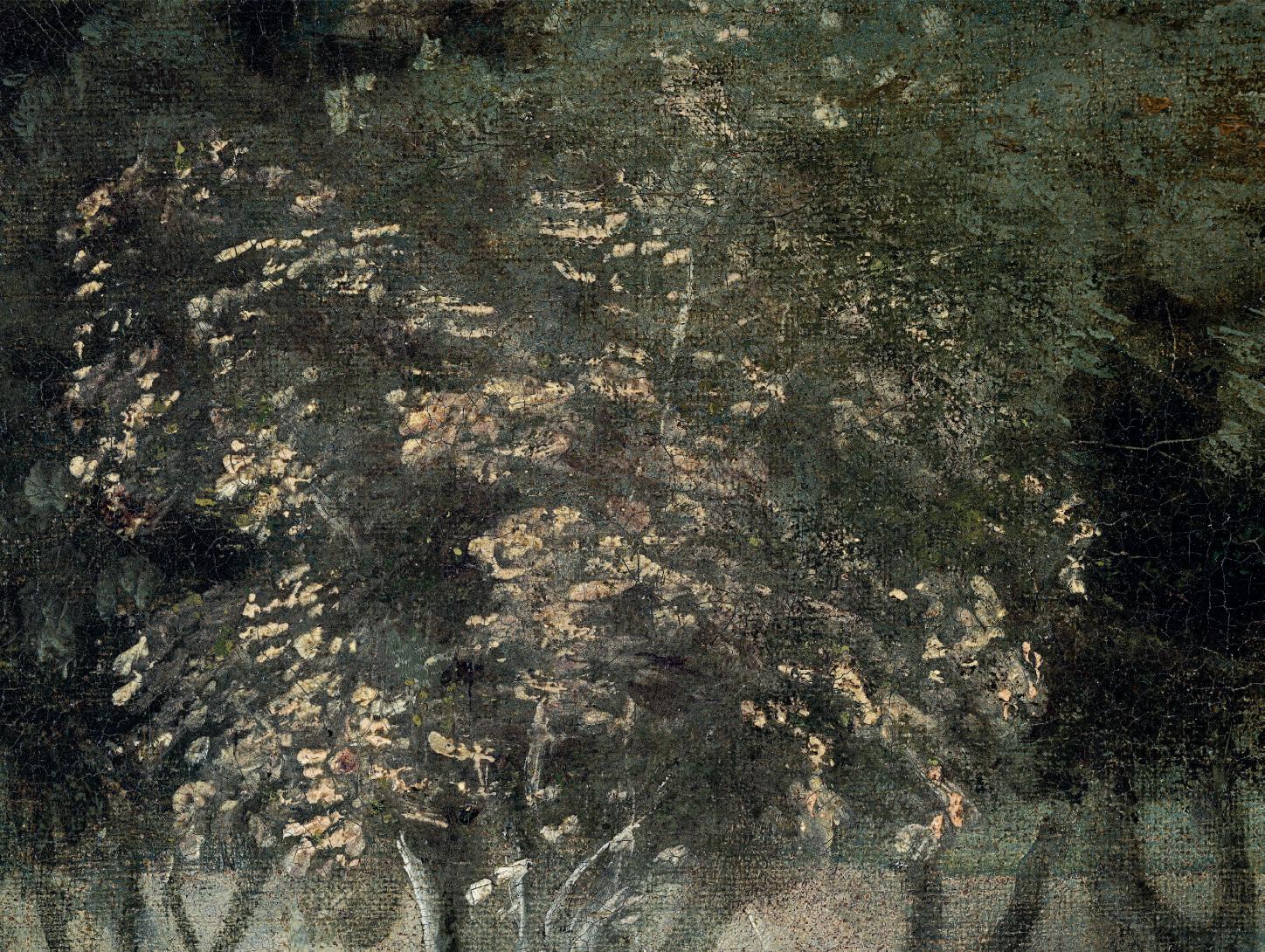
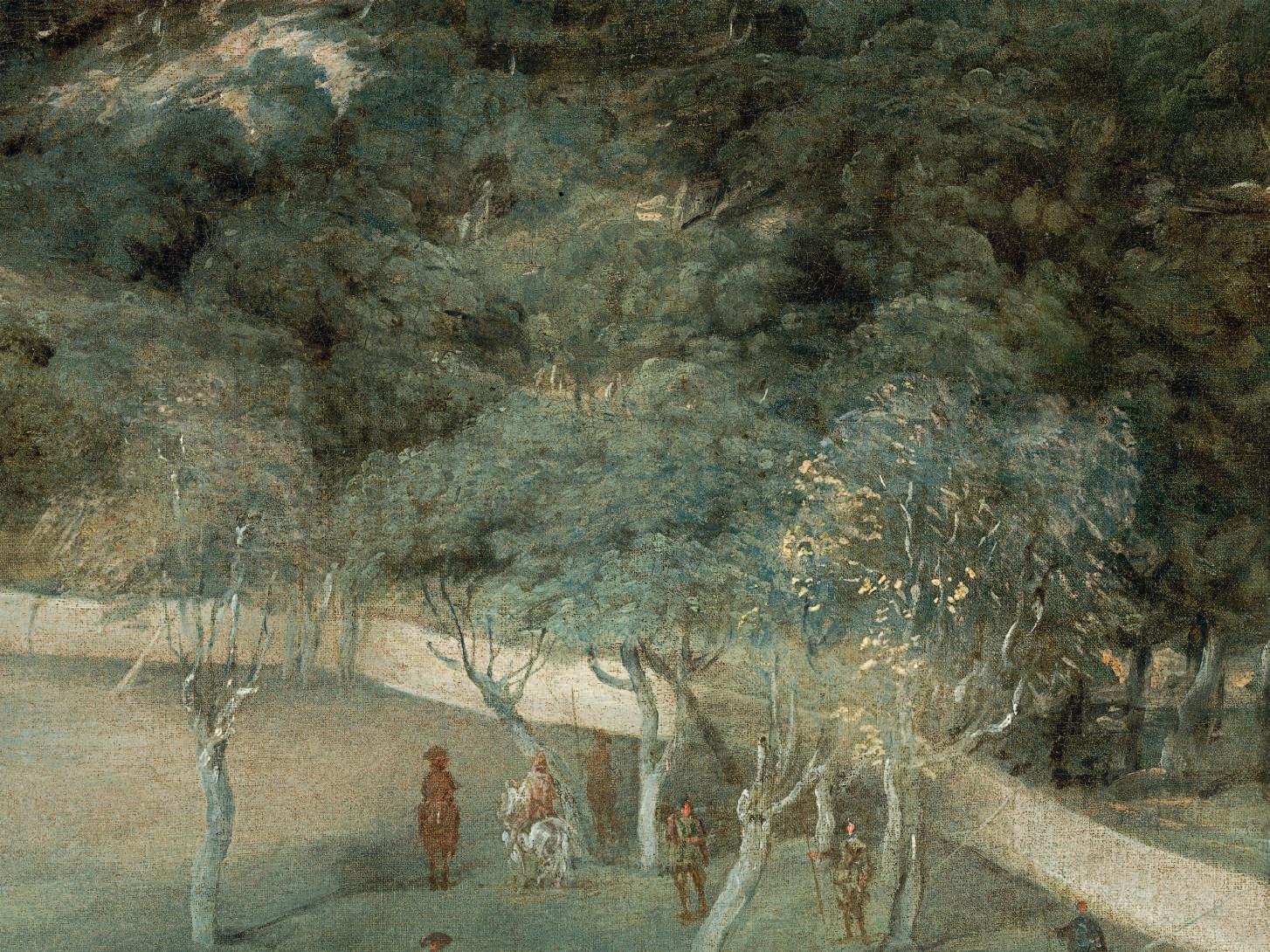

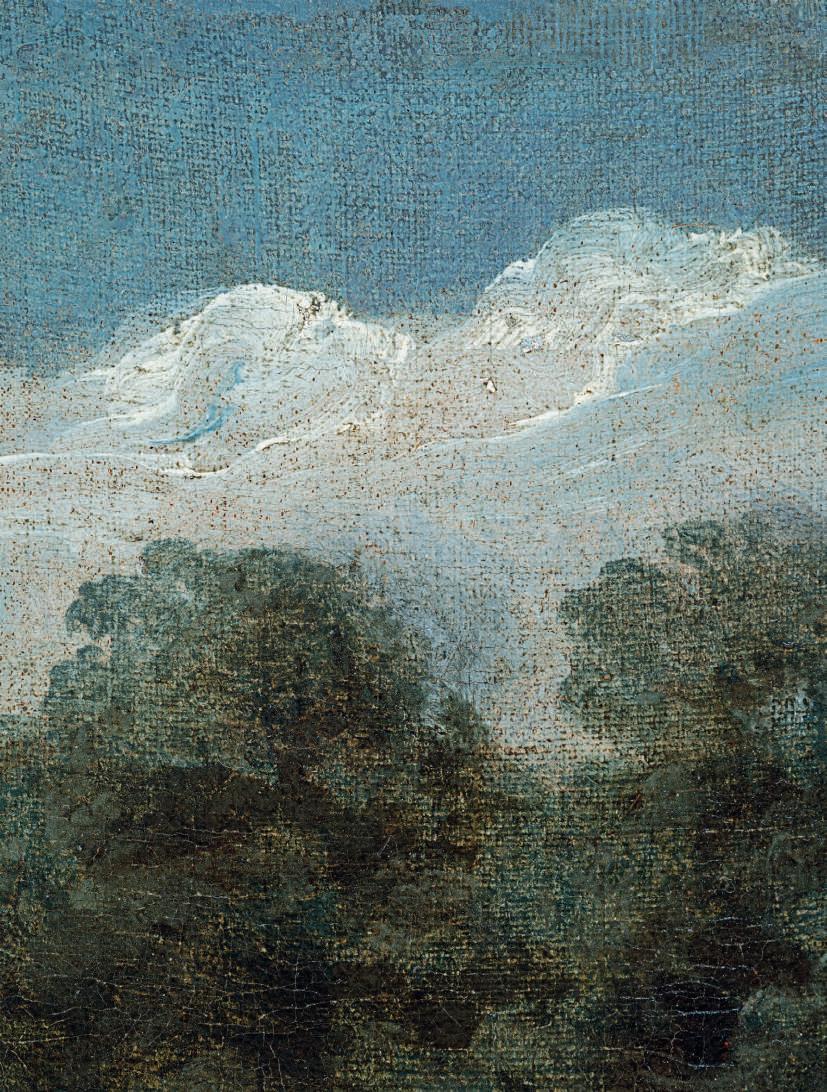

BETWEEN THE PREPARATORY STUDY AND THE FINAL VERSION OF PHILIP IV HUNTING WILD BOAR (« LA TELA REAL ») AT THE NATIONAL GALLERY IN LONDON.
Our painting is the preparatory work for the large composition held at the National Gallery (NG) in London. Signifcant differences between the two paintings suggest that our version predates the fnal composition.
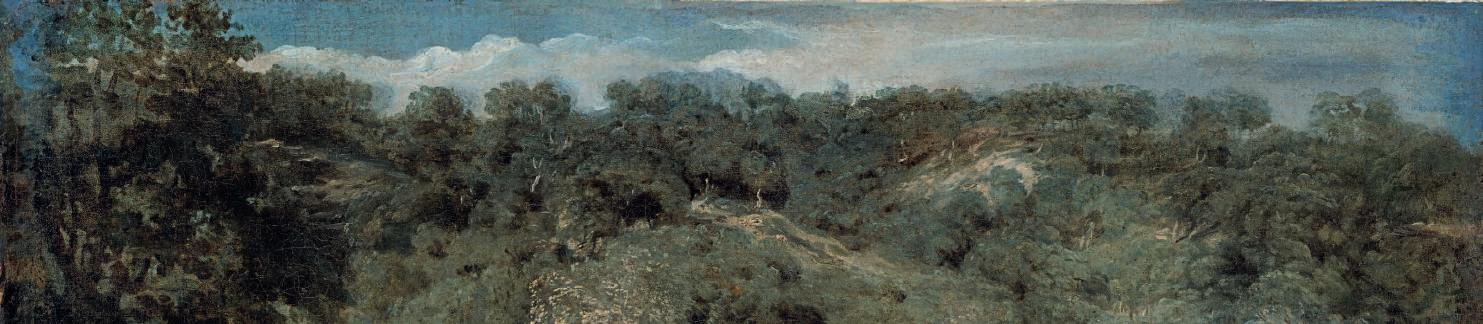
One of the most striking distinctions lies in the execution of the landscape. While the landscape in National Gallery contains more details such as the mounted fgures on the hillside in the upper right, it is less vigorously executed than in the preparatory study and appears altogether more subdued. It seems to rely less on direct observation, whereas our version conveys a more spontaneous and natural rendering with traces of earlier adjustments clearly visible.
A notable structural difference is that NG lacks the « extensions » present in our painting, though it does extend further to the right. Additionally, the large tree on the left in NG does not show signs of pentimenti that would reveal a thinner, more irregular trunk, a characteristic unique to our version.
As for the NG, the fgures are handled with extraordinary confdence in our painting. Velázquez reworked the scene’s space between his preparatory study and the fnal version.
The enclosure around the wild boar hunt is more geometric in the NG version and less linear in ours, showing that he frstly sketched our version outdoors and later refned his fnal composition in his studio. These differences collectively support the idea that our painting served as a preparatory study, allowing for later refnements in the larger fnal composition.
Moreover, in the National Gallery version, there are numerous pentimenti, some of which correspond to elements present in our painting. Furthermore, in the National Gallery version there are no visible pentimenti of the trees unlike our painting where trace of earlier adjustements are clear.
Fig. 29 : DIEGO VELÁZQUEZ
PHILIP IV HUNTING WILD BOAR PREPARATORY STUDY
c. 1634-35, OIL ON CANVAS
61.5 x 106.5 cm, private collection.
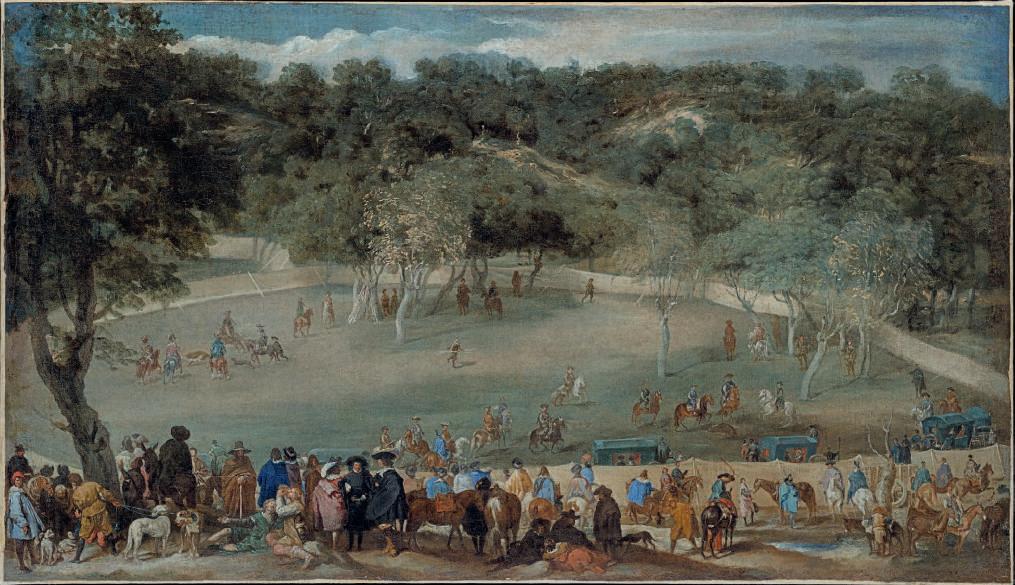
The preparatory study is approximately three times smaller than the painting in the National Gallery.
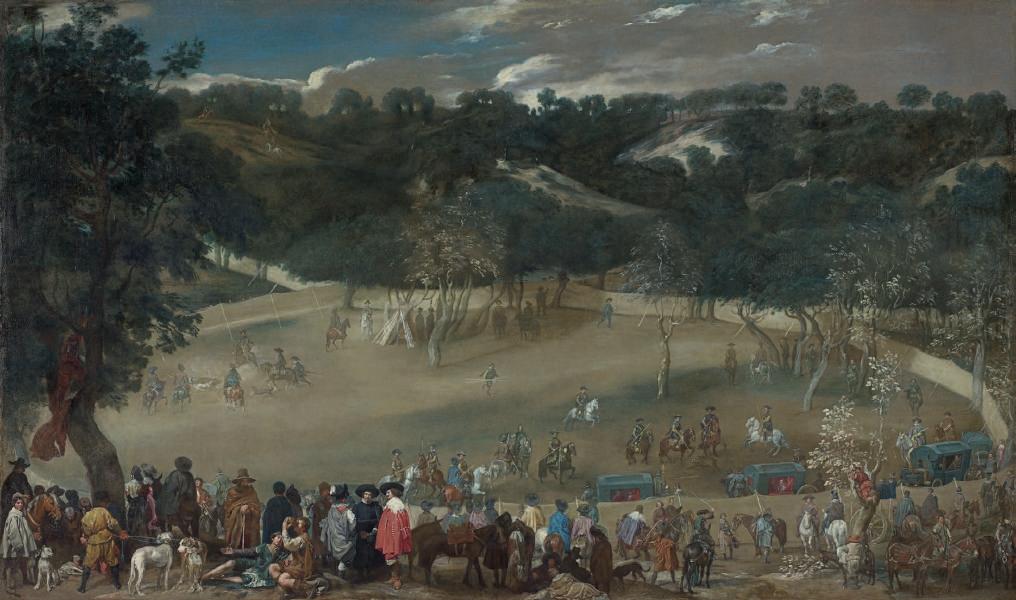
Fig. 30 : DIEGO VELÁZQUEZ
PHILIP IV HUNTING WILD BOAR («LA TELA REAL»),
c. 1635, OIL ON CANVAS
182 x 302 cm, National Gallery, London.
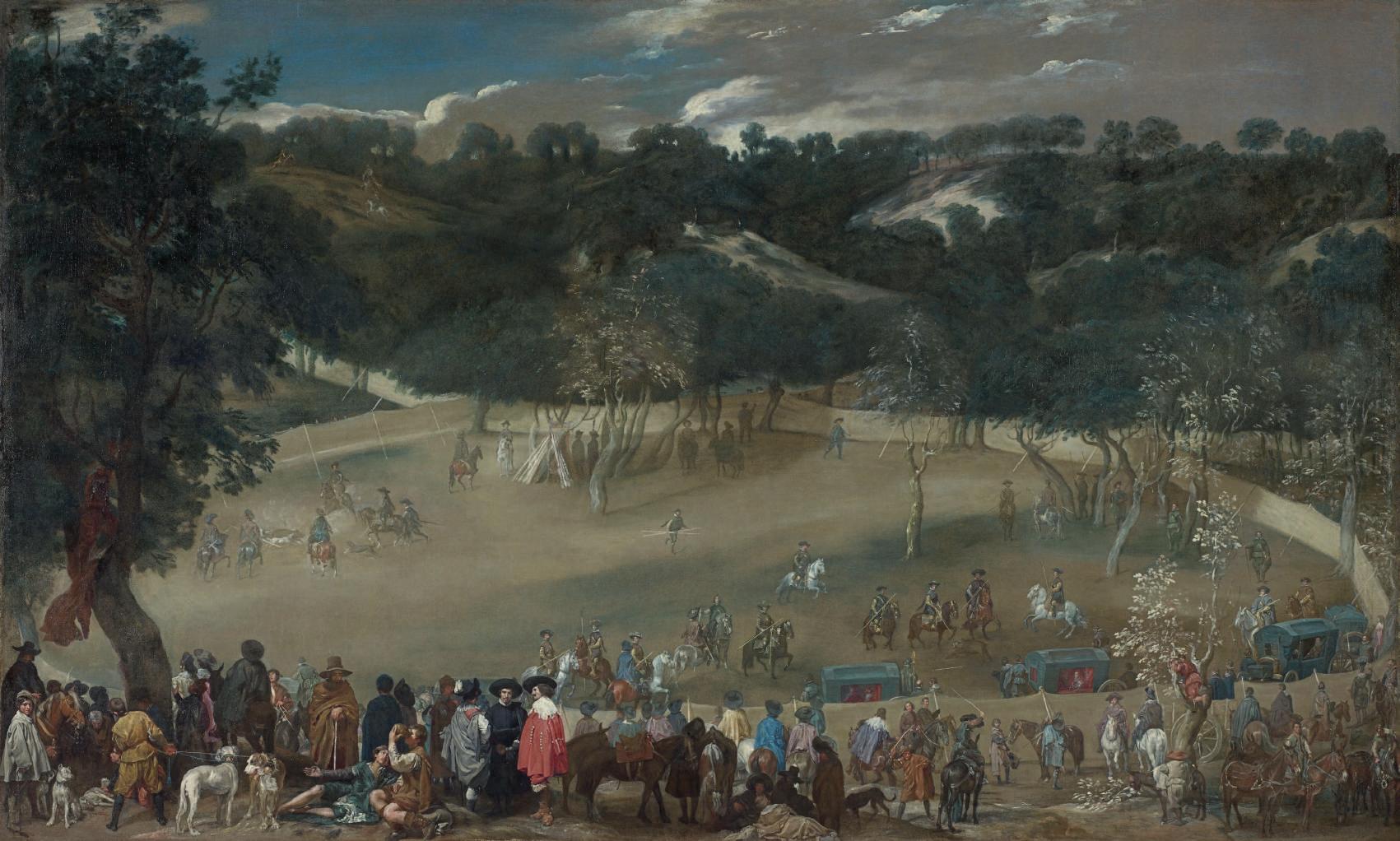
32 : DIEGO VELÁZQUEZ, PHILIP IV HUNTING WILD BOAR, PREPARATORY STUDY, c. 1634-35, Oil on canvas , 61.5 x 106.5 cm, private collection.
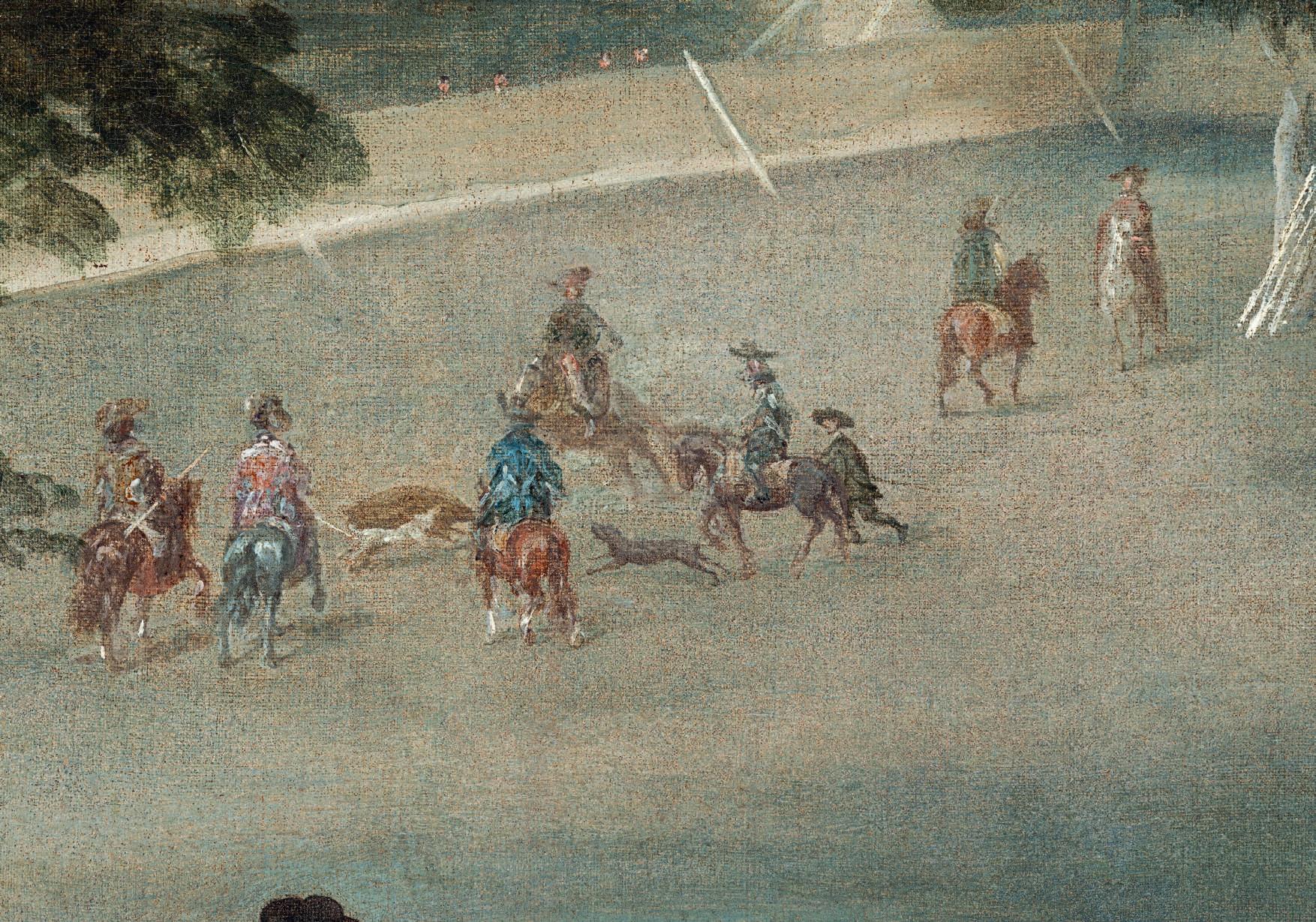
Several details from the initial composition have been refned in the fnal artwork. For example, the right corner of the fence now curves around the trees instead of disappearing from the frame, as it did before.
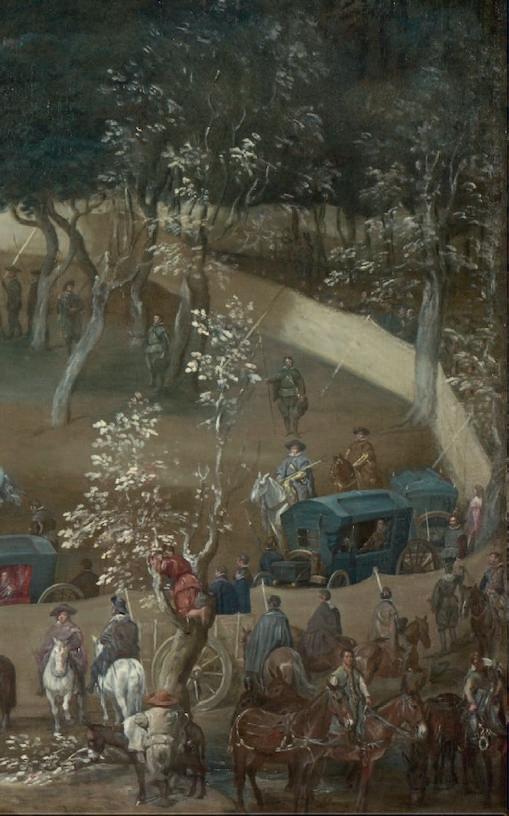
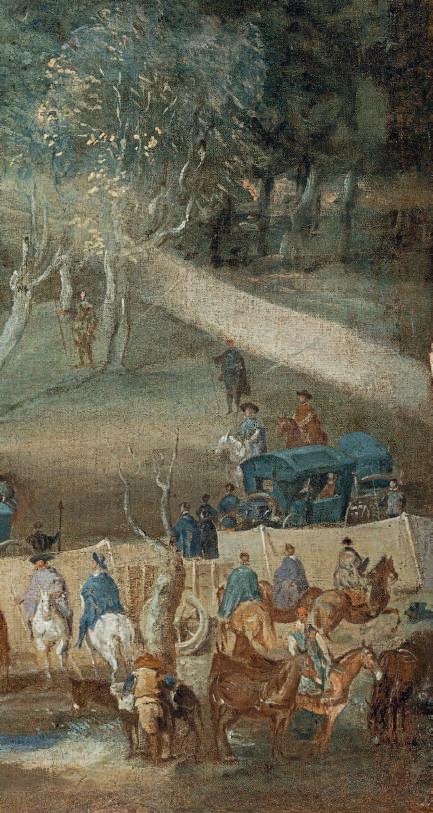
The foreground tree on the right in the NG version is depicted with fuller foliage, and Velázquez added the detail of a man perched in the branches.
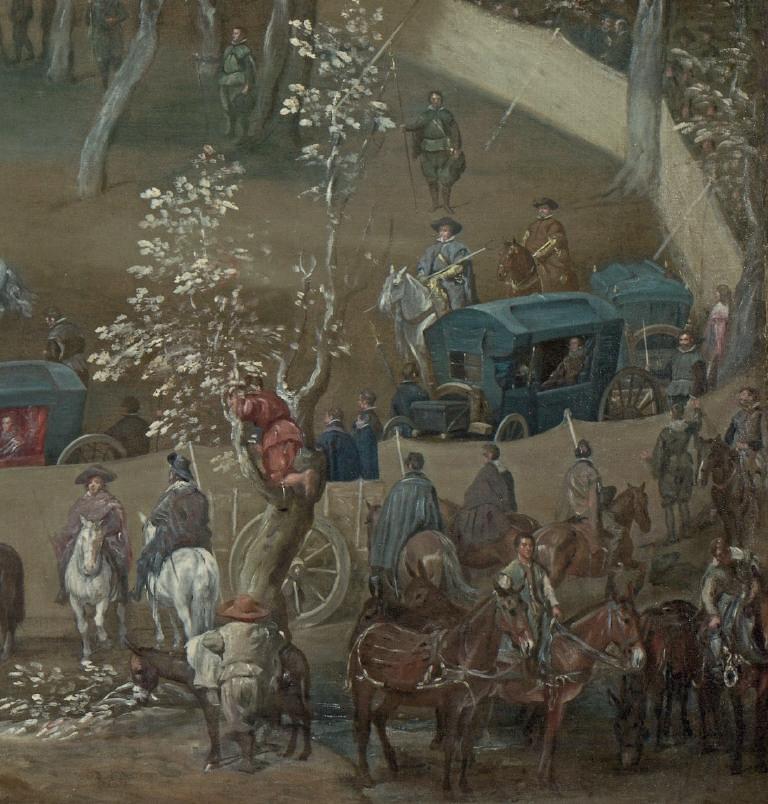
Fig. 35 : Leafy tree with a man perched in its branches in the NG painting.
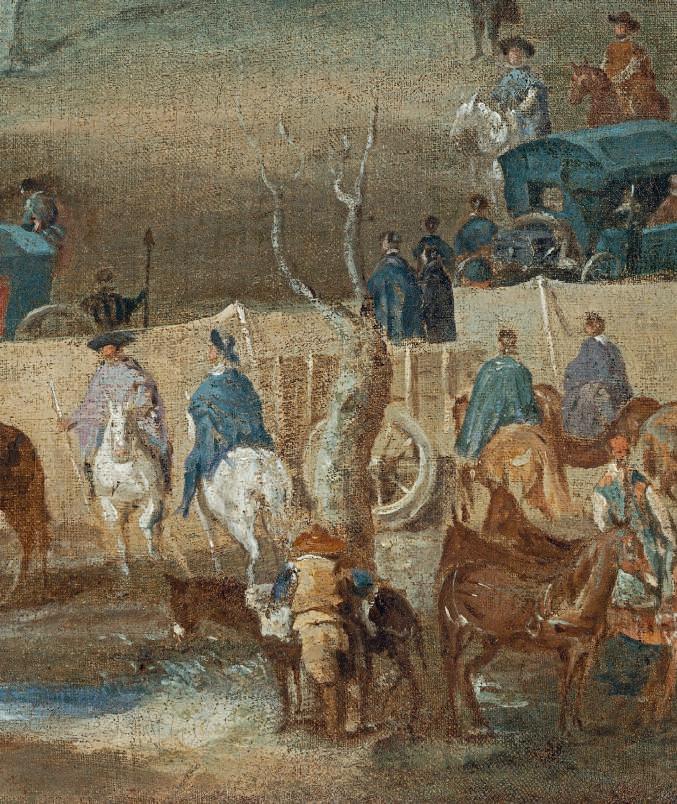
Fig. 36 : A leafess tree with no man perched in its branches in the preparatory study.
In our version the large tree on the left had a narrower and more contorted trunk, which was later simplifed and thickened. This does not exist in the version of the National Gallery.
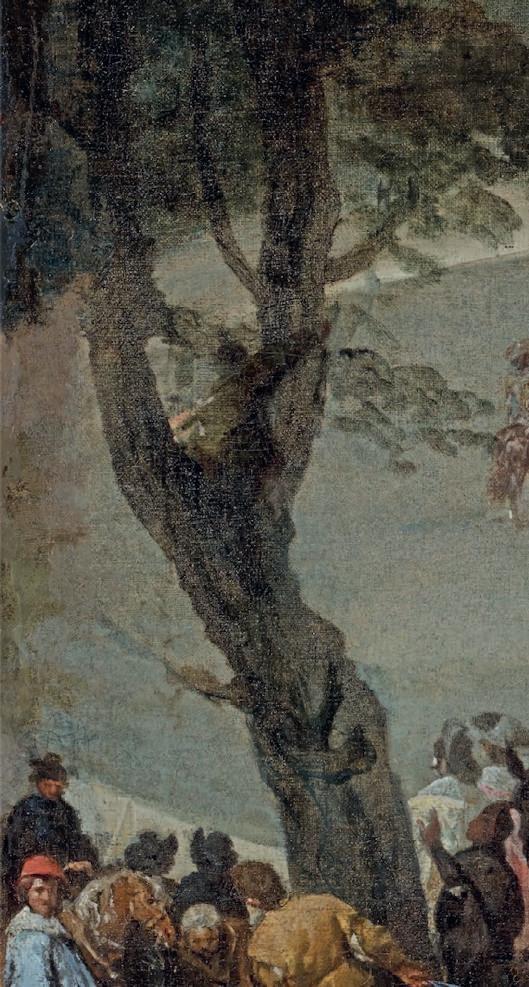
preparatory study, revealing a later modifcation.
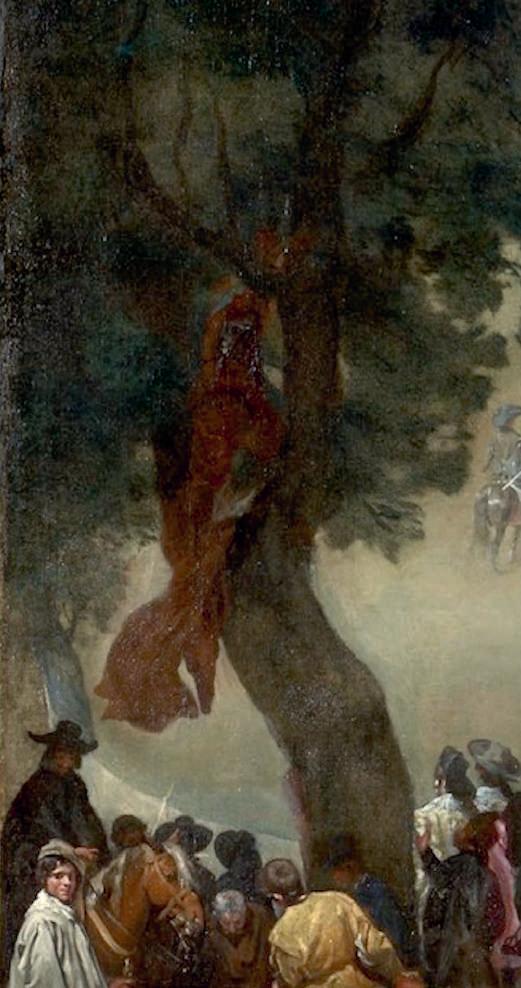
In our version, a sketch of the man climbing the tree visible in the NG painting, is present. However, the reddish fabric that is fully unfurled in the NG version appears differently in ours: a single red color is visible at the tip of his left hand, as the fabric has not yet been unfolded.
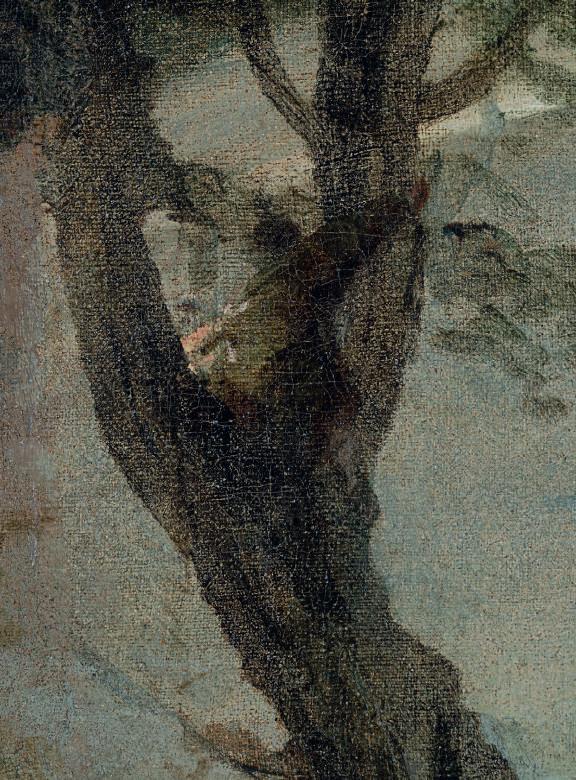
39 : The body of a climbing man is visibe in the preparatory study but in a very different position.
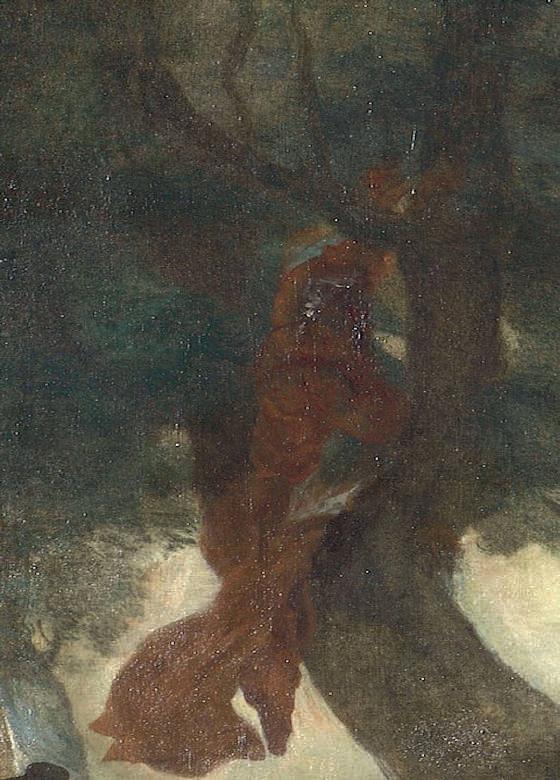
40 : Climbing man in the NG version.
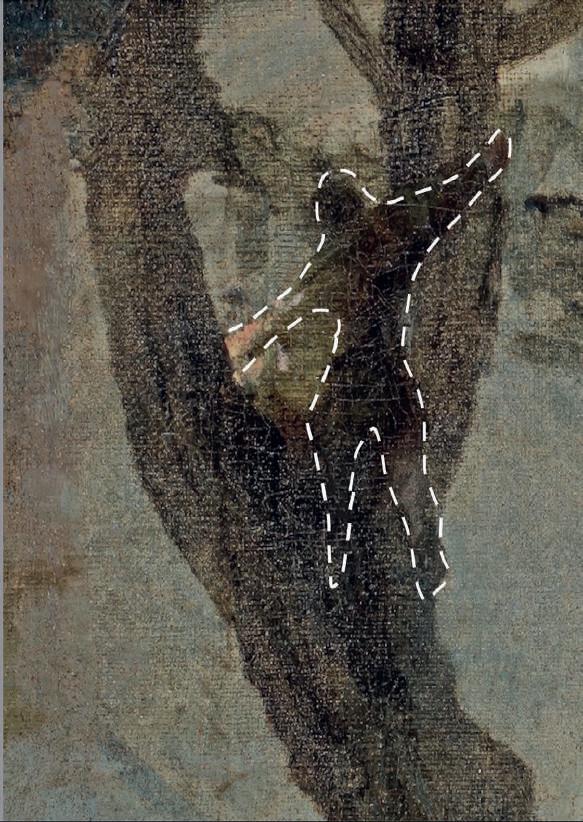
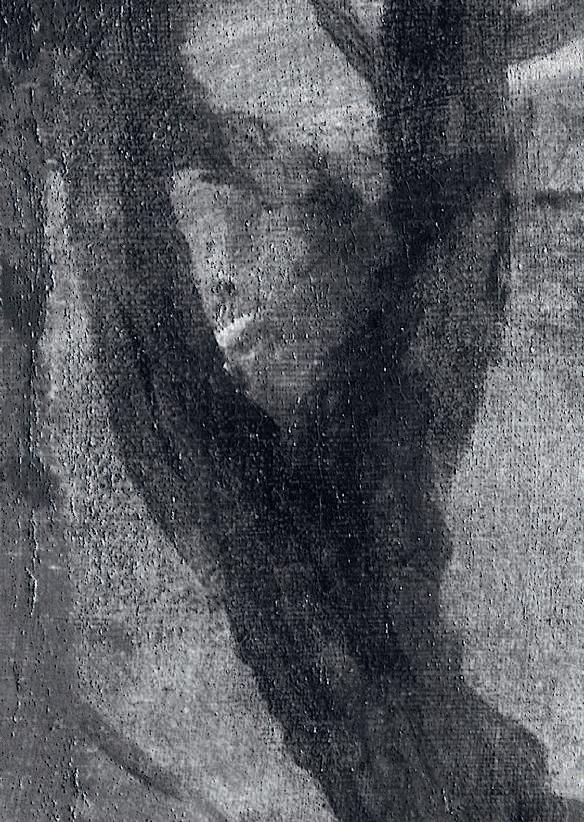
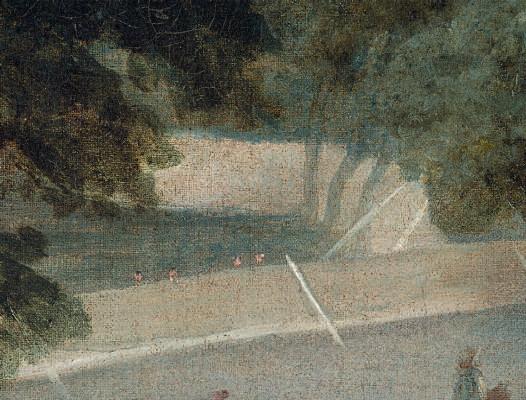
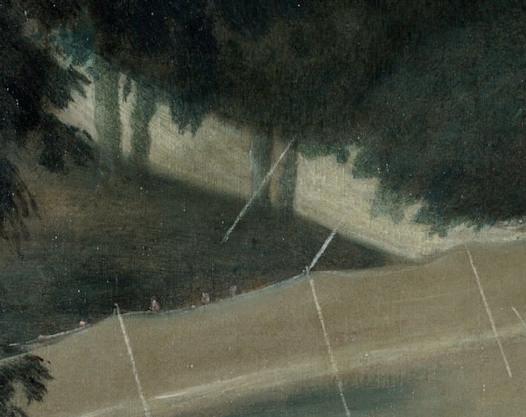
Between the two versions, the artist modifed the composition, notably regarding the fence posts; some were added, while others were removed. The trees are also different.
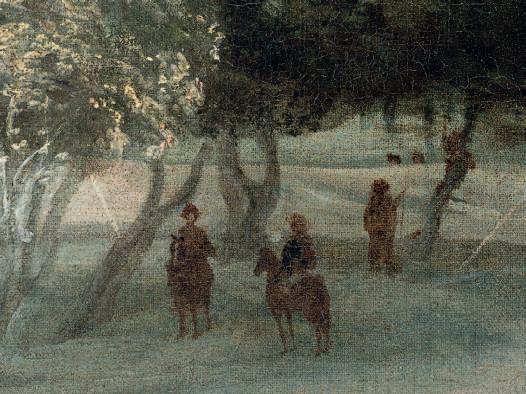
Fig. 43 : Preparatory study - Fence post.
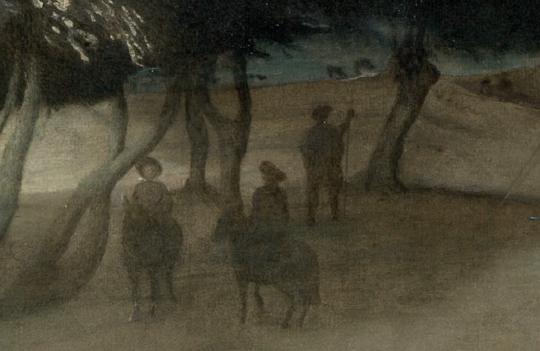
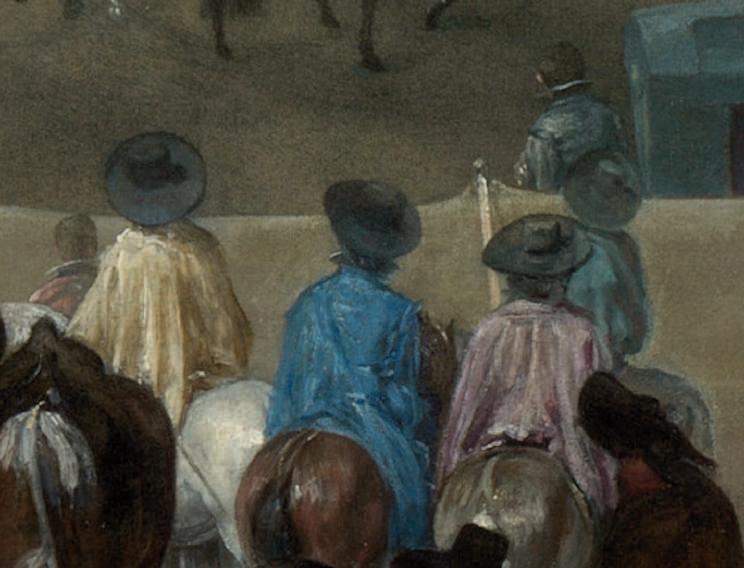
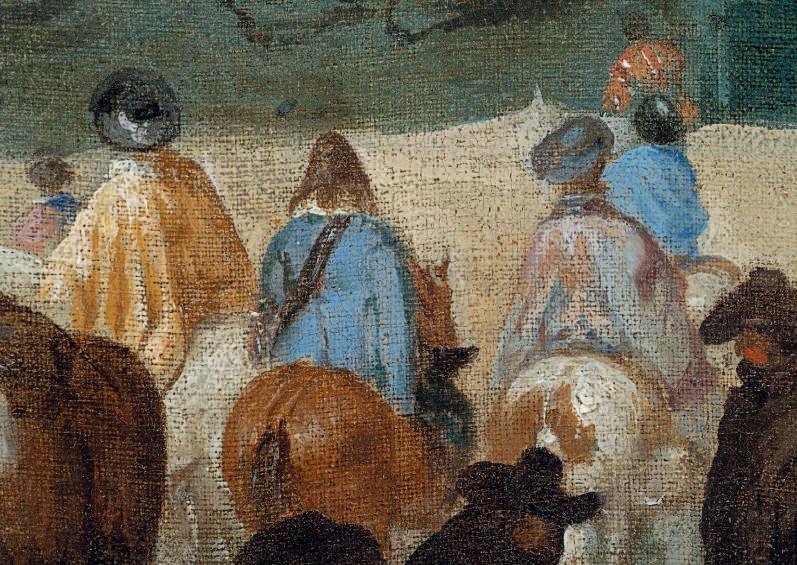
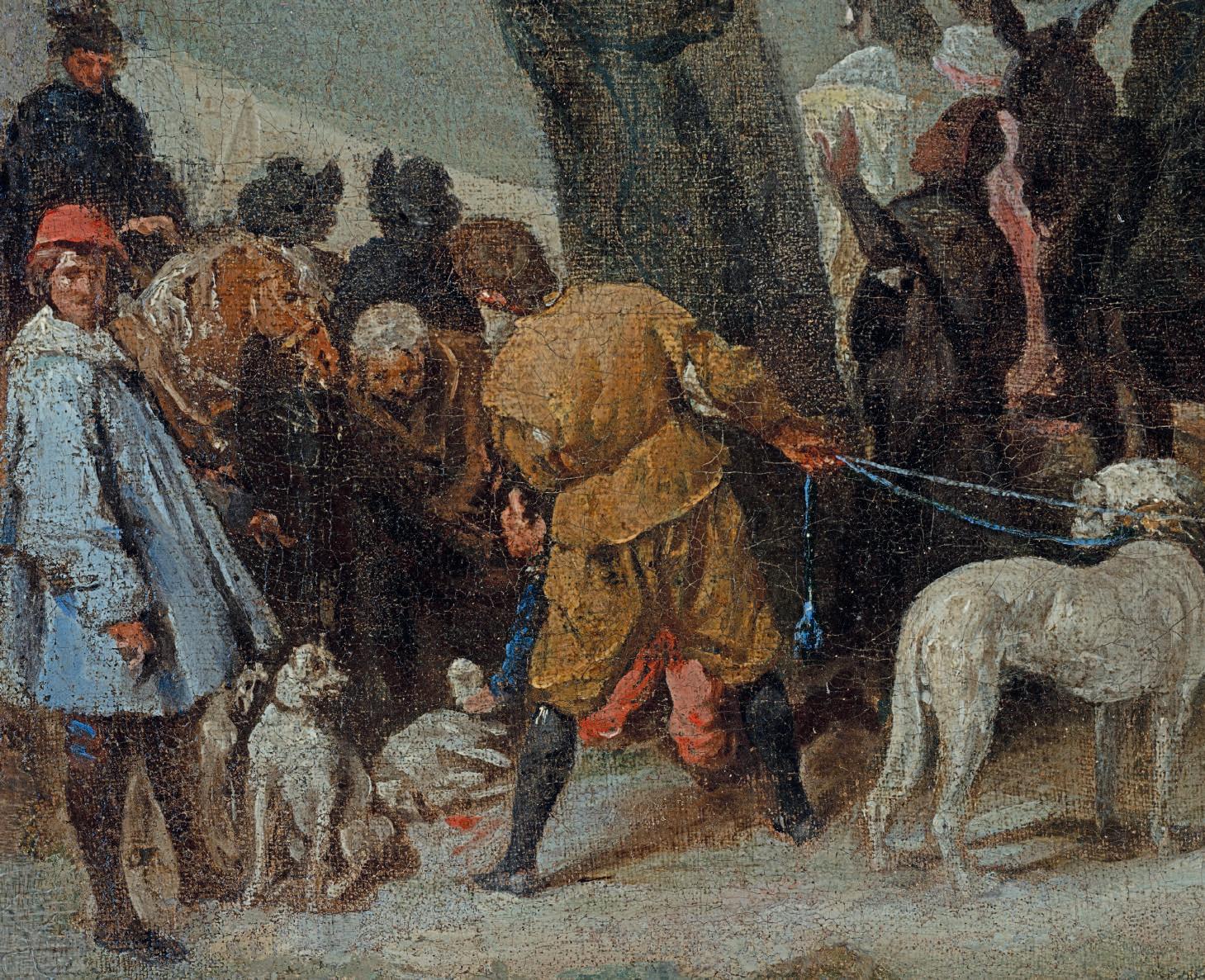
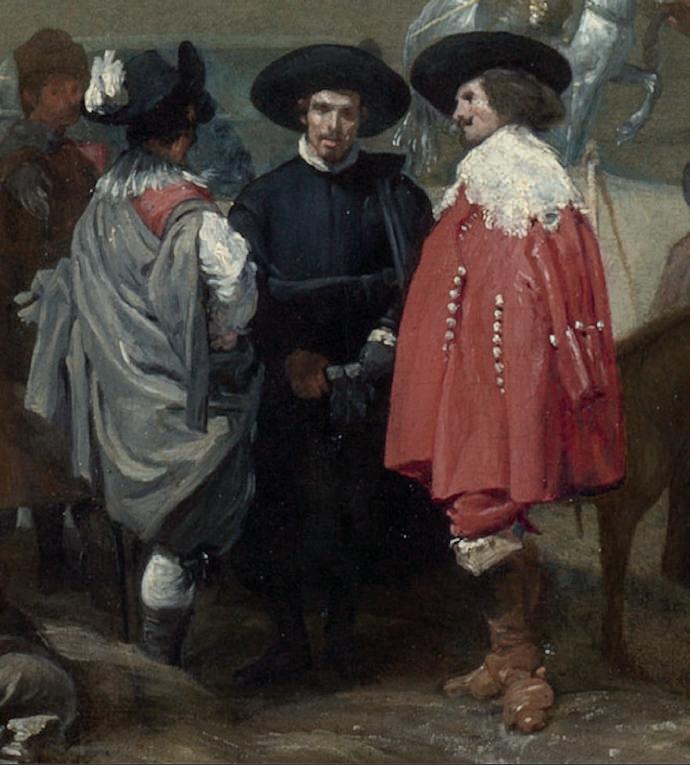
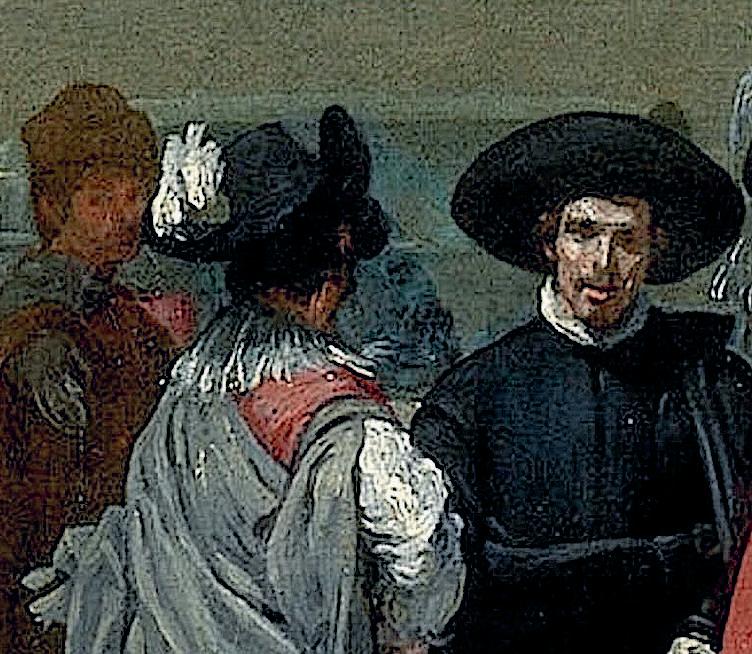
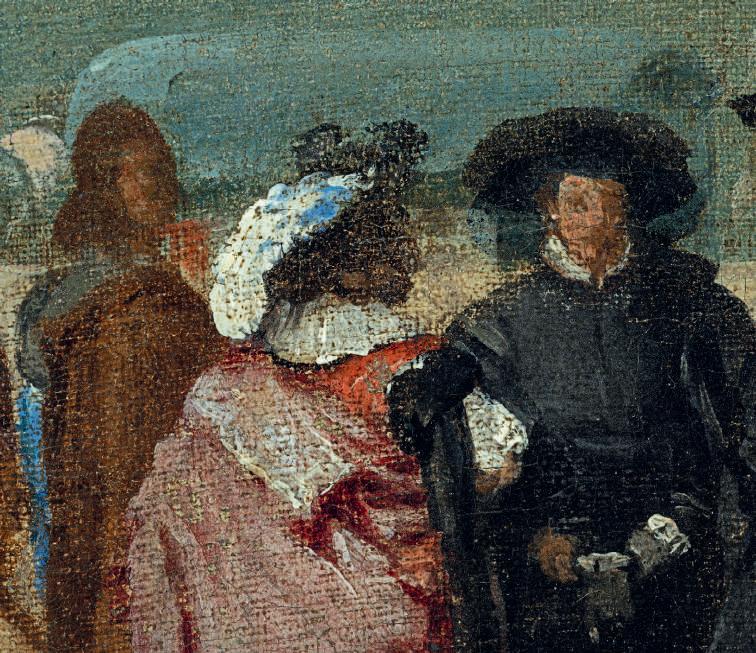
Within the central group of three men, their clothing differs between the two versions. In the preparatory study, the man on the left wears a red cloak and is seen from behind, while in the NG version, he wears a different grey blue coat and is shown in a three-quarter view.
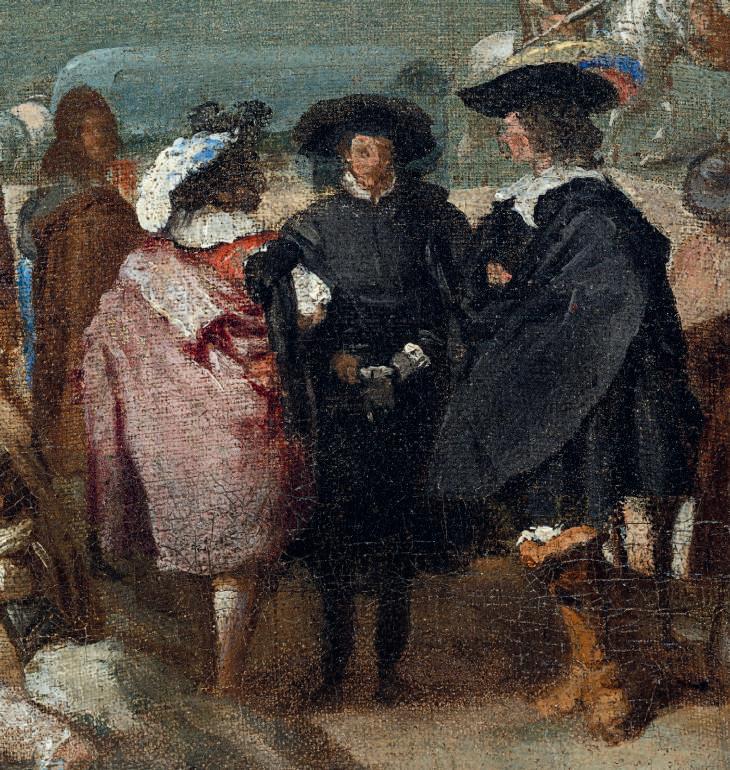
In the preparatory study, the man on the right wears a different and a dark blue coat while in the National Gallery version a red one. Interestingly, the red cloak in the NG version was originally dark blue, just like in our version (see Larsen, p. 101).
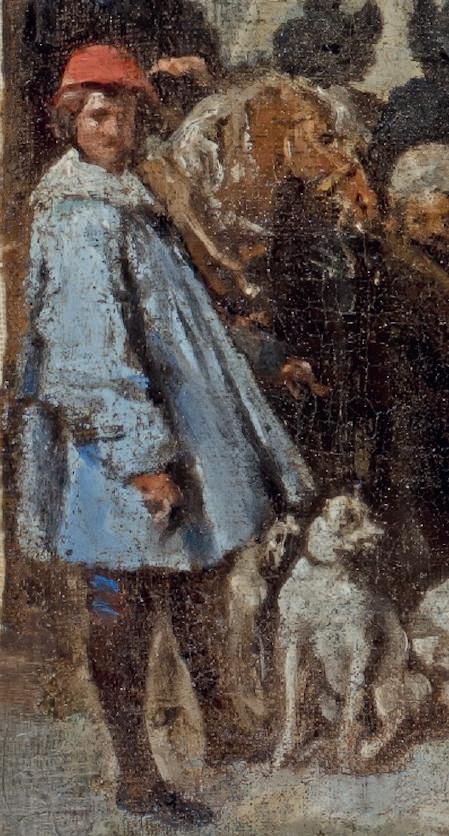
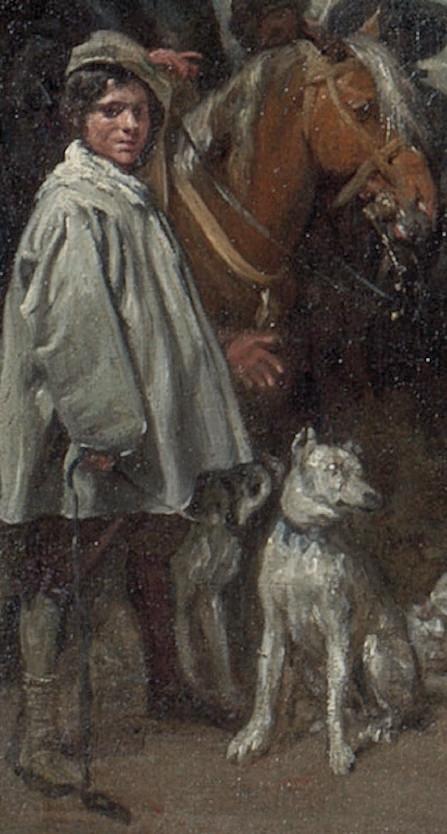
In the preparatory study, the dog handler wears a blue coat and a red cap, whereas in the National Gallery version, he is wearing a grey coat and a grey cap.
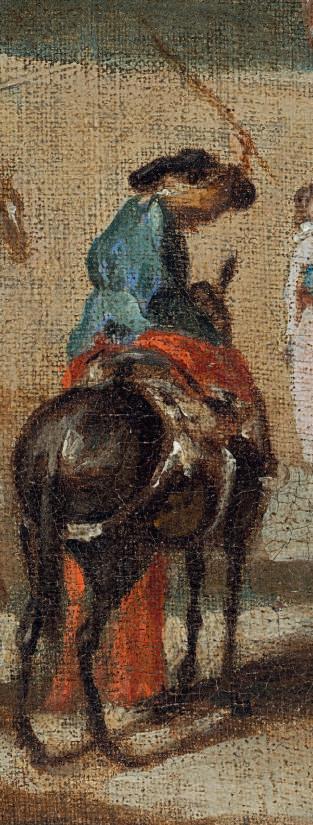
The red cover on the black horse, which is present on the right side of the foreground in the earlier version, has been changed in blue in the fnal painting.
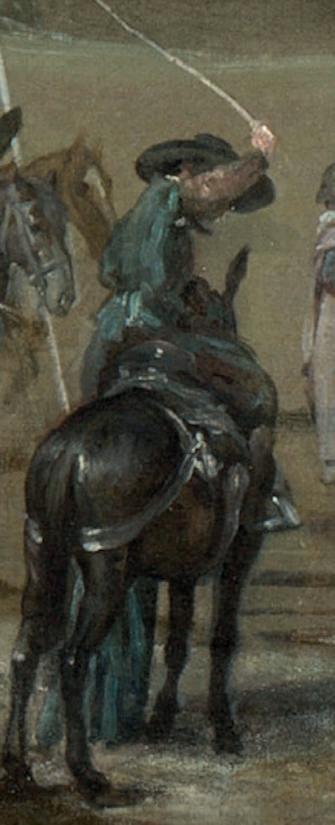
Several other differences are noticeable between the preparatory study and the fnal version, showing that the painter refected on the two compositions.
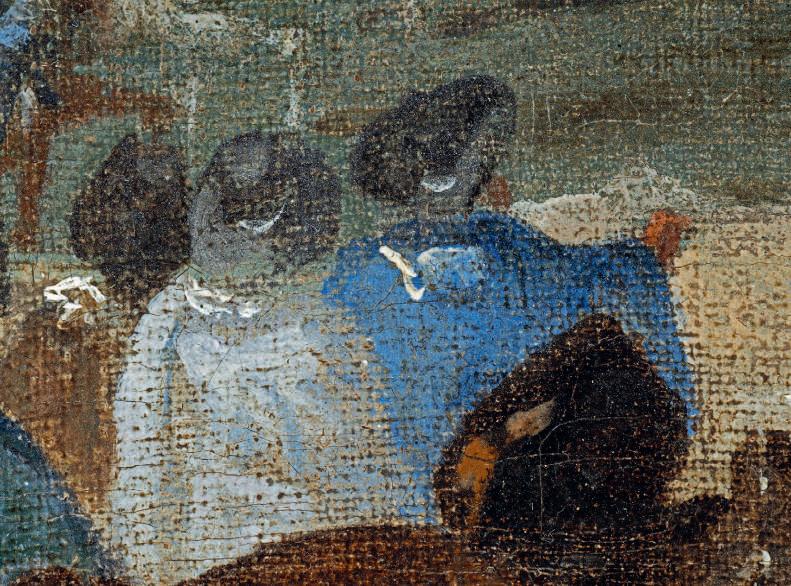
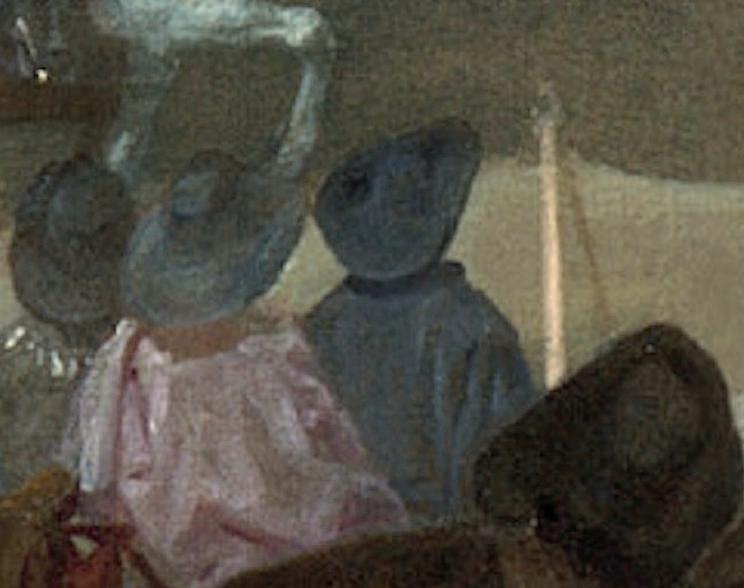
Some elements between the preparatory study and the fnal one have either been removed, added, or adjusted.
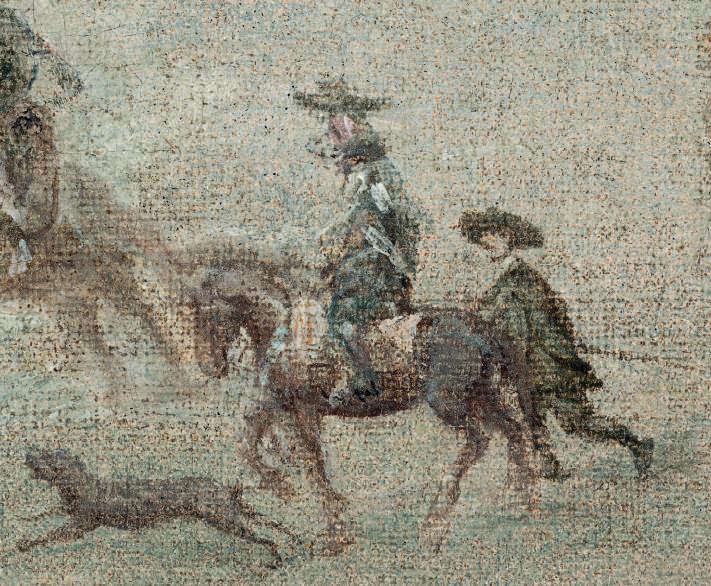
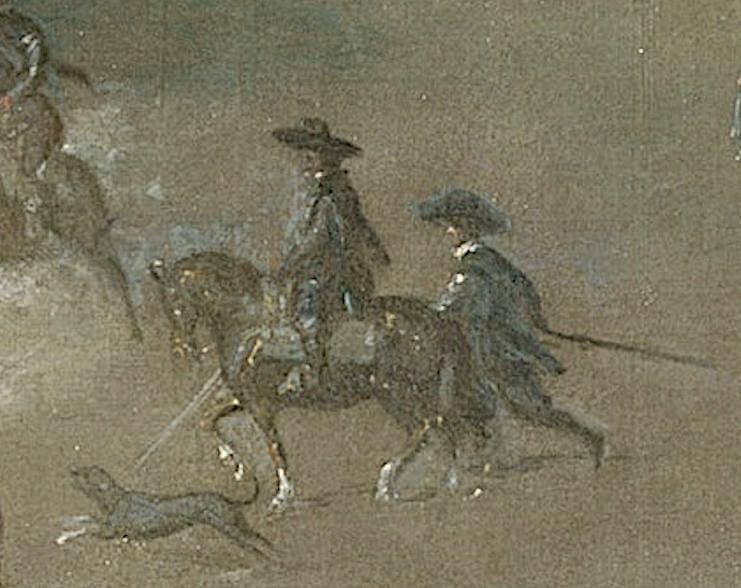
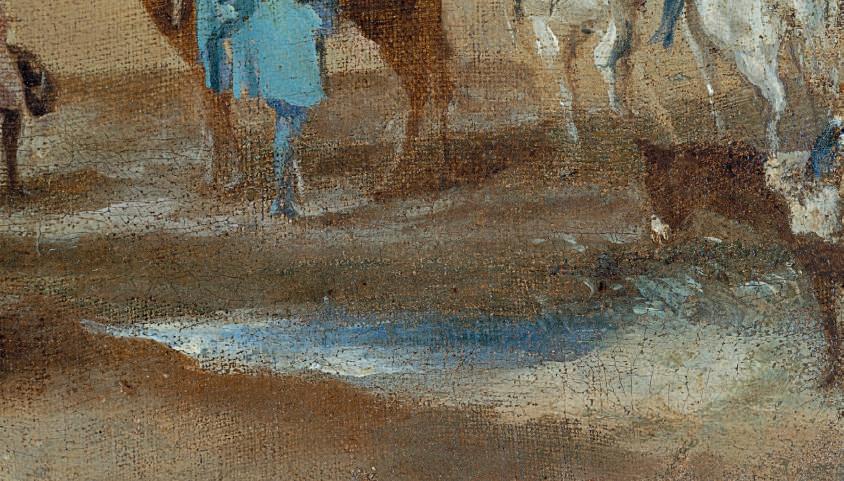
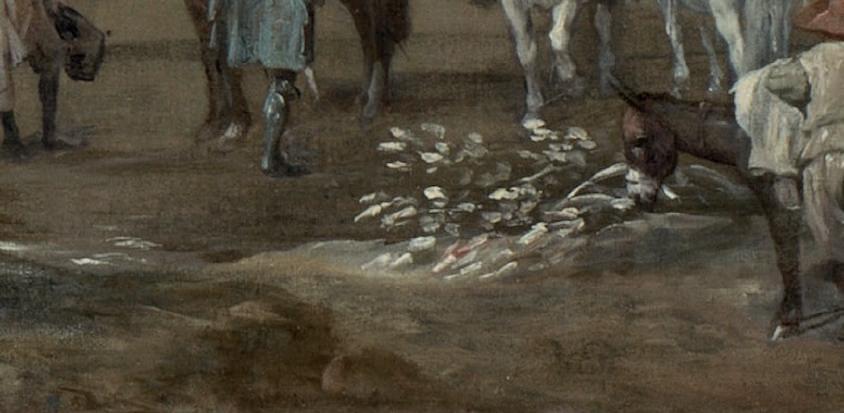
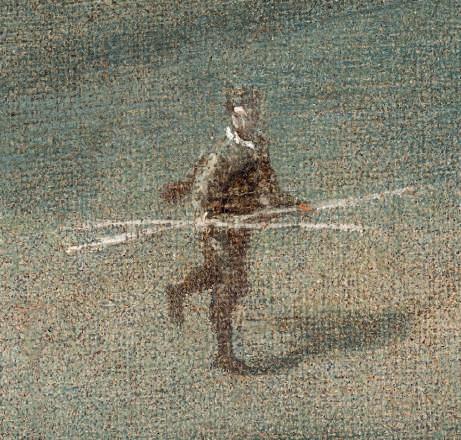
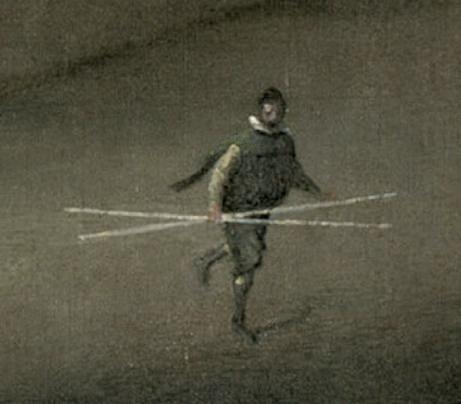
The extremity of the blue stagecoach is hidden by the brim of the black hat in the NG version and visible in the preparatory study.
AT LEAST THREE OTHER VERSIONS EXIST IN ADDITION TO OURS AND THE ONE IN THE NATIONAL GALLERY.
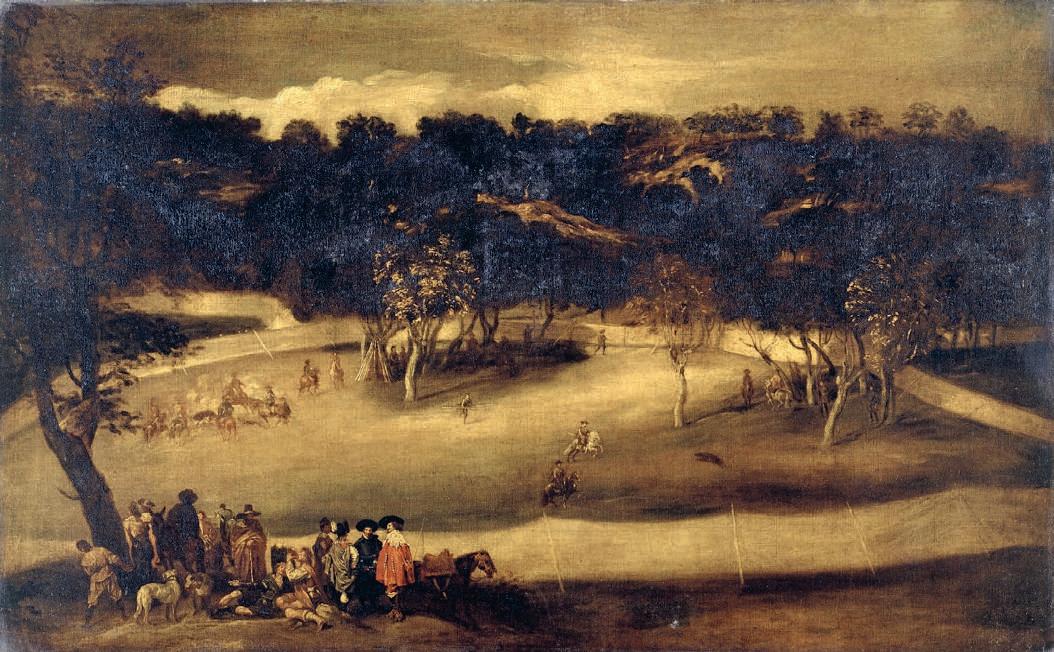
In most respects, that copy follows our painting so closely that it appears to be based on it, except for the grand fgures near the center foreground, which follow NG. The copy lacks all pentimenti and contains far less the fgures. In this copy, the man climbing the tree can be also seen at the far left of the painting, in the same position as our preparatory study and thus very different from the painting in the National Gallery. Even disregarding its darkened varnish, the background foliage in that copy appears to be painted in brown rather than green.
Overall, the handling in the copy appears stiff and uninspired, lacking the vigor and inventiveness of our version. These factors suggest that the Wallace Collection version is a later copy of our preparatory study. A copy requires an original : our painting.
Anonymous, 17th or 18th century, Philip IV hunting Wild Boar, oil on canvas, H. 188 cm / 74 in, L. 303 cm / 119.3 in; Madrid, Prado Museum.
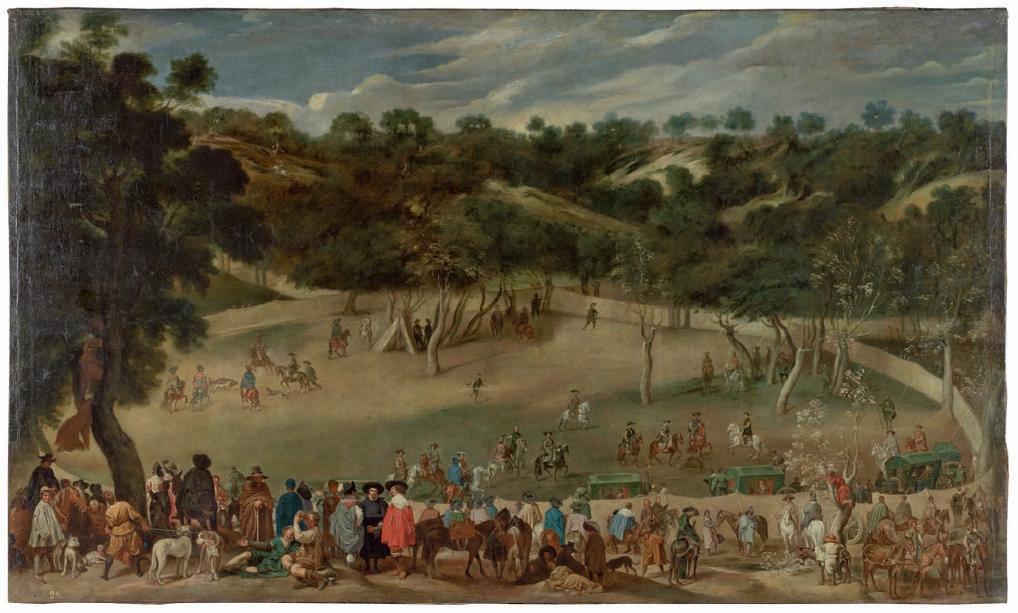
This painting is a copy of the painting from the National Gallery, with very similar dimensions and of inferior quality. The color palette is more saturated, with greenish blues instead of the smalt-based blues in our painting. The lack of revisions in the Prado version suggests it was based on the completed model of the « Tela Real » at the National Gallery, whereas our painting represents an earlier stage in the creative process. Unlike ours, which shows visible pentimenti and spontaneous brushwork, the Prado version has more controlled execution, smoother transitions, and a fnalized composition.
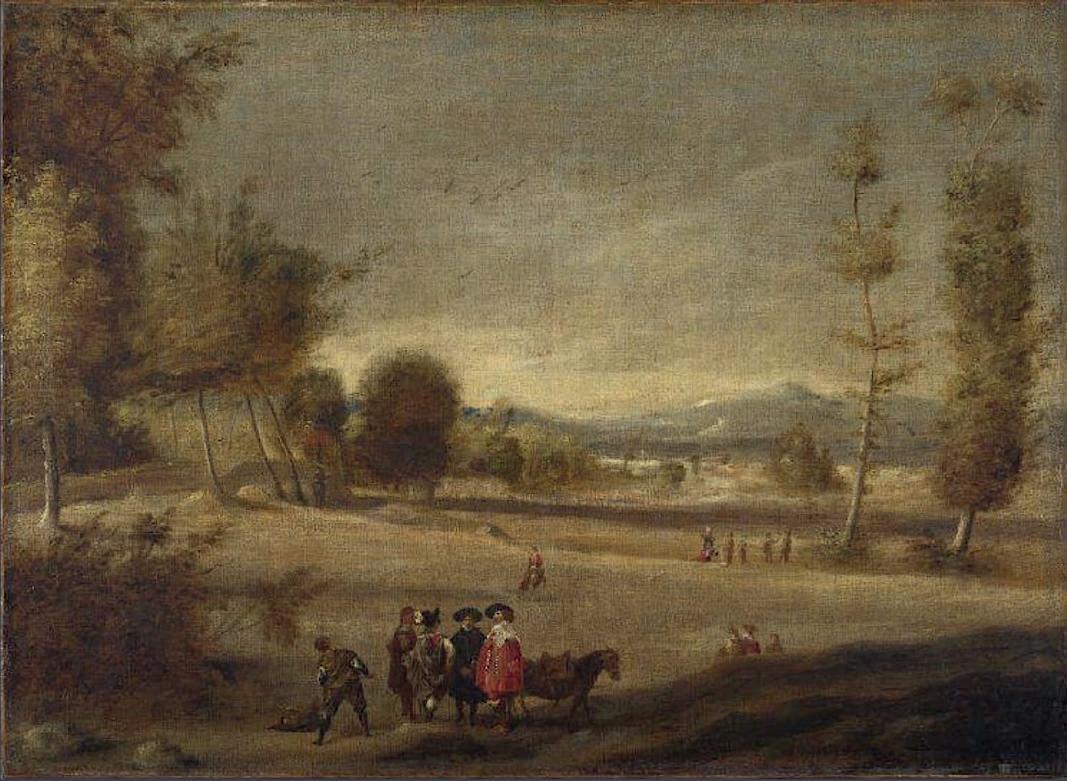
Spanish anonymous, 17th century, Boar Hunt, oil on canvas, H. 91 cm / 35.8 in, L. 126 cm / 49.6 in; London, National Gallery.
/
The composition is far more simplifed and lacks the dynamism found in our painting. The landscape is more rigid and less fuid, with fewer details and a less natural perspective.
The central scene is less defned, and the placement of fgures appears more static compared to the two original versions.
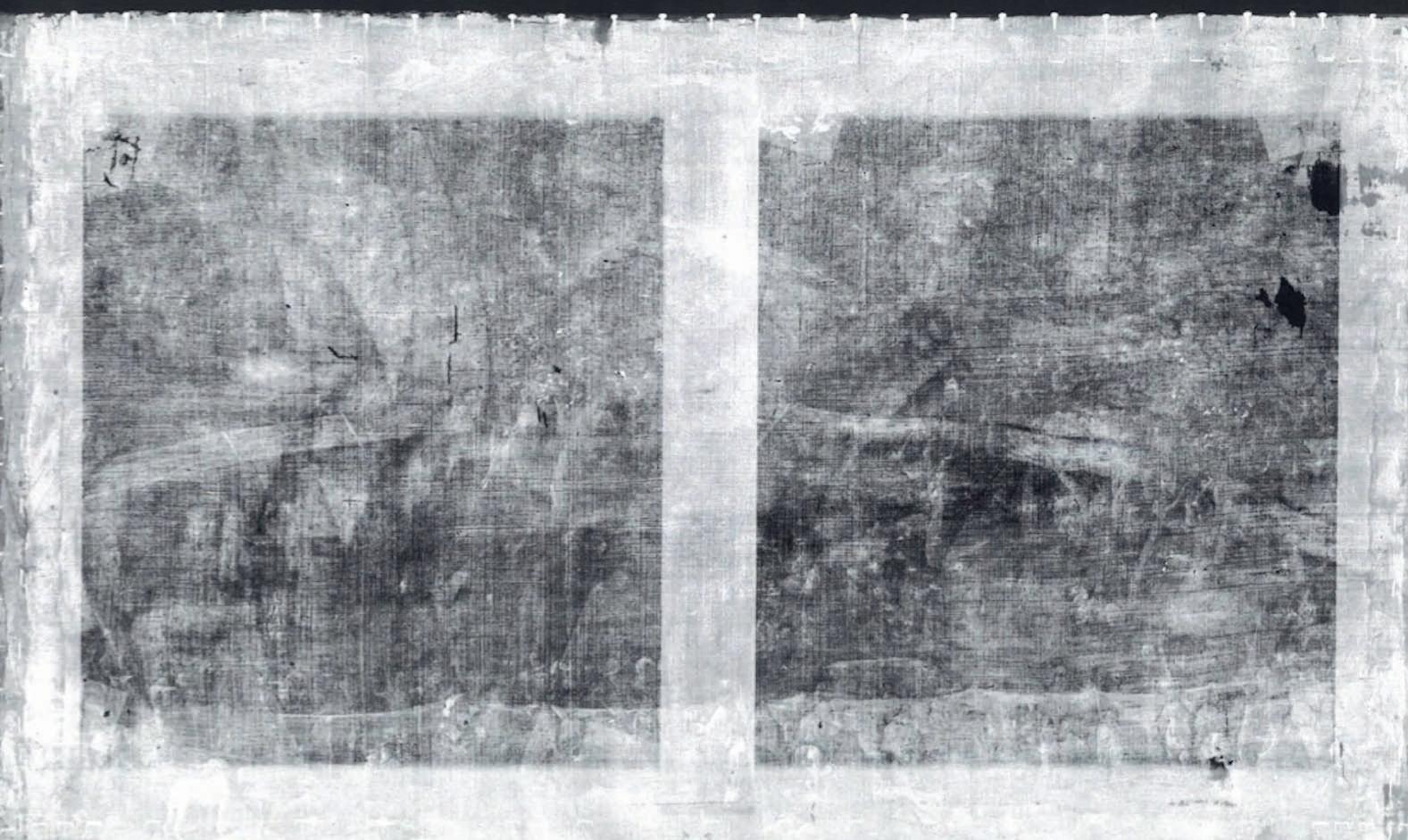
Our preparatory study exemplifes Velázquez’s pictorial technique from the 1630s, characterized by a loose and fuid application of paint, subtle atmospheric effects, and a masterful use of transparency. The artist’s working process is revealed through layering, pentimenti, and preparatory brushstrokes that structure the composition while allowing for later adjustments. Technical analysis demonstrates that Velázquez painted frstly the sky then the landscape establishing the overall tonality and depth of the composition before introducing the fgures. This foundational approach is confrmed by X-ray imaging, which reveals the circular enclosure (Tela Real) as a continuous form beneath the paint layer. This element was executed early in the painting process, with fgures and trees painted subsequently to overlap it. Such layering reveals Velázquez’s dynamic approach to structuring the composition, adapting and integrating changes as the work progressed.
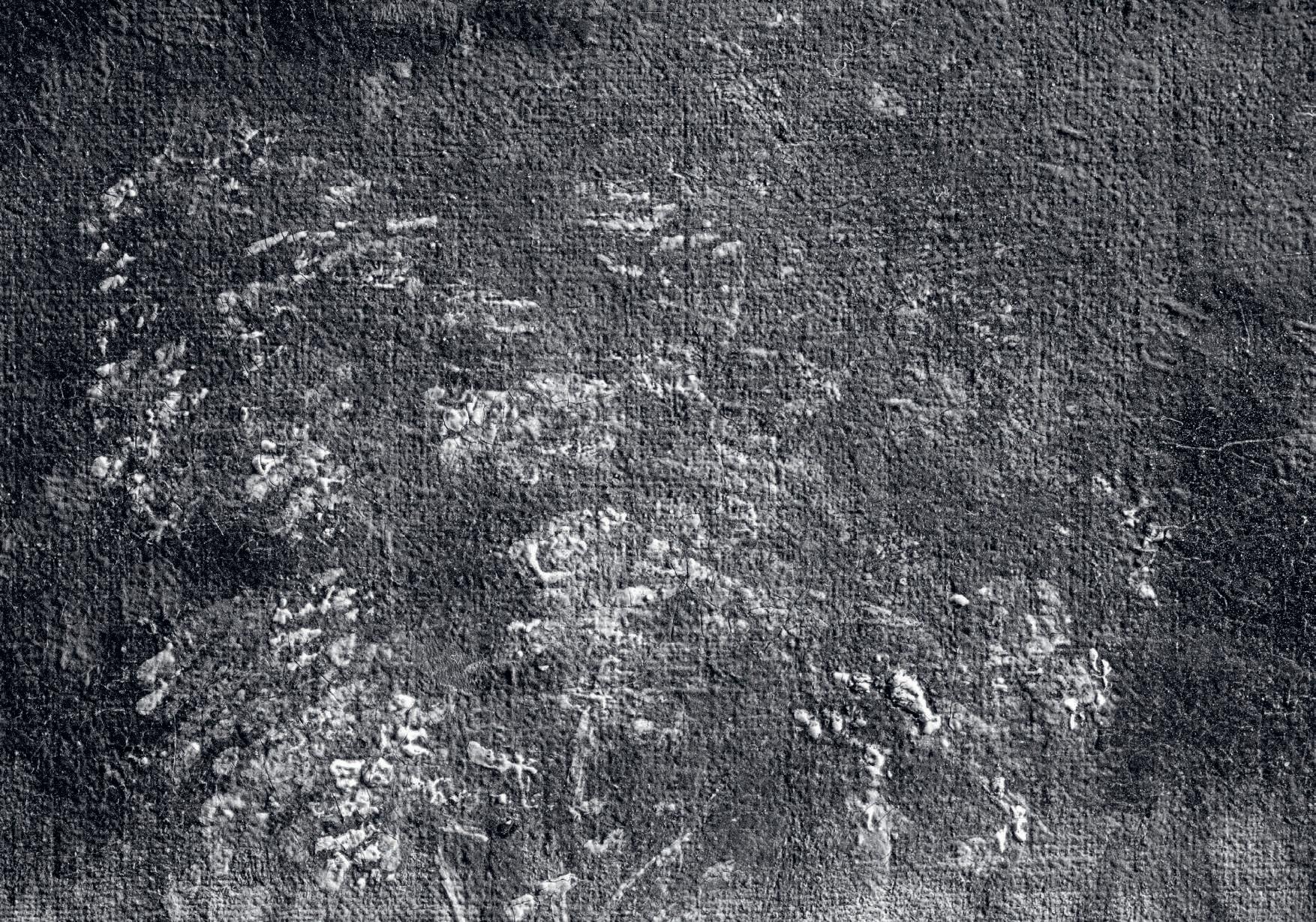
In the X-radiograph, random arcing strokes suggest that the ground layer was applied using a large fat spatula or knife - an approach typical of Velázquez’s working method.
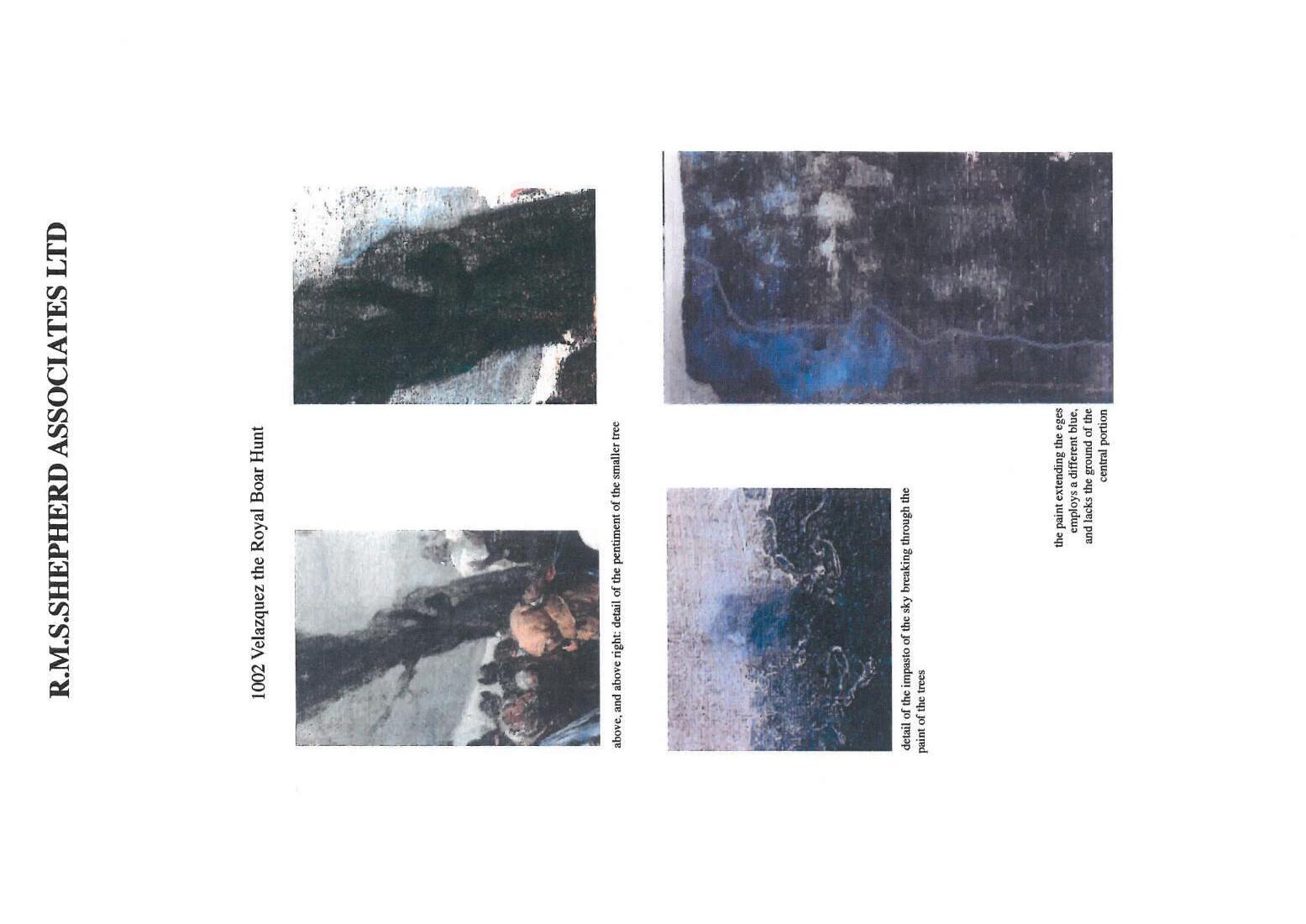
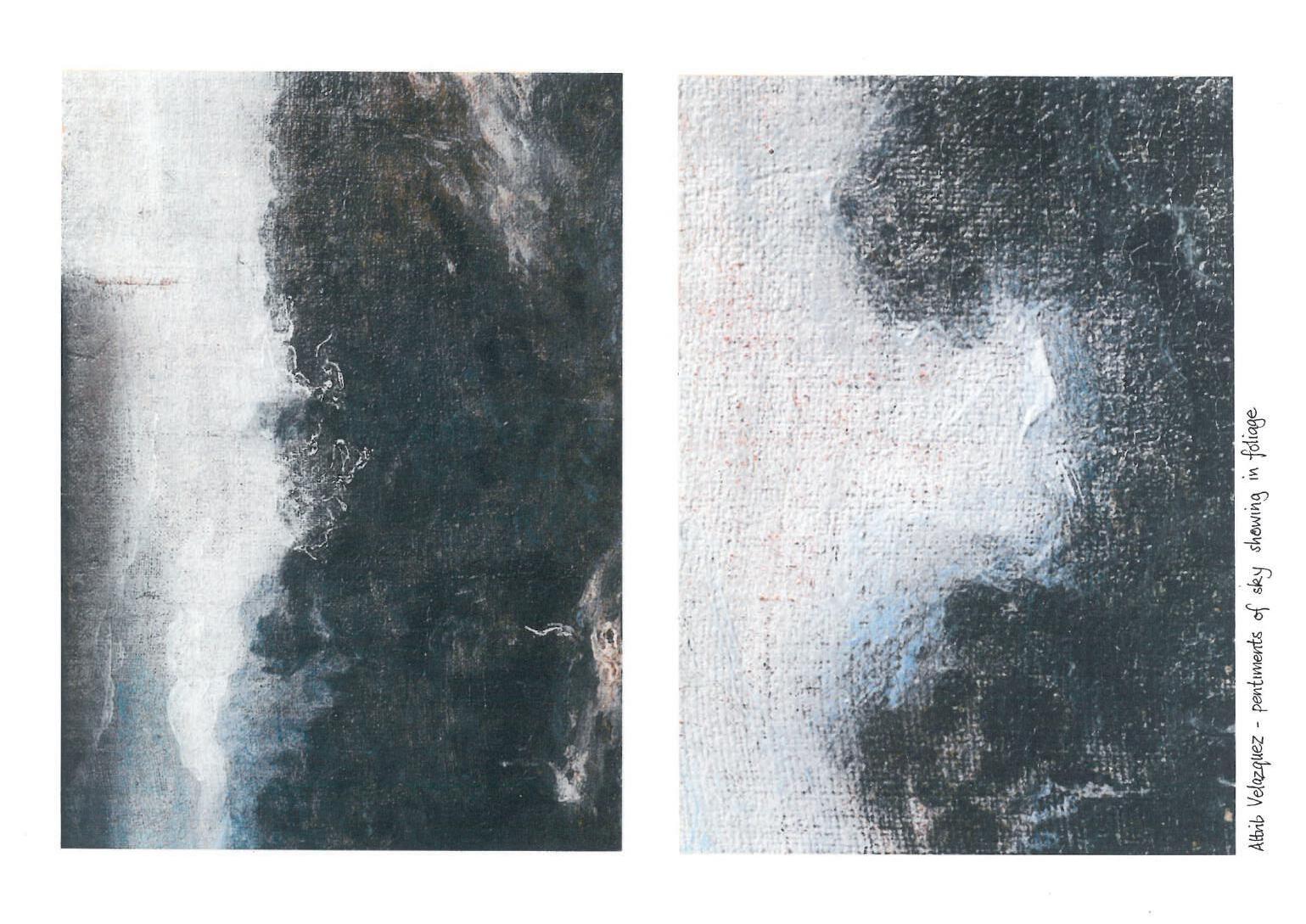
The sky was frst painted to establish the horizon, with pale blue tones visible through the thin paint of the trees in several areas. Then, the central landscape was painted and later extended by approximately 1.5 cm on each side over the unprimed fabric (see p. 25) . The paint extending to the edges of the canvas employs a different blue and lacks the ground layer found in the central portion, further highlighting Velázquez’s adaptive and exploratory working process. Finally, the fgures were painted to cover the entire extended width of the canvas. Pentimenti of tree shapes are clearly visible along the horizon line, further attesting to the evolving nature of the composition. The same creative process,painting the sky frst, then the landscape, and fnally the fgures,can be observed, among others, in Prince Baltasar Carlos in the Riding School (oil on canvas, 1636,144.2 × 97 cm, Grosvenor Estate, property of the Duke of Westminster), where the clouds are visible through the roof and the buildings through the fgures. See Domínguez Ortiz, A., Pérez Sánchez, A. E., & Gallego, J. (1990). Velázquez (pp. 246–251). Museo del Prado.
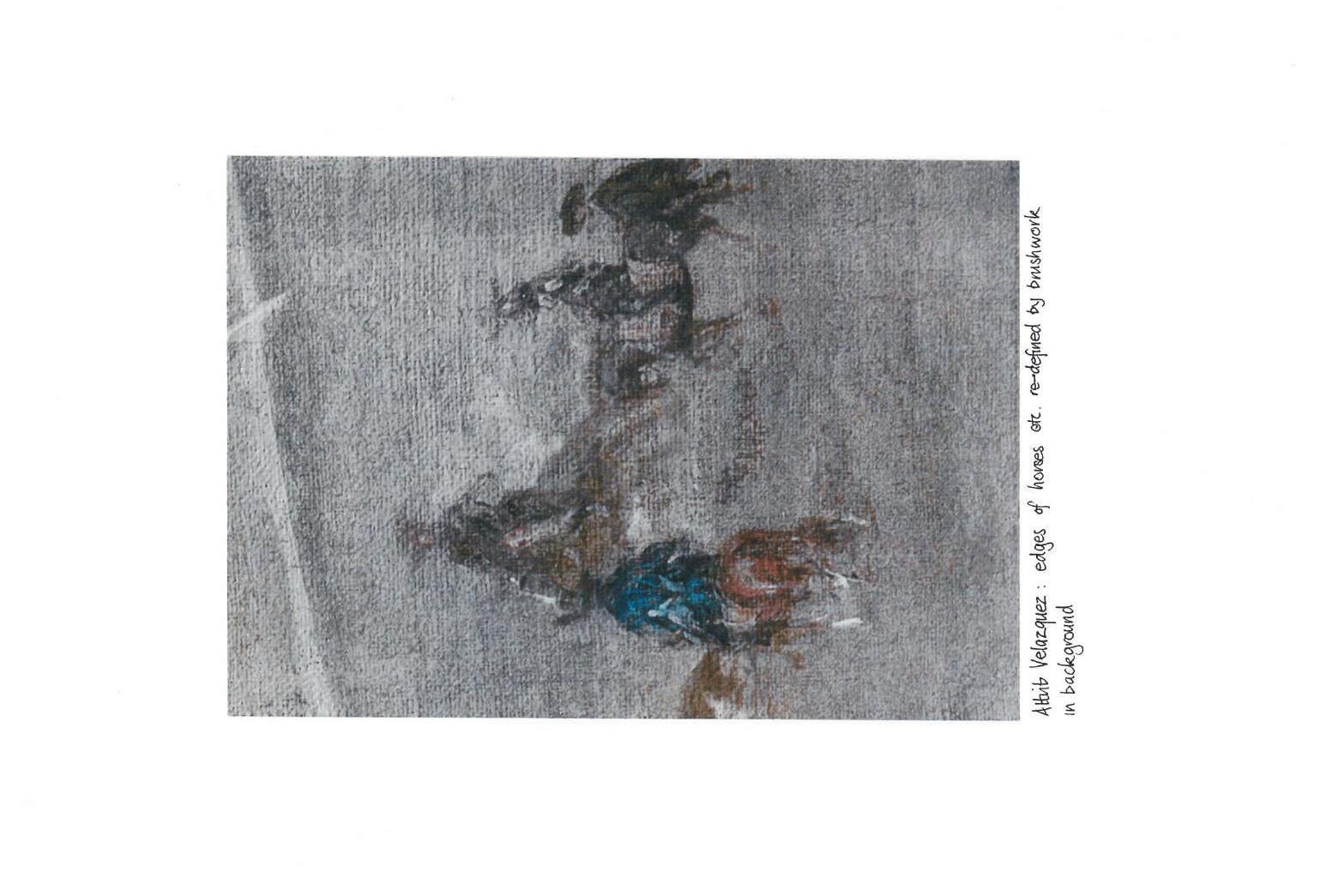
A notable feature of Velázquez’s handling of form is the way outlines are established: features are initially laid in, and their contours are then refned through brushwork applied in the surrounding areas. This technique is especially evident in the fgures chasing the boars within the Tela Real.
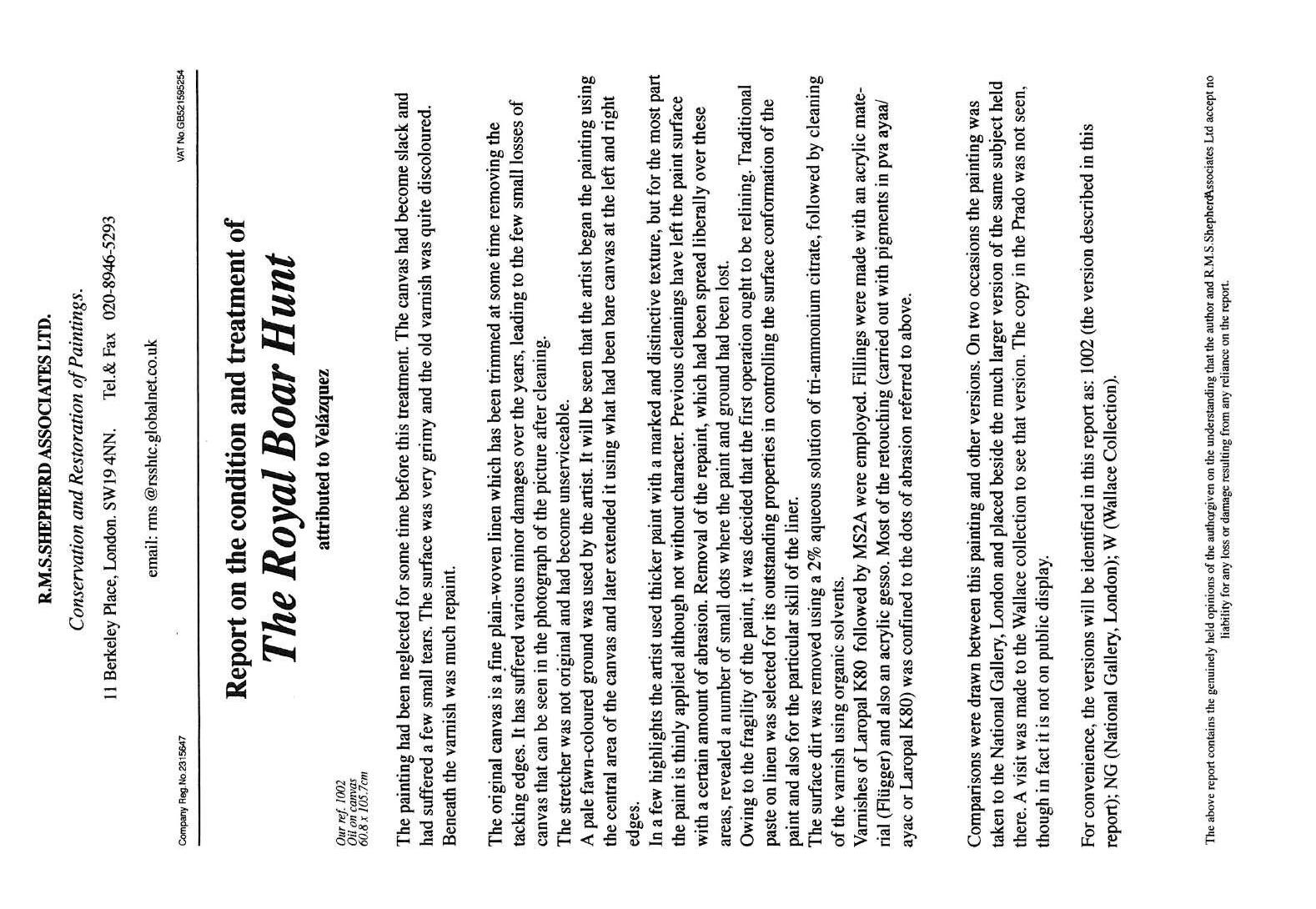
The analysis of our painting by R.M.S Shepherd Associates (see p. 90) confrms the use of pigments and techniques consistent with those described in Velázquez : The Technique of Genius by Jonathan Brown and Carmen Garrido.
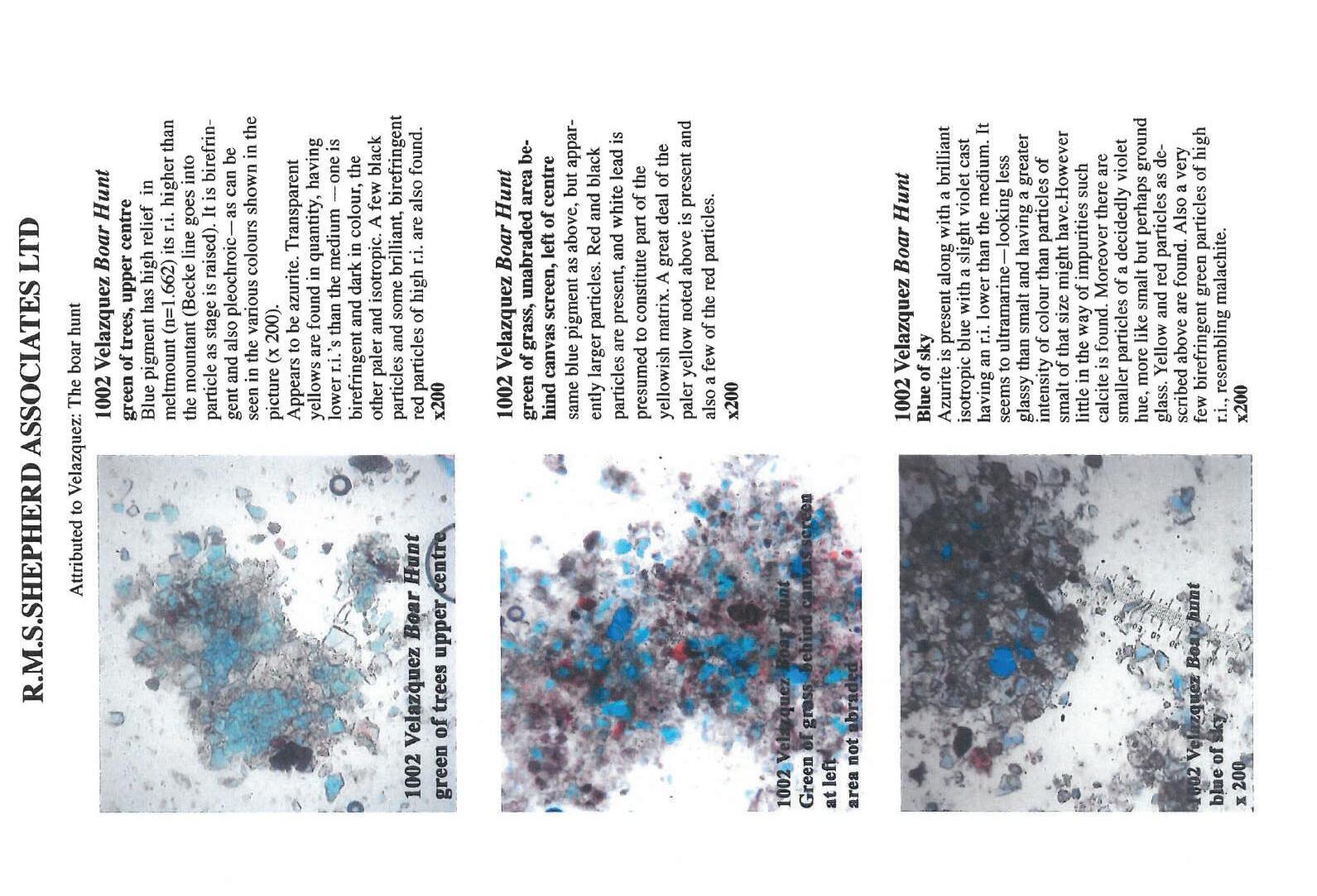
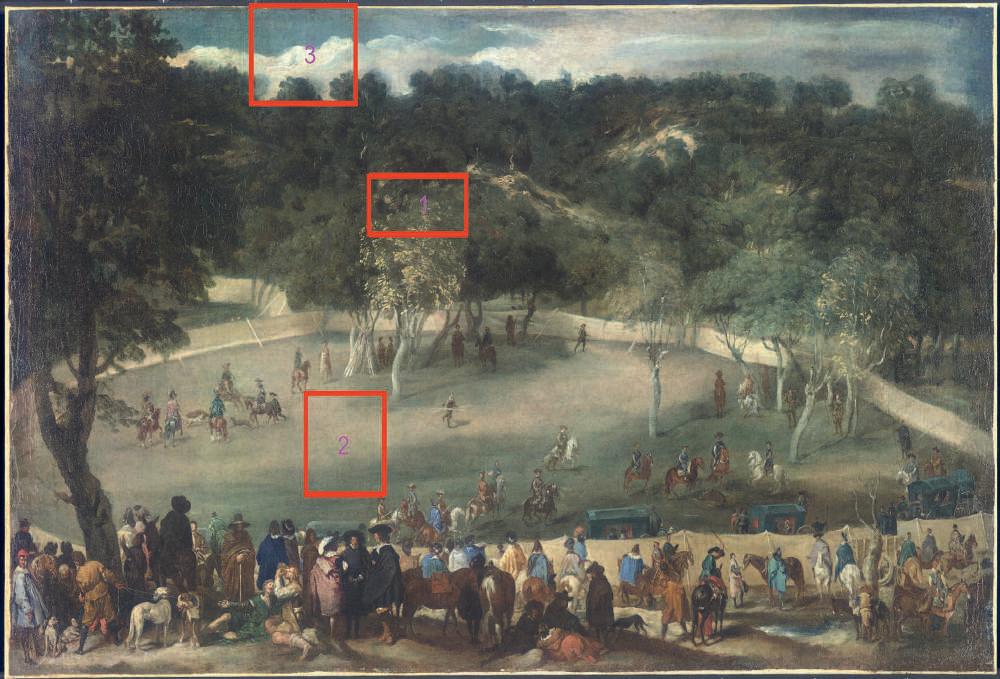
- Blues : The presence of azurite and a brilliant isotropic blue resembling ultramarine aligns with Velázquez’s known use of azurite, lapis lazuli, and smalt. The mention of smalt-like particles is also consistent with his technique after « The Forge of Vulcan ».
- Greens : The combination of azurite and yellow pigments to create green matches the description in Garrido’s analysis, which emphasizes Velázquez’s reliance on mixtures rather than pure green pigments. However, the presence of malachite is an interesting addition, as it is not explicitly mentioned in Garrido’s book but was historically used as a pigment.
- Reds : The bright birefringent red particles in the report correspond to vermilion and red iron oxide, which Velázquez commonly used. Garrido highlights his ability to achieve a wide tonal range with a limited palette, which is evident in the reported fndings.
- Blacks : The report mentions organic black particles, which matches Garrido’s identifcation of charcoalbased or bone-black pigments used by Velázquez.
- Whites and Yellows : The lead white base and transparent yellow pigments align with Velázquez’s typical practice. Garrido notes that he frequently adjusted the lead white ground to enhance luminosity, a technique that seems evident in this painting.
Most remarkably, the central landscape was painted frst and later extended by approximately 1.5 cm on each side onto unprimed fabric. This extensions create a distinct texture and color variation in these areas. The fgures were added afterward, covering the full extended width of the composition. The paint extending the edges employs a different color also visible under infrared.
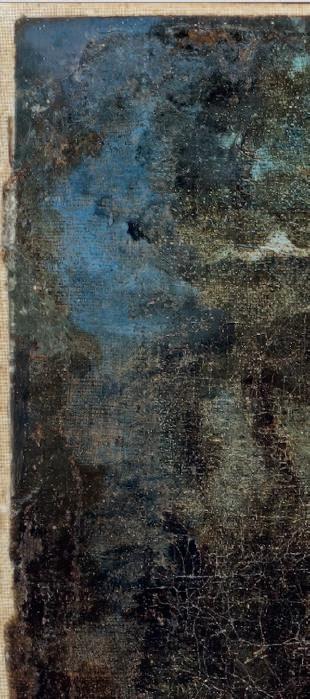
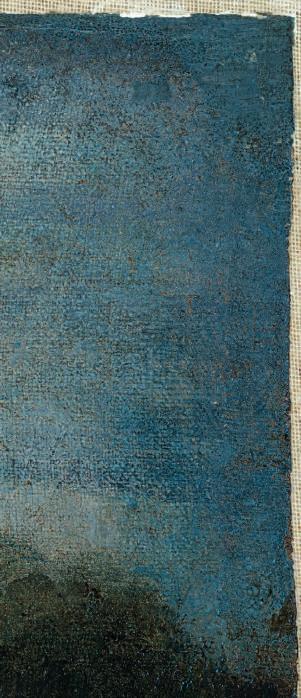
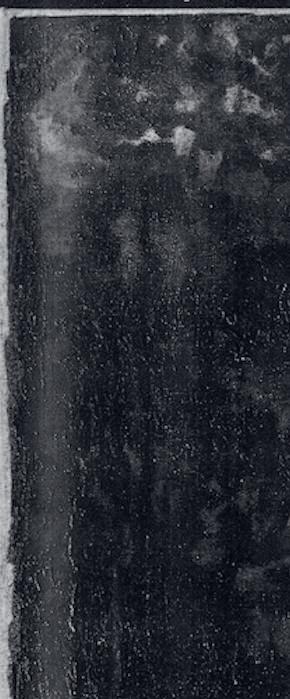
IR imaging.
The fgures were painted after the sky and the landscape.
Small preparatory strokes (fg. 74), visible to the naked eye, create slight incisions in the paint due to the almost dry, lightly loaded brush Velázquez used. These strokes outline the enclosure, which was painted frst, followed by the trees and fgures, revealing the layering process.
The painting technique is typical of Velázquez in the 1630s, featuring characteristic plays of transparency.
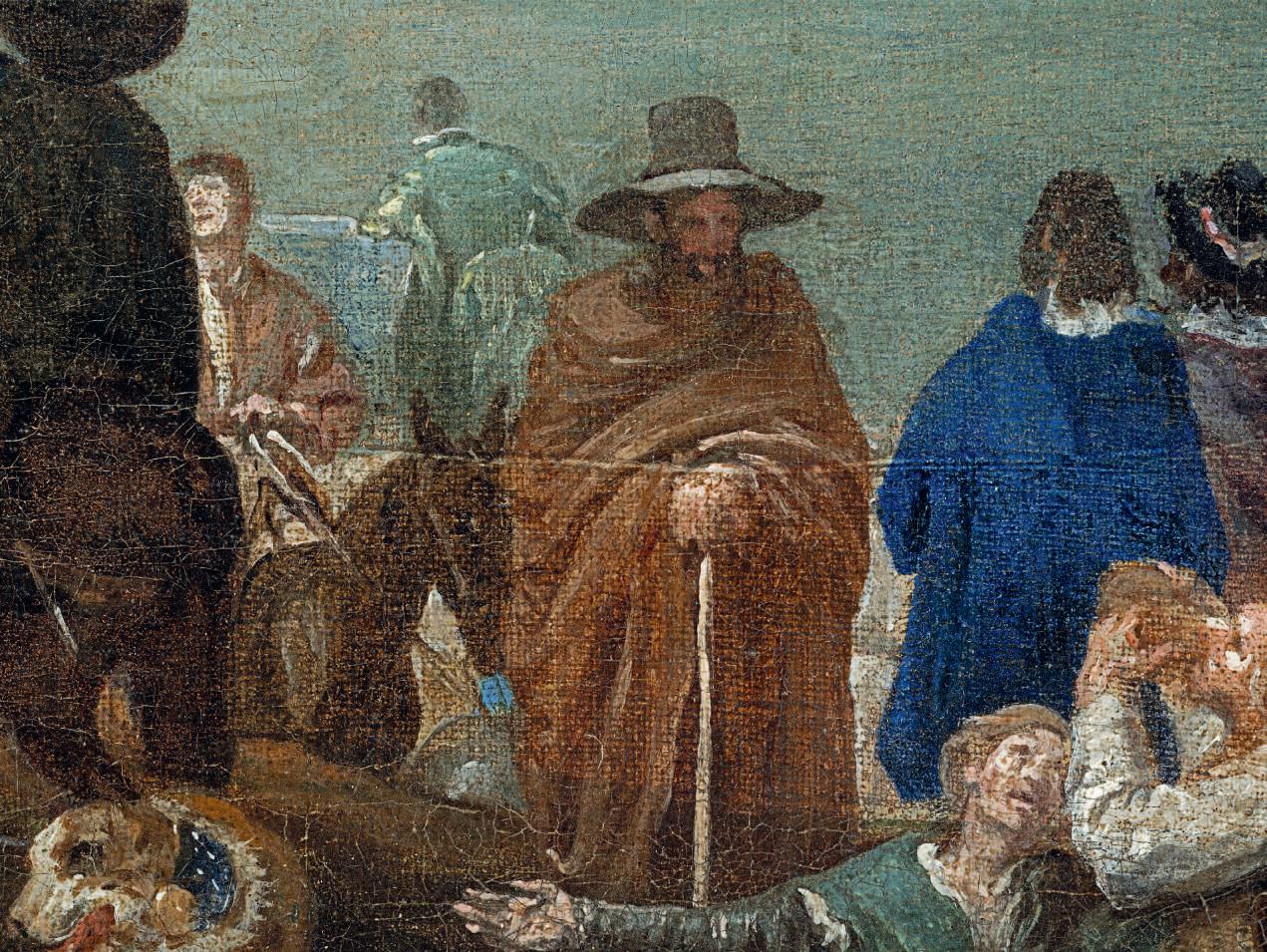
In our painting, the transparency of the fgures is particularly notable. Their forms seem to blend subtly with the background, emphasizing the delicate interplay of light and shadow characteristic of his technique.
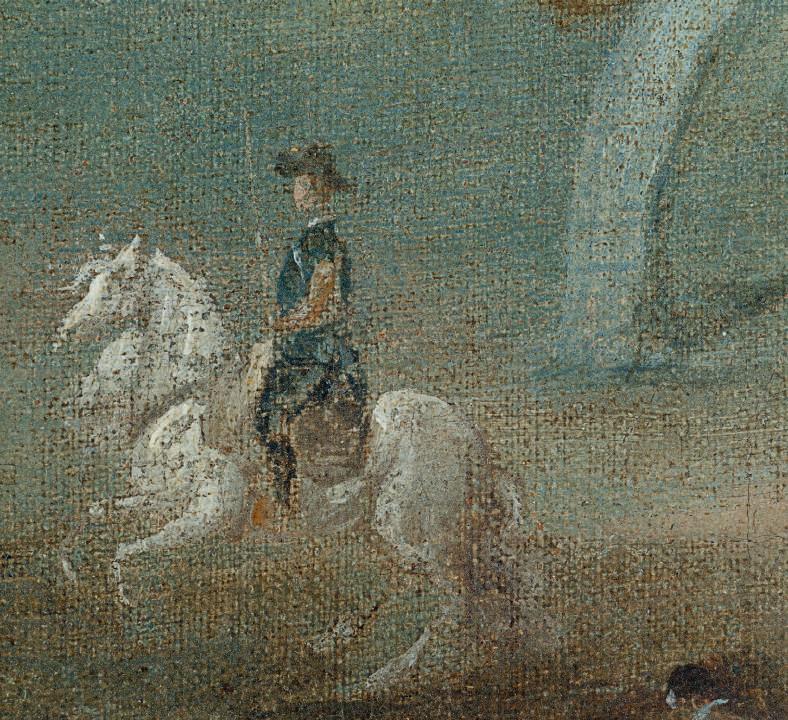
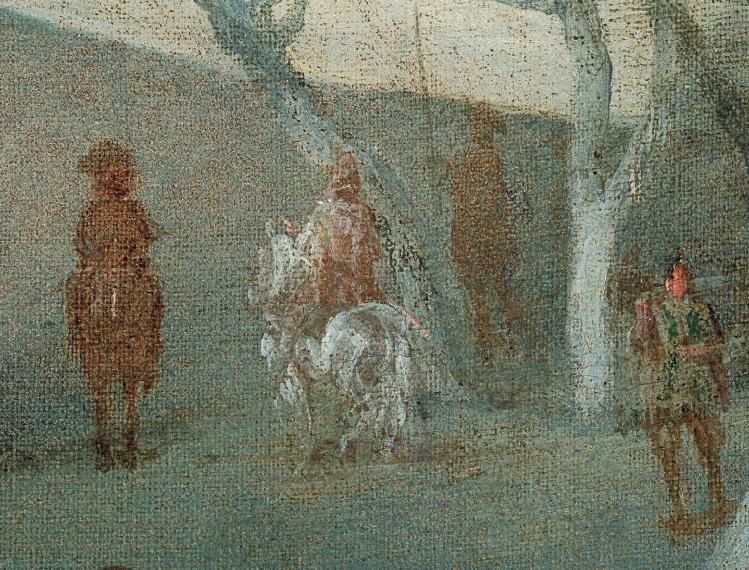
This effect is also present in other paintings as in « Prince Baltasar Carlos in the Riding School », where the fgures appear almost ethereal, revealing Velázquez’s mastery in using the ground and underpainting to create depth and atmosphere.
The landscape refects Velázquez’s evolving technique in the 1630s, balancing transparency, texture, and depth. The sky and distant landscape are painted with thin glazes, creating soft tonal transitions and atmospheric perspective, with blended brushwork and minimal impasto for a diffused light effect.
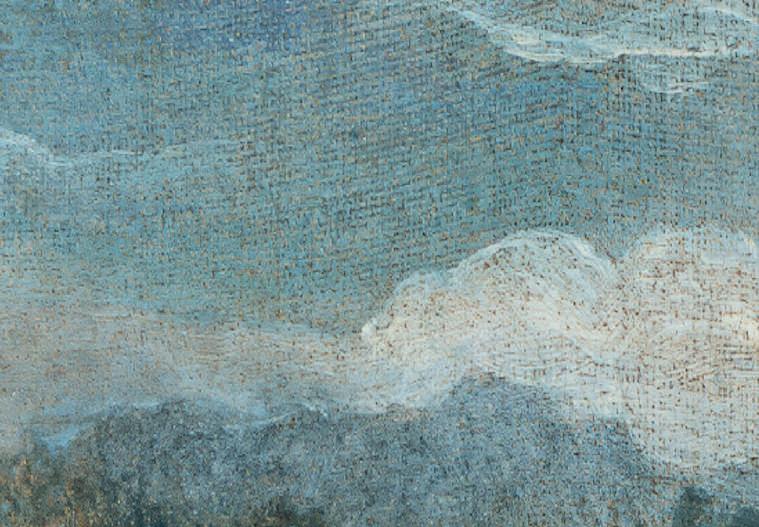
As in other works by Velázquez from this period, traces of heavily loaded brushstrokes can be seen in the sky, particularly in the clouds, to create a sense of movement.
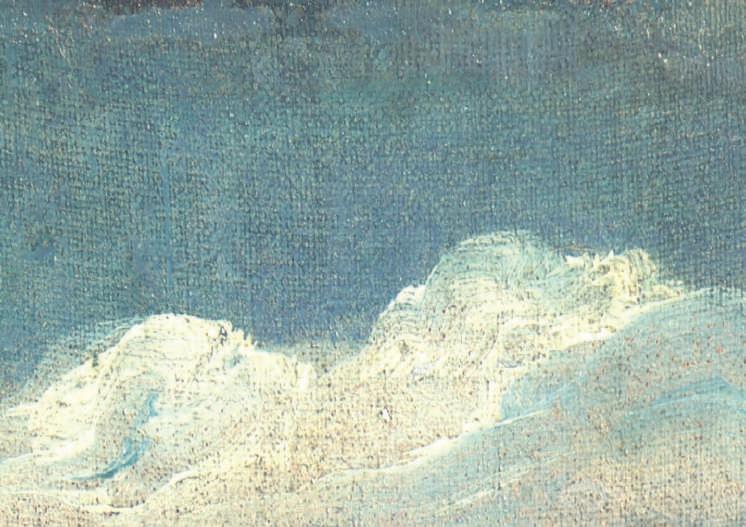
In contrast, the trees and foliage are more textured, with dry brushwork on branches and trunks, using a lightly loaded brush to defne forms while preserving underlying layers.
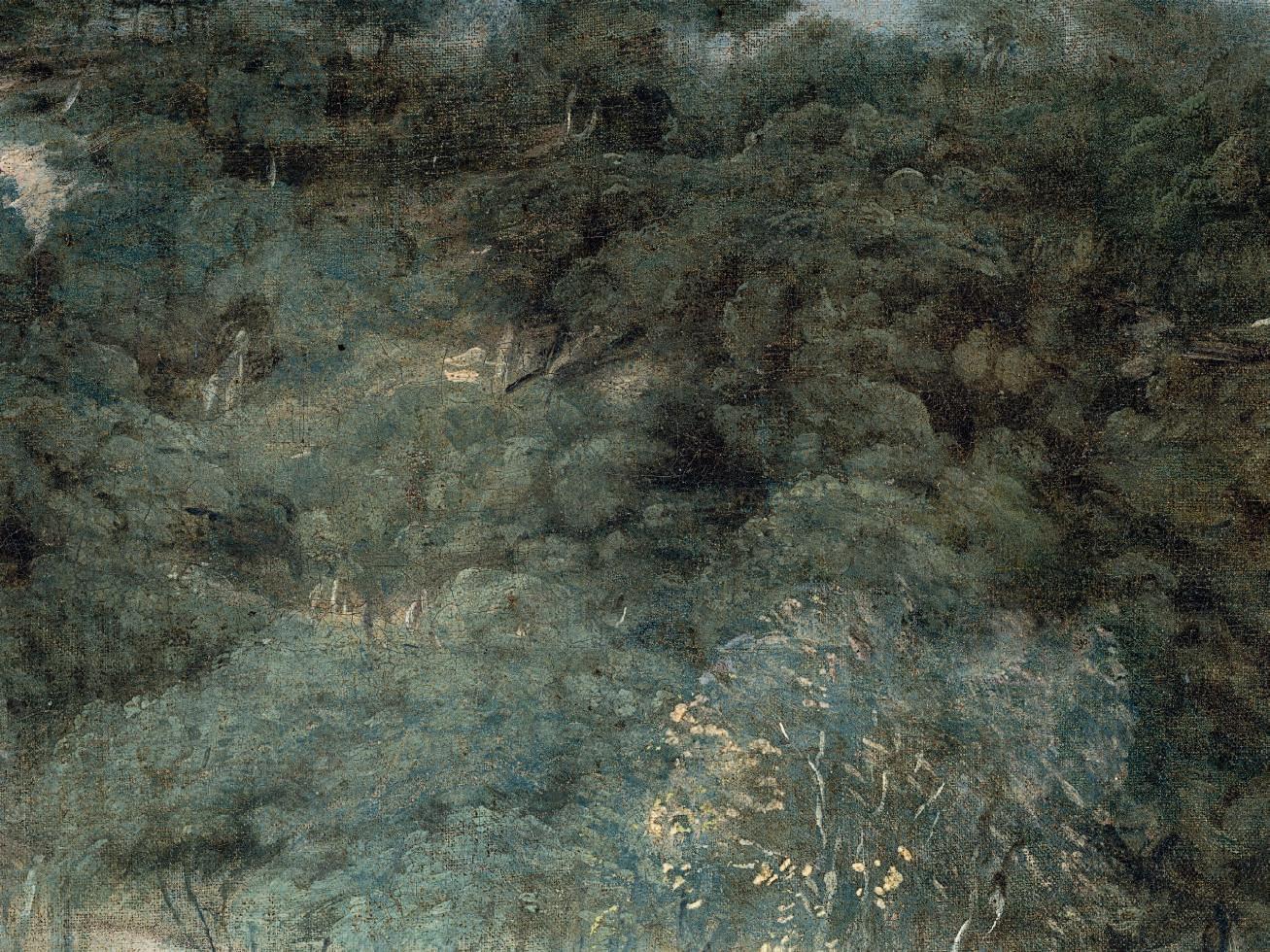
Quick, broken strokes and thicker highlights capture the fickering sunlight on leaves and give an impressionistic effect.
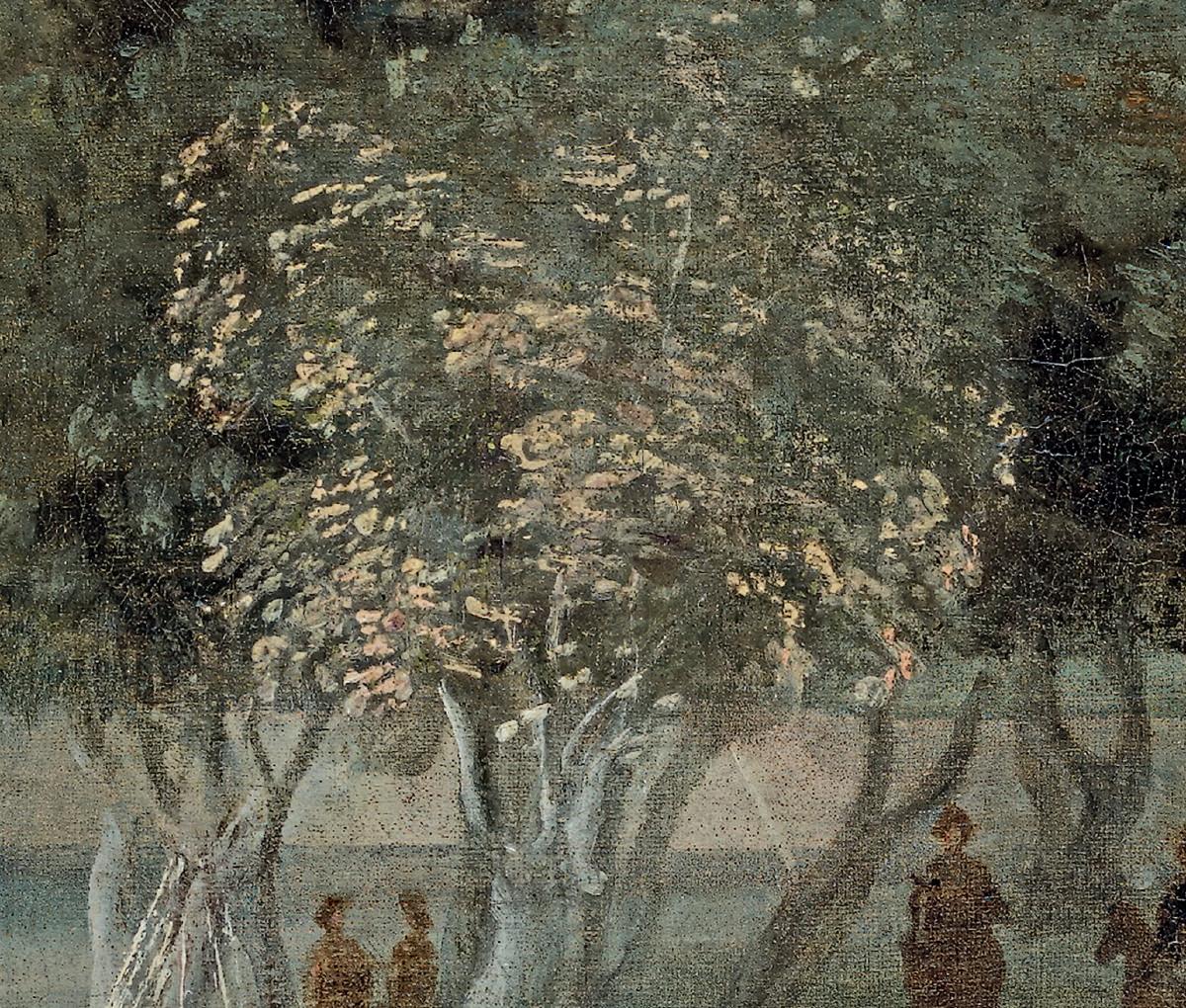
In certain areas, the artist builds up the highlights with a swift application of paint, creating texture and depth in the brushstrokes.
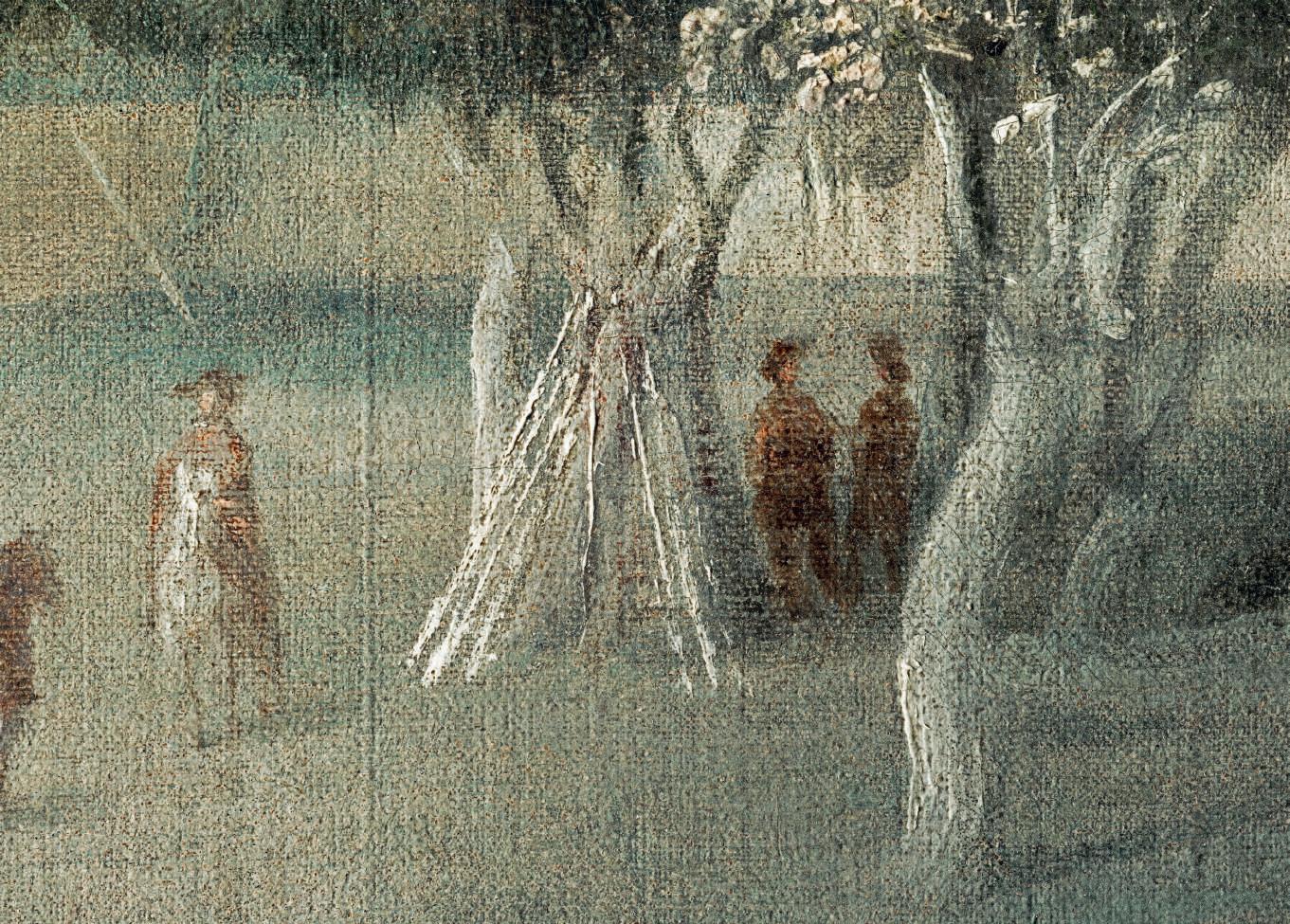
In our painting, the main pentimenti are visible in the following areas
Originally, the large tree on the left had a narrower and more contorted trunk, which was later simplifed and thickened. This suggests that the artist changed his mind about the tree’s form as he worked.
A climbing man holding a fowing red cloth is painted in the National Gallery version. A sketch of him is also painted in our version, at the center of the tree but in a very different position (refer to p. 41, 42, fgs. 37 - 40).
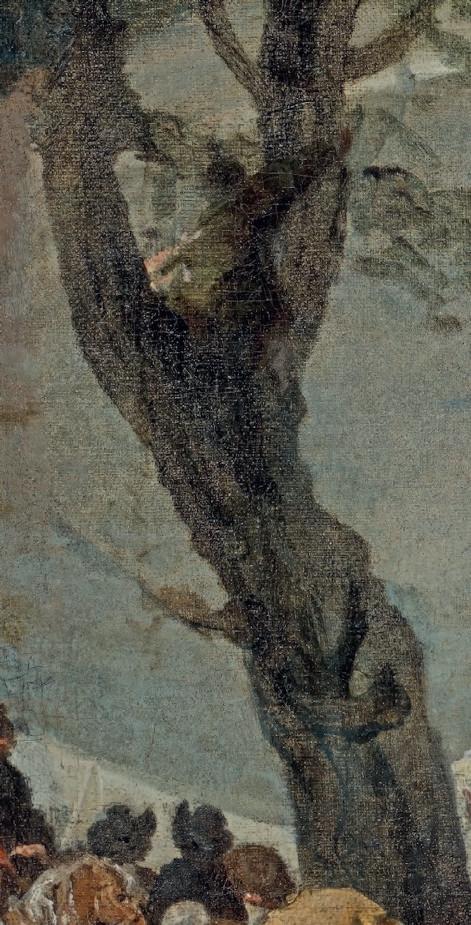
Fig. 82 : Pentimento of the tree trunk in the preparatory study visible to the naked eye.
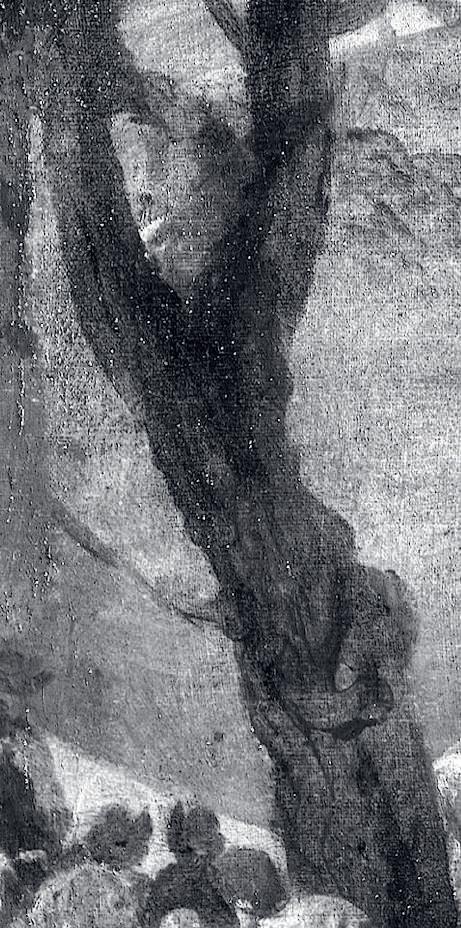
Fig. 83 : Pentimento of the tree trunk in the preparatory study visible under infrared imaging .
The features were initially laid in and later refned by adjusting the contours through brushwork in the surrounding areas. This likely means that some fgures were repositioned or adjusted during the painting process. Some of these adjustments are visible to the naked eye and also under infrared imaging.
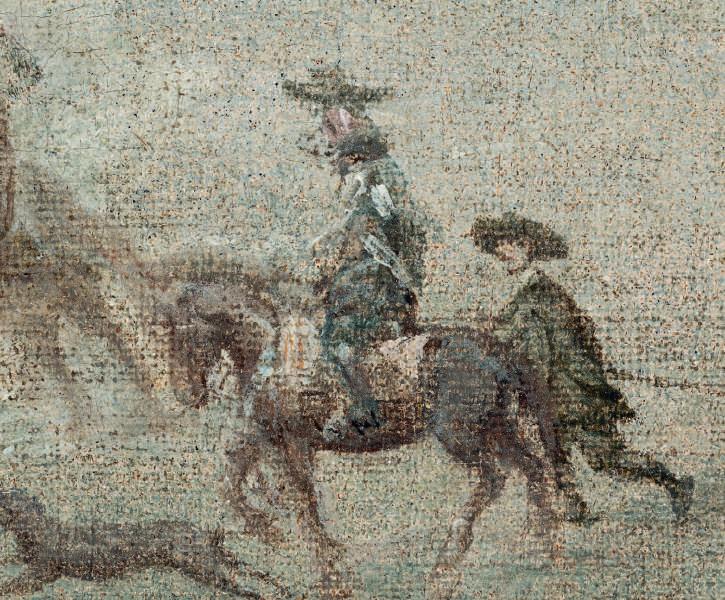
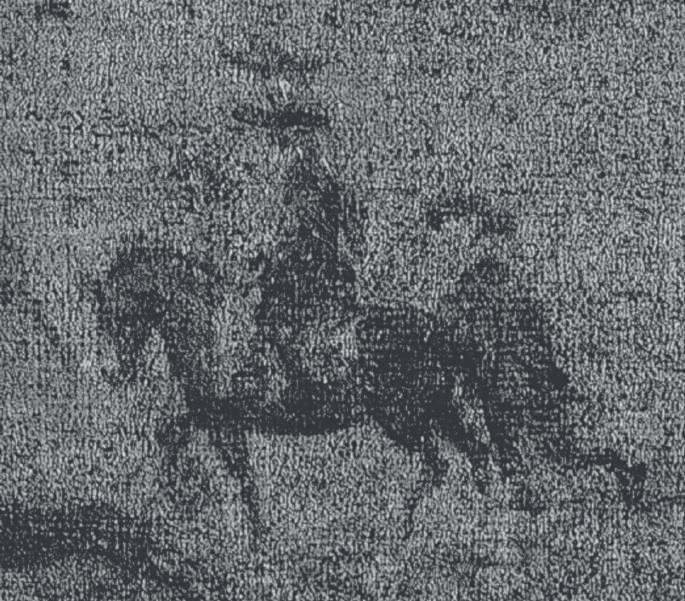
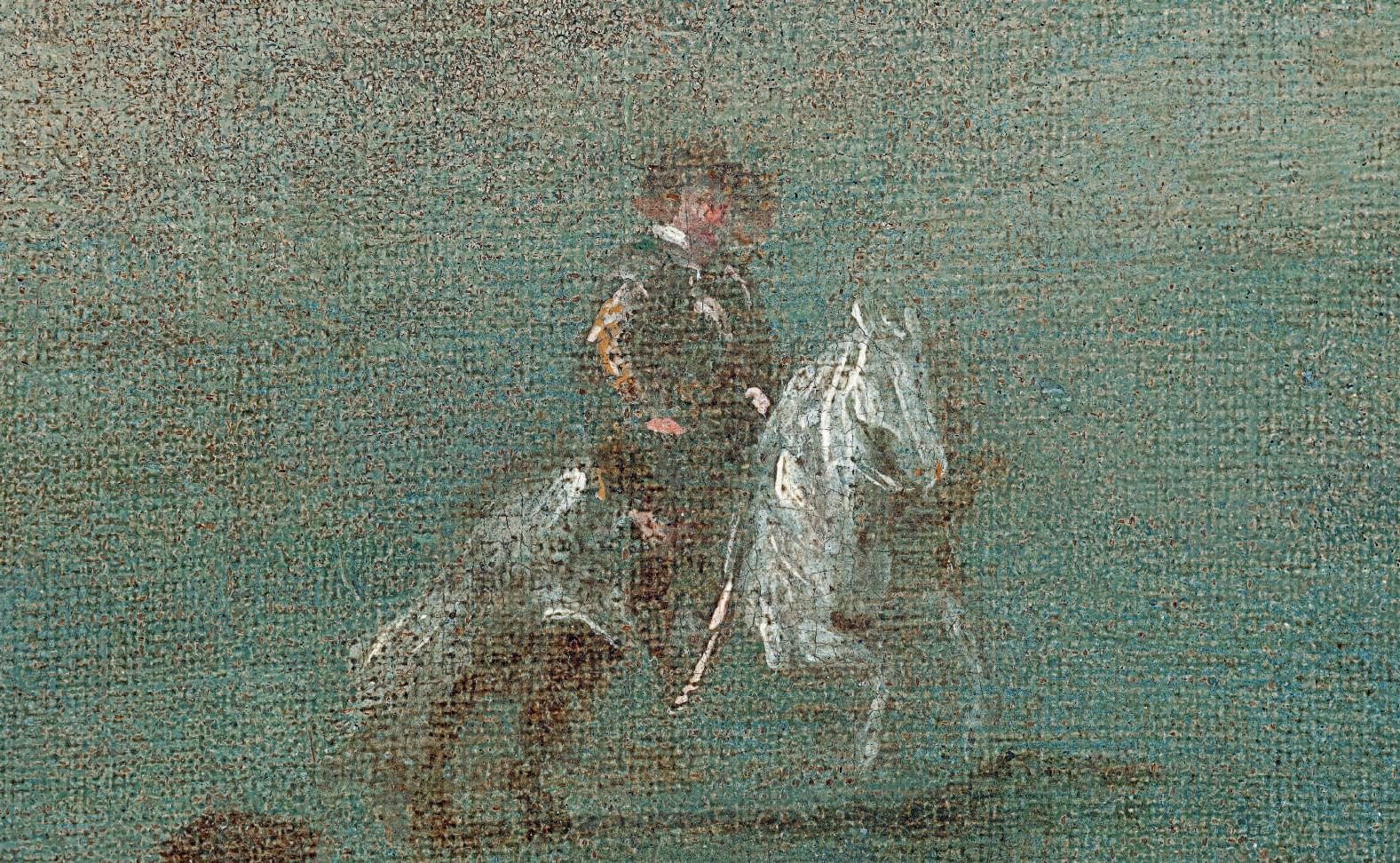
A signifcant pentimento is visible in the left corner of the painting. Initially, the man in black was taller and wider (refer to p. 15).
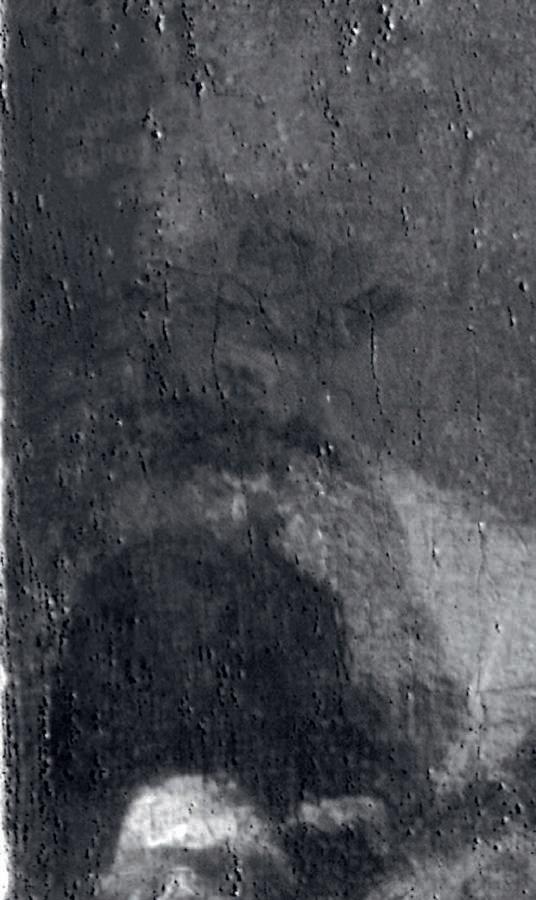
infrared imaging.
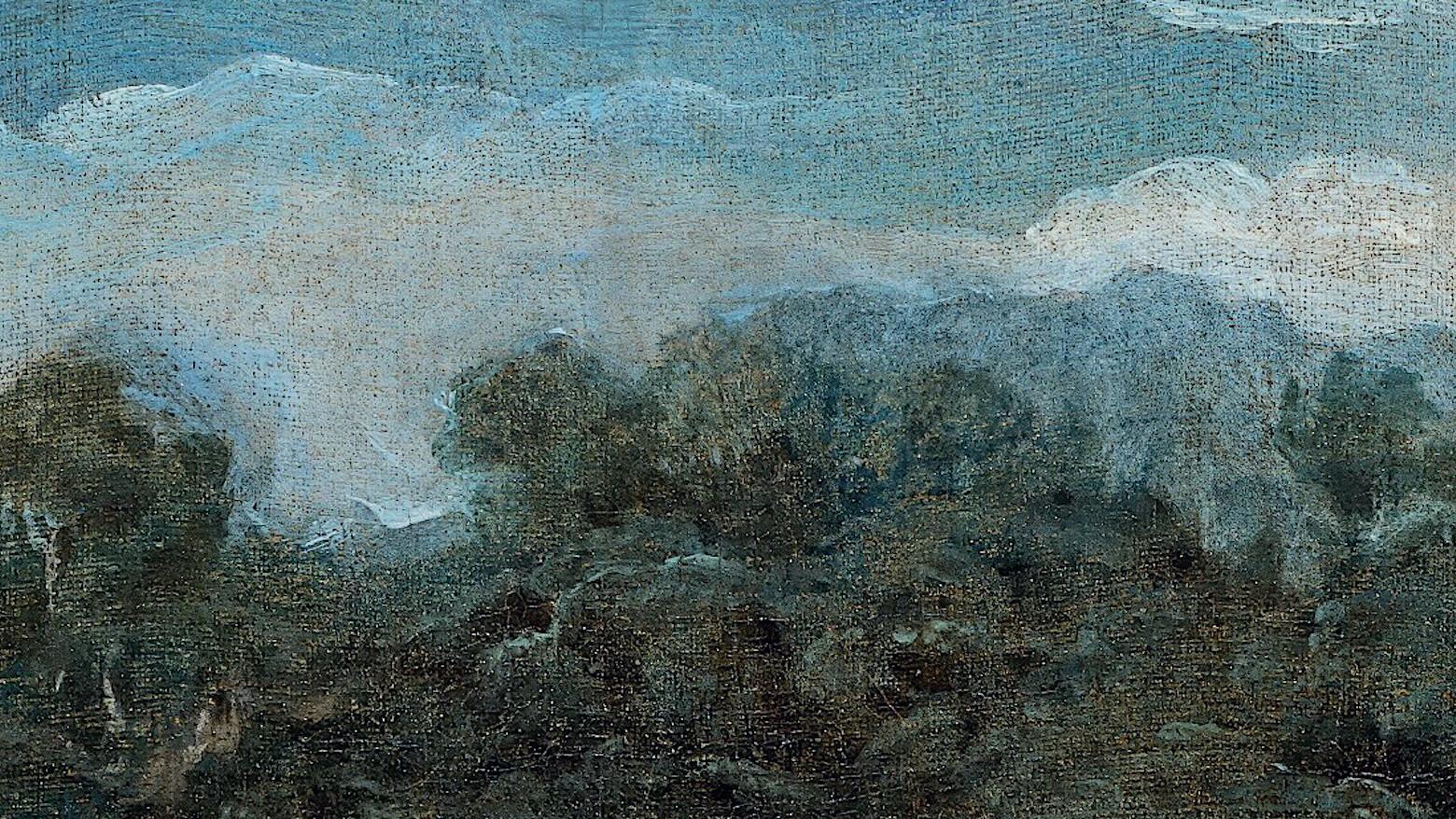
Pentimenti in the sky, visible within the foliage and at the tops of the trees showing that the sky with its clouds was painted before the landscape.
Velázquez generally did not produce preparatory drawings, a characteristic that can also be observed in our painting.
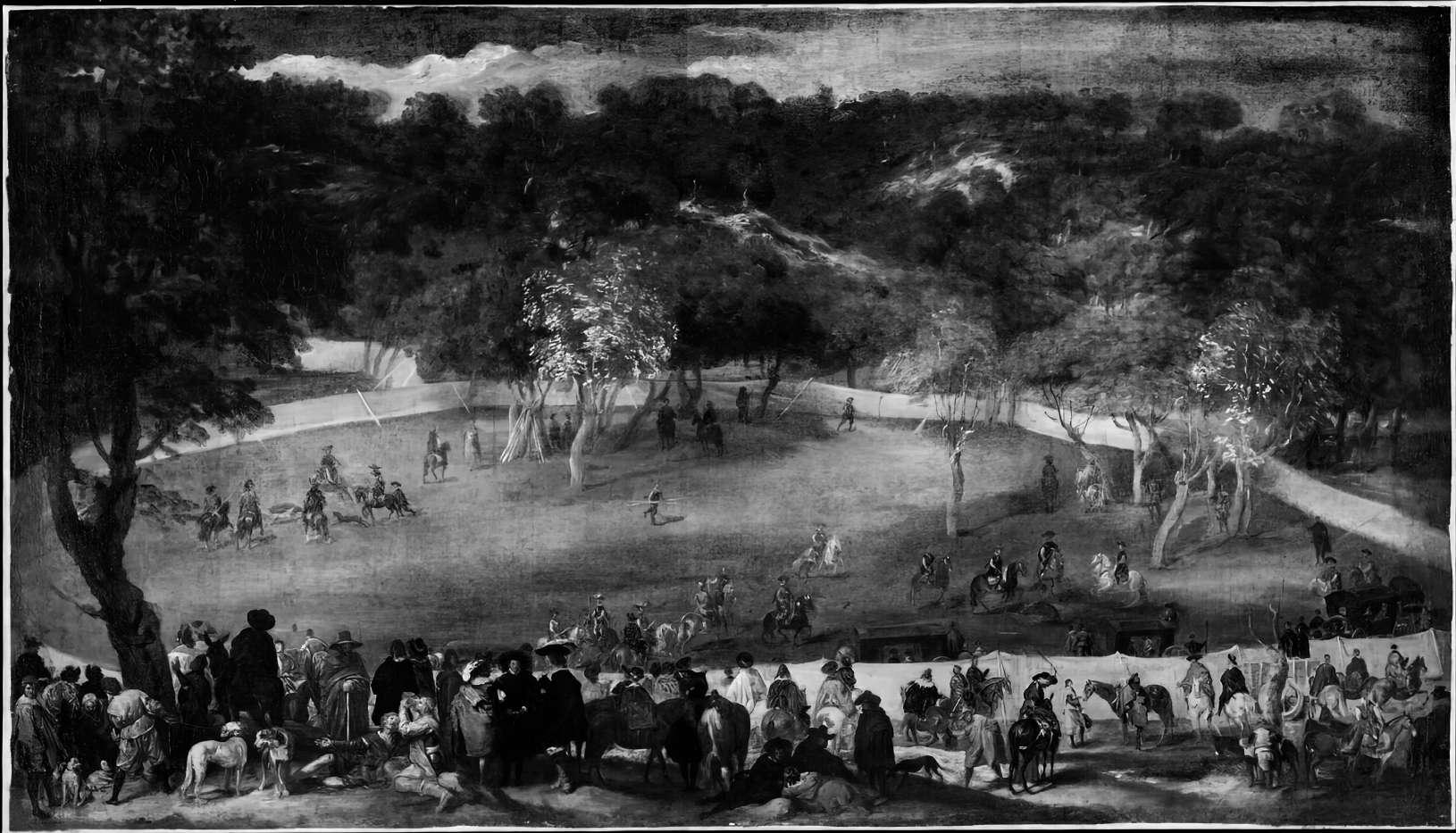
Infrared imaging highlights certain contours of the fgures, the horses, and the trees. These lines suggest that Velázquez made adjustments during execution, which aligns with his known technique.
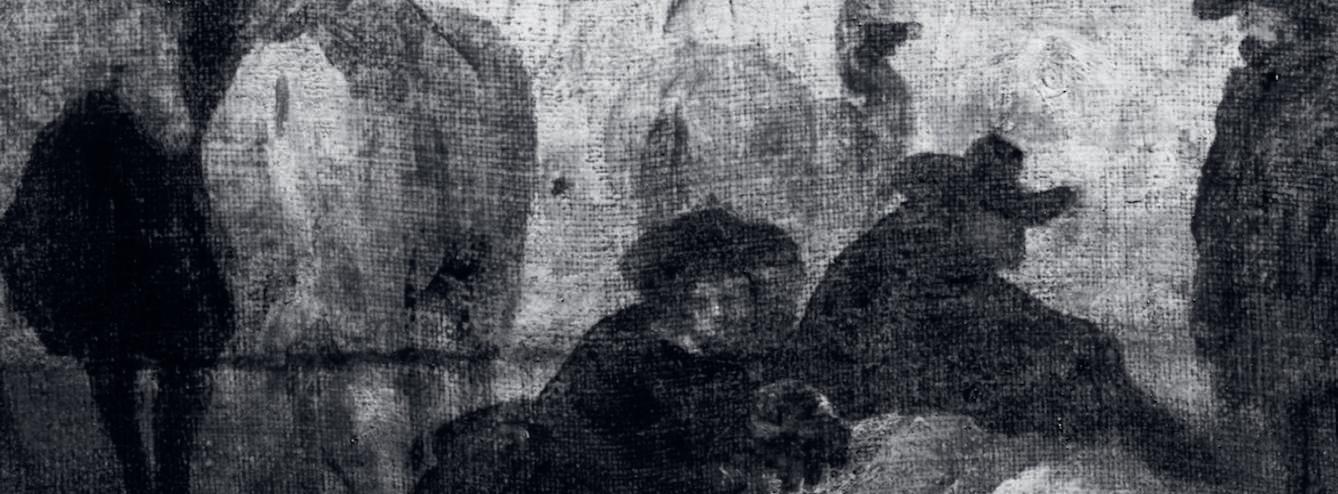
Fig. 91 : Infrared - The painter lightly sketched certain characters particulary those at the bottom of the composition and highlights certain contours.
IR analysis reveals also that the white circular enclosure (Tela Real) remains continuous beneath the paint. Some preparatory pencil lines also appear to be incised into the surface. The fgures and trees were painted afterward, partially covering the enclosure. This indicates that the enclosure was created frst, with the trees and fgures added later, demonstrating the layering process.
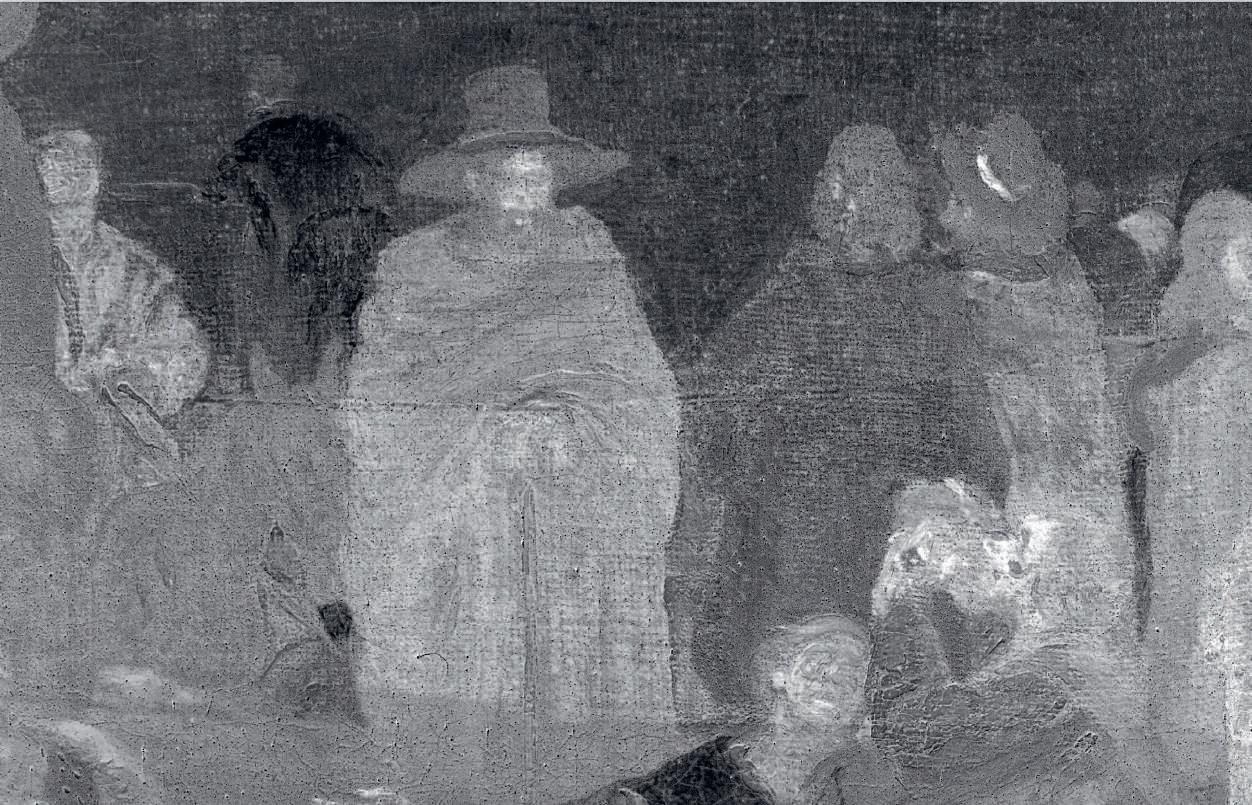
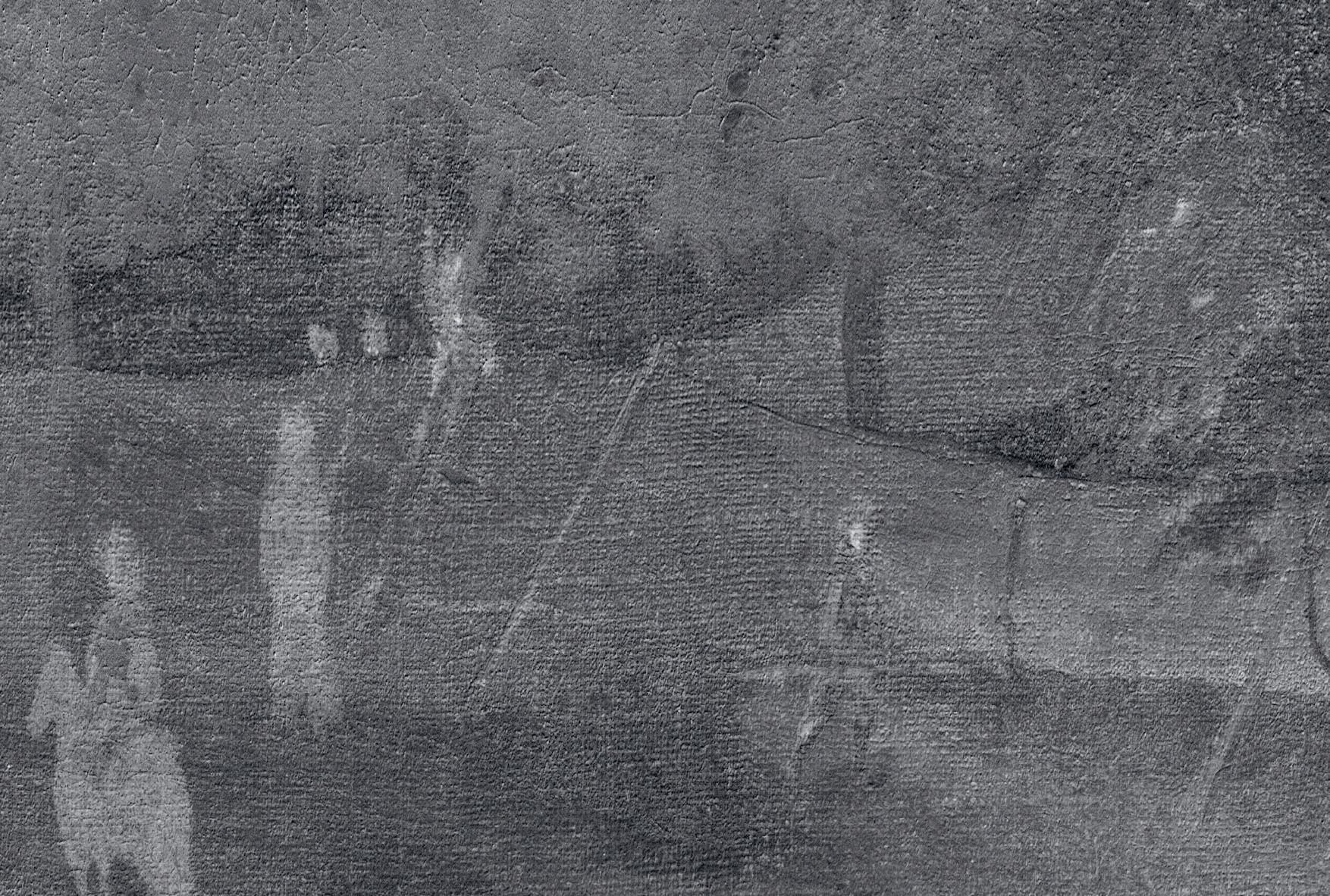
It is fascinating to observe how the painter works with the still-wet paint to create light effects rather than adding them. This technique, particularly visible in the trees, allows him to quickly capture the feeting light of the moment. This method highlights his intent to maximize the impressionist effects he wished to refne in the fnal composition.
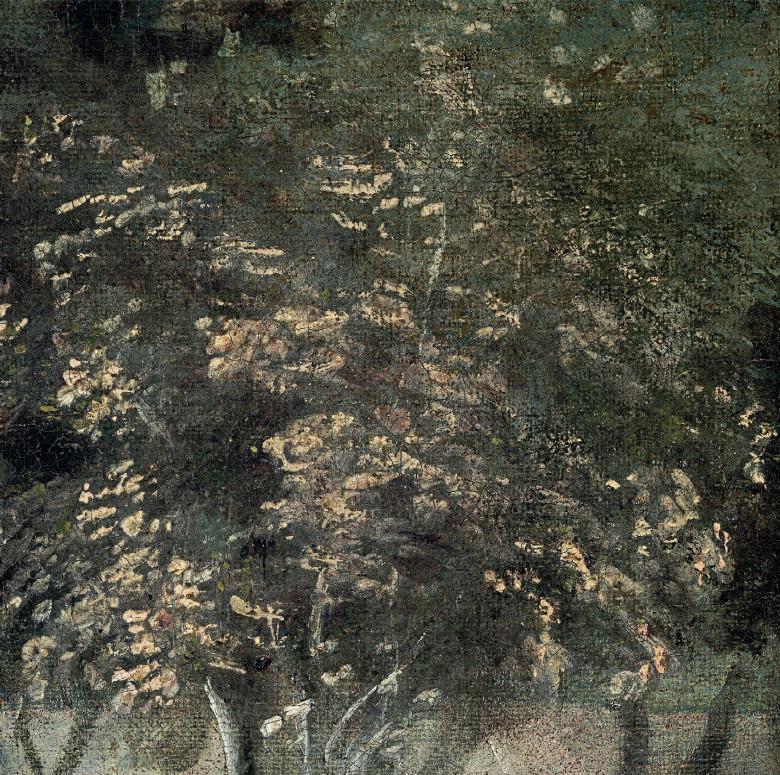
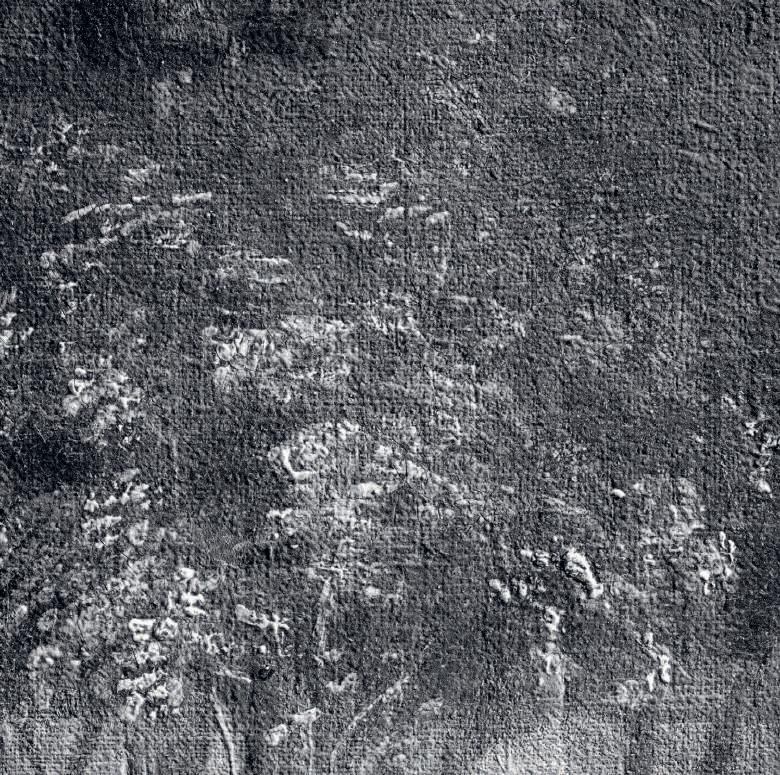
The canvas weave is clearly visible, confrming the use of a linen or hemp support, as described in Velázquez: The Technique of Genius by Carmen Garido and Jonathan Brown. The stitched edges confrm that the canvas was either extended or additional fabric was added, a common practice for Velázquez when enlarging his compositions.
After his frst trip to Italy in 1630, Velázquez adopted a lead white ground. This even, light-colored ground became characteristic of his technique, as he used lead white mixed with earth pigments to prepare his canvases.
This type of ground not only enhanced the luminosity of colors in his paintings but also played an active role in the composition, sometimes defning contours or highlights.
Xray imaging reveals large brushstrokes from the initial preparation of the canvas, offering also further insight into his working process. Some areas exhibit a higher density of lead white, which may have contributed to variations in brightness and texture, reinforcing the depth and tonal subtlety that defne his mature works.
Velázquez makes use of the pre-painted background of the «Tela Real», refraining from applying pigments to depict certain fgures. For instance, the body of the horseman (fg. 98) on the right is defned by pictorial absence, with its coloring emerging directly from the light-toned background.
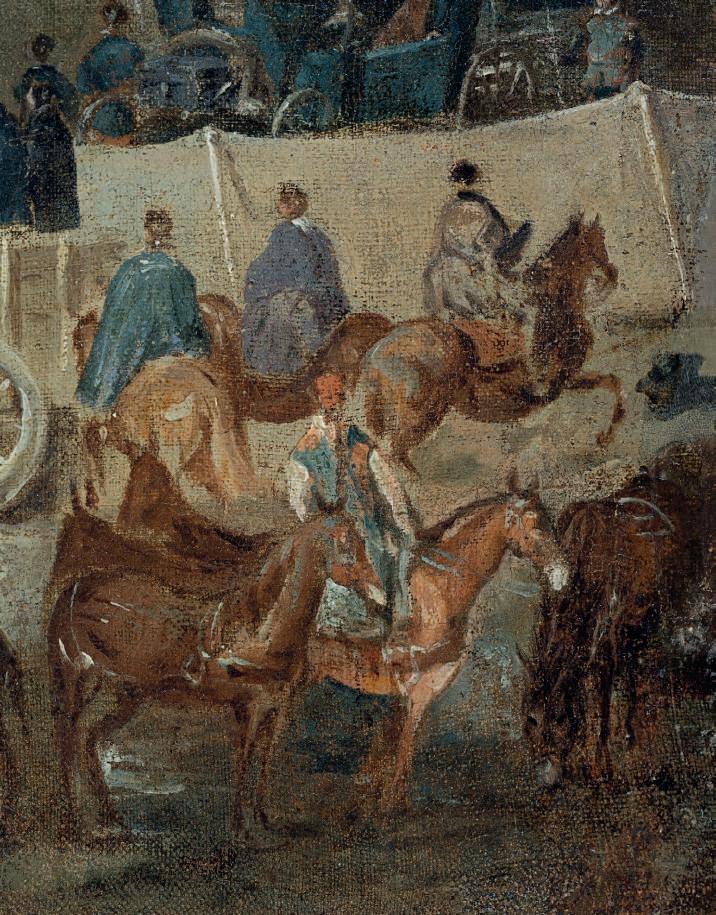
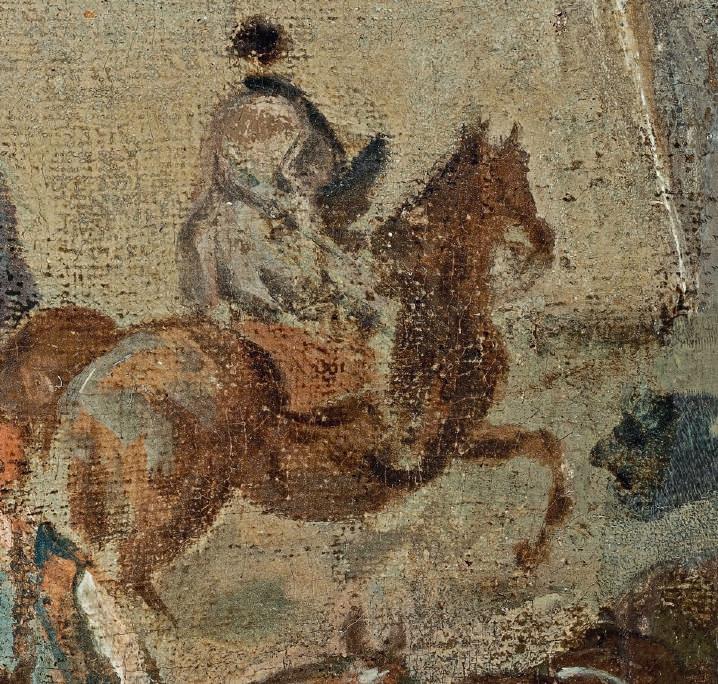
Figs 97, 98 : Velázquez makes use of the pre-painted background of the « Tela Real », refraining from applying pigments to depict the horseman.
X-ray imaging reveals little of the fgures due to the high lead white content, making the upper paint layers almost invisible. In our painting, we can see the usual broad brushstrokes from the initial preparation.
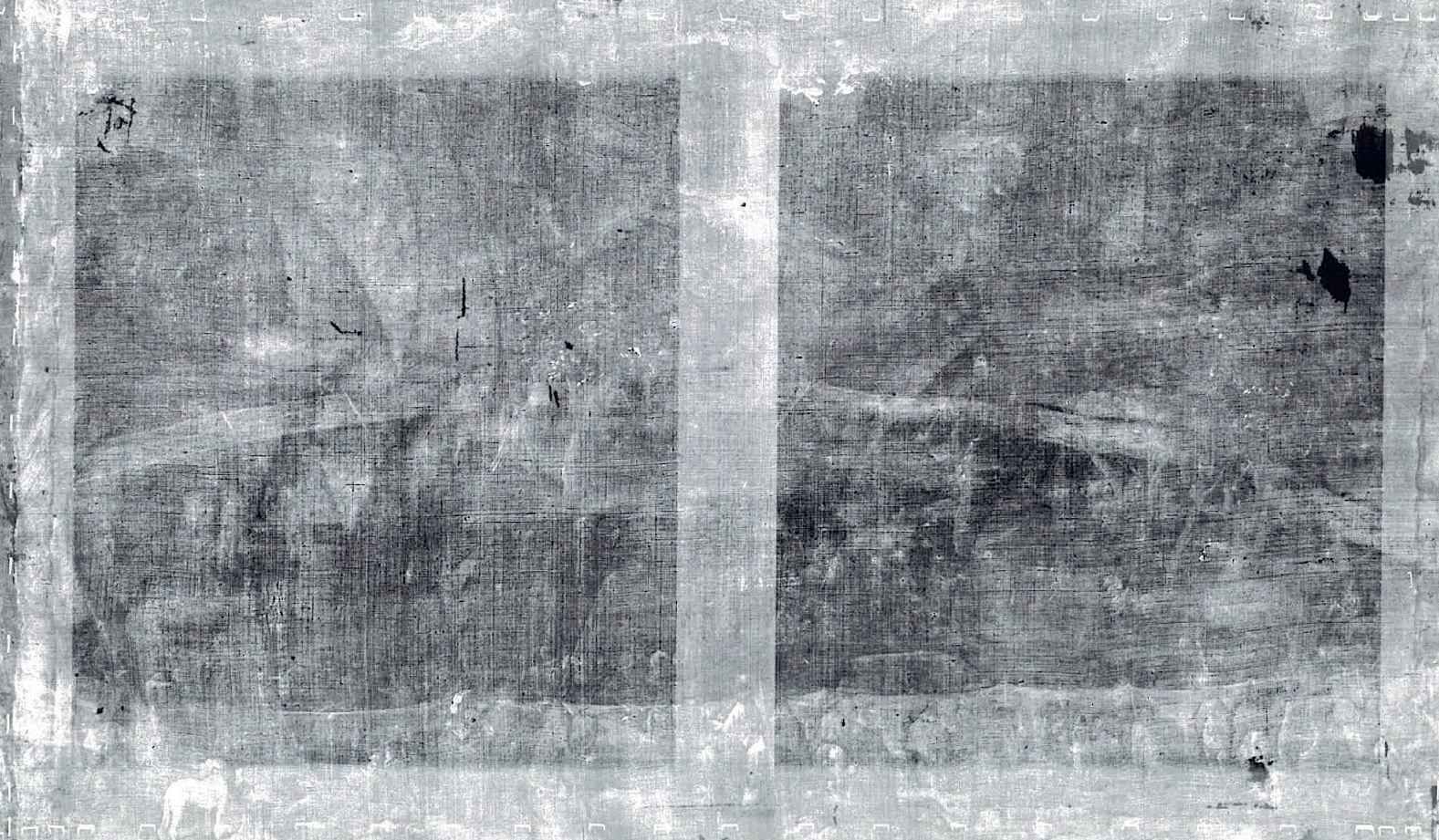
Fig. 99 : X-ray image of our painting revealing high lead white content and the usual broad brushstrokes characteristic of Velázquez’s initial preparation.
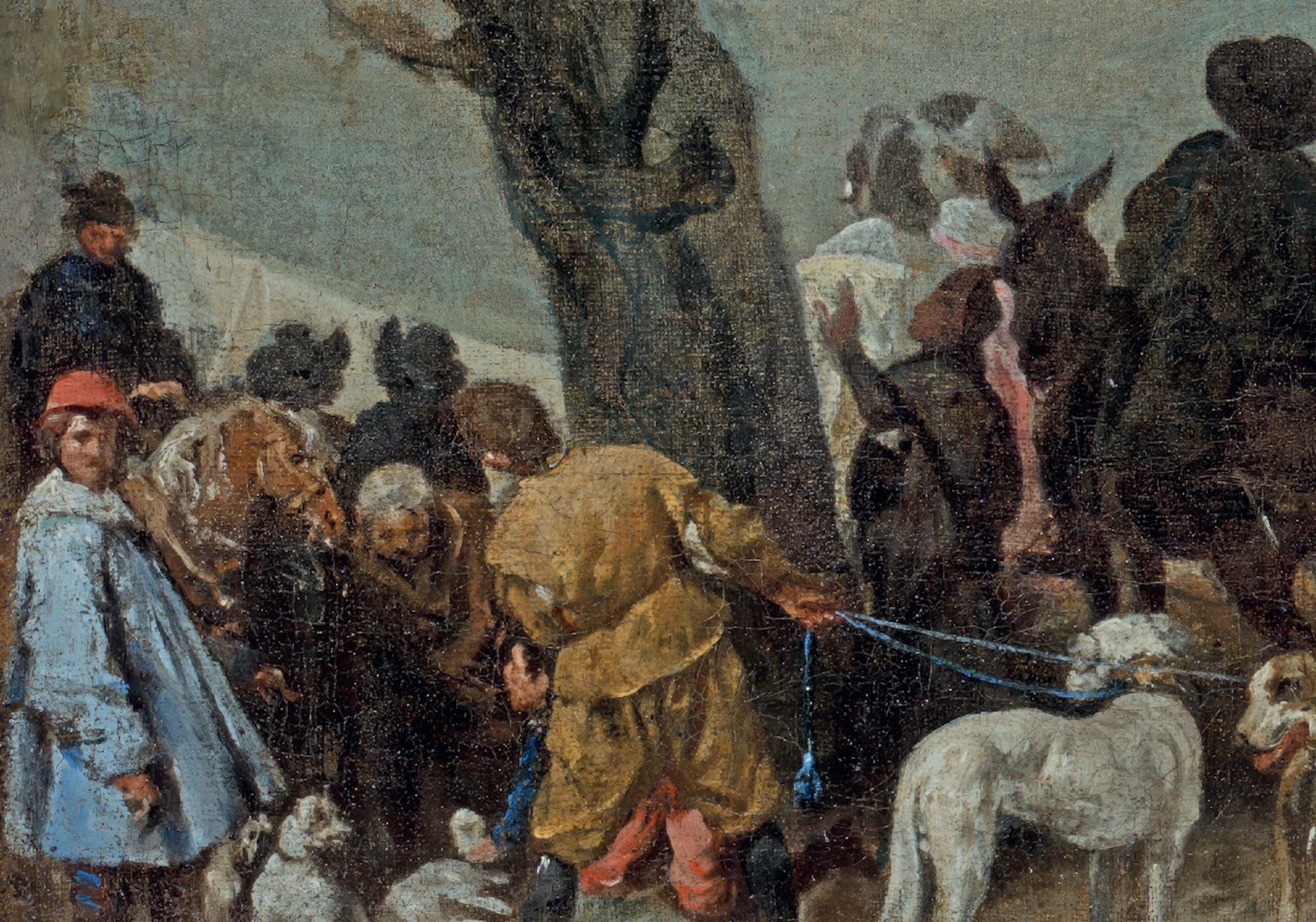
In the Spanish Royal inventories from 1700 to 1772, two paintings of boar hunt are described as originals by Velázquez - one is at the National Gallery in London, and the other possibly ours.
A study from the celebrated Boar Hunt was in the Sir George Hayter sale, London, 3 may 1845, lot 5 bought by Wedgwood1.
This fle supports the attribution of our painting as the preparatory study for « La Tela Real » in the National Gallery. Until now, it was presumed that Velázquez did not produce complete preparatory studies for his most important paintings, simply because none had been found.
However, as established at the beginning of this essay, such studies did historically exist with certainty. Art historians will have to investigate this reality, which is supported by our fle even if it challenges some long standing ideas. It is still to be hoped that other preparatory studies will resurface, particularly the two listed in his posthumous inventory of 1660 (refer to p. 9).
In our painting, everything is consistent with the work of Velázquez from the mid - 1630s.
The composition, which differs from the one in the National Gallery, along with the pictorial quality, the pentimenti, and the creative process, starting with the sky, then the landscape, and fnally the fgures, all suggest that this is an original work.
Moreover, everything revealed by the scientifc analysis is consistent with a work by Velázquez from the mid - 1630s, as well as with his known pratice of enlarging his canvases during execution when the composition required it.
" National Gallery Catalogues: #e Spanish School. London : 1988, pp. 105, 108.
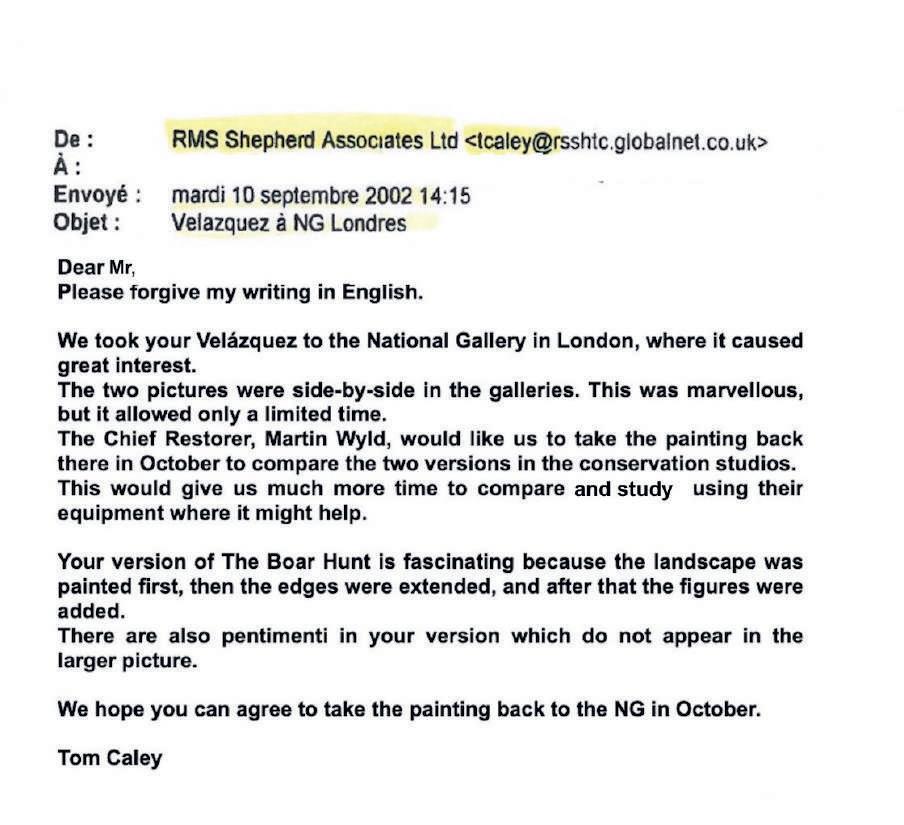
Unfortunately, it was not possible for our painting to be sent to the National Gallery in October 2002.
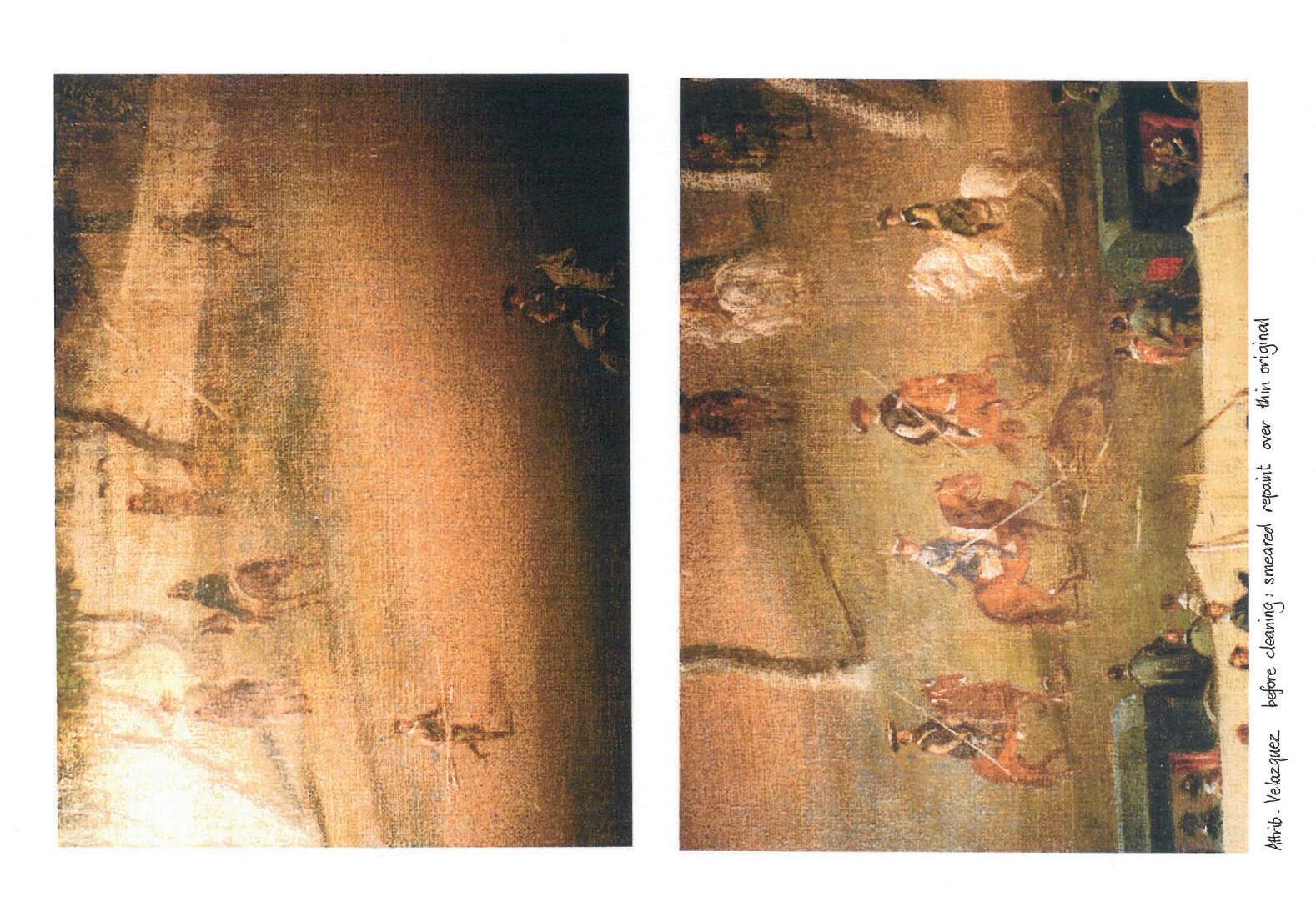
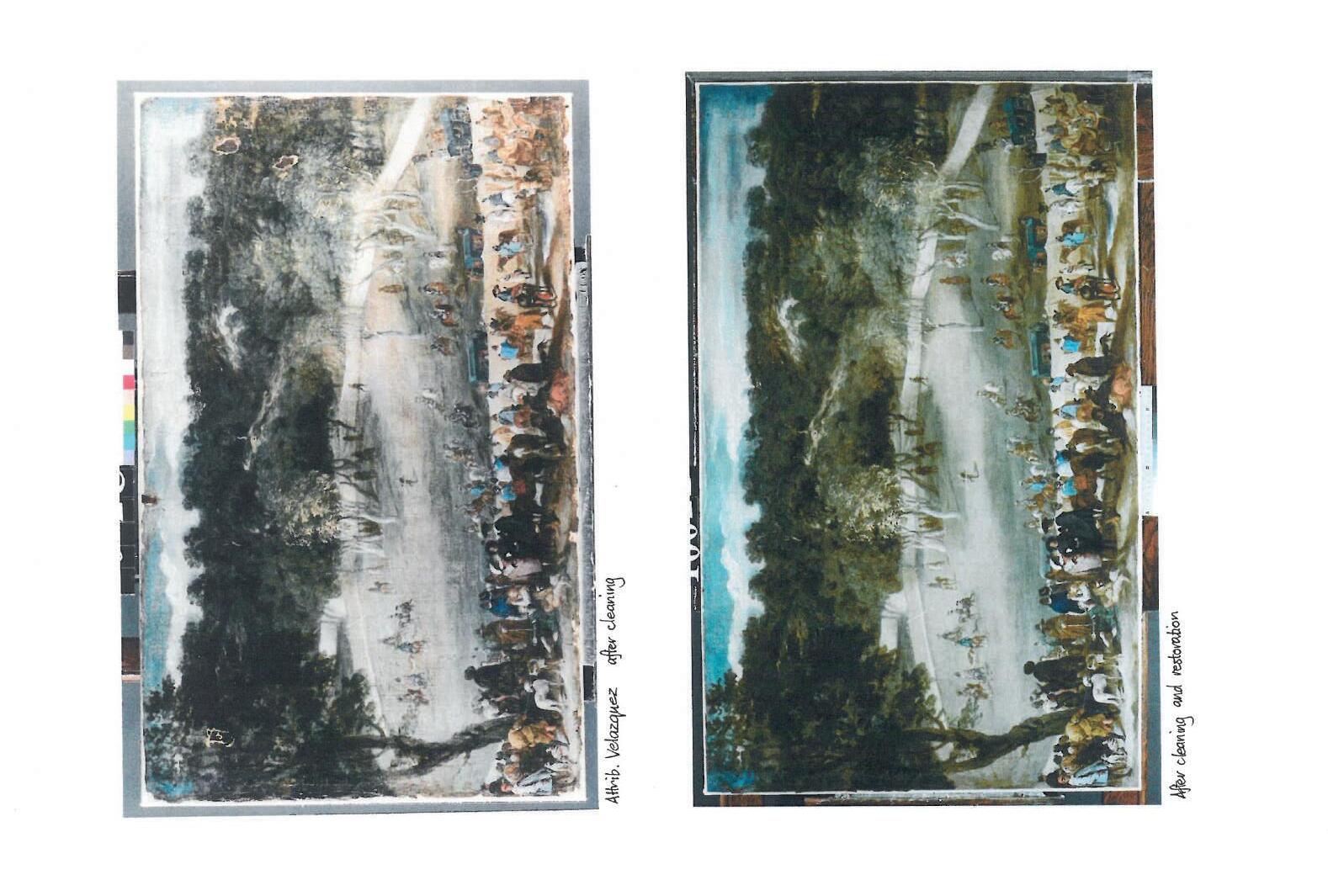
Our sincere thanks to Tom Caley and Simon Howell of Shepherd Conservation for their meticulous cleaning of the painting and the very valuable insights gained through their essential research.
MACLAREN, Neil, 1952
National Gallery Catalogues, The Spanish School. London : National Gallery Publications, 1988. pp. 101 - 108.
PANTORBA, 1955
Velasquez. Madrid.- n°74
LÓPEZ-REY, José, 1963
Velasquez : A Catalogue Raisonné of his Œuvre. Glasgow : Collins.- n°140
BARDI, Pietro Maria, 1969
The Complete Painted Works of Velasquez. Paris : Flammarion. no. 75B
DOMÍNGUEZ ORTIZ, Antonio; PÉREZ SÁNCHEZ, Alfonso E.; GALLEGO, Julián.
Velázquez, Museo del Prado, enero-marzo de 1990 - pp. 246 – 251
GARRIDO PÉREZ, Carmen. Velázquez: técnica y evolución, Museo Nacional del Prado, mayo de 1992. pp. 344 –345.
COMMUNIDAD DE MADRID,1999
Publicaciones Ofciales; Primera edición : 1 December. - p.79
KIENTZ Guillaume, Velázquez: L’affrontement de la peinture, 2015.
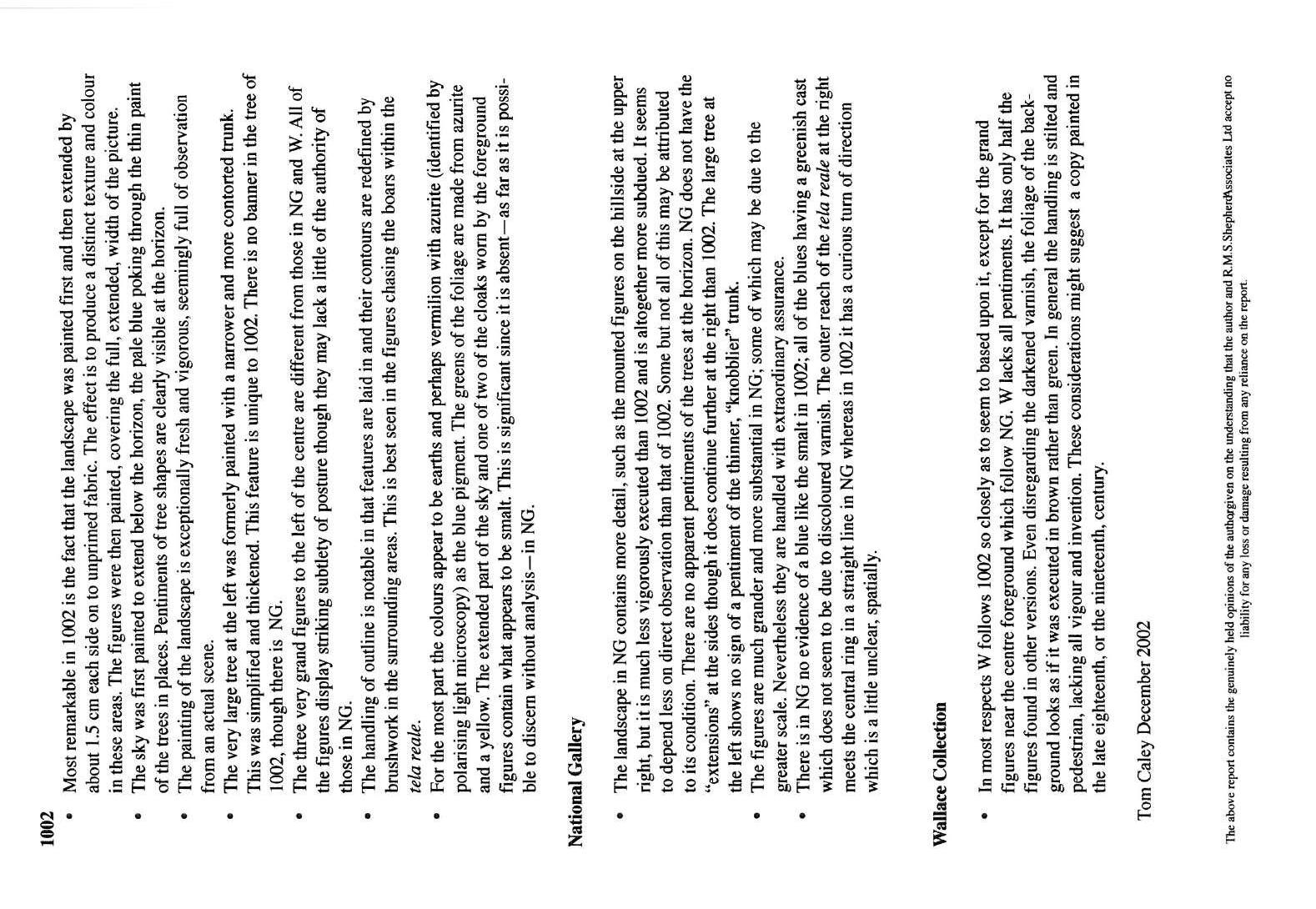
R.M.S. SHEPHERD ASSOCIATES : Condition and treatment of The Royal Boar Hunt attributed to Velázquez.
Photographic credits
All the photographs by Maurice Aeschiman in Geneva except the following :
© The National Gallery, London
© The Wallace Collection, London
© R.M.S SHEPHERD ASSOCIATES
© Museo Nacional del Prado
Binding
Prestige Graphique