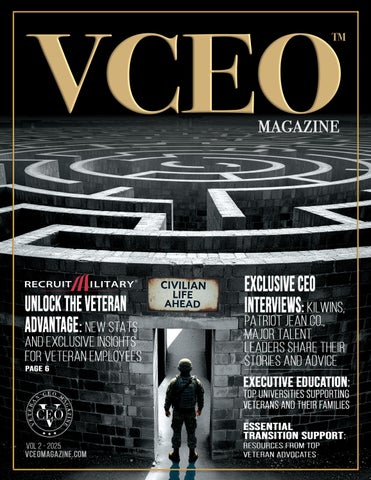
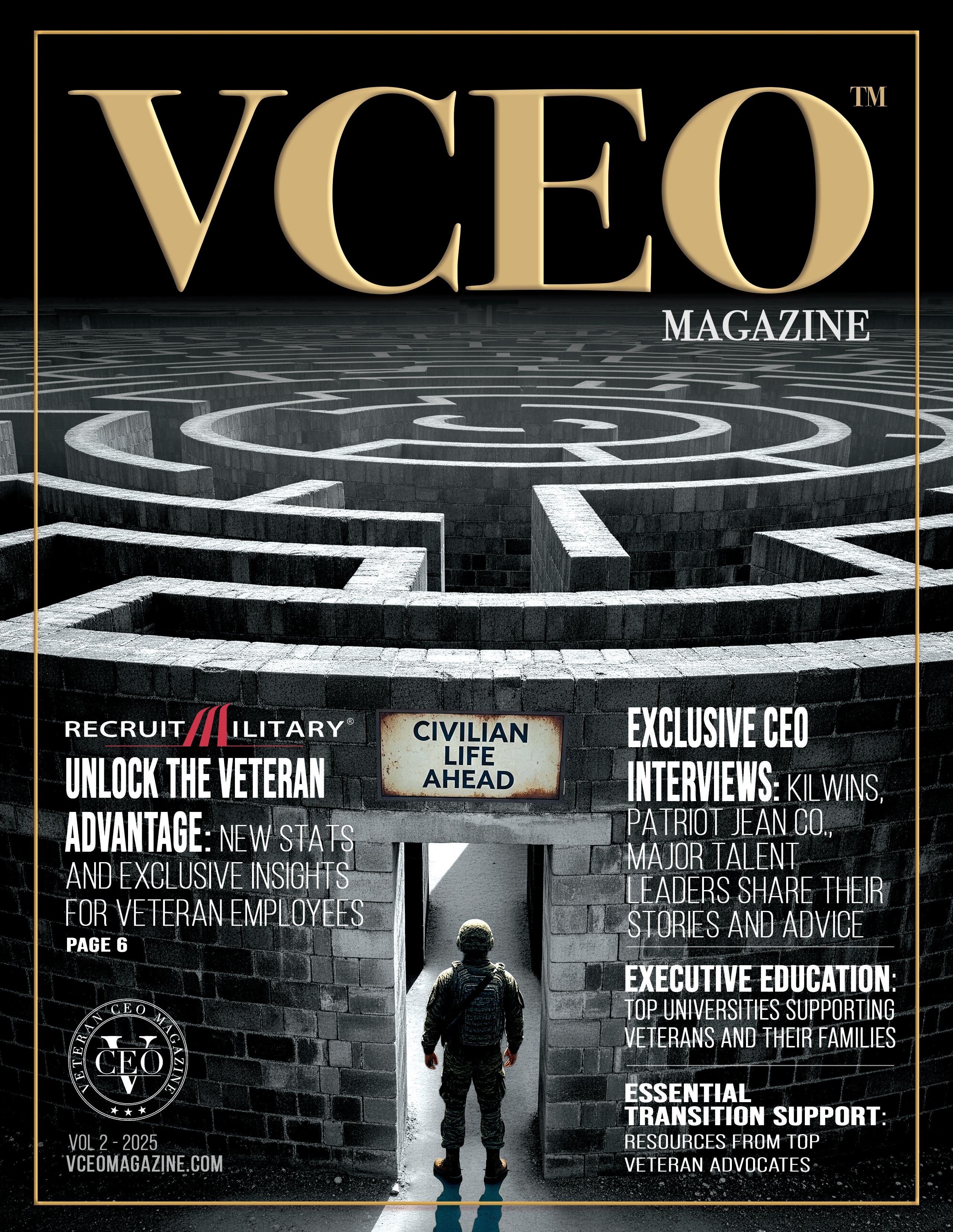
We are honored to bring you Volume 2 of Veteran CEO Magazine (VCEO). As we mark one year since our inaugural edition, the passion and commitment that launched this magazine have only deepened.
Our mission remains clear: to help Veterans and military families navigate the often complex and daunting career transition process by sharing the insights and practical advice of those who have successfully climbed to the top of their civilian careers. In this edition, you'll find four distinct sections focused on:
• Veteran Employment
• Veteran Support and Resources
• Franchise and Entrepreneurship
• University Resources
I am particularly excited about sharing the valuable insights from leaders at RecruitMilitary and Findem, whose recent study, Unlocking the Potential of Veterans in the Civilian Workforce, offers a deep dive into Veterans' career progression after military service.
We are deeply grateful to all the Veteran Executives and CEOs interviewed in this edition for sharing their stories, which help you, the reader, by offering their personal insights and advice.
Veteran CEO Magazine, Where Veterans Lead The Way!
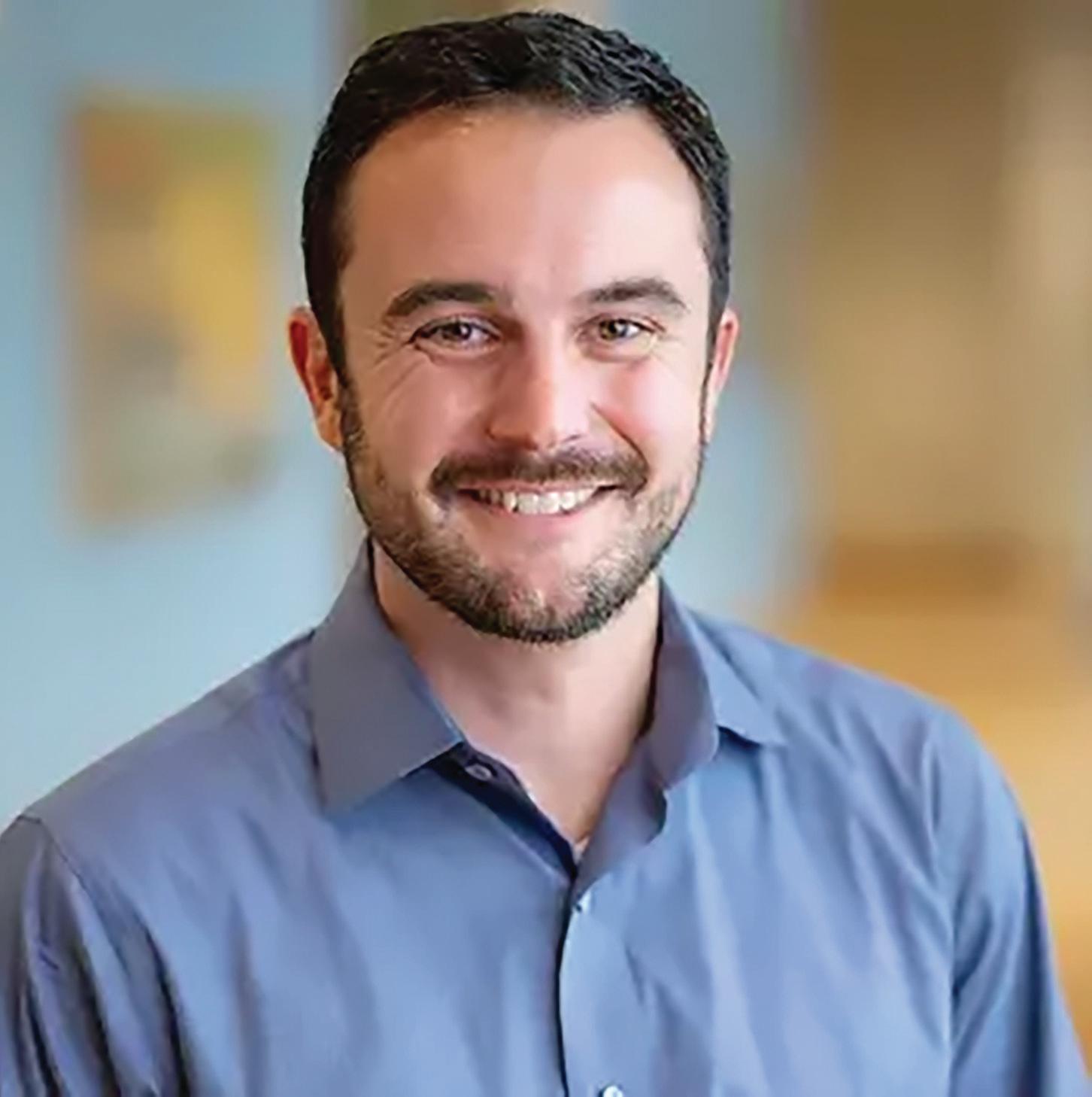
Jonathan HernandezFounder
&
Owner
Veteran CEO Magazine (VCEO) LLC
Volume 2 - November 2025
Editorial
Jonathan Hernandez
Creative Designer
Carlos Arenas
Contribuiting writer
Randy Hewage
Subscriptions vceomagazine.com/subscribe
Contact us: vceo@vceomagazine.com
Don't miss a beat! Scan the QR codes below to access the VCEO YouTube channel and Podcast.
Watch and listen to the fulllength episodes of Veteran CEO Magazine, where we dive deep into the inspiring stories and invaluable insights of veteran entrepreneurs.
Disclaimer:
Get exclusive content and expert advice delivered straight to your devices.
INDEX OF CONTENT
06
Unlocking the Full Potential of Veteran Employees
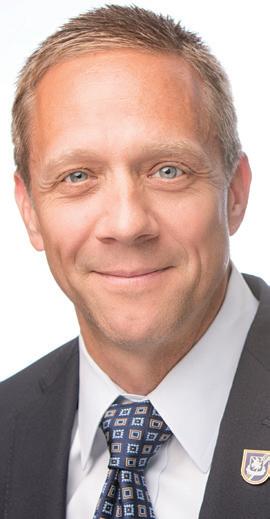
RecruitMilitary recently teamed up with Findem, an AI. Powered Talent Solution company, to publish a new report vital to the Veteran workforce and career-transitioning service members and their families. The report, titled: “Unlocking the Potential of Veterans in the Civilian Workforce,” provides data-backed intelligence that highlights the enduring value of hiring Veterans. Tim Best, CEO of RecruitMilitary, and Heather Haag, Head of Veteran Initiatives at Findem, sat down with Veteran CEO Magazine (VCEO) to discuss the findings and how Veterans can use this report in their civilian career journey.
11
Maximizing Veteran Career Transition Opportunities
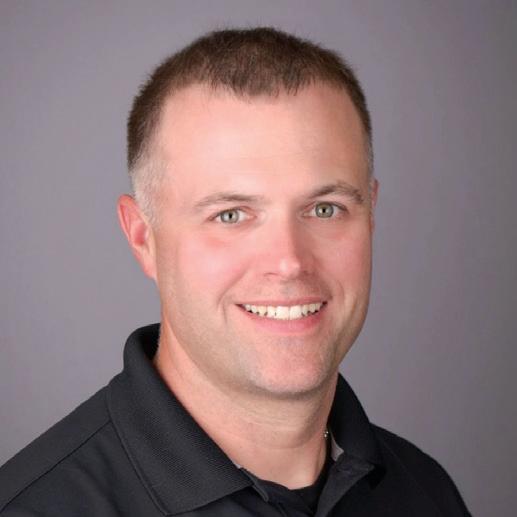
Military service prepares Veterans for all kinds of missions, but often leaves them facing a fundamental Workforce Experience Translational Barrier when their hard-earned skills are lost in translation to civilian careers. Tim den Hoed, Founder and CEO of Major Talent, is determined to close this gap. In an exclusive interview with Veteran CEO Magazine (VCEO), Tim discusses how his own extensive military journey, including time as a recruiter, led him to create a platform that shifts the job search from a “mortar round” approach to a precise, intentional “sniper round” strategy.
14
Unmasking The Weapons of Mass Deception
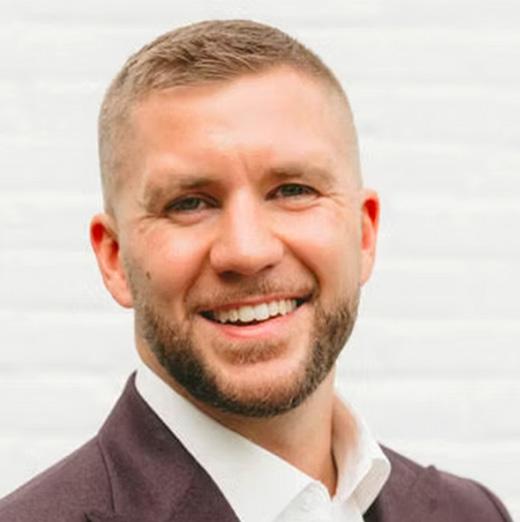
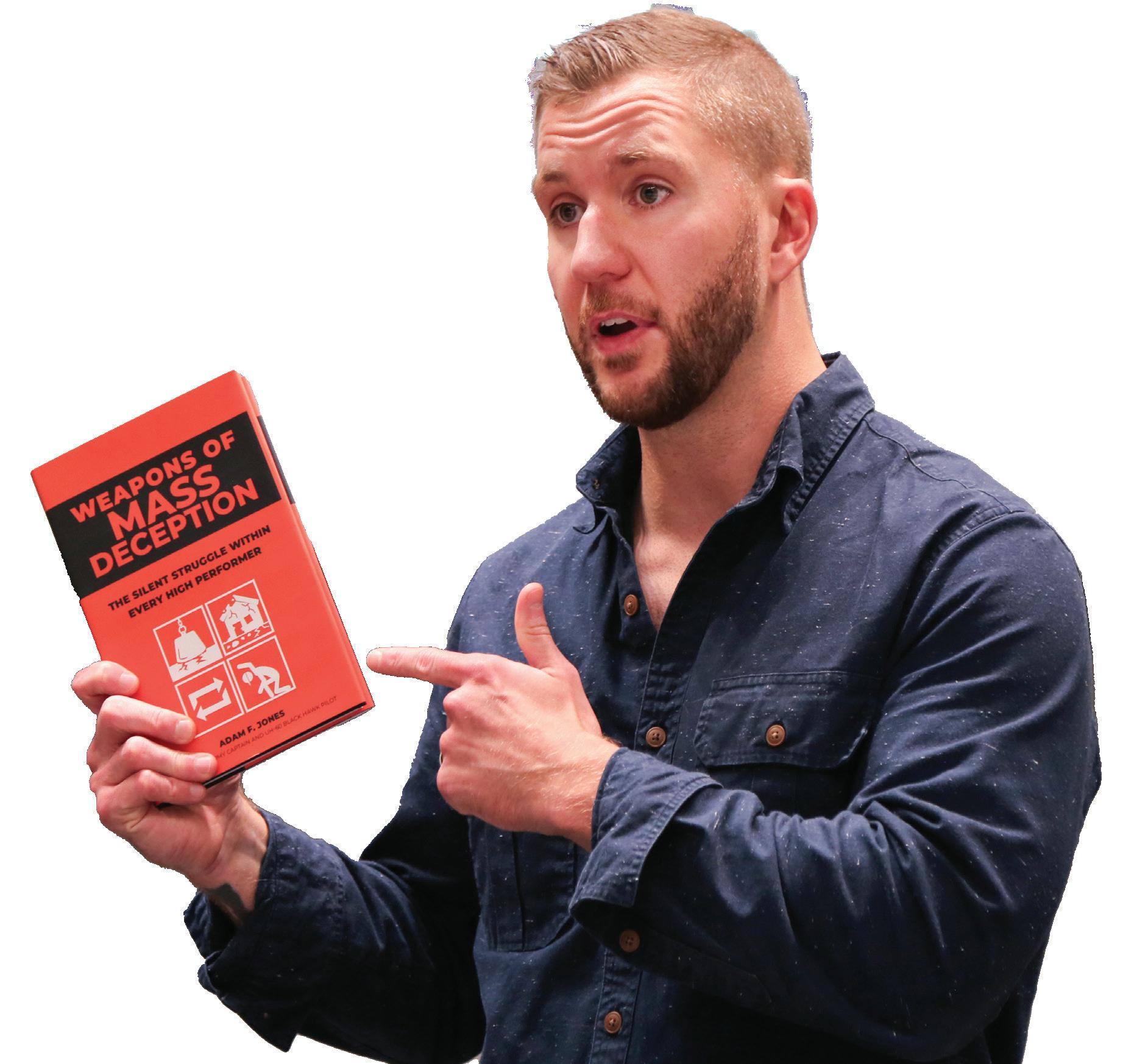
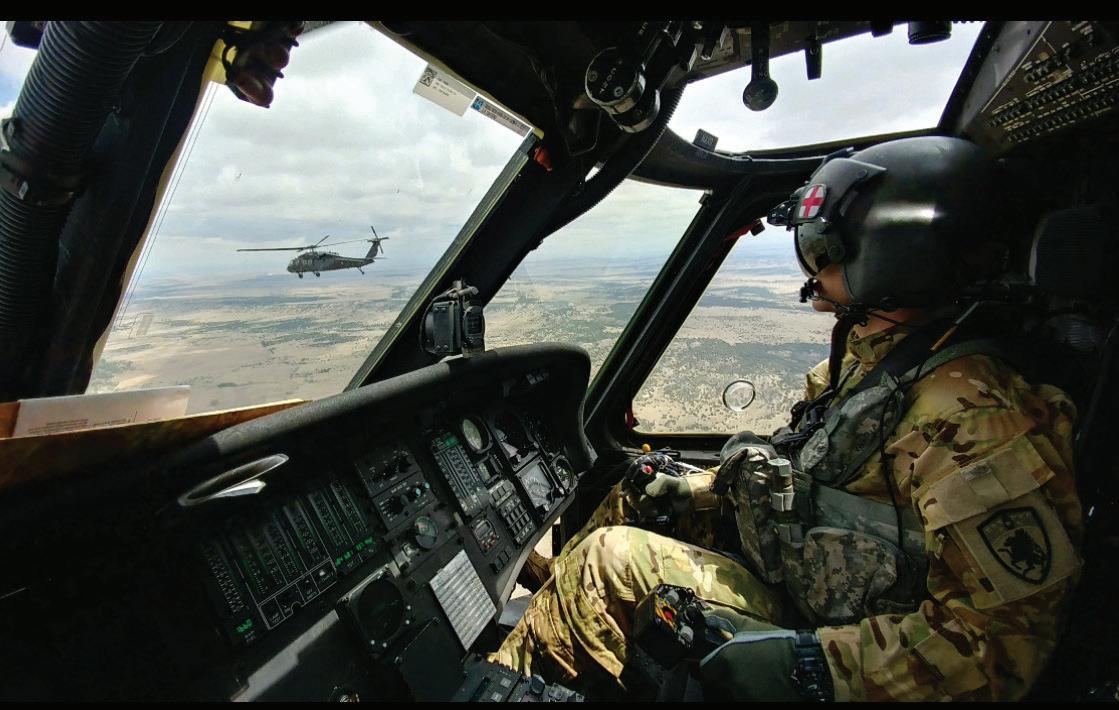
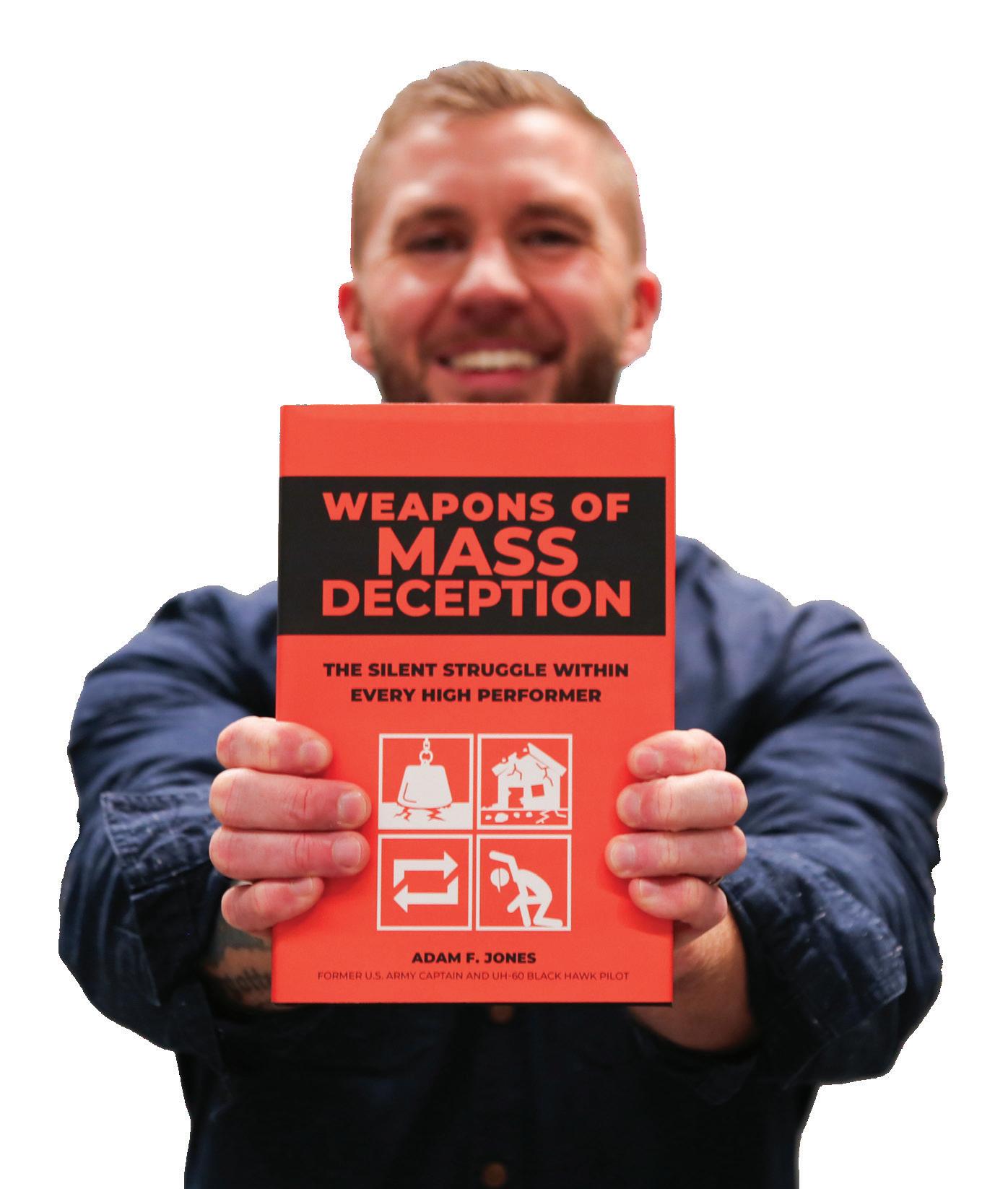
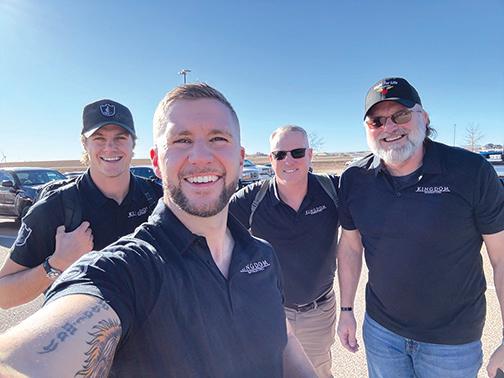
In the high-stakes world of military aviation, a moment of “drift” can mean catastrophe. For Adam Jones, the same principle applies to life after service. The Blackhawk pilot and company commander navigated a decade of missions, only to realize he was “drifting” in his own transition. Now the founder of Kingdom Operatives, Jones spoke with VCEO about confronting this hidden crisis.
18
The Unvarnished Truth of Veteran Transition
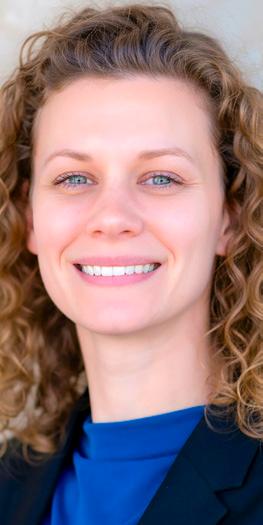
When veterans leave the military, they embark on a journey that is often far more complex and emotionally layered than anticipated. Kelly Freel, Ambassador Virginia Veterans Network for the Virginia Department of Veteran Services District 2, recently sat down with Veteran CEO Magazine to distill the essence of this transition.
Kelly dedicates her career to supporting Veterans and their families as an Ambassador for the Virginia Veterans Network within the Virginia Department of Veteran Services. Her work actively dismantles stigmas and barriers for Veteran care, and helps connect families to the vital resources they need through dedicated programs.
22
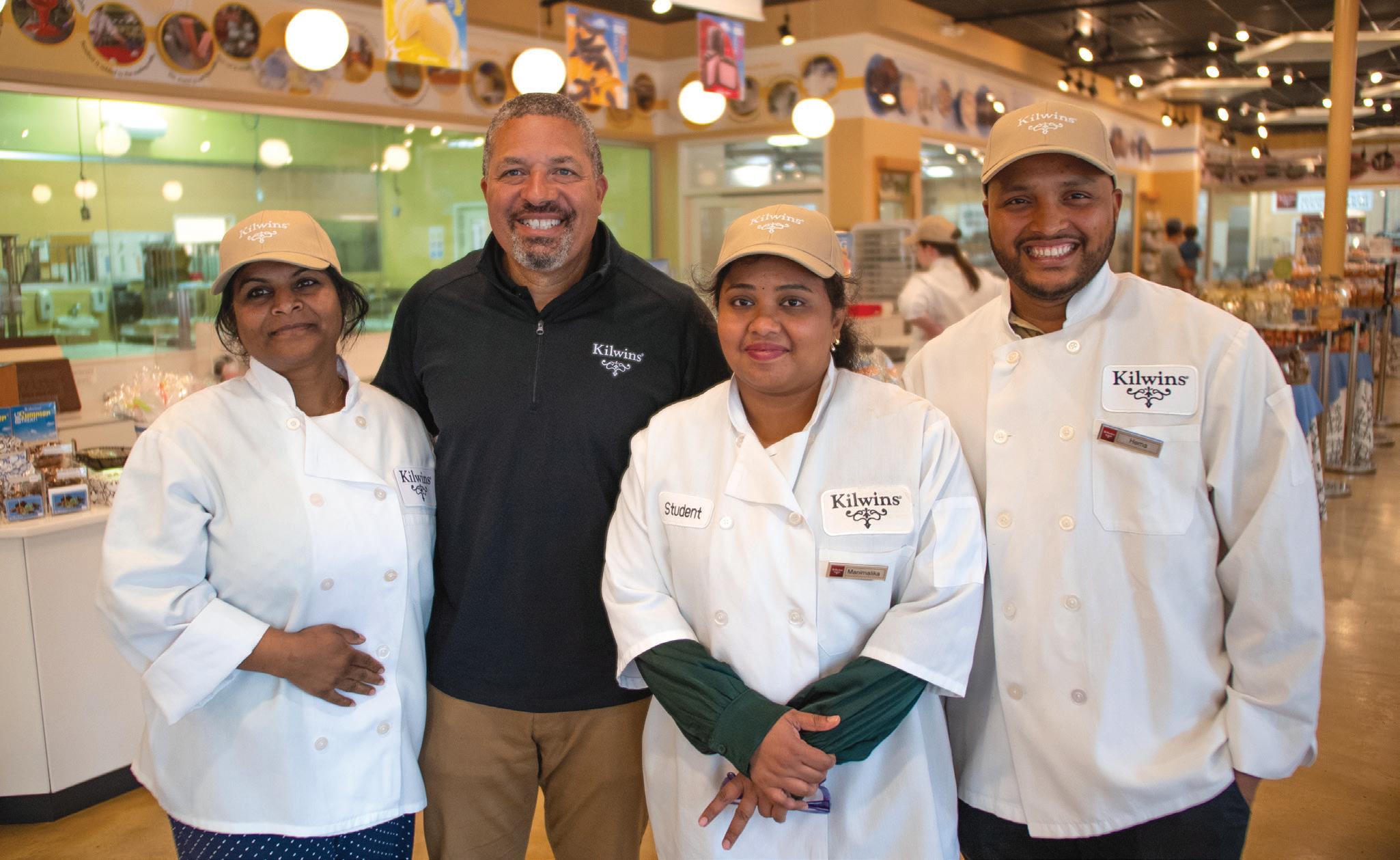
Kilwins CEO's Sweet Recipe: Military to Civilian Career Success
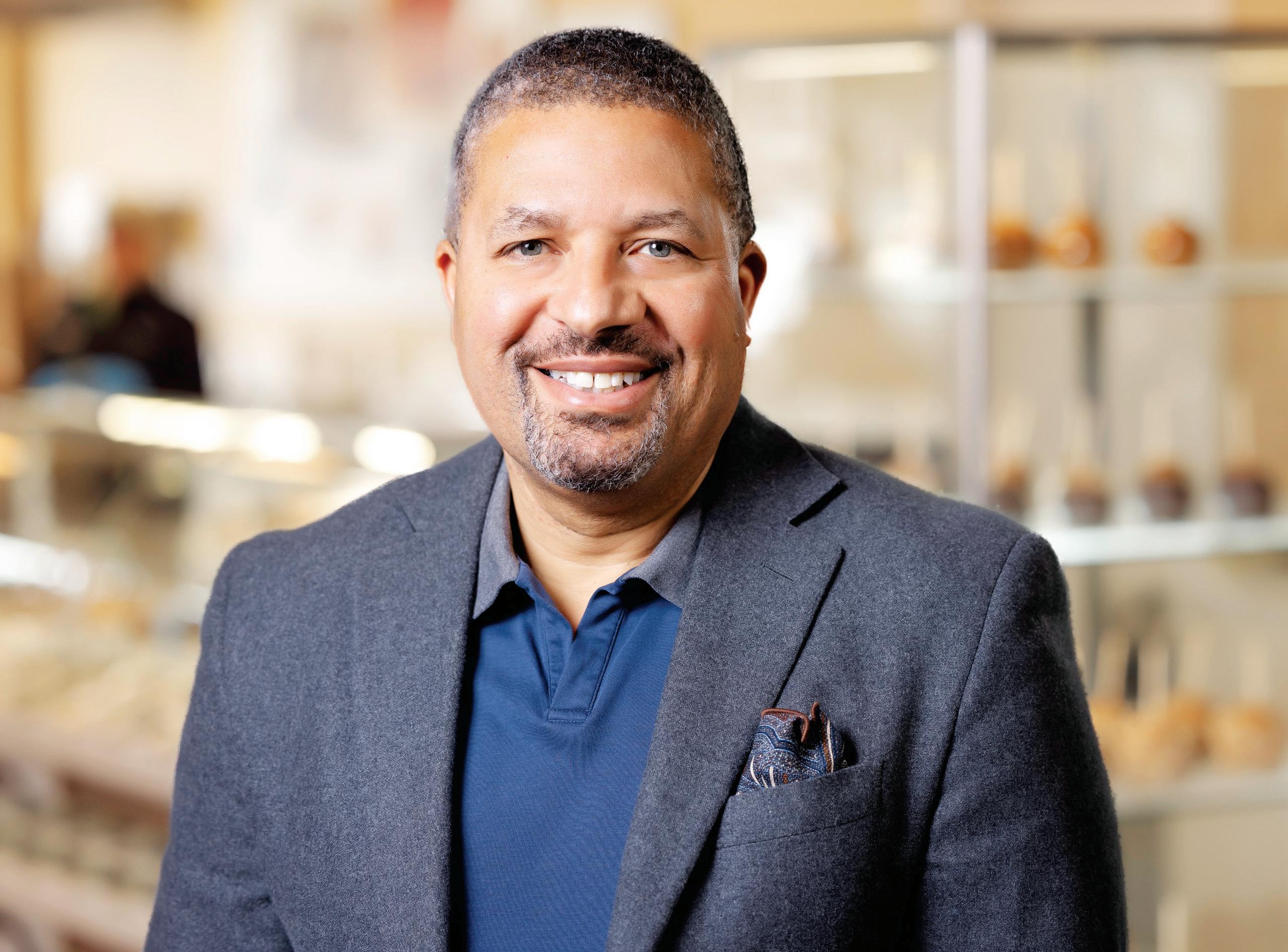
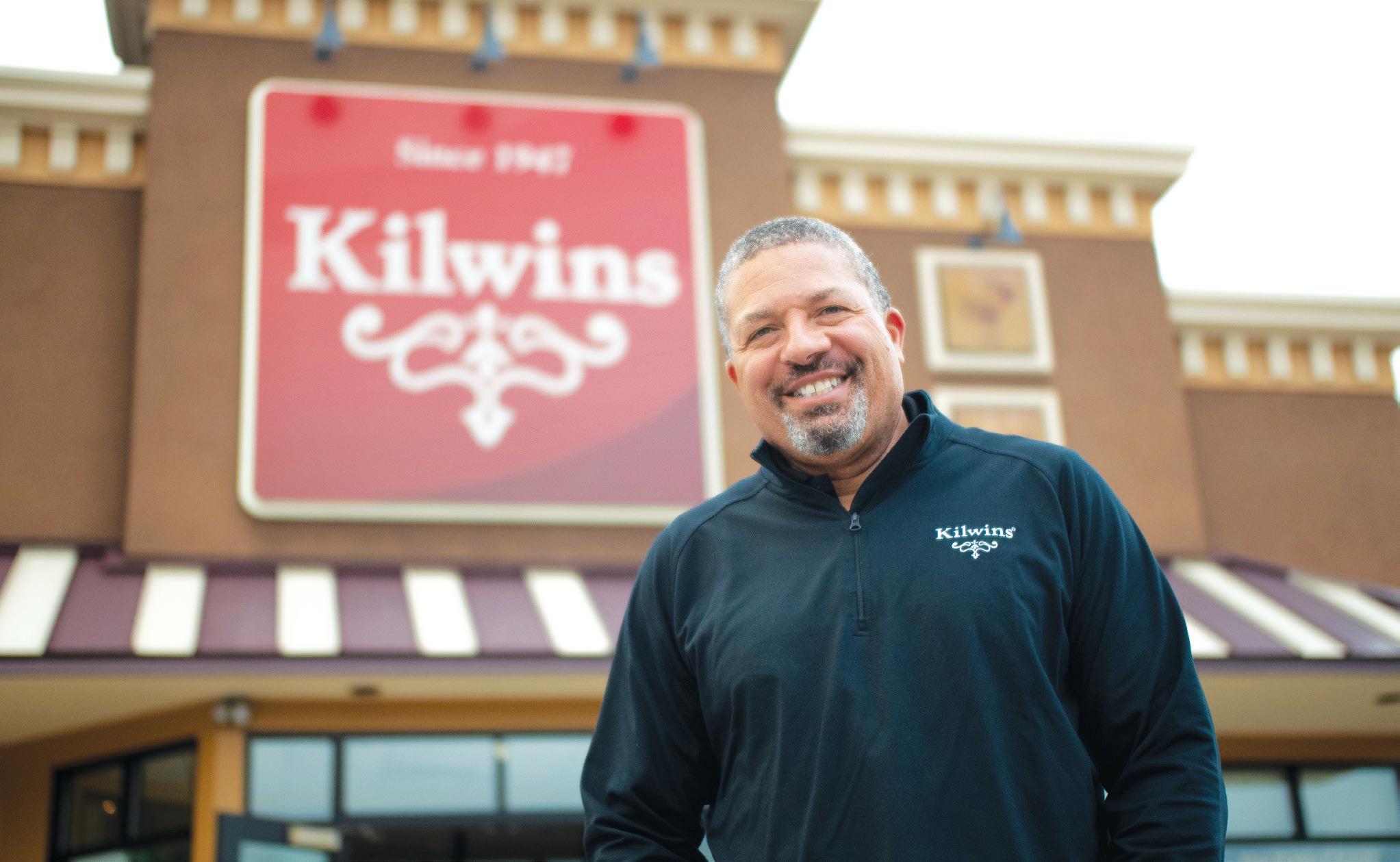
Brian Britton, a former naval flight officer, successfully navigated his transition from the military to become the CEO of Kilwins Chocolate and Confections. In an interview with Veteran CEO Magazine (VCEO), Brian discusses the elements that played a crucial role in his success and offers valuable lessons for transitioning service members and Veterans.
26
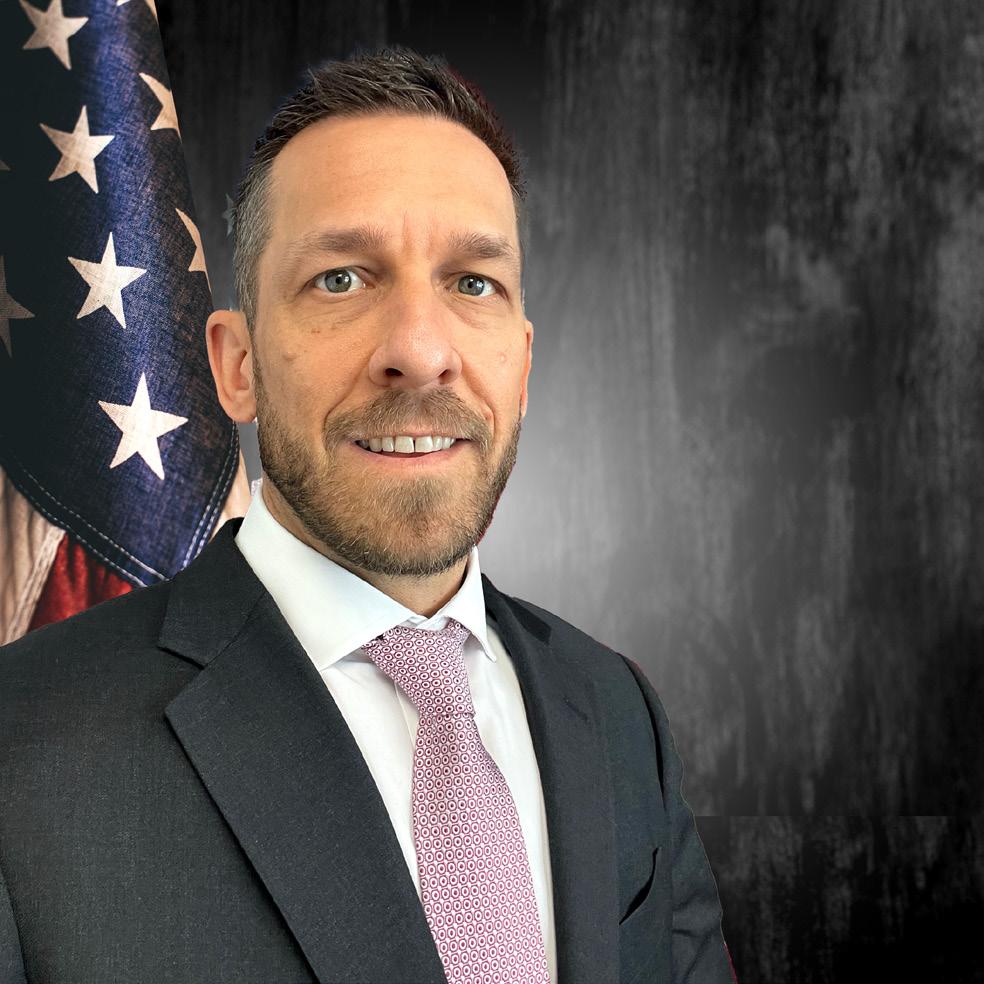
The Unexpected Journey of a U.S. Army Veteran Building an American Denim Brand
The path from military service to civilian life is rarely a predictable one. Still, for Patrick Mate, CEO and co-founder of Patriot Jean Co., the journey was a profound case of the unexpected. After a career in the military and then a successful civilian career that had its own share of unexpected encounters, Patrick leaped into entrepreneurship. During an interview with Veteran CEO Magazine, Patrick shared his story of recognizing a market gap and building a veteran-owned company, a journey marked by challenges, self-funding, and triumph for veteran-owned businesses.
29
The Myth of 'Going Home':
WHY NORTHEASTERN’S GOLD STANDARD FOR VETERAN TRANSITION STARTED WITH A SINGLE HIRE.
The transition from military to civilian life is rarely as simple as returning to the way things were before service. Andy McCarty, Founder of Northeastern University’s Dolce Center for the Advancement of Veterans & Servicemembers (CAVS), understands this fundamental truth. He offers a powerful perspective on the post-service journey, unpacking what life after service truly means for veterans— and how higher education and community can shape a new, lasting sense of belonging.
32
Transforming Service Members Into Business Executives
When service members prepare to step away from a career in the military, which can span multiple decades, they may also be leaving behind all they have known in their professional lives. Dr. Erik Helzer, Co-Director of the Veterans to Executives Transition (VET) Academy at Johns Hopkins University’s Carey Business School, explains in an exclusive interview with Veteran CEO Magazine (VCEO) how their university recently launched the VET Academy, specifically designed to help Veterans navigate this transition into executive roles. Discover how this program has been tailored to address the unique challenges of securing C-suite-level roles after the military and transforming the unknown into a well of opportunity.
UNLOCKING THE FULL POTENTIAL
OF VETERAN EMPLOYEES
The Veteran Employee Advantage: More Experience, Higher Performance
RecruitMilitary, one of the nation's leading organizations connecting employers with the military community, has recently partnered with Findem AI to conduct a
comprehensive study on Veterans in the civilian workforce, aiming to provide statistical evidence on the value that Veterans bring to the civilian workforce. The data uncovered tells a story of a workforce that brings in exceptionally high-valuable workers for performance, innovation, and retention.
The Experience Edge
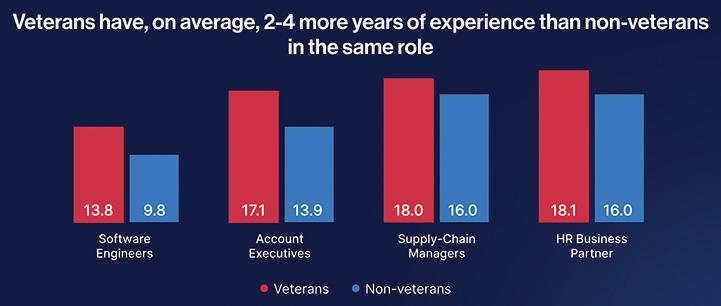
Across various career fields, Veterans have, on average, two to four years more experience than their non-Veteran counterparts in the same roles. This experience is particularly notable in customer-facing and innovation roles, where Veterans are 43% more likely to be top-performing salespeople and 23% more likely to hold patents and frequently publish
research, often without having advanced degrees.
Another significant finding of the study was that Veterans from technical career fields, such as aircraft maintenance, had skills that translate incredibly well into engineering jobs. A unique finding here is that Veterans are 20% more likely to hold engineering jobs without a bachelor's degree, largely due to their on-the-job experience.
"When you have really highly skilled professionals coming out of those career fields... many times their skills translate incredibly well into hands-on true engineering jobs,” says Tim Best, CEO of RecruitMilitary.
Retention Advantage
In addition to Veterans bringing more
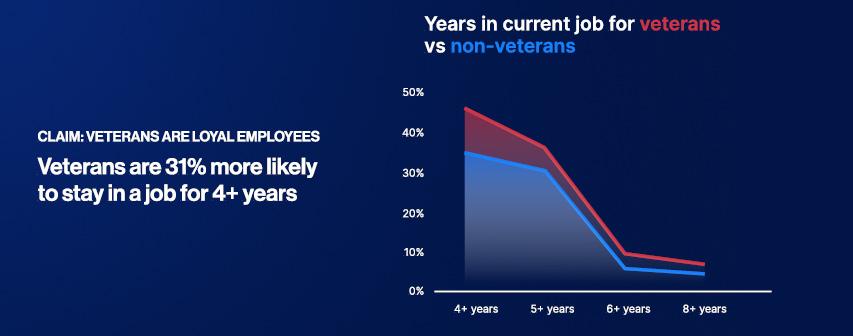
experience to employers than their nonVeteran counterparts, Veterans are also more likely to stay with companies longer. Veterans are 31% more likely to remain in a job for four years or longer. These higher retention rates translate directly into a reduction in turnover costs, which typically range from 50% to 200% of an employee's annual salary.
"Every time we turn someone over, you're talking about $25,000 to $100,000 per employee for typical U.S. jobs,” says Tim. “That's a massive case study for the purpose behind retention".
The Promotion Paradox
Despite the added years of experience they bring, Veterans are also facing a unique career paradox: they arrive at civilian jobs with superior expertise, yet they are slower to advance throughout their civilian careers. Data from the study shows that Veterans are 6% to 13% less likely to be promoted than non-Veterans in similar roles.
However, this disparity exists alongside compelling data on Veteran leadership success: Veterans are 55% more likely to hold executive positions and 38% more likely to hold managerial roles. This highlights the importance of effectively translating high-value military leadership skills into suitable civilian roles as early as possible.
The Overlooked Difference In Promotion Structures
Heather Haag, Head of Veteran Initiatives at Findem, notes that the core of this paradox lies in the fundamental difference between military and corporate promotion structures. The military provides a regimented and clearly outlined path, whereas in the corporate world, advancement relies heavily on individuals being proactive and taking initiative.
"In the military, not only is promotion on a timeline, it is outlined for you in a regulation,” says Heather. ”On the civilian side in corporate America, nobody's going to come and say it's time for your next role. Go sign up for it. Make sure you apply”.
Heather continues that Veterans must understand their own role, ensure their leadership is aware of their contributions, and learn how to recognize opportunities for advancement.
The "Quiet Professional"
Contributing to the promotion gap is a subtle cultural factor that Tim often highlights, which can inadvertently hinder Veterans, known as "Quiet Professionalism."
This highly valued trait can lead Veterans to hesitate in self-advocacy. Tim noted that one study found that Veterans were less likely to raise their hand for promotions as a result.
Tim also notes that military service instills a profound sense of natural purpose in service members, which may feel like it is missing when they enter their civilian roles, manifesting as underemployment.
"Sometimes what is feeling like underemployment is also a lack of a sense of purpose in the organization they're working in,” says Tim.
Solving the Riddle
To Unlock The Full Potential of Veteran Employees
Tim and Heather point out that both Veteran employees and companies must take intentional steps to maximize Veteran experience, leadership, and innovation, ultimately solving the promotion paradox.
Employer Recommendations: Strategy Over Initiative
For companies, treating Veteran hiring and retention as a strategic business imperative is essential, rather than just a compliance or feel-good initiative.
The study references an initiative by John Deere, which has partnered with RecruitMilitary, resulting in a 2.2 times
higher Veteran promotion rate compared to the national average. They achieve this by deliberately outlining clear career paths, promoting various learning opportunities for growth, and intentionally establishing programs that foster a sense of community.
“It becomes a question of ‘why would you leave when you are not only happy and comfortable, you know the people around you, you've built that community?’” says Heather. “The opportunity to learn really goes back into mission and feeling like you belong and you're growing”.
Veteran Recommendations:
Proactivity and Ownership
For Veterans and transitioning service members, it is essential to focus on career ownership and proactivity. Veterans must ask questions to help them understand existing career gaps and proactively work to make themselves visible. The advice is to maintain intellectual curiosity, excel in their current roles, and actively seek opportunities where they can make a meaningful impact.
“Understanding the challenges is there, so then you can understand how to navigate them,” advises Heather.
Leveraging AI. to Bridge the Gap
A critical tool for bridging the militaryto-civilian gap is Artificial Intelligence. Heather notes the significant role AI plays in translating military experience into corporate language. This technology streamlines the recruiting phase by optimizing digital profiles, making the initial hiring process more efficient for everyone.
"The beauty of AI right now is that you don't necessarily have to do it perfectly,” Heather says. “The AI is going to start doing that translation... But you can't, you can't cheat your way out of making sure you put the information out there to be then analyzed and highlighted and optimized".
Tim also recommends that Veterans use AI not just for self-promotion, but for selfassessment, helping them prepare for tough interviews. “Go in and have AI tell you why you're not fit for the role so you can war game it before you even go into the interview,” says Tim.
The Competitive Advantage Realized
The data provided by RecruitMilitary and Findem presents a compelling case for strategically investing in Veteran employees. It also addresses the common challenges faced by Veterans once they have landed a job and how employers can utilize this information to maximize a talent pool of statistically proven, highly skilled, and professional employees, thereby gaining a strong competitive advantage. Veterans don't need to be reinvented; they need to be understood in context.
MAJOR TALENT FOUNDER, TIM DEN HOED, ON MAXIMIZING VETERAN CAREER TRANSITION OPPORTUNITIES
From Mortar Round to Sniper Round
Tim den Hoed’s military career was anything but linear. It was an unmediated lesson in career transition. Spanning multiple branches and roles, Tim served as an infantryman in the Marine Corps, an Air Force mechanic, a recruiter, and ultimately earned a commission as a Force Support Officer. This unique and varied experience led him to a crucial realization: the difficulty of military-to-civilian transition is rooted in a fundamental communication gap. This gap is the Workforce Experience Translational Barrier, which is the difficulty in effectively communicating the direct applicability of military experience within civilian HR and recruiting systems.
Tim’s experience as a military recruiter provided the key insight. He realized the
same intentional, targeted techniques he used to recruit people into the military could be applied to placing Veterans into civilian careers. This idea became the foundation for Major Talent, a free, comprehensive resource focused on four critical areas: military career translation, resume development, interview preparation, and job placement.
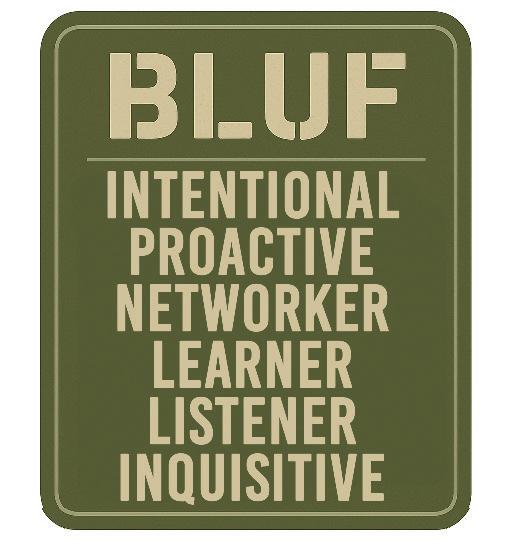
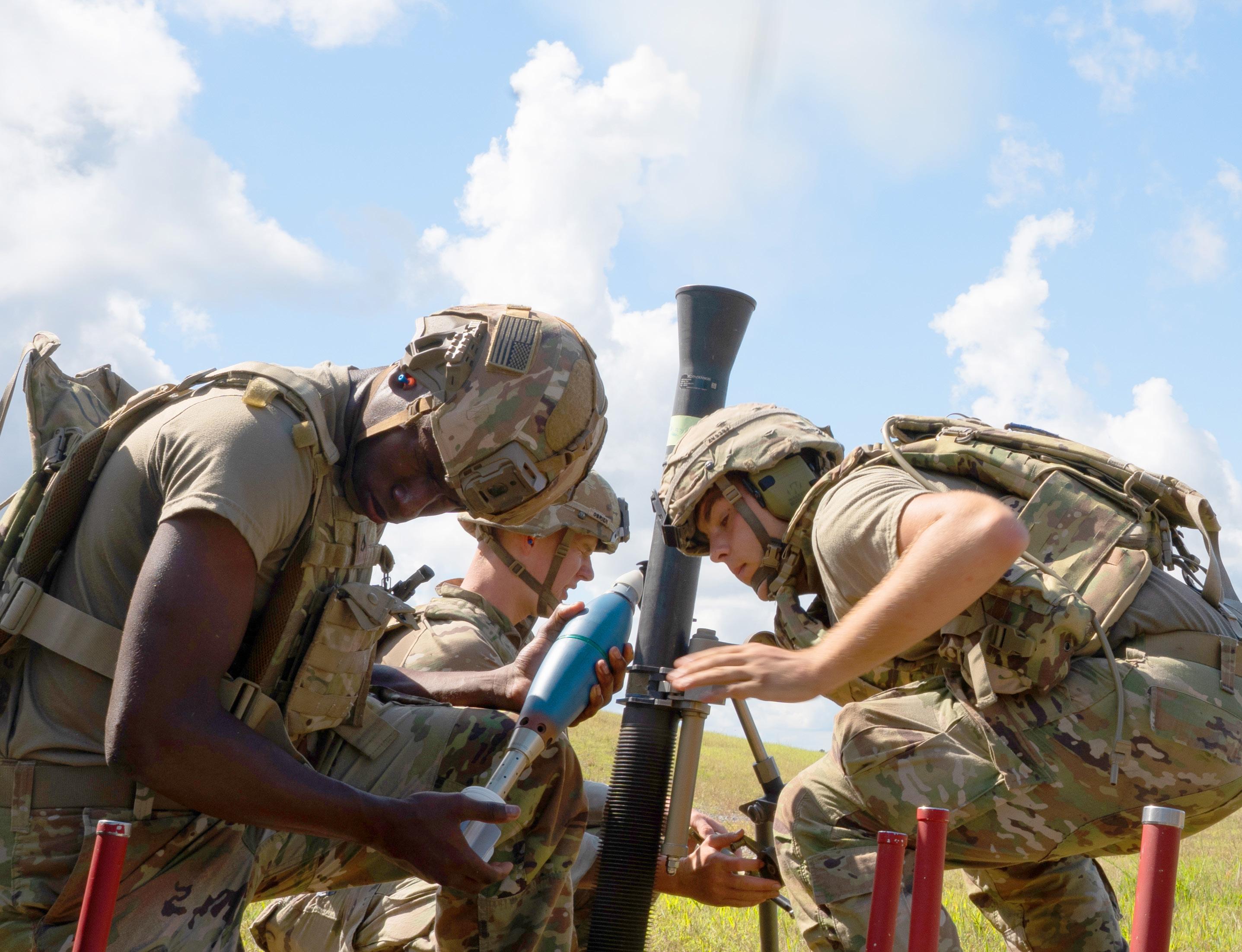
The platform is driven by Tim's core philosophy: every Veteran must embrace intentionality and proactivity. “The goal is to eliminate the guesswork,” Tim explains, moving away from generalized advice and toward a "sniper round" approach to job placement. “When you’re intentional about translating your military experience into business-friendly language, you stop shooting a mortar round and start aiming a sniper round.” This means Veterans must meticulously plan their transitions, just as they would a mission. “We plan everything forward in the military: deployments, missions, you name it. The same should go for our careers,” he urges. Starting early, building networks, and clarifying their ideal career paths are essential to avoid the common mistake of accepting the first job offered, which often leads to job hopping.
The Recruiter’s Secret of the Job Search
Networking:
To become an expert networker—a skill that many veterans find daunting—Tim helps break down the overcomplication surrounding the term. “A lot of times we overcomplicate what this word means: ‘grow your network’,” he explains. He notes that veterans already do this daily, citing examples from his military service: the people serving food at the dining facility build their network just as much as anyone who reaches out to solve a problem. “We do this and we don't even think about it.”
When it comes to the job search, Tim notes that by sharing your goals and vision with others, doors can be opened that would have otherwise remained closed. “By nature, we want to help... I think veterans have this amplified,” he explains. “People want to help, but you have to allow them to help you.”
Learner/Listener:
To understand civilian job requirements, Tim says humility is key. Rather than pretending to know something, veterans should embrace their status as perpetual learners and focus heavily on listening. “If you don’t know something, just say so. Ask questions. That’s how you learn and grow,” Tim advises. One way to master this is through active listening, which includes repeating or clarifying what you hear in conversations and interviews. This skill demonstrates engagement, helps avoid
misunderstanding, and shows employers a strong willingness to adapt.
Inquisitive:
Being inquisitive is the secret weapon for the job seeker. Tim insists that an interview should never be a one-way conversation. Candidates must take the initiative to interview the company as much as the company is interviewing them. “Ask thoughtful questions about the role, the company, and the industry,” Tim suggests. This critical step not only sets candidates apart but also provides the necessary intelligence to ensure the next career move is truly intentional.
Embrace the Unknown: Curiosity and the SMB Opportunity
Tim’s closing advice for Veterans is to embrace the unknown and allow curiosity to guide their path, particularly when considering opportunities outside of wellknown large corporations. He is a strong advocate for Service Members, Veterans, and their Families to apply to small to medium-sized businesses (SMBs), pointing out that these agile companies are often
overlooked by job seekers who instinctively gravitate toward big-name employers.
“Don’t be afraid to try something different,” Tim urges. He notes that working with an SMB often provides greater opportunity to learn, influence, and grow. As he observed, some of the most innovative founders start small, but it is these small to medium-sized businesses that drive everything. Working with them can often lead to partnerships with the biggest players in the industry.
This spirit of adventure is critical to longterm success. With the average Veteran changing jobs three times in the first five years after separating, Tim stresses that your first civilian job doesn’t need to be your last. “Network, advocate, and don’t feel like you have to solve all the problems in your first job,” he advises. By staying curious, remaining flexible, and focusing on continuous learning, veterans can ensure that their first career step, even if imperfect, remains an intentional part of their overall journey.
UNMASKING THE WEAPONS OF MASS DECEPTION:
KINGDOM OPERATIVE’S FOUNDER’S GUIDE TO HEALING AND GROWTH
Achieving a Childhood Dream… and Then Stepping Away from It
From the age of five, Adam Jones dreamed of becoming a pilot. He pursued this goal relentlessly, learning to fly in the Civil Air Patrol at age 12, and later achieving his childhood dream by becoming a UH60 Blackhawk pilot in the U.S. Army. As a high-performer, Adam quickly rose through the ranks and within a decade was promoted to company commander in the Colorado Army National Guard. However, as his career advanced and he gained more responsibilities, the weight of his commitments to his family simultaneously became heavier and more important.
Around the same time Adam was promoted to company commander, he also became a new father. The combined responsibilities of taking care of his family and his unit took a toll on Adam’s mental health.
“I felt like, ‘man, I am not really doing well here,’” Adam said, reflecting on his dual responsibilities. "I felt that would solve everything... if I made myself more available to my family, a lot of these issues and maybe even my stress and tension and those things that were in me would start to go away because I was no longer around that type of environment.”
With his family as his top priority, Adam made the decision to leave the military and his childhood dream behind so that he could focus on his responsibilities at home. Yet, he would discover there was still more work to do before he could be the father that he dreamed of being.
Finding himself after leaving the military
After getting out of the military, Adam describes the feeling like being in a haze; able to provide exact details of moments yet still stuck in a fog. It was on one of these days, Adam recalls his wife addressing the situation directly…
“Where are you right now?” his wife asked.
“What do you mean?” He replied.
“You're not here. You're never here. I don't know where you are, but it's not here,” she said and then finished, “And I don't think you want to be here.”
Adam realized, in this moment, that being physically present at home did not mean he was truly present with his family. He was still carrying much of the stress and emotions from his military service with him even after leaving the military.
“What I had to learn was that availability does not equal presence,” Adam told VCEO. “My biggest struggle with my transition is I didn't know how to reset, to let it go, to figure out who I was without all the other things attached to me. And without even recognizing it, the same struggle that I was going through in uniform got worse when I got out.”
Calling out “The Drift”
Adam described a military mission to illustrate the phenomenon he calls “the drift”: a disconnection between intentions and outcomes. During a nighttime operation, his team was conducting a medical hoist operation. Missions like these require extra attention to detail because of all the additional challenges to normal cruise operations. Hovering a helicopter is widely considered one of the hardest things to do. Adam was performing this maneuver while wearing NVGs with limited field of view, just above the treetops, and at the same time trying to prevent the rescue stretcher from going into a spin.
While he was focused on keeping the aircraft stable, the helicopter started to drift. The crew chief immediately called it out over the radio:
“Hey, Sir, drifting left.”
No response.
Adam notes that in these situations, callouts and
acknowledgements are vital to preventing accidents. A non-acknowledgement means just as much as a response. In this case, Adam was so worried about messing up, he became more focused on what he was doing and started blocking things out.
Over the radio, his crew chief called out again.
“SIR! You are drifting left!”
“Oh, Roger, got it. Sorry.”
Adam then tried to explain the details of why the drift was happening based on the current flying condition, when the crew chief sharply interrupted:
“Sir, no one cares, just fix it.”
After the mission, his crew chief approached him to talk about what had happened.
“Hey what was that?”
“I just didn’t catch it, I’m sorry. I’m going to make the adjustments next time.”
“No, not that. What was with all the explanations? We don't care that the aircraft moved out of position. What we care about is that your ego got in the way and you wouldn't acknowledge the fact that it was actually drifting. You made the situation worse because with each passing second, we became closer to a crash.”
This moment is one Adam calls out as vital for transitioning service members. Just
as in flying, when they get hyper-focused on one thing in life, ignoring the drift only makes the situation worse.
He advises a three-step approach: announce the drift, acknowledge it without excuses, and assess the situation. This honesty allows others to help correct the course.
What We Suppress Spreads: Defining the Weapons of Mass Deception
"What we suppress spreads." Adam uses this phrase to describe the challenges of military transition. The stress and suppressed emotions he carried from his service persisted and even intensified after he left, and, left unresolved, these feelings began to affect his relationships and well-being. This emphasizes the importance of open communication within families during transition. By having open conversations to address the drift, acknowledge it without excuse, and assess the situation (Adam's three-step approach), Veterans are better able to identify what he calls the weapons of mass deception. These "weapons" include hidden insecurities, mixed motives, and the pressure to perform, which can lead to stress, marital issues, anger, and anxiety. He noted that trauma, transition, and military training that encourages suppression are key origins of these struggles.
Adam encourages creating a culture where family members feel comfortable pointing out when a Veteran is “drifting.” Managing expectations is also crucial; expecting a smooth, immediate transition is unrealistic. “Expecting drift during transition is normal and healthier than expecting a smooth, immediate improvement,” he said.
Correcting the Course: Final Advice for Veterans in Transition
Adam advised Veterans to detach their
current struggles from their inherent value, viewing challenges as opportunities for growth. He shared his own experience of overcommitting after leaving the military, which prevented him from finding his true self outside of his military identity. “Give yourself grace and recognize that you may need to adjust more than the civilian world,” Adam says.
Adam highlighted key indicators of the “weapons of mass deception,” such as feeling Frustrated, Anxious, Stressed, Tense, Exhausted, or Run down. These feelings form the acronym FASTER, which can help Veterans and their families identify when these struggles are present.
Referencing the high rate of Veteran suicides compared to combat casualties, Adam believes identifying these weapons of mass deception is far more significant than any battlefield challenge. Adam encourages Veterans to seek resources, including his book and the frameworks available at kingdomoperatives.com and breakthepact. org.
Adam encourages Veterans to allow themselves to change and grow beyond their military roles. He stresses the very act of calling out the drift is the first, vital step toward healing and a successful transition.
THE UNVARNISHED TRUTH: VETERAN TRANSITION HIDDEN DEPTHS
Expectations vs. Reality
Many veterans enter civilian life believing the ‘grass is greener,’ only to find the transition fraught with unexpected challenges. “You think you’re going to leave something behind and start something new,” Kelly Freel, Ambassador for the Virginia Veterans Network within the Virginia Department of Veteran Services, explains. “But it follows you. It’s part of who you are”.
The reality of separating from the military is that it often involves a jarring shift in identity, prompting serious questions about career, family, and sense of belonging. These issues can arise before or long after separation. “No matter what you do in the military, no matter how amazing or how cool your job is, going into civilian life is scary for everybody. I’ve talked to Navy SEALS, to EOD, all of the guys who do some of the toughest things out there, and they have had transition issues as well”.
For some Veterans, it can also bring on challenges with mental health that may not manifest for years after separation. Anxiety, depression, and post-traumatic stress (PTS) are challenges service members may unknowingly mask with alcohol or other substances.
Service members can set the expectation that they might have to work through mental health challenges. “If you know what you need prior to getting out, you know that you’re going to have these challenges when you’re getting out, it’s going to help you with your expectations”.
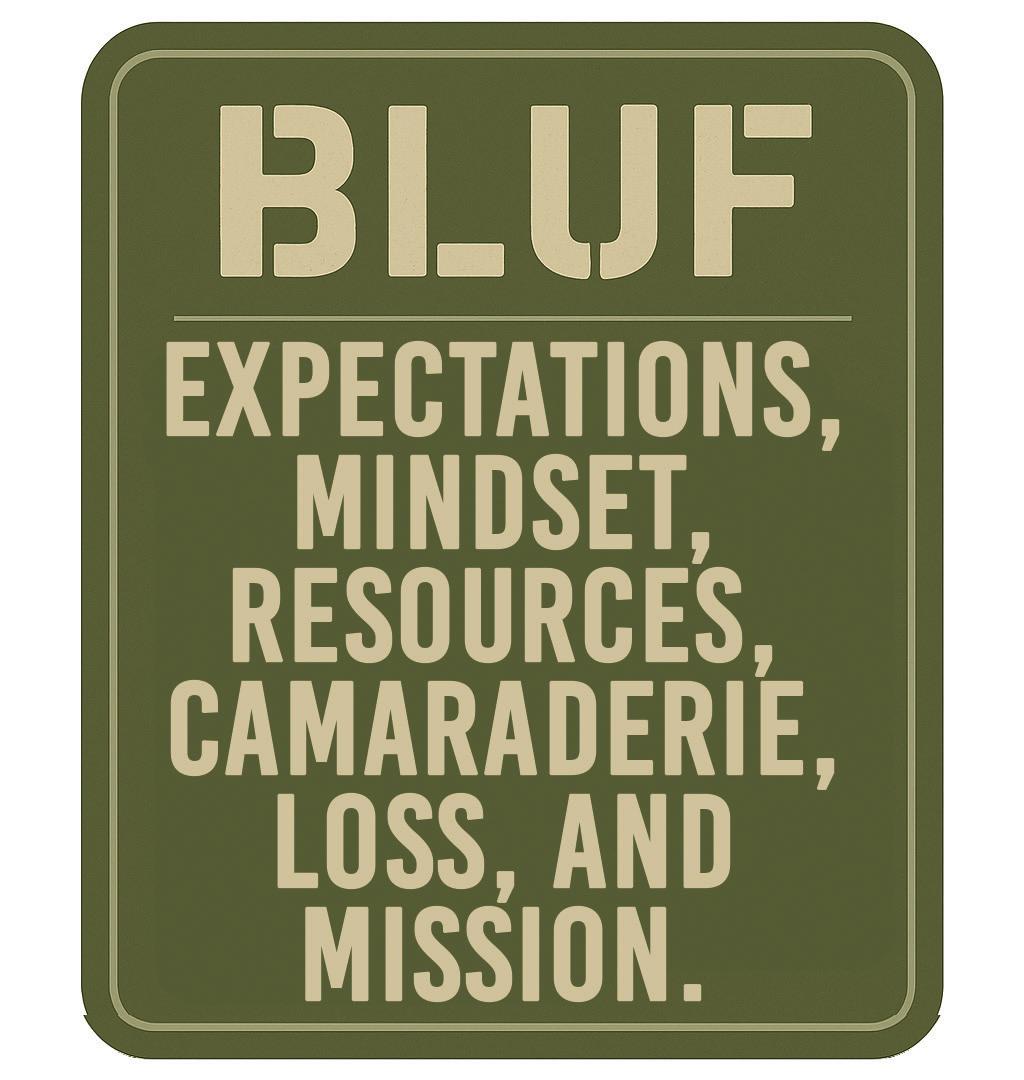
Mindset: The Foundation of Resilience
As an advocate for Veterans’ mental health, Kelly advises Veterans to manage
their expectations, understanding that uncertainty is normal. The military instills a mindset of perseverance and commitment, qualities that Kelly found invaluable as she transitioned to civilian roles. “I like to do everything at 110%,” she says, crediting her military background for this drive. However, she also emphasizes the importance of selfawareness and seeking help when needed. Veterans may find it challenging to discuss personal issues when comparing their own struggles to those of others. They may feel that their personal issues are minor compared to those of others or to the difficulties they faced during their service. This can lead to Veterans consciously or unconsciously suppressing their feelings instead of confronting them directly. “This is normal, what you are feeling is normal. You are going to need to unpack it,” Kelly says. Talk therapy, she notes, was essential in helping her process stress and develop coping skills, enabling her to face postmilitary life with clarity and purpose.
KELLY FREEL Ambassador for the Virginia Veterans Network
Resources: Tools for Success
AI
Access to resources is crucial for a smooth transition, as different situations may require different tools. Military members sometimes struggle with ‘corporate speak,’ finding that their direct communication style can seem unprofessional. Kelly points out that this is a perfect opportunity to incorporate AI to help translate thoughts and feelings into corporate lingo. “I can type in what I really want to say in Chat GPT and say, ‘say it in a heartfelt and professional way ‘ or say it in a kind way ‘ and it [Chat GPT] will turn it over and say exactly what I want to say, but the right way”.
Addiction
Many Veterans may find that they develop some alcohol dependency issues while in the military. For veterans dealing with addiction, Kelly recommends a variety of specialized resources:
• VA Hospitals: Veterans should visit their nearest VA hospital to find out what resources, including sobriety programs, they offer locally, as services vary by location.
programs for sobriety and mental health in both Texas and Virginia. They offer a minimum 42-day inpatient program for veterans, active military, and first responders.
• Recovery for Life (Virginia Beach): This organization has veteran outreach, offers sobriety and mental health support, and provides housing.
Kelly stresses the importance of seeking help voluntarily before a legal incident or other issue, especially for those with a security clearance, as legal protections exist for those who seek help on their own. The first step in the personal journey to sobriety is making the voluntary decision to get help. Veterans struggling with addiction should also consider changing their social circle and seeking a peer coach or attending a 12-step meeting.
• Avalon Action Alliance: This organization helps with co-occurring substance abuse, post-traumatic stress (PTS), traumatic brain injury (TBI), and may help connect veterans to local VA offices and arrange transportation for eligible veterans. Avalon also assists with sobriety and TBI clinics.
• Warrior Hearts: This organization has
Community
Kelly also highlights that several tools are available to Veterans that can help them in their community:
MyVetBenefits app offers veterans limited-time access to LinkedIn Premium for job search and networking support.
VetJobs.com is another community resource that assists veterans in finding mentors and identifying transferable military skills.
Veterans of Foreign Wars (VFW) outposts can also serve as a hub for resources, hosting job fairs and educational events, such as scholarship programs for family members.
Vet Tix provides free or discounted
tickets for veterans and their families to recreational activities like sporting events and concerts.
Camaraderie: The Power of Connection
Transition often brings a profound sense of loss of structure, identity, and comrades. Kelly likens this to a grieving process, noting that the sadness can be unexpected and overwhelming. The bonds formed in the military are unlike any other, and their absence in civilian life can be deeply felt. She encourages veterans to acknowledge these feelings and seek support, emphasizing that loss is a universal part of the transition experience.
Kelly stresses the importance of staying connected, whether through veteran organizations, online groups like Disgruntled Vets, or local chapters of the VFW or American Legion. She also
recommends joining veteran organizations and finding a “buddy system” to avoid isolation. “You can lose yourself when you get out of the military,” she warns, urging veterans to seek out their “people” and avoid isolation. Even having a pet can provide a therapeutic emotional connection, responsibility, and combat loneliness. Kelly recommends Veterans reach out to Mutts with a Mission, a non-profit organization that trains service dogs for disabled Veterans, First Responders, and Law Enforcement at no cost to the recipients.
Mission: A New Chapter of Service
Kelly’s final word, “mission,” encapsulates the transformative nature of veteran transition. “Your mission isn’t over,” she says. “You just have a new mission now”. Veterans should view their post-service life as an opportunity for growth and continued leadership. Kelly emphasizes that veterans become “hybrids,” combining valuable military skills like being methodical, organized, researched, and resourceful with new civilian expertise.
“We’re not just military anymore. We’re adding on to what we already are”. By reframing transition as transformation, veterans can find renewed purpose and pride in their evolving roles.
By managing expectations, cultivating resilience, leveraging resources, maintaining connections, acknowledging loss, and embracing new missions, veterans can navigate this journey with confidence and hope. For those in need of support, especially with addiction or mental health, Kelly urges them to get help without shame, use available resources, and find their community.
Department of Veteran Services
VA Veteran Network
KILWINS CEO'S SWEET
RECIPE: MILITARY TO CIVILIAN CAREER SUCCESS
Pride and Planning: A Soul-Searching Journey
From commanding combat aircrews to leading a sweet empire: Kilwins CEO Brian Britton's career transition from the military was more than a career change; it was a soul-searching journey. “I thought I was going to make a career out of the Navy and was looking forward to doing that… but I had this itch. There was something that was telling me, ‘maybe you're supposed to go out and lead in some other way,’” Brian said.
Deliberately seeking input from friends, family, and mentors helped Brian understand his motivations and ensured he was clear on why he was ready to leave the
military. Addressing the delicate balance between preparation and decisive action, Brian also cautions about a common pitfall known as 'analysis paralysis', or overthinking to the point of not being able to make a decision. "I realized because I wanted to lead, part of what I needed to do was to plan how I was going to lead outside of the Navy."
By knowing that he wanted to lead in business, Brian was then able to focus on the next task at hand: getting the best business education possible.
The Role of Education
was the next critical step, and Brian had his sights set on one school in particular:
Harvard. Recognizing gaps in his business knowledge, Brian took night classes in accounting and statistics while still in the Navy to build the necessary foundation to be competitive at Harvard. "It paid off big time, I can’t imagine not doing that,” said Brian. “Everybody else had been out in the business world for five years or so, and I had been leading for five-plus years, longer than that, but I didn't have that business background to fall back on, and that was critical as part of my plan.”
After being accepted to Harvard, Brian found he could learn from more than just what was being taught in the classrooms. His classmates came from all kinds of business backgrounds, and he would constantly ask them for their experiences while sharing his leadership experiences from the military with them. "I think the biggest thing was I had no idea how many types of different careers were even available out there. There were people doing
startups, people who work in corporate America, people who were consulting, people who were going into big nonprofits, people going to education, people going into international business, people who were going to, like, develop a franchise," said Brian. "For me, it really was sort of a dual education. I was learning about business, but I was also learning about the business world."
Learning from his classmates was more than just beneficial for Brian’s education; it also helped him learn more about Networking and Mentorship.
The Organic Approach to Mentorship and Networking
is a key component of a successful career transition. Brian, for example, benefited from mentors who had recently transitioned from the military to Harvard Business School, guiding him through the application process and campus life. Networking
remained vital as he graduated from Harvard and began working at Disney. He advises transitioning service members, Veterans, and their family members to organically seek out people they can learn from, rather than relying strictly on formal requests. “Instead of finding mentors, I would find people who like to teach.”
Brian also emphasizes the importance of learning from people in their own environment: "I would do things like, 'Hey, can I just shadow you for like an hour or two and watch what you do in the theme parks? I'll come to your territory.’”
Brian views networking as a result of ethical business practices and helping others.“I found that the right mentor relationships were with people who poured into me more than I poured into them, but I was still intentional about giving back.”
Joining professional groups and attending industry conferences can open doors, while
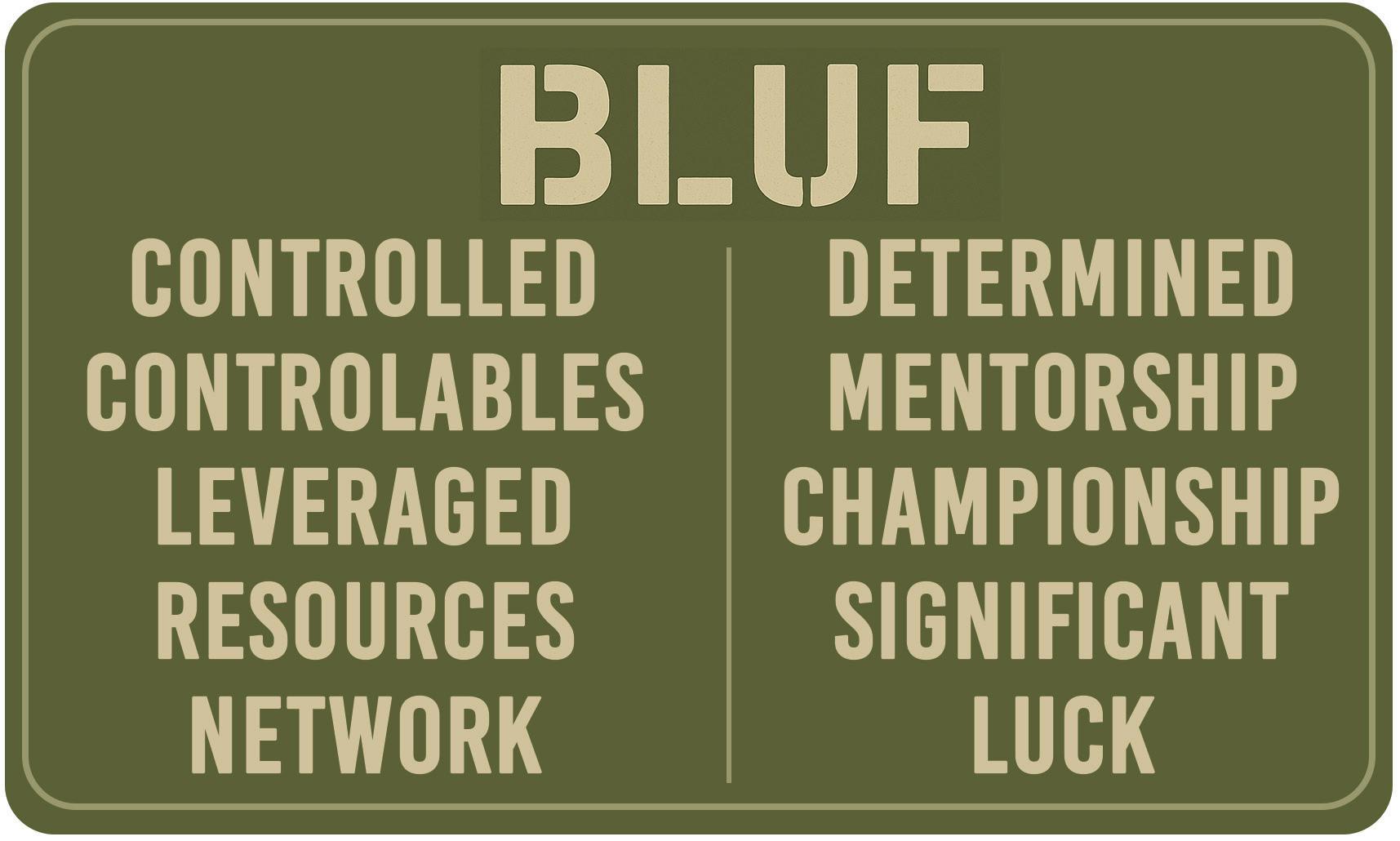
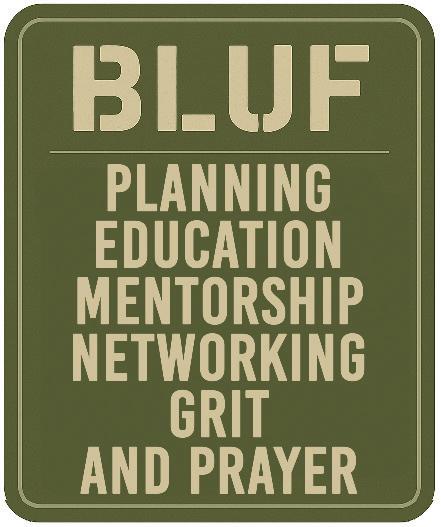
connecting people within your network builds trust and credibility. After detailing how planning, education, mentorship, and network building all played vital parts in his transition, Brian highlighted that the process, even with the best possible outcomes, still requires time, patience, and a skill military members and their families are uniquely equipped with: Grit.
The Power of Grit
can be thought of in many different ways, and the way Brian approaches it is as something many Veterans already possess. He notes that while a Veteran may have less knowledge and experience in a civilian job at first, with a little grit, it's possible to catch up really fast. Brian says the benefit of this is how Veterans are already used to doing the hard work. Thus, by the time they catch up to their civilian counterparts in the knowledge and skills of their civilian job, their military experience positions them
to even launch themselves ahead of their peers.
For Brian, while at Disney, he found his grit when he had to learn how all the different parts of the business worked together, recognizing that no role or detail was too unimportant for his attention. "I would get into, quote unquote, costume and work alongside our frontline cast members, and do the tasks and duties. And by doing that, you quickly learn the business."
By acknowledging the areas of knowledge he didn’t have and then having the grit to learn as much as possible, Brian highlights another element crucial to his transition from the military into civilian leadership: prayer.
Faith and Decision-Making
are foundational to Brian’s decision-making process. He relies on faith to guide his choices, seeking a sense of peace when making major decisions. “I try not to make any decision that I don't feel that I'm called to do. I want to be called to something.”
For Brian, peace does not mean the absence of difficulty but rather a deep conviction that he is on the right path, even when the journey is challenging. “I found that when I was right on the cusp of making a decision, if I felt at peace with that decision, then I really knew it was the right one. And if I didn't feel peace, I had a sense of angst that, for me, I knew it wasn't the right one, and God's probably pointing me in a different direction.”
When navigating a tough transition, Brian wouldn't just focus on his skills and talents, but also his desire and vision. He would then listen to his friends and mentors, and through prayer, he was able to identify what areas gave him the most peace.
Advice for Transitioning Service Members, Veterans, and their families
considering a career transition is to view the civilian world as full of opportunity. He encourages Veterans to explore different paths, accept that there will be stumbles, and consider entrepreneurship or franchising as viable options. With the right plan, education, mentorship, network, grit, and faith, Brian proves that a successful transition and a fulfilling second career are within reach.
THE UNEXPECTED JOURNEY OF A U.S. ARMY VETERAN BUILDING AN AMERICAN DENIM BRAND
The Five-Minute Pivot
When Patrick Mate separated from the U.S. Army after working in missile and space defense, he assumed he would go into a career in programming or technology. After all, these were the jobs that most directly aligned with his degree in computer science. He never expected to one day launch his own company.
Following his final military assignment, Patrick landed an interview with Raytheon, a major defense contractor in aerospace and defense. Working for a defense company felt “easy, seamless, and quite natural,” Patrick told VCEO. However, only five minutes into his first interview, Patrick had a sudden realization: this job was not what he wanted to do.
Patrick describes the moment: "I kind of took a pause and I told the interviewer, 'I think you're a fantastic company and it
sounds really interesting work, but I don't think I'm quite the fit that you're specifically looking for here.'"
However, instead of ending the interview then and there, the recruiter did something unexpected. He told Patrick that Raytheon was still keenly interested in hiring him; they would just need to find the right role. Raytheon flew Patrick out to Tucson to interview with more of the team and eventually hired him into a role that better fit his skills.
Over the next 13 years, Patrick would work in a variety of leadership roles, including systems engineering, analytical work, and eventually project and program management. Reflecting on how he landed the job despite the initial mismatch, Patrick offered this valuable advice: “There's a lot of skills that are transferable. Sometimes it's knowing how to translate that.”
million pairs of jeans being sold annually in the U.S., less than three percent are made domestically. This finding gave Patrick an idea: to start a U.S.-based denim company that sources and manufactures jeans 100% in the U.S.
Patrick was clear about the mission: “I wanted everything from cotton seed to denim jeans, everything in between to include zippers, labels, tags, everything, even our custom shipping boxes to be 100% made in the USA.”
Military Mindset, Entrepreneurial Action
Patrick spent those 13 years leading various departments at Raytheon, learning critical skills from each role. Skills like strategy, supply chain, and program management would become the essential foundation for his next career transition into entrepreneurship.From Defense to Denim: Making the Leap into Entrepreneurship
The ultimate career shift for Patrick came when he decided to launch his own venture. During the height of the COVID-19 pandemic, Patrick was eager to support local businesses and had a realization while shopping for jeans. Despite more than 450
This ambitious goal required a skill Patrick honed in the 101st Airborne: assessing a complex challenge, understanding the needed resources, and rapidly mobilizing a support team. Facing a complex business problem, he didn't try to master every detail himself; instead, he built an initial business plan and then sought out mentors with the exact skills needed.
Patrick spent the first two years learning the business from the ground up. He took "denim 101" classes to learn jean construction, design, and shipping, and worked with designers in LA and New York. He made a point of meeting industry leaders to learn how to put together a coast-to-coast supply chain. He recalls a trip to North Carolina: “North Carolina was at one point the heart of denim jeans 40 years ago and would produce millions of pairs of jeans every month. So I went out to that industry to learn.”
PATRICK MATE Patriot Jean Founder
However, even with the right team of mentors and industry knowledge, Patrick quickly encountered the brutal reality of domestic production. Sourcing materials 100% within the U.S. and finding reliable partners meant placing minimum orders that were sometimes 10 to 100 times what his small business needed. This high upfront cost was further amplified by Patrick’s decision to self-fund the venture, relying entirely on personal capital.
This choice required adherence to strict financial principles advised by mentors. Patrick explained that financial advisors stressed fundamental principles, such as the need to reinvest every pay raise he gave himself back into the company. “Those principles really have stuck with me and applied to not only being able to raise the capital myself over many, many, many years, but also are key tenets of what we do as a company now, giving back those types of things.” Based on this experience, Patrick advises any veteran looking to start a manufacturing company to radically overestimate capital needs: “Whatever you think you need, it's probably at least 2X.”
This financial pressure came to a head during one such low point: having to repurchase his entire supply chain after a manufacturing stop failed to deliver the quality he needed. Patrick relied on the core mindset of a veteran entrepreneur. He credits the resolve to keep moving with the simple, driving conviction: “You've got to have a true belief in yourself, whether you're starting your own business or whether you're joining a company... you've got to have a belief in yourself.”
The Power of Daily Discipline
This internal conviction was powerfully reinforced by the words of an early veteran mentor. When Patrick shared his detailed
business plan, the mentor interrupted him: “Stop... If you're going to do it… do it. Go for it!” The real struggle, the mentor explained, wasn't in the theoretical details, but in the “daily discipline, which develops the habits, which develop the character, right, of you as a person, but also your business as a whole.” This principle became the anchor for Patrick, emphasizing the value of persistence and relationship building. He notes that the military taught him not to be afraid to ask for support and to “keep driving on.”
The Success That Was "Different Than Expected"
Patriot Jeans Co. stands today as a powerful testament to the value of Veteran adaptability, community, and craftsmanship. The challenges Patrick overcame—from his first career transition to launching his own company—each held powerful lessons that reinforce the potential of career-transitioning Service Members, Veterans, and their Families.
For those considering their own entrepreneurial venture, Patrick offers direct, practical advice rooted in his personal journey. He insists that the core skills for success are already present: “You've got to have a true belief in yourself. Whether you're starting your own business or whether you're joining a company or a small business, you've got to have a belief in yourself to apply the same two main skills, learning and leading that you have already in the military. So get out there and learn and lead.”
For Patrick, the journey from a U.S. Army Captain to CEO was indeed “different than expected,” but it has proven to be a profoundly rewarding, inspiring adventure, one that serves as an example of success for Veteran entrepreneurs.
THE MYTH OF 'GOING HOME': Why Northeastern's Gold
Standard for Veteran Transition Started with a Single Hire.
The Myth of the Smooth Return
When Andy McCarty transitioned out of the Air Force and back into civilian life, he expected his journey to be smooth. "I'd only been in for four years. I wasn't in combat," he recalls, explaining his expectation to simply "put back on the old clothes and... old skin" and return to normal.
Instead, he discovered a fundamental truth about life after service. "You can never go home again," McCarty says, recalling the sudden realization that his home of record had continued to change while he was away, and all of his relationships had shifted. Perhaps most significant was the realization that he himself had changed during his time in the military. The person coming back “home” was fundamentally different from the person who left.
ANDY McCARTY Founder of Northeastern University Dolce for the Advancement of Veterans and Service Members
Andy learned that he had to let go of the "longing for going back to exactly the way things were before" and accept that moving forward meant building a new sense of belonging in a world that had continued to change in his absence.
The New Path Forged Through Service
The challenge of finding a new home after the Air Force led Andy to the idea of service itself. He knew that he liked helping other people, and that became part of the foundation he would build his new life on.
Andy’s first job after the Air Force was with Paramount Pictures. He notes that one of the things that helped him land the role was his prior habit of volunteering at Paramount events before he separated, which allowed him to network with people who would eventually become his colleagues. Once hired full-time, perhaps through a stroke of serendipity, his primary responsibilities were to oversee all of the studio's volunteer activities. This role allowed him to work closely with several Nonprofit organizations, which became a vital part of his professional background as he built his new career.
Andy eventually decided that he wanted to move back to Boston, but upon returning, his career transition faced another snag. He sought roles with the Nonprofit organizations he had collaborated with, but was often blocked by institutional requirements. "What I found was that the pay wasn't very good," Andy recalls, "and two, even though the pay wasn't very good, they required in many cases a master's degree." He decided to pivot to higher education and found his way to Northeastern University, landing a role in financial aid.
It was at Northeastern University that his
Veteran identity finally became a core asset.
The Value of Hiring a Veteran: The Birth of the Center for the Advancement of Veterans and Service Members (CAVS)
The discovery of McCarty's Veteran status coincided with the university's push to become a Yellow Ribbon School, a program where institutions partner with the VA to cover tuition costs not fully met by the Post9/11 GI Bill. Recognizing the immediate need for a robust support structure, Andy pushed for the creation of a Student Veteran Organization (SVO). His goal was to ensure the university took a methodical approach to meet actual Veteran and Service Member student needs, not just administrative assumptions.
"We took the approach of saying, 'What are the problems that are facing our Veterans that are unique to this population?'" Andy explains. "And then we tried to go and meet them." This on-the-ground, needs-based focus on community building and problemsolving provided the proof of concept.
It was through this successful SVO and the Yellow Ribbon initiative that Northeastern fully discovered the tremendous asset they had in the Veteran they had already hired. McCarty’s deep, firsthand understanding of the transition was fundamental in laying the groundwork for what would become a gold standard for Veterans going to school after service.
In 2015, Northeastern formalized this commitment, consolidating all Veteran resources into one place: the Dolce Center for the Advancement of Veterans and Servicemembers (CAVS). CAVS was built on three core pillars designed to address every facet of the Veteran transition:
1. Concierge Services: CAVS acts as a one-stop-shop that simplifies access to university resources and benefits for prospective students, current students, alumni, and employers interested in hiring Veterans.
2. Financial Stability: Northeastern’s Yellow Ribbon Program is among the most generous in the country, covering over 200 programs for eligible Veterans, with CAVS providing additional scholarships and grants to fill remaining gaps.
3. Career Support: CAVS leverages Northeastern’s renowned co-op program, giving Veterans the opportunity to complete up to three co-op terms with top employers—from Goldman Sachs to Raytheon and even the White House—to gain essential real-world civilian work experience before graduation.
Beyond these tangible pillars, Andy says that CAVS’s success is cornerstoned in community. “By creating that community and giving them a place where they can gather and talk, we’ve seen huge wins for our students,” he said. These successes include the introduction of the Patriot Scholar Program and the cultivation of a supportive alumni network, ensuring Veterans continue to have the support of CAVS even after graduation.
You Can Never Go Home, But You Can Build A New One
For Service Members considering getting out of the military, McCarty’s advice is straightforward: start planning early, ideally two years if possible before transitioning. He encourages researching schools, connecting with Student Veteran Organizations to learn about their experiences as Veteran Students.
For Veterans who have already been out of
the military and are considering going back to school but may feel like it is too late Andy gives these remarks: “The best time to plant a tree was 20 years ago… the next best time is right now.”
Reflecting on his personal journey, the one that took him from Paramount Pictures, to supporting Nonprofits, and then to founding a national gold standard in student Veteran support, Andy acknowledged the enduring truth of his initial realization. You can't undo your military experience, and you can never go home again. But that isn't a limitation; it's a launchpad for the person you've become. “You can’t undo your military experience,” he said. “But you can find new community, new relationships, and a new sense of home.”
Andy also stresses that this new home doesn't have to be limited to the Veteran population. “The benefits of being part of a community can’t be overstated,” he emphasizes, urging all Veterans to seek connection in church, Nonprofit work, or employee groups, making belonging a priority for the next chapter of their lives.
Andy McCarty didn't go back to the world he left; he built a better one—a new home in the form of CAVS—proving that the postservice journey is ultimately about forging a new, lasting sense of self and belonging.
HOW AMERICA’S FIRST RESEARCH UNIVERSITY IS TRANSFORMING SERVICE MEMBERS INTO BUSINESS EXECUTIVES
From the Battlefield to the Boardroom
Practical wisdom is the capability to apply the correct ethical behavior, knowledge, and agency at the right place and at the right time. Military leaders are tasked to make immensely important decisions that, more often than in any other career, involve life-and-death situations. For many service members, this unparalleled experience makes them excellent candidates for senior leadership roles outside the military. However, before a Veteran can thrive in the C-suite, they must first learn how to translate their practical wisdom from the battlefield to the boardroom.
Dr. Erik Helzer, Co-Director of the Veterans to Executives Transition (VET) Academy at
Johns Hopkins University's Carey Business School, combines his experience leading the Executive Education Leadership Curriculum with his background in teaching at the Naval Postgraduate School. This unique perspective allows him to help Veterans maximize their civilian careers in senior leadership by developing a program focused on three essential goals: Bridging the Gap, Building a New Network, and Forcing a New Professional Identity.
Bridging The Gap From Commander To CEO
The transition from senior leadership in the military to senior leadership in civilian companies is more than a job change, stresses Dr. Helzer; it's a transformation. Some skills are easier to translate than others. For instance, managing a multimillion-dollar budget in the military differs from working in a for-profit environment. Still, this difference can often be bridged through business finance literacy, while maintaining many similarities between the two. Other skills, like negotiation, may require more effort to develop. The structured nature of the military creates fewer opportunities to negotiate on things that are common in the civilian world.Aside from addressing knowledge gaps, Dr. Helzer and the VET Academy also aim to tackle the massive shift in social networks, as well as the socio-emotional gaps that arise upon separation. Through the VET Academy’s strong network of connected employers, Dr. Helzer is able to successfully provide crucial connections outside of military and government networks, which are vital for thriving in the career transition. Dr. Helzer notes that while hanging up the uniform can be an emotional period for a Veteran's identity, it is also an opportunity to create a new professional identity that takes all
the best attributes from decades of military service and transforms them into a unique professional identity.
Tapping Into Hidden Value: The ROI of Hiring Veteran Leaders
After service, finding the right job that leverages a Veteran’s years of experience is a challenge for both the individual and the employer. Dr. Helzer emphasizes that companies should view Veterans as a strategic investment with a profound return on investment (ROI) because many Veterans have already spent a career honing the specific leadership skills that companies desire. “The return on investment has to do with the performance and the ownership over the work they're doing, but it also has to do with their impact on peers and the organization's culture, ethics, and character,” he states.
Dr. Helzer notes that maximizing this ROI requires Veterans first to identify work they are passionate about, ensuring they can bring lasting value. "One of the things we know from the research we've done in setting up this academy is that the challenge isn't always finding that first job out of the gate," Dr. Helzer explains. Often, service members will find jobs that may seem like the obvious next step but fail to utilize all their skills. To prevent this, Dr. Helzer and the VET Academy provide a program that enables Veterans to explore career opportunities, recognizing that the first civilian job might be a necessary step or two down from their ultimate goal.
"When I say the word right, I mean it in two senses," says Dr. Helzer. "One is, 'What is the right fit for service members that uses the skills and abilities they have?' But I also mean right in the area of ethics."
Dr. ERIK HELZER
Co-Director of the Veterans to Executives Transition (VET) Academy
By aligning the right service member with the right skills and the right moral character, companies can attract leadership that helps foster other intangible qualities beyond the bottom line, such as team building, influencing future leaders, and upholding the organization's character.
Executive Opportunity: A Commitment to Veterans
Dr. Helzer designed the VET Academy as a 10-day intensive cohort program to help address one of the most unique gaps in professional careers: shifting from a known military path to an unknown civilian landscape. Most people will transition into something they are familiar with, but there is also a vast opportunity to apply their leadership skills in an entirely new area. "It’s the world where you don’t know where the realm of possibility exists,” says Dr. Helzer. "The only way for this to happen is through exposure or through the school of hard knocks.”
Designed to deliver crucial exposure and bridge the gaps between military and civilian careers, Dr. Helzer notes that the VET Academy is demonstrably not a "oneand-done" kind of organization. Veterans
who participate in the program not only have the opportunity to explore how their background and skills can be an asset in the civilian job market, but they also have access to resources developed through Johns Hopkins' cultivated relationships and commitment to service members. Participants gain access to professional coaches, career resources, and a supportive network of alumni and employers, a privilege of the program intended to support ongoing growth and adjustments.
In closing, Dr. Helzer encourages Veterans to be open to growth and exploration, noting that it’s okay to experiment with early roles. “The world is your oyster, and you have the burden of choice, which is a big thing to do,” says Dr. Helzer. “What we want to be able to do is to expose folks to the experiences and knowledge and people who can help them make that next right decision.” By combining practical wisdom with business literacy and connecting Veterans with employers seeking unique leadership qualities, Dr. Helzer and the VET Academy aim to empower both Veterans and employers with the tools needed to build the next generation of executive leaders.