20 April 2010 Volume 69: Number 5 021 650 3543 varsitynewspaper.co.za twitter.com/varsitynews
Varsity, the official student newspaper since 1942, is committed to the principles of equality and democracy.
Girl Graffitied
In This Issue News To outsource or not to outsource? The UCT debate continues.
Page 2 Equal Education opens new bookery 1 School, 1 Library, 1 Librarian. The new Bookery opened on Roeland Street.
Page 3
Opinions Eat like a rabbit Another meaning to going green...
Page 5 Racial division in SA Looking at the “race” thing after a torpid three weeks in South Africa.
Page 6 The end of misogyny Could we be witnessing the end of chauvinism?
Page 7
Features RAG Fashion Show takes ot the catwalk
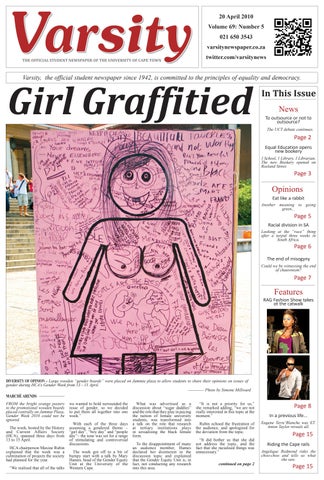
DIVERSITY OF OPINION - Large wooden “gender boards” were placed on Jammie plaza to allow students to share their opinions on issues of gender during HCA’s Gender Week from 13 - 15 April. Photo by Simone Millward
MARCHÉ ARENDS FROM the bright orange posters to the promotional wooden boards placed centrally on Jammie Plaza, Gender Week 2010 could not be ignored. The week, hosted by the History and Current Affairs Society (HCA), spanned three days from 13 to 15 April. HCA chairperson Maxine Rubin explained that the week was a culmination of projects the society had planned for the year. “We realised that all of the talks
we wanted to hold surrounded the issue of gender, so we decided to put them all together into one week.” With each of the three days assuming a gendered theme – “girl day”, “boy day” and “people day”– the tone was set for a range of stimulating and controversial discussions. The week got off to a bit of bumpy start with a talk by Mary Hames, head of the Gender Equity Unit at the University of the Western Cape.
What was advertised as a discussion about “sugar daddies” and the role that they play in paying the tuition of female university students, was transformed into a talk on the role that research at tertiary institutions plays in sexualising the black female form. To the disappointment of many an audience member, Hames declared her disinterest in the discussion topic and explained that the Gender Equity Unit is, in fact, not conducting any research into this area.
“It is not a priority for us,” she remarked adding, “we are not really interested in this topic at the moment.” Rubin echoed the frustration of the audience, and apologised for the deviation from the topic. “It did bother us that she did not address the topic, and the fact that she racialised things was unnecessary.” continued on page 2
Page 8 In a previous life... Eugene Terre’Blanche was ET. Anton Taylor reveals all.
Page 15 Riding the Cape rails Angelique Redmond rides the choo-choo and tells us what she saw.
Page 15
2 News
Volume 69 Number 5
Emasithandane Children’s Project BERNDT HANNWEG THE BUSINESS in Context class is seeking to raise R75 000 in an effort to help the Emasithandane Children’s Organisation, a shelter for orphans and other vulnerable children. Situated in Nyanga, Emasithandane provides food, education and extra-mural activities for abandoned or abused orphans and children affected by HIV/AIDS, as well as providing food for children whose families could not otherwise afford to feed them. In addition, the organisation provides soccer activities for over 50 children from the local community. Founded by Zelphina “Mama” Maposela in 1994 when she took in three foster children, Emasithandane was declared a non-profit organisation in 2004 and as such celebrates its sixth anniversary in October of this year. However, it currently suffers from a lack of funds and is often reliant
on outside parties providing for it towards the end of every month. This semester, the BUS4067F class chose Emasithandane as the charity they would support, following a careful selection process involving the submissions from the students, which culminated in Emasithandane winning by a landslide. The class hopes to raise R75 000 in order to help the home to expand to other areas and to further assist more children in need. The class will be engaging in several events in the future, such as bake sales, and appreciates all forms of support. The organisation needs, among other things, medical supplies, school uniforms, stationery, toiletries, food, and money for transport, utilities and day-to-day running costs. For further information on this charity, visit the website at www.emasithandane.org.za, or e-mail Ryan Llewellyn-Williams at llwrya001@uct.ac.za.
HIV/AIDS at UCT - too good to be true? NATASHA NEL
and condom use: the majority A RECENT HIV prevalence survey of students uses condoms, while conducted at UCT has revealed, this practice is significantly lower according to Vice-Chancellor Dr among staff. Max Price, “excellent” results. A total of 1 574 people were tested, 1 005 of which were students. The official findings state: “Almost no students are living with HIV (0.2%) and no academic or service staff were found to be HIV positive in the sample… It is estimated that a total of 31 students and 25 admin/service staff at UCT are living with HIV.”
Almost no students are living with HIV
Despite a largely positive response to the testing initiative, students were discouraged by long queues in Jameson Hall. First-year Humanities student Phoebe Julius complained that she waited three hours for her The survey also found that test. “If they could fix that, I think an estimated two-thirds of all more students would definitely students (64%) have been or are have been tested.” sexually active. “However, less than half of students aged 18 In an e-mail, Price expressed had had sex before (48%) and his contentment with the results, this increases to 65% among but did highlight the need to those aged 20, and to 74% among acknowledge “some bias in the those older than 20. This suggests study”, and a few “worrying that many students have sex for trends”. He listed these as: the first time while they are at “alcohol use to the point of drunkenness”; a high prevalence university.” of sexually transmitted infections; Various comparisons were and the seemingly frequent drawn between students and occurrence of “concurrent sexual staff, including drinking habits relationships”.
“Gender Week” continued from page 1 Another point of contention was the placement of the large wooden “gender boards” on Jammie Plaza on which students were encouraged to write. According to the HCA, the aim of the boards was to allow students a platform through which they could express themselves about gender dynamics in South Africa. By the end of the week, however, the boards were littered with sexist, racist and homophobic slurs.
“...people on the African continent are more comfortable with two men holding guns than two men holding hands.” “I expected people to draw penises,” said Rubin; “I was not expecting swastikas and AWB signs.” Rubin however went on to explain that the HCA did not regret placing the boards in such a public forum.
LGBTI RIGHTS - Panelists discuss the state of LGBTI rights in Africa at a talk during Gender Week on 15 April. Photo by Lyndall Thwaits South African masculinities to the relationship between religion and gender.
“Even if only a few people wrote serious comments, I think the boards speak a lot about UCT students’ maturity about gender.”
The final event of the week – a panel discussion on the rights of the Lesbian, Gay, Bisexual, Transsexual, and Intersexed (LGBTI) community in Africa – proved to be the most well attended and sparked great postdiscussion debate.
While the initial event may have been unsatisfactory, the rest of the week ran smoothly with discussions on topics ranging as diverse as
Highlighted in this discussion was the intense wave of homophobia sweeping Africa at present.
“I cannot understand why people on the African continent are more comfortable with two men holding guns than two men holding hands” remarked Marlow Valetine, Deputy Director of the Triangle Project. In addition to this, clear gendered dynamics were present at the events themselves with only 3 males attending the documentary screening on “girl day” and the LGBTI panel discussion having been attended almost exclusively by members of the LGBTI community.
To outsource or not to outsource? TONBARA EKIYOR LAST May, over 3 000 students signed a petition requesting a review of UCT’s outsourcing policy. The petition was taken to Bremner and an external committee overseen by Deputy Vice-Chancellor Thandabantu Nhlapo was appointed to evaluate UCT’s employment methods. The areas of service that were under consideration included: security, residence cleaning, grounds, campus cleaning, the shuttle service, catering and garden maintenance. The main reason why concerns were raised among others was to ensure job security for the workers. After its investigations, the outsourcing review board concluded that three of the seven services considered should be insourced. The services recommended for insourcing include residence cleaning, garden maintenance and the shuttle service. A wide range of variables were used to determine whether or not service should be outsourced. The main concerns contained in the report were the level of efficiency with which the external company carried out the service, whether or not the outsourced company could be held accountable for non-delivery, and the effect outsourcing each service has on UCT’s reputation in the case of unforeseen circumstances. The committee recommended that the cleaning services be insourced because “lack of service delivery in terms of the cleaning of the residences [and the grounds] will significantly impact on the UCT reputation”. The Jammie shuttle service was recommended
DISSATISFACTION - Workers protest Management’s treatment of them in March this year. Photo by Andrecia Ramnath
for insourcing because of the visible UCT brand on the side of the buses, which represent the university off-campus. If the service is outsourced, UCT has no liability in the case of an accident. Despite these recommendations, UCT management said in a statement that they “did not agree that there was a convincing case for insourcing”. Vice-Chancellor Dr Max Price stated that “there is no reason to change [the UCT] policy if the systems are still working”. Price further stated that insourcing the cleaning services would lead to “inefficiencies, particularly because of the need for different types and intensities
of cleaning, which vary between term and vacation times”. In the case of the shuttle service, Price stated that “it would be against national and international best practices to insource the Jammie shuttle”, as it is more effectively managed by an outsourced entity. Concerning the job insecurity of the workers, Price stated that UCT is introducing Supplemented Living Level (SLL) policies which set a minimum wage to be paid to the workers. He further stated that although outsourcing may cause job insecurity for workers, there are policies put in place to “mitigate that risk”.
News 3
1 School, 1 Library, 1 Librarian Prof Crain Soudien appointed DVC STEPHANIE VENTER
Image courtesy of www.uct.ac.za
SOCIOLOGIST of youth Professor Crain Soudien has recently been appointed Deputy Vice-Chancellor (DVC), effective 1 April 2010. He will be responsible for “the cluster of activities related to supporting UCT’s transformation strategy,” according to Vice-Chancellor Dr Max Price.
READ AND LEARN - The Bookery has been launched on Roeland Street to collect books for under-resourced public schools. Photo by Lyndal Thwaits shown in research that having LYNDALL THWAITS learners in South Africa. The access to a fully functional library Bookery serves to sort, categorise improves learning performance in EQUAL Education’s “1 School, 1 and catalogue the books before school learners. The project has Library, 1 Librarian” campaign allocating them to a specific been highly successful so far but has launched The Bookery, a school, a process which requires needs as much support as it can branch of the organisation run time and volunteers from various get, with the intention to fill every by Doran Isaacs. Opened earlier areas around the city. Volunteers school with books. this year on Roeland Street, The include some UCT students. The Bookery has been promoting Bookery is now fully up and Books are then sent out to public running and serves as a space schools across the country which its campaign through schools, of development and collection lack the funds and resources to buy private and public companies, for the campaign. On 21 March new books. Currently, only 7% international organisations and an estimated 10 000 learners of public schools have functional universities. Equal Education believes that tackling the basic gathered on the Grand Parade libraries. education crisis in South Africa to march to Parliament to hand The organisation is generating has become an urgent fight for over a memorandum in support of the Equal Education initiative, awareness and highlighting the basic rights and is essential for the supported by various public importance of libraries within progression and development of figureheads such as COSATU’s schools as a vital learning tool our country. General Secretary, Zwelinzima through the campaign. VARSITY spoke with the head co-ordinator of Donations can be dropped off at Vavi. The Bookery, UCT alum Richard 200 Roeland Street (old location of The Bookery’s aim is to collect Conyngham. Conyngham believes Charly’s Bakery), and people can up-to-date books in good condition “every child deserves books of volunteer by contacting Richard for primary and secondary school a high standard” and it has been Conyngham at 076 593 9310.
From his days as a student in the early 1970s, Soudien’s history with UCT is extensive. The main difference between UCT then and UCT today is a racial one, says Soudien. “There were no African students at UCT, and Coloured and Indian students had to apply for permits to study here,” he remembers, adding that he was one such “permitted” student. However the campus itself was a “non-racial island” in many respects, with opportunities for all students that led to lifelong friendships that would otherwise never have been formed.
international universities, including the Universities of Washington, Sussex, York, and the State University of New York. While acknowledging that these institutions have resources far beyond those of UCT, “UCT concedes nothing [to such acclaimed institutions] in terms of the quality of intellectual discussion,” says Prof Soudien. But, UCT needs continually to think about ways in which it can improve, without becoming a carbon-copy of international tertiary institutions. Soudien’s job as DVC will include having the Executive Directors of Student Affairs and Transformation Services report directly to him, as well as bearing responsibility for the social justice portfolios, the Institutional Forum, employment equity, student demographic change, and the student financial aid policy. The social justice portfolios include HIV/AIDS, discrimination and harassment issues, and disability services. In addition, he is the Chairperson of the Admissions Review Task Team (ARTT), a body that aims to put together an admissions policy for UCT that is “sensitive to disability”, and can better measure disadvantage for potential students.
One of the biggest challenges facing transformation is student complacency, believes Soudien. “How can we develop confidence amongst students to participate in [and care about] activities beyond After completing postgraduate their own self-gratification?” study at UCT, Soudien went on to study at prestigious
LOVE FASHION? If you are looking for an exciting career in a dynamic, energetic working environment, there are many opportunities for young, passionate graduates in various departments. All our positions advertised below are based at our Head Office in Cape Town. For more information on the requirements for these positions and to apply, visit our website at www.truworths.co.za
TR AI NE E PL AN NE R
If you are a born trader, analy tical, love numbers and want to play a strategic role in the success of a business, then you should consider embarking on a career as a Trainee Planner.
TRA INE E BUY ER If you live, breathe, eat and sleep fashion then our Trainee Buyer programme is for you!
CAL L CEN TER AGE NT, DATA CAP TUR ER OR A CON FIR MER / UNDERW RIT ER If you are energetic, passionate, display exceptional communication and interpersonal skills, consider working in our credit office.
Truworths is committed to Transformation and meeting the objectives of the Employment Equity Act. Meeting our employment equity goals and targets will be taken into account in our recruitment decisions.
4 Editorial VARSITY NEWSPAPER BLOGS READER DISCRETION ADVISED: anything goes at the VARSITY Newspaper blogs...
Reasonable Doubt Proudly Conservative In this fast-paced and interconnected world, conservatism is too quickly branded as being representative of prejudicial thinking; yet the same liberals who are quick to make these charges are quick to also state that they are open-minded and tolerant of views different from their own. If someone is against abortion, homosexuality and disagrees with feminism then that is their right and they should not be adversely judged or treated for believing it. The world, indeed liberals need more people who adhere to the Biblical saying, “let those who are without sin cast the first stone”.
TATENDA GOREDEMA is the Deputy Editor of VARSITY newspaper.
Read more at www.reasdoubt.blogspot.com
Trust and Believe
You must relax yourself!
I love embarrassing people – it’s cheap, fun, and non-fattening. Rarely am I happier than when I know I’ve made someone squirm uncomfortably. But before you get on the anti-Yati warpath, pitchfork in hand, ready to educate me, let me explain. I love embarrassing people that deserve to be embarrassed. For instance, push me away from the counter (it’s happened) while I’m ordering my morning chocolate-chip muffin (what a deep and loving relationship we have) and you will be called out. I am not the one, today is not the day, and tomorrow really doesn’t look so good, either. You must relax yourself, child.
NKOSIYATI KHUMALO is the Copy Editor of VARSITY newspaper.
Read more at www.trustbelieve.blogspot.com
newsgathering next newsgathering Thursday, April 22 2010, Meridian, Beattie 114
2010 collective editor Rémy Ngamije deputy editor Tatenda Goredema copy editor Nkosiyati Khumalo sub-editors Kelly Berold, Nicholas Botha, Cayleigh Bright, Karen Froneman, Liam Kruger dtp editor Danni Liang finance team Tina Swigelaar & Odwa Sihlobo images editor Simone Millward photographers Nico Gous, Andrecia Ramnath, Zakareeya Pandey, Lorna Rae Daniels news Olivia Walton & Natasha Nel opinions Sarah Jackson & Martin Mendelsohn features Nyasha Kadandara & Tiffany Mugo sport Dominic Verwey & Edward Sellier human resources Tariro Nyamakura & Aleeshah Sayyideena advertising Odwa Sihlobo marketing team John-Ross Hugo, Andrew Ehmke & Mathabatha Sexwale IT manager Irfaan M Imamdin
Volume 69 Number 5
“Sticks and stones...” ...may break my bones, but words will never hurt me. So the saying goes, but in today’s world, especially in the African political context, I find myself disagreeing with this old mantra. Probably on no other continent have words been of more importance. Words arranged in a certain way and spoken by a specific person can make people feel happy, they can make them angry and they can make them sad. Words can help heal nations, end wars, raise funds for victims of natural disasters, alert the world about the need to preserve the environment and help in making the world a better place. And there have been countless examples of this throughout history: Martin Luther King, Jr’s “I have a dream”; Winston Churchill’s “Never Surrender”; Michael Jackson’s “We Are The World”; and closer to home, Nelson Mandela’s “Never and Never Again” – all prime examples of the ways in which words are used to encourage people to grab hold of the small spark of positive life within them and use it for the greater good. In the same manner that words are marvellous things with which to order and structure the world, they can aid in its destruction. A careless word here can sow the seeds of hatred, and another one there can spark racial wounds once thought forgotten. A wrong word can incite violence, economic downturns and bring each and every person on Earth to their knees. A look back at history will show pivotal moments in which words were used to turn people against each other, taking hunanity to the edge of existence. Hitler’s declaration of war, Idi Amin’s numerous speeches during his tyrannical reign and most recently, the various speeches, counterspeeches and articles abound in the South African media after ET’s death and Malema’s subsequent tirade at a recent media briefing. Truly, words are powerful and dangerous things. Which is perhaps why someone should sit Julius Malema down and tell him to be more careful with his words because he consistently spews forth garbage. This statement is directed at many politicians but due to space constraints (even an editor has limits), we shall focus on Comrade Juju. There are many that will say Julius Malema is an intelligent person – a shrewd politician who says what he says merely out of pre-planned political tact. And there are others that will have us believe that his words are chosen in the same manner that a chess grandmaster will make a move: intelligently and with purpose. Even more will speculate that his actions are the result of an invisible puppet master, tugging at the strings attached to Juju’s very loose mouth. However, when Comrade Juju opens his mouth, I find myself wondering why the ANCYL does not spend more money on a public relations department. At least they should hire a speechwriter. I know numerous English students at UCT that would be able to compose a speech for him that does not make him and the organisation that he leads, look like complete idiots. (Even Obama has a speechwriter, for crying out loud.) The reason why Juju merits a mention in this particular editorial is not because of his antics on televisons, as entertaining as they might be. It is the fact that Juju, like too many leaders across the continent, take it for granted that they are above reproach for what they say in public once they are put into places of power. Without realising the effects that speeches – planned and unplanned – have on people, African leaders have an annoying tendency of putting their mouths on auto-pilot, something that can only be done by people with spare brain cells to monitor the working of their mouths. Juju (all of his statements), Zuma (the shower thing), Mugabe (too many to count), Visagie (eish, where to start), Shivambu (sleeping around is sleeping around), Manto Tshabalala-Msimang (just use beetroots) and a few others are just some people who should have been told how to use teleprompters long ago. But part of the problem with admitting to errant leadership stems from the fear of ostracisation that comes from going against party directives and closer to home, from fear of being told that you have certain “white tendencies”. Personally, regardless of race, culture and all other divisive things that plague the continent, Africans should demand stronger, accountable and well-spoken leadership. The last part is becoming more important because as people us according to our leaders. As an aside, if you were a girl, can you imagine bringing Julius home to your parents? Just a thought. Rémy Ngamije
staff writers Tonbara Ekiyor, Daniel Freund, Calvin Scholtz, Anton Taylor, Stephanie Venter, Lyndall Thwaits, Alexander Child, Tarryn Steenekamp, Gosia Podgorska, Berndt Hannweg, Alexandra Perry
The VARSITY QR Code
external contributors Carla Gontier, Paul Herman, Karl Buckton, Angelique Redmond, Thato Mabudusha, Lekometsa Mokhesi, Leonard Chitunhu, Carrie Timlin, Mpho Moshe Matheolane, Aimee Dyamond, Kathryn Mitchell
VARSITY is making it easier to connect you and your phone to the digital world of VARSITY, including our extensive and continually updated image galleries. To scan a QR code using your phone, point your mobile browser to get.geetagg.com (or use scanlife.com), point and shoot your phone at our block of squiggles using the mobile app, and you’ll be automatically directed to the VARSITY website.
To get hold of the News team email:
news@varsitynewspaper.co.za To contact the Opinions editor or submit an opinion, email:
opinions@varsitynewspaper.co.za To contact the Features team, email:
features@varsitynewspaper.co.za To contact the Sports desk, email:
Know your status.
Please recycle VARSITY.
Don’t drink and drive. Drink responsibly.
Reduce energy emmission.
sports@varsitynewspaper.co.za To advertise, email:
ads@varsitynewspaper.co.za Want to join VARSITY Newspaper? Email:
hr@varsitynewspaper.co.za Tel: 021 650 3543 Fax: 021 650 2904
is looking for Staff writers | Photographers | Design editors | Web developers
If you are interested, please send a brief CV and a letter of motivation to hr@varsitynewspaper.co.za
Opinions 5
Save the planet, be a vegetarian
My creed – a case for spirituality
ANGELIQUE REDMOND
GOSIA PODGORSKA
NOTHING can make a meat eater more hostile in the space of a few seconds than the word vegetarian. You would swear it’s a personal affront to animals that some people just don’t enjoy eating them. The staunch meat eater will defend his position to the death; after all, it’s his constitutional right to have an opinion. While you are chewing on your hamburger, here are a few interesting things you may not know about. Most meat eaters have an increased risk of heart disease, colon cancer, lung cancer, and breast cancer, to name a few. Do you really know what’s in the meat you consume on a regular basis? Hormones – and not just natural hormones such as progesterone and testosterone.
Have you ever heard of estradiol 17a? According to the European Union’s Science Panel this hormone is a carcinogen, a substance capable of causing cancer in humans. The hormone is used as a growth promoter for cattle, so the medium-rare steak you enjoy so much may just give you cancer. There are at least five other growth hormones used to hasten the growth of animals from the fields to the slaughterhouse. Besides health risks, there are also the inhumane conditions animals face when being led to the great beyond. While abattoirs are now legally required to stun animals, rendering them insensible, the method for stunning varies. Most cattle receive a two- to threehundred volt shock to the back of the head or are shot in the front of the head with a captive bolt pistol.
VEGGIES - Would these vegetables be smiling if they knew what was coming their way?
They are secured with a head halter through a metal ring on a concrete floor. Then their throats are cut, which is the actual cause of death. These are, of course, the abattoirs in which humane stunning is done. A video released by a proanimal rights movement in California showed live, thrashing cows chained upside down to a meat processing line. Animals are also have their tails twisted, are prodded with electric wands, or are beaten prior to the apparently humane method of slaughter. If not for the health-related or ethical reasons for not eating meat, what about the planet? The carbon emissions released due to cattle farming are alarming. Methane is a green house gas resulting in global warning. The current estimate states that cows release an average of 70kg to 120kg of methane per year. If you take into account that there are 1.5 billion cows and bulls worldwide, that is a lot of methane and a significant contribution to global warming,. Research suggests that by going vegetarian, you could do more for the environment than by driving a hybrid car. With so many negative aspects to eating meat, being a vegetarian is simply the better option. Vegetarians live a healthier and longer life than their meat-eating counterparts, so before you sink your teeth into a piece of steak consider the benefits to you and the planet of cutting down on meat or giving it up for good.
The battle for the soul of UCT THATO MABUDUSHA IT HAS been a battle for dominance for decades. Tears have been shed and feelings have been hurt. Yet, the war between Humanities and Commerce rages on... This war is not one fought with sophisticated machinery and lethal weaponry. Billions from the budget are not allocated to it annually – this war is far too advanced for that. As a third party, completely neutral and objective, I have noted that its weapons are persistent mockery, bare-footed defiance and vicious glares exchanged across the Leslie Social and Leslie Commerce buildings. The Humanities clan is generally good-looking, carefree, bare-footed and – for lack of a better term – happy. They have time to explore Cape Town during weekdays because one lecture a day certainly allows for free roaming. They are perpetually laughing and exposing white, dimpled smiles because they are – for lack of a better term – happy. They are at the forefront of social issues as they fiercely and passionately debate the ills of society and the perils we face in our beautiful land. This clan takes what they’re studying quite seriously despite what people may say about dismal job opportunities post-graduation. They will be the psychologists, politicians, teachers and social workers of the future. They are the heart of UCT. On the other end is the Commerce tribe. This is a strong,
ambitious, determined group with members marching around UCT like they recently purchased Earth and its inhabitants. Some can even be seen engrossed in intense business-esque discussions about commodities and market values. They peck away ferociously on their BlackBerrys and peruse the library like famished lions for the latest financial journals. They are – for lack of a better term – serious. This serious clan sincerely believes that what they do defines the world as we know it (which is true). “What is the world without economics?” they bellow. These people are – for lack of a better term – serious. They are the wallet of UCT. These two tribes hurl abuse at each other with frightening intensity and foul attitudes. The Humanities side barks about Commerce’s lack of a soul and their hunger for money. They are better because they will make a difference in life. The Commerce clan laughs at them because essentially, they will be wealthy, they’ll have the privilege of carrying serious-looking briefcases (like the ones in movies) and they will run the world. They jeer at bare feet and shake their heads disapprovingly at them on the Jammie stairs as they make their way to a (very serious) Economics lecture. Jabbing jokes are exchanged at the expense of the other, along the lines of: - What is the difference between a pizza and a Humanities graduate? A pizza can feed a family of four...
“DO YOU believe in Jesus Christ, his only Son, our Lord? Do you believe He was conceived by the power of the Holy Spirit and born of the Virgin Mary? Do you believe He will come again to judge the living and the dead? Do you believe in the holy Catholic Church?” There I stood in familiar surroundings, listening to the words of the Apostles’ Creed, completely stunned. Do I? While other people in the church recited their I Dos unquestioningly, I just couldn’t bring myself to open my mouth and say anything. All that was required was a simple twoword answer, and yet I was too preoccupied with my thoughts, which were jolting around from one corner of my head to the other. Indeed, while some people have the belief that one should not question religion in the first place, I couldn’t ignore the need for clarity any more. The reasons for my inability to answer were deep-seated. Since the day I was born, like many others among us, my parents caringly baptised me under the faith they believed in – Roman Catholicism – which I followed ever since. While I do not resent them even mildly for wanting to give me a religious background, and am indeed thankful to them for showing me a path, there inevitably came a time in my life when I became more conscious of my existential identity. Questions began forming in my mind: “Are religion and spirituality permanently linked? Is it possible to be spiritual but not religions, or religious but not spiritual?” While others among us may have found
the answers for themselves a long time ago, it was now my turn, and I had to find out for myself. My search unsurprisingly led me to, well… me, where I found that greater questions in life have to be answered by oneself. While you can get advice from the people in your life, no one should tell you what to believe. In my case, all my questions led me to find that I was much more comfortable and happy being spiritual, believing in a higher power, a God, that I feel exists. But, in my case, the link between religion and faith has slowly been separated. I find religion to be a man-made concept with which I have a lot of difficulty finding peace. Nevertheless, that is my answer to my own search. While religion has always been known to be a particularly sensitive topic, I don’t see why I shouldn’t be allowed to explore the idea. I’m sure that I’m not the only one out there who struggles to define themselves according to the outset laws given to us from the getgo. Sometimes in life, it takes a little more effort to find a good relationship between your head and your heart. I’m encouraging those who feel lost or stuck to not be afraid to wonder outside the edges of the proverbial box. Ultimately, we all come across questions that we find difficult to answer, be it in the greater sense of who we are and what we believe or in smaller aspects of our lives. I believe that everyone is an individual, and whether you find yourself comfortable being religious, spiritual, or both, that all becomes part of your own personal creed. The hard part is simply to remember to live by it. And that much, I do. Amen.
HOLIER THAN THOU - The link between religion and spirituality explored.
-What is the difference between a pizza and a Commerce student? People actually like pizza... Some may remark, “This is immature.” The Humanities and Commerce students will roar, “No, this is Sparta!” What these two clans don’t realise is that they are important in their own right – one cannot exist without the other. If one completely destroys the other, its own existence is compromised. UCT needs a heart and UCT needs a wallet. This delicate balance and understanding of the equilibrium of UCT is something only the more sophisticated mind would understand. It is something only the most intelligent people on campus comprehend – its intricacies, the precise mathematics involved, as well as the natural laws of physics it obeys. The Engineers’ superior intellect allows them to sit quietly and smugly with the knowledge that they are, in fact, the best, while the war between the Faculty of Commerce and the Faculty of Humanities rages on, for no good reason.
disclaimer The VARSITY Opinions section is a vehicle for expression on any topic by members of the university community or other interested parties. The opinions within this section are not necessarily those of the VARSITY Collective or its advertisers. The Opinions Editor expressly reserves the right to edit or shorten letters. Letters should include the name and telephone number of the writer, and must be received by 17h00 on the Wednesday before publication. They should not exceed 350 words, and will not be published under a pseudonym, or anonymously.
Email articles to opinions@varsitynewspaper.co.za
6 Opinions
Volume 69 Number 5
I am your brother! The multiplication of racial division ANOTHER student's life lost to crime at UCT. We mourn, we feel unsafe. We protested “How many more?” How many more lives are we going to lose to crime – not only at UCT, but throughout the country? South Africa has one of the highest murder rates per capita in the world. According to the SAPS 2008/2009 report, on average 50 people in South Africa lose their lives because of crime every day. When your neighbourhood becomes unsafe, you relocate to a safer place. If you cannot relocate, what do you do? You build higher gates, buy wilder dogs, and put on larger locks. The criminals break the gate, shoot the dog and destroy the lock, and they still come in. We are in a serious predicament. It’s saddening to realise that most of the perpetrators are under the age of 35. What will the future of this country be with young people who kill so mercilessly? Crime is a spirit – an attitude. Once crime becomes a way of life, that person becomes maleficent to their society. Unfortunately the spirit of crime cannot be shot with a gun or placed behind bars. You can put a man in prison, but not his ideologies. He breeds more like him.
Some of you have been fortunate enough to make good choices – such as coming to study at a university like UCT. You have friends and neighbours who made wrong choices and ended up on street corners. Consequently, they developed a dangerous belief system that says “I have the power to take your life or give it to you”. Be warned, these might be the people who will be holding a knife on your neck, demanding the money and car you've been working so hard for. In the end, we remain at the mercy of the competence of the police. The problem of crime still remains insuperable. We cannot sit and wait. It’s now incumbent upon us to go one step further. We can reach out to the communities with a different message, a message that can reach the hearts of the criminals and foster compassion. A message that has the efficacy to restore the value of a human life in them. As the government continues to invest more to meliorate security, we take safety measures against crime. Can we go one step further and come up with creative methods of reaching out to the criminals with a "Love thy Neighbour" campaign?
LEONARD CHITUNHU
Images courtesy of www.fmg.co.za
LEKOMETSA MOKHESI
DOES the death of white supremacist Eugene Terre’Blanche multiply racial division, adding fuel to the fire and subtracting unity from the rainbow nation? Do the math. Now the history: Eugene “Terror” Blanche, born 1941, renowned white supremacist, ex-convict, farmer and loving father, died from a farm attack. A couple of disgruntled workers who just happened to be black males beat the Afrikaner Weerstandsbeweging (AWB) leader to death, ambushing him whilst asleep. Rumour has it that the killing was over unpaid wages. Other wagging tongues utter tales of retribution for Terre’Blanche’s misdeeds. Perhaps the wages of his sin is death. The coincidences abound, what with his death being on the same day as Chris Hani’s assassination on April 3. Worse still, the ANC hit “Kill the Boer” is said to have been the inspiration behind the slaughter. Is this killing the flame that develops into the veld fire, or is it the huff and puff of the wind against a stone wall?
GIVE ME AN R – The death of Terre’Blanche is giving life to the rest of the debate. sympathises, calling the murder “cowardly”. However, before you breathe a sigh of relief, consider Julius “the black skinhead” Malema’s verbalisations. His and Helen Zille’s mudslinging could set a flame in the hearts of the impressionable. And of course Brandon Huntley, the South African-Canadian, who turned Free South Africa into Flee South Africa in 2009 by escaping the wrath of the Black Plague – that is, the “persecution of whites by blacks”. Perhaps the rainbow nation is not as rainbow-y as we would like to think. The rainbow does not even have black and white colours to begin with! Perhaps being called a Zebra Nation would prompt people to hold hands, whilst singing “Kumbaya” around a campfire.
hijackings, rapes, murder, suicide bombings – these are the norm, like it or not. The only difference is that in South Africa the conflict may take a racist flavour, because of a history that is still fresh in the fridges of cold hearts. AWB might vow to repay their loss and Malema might fail to reserve hate speech to the privacy of his own home. But conflict on this side of the grave is the order of the day. Political analysts warn people to come out of their underground basements. Peace prevails. Perhaps not so much in Ventersdorp, but at UCT day meets night under the shade of an eclipse. The lion lies down with the lamb and the black sheep gets invited to the family reunion. The raised fist and extended arm simply high-five, thumb wrestle and rock-paperscissors. The only raised fists in the air accompany the yawns of students in boring lectures. The black panther will not piss on the burning cross. The Capetonian mountain gods are pleased. People stare at the world through heartshaped pupils at only the colour of love. Black and white television sets have been thrown to the museum. Fortunately, the Blacks/ Whites Only signs are just jest.
Hate speech by any other name
Such incidences cause the teenage new South Africa (a tender 16-year-old) to question just how far behind it has left the corpse of apartheid, and whether the stench still clings to the youth. Teenagers are indeed volatile and it is no surprise that some South Africans are bracing themselves for a showdown of blood and gore. AWB points the index finger at Malema for inciting the Terre’Blanche murder. However, cooler heads say the farm attack is just another murder, in a society where the solution to life’s problems lies in the barrel of a gun. Criminals in South Africa only see the colour gold when out on the prowl. De Klerk, the former NP leader, says the event is non-racist. Van de Merwe of the IFP agrees and President Zuma
CARLA GONTIER
Beyond borders: the global struggle for women’s rights
ARE songs like “Shoot the Boere” still relevant? This is a difficult question to answer. I mean, it is very difficult to discover whether racism is relevant or not. But I believe I have decided: absolutely and unequivocally, no. If none of you have picked up on my sardonic inferences, then I’ll put it to you straight. Why is this even a question for debate? Hate speech is hate speech, no matter how anyone is trying to frame it. The ANC and Julius Malema arguing that this song is part of our history is a completely ludicrous notion. So were pass laws. So was the Immorality Act. Does that mean we should bring those back? No, and we certainly shouldn’t sing songs about them. Building a democratic future together as the rainbow nation has been difficult enough. South Africans struggle every day with racism and to accept one another’s differences, without our own government endorsing songs that promote blatant hatred of another race. If such behaviour is condoned, where will it stop? Wait, I’ve just thought of a song that you all might like. It was sung by another youth league not so long ago – the Fahrenlied. Anyone recall that? I’ll give you a clue who it was sung for: he killed millions of Jews and his surname started with Hitler. Lovely man. Ok, that’s a bad analogy. The Fahrenlied wan’t actually about
killing anyone, but you get the idea. Is it possible that, coupled with the amount of Boere (white farmers) being killed annually, a genocide is taking place right under our noses, and it’s just being happily sung about? The High Court’s ruling to ban these hate songs from being sung has done nothing but uphold the law and protect the right of all South Africans to be treated fairly. A ruling in favour of the song being sung would have been detrimental to all of our civil liberties. The ANC’s appeal against this ruling is fundamentally at odds with what they fought so hard to bring an end to. Isn’t the song “Shoot the Boere” just as bad as “Shoot the whites” or “Shoot the blacks”? They are all just different sides of the same blatantly racist coin. Anything that incites hatred of another race should be left in the pre-1994 era where it belongs. This is not to say that debate should not take place about the past; we should never forget what happened in our past so that we can ensure it never happens again. But this can be done without insensitively singing racist songs, because the meaning of the songs has changed over the years. What once was a song used to end apartheid, is now being used to rouse hatred among South Africans. Apartheid is over, and we should work towards building our country, together. So perhaps Malema should spend his energy on trying to do some good for a change, instead of just trying to cause a stir in the media.
CARRIE TIMLIN FRESH in the wake of Gender Week, many of the discussions on campus have turned to the problems of gender and discrimination within our own microcosm at UCT. The concerns surrounding gender and discrimination are very real in South Africa and on campus. That said, we should be grateful that we live in a society where these issues are acknowledged and can therefore be addressed. With this in mind I would like to take you beyond borders to such regions as Egypt, Ethiopia, India and the Middle East. In the rural areas of these countries it is rare for young girls to be allowed out of their homes unless to work in the fields or for marriage. Children as young as seven are forced to marry men four or five times their age. If this is not shocking enough, a recent case in Yemen tells of a 13-year-old girl who died of severe vaginal bleeding after a forced marriage to a 23-year-old man. This was the result of an agreement between two men to marry each other’s sisters to avoid paying expensive bride prices. In Ethiopia, many young girls suffer from a condition known as obstetric fistulas. This occurs when a physically immature girl, often the product of an arranged marriage, tries to give birth and
“...Perhaps being called a Zebra Nation would prompt people to hold hands...” Now, to draw away from mushroom-inducing thoughts like the Zebra Nation. The world has never been seamless. Conflict has been grim reaping since planets smashed into each other and produced the moon. The xenophobic attacks, the
the baby is unable to breach. The baby is stillborn and the girl is left with severe vaginal damage. The result is an inability to hold in her bodily wastes; she smells pungent and her marriage is often affected. This condition affects close to two million women and girls worldwide. In these countries women and female children have little to no rights and are traded like cattle. Child brides are placed in a situation in which most of them lack the maturity or means to contest a patriarchal society that denies them basic human rights - their only crime being that they were born female. As women living in South Africa a majority of us enjoy the liberation of choice. As university students we are spoiled for privilege through education and social liberties. The examples used
The differences have been cast aside and that is the sum of it.
above are a small part of a massive global problem faced by women who may never enjoy this kind of liberty. Locally, the simple fact that we can have a Gender Week and can talk openly about the concerns around gender says something for the democracy that we take for granted. It becomes too easy to centralise our thoughts and actions around that which affects us directly. I realise the reality of gender discrimination within our society and the need for change, but by comparison to other countries, our ability to acknowledge this need will be fundamental in that change. It is also fundamental, however, that we are aware of our role in the global community and the injustices (in some cases far greater than our own) faced by those outside of our country. Images courtesy of www.aljeezarah.com
Images courtesy of www.flickr.com
Please don’t kill me – I am your brother!
COVERED UP - Within the Arab world, the quest for women’s rights continues. Burqas, the long gowns that Muslim women wear, elicit much criticim from women’s rights activists.
Opinions 7 Trivial Pursuit By Sarah Jackson
Juju is inappropriate but not hateful
direct effect of the death of Eugene Terreblanche. It is doubtful that Malema truly believes that Helen Zille is a Satanist or that Jeremy Cronin thinks that he is a white messiah. Instead, Malema knows exactly what will upset people the most. He is well aware of what will get him in trouble in the press and talked about. And he knows us well because without fail, there we are, feeding the media monster with all the attention it does not deserve.
THE controversy over the singing of struggle songs such as “Shoot the Boer” and “Umshini Wam” has brought to the forefront of public debate thinly veiled South African fears; the ones that many people think but will only mutter out loud in very select company. Thoughts that when articulated, begin like this: “I swear when Nelson Mandela dies…”and “If Malema ever becomes president…” I don’t think that Malema singing “Shoot the Boer” had any
Not that Malema’s comments are trivial or deserve to go unpunished. Zuma’s late reaction to condemn the comments of the ANCYL president is symptomatic of deeper corruption that has plagued the ANC since 1994. Tenderpreneurs investing huge amounts of money in businesses in Limpopo and the Arms Deal, where the government purchased R30 billion worth of armaments despite allegations that up to R1 billion was paid in bribe money to facilitate the deal, do not make the ANC out to be a shining beacon of morality. Now a belated crackdown (and actual praise) offered about Malema’s comments only point to corruption within the party.
So while I think that Malema’s comments are racist and inappropriate and, as the ANCYL is part of the ruling party, he should have been told off at a much earlier stage, his comments are not hate speech. Childish, racist and irresponsible in a country with the constant underlying racial tensions that have been present since the first colonisers, maybe; but not hate speech. People overlook the fact that while Malema and his followers might be singing “Shoot the Boer” just on the other side of the fence, white South Africans are singing “Die Stem” and marching under the old South African flag. In fact, verses of the apartheid-era anthem make up just less then half of our current anthem. These symbols surely represent and signal many more deaths of black activists at the hands of the National Party, but somehow they are left out of popular discourse. Additionally, many Facebook groups have sprung up, especially since the death of Terre’Blanche, groups with titles such as “Shoot the ANC, not the Boer”.
How are these acceptable forms of public expression and how is it any different from what Malema is doing? Simon Bikindi, a very popualar music artist, was convicted by the International Criminal Tribunal for Rwanda, because he wrote and distributed songs that incited people to violence on a radio station that he co-founded (with lyrics such as, “I hate these Hutus, these un-Hutus who gave up their identities, dear comrades”). Bikindi also attended Hutu political rallies to make statements about how Hutus should find and kill Tutsis. Bikindi took hate speech to a new level by inundating a medium that can reach the majority of the population with songs that explicitly encourage violence. This is simply not compareable to Malema singing a legitimate struggle songs at rallies, an action that has been blasted (albeit belatedly) by the ANC. Malema’s actions are inappropriate, but so are the actions of white South Africans who sing an anthem that could just as much be seen as a
call for action to return South Africa to its former regime. We will never know the circumstances behind the death of Terre’Blance, or whether his murder was politically motivated. We can only deal with the aftermath, which at this point is reminding us that under the guise of reconcilliation and embracing diversity are racial tensions that clearly have not, as much as we would like to think otherwise, diminished over time.
“People overlook the fact that while Malema and his followers might be singing ‘Shoot the Boer’ just on the other side of the fence, white South Africans are singing ‘Die Stem’ and marching under the old South African flag.”
The soon-to-be demise of misogyny as we know it STHABILE KOWA IN RESPONSE to Gosia Podgorska's succint article about the subtle ways in which chauvinism comes into play within our daily interactions with one another, I would like to expand on a number of points she made. But firstly, and this is by far the most important piece of news you will ever receive with regards to the feminist movement: it is not an ideology that seeks to point men out as egregious rapists, wifebeaters and murderers. Quite clearly, there are plenty of men, young and old, who each of us can point out as not coming even nearly close to fitting this profile. But the truth of the matter is that, on a broad scale, society has evolved to place the male gender in a higher position on the hierarchy. We see this manifestation in the wage-gap phenomenon (which is not much of a phenomenon when
one begins to closely inspect the dynamics between genders). The fact that historically, women have been economically-repressed for centuries by not being given access in the workplace, being held back from seeking tertiary education, not being allowed ownership of property and land, being disallowed from partaking in the public vote, being given titles in accordance with maritial status (which still happens today) and others are plenty of cause for such a movement as feminism to have struck its climax during the 1970s. Though some argue we now live in a post-feminist society (the same claim they would make with respect to race), I disagree. Put simply, until we reach a state of absolute equality between women and men in every sphere of society, feminism will still have its place in attempting to galvanise the notion that yes, "Women are
people". To describe this pattern of degrading, dominating, controlling and humiliating women, I use the word misogyny. This word does not relate to the ways in which men view women but often the ways in which society as a whole treats people who are of the female gender. Women too can be guilty of it; I can bravely say that because our society is built on sexist beliefs pertaining to the gender-binary and chiefly subscribes to a notion that there are specific and clear-cut roles that women and men must play, the very language we speak is a language of male chauvinism (upholding the false notion that men are superior to women). From the ways women's bodies are commodified for media consumption and sexualized for the purpose of male erotic stimulus, it is no surprise that
general "guy-talk" or what I would personally call "douchebag-talk" is comprised of the excitement found in dominating a woman sexually and then calling her a "slut" which relates to the manner in which society as a whole likes to compartmentalise female behaviour – you are either a "good-girl" or a "ho" (the virgin/ whore dichotomy). Sexism often shows up in the dismissal of female intelligence and creative agency. Often women are treated as if we are dumb and in need of male instruction. It goes further: females’ ideas are often discredited despite the richness they may carry. In worse cases a male may even steal the idea and take credit for it knowing full well that people will have a better time believing in his intelligence rather than that of a woman. In asserting a gender-binary with regard to stereotyping, we
all do ourselves a great disservice. I know for sure that there are young women out there who you'll probably find one afternoon sitting in front of the TV with beer in hand and Arsenal jersey getting aggravated about Fabregas missing the goal. Gender stereotypes are a fallacy; they are sociallyconstructed. We have effeminate men and tough chicks and plenty of other types of personalities that bear no relation to the individual's gender whatsoever! What Gosia described is misogyny (hatred of females) in three acts: this perpetual need to re-affirm patriarchal masculinity by observing women as sex-toys, virgins, whores, crazy, uncontrolled, docile and not as the individual people. It's an attitude that does prevail, and for this reason feminism is absolutely necessary in combating misogyny and deconstructing patriarchal definitions of masculinity.
Why non-taxpayers should be allowed to vote MATTHEW BUTLER-ADAM IN A recent VARSITY article, Chris Rooney argued that people who don’t pay income tax shouldn’t be able to vote (even though they pay VAT – something he acknowledges and then ignores). There are so many problems with his argument (like his blatant bias against the ANC) – but I have to be brief. It’s not just an impractical idea (which Chris seems to concede), it’s principally shocking. The most glaring consequence of a policy that prevents “people who don’t pay income tax” from voting is that a huge proportion of South Africans just wouldn’t be able to vote. This group would include everyone who is unemployed (close to 40% of our population on the broad definition) and those employed but who don’t earn enough to pay
income tax (something like R54 200 a year). So the majority of South Africans wouldn’t be able to vote. Is this democracy? Furthermore, we don’t just vote to determine how our tax is used. That is one of many reasons for the vote. We also vote so that we have a say in who represents us in Parliament – who determines legislation. The vote is also important as a mechanism of accountability and unity. Yes, it is true that the people who form the government determine how our taxes are used, and voting might affect this decision. But it is only one of the many factors that our votes influence. People who don’t contribute to income tax should still be able to vote for these reasons. If poor people couldn’t vote, what incentive would politicians have to cater to them? Taxation is a means for the
government to cater for market inefficiencies (providing public goods), but (especially in South Africa) it’s also about redistribution - giving money (through grants, education and health) to the poor. Who is better placed than those very poor people, in deciding how that money is spent? Most importantly, poor people (especially those in South Africa) don’t choose to be poor - they are born into poverty. They suffer because of their poverty, and are caught in a vicious cycle that excludes them from healthcare and education so that they may never escape. How can you punish poor people for something they haven’t chosen? We then have the conspiracy theory that the votes of poor people are less valuable because they are easily “brainwashed”. If anyone is aware of their reality
it’s the poor. They may not have a formal education, but they are most certainly aware of the challenges they face. If anyone is aware of government failures it’s the poor. So what if they respond to positive incentives when making their votes? If anything this shows that they are making rational votes. They are voting for the party that offers them the most (whether that be a food basket, or the promise of free education in the long run). Chris’s analysis relies on the assumption that a vote for the ANC is a bad vote, an irrational vote. It might be a bad vote for you – it’s certainly not a bad vote for other South Africans. Chris tells us that it’s fine to discriminate because we do it all the time. Here Chris has failed to draw the distinction between justified discrimination, and unjustified discrimination. It’s good that we don’t allow people
to become pilots if they have bad eyesight because they’d probably crash planes and kill people. It’s not good to be racist (or elitist) – because that’s arbitrary discrimination (it’s why apartheid was bad, Chris). We hear more conspiracy theory when we are told that prisoners shouldn’t vote and that the only reason they do vote is because they vote for the ANC. Do you know how prisoners vote Chris? Have you read their ballots? There might be some good reasons to allow prisoners to vote: they are citizens; after confinement they are reintroduced into society (the society that their vote might determine), it gives them incentive to re-integrate; the list goes on. Importantly, like poor people, they are citizens - with the fundamental human right to vote.
8 Features
Volume 69 Number 5
All things chic NYASHA KADANDARA THERE are two things that make a fashion show a success: beautiful clothes that you want to die for in the name of fashion, and models who make you consider renewing your gym membership. On 10 April the RAG Fashion Show attempted to reach the high expectations associated with a R140 ticket for a fashion show put on by students, and did a decent job. There were some designs that were amazing and some that left a lot to be desired. If you had never been to a fashion show then you would have had an amazing time and been blown away by the clothes that were paraded. The theme of the competition was “City Chic vs Township Chic”, and at first glance one would wonder how Oliver Strang won given his model’s resemblance to one of Dennis Rodman’s ensembles. However on close examination we can see that his design was in accordance with the theme as it was inspired by the new subculture of fashion Smarteez Soweto. There was not much competition between the models. Realistically, to be a model you need to be a certain height and weight, but some people still moan about the unethical standards that models
live up to so they stay in the game. I think it’s the least they can do considering the rest of us have to get a degree to live our dream. These days classic beauty has gone out the door. Obscure facial features, contrasting skin tones – in fact, anything that is not typical and makes clothing pop at the audience will get you into the modelling industry. Senzo Luthuli proved that second time’s a charm as he overcame past disappointment to win a much sought-after BOSS Models contract. Luthuli was stunned at his success and is looking forward to launching his modelling career and maybe one day gracing the catwalks of Milan and Paris Fashion week.
RAG Design Competition Winner - Oliver Strang. A model parades the winning design from Strang (above).
The best designs came from Jani B who presented a new mix of funk, while Ragnork’s designs looked like something from the set of Tokyo Drift. The Lot was one of my favourites with a vibrant electric feel. Their clothes were shocking, but real fashion is for the brave. The famous Nkhensani Nkosi’s designs from Love Movement were rather disappointing as they looked like a bad version of Ginger Mary designs. She tried to create an Afro-chic line, but it looked unoriginal and bland. All in all the RAG Fashion show was a success – it could have been better attended, but there were indeed beautiful clothes and beautiful people, and sometimes that is all you need. RAG Model Search Winner Senzo Luthuli strikes a pose on the catwalk (left).
Photographs by: Zakareeya Pandey Andrecia Ramnath Lorna Rae Daniel Lyndall Thwaits
Features 9
Images courtesy of www.cduniverse.com
Nosferatu (1922)
STEPHANIE VENTER THIS 1922 German Expressionist film changed vampire lore forever. Before Nosferatu there were many ways to kill a vampire: wooden stake through the heart, a silver bullet, beheading (to name but a few). Sunlight as a deadly threat to vampires however, had never been heard of. Enter Nosferatu.
of death” who drinks the blood of humans. Nosferatu’s demise (death by sunlight) at the end of the film was the first time sunlight was seen to kill a vampire, something which today is an accepted “fact” of vampire myth. Orlok’s depiction as a rodentlike, demonic-looking creature was highly influential in creating a common perception of vampires: that of a dangerous, animalistic predator. Though Dracula’s idea of a sophisticated, charming vampire is more common these days, the Nosferatu perception has nevertheless been influential.
This unlicensed version of Bram Stoker’s Dracula follows the creepy Count Orlok’s (Stoker’s novel’s names were changed) obsession with a young, beautiful (but engaged) woman, Ellen. Orlok is eventually revealed to be Nosferatu, a dangerous “bird
Images courtesy of www.starblogs.net
Interview with the Vampire (1994)
STEPHANIE VENTER IT IS no stretch to the imagination to imagine the twice-awarded “Sexiest Man Alive” Brad Pitt as a vampire. Personally, I find Tom Cruise a bit more of a stretch.
two easily-recognisable vampire stereotypes: the charming-but-evil vampire, and the self-loathing-butsomewhat-helpless vampire.
However, these two well-known actors and a very young Kirsten Dunst made a formidable vampiric trio in the 1994 film Interview with the Vampire. Based on one of the books in Anne Rice’s series The Vampire Chronicles, the movie sees Tom Cruise take on the role of one of the most complex vampires in literary history: Lestat.
Kristen Dunst’s child vampire Claudia brings an interesting dimension to the film. She has all the charm of a child, the worldlyknowledge of a grown woman, and the thirst of a vampire. Often out-of-control in the film, could she perhaps be the inspiration for the vampire children featured in Stephenie Meyer’s Breaking Dawn?
Lestat appears to be intrinsically evil, contrasted with the conflicted character of his side-kick Louis (Pitt). Both are the epitome of the good-looking, charming, seductive vampire that we are now fond of, but while Lestat uses his charm to serve his own purpose, Louis often struggles with his conscience. Thus the film portrays
Certainly not one of the vamproms we’ve become used to, the film is yet another interesting take on the vampire myth, with a bit more complexity.
her in the fight against Buffy the Vampire Slayer (1997 - 2002) guides the forces of darkness and who Images courtesy of www.cduniverse.com
TIFFANY MUGO “IN EVERY generation, there is a chosen one. She alone shall stand against the vampires, demons, and forces of darkness. She is the Slayer.” Buffy is your ass-kicking blonde-haired leading lady. This was in the days before blondes were no longer allowed in vampire movies and when you didn’t need to be ash-white to stalk the night. She, in true Scooby Doo fashion, comes with a team: a witch called Willow who eventually joins
both her powers and her lips with another witch; Xander, her quirky yet completely unhelpful sidekick; and Giles, her British mentor who
brought the only traces of intellect to the show. What good would a vampire story be without a love interest? In this one she loves a vampire (certainly a conflict of interests). He is big and brooding and has recently gained a soul which leads to feelings of remorse over his diet. Their love affair is so great that their orgasms will end the world. Now that is a love affair. But we mustn’t forget that there is a blonde underdog named Spike who loves her. Blondes don’t win in the vampire world.
Images courtesy of www.cduniverse.com
Twilight Saga (2008 - Present)
CARLA GONTIER I AM not going to give a synopsis of Twilight: New Moon. To be honest, I don’t think I can go through that paint-drying experience again. Once was enough, thank you, without having to regurgitate it back. Rather, I’m going to tell you why you should hate it too.
I think that Bram Stoker would revolve in his grave if he knew what Stephanie Meyer had done to the vampire myth. I take great issue with vampires that twinkle in the sunlight. Vampires, blood-sucking beasts that they are, should burst into flame and crumble into ash. Period. Vampires, like superheroes, have weaknesses. It is what makes them so great. They are powerful, but broken. They should not be out and about during the day, and they certainly should not be at school. Who the hell would want to go to school for a hundred years? I am willing to suspend my disbelief for many things, but I really cannot endorse such nonsense. Vampires should be out
Images courtesy of jennifermorrill.files.wordpress.com
Vampire Diaries (2009 - Present) TIFFANY MUGO IT’S everywhere and you can’t escape it – not even during the day. These vamps have the power to walk the day without that pasty look à la Twilight. Personally, I am not a fan of the angst-ridden, pale-faced night crawler, hence the appeal of the Salvatore brothers. They have it all: drama, torment, 140+ years behind them, and best of all – a
Spier Contemporary 2010
at night, with the other undead, doing evil and immoral things, like they’re meant to. Falling in love with humans and trying to protect them is pure nonsense. They are soulless and without feeling. Vampires should want to suck upon, and not date, 18-yearold girls. Quite frankly, I would kill Bella if I could. I have little to say on the werewolves, which can just change, willy-nilly, without the full moon. I know several people who would want to kill me right now, but I do not care. Everyone is entitled to their own opinion. Theirs is just wrong. Twilight sucks. New Moon does however have a soundtrack that is worthy of a listen, and could almost be the saving grace of this near-abomination. But almost never got anyone anywhere. TAN! And of course there is the customary brunette human who seems to get in the way of every vampire she comes across.
ZAKHELE MOSES HLATSHWAYO from Strange Family series.
CHRISTOPHER SWIFT’S DREAMCATCHER - 4,000 black condoms obtained via the RSA/ German arms deal (above).
MPHO MOSHE MATHEOLANE
HASAN AND HUSAIN ESSOP - Halaal Art
THE SPIER Contemporary 2010 which opened on 14 March, is currently underway at the Cape Town City Hall.
variety of media. One of the artists who ‘literally’ stood out for me, is Brett Murray. His work has the tenacity to take a stab at all things pop-culture and materialistic.
This is the second exhibition produced by Spier Contemporary and is a biennial event. Similar to the now defunct art organization, CAPE, which due to terrible management, lack of funding and a number of law suits, never stood a chance. Fortunately, Spier Contemporary has not exhibited any of these worrying signs and looks to be growing from strength to strength.
BRETT MURRAY - Culture
The City Hall has been subject to a curatorial transformation of the highest quality, with acute attention to detail. From outside and more especially inside, its Victorian-themed architecture is hard to miss. Walls laden with marble, ingrained images in high and low relief, and detailed ceilings serve to add an interesting dimension to the exhibited artworks and engulf the viewer in an unforgettable experience. The quality of artworks on display, their various subjectmatter and the themes they address, is incredible. They provide social commentary through sarcasm, irony, humour and brutal honesty. With this being the year of the 2010 Fifa World Cup, a number of the works address how this upcoming event has been construed and the various meanings that have been attached to it.
His approach is akin to being axiomatic, both in the figurative and literal sense. But this is only the tip of the iceberg because inside all the rooms of the City Hall there is an artwork or two that will make you pause and ponder the intelligence, talent and idea behind it. If you are looking for incentive to visit, than you will be pleased to know that there are other interesting mini-events linked to the exhibition; jam sessions, poetry readings, live performances and much more. The exhibition will run until 23 May, so get there and get cultured before the dreaded exams take over your life.
The line-up of artists is notable, with a mix of established and upcoming artists who work in a
DAVID BLOOMER - The Carlton (above) HELEN SEBIDI - Marriage After Lobola (right) ARAMINTA DE CLERMONT Thembani (right) MLU ZONDI - Inferno (below).
-
The overall rating for this show is two sharp fangs. It has an interesting back story, the history of the brothers is intertwined with the history of the town and the constant references to the past make for a fascinating history lesson. Let’s not forget the cherry on top of the sundae: Damien Salvatore – who can resist a bad boy with fangs? Images courtesy of spiercontemporary2010.co.za
10 Features
Volume 69 Number 5
Riding the Cape rails One bite and you’re hooked ALEXANDRA PERRY ADDICTION: it’s a very sad thing really. Whether it’s a povertystricken heroin addict, or the smokers who stand outside in the pouring rain, the need to satiate a fix is an unfortunate shackle on a person’s lifestyle. They come in all shapes and sizes: caffeine, speed (the type that works in a sports car), tobacco, alcohol, sex, drugs... But there is one, increasing in popularity, that remains widely misunderstood; tattoo addiction. Twenty years ago, it was only sailors and low-lifes that got themselves covered in ink, but today, the bug is spreading, so let me explain for the elderly folk and the pansies.
WHEN YOU tell someone you travel to UCT by train for 45 minutes each day, they look at you with awe as though you have told them you just got back from a trip to Afghanistan. The train is not quite the gangster’s paradise it’s imagined to be. After three years of using the train I am still alive and have never been mugged – bearing in mind that even though it’s a public transport system one should still follow safety measures. Be as careful with your belongings as you would be on a night out clubbing. Don’t leave your bag unattended, and as long as you have no aversion to really bad graffiti, the train is a cheaper, faster way to see some spectacular sights along the coastline. The train is a safe and reliable way to get out of the hub of the city and visit some hidden gems along the route. Metrorail has various tickets which will allow you to visit many popular destinations, and will not leave your pockets empty. The tourist rail pass, which will cost you R30 for one day or R50 for two days, is a lot cheaper than a tank of fuel. This ticket allows you unlimited train travel between Cape Town and Simon’s Town on the day of purchase. If you have a specific destination in mind, a trip between Cape Town and Simons Town will cost you R13. Some of the more popular destinations are Muizenberg where you can stop off and walk along the beachfront, have some coffee or breakfast at the cafés situated right by the beach. Or if you are interested in learning to surf there are various surf shops offering lessons, board and suit rentals. St James boasts a pristine rock pool, and you can take a stroll along the catwalk between St James and Muizenberg; the ocean is literally next to you and may even cool you down if the tide is high enough. The next stop is Kalk Bay; here the activities you can indulge in are limitless. For the boys, stop
ALL ABOARD - The train will take to places you might never have known existed otherwise. Photo by Zakareeya Pandey off and watch a game at The Brass Bell while enjoying a draught. For the ladies, there are shops galore: Gypsy for the more boho look with long dresses, skirts, pants or shirts in a plethora of colour and varieties; and India Jane for a more glam look. Amidst the many restaurants and coffee shops, (I highly recommend a trip to either Olympia or Tribecca), there are many other antique, furniture and jewellery stores, and even a book shop. If after all that walking around you are a bit thirsty, head to Cape to Cuba for a cocktail, take off your shoes and sink your feet in the sand. If it’s a bit early for cocktail hour, grab an ice cream from the
Ice Café; be prepared for difficult decisions when encountering all the flavours available. Sadly a trip to Simon’s Town is not on the menu unless you want to wait in a queue to board a bus there, as the train service between Fish Hoek and Simon’s Town has been suspended due to repairs.
This is how it goes for your average, calculated junkie: you probably always wanted a tattoo, and today’s the day you walk the talk. You book your appointment (or stumble drunkenly into the closest ink establishment, whatever works for you), suck it all up, be a man and sit in the chair for that tribal on your shoulder (or dolphin on your ankle). The actual experience is nigh indescribable because it’s different for everybody, ranging from “Jislaaik! I f****** kak’d myself it was so sore!!! Bliksum!” to “What? Sore? Nonsense man, its not bad, don’t be a girl”. There seems to be a general consensus that it feels like a knife
pulling slowly through your skin, giving you extreme pins and needles. It goes drill-dab-drill(refill with ink)-drill-dab- and so on, until voilá! They snap the picture for their portfolio, bandage you up and break your bank at the till. It’s done. Then after your particular time of torture, or blissful adrenalin, whichever way you swing, you waltz out of there, brandishing your new scar like a war trophy and think, immediately and inevitably, “that wasn’t so bad... I want another one!” Just know that it’s the adrenalin talking, because by that stage your body is as high as it can get without any, you know, help. The dopamine kick from this is oh-so good. So you start thinking about another one. Over the next few days and weeks, your mind races, you envision it on a certain patch of skin, you even print it out and stick it there with tape until, every time you look there, that blank space of plain epidermis seems bare and insufficient, you need that next tattoo! Just one more, this will be the last one, you promise, you just need to feel that way again! And the addiction begins. Alternatively, you wake up the next day with a killer headache and en even more agonizing lower back and think, “I’m never drinking again...”
HOOKED ON IT - Admitting to having an addiction is the hardest part. Addressing it is the first step towards recovery. Images courtesy of www.flickr.com
ANGELIQUE REDMOND
To ensure you get the most out of your day, phone and check the train timetable; although the trains run regularly during the week, on weekends they have different running times. Take the plunge and discover a different culture – it all starts with one train ride. The toll-free Metrorail number is 0800 65 64 63.
Transformation – myth or reality? TRANSFORMATION is an issue often spoken about with great conviction, but rarely fully understood. To some people it means a Rainbow Nation of happy people who all love and accept each other despite racial, social, or ethnic background. To others it means having the demographic of every institution resemble that of the country. For still others, it means equal opportunity. But what should it really mean? According to UCT, transformation is a multifaceted and integrated process through which the university continuously renews itself in an ongoing effort to represent, in all aspects of its life and functions, the vision and ideals of its mission and values. UCT has two strategies in place to facilitate transformation: the admissions policy and demographic representation. This is essentially to make sure that a UCT degree is accessible to more black students. Unfortunately, the black students
that actually get the opportunity to enrol here are the same students that experience the greatest cultural shock. And often they are just not as academically equipped as white students and face academic exclusion by the end of their first year. Despite transformation equity policies, students in faculties like Engineering and the Built Environment still struggle to survive in what can be considered fairly cushioned academic development programs. “But UCT can do more! They don’t care about the black people!” These are some of the accusations I hear from disgruntled students who feel that not enough is being done by the SRC and the people down in Bremner. Perhaps UCT is full of elitists who would much rather sit on their cosy mountain and send SHAWCO and Ubunye volunteers once a week to do the “dirty work”, than address the problem. The truth is there is only so much that a hundred-odd volunteers can do when the child they are playing with or reading to is perpetually starving and not getting a decent primary education. This is a national problem, and is
it really our job to fix it? It seems just too vast and severe. Despite what the ANCYL thinks as they march to Parliament, free education will not ensure that more than 5% of blacks are eligible to attend university. It is this very mentality that gets students here when they truly belong in an alternative form of higher education; it has them accepting bursaries for degrees that are not meant for them. We would all like free education – this is not a money issue. It is about stepping onto campus and knowing that if you could make it through the admissions process, then you can make it out with the scroll and handshake from Dr Max Price. If you are a student considered to be from a disadvantaged background and are reading this, please do not internalise past racial social and economic issues that would have made it impossible for you to get somewhere in life. The truth is that dreams like the Rainbow Nation are far from becoming a reality. If we can’t
even talk about racial tension, discrimination, or apartheid without getting choked-up, how can we expect the end of thoughts about mixed raced couples on Jammie like, “Hmm they have guts” or worse off, “I can’t believe he’s dating a [fill in relevant term] girl”.
We should accept each other for who we are, forget about statistics and let go of the stigmas that have prevailed in the past. As Prof Crane Soudien, Deputy Vice-Chancellor in charge of Transformation says, “You are nothing that anyone thinks you are, but everything that you make yourself to be.”
BLACK & WHITE - Did you hear that he is dating a white girl? Images courtesy of www.flickr.com
NYASHA KADANDARA
Images courtesy of www.fcduniverse.com
Eugene like pomp
ET - Eugene Terre’Blanche might have had a more amiable appearance in a previous lifetime.
ANTON TAYLOR I LIKE to think of myself as somebody who follows the news, events and general goings on - you know, “finger on the pulse” and all that sort of thing. Thus I think it only fitting that this week I should write about the whole Eugene Terre’Blanche-being-bludgeonedto-death incident, which, unless you are like the mentally stunted girls I was speaking to on Friday night, will by now know all about. What some of us seem not to know is that he was a particularly evil man who in life sought to pull apart our country, and now in death threatens to split us more than ever. And whilst murder is never acceptable, people can perhaps stop acting as if the Dalai Lama was just found dead in his Tibetan tent. But enough of that for now.
ANGELIQUE REDMOND & AIMEE DYAMOND THE FIRST date is the most important, as it determines whether there will be a second date. The wrong venue can make your date go downhill faster than Britney’s career after lip-syncing. Even if the conversation is strained and the laughter a little too forced, the one thing that can save a first date is the appropriate venue; think romance, not Tiger Tiger. Below are some first date venues which could keep your date from sinking faster than the Titanic.
1
If transport is an issue, or if petrol costs are getting your finances down, take the daytime train to Kalk Bay. It is cheap, safe and scenic. The quaint fishing village of Kalk Bay has the perfect date ambiance. Grab a pastry from the famous Olympia Café and take a leisurely walk along the pier. Take her antique shopping along the Main Road and explore the side streets, art galleries and old churches of this historic suburb.
Cactus for Mexican, 2garlicFat Ari’s for Greek (watch the though) and Col’Cacchio for Italian and there you have it.
The reason that I really want to write about ET is that I think what has taken place over the past few weeks is without doubt one of the grandest steps that our country has made towards equality and social freedom since 1994. This is not because I’m going all Juju on you and calling for boers to be killed, but rather because I find that fact that Eugene was (for legal reasons I have to say “allegedly”) engaging in drunken gay orgies with his workers to be really quite sensational. What a wonderful step it is towards an open society when it is discovered that the world’s most prominent neo-Nazi is found having a threesome with his two black workmen. It’s just like American History X, except instead of seeing the error of his ways and preaching love and tolerance
after a stint in prison, the main character just gets hammered and starts drilling the guys that work for him. Furthermore, this latest event shows a large improvement in employer/employee relations in South Africa. I just wish that when I worked as a waiter my stunning manageress had also had such a spirit of love in the workplace. I mean let’s be honest; there was no way that the leader of the AWB was going to make it through prison without at least one brutal shower rape, and you can certainly see the light bulbs going on as everyone remembers him saying how he was “a changed man” after he got out of prison. It’s a pity that the police have categorically denied finding a used condom on the scene of the crime, as it would have been nice if they’d been safe, but Eugene does strike one as the type that prefers it raw. Secondly, any hopes that the right wing had of making a civil war out of this whole thing have absolutely crumbled since news of the sordid pompage emerged. I hate to put people in boxes, but I have a creeping sensation that an organisation that thought Hitler was right is not going to want to take arms and die in the name of a man who pegged giving it to two men of a different race. Interracial homosexual orgies don’t rate highly on the white supremacist’s to-do list. In conclusion, I can confirm that last edition’s article is up in Stellenbosch residences, so if you are an AWB sympathiser who is offended by what I’ve said about Oom Eugene, PLEASE feel free to join the Maties students who are sending me hate mail and death threats. I am so glad that there are still some people out there who haven’t realised how much all this attention fellates my ego.
Ten first 7 dates out Daddy Cool at 3Long,Check the Grand Daddy Hotel on Rick’s American Café
off Kloof or Banana Jam for halvies on cocktails. Buena Vista Social Café in 4 Greenpoint. Sundays are a vibe and the dancefloor really gets moving.
If you’re into bands and like to see good local talent head to the Cape Farmhouse in Red Hill, by Scarborough. The venue is outdoors and the bands start at 15h30, with the gates opening at 13h30. Students get in for R40, and they have drinks and food available.
Features 11 How to pick up GILSs ALEXANDER CHILD THERE comes a time when you, as a man, may get tired of all the usual women: the tarted-up Tiger plastics, the pretentious indie non-conformists and the general smegma that is found on the streets of Cape Town’s popular night culture. In these times of lethargic ruts you crave the adrenaline of a new thrill, a new grip in the heat of passion – you need a Grandma I’d Like to Screw: a ferocious example of womanhood who can rock you in the bedroom, then roll over and tell you firsthand stories about WWII; who could whisper sexy words into your ear but then rap you on the knuckles for not combing your hair. For those of you who wish to reach this pinnacle of unbridled sexual/ spiritual fulfilment, here’s how to bag one of these feisty autumn flowers: Hang out by the post office: GILSs tend to converge upon post offices in the droves to get some naughty conversation and stamps. You’ll want to keep loads of spare change in your pocket in case their piles of 5c and 10c don’t add up and you can swoop in and initiate the spade. Mill about in the line and make small talk about the price of milk; if possible wear a v-neck Polo jersey – might as well say open sesame! Carry around a bottle of Q 20 (Oil lubricant): Strollers can be a game-ruiner; they can become rusty and jam up, forcing you to leave your lady stranded by her walker while you have to go get help, thus lengthening the already infinite time it takes to walk to the bedroom! An easy solution is to just carry around lubricant at all times to keep the romance and the wheels rolling easily. An added bonus is that this lubricant
is not restricted just to bolts and screws... Keep her entertained: The age gap might result in conversation drying up every now and then. I mean, let’s face it: there are only so many times you can talk about grandkids and that astonishing new invention: the TV! To remedy this, always bring a ball of wool and two knitting needles on your dates – this way there won’t be any awkwardness and you score a free tea pot cosy! Raw animal attraction: As people get older, desires change. GILSs no longer get excited by muscles or cars or looks (thankfully) but by more refined things. The quickest way to get a GILS is by smelling of old laundry detergent and having jam and scones with a slight hint of spearmint and tobacco on your breath. To seal the deal you might have to spend some time rubbing baby powder and vinegar on your member, this may sound sick and weird – but if you’ve chosen to read this, you’re mind’s probably already pretty damn disgusting! Know when to get out: This is probably the most important issue. As we are dealing with antique goods, senility can become a problem. You must use aggressive, guerrilla strategies of spading, because you only have a short while until she will completely forget who you are. However, the plus side is that if you mess up the first time, you can keep on trying later on in the day without her even remembering you! Here the code of “Get in, Get it, Get out” must be adhered to at all times, because no one likes to wake up next to a screaming pensioner and having to run naked out of an old age home!
If you want to try something 8daring, a bit more adventurous and why not go ice skating?
The Olympic size ice rink at Grand West Casino is open to the public, just check the timetable. You can rent skates and it costs about R25 pp.
Mexican 5foodPancho’s Restaurant. The Mexican For the theatrical enthusiast, is the best in Cape Town, 9 why not head to Stardust and to ease the conversation restaurant in Rondebosch? The along they do pitchers of frozen margaritas: chose from lemon or strawberry or a mixture of both. The food can be ordered mild or spicy and comes in large or small portion sizes.
menu is Mediterranean – but the real fun is in the performance during dinner. The waiters are professional performers or students studying around Cape Town. The meals start from R28 and the performance is free.
to Hiddingh. Situated 6willHead just over the road you find restaurants in every
you are a bit more 10 Iftraditional and want to
variety, from Mamma Africa to Anantoli’s. The best way is just to park at Hiddingh and take a walk around, have a drink along the way till you both decide on a restaurant depending on your culinary preferences.
Disclaimer
head to a movie before heading to any of the cocktail spots in Long Street, why not go to the Labia, the venue is very cosy and it’s the oldest cinema in Cape Town. The Labia boasts the latest releases as well as nouveau films.
None of the views expressed in the humour page are those of VARSITY or its advertisers. Reader discretion is advised.
14 Sports Dom-inat-Ed
But let’s look at some stars who have aided him in his success. Could he have done it without the likes of Keane-O, Cantona, Rooney, Scholes, Giggs, and Ronaldo, just to state a few? Some of the biggest names in football have all stemmed from or established themselves at Sir Alex’s club, but the question remains whether or not he could have done it without such talent at his disposal, not to mention the economic backbone. Let’s look at another manager, José Mourinho, or the “Special One” as some like to call him. His flamboyance and silky-smooth, suave attitude to football has seen him gain the admiration (or disgust) of many football fans around the world. Some enjoy his cocky,
DOMINIC VERWEY discusses the rise and prosperity of managers in today’s football scene The Everton team, who wreak havoc among the big guns week after week, are considered one of the biggest threats in the competition. While they don’t collect numerous trophies, nor have they won a top-four spot, they do show how a Premiership side should play to get points in today’s football world. They run forever, they sweat, bleed, they cry, and most of all they live for football and the team they represent. They exemplify a team driven by eagerness, passion and commitment for the game rather than for money or to collect worldrenowned players, because they have neither.
likes of Timmy Cahill and Mikel Arteta, among others – or have moved on to “bigger things” (insert Wayne Rooney’s name here). These players, however, have developed their abilities over countless seasons under the guidance of the brilliant David Moyes. Who is David Moyes? We never knew, until now. Strip them of their money, their star players and everything and anything else that could be used for success. Now make them build from the ground up. If the things that were once not there are now present, we have ourselves a leader, people.
Yes, their players, after a good few years of strong football, have made themselves known – the
SMUG ALERT - The “Special One” José Mourinho knows how to make big names play together on the pitch. devil-may-care mentality, while some find it repulsive, and a poor representation of what football should be like. Either way, the man gets the job done. Let’s have a look at his career path, shall we? Not extensively known until his Champions League successes with FC Porto, Mourinho used his swift rise to fame with the Portuguese club as a ticket into the Premier League’s boys’ club, taking over the managerial position of the great Claudio Ranieri at a newly-funded and shiny Chelsea. This allowed him to build one of the best teams in the world (at least on paper) and his die-hard attitude to football, combined with a side brimming with talent, could only spell success - and that’s what he got. Yet without the oily bank notes supplied by a Roman, and worldclass players at his disposal, could
KICKING IT OLD SCHOOL - David Moyes challenges the spending habits of rich football clubs. Images courtesy of www.football365.com
Ok, being a Liverpool fan (yes, go ahead, you can give me stick this season), it does grate me to say anything remotely positive about that Manchester United club, but I can acknowledge when someone has been successful. Sir Alex Ferguson, indeed one of the masters of past and present generations, has established himself among some very prosperous managers – most of the time, out-playing them – in the most exciting league in the world. His football prowess, knowledge and allround comfort in his own ability has led him to become what he is today.
Anonymous to autonomous, but by what means?
Images courtesy of www.football365.com
FREQUENTLY, a manager will start off at a club as an anonymous nobody to the sporting world – and spend the remainder of his illustrious career with the limelight shining out of his arse, so to speak. We’re assuming from this point onwards that the team he managed was successful, of course.
Volume 69 Number 5
he have pulled as many wins and trophies out of the bag at Chelsea? Or would he have just been another washed-up Premier League manager? Now that he’s moved to Italian giants Inter Milan (who have their own, equallyimpressive bank account, I might add), i’m afraid we might not get to see his true ability because it runs the risk of being masked by the talent that does a lot of the job for him. To find out the truth, we have to take a deeper look into the league and find the people who lurk in the shadows of the untouchables – the ones who have come a long way and not much to show for it. I think the managers, who aren’t necessarily your household names (by sheer default of the side they manage) are the ones who we should look to when trying to suss out where the talent lies in this league.
Images courtesy of www.runnersworld.com
Legless endeavour - running the Two Oceans Half
PANTING AND WHEEZING - The chafing, the nipple rash, the sweat, the aches, the burns, the phlegm-spitting, the blisters, the will not to give up – just some of the things that happen to you in the marathon.
LIAM KRUGER ON SATURDAY 3 April, I ran my first Two Oceans Half Marathon. I finished just a hair under two hours, the culmination of eight weeks of on-again, off-again training. We’d risen at about 5am, cursing whoever it was that had ever suggested this awful bloody idea; my running buddy was silent for most of that time, so I had two hours free for running-related thoughts. In this time, I came to the following conclusion: everybody should run the half marathon.
This wasn’t because of anything to do with the unique qualities of the Two Oceans 21km run. Don’t get me wrong, the route is gorgeous, incredibly well-organized, and attended by a large and friendly crowd. The half marathon was an awesome experience that I look forward to returning to next year, but this isn’t why everybody should take part in the run. Everybody should join the Two Oceans Half Marathon to make it less awkward for me to mention that I’m doing a half marathon. As it is right now, I would rather go back and repeat the 3km uphill
on Southern Cross Drive than have to spend another eight weeks explaining why I wasn’t drinking or, to be fair, why I wasn’t drinking quite as much as usual. Let me talk you through a typical slice of dialogue a student preparing for the Two Oceans encounters: “Hey dude, want to go down to the pub?” “Ah, sorry man, I can’t. I’m training.” “What for? Your new vagina?” “No, I’m doing that half-marathon thing over the weekend.” “.....why?” Now if everybody else did the
half marathon that wouldn’t be a problem; people would understand that you’d rather not pass out at the feet of one of the friendly Old Mutual-sponsored supporters because you’d been pressured into beating your liver rather than hitting the road. They don’t hand out Jaeger at the 12km mark for a reason, folks. As it is, mentioning that you’re about to run a half marathon is generally on par with talking about your grandparents’ Holocaust experience for ending barroom conversation. My only comfort is that even fewer people understand
what it’s like to run the ultramarathon. To whit; “Hey, Craig, are you coming down to the pub?” “He can’t, he’s doing that marathon over the weekend.” “Actually, Roy, it’s an ULTRAmarathon - you see--” “SHUT UP, CRAIG. WE GET IT, ALRIGHT? YOU’RE HEALTHY. GO HAVE SOME GRANOLA.” So make the world a little less awkward for me, and start working on those 2011 entry forms.
Defensive dilemma to that of their Pretoria rivals. A tactical, defence-orientated approach to play has allowed the Cape-based side to concede less than 100 points and thus has effectively produced a positive difference of a massive 113 points. Team coach Allister Coetzee clearly understands the value of strong defensive techniques and has advised his new, fast-paced Stormers acquisitions Bryan Habana and Jaque Fourie to prioritise defence over speed.
RIGHT BLEND? - The Bulls need to combine defence and attack in order to retain their trophy.
TARRYN STEENEKAMP THE BULLS may be one of the most prolific try-scoring outfits in the Super 14 competition, but does the Pretoria-based side have what it takes to successfully defend their way to their third Super 14 title? The men in blue seem to have focused the majority of their season on an attacking game, churning out both exciting and exhilarating home and away performances, and scoring a total of 33 tries in their initial eight matches. With an average of 4.12 tries scored per match during the 2010 Super 14, the Bulls remain one of the greatest attacking teams in the competition’s history, yet a generally concerning defensive performance seems to have taken
away from their physicality and dominance. The team conceded 15 tries within their first four matches, and a total of 223 points in their opening eight performances of the season. This resulted in a meagre point difference of only 73 points; a statistic unacceptable of any logleading outfit. While it may seem daft and impractical to change a match-winning formula, the Bulls’ management needs to ensure that their somewhat predictable approach does not affect their chances as they head towards the end of the tournament. The Stormers, who remain one of the Bulls’ greatest opponents, have seemingly reaped the rewards of a refreshing game plan, opposite
The Bulls and Stormers are to meet in an epic encounter at Newlands on 15 May. The match will ultimately decide which of the two teams has calculated the most effective game plan. The question is, will the Bulls still have sufficient momentum to urge past the consistent and sturdy Stormers’ defence? The encounter will mark the conclusion of the thirteenweek log-based competition and the Bulls hope that their players will still be in form, as well as fit enough to continue their attacking tactics. It would only be wise for the Bulls to focus on the holes marring their defence at present, before they face the Stormers and end up badly exposed. With many coaches supporting the theory that good defence can win championships, it is especially important for the team to improve their defensive approach at this crucial stage of the tournament. While an attacking game plan may create a substantial hype and swiftly fill stadiums, defensive tactics will ensure that the Bulls are able to keep hold of the Super 14 trophy for yet another season.
Fair play - egos on and off the pitch KATHRYN MITCHELL IT DOESN’T matter if you win or lose; it’s how you play the game. There was once a time when the fair sports pitches of the world were graced by ladies and gentlemen who kindly refrained from unsportsman-like behaviour. When a batsman knew he was out, he walked; tennis players never dared to question umpires’ decisions; and golfers’ private lives were as boring as their professional ones. Nowadays it appears a new breed of sportsman has been spawned; one that shows no regard for the old traditions and does not care if, well, it just isn’t cricket. This new sports star is characterised by an inflated ego to match an equally inflated paycheque, coupled with an attitude that suggests all that matters is winning. The emergence of this attitude is hardly surprising. The current professional sporting scene is highly competitive, not to mention highly lucrative. Players are pushing themselves further, achieving more and earning higher than ever before. This combination of factors is highly conducive to arrogance. To add to this, most sports stars become enormously successful at a very young age, which often means they lack the maturity to handle their success properly. It is thus no surprise that these professionals are capable of throwing tantrums even spoilt brats would be proud of. To add fuel to their flames, we have so far condoned such behaviour in our champions, even encouraged it. This is demonstrated
by the multi-million dollar a year sporting industry, with advertising revenue generated from the 2006 soccer world cup reaching in excess of US$1 billion being one of the many examples of industry overspending. Many sports stars earn more than most of us could ever dream of, and are often able to supplement their earnings with income from endorsement deals and sponsorships. There appear to be very few conditions attached to these deals, which suggests that the industry condones unsportsmanlike behaviour, perhaps even rewards it. We have created a culture of winning where it no longer matters how you play the game. Ultimately, the purpose of sport is to entertain. A large part of what attracts us to a sport is its players and personalities. In most cases a sport and its stars are synonymous with one another, and arrogance and irreverence only add to the spectacle. Such qualities in players provide a contrast to the more mild variety of sportsman. This is fundamental for entertainment. They become the people we love to hate. With the recent overexposure of Tiger Woods’ salacious sex life, viewing figures for the Master’s tournament have gone up by 16% from last year. The link is selfexplanatory. To a spectator, the game matters just as much as the final score. For example, there is less satisfaction in a game like the 2007 rugby world cup final, where South Africa played England in a closely contested match. South Africa won, which is obviously important, but no tries were scored and the game
was not especially memorable. This shows that drama on the field is necessary for entertainment. If that drama cannot come from the game itself, players should provide it, if only to add to the spectacle. John McEnroe, the notorious 80s tennis star famous for his erratic outbursts on court, exemplifies this. Regardless of whether you loved or hated him, his games were guaranteed to be exciting. Big egos cannot be eradicated or even controlled in sport, and they shouldn’t be. These players are the best in the world at what they do and have thousands of adoring fans to reaffirm their self-esteem. Controversial and unpredictable behaviour can spice up what is sometimes a rather mediocre show. Ultimately, if they can maintain their standard of performance on the field, the more scandalous their personal lives, the better.
PRETTY BOY – Superstar Cristiano Ronaldo’s ego and talent make for an entertaining combination.
Sports 15 The immorality of fantasy league PAUL HERMAN OK, SO maybe fantasy league is not so much a measure of moral aptitude as it is a fun way of keeping us involved in a sport we love, but as fun and involving as it can be, it can sometimes put one into a serious ethical quandary. For those of you who’ve played it, be it a version of rugby, football or any other fantasy sport, you’ll know what I mean. Not all the time (certainly not every gameweek), but every now and then, the game will throw us in the middle of an impossible dilemma whereby your thought process may go a little something like this: “Premier League; Gameweek X...my team’s playing against Chelsea this weekend, but Chelsea are also playing twice this week... and the second game is against Wigan (banker)... Lampard’s on form at the moment, odds are he’s going to score at Wigan (and maybe even against us)… well, I have kind of been supporting this team since I was 10 years old, we go back… but the again everyone else has him in their team; if he scores, I lose ground… hold on, wait, am I even considering this? Frank Lampard? I hate that blue toss…” Your Saturday afternoon is then spent watching a game that’s destined to bring you no enjoyment whatsoever, because yes, you sold out. As fun and involving as fantasy league is, it can sometimes border on the morally perverse. So what is it about this game we all love so much and occasionally hate to love? On more than one occasion this season I found myself hating on Dimitar Berbatov. His crime? He scored and Wayne Rooney didn’t (and I support United, by the way). I’m also happy to see a results roundup nowadays and see Chelsea
three goals to the good (yes, Didier Drogba probably scored). Then there’s that utter atrocity of choosing defenders from rival teams.There’s absolutely no winning in this situation, and seemingly trivial events like these ultimately lead you to a point where a choice has to be made, a choice that can test the very makeup of your moral fibre: my team, or my team. For most of us, well, perhaps it’s not that serious. You probably get over it quicker than Rafael Benitez gets over his last defeat, but it has made me question the fickle nature of support at times. Perhaps our support for these teams is more one-sided an affair than we’d care to admit (note the word ‘affair’). Perhaps, when there’s something at stake, the only real loyalties we have are to ourselves, strong enough to make us drop a long-held allegiance – albeit for a short while. I think Brian Clough may have summed it up best when he said, “I’ll kill my grandmother for three points.” Well, in this case, a clean sheet and a goal bonus... At the end of the day, fantasy league is just that - fantasy. So why do we play it then? To beat the others, I guess. That’s what it’s all about; the banter, the comments, rubbing salt deep into the wounds of those ill-fated Liverpool supporters. That’s the main reason we all love fantasy league, and even sport for that matter. It gets us involved in something we enjoy, and, in return, it gives a collection of headache-worthy decisions only sparingly topped off with a gratifying gameweek haul. Is that a good enough reason to sell out? Probably not. But I‘m not bothered, you know why? I think City are playing two games next week. Thanks, I’ll take the points please…
NOT THE REAL DEAL - The Fantasy Premier League continues to draw in numerous fans.
The African Men of 2010: Côte d’Ivoire
Images courtesy of www.football365.com, www.footsies.com
ED SELLIER is back with all you need to know about the African footballing stars. FACT FILE: Côte d’Ivoire aka Les Elephants (The Elephants) Official FIFA ranking: 25 Highest FIFA ranking: 16 (November 2009) Previous World Cup appearances: 2006 (Germany) Highest World Cup finish: group stages, 2006 Head Coach: Sven Goran Eriksson Key Players: Didier Drogba, striker, (Chelsea), [63 caps] Salomon Kalou, striker, (Chelsea), [28 caps] Yaya Touré, defensive midfielder, (Barcelona), [47 caps] World Cup History: Côte d’Ivoire qualified for their second World Cup campaign this year when Didier Drogba scored an equalizing goal against Malawi in a 1-1 draw. Germany 2006 was the first time the Ivoirians had qualified for the tournament, where they were pitted in the group of death against Argentina, the Netherlands and Serbia and Montenegro.
In this issue
They lost their opening game to Argentina 2-1 where goals from Hernan Crespo and Javier Saviola cancelled out Drogba’s strike. Côte d’Ivoire then suffered another 2-1 defeat at the hands of the Dutch, where Ruud van Nistelrooy and Robin van Persie
sent the Ivoirians crashing out of at the earliest stage. They salvaged their pride with an exciting 3-2 victory over Serbia and Montenegro, clinching third place in their group. The experience of the proverbial “group of death” in 2006 will no doubt prove invaluable as they face a similar challenge this June. AFCON: The Ivoirians were part of an historic AFCON final in 1992 when Senegal hosted the tournament. The final against Ghana ended in a 0-0 stalemate after extra time. The resulting penalty shoot-out was significant as it was the first in the final of a major international tournament in which every player on the pitch took a penalty. After 21 penalties had been taken, Ivoirian goalkeeper Gouamené brilliantly saved Ghanaian defender Baffoe’s spotkick. This save meant that Côte d’Ivoire had won their first major tournament. Since then, however, such heroics have not frequented. In this year’s tournament in Angola, the side was placed in group B with Ghana, Burkina Faso and Togo. The Togolese were officially disqualified after they withdrew following the terror attack on their team bus. After a lacklustre performance against Burkina Faso, the Ivoirians faced up to a strong Ghanaian side. They secured an emphatic 3-1 victory with strikes from Gervinho, Siaka Tiéné and Drogba, which saw them into the quarterfinals.
Here they faced a strong Algerian side after a feisty encounter, which needed extra time. Goals from Salomon Kalou and AbdelKader Keïta were not enough as the Algerians sent the Ivoirians crashing out, with the final score ending 3-2. The defeat spelled another major disappointment for a side that has never really lived up to its capability. Sven’s International Return: After a “hard-fought” spell as director of football with English league one side, Notts County, former England and Mexico coach Sven Goran Eriksson has taken the helm of the Ivoirian side heading into 2010. He was announced as head coach at the end of March. He is eager to start work and has been spotted at various games throughout the UK and Europe, watching the likes of Didier Drogba, Emmanuel Eboue, Salomon Kalou, Kolo and Yaya Toure. He has also travelled throughout Côte d’Ivoire as he plans to name his squad, which will meet on 22 May. Eriksson is extremely optimistic about African prospects in June. Talking to the BBC, he said: “There are six African countries in the World Cup, it is in Africa for the first time, and I am sure two or three will spring some big surprises and we have to make sure we are one of those that do. “We should have lots of support
and the tournament in South Africa should be very good for the whole continent and the game of football.” Reliant: There has been increasing criticism of Côte d’Ivoire that they are heavily reliant on the performances and goals of Didier Drogba, who Supersport presenter Thomas Mlambo would have you believe is the “Pride of Africa”. Drogba is their all time leading goal scorer, with a remarkable 43 goals in just 64 games. Their next best contributor is Portsmouth’s Aruna Dindane who has 16 to his name. Despite such criticism, the Ivoirians boast plenty of attacking threat with Salomon Kalou a proven finisher in his spell with Chelsea. He has forged a decent relationship and partnership with Drogba in club football, which will no doubt benefit the international setup. Along with Keita and Gervinho, the Ivoirians are not short of matchwinners and with a powerful group of midfielders providing service, they will pose a threat to the strongest of nations. Physicality: African sides are often criticized for their lack of physical strength when taking on the top teams. Côte d’Ivoire find themselves in this year’s “group of death” alongside formidable teams in Brazil, Portugal and South Korea. The Ivoirians are arguably the most physically imposing of the
six African teams in this year’s tournament. Drogba is the obvious target man, but the likes of Kolo and Yaya Toure, Didier Zokora and Emmanuel Eboue are all hungry players who are not shy of throwing themselves into a tackle. This vigorous and robust group will need to impose themselves against the Portuguese and Brazilians if they are to progress through the group stages. A win and two draws would more than likely see them through. Ed’s Prediction: I have high hopes for this team and think they pose a huge threat as a wildcard call. They will have enough to beat South Korea so that leaves them Brazil and Portugal. The Brazilians traditionally take some time to get going in the World Cup but I expect them to win the group, possibly on goal difference. A draw against the Brazilians would be an awesome result. The Portuguese have blown hot and cold in recent months and I think the industrious duo of Yaya Toure and Zokora has an opportunity to really assert themselves against Deco, Maniche and Pepe, and get under their skin. With Drogba up front they will always threaten to score and I expect them to upset the Portuguese and progress to the knockout phase. A quarterfinal or semifinal berth would be a fair performance for Côte d’Ivoire.
Defence wins championships
Arrogance in sport
Dom-inat-Ed discusses coaches
Running the Two Oceans
THE BULLS may be one of the most prolific tryscoring outfits in the Super 14 competition, but do they have what it takes to successfully defend their way to their third Super 14 title?
“BIG egos cannot the eradicated or even controlled in sport, and they shouldn’t be...”
WHO rules the roost? Is it the cheque wielding chairman or the studious coach nursing players from obscurity to superstardom.
WE LOOK into the hidden trials and tribulations of running the Two Oceans Marathon.
– Tarryn Steenekamp, page 15
– Kathryn Mitchell, page 15
– Dominc Verwey, page 14
– Liam Kruger, page 14
In Edition 4 (7 April 2010), VARSITY newspaper incorrectly published an article by Paul Herman about the Premier League. VARSITY sincerely apologises for the error. Want to write for SPORTS? Send an email to Dominic and Edward at:
sports@varsitynewspaper.co.za