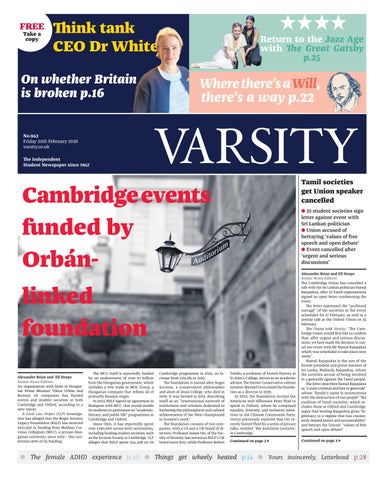
An organisation with links to Hungarian Prime Minister Viktor Orbán and Russian oil companies has funded events and student societies at both Cambridge and Oxford, according to a new report.
A Good Law Project (GLP) investigation has alleged that the Roger Scruton Legacy Foundation (RSLF) has received £512,500 in funding from Mathias Corvinus Collegium (MCC), a private Hungarian university, since 2023 – this constitutes 90% of its funding.
Return to the Jazz Age with e Great Gatsby p.25
Where there’s aWill, there’s a way p.22
Cambridgeevents funded by foundation Orbánlinked
e MCC itself is reportedly funded by an endowment of over €1 billion from the Hungarian government, which includes a 10% stake in MOL Group, a Hungarian company that re nes oil of primarily Russian origin.
In 2023, RSLF signed an agreement in Budapest with MCC, that would enable its students to participate in “academic, literary, and public life” programmes at Cambridge and Oxford.
Since then, it has reportedly spent over £190,000 across both universities, including funding student societies, such as the Scruton Society at Cambridge. GLP alleges that RSLF spent £54,458 on its
Cambridge programme in 2024, an increase from £29,185 in 2023.
e foundation is named after Roger Scruton, a conservative philosopher and alum of Jesus College, who died in 2020. It was formed in 2021, describing itself as an “international network of institutions and scholars dedicated to furthering the philosophical and cultural achievements of the West championed in Scruton’s work”.
e foundation consists of two companies, with a US and a UK board of directors. Professor James Orr, of the Faculty of Divinity, has served on RSLF’s UK board since 2021, while Professor Robert
Tombs, a professor of French History at St John’s College, serves as an academic advisor. e former Conservative cabinet minister Michael Gove joined the foundation as a director in 2025.
In 2023, the foundation invited the American tech billionaire Peter iel to speak at Oxford, where he compared equality, diversity, and inclusion initiatives to the Chinese Communist Party.
Varsity previously reported that Orr recently hosted iel for a series of private talks, entitled ‘ e Antichrist Lectures’, in Cambridge.
Continued on page 3 ▶
Tamil societies get Union speaker cancelled
● 22 student societies sign letter against event with Sri Lankan politician
● Union accused of betraying ‘values of free speech and open debate’
● Event cancelled after ‘urgent and serious discussions’
Alexander Brian and Ell Heeps Senior News Editors
e Cambridge Union has cancelled a talk with the Sri Lankan politician Namal Rajapaksa, after 22 Tamil organisations signed an open letter condemning the event.
e letter expressed the “profound outrage” of the societies at the event scheduled for 27 February, as well as a similar talk at the Oxford Union on 25 February.
e Union told Varsity: “ e Cambridge Union would rst like to con rm that, after urgent and serious discussions, we have made the decision to cancel our event with Mr Namal Rajapaksa which was scheduled to take place next week.”
Namal Rajapaksa is the son of the former president and prime minister of Sri Lanka, Mahinda Rajapaksa, whom the societies accuse of being involved in a genocide against the Tamil people. e letter describes Namal Rajapaksa as “a state criminal and heir to genocide” whose “family’s name is synonymous with the destruction of our people”. e coalition of Tamil societies, which includes those at Oxford and Cambridge, argue that hosting Rajapaksa gives “legitimacy to a regime that has consistently denied justice and accountability” and betrays the Unions’ “values of free speech and open debate”.
Lent, Week 3
Editors’ Note
As the Week Five blues dampen student spirits, Varsity looks outwards. Our lead stories this week nd Cambridge at the centre of global issues, bringing student voices to the forefront.
With eology don James Orr being appointed Reform’s director of policy this week, we reveal (p.3) how the Roger Scruton Legacy Foundation, on whose board he sits, has been receiving the majority of its funding from a Hungarian university linked to Viktor Orbán. Connections to political gures with spotty pasts have also embroiled the Cambridge Union: it was forced to cancel an event with Namal Rajapaska, heir to a Sri Lankan political dynasty responsible for violence and discrimination against the country’s Tamil population (p.3).
In Features, we highlight (p.10) the rising rates of ADHD diagnoses. Compared with men, women are grossly underdiagnosed. To understand the human
angle, we speak to female Cantabs about their neurodiverse experiences in Cambridge and how narratives need to change to e ectively support them.
Amid Week Five, Vulture provides some perfect distractions as the essays pile up. We return with another eatre review (p.25): the star-spangled performance of e Great Gatsby, which transports the audience back to the Jazz Age. A double-page spread in Fashion highlights (p.26-27) the political power of clothing, whether it’s overt resistance or subliminal messaging.
e new release of Emerald Fennell’s Wuthering Heights causes a stir in Film and TV (p.28) with its apparent lack of chemistry between Cathy and Heathcli . While sparks may have failed to y in this movie, a new installment of Blind Date (p.20) sees our matchmaker try to nd some more soul-students (hopefully with a bit more success than Fennell).
February is LGBTQ+ History Month, and in Music (p.24) this is brought to the forefront with a tribute to The Communards’ cultural contribution to queer liberation. In Arts (p.23), beauty is in the eye of the oar-holder. Although the boat may be freezing at this time of year, it provides glorious views of the city in the trail along the Cam.
So, whether you’re here to have your worries assuaged by our Agony Aunt, or for the latest news on the vet school, we hope that Varsity continues to bring the Cambridge perspective outside of the bubble.
associate editors WilfVall, Ben Curtis, Charlie Rowan, Sophie Ennis, Daisy Bates & Anuk Weerawardana, Nick James associate@varsity.co.uk
business manager Mark Curtis business@ varsity.co.uk
varsoc president Wilf Vall president@ varsity.co.uk
varsity board Dr Michael Franklin (Chairman), Dr Tim Harris, Michael Derringer, Mark Curtis (Company Secretary), Sophie Ennis, Hugo Gye, Wilf Vall & Anuk Weerawardana (Directors), Lotte Brundle (Guest) & Zoah HedgesStocks (Guest)
Union accused of ‘grievous insult to the Tamil people’
Continued from front page
he Cambridge Union responded: “We would like to assert in the strongest possible terms that none of our events are endorsements of, or uncritical platforms for, any speaker or their beliefs, actions, or record. Our events are curated with the sole purpose of ofering our members the opportunity to question and challenge the individuals and groups whom we invite to our institution.
“At the present moment, we don’t believe it’s possible to have a balanced and open discussion on this subject, and thus our Standing Committee made the decision to cancel this event.”
he letter demanded the cancellation of both events, as well as an apology from both Unions to the British Tamil community and “all survivors of Sri Lankan state violence”. he societies also called for the Unions to adopt a non-platforming policy for those accused of war crimes,
genocide, or human rights abuses.
Between 1956-2009, the Sri Lankan security forces committed over 100 massacres of Tamil civilians. At least 150,000 died amid tens of thousands of forced disappearances.
One of the worst atrocities of the Tamil genocide was the Mullivaikkal massacre, in which the government designated ‘no ire zones’ in Mullivaikkal, encouraging civilians to congregate there, before shelling those areas.
Rajapaksa’s uncle was Defence Secretary at the time, and justified these actions by arguing that the hospitals operating in these areas were
legitimate targets, and that all the local civilians were sympathisers of the Tamil militant organisation KTTE.
Namal Rajapaksa was previously arrested on charges of money laundering, and is embroiled in an ongoing investigation into his alleged involvement in the death of Sri Lankan rugby player Wasim hajudeen. He has also been accused of receiving preferential treatment in his inal-year law exams, and lying about his grades, which he strongly denies.
he Tamil societies wrote that “he remains a staunch defender of [his family’s] genocidal apparatus
and an active beneiciary of its impunity,” arguing that his invites to speak are an “act of profound insensitivity and a grievous insult to the Tamil people”. Rajapaksa’s father, Mahinda, has faced accusations of money laundering and involvement in the abduction and assault of a journalist. During his presidency, he curtailed media freedom and banned the Tamil version of the Sri Lankan national anthem.
Caius doesn’t ly Pride lag
Ell Heeps
Senior News Editor
Caius has not lown the Pride lag this month, after a student vote on the issue failed to achieve the necessary turnout.
he Union also announced yesterday (19/01) that an interview with former French prime minister Gabriel Attal, scheduled for this evening, has been postponed due to “last-minute developments in the French National Assembly”.
Last week, student and guest speakers at the Union condemned rhetoric from the far-right media personality Katie Hopkins they described as “hateful” and “racist”. he Oxford Union and Namal Rajapaksa were contacted for comment.
Cam societies funded by foundation linked to Russian oil and Hungarian university
Continued from front page
RSLF hosted a conference in 2025 called ‘Now and England’, where politicians from both the Conservative Party and Reform UK spoke. Among the speakers was Joanna Williams, head of education and culture at the conservative think tank Policy Exchange – the controversial Cambridge University Society of Women hosted Williams for a talk last week (13/02).
£512,500
much money
At Cambridge, RSLF funded a conference called ‘he Pursuit of Beauty’ in 2023, which took place at Peterhouse over the summer vacation. RSLF described the theme as confronting “the myriad challenges facing our art institutions today – from the pressures of decolonisation initiatives and diversity and equity mandates to the rise of political art and the impact of vandalism.” he conference included Michael Gove as a panellist.
he RSLF has also funded a residential at Oxford, ‘he Oxford Seminar’, which purports to allow undergraduates to “explore the philosophy of Sir Roger Scruton and the broader Western tradition that shaped his work”. he programme’s web-
site describes lecture topics such as “the roots of culture” and “national loyalty and the nation-state”.
he foundation also runs the annual Oakeshott Lecture Series, previously titled the Scruton Lectures, which are held in Oxford. he lectures have previously featured speakers such as the philosopher Kathleen Stock, who resigned from the University of Sussex in 2021 after being accused of transphobic rhetoric, and the historian David Starkey, who resigned as an honorary fellow of Fitzwilliam College in 2020 after comments he made on a podcast were widely decried as racist.
GLP reports that RSLF’s 2025 symposium was hosted by the Hungarian embassy in London, and featured a representative from the Hungarian energy industry. Alongside this, RSLF is registered in the US, and has previously received funding from the nonproit organisation DonorsTrust, which funds conservative movements such as the Alliance Defending Freedom (a Christian-right organisation).
£54,458
How much the Roger Scruton Foundation spent on programmes in Cambridge in 2024
Charlene Pink, GLP campaign manager, said: “It’s shocking to see elite universities lining up to use Russian
money to indoctrinate students with far-right ideology.
“You might expect that academics would have learned the lessons of history instead of handing foreign propaganda outits a megaphone on campus. It’s time for Oxford and Cambridge to cut ties with networks like the Roger Scruton Legacy Foundation who are pushing an extreme agenda which fuels harmful culture wars in the UK.”
A spokesperson for the University of Oxford said: ”he Scruton Lectures (now the Oakeshott Lectures) are run by the Roger Scruton
Legacy Foundation and only use Oxford as a venue – they are held in the Sheldonian heatre, but the theatre operates as a commercial venue hosting hundreds of external recitals, talks and other events throughout the year.
“Similarly, the Oxford Summer School may use the location of Oxford and some of the University facilities as venues, but they are not oicial university-ailiated activities; university venues such as colleges host a wide range of summer schools and act as conference venues for a wide range of events, which are separate from and independent of the University’s core activities of teaching and research.”
In November, a vote was opened to all students, to determine whether the Progress Pride lag would be lown at the College’s main site on 1 February, to mark the irst day of LGBT+ History Month, and on 1 June, for the irst day of Pride Month.
Both proposals failed to pass, despite the majority of those who voted supporting the lying of the lags. 296 total votes were required for the proposals to pass, but only 259 students voted in each case.
200 voted in favour of lying the lag on 1 February, while 39 voted against, and 20 abstained. Similarly, 205 voted in favour of lying the lag on 1 June, compared to 38 votes against, and 16 abstentions.
he lying of lags other than the College lag has been a signiicant source of contention at Caius in recent years. In 2022, the Gonville and Caius Student Union (GCSU) published an open letter, signed by hundreds of students, criticising the College for its decision to take down the Pride lag two days into LGBT+ History Month.
he decision followed a general meeting of fellows, in which it was agreed that the lying of any lag other than the College lag would be banned. his was quickly reversed, following the backlash from students and staf, including the Senior Tutor.
In the aftermath, it was agreed that the lying of other lags would be subject to a student vote each year. Flying of the Progress Pride lag in February and June would require a vote in favour from students, with at least 33% turnout across the student body.
All other lags require a petition signed by at least 100 Caius students, with a limit of one student lag being approved each academic year. he total number of ‘student lag days’ is capped at six per year.
Caius students voted to accept these proposals in 2025, including a ban on the lying of national and territorial lags.
he Pride Flag was not lown in 2023, despite students voting in favour, due to low turnout. In 2024, students voted to ly the Progress Pride lag, the Tibetan lag, the Welsh national lag, and the Irish lag. he lying of the Transgender Pride lag was also proposed, but failed to pass, again due to low turnout.
One Caius student told Varsity: “Although the College’s decision not to ly the Pride lag this month is in line with the agreed-upon policy, Caius’ decision to ignore the overwhelming enthusiasm in favour of lying the lag among those who voted is telling of the College’s attitude towards its queer students.
“An updated policy is needed to ensure the majority of votes are represented in the decision to ly the lag or not, rather than relying on technicalities which act in favour of the minority.”
A Gonville & Caius College spokesperson said: “he Student Flag Day Policy was proposed by and agreed with students. he democratic threshold for lying the Progress Pride Flag was not achieved for 2026.”
oil
How
the Mathias Corvinus Collegium has given to the Roger Scruton Legacy Foundation since 2023
LOUIS ASHWORTH ▲
RYAN TEH ▼
Hundreds of dons demand vote on vet course
Nick James and Bela Davidson Associate Editor and Deputy News Editor
Nearly 1,000 academics at the University of Cambridge have signed a petition urging the institution’s leadership not to bypass its senior governing body over plans to discontinue its veterinary medicine course.
A total of 995 members of the 7,200-strong Regent House – Cambridge’s senior governing body comprising academics, senior researchers, college heads and administrators –have backed the petition, making it the most signed in the University’s recent history.
Signatories are calling for formal safeguards to ensure that any proposal to cease admissions to a course must be put to a vote of the Regent House.
A second petition, signed by nearly
500 academics, speci cally seeks to block the leadership from stopping admissions of the veterinary course without the approval of the Regent House.
e petitions were drafted after the Council of the School of the Biological Sciences voted in December 2025 to recommend the cessation of the vet course on the basis that “there was no viable long-term solution” for the “sustainable delivery of clinical services”.
It was recommended that the vet course would close in 2032 and that those starting in October 2026 would be the nal year of admission.
e University’s General Board, which is responsible for the academic policy of the University, and chaired by the ViceChancellor, Professor Deborah Prentice, is set to vote on the recommendation on 23 February. e Board is comprised of only 15 members.
e initial petition says that the General Board’s “apparent intention” to not consult Regent House over the termination of admissions for the vet course is “contrary to the spirit, if not the letter” of the current governing principles.
It further argues: “ e Regent House should have an opportunity to express an opinion, especially since discontinuation of admissions has consequential implications for the future viability of the Department of Clinical Veterinary Medicine and the sta employed in it”.
e petitions’ lead, Dr Stephen Cowley, told Varsity: “Cambridge is a bottomup self-governing university. at the sta have a say in the running of the University generates collegiality, buy-in and often a willingness to go the extra mile.
He added: “ e unwillingness of the General Board to put the fate of the VetMB to a ballot of the Regent House is generating signi cant unease, and frustration with the leadership who do not seem to be listening.”
e head of Cambridge’s Vet School, Professor Mark Holmes, who signed both petitions, said he “strongly urged” other academics to sign “to show the strength of feeling on this matter in the Regent House”.
e second petition – which specically calls for a Regent House vote on the terminating of the veterinary medicine course – was organised with “the aim of indicating to both the [Royal College of Veterinary Surgeons] and applicants for the VetMB course that any decision of the [General Board] on 23 February might be subsequently overturned”.
e signing of the petitions comes after applicants who applied to start the
Cambridge veterinary medicine course in 2026 have been left in limbo with no o ers yet made, despite being told that this admissions cycle would go “as planned”.
20,000
e number of supporters that the ‘Save the Vet School Campaign’ claims to have
e justi cation for the decision has not been revealed, but a spokesperson for the University said: “We understand that the current situation may feel uncertain for applicants still under active consideration, and we appreciate their patience. ere is no further action required from them at this time. We will provide further updates as soon as we are able to.”
Last month, the Head of the School of Biological Sciences, who recommended the closure of the vet course said that there were “signi cant challenges relating to the quality of educational provision” as well as nancial issues, with the Vet School “losing over £1 million a year for some time.”
Since the publishing of the recommendation, academics from the vet school and other departments have questioned the evidence and process that was used to come to the recommendation.
e ‘Save e Vet School Campaign’ – started by members of the Cambridge vet school – staged a protest in central Cambridge on 18 February to urge mem-
bers of the General Board not to vote to stop the course.
In a speech at the rally, a representative from Unite the Union adressed the Vet School’s £1 million de cit, which has been used as a justi cation for the closure, stating: “A university like Cambridge suggesting that £1 million is a serious nancial hardship is a laughing matter.”
Cambridge University Veterinary Society (CUVS) environmental o cer and fourth year vet Shreya Patel also spoke out about the abruptness of proceedings, stating: “I want everyone to know that the recommendation to close our course and the soon-to-be-made decision by the general board was held with no consulation with students. No consultation with sta .”
A formal protest will be be held outside Great St Mary’s on 23 February, the morning of the nal decision meeting about the closure of the course. Student representatives told Varsity they were only informed the meeting would be taking place then on 10 February, and said: “this information has purposefully been kept from us for months”.
e campaign claims to have received the support of over 20,000 people since it began in December. Supporters include Julian Norton, star of the Channel 5 docuseries, e Yorkshire Vet and the Conservative MP Neil Hudson, who both studied veterinary medicine at Cambridge, as well as Liberal Democrat MP Danny Chambers, who was a veterinarian before becoming an MP. e University of Cambridge was contacted for comment.
SU launches referendum on amending its constitution
Alexander Brian Senior News Editor
e Students’ Union (SU) is holding a referendum on whether to update its governing document, known as the Articles of Association.
Under SU rules, the University is required to review the Articles at least once every ve years. e trustees of the SU can propose changes to the document, but these must receive approval from the University Council, as well as from students in a referendum.
Only a simple majority of both undergraduate and postgraduate students is needed for the changes to pass. However, a minimum of 2000 students must vote for the results to be valid.
Voting is set to open at 9am on 23 February and close at 3pm on 26 February. Students will also be able to choose next year’s sabbatical o cers.
e new Articles make several changes to the board of trustees, including formalising the current situation in which two people can be chair and removing the requirement for the deputy chair to be an external trustee (not a student or employee of the SU).
While currently trustees can ignore a student vote if it would damage the SU materially or legally, the updated document lets the board prevent votes altogether. However, they would need to “reasonably consider” if the decision “has or is likely to” cause these harms –a slightly higher standard than exists at the moment.
e SU explained their reasoning for this change: “In a world of increasingly hostile rhetoric, it’s important that trustees are able to protect students in a situ-
ation where SU democratic processes are used to shield hateful and illegal speech. is is a provision we hope to never use, and would only use where the question being asked is itself abusive (e.g. racist rhetoric dressed up as a question). e threshold for exercising this power has also been raised to protect democracy in the union.”
Student trustees, who sit on the board but are not sabbatical o cers, would be able to serve three instead of two consecutive or non-consecutive one-year terms, in order to allow “a greater longterm focus for the SU”.
External trustees would still only be able to serve two three-year terms. However, both types of trustee would no longer need approval from the Student Council (the body comprising sabbatical o cers, JCR and MCR presidents, and academic representatives) when continuing for a consecutive term.
Any trustee – as opposed to just external trustees – could be removed by a unanimous vote of the other board members. However, the SU emphasises that “the threshold for this intervention is extremely high”.
e explicit requirement for an equal number of undergraduate and postgraduate trustees would also be abolished. However, the SU says it will “endeavour to retain generally balanced representation on the board”.
e new document allows more issues to be decided by referendum, and prevents these topics from being discussed in SU meetings for a year after the vote.
e Articles have also been updated to re ect the slashing of six sabbatical o cer roles in October 2024. Currently,
only the undergraduate and postgraduate presidents are guaranteed positions as trustees, while up to three other sabbatical o cers can be elected to the board.
In 2024, the SU made its ‘liberation’ campaigns independent of the institution, and abolished their sabbatical ofcers. e roles of welfare o cer – as well as access, education, and participation o cer – were also abolished, and replaced with three vice-presidents.
e new Articles therefore remove the obsolete limit of ve sabbatical trustees, making them all board members, as well as “major union o ce holders” for the purposes of the Education Act.
2,000
e number of students that must vote for the results to be valid
e amended document changes the name of Cambridge Students’ Union to e University of Cambridge Students’ Union, and explicitly includes intermitting students as members.
Before 2019, Cambridge’s undergraduate and postgraduate students’ unions were separate. e updated Articles remove passages detailing the temporary arrangements during the merger. is latest referendum follows two held last term: one on disa liating from the National Union of Students (NUS), and another about whether the SU should campaign for arms divestment. Both measures easily passed, albeit with low turnouts.
CUCA members attend London Reform rally
Alexander
Brian Senior News Editor
Two senior members of the Cambridge University Conservative Association (CUCA) are alleged to have attended a Reform UK rally in the East London borough of Romford on Monday (16/02).
Christian Calgie, a journalist covering the event for e Express, wrote on X that it was a “sign of the times” that the students travelled down for the event.
He said of CUCA: “Once a poaching ground for the brightest and best Tory MPs and ministers, one says its leadership is now crawling with Faragists.”
Calgie added that one of the students told him that CUCA Chairman Oscar Lingwood is a supporter of Reform leader Nigel Farage. Lingwood denies knowledge of any members attending the rally.
Calgie told Varsity that the students said they were attending uno cially, but that “one of them – with access to CUCA’s social media log-ins – asked his mate whether he should put something on the group’s insta story.” Lingwood denies this, telling Varsity that only he, the communications o cer, and the vicechairman have access to the society’s Instagram page, and that none of them attended the rally.
Lingwood further told Varsity: “Any CUCA members who attended the Reform event yesterday did so in a purely private capacity. CUCA did not organise a trip to the event. As we are not formally a liated with any political party, whether or not some members decided to go in a private capacity is neither your nor our concern. As the only openly rightwing and truly pro-free speech society in Cambridge, CUCA proudly re ects and
welcomes a wide range of views.”
Responding to the news, the Cambridge University Labour Club (CULC) said: “Reform knows it’s not welcome in Cambridge and so is hiding under the Conservative name. It’s always horrible to hear that students are stoking the harmful politics of Reform, but given recent speaker invitations it is not surprising. Whatever they call themselves, it’s clear that CUCA sits not too far away from Reform’s vile policy platform.” is comes after CUCA cancelled an event with the YouTuber Tom Roswell after CULC claimed he was linked to the “far right” and “eugenicists”.
e Cambridge Young Greens said: “It’s worrying to see students going to rally organised by a party that stands for hate, division, and scapegoating minorities.”
Meanwhile, the University of Cambridge Left Society commented: “When members of a society initially intended to represent the most successful political party in history treks [sic] down to Romford to attend its rivals on the right’s rally, something has gone seriously wrong.”
e rally took place after Keir Starmer U-turned on his decision to postpone some local elections. At the event, Nigel Farage criticised the “14th major u-turn from this inept, useless, gutless, unpatriotic loser of a prime minister”. He was joined by local MP Andrew Rosindell, who defected from the Tories to Reform last month. Rosindell told the crowd that a Reform government would allow constituents to vote on whether to leave Greater London and join Essex. Reform UK was contacted for comment.
TURN YOUR PASSION INTO A PROFESSION
Rewarding and intellectually rigorous postgraduate degrees in Performance, Stage and Production Management, Theatre forCommunity and Education, Creative Producing,Directing and Dramatic Writing.
by Steve Gregson Photography
EMILY ABOUD - Director, Playwright and Theatremaker Winner of the Evening Standard Future Theatre Award
Photo
Academics sign open letter criticising research funding changes
Ell Heeps Senior News Editor
Cambridge academics are among more than 1,000 signatories of an open letter warning of the impact of changes to UK Research and Innovation (UKRI)’s investment model on early-career scientists.
UKRI is a public body that invests in research projects in the UK – it is government-funded, and spends around £8 billion a year on various research grants.
Earlier this month, UKRI CEO Professor Sir Chapman warned that the organisation faces “hard decisions” on the funding of future research. He announced that going forward, there would be a greater “emphasis on commercialisation” in deciding which projects to fund; alongside this, funding for “curiosity driven” research will remain static, meaning that it will decrease in real terms over time.
e UKRI is composed of eight research councils, including the Science and Technologies Facilities Council, which oversees research into areas such as astronomy and nuclear physics. e government has instructed the various councils to nd savings, leading to a restructuring of the overall research funding model. Chapman said that he expects the funding changes to be implemented fully by April 2027.
Professor Oleg Brandt of the Department of Physics told Varsity of the changes: “ ese UKRI measures could result in a cut of ~30% (on top of another
25% over the last decade, so ~50% combined); this essentially translates into killing the Hawking and Higgs legacy.”
e open letter is addressed to Chapman, as well as Liz Kendall, the Secretary of State for Science, Innovation and Technology. It is signed primarily by early-career researchers who describe themselves as part of the particle physics, astronomy and nuclear physics community.
e letter states: “We are concerned that aspects of the new funding framework, as currently implemented, risk eroding the UK’s foundational capability in fundamental science through mechanisms that disproportionately a ect early-career researchers.
“[…] Many of the technologies that now underpin the UK economy – spanning computing, communications, medical imaging, advanced materials, arti cial intelligence (AI), and emerging quantum technologies – originated in fundamental research that required and created entirely new technological trajectories before their commercial relevance was recognised.
“[…] While the full impact of these losses may take several years to materialise, by the time they are visible they are no longer reversible. For this reason, early-career outcomes should be treated as a leading indicator of system health under the new funding model.”
Dr Anke Andersen-Arentsen, a research associate at the Institute of Astronomy, told Varsity why she signed the letter: “While the full details and impact
of the new framework are not yet clear, it is already reducing job opportunities and is likely to do so even more in the future, driving talented researchers out of the eld.
“[…] e team is already working at full capacity, and potential reductions in funding would add further pressure.”
e letter urges UKRI to assess the viability of curiosity-driven research according to “their contribution to skills formation”, rather than merely its apparent commercial value. It also demands greater representation of early-career researchers at the decision-making level, which “re ect[s] the fact that early-career outcomes are the earliest and most sensitive indicator of system health.”
Eleftheria Malawi, a postdoctoral research assistant in the Faculty of Mathematics, said: “ e proposed funding changes risk serious damage to the careers of young researchers facing job insecurity and unemployment at a critical stage, and to Cambridge’s wider research culture.
“[…] is will have a huge impact on the university, making it harder to attract skilled researchers who are essential for the knowledge and innovation that drive progress at every level.”
Dr Lisa Kelsey, an early-career fellow at the Kavli Institute for Cosmology, said: “We are at risk of losing a generation of scienti c talent, with many early career researchers already considering moves abroad or leaving academia entirely because of the uncertainty under the new UKRI funding framework.”
Council rescinds University Centre membership
Ell Heeps Senior News Editor
e University Council has agreed to rescind the membership status of the University Centre, meaning it will no longer serve as a shared facility for members of the University.
e Council approved a grace on Friday (13/02) that will rescind the Ordinance of the University Centre, which previously entitled members of Regent House, university o cers, fellows, and postgraduate students to be members of the University Centre.
e grace states that the University will continue to own the building.
e grace was prompted by the need for signi cant refurbishments to the building, which was built in the 1960s – the mechanical, electrical and plumbing systems are described as “beyond end of life”. e grace states that the necessary refurbishments are “unlikely to be a ordable for 10 to 15 years”.
e University Centre, a Grade II listed building located in the centre of the city, currently houses the Cambridge Students’ Union. It was originally constructed to serve as a meeting space with catering facilities for those not a liated with a speci c college, who were unable to access college facilities.
Many of the original amenities have since been relocated, particularly since the opening of West Hub in 2022, which provides students with access to a café, bar, and shop.
Some refurbishments were made
to the building while it was closed during the pandemic, which enabled it to remain in use while deliberations continued over its future use.
e grace states that a large part of the cost of the remaining refurbishments arises from the need to replace the gasred boilers, in order to remain in line with the University’s commitment to achieve net zero carbon emissions by 2048. e grace describes these costs as “signi cant”, and currently unviable. A consultation was launched in 2024 to consider the future of the University Centre, with those entitled by the Ordinance to membership of the Centre asked to contribute. ere was a strong preference indicated by respondents for the Centre to serve as a “multi-use” hub, similar to West Hub.
In the interim period, the grace details plans for the available space within the University Centre to be reallocated to better serve the needs of University members. e ground oor bar area, which was previously used as a wine bar by a private company, will be granted to the Newcomers and Visiting Scholars organisation, a volunteer organisation that supports University members as well as their families.
Part of the rst oor is to be made into an Occupational Health hub for students, whilst other parts of the building that were previously used by Gates Cambridge Trust scholars will be given to IdeaSpace, a local company which describes itself as a “community of founders and entrepreneurs”.
We are a European consultancy firm focussed on analytical and quantitative topics and the development of sustainable solutions to bring about positive change for our clients.
What does d-fine offer you?
- Diversity: Work with clients on topics ranging from financial engineering and machine learning through to climate risk and healthcare
- International: Collaborate in project teams staffed across Europe
- Education: Acquire new skillsets to broaden your technical and professional repertoire
Who do we look for?
Master’s or PhD-level graduates in STEM fields
Petition demands University reverse decision on vegan menu
Alexander Brian Senior News Editor
A petition for the University to reverse its decision to end a trial of a fully plantbased menu at the Whale Café, in the Museum of Zoology, has obtained over 2,000 signatures.
e campaigning group Plant Based Cambridge (PBC) launched the petition in November, claiming that the decision to end the trial was based on incorrect data.
e trial took place between October and November 2024, and in May 2025 the Estates Technical Sub-committee recommended the menu not be made permanent.
PBC claims that the Sub-committee compared sales data from October 2023 and October 2024 when making its decision. e resulting report shows that café sales declined by £1,100, but that there was “insu cient nancial data” to determine the long-term viability of an exclusively plant-based menu.
e Sub-committee also states that new plant-based options developed during the trial will continue to be served, and that a fully vegan menu is still a possibility once the current supplier’s contract ends.
PBC argues that the Sub-committee was wrong to exclude from its calculations the rst week of November, which saw the highest weekly sales that term, while including the rst week of October, before term had started. e group
claims that if the Sub-committee had used a di erent time frame, the results would have shown an increase in sales.
ey also told Varsity: “Despite problems in the menu design, such as an overreliance on ‘fake meats’, a clear majority of survey respondents, especially those that were students, preferred the fully plant-based menu.”
Survey data shows that of 173 respondents, 58% liked the menu, 36% did not, and 6% could not tell the di erence.
e group claims that Director of Estates Graham Matthews responded to their analysis by stating: “We will not be opening this up for further discussion.”
PBC is the Cambridge branch of an international network present at 60 universities across Europe. e umbrella organisation, Plant Based Universities, was founded in 2021 at three UK universities, with the goal of turning the catering provision at these establishments 100% vegan.
PBC argues that transitioning to plantbased food would reduce greenhouse gas emissions from agricultural production and free up farmland for rewilding. In an open letter signed by 54 Cambridge academics last February, the group also cited the dangers of antibiotic resistance and zoonotic diseases as reasons for their campaign.
e petition follows the SU’s decision in October not to renew its support for transitioning to 100% plant-based provision across the University Catering Service, which operates cafés on Cam-
bridge campuses. e SU instead voted to aim for 75% plant-based provision while prioritising more “important” sustainability issues.
e initial motion to support the campaign was passed in 2023 with the backing of 55% of the Student Council. In 2024, the SU decided by a single vote to transition to 100% plant-based food at its meetings and events.
Fergus Kirman, the undergraduate president at the time, urged members to oppose this second motion, arguing that the nutritional rules were “probably not supported by the majority of people we are supposed to serve”. e SU’s disability campaign also expressed concerns that a 100% plant-based menu would not be accessible to those with autism, sensory issues, or eating disorders.
Reacting to the petition, a spokesperson for the SU said: “ e Whale Cafe trial was clearly awed in a number of respects, but it still demonstrated the clear demand for plant-based options from students and sta across the University. We’re campaigning alongside Plant-Based Cambridge for a sustainable food system that works for everyone. As we move forward, our priority is ensuring that new environmental initiatives are fully accessible and leave no student behind.”
Regarding the SU’s decision, PBC commented: “All SU motions last three years, so the motion passed in February 2023 to support 100% plant-based catering naturally ended. Even with one fully
plant-based venue, the University’s total proportion of plant-based foods would not be close to 75%, so there’s a lot of work to do.
“Accessibility has always been central to our campaign, which is why we passed a motion in 2023 speci cally about ensuring the accessibility of any transition to plant-based menus. is was developed alongside what used to be the Cambridge SU Ethical A airs Campaign.”
e group also rejects claims that operating a fully plant-based service would harm pro ts, noting that the Whale Café loses £40,000 a year with its current menu.
Anna, an MPhil student at Darwin who signed the petition, told Varsity: “It is a real shame that such a prestigious university, one that supposedly prides itself on its commitment to carbon reduction to achieve their goal of becoming ‘carbon zero’ by 2048, would decide to axe a fully plant-based menu […] Change takes time, and this menu would have been the start of a great change in attitudes towards plant-based foods within a university environment.”
e University of Cambridge was contacted for comment.
Solving the Puzzle of Global Markets
Learn more about Jane Street:
EOGHAN ROSS ▲
▲AMIKA PIPLAPURE
Council considers rent increase to improve housing
Council rents are due to rise by 4.8% next financial year under proposals from Cambridge City Council, in line with the national Rent Standard. is would add an average £6.14 per week for tenants on lowest rents. Councillor Gerri Bird said that the rise is “necessary so we can continue to invest in high-quality housing within the city”. e council aims to improve homes’ EPC ratings, build 1,300 new council homes by 2036, and reduce a projected £11.5 million overspend to £1.5 million.
Vandalised Mill Road memorial bench restored
Acommunitye orthasrestoredavandalised memorial bench on Mill Road, dedicated to the late Suzy Oakes, cofounder of the Mill Road Winter Fair. e bench was vandalised with the back and memorial plaque removed. e backrest and plaque were found by a local and taken to e Earl of Bacons eld pub. A County Councillor and the landlord of the pub reattached it with new screws. Cambridge City Council also removed gra ti from a nearby memorial to British historian and tour guide, Allan Brigham.
A trade o between bats and lighting
A plan to improve safety on a road in Cambridgeshire, originally submitted in 2022, was withdrawn following objection from the county council’s biodiversity team. e team expressed concerns for local bats, stating that permanent lighting on the road would cause “unacceptable illumination” in a potential bat crossing area. As of a meeting on 12 February, the plans were announced to still be at an impasse, with the GCP’s head of programme stating the issue has become “a trade o between bats and lighting.”
BBC lming at Wolfson
On Wednesday (18/02), Wolfson College hosted a live recording of BBC Radio 4’s culinary panel programme, e Kitchen Cabinet. e College o ered ten spare audience tickets to Wolfson students, courtesy of the BBC. e Kitchen Cabinet, hosted by journalist and food critic Jay Rayner, has previously made visits to Cambridge. In 2013, the show lmed their series nale at Clare College. Slightly more recently, e Kitchen Cabinet visited Wolfson College, Oxford, lming an episode in 2018.
University watch
Neve Wilson rounds up student news from across the country
Bangor Debating’s beef with Reform
Bangor University’s Debating and Political Society has clashed with Reform UK after refusing to host Reform MP Sarah Pochin and campaigner Jack Anderton, urging “our fellow societies to join us in keeping hate out of our universities”. Reform’s Head of Policy, Zia Yusuf, suggested a Reform government would strip the University’s funding, although the party’sWelsh branch said this was not party policy. Bangor Students’ Union and the university distanced themselves from the Debating Society’s decision, with the University stating that it was open to debate “across the political spectrum”.
UCL settles over COVID-19 teaching
UCL has reached a con dential settlement with around 6,000 graduates who took legal action over teaching quality during COVID-19 and strike action. Lead claimant David Hamon said neither party took “admission of liability or wrongdoing”. Adam Zoubir, partner at litigation rm Harcus Parker, added that “we continue to represent tens of thousands of students who were at other universities during Covid”. 36 more universities now face legal action from around 170,000 students over the quality of their education during COVID. is includes the University of Warwick and LSE, but not the University of Cambridge.
Oxford Union Librarian quits
e Oxford Union’s Librarian Brayden Lee has resigned for making comments described by Oxford Union members as "racist". Lee was covertly recorded calling the conduct of BAME committee members “highly tribal” and said of union elections“Idon’tknowofatimethat a British person was running up against a non-British person and won”. Lee also made comments about former Union President Israr Khan. He wrote on social media that he believed someone was “deliberately trying to bait [him] into saying racist things”, but said he was “deeply sorry”.
Campaign to highlight shortcomings of Uni sexual misconduct reporting
Alexander Brian and Ell Heeps
Senior News Editors
e groups More an Misconduct (MTM) and End Sexual Violence Cambridge (ENDSV) have launched a joint campaign on sexual misconduct reporting procedures in Cambridge.
‘When Students Report: Cambridge’ invites testimony from students who have previously reported incidents of sexual misconduct to the O ce of Student Conduct, Complaints and Appeals (OSCCA), individual college disciplinary bodies, and other organisations including societies and sports teams.
e founders are seeking to collate individuals’ experiences in order to identify discrepancies between the various reporting bodies as well as areas that can be improved.
The campaign was launched on Wednesday (18/02), with the two groups writing in an Instagram post: “We invite you to submit rst-hand, de-identi ed testimonies that focus on your experiences of reporting sexual misconduct.
“You’ll help us to raise awareness, contribute to research, and support thoughtful advocacy for improvements in policy and practice.”
e leaders of the campaign, Carys Bonell of ENDSV and Elisha Carter of MTM, told Varsity that their aim is “to see how students actually feel interacting with these reporting procedures […] to nd if there were repeated areas that students struggled with.”
e campaign was inspired by Everyone’s Invited, which was founded in 2020 with the aim of raising awareness about the issue of rape culture within the UK – individuals could submit anonymous testimony about their experience of sexual assault. Bonell said ENDSV and MTM sought to base the campaign on testimonies, in order to gather information about people’s “experiences with reporting procedures in Cambridge”.
Bonell was keen to emphasise that anonymity is integral to the reporting process, telling Varsity that the focus of the form is the speci c reporting procedure that a student has experienced: “We need to understand which colleges we’re looking at, or which reporting procedures we’re working with, but apart from that we try and keep it all as depersonalised as possible.”
Individuals will retain the right to withdraw their testimony at any time, if they feel it may interfere with an ongoing misconduct investigation, for example.
e ultimate aim of the campaign, Bonell and Carter said, is twofold. ey will use the details of individuals’ testimonies to inform their conversations with reporting bodies such as OSCCA and individual colleges. Alongside this, submissions will be used as a basis for social media posts, with anonymised testimonies being published in order to increase public understanding of the existing issues with Cambridge reporting procedures.
ey said that their primary goal is
“to see if there have been recurring issues that people have had with reporting, both the University and college policies.
“It would be really interesting to see if there’s a discrepancy between colleges, because within Cambridge University we just don’t have a uni ed policy on reporting sexual misconduct – that can lead to quite dramatically di erent experiences,” Bonell continued.
Carter emphasised the value of collecting qualitative data on the topic of misconduct reporting.
“OSCCA has their things that they put out […] this many people have had hearings, this many people have had committees, which is great and really useful […] But really there’s little we can do with just that data because it’s on a case by case basis.
“So if people are willing to share things with us […] we can see what’s a ecting them, what actually matters and what needs to change. Obviously we have our own ideas about this kind of thing, and we’re trying to get those through, but it needs to be relevant to
people.”
e operation of reporting bodies such as OSCCA can create tension when students wish to speak out about their experiences of sexual misconduct.
“OSCCA don’t like you to publicise the case, so we’re talking about concluded cases, because it’s not within our scope to be talking about ongoing cases,” Carter said.
“We’re very thorough, because obviously this is people’s testimonies about such a sensitive subject and such a complex subject. But we’re not taking this lightly – there’s a lot of things that we’ve considered and are taking into account,” she continued.
Varsity recently reported that 2025 saw an increase in the number of hear-
ings for cases of sexual misconduct, as well as a tripling in the number of complaints made by students.
A spokesperson for the University told Varsity: “ ere is no place for sexual misconduct at the University of Cambridge. While disciplinary action may vary depending on the circumstances of a particular case, we always take allegations seriously, providing support for those a ected and clear systems for reporting incidents. e O ce of Student Conduct, Complaints and Appeals has also increased its investigative capacity, thanks to funding for an additional investigator.”
‘There
isn't a right route’: Navigating ADHD as a woman at Cambridge “
Bibi Boyce talks to experts and students about the female experience with ADHD
ifyou’vemetonepersonwith ADHD, then you’ve met one person with ADHD.” ese are the words of Dr Helen Duncan, the Senior Neurodiversity Advisor at the University’s Access and Disability Resource Centre (ADRC), in response to: “What does it mean to have ADHD?” e NHS describes Attention De cit Hyperactivity Disorder (ADHD) as “a condition where the brain works differently to most people”. ough broad, this de nition re ects Helen’s point: it’s a condition that manifests uniquely in each individual. Nevertheless, there are common symptoms, such as di culty focusing, feeling restless, or a predisposition to procrastination. When diagnosed, it’s often categorised as ‘inattentive’ or ‘hyperactive’, or ‘combined’ based on the dominant symptoms.
Another recurring pattern is that, on average, women with ADHD are diagnosed less and later than men. One major reason for this is the historical lack of research into women’s health, and the fact that female health is seen as more complex. Men are the clinical default. With this lack of information and diagnoses, women who have ADHD (and are struggling) are likely to “assume that the problem is them,” says Dr Rebecca Champ, adult ADHD coach and psychotherapist. is can fuel low self-esteem and, for some, mental health crises.
❝
Women who have ADHD are likely to ‘assume that the problem is them’
At Cambridge, this pattern persists. Many female students arrive unequipped to support themselves properly, only discovering their ADHD during university. Alongside Helen and Rebecca, I spoke with eight students about their experiences: ve were diagnosed (or screened positive for ADHD with the ADRC) while at university, and three were diagnosed before – the earliest being age 16. e current diagnostic criteria typically focus on ‘externalising’ behaviour: outward expressions that set a person apart from their neurotypical peers. In an educational setting, it’s disruptive outward behaviour associated with hyperactive boys that is often picked up on. It is believed that there are both genetic and societal explanations for the gendered differences in ADHD. “Women are more tuned into what behaviour is expected and therefore [internalise these behaviours],” says Helen. is covering-up is known as ‘masking’ and can require a lot of sustained mental e ort,
contributing to the risk of burnout, something those with ADHD are already predisposed to. Alongside this, the typical presentation of ADHD in women: “being chatty, bubbly, scatterbrained, and in some cases more emotional tends to be more socially acceptable for women,” says Rebecca. Many women may feel like they’re not reaching their potential, which can be incredibly frustrating. is can give way to secondary symptoms of anxiety and depression. It’s often only later down the line that they discover they have ADHD. One student who was in this position doesn’t think she’d have known she’d had ADHD if it hadn’t reached a “point of crisis”. Academic ability can further obscure symptoms. If you’re coasting through pre-university education, then typical ADHD behaviours like procrastination or lack of focus might not visibly a ect your performance, like it does with others. One student felt that her constant talking and movement around the classroom was permitted and unquestioned because of her academic success. However, on arrival in Cambridge, the transformation from big- sh-small-pond to small- sh-big-pond and the struggles to balance self-care and a demanding workload can be beyond overwhelming for anyone, not least those with undiagnosed and untreated ADHD. First year was “like hell […] it was like being dropped o a cli ,” said one student. For her, the “cracks began to show”
❝
I enjoy having a di erent brain to other people, I think it gives me a di erent perspective
derstand their ADHD before arriving at university are often better equipped to manage it. is is why it’s crucial to build a framework that enables underdiagnosed groups to recognise their condition. Rebecca stresses the importance of introducing the neurodivergent “lived experience” to the literature. Six out of the eight students referenced either a diagnosed family member or close friend as both an introduction to ADHD and a point of relatability. After her best friend screened positive, one student said: “if [she has] it, I almost certainly have it”. One student noted that while going through the diagnosis, it has become clear that both her parents also have ADHD. " ey never noticed that I was di erent because I was just behaving like them." Seeing others’ “lived experience” often enables women to recognise in themselves what is missed by others.
e other key sources of introductory information that the students mentioned were the internet and social media. e pandemic in 2020 removed the routine of school, allowing the characteristic traits of inattentive ADHD to shine. 2020 also saw the rise of TikTok, and while plenty of informative content about neurodiversity was posted, a culture of ‘self-diagnosis’ and its backlash followed. A few of the students referenced how this prevented them from seeking out a diagnosis, with one quoting the infamous tweet: “Omg you people can’t do anything” (in response to a claim that choosing a Halloween costume is di cult for someone with ADHD).
Conversations about ADHD often focus on the negative, but several students were
Others have had similar experiences. Several students acknowledged that the intense pressure of the Cambridge timetable forces them to override issues in unhealthy ways that can lead to burnout. “[It’s] pushed me to the point where I have to just squash the procrastination. Otherwise, I’m going to be forced to intermit.” All-nighters to produce subpar work in accordance with deadlines cropped up in several conversations. “ e structure [of Cambridge] itself is quite incompatible with ADHD,” said one student, who also acknowledged that while she has found ADHD medication transformative, she doesn’t think she’d need it if she wasn’t at Cambridge. As with many systems (beyond just education), these structures are built with a neurotypical framework. rough her work at the ADRC, Helen’s main goal is access and inclusion: “If it’s inclusive for neurodiverse students, then it’s inclusive for the vast majority of students.”
transformative. “Having the diagnosis legitimises what you struggle with and allows you to understand it as part of your identity, and move towards not being ashamed of it,” said one student, “I could put a name to a feeling.” Some choose the medication pathway, but even those who haven’t (or are yet to start) recognise the bene ts of understanding that what’s happening in your head is not your “fault”, and not something that can be overcome with more e ort. Others said that the diagnosis didn’t mean a great deal to them, citing that they’d already realised their brain was di erent and needed new techniques to function e ciently. Almost all students commented on exam arrangements: “[they] literally changed my life”.
❝
Having the diagnosis allows you to move towards not being ashamed of it
during sixth form and broke completely at
Students who un-
of de cit. [It’s a] di erence, not a de cit.”
keen to highlight positive experiences. “I enjoy having a di erent brain to other people, I think that it gives me a di erent perspective,” said one, and “I’ve always had a pretty positive relationship with myself and the way that my brain works,” added another. As Helen put it, people with ADHD have “a very creative, innovative problem-solving pro le,” and she’s very keen to change the narrative that it’s only detrimental. Instead she argues: “It’s a normal part of the variation of the human species […] we’re diverse because it gives us an evolutionary advantage.” She gives the analogy: “I think it’s a bit like a map of London. You’re trying to get to the same destination, which is: write that essay. It doesn’t matter which route you take. You can take a di erent route from someone else. ere isn’t a right route. It’s the destination.” Rebecca’s work aims to reshape traditional frameworks and highlight their unintentional harm. She hopes her work will create “a self-concept to develop that doesn’t rely on a question e diagnosis itself can be total-
Once someone recognises that they may have ADHD, the route to seeking advice or support is not always simple. e ADRC screenings are an essential support tool for students, but are not a real diagnosis. You either have to wait months or even years to be seen through the currently inundated and underfunded NHS, or cough up and go private. is is simply not feasible for many, given that the initial assessment can easily cost £500-1000 and be followed by £100 per month for medication.
e ADRC has seen huge increases in the number of students with ADHD at Cambridge. When Helen rst started in 2008, they had 20 students registered with ADHD, and now they have over 1,500. Cambridge is both fantastic and di cult for everyone, but for certain demographics, this can be felt to the extreme. It is essential to acknowledge and understand the interplay between misogyny and neurodivergence, not only at Cambridge, but universally.
Where are all the liberal Christians at Cambridge?
Frida Bradbrook
You don’t have to search hard to nd a Christian at Cambridge.
talks to progressive Christians about their religious experiences at Cambridge people where they are?”
Faith isn’t just part of the University’s legacy; it’s kept alive through students’ zeal. Particularly unavoidable is theCambridge Inter-Collegiate Christian Union (CICCU), which last week held its annual Events week, aiming to make Jesus known to students.
Yet in this active religious climate, many queer and progressive Christians are left feeling uncertain of their place.
While CICCU events are open to all, the organisation adheres to the conservative evangelical doctrinal basis of the UCCF (Universities and Colleges Christian Fellow-
libility of the Bible, the universal sinfulness of humanity, and penal substitution. e churches it promotes — such as St Andrew the Great, Eden Baptist Church, and Holy Trinity Church — tend to be theologically conservative. In 2022, ministers at Holy Trinity and St Andrew the Great signed an open letter opposing the government’s proposed ban on conversion therapy. Eden Baptist Church states that all sexual activity outside heterosexual marriage is sinful, and both Eden and St Andrew the Great restrict church leadership to men.
Several students raised Christian found Cambridge a cultural shock. As a Catholic brought up in the aftermath of ‘liberation theology’, which emphasises social justice
in the Catholic church, Clare described living in a “little bubble” in terms of faith and being “pretty shocked” at her exposure to evangelism in Cambridge. Bea* and Natalie*, both raised in Church of England congregations, also had to adjust. Bea notes, “I’ve always been at a church where women have been in roles of leadership, so that was a big shock”.
Natalie was initially excited about the prospect of meeting other young Christians, but gradually realised that the CICCU was not for her. A turning point was the CICCU’s platforming of Rebecca McLaughlin, who describes herself as ‘same-sex attracted’ but opposes gay relationships. At CICCU, Natalie felt she couldn’t voice her liberal opinions comfortably — “because I have and you do get funny looks”. She recalled bringing up her support for gay relationships and noticed “conversation moved very quickly away from that”. She felt that CICCU hadn’t created a “space that allows for dissent or any form of healthy di erent opinions”.
In response, Danny King, the president of CICCU said: “We are really sorry that someone was made to feel unwelcome at one of our events”. He explains: “We do hold to evangelical Christian beliefs, including the infallibility of the Bible, but don’t believe this con icts with seeking to show love and generosity to everyone, including those who disagree”.
An alternative exists in the Cambridge Student Christian Movement
(SCM), an openly progressive, LGBTQ+ a rming society that hosts talks on political theology and queer rights. eir current president, Miriam, describes the SCM as an “open space where anyone can feel free to come and learn and discuss”. eir vision of faith is one “shown by doing, not by saying,” with activism central to the SCM nationally.
❝Liberal Christians aren't concentrated in one place
However, the Cambridge SCM remains small compared to the CICCU. According to Hannah,* a former president, funding is a persistent challenge. While Miriam highlights a recent SU grant to establish a small SCM library, Hannah recalls that during her presidency, “we didn’t have a budget for snacks,” relying instead on donations from a local vicar.
“If people aren’t coming to us,” she wondered “why is that?” She quotes the former Archbishop of Canterbury, Rowan Williams: “How do we recapture the imagination of the nation of Christ?” To her, this means: “How do we meet
Liberal Christians aren’t concentrated in one place in Cambridge but scattered around. Bea, Clare, Hannah and Natalie all attend or sing in college chapels, which tend to be more liberal spaces. For example, the Dean and Chaplain of Emmanuel College, Jeremy Caddick, has long campaigned for recognition of LGBT relationships within the church. Others attend inclusive churches with fewer students. For Reuben, a Methodist, this o ers a welcome Sunday-morning escape from the university bubble. Whereas Bea prefers a student church, even if that means attending a more conservative place like Holy Trinity. She describes having “really good conversations” with people she disagrees with there and argues that “it’s helpful for some of these people to be reminded that Christianity is broader”. She hopes her presence confronts assumptions that liberal Christians “just don’t believe in the Bible”. Rather, it is the Bible and the example of Christ that often shape progressive Christians’ political perspectives. As Reuben puts it: “Religion is far too all-encompassing, a far too powerful a force in my life for me to separate it”. You can nd great diversity within Christianity at Cambridge (and in the country), if you know where to look. Clare stresses that despite di culties, “there is space being made within Churches for queer, socially liberal, radically Marxist Christians”. *Names changed upon request
▲ JORDAN INGLIS
A scienti c walking tour of Cambridge
Laura Verdina takes you on a journey through the city's science history
Central Cambridge is home to many commemorative plaques which document the discoveries made in buildings, or notable gures who lived in the area.
Several of these plaques describe scientists who played a part in shaping our current understanding. ese plaques aren’t always obvious – let this guided tour help you spot some of them as you wander through the streets of Cambridge.
Downing Site
We will begin our tour somewhere that will be familiar to most Bio NatSci students: Downing Site! ose who were attentive when going to their IA Physiology of Organisms lectures may have spotted two plaques on the outside of the Physiology, Development and Neuroscience (PDN) Department building.
is is where Edgar Douglas Adrian, who was a Natural Sciences student at Trinity College, rst recorded electrical signals emitted by single nerve bres.
Two other Trinity Natural Scientists (Sir Andrew Huxley and Sir Alan Hodgkin) followed in his footsteps and later won the 1963 Nobel Prize in Physiology or Medicine for discovering action potentials in nerves. Hodgkin and Huxley performed experiments on giant nerve
Watson worked on deducing the struc-
Further along Free School Lane, you will see a plaque praising J. J. omson’s famous 1897 discovery of the electron (a fundamental particle of the atom). omson was appointed as the Cavendish Professor of Physics in 1884, and won the 1906 Nobel Prize in Physics for his work on the electrical conductivity of gases. If you have spent any time in West Cambridge, you have likely walked along JJ omson Avenue, which is also named after him.
Hodgkin and Huxley performed experiments on giant nerve cells from squid
cells from squid, as their large size (around 0.5mm in diameter) allowed them to use electrodes to measure ion currents through the nerve’s membrane.
On the same building, another plaque celebrates Bob Edwards’ work on In Vitro Fertilisation (IVF) in human egg cells. He was awarded the 2010 Nobel Prize in Physiology or Medicine for having pioneered this technique.
Free School Lane
After exiting Downing Site, take a left and continue along Downing Street until you see Free School Lane on your right. is street is home to a plaque which marks what once were the Old Cavendish Laboratories (now known as the New Museums Site). In these labs, Francis Crick and James
Old Cavendish Site
Inside the Old Cavendish site, you can nd a plaque which recognises the rst calculation made by the EDSAC (Electronic Delay Storage Automatic Calculator), an early British computer. e EDSAC was built by Maurice Wilkes and his team in the Cambridge University Mathematical Laboratory, near what is now the New Museums Site. Its rst calculation was a program which calculated the squares of numbers, and it was used in the rst Computer Science course at Cambridge, which began in 1953.
path often taken by Francis Crick and James Watson after a long day in the Old Cavendish labs!
Outside the pub, you will see a blue plaque memorialising the 28th of February 1953 –on this day, Watson and Crick came to e Eagle to announce the fact that they had nally cracked the double helix structure and discovered “the secret of life”.
King’s Parade
Keep going past e Eagle, and at the crossroads before King’s Parade you will see a blue plaque on the wall of King’s College. is is where Alan Turing lived as a
❝ Congratulations: you have just completed the path taken by Francis Crick and James Watson
Mathematics undergraduate. Turing is best known for developing the eld of theoretical computer science, as well as his work on cracking intercepted German messages at Bletchley Park during the Second World War.
If you continue into the centre of town, you may nd yourself near Boots on Sidney Street. Look above the entrance to spot the nal plaque of this tour,
Hydrogen, out of thin air!
New research suggests that moisture in the air could be harvested and converted into hydrogen fuel using nothing more than sunlight.
Hydrogen is often touted as a cornerstone in plans to phase out fossil fuels. It has potential as a low-carbon raw material for the chemical industry and as a fuel for transport, powering planes, trucks, and cars such as Toyota’s Mirai. Yet despite its green reputation, hydrogen has seen limited real-world adoption.
e problem lies in how we produce it. e cleanest existing method splits water into hydrogen and oxygen using electricity. But this comes with caveats: the water must be clean, posing challenges in regions facing freshwater scarcity, and the process is energy-intensive. In addition,if the electricity used comes from fossil fuels, the climate bene ts disappear.
Ruby Jackson and Yu Tong Lim cover some of the latest scienti c research
▼LYRABROWNING
Babies, Bach and nding the beat
A group based at the Italian Institute of Technology have found that babies seem to be born with an innate ability to recognise musical rhythms, but an understanding of melody comes later. e ndings o er new insight into how auditory processing develops in early life.
e researchers used electroencephalography (EEG) to measure the electrical activity of the brains of sleeping babies while playing them musical recordings of Bach piano pieces. ey looked at responses to the unaltered pieces as well as ‘shu ed’ versions, where the timing and pitch of the notes were randomised so the music did not have a predictable rhythm or melody.
To sidestep these limitations, researchers have developed a system that extracts water directly from the air and splits it into hydrogen without requiring an external water supply or electricity. Instead, it exploits natural day-night cycles. At night, the system adsorbs water vapour from the air; during the day, sunlight drives a reaction that releases hydrogen gas from the water.
A computational model was used to analyse the EEG data. In particular, the group were interested in how the babies responded to unexpected events in the unaltered music – i.e., moments that did not t with the rhythm or melody.
ey found that the babies tended to register disruptions to the timing of notes as being surprising, suggesting their brains were tracking rhythmic patterns and predicting what should come next. However, unexpected changes in pitch did not elicit the same surprise, implying that the infants were not forming similar predictions about melody.
Bene’t
Continue down Free School Lane onto Bene’t Street and you’ll nd yourself directly opposite the Eagle pub. Congratulations: you have just completed the
which states that Charles Darwin lived in a house on this site in 1828. Darwin was a student at Christ’s College and is credited with the theory of natural selection and the proposition that all living beings descended from one common ancestor.
Now that you have completed this STEM walking tour, you’ll be able to spot these plaques everywhere! Taking the time to read them opens your eyes to the rich history of science found throughout the city. If you aren’t sick of seeing blue plaques yet: visit the Whipple Museum of the History of Science on Free School Lane to see the original DNA double helix plaque from e Eagle (complete with gra ti attempting to acknowledge Rosalind Franklin’s contribution).
e technology has two key components. e rst is a metal-organic framework (MOF), an extremely porous material that acts like a sponge, soaking up water vapour. MOFs gained wider attention after being recognised with 2025’s Nobel Prize in Chemistry. e second component is a platinum catalyst, which drives the chemical reaction that splits water. ese materials are engineered into nanoparticles and combined into a thin membrane.
What makes the design novel is how these components work together. Beyond splitting water, the platinum catalyst also helps cool the system, enhancing the MOF’s ability to adsorb moisture. Crucially, the process uses water vapour rather than liquid water, avoiding problems seen in earlier designs where liquid water blocked the absorption of sunlight or trapped the hydrogen produced.
e research points to a compelling idea: that future sustainable technologies might rely less on complex infrastructure, and more on the air around us and the sun above us.
e researchers suggested that exposure to rhythmic stimuli while in the womb – for example, the sound of their mother’s heartbeat, or the rhythmic motion produced by her walking – enables fetuses to develop sensitivity to rhythm before birth. In contrast, the distortion of sound by amniotic uid means fetuses are only exposed to a narrow range of pitches, and the ability to recognise melody likely develops after birth through exposure to speech and music.
Similar patterns to those in the babies have been observed in other species, including rhesus monkeys. e rst author of the study suggested that an understanding of rhythm might therefore re ect “ancient auditory abilities that we share with other primates,” while melody is “shaped by learning after birth”. is distinction may help explain why patterns of rhythm are often similar in music from di erent cultures, while melody tends to be far more diverse.
▼ RUBY JACKSON
1953. An-
Wherefore art thou Romeo?
Yu
Tong
Lim explores the Romeo & Juliet e ect
– is it really ‘us against the world’?
If you were living vicariously through TV love stories this Valentine’s, you may have noticed a familiar trope. From Shakespeare’s Romeo and Juliet to today’s Shane and Ilya, audiences love a forbidden romance: two people divided by family, society or circumstance, choosing each other against the world. Psychologists have a name for this idea: the Romeo and Juliet e ect.
of your partner, loving them becomes an appealing act of de ance.
e theory was coined in 1972, when researchers surveyed 140 couples and found a positive correlation between parental interference and romantic love. They explained the nding using reactance theory, which proposes that when people feel their freedom being threatened, they are motivated to restore it; if your parents disapprove
In the paper, the researchers quoted novelist Edith Hamilton: “ e more the ame is covered up, the hotter it burns.”
Perhaps it is no surprise that such a romantic psychological theory quickly gained traction in popular culture, blogs and relationship advice columns.
However, the story doesn’t end there. When researchers in 2014 attempted to replicate the original study, they reached entirely the opposite conclusion. Instead of strengthening love, disapproval from friends and family seemed to predict lower relationship quality. In fact, in the decades since the Romeo and Juliet e ect was rst proposed, further studies have largely failed to support it, instead nding evidence for an alternative theory: the social network e ect.
According to this theory, relationships thrive when embedded within supportive networks. Approval from friends and family is associated with greater stability and commitment. is approval can be explicit, like telling a couple they’re ‘perfect together’, or indirect, like inviting them to events as a pair, or liking
their Valentine’s posts on Instagram. Social media may even enhance the e ect since it makes social validation more accessible, with studies nding that greater overlap in a couple’s Facebook posts predicts stronger commitment. Interestingly, perception may matter even more than objective reality; people believing that others approved of their relationship was more strongly linked to relationship quality than the approval itself.
From Romeo and Juliette to Shane and Ilya, audiences love a forbidden romance
Networks shape relationships in other ways, too. ey in uence not only how relationships are maintained, but how they begin: in experimental studies, people are more likely to pursue potential partners endorsed by their friends. Once formed, couples with mutual friends
tend to be more stable. At the same time, networks can have negative e ects: there is evidence that having close friends outside the relationship can reduce emotional dependence on a partner and weaken the connection. If maintaining a large network detracts from the time and e ort invested in a relationship, it is likely to su er as well.
What about Heated Rivalry’s Shane and Ilya? For relationships facing prejudice or stigma, including same-sex or interracial relationships, the social network e ect becomes especially salient. Research has found that reduced social support can lead to stress that erodes commitment over time. Relationship secrecy is another mechanism: being forced to conceal a relationship, whether from family or the public, has been linked to lower relationship quality.
So is the Romeo and Juliet e ect entirely false? Not necessarily. In response to the failed attempts to replicate the
original study’s ndings, one of its authors commented that the increase in romantic love they observed in 1972 was accompanied by increases in distrust and criticism. In other words, heightened romantic feelings did not necessarily mean healthier love, which could reconcile it with the social network e ect.
Meanwhile, the authors of the 2014 study revisited their data and found that people whose behaviour followed the Romeo and Juliet e ect di ered systematically from those who t the social network effect. ese ‘Romeos and Juliets’ reported greater support from friends, stronger individualistic values, and a more independent sense of self. Forbidden love, it seems, may ourish under certain conditions, but is far from universal.
e Romeo and Juliet e ect makes for a compelling Valentine’s watch. e science, however, paints a more realistic picture: the strongest relationships are not those that burn hottest under pressure, but those supported by the world around them.
Pedestrians are more irritating in Cambridge
As a fresher, if I found a pedestrian in my path while cycling, I would swerve round them, roll my eyes, and silently curse the wheelless fool in my way. Now, as a more seasoned veteran of the rather poor Cambridge road surfaces, I nd my thumb perched ready on my bicycle bell. In recent history when my incessant ringing has failed, I’ve even opted for the all-time classics of “oi” and “move” delivered in a raised voice and sharp manner, accompanied by a furrowed brow – if people looked both ways before crossing the road, or didn’t walk four abreast with two small children in the middle of Trinity Street, then maybe we wouldn’t have this problem.
Even as an adamant cyclist, when stripped of my wheels and reduced to pedestrian status, I am con dent I do not transform into a day-dreaming idler. I can feel my legs itching to overtake. e 2008 Dark Knight quote “die a hero or live long enough to see yourself become a villain” is not lost on me, but do not be mistaken: you will never nd me standing aimlessly gawking at King’s Chapel with both feet planted in di erent pot holes on King’s Parade, nor with an apple atop my head while I soak up space on the pavement outside of Trinity. Mind you, the real apple tree is in Grantham, and, as a second year Phys NatSci, I nd this continued perversion of the truth (the apple did not land on Newton’s head) overwhelmingly irritating – but this, I’ll allow, can remain a personal gripe.
is sentiment carries through to noncycling students: a close friend of mine is sure of her ability to get from Murray
e❝ Tourists walk up from the station, get to Emmanuel, and forget that they’re entering a real city
Edwards to New Museums in 13 minutes on foot, and she’ll complain profusely if dawdlers push that limit and create a late arrival to a seminar. Following this, I’d bet my Nectar card that the residents of Cambridge feel a similar sense of dismay when the weather forecast is a positive one, ensuring a packed city on a day that necessitates focused errand-running.
But this is what leads us to the crux of the issue. If it’s not the locals or the students clogging the pavements, that leaves one obvious category: the tourists. is conclusion is far from new. We all love to complain about someone taking photos of us cycling down this lane and over that bridge, yet will turn around and take that same photo when the sun hits the limestone just right. I’m not going to play into this hypocrisy. I recently went to Oxford and did my duty by capturing the RadCam on my iPhone camera, and when in Florence I forced my mother to take numerous pictures of me attempting to recreate Botticelli’s iconic e Birth of Venus. Tourists everywhere are annoying, but I’m convinced they’re worse in Cambridge.
I’ve walked along Oxford Street on the 20th of December and yet still nd a warm Spring weekend worse in Cambridge, and every day it becomes more apparent to me what the problem is: the infrastructure. Cambridge is cramped. A medieval city essentially built on a university campus, Cambridge is simply not designed to host this much foot (and wheel) tra c. Shops and cafés are squeezed into corners and narrow pavements facilitate frequent bottlenecking – it’s much more obvious that someone is in your way when you can’t get around them without stepping into the path of
a vehicle. But there’s another, more in-yourface, reason to blame the infrastructure for snail-paced shu ing, and that’s its appearance. e architecture of (typically) the central colleges is undeniably a sight to behold. Just because we, as students, see it everyday does not mean we have any grounds on which to diminish the aesthetic appeal of the city to tourists (although I will continue to question the speci c appeal of the Corpus Clock).
A world famous historic university, with fantastic buildings and a convenient distance from London makes for the perfect day trip, and when combined with a city designed for academics and horsedrawn carts, it’s inevitably going to be a recipe for disaster. For these reasons, we ultimately cannot blame
the tourists.
ankfully, for the more antagonistic among us, I have thought of a reason where we can blame the tourists. For me, at least, this reason underpins exactly why the visitors that overwhelm Cambridge are, on average, lacking in self-awareness when compared with tourists in other cities. e infrastructure and relatively small size of Cambridge create an almost ‘model-village’ feel. Tourists walk up from the station, get to Emmanuel, and forget that they’re entering a real city – suddenly, they are in a magical fantasy land of attractive buildings, intellectuals and Harry Potter rip-o gift shops. In fairness, it may not be immediately obvious that the romantic cobbled lanes are in fact one-way roads. However, you’d think seeing one bike y past would actualise this, but I’d argue that object permanence also vanishes upon entry.
So, personally, I will continue to ring my bell as an attempt to pull the tourists back to reality, while simultaneously recognising that they’re perfectly welcome to visit. Besides, I’d probably be more sympathetic to the mooching if they got more inventive with their touristic ventures –so do let me know if you see anyone attempting the ‘Leaning Tower of the UL’ pose.
right to o end entails the right to sack
Just when I thought things were getting a little bit boring here, political normality at Cambridge (so, chaos) was restored last week during episode one million of Cambridge students versus right-wing apologists. Last week’s edition featuring Katie Hopkins was a classic case of the familiar story we all know and love: right-wing apologist o ends students, students complain, right-wing apologist complains about students complaining. Oh, the irony of this occurring at a debate about the ‘right to o end’… thank you Cambridge Union for another justication of the 250 quid I splashed on a membership!
Hopkins’ tactic at the debate was to exercise the very right she was advocating for, even targeting speci c students in the chamber. I put it to you, o ended students of Cambridge, that this attitude is the winning formula in the free speech debate. “If you feel o ence, that’s a you problem”, says Hopkins. Right back at you, I say in reply.
Cambridge truly is the gift that keeps on giving, for my point can be perfectly exempli ed by another notable clash at the University. e Cofnas versus Emmanuel saga continues, with the former ‘race realist’ fellow now suing the College for belief discrimination. I’ll spare you the details, but I’m sure you already get the gist of Cofnas’ contention – his controversial views, however o ensive, ought not to be grounds for dismissal. Now, here’s the thing: the argument
❝ If we actually want to protect freedom of expression, we must let the o ended express themselves just as much as the offenders
for the right to o end is based on the idea that such a right is necessary for meaningful political thought and discourse. Sure, it may very well be. Yet a logical extension of this is that the right to react – the right to be o ended – is equally essential. And, yes – that includes the right to sack someone if they say something o ensive!
Before I get into exactly why this is the case, there’s an incredibly interesting turn of the tables that shouldn’t go unmentioned. e conversation surrounding free speech has always equated those who treasure it dearly with the ’tough guys’ who tell those weaklings who want to restrict it to just ‘get over it’. Cofnas, as someone seemingly o ended by the fact that his employer exercised their right to be o ended, is the ultimate counterexample to this picture.
Yeah, it sucks that you lost your job over a belief that you hold. But what are you going to do about it, huh? Complain? Sue? row a t? Toughen up, softie (oh wait, that’s supposed to be your line… my bad – I was just channeling my inner Hopkins!)
So the ‘tough guy’ free speech absolutist isn’t so tough if you react with tangible consequences to their words. Yet, what makes us justi ed to do this in the rst place?
As a philosophy student, I can’t (nor do I want to) speak on behalf of my department, but I can o er my two cents –so here they come. Cofnas’ case for literal white supremacy is not just o ensive,
it’s bad philosophy. If I wrote an essay arguing for a greater embrace of the biological di erences between genders such that they are actualised into social standings, I don’t think my supervisors would be very impressed. Sure, they’d probably be o ended. But I think they’d also just be… again, unimpressed.
A lot of where we go wrong here boils down to an utterly infuriating tendency within academia to completely ‘subjectivise’ the humanities. e non-existence of an objective right or wrong in a particular eld is no reason to trivialise all standards within it. Yes, there are bad arguments, and bad papers, and bad interpretations. If only I were an undergraduate in the days of Wittgenstein so that he could exemplify this fact by bullying me for my (probably terrible) insights on his Tractatus
Some academic insights aren’t just o ensive – they’re bad. And, yes, it may be harsh that certain people at the top get to decide what counts as ‘bad philosophy’, but that’s just how it is (once again – suck it up). If you want to make your case that badly, go somewhere else (may I suggest O*ford?)
To be clear, I’m not advocating for silencing those we disagree with (I have adamantly written against this in the past). I’m simply making the point that any institution’s standards (even if subjective) are not subservient to freedom of speech. Your right to ‘say anything’ is not a meaningful counter to your employer telling you that you aren’t working up to
par – especially when your work literally consists of saying insightful things on behalf of your employer.
Sacking, at least in this case, is not the same as silencing. It’s not a declaration that you’re not allowed to say whatever it is that you want to say. It is the subtly yet vastly di erent declaration that you can’t say what you want to say here. If Cofnas was a farmer rather than a philosopher, then perhaps losing his job would be a case of belief discrimination. But his job is (or, sorry, was) entirely predicated on upholding a certain quality of philosophical belief, so why would that not be scrutinised?
e main argument that Cofnas and his supporters make is that the academic sphere should allow for more controversial philosophy. And you know what, ne. Write whatever you want. In that sense, consider me a free speech absolutist. What is honestly laughable, though, is the assumption (no, sorry, the expectation!) that writing what you want (again, especially in an academic sphere) will come without consequence.
“But there should be no consequences for expressing my beliefs,” they all say in unison. Yet, if this is the case, what is there to make of the freedom of the offended? How can the University express their own freedom?
Truly, if we actually want to protect freedom of expression, we must let the o ended react just as much as the o enders provoke. And, in doing so, the reactors can be as o ensive as they wish.
Bibi Boyce and Ellie Buckley clash over who’s actually got right of way
Cambridge’s old, cobbled, winding streets are perfect for meandering, getting lost in your thoughts, admiring the shop fronts and pretending you’re in a sepia photograph… until a harsh BBRRRIIINGGG brings your daydream crashing down. Such a return to reality is caused by a twowheeled machine that glides past, forcing you into a hedge in a move that feels less like stepping aside and more like bowing to a monarch. Many times I’ve been walking along and had to sacri ce my space for two bikes coming from either side, or had a bell rung furiously at me on a path so wide you could land a small aircraft on it. And this is all while I am already ankle-deep in mud because the cyclist seems to think they’re manoeuvring a tractor rather than a feather-light vehicle, wielding speed as if it were a constitutional right.
Of course, the cyclists will say the opposite. Pedestrians are the unpredictable ones. We stop suddenly, we drift, we walk around aimlessly and three-abreast like a human barricade. We take photographs of King’s, Rose Crescent and Catz as if it hasn’t been photographed before. We step into the road without looking, headphones in, latte in hand, living proof that self-preservation is no longer fashionable. To the cyclist, we are chaos embodied – slow, unaware, and everywhere, an a ront to the clean geometry of their route
❝ e city reveals itself at walking pace, not at the velocity of someone checking their watch at every junction
planning. But walking is meant to be slow, an opportunity to admire the things that pass you by on the daily. e city reveals itself at walking pace, not at the velocity of someone checking their watch at every junction. On a bike you are in permanent transit, your relationship with Cambridge reduced to a series of obstacles and short cuts, a tactical map rather than a lived space. To walk is to notice the small beauties of the city where we live: the way the light hits the chapel stone, to overhear half a supervision argument, to pause on a bridge and admire the view without calculating where to lock your bike or whether it will still be there when you return.
E ciency, the cyclist’s favourite word, is also more myth than reality. Getting the bike out of the bike shed, putting on a helmet, nding lights that actually work, unlocking the D-lock with frozen ngers, circling endlessly for somewhere to chain it up. And then arriving at lectures ushed and dishevelled, helmet hair announcing your exertion before you’ve even said hello, as if punctuality must always come with evidence of athletic e ort. e pedestrian, meanwhile, continues in a straight, uninterrupted line, not negotiating with railings and racks. Cyclists argue that they are environmentally virtuous, the moral high ground on wheels. And yes, they are better than cars – but this does not automatically grant the right to occupy both pavement and road as mood dictates. On the hill, they ring bells at pedestrians while a perfectly good bike lane sits to their right
unused, like a decorative suggestion. e bell, defended as a courteous warning, lands less like a request and more like an instruction to clear a path immediately. If the aim is to move with the authority of tra c, then join the tra c. Likewise, if you lack the con dence to ride on the road, then don’t ride a bike at all. e selective use of pedestrian space only when convenient feels less like sustainable transport and more like spatial opportunism.
What makes Cambridge uniquely combustible is that the city was not designed for any of this. Not for the volume of pedestrians, not for the number of bikes, certainly not for large vans wedged into streets built for horses. On a Saturday or any public holiday the pavements become an obstacle course: prams, tour groups, street performers, people queuing for co ee as if it is a matter of national importance. e cyclist weaves through this and sees ine ciency; the pedestrian sees a city being experienced and lived in, a place where stopping is not a failure of movement but the whole purpose of being there. Unlike the tourists who come to admire, it is easy to not appreciate the beauty we live in, especially when we move at rapid paces every day.
And perhaps that is the real divide. Cyclists experience Cambridge as a route – a network of shortcuts, gradients, and tactical overtakes, seconds shaved only to be surrendered at the next red light or the next tangle of handlebars. Pedestrians experience it as a place. e irritation on both sides comes
from these incompatible purposes. To the cyclist, the walker is in the way. To the walker or tourist, the cyclist is missing the point.
Cambridge was established six centuries before the bicycle, and its streets still carry that memory. e thin, wonky paths reward slowness (if not for the need to appreciate their beauty, then for the fear of falling over). ey reward attention. ey reward the person who is willing to take the long way round simply because it is beautiful. You cannot do that at 15 miles an hour while ringing a bell at someone’s back.
So yes, pedestrians drift and take up space. We are, at times, infuriating. But we move at the speed the city was built for, and if that means occasionally stepping into the grass to avoid a bell-ringing blur of high-vis and moral superiority, then at least we have time to notice where we are – and, crucially, we do not expect the entire pavement to rearrange itself for our arrival.
College football is being overwhelmed by the prejudices of the few
Speaking to the New Statesman in an exclusive interview following his inauguration as Chancellor of Cambridge University, Sir Chris Smith emphasised that we need to “humanise and personalise” the debate surrounding trans students in higher education. However, when pressed about the University’s stance on the discourse on women’s only spaces, a discourse stoked by organisations like Cambridge University Society for Women (CUSW), he was hesitant to commit to a position; it seems that it is not the University’s “place” to be making such de ant stances.
In the recent developments surrounding the college football league, one can see a similar attitude. Rather than coming to a conclusive position, let alone defending the students of the University, the college league organisers have tried to resolve this issue via the normal 11-aside Cuppers’ competition and a small sided mixed gender league, limited to 7-a-side.
e 7-a-side league is, unquestionably, a shoddy imitation of the former format of the college football league, and bars trans students from pretty much all organised college football. While it gives individuals playing time, rather than suspending this possibility altogether, the University cannot hide behind the fact that this is nowhere near a proper solution. As emphasised by so many of those interviewed by Varsity, and summarised brilliantly by college footballer Izzy Cheetham, “college sport should be a safe and inclusive space where people can come together to enjoy themselves,
❝ Attacked by a very small minority of individuals who stoke this idea into a far more volatile subject than it needs to be
rather than becoming a site of exclusion or politicisation”. Rather than the University standing up for students, it is placing the burden of responsibility on the players’, and particularly the captains’, shoulders.
Additionally, and unsurprisingly, this whole process has been intensely bureaucratic and ultimately fruitless. Communication has been poor, as if those who run the league were hoping these changes would quietly be accepted by the student body without resistance. Rather than standing up against antitrans sentiment, their strategy seems to be attempting to mute discourse, or drown it out in a sea of endless votes and committee meetings, most of which treat the subject as an afterthought. As noted by Nim Paz, captain of the University’s men’s side, the “University and its legal team didn’t seem to want to speak to individuals and students” and instead they “set standards and expected us to nd a solution within that”.
Personally, the biggest surprise for me was when Paz reported that the issue was not even on the formal agenda for the meeting of college captains; rather, it was half-heartedly tacked on at the end. I struggle to see how stu like scheduling matches, booking pitches, or making sure the game has a referee should have priority over such a di cult and impactful topic for the player base. e captains should have had an opportunity to give this proper air time and to express their feelings about it, rather than it being slid under the carpet by the University. ere is a real argument to say that this is a consequence of pandering to
those who shout the loudest, those who ultimately make the biggest fuss but who number in the very few. I don’t think I am being presumptuous in saying that most students want to crack on with playing sport, and we aren’t worried about who is playing, as long as we beat them. As someone who has played college sport for three years, I can tell you rst-hand that it does not produce the next wonder-athletes of our generation. Rather, it serves as a space to socialise and improve one’s mental and physical health, an outlet for students during their time at a seriously rigorous institution. is very important aspect of college sport is being attacked by a very
small minority of individuals who stoke this idea into a far more volatile subject than it needs to be.
On the national level, there are around thirty trans athletes registered with the Football Association (FA), the governing body of football in Britain, whose own ruling, following the Supreme Court, created this situation. erefore, despite what the increasing tide of anti-trans sentiment would have you think, there is no reality in which football is being invaded by a tide of trans athletes out to ruin the “Beautiful Game”. e numbers simply do not back such outlandish claims.
It is naive to think that sport is not political, and football is particularly intrinsically tied into the social and cultural identity of the UK. It has the potential to bring people together during a time where not much else will, but we are running the risk of subjecting it to the same polarising debates which permeate our political discourses, and which render them intensely toxic.
While Sir Chris Smith stated that whilst the University should champion “the importance of inclusivity and welcome,” he caveated this statement by saying that “it is not up to the University to tell people who are creating this society what they should be doing”. I fundamentally disagree. e University has a social responsibility, as an international stronghold of academic and cultural excellence, to stand their ground. Institutions like the University, the Supreme Court, and the government should not persecute the inclusivity of the many at the behest of the prejudice of the few.
Ellie Buckley
Duncan Paterson
▲ ROSIE BEYFUS
▲ CAMBRIDGE UNITED
Dr Hannah White, Institute for Government CEO
Vienna Kwan talks to the director of the UK's leading independent think tank
Former Selwyn Master Roger Mosey o ered a peculiar piece of advice in our matriculation speeches: look out for who you stand next to in your matriculation photo. One alumnus, he said, had ended up (real-life, not college) marrying the person beside them. e protagonist of this story was Dr. Hannah White – now Director and CEO of the Institute for Government (IfG), one of the UK’s most in uential think tanks.
White’s story began at Selwyn College, where she read geography. Infected with a serious case of “imposter syndrome,” this feeling was only amplied in the matriculation queue when someone asked if she was one of the “ecclesiastical Westerns” – her maiden name. “I had no idea who the ecclesiastical Westerns are,” she laughs.
White describes having a “classic” Oxbridge experience. Even though she never became involved in any political clubs “and could never subscribe […] to the full agenda of any individual,” she was “fascinated by politics.” In hindsight, this fascination led her towards the path of nonpartisan work, starting as a senior clerk at the House of Commons.
Even now, when people occasionally ask her who she votes for as the head of a think tank, “I always say, under our system, I would look at who you have as
your MP now in your constituency, as a person, and see what you make of them […] as a constituent.” Ultimately, her job is to look at all parties and “think about how they could work better.”
❝
e media nds it easier to focus on personalities
“ e whole ‘Britain is broken’ narrative has become rmly established in the public mind,” White says, and she worries that politicians “sometimes forget how little attention to politics normal people pay”. Extreme messaging cuts through – but at a cost. “It becomes self-reinforcing,” she says, arguing instead for “a more balanced, and in some ways more positive, message about the strengths of the country”.
e last decade, marked by “Brexit, followed by Covid, and then the energy crisis and the ruptures within the Conservative party” has placed pressure on parliament – “more than half of MPs are now new.” Over this period, “we have
had to legislate rapidly without the extent of scrutiny of legislation that you would anticipate”.
When White was working in the legislation o ce at the House of Commons, “a criminal justice bill would go into committee and be scrutinised for, you know, 10, 12 weeks. Now it’s just really normal for legislation to pass really fast, so politicians don’t have the same expectation of the groundwork you would put into a policy before you bring it into the House”.
to bring attention to the bullying she had seen repeatedly in Westminster that the media had overlooked. She contacted a journalist at Newsnight and spoke to
“former colleagues who had to leave the House after they’d been bullied by MPs”. e resulting programmes triggered major inquiries, including into then-Speaker John Bercow, and eventually led to the creation of the Independent Complaints and Grievance Scheme (ICGS), which allowed allegations to be investigated
everyone else seemed to understand. “Everyone seemed really impressive. en, she pauses. “Trust yourself. It might not feel like it, but you’re good
White argues for a return to “more deliberate policy development and […] more stability around the politics,” while acknowledging the media’s role in accelerating personality-driven politics. “ e media nds it easier to focus on personalities,” and politicians inevitably respond to those incentives. Still, she points to recent examples of progress, such as the Gauke and Leveson Reviews – government-commissioned reports published in 2025 that address crises in prison capacity and court backlogs.
“For me, that was kind of amazing,” she re ects. “When I had been in the House, I’d observed these behaviours […] and felt bad about what was happening. Once White came out of the system, she was able to “provoke the levers” that achieve change. Her role in catalysing progress within the parliamentary system cemented her transition to the IfG, where she eventually became Director
White left the Commons for the IfG to work on research into parliamentary culture. ere, she realised she enjoyed leadership. “It’s not about me but about the kind of important research that we do.”
Looking back, White laughs at the memory of standing in the matriculation queue, trying to decode references story
Perhaps the moral of the story is to be nice to your atmates in Cripps Court –they could one day run one of the UK’s top think tanks. But more importantly, White has built a path grounded in the ideas that systems mat-
One moment particularly stands out in White's memory. When the ‘Me Too’ movement broke, White took the chance
ter, and that individuals can change them. It is a responsibility she continues to carry as the IfG navigates an uncertain political climate – one where scrutiny is thin and legislation moves fast. Despite this, White remains an optimist: better processes, better leadership, and better parties are
Researching Cambridge's slavery links in the face of backlash
Calum Murray talks to historian Nico Bell-Romero about Cambridge and Atlantic slavery
“There’s often the sort of nostalgia about empire, which is not new, it turns up every decade or so.” Nico Bell-Romero was a new postdoc when he was tasked with undertaking historical research into the University’s links to slavery, under its Legacies of Enslavement inquiry. As part of this, he was given a year-long, one day a week contract to research Caius’ links to slavery – with that report concluding: “Caius alumni, fellows, and the College had signi cant connections to slavery”. e conclusion was, Bell-Romero remarked, “quite unexceptional” – similar links can be found in most Oxbridge colleges, and indeed at many other universities across the West. Despite this, it drew criticism from Caius dons, who labelled Bell-Romero a “woke activist” seeking to “rewrite history”.
I speak to Bell-Romero four years on from the media storm, fresh from the publication of his book e University of Cambridge in the Age of Atlantic Slavery, which documents the ndings of the research he did for the inquiry. BellRomero’s brief was about ideas: covering the involvement of students and dons in imperial companies and plantations, and the intellectual work performed by the University to help uphold the institution of slavery. His colleague, Sabine Cadeau, covered the nancial side of slavery connections.
“What are universities about? ey’re about the development of ideas,” BellRomero asserts. His book seeks to illustrate the depth of British connections to the Atlantic slave trade – going
far beyond a focus on major nancial centres with immediate ties to slave ships. He uncovered a sample of 850 students who came from families actively involved in the slave economy, his work documenting how wealthy plantation-owning families bene ted from university education.
❝
Caius dons labelled Bell-Romero a ‘woke activist’ seeking to ‘rewrite history’
e University’s status as a centre of knowledge-production ties into the economic penetration of the slave trade in Cambridge. “People are often involved in a particular imperial company, the South Sea company, Royal African Company, East Indian Company, but at the same time doing intellectual work for those organisations.”
e picture is complex: “Every college had its own little story,” he noted, with a diverse collection of characters at play in his book: from dons, to students, to “the urban and rural communities
of Cambridge and Cambridgeshire.” By focusing on a provincial part of the country, Bell-Romero sought to illuminate the depth of British connections to slavery, and challenge the separation between metropole and empire that has historically dominated teaching of the topic. “British history is sort of [...] we think about Britain, and then we think about its empire, but a lot of scholarship has been about trying to rethink and blur the lines between the two”.
“When these issues get raised, there are voices that have to say ‘but what about abolition?’” Bell-Romero does indeed talk about abolitionism in his book, yet is keen to point out that focusing exclusively on Cambridge’s role in ending the slave trade is rather disingenuous. “Cambridge abolitionism was far more complicated than the conventional wisdom, usually promulgated in histories, and public forums, or universityeducated abolitionists such as omas Clarkson and William Wilberforce.” An intellectually diverse institution, di erent voices within Cambridge had di erent things to say about slavery – from pro-slavery advocates like Trinity don Stephen Fuller, to moderates like Granville Sharp, whose ‘Spanish Regulations’ sought to “soften and gradually reduce the slavery in the West Indies.”
Eschewing discussion of policy responses to his work at rst, after I pressed him on the subject, Bell-Romero eventually conceded: “If I was going to approach that problem, it would be from the sort of CARICOM [Caribbean Community] perspective [on reparatory justice]”.
CARICOM’s ‘Ten Point Plan for Reparatory Justice’ emphasises dismantling knowledge hierarchies through supporting the involvement of postcolonial nations in scienti c and cultural spaces, alongside economic measures like debt cancellation. Bell-Romero highlighted work being done by the University of Glasgow in “actually engaging intellectually and building intellectual connections and partnerships to the University of the West Indies”.
“You can’t escape politics, this idea of objectivity is ridiculous,” he a rms. While his own interests were principally historical, Bell-Romero understood the
global political signi cance of the increasing prevalence of research into slavery and colonialism. Now, he has started a post at Tulane University in New Orleans, where the links to slavery are spatially closer – and African American oral histories are at the forefront. With controversy at Caius remaining Bell-Romero’s “most direct connection or confrontation” to date, he tries “not to spend too much time on social media”. Instead, the historian’s interests remain in shedding more historical light on “the global signi cance of institutional racism to slavery and colonialism”.
▲ VIENNA KWAN
▼ NICOLAS BELL-ROMERO
If the area of the outside square is 100cm², what is the area of the inside square?
What percentage of respondents successfully solved this?
e Smoking Area
Cryptic by Jafar
Cryptic ACROSS
1 Person almost running into Italian, greeting no one in Puerto Rican city (7)
5 Container, tawny, holding a receding Indian god (7)
9 Nonsense delivers campy show of ngers (4,5)
10 Is laughter in Qatar the name of this prophet of Islam? (5)
11 A place for sitting president (5)
12 Axes to cut and sharpen instrument (9)
13 Where to nd orts for setter; hardly any left? (2.5.6)
17 Stipulate myth about purple ower (8,5)
21 Five hundred gone missing in earthly place opposite, embracing Pius I as schismatic leader (8)
24 is country's dysfunctional panel (5)
25 How I hear my dog treats his wounds in coil (5)
26 In Catalonia, who is one hundred and silent? (9)
27 Sea snails taking back thanks when introduced to nice invading Austrian (7)
28 Yosemite song (3,4)
Down
1 Appropriate greeting card (6)
2 Sleeping in average line of no length, leading to theatre balcony (9)
3 Short temper giving rise to House of Commons overturning divisions (7)
4 Old boy's got no debts concerning unknown o ensive (9)
5 Inapplicable salt of facial protrusion (5)
6 Hit hump when relocating to capital (7)
7 Miserly hero dissolving in contact with river (5)
8 New York Justice interfering in equal charging of French woman (8)
14 Deluded atheist with ends of might becomes Australian canoeist (4,5)
15 Temporary restaurant's carte is the bane of internet users (3-2,4)
16 Ruin a thong when rst of gland is discharged in race (8)
18 Confused by lack of sourstu ? (7)
19 She’s blind, perhaps? Not at first (7)
20 Disguise fool with helium (6)
22 Not one toilet for rent! (2,3)
23 Arouse Marcella (5)
Sudoku by Anastasia
Word Wheel by Anastasia
Midatlantic Miniature ACROSS
1 Nip at spot in translation (5)
6 Drunk ale in straight situation (5)
7 Militaristic-sounding feature (5)
8 Scotch-making apparatus yet unmoving (5)
9 Hollers at solvers lying low, safely, to start with (5)
Down
1 Brashly yaps about new ower (5)
2 Ditching outsiders, forms connection to make ecstatic (5)
3 104/49 especially community-oriented (5)
4 Deathly ring-bearer (5)
5 Advertises substitute, initially after head of heuristics leaves petrol company (5)
Combine the following letters to make as many words as you can. Letters can be used more than once, but central letters must be used in each word. ere are 155 answers.
Midatlantic Miniature by Goober
vulture.
Lifestyle
Blind Date: pints and performativity
So, you didn’t have the most conventional route into this date…
Yeah, I got the email that I’d been selected for a date… which was surprising, given that I hadn’t even signed up! I knew immediately which of my friends had done it and was quite pissed o , but I’m glad I went through with it.
What attitude did you go in with?
I gured, worst of all, I’d make a friend.
So, how’d it go?
We got on quite well! It didn’t feel like there were too many awkward moments.
How was the conversation?
Well, we quickly got talking about lms and music – I got the piss taken out of me for seeming quite performative.
You guys got on quite easily, then?
I’d de nitely say so. It was probably clear to me from the start that it wasn’t serious serious, though.
You saw it just as a hang-out from quite early on?
Yeah, I noticed pretty quickly that it was platonic – on my end, at least.
Any memorable moments?
We realised we have a mutual friend and started sending photos of each other to her – she thought it was hilarious!
What did you think of Louise in general?
Very bubbly and chatty – it was nice to hear her just talk about things she’s passionate about.
What do you think she thought of you?
Quite chatty? Maybe too chatty. I imagine she thought I was slightly annoying by the end.
So, you guys met at e Tivoli, how did that go?
ere was no golf or live music as expected… but it was good! We just chatted away. What was the vibe?
It didn’t really feel like a date, but we really got along!
So, you guys had a pint and… that was all?
And what did he think of yours?
I think he respected them (but maybe he was judging silently). I think he thought I was performative for drinking oatmilk matcha, though.
And nally, how would you rate the date from one to ten?
I’ll go with seven!
Yeah, boring answer – sorry! Did you have much in common?
I feel like the arts was a good topic – we spoke about each other’s Letterboxes… What did his Letterboxd Four say about him?
Ooh. (Laughs) Slightly performative.
Do you think he had the same takeaway from the evening?
I think so. We both said it was a good chat – it was quite banter-y! Any mention of hanging out again?
We talked about doing a formal swap into Fraza! Did you get each other’s numbers?
We actually didn’t… Okay, so that might be quite di cult.
I have a feeling we’ll run into each other! And we had a mutual actually – so maybe I’ll ask her. Sounds like a pretty solid evening all around!
Sid
Yeah, I’d say he’d be a great mate –he’s very chill and nice, can’t really complain!
And what would you rate the night on a scale from one to ten?
Ummm seven and a half? Decent evening. Good conversation.
e curious case of the subject dinner
Georgia Gooding gets real about the highs and lows of the tradition
“Bever quintessential Lent term illness is threatening to take you down at the single most inconvenient moment possible, a night like this is just what the DoS ordered.
usiness in the front, party in the back”: these are words famously uttered to describe the era-de ning mullet haircut. Coincidentally, they also apply to the concept of a subject dinner. ough we may gather under the guise of mingling with our peers and supervisors over a sophisticated meal for a night of glori ed networking, the true purpose of the evening is clear from the outset: it’s an all-expenses-paid, faculty-facilitated piss-up. It’s also the place to be, and anyone who’s anyone in your small, subject-speci c college cohort will be there. So, whether it be for the free wine or the BNOC-sightings, it’s a must-attend event.
e true purpose [...] is clear from the outset: it's an all expenses-paid, facultyfacilitated piss-up
From the moment that RSVP begins to circulate, frenzy ensues – and military-levels of preparation begin. Out ts are planned – it’s serious shit; all the fuss and fanfare serving as a welcome distraction from the mid-term blues. And after a long day of chugging ginger shots in a desperate attempt to ward o what-
Okay, I’m exaggerating. e subject dinner may be something to look forward to, but the night’s invitation doesn’t quite get my heart palpitating and mouth foaming the way it seems to with the HSPSers I know. It’s not my superbowl – and I’m not crossing o the days in my calendar like a wartime wife waiting for her husband to return from the trenches. Still, it’s a nice, if slightly strange, idea. I mean, how often do students at other unis get wined and dined like this? To be clear: your position at the
table will make or break the evening and – lucki-
ly for you – you have absolutely no control over this. e seating chart is gospel and will be respected as such. So, if you haven’t had your dinner yet, I’m warning you now: savour those 15 minutes of pre-dinner drinks – hunt down the familiar faces and say your “hello”s and “goodbye”s before it’s too late. At best, you’ll be seated close enough to one of them to have a short, shouted-across-the-table conversation in between each course. At times like these, it’s important you have perspective – for me, the realisation that my poor supo partner was thoroughly zoned out, having the ins and outs of Cambridge’s 19th century female imprisonment process explained to him at length by one particularly enthusiastic fellow,
humbled me unexpectedly. Yes, I may have been struggling to conceal my tipsiness from the sober fresher next to me, but all in all, I had it pretty good. With epic lows come epic highs, though. For one, it can be a seriously unifying experience, with collective angst over a deliberately ambiguous dress code (gowns optional?) forever forging coursemate bonds in a way that only the most humbling of supervisions normally can. Post-dinner drinks in the college bar do this too; it serves as the perfect transition location for when you’re not quite sure if you want to keep the good times rolling, or leave the night on a high. We essentially spent the next hour shu ing out of people’s way and avoiding eye contact with the single most intimidating variant of human being to ever exist: fourth-year MMLers – a year spent sipping sangrias in the sun and kissing strangers on cheeks has endowed each and every one of these nalists with never-before-seen levels of aura – followed by a disappointingly tame stint
Despite any obligatory awkwardness, though, the subject dinner is ultimately a comforting experience. And at the end of the day, these are the only people who’ll listen to me whine on end about having to read Rousseau and Montaigne. ey’re the only ones who can really get it, after all. And even if you guys aren’t friend friends outside of your course, or even if this is the rst time you’ve spoken to each other all term, it helps to know that there are other people that share your stress or frustration.
DAISYCOOPER
Ellana Cowan wishes for the company of a collegiate family Lament of acollege spinster
At the start of the academic year, I stumbled across a feeling of envy I wasn’t expecting. I was at a Freshers’ event for a society I’m on the committee of, and our president mentioned that his dad would be coming by. I sat there, confused, for the next 15 minutes, expecting a middle-aged man to walk through the door. Instead, when his ‘father’ arrived, he was very clearly another student. It was then that it clicked. He had meant his college dad.
If I were a Jane Austen character, I would have zero prospects
To many students, this would have been obvious. I, however, come from a college without a family system. ere is a reason for this: as a mature college, it would be strange to have someone in their 40s as the child of a 20-odd-year-old (though I think the situation would be pretty amusing). Still,
the logic behind the decision doesn’t stop me from yearning for a college spouse – someone with whom to navigate the ups and downs of university life.
Instead, as a second year, I nd myself a college spinster – beyond the age of marriage and with no family to recommend me. If I were a Jane Austen character, I would have zero prospects.
But with proposal season now rolling in, I’ve started to imagine what could have been. What would my proposal have been like? Maybe college spouse would have crossed Sidge at rush hour to nd me in the crowd and propose. I doubt it. I know, in reality, most proposals take the form of one friend turning to another and o ering a panicked “Should we just get married, then?” But one can still dream. Would I have been
a good college mum? I know I would have loved having someone to turn to when I was a fresher – maybe I could’ve been that for someone. Could I have helped ease my college children’s anxiety as they embark on the daunting prospect that is Cambridge? At the very least, I could have o ered some sage words: warned them of the perils of Bridge Street in tourist season, or informed them about the superiority of Farawainsbury’s.
As a history student, my DoS would be horri ed if he saw me constructing such a pseudo-history. But maybe that’s the beauty of being a spinster: that the idea of college families can still stay one big, idealised fantasy. I’ve de nitely heard a variety of experiences, from parents and children becoming lifelong friends to family members growing estranged. And the importance of collegiate
Agony Aunt: mini edition
Dear Auntie Alice,
families to Cambridge life is likely overly exaggerated, so I’m better o not feeling pressured to have the perfect family experience. Or maybe I’m not? I guess it comes down to that old age, whether it really is better to have loved and lost, than not to have loved at all.
Is it better to have loved and lost, than not to have loved at all?
Instead of dwelling on a hypothetical past, I should look towards the possibilities of the future. Who knows, there’s still a chance I’ll be adopted as someone’s intercollegiate aunt. It’s also possible I’ll nd another spinster willing to elope in a Married at First Sight-style union. I might even come to embrace my singlehood and the freedom it brings. Either way, I’m sure I’ll nd a place for myself, whether that’s on my own, or among the messy branches of the collegiate family tree.
“Help! I recently caught my friends slagging o my boyfriend behind my back – do I confront them about it? Do I tell my bf?!?”
Hmm tricky. I don’t know why you’re asking me because I don’t know your boyfriend, nor do I know what was said, and I don’t know your friends. But – general rule of thumb is: if you feel 100% con dent (and absolutely no less than that) that your friends do not fancy your boyfriend, or are jealous of your relationship, then listen to your friends. Don’t be that person who sees their SO’s major red ags through rose-tinted glasses. It always ends in “I told you so.”
Love, Alice x
What does the Homerton fox say?
Emily Cushion solves the mystery of the fox by tracing its literary movements
Last term, one of the foxes at Homerton started behaving abnormally – walking around the orchard in the daytime, loi-
tering around students instead of running away, and at one point even chasing someone across the eld. Nobody understood why the fox was acting like this. Mass emails were sent, Homfesses posted, and everywhere that little fox went, it was followed by a herd of Homertonians wanting a photo. Our college wildlife has always thrived: we have squirrels, magpies, a pond full of ducks that get fed every morning. But attention became focused solely on the fox, because it wasn’t, well,
the fox, squinting to catch a ash of orange dancing through the orchard in the moonlight. Our fox was soundtracked less by the ambience of nature, like
Oliver’s, and more by the sound of trains passing behind college, or glasses smashing in the bar. No
For such an elusive creature, the fox has been present in my mind ever since. I’m not alone in wanting to understand it – Mary Oliver gets into a vulpine mindset in ‘Straight Talk from Fox’. Oliver’s fox, the poem’s speaker, is quite like the Homerton one in feeling “it is like / music to visit the orchard.” It used to be an evening ritual of mine to leave my room and see
Where
A fox in the daytime is matter out of place. It belongs to the night, which is why its early appearances were so surprising. In D. H. Lawrence’s short story, the titular fox does not shock when seen, but rather when it sees. Attempting to hunt this fox, protagonist March makes contact with him: “And he knew her. She was spellbound – she knew he knew her.” Lawrence’s choice of “spellbound” imbues magic into the fox’s gaze. March feels “possessed” by the creature, whose supernatural potential is realised through sight. e speaker of Rachel Spence’s ‘Fox’ is similarly a ected by a fox’s eyes, which “drill me, down to the bone”. ere is an unnerving quality to
a look that burrows into you like this. Wanting desperately to unearth the fox’s secrets, we instead nd our own, extracted with just one glance.
in Antoine de Saint-Exupéry’s Le Petit Prince, however, feels di erently: “On ne voit bien qu’avec le cœur. L’essentiel est invisible pour les yeux”(“We only see clearly with the heart; what’s essential is invisible to the eyes”). Being nocturnal, foxes have excellent eyesight, but Saint-Exupéry considers a di erent kind of sight which is embedded within the heart. In Alice Oswald’s ‘Fox’, the animal is similarly found “hungrily asking / in the heart’s thick accent”. According to SaintExupéry, love evades sight, and Oswald argues that it also evades language: the fox’s heart reveals its own content through its “thick accent”. Another Oliver poem, ‘A Fox in the Dark’, alludes to “a yearning for which we have no name” – this feeling is all the more palpable for its ine ability.
“A❝
For such an elusive creature, the fox has been present in my mind ever since
Phoebe Waller-Bridge’s Fleabag is home to one of the most famously inexplicable foxes of all time. e priest complains that “foxes have been after me for years” – they represent what chases us; what we run from. After their nal conversation, left alone at the bus stop, Fleabag sees a fox and sends it after the priest: “He went that way.” While other quotes from this scene have gone viral (I’m sure you’ve
seen the “it’ll pass” tattoos), these are actually the nal words of the show. e audience anticipates one nal wall break, a line to wrap the show up neatly, but Fleabag just shakes her head. ere are no words left; there is only unutterable heartbreak, tethered to the elusive, allusive fox. Waller-Bridge has been incessantly asked what the show’s fox signi es, but she always declines answering. I too have been unable to determine why the Homerton fox is so affective, and what it might represent for me. I’d never thought about it before, but foxes are actually everywhere. ey are the stu of medieval fabliaux; their name borrowed for everything from pub names to constellations; they have been made into a commodity, hunted and worn as scarves. We all know the famous pangram “the quick brown fox jumps over the lazy dog,” containing every letter in the alphabet – and again, the fox. Maybe this is why they are so di cult to place; they resist delineation. Nobody has seen the Homerton fox for months. Once uncommonly present in our lives, it has now walked entirely out of them – Shinjiro Kurahara’s ‘A Fox’ explains it well: “It is a shadowy existence, as if all or nothing.” But I never walk through Homerton’s orchard without thinking of the fox. I still hear people ask about it every now and then, wondering where it went. Even though we no longer see it, the fox lingers. Spence somehow manages to articulate it: “Perhaps she was always there.”
there's a Will, there's a way
rose by any other name would smell as sweet," declares Juliet famously in one of Shakespeare’s best-loved plays. But would it really? If, say, Romeo and Juliet was not written by the Bard, and instead by a di erent or less famous playwright, would it still be as revered?
No matter how many new plays emerge, no matter how much traction they gain, the artistic and literary worlds turn time and time again to nding new ways to showcase Shakespeare. Between West Side Story
You, or even the countless paintings inspired by Shakespeare’s characters , there is evidently something we inherently value about these works. Aside from their literary air, Shakespeare’s works do certainly cover a vast range of topics that remain relevant throughout time. Audiences trust tradition; they like to know that what they are engaging with is not only relatable but nds its basis in universally accepted ‘good But it is time to think more broadly. Given that we as consumers of art seem so preoccupied with Shakespeare, little thought is generally given to the life of the man himself. It is only in
Emma Gower discusses why we should retell stories of Shakespeare’s life as much as his plays
recent years that stories imagining what Shakespeare might have been like have begun to gain mainstream attention. is seems particularly pertinent now, in the wake of Maggie O’Farrell’s successful lm adaptation of her novel Hamnet. Suddenly it’s not just Shakespeare’s plays that interest us, but the reasons he might have written them. e recent West End run of Liz Du y Adams’ seemed to enrapture audiences in a similar way, as the art was no longer Shakespeare’s words but his potential actions. In this post-truth era, perhaps it is a natural consequence that we are suddenly engrossed by the endless possibilities that could have been, rather than the written stories we already have. Yet despite all of this apparent branching out, all of this new interest in Shakespeare’s life as well as his work, the focus still comes down to the singularity of the man himself. ere needs to be more mainstream media and artistic focus on the people around him, on the personal yet contextual backdrop that surrounded him. is is something that both Adams’ and O’Farrell’s works touch upon, yet still falls secondary to the great Bard when it comes to the focal point of critical discussion. ere is a necessity to think more imaginatively about the people around Shakespeare if society is so intent upon declaring his greatness – greatness
which I do not dispute, but that I think requires deeper understanding than we give it. Some do, however, take the AntiStratfordian approach and deny entirely that Shakespeare authored the works attributed to him. Whether or not this is the case, Jodi Picoult’s novel Name exploration of how it may have played out.
it means to tell a story and have your voice put on display.
Importantly, Picoult explores how this
❝ Audiences trust tradition
feat would have relied on the other people around Shakespeare. It speci cally posits Aemilia Lanyer, the rst female published poet in English, as his ghostwriter. Regardless of the fact that this is an imagined history, it reminds us of how many voices, particularly female ones, are drowned out by that of the dominant man. Carol Ann Du y’s poem ‘Anne Hathaway’ takes up
a similar idea. A part of her collection e
World’s Wife, in which Du y gives voices to the women behind famous men, this poem puts Shakespeare’s wife rst and him second. In giving Hathaway a perspective, Du y breaks down what from
Hopefully in the wake of the mainstream attention given to projects like Hamnet, people’s eyes will be opened to these newer stories. ey may be lesser known, but they are equally important avenues to explore. Whether or not you’re an Anti-Stratfordian, it’s so important to engage in these sorts of stories from a creative perspective. In giving voices to these characters who were real people, we enlarge the volume of history we understand, if only imaginatively. In hearing previously silenced voices, we are forced to consider why we enjoy the literature that we do; what it is that makes us value something creative or artistic. Perhaps now society will start to shift towards a broader framework of airing Shakespeare, perhaps a more holistic viewpoint will emerge that encapsulates the complexities behind his works. It’s time to move away from the fact that they were simply written by the Bard, as currently it appears that what’s in a name is
AISHA AZIZUL
The renard Ac and alludes at
10 ings I Hate About With Teeth enrapture
e artof rowing along the Cam
Rower Ollie Liversedge treats the views from his boat as an art gallery
On Tuesday, I found myself rowing to the Reach and back in a 4+. It was raining, it was freezing cold, and I could feel my ngers turning blue with every stroke. With no escape now that we were halfway to the weir, I decided the only way to overcome my meteorological torment was to treat the Cam’s riverside like an art gallery. Rowing forces you into a particular kind of looking. You face backwards, watching the world drift away from you in slow motion. Buildings, bridges, and green spaces slide by like paintings on a moving wall. ey start to look like compositions: shapes, textures, and fragments of history arranged along the water’s edge. I’m sure college rowers in 1926 were just as upset to be out in the cold and rain as I was. Imagining some equally miserable Petrean rowing here a hundred years ago – seeing what I was seeing, with the same tragic expression – gave me an enormous sense of kinship with the river.
We started at Peterhouse Boathouse. I have always thought the building has a digni ed charm, with its jaunty angles and narrow balcony. e current structure was built in 1928, replacing a previous boathouse that dated to 1897; the club is now hoping to refurbish again. e oldest boathouse on the river is Goldie Boathouse, built in 1882. Home to the University Boat Club, it is named for the oarsman J. H. D. Goldie, who rowed in four Boat Races from 1869 to 1872, and won three. It is one of the most magisterial boathouses on the bank. Close competition comes from the Mock Tudor Trinity Hall boathouse (the Latham-Scott
Boathouse), with its nostalgic beams and ourish, and the wonderfully modern Downing Boathouse, which houses the Cambridge Rowing Tank opened in 2018. Together, they form a kind of accidental architectural timeline, best noticed when shivering from head to toe I suppose.
reliable, the building certainly looks like the sort of place where a future Lord Protector or fantasy author might pass a damp afternoon. As I rowed by, I envied Frodo, who only had to go to Mordor and back, not the Reach in this weather. I wondered which future revolutionaries and novelists were currently sitting
houses and were heading towards Chesterton, the cox’s teeth were chattering, her face was turning white, and her lips were turning blue. So I kept my eyes firmly on the riverside views. We soon reached the Green Dragon, a historic pub in Chesterton village that dates back to the 16th century. e pub claims that Oliver Cromwell once sat in it practising throwing knives at the re lintel. It also claims that J. R. R. Tolkien visited frequently while writing e Hobbit and e Lord of the Rings. Whether or not these stories are entirely
By the time we had passed the college boatre
abolished in 1934, but I think we should bring it back. Today, the Common is a local nature reserve and oodplain. Much like Ditton Meadows further up the Reach, it is a place where cattle graze while people gather to sh, blast rap music, and smoke: a scene surely worthy of Constable, minus the JBL speaker…
Looking wistfully over towards Stourbridge Common, I tried to imagine what the river might have looked like when Cromwell glanced out from the pub window, perhaps between downing a pint and planning to overthrow the monarchy. For 700 years, Stourbridge Common was home to an annual fair,
rst formalised in a charter granted by King John in 1211 to support lepers. It grew into one of the most important fairs in Europe and later inspired John Bunyan’s ‘Vanity Fair’ in e Pilgrim’s Progress. e fair declined at the end of the 18th century and was
Rowing forces you into a particular kind of looking
As we reached the end of the Reach, I pictured the burger I could be eating at the Plough in Fen Ditton right about then. Once a paper mill and coaching inn, the Plough Country Pub & Restaurant is now the perfect place to sit and watch Bumps with friends, with excellent views from Grassy Corner to Ditton Corner. From inside the boat, however, as I felt my nose solidifying into a hard block of ice, it is the worst place to be told we are turning around and heading back. At least on the row back, I’d have a whole new angle on all the horticultures and architectures I was paddling slowly by. Rowing may be cold, wet, and occasionally miserable, but it does give you an opportunity to slow down and look at things. And along this stretch of the Cam, there is quite a lot worth looking at!
▲ LYRA BROWNING
How e Communards changed the course of Queer history
e Communards are under-appreciated, says Daniel Kamaluddin
In the busyness of university life, save the presence of pride ags brie y blessing the ag masts of select colleges, it’s important to remember that February is LGBTQ+ History Month. And as much as the ght for liberation still has a long path to run, it is perhaps still more di cult to imagine a time when the right to love was contested both through state oppression, the stigmatising, disastrous handling of the AIDS epidemic, and individual acts of violence. at said, when e Communards, composed of Jimmy Somerville and Richard Coles (now of television comedy and murder mystery fame), burst onto the British music scene 40 years ago, queer liberation was still edgling. ere was no state recognition for same-sex couples, a di erent age of consent for homosexuals, and even the people who were above 21 were still regularly punished because of loopholes in the 1967 Sexual O ences Act - the single piece of legislation which o ered any protection of queer rights. e whole state and cultural apparatus of the United Kingdom was so heteronormative that the atcher government had yet to dream up Section 28, which prohibited ‘the promotion of homosexuality’ by local authorities in the same year as The Communards broke up.
The Communards are one of those rare bands that can make a serious claim to having altered the music scene and national culture they emerged into.
Jimmy Somerville, the duo’s lead singer, had left his previous band, Bronski Beat, which had just been invited to join Madonna on tour at the height of her fame, because he felt it was increasingly becoming captured by corporate, big-money music interests.
❝
which captures the agony of leaving one’s family and community behind to nd liberation in the city. Somerville wanted to do something di erent, something radical; to trade press popularity for lyrical and aesthetic honesty.
When e Communards, composed of Jimmy Sommerville and Richard Coles [...] burst onto the British music scene forty years ago, queer liberation was edgling
e band had departed from its original goal of capturing the di cult reality of the queer lived experience in the UK in the 1980s, in tracks like Somerville’s most celebrated song: ‘Smalltown Boy’,
To start, in the midst of the Cold War, the band wrapped themselves not-at-all discreetly in the trappings of Soviet aesthetics. eir name carried Marxist undertones, a reference to the proletarian commune which took over Paris in 1871, and inspired the writings of Marx and Engels. If this wasn’t subversive enough, their music was, from the start, founded on the desire to contort genre and resist classi cation. Coles was a classically trained pianist, while Somerville took his cues from the glory days of disco. Put together, what is produced is an extraordinary universe of sound with all the potential to contain the joyful, elegiac and angry in a single album, and sometimes even a single song.
❝
ey embraced a radical conception of queerness, one where the struggle for liberation is not merely limited to gay rights, but bound up with the struggle against classism and racism the
Rarely has a single band managed to be so much, and that’s before one even considers its cultural and political impact. Many queer artists in the period attempted to assimilate with society’s normative expectations; Elton John, for example, addressed many of his love songs to women, and refrained from using male pronouns; his songs that are addressed to men are desexualised. Other performers in the period transform their queerness into a brand, a spectacle, rather than a lived experience, like Culture Club.
e Communards, by contrast, were unapologetically queer; there was no adaptation of pronouns, no compromise with the political status quo. ‘Don’t Leave Me is Way’, their cover of the Harold Melvin & e Blue Notes original, which spent four weeks at number one in the charts,
Metal is probably the most misunderstood and reviled major genre out there. It’s easy to see why, the music is infamous for its rather ‘out there’ band names (Infant Annihilator comes to mind), gory album covers, morbid song topics, and loud and spiky outer appearances. But if you scratch beneath the surface, and ignore the gatekeepers (they’re not worth anyone’s time or attention), you’ll nd that metal can be a pretty welcoming subculture to newcomers.
does not limit its celebration of queerness merely to sexuality but also to gender. e higher voice in the track is Somerville’s soaring counter-tenor, and the lower voice is Sarah Jane Morris’ earthy alto. However, when lip-syncing live on Top of the Pops, they switched voice parts, highlighting the uidity of gender roles. They embraced a radical conception of queerness, one where the struggle for liberation is not merely limited to gay rights, but bound up with the struggle against classism and racism.
‘Reprise’, for example, is ironically dedicated to Margaret atcher, but is in fact an excoriating criticism of the soullessness of atcher’s neoliberal project, and the human tragedy it created.
For me, their most beautiful and devastating track is ‘For a Friend’, which was for a long time my favourite song in the world. e song is dedicated to the memory of Mark Ashton, Somerville’s closest ‘best friend’, who tragically died from AIDS at the age of just 26 years. Somerville’s voice sounds distant, far away, half-angel, half-mourner. His falsetto sounds like weeping. e sense of loss is so intense that it feels like “watching the world fade away”. All Somerville wants is to “kiss” his friend “once goodbye . It leaves me with shivers every time.
More than anything else, e Communards’ music sounds exceptionally good. It makes me genuinely sad that they are not more widely listened to. eir tracks are so kaleidoscopic; their in uence is so broad that it is hard to pin them down in a single article. I don’t feel that I have even begun to do them justice. All I ask is that you consider giving them a listen and learning a little more about their contribution to queer history.
Why should you even bother trying it out? I'd argue that broadening your musical taste can only be bene cial. Metal doesn't necessarily ful l the same purpose that calming or melodious genres do: it isn't angry, it's emotional. Metal is a much more intense way to let your emotions ow. But there’s also an indescribable feeling you get from enjoying a heavy guitar ri or insane breakdown that no other type of music evokes, and that every person should get to experience. Musicianship is exceptionally important too, if you play an instrument and want to hear intricate beats, impressive guitar ri ng or groovy bass lines, metal has you covered.
Another huge pro: the biggest names in the industry are still small by mainstream standards, meaning you get to see your favourite bands live for quite cheap – often with insane lineups as all the best bands love touring together - and in small venues no less, which are arguably the best kind for live music. e relatively small size of the metal fanbase makes it so much more special when you meet other fans of the bands you like – perhaps because the subculture is so visually distinct, it’s easy to connect with people and forge strong friendships for those looking for community.
I won't pretend that enjoying metal is as simple as having the right mindset. e most common complaint I hear is that the vocals are o -putting. Most metal heads I know had to be eased into it over time to build volume tolerance.
If you already enjoy music whose main focus isn’t necessarily melody, or ‘dirty’ vocals, like what you’d nd on a My Chemical Romance or Pierce the Veil record, you’re already well-poised to dive into metal. at doesn’t mean that liking only clean soft vocals and complex melodies bars you from the genre, though! Luckily for us, there’s plenty of metal out there that combines clean, melodic vocals with metal instrumentation. e playlist we’ve concocted for this article is intended as a stepping stone into the genre – close enough to what most people will be familiar with musically, but still not too out there. I encourage you to give it a shot, and frankly, if you end up not liking it, that’s expected for most – but if this helps introduce metal music to just one person who appreciates it, then I consider this experiment a huge success!
FELICIA NAYLOR
e Great Gatsby is an enthralling spectacle
is production captures the glittering excess of the Jazz Age, says Ella Hardy
The lights go up, washing the stage in blue twilight against the backdrop of a milky impression of the Long Island Sound. Flappers take to the stagefor the rst of several musical numbers. e party has begun.
We travel at a rapid pace with Nick (Nick Danby) through the whirlwind of Jazz Age New York, seamless transitions carrying us from one bright place to another. Danby’s monologues are crystalline in their capturing of Nick’s exasperation and struggle to understand the world he has stumbled into.
e nal monologue is a triumphant emotional crescendo in his character trajectory
Felix Warren plays a haughty and supercilious Tom, constantly roaming around the outskirts of the living room with a self-determined desire to dominate. Mia Lomer brings a light and airy energy to Daisy, bubbling with girlish naivety. Meanwhile, Mina Strevens as Jordan is suave, collected and stylish. I particularly enjoyed the retelling of Daisy’s girlhood and marriage to Tom; the use of Jordan’s narration alongside physical storytelling called to mind Gatsby’s desire to repeat the past as a beautiful, intimate portrayal of life before the play’s present world.
e production’s minor characters beautifully capture the eccentricity of the Jazz Age. omas Gladstone’s Wolfsheim is hysterical, and the McKees (Jacob Coughlan and Flossie Bullion) are utterly ostentatious. e Wilsons are a stunning duo, Michael Mundove in particular is extremely compelling, portraying George with a heart-breaking humility. His derailment following Myrtle’s death is
one of the play’s most striking moments, as George breaks apart under the weight of the social system which has oppressed him his entire life. Violette Chereau as Myrtle is unfalteringly lascivious and overtly sexual – a perfect portrayal of the character. Later in the rst act, our hero reveals himself through Nick’s comical misunderstanding. Eddie Luchmun’s Gatsby is a charming and wistful dreamer, speaking in a husky, contemplative tone which alludes to his interior complexity. Director Tally Arundell gives her cast freedom to breathe a new life into these characters, and they should be commended for their skill in embodying the essence of the iconic literary figures they are portraying. I would have liked to have seen a little more nuance in these complex
characters; Daisy’s whimsicality and obnoxious obsession for wealth could be taken even further. Warren’s booming explosion in the hotel suite is utterly captivating; adding more vocal intensity in earlier scenes could have made his performance even more powerful. Luchmun is wonderful to watch: he captures the wistfulness and romantic, dreaming nature intrinsic to Gatsby whilst moments of awkwardness render his character foolishly loveable. Gatsby is about love, but it is also about superficiality. Therefore, I
would have liked to have seen more fragility and anxiety in Luchmun’s character regarding Gatsby’s suspiciously-acquired wealth.
e visual aspect of the show certainly does not disappoint. e lighting gives the stage an otherworldly feel, fading dreamily through hues of blue, green and pink. Music punctuates the world of the play – Piaf’s ‘La Vie en Rose’ interlaces a quality of softness among bold blasts of vivacious jazz music. e ADC theatre is used extremely creatively: the audience turns eagerly to the aisles as characters parade through, blurring the boundaries between stage-world and realworld. My favourite example of this was Nick saying “they’re a rotten crowd” to Gatsby, which made the distance between them – and Gatsby’s fatal isolation – tangible and poignantly heartbreaking. Gatsby is an incredibly innovative, emotionally poignant and thought-provoking production, pertinent even now in its call for an undying hope.
Fashion Political in pink?
Arushi Dattani and Ursula Rowe explore the political messaging behind out t choices
Fashion has long functioned as a political device, used both as a means of control
soft and sweet – is anything but neutral. At the 2017 Women’s March, marchers protesting against Donald Trump’s inauguration wore pink pussyhats to create a visual, political statement: the accessory spoke volumes without uttering a single word. is is hardly new. Take the purple, green, and white sashes worn by the Su ragettes – purple for dignity, white for purity, green for hope. ese colour choices stood for much more than aesthetics alone. Fashion and politics are evidently intertwined then, the former used to broadcast the latter.
expression that challenges movements, conveys support for others, and forces confrontation and re ection. Looking pretty in pink, it and as a powerful form of resistance. Pink – mistakenly coded as feminine, Political dress is not always as bold or declarative as this. Sometimes, it is coded. If we start by considering the carefully curated out ts of the royals, we can see these codes in action. Bound by constitutional neutrality, the
Contemporary fashion has continued this lineage; bold, contemporary slogans are printed on T-shirts to convey direct messages in front of an audience. When Dior sent models down the runway at their Spring 2017 fashion show, they wore T-shirts, emblazoned with slogans such as “We Should All Be Feminists”. ough the brand was later criticised for commodifying feminism without materially supporting the cause, the controversy this caused is precisely the point. It is clear to see that the runway has power: it can be a site of visual, political
British royal family cannot endorse any one political party, ideal, or movement. At least, not openly. eir out ts though, tell a di erent story – they express opinions that must otherwise remain hidden. Queen Elizabeth II’s coronation gown, a full-length, heavily embroidered
piece, may not look like much of a political statement, but it was stitched with symbolism. e queen herself had requested it feature the oral emblems of all nations across the Commonwealth too, as well as those she ruled – a gesture of acknowledgement and respect for every nation she was a liated with.
During the Trumps’ first state visit to the UK, the late Queen
❝ Political dress is not always bold or declarative. Sometimes, it is coded
But, of course, political dressing extends well beyond royalty, and well beyond the colour pink. Female politicians often wear suits in bright, striking colours to command authority within institutions historically dominated by men. Many female celebrities make big statements about current issues and debates on the red carpet, using slogans, pride ags, and cultural dress to resist the shift in favouring Western styles. In each case, clothing is a form of announcement.
Political fashion also exists closer to home, here in Cambridge. At our very own Cambridge Union’s 210th anniversary debate, Baroness Ann Mallalieu (its rst female President) donned a long black suit jacket, paired with a white, ru ed blouse, and black trousers, accessorised with a black bow tie. A strong out t choice for an equally powerful gure, whose career has been trailblazing for women entering male-dominated spaces. e ensemble felt deliberate: a negotiation between traditionally masculine and conventionally feminine elements. is achieved a delicate balance between self-expression and conformity – the same balance which women who attempt to challenge social norms are always confronted with.
❝ e runway has power: it can be a site of visual, political expression that challenges movements
again managed to deploy fashion strategically, and implicitly communicate her political stance. In a subtle act of de ance, she wore a brooch given to her by the Obamas on the rst day of the visit. en, on the last day, she wore the brooch her mother had worn to her father’s funeral (make of that what you will…). Kate Middleton, Princess of Wales, can also be seen wearing blue and yellow out ts on several occasions, widely interpreted as her signalling support for Ukraine.
e balance is di cult to strike for younger women too. At a university that demands intellectual rigour and encourages the development of political passion, those who read academic journals, devour public journalism and annotate literary criticism are often those very same students who like to get glam, sleep in pink pyjamas and set their hair in en,
might instead signal e ort, intention, and commitment: glamour is our weapon, and those who wish to wield it should. Presenting yourself as polished in a place that once barred women altogether is not accidental, it is political – we are now free to demonstrate unapologetic femininity while exceeding academically, and this is less about decoration than declaration. So before you dismiss the glamorous woman on Sidgwick (who may well have woken up hours earlier to perfect her awless makeup), stop to consider what her e orts might truly represent. As society continues to restrict women’s fashion to the feminine, the ornamental and the indulgent, and as the world around us becomes increasingly politically charged, it becomes all the more important to consider the political potential of out ts. Clothes respond to the world around us. Whether you articulate yourself through a sharp suit, a slogan T-shirt, or symbolic colours, the clothes we wear can have a huge range of political implications. Fashion is not super cial, nor impartial. It renders politics visible. e only question is: are we paying attention?
rollers before a supervision. e time and discipline devoted to perfecting an eyeliner ick might mirror the time spent re ning the argument of a weekly essay. What has long been trivialised as ‘feminine, frivolous, and vain – the rollers, the blush, and the lipstick –
Models: Ruby Randall, Emily Turner, Nicolae Patru, Anna Elizabeth Yaveva
Film & TV
Yours insincerely, Letterboxd
Daniella Adetoya hears student perspectives on the lm-logging app
The rst thing you’re often asked upon entering a Cambridge lm society isn’t your college or course, but your Letterboxd Top Four. It’s an introduction that asks you to compress your tastes and cultural literacy into four small squares. In a university where intellectual identity is constantly being performed and assessed, even leisure can begin to feel like a representation. is year’s ‘Letterboxd Wrapped ampli ed the prevalence of performative lm consumption, lling my feed with screenshots of yearly stats and lists of most-watched actors. I checked mine: 90 lms, 136 hours. Had I watched enough? Enough compared to who? is feeling of intrinsic comparison is close to any Cambridge student’s heart. ere’s a lot to be said for watching art seriously and deepening our understanding of media. Letterboxd, at its best, facilitates that. Before the app, I kept a physical lm diary to log what I’d watched, jot down a few thoughts, maybe rate something so I’d remember how it made me feel. Many users still use Letterboxd in exactly this way. One Engling told me they like it simply because it’s “a fun way to keep track of lms, write down thoughts, and see what friends, and the wider public, thought about each lm”. Somewhere along the way, though, Letterboxd became a semi-public performance of taste, productivity, and cultural knowledge. In a cultural landscape that celebrates media consumption as achievement, and in a university where cultural capital is already carefully cultivated, I wonder if we are still watching lms for ourselves or for the feed.
On the surface, Letterboxd is deceptively simple. An app where you log lms, rate them and write reviews if you want to. But there is something to be said about how its design publicises what was once a private record and nudges it rmly into social media territory through public pro les, followers and likes, turning lm consumption into something increasingly trackable, quanti able and shareable. Of course, none of this is inherently sinister.
For many people, myself included, it’s just fun. It helps you remember what you’ve seen, and reinforces a lm community, something particularly visible in Cambridge through societies like CUFA or WorldCinemaSoc. However, Letterboxd’s ‘soft gami cation’ also introduces a quiet pressure to keep pace with an imagined standard of what a ‘proper’ lm fan looks like. Taste is public. Your ratings, lists, and Top Four act as a compressed version of who you are. at makes them feel oddly high-stakes. Stats pages break your viewing into hours, decades, and countries. Lists invite curation. Watching lms begins to feel less like drifting into a story and more like keeping up with my evergrowing supo reading list. ere are lms that are ‘good’ because everyone agrees they are good. I’m fully guilty of rating a threestar experience four stars because I’d been told it was important (sorry, Conclave). When taste becomes visible, it becomes adjustable. You start to sense where your opinion sits in relation to the consensus, and sometimes, consciously or not, you begin to shift it.
Several students admitted to feeling a similar pressure. One told me they’ve watched lms “partly so I could log them,” especially classics like Fight Club (1999) or e Wolf of Wall Street (2013), but also the A24 canon that dominates Letterboxd culture, from Midsommar (2019) to Everything Everywhere All At Once (2022). Watching becomes a way of lling gaps, completing an implied syllabus. is leads into the issue of performance; obscure lms signal seriousness and taste, with certain directors or movements carrying cultural weight, while others feel faintly embarrassing to admit enjoying too much. Over time, your pro le starts to look like a carefully arranged exhibition of taste. It’s meant to represent your favourite lms, but often it becomes a carefully balanced signal: one classic, one international, one contemporary, one wildcard. It signals range. Whether it truly re ects your fa-
vourites feels almost beside the point. Another interesting aspect of Letterboxd I noticed while scrolling through the most-liked reviews is the prevalence of witty one-liners. Being the hypocrite that I am, I can acknowledge that I’ve enjoyed both writing and reading them. It’s far easier, and often more rewarding, to dash o a quippy response than to sit with a lm’s themes or contradictions. is has led many traditional lm critics to lament the ‘death of criticism’. To me, these takes feel dramatic and rooted in elitism. Humour has always been part of cultural commentary, and a sharp joke can reveal something true in a way that a long analysis can’t. Several users I spoke to admitted they skip longer reviews entirely. One student described these longer pieces as “basically promotions for longer-form articles or lm critics linking their websites,” adding that it can feel alienating for more casual viewers “looking for a laid-back way to engage with lm”. Quippy reviews, by contrast, are more readable, more shareable, and more likely to be rewarded by the app’s design. However, the dominance of irony also re ects something broader about Gen Z online culture. Sincerity is risky. To care openly, emotionally, or earnestly is to risk sounding pretentious or overly invested in the fear that feels particularly acute in an intellectual envi-
ronment like Cambridge. Irony o ers protection. One student told me they always think about how a review will be received before posting, wanting to seem “witty and funny but still light-hearted” rather than overly serious. Others echoed this hesitation. “You don’t want to be that person,” one said, referring to users who write paragraphs of earnest analysis under a lm everyone else is joking about. So, is Letterboxd ruining lm? Probably not. But it is changing the conditions under which we watch and talk about lms. Letterboxd democratises lm culture in ways traditional criticism never did: anyone can write, anyone can be funny, anyone can respond. It can make lm social again, something especially valuable in a university environment built around intense workloads. At the same time, it reproduces the familiar pressures of Cambridge life. In a university where even hobbies can feel evaluative, the most radical act might be watching something without logging it at all, letting a lm exist, brie y and sincerely, just for you.
I’d like to begin this article with a confession: I entered the cinema with hate pre-formed in my eyes. Since the announcement of the cast, several unproven – and potentially unfair – theories on the lm’s quality have been taking root in my mind. Like many, I shuddered at director Emerald Fennel’s bizarre choice of Margot Robbie and Jacob Elordi as the stars of Brontë’s classic northern romance. Nevertheless, I set aside my rage in favour of an open mind. At least a love a air between two very sweaty Australians would help to distract me from the sexlessness which pollutes the Cambridge air. To be honest, I was cringing in my seat from the rst scene. A man is executed via hanging, as a young Cathy watches in fascination up at the gallows. Despite the very unsexy inevitability of his impending death, the man grunts suggestively stimulating many members of the audience with his provocative noises. However, from here – and this I where it gets even more di cult to endure – the lm’s opening falls into greater ridiculousness. A montage of several sexual acts in the aftermath of the death oods the screen, as
New Heights, or same old story?
Charli xcx’s music thunders over the top. e camera zooms in to capture an image of the victim’s tasteful erection pressed against the inside of his solemn grey britches. Who knew capital punishment could be so sexy?
After a rather esoteric start, a more conventional narrative progresses. e rst part of the lm covers the youth of Cathy and Heathcliff, who are played by Charlotte Mellington and Owen Cooper. This section was engaging, and the two young actors pulled the pair’s dynamic off impressively, allowing me to relax into the reverie of viewership. en, Margot Robbie appeared on screen, and I realised I was at the cin-
ema again. Several things about this irked me. Margot Robbie is undoubtedly a beautiful woman. But I think it is fair to say that when your face has been on that many phone screens for that long, it becomes increasingly less convincing on cinema one. She is also 35 years old. While there has been a lot of great discourse over the casting of older women recently, watching her attempt to convince in the role of an impetuous teenager is slightly disconcerting. e younger Jacob Elordi does not distract so much with his age, but there is still a rather large elephant in the room: he is, crucially, white. An interesting decision to say the least, especially when Heathcli was very con-
fair
sciously played by a black actor in Andrea Arnold’s 2011 adaptation. No one except Emerald Fennel imagined anyone remotely like these two when they read the novel. e lm su ered unendingly from the complete lack of chemistry between Robbie and Elordi. At no point did I nd myself believing in their doomed love a air, despite two adequate performances. I restrained myself from rolling my eyes during more than one of their more emotional scenes and really struggled to care when Cathy died. More than this, though, and more than the ugly costumes, over-budgeted sets and constantly trailer-like editing, the lm is boring. Some period of its middle was spent in and out of consciousness.
If you are hoping for a convincing romance, you will be disappointed. If you love Bronte and are hoping for an interesting take on her classic, you will be disappointed. If you are hoping for a Fifty Shades style sexual adventure, you will even then be disappointed. Emerald Fennel’s Wuthering Heights is at best a slightly racy pantomime and at worst a feature-length Instagram reel.
▲FELICIANAYLOR
For nearly 200 years alumni have chosen to take up membership of a spacious and elegant private club in the heart of London. The Oxford and Cambridge Club in Pall Mall is the perfect place to meet for a drink, entertain friends and colleagues in magnificent surroundings, play squash, take a break, host a party or just find a quiet corner to prepare for a meeting. A thriving social scene, sports facilities, a lively calendar of events including talks, tastings, dinners and balls, an exceptionally well-stocked library, extensive wine cellars and more than 40 bedrooms mean our members use their club for recreation, relaxation and business - and now you can too. For details on membership or a tour of the Club house on Pall Mall, please visit www.oxfordandcambridgeclub.co.uk or call 020 7321 5110 Oxford and Cambridge Club @oandcclub
Vulture
WHAT’S ON?
Film & TV Music Arts heatre
24 February
CUFA: Milennium Mambo Old Divinity School, 7:00pm
25 February
World Cinema Society: Tropical Malady Old Divinity School, 7:00pm 25 February
Memory and Film Festival: Sunset Boulevard
Buckingham House Lecture heatre, Murray Edwards, 6:00pm 27 February
CUFA takein8 screening Old Divinity School, 7:00pm
6 March
Watersprite Screening: Resistance Palmerston Room, St Johns, 1:30pm
21 February
HMS Pinafore, CUGSS West Road Concert Hall, 7:45pm 22 February
Green Mind 25th Birthday: Nightingales + homas Truax he Portland Arms, 5:00pm 25 February
Mogwai Corn Exchange, 7:30pm 27 February
Kaiser Chiefs Corn Exchange, 7:30pm 2 March
Margaret Glassy he Portland Arms, 7:30pm
22 February
African Legacies in Cambridge Tour Fitzwilliam Museum, 2:30pm
26 February
Gabriel Zuchtriegel: he Buried City Waterstones, 6:00pm 27 February
Broken Spines Book Club: Earthlings Waterstones, 6:00pm
Until 28 February
Hockney’s Normandy Masterpieces at MODO MODO, Sidney Street hroughout February and March
poíēsis: an exhibition by Tom de Freston Museum of Classical Archaeology, 10am5:00pm
24-28 February
Footlights Spring Revue 2026: Don’t Mind If I Do ADC heatre, various times
26-28 February
After Juliet Howard heatre, Downing College, 7:15pm
27-28 February
CUMTS Gala 2026: Be Our Guest ADC heatre, 10:30pm 28 February
Trinity LGBTQ+ History Month Arts Night 2026 Trinity College Chapel, 7:45pm
Studying at two of the planet’s premier academic institutions in Harvard and Cambridge, competing at Division-I level in American Football, and winning a wrestling state championship plus an international Jiu-Jitsu tournament while interning at a multibillion-dollar global investment rm might sound fathomable. But for Brock Locnikar, these are lived experiences –a man of many talents, you could say. Labelling these accomplishments as outstanding would be an understatement, and it goes to show the level of all-around talent that Cambridge students have to o er. Earlier this week, I sat down with Brock to discuss the keys to achieving this success and the adversity he has faced.
❝
Sport was always a conduit to academics. It was more about the goal than the method
Growing up in Scottsdale, Arizona, Brock Locnikar participated in a variety of sports, including combat sports such as jiu-jitsu and wrestling. He re ected: “It prepared me for a lot of other sports. It also funnelled me into taking accountability and to withstand adversity.” During high school, the current Lucy Cavendish management student focused on wrestling, winning the Arizona state championship and becoming a Greco
All-American in junior year. Alongside this, he picked up American football in sophomore year, and while he knew football recruitment was a huge thing, he never thought he would play College football. However, this all changed when lm of him playing linebacker started to gain traction. “Since I was a kid, my parents always wanted me to go to an Ivy, so I was really happy when I committed to Harvard after my junior year of high school. Sport was always a conduit to high-level academics. It was more about the goal than the method.” is opportunity to play Division I College sport came about after being named Arizona linebacker of the year in 2019 and the state leader in tackles made for two consecutive years.
At Harvard there was, of course, a transition, being a very di erent environment from Arizona. “I de nitely learnt some lessons in my rst year, but rolling into my later years, I wanted to really focus on my grades and keep them as high as possible. It became a process of rinse and repeat both in the classroom and on the pitch.” During college, Locnikar su ered a signi cant setback as he had a nasty knee injury, which kept him out of action for much of junior year. However, in true Locnikar style, he bounced back to play in several important games in his senior year, notably against the University of Pennsylvania: “I was able to make big tackles against their heavy running o ence. Being from special teams and defence, it was important that I made an impact.” In fact, Locnikar was on the Harvard roster that tied the Ivy League Championship with Yale.
Away from football, Locnikar had other extracurricular successes during his college years, including taking part in (and winning!) an MMA ght, while also taking six months out of his degree to work at Mubadala Investment Company in Abu Dhabi. During his time in the Middle East, he won the 2023 Abu
Dhabi Jiu Jitsu Pro Tour and placed second at the Sheikh Khaled bin Mohamed Jiu Jitsu Championship. It’s clear that even before coming to Cambridge, he had a CV which many could only dream of.
Graduating with a 3.72 GPA from Harvard, he arrived at the Judge Business School in Cambridge with both academic and sporting intent. Adding yet another arrow to his bow, Locnikar tried out rugby for the rst time:
“I was totally welcomed by everyone in Cambridge University Rugby Club. My rst game against the Royal Air Force U23s and I scored my rst try, as well as getting my rst rugby concussion! I have played in the front row, anker, and winger so far. I am a tackler by profession, and I really like the rucks and the dirty parts of the game, but ultimately, it’s a learning curve with everything. e best thing about rugby is being able to throw your body on the line for your teammates and then celebrating as a team afterwards.”
❝
My mom hates the amount of contact sport that I do!
As well as combining rugby with his management degree here at Cambridge, Locnikar has also recently featured for Cambridge’s American Football team: “Last week I had a rugby game on Saturday and a football game on Sunday, so managing my body has been a big struggle.” is amount of contact sport means that recovery is important for avoiding injury, getting up the next day and competing to the best of your ability.
As Locnikar notes: “After any event, I will always stretch to try to keep my muscles loose. Active training and sleeping have been the most important things for me.
I am a huge sleeper. I will sleep 13 hours if I have to. It is just so helpful and lets my mind just come back when I need that clear, fast-acting brain. I also feel like I now withstand a lot more on the pitch by hitting the sauna and drinking the right amount of water.”
Studying at arguably two of the most competitive academic environments in the world, it was particularly interesting to hear Locnikar’s insight when comparing Harvard and Cambridge: “I found Cambridge to be a bit more analytical. It is very A to B and a progressive learning environment. Cambridge is very back-heavy. I would say it’s a lot more intense when the intensity comes, but there are more ebbs and ows. Harvard is a bit more sporadic with a liberal arts education style: you choose your course based on your interests. It’s not a linear progression, and there’s greater focus on dialogue. Seminars took up a lot of my day. ere is more why than how.”
❝
I scored my rst try and got my rst rugby concussion [...] I really like the dirty parts of the game
As Locnikar graduates from Cambridge this summer, he revealed his plans and aspirations post-Cambridge: “I have always had trouble working on one thing at a time. First and foremost, I would like to work for the investment fund Mubadala in Abu Dhabi, where I have completed several internships. I also love start-ups. I have been working on this tech software with one of my old mates from high school, and my goal would be to have a career, but also on the side work on my own entrepreneurial endeavours.”
Faced with the prospect of giving up sport, Locnikar lamented: “Currently, my Mom hates the amount of contact sport that I do. Whether it is being in a team environment or testing your athletic limits, there is something so special about that. It’s hard to give that up, but my body is starting to break down. Don’t remind me that my time may be over!”
It is evident that Brock Locnikar has an incredibly bright future ahead of him, and he epitomises the talent, promise, and hard work typically associated with Cambridge. While it is impossible to predict the future, a smart betting man would put their money on the former Harvard linebacker achieving extraordinary things in life.
As a club with huge growth potential, how can people get involved, and are there any expectations when it comes to training?
Emma: You can try out as much as you want, and, to be honest, we encourage people to do the sessions which are most fun for them. For swimming, there is a baseline of being able to swim 50 metres, but beyond that, we welcome everyone of all levels.
Marcus: e most important thing is that we try to provide a space for people of all abilities, as we want to welcome as many people as possible. What are the usual distances for triathlon at University level?
Marcus: Varsity is usually the sprint distance of 750m swimming, 20km bike and 5km run, and then BUCS is the full Olympic distance at 1.5km swim, 40km cycle and 10km run.
Would either of you ever want to do an Iron Man?
Marcus: Yes, I get great satisfaction from achieving milestones in terms of distance, so at some point I would like to.
Emma: My hometown hosts an Iron Man, so yes, I would love to, but not in the near future!
Who is your sporting inspiration?
Marcus: Although I have never been a particularly sporty person, I have found it particularly interesting to follow the story of a triathlete called Oliver Conway, who is the current reigning champion of triathlon in BUCS and won the 2025 World Triathlon U23 Championship.
Emma: Coming from Germany, I would have to say Mika Noodt, a successful triathlete, or potentially Alex Yee.
Emma, you have achieved something brilliant by becoming both the club and women’s captains of Cambridge University Triathlon Club,
Do you have any speci c triathlon goals?
Emma: For me, it might sound a bit cheesy, but I don’t want to put too much pressure on myself to pursue competitive goals. Ultimately, it’s all about having fun, though I would love to race back in Hamburg, Germany, where I am from.
▲ BROCK LOCNIKAR
Sport
Army gun down battling Blues
Nicholas Hall reports as Army XV beat Blues 50-43
Ahigh-energy performance characterised by grit and resolve was not enough for Cambridge as they fell just short against a physical Army XV who capitalised through the middle of both halves. Constant ebbs and ows made it a breathtaking, and at times tense, watch for the healthy crowd at Grange Road on Wednesday night (11/02). e battle ended 50-43 to the visitors, but the Blues can take heart from their performance, which acts as a prelude to the Varsity Match on 28 February.
Cambridge blitzed their way out of the starting blocks, winning a series of penalties on the halfway line before capitalising in the sixth minute from the lineout. Attacking the far side, a sharp throw was brought down, followed by a rampaging rolling maul that was securely bundled over by the hooker Will Kennedy.
It was not long before Cambridge added another try to the scoreboard. A crafty chipped box kick from the scrum-half was collected by the Cambridge wingers, who fed the ball back to Ben Cook in the
middle of the pitch. He was in the clear and leapt over the try line right under the posts to give the home side a solid advantage with only nine minutes on the clock. e conversion was added to put Cambridge 12-0 up.
ere was a sense among the crowd that this game could be another one of those one-sided clashes that Grange Road had already played host to this season, after the Royal Air Force team were comprehensively thrashed late last year, while a stellar Trinity Dublin dished out a heavy beating to the Blues in October. is was not to be the case however.
e Army quickly regrouped and had a penalty after a good jackal just outside their opponents’ 20-yard line. A couple of phases after the lineout, Jefeti Vakalalabure scored in emphatic fashion to put the Army on the scoreboard and show they weren’t there to be rolled over. e rst scrum of the game came in the 19th minute, not far from the Cambridge try line. Moving the home team’s pack backwards, the lead soon belonged to the Army as number
eight Matt Dawson peeled o the back of the scrum and made it 12-14.
Capitalising on the swing in momentum, the Army scored a series of tries, exposing pockets in the Cambridge line through their nimble footwork, lightning speed and sheer force. Sitiveni Vasuturaga added his name to the growing list of Army try scorers before a superb try from Tomasi Vula, who nished a length-of-the-pitch try under the posts. It looked like the game might slip away from Cambridge when the ball was bundled over again by the Army, but there was contention over whether the it had been knocked on by Ben Hurfond-John. After a brief word with his touch judge, the referee gave the try to leave the score 12-31 just after the half-hour mark.
It would have been easy for Cambridge to dip their heads and surrender their efforts against an evidently talented opposition. Rallying calls from the Blues captain kept body language positive however, and they had the nal say before half-time. Kennedy ung the ball wide to his y-half Nate Bottomley, who played a deadweight grubber to the corner that was smacked
down by Tim Andrew to keep the de cit to 17-31 at halftime.
Cambridge came out in the second half with greater verve, intensity and aura to their play. ey immediately closed the gap to just seven points with a try in the right corner by the Grange Road entrance, followed by a post-splitting conversion. ey could not keep Matt Dawson from scoring his second of the match for the Army however, and this constantly turning tide was to characterise the second half.
When the brigade of Cambridge defenders held the ball up on their own try line just minutes later it felt like this could be a turning point in the match; the kind of spirited resolve that could ick the switch when down. e Army’s pressure remained sustained though as Vakalalabure showed good footwork to put the Army up 19 points up with around fteen minutes left to play and leave the score 24-43.
e last ten minutes were truly gripping. e Cambridge captain George Bland dummied and weaved past the last Army line and nished under the posts
to give his side the hope and momentum they needed to try and draw back level. Ben Barlow then closed the de cit to just seven points barely two minutes later. e Army side looked nervy as their captains ordered them to “keep calm, keep the ball and win this game”. e Grange Road scoreboard was showing full time, yet a di erent gure on the referee’s watch meant the crowd were treated to more action. e Army rallied their way back into the Cambridge half, scoring in the corner and hitting a half-century of points on the night. at turned out to be the matchsealing try, as Lewis Cooper’s subsequent score for the Blues turned out to be a mere consolation; the nal score 43-50. It was a frantic, energetic, and classy display of rugby from both sides, who put on the kind of thrilling spectacle that we have come to expect from Wednesday nights at Grange Road. Cambridge’s attack looked sharp and is suited by the arti cial surface. With a tighter defence against an Oxford side whom they have beaten three years running, they look in pole position to keep their Varsity crown.
Captain’s Corner
Sam Ho speaks to triathlon captains
Emma Richter and Marcus Bar eld
As a multi-disciplinary sport, Triathlon tests not only your endurance, speed, and versatility, but also your ability to persevere when the going gets tough. Swimming, cycling, and running each present distinct challenges, with athletes coming from a range of sporting backgrounds. I sat down with the Blues triathlete captains, Emma Richter and Marcus Bar eld, to explore their journeys in all things
triathlon, including how to get involved with CUTRIC.
Triathlon can be an incredibly challenging sport to balance, especially alongside a rigorous degree. Could you tell me about your academic and triathlon background?
Marcus: I am a third year veterinary medicine student at Emmanuel, currently intercalating in pathology. Before coming to Cam-
bridge, I hadn’t really had any experience in triathlon, but since joining I have loved the running aspect. Emma: I am a third year student in psychological and behavioural sciences at Homerton. My sports background is in fact in sailing, and I only joined the triathlon club in my second year. It is quite common not to have any experience in the disciplines.