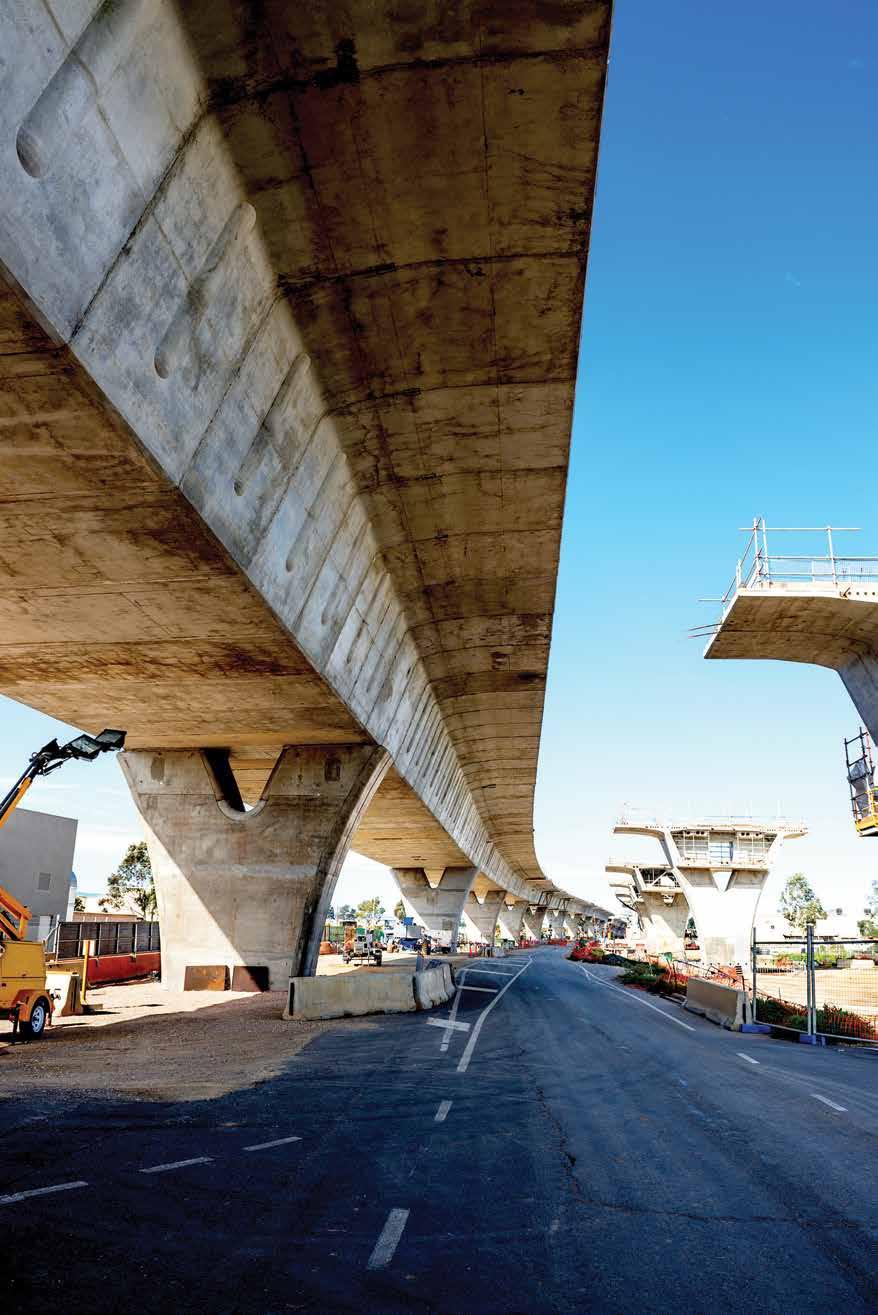
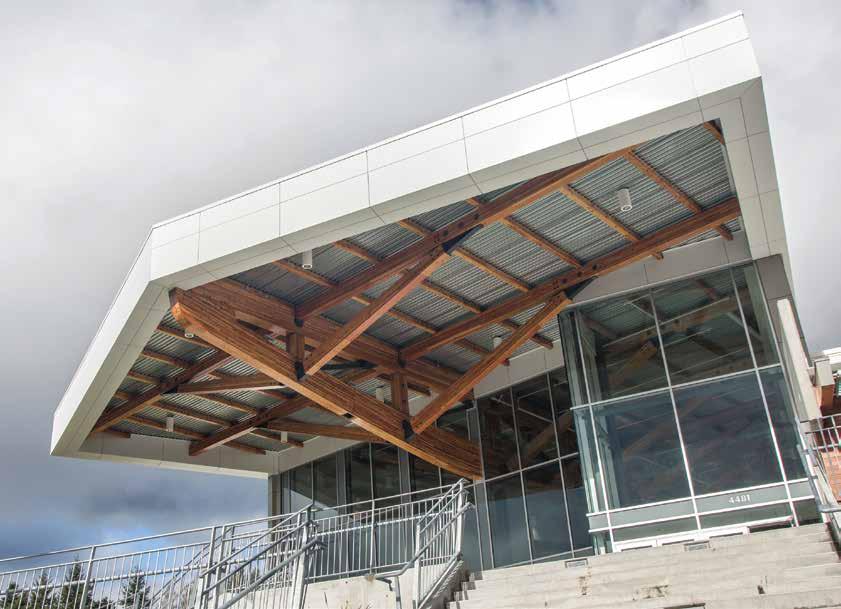

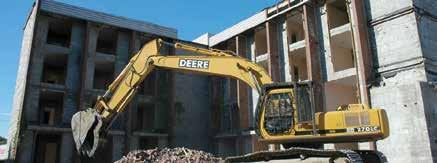



Camosun College is the largest trades educator on Vancouver Island providing excellence in foundation and apprenticeship training in: Carpentry, Electrical, Heavy Mechanical Trades, Horticulture, Plumbing & Pipe Trades, Sheet Metal & Metal Fabrication and Welding.
Camosun is set to train over 2,700 trades and apprenticeship students each year thanks to the new Centre Trades Education and Innovation and the plan to refurbish and expand current trades shops at the Interurban campus.
Camosun’s TRADEmark of Excellence Campaign is still underway. Support is still needed to revitalize our 40-year-old shops and equip our students with the latest teaching tools and skills demanded by industry.
As a VICA member - you have a special opportunity. Donate between $50 to $5,000 to help Camosun trades students, and we will match your contribution, dollar for dollar. Your support will go twice as far!
It’s organizations like the Vancouver Island Construction Association, and members like you, who can really make a difference.


our Scope of Work (our Mission)
As the Vancouver Island Construction Association (VICA), we serve our construction community: the institutional, commercial, industrial, civil, and multiresidential construction sectors of the construction community on Vancouver Island, the Gulf Islands, and other coastal areas of British Columbia. Our members come from all parts of our construction community.
our Blueprint
We are our construction community’s blueprint to success.
our Foundation (our Values) Our foundation is integrity.
our Keystone (our Principle) Our keystone is leadership.
our Pillars (our Functions)
• Advocacy – We are the unified voice for our construction community.
• Professional and Business Development –We build knowledge, skills and expertise in the construction community.
• Services – We provide services for our construction community.
• Governance and Operations – We safeguard and grow our association. n
Victoria office 1075 alston Street P: 250-388-6471 toll free: 877-847-6471 f: 250-388-5183
NaNaimo office
#5- 1850 Northfield road P: 250-758-1841 f: 250-758-1286 www.vicabc.ca




Complete Mechanical Installations
Complete Plumbing Installations
Boiler Installations & Maintenance
Retrofits & Repairs
Gas Fitting & Installations
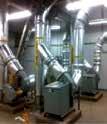
HVAC Installations
HVAC Fabricating Shop
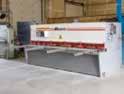
Based out of the Comox Valley on Vancouver Island BC, CanWest Mechanical Inc. offers HVAC Spiral Sales, and provides HVAC & Plumbing services to Commercial and Industrial clients throughout Western Canada. Our fully automated, state of the art, 7200 square foot fabrication shop provides us the foundational platform to meet the individual needs of every client.



HVAC Spiral Sales Custom Duct & Fittings

Mechanical Insulation, Cladding & Labelling

BC: (250) 871-2204
AB: (587) 524-9654
fabrication@canwestmechanical.com
estimating@canwestmechanical.com (250) 871-2204
www.canwestmechanical.com
PUBliShED By
DEL Communications Inc.
Suite 300, 6 Roslyn Road
Winnipeg, MB R3L 0G5 www.delcommunications.com
PRESiDENT & CEo David Langstaff
PUBliShER Jason Stefanik
MANAGiNG EDiToR Tammy Schuster
JUNioR EDiToR Karolina Karas
ADVERTiSiNG MANAGER Dayna Oulion


ADVERTiSiNG SAlES Gary Barrington Cheryl Ezinicki Brian Gerow Jennifer Hebert Ross James Gary Seamans
PRoDUCTioN SERViCES
PRoViDED By S.G. Bennett Marketing Services www.sgbennett.com
ART DiRECToR/DESiGN Kathy Cable
ADVERTiSiNG ART Sheri Kidd Dana Jensen
© COPYRIGHT 2016
DEL Communications Inc. All rights reserved.
The contents of this publication may not be reproduced by any means, in whole or in part, without prior written consent of the publisher.
Publications mail agreement #40934510
Return undeliverable Canadian addresses to: DEL Communications Inc. Suite 300, 6 Roslyn Road Winnipeg, MB R3L 0G5 Email: david@delcommunications.com
While every effort has been made to ensure the accuracy of the information contained in and the reliability of the source, the publisher and/or the Vancouver Island Construction Association in no way guarantees nor warrants the information and is not responsible for errors, omissions or statements made by advertisers. Opinions and recommendations made by contributors or advertisers are not necessarily those of the publisher, its directors, officers or employees.
PRINTED IN CANADA | 08 / 2016
The Vancouver Island Construction Association (VICA) has developed and nurtured the vision for one market, one association, and one voice for the Island. Guided by principles of leadership, service, and representation, VICA continuously serves the construction community, with a focus on the industrial, commercial, institutional, and multi-storey sectors.
From representation on regional, provincial, and national policy and regulatory issues, to spearheading formal and informal construction community dialogue, VICA is proud to initiate positive change and serve as the voice of Vancouver Island’s construction industry.
VICA thrives when members grow professionally through participation in our boards, committees, and U40 and Women in Construction groups. VICA succeeds when its members come out and passionately participate in member meetings, councils, and forums such as the Construction Council of Vancouver Island (CCVI).
VICA flourishes when it can help its members grow and participate in the construction community and beyond. VICA and its members work together to support the communities across the Island as well. Throughout the year, VICA and its membership carry out multiple volunteering and fundraising efforts. This year, we raised $7,500 for the Kids in Need program.
VICA prospers when it can bring much needed business intelligence to its members. The association also adapts as
VICA exists to support the construction industry and building community – owners, consultants, engineers, architects, and construction contractors. VICA membership gives you access to services, programs, and resources you won’t find anywhere else! Our goal is to help you do three things: save, connect, and grow. VICA offers programs that will save you money and offset the cost of membership. Our VICA Fuel Program saves participating members an average of $700 per year and the top users save an average of $2,400 annually. Combined with savings from the BCCA Employee Benefit Trust and 20-per cent discount on office supplies from Monk Office, VICA membership truly pays for itself!
technology and industry needs change. VICA’s membership uses BidCentral™ to source project opportunities, bid on projects, and view subsequent bid and award results. VICA’s staff is constantly working with the owner and consultant community to make sure the members receive the most up-to-date information about bidding opportunities.
VICA is proud to be a part of the BC Construction Association and Canadian Construction Association. Combined, this relationship provides services and supports to the Island membership. When the construction community comes together in any way, VICA thrives and the industry can meet its common goal of building prosperous communities across the Island. n
Membership connects you with a wide range of organizations that make up the construction community including contractors, suppliers, consultants, and the purchasers of your services. VICA supports its U40 and Women in Construction groups, as well as the Construction Council of Vancouver Island, so that you’re connected with the right people.
Grow personally and in your business with VICA! Your membership gains you access to industry insight and business intelligence. The advisory services from VICA’s staff will keep you in the know. If you have a question or issue, give us a call – we’re here for you. n












Each year, the Canadian Construction Association recognizes a partner association for their efforts in creating valuable services and programs for its members, and acting as a liaison for government, media, and community.
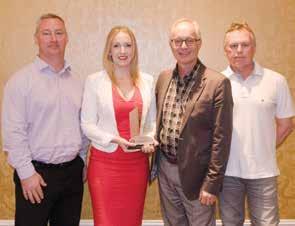
This year, VICA received the 2015 CCA Partnership Association Award of Excellence at the annual conference in New Orleans for the successful representation of its members. The award also acknowledged the Association’s procurement initiatives, educational programs, and collaboration efforts.
“We are incredibly honoured to receive this recognition,” says Greg Baynton, CEO of VICA. “With the support of industry partners, VICA has provided the necessary leadership to bring the broader construction community together to explore infrastructure delivery best practices, and to continue building a more cohesive construction community.”
Alan Fletcher, chairman of VICA’s board of directors, extended his gratitude to the board, committees, membership, and VICA staff. “We work closely together to improve and enhance the construction industry across Vancouver Island,” he says. “We look forward to continually working together for the betterment of the industry and the Island’s economy.” n
“VICA’s efforts in government relations reflect its interest in fair, open, and transparent practices in procurement. When its provincial government determined that bundling would be its preferred procurement method for building new schools, VICA took steps to address this issue that would have hindered its member firms’ ability to compete. As a result, the provincial government reversed its decision and will now consider bundling on a case-by-case basis.
VICA was also instrumental in bringing together the stakeholders of the public construction community and creating collaborative forums to share perspectives, and develop and communicate potential solutions. The first meeting took place in January 2015 and was
attended by public entities, consultants, and contractors – 60 stakeholders in total. By May 2015, over 150 stakeholders attended a one-day capital project forum hosted by this association and partners AIBC (Architectural Institute of British Columbia) and ACEC (Association of Consulting Engineering CompaniesCanada).
VICA provides a one-stop shop of educational courses and resources for its members, cultivates relationships with schools to promote construction careers, and sets up site tours for students.” n
Source: awards.cca-acc.com

GREG BAyNToN Chief Executive Officer gregbaynton@vicabc.ca

SARAh BARTFAi
Member Services Coordinator (Victoria) memberservices.victoria@vicabc.ca

ChENEllE FAlCoNER Education Coordinator education@vicabc.ca

RoSiE MANhAS Director of Operations director.operations@vicabc.ca

KAREN FlooD
Project Services Coordinator (Victoria) projectservices.victoria@vicabc.ca

KARoliNA KARAS Communications and Events Coordinator communications@vicabc.ca

DAWN ChARiTy
Member Services Coordinator (Nanaimo) memberservices.nanaimo@vicabc.ca

KENDRA RENAERTS
Project Services Coordinator (Nanaimo) projectservices.nanaimo@vicabc.ca

SERENA hUPPE Services Assistant (Nanaimo) admin.nanaimo@vicabc.ca

AlAN FlETChER
Chair

ANThoNy MiNNiTi
Vice Chair

DAViD FliNT Treasurer

RoGER yAGER
Secretary
Alan Fletcher, president and founder of AFC Industries Ltd., has owned and operated successful construction companies in Victoria, Courtenay, and Comox over the past 20 years, specializing in commercial, light industrial, multi-family, and award-winning custom homes. As a ticketed carpenter and joiner with over 30 years in the construction industry, he takes pride in balancing project costing with quality construction and creative design.
Over the years, Alan has grown his company to a strong team of up to 45 experienced employees and completes approximately $10 million annually in construction costs. Alan is a highly reputable builder, representing the North Island construction industry as chair of the Vancouver Island Construction Association (VICA). Over the years, he has been a speaker at several conferences targeting the construction and development industry.
Anthony Minniti is the vice-president of operations for Century Group Inc. and brings over 20 years of planning and construction experience to the VICA board. He is responsible for the planning and managing of the Western Canada construction operations, including business development, estimating, human resources, project management, and leading the construction management and designbuild team. Moreover, Anthony has a broad experience in design, procurement, and management of creative and construction personnel. Anthony is also the president of the Cordova Bay Association for Community Affairs.
Dave Flint of Flynn Canada has more than 30 years of experience in the construction industry. Starting as a sheet metal apprentice in 1980, Dave took every available opportunity to learn more about the industry and cultivate his career. By placing emphasis on profitability, communication, and mentoring, he built a successful roofing and cladding company from the ground up. In 2003, Dave sold his interests to Flynn Canada Ltd. and started the most recent phase of his career as a partner in this national construction firm. Recognized as a team player and a leader with forward-thinking ideas, he has contributed to the growth of the company both locally on Vancouver Island and regionally.
Dave served for a period on the board of directors for the Roofing Contractors Association of BC (RCABC) and held the post of president for a two-year term. Dave also served on boards for various community sports organizations, including the Saanich Peninsula Amateur Basketball Association, the Peninsula Lacrosse Association, and the Peninsula Soccer Association.
Roger Yager was born in Saint Boniface, Manitoba and started his contracting career in the familyowned construction firm Yager Builders Ltd. based in Winnipeg. After completing a bachelor of science degree in civil engineering at the University of Manitoba, he relocated to Victoria, B.C. looking for new challenges and experiences.
The local phase of his career started in 1993 when Knappett Construction Ltd. hired him as a junior estimator. Over the years, he has worked his way up the company structure to earn his current position of vice-president of the Knappett Group of Companies. Currently, Roger is responsible for overseeing all aspects of project estimating and project management and assists in all other areas of company operations.
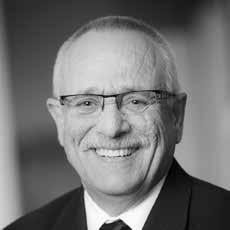
DoN CAMERoN
Past Chair
Don Cameron, senior project manager with G&E Contracting Ltd., is a Victoria native with more than 35 years of experience in the construction industry. Don’s early years were spent with Thurber Consultants and Levelton Engineering, where he received extensive training in geotechnical engineering, material testing, building, and environmental sciences. In the late 1980s, he was employed with the Capital Regional District and played a key role in the development of the award-winning Hartland Landfill and the region’s solid waste management plan.
Among his previous positions, Don has served on the VICA board since 2008 and was a member of the MICA/VICA merger task team. He has also served three terms as president of the Island Equipment Owners’ Association and is a past director of the B.B. Aggregate Producers Association. The former member of the Great Victoria Harbour Divestiture Committee is also a past vice-president of the Gordon Head Soccer Association and a nationally certified Level 3 coach.

KATy FAiRlEy
Director
Katy Fairley is the business development manager for Kinetic Construction Ltd.’s three offices in Vancouver, Victoria, and Courtenay. She graduated from Mount Allison University in New Brunswick in 2005 with a double major in international relations and political science. After working in Chengdu, China, she spent over three years as a political aid to MLAs in the B.C. Liberal Government Caucus. In 2010 she entered the construction industry thinking it was just a job. Instead, she found a career.
In 2013, Katy founded VICA’s Women in Construction (WiC) because of her passion for the construction industry. She wanted to meet others with that same level of interest, in addition to encouraging young women to consider a career in the construction industry. She believes that in order to meet labour shortages, women need to be encouraged to consider construction as a career. She brings her knowledge of procurement issues and best practices to the board. She is the chair of WiC and served on the U40 executive, and she has also lent her voice to a number of VICA taskforces. Because of her diverse background and experience, she brings a unique perspective to the board.

TylER GAlBRAiTh
Director
Tyler Galbraith is a partner at the law firm, Jenkins Marzban Logan LLP. Tyler practises in the areas of construction and commercial litigation. Tyler has appeared before all levels of court in British Columbia and has been involved in numerous construction related appeals, trials, arbitrations, and mediations. He has acted in builders’ lien and tender cases, disputes arising from delays, defective work, contract termination, bond claims, and insurance coverage.
Tyler is a member of a variety of construction and legal associations and has lectured for the Continuing Legal Education Society of British Columbia on construction-related matters. He is the author of numerous construction law articles and other publications, with a focus on tender and builders’ liens issues.

JASoN
KiNCh Director
Jason Kinch completed his civil engineering degree from the University of Alberta specializing in structural design in 1993. He started his career in 1999 for a major construction management firm then served as a project engineer for a structural design organization where he co-ordinated and managed commercial, industrial, and residential construction projects. Jason’s experience includes contract administration/construction review, project management, developing and monitoring budgets, and conducting assessments. As the regional manager and senior project engineer in charge of RJC’s Nanaimo office, Jason draws from his experience in both the private sector and local governments to ensure provision of the necessary resources to deliver a high level of client service.

DoUG SAVoRy Director

KEiTh
PARSoNAGE Director
Born in Nanaimo, Doug Savory has been in the mechanical construction industry for 37 years. For the last 15 years, he has been in the office at Archie Johnstone Plumbing and Heating, and is now the vice-president. He sits on various boards and committees related to the mechanical industry, and he holds a COR certification and a Gold Seal accreditation in construction management. Doug maintains a membership in SMART (Sheet Metal Air Rail and Transport). He is on the executive committee, sits on the joint adjustment board, the joint apprenticeship committee, and is an experienced negotiator. His understanding of both the needs of the worker and the needs of management brings a multi-sided view to the table.
Keith Parsonage is the regional manager for Houle Electric, covering Nanaimo and Northern Vancouver Island. He relocated to Nanaimo in February 2014 from Prince George and immediately became involved with VICA. Before being elected to the board, he was actively involved as an industry representative on VICA’s S&P committee and Construction Council of Vancouver Island. He also promotes the construction industry locally through VIU as a PAC member and through providing job shadowing opportunities for the VIU pre-apprenticeship and high school CTC students.
During his nine years in Prince George, Keith was involved in the promotion and improvement of the construction industry. He was a director with PGCA for four years, including past chair and director for one year on the BCCAN board. He also participated on various PGCA committees and sat on the CNC Trades Advisory Board. He actively supported apprenticeship training through involvement in WITT, CNC pre-apprenticeship training, CTC, and ITABC. Keith is excited for the opportunity to continue promoting and improving the industry as a member of VICA’s board of directors.

yoSEF SUNA
Director

KEiTh TATToN
Director
Yosef Suna is a project manager and estimator for Knappett Industries Ltd., and has been involved in multiple high-profile civil construction projects throughout Vancouver Island. He has held his current position for five years and, prior to embracing a management role, he was a site superintendent for a similar duration after quickly advancing through the ranks from his initial labourer position at 15 years old. Yosef’s post-secondary education in civil engineering technology, combined with his “bottom up” career path, and his company’s diversity operating as both a general contractor and a subcontractor, give him a well-rounded perspective on his profession and the construction industry.
Keith Tatton became involved in the concrete industry as a high school student and since then, he has worked as a manager, managing partner, or managing owner of four ready-mixed concrete companies on North Vancouver Island. In 1998, Keith and his wife started Cumberland Ready Mix Ltd. and later acquired Cumberland Sand & Gravel Ltd.
Since the late 1980s, Keith has been actively involved in many boards related to business, trade, and community service organizations across the Island and the province. This includes serving as chair of the Comox Valley Community Foundation’s Distribution Committee and treasurer and finance committee chair for the Comox Valley Airport Commission. For the past decade, Keith has served the board of directors of the Rotary Club of Cumberland Centennial. Keith joined VICA’s board of directors in the fall of 2015.

ERiC UlRiCh
Director

GERRiT ViNK
Director
Raised in Port Alberni, Eric Urlich moved to Vancouver to attend the Sauder School of Business at UBC. After graduating with a degree in commerce in 2001, Eric spent the next few years working in construction-related sales roles as a means to fund his backpacking adventures through Europe, the Middle East, Australia, and Asia. In 2009, he moved back to the island to join the family business, working as a project manager with Playsted Sheet Metal Ltd.
Eric has been involved with VICA in many ways since returning to the Island, including actively participating in VICA’s Under 40 (U40) group, the Construction Careers Committee, and the Trade Contractors Council. Eric has also recently taken on the position of business manager for the Vancouver Island Sheet Metal Contractors Association and is involved in the Greater Victoria Division 15 Sub-Trade Bid Depository Committee.
Gerrit Vink has more than 14 years of construction experience with progressively increasing responsibility levels. Having started as a junior project manager with Farmer Construction Ltd. in 1999, Gerrit is now president. His resume of local projects include Shoal Point, Dockside Green, Bayview, Pacific Sport Institute, the University of Victoria’s Engineering/Computer Science Building, Parkside, and Uptown which were completed under various delivery methods including trade contractor, general contractor and construction manager.
Gerrit was born and raised on the Island and completed his post-secondary education at the University of Victoria graduating with a degree in mechanical engineering. He is also a Gold Seal certified project manager and has significant experience with LEED projects.

Innovation and collaboration: buzzwords we all hear in the construction industry. Innovation involves ongoing change and adaption, and it requires some creativity. Innovation also requires collaboration and support to exist and be beneficial. It is incredibly satisfying when we experience collaboration that leads to innovation, and it is no wonder your customers seek both in the products and services you provide.
Your customers are not alone! Through your input, VICA will be modernizing our value proposition to align with your current and future needs. Many of you have expressed your desire to be involved in determining what the future VICA will look like as an innovative association.
You have been heard. While not all of our members have the time or desire to be a part of the process, many members have expressed interest. So we have begun the process through a variety of touchpoints and initiatives, and we hope that inclusion will inspire innovation –the same kind of innovation that led to VICA receiving the 2015 CCA Association Award of Excellence.
We accomplished this by effectively representing our members on key issues such as government procurement initiatives related to bundling projects, design-build only, and a review of Partnerships BC activities all of which resulted in positive change for the industry in these areas; establishing VICA as the voice of the island construction industry to government, industry stakeholders, and media; bringing the construction community together in a collaborative environment through the formation of the Construction Council of Vancouver Island; and the diversity and growth we have demonstrated in our education program.
Receiving this national association award of excellence confirms that we are one of the best associations in Canada and it is cause for celebration.
VICA intends to build on our successes by reframing the value of membership around saving, connecting, and growing. There will be new layers to our renewed value proposition. It will take time to roll these new layers out and for us to evaluate them together.
I urge you to seize every opportunity to actively participate in association initiatives, events, education, and volunteer for member leadership opportunities. These opportunities are the key to innovation and collaboration and the key to your success as well as the industry’s success.
We also want to honour the 104-year-old history of our association and the people who contributed to making the island construction industry better through their volunteer work at VICA. The members are a big part of that history and our future. Through membership in VICA, the members determine the future of the construction industry on Vancouver Island. Get involved today. n

why it is important to serve on the vica board?
The construction industry is being challenged from many directions, so it’s really important – especially for those of us who have been in the industry for a while – to address issues together in order to make our industry better. Over time, we’ve witnessed, and been a part of, the construction industry opening up to include everyone such as the architects, engineers, owners, and consultants. VICA has really been the driving force for collaboration in the industry.
what are the biggest challenges in the construction industry on vancouver island?
The procurement process combined with limited amount of projects.
We have a strong fluctuation in availability. Currently, competition is fierce for projects on the North Island, and the way projects are tendered makes it more of a challenge.
Because of the procurement issues in our industry there are organizations that are still trying to come up with their own solutions rather than collaborating with everyone involved. This has resulted in awkward, time-consuming tendering processes.
With the industry so competitive, the manner in how projects are delivered impacts our success to bid on them.
have you seen any progress with the procurement process?
We are seeing many examples of success in our industry. A municipal body recently called a meeting of local general contractors and subtrades to review drawings and documents for a large infrastructure project. They were asking for feedback and consultation on how they should present the project to the construction industry.
That’s very progressive to ask for input on their procurement method, and it’s another VICA initiative that I see as very successful.
what do you see happening in the coming year?
The residential sector is very busy right now and our sector will likely follow within a year or two. Finding your niche market within the industry is always important to ride through these ebbs and flows.
We’ve come a long way, but we still have a lot of work ahead of us. The seed has been planted; we are all asking the questions and trying to figure out how to do this more effectively.
The construction industry on the Island is a great community and it’s really grown. VICA has become a respected organization and because we’ve been so collaborative and openminded, the rest of the industry continues to join us in finding solutions to these issues.
I don’t think there is anyone on our board who isn’t proud of what we’re doing. n
The Vancouver Island Construction Association is proud to honour students and apprentices in the construction trades through its annual scholarship program. Recipients of the Secondary School Apprentice Scholarship, the Superstar Apprentice Scholarship, and the Women in Construction Scholarship are each awarded $500 to be applied toward tuition fees in continued trades training.
For the 2015/2016 school year, VICA awarded five remarkable
students in the Secondary School Apprentice Scholarship category. The Secondary School Apprentice Scholarship honours Level 1 construction apprentices on Vancouver Island who have completed a training program through the South Island partnership, Central Island partnership, or North Island partnership. The $500 is awarded to the highest-achieved grade point average in carpentry, electrical, joinery/cabinet making, piping, sheet metal, and welding.



0827746 BC ltd. dba Advantage Steel
Cobble Hill / (250) 743-8981
50th Parallel Rebar ltd.
Campbell River / (250) 923-2231
A Stroke Above Painting parksville / (250) 240-2310
A. Schenck Construction ltd.
Brentwood Bay / (250) 652-1365
AAA Rebar only ltd.
Victoria / (250) 652-6461
ABBA Floor Coverings ltd.
Nanaimo / (250) 758-5588
ABC Concrete – A Division of lehigh hanson Materials ltd.
Nanaimo / (250) 722-4001
ABl Masonry ltd.
Lantzville / (250) 741-7669
Accord Metal Fabricators (2004) ltd.
Victoria / (250) 474-2557
Accutemp Refridgeration, Air Conditioning & heating ltd.
Victoria / (250) 475-2665
Acme Painting 2010 ltd.
Victoria / (250) 474-2981
Action Door Service inc.
Victoria / (250) 383-2795
Advanced Products Roofing
Victoria / (250) 920-5757
Advantage Crane Rentals ltd.
Victoria / (250) 920-9691
AFC Construction
Courtenay / (250) 897-1789
All Metals installations ltd.
Nanaimo / (250) 244-3788
Alliance Engineering Works (1985) ltd.
Saanichton / (250) 544-2020
Allied Glass & Aluminum Products (2007) ltd.
Victoria / (250) 388-5108
AllTERRA Construction ltd.
Victoria / (250) 658-3772
Alpha Roofing & Sheet Metal inc.
Saanichton / (250) 544-0169
Alpine insulation ltd.
Victoria / (250) 384-0985
Andrew Sheret limited Nanaimo / (250) 758-7383
Andrew Sheret limited Victoria / (250) 386-7744
AoN Reed Stenhouse inc.
Victoria / (250) 413-2220
Apex landscaping
Duncan / (250) 710-0233
Apex Steel & Gas ltd.
Victoria / (250) 386-2929
Apple Electric
Campbell River / (250) 830-0997
Aqua irrigation
Brentwood Bay / (250) 652-9293
Aral Construction
Victoria / (250) 384-1425
Archie Johnstone Plumbing & heating ltd.
Nanaimo / (250) 754-2232
Associated Sheet Metal Products ltd.
Saanichton / (250) 652-6628
A-Tech Doors ltd.
Victoria / (250) 384-2259
Athecon Projects ltd.
Port Alberni / (250) 732-5599
Atlas Truss Nanaimo / (250) 754-1400
Aurora Roofing ltd.
Coombs / (250) 248-2202
B.R. Ventilation ltd.
Victoria / (250) 812-8314
Barnes Enterprises inc.
Qualicum Beach / (250) 752-2849
Bartle & Gibson Co. ltd.
Victoria / (250) 727-9976
Bayside Mechanical ltd.
Sidney / (778) 426-2116
BC Concrete Curb and Gutter inc.
Nanaimo / (250) 729-5174
BC Thermal Applicators
Nanaimo / (250) 758-9712
Belltech Electric
Victoria / (250) 360-2233
Bennett Sheet Metal & heating ltd.
Courtenay / (250) 334-3621
Benson industries limitd
Victoria / (250) 652-4417
Benton & overbury ltd.
Victoria / (250) 474-1251
Bernhardt Contracting ltd.
Victoria / (250) 857-2432
Biamar Building Systems
Victoria / (250) 883-2604
Bickford Enterprises ltd.
Saanichton / (250) 652-2309
Bigfoot Estimating And Project Management
Victoria / (250) 598-6283
BMS integrated Services
Victoria / (250) 590-3563
Bowerman Excavating ltd.
Port Alberni / (250) 723-8775
Brenric Construction ltd.
Victoria / (250) 382-3505
Brewis Electric Company ltd.
Victoria / (250) 383-5157
Britco lP
Nanaimo / (250) 722-2203
Brock White Canada
Victoria / (250) 384-8032
Brunnell Construction ltd.
Victoria / (250) 733-0657
Bryans Mechanical ltd.
Nanaimo / (250) 758-0738
Built Contracting ltd.
Nanoose Bay / (250) 468-9312
Butler Brothers Supplies ltd. Saanichton / (250) 652-4484
C & M Development inc. Nanaimo / (250) 756-7732
C & W Campbell homes ltd.
Victoria / (250) 658-8226
Campbell Construction ltd.
Victoria / (250) 475-1300
Cancor Cutting & Coring ltd. Errington / (250) 752-1287
Canem Systems ltd.
Nanaimo / (250) 751-7760
Canem Systems ltd.
Victoria / (250) 475-1955
Canpro Construction ltd.
Victoria / (250) 475-0975
Cantech Construction ltd.
Victoria / (250) 418-5522
CanWest Mechanical inc.
Courtenay / (250) 871-2204
Capital City Paving ltd.
Victoria / (250) 652-3626
Cascade Aqua-Tech ltd.
Victoria / (250) 381-3623
Cascade Fire Protection 2012 ltd.
Sooke / (250) 642-6542
Cat’s Eye Contracting ltd.
Victoria / (250) 590-1959
Central Glass (Duncan) ltd.
Duncan / (250) 748-2575
Century Group inc. Constructors
Victoria / (250) 727-6560
Circon Construction ltd.
Victoria / (250) 658-0449
City Construction ltd.
Nanaimo / (250) 585-8801
City Service Plumbing & heating ltd.
Victoria / (250) 744-3900
Clark & Pattison (BC) ltd.
Victoria / (250) 386-5232
Clearlite Glass (BC) ltd.
Victoria / (250) 652-8090
Clemco Mechanical (2010) ltd.
Saanichton / (250) 361-9996
Clyde Snobelen landscaping ltd.
Brentwood Bay / (250) 652-9984
CMF Construction ltd.
Nanaimo / (250) 754-6223
Coastline Fire Protection inc.
Shawnigan Lake / (250) 929-3939
Cochrane Contracting ltd.
Victoria / (250) 598-1233
Co-Gen Mechanical Services ltd.
Fanny Bay / (250) 335-2117
Coho Communications ltd.
Langford / (250) 474-2214
Complete Construction Services ltd.
Powell River / (604) 414-5395
Construction Drilling inc.
Duncan / (250) 746-4408
Convoy Supply ltd.
Victoria / (250) 474-5733
Corix Water Products limited Partnership
Duncan / (250) 746-8877
Cornerstone Tile ltd.
Nanaimo / (250) 756-9996
Cottam Enterprises ltd.
Victoria / (250) 590-2700
Cougar Pacific Systems Corp.
Victoria / (250) 360-2128
Cumberland Ready Mix ltd.
Cumberland / (250) 336-8515
Custom Pro Exteriors ltd.
Victoria / (250) 474-7725
D. Chalifour Drywall Contracting
Lantzville / (250) 390-3390
Butler Brothers Supplies Ltd. is a family run company that has been supplying South Vancouver Island with building supplies since the early 1930’s, along with Ready-Mix Concrete since the 1950’s. Today our focus is primarily on concrete, sand and gravel supply. We currently operate 3 gravel pits, alongside 3 concrete batch plants, with a large fleet of concrete trucks for prompt delivery. Today we are capable of supplying all 13 municipalities and the outlying areas of the CRD also extending our service over the Malahat and into the CVRD. We have a large portfolio of mixes designed to meet your project’s needs along with a wide variety of washed or crushed sands and stone.
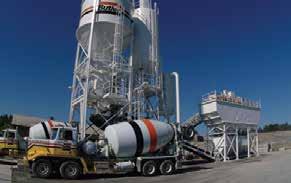


Gravel & Concrete Sales 6700 Butler Crescent, Victoria B.C. 250-652-4484
Gravel & Concrete Sales 6228 Sooke Rd., Sooke B.C. 250-642-5296
Gravel Sales 4998 Langtry Rd, Duncan B.C. 250-746-1080

Dalcon Construction (2001) ltd.
Cobble Hill / (250) 743-1449
Dave McDonald Electric ltd.
Victoria / (250) 474-3234
Den Mar Electric ltd.
Nanaimo / (250) 758-8464
Denford Construction Management ltd.
Victoria / (250) 385-1505
Depend-A-Dor Repairs & installation ltd.
Victoria / (250) 383-4225
Dirk and Dan’s Painting ltd.
Victoria / (250) 883-3233
Discovery Diesel Electric ltd.
Campbell River / (250) 286-9621
Dixon Networks Corporation
Delta / (604) 940-8817
Domingo & Company Construction ltd.
Victoria / (250) 595-8813
Don Mann Excavating ltd.
Victoria / (250) 479-8283
Draycor Construction ltd.
Victoria / (250) 743-9077
Dryco Systems inc.
Cowichan Bay / (250) 746-6251
Durwest Construction Management inc.
Victoria / (250) 881-7878
Dyler’s Window Fashions
Victoria / (250) 381-2122
E K industries incorporated
Cowichan Bay / (250) 715-7516
E.h. Emery Electric ltd.
Victoria / (250) 383-6961
EB horsman & Son ltd.
Campbell River / (250) 287-9265
ECCo Supply
Victoria / (250) 361-3395
Edgar & Miner Floor Coverings
Victoria / (250) 388-6208
EECol Electric inc.
Victoria / (250) 475-7578
Eh Price limited
Victoria / (250) 475-1500
Elite Metal Works ltd.
Saanichton / (250) 652-6538
Emco Corporation
Nanaimo / (250) 756-3344
Emco Corporation
Victoria / (250) 475-6272
Empress Painting ltd.
Victoria / (250) 383-5224
Erb Technical Contracting ltd.
Saanichton / (250) 665-7636
Erickson Roofing ltd.
Nanaimo / (250) 758-5440
ESC Automation inc.
Nanaimo / (250) 756-3006
European Masters Painting ltd.
Comox / (250) 339-1979
Excel Contracting ltd.
Victoria / (250) 388-0047
F & M installations ltd.
Nanaimo / (250) 753-1214
Farmer Construction ltd.
Victoria / (250) 388-5121
Faucet Plumbing & heating ltd.
Nanoose / (250) 741-4803
Fineline Road Marking ltd.
Nanaimo / (778) 265-3184
Finishing Touch Painting ltd.
Victoria / (250) 995-2510
Five Star Paving Co. ltd.
Saanichton / (250) 544-4994
FloCoR inc.
Nanaimo / (250) 758-1551
Flotech Mechanical System Specialists (2004) ltd.
Victoria / (250) 475-3719
Flynn Canada ltd.
Saanichton / (250) 652-0599
Foster Air Conditioning ltd.
Victoria / (250) 475-0500
Fournier Excavating ltd.
Nanaimo / (250) 754-7390
G & E Contracting ltd.
Sidney / (250) 656-3159
G & G Roofing ltd.
Nanaimo / (250) 585-0041
Gorge Electrical Services ltd.
Victoria / (250) 658-0960
Graham Construction & Engineering inc.
Kelowna / (250) 765-6662
Graphic office interiors ltd.
Saanichton / (250) 544-3500
Grascale Developments inc.
Victoria / (250) 888-9841
Great West Scaffold Rentals ltd.
Victoria / (250) 386-5545
Great White Cladding and Decking ltd.
Saanichton / (778) 351-1199
Griffin Properties ltd.
Victoria / (250) 656-8621
Guillevin international Co.
Campbell River / (250) 286-1055
Guillevin international Co.
Nanaimo / (250) 755-1104
h & R Exterior Finish ltd.
Victoria / (250) 474-5118
haldon Construction ltd.
Saanichton / (250) 652-8608
harbour City Drywall ltd.
Nanaimo / (250) 753-4409
harbour Door Services
Victoria / (250) 383-1606
harris Rebar/Div. of harris Steel
Nanaimo / (250) 722-3378
hazelwood Construction Services inc.
Nanaimo / (250) 716-1940
hD Form Construction ltd.
Victoria / (250) 744-2889
heatherbrae Builders Co. ltd.
Nanaimo / (250) 585-0117
hendry, Swinton, McKenzie insurance Services inc.
Victoria / (250) 940-9413
henneberry Electrical Contractors ltd.
Victoria / (250) 388-5756
herold Engineering limited Nanaimo / (250) 751-8558
highland Plumbing 2005 ltd.
Victoria / (250) 995-2300
hilti (Canada) Corporation
Victoria / (250) 883-4221
hl Demolition & Waste Management ltd.
Victoria / (250) 383-4444
holdfast Metal Works ltd.
Nanaimo / (250) 591-7400
home lumber and Building Supplies
Victoria / (250) 475-0333
homewood Constructors ltd.
Victoria / (250) 475-1130
horizon Pacific Contracting & Sunrooms inc.
Victoria / (250) 380-4605
houle Electric ltd.
Nanaimo / (250) 758-3011
houle Electric ltd.
Saanichton / (250) 544-0099
hub City Glass ltd.
Nanaimo / (250) 758-1985
impact Electric ltd.
Nanaimo / (250) 755-7311
imperial Welding ltd.
Chemainus / (250) 246-2133
independent Concrete ltd.
Victoria / (250) 478-0555


insulpro insulation inc.
Nanaimo / (250) 751-1108
integrity Exteriors ltd.
Saanichton / (250) 382-9181
inter-Kraft Contracting ltd.
Nanaimo / (250) 753-2897
intertech Electric ltd.
Gabriola / (778) 960-2377
irwin industries (1988) ltd.
Victoria / (250) 382-5154
island Applicators ltd.
Sooke / (250) 642-2375
island Architectural Millwork ltd.
Nanaimo / (250) 753-3327
island Asphalt/ok industries
Victoria / (250) 652-9211
island Floor Centre ltd.
Victoria / (250) 475-3323
island overhead Door (1979) ltd.
Nanaimo / (250) 758-3032
island Solar Films
Nanaimo / (250) 756-2454
island Temperature Controls ltd.
Victoria / (250) 382-2161
island Traffic Group
Victoria / (250) 727-8138
island View Nursery
Saanichton / (250) 544-4802
iWC Excavation ltd.
Nanaimo / (250) 585-0492
iWCD
Nanaimo / (250) 756-9665
J Waters Electric ltd.
Courtenay / (250) 703-0802
J. lee Diamond Drilling ltd.
Victoria / (250) 479-1251
J.R. Edgett Excavating ltd.
Lazo / (250) 339-6100
J.Roberts Caulking
Victoria / (250) 477-6789
Jacob Bros. Construction ltd.
Surrey / (604) 541-0303
Jardine lloyd Thompson Canada inc.
Victoria / (250) 388-4416
Jenkins Marzban logan llP
Vancouver / (604) 681-6564
Jerry Wakefield Construction
North Saanich / (250) 704-8498
K & S Railings ltd.
Nanaimo / (250) 754-9003
Kal-lay Plumbing and heating ltd.
Victoria / (250) 595-5165
Kang and Gill Construction ltd.
Victoria / (250) 590-3140
Keith Plumbing and heating Co. ltd.
North Vancouver / (604) 980-4891
Kerr Controls inc.
Saanichton / (250) 655-0145
Ketza Pacific Construction (1993) ltd.
Campbell River / (250) 850-2002
Kinetic Construction ltd.
Courtenay / (250) 871-8662
Kinetic Construction ltd.
Victoria / (250) 381-6331
Knappett industries (2006) ltd.
Nanaimo / (250) 390-3022
Knappett Projects inc.
Victoria / (250) 475-6333
KoNE Elevators
Victoria / (250) 384-0613
l. G. F. Environmental Services
Metchosin / (250) 642-6434
lafarge Canada inc. DBA hub City Paving
Nanaimo / (250) 754-2195
lake Construction ltd.
Duncan / (250) 746-1778
langdon Weir Construction ltd.
Victoria / (250) 386-9900
lanson’s Drywall Systems ltd.
Nanaimo / (250) 758-1500
large & Co Developers, DataTech Developments inc. DBA
Victoria / (250) 480-2894
lark Projects ltd.
Surrey / (604) 576-2935
ledcor Construction limited
Victoria / (250) 477-1831
leighton Contracting (2009) ltd.
Courtenay / (250) 338-6460
lewis Sheet Metal ltd.
Victoria / (250) 383-0520
liddell Contracting ltd.
Victoria / (250) 477-2334
liesch interiors ltd.
Victoria / (250) 590-4102
lifestyle Metal Ventures – inc.
Black Creek / (250) 337-8055
locar industries ltd.
Nanaimo / (250) 751-3316
logue & Bridges ltd.
Victoria / (250) 475-0188
longview Construction and Project Management ltd.
Victoria / (250) 813-2180
lts Custom Millwork ltd.
Langford / (250) 589-0835
lumberworld operations ltd.
Victoria / (250) 479-7151
M. Griffin ltd.
Victoria / (250) 382-5159
M.A.R. Mechanical inc.
Duncan / (250) 510-6745
M2 Green Mechanical ltd.
Nanaimo / (250) 585-7778
Maltesen Masonry ltd.
Parksville / (250) 248-6261

Mammoth landscaping & Masonry ltd.
Victoria / (250) 388-4616
Matthews Agencies
Victoria / (250) 388-4123
Mawson Gage & Associates 1998 ltd.
Victoria / (250) 383-6631
Mayco Mix ltd.
Nanaimo / (250) 722-0064
Mazzei Electric ltd.
Nanaimo / (250) 751-1727
McElhanney Consulting Services ltd.
Victoria / (250) 370-9221
McGrath Contracting ltd. Also DBA Coastal Welding & Metal Fabrication
Campbell River / (250) 286-9992
McGregor & Thompson hardware ltd.
Nanaimo / (250) 729-7888
McGregor & Thompson hardware ltd.
Victoria / (250) 383-8666
Mcintyre Painting ltd.
Victoria / (250) 213-5649
Mega Power installations ltd.
Victoria / (250) 475-2100
Megson Fitzpatrick & Town & Country insurance
Victoria / (250) 595-5212
Michell Excavating limited
Saanichton / (250) 652-1640
Mid island Glass ltd.
Nanaimo / (250) 751-8199
Mid island Stucco & lathing inc. Nanaimo / (250) 753-5082
Mid-island Masonry Contracting ltd. Ladysmith / (250) 245-3127
Milestone Equipment Contracting inc. Cedar / (250) 951-6659
Millstone heating & Sheet Metal ltd. Duncan / (250) 746-0988
Milner Group Ventures inc. Nanaimo / (250) 756-0773
Miranda Construction ltd.
Nanaimo / (250) 758-9751
MNP llP
Nanaimo / (250) 734-4368
Morinwood Mfg inc.
Saanichton / (250) 479-0581
Mount Benson Mechanical (1991) ltd. Nanaimo / (250) 585-6730
Muchalat Projects ltd. Courtenay / (250) 338-0995
Namdor Reinforcing Steel (1987) ltd.
Victoria / (250) 383-5562
Nanaimo Precast ltd.
Nanaimo / (250) 591-6115
National Concrete Accessories
Victoria / (250) 388-4257
Nedco Division of Rexel Canada Electric inc.
Victoria / (250) 383-1116
Nelson Roofing & Sheet Metal ltd.
Cumberland / (250) 336-8088
Nordic industries ltd.
Saanichton / (250) 652-0022
North Glass & Aluminum ltd.
Victoria / (778) 440-8240
North West Environmental Group ltd.
Victoria / (250) 384-9695
Northridge Excavating ltd.
Victoria / (250) 479-4373
Northwest Scaffolding
Cobble Hill / (250) 743-5560
N-Viro Air Corp
Victoria / (250) 382-2198
ocean Concrete ltd.
Victoria / (250) 382-8121
oceanview Mechanical ltd.
Victoria / (250) 920-3605
o’G Painting
Victoria / (250) 595-5268
olde Country Masonry ltd.
Victoria / (250) 727-7099
omicron Construction ltd.
Vancouver / (604) 632-3350
omni Mechanical inc.
North Saanich / (250) 655-1202
osprey Electric ltd.
Parksville / (250) 586-6220
Pace-West Mechanical ltd.
Nanaimo / (250) 756-9888
Pacific Commercial interiors ltd.
Sooke / (250) 480-8985
Pacific industrial & Marine ltd.
Duncan / (250) 746-7272
Pacific landing ltd. Partnership
Victoria / (778) 265-8280
Pacific Rim industrial insulation ltd.
Surrey / (604) 533-8179
Parker Johnston industries ltd.
Saanichton / (250) 382-9181
PCl Constructors Westcoast inc.
Richmond / (604) 241-5200
Perma Construction ltd.
Victoria / (250) 384-2323
Phoenix Glass ltd.
Delta / (604) 525-2800
Pino-lite Glass (2010) ltd.
Victoria / (250) 385-1332
Playsted Sheet Metal
Victoria / (250) 382-2164
Powerhouse Sheet Rock ltd. Courtenay / (250) 920-8262
PR Bridge Systems ltd.
Victoria / (250) 475-3766
Prices Alarms inc. Saanich / (250) 384-4104
Propacific hazmat Services (A Division of Propacific Restorations)
Nanaimo / (250) 756-9966
Protex Fence Services
Victoria / (250) 580-6505
Quality Victoria Drywall
Victoria / (250) 613-3966
R.W. (Bob) Wall ltd.
Nanaimo / (250) 756-2707
Rada Resurfacing Enterprises ltd.
Victoria / (250) 391-9919
Ralmax Contracting ltd.
Victoria / (250) 590-7072
Ramsay Painting ltd.
Victoria / (250) 474-3288
Raylec Power lP
Cumberland / (250) 400-4266
Read Jones Christoffersen ltd.
Victoria / (250) 386-7794
Redline Glass ltd.
Saanichton / (250) 544-1909
Removall Remediation Services ltd.
Victoria / (250) 478-9998
Richmond Elevator
Victoria / (250) 590-7198
Rob Tournour Masonry ltd.
Victoria / (250) 478-3364
Robertson Sheet Metal ltd.
Victoria / (250) 391-7883
Rockridge industrial Services inc.
Victoria / (250) 658-1001
Rolling Tides Construction inc.
Shawnigan Lake / (250) 888-9703
Ron’s Drywall ltd.
Nanaimo / (250) 758-0257
Roofmart Pacific
Central Saanich / (250) 652-0543
RTl Mechanical Systems ltd.
Shawnigan Lake / (250) 812-3450
Russell Food Equipment
Victoria / (250) 386-3161
Rutland Glass
Victoria / (250) 590-2022

Saanich landscaping ltd.
Victoria / (250) 479-6490
Savage Kohut Electrical Contractors
Victoria / (250) 598-2933
Saywell Contracting ltd.
Nanaimo / (250) 729-0197
Saywell Developments ltd.
Nanaimo / (250) 729-7215
Scansa Construction ltd.
Victoria / (250) 478-5222
Securco Services inc.
Nanaimo / (250) 754-6014
Shanahan’s limited Partnership
Victoria / (250) 920-5533
Simpson Controls ltd.
Victoria / (250) 383-9490
Slegg Building Materials ltd.
Nanaimo / (250) 758-8329
Slegg Building Materials ltd.
Sidney / (250) 656-1125
SlS Group industries inc.
Burnaby / (604) 874-2226
Sneddon Masonry ltd.
Qualicum / (250) 594-9991
Somenos Construction ltd.
Duncan / (250) 746-5953
Southcoast Electric ltd.
Victoria / (250) 386-4117
Specified Technical Sales ltd.
Calgary / (250) 540-3143
SPR Traffic Services lP
Victoria / (250) 655-5041
SRl Fire Protection ltd.
Victoria / (250) 479-5884
Stanley Construction ltd.
Victoria / (250) 618-5371
Starline Windows (2001) ltd.
Victoria / (250) 475-1441
Stint Construction ltd.
Nanaimo / (250) 585-5171
Stone Pacific Contracting
Duncan / (250) 748-2095
Story Construction ltd.
Victoria / (250) 386-3396
Summit Mechanical Systems ltd.
Shawnigan Lake / (250) 216-2896
Surespan Structures ltd.
Duncan / (250) 748-8888
Tech Mechanical Systems ltd.
Victoria / (250) 475-1011
Tedford overhead Doors and Gates ltd.
Victoria / (250) 727-6811
Tervita Corporation
Langford / (250) 915-2010
The Guarantee Company of North America
Vancouver / (604) 687-7688
Thomis Electric ltd.
Victoria / (250) 370-1123
ThyssenKrupp Elevator (Canada) limited
Victoria / (250) 474-1150
Top line Roofing ltd.
Victoria / (250) 478-0500
Tower Fence Products ltd.
Victoria / (250) 478-9733
Trades labour Corporation (TlC) Victoria
Victoria / (250) 386-0024
Trane British Columbia
Victoria / (250) 414-7520
Tri City Finishing
Victoria / (250) 381-1989
Trotter & Morton Group of Companies
Burnaby / (604) 525-4499
Troy life & Fire Safety ltd.
Victoria / (250) 475-1076
True line Contracting ltd.
Victoria / (250) 812-7236
Tycon Steel (1998) inc.
Victoria / (250) 475-3505
United Floors
Nanaimo / (250) 758-4664
Universal Sheet Metal
Saanichton / (250) 652-6771
V.i. Steel inc.
Victoria / (250) 475-3883
Van Berg interiors Painting ltd.
Parksville / (250) 947-9220
Van isle Bricklok Surfacing & landscape
Victoria / (250) 382-5012
Vancouver island insuranceCentres
Courtenay / (250) 338-3355
Van-isle Coatings & Sealants ltd.
Shawnigan Lake / (250) 883-7175
Van-Roc interiors Drywall ltd.
Parksville / (250) 947-9220
Verity Construction ltd.
Victoria / (250) 880-0139
Vescon Construction ltd.
Duncan / (250) 748-6262
Victoria Construction ltd.
Victoria / (250) 727-5800
Victoria Drain Services ltd.
Victoria / (250) 818-1609
Victoria Glass inc.
Victoria / (250) 388-4811
Victoria landscaping 2012 ltd.
Victoria / (250) 479-1224
Victoria Metal Craft ltd.
Victoria / (250) 727-3567
Viking Reinforcing ltd.
Coombs / (250) 248-8355
Visionary Glass inc.
Shawnigan Lake / (778) 356-4899
Wallace industrial Services
Victoria / (250) 590-8897
Waywest Mechanical ltd.
Nanaimo / (250) 729-2394
Webb & hamilton installations
Victoria / (250) 812-9601
Webster Electric ltd.
Courtenay / (250) 338-1686
Wells Fargo Equipment Finance
Vancouver / (604) 540-6628
Wesco Distribution Canada
Nanaimo / (250) 758-1777
Wesco Distribution Canada Victoria / (250) 382-7265
Wescor Contracting ltd.
Victoria / (250) 475-8882
West Bay Mechanical ltd.
Nanaimo / (250) 729-7440
West Bay Mechanical ltd.
Victoria / (250) 478-8532
West isle industries ltd.
Victoria / (250) 474-6277
West Rock Construction ltd.
Victoria / (250) 727-9725
West Shore Gypsum ltd.
Victoria / (250) 391-4744
Westburne Electric
A Div. of Rexel Canada inc.
Victoria / (250) 475-1900
Western Asbestos Removal
Calgary / (587) 880-2929
Western Grater Contracting ltd.
Victoria / (250) 478-4225
Western Medical incorporated Mill Bay / (250) 929-8192
Western oil Services ltd. Langley / (604) 514-4787
Westernone Rentals & Sales Victoria / (250) 652-5550
Westlund industrial Duncan / (250) 746-0904
Westmark Construction ltd. Nanaimo / (250) 729-7540
Westwood Metals ltd. Nanaimo / (250) 758-1158
What A Steel Erector Company ltd.
Cobble Hill / (604) 219-5515
White Knight Painting Victoria / (250) 472-8465
WJ Murphy Contracting 2013 ltd. Nanoose Bay / (250) 468-2072
Wolseley Canada Victoria / (250) 475-1111
york Excavating ltd.
Victoria / (250) 478-7178







Advicas Group Consultants inc.
Victoria / (250) 383-1008
BC hydro – Vancouver island Generation
Campbell River / (250) 850-5913
BC Transit
Victoria / (250) 385-2551
Beacon Construction Consultants inc.
Victoria / (250) 385-7899
Best Western plus, The Westerly hotel and Convention Center
Courtenay / (250) 338-7741
BGC Partners inc.
Abbotsford / (604) 807-3899
Brookfield Global integrated Solutions
Victoria / (250) 952-3835
Building links
Courtenay / (250) 338-5466
Camosun College
Victoria / (250) 370-3803
Canadian Western Bank
Courtenay / (250) 334-8888
Coastal Community Credit Union
Nanaimo / (250) 729-2567
Columbia Fuels
Victoria / (250) 213-7808
Commissionaires
(Canadian Corps of Commissionaires Victoria, The Islands and Yukon)
Victoria / (250) 727-7755
Connect hearing (island hearing Services)
Victoria / (250) 413-2141
Constructive Solutions for Business
Vancouver / (604) 878-8100
Del Communications ltd.
Winnipeg / (204) 667-0376
Dial-A-Geek
Victoria / (250) 385-3425
Domcor health Safety & Security inc.
Campbell River / (250) 286-3163
Emcon Services inc.
Merritt / (250) 378-4176
Footprints Security Patrol inc.
Nanaimo / (250) 753-6944
FortisBC
Surrey / (604) 592-8220
Goal Engineering ltd.
Victoria / (250) 744-3992
Greater Victoria harbour Authority
Victoria / (250) 383-8300
heartSafe Emergency Medical Solutions ltd.
Victoria / (250) 385-3223
iNTRoN Fire Stopping Consultants
Victoria / (250) 661-0539
island Blue Print
Victoria / (250) 385-9786
island health
Victoria / (250) 881-6106
island Savings
Victoria / (250) 385-4476
J.W. Wells Consulting inc.
Victoria / (250) 658-3143
KPl James Architecture
Victoria / (250) 388-4261


KPMG MSlP
Victoria / (250) 480-3500
ll Brougham inc.
Victoria / (250) 920-7020
low hammond Rowe Architects inc.
Victoria / (250) 472-8013
Mayfair Shopping Centre ltd. Partnership
Victoria / (250) 383-0541
Medix holdings ltd.
Ladysmith / (250) 893-3418
Merrick Architecture
Victoria / (250) 480-7811
Monk office Supply ltd.
Victoria / (250) 508-6182
Multivista Construction Documentation
Victoria / (250) 217-1355
NexGen hearing (industrial) inc.
Victoria / (250) 580-5884
North island College – School of Trades & Technology
Campbell River / (250) 923-9722
number TEN architectural group
Victoria / (250) 360-2106
Pacific Rim Safety Training inc.
Kelowna / (250) 769-3354
Pearlman lindholm
Victoria / (250) 388-4433
Peggy yelland & Associates inc, CGA Saanichton / (250) 652-7845
RBC Royal Bank Nanaimo / (250) 741-3515
Revay and Associates limited
Surrey / (250) 240-9052
Ryzuk Geotechnical
Victoria / (250) 475-3131
Securiguard Services ltd. (Security) Victoria / (250) 388-3118
Stantec Consulting ltd.
Victoria / (250) 388-9161
Superior Propane inc.
Nanaimo / (250) 739-2573
Tetra Tech EBA inc.
Edmonton / (780) 451-2130
The Bank of Nova Scotia
Victoria / (250) 298-4401
Thurber Engineering ltd.
Victoria / (250) 727-2201
Tsolum & Tsable Environmental ltd.
Courtenay / (250) 871-8638
University of Victoria- Facilities Mgmt.
Victoria / (250) 472-4826
Vancouver island Building & Construction Trades Council
Victoria / (250) 727-3458
Vancouver island University
Nanaimo / (250) 740-6505
Waymark Architecture
Victoria / (888) 206-0123
Wells Klein Consulting Group inc.
Victoria / (250) 388-0312
WSP Canada inc.
Victoria / (250) 475-1000
yellow Sheet Construction Data ltd.
Victoria / (250) 480-1230
550 Cuduthel Street
Victoria, BC V8Z 1G1
PH: 250-475-6272
FX: 250-475-6282
TF: 888-545-6111
927 Dunford Avenue
Victoria, BC V9B 2S4
PH: 250-391-3050
FX: 250-475-6200
TF: 866-551-6789
2350 Dorman Road Nanaimo, BC V9S 5G2
PH: 250-751-2622
FX: 250-751-2621
TF: 877-751-2622
Plumbing, HVAC, Hydronic, and Industrial Supplies www.emcobc.ca
Walking into the Vancouver Island Construction Association boardroom, groups of people stand together talking, shaking hands, sipping coffee, and laughing. It feels much like walking into a reception or retirement party. In a way, it was.
At the VICA 2015 annual general meeting, Don Cameron of G&E Contracting Ltd. is the outgoing VICA chair and, after over 40 years in the construction industry, is heading toward retirement.
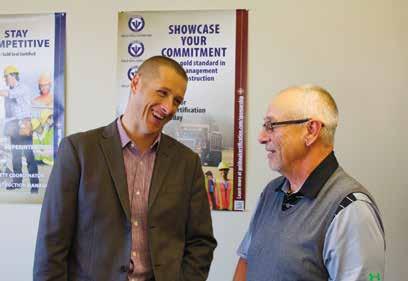
He began the meeting by acknowledging the hard work VICA has done to increase value to its membership and continue growth by adding new members to the associations. “It’s always good to see new members take over for the long-in-the-tooth, grey-haired men,” he says.
Greg Baynton, VICA CEO, called 2015 a year of rapid change. He says VICA members have noticed a positive trend beginning to unfold in the industry as the economic recovery continues.
He says VICA members identified a highly competitive market and human resources challenges as the biggest issues impacting their businesses, but says 2016 promises to be a year of change.
“We will refresh our member focus and will continue to enhance our member value proposition,” says Baynton. “I urge you to get involved in your association and help make your industry a better and stronger place to live and work.”
Treasurer, Anthony Minniti of Century Group Inc., says the auditors’ report completed by LL Brougham and Associates showed a 6.5-per cent decline in membership, which, he says, was due in part to business closures – a reality that is not unique to VICA. But
he says the Association reported approximately $400,000 in its reserves, and a clean auditors’ report that added to the well being of the Association.
The one-hour AGM, held in both Victoria and Nanaimo locations and connected via video conference, also voted in eight members to the board of directors. Keith Parsonage of Houle Electric Ltd. and Keith Tatton of Cumberland Ready Mix, were voted in as VICA’s newest directors.
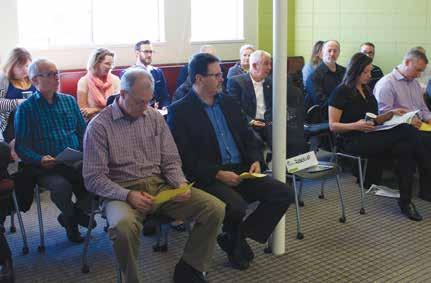
“It’s great to see our new nominees and new members come from all walks of life within the industry,” says Cameron. “That can only make our association stronger and a greater place for what is good in the construction industry.”
Alan Fletcher of AFC Industries Ltd., was elected as the new chair at the following board meeting. Anthony Minniti of Century Group Inc. as the vice-chair, Dave Flint of Flynn Canada as VICA treasurer, and Roger Yager of Knappet Group of Companies as VICA secretary.
The AGM ended with Cameron saying many members have been a part of VICA for over 35 years. “We’ve been able to enjoy the social aspects of VICA – and overjoy them on more than one occasion – but it’s the business and advocacy that VICA does on a daily basis that is the driving force behind getting involved and giving back to the industry that’s been great to me and my family.”
As Cameron finishes out his term as chair, he says the role brings a lot of work but it’s well worth it.
“I urge the next generation to get involved, volunteer, and become an industry leader. The personal growth is your reward.” n










VICA celebrates and raises $7,500 for local charities at the annual holiday luncheon

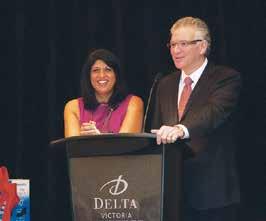
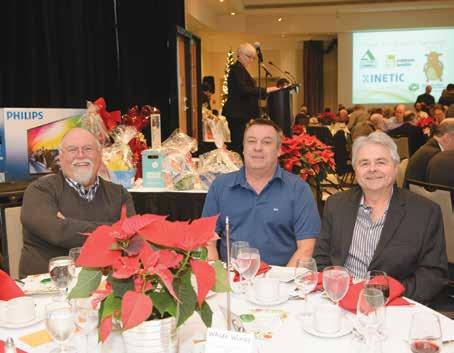

The 2015 VICA Annual Christmas Luncheon was held on a grey Friday in December, but the sprit of camaraderie and celebration inside the ballroom of the Delta Victoria Ocean Pointe Resort and Spa was bright and festive.
The, once again, sold-out event had members eating, drinking, and being merry while winning prizes and raising funds for the community.
Greg Baynton, VICA CEO, and Rosie Manhas, director of operations, welcomed the guests and thanked them for their support and partnership over the year. “We are the voice of the construction community,” said Baynton. “We represent your interests, your leaders, your decision-makers, and all levels of your governments. It’s you, the members, who enable this voice and the influence it carries is strong.”

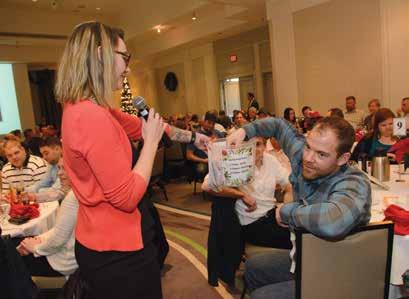
In the spirit of giving, VICA members helped to raise $7,500 for children in need – the proceeds were donated to a number of inner city schools on Vancouver Island. Funds were raised through the purchase of door prize tickets, a 50/50 draw – $2,520 won by Colin

East of Heatherbrae Builders – and a paint-can coin drive used to empty loose jangly change from members’ pockets and purses.
Canadian comedian, Mike Delamont, took the stage to entertain the crowd. The award-winning comic has performed in venues across the country including the Just for Laughs Festival.
Throughout the afternoon, 18 prizes were awarded to lucky ticket-holders, including Canucks tickets and hotel stay, spa, resort, and golf packages, cooking lessons, and a 40” Sony HD LCD TV.
Opportunity knocked for 10 members who tried their luck at unlocking a door to a one-week vacation in Hawaii donated by Peggy Yelland & Associates and Escape Solutions. The lucky key that opened the door belonged to William Doyle from Chew Excavating.
Baynton ended the afternoon by wishing everyone a happy and safe holiday season and said the luncheon was one more way to promote partnerships, build relationships, and contribute to the community. “Building infrastructure and prosperous healthy communities is what we are about.” n






























Scandinavian











We
We

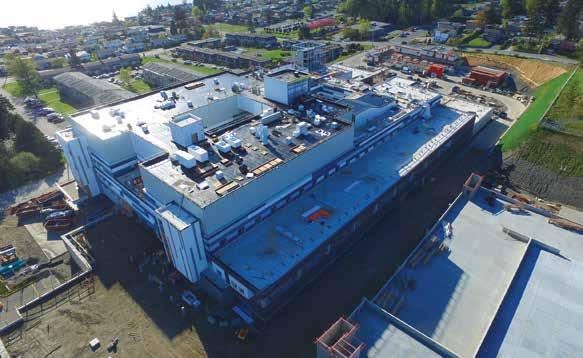
With only a few months left until completion on major infrastructure projects in the North Island, construction and planning has reached an all-time high. In a report released by Island Health in April, the number of people employed with the North Island Hospitals Project topped 1,000 employees at both sites. The report also says 90 per cent of the workforce is from Vancouver Island and 63 per cent come from the Comox Valley and Campbell River.
The North Island Hospitals Project is scheduled to complete at the end of April 2017, and both the Campbell River District Hospital and the Comox Valley Hospital are in their last 10 months of construction.
“Much of the focus now is on commissioning and transition planning for our clinical teams that will be moving into the new facilities,” say Tom Sparrow, chief project officer for the NIHP. “Our plan is to obtain the key on April 30, and move into both facilities in midSeptember – I’m anticipating a week apart.”
The Campbell River District Hospital is located on a brownfield site – an existing hospital site – and Sparrow says once they move into the new hospital, deconstruction of the existing hospital will begin.
Demolition is expected to complete in September 2018.
The Comox Valley Hospital is located on a greenfield site, or a completely new site. It has 153 beds and six operating rooms, including several procedure rooms, 105 inpatient units, 18 intensive care and telemetry units, and a psychiatric ward. The Campbell River District Hospital has 95 beds with four operating rooms, several procedure rooms, 72 inpatient units, and 13 intensive care and telemetry units.
While the Comox Valley Hospital is larger than the Campbell River District Hospital, both hospitals are designed to feel nearly identical inside.
“If you were to enter one hospital through the main entrance, the layout and adjacency of each department is similar to the other hospital,” Sparrow says, adding that the hospitals are 45 minutes apart from each other. “The standard design makes it easier for family, friends, staff, and even patients to navigate. Whether they end up going to either hospital, they’ll already have a general idea of where things are situated in each hospital.”
Graham Construction was responsible for the design-build delivery of the hospitals, and is the lead developer and equity investor for the project.
“Both facilities are progressing well, with most of the focus now moving to completing interior finishes and commissioning,” says Matt Dekkers, vice-president of concessions for Graham.
Once the hospitals are completed and operational, another large infrastructure project will be entering its final construction phases.
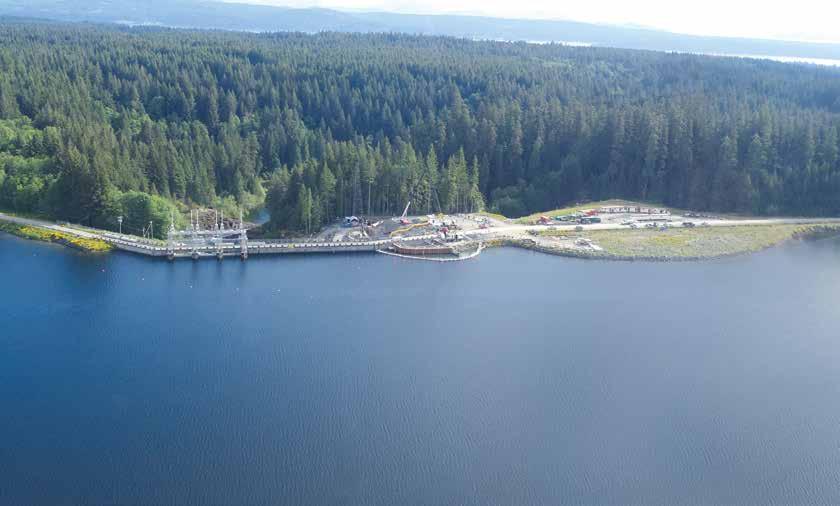
The John Hart Generating Station Replacement project is slated for commissioning in the fall of 2018. Stephen Watson, BC Hydro’s communications lead for the project, says once the facility is commissioned, overall completion and decommissioning of the existing facility will go into 2019.
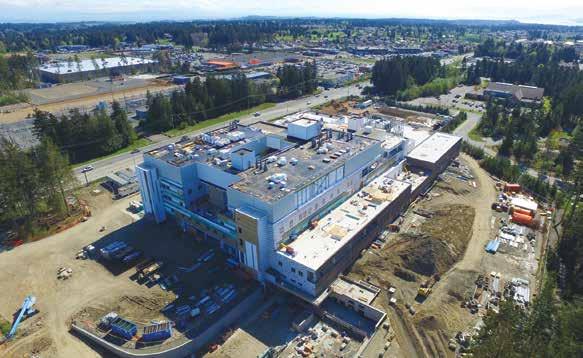
“The current station is now 68 years old. It’s like an old car – it’s reached the end of its life, so we need to replace it,” says Watson. “We looked at different options and landed on the replacement of those facilities.”
Watson says the water intake structure is being moved 300 metres to another area of the dam under a concrete section and into bedrock. Nearing completion is the vertical power tunnel shaft excavation that will ultimately place the power tunnel about 100 metres
below the surface, running down to the underground powerhouse.
The powerhouse cavern, which is as tall as a 10-storey building and as long as an NFL football field, is now at the stage where concrete is being placed. The first few years had been similar to a mining operation with the removal of 300,000 cubic metres of rock – and there is still work to be done. However, according to Watson, they are getting closer to the building stage.
“if you were to enter one hospital through the main entrance, the layout and adjacency of each department is similar to the other hospital,” Sparrow says, adding that the hospitals are 45 minutes apart from each other.
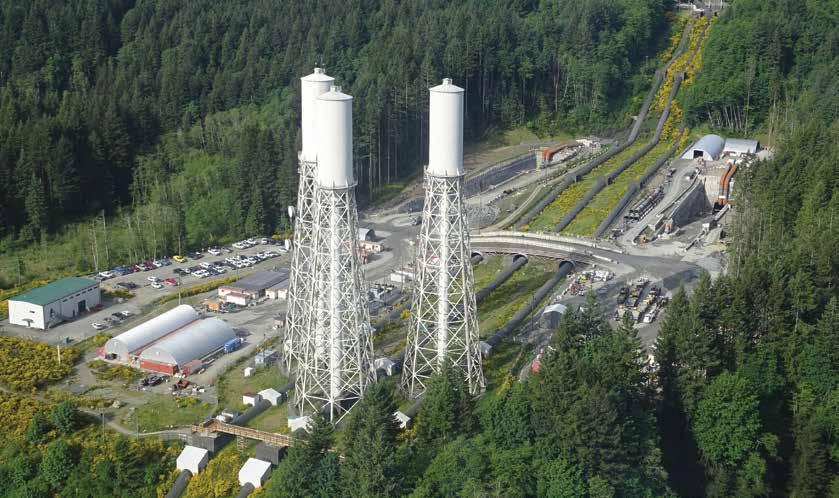
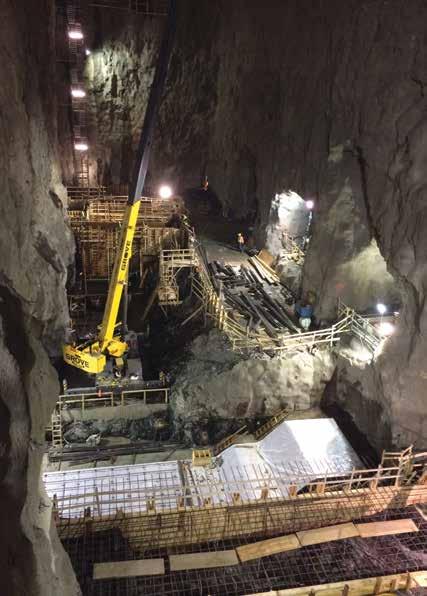
“Different trades are arriving on site this year and next year,” says Watson. “It’s exciting to see the project take shape.”
It is estimated that around 100 Vancouver Island businesses have been providing supplies and services to the project, and according to a construction update published by BC Hydro in June, approximately 360 people were working on the Campbell River project.
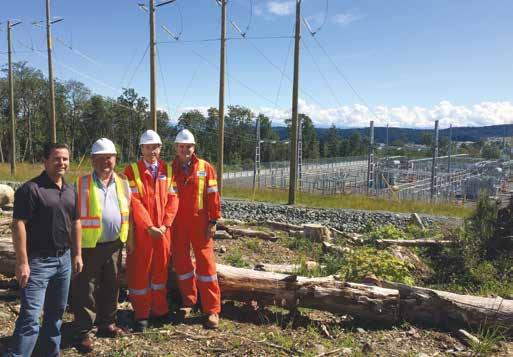
In June, two new substations were put into operation – the Buckley Bay and South Wellington substations. According to a BC Hydro release, the $28.5-million South Wellington substation will serve the Nanaimo and Ladysmith areas while the $32-million Buckley Bay substation will serve the Comox Valley area. Some work remains to interconnect the substations into the local power grids.
Greg Baynton, VICA CEO, says these large projects are a positive indication of the level of infrastructure investment on the Island, adding that infrastructure supports community growth.
“Privately funded non-residential
L to R: Stephen Watson (BC Hydro), Keith Tatton (VICA), Bruce Joliffe (Comox Valley Regional District), and Kevin East (Comox Valley Chamber of Commerce) at the Buckley Bay substation.
construction activity on the island has been very strong since the tail-end of 2013,” says Baynton. “However, it has been eclipsed in some areas of the island by the value of multi- and single-family residential construction.”
These projects are not only encouraging growth in construction, but major partners such as the North Island College, along with local school districts, businesses, and organizations are helping to develop, promote, and support skilled workers in the workforce through employment and training initiatives.
In their April report, Island Health says approximately 290 apprentices are


currently working on the NIHP project in areas including, plumbing, mechanical, electrical, construction, and sheet metal.
“During my 35 years in construction, I
have never observed such a strong upper trend of activity for such a sustained period,” says Baynton. “The outlook is very promising for the next decade.” n



Structural Steel / Misc Metals / Custom Metal Fabrication (Seismic, Industrial, Commercial) Pat Hoskins Pat Hoskins Pat Hoskins 1345 Fisher Road, Cobble Hill, BC V0R 1L0
email: pat.advantagesteel@hotmail.com pat.advantagesteel@hotmail.com pat.advantagesteel@hotmail.com
An hour bank plan allows employers to provide benefits to employees that would often not otherwise qualify through a group benefits plan. Enrolling employees that are seasonal or project-driven, when there will be periods without work, on an hour bank plan makes a lot of sense.
Employees receiving benefits through a group plan must meet participation requirements for the hours worked per week. If you have an employee that doesn’t work for a week due to the weather or a job completing they can quickly become ineligible to participate in a regular group benefits plan. An hour bank plan allows employees to “deposit” into a bank the hours that they work so that they can “withdraw” those hours for coverage when they are not working.
There is typically a minimum that must be initially “banked”, a minimum that must be maintained while working and a maximum cap on an hour bank plan. Benefits offered usually consist of health and dental, life insurance, accidental death and dismemberment, and disability insurance, but can vary with the provider and the plan.
Employers pay an hourly rate per employee for the hour bank plan when that employee is working. Each month, hours are “withdrawn” from the plan to cover the benefits. When an employee is not working, hours continue to be “drawn” from the bank each month. If the hours “withdrawn” reach the plan’s minimum, an employee can often choose to pay to continue receiving benefits, usually for up to six months.
In many cases, it makes sense to have employees that have established hours, including hourly workers, on a regular group plan and employees with fluctuating hours on an hour bank plan. The plans can work together cohesively but must be set up to accommodate the classes within that workforce.
Hour bank plans are a great tool to provide employers with flexibility within their labour force. Benefits help to protect employees and provide employers with an advantage to recruit and retain employees.
If you have questions about hour bank plans, group plans, critical illness insurance, or other benefits questions, BCCA Employee Benefits is happy to consult with you. Find us online at www.bccabenefits.ca, email info@ bccabenefits.ca, or call 800-665-1077 or 604-683-7353. n



CCA conducted one-on-one interviews with each of the leaders of the major federal political parties just prior to the commencement of the federal election campaign. It also operated a special election website that included the responses from the prime ministerial candidates. This helped to ensure that the concerns and views of CCA members on national issues of interest, such as infrastructure investment and immigration, were well-known to the candidates.
CCA looks forward to working with the new government, especially with respect to the implementation of the new 10-year $125-billion infrastructure program, which promises to nearly double
the existing federal commitment. Other priority areas include apprenticeship promotion, immigration, and environmental assessment.
The CCA board passed the following motion at its October 2015 meeting: “THAT, CCA work with its partner associations, interested stakeholders, and federal contracting authorities, to educate the federal government on the importance of prompt payment and cash flow on federal construction projects, and work together to resolve any concerns, which may include the enactment of federal prompt payment legislation acceptable to the industry.”
CCA has established a taskforce, which has begun discussions with the major federal contracting agencies on industry payment and cash flow concerns on federal construction contracts.
CCA continues to hear grave concerns about the poor quality of design documents. It hosted a series of regional workshops with its partner associations to raise the awareness of the impact of poor design, to seek feedback on its causes, and to identify potential solutions.
CCA captured and recorded the major points, findings, and recommendations that emerged from these workshops in a special report that is downloadable from bit.ly/QoDReport.
CCA established the Lean Construction Institute of Canada (LCI-C) this past year as a special committee of the CCA similar in structure and operation to the Canadian Design-Build Institute. This has been done with the support and acknowledgement of the flagship Lean Construction Institute (LCI) in the United States.
CCA has been working with Defence Construction Canada (DCC) to ensure that DCC’s new e-procurement system it is planning to use for its construction contracts meets industry expectations.
CCA worked with BuildForce Canada to develop a national construction industry ethics course. This new course, which will be mandatory for all Gold Seal Certification applicants, launched in April. Learn more at elearning.buildforce.ca.
• Updated
The CCA board has endorsed changes to the CCA Trade Contractors’ Guide and Checklist to Construction Contracts, which will be available soon.
CCA, together with the Aboriginal Human Resource Council, is in the process of developing an Indigenous Engagement Best Practices Guide focused specifically on the construction industry. n


If you’ve been paying attention, you know that competition for skilled workers in British Columbia is intense. Supply is tight and 94 per cent of B.C.’s construction employers is hiring.
57% of Vancouver Island employer respondents hired at least one worker from Alberta in 2015.
The latest BuildForce Canada report predicts a skilled worker shortage of 15,000 workers over the next eight years. This is down from a few years ago, but with too many retirements, too few new entrants, and $296 billion in proposed construction projects means employers need an HR strategy.
Economics 101 says when there’s not enough supply prices go up. But do they? If you’re a construction employer putting a budget together, salary increases might not be on the cards.
The BC Construction Association, Construction Labour Relations, and the Progressive Contractors Association teamed up to gather compensation information from the employers and workers on the front lines across B.C.’s construction sector. An impressive 900 respondents – all of them B.C. construction employers (55 per cent of respondents) or skilled workers (45 per cent) – answered straightforward questions about what they’re paying and what they’re getting paid. The big picture results are shared in this article, with more information at www.bccassn.com.
Here’s what we found.
1) RETENTION IS ABOUT MORE THAN MONEY: THINK BENEFITS AND COMPANY CULTURE
Our surveys show successful
retention takes more than competitive compensation packages.
Small employers are doing the best job keeping their workers, despite offering lower wages and fewer benefits. Large employers – those with 100 or more employees – are the biggest spenders but suffer with the weakest retention rates. Even though 69 per cent offered raises last year and 80 per cent are paying overtime, more than half still lost workers due to pay.
Benefits are everything. Employers need to offer the complete package to be competitive. Even the smallest companies (with less than five employees) are offering health, RRSP, training/mentoring programs, and career planning. Only 15 per cent of employers said they don’t offer any benefits at all. Are competitive forces closing the gap between small, large, union, and open-shop employers?
Any way you slice it, the construction workforce is highly mobile. Employers of all sizes can improve retention by developing personalized strategies that help skilled tradespeople onto a career path that builds loyalty. Take a note from the technology companies who offer simple perks such as “doughnut day” or the occasional round of Tim Horton’s gift cards. Don’t be a sceptic – these types of perks go a long way, especially with younger employees.
2) EXPERIENCED PEOPLE ARE YOUR MOST VALUABLE ASSETS – TREAT THEM ACCORDINGLY
Skilled workers with 10-plus years of experience are much more mobile than
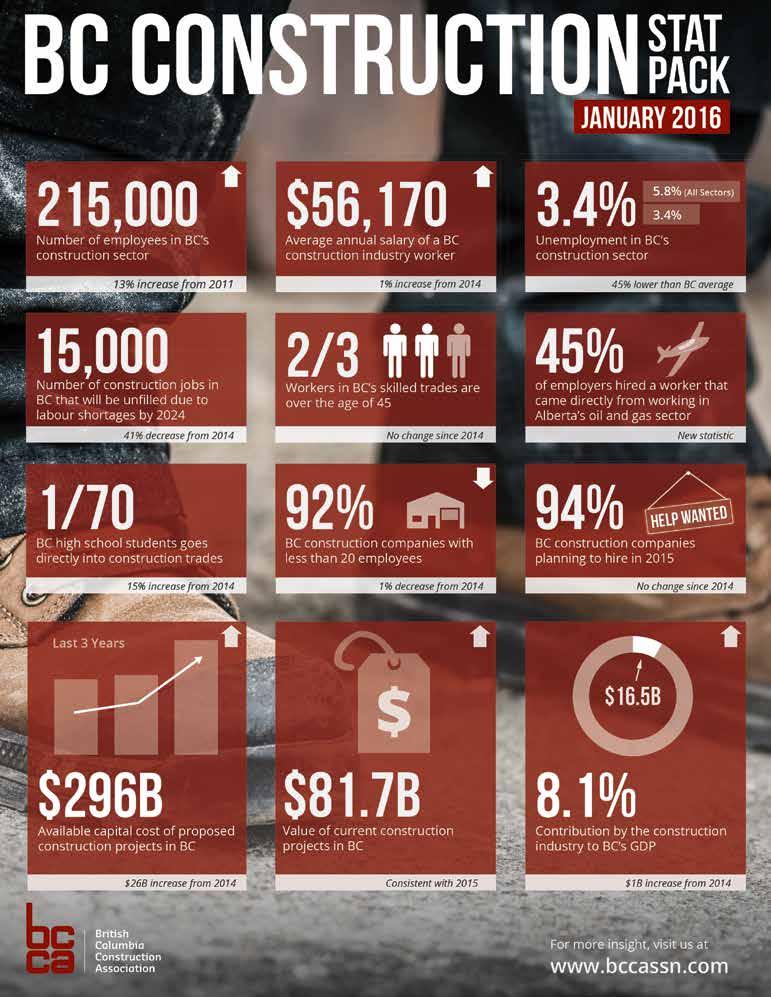

other workers. Journeypeople are the most likely to express wage dissatisfaction.
Experienced workers in their prime earning years understand their value and are making sure they get their dues. Employers must find ways to deliver recognition and value beyond dollars: consider retention bonuses, succession plans, mentorship programs, and ownership options to help you create value that can’t easily be found elsewhere.
3) LOOKING TO NEW TALENT POOLS MEANS GOOD BUSINESS
Alberta’s workforce is shifting westward – this is good news for B.C.’s shortages. Nearly half of the employer respondents have hired a worker from the Alberta oil fields in the past year.
Of the 450 skilled workers that participated in the survey, 15 per cent

were female, and an impressive 70 per cent of them are apprentices. Women are ready to work and are putting in the hours to get the skills they need. A third of the female respondents received raises last year, and most either already have their credentials (53 per cent) or are actively earning them (27 per cent).
DON’T LEAVE THE MONEY ON THE TABLE
If you’re wondering how you’re going to develop a competitive HR strategy without breaking the bank, consider these excellent resources:
1) LNG CANADA Trades Training Fund. This is a $1,000,000 private fund from LNG Canada open to any construction employer in B.C. who would like help paying for apprenticeship training. All construction trades are eligible, and
turnaround is quick. Employers don’t pay out of pocket and may submit for multiple employees.
www.bccassn.com/lngcanada
2) Skilled Trades Employment Program. STEP has 12 offices around B.C., staffed by 17 skilled trades placement specialists. If you’re a construction employer with a job to fill, they will source and screen candidates for you. If you hire a STEP candidate, the program can help that worker get job ready with gear, tickets, and other supports. www. stepbc.ca
3) BCCA Employee Benefit Program: Whatever your company size, EPB has a package that will work for you. It’s a non-profit plan provided and governed by the industry. www.bccabenefits.ca. n








Dr. Dave Baspaly, President, coca

The Council of Construction Associations (COCA) represents most of British Columbia’s construction associations (19 altogether) and acts on behalf of the construction industry in WorkSafeBC matters.
COCA works to present a united front and a systematic approach to WorkSafeBC (WSBC) issues. COCA initiates and responds to legislative, regulatory, policy, and practice issues within the workers’ compensation system in B.C. COCA also assists individual contractors with their WSBC concerns.
COCA’s board of directors is composed of contractors from throughout B.C. who represent the COCA member associations. Their dedication and support makes COCA possible.
A summary of key 2016 activities/issues follows:
• COCA worked on the anticipated impact of Bill 35 and the resulting regulations. Bill 35 was passed by the B.C. legislature and mandates new actions to safeguard the workplace.
• COCA continues working with a consortium of construction entities to consider issues with Coast Mountain Bus Company and their rules concerning trolley wires.
• COCA met with WSBC, the Employers’ Forum and employer representatives to discuss the issue of ‘Relief of Cost for Employers’. It was agreed that this item would be added to the 2016 Regulatory Work Plan for resolution.
• COCA continues working with representatives from electrical contractors, line contractors, and WSBC to resolve the issue of when WSBC confined space regulations should apply.
This past year has seen a dramatic increase in the number of changes proposed by WSBC to the Occupational Health & Safety Regulation. COCA has submitted a detailed response to each proposal:
• WHIMIS and the proposed new definitions;
• Section 4.43.1, General Conditions, new section, storage racks;
• Section 4.56, General Conditions, work area guards and handrails;
• Section 6.4, Substance Specific Requirements, asbestos inventory;
• COCA noted that the 30-year requirement for record keeping is a very significant increase from the current requirement to keep the asbestos records for 10 years. We do not believe this is practicable within the construction industry.
• Section 12.83.1, Tools, Machinery and Equipment, new section, chassis dynamometer;
• Sections 13.11, 14.1 and 14.2, Cranes and Hoists, construction material hoists;
• Section 14.5, Cranes and Hoists, rated capacity indicators;
• Section 14.11, Cranes and Hoists, support structures;
• Section 14.81, Cranes and Hoists, limit devices;
• Section 20.2, Construction, Excavation and Demolition, notice of project;
• Section 22.12(1) and (2), Underground Workings, underground supervisors;
• Section 23.69, Oil and Gas, flow piping systems;
• Section 26.13.4, Forestry Operations and Similar Activities, new subsection, saw chain shot;
• PART 6: Substance Specific Requirements; Section 6.58.1: Lead;
• PART 6: Substance Specific Requirements; Section 6.110, Respirable Crystalline Silica and Rock Dust.
COCO co-ordinated a meeting with industry and WSBC to address the failure of rental companies and third-party manufacturers to provide appropriate user manuals/ instructional materials for equipment of all types.
COCA submitted a response to WSBC in regard to the 2016 Regulatory Work Plan and recommended the addition of two important items:
Average Earnings – a review of the policy on earnings for workers who work outside of B.C. for non-B.C. employers. In our view, there is no legislative authority for including the earnings of a worker who works outside of B.C. for an employer who is not registered and not paying assessments in B.C. Yet this is now the practice within WSBC.
Relief of Costs – a review of how and when costs are relieved for previously existing diseases, disabilities, and conditions that impact a worker’s recovery. Currently, the employer pays for the first 10 weeks of the claim – a significant cost. We believe that the relief of costs for the accident should begin on the first day of the claim.
The pace of change continues to accelerate in 2016 at WSBC with further changes to WSBC regulation, along with selecting two new vice-presidents.
For more information visit our website at www.cocabc.ca or contact the COCA office: Dr. Dave Baspaly, President #203 - 318 Homer Street, Vancouver, BC V6B 2V2 Telephone: 604-683-0556 Fax: 604-683-0557
Email: dave@cocabc.ca n

mike mcKenna, executive Director, BccSa
Arecent study at the University of British Columbia found that participation in WorkSafeBC’s Certificate of Recognition (COR) program is associated with lower injury rates in the construction and forest industries.
WorkSafeBC’s COR program involves industry employers working with a certifying partner, such as the BCCSA, to meet the program's safety and health standards. Once an audit is passed, employers receive a COR and become eligible to receive rebates through WorkSafeBC.
According to the research brief issued by UBC’s Partnership for Work, Health, and Safety, (PWHS), which conducted the study on behalf of WorkSafeBC, the results showed that, on average, injury rates were down in most sectors.
The study compared injury rates between certified companies and non-certified companies in the construction, forestry, manufacturing, and transportation/warehousing industries over a period between 2002 and 2012. The study looked at three categories: injuries resulting in long-term disability, shortterm disability, or fatality; serious injuries; and health care only (injury that did not lead to time off work). It also compared pre- and post-certification injury rates. COR companies in the construction industry showed a 12-per cent decrease
in short-term disability, long-term disability, and fatality rates, and a 16-per cent decrease in serious injuries. COR companies in the forestry industry had a 16-per cent decrease in short-term disability, long-term disability, and fatality rates, and a 21-per cent decrease in serious injury rates, compared to non-COR companies.
No differences were found in the health care-only category, and only small or no differences were found in the manufacturing and transportation/ warehousing sectors.
The brief noted the reductions were the greatest between 2009 and 2012, which were years with the highest number of certifications.
Between 2005 and 2012 COR companies averaged a 12-per cent decrease in shortterm disability, long-term disability, and fatal injuries, and a 17-per cent decrease in serious injuries compared to non-COR companies.
Dr. Chris McLeod, co-lead with PWHS, says the results are positive in that they reveal an association between COR and good safety performance. “Overall, we identified reductions in injury rates in almost all of the categories we looked at,” he says. “The 17-per cent reduction in serious injuries was an especially interesting finding and this indicates that having COR can make a difference.”
McLeod stressed, however, that the
study’s results must be viewed with caution because association is not the same as causation. “On average, we found that COR companies had lower injury rates than non-COR, but this is not the same as saying COR caused the results,” he says. Because certification is voluntary, he suggests a company could already be in better position in terms of safety and resources when it takes the program. While variables, such as number of employees and years in operation, were taken into account for comparison purposes, McLeod e says there are nonCOR companies that have lower injury rates as well.
“The only way to know for sure if COR itself is having an impact is by conducting additional research that focuses on how the COR process itself facilitates change in a company’s occupational health and safety practices.”
Mike McKenna, executive director of the BCCSA (COR certifying partner for construction industry employers), says the alliance will be partnering with WorkSafeBC and other industry organizations with a view to enhancing and expanding COR program-based research.
For more information, please visit Partnership for Work, Health, and Safety at http://pwhs.ubc.ca/research/policyand-program-evaluation/certificate-ofrecognition-audit-program/. n
Through industry partnerships, VICA offers programs that will save you money and help offset the cost of your membership.

10%


20% OFF office supplies and other services at Monk — right now, our participating members are saving $100 per quarter
3 CENTS OFF per liter at PetroCan plus 20% off car washes — participating members save an average of $700 per year and 20% of participants cover the cost of VICA membership with savings
BCCA Employee Benefit Trust offer further savings and assists you in recruiting and retaining your people
Professional development is an important educational process, but is often misunderstood. Of course most aspiring or current construction management professionals may already have a university education, or be employed and feel that they know the ropes all too well. However, Gold Seal Certification and its professional development benefits continue to be misunderstood, and we would like to clear the air.
Continual education and professional development is beneficial and necessary in many fields such as law, medicine,

and education. But we cannot help implore how important it is for the construction industry. We are the industry that creates the literal structural integrity of this great country after all. So why not expect excellence for its infrastructure?
When the term professional development is used, it usually means a formal process such as conference, seminar, or workshops; collaborative learning among members or a work team; or a course offered at a local construction association. However, professional development can also occur in informal contexts such as discussions among work colleagues, independent reading and research, observation of a colleague’s work, or other learning from a peer. Thus, any time you work
with your construction colleagues, you’re not only teaching others, but you’re also learning how to accomplish your role through observing others. Now we’d like you to imagine a world where you’ve been teaching and learning skills that could definitely be refined, polished, made safer, or could even be accomplished in less steps. Let’s take this one step further. Through Gold Seal professional development, you could be learning new skills that you may not even have know. As we are sure you’ve noticed, as time progresses, new technological mediums are being incorporated into the field. Imagine how magnificent it could be if construction management knowledge was streamlined and a universal set of skills was shared between professionals. Think about the possibilities! Individuals who decide to pursue professional development through a renowned certification program such as Gold Seal Certification, have more to show for it than simply ‘experience’. Gold Seal Certified graduates receive proof of their education, skills, and knowledge. They are trusted and credible employees. In education, research has shown that teaching quality and leadership are the most important factors in raising the achievements of those involved in the learning process. For Gold Seal instructors to be as effective as possible, they themselves continually expand their knowledge and skills to implement the best educational practices for their protégées.
In this regard, starting January 2017, Gold Seal will be making their industry ethics course mandatory for construction management professionals. However, that’s not the only change happening with Gold Seal. The cost to register as a Gold Seal intern has dropped significantly from $500 to $100 upon registration. With many more questions regarding Gold Seal Certification, we invite you to contact your local construction association. Many people may not be aware of the methods their local construction associations use for improving education and skill of construction professionals. However, options do exist, and you can expect excellence from those who have achieved their Gold Seal Certification.
Please join the Gold Seal Certification discussions online! We have updated our website to be more accessible and easy to browse. We also invite you to join us on our social media! We are on Facebook, Twitter, and LinkedIn. n
katherine O’Hanley
kurt








By tammy Schuster
It could have been a scene from a Martin Scorsese film, but it was real and it was right here in Canada.
The Charbonneau Commission – officially called the Commission of Inquiry on the Awarding and Management of Public Contracts in the Construction Industry – was a public inquiry that examined alleged corruption in the Quebec construction industry. Formed in 2011, the focus of the inquiry included many levels of government, political parties, and private organizations. Over the course of two and half years, the public heard 261 days of testimony from almost 300 witnesses.
While stories about city officials and corporate executives accused of fraud, bribery, and collusion spread through the media, a conversation was sparked at the Canadian Construction Association in Alberta.
“We identified this as a national issue; it’s not just in Quebec,” says Kees Cusveller, an executive board member at the Canadian Construction Association (CCA). “We started looking around and realized very quickly, there is no such thing as a national ethics course in the construction industry.”
“There are a lot of courses that deal with general ethics but not specifically related to what we do as an industry.”
The CCA reached out to BuildForce Canada, a national organization that provides market research and information to the construction industry. Together they created a task

force to develop the Construction Industry Ethics Course, which launched in April.
“This was really an opportunity for the industry to show some leadership,” says Rosemary Sparks, executive director of BuildForce Canada. “The CCA identified ethics training as a need and a way to demonstrate the ethical standards the industry should be striving for.”
“This is critically important to the industry, and training is one effective strategy that can instil the importance of ethical behaviour to, not only the companies, but to the individual employees, and to the industry as a whole.”
Cusveller says passing the idea of developing an industry ethics course was one of the easiest and quickest board decisions ever made. He says due to the range of their members, some issues tend to get polarized. “We considered what a small drywaller in Nova Scotia has in common with a general contractor in Calgary or a mid-sized plumbing supplier out of Quebec City,” he says. “This was one of those things where we agreed to spend the money and to do it right.”
The course, developed for supervisors, superintendents, and managers, was designed as a blended format, combining online delivery with classroom learning. Cusveller believes in-class conversation and open discussion between students will be beneficial for a course of this nature.
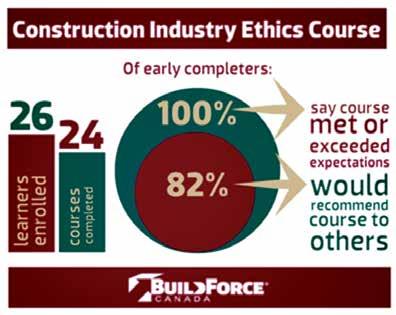
The content includes ethics theory, social responsibility, business and legal ethics, and focuses on actual day-to-day situations.
“It uses practical construction scenarios to support the learning,” says Sparks. “Situations that a manager or supervisor might actually come across in a construction environment.”

VICTORIA
Sparks says they used industry people to ensure the content focused on circumstances seen in the business.
“It’s very uniquely construction,” she says. “While this course is not trade specific, because ethics are ethics, it is industry-specific.”
Cusveller says the task force was made up of a diverse group of people from across the country, covering a cross-section of all trades in the construction industry. Each member of the task force was able to share his or her own experiences taken from their own day-to-day dealings.
“Our committee was a very interactive, focused group, and most things were decided by consensus. We discovered how complicated it was. It’s a big conversation.”
Since its release in April, Sparks says the course is not yet a mandatory requirement to receive Gold Seal Certification, but it has been presented and they hope it will be by next year.
To learn more about the Construction Industry Ethics Course, please go to BuildForce Canada online at buildforce.ca. n





By melanie franner
Its official duty as a guiding light to weary sailors has long since passed, but the Pachena Point Lighthouse, near Bamfield, B.C., remains very much a time-honoured and respected landmark. It still operates as a staff site for the federal Fisheries and Oceans Canada (DFO) and has been a key point of interest to the thousands of hikers who have traversed the West Coast Trail over the years.
But unfortunately time had taken its toll and the beloved structure was in dire need of major repairs. Enter Nanaimobased CMF Construction Ltd., part of the GW Carlson Group of Companies, a family-owned operation for over 45 years with a strong reputation for taking on complex projects.
“We bid on the project in the summer of 2015 and started work on-site that September,” says Carla Smith, president of CMF Construction. “And we demobilized by April 2016.”
Asked how she would rate the complexity of the project on a scale of one to 10, Smith is quick to reply: “I’d say it scored an eight.”
The Pachena Point Lighthouse was designated as a recognized federal heritage building in August of 1991, requiring that any work be conducted according to the standards and guidelines for the conservation of historic buildings in Canada. It is the last remaining timber-framed light tower along the coast of British Columbia. The lighthouse’s 65-foot, framed octagonal tower was constructed in 1907 to1908. It supports a 26.5-foot cast-iron
lantern house and a first-order Fresnel lens and pedestal.
“One of the key challenges with this project was that the site had no land access and no boat access,” says Smith, who adds that it is located 12 kilometres from Bamfield. “It would have been a lot easier if we had been able to bring in a crane. Instead, we had to fly in the major components by helicopter.”
These major components included a 40-foot, 10–inch-by-12inch Douglas fir beam to replace the deteriorated one inside the tower, along with pieces of Douglas fir to replace sections of other existing beams.
“The site was completely exposed to the elements in terms of winds, rain, and storms,” says Smith. “Our management team had to be on top of the latest up-to-the-minute forecasting for significant amounts of time throughout the duration of the project.”
Another unusual aspect of the project involved lifting the top of the Lighthouse tower to replace a structural piece of metal and flooring.
“This was a very complicated engineering scope of work in that it involved jacking up the lantern room, which contained the Fresnel lens and pedestal,” says Smith. “We lifted it up hydraulically and left it on the hydraulic jacks for a month.”
To help with the complex engineering required on the project, CMF Construction relied upon the expertise of various engineering firms, including project designers WSP Parsons Brinckeroff and Goal Engineering Ltd. in Victoria.
“Part of the refurbishment included the repair and replacement of the Lighthouse’s deteriorated or damaged cedar wood siding,” says Smith. “The scope of the work included the building envelope replacement of the rain screen, walls, windows, and deck

membrane. To do this, we had a helicopter fly in 60,000 pounds of scaffolding from Bamfield. It took about two weeks to organize, ship, and erect the scaffolding. And then we had to dismantle it at the end of the job.”
By April 2016, the Pachena Point Lighthouse was once again a bright and shining beacon of respectability – and safety. The project came with a budget of $900,000. CFM Construction delivered on both time and budget, and the DFO is more than happy with the results.
For Smith, the end of this project signals another job well done.
“We have a diverse group of people here who love to take on complicated jobs,” she says, adding that the firm has now completed 17 structure upgrades that include new bridges, new cable car crossings, and upgrades to a suspension bridge along the 75-kilometre West Coast Trail. Smith’s crew spent three months living on the trail for both contracts.
“We find the complicated jobs very interesting. There tend to be a lot of obstacles but once the job is finished, you feel like you’ve really accomplished something together as a team.” n
By Helen Goodland
There are powerful forces of change at work in Canada’s building industry. Across the country, architecture, engineering, and construction (AEC) companies are facing profound regulatory, technical, demographic, macroeconomic, and consumer disruption that is impacting every aspect of their business.
In the context of sustainability, understanding the business realities facing AEC companies is important. Pressures to achieve environmental performance goals are being superimposed on an industry that is already being pushed to deliver projects faster and cheaper while at the same time facing rising prices and, in many regions, a looming labour shortage.
At the root of the problem is that everincreasing performance expectations are being demanded within the traditional mechanics of the design-bid-build process. It is fair to say that, to date, green building has largely been about making adjustments to conventional practice.
The problem is that envelope assemblies are now layering on so many more components and mechanical systems are becoming so much more intricate that the risks of something going wrong are increasing – especially as all these components are frequently put
together high above the ground and in inclement weather conditions.
Questions can certainly be raised about whether limits are being reached over what is technically or economically feasible with how buildings are designed, tendered, and put together – and why owners are willing to take such risks. However, it is more useful to consider how best to plan for a resilient, responsible construction industry that is motivated to deliver affordable, carbon-free, zero-waste projects while providing a fair financial return to all parties.
To do this, the entire design and construction process needs to be re-tooled with a far greater focus being placed on the entire construction supply chain. Here is where sustainability intersects with innovation. For AEC companies to come to grips with the demands being placed on them – to be faster, cheaper, and greener – they need to invest substantially in innovation.
To be clear, innovation is not just about day-to-day problem-solving or doing things just a little better than last time. It is about organized and proactive investment in people, technologies, processes, and products that will potentially result in improvement – major leaps forward in profitability, productivity,

and performance.
Examples of the benefits of investment in construction innovation are widespread. The U.K. has experienced a serious multi-dip recession starting with the global economic meltdown in 2008. Fearful that by just focusing on marginal returns would not only result in a slow and painful road to recovery, but also leave companies seriously exposed to stall pressures, a series of very ambitious goals were proposed. These included cutting costs by 33 per cent, construction time by 50 per cent, and lowering emissions by 50 per cent by 2025. The intention was to avoid “death by incrementalism” and kickstart the modernization process.
To achieve the goals required, a fundamental rethink of how buildings had to be designed, procured, and assembled using efficient processes such as prefabrication, preassembly, modularization, and off-site fabrication. The goals provided a focus for hundreds of millions of pounds of business and public investment that has since been pumped into construction innovation in the U.K. Fortunately, Canada has not suffered the same economic hardships as the U.K. However, the motivations for taking a likewise approach to improvement are strong.
In B.C., the AEC industry is facing a labour shortage (two-thirds of B.C.’s skilled workforce is over the age of 45), rising costs of materials, and an increasingly demanding green building code (the City of Vancouver is aiming for all new projects to be carbon neutral by 2020).
In 2015, the BC Construction Association commissioned Brantwood Consulting to undertake a research project to consult with B.C. AEC firms and assess overall innovation readiness. The two-part Construction Innovation Project report
Helen Goodland RIBA MBA is principal of Brantwood Consulting and co-founder of Building Technology Innovations. She recently completed the BC Construction Innovation Project for the BC Construction Association. She serves
Taskforce and
(available at bccassn.com) sets out a vision of what innovation means to B.C. AEC firms and documents the current state of play, trends, and drivers facing the industry. It also provides ideas about what is needed to foster a culture of innovation.
The report makes some important points. The first is that both public and private sector investment in construction innovation has languished for many years. By properly defining what is important to the industry in terms of R&D priorities is a first step to re-engaging with funders and investors. Equally important, the procurement process needs to be fixed to ensure that project quality and performance are properly understood and the risks and rewards are shared equitably. Innovation is stifled in projects where the lowest price wins and no account is made of life-cycle-based benefits. It is almost impossible for construction firms to propose innovative solutions such as pre-fabrication or lean processes that will deliver efficient, high-quality, sustainable projects if the client and design team are not on board from the start.
The report also identifies the need for an industry-accepted interpretation of innovation and industry performance metrics that can show improvement over time in key areas such as productivity, environment, reliability (cost and schedule), and client satisfaction.
Modernizing the construction industry is not going to happen overnight. However, profound change lies ahead driven by the pursuit of improved environmental performance that is calling the business as usual paradigm into question. For the first time, there seems to be support in embracing this change across the industry. After all, many businesses may soon have no other choice. n


Where Performance and Quality Always comes First
*Commercial * Industrial * Residential* *Design Build * Leed Projects* *Red Seal Certified*



100 B 1779 Sean Heights, Saanichton
Phone – 250-665-7636
Fax – 250-665-7618
Email: erbtechnical@shaw.ca





By Lisa fattori
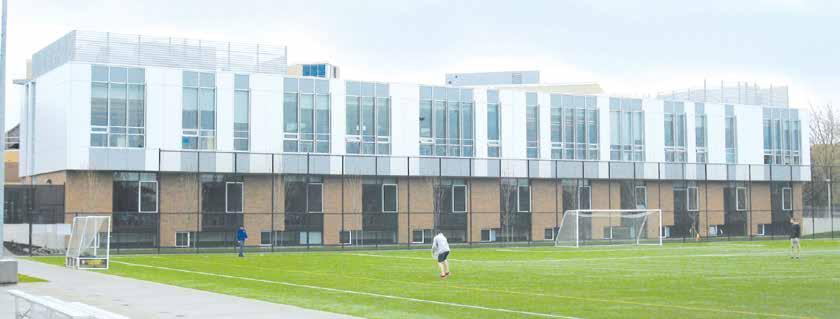
Anew addition to University of Victoria’s (UVic) Continuing Studies building increases the facility’s space by approximately 72 per cent, providing international students in the English Language Centre’s Pathways Program, as well as students in Continuing Studies programs, with a state-of-the-art building that promotes openness and collaboration. Construction of the $13.7-million project began in September 2014 and was completed in February 2016. Faculty and students have access to additional classrooms and labs, and a central atrium gathering space that bridges the old with the new, for one seamless building.
The university’s vision was to create a light-filled, open, and inclusive multi-cultural learning environment. “The university wanted the space to accommodate both collaborative work and opportunities for quiet work and privacy,” says Carl-Jan Rupp, a principal at HCMA Architecture + Design in Victoria. “Classrooms needed to be flexible so that they could be easily reconfigured over time.”
The 3,620-square-metre expansion provides three levels of new classroom and student support spaces along the northwest edge of the site, which link back into the existing building. The under-utilized outdoor courtyard was enclosed, transforming the space into a central atrium, complete with seating and study areas, kitchenettes, and washrooms. Open to above views, central stairs to the upper level and store-front glazing of classrooms create an open and transparent environment. The design optimizes the flow of people throughout the building, drawing students into this hub of activity.
The atrium’s uniquely designed parasol roof features five pitched skylights that run east to west. South-facing skylights carry a heavy-frit pattern to decrease solar heat gain, while the north-facing glazing has a light-frit pattern to provide sky views. The expansion includes some demountable wall systems so that work and teaching spaces can be easily reconfigured, and permanent, non-loadbearing partition walls are largely free of services in anticipation of any layout changes in the future.
“Given the function of the facility as a language learning environment, acoustics were very important during the design and construction of the project,” Rupp says. “An increased sense of openness and transparency goes against the goals of acoustics. Studies have shown that you can achieve both by increasing the thickness of the glass and providing additional seals around the doors.” Rupp says that when the acoustical performance is increased, the number of fire alarm bells also needs to be increased. He says the building has twice the amount installed for that reason.
While the purpose of the facility was an interesting challenge for designers, the building site proved to be a challenge to Roger Yager and his team at Knappet Projects Inc., the general contractor for the project. Because the Continuing Studies building is hemmed in by surrounding buildings and a sports field, there was only one point of access to move crews and materials to the construction site. Also, the existing building was fully operational throughout construction, and renovations and tie-ins in this
the atrium’s uniquely designed parasol roof features five pitched skylights that run east to west. South-facing skylights carry a heavy-frit pattern to decrease solar heat gain, while the north-facing glazing has a light-frit pattern to provide sky views.

portion of the facility had to be carefully orchestrated to minimize disruptions for faculty and students. New building systems also had to be integrated with existing building systems, which was complicated and required some tweaking to make them all work together.
“Despite the challenges with the project, we overcame these issues through a lot of collaboration,” says Yager, vice-president

and project manager for Knappett. “There were many open and frank discussions between the owner, consultant, and all of the trades.”
Yager says that it was because everyone involved was willing and had an open ear to discuss issues, that they were able to find solutions to those issues. “To create a building that functions properly, you need all of the stakeholders participating.” n
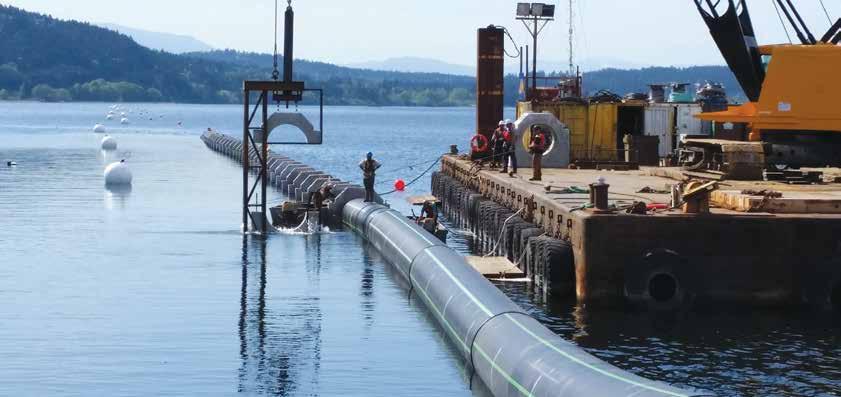
By melanie franner
For the past several years, the Regional District of Nanaimo (RDN) has suffered a series of leaks in its aging wastewater outfall system. The current pipe has been in place since 1973. But time has not been kind.
“The old system used a 36-inch diameter, epoxy-coated, spiralsteel pipe that was prone to corrosion in the marine environment,” says Sean De Pol, manager of wastewater services at RDN. “We opted to replace it with a larger, high-density polyethylene pipe that is much better suited to the environment.”
The new 55-inch HDPE pipe will run parallel to the existing one, extending the discharge point two kilometres out into the Strait of Georgia (beyond Five Fingers Island) and 70 metres below sea level. This will enable the new pipe to mirror the old one in reducing the environmental impact of the city’s wastewater system.
The replacement project consists of two stages: pipe replacement from the sewage/treatment plant to Morningside Park and the pipe replacement from Morningside Park out to the discharge point. The total budget is $18 million.
“There are a lot of technical components to this one,” says De Pol. “There are a limited number of people who have the technical expertise on these types of projects.”

Opus DaytonKnight Consultants Ltd. out of Vancouver was the firm charged with the engineering design and inspection responsibilities for the second phase of the project. McNally Construction Inc. was awarded the contract for the project and formed a joint venture with JJM Construction Ltd. to perform the work.
With the contract awarded in November 2015, crews had a very short weather window during the winter months because of the Department of Fisheries and Oceans permit requirements. “We completed the drilling and blasting work in January and February 2016 but had to stop mid-February because of the herringspawning season,” says Steve Deveau, project manager for McNally Construction. “We began construction again at the Hammond Bay site on June 1st.”
Fortunately, there was plenty of work to do during the winter months, namely fabricating the pipeline for its eventual sinking in Hammond Bay on the Georgia Strait.
The pipeline consists of two main components: the pipe and the precast-concrete anchor blocks that hold the pipeline on the ocean floor after it’s filled with water. The task of engineering and



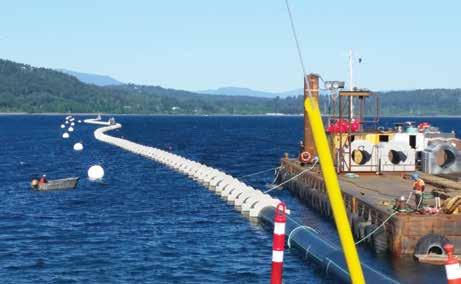
manufacturing these weights was given to Nanaimo Precast Ltd., a certified CSA producer of structural precast.
“We did our own in-house shop drawings for the design,” says Steve Taylor, structural precast manager at Nanaimo Precast. “It involved a fairly intensive prototyping process where we used high-performance concrete and silicon-bronze hardware cast into the units.”
Nanaimo Precast started work on the project in January 2016 and completed the job in May. It involved the custom manufacturing of 460 counterweights – each of which weighed approximately 5,000 pounds. The anchors were loaded on a barge and sent to Nanoose Bay, where pre-assembly of the pipeline took place. In total, there were seven barge loads.
Nanoose Bay was chosen as the best nearby location for the pipeline assembly work because of the protected and sheltered harbour, and its close proximity to the outfall site in Hammond Bay.
Deveau says they received a lot of co-operation from the

Nanoose First Nations and have been employing members from their community to work on the project.
Now that the 2016 DFO window has re-opened, McNally/JJM will continue with its dredging activities in order to ready the trench for the new pipeline deployment, which will be towed to Hammond Bay in two sections. The first section will be 200 metres in length and the second section will be 1,800 metres. The two pipes will be joined underwater with crane barges attached to each pipeline, and divers making the actual connections.
Once the new pipeline is laid out on the bottom of the Georgia Strait, the contractor will backfill the shorter section of the pipeline. The contract completion date is slated for mid-August.
“It has taken about six months of planning to prepare for the deployment of the two kilometers of pipeline,” says Deveau. “And that critical portion of the work will only take about 24 to 36 hours, if it all goes according to plan.”
And why wouldn’t it?
“We’re very happy with how things are progressing on this project,” says De Pol. “Everything so far has gone according to plan. n
Cumberland, B.C. recognized as Canada’s first Buy Social certified municipality announced at NBCM in September 2015. Left to right: Comox Valley MLA Don McRae, Social Procurement Advisor Sandra Hamilton, Mayor Leslie Baird, Premier Christy Clark, Councillor Sean Sullivan, Minister Michelle Stilwell, Councillor Jesse Ketler, and David LePage, Buy Social Canada.
When the Village of Cumberland on Vancouver Island issued tender on the Dunsmuir Project, contractors had to prequalify on social criteria before being able to bid on the infrastructure project.
Last year, Cumberland, B.C. earned certification as Canada’s first buy-social municipality. The village was followed closely by the city of Vancouver and is being recognized across the country as a public sector innovator and early adopter of an emerging practice called social procurement.
Increasingly, organizations around the world are strategically leveraging supply chain partnerships to achieve positive social outcomes and desirable community objectives. Prime Minister Justin Trudeau included social procurement in his mandate letter to Minister Judy Foote, Federal Minister of Procurement.
Infrastructure tenders from the Village of Cumberland are issued based upon a social procurement framework passed by council in August 2015. The British Columbia government has also issued social impact purchasing guidelines, Toronto also has a social procurement program, and Mayor Lisa Helps of the City of Victoria has announced a social procurement and social enterprise taskforce.
There is growing interest in developing
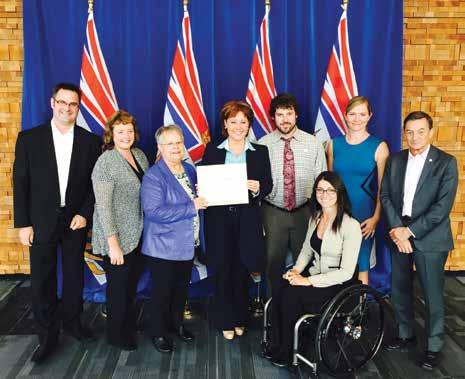
an island-wide regional strategy, and on June 13, 2016, the Town of Qualicum Beach approved Canada’s first social procurement policy.
What is social procurement and why is it important to Vancouver Island?
Social procurement takes a more strategic, proactive approach to achieving social value and community benefits through existing spend. Equally, social procurement stretches and diversifies supply chains by sending important signals to the marketplace.
Social procurement communicates that social responsibility and supply chain partnerships that help address strategic community priorities, are being recognized and increasingly valued in the procurement process.
“If we want a more entrepreneurial culture, we have to make it a lot easier for smaller businesses to access stable, multiyear public sector contracts,” says Sandra Hamilton, social procurement advisor.
“If we want jobs and apprenticeships for young people, government must do more business with companies that are providing such opportunities. If we want agri-tourism and access to more local food, government can better support farmers by matching supply to the needs of anchor institutions like Island Health. We are talking about public sector innovation, a more strategic and less transactional approach to procurement.”
Sandra Hamilton is working with a network of Vancouver Island mayors, and is in discussion with VICA to develop a co-ordinated and standardized approach to social procurement and community benefit agreements across Vancouver Island.
Foundational to the practice is the belief that taxpayer-funded contracts should enhance, rather than diminish, social value in community. Thirty years ago, environmental criteria in public sector contracts were not even a consideration, but now it is normalized. By adding social evaluation criteria, we are recognizing and rewarding companies that contribute to a healthier, sustainable future for communities. It is a people, planet, profit, triple-bottom-line approach to procurement.
This new approach to economic development is particularly important to regions like Vancouver Island. Nationally, the public sector accounts for 40 per cent of GDP. On Vancouver Island, people are twice as likely to work in the public sector as they are in other areas of B.C. Here, the public sector represents three of Vancouver Island’s top five employment sectors: health care and social services, education, and government. How the public sector spends drives the local economy and shapes communities.
In April 2016, delegates from 62 member municipalities at the Association
Bruce Hendersen, J.R. Edgett Excavating Ltd., Leslie Baird, Mayor of Cumberland, and Sandra Hamilton, social procurement advisor on Cumberland’s main street, Dunsmuir Avenue.
“i am delighted with the responses that we have had. the Village has been able to stay within budget, and by taking a social procurement approach, we have been able to achieve incremental community benefits that would not have been achieved under a conventional procurement model.”
– Michelle Mason, financial officer,
Village of Cumberland
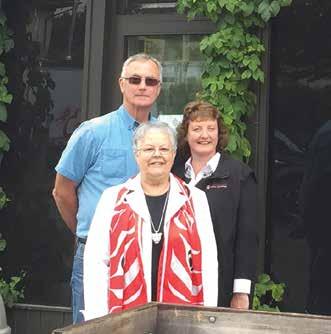
of Vancouver Island & Coastal Communities (AVICC) annual conference voted overwhelmingly to support the advancement of social procurement across the region.
The Vancouver 2010 Winter Olympics were a catalyst for social procurement in Canada. It was the first Olympics in history to include social value considerations in the sustainability strategy. Community benefit agreements were utilized for construction of the athletes’ village and at-risk youth learning carpentry skills built items such as podiums for medal ceremonies.
In July 2015, the Government of
Ontario passed Bill 6, t he Infrastructure for Jobs and Prosperity Act, which requires community benefit clauses to be added to provincial infrastructure contracts.
In his November 2015 mandate letter to Federal Procurement Minister Foote, Prime Minister Trudeau clearly signalled the new government’s intention to create more social value through procurement.
More recently, Liberal MP Ahmed Hussen (York South-Weston) advanced Bill 227 in the house. The bill seeks to derive more social value through federal infrastructure spending.
Infrastructure Minister Amarjeet Sohi, who is responsible for $60 billion in new federal spending, has floated the idea of
Cumberland, B.C. – Dunsmuir Project SoCIAL PRoCUREMENT fRAMEWoRK
A guiding principle of the framework is a requirement that the municipality consider how the purchase might be better leveraged to improve the economic, social, or environmental well-being of Cumberland, to improve access for micro, small businesses, and social enterprises, or to promote innovation.
Bidding contractors met, and in all cases, exceeded requirements. The contract was awarded to J.R. Edgett Excavating Ltd. and committed to the following criteria.
1. To provide on-the-job training that will lead to competence over a period of years
2. To provide on-the-job training for three labourers and one clerical staff
community benefit agreements becoming part of the Liberals’ new infrastructure program and has taken the idea to cities and provinces. Bill 227 has been read into Parliament and is scheduled for further debate in September 2016.
Social procurement strategic advisor is the former business manager to John Furlong, CEO, Vancouver 2010 Olympic & Paralympic Winter Games. Hamilton is the author of both British Columbia’s and Alberta’s first social procurement frameworks, and of Canada’s first social procurement policy. She has recently graduated as Canada’s first Social MBA. n
3. To employ qualified local residents
4. To supply in-kind labour, materials, and equipment to enhance public spaces
5. To provide financial support to a non-profit community organization providing benefits to Cumberland residents
6. To pay a living wage in excess of $17.30 per hour
J.R. Edgett Excavating Ltd. is a locally owned company and a proud supporter of the community. The company is well-known for its support of children’s’ charities and is the sponsor of the centennial celebration fireworks display with the City of Courtenay.
By tammy Schuster

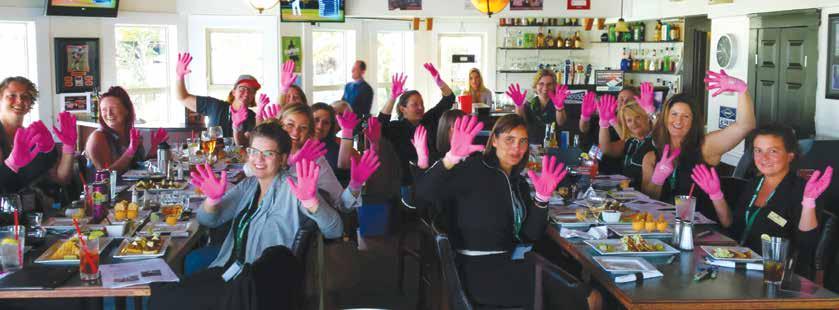
Acrowd of women stand in the parking lot next to the Janion Building near the waterfront of downtown Victoria. Some women are in suits, some are in jeans, but all are wearing steel-toed shoes and hardhats.
These women are all members of Women in Construction, an organization that aims to increase and support female involvement in all areas of the construction industry. And this behindthe-scenes tour is part of a monthly networking event organized by the WiC board.
“Our mandate refers to it as connecting, because that is what it’s meant to be,” says Kate Ulmer, structural engineer at Herold Engineering Limited and chair of the Victoria WiC branch.
“Connecting on a social level is one of the big factors to becoming a member. It enhances your career experience when

you understand the industry from other perspectives, and it’s nice to see a familiar face when you walk into an office or onto a job site.”
As the sea of hard hats slowly flow from the parking lot into the building, the project manager, architect, and engineer for the Janion talk about features, challenges, and solutions involved with the restoration and addition to the building originally built in 1891.
Usually combined with a site tour or a guest speaker, the meetings are a chance to meet other women in the industry, socialize, and learn about projects in the area. Ulmer says it makes business easier when she is aware of who works at what company.
“Our site tours have been very popular. It’s such a great opportunity to get a sneak peek into projects that we wouldn’t have been able to see otherwise,” says Ulmer. “And, over time, you build relationships, so the development aspect is prominent.”
Site tours and speaker series are usually followed by an informal catered social event at a nearby venue, which gives everyone the opportunity to connect over food and drinks.
“WiC is about supporting women who are passionate about the construction industry,” says Carla Smith, president of CMF Construction Ltd. and chair of the Nanaimo WiC chapter. “Women always make getting together a priority.”
Nanaimo social events included guest speakers who have addressed topics such as working in generations (a popular one these days), safety, harassment, as well as learning opportunities available.
Ulmer says, after three years, WiC events are still very well-attended, averaging 40 women at each monthly event. “People keep returning and want to attend whenever they can. It’s endured,” she says. “We’ve received so much support from the community – building owners, contractors, architects, designers. They have given their time after hours to give tours and answer questions.”
WiC members include private and
public sector employees, architects, technicians, engineers, apprentices, students, tradespeople, project managers, and professional staff – administration, insurance, marketing, real estate agents, and business developers.
In an effort to encourage more women to consider a career in construction, Smith has been instrumental in building relationships with Vancouver Island University in Nanaimo, as well as a few Nanaimo school districts. By arranging for
speakers to attend the university campus and secondary schools, her goal is to create awareness among young students about career opportunities in the trades and construction industry.
“Our numbers in the industry are growing,” says Smith. “And having this supportive network of like-minded people is just one more added strength.”
If you are interested in becoming a member, or would like to attend an event, go to the WiC page at vicabc.ca. n






By tammy Schuster
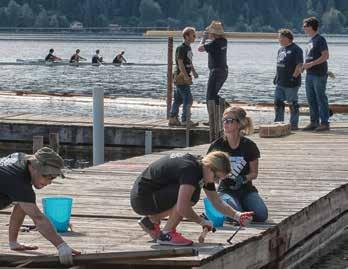
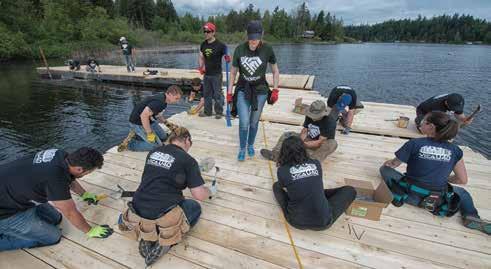
Walking down the green and wooded path toward Shawnigan Lake on a crisp Saturday morning, the sound of chirping birds are soon overtaken by the sounds of power tools sawing and hammering, and Vanilla Ice blasting from the two speakers on the beach.
On this weekend in mid-May, almost 50 men and women are on the beach and in the water at Camp Pringle in West Shawnigan Lake, repairing a 2,600-square-foot dock before young campers arrive in July.
The rebuild is part of the initiative of HeroWork, an organization that performs renovations for other organizations and charities that don’t have funding in their budget for upkeep of their facilities. Called a radical community renovation, HeroWork organizes a workforce of companies and volunteers for a multi-weekend event to repair an ailing building, or, in this case, a dock.
“We help organizations so they can continue to help others,”
says Paul Latour, creator and executive director of HeroWork. The organization co-ordinates the project from permits and supplies, to manpower and experts. Latour says the renovations affect many layers, including the volunteers who participate in the teambuilding, and repairing a building so it can continue to be utilized.
“There is the camaraderie and connection of creating a memorable experience,” he says. “And when a large group of people comes together to work toward one goal, it’s eye opening. It lifts the neighbourhood and the organization up.”
With staging areas, woodpiles, and supply areas – for tools as well as refreshments – on the beach, volunteers work on the dock, in the water, and on the beach to resurface the existing dock and rebuild a portion of one corner. The dock will receive extra flotation, joist replacements, new ladders, and a renewed slide.
This is the second year the VICA U40 group has supported HeroWork and close to 30 members joined the ranks of volunteers
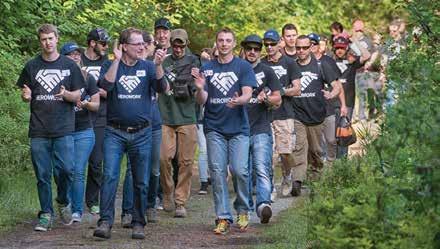


“We are working towards a goal, and connecting over something fun and meaningful. We are bonding over beers at night and teambuilding while we work during the day.”
–AJ
Winters, AON Risk Solutions and U40 vice-chair.
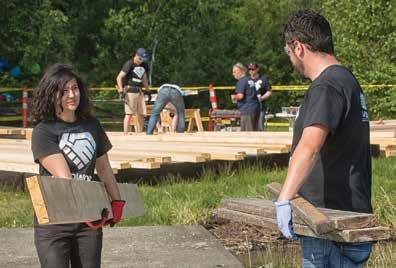
working on the beach. What’s unique about this project is that members were invited to bring their families to stay for the weekend and have a camp experience at Camp Pringle. Over 20 families are taking part in archery, swimming, hiking, games, and crafts.

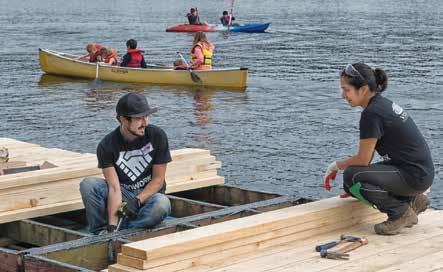
built a dock before and I actually learned was a stringer was.”
“Outside of the pride of completing a project like this, my two kids had a blast and I know a lot of the other kids did as well,” says Chris Lyons, senior construction manager at Omicron and U40 chair. “HeroWork partners well with U40 because they source out a good project, set it up, and we provide expertise and labour.”
The U40 group is an organization that focuses on executives and professionals under the age of 40 in the construction industry. Their goal is to build relationships and promote and support careers in the construction industry while participating in community initiatives. They do this by holding a social night on the third Thursday of each month. The group also volunteers and holds fundraisers with the proceeds going to organizations such as the Mustard Seed.
“Our main mandate is to give back to the community and provide an opportunity for networking among the younger members of the construction industry,” says Kristen McKeracher, project manager at BC Transit and U40 secretary. “I get to meet people around my age who are in the same industry, and it provides an opportunity for us to get to know each other and solidify relationships for when we are further along in our careers.”
At Camp Pringle, McKeracher says she was hauling wood, nailing planks, and removing old planks. “It was great to be a part of a project with HeroWork. I’ve never
For over 60 years, Camp Pringle has been a place of development, transformation, and fun. “It’s a new incarnation, with a significant amount of effort in a short amount of time,” says Ian Fraser, camping ministry co-ordinator for the BC Conference of the United Church of Canada. “One thousand pairs of feet will be on the dock each summer.”
After two full days of work on the dock, the big reveal on late Sunday afternoon ended with a few members jumping into the waters of Shawnigan Lake.
“The people from VICA were amazing,” says Latour. “There were a few blisters, bandages, and ice packs, but a lot of gratitude. And you gotta jump off the dock at the end of something like that.”
HeroWork’s next radical renovation is taking place in September at the Victoria Rainbow Kitchen Society. The goal is to have the facility ready to host Thanksgiving dinner. To find out more about HeroWork, go to herowork.com.
For more information about attending a U40 event or becoming a U40 member, go to vicabc.ca. n
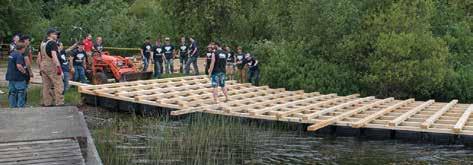

Marc Schaufelbuhl is operating a road grader, smoothing our rough patches caused by heavy rains, keeping one eye on his work and one eye on the dirt bike riders racing around him.
Schaufelbuhl is a student of the Heavy Equipment Operating program at Vancouver Island University, and, through a partnership with the Nanaimo Motocross Association, he is getting practical experience while helping an organization keep its facility safe.
Before the race season began, the non-profit club that manages the Wastelands Motocross Track outside of Nanaimo, identified some track, drainage, road, and site repairs that had to be performed. The member-supported organization didn’t have the budget to do the work, but after contacting Joe Skipsey, chair of VIU heavy mechanical trades, four excavators, one articulated rock truck, one grader, and six student operators were on site working.
Through engagement with non-profits, community
organization, and schools that don’t have funds in their budgets for heavy equipment work, Skipsey has found opportunities for students to get hands-on experience while helping members of the community.
“We’re always looking for opportunities that fit within our curriculum because it allows our students to take the theory they learn in the classroom and basic training into the real world,” said Skipsey. “It gives them a sense of purpose and shows how their training can benefit the greater community.”
VIU’s HEO program provides intensive, hands-on training in the operation of heavy equipment, routine maintenance of machinery, and the practical field operations of excavating, land clearing, grading, and road-building.
Over the course of the Wastelands project, each of the 17 students will work on-site for a week.
Jessica Conn is putting the skills she learned in class to operate a loader on site. She says her father had long career in the forestry industry as a log loader and excavator operator.

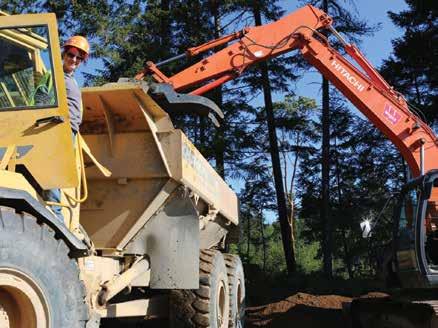
“When I was growing up he would come home and tell me stories about his job in the logging camp. I guess I just wanted to honour him and the time we had together,” she says.
As for working on a track that has jumps and motorbikes racing around her, she laughs. “I love it. It’s great to experience work in the field, you just have to be really aware of your surroundings.”
NMA president Stu Hopewell says it’s been wonderful seeing the students honing their skills while making a significant contribution to the non-profit organization.
“We’ve already had numerous comments from the racers and their families about how much the track conditions have improved and how great the site looks since the students started
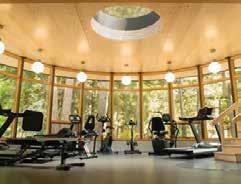
Nanaimo: 250-751-8558
Victoria: 250-590-4875
Email: mail@heroldengineering.com
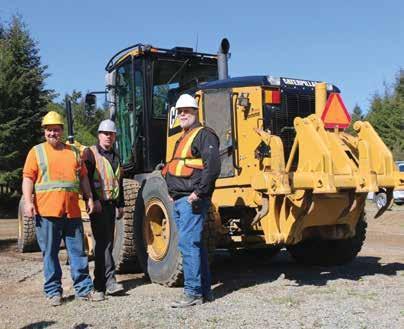
the project.” Hopewell says the students’ efforts to beautify the racetrack include clearing out broom and trees, and fixing culverts.
Back on the road grader, Schaufelbuhl is optimistic about his on-the-job experience.
“We’re running into some unique problems like buried waterlines and the fact that motorbikes are still operating on the track,” he says. “It’s challenging, but that’s how we learn.”
To learn more about the Heavy Equipment Operators program and other trades programs offered at VIU, go to: www.viu.ca/tat.
To find out more about the NMA go to: www.nanaimomx.com. n
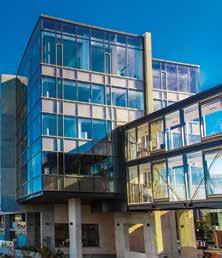


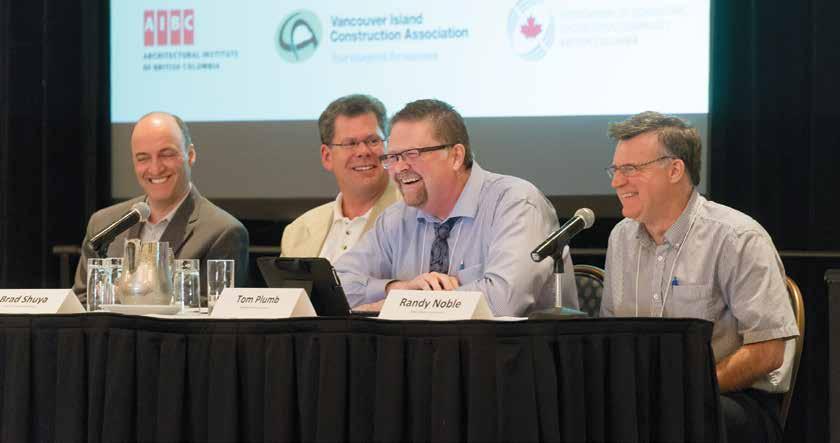
To communicate, educate, and engage – three objectives and outcomes of the second annual Capital Project Delivery Forum held at the Vancouver Island Convention Centre in Nanaimo on April 20.
The full-day event is organized by the Construction Council of Vancouver Island in an effort to bring the Vancouver Island construction community together to share ideas, issues, and solutions. The sold-out event had 183 attendees consisting of owners, consultants, contractors, suppliers, and members from the public sectors.
The day started early in the morning with breakfast and a mini trade show outside of the main ballroom, providing a great backdrop to network and visit with colleagues.
Dr. Ralph Nilson, president and vice-chancellor of Vancouver Island University, greeted the room and gave his opening remarks.
“With so much activity on Vancouver Island, across British Columbia, and the country, this forum is very important to encourage people to get involved, collaborate, and engage.”
Kevin Richter, assistant deputy minister of the highways department at the Ministry of Transportation and Infrastructure, was in-house showing where the province stood in terms of infrastructure spending and where opportunities may exist for business.
He advised that another round of strategic funding would be coming in the fall. “This will translate into more kilometres of road, more bridges, and more infrastructure,” he says. “This is a call-toarms to the construction industry and professionals to be ready when there is money on the table.”
Author and procurement consultant, Michael Asner, addressed ethics in procurement and advised on the benefits of having an
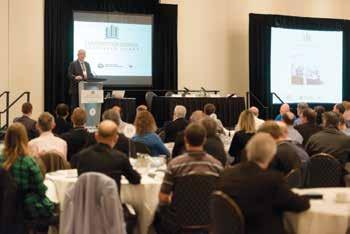

internal procurement specialist within your business.
The speaker who hit the nail on the head was John Savicky from Arizona State University. A lecturer and director of sourcing research, his presentation about best value procurement offered solutions to making the procurement process fair, open, and transparent.
Through his research and experience, his recommendations included hiring experts and changing the RFP process by limiting RFPs to two-pages in length and making them anonymous.
“RFP documents are getting larger and larger, making it more difficult to evaluate and are often not read thoroughly,” says Savicky. “In most cases, evaluators may refer to their personal bias – not because they want to have a bias but it’s just difficult to go through these large RFPs.”
He also recommended companies focus on the key individuals during the interview process, such as the project manager or site supervisor.
He identified misaligned expectations, lack of pre-planning, and reverting to low-bid awarding as major mistakes in the industry. “When everything looks the same, the easiest thing to understand is cost.”
After lunch, Bob Keen and Bill Gillan from Revay & Associations


Consulting moderated a panel about the pitfalls of incomplete contract documents.
Ron Proulx of the University of Victoria, Brad Shuya of Bradley Shuya Architecture, Tom Plumb of Kinetic Construction, and Randy Noble of Houle Electric discussed elements that contribute to the quality of current construction documents.
The delegates then broke into smaller workshops to discuss topics including builders’ liens essentials, non-compliant bids, dispute prevention and resolution, and risk allocation and costs.
Mike Demers and Tyler Galbraith of Marzban Logan LLP reviewed recent legal actions that demonstrated the benefits of knowing who you are doing business with, completing bid packages in their entirety (including appendices), and potential consequences arising from worksite accidents.
Anthony Minniti, CCVI chair, closed down the forum by inviting guests to join him at the reception sponsored by BCCA and to attend next year’s forum on April 19, 2017.
“Lets work together for the improvement of our industry and breakdown the communication barriers to build a healthier construction industry on Vancouver Island.”
The CCVI is comprised of representatives from public sectors, design and construction industries, consultants, and suppliers. n
Chair Anthony Minniti, Century Group Inc. – Constructors
1st Vice-Chair Bruce johnson, Read jones Christoffersen Ltd.
2nd Vice-Chair Richard Brown, Island Health
David Graham, North Island College
Ian Heselgrave, School District 71
Doug Savory, Archie johnstone Plumbing and Heating
kevin Parker, Draycor Construction
jason Hartely, City of Campbell River
Brad Shuya, Bradley Shuya Architect Inc.
Richard Brown, Island Health
Geoff Goodhall, City of Nanaimo
Stacey McGhee, District of Saanich
Michelle Mahovich, City of Langford
Brian kapuscinski, kPL james Architecture
Chris Downey, koers and Associates Engineering
Bruce johnson, Read jones Christoffersen Consulting Engineers
Peter Ferguson, McElhanney


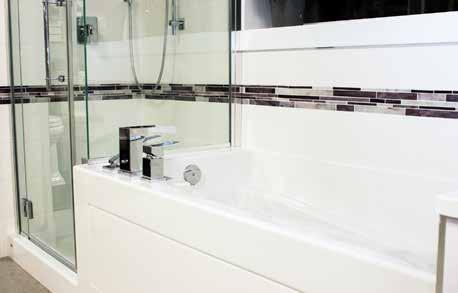






By Lisa fattori
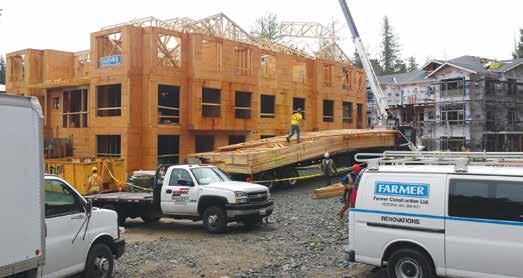
Southwest of Victoria in Colwood, a new condominium community is currently under development by Latoria Creek Joint Venture. Nestled in a forested area, adjacent to the Olympic View Golf Club, Heron’s Landing at Latoria Creek offers three-storey boutique residences, with suite prices starting under $300,000. The first two phases, with two buildings each, are already sold out and the developer is set to launch the third phase, which will feature over 30 townhomes.
Construction of Phase II – buildings 3 and 4 – at Heron’s Landing began in January 2015, and both buildings were completed and occupied by February 2016. Each residence is comprised of 12 units per building, with different floor plans for each of the three levels. Because there are only four units per floor, each condo is a corner suite, with ample windows for plenty of natural light and cross ventilation. Floor plans range from 1,246 to 1,348 square feet, and all homes have two-bedroom designs with master ensuites. Ground-level units have walk-out patios, and suites on the second and third levels have balconies.
The slab-on-grade, wood-frame buildings incorporate upgrades in construction to ensure that each suite is private and protected from noise from neighbouring units. “These buildings have been constructed over and above minimum standards, to eliminate the problem of noise,” says Blair Echlin, project manager at Farmer Construction Ltd. in Victoria. He says the units have a separated party wall, rather than a staggered stud wall on the same plate, and an added acoustic isolation membrane runs between the units, along the floors and up the walls. “This is the first multi-unit building we’ve constructed where we’ve had zero noise complaints from homeowners.”
Suite finishes include wood flooring in the main living areas, carpeted bedrooms, and heated tile flooring in the bathrooms and kitchens. Open-concept kitchens feature quartz countertops and all suites come with a stainless steel Energy Star KitchenAid appliance package, as well as a washer/dryer. The second phase features

two out buildings, one with a five-stall garage and the other as storage space for residents. There is also surface parking available.
The buildings’ exteriors are finished with board siding by James Hardie Building Products Inc., and comb-face spruce wood trim and composite shingles – which is a faux cedar shingle product by Exteria Building Products in Florida. The cedar shake siding is durable and maintenancefree. Each course is four feet long, and is easy to install, with integrated rain screen features. The cladding is recycled, termiteresistance, and requires no site-applied finishing.
“With strata buildings, owners are making choices to reduce the amount of required maintenance, and the Exteria shingles have a life cycle that is more favourable for this type of project,” says Alan McBride, project manager for Custom Pro Exteriors Ltd. in Victoria. “This product has been used quite a bit in the U.S., but is relatively new for Canada. Also, Heron’s Landing is located in a forested area, so we installed gutter guards, which will also reduce maintenance of the buildings.”
Situated in the Latoria Creek area, Heron’s Landing is next to a riparian area, and includes natural landscapes, with easy access to the nature trails of Latoria Creek Park. The ocean is just minutes away and the community is close to convenient neighbourhood amenities.
“The feedback about Heron’s Landing has been very positive,” Echlin says. “People have commented that the floor plans are very generous and the level of finishes is comparatively high. Every unit also offers a different view, which appeals to both people who want more urban surroundings and those who prefer facing the forest, for greater privacy.” n



Connect Hearing Industrial Division, formerly Island Hearing Services, has been testing the hearing of British Columbians for over 35 years – a testament to their expertise in hearing health.
With four mobile units available to test hearing on site, the process is simple, convenient, and comfortable.
Each mobile unit has two testing booths and each test takes about 15 minutes. The test includes a few questions about hearing and health factors and a short evaluation. Once inside the soundproof booth, participants respond to a series of sounds and tones by pressing a button.
WorkSafe BC inspects all the mobile units annually and the audiometers are

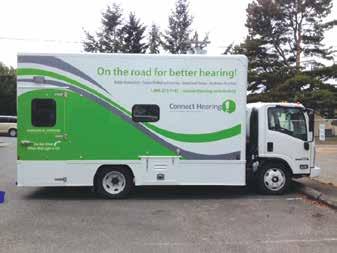
also calibrated on an annual basis.
Connect Hearing will remind a company when its employee hearing tests are coming due, and schedule a date to send a mobile testing unit to a job site. Connect Hearing established this protocol to take the onus off employers, and Elaine Colford, co-ordinator for the Island, works with companies to schedule tests at their convenience.
Part 7, Division 1 of The Occupational Health & Safety Regulation states employers must test the hearing of their employees at least once a year if they are exposed to noise that exceeds 85 decibels. WorkSafe BC enforces this regulation and Connect Hearing is authorized by WorkSafe BC to conduct such tests. All
industrial technicians at Connect Hearing are certified by WorkSafe BC to perform hearing tests and are required to recertify every two years.
“Most companies know about us and are compliant,” says Bob Casmey, manager of the industrial division. “Sometimes it takes a bit of education for the newer companies to become familiar with the regulations, but once they know it’s mandatory and important, they comply.”
Once the test is completed, a technician will discuss the results with the employee, make recommendations for ear protection, or refer to a specialist if needed. Monitoring annual hearing is an excellent way to ensure good hearing health.
Connect Hearing can also provide



custom-moulded hearing protection and are happy to offer VICA members a 10-per cent discount. Other services include toolbox talks with a short video on the importance of good hearing protection, qualitative fit testing, as well as the companies that require it.
WorkSafe BC is provided with the results of each test, and each employer receives a list of employees that have completed an annual hearing test. Each employee will also receive a pocket-sized card for his or her records.
Casmey and his team provide hearing tests for trade students at Camosun College and Vancouver Island University. This gives apprentices the opportunity to have their hearing tested before getting hired.
Connect Hearing schedules testing year-round and services the entire Island from Victoria to Port Hardy, as well as the mainland.
If you miss your scheduled time, there are sound booths in the Connect Hearing office – with lots of parking in the back – at their new location at 1316 Esquimalt Road in Victoria.
To schedule a mobile unit to attend a job site, or to schedule an in-office test, contact Connect Hearing at 250-413-2141 or 250-413-2128, or stop by the office anytime. n







By Gloria taylor

Agreen accent wall highlights one end of an open-concept office for a new corporate headquarters in Victoria. The vision of a light, bright office space has come to life with a neutral palette, modular walls, and a space plan that facilitates connectedness and workflow.
It’s the spring of 2016, and Kirsten Cluett, interior designer at Monk Office, is transforming a 1,500-squarefoot space for a corporate client. From space planning to finishing choices through to wall construction and furniture design, Cluett’s touch will be integral to the flow, function, and form of the office.
Bringing the company’s vision to life was made easier for Cluett given the expertise and products available at Monk Office – the certified Konica Minolta, Herman Miller, and DIRTT dealer on Vancouver Island.
Monk Office is unique in its service offerings as the company not only provides furniture for client offices, but it also creates useable and efficient space plans for that furniture, helps clients select finishes for the space, and co-
ordinates with contractors. The company can also bring in technology specialists to assist with selecting an interactive display board for your boardroom or the copier that best meets your business needs.
“It’s very helpful to have all the solutions at hand from start to finish,” says Cluett, referring to Monk’s wide range of offerings. Beyond furniture and technology, Monk Office can provide clients with the products needed to run their business, from top brands in office products to cleaning supplies, along with tech service and product expertise needed to keep their office running smoothly.
Monk Office works in many industries and is committed to supporting non-profits and educational organizations. “In the art and education division, we work with a lot of local schools. We have a back-to-school program where we work with education specialists to supply schools, universities, and colleges with office supplies, printers, photocopiers, janitorial supplies, and design services,” says Cluett.
Cluett’s specialty is DIRTT manufactured walls. Made and manufactured custom-toorder in Calgary, Alberta, DIRTT walls are an environmentally friendly alternative to traditional steel and stud construction. They reduce disruption and down time in office renovations and are reconfigurable for future needs.
Monk Office started as an office supply company in 1961. Since then they have diversified to meet the community’s needs and developed the kind of reputation that keeps owners, managers, and contractors calling. n
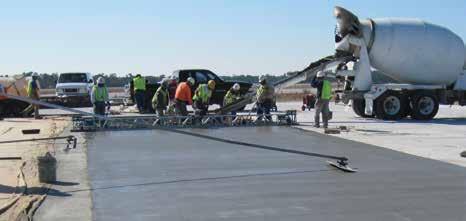

The cloud – it’s everywhere and everyone is using it, but what does it mean to be in the cloud? Where are your files? Who is responsible for it? Why is it good? What can go wrong?
There are many definitions for the cloud. Simply put: any time you store information somewhere outside your organization’s physical walls, you are storing it in the cloud. Anyone who has used Hotmail, Gmail, or Dropbox is familiar with the concept of information being stored on remote servers that is accessed through a website. For the purpose of a business, any time servers are stored off-site or virtualized and transitioned into a service, it is in the cloud.
So why should we care? What’s better about accessing information from remote servers instead of from a server on premise? The key advantages of the cloud include:
• Access to your files everywhere;
• Access to your files on any device;
• Mitigation of IT costs;
• Constant access to the latest versions of software;
• Dramatically lowered downtime; and
• Lower total cost of ownership.
So how are we able to achieve all of this? By distributing load and risk among hundreds of thousands of businesses, large-scale cloud providers are able to mitigate risk and give you significant scales of economy. Instead of having one or two servers at the office, your information is now scaled and replicated on hundreds of servers distributed across Canada. Instead of having one technician assigned to manage and maintain your server, you now have thousands. Because all cloud solutions are designed for remote access, it makes no difference whether
you are accessing from the office, or from a job site.
Of course, with all these advantages some issues can and do occur. Firstly, not every application has been, or will be, migrated to the cloud. Any application that is pulling large amounts of data every time it opens is not suited for a cloud solution. Remember, the speed of an internal network is about 1000 Mb/s where Internet speeds are about 50-100 Mb/s depending on your Internet package.
Speaking of the Internet, with a cloud solution you now require a robust Internet connection in order to function. If all your files are in the cloud, then you will not be able to access them if the Internet is down. Secondly, information stored in the cloud must be stored securely. Weak passwords and poor security discipline is far more damaging when everything is stored in the cloud than on-site.
All of the problems mentioned above can be addressed; a competent cloud specialist will be able to provide a candid overview of which programs and applications would be best suited to be migrated into the cloud and which solutions are best suited to an on-premise server, along with a TCO analysis.
We at Dial-A-Geek know that the ability for construction companies to work from a phone or tablet anywhere in the world makes cloud solutions a particularly good fit. We have worked and continue to work with hundreds of organizations across Vancouver Island lowering their expenses and bringing IT into 2016. If you’d like to have a further conversation to see if a cloud migration is the right fit for your company, we are always ready to talk and assist. n

250-475-8882
250-475-8883
richard@wescor.ca www.wescor.ca













By
With more and more construction company owners approaching and reaching retirement age, succession planning is a hot topic these days. One of the key elements of a successful exit strategy is to ensure that the corporate structure allows the owner to exit the business in the most tax-efficient manner. If the structure does not align properly, it will either inhibit the intended exit strategy, or result in excessive income taxes. There are a number of ways to exit a construction company: 1) liquidate the business assets and shut the operation down; 2) sell the business to a third party; 3) pass the business on to the next generation, or; 4) sell the business to the


employees. Each option has its own tax issues that must be addressed to ensure the least amount of tax is paid. If the business is being sold to employees or third parties, the company must not hold passive assets that would prohibit a tax-free sale of the company with the use of the business owner’s $824,176 lifetime capital gains exemption. In addition, a corporate structure should be in place that allows for the multiplication of the number of capital gains exemptions available. It’s critical to understand that structuring the company to remove passive assets and multiply the capital gains exemption cannot take place at the time of the sale. Rather, it must be done several years before the sale of the business is to take place.
Transferring the business to the next generation can be problematic from an income tax perspective, as non-arm’s length transactions have different tax consequences. If the owner utilizes their capital gains exemption on the transfer to the next generation, it results in tax consequences for the next generation. However, if the capital gains exemption is not used, then the business owner ends up bearing the income tax consequences. Another alternative available is to have the company redeem the business owner’s shares, however this will result in the business owner paying tax at dividend rates rather than at the lower capital gains rates. Capital gains are taxed at a rate of 24 per cent while ineligible dividends are taxed at a rate of 40 per cent. There are
other creative ways to mitigate the tax consequences of a non-arm’s length sales transaction, but this must be arranged in advance of the actual transaction.
A sale of the business to an employee group has its own consequences. Often, the employee group won’t have the capital necessary to purchase the business outright, so it is common for the owner to finance the purchase. In this case, the corporate structure should allow the business owner to continue to control the corporation, or at least have a say in operations. This is because the business owner will continue to bear the majority of the risks should the business fail before the employees finish paying for the purchase. Unanimous shareholder agreements are also extremely important in this case to minimize risk.
Liquidating business assets is generally fairly simple; however, proper planning will help to minimize the amount of tax paid on the distribution of corporate funds. In all cases, it is important that the appropriate corporate structure be put in place long before any actual sales transaction takes place in order to maximize the after-tax cash received from the sale.
Doug Tyce, CPA, CA is a business advisor and the regional leader for Real Estate & Construction Services with MNP LLP and Jamie Kungel, CPA, CA is the regional tax leader for MNP LLP. They can be reached at 250-753-8251. Please consult a tax advisor for advice on how the above information should be applied. n

YOUR BUSINESS IS BUILDING.
As your business grows, your tax and business strategies need to evolve along with it. That’s where MNP can help. More than 200 commercial and residential construction clients across the Island rely on MNP for industry-specific advice that goes far beyond traditional accounting. From project structuring and tax minimization to asset protection and succession, our Real Estate & Construction team looks at your operation from all angles to help you manage risk, plan for the future and build your business.
Doug Tyce, CPA, CA
T: 250.734.4368 (Nanaimo) E: doug.tyce@mnp.ca
Wendy Lewis, CPA, CA
T: 250.338.5464 (Courtenay) E: wendy.lewis@mnp.ca



by tyler Galbraith, partner, Jenkins marzban Logan LLP
Architects and engineers play an integral role in the administration of construction contracts, both generally and with respect to the dispute resolution process specifically. Typically, an architect or engineer will make initial interpretations and findings regarding matters in question relating to the performance of the work under the contract or the interpretation of the contract documents. Accordingly, an architect or engineer is, more often than not, the first arbiter of disputes between an owner and contractor. But what are the duties of the architect or engineer when a dispute arises and it is called upon to make an interpretation or finding?

Tyler Galbraith
Mike Demers

Generally speaking, architects and engineers are retained as agents of the owner of the project to design, supervise, and administer the construction of a project. This relationship can place an architect or engineer in a delicate position. In some construction contracts, it is expressly provided that in making interpretations and findings the architect or engineer will not show partiality to either the owner or the contractor. However, not all contracts deal with this point expressly.
The courts have held that an architect or engineer employed by an owner is required to act judicially (i.e. fairly and reasonably) when adjudicating disputes or making decisions under a construction contract. All decisions must be dictated by the architect’s or engineer’s own best judgment of the most efficient and effective way to carry out the contract. Further, the architect or engineer must not be influenced by extraneous considerations and, particularly, his or her judgment must not be affected by the fact that he or she is retained and paid by the owner.
A contractor will not be bound by a decision of an architect or engineer if the architect or engineer does not adhere to the provisions of the contract and acts arbitrarily, fails to exercise his or her duties in good faith or to act impartially, or makes a decision under the owner’s influence. As a corollary to this, because the owner is typically given the power to name its own architect or engineer as an arbiter or adjudicator of a contractor’s claims, the courts have held that there is an implied term in the construction contract that the owner must not interfere with the independence of the architect or engineer, meaning an owner is under a contractual duty not to influence or interfere with the architect’s or engineer’s judgment.
In summary, in adjudicating disputes under a construction contract, the architect’s or engineer’s duty is to decide claims and disputes impartially, fairly, and with professional competence. An architect or engineer is required to act in an unbiased manner and his or her judgment cannot be affected by extraneous considerations, including the fact that he or she is being paid by the owner. A contractor will not be bound by determination of an architect or engineer where the architect or engineer does not act in such a manner. n

The story of Jardine Lloyd Thompson Canada Inc. (JLT) begins in Vancouver in the early 1900s. JLT became an integral part of the construction industry in 1917, when we provided the first construction bond ever issued in the province of British Columbia. Since then, we have grown and expanded across the country, operating in all provinces and territories with offices in Vancouver, Victoria, Surrey, Calgary, Toronto, Ottawa, and Halifax.
We are part of the Jardine Lloyd Thompson Group of Companies, an international group of risk specialists and employee benefits consultants and one of the largest insurance brokering groups in the world. JLT operates in specialized sectors with a team of professionals in the construction, natural resources, public sector, corporate, employee benefits, insurance for professionals and sport, and hospitality and leisure sectors. Operating in specialty divisions – and with access to a worldwide network of professionals –allows us to provide the expertise to meet our clients needs.
We have been providing construction insurance and surety bonds for Vancouver Island contractors for over 50 years. To maintain our priority of local support, the JLT Victoria office was established
in 1971. Our construction group offers expertise in construction insurance and surety bonds for general contractors, subcontractors, owners, and developers. We provide operational coverage and specific project insurance, including course of construction, wrap-up liability, pollution, and delayed start-up. We have maintained strong, long-term relationships with all major surety companies in Canada, issuing surety bonds in B.C. for over 100 years.
For over 18 years, the JLT Victoria office has been heavily involved with the Vancouver Island Construction Association (VICA). Our construction experts have sat on the Association’s board and executive and the Under 40 group. They have participated in numerous special committees and provided educational seminars on insurance and bonding to VICA members. Carole Bissett, managing director and JLT’s national construction specialty leader, is a past chair of the Association and was part of the initial
team that worked toward amalgamation of the three Associations on Vancouver Island. Belonging to and being active in VICA is important to us as it provides a greater insight into issues affecting our clients and allows us to work more closely with the Association, to identify onerous contract language, and ensure fair tendering practices for contractors.
We look forward to continuing to provide service and solutions to our clients for many years to come whether it is through our expertise as leading construction insurance brokers or our close involvement with VICA.
We would like to take this opportunity to congratulate the Vancouver Island Construction Association on winning the 2015 CCA Partner Association Award presented in March of this year. It is a reflection of the leadership and dedication of the executive, staff, and board members as they continue to provide meaningful support and advocacy for their members. Congratulations, VICA! n


By tammy Schuster

Everyone has had experience sitting in a classroom. From that experience, it’s hard to argue that a class is only as strong as the person teaching it. It’s not only the teacher’s knowledge of the subject, but his or her passion for the topic that translates into a compelling delivery.
Combined with valuable content, students are in for more than an informative education session. It’s an experience.
Wearing a red leather jacket and glasses to match, Debbie Hicks stands at the front of a packed classroom holding her hand in the air. “For one reason or another, your company has chosen to send you here,” she says.
Hicks is in Victoria, B.C. to teach Construction 101, a two-day course developed for people working in the construction industry.
First developed by the Calgary Construction Association, the course provides a comprehensive overview of construction basics. Content includes roles and responsibilities of various stakeholders involved in construction, reading and understanding construction documents, risk management, legal matters, and project management.
Initially created for those holding supporting roles in the construction industry, the class is filled with a variety of industry professionals.
“Typically the class is split evenly between those new to the industry, those with many years of experience, and everything in between,” says Hicks, who travels across western Canada teaching the program. “We have somebody in the class today with 20 years of construction-related experience.”
Today’s attendees include a facilities manager from the
University of Victoria, a project manager from the Greater Victoria Housing Society, an accounting clerk from an electrical contracting company, and a project administrator with 10 years of construction experience.
Jenn Bogwald, a certified professional accountant at MNP LLP, sits near the front of the class and says half of her client base is in construction. “I already know the tax and accounting side,” she says. “So by understanding the nuances of the industry, I can provide better service and be an asset to my construction clients.”
Construction 101 is Gold Seal accredited. Students earn two credits in this course toward their certification. “The course is very content intense, but this component builds onto others offered by each association,” says Hicks, referring to a half-day bonding course, a two-day project management course, and a one-day course on estimating offered by most associations.
“There are many ways to take the components we touch on today and develop stronger skills.”
The first chair of the Canadian Construction Association COO committee and the president of the Southern Interior Construction Association for 22 years, Hicks was also at the helm of construction of the new Kelowna Yacht Club last year. Throughout her career she has liaised with buyers of construction services, architects, engineers, and contractors.
Understanding terminology, procurement methods, and how to read a contract are all skills necessary when tendering, bidding, and planning a project. But Hicks says not everyone in the industry shares these skills.
“We had many conversations about standards and best
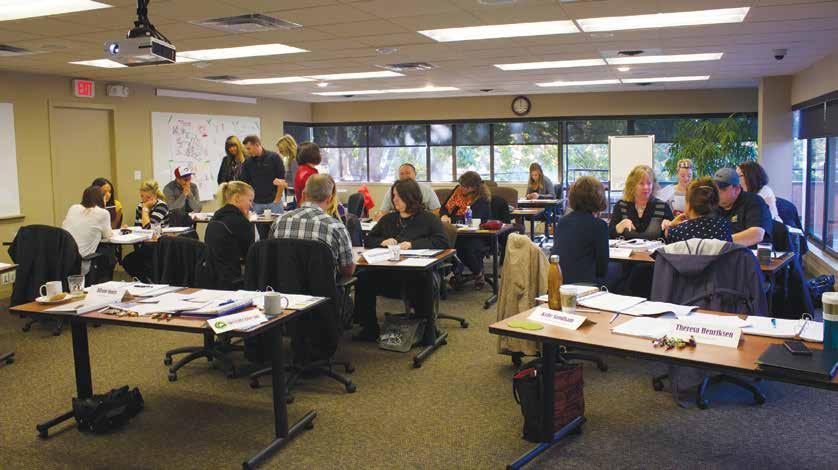
practices, and we recognized we needed to provide training,” she says. “I learned, through engagement between contractors and owners, you need to understand both perspectives.”
Her industry knowledge is almost as varied as her course delivery methods.
To help break up the more tedious material and keep students engaged, Hicks has students work in groups using large pads of paper and coloured markers to help illustrate examples of construction bonding and insurance. “It gets people to think about it differently,” she says. “If people just sat in a classroom for two days listening to me talk, they won’t retain much of the information.”
The idea is to have groups collaborate and use their own experience to help others, much like real-life scenarios.
While helping his work group decipher a thick set of blue prints, Aurel Johnson says he is attending the course to better understand construction contracts.
Johnson, estimator and project manager at Houle Electric, has been in the industry for over 15 years. He says he reads through approximately 30 contracts a month and is attending today to improve his comprehension. “If you can help move the process along, you’ll be a step ahead in this industry,” he says.
Bringing in guest speakers to talk about insurance, law, and project management, Hicks uses her personal contacts from the industry to discuss scenarios with the class.
She even shows an enlightening YouTube video of David Lee Roth, former lead singer of Van Halen, discussing the importance of reading and understanding contracts. It’s a great lesson and
probably where the urban legend of brown M&M’s in dressing room riders started.
During one of the class breaks, Hicks takes questions from a student about Gold Seal certification. “There are advantages to both online and classroom learning,” she tells him before taking a quick bite of her sandwich as the next student approaches.
In the afternoon on day two, guest Tom Plumb leads the group through a mock project startup meeting. Turning the classroom into a boardroom, most attendees are given roles at the meeting. Plumb, vice-president at Kinetic Construction Ltd., says the purpose of the startup meeting is to pull order kicking and screaming out of chaos.
“Construction is a combination of art and science,” says Plumb. “You need to know what you’re talking about, including every page of a contract, and every drawing from corner to corner.”
As the project startup meeting winds down, Hicks gets into a conversation with the group about the importance of relationships. Again, with her hand in the air, her lime green power suit is no match for her personality.
“You have to sell your companies like never before,” she says. “We are working on building relationships in a faceless society, so pick up the phone and shake hands every once in a while.”
With that, Hicks concludes the course and her stay in Victoria, and another small group of students begin lining up with their questions.
Construction 101 will again be offered by VICA in Victoria on November 17-18, 2016. Register today at vicabc.ca.. n
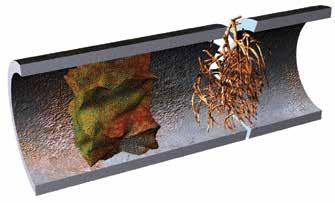
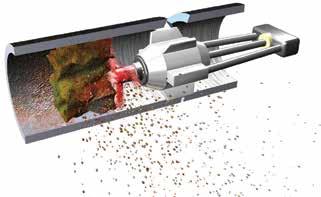
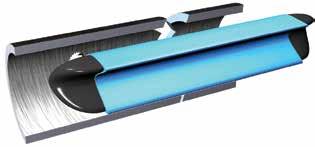
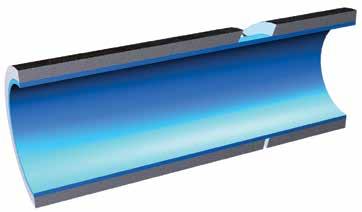
Asbestos drywall removal to replace vertical plumbing stacks is no longer an issue. Nu Flow cured in place pipe renewal offers no disruption to living spaces and no demolition and reconstruction costs. Rehabilitate your old plumbing stacks quickly and mess free with Nu Flow.
Trenchless repair means your floors, yard, trees, deck and driveway are left untouched! Your certified Nu Flow installer has the proper training and experience to get the JOB DONE RIGHT. Nu Flow’s pull-in-place method can handle even the most difficult repairs including large vertical pipes and multiple bends.
By creating a pipe inside a pipe, Nu Flow’s process means no more hard scale build-up or root intrusion, PERMANENTLY!