Vol. 21: #48 • Tongues • 11-23-2025) Tidbits of Coachella Valley
by Kathy Wolfe
The tongues of both animals and humans are fascinating muscles in the mouth that play a crucial role in our ability to taste, speak, and perform the necessary process of chewing and swallowing our food. A study of the tongue is a fascinating subject and and well worthy of investigation, so open wide as Tidbits takes a closer look and reveals some interesting facts about the properties and functions of these vital organs we all need for survival.
PROPERTIES
• The human tongue measures between 3 and 4 inches (7.6 – 10.2 cm) from the back to the tip, about the length of a credit card. There are eight distinct muscles in a human tongue, four that aid speech and swallowing and four that control its position in the mouth. They’re the only muscles in the body that work independently of the skeleton, and are one of the body’s strongest and most flexible muscles.
• The tongue’s upper surface is called the dorsum. Itʼs the part that is visible when the mouth is open.
Tongues: Turn to page 3
TRIV
(Answers on page 16)
1. HISTORY: Which country sold Alaska to the United States?
2. GEOGRAPHY: On which continent is the Sahara Desert?
3. GENERAL KNOWLEDGE: Who created The Muppets?
4. MUSIC: What was singer Miley Cyrus’ alter ego when she starred in a Disney sitcom?
5. MATH: How many sides does a heptagon (sometimes called a septagon) have?
6. MOVIES: Which singer is featured in the biopic “A Complete Unknown”?
7. FOOD & DRINK: What is carpaccio?
8. LITERATURE: In “The Jungle Book,” who raised the boy called Mowgli?
9. TELEVISION: Where was Mork from in the sitcom “Mork and Mindy”?
10. LANGUAGE: What does the phrase “doubleplusungood” mean in Newspeak, featured in the dystopian novel “1984”?
Russia, in 1867.
THE HIGHLAND GAMES
The Highland Games are mainly associated with Scotland and are competitive strength events that celebrate Scottish and Celtic culture. This week Tidbits heads to the hills to investigate the segments of this obscure 900-year-old sport.
• The Games were first historically referenced during the time of King Malcolm III, ruler of the Kingdom of Scotland from 1058 to 1093. Malcolm challenged men to race up Craig Choinnich Hill overlooking the village of Braemar with the purpose of finding the fastest runner to serve as his royal messenger. This race remains part of the Braemar Highland Games.
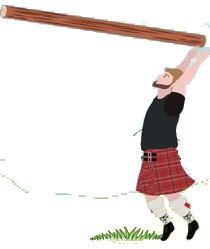
• The Caber Toss is simply throwing large and heavy wooden poles a certain distance. The word “caber” has Gaelic origins, with the word “cabar” referring to a wooden beam. The person tossing the caber is appropriately dubbed a “tosser.”
• In the Scottish games, the caber is typically crafted from a larch tree and measures 16 to 20 feet (5-6 m) long, weighing 90 to 150 lbs. (40-70 kg). The objective is to toss the caber so that it turns end over end in flight. The winner is not the one who tosses the log the farthest, it’s the one who can complete the most consecutive tosses during a set time limit. Some competitions require the tossers to wear a kilt during the event.
• The sport is believed to have its beginnings in the Scottish Highlands, when lumberjacks needed to move logs across crevices in order to bring them home.
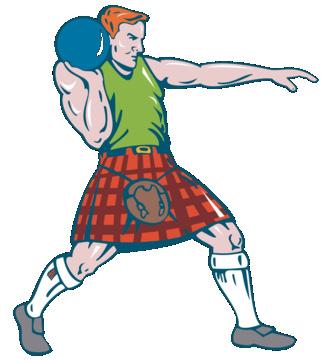
• The Stone Put is similar to modern-day shot put,
but uses a large stone rather than the 16-lb. (7.26 kg) steel shot used in the Olympics. The weight of the Highland Games stone varies between 20 and 30 lbs. (9.1 – 13.6 kg). The sport originated when the Scottish farmers needed to clear the rocks from their fields in order to plant crops.
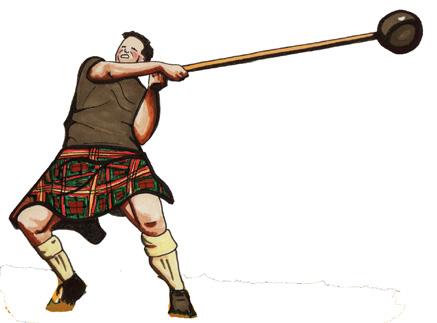
• The Scottish hammer throw uses a round 22-lb. (10-kg) ball attached to a 4-ft-long (1.2-m) shaft of wood, bamboo, rattan, or plastic. The athletes stand with feet in a fixed position, then whirl the hammer over the head before throwing it over the shoulder, twisting the upper body nearly 180 degrees. The world record distance is 132 ft., 3 inches (40.31 m).
• The sheaf toss uses a 20-lb. (9 kg) bundle of straw that has been wrapped in a burlap bag. The athletes use a pitchfork to throw the sheaf over a horizontal bar that gets progressively higher as each round is completed. The world record was set in 2019, with American Spencer Tyler tossing the sheaf over a bar 37 ft., 1 inch (11.3 m) high.
• In the Weight for Height event, competitors throw a 56-lb. (25.4-kg) weight with one hand over a progressively raised bar,
• A less strenuous and more humorous part of the Highland Games is the Haggis Hurling, in which participants throw haggis as far as possible while standing on a whiskey barrel.
• And what is haggis? It’s a Scottish dish made from sheep’s heart, liver, and lungs, mixed with onion, oatmeal, and suet, encased in the animal’s stomach and boiled for three hours. In this event, the haggis must be lifted with both hands and launched forward as far as possible with a mighty throw.
• The Games are more than just athletic events. Music and dancing play an integral part of the celebrations, with bagpipes, fiddle, drum, and Gaelic harp competitions. Pipe bands open and close the games’ ceremonies, often with multiple groups joining together. Highland dance competitions are held in the games, a tradition that dates back to at least the 16th century.
Jim Henson.
CLIP AND SAVE
CLIP AND SAVE
Tongues (from page one)
The lingual septum is a piece of tissue that separates the left and right sides of the human tongue with a vertical groove.
• The official name for the tip of the tongue is the apex. When you say, “It’s on the tip of my tongue,” it means you know something, but just can’t remember it right at that moment.
• No two tongues are alike. In fact, your tongue is as unique to you as your fingerprints. Every person’s tongue print is different in shape and texture and can even be used for verification of identity. Even the tongues of identical twins do not match.
• There are about 10,000 microscopic taste buds on a human tongue, which have a short life span and are constantly renewing themselves, regrowing about every 10 to 14 days. All those little bumps on your tongue are not taste buds, but rather, hair-like papillae on which the taste buds live. Taste can be perceived on all parts of the tongue, not only on certain areas.
• In addition to their location on the tongue, taste buds are also spread out across the roof of the mouth and the back of the throat.
• Dogs cannot taste as well as humans because humans have significantly more taste buds. Humans have about 9,000 to 10,000 taste buds, while dogs only have around 1,700 FUNCTIONS
• There are five basic tastes that taste buds detect – sweet, sour, salty, bitter, and umami. Umami is a savory taste, such as that of meats, shellfish, mushrooms, and broths.
• For decades it was believed that certain zones of the tongue are specialized for the five tastes, according to a paper written in 1901 by German scientist David Hanig. He developed a tongue taste map showing that salty taste was perceived on the tip of the tongue, sour on the sides, bitter on the back of the tongue,
umami in the center, and sweet, surrounding the umami. But it has since been discovered that each taste bud contains a mixture of 50 to 100 receptor cells, enabling each to perceive any of the five distinct tastes anywhere on the tongue.
• As we grow older, we frequently undergo a decline in our taste sensitivity, due to a decrease in the number of taste buds and a reduction in size of those remaining. Unfortunately, this, along with damaged or worn-out taste buds, often leads to a decrease in appetite and a degree of loss in the enjoyment of food.
• Besides aging, taste can be affected by hydration, which plays a vital role in how food tastes. Saliva breaks down the food we eat, allowing flavors to become more accessible to the taste buds.
the tongue being connected at the front of the lower jaw, rather than at the back of throat. The frog’s tongue is shaped such that it can wrap around its prey and secure it firmly. It’s also covered with sticky mucus that allows
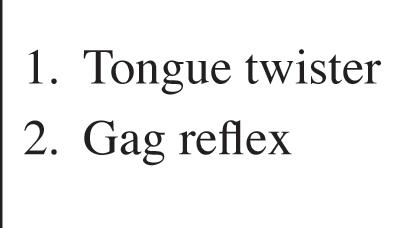
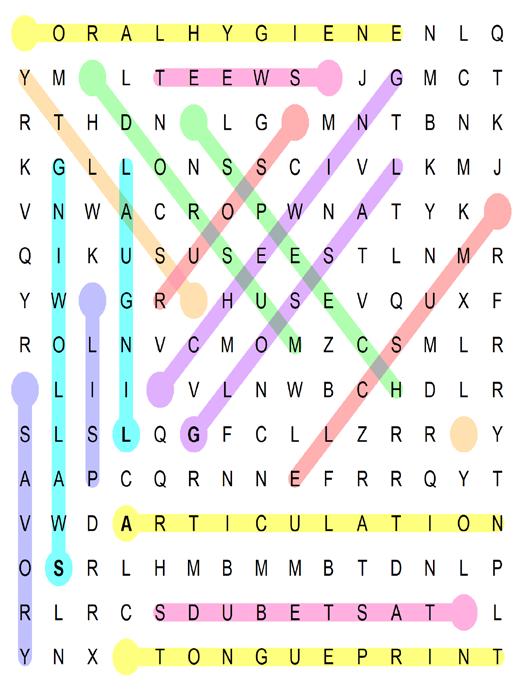
1. What term describes a phrase that is designed to be difficult to articulate properly?
2. The tongue helps protect the airway from foreign objects through the ______?
• Your tongue can alert you to certain health concerns, such as a bright red color indicating a Vitamin B12 or folic acid deficiency. A yellow tinge could be a symptom of a buildup of bacteria or dead cells, while a white coating or spots might signal oral thrush, an overgrowth of yeast.
ANIMAL TONGUES
• In the animal kingdom, the giant anteater boasts a tongue that is two feet (61cm) long. This 90lb. mammal uses its tongue to hunt ants and termites in tight spots, and might consume as many as 30,000 creepy-crawlies a day. The anteater’s tongue connects to its sternum rather than its throat, enabling the creature to flick its tongue as fast as 150 times per minute.
• The tongue of an 18-foot-tall giraffe measures over 21 inches. It’s dark in color, a blend of purple, blue, and black, coated with melanin, which serves as a protector against sunburn. This 4,200-lb. animal with a 6-foot neck uses its tongue to strip leaves off high treetop branches, consuming about 75 lbs. of leaves and twigs a day.
• There are upwards of 4,000 species of frogs that can grab objects with their tongues faster than the blink of a human eye. This is due to
By Lucie Winborne
* The Great Pyramid of Giza was the tallest structure in the world for more than 3,800 years.
* Royal Air Force uniforms in World War II included a pants button that served as a compass.
* Those lovely aromas of candy and popcorn breezing down the sidewalks of Disney’s Magic Kingdom’s Main Street, U.S.A. are brought to you courtesy of scent machines called “Smellitizers” that release fragrances throughout the parks.
* Spider silk is stronger than steel.
* Gambia’s citizens elect their political leaders using marbles rather than paper ballots in the voting booths, a method that was adopted in 1965 due to the country’s low literacy rate.
* Humphrey Bogart never actually said “Play it again, Sam” in the film “Casablanca.”
* High-heeled shoes exert more pressure on the ground than a skyscraper, which is why they’re even banned at certain historical sites such as the Acropolis in Athens, to prevent damage to the ancient stone.
* Jackie Robinson was the first student athlete to letter in four sports at UCLA. Curiously, baseball was his worst sport in college.
* Olo, a color described as a “blue-green of unprecedented saturation,” has only been viewed by five people in a laboratory, as it’s beyond the range of normal human visibility.
* There are an estimated 3 million shipwrecks in the ocean. ***
Thought for the Day: “A sign of intelligence is an awareness of one’s own ignorance.” -- Niccolo Machiavelli
PEANUT BUTTER JARS
Everyday CHEAPSKATE®
by Mary Hunt
The Best Containers to Save and Repurpose
Wide mouths, tight lids and a size that’s just right for bulk spices, trail mix or baking soda. Plastic ones won’t shatter in the garage; glass ones look sharp in a pantry. Sticky peanut butter residue? Just add hot water and soap, and shake like crazy. Done.
WHY THIS MATTERS
Everyday CHEAPSKATE®
I can’t tell you how many times I’ve been tempted by those gorgeous sets of matching glass storage jars that pop up in catalogs and on Pinterest boards. Perfect rows of grains, beans and pasta looking like a magazine ad. Lovely, yes. Affordable? Not so much.
by Mary Hunt
Meanwhile, I’m over here stacking cottage cheese tubs in my fridge, and guess what -- they work. In fact, some of the best containers don’t cost a dime. They come free with your groceries.
COTTAGE CHEESE & YOGURT TUBS
Don’t laugh. These plastic tubs are sturdy and with lids, and they stack neatly. They freeze soup beautifully and hold craft beads, buttons or even leftover gravy. Pro tip: Slap a label on unless you like the thrill of wondering if tonight’s dinner is beef stew or chocolate pudding.
GLASS JARS
Pickle jars, pasta sauce jars, jelly jars -they’re practically built to be reused. They don’t stain, they wash up shiny, and they look sharp lined up in a pantry. I know one reader who uses empty spaghetti jars (sans labels) as flower vases.
COFFEE CANS
Coffee cans are heroes in the world of repurposing. Plastic or metal, they’ve got lids that snap tight and plenty of space. Perfect for storing coins, birdseed, dog food or kitchen scraps bound for the compost. Drill a few holes in the bottom and you’ve got yourself a flowerpot with a recessed hand hold -- instant container gardening, courtesy of your morning cup of joe.
BERRY BINS
Those flimsy plastic clamshells your strawberries come in? They’re excellent little organizers. Wash them and use them for LEGO pieces, crayons or cherry tomatoes. They’re vented, which means herbs dry out less and strawberries don’t get slimy as fast.
BUTTER & WHIPPED TOPPING CONTAINERS
Think of them as not particularly glamorous but incredibly useful. They’re lightweight, freezer-friendly and perfect for snacks, sauces or craft supplies. A friend of mine hides cookies in butter tubs to fool her teenagers. That’s what I call next-level parenting.
TAKEOUT CONTAINERS
These are obvious but still worth mentioning. They’re stackable, already portion-sized and great for freezing leftovers or packing lunches. Just don’t get too attached -- they sometimes warp in the dishwasher. Think of them as temporary employees in your kitchen.
EGG CARTONS
The humble egg carton has more lives than a cat. Use them to start seedlings, sort jewelry or organize beads, or hand them over to kids as paint palettes. If they’re cardboard, you can even toss them into the compost pile when they’ve outlived their usefulness.
Sure, you can buy fancy containers, but why pay for what you already own? These castoffs are free, durable and ecofriendly. They keep your pantry neat, your junk drawer manageable, and your wallet a little fatter.
Will anyone mistake your margarine tub for a designer storage container? Probably not. But the money you don’t spend on jars and bins can go toward groceries, gas or that emergency fund.
So before you toss the next cottage cheese tub in the recycling, stop and think: That’s not trash. That’s tomorrow’s storage solution -- delivered free of charge with last week’s groceries.
* * *
Mary invites you to visit her at EverydayCheapskate.com, where this column is archived complete with links and resources for all recommended products and services. Mary invites questions and comments at https://www.everydaycheapskate. com/contact/, “Ask Mary.” This column will answer questions of general interest, but letters cannot be answered individually. Mary Hunt is the founder of EverydayCheapskate.com, a frugal living blog, and the author of the book “Debt-Proof Living.”
COPYRIGHT 2025 CREATORS.COM
CLIP AND SAVE
(c) 2025 King Features Synd., Inc.
The holiday baking season is almost upon us, giving Tidbits the opportunity to celebrate National Cookie Day on December 4 by presenting some of the history behind a few of our favorites.
• Gingerbread can be traced to the 1400s, but it wasn’t until the reign of Queen Elizabeth I of England (1558 – 1603), the daughter of King Henry VIII, that gingerbread was fashioned into human shapes. It was her practice when hosting elaborate royal banquets to have the dough made into the likenesses of her important guests and dignitaries, forging the way for gingerbread figures.
• According to legend, those who practiced folk medicine created gingerbread men as love tokens for young women seeking a husband. If the woman could persuade the man of her choice to eat the cookie, he would instantly fall in love with her.
• The current record for the world’s largest gingerbread man is held by the employees of a Norwegian IKEA store, who concocted a 1,435 lb., 3 oz. (651 kg) cookie in November 2009. The scrumptious dough includes the fragrant spices of ginger, cinnamon, cloves, allspice, and cardamom.
• Stroopwafels have their origins in the Netherlands, where they were first made during the late 1700s. Bakers would use up leftover scraps and crumbs from other creations by forming them into two layers of dough held together with a syrup filling. The word “stroopwafel” literally translates “syrup waffle.” The oldest known written recipe is from 1840.
• Snickerdoodles are the favorite of many, with their sugar cookie-type dough rolled in white sugar and cinnamon. They are most likely German in origin, with their unusual name a variant of the word “Schneckennudel.” Others will argue that the name is just a nonsensical word without a particular name.
• Why is shortbread called short? This cookie type takes its name from its crumbly texture. “Short”
was the term used in medieval times to describe pastry that was dry and sandy, resembling biscuits, as opposed to long and stretchy dough. Similarly, the word “shortening” refers to fat that is added to make a short or crumbly texture.
• Although your Chinese take-out order most likely includes fortune cookies, these little confections actually trace their beginnings to Japan in the 1800s. They were brought to the United States in the late 19th century by Japanese immigrants.
• Fortune cookies were reportedly first served in the U.S. in the early 1900s at San Francisco’s Golden Gate Park’s Japanese Tea Garden. The cookies were made by hand with the paper fortune inserted into the baked dough while it was still warm and flexible, then formed into its familiar shape around the fortune.
• The fortune cookie machine was invented in the late 1960s by 69-year-old Edward Louie of San Francisco’s Lotus Fortune Cookie Company. The machine automatically folded the dough and slipped in the fortune.
• The world’s largest fortune cookie manufacturer is Wonton Food, Inc., with their Queens, New York factory cranking out upwards of 4.5 million cookies every day. The company started out as a noodle shop in a small Chinatown location in 1973. The nephew of their founder actually composes the fortunes that are inserted into the millions of cookies. Itʼs not known if he was the originator of the classic line that reads, “Help! I'm being held prisoner in a fortune cookie
• They may not sound good to most, but Philly cheesesteak cookies are a real thing, a recipe that includes cheddar cheese, beef jerky, onions, and dried pepper flakes. These little bites are then frosted with tomato cream cheese. Likewise, Sriracha peanut butter cookies won’t be for everyone, with ¼ cup of Sriracha sauce adding a spicy kick to this confection.
Tidbits of Coachella Valley
by Dana Jackson
Q: What is Jessica Alba doing these days? I saw she hosts some kind of home renovation show, but is she still acting? -- L.S.
A: Jessica Alba stepped away from her acting career for a while after having children to run her very successful business the Honest Company, which includes a line of baby products and continues to expand. As you noticed, she’s been co-hosting the Roku original series “Honest Renovations,” which will premiere its fourth season in 2026.
Alba became a household name at the age of 20 when she starred in the Fox series “Dark Angel.” She then became part of the Marvel Universe by playing Sue Storm in the first series of “Fantastic Four” films and followed them with films by acclaimed director Robert Rodriguez (“Sin City” and “Machete”).
Alba returned to television opposite Gabrielle Union (“Riff Raff”) in the police procedural “L.A.’s Finest.” She really hasn’t slowed down. Ear-
1. Predator: Badlands (PG-13) Elle Fanning, Dimitrius Schuster-Koloamatangi
2. Regretting You (PG-13) Allison Williams, Mckenna Grace
5. Nuremberg (PG-13) Russell Crowe, Michael Shannon
6. Bugonia
(R) Jesse Plemons, Aidan Delbis
7. Chainsaw Man - The Movie: Reze Arc (R) Kikunosuke Toya, Tomori Kusunoki
8. Die My Love (R) Jennifer Lawrence, Robert Pattinson
9. Springsteen: Deliver Me from Nowhere (PG) Jeremy Allen White, Jeremy Strong
10. Tron: Ares (PG-13) Jared Leto, Greta Lee
Inc.
lier this year, she starred in the Netflix film “Trigger Warning” and appeared in the comedy series “Too Much,” which was created by Lena Dunham. It looks like 2026 might be her year as she has four upcoming projects, including “A Tree Is Blue,” which is a film directed about a young woman on the autism spectrum. It is directed by Dakota Johnson and also stars singer Charli XCX.
***
Q: I’m really enjoying the miniseries “Death by Lightning” on Netflix about the assassination of President Garfield. How historically accurate is it? -- P.R.
A: It depends on who you ask, but the majority of critics and historians would say that it’s very accurate, especially when you compare it to other biopics such as Ryan Murphy’s “Monster” series (also on Netflix). In addition to it obviously being a true story, “Death by Lightning” is based on Candice Millard’s bestseller “Destiny of the Republic.” It features a fantastic cast that includes Michael Shannon (“Boardwalk Empire”) as President Garfield and Matthew Macfadyen as his assassin, Charles Guiteau.
According to an article in Esquire, one of the liberties that the series takes is the anachronistic dialogue, but overall, it “nails the important stuff.” There’s a great debate in the r/Presidents group on Reddit about what is deemed fiction and what is known truth in the miniseries, but mostly all are in agreement that it’s an enjoyable watch that gets most of the facts correct.
***
Q: When is “High Potential” coming back? Why is it taking such a long break so soon? -- C.P.
A: Fans of the hit series “High Potential” weren’t happy to learn that it was going on a planned two-month hiatus after just seven episodes of its sophomore season. When the show returns on Jan. 6, 2026, it’ll have a new time slot, airing at 9 p.m. ET instead of 10 p.m.
Many shows from the fall season line-up will take a break over the holidays, but “High Potential” chose to go on a break sooner. A reason wasn’t given, but it’s a huge hit. So, have no fear! It’s not in danger of cancelation. * * *
Send me your questions at NewCelebrityExtra@gmail.com. (c) 2025 King Features Synd., Inc.
Good Recipes from
Classic Bread Stuffing
1/2 cup butter or margarine (1 stick)
5 celery stalks, finely chopped
1 medium onion, finely chopped
2 loaves (16 ounces each) sliced firm white bread; cut into 3/4-inch cubes
1 can (14 1/2 ounces) chicken broth
1/4 cup chopped fresh parsley
1 teaspoon dried thyme
3/4 teaspoon salt
1/2 teaspoon ground black pepper
1/2 teaspoon dried sage
1. In 5-quart Dutch oven, melt butter over medium heat. Add celery and onion, and cook, stirring occasionally, about 15 minutes, until tender.
2. Remove Dutch oven from heat. Add bread cubes, broth, parsley, thyme, salt, pepper and sage; toss to combine well.
Use to stuff 12- to 16-pound turkey, or serve in baking dish alongside poultry or ham: Spoon stuffing into greased 13-by-9-inch baking dish; cover with foil and bake in preheated 3250 F oven about 45 minutes until heated through.
Makes about 10 cups stuffing.
Each 1/2 cup: About 170 calories, 4g protein, 24g carbohydrate, 6g total fat (3g saturated), 1g fiber, 13mg cholesterol, 475mg sodium.
Grandma’s Fresh Cranberry Relish
This easy, no-cook relish will have your guests fighting over who will take home the leftover relish!
1 bag (12 ounces) cranberries, (3 cups)
1 medium Granny Smith apple, peeled, cored and cut up
1 medium Gala apple, peeled, cored and cut up
1 small navel orange, unpeeled and cut up 2/3 cup sugar
In food processor, with knife blade attached, pulse all ingredients until coarsely chopped. Spoon into serving bowl; cover and refrigerate until well-chilled, about 3 hours or up to 4 days. Makes 4 cups.
Pumpkin Pie With Bourbon Whipped Cream
Store-bought pie becomes extra special with homemade, bourbon-laced whipped cream.
1/2 cup heavy or whipping cream 1 tablespoon confectioners’ sugar
1 1/2 teaspoon bourbon or 1/2 teaspoon vanilla extract
1 prepared pumpkin pie
1/2 cup packaged spiced sugared pecans
1. In medium bowl, combine cream,
cream until stiff peaks form.
2. Cut pie into 8 wedges. Top each wedge with a dollop of whipped cream and sprinkle with pecans.
Each serving: About 420 calories, 23g total fat (9g saturated), 86mg cholesterol, 395mg sodium, 46g total carbohydrate, 1g dietary fiber, 8g protein.
By John Allen DIAMOND LIL
by Brett Koth
Donald
NEXT
Holidays & Observances This Week
11/23 Say Only Nice Things Day
11/24 What Do You Love About America Day
11/25 National Play With Dad Day
11/26 Random Acts of Kindness Day
11/27 Thanksgiving Day
11/28 Black Friday 11/29 Revive Square Dancing Day
By Matthew Margolis
Dog Eat Dog
Perfect harmony in an aural sense is created through careful selection of the notes to be brought together. Perfect harmony in relationships requires careful consideration of the compatibility, personality and temperament of the people to be brought together. But when it comes to bringing dogs together, careful consideration is not even given casual consideration.
The sentiment that is most erroneously attributed to dogs is that they all like each other. Don’t shoot the messenger, but the canine community is no more inherently harmonious than is the Middle East. Take this letter from a reader:
“Gibson, my 9-week-old male Labrador retriever, is doing great. He nips a bit, but is easily redirected with a chew toy. We picked him up from the breeder at 8 weeks, and he has already learned to sit and is now learning stay, come, down, and to calmly walk on a leash. He is home alone about two to three hours a day during the week and has taken to his crate, even going in and sleeping with the door wide open.
“Our problem is with my sister’s dog, a 2-year-old female American bulldog. I took Gibson over to meet her, and almost immediately, she had her tail up and rigid, her whole body tense, and would not let Gibson do the obligatory sniffing. I asked my sister to monitor her dog, as she was showing signs of aggression. She did not agree with me. As quick as a snap, the bulldog shoved my puppy with her chest, growled and snapped at him. I scooped Gibson up into my arms -- thankfully, he wasn’t injured or even too concerned about the whole thing.
“I decided to leave and told my sister I would not be bringing Gibson over again. She did not intervene or discipline her dog at all. I have done the aggression tests you suggest, and Gibson shows no signs of aggression. He enjoys everyone he meets and plays with an older Lab at my brother’s house just fine -- running around, tails relaxed and wagging.
“Did I do the right thing? Am I correct in not allowing Gibson to socialize with my sister’s dog? Should my sister have corrected her dog? I guess I just need reassurance.”
All too frequently we seniors don’t ask for help when we need it, using as an excuse that others need it more. Sound familiar?
Our local senior center decided to host a free holiday dinner a few weeks before Christmas last year. It was to be a full turkey dinner, with several courses, a sit-down affair with table service from the Community Club at the high school. They needed to limit it to 100 people, and advance signup was required. Color them amazed when a full week after the announcement, there were still well over 50 dinner slots available.
Staff starting manning the phones, calling senior center members to ask if they’d heard about the dinner. Yes, people had heard. Yes, it sounded lovely. But no, they wouldn’t be signing up for it. Other people, many stated, needed the
Organization: Your Best Housekeeper
An organized home transmits an air of serenity, appears larger and makes day-to-day housekeeping easier. Selecting one location to gather and organize the items in each room is the goal. I recommend that each room contain some dedicated piece of organizational furniture such as shelves, an armoire or vitrine. The piece of furniture you choose can make your chores easy -- or a nightmare.
Over time, most everyone amasses many items, some that are useful and some that are not. Part of organization is editing. Ditch anything useless. This will enable you to make the useful items you already own fit within the space you have and allow some room for expansion.
free dinner more than they.
This did not surprise me. After all the times I’ve talked to seniors around me about how it was OK for them to go to the food bank, that it was OK to ask for help -- no, I wasn’t shocked that many were turning down a free holiday dinner at the senior center.
Does this describe you? Someone who would turn down free things because of your pride, saying that others might need it more?
There’s more to it when we decline help, if we’re going to be honest with ourselves. Mostly we fear loss of independence. Somehow we equate getting help at the food bank -- or a free turkey dinner -- with not being able to take care of ourselves, thus possibly inviting scrutiny from others who might start questioning our ability to manage our lives.
I was not surprised when the senior center changed their promotion for the free dinner to say they would welcome donations, and the rest of the slots suddenly filled up.
Matilda Charles regrets that she cannot personally answer reader questions, but will incorporate them into her column whenever possible. Send email to columnreply2@gmail.com.
(c) KingFeaturesSyndicate2025
Stacking or aligning items on the shelves is the straightforward way to organizing them. To accomplish this in a visually appealing way, there should be a mix of books, objet d’art and other items such as framed photographs and vases. Whatever you have the most of will be the main focus, and the rest will be secondary. For example, if books are what you are organizing, I would recommend they be mixed with other items or empty space to the tune of 2/3 books, 1/3 everything else.
Most people think armoires are easier to arrange because the items stored are behind doors. But what happens when the doors are open? There is no reason why this area should be unsightly. Shelves, pegs and hanging bars can be added to any armoire. In addition, loose items can be stored in colorcoordinated boxes and bins giving your wares the same appeal as when you bought them in the store. For linens and intimate apparel, some boxes are available with a “peek-a-boo” window to facilitate locating them.
While you are organizing and editing, take the time to create an inventory of what you own. Writing down each item makes it easier to find later, and if they are items of value, take photographs. This will make life easier for insurance purposes in case of loss or damage. The added bonus is that you will know the value of what you own and where it is located.
Depending on your needs, some homes require more shelving space for books; other homes require space to store toys. Each household is different, and the requirements are different. There are many solutions for storage. The best and most efficient, of course, are custombuilt units designed for specific needs. However, most existing or store-bought pieces of furniture can be semi-customized with a little effort.
Vitrines and china cabinets are special if only because they have glass doors that make their contents visible. Organized stacks of dishes and any other items should be arranged for accessibility, but they should also be placed for visual impact. If displaying china, perhaps stack dishes in front of a vertical plate on a stand. Other items can be moved around to create visual interest. Because they are behind doors and less susceptible to dust, stemware and glasses can be placed on their bases. Figurines can be displayed in the spaces between for interest.
Whatever you are storing, the name of this game is to do it with style. A small investment in boxes, bins and other organizers will make life easier and tidier.
* * * Joseph Pubillones is the owner of Joseph Pubillones Interiors, an award-winning interior design firm based in Palm Beach, Florida. To find out more about Joseph Pubillones, or to read features by other Creators Syndicate writers and cartoonists, visit the Creators Syndicate website at www.creators.com.
Corner (from page 9)
As a rule of thumb, introduce dogs on neutral territory. Think U.S.-North Korea relations: The United States, via Sweden, utilizes diplomatic envoys to lay the groundwork for future discussions, which set the tone for official negotiations. And still there’s no guarantee that all parties will play nicely.
The writer is so busy being mad at her sister for not protecting her dog that she neglects to take responsibility for the fact that she brought her puppy onto another dog’s turf assuming he’d be welcome. That’s like assuming it would be fine to drop by Kim Jong-un’s for cocktails uninvited.
As for whether there is any hope of a friendship between Gibson and the bulldog, on the one hand, there’s no need to banish the dogs from each other’s presence. Put them on a leash, take them to a park, and let them sniff each other out there. Like Sweden.
On the other hand, there’s also no need to force the issue. Dogs aren’t friends, they’re animals -- hierarchical animals at that, meaning all dogs are not created equal.
Personally, I’d be more concerned about repairing the relationship between sisters. It’s a dog-eat-dog world, and friends and family should be cherished.
Woof!
* * *
Dog trainer Matthew “Uncle Matty” Margolis is the co-author of 18 books about dogs, a behaviorist, a popular radio and television guest, and the host of the PBS series “WOOF! It’s a Dog’s Life!” Read all of Uncle Matty’s columns at www.creators.com, and visit him at www.unclematty.com.
deceased parent.
YOUR SOCIAL SECURITY
by Tom Margenau
Young People and Social Security
The people who syndicate this column have just assigned a new editor to me. She’s a relatively young person. (Of course, when you are 76 years old, as I am, the majority of people I meet and deal with are younger than me!) I sort of apologized to my young editor for having to work with a guy who writes a column about an old people’s topic like Social Security. But she graciously let me know she was looking forward to learning more about the program.
Anyway, this got me to thinking about the issue of young people and Social Security. And it turns out they are more involved with the program than most folks might think. And I’ll use the rest of this column to explain.
I’ll start out by sharing this story. For part of my career with the Social Security Administration, my job was to run around and give speeches and make presentations about the program to various groups and organizations. I used to go out of my way to schedule such talks to high school students -- usually as part of a history or economics class. You might think that I had some kind of speaker’s death wish. After all, can you think of a tougher crowd to stand up in front of and talk about Social Security than a group of teenagers? But there was a method to my madness.
I’d start each class by asking the kids what they thought of when I said the words, “Social Security.” Inevitably, someone would say “old people.” And another kid might pop up and say, “Yeah, I think my grandparents get Social Security checks.” And usually another student would say, “I think that’s what they are taking out of my paycheck at McDonald’s.” Those were the kinds of responses I was expecting.
After a few minutes of playing that word association game, I’d turn the tables a bit and tell the class this. “Many years ago, when I was sitting where you are sitting, I was getting a Social Security check every month from the government.” And then I’d ask them, “How come?”
There was always a long pause as the kids mulled this over. In fact, even the teacher usually looked puzzled. But eventually, a young person somewhere in the room would raise his or her hand and say, “Maybe one of your parents died?”
And that was the right answer. My dad died when I was a little kid. And soon after that, my mom and my sister and brothers and I started getting monthly survivor benefits. So when I was in high school, I was indeed getting a Social Security check every month from the government. (And in case you’re wondering, I wasn’t making a killing off the program. As I recall, my check was all of $22 per month. But of course, that was 60 years ago.)
By the way, I just said “eventually” some kid in the class would figure out that my dad had died. And that was always because that child also had a deceased parent and was getting Social Security survivor benefits just as I was many years earlier. In fact, I probably made a hundred such talks to high school classes during that part of my career, and I don’t remember a single class that didn’t have at least one kid who was collecting a monthly Social Security check off the record of a
That’s a big part of the message I was delivering to the kids (and now, to you). Social Security isn’t just about old people. There are many millions of younger people who get Social Security benefits every month. They might be children of a deceased parent. Or they might be children of someone getting Social Security retirement or disability benefits. And speaking of the latter, they also might be young or middle-aged adults getting Social Security disability benefits.
The point is that survivor benefits (around since 1940) and disability benefits (around since 1956) are a big part of the Social Security program that many people usually don’t think about. How big? Let’s look at some numbers.
There are 70 million people getting Social Security benefits. Of those, about 8 million are getting disability benefits and another 6 million are getting survivor benefits. In other words, almost 20% of the people getting Social Security benefits are not retirees -- the kind of “old people” normally associated with the Social Security program.
Let me break that down further to highlight the number of children getting Social Security. There are about 1 million children of disabled workers getting monthly dependent benefits, and 2 million children of a deceased parent who are getting monthly survivor benefits.
Further, there are another 723,000 children of retirees who are getting dependent benefits. In other words, we are talking about senior citizens (almost always men) who are getting Social Security retirement benefits who happen to have one or more minor children still living at home. (For obvious biological reasons, it would be rather rare for a woman in her 60s to still have a minor child.)
This has always been a controversial part of the program. I can tell from the emails I’ve gotten over the years that people don’t mind kids getting benefits from a disabled or deceased parent. But for some reason, they have a problem with the children of retirees getting benefits. I’m guessing it’s because they figure we are talking about some old goat who has married a much younger woman and fathered a child or two by her -- and now those
1. The book of Galations is found in the a) Old Testament b) New Testament c) Neither
2. From which book's 10:35 does Jesus say the scripture cannot be broken? a) Matthew b) Mark c) Luke d) John
3. In order to see Jesus in the crowd, what kind of tree did Zaccheaus climb? a) Cedar b) Sycamore c) Fig d) Carob
4. From Matthew 17, what did Peter find with a coin in its mouth? a) Donkey b) Lamb c) Raven d) Fish
5. In Mark 3:17, who did Jesus call "The Sons of Thunder"? a) Philip/Matthew b) Peter/Andrew c) James/John d) Thomas/Judas
6. From Luke 8, Jesus caused swine to rush into what body of water? a) River Jordan b) Dead Sea c) Euphrates River d) Sea of Galilee
kids are getting monthly Social Security checks. Of course, that is not always the case. But I think it’s the perception most people have of male retirees with small children at home.
Although when it comes to benefits for “children,” we are not necessarily always talking about a minor. Those monthly Social Security checks to kids usually end when the child turns 18. But the law has always said that a child can get benefits after 18 if he or she is disabled. In other words, there are adults in their 30s, 40s and 50s who are getting “disabled adult child” benefits. That number is about 1 million. And that cuts across all three of the major benefit categories. In other words, of the 723,000 children of retirees and 1 million children of disabled workers and 2 million children getting survivor benefits, about 1 million of them are “disabled adult children.”
Anyway, the whole point of this column is to point out that Social Security isn’t always an old people’s program.
If you have a Social Security question, Tom Margenau has the answers. To find out more about Tom Margenau and to read past columns and see features from other Creators Syndicate writers and cartoonists, visit the Creators Syndicate website at www.creators. com.
COPYRIGHT 2025 CREATORS.COM (Answers on page 16)
to www.TriviaGuy.com
Puncture Site Pain Persists After
Medical Procedure
DEAR DR. ROACH: Nine days ago, I had a medical procedure under general anesthesia. One of the lines was put in the artery in my left wrist. Aside from deep bruising that went halfway up my forearm, it seems that there is some nerve damage. I have constant pain from my thumb, through my wrist, and up to about 3 inches on my arm. Overnight, the pain becomes intense and radiates all the way up to my shoulder.
Tylenol and an arthritis sleeve only provide minimum relief. Should I request to see a neurologist, or is there another type of doctor to seek out for a diagnosis? This has become life-altering, and I’m hoping it will eventually be healed. B.F.
ANSWER: I suspect that the bruising on your forearm was caused by bleeding from the puncture site of the artery in your wrist. (This type of line is used to measure blood pressure accurately and instantaneously.) The hematoma (blood collection) inside the wrist might be compressing the median nerve in your carpal tunnel, which causes a neuropathy very much like carpal tunnel syndrome.
If I am right, then the condition should improve as your body absorbs the blood, which takes pressure off the nerve. However, there are case reports of permanent damage to the nerve from complications of an arterial puncture. In general, if the nerve compression is serious enough to cause weakness, it needs to be acted upon urgently.
The doctors who performed your procedure need to know about this complication, and a neurologist is exactly the right person to see. A simple nerve test could confirm my suspicion or disprove it by finding a different cause if your symptoms persist.
DEAR DR. ROACH: I’m an active 60-year-old who took a soccer ball to the groin some time back. After a few months, I noticed a change in my sexual organ. Narrowing and bending of my organ developed, and it seems to be getting worse.
My general doctor seems to think it’s Peyronie’s disease. After researching this, I started taking vitamin E and COq10 supplements. I scheduled a urologist exam but was hoping for some insight on this. G.
ANSWER: I suspect your general doctor is correct, and an evaluation by a urologist is certainly indicated. Peyronie’s disease is often triggered by trauma in a person who is genetically susceptible to the condition. (Your trauma was very clear, but it isn’t always clear in everyone what the trauma might have been.)
The diagnosis is made by an examination showing a bend in the penis, along with plaque that can be felt during an examination in most cases. Some men, but not all, will have pain. In men who are in the active phase of the disease (where the curvature is getting worse), urologists will often prescribe pentoxifylline for three
to six months in hopes of stabilizing the condition and preventing the curve from worsening.
Vitamin E was not found to be superior to a placebo treatment. CoQ10 was found to have a benefit in a small trial, and since it is very safe, this was a reasonable treatment for you to try.
Depending on your symptoms and degree of curvature, there are several options for treatment. Medication can be injected directly into the penis; men treated with this were found to have about a 34% improvement in curvature. Traction therapy is also frequently used.
In men with more severe disease that does not respond to the previous options, surgical treatment can be considered. This should be done in men whose sexual function is affected by the disease and in cases where medical treatments have failed to improve their symptoms adequately.
* * *
Dr. Roach regrets that he is unable to answer individual questions, but will incorporate them in the column whenever possible. Readers may email questions to ToYourGoodHealth@med.cornell.edu.
VETERANS POST
by Freddie Groves
Helping Other Veterans Over the Holidays
The holidays are here, and for many veterans they won’t be very merry. It’s one struggle after the other, and the holidays just bring additional stress and burdens.
There are presents to buy for the kids, the weekly dilemma of how to maneuver around the rising costs of groceries, etc. We want to step in, but sometimes the needs seem endless and we don’t know if or how we can help.
But, we can. Even a small effort on our part can go a long way to helping fellow veterans make the holidays a little less of a struggle.
If you’re a member of a veterans group, like the American Legion or Disabled American Veterans, you’re in a perfect position to give some real assistance to other veterans.
Here are some ideas to get you started, either as part of a group or individually:
Call Voluntary Services at the closest VA medical center and ask what you can do. You might be asked to run the parking lot shuttle and bring veterans from their car to the door. You might be asked to do one-on-one visits with patients who don’t have friends or relatives to stop by.
You might be asked to read to patients with vision problems. If your group is big enough (as well as having a good budget), you might want to host a holiday party for a whole ward, with food, drinks and presents for each patient. Hint: You can seek donations from the community to defray the cost of purchases.
Take a local veteran and family under your wing and ask what they need, whether it’s meals, presents for the kids, a warm pair of boots or some home repairs.
Work a shift at a homeless shelter that serves a large population of veterans. You might be cooking, serving meals at the tables or helping veterans find warm winter gear among the donated coats and gloves.
Whatever you do, your help will have a much-needed impact.
Freddy Groves regrets that he cannot personally answer reader questions, but will incorporate them into his column whenever possible. Send email to columnreply2@gmail.com.
(c) 2025 King Features Synd., Inc.
Detecting Early Signs of Parkinson’s Disease
DEAR SAVVY SENIOR: Can you explain what the early signs of Parkinson’s disease are? My husband was recently diagnosed after noticing a slight thumb tremor, but we’re wondering if there are other signs that may have been caught earlier.
Cautious Wife
Dear Cautious: Recognizing the early signs of Parkinson’s disease is challenging because the symptoms are often subtle and/or similar to those in other health conditions. This can mean overlooking, dismissing or misdiagnosing the warning signs.
Parkinson’s disease, which afflicts around 1 million Americans, is a degenerative disorder
that occurs when the brain’s dopamine-producing neurons die or become impaired. This happens in the part of the brain that controls movement, which can cause tremors, stiffness, and difficulty with walking, balance, and coordination.
The symptoms usually begin gradually and worsen over time, and the progression of symptoms is often different from one person to another. Some people with Parkinson’s become severely disabled, while others may experience only minor motor disruptions.
Although the cause of Parkinson’s disease is unknown, scientists believe genetics and environmental factors (exposure to certain toxins) play a key role. Most people with Parkinson’s first develop the disease around age 60 or older, and men are more likely to develop it than are women.
Early Warning Signs
Parkinson’s disease is difficult to diagnose because there’s no definitive test to confirm it. Doctors, usually neurologists, will do an examination and evaluate a combination of warning signs, but because symptoms can vary greatly by patient it often leads to confusion and misdiagnosis. That said, here are some of the key signs and symptoms everyone should be aware of.
Restless sleeping: Talking in your sleep, sleepwalking and/or acting out your dreams by kicking or jerking. This is a REM sleep behavior disorder and one of the strongest and earliest pre-diagnostic symptoms of Parkinson’s disease.
Loss of smell: Not being able to smell certain foods very well, such as bananas, dill pickles or licorice. This early symptom occurs in around 70 to 90 percent of Parkinson’s patients.
Constipation: Problems with digestion and bowel movements are a big problem for people with Parkinson’s, and an early sign that can occur up to 20 years before this disease is diagnosed.
Changes in handwriting: Writing may become harder to do, and your handwriting may appear much smaller than it has in the past.
Softening of voice: According to the Parkinson’s Foundation, 89 percent of people with Parkinson’s will have speech and voice disorders, which often shows up first in volume of the voice, meaning that you may speak more softly.
Tremors: Slight shaking or tremor in your finger, thumb, hand or chin. The tremor usually happens at rest, and when you move the extremity, it may disappear. This is the most common and recognizable outward sign of Parkinson’s disease, but by the time tremors start, the brain has already lost more than half of its dopamineproducing cells.
Slowed movement: Over time, Parkinson’s disease can slow movements, making simple tasks difficult and time-consuming. Your steps may become shorter when you walk. It may be difficult to get out of a chair. You may drag your feet as you try to walk.
Masked Face: The muscles in the face experience the same gradual stiffening as in the rest of the body, which results in lack of smiling and facial expressions.
Impaired posture and balance: Stooping, leaning or slouching when you stand, and/
or balance problems can all be an early sign of Parkinson’s.
Having these symptoms doesn’t necessarily mean that a person has Parkinson’s disease. But if you are experiencing any of them, and you’re over age 60, you should consider talking with your doctor, who may order a DaT scan or Syn-One (Skin Biopsy) Test to help diagnose it. Early detection leads to earlier treatment, which can improve a person’s overall quality of life.
For more information, visit the Parkinson’s Foundation at Parkinson.org
Send your senior questions to: Savvy Senior, P.O. Box 5443, Norman, OK 73070, or visit SavvySenior. org. Jim Miller is a contributor to the NBC Today show and author of “The Savvy Senior” book.
-- by Jim Miller
downsizing and only have uninterested men in the family.
JUNQUE
by Anne McCollam Creators News Service
Tea Cups and Saucers Were a Tradition
on Petticoat Lane.
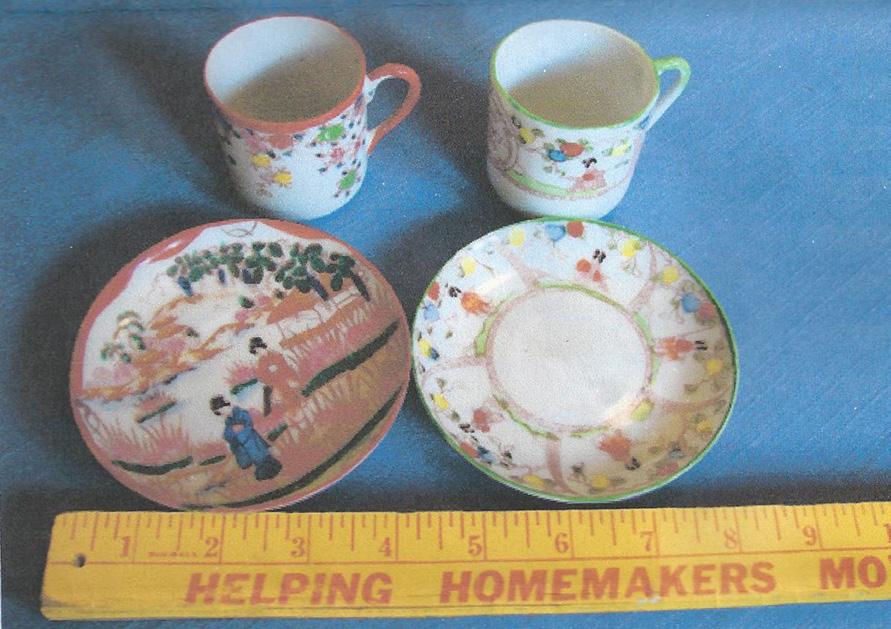
Q: I have two small “dolls’ tea party” porcelain cups and saucers. They are from the Emery, Bird, Thayer department store located in Kansas City, Missouri. It was an upscale department store, where it was a tradition to take young girls to tea in the restaurant. The tea parties were for girls and their dolls in the elegant tearoom and provided an opportunity for them to learn manners and social graces.
My mother, who was born in 1907, participated in the events around 1916. One teacup is marked “Emery, Bird, Thayer -- Kansas City Dolls’ Tea Party 1916.” Both cups are approximately 2 1/4 inches tall by 2 1/4 in diameter, and each saucer is about 4 1/4 inches in diameter. Both are decorated with Asian designs and figures.
Emery, Bird, Thayer began in 1863 and continued through the 1920s and 1940s as the Petticoat Lane drew crowds to downtown Kansas City. Its success of the shopping area was attributed to transportation that was available to the hub of the Midwest. One could get to Kansas City by train, and then proceed downtown by trolley, electric street car or motor bus.
Would my teacups and saucers have a value, and where might I find a market? I’m
A: Teacups and saucers souvenirs from the Emery, Bird, Thayer department store tea parties are collectible. They are a lovely reminder of an era that valued politeness and good manners. According to one source, there is an Emery, Bird, Thayer restaurant that displays memorabilia from the store. “Petticoat Lane” is the name given to Main Street, where the stores covered an entire block with a variety of shops. The capricious prairie winds would often catch ladies’ skirt hems and reveal their petticoats, thus the name.
Each cup and saucer set would probably be valued around $35 to $85. Donating the cups and saucers to the Emery, Bird, Thayer restaurant collection would also be an option for you.
Q: I have enclosed the mark that is on the back of six Flow Blue luncheon plates that I bought over 50 years ago from an antiques shop. Each dish is decorated with a border of roses against a white background. They are in perfect condition
What can you tell me about their value today?
W. H. Grindley and Company, Ltd made Flow Blue ironstone.
A: W.H. Grindley and Company, Ltd., made your plates in Staffordshire, England. They have made ironstone and earthenware since 1880. “Beauty Roses” is the name of the pattern, and they were made around 1922.
Each plate would probably be worth $60 to $85.
* * *
Antiques expert and columnist Anne McCollam has since retired and no longer receives inquiries nor answers reader letters. Due to the popularity of her column, this publication will continue to reprint previous columns of interest to our readers.
To find out more about Anne McCollam and read features by other Creators Syndicate writers and cartoonists, visit the Creators Syndicate website at www.creators.com
COPYRIGHT 2025 CREATORS.COM
If pastors are thirty-one, forty three or fifty-nine years old, do people say they're
* On Nov. 24, 1947, the House of Representatives voted 346 to 17 to approve citations of contempt against 10 Hollywood writers, directors and producers who’d refused to cooperate at hearings dealing with Communism in the movie industry held by the House Un-American Activities Committee. The men were sentenced to one year in jail.
* On Nov. 25, 2000, after passing a resolution earlier in the year, the United Nations General Assembly recognized the first International Day for the Elimination of Violence Against Women. The resolution marked the anniversary of the death of three sisters -- Patria, Minerva and Maria Teresa Mirabal -- who were murdered in the Dominican Republic in 1960.
* On Nov. 26, 1968, Air Force 1st Lt. James P. Fleming and four other Bell UH1F helicopter pilots received an urgent message from an Army Special Forces team pinned down by enemy fire. While the first rescue effort failed, Fleming, accompanied by a second pilot, managed to land and pick up the team before discovering upon return to his base that he was nearly out of fuel. He was eventually awarded the Medal of Honor for his actions.
* On Nov. 27, 2015, Pope Francis released a progressive-rock album titled “Pope Francis: Wake Up!” featuring excerpts of the pontiff sermonizing on subjects including peace, the environment and family, and hymns rearranged with guitar and synthesizer.
* On Nov. 28, 1929, a month after the stock market crash, NFL star Ernie Nevers, of the Chicago Cardinals, scored a record 40 points in a single game, playing against the Chicago Bears.
* On Nov. 29, 2004, Japanese movie monster Godzilla, a mutant born of nuclear radiation fallout, got a star on the Hollywood Walk of Fame -- quite a present on his 50th birthday.
* On Nov. 30, 1965, attorney Ralph Nader published “Unsafe at Any Speed: The Designed-in Dangers of the American Automobile.” An immediate best-seller, it also launched the passage of the National Traffic and Motor Vehicle Safety Act of 1966, seatbelt laws in 49 states and other roadsafety initiatives.
(c) 2025 King Features Synd., Inc.
"No,
of course
Souvenir cups and saucers were given at upscale department store teas for young girls.
Tongues (from page 3) the tongue to stick to the prey. The tongues of several species of frogs are able to pull in prey several times their own weight.
• The sun bear extracts honey from beehives with its 10-inch-long tongue. It has longest tongue of all bears, but the sun bear is actually the smallest of all bears. Its maximum weight is about 145 lbs., eating about 10 lbs. of food per day.
• The tongue of a chameleon is twice as long as the animal itself. The 47.2-inch (120 cm) tongue can shoot out toward its prey in a fraction of a second, accelerating from 0 to 60 mph in 1/100 th of a second. If humans had the same tongue-to-body ratio, we’d have tongues ranging from 10 to 12 feet long.
• The mouth of a woodpecker isn’t big enough to hold its tongue, which can be up to a third of the bird’s total body length. The woodpecker houses its tongue by wrapping it around its skull. The tongue, made of bone, cartilage, and muscle, winds behind and onto the top of the head when it’s not reaching deep into crevices looking for grubs.
• A penguin’s tongue has no taste buds, but rather lots of spiky bristles made of the fibrous protein keratin, the same substance that composes human hair and nails. The bristles act like barbed fish hooks, enabling the penguin to grab a slippery, wriggly fish and move it down the throat. The penguin’s tongue has more bristles than a hairbrush.
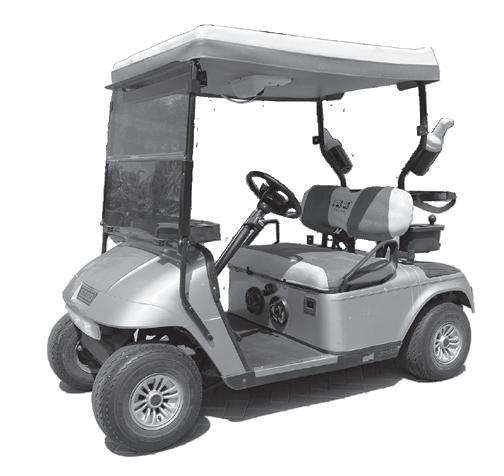
Thomas Golf Cars
• In the days of ancient Rome, a royal banquet of exotic foods and delicacies usually included the tasty treat of sugar coated flamingo tongues.
Give your golf-related advertising message targeted visibility in full color in this weekly 2” x 6” fixed location $159 per insertion reaches 70,000+ readers each week at the low cost of only $2.27 per 1,000 reader impressions!
Game Changers
by Jason Jenkins
Langer’s Longevity
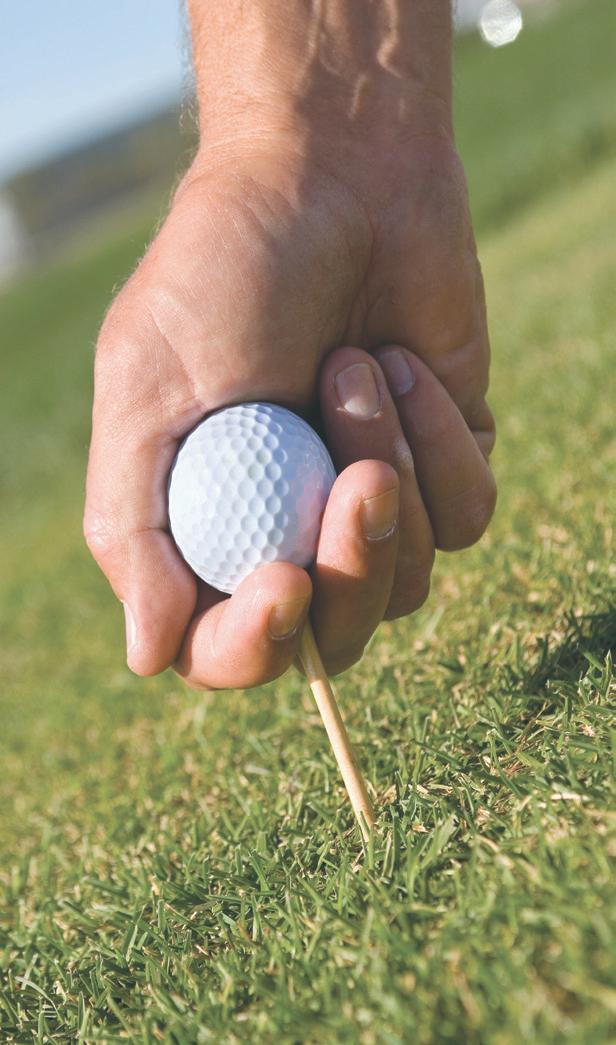
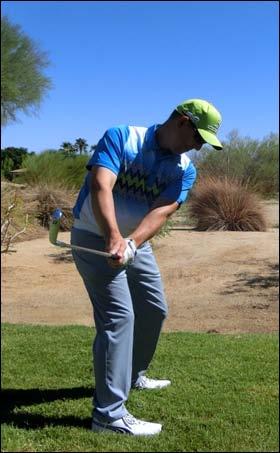
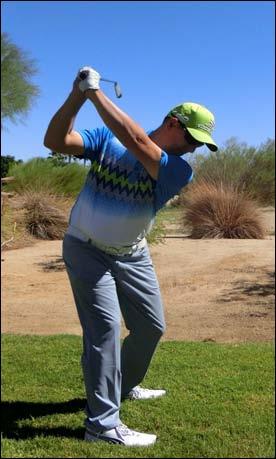
Bernhard Langer has created a Senior Tour career that few would have envisioned after witnessing his PGA Tour days. Putting yips were sure to keep him from winning, yet with the long putter working successfully, Langer has relied upon his swing to elevate his game to one of the best senior champions ever.
Langer’s strong grip and “two part” backswing are truly his secrets of success. By two parts, we mean that as his body turned in the backswing, his arms would create a lifting action that would raise his hands high above his right shoulder. Many golfers glue those two actions together: body turns as arms swing around, or arms lift as body slides. In the first half of the backswing Imagine the body turning as the arms go along for the ride. Then midway through, feel the arms lifting upward as you attempt to swing the club high above the right shoulder. Perhaps you elongated your success-
playing days like Langer.
GO FIGURE!
TRIVIA TEST Answers Answers
The idea of Go Figure is to arrive at the figures given at the bottom and right-hand columns of the diagram by following the arithmetic signs in the order they are given (that is, from left to right and top to bottom). Use only the numbers below the diagram to complete its blank squares and use each of the nine numbers only once.