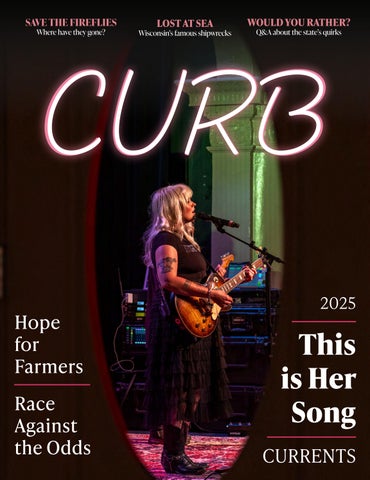
2025 Curb Currents

Page 1


SAVE

THE

FIREFLIES Where have they gone?

LOST AT SEA

Wisconsin’s famous shipwrecks

WOULD YOU RATHER?

Q&A about the state’s quirks

CURB

Race Against the Odds

Hope for Farmers CURRENTS

FROM THE

LETTER EDITOR

Dear readers,

I would be lying if I said I didn’t have a fear of the water. As someone who can’t swim, even a calm day on the lake can spark fear of getting lost, of falling in too deep, of what might lie below. And that’s without mentioning the currents. The currents that push and pull violently, as nature does, shaping our lands for better or worse. Whether we like it or not – whether we fear it or not –water will do as it likes.

Wisconsin is a land defined by its lakes and rivers. We rely on them for our livelihoods, recreation and industry, but the water is wild, and the currents push and pull us. With that in mind, it feels important for us to look not forward or backward, but right down at our own feet. The question is: Where are we now?

In times of unprecedented change, the waves have shifted us left, right, up and down, so we aim to take stock of where that leaves us. What do we have left? What are our lives like right now? The answers to these questions are difficult to find, but like true Wisconsinites, we’ve decided to take our boat out on the water and look forward to the horizon.

While reading through this issue, I anticipate you’ll find some of the same things I have: a little bit of whimsy, a sense of adventure and most importantly, hope.

There will always be more that connects us than divides us and if you’re looking for proof, it’s right in front of you. Twenty-five people from different backgrounds came together to make this magazine, imbuing each story with the values we all share. I bet by the time you make it to the end of Curb: Currents, you’ll be just as proud of each and every one of them as I am.

There's more to love! Visit us at curbonline.com Curb is published through generous alumni donations administered by the UW Foundation and in partnership with Royle Printing in Sun Prairie, Wisconsin.

© Copyright Curb 2025

Editorial

Gabriella Hartlaub, Editor in Chief

Cameron Hagen, Managing Editor

Mary Bosch, Content Editor

Dylan Goldman, Lead Writer

Sreejita Patra, Lead Writer

Greta Boatcher, Copy Editor

Isabelle Dunai, Copy Editor

Elsa Englebert, Copy Editor

Business

Hannah Tuckett, Business Director

Kate Reuscher, PR Director

Cleo Whitney, Events Director

Greta Felton, Engagement Director

Isabel Butler, Marketing Representative

Clare Cowan, Marketing Representative

Design

Maggie Spinney, Art Director

Sage Pollack, Production Editor

Lenah Helmke, Designer

Sarah Van Der Vaart, Designer

Alex Yu, Designer

Jonás Tijerino, Photo Editor

Online

Madalyn Scharrer, Online Editor

Josie Cargill, Online Producer

Mason Kelly, Online Producer

Sophie Wooldridge, Online Producer

Cameron Schneider, Multimedia Director

Publisher

Stacy Forster

PHOTO BY JONÁS TIJERINO

DISCOVER YOUR NEXT WISCONSIN GETAWAY

Wisconsin’s lakes are essential to its spirit and allure. Soak up these hidden gems in true Midwest fashion.

Madeline Island, Apostle Islands Best for nature-lovers in need of seclusion

Madeline Island is the largest of Lake Superior’s Apostle Islands and is widely regarded as the Ojibwe people’s spiritual home to this day. Only accessible by ferry, boat or plane, it’s an exclusive getaway with sea caves and sandstone bluffs in Big Bay State Park.

Kohler-Andrae State Park Best for sand dunes, camping and local fun

Winding cordwalk trails guide visitors to sand dunes and pine trees along the park’s 2.5-mile shoreline. Pitch a tent at the family campground, stop into nearby Sheboygan’s

MOUNDS NOT MOUNTAINS

Tour Wisconsin’s effigy mounds

Effigy mounds

large, elevated piles of earth, were created by predominantly HoChunk moundbuilders to serve as burial grounds, places of religious worship and maybe even territory markers.

The mounds represent the Ho-Chunk’s spiritual connection with nature, often resembling animals, and can be found across Wisconsin.

To prevent trespassing, all effigy mounds in Wisconsin are protected as burial grounds.

POSTCARDS FROM BADGERS

Though the waves have carried many SJMC alumni away from Madison, we’re all shaped by the traditions and friendship from our Wisconsin experience.

We asked them what they miss most about life at UW–Madison. Here’s what we heard:

“I miss the ease and camaraderie of Wisconsin, from jumping around at Camp Randall in the fall, to hiking up Bascom Hill in the winter and enjoying the terrace with a brat in the spring.”

— Jamie Randall, ’23, Chicago

Hi Jamie! The terrace is still the place to be! Next time you’re back, try the new Terrace Lemonade, a nonalcoholic sparkling drink crafted in collaboration with local brewery, Karben4 Brewing.

“I will always miss a crisp fall morning on campus. There is nothing like the crisp Wisconsin fall air and a walk by the lake to heal the soul.”

— Jake Leskovar, ’22, Dallas

“Supper clubs.”

— Sara O’Neil, ’00, Raleigh

Hey Jake, the Lakeshore Path continues to be full of walkers, runners and bikers on autumn days. The Wisconsin Hoofers, UW–Madison’s outdoor club, hosts Picnic Point runs and sunset hikes. Sara, Wisconsin’s supper club tradition is alive and well! Check out Ron Faiola’s book, “Wisconsin Supper Clubs: An Old-Fashioned Experience,” for a history of Wisconsin’s classic supper clubs and new spots on the scene.

— Josie Cargill

CAUGHT IN THE CURRENT

How to survive currents in Lake Michigan

When a sandbar forms near a shoreline, crashing waves trap water between the sandbar and the shore. This trapped water flows back into the lake in the form of a rip current, also known as a “riptide.” This narrow but intense current has the power to suck someone deeper into open water. But don’t fret!

When encountering a rip current, the number one rule is to not panic. Take deep breaths, and don’t swim directly back to shore. Instead, swim parallel to the shoreline. Within a few strokes, you will be out of the rip current. Once you feel you are far enough away from the rip, you are safe to swim directly back to shore.

BUG UT

In the summer, adults and children alike marvel at glimmers of light, chasing sparkles and trying to capture their flicker in Mason jars. These glimmers are fireflies, also known as lightning bugs, glowworms or moon bugs. This year we saw a resurgence of fireflies in southern Wisconsin after their populations declined over the last decade.

Why do fireflies glow?

The blinking lights of fireflies so many enjoy serve a real purpose — fireflies communicate by blinking. Males fly around flashing to attract females that hover in the tall grass and blink back. Mating season is June through July, and fireflies are most active between dusk and 10 p.m.

Fireflies have relatively short life spans. After mating, fireflies lay eggs in the ground, and those eggs then mature into glowworms. Not all fireflies are bioluminescent, or glow.

As cities grow, greenspaces are paved over or grass is mowed short, destroying natural habitats for firefly mating rituals.

Where have all the fireflies gone?

While 2025 was a peak for this beloved beetle, this was only a pleasant blip and not a sign of firefly population recovery.

“The reason that a lot of people saw a lot more [fireflies] this summer was the fact that we had quite a wet spring and early summer, which meant that a lot of the habitats that were typically not available for larvae were available,” says Dan Young, entomology professor at UW–Madison.

Firefly populations have decreased in Wisconsin and the nation due to habitat loss, pesticide use, light pollution and salt used to melt ice on roads. Additionally, artificial light can interfere with fireflies’ mating patterns.

“If you like your cute little lights, cool, it’s your thing,” Young says. “But understand that could be having a significant impact on fireflies’ ability to find one another and mate, and it seems like everybody likes fireflies.”

Why is conservation difficult?

Firefly conservation is impaired by the inability to assess how many fireflies there really are.

“Fireflies are extremely taxonomically challenging,” Young says. “We have a hard time understanding what the species are if you look at them anatomically.”

Because of this, researchers don’t have accurate population estimates to track the impact of conservation efforts. Lightning bug lovers can assist scientists by submitting data — photos of fireflies and records of flash patterns — to public, collaborative databases like Firefly Atlas and iNaturalist.

WISCONSIN'S LATIN FLAIR

Many Nicaraguan restaurants have opened across the state in recent years. From hearty gallo pinto to savory nacatamales, these spots bring Central American flavors north.

Jonás Tijerino

a sweet

Here are five Nicaraguan restaurants to try in Wisconsin

Cocina Nica 1701 Moorland Rd. Madison

La Marimba 824 Water Ave. Hillsboro

Fritanga El Güegüense 5823 W. Burnham St. West Allis

Los Dos Cuates 350 N. Century Ave. Waunakee

Dos Caminos 2525 Menasha Ave. Manitowoc

WHERE THEY'RE BITING

Fish: They’re just like us! Some prefer warm water, some prefer cool, and they are drawn to places with the most food and the perfect temperature. For those who fish, this means knowing exactly where to look to find the kind of fish that they want, including in Lake Michigan.

TRADITION

Dating back to the 1940s, ice cream drinks have been a staple in supper clubs and cocktail lounges across Wisconsin, blending two elements Wisconsin is known for: alcohol and dairy. Here are three iconic ice cream drinks you can make from home.

1 ounce crème de noyaux liqueur

1 ounce white crème de cacao liqueur

3 scoops vanilla ice cream

Combine all ingredients in a blender. Blend until smooth. Pour into a poco glass — which features a tulip-shaped bowl and hourglass stem — and garnish with grated nutmeg.

Brandy Alexander

½ ounce dark crème de cacao liqueur

½ ounce brandy

3 scoops vanilla ice cream

Combine all ingredients in a blender. Blend until smooth. Pour into a coupe glass — one with a wide, shallow bowl — and garnish with ground nutmeg. Banana Banshee

½ ounce dark crème de cacao liqueur

½ ounce brandy

3 scoops vanilla ice cream

Combine all ingredients in a blender. Blend until smooth. Pour into a hurricane glass and garnish with a banana slice and chocolate drizzle.

Pink Squirrel
Lenah Helmke
Gabriella Hartlaub

UNCOMMON FOLK

An eccentric work of folk art preserves a town’s past, piece by piece

BY

PHOTO
ELSA ENGLEBERT
An eagle statue is perched atop the Patriotic Shrine at the Dickeyville Grotto.

Dickeyville is a sleepy town with a funny name, nestled among the Driftless Area’s gentle dips and curves in terrain — just off of Highway 151 as it meanders south toward Dubuque. It’s the sort of place an oblivious roadtripper might miss, streets lined with rows of compact, ranch-style homes with neatly manicured lawns and tidy front gardens. The only building in Dickeyville’s downtown that’s over two stories is the red-brick Holy Ghost Catholic Church, its slender, white-topped spire pointing heavenward.

One gets the impression that not much happens here. But Dickeyville is home to something that’s quite out of the ordinary: a strange, intricate concrete structure inlaid with gemstones, broken glass and other found objects.

This feast for the eyes is the Dickeyville Grotto, a curio of a bygone era that’s made this Wisconsin town a tourist hotspot for nearly 100 years.

The Midwest has one of the highest concentrations of grottos, which are human-made caverns, in the United States — Dickeyville Grotto among them.

The grotto is a work of folk art: an amalgamation of the natural terrain that surrounds it, the politics of the era it was built in and the Midwest’s material culture. Experts say we’ll lose a piece of Wisconsin’s history if folk art environments like this aren’t preserved.

“With a lot of what we might call fine art … there’s a real emphasis on the individual, on innovation, on novelty and their own distinctive, unique voice,” says Anna Rue, the director of the Center for the Study of Upper Midwestern Cultures at UW–Madison, who holds a doctorate in Scandinavian studies.

“And within a folk art practice, the emphasis is a bit more on community expression.”

Works of folk art are rooted in longstanding cultural traditions, but they’re not immune to change. Midwest grottos are no exception.

“The Midwest is super wild and weird and really wonderful in a way that I don’t think people appreciate,” says Laura Bickford, curator at the John Michael Kohler Arts Center in Sheboygan, who recently organized a Midwestern grotto exhibition.

Naturally, that wonderful weirdness is manifested in the grottos within the region.

Common grottos are places of worship, and Midwest grottos fill that religious niche. A German Catholic priest, Father Matthias Wernerus, built the Dickeyville Grotto from 1920 to 1930, and it has plenty of Catholic iconography. But what makes Midwest grottos unique, Bickford says, is their inclusion of found objects into their form. Each bauble and knickknack embedded in the Dickeyville Grotto’s facade tells a story — you just need to know how to decipher it.

Look closer

Jennifer Digman, the director of the site, can.

“Every piece has some special meaning,” she says.

Dickeyville Grotto was built by Wernerus alone, but he had help from Dickeyville’s residents when it came to gathering its materials.

“People didn’t have money to give, so they would give whatever they could that was precious to them to be a part of [the Dickeyville Grotto],” Digman says.

As a result, the grotto and its surrounding shrines are century-old time capsules of hidden curiosities, from tiny glass figurines to family heirlooms, frozen in time.

The shrine is filled with religious iconography, like a statue of Mary holding baby Jesus.

These human-made objects tell the history of a town, but the grotto’s natural materials tell the history of the land.

Lodged among trappings of 20thcentury life are bits and pieces of the natural world, like blush-pink rose quartz from South Dakota, a Lake Michigan fossil, and stalactites and stalagmites from Iowa, Digman says.

The organic mingles with the human-made, and the grotto sits at the intersection of modern human expression and the natural world.

All-American

The Dickeyville Grotto and its surrounding shrines are primarily works of art and places of worship, but one of the shrines serves another purpose: to assert its architect’s American patriotism.

Wernerus arrived in the U.S. in 1904 to answer a call for German-speaking priests, settling in Dickeyville in 1918 when anti-German sentiment among Americans was high. Perhaps to build rapport with his new neighbors, Wernerus constructed the aptly named Patriotic Shrine as a delightfully kitschy tribute to the United States.

The shrine’s stewards? Statues of Christopher Columbus, Abraham Lincoln and George Washington.

The message is clear: The shrine’s architect is an American, through and through.

“Those impulses … to use an ethnically informed cultural, artistic expression to articulate belonging in an American context is something that many artists have done in the past,” Rue says.

And thus, Wernerus used an uncommon work of art to bond with Dickeyville’s common folk.

Folk revival

When it opened in 1930, the Dickeyville Grotto became a popular tourist attraction and religious pilgrimage site that never ceases to amaze visitors, Digman says.

“The passion that [Wernerus] put into it — it’s something that you can’t replace,” Digman says.

But after nearly a century of exposure to pollution and harsh weather, the grotto deteriorated. Mosaic tiles, shells and gemstones were dislodged from the mortar, leaving yawning cavities in their wake. Fissures, like crooked smiles, split open its facade.

Dickeyville needed to take action before its time capsule became officially defunct, but revitalizing the grotto wouldn’t be easy.

“The great neighbor next door that just wants to help out, they don’t always have that tender hand that you need for this kind of work,” says Beth Wiza, the preservation project manager at the Kohler Foundation, a nonprofit organization (unaffiliated with the Kohler Arts Center) that supports the arts and education.

The Kohler Foundation led the Dickeyville Grotto’s restoration, hiring Heritage Preservation and Design to conserve the artwork. Upon the project’s completion in 2023, the grotto looked good as new.

“Let’s make it last forever,” Wiza says. “The Roman Colosseum can still be around — so can the Dickeyville Grotto.”

Most things don’t last forever. But for now, the Dickeyville Grotto remains a strange and deeply meaningful work of folk art. It’s a testament to the nuances of the American immigrant experience, the Midwest’s natural beauty and a town’s shared identity.

That’s worth preserving.

The walls of the Dickeyville Grotto shrines are inlaid with natural materials like rocks, shells and fossils.
PHOTO

on TRADITION

Wisconsin fish fries turn friends into family

The destination: the Dorf Haus Supper Club. A lively German tavern in Roxbury buzzing with regulars and dotted with wanderers, all gathered for the same reason — to savor the traditional taste of Wisconsin.

The smell of fried food drifts through the air, testing everyone’s willpower. Waitresses carry trays heavy with plates of crispy haddock, tangy coleslaw and heaping fritters the size of the stuffed animals in the claw machine by the door. Glasses clink against wooden tables as laughter ripples through the room.

Here, time stretches backward into a lineage of Friday nights spent doing exactly this.

On these nights in Wisconsin, tradition is best served battered and fried. The fish fry, a meal early European settlers brought to the state, has endured through generations of cultural shifts, political upheaval and changing tastes. This simple dish, rich in both carbohydrates and history, remains a distinctly Wisconsin staple. As common as the lakes and rivers that define the region, it’s nearly impossible for a visitor or local to avoid crossing paths with this weekly gathering. Shared by thousands across counties, the fish fry stands as a testament to Wisconsin’s deep sense of community and continuity. Dinner at the week’s end is about more than food — it’s a shared ritual to unite people.

The banjo, an instrument that can be found in Wisconsin’s folk and bluegrass scenes, is a perfect complement to a Friday night fish fry.

A bartender at Dorf Haus Supper Club takes patrons’ orders, including old fashioneds and Wisconsin’s best draft beers.

Stemming from a strict no-meaton-Fridays regimen, fish fries were rooted in German Catholic morals. By 1900, German-born residents made up approximately 10% of Wisconsin’s population.

“You take a seasonally abundant, cheap, but unglamorous foodstuff like fish, and match it with a seductive and quick preparation technique, and voila,” Janet Gilmore, a UW–Madison emeritus professor of folklore and landscape architecture, wrote in a personal paper on the tradition.

Bars and restaurants turned their dining rooms into community hubs. Owners opened their doors to patrons looking for warmth and conversation, offering a place to escape the tension of the time. With alcohol restricted but fellowship encouraged, the fish fry became less about what was on the plate and more about who you shared it with.

The meal in question? Deep-fried fish, flaky enough that knives are unnecessary. Potato pancakes. Peppery, crisp coleslaw. Two slices of rye bread with butter, tartar sauce and a lemon wedge on the side. Some places add applesauce; others swap

in fries or baked potatoes. But the bones of the ritual remain the same. Rebecca Maier-Frey, co-owner of the Dorf Haus, finds tradition is what sticks best. While the fish used may vary from perch to haddock, the key ingredients of the fry never change. In fact, the Dorf Haus’ recipe for fritters is rooted in family history.

“My grandma — my dad’s mom — she would make bread dough, and if it wasn’t risen enough by dinner ... she would make fritters,” Maier-Frey says.

That small act of improvisation became the foundation of the Dorf Haus’ story.

As Wisconsin’s climate warms, fish fries are also adapting. Warmer water temperatures and invasive species have disrupted spawning patterns across the Great Lakes. Yellow perch, once a local favorite, has declined sharply and some restaurants now import fish from Canada or the Atlantic.

Across Wisconsin, people continue to find time to sit together, share a plate and celebrate the generations before them. Fish fry enthusiast Caleb Westphal has done so for more than a decade, writing

his “Enjoy Every Fish Fry” reviews for the Milwaukee Record.

But as lakes change and local fish disappear, questions linger.

Will it continue to matter that this meal is no longer truly local? Or will the families behind each fry find new ways to carry on the ritual?

“They bring families and friends together and tie us to the generations that came before us,” Westphal says. “In our politically polarized climate, they can still be unifying … We may have our differences, but many can agree on a good fish fry.”

THANKS TO OUR SPONSORS JUST ICE TEA

PHOTOS BY JONÁS TIJERINO
The stained glass greeting at the Dorf Haus Supper Club welcomes visitors.
Friday nights in Wisconsin not only signal the start of the weekend, but also fish fries at supper clubs like the Dorf Haus.

BEFORE THEY FALL

PHOTO BY LENAH HELMKE

A Wisconsin native preserves his family’s homestead

When Todd Larson was negotiating ceasefires between Serbia, Croatia, NATO and the former Yugoslavia while serving overseas, his colleagues held their rosaries tight and wrote their last letters home to their loved ones.

But as he sheltered in a bank vault amid threats of bombardments, Larson thought of one thing: his family farm in southwestern Wisconsin.

“I would close my eyes and think of this place,” Larson says. “Sleep like a baby.”

Fast forward to the present day, and down a narrow and winding road, light shines into an 1800s Norwegian farmhouse, illuminating a black-and-blue stained-glass cow hanging from the window. It’s a warm September afternoon, and nothing but the sound of birds and the excitement of two barking dogs can be heard for miles. Delicate, white lace curtains fall from two kitchen windows, framing the farm views beyond. Pots and pans hang from the wood-beam ceiling, and the exposed stone wall creates additional style and visual curiosity.

Outside, geese float in a calm stream, peahens strut among the green grass, and pigeons flutter in and out of the barn, landing strategically on their custom-built perches. The trees sway in the last bit of summer air, showing signs of a new season ahead.

“I’ve spent my life rebranding this place,” says Larson, now the owner of Larson Farm.

The farm was originally settled in 1854 by Norwegian immigrants Knut and Gunhild Syse. It covers around 200 acres of land in Blanchardville, 45 minutes southwest of Madison.

As you drive along the main highways or old country roads, barns like those at Larson Farm paint the vast landscape with structures that speak through time and remind us of the foundations that make Wisconsin Wisconsin.

Norwegians began settling in Wisconsin back in the 1830s, beginning with fewer than 1,000 immigrants. By 1860, around 44,000 Norwegians had immigrated to the United States, according to the Wisconsin Historical Society.

Due to this early settlement,

various structures across Wisconsin reflect the immigration of Norwegian families, and they remind us of the decades of hard labor, agricultural progression and care put into sustaining the land for future generations. Over time, however, designs change, technology advances and farms grow — changing how new barns and farm structures are built.

“It’s tough because farm buildings were not built to last 100 years,” says Jason Tish, preservation education coordinator for the Wisconsin State Historic Preservation Office at the Wisconsin Historical Society. “They were expedient utilitarian structures. But they do have … a lot of culture and heritage in them.”

Although many barns throughout the state have been restored, more than half of old

barns were lost from 1935 to 2008, according to Jerry Apps in his 2010 book, “Barns of Wisconsin.”

“It is important to restore historic barns,” Apps wrote in an email. “It is necessary to examine our past if we are to see our future. Restoring old barns is one way to restore our history and keep it alive.”

Norwegian barn architecture and heritage can be found consistently throughout the state of Wisconsin. In Baraboo, an hour north of Madison, Myklebust Farm transformed its gothic barn into an event space in 2014 — now known as Vennebu Hill.

The barn that once housed the country’s prized herd of Black Angus cattle now hosts weddings and barn dances, giving a new life to the beloved building.

“A beautiful barn that has been redone is a very comfortable living structure,” says Anna Maria Myklebust, co-owner of Vennebu Hill. “If it’s done in the right way … it can be used by people for moments of celebration and joy.”

Myklebust recounts memories of feeding the cattle at 6 a.m., playing in the hayloft and meditating on the hillside as a kid. But after inheriting the farm from her parents, Myklebust knew it couldn’t continue as it was. So she set to work on the barn, taking it down piece by piece, replacing the exoskeleton and adding new flooring to the top floor.

“The thing that I feel is important is if you are going to save the barn, you have to repurpose it,” Myklebust says. “Because otherwise, it is hard to maintain the cost. It’s not inexpensive to take down a barn and bring it back up, but make it stronger.”

Restoring old structures is no easy task. But for the Larson and Myklebust properties, and, many more, their preservation holds on to the state’s rich history — reminding us all of the generations that came before us and how they can inspire our future.

“This place is everything to me,” Larson says. “Always has been, always will be.”

Scenes from the Larson Farm, from the inside of the farmhouse to the outdoor stonework.

THE GOD IN OTHERS

Wisconsin’s Hindus build community through service

When you first greet a Hindu, they may clasp their hands in prayer close to their heart, bow their head and say an old Sanskrit word.

Thrown around by many a Western yoga instructor and printed on overpriced tote bags, the word thought of as a colloquial greeting speaks, in reality, to an old philosophy’s defining warmth.

“‘Namaste’ is saying that the soul inside me and the soul inside you is same, irrespective of your gender, your caste or your color,”

Jayashree Narayanan, a founder of New Berlin’s Sri Lakshmi Narasimha Temple, serves food to members of the All India Visually Impaired Talents Association.

gender, your caste or your color,” says Kapil Rajvanshi, an honorary board advisor who helps with community outreach at the Hindu Temple of Northeast Wisconsin in Kaukauna. “Your soul is the same pure soul that I have, and both our souls are part of the ultimate God.”

In Wisconsin, members of the diverse religion “Hinduism” comprise a mere 1% of the state’s total population.

Many Wisconsinites have never met a Hindu, and even fewer know the significance behind Hindu philosophy.

In spite of this, Wisconsin’s Hindus work hard to preserve their cultural values and educate others about the faith. They worship together, form temples and serve those in need — all while facing discrimination from outside the community and division within.

As a descriptor of the many religious practices native to the Indian subcontinent, “Hinduism” (written then as Hindooism) was coined in the 18th century by British colonists and missionaries.

Prior to colonization, Hindus would identify themselves by their

PHOTOS

specific religious sects, locations and castes. The scriptural term for all Hindus is Sanātan Dharma, translating roughly to “Eternal Law.”

Hinduism is often said to be a polytheistic religion worshipping many Gods, but it is more accurately pluralistic, which means it accepts the coexistence of diverse religious beliefs. Hindus are typically tolerant of religious diversity, as Sanātan Dharma teaches there are many paths in this life, and that no particular religion claims ownership of the truth.

Deities within Hinduism are also all part of a universal Supreme Spirit — the same spirit to which Hindus believe humans, animals and all life on Earth belong.

“It’s like liking colors,” says Lalitha Murali, a teacher at Glen Hills Middle School near Milwaukee and devotee of Shiva, God of Destruction. “You might like green and I might like red … [but] it doesn’t matter which God you worship as long as you believe in one Supreme God.”

Finding Hindu community

Krishna Sijapati is a Nepali Hindu who has lived in Wisconsin for almost 50 years. He is now the president of Madison’s Hindu Dharma Circle, a nonprofit serving the Hindu community regardless of race, religious sect or nationality.

While the organization includes everyone, Sijapati says one of its main functions is to do “almost everything to try and meet the needs of the Nepali community.” They host fundraisers, children’s cultural enrichment classes and satsangs, or spiritual gatherings.

“Any social activity, neighborhood or community service work, all those things, Hindu Dharma Circle does,” he says.

Hindu Dharma Circle is currently based in the Neighborhood House Community Center, just off of Regent Street in Madison. The community wants a temple of its own one day, but right now it lacks

“We see God in the human beings around us, so we believe service to man is service to God.”

the funds to be able to do so. That doesn’t stop Sijapati from making their space one of celebration.

People often ask him, “Oh, I have my birthday next week, can I come to temple, can I invite people?” Or, “I need to do the wedding of my daughter [and] there is no place … can I arrange things here?”

He says the answer is always yes.

Wisconsin’s Hindu temples and faith-based organizations play a vital role in promoting cultural, educational and social services for Hindus and non-Hindus alike. To perform selfless acts in service of others, Hindus believe, is a tenet of basic humanity known as sevā/sewa.

When Anu Kelkar came to Wisconsin with her family in 2004, her husband, Shriram, was robbed while working in downtown Milwaukee. The incident inspired the couple to get further involved in social service work by providing educational opportunities for disadvantaged youth in their community, Kelkar says.

“If [the next generation is] educated, then all these problems we typically see in the inner city — any type of crime, any type of theft — would automatically reduce,” Kelkar says. “You give them a pen in their hand instead of a sword.”

The Kelkar family has hosted multiple free chess tournaments and STEM workshops, as well as free and reduced-cost nutritional concession stands for children across Milwaukee schools since then.

“We see God in the human beings around us, so we believe service to man is service to God,” Kelkar says.

A volunteer paints a rangoli, or mandala, outside the Mandir of Madison in Sun Prairie, welcoming visitors human and divine.

OUR OUTDOOR

HERITAGE

Budget cuts leave Wisconsin state parks’ future in a balance

It was the Fourth of July weekend at Devil’s Lake, one of the busiest of the year.

Seth Taft, a local Baraboo resident, arrived with his windows rolled down, bracing himself to wait in a long line of cars entering the park. Laughter from children floated across the lake — normally a sound that would bring him joy — but today, it felt heavier.

Along with being a longtime visitor of the parks, Taft serves as the executive director for Friends of Wisconsin State Parks, the largest advocacy group in Wisconsin for state parks. For him, and for the millions of Wisconsinites who love the outdoors, the stakes couldn’t be higher. The state of Wisconsin’s biennial budget had just taken effect that morning, July 3, 2025, dealing a heavy blow to the parks.

This year marks the 125th anniversary of the Wisconsin State Park System — one of the oldest in the nation. But as it reaches this milestone, a sobering question looms: Will these parks still be here 125 years from now?

Despite being beloved by millions, Wisconsin’s state parks face serious challenges. The 2025 to 2027 state budget slashed funding for maintenance, staffing and improvements — leaving trails, facilities and programs at grave risk.

Most visitors have little awareness of these hardships, enjoying the parks without knowing just how much work and money is needed for them to survive. Last year alone, more than 20 million people visited Wisconsin’s 50 state parks, a high that reflects growing demand, even as resources decline.

BY

Although the state Department of Natural Resources still receives general purpose revenue — taxpayer dollars that fund a portion

A rock climber takes on one of the trails at Devil’s Lake State Park.

of its overall operations — the state park system, has operated as a fully self-funded system since 2015.

Today, admission passes, campsite reservations and trail stickers provide nearly all of the revenue that keeps the parks open, and the department’s limited state funding offers little relief.

With fewer public dollars to rely on, both the department and the parks it manages are increasingly dependent on user fees and volunteer labor to fill the gaps.

The impact of this longterm disinvestment is visible across Wisconsin’s park system. With an estimated $1 billion backlog in overdue infrastructure improvements, trails erode faster each season, restrooms and bridges show their age, and many of the Civilian Conservation Corps-era buildings deteriorate. What funding remains goes to maintaining basic operations, not preservation.

Taft says the list of overdue maintenance projects grows longer each year, and with limited staff and resources, some parks may soon face impossible decisions.

“You’re going to see, likely, discussion of property shutting down, cutting of staff. They’re going to have to try to gauge what’s the necessity,” Taft says. “And, unfortunately, some that still aren’t deemed a necessity can’t be kept going.”

Currently, the park system operates under what officials

describe as a “business model” divided into two areas: operations and capital development. Operations, which cover daily functions like staffing and maintenance, take priority, while capital development projects are deferred — often indefinitely.

Operational budgets fall short of what’s needed to hire enough seasonal and permanent staff or to pay them competitive wages.

“We continue to reduce our supply budget in order to fund as many of our seasonal staff and permanent staff as we possibly can,” says Melissa Vanlanduyt, the recreation partnership section chief for the state Department of Natural Resources.

Vanlanduyt partners with organizations such as Friends of Wisconsin State Parks. One of the greatest challenges, she says, is simply getting more people engaged in the conversation, as many visitors don’t even realize that Wisconsin’s state parks are now entirely self-funded. For Vanlanduyt and her team, part of the mission is to change that by helping people understand these parks depend on them not just as visitors, but as advocates.

Frequent park visitor Ava Glaser, a UW–Madison senior, didn’t know that the parks had lost taxpayer funding until recently, and she worries that too few people understand how fragile the system has become.

Engaging young people is key to protecting Wisconsin’s parks, she says, and reconnecting people with the outdoors can remind them how accessible nature really is.

Despite the funding challenges, Wisconsin’s state parks have never been more popular. The attraction of these natural spaces extends beyond recreation, offering many visitors a sense of community and belonging.

For Wisconsinite Mark Arnold, the parks have shaped both his pastimes and his passions.

He grew up visiting Merrick State Park in western Wisconsin’s Buffalo County with his family every Sunday, and one afternoon, he watched an artist capture the landscape in watercolor. That moment sparked a lifelong love of painting — and of the parks themselves.

“I have finished, now, my 42nd summer of painting on site, landscape, so it certainly had an influence in that respect,” Arnold says.

It’s people like Arnold who show how devoted Wisconsinites are to their parks. From staff who stretch every dollar to volunteers who give their weekends, the system continues to endure because people refuse to let it fail.

“We have a challenge, but we can do it great together. We can accomplish great things,” Taft says. “That’s what we’ve got to focus on.”

Arnold’s painting of the Ice Age Trail, which intersects with several state parks.

“America’s Little Switzerland” waters its roots

Just over a half-hour southwest of Madison, amid the rolling green hills of a rural countryside, an unassuming small town becomes more than what meets the eye. The blend of wooden chalets with gabled roofs, Frakturstyle fonts and swinging wooden signs instantly transport you into a “Little Switzerland.”

Maintaining the historical roots of a Swiss-settled town for nearly 180 years hasn’t been easy, but balancing this culture while adapting to modernity has only just started for New Glarus, in southern Wisconsin.

Despite setbacks from the COVID-19 pandemic, the town bustles year-round with activities and events set against a picturesque movie-set scene of Swiss architecture, drawing people from all over Wisconsin, Illinois and Switzerland itself.

With long-standing businesses and traditions still preserved in

A swinging wooden sign hangs outside of the New Glarus Hotel restaurant, where The Yodel Room will bring an Alpine flair to the classic supper club.

ALT UND NEU

this small town, New Glarus is transforming itself with renovations and expansions that will continue to enhance the charm.

New Glarus was born on a mere 1,200 acres of land in 1845, when 131 colonists from the canton of Glarus in Switzerland arrived on the Wisconsin Territory. Within a few years, Wisconsin was formally established as a state, and immigrants from other parts of Switzerland settled in Green County.

“The village made a conscious decision 60 years ago to really embrace our Swiss heritage,” says Bekah Stauffacher, the president of the Swiss Center of North America, located in New Glarus. “Local business owners put Swiss facades on their buildings, and they made targeted ad campaigns to bring visitors in to get a slice of Switzerland in Wisconsin.”

One of the pillars created in the town’s early days was the New Glarus Hotel, built in 1853, which still features a Swiss facade. However, the main restaurant shut down in 2021 following the pandemic, remaining an empty Swiss time capsule.

Now, a $7 million renovation is underway on the hotel with the help of $1 million in tax-incremental

financing from the village, historic tax credits and overwhelming support from locals.

“I would say ... over threequarters of the business owners downtown have invested in the hotel,” says Steve Landry, a local resident and commercial banker at the Bank of New Glarus.

And while some buildings are being restored, others are expanding. In October 2024, the New Glarus Brewing Company, home to the beloved Spotted Cow beer, began a $55 million expansion to its Hilltop facility.

“If you’re not growing, you’re dying,” Landry says. “Lucky for the village of New Glarus, we’ve always kind of stayed ahead of that curve.”

RIGGED READY &

Devoted windsurfers keep Wisconsin sails in motion

As the first gusts hit, a bright orange sail snaps taut, propelling the board across the spraying waves. The rhythmic slap of water against the craft’s hull mimics the howling wind, catapulting the windsurfer forward.

With each pull of the boom, muscles strain against the elements as the rig carves through the lake’s shimmering surface.

Here, every breeze feels infinite and every wave alive.

“You feel like you’re part of the wind, you’re part of the water … It’s a very satisfying experience,” says Madison windsurfer Jim Matzinger.

Welcome to a windsurfer’s paradise: the inland lakes of Wisconsin, where the currents of wind and water never seem to fully run out.

If you want to find windsurfers, wait for a windy day, then look to the lake. It’s like a shooting star in the night sky: rare, vibrant and fleeting — proof that something untamed still lingers out there.

To understand its pull, you must first understand the sport itself. Windsurfing involves three main components: the board, sail and boom. You ride on top of the board,

trying to catch each wind gust with the sail to propel you forward, gripping the boom tightly to steer as you bounce along the waves. The whole setup is “rigged,” or connected, together, and the board has a fin on its underside to help steer the craft by resisting lateral movement in the water. People will also use harnesses and foot straps to keep themselves steady while they move swiftly across the waves.

“You’re out there, you’re at the mercy of the weather, and all you have is your skills.”

Windsurfing took off on the coast of Los Angeles in the late 1960s, garnering national attention during its peak in the 1980s. The first windsurfers were drawn to the combination of sailing, surfing and speed, which felt fresh compared to other recreational lake activities at the time. However, the sport began

Windsurfer Calvin Hruby cuts through the current on Lake Mendota, gripping the boom.

to lose momentum as equipment became costly, and similar watersports, like kiting and foiling, took its place.

But for some, windsurfing never lost its appeal.

Matzinger has spent more than 40 years windsurfing across lakes in Wisconsin and other states. As a UW–Madison alumnus, he saw his first windsurfer as a senior in college, right before he took off to California for love.

“I was like, why would anybody ride that? Sailing is hard enough,” Matzinger says. “But then my wife got recruited to California, and that’s the only access I had to boat. So I learned to do it out there … Then I was hooked.”

Today, Matzinger takes his windsurfing board out on Lake Mendota three to four times a week. When he’s not riding the blue ripples, he’s on the docks teaching students “Intro to Windsurfing” and other classes at Wisconsin Hoofers, the premier outdoors club at UW–Madison.

Every class is open to the public with a Wisconsin Hoofers membership and a reserved spot. During the classes, students can achieve different ratings that allow

Commodore Max Bublik teaches a student as they get ready to set sail.

them to take the equipment out when they want, depending on wind conditions. Once you have a rating, you have it for life, so anyone visiting campus can still try out the sport without losing progress.

“I really enjoy teaching, meeting people from all over the world, all the students,” Matzinger says. “One day I was out there and was teaching a quantum physicist something. I thought, ‘This is kind of cool.’”

Like Matzinger, other Wisconsinites found their love for windsurfing thanks to educational programs like Wisconsin Hoofers. One newly devoted windsurfer and commodore of the Hoofers Sailing Club is Max Bublik, a first-year graduate student at UW–Madison.

He learned to windsurf this past summer once the lake opened up, and it was one of the first activities he tried since joining last year.

“[Windsurfing’s] kind of just a combination of surfing … and sailing aspects, but it’s a different beast entirely,” Bublik says. “A lot translates from windsurfing to sailing, but not a lot translates from sailing to windsurfing if you had to compare the two.”

Bublik now teaches windsurfing lessons as well, guiding newcomers through everything from equipment and proper board positioning to catching the perfect gust of wind. With windsurfing, the wind is your fuel, and different directions of wind impact the way you need to sail.

“Once you get it, you get it. It’s like riding a bike,” Bublik says. “It’s definitely a kind of thing where if you do it once, you realize how much fun it can actually be, and you want to keep doing it.”

That thrill — the mix of speed and control — keeps him captivated.

“You’re out there, you’re at the mercy of the weather, and all you have is your skills,” Bublik says. “Love that.”

This past summer, Bublik watched familiar faces return to his lessons week after week, hoping to build their skills on the water.

Bublik says he didn’t just find a new hobby when he started windsurfing, he found a whole new community.

“If you have an interest in it and other people have an interest in it, it’s an immediate connection,” he says. “You talk about the wind, the waves, good experiences you’ve had around the world. I’m almost certain it extends that same effect.”

Just as passion can extend through people, the passion for windsurfing extends all across the state. Drive an hour and a half northeast of Madison to Lake Winnebago — Wisconsin’s largest inland lake — and you’ll find another community of windsurfers.

Katherine Ebensperger has been windsurfing for the last five years with no plans to stop anytime soon. After moving to Appleton for work after college, she craved a new activity.

Ebensperger found a group of windsurfers online and attended one of their “meetup” events, where anyone could go and learn about windsurfing. She recalled her first time on a board being hard, as you need proper balance between yourself and the sail in order to not fall off.

“It was fun because everyone was new,” Ebensperger says.

Today Ebensperger sees windsurfing as a hidden gem in the world of recreational water sports.

BY

PHOTO
CAMERON HAGEN

“I’ll be out sailing, and there’ll be boats going by, and it’ll just feel cool to just be going really fast … or at the same speed or faster than the boats near you,” she says. “It’s like freedom in a way.”

There are only a couple of small communities of windsurfers across Lake Winnebago, but she’s been able to find a consistent group of four to five others with whom she windsurfs.

“That’s nice, too, just to have that friendship through doing an activity,” Ebensperger says.

The group has traveled out of the state for windsurfing trips to the Outer Banks in North Carolina, Hood River in Oregon and even Bonaire, an island in the Caribbean known for windsurfing.

However, Ebensperger still appreciates Wisconsin as her home base due to Lake Winnebago’s shallow depths and diverse wind conditions.

Despite Lake Winnebago’s ideal conditions, the sport still falters when it comes to popularity, impacting local businesses around the area.

Forty years ago, you might’ve seen flocks of windsurfers shredding Wisconsin’s waves with bright sails and freshly rigged boards. But today, you’d be lucky to see just one dotting the horizon.

Brian Stenz, owner of Wind Power Watersports — an outdoor equipment store located in Fond du Lac at the southern point of Lake Winnebago — says the sport is losing its appeal as people lean toward other activities.

“It’s just the sports changing, and more people are getting away from windsurfing and going to the kiting, the winging and things like that,” Stenz says.

Windsurfing doesn’t have the hold it once did, but despite Wisconsin’s icy climate and

unpredictable winds, these devoted windsurfers never gave up. They show up on those extra blustery days when the water is frigid, ready to share their passion with anyone willing to learn. They know that once you feel the first breeze, you’ll understand why it never truly lets go.

SHIPWRECKED

The hundreds of shipwrecks in Lake Michigan and Lake Superior provide an economic and cultural history of the state. Here are five historical ships with winding journeys to the bottom of the Great Lakes.

THE IRA H. OWEN set off from Duluth, Minnesota, on Nov. 28, 1905, but the weather worsened as the vessel moved into open water. Another ship’s captain saw the Owen struggling but couldn’t help in the storm. Two days later, another ship spotted the Owen’s wreckage.

THE EDMUND FITZGERALD left Superior on Nov. 9, 1975. The next day, a storm with 40- to 60-knot winds and 10- to 25-foothigh waves hit. The captain of another ship radioed the Fitzgerald’s Captain McSorely, who replied, “We’re holding our own.” Ten minutes later, the Fitzgerald dropped from radar. In 1976, Gordon Lightfoot immortalized the wreck with the song, “The Wreck of the Edmund Fitzgerald.”

THE LUCERNE set off on its final voyage from Ashland on Nov. 15, 1886, with a load of iron ore. A storm hit the ship the next night, and a lighthouse keeper found the wreck in Chequamegon Bay in Lake Superior the next morning. It sits there today in 24 feet of water.

THE M.C. NEFF was unloading cargo at the Superior Shipbuilding yard when a fire broke out in 1909. The crew decided the ship couldn’t be saved, so they let the Neff sink.

THE FRONTENAC left Silver Bay Harbor in Lake Superior on Nov. 22, 1979. The reef of a nearby island damaged the ship’s hull during a snowstorm. It was towed back to Duluth but the damage was so severe that the vessel was considered a total loss.

Celebrate your Badger pride with this year’s collectible design, featuring the Camp Randall arch, inspired by vintage travel posters! Plus, 25% of proceeds support need-based scholarships through the Wisconsin Alumni Association.

Scan or visit uwalumni.com/TheRedShirt to buy yours today!

TAKE FLIGHT

Ultimate Frisbee makes its mark in Madison

UP!

“ ”

Players and fans shout at the disc flying through the air, gleaming white as sunlight hits all 175 grams of plastic. It’s a crisp late-summer evening in Madison, and Breese Stevens Field is packed with eager fans watching the Ultimate Frisbee Association championship game.

Most fans in the bleachers are already familiar with the game of Ultimate Frisbee, but some are firsttime spectators.

Those select few are the demographic that folks like Tim DeByl, commissioner of the Ultimate Frisbee Association, are targeting.

Ultimate has a rich yet humble history in Wisconsin, with UW–Madison’s men’s team, the Wisconsin Hodags, winning the national college championship three times since 2001, and Madison’s professional ultimate team, the Madison Radicals, winning an Ultimate Frisbee Association title in 2018. However, the up-andcoming sport aims to expand beyond its niche community in the state. Ultimate might be a sport on the rise, yet two keys for growth remain: involving and engaging broader audiences, and recruiting young players to the sport.

“No one’s going to buy a Frisbee if they don’t even know if the game exists,”

“No one’s going to come to a game, no one’s going to play ultimate, no one’s going to buy a Frisbee if they don’t even know if the game exists,” DeByl says.

While ultimate has pockets of popularity, most notably in New England and the Pacific Northwest, the majority of the country has never been exposed to the sport. Wisconsin is one of the few exceptions, with its larger cities serving as hotbeds for avid players and fans of Ultimate Frisbee.

The question still remains, however, of how to grow the game into a mainstream sport with professional teams and sponsorships. The contrast of the game’s spirit and its hyper-competitive foundation create a welcoming yet challenging scene, players say.

Almost all Ultimate Frisbee games, except for high-level play, are fully self-officiated. As opposed to a referee making calls, self-officiating opens the door to honest discourse and problem solving among players.

“I wish other parts of our lives were more like this, right, where if something was bugging you, you call a foul,” says Andy Alexander, a longtime Madison resident and Madison Area Ultimate Frisbee player.

Wisconsin Hodags’ Jude Ogden goes up for a disc. The Hodags have won three national championships since 2001.

Ultimate Frisbee is evergrowing, even outside of Madison and Milwaukee. Players of all ages continue to love and cherish their favorite niche pastime.

“It’s been not only an athletic activity, but also a source of community and friendship,” Alexander says.

Homegrown Harmonies

AGenevieve Heyward HAS TAKEN AN unconventional path to show business

bout an hour north of Milwaukee, the lights dim at the Thelma Sadoff Center for the Arts in Fond du Lac. It’s a Friday night, and an intimate crowd cheerfully welcomes their entertainer.

She emerges from behind the curtain, donning a tiered black tulle skirt and a bedazzled “Howdy” baby tee, acoustic guitar in hand. As she

draws closer to the microphone stand, cowboy boots clacking, the audience falls silent in anticipation of the powerful voice that is about to captivate the room.

Wisconsin-born singersongwriter Genevieve Heyward has built a sound that bridges the smalltown stages where she first sang into a karaoke mic and the Nashville venues she now calls home.

Blending folk, pop and indie rock, her music carries both the warmth of her Midwest roots and the polish of her evolving artistry.

Now, having returned to Wisconsin on tour this fall, Heyward reflects on the state that shaped her, the reasons she had to leave and how the imprints of her early life remain the overture lingering in everything she creates.

Heyward was only 5 years old when her mother recognized her undeniable talent and passion for performing.

“She was always dancing and singing,” says her mother, Kim Heyward.

This would eventually lead Kim to enroll her daughter in formal musical training.

“She started with piano lessons in second grade, and she was like, ‘Mom, I don’t want to do this,’” Kim says. “And I said, ‘Nope, nope. Once you start, you finish.’ And she thanks me to this day that I never let her [quit].”

Growing up outside of Lake Geneva in southeast Wisconsin, Heyward, now 26, got her start in music thanks to state law that allows anyone under the age of 21 to enter a bar with a parent or guardian.

By the age of 12, Heyward was spending two nights a week at local karaoke bars, belting out classics under her mother’s supervision. Her setlist was diverse, featuring songs

by The Beatles, Fleetwood Mac, Soundgarden, Nirvana and more.

It was during these nights that Heyward discovered her love for performing.

Heyward credits her parents’ unwavering support and encouragement that is, at times, insistent, as the backbone of her success.

Heyward’s parents knew their daughter had something special and it would have been a mistake to hold her back from reaching her full potential.

“I never wanted to be the big fish in the small pond,” Heyward says.

That’s why, two years ago, Heyward made the move south to Nashville, the heart of country music in the United States. She’s been successful, but not without hard work.

“I had a meeting with a label down here, and they said, ‘You’re really cute. We really like you. We like your sound,’” Heyward says. “But they [wanted] to make money,

and I couldn’t make them any money. So they’re like, ‘Why don’t you start from scratch?’”

Heyward removed her existing music from Spotify, started working with producers and fell in love with her music all over again, starting from scratch.

Some people might see Heyward’s Wisconsin exodus as an excuse to distance herself from her upbringing and adopt a more commercial persona, rejecting a place that no longer served her. For Heyward, however, that’s never been the case.

“I’m honestly in love with Wisconsin,” she says.

There is an undeniable bond between Heyward and her Midwest memories.

“I think part of the thing that shaped me as an artist from Wisconsin is that it’s kind of humbling to come from a really small town,” Heyward says. “I think one day I will move back there … I really, really miss Wisconsin.”

Genevieve Heyward, who got her start singing in karaoke bars, performs at a concert in Fond du Lac during her fall tour.
PHOTO BY JONÁS TIJERINO

Most 16-year-olds have the same goals, milestones and concerns in life: getting a driver’s license, passing a class or making it through high school.

Few are thinking about playing minor league hockey in preparation for a career playing in the Ivy League — and maybe in the NHL.

Michael Tang, 16, is one of them. He is playing the 2025-26 season with the Madison Capitols, a Tier 1 junior team in the United States Hockey League in the Madison suburb of Middleton.

Even at such a young age, he is projected to play hockey for Harvard University starting next fall, according to Drew Steele, the Capitols’ director of media relations and inside sales.

With a promising hockey career ahead of him, Tang is likely one in a

PLAY

Michael Tang’s road to high-level hockey runs through Wisconsin

string of unstoppable great athletes who made their mark in Wisconsin before hitting it big, much like Major League Baseball star Pete Alonso, Badgers hockey players Brianna Decker, Mark Johnson and Bob Suter, and former NFL quarterback Tony Romo.

Tang was born in the United States and lived there for a short time before his family moved to China and later to Toronto.

“My decision to go to Canada was just to play hockey. I’d say as soon as I got there — so 8 or 9 — I wanted to pursue a hockey career,” Tang says. “That’s obviously a dream when you’re young.”

He worked his way up to the Toronto Titans Under-16 AAA hockey team. From there, he became one of 46 players recruited for the USA National Team Development Program Evaluation Camp, which

feeds into the USA National Team and often faces opponents that are similar in age.

They even play the Madison Capitols and UW–Madison’s men’s hockey team on some occasions, leading to a familiar community around collegiate-level hockey.

Born in 2009, Tang is one of the youngest players in the league, according to Steele, but he makes up for his youth with his game sense.

The right-shot forward has been praised for his “hockey IQ.” Steele says Tang excels at sensing where he needs to be positioned on the ice and what the next play should be for any given moment.

“As a rookie, I think this kid could be a big playmaker for the team and a big piece offensively,” he says. “He’ll be on the power play and trying to find out more and more ways to get involved.”

SWEAT IT OUT

Wisconsin adopts Finnish tradition of the sauna

The sauna floats on the Bergen waters in Norway, rocking gently in the morning waves.

Thick steam stings my nose, clouding my vision. The heat doesn’t just press — it seeps, insists, burns. I can’t tell if I’m meant to endure it or escape.

I wait for the woman beside me to return from her plunge before climbing outside the small cabin. The air is cool and refreshing when I dart around the deck to find a ladder and slide into the fjord below.

The immediate rush is invigorating. The water stings, steals my breath. I gasp for something longer, deeper. I chill in the calm before rushing back to the scorching heat.

A man next to me mutters something in Norwegian, motioning towards the stove in the corner. The others in the sauna nod, so I do, too, watching

as he dumps a ladle of water on the rocks. Thick steam takes to the air instantly.

Thousands of miles from Bergen, that same practice is catching on in an unexpected place: Wisconsin. The saunas popping up here tie a long Nordic tradition together with modern wellness in ways that feel new to some, even though generations have long embraced the ritual for its social and restorative benefits.

A growing number of people are turning to the heat to seek rejuvenation and community inside the rising wave of saunas across the state. In today’s fastpaced culture, true rest can feel hard to come by.

As more saunas open around the state, they’re not just providing wellness — they’re shaping new rituals around connection, nature and resilience.

“It’s not a fad or a trend,” says

Emily Thompson, owner of Tuli Sauna & Plunge in Paoli, just outside Madison. “It’s a holistic ritual that has stood the test of time.”

Saunas are in their Renaissance period, and some say the major recent surge in popularity is undoubtedly due to more research on their health benefits.

A 2015 study from the University of Eastern Finland found that frequent sauna use — specifically four to seven times per week — is linked to a 40% lower risk of all-cause mortality compared with using a sauna once a week. Almost 10 years later, the study is still cited in research highlighting the cardiovascular benefits of sauna use — similar to the effects of moderate physical exercise. Still, the boom in saunas across Wisconsin reflects a broader cultural shift. Wellness is

having a moment. The world of yoga studios and boutique gyms is now moving outdoors and back to practices that ask us to slow down.

Thompson is just one member in the growing group of “saunapreneurs” in Wisconsin — individuals who are launching community and mobile saunas throughout the state.

Many sauna operators talk about unique sauna adventures in Europe — much like mine — that left them wanting more back home. They tell stories about growing up with saunas in their routine, knowing it was something they could never outgrow.

Researchers credit the birth of Wisconsin sauna culture — pronounced “sow-na” in Finnish, not “saw-na” — to the emergence of Finnish immigrants in the late 19th century. The first Midwestern Finns settled just west of Minneapolis in rural Cokato, Minnesota, in 1864, says Arnold Alanen, an emeritus professor in the Department of Planning & Landscape Architecture at UW–Madison.

“It’s quite always amazing to me

that no matter how humble their conditions might’ve been, that sauna was always such an essential part of their everyday life in their culture,” Alanen says.

Saunas likely took root in the Upper Midwest because the forests, lakes and cold reminded Finnish transplants of home. Alanen explains that conifer trees — primarily spruce, pine and balsam in northern Wisconsin — were familiar to Finnish immigrants arriving from their homeland. Therefore, it was logical that the Finns would use Wisconsin versions of these species when constructing saunas.

Connection to bodies of water runs deep in sauna culture. For some, it’s essential — and not just for the easy access to a cold plunge.

“There’s something really magical about being on water.”

In Door County, Zoe Lake, founder of Kiln Floating Sauna, took the idea one step further: building Wisconsin’s first floating sauna, which sits directly on Lake Michigan.

“There’s something really magical about being on water,” Lake says. “You can feel the boat move, you can hear the boat move — you’re taking yourself out of the element of being on land … I think it really adds to the beauty of sauna and relaxation.”

After almost 200 years of saunas in Wisconsin, science backs parts of the ritual but much of the healing reputation still rests on feeling. Many believe less about data and more that a good sweat can wash something out of you.

From cold plunges to aromatherapy, people are seeking ways to feel better. With no technology allowed, the sauna doesn’t require much: It asks participants to simply unplug and sit through discomfort.

Read more about where to try Wisconsin saunas at curbonline.com

Zoe Lake walks across Kiln Floating Sauna in Door County.

CHARRO SUITS

ECLECTIC SOUNDS

Meet Wisconsin’s ambassadors of mariachi

The gentle plucking of violin strings and the wobbly pitch of guitar strings being tuned flood the room of a suburban home on Madison’s west side. A single, sustained note sputters to life through the horn-end of Fernando Ponce’s trumpet, and the band is called to attention.

The five musicians sit in a circle in Tino Martinez’s cozy living room. The early afternoon sun shines through the frosted windows and the plants along the windowsill. The Martinez family Chihuahuas, Papa and Yuca, wait in anticipation for what is no doubt a regular scene.

A count off, and suddenly Ponce’s trumpet blasts four measures of melody throughout the living room. Amairani Zepeda Brito and Jocelyne Real repeat the melody on their violins. Martinez provides the bass on the guitarrón, and his son, Rafa Martinez Salas, comes in with the

rhythm on the guitar. Ponce lowers his trumpet and begins to sing.

“En tu pelo tengo yo, el cielo (in your hair, I have the sky,)” he sings. Suddenly, Javier Solis’ romantic bolero ranchero — Mexican music characterized by dramatic and passionate lyrics — is in full swing. The music spills out the door into the neighborhood, announcing itself to Madison, a place where mariachi has never taken root, until now.

This is Mariachi Corcel de Madison. The band, composed of musicians from diverse backgrounds, is doing more than just playing music: It is weaving together tradition, innovation and community. The group’s current roster has become a cultural bridge in Wisconsin, introducing mariachi to new audiences across the state.

Balancing respect for Mexican heritage with creative experimentation, these musicians

wear handmade charro suits imported from Mexico while drawing on influences such as jazz, funk and classical to experiment with their sound.

Often playing for audiences that may not have heard mariachi before, Mariachi Corcel de Madison are shaping the future of the genre in a region where such music is still rare.

The current iteration of the band joins several other efforts across the state to normalize mariachi in Wisconsin. These include university initiatives to formalize mariachi in academic spaces, like UW–Oshkosh’s “Wisconsin’s Mariachi Academia Popular,” and longstanding efforts from nonprofits such as the Latino Arts Strings Program in Milwaukee. Corcel’s journey reveals how music can transcend borders, foster community and keep cultural currents alive, far from their origins.

Mariachi Corcel de Madison was co-founded in 2011 by Martinez, guitarrón player and vocalist, and his son, Rafa, who plays guitar and also provides vocals. Martinez played with groups in Mexico, California and Madison before deciding to start his own group.

The father-son duo played with various musicians until the group’s current lineup began to coalesce before the COVID-19 pandemic.

Ponce, the group’s lead trumpeter, joined that year following short stints with other mariachi groups, and violinist Zepeda Brito joined the group in August 2022. She had played with them on and off for about a year before joining the roster full time.

Shortly after, Real joined as a second violinist and vocalist. Born in Spain and raised in Ecuador, Real is the only non-Mexican member of the band.

“Even though Mexican music is very popular in all Latin America, I didn’t really play mariachi music before,” she says. “I had to learn a 50-song repertoire in a month.”

Corcel’s identity is elastic by design. Ponce rattles off a repertoire that easily jumps decades and genres: “We play songs that are in English … a version of ‘Can’t Take My Eyes Off of You.’ We play … ‘We Don’t Talk About Bruno.’ We play Lady Gaga, we played Kendrick Lamar, ‘Not Like Us.’”

That range is not just a party trick; it is how the band meets Wisconsin audiences where they are. When they first started, they were mostly hired by Mexican clients who needed a band for private parties or to perform at their businesses.

Now, the group finds itself being employed by all kinds of audiences, including people from other Latin American countries such as

Colombia and Nicaragua, as well as non-Latino groups.

Beyond meeting clients where they are, the band’s eclectic music repertoire reflects the individual members’ own special interests.

Zepeda Brito and Real are classically trained violinists who will sometimes implement variations — transforming sections of a composition in a modified form — in traditional mariachi songs, which often have many unchanging lines. Ponce, who was born in Mexico and raised in Madison, grew up playing in jazz, funk and school bands. He brings those musical influences to the band, contributing to its overall mass appeal among audiences.

“It’s fun to mix the music together,” Ponce says. “Mariachi is interesting because it’s definitely like balance. It’s very much tradition, but as time progresses, you have to innovate at the same time.”

Rafa Martinez Salas (far left), Tino Martinez (back left), Fernando Ponce (front) and Jocelyn Real (right) sing and play their instruments in La Hacienda, a popular Mexican restaurant in Madison.

UNCHARTED TERRITORY

Wisconsin tech leader reshapes Dane County

The cows tell you all you need to know about Epic. Epic is so massive — with a campus spanning over 1,600 acres in the Madison suburb of Verona — that the health care company rents its land to farmers for their cows to graze.

That’s what makes it so uniquely Wisconsin, says Belle Counts, a student intern at Epic.

Epic’s growth is reshaping Dane County, bringing in hundreds of employees and launching a wave of development in the area. Today, it is not only expanding its national footprint — it’s transforming the daily rhythms of life in Madison.

As the company corners the health records market, its influence on the local economy, infrastructure and community identity will expand.

Chances are you’ve already met Epic, even if you don’t know it.

Founded in 1979, Epic Systems is a software company that develops electronic health record systems, such as MyChart, used to track patient data. Today, Epic says it has more than 325 million patients in its system.

Epic hires heavily from UW–Madison, keeping recent graduates and alumni in the region, according to the Wisconsin Alumni Association.

But Epic’s ties to Wisconsin are not just about who it hires — they show up in the company culture.

Siri Allegra-Berger, an Epic employee who recently moved to Wisconsin, is no stranger to the weekly farmers’ markets on Epic’s campus selling fresh produce, or the

cow-themed bikes, vans and golf carts used by employees to travel around campus.

She says Madison’s “funky, almost hipness” energy, combined with Epic’s welcoming culture, rapid growth and ability to attract young workers, helped her adjust to life in Wisconsin.

“Epic is a place that really encourages growth … and everyone at the company is very kind, very welcoming and very friendly,” Allegra-Berger says. “So it’s making it feel kind of like home.”

After living in Madison for nearly three decades, Katie Beilfuss has watched how Epic has changed Madison and its surrounding communities.

“We have flights from our airport to so many more places that we never did before,” Beilfuss says. “We used to drive down to O’Hare to catch flights all the time or take the bus.”

Verona opened a new high school in 2020 to support an influx of families, while Madison’s east side hosts a population of young professionals who fuel local businesses.

Not all reactions to Epic’s growth have been positive, Beilfuss says.

“There’s people in our neighborhood who are less happy with that, because … it brings more people and more noise and more cars,” Beilfuss says.

Epic’s herd of 600 cow‑print bikes moooove employees like Belle Counts across campus.

SPEED SPEED

QUEENS QUEENS QUEENS

Wisconsin-raised female drivers break barriers in the car racing industry

PHOTO BY CHRIS GREEN
Ava Hanssen zooms around the track at Pittsburgh International Race Complex.

From growing up on her family’s snowmobile track in Eagle River to becoming a professional NASCAR stock car driver, 28-year-old Natalie Decker isn’t just a racer.

With every lap she speeds past her male competitors, she proves that racing isn’t just a boys club.

Female competitors like Decker are becoming part of a rich racing legacy in Wisconsin — one that started with the founding of the Milwaukee Mile in 1876, the oldest operating motor speedway.

Today, more girls are stepping into motorsports, often getting their start in go-karting. In the process, they’re battling for a position in the industry and inspiring future generations. Among them are a group of Wisconsin-raised racers and engineers, including Decker, Ava Hanssen and Chloe Thompson. They’ve faced challenges securing sponsorships while competing with gender bias and equipment disparities. Yet the support of their families keeps them grounded — and driven.

As the sport evolves, allfemale driver organizations like F1 Academy and Porsche Mobil 1 Female Driver Program are offering programs to encourage more women to get involved in motorsports.

While these efforts are increasing popularity at the lower driving levels, a majority of female drivers don’t remain in the sport due to the high costs of racing and the disparities in sponsorship, equipment and treatment compared with male counterparts.

Hanssen, a 15-year-old from Elkhorn in southeastern Wisconsin, competes as an open-wheel driver, racing high-speed cars with exposed

wheels similar to those used in Formula One.

She discovered her love for the sport at age 4 when her dad introduced her to go-karting, and she has since raced her way to her first open-wheel championship in the 2023 Circuit of the Americas F1600 event. Yet Hanssen says that without sufficient funds through sponsorships, competing at this level would be extremely difficult.

“We were originally doing this out of our trailer,” Hanssen says. “We don’t have big pockets like everybody else in our field, so it’s kind of hard to compete with money over talent.”

Despite facing inequality in sponsorships, equipment and representation on teams, many women remain driven to stay in racing and persevere through setbacks thanks to their families’ unconditional support.

Amy Decker remembers feeling nervous when her daughter first got behind the wheel. Over time, fear gave way to excitement — and she eventually grew to love the sport.

“It’s like an addiction,” Amy Decker says.

That energy connects everyone in the racing world — from fans in the crowd to families in the stands. For Decker, Thompson and Hanssen, they may stand alone as the only female on the track or in the shop, but their racing journeys are powered by a whole community — one built on love, loyalty and adrenaline.

“If you have that team that believes in you when you start to not believe in yourself or you’re starting to lose the hope of what your end goal is or your dream … they’ll help pick you back up and be there for you,” Decker says.

Natalie Decker, professional NASCAR stock driver, walks the track at Charlotte Motor Speedway during her 2024 season.
PHOTO BY DANIEL OVERBEY

FLOW

WITH THE GO

Hydropower shapes energy of tomorrow

In the fall of 1882, the quiet city of Appleton made headlines.

As evening fell on the banks of the Fox River, the world’s first hydroelectric power plant flickered to life, lighting up the inside of the Hearthstone House.

Known as the Vulcan Street Plant, the Edison Company used the river’s steady current to spin a waterwheel connected to a dynamo, converting the force of flowing water into usable power. As water coursed through wooden turbines, electricity powered an entire neighborhood.

This moment on the Fox River launched more than a new kind of light: It sparked a relationship between Wisconsin’s waterways and its future energy.

According to the U.S. Department of Energy, hydropower turns natural motion into a mechanical

force. Despite its simplicity, the use of hydropower has spurred ongoing ecological discussions among researchers, students and policymakers in Wisconsin.

Powered by the natural water cycle, it supplies energy to homes, businesses and industries without depleting fossil fuels, according to the U.S. Department of Energy.

Yiying Xiong is associate director of UW–Madison’s Great Lakes Bioenergy Research Center.

After moving to the United States and completing her graduate study, Xiong began her career in hydropower consulting and has since worked on projects in more than 20 countries, focusing on dam safety, development and integration into energy systems.

Wisconsin is unique when it comes to generating renewable

energy, Xiong says. The rivers are abundant and stable, providing a resource that’s less vulnerable to climate-related fluctuations in other regions. That reliability is an advantage over wind and solar.

“Hydropower provides many different benefits beyond generation,” Xiong says. “It provides benefits for fish, for environmental purposes, for water irrigation and for flood control.”

Not all experts see hydropower as purely beneficial. Ellen Voss, climate resilience director of the River Alliance of Wisconsin, emphasizes the environmental trade-offs that are often overlooked.

Even small hydro facilities can significantly alter flow patterns, strand fish and other aquatic organisms, or change sediment and nutrient transport, Voss says.

PHOTOS
The Angelo Dam harnesses the power of the La Crosse River near the city of Sparta.
Waves crash on the shore of Lake Michigan.

MAKE A SPLASH

Dive into the Wisconsin Dells’ natural water park

The Makowski brothers know what people expect when they go to water parks. They want thrills — wave pools, water slides, splash pads and more.

So the brothers, who have years of experience in the water park industry, asked themselves: How could they compete with all that and more in the Wisconsin Dells?

Then, it hit them: They would find a way to make nature into a playground for their guests.

“We can’t enjoy our summers because we’re always at work,” Rich Makowski says. “So why not have a beautiful summer at work?”

Just a few turns off the busy stretch of shops, restaurants and water parks is Lake Wisconsin Dells, a naturally filtered, human-made lake that’s home to Land of Natura, the largest inflatable water park in the country.

Its attractions include a floating

obstacle course with slides, jumping pillows, trampolines and more — all integrated into a natural setting.

When the water park is closed for the season, Lake Wisconsin Dells is reminiscent of a peaceful nature retreat. But don’t be fooled — come summertime, Land of Natura draws large crowds of water park-lovers looking for a fresh way to enjoy one of Wisconsin’s most iconic pastimes.

Water parks are usually filled with chemicals and disconnected from nature.

But Land of Natura, which opened in 2023, is a chlorine- and dye-free water park that provides a natural alternative to traditional water parks.

The Makowski brothers’ work in the Wisconsin Dells indicates a shift toward a more natural experience for water park-goers, inviting visitors to rethink how water parks and nature can coexist.

Their parents emigrated from

Poland to the Wisconsin Dells in 1970, and the brothers drew inspiration for the name of the water park from those family ties. “Natura,” which translates to “natural” in Polish, is a word they often heard from their parents and grandparents growing up.

On its 150-acre property that contains forest and a portion of the Wisconsin River, Land of Natura boasts a five-acre lagoon: Lake Wisconsin Dells. It’s bio-filtered — meaning the water is cleaned without chemicals — and holds the title for the world’s largest naturally filtered human-made lake.

There’s no shortage of attractions to enjoy at Land of Natura on Lake Wisconsin Dells. Visitors can also go snorkeling and kayaking. Lake Wisconsin Dells attracts divers from around the state who want to learn about the ecosystem that supports the water park.

The Makowskis say parents can’t

PHOTO COURTESY OF LAND OF NATURA

get their kids to leave the water park, and it’s easy to see why.

Some of the inspiration for Land of Natura came from the Makowski brothers’ shared love for diving and spending time near the water.

They were also inspired by a trend that they noticed: People trying to reconnect with nature.

That’s at the center of Land of Natura’s mission, which shines through in its intentional design and location. Lake Wisconsin Dells is tucked away in a quiet corner of the Dells, surrounded by trees that provide seclusion from the chaos of indoor water parks. Now and then, a train passes by, adding a soothing rhythm to the buzz of the outdoors.

The Makowski brothers used the site’s natural features to enhance the design and function of their water park. Visitors might think surrounding hills serve only as a pleasant backdrop, but they’re integrated into the park itself, serving as a base for the slides that feed riders into the lake and shielding water park-goers from the wind.

Science behind the park

Lake Wisconsin Dells uses a filtration system to mimic what happens in natural wetlands, Adam Makowski says.

“The wetland filter is the key to keeping this all clean and clear,”

he says.

The filter slows the water as it filters through layers of differentsized rocks, and as water is pumped through, bacteria remove organic waste. In the final stage of filtration, aquatic plants minimize algae and keep the water clean. Finally, the filtered water goes over the waterfall from the wetland into the lake.

An on-site greenhouse showcases some of the plants used to filter the lake, helping visitors understand the inner workings of the water park by teaching them about the science behind its filtration process.

There’s also a three-dimensional, aerial map in the greenhouse that offers a bird’s-eye view of the park. There’s always something to be discovered at Land of Natura, both on land and underwater.

The water park is home to Wisconsin’s only underwater art museum, complete with four human-made and three natural displays — among them, a crocodile sculpture and a replica of the Statue of Liberty. Visitors can catch a glimpse of these artworks when swimming, snorkeling or kayaking.

Recycling and minimizing waste are important parts of Land of Natura’s mission.

During the water park’s offseason, palm trees and other nonnative plants are taken care of in the greenhouse until they are moved

back to the beaches for the water park’s opening.

What visitors are saying

Many patrons agree that the water park’s natural elements are what set Land of Natura apart from other attractions in the area.

The Makowskis say visitors appreciate the immediate benefits of the chlorine- and dye-free lake. The difference becomes clear once visitors experience a water park without chlorine.

After visiting a traditional water park that relies on these chemicals, patrons often leave with burning eyes and dry skin.

In contrast, time spent in the naturally filtered Lake Wisconsin Dells leaves visitors feeling refreshed rather than irritated.

There’s no rush to rinse off chemicals — instead, there’s more time to relax by the lake or enjoy the water park’s attractions.

Mary Kate Mack, a patron of Land of Natura, was first drawn to the water park for its range of family-friendly activities and outdoor setting.

“There’s a time and place for an indoor situation, but I love that this had us be outside,” Mack says. “It’s so important in summertime that my family spends as much time [as possible] outside.”

Mack’s family felt a noticeable difference after spending a day in the water at Land of Natura instead of a traditional water park. Specifically, they noticed their clothes didn’t fade or carry a lingering chlorine smell.

“Nothing gave me pause to feel like this is gross or sticky and slippery,” Mack says.

The three-hour drive to Land of Natura from Chicago is absolutely worth it, Mack says, and she sees her family coming back summer after summer to enjoy the attractions at Land of Natura.

The Makowski brothers are making waves in the water park industry — and Wisconsin can’t get enough of it.

Palm trees in the greenhouse at Land of Natura for the summer season.

CURB CROSSWORD

Time for a brain break! Test your Wisconsin and pop culture knowledge with the Curb Crossword.

ACROSS

1 Edie of HBO’s “The Sopranos”

6 Biotech bites

10 Like finds at Goodwill

14 Take out ___ (borrow money)

15 Exam for soon-to-be J.D.

16 ___ Alto

17 Cape Cod of the Midwest

19 “Father of the National Parks”

20 Southern U.S. region with extra warmth and development

21 Fleet of Kia minivans

23 In ___ of (instead)

25 Yoga pose

26 Hometown in Disney Channel’s “Liv and Maddie”

32 Moon-related

33 Loan rates, abbreviated

34 Fleur-de-___

37 Org.

38 Spy’s info

40 Walk through water

41 Where to visit Land of Natura, with 47-Down (p. 38)

42 Just

43 Canon competitor

44 Where Packers pack in

47 House for a hash

50 Madison EHR giant (p. 29)

51 EU study abroad program

54 Winner of the 2025 World’s Ugliest Dog Contest

59 Pull-up muscles, for short

60 Packer fan

62 Miller ___

63 Tofu bean

64 Come to ___

65 Titans kicker Joey ___

66 Elk cousin

67 Honorable DOWN

1 Capris, pastels, bows, to name a few

2 Baseball family

3 Minnesota coo-er

4 Load before a marathon

5 Thneed inventor in “The Lorax”

6 Squat muscles

7 Where Badgers take off, abbreviated

8 Quaker breakfast

9 Eye sore

10 Like Michigan’s U.P., perhaps

11 Steamy science studied by Arnold Alanen (p. 30)

12 Gonzalez in 2000 news

13 Animal back

18 Park on Lake Monona shore

22 Day-Lewis, Radcliffe and DeVito

24 Stuck

26 Bed-frame component

27 Backside

28 Sword, in Latin

29 Tailgate ride

30 How a Wisconsinite says “whoops!”

31 Texters “offline”

34 Mendota is the world’s most studied

35 Fan favorite

36 Email button

38 “I think, therefore ___”

39 Penpoint

40 Xbox rival

42 Where mental health resources (and crops) are growing in Wisconsin (p. 50)

43 Packers, for one

44 One living month-to-month, perhaps

45 “Objects in mirror are closer than they ___”

46 180s on the road

47 See 41-Across

48 Train track beam

49 Nationals, slangly

52 So-Cal university

53 Mule or pump

55 “I’m not doing that.”

56 ___ dosa, Mangalorean rice crepes

57 Suffix for a collection

58 More, abbreviated

61 Peer at

— Cleo Whitney

JOIN THE FASTEST GROWING PRINTER IN AMERICA

ABOUT US

We are an independent, family-owned business with zero debt. If you're looking for a challenging and rewarding opportunity to grow, look no further. Royle o ers extensive training programs to watch our employees succeed, and our culture is what di erentiates us from the rest. Innovation, teamwork & creativity have made Royle Printing one of the premier printing companies in the industry. Our employees work daily to redefine what it means to be a printing partner.

OUR MISSION

Royle’s mission and future revolve around people. Discipline, passion, and genuine care drive how we support our clients, our team, and our community. For more than seventy-five years, we’ve remained independently owned, building a company rooted in craftsmanship and collaboration. We continue investing in our talented associates, innovative technology, and environmentally responsible practices so we can deliver exceptional print and distribution services with a personal touch. Our belief in the power of print and the people behind it keeps us moving forward, evolving to stay strong, sustainable, and relevant for decades to come.

HIRING

- Customer Account Representative

- Sales Representative

- Internship

- Operations

- Billing and Estimating

608-837-5161

LAST

RESORT

Door County’s rising property values erase historic resorts and price out year-round residents

As the sun begins its descent into Lake Michigan and firelight gradually illuminates the evening, Ella Lambert starts the chords to a familiar song, her guitar glowing amber. Her voice carries across the water, reaching the lone sailboat crossing through Little Sister Bay.

One by one, others huddled around the fire begin to hum the gentle melody they all know by heart. It’s the nightly ritual at Little Sister Resort.

The song ends just as the sun slips under the horizon. The brief silence is broken by applause from the audience on the dock, echoing out from the cluster of cottages nestled among the trees.

The sun set on Little Sister Resort for the last time in 2020. The cottages of the resort were replaced by private, luxury residences — a familiar occurrence along Door County’s shoreline, where new developments are reshaping who can afford to stay and who is forced to leave.

Tourism has long been the lifeblood of Door County, sending a wave of visitors to Wisconsin’s northeastern peninsula every summer. However, an ongoing increase in tourism is erasing generations of history and pricing out the very people who keep the tourist hotspot running. As residents grapple with these challenges, local business owners and nonprofits are stepping up to preserve the community and its history.

Mariah Goode, one of six founding board members of the Door County Housing Partnership, recognizes this crisis and the need for more housing that it presents.

“We need everything. We need rentals, we need single-family, we need multi-family, we need homeownership,” Goode says.

Tourism in Door County is only continuing to rise. Home to roughly 30,000 year-round residents, Door County is flooded by nearly 2.5 million visitors each year who flock to its hiking trails, restaurants and hotels in droves.

As tourism climbs, so do Door County’s property values, making it difficult for year-round workers to find affordable housing.

Goode has experienced the affordable housing crisis firsthand.

When she began looking for a place to live in Door County in the 1990s, finding rental housing was difficult. The first place she rented was later found to have mushrooms growing above the ceiling, she says. She eventually bought a house, but only with the help of roommates to make the mortgage payments.

The average price of a home in Door County was just over $420,000 as of November 2025 and had increased 2.8% over the past year, according to Zillow, a real estate website.

“Most people that are living up here and working year-round do not make enough money to buy a $400,000-plus house,” Goode says.

Homeowners are increasingly turning properties into short-term vacation rentals. The number of cottages, homes and cabins available for short-term stays in the county rose by 96% between 2009 and 2022, according to a report from the Door County Tourism Zone Commission.

For Jeb Blossom, a Door County local whose family’s century-old

Two women dressed in their swim gear enjoy the refreshing waters of Little Sister Bay.
Visitors look out toward the Bailey’s Harbor Lower Range Light, one of Door County’s popular tourist attractions.

cottage is now neighbored by a new development, the changes in the county are personal.

“Door County has just changed so drastically and so fast,” Blossom says. “I think my family member who first moved here … he’d be astounded and maybe a little bit disgusted by what’s happened.”

Blossom acknowledges that while growth in Door County is important and is needed to keep people in the county, he believes there has been enough for now.

These changes are not just affecting workers and locals. When Little Sister Resort was sold in 2020, its popular waterfront restaurant Fred & Fuzzy’s Waterfront Bar & Grill was lost with it.

“[Fred & Fuzzy’s] was a pretty well-loved local and tourist place,” Blossom says. “I have some good memories going there when I was younger.”

The luxury homes built on its property follow a trend of people from out of town overhauling property and “usually doing a worse job than before,” Blossom says.

While many people are being pushed out of Door County, business owners like Chad Kodanko, partowner of vacation rental company Rent Door County and restaurant Husby’s Food & Spirits in Sister Bay, are working to keep local workers in

the community by buying housing in the area for their employees.

“We generally bought it when it was more affordable, so we could give options to our employees,” he says. For those who grew up in the county — longtime residents, seasonal workers and returning

visitors who once gathered to watch the sun set on Little Sister Bay — every change feels like a loss.

“I think it’s time to focus less on attracting more people,” Blossom says, “and focus on taking care of the people who actually make things happen in the county.”

“I think it’s time to focus less on attracting more people and focus on taking care of the people who actually make things happen in the county.”
The Little Sister Resort closed in 2020 and was replaced by private residences.

A PLEASANT LIFE

American Girl founder pledges to preserve the past, guarantee the future

Pleasant Rowland was a girl living outside Chicago in the early 1950s, watching America change after coming out of World War II. But as she progressed through middle and high school, society urged her to put away childish things — the dolls, dresses and made-up plays she loved.

Her love of literature and American history, however, was only beginning.

After becoming an elementary school teacher, she noticed that an entire generation of young girls were “being rushed headlong into adolescence,” Rowland wrote in her 1992 holiday edition of the Pleasant Company Catalogue. “They are overwhelmed by media messages that glamorize ‘growing up’ at the expense of growing.”

Fueled by her continued love of girlhood, history and stories, she fused her passions together and created a company that celebrated what she once lost: American Girl.

“Pleasant, in those early days, just took a flying leap and said, ‘I think girls will like this, but they also need this,’” says Kathy Borkowski, a historical researcher at American Girl.

Pleasant Company — now American Girl — was born after a trip to Colonial Williamsburg. Rowland came back to Middleton, a suburb of Madison, with a dream: to combine her love of American history with toys that could make the past come alive. In 1986, her dream came true.

Now 25 years later, at age 84, Rowland continues to make her mark on the Madison community as a philanthropist dedicated to the arts, education and historic preservation.

One recent project has become the centerpiece of her ongoing legacy: the Wisconsin Historical Society’s History Center,

which will share stories that extend beyond Wisconsin while establishing the state’s role in national history.

In April 2025, Rowland and her husband, philanthropist Jerome Frautschi, propelled the center’s fundraising campaign with more than $27.2 million in collective contributions.

“She challenges us to make [the center] something that’s engaging and meaningful for people. To make them really reflect and think while they’re in this building,” says Julie Lussier, executive director of the Wisconsin Historical Foundation.

With American Girl’s 40th anniversary on the horizon in 2026, Rowland’s philosophy continues to shape how people, young and old, connect with history.

For Mathilde Gordon, a senior at UW–Madison from Boston, her love for the historical American Girls collection transcended childhood. Now a double major in history and economics, Gordon is hoping to attend graduate school for history.

“I learned a lot about the time periods and what was going on at that time in America through those books,” Gordon says. “I think it inspired me to just kind of love reading more.”

Chef Carson Gulley and Beatrice Gulley, Carson’s wife, who appeared in this program with Gulley, on Madison television station WMTV. His weekly television program, “What’s Cooking,” ran from 1953 until 1962.

BLACK CHEFS BOLD VISIONS

Madison’s black chefs lead a culinary movement rooted in history

In the summer of 1926, Donald L. Halverson, then-director of dormitories and commons at UW–Madison, stopped at the Essex Resort Lodge in Tomahawk. The northern Wisconsin lodge was closed, and Halverson had been hoping to get a quick meal as he waited out a thunderstorm.

Halverson later said he only asked for a sandwich, but the chef at the lodge insisted on opening up the kitchen and serving him a full meal. Suddenly, the most notable thing about the Essex Lodge was its chef, Carson Gulley, a southern transplant who would eventually become Madison’s first celebrity chef.

Halverson delayed his return to Madison to spend more time with the chef. An invitation to chat after the meal turned into a 5 a.m. fishing trip, lunch, dinner and, most importantly, a job offer.

That winter, Gulley began his 27-year career at UW–Madison.

“At the time of his death, there was, arguably, no better known African American in Wisconsin.”

In spite of being a star of the Madison food scene in the 1950s and early 1960s, Gulley struggled to find housing in a city where segregation ran rampant. At one point, Gulley and his family lived in a basement apartment next to the campus building where he worked and that now bears his name, the Carson Gulley Center.

Gulley opened his own restaurant in 1962 after facing further discrimination in private business but died less than two months later, leaving him unable to see it truly flourish. Decades later, Black-owned restaurants are thriving in Madison, bringing their own love for food to the community.

Those most likely to recognize Gulley’s name are students who lived in residence halls like Tripp, Adams and Slichter and ate at Carson’s Market, a dining hall in the Lakeshore neighborhood of campus. The building, named after Gulley in 1966, was the first on UW–Madison’s campus to be named after an African American and the first to be named after a civil service employee.

Despite the name, many who walk through them are unaware of Gulley’s story and experiences with segregation in Madison.

Gulley’s legacy lives on through his family. When he began his cooking career, Gulley divorced his wife and left his children with her. It was his second wife, Beatrice, who rose to fame alongside him in Madison. His grandson, Robert Pennie, didn’t know his grandfather well, but he revels in the legacy left behind by his cooking.

Pennie’s wife, Peggy, described how she goes onto Facebook groups connected with the university and still finds those who remember eating Gulley’s food.

Food and family aren’t unique to Gulley; Black chefs in Madison today have their own rich legacies.

James Bloodsaw Jr. is the chef and owner of Just Veggiez, a State Street restaurant with a single claim to fame: It’s completely vegan.

Bloodsaw’s vegan cooking career started small, serving food at pop-up events in the city before moving on to cook throughout the Midwest, traveling and setting up kitchens on the weekends after his day job.

The Just Veggiez sit-down restaurant opened in the summer of 2023 and serves vegan versions of many classic dishes like pizza, chicken sandwiches and even cheese curds.

Bloodsaw says that while Just Veggiez is a family business — he works in the kitchen when it gets busy, and his son works behind the counter — there have been challenges to being a Black business owner on State Street.

Early on, Bloodsaw says he worked with contractors to try to take down a wall in the restaurant. Contractors came in, looked at the space and said they would contact him soon with an estimate.

“We’ve been here two years, and I ain’t got the estimate yet,” he says. “95% of the contractors never called me back.”

talking to me, and was like, ‘Did they not call you back because you are Black?’ And I was like, ‘I didn’t think about that’,” Bloodsaw says.

Marie’s Soul Food serves a limited menu of comfort classics like ribs, fried chicken, mac and cheese, collard greens and fried catfish.

Owner Marissa Holmes says the restaurant is frequented by students and community members alike.

Marie’s offers a discount and a $7 meal deal for all students who show a valid school ID.

“[Students and families] are probably our biggest support system,” Holmes says. “So it’s the least that we can do.”

For Gulley, the Madison community of the 1950s wasn’t quite as welcoming.

“There was a lot of racial stuff going on, especially when he got into the private business,” Pennie says.

Despite his name living on through Carson’s Market, much of Gulley’s backstory was not collected until 2016, when Scott Seyforth, assistant director for residence life at UW–Madison, wrote an article about Gulley, published in the Wisconsin Magazine of History.

To Seyforth, describing Gulley’s impact is simple: “At the time of his death, there was, arguably, no better

Gulley smiles out the window of his truck in an ad for his catering company in the 1960s.

LIVING EGACY

IWPR’s Norman Gilliland provides Wisconsin listeners with community-oriented radio

n a softly lit studio, filled with the hum of old recordings and trinkets of the past, Norman Gilliland speaks into the microphone, bringing a familiar voice that’s told decades of stories to Wisconsin Public Radio listeners.

Since 1977, he’s been on air nearly every weekday. Gilliland is the host of “Midday Classics,” a classical music broadcast that features musicians, discussion about their work, upcoming shows and even live performances. Gilliland is also one of the hosts of “A Chapter A Day,” the nation’s third-longest running broadcast, during which he reads a chapter of a book for a half hour each weekday.

This summer, Gilliland’s mission to provide Wisconsin narratives and music grew far more difficult. In July, Congress approved a Trump administration plan rescinding $1.1 billion in federal funding to the Corporation for Public Broadcasting

— ending all federal support for NPR, PBS and their affiliate stations.

The previously allocated funds were meant to support the Corporation for Public Broadcasting for the next two years, and without them, public media, including WPR, struggles to serve its communities.

Despite this sizable uncertainty, Gilliland remains steadfast in his mission to uplift and amplify Wisconsin voices and artists through his guiding broadcast philosophy: “live, local and interactive.”

That hands-on style has made him one of Wisconsin Public Radio’s most trusted voices.

Each year, Gilliland hosts the finalists of the symphony’s annual Bolz Young Artist Competition, a highly regarded statewide competition in which Wisconsin’s young musicians compete for scholarships and the opportunity to perform as soloists for the orchestra. The impact of radio exposure for

these young artists is “a catalyst” for their growth, says Peter Rodgers, Madison Symphony Orchestra director of marketing.

In 2015, Gilliland hosted the competition’s first-place winner, violinist Julian Rhee, who was a freshman in high school at the time. Rhee played a range of classics for the listeners of “Midday Classics” and appeared on the show three more times during his time at Madison Symphony Orchestra.

Gilliland’s strong partnership with Madison Symphony Orchestra highlights both young, budding artists to legendary musicians. “Midday Classics” gives Wisconsin musicians a platform, helping them gain visibility and confidence.

“It’s real people making real art, in real time … that’s what broadcasting really should be,” Gilliland says. “One real person talking to another.”

BY MAGGIE SPINNEY

PHOTO

SEAMS OF TIME

Jewish Museum Milwaukee preserves a people’s stories

The Jewish Museum Milwaukee spotlights everyone’s stories, from those of European refugees to Wisconsin-born celebrities, serving as an enduring reminder of the strong relationship between the city and its Jewish residents.

The museum, small in size but rich with content, strives to fight antisemitism by highlighting Jewish stories — both ordinary and extraordinary — that have made Milwaukee a better place. One of its most powerful exhibits focuses on the Holocaust and tells stories of Jews who sought refuge in Milwaukee or had family members residing in the city.

Others document stories of the laborers, entertainers and professionals who called Milwaukee home.

One of the museum’s most prominent accomplishments was its 2014 exhibit, “Stitching History from the Holocaust,” which told the story of Hedvika and Paul Strnad, who were both killed during the Holocaust. The couple lived in Prague and desperately tried to escape to Milwaukee, where Paul’s cousin Alvin lived, as the abuse of Jews by Nazi Germany worsened.

Due to immigration restrictions such as the Johnson-Reed Act of 1924, Jewish immigrants like the Strnads faced difficulty entering the United States. While Hedvika and Paul did not survive the Holocaust, the Jewish Museum Milwaukee was able to keep the couple’s legacy alive through the presentation

of Hedvika’s dress designs. The exhibit traveled to eight other states.

As antisemitism percolates throughout America and the world, spaces like the Jewish Museum Milwaukee become even more important. Chad Alan Goldberg, a professor of sociology at UW–Madison, says sensitivity to the Holocaust is declining as years pass.

“You can say that the way that the Holocaust entered public consciousness, the way that it was commemorated, really created a taboo around overt public expressions of antisemitism,” Goldberg says. “It didn’t mean that antisemitism went away … But the further out we get from that catastrophic event, I think the harder it is for that taboo to remain strong and to remain intact.”

The people who keep the museum running spend months undergoing docent training to lead tour groups. Additionally, volunteers in the archives identify photos, process collections, clip articles from newspapers and do critical outreach to community members who might donate artifacts.

Beyond its exhibits, the museum has collected more than 15,000 photos and preserves Jewish life in Milwaukee through an oral history project, says archivist Jay Hyland.

Visit the Jewish Museum Milwaukee at 1360 N. Prospect Ave. and preview the museum’s exhibits at jewishmuseummilwaukee.org.

The dress designs of Hedvika Strnad, a Holocaust victim who sought refuge in Milwaukee.

GRIEF

GRIT BEHIND

Farming community fights silence with hope

BY LENAH

PHOTO
HELMKE

Content warning: This story discusses suicide. If you or someone you know is experiencing suicidal thoughts or emotional distress, help is available 24/7. Please call or text the Suicide & Crisis Lifeline at 988 to be connected with resources.

Before the sun rises, before the coffee brews, before presents are even opened on Christmas morning — the barn comes first.

That’s the unwritten rule on many Wisconsin farms.

But beneath that stoic ethic, the pride, grit and long hours, something quieter has grown in the farming community: depression, burnout, anxiety and, in some cases, deaths by suicide.

Karen Endres still remembers the moment a farmer called her with an update after reaching out for mental health help.

The passing comment — from a son to his father, standing in their barn — stuck with her.

“Dad, you’re laughing, and you’re smiling again.”

It was the first farmer Endres helped as the Farmer Wellness Program coordinator at the Wisconsin Department of Agriculture, Trade and Consumer Protection.

The last time Endres had spoken with the farmer, he’d told her he felt overwhelmed and stuck. The mental health providers he tried were either unavailable or too entangled in small-town ties. One was even married to the farmer’s own cousin.

So Endres stepped in, sending a short, handpicked list of providers who understood farm life and the isolation, grief and stress that often hide behind grit.

That single sentence from his son became proof that her work matters.

“Please tell farmers that there is hope,” the farmer told Endres.

Farmers are three and a half times more likely to die by suicide than the general population, according to the National Rural Health Association. In Wisconsin — a state proudly known as “America’s Dairyland” — something deeper is shifting. Beneath the surface of daily routines and long-held traditions, farmers, advocates like Endres and support networks across the state are working to open conversations around mental health. Their efforts ripple through rural communities with a clear goal: reduce stigma and bridge gaps in care.

Karen Endres is the Farmer Wellness Coordinator at the Wisconsin Department of Agriculture, Trade and Consumer Protection.

Agriculture makes up 9.5% of Wisconsin’s workforce and contributes over $116 billion to the state’s economy annually, according to the Wisconsin Department of Agriculture, Trade and Consumer Protection. At the same time, 95% of farms in the state are family-owned, Endres says.

This cultural prominence has shaped a romanticized version of farm life in Wisconsin: red barns, green pastures and cute cows. But the reality, Endres says, is relentless with time pressures and round-theclock responsibilities.

Jeff Ditzenberger, a Navy veteran and lifelong member of the agricultural community, knows the weight of the stigma firsthand.

“It was time to come out of the darkness, so to speak, and start seeing what I could do, if anything, to change the climate.”

In 1991, Ditzenberger survived a suicide attempt. In the aftermath, he carried such deep shame that he preferred others knowing that he had an arson charge rather than that he had tried to end his own life.

For years, he kept silent. Then in 2014, after losing a friend to suicide, he decided enough was enough.

“It was time to come out of the darkness, so to speak,” Ditzenberger says. “And start seeing what I could do, if anything, to change the climate.”

After that moment of reckoning, Ditzenberger started his advocacy journey.

Late one night in 2015, inspiration struck. Ditzenberger thought back to his time on Navy ships and the way large ships relied on small tugboats to help them through challenging waterways.

That night, he envisioned a nonprofit to support farmers.

“It was just rolling through my mind, and all of a sudden I came up with TUGS — talking, understanding, growing and supporting,” Ditzenberger says.“Because even big ships need little ships sometimes.”

Today, Ditzenberger speaks across Wisconsin, connecting with farmers one-on-one.

His reach also extends globally: Ditzenberger’s work on documentaries, like the awardwinning “Greener Pastures” has introduced him to farmers from Africa, the U.K. and beyond.

These efforts help him support individuals who are silently struggling.

Ditzenberger says his credibility as a farmer makes a difference.

He understands the daily stressors others in agriculture face — from milk prices to concerns about returns on investments.

One of his more unconventional methods uses the social media platform Snapchat. Every day, he sends themed messages to up to 250 people — from “Monday Mantra” to “Sunday Solace.” The result? An average response rate of 90%, he says.

“I think the biggest thing that we have to do as a society is we need to reconnect,” Ditzenberger says. “I think we need to reaffirm people that it’s OK for them not to be positive all the time, that it’s OK to have bad days. Bad days are a part of life, but that’s exactly what it is. It’s a bad day. It’s not a bad life.”

BY

Jeff Ditzenberger with his dog Lukas. Ditzenberger founded an advocacy organization after his suicide attempt.

ON THE FLOOR

How Madison’s contra dance community became one of its queerest

Astanding bass plays four notes — dum, dum, dum, dum. A fiddle joins, a lilting tune. Then, a guitar fills out the texture.

The players sit on a small stage at the head of the ballroom behind a woman calling out moves. Dancers’ feet stamp the ground, skirts twirl in the air and spirited whoops echo throughout the large room, reverberating off the walls. Familiar faces smile at each other, bodies falling into a shared rhythm silently negotiated over their encounters.

This is an average Tuesday night at Wil-Mar Neighborhood Center’s weekly contra dance, which over the last several decades has transformed tradition. Contra is a type of folk dance with long lines of couples, similar to square dancing in that there’s a “caller” who provides instructions for each dance. Developed in the New England and Appalachian regions, contra dance derives its origins from English, Scottish and French dance styles of the 17th century.

Each dance lasts around 15 minutes, after which everyone is meant to switch partners, building community between participants. Couples also move up and down the line, dancing with a different set of

partners each time the pattern of steps is completed.

In recent contra history, ladies and gentlemen danced in couples with men as the lead and women as the follow. Those who wanted to diverge from those expected gender norms often received pushback. Now, many Wisconsin contra dances have removed gendered terms entirely.

These changes have made the contra community a safe space where queer and transgender dancers can experiment with gender expression and find their identity — part of a movement reshaping contra dance into one of the country’s most welcoming spaces for LGBTQ+ people.

When Summer Shay, who uses she/they pronouns, attended her first contra dance festival, she identified as a man. When she saw other men in the room wearing skirts, she bought her own, not knowing what the future would hold. Shay, now a caller, says contra helped establish her identity.

“[Contra] was a place where I felt safe to try things on and experiment and see how I wanted to present,” Shay says. “[It’s] not something that I had really been exploring before that.”

Nick Bryan swings Judy Selp, whose dress, revered for its spinning quality, has been passed among dancers around the country. PHOTO BY MARY BOSCH

Mary Burns takes pride in her loom specialized for Jacquard weaving.

WOVEN WATERS

Wisconsin artist weaves women’s global efforts to protect water

About 20 paces along State Highway 47 from Mary Burns’ home studio in northern Wisconsin is a narrow path down to the Manitowish River. No definitive shoreline divides the grass path from the water — it merely encroaches on and seeps into the grass surrounding the river, making the landscape moist and swampy.

“My husband likes to say that in Vilas County, for every three steps you take, one of them is going to squish,” Burns says.

She would know: Her backyard is a marshy extension of the river she’s known since she was a child.

Burns has felt deeply connected to water and the natural world her entire life, and during the process of creating her Ancestral Women Exhibit, Burns recognized strong relationships with water were a defining trait among many of the women she portrayed.

In 2021, the Wisconsin Department of Natural Resources launched the Wonderful Waters of Wisconsin initiative to balance the restoration of damaged ecosystems with the protection of those still thriving. When Burns noticed inadequate attention toward water conservation, she identified an opportunity to spotlight those dedicated to such proactive efforts.

For Burns, whose personal life and artistic career have been rooted in love and appreciation for the natural world, illuminating women’s efforts to protect the world’s waters is a pursuit that feels innate. Burns’ current exhibit, “Women and Water,” aims to uplift women water protectors from all around the world. Through her artistic storytelling, Burns creates a path for audiences to engage meaningfully with water conservation by becoming familiar with the wide breadth of work achieved by the exhibit’s subjects.

“I feel called to do this work and to bring the stories of these women to a broader audience, for sure, and hopefully to inspire people to take action themselves,” Burns says.

The need to preserve and protect freshwater reserves is more urgent than ever, especially in places like Wisconsin, which is surrounded by Lake Michigan and Lake Superior. Combined, these lakes represent 20% of the world’s available fresh water, and almost 3% of the state’s total area — nearly 1 million acres — is lakes.

“Women and Water” is made up of nearly 30 woven portraits of scientists, educators, Indigenous leaders, farmers, activists and healers. Weaving them gave Burns an opportunity to measure the impact of women from around the world

and from all walks of life.

Burns, who has been weaving since she was in high school, specializes in Jacquard weaves, which are characterized by especially intricate patterns that require a specific loom to control individual threads. Some subjects are depicted out in the field — scuba diving amid a swarm of fish or wielding the tools that they use to conduct research each day. Others are more traditional portrait-style close-ups where, thread by thread, Burns brings to life every wrinkle, smile and strand of hair in the women she portrays.

She developed the concept while researching Josephine Mandamin, an Anishinaabe elder who spread the practice of water-walking by walking more than 10,000 miles along shorelines of the Great Lakes to raise awareness and help inspire people to protect them.

The first portrait she wove was of Mandamin, and as she took on the research process for the rest of the exhibit, representing women of all different backgrounds and careers was a driving force.

“I hope people are inspired by these women to take action, and I hope that people looking at the exhibit and reading these stories will see that they aren’t alone,” Burns says. “There are people all over the world who are doing important work and … yes, we can do that, too.”

PHOTOS
Inside Burns’ studio from top to bottom: Eco-printing is a dyeing process using natural pigments; physical and digital materials; larger loom for carpet weaving.
Mary Burns wove Mandamin’s portrait for “Women in Water” first.

BOOKS IN BLOOM

Once upon a time, in a city kissing the coast of a Great Lake, magical storybook gardens came to life. Within the gardens’ gates, there lived a million stories. Children rode on the Magic School Bus, met the Lorax and sat beneath The Giving Tree. Adults walked hand in hand with smiles lighting up their faces, transported back to simpler times.

The gardens aim to inspire a love for reading and nature in visitors both young and young at heart — and when those visitors depart, the magic stays with them, even beyond the gardens’ gates.

At Bookworm Gardens, fairy tales don’t end when you close the book.

Hard work from many dedicated people made these botanical gardens based on children’s literature what they are today. Because of the love poured into its creation and continued nurturing, Bookworm Gardens in Sheboygan is more alive than ever as it celebrates its 15-year anniversary.

“Whether you are a kid or once were a kid, you can find the nostalgia that is just planted in here,” says Dana Elmzen, marketing and communications director of Bookworm Gardens. “It just blooms with the little bit of curiosity.”

A long, long time ago …

The idea for Bookworm Gardens first sprouted when founder Sandy Livermore realized her passion for gardening.

After graduating from UW–Madison in 1982 with a master’s degree in business administration and management, Livermore embarked on a career in business that brought her all the way to New York. In 1987, Livermore and her family moved back to Wisconsin, and she took some time away from her career to stay at home with her children.

It was then that Livermore discovered her green thumb and was inspired to pursue a degree in landscape design.

Livermore dreamed big, and she soon opened up her own landscape

ILLUSTRATION BY MAGGIE SPINNEY

design firm. In July 1999, she attended a conference at Michigan State University — the location of the first children’s garden in North America.

During her visit, Livermore witnessed a group of teenage volunteers sit down and begin to read aloud to some of the children in the garden.

“It felt like it was worms to the surface after a rain,” Livermore says. “[The children] just appeared, as if from nowhere, to be read to by teenagers.”

It was then that Livermore had an “Aha!” moment: Combining the idea of a garden designed for kids with the read-aloud she witnessed, she decided to create gardens based on children’s books. The location for her ambitious new project would be where she lived: in the northeastern city of Sheboygan.

The first step in Livermore’s plan was starting a gardening group at the local Pigeon River Elementary School. With help from the kids, she designed multiple gardens for the students to enjoy.

One, called the Pizza Garden, grew vegetables commonly used to top pizzas to be harvested by “Green Gang” students. As she realized that many kids didn’t know where their food came from, Livermore’s philosophy — that children could learn a lot through nature — was strengthened. She set out to garner more support for her literature gardens.

Over the next decade, more than 1,000 people from Sheboygan County chipped in to help Livermore create the gardens — something she notes with pride. Sheboyganites who believed in Livermore’s vision helped clear the acquired land, plant fauna, and build and paint the structures for the gardens.

A teacher from a local high school even had his technical

PHOTO BY JONÁS TIJERINO

education class build the barn for the Farm Gateway area of Bookworm Gardens. The Sheboygan County Home Builders Association and Master Gardener Association also donated their labor to install the barn’s roof, windows and cupola, Livermore says.

After countless hours and lots of help from the Sheboygan community, Bookworm Gardens opened its gates in 2010 — 11 years after the original idea was planted in Livermore’s mind.

“I don’t know if this would have happened in another city. I just don’t,” Livermore says. “It’s a really special town.”

The first 15 chapters

When Bookworm Gardens opened, its 65 book-themed gardens occupied only 7.5 acres of land, but over the course of its first 15 years, it has grown to include 83 themed gardens, with plans to expand on 30 acres of recently acquired land across the street, according to Livermore and Bookworm Gardens’ executive director, Elizabeth Wieland.

Structures and statues that depict scenes from classic stories — like the Once-ler’s Thneed factory from “The Lorax” or Humpty Dumpty perched on a wall — mingle with the gardens’ natural fauna. For example, the “Pinkalicious” garden is enhanced with real pink flowers.

Some of the original stories that inspired gardens are “The Magic School Bus” and “The Three Little Pigs.” Walking toward the entry gate, a big yellow school bus with polkadotted wings welcomes visitors, and within the gardens, The Three Little Pigs’ straw, stick and brick houses invite children to crawl inside.

Visitors can revisit the pages of the stories portrayed in the gardens’ scenes, too: In each “Gateway,” or themed section of Bookworm Gardens, there’s a brick pillar containing a metal box, each stocked with the books portrayed in that area.

During the design process,

The garden highlights “Degas and the Little Dancer,” inspired by the iconic sculpture of the 19th century.

PHOTO BY MADALYN SCHARRER

Two children play in the garden inspired by the Whistling Straits golf course in Kohler.

PHOTO BY PAKOU LOU

On the way to the Bookworm Gardens entry gate, visitors are greeted by The Magic School Bus. Kids can climb inside the bus and open their imaginations.

PHOTO BY WHITNEY MORALES

A statue of a stack of books lives in the 15th Anniversary Garden. Achievements of Storybook Gardens are written on each of the spines.

PHOTO BY MADALYN SCHARRER

PHOTOS CLOCKWISE FROM TOP:

Livermore says she’d imagined 50 visitors per day and 100 per day on weekends — well below the 800 to 1,000 who actually visit Bookworm Gardens on its busiest days in the summer, Wieland says.

“The garden itself spoke to this community,” Livermore says. “And the garden dreamed way, way bigger than that.”

The small-town community gardens grew far beyond the scope of what Livermore imagined. An impact report stated Bookworm Gardens welcomed 78,223 visitors in 2024, hailing from 47 states and seven countries.

As they’ve physically expanded, the gardens have also grown to host a variety of events and programs. The budding nature preschool program, which takes enrolled children through a seasonal, nature-based curriculum, took off in 2022.

The preschool director at Bookworm Gardens, Bianca Beilke, has seen how the program furthers Bookworm Gardens’ mission as both a teacher and parent: Her 5-year-old son, Lennon, entered the program at age 3.

Ever since enrolling, Lennon has developed a noticeable love of nature and the outdoors, Beilke says. He even gets concerned if a bug appears to be hurt, and he’s always trying to “rescue” them.

“I feel like it’s directly a result of his learning about nature and how to care for things big and small,” Beilke says. “Seeing that empathy … for something like a bee or a tiny bug is pretty cool for a child that small.”

The gardens invite visitors young and old to enjoy its stories. Wieland recalls watching an elderly couple explore the gardens. Whenever they could, the two would hunt for the copy of the story from each garden and sit down on a bench, where the husband would read each story aloud to his wife, she says.

“There’s something really special that happens when an adult can connect with that childlike sense of wonder that they had when they were a kid,” Wieland says. “It loosens something. It reinvites imagination and whimsy into your world, and it just makes for a happier person.”

Happily ever after

Nostalgic as they may be, these literature gardens are far from being stuck in the past. As Bookworm Gardens celebrates its anniversary, it looks forward to the exciting future that includes the addition of 30 more acres to the gardens — a major project that could take years to complete, Livermore says.

“Just like nature and just like our gardens, we’re constantly growing and evolving,” Elmzen says.

For now, visitors can continue to enjoy the small but mighty changes that occur each year at the Bookworm Gardens — like this year’s Anniversary Garden, which highlights the impact of the gardens’ first 15 years and pays tribute to Livermore.

Today, Livermore enjoys a more laid-back role as a weeder for the gardens. She witnesses what the gardens mean to visitors as they interact with the books and plants. Once, she heard a father telling his son how he’d helped build the barn in his technical education class.

Just as the gardens had blossomed, so had the people who helped create them.

In many ways, Bookworm Gardens is writing its own fairy tale.

“People will protect what they love,” Wieland says. “I hope the long-term ripple effect is that we’re growing people who are lifelong lovers of books and nature.”

Would You Rather?

Berens shares the quirks that keep Wisconsin special

Wisconsin is a quirky place: We deep fry our cheese, consider tailgating a sport in itself and, yes, we’ll talk your ear off about the weather. But the quirkiest things might just be the locals themselves. We sat down with Charlie Berens — an American journalist, comedian, musician and host of the “Manitowoc Minute” — to hear what makes Wisconsin so unique.

This conversation has been edited for clarity and brevity.

Would you rather spend a week ice fishing with a bunch of Illinois tourists or get stuck behind a tractor on a one-lane road for a month?

I’d sit behind a tractor. At least you’re looking at a hardworking guy. You can learn a lot sitting behind a tractor. It’s kind of like sitting watching a train go by. Sometimes you got to slow down. And also, more importantly, I’m not in the proximity of a F.I.B., so I’d say that with love.

What do you think your favorite quirk about the Midwest is?

Oh my gosh, there’s so many things. But that idea that we say ‘I love you’ in weird ways, you know, like ‘Watch out for deer.’ We show you our love. We don’t need to say it.

Would you rather give up cheese curds forever or only drink warm beer for the rest of your life?

I’d only drink warm beer. Some beer is really good warm, believe it or not. I don’t know that I want to give up cheese curds.

Out of all the weird Wisconsin lingo, what’s your favorite slang word?

‘It’s a horse apiece.’ I just like saying it to people who have no idea. I know they’re not gonna know what it means, and I like seeing the looks on their face after I say it. It’s polite confusion is what it is mostly. Like, am I supposed to know what that means?

Would you rather have to wear a Packers Cheesehead or only wear flannels at all formal events you attend? Packers Cheesehead, because that’s a stylish choice. Flannels are wonderful, but you want to diversify it a little bit. An aged Cheesehead is more brown so you can wear it with a brown suit, whereas if you get a sharper, fresh piece that’s yellow, you can wear that with brighter colors. You can be more versatile.

Why do you think that the Midwest and Wisconsin in general are truly special?

It’s a place filled with quirk that embraces its quirk. You don’t see a lot of other teams in Major League Baseball tailgating. There’s not another state that wears a piece of dairy as headwear. There’s not a whole lot of other places that take great pride in a deer camp, which is oftentimes a building that doesn’t even have indoor plumbing. We find the joys in the little things here, and that’s what life’s about.

PHOTO

CURB

5115 Vilas Hall

821 University Ave. Madison, WI 53706

Curb is produced and published every fall by a class of UW–Madison students in the School of Journalism and Mass Communication, and complimentary copies are distributed to thousands of the school’s alumni.

We need your help giving career advice and sharing available internship opportunities with SJMC students. The UW–Madison SJMC + Career Connections page on LinkedIn is where Badgers go to connect. Join the group to post internship openings, help current students launch their careers and stay linked with the SJMC.

Find us at go.wisc.edu/connectwithsjmc

School of Journalism and Mass Communication

Turn static files into dynamic content formats.

Create a flipbook
2025 Curb Currents by University of Wisconsin–Madison School of Journalism and Mass Communication - Issuu