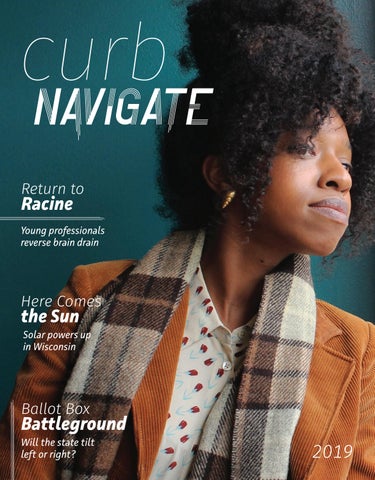
2019 Curb Navigate

Page 1


Return to Racine

Young professionals reverse brain drain

Here Comes the Sun

Solar powers up in Wisconsin

Ballot Box

Battleground

Will the state tilt left or right?

WHERE MEETS

INFINITE

UNLIMITED POSSIBILITIES

To Our Navigators,

t times I find myself tossing and turning at night, mulling over all the possibilities that lie in front of me. Even though I’m indecisive, there’s one thing I’m certain of — without decisions, we wouldn’t exist. In fact, the choices of those who came before us have led us to where we are today and every deciding factor has molded us into who we are now.

Every day we continue to confront new challenges that have the power to stop us in our tracks — sometimes leaving us at a crossroads in our journey. This uncertainty forces us to ask: which way should we go when the directions aren’t always left or right? Whether big or small, every choice can alter the course and even cause us to lose our way. Luckily, they can also help guide us, and through each new path, there’s an opportunity for discovery.

With 2020 on the horizon — and ultimately a new decade coming into view — we must continue to navigate our way through a labyrinth of decisions, where the future can’t always be seen with perfect vision.

Wisconsin is no exception. The direction we choose to take from here will change our destination, shaping the state, the next generation and beyond. In the 18th edition of Curb, we set out to explore uncharted territory and share stories of choice, leading us to this year’s theme: “Navigate.”

From coverage of changes in energy, research and activism to our political fate as a swing state, we embarked on a mission to unravel stories across Wisconsin — in small towns and big cities. As the state transitions into a period of tremendous transformation, we’ve found that our actions are becoming more important now than ever.

Though navigating that journey may seem daunting, “Navigate” guides readers on a path into the unknown, seizing the opportunity to grow and learn in every route we encounter. While these decisions aren’t always easy, we hope readers will see that choice doesn’t have to be confining. It can empower us to find ourselves — no matter which direction the compass leads us.

We invite you to join us in this adventure through every twist and turn in the journey. After all, the possibilities are limitless.

Editorial

Kayla Huynh, Editor in Chief

Ally Melby, Managing Editor

Paige Strigel, Content Editor

Maddie Boulanger, Lead Writer

Sam Jones, Lead Writer

Max Witynski, Lead Writer

Justine Spore, Copy Editor

Kathryn Wisniewski, Copy Editor

Business

Bethany Henneman, Business Director

Capri Whiteley, Public Relations Director

Michelle Navarro, Engagement Director

Megan Growt, Marketing Representative

Kia Pourmodheji, Marketing Representative

Design

Lily Oberstein, Art Director

Elizabeth Jortberg, Production Director

Jaci Moseley, Production Associate

Nicole Shields, Production Associate

Kylie Compe, Photographer

Online

Jade Anthony, Online Editor

Isaac Alter, Online Associate

Jaya Larsen, Online Associate

Claudia Prevete, Online Associate

Natalie Yahr, Multimedia Producer

Publisher

Stacy Forster

Curb is published through generous alumni donations administered by the UW Foundation and in partnership with Royle Printing, Sun Prairie, Wisconsin (c) Copyright 2019 Curb Magazine Unless otherwise noted, all photos are attributed to Kylie Compe
Collage by Lily Oberstein
Photos by Paige Strigel

Solo, Not Alone

hen I was 20 and spring break arrived, most of my classmates threw swimsuits in their suitcases. I carefully rolled wool sweaters, thermal leggings and a new waterproof coat inside packing cubes and fitted them tightly inside my lime-green hiking backpack. My friends headed off to beaches from Miami to Mexico with friends and family to enjoy a week of lazing in the sun. I took a bus to O’Hare International Airport and boarded a flight to cold, wet Scotland — alone.

Despite the conventional wisdom that danger lurks around each corner for a woman unaccompanied, solo female travelers from Wisconsin and all over the world have decided to take their chances. They go in the hopes of finding confidence, adventure and freedom — from other people, expectations and their own fears.

And despite what you may think, they’re in good company. Hostelworld, the largest online hostel-booking platform, reported a 45 percent increase in female solo bookings between 2015 and 2017.

However, in the Midwest, nearly half of adults never move away from their hometowns and 64 percent never live outside their home state. Wisconsin has the fifth-highest percentage among all states of residents who were born and continue to reside here. Perhaps that’s why my family and friends were in such total disbelief when I got on that plane alone.

Sweet freedom

When my flight lands, I have to smile despite my anxieties. Somehow, I made it across an ocean alone.

After finally locating my hostel, I climb three flights of stairs over threadbare carpet, passing suits of armor and walls crowded with heavily framed artwork. Unlocking the door to my room, a mixed-gender dorm filled with half a dozen sets of bunk beds and lockers, I drop my bags on my bed. Standing there, I suddenly wonder, “What now?”

Slowly, the answer dawns on me: whatever I want.

This kind of freedom is a major part of solo female travel’s appeal.

“I think as women, we tend to be more accommodating. So

when you go by yourself, you get to do exactly what you want to do,” says Mary Karsten, a Wisconsin native. When she and her then-husband divorced five years ago, she took a hike.

Literally.

“When I got divorced, I said, you know, what is it that I love to do? And I didn’t even really know. So I just started doing a whole bunch of different things,” Karsten says. Ultimately, she found hiking and women’s hiking groups.

Still, something was missing.

“I had always wanted to take a solo trip, but it kind of scared the bejesus out of me,” Karsten said. One day, she stopped waiting. Karsten put a date on the calendar, requested time off work and told her family.

Emma Moll, a UW-Milwaukee graduate and Madison resident, went solo to find freedom from others’ plans. A friends’ trip — featuring one sweltering, hours-long drive, one phone dropped in the ocean, and one surprise double Tinder date — was the final straw.

Under attack

Whatever our motivations for hitting the road on our own, it’s hard to ignore the elephant in the room.

“My family thought I was going to get myself killed,” Moll says.

Jenny White, who was until recently an operating room nurse in Madison, says her mom was far from supportive when she decided to visit Israel and Morocco.

“My mom’s like, why are you gonna go gallivanting around the world in places where you shouldn’t be?” she says. Those words may not have stopped White, but they hit home in a world filled with headlines about assaulted and murdered adventurous women. Those are extreme cases, no doubt. But the everyday threats that lead women to take precautionary measures in nearly any city seem to loom larger for those who have gone solo.

In the dorm room of a hostel, a middle-aged man on the bed next to mine wakes up from a nap as I stow my backpack. He begins to question me persistently. Where am I from? Why am I here? What are my plans? And was I alone? I feel his

eyes on me as I snap the padlock on my locker and hastily exit the room.

Rule number one of solo female travel: never admit you are alone. Except the rules aren’t really about solo travel. For the most part, they are about being a woman.

Moll says she just takes all the usual precautions while traveling: “no creepy alleys. No being out too late. No being drunk and belligerent.”

White’s mother’s words about going somewhere she didn’t belong stayed with her when she left the country.

“Holy crap, I’m in the Middle East. What have I done?” she remembers thinking as her plane landed in Israel.

After a fitful night of sleep, I roll out of bed and throw on my backpack. I don’t stop moving until I get on a train to Stirling, a city farther north. I try to leave my fear behind. The decision pays off, and I find myself up until the early hours of the morning talking with Laura and Aleyna, two German girls I meet in my new hostel.

Reality did not match White’s fears. Remembering the Middle East, she thinks about the Church of the Nativity in Bethlehem. Reminiscing on Scotland, I remember Laura and Aleyna.

Hooked

White eventually left Madison to become a travel nurse, planning to use the newfound flexibility to see more of the country.

Karsten spent that first solo trip driving through South Dakota, hiking the Badlands.

“Then I was kind of hooked,” she says. Now she sneaks in little trips wherever she can.

Moll usually takes one international trip each year. Thailand might be next, she thinks.

As for me, I spent the past summer as an au pair, living with a family in Italy and teaching their 9-year-old daughter English.

Recently, Karsten stumbled upon a video of Mont Blanc, a mountain in the Alps circuited by popular trails. There must be tons of good mountains to hike in Europe, she thought, but she learned of this one first. So someday soon Karsten will set a date, request off work and go. It’s that simple.

“It’s hard to understand … some of those things that you overcome, once you know that you can do them by yourself, it’s very empowering,” Karsten says. “It’s just really a cool feeling to know you can do those things.”

Paige Strigel traveled by herself to Scotland in 2018.

SUNNY

Side Up

isconsin is poised on the edge of a solar-energy revolution.

In 2018, less than 0.2 percent of electricity was provided by solar in Wisconsin, and the state has lagged behind its neighbors in renewable energy development. But, for the first time, utilities and developers are investing in large-scale projects that complement small-scale rooftop and community installations.

Earlier this year, the Public Service Commission approved a five-fold expansion of Wisconsin’s solar capacity. This is good news for Wisconsin’s electricity consumers because it means fewer carbon emissions, cleaner air and sending less money out of the state to buy fossil fuels. The projects approved this spring are just the tip of the iceberg: Lower prices mean that solar is growing much quicker than many people realize.

“It’s really a hallelujah moment for the renewable energy industry and for advocates because now the economics are on our side,” says Tyler Huebner,

executive director of RENEW Wisconsin, a nonprofit that advocates for renewable energy in the state.

Wisconsin currently has about 100 megawatts of solar capacity installed — enough to power about 15,000 Wisconsin homes, according to the Solar Energy Industries Association — but more than 6,000 megawatts have been proposed to be built by 2022. This means the state could see a 60-fold increase in capacity in the next few years if all the proposed projects are built.

Because of industry jargon, it can be difficult to understand just how significant this is. For context, the large Pleasant Prairie coal plant in southeastern Wisconsin, which closed last year, had a capacity of 1,200 megawatts. So 6,000 megawatts of solar represents about five times as much power capacity. Even if just half of the proposed solar projects make it to completion, this would still be enough energy to equal a coal plant like Pleasant Prairie, since coal plants

run about half the time, whereas solar projects produce electricity about 20 percent of the time.

Of course, some of the proposed projects will not see completion. But Huebner says the 6,000-megawatt number is indicative of momentum in the industry, given that institutions and companies can be required to temporarily front millions of dollars just to have their proposals studied by the Midcontinent Independent System Operator, the organization that manages the Midwest’s electric grid.

From bust to boom

Skeptics long doubted that solar would become a mainstream source of electricity generation because it was too expensive and too variable, producing electricity only during the day.

But Greg Nemet, a professor of public policy in the LaFollette School of Public Affairs at UW-Madison, says that huge declines in cost have made solar energy more appealing to developers.

Dan Litchfield poses with a solar panel near the new Badger Hollow solar farm.
Photo contributed by Emily Hamer of Wisconsin Watch

“The fact that large companies are deciding to install solar — not necessarily because it’s green, but just because it doesn’t use fuel, it’s independent of policy risk and it is inexpensive — that makes me really optimistic,” Nemet says.

The cost of solar has fallen by a factor of 15,000 since the technology was first developed in the 1950s, according to Nemet’s new book, “How Solar Energy Became Cheap: A Model for Low-Carbon Innovation.” The price fell from about $300,000 per megawatt hour in today’s dollars in 1954 to about $20 in sunny places today.

In just the last decade, utility-scale solar prices have fallen 88 percent, according to Lazard, a financial advisory and asset management firm. These price declines mean solar is more competitive than it used to be, Nemet says, making it a good choice for utilities looking to add new generation or replace

retiring coal plants.

Big solar capacity additions in Wisconsin are also coming from utility-scale projects, such as the 300-megawatt Badger Hollow solar farm in southwestern Wisconsin near Dodgeville, which was approved this spring. Three large utilities, Madison Gas and Electric (MG&E), We Energies and Wisconsin Public Service have purchased the electricity that will be produced by that project, which is being built by Invenergy, a Chicago-based developer.

Utilities around the country have been under increasing pressure from consumers and policymakers to reduce their carbon footprints, and MG&E and We Energies have responded by setting respective goals to be 100 percent carbon neutral and reduce carbon emissions 80 percent by 2050. Solar is expected to play a big part in meeting those ambitious goals, especially as advances in battery storage — another technology that is rapidly becoming cheaper —

help to offset the challenge of storing solar energy for times when the sun is not shining.

Happy homeowners

While multimegawatt projects are often owned by utilities, solar is unique in that homeowners, businesses and nonprofits can install it and start producing their own electricity.

Much of Wisconsin’s existing solar capacity is located on private rooftops, where it has been installed by homeowners and businesses interested in providing their own clean, renewable energy.

Patty Prime, a retired information technologist at the Wisconsin Alumni Research Foundation, installed panels on her home on Madison’s east side almost 15 years ago, in 2005.

For Prime, the investment seemed logical even back then, when solar had a lower public profile. “We thought ... if you buy a car, you make payments for a certain number of years, and the value of your asset just plummets,” she says. “But if you buy solar, I mean, you continue to enjoy the benefits the whole lifetime, and then eventually it’s paid off, and you still get them. That’s pretty cool.”

Even better, an investment in solar pays for itself over time by offsetting utility bills. Prime says she receives a credit on her bill from MG&E about nine or ten months out of the year. She anticipated that the payback period might be 15 to 17 years, but it ended up being about 11.

Dan Robbins, who lives in the Milwaukee suburb of Glendale, Wisconsin, installed solar in 2014 because he liked the idea of green energy and had heard about the decreasing cost of installation.

Robbins, who is retired from a technical support position at a chemical manufacturing company, got a quote from a local solar installer, Arch Electric, and determined that he would have a payback period of

Solar panels are installed at the Wisconsin Energy Institute.

about 10 years. He had a 7.5-kilowatt array installed on his roof, and has been satisfied with the system, which he says runs smoothly and is aesthetically pleasing.

“I haven’t paid a monthly bill since we started,” Robbins says. “Our usage actually went down, since we also installed LEDs and more efficient windows.”

He says the only challenge came not from installation or maintenance but from We Energies, who in 2014 tried to change rules related to monthly billing base rates and net metering, which Robbins says would have made it more difficult to earn a payback on his home installation. He spoke on the phone with a vice president at We Energies, and RENEW Wisconsin challenged the utility’s proposal at the Public Service Commission. Ultimately, a grandfather clause allowed Robbins to retain his original deal with We Energies for 10 years.

These days, RENEW Wisconsin’s Huebner says payback periods in the 10to 12-year range are typical for rooftop arrays. He also notes that Wisconsin has some policies — such as net metering — that make it easier for homeowners to install solar by allowing them to be paid for the excess electricity they generate and send to the grid, meaning it gets used by their neighbors.

Community benefits

Single-family homeowners are not the only ones who can benefit from solar installations. Big opportunities also exist for farmers to earn revenue by leasing their land to solar developers, and for communities, such as apartment buildings and neighborhoods, to buy solar through community solar programs.

“Without question, [it’s] a very exciting time for renewable energy in Wisconsin.”

In rural Wisconsin, opportunities for

Invenergy partnered with a prairie restoration company, Applied Ecological Services, to design a site-specific ground cover that includes shade-tolerant native prairie and savanna grasses. Pollinating insects living under the panels can venture onto nearby fields to also pollinate crops.

Construction on Badger Hollow began in mid-October 2019 and will continue in 2020. The company estimates that the project will generate $27.6 million in new revenue for Wisconsin during construction, including 500 construction jobs and $1.5 million in annual earnings over the lifetime of the project, increasing local tax revenues about 12-fold.

The Badger Hollow project will

Rooted in Tackling brain drain one community at a time

Racine

Left: Megan Dorsey, co-founder of What’s Up Racine, sits in front of a mural in Racine, Wisconsin.
Right: What’s Up Racine cofounder Brianna Wright points out her contribution to a mural.

young professionals tend to leave. As young professionals face the decision of where to land after completing their education, community members in mid-sized Wisconsin cities like Eau Claire, La Crosse and especially Racine work to redefine their city’s narrative to attract young professionals and further grow their communities.

This migration is known as “brain drain.” According to a 2019 study by the Wisconsin Policy Forum, a nonpartisan policy research organization, neighboring states outpace Wisconsin in attracting individuals with a bachelor’s degree or above.

The study found that 20 percent of 31- to 41-year-olds born in Wisconsin who had moved away from the state were considered “highly educated.” Only 10 percent of people in this age group who were born elsewhere and moved to Wisconsin had a bachelor’s degree or higher, however, resulting in a brain drain of 10.7 percentage points. In comparison, Wisconsin’s neighbors experienced the opposite: Illinois had a “brain gain” of 10 percentage points and Minnesota had a net gain of 1 percentage point. Since 1990, Wisconsin remains one of five states in the U.S. with the largest “brain drain” gaps.

Many elements factor into a young professional’s decision on where to move after college, but one key motivation is economic: They follow job opportunities.

“Wisconsin faces the challenge of having two of the Midwest’s most dynamic metro areas — Chicago and Minneapolis — near its borders, which draw highly educated people away from the state,” the report says.

While Wisconsin lawmakers have initiated several policy solutions, Racine is trying another approach. The Racine Area Manufacturers and Commerce organization and their group, Young Professionals of Racine, aim to quickly connect newcomers with active community members, hoping

to integrate them into the community, according to Anna Clementi, the organization’s vice president of operations and coordinator of Young Professionals of Racine.

Weslaski is part of the Young Professionals, and she’s often asked why she came back to Racine.

“I feel like that is such a sad question,” Weslaski says. “And my answer is always that you can make the sun shine anywhere that you’re at, and there’s beauty anywhere that you’re at.”

Racine is a puzzle piece in a larger movement in Wisconsin.

Megan Dorsey was 26 years old when she moved to Racine with her fiance. She was looking to make new friends, so she made a Facebook page to figure out what young people were doing in their spare time.

In essence, she asked: What’s Up Racine?

Intrigued by Dorsey’s idea, Brianna Wright responded immediately. She was 24 at the time and working as a freelance graphic designer. They soon planned their first event, which they called a “Big Ideas Mixer,” where they asked the diverse attendees, “What do you see for the future of Racine? Or what do you want this group to stand for?” Almost three years later, many of these people are still involved.

The newfound leaders define themselves as “a social rebranding initiative with the end goal of making Racine a destination city for young

professionals, students, creatives and entrepreneurs.”

Through Dorsey and Wright’s efforts, What’s Up Racine has become a connecting force both between different local groups and the greater Wisconsin community of millennials and young professionals. Their social media presence (@WhatsUpRacine) amplifies this positivity, growing and connecting their audience.

What’s Up Racine aims to host monthly events related to art, music and culture, especially downtown. With Racine Area Manufacturers and Commerce, they hosted Wisconsin’s third-largest Young Professionals Week and are working to redefine an area of downtown Racine as an arts district called “Uptown,” where they’ve installed eight new murals.

Despite having their hands in so many projects, What’s Up Racine is completely grassroots-based and operates without a budget. While they’d like to recruit more young people, that’s still in development.

Fortunately, many are working together to make the community a better place.

“I want to be a really good steward with the time that I’ve been given and the city that I’m living in, and better it,” Weslaski says.

de Voces

Wisconsin

arissa’s dedication to political advocacy in the Latinx community took on new urgency in 2010, when she was only 15.

“All I remember was that my dad opened the door, and they were looking for someone that we didn’t even know — so they took him,” says Larissa, who has asked that her last name not be used. “My dad has no criminal record, no anything ... Me and my brother were there, so it was not a good situation to go through.”

Larissa’s experience allowed her to recognize the lack of resources and support for Latinx individuals in her community. She realized that she was just one of many children who have witnessed their parents being taken away by U.S. Immigration and Customs Enforcement, or ICE.

Communities of color have faced racial disparities throughout Wisconsin, according to a WalletHub study that

ranked Wisconsin the lowest state for racial progress in most categories. After seeing President Donald Trump’s negative rhetoric toward immigrants in 2016, Latinx immigrant communities and organizations were deeply concerned and began to realize the importance of getting more eligible Latinx individuals to the polls for the 2018 midterm and the upcoming 2020 presidential election.

Historically, community organizing to mobilize the Latinx vote has been successful. According to Benjamin Marquez, a political science professor at UW-Madison, the Mexican-American movement in the 1960s, known as the Chicano Movement, was very active in the election of President John F. Kennedy. The largest and oldest Hispanic organization in the country, the League of United Latin American Citizens, has also historically encouraged Latinx people to register and vote.

Larissa’s experience with her father

was “really, really traumatizing,” she says. “The only people that were there for us … in any way was Voces de la Frontera.”

Spanish for “Voices from the Border,” Voces de la Frontera was originally a newspaper from Austin, Texas, that was brought to Wisconsin by co-founder Christine Neumann-Ortiz. Inspired by advocacy work that was being done in the community, Voces de la Frontera became a membership-based community organization, powered by “low-wage workers, immigrants and youth” to protect and expand civil and workers’ rights from a grassroots level, according to the organization’s mission statement. Electoral work in the organization falls under the advocacy arm Voces de la Frontera Action.

Behind these organizations are people who recognize the power of the Latinx vote in Wisconsin. Eloisa Gomez first became politically active when she was 16 years old, and after Trump was elected into office, she knew it was her time to start organizing again in Milwaukee. Gomez, now in her 60s, reached out to the Wisconsin League of Women Voters, a nonpartisan organization that works on the issues that concern its members and the overall public. The League of Women Voters of the United States specifically works to encourage active participation in government by informing voters on current issues. Gomez saw potential and reached out to former colleagues who were involved with the league for a chance to create a new initiative focusing primarily on the Latinx community.

Along with those colleagues, Gomez created the Comité por el Voto Latino/ Latinx Voter Outreach Team. Its purpose is to increase the number of Milwaukee Latinx voters by primarily targeting

Above: Larissa leads a meeting for the organization Voces de la Frontera Action. Right: Centro Hispano is an organization that offers resources and services for Dane County’s Latinx community.
Photos by Michelle Navarro

Milwaukee’s south side through utilizing the League of Women Voters-Milwaukee County’s resources, volunteers and team members’ own connections and resources, according to the Latinx Voter Outreach Team 2019 Action Plan Summary.

“The highest number of Latinx residents in the state of Wisconsin is on the south side of Milwaukee, and I wanted to focus on that,” Gomez says.

A main issue that Gomez and the Latinx Voter Outreach identified was the lack of bilingual resources, leaving out eligible voters who only spoke Spanish.

“There was hardly any bilingual literature available, not only in Milwaukee,” Gomez says, “but several of us went onto the California and Texas websites to look for literature in Spanish on their websites. And we hardly found anything.”

The Latinx Voter Outreach team took on the task and began translating registration information themselves. They created a 2018 plan of action for the election and committed to translating, printing and distributing the nowbilingual resources on voter registration and education to parishes and community organizations of Milwaukee’s south side. They hoped to enable the Latinx communities to register and vote in the 2018 governor’s election.

Voces de la Frontera and Voces de la Frontera Action also made large strides in time for the 2018 election by developing a relationship-driven voter engagement strategy, according to a statement from Voces de

la Frontera Action.

Fabi Maldonado, statewide political director at Voces de la Frontera Action, describes the relational voter program as a tool that allows them to mobilize voters by using pre-existing personal relationships.

“You have to start from somewhere. If you don’t, then we’re never gonna accomplish anything. So it’s really, really important to stay active.”

“These people, essentially, who are part of our community, have these personal relationships with people already,” Maldonado says. “So like their brothers or sisters or aunts or moms, uncles, and we’re going to be texting each other ... letting them know this is when the April election is going on.”

In less than six weeks, Voces organized 410 of their members to create a network of 5,600 Latinx voters, 67 percent of whom were new voters, according to a Voces de la Frontera Action statement.

This was the largest Latinx relational voter program in the state and second largest in the country, and it contributed to increasing the Latinx voter turnout by 33 percent, compared

to the midterm elections in 2014. Exit poll data suggested that the increased turnout of Latinx as well as black voters in Milwaukee made the difference in electing now-Gov. Tony Evers — who supports giving undocumented immigrants the ability to qualify for driver’s licenses and in-state tutition — over incumbent Scott Walker.

The Latinx Voter Outreach Team plans to continue working on increasing Latinx voter turnout in 2020. Gomez and the other women behind the team hope to keep sharing bilingual voting information and registration materials and building stronger community ties to encourage people.

Reflecting on the growth that Voces de la Frontera has made since she first started, Larissa is prepared to continue the fight with Voces de la Frontera Action for yet another increase on voter turnouts in Latinx communities.

“It was a group of six, 10, maybe 20 people at the most knocking on doors, going up to churches going outside El Rey, which is a big Mexican store in Milwaukee,” said Larissa. “You have to start from somewhere. If you don’t, then we’re never gonna accomplish anything. So it’s really, really important to stay active.”

Memory Devoted to

Wisconsinites mobilize to fight Alzheimer’s disease

“ o not ask me to remember ...” That’s the beginning of a poem that lives in a frame on the wall of Carolyn Scheuerell’s room at Park Place Assisted Living.

“Just remember that I need you / That the best of me is gone / Please don’t fail to stand beside me / Love me ’til my life is done.”

Kent Scheuerell does just that for his wife, who has been living with Alzheimer’s disease for the past 10 years. Until last December, Scheuerell was his wife’s primary caregiver before circumstances forced her to move into Park Place Memory Care in Platteville, a city in southwestern Wisconsin. He now visits every day.

On some days, they dance together — something they’ve been doing for almost 50 years. “I met her when I asked her to dance,” Scheuerell says, remembering the night when he first led his future wife onto the dance floor.

Now, they dance in her room to “Smile” by Nat King Cole and Glenn Miller’s “In The Mood.” But today, there will be live music in Park Place’s lobby. Residents will gather around a baby-grand piano to listen to music, tap their feet, and watch Kent and Carolyn dance. When they dance, he gets his wife back. “When the music starts, she starts swinging and dancing, and smiles more than otherwise,” Scheuerell says.

There is something about being close to a person with Alzheimer’s disease that inspires people to dedicate their lives to fight against it. Scheuerell was initially afraid and tried to hide his wife’s diagnosis but now finds himself engaged in the Alzheimer’s community. Many people across Wisconsin point to personal experiences with Alzheimer’s

and dementia as inspiration for their involvement. This community is guiding Wisconsin toward a future where caregivers feel more supported, and maybe, thanks to research at UWMadison, loved ones of those with Alzheimer’s can start hoping for a cure.

In Wisconsin, loving someone with Alzheimer’s is a common experience. The disease is the sixth-leading cause of death in Wisconsin, and, according to the Alzheimer’s Association, the number of people 65 or older with Alzheimer’s disease in the state is estimated to increase 18 percent by 2025.

This experience galvanizes those who are working to beat it. Dr. Nathaniel Chin was finishing his internal medicine residency when he heard that his father had been diagnosed with Alzheimer’s. His father had been a family care physician and was Chin’s inspiration to pursue medicine. Chin, 35, is now a memory care provider with UW Health and a researcher with the Wisconsin Alzheimer’s Disease Research Center.

After starting a new position as a dementia outreach specialist at the Alzheimer’s and Dementia Alliance of Wisconsin, Becky DeBuhr started noticing changes in her mother-inlaw. “She would have some paranoid thoughts about people stealing her money or taking her purse. She was often misplacing things to the point of not remembering at all where she could find [them],” DeBuhr says. “She explained to us that she felt like she was going to get lost.” Eight years after being diagnosed with Alzheimer’s, her mother-in-law passed away. Now, DeBuhr serves as the program director at the alliance, a nonprofit

Kent Scheuerell and his wife, who has Alzheimer’s disease, dance together in the lobby of Park Place Assisted Living.

that provides free resources to families dealing with Alzheimer’s.

For Wisconsin State Rep. Mike Rohrkaste, his mother was in Ohio when she began experiencing dementia. Rohrkaste couldn’t be there to help her, but he still had important decisions to make. “Eventually, I had to put my mom in a nursing home because she just couldn’t live on her own. It was too dangerous for her or for others,” Rohrkaste says. “It was unfortunate that I had to do that, because I think that ... she might have lived longer if she would have been able to stay at home.”

Understanding Alzheimer’s

Alzheimer’s and dementia are not one and the same. According to the Alzheimer’s Association, dementia is a range of conditions defined by loss of memory, language, problem-solving and other skills, making it difficult for those affected to independently manage their lives. Alzheimer’s disease is an abnormal process in the brain which causes symptoms such as

cognitive impairment or dementia. But having dementia does not necessarily mean that a person has Alzheimer’s, just as Alzheimer’s disease could cause mild cognitive impairment but not dementia.

Symptoms can manifest in different ways. Scheuerell, 72, knew his wife, also 72, was having trouble when he opened their checkbook one day to find it a mess. Carolyn, who had been a bank teller before retirement, always balanced their checkbook perfectly. When he asked her about it, she seemed not to care.

He went with her to the next doctor’s appointment, where it became clear that she was not as mentally fit as before. That’s when he was introduced to the local Aging and Disability Resource Center and the Alzheimer’s and Dementia Alliance, organizations that he says saved him.

A network of support

Spread across the state, Wisconsin’s Aging and Disability Resource Centers and the Wisconsin Alzheimer’s Institute

affiliated Dementia Diagnostic Clinic Network bring quality information, dementia expertise, medical screenings and outreach specialists to communities, especially in rural areas. “That’s really the progressive part here in Wisconsin — that no matter where you are in the state, most people can pretty much get to a local memory diagnostics clinic,” DeBuhr says.

Through these networks, the centers’ specialists connect with people in Wisconsin counties. They have the initial difficult conversations, which are the catalyst for connecting patients and caregivers to local resources. Scheuerell has taken nearly 20 of the free classes that the alliance offers.

Support groups provide a space where caregivers can ask difficult questions and receive honest answers that only other caregivers can give. Scheuerell says the group he attends has become like family and the bond they create is special.

The alliance also offers memory cafes, where caregivers can take their

patients to “experience music and art and movement, connection and cognitive stimulation,” DeBuhr says, “and we do a lot of laughing.” Twice a month, Scheuerell and his wife go to one of these memory cafes.

“If my wife smiles, it’s worth it,” he says of the experience. “If she’s having a good day, I am, too.”

He never imagined how involved he would be, but he has become a liaison between the help and those who need it. Now, he always carries a card in his wallet that outlines who to contact at the alliance.

An uncertain future

It is difficult for families of Alzheimer’s and dementia patients to know what each day will bring. Scheuerell says it can be difficult to plan for the future, including navigating financial needs and understanding the legal intricacies of their situation, while dealing with the daily challenges of caregiving.

“We don’t know what’s going to happen,” Scheuerell says, “so we just have to do what you have to do.”

As a member of the Wisconsin State Dementia Plan Steering Committee, which helped create the state’s new dementia plan for 2019 to 2023, Rohrkaste understands the importance of supporting caregivers.

“The help can vary between health care help, to potential nursing home options, to just staying active in the community, or getting personal care workers to come in or getting respite care,” Rohrkaste said.

But legislators and nonprofits aren’t the only ones contributing. Through the Wisconsin Registry for Alzheimer’s Prevention, people can participate in groundbreaking research. The registry is a home-grown program, accepting only participants from Wisconsin. The study has been running since 2001, when it was created by Mark Sager, the same physician who diagnosed Chin’s father.

“It is one of the most important and foundational studies in the entire world,” Chin says. “[It] is probably the first of its kind to recruit people who had a family history of Alzheimer’s disease and not just the person who has Alzheimer’s disease.”

He says the environment in Wisconsin makes the research possible.

“I think there’s a real relationship between the research that we’re doing and the researchers, and the community that’s engaging in that research,” Chin says. “And I do think that that is something very special.”

Researchers are also seeing a big increase in funding. The National Institutes of Health will spend more than $2 billion on Alzheimer’s disease research in 2019 and are expected to commit $350 million more in 2020.

“I think we’re at this precipice where something is going to happen in the next few years that is going to be monumental for the field,” Chin says. “I do think 2020 marks a change in the acceleration towards that big moment when we actually have something very

meaningful to share with people who have Alzheimer’s.”

While researchers continue to work toward a breakthrough, the community will continue offering solutions to better the quality of life for patients and caregivers.

DeBurhr says the most important factor for those involved is remaining hopeful.

“I think we’re at this precipice where something is going to happen in the next few years that is going to be monumental for the field.”

“I think that looking into the future, probably for a caregiver and the person with dementia, is to always keep the idea of hope central,” DeBuhr says. “That today may not be a great day, but there are things that we can try, or we can learn, or we can do, to always keep hope as part of the journey with dementia.”

Scheuerell knows that a cure would come too late for his wife, but he takes comfort in knowing that it may give their children peace of mind.

And without every resource that helped them along the way, they could not be here in the lobby of Park Place, waltzing to piano music. And you can almost picture them as they were, nearly 50 years ago, when he first asked her to dance.

SECOND ACT

Baby boomers redefine retirement

n any given Wednesday at 3 a.m., almost two hours before the sun will rise, John Paider finishes his 12-hour shift at A to Z Machine Company Inc., an employee-owned machine shop in Appleton. While the average age of his second-shift coworkers stands at 31, Paider is 73. Not only is he the oldest member of the second-shift team, he’s also the oldest employee of the entire company. Although working the night shift and more than 40 hours a week may not be a goal — or even physically possible — for most people his age, this is how Paider likes to stay busy.

Paider, part of the baby-boom generation born between 1946 and 1964, grew up on his family’s dairy farm in Denmark, Wisconsin, south of Green Bay. He developed his work ethic when he was about 3, when he was assigned the job of feeding his family’s cows.

About 59 years later, in 2008, Paider retired from his full-time job at a machine shop. He continued his childhood passion and helped out on local crop farms, but the job’s hours were sporadic.

About two years later, he received a phone call from A to Z Machine. Paider’s son-in-law — who was fixing a copier in the company’s office — had mentioned to a company partner that Paider, who was bored at home, needed a job to stay busy. Although he had no real financial

by Lily Oberstein

John Paider returned to a career in machining after initially deciding to retire.
Photo

reason to return to the labor force and taking the job meant driving 61 miles every day he worked, Paider jumped at the opportunity.

He restarted his machining career at 64 years old, and even on his first day at A to Z Machine after a two-year machining hiatus, Paider was anything but nervous.

He was excited.

“I always tell [my boss], as long as I’m healthy and able to do my job, I say, ‘Please let me work,’” Paider says.

According to the National Academy of Social Insurance, the age to collect full Social Security retirement benefits is 66. However, the Pew Research Center reports that baby boomers are choosing to stay in the workforce longer. In 2017, 19.1 percent of eligible Wisconsin retirees were still working — nearly a 5 percent increase since 2000, according to the UW-Extension Center for Community and Economic Development.

Retirement can be a vast unknown. Some have to budget for more than 30 years, depending on when they choose to retire; others decide to continue to work out of necessity or personal choice; and some retire and then re-enter the workforce just a few years later. Whatever their reasons, as Wisconsin’s baby boomers move through their retirement years, they are altering how retirement could look for future generations.

According to Crystal Carlson, a senior financial adviser at Merrill Lynch Wealth Management in Madison, financial planning — the backbone of outlining and preparing for retirement — has changed. A decade ago, adults who were thinking about retirement started to speak with financial planners in their late 30s or early 40s. Now, the standard is shifting, and clients are beginning to work with a financial planner in their early 20s — or as soon as they start their careers. Carlson attributes this change in mindset to the parents of these young adults, who are

Whatever their reasons, as Wisconsin’s baby boomers move through their retirement years, they are altering how retirement could look for future generations.

serving as examples to their children for why they should start planning earlier in life.

“[They] will start asking about, ‘OK, how much should I save? What’s the best way to save?’ because I think there is a lot more awareness about the long-term detrimental side effects of not saving, so we see it a lot earlier,” Carlson says.

Susan Lampert Smith also had some financial considerations before she announced her retirement in fall 2019. Lampert Smith, 60, is a media relations strategist for UW Health and the University of Wisconsin Carbone Cancer Center and a senior lecturer at UW-Madison. She has worked two jobs throughout most of her adult life and credits both for her ability to retire at a younger age.

Although Lampert Smith’s financial planner originally advised her to retire at 62 because of her finances, she was able to push up her end date by rebalancing her monthly budget for when she did retire.

“Start early if you can, because you don’t think you’ll get old, but you will,” Lampert Smith says.

While many people, such as Lampert Smith, hope to retire early, others forgo their retirement plans completely to continue their careers. Steve Walters, 72, chose not to retire from his career as a journalist out of passion for the state’s political climate. He instead opted to continue working part time as a senior producer for WisconsinEye, a public affairs cable network in Madison.

Twelve years ago, Walters’ friends met with a financial planner and were told they would need to save $1 million to retire comfortably. Although Walters

was shocked by the sum, it served as a wake-up call.

“We aggressively saved and paid off everything like five years ago, so we are debt-free, which means I don’t have to work,” Walters says of his shared finances with his wife.

Because his paychecks aren’t needed to support his family, Walters will use his extra income this upcoming year to pay for things such as vacations and two new roofs — one for his house and one for his cottage.

But for those on the cusp of retirement, continuing to work is not always for personal fulfillment. With common financial setbacks, such as divorce or sickness, funding retirement isn’t easy. According to the Associated Press-NORC Center for Public Affairs Research, 32 percent of adults who are 50 years or older do not think they will be prepared when the time to retire comes.

Carlson says that while older generations and some of the early baby boomers could rely on pensions, the majority of retirement costs fall on the shoulders of the retiree, increasing the importance of the retirement plans companies offer.

She recommends her clients replace 75 percent of their full-time income in retirement. If her clients’ retirement fund falls short of their retirement savings goal, the options are to either save more or work longer.

For Lampert Smith, striking a balance between having enough money to see herself through retirement, as well as enjoying her life while still healthy, was one of the biggest considerations in her choice to retire.

She had talked with a friend about what the two would do after they

retired — but shortly after her friend reached that milestone, she fell ill and passed away. This caught Lampert Smith’s attention.

“You know on one hand, we think we’re going to be retired for 30 years, but you don’t know how much time you have. The time that you have that you’re in good health or you can actually do fun things is short, so I decided to maximize mine,” Lampert Smith says.

Paider’s thoughts on retirement are different, however. He thinks that not working will have negative effects on his health. He says many of his retired friends who haven’t continued working on other projects look older and are in worse health than he is.

Instead of drawing up a retirement plan, he jokes he’ll quit working only when he can collect his life insurance policy.

Walters isn’t as worried about staying busy after he retires, though. Already an active volunteer in his community, he would simply spend more time serving at his church.

Top: After working for more than 30 years, Susan Lampert Smith recently announced her retirement.

Bottom: Steve Walters, now a senior producer for WisconsinEye, wasn't quite ready to give up his job as a journalist.

But he won’t step away from his job quite yet. “How can one retire looking at the next fascinating election year?” he says.

Still, Walters’ future holds a lot of personal unknowns. “Will I still be healthy, will I still be interested, will I still find the process and the people and the public policy interesting?” he asks.

Lampert Smith does not intend to make plans for her first year of retirement besides traveling and spending more time with her family. While the ambiguity of retirement can be scary for some, Lampert Smith is excited to transition out of the workforce, saying that the experience reminds her of the thrill of her youth.

“Remember when you were in high school and you knew you were going to college, but you really didn’t know what college was?” she recalls. “That’s kind of where I’m at right now. It’s like, you know there’s going to be this different world, but you don’t really know what it is.”

FOR THE FOODIES

Navigating life takes a lot of things: courage, strength, support, preparation and, of course, food. While you’re navigating your way through Wisconsin, be sure to try these essential (and tasty) treats to stay nourished along your journey.

Cheese Curds (fried and fresh)

Wisconsin’s most famous tradition, cheese curds, can be found at practically every classic Wisconsin restaurant or event, from farmers’ markets to festivals.

Bratwurst

Wisconsin is home to three of the biggest bratwurst producers in the country. If you want to truly experience this Wisconsin tradition, you have to boil the brats in beer and onions before you finish them off on a grill. Yum!

Cream Puff

Each year more than 400,000 cream puffs are consumed at the Wisconsin State Fair — and for good reason. The pastries are filled with a thick layer of cream and covered with powdered sugar for a mouthwatering sweet treat.

Frozen Custard

Whether it’s a nondescript shop on the side of the road or the famous Culver’s frozen custard, you’ll never regret stopping for a scoop. Trust us.

Pączki

Wisconsinites love eating this Polish bakery treat, especially on Fat Tuesday. While the tradition is strongest in Milwaukee, people come from all over Wisconsin each year to celebrate “Pączki Day.”

Fish Fry

Pasties

In typical Wisconsin fashion, we love to take a delicious food and make it even better by deep frying it. While Friday fish fries are most popular in the summer, most places in Wisconsin continue to serve them all year long.

A northern Wisconsin favorite, pasties are traditionally made with meat and vegetables baked in a pastry shell. It’s a whole meal, wrapped up into a delicious package.

ButterBurger

Made famous by the Wisconsin-based chain Culver’s, Wisconsinites toast their burger and bun in butter. Let’s be honest, it’s just better that way.

Kringle

This Danish delicacy is the official Wisconsin State Pastry. Its circular shape makes it a great treat to share with friends or save all for yourself.

Beer Cheese Soup

Wisconsinites’ two favorite things, beer and cheese, are combined into a flavorful soup to help us stay warm in the winter. Need we say more? 1 2 4 3 5 6 7 8 9 10

CHEESE CURDS KRINGLE

Photos licensed under Creative Commons via Flickr by (from top to bottom): Pockafwye, vxla, beautifulcataya, Lynn Friedman
FISH FRY
CREAM PUFF

Decisions Decisions,

ike Titelbaum’s goal was to stay as dry as possible at the Badgers game. He decided days in advance that he wouldn’t bike to the stadium because he was confident that it would rain. By the time Saturday rolled around, Titelbaum saw that he was right about the weather. Even so, he decided to drive, park and walk from his car to his seats just to see his beloved Badgers play — a choice that led him to get “very, very wet.”

Every day, the average adult makes about 35,000 conscious decisions like the ones Titelbaum made about his transportation, according to Cornell University researchers. Numerous theories spanning across many disciplines explain how these decisions are made and if they can be classified as good or bad. In Titelbaum’s case, he made the wrong choice for staying dry, but wasn’t upset about it because, he says, “It was fun anyway!”

Wouldn’t it be nice if there was a way that we could always know what the right decision is? Experts in decisionmaking say that more than one factor influences how and why we ultimately come to decisions.

Brett Schneider, a UW-Madison psychology graduate student, can tell you where the emotions involved in decision-making happen in your brain. Jenny Greiber, the coordinator of UWMadison’s analytics of decision-making certificate program, could look at trends in the results achieved by others

making the same choices. Father Luke Syse, a Catholic priest, may advise you on what decisions will lead to the highest levels of fulfillment. Gretchen Chapman, a social science researcher at Carnegie Mellon University, can tell you what desires might be driving your decisions.

In Titelbaum’s role as chair of the philosophy department at UWMadison, he spends a lot of time thinking about decision-making — beyond choices about how to travel to football games.

Recently, Titelbaum has been looking at decision theory through the lens of Bayes’ theorem, which proposes that individuals make choices based on how they think the world works and what they believe they want. Therefore, people make the wrong choices if they have an inaccurate understanding of the world or they want the wrong things.

How the world works

Bayes’ theorem would have you think that a complete understanding of how the world works would translate to better decisions. However, with limitations in time, resources and capacity, an imperfect view of how the world works is often a better option than having all the facts.

This may seem counterintuitive. However, Chapman doesn’t think it’s possible to know all the facts. She studies decision-making and has created a decision science

undergraduate major that highlights how to make decisions through an interdisciplinary approach.

“You’re going to not pick the optimal solution; you’re going to pick the goodenough solution because you want to be efficient about using your time and resources and information,” Chapman says. “Finding the just good-enough solution is actually rational in a certain sense.”

Chapman looks at decisions through a practical lens, discussing actual decision-making that we can implement in our lives. But when Titelbaum applies Bayes’ theorem to decision-making, he has to use complex functions and confidence intervals — aspects that aren’t often available in daily life.

“Formal decision theory, like mathbased decision theory, is not typically an awesome tool for making decisions in everyday life because it requires attaching [confidence intervals] to things when you don’t have numbers for those things,” Titelbaum says.

However, the field of data analytics and statistics can simplify this by utilizing modern technology to provide new possibilities for those who want to apply statistical or probability calculations in their daily lives, helping them make decisions about what to buy or who to hire, for example.

Greiber is quick to share data methods to make more well-informed business decisions. She notes that before students can use data points to make better choices, they must learn how to visualize them.

While you could look at the ability to process the world around you through data analytics, you could also see it on a neurological level. Schneider has spent hundreds of hours looking into people’s brains. He studies the ventromedial prefrontal cortex, an area of the brain that manages fear, subsequently helping people make social and interpersonal decisions by triggering unpleasant

memories from the past.

One idea he has investigated is the somatic marker hypothesis. This theory explains that when humans go through emotional experiences, those perceptions create markers in their brains that influence future decisionmaking. For instance, if a small child eats a bratwurst only to discover she doesn’t like the taste, a somatic marker is created in her brain that reminds her of her previous unpleasant experiences at her next cookout.

Even after spending a rational amount of time weighing options, analyzing all the available data and having functional somatic markers to remove some of the unknowns, individuals are not guaranteed to make the right decisions for themselves.

Knowing what you want

Titelbaum says you still may not make the right choices if what you want doesn’t line up with your best interests. He says that some people “want the wrong kind of things in an ethical sense, so they make poor decisions that are morally bad, or they want the wrong kinds of things because they don’t understand what will make them happy or what will make them thrive as a person.”

Deciding whether or not your goals are correct is far more ethically ambiguous than understanding what you know about the world. Gaining more external information could change your view about how the world works, but analyzing your needs, wants and desires is more internal.

An economist or data scientist might not be willing to make judgment calls about what is worthy, but philosophers, including Titelbaum, often address these types of questions head on.

“Economists start out just assuming that everyone has preferences, and whatever your preferences are, as long as they kind of mesh together in a rational way, that is fine, and we are just going to figure out how to get

Mike Titelbaum’s office is full of books on philosophy and decision-making.

you the things you prefer,” he says. “Whereas a philosopher will say, ‘Wait a second. Are all sets and preferences equally good?’”

Syse is a priest at St. Paul’s University Catholic Center, where he looks at day-to-day decisions people face, rather than the larger theories. As a priest, Syse considers himself “like the family practice doctor” in terms of providing help with decisionmaking.

In his own life, Syse has made choices that he believes have and haven’t made him happy. He has found happiness in his career, but he spent his undergraduate education pursuing a degree in agricultural engineering, a path that may have made him happy, but not as happy as he is today.

“At the beginning of my senior year, I decided to become a priest and enter seminary. But that thought had been in my heart since age 12,” Syse says. “I just didn’t pay much attention to it till I came to college, and in college, I rediscovered my own faith and realized I would be happiest putting God first in my life.”

If we know that people act against their own self-interests — by, say, choosing unfulfilling majors, dating

people they know are bad for them or eating dairy when they know they are lactose intolerant — what can we do to stop that?

Does it matter? Are bad decisions even really bad? If Titelbaum had achieved his initial goal of avoiding rain on his way to the football game, he would have missed an event that he really enjoyed. Instead, he went against both his belief about how the world works, based on accurate weather reports, as well as his goal of staying dry, and made a decision that made him happy.

Syse says people must make mistakes, but he fears that many are too fearful of bad decisions to act at all.

“I don’t see too many really bad decisions,” Syse says. “I almost wish more bad decisions were being made, because that’s how you learn. And there’s kind of a fear of failure out there. So, I am not concerned about bad decisions, actually. I’m more concerned about the person who is stuck and doesn’t make a decision, doesn’t try anything.”

College WAYFINDERS

ach fall, thousands of students arrive at UW-Madison to start the next chapter of their lives. They attend orientation wide-eyed and brimming with enthusiasm, looking forward to the college years to come. Sitting in the Kohl Center, the new class of Badgers is welcomed and told how the application process was “selective” and that they’re “the best of the best.”

But within this group, there are students wondering, “Is this a mistake? Am I supposed to be here? Do I really belong?”

These are common questions among first-generation students, who are the first in their immediate families to attend or graduate from a four-year institution. According to statistics from UW-Madison, 17 percent of the class of 2020 self-identified as first-generation students. Some experience nagging internal doubts about whether they truly belong and deserve to be in college, along with thoughts about the family they are leaving behind.

her small town would give her more options.

She says arriving on campus was an overwhelming experience. Moving to a new place while taking classes, working and being involved was a lot on her plate, but it was what Cailey thought she was supposed to do. “I felt like I was starting off behind the start line where non-first gen students were, so I tried to make up for it by doing way too much,” she says. “Because my parents did not attend college, I did not know how to gauge myself to past experiences or how to ask for help.”

In October 2018, she was exploring the Wisconsin Involvement Network of student organizations looking for a group geared toward first-generation students, only to find that none existed.

“I felt like I was starting off behind the start line where non-first gen students were.”

Being a first-generation student is an accomplishment, and it's not an easy feat. These students often don’t have a background that helps them navigate the higher-education system, so dealing with everything from the admissions and financial aid process to knowing what classes to take presents challenges. First-generation students also come from various family backgrounds and have unique perspectives, yet their intersecting identities add to the Wisconsin Experience and contribute to making UWMadison a world-class institution.

For UW-Madison junior Samantha Cailey, going to college was always something she knew she wanted to do. Growing up, she enjoyed school, so attending college was the next logical step in her educational journey. Though Cailey knew it was a big decision, she also knew that leaving

Baffled by this, Cailey decided to start a club to help other first-generation students find opportunities and gain advice from others about navigating the unknown.

In spring 2019, she began reaching out to various offices on campus to help create First Generation Student Success. Doing so has required time and energy, but Cailey is passionate about the work.

“I really just want to help these other students because I feel like we’re on the same page,” she says. “And that page is a little crinkled and messed up.”

Despite all the obstacles and the odds stacked against them, first-generation students are making strides and have big plans for the future. After graduation, Cailey hopes to go to medical school.

While she used to be embarrassed about being a firstgeneration student, it’s now something that empowers her.

“I’m a first-generation student and that’s awesome,” Cailey says. “It’s definitely something we should be celebrating and be super proud about.”

Samantha Cailey, a first-generation student, created the First Generation Student Success organization at UW-Madison.

STATE OF MIND UP NORTH

Cabins offer escape from daily life

eel! Pull! Reel! Pull!” my uncle shouted as my little hands barely managed to grip the fishing rod. The butt of the rod pressed up against my belly as I arched backward, pulling the beast on the other end of the fishing line out of the water.

Afraid to touch the creature, I dangled the bluegill at the edge of my rod. With my cousins cheering behind me, it was impossible to contain my excitement. I jumped up and down, shaking the dock. I had finally caught my first fish.

Every time I arrive at my cousins' cabin, I’m reminded of this memory and countless others. For me, this place acts as a time capsule — a keepsake of my childhood.

Other Wisconsinites with second homes can relate to this rush of memories, and they tie many of their most memorable experiences to their vacation homes.

These experiences lie in a place where the trees stand taller, the

highways funnel narrower, and the distance between cars grows wider. Along with the traffic of Milwaukee and Madison, the city stress is left in the rear-view mirror. “Up North” is a place filled with activities centered around relaxation and indulging in a slower pace of life. Although magical, the idea of purchasing a second home for temporary use seems quite lavish. Nonetheless, ownership of second homes in Wisconsin is widespread and continues to rise.

Cabin, cottage, lake house and vacation home are all terms used to describe second homes in Wisconsin. Regardless, the National Association of Home Builders defines a second home as a nonrental property that is not classified as a taxpayer’s principal residence.

Areas including northeastern and northwestern Wisconsin, especially counties bordering Lake Michigan, have a high volume of second homes. In fact, 15 percent of the counties in the U.S. with the most vacation homes

are located in northern Wisconsin, according to the National Association of Home Builders.

The high volume of second-home ownership in northern Wisconsin isn’t due to financial feasibility, however — Wisconsin is reported to have the fifthhighest property tax in the nation.

According to records from the Wisconsin Realtors Association, the cost of a second home in Door County, Wisconsin is estimated at around $200,000, not including annual maintenance and other upkeep costs.

To put this cost into perspective, Kevin McKinley of the Eau Clairebased McKinley Money, who reported on behalf of Wisconsin Public Radio, broke down the cost of a $200,000 second home in northern Wisconsin. The total? A $40,000 down payment, a monthly mortgage of about $800 and $10,000 a year for other costs.

The Wisconsin Department of Natural Resources highlights some of the other costs, including travel expenses, property taxes, maintenance

Photo by Kia Pourmodheji

and upkeep, lake dues, taxes required by local lake associations or districts, and installation or repair of erosion control measures. This expansive list doesn’t include the fixed costs that new second homeowners incur when remodeling.

If Wisconsin second homes are not very affordable, why do they have such a strong presence?

One possible explanation is the prevalence of multigenerational homes that get passed along through generations, which takes away the financial burden of purchasing a second home. Mark Dawson, 53, and his wife, Joan, 57, own such a cabin in Barron, Wisconsin, about an hour and a half northeast of downtown Minneapolis.

“The cabin has been in my family since the ’40s. My grandparents built it, and it got passed on to my dad. Then my dad passed it onto his four sons — my brothers and me,” Mark says.

He notes that his family travels to their cabin at least once or twice a month between May and October. However, Joan had a more accurate estimate of how often they visit their cabin: “Not often enough!” she says.

One factor that motivates them to take the three and a half hours drive from Madison to Barron is the friendliness of the community that surrounds their cabin.

Describing neighbors and nearby friends, Mark says, “Everyone’s in the same position in life where we’re here to relax and enjoy life. It’s really a sense of almost a family community that we’re all kind of the same.”

For the Dawsons, the friendliness of the community within Barron justifies the costs associated with their cabin. However, a large portion of second homes in northern Wisconsin have been purchased rather than inherited from family members.

Olivia Kowalkowski’s family purchased a cottage in Door County during the early 2000s.

Although Kowalkowski, 21, and her family have taken on both the cost of purchasing their cottage and the annual expenses, they too are drawn to the communal atmosphere in the area, which they say outweighs the financial risk associated with acquiring a second home.

Both families agree that the primary reasons they travel to their vacation homes are the quality time they spend with their loved ones and the memories they create. With Door County being a popular tourist area, there are plenty of opportunities to craft family memories through local activities. Jen Rogers, public relations and communications manager for Door County Visitor Bureau, notes that they receive nearly 2 million tourists during the summer months.

Yet, the Kowalkowskis and the Dawsons find that their most memorable moments are fostered in the comfort of their vacation home. One of the Dawsons’ favorite memories is the time their daughter jumped off the dock before she knew how to swim.

“[It was] probably one of the first times that season, and she was so excited,” Mark says. “She got her swimsuit on and ran down to the dock without even thinking. She jumped

off the dock. Although Joan was right behind her, it was hard to keep up with her. That’s a funny one.”

The memories created at these second homes stretch back across a lifetime. While talking with the Dawsons and Kowalkowski about childhood memories at their second homes, I couldn’t help but connect their experiences to my own. As we shared our memories, it became apparent that these experiences revolve around a single location unique to each of us.

Vacation homes have an ability to foster lifelong memories that make the financial investment worth every penny.

Joan points to a poem hanging above their cabin’s family room table, which reads in part, “So how do you know when you’ve arrived ‘Up North’? When you feel the cares of the world begin to slip away. When you begin to breathe a little easier because the air seems purer. When you notice that the sky is a little bluer and the pines are taller, and the people smile a lot more. It’s then that you know you’re ‘Up North.’”

Left: There is something special about being Up North — must be something in the water. Below: A sense of community and togetherness is just part of what makes cabin culture so appealing.
Photo contributed by Mark Dawson

From Red to RAIDER

Alec Ingold’s NFL dreams become reality

tepping into U.S. Bank Stadium, home of the Minnesota Vikings, prompted a mix of emotions for the Green Bay natives ready to cheer on the Oakland Raiders. It was enemy territory, no doubt. Yet for seven of us high up in section 305, the only thing we focused on was No. 45 in black and silver: Oakland Raiders’ rookie fullback Alec Ingold.

Alec’s family traveled from Green Bay, while his friends, myself included, came from Madison to catch the Vikings vs. Raiders football game in Minneapolis on that sunny Sunday in September. I hadn’t seen Alec since the beginning of May 2019, prior to training camp, final cuts and his first few games as an NFL player.

I met Alec in Minneapolis for the first time in 2016. I was visiting my friend from high school who happened to be freshman-year roommates with Alec’s girlfriend, Alexa Leiterman. Fast forward a few years later, Leiterman has been my friend and roommate since we both transferred to UWMadison in 2017, where we never missed a Badger football game at Camp Randall Stadium and an opportunity

to watch our favorite player, No. 45.

Training for the NFL was not Alec’s only career option. He graduated from UW-Madison in December 2018 with a bachelor’s degree in personal finance and had a job lined up in Boston with Oracle, a multinational computer technology corporation.

“There is no going back to football two, three years down the line, so he either had to commit to it to work toward getting the opportunity to play in the NFL, or there was just no second chance, so we were certainly supportive and felt like he should see it through,” says Alec’s father, Patrick Ingold.

As a young kid, Alec enjoyed the physical push-you-to-the-brink aspect of football, and he always had a strong drive to not only play the game, but to win.

“He didn’t understand that kids didn’t want to win,” says his mother, Christine Ingold. “He couldn’t comprehend that kids loved to just play. He wanted to play, but he also wanted to win.”

Alec began playing football in second grade, wearing a little T-shirt

and a belt with flags on each hip. That day was a long time coming. Even as a toddler, he showed a clear interest in all things sports.

“He never liked Legos, never liked trucks. Always sports,” Christine says. “We had a calendar that had quarterbacks on it from the NFL, and at a very young age he could tell you the name of the quarterback and what team it was. He was 3 or 4, and he just lived sports.”

Many little kids, like Alec, are taught to dream big. They are told, “the sky is the limit,” and “you can be whatever you want to be.” As a result, their dream jobs range from astronaut to actor and even professional athlete, and they require a strong work ethic and passion to drive these dreams to reality.

But with only 32 teams in the NFL and 53 players on each roster, the number of dream-come-true-jobs is limited. Out of all the kids who dream of becoming professional football players, only 1,696 will play each year.

“It doesn’t matter if they’re going into the NFL or if they’re going into a profession, you just want them to fit

Alec Ingold started playing football in second grade and eventually went on to play for the Wisconsin Badgers. He now plays in the NFL for the Oakland Raiders.
Photo contributed by
Christine Ingold
Photo contributed by Wisconsin Athletics

where they should,” Christine says. “He works so hard that you just hope everyone sees that, too. Thank God Jon Gruden saw that.”

Gruden, the head coach of the Oakland Raiders, established a relationship with Alec prior to the NFL draft when he coached him in the Reese’s Senior Bowl in Mobile, Alabama. Alec’s work ethic may have stuck in Gruden’s mind, but it was not enough for him to get drafted. He was home in Green Bay during the draft with a house full of family and friends waiting for his name to be called.

It wasn’t — but that didn’t stop him.

“It’s probably one of the worst days of my life, in the fact that I had so many friends and family there that were ready to celebrate. To have to go in front of everybody and tell them the dream didn’t really come true that day was really tough for me,” Alec says. “But I’m really glad I had to go through it because it really made me understand how much I wanted to pursue this moving forward and how committed I really was to this dream that I had set up for training camp and for the NFL.”

This scenario seemed familiar to Alec. According to him, his football career at Bay Port High School was a roller coaster. After losing out on a chance to play quarterback, Alec was switched to running back. For some, this would be a frustrating and unexpected challenge, but for Alec, he just wanted to win.

“Instead of just playing a specific position, it was playing the game and helping my team win the game that was really the main objective, it wasn’t about statistics or how I was doing particularly,” he says.

Following his high school career, college recruitment presented Alec with a new set of challenges. After visiting Northern Illinois University and verbally committing to the team as a quarterback, he continued to receive Division I offers but not

from any Big Ten schools, which was his goal.

“There were a number of Division I universities that were interested in [Alec], but when it came to the Big Ten schools, they didn’t necessarily think he was good enough or didn’t fit their needs,” Patrick says. “I think there was a lot of frustration, from [Alec’s] standpoint, that some of these larger schools didn’t think he was good enough to compete.”

“It might not be the path that you think you will navigate, but there’s definitely a path for you when accomplishing your dreams and goals.”

After watching Alec play, Paul Chryst, the University of Pittsburgh’s head football coach at the time, offered him a scholarship. No more than two weeks later, following the resignation of Wisconsin’s head football coach, Chryst’s name surfaced as the coach who would take over. When the rumors came true, he offered Alec a scholarship — this time at his dream school.

Even at Wisconsin, Alec had to be willing to learn a new position. Recruited as a linebacker for the Badgers, Alec had to learn how to play defense, a side of football he had never played before. His willingness to play any position throughout the whole process opened doors later on for him to find a niche as fullback, something that has ultimately been beneficial for his career.

“Being able to make that decision to really chase after this dream and sign an undrafted free-agent deal was tough for me, but at the same time, I really had to put all my chips into one basket there and really cut all ties to anything

else and really just chase it,” Alec says.

Moving to Oakland, California, marked the beginning of another uphill battle for the hopeful rookie. To make the NFL team, Alec had to outplay former Raiders fullback, Keith Smith, a league veteran since 2014. As an undrafted kid from Wisconsin, this seemed like a stretch for Alec.

“Being undrafted you really don’t have any respect out of any coaches, any teammates. You’re at the bottom of the totem pole,” he says. “It was a daily challenge of waking up, being motivated for 30-some straight days of some of the hardest physical and mental work you have to go through.”

At the end of August, Alec’s dream became a reality. With Leiterman by his side, Alec finally received the news that he made the Oakland Raiders’ 53man roster.

“You gotta think crazy, you gotta think big, you gotta dream big if you want to ever accomplish something like that,” Alec says. “To even give yourself a chance at accomplishing your dreams, you have to believe in yourself before anybody else.”

Sitting in section 305 of U.S. Bank Stadium, I was much closer to the ceiling than the field. Countless bright lights, loud speakers and big screens surrounded the field. Fans filed into their seats, filling the stadium with purple and gold, but our eyes were locked on No. 45 warming up in black and silver.

Passing on a traditional career in personal finance to pursue a more uncertain route in the NFL wasn’t an easy decision. It took a lot of perseverance, and in Ingold’s words, a lot of hard work.

“If you want to work hard and you want to really accomplish something that’s pretty spectacular, then you have to work hard for it,” Alec says. “It might not be the path that you think you will navigate, but there’s definitely a path for you when accomplishing your dreams and goals.”

Hold Your Ground

Lack of representation brings Native American

law students to the stand

orrest Gauthier didn’t tell the members of his tribe he was considering law school.

They were the reason he was doing this. They were the ones who had taught him how to hunt and fish, and to give much of his haul to those who could no longer bring home their own. It was they who had once created such a thriving economy that the U.S. government stopped recognizing the tribe, a decision that for more than 10 years prevented new members from enrolling.

And it was their grocery store and hospital that disappeared in the following decades, along with about a third of the reservation’s population. It was this tribe — his tribe — that had become Wisconsin’s poorest; in their county, where 87 percent of residents identify as Native American, more than 35 percent live below the federal poverty line, almost triple the rate for the state as a whole.

He didn’t doubt their support. But back home on the reservation, about 60 miles northwest of Green Bay, just going to college was an outside-the-box choice, and no one else from his generation — as far as he knew — had considered law school.

“The whole time that I was studying for the LSAT, I didn’t tell anybody what I was doing,” says Gauthier, a towering and

soft-spoken 27-year-old and former three-sport athlete for Menominee Indian High School.

So he waited until he’d taken the entrance exam, until he’d seen his score and gauged his chances of success, to begin breaking the news to his community, the Menominee Indian Tribe of Wisconsin.

“They were very supportive. They’re like, ‘That’s great,’ because we don’t know [many] Native attorneys from my community,” Gauthier says. “It provides me some reassurances that it was the right decision and that people are supporting me on this journey” — he laughs — “because law school’s hard.”

When Gauthier enrolled at University of Wisconsin Law School in 2018, he was one of nine Native American students and one of only about 200 Native American students in the country embarking on a legal education that year, according to statistics compiled by the American Bar Association.

Unreliable data make it difficult to measure Native American representation in the legal field, as many people who are not enrolled members of tribes check the Native American box on forms. The gap is large: On the 2010 U.S. Census, 5.2 million people selected American Indian or Alaska Native as one of their races, but in the same year, just under 2 million were enrolled as members of federally recognized

University of Wisconsin law student Lorenzo Gudino (left) and prospective law student Michael Williams (right) perform at an Indigenous Peoples' Day celebration.

tribes. Law schools are not required to ask applicants who identify as Native American to describe their ancestry or tribal affiliation, though the American Bar Association has recommended that they do so.

But one thing is clear: Native Americans make up a tiny fraction of the legal profession. In 2018, they were only 0.5 percent of new law students, and in the 20 states that reported demographic information to the American Bar Association, Native Americans made up only 0.5 percent of lawyers.

The numbers are no more promising at the top of the ranks. The first Native American federal judge was appointed in 1979. In the 40 years since, the number serving at any time has never exceeded two.

Tribes need more Native American lawyers, advocates say, to navigate emerging legal complexities and continue longstanding battles for rights. Without them, tribes may find themselves without sufficient and culturally appropriate defense as legal matters come to the fore, such as treaty rights, the Indian Child Welfare Act, the casino industry or even possible representation in Congress.

High stakes

While people of all backgrounds choose careers in law, Native Americans may choose that path for different reasons than their non-Native American peers.

According to the 2018 results of the American Bar Association’s annual survey of law students, the most

common reasons law students gave for their career choice were that they were seeking “careers in politics, government or public service,” that they were passionate about the work itself or that they were seeking “an opportunity to be helpful.”

For Native American law students, the stakes are much higher.

“With the Native community ... the legal rights of that community are critical to survival in a way that I don’t think that other people can truly appreciate,” says Stacy Leeds, a citizen of the Cherokee Nation and former dean of the law school at the University of Arkansas. “We need a lot of people who are trained to be able to advocate for us, and ... when those people also are from those communities, there’s a passion and a personalization that can’t be replicated.”

Law comes calling

It wasn’t until Gauthier left the Midwest that the lifelong Wisconsinite realized that law school was for him. In fact, when he graduated from UW-Madison, he thought he was done with school for good.

“I didn’t really think beyond undergrad,” Gauthier says. “My thought at that time was like, ‘This is a huge accomplishment for me, and this is where it ends.’”

From Madison, Gauthier returned to his reservation in northern Wisconsin and worked on an obesity prevention effort for his tribe before moving to New Mexico, where his partner was working toward a doctorate. It was there, nearly a country’s width away, that he saw Native Americans in the Southwest grappling with many of the same challenges his Wisconsin tribe faced, and he realized that a law degree might position him to help.

Fortunately for Gauthier, he happened to live next to a university that houses what has been called the most successful pipeline program for Native American law students in the country. In summer 2018, he joined Native American prospective law students from across the country at the American Indian Law Center, housed at the University of New Mexico, for the Pre-Law Summer Institute. The eightweek intensive preparation program is designed to mimic the first semester of law school.

A partner on the journey

At the summer institute, Gauthier met Lorenzo Gudino, a baby-faced, self-described “urban Indian” who jokes that he looks too young to have a Costco card. Gudino is a member of the Fort Sill Apache Tribe of Oklahoma, but he grew up in the Chicago suburbs, far from the rest of his tribe. Gudino’s mother and grandmother had worked at Chicago’s American Indian Center and would regularly bring him along with them,

Forrest Gauthier, a University of Wisconsin law student and member of the Menominee Indian Tribe of Wisconsin, sits in one of the law libraries.

but at school, he and his brother were the only Native Americans.

Gudino earned a bachelor’s degree in journalism from Northwestern University and reported for seven years on Native American communities, but he ultimately decided he wanted “to do more” with the stories he was hearing. During college, he attended a talk by a Native American lawyer and recalls turning to his mentor, professor emeritus of psychology at Northwestern University Douglas Medin, as soon as the speaker finished.

“Are you thinking what I’m thinking?” Medin asked. Three years later, he was in New Mexico preparing for the journey.

Because many students were still awaiting admissions decisions, students at the summer institute were told not to discuss what schools, if any, had accepted them for admission. But when Gudino discovered Gauthier would be his classmate at UW-Madison, he was thrilled.

Not a thing of the past

While many Americans might have only ever learned about treaties and Indian law from history textbooks, Gudino says it would be a mistake to think of them as relics of the past. “America is still a very relatively young, growing country,” Gudino says. “A lot of the same issues that it was grappling with, we’re still grappling with.”

Today, legal issues related to Native Americans can be found on court dockets all the way up to the highest court in the land. In June, the U.S. Supreme Court announced it would hear for a second time a case that could determine whether about half of Oklahoma is, in fact, still Indian Country. Many argued that at the heart of the push for the Dakota Access Pipeline and the ensuing protests at Standing Rock were questions about what water and land rights tribes reserved in their treaties and whether those treaties were fair in the first place. Treaty rights made headlines again in September of this year when the Cherokee Nation named Kimberly Teehee its first delegate to the U.S. House of Representatives. An 1835 treaty promised the tribe a nonvoting congressional delegate, but the position had never been filled. Teehee’s appointment is currently awaiting congressional approval.

A call for more Native lawyers

A little more than a year after meeting in New Mexico, Gudino and Gauthier are classmates in a course on federal Indian law.

Their professor, Richard Monette — now the director of the university’s Great Lakes Indigenous Law Center — enrolled in law school more than three decades ago for reasons not so different from theirs. Growing up on the Turtle Mountain Band of Chippewa reservation in North Dakota, Monette says, it was hard to ignore the disparities between life on the reservation and the “surrounding society.” He found motivation, he says, in the “cacophony and some of the dissonance” between his world and the worlds around him.

“On rare occasions, you feel like you’re coming out ahead, but frankly, most of the time you feel like you’re coming up behind. And you feel like it’s unfairnesses that can be addressed in the law, and sometimes they can,” Monette says.

For decades, Monette has made meeting the legal needs of Native American communities part of his law school job. He and his students have provided legal expertise and mediation to aid tribes in drafting constitutions that conform to their own values. His team drafted the Ho-Chunk constitution that was adopted in 1993, and others are pending.

Perched on a plush bench in a hall of UW-Madison’s historic Memorial Union, Monette speaks enthusiastically about the opportunity to develop the Native American lawyers of the future.

His “charge” at the moment, he says, is to convince students to become lawyers in the “old fashioned lawyer-in-town sort of model” in Indian Country, rather than exclusively pursuing careers with tribes’ casinos or marijuana operations. Tribes need more Native American lawyers, Monette says, to help with everything from ensuring casino operations align with the community’s priorities to drafting new constitutions and settling property disputes.

In some cases, that means writing new laws, and he argues that Native American lawyers “steeped in the culture” are uniquely qualified to ensure that, even as the dressings of justice might come to resemble those of the U.S., the tribal values remain front of mind.

Michael Williams, dressed in his casual traditional clothing, stands in front of a mural in the American Indian Student & Cultural Center.

“It’s okay to call them laws ... It’s okay to call it a courthouse,” Monette says, and it’s fine if the courthouse is made of marble pillars and glass. “None of that matters. You could be wearing black robes, little curly white wigs,” Monette says. “What matters is that the norms and values, the culture, that is giving life to the laws there ... is ours. That’s what matters.”

Creating a new wave

“What matters is that the norms and values, the culture, that is giving life to the laws there ... is ours."

Monette and Leeds belong to what Leeds calls “this first 50 years’ wave” of Native American lawyers, who were growing up just as tribal governments were regaining strength in the 1970s. Those lawyers tended to study federal Indian law, becoming what Leeds calls “generalists.”

Now, Leeds says, it’s time for some future Native American lawyers to specialize in areas such as banking, intellectual property or education. That might mean recruiting people whose first passion isn’t the law — for example, an education advocate in Indian Country might find that navigating the complex tribal educational landscape requires a law degree, Leeds says.

“There’s almost nothing that a tribal community does that isn’t political and doesn’t have complex legal issues associated with it,” Leeds says.

After 28 years at UW-Madison, Monette speaks frankly about his university. He notes that 20 years ago, the school enrolled far more Native American students than it has in recent years. In the late 1990s, the Native American share of the law school student body was double what it is today.

Among Monette’s recommendations: offer more funding to Native American students, perhaps by partnering with tribes. He’d like more opportunities for Native American students, including undergrads, to participate in the work the university does with tribes. He’d also like to see the university and law school coordinate with tribes to create opportunities for law students to clerk for federal, state and tribal judges and then get jobs in courts or government after graduation.

Waiting in the wings

On a chilly October evening at UW-Madison’s Dejope Residence Hall — named for the Ho-Chunk term for “four lakes” — Gudino and three fellow students surround a large drum, taking turns beating the drum and singing powwow songs from area tribes. The four sit in the center of the large room as dancers in tribal regalia circle them in dance. It’s a celebration of Indigenous Peoples’ Day, which Native Americans and their advocates believe should replace Columbus Day. At Gudino’s left sits Michael Williams, 21, a leader of campus Indigenous student organization Wunk Sheek and an organizer of the evening’s festivities.

If Williams has his way, he and Gudino may soon share more than a drum. A UW-Madison junior studying psychology, legal studies and American Indian studies, Williams hopes to be part of a future class of law students and eventually return to help his tribe, the Oneida Nation, with its legal matters.

“I think about my tribe because they’ve helped me do everything so far in my life,” says Williams, who grew up around 50 miles from Gauthier on the nearby Oneida reservation. “I want to be back in my community, and I want to be making it better and making it sustainable for not just me, but for the next generations to come as well.” UW-Madison is one of the top schools on his list; he’d like to be able to intern with his tribe. One day, he hopes, he’ll be the one encouraging the next generation of lawyers. “What I envision is to kind of be that named person that people know, that you can say, ‘Oh, this kid who is my friend’s daughter … is interested in law, you should go and talk to Michael.’ I want to be that name in the community that people can be comfortable with, and that people can come and talk to,” Williams says.

A woman dances around a drum circle at the Indigenous Peoples’ Day Celebration.

Plant-Based PIONEERS

Jennie Capellaro (left) will happily pass her Madison restaurant on to new owner Erick Fruehling (right).

because she perceived a local need for food options that accommodated her healthy lifestyle and diet — one that, for the past 28 years, has not included meat or dairy.

“Some people always have a passion of ‘Oh, I want to own a restaurant one day or a cafe — that was never necessarily a passion of mine. But when we moved [to Cable], I noticed it really is what I call a food desert up here,” Carpenter says. “I did it out of a need because I’m a vegan.”

In Wisconsin, where meat and cheese are menu staples, plantbased restaurants defy the state’s traditional food culture. Restaurant owners are opening their businesses to meet a perceived local need for meatless and non-dairy options, and their decisions to offer vegetarian and vegan menus, which often feature seasonal, locally grown produce, are evolving the state’s cuisine.

Defining the trend

Vegan, vegetarian and plant-based lifestyles exclude, to varying extents, meat or dairy — or both. Veganism, which excludes all animal products, often goes beyond dietary habits, according to Emilia Cameron, lead organizer of the Madison Vegan Fest.

efore Deneen Carpenter made the decision to open a cafe in 2018, she had to consider the risks of starting a business in Cable, a town of approximately 825 people in the Northwoods of Wisconsin.

“There are already, before we opened, three other cafes. And then one pizza place in this little five-mile radius,” Carpenter says. “So people thought I was really not thinking. They

thought I was crazy to do this.”

Yet, Carpenter, 52, had peace of mind in her choice to pursue her business concept: a primarily organic, plant-based restaurant called Velō Cafe. Carpenter was counting on a healthier food option to appeal to the active community that visited Cable for its destination biking, skiing and trail racing. Carpenter, an avid biker herself, was also motivated to open Velō Cafe

“Veganism is more about a philosophy of doing the least harm and committing yourself to, essentially, nonviolence towards other sentient beings,” Cameron says. While choosing to eat plant-based foods may be an ethical decision aligned with veganism, many people also try it simply for health or environmental reasons. A plant-based diet is a “winwin,” according to a 2016 study by the U.N. — good for both health and the environment.

A 2018 Gallup Poll, however, reports the number of vegetarians or vegans in the U.S. has seen little change in recent years. Yet as the global vegan food market grows, plant-based options are becoming more accessible

to consumers. Cameron believes this growth, rather than an increased number of vegans or vegetarians, is driving more national interest in veganism.

Growing a business

In 2009, Jennie Capellaro, then a recent graduate from the University of Wisconsin Law School, perceived a local need for more plant-based options, so she opened the Green Owl Cafe, the only exclusively vegetarian and vegan restaurant in Madison.

“Mainly [my motivation] was: No one’s doing this; it should happen,” Capellaro says. “There should be a place for vegans and vegetarians to come and eat where they have some options other than two or three things at the bottom of the menu.”

Just a year earlier, in 2008, Robin Kasch had opened the first 100 percent vegetarian restaurant in southeastern Wisconsin, Cafe Manna, in the city of Brookfield. Kasch, too, was a vegetarian who felt limited by local options. After experiencing a vegan restaurant in California, Kasch decided to bring the concept back home, according to Alexia Couto, the general manager.

At Green Owl Cafe, where the walls seem to be decorated with just as many community-voted favorite business awards as unique owl decorations, Capellaro sees firsthand the gap filled by the fully vegan-friendly menu.

“It’s just beautiful to watch because [vegan customers are] overcome. They’re like, ‘I can choose everything!’ And they can’t decide because they have all these options. So that’s really gratifying to see as an owner,” Capellaro says. “That’s what I wanted — I want to be able to have people have too many choices and be excited.”

For Stephanie Kind, 32, the decision to open a vegetarian restaurant was more about doing “something completely different” with her life, rather than meeting a community need. She served in the U.S. Navy,

then moved to the city of Monroe in south central Wisconsin and opened the Black Walnut Kitchen in 2018.

Like other restaurant owners who have opened plant-based businesses in America’s Dairyland, Kind brought more than just a fresh menu of options to the community: She also brought a new experience. The Black Walnut Kitchen offers a fusion of local ingredients and global flavors, which Kind says comes from her time in the military and her own vegetarian palate.

Vegans in Dairyland

Carpenter will forever remember a moment during Velō Cafe’s opening when the older “local locals” came to try the food for the first time. After seeing the looks on their faces at the nontraditional options on the menu, she couldn’t help but joke and have fun with them.

“There are the people who have

been there once, and they’ll probably never come back because we just don’t speak to their need. And that’s okay,” Carpenter says.

While Cameron doesn’t necessarily believe Wisconsin is any less accepting of plant-based options than other states, she says many have connections to dairy farming and may express resistance to plant-based diets and lifestyles.

Kind initially experienced skepticism from others about opening a plantbased restaurant in a small town. But she says the Black Walnut Kitchen has so far been successful, especially considering that a number of her returning customers are beef farmers. Kind has faith in her philosophy: “If the food is good, and people enjoy the food, they will come regardless of whether it’s plant-based or not.”

Cafe Manna shares this theme, too. According to Couto, the majority of the restaurant’s customers consume meat and dairy, but they still come to the restaurant because the food tastes good.

With the Green Owl Cafe still in operation nearly a decade later and happily being passed on to a new owner who will contribute fresh ideas to the business, Capellaro is able to prove her skeptics wrong. “We have thrived,” she says.

Despite the state being largely characterized by its dairy industry, these plant-based pioneers perceive a positive shift in the reception of vegetarian and vegan food culture in Wisconsin. Their businesses are perhaps more accepted now than they were, or would have been, years ago, especially in more rural communities.

“Five years ago, I don’t know if this would have taken off,” Carpenter says. “But I think now is the right time.”

The Green Owl Cafe, located in Madison, is nothing short of vibrant.

Cohouse, coexist

Finding a home in cooperative living

lates and assorted silverware clank among muffled conversations as the members of Village Cohousing Community wrap up their monthly meeting. This evening, they debated the removal of a shelf housing mugs and dishware in their communal kitchen. While they didn’t decide where to relocate the shelf, the consensus was that it would, in fact, be removed. The argument wasn’t necessarily heated, but there was plenty of discussion within their cozy, yet open dining room.

This kind of open decision-making is central to the concept of cohousing — where a group of individuals, couples and families live in a single development with independent, private units and extensive common spaces. Proliferating in Scandinavia in the 1960s, they’re now popping up in the U.S. According to the Foundation for Intentional Community, an association representing cohousing organizations, there are around 500 cohousing groups across the nation, 23 of which are in Wisconsin — mostly spread between Madison and Milwaukee.

Cohousing may seem straight out of a cult documentary or reminiscent of the drug-fueled communes of the 1970s, but today’s cohousing arrangements are vastly different. In reality, residents say these institutions offer great emotional and physical support and foster members’ shared values of peace- making and relationship-building.

Application processes for these communities vary, but in-person meetings to ensure residents are a good fit — in terms of personality, attitudes, principles — are compulsory. Once an application is accepted, folks may (voluntarily, of course) join committees to fully take advantage of the interdependent and reciprocal nature of their micro-society.

Yet not all cohousing communities

Photos by Sam Jones

look the same. Some take the form of high-rise metropolitan condo buildings and others are an amalgamation of historic buildings — but each are bound together by democratic decision-making.

Charles Anaman, who recently moved into Village with his wife and 4-year-old son, Oliver, grew up in a West African boarding school and was constantly moving, calling 16 countries home over the past 25 years. Yet, in each of these countries, he clung to his principles of social trust and community ethic — along the way learning how to mitigate conflict and instill a sense of democracy in all decisions.

“I had the environment growing up to know how to deal with these kinds of things, so I came in with my eyes fully open,” Anaman says. “These are people that miss that environment where you can have respect for yourself, have respect for other people, and be able to tell each other what you are doing is wrong or what you are doing is nice.”

Yearning to belong to a tight-knit community is the reason most people decide to live in these places and oftentimes results in unique diversity among members.

Arboretum Cohousing, located in Madison and known as Arbco, has a mix of people coming from different backgrounds and of ranging ages, experiences and abilities.

“We have a number of people who are either physically or cognitively disabled, and it’s been really great for them and their families, too, because there’s a support system in place, and there’s people around to help if they need it,” says Arbco member Janet Kelly. She also noted Arbco’s baseline priorities across its full membership: sustainability, togetherness and positive dialogue.

“Ironically, there’s a cohousing Listserv, a national one, and they’ve done surveys and they say that three-quarters of people who live in

cohousing are introverts,” Kelly says. Introverted or not, having people just down the hallway or across a courtyard can be rewarding in difficult times — especially when raising a child.

Anaman, in particular, found a sense of peace in raising Oliver alongside a group of 23 other adults.

“He grew up being handed off to complete strangers, and he’d be fine, he’d be safe. We kind of have to rein him in, because he just wants to go off with everyone and be friends,” Anaman says. “So, it’s not been difficult — if anything, it’s been more like trying to get him to understand people’s own boundaries.”

Oliver buzzes around the kitchen and TV room, stopping only for a highfive and to tell me that his favorite parts of his new house are the big yard and a futon fit for slumber parties.

Still, there are greater benefits to cohousing than simply having a condo full of last-minute babysitters. Studies by the University of Texas support claims that a healthy social life correlates with longer lifespans, improved mental health and a stronger immune system.

This past September and October, a cohousing development particularly interested in the universal benefits of living with others filled its walls with residents. Linden Cohousing, a threestory development sharing a parking lot with Madison Circus Space (a place for circus and movement arts groups), is attempting to fully assimilate into the community. While members won’t be flipping through the air or spinning between two hoops, they do hope to emulate the same collaborative and carnival neighbors.

With rentable studio space in addition to

designating a quarter of their units as permanent affordable housing, Linden Cohousing has prioritized accessibility and equity.

“It’s set up such that our needs, as they change, will be taken into accommodation and we will be able to live in that community longer,” says Bert Zipperer, the president of Linden Board of Directors.

This is a common theme among cohousing facilities — each notes the accessibility features available, from accomodations for people who use wheelchairs to a system of colored circles to indicate to children which rooms are off-limits.

Yet these facilities are also forced to adapt in other ways due to environmental issues.

With an advanced recycling program, solar panels and a garage full of bikes, Arbco has gone beyond the inherent sustainability features associated with cohousing. Intentional design of window placement, heating and cooling elements, and ridesharing capabilities typically accompany condos and other centralized rental properties, but the unique intersection with decision-making policies allows for residents to advocate for such features as renewable energy generators and compost systems.

Membership in cohousing communities is not always stable or consistent, however. Dreamtime Village, a cohousing collective located in the rural town of West Lima, about an hour east of La Crosse, has experienced fluctuations in membership and involvement in recent years.

Though members recognize that Dreamtime will need to recruit younger folks to curb the barriers of living in such a rural location, the egalitarian vibe of their philosophy differs dramatically from

other cohousing developments. It maintains much more of the eccentric vibe many associate with communal living.

The idea of the “dream time” has resulted in a shared-responsibility community that currently consists of an old post office and teachers’ hotel transformed into living quarters. By making each experience an art form — harvesting apricots and elderberries for winemaking, hunting for game or writing poetry — through meditative song and dance, or simply fostering hyperawareness of one’s surroundings, Dreamtimers have formulated a modern version of this philosophy.

Regardless of the clear distinctions between these four cohousing establishments, they all value something a bit less philosophical than community ethic or democratic engagement: food!

Chicken coops line the perimeter of Arbco, Dreamtime harvests medicinal and edible herbs, and periodic community dinners — with shared responsibilities — are a fixture among cohousing units across the nation.

Lou Host-Jablonski worked with Design Coalition on the development of both Village Cohousing and Arbco’s facilities and is optimistic about the future of shared living spaces.

Educate. Measure. Improve. Connect.

“If you look at the society at large, it’s never going to be 100 percent of the population, but it’s just going to keep incrementally growing as people understand the benefits of it,” HostJablonski says. “The more people will have exposure to it, it will just become this normal thing like it’s become in Europe.”

As for the physical design of these future developments, HostJablonski believes the biggest barrier is not dissension with neighborhood associations or acquiring building permits, but rather is hitting that perfect “sweet spot” of dwelling units — “between 20 and 40, 45” — where there are enough residents to distribute work appropriately, but still know each individual on a personal level.

Even if cohousing never becomes fully mainstream, Host-Jablonski and other cohousing supporters believe we can all learn from those who have abandoned the traditional housing model in pursuit of greater connection.

“What brings us together is community and living in community,” says Village member Chucho Alvarado. “I think the way I can explain that very quickly is that the whole is more than the sum of the parts.”

Arbco offers community living and is located near downtown Madison.

The Wisconsin Sustainable Business Council’s (WSBC) mission is to advance sustainable principles and practices forward through the power of business. We support businesses and sustainability professionals through an array of programming, education, resources and tools and are a catalyst for businesses looking to integrate sustainability into the fabric of their organization.

Becoming Justice

One man's journey from outlaw to outreach

y the grace of God, the skin of his teeth and lots of helping hands, Justice Castañeda is where he is today — or at least that’s how he sees it.

Despite being left by both parents by second grade, moving more than a dozen times, barely graduating from high school and beating a felony charge in his first 18 years, he managed to find a path toward redemption that would lead him across the country and the world.

a Mexican-American veteran with no college degree, adjustment back to civilian life proved more difficult than he expected. Castañeda returned to the Marines for another four years.

Little did he know, it would also end up leading him home.

“I was a violent kid,” Castañeda says. “I was very angry. I did horrific things as a child … in any religion, I’m a heathen ... I’m accountable to that.”

Castañeda, who was born and raised in Dane County, spent time in juvenile detention centers early on, with his first arrest coming at age 13. Eventually, he found himself paired with a young Community Adolescent Programs worker named John Bauman, who would serve as a mentor of sorts for the troubled teen.

“Justice was one that I could tell, and others who were around him could tell, that … deep down he’s got a lot going for him,” Bauman says. “If he channeled things correctly he could achieve a lot.”

When he was 18, Castañeda was charged with a felony — abuse of a minor — after getting in a fight with a 17-year-old. He barely beat the charge and decided that something needed to change — fast.

“It was one of those moments where you get shook,” Castañeda says. “It made me really think about what I was doing.”

Though the charges were dismissed, it wasn’t enough to end the cycle that Castañeda saw spiraling before him.

“[One day] I looked over and saw a [Marine] force recruiting. It was not really what I wanted to do or where I saw my life going, but I just recognized [that] I needed to get out of Madison,” Castañeda says. “So I quite literally got out of the car and walked over there and asked those guys if they would please get me the hell out of here. They obliged.”

After a four-year tour of duty in Iraq, he returned home. But as

He later decided to go back to school, earning a Bachelor of Arts in urban studies and planning from the University of California, San Diego and graduated with nearly a perfect 4.0 GPA — a dramatic change from barely graduating high school.

Castañeda then went on to get two master’s degrees from Stanford University and the Massachusetts Institute of Technology. In 2013, he joined a fellowship program at the University of California, San Francisco, where he worked on community-level health improvement.

Eventually, Castañeda was approached about a position that would bring him back to where it all began. “I just had this kind of moment to pause where I felt like it was a good time to come home,” he says.

In 2017, he became executive director of Common Wealth Development, a Madison-based nonprofit that runs workforce development and literacy programs and builds low-income housing and affordable commercial spaces. With the number of programs like these diminishing, the work that Castañeda and his colleagues are doing is critical.

Now finishing his Ph.D. at UW-Madison, Castañeda was nominated for the Sustain Dane 2019 Live Forward Award, which aims to shine a light on local activists and leaders who work toward bettering communities through sustainability and well-being, according to the organization.

“I hope the story’s not done,” Castañeda says. “I think there’s a lot of work. I have a lot of people who have invested a lot in me, and I feel very fortunate for that. You always try and leave places a little better than you found them, and I hope that’s what I’m doing.”

Justice Castañeda has served as the executive director of Common Wealth Development since 2017.
Photo contributed by Kolin Goldschmidt

GIFTED

SISTERS

itting at the craft table in the loft of their store, sisters Sachi and Laura Komai joke about the shape of Wisconsin. “Wouldn’t it be nice if we just lived in Colorado?” Laura says. “Nice and square.”

Wisconsin is not nice and square. Its jagged edges form an instantly recognizable shape, symbolizing what it is and what it stands for. It’s scattered throughout Anthology, which sits near the top of State Street in Madison. It appears on posters, prints and T-shirts covering the walls. It’s applied to greeting cards, pint glasses, drink coasters and ornaments that fill the shelves. It’s everywhere. The state has shaped the store.

Beside the sisters lay prints from their coloring postcards book. Described as for and by those who love Wisconsin, the prints are available for customers to sit and put pen — or paintbrush, or colored pencil or crayon — to paper, and create.

Growing up, the Komai sisters were taught early on that creativity was valuable. The sisters-turned-business-partners maintain this mindset in their current roles as co-owners of Anthology.

Sachi and Laura were co-managing a gift shop when they realized they longed for more in their careers. “I started to sort of feel like that creative piece was not really as integrated into my work life as I wanted it to be,” Laura says.

In search of creative freedom, the sisters left their jobs and decided to open their own store in 2008. They called it Anthology — a collection of works of art. Like a blank canvas, the Komais were the artists, eager to fill the space. This was a place where they could embrace creativity.

window display.

“I think both of us kind of felt, like, in terms of having a store, that it would be possible to pull in more of that creative side both for ourselves, and to inspire our customers and to work more with local and independent artists,” Laura says.

The sisters stocked their store with items that spark creativity. They assigned a long wooden table specifically for people to gather around and craft. They searched for work by local and independent artists to sell, providing them with a platform for discovery.

Among the work for sale are also more personal pieces. There’s a screenprint of the Madison flag, hand drawn by Sachi. The blue background is split diagonally by white, symbolizing the Isthmus slicing between Lakes Mendota and Monona. A closer look reveals drawings of Madison features. There’s a Memorial Union Terrace chair, the Orpheum Theater sign and a Picnic Point bonfire.

There’s a tea towel with Laura’s Wisconsin Tree of Life printed in red. In the design, the roots form the base, working their way up a collection of Wisconsin wildlife. Fish, cattle and, of course, a badger appear among the branches, merging into the state’s outline crowning tree.

There’s even clothing — for all ages. A cheddar yellow onesie featuring Sachi’s original Lil’ Cheese Curd design quickly became a bestseller. Originally hand-stitched, the product was met with such high demand that it’s now printed locally on Willy Street.

“We have product, we sell things that you can’t find anywhere else in the world,” Sachi says.

Alongside crafting, the sisters also engage with their customers daily. The Komais attribute the evolution of their original business plan as a response to which products their customers notice and buy.

“I look back at our business plan,” Sachi says, “and we were going to have Wisconsin local artists, but there was no mention of Wisconsin kind of imagery. Which is everywhere. Which is a huge part of us.” Locating this need and filling it with a niche product has enabled Anthology to thrive.

Nestled between the state Capitol and the UW-Madison campus, tourists stream through the store’s door. The window display filled with products — many reflecting Wisconsin imagery — catches their eye as a potential souvenir shop. Filling the space is an overwhelming and enticing assortment of art — an anthology — each carefully selected or created by the Komais.

After browsing the products, the sisters frequently overhear customers exclaim, “Wow, they must really love this place.” To the Komais, the idea feels foreign. They grew up knowing and loving Wisconsin. They can’t imagine anything different.

Navigate Anthology

“I think that one kind of taught me the lesson of like how much people love to say things out loud, like people love a little little squeak.” — Sachi

“I had seen a tree of life,

Most Meaningful

Wisconsin Effigy Mounds Ornament

Best Seller

Madison Stickers

“My sister saw ... the style of the artist but they didn’t have this exact image and we were basically like, what would really work well for us is to have it as a Madison, you know, to kind of tie in the local angle.” — Laura

“That piece of art was actually on a protest sign … The artist has been partnering with nonprofit Effigy Mounds group that deals with education and preservation.” — Laura

Most

Interesting Madison Skyline Print

“If you look up close, the buildings are the shapes... are made by text. So it has like words for Monona Terrace and all the different places around town.” — Laura

CHANGE THE WORLD. IT’S WHAT BADGERS DO.

Make a gift to the Annual Campaign to help the UW continue defying the impossible.

A i FE Stalemate State

The race to win Wisconsin and the presidency

n Nov. 8, 2016, Donald Trump shocked the world and won the presidential election, and Republicans won every statewide election in Wisconsin that night.

“It was like the floor fell out and we were suddenly falling into a bottomless abyss,” says Ben Wikler, now-chair of the Democratic Party of Wisconsin. “That was one of the darkest nights of my life.”

On Nov. 6, 2018, State Superintendent Tony Evers unseated two-term incumbent Republican Gov. Scott Walker after a dramatic late-night victory. Democrats won every statewide election in Wisconsin that night.

“There was a new structure needed at that time,” says Mark Jefferson, who had been executive director of the Republican Party of Wisconsin before and returned to the role after Walker’s defeat.

Two years apart.

Two dramatically different results.

Heading into the 2020 election, many political pundits agree that Wisconsin is the battleground where the

presidential election is likely to be fought — and potentially won. But which direction the voters of Wisconsin will choose is far less clear.

With Wisconsin’s 10 electoral votes being decided by fewer than 23,000 votes in three of the last five presidential elections, Supreme Court seats decided by less than one point and a governor’s race decided by less than two points, the stakes are incredibly high. As voters navigate the 2020 election, the choices the two parties make over the next 11 months can be critical in determining which direction Wisconsin, and the country, goes.

A swing state

Democrats won the state’s electoral votes in every election from 1988 to 2012, but control of the governor’s office, other statewide offices and the state Legislature has swung between the two parties for years. After Trump’s victory, many claimed that something had fundamentally changed in Wisconsin and it could now be labeled as a swing state.

Illustrations

“I don’t think the change has to do with becoming a swing state. I think it was always a swing state,” says Craig Gilbert, the Washington bureau chief for the Milwaukee Journal Sentinel. Gilbert has covered Wisconsin politics for more than 30 years. In that time, he says, elections have never truly been predictable or consistent in outcome.

But, according to Jefferson, Wisconsin’s political makeup has stayed remarkably consistent over time, while other states typically undergo changes.

“It’s just been right on that bubble now for a solid generation. And that’s not changing,” he says.

Close calls

Margins in statewide races have been incredibly close in the 21st century. In 2000, Al Gore won the state by only 5,708 votes, and in 2004, John Kerry’s victory was decided by only 11,384 votes. And three of the more recent statewide races — governor, president and Supreme Court justice — have been decided by less than two percentage points each.

While the state has remained close over time, individual areas have become less competitive.

“There are some Republican areas that have become more Republican and some Democratic areas that have become more Democratic,” Gilbert says.

That close balance is part of the reason why many have projected Wisconsin as being one of the most important states for 2020.

“At least for now, it’s a pretty solid claim that we are very close to the tipping point state as we understand

the election today,” says Charles Franklin, director of the Marquette Law School Poll.

Wisconsin was one of just a handful of states that were within five percentage points in the 2016 presidential election. In the race to 270 electoral college votes needed to win, the stakes are high for candidates to compete and win a rare up-for-grabs state like Wisconsin.

Wikler predicts Wisconsin will be the “site of the biggest showdown in the history of American politics.” According to him, this gives the voters of Wisconsin great influence over the 2020 election.

“I think of it as a superpower,” Wikler says. “Everyone in Wisconsin has been given a vote that matters more than the votes of people in any other state.”

2020 strategies

Wisconsin may be crucial to winning the presidency, but according to Franklin, there isn’t just one key to winning the Dairy State.

“If you look at stories, you will commonly see people write ‘the key to winning Wisconsin is,’” Franklin says. “We were decided by 23,000 votes; there must be two dozen keys to winning.”

In that type of environment, every voter — Democratic, Republican or independent — matters. According to Gilbert, recent elections have become more about turning out the “base” than those who need persuading.

“But that doesn’t mean [persuadable voters] don’t matter, and that doesn’t mean they don’t exist,” Gilbert says. “That obviously in a really close election they matter. It doesn’t take a lot.”

This presents a challenge for both parties, and given the backand-forth of the past few elections, neither can afford to use the same

playbook as the past.

According to Jefferson, the Republican Party has struggled to match “old-school retail politics” with more modern technologically driven grassroots approaches.

“I think the ground game is going to matter this time around,” he says. “We’re going to have to have had strong data. We’re going to have to have had a lot of volunteers on the ground using the latest data and tools.”

Jefferson says using more sophisticated data will help the party find voters and tailor messages specifically for them. Among the voters Jefferson hopes to reach are Republicans living in Democratic areas, Republican voters who simply need motivation to vote and likely voters whose choice is unclear. Once they find the voters, communication becomes critical.

“If you’re talking to voters, you can dial down a lot of the animosity, a lot of the rhetoric that you see on cable news all the time, by just being a neighbor talking to a neighbor and having a discussion,” Jefferson says.

According to Wikler, Democrats will also look to connect directly with voters in 2020. Their focus thus far has been building what Wikler calls “neighborhood teams.” These teams go out in their own communities and talk with voters to learn more about the issues people are focused on.

“The best messengers are the closest messengers,” he says.

The Democratic Party has been building these teams for the past two years, according to Wikler. For now, their emphasis is on hearing what voters have to say, understanding their motivations and priorities.

Issues

Along with tracking head-to-head races, the Marquette Law School Poll asks around 30 questions

to gauge opinions on public policy, Franklin says. Referencing the result of an Aug. 25 to 29 poll, Franklin pointed to economic opinions as something to watch ahead of the election.

While more respondents held a positive view of economic performance over the past 12 months, there is now a more negative outlook on the economy for the upcoming year.

“We saw economic optimism for the next 12 months, here in Wisconsin, turn negative for the year,” Franklin says. “And quite negative in our August poll, having never been negative throughout 2012 through 2016 with Obama, and having been even more positive under Trump in ’17 and ’18.”

Even as polls show a faltering sense of optimism in the economy, Jefferson says Republicans will look to tout its strengths during the election.

“I think the president has a great record to point to, and I think the things that we’ve done since he’s been president have helped [and] contributed to that growing economy,” Jefferson says.

While Wikler acknowledges the importance of issues related to the economy, he says the No. 1 issue is health care and the cost of health care.

“It’s the number one thing that people are feeling strained by,” he says.

While the two party leaders don’t agree on what issues will be most important, they do have one thing in common: They both share a sense of optimism about how it will turn out.

“I feel good about the 2020 election,” Jefferson says.

“I feel a combination of confidence and productive anxiety,” Wikler says.

BIKE with a BOOST

athleen Bartzen Culver was looking for pain management, a way to relieve the inflammation she felt in her joints after two hip replacements. What she found was an electric bike, which she purchased on Memorial Day in 2018 and has since pedaled more than a thousand miles.

“I was reading on some pain management blogs that this is something a lot of people have benefitted from, and that keeping your joints in motion without bearing a lot of weight was really important,” Culver says.

While she originally planned to use her 2018 model for recreation, Culver quickly realized she could commute by e-bike to her job as the James E. Burgess Chair in Journalism Ethics at UW-Madison. The round-trip journey to campus from her home in Fitchburg, Wisconsin — a suburb south of Madison — is 17 miles, and she can bike it in less time than it would take to drive and park.

E-bikes have quickly become a popular option in the biking world, with e-bike models available for fitness, recreation, commuting and even racing. Public bike sharing systems have also joined the trend, and Madison became the first city in the United States to completely convert its bike sharing system to e-bikes this past summer. As individuals look to buy or rent bikes, riders are choosing e-bikes over their motorless counterparts because of their versatility and ease of use.

Consumers might also consider an e-bike to reduce

their carbon footprint. Eric Bjorling, a spokesman for Trek Bicycles, says electric bikes are the first thing that’s ever been able to truly replace a car.

“In the United States, 40 percent of all car trips are under two miles,” Bjorling says. “And an electric bike takes care of a lot of the reasons people haven’t been able to approach cycling as a transportation option as often as they may like.”

Most major bike manufacturers now produce and sell their own e-bike fleets, ranging in price from a little less than a thousand dollars to several thousand dollars. Some are designed for fast riding on pavement, while others are made for mountainous terrain, commuting or recreation.

E-bikes work like regular bikes but with an integrated electric motor, usually located by the pedals or on the back wheel. The batteries can be charged from a wall outlet and last between 50 and 80 miles. Riders use a set of buttons located on the handlebars to use the motor and tell it how much help — or assist — they want.

Despite how quickly some enthusiasts have adopted e-bikes, others remain skeptical, dubbing them “cheater bikes.” Culver is well aware of these apprehensions.

“The way I describe it is that it’s like biking with someone’s hand on your back,” she says. “It’s just that little bit propelling you forward a little bit faster, but if you don’t put in effort you don’t go.”

To anyone who has never ridden an e-bike before, the first few pedals with the assist on can be a bit jarring, similar

to hitting the accelerator a little too hard on a touchy car. After a few strokes, it feels extremely similar to a normal bike — just easier and faster.

Joyce and Phil Wall live in Mount Horeb, Wisconsin, 20 miles west of Madison, and each bought an e-bike last spring. Joyce, who is in her 60s, had been riding her regular bike nearly 20 miles a day for fitness, but was having a hard time keeping up with Phil and didn’t want her rides to be strenuous.

“Due to my age, I just didn’t want to do that anymore, so we tried e-bikes and I loved it immediately — it just has a little more support and help,” Joyce says.

Phil bought his own e-bike within weeks of her.

“I bought her an e-bike so that she could keep up with me, and after I bought her a bike I couldn’t keep up with her, so I bought one.”

Phil says e-bikes have changed the way they go around the hilly town of Mount Horeb, too. “We’ve always taken a level route to stay high so that we don’t have to go back up the hill. Now we go everywhere in town and have seen all kinds of things that we never knew existed,” he says.

E-bikes have also made their way to bike sharing, as Madison’s BCycle replaced its regular fleet with 300 e-bikes in June. Across the city, BCycle has docking stations from which e-bikes can be rented.

In a recent interview with the Badger Herald, executive director of Madison BCycle Lisa Snyder said the switch

has encouraged those who normally wouldn’t rent a bike to give it a try.

“We have overwhelming feedback that people love the electric bikes, and we are seeing it with 2.4 times the ridership,” Snyder told the Badger Herald. “We’ve had 75,000 trips in two months since June 18. In comparison, we had 31,000 trips the same two months in 2018 with the [nonmotorized] bikes.”

Snyder also said 37 percent of riders reported using their cars less often because of BCycle.

According to the Rails-to-Trails Conservancy, Madison is uniquely situated to host a growing e-bike market and sharing system, with more than 50 bike trails covering 505 miles. In October, UW-Madison was also named a platinumlevel Bicycle Friendly University, one of only eight such institutions in the United States.

Culver says living near a great trail system is one reason she is able to commute by e-bike and feel safe doing so. Her daily rides, she says, have had a positive impact on her in more ways than one, reducing her pain and also allowing for more fresh air.

“The biggest surprise benefit that I hadn’t realized is that with the work that I do ... I really have not been outside that much,” Culver says. “So when I got the bike, I was just outside for an hour to an hour and a half every day, and that had tremendous benefits to it. I just really felt better because I was connecting with nature and getting fresh air.”

She has also encouraged others to invest in their own e-bikes.

“This friend of mine was like, ‘Why are you so happy?’” Culver says, “and I was like, ‘I got this e-bike, it’s wonderful!’ and she went out and bought one.”

Madison BCycle docking stations across the city allow anyone to take the new electric fleet for a spin.

Write at Home

Driving down the Wisconsin interstate, tableaus zip past — rustic red barns, dairy cows peppering a green field, or rural towns buried in deep snow. But the Wisconsin narrative is more than its images; it is its people and its words. Through fiction, literary nonfiction and historical accounts, four Wisconsin writers portray what it means to be a Wisconsinite.

Somewhere in the middle of nowhere

Erin Celello, 43, lives in Middleton, Wisconsin, a Madison suburb

Celello is the author of two novels. Her latest project is based on her hometown in the Upper Peninsula of Michigan, in a remote, rural area. While not a personal memoir, it does bring in ties from her own upbringing.

“This book was my way into paying a little bit of homage to this place that I really love,” Celello says. Still, presenting life in a small town is a fine line to walk.

“That’s a balance that I really tried to find in that book. Instead of letting nostalgia kind of take over and really drive it, I tried to balance what is great about it, and also what’s really hard about living in some of these small towns that the country kind of forgets about,” she says.

Forgotten by history

Adam Schrager, 50, lives in Madison

Schrager is the author of “The Sixteenth Rail,” a historical account of Arthur Koehler, a Wisconsin wood technologist who was the final prosecution witness in the Lindbergh baby kidnapping trial. Koehler was called the Sherlock Holmes of his era by the New York Times.

“There have been dozens of books written, hundreds of thousands of words, if not millions of words written about the trial of the century,” Schrager says. “But no one ever really looked at the guy who did the ladder. And here he was — kind of in my backyard.”

Let me show you

Jerry Apps, 85, lives in Madison

“People think I’m crazy, but I try to write every day,” Apps says. He began his writing career in eighth grade after coming down with polio. With his right leg paralyzed, he was no longer able to play sports and took up typewriting.

Since 1970, he has published more than 30 nonfiction books, seven novels, one young adult novel, two children’s books and several professional books during his more than three-decade career as a UW-Madison professor.

Apps’ fiction and nonfiction are united by his depictions of rural Wisconsin and issues troubling rural America, told creatively through character and story.

Ties

Krista Eastman, 39, lives in Madison

“A lot of it has to do with overlooked places … and, probably most importantly, how we can craft our own identities around the places that we say we’re from,” Eastman says of her recently released collection of essays.

Titled “The Painted Forest,” it contains essays that she says all share the same question: How do people form their identities around the places they live?

“When I was not living in Wisconsin,” Eastman says, “I was often operating as an unpaid ambassador, or I was like, ‘Look, this place is not two-dimensional. People are not types.’ And I was always trying to complicate people’s understanding of this place.”

Left to Right: Headshots of and contributed by Erin Celello, Adam Schrager, Jerry Apps and Krista Eastman.

by

Trapper Schoepp tours across cities in Wisconsin. On Nov. 8, he performed at High Noon Saloon in Madison.
Photos
Lily Oberstein

LifeinChords

hen I first met Milwaukeebased singer and songwriter Trapper Schoepp, he was accompanied by Ollie, his 7-year-old Boston terrier. Entering the local coffee shop, the pair seemed to blend in with the everyday slew of coffee-drinkers and conversationalists gathered there. I’d soon learn this was how Schoepp spends his days when not on tour or writing music: drinking substantial amounts of coffee alongside Ollie. With caffeine coursing through his veins and Ollie at his feet, Schoepp was ready to tell his story.

And while it’s not everyday you meet the voice coming through your stereo, Schoepp makes it clear the songs you hear are often the result of choices that can’t always be anticipated. Sometimes the last-minute addition of a pedal steel guitar can change everything, making a good song great — sometimes there isn’t enough studio time to dream up all the might-have-beens.

When it comes to songwriting, there’s no clear line between getting it right or not. There’s also no way of truly knowing when the best version of a song has been created — that’s part of the process. As a folk musician rooted in Wisconsin, Schoepp’s storytelling is anchored by the salient and relatable conversations happening around him. There’s no telling where his music will take him next.

“Sometimes it’s best to just trust your gut and just commit to it and know that there will be more songs,” Schoepp says.

His most recent album, “Primetime

Trapper Schoepp on songwriting and serendipity

Illusion,” tells the stories of characters striving to fulfill their version of the American dream. In its stripped-down blend of folk, country, roots and rock, he encapsulates the essence of a 1970s singer-songwriter in Laurel Canyon. His writing shows thought-provoking and tactful narratives — easier said than done.

As he sees it, thinking of songwriting as a process or a formula can be a trap for a writer. Finding the inspiration for a song can happen anywhere, at any time. Sometimes all it takes is a quick walk around the block — literally. Inspired in tandem by a relationship and the 2016 election, the song “It’s Over” is a product of feeling like a circus-gone-wrong, Schoepp says, and all it took was a five-minute walk to find the words.

It should be noted, this isn’t always the case. It can also take years to mold and develop a song, making sure the characters within the story fall into place and have an engaging narrative. For Schoepp, this sometimes means leaving the door open and hoping a song walks in.

“Sometimes it all happens at once and that’s when it really feels like a magic trick,” Schoepp says. “And sometimes it can take years to get a song done.”

Songwriting

Part of the escape to writing and performing for Schoepp can be found in his songs. While they in part tell his story, many require him to place himself in someone else’s. They signify

the ever-present lessons to be learned from the past. It’s what storytelling and folk music is about, Schoepp says, looking back and seeing how the past informs the present.

And while many of his songs relay stories of his family, an integral part of folk music, Schoepp takes the tradition one step further by incorporating family. His brother, Tanner Schoepp, has been alongside him from the beginning of his music career. In high school, the two joined with their friends to form their first band, and, as time has passed, Tanner continues to contribute to the journey, accompanying Schoepp on tours, playing electric bass and harmonizing vocals.

“There’s such a thing as blood harmony. It’s a kind of harmony that cannot really be replicated easily,” Schoepp says. “That’s an important part of our sound.”

Together, their voices blend to reach the blood harmony found in songs like “Run, Engine, Run,” a tribute song to their grandfather and the 1964 Mercedes-Benz they inherited from him. As if they were the same make and model, their voices both compliment and offset one another seamlessly.

In terms of songwriting, Tanner also provides his brother with what Schoepp calls checks and balances, often playing the role of editor. Being siblings has only made this dynamic stronger, allowing for honest and open discussion over song ideas or inspiration.

“A small change can make a big

difference to a tune, just having another person to bounce ideas off of is important,” Tanner says. “Music is a very collaborative experience.”

Songs like the “Ballad of Olof Johnson,” show the intricacy in Schoepp’s writing. Another piece inspired by his grandfather, the song isn’t just about a person, but about perseverance in putting down roots somewhere unfamiliar. As Schoepp looked back on Johnson’s journey, he soon realized people are still experiencing some of those struggles trying to immigrate to the U.S. in 2019, although it may look different than it did in 1901.

While Schoepp has toured as far away as Europe, he still finds his Wisconsin roots are never far behind. “I think that is really gratifying when you get to bring something you wrote on your kitchen counter back home in Wisconsin to some little town in Tuscany and it connects with people,” Schoepp says on touring outside of the state. Yet he still finds his way back to Wisconsin, performing in cities from Milwaukee and Madison to Neillsville and Sheboygan.

Schoepp’s folk music is inspired by stories of his family and often fuses different genres together.

Serendipity

After touring for “Primetime Illusion,” it’ll be time for Schoepp to put pen to paper again, continuing to write more songs, find new inspiration and build his repertoire in folk.

Unsure where the next song may introduce itself, he continues to develop his storytelling ability by reminding himself when clarity hit hardest — at 16, sitting in his parents’ basement. Laid up with a back injury, Schoepp discovered Bob Dylan and had a huge burst of clarity in his own songwriting when Dylan’s song “Hurricane” gave him the jet fuel he needed to make sense of the world through song. Schoepp says his attraction to Dylan was partly inspired by the craftsmanship behind his lyrics.

“He had so much to say and was so culturally significant in what he was singing about and when he was singing about it,” Schoepp says.

Playing guitar and writing songs led Schoepp in a new direction, where uncertainty and self-doubt met the escape of being onstage and finding a sliver of control in an otherwise chaotic existence.

Little could Schoepp imagine, Dylan had begun to write a song about

Wisconsin in 1961 after stopping in Madison for the last leg of his move to New York City. The song got pushed aside when Dylan went to record his first studio album.

Fifty-seven years later, the unfinished lyrics were put up for auction at $30,000. While he had no intention of purchasing the song, it was in the folk tradition for Schoepp to finish the song about his home state. Adding a chorus and cleaning up some grammar, he set the lyrics to music in what he described as a weekend project, not knowing what would come of it.

After a series of what he calls “Hail Mary passes” the folk tradition continued as Schoepp’s finished version of the song, “On, Wisconsin,” eventually made its way to Dylan himself.

Before long Schoepp was standing inside Whole Foods scooping couscous when he received the confirmation email that Dylan had signed off on the collaboration.

He had just written a song with his hero.

“All the wildly serendipitous things that had to happen in order for that to take place is a bit remarkable,” Schoepp says.

Flyover

Fashion

Who says cheeseheads can’t be chic?

“ heesehead” has probably appeared in Vogue a pretty limited amount of times over the course of the so-called fashion Bible’s reign; however, a moment at Paris Fashion Week in September 2019 gave the publication reason to expand its vocabulary.

The Spring 2020 ready-to-wear collection for Virgil Abloh’s high-end streetwear label, Off-White, served as an “ironic homage,” according to the fashion show’s notes, to Abloh’s alma mater — UW-Madison. A repetitive Swiss-cheese-like hole motif and cowspot patterns characterized the line of cargo pants, track suits, chunky boots and bags. The tribute to the dairy state was prevalent enough for “Wisconsin” and famous supermodel “Gigi Hadid” to be uttered (or should I say, uddered?) within mere sentences of one another.

While Wisconsin may be better known for its agriculture and livestock industries, it also serves as the launchpad, home and inspiration to designers in tenacious pursuit of

success in the multibillion dollar global fashion industry.

Milwaukee has even hosted its own fashion week for five consecutive years now, creating a spotlight for local fashion designers and community for social media fashion influencers and bloggers. For some hopeful fashion professionals, Wisconsin is a classroom from which they plan to graduate, while for others, it’s the focal point of their plans.

For college junior Erin Schaut, growing up west of Milwaukee in Wauwatosa was both limiting and liberating for discovering her talent and aspirations in fashion. “There’s just kind of this idea that it’s almost impossible to be successful,” Schaut says of the cutthroat industry. “I’ve realized as I’ve grown up that that wasn’t the case.”

As a part of the textiles and fashion design program at UW-Madison, Schaut designs real and wearable garments with the goal and belief that she’ll one day have a professional career in fashion.

The capacity to tune out the naysayers made a world of difference for Schaut, who says she was up against opinions like, “No you can’t do that, you’re from Wisconsin. You can’t succeed, you’re no one. You don’t know anyone.”

An admissions interview with North Carolina State University’s fashion and textile design program was somewhat of a defining moment for Schaut.

“How do you view clothes and design?” the interviewer asked.

Schaut answered: “It’s everywhere.”

“It’s everything,” the interviewer said. “Every type of thing is designed by someone.”

That statement made Schaut think, “I can do it. I can fit in.”

Mark Jansky, a classmate of Schaut’s, “started with just liking clothing and putting together outfits.” But his merchandising job at Zara in Chicago didn’t entirely fulfill his desire to pursue fashion.

He had completed a bachelor’s degree in journalism with an emphasis in advertising at UW-Whitewater but decided to enroll at UW-Madison for a second degree in the textiles and fashion design program.

Jansky keeps up with high-end luxury designers, although he finds doing so to be a challenge in Madison.

“There are a couple people who are really, really into it, but it’s definitely a

niche interest more than anything,” he says. “It’s a little difficult just because it’s hard to find experience in the kind of fashion I’d like to go into.”

Jansky believes there is a certain level of perseverance asked of people looking to pursue fashion education in Wisconsin. Because it is so niche, those who are planning to pursue it are likely really interested in it, he says.

“One thing that is an advantage is … there isn’t so much of a fashion establishment here,” he says. “You have a little bit more freedom from the influence of others and from a particular scene, and you’re kind of able to create your own thing.”

Jansky likened the idea of pursuing fashion education within the state lines of Wisconsin to a European movement in the ’90s. “Martin Margiela and all those guys,” Jansky says, referring to the luxury designer famous for his eponymous label, “they kind of came about because they were at the Royal Academy over in Antwerp and it was kind of this — I guess, not ‘anti-fashion’ scene, but it was away from the fashion mainstream of Paris and Milan.”

“They created this whole movement that was different than everything else that was going on because they were in a little bit of an isolated environment,” he adds. “ I could see a similar effect taking place here, possibly.”

Left: Erin Schaut, a fashion student at UW-Madison, pins up a white jacket she created onto a mannequin; Center: A design sketch of a dress hangs on the wall of a studio next to fabric samples; Right: Schaut lays her sewing tools onto a table.

Hot

Temper(ature)s

Youth activists rally against climate change

n a harsh winter night earlier this year, high school students from around the Madison area were setting the course for Wisconsin’s environmental future. On that night, Max Prestigiacomo, 18, drove to Madison to meet with other young people to discuss bringing the global climate movement to Wisconsin. A few short weeks of planning later, thousands of students across the state of Wisconsin were marching as part of the global Youth Climate Strike.

He says the meeting came together under one premise: a climate emergency.

Their decision made history as the strike on March 15 was the first time that Fridays for Future, a movement popularized by Swedish student-activist Greta Thunberg, had ever been brought to Wisconsin on such a broad scale. The strike initiated a growing youth movement in Wisconsin, and a few months later the Youth Climate Action Team was born. The team is a youth nonprofit organization dedicated to empowering young people and localizing the fight against climate change to Wisconsin.

On Sept. 20, thousands of Wisconsin students skipped school to march in another global climate strike, organized in part by the Youth Climate Action Team. In Madison, students crowded outside the Madison Gas and Electric building to demand a switch from fossil fuels to clean energy resources.

“It’s time now where we need to be really pulling up the roots of the big corporations that are causing carbon emissions,” Prestigiacomo says.

In August, Wisconsin Gov. Tony Evers signed an executive order declaring that Wisconsin aims to run entirely on carbon-free energy by 2050. While the team believes this is a positive step, they also argue that it should be changed to 2030 to limit emissions from doing further damage. They’re also demanding that Wisconsin government officials declare a climate emergency.

Today’s youth say they will be the ones enduring these long-term climate effects, so they’ve decided to fight for their future — a better future. At the protest, people of all ages filled the steps of the Capitol building and its surrounding lawn to hear what the activists had to say.

“We have to vote for candidates who support green energy

sustainability in this upcoming election,” student activist Veronica Cruz, 19, said on the Capitol steps. “If nothing gets done to address climate change then nothing we are fighting for or living for now will matter.”

Though climate change impacts everyone, young people are continually the ones stepping up to demand action. “We don’t want to be doing any of this … but the only other option is for us not to have a future,” says Youth Climate Action Team executive director Sophie Guthier, 19. “We need to be taking action right now. Which side do you want to be on?”

She says the biggest roadblock they face is their age, but the Youth Climate Action Team aims to change that. Based on their experiences in student activism, Guthier and Prestigiacomo agree that high-ranking government officials do not seem to be taking young people seriously. But in the hopes of influencing legislation and ensuring young voices are heard, Prestigiacomo says he will be running for a seat on Madison’s city council.

As the fight against climate change makes its way to Wisconsin, young people are proud to be at the front of the movement. “Youth activism at its heart is young people looking at this community, not as what it is, but what it could be,” Prestigiacomo says.

Thousands marched to Capitol Square in September to advocate for a more sustainable future.

little house in

SUN PRAIRIE

Tensions rise as fast growth threatens a suburb’s history

s cars zoom past, a brick house sits empty on South Thompson Road in Sun Prairie, Wisconsin. A planter box painted with two red hearts adorns one of the window sills, perhaps symbolizing a space once wellloved by the families who lived there. Now, the home serves merely as a

reflection of the soon-to-be-forgotten heart of this community.

Though a barricade blocks the gravel driveway, the house’s white door seems inviting, asking visitors to come inside to hear the stories within these walls.

For the past 153 years, the Thompson-Schneider home’s brick

façade has stayed nearly the same as when it was built and has watched Sun Prairie, once a small agricultural town, transform into a thriving suburb of Madison. Throughout the years, nearly everything around it has changed and evolved into the present century.

Since its incorporation as a village

by Lily Oberstein

Illustrations

in 1958, Sun Prairie has surged from a population of less than 4,000, to a city of nearly 35,000 in 2019. And the Wisconsin Department of Administration projects the community will continue expanding over the next 10 years — in 2030, its population is expected to reach 41,000 residents. Considering this estimated increase, Sun Prairie city administrator Aaron Oppenheimer says the decline of the community’s historic landmarks, such as the Thompson-Schneider home, should come as no surprise.

Some of the home’s exterior has now faded with age, and has begun to look out of place among the new retail stores that have sprung up just a mile away. Today, the Civil War-era house stands only as a passing blur in the windows of passengers traveling through Wisconsin, and some might not notice it’s there at all.

Soon, though, the house that represents the city’s rich history will be paved over — and all that remains will be its rubble. Or, perhaps, a parking lot.

In a decision made by the Sun Prairie City Council, the property is fated to turn over to the hands of a developer, who’ll likely build a new grocery store where the farmhouse currently stands. If a deal fails to fall into place, the Sun Prairie Fire Department will burn the home and its eight surrounding structures to the ground as part of its training exercises.

These choices haven’t come easy to the council and its community, however. For years, the farmhouse and other historic buildings in the city have faced the question of whether Sun Prairie should remain set in stone or instead blaze a new path to the future.

While many younger residents push for the modernization of Sun Prairie, longtime residents grapple with the fact that the city is no longer what it once was. This contrast — between the city’s desire for progress and the longing to preserve its past — represents the continually changing values of Sun

Prairie and the looming decisions the community will face.

Hearth and home

As Sun Prairie residents Joe Chase and Peter Klein look longingly at the land, they point out the farmstead’s many quirks — the locally-made brick, the bow-roofed machine shed, the pre1900 dairy barn, an anti-Vietnam War peace sign located prominently in the backyard.

While many younger residents push for the modernization of Sun Prairie, longtime residents grapple with the fact that the city is no longer what it once was.

Chase, former mayor and fifthgeneration resident of Sun Prairie, has been a vocal advocate for the preservation of the ThompsonSchneider home. He says the council is changing the community’s image by prioritizing new development over the maintenance of its historic buildings.

“There was always a lot of miscommunication because the city really didn’t want to be involved here,” he says. “They knew they had a number of options — the simplest one in their head was to tear it down.”

But getting rid of the symbols of Sun Prairie’s past, Chase says, may make the community forget how far they’ve come since the 1800s. As the chair of the city’s Historical Library and Museum Board, he has long pushed for historical preservation. Reminders of the past, he says, make people appreciate the choices and efforts of those who once shaped Sun Prairie.

The original owners of the Thompson farmhouse are some of those early settlers whom Chase looks back upon as formative to the city that

it is today.

In 1846, then-23-year-old Sereno Thompson ventured on foot from Bristol, Vermont, to Wisconsin in a month-long journey, where he arrived at what would become the sparsely settled township of Burke and eventually the booming city of Sun Prairie.

Thompson and his wife, Sarah, bought a parcel of land there for $250, where they built a modest oneand-a-half story frame house seven years later. In 1866, they then built a Greek Revival brick addition onto the farmhouse — a style of architecture reminiscent of ancient Greek temples. While once popular in the 18th century, Greek Revival buildings are now rare in Dane County. On the Wisconsin Architecture and History Inventory, there is just one other Greek Revival home in Sun Prairie listed; in Madison, only 39 are listed.

According to a 1994 assessment conducted by architectural historian Elizabeth Miller, this was the earliest style of architecture built in Wisconsin. In fact, the use of brick, fieldstone and quarried rock in the construction of early buildings, such as the Thompson house, is a variation particular to the state.

No place like home

In 2018, the city purchased the 41 acres of land on which the home is located, as the building site for a stormwater drainage pond. Now, the home is being threatened by the population boom of Sun Prairie — one of the fastestgrowing cities in the state, trailing only behind Madison last year as the municipality with the largest population increase.

This isn’t the first time the Thompson-Schneider home has faced challenges because of the city’s growth, however.

The same assessment concluded by Miller was prompted by the Department of Transportation’s 1994 expansion of

Highway 151, which now connects Sun Prairie to Madison and stretches all the way through Wisconsin and Iowa. At the time, the house was owned by dairy farmer Arthur Schneider, who agreed in 1956 to have his home moved from its original location to make way for the construction of what was then the new four-lane Highway 151.

The move involved careful decisionmaking by his family. They weighed a number of possible choices — one of which included purchasing farmland elsewhere — before deciding to move and dismantle some of the house. “I lived there 40 years and it is the only home I have ever known,” Schneider told the Wisconsin State Journal.

With the guidance of a UW-Madison farm building specialist, the Schneiders planned to transport the brick section by digging a trench slightly wider than the house. Over a week-long period, the farmhouse was dragged on rollers

a few feet a day, bringing the property to its current location just 150 feet from the original site.

After evaluating the home and its history, Miller decided the property met the criteria for the National Register of Historic Places, which is the official list of spaces deemed worthy of preservation. The State Historic Preservation Office also later agreed with Miller’s recommendation for eligibility. To qualify for the list, buildings must meet one of four criteria and have significance in American history. Noting that the original brick face has remained the same since 1866, Miller wrote that the Thompson-Schneider home “embodies the distinctive characteristics” of a style that is architecturally significant at the local level.

Bridges burned

Its unique style is just one of the

reasons Klein, who served as the city’s historical museum curator for more than 30 years, says the property should be saved. But the home isn’t the only historic structure that’s faced demolition in Sun Prairie. The city’s past decisions to destroy old buildings, as well as their lack of historical maintenance efforts, show they’re “extremely anti-preservation,” Klein says.

Chase, too, thinks the City Council is ignorant of the importance of historic properties. In fact, he says the alders fail to prioritize the history and legacy of the city. “Without that leadership,” Chase continues, “we [have] a City Council of eight people that don’t have roots in Sun Prairie and are very progressive in nature to the point [where] they want to see rapid growth — because it’s an opportunity.”

According to Chase, seizing on change may not always be a positive

Joe Chase (left) and Peter Klein (right) have urged Sun Prairie City Council members to save the historic Thompson-Schneider home.

decision. He suggests that the council’s choices pose challenges in respecting and preserving the past. “You always look at an opportunity and move forward with it,” he says. “You don’t wait for it to crash.”

Both Klein and Chase recall a similar situation as the Thompson-Schneider property, where they were part of an effort in 2000 that kept the city’s oneof-a-kind 1899 water tower standing. The structure is now on the State and National Register of Historical Places after community members petitioned against the council’s decision to demolish it.

Following a natural gas explosion that destroyed a portion of Sun Prairie’s historic downtown district, Klein also says little has been done to restore the crumbling buildings affected by the blast, including the original City Hall, built in 1895. “I hope I’m wrong,” he says, “but from everything I’ve learned, the longer you wait with [renovation], the more damage is being done.”

If the city refuses to take action, Klein predicts that frustration from Sun Prairie residents will continue to fester.

“There [are] some beautiful historic homes in this area,” he says. “The people that live here have taken care of them, but they don’t feel like the city’s listening to them.”

A house divided

Despite criticism from the community, the City Council has stuck to its decision to either burn or build over the historic property.

That’s because only 11 of the 41 acres have been used by the city for stormwater drainage, Oppenheimer explains, leaving them with more land than they need. While he sympathizes with those who want to save the

home, Oppenheimer advises it’s not a practical solution for the community. “Ultimately, the City Council would make a decision,” he says, “and they’ve decided that [keeping it] is not in the public interest.”

He adds: “The city does not see a public use for the facility. The intent was at the time — and still is — to sell off the property that we do not need for a public purpose.”

“One of the things about preserving historic properties is that once they’re torn down — they’re gone.”

Though the sale isn’t official yet, the farm’s “public purpose” will likely be put into the hands of a Michigan-based retail brokerage company that has paid to put a hold on the property until April. One of its largest clients is the Meijer grocery company, which Chase and Klein predict will eventually take the place of the Thompson-Schneider home. Aldi, Target, Woodman’s Market and a Costco wholesale store are all already located within two miles of the site.

Some council members also view the vacant home as a liability, according to city alderman Steve Stocker. “Personally, I’ve not seen anybody trespassing on there,” he says. “But [they] just have a burr under their saddle, and they want to get it out of there.”

Some council members have even offered to give away the home for free to anyone who wants it, as long as the person would be willing to cover the costs to move it — an expense that could run upward of hundreds of

thousands of dollars. “If you have the land and you have the means to move it,” Stocker says, “it can be yours.”

If the council fails to come to an agreement with the developer or find a potential owner for the property, they’ll then move forward in leaving it to the fire department. So far, the city has received no proposals from the community to move the home, but Oppenheimer says they’ll keep the option available for as long as possible.

While Stocker still anticipates the home will not end up being saved, Chase, Klein and other community members continue to fight for its survival. They’ve suggested a number of ways to keep the property in its original state: a coffee shop, an office, an art gallery, a cycling store — anything but another place to buy groceries.

“[The City Council]... should analyze their options and listen to the community,” Chase says. “One of the things about preserving historic properties is that once they’re torn down — they’re gone.”

Regardless of the community’s suggestions, the fate of the home still remains up to the council — something that Chase says will be telling of the direction Sun Prairie is heading in the future.

For Oppenheimer, however, sometimes looking to the future means deciding to let go of the past.

“I don’t know that there is an option just to leave the house as is,” he says. “I know that there’s interest in the community in doing that, but they have to present an option that is viable.”

Royle Printing is proud to support the University of Wisconsin-Madison School of Journalism and Mass Communication and all contributing students who produced Curb Magazine.

curb

5115 Vilas Hall

821 University Ave.

Madison, Wisconsin 53706

Curb is produced and published every fall by a class of students in the UW-Madison School of Journalism and Mass Communication. Complimentary copies are distributed to thousands of alumni across the state.

where HANDS-ON meets WORLD-CLASS

J-School students get access to a world-class, hands-on education that doesn’t stop even after they’ve graduated. Students are set up to be the most experienced writers, presenters and thinkers anywhere they are — from the newsroom to the advertising agency and beyond. Support the J-School by attending alumni events in your community, making a donation or reading Curb.

Turn static files into dynamic content formats.

Create a flipbook