Fall 2014 — Unearthed

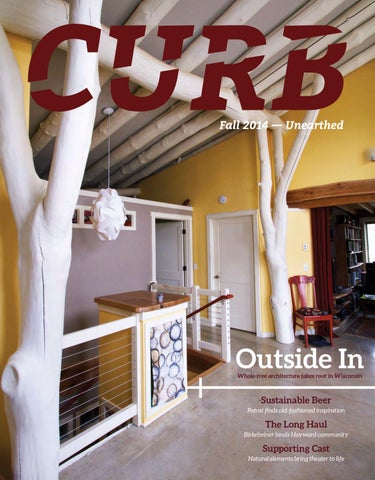
Outside In
Whole-tree architecture takes root in Wisconsin
Sustainable Beer
Potosi finds old-fashioned inspiration
The Long Haul Birkebeiner binds Hayward community
Supporting Cast
Natural elements bring theater to life
![]()

Whole-tree architecture takes root in Wisconsin
Potosi finds old-fashioned inspiration
The Long Haul Birkebeiner binds Hayward community
Supporting Cast
Natural elements bring theater to life
Teaching young students how to plant a garden, reaching out to people with depression, addressing the high rate of infant mortality among AfricanAmerican families—these Wisconsin Partnership Program investments are benefitting rural, urban and tribal communities across the state. Researchers also are making critical advances in some of the most complex health issues, including Alzheimer’s disease and cancer, while educators are meeting the needs of local communities by implementing unique training opportunities for the next generation of physicians and public health workers.


have never really been a nature person.
Living in cities my whole life, I’ve never been the type to hike, camp or generally thrive in the outdoors. However, when I came to Wisconsin throughout my life to visit family, the moments that stick with me are always moments in nature: my feet in the sand outside my family’s cabin in Door County, sledding with my cousins on a snowy hill in subarctic January, rocky bluffs on the side of the road while driving north.
So while I don’t consider myself a nature person, I’ve found that nature is a definitive part of my life in Wisconsin. You can’t escape it here—Wisconsin identity is rooted in nature. Across the state, the land plays an integral role in its communities and passions.
When the staff of Curb and I
set out to make a magazine for Wisconsin, we discovered that nature is even more influential in the state than what’s on the surface. This year, Curb unearths the unexpected connections between nature and Wisconsinites.
We discovered skunks wandering into outdoor theatre performances and whole trees holding up houses. We followed snowmobiling club volunteers down their trails and wandered into the forest with the Menominee. We witnessed the fight to save a town’s lake. We shared one of our family traditions.
Nature is the centerpiece of these stories. From Lake Michigan to the Mississippi River and Milwaukee to Hayward, Wisconsin’s land inspires its residents to get active, to make art, to preserve their homes. We discovered entire communities centered on nature, whether it’s around an outdoor skiing event or an entire lake.
We influence nature, too. From mining to sustainably brewing beer, we affect nature as much as it affects us.
I invite you to uncover the unique connections built between Wisconsin and its landscapes. Come see the Wisconsin we unearthed: always in conversation with nature, even if you’re not a nature person.

Natalie Amend, Editor
Editorial
Natalie Amend, Editor
Garth Beyer, Managing Editor
Chapin Blanchard, Copy Editor
Kristen Tracy, Copy Editor
Barbara Gonzalez, Lead Writer
Mara Jezior, Lead Writer
Jasmine Sola, Lead Writer
Business
Ally Boutelle, Marketing Director
Megan Hakes, PR Manager
Emily Skorin, Marketing Rep
Laken Stramara, Marketing Rep
Design
Lauren Nicole Mather, Art Director
Haley Henschel, Production Editor
Esta Pratt-Kielley, Production Associate
Jesse Tovar, Production Associate
Grey Satterfield IV, Photo Editor Online
Ashley Berg, Online Editor
Lanni Solochek, Online Associate
Katy Stankevitz, Online Associate
Samantha Wolfin, Online Associate
Michelle Gonzalez, Videographer
Curb Magazine is published through generous alumni donations administered by the UW Foundation and in partnership with Royle Printing, Sun Prairie, Wisconsin
© Copyright 2014 Curb Magazine

Nature in Wisconsin is active and filled with movement. Racers’ feet dance in snowy skis on the Birkebeiner Trail, and families hunt in the same wooded lands as their ancestors. We feel nature in every step we take, whether alongside a lake or across the stage in an outdoor theater. We bring to life how Wisconsinites are exploring nature across the state.
A visit to Wisconsin is incomplete without a trip off the beaten path, exploring woods, rivers, wetlands, glacial lakes, meadows and bogs. Here are five of Wisconsin’s most stunning hiking trails.
By Ally Boutelle
Located in northern Wisconsin, the ChequamegonNicolet covers 1.5 million acres of colorful forests, rivers, streams and meadows. It’s the perfect place for a range of recreational activities, including hiking, camping, fishing, snowmobiling and cross-country skiing. While on the trails, check out the native tree species like sugar maples, red maples and river birch, and keep an eye out for white-tailed deer, black bears, foxes, beavers, otters and elk.


All 9,217 acres of Devil’s Lake in Baraboo were carved by a glacier during the last ice age. Devil’s Lake is famous for its towering quartzite bluffs, which stretch 500 feet over the Baraboo Hills and offer a panoramic view of miles of scenery. It is the perfect destination for hikers from all walks of life. Families gather on the beach while adventurers take to the cliffs for rock climbing or the trails for mountain biking.
Located on the shore of Lake Superior, the Apostle Islands National Lakeshore is the northern tip of Wisconsin. It consists of 21 islands that encompass 69,372 acres and is home to beaches, cliffs and crystal-clear water. The lakeshore is famous for its beautiful and eclectic scenery, including sandstone sea caves and forests. Visitors can also take in historic lighthouses; the Apostles are home to the largest collection of lighthouses in the country.


Copper Falls packs an incredible amount of beauty into 3,068 acres. Its name comes from copper mining in the area, first by local Native American tribes and later by European settlers. The sound of rushing water can be heard throughout the park as the Bad River flows and tumbles down over several waterfalls. Hikers can unearth ancient lava flows while exploring the trails or relax in the park’s log cabins dating back to the 1930s.
Located on the northeast shore of Lake Wissota in Chippewa Falls, Lake Wissota State Park is a historic spot that rests on a bedrock of 2-billion-year-old granite. The park is in between a prairie and a temperate forest, and therefore is home to a variety of trees and plants ranging from sugar maples to white pines. In the past, the park was home to one-sixth of the country’s white pines; logging for timber and farming has now cleared the park of many of the original trees.


eaves rustle across the ground, the scent of a bonfire fills the air, a slice of the orange horizon breaks through the trees to show the waters of Green Bay. Wisconsin’s natural beauty creates its own stage, but sometimes even she gets to take a seat and enjoy a show.
Since its opening in 1935, Peninsula Players Theatre has been a landmark for residents and visitors of Fish Creek, Wisconsin. From its barn-under-the-stars origins to its current state-of-the-art stage, the theater has transformed performance for actors and audience members alike. From start to finish, the experience at Peninsula Players is rooted in true Wisconsin beauty.
Theater is an experience that is personal, special and immeasurable for many. Combining the age-old art of theater performance with the soothing, refreshing feeling of the Wisconsin outdoors gives Peninsula Players Theatre, and others like it, a uniqueness that is often hard to come by. Door County lends itself well to the theater setting, putting audiences at the brink of nature and helping them unearth the pleasure of natural art.
Turning off of Highway 42—which runs between Egg Harbor, Wisconsin, and Fish Creek—and onto Peninsula Players Road, audience members are immediately transported from the quickly passing cars and Fish Creek attractions to rows of trees as far as the eye can see.
“It’s a very special kind of place to watch theater,” says Tim Monsion, a veteran actor at Peninsula Players.
Monsion performed in his first show with Peninsula Players in 1997. Though he lives in Los Angeles and performs in movies and shows like “Frasier,” “Desperate Housewives” and “Monk,” he returns to the Players often and jokes that “now they can’t get rid of me.” As an actor, he says, the experience is completely unique.
“You can’t help [it]—you walk out on the stage at Peninsula Players and some nights, especially in the height of summer

when the sun goes down late...you see the gardens and it’s distracting for a moment,” Monsion says.
Inside the theater, which was rebuilt in 2006 in the footprints of the original theater, the audience is surrounded by a sturdy wooden structure. The sides of the building open up to face the two gardens on the grounds, the Beer Garden and the Far Garden, but can close when the weather is too chilly or not conducive to the performance. This allows the theater to transform throughout the year and the rotation of elements.
“The genius of what they did do with the new theater is cut down as few trees as they could and basically sat down a state-of-the-art, brand new theater in the middle of the woods in a way that, if you haven’t been there in a few years, you wouldn’t notice it until you actually walk into the theater,” Monsion says. “The gardens are still the same…they did such a good job of maintaining the original gardens.”
Although the season finishes in October, the theater is open year round, operating through the winter, preparing for the upcoming summer months. Artistic director Greg Vinkler and managing director Brian Kelsey meet to discuss the lineup of shows for the season. As the trees come alive again in the spring, the grounds transform into a hotel-like campus, Kelsey says, to accommodate those working on a show.
“It’s beautiful and so close to nature,” Vinkler says. “[W]hen the pressure gets to be high, we can just walk outside, walk out to the water, take a few deep breaths and put it all into perspective and go back in and get back to work.”
Summer is the busiest time of year for the theater for both on-campus attendance—sometimes as many as 50 people live on campus at once—and show attendance. Vinkler describes the experience as similar to going to summer camp.
“It has that feeling because that’s all you’re doing—life becomes very simple,” he says.
The group builds a camaraderie that only comes from
spending every day with each other, he says. Throughout the summer, the Players’ cast and crew celebrate their own holidays and occasions like Christmas in July, pumpkin carving and a boathouse party created by theater interns.

—Greg Vinkler
Monsion says that summer is the most interesting time of year for the theater because the pace of it all picks up and acting talents are put to the test. Shows change over quickly and often the actors rehearse one show during the day and perform a different show in the evening to keep the season moving along quickly.
“These wonderful sets get changed within one day and another day later we’re playing to an audience,” Monsion says. “[I]t’s all in this beautiful, bucolic summer setting, and people work extremely hard, but you can’t imagine working in a better place. You feel like you’re kind of working in a paradise.”
That paradise feeling extends from the cast and crew of the theater into the audience. Kelsey explains that the greatest difference for audience members of the theater is the key word: experience. In a typical theater outing, the experience doesn’t truly start until the lights dim. But, at Peninsula Players, audience members are encouraged to arrive early, exhale and enjoy themselves prior to seeing a play.
“You’re really relaxed before you actually go into the theater,” Kelsey says. “It’s the whole thing that happens when
you come to a show here. It’s very much regional theater… but we’re in the woods and we’re giving you an experience as part of being in the woods and being in Door County that’s very unique.”
Theatergoer Jana Rodriguez has traveled to Door County for years. Her experiences at Peninsula Players, she says, feel intimate and comfortable, while still providing a night-on-the-town kind of feeling that traditional theater often brings.
“There isn’t a lot of hustle and bustle, [it’s] just more laid back,” she says. “To me, it made me more appreciative of the work the actors, the crew and the owners put into these plays they put on all summer.”
Rodriguez cherishes the land around the theater most of all.
“I like being in nature and that they incorporate the setting...the theater is just great,” she says. “The way they keep the theater open on perfect nights makes a huge difference to me and is something you can’t really get anywhere else.”
Being so close to nature presents a few unique challenges— namely, animals in the theater. Mosquitoes, moths and other flying creatures are quick to invade the well-lit spaces of a stage.
“You basically had to deal with bats at least two or three times a week,” Monsion says. “You would think of pre-arranged ad-libs in case the bats would fly at you.”
On top of bats, theatergoers encounter some other wildlife intruders making inopportune entrances. “There was one show where some of us were standing at the back of the theater and this little baby skunk just wandered in and went under the audience,” Vinkler says tentatively. “We stood there and waited for a scream or total disruption and nothing happened.”
And so, despite some critter surprises, the show goes on, even when Mother Nature makes a cameo.


50 kilometers of pure Wisconsin land gives Hayward a world-class race, an economic boost and a communal core.
By Chapin Blanchard

tart line: Spandex-clad skiers line up in waves at Cable Union Airport early on a frigid northern Wisconsin morning. Approximately 31 miles stand between these racers and the finish line in Hayward, Wisconsin. They’re prepared to conquer a distance on skis roughly equal to that from Mitchell Airport in Milwaukee to the Illinois border, hoping to return to civilization at the end of the day.
Approximately 50 kilometers of pure Wisconsin land marks an international stage for cross-country skiers and serves as an economic and communal core for the city of Hayward. Each winter Hayward, in the far northern corner of the state, plays host to the Birkebeiner, the largest crosscountry ski race in the country.
While Hayward is known globally for the race, the community of locals defined by the Birkebeiner, affectionately known as the Birkie, goes largely unnoticed. Months of preparation, outreach and a 107-kilometer trail system used year round unite the rural city.
“You look at all the races that are doing well now, like the color runs and the monster dashes, and part of it is that sense of adventure,” Birkie Executive Director Ben Popp says. “This is the ultimate adventure.”
Birkebeiner history traces to one man: Tony Wise. Wise grew up in Hayward, fought the Nazis in World War II and returned to Wisconsin with alpine-turned-cross-country dreams. After seeing world-class ski resorts in Switzerland and Austria, Wise recognized the potential for a downhill ski resort in Wisconsin. Despite the lack of variation in elevation, Wise created Telemark, a resort for the upper class that featured entertainment from Chicago and a northwoods getaway. As competition began to rise, Wise realized the need for an entirely different sport, says 75-year-old John Kotar, one of the first Birkie racers.
“He heard about these fantastic citizens’ races, as they’re called, that were held in Norway and particularly in Sweden,”
Kotar says. “Someone put the bug into Tony’s ear, so to speak, that you could have this kind of event, and no one else has had that kind of a race in this country.”
At this time in the early 1970s, cross-country skiing was extremely inaccessible. Nonetheless, Wise decided to organize a 50-kilometer race that began in Cable and ended in Hayward.
“Tony was primarily a promoter,” Kotar says. “He figured if he could get the word out there, he could make it sound huge and all that, people would come.”
According to Kotar, who was one of the original 35 racers in 1973, Wise advertised in Duluth and the Twin Cities. Within a few short years, that small number grew to reach thousands. As Wise’s Telemark faced bankruptcy, the community realized how important the Birkie was to its local economy.
“You know one of the sort of aces in [Wise’s] hand was this Birkie event,” Kotar says. “And he threatened to pull it out of the Hayward-Cable area and move it into Minnesota.”
The American Birkebeiner Ski Foundation formed in response to Wise’s threat. The foundation successfully prevented the race from moving by legally declaring that it belonged to the region, according to Kotar. This view of the Birkie as an unparalleled economic resource for the Hayward area hasn’t changed. Today Sawyer County is the second poorest in the state even with the Birkie, according to Popp.
In January 2014 UW-Extension published a case study conducted on the economic impact of silent sports, defined as cross-country skiing, biking and running, on northern Wisconsin. The study found that in 2012, nonresident visitors to Sawyer, Bayfield and Ashland counties spent about $26.4 million, with the Birkie being the largest event.
Notably, the common factor among the silent sports is the land, which provides a backbone for northern Wisconsin’s economic stability.
“We can have this really positive impact on it financially because you have people come for that day, but they are coming back to the area, they are eating in restaurants,

by Darlene Prois
staying in hotels, building second homes,” Popp says. “If we put on great experiences, they will come back again.”
Halfway point: As racers emerge from the woods they spot a log-crafted structure on the opposite side of County Road OO with an arch to ski through, indicating they have completed half of the course.
Since its founding, the Birkie has been regarded as a citizen’s race, indicating that anyone who is able to stand the cold, has $115 for the early registration fee and who believes they can ski 50 kilometers is welcome to race.
“It’s really interesting because you get the super athletic, strict, have the neoprene tight suits, and they are really competitive,” says Jared Ursin, a Hayward Middle School art teacher. “And then you have people who are there just in flannel-lined jeans and they are wearing a flannel shirt.”
Popp made similar remarks about why the Birkie stands out among other cross country ski races in the country, citing a unique “international flair” to the race that attracts highprofile racers.
“You have all these international people that come, but then also you have Johnny-down-the-street that does it,” Popp says.
It’s Johnny-down-the-street who lives in Hayward year round and experiences the American Birkebeiner Ski Foundation’s efforts beyond race week. The race has always favored the common racer, but the foundation is now making greater efforts to include the community beyond one day in February. However, before addressing the foundation’s new initiatives, it is important to recognize existing divisions in the city and less favorable views toward the race.
“Because it’s such a privileged sport, it costs a lot of money to ski, usually [very] few people of color ski, and we have a lot of poverty in Hayward,” says Caitlin Flynn, a senior at UW-
Madison and Hayward native. “So you never see that part of the community really targeted for getting involved with the Birkie.”
Flynn describes the city of Hayward as one that does not facilitate a lot of inclusivity but views the actual Birkie race as a rare occasion where residents come together to help fill downtown in celebration.
“Birkie weekend was very cool because ... all the town is completely filled,” Flynn says. “It’s hard to find a place to see the finish because so many people are down there. Just seeing people come together just a little bit for that is really special to me.”
About one mile from the finish line: “People line up out on Hayward Lake ice fishing and skiers will stop to have a beer with them, but there is also a hill where snowmobiles park and heckle the racers,” says Ursin. “So there is that, too.”
Some locals view the influx of 40,000 people to the rural community as another drawback. While many express frustration toward tourists and road closures, for the most part the economic importance is not lost on residents. Both Ursin and Flynn were honest about the desire to stay away from the craziness, yet admitted there is a certain allure to the festivities.
“I like the Birkie more because there is more of a camaraderie feel to it, so like lining up along Main Street for the finish, and people got cow bells, and I have a lot of friends in the race, too,” Ursin says. “Our principal, he races in it, and I drive out to a spot and give him his Gu pack and his Gatorade.”
A major component of Birkie outreach is focusing on developing younger generations of skiers and supporters by reaching out to the local school district. Among the Birkie’s many initiatives is to raise $50,000 for the school district this

by
winter through the district’s “Like a Cane” campaign, inspired by the school’s mascot, the Hayward Hurricanes.
“They take these events like the Birkie and really put that into our school’s culture to kids,” Ursin says. “Like you can do great things like this and race.”
Other foundation initiatives include a temporary pedestrian bridge over U.S. Highway 63 to eliminate the traffic detour, a five-year campaign to build a permanent start area and a partnership with the Mayo Clinic to combat obesity. Part of the foundation’s mission is to “support an active outdoor lifestyle,” according to Popp.
“We have about 40,000 people in our database, and you look at these people and they obviously have some level of activity because they can ski 50 kilometers,” Popp says about the Mayo Clinic partnership. “So we want to take this group of people and create a baseline...what is their lifestyle like and trying to find [those] threads.”

It’s hard to find a place to see the finish because so many people are down there. Just seeing people come together just a little bit for that is really special to me.
— Caitlin Flynn

At the core of all things Birkie is the trail itself. Popp and Kotar both identified the land as an important reason the Birkie stands out among other races. Preserving the land is important because it is Birkie’s greatest resource, according to Popp.
“There is only one Birkie trail,” Popp says. “[The trail system is] 107 kilometers long, it’s unbelievably iconic, it’s got all of these rolling hills, it’s really in the middle of nowhere.”
Kotar also notes the cultural history of the race as a remarkable difference between the Birkie and other races in the country. Wise successfully transplanted Norwegian ski culture in the Midwest. He created a “majestic” display of international flags of participating nations, enlisted help from an Austrian master ice sculptor, developed a parade of nations and even hired the University of Wisconsin Marching Band, according to Kotar.
“All of this was extremely popular with the general public who, in addition to the competitors, came to enjoy the spectacle each February,” Kotar says. “Nothing of this sort existed at any other citizens’ race here or in Europe, so this reputation has stuck with us and today, the American Birkebeiner Ski Foundation is working hard on recapturing and maintaining some of these traditions and carrying the event on for younger generations.”
There is hope for more inclusiveness as the foundation continues to show that to be active and to take advantage of the trail does not require competition or Birkie-level athleticism. Community events on the trail include a 5K color dash sponsored by the school art department, the Fat Bike Birkie and practice terrain for the school’s nordic ski teams.
This Wisconsin land creates a common ground for community members. The extensive trail system provides year-round opportunities for residents and serves as a stage for world-class cross-country skiing that the town can rally around each winter.
Finish line: “The best part, so you start up in Cable, get closer and closer to town and recognize all these places I’ve been skiing on for years,” Flynn says. “And then you come through Main Street after just going through the hardest part of the race and then just having everyone cheer and like ring the bells...it was just incredible.”


Outdoor activities such as hunting, fishing and kayaking play an integral role in the culture of Wisconsin. But who is ensuring that the outdoors stay accessible to everyone?
By Barbara Gonzalez

atching Steve Johnson fish with such practiced precision, it’s no surprise that this is something he has been doing since he was a child. Standing at 7th Street Boat Landing in La Crosse, Wisconsin, he hooks his bait and casts it into the Mississippi River with finesse.
It is only until you notice a harnessed black labrador named Bennett sitting gallantly at his side that you realize there’s something different about him.
At 22, Johnson became blind from symptoms of Type 1 Diabetes. Even without his sight, his passion for the outdoors still remains.
“After losing my sight, getting back into the outdoors [was important] because I was raised in the outdoors in a hunting and fishing family. That was something I was not willing to give up after I lost my sight,” Johnson says.
As a society, we’re quick to believe that outdoor activity is exclusive to able-bodied people. With people like Johnson as advocates, recreational activities no longer exclude people with disabilities. Instead, we see a new definition of active lifestyle.
Johnson is a major advocate for disabled rights in Wisconsin. He is a member of the Wisconsin Department of Natural Resources Disability Advisory Council. Composed of people with disabilities, the council meets three times a year to draft suggestions to the DNR to make outdoor areas more accessible.
He is also secretary of the board of directors at the North American Squirrel Association, a non-profit organization in Holmen, Wisconsin, providing outdoor activities for more than 6,000 people with disabilities, children and the elderly each year.
“You can change lives of those individuals from ‘can’t’ to ‘You know what? I can do this.’” he says. “That’s what we try to do. We try to change their lives back to one of belief, knowing that they can.”
While he mentions he doesn’t do advocacy work for his own gain, he says empowering others to get outdoors inspires him

to be as active as he was before becoming blind.
“My disability hasn’t stopped me from doing things that I’ve always done,” Johnson says. “If anything, it encourages me even more to say, ‘You know what, yes, I want to do a zip line … okay, do I have some fears? Absolutely. Would I still do it? Absolutely.”
While his brother or his brother’s girlfriend provide sight for some of his excursions, Johnson mostly works independently.
“Blind doesn’t mean that I can’t be aware of my surroundings,” he says. “Part of it is just being an outdoors man who is in tune with what’s going on … A lot of it just goes back to me being a responsible person.”
But what’s most important to Johnson is how actively pursuing his passion for fishing can inspire other disabled people to stay active.
“[I’m more] independent and more confident in the outdoors,” he says. “[And taking] on leadership roles, and set an example for my disabled peers and say, ‘If you want to get out, you can get out. There’s nothing stopping you except you.’”

Royle Printing proudly supports the University of Wisconsin-Madison School of Journalism and Mass Communication and all aspiring students who produced Curb: Unearthed

More
than 25,000 miles of snowmobile trails in Wisconsin require maintenance from dedicated volunteers who work year round to ensure safety and quality of the trails.
By Megan Hakes

the blizzard hit Dane County at approximately 10 p.m. Some people slept through it. Chad Petersen did not. He and another man set out earlier that night to groom a snowmobile trail using their 1994 groomer. Soon after, the groomer’s lights dimmed and the heat went out. The men realized they were losing power, so they tried to make it to the highway. Before they could get there, the groomer shut down.
The men were stranded halfway across a field, in a blizzard, at 2:30 a.m.
Petersen bundled up in his dark blue snowsuit. He and his partner abandoned the groomer and started to walk toward Liberty Corner Tavern—miles away—where they hoped to find help. The snow was getting deep, making it harder and harder to walk.
Almost 45 minutes after Petersen and his partner abandoned the broken groomer, two snowmobilers drove past it, noticing footprints, which they immediately realized belonged to the groomer operators. Soon they caught up to Petersen and his partner and drove them to Liberty Corner.
Somewhere between 3:15 and 4 a.m., Petersen’s brotherin-law picked them up at the tavern. The men went home, leaving the broken groomer parked in the field until the next morning.
That blizzard hit roughly a decade ago, but 44-yearold Petersen still stays out late grooming snowmobile trails each day. He is one of many volunteers who put in countless hours of effort each winter to maintain more than 25,000 miles of snowmobile trails in Wisconsin and ensure the state remains a top snowmobile destination.
For roughly 15 years, Petersen has volunteered as the Utica/ Nora Trailblazers snowmobile club trail boss, maintaining
more than 40 miles of Dane County trails assigned to his club.
“When the snow flies, the phone rings daily. When the snow flies, I’ll have phone calls all day long,” says Petersen, a Deerfield, Wisconsin, native whose parents loved snowmobiling so much they taught him to drive a snowmobile when he was 5 years old. His siblings also learned, and Petersen vividly remembers watching his younger brother, then age 4, drive a mini-snowmobile across their family’s frozen in-ground pool.
Still enjoying snowmobiling years later, Petersen worked for 13 years at a Polaris dealership, selling snowmobiles and other products before beginning his current job at the Nine Springs Wastewater Treatment Plant.
“Chad is a very devoted snowmobiler and coordinator of the trail system in our area,” says Tom Schoenmann, the Utica/ Nora grooming operations volunteer who schedules Petersen and other groomer drivers. “He takes that responsibility very seriously.” Schoenmann has known Petersen for 15 years and refers to him as a true steward of the sport of snowmobiling.
Petersen and his family enjoy the results of his hard work on the trails. His wife Heidi, 45, is a native of Cottage Grove, Wisconsin, who grew up racing snowmobiles, and their sons Kelby, 11, and Collin, 9, have snowmobiled since they could say they were cold.
Wisconsin snowmobile trails go from the bottom of the state to the top, so the Petersen family explores much more than their hometown of Marshall, Wisconsin, on their snowmobiles. They take special routes and find places in Wisconsin they could not normally see by car or hiking.
“Our cabin up north is on the south end of the Turtle-
Flambeau Flowage and in order to go north of that [in the summer], you have to go way around it, around by Mercer or to the west around Park Falls,” Petersen says. “And in the winter you can go right up it.”
Petersen’s work as trail boss also allows him to teach his children a lesson in perseverance.
“I wanna show them that this stuff isn’t gonna do itself,” he says.

When his sons were in car seats, they would keep Petersen company while he groomed the trails, going with him for an hour until Heidi met up with them at a crossroad and took them home to bed. Now, Kelby and Collin mark trails, pound in stakes and take them out.
“People work to put those trails in, they don’t just appear,” says Heidi Petersen, hinting at a problem facing Wisconsin snowmobiling.
Before you head outside to snowmobile, you need the proper gear and paperwork. By our calculations, buying a snowmobile and trailer, joining a snowmobile club, and purchasing gear and miscellaneous items such as storage and oil will set you back $14,327. Here’s where some of that money would go.

By Megan Hakes


The Pratts now question the future of a culture deeply rooted in family land and traditions passed through generations.
Story and photos by Esta Pratt-Kielley

he woods are silent at 4:30 in the morning.
Like every year, the hunters are out as the sun creeps above the horizon.
Like every year, the hunters wear blaze orange and camouflage, wrapped in layers to brace against the Wisconsin cold that penetrates their bones.
Like every year, they hold their guns ready, senses attuned to what nature tells them. They listen to the birds and squirrels emerging from their nests and hear the forest start to come alive.
Like every year, the family is ready for another deer hunting season, finally in the woods after a year of excitement and anticipation for opening day.
But unlike every year, one face is missing.
Mark Pratt passed away July 6, 2011. This is the first deer hunting season on the Pratt family land in Wiota, Wisconsin, without his hilarious demeanor, vibrant spirit and contagious personality.
Mark was unlike any other person, living on the outskirts of society for most of his life, passionate about becoming more in touch with the earth and continuously learning about the ways the land could provide for him.
A brother, a cousin, a friend, my uncle, Mark was the man who brought the family together to hunt the land that has been in our family for generations.
Looking at the wooden deer stand that Mark and my cousin Ryan built years ago, the hunters feel Mark’s energy surge through them.
This is the story of the Pratts. Hunting has tied my family to the rich Wisconsin land for three generations. Starting as a means to gather meat and sustain a family of eight children, the annual hunt continues to preserve our family’s connection to the land.
The land in Wisconsin is the most important part of deer-hunting culture. From the family land passed from generation to generation to the woods themselves that create
the environment in which the hunt occurs, every step on the Earth forms an interconnected story, a unique path and a timeless connection for avid hunters in Wisconsin.
With public, huntable land becoming more difficult to find, my family, along with hunters across Wisconsin, is worried about whether future generations will be able to wander the woods in the same way. The Pratts’ story represents similar family traditions all over the state.
Following Mark’s wishes, the hunters spread his ashes in the calf pasture forest at the base of the deer stand and salute his memory so he can always remain a part of the land.
“I carry him with me whenever I hunt,” says Terry Pratt, 66, Mark’s brother.
In fact, the entire group carries his ashes with them on the hunt, some in leftover bullet casings in the stock of their guns, others in their jacket pockets.
“I still carry a vial of ashes with me when I hunt and sprinkle some wherever I go,” says Kevin, 55, Mark’s brother. “He wanted to still be with us hunting. His ashes are all over the Wiota area.”
My grandfather, Kenny Pratt, was born on this Wiota land in 1921. Now Tim Pratt, Mark’s cousin, lives in a house just down the road from where Mark’s father and Tim’s father grew up. Tim still owns the farmland that my greatgrandparents owned before him. He sold about half of his own land in 2008 when he retired from farming.
“When my parents sold the farm, they kept certain parts of the calf pasture so that my dad could always have a place to hunt,” says Ashley Pratt, 30, Tim’s daughter. “Especially now that Mark’s remains are spread there, hopefully that land will never leave the family.”
Tim lives in a house perched on top of a knoll overlooking the rolling hills and farmland of southern Wisconsin. Scattered throughout the land are small timbers, groups of trees, usually home to white-tailed deer.

Just behind Tim’s house is a timber he has hunted since he was a little boy. Just down the road are several wooded pastures, housing the old deer stand and Mark’s ashes.
These woods are so familiar to the Pratt family, they know every plunging valley in the earth, every path through the trees, every acre’s unique story. Looking at any given hill swelling above the land reminds the Pratt hunters of years past.
“My dad has grown up hunting that same land,” Ashley says. “If you want to know how to hunt a certain pasture, he’s going to know the right way to do it.”
“You feel like you’re part of the land, like you belong there,” says Tim, 55. “There’s something about being out in the timber that makes you feel more alive.”
Although this land is still in the Pratt family, hunting in Wisconsin is not the same as it used to be. Those without private land are finding it increasingly difficult to hunt in a place where families used to be able to walk for miles and “cross fence after fence,” as my uncle Kevin remembers.
“We used to be able to use most of the land around here,” Tim says. “Now, more and more people tell me that we are not allowed to hunt on their property. A lot of the land around here is being bought up by corporations.”
“Back when we were kids, farms were passed on from generation to generation,” Kevin says. “Now farms are being sold left and right to people usually not from around here. Tim is probably the only one still out there who owns the original family farm.”
Because Tim still owns 145 acres of land, the Pratts have some area to roam. But many of the landowners in the surrounding area have changed and won’t let them hunt on their property anymore.
“There isn’t nearly the territory that is open for hunting anymore,” Terry says. “When we started out near Wiota, Dad knew everybody and we would go from property to property without a word said. If you had property, everyone knew that there would be deer hunters on there. You can’t do that today.”
The Wisconsin Deer Hunters Association is also concerned about this trend, Vice President Clarence Plansky says.
“The cost of the land is so high, and people that own the land are locking it up,” Plansky says.
The state works to preserve land through the KnowlesNelson Stewardship Program, but hunters are concerned that the quality of public land, specifically woodland, is deteriorating, making it difficult to sustain white-tailed deer.
Half of Wisconsin is covered in forestland, nearly 15 million acres, but 56 percent is privately owned, according to the American Forest Foundation.
According to a U.S. Fish and Wildlife Service Survey from 2011, just 31 percent of hunters in Wisconsin use public land to hunt.
“It’s getting to the point where if I want to hunt, or I want places for my son to be able to hunt, we’re going to have to buy or lease the land,” Kevin says. “That’s not something I want to teach the next generation.”
About 30 miles west of Wiota is Buck’s Landing, an 80-acre plot of land in Belmont, Wisconsin. Buck Runde, 85, Mark’s maternal uncle, bought this land in 1987 so his family would always have a place to hunt.

— Hunter Pratt
At the center of the property sits a small, wooden cabin, built by Buck Runde and his sons. Looking like a life-sized Lincoln Logs construction, the cabin overlooks a small pond, forest surrounding it in all directions.
“The land is a very valuable commodity,” Buck says. “To keep land like this, to keep the woods, is very important so they don’t take it all and plow it up. You’ve got to have some woodlands.”
After Kenny married my grandmother, he introduced her brother Buck to hunting. Like Kenny, Buck passed the tradition to his kids.
“He made it pretty easy [to keep the tradition going],” says


Sam Runde, 53, Buck’s son. “He bought a piece of property and granted it to the family to preserve it for hunting. We’re really lucky that we have a place like this to go.”
Family land gives the next generation a place to gather and learn from the family. For Kevin’s son, Hunter, named after the hunting tradition itself, the legacy continues.
Hunter Pratt was born on Thanksgiving Day in 1995. Kevin had to leave the group hunt that year to go to the hospital.
“It was basically destiny that I become a hunter,” Hunter says, laughing. “It’s not just for the shooting of the animal. It’s for gathering and carrying on the tradition. I love being out there with everybody, being able to relate to them and spend time with them. Having them teach me what their parents taught them.”
Hunter and his cousins continue primarily because the tradition has been ingrained in them since childhood.
According to a study from the Department of Community and Environmental Sociology at UW-Madison, the millennial generation is being recruited into hunting at lower rates than previous generations. The study projects that the number of male gun deer hunters will decline in the future.
“Hunting doesn’t have much chance of moving forward if you don’t keep it in the family,” Tim says. “If the kids won’t do it, it can’t go on any further.”
If this land, so integral to my family’s history, were to ever leave the Pratt name, we would lose more than just hunting ground. The land holds the remnants of the wooden stand Mark and Ryan built, Mark’s ashes spread all over the timbers, a place for future generations of Pratts to gather and a family legacy.
Last year, as the hunting day was coming to an end, Hunter waits at the edge of the woods. A large buck runs over the hill. Without second thought, Hunter picks up his rifle, once used by his grandfather, Kenny, and more recently used by his uncle, Mark.
He aims and shoots. The deer falls instantly. No pain, no suffering. A single bullet to the heart kills the animal.
“It kind of reminds you of something Dad would have done,” Kevin says, thinking of Kenny. “Dad was probably the best shot at running deer. It’s exciting to see Hunter do that also … [he] shot this deer with his grandfather’s gun.”
“Hunter killed this buck on the same property we’ve been hunting on for 40 to 50 years,” Terry says.
“It does take on a special meaning when it comes off a piece of property that is so close to the family,” Kevin says, pride shining on his face.
“That was the first deer I really got by myself,” Hunter remembers. “It was a surreal moment. I definitely felt like Mark was there.”

Wisconsin is filled with nature that needs to be protected and preserved. From water to land, from nature to animals, we uncover how residents of the state approach the land and its long-term prosperity. Humans live off the land, and their work to stay connected provides us with insight into this valuable resource and its relationship with those who use it.


he bright light of the sun shines down on her each day and accentuates her most charming features. But today her color is off, and suddenly that same light looks less flattering. One by one people begin to enter the dimly lit room. Some lay out charts for everyone to see, others mumble to one another over her most recent images. The charts show she’s losing too much oxygen and not getting the nutrients she needs. The images show areas where something is growing where it shouldn’t be. She is sicker than they thought, and they need to come up with a plan—and fast.
They meet in the same small, faintly-lit room each month in northern Wisconsin. Every time they meet they discuss her condition and what can be done to improve her health. Sometimes it’s little changes here and there, while other times she needs expensive procedures.
Even though the treatments are expensive and time-consuming, these individuals will do whatever it takes to heal her.

This patient, however, is not a typical patient.
Her name is Little Green Lake, and because of humans, she is gravely ill.
In her case, the something-growing-where-it-shouldn’t-be is invasive weed species and harmful algae. Much like smoking and obesity can cause health problems in humans, agriculture and farming can cause serious health issues in lakes.
Lakes throughout Wisconsin located in dense agricultural areas suffer from severe algae blooms in the summer because of high phosphorus levels. A major cause of these high levels is runoff from nearby farms. But the people who care about Little Green aren’t ready to give up even though treatment is expensive and results aren’t guaranteed.
According to Steve Carpenter, director of the Center for Limnology at UWMadison, these algae blooms are very difficult to handle.
“The chemistry of dealing with [this type of bacteria] is not very well known, and they are extremely stable and very hard to break down,” he says. “So once they get into a water supply you’re really stuck, and there’s not much you can do about it.”
Little Green Lake is a small lake located about an hour north of Madison near the town of Green Lake. Her name was given to her years before the problem emerged, but now she looks even greener than before. This is due to the overwhelming presence of blue-green algae, or cyanobacteria, one of the side-effects of high phosphorus levels.
Blue-green algae is most dangerous if humans, livestock or pets swallow the water it contaminates. “This type of algae can be toxic ... it can make them sick or
Many Wisconsin lake communities work hard to keep their lakes healthy, but proximity to agriculture creates a major roadblock.
By Kristen Tracy

kill them,” Carpenter says. The most common cause of algae buildup starting in the 1880s was human sewage.
Everyone dumped their sewage into the lake, according to Carpenter. Around the 1970s when Wisconsin established human sewage treatment, the sewage was diverted from the lakes.
“But by then farm runoff had pretty much replaced the [human] sewage,” Carpenter says. “The baton was handed from human waste to manure and farm runoff, and it continues to be a problem.”
According to Little Green Lake’s 2011 Aquatic Plant Management Plan, Little Green’s watershed is 77 percent agriculture. Because of this, she often receives high amounts of the runoff from nearby farms, especially after heavy rain.
For Little Green Lake, blue-green algae blooms were a major problem a decade ago, according to Gregg Cygnar, Little Green Lake Protection and Rehabilitation District committee chairman and lake homeowner.
Cygnar owns a home on Little Green, right across the street from a large farm and on one of the most algae-ridden bays of the lake.
“Twenty years ago it was sickening, it was utterly sickening,” he says. “The algae was so thick it was like floating cement and the algae literally stopped the surface of the water from agitating. [It] was a purple-grey, stinking, rotten material that you could smell from hundreds of feet away.”
Cygnar purchased his lake home in 1991, and a few years later, he feared he had made a terrible mistake.
“I looked out the front and I just cried,” he says. “Driving into the driveway you could smell the stink.”


Another side effect of the excessive phosphorus levels from her condition is invasive weed species. According to Ted Johnson, a water resources management specialist for the Wisconsin Department of Natural Resources (DNR), the two most common invasive weed species present in Little Green are the Eurasian water milfoil and curly-leaf pondweed.

“Some lakes have milfoil and it just becomes part of the plant community,” he says. “In other lakes it can take over, and it’s like weeds in your garden. It will just take over, and that’s what happened on Little Green.”
Carpenter says Eurasian water milfoil typically causes the most harm because it grows to the top of the water surface and interferes with boating and fishing, which happen to be two main attractions that draw people to Little Green. But prevalent weed growth makes it very difficult for boats to maneuver through the water.
According to Renee Braun, Little Green Lake Protection and Rehabilitation District secretary and lake homeowner, two decades ago boating was extremely difficult because the weeds were so thick.
“We had a jet ski and you would take off from the pier, but then you had to get off when you got about 50 yards out to pull the weeds out from under it,” she says.
“[The jet ski] would pull the weeds into the intake.”
At that time 20 years ago, Cygnar and his neighbors would often try to clear a path around their piers so it would be easier to get their boats out.
“My neighbors and I would take a huge heavy chain, and we would go in the water and drag it along the bottom to uproot the weeds,” he says. “But we did that for about an hour and a half before we realized that we were going no place fast.”
The weeds were so rampant that hours of work would make little difference.
“I mean we tried everything,” Cygnar says. “We would spend hours raking, and we would clean it up and it would come right back.”
In 1991 the Little Green Lake Protection and Rehabilitation District was formed to create and implement protection strategies to improve her health, according to the 2004 Little Green Lake Watershed assessment.
Six years later, lake residents’ concerns about excessive plants and algae growth led to the creation of a lake management plan with strategies to address the concerns.
The community surrounding Little Green is passionate about her health. A 1997 survey of residents found that her fishing and aesthetic qualities are most important to them.
As a result of this, residents agreed her excessive algae and weed growth represent the biggest problems concerning lake use and satisfaction.
After the implementation of the 1997 plan, Little Green Lake residents began to see changes in their community and the health of their beloved lake. When Cygnar mentions his fear of making a terrible mistake about buying a home on this lake, he immediately says, “But that changed, we’ve got ahead of it.”
She began to look healthier in 1992, when the residents of Little Green Lake began installing sediment basins in areas susceptible to high runoff levels around the lake, according to the Watershed Assessment.
Retention ponds and sediment basins help slow down the phosphorus by keeping it in the retention pond, Carpenter says.
One of the biggest changes she went through began in 2002, when an aeration system was installed to prevent the release of sediment phosphorus forms stored in the bottom of the lake, according to the Watershed Assessment.
The system consists of tubes installed in the deepest part of the lake, with an air compressor on shore pumping air into these tubes, according to Aaron Gruenewald, an aquatic and environmental biologist and owner of Natural Resource Group, LLC. Gruenewald wrote the Aquatic Plant Management Plan for Little Green Lake that was passed by the DNR in 2011.
“The air bubbles that are generated keep the bottom waters well mixed and do not allow the deep water to become devoid of oxygen,” Gruenewald says. “When oxygen is present near the bottom sediment, phosphorus that is found in the sediment is not released.”
Cygnar refers to this system as the “bubble machine” and considers its installation one of the biggest improvements of her health.
Along with catch basins and retention ponds, the Little Green community also has a weed harvesting system in place, which limits the loading of phosphorus. In addition to harvesting, the community utilizes a herbicide application to keep weeds at a more tolerable level for boating and recreation.
According to Cygnar, these treatments are mostly used in areas where the harvester cannot reach. The treatment, Cygnar says, kills the weeds at the surface, but it does not keep them from coming back.
According to Johnson of the Wisconsin DNR, about 60 to 70 percent of the phosphorus in Little Green Lake is due to farming. In order for any kind of lake management plan to be successful, partnerships need to develop between all aspects of a community.
“It’s a combination of local input, not only lake residents, but also farmers in the area, the Department of National Resources, the County Land Conservation Department, the township itself and the federal government,” he says.
Little Green Lake is lucky to have such a responsible community who cares deeply about her health. Just as with any sick patient, many people are invested and involved in the treatment process.
Thanks to the loving and dedicated community surrounding Little Green Lake, she continues to get healthier each and every year and the sun continues to shine just a little bit brighter on her waves.
Cygnar has a positive outlook on the improvements of her health through these various management plan implications, but he worries “it would take one year, maybe two, to undo all the years of work we’ve done if all of these programs are not continued.”

AQBy Samantha Wolfin
Q A
Paul Koch, assistant professor in UW-Madison’s Department of Plant Pathology, provides insight on a hot-button topic in sustainability: pesticide use in recreational settings.
What do you see as the biggest issues with the use of synthetic pesticides in Wisconsin?
A : : : : : :
The biggest issue is the unknown, especially regarding longterm impacts on the healthy development of children and teenagers. Most of the research shows that when modern pesticides are used appropriately in a recreational setting— lawns, golf courses, athletic fields—there is a relatively low risk of injury to the environment and to mature adults.
However, there is evidence that children are more susceptible than adults to long-term health effects. When it comes to this risk, which hasn’t been fully established by the Environmental Protection Agency, most people rightfully err on the side of caution.
Have switches to natural products rather than synthetic been effective?
Currently it is difficult for a manager of an intensively managed recreational site such as a high-traffic athletic field, park or golf course to move toward exclusively using natural products.
First off, the products often have less scientific research into their efficacy, which makes managers hesitant to give them a try.

QThe cost can oftentimes be prohibitive for many facilities though as natural product production increases this cost should theoretically go down.
Lastly, many managers have been able to very effectively and cheaply manage their recreational sites with synthetic products and don’t necessarily see a reason to switch.
Could you touch upon social pressure to go in a more natural direction with recreational site maintenance?
There is certainly social pressure to reduce the non-target impacts of turf grass management, whether it be from fertilizer, pesticide or water usage. I would say most of the pressure comes from the public at large, but no turf grass manager wants to use any more fertilizer, pesticide or water than they need to. The trend toward sustainability is a hot topic in turf grass management right now, with a high demand from turf grass managers for more research into more sustainable management practices.
Sustainability won’t come solely from using more natural products, but in combination with developing low-input turf grass species, using technology to minimize excess inputs, and using reduced-risk/low toxicity synthetic pesticides I think the future of sustainable recreational management is very bright.


Bright lights and rumbling trucks put Trempealeau County residents at odds over frac sand mining and the environment.
By Ashley Berg

t’s 4:15 a.m. when Judt Haase-Hardie shudders awake. Through her open window, she hears the beeping of machinery and the grinding of the earth. She pulls herself out of bed and makes her way toward her barn to start the day’s work. Farther west, she sees her country road lit up like a city street. She remembers how it was before they came. Now the machines are robbing her of silence, the floodlights robbing the night of its darkness.
Since the sand mines appeared in 2010, the residents of Trempealeau County deal with many disturbances. Mines run up to 24 hours a day, which means loud blasts and bright lights at all hours of the night.
Trempealeau County is home to 26 of these mines and processing facilities. Residents worry about the consequences for their environment and their community.
“Over and over again when we asked [residents] what was most important to them, it was the natural environment, it was the drinking water, it was the scenic views,” says Patricia Malone, UW-Extension development educator.
Haase-Hardie owns an organic dairy farm bordering the Trempealeau River to the south and a bluff to the north. Hidden behind the bluff is a frac sand mine owned by Preferred Sands.
Frac sand mining is a type of non-metallic mining that extracts frac sand, or silica sand, from the earth. The state of Wisconsin has an abundance of this type of sand hidden under layers of topsoil in its hills. After extraction, it is sent to other states for hydrofracking, a method of extracting oil and natural gas from the sand.
As a farmer, Haase-Hardie respects the land and recognizes that it must be preserved.
“We can’t do whatever we want to do with [the land]. We do not have that right,” Haase-Hardie says. “We are to be
good stewards of the land and leave the land in a better shape for the next generation.”
The first visible change frac sand mining has on Trempealeau County is the destruction of the landscape. As more mines enter the community, more bluffs are seen as hosts to resources rather than beautiful landscapes that took billions of years to form.
“One day it’s a hill with various hard and soft woods. A week later, it’s bald, and the trees are scraped into a pile and burned or buried,” says Susan Faber, a Trempealeau County resident.
The impact mining has on the landscape is irreversible. Once the sand is taken from the tops of the hills, it can no longer be replaced, and the hilltops will remain flat.
“The hills are gone. The trees and habitat [are] gone, and the animals and birds no longer have homes,” Faber says.

commute to work from farther away to avoid the negative consequences associated with living near mining areas.
“All of the damage to the roads and the natural resources is going to be at the expense of Trempealeau County residents,” Custer says. “It will not be at the expense of Eau Claire County. It will not be at the expense of La Crosse County, but those counties will capture the revenue and the economic vitality of this industry.”
After mining companies clear the land of its resources, they are expected to reclaim the land. Many residents believe the companies are not truly reclaiming the land as they mine.
“Farming will never be the same,” Faber says. “They will have more flat land to farm, but it will be dead and fallow land with no proof that future crop production is viable.”
One day it’s a hill with various hard and soft woods. A week later, it’s bald and the trees are scraped into a pile and burned or buried.
While mining has negative impacts, the mining industry says it benefits the area. The Wisconsin Industrial Sand Association says the sand mining industry creates thousands of jobs and generates millions of dollars for the state.
However, Trempealeau County resident Cristeen Custer says this economic vitality will not reach the small towns where the mines are. For them, the benefits only extend to residents being hired or people choosing to move to the county for jobs.
However, a health impact study created by Trempealeau County states that mining employees are more likely to

—Susan Faber
Faber says recreation will decrease because there will be less land to sustain wildlife populations. As the streams and rivers become more polluted from storm water runoff, fish populations decrease, and fishing tourism decreases with them.
“Who would plan a vacation where there are ugly hideous sand mines?” Faber says.
Despite the hardships residents face from the sand mines, they still carry on with their lives. They won’t let sand mining affect them.
“You just can’t allow yourself to be eaten up by the works of the sand mine,” Haase-Hardie says. “Life has to go on. You have to find pleasures in life even though you live near a sand mine.”

byAshley


By
WholeTrees Architecture and Structures roots itself in sustainable building by repurposing unwanted, diseaseridden or invasive trees. Now the company hopes to expand the use of small-diameter round timber in urban building projects throughout the state.


So if you think about it, the future of our cities in very large part could be grown from trees. Big, banal buildings could potentially become beautiful, carbon-sequestering, local-job-creating and potentially forest-facilitating sorts of endeavors, and that’s exciting to me.

—Roald Gundersen

oald Gundersen pauses halfway up the wooded trail, scans the trees around him and lets his architectural mind wander. Uninspired by the tall, straight trees, he slowly skims the trail searching for the “weed trees” that survive in the crowded woodlot by twisting and turning toward the light. Their unique, expansive branching patterns are stronger than traditional timber frame joinery.
They are exactly what he is looking for.
Doug Hansmann and Denise Thornton follow closely behind. They are the excited future homeowners of a nonmilled, branching timber frame home designed by Gundersen and his team at WholeTrees Architecture and Structures in Madison. Della Hansmann, WholeTrees’ designer and, incidentally, Thornton’s and Hansmann’s daughter, brings up the rear.
Doug Hansmann points to a sturdy, but lopsided walnut tree at the edge of the woods whose branches are stretched horizontally in one direction, begging for sunlight. Gundersen examines the tree and nods approvingly.
“This walnut will be the corner post of your bedroom,” Della Hansmann says. “Those horizontal branches are long enough to span the room and reinforce the wall.” She snaps a photo, and the walnut’s undulating form becomes part of the blueprints. * * *
Over the course of a few spring days, 140 oak, cherry, walnut, pine, spruce and elm trees are added to the design of the home. They are diverse in width, height and branching structure, but these trees have a common thread: their removal improves the forest by thinning overcrowded stands and giving the remaining trees more potential to thrive.
“I fell in love with the convoluted shape of that lopsided walnut for our bedroom,” Thornton remembers. “I watched it and other distinctive and beautiful trunks as they were prepped and then took their place as timber posts and beams. The trees that hold up our house feel like old friends.”
Small-diameter round timber trees, like the walnut incorporated in Thornton’s home, are too small to mill and
are often overlooked by conventional builders; however, Roald Gundersen, the principal architect and co-founder of WholeTrees Architecture and Structures, breathes new life into these unwanted, disease-ridden or invasive trees by repurposing them into one-of-a-kind support structures in residential and commercial buildings.
The unique branching structures of the whole trees create awe-inspiring buildings that reflect bends and arches naturally found in Wisconsin’s landscape. By allowing nature to inspire and penetrate his designs, Gundersen hopes to reconnect people with the outdoors. He estimates that we spend about 94 percent of our lives inside and believes that the architecture of the buildings we reside in can have large effects on our overall happiness and outlook on life.
“We can transform quality of life by bringing inspirations from nature into the home and workplaces,” he explains. “It is freeing and comforting to bring a bit of the outside in.”
After founding his company in 2007 with his wife Amelia Baxter, Gundersen sought to pioneer the use of local round timber in contemporary building projects with the goal of aiding forest sustainability efforts in Wisconsin and increasing jobs for local craftsman and artisans. In the process, he’s changing the way people look at round timber in homes.
“We get a lot of people saying ‘Oh, I remember the cabin we used to go to in summers and everyone has a story of a place that they had gone to away from the city,” Gundersen explains. “So then there’s this sort of lodge aesthetic or cabin aesthetic that has been [associated with] round timber. We are working to rebrand that into the 21st century.”
WholeTrees looks at round timber as a modern material for building, and recent research has exposed the strength, durability and environmental benefits of using whole trees as opposed to milled timber, steel or concrete.
The U.S. Department of Agriculture Forest Products Laboratory, located in Madison, conducted structural testing of small-diameter round timbers and found they are 50 percent stronger in bending than a piece of milled lumber of the same size. This is partially due to the tree’s rings, which have a natural continuous, spiraling fiber arrangement.


“If you can imagine bending in yoga, this way and that way, you can feel the outer fibers of your body in tension. That’s just like with a tree,” says Gundersen. “So the engineering of a tree over those millions of years has really created that structural quality, and that’s the most important thing to understand about the material.”
Milling violates this structure and removes the strongest outer layers of the tree that have been naturally designed to resist the brunt force of wind. For that reason, whole trees are stronger than milled wood.
Structural testing by the Forest Products Laboratory has also found that whole-tree round timbers are comparable to steel in their weight-to-strength ratio in compression—when a force is pushing against an object—and are twice that of steel in tension—when a force is pulling on an object.
R. Bruce Allison, adjunct professor of forest and wildlife ecology at UW-Madison and a private industry cooperative researcher, believes that with better understanding of the strength characteristics of round timber, builders can meet building codes and construct reliable, long-lasting buildings.
“WholeTrees Architecture and Structures is making a significant contribution to sustainable forestry and building construction by establishing the technical reliability standards of round timber,” Allison says. “Today’s construction market favors ecologically sound, sustainable products used in creative, visually-pleasing forms.

garden a forest…The forest would love to be paid attention to, and part of that is really cutting and killing trees. That’s a very important role, and humans can handle it.”
WholeTrees’ “green” building philosophy and positive impact on forest sustainability is a very influential draw for homeowners. Theresa Marquez, a client of WholeTrees whose passive-solar home is currently under construction near La Farge, in the southwestern corner of Wisconsin, wanted a house with a small carbon footprint and natural aesthetic.
“I have been in the organic industry for 40 years, and it seemed that having a home that was environmentally inspiring was essential and part of my lifestyle,” Marquez says. “I wanted to have a home that fit into the environment that it was in—rural woods and pasture.”
Each tree that is incorporated adds new shape and new challenges to the building projects and designs.
“The houses are very interesting looking. They have an organic line that most houses don’t have because they follow the shape of the tree timbers that are used,” says Thornton, who collaborated with WholeTrees to design her personalized home. “It’s not the cheapest way to build a house. Getting the artisans to put them together was the cost, but we decided that we wanted to support people working in the community rather than ship in cheap timber from the West Coast, China or Lord knows where.”
We can transform quality of life by bringing inspirations from nature into the home and workplaces. It is freeing and comforting to bring a bit of the outside in.
WholeTrees selects round timber trees from public and private forests that are usually part of a managed forest plan. Once they are evaluated for aesthetic and structural strength, they are harvested, peeled and air-dried to ensure longevity. WholeTrees then stains or paints them before they are incorporated in straight and branched columns, beams, rafters and other interior elements.
WholeTrees’ process of preparing the round timber is the lowest embodied energy—the sum of all the energy required to produce a good or service—of any structural material. It requires less than 2 percent of the energy needed to process and transport concrete and steel for building. “Life-cycle assessment studies consistently show that wood outperforms these fossil fuel-intensive materials, such as steel and concrete, on all measures, including embodied energy, air, water pollution and global warming,” according to WholeTrees’ fact sheet.
Additionally, by taking these “weed trees” out of the forests, larger, native trees on the plot are exposed to more sunlight and carbon dioxide, which benefits the overall health of the forests.
“There are very few things we as humans can consume and potentially benefit the planet,” Gundersen explains. “But this is a potential area where, if you thin and prune a forest, if you

—Roald Gundersen
This attention to local artisans and builders is something that drew Thornton and Hansmann to WholeTrees. Thornton explains that they wanted to help their local community because, to them, sustainability is not limited to land. To be truly sustainable, you have to think about keeping your community sustainable, she says.
“One of our goals was to build green and operate green with really good energy efficiency, but also help create community and help support local people, and I think everyone that worked on our house is still good friends,” Thornton says. “I feel like it built not only a house, but built community.”
WholeTrees uses local builders and trees, allowing their practices to provide twice the number of local jobs compared with building projects that use milled lumber, steel or concrete. These projects typically use imported building materials, which consequently takes jobs away from Wisconsin construction and manufacturing companies.
Through their harvesting and building process, WholeTrees works with foresters, arborists, carpenters, builders and volunteers in local communities to provide opportunities for these local artisans and craftsmen to build a little differently and think creatively.
“People in Wisconsin, they love to be in the woods engaging the forest, and this will create jobs in those occupations,” says Gundersen, who believes that this can be true for cities as

well. “It can lend itself to really crafted, beautiful, professional pursuits that could be very valuable in terms of being paid well to perform the work.”
While most of the buildings WholeTrees has designed are custom projects in residential areas, it is branching out and working to show that its practices are a competitive urban and commercial building option. This necessitates a cheaper and more replicable model of building that is also reputable.
“Currently our business has gone from this very custom business into one that is looking at making the material accessible—as accessible as blue jeans and Bic pens, and lowcost vehicles like VWs—and make it into something that is accessible, repeatable, standardized and can be sort of plug and play,” Gundersen explains.
However, entering a metropolitan market with misunderstandings of whole-tree architecture is a challenge, especially when attempting to overcome current attitudes and change how people view urban building structures.
Marquez is excited about the potential of WholeTrees’ sustainable building practices spreading to cities in the state and nation; however, she is concerned about public perceptions.
“It is unclear just what materials the future will need to build energy-efficient, cost-efficient homes for the future, but WholeTrees is most definitely pioneering this, and, at this point, public awareness is the most important first step,” she says.
Gundersen believes that awareness can be taught and misperceptions can be overcome by not straying too far from people’s comfort zones and engaging the community in the design and building process.
“So if you think about it, the future of our cities in very large part could be grown from trees,” Gundersen says. “Big, banal buildings could potentially become beautiful, carbonsequestering, local-job-creating and potentially forestfacilitating sorts of endeavors, and that’s exciting to me.”
Currently, WholeTrees is doing just this in their design of a grocery store for Festival Foods in Madison. This exciting venture is a first taste of how round timber can be incorporated into larger city structures and landscapes.
“Not only are we excited to be partnering with another local Wisconsin-based company, but are thrilled to be providing a solution to repurpose ash trees that need to be removed from the city,” says Mark Skogen, Festival Foods’ chief executive officer, in a press release announcing their partnership.
Thornton is enthusiastic about the possibility of these sustainable practices becoming accessible to more people and wishes others would take advantage of timber that is otherwise discarded or seen as not commercially valuable.
“I wish it would become more common to use the kind of wood that we used because there is a lot of it out there...you can see it everywhere you look, growing in stands all over the place,” Thornton observes. “It is actually strong and beautiful, and I think it will stand the test of time.”


Powering down technology can bring people back into nature to recharge.
By Emily Skorin

t Tall Timbers Resort in Iron River, Wisconsin, there are no pings, blips or flashes. There is rustling wind, splashing canoe paddles and people engaging with each other without their devices.
Surrounded by trees, water and wildlife, Tall Timbers’ rural setting and Wi-Fi-free policy allows people to reconnect with nature by disconnecting with technology.
This is why Tall Timbers owner Barb Anich and manager Jan Lee made “Unplug and Reconnect” their resort’s philosophy.
“We’re constantly trying to balance nature and comfort to give nature the edge [at the resort],” Anich says. “It’s been incredibly successful to have people come up here and just spend time with each other.”
The chance to turn off technology provides a welcome break to those who choose an unplugged vacation. Being immersed in nature has a way of bringing people together.
“We had some people come up here for their 40th wedding anniversary,” Anich says. “[They] were supposed to go to this nice restaurant in Bayfield and ended up cooking hot dogs down on a bonfire because they just didn’t want to leave.”
However, not everyone is thrilled with a lack of connectivity, namely their younger guests.
“Listening to kids talk to each other when they get up here and watching them from the minute they arrive, they don’t quite know what to do or what to make of it all,” Anich says.
Younger generations learning to spend time away from their technology reveal just how connected we all are. According to Anich, many of the children who come here have rarely spent time in nature. Their stay at Tall Timbers is the first time they canoe up a river, paddle board on the lake or hike through a forest.
“Last summer we did have a grandfather come up with six of his grandchildren. When they got here he gave them about 15 to 20 minutes to connect with their friends to let them know that he was taking their cell phones,” Anich recalls. “They weren’t real happy at first, but he put them all in a Ziploc bag, wrapped them up, threw them in his car and locked it. They spent their entire vacation unplugged.”
This story is one of many from Anich about people separating themselves from their devices to enjoy nature and each other. Guests don’t miss their cell phones after their first full day outside. Siblings quietly talk on their paddle boards instead of bickering. Kids paint rocks to take home.
“There’s so many kids in the city ... that just don’t have enough outdoor time, enough fresh air time, enough greenery time,” Anich says. “When you take away the things that interfere with that, it enhances their experience tremendously.”
Putting down our devices and immersing ourselves in nature brings about a peace of mind. The quiet of nature has a way of “getting under people’s skin,” Anich says.
“Sometimes nothing is the nicest thing to have—when your mind gets to create its own good time.”

Owner Pam enjoys working with student organizations for various dinners and events
Repeatedly voted best date restaurant in Madison
Equipped with three dining levels
Whether you’re looking for an introduction to outdoor rock climbing or training to lead your own climbs, our guides help you achieve your goals. Explore Devil’s Lake State Park in a safe, fun and educational environment.
Trips and courses available daily. Call 608-556-1135 or visit devilslakeclimbingguides.com.


Nature is a part of Wisconsin identity. Our communities are intertwined with the landscapes around us. The land acts as a common ground as we build relationships with others around the beauty of Wisconsin, and it inspires us to work together to preserve our traditions. For Wisconsinites, nature is part of our heritage.

Meet three Wisconsin women changing the face of agriculture, combating gender stereotypes and creating lasting bonds with one another.
By Natalie Amend

icture a farmer. What do you see?
A young man with dirt on his hands and a cowboy hat. An older man wearing overalls sitting in a rocking chair. Henry Fonda in “The Grapes of Wrath.”
But just when you think you know a farmer, she comes along.
She’s not the farmer’s wife. She is the farmer.
She’s creating intricate fences for her cattle. She’s unearthing her beets in the rain. She’s carrying 50 pounds of seeds across 40 acres. She’s doing the work typically associated with men.
According to Lisa Kivirist, director of the the Rural Women’s project, a venture of the Midwest Organic & Sustainable Education Service (MOSES), while farmers in Wisconsin are decreasing overall, women are the only group of farmers growing in number.
“Women are this small but vibrant pocket, starting farms in record number, but not only that,” Kivirist says. “Women are prioritizing starting small, locally focused, sustainably focused operations.”
According to Lynn Heuss, program coordinator of the Women, Food and Agriculture Network, despite this growth, women are still not recognized by the industry in their numbers.

Meet three of these women changing the face of agriculture. Maybe you’ll picture them the next time you think of a farmer.
Sylvia Burgos Toftness is as much a storyteller as she is a farmer.
Raised in the Bronx in the 1950s, Burgos Toftness developed a passion for nature by visiting her grandmother’s bungalow in a Hispanic collective in Staten Island, a slice of rural life in the middle of the country’s biggest city. It had no running water or television.
“That’s really where I felt I could breathe,” she says. “My grandmother had a huge garden there. That’s where I felt at ease. There was always an attraction to rural things even growing up in New York City.”
After she finished school, she moved to the Midwest to work at a CBS Radio affiliate. Over the next 40 years, she worked in journalism and public relations. Working for sustainable agriculture clients sparked her interest in farming.
You can grow tomatoes or kale or whatever you like, but it’s the people piece that’s magic. You get that group together, people who wouldn’t normally cross paths, and it’s amazing
“Women’s talk is often not appreciated or listened to. They’ve learned that in the agricultural setting, [their] talk doesn’t matter. It’s not as important as what the men say,” Heuss says.
However, to Heuss, women are innovators despite history of discrimination. They create networks and learn from each other. They find their personal values, whether it’s farming sustainably or raising a family in a safe place, and apply them to their agricultural practice.
“They can make the decisions that subvert and sustain their land and the way they pass it on,” Heuss says. “Women are being empowered to make better decisions for themselves and for their land.”

— Shelly Strom
After taking a few beginning farming classes, she opened Bull Brook Keep, a cattle farm in Clear Lake, Wisconsin, with her husband.
To Burgos Toftness, her farm is not only a working farm; it’s a place to share her story with her customers.
“[Farming] doesn’t hinge completely on what it is that you raise, but rather how it is that you want your life to be led,” she says. “We determined we wanted a place that would be a refuge for some very basic values … where we could practice real stewardship. Help to restore the soils, protect groundwater and raise beef that would be of high value.”
To raise her high-value beef, she farms in accordance with the seasons and her land. She raises her cattle only on grass and has calves born in the spring, the natural bearing time.
“It’s what their systems are designed for,” she says. “Cows

remain calm and healthier because they are together in sunshine, fresh air and open pastures year round.”
To Burgos Toftness, this only makes her product better for her customers. She says research indicates beef raised on a 100 percent grass diet is higher in healthy omega-3 acids. Her customers say grass-fed makes for a delicious meal.
She encourages customers to come to her farm and pick up their beef, but she makes it more than a pickup; she offers them tea or coffee, and they can walk her fields and witness the entire process of the beef making.
“Sustainable farming is transparent farming. [We] encourage visitors to walk our fields and talk about the challenges and rewards,” she says. “Being able to take a breath, walk on the land and get close to the animals just helps their stories emerge, and they love sharing them.”
Toftness even uses social media to bring people to her farm. She sends Facebook invitations to her customers, posts photos and writes blog posts nearly every day. For her, this differentiates her farm from others and allows her to connect to her customers.
Like many farmers in Wisconsin, her story about a good life has a chapter about a thriving local economy. Burgos Toftness calls farming in Wisconsin “a blessing.”
“We are among many small-scale farmers in this state, and I think Wisconsin is stronger as a state economically because of this,” she says.
For Burgos Toftness, this means her beef isn’t the only thing reaching a wider audience. Her story is, too. She wants people to know that even if her farming seems unfamiliar, it’s open to everyone. And she wants you to come experience it.
“One of the things I do tend to bring up frequently is the fact that I’m from the city,” she says. “If you’re from the city, you know what? I’m like you. Come on out, and don’t be afraid. I’ve got as many questions as you do.”
Gardening is more than a practice to Shelly Strom. It’s art.
“Being outside is incredibly nurturing. I have the luxury of helping design spaces that allow for that to happen,” she says.
Strom is the director of community land and gardens for Community GroundWorks, a nonprofit focusing on agricultural outreach to underserved populations in Dane County. Strom’s job is to design community gardens, with a focus on Troy Community Gardens, a space a few miles from the Capitol with more than 300 plots for anyone to garden.
Using her background in landscape architecture, she designs gardens for the people rather than for herself. Her inspiration for this community-focused design stems from a trip to Trinidad and Tobago when she was an undergraduate at UW-Madison.
One day, she visited a brand-new market. However, no one was actually there; they were all at another market in a different part of town. They ignored this beautiful space because the designers of the new market did not seek input from market goers and vendors for the design, Strom says.
“It was facing the wrong direction, so the solar axis was terrible. It was in blazing hot sun,” she says. “A space can be completely wonderful and beautiful and very design-y, but you have to invite people in. It could be very simple, but the people’s use is huge.”
When she designs gardens, she keeps the lesson of the Trinidadian market in her mind: never lose sight of the people using your space.
Once a space is designed, she works to get people involved.


Her favorite part about community gardens is seeing how her spaces can connect diverse people.
“I think that whole idea of community with a capital ‘C’ in Community GroundWorks is that you can grow tomatoes or kale or whatever you like, but it’s the people piece that’s magic. You get that group together, people who wouldn’t normally cross paths, and it’s amazing,” she says.
She also finds that audiences in Dane County are receptive to her art because of a rich history of community gardening, an interest in garden-based education, a commitment to building stronger, more resilient neighborhoods and an effort to increase access to fresh, local food.
Strom manages educational gardens for anyone willing to learn and garden. To Strom, gardening helps people cultivate their potential, both as individuals and a community. She points to an outdoor classroom and school garden she helped design at an elementary school in Waunakee, Wisconsin.
“They were at a standstill because they didn’t know how to translate [their] ideas into this piece of grass in front of their school,” she says. “So I came up with a plan for them, and that’s all they needed. It was a spark for them. They put in this garden in May, and it’s amazing. The space is just completely transformed.”
But, in the end, Strom’s mission is to acquaint people with her artistic muse: Wisconsin.
“It’s my plant palette. It’s the materials that things are made out of. The color of the sky,” she says. “The leaves in autumn. All of those things are, to me, Wisconsin.”
When you speak to Lisa Kivirist, you speak to all women in Wisconsin agriculture.
“We as women farmers need to always be thinking beyond ourselves and out of the box to take on new challenges that will ultimately affect other women,” she says. “We need to continually do that.”
Kivirist, who also owns a bed and breakfast in southern
Wisconsin, founded the Rural Women’s Project within the Midwest Organic and Sustainable Education Service in 2009. Its mission is to provide women an alternative space to learn and practice agriculture by connecting with other female farmers to trade ideas and stories about education and food operations, she says.
Rural Women’s Project gives women the skills and recognition they haven’t received from the traditional industry. It offers a variety of programming accommodating different interests and experiences in agriculture; from a mentorship program for beginning farmers, to gardening workshops, to a program encouraging women farmers to become politically active.
Most importantly, Kivirist wants to create a welcoming environment for women.
“Groups get together regularly for potlucks and farm tours, which are very informal and social, but that’s where things get done. Women have met and started businesses together. Goats have been exchanged!” she says. “Importantly, there’s a strong support structure here to continue farming. It’s all about community.”
When it comes to the future of this community, Kivirist believes that while programs like the Rural Women’s Project can empower women, what they really need to do is reach beyond the farm and into the Capitol.
“As the movement grows, we increasingly need to organize our voice, and we need more women in agriculture in leadership positions who are in these decision-making spots that can fundamentally change things,” she says. “It’s a long road still ahead, but the leadership component is key.”
Kivirist has faith in the women farmers of the future to do this, including those in her network. These women are more than students or business partners to her. They are her best friends.
“There hasn’t been a woman farmer in Wisconsin who has ever said no to anything I’ve asked. Be it advice. Be it time. Be it connection. Be it anything. This is the most generous, giving and forward-thinking group of people that represents our state. It’s what keeps me going,” she says.


Members of the Bad River Band fear threats to sacred wild rice harvesting as new mining comes to in Northern Wisconsin.
By Michelle Gonzalez

he slender canoe slowly snakes through the water of the Kakagon Bad River Sloughs, just off Lake Superior. The sloughs looks like a large lake surrounded by marshland.
One person stands in the canoe slowly pushing the boat with a long pole while another sits, gently tapping a cedar stick on the bent green stalk.
A gentle and unmistakable sound beats.
Shh-shhh, shh-shhh. Pause. Shh-shhh, shhshhh. Pause. Shh-shhh, shh-shhh.
Wet green kernels fall from the ricing stalk and gather in the bottom of the canoe.
Shh-shhh, shh-shhh. Pause. Shh-shhh, shh-shhh.
It continues in the sloughs as the early September sun beats down from a crystal clear blue sky.
It’s a delicate process, the harvesting of “the food that grows on water.” It’s the Anishinaabe term for Manoomin, also known as wild rice.
Manoomin is a sacred food to many northern Wisconsin Native American tribes. Since their arrival to Wisconsin, the Anishinaabe, also known as Ojibwe, have harvested wild rice on and off reservation land. This practice enables them to continue their way of life using Manoomin as a prominent nutritional, spiritual and medicinal food. But today, the Anishinaabe
people of the Bad River Band fear for the future and preservation of wild rice.
According to the elders from the Anishinaabe community, their people lived on the East Coast before they were instructed to go to the land where “food grows on water.” Anishinaabe, which translates into “original people” eventually found Manoomin in the northern Great Lakes area.
“Our people came here because we were told to come to the spot where food grows on water ... and we have been here ever since,” says Dylan Jennings, a 22-year-old Bad River Tribe member and Great Lakes Indian Fish & Wildlife Commission employee.
In the Kakagon Bad River Sloughs, the wild rice season occurs in late August until early September. According to the Great Lakes Indian Fish & Wildlife Commission, the process of harvesting Manoomin is elaborate and requires heavy labor. Other tribes and people off the reservations have their own unique processes of harvesting Manoomin, creating different types of wild rice.
Wild rice is not the same as white rice or brown rice. Manoomin is labor-intensive and more costly. Uncooked wild rice has more protein than white rice and most grains.
On the Bad River Reservation, wild rice is harvested the real way.
“The rice in Bad River is different than off-reservation rice,” Jennings says. “We’ve got one of the most special places on the earth up here. It’s called the Bad River Sloughs.”
Jennings and other tribal members are proud of their rice beds and how their rice is harvested. Before knocking off wild rice from the green stalks, the tribe first uses Asemaa, which translates into tobacco. Asemaa is their way of praying and giving thanks for the ability to harvest wild rice and to the rice they are about to receive.

“We take that tobacco and we offer that to the spirits, to those rice spirits, to the spirits of the water, to all those things that are watching over us as we do and practice these things,” Jennings says.
Association, says there are various watersheds and forests located in the Penokee Hills. Every time those watersheds are filled by rain or snow, the water eventually flows downstream, reaching Lake Superior. The Bad River and Lake Superior meet at the Kakagon Bad River Sloughs.
“The Kakagon Bad River Sloughs, where the wild rice is a large estuary of 16,000 acres, has been recognized as a globally important wetland because of the condition it’s in and because of all the wild rice that’s growing there,” Hames says.
Our people came here because we were told to come to the spot where food grows on water ... and we have been here ever since.
As traditions and techniques get passed down, the Bad River tribe continues to harvest wild rice. However, it has been difficult for them to harvest because of environmental changes.
Manoomin is a delicate crop and is usually grown in about a half-foot to three feet of clear water. If the water is dark then it limits the amount of sunlight penetration, and if it is too deep, the crop will not grow. The weather and temperature of the water also affects the growth.
“Wild rice is one of those indicator species that the ecosystems around the Great Lakes area are in excellent working order,” says Mike Wiggins Jr., Bad River Tribal Chairman.
A bigger change for the harvesting of wild rice looms. In 2013, Gogebic Taconite created a pre-project proposal to mine in the Penokee Hills. The Wisconsin Department of Natural Resources approved permits for the company to research with exploratory drilling. As their research of the land continues, they realize the complexities that surround the Penokee Hills.
“The Penokees is such a special area because it’s the headwaters to our Bad River,” Jennings says.
Tracy Hames, executive director of Wisconsin Wetlands

— Dylan Jennings
Gogebic Taconite plans to submit an application to develop a $1.5 billion iron mining operation, but are delaying the process in order to continue researching. Hames says the mine will remove watersheds and the forests located in the Penokee Hills. This will make it difficult for forests and watersheds to slow down the water streaming to Lake Superior. With no forests and watersheds, the water will quickly rush into the sloughs, creating flood peaks and increasing sediment.
Wiggins has seen the transformation of areas in Wisconsin where either wild rice is not growing or is not growing as thick as before.
“That mine right there will not only destroy rice. It will destroy us,” Wiggins says.
Despite the obstacles, the Bad River Tribe continue to preserve the tradition of harvesting Manoomin, but in order to preserve it, they need to pass the practice to younger generations.
“It’s really important to expose them to it, but it’s where they are [going to] take it. It’s their choice,” Jennings says.
The knowledge of harvesting wild rice can start at a young age, but the heart of the Anishinaabe people in the Bad River Reservation is the Kakagon Bad River Sloughs.
Harvesting wild rice occurs annually with a sound. Shhshhh, shh-shhh. Pause. Shh-shhh, shh-shhh. That takes them back in time to when there was nothing but the natural land of Wisconsin. To the time where their people, the Anishinaabe people, found “the food that grows on water.”


Potosi tries to forge a sustainable path back to the glory days of Wisconsin brewing.
By Garth Beyer


ustainability wasn’t a buzzword for Potosi Brewery when it opened more than 200 years ago in Potosi, Wisconsin. Reduce, reuse, recycle wasn’t a catch phrase. It was simply the only way to brew, and the only way to run a successful business.
How we think of and see sustainable practices in the brewing industry today is really a return to the old way of doing things. When Gabriel Hail opened the brewery in 1852, quenching the thirst of farmers, miners and fishermen in the catfish capital of Wisconsin, he planted the seed of sustainability into Potosi’s heritage.
After 120 years of faithful brewing, the brewery ceased operations and closed its doors in 1972. Many lovers of Potosi beer thought they would never enjoy a swig of Good Ol’ Potosi again.
But the people of Potosi couldn’t let go of its heritage or the old-fashioned way of brewing sustainably and maintaining ties to the Wisconsin land, a way Gabriel Hail—if he were here today—would be proud of.
Since the brewery’s resurrection, resource management has been a priority, with the brewery tying itself to the land in the same way it was in 1852, using valuable resources that rest right in the limestone bluffs it was built beside.
The brewery still uses natural spring water from the bluff to brew its beer. It also makes use of what looks like a bombed-out cave in the back of the brewery to store and age beer, just as Hail had.
Today the brewery is indebted to the village of 700, as well as history buffs and beer fanatics. Without them, the brewery would be an empty, condemnable building, and the heritage of Potosi would be lost.
To understand how old the brewery is, Frank Fiorenza, village president and vice president of the Potosi Foundation, likes to remind guests and visitors that the brewery opened before Abraham Lincoln became president and the Civil War began.
Presidential changes and war weren’t all Potosi Brewery endured.
Prohibition ended the life of many breweries in America. Out of the roughly 2,800 breweries in existence before prohibition began in 1920, only around 137 remained when it ended in 1933. Potosi Brewery was one of the few survivors.
The brewery even stood tall during the Great Depression, keeping the people of Potosi and the surrounding areas employed and, once prohibition ended, tipsy enough to ease their troubles.
Like many breweries at the time, Potosi Brewery made it through Prohibition by making and distributing root beer, milk and near beer, or beer with a low alcohol content, which breweries were still permitted to sell.
Despite enduring tremendous hardships and competition, the brewery shut down in 1972, leaving only eight breweries left in Wisconsin. The following 30 years took its toll on the buildings.
Robin Shepard, associate professor at UW-Madison and beer writer for the Isthmus newspaper in Madison, reflects on a time he took his students on a conservation field trip to Potosi in the early 1990s.
“I still have this image in my head from 25 years ago of a building that should have been condemned,” Shepard says.
In 1995, Gary David, who bought the ruined Potosi Brewery Bottling buildings, began restoring them. After bringing family on board, David held a community meeting to discuss what to do with the brewery.
“In ‘95, they were ready to tear the buildings down,” David says. “I purchased it to save our history and the heritage…all of which would be lost if it was a vacant lot.”
With an outstanding turnout of Potosi community members, beer fanatics and history buffs, the Potosi Brewery Foundation formed in February 2000 with the goal of resurrecting the brewery to its glory days as one of Wisconsin’s five largest breweries.
The foundation quickly became the sole owner of what is now Potosi Brewing Company and, in 2008, accomplished its goal of bringing the brewery back to life while preserving its vintage forms of sustainable brewing.
The first notch toward a sustainable trajectory is “all Wisconsin made,” according to Shepard.
“Potosi Brewery is rich with historical brews and ties to history, and is now starting to throw sustainability in the mix,” Shepard says.
The brewery’s resurrection may not have been successful if it weren’t for the number of visitors the American Breweriana Association attracted by making Potosi Brewery home to the National Brewery Museum.
According to Len Chylack, president of the American Breweriana Association, Potosi was selected to house the National Brewery Museum because of its passion for beer, brewery history and beer-making culture. Potosi was voted by an 80 percent margin to house the museum, according to David.
Fiorenza, with gleaming eyes, says he believed it was Potosi’s sense of community that led the association to choose Potosi.
“What sold the association on making Potosi home to the National Brewery Museum over, say, New Glarus or Milwaukee, was our ties to the community,” Fiorenza says. “They were amazed that a village of 700 people could raise $5 million to resurrect the brewery.”
Potosi’s innovative and community-led redevelopment project allows the brewery to focus on creating a positive sustainable impact on the environment and the economy.
“The brewery [what was left of it] could have been easily knocked down, but it was restored instead,” Fiorenza says, shifting in his chair at the bar. “All of these walls are the original walls [from Hail’s time].”
As he shows the brewing facility, including the cave, Fiorenza reflects on what made restoration a
Fiorenza makes sure to point out the see-through floor tile, roughly 2-foot by 2-foot in size, which showcases a natural spring the brewery uses to brew its beer—the same spring the settlers of Potosi used in the early 1800s.
Through the gift shop, Fiorenza walks to a glass wall and door leading into the cave that holds the brewery’s rye beer whiskey barrels at a perfect aging temperature of 43 to 46 degrees Fahrenheit. No air conditioner necessary.
Unwilling to detach itself from the remnants of the timeworn building, the foundation made the brew pub’s tabletops from salvaged cypress wood from the old vats used to age beer dating back to the 1890s and early 1900s.
The restoration also allowed the brewery to use recycled tires for the floor entrance center and the floor of the Potosi Brewery Transportation Museum, as well as to install LED lights to conserve energy.

Sustainable brewery practices creates a sustainable brewery, and a sustainable brewery creates an economically viable community. Everything is tied together.

—Frank Fiorenza
More importantly, the brewery found it could focus on sustainable ingredients for its beer by staying local. Since a large carbon footprint is left when ingredients travel across state borders to reach their destination, it makes the most sense to gather as many ingredients from within the brewery’s state. However, not all ingredients are readily available in local Wisconsin.
The basic ingredients of beer are water, yeast, malted barley and hops for flavor. All of Potosi’s malt comes from a Wisconsin maltster, and the grain comes from Chilton, Wisconsin.
As for hops, getting them supplied from a Wisconsin hops company is a continuous effort as not all hop varieties grow well in Wisconsin. The best current alternative is to support the reintroduction of hops in Wisconsin as an alternative
crop, Fiorenza says.
Potosi Brewery not only focuses on what it puts into the beer, but also what it does with the byproducts of the brewing process. The brewery gives spent grain to local farmers and uses condensed steam as reusable energy to cool vats and exchange heat.
However, it needs noting that Fiorenza, the Potosi Foundation and the people of Potosi see sustainability as much more than using natural resources and positively impacting the local environment. It is the brewery’s larger view of sustainability that will return it to its former glory days.
“Sustainable brewery practices creates a sustainable brewery, and a sustainable brewery creates an economically viable community,” Fiorenza says. “Everything is tied together.”
This resonates with the foundation’s mission to channel all profits to support historical and educational initiatives, and charitable causes.
In the last two years, Potosi has put more than $33,000 toward youth recreation, UW-Platteville scholarships and gift packages for silent auctions, according to Fiorenza.
For the Potosi community, the brewery was never an end in itself.
“It’s a catalyst for creating economic development,” Fiorenza says, after noting Potosi Brewery had a $4.6 million impact on the region in 2010.
Since renovating the brewery, Potosi Brewery attracts 65,000 to 70,000 visitors a year from more than 40 countries. Fiorenza hopes to double the number with the opening of a new brew house adjacent to the current brewery, which is estimated to open in early 2015.
Steve McCoy, the third Steve to take over the brewing responsibilities as brewmaster at Potosi Brewery, is excited for the future of the brewery and how he can make it more sustainable.
McCoy can hold a long conversation about yeast, sludge,

1 2 PhotosbyPotosiBrewery
Potosi Pure Malt Cave Ale:
An amber ale that pairs well with foods like burgers, seafood and salads. Miners populated the Potosi region to mine lead used for military lead shot. In the late 1800s, the brewery had them mine a cave to age beer in, which, at the time, was the best way to refrigerate beer, according to Brad Saunders, president of the Potosi Brewing Co. board.
A golden ale that pairs well with light foods like chicken, pizza and salmon. Potosi Brewery wanted to brew a beer representative of the original Good Old Potosi brand used in the late ’60s. After collaborating with local residents, the brewmaster put together case files reflecting the original beer style and flavor the brewery had during its good ol’ days. Each Potosi beer is specifically named and labeled to represent the history and heritage of the brewing community.Eachbeerpresentsitsownuniquetaste, matching itself well to certain foods. Learn about theirnamesandfoodpairings.
Good Old Potosi:
spent grain, fertilizer and water treatment, all of which he keeps in mind as construction of the new brew house continues.
“In the future we’re looking for a biomass burner, a boiler fueled by dried spent grain or wood or pellet fuel or something to that effect,” says McCoy. “Basically carbon-neutral.”
McCoy says the new brew house is being designed with extra room for new sustainable equipment once the brewery has the money to purchase it. However, that doesn’t mean it isn’t incorporating sustainable devices into the brew house already.
“The boiler we chose is an on-demand boiler, one of the most efficient boilers out there,” says McCoy. “Most boilers keep a certain temperature and stay on. Ours turns on and off when you need it.”
Cheese and beer have always gone together, but Potosi Brewery takes it up a notch by pulling refurbished refrigeration units from old cheese plants to put in its new building. For McCoy, all purchases and practices are tied together at the end of the day.
“For me it’s all about what am I purchasing? What vendors am I choosing to work with? Is any waste coming off my process? Where am I sending that?” McCoy says.
The mindset of Potosi’s brewmaster resonates with Fiorenza’s 5 Ps, to which he pins the success and the encouraging return of the brewery’s glory days: patience, persistence, perseverance, pesos (money) and partnerships.
Surprisingly partnerships—not “pesos”—have been the most important P to the success of Potosi Brewery, according to Fiorenza. The resurrection of the brewery, and its focus on sustainability, is the result of multiple partnerships and community-wide support.


“We’ve had [the community’s] support because this building, this brewery, had been a fixture here for 120 years. It’s part of the history and the heritage of the people of this community,” Fiorenza says. [ ] [ ] [ ] [ ]


A sweet golden ale that pairs well with brick cheese, bratwurst and zesty Asian dishes.


As early as 1948 Potosi Brewery used a steamboat to distribute its beer up and down the Mississippi River. Potosi was one of the few breweries that owned a steamboat and one of the few breweries that had the means to distribute its beer across state borders. 3 4

An India pale ale that pairs well with zesty curry, cheese curds and spicy Mexican dishes.
The area now called Potosi was once a group of homes settled down a deep hollow leading to the Mississippi River, called Snake Hollow. Conveniently, the name also applies to the type of beer, as hoppy beers often have a bite.


A legacy of preservation and resilience on the Menominee Indian Reservation influences how the tribe maintains identity and land.
Story by Jasmine Sola
Listen to the wind whistle across the deep green landscape, across the pines. The needles whirl on the land where the Menominee have walked for thousands of years.

he trees seem to grow thicker as you drive into the Menominee Indian Reservation in Keshena, Wisconsin. On a cloudy fall day, yellow, red and orange leaves fall from Aspen trees and dance in the sky, as the Wolf River ripples nearby.
David Grignon, who also goes by his Indian name, Nahwahquaw, is the tribal historic preservation officer on the Menominee Reservation. He sits in a cabin in the Menominee Logging Camp Museum, where wood smoke warms the air
“We are rooted here.”
—Patrick Delabrue
and a flute plays serenely in the background. The cabin has no doors, only an overhead roof, blocking the rain pattering in time with music.
“You ask the Menominee, ‘What is your belief system?’ Some will say God or going to church, but I just go into the forest,” Grignon says. “That’s where I worship, that’s my church. It’s our home: the land, the trees, the water. It’s a part of us.”
Those on the reservation tell of a day long passed when the land stretched farther and wider, a time before the tribe was terminated, before environmental and cultural devastation.
However, while members of the tribe acknowledge a painful history, they are proud to be Menominee. Their thriving forest is more than a physical place to the Menominee. It is their connection to history, a tie to ancestry and a place to embrace spirituality.
The forest is their identity.

Listen to the history, whispering through the cedars, ingrained in the soil where Menominee ancestors now lay. A story of destruction, revival and renewal.
The hundreds of trees, bathed in fall colors, stretch toward the sky. Their roots stay planted in the land the Menominee have lived on for thousands of years.
The forest remains the Menominee’s identity even though much of their land has been taken, serving as a reminder to everything the Menominee have done to protect who they are as a people.
UW-Madison professor and member of the Bad River Band of the Ojibwe tribe Patty Loew says the Menominee were forced into ceding millions of acres of their land in the early 1800s. Then, in 1848, the government ordered the Menominee to exchange their lands for a 600,000-acre reservation in Minnesota. Chief Oshkosh, a leader at the time, refused.
“Our ancestors were buried in this land. We didn’t want to move,” Grignon says. “What was here was wilderness. People knew this area because they had lived here for thousands of years. And we had a forest. Everything around us was being cut.”
According to Loew, Chief Oshkosh went to Washington, D.C., and spoke to President Fillmore, who eventually decided to temporarily withdraw the removal order. The Menominee continued to fight against removal and, in the Treaty of 1854, they received 276,000 acres in Wisconsin as a permanent home.
Even in the midst of land loss, the Menominee found a way to preserve what they had left: the forest.
According to Grignon, Chief Oshkosh developed a
sustainable forestry method that allowed the tribe to still maintain the woodland while benefiting from it economically. The method is still in use today. The tribe starts by cutting only mature trees on the east end. By the time they reach the other side of the forest, the east end is ready to be cut again to use for timber.
While using this method was a blessing to the people, it was also a curse.
“We’re considered one of the richest tribes because of our success with the forest, but we were punished for that in 1954,” Grignon says. “We were forced into what is called termination because of our success.”
Historically, American Indians have what is considered a “trust relationship” with the federal government, meaning the government must protect American Indian resources and lands while maintaining any treaty obligations. With the success of the sustainable forestry technique, the government saw the Menominee no longer needed the government’s help and terminated the trust relationship with the tribe, Grignon explains.
“That was a direct abrogation of treaties,” Grignon says. “We had to pay for termination, so we used all of our money. It was a real disaster for us. We lost federal status and we lost sovereign status through termination.”
The tribe was officially terminated by the government on May 1, 1963.
The Menominee is one of two tribes to have ever been terminated, no longer a tribe in the eyes of the government. A piece of their recognized identity was gone.
The government had no obligation to protect Menominee land. According to Grignon, the tribe lost its hospital, health care and education systems.
Before termination, the tribe had more than $10 million in cash assets, but after spending money to mitigate the effects of
termination, the tribe was left with a mere $300,000 in 1964.
The terminaton’s devastating effects were evident, and the government realized termination was not the solution to tribal independence. In the early 1960s the government stopped the termination process, but it was too late for the Menominee.
According to Loew, to keep their land, the Menominee decided to form a county. However, the costs of maintaining a county sent the tribe into extreme poverty. Menominee County remains the poorest in Wisconsin today.
The tribe, however, refused to accept termination as a permanent future. In the late 1960s, Ada Deer, a tribal member, went to Washington, D.C., to ask the government to reverse the Menominee’s termination.
On Dec. 22, 1973, the tribe was officially restored, but devastation still lingered.
“The damage was done already,” Grignon says. “We had lost pretty much everything. It was like starting over.”
Remember the way the forest looks in the brittle Wisconsin winter, on the days where the cold Midwestern sun memorizes the trees’ soaring bodies. On days when it feels like everything is gone: Remember the forest.
Branches rustle in the early October wind and the smell of wood smoke drifts through the air. The rings in the cut logs attest to the years these trees have lived in the forest—their forest.
While the Menominee lost devastating amounts of land, they continue to ensure that their identity, tied to the forest, lives on.
Chris Caldwell, a tribal member and the director of the Sustainable Development Institute at the College of Menominee Nation, works to do just that. The institute was created as a way for the Menominee people to explore their history with sustainable forestry and create a dialogue on sustainable development, while also studying the impacts of globalization.
Grignon says people come from around the world to look at the Menominee forest as a model of sustainable forestry.
The model at the institute is based on understanding the nativeness of the land itself—in other words, the Menominee identity in the land.
“This model is a derivative of the Menominee’s understanding of our place, of where we are at,” Caldwell says. The Menominee could easily make great economic gains by clear-cutting their entire forest and selling the timber, yet sustainability to them is about much more than economic success.


“The forest has always provided for the Menominee,” Caldwell says. “We have always known that if we take care of the forest, the forest will take care of us.”
Remember the connection that rests in the heart of the Menominee, in the land where they have grown and overcome.
A connection that refuses to be broken.
Golden leaves cover the grassy ground of the reservation. The mismatch of green and golden serves not only as a reminder to what has fallen but to what will be born again.
Today, the Menominee still have their land and, most importantly, their forest, a source of pride for tribal members.
“We are still bouncing back from termination, but our connection to the land is still there,” Grignon says.
Twenty-two-year-old Nicole Tomow, who also goes by her Indian name, Pah-fah-pan-nu-kiw, meaning first light of dawn woman, knows the stories of her tribal ancestors and is proud to have the land her people fought for.
“I feel blessed to be Menominee because we have our big forest and we have our Wolf River,” Tomow says. “The land we have now, and what we used to have, I guess it don’t matter how big it is. It is just being part of Menominee.”
For Tomow, her Menominee identity rests in the forest, where she began by drawing the trees and found her love of art. She hopes to return to school and pursue a degree in art.
Patricia Post, a current UW-Madison student and tribal member who grew up on the reservation, feels the land is part of her identity, even when she is far from home.
“Sometimes I would sit on Bascom Hill and think I just want to go in the woods and not see city,” Post says. “I feel grateful for the land because our ancestors fought for it and we should be happy that it is there. I feel like it is mine. It is my home.”
Eventually, a piece of the land will physically be her own, as her boyfriend and family members are building a house on the reservation where the two will live. This land in particular has spiritual significance to them; each time they go, they pray to the creator and offer tobacco as a way to feel a connection to the creator and the land.

You ask the Menominee, ‘What is your belief system?’ Some will say God or going to church, but I just go into the forest.

—David Grignon
Caldwell also celebrates his identity as a Menominee through a deep-rooted connection to the forest.
“There are so many different ways to say I am a Menominee,” Caldwell says. “Being a Menominee is stepping out into the woods and feeling the feelings that come up when you’re out there; thinking about the history, I wonder how many of my ancestors walked there and sat in this same spot, and all the things that all the people before me have done to ensure that we still have this piece of land to call our home and call our own.”
Patrick Delabrue, a reporter for the Menominee Nation News who grew up on the reservation, sits outside next to the river as the rain begins to come down more heavily, giving everything a dewy yellow glow; the trees glimmer in the mid-morning light.
Delabrue’s connection to the land surrounds him.
“It’s right here, man. All these trees you’re looking around at. It goes back to our roots really,” Delabrue says. “We are like all these trees here, man, we are rooted here, we’ve been rooted here for thousands and thousands of years and we’re not going anywhere.”
Celebrate the water, the ground, the trees, the Menominee people who have felt the same dirt beneath their feet, the same leaves above their head who will stand in these woods until the last golden sun falls below the horizon.
A drum ceremony begins. The deep beat of the drum can be heard over the wind and the rain. The trees flutter, as if to the beat of the drum, a sound they have heard for years.
The Menominee are dedicated to ensuring that future generations will have the same identity to celebrate that tribal members have taken pride in for centuries.
Audrey O’Kimosh, whose Indian name is Sdasadada, which means “white cedar woman,” hopes to pass along this identity.
“I am proud to be a Menominee woman. I’m 74 years old, and I’ve walked a long time in my moccasins. I want to give back to the younger children,” O’Kimosh says. “I think that the Menominee people are really blessed with this land, the trees, the waters. What is important to us is to go and take care of the land.”
Grignon also focuses on future tribal members when explaining why sustainability is important.
“It’s important because that’s what our Chief [Oshkosh] said. This land is what we have left, we had to cede millions of acres; this is what we have. We need to preserve it for future generations,” Grignon says.
Just like the hundreds of trees covering the Menominee Reservation, the Menominee tribe is rooted in the soil, in the forest where they have been for thousands of years and where they plan to stay for centuries to come.


After visitors leave northwestern Wisconsin vacation destinations, yearround residents embrace natural beauty while facing economic challenge.
Story and
photos by Mara
Jezior

n a map, northern Wisconsin looks like it has been splattered with paint: lakes, rivers, streams, swamps. The glaciers left traces of water pocketed in the land thousands of years ago, creating what looks like a Jackson Pollack piece in varying hues of blue.
Today, northwestern Wisconsin is an accumulation of small towns and cabins, where water hides around every corner. Roads snake through rural communities, merely the stopping points on the way to somewhere else and nowhere in particular.
Driving northeast up Highway 63, there’s a sign leading into Shell Lake that reads “Welcome to Vacationland.”
Of the thousands of lakes in northern Wisconsin, Shell Lake is just one that draws people from Wisconsin, Minnesota and Illinois to camp, fish, water ski and snowmobile each year. The community relies on these outdoor dollars, but the tourism industry isn’t enough to sustain the area and provide jobs to residents.
Steve Simundson, 47, has lived in more towns in the region than he can count on his hand, including Spooner, Cumberland, Hayward and, where he has called his vacationland home since 1990, Shell Lake. However, his residency shouldn’t be an indicator of Shell Lake’s economic viability, as the rural area has been depressed for as long as he can remember.
The average annual income of residents in the northwest region of Wisconsin lags behind the rest of the state.
“There just isn’t enough industry, and especially you don’t see the technology-based stuff that’s hot in urban areas,” Simundson says. “You just don’t see a lot of opportunities for people that are getting advanced education.”
Before the recession hit, Simundson worked in real estate. He left when the market plummeted.
Today, he owns a home near Shell Lake in Trego with his wife, Holly, and son, Jonah. They have lived on a little more than 11 acres of land for almost 11 years, the longest Simundson
can remember staying in one place. Currently, Simundson is in school again, this time studying to be a nurse.
“[Nursing is] not dependent on the economy, and you can do that anywhere,” he says.
While Simundson acknowledges the economic instability of the area, he praises the overall quality of life lake country provides him and his family.
“I think it’s the water more than anything—the abundant lakes and rivers,” Simundson says. “I like hunting, but I love fishing, so this area affords me a lot of different opportunities to do the things I like to do just to get away.”
Despite the area’s lagging growth, there is a draw: the water, the land, the quiet. Most people don’t come to northwestern Wisconsin to make it big. But maybe that’s the point. It’s a haven for recreation, relaxation and beauty. It’s a place to get away.
Juany and Jerry Dahlen sound like pioneers when they describe why they moved from New Glarus to Shell Lake at the end of the summer. Juany is 67. Jerry is 71. At their age, they’re expected to settle down, but they want a new adventure on a new frontier. They bought a house and 80 acres of land two miles outside of Shell Lake. Since then, they have been working to make their homestead feel like home.
Each morning before breakfast, they take their first walk of the day. A retired biology teacher, Jerry restores prairies and savannas. On the land across the street from their home, he takes inventory of the plants and wildlife he comes across.
“We want to explore the towns. We want to explore the people, who they are,” Jerry says. “We want to explore the lakes. We want to explore what’s over the next hill.”
Juany and Jerry walk two or three times each day, and when the winter comes to Shell Lake, they’ll snowshoe.
“We love quiet sports,” Jerry says.
“Except for dancing,” Juany chimes in.
“We don’t get on snowmobiles,” Jerry says. “We don’t get


on fourwheelers. Our fishing boat has a six-horse motor, but normally we like to have the electric trolling motor in the quiet, in the peace. The dog goes with us.”
Juany and Jerry lived on a farm in south central Wisconsin for 20 years before moving up north. Jerry retired in 1999 and Juany, who is semi-retired, teaches graduate school classes all over the country. They bought a cottage on Little Ripley Lake, eight miles from Shell Lake, before deciding to move to the Shell Lake community permanently.
After finishing the renovations on their new home in Shell Lake, Juany and Jerry hosted an open house for the people who helped them during the process. They were hoping to get to know the other residents in the town, but only a third of the
people could make it.
“I kind of grew up with that whole idea of the more you do, the more you can do,” Jerry says. “You keep pushing yourself mentally, physically, financially, whatever it is.”
“For a lot of people, everything is too much effort,” Juany says. “For us, it’s like nothing is too much effort. We worked like dogs for that open house and only about a third of the people could make it. But you know what? The third that was here had a great time.”
Everyone has their personal reasons for living in Shell Lake. Like most people, Juany and Jerry moved to Shell Lake to experience the masterpiece that is northwestern Wisconsin. It’s a place to get away, but also call home.

When we created Curb, we delved into the depths of Wisconsin. We traveled from Hayward to Milwaukee and discovered hobbies from snowmobiling to food foraging.
The Menominee Indian Reservation is
Many state parks and lakes in the Wisconsin Dells area were formed by glaciers during the last
669
7,446

26,767 miles
In 2013,

596
3.5 million wildlife-related recreation
#1 Wisconsin is the producer of frac sand in the U.S. miles of Wisconsin roads are designated as scenic roadways through the Rustic Roads program the Association of Wisconsin Snowmobile Clubs had more than 15,000 years ago ice age and some trees are more than 200 years old 95% forest Wisconsin’s streams and rivers would stretch end to end
In summer 2014,

Wisconsin residents can own
200 with more than
24,782 clubs and members people and one cat
Wisconsin Dells waterparks hold more than Wisconsin residents and non-residents over the age of 16 particpate in
16 million gallons of water at once Madison broke the record for the stand-up paddle board class largest virtually any breed of exotic animal, from tigers to water buffalo to anacondas without a permit or license

More than 61% of all undergraduates receive some form of financial aid. (2012-13)
Only 17% of UW-Madison’s overall budget comes from the state. (2013-14)
Whatever your Badger stories, one thing binds all 400,000+ alumni together. And that’s UW-Madison itself.
Now give future generations the chance to carve out their own Wisconsin Experience. Make a gift to the University of Wisconsin’s Annual Campaign today.
When you contribute, you’ll help to ensure students can afford to attend the UW and maintain the university’s status as a world-class educational institution.
Share in what makes being a Badger so special.


“#SJMCGaveMe