The Department of Theatre and Dance is a world-class educational environment that serves as the ultimate creative incubator for the next generation of artists, thinkers and leaders in theatre and performance.
Thursday, February 26
7:00 pm
Friday, February 27
7:00 pm
Saturday, February 28
2:00 pm
7:00 pm
Sunday, March 1
2:00 pm
Wednesday, March 4
7:00 pm
Thursday, March 5
7:00 pm
Friday, March 6
7:00 pm
Saturday, March 7
7:00 pm
SCHEDULE OF EVENTS
Vulturine
Lab Theatre
Ordinary Time
Oscar G. Brockett Theatre
Diet of Worms
A Tale for Home
Oscar G. Brockett Theatre
Lab Theatre
Vulturine
Lab Theatre
Ordinary Time
Oscar G. Brockett Theatre
A Tale for Home
Lab Theatre
Diet of Worms
Oscar G. Brockett Theatre
2:00 pm 11:00 am
Ordinary Time
Vulturine
Sunday, March 8
2:00 pm
7:00 pm
The Jans (Reading)
A Tale for Home
Diet of Worms
Oscar G. Brockett Theatre
Lab Theatre
Lab Theatre
Lab Theatre
Oscar G. Brockett Theatre
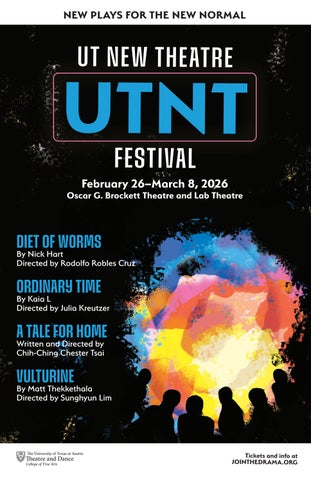
Welcome to UTNT 2026: a festival of five new plays for the new normal.
While you are here, I invite you to consider your existence in another light. Consider time differently: within yourself, inside this theatre, together, on this planet. Consider what we’ve lost and what we’ve maintained.
These five plays are charged with history, transformation, enormous heart, drive and delectable wit. I invite you to encounter them as the state of humanity today, translated for us by unflinching playwrights who hold their ear on the pulse for our collective understanding.
While you are here, I invite you to think through and talk about these plays as a creative community: What are these characters, stories and themes waking up in you? What about the person sitting in the seat near you at this performance, or tomorrow’s? Nurture your curiosity by making connections. And then, begin something new. The time is now.
About “New Play Development”
UTNT showcases new plays written by graduating M.F.A. candidate playwrights in collaboration with students and professionals from all theatre-making disciplines. In some ways this performance, when the play meets its audience, is the culmination of their creative work. After all, playwrights write to communicate, to express, to share their artwork through live performance. In our disposition as theatre makers, however, we know that a performance is also among the most useful stages of the developmental process.
In a moment, the creators of this play will learn a great deal astride the fulcrum of artistic intent and audience impact. With each performance, each scene, each moment, they’ll sense the shifts of energy in the piece: what works, what is unexpected and what needs attention. As an audience, you reveal their play and provide invaluable information that will influence the writing, design and acting choices for the next performance and productions ahead. While you are here, you help to build this new work.
-- Alexandra Bassiakou Shaw
UTNT (UT New Theatre) presents newly developed works from playwrights of Texas Theatre and Dance and Michener Center for Writers. Now celebrating its 19th season, this festival exists as an incubator for new work, with many plays continuing on to be professionally produced across the country.
The videotaping, photographing or audio recording of this production is
prohibited. Meet the cast and creative team behind Vulturine. Scan the QR code to view actor and creative team bios.
I have a morbid question for you:
Do you ever think about what’s going to happen to your body when you die?
Perhaps you’re considering a burial or cremation. Maybe even donating your body to science.
Two years ago, I found out about SKY BURIAL, an ancient Zoroastrian funerary practice in which vultures eat your dead body.
I was shocked to learn that Sky Burials were quite common across South Asia until very recently, when the population of vultures suddenly collapsed by 99% due to a mass poisoning.
Four species of Old World vultures are critically endangered in the very same region where mourners rely on them for Sky Burials.
Together, this remarkable bird and this fascinating ritual face an intertwined extinction. A way in which we understood grief and death for centuries might…die.
In a time when we’re bombarded with new, disturbing facts and figures every day, I wanted to take an intentional moment to grieve this tragically peculiar loss.
Unfortunately, I’m a rather morbid person with a flair for the irreverent. You could say there’s no one less qualified to tell this story than I.
But, hear me out – isn’t there something funny about the deep, dark abyss?
How, if you ever find yourself plunging down toward its shadowy bottom, you’ll inevitably go SPLAT?
Welcome to Vulturine. Let’s take the plunge together.
Vulturine is a comedy with a tragic story. A fiction that portrays the reality we are facing. Or rather, a visceral reality we often refuse to confront. If you are someone who has long lived in a complicated love-and-hate relationship with your loved ones, who struggles with grief and memory or wrestles with fear and guilt in the face of an existential crisis, I would say this play is for you.
The world of the play may appear absurd and nonsensical, but when reflected against the world we are living in now, it becomes clear that our reality is no less brutal or despairing. As the Old Man rages in the play, “The clock is ticking,” and here we are, gathered together in the theatre as a temporary but unique community. I hope that within this hilarious fictional world, we can collectively encounter heartbreaking moments through a mixture of laughter and sorrow. This play may not offer answers to the world’s problems or catastrophes. Instead, I hope it asks something of each one of us.
Last but not least, this play is dedicated “to the vultures,” to those who are going extinct because of our greed and violence.
“Long live the vultures.”
NOTE FROM THE DIRECTOR SPECIAL
THANKS
Alexandra Bassiakou Shaw, Kirk Lynn, KJ Sanchez, Andy Grapko, Christin Davis, Alison Vasquez, Zach Fine, Kaia L, Nick Hart, Chih-Ching Chester Tsai, Yasmin Eriksson, Andy Evren, Danbi Cho, 2025 Fall Production Process class, Department of Theatre and Dance staff, To the brave who dare to resist and stand together in a brutal world.
ORDINARY TIME
February 27 at 7:00 p.m.
March 4 at 7:00 p.m.
March 7 at 2:00 p.m.
By Kaia L
Directed by Julia Kreutzer
Oscar G. Brockett Theatre F. Loren Winship Drama Building
THEATREDANCE.UTEXAS.EDU
Georgia Beckmann – Assistant Director • Eleanor Bird – Assistant Stage Manager • Scott Bussey – Technical Director Nicole Chacko – Co-Production Manager • Edgardo Cruz –Assistant Lighting Designer • Gala Demarin – Assistant Scenic Designer • Valeria Nuñez
Estrada – Assistant Scenic Designer • Julia Kreutzer – Director • Kaia L – Playwright, Composer • Lisa Laratta– Scenic Designer • Jacqueline Mai – Stage Manager
Hannah Nelson – Dramaturg, Music Director • David Olivares – Sound Designer
The videotaping, photographing or audio recording of this production is strictly prohibited. There will be one 15-minute intermission.
Ben Barclay
Auden Beauvois
Connor Burk
Connor Davis
Caleb Goodwin
Channing Grace
Aidan Halat
André Lira
Diego Rodriguez
Khalia Sacko
Matt Thekkethala
Zachary Williams
NOTE FROM THE PLAYWRIGHT
Hello! This is Kaia (your playwright)—
—with a few gentle suggestions on how one might best engage with the play you have come here to see. So, if you’ll allow,
How to Watch Ordinary Time:
Sit still/sit quiet/sit back and relax
Be patient
Laugh when it is funny
Let your mind wander when it wanders
Or, said differently, release any expectations of yourself as an audience member
Let us take care of you
Believe what’s in front of you
Let go of anything that is no longer in front of you
Let it hurt, then let it go
Sing in your heart (but not out loud, if you please)
Look for God, if you’re willing, in the quiet moments, just in case
Forgive us
And, After You’ve Watched Ordinary Time:
Take a moment to come back to yourself
Stretch
Hydrate
Release anything you were holding onto inside the theatre
Continue to cultivate silence, if you would
And lastly, there are three Latin phrases that, towards the end of Act II, you might be glad to know:
1. Dominus nos videt means “God see us”
2. Dominus nos ignoscet means “God forgive us”
3. Dominus nos recreat means “God restore us”
I think that’s it! We’re so glad that you’re here.
The Lord’s peace be with you, Kaia L
NOTE FROM THE DIRECTOR
“I came to the monastery to look for angels, but I found men” — Brother Ignatious, Mount Angel Abbey
I came to graduate school to study campy, feminist theatre; instead, I found myself in a room of eleven young men staging a theatrical exploration of intention, silence and doubt. Much like religion, this play has found me when I needed it. It rewired my maximalist heart and taught me how to listen. Growing up Catholic, the order, rigidity and steadfastness of organized religion felt to me a heavy load to bear, only understood and appreciated by the few who “got it.” In this play, I’ve found new appreciation for this burden of belief, for the weight of devotion; how attentiveness and adherence can actually push us to exhale, whether we always “get it” or not.
Ordinary Time asks us all to commit to the rigor of stillness, to sit with ourselves longer than feels comfortable. A mirror to the Divine Offices that dictate the schedule of Benedictine monks, this three-hour experience of stillness and silence is both a relief and burden; we’re grateful for your joining us in the labor of cultivating holiness in the mundane, sacredness in monotony, humanity in the divine.
“...In the love of Christ to pray for one’s enemies. In case of discord with anyone to make peace before the setting of the sun. And never to despair of the mercy of God…”
–The Rule of St. Benedict, Ch. IV: “What Are the Instruments of Good Works”
The Rule of St. Benedict is an instructive set of precepts for how monks should dwell together. When men join the Benedictine Order, they commit themselves to God, their abbot, and the Rule itself. Benedictine monks spend their days intentionally: in labour, in silence, praying the Liturgy of the Hours and always in service of each other. In our play these men have values which have brought them here to this abbey. I’m struck by how their choice–to honor those values, to serve this particular community–has led each man to this moment in Ordinary Time.
Today you’ll witness a group of men with differing personalities, viewpoints and needs. You’ll see them doing the simultaneously difficult and deeply ordinary work of navigating what it means to live in community together. Bound by their commitment to God and the values of St. Benedict, these men have chosen this place–and so, every day, they must choose each other as well. These are men seeking to live well together: to make peace with themselves and each other, to seek moral clarity and to find hope in the midst of doubt. Whatever questions you leave here with, I hope you will consider them in the spirit of the Benedictines: with love, intention and humility toward yourself and each other.
SPECIAL THANKS
Kevin Auer, Peter Stopschinski, Kathleen Nelson, David Nelson, KJ Sanchez, Alexandra Bassiakou Shaw
Meet the cast and creative team behind Ordinary Time. Scan the QR code to view actor and creative team bios.
Laura Soares – Co-Production Manager • Aaron Sullivan – Dramaturg
Andrew Tham – Composer • Lindsey Thurston – Costume Designer
The Senator from Maryland
The Senator from Michigan
CAST (IN ALPHABETICAL ORDER)
The Senator from New Mexico
The Senator from West Virginia
The Senator from Connecticut
The Senator from Alaska
The Senator from Kansas
The Senator from Kentucky
The Senator from Oregon
The Senator from Nevada
The Senator from Washington
The Senator from Colorado
The Senator from Vermont
The Senator from Montana
The Senator from New Jersey
The Lobbyist
The Senator from Arkansas
The Senator from Florida
The Senator from Mississippi
The Senator from Idaho
The Senator from Illinois
The Senator from Texas
The Senator from Alabama
The Senator from Nebraska
Durrell Anderson
Haddon Britt
Frida Castro
Emma Dodds
Ella Eavenson
Ava Grottis
Zoë Hampton
Shaya Harris
Jimena Herrera
George Johannson
Isaiah Jones
Jarell Kearney
Jade Lang
Eli Leva
Sammy Liker
Roman Losa
Mackenzie Moberly
Keren Sofia Ortega
Blake Persyn
Manuela De Pontes
Preston Powe
Ericka Pugliese
Jason Robalino
Erin Simpson
The Senator from California
The Senator from Wisconsin
Jeremy the Intern
The Senator from Ohio
NOTE FROM THE PLAYWRIGHT
“I would have made a good Pope.’’
-Richard Nixon, 37th president and former Senator of California
“They don’t call me Tyrannosaurus Sex for nothing.’’
-Ted Kennedy, former Senator of Massachusetts
Neely Stalcup
Erick Vargas
Fred Wara
Pennylou Zimmerman
“If you don’t mind smelling like peanut butter for two or three days, peanut butter is darn good shaving cream.’’
-Barry Goldwater, former Senator of Arizona
“The only thing that I’ve heard is if you take a plastic bottle and put it in the microwave and you heat it up, it gives off a chemical similar to estrogen. So the worst case is some women may have little beards.”
-Paul LePage, Former U.S. Governor of Maine
‘’For seven and a half years I’ve worked alongside President Reagan. We’ve had triumphs. Made some mistakes. We’ve had some sex...uh...setbacks.’’
-George H.W. Bush, 41st president, and former U.S. Representative of Texas
‘’The internet is not something you just dump something on. It’s not a truck. It’s a series of tubes…”
-Ted Stevens, former Senator of Alaska
‘’Republicans understand the importance of bondage between a mother and child.’’
-Dan Quayle, 44th Vice President and former Senator of Indiana
“This land was made for you and me”
-Woody Guthrie
NOTE FROM THE DIRECTOR
The process of new play development is a fluid relationship between two forces: the playwright who creates the world, and the director who interprets and delineates the embodied rules the play requires. Together, they are responsible for transporting actors into this world in which they must fully accept the given circumstances and rigorously justify them. The reward is a singular event—one that examines our own world through an entirely new lens.
With Diet of Worms, that lens is rage, impulse and humor against the systems we stake our lives on every day—filtered through the distinct point of view of a cohort of young people. I ask the same of the audience—you are an active member of our ensemble. I ask you to experience through rage, impulse and humor. I ask you to be like the white-tailed deer, the official state animal for eleven of our fifty U.S. states.
The videotaping, photographing or audio recording of this production is strictly prohibited.
How can we possibly make sense of this age of American politics, one characterized by tension between state and federal governments and outright presidential overreach? In an era of congressional inaction and growing political influence from the ultra-wealthy, how can theatre offer us new ways of seeing?
“Against the assault of laughter, nothing can stand,” wrote satirist Mark Twain in his posthumous novel, The Mysterious Stranger. Laughter, Twain argues, is the most effective weapon against hypocrisy, capable of defeating “colossal” fraudsters.
For most of their conscious lives, Gen Z has been inundated by a political climate that thrives on absurdity and demands attention. Feeling decreasingly represented by the system, Gen Z has turned to social media to express their rage through evocative memes centered on political humor.
Diet of Worms operates within this perspective, posing the question: If we continue the absurd political practices that got us here in the first place, how will our country’s Senate operate? The childish octogenarians of the play respond by escalating the absurdity.
Mirroring the fast, recurrent nature of the political system it depicts, Diet of Worms invites audiences to laugh not as an escape, but as recognition of the current moment. The play doesn’t position its audience outside of the system it critiques: 24 of your fellow audience members have been chosen to decide the direction of tonight’s play.
Diet of Worms asks what laughter can still do in a moment when absurdity feels ordinary. As the play unfolds, audiences are invited to notice when laughter becomes release, resistance or recognition — and what it leaves behind.
SPECIAL THANKS
Keaton Perro for her work on this production. Ericka Pugliese for her choreographic work in sections of the play. Robin Virginie, Reuben Reyes, Kirk Lynn, Virginia Grise, Annie Laura Irizarry-Pérez. Everyone who helped this play along in its workshop development: Chester Tsai, Kaia Lyons, Matt Thekkethala, Nora Borre, Mikala Gibson, Sunghyun Lim, Julia Kreutzer, Jaden West, Kira Small, KJ Sanchez, Alexandra Bassiakou Shaw. The entirety of the Playwriting and Directing Cohort.
Our Brave Senators and Representatives of These United States of America
Meet the cast and creative team behind Diet of Worms. Scan the QR code to view actor and creative team bios.
The videotaping, photographing or audio recording of this production is strictly prohibited.
NOTE FROM THE PLAYWRIGHT/DIRECTOR
I’m thinking back to when I first started this play last year. The initial prompt was to interweave with one of a few selected folklores. I chose the one I first learned in a Chinese class in elementary school. The folklore did not make it into later revisions of the play, but the process stayed with me and led to a lingering question: what stories are we telling, and whose stories are they?
Today, it is not uncommon for us to leave home—to travel, to relocate or to migrate. When I arrive in a new place, I often feel the possibility of reinventing myself. What if I tell people that I’m this, and then fake it until I become it? Yet there are parts of my identity—perhaps most parts—that I cannot hide, fake or remake. There is the part called home, tied to space and time, and to the memories and people I hold dear.
Having spent more than thirty years in my hometown, Taiwan, being in America for the past three years has granted me distance from that part of my identity—one I had long taken for granted. I think of Yi-Fu Tuan’s words in Space and Place: “Thought creates distance and destroys the immediacy of direct experience, yet it is by thoughtful reflection that the elusive moments of the past draw near to us in present reality and gain a measure of permanence.”
Experience turns into memory. Memory turns into story. Through telling and retelling, something shifts—perspective, distance, belonging. What remains uncertain is whether a story can still hold its truth once it is carried elsewhere, spoken in another place, another time. Whether home can be remembered without being fixed. Whether what is translated or transplanted is lost, transformed or waiting to be told again.
NOTE FROM THE DRAMATURG
When I think about tales from home, I think of the recipes that began in my mother’s hands. Sun dried locust beans and the smell of blended red bell pepper on the stove. I hear the whirring sounds of electric handheld mixers creaming butter into sugar.
This tale in particular asks us what we take from home and what we go back for.
This play takes place every day in WhatsApp group chats and Facebook pages. In both college nationality interest groups and application papers.
I invite you to consider where else this play takes place in your day to day, as it never quite ends once the curtain has closed.
SPECIAL THANKS
Alexandra Bassiakou Shaw, ChKristin Sawyer Davis, Eghosa Courage Isibor, Kirk Lynn, and KJ Sanchez. Fall 2025 Method and Practice class reading cast: Adithi Chandrashekar, YiShuan Chiu, Eian Johnson, Akansha Ranbhise, Kira Small and Caitlyn Waltermire.
THE JANS
By Adithi Chandrashekar
Directed by Georgia Beckmann
READING
March 8 at 11:00 A.M. Lab Theatre The University of Texas at Austin
Do you, or have you ever:
• Carried a carabiner?
• Worn flannel?
THEATREDANCE.UTEXAS.EDU
• Gifted or been given a bouquet of violets?
• Had an undercut?
• Driven a U-haul?
If you said yes to any of the above, meet us at 11:00 a.m. on March 8. Bring a “friend.” Combat boots optional.
Scan the QR code to view a list of the cast and creative team for The Jans.