Classrooms without borders
Education, Inclusion and Diversity through Comics
COORDINATORS
Andrea Basantes-Andrade and Anniek Orye
Classrooms without Borders
Education, Inclusion and Diversity through Comics
Education, Inclusion and Diversity through Comics
Education, Inclusion and Diversity through Comics
Education, Inclusion and Diversity through Comics
Andrea Basantes-Andrade and Anniek Orye
UTN Researchers
Andrea Basantes-Andrade avbasantes@utn.edu.ec https://orcid.org/0000-0003-1045-2126
Gabriela Bastidas-Amador agbastidas@utn.edu.ec https://orcid.org/0000-0003-2370-5065
PXL Researchers
Claudia Ruiz-Chagna caruiz@utn.edu.ec https://orcid.org/0000-0001-6682-7885
Coordinadores
Marlen Congo-Cervantes mmcongoc@utn.edu.ec https://orcid.org/0009-0001-0651-2694
Gabriela Quintana-Andrade gaquintanaa@utn.edu.ec https://orcid.org/0009-0004-6009-6566
Anniek Orye anniek.orye@pxl.be https://orcid.org/0009-0006-9379-4066
Lieve Cuypers lieve.cuypers@pxl.be https://orcid.org/0009-0009-4719-1581
Sofie Molemans sofie.molemans@pxl.be https://orcid.org/0000-0001-5350-2096
Andrea Basantes -Andrade, Gabriela Bastidas-Amador, Lieve Cuypers, Sofie Molemans, Claudia Ruiz-Chagna, Marlen Congo-Cervantes y Gabriela Quintana-Andrade



Editorial Universidad Técnica del Norte
Av. 17 de Julio, 5-21 y Gral. José María Córdova Campus El Olivo IBARRA – IMBABURA – REPÚBLICA DEL ECUADOR
www.utn.edu.ec editorial@utn.edu.ec
Coordinators
Andrea Basantes-Andrade PhD. Docente Investigadora – Facultad de Educación, Ciencia y Tecnología Grupo de investigación de Ciencias en Red (e-CIER) Universidad Técnica del Norte, Ecuador avbasantes@utn.edu.ec https://orcid.org/0000-0003-1045-2126
Anniek Orye MSc.
PXL University of Applied sciences and Arts, Belgium anniek.orye@pxl.be https://orcid.org/0009-0006-9379-4066
External peer reviewers
Andrea Vargas Fajardo PhD. andreavargasfajardo01@gmail.com Universidad de los Llanos, Colombia
Maricarmen Caldeiro PhD. mcarmen.caldeiro@usc.es Universidad de Santiago de Compostela, España
Style reviewer
Sandra Guevara-Betancourt PhD. smguevara@utn.edu.ec Universidad Técnica del Norte, Ecuador
Authors
Andrea Basantes-Andrade
Anniek Orye
Lieve Cuypers
Sofie Molemans
Gabriela Bastidas-Amador
Claudia Ruiz-Chagna
Gabriela Quintana-Andrade
Marlen Congo-Cervantes
Paulo Aguilar-Robles
Angélica Osorio-Obando
Alisson Sánchez-Bastidas
Liliana Espinoza
Wendy Tutillo-Alba
Nazaret Isea-Mora
Mayra-Alexandra Morales-Tambaco
Oliver Amaya-Benavides
Paula Herrera-H
Nicole Flores-Santacruz
Diana Hernández-Ruales
Carlos Zumárraga-F
Donna Fuel-Cualchi
Damaris Ostaiza-Yepez
Indra Salcedo-Recalde
Ingrid Huera-Mites
Deisy Murillo-H
Leslie Marcillo
Geraldine Bajaña-Díaz
Jessica Anrango
Angela Cuascota-Gonza
Jéssica Hernández-Olmedo
Nathaly-Andrea Pomasqui
Karla Salazar-Quiroz
JS Santillán-Tamayo
Atikuri Yupanki-Orbes
André Ruiz
Tamya De la Torre-Sanipatín
Mayerli Vaca Castillo
Erika Jiménez
Linguistic Review
Directors
Gabriela Bastidas-Amador MSc. agbastidas@utn.edu.ec Universidad Técnica del Norte, Ecuador
Marlen Congo-Cervantes MSc. mmcongoc@utn.edu.ec Universidad Técnica del Norte, Ecuador
Comic illustration Director
Edison Díaz MSc. eddiazm@utn.edu.ec Universidad Técnica del Norte, Ecuador
Assistants
Ariel Sebastian Mier Albuja
Atikuri Yupanki Orbes Andrade
Boris Octavio Anrango De La Cruz
Cecibel Malena Pozo Ortiz
Dinna Marilyn Vargas Escobar
Jhoselyne Belén Rosales Endara
José Andrés Molina Gallegos
Joselyn Margoth Bazante Rosero
Josselyn Salomé Santillán Tamayo
Karla Lizeth Salazar Quiroz
Katherin Lisbeth Gómez Paredes
Lady Evelyn Tandalla Tandalla
María Celeste Larreal Aponte
Mier Albuja Ariel Sebastian
Miguel Angel Andrade Beltran
Oliver Rodrigo Cobo Enriquez
Samanta Brigith Villota Manosalvas
Siomara Arlet Chuquitarco Potosí
Steven Javier Chulde Acosta
William Israel Vistin Cuamacas
Artistic photography
Gabriela Arcos MSc. cgarcos@utn.edu.ec Universidad Técnica del Norte, Ecuador
Art direction and layout
Edison Díaz MSc. eddiazm@utn.edu.ec Universidad Técnica del Norte, Ecuador
Julian Posada MSc. japosada@utn.edu.ec Universidad Técnica del Norte, Ecuador
Cristhian Velasco MSc. cevelasco@utn.edu.ec Universidad Técnica del Norte, Ecuador
Digital comic layout Directors
Julian Posada MSc. japosada@utn.edu.ec Universidad Técnica del Norte, Ecuador
Cristhian Velasco MSc. cevelasco@utn.edu.ec Universidad Técnica del Norte, Ecuador
Deputy director
Santiago Loaiza MSc. sdloaiza@utn.edu.ec Universidad Técnica del Norte, Ecuador
Assistants
Cristian Brayan Morocho Cuzco
Dilan Ariel Sandoval Cachipuendo
Edison Javier Tuquerres Pichamba
Edison Josué Guerra Becerra
Eick Daniel Perugachi Morales
Gabriela Alexandra Ortíz Portilla
Gael Joad Quelal Flores
Gloria Paulina Guachamín Andrango
Jefferson Alexander Quilumba Castañeda
Jeniffer Betsabé Rosales Gallegos
Juan Fernando Salazar Cárdenas
Kerena Gudeyi Caicedo Velasco
Lesly Nayeli Quinteros Laguna
Maira Elizabeth Medina Tulcan
Marjorie Carolina Colcha Ipiales
Micaela Victoria Cevallos Sánchez
Naby Saleth Loor Medina
Paulina Fernanda Mejía Jurado
Paulina Gissell Castro Querembas
Sisa Sara Yamberla Ipiales
Yanel Estefania Jaramillo Espinosa de los Monteros
© Texts and photographs: the respective authors, 2025
© This edition: Universidad Técnica del Norte, 2025
First digital edition: September 2025 / DOI: 10.53358/libfecyt/VCOM7243
ISBN: 978-9942-572-19-6
No part of this publication may be reproduced, in whole or in part, without the prior written permission of Editorial Universidad Técnica del Norte.
Rol del Departamento de Consejería Estudiantil (DECE)......................
El rol del docente en contextos de inclusión educativa ..........................
Adaptaciones curriculares y metodologías inclusivas ............................
Estrategias pedagógicas para atender las necesidades educativas específicas. ................................................................................................................. 73
Estigmas y mitos comunes sobre la discapacidad
El impacto de la migración interna en el acceso a la educación en el Ecuador
Contexto de la migración interna en el Ecuador.....................................
Impactos de la migración en el sistema educativo .................................
95
Multilingüismo y aprendizaje de segundas lenguas ............................... 97
Uso de TIC para preservar lenguas originarias ...................................... 98
Lenguaje de señas como herramienta de inclusión ................................ 99
Cuentos y relatos tradicionales en lengua originaria como recurso didáctico.............................................................................................................. 101
Análisis de actitudes lingüísticas hacia el kichwa, shuar y otras lenguas indígenas ............................................................................................................. 103
Conclusiones 106
CÓMICS 107
Referencias Bibliográficas ...................................................................... 110
CAPÍTULO V 116
EDUCACIÓN CON SENSIBILIDAD: TRAUMA, RESILIENCIA Y APOYO EMOCIONAL 116
Introducción ............................................................................................ 116
Estrategias de regulación emocional en el aula 117
El rol de las familias en el acompañamiento emocional ........................ 118
Enfoques pedagógicos restaurativos y educación sensible..................... 119
Educación emocional: violencia intrafamiliar en zonas rurales ecuatorianas ................................................................................................................... 120
Espacios de diálogo intercultural: sanación emocional en contextos pluriculturales ..................................................................................................... 120 Conclusiones ........................................................................................... Universal Design for Learning (UDL): Inclusion in Formal Education �������������������������
CÓMICS 123
with Sensitivity: Trauma, Resilience, and Emotional
Referencias Bibliográficas ......................................................................
126
APRENDIENDO DESDE LA COMUNIDAD 129
Introducción
129
132
133
Integración de Saberes Ancestrales en Lengua y Arte en Ecuador.........
Documentación participativa de saberes comunitarios ..........................
Formas y medios de documentación participativa .................................
Estructura metodológica para proyectos de documentación 134
Participación de líderes comunitarios en el contexto intercultural del Ecuador 136
Estrategias para fortalecer la participación comunitaria intercultural ....
La minga como acto pedagógico: experiencias reales............................
Componentes pedagógicos de la minga..................................................
La minga como estrategia institucionalizada
Proyectos de educación patrimonial en colaboración con Gobiernos
(GAD)
CAPÍTULO VII 151
Unequal Access to Technology in Rural Communities in Ecuador
Digital Literacy in Indigenous Communities
Use of Mobile Technologies for Teaching Indigenous Languages
CONECTANDO MUNDOS: TECNOLOGÍA Y DIVERSIDAD EN EL AULA 151
Assistive Technologies for Special Needs
151
152
Introducción ............................................................................................
Ética digital e interculturalidad...............................................................
Chapter 8
154
Accesibilidad digital y plataformas inclusivas
Celebrating Our Roots: Ecuadorian Festivities in the Classroom ..................
155
Inteligencia artificial y personalización del aprendizaje inclusivo .........
Afro and Montubio Celebrations: Living Memory of Ecuador’s Coast 422
Agricultural Calendar and Ancestral Rites in the Andean Worldview
Experiencias innovadoras de aulas híbridas e inclusivas en Ecuador ....
Amazonia: Dances, Colors, and Gratitude to Nature
156
Galápagos: Sustainability and Tradition in Changing Islands
Acceso desigual a la tecnología en comunidades rurales del Ecuador ...
The Importance of Festivities to Teach Art, History, Music, Gastronomy, and Values: A Journey through the Cultural Meanings in Different Regions of Ecuador
157
Contemporary Transformations of the Traditional Festivities
159
Alfabetización digital en comunidades indígenas
Uso de tecnologías móviles para enseñar lenguas originarias ................ 161
Tecnologías de asistencia para necesidades especiales ..........................
Flavors that Unite: Ecuadorian Gastronomy in the Classroom ......................
Conclusiones ...........................................................................................
Gastronomy, Educational Culture, and Food Sustainability
CÓMICS 165
The Impact of Globalization on Local Food Practices
Ritual Cuisine: Food in the Context of Celebration and Ancestral Rituals
Referencias Bibliográficas ......................................................................
Community Kitchens and their Role in Social Cohesion
Origin Stories of Traditional Ecuadorian Dishes
The Use of Eatable and Medicinal Plants in Traditional Ecuadorian Cuisine
CAPÍTULO VIII 173 CELEBRANDO NUESTRAS RAÍCES: FESTIVIDADES DEL ECUADOR EN EL AULA 173
Introducción ............................................................................................
Celebraciones afro y montubias: memoria viva del litoral ecuatoriano .
Amazonía: danzas, colores y gratitud a la naturaleza
180
Galápagos: sostenibilidad y tradición en islas cambiantes .....................
List of Tables
Table 1: Peoples and nationalities of Ecuador by geographic region ���������������������� 27
Table 2: Types of speech balloons and their function in comic narrative���������������� 48
Importancia de las festividades para la enseñanza de arte, historia, música, gastronomía y valores: un recorrido por los significados culturales en diferentes regiones del Ecuador .......................................................................... 180
Table 3: Principles of Universal Design for Learning (UDL) �������������������������������������� 123
Transformaciones contemporáneas de las fiestas tradicionales..............
Table 4: Curricular planning levels and their characteristics ������������������������������������ 128
182
Table 5: Classification of curricula adaptations according to their duration �������� 132
Conclusiones
Table 6: Family intervention and outcomes of emotional support ������������������������� 266
Table 7: Audiovisual programs available for educational use ����������������������������������
Table 8: Ancestral medicinal plants used in Ecuador ������������������������������������������������� 515
183 CÓMICS 184
List of Figures
Referencias Bibliográficas ......................................................................
Figure 1: Five steps to design a comic with an intercultural approach 46
187
Figure 2: Story construction 53
CAPÍTULO IX 191
Figure 3: Character definition and sketches 54
Figure 4: Colorization with traditional technique 54
Figure 5: Layout and integration of texts 55
SABORES QUE UNEN: GASTRONOMÍA ECUATORIANA EN EL AULA 191
Figure 6: Curricular adaptations at different levels of the educational system 129
191
192
Introducción ............................................................................................
Gastronomía, cultura educativa y sostenibilidad alimentaria
Impacto de la globalización en las prácticas alimentarias locales .......... 194
Culinaria ritual: comidas en contextos de celebración y rituales ancestrales
196
Cocina comunitaria y su función en la cohesión social .......................... 198
Relatos de origen de platos típicos ecuatorianos .................................... 199
Uso de las plantas medicinales y comestibles en la cocina tradicional ecuatoriana ..........................................................................................................
200
203
Conclusiones ...........................................................................................
CÓMICS 205
Referencias Bibliográficas ......................................................................
Tabla 1 Pueblos y nacionalidades del Ecuador por región geográfica ..... 19
Tabla 2 Tipos de globos y su función en la narrativa gráfica del cómic .. 35
Tabla 3 Principios del Diseño Universal para el Aprendizaje (DUA) .....
66
Tabla 4 Niveles de planificación curricular y sus características .............
70
Tabla 5 Clasificación de las adaptaciones curriculares según su duración ........................................................................................................................
73
Tabla 6 Estrategias de intervención familiar y resultados del acompañamiento emocional
119
Tabla 7 Programas audiovisuales disponibles para el uso docente
160
Tabla 8 Plantas medicinales ancestrales utilizadas en Ecuador ............... 201
In an increasingly diverse and interconnected world, education must rise to the challenge of shaping citizens who are capable of living together in plurality. Inclusion and interculturality stand as fundamental pillars for building equitable societies in which every individual regardless of origin, identity, or abilities has the opportunity to learn and flourish within environments that recognise and value their uniqueness. With this goal in mind, Classrooms without borders emerges as an innovative pedagogical proposal that integrates the narrative power of comics with the principles of inclusive and intercultural education.
This work is part of the International Teacher Training Programme on Innovative Practice (ITP), an initiative funded by VLIR-UOS and led by PXL University of Applied Sciences and Arts (Belgium) in strategic partnership with Technical University of the North (Ecuador), Jimma University (Ethiopia), North-West University (South Africa), and Royal University of Phnom Penh (Cambodia). Within this interinstitutional and transnational synergy, the Technical University of the North has taken the initiative to create a comic-based book aimed at fostering awareness, training, and dialogue around diversity and inclusion in contemporary educational contexts.
Comics, with their unique combination of text and image, are presented here as a didactic resource accessible to varied learning styles and cultural expressions. They generate emotional connections, foster empathy, stimulate critical thinking, and facilitate reflection on the complex realities that inhabit our classrooms. Through visual stories and graphic narratives, this book addresses the challenges faced by students and teachers in multicultural contexts, offering innovative perspectives and creative solutions aimed at promoting equity and the participation of all educational actors.
Each chapter of Classrooms without borders: Education, inclusion and diversity through comics explores themes related to integration, discrimination, the construction of collaborative environments, and the visibility of ancestral knowledge. The work goes beyond theoretical exposition; it integrates reflective questions, examples of real-life experiences, student-created comic stories, and
a conceptual glossary that facilitates comprehension and application of the content. These graphic narratives enrich the material, promote experiential, creative, and meaningful learning, and demonstrate the potential of comics as an inclusive and culturally responsive educational tool.
Classrooms without borders is intended for students and teachers, both in training and in practice, as well as for educational researchers and professionals dedicated to inclusive and intercultural pedagogy. The book invites readers to rethink traditional pedagogical practices and offers concrete pathways for implementing approaches that recognise and celebrate diversity as an essential pedagogical value. This publication is the result of an interdisciplinary and collaborative effort involving lecturers, researchers, and students from fields such as Educational Psychology, Psychology, Pedagogy of Arts and Humanities, Pedagogy of National and Foreign Languages, Fine Arts, and Graphic Design. This process enabled the development of competencies in research, creativity, visual communication, teamwork, intercultural sensitivity, and the use of digital tools. The contribution of each discipline is reflected in the work, which combines conceptual rigour with an innovative graphic proposal, making it an academic and pedagogical reference.
The proposal of this book aligns with the Sustainable Development Goals (SDGs), particularly SDG 4 (Quality Education) and SDG 10 (Reduced Inequalities), and is envisioned as a reference for future research and innovative pedagogical practices. Readers of Classrooms without borders will encounter an academic text that weaves together voices, images, and experiences, illustrating that teaching and learning can be profoundly human, creative, and culturally sensitive acts. This work demonstrates that classrooms, rather than being closed spaces, can become a borderless environment where knowledge, languages, colours, and stories converge, and where every student and teacher has the opportunity to be the protagonist of their own educational process.
We invite readers to explore these pages with an open mind and a critical spirit, convinced that within these graphic stories and pedagogical reflections they will find tools, inspiration, and new questions to rethink education and to build through practice and research a more inclusive, equitable, and respectful society that
embraces diversity. Classrooms without borders: Education, inclusion and diversity through comics constitutes a significant contribution to the educational field, aimed at enriching pedagogical practices, making student diversity visible, and contributing to the construction of fairer, more inclusive, and more compassionate societies. Its reading invites the audience to embark on an educational, creative, and profoundly human journey.
With appreciation, The Coordinators
Andrea Basantes-Andrade and Anniek Orye
Andrea Basantes-Andrade¹, Anniek Orye³, Lieve Cuypers³, Sofie Molemans³, Gabriela Bastidas-Amador², Claudia Ruiz-Chagna ², Gabriela Quintana-Andrade²,Marlen Congo-Cervantes²
1Network Science Research Group e-CIER, Universidad Técnica del Norte, Ecuador
2Facultad de Educación, Ciencia y Tecnología, Universidad Técnica del Norte, Ecuador
3PXL University of Applied Sciences and Arts
avbasantes@utn.edu.ec, anniek.orye@pxl.be, lieve.cuypers@pxl.be, sofie.molemans@pxl. be, agbastidas@utn.edu.ec, caruiz@utn.edu.ec, gaquintanaa@utn.edu.ec, mmcongoc@utn.edu.ec
Introduction
The increasing cultural diversity characterizing contemporary societies presents complex and unavoidable challenges for educational systems, which must undergo profound transformations to respond with relevance, equity, and cultural sensitivity to increasingly pluralistic contexts. Such transformation necessitates a critical reexamination of traditional teaching and learning models, guided by pedagogical approaches that recognize diversity as an asset and actively promote an inclusive, culturally responsive, and profoundly human education (UNESCO, 2023).
In this context, diversity and inclusion have evolved from being peripheral concepts to becoming fundamental pillars of educational discourse and practice. Diversity Encompasses the coexistence of multiple cultural, linguistic, ethnic, gender, religious, and functional identities, among other dimensions, within a shared educational environment (UNESCO, 2017). Inclusion, for its part, entails the creation of pedagogical, social, and attitudinal conditions that ensure
equitable participation and meaningful learning opportunities for all students, regardless of their individual or sociocultural characteristics (Ainscow, 2020).
Facing these challenges require active methodologies and innovative pedagogical resources capable of reflecting and valuing such plurality. Among these resources, the educational comic emerges as a pedagogical tool to stimulate meaningful learning, promote critical reflection, and raise awareness regarding diversity (Belda-Medina, 2024). Its visual and narrative nature facilitates the representation of multiple realities, fosters empathy, and adapts to diverse learning styles, becoming a valuable resource in intercultural educational contexts (Dallacqua, 2019; Derkachova et al., 2022).
This chapter explores how educational comics can be strategically employed to promote diversity, inclusion, and intercultural education. It outlines the theoretical foundations underpinning their pedagogical potential, presents international experiences and evidence-based best practices and proposes didactic guidelines for their integration into educational curricula. The overarching aim is to provide educators, researchers, and students with concrete tools that contribute to the construction of more inclusive, equitable, and culturally diverse educational environments.
Although diversity and inclusion have been established as fundamental principles within contemporary educational discourse, their affective realization in classroom practice requires a comprehensive understanding of their historical, cultural, and pedagogical foundations. The notion of culture, central to any critical reflection on diversity, has undergone a significant evolution. It is no longer conceived merely as a static repertoire of shared customs, values, and practices but rather as a dynamic construct, continuously reinterpreted and re-signified through ongoing social interaction (Dembeck, 2020; González et al., 2018).
According to the Royal Spanish Academy, culture is understood as the “set of knowledge that enables someone to develop their critical judgment,” as well as the “set of ways of life and customs, knowledge,
and degree of artistic, scientific, and industrial development within a particular era or social group” (Royal Spanish Academy, 2024). UNESCO (2020) has reformulated its approach and, in its recent documents, positions culture as a central axis of sustainable development, considering it a source of identity and social cohesion essential for building fairer and more resilient societies. This implies that culture is connected to visible manifestations such as language, clothing, and traditions, as well as to ways of understanding the world, producing knowledge, and establishing power relations.
From this perspective, cultural diversity in the educational field cannot be reduced to the mere coexistence of different ethnic or linguistic groups within the same space. This entails the coexistence of multiple cosmovision and value systems that can converge, dialogue, or, at times, come into conflict. Such tensions, in fact, they represent valuable pedagogical opportunities, which can become a driving force for critical analysis, ethical reflection, and the construction of meaningful learning (Dallacqua, 2019; Vélez, 2008).
In Latin America, the reflection on cultural diversity has been profoundly shaped by its colonial history. For centuries, Indigenous populations, Afro-descendants, and other ethnic groups have been relegated to subordinate positions, their languages and wisdoms systems have been rendered invisible, and their identities, stigmatized (Vargas, 2019; Viteri, 2020). This historical legacy has given rise to societies marked by enduring social, economic, and political asymmetries, which are also reproduced in the educational sphere. Education, instead of acting as an instrument of liberation, has functioned as a mechanism for reproducing social hierarchies, imposing Eurocentric visions of knowledge and denying the value of local wisdom (Merino, 2019).
In this context, interculturality emerges as a political, pedagogical, and epistemological response. Unlike multiculturalism, which tends to limit itself to recognizing the coexistence of different cultures, interculturality proposes transforming the relationships between them, questioning the power imbalances that have historically placed some cultures and positions of domination and others in positions of subordination (Gómez-Hernández, 2018). In Ecuador, the 2008
Constitution marks a milestone in this regard, declaring the nation as both intercultural and plurinational state, guaranteeing the rights of peoples and nationalities to maintain and strengthen their cultural, linguistic, and territorial identities (Asamblea Nacional del Ecuador, 2008). However, the transition from normative frameworks into concrete educational practices remains a complex challenge, requiring processes of awareness-raising, teacher training, and the development of culturally pertinent pedagogical materials (Valarezo et al., 2019).
The discussion about interculturality has generated a range of conceptual interpretations. Martínez (2018) highlights that it is a polysemous term, whose meaning shifts depending on the historical and political context in which it is employed. While in the European context it is often related to the integration of immigrants and ethnic minorities, in Latin America, it is closely associated with processes of their decolonization of knowledge and power. This difference determines the priorities and approaches of educational policies and pedagogical practices.
In European contexts, interculturality is often framed around the management of coexistence and preventing cultural conflicts, frequently adopting a paternalistic stance. In contrast, within Latin America, interculturality is rooted in the recognition of a historical debt to Indigenous and Afro-descendant communities and is oriented toward the construction of a genuinely inclusive and pluralistic model of citizenship (Campani, 2018; Villareal & Ascanio, 2018).
Authors such as Wences (2021) argue that interculturality should be understood in critical terms, not as superficial coexistence, or respect, but as an ethical and political project aimed at transforming social and education relations.
From this perspective, three levels of interculturality are acknowledged: the relational, which refers to everyday cultural interactions without necessarily implying structural changes; the functional, which accepts diversity insofar as it is useful to the dominant system; and the critical, which seeks to subvert structures of inequality in pursuit of more equitable and democratic societies (Loh, 2022). This latter dimension is the one with the greatest transformative potential in the education field, it requires
reviewing curricular content, teaching methodologies, pedagogical relationships, and institutional practices.
Inclusive education and critical interculturality converge on a common horizon: to ensure that all students—regardless of their personal, linguistic, or cultural backgrounds— have equitable access to quality learning and can fully participate in school life. This convergence extends beyond the mere physical integration of students into common spaces; it entails the creation of pedagogical conditions that recognize, value, and harness diversity as a source of collective enrichment (UNICEF, 2020). Achieving this requires educational practices that promote intercultural dialogue, empathy, and critical thinking, fostering a pedagogical vision that tolerates difference and considers it essential for the construction of just and cohesive societies (Basantes-Andrade et al., 2025).
Understanding cultural diversity from this perspective entails recognizing that classrooms are profoundly heterogeneous spaces, where different languages, historical memories, and life experiences converge. For educators, this scenario poses significant challenges, but also offers a valuable opportunity to innovate pedagogical practices, develop intercultural competences, and build bridges between diverse knowledge (Belda-Medina, 2024; Derkachova et al., 2022). Adopting pedagogical approaches sensitive to diversity does not merely mean modifying content but redesigning the ways of teaching, assessing, and relating to students, attending to their specific realities and needs. (Basantes-Andrade et al., 2024).
The foundations of inclusive education and cultural diversity extend well beyond the mere recognition of plurality withing the classroom. They demand an active commitment on social justice and the creation of educational environments where every day students can see themselves represented, feel valued, and be supported in realizing their full potential. Within this horizon, innovative pedagogical tools such as educational comics acquire their meaning and potential, as they enable the visibility of diverse identities, promotes critical thinking, and stimulates meaningful teaching and learning processes.
In Ecuador, interculturality is deeply rooted in historical processes and social struggles that have shaped the nation’s political and cultural identity. They are particularly linked to the Indigenous movements and other ethnic collectives advocating for the recognition of their territorial, linguistic, and cultural rights. From the mid-twentieth century, and with heightened intensity during the 1960s onwards, Indigenous organizations began demands aimed at achieving structural transformations that ensured the recognition of their territories, languages, justice systems, and educational rights. These elements deemed fundamental for the perpetuation of their cultural heritage and collective identity (Bretón, 2009; Rodríguez, 2017).
The Confederation of Indigenous Nationalities of Ecuador (CONAIE), known in Spanish as La Confederación de Nacionalidades Indígenas del Ecuador, emerged as one of the most influential socio-political actors in the country. It strategically articulated its struggles around key issues such as the defense of land rights, the preservation and revitalization of ancestral languages, and the implementation of an intercultural bilingual education system, designed to challenge the cultural and intellectual hegemony imposed by the historically monocultural state (López-Gopar, 2021). These demands crystallized in a historic advance with the promulgation of the Constitution of the Republic of Ecuador (CRE) in 2008, which recognized the nation as an intercultural and plurinational state, as outlined in the previous section.
The constitutional recognition of plurinationality entails the formal coexistence of diverse nations within the state, effective respect for their legal systems, administrative autonomy, and cultural and linguistic practices. However, the realization of these principles faces significant challenges. Persistent political tensions, the continuation of extractive projects affecting ancestral territories, and entrenched institutional resistance have constrained the development of interculturality in practice (Arias-Gutiérrez & Minoia, 2023; Sempértegui & Báez, 2023).
Initially, the construction of interculturality in Ecuador was primarily oriented towards Indigenous peoples. This has elicited criticism from researchers and social sectors emphasising the need to broaden its focus to include the other historically marginalized groups, such as Afro-Ecuadorians, Montubios, and Mestizos communities with distinct cultural identities (Higuera & Castillo, 2015; Urteaga & García, 2016). Although the 2008 CRE explicitly recognizes interculturality and plurinationality as fundamental principles of the state, in practice, public policies have predominantly centered on the Indigenous population, often relegating the broader ethnic diversity characterising the country to a secondary position (Urteaga & García, 2016).
The achievements attained are undeniable. Since the Constituent Assembly (Asamblea Constituyente) of 1998, legal foundations have been established to recognize the cultural, educational, and linguistics rights of peoples and nationalities’ accomplishments consolidated with the 2008 Constitution. This normative framework enabled the creation of institutions such as the Council for the Development of Indigenous Peoples of Nationalities of Ecuador (CODENPE) known as Consejo de Desarrollo de las Nacionalidades y Pueblos Indígenas del Ecuador, as well as the institutionalization of entities dedicated to bilingual intercultural education and health with a culturally relevant approach. Furthermore, significant progress has been attained in the delimitation and legalization of ancestral territories, particularly in the Amazon region, thereby strengthening the organizational autonomy of Indigenous communities (Gómez et al., 2018).
Ecuadorian ethnic diversity is undeniably rich and complex. According to the 2022 Population and Housing Census conducted by the National Institute of Statistics and Census (Instituto Nacional de Estadística y Censos, INEC, 2023), 77.5% of the population selfidentify as Mestizo, 7.7% as Montubio, 7.6% as Indigenous, 4.9% as Afro-Ecuadorian, 2.2% as White, and 0.1% as belonging to other ethnic identities. These data reflect the profound plurality of the country and underscore the necessity of promoting inclusive public policies that acknowledge and respect the diversity in all its dimensions.
CODENPE and UNICEF (n.d.) have officially identified 14 nationalities and 18 indigenous peoples distributed across Ecuador’s diverse geographical regions. This cultural mosaic constitutes provides the contextual foundation for the narratives presented in the comics included in this educational volume. The stories depicted in these pages draw inspiration from the lived experiences, collective memories, cosmovisions, and region-specific challenges faced by these communities, with the purpose of offering a nuanced and respectful representation of Ecuador’s vast cultural diversity. Table 1 provides a summary of this cultural richness:
Table 1
Peoples and nationalities of Ecuador by geographic region
Table 1
Geographic region
Geographic region
Nationalities
Nationalities
Peoples
Peoples
The Coast Awá; Chachi; Épera; Tsáchila Afroecuadorian; Montubio
The Coast Awá; Chachi; Épera; Tsáchila Afroecuadorian; Montubio
The highlands Kichwa Otavalo; Karanki; Natabuela; Kayambi; Quitu - Kara; Panzaleo; Salasaka; Saraguro; Puruhá; Cañari; Waranka; Palta
The highlands Kichwa Otavalo; Karanki; Natabuela; Kayambi; Quitu-Kara; Panzaleo; Salasaka; Saraguro; Puruhá; Cañari; Waranka; Palta
The Amazon Achuar; Andwa (Andoa); Cofán (A’i); Kichwa; Secoya; Shiwiar; Shuar; Siona; Sapara; Waorani
Source: UNICEF (2013)
Tagaeri - Taromenane (peoples in voluntary isolation)
This cultural wealth serves as the cornerstone for envisioning an authentic interculturality, conceived as peaceful coexistence, active dialogue, wisdom exchange and mutual recognition among the various nationalities and peoples. According to CONAIE (2007), the plurinational state is envisaged as a political organization model aimed at decolonizing historical power structures, promoting social justice, and constructing economic and social alternatives to the neoliberal model, strengthening popular sovereignty and social and political equity.
It is crucial to emphasize that the realization of this vision requires interculturality not to remain anchored in symbolic or discursive realms but to be translated into concrete, institutional, and everyday practices. This entails guaranteeing collaborative rights, such as the autonomy of community governments, respect for Indigenous legal systems, and the integration of wisdoms and cosmovisions in areas such as education and cultural production (CRE, 2008; García & Tuasa, 2007).
The 2008 Constitution explicitly enshrines these principles. Article 1 defines Ecuador as a constitutional state of rights and justice, social, democratic, sovereign, independent, unitary, intercultural, plurinational, and secular. It also recognizes rights such as intercultural communication (Art.16), the construction and preservation of cultural identity (Art. 21), and citizen participation in the formulation of public policies with an intercultural approach (Art. 23). Furthermore, it establishes the mandate to protect and strengthen the identity, traditions, and forms of social organisation of communities, peoples, and nationalities (Arts. 56–57).
In the educational domain, the CRE accords a central role to the Intercultural Bilingual Education System (Sistema de Educación
Intercultural Bilingüe, SEIB), conceived as the result of decades of social struggles. This system encompasses all educational levels, from early childhood education to higher education, and operates articulated with the paradigm of Buen Vivir (Sumak Kawsay in Kichwa), integrating contemporary scientific knowledge with the ancestral wisdom of Ecuador’s diverse peoples and nationalities. (Higuera & Castillo, 2015). Furthermore, Article 276 explicitly links interculturality to the national development model, mandating that development strategies must protect and promote cultural diversity while safeguarding spaces for cultural reproduction and exchange. It also places limits on neoliberal and extractive economic policies.
In this context, speaking of diversity and interculturality in Ecuador entails referring to a political, legal, social, and educational horizon that aspires to transform the nation into a more just, equitable, and culturally plural society. It is precisely within this context weave of historical struggles, political aspirations, and cultural richness that
the educational comic assumes a special significance. The graphic narratives presented in this book transcend their pedagogical function and positioning themselves as tools for visibility, recognition, and intercultural dialogue. Through their visual narratives, they aim to raise awareness of collective rights, honor the diversity of identities, and promote meaningful learning processes that contribute to the construction of a truly intercultural and plurinational Ecuadorian society.
Intercultural education has become established in Latin America as a fundamental component of educational policies due to its pedagogical relevance and its social and political implications. Over the past decades, its prominence has increased, driven by the impetus of social movements demanding recognition and equity among the diverse cultures coexisting within their territory. This educational paradigm seeks to overcome monocultural structures that have historically rendered invisible Indigenous peoples, Afro-descendants, and other historically marginalized groups (Granados-Beltrán, 2021; Valarezo et al., 2019).
From a critical perspective, intercultural education promotes the integration of ancestral and local knowledge into formal curricula, fostering a dialogue with contemporary scientific knowledge. Such articulation represents an act of historical justice and constitutes a means to promote critical thinking, inclusion, and respect for epistemic diversity (Walsh, 2020). UNICEF (2020) asserts that the educational system constitutes a key space for social transformation, serving as a platform for cohesion and as an engine for emancipatory processes: “The educational system is the foundation of human formation and an instrument not only for maintaining society but for the development, growth, transformation and liberation of that society and all its human potentialities” (p.11).
Intercultural education extends beyond the confines of formal schooling, unfolding within community, familial, productive, and symbolic spaces where collective identities are configured (Likszenberg & Lesta, 2020). It is a social and political process that demands the implementation of pedagogical, institutional, and
community strategies coherent with the socio-cultural realities of the territories.
In Ecuador, this framework is grounded in the Constitution of the Republic (2008), which designates the country a plurinational and intercultural state. Article 347 mandates that the educational system must “strengthen the cultural identity of peoples and nationalities” and guarantee the right to bilingual and intercultural education for Indigenous peoples (Asamblea Nacional del Ecuador, 2008). This mandate has driven various policies and programs aimed at recognizing the country’s cultural and linguistic plurality, although their implementation continues to face significant challenges.
Garcia and Rojas (2019) contend that intercultural education involves establishing processes of comprehensive intercultural communication aimed at fostering relationships grounded in recognition, appreciation, and equity. Nonetheless, they warn that this transformative model requires a profound revision of traditional pedagogical approaches to develop educational proposals capable of addressing ethnic and cultural complexity from a plural and democratic perspective (Martín-González et al., 2020).
In this regard, Garcia and Sáez (2021) identified several key components that underpin the consolidating intercultural educational policies. These include the recognition of the right of all ethnic groups to contribute their knowledge to the educational system; consideration of intra-ethnic diversity; respect for all cultures without imposing assimilation processes; and the acknowledgment that intercultural education is necessary for society as a whole, rather than exclusively for groups categorized as “minorities”. They underscore that challenges arising from cultural diversity cannot be addressed unilaterally but instead require transcultural frameworks that conceptualize knowledge as a collective good.
At the regional level, Granados-Beltrán (2021) expresses that intercultural education in Latin America must move beyond a paternalistic welfare perspective and advance toward a critical praxis that questions power structures and cultural hierarchies. The author contends that integrating interculturality into educational systems involves recognizing the coexistence of multiple epistemologies, making visible the asymmetrical relations between knowledge and
fostering pedagogical scenarios where cultures engage in dialogue on equal terms.
Tipa (2019) highlights that higher education has allowed the access of Indigenous and Afro-descendant students to university institutions and has favored the inclusion of their own knowledge within teaching and research programs. However, challenges persist, in the domains of institutional management, the theoretical design of programs, and the tensions arising from the encounter between diverse knowledge systems (Walsh, 2020). These tensions extend beyond the academic sphere, taking on political dimensions that reflect the confrontation between hegemonic visions of education and emancipatory proposals grounded in non-Western epistemologies.
Recent studies have revealed that, although normative and discursive advances exist, the actual implementation of intercultural policies remains partial and, at times, limited to programs directed exclusively at Indigenous populations, thereby marginalizing other groups such as Afro-descendants, Montubios, or migrants (Gómez-Hernández, 2018;Urteaga & García, 2016). This fragmentation obstructs the development of genuinely inclusive and plural educational systems.
Against this backdrop, intercultural education emerges as a strategic field for building more just, democratic, and diverse societies. Its challenge is to transform curricular content and pedagogical methods, power relations, and cultural frameworks that have historically defined the educational system. As Walsh (2009) and Granados-Beltrán (2021) assert, interculturality cannot be reduced to an aesthetic discourse; rather, it must be envisioned as a political, ethical, and pedagogical project committed to dignity and social justice for all peoples.
In Ecuador, efforts to integrate interculturality into the educational system have been a fundamental advance in articulating ancestral and Western knowledge. This approach responds to a holistic vision in which different ways of life and levels of learning converge. As Walsh (2005) asserts, talking about interculturality and educational models implies: “Confront and transform colonial designs that have positioned the knowledge of Indigenous people as non-modern and
local, in contrast to the universality and timelessness of Western knowledge” (p.20).
Interculturality in Ecuador has passed through fundamental milestones throughout its history, consolidating meaningful processes in both rural and urban contexts. In the 1940s, leaders such as Tránsito Amaguaña led the founding of the first Indigenous schools in Cayambe, advocating for access to education for Indigenous communities and the most vulnerable populations. Subsequently, in the 1950s, the Summer Institute of Linguistics promoted literacy and training, in the Amazon region, drawing on social sciences and theological currents.
Similarly, in the 1960s, Léonidas Proaño, Bishop of Chimborazo, founded the Popular Radio Schools of Ecuador (ERPE), known in Spanish as Escuelas Radiofónicas populares del Ecuador, with the purpose of reaching the Indigenous population through literacy programs and educational materials (Conejo,2008; Krainer & Guerra, 2016; Vélez, 2008). The impact of the ERPE facilitated the creation of similar experiences in Shuar communities, strengthening the use of Indigenous languages and generating demand for educational projects that integrated rural development with intercultural education.
While Indigenous popular action constituted the initial driving force for intercultural bilingual education, it was between during the 1960s and 1970s that more significant advances were consolidated, through the involvement of non-governmental organizations associated with the progressive Catholic Church and the work of private Indigenous institutions (Rodríguez, 2017). During the government of Jaime Roldós Aguilera, Indigenous political discourse was revitalized, with the inclusion of public policies aimed at strengthening Indigenous educational initiatives from the Ministry of Education of Ecuador. This governmental support proved crucial in the institutional consolidation of bilingual intercultural education (Vélez, 2008).
In the 1980s, the implementation of a national Kichwa literacy program ( (Higuera & Castillo, 2015), marked a milestone in the integration of interculturality into the Ecuador’s educational system. Building on these efforts, the National Director of Intercultural Bilingual Education (Dirección Nacional de Educación Intercultural Bilingüe, DINEIB), was established, in 1993, followed by the creation
of the Intercultural Bilingual Education Model (Modelo de Educación Intercultural Bilingüe, MOSEIB) in 1993. Krainer and Guerra (2016) highlight that these achievements were not only educational but also political “[…] as in this way were opened for Indigenous participation in public administration, and the capacity to consolidate a pedagogy that addressed diversity, and specificity was recognized” (p.46).
In the same decade, processes of state modernization drove the official incorporation of interculturality as a transversal axis within educational curricula. The 2008 Constitution formally recognized Ecuador as a plurinational and intercultural state. Specifically, Article 57, numeral 14, reinforced the intercultural character of education by strengthening the Intercultural Bilingual Education System (SEIB). Furthermore, Article 347, numeral 9, established the primacy of Indigenous nationalities’ own languages as the principal medium of instruction, reserving Spanish as the intercultural relational language (Rodríguez, 2017). This principle was necessary to achieve Buen Vivir (Sumak Kawsay in Kichwa).
Subsequently, in 2010 the Organic Law of Higher Education (Ley Orgánica de Educación Superior, LOES) was enacted, followed in April 2011, the Organic Law of Intercultural Ecuador (Ley Orgánica de Educación Intercultural, LOEI). The LOEI devotes fifteen articles to the SEIB and establishes that interculturality must permeate the entire national educational system. Both laws highlight interculturality as a cornerstone in the formation of citizens committed to social transformation. LOES (2010, art. 8, lit. g) establishes that higher education must serve as “spaces for strengthening the constitutional, sovereign, independent, unitary, intercultural, plurinational, and secular State”, while its functions underscore the importance of: “promoting and strengthening the development of the languages, cultures, and ancestral wisdoms of the peoples and nationalities of Ecuador within the framework of interculturality” (LOES, 2010, art. 13, lit. l, p. 11).
The LOEI established a distinctive educational system, termed intercultural, which organizes districts and circuits in territories with a high indigenous population, under the administration of representatives from those nationalities. Since this the enactment of this regulation, a new educational management model has been progressively implemented, comprising nine educational zones,
140 districts, and 1,117 educational circuits, all intended to serve the broader National Educational System (Krainer & Guerra, 2016). This process also integrates personnel from Ministry of Education of Ecuador across all levels.
The Ministry has prioritized the strengthening of Intercultural Bilingual Education (Educación Intercultural Bilingüe, EIB), as a relevant advance in the last decade. Hence, Ecuador has 21 districts of Intercultural Bilingual Education, led by representatives of the predominant nationality in each territory, and 190 intercultural bilingual educational circuits, which integrate the administrative structure with local cultural and linguistic particularities (Ministerio de Educación, 2015). In 2012, the General Regulation to the LOEI was approved, consolidating the normative framework for the effective implementation of the Intercultural Bilingual Education System (SEIB) (Higuera & Castillo, 2015).
The path of intercultural bilingual education in Ecuador has been marked by challenges. Vélez (2008) critiques that the public policies implemented represent a “multiculturalist” approach based on superficial celebration of diversity, without achieving profound recognition of cultural differences nor the structural transformation necessary for a more just and equitable society. As the author states: “Interculturality is a political proposal aimed at achieving more just and equitable societies, where the exercise of difference is truly a citizen’s right and education genuinely contributes to transforming situations of inequality and exclusion” (Vélez, 2008, p. 56).
In this context, teacher training emerges as a key factor for advancing substantive transformations. The LOES (2010), establishes the right of teachers to periodic training in their respective fields, aimed at promoting their academic and pedagogical development. Within the framework of educational reform, the so-called Millennium Units (Unidades del Milenio) were established as bilingual intercultural institutions equipped with advanced infrastructure and educational technology. These units were designed to gradually replace traditional intercultural bilingual schools, aligning national educational policy with the United Nations’ Millennium Development Goals.
Simultaneously, universities known as “of Excellence” were created, such as Universidad de las Artes (UniArtes), (University of the Arts),
Universidad Nacional de Educación (UNAE) [the National University of Education], Universidad Regional Amazónica (IKIAM) [the Amazon Regional University], and Yachay Tech. Rodríguez (2017) notes that, despite their modern orientation, these institutions reproduce curricula permeated by Hispanocentric models and Western perspectives, generating tensions with the Indigenous cosmovision that conceives educational institutions as extensions of the community (Fernández, 2005).
Higher education institutions have promoted “Affirmative Action Programs” to facilitate the access and retention of Indigenous and Afro-descendant students. Nevertheless, persistent social and cultural barriers continue to hinder their full integration into the university system. UNAE has emerged as a reference institution in teacher training aimed at strengthening of Intercultural Bilingual Education (EIB) (Hernández, 2016). Solórzano (2016), identifies several pending challenges for EIB, including the limited pedagogical interest in Indigenous content, some parents’ preference for Spanishlanguage education for their children, and the tendency towards universal educational models that minimize the relevance of nonWestern knowledge. Despite these difficulties, intercultural bilingual education remains a strategic project that seeks to transform cultural diversity into a driver of local and national development.
Within this framework, the advances, and challenges of intercultural bilingual education in Ecuador highlight the need for innovative pedagogical methodologies that integrate cultural content and didactic tools capable of representing and valuing diversity. In this context, the educational comic acquires relevance; its visual and narrative language allows the expression of knowledge, identities, and social realities from a culturally situated perspective. The articulation between interculturality and pedagogical resources such as the comic opens new opportunities to construct educational spaces so that they reflect national plurality, promotes student participation, and contribute to the consolidation of a transformative education committed to social justice.
In recent decades, the educational comic has consolidated its position as a didactic resource of considerable importance, valued for its capacity to articulate the narrative, the visual, and the pedagogical. It is defined as a visual narrative that integrates text and image, structured in sequences of panels, explicitly designed to communicate knowledge, promote learning, and stimulate cognitive, and affective processes in students (Dallacqua, 2019; Derkachova et al., 2022). Unlike the entertainment comic, whose purpose is predominantly recreational or artistic, the educational comic pursues pedagogical objectives such as explaining complex concepts, raising awareness about social issues, or fostering critical reflection (Pantaleo, 2021).
Beyond its apparent simplicity, the comic constitutes a pedagogical language with considerable potential, operating simultaneously on aesthetic (artistic), cognitive, and affective levels. Through the articulation of verbal, visual, and symbolic elements, it establishes a multimodal form of communication that aligns with the demands of contemporary education, which acknowledges the diverse ways in which students process information. According to multimodal learning theory, individuals learn better when different modes of representation such as text, image, and symbols are integrated (Yu & Sumayao, 2022). By combining these elements, the comic offers an ideal medium for constructing complex meaning in an accessible and meaningful manner (Sousanis, 2015).
One of the principal strengths of the educational comic lies in its capacity to represent cultural and social realities, thereby functioning as a medium through which the experiences, memories, and cosmovision of diverse communities can be expressed. Its narrative dimensions facilitate the construction of stories that connect directly with students’ environment and daily lives. This emotional and intellectual connection is key to consolidating significant learning and strengthening students’ self-esteem, as they see themselves represented in characters, contexts, or issues with which they can identify (Dallacqua & Peralta, 2022; Pantaleo, 2021).
Moreover, the comic constitutes a valuable pedagogical resource for fostering empathy and raising awareness on topics such as cultural
diversity, educational inclusion, human rights, or social issues. Recent studies have demonstrated that the creation of comics by students promotes understanding of special educational needs, promotes deep reflection on cultural differences, and contributes to generating more inclusive and respectful school environments (García & López, 2023). In this sense, the comic extends beyond the mere transmission of information: it grants visibility and legitimacy to students’ experiences, affording them voice and agency within the educational process.
From a cognitive and pedagogical standpoint, the comic stimulates both critical thinking and the development of communicative competencies. Reading a comic is not a passive act but rather an interpretive exercise in which students must infer events occurring between panels, establish connections between visual elements and narrative meaning, and reconstruct the overall coherence of the story (Smyth, 2023). This process fosters analytical, metacognitive, and emotional skills while enabling the exploration of multiple perspectives and connections with complex social and cultural realities.
The visual economy of the comic constitutes another educational advantage; through visual metaphors, speech balloons, color codes, and other graphic devices, it can synthesize dense or abstract information into comprehensible and engaging formats (Huang et al., 2024). This capacity makes it a highly versatile pedagogical tool, applicable across various curriculum disciplines such as history, social sciences, natural sciences, language, and citizenship education. In this regard, the comic acts as a bridge connecting the academic with the everyday, and the abstract with the tangible, facilitating students’ access to knowledge in ways that are both contextualized and meaningful.
The incorporation of comics into the classroom enables the accommodation of diverse learning styles. While some students feel more comfortable with visual stimuli, others prefer textual or narrative ones. The hybrid nature of the comic offers multiple entry points to knowledge, adapting to different abilities, interests, and educational trajectories (Jacobs, 2017). This inclusive quality is especially relevant in intercultural contexts, where students from
diverse linguistic and cultural backgrounds coexist. By virtue of its visual language, the comic mitigates linguistic barriers and enhances comprehension, positioning itself as a strategic pedagogical resource for intercultural and bilingual education (Moreno-Vera et al., 2021).
From a methodological standpoint, the creation of comics by students constitutes an innovative pedagogical strategy. The creation of a comic requires narrative planning, information synthesis, character design, dialogue construction, and the coherent articulation of visual elements. This process enhances creativity, reinforces linguistic and graphic competencies, and promotes autonomy and self-regulation in learning (Huang et al., 2024). Furthermore, it allows students to project their experiences, values, and emotions, contributing to a more personalized and meaningful pedagogy (Dallacqua & Peralta, 2022).
Another virtue of the comic lies in its potential for interdisciplinary application; its thematic flexibility allows it to address transversal contents such as interculturality, gender equality, environmental sustainability, or human rights. Integrating the comic into the curriculum enriches the teaching of each subject and fosters the construction of a critical and holistic cosmovision (Derkachova et al., 2022). Within the framework of this book, the comic is presented as both a didactic resource and a bridge to sow diversity, make cultural realities visible, and build truly inclusive and transformative education.
Within the educational field, the comic emerges as an effective and flexible pedagogical strategy, capable of integrating visual and textual narratives to address the challenges of contemporary teaching. Its application in education contexts has intensified over recent decades, driven by the need to diversify didactic resources and cater to the heterogeneity of students. Beyond its recreational use, the educational comic is characterized by six pedagogical attributes: multimodality, sequentially, accessibility, creativity, critical and reflective character, emotional dimension, and engagement.
• Multimodality: The capacity to integrate diverse languages: verbal, visual, and symbolic into a single communicative structure. This convergence allows the comic to offer multiple pathways to meaning, adapting to the different learning styles present in the classroom. The simultaneous use of images, words, colors, and symbols enables the transmission of the same concept through various channels, thereby reinforcing comprehension and facilitating information retention. According to Sousanis (2015) and MorenoVera et al. (2021), this attribute makes the comic an ideal tool for representing complex processes, explaining abstract phenomena, or narrating social realities in a clear and engaging manner.
• Sequentially: The narratives are organized into panels or frames that allow a logical order allowing information to be broken down into more manageable fragments. Each panel constitutes a minimal unit of meaning, and the set of panels generates a coherent narrative that guides the reader in constructing meaning. This staggered sequentially facilitates students’ mental reconstruction of concepts and events, reinforcing overall understanding and reducing cognitive overload (Huang et al., 2024).
• Accessibility: The fusion between visual and written language brings complex content closer to students who might have difficulties understanding written texts. This characteristic is particularly relevant in inclusive educational contexts, where students with varying linguistic competencies, specific educational needs, or learning barriers coexist. The comic synthesizes information, employs clear visual resources, and uses graphic metaphors to explain abstract ideas, thereby facilitating learning and reducing cognitive load (Jacobs, 2017).
• Creativity: Engaging students in comic creation stimulates competencies such as information synthesis, narrative planning, visual design, and written expression. This process fosters metacognitive thinking, reinforces autonomy, and allows students to project their own experiences, emotions, and perspectives into the final product (Dallacqua & Peralta, 2022). The practice of designing comics has become an innovative didactic methodology that promotes more personalized and authentic learning.
• Critical and Reflective Character: Its narrative nature allows addressing social, ethical, or cultural issues presented through conflicts, dilemmas, and characters. This facilitates critical analysis, stimulates divergent thinking, and enables debate on topics related to social justice, cultural diversity, or human rights (Jacobs, 2017; Moreno-Vera et al., 2021), promoting social awareness and civic engagement.
• Emotional Dimension and Engagement: Its ability to capture interest and provoke an emotional connection in the reader. The inclusion of characters with human trails, stories close to students’ realities, and situations charged with emotional significance contributes to generating engagement and motivating active student involvement. Pantaleo (2021) argues that the effective bond created through graphic storytelling enhances meaningful learning, as emotions support memory and deep comprehension of content. Moreover, the comic allows sensitive or complex topics such as cultural diversity, human rights, or social justice to be addressed in an accessible and empathetic manner.
Since 2017, educational institutions from different continents such as Universidad Técnica del Norte- Ecuador and PXL University (Belgium) have collaborated in promoting inclusive and culturally responsive teaching practices. This strategic alliance has strengthened teacher training through the exchange of knowledge, innovative methodologies and pedagogical approaches centered on diversity (Belda-Medina, 2024).
Within the framework of seeking inclusive and culturally responsive educational practices, the International Innovative Teacher Training Programme Based on Practice (ITP) emerged, funded by VLIR-UOS and led by PXL University of Applied Sciences and Arts (Belgium). This programme is developed in collaboration with international institutions including Universidad Técnica del Norte (UTN), Jimma University (Ethiopia), North-West University (South Africa), and Royal University of Phnom Penh (Cambodia).
Its main purpose is to strengthen the intercultural competences of teacher educators through a practical, collaborative, and situated approach, aligned with the Sustainable Development Goals— particularly SDG 4 (Quality Educations) and SDG 10 (Reduced Inequalities). These principles position cultural diversity as an essential component of transformative education, capable of responding to the complex challenges of contemporary societies (Barrow, 2023; UNESCO, 2023). As Mardešić (2023) asserts, training teachers with intercultural competences is key to building equitable and culturally sensitive educational environments, in line with Rosen et al. (2024), who highlight the value of training grounded in experience and critical reflection.
Within this collaboration Universidad Técnica del Norte (UTN) led the design and development of an innovative pedagogical initiative: the book Classrooms Without Borders: Education, Inclusion and Diversity through Comics, in collaboration with PXL University. This project integrates educational comics as a didactic resource to foster inclusion, intercultural dialogue, and social justice in diverse teaching contexts. The choice of the comic responds to its capacity to visually represent cultural plurality, facilitate meaningful learning, and stimulate critical thinking (Aikman & Dyer, 2012; Sousanis, 2015). Furthermore, it constitutes an accessible and effective medium to overcome linguistic and cultural barriers, promoting empathy and awareness towards diversity (Savoia et al., 2024).
The development of this book was undertaken through a collaborative process involving teacher-researchers and students from various disciplines, including Educational Psychopedagogy, Psychology, Arts and Humanities Pedagogy, National and Foreign Language Pedagogy, Visual Arts, and Graphic Design. From the selection of topics related to diversity, scriptwriting, sketching and panel creation, to the final integration of text and digitized images, a horizontal, creative, and participatory workspace was fostered. This process enabled the development of educational materials, strengthened digital competences, promoted pedagogical reflection, fostered intercultural sensitivity, and enhanced both creativity and visual communication among the participants.
Each story narrated in this book constitutes concrete evidence of the potential of the educational comic to cultivate diversity, build
community, and open pathways towards a more inclusive, critical, and humane education. This Ecuadorian experience illustrates how intercultural education, and the comic can converge to transform pedagogical practices and make diverse realities visible, offering students and teachers tools to construct more just and equitable educational environments.
This volume is fully embedded within the framework of international best educational practices and naturally connects with other global experiences in which the comic has been consolidated as an effective tool for addressing diversity, fostering inclusion, and promoting social awareness, as will be examined in the following section.
The comic has evolved from being recreational medium to becoming a recognized pedagogical and sociocultural instrument. Experiences gathered from various countries demonstrate that the comic facilitates content teaching and establishes itself as a privileged resource for addressing sensitive topics, stimulating critical thinking, and building inclusive educational environments. These international practices highlight the potential of the comic to act as both educational and critical instruments, capable of articulating learning processes with an active commitment to social responsibility.
In the United States, one of the most emblematic projects is The Comic Book Project, led by Michael Bitz. Implemented in over 850 schools, this programme invites children and adolescents to create comics reflecting their culture, language, or social concerns. Bitz (2016) emphasizes that this methodology has positively impacted immigrant students, who, by narrating their personal stories, strengthen their self-esteem, improve linguistic skills, and develop a stronger sense of belonging. This experience illustrates how comics, due to their multimodal nature, facilitate identity expression and cultural integration in diverse educational settings.
Smyth (2023), for his part, incorporated comics into science and humanities degree programs to facilitate scientific dissemination and critical analysis of texts and social contexts. Similarly, in Finland, comics have been integrated into teacher training education
programs to promote inclusion and cultural diversity in the university classroom (Huang et al., 2024).
In the United Kingdom, the Graphic Justice project, documented by Jacobs (2017), demonstrates the power of the comic to open critical debates in secondary education. In this initiative, students created comics addressing racial discrimination and human rights, processes that served to develop narrative and visual skills, generate spaces for ethical reflection and intercultural dialogue. The comics were exhibited in school communities, catalyzing profound conversations on prejudice and social equity. This experience confirms that the comic can articulate academic learning with social engagements, forming critical and participatory citizens.
In Spain, the use of comics in pre-service teacher education has enhanced creativity and multimodal literacy, equipping future teachers to face contemporary educational challenges (García-Ruiz et al., 2021). García- Hernández et al. (2022) describe workshops in Spanish schools where primary and secondary students created comics on functional diversity, migration, and gender. Following these interventions, a notable decrease in stereotypes and discriminatory attitudes was observed, alongside an increase in empathy and social sensitivity among students. The participating teachers noted that the comic enabled the addressing of delicate topics in an accessible, visual, and emotional manner, thereby fostering the construction of more inclusive school environments.
In the Canadian context, Pantaleo (2021) studied the use of comics in intercultural education, focusing on narratives created by Indigenous students. These comics served to make visible their identities, cosmovision, and native languages, integrating them into the school curriculum. According to Pantaleo, this approach strengthened Indigenous students’ cultural self-esteem and raised awareness among the rest of the educational community about the richness and diversity of their traditions. This practice underscores the role of the comic as a key resource for decolonizing educational contents and promoting an intercultural pedagogy based on recognition and respect for cultural differences.
Another important contribution is the work of Davies (2019) in his book Urban Comics: Infrastructure and the Global City in Contemporary
Graphic Narratives, which analyses comics produced in cities such as Cairo, Cape Town, New Orleans, Delhi, and Beirut. Davies introduces the concept of “infrastructural form” to describe how the comic becomes a visual and narrative tool capable of representing, questioning, and reconstructing urban spaces. These graphic narratives reveal that cities are not neutral spaces but are charged with political and social tensions, capable of enabling or restricting specific forms of social life. In education, this approach opens new possibilities for addressing topics such as urbanism, social inequality, and spatial justice through the accessible and emotionally powerful language of comics. In a similarly critical vein, Giddens (2018), in his study On Comics and Legal Aesthetics, explores the intersection between law and comic, highlighting how the multimodality of the comic reveals the emotional, cultural, and visual dimensions of legal systems. Giddens argues that the comic challenges the purely textual and rational view of law, allowing power discourses to be questioned and alternative readings of justice to be explored. Within the educational domain, this perspective is particularly significant, as it positions comics as a tool for critical literacy and ethical reflection beyond conventional contents.
A recent and relevant example emerges from Belgium in the work of Furniere (2023), which highlights the experience of the artist Judith Vanistendael, who addresses taboo subjects and complex contemporary life issues through the comic. Her work is linked to artistic collectives and social movements, using graphic narratives to make visible women’s experiences around equality, intercultural relationships, family crises, terminal illnesses, gender violence, and ethical dilemmas related to war and climate change, among others. This demonstrates how the comic transcends their pedagogical function to become a language of cultural resistance and social transformation. Expressing oneself without fear means communicating ideas and emotions authentically, overcoming the fear of judgement or rejection. For Vanistendael, comics serve as a vehicle for fostering such freedom, inspiring people to be themselves and contribute to a more open and just society.
In Latin America, universities in countries such as Colombia, Mexico, and Argentina have implemented projects where students create comics to address social, historical, and scientific issues.
These initiatives have strengthened visual literacy and the ability to synthesize, as well as foster participation and critical thinking in the university classroom (Moreno-Vera et al., 2021). For instance, in Colombia, university workshops have employed graphic narratives for training in human rights and historical memory, while in Mexico, comics have been used in social science courses to analyze cultural and political phenomena.
In Ecuador, recent experiences demonstrate that the integration of comics into university curricula fosters comprehension of complex topics and the development of critical and creative skills. For instance, in teacher education programs, comics have enabled future educators to examine educational scenarios from an inclusive and reflective perspective, facilitating discussions on diversity and equity (GarcíaRuiz et al., 2021). The experiences presented in this section constitute valuable references for the design of didactic proposals aimed at transforming the schools into a more inclusive, plural, and culturally responsive learning environments.
Designing an educational comic with a focus on diversity involves more than illustrating scenes or narrating stories; it is a profound pedagogical exercise that demands ethical, cultural, and aesthetic reflection on the messages conveyed and the realities represented. The specialized literature (Dallacqua & Peralta, 2022; Pantaleo, 2021) emphasizes that the creation of comics in educational contexts must aim to generate inclusion, foster empathy, and dismantle stereotypes, becoming a didactic resource coherent with the principles of intercultural and critical education.
Based on the professional experience of the authors, Figure 1 presents a structured proposal consisting of five recommended steps for designing an educational comic with an intercultural emphasis. These steps are detailed below.
Figure 1
Five steps to design an educational comic with an intercultural approach
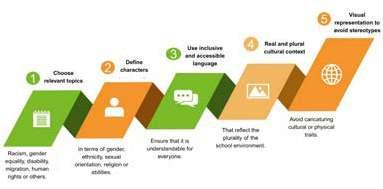
• Selecting Relevant Themes: The educational comic allows complex issues to be addressed in an accessible and emotionally meaningful way. Topics such as racism, gender equality, functional diversity, migration, human rights, and others, are suitable for exploration through this multimodal language. Its graphic representation facilitates students’ understanding of realities that can sometimes seem distant or abstract when presented solely in written texts. Choosing themes close to students’ experiences fosters a sense of belonging and grants legitimacy to their own lived experiences, connecting teaching with their cultural and social context.
• Defining Diverse Characters: In terms of gender, ethnicity, sexual orientation, religion, or abilities. The presence of plural protagonists enables students to see themselves reflected and recognized, which strengthens self-esteem and promotes emotional identification with narratives. According to Dallacqua and Peralta (2022), comics that include diverse characters contribute to normalizing social heterogeneity and combating the invisibility of historically marginalized groups. It is important to note that merely including diverse characters is insufficient, it is essential to grant them active roles, avoid stereotypes, and ensure their voices and perspectives are respected and represented with dignity.
• The Use of Inclusive and Accessible Language: In the educational comic, both written text and visual language must be carefully crafted to ensure comprehensibility for all students, regardless of their linguistic or cognitive competencies. This involves avoiding unnecessary technical terms, using respectful vocabulary, and adopting a non-sexist and non-discriminatory approach. It is advisable to design panels with brief, clear messages accompanied by graphic resources that reinforce meaning, thereby optimizing reading comprehension and visual memory.
• Incorporating Real and Plural Cultural Contexts: This means situating stories in scenarios recognizable to students, using symbolic elements specific to different cultures and depicting customs, ways of life and artistic expressions of diverse communities. This approach enriches learning, legitimizes local wisdom, and contributes to strengthening students’ cultural identity. Derkachova et al. (2022) highlight that the comic is an ideal resource to integrate interculturality in the classroom, as it allows the visual representation of cultural practices that might be relegated to superficial mentions in curricular contents.
• Visual Representation to Avoid Stereotypes: One of the most common criticisms of the traditional comic has been their tendency to caricature cultural, physical, or gender traits, reproducing harmful clichés. To prevent this, the creator must conduct a critical analysis of each panel, and the symbols used, avoiding exaggerated features, colors that reinforce stigmas (such as dark tones for villains and light tones for heroes), or narrative situations that perpetuate prejudices. The challenge lies in maintaining the artistic expressiveness of the comic without falling into simplifications that foster biased views of the cultures or groups represented.
Designing an educational comic oriented towards diversity involves careful planning of contents, characters, and messages, employing visual language responsibly and critically. This proposal aligns with the pedagogical commitment to build an inclusive, plural, and culturally sensitive school environment where students can see themselves reflected and recognized in the narratives explored in the classroom.
The visual language of comics plays an essential role by integrating text and image into a narrative system. Within this system, balloons are graphic elements that convey words and provide information about emotions, voice volume, narrative tone, and the dynamics of interaction among characters (Antony & Huang, 2025; Figueiredo et al., 2019; Perea, 2024). Understanding their uses is indispensable for analysing or producing comics for educational or cultural purposes.
Based on what is presented in Perea (2024) and complemented with recent academic literature, it is possible to identify the main types of balloons and their narrative function. Table 2 summarises these types and illustrates their potential to express emotions, situations, and nuances in graphic stories.
Table 2
Types of speech balloons and their narrative function in comic strip narratives
Type of balloon Visual characteristics Narrative function Balloon shape
Type of balloon Visual characteristics Narrative function Balloon shape
Normal Dialogue Oval - shaped, tail pointing to the character Represents regular speech between characters
Normal Dialogue Oval-shaped, tail pointing to the character Represents regular speech between characters
Vertical Dialogue Vertically oriented oval Used when horizontal space is limited


Thought Cloud - shaped, tail made of small bubbles Expresses internal thoughts or inner monologues
Caption (Narration) Rectangular, no tail Narrator’s voice; indicates context, time, or place
Vertical Dialogue Vertically oriented oval Used when horizontal space is limited hought Cloudshaped, tail made of small bubbles Expresses internal thoughts or inner monologues
Shouting or Exclamation Jagged or irregular edges, bold or capitalized text Indicates shouting, exclamations or intense emotions
Caption (Narration) Rectangular, no tail Narrator’s voice; indicates context, time, or place
Whisper Dashed or dotted edges, fine lines Represents soft - spoken dialogue or secrets
Electronic Device Tail shaped like a lightning bolt; straight or square edges Voice from electronic devices, robots, or technological sounds
Weakness or Fatigue Wavy edges, trembling lines Indicates physical weakness, exhaustion, or altered states


Whisper Dashed or dotted edges, fine lines
Type of balloon
Visual characteristics
Electronic Device Tail shaped like a lightning bolt; straight or square edges
Shout-
ing or Exclamation
Weakness or Fatigue
Represents soft - spoken dialogue or secrets
Voice from electronic devices, robots, or technological sounds
Narrative function Balloon
Jagged or irregular edges, bold or capitalized text Indicates shouting, exclamations or intense emotions
Wavy edges, trembling lines Indicates physical weakness, exhaustion, or altered states
Extended Speech Several balloons connected by “bridges”
Whisper Dashed or dotted edges, fine lines Represents soft-spoken dialogue or secrets
Distributes long speeches into visually organised segments
Source: Adapted from Perea (2024); Dey and Bokil (2021).


These speech balloons are not merely graphic ornaments; their strategic use affects the emotional, cognitive, and narrative interpretation of the story (Antony & Huang, 2025). For instance, a jagged balloon conveys urgency or aggression, whereas one with wavy lines suggests weakness or fatigue, directly influencing how the reader perceives a scene or character (Borkent, 2023; Perea, 2024).
In the context of this educational initiative Classrooms Without Borders, mastery of these visual elements enables the creation of comics that are accessible, inclusive, and culturally responsive. The considered use of speech balloons supports the dismantling of linguistic and cultural barriers, fosters empathy and understanding among students from diverse backgrounds, and enhances emotional expression, critical thinking, and student creativity (Forceville, 2023). Thus, a thorough understanding of speech balloon types and their communicative functions is essential for maximizing the pedagogical potential of comic narratives, particularly in multicultural or multilingual classrooms.
Integrating this knowledge into teaching practice opens new pedagogical possibilities, making the comic into an enjoyable, educational, and transformative resource.
The integration of educational comics into the curriculum requires innovative and reflective methodologies that transcend the
occasional use of this resource as illustrative materials. To transform comics into a genuine pedagogical tool, they must be articulated with contemporary didactic approaches such as Project-Based Learning (PBL), critical education, and interdisciplinary teaching.
An effective strategy is Project-Based Learning (PBL). Within this approach, students undertake the challenge of creating a comic as a final product, working on themes related to diversity and interculturality, such as gender equality, inclusion of people with disabilities, the denunciation of racial prejudices, and others. This process encompasses research, information gathering, character design, dialogue development, and panel composition, integrating knowledge from various curricular areas. Moreover, it fosters transversal skills such as cooperation, planning, and critical thinking, while giving meaning to school content by connecting it with real social issues (Bitz, 2016; Pereira et al.,2024).
Another valuable methodology involves the critical reading of existing comics. Analyzing published works, such as Ms. Marvel or John Lewis’s March, enables students to identify stereotypes, explore cultural representations, and reflect on how visual narratives are constructed to either reinforce or challenge social prejudices. This practice strengthens visual literacy and contributes to forming critical readers capable of interpreting written text and the ideological dimensions embedded in images (Jacobs, 2017).
Guided debates constitute a third key strategy. After reading or creating comics, the classroom can become a space for dialogue where students share opinions, discuss values, and examine ethical dilemmas. For instance, after reading a comic about migration, teachers might pose questions such as: What emotions does the migrant character convey? What barriers do they encounter? Are stereotypes present? This approach stimulates empathy and reflective thinking, which are fundamental to education oriented toward social justice.
Due to its hybrid nature, the comic also facilitates interdisciplinary integration. Its multimodal language allows working on contents from language (oral and written expression), social sciences (cultural contexts, human rights), arts education (drawing, color, composition),
and citizenship (democratic values, diversity). In this way, it becomes an ideal resource for developing didactic projects that transcend subject boundaries, promoting meaningful and contextually grounded learning experiences (Pantaleo, 2021).
Suggested activities, such as autobiographical comics or inclusion stories, exemplify how comics can strengthen cultural identity, raise awareness of discrimination, and stimulate critical reflection. These exercises stimulate creativity and allow students to express their personal experiences, values, and emotions. They encourage active and participatory learning, where students become protagonists of their educational process.
Incorporating comics into the curriculum is not a methodological innovation; it represents a pedagogical commitment to inclusion and diversity. The capacity of comics to represent multiple voices and make invisible realities visible makes it an indispensable ally in building more just, equitable, and culturally sensitive educational environments.
Although educational comics has gained recognition as innovative and versatile pedagogical tools, it is imperative to critically examine their inherent limitations and contextual challenges. Such scrutiny is essential to prevent their mischaracterization as universal applicable solutions withing all educational settings. A nuanced understanding of their scope allows their strategic and pedagogically integration.
Firstly, the comic presents pedagogical limitations related to the complexity of certain contents. Highly abstract concepts, such as advanced scientific theories or intricate mathematical formulations, may require visual representations that exceed the graphic possibilities of the comic or render them excessively dense for students (Jacobs, 2017; Sousanis, 2015). In such cases, exclusive reliance on the comic may be insufficient, needing to be implemented with other didactic resources to ensure full comprehension of the material (Moreno-Vera et al., 2021).
Educational comics may also be unsuitable in contexts where instructional time is limited as its design, reading, and analysis
demand considerable time investment from both teachers and students (Smyth, 2023). The creation of educational comics requires detailed planning, narrative design, and graphic production, which can become unfeasible in educational settings burdened by extensive curricular demands or constraints on material and temporal resources (Belda-Medina, 2024).
An additional challenge lies in the didactic use of comics and the specific competencies required from teachers, both artistic and pedagogical. Proficiency in visual literacy, graphic design, and sequential narrative is often necessary to either produce or critically employ comics within the classroom (Pantaleo, 2021). This situation highlights the need for teachers training programs that integrate multimodal and visual competences, promoting a critical and creative use of comics as educational tools (Carlson et al., 2022).
From a cultural standpoint, the use of comics in educational contexts is not exempt from risks. There is the possibility of reproducing stereotypes or cultural simplifications when depicting ethnic groups, gender identities, or complex social realities (Marshall, 2019). If not approached with a critical and culturally sensitive perspective, the educational comic could reinforce prejudices rather than contribute to inclusion and respect for diversity (Moreno-Vera et al., 2021).
Access to technological tools and high-quality materials present further limitations to the widespread integrating of educational comics. In low-resource or rural educational contexts, limited infrastructure may hinder the creation, reproduction, or distribution of comic-based materials (UNESCO, 2023). As such, the use of comics must be contextualized, complemented with other methodologies, and supported by appropriate teacher training to ensure their meaningful contribution to equitable, critical, and culturally relevant education.
The creation of the comics that accompany each chapter of the book followed a carefully designed methodological process, consisting of four main phases that ensure both narrative coherence and the visual and pedagogical quality of the graphic stories.
• Phase 1. Story construction. The starting point was the definition of the narrative script. Each working team developed stories based on the thematic content of the chapter, seeking to maintain a balance between academic rigour, pedagogical relevance, and narrative appeal. In this phase, the conflicts, characters, and settings that would bring the stories to life were established, ensuring alignment with the objectives of inclusion, diversity, and interculturality set out in the work (see Figure 2).
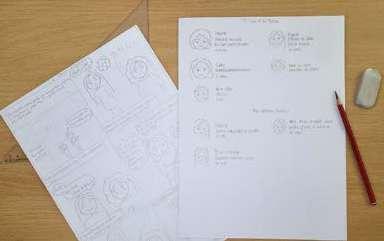
• Phase 2. Definition of characters and sketches. Once the story was consolidated, the creation of characters and the preparation of the first sketches followed. This creative stage enabled the visualisation of the protagonists, giving them physical, expressive, and cultural traits representative of the diversity that characterises educational contexts. The preliminary sketches facilitated the organisation of panels and the arrangement of the visual story into comprehensible sequences (see Figure 3).
Figure 3
Definition of characters and sketches
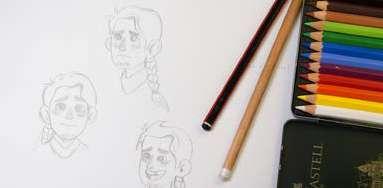
• Phase 3. Colouring with traditional technique. Subsequently, the sketches were developed in a colouring stage using traditional techniques, prioritising chromatic harmony and visual expressiveness. Colour was employed both as an aesthetic resource and as a pedagogical element that reinforces emotions, underscores key messages, and contributes cultural identity to the stories portrayed (see Figure 4).
4
Colouring with traditional technique
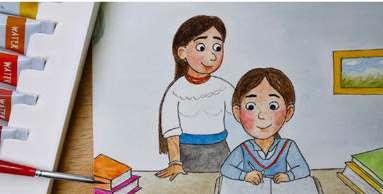
• Phase 4. Layout and integration of texts. Finally, the completed illustrations were integrated into a layout process, in which texts, dialogue balloons, and graphic resources that complete the narration were added. This phase ensured coherence between image and word, optimising readability and communicative impact. The result is a set of comics that accompany the theoretical content and enrich it with a dynamic, inclusive, and accessible visual language for different types of readers (see Figure 5).
Figure 5
Layout and integration of texts
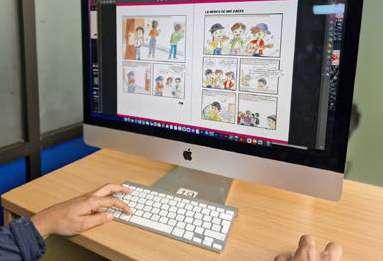
These images not only reveal the technical progression but also highlight the pedagogical and cultural dimension of each stage, providing transparency and methodological rigour to the project. In this way, the comics section culminates in a graphic and narrative proposal that integrates theory and practice, preparing the reader to delve into the bibliographic references, where the conceptual and
methodological framework underpinning the development of this work is established.
The educational comic consolidates as an innovative and multimodal pedagogical strategy, integrating visual, narrative, and symbolic elements to represent cultural diversity and foster meaningful learning experiences. Its implementation encourages critical thinking, empathy and understanding of complex social realities, thereby positioning itself as a pivotal resource for inclusive and transformative education.
Intercultural education, particularly in Latin America contexts such as Ecuador, faces the ongoing challenge of moving beyond normative discourse toward effective pedagogical practice. Despite legislative progress and the development of relevant educational initiatives, persistent tensions remain regarding the implementation of intercultural policies, the provision of specialized teacher training, and the integration of local knowledge systems into formal curricula. These challenges highlight the urgent need for more critical, contextually relevant, and culturally responsive educational approaches.
The experience of the International Innovative Teacher Training Programme Based on Practice (ITP) and the collaborative creation of educational comics demonstrate the value of international partnerships and pedagogical co-creation. These processes legitimize local wisdom, strengthen intercultural competences among teaching staff, and generate didactic resources tailored to diverse educational realities, thereby making a significant contribution to the construction of culturally sensitive, inclusive, and democratic education communities.
While educational comics hold considerable pedagogical potential, their use also presents certain limitations that must be critically acknowledged and addressed These include the risk of oversimplifying complex concepts, inadvertently reinforcing cultural stereotypes, and the need for specialized teacher preparation in visual literacy and narrative design. Overcoming these limitations necessitates the promotion of teacher education programs focused on multimodal
competencies, the implementation of participatory and collaborative methodologies, and the intentional use of comics as illustrative, critical, and emancipatory tools to advance the construction of more just, equitable, and culturally pluralistic societies.
Aikman, S., & Dyer, C. (2012). Education and inclusion: re-examining the narratives. Compare: A Journal of Comparative and International Education, 42(2), 177–185. https://doi.org/10.1080/03057925.2012.652816
Ainscow, M. (2020). Promoting inclusion and equity in education: lessons from international experiences. Nordic journal of studies in educational policy, 6(1), 7-16. https://doi.org/10.1080/20020317.2020.1729587
Antony, V., & Huang, C. (2025). ID. 8: Co-creación de historias visuales con IA generativa. ACM Transactions on Interactive Intelligent Systems, 14 (3), 1-29. https://doi.org/10.1145/3672277
Arias-Gutiérrez, R., & Minoia, P. (2023). Decoloniality and critical interculturality in higher education: Experiences and challenges in Ecuadorian Amazonia. Forum for Development Studies, 50(1), 11–34. https://doi.org/10 .1080/08039410.2023.2177562
Asamblea Nacional del Ecuador. (2008). Constitución de la República del Ecuador. https://www.asambleanacional.gob.ec/sites/default/files/documents/ old/constitucion_de_bolsillo.pdf
Asamblea Nacional del Ecuador. (2010). Ley Orgánica de Educación Superior (LOES). Registro Oficial Suplemento 298. https://www.asambleanacional.gob.ec
Asamblea Nacional del Ecuador. (2011). Ley Orgánica de Educación Intercultural (Segundo Suplemento del Registro Oficial No. 417, 31 de marzo de 2011). https://educacion.gob.ec/wpcontent/uploads/downloads/2017/02/ Ley_Organica_de_Educacion_Intercultural_LOEI_codificado.pdf
Barrow, R. (2023). Visual literacy and inclusive learning. Oxford University Press.
Belda-Medina, J. (2024). Inclusive education through digital comic creation in higher learning environments. Social Sciences, 13(5), 1-15. https://doi. org/10.3390/socsci13050272
Basantes-Andrade, A., Orye, A., & Naranjo-Toro, M. (2024). Enseñanza culturalmente receptiva: Un enfoque pedagógico para promover la inclusión y la diversidad cultural. Universidad Técnica del Norte. https:// repositorio.utn.edu.ec/handle/123456789/16732
Basantes-Andrade, A., Orye, A., Naranjo-Toro, M., Pabón Ponce, M. K., Pereira González, L. M., & Benavides Piedra, A. (2025). Diversidad en el aula: Experiencias y estrategias para una educación inclusiva intercultural. Universidad Técnica del Norte. https://repositorio.utn.edu.ec/handle/123456789/16733
Bhandari, R. (2024). Reclaiming diversity: Beyond deficit discourses in education. Springer.
Bitz, M. (2016). When commas meet kryptonite: Classroom lessons from the Comic Book Project. Teachers College Press.
Borkent, M. (2023). Cómics y cognición: Hacia una poética cognitiva multimodal. Oxford University
Bretón, V. (2009). La deriva identitaria del movimiento indígena en los Andes ecuatorianos o los límites de la etnofagia. En C. Martínez Novo (Ed.), Repensando los movimientos indígenas (pp. 69–121). FLACSO.
Campani, G. (2018). Procesos interculturales y decolonialidad. Comparative Cultural Studies, 3, 95–106. https://doi.org/10.13128/CCSELAP-24508
Carlson, M., Gutierrez, F., & Jara, C. (2022). Graphic narratives in education: Perspectives on cultural inclusion. Routledge.
Carlson, M., Jacobs, D., & Lee, A. (2022). Graphic narratives and social change. Visual Communication, 21(1), 12–30. https://doi. org/10.1177/14703572211050612
Carvajal, A., & López, R. (2020). Educación intercultural en contextos comunitarios: aportes para la equidad educativa. Abya Yala.
Conejo, M. (2008). Escuelas radiofónicas populares: Comunicación y educación indígena. Revista Comunicación y Educación, 19(2), 45–57.
Dallacqua, A. K. (2019). Reading images, reading worlds: Visual literacies and graphic novels in education. Language and Literacy, 21(3), 52–72. https://doi.org/10.20360/langandlit29434
Dallacqua, A. K., & Peralta, L. (2022). Comics as pedagogy: Empowerment and identity in visual storytelling. Journal of Adolescent & Adult Literacy, 65(5), 473–482. https://doi.org/10.1002/jaal.1234
Davies, D. (2019). Urban comics: Infrastructure and the global city in contemporary
graphic narratives. Routledge. https://doi.org/10.4324/9781315310138
Dembeck, T. (2020). La cultura como imaginación social. Theoria. Revista de Teoría, Historia y Fundamentos de la Ciencia, 3(2), 117–132. https://doi. org/10.30827/tnj.v3i2.15502
Derkachova, O., Tytun, O., & Ushnevych, S. (2022). Educational and cultural potential of inclusive comics. Mountain School of Ukrainian Carpaty, 26, 16–22. https://doi.org/10.15330/msuc.2022.26.16-22
Dietz, G. (2019). Multiculturalism, Indigenism and New Universities in Mexico: A case of intercultural multilateralities. Journal of Multicultural Discourses, 14(1), 29–45. https://doi.org/10.1080/17447143.2018.1563608
Fernández, A. (2005). Educación intercultural y cosmovisión indígena. Revista Iberoamericana de Educación, 37(3), 19–34.
Forceville, C. (2023). Narrating and focalizing visually and visual-verbally in comics and graphic novels. Pragmatics & Cognition, 30(1), 180-208.
Furniere, A. (2023, Julio 28). Judith Vanistendael: Shattering glass ceilings in the world of comics.https://www.brusselstimes.com/619114/judithvanistendael-shattering-glass-ceilings-in-the-world-of-comics
García, A., & Rojas, D. (2019). Educación e interculturalidad en América Latina: desafíos contemporáneos. CLACSO.
García, E., & Sáez, J. (2021). Interculturalidad crítica y educación inclusiva. Revista Iberoamericana de Educación, 85(1), 17–34.
García, M., & López, A. (2023). El cómic como herramienta para la sensibilización sobre la inclusión educativa en primaria. Ocnos, 22(1), 1-16. https://doi.org/10.18239/ocnos_2023.22.1.333
García, M., & Tuasa, P. (2007). Educación intercultural bilingüe en Ecuador. Educación y Ciudad, 12(3), 95–111.
García-Ruiz, R., Gómez-García, G., & Miralles-Martínez, P. (2021). El cómic como recurso didáctico en la formación inicial de docentes universitarios. Educación XX1, 24(2), 133-154.
Giddens, T. (2018). On comics and legal aesthetics: Multimodality and the haunted mask of knowing. Routledge. https://doi.org/10.4324/9781351054492
Gómez Hernández, R. E. (2018). Escenarios contemporáneos de lo social. Una mirada desde el Trabajo Social intercultural y decolonial. Revista Trabajo Social, 26(27), 39–56. https://revistas.udea.edu.co/index.php/revistraso/article/view/342770
Gómez, J., Torres-Toukoumidis, Á., & Afonso, A. (2018). Efecto de la territorialidad en la identidad andina: Caso Ecuador. Revista Científica Guillermo de Ockham, 16(1), 51–62.
González, L., García, J., & Chavarri, O. (2018). La cultura económica: una mirada actual. Revista Universidad y Sociedad, 10(4), 360–364.
González-Machado, E. C., & Santillán-Anguiano, E. I. (2024). Critical interculturality as an educational process: Experiences in an indigenous community in northwest Mexico. SocioEdu: Sociological Education. https://doi. org/10.59098/socioedu.v5i2.1789
Granados-Beltrán, C. (2021). Promoting understanding of diversity by taking a critical intercultural stance. En A. B. Ferguson, R. S. Preece & K. Byram (Eds.), International perspectives on diversity in ELT (pp. 33–48). Springer. https://doi.org/10.1007/978-3-030-74981-1_3
Hernández, S. E. (2016). Educación comunitaria y EIB en el Ecuador contemporáneo. Ecuador Debate, 98, 51–64. https://hdl.handle.net/10469/12169
Hernández, J. (2016). Formación docente para la educación intercultural bilingüe en Ecuador. Revista de Educación Superior y Sociedad, 28(2), 75–92.
Higuera, E., & Castillo, N. (2015). La interculturalidad como desafío para la educación ecuatoriana. Sophia: Colección de Filosofía de la Educación, 18(1), 147–162. https://doi.org/10.17163/soph.n18.2015.08
Huang, Y., Rahman, A. R. A., & Yahaya, M. B. (2024). Applying comics as learning tools: A thematic review. International Journal of Academic Research in Progressive Education and Development, 13(3), 2253-2276.
Instituto Nacional de Estadística y Censos (INEC). (2023). Resultados del Censo de Población y Vivienda 2022: Autoidentificación étnica.
Jacobs, D. (2017). Graphic justice: Comics as tools for teaching social justice. Law and Humanities, 11(2), 211–230. https://doi.org/10.1080/17521483 .2017.1381699
Krainer, A., & Guerra, R. (2016). Educación intercultural bilingüe en el Ecuador contemporáneo. Revista Latinoamericana de Educación Inclusiva, 10(1), 35–52.
Likszenberg, D. E., & Lesta, L. M. (2020). Interculturalidad: políticas y acciones educativas y escolares frente a la inmigración. Anuario Digital de Investigación Educativa, 2, 161–173. https://revistas.bibdigital.uccor.edu.ar/ index.php/adiv/article/view/4224
Loh, S. H. (2022). The continued relevance of multiculturalism: dissecting interculturalism and transculturalism. Ethnic and Racial Studies, 45(3), 385406.
López-Gopar, M. E. (2021). Critical interculturality and multilingualism in Latin American education: Challenges and possibilities. International Journal of Multilingualism, 18(2), 223–238. https://doi.org/10.1080/14790718.2 020.1730389
Mardešić, M. (2023). Educating for equity: Intercultural pedagogy in a global context. Palgrave Macmillan.
Martínez, E. G. (2018). Espacios diferentes e interculturalidad. Posición, pensamiento y posicionalidad otra sobre la Universidad Intercultural del Estado de México. Revista CoPaLa. Construyendo Paz Latinoamericana, 6, 151-164. https://www.redalyc.org/pdf/6681/668170993010.pdf
Martínez, E. G. (2018). Espacios diferentes e interculturalidad: Posicionalidad otra sobre la Universidad Intercultural del Estado de México, 151–164.
Martín-González, M., Ramírez, V., & Pérez, E. (2020). La educación intercultural como eje de transformación social en América Latina. Revista Latinoamericana de Educación Inclusiva, 14(1), 89–107. https://doi. org/10.4067/S0718-73782020000100089
Merino, R. (2019). Autodeterminación indígena: El significado del derecho a la consulta previa. Revista del Instituto de Investigaciones Jurídicas UNMSM, 3(2), 50–68.
Ministerio de Educación del Ecuador. (2012). Modelo del Sistema de Educación Intercultural Bilingüe. https://educacion.gob.ec
Ministerio de Educación. (2015). Informe nacional sobre educación intercultural bilingüe en Ecuador. Ministerio de Educación.
Moreno-Vera, J. R., et al. (2021). Comic-based learning: Educational applications and research perspectives. Education and Information Technologies, 26(6), 7305–7322. https://doi.org/10.1007/s10639-021-10741-7
Munsberg, J. A. S., & Silva, G. F. (2018). A interculturalidade como estratégia de aproximação entre pesquisadores brasileiros e hispano-americanos na perspectiva da descolonização. https://doi.org/10.5585/ECCOS. N45.8298
Pantaleo, S. (2021). A social semiotic approach to children’s multimodal texts: The impact of semiotic choices on writing processes and products. Literacy Research and Instruction, 60(2), 163–180.
Perea, I. (2024, julio 14). Tipos de globos y su significado en las historietas. Ilka Perea Studio. https://ilkaperea.com/2019/08/15/tipos-de-globos-y-su-significado-en-las-historietas/
Pereira, L., Basantes, A., & Guía, M. (2024). Habilidades de pensamiento: Un enfoque desde la integración del Pensamiento Complejo, en sinergia constructiva con el Pensamiento Crítico y el Pensamiento Sistémico. Universidad Técnica del Norte. Universidad Técnica del Norte.
Pueblos y Nacionalidades. (2024). Conceptos básicos de interculturalidad para la agenda nacional. Ministerio Pueblos y Nacionalidades.
Real Academia Española. (2024). Diccionario de la lengua española (ed. en línea). https://dle.rae.es
Rodríguez Cruz, M. (2017). Interculturalidad, plurinacionalidad y sumak kawsay en Ecuador: La construcción de un nuevo modelo de Estado a través de la educación intercultural bilingüe: Discurso y realidad. Perfiles Educativos, 39(157), 70–86. https://doi.org/10.22201/iisue.24486167e.2017.157.58441
Rosen, S., Phillips, D., & Liu, Y. (2024). Teacher education through reflective practice. SAGE Publications.
Savoia, M., Torres, L., & Jiménez, A. (2024). Educación, justicia y diversidad cultural. Fondo de Cultura Económica.
Sempértegui, A., & Báez, M. (2023). Ontological conflicts in the plurinational state: The case of Indigenous resistance against the Mirador mega-mining project in Ecuador. Society & Natural Resources, 37(6), 660–677.
Smyth, T. (2023). Teaching with comics and graphic novels: Fun and engaging strategies to improve close reading and critical thinking in every classroom. Routledge.
Solórzano Granada, M. F. (2016). Reflexiones sobre la educación intercultural en Cotopaxi desde la mirada de los/las estudiantes de la Carrera de Educación Intercultural Bilingüe de la UPS. En M. V. Di Caudo, D. Llanos Erazo & M. C. Ospina Alvarado (Coords.), Interculturalidad y educación desde el Sur: Contextos, experiencias y voces (pp. 193–214). CLACSO. https://pure.ups.edu.ec/es/publications/reflections-on-intercultural-education-in-cotopaxi-from-the-persp
Sousanis, N. (2015). Unflattening. Harvard University Press.
Tipa, N. (2019). Interculturalidad en la educación superior: avances y tensiones. FLACSO.
UNESCO. (2017). A guide for ensuring inclusion and equity in education. UNESCO. https://unesdoc.unesco.org/ark:/48223/pf0000248254
UNICEF. (2013). Serie aprendamos de los pueblos y nacionalidades del Ecuador: Sierra, Costa y Amazonía [Mapa de los pueblos y nacionalidades del Ecuador]. Programa EIBAMAZ. https://www.unicef.org/lac/media/32681/file/catalogo-eibamaz.pdf
UNICEF. (2020). La educación intercultural como estrategia para la inclusión. Santiago de Chile: Oficina Regional para América Latina y el Caribe.
Urteaga, M., & García, L. (2016). Rutas para aproximarnos a la disputa por la interculturalidad desde la educación superior y los jóvenes indígenas en América Latina [Prólogo]. En M. V. Di Caudo, D. Llanos Erazo & M. C. Ospina Alvarado (Coord.), Interculturalidad y educación desde el Sur: Contextos, experiencias y voces (pp. 7–28). CLACSO. https://biblioteca.clacso.edu.ar/clacso/se/20161004101819/Interculturalidad_y_educacion.pdf
Valarezo, G. R., Tituana, J., & Romero, L. (2019). Territorio, identidad e interculturalidad. Abya Yala.
Vargas, M. (2019). Territorio, identidad e interculturalidad. Abya Yala. https:// www.flacsoandes.edu.ec/libros/territorio-identidad-e-interculturalidad
Vélez, E. (2008). Educación intercultural en Ecuador: Avances y retos. Revista
Educación Superior y Sociedad, 20(1), 45–62.
Villareal, K. M., & Ascanio, A. C. (2018). Pensamiento sociológico latinoamericano y del Caribe: La superación del eurocentrismo desde una perspectiva intercultural. Pensamiento Actual, 18, 199–208.
Viteri, M. (2020). Los caminos de la interculturalidad en el Ecuador plurinacional. Abya Yala.
Walsh, C. (2005). Interculturalidad, conocimientos y decolonialidad. Signo y Pensamiento, 24(46), 39–50. https://revistas.javeriana.edu.co/index.php/ signoypensamiento/article/view/4663
Wences, M. (2021). Interculturalidad crítica y decolonialidad epistémica. Propuestas desde el pensamiento latinoamericano para un diálogo simétrico. methaodos. Revista de Ciencias Sociales, 9(1), 152-165. https://doi.org/10.17502/mrcs.v9i1.448
Yu, J., & Sumayao, J. (2022). Comics as a tool for teaching science concepts. International Journal of Academic Research in Progressive Education and Development, 13(3), 1-13.
Paulo Aguilar-Robles1, Angélica Osorio-Obando1, Alisson Sánchez-Bastidas1 , Liliana Espinoza1
1Facultad de Educación, Ciencia y Tecnología, Universidad Técnica del Norte, Ecuador
piaguilar@utn.edu.ec, amosorioo@utn.edu.ec, ajsanchezb@utn.edu.ec, laespinozar@utn.edu.ec
Ecuador is a country distinguished by its vast cultural, ethnic, and linguistic richness, manifested in the coexistence of multiple nationalities and Indigenous people, Afro-Ecuadorians, Montubios, and mestizos, each possessing their own worldviews, languages, and traditions. This cultural diversity is reflected within classrooms, where boys, girls, and adolescents from diverse backgrounds share educational spaces that are far from being homogeneous and are marked by multiple identities. In this context, the school becomes a pivotal space for the promotion of inclusion, respect for differences, and the construction of a plural citizenship. “The school must teach how to live together with cultural diversity. To this end, children must learn that diversity is a value. For all these reasons, it is vital to address cultural diversity in education” (Peinado, 2021, p. 2).
According to the Constitution of Ecuador (2008), in its Article 1, the country is declared an intercultural and plurinational state. This recognition marked a milestone in the national history by officially acknowledging the existence of diverse cultures that compose a social fabric, both authentic and heterogeneous. Interculturality refers to the plurality of cultures that coexist, interact, and share within a given context and locality. Plurinationality implies the acceptance of a society composed of distinct nationalities. Both concepts constitute foundational principles of a state oriented towards harmony and respect for diversity. It is worth noting that these statements are
intricately linked to the alternative development model, known as Development Plan for a New Ecuador. According to the Secretaría Nacional de Planificación (2024), this plan:
Seeks to improve the living conditions and comprehensive security of the population, directing public action towards the eradication of poverty, the reduction of inequalities, equitable access to health, housing, and education, and the strengthening of social justice as the foundation of a safer society. (p. 1)
Education plays a crucial role in the appreciation and recognition of cultural diversity. Learning about cultures, languages, and skills within the classroom enables an understanding of the past and how these evolve and adapt in the present. It is essential that students value their own culture as well as that of others, thereby fostering the importance of preserving identities over time. Intercultural education does not merely entail the coexistence of students from diverse backgrounds; rather, it involves the integration of their knowledge, languages, and perspectives into the curriculum and school life.
Recognizing the ethnic diversity present within educational institutions entails profound reflection and the construction of relationships among diverse groups. The inclusion of Indigenous languages in the curriculum is fundamental to preserving cultural identity and guaranteeing the right to education in the native language. The Organic Law of Intercultural Education of Ecuador (LOEI) establishes guidelines for bilingual education, promoting the use of Indigenous languages alongside the official language, Spanish, at all educational levels, the implementation of intercultural policies in educational institutions requires institutional will and adequate resources. In this regard, the following is proposed:
Through the Educational Units of the Order as the object of investigation, the aim was to analyze whether the inclusive educational policies established in the LOEI (2010) foster an inclusive mindset oriented toward the acceptance of the other and the recognition of human dignity in the capacity to face global challenges with free access to education and the implementation of rights on equal terms (Reyes-Paz, 2022, p. 7).
Cultural diversity in the classroom poses significant challenges. Educators must be prepared to address cultural and linguistic differences in ways that enrich the teaching-learning process. This entails training teachers in intercultural competencies, creating a school environment that celebrates diversity and promotes equity. García et al. (2023) assert that: “Inclusive education upholds the right to be different as a legitimate claim that explicitly values the existence of such diversity” (p. 3). This approach benefits students from minority groups and enriches the educational experience for all learners.
It is essential to consider the role of families and communities in the educational process. Collaboration between the school and the community is fundamental to creating an environment that values and respects cultural diversity. Families can contribute knowledge and experiences that enrich the school curriculum, and their participation may foster a sense of belonging and cultural pride among students. “The involvement of the family is of great importance, as it predicts the optimal advancement of student learning, taking into account the commitment of their knowledge and interactions with the school” (Gómez & Orozco, 2022, p. 194)
Intercultural education constitutes both a right and a transformative tool that enables the construction of a more equitable society, one that is conscious of and respectful toward the diversity that characterizes Ecuador. Cultural diversity within the classroom represents an opportunity for collective learning and growth, fostering respect and understanding among distinct cultures. As we move toward a more inclusive future, all stakeholders involved in the educational process must work collaboratively to ensure that cultural diversity is valued and celebrated in every corner of the classroom.
One of the main challenges faced by culturally diverse environments in Ecuadorian classrooms is the persistence of stereotypes and prejudices that may affect school coexistence. When cultural differences are not addressed with sensitivity and respect, situations of discrimination and exclusion may arise, thereby undermining the emotional and academic well-being of students. “Cultural discrimination in educational contexts constitutes a subtle yet persistent form of symbolic violence that hinders the full exercise of
citizenship by Indigenous and Afro-descendant people” (Walsh, 2012, p. 25). For this reason, it is urgent to implement pedagogical strategies that promote empathy, mutual recognition, and intercultural dialogue.
From a pedagogical perspective, teacher training in intercultural competencies is essential to ensure educational practices are both inclusive and culturally relevant. According to Guaita (2022), “Teaching is conceived as a collaboration, wherein the teacher acts as a guide who actively participates in the students’ learning process” (p. 24). This paradigm demands specialized academic preparation as well as an ethical commitment to the principles of social justice and equity. Universities and teacher training centers bear the responsibility of incorporating into their curricula content related to interculturality and the decolonization of knowledge.
The school curriculum must be reviewed and adapted to authentically reflect the country’s cultural richness. Several current educational contents continue to perpetuate Eurocentric or centralist perspectives that render Indigenous and Afro-Ecuadorian cultures invisible. This transformation strengthens the identity of students belonging to Indigenous people and nationalities, while enriching the cultural horizon of the entire educational community.
Technology can play a significant role in promoting cultural diversity within the classroom. Digital platforms, multilingual resources, and audio-visual content may facilitate access to diverse educational materials adapted to various cultural contexts. “Many educators perceive new technologies as supportive tools for the classroom, useful for expanding the learning environment into a virtual space, or effective in entertaining and motivating students, which in turn facilitates teaching” (Crespo-Fajardo & Pillacela-Chin, 2021, p. 340)
The coexistence of cultures within the classroom should not be understood as an obstacle but rather as an asset that enables the construction of a more inclusive, equitable, and meaningful education for all students. The recognition of the multiple cultural identities present in the Ecuadorian context demands an institutional and pedagogical commitment that promotes educational justice and respect for differences. Integrating interculturality into the
educational system is both urgent and necessary to advance towards a more democratic, plural, and unified society, wherein each student recognizes themselves as a fundamental part of a just, equitable, and culturally diverse society.
Intercultural dialogue within the classroom is fundamental for fostering an environment of respect and understanding among students from diverse cultural backgrounds. To achieve this, it is necessary to implement strategies that facilitate communication and mutual comprehension. One of the most effective strategies is the creation of dialogue spaces where students can share their cultural experiences and perspectives. Soto and Quijije (2025) affirm that: “School coexistence is a critical aspect of the educational environment, as it directly influences students’ well-being and their capacity to learn effectively” (p. 21). These circles may be organized regularly, allowing students to feel comfortable sharing their thoughts and experiences. The regularity of these meetings helps build trust among students and enables them to develop active listening and critical reflection skills essential for intercultural dialogue.
Another important strategy is the incorporation of activities that foster collaboration among students from diverse backgrounds. Group projects requiring the participation of all members can help build interpersonal relationships and develop teamwork skills. “The implementation of strategies and pedagogical practices that strengthen group integration and promote a collaborative educational environment centered on the holistic development of students” (Hidalgo et al., 2024, p. 12). Such activities may include the creation of murals representing the classroom’s cultural diversity or the organization of cultural fairs where students present their traditions and customs. By working together on projects, students learn about their peers’ cultures, develop a sense of community and belonging, which are crucial to fostering an inclusive school environment.
Educators must receive training in intercultural competencies. Teachers’ professional development in this domain enables them to effectively address cultural differences and to foster an inclusive environment. “Interculturality recognizes difference, promotes
equitable dialogue among knowledge, cultures, and ways of life” (Walsh, 2018, p. 46). This encompasses the development of skills to manage cultural conflicts and to promote empathy. Training may include workshops on how to approach sensitive issues related to culture and identity, as well as strategies to integrate cultural diversity into the curriculum. Continuous professional development for teachers is vital, as it provides them with the necessary tools to adapt to an ever-changing educational environment and to respond to the needs of a diverse student population.
The use of didactic resources that make cultural diversity visible constitutes an effective pedagogical strategy. Integrating materials such as books, videos, comics, or works of art that represent different cultural expressions enables students to recognize and value the plurality of identities present in their environment. For example, comics featuring narratives from diverse people can serve as powerful tools to capture students’ interest and foster intercultural dialogue. This type of material enriches the educational experience by reflecting the cultures of the students themselves, thereby strengthening their sense of belonging, motivation, and commitment to learning.
It is imperative that schools establish policies that promote inclusion and respect for cultural heterogeneity. The development of a code of conduct emphasizing the importance of respect and tolerance towards all cultures may be considered. The implementation of such policies should be accompanied by continuous monitoring to evaluate their effectiveness and to adjust as necessary. The creation of an inclusive school environment benefits students from minority groups and enriches the educational experience of all learners, fostering meaningful and lasting learning.
It is important to recognize that intercultural dialogue is not limited to interaction among students from different cultures; it also entails reflection on one’s own identities. Educators must encourage students to explore and share their own cultures, which can help build a sense of identity and belonging. This process of self-exploration is essential for students to feel safe and valued within the classroom, thereby enhancing an environment of respect, and understanding.
Intercultural dialogue within the classroom fosters a multifaceted process that necessitates the implementation of diverse strategies. The
creation of spaces for consensus-building, collaboration on projects, educator training, the use of varied didactic resources, and family involvement are key elements to promote an inclusive and respectful environment. As schools apply these strategies, it is essential that all stakeholders engaged in the educational process commit to valuing and celebrating cultural diversity, thereby contributing to the construction of a more just and equitable society. Intercultural education constitutes a right; it is a transformative tool capable of building bridges between cultures, strengthening democratic coexistence, and forging citizenship that is both solidaristic and conscious.
The evaluation of the development of intercultural competences constitutes a pivotal aspect within the educational sphere, as it enables the measurement of students’ progress in their capacity to interact and communicate with individuals from diverse cultural backgrounds. Various methodologies are available to educators for the effective assessment of such competences. The significance of these evaluations lies in their comprehensive focus on theoretical knowledge, practical skills, and the attitudes that students cultivate throughout their educational trajectory.
• Formative assessment: One of the most common methods is formative assessment, which focuses on the learning process rather than on the outcome. In a study on intercultural assessment, Cruzado (2022) found that:
Formative assessment establishes a continuous process of change, resulting from the interactions between students and the teacher’s pedagogical approaches; it is imperative to understand what occurs during the process and to recognize the need for new learning opportunities; thus, the process is more relevant than the outcome and becomes key for reflection and improvement. (p. 4)
This provides valuable insight into the development of intercultural competences and enables educators to adjust their teaching
accordingly. Formative assessment may include observations, feedback, and self-assessments, allowing students to reflect on their learning. This approach assists educators in identifying areas for improvement and empowers students to actively engage in their learning process.
• Self-assessment: Self-assessment involves students reflecting on their own intercultural experiences and skills. Aravena et al. (2023) assert that “self-assessment is a continuous process of reflection, feedback, and learning from practice that contributes to the construction of a shared vision of education” (pp. 21–22). This practice promotes personal responsibility in learning, as students become active agents in their educational process. Self-assessment may include questionnaires, reflective journals, or interviews in which students analyse their interactions and experiences with other cultures. This type of assessment helps students develop greater self-awareness and enables them to set personal goals for their intercultural growth.
• Evaluation through projects: Assessment via intercultural projects constitutes an effective means to measure the development of intercultural competences. Projects that require collaboration among students from diverse backgrounds offer a platform to evaluate skills such as communication, empathy, and conflict resolution. According to the UNESCO report (2020), intercultural projects enable students to apply their skills in real-world contexts, fostering a sense of community and collaboration. Such projects may include organizing events, creating presentations on different traditions, or conducting research on the cultural richness within the community. Through engagement in these projects, students acquire knowledge about other cultures and develop practical skills essential for life in a multicultural society.
It is important that educators utilize assessment rubrics that include specific criteria to measure intercultural competencies. These tools can assist educators in objectively evaluating students’ performance in intercultural activities. Rubrics may incorporate criteria such as participation, the ability to listen to and respect others’ opinions, and teamwork skills. At providing clear criteria, educators can help students understand how they can improve and which skills they need to develop to be more effective in their intercultural interactions.
It is essential to understand the differences between multiculturalism, interculturality, and plurinationality, as these concepts are pivotal for addressing cultural diversity within the classroom. Although often used interchangeably, each term possesses a distinct meaning and focus. Education, in its role as a shaper of citizens, must integrate these concepts to foster an inclusive and respectful environment that values cultural diversity.
• Multiculturalism: Multiculturalism refers to the coexistence of diverse cultures within society. This approach acknowledges and values cultural diversity but often remains limited to the mere acceptance of different cultures without promoting interaction among them. “Multicultural education offers equal opportunities for all students. It helps educators recognize the strengths and capabilities of all students, regardless of their cultural background” (Naz et al., 2022, p. 2). This approach may result in a lack of understanding and respect among cultures, as it does not foster dialogue or collaboration. Multiculturalism can be considered a passive approach that, although recognizing diversity, does not promote active coexistence among different cultures.
• Interculturality: Interculturality goes beyond multiculturalism by promoting dialogue and interaction among different cultures. This approach seeks to create a space where cultures can learn from one another and mutually enrich each other. Interculturality entails an active commitment by individuals and institutions to foster understanding and respect among cultures. Unlike mere coexistence, this approach aims to establish an environment where differences are valued and utilized as a source of learning and enrichment.
• Plurinationality: Plurinationality refers to the existence of multiple nationalities within a state. In the Ecuadorian context, plurinationality implies the recognition of the country’s ethnic and cultural diversity, as well as the acceptance that each nationality possesses its own identity and rights. The Constitution of Ecuador (2008) establishes that Ecuador is an intercultural and plurinational state, reflecting the country’s commitment to diversity and inclusion.
This approach acknowledges cultural diversity and promotes the participation of different nationalities in political and social decisionmaking processes.
In the educational context, plurinationality entails the necessity to recognize and value the languages and traditions of the various nationalities coexisting within a country. “Plurinationality seeks to acknowledge the cultural and ethnic diversity within the state, promoting a deeper inclusion of Indigenous people and other nationalities” (Ruiz & Luzuriaga, 2024, p. 1). Education must serve as a space where linguistic and cultural diversity are respected and promoted. This benefits students from minority groups and enriches the educational experience of all learners, fostering meaningful and lasting learning.
The key difference among these concepts lies in their approach to cultural diversity. While multiculturalism focuses on the coexistence of cultures, interculturality promotes interaction and dialogue between them, and plurinationality recognizes the diversity of nationalities within a state. Understanding these distinctions is essential to effectively address cultural diversity in the classroom and to foster an inclusive and respectful educational environment.
Intercultural education, derived from the concept of interculturality, seeks to integrate these principles into the school curriculum. This entails the inclusion of content that reflects cultural diversity and the promotion of intercultural skills among students. Plurinationality, understood as a principle of social justice, aims to guarantee equality and respect for the cultural diversity of people. Intercultural education is presented as a pedagogical approach focused on fostering peaceful coexistence and mutual respect among cultures (UNESCO, 2020, p. 8). This educational approach is essential to prepare students to live and work in an increasingly globalized world, where the ability to interact and collaborate with people from different cultures is fundamental.
The implementation of educational policies that reflect these principles is crucial for the success of intercultural and plurinational education. Schools must develop programs that encourage student participation in the construction of an inclusive environment. This may include organizing activities that celebrate cultural diversity, such as cultural fairs, language workshops, and research projects on
the different nationalities present within the community. Boada and Mayorca (2019) emphasize that “student participation, both individual and collective, is especially significant, synergizing with the rapport established among peers” (p. 4).
Teacher training plays a fundamental role in the implementation of these approaches. Educators must be equipped to address cultural diversity in the classroom and foster an environment of respect and understanding. Training in intercultural competencies has been identified as an essential factor enabling teachers to promote dialogue and comprehension in culturally diverse contexts. This includes developing skills to manage cultural conflicts and encouraging empathy. Continuous professional development is vital, as it provides educators with the necessary tools to adapt to an ever-changing educational environment and to respond effectively to the needs of a diverse student population.
The assessment of the development of intercultural competencies is a crucial aspect of education. Educators must employ evaluation methods that reflect students’ progress in their ability to interact and communicate with people from diverse cultures. This may include formative assessment, self-assessment, and evaluation through intercultural projects. The implementation of clear and specific assessment rubrics can assist educators in measuring student performance in intercultural activities and in providing constructive feedback.
The differences between multiculturalism, interculturality, and plurinationality are essential to addressing cultural diversity in the classroom and promoting an inclusive and respectful educational environment. Education must integrate these concepts to foster a setting where cultural diversity is valued and dialogue and interaction among different cultures are encouraged. The implementation of educational policies reflecting these principles, teacher training in intercultural competencies, and the assessment of intercultural competence development are key elements to ensure the success of intercultural and plurinational education. As we advance toward a more inclusive future, it is crucial that all stakeholders involved in the educational process collaborate to build a more just and equitable society where cultural diversity is valued and celebrated. Intercultural
education is a right and a powerful tool to transform society and promote peace and coexistence among different cultures.
Ecuador is a country characterized by its remarkable linguistic diversity, where multiple Indigenous languages coexist alongside Spanish. This linguistic richness reflects the country’s cultural diversity and represents an invaluable opportunity to enrich the educational process within classrooms. Education in Ecuador must recognize and value this diversity, fostering an environment where all languages are appreciated and respected. According to the Constitution of Ecuador (2008), the State recognizes linguistic diversity as a cultural heritage that must be protected and promoted. This recognition is fundamental to ensuring that students from different linguistic backgrounds feel valued and respected within the school environment.
The inclusion of Indigenous languages in the school curriculum is a key strategy for fostering the appreciation of linguistic richness in classrooms. The Organic Law on Intercultural Education (LOEI) establishes guidelines for bilingual education, promoting the use of Indigenous languages alongside Spanish at all educational levels. This bilingual education allows students to learn in their native language while also providing them with the opportunity to develop Spanish language skills, which is essential for their academic and social success. “The mixing of two languages is not a sign of confusion in children who are learning a language; it is a sign of communicational growth of how to use multiple communicational systems to create powerful meanings” (Torres & Romero, 2022, p. 4).
It is important that educators receive training in linguistic and cultural competencies to effectively address linguistic diversity. Teacher education in this area enables them to create an inclusive environment where all students feel comfortable sharing their languages and cultures. This includes the development of skills to manage linguistic conflicts and to promote empathy among students.
The use of didactic resources that reflect linguistic diversity is essential to fostering an appreciation of languages in the classroom. Incorporating materials that represent different languages, such as books, videos, and comics, can help students recognize the richness of linguistic diversity. “These resources are teaching tools that facilitate communication, interaction, portability, among others, to
represent knowledge or theories embodied in each discipline within the curriculum” (Intriago et al., 2023, p. 4). For example, using comics that depict stories in Indigenous languages can be a powerful tool to capture students’ attention and facilitate discussion about linguistic diversity.
It is essential to foster an environment of respect and openness toward linguistic differences. This entails establishing clear norms regarding respect and inclusion within the classroom. Educators can set coexistence agreements that include respect for linguistic differences and the promotion of a supportive and collaborative atmosphere.
Family participation in the educational process is crucial to fostering an appreciation of linguistic richness in the classroom. Families can contribute knowledge and experiences that enrich the school curriculum, and their involvement can foster a sense of belonging and cultural pride among students. Family engagement remains a fundamental pillar to ensure comprehensive education. As Aguiar et al. (2020) emphasize:
The family is irreplaceable in its educational role, playing a fundamental part in the development of children. The education of children is the exclusive responsibility of parents. All parties must analyze and determine their function in the educational process to contribute to the comprehensive development of the learner by providing a quality educational response. Schools can organize events where families share their languages and traditions, creating a space in which everyone feels valued and respected. (p. 3)
The linguistic richness of Ecuadorian classrooms is an invaluable resource that must be appreciated and promoted throughout the educational process. The inclusion of Indigenous languages in the curriculum, teacher training, the use of diverse didactic resources, and family participation are key strategies to foster appreciation for linguistic diversity in the classroom. As Ecuador moves toward a more inclusive future, it is essential that all stakeholders involved in education work collaboratively to ensure that every student feels valued and respected, thereby contributing to a more just and harmonious society.
The construction of identity is a fundamental process in education, especially in a country like Ecuador, where multiple nationalities and Indigenous people coexist. Textbooks play a crucial role in this process, as they are tools that can contribute to the formation of a strong and diverse cultural identity. The inclusion of content that recognizes and values Ecuadorian nationalities and people in textbooks is essential to promote a sense of belonging and cultural pride among students. According to the Constitution of Ecuador, the State recognizes and protects the country’s cultural and ethnic diversity, which implies the need to reflect this diversity in educational materials.
Intercultural education seeks to integrate and value cultural diversity within the curriculum, promoting respect and inclusion of all cultures. Intercultural education forms the foundation for enhancing learning and recovering ancestral values essential to the cultural identity of the people and nationalities present in the country (Sarmiento, 2021, p. 8). This is especially important in contexts where students come from diverse cultural and linguistic backgrounds. The inclusion of histories, traditions, and customs of the various Ecuadorian nationalities and people in textbooks can help students develop a richer and more diverse cultural identity.
It is fundamental that textbooks are representative of the country’s cultural diversity. This entails the inclusion of content about the different nationalities and people, reflecting their languages, traditions, and worldviews. Adequate representation of Ecuadorian nationalities and people in educational materials can help students feel valued and respected in their cultural identity.
The use of didactic resources that include comics and other visual formats can be an effective strategy to foster identity construction. Comics can present stories of different nationalities and people in an engaging and accessible way for students. “The comic as a didactic tool allows both students and teachers to break away from traditional methods and focus on a comfort zone where both can teach and learn” (Hernández et al., 2024, p. 53). These resources can complement textbooks and provide a richer and more varied representation of
Ecuadorian cultures. Family and community participation in the educational process is crucial for identity construction. Families can contribute knowledge and experiences that enrich the school curriculum, and their involvement can foster a sense of belonging and cultural pride among students. “Family participation is a shared responsibility with school staff to meet educational goals and foster student growth” (Mendoza-Santana & Cárdenas-Sacoto, 2020, p. 15). Schools can organize events where families share their traditions and customs, creating a space where everyone feels valued and respected.
The construction of identity through the recognition of Ecuadorian nationalities and people in textbooks constitutes a fundamental process for fostering a sense of belonging and cultural pride among students. The inclusion of content that reflects the country’s cultural diversity, the employment of engaging didactic resources such as comics, and the involvement of families are key strategies to promote the development of a rich and diverse cultural identity. As Ecuador progresses towards a more inclusive future, it is essential that all stakeholders involved in education collaborate to ensure that every student feels valued and respected in their cultural identity.
Cultural diversity in the classroom is not merely a logistical or linguistic challenge; it represents a pedagogical opportunity to enrich teaching-learning processes and promote a more inclusive and equitable education. The implementation of intercultural approaches requires rethinking traditional educational practices and incorporating methodologies that validate the knowledge, languages, and worldviews of all students to foster an environment of respect and mutual recognition.
There is clear evidence of the need for continuous teacher training in intercultural and didactic competencies to prevent unconscious biases and to create educational environments capable of responding to cultural plurality critically and creatively. A future line of research is identified in deepening pedagogical models that effectively integrate intercultural content across various curricular areas, evaluating their
impact both on academic performance and on the construction of intercultural citizenship.
The integration of innovative pedagogical resources, such as educational comics, can be key to facilitating intercultural learning by offering accessible visual and narrative languages that emotionally connect with students and meaningfully represent cultural diversity.
The new school year begins, and students return with excitement. This year brings a surprise: Lucas, an exchange student from Belgium, joins the class. Through a special activity, the students learn more about him and reinforce the value of diversity and inclusion in the classroom.
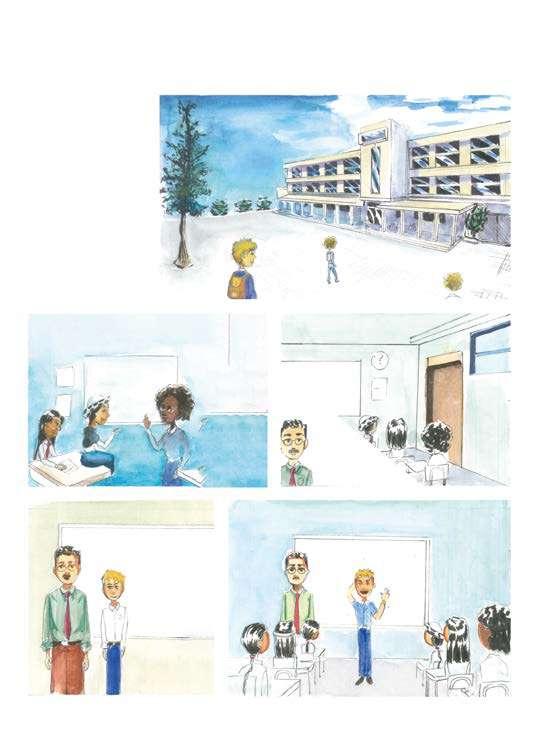
So good to see everyone again!
Yeah, we are going to learn so much this year
The first day of school is a new chance to learn and make friends.
This is Lucas, our new classmate.
TOK¡ TOK!
Who could it be?
Welcome! I have some special news today.
Hi, I’m Lucas. I’m from Belgium and I’m excited to learn with all of you.
Welcome, Lucas!
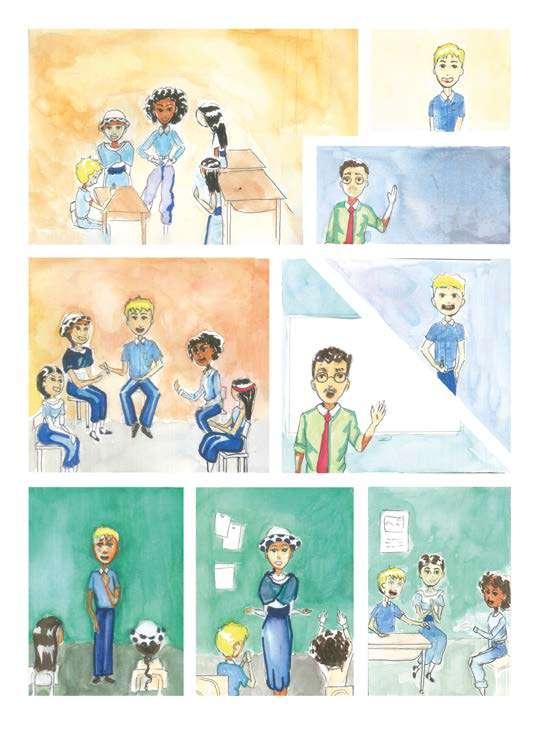
TINGO TANGO
If you need anything, we have got your back.
We are going to play Tingo Tango
We will pass this marker, and when I say ‘tango,’ whoever has it will introduce themselves.
I’m Lucas. My mom is Ecuadorian and my dad is Belgian. I’m here on exchange.
Everyone has a story, and sharing it brings us closer together.
As the days pass, Lucas’s classmates discover that it is his birthday. With great enthusiasm, they organize a surprise in the classroom, sharing traditional Ecuadorian sweets. Through the celebration, Lucas gains a deeper understanding of the local gastronomy and the importance of sharing meaningful moments.
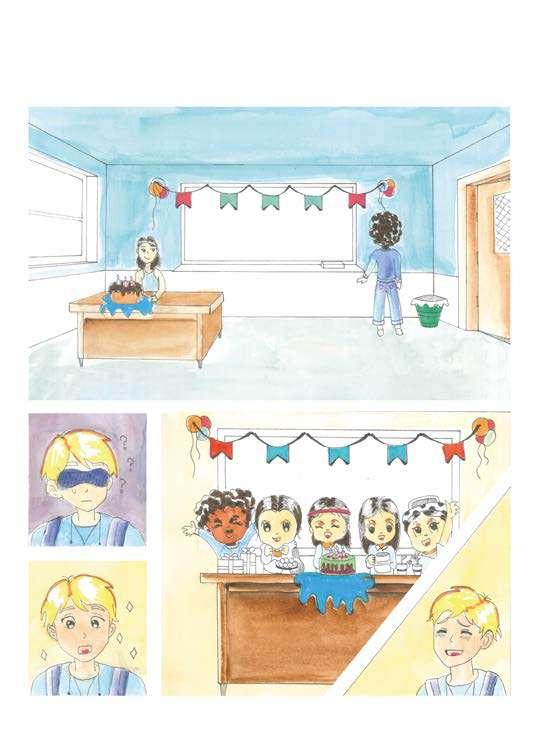
Celebrations bring people together and help us appreciate our traditions.
Surprise!
Thank you very much
I didn’t expect this!
This is dulce de guayaba. It is very popular in my community. And these are Cachitos, made from corn. They are spicy.
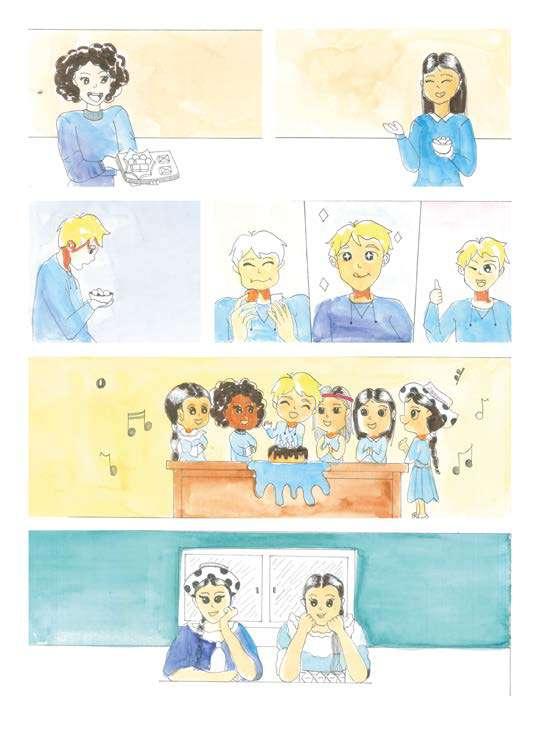
Lucas, I brought you cocadas, a traditional sweet from Esmeraldas. I hope you enjoy it.
In Ecuador, we always celebrate with traditional snacks and songs.
Celebrations allow us to share, learn, and strengthen our friendships.
It is delicious. I have never tasted anything like this before
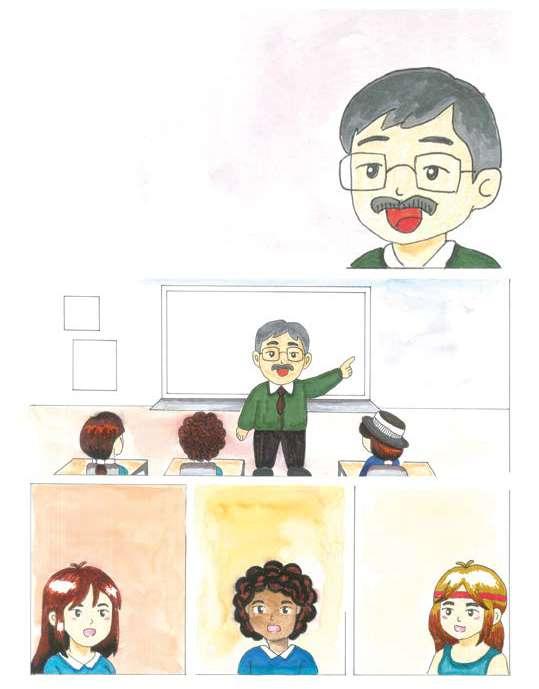
It is October 12, and the teacher leads a conversation about cultural diversity in Ecuador. Through dialogue, the students reflect on the importance of recognizing and appreciating the different cultures that enrich society.
Teacher, isn’t this the day that commemorates the discovery of America?
¡Good morning!
Today we will discuss October 12, the Day of Pluriculturality and Diversity.
In Ecuador, we remember it as a day to appreciate our cultural diversity.
There are 18 communities and 14 nationalities living together here. It is amazing
How can there be so much diversity in such a small country?
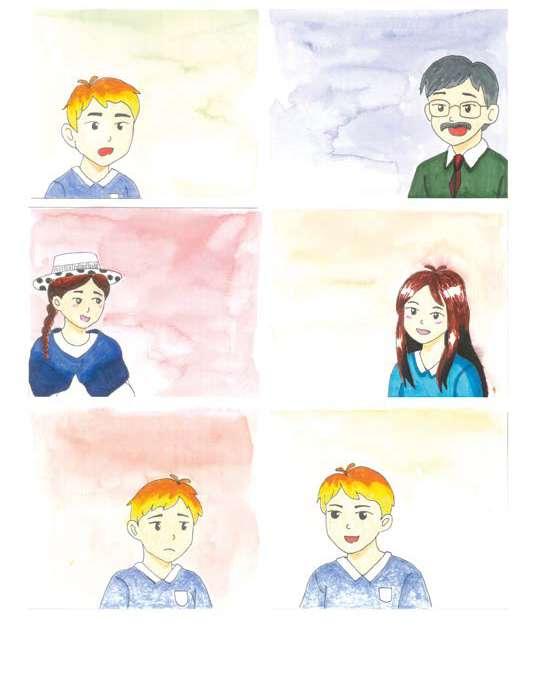
For example, I am Saraguro, and I speak both Kichwa and Spanish.
Ecuador is a diverse country, and that makes us stronger and more unique.
Lucas thinks about the diversity of his own country.
I am mestiza, and I love our culture.
Each culture has its own history and value. Learning about them helps us live together more respectfully
In Belgium, there are also distinct cultural groups, such as the Flemish and the Walloons.
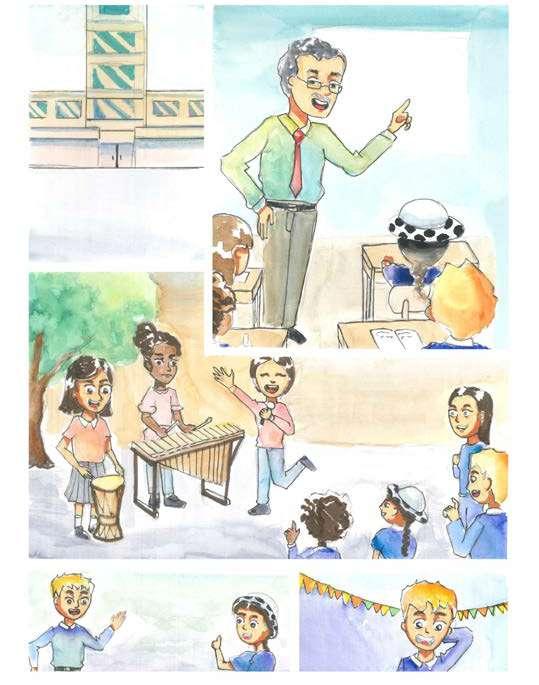
At school, a traditional dance festival is being organized to celebrate Ecuador's cultural diversity.
In the schoolyard, students watch other classes rehearse.
Lucas and his class begin practicing, but the first steps aren’t easy.
Whoa! I have got two left feet.
I will give it my best!
Relax! Just follow the rhythm.
Attention, everyone! Each class will perform an Ecuadorian dance for Cultural Week.
Awesome! What will we perform?
We are dancing the Sanjuanito, a traditional dance from Otavalo.
San-what?
Sounds interesting!
That is the marimba, an Afro-Ecuadorian rhythm.
Wow! That dance with drums is full of energy! Everyone looks amazing.
Let’s go, Lucas. You have got this! The big day has arrived. Everyone is dressed in their traditional outfits.
On stage, each class performs their dance. The audience claps enthusiastically.
Up next, Sanjuanito from the Ecuadorian Sierra Region!
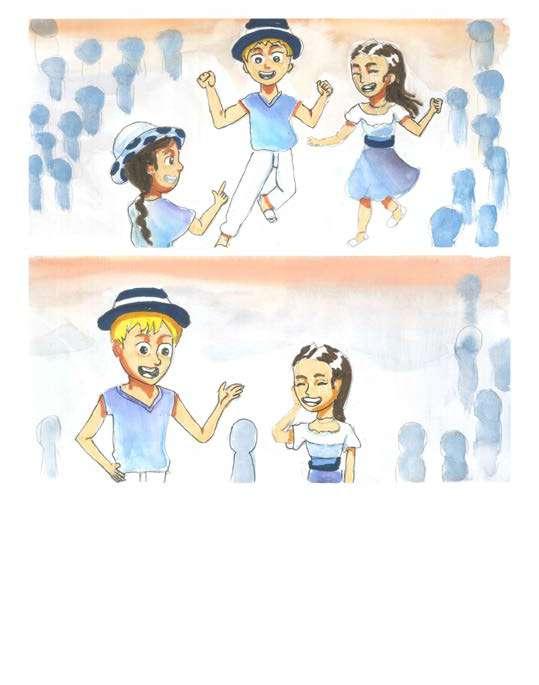
Great job, everyone! Keep it up!
These alpargatas are super comfy It is so beautiful to learn about culture through dance!
And sharing it with respect makes it even more meaningful.
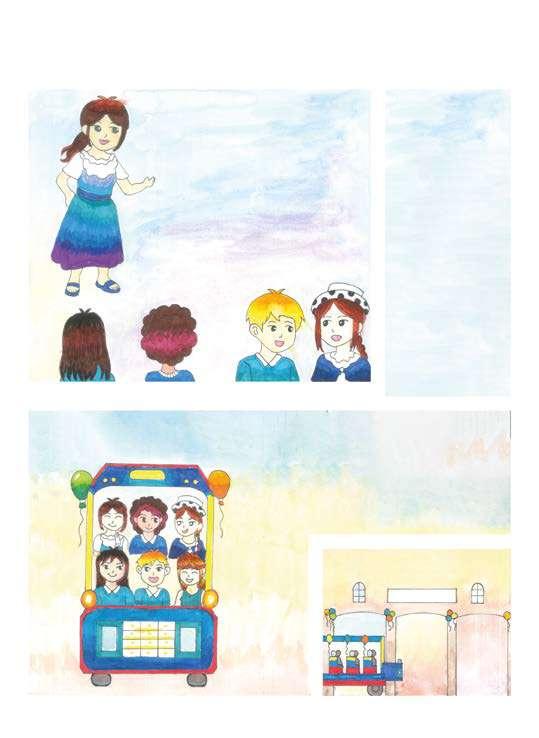
Friends, I would like to invite you to my sister’s wedding. It will be a beautiful Otavalo ceremony.
It is beautiful. There are rituals, music, and plenty of food.
I HAVE NEVER ATTENDED A TRADITIONAL WEDDING.
I LOVE THE IDEA. WE WILL DEFINITELY BE THERE.
WHAT IS IT LIKE?
A TAXI WOULD HAVE BEEN A BETTER CHOICE
THIS IS REALLY ROUGH
WHAT A BEAUTIFUL VIEW FROM HERE.
The group travels in a slightly old bus called a chiva, decorated with balloons and streamers.
This is amazing. I have never been on a Chiva before.
IS THAT WHEEL COMING LOOSE?
Arriving at the wedding on the chiva.
WELCOME
Yes.
The groom’s poncho represents respect and authority, while the bride’s anaco symbolizes elegance and tradition.
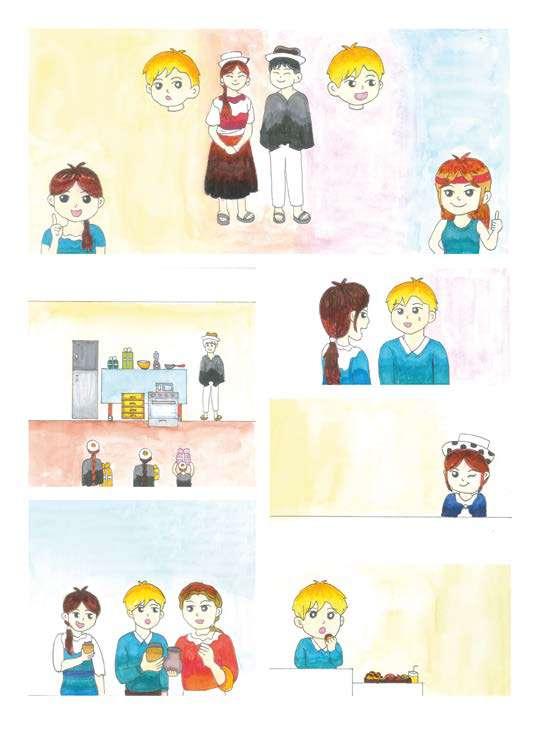
Their outfits are incredible. Do they have any special meaning?
And look at their necklaces. They are called wallkas, a symbol of prosperity.
The godparents give expensive gifts to the bride and groom.
The bride’s mother shares chicha with the guests, especially with Lucas.
¡Wow! It´s delicious. Is this similar to juice?
Try it. You´re gonna love it.
It is chicha de jora, a traditional fermented corn drink. It is served during important celebrations.
More than just gifts, it is a blessing from the community.
¡Wow! Do they always receive so many gifts?
Yes. The godparents give them jewelry, silver, household appliances, land, or animals. It is a way of supporting their new life together.
Lucas is amazed after seeing how the couple receives so many gifts.
THIS IS UNIQUE! IT TASTES REALLY GOOD.
Lucas tries cuy for the first time.
Long live!
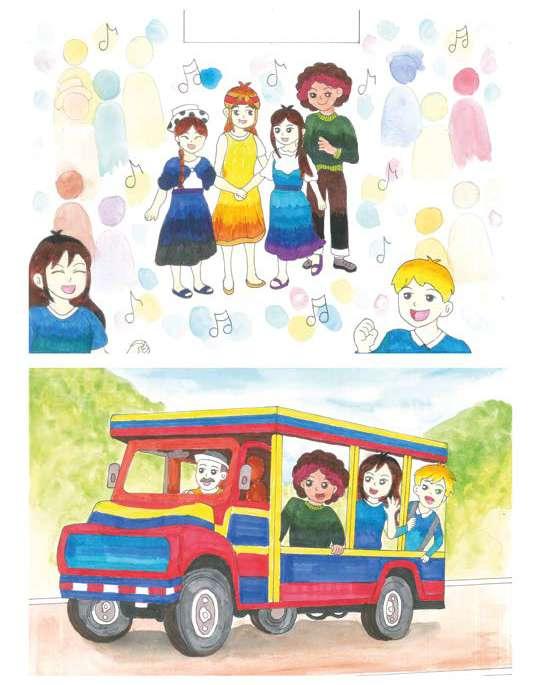
It’s traditional folk music.
It is easier than I thought.
Everyone enjoys the dance.
THAT WAS AN INCREDIBLE WEDDING. ONE OF THE BEST EXPERIENCES I HAVE HAD.
Everyone smiles as the chiva drives away along the road.
Long live!
This music is beautiful.
Long live the bride and groom!
NOW I ACTUALLY LIKE RIDING ON THIS CHIVA HAHAHA.
Return home.
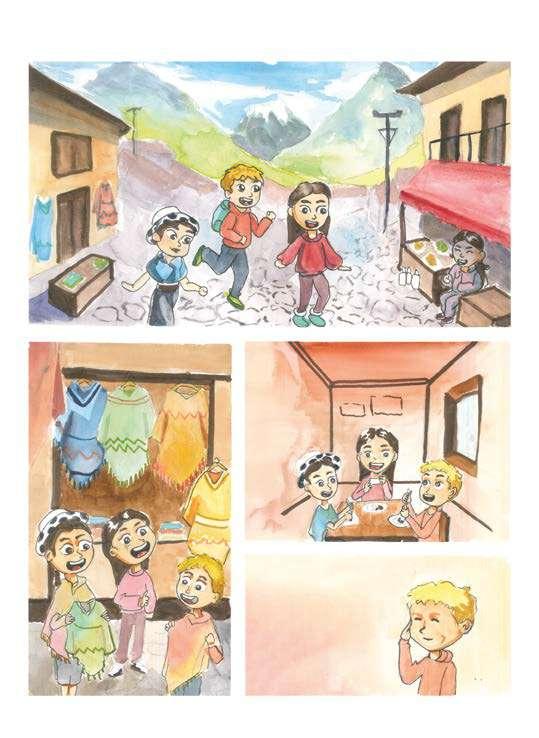
THIS IS INCREDIBLE! IT LOOKS LIKE A RAINBOW MADE OF FABRIC!
BARGAIN? YOU MEAN LIKE NEGOTIATING A PRICE?
BUT KEEP IN MIND, IF YOU WANT TO BUY SOMETHING, YOU HAVE TO BARGAIN!
WELCOME TO OTAVALO. HERE, EVERY GARMENT TELLS A STORY.
EXACTLY. IT IS PART OF THE EXPERIENCE.
The group walks through the plaza, surrounded by stalls full of ponchos, hats, necklaces, and crafts.
Fritada is a traditional Ecuadorian dish made of fried pork.
FRITADA WITH MOTE. GO AHEAD TRY IT!
YES. THE COLORS AND PATTERNS REFLECT EACH COMMUNITY’S IDENTITY.
I LOVE THIS ONE. DOES IT HAVE A SPECIAL MEANING?
WEARING ONE IS LIKE WEARING A STORY!
THIS RED SYMBOLIZES STRENGTH, AND BLUE REPRESENTS CONNECTION TO THE SKY..
In Indigenous culture, textiles not only provide warmth but also convey the identity and traditions of each community.
CRISPY AND TENDER AT THE SAME TIME! I LOVE IT!
ARRARRAY! I LEARNED THAT WORD HERE, IT MEANS SOMETHING’S HOT!
THAT LOOKS AMAZING! WHAT IS IT?
THIS MUSIC GIVES ME GOOSEBUMPS. IT’S AMAZING!
I’M SO GLAD. IT’S AN HONOR TO SHARE IT WITH YOU.
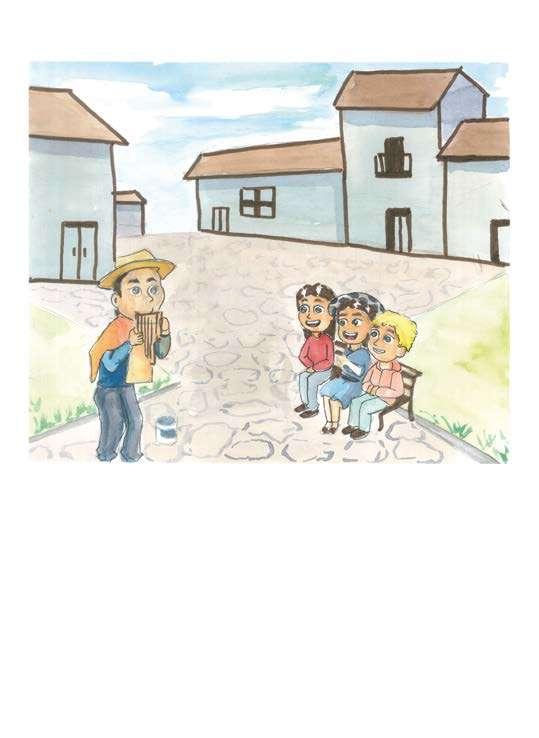
ÑUSTA, IT’S BEEN WONDERFUL LEARNING ABOUT YOUR CULTURE. I’VE LOVED EVERYTHING.
Everyone smiles while music plays in the background.
THIS PLACE IS INCREDIBLE. THERE’S SOMETHING TRULY SPECIAL ABOUT IT.
The teacher adjusted his glasses and raised the flashlight to light the way. The group of students moved forward with backpacks on their shoulders and flashlights in hand, excited for the night hike.
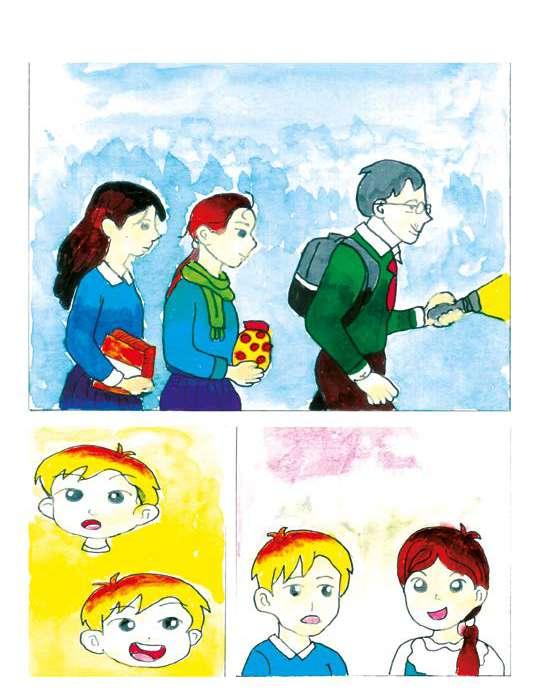
Lucas, the Belgian exchange student, looks around with eyes wide open.
This is incredible. I have never been a real jungle before.
Technically, it is just the school forest,but I get your excitement.
If you saw a real jungle, Lucas, you would probably faint.
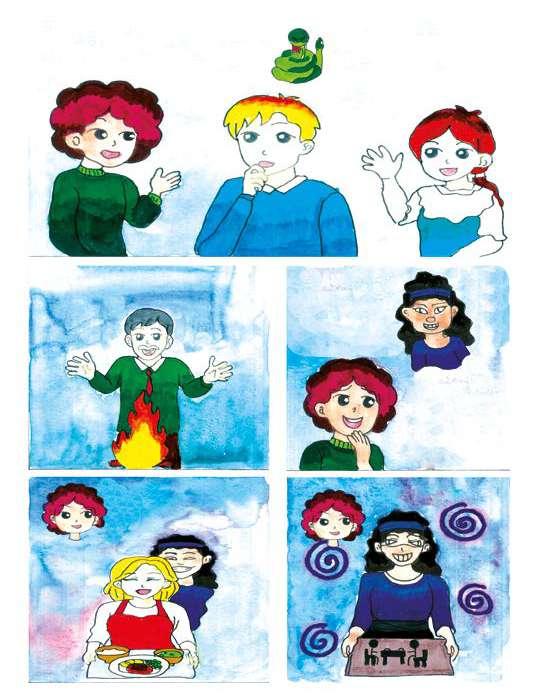
Imagine seeing an anaconda up close.
Alright, everyone! The campfire is lit, and tonight is special.
Each of you will share a story or legend from your culture. Let’s start with Zulema.
First, she disguises herself as their mother or a relative to lure them into the forest.
In Esmeraldas, we say La Tunda takes away disobedient children.
Then, with her wooden paddle-like leg, she hypnotizes them with enchanted food.
That sounds thrilling!
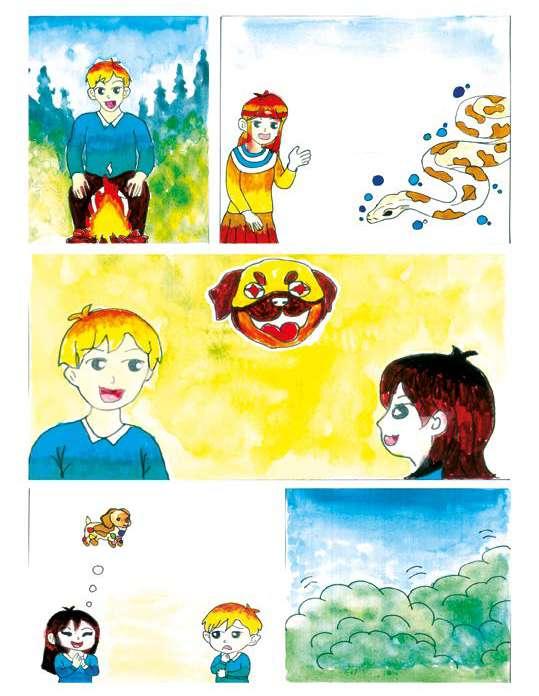
In Tsáchila culture, we have the story of Uchumanka, the great sacred serpent. It is said that it lives deep in the river and protects the jungle’s balance.
In Belgium, we have the tale of the Kludde, spirits that take the form of a black dog with glowing eyes.
It was the wind… right? It is the Kludde… or the Uchumanka…
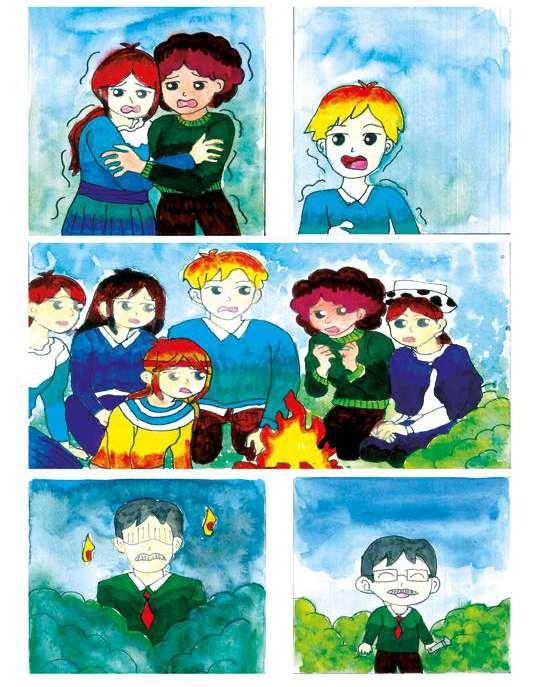
Everyone looks scared, waiting to see what it is.
The students screamed, and after a few seconds, the tension turned into laughter.
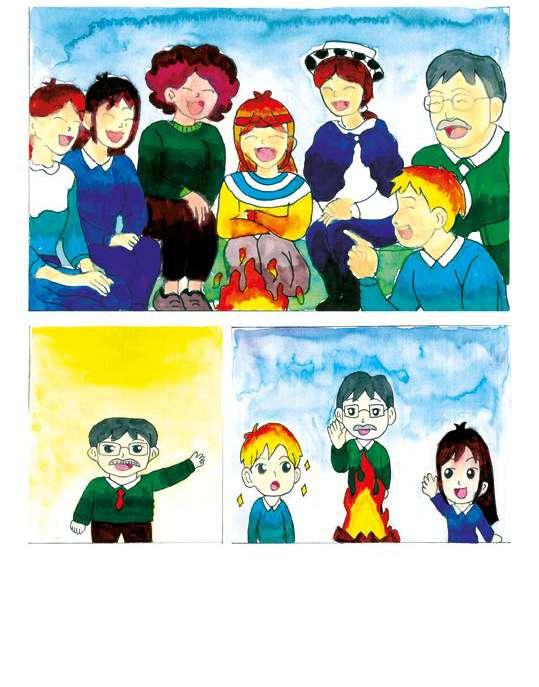
The important thing tonight is to understand that all our stories matter. It doesn’t matter if you’re from the city, the jungle, the mountains, or another country.
Our diversity is our strength, and learning from each other makes us stronger.
The group huddled closer to the campfire, sharing laughter and stories. That night, they learned that true magic lies in the diversity of their voices.
Alright, Andrea, it is your turn!
Have you heard the story of Cantuña?
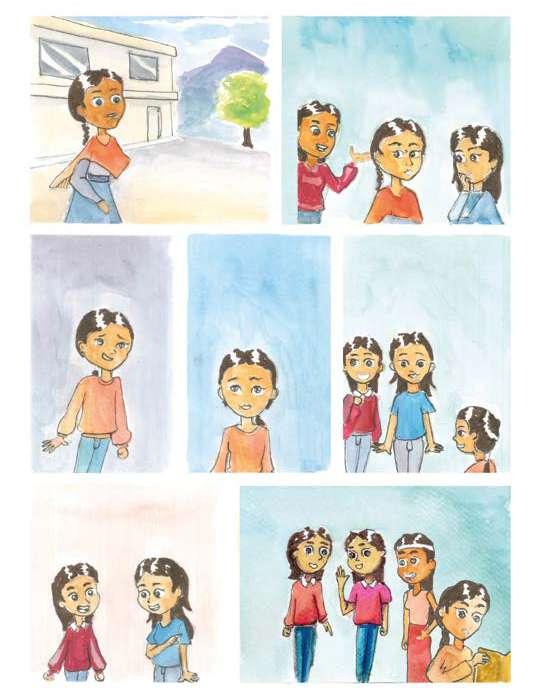
The next day...
Look! It´s Ñusta
At school, Ñusta had always worn her traditional clothing with pride. Her colorful skirt and braided hair were part of her identity.
The next day, she came to class wearing jeans and a plain blouse, with her hair down.
Why do you dress a little differently?
Should I dress like them?
Oh! You look different.
But something didn’t feel right. Ñusta noticed the looks from her friends Lina, Zulema, and Mayra. They didn't say anything, but there was disappointment in their eyes.
During class, the teacher noticed Ñusta’s change. He didn’t say anything at first, but when the lesson on cultural identity began, he paused and looked at all the students.
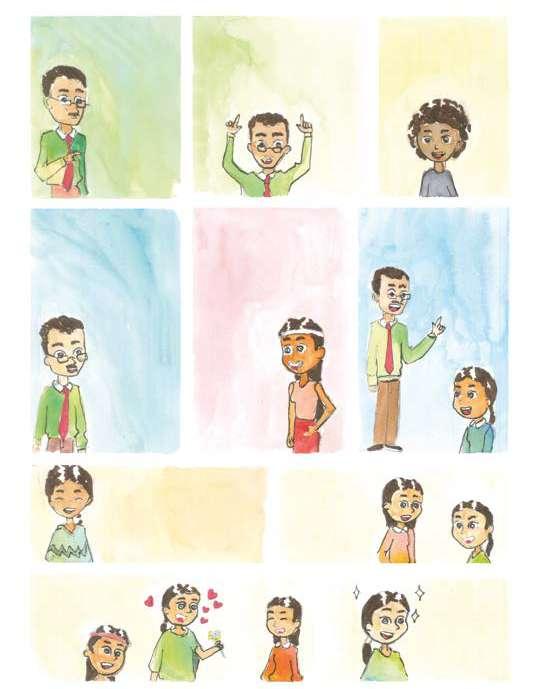
Lina, what does being Tsáchila mean to you?
We brought you this, it’s for your hair.
Today, we’ll talk about the value of our roots. Can anyone tell me what it means to lose your identity?
It’s when we give up who we are to fit into something that doesn’t represent us.
It means… my history, my ancestors, my traditions.
Our identity is what makes us unique
We don’t need to change to be accepted. Beauty exists in many forms.
The next day, Ñusta came back wearing her traditional clothing. She walked with her head held high. She knew who she was, and she was proud of it. Now she truly knew, thanks to the teacher.
Honestly, I love your outfit. Now I get that it represents your culture. It looks beautiful on you!"
To make you look even prettier. I love it!
The girls in the class loved social media; they watched videos and shared photos.
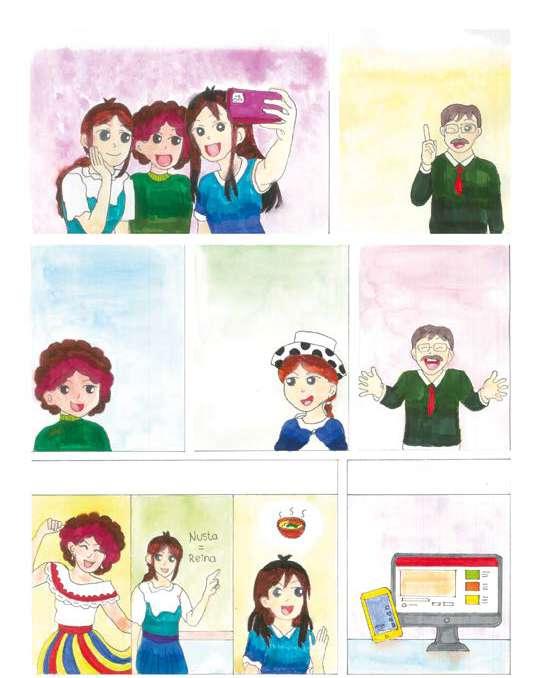
We could make a video dancing traditional music, but with a modern remix.
Or we could create a challenge where each of us teaches a word in her own language.
One day, the teacher arrived with a special task.
You will carry out a social experiment on social media. Your mission is to create content that promotes cultural identity.
Let us get to work.
Little by little, the ideas began to flow. They recorded themselves trying typical dishes, wearing traditional clothing, dancing, and teaching new words.
Thousands of people started commenting and sharing.
I never thought so many people would be interested in this!
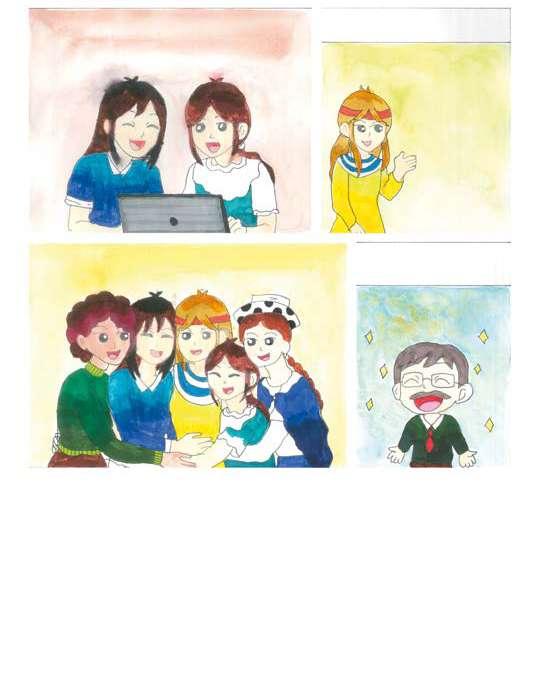
Because culture is not boring. It is part of our life.
After a week, the teacher asked them to reflect on the experience.
Social media helps us to share our culture and show who we are.
And now, besides learning, we feel more united.
Social media, when used properly, could be a bridge to unite cultures.
Today we are going to talk about the importance of cultural traditions. What do you think?
Of course they do. They are part of our identity something that connects us to those who came before us.
I do not know much about those traditions.
Sometimes people do not understand them, but every tradition has a special meaning. It is good to learn about this together. Do they still have an important meaning today?
It is true. Sometimes we do not understand the value of something until someone explains it to us It has not always been easy for us to keep our traditions
This is the wonderful thing about learning.
Ñusta, how did you feel about what Andrea said?
But we do it proudly
For me, our traditions are a bond with my grandparents. They teach us values and give us identity.
That sounds interesting. I had never thought about all of that.
We can share our stories and grow together. That is what really matters.
Thank you for sharing your story with me.
Knowledge brings us together, and respect turns our differences into a strength instead of a barrier.
I am glad you want to learn more. We can teach each other many things.
Now I see how important it is.
Diversity enriches us. Listening and respecting help us live together better and learn to value the cultures that surround us.
The school is getting ready for the holiday parade. The teacher has organized a procession where the students represent different cultures of Ecuador. What no one expects is an event full of chaos and unexpected laughter.
We’ll get ready for Parade Day.
The classroom is a whirlwind of activity while the students check their costumes.
Are you sure this is my size? It looks like curtains!
Ah! That explains why I could not see anything.
Lucas, you put it on backwards.
My mother says Tsáchila clothing must be worn with pride… although I think I overdid it with the achiote. I look like a tomato!
Mylliklla is perfect… although Andrea just stepped on my anaco.
Oh no! Did I tear it?
The big day arrives.
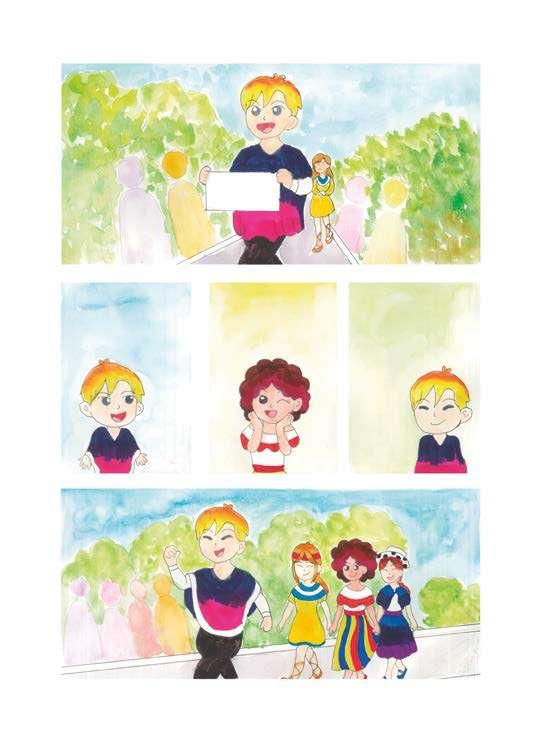
The parade: Between disaster and spectacle.(Music...applause and... butterflies!)
Ñusta discreetly helps her. Andrea smiles and adjusts her skirt. Sofía improvises with her headpiece. The audience applauds, thinking it’s all part of the show.
Guys… my poncho is falling off again!
Everyone shows off their outfits with great style.
Do not worry. Just walk with style!
Reflection and Ending: When chaos bring people together.
If I trip again, I’ll be the first person to knock myself down three times.
After the parade.
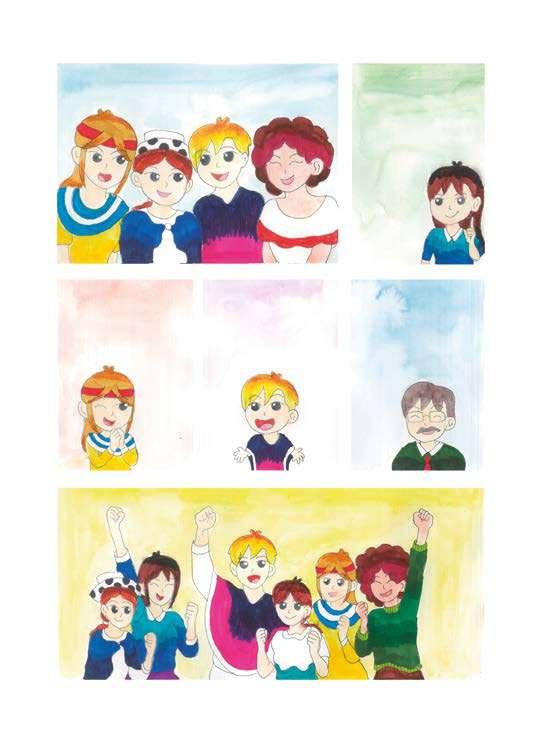
The students laugh about what happened.
Our clothing made us shine.
I learned about Ecuadorian culture… and that I am terrible at dancing.
If there were a prize for the most disastrous but charming group, we would win it.
The students celebrate, hugging and laughing
Perfection does not matter. What matters is understanding diversity. We learned and had fun together.
The students are planning a heartfelt surprise to say goodbye to Lucas, their Belgian exchange student.
¡Surprise!
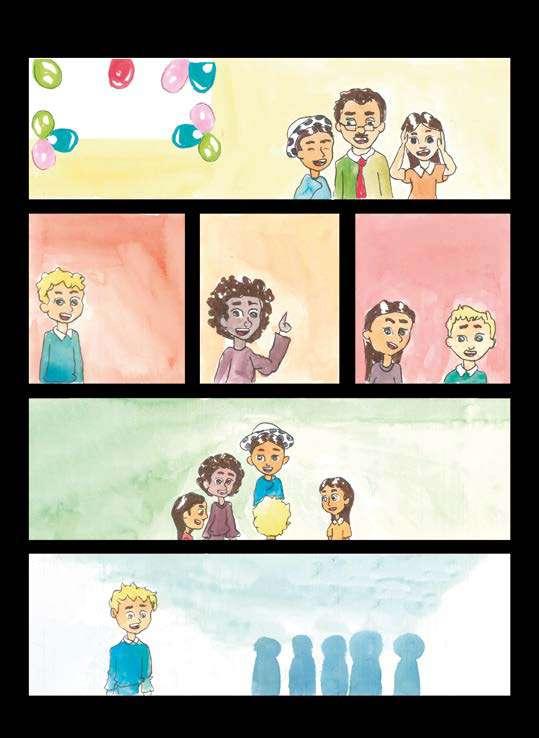
¡Surprise!
What’s all this? A surprise party for me?
In my family, a farewell always includes music and dancing.
On the Coast, we say goodbye with a big hug and lots of laughter.
¡Surprise!
Of course! We want you to remember Ecuador with affection.
We didn't know if you had farewells like this in Belgium.
Not exactly… but I love it.
In my culture, we give a blessing for a good journeY
In the Highlands, we make a toast and eat together.
I like all of them!
WHAT YOU ARE SEEING HERE IS THE VALUE OF DIVERSITY; EACH CULTURE HAS ITS OWN WAY OF EXPRESSING AFFECTION AND GOODBYE INSTEAD OF COMPETING. WHY NOT COMBINE A BIT OF EACH?
Each student contributes in the farewell... we will miss you
Ñusta performs a symbolic blessing to wish him a safe journey.
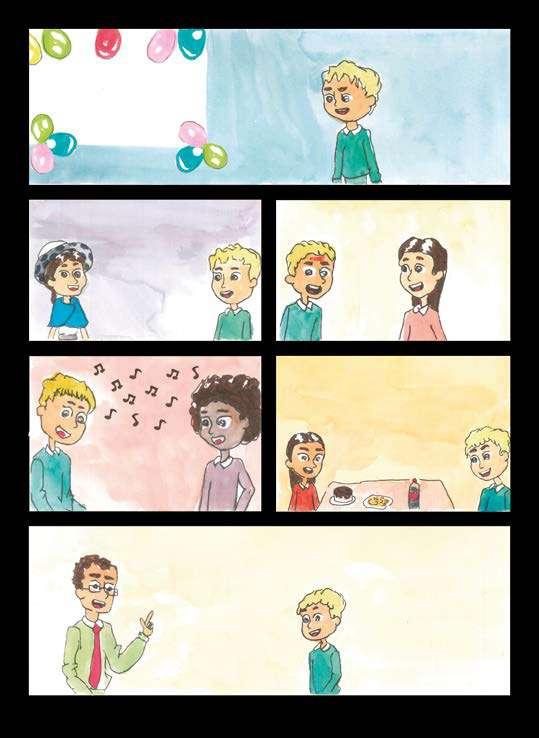
plays music and they start a small farewell dance.
Lina paints a small achiote stripe on his forehead as a symbol of good wishes.
Lucas is leaving, but the lesson about diversity stays. Every culture offers something valuable
Andrea organizes a meal with traditional dishes.
I never thought I could be this special. I’ve learnt so much with you. Thank you for showing me that diversity makes us stronger.
This is not goodbye; it is a see you soon
Aguiar, G., Demothenes, Y., & Campos, I. (2020). La participación familiar en la inclusión socioeducativa de los educandos con necesidades educativas especiales. [Family participation in the socio-educational inclusion of students with special educational needs]. Mendive. Revista de Educación, 18(1), 120-133. https://bit.ly/44BdMPP
Aravena, O., Villagra, C., Troncoso, C., & Mellado, M. (2023). Autoevaluación del liderazgo pedagógico: Una experiencia de aprendizaje y desarrollo profesional en la escuela. [Self-evaluation of pedagogical leadership: A learning and professional development experience in the school]. Perspectiva Educacional, 62(1), 113-139. https://doi.org/10.4151/07189729vol.62-iss.1-art.1396
Asamblea Constituyente del Ecuador. (2008). Constitución de la República del Ecuador. https://www.asambleanacional.gob.ec/
Boada, A., & Mayorca, R. (2019). Importancia de la participación activa de estudiantes virtuales a través de los foros-debates en plataformas digitales. [Importance of active participation of virtual students through forum debates on digital platforms]. https://bit.ly/44kfAxT
Crespo-Fajardo, A., & Pillacela-Chin, J. (2021). Estrategias pedagógicas en entornos virtuales de aprendizaje. [Pedagogical strategies in virtual learning environments]. Revista de Ciencias Sociales, 27(1), 334-346. https:// dialnet.unirioja.es/servlet/articulo?codigo=7817702
Cruzado, S., Jenner, J. (2022). La evaluación formativa en la educación. [Formative assessment in education]. Comuni@cción, 13(2), 149-160. https:// doi.org/10.33595/2226-1478.13.2.672
De la Cruz, R. H., Ceronio, N. R., García, C. E. L., Vilchis-Reyes, M. A., & Pérez, L. I. A. (2024). Implementación de un cómic para la enseñanza de simetría molecular en química. [Implementation of a comic for teaching molecular symmetry in chemistry]. Emerging Trends in Education, 10(28), 43-55. https://dialnet.unirioja.es/servlet/articulo?codigo=9784105
García, X, Guirado, V., Largo, E., & Bermúdez, I. (2022). Inclusive education: everyone’s right to a quality education. Conrado, 18(87), 298-305.
https://bit.ly/4eH1b2f
Gómez, J., & Orozco, L. (2022). El cómic como recurso didáctico para la promoción de valores en el entorno educativo. [The comic as a didactic resource for promoting values in the educational environment]. Horizontes. Revista de Investigación en Ciencias de la Educación, 6(27), 186–199. https://repositorio.cidecuador.org/bitstream/123456789/2534/1/Articulo_12_Horizontes_N27V7.pdf
Guaita Morales, P. A. (2022). Las metodologías participativas en la educación intercultural bilingüe: Experiencias de tres docentes kichwas de Otavalo [Tesis de maestría, Universidad Andina Simón Bolívar]. [Participatory methodologies in intercultural bilingual education: experiences of three kichwa teachers from Otavalo]. Repositorio UASB. https://repositorio. uasb.edu.ec/bitstream/10644/9912/1/T4351-MIE-Guaita-Las%20metodolog%C3%ADas.pdf
Hidalgo, W. S., Torres, Á., & Hidalgo, C. G. (2024). Potenciando la integración grupal en instituciones educativas: Un enfoque didáctico en el pie de monte costero de Nariño, Colombia. [Enhacing group interaction in educational institutions: A didactic approach in the coastal foothills of Nariño, Colombia] Ciencia Latina: Revista Multidisciplinar, 8(1), 8841–8853. https://dialnet.unirioja.es/servlet/articulo?codigo=9426839
Intriago, Y., Vergara, J. y López, R. (2023). Uso de recursos didácticos, desde la analítica de aprendizaje en las transformaciones de la enseñanza de las matemáticas en la geometría plana. [Use of didactics Resources, from learning analytics, in the transformarion of mathematics teaching in plane geometry] MQRInvestigar, 7(3), 2278-2296. https://www.investigarmqr.com/ojs/index.php/mqr/article/view/567/2272
Naz, F., Afzal, A., y Khan, M. (2023). Desafíos y beneficios de la educación multicultural para promover la igualdad en aulas diversas. [Challenges and benefits of our multicultural education to promote equality in diverse classrooms] Revista de Ciencias Sociales, 3(2), 511–522. https:// doi.org/10.54183/jssr.v3i2.291
Mendoza-Santana, Mayra Isabel, & Cárdenas-Sacoto, José Humberto. (2022). Importance of Family Participation in the Learning Process in Kindergarten Students. [Importance of family participation in the learning process in the kindergarten students] Revista Estudios del Desarrollo Social: Cuba y América Latina, 10(2), 3-15. https://bit.ly/4krj4mQ
Peinado, M. (2021). La diversidad cultural en el aula: una revisión bibliográfica. [Cultural diversity in the classroom: A bibliographic review] RAES: Revista de Investigación en Aula, 4, 1–9. https://revistaselectronicas.ujaen. es/index.php/riai/article/view/5950
Reyes-Paz, W. (2022). Políticas educativas y pensamiento incluyente: análisis desde la experiencia educativa de la Orden de la Compañía de María Nuestra Señora en Ecuador. [Educational policies and inclusive thinking: Analysis from the educational experience of the Order of the Company of Mary Our Lady in Ecuador] Revista Criterios, 29(1), 6–28. https:// revistas.umariana.edu.co/index.php/Criterios/article/view/2917/3907
Ruiz, S., & Luzuriaga, E. (2024). Antecedentes históricos de la Plurinacionalidad y del Sumak Kawsay en la Constitución ecuatoriana. [Historical background of plurinationality and Sumak Kawsay in educational construction] Revista de Derecho, Universidad Nacional del Altiplano de Puno, 9(2), 1-15. https://dialnet.unirioja.es/servlet/articulo?codigo=9931802
UNESCO. (2020). Educación intercultural: Un enfoque para todos. [Intercultural education: An approach for all] https://www.unesco.org/education/ intercultural
Verano, H., & Sanabria, D. (2022). Importancia de la educación bilingüe del idioma Quechua en el desarrollo nacional del Perú. [Importance of bilingual education in the Quechua language for national development in Peru] World Literature & Linguistics, 1(3), 32-40.
Walsh, C. (2012). Interculturalidad, Estado, Sociedad. Luchas (de)coloniales de nuestra época. [Interculturality, State, Society: (De) colonial struggles for our time] Universidad Andina Simón Bolívar.
Wendy Tutillo-Alba1, Nazaret Isea-Mora1, Mayra-Alexandra Morales-Tambaco1 , Oliver Amaya-Benavides1
1Facultad de Educación, Ciencia y Tecnología, Universidad Técnica del Norte, Ecuador
wmtutilloa@utn.edu.ec, njiseam@utn.edu.ec , mamoralest@utn.edu.ec, osamayab@utn.edu.ec
Introduction
Education, in its most just and equitable essence, must be centred on inclusion, as it is expressed in the following definition: Inclusive education seeks to ensure that all students, regardless of their abilities, backgrounds, or social contexts, have access to quality education (Villera-Coronado & Villera-Ceballos, 2024). However, in practice, many individuals encounter barriers that hinder their participation and learning. These barriers include the lack of adequate infrastructure, the absence of curricular adaptations, and the persistence of prejudice and stigma within various High School. Article 47, paragraph 7 of the Constitution of the Republic of Ecuador guarantees that:
An education that fosters the development of their potential and abilities for integration and participation in equal conditions. Their education shall be ensured within regular education. Regular institutions shall incorporate differentiated treatment, and specialized attention shall provide specialized education. Educational establishments shall comply with accessibility standards for people with disabilities and they shall implement a scholarship system that responds to the economic conditions of this group. (p. 25)
This entails an active commitment on the part of High Schools, to adapt to the needs of all students, valuing the diversity of learning styles and abilities. In this context, it is essential to acknowledge that
each student may require distinct forms of support to reach their full potential. A specific learning disorder associated with a delay in neurological maturation, which is mainly evidenced in difficulties in acquiring reading and writing skills (Prieto et al., 2025). Consequently, although it is not related to intelligence, dyslexia can lead to exclusion if the necessary support is not provided.
It is essential to identify and implement a wide range of pedagogical, communicative, and social strategies which serve to reduce or eliminate the barriers that hinder equitable access to education and full participation in both educational and social environments. These strategies must be designed with an inclusive approach, one that regards diversity as a strength rather than as an obstacle. In this regard, the legal framework also supports this commitment. Article 47 of the Organic Law of Intercultural Education (LOEI) stipulates that:
High Schools are obligated to admit all people with disabilities and to establish the physical, curriculum, and promotional supports and adaptations appropriate to their needs; and to ensure the training of teaching staff in methodologies and specific evaluations to the instruction of children with capabilities for the process with inter-leaning, with the aim to get high in quality and warmth attention. (p. 41)
The implementation of these strategies ensures a more equitable and egalitarian education, and it contributes to the construction of an educational environment in where individual differences are respected and valued. By adopting inclusive practices, the participation of all students is promoted, providing them with the necessary tools to achieve full academic, social, and emotional development. In doing so, an institutional culture grounded in respect, empathy, and educational justice is fostered, it enables students to learn more effectively and become clear examples of inclusion, cooperation, and coexistence within each High Schools nationwide.
Universal Design for Learning (UDL) is a pedagogical approach that advocates curriculum planning from the outset, ensuring that all students, regardless of whether they have a disability, can learn equitably and effectively. Unlike traditional adaptations, which alter the curriculum only after barriers have been identified, UDL seeks to prevent them by anticipating diverse needs during the design phase. The origins of UDL can be traced to the concept of “universal design” in architecture, which emphasizes the creation of spaces accessible to all individuals without requiring subsequent modifications. This concept was later adapted to the educational field by the Center for Applied Special Technology (CAST) in the United States during the 90s (CAST, 2018). UDL is grounded in neuroscientific research demonstrating that every brain learns differently, thereby demanding a flexible and diversified educational response (Meyer et al., 2014).
Since its development, Universal Design for Learning (UDL) has exerted a significant influence on international educational policies oriented toward inclusion. For example, the Individuals with Disabilities Education Act (IDEA) in the United States and UNESCO’s guidelines promote similar principles. In the Latin American context, countries such as Colombia, Chile, and Ecuador have begun to incorporate UDL into their regulatory frameworks and strategies for addressing diversity. UDL represents a paradigmatic shift in teaching, moving away from a traditional and homogeneous approach toward one in which diversity is not accommodated post hoc, but is embedded from the outset. It is a tool that actively promotes inclusion and enhances the quality of education for all learners. As underscored in the Global Education Monitoring Report (UNESCO, 2020), this inclusive framework “recognizes that education systems must be adapted to student variability, rather than expecting all students to conform to a single model” (p. 120).
UDL is grounded in three fundamental principles, each derived from the functioning of the neural networks involved in learning: the
recognition network (the “what”), the strategic network (the “how”), and the affective network (the “why”). Each principle seeks to address different ways of learning, expressing, and engaging with knowledge (CAST, 2018). (see Table 3)
Table 3
Principles of Universal Design for Learning (UDL)
UDL Principle
UDL Principle
Multiple Means of Representation
Multiple Means of Representation
Multiple Means of Action and Expression
Multiple Means of Action and Expression
Multiple Means of Engagement and commitment
Multiple Means of Engagement and commitment
Description
Description
Present information in multiple formats to accommodate students’ learning styles
Present information in multiple formats to accommodate students’ learning styles
Allow multiple ways for students to demonstrate what they have learned, respecting their individuality
Allow multiple ways for students to demonstrate what they have learned, respecting their individuality
Provide options and environments that foster students’ interest, emotional security, and effo rt
Source: Adapted from Alba et al. (2018).
Provide options and environments that foster students’ interest, emotional security, and effort
Examples of Implementation
Examples of Implementation
Texts, audio recordings, images, videos, charts, augmented reality
Texts, audio recordings, images, videos, charts, augmented reality
Oral presentations, essays, dramatizations, videos, digital tools
Oral presentations, essays, dramatizations, videos, digital tools
Clear goals, positive feedback, differentiated challenges, safe and motivating environments
Clear goals, positive feedback, differentiated challenges, safe and motivating environments
Implementing UDL in the classroom entails changing the way teachers design their lessons, activities, and assessments. It is not about creating multiple versions of the same class but about designing learning experiences that are accessible to all from the outset. This requires pedagogical intentionality, flexibility, and creativity. A practical example might be a history lesson in which, instead of explaining a topic solely through reading, the teacher offers an explanatory video, an infographic, and an interactive experience. For assessment, students may choose between writing a summary, recording a video in which they explain the topic, or building a model using recyclable materials. In this way, all three UDL principles are addressed (Novak & Rodriguez, 2016).
The use of information and communication technologies (ICT) constitutes a powerful tool within the framework of UDL. To personalize learning, educators can employ digital platforms, text-tospeech readers, automatic subtitles, interactive games, or accessibility
applications. Nonetheless, it is essential that the approach is not limited to technology use alone but rather to be grounded in inclusive pedagogical strategies. Collaborative work, project-based learning, thinking routines, and explicit instruction are methodologies that align with UDL. These practices enable the meaningful inclusion of all students in the learning process, regardless of their individual characteristics. Implementing UDL requires institutional planning: teacher training, evaluation of curricular materials, assessment adjustments, and the commitment of the entire educational community. Only through such coordinated efforts can you build a school that truly values and embraces diversity.
UDL not only offers multiple benefits for students with disabilities, but also promotes inclusive practices for all. One of its main advantages is that it promotes educational equity, as it does not begin with a standardized model to which all learners must adapt; rather, it offers multiple pathways for all students to achieve learning objectives. From an inclusion perspective, UDL reduces learning barriers that typically arise when curricula are designed in a rigid manner. By anticipating diversity, UDL minimizes the need for later adaptations, thereby facilitating the full participation of students with disabilities, learning difficulties, exceptional talents, or vulnerable backgrounds (Echeita, 2019).
This approach enhances both motivation and academic performance. When students feel acknowledged, valued, and can have the opportunity to choose how they learn and demonstrate what they know, their engagement and confidence increase. It fosters autonomy, self-regulation, and creativity skills which are essential in the twentyfirst century (Ryan & Deci, 2020). Another key advantage is that UDL transforms traditional teaching. It compels educators to reflect on their practice, to question their assumptions, and to innovate in their instructional approaches. This enriches professional experience and strengthens the ethical foundation of education as a universal right.
UDL benefits students with specific needs as well as the entire educational community by fostering a more inclusive, flexible, and empathetic culture. It is an approach that demonstrates there are no “normal” or “different” students, only multiple ways of learning that must be acknowledged and valued.
Educational inclusion represents a fundamental ethical and pedagogical commitment to ensuring the right to quality education for all students, regardless of their personal or contextual characteristics. Students with Special Educational Needs (SEN) not associated with disability require differentiated pedagogical practices that address their specific learning barriers without falling into stigmatization or exclusion. According to Booth and Ainscow (2015), “inclusion is not simply about placing everyone in the classroom, but about creating cultures, policies, and practices that celebrate diversity and remove barriers to learning and participation” (p. 16). In this context, the best practices focus on timely identification, relevant curricular adaptations, and the implementation of inclusive pedagogical strategies that foster the holistic development of each student.
The primary function of the Student Counselling Department (SCD) is to provide follow-up for referred students. On the other hand, the District Unit for Inclusion Support (DUIS), fulfils two responsibilities: supervising the work carried out by the SCD to ensure appropriate case follow-up, and coordinating referrals to the relevant units of the Ministry of Public Health of Ecuador (MPH) for the necessary evaluations and interventions. Once a student’s Special Educational Need (SEN) has been identified, specific strategies are designed and implemented, such as appropriate curricular adaptations, developed by the teacher in collaboration with the institution’s interdisciplinary team (Ministerio de Educación, 2019).
The teacher plays a vital role in the early identification of indicators associated with Special Educational Needs (SEN), a critical component for the implementation of timely and differentiated pedagogical responses. This task requires the execution of systematic and contextsensitive observation processes within the school environment, with the aim of detecting indicators such as persistent learning difficulties, atypical behaviors (hyperactivity, withdrawal, or aggression),
impairments in oral communication or language comprehension, as well as limitations in fine or gross motor skills.
According to the American Psychiatric Association (APA, 2022), some of these indicators may coincide with standardized clinical diagnostic criteria. It is not the teacher’s role to conduct diagnoses or issue clinical judgments, but rather to refer relevant cases to specialized teams, in accordance with institutional protocols and while ensuring the objectivity of the process. It is essential that teachers’ observations be cross validated with information provided by the family, given the direct influence of the sociocultural environment on the student’s development.
According to the Ministry of Education of Ecuador (2023), the first step in addressing SEN is their accurate identification. To achieve that, the teacher must prepare a descriptive report documenting the difficulties observed in the student’s academic performance and behavior. Subsequently, the Student Counselling Department (SCD) will request a diagnostic questionnaire to detect potential barriers to learning and participation. Both documents shall be submitted to the institutional SCD or, if unavailable, to the entity designated by the District Education Office, to validate the existence of a SEN.
In public institutions that do not have a SCD, documentation shall be processed through the District Unit for Inclusion Support (DUIS). In the case of the private education sector, it is the responsibility of legal guardians to arrange the evaluation through an authorized psych pedagogical or neuropsychological center. The ultimate objective is to obtain a technical report outlining individualized pedagogical actions to be implemented by the SCD (Ministerio de Educación, 2023).
The Ministry of Public Health of Ecuador (MPH) is the entity responsible for providing specialized support to students with SEN within the public education system, through services such as physical therapy, speech and language therapy, occupational therapy, and psychological care. This process requires effective inter-institutional coordination to ensure comprehensive support. In specific cases, the involvement of external professionals may be necessary to complement the therapeutic approach.
Students with learning difficulties or conditions requiring differentiated educational attention, they will benefit significantly from a special education model that responds to their particular characteristics. In this context, the implementation of curricular and methodological accommodations is essential to facilitate meaningful engagement with knowledge. These adaptations may include content modification, the use of assistive technologies, or the application of differentiated pedagogical strategies that address individual learning styles and paces (Palacios-García, 2024)
Diversity and educational inclusion promote equity, respect for differences, and the development of socio-emotional skills such as empathy, cooperation, and acceptance of otherness. These principles strengthen school coexistence and contribute to the formation of citizens committed to building a just, plural, and solidary society (Revilla et al., 2025).
Curricular adaptations are intentional modifications made to various components of the curriculum: learning objectives, skills, methodologies, teaching resources, activities, allocated time, assessment systems, and access conditions. Their purpose is to address each student’s SEN in a relevant and effective manner (Ministerio de Educación, 2019).
The responsibility for designing and implementing these adaptations lies primarily with the teacher, supported technically by SCD and coordinated through subject-area teams. The corresponding institutional authority must formally validate the adaptation document, and the student’s legal guardians must actively participate in the process by providing relevant information and expressing their consent through a signed letter of acceptance.
The design of curricular adaptations must be guided by pedagogical principles established by the Ministry of Education of Ecuador: flexibility, student-centeredness, contextualization, realism, cooperation, and participation. These principles underpin inclusive teaching practices aligned with a rights-based approach and grounded in educational equity.
• Curricular adaptations according to the level of concreteness: the levels of curricular concreteness make it possible to adapt the national curriculum from a general design to specific interventions, thus guaranteeing inclusive and relevant education. According to the Ministerio de Educación (2019):
The curriculum is organized into three levels of concretion: the macro curriculum, which corresponds to the national curriculum model with an inclusive and plurinational approach; the meso-curriculum, which adapts the curriculum to the particularities of each High School through documents such as the IEP, ICP and ACP; and the micro curriculum, which focuses on classroom planning and individual curricular adaptations registered in the ICAD, addressing the specific needs of students.(p. 45). Table 4 below describes these levels for a better understanding.
Table 4
Curriculum planning levels and their characteristics
Description
Macro curriculum
Macro curriculum
Meso curriculum
Meso curriculum
Description
Examples / Documents
Micro curriculum
Micro curriculum
General curriculum design is developed by the Ministry of Education of Ecuador Reflects ideological, pedagogical and structural transformations with an inclusive, plurinational and intercultural approach.
General curriculum design is developed by the Ministry of Education of Ecuador. Reflects ideological, pedagogical and structural transformations with an inclusive, plurinational and intercultural approach.
Institutional planning that translates the national curriculum into the reality of each educational center, considering its context and student diversity
Institutional planning that translates the national curriculum into the reality of each educational center, considering its context and student diversity
Compulsory national Curriculum
Compulsory national Curriculum
Institutional Educational Project ( IEP ), Institutional Curriculum Project (ICP), Annual Curriculum Planning ( ACP)
Institutional Educational Project (IEP), Institutional Curriculum Project (ICP), Annual Curriculum Planning (ACP)
Classroom planning that responds to the specific needs of students Includes individual curricular adaptations recorded in the Individual Curricular Adaptation Document ( ICAD ).
Source: Ministerio de Educación (2019)
Classroom planning that responds to the specific needs of students. Includes individual curricular adaptations recorded in the Individual Curricular Adaptation Document (ICAD).
Lesson Planning, Individual Curriculum Adaptation Document ( ICAD )
Lesson Planning, Individual Curriculum Adaptation Document (ICAD)
Every curriculum must address key questions such as: Why teach? What to teach? How to teach? When to teach? as well as What to assess? How to assess? and When to assess? From these questions derive the essential elements: objectives, content, methodologies, resources, and assessment (Ministerio de Educación, 2019).
• Curricular adaptations according to the entity in which they are applied: curricular adaptations are an essential component in the construction of inclusive and equitable education systems. These modifications can be applied at different levels of school management and operation, from the school as a whole to the classroom and the individual, allowing the national curriculum to be adjusted to specific contexts, groups of learners or particular needs. This differentiation is key to ensuring that all students have access to relevant and quality learning opportunities, fostering participation and academic progress. Figure 2 summarizes curricular adaptations according to the entity in which they are applied, in accordance with the guidelines established by the Ministerio de Educación (2019).
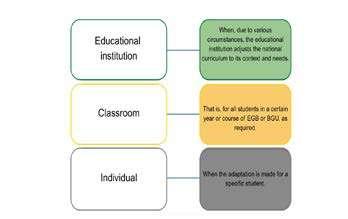
Source: Ministerio de Educación (2019)
When, due to various circumstances, the institution adjusts the national curriculum to its context and needs.
• Curricular adaptations according to degree of impairment: Adaptations for access to the curriculum involve adjustments to aspects such as the physical environment, available resources and materials, infrastructure, the time needed for the student to carry out an activity, and the means of communication used.
• Grade 1 impairment: According to the Ministerio de Educación (2019), when making curricular adaptations it is important to consider different types of resources, among them:
• Human resources: These include the head teacher, the professionals of the Student Counselling Department (SCD) and the technical team of the District Inclusion Support Unit (DUIS).
• Spatial resources: It is essential to adapt the physical conditions to ensure access to inclusion.
• Communication resources: Alternative communication systems need to be implemented.
• Material resources: Materials designed or adapted to facilitate student learning and participation. The incorporation of these technical resources and the adaptation of the school environment to the particular needs of students are considered part of the adaptations for access to the curriculum.
• Grade 2 or non-significant: According to the Ministerio de Educación (2019), this type of adaptation involves additional adjustments to those of grade 1, incorporating changes in methodology and assessment. However, the learning objectives and skills with performance criteria remain the same for all students. Methodological and assessment strategies must be flexible, creative, motivating and tailored to the individual needs of learners.
Strategies that can be applied include:
• Peer tutoring: Students with greater mastery of knowledge and skills collaborate with peers in need of support.
• Teacher support group: Educators with expertise in SEN provide guidance to other staff; in addition, the SCD is responsible for accompanying and training teachers in the process.
• Centers of interest: A technique that consists of organizing the classroom into different workspaces, each with activities that favor the development of specific skills.
• Projects: Group activities focused on the creation and execution of a project related to the students’ interests. Students with SEN participate according to their abilities and possibilities.
• Paired reading: Particularly useful in cases such as dyslexia, it allows a partner to support a student who needs it by reading aloud.
• Collaborative writing: A strategy that involves the joint creation of a text by several students, encouraging teamwork and improving the skills of those who face difficulties in expressing their ideas in writing.
• Grade 3 or significant: For the Ministerio de Educación (2019), this type of adaptation involves modifications to the elements included in grade 2 (methodology, assessment, resources, etc.), educational objectives and skills with their respective performance criteria. The curriculum is further adjusted to respond to the particular needs of the learner.
Assessment strategies that can be applied include:
• Oral assessments: Exchange of questions and answers verbally to assess knowledge.
• Objective written assessments: Consisting of multiple choice, true/false, matching, completion and ordering questions.
• Objective attitudinal assessment: Systematic observation of the effort and commitment of the student with special educational needs.
• Conversations: Activity based on a reading or video, where each student expresses the main idea and shares his or her opinion.
• Rubrics: Tools in the form of matrices that allow different aspects of a specific task to be evaluated.
• Other forms of assessment: For students with reading or writing difficulties, alternative products such as mock-ups, collages or drawings can be used instead of written work.
Curricular adaptations according to duration: In education, curricular adaptations are deliberate adjustments made to cater for the diversity of students, with a particular focus on those with special educational needs (SEN). Among the classification axes, the duration of the adaptation is a key dimension: a distinction is made between temporary and permanent adaptations, see Table 5. Understanding this distinction allows teaching and technical teams to design more adjusted, effective, and inclusive educational processes (Loor & Aucapiña, 2020).
Table 5
Classification of curricula adaptations according to their duration
Duration
Duration
Level of integration
Level of integration
Typical examples
Typical examples
Temporary
Temporary
Permanent
Permanent
Access or not meaningful
Access or not meaningful
Not meaningful or meaningful
Not meaningful or meaningful
Overtime, tutoring, light physical support
Overtime, tutoring, light physical support
Modified objectives, methodological changes, deletion of content
Modified objectives, methodological changes, deletion of content
Source: Loor and Aucapiña (2020)
Inclusive teaching strategies consist of a set of tools and approaches that enable teachers to respond to the diversity present in the
classroom, regardless of physical, social, economic, or cultural characteristics. Each student has particular needs, so it is essential that teaching is adapted to ensure their learning and all-round development. Currently, these strategies promote participation and the development of values such as empathy, respect, tolerance, and appreciation of diversity. To this end, it is essential that teachers have the necessary preparation to apply relevant methodologies to the needs of each student (Ministerio de Educación of Ecuador, 2024).
This process involves observing and understanding the specific characteristics of all students who present some barrier that hinders their learning, and different methods and strategies that help with the needs of each student must be carefully and systematically implemented.
Learning disabilities
• Use auditory material.
• Make learning concrete.
• Use manipulatives: (picture boards, syllable cards, dice and blocks).
• Use tangible objects: (Plasticine, puzzles, word or number puzzles and memory games with pictures or sounds).
• Incorporate familiar (everyday) objects.
• Differentiated assessment.
• Use visual materials.
• Motivate the student to complete small tasks.
Behavioral disorders
• Give more time to respond (verbally and in writing).
• Break activities into short steps.
• Model instructions for an activity.
• Explain instructions using visual material.
• Provide clear instructions.
• Explain what is expected of the learner clearly and consistently throughout the day.
• Remain calm in the face of inappropriate behavior.
• Use different behavior modification techniques (BMPT).
• Work on turn-taking.
• Reinforce positive or appropriate behavior when it is present.
• Give importance to their interests to motivate them.
• Create extra activities related to their interests.
• Create activities according to their abilities.
• Encourage more complex activities.
• Provide material to encourage research on different topics.
• Make curricular adaptations.
• Create teaching moments in which students learn to accept their mistakes.
• Observe what environmental stimuli may be bothersome to the student (sensory).
• Make adaptations considering the sensory sensitivities the student has and demonstrates.
• Make a behavior modification plan. Work on areas of need for the student (fine and gross motor, language, or socialization).
• Make curricular adaptations.
• Modify activities according to the student’s abilities.
• Use visual material.
• Use different forms of communication (pictograms, sign language).
• Create activities that teach social skills and behaviors.
• Use group work to promote acceptance and socialization.
• Have clear rules and routines.
• Anticipate any schedule changes to avoid student anxiety.
Understanding disability from a human rights and social model implies recognizing that it is not just a medical or biological condition of social construction arising from the interaction between a person’s individual characteristics and the physical, social and cultural barriers of their environment (Navarro, 2023). This vision represents a fundamental change with respect to the traditional medical model, as it does not focus the problem on the person, on the need to transform society to guarantee equal opportunities and the full exercise of rights. Despite theoretical and policy advances, many myths and prejudices persist that fuel discrimination and hinder inclusion, especially in education (Samaniego et al., 2024). Some of the most common stigmas are discussed below, based on current research, to promote a fairer, more empathetic, and evidence-based view.
• Disability is not a disease: One of the most common misconceptions is the belief that having a disability is equivalent to being ill. This confusion stems from a reductionist view that associates every different condition with the need for treatment or cure. Nevertheless, many disabilities are not caused by diseases, but rather by genetic factors, accidents, ageing or congenital conditions. In Mexico, 34% of disabilities are due to diseases, while 23% are linked to old age, 16% to birth conditions and 15% to accidents (Baumed,
2023). The United Nations emphasizes that disability should not be seen as a pathology, but rather as a condition that requires the removal of physical, social, and attitudinal barriers that impede people’s full participation in society.
• Not all people with disabilities want to stop being disabled: There is a widespread perception that people with disabilities want to be ‘cured’ or free from their condition. This view is based on a negative conception of disability, as if it were a mistake or defect that needs to be corrected. Many studies show that people with disabilities want to live in a society that respects them, values their abilities, and provides them with opportunities for development and participation as much as anyone else (UN DESA, 2024). For many people, disability is part of their identity and does not necessarily represent an obstacle to being removed, it is a feature of their lives that they have learned to integrate and with which they can fully develop if they receive appropriate support.
• Not all disabilities imply intellectual disability: A widespread prejudice is to assume that all people with disabilities have cognitive limitations or learning difficulties. This generalization is erroneous and harmful, as it makes the diversity within the group invisible. There are many types of physical, sensory, psychosocial, and intellectual disabilities, and stuff, and the presence of a physical or sensory disability does not imply any impairment in intellectual capacity (Baumed, 2023). For example, people with visual or hearing impairments can access higher levels of education, pursue complex professions, and excel in various fields, demonstrating that intelligence is not determined by the presence or absence of a disability (Samaniego et al., 2024).
• People with disabilities are not a social burden: Another harmful stigma is to consider that people with disabilities represent an economic burden for society, due to the fact that they require special support or adjustments. This approach ignores the multiple contributions they can make if given the right conditions. This study highlights that inclusion in the workplace brings significant benefits such as improved emotional well-being, financial autonomy, social integration, and legislative and cultural challenges that persist for effective inclusion (Santana & Pinargote, 2025). Inclusive companies
tend to be more innovative, resilient and productive, and investments in accessibility and human diversity have a positive long-term impact.
• People with disabilities can work and be highly productive: Related to the previous myth, it is still believed that people with disabilities cannot perform a job or that their performance will be lower. However, the evidence shows the opposite. With reasonable accommodation, such as adapting physical spaces, implementing accessible technology or flexible working hours, many people with disabilities can effectively perform a wide range of work tasks (Aksnes & Ulstein, 2024). In many cases, they even exceed productivity expectations. The key is to remove existing barriers in the work environment and foster an inclusive and respectful organizational culture.
• Not all people with disabilities are the same: A common mistake in public discourse is to treat individuals with disabilities as a homogeneous group. In reality, disability encompasses a broad spectrum of conditions, over 200 distinct types, each marked by its unique characteristics, challenges, and potentialities (Samaniego et al., 2024). This diversity necessitates a personalized approach in the formulation of public policies, educational strategies, and support systems. Generalization obstructs the development of effective solutions and perpetuates stigmas that hinder the full participation of these individuals.
• People with sensory disabilities can live a full life: It is often assumed that those with visual or hearing disabilities lead limited or incomplete lives. Nevertheless, when there is adequate support, assisted technology, and accessible environments, these people can develop personal, social, and professional skills with full autonomy (Aguila, 2025). The key is not in the condition itself, but in the opportunities that society offers for each individual to unfold their potential.
• Not everyone needs constant care: It is common to think that all people with disabilities depend on the permanent care of others. In reality, many people are capable of making decisions, managing their daily lives, and living autonomously, if they have
the appropriate tools and environment (Jaramillo Ruiz et al., 2023). Overprotection, far from helping, can limit their development and perpetuate dependence. Fostering autonomy is essential for wellbeing and inclusion.
• Regular education is a valid option: For decades, it was considered that people with disabilities could only attend special education institutions. Nonetheless, current research demonstrates that inclusion in regular classrooms, with appropriate support and adjustments, improves academic learning, strengthens social skills, and contributes to a fairer and more supportive school culture (Samaniego et al., 2024). Educational segregation limits the potential of these students and reinforces social exclusion.
• People with disabilities can form a family: The belief that people with disabilities cannot take on family responsibilities or be parents remains. However, there are numerous documented cases of people with disabilities who, with appropriate support, have formed stable families and have successfully raised children (Baumed, 2023). The ability to care, love, and educate is not determined by physical or sensory condition, support networks, and access to conditions of equity.
• They can make decisions about their lives: The infantilization of people with disabilities leads to the false idea that they cannot make important decisions. On the other hand, the Convention on the Rights of People with Disabilities recognizes the right to autonomy and informed decision-making, provided that the necessary support is provided (Arias, 2025). Fostering their selfdetermination strengthens their self-esteem and general well-being.
• Independent mobility is possible: Thanks to technological advances and improved urban accessibility, more people with disabilities are able to move independently. The ability to travel or move does not depend solely on their physical condition, the design of accessible environments, inclusive transport, and the availability of support tools (Aguila, 2025).
• They can be agents of change and innovation: Contrary to the disability myth, many people with disabilities are actively involved
in developing technological solutions, accessible programs, and innovative tools that benefit society as a whole. Functional diversity brings different perspectives and enriches the processes of design, creativity, and innovation (Aguila, 2025). Their expertise is key to building more inclusive and humane environments.
• Not all disabilities are visible: It is important to recognize that there are invisible disabilities, such as psychosocial, mental, or certain chronic diseases, which are not physically evident but have a significant impact on people’s lives (Baumed, 2023). Lack of understanding these conditions can lead to discrimination, stigmatization, and even denial of rights. Making this diversity visible is essential for inclusion.
• Living with a disability is not a tragedy: It is common to assume that a life with a disability is marked by suffering or resignation. This narrative victimizes and limits people, when in reality, many of them lead full, active, and meaningful lives, facing challenges with courage and creativity (Baumed, 2023). Changing this view means recognizing the dignity, abilities, and achievements of people with disabilities as a valuable part of society.
The persistence of these myths reveals the urgent need to transform social, educational, and cultural discourses around disability. The greatest barriers are not found in people, but in attitudes, structures, and policies that perpetuate exclusion. Promoting inclusion requires dismantling stereotypes, promoting universal accessibility, and respecting human diversity with an informed, empathetic, and committed society to equity, which will ensure that all people, with or without disabilities, develop their potential and exercise their rights.
Internal migration in Ecuador has gained significance in recent decades, becoming a social and economic phenomenon that affects various regions of the country. The migration process involves people moving from rural to urban areas in order to seek better living conditions and opportunities (Illicachi 2023). This has several implications on key issues, such as access to education. As migrant families settle in new communities, they face significant challenges
that can impact the continuity and quality of education for children and young people. Factors such as lack of adequate infrastructure, limited resources in High Schools, cultural and linguistic adaptation are obstacles faced by many communities, which can result in unequal access to equitable educational opportunities.
According to Torres (2023), “existing educational policies often do not take into account the specific needs of this migrant population, which aggravates the situation” (p.58). In the Ecuadorian context, it is essential to understand how internal migration impacts on the education system and what strategies can be implemented to mitigate the barriers faced by these families. The study seeks to analyze these dynamics, providing data and reflections that serve as a basis for developing effective public policies that promote access and quality of education for children and young internal migrants in Ecuador.
According to the Migration Unit (2024), the term internal migration is defined as “movement of people within the same country, for example from the countryside to the city or between regions” (p. 4). This refers to a change of residence from one location to another, without crossing international borders. This phenomenon may be driven by a variety of factors including economic, social, political, and environmental factors.
In the Ecuadorian context, internal migration has been historically significant, especially to urban areas from rural areas, which corresponds to the search for better job opportunities, access to basic services, and more adequate living conditions (Yanza, 2022). This type of migration is often associated with seeking education and improving the quality of life. In Ecuador, internal migration has been strongly influenced by natural disasters and climatic phenomena, which have forced entire communities to move to other regions in search of security and stability.
Internal migration impacts individuals moving, it has repercussions in the places of origin, altering demographic structures and generating both challenges and opportunities in terms of access to services, including education for migrant children and their families, because it often involves the relocation of children to new High Schools which
can generate progress or challenges related to cultural adaptation, social integration, and available educational quality (Bayona et al., 2024).
Ecuador is characterized as a country of origin, transit, and destination for both internal and international migration. In terms of internal migration, the provinces of Manabí, Guayas, Los Ríos, and Loja account for the largest number of people who have migrated to other parts of the country, especially to the poles of attraction of Quito, Guayaquil, and Cuenca, due to their economic dynamics and production capacity. The latest Revista Gestión census (2024) shows that the province of Manabí leads this migratory trend with 503,394 internal migrants, followed by Guayas, with 299,734 migrants: Los Ríos, with 248,848, and Loja, with 219,202.
Internal migration in Ecuador has been linked to socio-economic factors that influence access to education. Economic inequality between the different regions of the country, especially between urban and rural areas, determines the educational opportunities available to internal migrants. Many of these migrants come from rural areas where poverty is more prevalent and where High Schools lack the necessary resources to provide quality education (Rendón, 2024). Similarly, when migrating to cities in search of better opportunities, migrant families often face additional challenges, such as a lack of documentation, which makes it difficult for them to access educational services, and problems of cultural and social integration affect their interaction in the local education system.
Changes in family structure due to internal migration, such as the displacement of one or both parents, impact on children’s access and continuity in education (Delfin et al., 2021). Migrating families tend to have less economic resources, which may lead to a decrease in educational investment and, consequently, to school drop-out.
Similarly, the informality in which many migrants find themselves, characterized by unstable and insecure jobs, limits families’ access to fixed incomes. This economic precariousness directly impacts their ability to cover the costs related to education, such as uniforms, school supplies, and transport (Bonal & González, 2021).
Internal migration in Ecuador has had a significant impact on access to education, generating both positive and negative effects on the country’s educational system. This phenomenon has generated a series of impacts on the educational offer, quality, inclusion and equity, structural, pedagogical, administrative, and socio-emotional aspects of the education system.
• Positive impact
Many migrants move to urban areas where educational opportunities are more varied and accessible, allowing children and young people to benefit from better quality education with greater resources. This includes access to more appropriate school infrastructures, trained teachers and diversified educational programmers that promote integral learning (Rincón-Báez, 2024). The arrival of migrants has contributed to greater cultural diversity in classrooms, which enriches the educational environment and promotes values of inclusion and respect for traditions and customs.
Rincón-Báez (2024) argues that migrants often prioritize education as a fundamental tool to improve their quality of life, motivating their children to strive and reach higher educational levels. This approach results in increased enrolment and school attendance rates, especially in previously neglected areas. Internal migration has led to the creation of new schools and the strengthening of educational programmes, leading to public policies aimed at improving access to and quality of education.
• Negative impact
Because of internal migration, there are negative impacts on access to education, highlighting inequalities that affect both migrants and host communities. One of the adverse effects is family destabilization, as migration movements often lead to the separation of families, creating an environment conducive to school drop-out. Many young people mention that when moving with one of their parents, students must face complex processes of adaptation to new educational
contexts, which often lead to dropout situations that put their academic trajectory and future employment opportunities at risk (Lafaurie, 2021). In addition, the quality of education may be affected as institutions in host areas often do not have sufficient resources to cater to many students from different socio-economic and cultural backgrounds.
An increase in the student population may lead to classroom overcrowding, limiting opportunities for personalised attention and negatively affecting students’ academic performance. In addition, internal migrants are frequently subjected to discrimination and stigmatisation, because of their status as migrants but also due to the perceived quality of the education they received in their places of origin, which may foster experiences of marginalisation and social exclusion.
In Ecuador, education policies have had to adapt to the reality of internal migration, which has significantly influenced access to education. The legal framework in the country establishes fundamental rights to education, reflected in the 2008 constitution, which recognizes education as a human right and an obligation of the state. In this context, specific strategies have been implemented to assist internal migrants, that is, “those who face structural and cyclical barriers that hinder their access to quality education at different educational levels” (Universidad Nacional de Cuyo, 2024).
Among the most relevant government initiatives are scholarship programs and financial support that seek to facilitate access to education in rural and urban areas affected by migration. Similarly, access to education depends on the existence of inclusive policies and their effective implementation in different provinces and local contexts, where socio-economic particularities influence the assimilation of internal migrants into the educational system. Jordán (2023) states that improving this situation requires policies that address the structural aspects of the education system, consider social integration and psychosocial support for migrants, thus promoting their permanence and academic success.
Interviews with internal migrants in various regions of Ecuador reveal a multifaceted reality regarding access to education. For example, Maria, a mother who emigrated from the Sierra region to the coast in search of better job opportunities, said that the move directly affected the school enrolment of her children, who faced difficulties adapting to the new educational context due to differences in curriculum and resource availability (Illicachi, 2023).
In turn, Carlos, a young man who emigrated with his family, pointed out that the lack of information about High School s in his new place of residence complicated his registration process, which led him to miss a school year, but the interviews highlighted the resilience of this family, for example Ana, who, despite the specific difficulties she faced after migration, she got organized with other mothers in their community to create an educational support group that would facilitate the exchange of information on bursaries and school reinforcement programs (Jiménez & Loor, 2025). The testimonies highlight migrants’ challenges in accessing education, show solidarity, and community effort as responses to a lack of geographic resources.
To improve access to education in the context of internal migration in Ecuador, it is essential to implement concrete recommendations that address migrants’ barriers. The promotion of inclusive public policies is essential to ensure access, permanence, and educational success for migrant children and young people, overcoming legal, cultural, and socio-economic barriers that hinder their integration (UNESCO IIEP, 2021). Thus, guaranteeing their right to education without discrimination. This involves developing mechanisms to facilitate the validation of prior studies.
School support programs should be implemented to help these students adapt to their new educational environments and promote the training and awareness of teachers about the realities and needs of migrants, so that they can provide appropriate and contextualized support. It is essential to increase investment in educational infrastructure in migrant-receiving localities, ensuring that there are sufficient quality schools to accommodate the growing student
population, and implementation of bursaries must be considered to the implementation of bursaries and financial aid programs to alleviate the financial burden of education for migrant families, and the promotion of accessible school transport.
It is imperative to strengthen coordination between different government institutions to ensure a comprehensive approach in the care of migrants, thus promoting their equitable access to education and contributing to the social and economic development of the country.
Educational inclusion requires much more than the existence of legal norms or abstract principles; it requires profound and sustained changes in institutional culture, pedagogical practices, and the infrastructure of education systems. Invisible barriers such as prejudice, stigma, methodological shortcomings, or lack of resources continue to limit access and full participation for students with diverse needs. Recognizing and breaking down these barriers is essential to achieving equitable education that truly responds to human diversity and guarantees the right of every person to develop fully.
Universal Design for Learning (UDL) is presented as a pedagogical and ethical response to the challenges of diversity in the classroom. Its proposal, based on neuroscience and curriculum flexibility, seeks to anticipate the needs of all students, avoiding late interventions that perpetuate exclusion. Nevertheless, its implementation is neither automatic nor simple: it requires strong teacher training, accessible teaching resources, and a change in mentality that sees difference as a value rather than a problem.
Internal migration produces positive and negative impacts on the Ecuadorian education system. On the one hand, migrant families find in urban areas greater opportunities for access to a diversified and better-quality education, also enriching the cultural diversity in the classroom. However, they also face significant challenges such as curriculum adaptation, the saturation of educational infrastructure, and the persistence of discrimination and social stigmatization. It
reveals the urgent need for public policies that guarantee physical access to education and comprehensively accompany the process of cultural, emotional, and academic integration of migrant students.
The stigma and myths surrounding disability persist in a worrying way, fueling social and educational discourses that limit the possibilities of real inclusion. Misconceptions such as considering disability exclusively from a medical perspective or assuming that people with disabilities cannot be fully integrated into society perpetuate exclusions and deepen inequalities. Overcoming these conceptions implies a cultural transformation that values diversity as a wealth rather than a deficit. It is necessary to promote social awareness, teacher training in human rights, and the implementation of inclusive pedagogical practices that break with deficient vision.
Mateo Quispe, ��, lives in a small town high in the Ecuadorian Sierra, where the cold wind and Andean landscapes have always been his home. He has been confined to a wheelchair since childhood, and it has defined who he is. Today, he lives with his godparents while his mother works to support his studies. Throughout his life, he has learned to cope with a world that often forgets people like him; he has been fascinated by technology since childhood. He spends hours disassembling radios, learning about circuits, and dreaming of building his own inventions. Now, upon taking the big leap to a public university, he discovers the existence of a robotics club, something he had always longed for. However, this new stage also brings him unexpected challenges, such as an environment that is not designed for accessibility, a more demanding pace, and the need to adapt without the support he was used to.
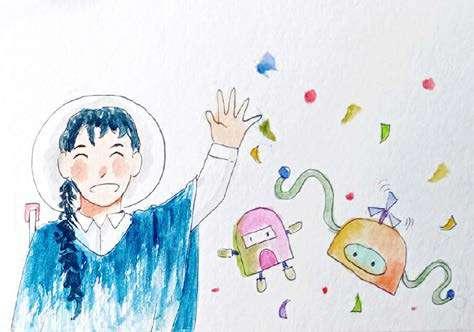
My dream has always been robotics.
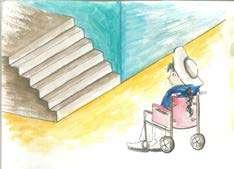
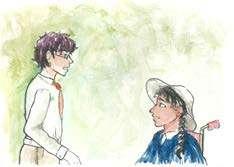
There’s no elevator in this building. The teacher doesn’t offer any flexible solution.
Today, I want to sign up for the robotics club.
How does he expect to get to the fifth floor like that?
But I wanted to be in the classroom and use all the machines.
You could help us from down here, but there’s nothing else we can do.
What’s wrong, Mateo? Why do you look so down?
You can talk to us, we’ll try to help.
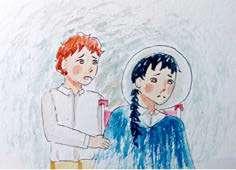
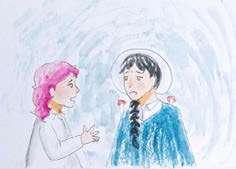
I wanted to join the robotics club, but the professor said I could only stay downstairs because there’s no way for me to get up.
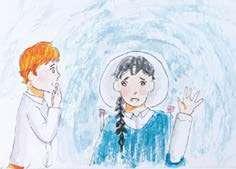
That’s awful!
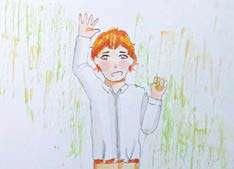
Yes! Let’s do it!
I have an idea! What if we make signs and posters so everyone knows what’s going on?
Don’t be sad.
It all happened this morning.
We have to do something. Mateo isn’t the first student excluded at this school.
Why is there so much commotion?
What could be going on?
I heard there’s a student with special needs.
There are posters everywhere.
Mateo’s friends quickly organized the protest, making sure every message was clear and inclusive. Together, they raised one united voice.
I need to fix this situation.
Who’s behind all of this?
Director, the whole school stands against the exclusion of Mateo from the robotics club. We’re asking for a real solution. Please.
We all support Mateo!
Alright, everyone. I promise we’ll take action. But please, end the protest and take down the posters.
The real disability is discrimination!
The director agrees that action must be taken. After the organized protest, he acknowledges the importance of the situation and commits to improving accessibility in education.
Mateo, the school authorities have decided to move forward with building a new elevator, so you and any student who needs it can reach the fifth floor. I apologize to everyone, and I promise that through teamwork, we’ll break down these invisible barriers.
we´re sorry mateo. you taught us that invisible barriers don´t exist
The bus should be arriving soon
Lucas is 15 years old. He lost his vision in a traffic accident. Over time, he learned Braille and how to navigate the city on his own.
As Lucas boards, he accidentally touches a girl’s shoe with his cane. She’s sitting in one of the priority seats.
¡screeeech!
The students completely ignore Lucas. The bus moves fast, and he has to hold on tightly to stay upright.
Hey!
Those are priority seats you need to give it up
Not my problem. He can sit somewhere else
Sofía gives up her seat to Lucas.
Lucas!
Over here take my seat
Thank you so much, Sofía!
Please, it’s just a seat!
No! These seats are meant for more than just people who can’t see — they’re for anyone who needs them
I think we should’ve moved from the start…
Sofía is determined to change her school’s mindset.
Everyone, let’s create posters about inclusion!
The school is soon filled with inclusion posters.
Ugh… what a pain.
Sofía looks surprised at her classmate’s reaction.
Later, during class…
Miss, can we make posters to support Lucas?
Absolutely, Sofía. Supporting inclusion is very important
Thanks, Miss. I’ll get the whole class involved
Wow! Sofía’s campaign is already going viral on social media!
I feel like today’s going to be a great day!
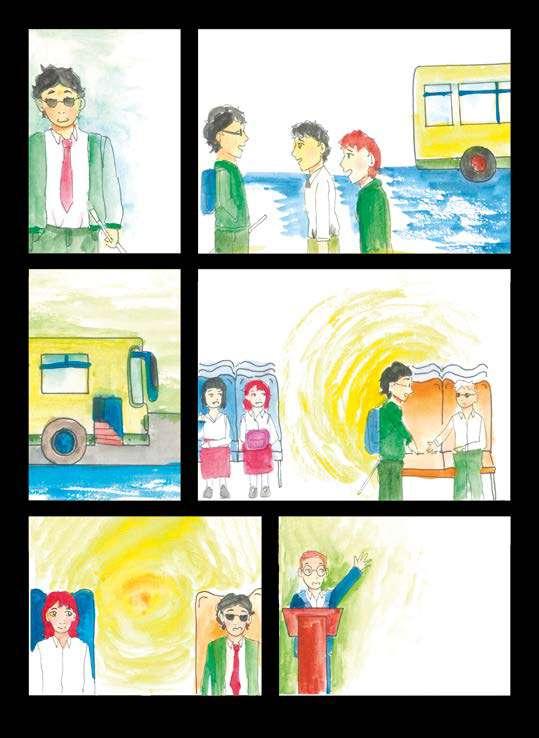
Hey Lucas, over here!
I feel good knowing I did the right thing
Thank you, Sofía, for caring about inclusion
Si Lucas, ahora gracias a Sofía nos entendemos mucho mejor
It’s okay, guys. Always remember to respect people, no matter their condition
We’re sorry about what happened the other day, Lucas
Take this seat, please
Thank you very much!
Little by little, the students became more aware not just with Lucas, but with everyone.
We want to thank all of you, kids. Small actions can change the world
“One seat at a time, for everyone.”
A sunny morning on the school playground…Sumak and Danny watch the game from the edge of the field.
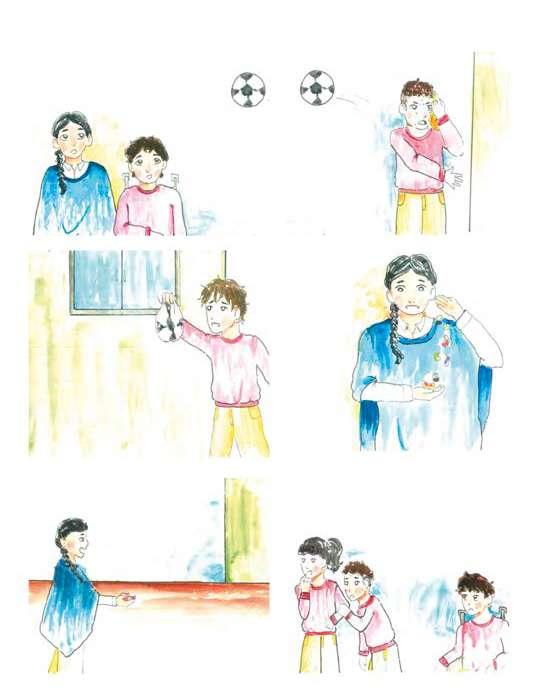
It’s not even fun anymore. The ball keeps getting stuck in the holes
This is a disaster!
Martin complains about the condition of the field.
Sumak shyly approaches his classmates and suggests playing chunkana with “tortas”, a traditional game in his community.
Guys! What if we try something new?
It’s called Chunkana. It’s a game from my community. And the best part? Everyone can play... even Danny!
The heat and losing the game left the students feeling frustrated... We always lose!
It’d be awesome if Danny could play. But there's not even a ramp for his chair…
Back in my community, we play something that’s really fun and competitive… And everyone can join in!
Sumak looks at his “tortas” (large beans) and remembers a game from his community.
The classmates are curious.
Chunkana? Isn’t that something you eat?
What are those? They look like giant beans!
Never heard of it. How do you play?
They’re tortas, kind of like giant beans. In my community we use them for games, not food
I promise you’ll love it!
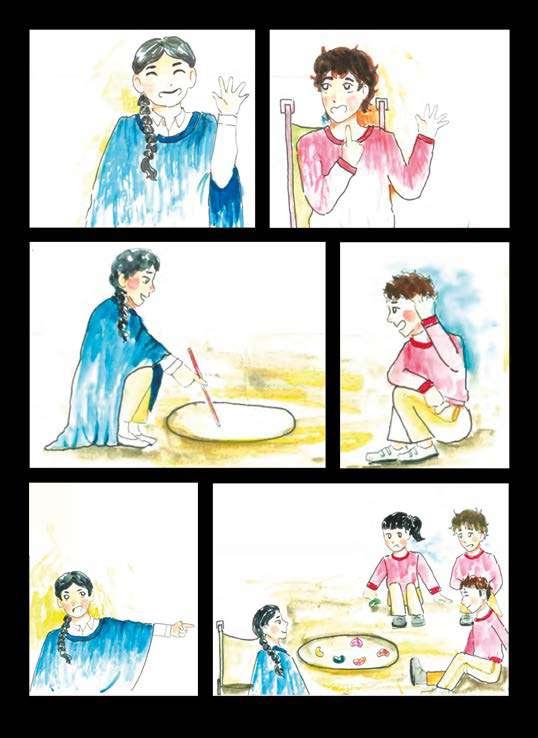
Everyone places their Torta in the center. Then we take turns tossing one to knock out the others
Whoever knocks out the most wins!
Sumak draws a circle on the ground and explains the rules of the game to his classmates.
Don’t get cocky… it takes aim and strategy
I can really play?
Let’s play! If you beat me, Martín, I’ll give you my dessert
Sounds great! I’m tired of just watching
That’s it? Easy! I bet I’ll win
Sumak throws first and manages to knock Carlos' torta out of the circle.
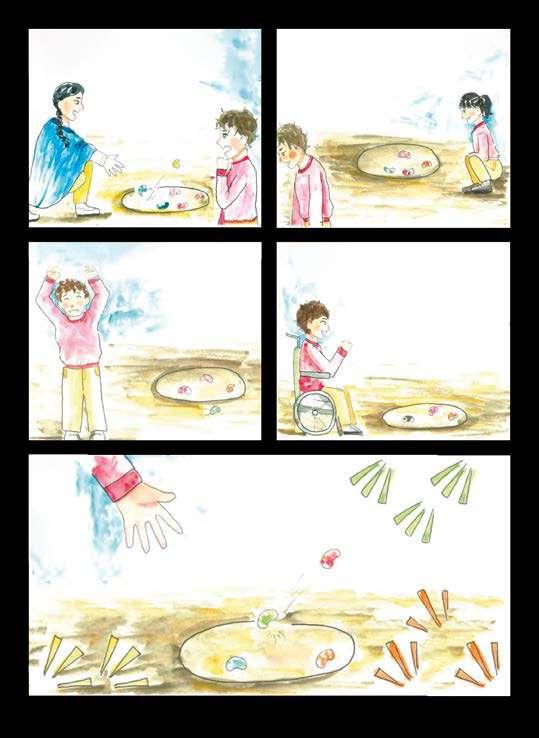
Hey! That was lucky!
Now watch how it’s done!
Jennifer and Martin are surprised and try to throw, but they miss.
I miiiissed! Whoa! This is harder than I thought!
I did it! Knocked one out!
Danny excitedly announces it's his turn.
My turn! Watch this!
Way to go, Danny! Excellent!
Yesss! I beat the champ!
Danny manages to knock out a torta, and everyone applauds his achievement..
This is so much fun! I never imagined I could play like everyone else.
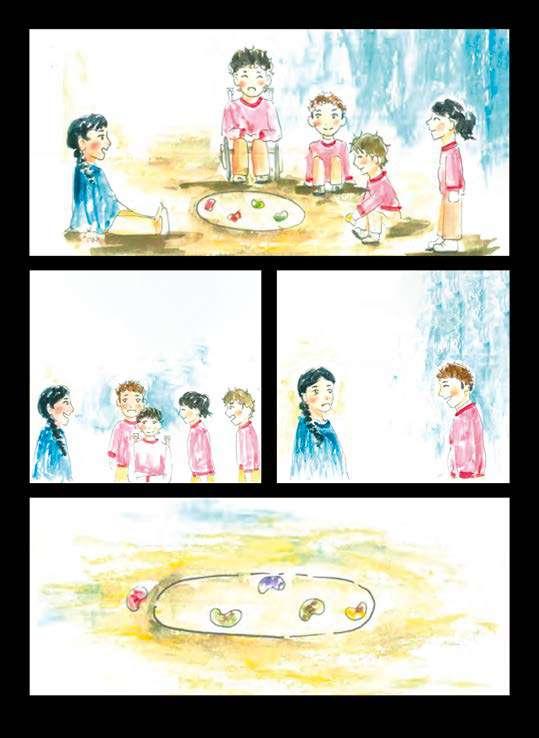
Thanks for sharing with us, Sumak. This beats regular soccer!
Es parte de nuestras tradiciones. Me alegra que les guste
The children keep playing with enthusiasm, celebrating each shot. Danny, participating for the first time, feels part of the group.
The children rest after the game, talking about the experience.
Awesome learning games from other cultures! Can we play again tomorrow?
Sure! I’ve got one with seeds and another with leaves. You’ll love them!
Yeah!
Will you teach us another one, Sumak?
Thanks for sharing this, Sumak. Sometimes we forget there’s more out there than what we already know.
That’s what it’s all about! Sharing, learning… Diversity makes us stronger!
Diversity brings us together. Let’s learn from one another our differences are our strength.
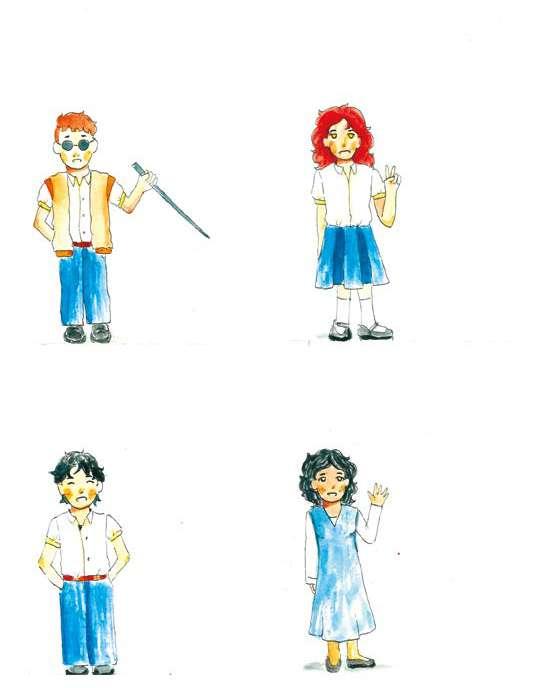
Hi! I’m Carlos, a visually impaired student curious, smart, and persistent. Even with barriers, I always find ways to keep learning.
Hey there! I’m Sofía, Carlos’s close friend. I’m supportive and stand up for inclusion. I always make sure everyone gets the same opportunities.
What’s up? I’m Martín, Carlos’s classmate. I’m fun to be around, and I love hanging out with Carlos and Sofía.
Hello, everyone! I’m Ms. Elena, a dedicated teacher with a strong interest in inclusive education though I’m still learning how to improve accessibility in my classroom.
A regular day in class. Ms. Elena brings in new books for a reading activity.
Ms. Elena enters the classroom carrying a stack of books
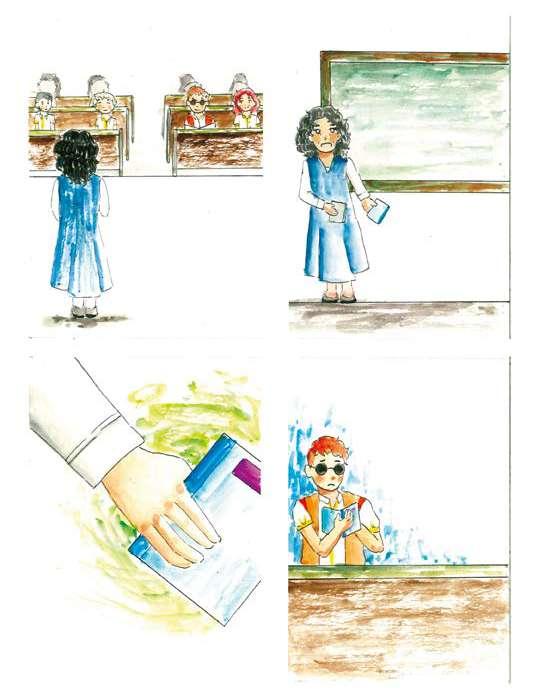
Students excitedly receive the books and begin to read.
Attention, class! Today we’re starting a new book. It’s a fascinating storyI’m sure you’re going to love it!
Carlos touches the pages, frowning.
No braille... I won’t be able to read it.
Carlos, what’s wrong? Don’t you like the book?
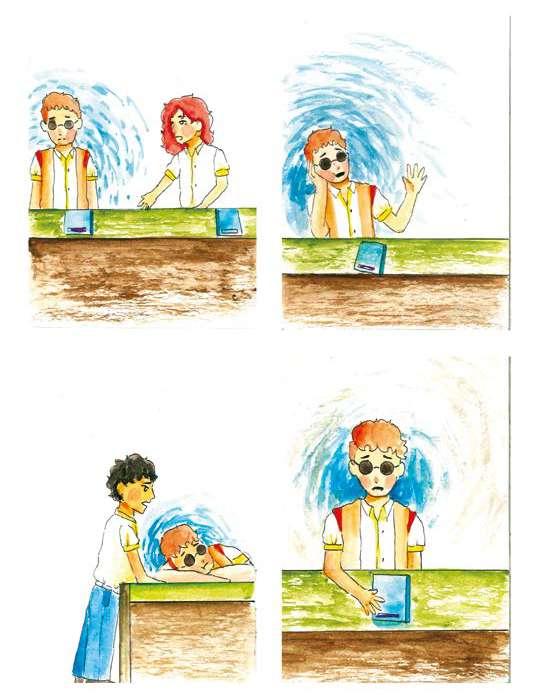
Really? I never thought about that... How can you take part in the activity?
It’s not that... I can’t read it. There’s no braille or audiobook version.
I usually have to wait for someone to read it to me or miss out entirely.
During recess, the three friends plan to speak with their teacher
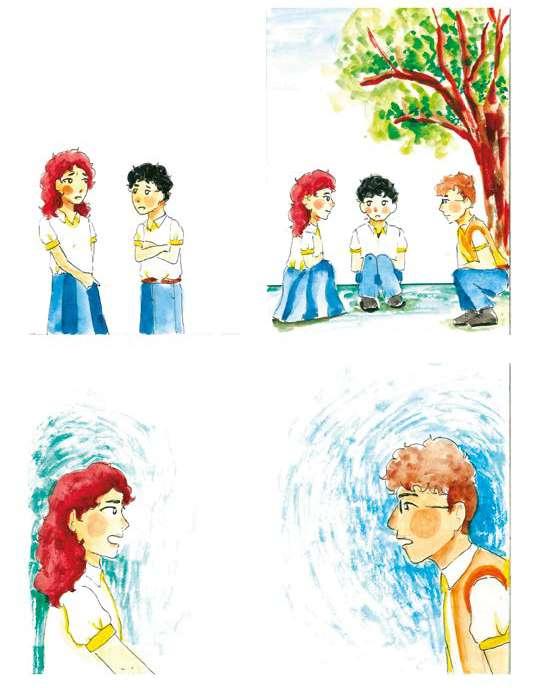
That’s not fair! We have to do something.
Yeah… Let’s talk to the teacher after class.
Carlos, have you ever had a braille book at school?
No… I always have to ask for help. But I’d love to be able to read on my own.
Let’s talk to Ms. Elena right now.
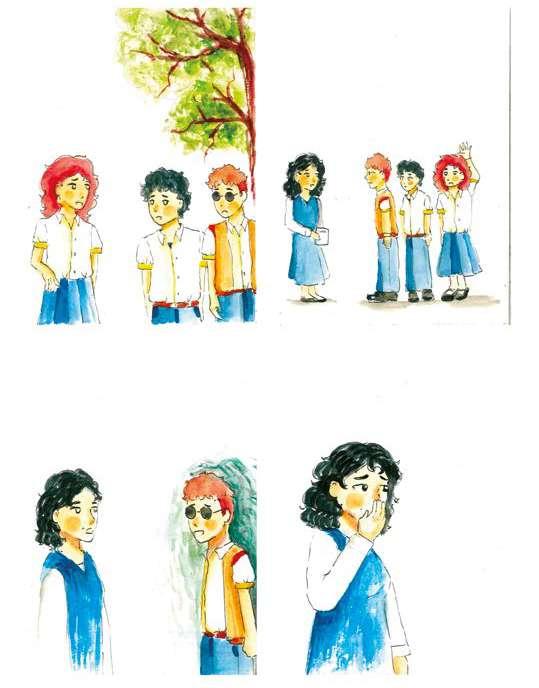
Of course, kids. What’s going on?
I had no idea how hard this could be… We’ve got to do something!
After class, the three approach the teacher’s desk.
Ms. Elena, we need to talk about something important.
I can’t read the class book there’s no braille or audio version. I want to join in, but I have no way to access it.
Carlos... I hadn’t realized that. You’re absolutely right. We need to find a solution.
Ms. Elena looks for ways to make the class more inclusive.
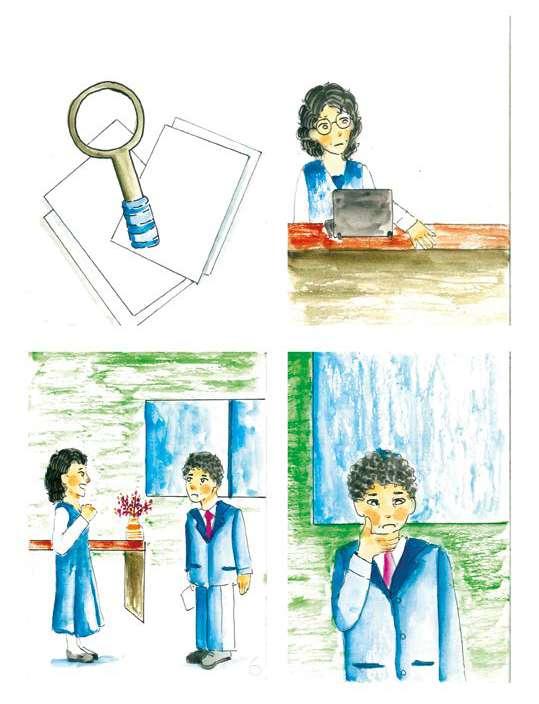
In the principal office, talking to principal Ramirez.
Principal, we need accessible materials for Carlos. He can’t read the current books.
Ms. Elena in the teachers' lounge, doing research on her computer.
We need accessible books… Where can I find braille or audiobook versions?
I understand… But we don’t have those resources yet. Let me see what we can do.
Back in class, Sofía and Martín come up with an idea
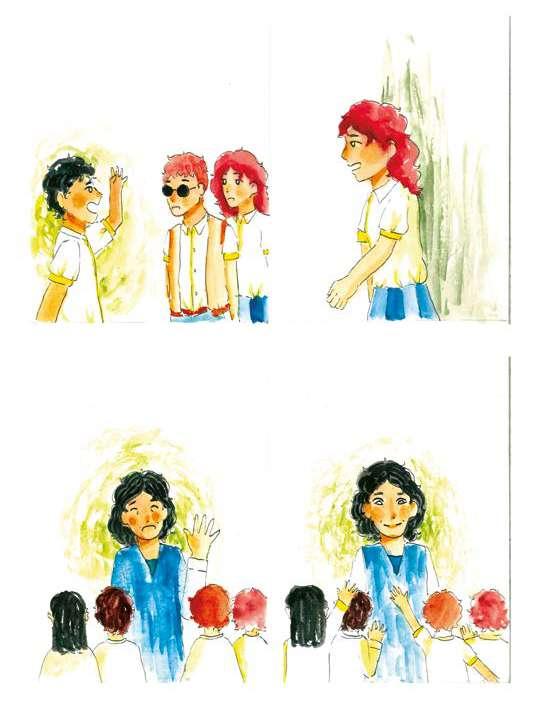
While we wait for the braille books, we could record the chapters for Carlos.
That’s a great idea! That way, he can follow along with the story.
Ms. Elena returns, smiling.
Class, while we work on getting braille books, we’ll do something special. Who wants to help record the texts for Carlos?
The students eagerly raise their hands.
We do it!
We do it!
The whole class joins in to make reading accessible in a new setting, the school’s recording studio.
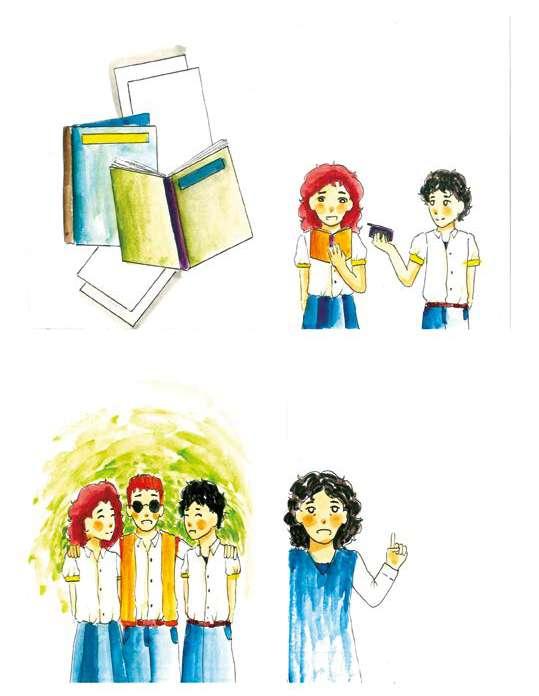
Carlos listening to the audio on his tablet, smiling.
Thanks, guys! Now I can follow the story too.
Sofía and Martín recording audio for the book.
Chapter One… Once upon a time…
Accessible learning materials ensure equal opportunities for every student, allowing each person to learn under fair and inclusive conditions.
hi, I´M LUIS A 9TH. GRADE TEACHER AND I LOVE MY JOB
I’m Laura, a sign language interpreter hired to make our school more accessible.
Scene �: The Challenge in the Classroom
I’m Juan, María’s friend and an advocate for equity and inclusion.
Hi, I’m María. I’m a student with a hearing disability observant, creative, and determined.
The classroom is full of attentive students. Mr. Luis is explaining ancient civilizations using the board, but he only speaks there are no visuals or captions.
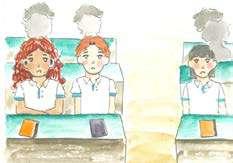
María sits at her desk, frowning in confusion.
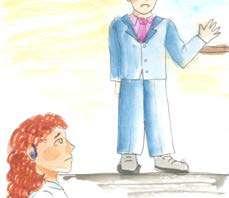
I can’t follow the lesson… There are no captions or interpreter.
Juan notices her frustration and gently touches her arm.)
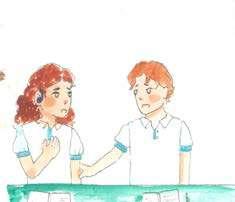
Everything okay, María?
I don’t understand anything. I can’t read lips when the teacher turns his back.
María sighs, stops taking notes, and looks around. Her classmates are writing without any issue.
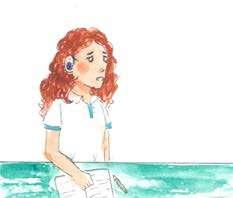
Everyone gets it… except me.
Mr. Luis continues talking and writing on the board.

As you can see, Egyptian culture greatly influenced architecture at the time.
Mr. Luis pauses, frowning slightly.
What do you mean, Juan?
Juan raises his hand.
Sir, I think María needs some help to follow the class.
María can’t hear everything you say. Could you use more visuals or captions?
Mr. Luis looks thoughtful.
I hadn’t thought about that… Let me find a solution.
Sir, there are ways to make the class more accessible. Can we work on a solution?
Juan smiles excitedly and shares the news with María using sign language.
There will be an interpreter in class!
After class, Juan and María approach Mr. Luis to talk about the issue.
Mr. Luis searches on his computer and finds the option to hire a sign language interpreter.

Here it is! We can request an interpreter.
That would be awesome!
A few days later, someone new walks into the classroom with the teacher.
Thank teacher!you,
Laura stands beside Mr. Luis and starts interpreting as he speaks.
Today we’ll talk about Ancient Greece and their philosophical achievements.
Mr. Luis teaches happily, knowing María now has support.

Juan smiles at her and shows his notebook.
María follows along easily, taking enthusiastic notes.
All good now?
Yes! Thank you!
After the change, all students are happy.
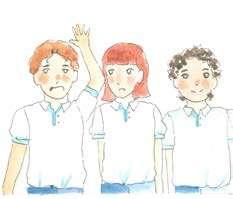
At recess, Juan and other classmates talks to Laura
How do you say “good morning” in sign language?
Like this watch.
We want everyone to understand each other.
The whole class is engaged including María, who now understands everything clearly.
María watches her classmates learning to communicate with her. She’s moved.
Thank you for learning!
In the next class, Mr. Luis uses more visuals and captions in his presentation.
In addition to the interpreter, I’ll use captions from now on, so everyone can follow the lesson.
Now I can learn just like everyone else.
An inclusive classroom is a classroom for all.
Let’s do the project together!
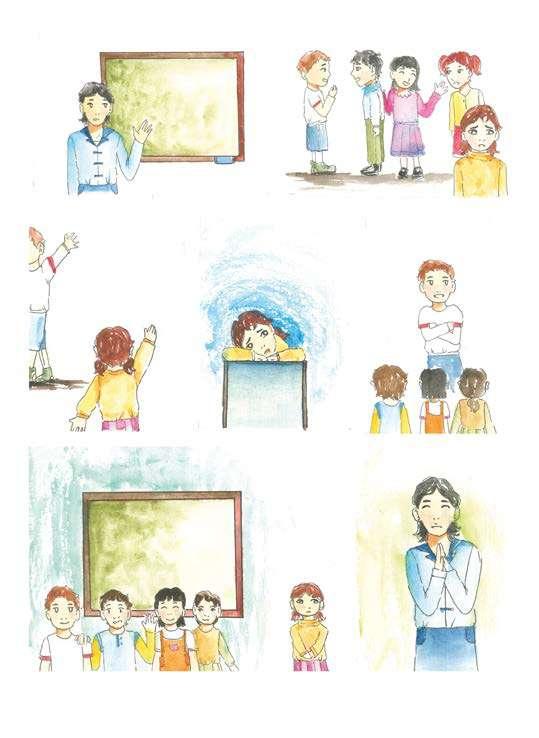
For the next class, you’ll work in groups and present the topic of social media. We’ll form groups of ten. Lucía will be in Group Two. I hope no one leaves her out because of her dyslexia.
Yeah, yeah, whatever…
I can help by doing the conclusion.
Why is it so hard for me to understand letters, and even harder to speak them?
I can do the introduction.
I hope they include me and let me participate.
I think it’s best if Lucía just handles the slides today
Lucía goes into her room, takes a deep breath, and searches for a way to be heard.
You all did an amazing job. Congratulations!
He takes his cell phone and discovers an application that works with artificial intelligence.
There must be a way…
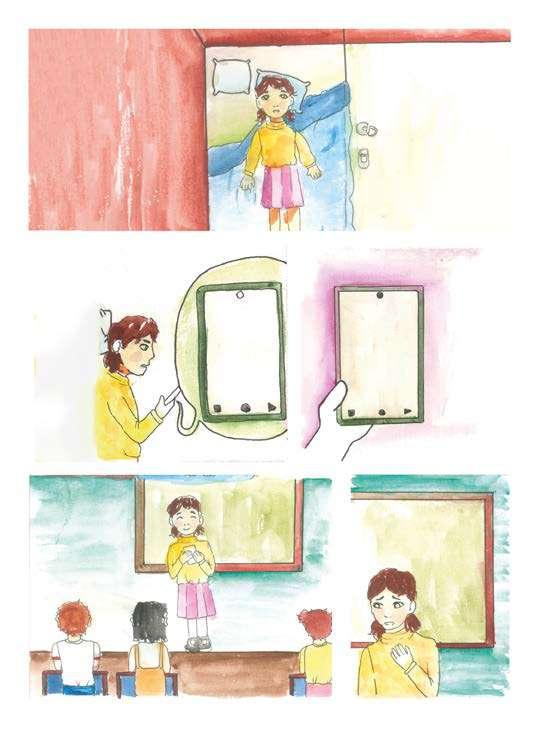
It’s true,
“To
Why are you all so mean to me?
It’s time to do something. If they don’t want to talk to her, then I will today.
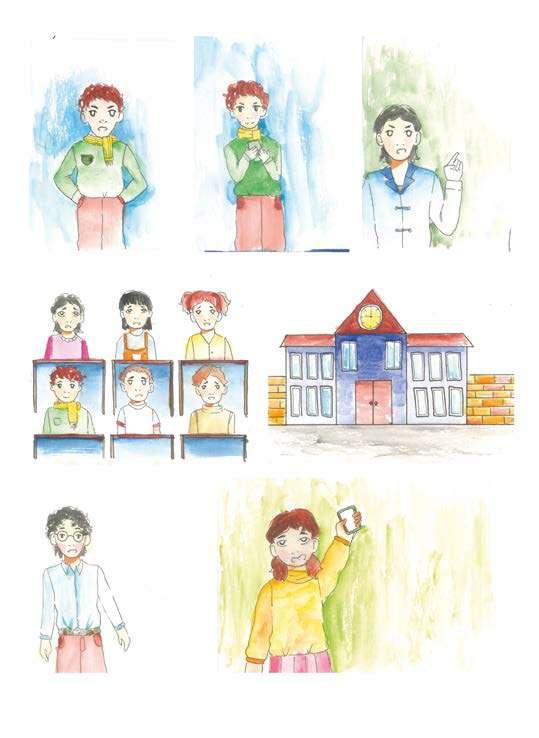
I love this app.
We’re sorry, Lucía.
I’m going to use it
I’m going to give you all a lesson.
*THEY LAUGH
Today I’m not a robot. I’m technology designed to help everyone communicate. I’m from the future!
This isn’t a joke—it’s a chance for someone to speak.
Forgive us.
Today we have the chance to hear from Lucía, a student who has shown us that barriers only exist if we let them. The tools she’s introduced will now be implemented for all students with learning needs.
The school authorities put up a large sign outside to promote inclusion.
Barriers in education aren’t always physical walls. Sometimes they’re indifference, impatience, or fear of what’s different. But today, thanks to technology and to those willing to listen, even in a different way, those barriers can be broken down.
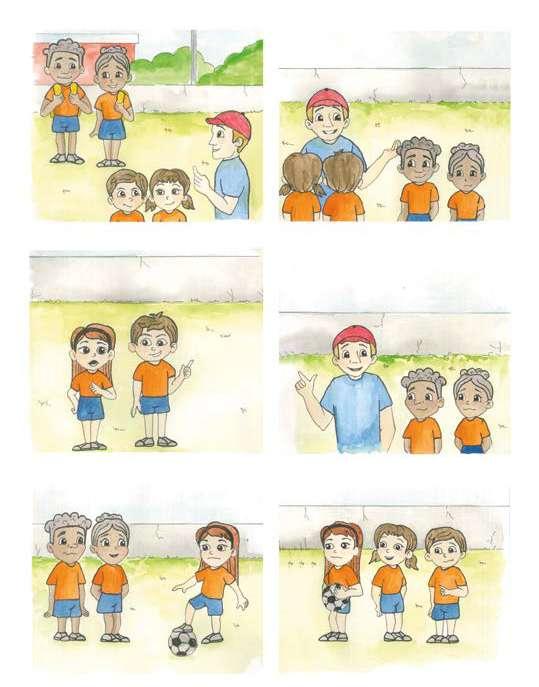
Hey, kids! Come closer!
Let’s go, Emmanuel
Let's go to let them know about us!
Who are these guys?
Hopefully they’re not like they say… that afros are dangerous.
Are they new?
We’d love to get to know you
Hey guys! Can we join in?
Now what do they want?
Welcome, kids. These are your new teammates. Thanks, coach. They look at us weird
Look at that hair—so curly!
Go ahead and play while I head to the office
They look at us like we’re strange creatures. Will they let us play?
I bet they’ve got chocolate instead of blood. I mean… Can they even play?
Better not. Bet they’re rough.
We just want to have fun…
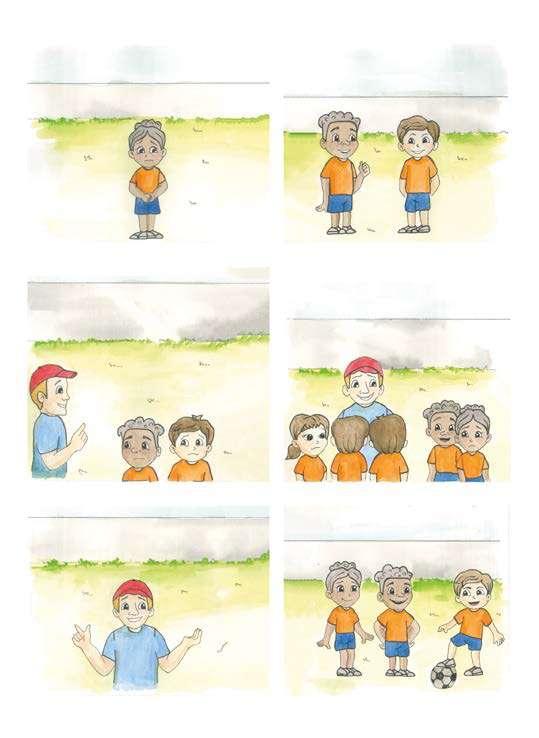
Just give us a chance. If you don’t like it, we’ll leave
Alright… go ahead.
Judging people just by how they look?
Enough! I guess not… They’re not criminals!
We also want to be part of this team We just want friends. Everyone deserves a chance. I agree.
Alright, let’s play!
Let’s see what they’ve got.
Gooooal! Did you see that?! You did it, brother! They’re really go
Incredible! Where’d you learn that?
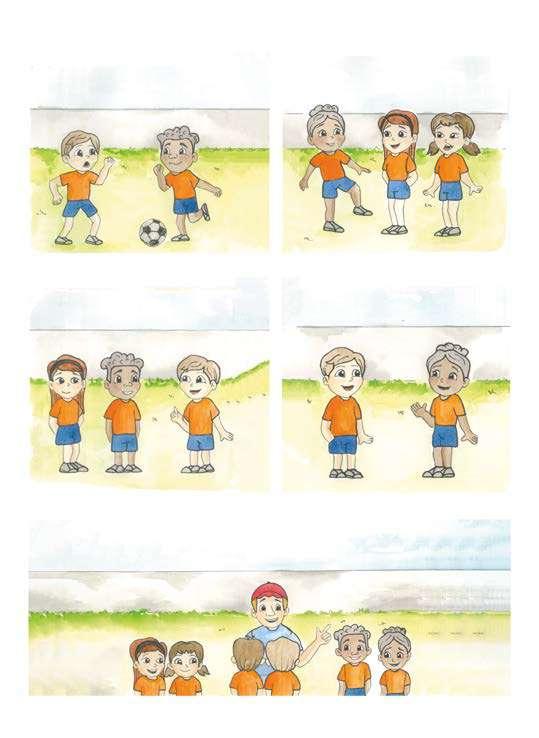
I learnt in my town. We played every day.
This is how we celebrate goals. Want to learn?
You’re awesome!
Sorry. You guys just wanted to be friends.
Hey, wait! And us show who we really are.
We learned not to judge by appearances
Yes, show us!
Exactly!
Differences shouldn’t keep us apart.
We all have something to learn from each other.
Thank you! That means a lot.
I’m so happy! I’ll finally see my mother again. And I’ll get to study in the city, even though everything here feels so different.
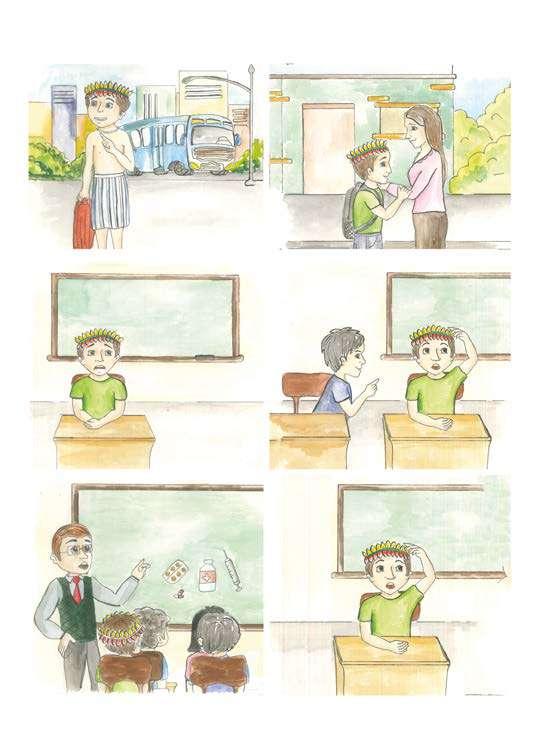
There’s nothing in this book about my community in the Amazon… And everyone’s
Be strong on your first day of school, my son. And never forget where we come from.
I won’t, Mom.
These are medications that help cure diseases.
I don’t know where you’re from, but that thing on your head looks pretty funny.
It’s called a "tocado de plumas". It represents our identity in the Amazon.
Teacher, we don’t have pills in my community. My grandma heals us with ayahuasca
Drinking herbs? Ha ha!
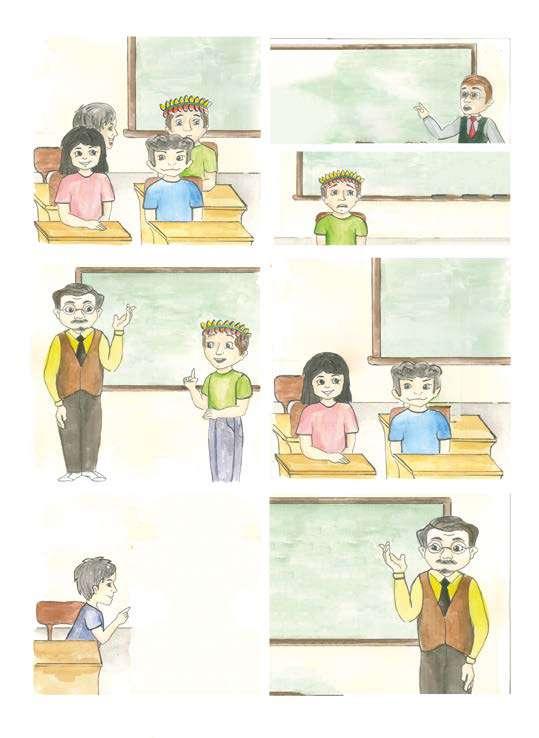
That must be some kind of magic
That’s not medicine. Those are just beliefs from your people.
That’s the weirdest thing I’ve heard. My grandma doesn’t lie… it really works.
Today I’ll talk to you about Amazonian plants that science is just beginning to discover
My grandmother taught me about guayusa. We use it for energy and focus.
ha ha!
He should just stay
Guayusa!? Did you know it’s now sold worldwide as a superfood and is hard to find?
We also use cat’s claws to boost the immune system and dragon’s blood to heal wounds
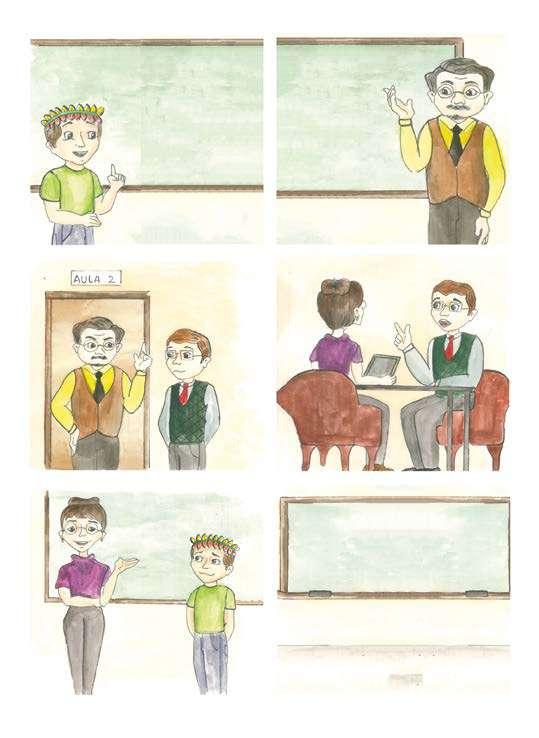
I’m shocked this isn’t taught in schools. This is real knowledge, not magic!
Bayri, I want to apologize in front of everyone. No one appreciated your knowledge or that of your region.
This is amazing! Did you know many modern medicines come from this knowledge? Big pharmaceutical labs pay millions to research it!
You’re right. Our curriculum includes nothing about the Amazon. We need to change that…
I don’t want you to just listen to me… I want you to hear all the people who’ve been ignored, even though they always had valuable knowledge to share.
Principal, we need to rethink how we teach. We can’t keep ignoring such valuable wisdom.
Hi, I’m Lucas. I’m a student with visual impairment. I love nature, and my other senses are super sharp
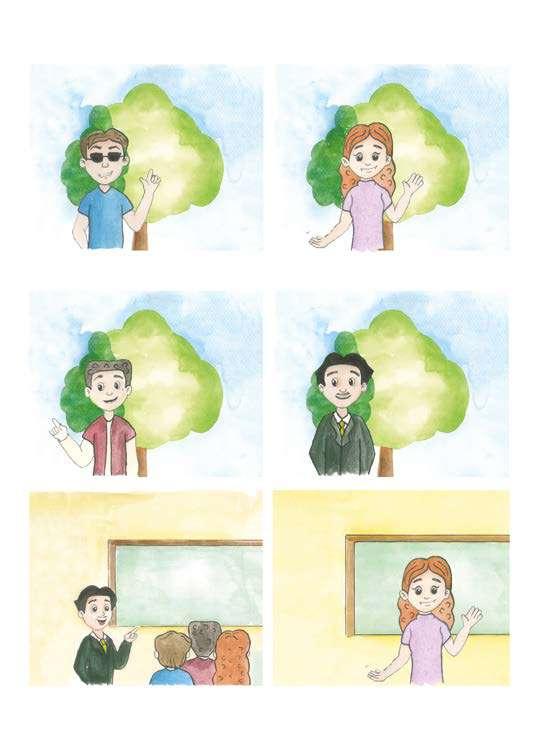
Hey! I’m Ana, Lucas’s friend. I’m energetic and creative. Always looking for ways to help others
What’s up? I’m Diego, Lucas and Ana’s classmate. I’m thoughtful and a good friend. I like finding ways to include everyone.
Hello, I’m Mateo, their teacher. I’m enthusiastic and open to learning how to make school activities more inclusive.
Kids, this Friday we’re going on a nature walk! It’s a great chance to learn about the ecosystem!
Awesome! I love nature.
My backpack’s already packed!
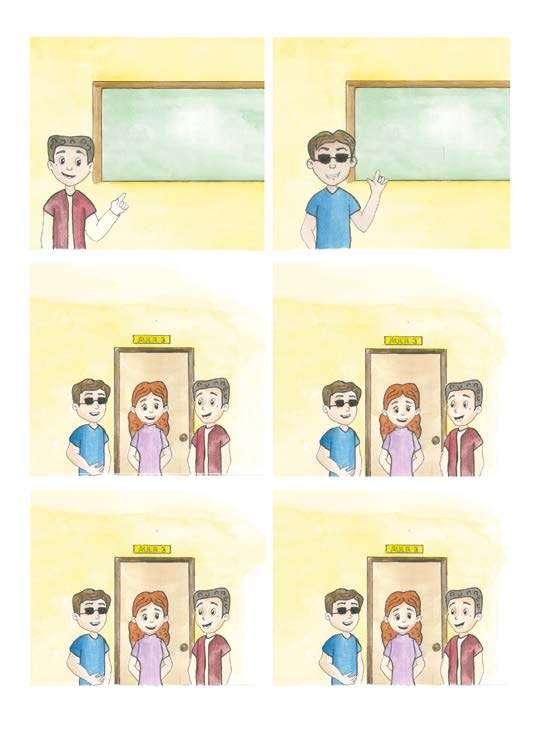
Sounds amazing…
Lucas, aren’t you excited about the field trip?
I love nature, but…
how will I enjoy the walk if I can’t see the trail?
What if there are obstacles? What if I get lost?
I hadn’t thought of that, but you’re right. How can we make it easier for you?
I don’t want to be a burden… Maybe I shouldn’t go.
Don’t even think that! Let’s talk to Teacherr.Mateo. I’m sure we can find a solution
Teacher, Lucas wants to go on the trip, but he’s worried he won’t be able to fully participate
We thought maybe we could do something to help him enjoy the walk without issues.
I’ve never considered this… but you’re right. Everyone should be able to join. Let me think…
I’ve got it! We’ll organize the trip in pairs, and Lucas will have a guide
Plus, the park guide can describe everything in detail
That sounds amazing!
Lucas will get to experience the trip in his own way
The tree leaves are a deep green, and there are colorful butterflies flying nearby.
Here’s a fern leaf. Touch it—Do you feel the texture?
That’s what matters! We all learn in different ways.
It’s soft and a little rough at the same time!
I can hear the birds singing… and I feel the cool breeze on my face.
Lucas is exploring nature better than we are!
That was amazing! I thought I wouldn’t enjoy it, but thanks to you, I experienced it in a unique way.
We all experience the world differently—and that’s what makes us special.
The important thing is making sure no one gets left out.
Mateo and his family just moved from Quito to Loreto, a city in the Amazon, because his parents found better jobs. Today is his first day at a new school
Alright, a new beginning. I wonder if I’ll make friends quickly?
Alli puncha ñañito, welcome!
¡Ay!
Thank you so much!
We can learn together!
Don’t worry! We’ll help you learn
Little by little, Mateo learns to speak Kichwa, and it starts to make more sense to him
Maya, a teacher, approaches Mateo with a warm smile
Good morning… Yes, I’m Mateo.
I don’t understand what some of the other kids are saying
Oh… That sounds hard
I understand so much more
See, Mateo! It’s not that hard!
¡Hello! Are you Mateo?
What’s wrong, Mateo?
Well, here we learn in two languages—Kichwa and Spanish
A few hours later…
Alright kids, let’s continue our lesson. Who can tell me how to say “sun” in Kichwa?
Very good, Josué
Me, teacher! It’s “inti.”
En el recreo Josué le enseñan a Mateo muchas palabras más.
Qué curioso ¿Cómo se dice agua!
Esta es la soga en kichwa decimos ¡wakra!
During recess, Josué and Inti teach Mateo more Kichwa words
Oh! That makes sense
Look, Mateo—water is “yaku.”
A few days later in class…
Today, each of you will teach us an important word from your culture
In Kichwa, “shuyay.” In English, “hope.”
¡very good guys!
Thanks Inti for the help, I understand more words now!
It’s wonderful to see them helping each other. Inclusive education builds bridges toward understanding And I’ve learned more Spanish with you!
Maya is amazed by how the children support one another
In ����, a Kichwa student from Otavalo received a scholarship to study at a school in Quito. He and his family moved excitedly to the city, unaware of the challenges he would face. His native language is Kichwa, and he struggles with Spanish. He has signs of dyslexia, which affects his communication and makes him a target of ridicule from some of his classmates.
Language and Literature Classroom.
It was a quiet morning in the classroom; sunlight streamed through the windows, illuminating the faces. Laura, the Language and Literature teacher, had organized a reading aloud activity. One by one, the students came forward to read a passage from the assigned text. Some did so confidently, others somewhat timidly, but none seemed to have any trouble... until it was Sayri's turn.
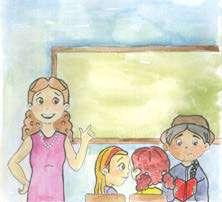
One morning in class, Teacher Ana asks for a reading.
Sayri begins to read, but pronounces each word with difficulty.
On… Thi…ss… beau…ti… trees. Woooo…ke up green.
attitude Sayri, it’s your turn. He’s nervous!
Sayri takes the book with both hands and takes a deep breath.
A murmur spreads
He talks weird! Like he can’t read.
“Imashpa mana mishu shimita yachakushkani wawamanta.” Why didn’t I learn Spanish as a child?
He sounds like a five-year-old.
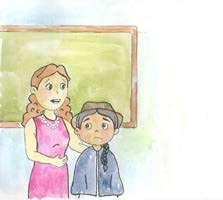
I’m sorry…
Sayri, embarrassed, lowers his gaze. In his mind, he asks himself with frustration, Why didn't I learn English as a child?
Just as laughter begins to fill the classroom, the teacher's firm voice interrupts the activity, drawing everyone's attention. She explains that Sayri is learning and that it's his second language, making them reflect on how they would feel in his place.
The classroom falls silent their
Wait a minute, class! Sayri is learning english
Let's do an activity to understand him.
We laughed without thinking…
I would feel bad too.
We had never thought about that…
Sayri, with tears in his eyes, feels that for the first time someone understands him.
The experiment Professor Laura, with a defiant smile, hands them a text written in Kichwa.
Guys!, Now it's your turn, let's read aloud.
sh... uk... pun... lla... ri... r... kani
I don't understand anything!
This is impossible!
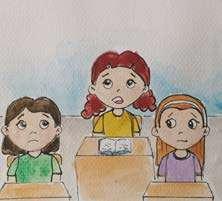
Professor Laura breaks the silence with a reflection.
how am i supposed to read this?
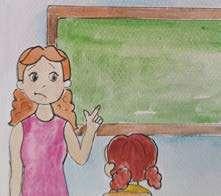
This is how Sayri feels when he reads in Spanish.
I didn't know it was so difficult.
yupaychani yachachik mashi yanapawashkamanta
It means: thank you teacher for helping me
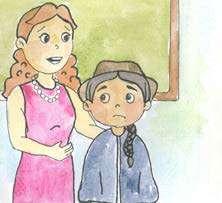
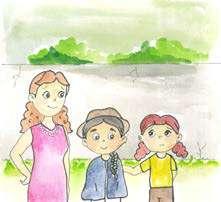
Sayri smiles with confidence
alli chi... shi alli chishi
interesting, sounds very sweet!
What a beautiful language!
Showing empathy
Some colleagues approach Sayri with a friendly smile and a show of support, mentioning: could you teach us some Kichwa words?
Sayri, you can read slowly. We'll help you!
shunkumanta yupaychani mashikunasignifica: It means: from the bottom of my heart, thank you very much, colleagues.
Repeat after me:
Of course!
alli punlla alli chishi alli tuta
That means: good morning, good afternoon, and good night.
This is how I feel. Reading in Spanish is hard for me. Sometimes I’m afraid people will laugh. I just want to learn.
Empathy with Sayri.
I’m sorry, Sayri
That must be really hard.
Inclusion and reflection.
Thank you, Andrea. I don’t feel alone anymore. Everyone deserves respect.
Words can hurt, but they can also help It won’t happen again. I’m sorry.
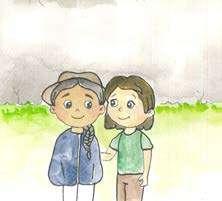
Liam and Camila go shopping with their father at an older mall that doesn’t meet accessibility standards.
Kids, please wait here while I go ask the guard about the ramps.
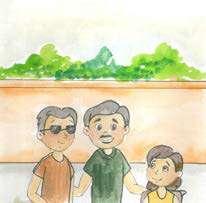
Camila and her father are shocked by the condition of the ramp.
How are we supposed to go up there?
Liam and Camila have had special abilities since they were born, and their parents are looking for the security guard.
They’re too damaged. Let’s just leave
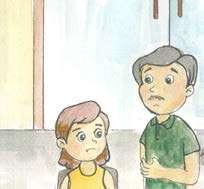
Liam, Camila, and their father return to the mall and find a surprise.
Look, Camila—they remodeled the whole mall!
Good morning, can you tell me where the entrance ramps are?
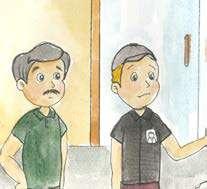
Good morning, of course—they’re this way, but they’re a bit damaged
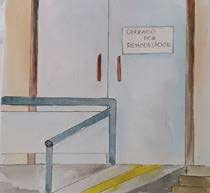
After an anonymous complaint, the mall undergoes renovations. Some time later, it reopens with new ramps, automatic doors, and Braille signage
That’s my girl!
Really!
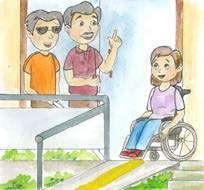
Look, Dad! I got up here so easily!
Liam and Camila feel good because they now have full access.
Liam! I can move around without any problems!
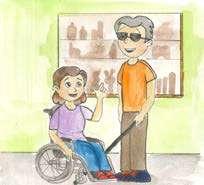
Let me feel it. Wow, it really does! What a blessing!
A kind woman speaks with Camila.
Sweetheart, let me know if you need anything—I’ll be happy to help, okay?
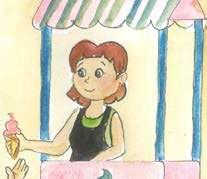
The family happily heads to the food court.
I love that we can be here together!
Yes! And these burgers are delicious!
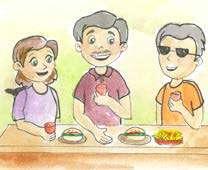
The best place for everyone!
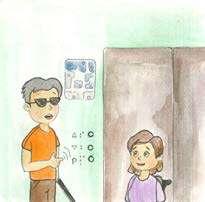
Universal design is no longer a luxury—it’s a necessity.
Hey Liam, touch this—the map has Braille!
Thank you for your kindness! But thanks to inclusive design, I now have full independence inside the mall!
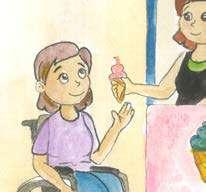
We present this award to Canavalle Mall for its commitment to social inclusion!
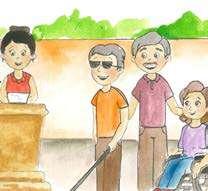
This is great, we can come here more often!
A 100% inclusive shopping center.
The best place! Can we come again next weekend?
Tell me, Liam—what was your favorite part of the mall?
Inclusion isn’t just about ramps or elevators. It’s about creating spaces where everyone feels welcome and supported.
Aguila, C. (2023). Vulneración del derecho al libre acceso y movilidad de personas con discapacidad física en la zona urbana de San Miguel de Bolívar [Violation of the right to free access and mobility for persons with physical disabilities in the urban area of San Miguel de Bolívar], 2023 [Bachelor’s thesis, Uniandes]. Repositorio Universidad Uniandes, https://dspace.uniandes.edu.ec/handle/123456789/18918
Aksnes, S. Y., & Ulstein, J. (2024). Sustainable Employment for People with Disabilities: A Scoping Review on Workplace Practices and Positive Employment Outcomes. Scandinavian Journal of Disability Research, 26(1), 189–210. https://doi org/10.16993/sjdr.1089
Alba Pastor, C., Sánchez Serrano, J. M., & Zubillaga del Río, A. (s.f.). Traducción y síntesis del documento CAST (2011), Universal Design for Learning Guidelines version 2.0. (Original Work published 2011). CAST.
American Psychiatric Association. (2022). Diagnostic and statistical manual of mental disorders (5th ed., text rev.; DSM-5-TR). American Psychiatric publishing.
Arias Albán, O. D. (2025). Vivencias de autonomía personal e interdependencia de personas con discapacidad desde el enfoque de Vida Independiente e Inclusión Social. Caso: Personas con discapacidad que participan en organizaciones sociales [Experiences of personal autonomy and interdependence among persons with disabilities from the perspective of Independent Living and Social Inclusion. Case study: Persons with disabilities participating in social organisations], [Trabajo de titulación, Pontificia Universidad Católica del Ecuador]. Repositorio PUCE. https://repositorio.puce.edu.ec/items/93a9ed88-9dcd-4432-9b09-03f20cfb14a0
Baumed, J. (2023). 10 mitos y realidades que viven las personas con discapacidad [Ten Myths and Realities Experienced by Persons with Disabilities]. Yo también discapacidad y sus letras. https://yotambien.mx/noticia/10-mitos-y-realidades-que-viven-las-personas-con-discapacidad/.
Bayona-i-Carrasco, J., Lizcano Palacio, J. J., & Thiers Quintana, J. (2025). Migraciones internas y dispersión residencial de la población latinoamericana en España en el siglo XXI [Internal migration and residential dispersion of the Latin Amer-
ican population in Spain in the 21st century],. REMHU. Revista Interdisciplinar Da Mobilidade Humana, 33, e332033. https://doi.org/10.1590/198085852503880003302
Bonal Sarró, X., & González, S. (2021). Educación formal e informal en confinamiento: una creciente desigualdad de oportunidades de aprendizaje [Formal and informal education during lockdown: a growing inequality in learning opportunities]. Revista De Sociología De La Educación-RASE, 14(1), 44–62. https://doi. org/10.7203/RASE.14.1.18177
Booth, T., & Ainscow, M. (2015). Index for inclusion: Developing learning and participation in schools (4th ed.). Centre for Studies on Inclusive Education.
CAST. (2018) Universal Design for Learning Guidelines version 2.2. Center for Applied Special Technology. https://udlguidelines.cast.org
Constitución de la República Del Ecuador. (2008). Título II, Articulo 47. Ministerio de Defensa Nacional del Ecuador. https://www.defensa.gob.ec/wp-content/uploads/ downloads/2021/02/Constitucion-de-la-Republica-del-Ecuador_act_ene-2021. pdf
Delfin, C. R., Saldaña, C. O., & Peña, R. V. (2021). Caracterización de los roles familiares y su impacto en las familias de México [Characterisation of family roles and their impact on families in Mexico]. Universidad del Zulia.
Echeita, G. (2019). Educación inclusiva: El sueño de una noche de verano [Inclusive Education: A Midsummer Night’s Dream]. Editorial Octaedro.
Illicachi, R. (2023). Migración interna: Contextualización histórica rural hacia la ciudad [Internal Migration: historical context of rural movement to the city]. LATAM Revista Latinoamericana De Ciencias Sociales Y Humanidades, 4(6), 961 – 974. https://doi.org/10.56712/latam.v4i6.1497
Jaramillo Ruiz, F., Guzmán, Y., & Cortés, M. (2023). Encuentros y desencuentros. Análisis de los debates en torno al Sistema de Cuidado de Bogotá D. C. desde el enfoque de la discapacidad y el género [Encounters and Misalignments: An Analysis
of the Debates Surrounding the Care System of Bogotá D.C. from a Disability and Gender Perspective]. Colombia Internacional, 115, 57-84. https://doi. org/10.7440/colombiaint115.2023.03
Jimenez, A. M., & Loor, L. (2025). Relación de las redes de apoyo con la adaptación al ámbito socioeducativo de los estudiantes en migración interna de la carrera de ingeniería automotriz de la Universidad Politécnica Salesiana [The Relationship Between Support Networks and the Socio-Educational Adaptation of Internal Migrant Students in the Automotive Engineering Programme at Universidad Politécnica Salesiana]
Jordán, D. N. (2023). Migración interna y discriminación a la mujer indígena [Internal Migration and Discrimination Against Indigenous Women]. [Tesis de licenciatura, Universidad Técnica de Ambato]. Repositorio Institucional Universidad Técnica de Ambato. https://repositorio.uta.edu.ec/items/f30c1dca-5af5-4d5c8756-ff1c5955892c
Lafaurie, E. (2025). Impacto de las políticas migratorias en la economía colombiana: un análisis documental [Impact of Migration Policies on the Colombian Economy: A Documentary Analysis]. European Public & Social Innovation Review, 10, 1–18. https://doi.org/10.31637/epsir-2025-1453
Ley Orgánica de Educación Intercultural. (2015, 25 agosto). Artículo 47, Título III, p.41. Ministerio de Educación. https://educacion.gob.ec/wp-content/uploads/downloads/2017/02/Ley_Organica_de_Educacion_Intercultural_LOEI_codificado. pdf
Loor-Aldás & Aucapiña-Sandoval. (2020). Percepciones de los docentes hacia las adaptaciones curriculares para estudiantes con necesidades educativas especiales [Teachers’ Perceptions of Curriculum Adaptations for Students with Special Educational Needs]. Polo del Conocimiento, 45-58.
Meyer, A., Rose, D. H., & Gordon, D. (2014). Universal design for learning: Theory and practice. CAST.
Ministerio de Educación del Ecuador. (2019). Guía de adaptaciones curriculares para la educación inclusiva [Guide to Curriculum Adaptations for Inclusive Ed-
ucation]. https://educacion.gob.ec/wp-content/uploads/downloads/2019/05/ Guia-de-adaptaciones-curriculares-para-educacion-inclusiva.pdf
Ministerio de Educación del Ecuador. (2023). Guía de adaptaciones curriculares para la atención a estudiantes con necesidades educativas especiales [Guide to Curriculum Adaptations for Supporting Students with Special Educational Needs]. https://educacion.gob.ec/wp-content/uploads/downloads/2019/05/ Guia-de-adaptaciones-curriculares-para-educacion-inclusiva.pdf
Ministerio de Educación del Ecuador. (2024). Orientaciones pedagógicas para las adaptaciones curriculares (necesidades educativas específicas) [Pedagogical Guidelines for Curriculum Adaptations (Specific Educational Needs)]. https:// acortar.link/xewS4m
Ministerio de Educación. (2019). Guía para la atención educativa a estudiantes con necesidades educativas especiales no asociadas a discapacidad [Guidelines for the Educational Support of Students with Special Educational Needs Not Associated with Disabilities]. MINEDUC.
Navarro, M. (2023). Distorsión en el concepto y la protección de la discapacidad sobre el derecho al trabajo en las personas en condición de discapacidad dentro del marco jurídico colombiano [Distortion in the Concept and Protection of Disability Regarding the Right to Work for Persons with Disabilities within the Colombian Legal Framework].[Trabajo de grado, Universidad de Manizales]. Repositorio Institucional Universidad de Manizales. https://ridum.umanizales.edu.co/ items/62c53217-0ff7-48b2-ac4c-b47aa8fad67a
Novak, K., & Rodriguez, K. (2016). Universally Designed Leadership: Applying UDL to Systems and Schools. CAST.
Palacios-García, Tito. (2024). Adaptaciones curriculares y su importancia en estudiantes con necesidades educativas especiales. Cienciamatria [Curricular Adaptations and Their Importance for Students with Special Educational Needs]. Revista Interdisciplinaria de Humanidades, Educación, Ciencia y Tecnología, 10(18), 313326. https://doi.org/10.35381/cm.v10i18.1273
Prieto, M. P., González, S., Aules, L., Tigrero, O. F., & Macias, D. (2025). La educación
inclusiva: Un reto para los educadores [Inclusive Education: A Challenge for Educators]. Ciencia y Reflexión, 4(1), 704–723. https://doi.org/10.70747/cr.v4i1.139
Rendón, M. M. (2024). Estudio de caso representaciones sociales sobre la educación inclusiva y su relación con las barreras de aprendizaje en la Institución Educativa Sebastián de Belalcázar, Palmira, Valle del Cauca [Case Study: Social Representations of Inclusive Education and Their Relationship with Learning Barriers at the Sebastián de Belalcázar Educational Institution, Palmira, Valle del Cauca]. [Proyecto de investigación]. Repositorio Institucional UNAD. https://repository. unad.edu.co/handle/10596/64245Revista Gestión. (2024). La migración interna, el eterno desafío social del Ecuador. Ecuador: Revista Gestión.
Revilla, A.., Zamora, S. L., Zamora, M. M., & Sánchez, S. P. (2025). La educación inclusiva en la era digital: retos y oportunidades para la enseñanza de estudiantes con discapacidades en entornos virtuales [Inclusive Education in the Digital Age: Challenges and Opportunities for Teaching Students with Disabilities in Virtual Environments]. Revista Científica de Innovación Educativa y Sociedad Actual “Alcon”, 5(3), 209–217. https://doi.org/10.62305/alcon.v5i3.586
Rincón-Báez, W. (2024). Estudios sobre migración interna educativa universitaria en Latinoamérica y Colombia. [Studies on Internal University Educational Migration in Latin America and Colombia] Panorama, 18(34). https://revistas.poligran.edu. co/index.php/panorama/article/view/4329
Ryan, R. M., & Deci, E. L. (2020). Intrinsic and extrinsic motivation from a self-determination theory perspective: Definitions, theory, practices, and future directions. Contemporary Educational Psychology, 61, Article 101860. https://doi. org/10.1016/j.cedpsych.2020.101860
Samaniego, A., Moreno, N. M., Campuzano, M. L., & Valenzuela, K. (2024). Inclusión educativa de estudiantes con discapacidades en escuelas públicas ecuatorianas. [Educational Inclusion of Students with Disabilities in Ecuadorian Public Schools] Ciencia Latina Revista Científica Multidisciplinar, 8(2), 2954–2971. https://doi.org/10.37811/cl_rcm.v8i2.10727
Santana, F., & Pinargote, M. (2025). Análisis de la inclusión laboral de personas con discapacidad. [Analysis of the Labour Inclusion of People with Disabilities] Dominio de las Ciencias, 11(1), 1594–1616. https://dominiodelasciencias.com/ojs/
index.php/es/article/view/4259
Torres Sacta, J. F. (2024). Análisis de los factores psicosociales de los y las estudiantes en situación de migración interna, que inciden en la permanecía de su carrera, en la Facultad de Jurisprudencia Ciencias Políticas y Sociales, de la Universidad de Cuenca, en Ecuador [Analysis of the Psychosocial Factors Affecting the Retention of Students Experiencing Internal Migration at the Faculty of Jurisprudence, Political and Social Sciences, University of Cuenca, Ecuador] [Trabajo de titulación, Universidad de Cuenca]. Repositorio Institucional Universidad de Cuenca. https://repositorio.ucuenca.edu.ec
United Nations Department of Economic and Social Affairs UN DESA. (2024). 4 things you should know about rethinking disability inclusion. UN DESA Voice. https:// desapublications.un.org/un-desa-voice/things-you-need-to-know/june-2024/4things-you-should-know-about-rethinking
Unidad de Migración. (2024). Tipos de migración: concepto y análisis en el contexto regional. [Types of Migration: Concept and Analysis in the Regional Context] La Maleta Abierta. https://blogs.iadb.org/migracion/es/concepto-y-desafios-de-los-diferentes-tipos-de-migracion
Universidad Nacional de Cuyo. (2024). Jornada “Migración y Educación: Retos y Perspectivas”. [Conference on Migration and Education: Challenges and Perspectives] Facultad de Filosofía y Letras, Universidad Nacional de Cuyo. https://ffyl. uncuyo.edu.ar/jornada-migracion-y-educacion-retos-y-perspectivas
Villera Coronado, S. R., & Villera Ceballos, S. (2024). Desafíos contemporáneos de la educación inclusiva: reflexiones y perspectivas globales. [Contemporary Challenges of Inclusive Education: Reflections and Global Perspectives] GADE: Revista Científica, 4(6), 80-97. https://doi.org/10.63549/rg.v4i6.524
Yanza Medina, T. E. (2025). Hacia el equilibrio espacial: un análisis de la migración interna entre los cantones del Ecuador [Towards Spatial Balance: An Analysis of Internal Migration Between the Cantons of Ecuador] [Tesis de maestría, FLACSO Ecuador]. Repositorio FLACSO Ecuador. UNESCO. (2020) Global education monitoring report 2020: Inclusion and education – All means all (p. 120). UNESCO. https://www.right-to-education.org/sites/right-to-education.org/files/ resource-attachments/GEM_Report_Inclusion_2020_En.pdf
Paula
Herrera-H1,Nicole Flores-Santacruz1, Diana Hernández-Ruales1 , Carlos Zumárraga-F1
1Facultad de Educación, Ciencia y Tecnología, Universidad Técnica del Norte, Ecuador
peherrerah@utn.edu.ec, knfloress@utn.edu.ec, dchernandezr@utn.edu.ec, cazumarragaf@utn.edu.ec
Language constitutes a fundamental tool through which we may gain deeper insight into individuals and their surroundings. It enables us to delve into their lived experiences and cultural traditions, thereby fulfilling essential functions such as the expression of ideas, the sharing of emotions, the construction of identities, and the reinforcement of social bonds (Gómez-Casola & Arrocha-Rodríguez, 2021).
Ecuador is home to 18 Indigenous peoples and 15 nationalities, who preserve 14 mother tongues. Regrettably, Ecuadorian ancestral languages have gradually lost their value over time due to the limited communicative contexts in which they may develop, given that the predominant language in the country is Spanish (Confederación de Nacionalidades Indígenas del Ecuador, 2022). Cabascango (2023) indicates that Kichwa is a heritage language spoken by the majority of Ecuadorian Indigenous families. This language functions as an intercultural communication channel that fosters harmonious coexistence between humans and nature, thus contributing to the building of national identity.
Kichwa, traditionally transmitted from parents to children, has begun to weaken, largely because parents themselves have prioritized learning foreign languages. Similarly, Cabascango observes that the educational sphere constitutes an additional obstacle; although children acquire their ancestral language at home, they receive instruction in a different language within educational institutions, which hinders both communication and the learning process.
Within this context, the notion of the language of respect becomes particularly significant as a means of safeguarding these ancestral tongues.
Recognizing and valuing cultural diversity necessitates concrete actions within the educational sphere. To improve intercultural communication and foster mutual respect, it is essential to implement pedagogical and social strategies that acknowledge the country’s linguistic and cultural richness. Among these are the promotion of intercultural bilingual education, teacher training in inclusive approaches, and development of educational materials in indigenous languages. Participatory methodologies that value ancestral knowledge, such as community-based dialogue circles, serve to strengthen the bond between the educational community and its cultural context, enabling the sharing of knowledge, narratives, and local cultural expression (Ministerio de Educación del Ecuador, 2019; Liga de Educación, n.d.; UNICEF, n.d.). These actions contribute to strengthening the self-esteem of Indigenous students and raise awareness within the educational community regarding the importance of respect (Organización de Estados Iberoamericanos, 2020).
To prevent cultural or linguistic conflicts, it is essential to incorporate cultural mediation programs within educational and community spaces. These initiatives enable tensions to be resolved peacefully using mother tongues, the recognition of diverse cultural codes, and the fostering of empathy, active listening, and reciprocity (Alcívar, n.d.; Ministerio de Educación del Ecuador 2023). School activities such as dramatizations, collaborative projects, and intercultural celebrations contribute to making the various identities present within the educational environments more visible; they promote harmonious coexistence based on respect, while sustaining a connection between cultures and generations (Ministerio de Educación del Ecuador, 2014, 2025).
This chapter explores various Kichwa-speaking Ecuadorian cultures, such as Otavalo and Zuleta, both located in the northern region of the country, within the province of Imbabura. These communities are characterized by a strong sense of identity, expressed through their traditional attire, language, and artisanal production, elements that can be observed in the renowned Plaza de Ponchos (Hdez, 2023).
The Zuleta culture, situated in the canton of Ibarra, is composed predominantly of those who engaged primarily in agriculture (Grupos Étnicos del Ecuador, 2013). Throughout this chapter, we accompany our characters on their adventures, where they share their language and customs; despite our differences, respect must always be present as a foundation for harmonious coexistence.
The loss of ancestral languages, such as Kichwa, threatens the cultural identity of Indigenous communities due to factors including colonization, which imposed dominant languages, and migration, which distances speakers from their traditional environments. Discrimination and the lack of educational resources hinder their transmission to new generations, while globalization promotes majority languages. Preserving these languages is crucial for maintaining unique worldviews and fostering inclusion, thereby strengthening cultural diversity (Ramírez & Chaparro, 2021).
According to UNESCO (2010), one of the main factors contributing to this loss has been colonization, which prohibited or displaced many indigenous languages in favor of those of the colonial powers. The construction of nation-states has prioritized an official language as a symbol of national unity, relegating native tongues to marginal spheres. Another significant factor has been the education system, which for decades promoted monolingualism, discouraging the use of local languages both at home and in schools. Globalization has intensified the pressure to adopt international languages such as English or Spanish, which are perceived as more useful in professional and technological contexts. As a result, younger generations increasingly abandon their mother tongues, thereby weakening intergenerational transmission, an essential process for the survival of a language over time. The consequences of this loss are profound, as each language contains unique knowledge about nature, traditional medicine, spirituality, history, and the identity of a people. Thus, the disappearance of a language represents the irreversible loss of cultural knowledge and perspectives that cannot be replicated in another language. This process also negatively impacts social cohesion, since those who abandon their mother tongue often experience a
diminished sense of belonging, thereby weakening the bonds that hold the community together.
UNESCO warns that, unless urgent measures are taken, thousands of languages may disappear in the coming decades, drastically reducing the cultural diversity of humanity. To prevent this, it is essential for governments, communities, and international organizations to work collaboratively to revitalize endangered languages, promote their teaching, and encourage their use in everyday life, within official institutions, and in technological environments (UNESCO, 2010).
Indigenous languages represent a valuable cultural legacy that is currently at risk of extinction. Of the approximately 7.000 languages spoken worldwide, nearly half could disappear before the end of this century. These languages are not only tools of communication, but also custodians of identities, traditions, and unique bodies of knowledge, particularly within Indigenous communities which, despite comprising merely 6% of the global population, face disproportionately high levels of poverty (World Bank, 2019). In Latin America, home to more than 500 indigenous languages, linguistic diversity is vast, yet many of these languages are endangered due to globalization, discrimination, and the absence of effective protection policies.
Preserving these languages is essential for safeguarding cultural richness and ancestral knowledge, including agricultural systems and medical practices that have long enriched humanity. For instance, indigenous communities have transmitted knowledge about biodiversity that is now considered vital for sustainability. The decline in the number of speakers, particularly among younger generations, places this heritage at risk. In response, global initiatives are promoting revitalization through bilingual education, the documentation of vocabularies, and the use of indigenous languages on digital platforms (World Banck, 2019). Each language lost is a window to the past that is irrevocably closed, thereby limiting our understanding of shared history. Supporting Indigenous communities in the preservation of their languages is both an act of cultural justice and a commitment to diversity and to the planet’s future.
Indigenous languages are essential for cultural diversity and human rights, yet many are at risk of disappearing. They represent much more than a means of communication; they encapsulate unique knowledge, such as the myriad words used to describe snow, reflecting an intimate connection with the environment. These languages form part of the identity, history, and culture of Indigenous peoples, who constitute more than 5% of the world’s population but face high poverty levels (Educo, 2019).
Although there are nearly 7,000 languages, most spoken by Indigenous peoples, over half may become extinct by 2100 due to forced relocations, discrimination, economic migration, pressure to adopt dominant languages, and lack of legal recognition (UNESCO, 2020). These factors limit intergenerational transmission and the daily use of languages. To determine whether a language is endangered, aspects such as the number of speakers, generational transmission, the existence of educational materials, and official recognition are assessed. Preserving these languages is crucial to promoting peace, sustainable development, and social inclusion. Actions such as incorporating indigenous languages into education, public administration, and digital media, or creating study centers, can revitalize them. Examples include the success of native Hawaiians, who managed to include Hawaiian in public schools. In the Philippines and Guatemala, Educo promotes bilingual education projects that strengthen cultural identity and improve children’s learning (Educo, 2019).
Kichwa, also called Quichua, is a pillar of Ecuador’s cultural heritage, acting as a bridge that connects Indigenous communities with their traditions and sense of belonging. Beyond being a means of communication, Kichwa embodies the identity of various ethnic groups, transmitting worldviews and ancestral knowledge that enrich cultural diversity. Its teaching as part of bilingual education programs strengthens students’ pride in their roots and fosters an environment of respect and inclusion (López Puente et al., 2023).
Integrating Kichwa into schools preserves this language and empowers new generations, helping them to value their legacy while participating in a multicultural society. However, challenges such as
migration to cities and the lack of appropriate educational materials threaten its survival. Therefore, it is crucial to promote initiatives that reinforce its use, from classrooms to community spaces, to keep this linguistic wealth alive (López Puente et al., 2023).
The revitalisation of Kichwa besides the fact that protects a language, strengthens cultural identity and promotes equity. By including education, it fosters intercultural dialogue that enriches all involved, celebrating diversity as a core value for Ecuador’s future (López Puente et al., 2023).
The Kichwa language is a cultural treasure of Ecuador, deeply rooted in the identity of Indigenous communities. More than just a means of communication, it reflects worldviews, traditions, and ancestral knowledge that shape the lives of numerous ethnic groups. Its incorporation into bilingual education safeguards its richness, but also reinforces the cultural pride of the new generations, enabling them to connect with their heritage while engaging with a diverse world (Confederación de Nacionalidades Indígenas del Ecuador, CONAIE, 2022).
In Ecuador, indigenous languages such as Kichwa face significant challenges due to urbanization, discrimination, and the lack of adequate educational resources. These factors have led to a decline in the number of speakers, particularly among younger generations, thereby endangering the survival of these languages. Nevertheless, initiatives such as intercultural bilingual education and communityled efforts aim to revitalize these languages by promoting their use in schools and public spaces, thereby sustaining their cultural relevance (CONAIE, 2022).
The preservation of Kichwa is not merely a linguistic endeavor; it constitutes an act of cultural resistance that strengthens Indigenous identity and fosters social inclusion. By valuing and teaching this language, Ecuador honors its diversity and builds bridges across cultures, ensuring that ancestral voices continue to resonate into the future (CONAIE, 2022).
According to Brodowicz (2024), language shapes the way individuals perceive and engage with the world, influencing both personal and
collective identity. For instance, the teaching of native languages in educational settings nurtures cultural pride and promotes inclusion, enabling speakers to navigate between their traditional identity and modern society. However, the loss of language is driven by globalization, or discrimination poses a threat to this cultural wealth, weakening the communal bonds that sustain it. Preserving languages such as Kichwa is therefore an act of safeguarding linguistic diversity and reinforcing cultural identity, promoting intercultural dialogue that enriches society. It is an expression of reverence for the history and traditions that shape communities.
Multilingualism and second language learning are deeply interrelated phenomena that have been examined from various disciplines, including linguistics, psycholinguistics, and neuroscience. Multilingualism refers to the capacity of an individual or society to communicate in more than two languages, whereas the learning of a second language (L2) involves a process of acquisition subsequent to the mother tongue, whether naturally or through instruction (Chiang, Riveros & Torres, 2022). According to these researchers, multilingual development may give rise to linguistic interferences, particularly when the languages share similar structural features, which directly affect the speakers’ linguistic competence.
From a psycholinguistic perspective, the critical period hypothesis posits that acquiring an additional language is significantly more effective during early developmental stages, particularly before puberty, due to heightened neural plasticity and ongoing brain lateralization (Hartshorne et al., 2018). Studies such as that conducted by Chiang et al., (2022) confirm that speakers who acquire multiple languages before the critical period exhibit a type of simultaneous and balanced bilingualism, which fosters a higher level of competence in several languages and reduces certain syntactic or phonological interferences. The relationship between the type of bilingualismwhether coordinated, compound, complete, or dominant- and the efficacy of second language learning is crucial for understanding the cognitive processes involved in multilingualism.
In the educational sphere, learning a second or third language entails significant cognitive and social benefits. As indicated in the article by Educo (n.d.), children who learn another language develop greater attentional capacity, cognitive flexibility, and communicative skills. Mastery of languages beyond one’s native tongue broadens academic and professional opportunities in a globalized world. The acquisition of an L2 promotes intercultural awareness and respect for linguistic and cultural diversity, key aspects in the formation of global citizens.
From a theoretical standpoint, models such as Selinker’s (1972) interlanguage model and Krashen’s (1982) monitor model elucidate the internal mechanisms that underlie L2 acquisition. According to Gonzáles and Asensio (1996), interlanguage is a transitory system formed in the learner’s mind during the learning process, which may fossilize if not properly addressed. In contrast, Krashen underscores the importance of comprehensible input and the affective context in second language acquisition, which is particularly relevant in school contexts where exposure to the language may be limited.
It is noteworthy that learning an L2 differs from acquiring a third language (L3), since, as argued by Fessi (2015) and Salas (2016), the mechanisms employed to learn an L3 are not identical. Bilingual speakers tend to transfer knowledge and strategies acquired in previous languages, which may facilitate or hinder the process depending on linguistic typology and the sociocultural context. Thus, multilingualism broadens linguistic capacities and transforms individuals’ cognitive and metalinguistic processes.
Multilingualism and second language learning must be approached from a multidisciplinary perspective, considering both the internal factors of the learner and the external conditions of the environment. To harness its cognitive, cultural, and social benefits, it is essential to develop inclusive and sustainable educational policies that recognize the value of multilingualism. As Lozano (2015) points out, multilingualism is limited to the functional use of several languages; it represents a complex and enriching way of being in the world.
Linguistic diversity faces a critical situation due to the weakened use of native languages and the rise of cultural homogenization processes in the XXI century (Bonilla, 2018; UNESCO, 2019). In response to this issue, Information and Communication Technologies (ICT) are emerging as a relevant tool for safeguarding and revitalizing this linguistic heritage, facilitating both its conservation and the transmission of knowledge across generations (Cruz, 2021; Miranda & Pérez, 2024).
In this context, the use of ICT provides new spaces for learning native languages and for strengthening the collective identity of Indigenous communities. According to Rubiano and Hernandez (2024), ICT demonstrates a contextualized effectiveness, evident in the design of platforms, videos, multimedia texts, and apps created in collaboration with the communities, thus increasing the interest of younger generations in learning their ancestral knowledge. This simultaneously reinforces the connection to their cultural roots, enhancing the sense of belonging and the valuation of Indigenous groups (Bonilla, 2018).
Digital multilingualism offers spaces for encounters and collective expressions, facilitating the maintenance of native languages in the face of pressure from dominant languages (Cabrera & Moreno, 2021). The use of ICT in multilingual contexts provides new arenas for both synchronous and asynchronous socialization, thereby increasing Indigenous communities’ access to linguistic resources, texts, discussion groups, and online communities in various languages, thus raising interest in learning (Ríos, 2020).
According to Sandoval (2020) and Cipagauta (2023), the use of these technologies faces specific challenges, such as scarce technological infrastructure, limited internet access, and a lack of training among teachers and communities in managing new devices. Therefore, the design of pedagogical strategies mediated by ICT must take into account the sociocultural, linguistic and geographical context of each community (Díaz et al., 2024), as well as involve both teachers and
Indigenous groups in the joint construction of content, to prevent ancestral knowledge from becoming distorted or folklorised.
Ultimately, the use of ICT offers a valuable opportunity to protect and promote the safeguarding of native languages through new learning spaces and mechanisms for transmitting knowledge, thereby strengthening multilingualism and the maintenance of cultural identities in an increasingly globalized context (Colmenárez, 2020; Miranda & Pérez, 2024). Employing this strategy will enable younger generations to access, learn, and express their linguistic and cultural knowledge, thus increasing the appreciation of humanity’s linguistic diversity.
There are several languages spoken, each shaped by the cultural particularities of the country in which they evolve. Sign language shares these same linguistic and cultural characteristics. Its acquisition must occur in a manner comparable to that of spoken language, that is, from early childhood, so that deaf children may develop academically at the same pace as their hearing peers. Understanding that achievement depends fundamentally on the opportunities provided by the child’s environment, it becomes essential for parents to receive support in acquiring a fluent command of sign language, which will be transmitted to the child. Likewise, the education system must offer and facilitate access to teachers and materials adapted to the needs of students with hearing impairments, enabling them to access inclusive, high-quality education that ensures their development as active global citizens (World Federation of the Deaf, 2018a). For this reason, the Declaration on the Linguistic Rights of Deaf Children outlines principles that promote the lifelong teaching of sign language, recognizing its centrality to the cognitive, social, and academic development of deaf individuals (World Federation of the Deaf, 2018b).
Ecuador, as a state party to the International Convention on Human Rights, is obliged to comply with the provisions set forth in this instrument. El Ministerio de Educación del Ecuador (2013) refers specifically to Article 24, which concerns the right to education and establishes that all individuals, regardless of their educational needs, are entitled to an education that guarantees equality of opportunity
without discrimination. This right must be upheld throughout the individual’s lifetime and must include the necessary curricular adaptations to ensure effective learning. Consequently, people with hearing impairments must receive an education that facilitates the learning of Ecuadorian Sign Language, with access to teachers trained in its instruction, as highlighted by the Ministerio de Educación del Ecuador (2020):
For individuals with prelingual hearing impairments, sign language serves as an effective tool for engaging their intellect and accessing knowledge. It is through sign language that deaf children and adolescents enrich their cognitive frameworks, express their emotions, construct their identity as deaf people, and establish fulfilling relationships with others. (p. 38)
Despite the inclusion mandates established in Ecuadorian legislation and the national curriculum, a study conducted by Ureta-Andrade and Donoso-Cedeño (2022) at the School 16 November, in the San Vicente canton, revealed a low level of proficiency in Ecuadorian Sign Language among the institution’s teachers and even among the students with hearing impairments themselves. As a result, communication tends to occur on an improvised and empirical basis, which hinders the development of effective interaction between teachers and students, and vice versa, ultimately generating feelings of frustration among deaf learners. In this context, the implementation of ICT has been identified as a crucial tool for advancing towards a more inclusive educational model for deaf individuals.
In the current technological era, where the pursuit of new tools to support human development is paramount, the use of information and communication technologies (ICT) for inclusive educational purposes is crucial. The use of ICT has opened new opportunities for education by eliminating geographical barriers, facilitating collaborative work through improved communication, and fostering autonomous learning. For them to be effective, both teachers and students must know how to use these technologies appropriately. When educators identify the appropriate tools and apply them, it becomes possible to enhance the phonetics, lexicon, and morphosyntax of students with hearing impairments. The dynamic and engaging nature of ICTs encourages pupil participation and fosters the development of
literacy skills (Roing Osete, 2012). In Ecuador, significant advances have been made regarding inclusive education, with efforts directed at ensuring quality education for all. In this context, the relevance of ICTs has increased, as they help teachers to better adapt their lessons to the specific needs of each student, particularly those with special educational needs, thereby contributing to the development of equity within the educational system (Arteaga Tuba, 2024). It must be acknowledged, however, that despite considerable advances made using ICTs, there remains much room for further development. Garcia (2024) highlights the need to develop inclusive technologies for deaf individuals and affirms that:
Although the use of ICTs has driven significant progress, there remains a vast field yet to be developed. It is necessary to create new information and communication technologies (NICTs) that are specifically adapted to the needs of deaf individuals. This requires the application of approaches such as universal design, user-centred design, and participatory design. Achieving genuine digital inclusion fundamentally depends on possessing a deep understanding of deaf culture and sign language. (p.40)
Within this context, it can be concluded that the learning and teaching of sign language constitute a vital tool that gives life to and strengthens inclusion within the classroom. Training in sign language for both teachers and students enhances inclusive communication in educational settings, fostering equity of opportunity and the development of socio-emotional skills (González et al., 2023). For this reason, the Ministerio de Educación del Ecuador has incorporated the teaching of Ecuadorian Sign Language for people with hearing impairments among its guiding principles, recognizing it as an essential component of the national education system.
Latin America is a region characterized by the diversity of its Indigenous and Afro-descendant peoples, which makes an intercultural approach essential for the preservation of their cultures,
traditions, and languages. Within this framework, intercultural bilingual education has undergone sustained development over more than five decades, achieving significant progress. Initially, this educational model was limited to the mere translation of texts from Spanish into indigenous languages; however, it has since evolved into an approach that produces educational materials directly in those languages, integrating their own cultures and worldviews and promoting reciprocal teaching and learning processes. Such progress has not been regional, as certain areas still lack access to intercultural bilingual education (UNICEF, 2021).
In a country as culturally rich as Ecuador, it is vital to address multiculturalism and, more specifically, interculturality. Walsh (2005) defines interculturality as:
A goal to be pursued, interculturality should be understood as a permanent process of relationship, communication, and learning among people, groups, knowledge, values, and different traditions, aimed at generating, constructing, and fostering mutual respect and the full development of individuals’ capabilities, beyond their cultural and social differences. (p. 4)
Thus, the implementation of intercultural bilingual education becomes highly relevant, as it enables the full exercise of the rights of all peoples and nationalities residing in the country, and it guarantees their ability to transmit ancestral knowledge through quality education that fosters both cognitive and socio-affective development (UNICEF, n.d.).
The integration of storytelling as a didactic resource in the classroom opens new opportunities to engage in meaningful learning, thereby contributing to quality education in which learners participate actively. A study conducted by López (2023) in Oxapampa, Perú, revealed that the use of popular stories in the Yanesha language fosters meaningful learning by increasing student motivation and interest. Similarly, a study by Padial and Sáenz-López (2013) demonstrated that implementing storytelling as a pedagogical tool, through playful activities, benefits students by supporting both their
cognitive development and their socio-affective growth, allowing them to acquire new perspectives on the surrounding reality.
In this context, and with the aim of providing an education that integrates the cultural knowledge of Ecuador’s diverse peoples and nationalities, legends, myths, and traditional stories are regarded as fundamental didactic resources for fostering quality education that reinforces cultural identity. According to Haro (2023), core aspects of culture such as history, traditions, language, and folklore play a crucial role in the formation and consolidation of identity. For this reason, the inclusion of Ecuadorian legends into the educational process enables students to engage more deeply with the country’s cultural diversity, as they are exposed to new realities that, being linked to their own lived experiences, contribute to a strong formation of cultural identity. The use of such legends allows for the design of pedagogical activities that enhance learning, as these narratives facilitate broader knowledge and a deeper understanding of Ecuadorian cultures (Rojas, 2019).
Traditional stories and legends represent a valuable didactic resource for enriching intercultural bilingual education, particularly when conveyed in the country’s indigenous languages. These narratives stimulate interest and facilitate learning among students while also strengthening cultural identity. They promote understanding of Ecuador’s sociocultural diversity and foster mutual respect.
Ecuador is a country marked by profound diversity in every sense. According to the Instituto Nacional de Estadísticas y Censos (2023), among Indigenous peoples, Afro-Ecuadorians, Montubios, Mulatos, and Mestizos, the Consejo de Nacionalidades y Pueblos del Ecuador (CODENPE) officially recognizes 14 nationalities and 18 Indigenous peoples across the country. Interculturality is understood as a condition that opens a path of possibilities towards pluractionality and is, in turn, complemented by a state of the same character, one that permits its expressions and acknowledges the existence of the other (Mosquera & Ayala, 2020).
Language attitudes refer to the opinions, beliefs, and prejudices that speakers hold regarding a language, its varieties, or its usage. They constitute a central topic within sociolinguistics owing to their significance in understanding phenomena such as linguistic variation, language awareness, and the notions of correctness and prestige associated with languages. Although all indigenous languages in Ecuador are considered vulnerable, both the degree of language used and the attitudes towards them may vary considerably even among neighboring communities that share the same language (Haboud, 2004).
In Ecuador, specifically in the province of Imbabura, there have been documented cases concerning the use of the Kichwa language. According to the publication by Guarin and Tovar (n.d.), it was found that non-indigenous female teachers value Kichwa and have even learnt the language as a result of the work carried out by the Casa de Pensamiento. In contrast, native speakers reported having shown a reluctant attitude towards Kichwa during their childhood due to experiences of discrimination. These findings illustrate that, although Kichwa was a marginalized language, it is now recognized even by those outside Indigenous communities as a component of cultural identity and is regarded with pride.
According to Yungán et al. (2019), attitudes may be either positive or negative, depending on values, beliefs, social environment, age, or education, as attitude reflects how an individual adapts to their surroundings and is the result of a cognitive, affective, and behavioral process. Those speakers build a network of values from which they understand their perceptions of language, whether their own or someone else´s. In this regard, Mejía (2021) argues that language awareness depends on the speaker’s possession of functionally equivalent linguistic resources, and the availability of their social variation. Language awareness thus produces a sense of either security or insecurity in the speakers. Considering this, we can observe that children, even from an early age, develop an awareness of these language attitudes through their idiolect, whereby they come to value their language within the social sphere.
Within a broader context, that of education, the Kichwa language is represented as a symbol of Ecuador’s pluricultural identity. Its
preservation is not only essential for Kichwa-speaking communities, but also for Ecuadorian society as a whole, in the construction of an inclusive and respectful society. According to Puente et al. (2024), in the educational sphere, the presence of Kichwa acquires relevance; its inclusion contributes to linguistic diversity and enables students to connect with their cultural roots, fostering a sense of belonging and pride in their Indigenous heritage. This implies that, within the Ecuadorian educational system, there are schools in which Kichwa is preserved and even integrated into the curriculum, to safeguarding the language and its cultural significance.
Linguistic practices and attitudes within educational institutions are of great importance even in major urban cities of Ecuador, as they underscore the significance of bilingualism both at the individual and societal levels. As Andrade (2016) states:
The study of language attitudes and their relationship with the linguistic practices developed by speakers in relation to their language has attracted the attention of scholars from various disciplines, including linguistics, psychology, sociocultural studies, and language and educational planning. It is undeniable that attitudes, namely the beliefs and predispositions that individuals hold towards the Kichwa language, have a profound impact on its vitality, that is, on its maintenance or decline. (p. 19)
The Intercultural bilingual education constitutes one of the most significant accomplishments of Indigenous groups, as it has brought about an extensive sociocultural transformation in the country. According to Flores (2020), many Indigenous education initiatives have been implemented in the Andean region and parts of the Amazon region, to promote education among these communities through the teaching of both Kichwa and Spanish, thereby preserving ancestral knowledge, worldviews, and wisdom. With the support of the state, individuals, particularly children and adolescents, benefited from the implementation of Kichwa instruction, as it is one of the most widely spoken ancestral languages among Indigenous peoples in Ecuador. Efforts have therefore been made to ensure the preservation of the language in both the Sierra and Amazon regions.
Today, Indigenous communities in Ecuador remain the principal source of Kichwa language preservation; however, younger generations have increasingly shifted towards Spanish as their dominant language. As Chávez (2022) mentions, it is widely acknowledged that the survival of indigenous languages is under threat, not only in Ecuador but across the globe. Fortunately, many scholars have researched on the matter, and several governments and organizations have committed themselves to efforts aimed at revitalizing these languages.
Not all these efforts conduct to positive results. As Gauin (2024) mentions in her study on the importance of the Kichwa language at the Unidad Educativa Bilingue Ñuncachik Yachay, the institution faces considerable challenges in maintaining Kichwa among students in upper primary education. The lack of resources and insufficient teacher training makes it harder to use the implementation of effective methods and approaches for teaching Kichwa. Although efforts to sustain the Kichwa language within the educational environment persist, such efforts are rendered difficult by persistent barriers, particularly those concerning the implementation and development of pedagogical strategies in the classroom.
In educational communities, UNESCO (2016) mentions that linguistic improvement has some significant limitations. For example, even though both bilingual teachers and students speak the same language, district and school officials have tended to dismiss the importance of Kichwa and rural school. In this regard, Spanish should function solely as a medium of intercultural communication. This situation contributes to a diminished depreciation of the mother tongue among younger generations; indeed, some Kichwa speakers may even choose not to express their Indigenous identity, leading to a gradual erosion of the language´s perceived value.
Yanzapanta (2018) warns that the persistent lack of critical reflection on the relationship between linguistic phenomena and speakers value judgments gives rise to academic disinterest across various disciplines, including linguistics, language, planning, and sociocultural and educational studies. This institutional neglect negatively affects the development of language, attitudes, and communicative practices, thereby limiting the learning process. Consequently, it is essential
for students to become creative, participatory and reflective subjects capable of strengthening both their intellectual capacities and their attitudes towards language.
In Ecuador’s Amazonian region, similar difficulties arise, particularly in relation to structural limitations and barriers that hinder the effective teaching of Kichwa. Vilema et al. (2025) mention that:
In the Amazonian region of Ecuador, teachers face a set of sociocultural conditions that affect their professional practice. The geography of the region, marked by remoteness and limited access to educational zones, creates a challenging environment. In Pastaza Province, the parish of Río Tigre is home to six educational institutions that experience these difficulties. (p.7)
This highlights that the struggle to adapt and maintain the Kichwa language is affected by numerous factors, including sociocultural conditions, the lack of pedagogical resources, and notably a pronounced lack of interest among students in continuing the learning of Kichwa.
Language is not only a means of communication, but also a vital component of cultural identity, collective memory, and the worldview of Indigenous peoples. In Ecuador, languages such as Kichwa face ongoing threats stemming from historical processes of colonization globalization, and internal migration factors that have diminished their intergenerational transmission. Preserving ancestral languages requires unquestionable educational action, sustained public policies, and the active participation of communities, as each language carries unique forms of knowledge that enrich the human legacy and the cultural diversity of the country.
Intercultural bilingual education is important for maintaining indigenous languages and fulfilling Indigenous students´ right to
quality education that representative and respectful to their cultural identity. Reported experiences in both urban and rural contexts demonstrate that the integration of indigenous languages into school curricula fortify the sense of belonging, self-esteem, and social cohesion with communities. However, the implementation of this educational model continues to face challenges, including the lack of appropriate teaching materials, the deficiency of trained educators, and prevailing social attitudes that continue to reduce indigenous languages. Overcoming these barriers is fundamental to building an equal and genuine intercultural education system.
The incorporation of technological resources into the teaching and preservation of indigenous languages opens up new possibilities for their revitalization and dissemination among younger generations. The ICTs enabled the creation of interactive educational materials, digital platforms, and multimedia content in ancestral languages, thereby fostering student interest and active participation. The achievement of these strategies depends on overcoming limitations such as the digital devises, lack of connectivity, and insufficient technical training both among teachers and within Indigenous communities. It is essential that educational policies prioritize the development of inclusive and culturally appropriate technological solutions.
Profound educational interventions, spaces for intercultural dialogue, and policies that bring visibility to the value of ancestral languages in both public and everyday life are urgently needed. As a future line of research, it is proposed to examine innovative pedagogical strategies and cultural mediations that may promote lasting changes in societal attitudes, thereby fostering a culture of linguistic respect and equity in Ecuador.
A typical day in a hospital in Imbabura.
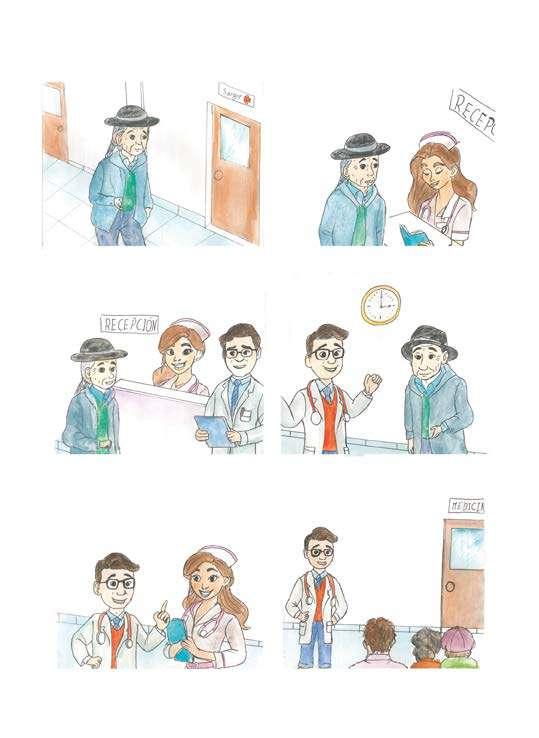
Ñuka mana yachanichu castellanu... (I don't understand English.)
¿Kaypi pipash kan? (¿Is anyone here?)
Since all the information was in Spanish, the old man could not understand it.
The old man was very confused. Fortunately, Oscar, a young man from his community, was working at the hospital, and he observed what was going on.
Calm down, sir. I speak Kichwa. What do you need?
Excuse me, sir, how can I help you?
Kunan ñuka ushay. Pitak yanapanka? (I feel sick. Who can help me?)
The next day.
If this happened to this poor old man, I'm sure it will happen to others too. The best thing to do is to make inclusive posters.
That's a great idea.
Days later, the young man met with people from different indigenous communities in the province to achieve his goal.
Yes, if we make use of drawings, the posters can be clearer along with the translation.
Kay shuk sumak rurana! (That's a great idea!)
Days later, people from the community and hospital staff put up the new posters.
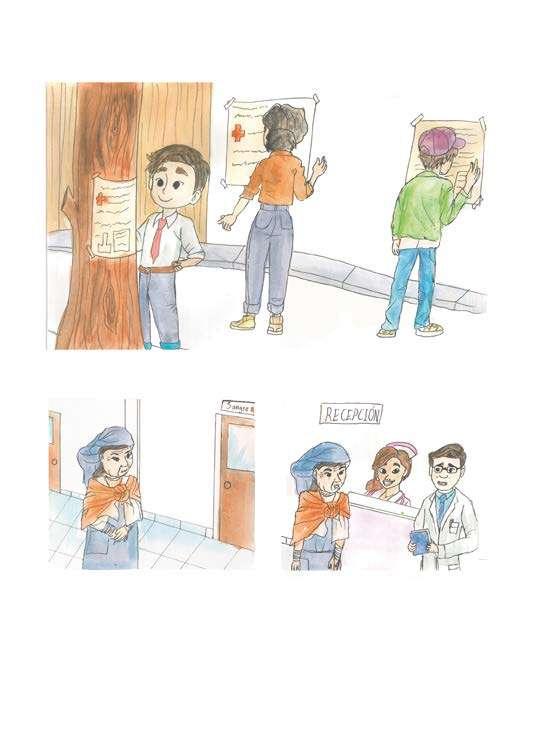
Some time later, an old lady from another distant Kichwa community arrived at the hospital. Fortunately, now, she had something to help her.
Now our posters are bilingual. No one will get lost again.
Muyu, a young indigenous boy, and his friends were listening to music in Spanish as usual.
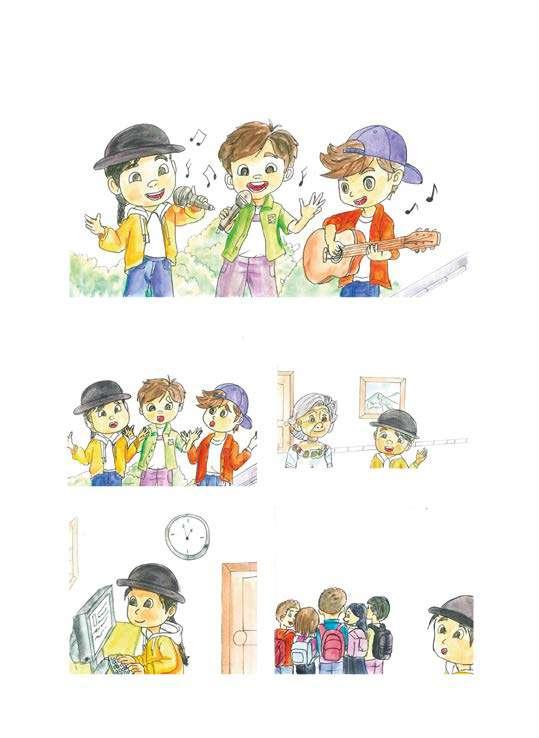
I don't know, there are hardly any modern songs. But... Why don't you ever listen to music in Kichwa?
Right away, Muyu went to his computer to mix and edit the song. When he finished, he uploaded it on her social media.
The next day, Muyu was concentrating on his cell phone when his grandmother started singing a traditional song from his community.
Imashina, kay takina ñawpa ñukanchik runakunapa. (Listen to this song, it comes from our ancestors.)
Quickly, Muyu began to record his grandmother 's song.
The next day, Muyu arrived at school and noticed a group of classmates gathered around listening to something.
I'm going to do something with this. Modern rhythms can make it sound great.
WOW! Muyu, this song is great, can you show us what it says?
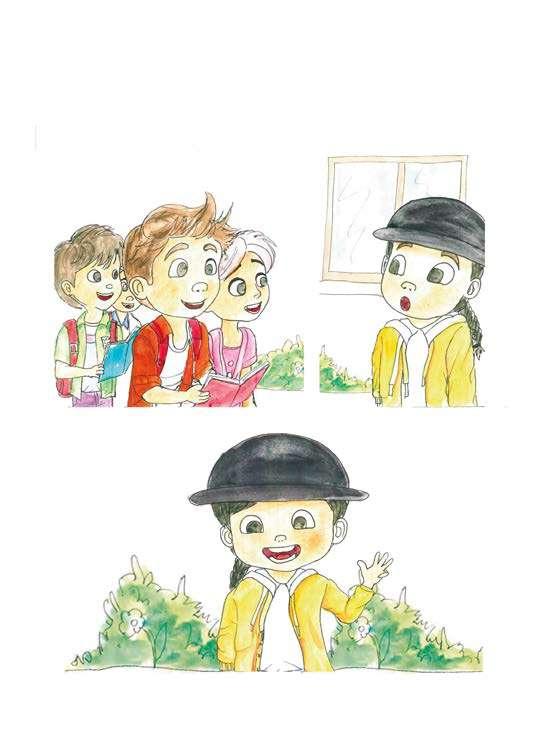
It`s my song!
Sure! Look, the phrase "Chaskakunaka ñukapak rikchana" means: "The stars light my way".
24 de Mayo School.
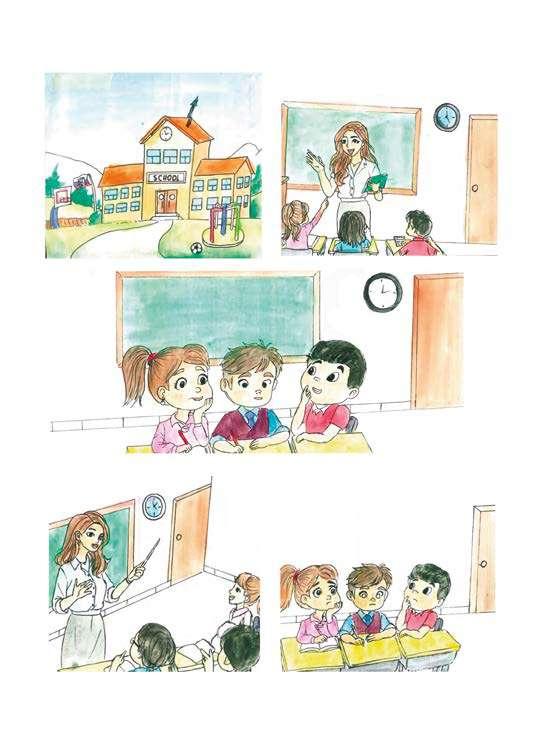
I'm sorry, I'm not used to speaking Spanish.
Today we're going to play a quiz tournament! Form teams and get ready.
Wait a minute! Before we continue, let's learn some key phrases and other ways to communicate.
I don't understand what you are saying! How can I answer if I don't know Kichwa?
But... how will we understand each other if some speak Kichwa and others Spanish?
You say "kawsaypuak kashun"!
How do you say "let's win" in Kichwa?
The children began to understand each other better. They even found more ways to communicate such as using drawings.
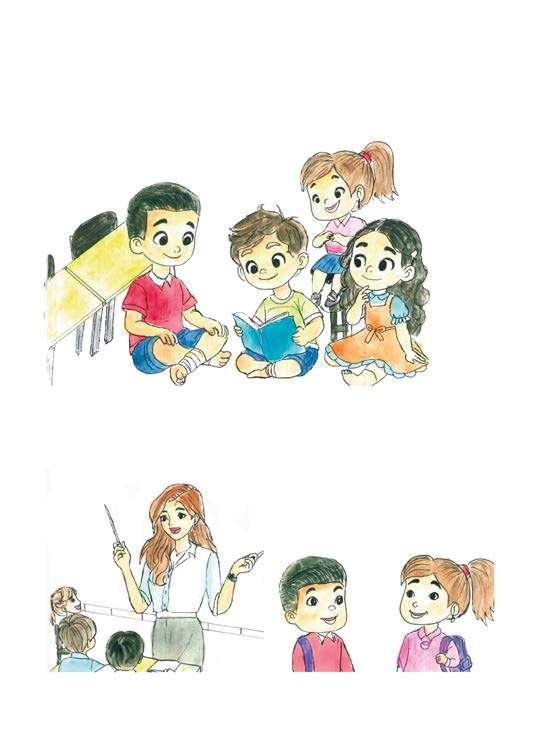
Children are shown actively participating and having fun.
Incredible job, kids! More than winning, you have learned to understand each other and to value their languages. And I know a little more of Spanish! That's great!
Yes!
Now I know how to speak a little of Kichwa!
A few years ago, in the city of Otavalo, at Grandma’s house… Grandma sings a song in Kichwa as Wayra, her five-year-old granddaughter, nestles beside her.
A few days later, Wayra invites her friend over to play at Grandma’s house. As they play, Grandma sings while sweeping the yard…
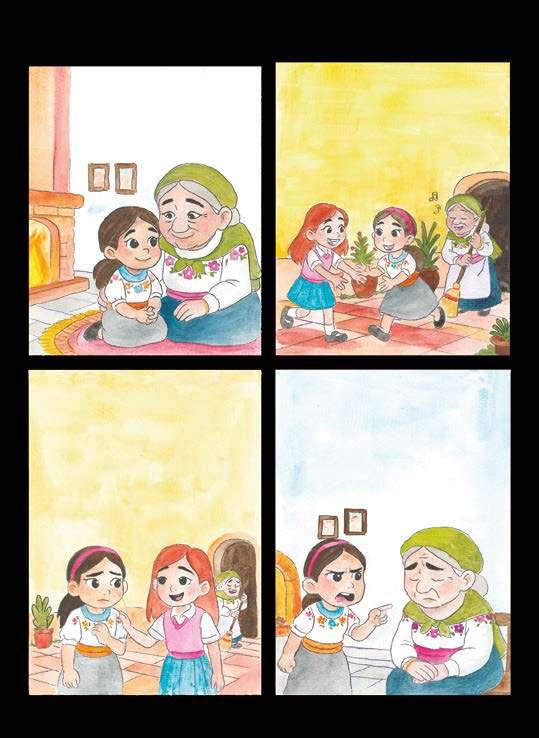
Hearing her, Wayra feels embarrassed. She glances sideways at her friend; afraid she might laugh.
Later that day, Wayra approaches her grandma…
This is so embarrassing… I hope she stops soon
Grandma, please… don’t sing that song in public anymore. Especially not in Kichwa
Grandma, though confused, nods silently.
Five years later, a poster on the school bulletin board catches Wayra’s eye.
Should I give it a try?
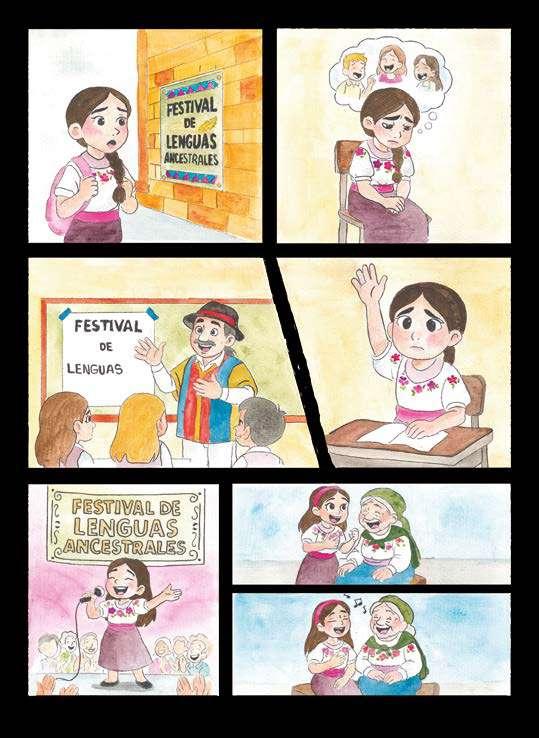
What if they make fun of me?
In that moment, she remembers Grandma’s song.
The Ancestral Languages Festival is a chance to reconnect with our roots
Who wants to take part?
Wayra feels she’d be embarrassed to sing in Kichwa in front of her classmates…
The next day in class, the teacher encourages students to join the festival.
On the day of the festival, Wayra performs her grandmother’s song in the contest. Her voice trembles at first, but soon grows strong.
Grandma, I won the contest thanks to your song!
Wayra, though unsure, raises her hand.
You see, Wayra? We should never be ashamed of our language
Later that day, Wayra visits her grandmother to tell her what happened…
Wow! She’s so talented!
Contrary to her fears, the crowd, excited, applauds her.
Grandma, filled with emotion, gazes at Wayra with tenderness and begins to sing again.This time, Wayra joins in—without fear. The language of their ancestors was never forgotten. It had only been waiting to be heard again.
Manuel, an English teacher, returns to his hometown in Zuleta after ten years to visit his family.
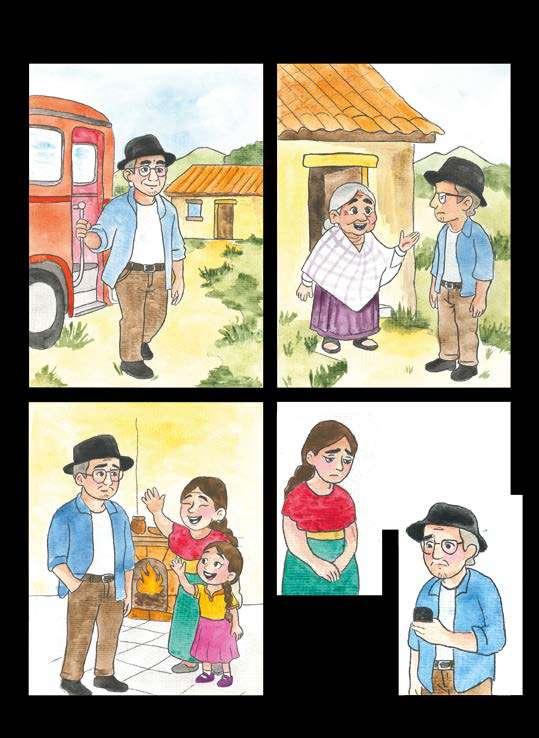
The whole family has gathered to welcome him; however, he cannot communicate with them because they speak Kichwa.
Uh… yeah…
Hi, Manuel! It’s been so long! How have you been?
When he arrives at his grandmother Paz's house, she receives him excitedly and welcomes him in her language, Kichwa.
¡Welcome home, Manuelito!
Not understanding much, Manuel just nods in confusion.
Manuel, confused, smiles awkwardly because he doesn’t understand her.
That’s odd… Maybe Manuel doesn’t want to talk to us?
How awkward...I don't understand
Unable to communicate with his family, Manuel gradually withdraws. While everyone else chats and catches up, he distracts himself with his phone. So, the other day… I feel so alone…
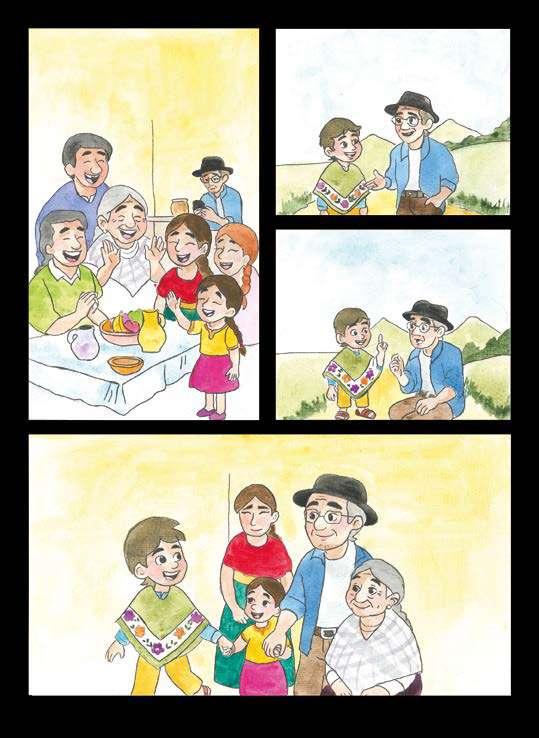
Later, Inti, Manuel’s youngest cousin who speaks both Kichwa and Spanish, notices his struggle and approaches to help.
¡HI! You can’t understand Kichwa, right? Would you like to learn?
No, I can't, but I would like to learn.
Alli chishi means “Good afternoon,” and imanallatak kanki means “How are you?”
Inti teaches him some basic phrases so he can start a conversation with the family.
After some practice, Inti feels that Manuel is ready to have a simple conversation.
Okay, but help me if I mess it up.
Come on, Manuel, try talking to the uncles.
With Inti’s support, Manuel talks to his uncles.
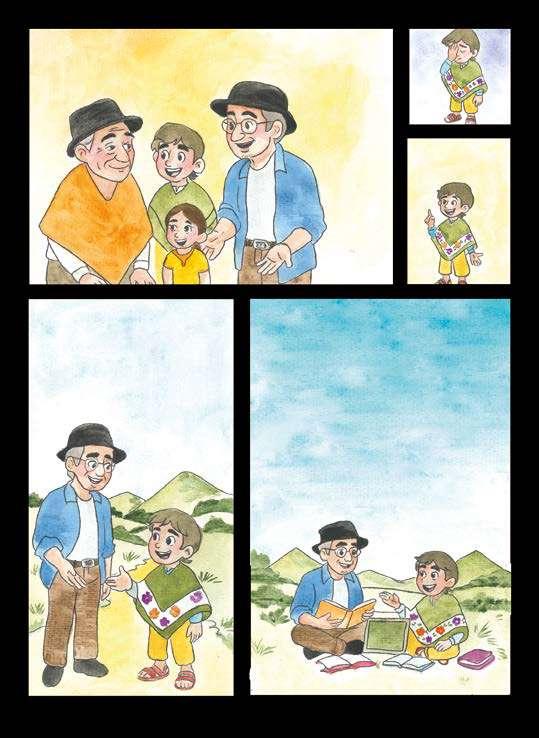
Not quite, Manuel... Ari means “yes.” What you want is alli, it means “good.”
Learning his family’s language helped Manuel reconnect with them.
The next day, Manuel, excited, approaches Inti.
Inti, can you teach me more Kichwa, please? Of course! As long as you teach me English
Today’s your first day, Dulce. Good luck!
Dulce, an Afro-Ecuadorian girl with a hearing impairment, is very nervous because today is her first day at a new school.
Who is she?
Hi!
I’m Marta. What’s your name?
Dulce tries to answer using sign language, but Marta cannot understand her.
Marta walks away annoyed, while Dulce watches her sadly.
Dulce, very nervous, enters her new class. Her classmates watch her with curiosity.
Marta, not understanding Dulce's signs, assumes that she does not want to be her friend.
Maybe she doesn’t want to be my friend… But she could at least answer me. How rude!
Good morning, everyone. Today we welcome our new classmate, Dulce.
It’s so sad she doesn’t understand me.
Dulce and the teacher communicate using sign language.
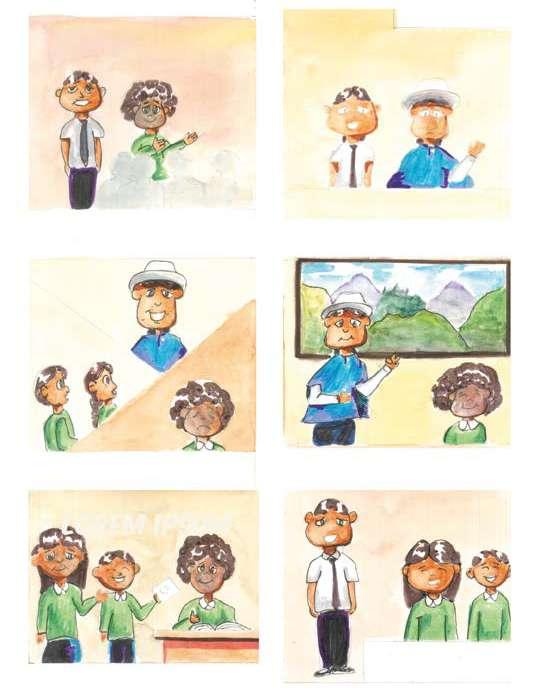
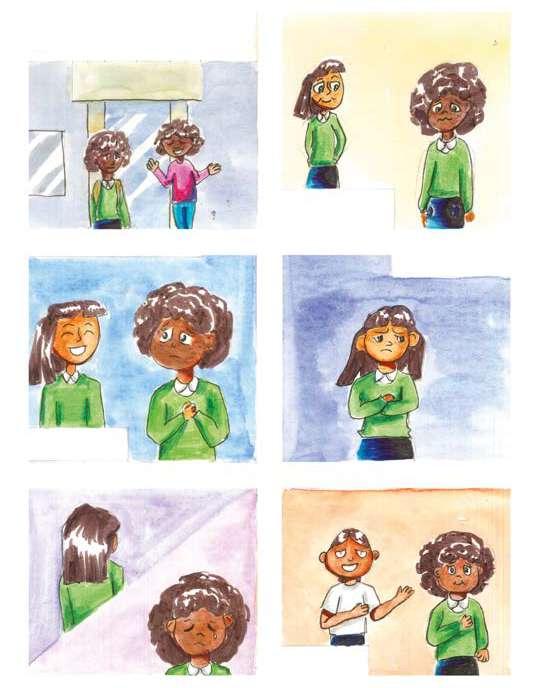
Dulce is very happy to meet all of you.
Today we’re joined by Don Luis. He’ll tell us the legend of Taita Imbabura.
The teacher translates Dulce's sign language so that her classmates can understand her.
Many years ago… How interesting!
I don’t understand.
As Don Luis begins to tell the story. However, Dulce, unable to understand, feels sad and confused.
A few days later, during the reading festival, the teacher introduces a wise elder to the class.
Now I get what the legend is about!
Don Luis, noticing the situation, begins to use mime, gestures and drawings on the board so Dulce can follow the story.
Today we’re going to learn some basic signs. Hopefully, Dulce likes it.
The next day, inspired by Don Luis, the children try to communicate with Dulce using gestures and drawings. Dulce responds by writing.
Over time, with the teacher’s help, everyone found a way to communicate.
But there’s also some good news.
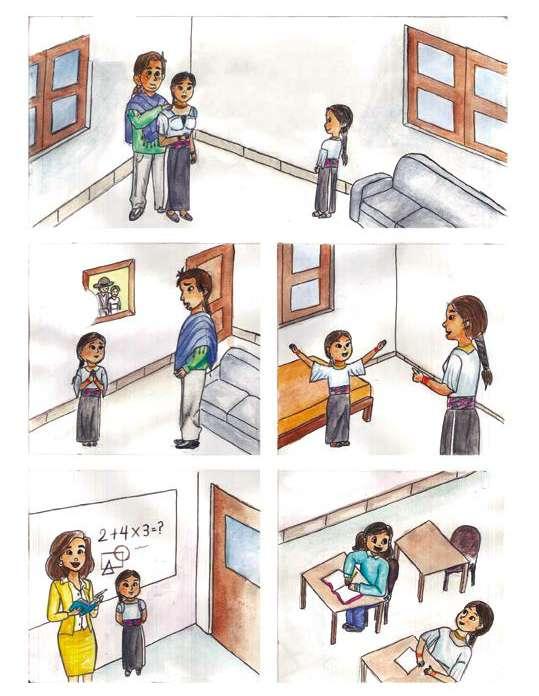
Sweetie, we have some… not-so-great news.
What could it be?
Your dad got a new job—with better pay. But we have to move, and that means… you’ll have to switch schools.
No! My friends are here!
I don’t want to leave!
I know, sweetheart… but it’s for our future.
Okay… I just hope I can make new friends
Alright class, listen up! We have a new student today—her name is Samai. Please be kind and help her feel welcome
Go sit next to that girl over there
Okay!
Huh? What did you just say?
You will, I’m sure of it! It’ll feel weird at first, but you’re going to like it.
Where are you from?
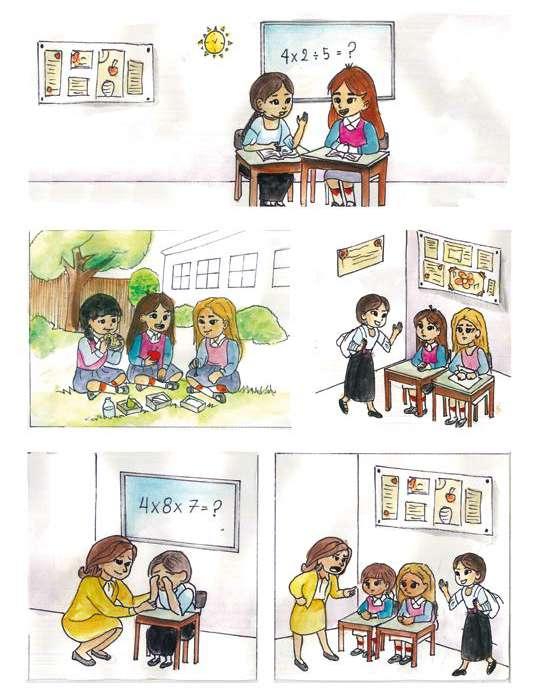
Sorry… I don’t speak much Spanish
From Angochagua
Girls, did you hear the way Samai talks?
Yesss!! She talks so weirdly
The next day
Good morning, everyone Let’s just ignore her Yep, let’s go
You're right… better if we just ignore her
Recess time
I understand… I’ll go talk to them right away
eacher, my classmates ignore me and make fun of the way I talk. It makes me feel really sad.
Kids, listen up. Some of you have been behaving poorly toward your classmate, and you don’t seem to understand her language.
So, I came up with an idea—how about we learn a new word in Kichwa every day before class? Sounds good?
Great idea! Yes! I’ll teach you!
After hearing everything, the teacher decides to
Hey everyone, this word—Allipuncha—means "good morning" in Kichwa.
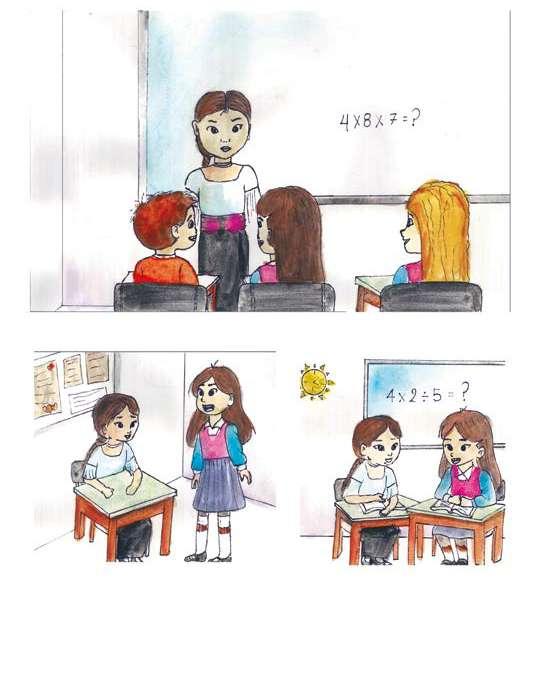
I’m sorry, Samai. I thought you were insulting us when you spoke in Kichwa, and that’s why I told everyone not to talk to you
His classmates learn happily and excitedly.
¡Of course! We’ll all help you!h
I forgive you, Veronica. But… could you help me improve my Spanish?
While studying, Yaku looks worried.
Son, you seem anxious. What’s going on?
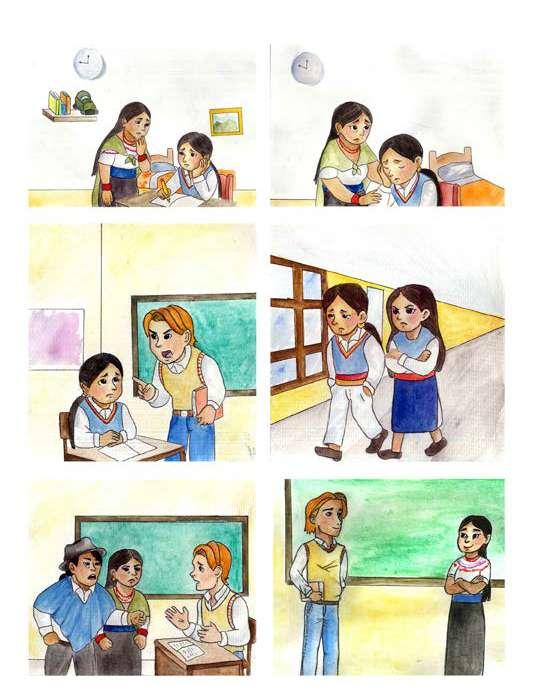
Mom, I don’t understand the books, and I have a test tomorrow. I’m not going to make it!
Don’t worry, I know you can do it. You’re very smart.
But they changed the teachers, and now everything’s in Spanish. I don’t want to go to school anymore.
Yaku, why did you leave some of the questions blank?
But we covered this in class.
I don’t really understand what they’re asking.
Ugh!
Later… at a parent-teacher meeting.
THEACHER, we need to talk about the test.
Why didn’t you include the language our children have been learning since they were little?
I know! But I’m scared to tell the teacher.
That’s not fair! These tests are only for those who read Spanish.
I hadn’t thought of that... I’m sorry.
Not everyone reads Spanish as well as Kichwa. Now they feel like they’re not smart. (Kichwa an indigenous language from Ecuador)
Of course! What’s the problem?
You’re right, I hadn’t realized that Killa and Yaku struggle with reading in Spanish. I’ll give them the test again.
hank you, THEACHER
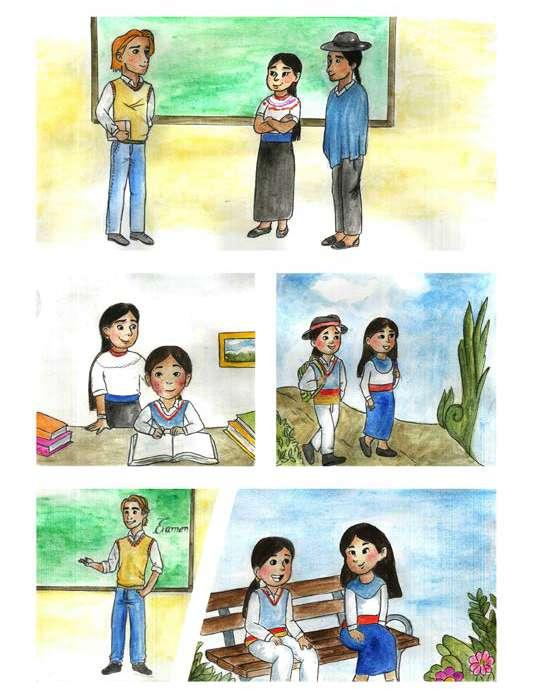
Yaku son, good news! The teacher will take the test again, this time in Kichwa.
Really? thanks mom!
Later at Yaku's house.
Good morning, students. Today, I’m going to retake the test with Yaku and Killa, but first, I’d like to apologize for not considering their language.
In class.
Thank you so much.
Hey Killa, did your dad tell you that we’re going to retake the test? Yesss!!! I’m so glad our parents talked to the teacher.
The next day at school..
After the exam results.
How’d you do, Killa? I got a 10! I did better than before. What about you?
I got a 10 too! I’ll keep studying hard.
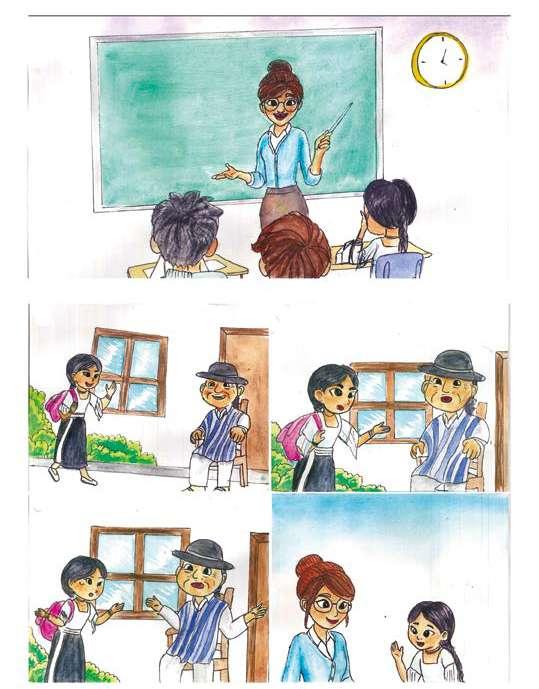
Alright, kids, for tomorrow, bring in the stories that your grandparents used to read or tell in your communities
arrives home
Hi, Grandpa! Guess what...
Our teacher asked us to bring stories from our culture
Hello, little Sisa. What’s going on? That’s great!
Sure, teacher!
But Grandpa, why aren't there any books with stories from our people?
Little Sisa, it’s because we didn’t write them down. We only told them to our children and grandchildren.
It can’t be!
What am I going to bring tomorrow?
Don’t worry, Sisa! There’s no better record than this...
Why? What happened?
I’ll tell you all the stories I know!
The next day at school
Teacher, I couldn’t finish yesterday’s homework very well.
I understand, in that case let's do something fun
Let's go to the classroom!
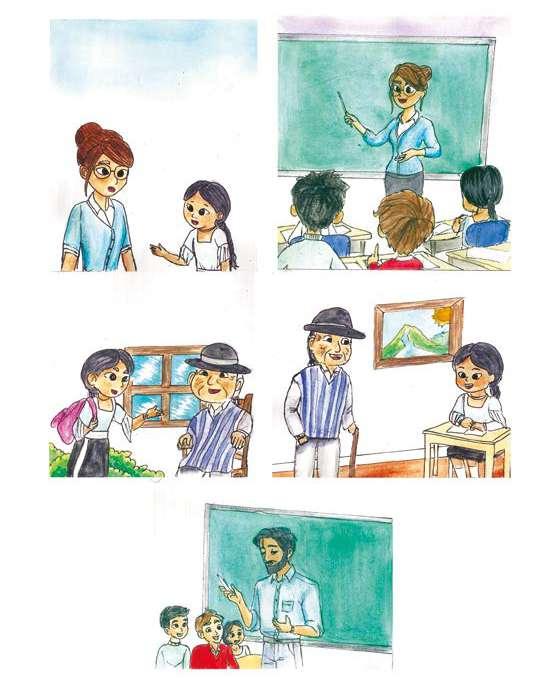
My grandfather told me many stories, but there is no record of them in Spanish and even less in Kichwa
Kids, we’re going to write everyone’s stories and have a reading festival!
Grandpa, I have some really good news! We’re going to write books with stories from our culture, and I’ll do it in Spanish and Kichwa!
How exciting! Yes!
Many years ago, there was...
That's great, Sisa! I'll help you with Kichwa!
Yes, it was a great idea! Yes! That way, everyone will learn the stories of my people
Alright, kids, the festival is about to begin. Grab your books and let’s head to the yard
Does anyone here speak a language other than Spanish?
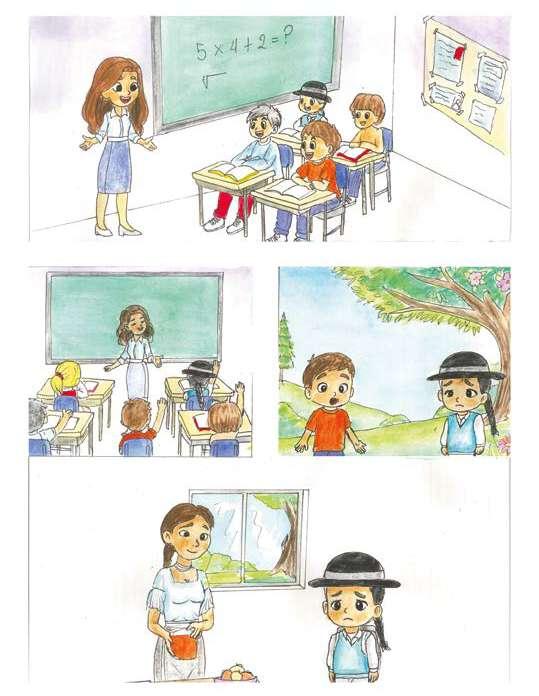
First day of school in a multicultural classroom where we see Indigenous children
That’s wonderful, Inti congratulations! Quiet, everyone
I speak Kichwa
Inti, an Otavalo Indigenous boy, nervously raises his hand while some classmates make fun, but teacher Emilia congratulates him
How was school today? My dear child, never be ashamed of our language. Don’t let them make you feel small
Why do you speak Kichwa?
If nobody understands you.
Why is he telling me that?
Later at home
I don’t want to go back. They made fun of me just because I speak Kichwa
The next day, in class
Today, we’re going to learn about… Indigenous Languages
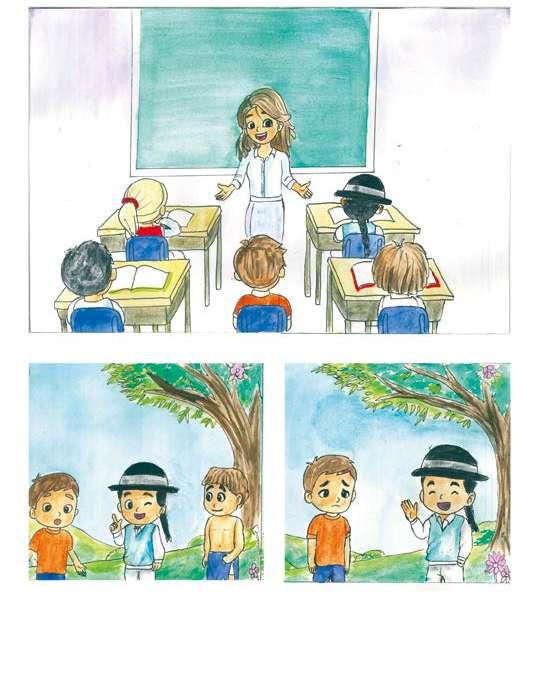
I love this topic, how exciting!
Inti, I’m curious about Kichwa. How do you say “Good morning”? You say “Alli Puncha.”
Yes, Inti. Your language is just as valuable as any other. Great job!
Inti, I’m really sorry for making fun of you. I understand now that every language is important
Don’ t worry. Maybe one day, we’ll be friends
At recess, his classmate Martin, interested in learning his language, approaches Inti and Kunki to learn
A few minutes later, Eduardo who bothered him earlier, is embarrassed and apologizes
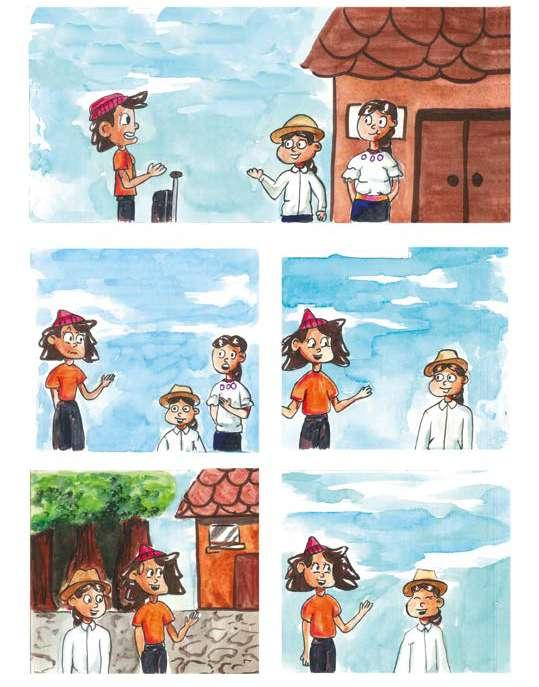
¡Hi! I'm Helen, and I'm so happy to meet you all.
¡Hi Helen! Nice to meet you. I'm Rumi.
From Canada, a teacher travels on an exchange program to Ecuador, to the city of Otavalo, where she is welcomed by an Indigenous Kichwa family.
What did she say?
Alli shamushka kapay, ñuka shutimikan Rosa
Sorry, my mom only speaks Kichwa. She’s welcoming you and says her name is Rosa.
Later, at home, Rosa, Rumi’s mother, introduces herself. But Helen doesn’t understand her, so Rumi helps translate and he speaks Spanish and a bit of English.
Here in Otavalo, there’s a really famous place called the Plaza de los Ponchos. Let's visit it!
¡I love the idea! Let’s go, Rumi!
Later, Helen introduces herself and explains where she’s from and why she’s here.
Alli puncha imanalla mashi
Nice to meet you! Let’s start with the language here in Otavalo, we speak both Spanish and Kichwa.
¡OK! Thanks, Rumi. As you already know, I’m Helen, a teacher from Canada. I came to learn from you and thank you so much for welcoming me.
Hey Rumi, I have an idea—what if you teach me Kichwa? I’m a fast learner! ¡Great idea! Let’s start with a greeting: “Alli puncha” means “Good morning.”
A little later, before reaching the city center,
Inside the plaza, Helen, full of excitement, greets everyone in Kichwa with “Alli puncha.” The artisans and vendors are surprised.
How lovely! She's really learning our Kichwa!
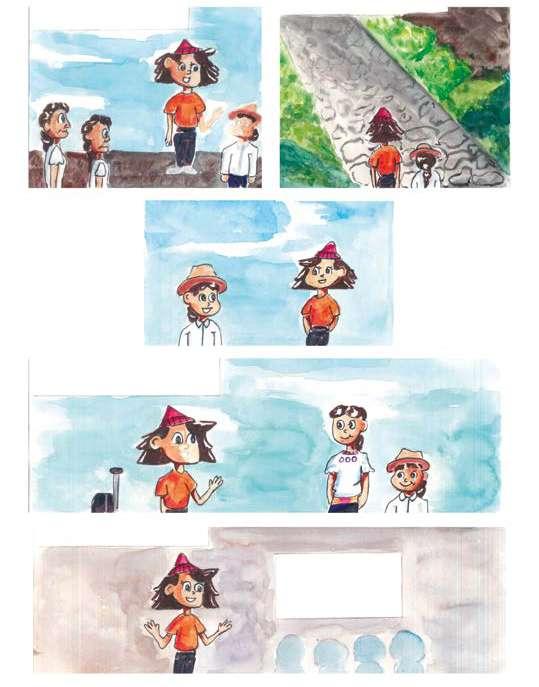
¿Maymanda shi?
Your Kichwa has gotten so much better, keep practicing!
Later, Helen and Rumi talk on their way back home.
Rumi you can teach me more of Kichwa in exchange I will teach you my language which is English.
Yesss! I love the idea that we can learn from each other!
Thanks to you Rumi, you know, I really want you to learn to speak English and I'm giving you this book to help you do it.
After some time, at Rosa’s house, Helen and Rumi’s family reflect on all they’ve learned.
Later, Helen says goodbye and thanks the family for their time together.
It’s time for me to go.
Yupaychani Mamita Rosa shinallata Rumipash.
Back in Canada, Helen shares her experience with her students.
Good morning, students. Today I want to tell you about my journey to Otavalo, where I learned so many things.
Ama kungahuankichu llakishami (¡Don’t forget me I’ll miss you!) I’ll miss you too. Thanks for everything. Take care and goodbye!
I think our teacher had a great vacation! Now I’m really curious to learn this! I want to learn.
It was just an ordinary day for Grandma Isabel and her granddaughter Sara at the Plaza de Ponchos in Otavalo, when Sara discovered something shocking.
Imanalla mashi
(How are you, friend?)
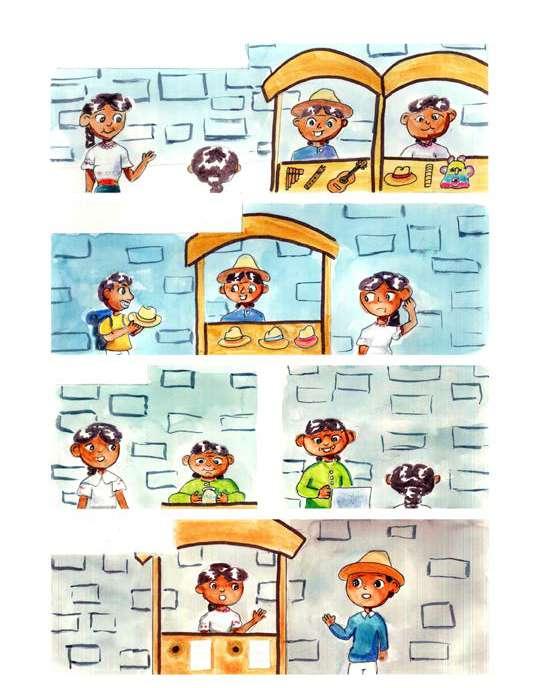
Ah! I'm doing well. I'm surprised you speak Kichwa since hardly anyone does nowadays.
Hardly anyone?
A few minutes later, Sarita realized that Kichwa was disappearing. All the salespeople were switching to other languages, leaving their own behind.
"This hat is beautiful! How much?"
Back home, Sara approaches her grandmother, who sells handicrafts, and expresses her doubts.
Ah, Sarita, the tourists don’t understand it, so we had to learn Spanish and English to make sales.
grandmother, why don’t people speak Kichwa here anymore?
"Fifty
dollars!"
Back then, our grandparents sold things speaking in Kichwa.
Why don’t they do it anymore?
Grandma shows her an old sign that said “Sisa Shop, ” trying to explain how the use of Kichwa faded over time.
Ah, Sarita, the tourists don’t understand it, so we had to learn Spanish and English to make sales.
But Grandma, if we stop speaking our language, it will be forgotten.
The next day, while at the market, Sara realizes that even adults don’t speak Kichwa anymore. Sara decides to take over her grandmother’s booth and greet the customers in Kichwa.
"Alli puncha! Imaguta rantikripanki?" (Good morning! What would you like to buy?)
It’s Kichwa. Don’t you speak it?
Eh? What did you say?
My grandparents did, but I never learned.
After a few minutes, a tourist notices the language the girl is speaking and is impressed.
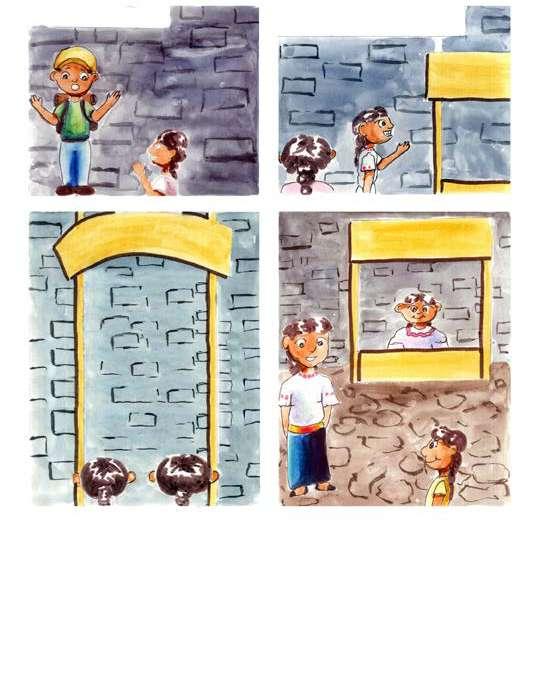
"What language is that?" "Can you teach us some words?"
The following day, Sara and her grandmother placed a sign at their booth. Sara’s goal was to reclaim and strengthen the Kichwa language.
This reminds me of the old days.
It is Kichwa, the language of our ancestors!
It should always be this way, GRANDMA!
Some time later, people began to notice the sign and grew interested in reconnecting with their language. Other salespeople picked up on the enthusiasm and started speaking Kichwa with their customers.
Some time later, a little girl greeted Sara’s grandmother in Kichwa. Sarita realized her efforts hadn’t been in vain and felt deeply moved that a child was now speaking the language.
¡Allí puncha wawa! (Good morning, little one.)
A language lives on if we use it every day.
Neighbor! Maybe we should start speaking our language again.
Yes! That way we show our true culture.
¡Alli puncha mama! (Good morning, Madam.)
Andrade, L. (2016). Repositorio Interculturalidad. Prácticas y actitudes lingüísticas de estudiantes Kichwas en la ciudad de Quito: el caso de la Unidad Educativa Tránsito Amaguaña [Intercultural Repository. Linguistic practices and attitudes of Kichwa students in Quito: the case of the Unidad Educativa Transito Amaguaña]. [Tesis de Grado, Pontificia Universidad Católica del Ecuador]. Repositorio Institucional PUCE. https://acortar. link/KNC7Xu
Arteaga-Tuba, G. J. (2024). Recursos tecnológicos para el aprendizaje en el marco de la educación inclusiva ecuatoriana [Technological resources for learning within the framework of Ecuadorian inclusive education]. Cienciamatria. Revista Interdisciplinaria de Humanidades, Educación, Ciencia y Tecnología, 10(18), 289-312.
Bonilla, L. M. (2018). Sentidos y prácticas de los saberes ancestrales en el fortalecimiento de la identidad cultural, y la relación escuela-familia con los niños y niñas del Proyecto Ondas de la Institución Educativa María Fabiola Largo cano, sede La Candelaria del resguardo indígena la Montaña en Riosucio Caldas [Meanings and practices of ancestral knowledge in strengthening cultural identity and the school-family relationship with the children of the Ondas Project at Unidad Educativa María Fabiola Largo Cano, the Candelaria branch of the Indigenous Mountain reserve in Riosucio, Caldas]. [Tesisde maestría, Universidda de Manizales] Repositorio Intitucional Universidad de Manizales. http://ridum.umanizales.edu.co/handle/20.500.12746/3362
Brodowicz, M. (2024, noviembre 10). La influencia del uso del lenguaje en la formación de la identidad cultural [The influence of language use on the formation of cultural identity]. https://aithor.com/essay-examples/la-influencia-del-uso-del-lenguaje-en-la-formacion-de-la-identidad-cultural
Cabascango, F. L. (2023). Adquisición y desarrollo de la lengua kichwa como lengua materna en el tercer año de educación básica del centro educativo comunitario intercultural bilingüe Tarquino Idrobo, de la comunidad de Ucsha, parroquia San Pablo, cantón Otavalo [Acquisition on and development of the Kichwa language as a mother tongue in the third years of basic education at the Tarquino Idrobo Intercultural Bilin-
gual Community Educational Centre, in the Ucsha community, San Pablo parish, Otavalo canton]. [Tesis de maestría, Universidad Politécnica Salesiana]. Repositorio Institucional DSpace. https://dspace.ups.edu.ec/ handle/123456789/26526
Cabrera, G. C. L., & Moreno, M. A. S. (2021). Percepción de la cultura ambiental del agua a partir de saberes ancestrales de la comunidad indígena de Yascual, Túquerres [Perception of the environmental water culture based on ancestral knowledge of the Yascual Indigenous community, Tuquerres]. Revista Historia De La Educación Colombiana, 26 (27), 71–91. https://revistas.udenar.edu.co/index.php/rhec/ article/view/6758
Chávez, S. (2022). Actitudes lingüísticas y factores que debilitan el Kichwa en la comunidad “San Francisco del Río de Misahuallí” en la ciudad de Tena [Linguistic attitudes and factors that weaken Kichwa in the “San Francisco del Río de Misahuallí” community in the city of Tena]. https:// repositorio.puce.edu.ec/server/api/core/bitstreams/a55184fd4dad-43f6The acquisition of multiple languages: Mult-888b-30e46cda3e97/content
Chiang Montañez, M. A., Riveros Alata, K. P., & Torres Chavez, V. A. (2022). La adquisición de varias lenguas: Multilingüismo e interferencias en la competencia lingüística [ The acquisition of multiple languages: Multilingualism and interferences in linguistic competence]. Revista Científica de Literatura, Lingüística y Creación Literaria, World Literature & Linguistics (WLL), 24–31. https://literaturejournal.org/index.php/WLL/ article/view/34
Cipagauta Moyano, M. (2023). TIC en el aula: Caso de estudio Colombia [ICT in the classroom: Case study Colombia]. TECHNO REVIEW. International Technology, Science and Society Review, 13, 27–47. https://doi. org/10.37467/revtechno.v13.4808
Crispín López, A. (2023). El uso de cuentos populares en lengua Yanesha para el desarrollo del aprendizaje significativo en Oxapampa, Perú [The use of popular tales in the Yanesha language for the development of meaningful learning in Oxapampa, Perú].(Tesis de licenciatura). Universidad
Nacional de la Selva Central.
Cruz Forero, L. D. (2021). Diseño e implementación de proyectos de aula transversales con lineamientos estatales, desde saberes ancestrales indígenas en Colombia [Design and implementation of cross-curricular classroom projects with state guidelines, based on Indigenous ancestral knowledge in Colombia]. MODULEMA. Revista Científica sobre Diversidad Cultural, 5, 112-129. https://digibug.ugr.es/handle/10481/73407
CONAIE. (2022). La preservación del Kichwa como acto de resistencia cultural [The preservation of Kichwa as an act of cultural recistent ]. Confederación de Nacionalidades Indígenas del Ecuador. https://www.conaie.org/ documento-kichwa-2022
De Estadística y Censos, I. N. (s. f.). Boletín de prensa [Press bulletin]. Instituto Nacional de Estadística y Censos. https://www.ecuadorencifras.gob.ec/ boletin-prensa-ferias-autoidentificacion/#:~:text=Quito%2C%20Ecuador%20(06%2F12%2F2022)
Díaz, J. P., Ruiz, A. K., & Egüez, C. (2024). Preservación de los saberes ecológicos ambientales Mokaná: Análisis desde la experiencia, los Objetivos de Desarrollo Sostenible y los vacíos curriculares [Preservation of Mokaná environmental ecological knowledge: An analysis based on experience, the Sustainable Development Goals, and curricular gaps]. Ciencia Latina Revista Científica Multidisciplinar, 8(1), 1253–1271. https://doi. org/10.37811/cl_rcm.v8i1.9513
Ecuador, C. d. (25 de abril de 2022). Lenguas Indigenas de Ecuador y el mundo [indigenous languages of Ecuador and the world ]. Confederación de Nacionalidades Indígenas del Ecuador. https://conaie.org/2022/04/25/ lenguas-indigenas-de-ecuador-y-el-mundo/
Edilma Sulay López Puente, S. M. (30 de diciembre de 2023). El Rol Vital de Rescatar y Preservar el Kichwa como Lengua Ancestral en la Educación General Básica [ The Vital Role of Rescuing and Preserving Kichwa as an Ancestral Language in School]. Tesoros Lingüísticos. https://acortar. link/nfoAfH
Educo. (2019). La importancia de aprender un segundo idioma [The importance of learning a second language]. Blog de Educo. https://www.educo.org/ blog/la-importancia-de-aprender-un-segundo-idioma
Fessi, I. (2015). La adquisición de terceras lenguas: multilingüismo aditivo y substractivo [The acquisition of third languages: additive and subtractive multilingualism]. Dirasat Hispanicas. Revista Tunecina de Estudios Hispánicos, 0(2), 109-119. https://doi.org/10.71564/dh.vi2.19
Flores, P. (2020). Análisis de los factores intervinientes para el desarrollo del kichwa en la Educación Intercultural Bilingüe ecuatoriana desde 1944 hasta 1996 [Analysis of the intervening factors for the development of Kichwa in Ecuadorian Intercultural Bilingual Education from 1944 to 1996]. DSPACE https://www.dspace.uce.edu.ec/server/api/core/bitstreams/c86b2d9b-66a3-4dd5-bec9-320dccbae62f/content
García Cámara, M. (2024). Comunidad sorda y uso de las nuevas tecnologías de la información y la comunicación (NTIC) [Deaf community and use of new information and communication technologies (ICT)]. [Trabajo de fin de grado, Universidad de Valladolid]. UVaDoc. https://uvadoc.uva. es/bitstream/handle/10324/72502/TFG-G7221.pdf?sequence=1
Gauin, B. (2024). Percepciones sobre la importancia del idioma kichwa en los estudiantes de Básica Superior de la “Unidad Educativa Bilingüe Ñucanchik Yachay” [Perceptions about the importance of the Kichwa language in upper basic students at “Unidad Eduactiva Bilingüe Ñucanchik Yachay”]. DESPACE. UNACH. http://dspace.unach.edu.ec/bitstream/51000/12997/1/UNACH-EC-FCEHT-EBAS-035-2024.pdf
Gómez Casola, K., & Arrocha-Rodríguez, O. (2021). La importancia de la lengua materna como símbolo de la identidad cultural [The importance of the mother tongue as a symbol of cultural identity]. [Artículo]. ResearchGate. https://www.researchgate.net/publication/352846404_TITULO_LA_ IMPORTANCIA_DE_LA_LENGUA_MATERNA_COMO_SIMBOLO_DE_LA_IDENTIDAD_ CULTURAL_TITTLE_THE_IMPORTANCE_OF_DE_MOTHER_TONGUE_AS_SYMBOL_ OF_THE_ CULTURAL_IDENTITY_Autores_Kenia_Gomez_Casola
González Díaz, J. L., & Asensio Brouard, M. (1996). Las teorías sobre el aprendizaje de segundas lenguas [Theories on second language learning]. Babel – AFIAL, 3(5), 155–172. https://dialnet.unirioja.es/servlet/articulo?codigo=5155975
González Orbea, G., San Lucas Peña, S., & Dahik Cabrera, J. L. (2023). La lengua de señas como estrategia de inclusión en la formación de los docentes y estudiantes [Sign language as inclusion strategy in teacher and student training]. En Universidad Laica Vicente Rocafuerte (Coord.), Memorias INPIN 2023 (pp. 150–154). Universidad Laica Vicente Rocafuerte. https://dialnet.unirioja.es/servlet/articulo?codigo=9958864
Guarin, A. T., & Tovar, K. M. (s. f.). Conferencia CLACSO 2025 [ CLASCO 2025 Conference]. https://conferenciaclacso.org/programa/resumen_ ponencia.php?&ponencia=Conf-1-8355-31276&
Haboud de Ortega, M. (2004). El español y las lenguas indígenas en el Ecuador hoy [Spanish and indigenous languages in Ecuador today]. [Ponencia]. III Congreso Internacional de la Lengua Española, Rosario, Argentina. https://cvc.cervantes.es/obref/congresos/rosario/ponencias/aspectos/ haboud_m.htm
Hartshorne, J. K., Tenenbaum, J. B. y Pinker, S. (2018). A critical period for second language acquisition: Evidence from 2/3 million English speakers. Cognition, 177, 263–277. https://doi.org/10.1016/j.cognition.2018.04.007
Haro Robayo, V. L. (2023). Las leyendas ecuatorianas y la identidad cultural en los estudiantes de educación general básica media, de la Unidad Educativa “12 de noviembre” del cantón Píllaro [Ecuadorian legends and cultural identity in lower secondary students at “12 de Noviembre” School in Píllaro]. [Trabajo de Grado, Universidad Técnica de Ambato]. https:// repositorio.uta.edu.ec/items/0804de56-9b41-4050-ae01-5c6f5d2a6e2a
Hdez, R. (2023). La identidad kichwa en Otavalo: lengua, vestimenta y la Plaza de Ponchos [ Kichwa identity in Otavalo; language , clothing and La Plaza de Ponchoz]. Ecuador Travel. https://ecuador.travel/la-identidadse-teje-de-colores-en-otavalo
Humanidades, Educación, Ciencia y Tecnología, [Humanities, Education, Science and Technology]10(18), 289–312.. https://doi.org/10.35381/ cm.v10i18.1272
Instituto Nacional de Estadística y Censos. (2023). Presentación Censo 2022: Pueblos y nacionalidades [2022 Census presentation: Peoples and Nationalities]. Secretaría de Pueblos y Nacionalidades. https://www.secretariapueblosynacionalidades.gob.ec/wp-content/uploads/2023/12/Presentacion-CENSO-2022-Pueblos-y-Nacionalidades.pdf
Krashen, S. D. (1982). Principles and Practice in Second Language Acquisition. México: Siglo XXI. Disponible en bibliotecas universitarias o plataformas académicas. https://www.researchgate.net/publication/242431410_ Principles_and_Practice_in_Second_Language_Acquisition
Liga de Educación. (n.d.). Manual de estrategias inclusivas para aulas interculturales [Handbook on Inclusive Strategies for Intercultural Classrooms]. Liga de Educación del Ecuador https://educacion.gob.ec/wp-content/uploads/downloads/2014/02/Manual_de_Estrategias_100214.pdfd
López Puente, S. et al. (2023). Bilingual education and cultural preservation in Ecuador (Report No. 2023-17). UNESCO https://www.researchgate. net/publication/390120816_Preservation_of_cultural_diversity_in_Ecuadorian_education
Lozano, M. (2015). Multilingüismo y aprendizaje de lenguas extranjeras: revisión de fundamentos y estrategias. Sinapsis [Multilingualism and foreign language learning: a review of fundamentals and strategies. Synapses]. Revista Científica Multidisciplinaria de la Educación, 2(1), 46–58. https://revistas.itsup.edu.ec/index.php/sinapsis/article/view/435
Mejía, M. C. (2021). Actitudes lingüísticas, revisión teórica y repercusiones en la enseñanza de lenguas extranjeras [Language attitudes, theoretical review and implications for foreing languages teaching]. https://www.redalyc.org/journal/3222/322271266001/
Ministerio de Educación del Ecuador. (2013). Módulo I: Educación inclusiva y especial [Module I: Inclusive and special education]. https://educacion.gob. ec/wp-content/uploads/downloads/2013/07/Modulo_Trabajo_EI.pdf
Ministerio de Educación del Ecuador. (2019). Modelo del Sistema de Educación Intercultural Bilingüe del Ecuador [Model of Intercultural Bilingual Education System in Ecuador]. https://educacion.gob.ec/wp-content/uploads/downloads/2019/03/Modelo-del-Sistema-de-Educacion-Intercultural-Bilingue-del-Ecuador.pdf
Ministerio de Educación del Ecuador. (2020). Modelo Educativo Nacional Bilingüe Bicultural para Personas con Discapacidad Auditiva. Ministerio de Educación del Ecuador [National Bilingual Bicultural Educational Model for people with hearing impairment].https://educacion. gob.ec/wp-content/uploads/downloads/2020/02/Modelo-Educativo-Bilingue-Bicultural-para-Personas-con-Discapacidad-Auditiva.pdf
Ministerio de Educación del Ecuador. (2023). Directrices para la acreditación del cumplimiento de los indicadores de calidad educativa [Guidelines for accreditation of compliance with educational quality indicators]. Subsecretaría de fundamentos educativos. https://doi.org/10.5281/zenodo.8310291
Miranda, G. C., & Pérez, A. M. (2024). Integración del modelo tpack y recursos digitales en la enseñanza de saberes ancestrales [Integration of the tpack model and digital resources in the teaching of ancestral knowledge]. LATAM Revista Latinoamericana de Ciencias Sociales y Humanidades, 5(1). https://doi.org/10.56712/latam.v5i1.1707
Mosquera Enadara, M., & Ayala, L. L. (2020). La interculturalidad y la plurinacionalidad del Ecuador en el marco de los derechos del Buen Vivir [Ecuador´s interculturality and plurinationality in the framework of the rights of Buen Vivir]. Uniandes EPISTEME, 988–998.
Organización de Estados Iberoamericanos para la Educación, la Ciencia y la Cultura [OEI]. (2020). Documento sobre acciones para fortalecer la autoestima de estudiantes indígenas y concienciación educativa [Documents on actions to strengthen the self-esteem of indigenous students and educational awareness]. https://oei.int/
Padial Ruz, R., & Sáenz-López Buñuel, P. (2013). Los cuentos populares/tradicionales en educación infantil: Una propuesta a través del juego [Folk/
traditional tales in early childhood education: A proposal through play]. E-motion. Revista de Educación, Motricidad e Investigación, 2, 32–47. https://www.uhu.es/publicaciones/ojs/index.php/e-moti-on/index
Puente, E. S. L., Pineda, P. R. T., Pandashina, S. M. T., Villagrán, L. J. F. C., Semanate, A. M. E., & Chamba, J. X. Q. (2024). Tesoros Lingüísticos: El Rol Vital de Rescatar y Preservar el Kichwa como Lengua Ancestral en la Educación General Básica [Linguistic Treasures: The vital role of rescuing and preserving Kichwas an Ancestral Language in schools ]. Ciencia Latina Revista Científica Multidisciplinar, 7(6), 5235–5256. https://doi.org/10.37811/cl_rcm.v7i6.9078
Ramírez, A.B.& Chaparro, C.D.(2021). Lenguas ancestrales e identidad cultural: El caso del kichwa [Ancestral languages and cultural identity: The case of Kichwa]. Universidad Andina Simón Bolívar. https://repositorio.uasb.edu.ec/handle/10644/8158
Ramírez-Cruz, H., & Rojas, J. F. C. (2021). Introducción: la diversidad lingüística y la investigación de lenguas en peligro [Introduction: Linguistic diversity on endangered languages]. Forma y Función, 34(2). https://doi. org/10.15446/fyf.v34n2.96558
Ríos-Colmenárez, M. J. (2020). Enseñanza de lenguas indígenas mediadas por las TIC en América Latina [ICT-mediate indigenous language teaching in Latin America]. Revista Lengua y Cultura, 1(2), 20–27.
Roig Osete, M. (2012). Utilización de recursos TIC para la integración del alumnado con discapacidad auditiva en primaria [Use of ICT resources for the integration of hearing impaired pupils in primary school] [Trabajo de fin de grado, Universidad Internacional de La Rioja]. Repositorio institucional UNIR. https://reunir.unir.net/bitstream/handle/ 123456789/862/2012_09_17_TFG_ESTUDIO_DEL_TRABAJO. pdf
Selinker, L. (1972). INTERLANGUAGE. International Review of Applied Linguistics in Language Teaching, 10(1-4), 209-232. https://doi.org/10.1515/ iral.1972.10.1-4.209
Rojas Guanoluisa, S. A. (2019). Leyendas ecuatorianas y el desarrollo de la identidad en niños de 5 a 6 años [Ecuadorian legends and the development of identity in 5-6 year old children] [Trabajo de titulación de grado, Universidad de Las Américas]. https://dspace.udla.edu.ec/bitstream/33000/11147/1/UDLA-EC-TLEP-2019-11%20Tomo%20I.pdf
Rubiano Caballero, M. L., & Hernandez Mejía, C. A. (2024). Integración de las TIC en la preservación y enseñanza de saberes ancestrales: Impacto en la identidad cultural y educación indígena [Integration of ICTs in the preservation and teaching of ancestral knowledge: Impact on cultural identity and indigenous education]. Ciencia Latina Revista Científica Multidisciplinar, 8(5), 9399–9415. https://doi.org/10.37811/cl_rcm. v8i5.14326
Salas, J. (2016). La influencia del bilingüismo en el aprendizaje de terceras lenguas [The influence of bilingualism on third language learning]. Lenguas Modernas, (24), 177-. https://archivo.revistas.ucr.ac.cr//index.php/ rlm/article/view/24608
Sandoval, C. H. (2020). La Educación en Tiempo del Covid-19: El nuevo rol del profesor en el fortalecimiento del proceso enseñanza aprendizaje de las prácticas educativas innovadoras [Education in Covid-19 time: The new role of the teacher in stregthening the teaching-learning process of innovative educational practices]. Revista Docentes 2.0, 9(2), 24–31. https:// doi.org/10.37843/rted.v9i2.138
UNESCO. (2010). Atlas of the World’s Languages in Danger (3rd ed.). http:// www.unesco.org/languages-atlas
UNESCO. (2016). Educación intercultural bilingüe: fortaleciendo la identidad cultural y lingüística en América Latina y el Caribe. Recuperado de https://unesdoc.unesco.org/ark:/48223/pf0000246395
UNESCO. (2020, diciembre 18). Lenguas en peligro: El pensamiento amenazado. Organización de las Naciones Unidas para la Educación, la Ciencia y la Cultura [Thought under threat. United Nations Educational, Scientific and Cultural Organization]. https://courier.unesco.org/es/articles/ lenguas-en-peligro-el-pensamiento-amenazado
UNICEF. (2019). Las lenguas indígenas como factor de inclusión y sostenibilidad. Organización de las Naciones Unidas para la Educación, la Ciencia y la Cultura [indigenous languages as a factor of inclusion and sustainability United Nations Educational, Scientific and Cultural Organization ]. https://www.unicef.org/lac/media/22251/file/EIB-AMERICA-LATINA-SPA.pdf
UNICEF. (2021). Educación intercultural bilingüe en América Latina [PDF]. Oficina Regional para América Latina y el Caribe [Billingual intercultural education in Latin America. Regional Office for Latin America and the Caribbean]. https://www.unicef.org/lac/media/22251/file/ EIB-AMERICA-LATINA-SPA.pdf
UNICEF. (s. f.). La educación intercultural bilingüe en Ecuador. [Intercultutal bilingual education in Ecuaodor]. https://www.unicef.org/lac/la-educacion-intercultural-bilingue-eib-en-ecuador
Ureta-Andrade, J. J., & Donoso-Cedeño, M. M. (2022). Lengua de Señas Ecuatoriana (Lsec) como herramienta de inclusión en educación especializada [Langua de Señas Ecuatoriana (Lsec) as a tool for inclusion in specialised education]. Dom. Cien., 8(2), 251–261. https://dialnet.unirioja. es/descarga/articulo/8383432.pdf
Vilema, S. V. H., Rivadeneira, A. S. T., Peña, M. I. S., & Vela, M. E. C. (2025). Enseñanza del Idioma Kichwa y la Educomunicación: Un Análisis de su Estado desde las Voces de los Docentes en la Provincia de Pastaza-Ecuador [Kichwa laguage teaching and educommunication: An Analysis of its Status from the voices of teachers in the province of Pastaza-Ecuador]. Revista Veritas de Difusión Científica, 6(1), 2281–2304. https://doi. org/10.61616/rvdc.v6i1.522
Walsh, C. (2005). La interculturalidad en la educación. Minedu-Unicef [Interculturality in education. Minedu-Unicef] https://centroderecursos.cultura.pe/sites/default/files/rb/pdf/La%20interculturalidad%20en%20la%20 educacion_0.pdf
World Bank (22 de febrero de 2019). Lenguas indígenas, un legado en extinción. Lenguas indígenas, un legado en extinción [indigenous languages, a dy-
ing legacy. Indigenous languages, an endangered legacy]. https://www. bancomundial.org/es/news/infographic/2019/02/22/lenguas -indigenas-legado-en-extincion
World Federation of the Deaf. (2018a). Position paper on the language rights of deaf children. https://wfdeaf.org/resources/position-paper-on-the-language-rights-of-deaf-children/
World Federation of the Deaf. (2018b). Declaration on the rights of deaf children https://wfdeaf.org/rights-of-deaf-children/
Yanzapanta, Z. (2018). Actitudes lingüísticas y el kichwa en la unidad educativa del milenio intercultural bilingüe Chibuleo [Linguistic attitudes and Kichwa in Chubileo intercultural bilingual millennium education School]. https://repositorio.uta.edu.ec/server/api/core/bitstreams/05611e65-1dad4c5c-a0a2-fa85f3878030/content
Yungán, R. Y., Zurita, G. E. O., Chusín, H. M. N., & Fuentes, C. C. (2019). Percepciones de los docentes indígenas Kichwas sobre la enseñanza en la lengua ancestral [Perceptions of indigenous Kichwa teachers on teaching in their ancestral language]. Ciencia Digital, 3(1), 424–440 https:// cienciadigital.org/revistacienciadigital2/index.php/CienciaDigital/article/view/347
Donna Fuel-Cualchi1, Damaris Ostaiza-Yepez1, Indra Salcedo-Recalde1
1Facultad de Educación, Ciencia y Tecnología, Universidad Técnica del Norte, Ecuador
1Facultad de Educación, Ciencia y Tecnología, Universidad Técnica del Norte, Ecuador
djfuelc@utn.edu.ec, dlostaizay@utn.edu.ec, insalcedor@utn.edu.ec
Ecuador’s classrooms are a faithful reflection of the country’s cultural, linguistic and social richness, showcasing an important indigenous plurality that demonstrates there is more than one way of learning. To speak of education with sensitivity, today is not a luxury but an urgent necessity. In a context characterized by cultural plurality, it is essential to recognize that diversity is not a problem to be solved but a valuable opportunity to enrich the teaching and learning processes. In this way, it is possible to overcome deeply rooted prejudices and pave the way for a transformative and liberating education that responds with justice and equity to contemporary realities.
One of the persistent challenges in Ecuador is the influence of gender stereotypes that assign roles according to biological sex, perpetuating attitudes such as machismo and homophobia. Although progress has been made towards equity, opportunities for women remain limited, while male presence continues to be legitimized in technical, physical and sporting activities (Ramírez et al., 2019). In this context, education plays a fundamental role as an agent of change. To achieve genuine gender equity, continuous teacher training and teaching based on coeducation, respect for diversity, peaceful coexistence and autonomy are essential (Vizuete-Salazar & Lárez-Lárez, 2021).
Valuing the diversity of talents is also one of the major challenges of contemporary education. This requires the implementation of inclusive and personalized pedagogical approaches that are capable of responding to the particularities of each student (Hernández et al.,
2021). In this context, Guzmán (2018) observes that ‘the incorporation of adaptive methodologies in the classroom fosters learning diversity and allows students to progress at their own pace, favoring a personalized education that caters to individual needs’ (p. 45).
As Hernández-Sánchez and Ainscow (2018) argue, offering exactly the same to everyone does not guarantee educational justice. On the contrary, applying differentiated criteria that favor those who face greater disadvantages, as Bolívar (2012) notes, constitutes a form of equality aimed at achieving effective equity. When all voices are heard, the educational institution becomes a genuine engine of social transformation (Guaillas et al., 2024). In this context, it is also crucial to attend to children and adolescents who have experienced traumas such as abandonment, abuse, or the loss of a loved one, as these experiences affect their emotional and academic development. The educational response must be comprehensive and sensitive to the realities of each student, incorporating psychological support, academic accompaniment, early detection of risk factors, teacher training, and close collaboration with families and social services. In this way, it is possible to foster a safe environment, based on empathy, trust and respect, which strengthens students’ resilience and overall well-being (Alduán, 2024).
Emotional regulation is essential for the holistic development of students within the educational environment. It is important to implement strategies that effectively promote self-regulation and emotional management skills, as these influence both the psychological well-being of students and their academic performance.
Over the last decade, research has shown that well-articulated strategies within the school environment, implemented by teachers, students and institutions, support cognitive, relational and psychological well-being. Appropriate management of emotions in the classroom is a key factor in enhancing learning, fostering healthy interpersonal relationships among students and with teachers, and achieving academic goals.
In the educational context, emotional regulation is a decisive factor for students’ academic performance, social adaptation and overall
well-being (Salovey et al., 2022). This process should not be confined to students alone but must extend to teaching staff and the organizational structure of the school. As Garn et al., (2021) highlight, emotional regulation within the educational environment is fundamental for consolidating positive school climates and promoting the well-being of all stakeholders involved.
From this systemic approach, three complementary levels of emotional regulation strategies applicable to the classroom can be identified:
• Teacher-focused strategies: encompass both teachers’ emotional self-regulation and their ability to co-regulate students’ emotions during pedagogical interactions. These strategies include individual practices such as cognitive reappraisal, mindfulness and stress management, as well as institutional programs aimed at teachers’ emotional development to strengthen professional wellbeing and foster positive socio-emotional climates in the classroom.
• Student-centered strategies: focus on the systematic teaching of emotional competences to students, emphasizing the recognition, understanding and regulation of their own emotions. These include developing emotional awareness, mindfulness training, employing adaptive cognitive strategies such as reframing, and promoting social-emotional intelligence to support coexistence and co-regulation among peers.
• Institutional and curricular strategies: encompass the creation of a safe and supportive school environment. These include designing emotionally safe school spaces, integrating traumainformed educational practices, and implementing curricular programs that foster resilience and collective social-emotional development within the educational community.
The incorporation of emotional education supports the strengthening of intrapersonal competences, enabling students to identify emotional experiences in ways congruent with their individual personality styles
(Ruales et al., 2022; Villegas, 2023). The implementation of relaxation techniques, such as deep breathing and physical activity, has proven effective in preventing anxiety and managing stress associated with the school environment, while also improving students’ mood (Balón et al., 2024; Bravo, 2017).
Integrating emotional education within the school environment plays a crucial role in fostering intrapersonal competences, enabling students to recognize, comprehend, and regulate their emotions in a manner aligned with their individual personality traits. Bentley et al. (2022) note that the consistent application of emotional selfregulation techniques such as deep breathing, muscle relaxation, and mindful physical activity has yielded positive outcomes in preventing anxiety, alleviating stress linked to the school setting and enhancing students’ overall mood.
The family, as the primary environment where students first learn to regulate their emotions, plays a crucial role in developing socioemotional skills that students apply in the classroom whether these skills are positive or otherwise. Therefore, it is essential for families to be actively involved in their child’s emotional development. Emotional support from parents or significant adults who have a positive connection with the student is a key factor in fostering motivation and self-esteem, thereby helping to prevent difficulties in areas such as reading, writing and other academic skills (Mejía et al., 2023).
Effective communication is fundamental to providing emotional support, which is crucial for the holistic development of learners. Parents should create a safe and nurturing environment that encourages their children to express their emotions freely. Additionally, family members who maintain regular contact with learners ought to model healthy behaviors and demonstrate socialemotional skills, enabling students to learn through observation (González et al., 2025). Table 6 outlines family intervention strategies and their outcomes in supporting students’ emotional well-being.
Table 6
Intervention Strategies
Intervention Strategies
Documented Outcomes
Parental training in emotional regulation through workshops and digital programmers.
Parental training in emotional regulation through workshops and digital programmers
Encouraging empathy and communication during homework.
Encouraging empathy and communication during homework.
Creating immediate family spaces for emotional listening.
Creating immediate family spaces for emotional listening
Promoting school–family partnerships with an emotional focus
Promoting school –family partnerships with an emotional focus
Parental stress relief measures: community services, psychological support and networks
Parental stress relief mea sures: community services, psychological support and networks
Source: González et al. (2025)
Emotional well - being: better perceived support reduces stress and anxiety and increases self - esteem...
Emotional well-being: better perceived support reduces stress and anxiety and increases self-esteem...
Academic performance: when parents provide both emotional and instrumental support, motivation and academic focus improve.
Academic performance: when parents provide both emotional and instrumental support, motivation and academic focus improve.
Emotional regulation: development of adaptive strategies is fostered under family guidance
Emotional regulation: development of adaptive strategies is fostered under family guidance.
Resilience: emotionally present families strengthen the ability to cope with crises.
Resilience: emotionally present families strengthen the ability to cope with crises.
Time and quality of interaction: meaningful time with the family unit strengthens bonds and trust
Time and quality of interaction: meaningful time with the family unit strengthens bonds and trust
In recent years, education has evolved to recognize the impact of trauma on learning, promoting restorative pedagogical approaches that transform the school into a safe and welcoming space for students. According to Universidad Pablo de Olavide (2024), it is vital that the entire educational community is aware of the effects of trauma and works collaboratively to create a safe, empathetic and emotionally supportive school environment.
Restorative approaches in education focus on strengthening the community through values such as respect, empathy and dialogue. The Ministry of Education of Ecuador (2020) states that ‘conflict management based on the restorative approach curbs negative student behavior much more effectively than models based solely on sanctions and punishments. Similarly, Schmitz (2020) observes that ‘Instead of “blaming to punish”, it seeks “accountability to repair harm and restore relationships”’ (p. 22). Ultimately, restorative approaches strengthen the bonds between teachers and students through mutual respect and support.
At the same time, sensitive education fosters emotional support and spaces of understanding, where the entire educational community is prepared to respond empathetically and collaboratively to the consequences of trauma. As Moreno (2024) aptly observes, empathy and a safe school environment can help to mitigate the effects of trauma and stress in students’ lives.
In rural areas of Ecuador, many students enter the classroom carrying the emotional burdens of violence experienced in their homes. This reality profoundly affects how they learn and interact with others in the classroom. As Pinargote Pincay et al. (2022) observe: When a child grows up in a violent environment, their emotional, physical and mental well-being will be profoundly affected. This is reflected in their academic performance, hindering their ability to learn and develop fully. These words constitute a clear call to action: it is not enough to teach content if we do not also care for the hearts of those who learn.
A study conducted in an educational unit in the province of Esmeraldas concludes that the impact of domestic violence on students extends beyond the home and is evident in their academic performance. Low self-esteem, a tendency to withdraw, and constant exposure to conflict make it difficult for them to concentrate, diminish their motivation and limit their participation in learning (Cueva et al. 2025).
In this context, research shows that the school is not only a place of learning, but also a potential refuge for emotional education. According to Chávez-Martínez and Salazar-Jiménez (2024), integrating emotional competencies in schools improves the school climate and reduces behavioral problems by fostering skills such as self-regulation, empathy and emotional management.
In rural contexts, however, the challenge is even greater, as support services are scarce and physical distances make access to specialized care difficult. It is therefore essential to train teachers themselves in emotional intelligence and resilience strategies. The OECD (2023) has highlighted that socio-emotional development programs, particularly
in rural and vulnerable communities, “raise cognitive performance, strengthen social cohesion and reduce anxiety” (p. 12).
According to Decolonised Minds (2022),
Spaces for intercultural dialogue play an essential role in emotional restoration within diverse communities. Firstly, they provide a safe and respectful environment for expressing emotional experiences linked to discrimination, trauma, or cultural loss. Such social recognition is crucial for validating emotions and preventing their denial or invisibility. (p. 15).
In contemporary societies marked by cultural diversity, the creation of spaces for intercultural dialogue has become a necessity to foster peaceful coexistence, mutual recognition, and emotional healing in multicultural communities. Pluricultural contexts bring together multiple identities, traditions, and worldviews which, when interacting, can give rise to conflicts and emotional tensions rooted in discrimination, exclusion or traumatic historical processes. In this context, spaces for intercultural dialogue are not only places of encounter and learning, but also vital settings for emotional reparation and collective well-being. Latin America benefits from the presence of interculturality in every country; the creation of spaces for intercultural dialogue is essential for emotional healing in multicultural contexts, as well as fostering emotional well-being.
Interculturality entails coexistence and active interaction between different cultures, grounded in mutual respect and the construction of shared cultural expressions, communicated through accessible language that acknowledges the various dialects present in the environment (Le Mur, 2020). The implementation of intercultural dialogue practices significantly contributes to reducing symptoms of anxiety and stress among members of different cultural groups such as the Kichwa and Shuar peoples, among others, in Ecuador and promotes the strengthening of self-esteem and self-confidence (Comboni et al., 2020).
The provision of safe and receptive environments that enable individuals from diverse cultures to share their experiences and emotions through effective communication aimed at fostering intercultural understanding is essential, particularly within academic settings. Active listening and constructive feedback are fundamental practices in this process. Likewise, recognizing and respecting cultural diversity while avoiding assumptions about other cultures promotes equitable relations among peoples a crucial consideration given the cultural heterogeneity present in Ecuador and across Latin America (García, 2014).
The stories, examples and reflections presented here aim to inspire teachers, families and communities to unite in ensuring that every child, without exception, can learn with both their minds and the protective heart of an empathetic school.
Trauma-sensitive education represents a necessary response to the emotional and social realities affecting students, particularly in contexts marked by violence, neglect, discrimination and displacement. Recognizing the impact of trauma on the development of children and adolescents enables us to reconceptualize the role of the school as a space for knowledge transmission, as well as a protective environment that fosters emotional stability, affective support and the strengthening of resilience.
The family plays a vital role in the emotional support of the educational process. Research indicates that when primary emotional bonds are strong and communication is respectful, students develop higher levels of security and self-confidence. Accordingly, it is essential to promote institutional actions that enhance parental capacities in addressing trauma, such as training workshops, psychological counselling, and school-family mediation initiatives. Emotional co-responsibility between home and school reinforces the positive impact of pedagogical interventions.
The development of social-emotional competencies in the classroom fosters self-regulation, empathy, and resilience. Strategies such as
conscious breath management, active listening, strengthening the sense of community and emotional validation contribute to creating safe learning environments. These practices should not be regarded as peripheral activities but as fundamental components of the curriculum that enhance the holistic development of the student.
Santa Aurora High School faces high dropout rates and disciplinary issues.
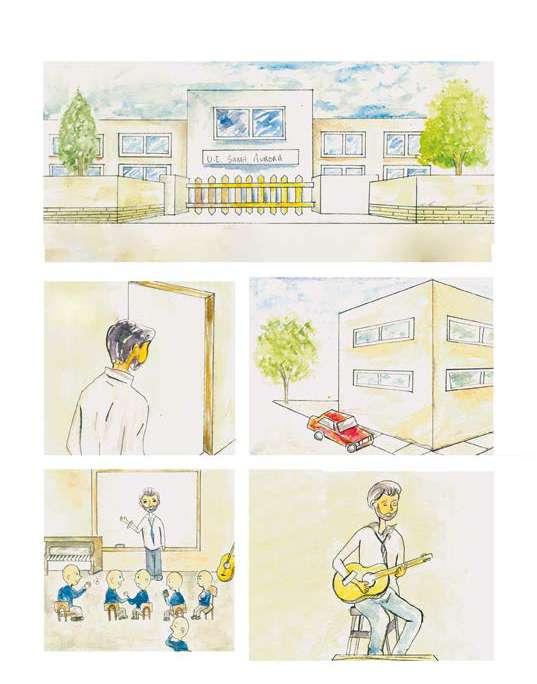
Today, a new music teacher arrives: Gabriel Rivas.
Entrance to the music room
School entrance
"Good morning, everyone! I’m your new music teacher."
Gabriel Rivas introduces himself to a group of scattered, distracted, indifferent students—undeniably… a profound disconnect.
"Music can be more than a subject… it can be your voice."
"Music? What a waste of time!"
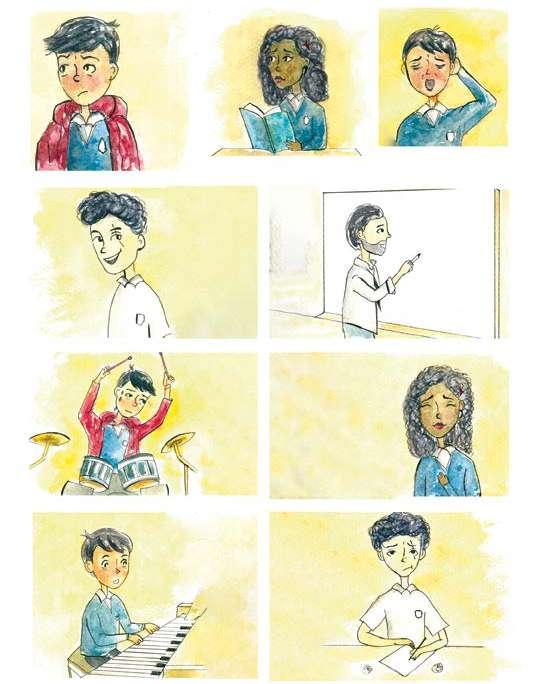
her
"Let’s play soccer instead, teach!"
Damián, always so relaxed, each one lost in his own world, where music had no place.
"Let all the noise stay in the drums…"
Enrique, on the drums—it’s not just rhythm, it’s everything he couldn’t say at home.
"How can something so old… sound so beautiful?"
"I don’t have time I work late."
"Write what you feel… Pain, anger, happiness—it doesn’t matter. Just let it out and try."
Gabriel didn’t want good grades He wanted to leave a mark on their lives!
"This song... why does it feel like it’s mine?
Camila didn't talk much. But when she sang, the room heard her soul.
"No, not that… How about: “I’m not what happened to me—I’m what I do with it.”
Manuel discovered a language he had never known... yet it had always been inside him."
Damián wrote so he wouldn’t forget who he wanted to become.
"Music is art! Magic! And… it judges no one."
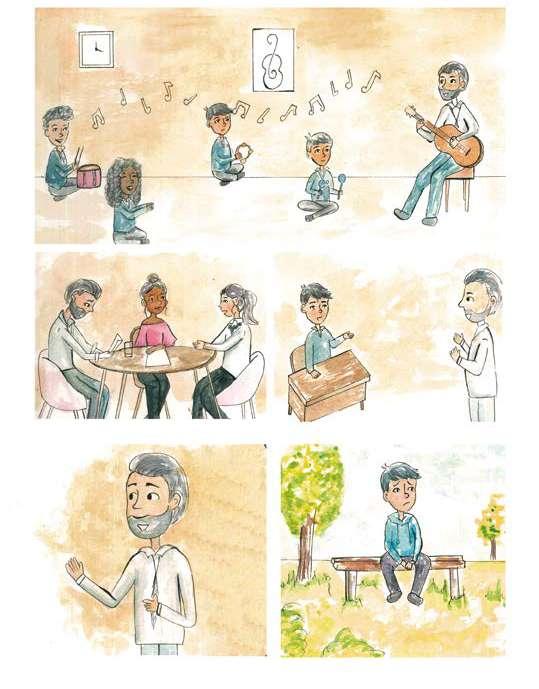
With each class, music seeped into Enrique’s heart.
"These kids have talent, but they need real support."
"With their grades… scholarships will be tough."
"I have an idea…"
Gabriel wanted more for his students: counseling, scholarships, a real future.
"Music is magical. But if you want to go far… you’ll need to study too."
"So what? I’m no brainiac! I just wanna play drums."
You will do it and you will study. Let no one tell you that you can't dream big!
The next day in music class…
"Since my brother died… nothing’s the same. I miss him so much."
That afternoon… After arguing with his dad, Enrique takes refuge in the park. Enrique felt he didn’t belong anywhere…
"Your mom said you’d be here… This song’s for you. You’re not alone, man."
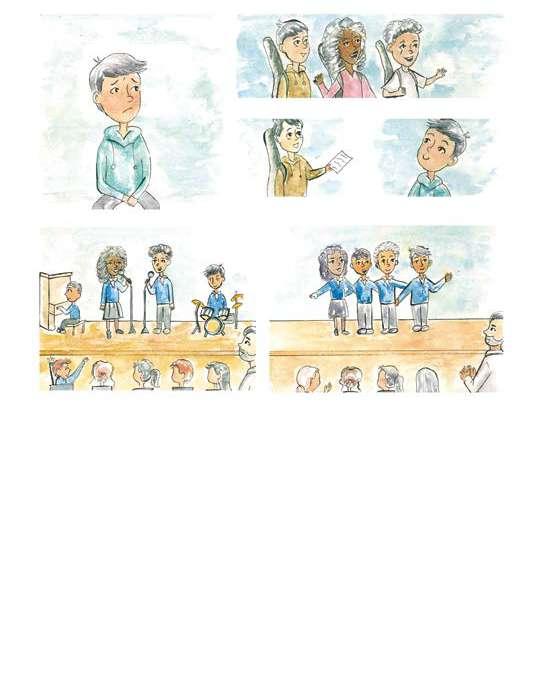
Enrique never expected this moment. His heart trembled. Comfort? Maybe. But for the first time in a long time... he didn’t feel alone
He didn’t know what he was searching for… until he felt it: a home, a family. And something inside him softly broke.
"It’s not where you’re from those matters… It’s where you’re going."
Gabriel watched them proudly, like seeing a seed bloom… one planted with heart.
Enrique had found his passion in music… and his strength in friendship.
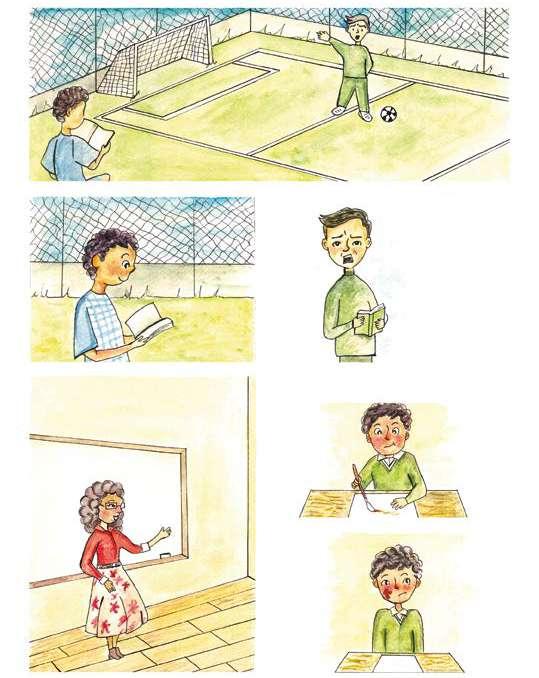
Come on, Alan! You can’t spend all day with those drawings!
When Alan opened his sketchbook, the world faded away. Only he and his drawings remained... his safe place.
I don’t want to play… I want to draw.
This won’t get you anywhere in life! A man is strong… not a dreamer!
The next day, Alan felt a strange calm. In Ms. Claudia’s class, everything seemed easier…
For the first time, Alan felt permission to be himself. He grabbed the brushes… and let everything out.
Kids!
Paint what you feel… without words… just color and tomorrow we will exhibit it in the courtyard.
How do you paint fear?...
"Exhibition day arrived! Parents and children wandered around the courtyard, looking at the paintings. Alan just wondered... would his dad come?"
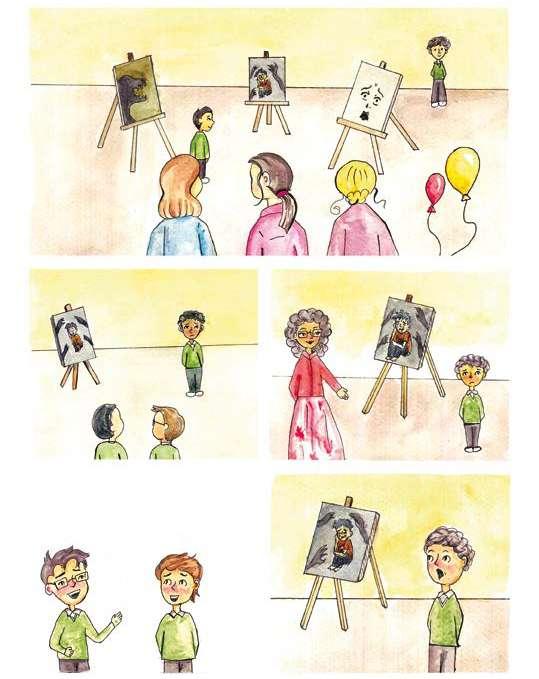
In front of his painting, he overheard comments… and every word tightened his chest.
Then, Ms. Claudia spoke. Slowly… the reactions began to shift Alan’s nerves.
That painting… looks like a monster.
Or a weird doodle.
Some classmates murmured to friends, their voices low… but Alan heard them.
It’s like… when I’m yelled at home and feel scared.
Or when I’m alone at recess and feel… empty.
Guys,gather round!
What do you feel or imagine when you see this painting?
Doubt
Alan never thought others could feel… the same way he did.
They… feel like me.
And then, through the crowd… his father appeared. Silent. Watching Alan’s painting from afar
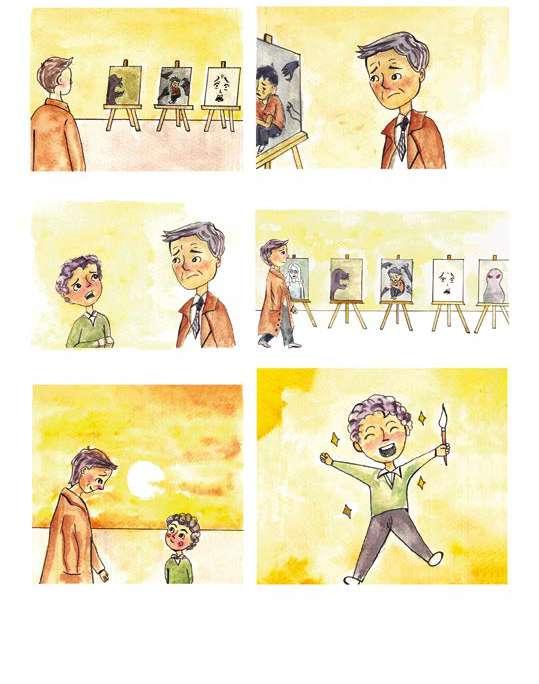
Alan said nothing… but in his eyes, he understood.
I was afraid too, as a boy… but I never painted it
The painting stirred old fears… and buried memories.
His father's words gave him safety, peace, confidence
His father walked past the paintings, silent. Something inside him… had begun to crack open.
Son… keep drawing what you feel. You’re good at it. I love you so much.
From that day on, everything changed. Alan was no longer afraid to express himself. Now… he drew freely.
"Sometimes, colors say what words cannot."
Amid the morning chatter, Professor Andrés begins math class
"Open your books to page 124!"
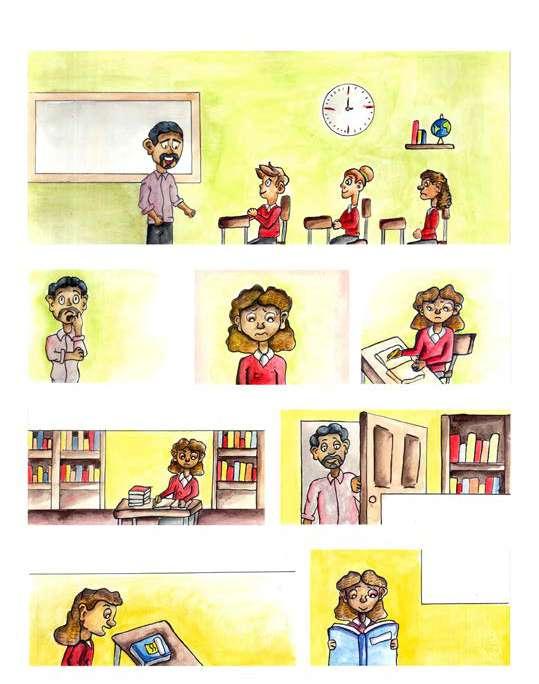
"I left mine at home, sir..."
"Again...? Be more careful, Eva. Don’t forget next time."
"Strange... Eva’s usually so responsible."
Eva felt embarrassed. She loved math, but that day... the embarrassment weighed heavier.
Silently, Eva scribbled cramped notes in her notebook. Every inch mattered. Each sheet was precious... like gold.
"Yes, sir..."
Later, in the library, Eva raced through math problems. Every stroke of her pencil spoke of effor
Her dedication moves me... Now I see why she had no book.
Andrés happened to pass by and spotted Eva from afar. He said nothing. But something stirred inside him—a push to act.
The next morning. Eva arrived early. On her desk sat the unexpected: a new book... and a note.
"Knowledge is like a tree: water it, and it grows. I only give you the seed. You’ll make it flourish. This seed is yours."
Eva took it with trembling hands.... When she opened it, her heart skipped a beat. The math book? Yes, it was!... the same one from Professor Andrés' class.
MOM, I WAS ABLE TO GET THE BOOK, THE TEACHER GAVE IT TO ME.
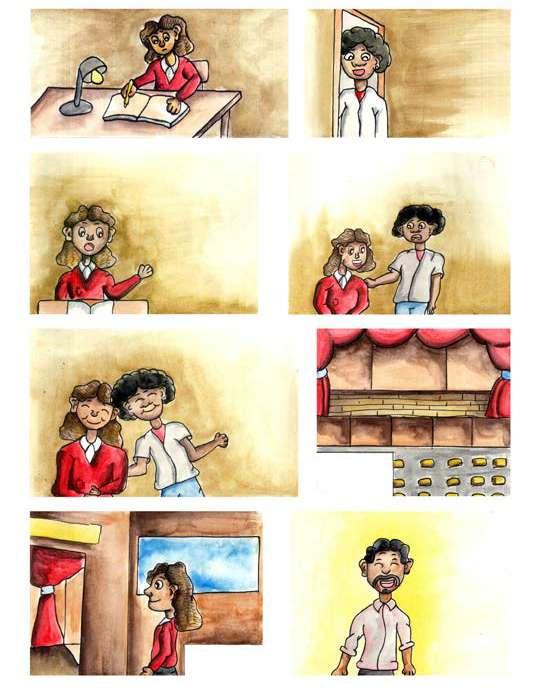
"I will! And guess what? He entered me in a math competition!"
Thank you, beautiful mommy. I love you very much too.
Thank you, my princess, for understanding us. I love you. I know you will do well in the contest
It's okay, Mommy. I know it's been a hard few days.
I understand. Tell him thank you... and that he can count on us. But... how?"
Thanks to you... I am here.
Despite her nerves, Eva had confidence in herself. Among so many looks, two filled her with faith: her mother... and the teacher who believed in her.
Competition day arrived. The room buzzed with nerves... pencils... and hope.
Sorry, daughter... your father's payment for his work is late.
I only gave you a seed. You turned it into a forest. Keep it up, Eva. Never give up... or stop believing in yourself.
"Shared knowledge can change lives. And perhaps, much more."
During P.E. class at Florida Uno School, Isabel felt overwhelmed and frustrated. Gymnastics didn’t come as easily to her as it did to the others.
Isabel watched her classmates. The knot in her chest tightened with every attempt she saw.
I’ll never be able to do that…
No matter how hard I try… it’s never enough.
Isabel tried a handstand… but fell sideways again. The fall didn’t hurt as much as failing once more.
Isabel… how are you feeling about gymnastics class?
¡Isabel felt demotivated… She saw her classmates performing the exercises with such ease, while everything felt twice as hard for her!
I can’t do it… It’s not for me.
Margarita’s words ignited a spark in Isabel! Still sad, she decided… not to give up.
You don’t have to be the best, Isabel! Just take it one step at a time. I’ll teach you some exercises to help you overcome your fear.
Thank you, teacher…
After class, Isabel trained with determination, without comparing herself to anyone. Her teacher watched from afar, proud of her effort.
That once-insecure girl… now managed to hold a handstand, even if only for a few seconds!
I did it!
This time… I’m going to make it! Way to Isabel!go,
The final class had arrived... Isabel felt her heart pounding; she wasn’t the same anymore... this time, she was ready.
Determined… she took a deep breath and raised her arms.
With all her strength and courage, she launched herself onto the mat. without fear.
She had done it! The handstand was hers! Surprised, happy… unstoppable!
Margarita approached proudly, watching Isabel overcome her fears and achieve her goal.
You did it!
¡Isabel not only conquered her fear of gymnastics… she also stopped comparing herself to others!
Remember, Isabel! True talent lies in progressing at your own pace. What matters is that you did it, surpassing yourself!
“Every talent is unique and valuable. We all deserve a safe space to learn and grow, just like Isabel did.”

Ana prepared to present...
No way!
Now, her gays couldn’t believe what they saw in Ana’s presentation!
My app can translate text into sign language... in real time! To help people with hearing disabilities.
Ana earned applause from her guys, who now looked at her with pride... even Teacher Lucía beamed with joy!
Ana receives an unexpected apology Ana, I’m sorry for mocking you before. You’re really talented!
Thanks, Carlos! Apology accepted. I love coding, and I want my idea to help others.
With courage... Ana didn’t just prove her talent—she broke barriers and lit the way for many more!
Talent has no gender and does not depend on resources; it just needs opportunities.
Once, at a school... teachers attended a thought-provoking workshop that began with a question...
All the objects belonged to the teachers' former students... but whose exactly?
Whose is this?
What do you think it takes to succeed in these professions?
The screwdriver and tools must be Mateo’s. He’s a skilled builder!
I bet the soccer ball is Juan’s—he’s a great athlete!
The medical bag has to be Tomás’s—he was always so bright!
Strength!
Well, dear teachers... let me introduce the real owners—your former students...
Courage!
Professional soccer player.
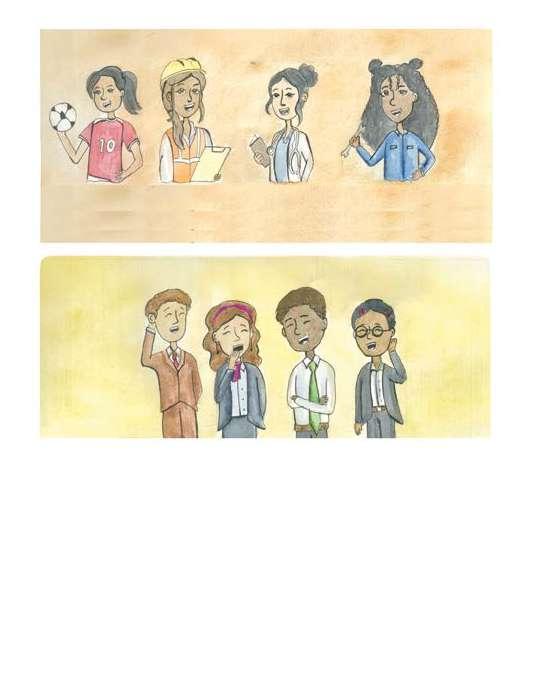
Industrial Engineering graduate.
Doctor and CEO of her own general hospital.
Automotive Engineer at a renowned car company.
And so, the teachers left stereotypes behind... because they learned dreams have no gender—and neither does talent.
Teacher Luz has a lovely garden. She tends to it every day, Monday through Friday.
In a school with a beautiful garden
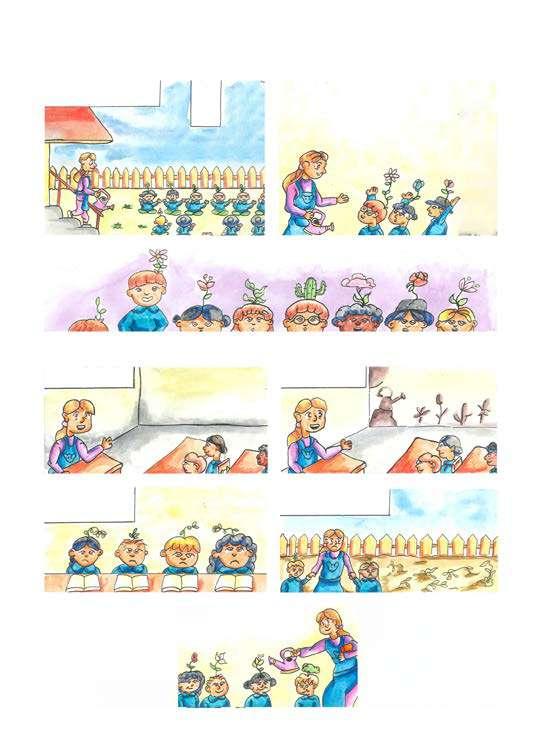
Every morning, the teacher greets each plant in the garden (the children)... She carries her watering can and begins teaching them all equally.
"Who wants help to grow?"
From the smallest to the tallest; from the reddest to the greenest; whether roses, carnations, cacti, or lilies... every plant had to learn to grow the same way, without adaptations.
Each plant is nurtured and made to grow just like the others...
the same assignments, the same way of learning, and the same tests." "My dear little flowers, you will all follow the same learning method:
The teacher doesn’t see the consequences. Soon, there’s no longer equal opportunity to grow, because each child’s specific needs go unmet.
Even as some flowers wilt, stall, or stop blooming…
In the end, Teacher Luz’s beautiful garden slowly withered away—only a few lonely flowers survived.
Perhaps if every flower in the garden had grown with equal care and equity—each receiving the specific support they needed—the teacher could have created a vibrant garden full of different, yet equally valuable, flowers.
"Everyone gets the support they need!"
Hi, my name is Omar. I just lost my grandmother. Since then, deep sadness and anxiety have robbed me of peace.
In an institute
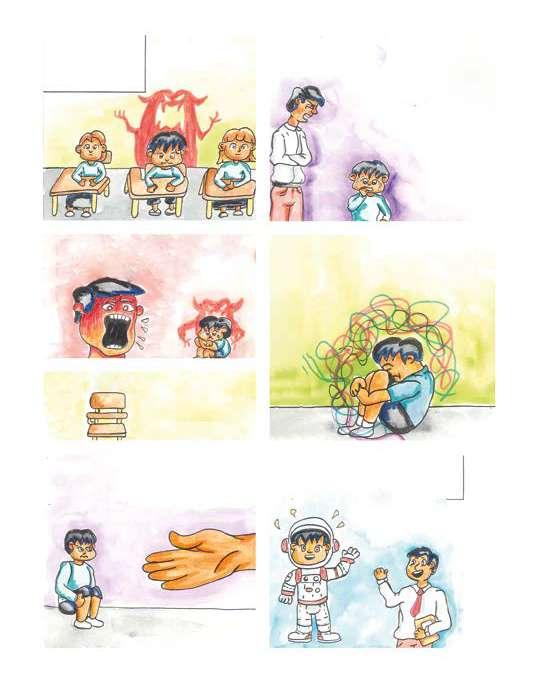
Lately, my grades dropped because I couldn’t focus… and the professor hasn’t stopped scolding me.
"You’re full of excuses!
Stop crying!
There’s no justification for missing work
There’s no justification for missing work
In the end, I left the institute, and never saw Professor Pérez again.
Maybe with a little support, I could’ve been the top student even with Professor Pérez. My dream was always to be an astronaut… and I will make it someday.
My greatest fear is Professor Pérez. Just seeing him makes me tremble. He’s a "strict disciplinarian."
"No doubt about it—you’re a defective kid! "
He constantly rages at me for not participating. His judgment is unfair…
"A defective kid who can’t overcome his problems is doomed to fail at life…"
If only Professor Pérez had shown empathy and flexibility, and had given me the trust and support I needed, I would have been trained as a professional in a healthy and resilient environment.
Carpentry workshop.
One day, you’ll build great things on your own, my girl.
Yes, Dad! I want to build huge buildings!
Ever since she was 10, Mariana had a passion for construction—thanks to her father, a carpenter.
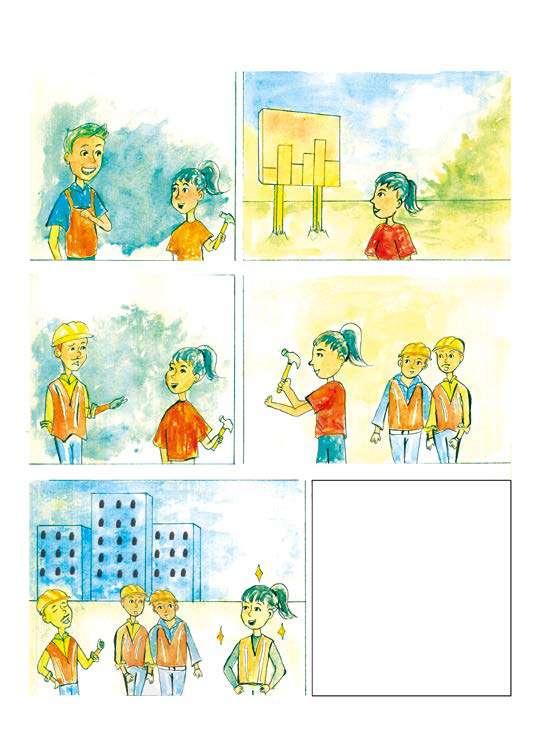
Are you sure you know what you’re doing?
Absolutely.
Just watch me.
Mariana who is 15 years old, stands in front of a building displaying a poster advertising an invitation to renovate the city's central square.
I CAN HELP WITH THE CONSTRUCTION!
When Mariana turned 15, she stumbled upon something during a walk—something that would change her life forever.
Everyone was amazed by Mariana’s confidence and skill.
You’re incredible, Mariana!
The next day, Mariana arrived at the renovation site early, tools in hand—but not everyone welcomed her.
All those who worked on the reconstruction are standing in front of the inauguration ribbon proud of their work.
Mariana, you’ve got a real future in construction—you’re brilliant! Sorry for doubting you.
At the grand reopening, the crowd gathered to celebrate their work.
Thank you. This is my dream.
Mariana after a few years in college. Inspired by her triumph and her city’s praise, she went on to study architecture.
From childhood, Yuri was fascinated by construction. She dreamed of connecting communities like the engineers before her.
One day, I’ll build bridges for my people too!
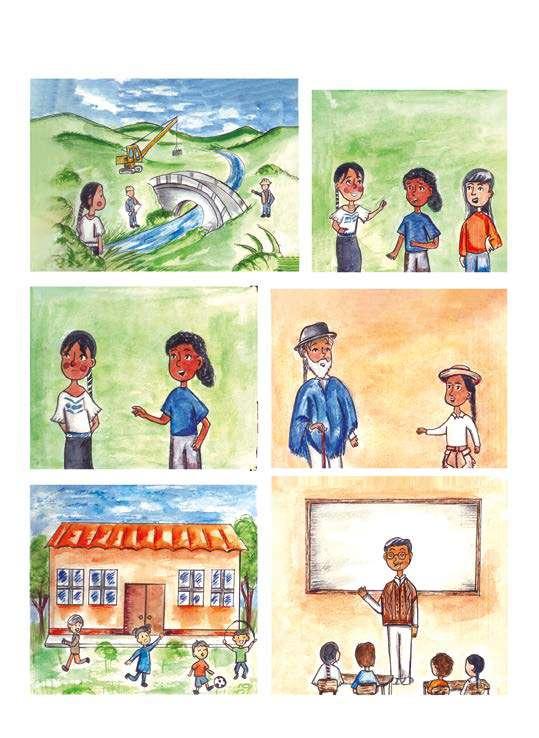
I won’t let this stop me...
Come on, Yuri! It’ll be fun!
But in her community, engineering was still seen as men’s work.
Girls, I saw the bridge! It’s amazing!
I don’t know, Yuri... That’s for boys.
Yeah, Yuri. Let’s go weave instead.
In the only school for miles, where first-graders shared slates with teenagers, Yuri and Kunaq's paths finally crossed
Meanwhile, in Imantag, Kunaq grew up immersed in ancestral music and dance.
Son, the Inti Raymi dance tells our people’s story... Carry it to the world!
Yes, Grandfather! I promise our culture won’t be forgotten!
The years turned like pages in their shared notebook.
Each of you will demonstrate your unique talents to the community.
I'll build a bridge!
I'll share my gift...
Later that afternoon at Yuri's home...
Honey, our ancestors used these very materials to build roads. Do you need help?
Yes, grandpa! Thank you!
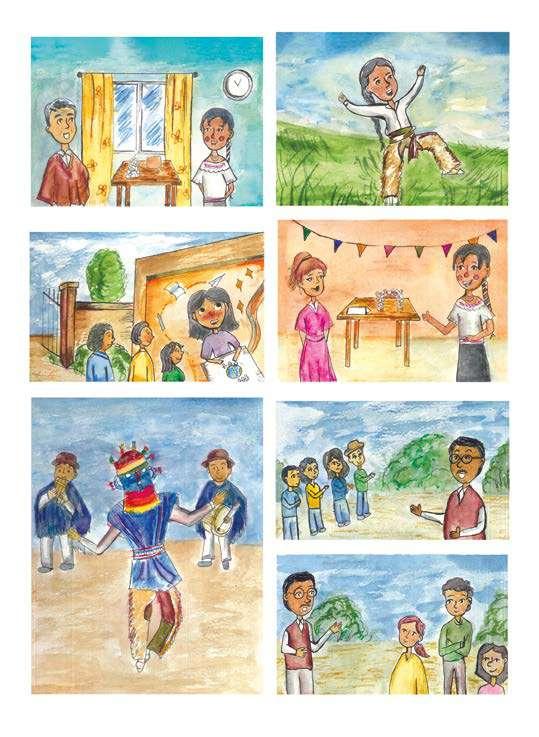
The big day arrived at last...The courtyard hums with anticipation as students and families crowd together, eager faces turned toward the demonstration area.
Meanwhile, Kunaq was practicing his dance with great dedication.
Kunaq’s Inti Raymi performance began. Every movement told a story.
His movements are broad and powerful, like the rising of the dawn!
Incredible! It’s just like the Inca suspension bridges!
This bridge uses ancestral Andean techniques. It doesn’t just connect places—it connects stories!
The mesmerized audience saw more than just a performance - they witnessed their living history.
Every movement... every step... tells the story of our land" This... this is our heritage!
As the event closed, something greater than talent had been revealed...
There are infinite paths to greatness!" "Our culture isn't just history" "It's the foundation we build upon!!
In Pimampiro, Ñusta found happiness in numbers... though some said they weren’t for her.
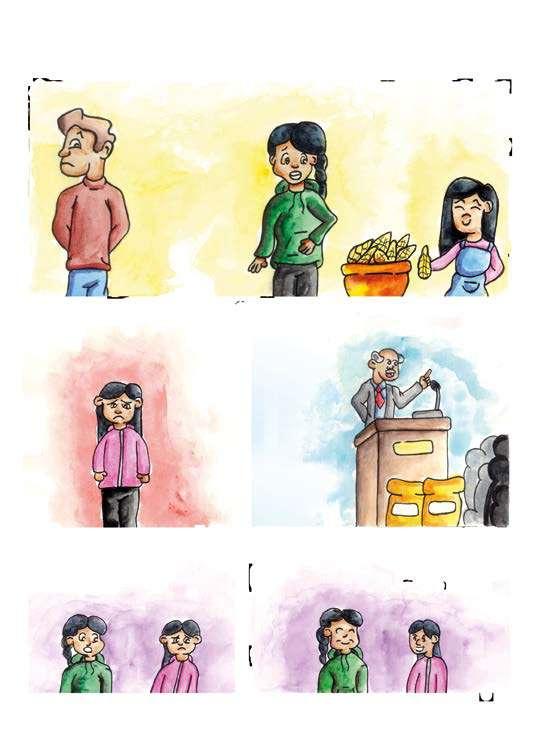
¡Ñusta baby! How many corncobs are left?
That girl should be learning to cook... not math.
At only 15 years old, the words of others were shaking his confidence.
What if they’re right? What if… numbers aren’t for me?
15, Mom! If we sell 3… we’ll have 12.
Ñusta was excited... but her look also showed fear.
Why not join, baby? You would do great!
I don’t know, Mom…What if I am wrong in front of everyone?
During the barter market, the alcalde surprised everyone with an announcement.
Today, we’ll see who best organizes goods and calculates fair prices! The winner gets a sack of quinoa and a handwoven blanket!
Seeing her hesitate, her mother decided to remind her of her strength.
Baby, your hands can knit... and count too!
Thanks, Mom. I will do it... I’m going to participate!
The contest began. One by one, participants took the stage.
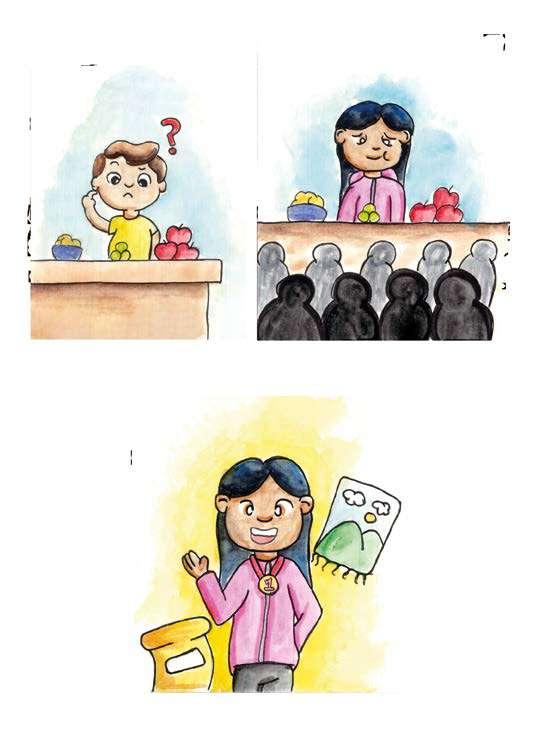
Some people got confused... until it was Ñusta's turn.
If I sort the bags by weight... it will be easier to calculate the exchanges.
swift as the
That's great!
Look how she organizes everything!
Ñusta won! She proved knowledge has no gender. From that day on, her community believed in her and knew her talent could uplift them all.
This story begins on a journey to Quito for a musical performance.
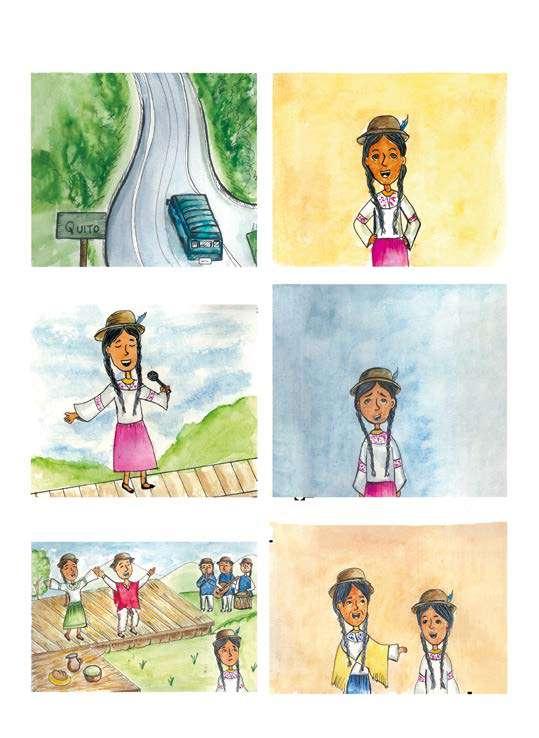
Killa loves singing at events and festivals. Even if not everyone values the Kichwa language...
cay chiri tutapi... (In this cold night)
This is Killa, a girl from Cayambe... her dream has always been to become a famous singer in her country.
I love sharing songs from my homeland! I always sing in my native language.
How embarrassing! Am I making a fool of myself? They don’t even understand what I’m singing!
Haha, what did she say?
So lame... she can’t even speak! Haha
After some time, Killa returns to Cayambe just in time for the town festivities...
Though Killa loved her culture, she feared rejection as a singer for preferring Kichwa...
Should I sing more in Spanish? Maybe I should start forgetting my mother tongue...
I won’t even try to sing with them. Everyone prefers songs in Spanish!
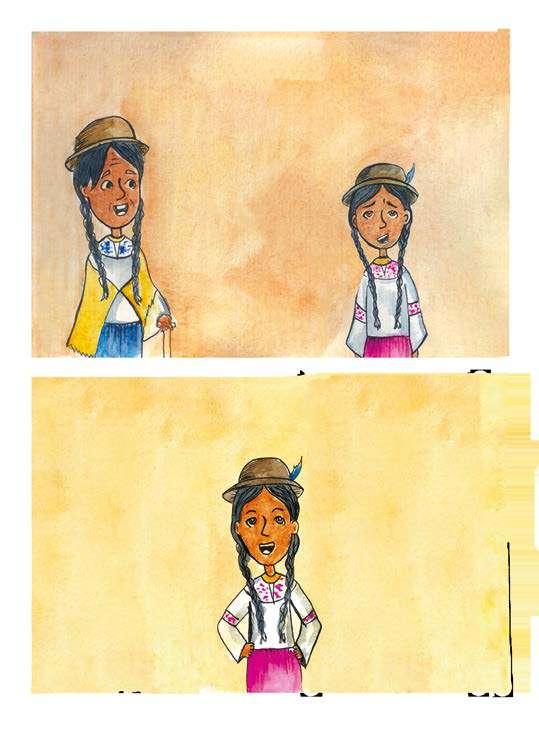
You seem sad. What’s wrong?... Don’t you want to go on stage, dear Killa?
I don’t feel like it, Teacher Sisa... I think I’ll stop singing in Kichwa. Even if singing in other languages doesn’t make me happy.
In the end, Killa felt the desire to speak her language without fear, and with pride, she would continue speaking her native tongue
You’re right . I have no reason to be ashamed. I should be happy. From now on, I’ll break the stereotypes about our language in the city and help more children learn to speak it
Almaguer, J., Vargas, V., García, H. (2014). Interculturalidad en salud: Experiencias y aportes para el fortalecimiento de los servicios de salud. {Interculturality in health: Experiences and contributions for the strengthening of health services} .Secretaría de Salud. http://www.dged.salud.gob.mx/ contenidos/dged/descargas/docs/InterculturalidadSalud.pdf
Balón, K., Pino, R. (2024). Estrategias psicopedagógicas para la Regulación Emocional en una Niña Con Ansiedad en la Escuela de Educación Básica Abraham Lincoln{ Psychopedagogical Strategies for Emotional Regulation in a Girl with Anxiety at Abraham Lincoln Elementary School}. Redilat, 1(1). https://doi.org/10.56712/latam.v5i4.2304
Bentley, T. G. K., Seeber, C., Hightower, E., et al. (2022). Slow-breathing curriculum for stress reduction in high school students: Lessons learned from a feasibility pilot. Frontiers in Rehabilitation Sciences, 3, Article 864079. https://doi.org/10.3389/fresc.2022.864079
Bravo, M. (2017). Estrategias metodológicas para mejorar y controlar las emociones de niños y niñas de tres a cuatro años en la escuela de educación básica gaspar Sangurima del cantón Cuenca – provincia del Azuay 2017. { Methodological strategies to improve and control the emotions of children from three to four years old in the school of basic education gaspar Sangurima of the canton Cuenca - province of Azuay 2017}. Universidad politécnica salesiana- sede Cuenca. https://dspace.ups.edu.ec/bitstream/123456789/14390/1/UPS-CT007061.pdf
Chávez-Martínez, A. L., & Salazar-Jiménez, J. G. (2024). Relación Entre Inteligencia Emocional Y Rendimiento Académico En Adolescentes: Aportes Para La Práctica Educativa. { Relationship Between Emotional Intelligence And Academic Achievement In Adolescents: Contributions to Educational Practice}RECIE. Revista Caribeña de Investigación Educativa, 8(1), 145–166. https://doi.org/10.32541/recie.2024.v8i1. pp145-165
Comboni, S., Juárez, J. (2020). Interculturalidad y diversidad en la educación: Concepciones, políticas y prácticas.{ Interculturality and diversity in education: Conceptions, policies and practices}. Universidad Autónoma Metropolitana, Unidad Xochimilco. https://biblioteca.clacso.edu.ar/ Mexico/dcsh-uam-x/20201118022700/Interculturalidad-Educacion.pdf
Cruz, E. (2013). The plurinational state, interculturality and indigenous autonomy: A reflection on cases of Bolivia and Ecuador. VIA IURIS. 1(14). 56-59. https://www.redalyc.org/pdf/2739/273929754005.pdf
Cueva, C. G., Hurtado, O. B., & Sucuy, D. (2025). La violencia intrafamiliar y su incidencia en el rendimiento estudiantil.{ Domestic violence and its impact on student achievement} LATAM Revista Latinoamericana de Ciencias Sociales y Humanidades, 5(6). https://doi.org/10.56712/latam v5i6.3267
Decolonised Minds. (2022). The role of cultural healing practices in trauma recovery for marginalised communities https://decolonisedminds.ie/ the-role-of-cultural-healing-practices-in-trauma-recovery-for-marginalised-communities
García, M. (2014). Arte y corporeidad, una apuesta para el diálogo intercultural. { Art and corporeality, a commitment to intercultural dialogue} Dialnet. 1(20). https://dialnet.unirioja.es/servlet/articulo?codigo=5533827
Garn, A. C., Matthews, M. S., Jolly, J. L., & Callahan, C. M. (2021). Emotion regulation and the classroom: How teachers and students manage emotions to improve learning. Springer.
Goleman, D. (1995). Inteligencia emocional.{ Emotional intelligence} Editorial Kairós. https://www.editorialkairos.com/catalogo/p/inteligencia-emocional
Gonzales, L., Aules, L., Agualongo, L., Contreras, K., & Orrala, A. (2025). El Rol de la Familia en el Proceso de Aprendizaje de los Educandos.{ The Role of the Family in the Learning Process of the Learner}. Ciencia y Reflexión, 4(1), 2002-2015. https://doi.org/10.70747/cr.v4i1.180
Guzmán, M. (2018). La importancia de las metodologías adaptativas en la educación contemporánea. { The importance of adaptive methodologies in contemporary education} Revista de Pedagogía y Educación Inclusiva, 12(3), 40-50.
Le Mur, R. (2020). ¿Qué es el diálogo intercultural y cómo podemos lograrlo?{ What is intercultural dialogue and how can we achieve it?} AMIDI. https://www.amidi.org/dialogo-intercultural/
Londoño, S., Ossa, J., Lasso, P., Castellanos, E. (2018). Diálogos interculturales latinoamericanos: Hacia una educación superior intercultural. { Latin American Intercultural Dialogues: Towards an Intercultural Higher Education}. Editorial Bonaventuriana. 107-108 https://www.editorialbonaventuriana.usb.edu.co/libros/2018/pdfs/dialogos_interculturales. pdf
Mejía, M., Yepez, C. (2023). El acompañamiento y su influencia en el rendimiento académico de los estudiantes de Octavo Año de Educación
General Básica.{ Accompaniment and its influence on the academic performance of students in the eighth year of General Basic Education} Zenodo CERN European Organization For Nuclear Research. https://doi. org/10.5281/zenodo.8056092
Mendoza, M., Cárdenas, J. (2022). Importancia de la participación familiar en la educación de los estudiantes del nivel inicial. { Importance of family participation in the education of early childhood students} Revista Estudios del Desarrollo Social: Cuba y América Latina, 10(2). http://scielo.sld. cu/scielo.php?script=sci_arttext&pid=S2308-01322022000200024&lng=es&tlng=es.
Ministerio de Educación. (2020, junio 14). Prácticas restaurativas en el ámbito educativo. { Restorative practices in education} educación.gob.ec. https://educacion.gob.ec/practicas-restaurativas-en-el-ambito-educativo/ Moreno, M. (2024). ¿Trauma y educación? Una perspectiva desde la promoción de salud mental en las escuelas.{ Trauma and Education: A Mental Health Promotion Perspective in Schools}. Notas de Política En Educación, 9 https://educacion.uniandes.edu.co/sites/default/files/educacion/Archivos/Notas %20de%20pol%C3%ADtica/2024/NotaDePolitica-Trauma-Educacio%CC%81nV2.pdf
Pazmiño, J., Chávez, A., Cordero, C. (2022). Acompañamiento psicopedagógico y familiar a estudiantes con problemas en el desarrollo de la lectoescritura.{ Psycho-pedagogical and family support for students with reading and writing development problems} Revista EDUCARE - UPEL-IPBSegunda Nueva Etapa 2(26), 666-686. https://doi.org/10.46498/reduipb. v26iextraordinario.1640
Pinargote, P. P., Loor, L. W., Reyes, E., & Intriago, M. (2022). La violencia intrafamiliar y su incidencia en el rendimiento académico en etapa escolar. { Domestic violence and its incidence on academic performance at school} Revista Electrónica Formación y Calidad Educativa (RefCalE), 10(3).
Ruales, R., Lucero, S., Gómez, Á. (2022). La autorregulación emocional desde una perspectiva educativa.{ Emotional self-regulation from an educational perspective} Revista Fedumar Pedagogía y Educación, 9(1), 6473. https://doi.org/10.31948/rev.fedumar9-1.art-4
Schmitz, J. (2020). Manual de prácticas restaurativas en el ámbito educativo. { Handbook of restorative practices in the educational setting} VVOB – Educación para el Desarrollo. https://ecuador.vvob.org/sites/ecuador/ files/2020_ecuador_eftp_manual_practicas_restaurativas.pdf
Universidad Pablo de Olavide. (2024, 2 julio). Escuelas sensibles al trauma para mejorar trastornos de conducta y problemas de convivencia – DUPO –Diario de la Universidad Pablo de Olavide.{ Trauma-sensitive schools to improve behavioral disorders and coexistence problems - DUPO - Journal of the University Pablo de Olavide} https://www.upo.es/diario/cursos-verano/2024/07/escuelas-sensibles-trauma-mejorar-trastornos-conducta-problemas-convivencia/ Villegas, J. (2023). Regulación emocional y bienestar psicológico en adolescentes de la provincia de Tungurahua.{ Emotional regulation and psychological well-being in adolescents from the province of Tungurahua} Pontificia universidad católica del ecuador- sede Ambato https://repositorio.puce.edu.ec/server/api/core/bitstreams/f8e75f4b-3c71-42a9-981d02988f232014/content
Ingrid
Huera-Mites1, Deisy Murillo-H1, Leslie Marcillo1, Geraldine Bajaña-Díaz1
1Facultad de Educación, Ciencia y Tecnología, Universidad Técnica del Norte, Ecuador
ijhueram@utn.edu.ec, damurilloh@utn.edu.ec, lamarcillop@utn.edu.ec, gabajanad@utn.edu.ec
Introduction
In Ecuador, the concept of interculturality began to gain recognition in the late 20th century as a result of social struggles led by Indigenous organizations seeking comprehensive recognition and respect for their cultures, languages, and ways of life. Although the term “interculturality” was already used in Latin American academic circles, in the Ecuadorian state, it emerged from grassroots communities, particularly through Intercultural Bilingual Education (Educación Intercultural Bilingüe, EIB). During the 1980s, movements like the Confederation of Indigenous Nationalities of Ecuador (Confederación de Nacionalidades Indígenas del Ecuador, CONAIE) and the National Directorate of Intercultural Bilingual Education (Dirección Nacional de Educación Intercultural Bilingüe, DINEIB) proposed an educational model that translated school content from Spanish into Kichwa and other indigenous languages. An academic framework based on ancestral knowledge, values, and worldviews was established. In this way, interculturality emerged from the community as a collective need to reclaim and legitimize Indigenous identity (Pilaguano, 2018).
According to Astudillo (2020), one of the most productive settings for intercultural practice has been the community. The process of teaching and learning from the community is a political, social, and
spiritual act that positions ancestral wisdom as a living heritage, transmitted across generations. In the Ecuadorian context, multiple Indigenous communities have developed participatory mechanisms to preserve their customs and knowledge. For example, mingas (community work gatherings) exemplify collaborative labor and transmit knowledge about planting, agricultural cycles, rituals associated with Pachamama (Mother Earth), and ancestral medicine. In the Ecuadorian Amazon region, peoples like the Kichwa, Shuar, and Achuar integrate spiritual and botanical practices into daily life, recognizing nature as a living educational space. These practices resist cultural colonization while adapting to contemporary social contexts (Bravo et al., 2023).
Indigenous leaders play a central role in local education. These community figures act as guardians and mediators of ancestral knowledge. By acting as guides in alternative educational processes, they extend their cultural practices into activities tied to nature and their surroundings. An example of this can be seen in the San Pedro de Quilotoa community in Cotopaxi province, where decisions about classroom construction, curriculum design, management of school activities and community resources allocation were made collectively by the cabildo (local council), families, and teachers with a shared goal: to strengthen intercultural education in the long term from within the community (Pilaguano, 2018).
In intercultural education, language and art are priority focus areas. Some educational strategies to integrate this knowledge into formal learning process include linguistic recovery workshops, such as strengthening the Kichwa language in Imbabura province or Shuar language in Morona Santiago. In terms of artistic expression, the revitalization of traditional arts is prioritized through teaching weaving, body painting, ancestral music, and ceremonial dance. These intercultural teaching strategies restore cultural pride to new generations, transforming community education into a holistic process that affirms diverse ways of experiencing the world (Astudillo, 2020).
At the institutional level, Decentralized Autonomous Governments (GADs) have implemented heritage education programs with direct community involvement. For example, in Otavalo, the 2023 Management Report (Diario El Norte, 2025) highlighted collaboration
with the National Institute of Cultural Heritage (INPC) to update inventories of tangible and intangible heritage, integrate traditional knowledge into community museums, and develop educational routes for local cultural heritage. This vision has created spaces for cultural retention, where Kichwa attire, traditional festivals, and agricultural knowledge become part of municipal school curricula.
Academically, research collaborations between higher education institutions and communities have been promoted. Within the study Ancestral Knowledge of the Kichwa Otavalo People and Its Influence on Cultural Tourism (Castro-Viera et al., 2022) notes that ancestral knowledge is an integral part of cultural identity and influences cultural tourism practices. Such collaborative research significantly contributes to recognizing interculturality as an educational process that values the tangible and intangible heritage of Ecuadorian diversity.
Learning from the community represents a multidimensional educational approach that integrates the participation of multiple stakeholders across different levels of contribution. Through their legacy, these actors validate ancestral knowledge, strengthen cultural identities, and stimulate interdependent learning methods. For higher education and national and international researchers, these community-based experiences provide fertile ground to rethink and relearn knowledge production processes, co-research, and teaching connected to the urgent needs of Indigenous peoples and nationalities. In a globalized world, intercultural education positions itself as an axis of transformation, capable of fostering legitimate dialogues between Indigenous and academic knowledge, always rooted in the preservation of Ecuador’s living cultural heritage (Agualongo, 2025).
Learning from the Community is a chapter that includes visual narratives to illustrate how community-based learning and intercultural education integrate ancestral knowledge into traditional education through stories showcasing the richness of blending diverse cultures in the educational sphere. The chapter includes 12 comics where readers follow a group of students and their teacher on a journey through Ecuador’s regions. Along this quest for community knowledge, they listen to stories, observe traditional practices, and
connect with the worldviews of those who preserve their identity across generations.
The integration of ancestral knowledge in language and arts in Ecuador is a fundamental educational strategy to preserve and revitalize Indigenous cultures. This integration addresses the need to preserve languages and artistic expressions while promoting intercultural education that recognizes and values the country’s cultural diversity. The following section presents various strategies implemented in the Ecuadorian context to achieve this integration.
• Incorporation of ancestral knowledge in the technical training of the intercultural bilingual education system (SEIB): The SEIB is a key space for integrating ancestral knowledge into Ecuadorian education. According to Segundo and Espin (2025), incorporating Indigenous worldviews into technical secondary school education enables the articulation of scientific knowledge with traditional practices, strengthening cultural identity and promoting sustainable models of local development. This integration is achieved through the contextualization of curricular content, the incorporation of participatory methodologies, and the alignment of technical knowledge with natural cycles and food sovereignty from a community perspective.
• Use of active and decolonial methodologies in arts education: Arts teaching in intercultural contexts has adopted active and decolonial methodologies that facilitate the transmission of ancestral knowledge. Fajardo-Minchala (2020) proposes a model of didactic planning that recognizes the legacy of ancestral wisdom related to medicinal plants and caregiving practices, highlighting women’s role in preserving this knowledge. Through group activities incorporating sensory perception exercises, games, and interviews, students collectively construct knowledge and recognize how ancestral wisdom is preserved in the memory and practices of women in their communities.
• Implementation of school gardens as intercultural learning spaces: School gardens have increasingly become
intercultural learning spaces where ancestral knowledge related to agriculture and traditional medicine is integrated. According to Rodríguez Jara et al. (2020), the “TiNi” methodology (Tierra de Niños, Niñas y Jóvenes para el buen vivir - “Land of Girls, Boys, and Youth for Good Living”), promoted by the Ministry of Education of Ecuador, encourages the creation of school gardens, fostering educational activities through environmental and intercultural approaches. In the community of Taday, a rural parish in the canton of Azogues, in the province of Cañar, the implementation of this methodology has enabled the participation of teachers, students, and parents. This process has facilitated the intergenerational transmission of ancestral knowledge and has contributed to the strengthening of the community’s cultural identity, which is characterized by its Andean richness and traditional practices.
• Teacher training in
Education: Teacher training is essential for the effective implementation of strategies that integrate ancestral knowledge into language and arts education. Martínez et al. (2020) argue that ethnoeducation in Ecuador serves as a crucial tool for preserving the cultural identity of ancestral peoples, particularly through the intercultural bilingual education system. However, challenges remain in implementing models that value Indigenous knowledge, especially concerning ancestral territories. Ongoing teacher training is vital to overcoming these limitations and promoting inclusive intercultural education.
The integration of ancestral knowledge in language and arts education in Ecuador constitutes an educational strategy that contributes to the preservation of Indigenous cultures and promotes inclusive intercultural education. Through incorporating Indigenous worldviews into technical training, the use of active and decolonial methodologies in arts education, implementing school gardens as intercultural learning spaces, and providing teacher training in Intercultural Bilingual Education, an educational model is achieved that recognizes and values the country’s cultural diversity. These strategies strengthen the cultural identity of Indigenous peoples, promote sustainable local development models, and contribute to building a more equitable and pluralistic society.
Participatory documentation of community knowledge is defined as a collaborative process in which communities are accompanied by academic or institutional actors to record, preserve, and transmit traditional, cultural, ecological, or practical knowledge through inclusive contextually grounded methodologies (Atzmanstorfer et al., 2025). This type of documentation is framed within approaches such as Participatory Action Research (PAR), citizen science, and documentation, with the central goal of democratizing knowledge production, recognizing the epistemic authority of communities, and strengthening cultural sustainability (Zamiri & Esmaeili, 2024).
Valuing community knowledge as legitimate sources of knowledge challenges conventional academic paradigms, which often subordinate local knowledge to institutional scientific knowledge. Participatory research involves a deliberate redistribution of power across all stages of the research process, from the formulation of research questions to dissemination of findings (Dadich et al., 2019). This approach aligns with collaborative and Indigenous research frameworks, which emphasize that citizen science and participatory research shift epistemological control to marginalized groups, reinforcing their agency in decision-making about their territories and cultures (Wolff et al., 2021).
The study by Zamiri and Esmaeili (2024), which focuses on methods and technologies for knowledge exchange in learning communities, identifies key processes such as mentorship, collaborative virtual spaces, and participatory digital tools that foster community engagement in knowledge documentation. Their findings demonstrate the success of participatory digital platforms depends on factors such as usability, user-centered design, cost-free accessibility, community marketing, community-led outreach and process management, elements equally applicable to participatory documentation initiatives (Atzmanstorfer et al., 2025).
The methods employed vary depending on context and the knowledge being documented but typically include visual, audio-visual, and digital strategies:
• Participatory videos: Recent studies highlight their usefulness in capturing peripheral knowledge, giving community members an active role in co-creating audio-visual content.
• Digital community archives: These create repositories autonomously managed by the communities, who define content, permissions, and access, preserving their autonomy and cultural representation.
• Participatory mapping: Geospatial tools enable the representation of knowledge linked to territories, environmental practices, and ceremonial routes. Success criteria include ease of use, data privacy, and alignment with community decision-making processes (Atzmanstorfer et al., 2025).
• Oral narratives and living practices: Participatory research with Indigenous peoples emphasizes the value of local narratives shared through workshops, semi-structured interviews, or audio-visual recordings, preserving the voices of elders, youth, and knowledge holders (Davis & Ramírez, 2021).
• Ethical and epistemological principles: Ethical principles include informed consent, local control over data, reciprocity, and transparency. Research with Indigenous communities stresses that agendas must emerge from the community, be co-designed, and be co-governed (Smith, 2012). Cochran et al. (2008) underscore the importance of validating local epistemologies as legitimate and operational within formal documentation projects, avoiding reductionism.
• Additionally, emerging initiatives in artificial intelligence, such as automated translation of Indigenous languages, highlight
how including native speakers strengthens the cultural and ethical validity of documented knowledge (Mager et al., 2023).
Participatory documentation methods are essential tools for preserving and making visible the knowledge of Indigenous and local communities, linking tradition and technology. Beyond recording knowledge, these processes generate tangible impacts on social cohesion, governance, and cultural projection. However, despite their many benefits, participatory documentation faces structural and ethical challenges that affect its reach and sustainability. The following section outlines the main positive impacts observed in practice, as well as persistent challenges requiring attention to consolidate truly inclusive and culturally relevant models (Atzmanstorfer et al., 2025; Davis & Ramírez, 2021; Smith, 2012).
• Identity strengthening: Documenting knowledge revitalizes intergenerational ties and reinforces cultural pride.
• Advocacy capacity: Documented community knowledge serves as valuable evidence for interventions in health, environment, or cultural policies, particularly when using citizen science (Wolff et al., 2021).
• Collaboration and local governance: The documentation process reinforces community organization and social accountability mechanisms.
• Digital divide: Limited access and technological literacy restrict participation, making it essential to develop user-friendly platforms and training support (Atzmanstorfer et al., 2025).
• Data protection and intellectual property: Protocols are needed for the use and safeguarding of sensitive knowledge, incorporating both customary and legal frameworks.
• Funding and sustainability: Participatory documentation requires logistical and technical resources; financial co-responsibility
strengthens long-term community commitment (Cochran et al., 2008).
Suggested methodological guidelines include the following stages:
• Joint diagnosis and planning: Identify the knowledge systems to be documented through deliberative workshops involving youth, elders, artists, and local wisdom keepers.
• Collaborative ethical and technical design: Establish mixed committees to decide on formats (audio, video, text, digital maps) and mechanisms for validation, intellectual property, and access.
• Training and piloting: Provide training to facilitate the use of cameras, geolocation tools, or community-based digital platforms.
• Co-documentation: interviews, oral narratives, field visits, maps, and videos, all with active community roles.
• Collective reflective analysis: Engage in collaborative classification and interpretation of data, ensuring interpretations remain faithful to the context and are not externally imposed.
• Internal validation and circulation: Community presentations, local festivals, and community repositories to share and validate documentation formats.
• Scaling and external transfer: Publications, intercommunity workshops, and visibility in networks or academic spaces, with protocols in place to ensure discretion when needed.
• Monitoring and evaluation: Evaluate the impacts, review formats and use of documented materials, and adjust processes to ensure relevance and renewal.
The following recommendations are provided for implementation:
• Accessible technological platforms: Design or adapt simple tools with user-friendly interfaces and the possibility of offline functionality, which guarantee usability (Atzmanstorfer et al., 2025).
• Mentorship and ongoing training approach: Step-bystep guidance from local facilitators enhances skills and prevents technological abandonment (Zamiri & Esmaeili, 2024).
• Hybrid data governance: Design collections managed by the community with their own access criteria, legal backup, and epistemological control.
• Mobilization of community resources: Promote contributions of time, spaces, ancestral knowledge, and partnerships with NGOs, universities, or public centres, with clear agreements of shared responsibility (Cochran et al., 2008).
• Adaptive evaluation approach: To incorporate active feedback, iterative adjustments, and follow-up to ensure continuous relevance and progressive empowerment.
Participatory documentation of community knowledge represents a transformative strategy to strengthen cultural autonomy, generate applied evidence for local development, and promote epistemic justice. Recent studies demonstrate that success depends on community-centered digital design, tailored training, and strong mechanisms for community governance of knowledge. This approach deepens citizen science by integrating it with the protection of local knowledge systems, ensuring that community members themselves are the ones who record, interpret, and manage their own legacy.
The participation of community leaders in Ecuador, framed within intercultural contexts, constitutes a complex and fundamental
phenomenon for ensuring social cohesion, local governance, and the effective exercise of collective rights. Given the country’s plurinational and multicultural composition, community leadership acquires particular dimensions where dialogue between worldviews, traditional knowledge systems, and state structures becomes indispensable (Pazmiño-Caiza et al., 2023).
• Community leadership and interculturality in Ecuador: Ecuador is constitutionally recognized as a plurinational and intercultural state, which implies formal recognition of the coexistence of diverse peoples and nationalities with their own cultural and political systems. In this context, community leaders fulfil strategic functions by articulating collective interests, promoting local development, and defending territorial and cultural rights (Guamán & Bustos, 2022). According to research conducted in Kichwa communities in Ecuador’s highlands, leadership is based on ancestral practices where the mashi or community representative is chosen by consensus and acts as guarantor of Sumak Kawsay or Buen Vivir (Pazmiño-Caiza et al., 2023).
• Interculturality presents an additional challenge: Managing spaces where community-specific logics converge with state or globalized regulatory frameworks. In these processes, leaders become symbolic and practical bridges that facilitate understanding and cooperation between actors with different worldviews (Loor et al., 2022).
• Social and political function of community leaders: Community leaders perform multiple roles including local administrative management, internal conflict mediation, dialogue with government authorities, and promotion of productive or environmental initiatives. A study conducted in Indigenous and AfroEcuadorian communities in the country’s north emphasizes that these leaders derive their legitimacy from community values, experience, and commitment, factors that distinguish them from externally appointed or politically designated leaders (Moreta et al., 2022).
Furthermore, in intercultural contexts characterized by historical inequalities, the actions of community leaders are crucial for demanding compliance with collective rights, such as access
to bilingual education, culturally appropriate healthcare, and participation in decisions about natural resources (Gómez et al., 2021). Thus, their role transcends local management and extends to the defense of territories and cultures.
• Leadership, participation, and social capital: Community participation is strengthened through networks of trust, reciprocity, and solidarity that constitute the community’s social capital. Leaders act as catalysts for these networks by convening assemblies, organizing mingas, and coordinating joint projects (Sánchez & Torres, 2020). In Ecuador, mingas or communal work are ancestral practices that, under local leadership, consolidate social bonds and foster a collective sense of responsibility.
• Recent research highlights that, in intercultural settings, community leadership drives participatory processes that enable communities to propose their own development agendas and establish autonomous governance mechanisms (Guamán & Bustos, 2022). This type of participation influences project implementation and enhances self-organization and cultural self-definition.
• Education, leadership, and interculturality: Community leadership in Ecuador is closely linked to the management of intercultural bilingual education (EIB). In Indigenous communities, leaders often promote schools that integrate native languages and knowledge systems with the official curriculum, thereby contributing to language revitalization and intergenerational knowledge transmission (Pazmiño-Caiza et al., 2023).
To consolidate the participation of community leaders in Ecuador’s intercultural contexts, specialized literature suggests the following two strategies:
• First strategy: Enhance training processes in collective rights, community management, and cultural intelligence to strengthen autonomy and dialogue capacity (Guamán & Bustos, 2022).
• Second strategy: Promote intercommunity networks that connect successful experiences, allow sharing solutions to common problems, and exert collective pressure on state or corporate entities.
It is essential to design participatory evaluation mechanisms that recognize achievements through culturally relevant parameters, moving beyond homogeneous models that fail to capture communitybased wellbeing. The inclusion of community-developed indicators helps legitimize processes and highlight achievements that transcend purely material outcomes (Gómez et al., 2021).
In Ecuador, the participation of community leaders in intercultural contexts represents one of the clearest expressions of the exercise of collective rights and the validity of the plurinational state. These leadership models sustain social fabric, mediate between diverse cultures, and promote participatory processes that enhance development from local perspectives. However, they face structural challenges that must be addressed through intercultural public policies, adequate funding, and respect for local normative systems. Strengthening these practices is essential both for directly involved communities and for consolidating a truly intercultural model of coexistence in the country.
The minga constitutes a collective educational methodology, where participants simultaneously learn and teach through action. Pascual and Del Carmen (2021) argue that this practice is a pedagogy of resilience, as it fosters the generation of community knowledge and exercises cultural resistance against homogenizing forces. Thus, the minga stands as one of the most outstanding examples of ancestral education with active pedagogical value.
Below are concrete examples illustrating how the minga operates in daily life, reaffirming its relevance as a living pedagogy and tool for strengthening educational, cultural, and social processes.
• Ecuador: Chimborazo and Andean Communities
In Chimborazo (Ecuador), Bravo et al. (2023) presented an ethnographic study on the minga as a communicative practice driving social transformation. In the parishes of Tixán and Totorillas, the minga enabled collective decision-making, facilitated reflection on local issues, and propelled well-organized community action. The authors conclude that the minga enhances communicative and organizational competencies among community actors.
• Colombia: Pedagogy of resilience
Colombian researchers assert that the minga functions as a symbolic language of collective teaching. Its execution strengthens historical and cultural consciousness, contributing to a social imaginary of resistance and peacebuilding following the 2016 Peace Agreement. This resilient pedagogy elevates ancestral practices into instruments of contemporary social transformation.
• Chile: Technological minga
Pareti et al. (2022) investigated the “minga chilota” of Chiloé and found that, when articulated with digital networks and smart urban structures, the minga reduces urban vulnerability. By incorporating modern elements, the strategy retains its cooperative essence while reinforcing community governance.
The minga is more than a community cooperation mechanism; it constitutes a dynamic pedagogical space where knowledge systems, cultural practices, and collective learning processes converge. Its pedagogical components reveal how this ancestral tradition functions as a living educational strategy, capable of strengthening cultural identity, promoting active participation, and building social resilience. Various studies have shown that the minga serves as experiential learning for intercultural education, articulating traditional and contemporary knowledge.
Below are the key elements that define its pedagogical power, along with guidelines for implementing this methodology in community
and institutional projects, demonstrating its adaptability and relevance across diverse educational contexts.
• Experiential and collaborative learning: The minga is based on active, experience-based learning, which strengthens technical, organizational, and cognitive capacities. In Ecuador, Bravo et al. (2023) document how participants acquire skills in dialogue, negotiation, planning, and collective action.
• Intercultural Education and Identity Reinforcement: In Columbe Grande (Chimborazo), Avemañay (2012) documented how community mingas complement Intercultural Bilingual Education by transmitting Kichwa knowledge and traditional community practices. This strengthens the cultural identity of children and adolescents, reinforcing their sense of belonging.
• Community resilience and citizenship education: The minga strengthens social cohesion, enabling communities to collectively confront challenges and generate community-based solutions. Mora and Correa (2020) emphasize the minga as a pedagogy of resilience that builds collective capacities for peace and social organization.
There are cases where the minga has been integrated into formal institutional education projects. Banderas (2021) documented the adoption of a “virtual minga” at PUCE during the COVID-19 pandemic, in collaboration with a Colombian Indigenous community. This approach enabled ICT-mediated co-creation, transforming the minga into a digital cooperative learning strategy.
The following requirements can be identified for designing mingabased projects:
• Shared purpose: The community defines a common objective (infrastructure, social transformation, community gardens).
• Participation: Voluntary involvement of diverse community actors.
• Knowledge system integration: Combining traditional knowledge and contemporary techniques.
• Collective reflection: Spaces to analyze processes and outcomes from multiple perspectives.
• Planning and sustainability: Scheduling of actions with long-term vision and community evaluation. These components, present in the studies cited, allow minga to be a practice of cooperation and an effective community educational process. Below, some challenges and future perspectives are described:
• Academic recognition: It is necessary for disciplines such as pedagogy, anthropology, and social sciences to systematically incorporate the minga as an object of study and formal educational intervention.
• Pedagogical evaluation: It is urgent to develop participatory evaluation mechanisms that measure the educational and social impact of minga-based projects, ensuring their replicability and continuous improvement.
• Technological integration: The virtual minga (Banderas, 2021) opens possibilities for replicating this strategy in urban and remote contexts, utilizing digital platforms to strengthen community pedagogy.
• Public policies and decentralization: Including the minga in community education policies can promote real decentralization, where local actors regain their leading role and strengthen their selfmanagement capacity.
The minga stands as a community pedagogical strategy with great potential. Through collective work, knowledge systems are built, identities are strengthened, resilience horizons are promoted, and organizational structures are energized. Recent cases in Ecuador, Colombia, and Chile demonstrate its effectiveness in urban and rural intercultural contexts. Its integration into formal educational projects, combined with evaluation methodologies and technological tools, projects a promising scenario for its consolidation. It is essential that researchers, educators, and public managers recognize the minga as an invaluable resource for building collective and transformative learning dynamics.
Participatory governance emerges as a determining factor for the success of heritage education projects by promoting shared management among different social actors. Various studies on institutional frameworks in Ecuador’s local governments highlight the need to create inter-institutional mechanisms that strengthen collaboration between Decentralized Autonomous Governments (GAD), academia, the private sector, and communities. This coordination enhances the legitimacy of initiatives while improving project effectiveness and sustainability. In this context, the cocreation of educational activities facilitates the integration of community interpretations of heritage into formal and non-formal curricular programs, integrating local knowledge with academic perspectives. This synergy between knowledge systems strengthens citizens’ sense of belonging and promotes an inclusive and equitable approach to cultural management (Sánchez & Torres, 2020).
A crucial aspect of heritage management for communities like Abañín in El Oro province is the active collaboration between Decentralized Autonomous Governments (GAD) and educational institutions to identify, document, and enhance intangible cultural heritage. This heritage, comprising practices like traditional artisanal techniques, is particularly vulnerable to being lost or transformed, requiring specific safeguarding strategies. Partnerships enable the development of local policies and regulatory frameworks aimed at protecting, preserving, promoting, and leveraging intangible heritage for tourism. Implemented actions include participatory inventories, interviews with knowledge bearers and local authorities, and community surveys, which have revealed a concerning disconnect from cultural roots. In response, governance mechanisms have been integrated to encourage community participation in educational activities, tourist routes, craft fairs, and exhibition spaces. This holistic approach revitalizes traditional practices, facilitates intergenerational transmission, strengthens collective identity, and generates socio-economic opportunities linked to sustainable cultural tourism (Párraga et al., 2021).
Despite the potential of GADs to lead heritage education initiatives, implementation faces multiple challenges, especially in rural contexts and communities with limited infrastructure. In provinces such as Imbabura, cantonal and parish governments frequently encounter difficulties related to financial resource shortages and limited technical expertise among their personnel. These limitations undermine project continuity and quality, impeding their integration into long-term public policies. Additionally, high turnover of local authorities and the absence of institutionalization of cultural education processes hinder the accumulation of knowledge and consolidation of experiences. Nevertheless, community willingness and growing interest in reclaiming local heritage can serve as important catalysts to overcome these limitations, provided adequate technical, financial, and regulatory support mechanisms are established (Benítez et al., 2025).
The incorporation of Information and Communication Technologies (ICT) into heritage education represents a powerful tool to expand its reach, modernize strategies, and engage younger generations. On the other hand, at Universidad Politécnica Salesiana, digital platforms incorporating augmented reality, virtual tours, and mobile applications have been developed, enabling users to explore heritage assets from anywhere and democratizing access to cultural knowledge. The use of social media, audio-visual resources, and virtual environments has enhanced the dissemination of heritage content, enabling more dynamic and participatory teaching-learning processes. Additionally, implementing digital monitoring systems, like those used in Centro Historico de Cuenca (Cuenca’s Historic Centre), has improved preventive conservation and technical documentation of cultural assets while integrating these resources into school classrooms and community processes. These innovations promote meaningful learning and strengthen sustainable tourism development, consolidating GADs’ role as promoters of an educational-cultural model adapted to 21st-century demands (Cobos et al., 2024).
The promotion of interculturality must serve as a cross-cutting axis in all heritage education projects developed in Ecuador. In a plurinational and intercultural country like ours, home to vast
ethnic and cultural diversity among Indigenous, Afro-descendant, and mestizo peoples, it is essential to design strategies that make these multiple identity expressions visible and valued. Collaborative projects with GADs should foster respect, intercultural dialogue, and mutual recognition, thereby promoting more equitable relationships among the diverse cultures coexisting in shared territories (Díaz & Romero, 2025). Heritage education, in this context, must contribute to building symbolic bridges between cultures, creating spaces for expression and mutual understanding, strengthening social cohesion, and enhancing collective enrichment through diversity. This approach also combats stereotypes, promotes inclusion, and contributes to developing critical, aware, and engaged citizens committed to the country’s cultural plurality.
The evaluation of heritage education projects constitutes an essential component to ensure their relevance, effectiveness, and long-term sustainability. Experiences in urban contexts like Cuenca’s Historic Centre demonstrate that evaluation should not be confined to a final stage but conceived as a continuous, integrated process from project inception. According to an analysis published in ESTOA Journal by the University of Cuenca’s Faculty of Architecture and Urbanism (2024), periodic monitoring systems have enabled detection of progressive heritage deterioration and proposal of early, effective interventions.
The application of environmental assessment matrices and technical records, reviewed during different periods (2017-2018 and 2020-2021), has facilitated results comparison and coherent preventive strategy design. This mixed methodology, which combines quantitative and qualitative approaches, strengthens local stakeholder participation and helps adjust both educational activities and conservation regulations. Moreover, it provides GADs and pedagogical teams with key tools for informed decision-making, aligning actions with specific socio-cultural contexts and ensuring long-term sustainability of heritage education practices.
Intercultural education rooted in community-based learning constitutes an alternative pedagogical model that recognizes
Indigenous cultures as legitimate sources of knowledge. This approach connects with ancestral practices, community values, and the worldviews of native peoples, enabling a redefinition of conventional educational processes. The minga, rituals, oral traditions, and collective labor represent cultural elements and living educational methodologies that promote reciprocity, active participation, and intergenerational memory.
The integration of ancestral knowledge into school curricula strengthens students’ cultural identities and fosters the decolonization of knowledge. Initiatives such as local festivals and workshops on traditional medicine or native languages enrich educational content and foster emotional connections with the territory. This dynamic relationship between schools and communities broadens pedagogical horizons and contributes to the socio-cultural sustainability of the educational process.
The systematization and documentation of community knowledge through participatory methodologies reinforces collective memory and enables its intergenerational transmission. Processes such as cultural mapping, life story collection, or the creation of community digital archives empower students as knowledge agents and validate voices traditionally excluded from academic discourse. In this context, pedagogical research becomes both a political and cultural tool.
Partnerships among communities, educational institutions, Decentralized Autonomous Governments (GAD), and universities are essential for consolidating critical and transformative heritage education. These collaborations must be grounded on principles of reciprocity, mutual respect, and active participation of local actors. The community-learning school is not merely a recipient of knowledge, but a builder of citizenship committed to its environment. In this way, the territory ceases to be a passive backdrop but becomes a pedagogical subject.
The community represents a legitimate and rich source of knowledge that has historically been marginalized by conventional education systems. Intercultural pedagogy rooted in community recognizes that learning is not confined to the classroom but is constructed
through daily interactions, rituals, collective practices, and ancestral narratives. This approach redefines the teacher’s role as a cultural mediator and demands institutional openness to alternative ways of knowing and teaching.
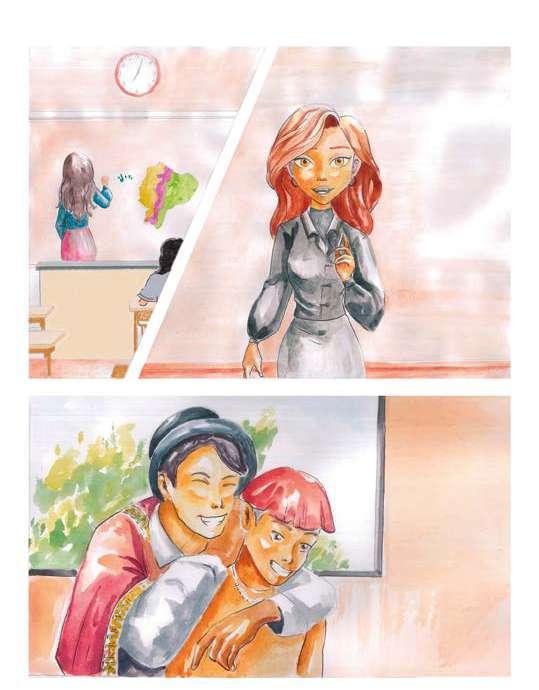
Today we were going to learn about Ecuador’s four regions: the Coast, the Highlands, the Amazon, and the Galápagos.
I would like to know more about you. Could you tell me which region you’re from and what nationality you belong to?
Ecuador has four wonderful regions, each with its own customs and traditions, yet united by cultural diversity, the solidarity of its people, and the pride of sharing a common identity.
I am from the Highlands. I’m from the Kichwa Otavalo nationality.
I am from the Amazon. I’m from the Shuar nationality.
The excited students, begin to share which region they come from and their nationality.
I’m from the Coast. I am Afro-Ecuadorian, from Esmeraldas.
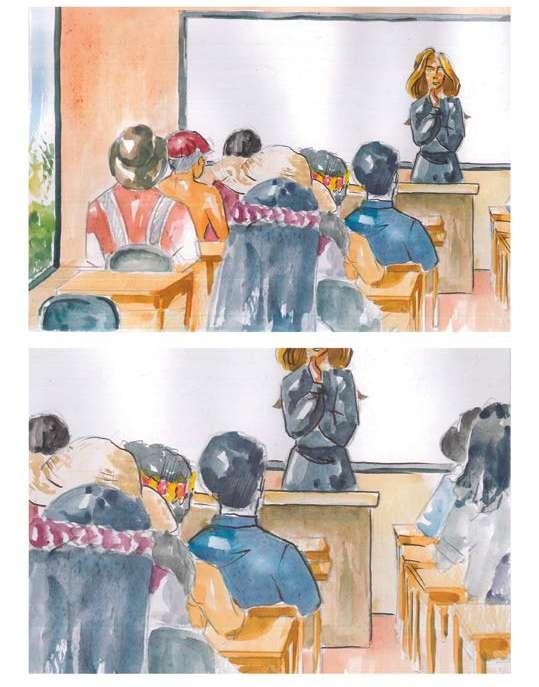
I’m from the Highlands. I am from the Salasaka nationality.
I’m from the Coast, from Manabí.
More students are encouraged to share their heritage, and everyone feels proud of their culture.
I’m from the Highlands. I am from the Puruhá nationality.
I’m from the Amazon. I am from the Cofán nationality.
More voices join in, creating a conversation filled with cultural pride.
I’m from the Coast. I am from the Tsáchila nationality.
Listening to you all makes me think about how diverse our country is. We should start a club to share our experiences and learn more about our cultures!
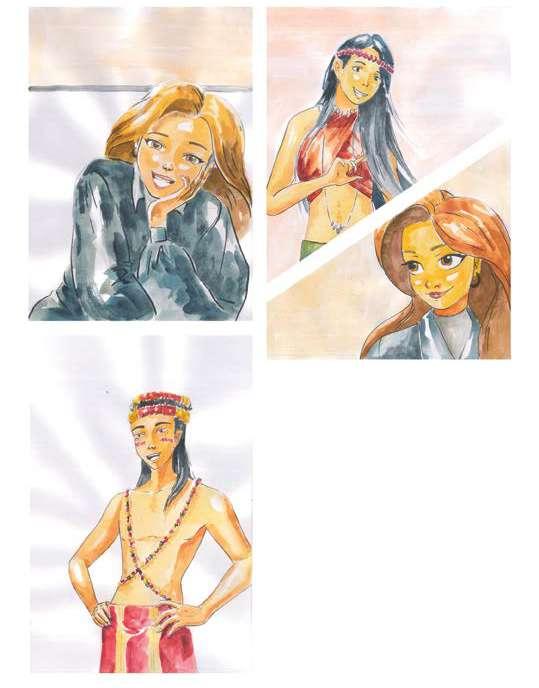
I love your enthusiasm. If you agree, we could name the club “Knowledge Explorers.”
And through the club, we could even travel to different regions and learn about their stories.
Ms. Lupita, enthusiastic with the idea, gives them her full support to create the club and that is how “Knowledge Explorers Club” was born.
I love the idea, in fact I already have a story to tell you.
One
week ago, at Tuku’s house…
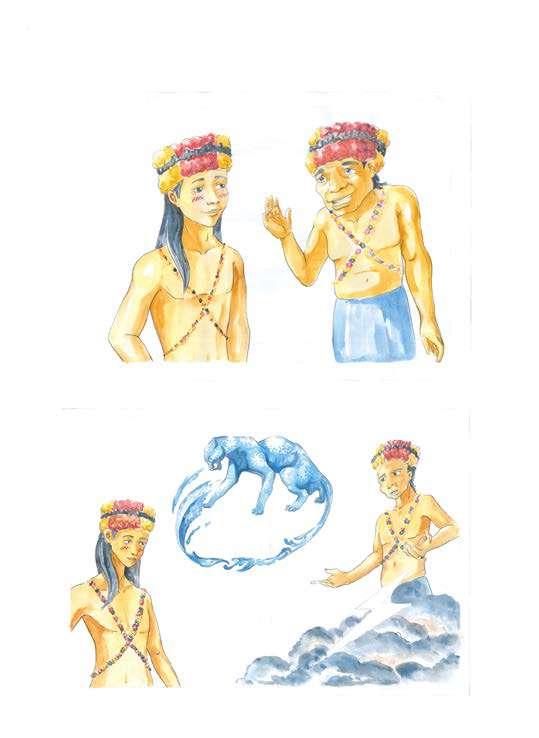
Today we’re going to the sacred waterfalls, Tuku. There, the spirit of Arútam will give us strength and wisdom.
Who’s Arútam, Grandpa?
One morning, Tuku was getting ready for a very special adventure with his grandfather, who had told him stories about the secrets of nature. Together, they would visit the Kintia Pankie waterfalls near the town of Sucúa, in the beautiful province of Morona Santiago, deep in the Amazon.
Arútam is a very powerful spirit. He lives in the waterfalls and appears in surprising ways. Some say he’s a jaguar. Others say he’s lightning.
Waterfalls are sacred places. Many elders like me come here seeking guidance.
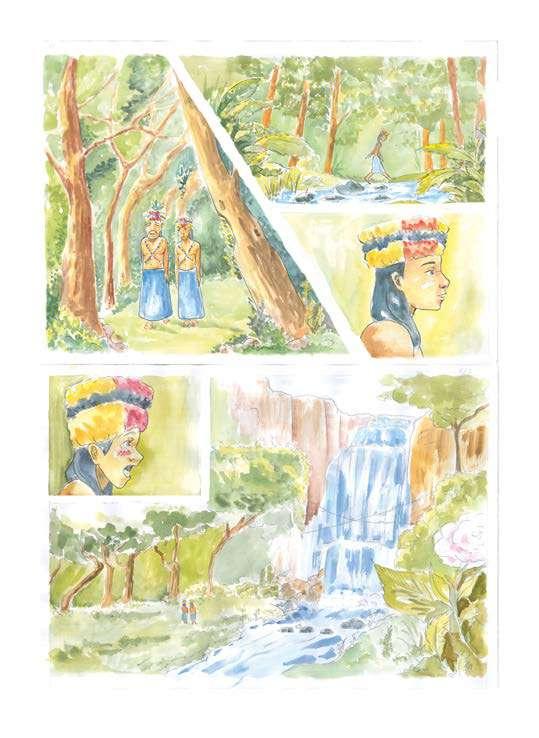
Tuku and his grandfather walked along a forest trail leading to the waterfalls.
Now, close your eyes and listen to the waterfall. Arútam comes in mysterious ways.
His grandfather explained that to encounter Arútam, they had to be deeply attentive and respectful of nature.
The water in the waterfall seems to move strangely, and Tuku feels a vibration. A strong wind begins to blow.
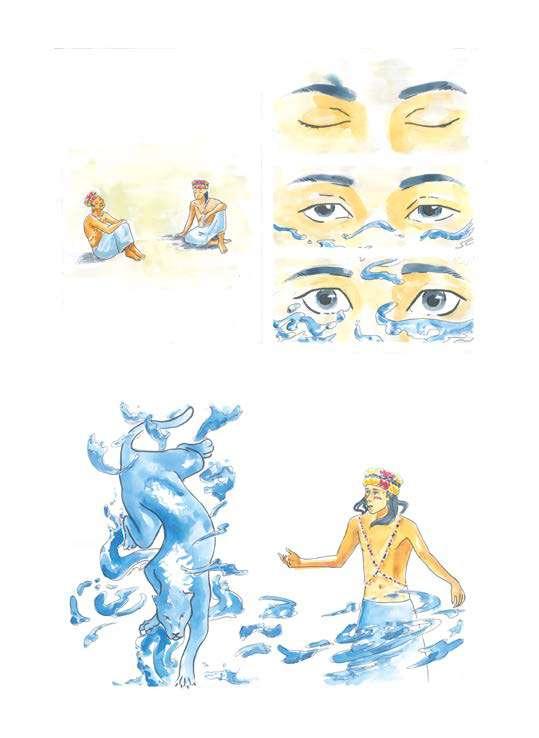
Suddenly, Tuku felt a strange energy. The water glowed, the wind roared—and before him appeared the figure of a giant jaguar.
Arútam, share some of your wisdom. Why is so important to protect nature?
Nature is life. Without it, we would not exist. Trees give us air to breathe. Water gives us life. Animals teach us how to live in harmony. Respect all that surrounds you, and nature will grant you wisdom and strength.
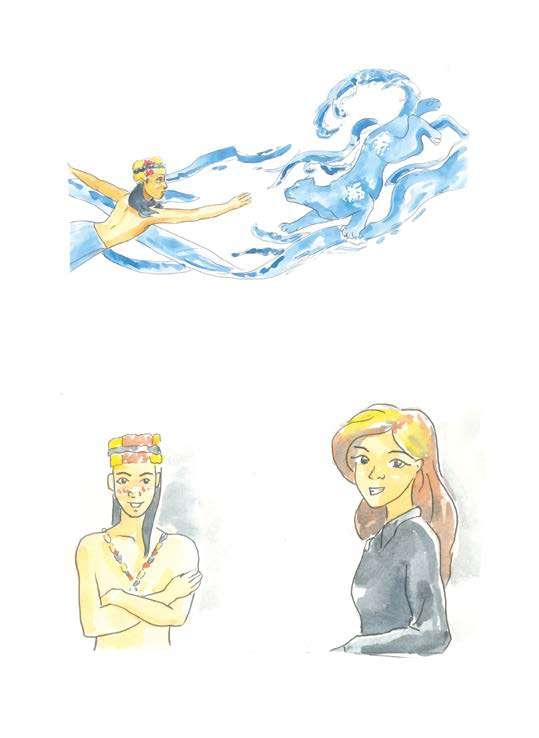
Tuku felt a deep peace in his heart. He knew Arútam’s message was clear: respecting nature is key to living in balance with the world.
And that was my story.
Thank you for sharing such a beautiful story with us, tuku.
Remember that nature has so much to teach, if only we learn to listen and respect it.
I am so happy to see how inspired you all are. I think it is time we plan our own trip.
¡We could start by visiting Otavalo! I’d be happy to host you at my house.
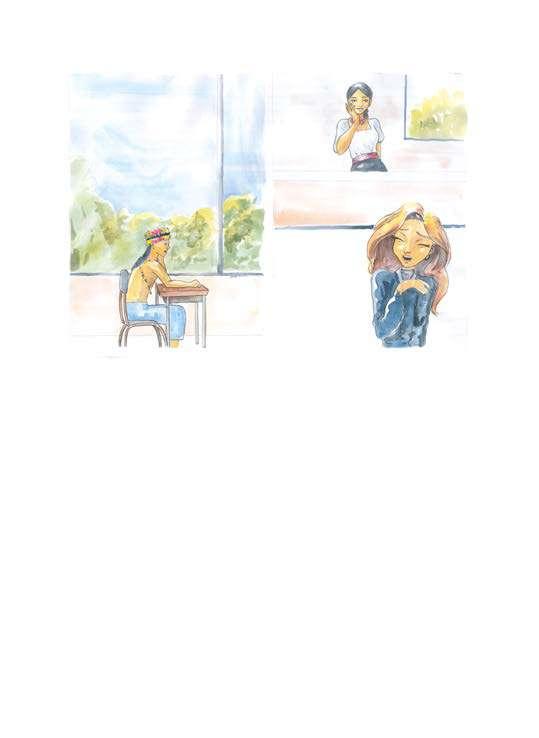
¡Yes!
Then Otavalo will be our first destination. It’s decided! We’ll go next week, after Monday’s community minga.
You’ve done an amazing job!
Remember, minga is also about sharing. Did you bring what I asked for?
The students are taking part in a minga at “Unidad Educativa Renacer” in Ibarra, Ecuador.

Everyone sits in front of a cloth where they have placed all the food.

A minga is an ancestral tradition of communal work in Indigenous communities, where people gather to carry out tasks for the collective good—such as a day of cleaning.
Yes, teacher. I brought cooked habas and choclos.
My grandma sent potatoes with cheese.
Inside the classroom, the students begin taking various foods out of their backpacks.
My
What we’re doing is called La Pampa Mesa, an ancient tradition meaning “food for everyone.”
Does anyone know what it represents?
it’s

What if everyone teaches at home what we learned today?
I love making bread and colada on this day, even more with you. I want to visit Grandpa.
Me too, today we will take this food to the cemetery. Not just for our grandparents, but to share with others.
Every November 2nd in Otavalo, the Kichwa Otavalo people commemorate the Day of the Dead by visiting their loved ones at the cemetery. They bring offerings such as wheat loaves shaped into figures of horses and wawas (children), accompanied by a drink called colada morada, made from blackberries. In addition, they carry dishes prepared with grains such as maize, beans, and broad beans.
Why do people share food with others? Isn’t it for their loved ones?
Because when we share, our souls are also nourished.
Each family spreads a blanket in front of their loved one’s grave. Placing the offerings on a blanket and sitting around it. Sharing food in this way.
Here you have, with love from our family.
I’ve never seen anything like this. It’s beautiful to share with everyone, not just the family.
Go, take this to that family. They also remembered their ancestors.
Thanks, may your ancestors bless you.
Now I understand, grandpa. We all remember each other, so no one is left alone.
After a long trip to Otavalo, children gather in the club room to share experiences.
Good morning children, our trip yesterday was amazing. Can you tell them what we did yesterday, Yurak?
is beautiful, Yurak. This tradition teaches us very important values. It teaches us to be supportive, to remember our ancestors with love, to value our roots and pass them on to new generations. We went to the cemetery with my family, bringing food to share. At first I didn’t understand why we should do it, but my mother said that our souls also feed when we share with others.
That
The Day of the Dead is not only lived in the cemetery, but also in our hearts and in what we transmit to others.
As long as we remember our ancestors, they will never go away completely.
This knowledge has been passed down through generations. Today we will learn about traditional Afro-Ecuadorian
The next day, the students with a smile visited Grandma Carmen again, who is also the healer of the Afro-Ecuadorian community to learn about traditional medicine.
These plants have been used for centuries.
Grandmother Carmen showed them the plants that grew in the region, some of which have been used since ancient times to heal the body and soul.
Since we’re little, we learn to recognize these plants.
We know that respect for nature is key to our health.
Javier shared with his classmates the importance of recognizing and respecting plants from an early age.
Professor Lupita asked if these remedies were only for the Afro-Ecuadorian community.
Can these remedies be used by everyone?
Traditional medicine is not only for us.
It is universal. Nature has the power to heal those who respect it. Is it true that this plant gives you energy without side effects?
Exactly, but we must always use it wisely.
Jandir, curious, wanted to learn how to make a guayusa infusion. He was fascinated with the bene ts of the plant.
Lupita concluded the lesson by highlighting the deep connection between traditional Afro-Ecuadorian medicine and respect for nature.
Guys, we are in my hometown; Tulubí. Here we will teach you about our traditions.
After their last trip, the students arrived in Esmeraldas, one of the northern coast provinces, known for its beaches, rich culture and vibrant music. Here, they will learn more about this wonderful culture.
Today we are going to learn about our ancestral rhythms.
¡Welcome!
The students arrived in the Afro-Ecuadorian community, in the province of Esmeraldas Javier’s homeland ready to discover a new culture.
The rhythm and dance lled the air, inviting the visitors to move with the music.
The rhythm and dance filled the air, inviting the visitors to move with the music.

The vibrant rhythm of the marimba made their hearts beat in time.
Can I try?
Afro-Ecuadorian dance and music are ways to keep our history alive our history. Every movement has a meaning.
Each musical note told a story, and every dance step carried centuries of tradition.
¡I will teach you!
¡This is more fun than it looks!
Dancing was easy when they let the music guide them.
The students understood that tradition lives in every rhythm, every song, and every story told.
Today we experienced a tradition that carries centuries of history, and the most important thing is that we continue to pass it on with
The Salasaka Carnival is a traditional festivity of the Indigenous Salasaka culture in the province of Tungurahua, Ecuador. This ancestral celebration blends Andean rituals with elements of Catholicism to give thanks to Pachamama (Mother Earth) and ask for prosperity in the new agricultural cycle.
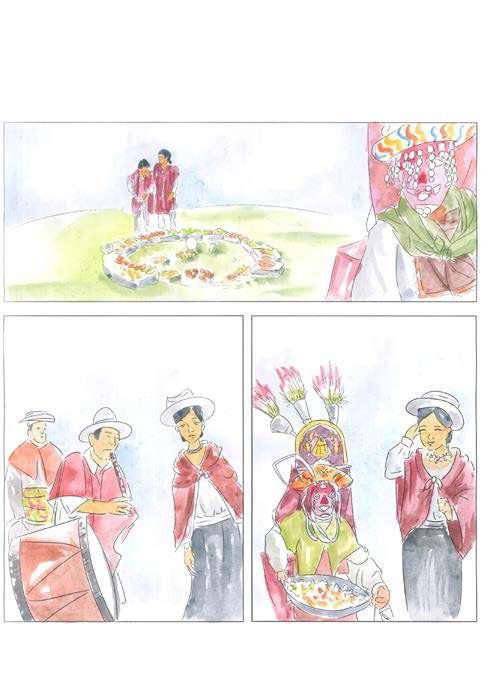
Every year, the Salasaka Carnival brings music, dance, and the joy of a united people. These flowers are our offering to Pachamama. Throw them with gratitude.
¡How beautiful! It’s our way of giving thanks.
Water in the Carnival symbolizes life and renewal. Everyone joins in with joy.
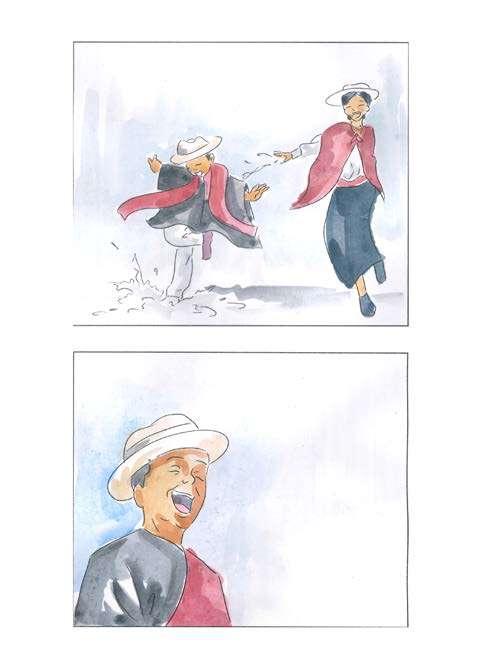
¡Let’s go see it up close!
¡Look! the parade is starting!
The village elders watch the celebration with smiles, remembering their childhood.
This is how we used to celebrate when we were children. Carnival connects us with our history.
¡And it will keep bringing generations together!
To dance, to laugh, and to share this is the true spirit of Carnival.
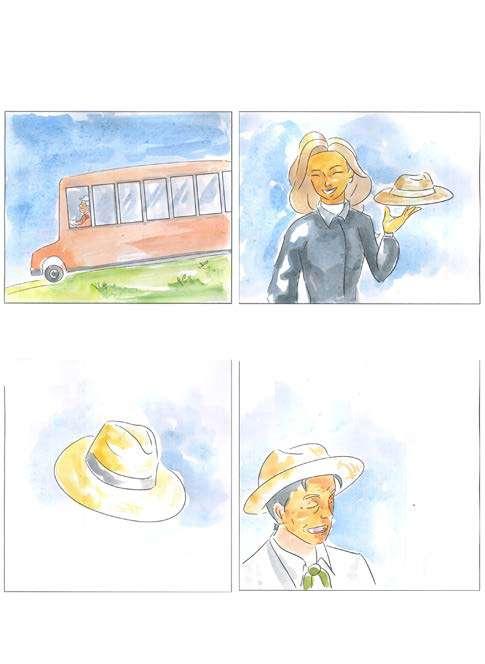
In this new adventure, the students and their teacher head to their destination with a special purpose: To know the true origin of the Panama hat in Pile, Manabí.
Teacher Lupita happily observes the students who meet her on the bus.
This hat is not just any accessory. Its history dates back more than 5,000 years.
The Jama Coaque, Chorrera, and Manteña cultures already used it as ‘tocados’ (ceremonial headdresses).
That's because in the twentieth century they were exported through the Panama Canal.
They became famous after former U.S. President Theodore Roosevelt was photographed wearing one, but their origin is 100% Ecuadorian.
¡But everyone thinks they are from Panama!
The students arrive at the Panama hat artisan workshop directed by Manuel.
¡Hello, guys! To make a fine hat, the straw must be cut at the correct phase of the moon. Then, it is boiled and dried.
A quality hat can take up to eight months to complete, depending on the fineness of the fabric.
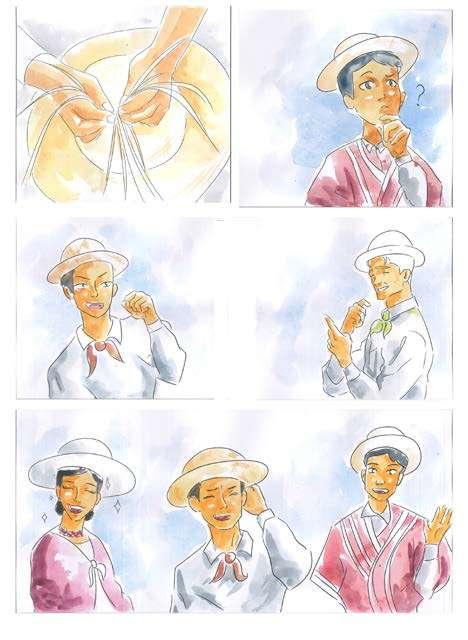
But… why do not they do this process with machines? It would be faster and they could sell more hats. It is smoked with sulphur to give it its characteristic colour
¡That is ancestral precision!
Because we would lose our ancestral knowledge! If everything was done with machines, no one would learn to weave like our ancestors did.
Exactly. The quality of a handmade hat does not compare to an industrial one. .
In addition, each hat tells a story, and that story is woven by us.
The Panama hat is more than an accessory. It is history, identity and the legacy of our ancestors.
When I get home, I'll tell my family about all of this. I don't want this art to be lost. I never imagined that a hat had so much history behind it.
I’ll make sure everyone remembers: the Panama hat is Ecuadorian—not Panamanian!
¡Goodbye!
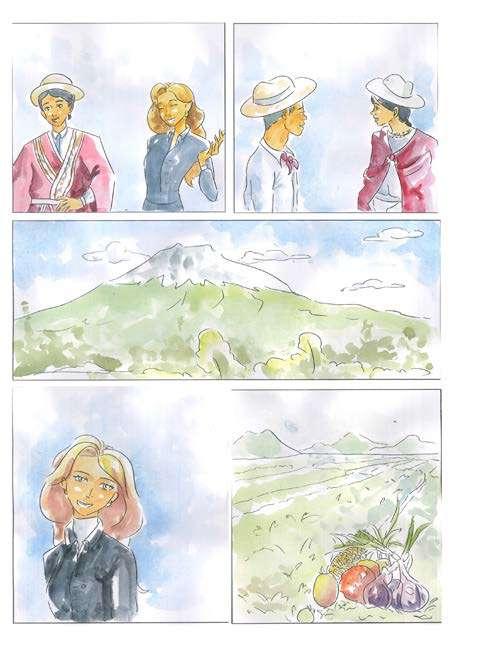
It’s time for you to get to know my roots.
That’s right, Jandir. We’re just 10 minutes away.
Look, ¡There are so many mountains!
And look, over there you can see a snow-covered mountain
We have arrived at our destination.
¡My dear grandson, it’s been so long since I last saw you!
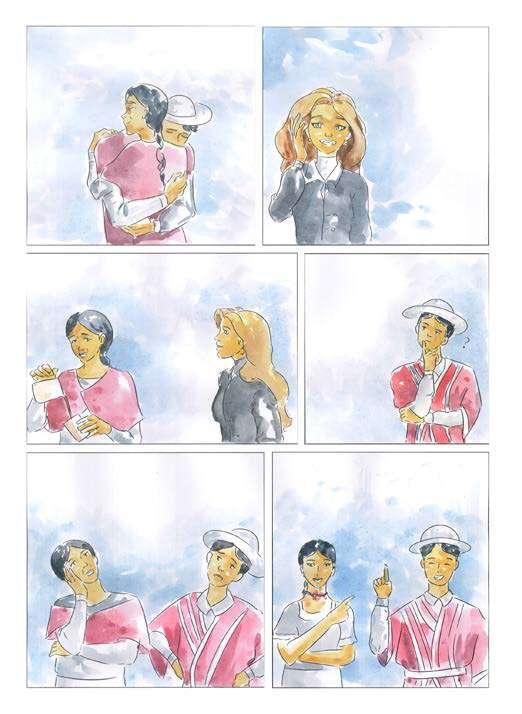
¡Grandmother!
Doña Juana, it’s a pleasure to meet you.
Have a seat, guaguitos (little kids), I made some coffee for you.
Thank you for welcoming us. We’re excited to learn new things.
I’m also excited to share with you all. And my grandpa, mamita Juana?
¡Good morning!
He went to town to buy fertilizer mijito
Well, I hope he comes back soon.
What’s that over there?
What are you talking about, Yurak?
¡Ohhh! That’s a sewing machine it's my grandma’s.
This is a tool I use to mend my clothes, but I want to tell you it was not always like this.
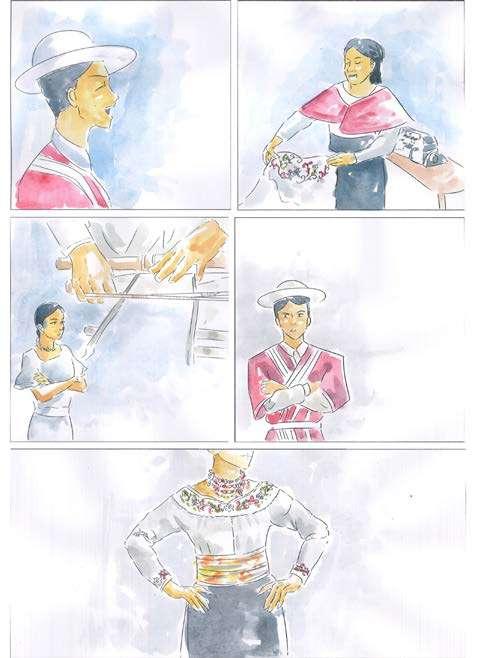
And how was it before, Doña Juana?
We used to sew by hand. Now this little machine helps us a bit.
My mother also weaves by hand. And what do you sew, Grandma Juana?
Did you make that skirt yourself?
Known as anaco, it is a garment representative of the Puruhá woman.
Yes, the machine helped me, and I embroidered it by hand.
That’s a very beautiful skirt, Grandma Juana. And what’s that around the waist?
Oh, this? It’s my sash. Its embroidery tells the story of my ancestors.
Jandir, your grandma Juana’s sash design is sacred. It holds a special connection to the ancestral spirits.
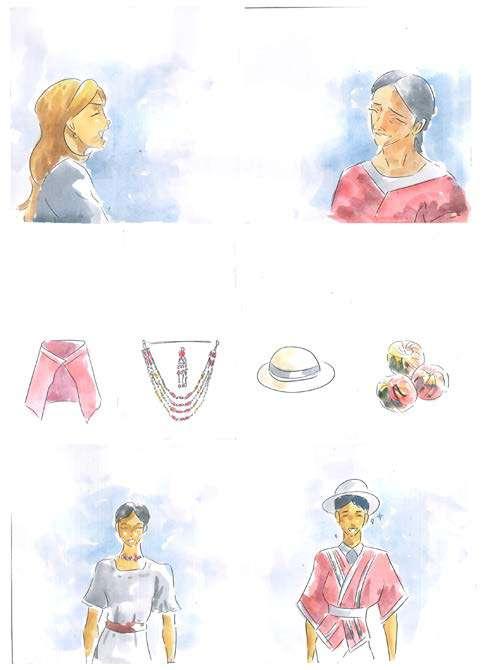
Bayetas
A brightly colored wool garment. Women like to feel vibrant and full of energy.
Necklaces and bracelets
They reflect the community's identity, connection to nature, and spirituality.
That’s right, Ms. Lupita. And like my sash, there are many elements that represent us as Puruhá culture.
Hats
In Puruhá culture, the hat represents protection, wisdom, identity, and tradition.
Cabuya fiber shirt
They represent the Andean trilogy of Inca culture
In our clothing we find a link to our past and a flag of our identity.
It’s impressive, they have many garments that distinguish them.
That’s right, everything looks beautiful.
Yes, friends, my culture stands out from afar.
So, if you see someone dressed like us… now you know, it’s Puruhá culture, haha!
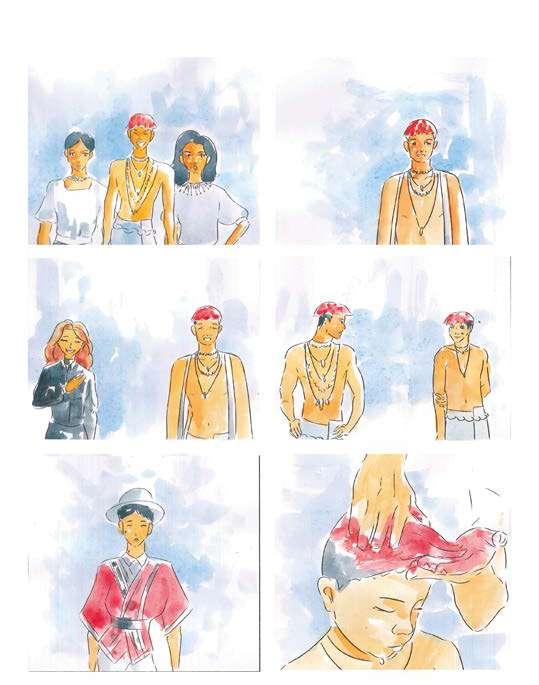
Wow, so many plants!
My home Are we there yet?
I was waiting for you. Follow me!
Thank you for welcoming us into your home. It means a lot to us.
¡It's so hot here! I want to wear your clothes too.
I hope you’re enjoying this place.
We’ve prepared this for you.
Who is he? He is my son.
Look! What is she putting on his hair?
Ah, that. It’s the sacred achiote plant.
Why is it so red?
Wow! And what is it for?
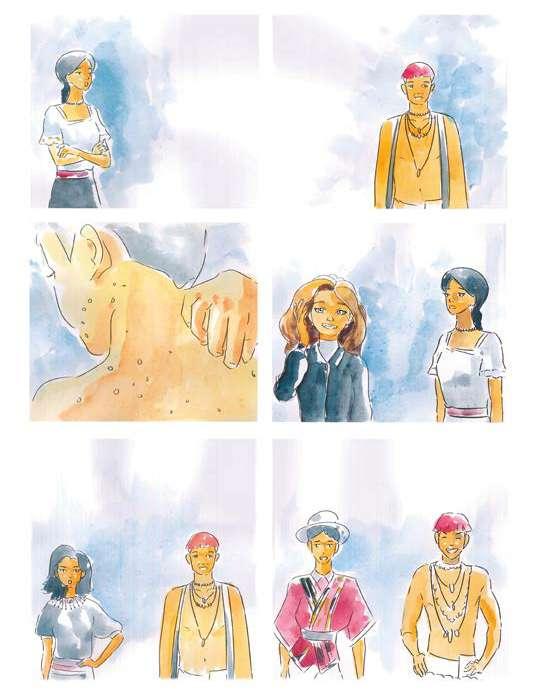
Is it a disease?
So, what is smallpox?
Since then, we have used it as a symbol of protection and hope. In our culture, achiote is a sacred plant
And achiote, what does it have to do with all this?
Some years ago, the community suffered a deadly smallpox outbreak.
Maro, did you also put achiote on your head?
Were there many families dying? Yes, hundreds of families.
Yes, when I lived here, my parents used to protect me that way
Well, you’re here now Maro, at your home. Paint your hair, Maro.
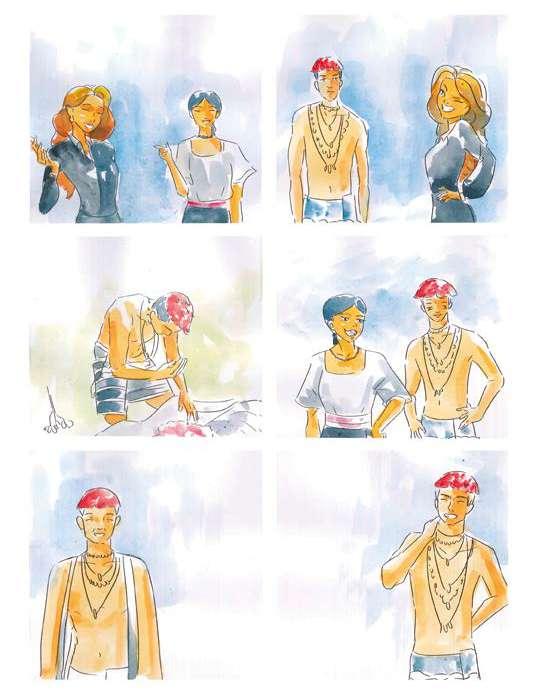
It feels so good! I had forgotten how wonderful my culture is. Thank you!
This is what’s important about our roots: knowing and sharing with joy…
I’ll do it.
Really? It’s been a long time…
It’s time, Maro. Go for it.
You look great, Maro — red color really suits you, haha.
That’s right, my culture has so many things that make it unique. I will never forget it; it’s my essence.
The students are traveling to a place unknown to them, while they look at their cell phones in concentration.
Teacher Lupita arrives and observes them with an intriguing smile.
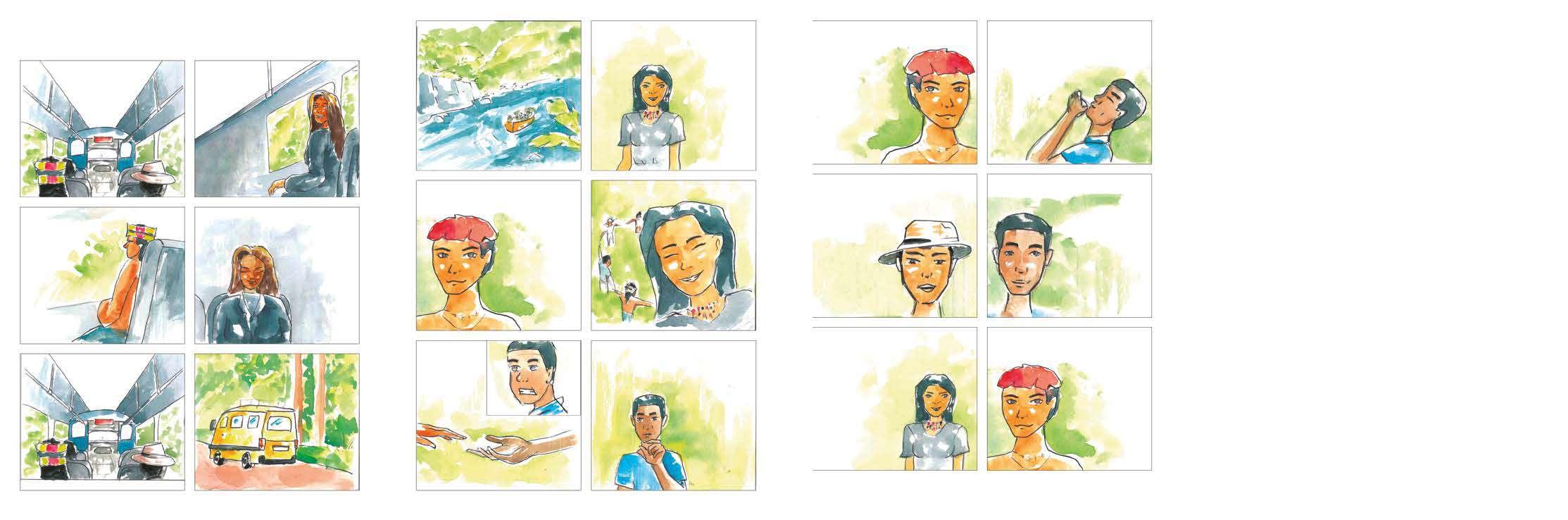
¡That sounds boring!
I'm sure it's a bit slow... nothing like video games.
Have you ever played like our ancestral peoples did?
¡WE ACCEPT!
¡I have never seen so much greenery!
What if I told you that you are going to challenge the Spirit of the Jaguar in a game that tests your courage and your connection with nature?
Are you sure there is internet here?
¡Today you are going to connect with something more powerful!
This river is our path and our history. Soon they will know something they will not forget.
¡What beautiful colors!
Javier, You've been caught by the jaguar! Now you must pay the penance.
To understand our culture, you must play U'ma Fiu'ga. Here we not only imitate the sounds of animals... we become them.
¡Don't let go of your hands! The jaguar watches you from the shadows!
Welcome. Today they will play U'ma Fiu'ga, the game of the Jaguar Spirit.
Penance? What do I have to do?
Drink five cups of chicha de chonta.
This was more fun than any video game!
Because playing is also a way of learning. Now you have a mission.
Soon, everyone was in high spirits, enjoying the connection with nature.
I did not know that ancestral games were so exciting.
Teach this game to others so that it never disappears
Intercultural learning is a way to honor and preserve our roots.
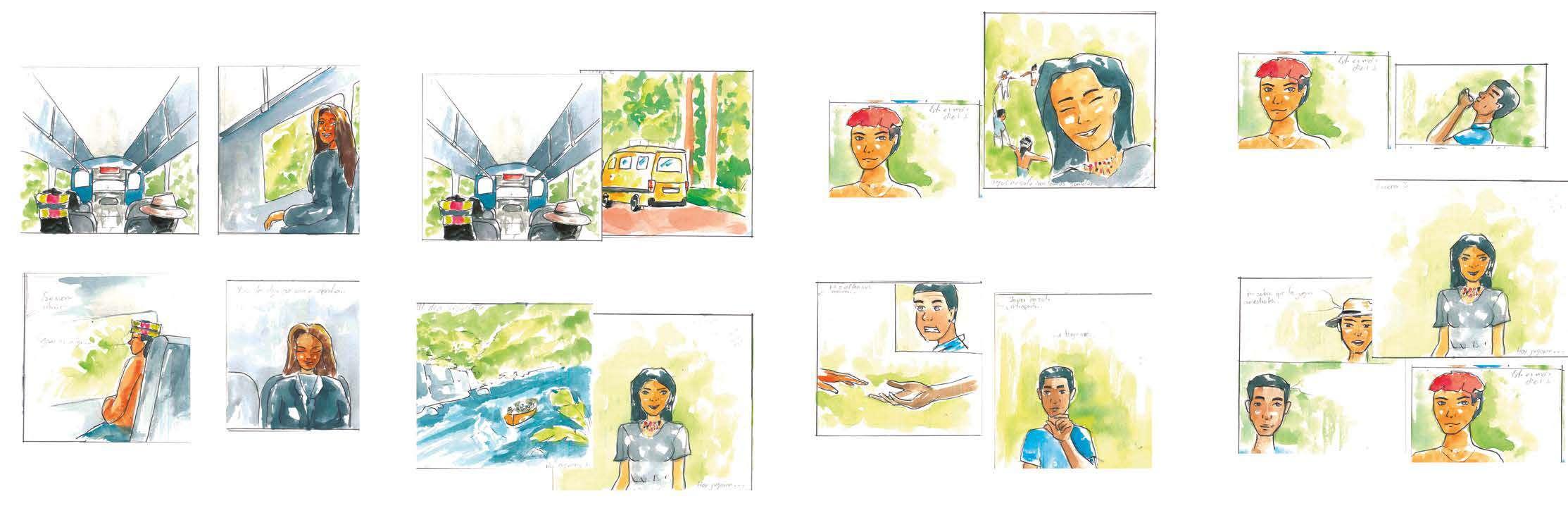
Good morning, my kids, how are you?
¡I see your happy faces, and that makes me so happy!
It was an amazing trip, teacher. I loved seeing Maro with red hair.
And I loved learning about the Kichwa culture in Imbabura.
Galápagos, it was the only region we didn’t visit…
My mom told me there are many animals, like:
And what I loved the most were the stories about the Panama hat.
I see you haven’t forgotten any of the cultures.
Which place, Javier? Where are you talking about?
Teacher, teacher! I’d love to visit another place.
That’s right, my kids, there’s a great story behind the Galápagos Islands.
Tell us, we want to know!
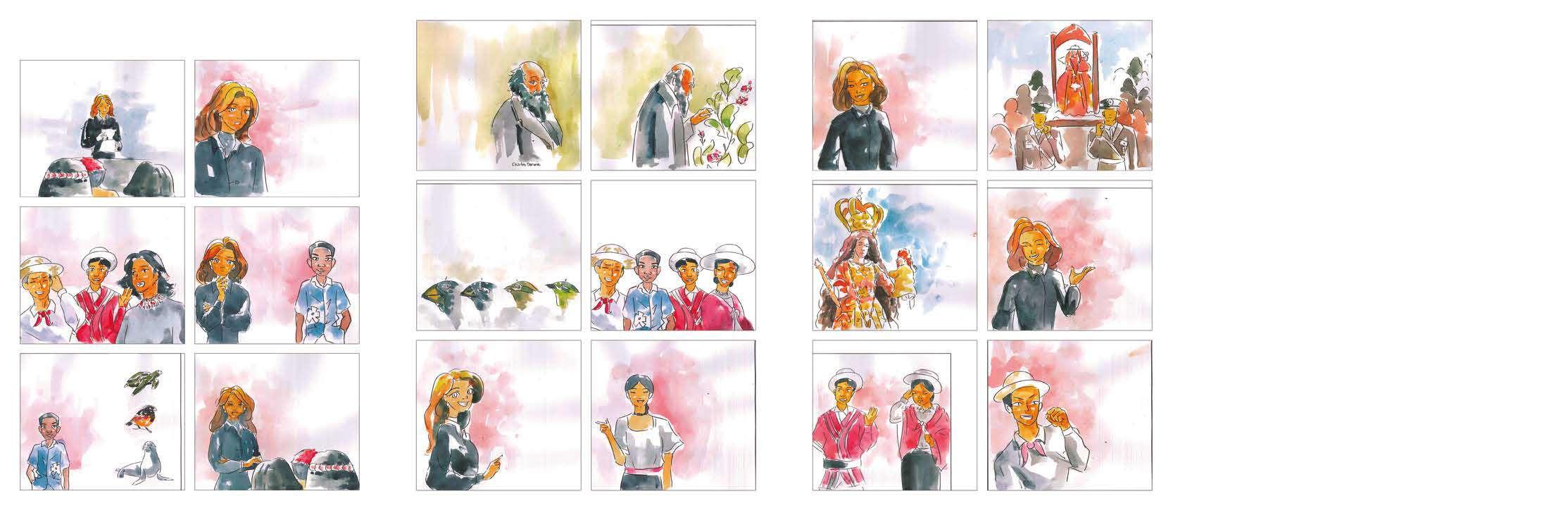
It’s about Charles Darwin... Charles who?
Charles Darwin was an English naturalist who proposed the theory of Biological Evolution through Natural Selection.
Who is He ?
In 1835. That’s when he observed the plants and animals of the place…
What is the theory of evolution?
There, Darwin explained that species change over time and that all of them come from a common ancestor.
And, when did all of this happen?
My mom didn’t tell me that!
Jajaja! You guys are so funny. We will learn about our origin in another time...
That's amazing!
And us, from whom do we come?
From our parents, obviously! Haha
From the monkey, haha!
Yes, yes. Now we want to know more about Galápagos!
And now, if we go to Galápagos, what will we find?
Currently, Galápagos, like all the regions of our country, has consolidated its unique customs and traditions.
I remember the celebration of the Virgin of Cisne, where everyone walks behind her. This religious and cultural tradition comes from Loja, which is why the people from Loja who live in Galápagos maintain this tradition as part of their culture.
And who is the Virgin of Cisne?
Sounds interesting, right?
And many other activities in Galápagos. It was an image carved by Diego de Robles, a sculptor, in 1595.
Yes, it seems that Galápagos is charming.
¡I have said that Galápagos should be our next destination!
Galápagos is a paradise on earth; its ecotourism, culture, and biodiversity deserve global recognition. THE STORY WILL CONTINUE....
Agualongo, L. M. (2025). Barreras epistemológicas en la inclusión de saberes ancestrales en el currículo universitario: una mirada crítica desde la interculturalidad [Epistemological barriers in the inclusion of ancestral knowledge in the university curriculum: A critical perspective from interculturality]. Polo del Conocimiento, 10(6). https://polodelconocimiento. com/ojs/
Astudillo, J. E. (2020). Construir la interculturalidad. Políticas educativas, diversidad cultural y desigualdad en el Ecuador [Building interculturality: Educational policies, cultural diversity,and inequality in Ecuador]. Íconos: Revista de Ciencias Sociales, 63, 11–30. https://iconos.flacsoandes. edu.ec/index.php/iconos/article/view/2922/2314
Astudillo, J. E. (2020). Prácticas del buen vivir: Experiencias en comunidades shuar, kichwa y manteña. [Practices of Good Living: Experiences in Shuar, Kichwa and Manteña communities]. Abya-Yala. https://dspace. ups.edu.ec/handle/123456789/23191
Atzmanstorfer, K., Bartling, M., Haltofová, B., Zurita-Arthos, L., Grubinger-Preiner, J., & Eitzinger, A. (2025). Critical Success Factors of Participatory Community Planning with Geospatial Digital Participatory Platforms. ISPRS International Journal of Geo-Information, 14(4), 153. https://doi.org/10.3390/ijgi14040153
Avemañay, Á. (2012). La minga comunitaria del pueblo indígena y su aporte a la educación intercultural bilingüe. Estudio de caso [The community minga of the indigenous people and its contribution to intercultural bilingual education: A case study]. Universidad Politécnica Salesiana. https:// dspace.ups.edu.ec/handle/123456789/3499
Banderas Quirola, M. P. (2021). Minga virtual: herramientas de co-creación mediadas por las TIC. [Virtual minga: Co-creation tools mediated by ICTs] Cuadernos del Centro de Estudios en Diseño y Comunicación, 135, 31-54. Pontificia Universidad Católica del Ecuador. Disponible en Repositorio PUCE: https://repositorio.puce.edu.ec/handle/123456789/4930
Benítez, A. S., Marcillo, J. C., & Montero, G. M. (2025). Problemática y desafíos de los Gobiernos Autónomos Descentralizados Cantonales del Ecuador para implementar un modelo de gobernanza: Caso de estudio cantones de la provincia de Pichincha [Problems and challenges of the Decentralized Autonomous Canton Governments of Ecuador in implementing a governance model: A case study of cantons in the province of Pichincha] MQRInvestigar, 9(2), e523. https://doi.org/10.56048/ MQR20225.9.2.2025.e523
Bravo, J. A., Murillo, A. S., Vaca Cárdenas, A., & Larrea Naranjo, C. (2023). La minga como práctica comunicativa que orienta la transformación social [The minga as a communicative practice that guides the social transformation] Communication Papers. Media Literacy and Gender Studies, 12(25), 105–116. https://doi.org/10.33115/udg_bib/cp.v25i12.22921
Bravo, J. A., Pinos, A. M., Cárdenas, A. V., & Larrea, C. (2023). En La minga como práctica comunicativa que orienta la transformación social de los indígenas de Chimborazo, Ecuador [The minga as a communicative practice guiding the social transformation of the Indigenous peoples of Chimborazo, Ecuador] Dialnet. https://dialnet.unirioja.es/servlet/articulo?codigo=921308
Castro-Viera, E. G., Rojano-Gallardo, A. P., Alban-Yánez, C. G., & Cabezas-Mejía, E.-D. (2022). Los saberes ancestrales del pueblo Kichwa Otavalo y su influencia en el turismo cultural [Ancestral knowledge of the Kichwa Otavalo people and its influence on cultural tourism]. Diálogo das Ciências, 8(1), 430–450. https://doi.org/10.23857/dc.v8i41.2501
Cobos Torres, J. C., Aguirre Ullauri, M. del C., & Cobos Torres, D. H. (2024). Sistema de monitoreo de bienes patrimoniales IoT: caso piloto en Cuenca [IoT-based monitoring system for heritage assets: A pilot case in Cuenca]. In Uso de tecnologías para la gestión y preservación de bienes patrimoniales [Use of technologies for the management and preservation of heritage assets]. Abya-Yala. https://doi.org/10.17163/abyaups.78
Cochran, P. A. L., Marshall, C. A., Garcia-Downing, C., Kendall, E., Cook, D., McCubbin, L., & Gover, R. M. (2008). Indigenous Ways of Knowing: Implications for Participatory Research and Community. Ameri-
can Journal of Public Health, 98(1), 22–27. https://doi.org/10.2105/ AJPH.2006.093641
Dadich, A., Moore, L., & Eapen, V. (2019, october 29). What does it mean to conduct participatory research with Indigenous peoples? A lexical review. BMC Public Health, 19, 1388. https://doi.org/10.1186/s12889019-7494-6
Díaz, M. L., & Romero, J. F. (2025). La educación patrimonial como herramienta para el diálogo intercultural en contextos plurinacionales [Heritage education as a tool for intercultural dialogue in plurinational contexts]. Revista Latinoamericana de Estudios Educativos, 55(2), 123–140. https:// ibero.mx/RLEE/ Diario el Norte.
Facultad de Arquitectura y Urbanismo, Universidad de Cuenca. (2024). Cuenca, quince años como patrimonio mundial: evaluación de los procesos de documentación y monitoreo. [Cuenca, fifteen years as a World Heritage Site: Evaluation of documentation and monitoring process] ESTOA, Revista de la Facultad de Arquitectura y Urbanismo de la Universidad de Cuenca. https://publicaciones.ucuenca.edu.ec/ojs/index.php/estoa
Fajardo Minchala, E. G. (2020). Planeación didáctico-artística desde el estudio de saberes ancestrales de mujeres, para estudiantes de Educación General Básica Superior [Didactic-artistic planning based on ancestral knowledge of women for upper basic education students]. Revista de Investigación y Pedagogía del Arte, 17. https://doi.org/10.18537/ripa.17.06
Gómez, A., Santillán, F., & Rivera, J. (2021). Evaluación participativa con pertinencia cultural en comunidades indígenas ecuatorianas [Culturally relevant participatory evaluation in Ecuadorian Indigenous communities]. Sustainability, 13(15), 8354. https://www.redalyc.org/ pdf/270/27041543004.pdf
Guamán, P., & Bustos, M. (2022). Gobernanza comunitaria e interculturalidad: desafíos en territorios indígenas de Ecuador [Community governance and interculturality: Challenges in Indigenous territories of Ecuador]. Revista Latinoamericana de Estudios Sociales, 10(2), 45–61. https://revistasociales.utn.edu.ec/index.php/rles/article/view/1234
Leona F. Davis, & Mónica D. Ramírez-Andreotta. (2021). Participatory Research for Environmental Justice: A Critical Interpretive Synthesis. Environmental Health Perspectives, 129(2), Article e006978. https://ehp. niehs.nih.gov/doi/10.1289/EHP6274
Loor, M., Macías, J., & Zambrano, E. (2022). Liderazgo educativo y participación comunitaria en zonas rurales de Ecuador [Educational leadership and cmmunity participation in rural areas of Ecuador]. Education Sciences, 12(8), 590. https://dialnet.unirioja.es/descarga/articulo/5187837. pdf
Mager, M., Mager, E., Kann, K., & Vu, N. T. (2023). Ethical Considerations for Machine Translation of Indigenous Languages: Giving a Voice to the Speakers. ArXiv. https://doi.org/10.48550/arXiv.2305.19474
Martínez Ordoñez, L. M., Martínez Ordoñez, M. P., Auquilla Andrade, E. G., Miranda Armijos, W. A., & Riera Palacios, G. M. (2020). Etnoeducación y saberes ancestrales: Preservación cultural a través del sistema educativo en Ecuador [Ethnoeducation and ancestral knowledge: Cultural preservation through the educational system in Ecuador]. Ciencia Latina Revista Científica Multidisciplinar, 8(5), 14250. https://doi.org/10.37811/ cl_rcm.v8i5.14250
Mora García, J. P., & Correa Alfonso, J. d. C. (2020). La minga como imaginario social. Una mirada a la pedagogía de resiliencia indígena en Colombia [The minga as a social imaginary: A view of Indigenous resilience pedagogy in Colombia]. Revista Historia de la Educación Latinoamericana, 22(35). https://doi.org/10.19053/01227238.10355
Moreta, R., Paredes, M., & Mera, E. (2022). Consulta previa y liderazgo comunitario en el norte del Ecuador: tensiones y aprendizajes [Prior consultation and community leadership in northern Ecuador: Tensions and lessons learned]. Journal of Latin American Geography, 21(3), 122–141. https://doi.org/10.1353/lag.2022.0035
Pareti, S., Flores, D., González, V., & Pareti, M. (2022). Networks, smart city governance and community rituals. Procedia Computer Science, 201, 72–78. https://doi.org/10.1016/j.procs.2022.03.012
Parraga Toral, K. V., Illescas Villa, K. L., & Bastidas, M. I. (2021). Gestión del patrimonio inmaterial, ámbito técnicas artesanales tradicionales: estrategias de salvaguardia y uso turístico del patrimonio inmaterial, parroquia Abañín, El Oro [Management of intangible heritage in the field of traditional craft techniques: Safeguarding strategies and touristic use of intangible heritage in Abañín parish, El Oro]. 593 Digital Publisher CEIT, 6(6), 92–113. https://doi.org/10.33386/593dp.2021.6.746
Pazmiño-Caiza, G., Gualoto, A., & Toapanta, J. (2023). Liderazgo comunitario y revitalización cultural en comunidades kichwas [Community leadership and cultural revitalisation in Kichwa communities]. Revista Andina de Estudios Interculturales, 5(1), 77–94 https://doi.org/10.32719/raei. v5i1.123
Pilaguano, G. P. (2018). El papel de la educación intercultural bilingüe desde el Estado y el SEEIC en los procesos organizativos de la comunidad de Guayama San Pedro de Quilotoa entre 1973 y 2015 [The role of bilingual intercultural education from the State and the SEEIC in the organisational processes of the Guayama San Pedro de Quilotoa community between 1973 and 2015][Tesis de maestría, Facultad Latinoamericana de Ciencias Sociales FLACSO Ecuador]. Repositorio Interculturalidad. https:// www.repositoriointerculturalidad.ec/jspui/bitstream/123456789/3381/2/ TFLACSO-2018GPP.pdf
Rodríguez Jara, R. E., Flores Sarmiento, M. D., Acosta Altamirano, M. F., Duchi Zaruma, J. A., Tacuri Albarracín, V. G., Rivera Avellán, A. K., ... Bravo Zambrano, G. V. (2020, diciembre 10). El saber ancestral en los huertos escolares [Ancestral knowledge in school gardens] [Pedagogical booklet]. Universidad Nacional de Educación del Ecuador. Disponible en http://repositorio.unae.edu.ec/handle/56000/1662
Sánchez, J., & Torres, L. (2020). Educación, etnobotánica y rescate de saberes ancestrales en el Ecuador [Education, ethnobotany, and the recovery of ancestral knowledge in Ecuador]. Revista Espacios, 41(23), 158–170. https://www.revistaespacios.com/a20v41n23/a20v41n23p14.pdf
Segundo Luis, P. M., & Espin Galarza, M. M. (2025). Integración de saberes ancestrales en la formación de bachilleres técnicos del SEIB: Una mirada
desde la cosmovisión indígena [Integration of ancestral knowledge in the training of SEIB technical high school students: A perspective from Indigenous worldviews]. Revista Latinoamericana de Calidad Educativa, 2(2), 84–89. https://doi.org/10.70625/rlce/198
Smith, L. T. (2012). Decolonizing methodologies: Research and Indigenous peoples (2nd ed.). Zed Books. https://nycstandswithstandingrock.wordpress.com/wp-content/uploads/2016/10/linda-tuhiwai-smith-decolonizing-methodologies-research-and-indigenous-peoples.pdf
Wolff, M., Schlüter, A., & Fujitani, M. (2021). La importancia de los valores en la predicción y fomento del comportamiento ambiental: Reflexiones desde una pesquería artesanal costarricense [The importance of values in predicting and encouraging environmental behavior: Reflections from a Costa Rican small-scale fishery]. Frontiers in Marine Science, 8, 543075. https://doi.org/10.3389/fmars.2021.543075
Zamiri, M., & Esmaeili, H. (2024). Métodos y Tecnologías para Secundario Conocimiento Intercambio dentro Aprendiendo Comunidades: A Sistemático Literatura Revisar [Methods and technologies for secondary knowledge exchange within learning communities: A systematic literature review] Administrativo Ciencias 14: 17. https://doi.org/10.3390/ admsci14010017
Jessica Anrango1, Angela Cuascota-Gonza
1, Jéssica Hernández-Olmedo1 , Nathaly-Andrea
Pomasqui
1
1Facultad de Educación, Ciencia y Tecnología, Universidad Técnica del Norte, Ecuador
jmanrangop@utn.edu.ec, aicuascotag@utn.edu.ec, jmhernandezo@utn.edu.ec, napomasquip@utn.edu.ec
Introduction
Inclusive and social education is consolidated as a fundamental pillar in education. This approach proposes a transformative integration within academic life, where teachers and students actively participate in the teaching and learning processes, regardless of their individual, social or cultural differences (Fig & Charry, 2022). Romero et al. (2017) indicate that, with technological advancement, there has been a notable strengthening of inclusive and social education, facilitating the overcoming of barriers derived from cognitive, sensory, and motor disabilities, significantly contributing to the development of student autonomy and the improvement of educational quality.
A number of digital strategies promote educational inclusion, including assistive technologies that facilitates access and participation for people with disabilities. These include tools such as screen readers, voice recognition software and sign language interpretation systems, which promote more accessible and equitable learning environments (Fernández-Batanero et al., 2022). Although the development of technological tools seeks the inclusion of the population, many platforms and digital environments remain inaccessible, severely limiting their participation in daily life. In the case of Ecuador, as in many countries, access to educational technologies is limited, especially in rural areas, where only 27% of
households have an adequate technological device, deepening the digital and educational divide (Boné-Andrade, 2023).
True educational inclusion begins when every voice is heard, and every story is valued. This chapter presents twelve narratives that bring to life school experiences in which students and teachers from diverse ethnic, cultural backgrounds and with different abilities actively participate in learning environments mediated by digital technologies. These stories illustrate how technology, used with an empathetic and inclusive approach, becomes a powerful tool to transform realities and generate environments where diversity is recognized and celebrated.
Thus, we aim to highlight the cultural and social richness of Ecuador, where diversity stands out alongside technology as an innovative, creative, and accessible digital tool that strengthens social inclusion. Furthermore, the intention is to promote respect for difference, the appreciation of identity, and the importance of inclusion, empathy, and, in general, to invite the reader to reflect on the potential of technology with purpose, sensitivity, and social commitment.
In an increasingly digital world, technology redefines the way we communicate, learn, and it acts as a bridge that links cultures, identities, and diverse realities. Through digital platforms, people can share their stories, traditions, and languages, generating intercultural meeting spaces that were previously unthinkable. This ability to connect the global with the local allows for greater visibility of historically marginalized communities and offers opportunities for dialogue and mutual learning.
Digital ethics, defined as the set of principles that regulate behavior in digital environments, demands an intercultural vision that respects diversity and fosters inclusion. In this way, Dennis and Clancy (2022) emphasize that digital ethics demands pluricultural approaches that allow for overcoming biases derived from Western normative perspectives and ensuring intercultural digital well-being. Currently, classrooms have become culturally diverse spaces, where technology can act as a connector between different worlds. Digital ethics refers
to the responsible use of technological tools, the recognition and respect for cultural differences among students, and the ethical integration of technology in education must focus on social inclusion and the development of digital competences that foster equity and participation. Thus, technology can become an ally to eliminate social and cultural barriers within the school environment.
Interculturality as an ethical principle demands an active commitment to dialogue and mutual recognition. In this sense, UNESCO (2020) highlights that “interculturality in digital environments must be based on mutual respect and cooperation, promoting dialogue between cultures to build a global digital citizenship” (p. 23). Multicultural classrooms, common in many countries, require students to interact with digital tools that are accessible and culturally sensitive. For example, the use of collaborative applications can facilitate projects where students from different cultures share their perspectives, promoting mutual understanding. However, without ethical guidance, these interactions can generate misunderstandings or reinforce stereotypes. Flores (2015) highlights that “interculturality in digital citizenship implies educating for mutual respect in virtual spaces” (p. 20). Teachers must teach students to question digital content and to create materials that reflect values of equity. This process strengthens intercultural competences and prepares students for an interconnected world.
Technology has the potential to connect worlds, but its design and application must be free of prejudice to guarantee equitable coexistence. The implementation of ethical and conscious digital practices can help prevent the exclusion of students belonging to cultural minorities. According to López (2018), digital governance with an intercultural perspective entails the creation of virtual environments that ensure users feel represented, respected, and safe. To achieve this, a critical review of digital content and platforms is necessary, promoting inclusion and respect as essential pillars of digital coexistence, to guarantee the appreciation of diversity by fostering equity, mutual recognition, and the enrichment of social and educational environments where all students feel valued and heard.
The development of an intercultural digital citizenship involves preparing students to participate in global environments where
multiple identities and worldviews coexist. This approach requires ensuring equitable access to information and communication technologies, as well as fostering the ability to use them to promote dialogue, cooperation, and mutual understanding. Thus, the classroom becomes a space for intercultural learning mediated by technology, in which diversity is valued as a collective wealth. Digital ethics, for its part, constitutes an essential framework that guides virtual interactions towards technical competence and cultural respect (Liu et al., 2023).
Technologies can and should be used as tools to make visible the narratives and knowledge of different cultures, promoting an inclusive and contextualized education. According to Hernández and Rodríguez (2021), it is necessary for digital resources to transcend hegemonic visions and offer content that reflects and represents the diversity of multiple cultures. This strategy promotes meaningful learning, strengthens students’ cultural self-esteem, and combats the homogenization of knowledge, and through collaborative projects and diverse digital platforms, it is possible to create spaces where all voices are heard.
Thus, the “Connecting Worlds” approach alludes to technological connection, human interconnection mediated by respect, ethics, and diversity. Current education requires training individuals capable of living together and collaborating in plural and dynamic digital environments. According to Area (2020), digital literacy needs to be complemented by ethical and intercultural education that enables students to navigate cyberspace with critical thinking, empathy, and a sense of justice. Technology will cease to be a neutral tool and will become a transformative agent for more equitable and inclusive societies.
Digital accessibility represents a fundamental pillar to guarantee educational equity in the technological era. Digital platforms, designed under principles of inclusion, allow students with disabilities or from disadvantaged backgrounds to participate in teaching-learning processes. According to Pérez and Sánchez (2021), an accessible digital environment helps to remove technological
barriers and fosters students’ active participation and autonomy. This approach contributes to democratizing access to education, recognizing diversity as a strength and not as a limitation.
Designing inclusive platforms involves considering multiple dimensions of accessibility, from simple navigation and the use of screen readers to adapting content to different learning styles according to students’ needs. Ramírez and Torres (2019) state that “the implementation of Universal Learning Design (ULD) in digital environments offers an effective alternative to meet the diverse needs of students” (p.5). From this perspective, technologies should not be neutral, adaptive, sensitive to individual differences, and capable of offering multiple forms of representation, expression, and participation. In this way, paths can be opened for more equitable, personalized, and inclusive education.
In vulnerable contexts, digital accessibility must consider the availability of devices and connectivity. Therefore, a technically inclusive platform is not sufficient if students’ environment limits basic access to technology. “Digital inclusion requires ongoing commitment to effective public policies that consider infrastructure, digital skills, and multisectoral collaboration to ensure equitable participation in the information society” (IIETA, 2024, parag. 5). Educational institutions must take an active role, managing resources and providing technical and pedagogical support so that all students can exercise their right to quality education, regardless of their socioeconomic context.
In this context, new technologies emerge as fundamental allies to support people, regardless of their abilities or conditions, provided that they are designed from the outset according to accessibility principles. According to Fundación Adecco (2022), accessible technologies enhance the autonomy and employability of people with disabilities in the educational sphere, while also promoting their complete inclusion. Inclusive platforms should not be considered an optional luxury; in fact, it is an ethical and pedagogical necessity that responds to the principle of equal opportunities. In this sense, educating in inclusive digital environments is a shared responsibility among authorities, teachers, and families. Through the conscious and equitable use of technology, it will be possible to build bridges between
diverse realities, eliminate gaps that hinder everyone’s participation, and move towards truly transformative education, where diversity is recognized, valued, and celebrated, not marginalized.
Artificial intelligence (AI) has become a key tool in educational transformation, personalizing teaching-learning processes. This technological revolution promises more adaptive and inclusive education, capable of addressing students’ specific needs and reducing structural barriers. In this context, AI seeks to optimize pedagogical efficiency and guarantee equity in access to knowledge and educational opportunities (Anchundia & Tubay, 2024). However, its implementation entails ethical and technical challenges that must be carefully addressed. Beyond content improvement, AI contributes to the development of methodologies, resources, and assessment systems that promote a truly student-centered education.
This approach is based on machine learning techniques and the analysis of large volumes of educational data, allowing the personalization of the learning experience effectively (Luckin et al., 2016). Educational applications include intelligent tutors, recommendation systems, predictive performance analysis, and assistive technologies that promote real inclusion of students.
Among the most notable applications in inclusive environments are adaptive algorithms that seek to analyze data in real time and adjust educational content according to each student’s level of understanding. Alongside assistive technologies such as screen readers with natural language processing, these enable students with disabilities to access complex texts (Cruz, 2022). Finally, there are conversational interfaces such as virtual assistants and chatbots that answer questions, guide students in specific tasks, and provide personalized reminders, strengthening educational support.
The growth of AI in the educational field is accelerating. It is estimated that the global market for this technology will reach USD 6.000 million in 2025, while 60% of educational institutions are already implementing policies to integrate intelligent solutions. Platforms such as Khan Academy and Duolingo have proven being effective in offering personalized education to students in rural and low-
income contexts, such as in India and Brazil (WIRED 2025), this personalization increases both the effectiveness and motivation of learning. UNESCO (2023) points out that investment in artificial intelligence should be understood as a complement and not as a replacement for traditional resources allocated to education, to ensure fair and sustainable integration.
The convergence of AI and education points towards scenarios where platforms analyze student behavior in real time, allowing the optimization of the learning experience (Metaverso Pro, n.d.). This technology enables teachers to identify individual difficulties more accurately and offer personalized strategies to overcome them. AI must not replicate or exacerbate existing inequalities; it must act as a driver of transformation towards equitable education. This objective will only be achievable through interdisciplinary collaboration among teachers, engineers, psychologists, and inclusion experts.
Artificial intelligence represents a unique opportunity to transform education towards more personalized, adaptive, and inclusive models. Its responsible use can eliminate barriers, facilitate access to knowledge, and improve educational quality for all students, especially those with specific needs (Luna, 2018). However, its implementation must be supported by ethical public policies, investment in technological infrastructure, and ongoing teacher training. In this way, AI can be consolidated as a strategic ally to guarantee the right to education.
Education in Ecuador has experienced significant transformations in recent years, with a growing focus on inclusion and innovation in learning spaces that promote hybrid-teaching environments. This model allows educators to adapt their strategies to different learning styles, facilitating the participation of all students. According to Peñaherrera et al. (2021), the implementation of hybrid classrooms has proven to be effective in promoting inclusion, especially in contexts where student diversity and geographical inequalities represent significant challenges. The innovative experiences of hybrid classrooms in Ecuador reflect a growing willingness on the
part of educational institutions to incorporate flexible, inclusive, and contextualized models that respond to urban and rural realities. Classrooms are considered educational spaces that combine faceto-face teaching with digital mediation. This mind-set allows for the integration of digital technologies with traditional teaching methods. Within the Ecuadorian context, classrooms have emerged as a response to challenges. Carazas et al. (2024) assert that this approach seeks to improve quality, promote the inclusion of students with diverse abilities and contexts, enabling them to participate equitably. Thus, these classrooms are not simply a change in methodology, but rather spaces where, regardless of their abilities, students can reach their full potential.
In Ecuador, the implementation of hybrid classrooms has been driven by the need to ensure educational continuity during and after the pandemic. Existing obstacles have been evidenced in both urban and rural areas. Various institutions have adopted innovative strategies aimed at integrating all students through adaptive uses of technological resources. Duque-Romero et al. (2023) state that the implementation of digital technologies has been fundamental to the inclusion of students with specific needs and in vulnerable situations. These efforts include the use of educational platforms, mobile applications, multimedia resources, and active methodologies such as project-based learning and gamification.
In cities such as Quito, Cuenca, and Guayaquil, some institutions have developed hybrid programs that combine synchronous and asynchronous classes, using tools such as Google Classroom, Moodle, and Zoom. These experiences have made it possible to adapt the learning pace to individual needs, while fostering collaborative work and the development of digital skills. Morales (2017) points out that, in rural contexts, the use of ICT represents an opportunity to overcome barriers of distance and lack of resources. Although his study does not focus exclusively on Ecuador, it applies to the Ecuadorian context due to structural similarities. In regions such as the Ecuadorian Sierra and Amazon, school radios, platforms accessible via mobile telephony, and community centers with shared connectivity have been implemented. These initiatives have been key to maintaining inclusion in hard-to-reach areas.
Binario (2025) highlights that one of the most significant contributions of these experiences has been the ability to adapt the content to the diversity of learning styles. In particular, programs were developed with automatic subtitles, materials in sign language, enriched visual resources, and differentiated activities according to the student’s level of understanding, producing an increase in student participation in hybrid environments that allow for greater autonomy and participation. Temporal flexibility has favored virtual attendance in contexts of mobility or labor needs, fostering the development of digital skills, and both students and teachers have improved their competence in the use of technological tools.
Future perspectives in the field of hybrid and inclusive classrooms in Ecuador are outlined through various trends and the expansion of educational models, and there is an effort to increase the use of technologies such as artificial intelligence and augmented reality that can provide adaptive resources to the individual needs of students. Likewise, inclusion involves the integration of educational policies that promote a learning environment at all levels of education (CalleCórdova, 2024). The implementation of awareness programs and continuous training for teachers is necessary to address diversity in the classroom. In the long term, inclusion and hybrid education in Ecuador guarantee a response to needs, which will be key instruments for building a fairer, more equitable society with opportunities for all.
For several decades, access to technology in rural areas has been a major challenge, which has limited the equitable participation of students in the digital classroom, generating inequalities and exclusion for students who belong to disadvantaged contexts (Torres et al., 2024). Several difficulties contribute to these challenges. Unequal access to technology is faced by the majority of students who do not have the same access to quality technological devices or to a reliable Internet connection. This is due to the lack of technological infrastructure that limits participation in the digital classroom and perpetuates educational inequality.
The high cost of mobile devices makes their acquisition difficult for low-income families, since a device with a stable network, software,
and online services are needed. The lack of knowledge and digital skills are other difficulties faced by people living in rural areas due to the lack of economic resources to hire trained teachers in those areas. This leads to a deficit in students’ academic performance and lower participation in online educational activities (Pin-Zambrano, 2024).
To resolve these difficulties, it is necessary for the government to implement policies and programs that promote access to technology and training in rural areas, in order to close these gaps and ensure that students, regardless of their geographic location, have equal opportunities in their education (Pin-Zambrano, 2024).
The lack of empathy on the part of the authorities regarding cultural diversity can lead to the perpetuation of stereotypes and prejudices in educational content. Therefore, it is essential to review didactic material before it is presented to students to avoid permanent stereotypes and prejudices. One of these factors may be the disintegration of cultural diversity in classroom materials, which in turn causes the omission of their internal diversity and affects the self-esteem of students who come from rural areas, generating low self-esteem.
Similarly, language barriers hinder communication and learning in multicultural digital environments. The lack of bilingual materials and limitations in automatic translation can generate exclusion for students who do not master the language. The unlimited content such as platforms and digital resources hinders learning due to language limitations. This, in turn, generates exclusion for students who do not speak different languages and only speak their mother tongue (Chyara, 2024).
The lack of infrastructure and literacy are considered barriers that affect technological advancement in rural areas. According to INEC (2020), only 27% of rural households in Ecuador have access to the Internet, compared to 67% in urban areas. These low connectivity rates are evident in Indigenous and Afro-Ecuadorian communities.
The lack of technological infrastructure is not limited to Internet connection, but also includes the absence of adequate and quality technological devices. Boné-Andrade (2023) mentions that digital
literacy is another critical factor affecting digital inclusion. This is due to the limited knowledge people have when trying to operate a device, generating frustration and low self-esteem in individuals who are unable to manage certain technological tools. Training in digital competencies is scarce in these areas due to the lack of resources to hire qualified teachers and obtain up-to-date devices.
Currently, one of the concerns of countries is that most inhabitants are affected by the lack of infrastructure and investment from governmental entities, especially in rural communities. Consequently, this generates less inclusion in the digital context and illiteracy in terms of information and communication technologies (ICT) (Herrera, 2023). Following the arrival of the pandemic, the use of technologies became a necessity in education for the continuity of classes during the COVID-19 pandemic. Several broadcasts of educational programs were made through television and radio media to share academic content, thus overcoming barriers to access education (Condori, 2023).
In response to these measures, the government, together with the Ministry of Education of Ecuador has chosen to provide technological equipment to certain communities in Ecuador. On March 7, 2025, at the Ecuador Martínez Collazo Coliseum, the National Government presented the Digital Gap Reduction Project in the National Education System, an initiative that will modernize learning in the country’s educational community with an investment of USD 92.5 million. The objective of this project is to equip schools with technological devices to strengthen education and the work of teachers, aiming to improve education and ensure equitable participation in digital competencies in vulnerable areas (Ministerio de Educación, 2025).
Similarly, the government of El Nuevo Ecuador (New Ecuador) seeks to reduce the digital gap in its three dimensions: access, use, and appropriation, integrating technology and connectivity as key tools in the educational process. The goal is for schoolchildren of different abilities, cultures, languages, socioeconomic contexts, and different ways of using technological tools, among others, to respond fairly
to the characteristics, needs, interests, talents, skills, and learning preferences of the entire student body (Pérez & Reeves, 2023).
The government and the Ministry of Education of Ecuador made decisions based on paradigms to promote equity and student participation, regardless of race, social status, or other factors. All institutions must now adapt to an inclusive approach. Today, all educational institutions must adapt to an inclusive approach in order to generate quality education, leaving behind certain gaps that exist in communities.
Institutions and teachers must fulfil the role of inclusion. Teachers must always be exploring certain inclusion techniques to improve relationships among students, considering equal opportunities for all. For the teacher to fulfil this role, they must focus on techniques, materials, and support for students, guiding them toward learning that can be transferred to other areas of knowledge and to everyday life (Gordillo-Fuentes et al., 2024).
In addition, for the objectives to be achieved, the teacher and the curriculum must be aligned to strengthen the use of digital tools in children, youth, and adults. Therefore, pedagogical integration between technology and teaching processes for learning is a necessity today. Technology has transformed education, and the way people access, process, and share information in all areas, including education. In this context, the role of the teacher must evolve to become a facilitator of learning adapted to the changing needs of students and to the demands of a digital society (Herrera, 2023).
During class, the teacher must apply strategies and teaching methodologies that encourage students to form active work groups, where collaboration and participation are central elements to achieve meaningful academic objectives. These dynamics promote cooperative learning, shared construction of knowledge, and the development of interpersonal skills.
On the other hand, typography constitutes an essential component in educational processes, as it directly influences the clarity, organization, and effectiveness of didactic materials. Its appropriate selection and use allow for the hierarchy of information, highlighting key concepts, and fostering attention and comprehension of content. According to Richardson (2022), typefaces can be classified into
various families that adapt to different functions and media, such as Serif, Sans Serif, Script, Display, and Monospaced, each with particular characteristics that facilitate legibility and visual impact depending on the context of use.
Proper knowledge and management of these typographic families, along with the use of appropriate digital tools, contribute to improving the quality of educational resources and enhancing students’ meaningful learning. Below, Table 7 presents several audio-visual programs available for teaching use, which stand out for incorporating typographic options favorable to legibility and enhancing the visual impact of educational materials.
Table 7
Audio-visual programs available for teaching use
Programme
Programme
Description
Description
Canva Online platform for graphic design and presentations
Characteristics
Characteristics
Wide variety of modern, legible typefaces; easy font combination possible
Adobe Spark A tool for creating videos, graphics and web pages
Canva Online platform for graphic design and presentations.
Wide variety of modern, legible typefaces; easy font combination possible.
Professional, customizable typefaces; options for animating text
Powtoon Platform for creating animated videos and presentations.
Adobe Spark A tool for creating videos, graphics and web pages.
Powtoon
Prezi Non - linear presentation software with visual effects
Platform for creating animated videos and presentations.
Microsoft PowerPoint Classic programme for education al presentations.
Prezi Non-linear presentation software with visual effects.
Animaker Platform to create animated videos with ease.
Microsoft PowerPoint
Filmora
Classic programme for educational presentations.
Easy - to- use video editing software for teachers.
Animaker Platform to create animated videos with ease.
Clear and dynamic typefaces that are easy to read on screen.
Professional, customizable typefaces; options for animating text.
Clean, legible fonts; customizable sizes and colors for emphasis
Clear and dynamic typefaces that are easy to read on screen.
Extensive font library; support for custom fonts.
Clean, legible fonts; customizable sizes and colors for emphasis.
Varied and attractive typographies to capture attention in educational videos.
Extensive font library; support for custom fonts.
Supports multiple fonts; allows you to adjust text size, color, and animation.
Varied and attractive typographies to capture attention in educational videos.
Note. Table created by the authors based on information gathered from various official websites.
These applications foster inclusive education, ensuring high-quality, inclusive, and equitable learning for all. The ultimate aim of technological tools is to promote a free education where students can access an internet connection regardless of their abilities, capabilities, and personal and/or sociocultural characteristics.
These are particularly necessary, especially in vulnerable areas, as they help to recognize diversity as an enriching value that promotes equity, accessibility, and the participation of all in the educational process. This, in turn, creates flexible and adaptable learning environments, ensuring students feel welcomed, valued, and can reach their full potential. Learning is based on the principle that every student is unique and has the right to receive a high-quality education through new technologies and strategies, thus fostering inclusive education (Arteaga-Tuba, 2024).
Herrera (2023) states that the integration of ICT in the educational field enhances the teaching-learning process. Therefore, to maximize their effectiveness, teachers must undergo training in technological competencies, which will enable them to integrate digital tools into the design of tasks and activities.
Ecuador stands out for its extensive linguistic and cultural diversity, with 14 indigenous languages existing, including Kichwa, Shuar, and Tsafiqui. Eight of these languages are disappearing, which represents a critical challenge to preserving the cultural and historical heritage that is integral to the country’s identity as a plurinational and multiethnic state (CONAIE, 2022). Among the main factors, threatening indigenous languages are the socio-economic conditions faced by native-speaking communities, the imposition of Spanish as the dominant and official language, limited government support, and the progressive loss of linguistic interest and pride among young Ecuadorians. These obstacles weaken intergenerational transmission and the strengthening of indigenous identities, thereby endangering Ecuador’s cultural diversity (Haboud, 2019).
According to Montes et al. (2024), technological advancements, especially mobile technologies such as educational applications, have emerged as innovative strategies to address the disappearance of indigenous languages. These tools facilitate the teaching and learning process of indigenous languages, offering interactive and accessible resources. Furthermore, mobile technologies enable meaningful learning using devices such as mobile phones, promoting individual
and collaborative educational experiences, and offering students a modern and accessible way to acquire knowledge.
A study conducted by Masaquiza (2021) highlights that mobile technologies, particularly educational applications, represent an innovative tool for the learning of indigenous languages, as they incorporate a social and cultural perspective closely linked to the users’ everyday context. These technologies facilitate the acquisition of new vocabulary and information through interactive resources, such as audios and images, which reflect the daily life and traditions of indigenous communities. As a result, the learning process is enriched, an increase in the number of speakers is promoted, and Ecuadorian cultural identity is strengthened, thereby contributing to counteracting the progressive disappearance of these languages.
According to Ríos-Colmenárez (2020), the development of mobile technologies has transformed and modernized educational processes, offering innovative opportunities for teaching indigenous languages such as Kichwa. However, their implementation faces significant challenges, particularly in rural contexts across Latin America, including Ecuador. These include the lack of internet in some rural areas, which presents a major connectivity problem necessary for the use of educational applications. Furthermore, insufficient teacher training in the didactic use of technological tools and the limited adaptation of students to these platforms significantly reduces their effectiveness in the teaching-learning process.
Beyond technological challenges, the revitalization of indigenous languages in Ecuador faces deeply rooted cultural barriers, particularly among the new generations of young Ecuadorians, where a weakening of cultural identity is perceived. This stems from the hegemony of Spanish as Ecuador’s official language, leading to a reduction in Ecuadorians’ interest in learning and valuing their ancestral languages and intensifying their disconnection from the indigenous worldview. This lack of motivation cannot be attributed solely to the Ecuadorian population, as many mobile applications designed for teaching indigenous languages adopt a reductionist approach. These applications limit themselves to literal translations that omit the cultural and symbolic meanings of these indigenous languages, and often have a limited design that rarely implements interactive and cultural virtual spaces (Ríos-Colmenárez, 2020).
According to UNESCO (2023), mobile technologies influence the social and cultural development of indigenous languages, strengthening the transmission and preservation of these languages through the visibility and reach of such applications, thereby combating the stigma of indigenous languages being seen as old-fashioned or boring. In this way, Ecuador will manage to preserve this linguistic treasure, which strengthens Ecuadorian identity and contributes to the country’s sustainable development, with its own citizens recognizing the importance of digital tools like “Singuistics”, an application that teaches indigenous languages through traditional songs created by indigenous artists, thus highlighting Ecuadorians’ commitment to keeping their culture alive.
Assistive technologies (AT) have transformed educational inclusion worldwide by promoting and facilitating the participation of individuals with disabilities or special educational needs in social and academic environments, thereby fostering their autonomy and significantly improving their quality of life. It is important to emphasize that these tools seek to overcome barriers limiting inclusion by offering functional and comfortable solutions that respond to user needs, replacing traditional resources and giving rise to new practices that strengthen equity and cultural diversity (García, 2024).
According to Hess and Gutierrez (2018), assistive technologies strengthen the development of functional and learning skills in individuals with special educational needs or disabilities. They therefore encompass a wide range of digital tools, from a simple low-tech magnifying glass to a communication system based on algorithms and automated programming. Currently, these tools aim to provide digital solutions such as applications on computers, mobile phones, or tablets, featuring functions like voice recognition, screen readers, and screen magnification; similarly, other digital tools exist, such as Braille printers, hearing aids, and adapted keyboards with covers, among others (Fundación Adecco, 2022).
In Ecuador, assistive technologies are key to educational inclusion, as they enable the removal of barriers and promote equity across
the entire educational community, generating awareness and sensitization processes through accessible and innovative resources. According to a study by García (2024), 48.4% of surveyed teachers state that teaching and learning within classrooms has been facilitated by assistive technology. Furthermore, 48.4% concur on the importance of promoting and raising awareness among both students and teaching staff regarding the use of assistive technologies.
Assistive technologies drive diversity and empathy in Ecuadorian classrooms, providing modern, effective, and motivating support. The integration of assistive technologies into educational settings represents a significant advance in Ecuador, where education is characterized by being more accessible, equitable, and respectful of differences.
Regarding the limitations faced by assistive technologies for their proper integration into Ecuadorian classrooms, Troya et al. (2024) point to the lack of technological resources, insufficient teacher training, and opposition to change from some educators. These difficulties hinder the effective development of linguistic inclusion through technological tools. For this reason, various studies highlight the importance of providing sustained support to teachers, as they play a key role in implementing such technologies within the classroom, ensuring their equitable access and use among students who require them.
The integration of technologies in diverse educational contexts constitutes a strategic tool for democratizing access to knowledge and strengthening inclusion processes. In intercultural settings, technology should be conceived as both a functional tool and a facilitator of dialogue among diverse knowledge systems, languages, and cultural experiences. When effectively guided, digital mediation enhances the visibility of marginalized narratives and supports the creation of learning environments that embrace students’ cultural diversity.
The use of technological resources in the intercultural classroom must be guided by pertinent pedagogical criteria that address the
sociocultural realities of the students. Educational platforms, mobile applications, and audio-visual tools can enhance active participation if they are contextualized and adapted to the needs of each community. The introduction of devices does not guarantee inclusion; it is pedagogical intentionality that transforms the digital environment into an opportunity for intercultural encounter.
Cultural products generated through technologies, such as digital comics, documentary videos, or visual narratives, enable students to express their identities and knowledge using accessible and creative codes. These productions, by incorporating indigenous languages, cultural symbols, and territorial references, strengthen the sense of belonging and validate community knowledge in traditionally hegemonized spaces. The collaborative creation of technological content thus becomes a strategy for educational and cultural empowerment.
For technology to be consolidated as a tool for intercultural inclusion, it is essential to guarantee teacher training in digital competencies with a critical and decolonial approach. Teachers must be capable of selecting, designing, and applying technological tools that do not reproduce colonial models of teaching, but instead promote intercultural dialogue, equity, and the recognition of diversity. Furthermore, it is urgent to overcome the structural digital divide that limits equitable access to technological resources, especially in rural and indigenous areas.
I'd like to join... but I'm sure they won't want to play with me.
In the Kichwa community of Pastaza, the river whispers. But Yura has no voice because she was born without one.
Yura did not join anyone for fear of making his classmates uncomfortable.
I want to talk to her… but I don’t know what to say. What if we accidentally upset her?
Hello, everyone!
I’m Camila, and I hope we all get along. Who would like to introduce themselves first?
She seems to want to participate too, but... What is she afraid of?
Let's start with the boys.
One day a new teacher arrived.
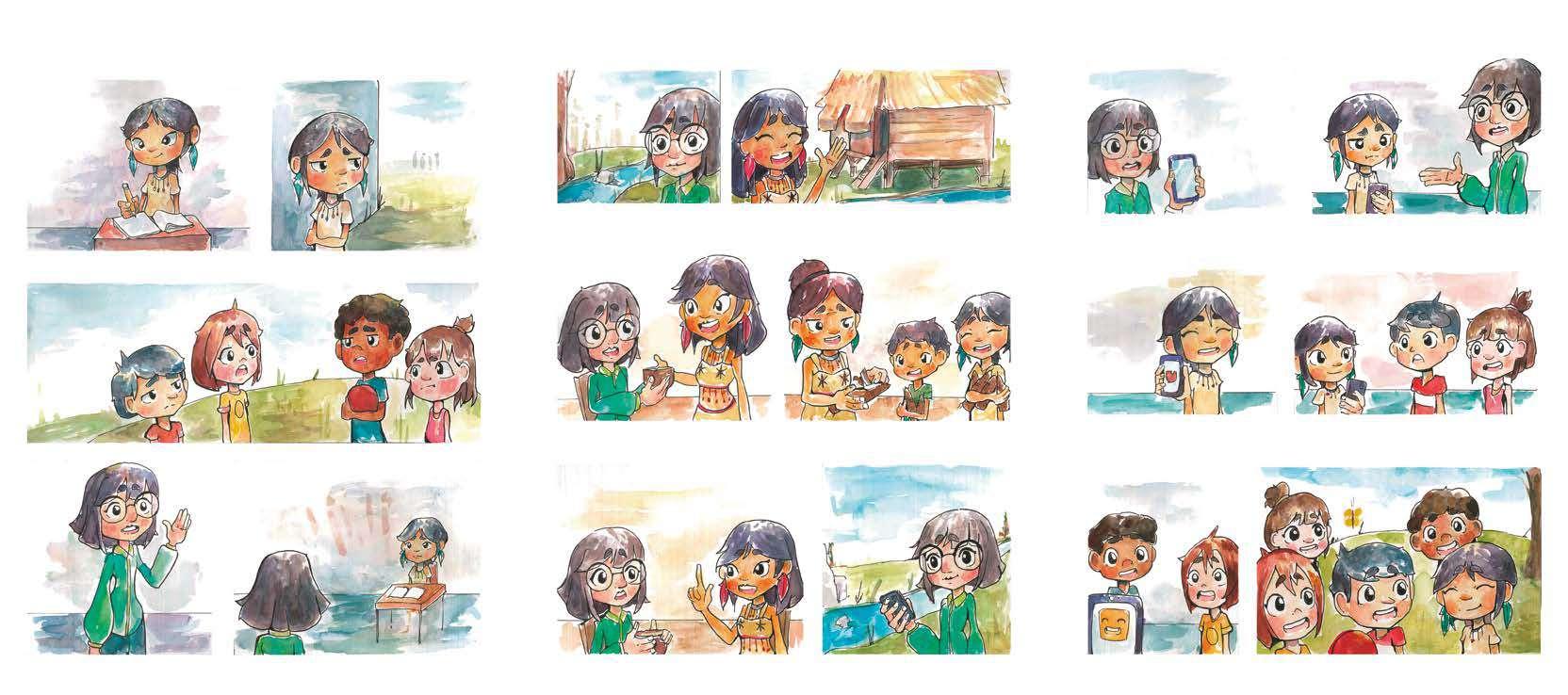
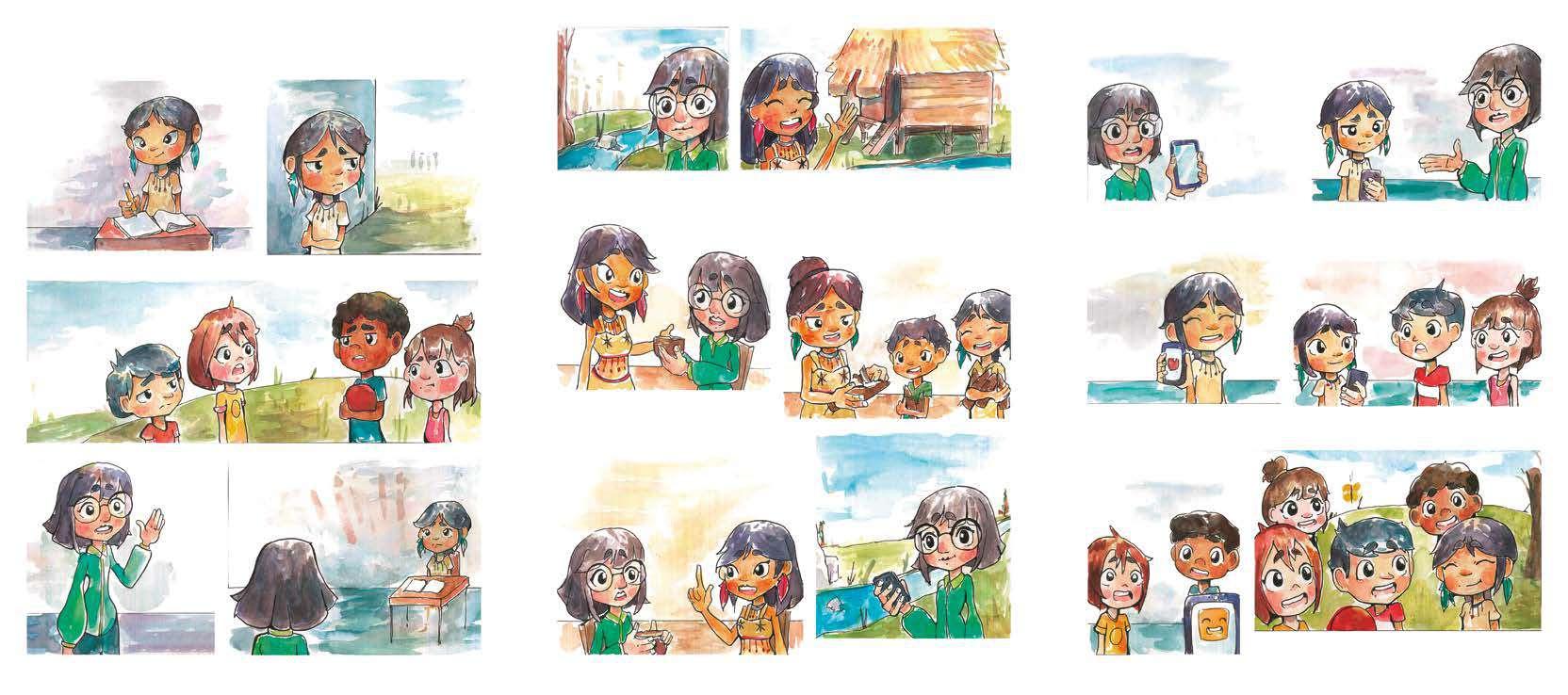
I hope I don't get lost, even though I just have to follow the river.
Camila couldn’t ignore Yura’s shy behavior, so to understand her better, she decided to get closer to her world by visiting her home and family
Try some “chicha de yuca”. Thank you very much.
Welcome, teacher!
Come closer our river 's God, Yaku, has given us a beautiful day.
You have to peel it carefully.
Here, life flowed to the rhythm of the river and traditions. Yucca, a tuber similar to potato with a light nutty touch, was crushed by the family to make their typical fermented drink, “chicha de yuca”.
This is delicious! Yura helps her prepare it?
Yes, even though she can't talk, she is a very active and curious child.
She communicates with gestures, but no one notices at school. It wasn't Yura who needed to change...it was the school that needed to learn to listen.
Camila decided to help Yura by giving her a “voice”, she found a news article on her cell phone “Artificial intelligence with predetermined phrases”.
This device will make our classroom more fun
The next day, Camila presented the new app in front of her class.
Try it, Yura! Remember the drink that we had at your house? It will turn Yura's movements and expressions into words that everyone can understand. It works!
Will it really work? Will I be able to make friends with this?
The teacher noticed Yura's doubt so she asked a question to motivate her to use the app.
It's called "chicha de yuca".
Yura opened the app and easily found an image of chicha de yuca, so when she clicked on it, a robotic voice came out.
At break time play with us I'd love to.
My grandmother likes “chicha de yuca”, even without fermenting it! If you don't know how to play, we'll teach you.
Both are delicious!
At my house, we prefer to drink medicinal herbal tea.
All the children surrounded Yura, because now they could get to know her better.
Inclusion is not a gift, nor a sign of pity. It is a reflection of a society that chooses to listen, learn and evolve. With technology, every voice will be the same song.
Lucia, a cheerful child, grew up happily with her deaf-mute parents. From an early age she learned sign language because, although she could speak, she loved communicating with them that way
I'm going to school, I love you!
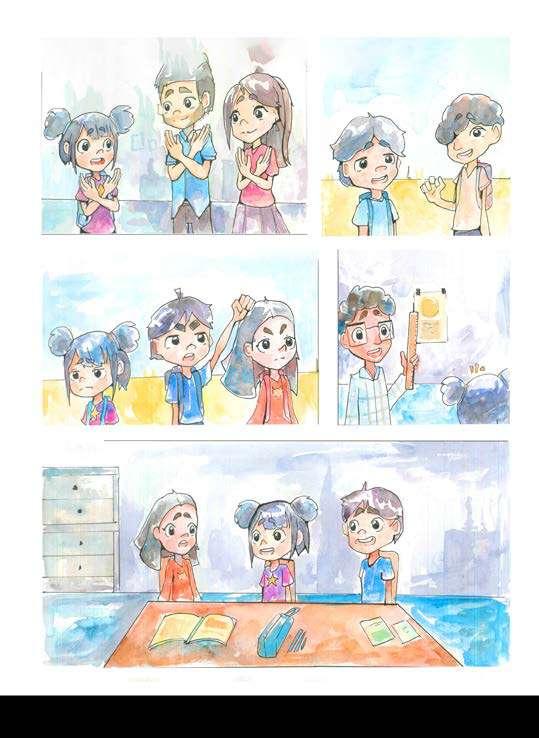
It's not my fault that I have this habit
Have a good day daughter, we love you
¡Leave her alone! Why make fun of something you don't understand?
That sounds amazing!
I have an idea guys, what if we translate sign language into a robotic voice?
Her classmates didn't understand why Lucia moved her hands so much when she spoke and treated her like a weird person
Always moving her hands
¡Look, there she is again
That day, the teacher arrived excitedly to class
This year you will have the opportunity to participate in the school fair
Maybe this is my chance to support people with hearing and speech disabilities
Let's do it!
The three friends worked hard on their project, ‘Talking Hands,’ programming and collecting data day and night. They managed to make their program produce a voice at the same time it uses sign language
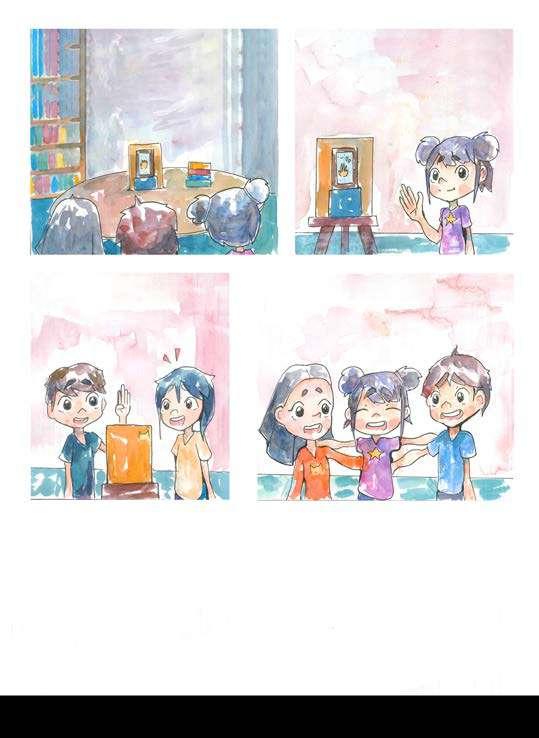
Let's go ahead!
Days and nights programming and now just have to touch a button It works!
As her classmates and teachers stared at her, Lucia began to move her hands in front of the translator that they created
Welcome everyone, I introduce “Talking Hands ”, who will help us to communicate with everyone without any barriers
Everyone loved “Talking Hands ” so they came over to see what else Lucia could do
I want to learn to communicate like that!
Amazing!
Not only words come from the mouth, but also from the heart, when we learn to listen we break the barrier and become inclusive
I'm glad they liked it
Thank you so much for helping me fulfill this dream
They will finally understand the value of sign language
When Juan lost his sight, he moved with his parents to a village called Pesillo. The new environment fills him with doubts, where his cane is his only ally as he makes his way to his new school.
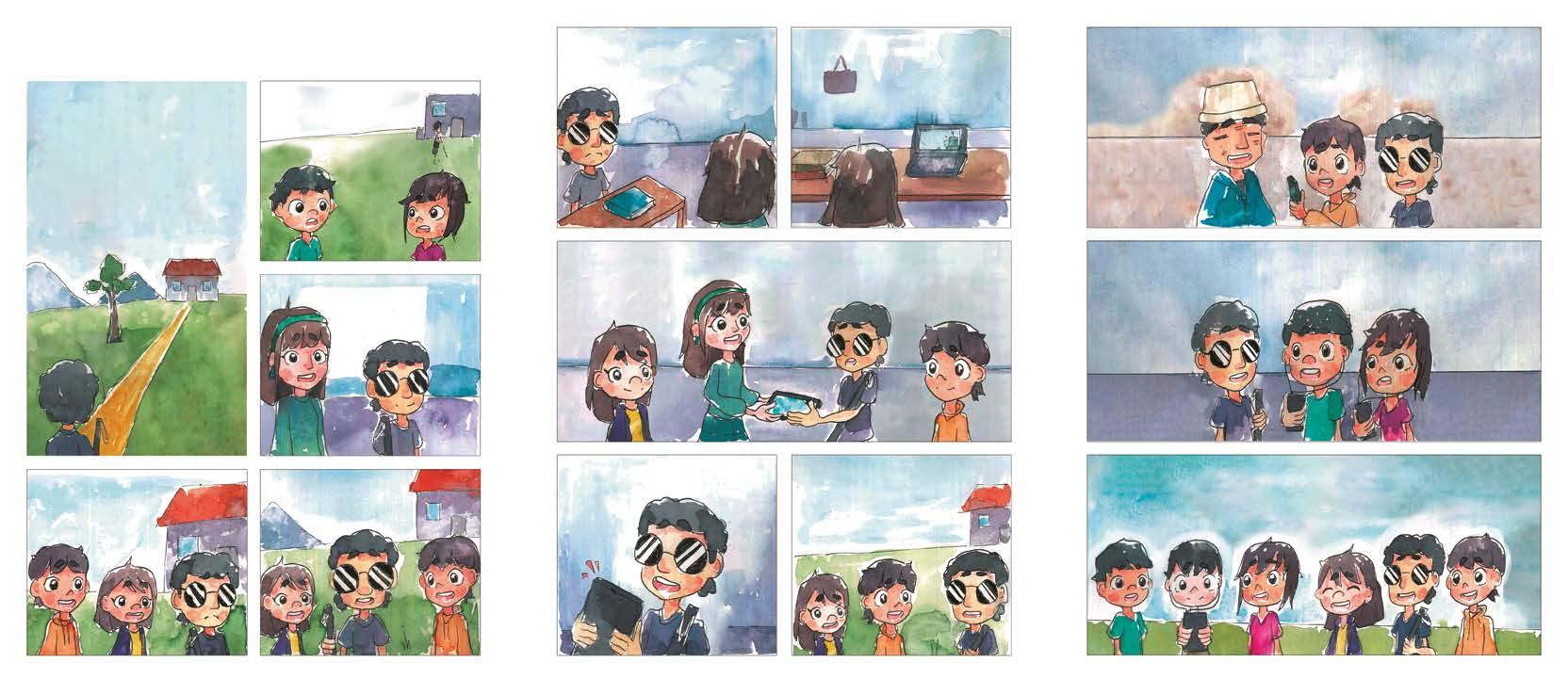
I remember the path because I walked it once with my mom, but I still hope I don’t get lost.
During recess, Juan sat alone on a bench so Karla and Luis approach him with a smile and invite him to join the group.
Come on, we don’t bite! By the way, I’m Luis.
Hi Juan, I’m Karla, your classmate. Why don’t you come play with us?
I don’t want to be a bother to your game.
At school, Juan feels nervous. Will they look at him with curiosity or pity?
En la escuela, Juan se sentía nervioso ¿Lo mirarán con curiosidad o lástima?
I've never met a blind person. How’s he supposed to study if he can’t see?
In front of the class, Teacher Ana introduces him to his new classmates.
Welcome, Juan. We’re all here to learn together.
Thank you, Teacher.
It doesn’t matter if you can’t see, we’re all part of the group here.
So, why not enjoy recess with us?
Alright, I’ll play with you. Thanks for inviting me.
Though Juan listened carefully, he couldn’t see what was written in his book, and frustration started to set in.
I need to find a tool that helps him study more independently.
The next day, Teacher Ana gave Juan a tablet.
Juan, I want you to try this. It’s a tablet with a text-to-speech app that will help you follow along in class.
As Juan held the tablet, a robotic voice greeted him.
“Hello, I’m your personal reader. What book would you like to listen to today?”
Thank you! Now I can keep up with the class.
Ana searched for a solution on her computer. She knew that with the right tools, Juan could learn and participate just like any other child.
That's amazing! Sounds interesting!
Seeing Juan’s excitement, Karla and Luis decided to help him connect with the traditions of their village, Pesillo.
Would you like to learn more about the legends of Pesillo? We can record them for you.
Great idea! We can even ask our grandparents to tell some stories and record those too. That sounds awesome!
Juan and his friends began recording different legends that the village grandparents knew.
“…And so, our volcano, Father Imbabura, or as we call him, Taita Imbabura, protected our community.”
This audiobook was recorded with the help of the grandparents in the village. Please listen to it!
I will also record a legend I know.
I'll ask my grandmother to tell me one to record.
This is fantastic!
Now I can share these stories with the world, thanks Grandpa.
This is great!
I didn't know there were so many legends!
I'm glad you like it!
I'm glad, too.
This new way of learning is really fun.
Inclusion is not about making things the same for everyone, it's about giving everyone the tools they need to grow.
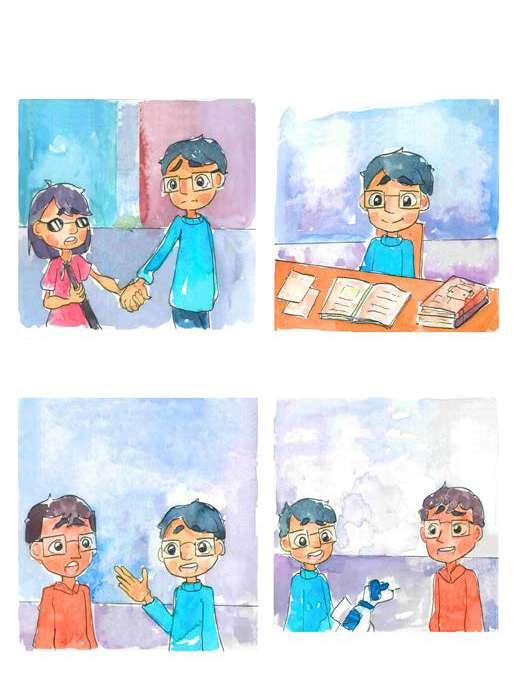
Camilo, don't walk so fast.
Sorry, little sister.
There must be a way to help her move on her own; she can’t even have a guide dog because of her allergies.
In Ecuador, many streets are not adapted for people with visual impairments. That’s why children like little Sofía, who could not see, had to rely on someone else to move around safely.
A robot assistant! That sounds amazing. But where should we start?
With proximity sensors, a guidance system and voice commands, we can do it.
Then let me help you.
At his university, Camilo shares his idea with his friend Diego, coming up with the idea of making a robot.
I will create something that will allow her to be independent, but it would be best not to do it alone.
Camilo, Sofia's older brother, has always been a fan of innovative and modern inventions. And now with that knowledge he was thinking about how to help his sister.
So, have you thought of a name for your puppy? After all this time you should have thought of a name by now.
Well, I hadn't thought about it, but I'm going to call him... LUX.
It was days of trial and error, where both friends consulted with professors and classmates, researched similar projects, and looked for parts in local tech markets.
Camilo’s house
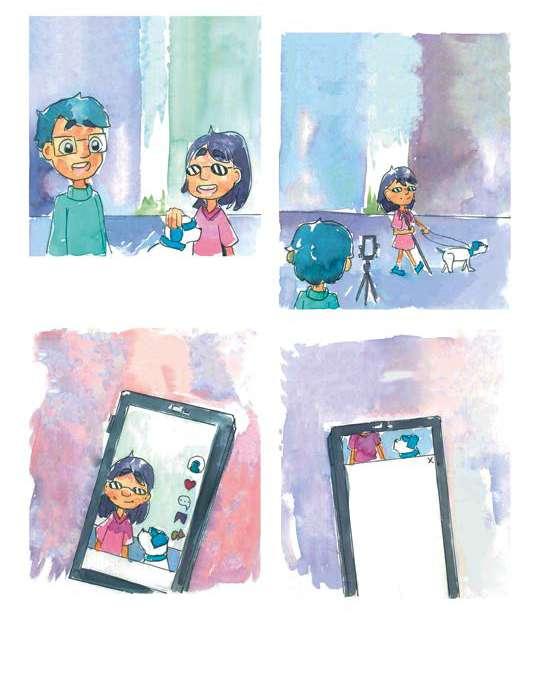
"It feels like a real puppy! Does it really work, brother?
From afar, Camilo held back his excitement as he watched his sister move forward with confidence. For the first time, she didn't need someone to guide her; LUX was doing it for her.
It works! It’s like we’ve always walked together.
Trust me. LUX is made for you.
With a knowing smile, Camilo showed Sofia how intuitive it was to handle LUX. All she had to do was give it voice commands, and the little robot would respond with Ecuadorian expressions and phrases.
Camilo surprised seeing his cell phone with hundreds of notifications, highlighting comments from people from other countries interested in LUX.
Camilo wanted to share his happiness with others, so he posted a video of his sister using Lux on TikTok.
Sometimes inspiration comes from where we least expect it. What started as an act of love became a solution that could change lives.
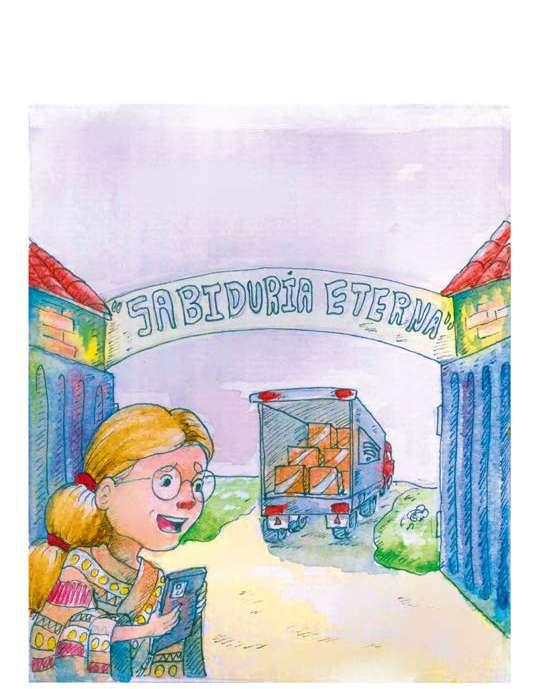
Inside the community school “Eternal Knowledge”, located in the Ecuadorian Amazon, children continue to study with the traditional methods of their grandparents; however, an educational program provides material to create their first digital classroom.
Good morning class! Today technological elements arrived that will help us in our way of learning.
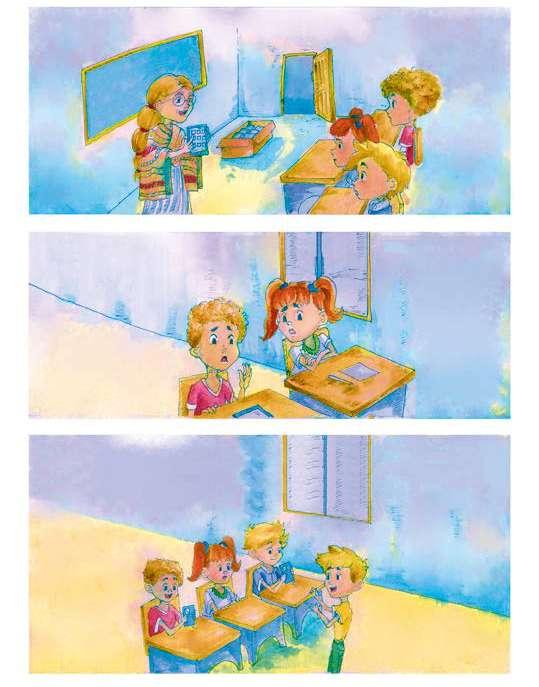
All the children are confused, and Ana is angry that this change could replace the ancestral stories.
Is it magic?
We don't need that to learn. We already have our stories and books to learn.
The screen moves when you touch it!
I feel something, but I don't know how it works.
Don't worry my friend! I'll show you how to use the voice option so you can hear what's on the screen.
There's the jaguar, I've seen a real one.
The stories of our ancestors are important.
Can we also find stories on the tablets?
They're right. Maybe technology can be a great help to our learning.
Look kids, with this video we can not only learn about animals, but we also see that technology can teach us about our community.
Yes, and we can read them all together. It's amazing, I love it!
Of course they are! So we could write them on the tablet and share them with other kids.
¡I can hear the sounds of the animals! We could add audio to the stories.
Excellent idea, kids! We can use technology to save and share our culture.
I'm going to write about the history of our culture.
I'll help with the drawings!
I'll add the sound to the story!
Technology helped us to share our culture with more people.
¡And also to learn new things!
The key is to combine what we know with what we can discover.
And I'll help digitize it!
This is just the beginning of our learning together.
Mateo faces a challenge every day as he tries to reach the books on the top shelves of the library, because his wheelchair limits him from doing so.
The books I want are always out of reach. .
Mateo talks to his friends about the problem he faces every day and they try to find a solution. Thank you, but I wish I could do it on my own. I wish everyone could have access to the library without limitations.
You are right, there must be a way to make the library more accessible.
Maybe we can build something to help. Or maybe we could create a digital solution.
The friends meet to start the project in their classroom, where they have a whiteboard full of ideas and sketches.
I have an idea! We could develop an app that includes audio books.
I love it! I can record explanatory videos to raise awareness about inclusion
Thanks a lot guys, this will not only help me but all the kids with disabilities. We could also make a ramp system.
Let's get to work!
Inti works on an automated ramp, Cristian programs the app, Valeria edits a video.
The ramps will be a great help to ease the way
The app is already taking shape.
The video is coming along very well and I'm sure it will help to raise awareness in the community.
The students present their project to the school principal.
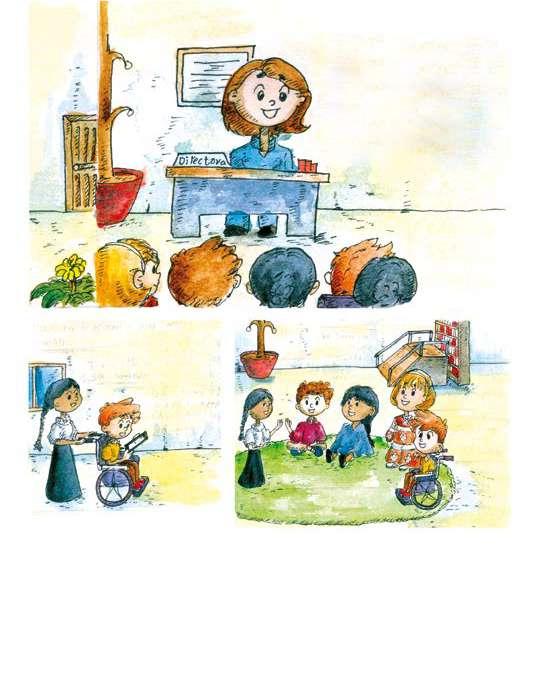
Everyone deserves to learn without barriers.
This is awesome! Now I can access as many books as I want.
Inclusion is everyone's responsibility.
It's an innovative idea. We will support its implementation. This project is a great example of innovation and teamwork. Thank you very much guys!
Mateo uses the app to access the audiobooks.
Technology can be a powerful tool for inclusion.
We are sure this will be a positive change for the school.
Of course it can! And with everyone's help, anything can be achieved.
Thanks so much for making it happen, guys!
The group of friends smile as they observe the impact of their project at school.
Miguel is a student with a visual disability trying to adapt to his lessons.
I wish I could read what’s on the board…
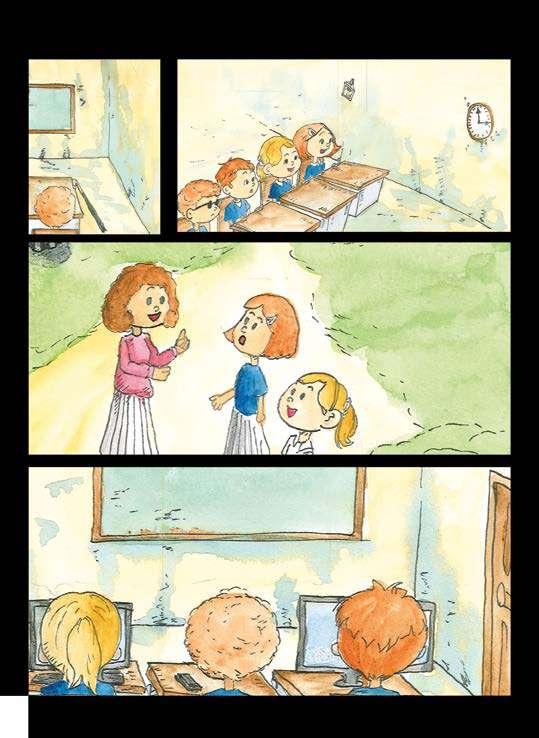
There has to be a way we can help Miguel.
You’re right, we must think of a solution to help him.
We can develop an application that converts notes into audio.
Or we can also record audiobooks with our own voices. That sounds amazing! It will be a great help for Miguel.
Miguel’s friends get together to create their inclusive app. Leonardo programs the app while Luisa designs the app`s interface, Rosa tests different forms of inclusive teaching methods, and Miguel uses headphones to listen to the beta version of the app.
If we combine this with other inclusive methods, it will be a great solution for
I agree! This is a great solution for children who have the same problem as me! Thank you very much!
We did it with pleasure, you are our friend and we wanted to help you with something so you can learn without problems.
This can benefit more students. Let’s implement it schoolwide!
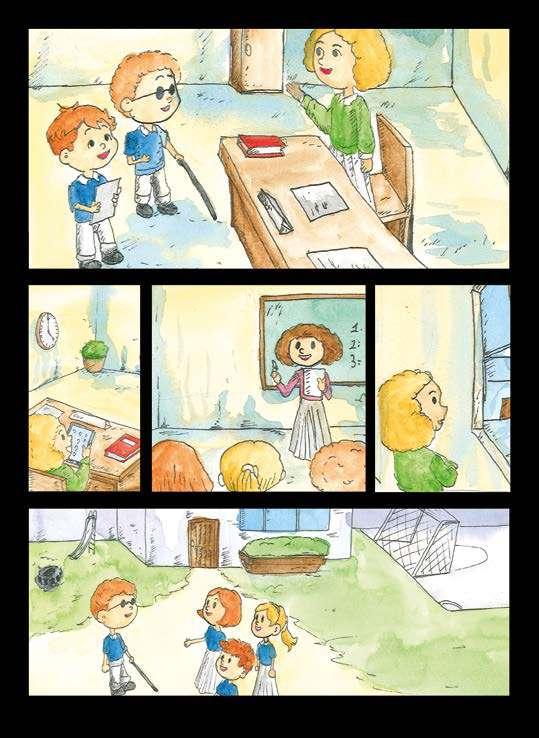
In class, teacher Elena uses the app to read aloud a text.
Our applications convert texts into speech to help students like Miguel.
This is incredible!!
In the classroom, teacher Elena uses the app to teach all her students, make the class much more dynamic and fun.
You guys did a great job. Now everyone will be able to access the information without any problems.
This will change the way we can all learn!
Thank you for believing in inclusion.
With technology and teamwork, we can change the world!
These young people are the future of an education without barriers. because diversity is not an obstacle, but a strength, and with creativity and teamwork, barriers in education can be broken down.
Teacher Lili walks into her classroom, where all her students are waiting for her.
Good morning!
Guys. Today we are going to try out an application that will allow you to share your roots such as traditions, customs, and experiences.
Rumi, a boy from an Indigenous community, remembers how he learned about his culture.
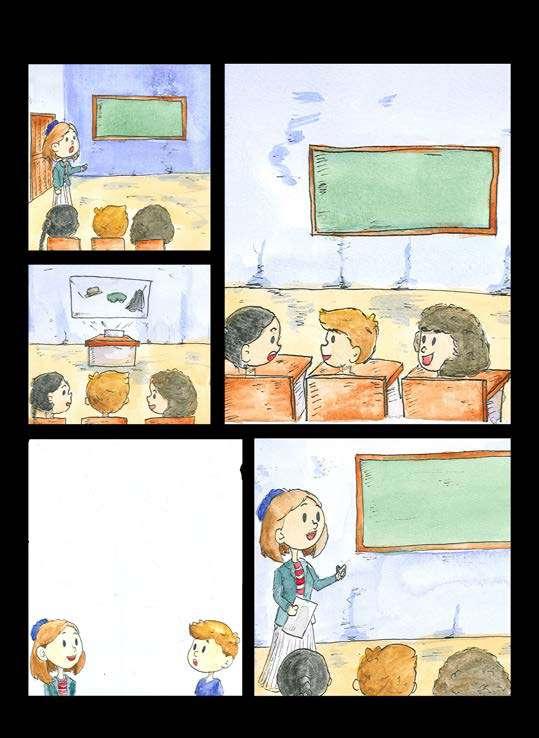
Teacher Lili displays the app on screen. It's called HIST. The students are amazed. This looks so fun!
Brandon, a tech-loving student, reflects on the lesson
Exactly! There are many ways to learn, but with this app, you can explore your identities through the internet.
I feel like people don't really care about culture.
In my community, we learn our history through legends and songs.
That sounds fascinating, Rumi! I learned history through documentaries and books.
You're right, Brandon. That's why HIST will help us share our roots in creative ways. You'll be working on a project to present later.
Sofia starts working in class, but the app begins to lag.
Don't worry, Sofía. It's slow because a lot of people are using it online.
This isn't working!
Brandon offers her a piece of advice his family often shares.
My parents always say: when things don't go your way, it's like trying to tie a knot without knowing how.
Rumi listens to Brandon and recalls what his grandfather used to say.
That reminds me of how we learn to weave. At first, it's frustrating, but with practice and patience, it gets better".
Sofía begins to relax.
I love those comparisons you make.
Learning about cultures is awesome!
The three of them work on the cultural project, excited and surprised by what they've learned.
Ms. Lili sees how focused and engaged her students are with the app
Keep working on your projects and learning more about your
Presentation day arrives. Rumi is excited to showcase traditional Otavalo clothing..
Welcome, everyone. Today I'll show you the Otavalo clothing from the Peguche community.
Wow! It's amazing how the colors in Otavalo clothing each have their own meaning.
Brandon starts to reflect after seeing how much everyone enjoyed the projects.
With technology, we can teach our cultures in creative ways.
After the presentations, Ms. Lili calls her students to the classroom to congratulate them for blending culture and technology.
What we've done today isn't just a project-it's creating a space where culture
The students are proud of their work and everything they've learned.
We did great, guys! We learned so much together-thanks to our teacher.
They all hug their teacher for helping them connect with their roots.
I'm so proud of you. You've realized that technology is a key tool for learning
Diversity is a strength when we foster respect and collaboration.
Will you participate in the contest? You are good at technology.
"I don't think I can do it. I have a hard time identifying letters and numbers."
In an institution will hold a technological project competition, Jorge, a student, wants his classmate Kevin to participate, however, he does not feel he can.
"Today we are in a digital age. I'm sure I can find something."
Once they got out of class Jorge started researching something that could help them with Kevin's case.
"Kevin you should participate, we can help you,".
"Look classmates! An app called 'CoVo ' that works only with voice."
the next day Jorge shows Maria what he found and tells her to present it in class.
CoVo? I’ve never heard of it, but how does it work?
Listening to Mary’s presentation, Kevin is taken aback.
"It uses voice recognition and performs calculations quickly that could help you. You're right, but I'll need help from both of you!
The screen stops working and locks up with every word spoken.
Jorge listened to Kevin and immediately left to explain its functions and operation.
Kevin gets home and starts trying again and realizes that CoVo is crashing so he has an idea.
The next day in class, Kevin tells his classmates to improve CoVo and enter it in the contest. They agree and work on the project.
"Explain to us how your project works.
The day of the competition arrives and the three students are ready for the presentation.
With all due respect, judges, our project focuses on improving CoVo in a more advanced way
"This app will allow people who are visually impaired to do their work and only uses voice commands."
Sounds interesting.
"We did it! We're the best!"
The jurors were impressed and chose them as the winners.
"Thanks, guys. If it wasn't for you , I wouldn't have made it. Technology gave me a different way to help them"
Kevin thanks his classmates for their support and trust.
"I think that being different allows us to be empathetic and this helps us to look for solutions having technology as a tool."
Learning does not have a single path, technology offers multiple ways to acquire knowledge and teamwork.
At Costas del Mar University, third-year technology students are taught through augmented reality glasses.
Where is our history? Inti Raymi or traditions
Students are surprised to see that the classes are about European cultures, not their own national ones
You're right. There's more to the story than just one.
Emma, a student of Otavaleña culture, tells Carlos that she can't find anything similar to their cultures.
Why don't we change it?
Lucia suggests Ema work on animations, but with Carlos, about their own cultures.
We can use 3D animations to show the corn harvest and the Inti Raymi ceremonies.
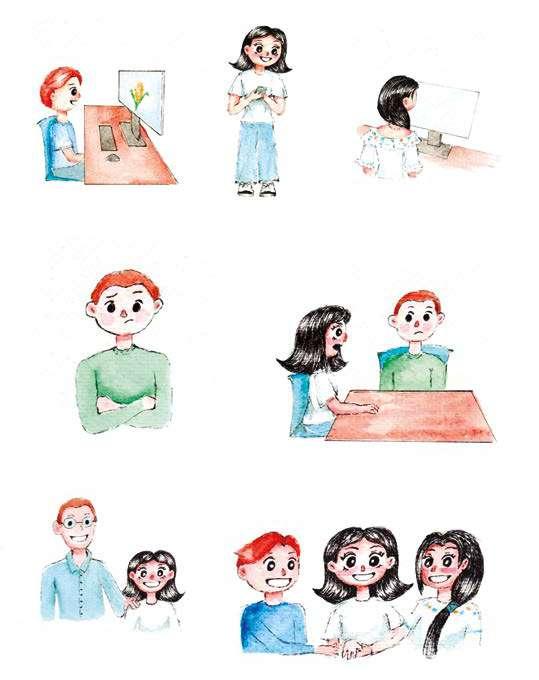
We can put old videos like this, when they watch them they'll feel like they're in the past.
We could also add voices in Kichwa and Spanish so everyone will be able to understand
Both students, upon leaving class, go home to research how to do it in a better and more creative way.
Next day in classes
Lucia, she believes that adding languages would give it another essence.
Because our history is also important. Why not represent all cultures?
Why do more?, what we have is enough.
The next day they go to class and one of their classmates heard them talking and told them it was a waste of time.
Don't worry, I feel like it will be a very good project, keep it up.
Professor Ramiro listens to them and thinks it's a great idea and he should put it into action.
Emma, Carlos, and Lucia feel motivated and continue to work even harder outside of class until the day of the presentation.
Welcome, sir. I present to you our project, which focuses on showcasing our Otavalo culture
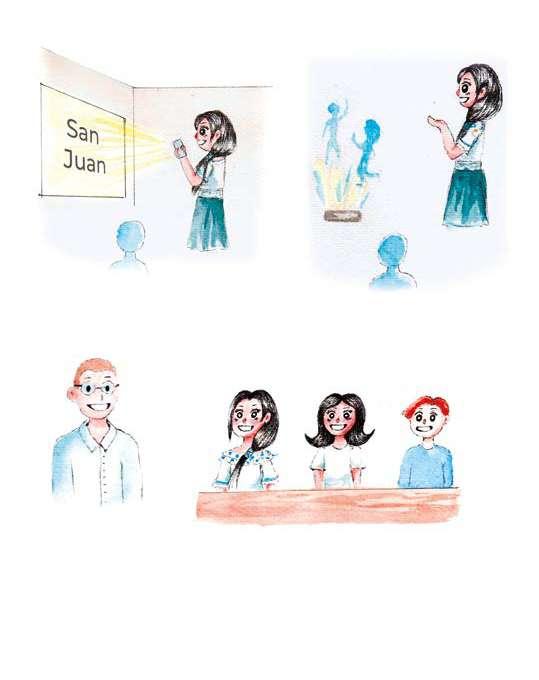
Go ahead
Emma explains to the rector that the project aims to go beyond a simple cultural video.
The teacher looks at them with great pride.
Congratulations, guys. You've shown that changes can be made and that we must first defend what's ours.
Education must adapt to new technologies without losing our cultural focus.
By using 3D animations, you can feel transported back in time and experience it in a truly real way
Mercedes, a young teacher, found an application she couldn’t ignore. It would help a special student, Amaru, a little girl who struggled to follow lessons because she didn’t understand Spanish very well.
Wow, how fascinatng! This application will help my students communicate better.
Excited, Mercedes went to show the app to her husband, Ronald.
Look, Ronald, I found this application for my students.
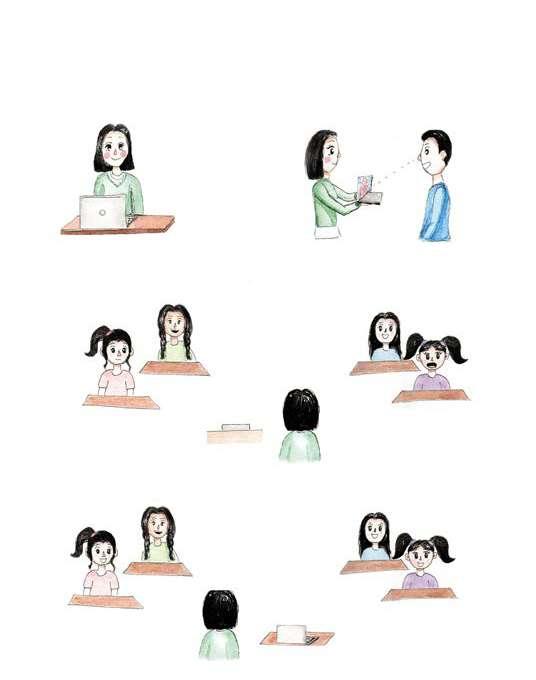
That’s cool! Your students will love it.
The next day at school.
Imata kanka? “What could it be?”
Oh no! I don’t like surprises.
Good morning, children. Today I brought something special today.
Teacher, does that mean I’ll be able to communicate better with my classmates?
I brought an app called “United in Knowledge”. It will help us translate books and conversations from one language to another.
Absolutely, Amaru..
The children head to the playground to test the app their teacher gave them.
: Everyone can use the app, so go explore it!
Awesome! Now I understand the instructions better.
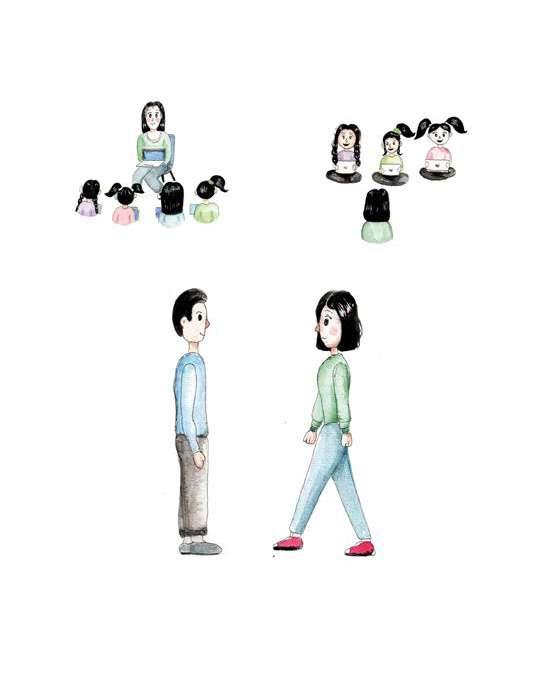
The children were thrilled, asking Amaru for words in Kichwa, her native language, eager to test the app.
Well, how about… Inti?
Now I can understand my best friend, Amaru, even more. This will make it easier to make plans together.
That night, Ronald came home, eager to hear about his wife’s class.
Honey, I’m home. How did it go today?
That’s awesome! I knew you’d do great.
It says it means “sun”! That’s amazing!
Tell us another word in Kichwa, Amaru
Great job, children! That’s all for today.
It was a success! The app helped them interact more.
Technology can be a powerful ally for inclusion, but true communication and empathy come from the effort and willingness to learn together.
One day, Teacher Ana, proposed an idea in class.
Today, we’re starting a project that will change how we see and hear each other, using technology.
What kind of project, teacher?
We will create an inclusive platform.
Could it be a social network? What will it be?
The students head to the playground, to come up with ideas for the homework the teacher left them.
We could create an application where people can listen to music and read educational texts from different cultures.
I am in charge of designing the platform.
We could add subtitles to the folk music of our people.
I can help by collecting the most traditional songs.
All the children came together as one group, and with each of their strengths they were able to slowly create their cultural platform.
I found an album of music from my culture. I’ll upload it to the platform.
I’ll organize the playlist a bit more.
How are you guys doing?
We’re creating an application… It’s a secret….
It’s a platform, not just for us, but for everyone. It sounds like a very interesting project, I will look forward to it.
Can I try it?
Finishing a few details on the final application, the children presented the project to the teacher, naming their project “Plataforma unión”.
It’s a music platform, where our Andean music, sung in Kichwa, can be understood by everyone through subtitles.
That sounds interesting, children!
Today will you tell me what it is?
Sure!
When technology is used creatively, everyone can learn in a more fun way.
References
Anchundia, J. D., Macías, R., & Tubay, L. (2024). La personalización del aprendizaje: Estrategias de adaptación de contenido con inteligencia artificial en entornos educativos [Personalised learning: Content adaptation strategies with artificial intelligence in educational settings]. Unidad Educativa Costa Azul.https://doi.org/10.33255/2591/1940
Area, M. (2020). Ciudadanía digital, alfabetización mediática y competencias informacionales [Digital citizenship, media literacy, and information skills]. Comunicar, 28(65), 1–10.
Arteaga-Tuba, G. (2024, August 22). Technological resources for learning within the framework of Ecuadorian inclusive education. Scielo. http://orcid. org/0000-0002-6241-8539
Binario. (2025). Educación híbrida [Hybrid education]. https://binario.com.ec/ wp-content/uploads/2025/01/Libro-Educacion-Hibrida-2.pdf
Boné-Andrade, M. (2023). Digital inclusion and access to information technologies in rural. Revista Científica Zambos, 2(2), 1–16. https://doi. org/10.69484/rcz/v2/n2/40
Calle-Córdova, M. J., Tenecota-Huerta, L., & Arévalo-Herrera, D. (2024). Políticas de inclusión digital en la educación: Perspectivas para el Ecuador [Digital inclusion policies in education: Perspectives for Ecuador]. Revista Docentes 2.0, 17(2), 355–361.
Carazas, L., Moreno, C., & Yánez, R. (2024). Modelos híbridos de aprendizaje en contextos rurales del Ecuador [Hybrid learning models in rural contexts of Ecuador]. Revista de Educación y Tecnología, 9(2), 75–89. https://doi.org/10.7822/redt.v9i2.4487
Condori, Y. (2023). Alfabetización digital y el desarrollo de competencias digitales en docentes rurales de educación secundaria [Digital literacy and the development of digital competencies in rural secondary school teachers]. Horizontes. Revista de Investigación en Ciencias de la Educación,
8(32), 4–6 https://doi.org/10.33996/revistahorizontes.v8i32.719
Confederación de Nacionalidades Indígenas del Ecuador. (2022). Lenguas indígenas del Ecuador y el mundo [Indigenous languages of Ecuador and the world]. CONAIE. https://conaie.org/2022/04/25/lenguas-indigenas-de-ecuador-y-el-mundo/
Cruz Guimarães, J. L. (2022). Las TIC y su impacto en la educación rural: Realidad, retos y perspectivas para alcanzar una educación equitativa [ICT and their impact on rural education: Reality, challenges, and perspectives to achieve equitable education]. Revista Educar. https://doi. org/10.37811/cl_rcm.v6i4.2539
Dennis, R., & Clancy, B. (2022). Digital ethics and intercultural awareness in global classrooms. Journal of Digital Education, 18(4), 221–235. https:// doi.org/10.1016/j.jde.2022.04.003
Duque-Romero, M. V., & Puebla-Molina, A. (2023). Educación básica: Desafíos para la educación ecuatoriana postpandemia. [Basic Education: Challenges for Ecuadorian Education in the Post-Pandemic Era]. Mendive. Revista de Educación, 21(2). http://scielo.sld.cu/scielo.php?script=sci_ arttext&pid=S1815-76962023000200001
Fernández, M. (2025, junio 15). Inteligencia artificial y educación inclusiva: Rompiendo barreras. [Artificial Intelligence and Inclusive Education: Breaking Down Barriers]. EPALE https://epale.ec.europa.eu/es/blog/inteligencia-artificial-y-educacion-inclusiva-rompiendo-barreras
Fernández-Batanero, J. M., de la Cruz, M. P., Godoy, E. J., & Martín-Carrasco, M. L. (2022). Assistive technology for the inclusion of students with disabilities: A systematic review. Educational Technology Research and Development, 70(6), 1911–1930. https://doi.org/10.1007/s11423-02210127-7
Fig, A., & Charry, L. (2022). Educación inclusiva y transformaciones digitales en el aula. [Inclusive Education and Digital Transformations in the Classroom]. Editorial Académica Española.
Flores, G. (2015). Interculturalidad y ciudadanía digital. [Interculturality and Digital Citizenship]. Revista Latinoamericana de Estudios sobre Ciberacoso y Ciberseguridad, 2(1), 15–28.
Fundación Adecco. (2022). Las nuevas tecnologías al servicio de la discapacidad. [New Technologies in the Service of Disability]. https://fundacionadecco.org/blog-diversidad-inclusion/las-nuevas-tecnologias-al-servicio-de-la-discapacidad/
García Rivas, N. E. (2024). Tecnología asistida para la inclusión educativa en Ecuador. [Assistive Technology for Educational Inclusion in Ecuador]. Ciencia Latina Revista Científica Multidisciplinar, 8(3). https://doi. org/10.37811/cl_rcm.v8i3.11228
García, A. (2017). Plataformas virtuales accesibles para la educación inclusiva. [Accessible Virtual Platforms for Inclusive Education]. Revista Iberoamericana de Tecnología y Educación, 5(3), 33–50.
Gordillo-Fuentes, E., Laínez-Vera, J., & Esteves-Fajardo, Z. (2024, 19 de julio). Inclusive education: A vision of a reality in indigenous language learners: Mexico and Ecuador. Scielo. https://doi.org/10.35381/r.k.v8i2.2983
Haboud, M. (2019, 5 de febrero). Una epidemia amenaza a las lenguas indígenas. [An Epidemic Threatens Indigenous Languages]. Courier de la UNESCO. https://courier.unesco.org/es/articles/una-epidemia-amenaza-las-lenguas-indigenas
Hernández, M., & Rodríguez, L. (2021). Tecnologías inclusivas e interculturalidad en el aula digital. [Inclusive Technologies and Interculturality in the Digital Classroom] Revista Educación y Tecnología, 14(2), 35–50.
Herrera, Y. (2023). [Importance of digital literacy in rural áreas]. Institución Educativa Humberto Velásquez García.
Hess, J., & Gutierrez, A.-M. (2018). Introducción a la tecnología de asistencia. [Introduction to Assistive Technology]. Center on Technology
and Disability. https://www.ppmd.org/wp-content/uploads/2019/08/ AT101-Spanish-v2.pdf
IIETA. (2024). Beyond Access: Public Policies and Digital Skills as Determinants of Digital Inclusion. Multimedia Communications, 45(1–4), 406–418. https://doi.org/10.18280/mmc_d.451-406.
Instituto Nacional de Estadística y Censos. (2020). Encuesta de hogares sobre tecnologías de la información y comunicación. [Household Survey on Information and Communication Technologies]. INEC https://www. ecuadorencifras.gob.ec/tecnologias-de-la-informacion-y -comunicacion-tic-2020/
Liu, G., Ma, C., Bao, J., & Liu, Z. (2023). Toward a model of informal digital learning of English and intercultural competence: A large-scale structural equation modeling approach. [Computer Assisted Language Learning], 36(5),1123-1145. https://doi.org/10.1080/09588221.2023.2191652
López, M. (2018). Hacia una Internet intercultural: Desafíos y oportunidades en la era digital. [Towards an Intercultural Internet: Challenges and Opportunities in the Digital Age] Journal of Digital Culture, 5(2), 40–50.
Luckin, R., Holmes, W., Griffiths, M., & Forcier, L. (2016). Intelligence unleashed: An argument for AI in education. Pearson. https://www.pearson. com/content/dam/corporate/global/pearson-dot-com/files/innovation/Intelligence-Unleashed-Publication.pdf
Luna, D. (2018). La tecnología para eliminar barreras de la discapacidad. [Technology to Eliminate Barriers of Disability]. Ministerio de Tecnologías de la Información y las Comunicaciones. https://www.mintic.gov.co/portal/ inicio/Sala-de-prensa/MinTIC-en-los-medios/63934:La-tecnologia-para-eliminar-barreras-de-la-discapacidad
Masaquiza, M. K. A. (2021). Aplicación móvil para el aprendizaje del idioma kichwa [Tesis de grado, Pontificia Universidad Católica del Ecuador]. Repositorio PUCE Ambato. https://repositorio.puce.edu.ec/handle/123456789/41547
Metaverso Pro. (s.f.). Estrategias para una implementación responsable de la IA en la educación. [Strategies for Responsible Implementation of AI in Education]. https://metaverso.pro/blog/estrategias-para-una-implementacion-responsable-de-la-ia-en-la-educacion/
Ministerio de Educación. (2025). Más de 3400 instituciones educativas en zonas rurales recibirán equipamiento tecnológico y conectividad mediante proyecto del Gobierno de Daniel Noboa. [More than 3400 Educational Institutions in Rural Areas Will Receive Technological Equipment and Connectivity Through the Government Project of Daniel Noboa]. Ministerio de Educación.
Montes Santiago, R. E., Sánchez García, J. E., Martínez-Ramírez, Y., & Bautista Morales, R. (2024). Aprendizaje móvil de lenguas indígenas: [Mobile Learning of Indigenous Languages: Literature Review]. Revisión de literatura. Alteridad, 19(1), 171–188. https://doi.org/10.61728/AE24002929
Morales Romo, J. (2017). Uso de TIC en contextos rurales: Superando barreras geográficas. [Use of ICT in Rural Contexts: Overcoming Geographical Barriers]. Revista Latinoamericana de Educación Rural
Novella-García, C., & Cloquell-Lozano, A. (2021). The ethical dimension of digital competence in teacher training is important. Education and Information Technologies, 26(3), 3529–3541. https://doi.org/10.1007/s10639021-10436
Peñaherrera-Acurio, W., Peñaherrera-Acurio, S., & Espinoza-Beltrán, P. (2021). La transformación de la educación en el Ecuador mediante la inclusión de herramientas tecnológicas en las clases virtuales. [The Transformation of Education in Ecuador through the Inclusion of Technological Tools in Virtual Classes]. Dominio de las Ciencias, 7(1).
Pérez, C., & Reeves, E. (2023, 28 de agosto). Digitally inclusive education: An updated review digital divides in inclusive education. Universidad de Costa Rica. https://doi.org/10.15517/aie.v23i3.54680
Pérez, J., & Sánchez, M. (2021). Accesibilidad digital: Retos y oportunidades
para la educación inclusiva. [Digital Accessibility: Challenges and Opportunities for Inclusive Education]. Revista de Educación Inclusiva, 14(2), 100–120.
Pin-Zambrano, J. (2024, 22 de agosto). Information and communication technologies and rural education in Ecuador. Scielo. http://orcid.org/00000002-5070-3519
Ramírez, F., & Torres, L. (2019). Implementación del DUA en plataformas educativas digitales: Un camino hacia la inclusión. [Implementation of UDL in Digital Educational Platforms: A Path Towards Inclusion]. Revista Latinoamericana de Tecnología Educativa, 12(1), 79–95.
Richardson, J. T. E. (2022). The legibility of serif and sans serif typefaces: Reading from paper and reading from screens. SpringerBriefs in Education. https://doi.org/10.1007/978-3-030-90984-0
Ríos-Colmenárez, M. J. (2020). Enseñanza de lenguas indígenas mediadas por las TIC en América Latina. [Teaching Indigenous Languages Mediated by ICT in Latin America]. Revista Lengua y Cultura, 1(2), 20–27. https:// repository.uaeh.edu.mx/revistas/index.php/lc/issue/archive
Romero, M., González, L., & Herrera, F. (2017). Tecnología educativa e inclusión: Retos y oportunidades. [Educational Technology and Inclusion: Challenges and Opportunities] Revista Iberoamericana de Educación, 75(1), 45–62. https://doi.org/10.35362/rie7512932
Karla Salazar-Quiroz1, JS Santillán-Tamayo1, Atikuri Yupanki-Orbes1 , André Ruiz1
¹Facultad de Educación, Ciencia y Tecnología, Universidad Técnica del Norte, Ecuador
klsalazarq@utn.edu.ec, jssantillant@utn.edu.ec, ayorbesa@utn.edu.ec, maruizq@utn.edu.ec
Introduction
In the contemporary educational landscape, cultural diversity occupies a central place in pedagogical reflection. Against this backdrop, the incorporation of traditional festivals into the school curriculum emerges as a key methodological strategy to strengthen cultural identity, foster respect for otherness, and enrich intercultural learning processes. By integrating these celebrations into the educational sphere, a deeper understanding of the symbolism underlying different cultures is enabled, as well as their historical, social, and spiritual dynamics.
Ecuadorian festivities constitute complex and deeply rooted cultural expressions, where Indigenous, colonial, and modern elements converge. These celebrations, featuring music, dance, rituals, and traditional attire, are tied to religious commemorations or agricultural cycles and are fundamental to the construction and reinforcement of social fabric (Valarezo & Escobar, 2009). In a context marked by structural violence, the advance of neoliberalism, and the consolidation of imperial logics, the voices of Indigenous peoples resurge in demands for recognition and cultural justice (Dávalos, 2005).
In this framework, education fulfils an irreplaceable role in the transmission, resignification, and preservation of cultural traditions. In the face of the fragmentation of a solid identity that characterizes
many school contexts, it becomes imperative to design pedagogical methodologies that foster a sense of belonging and reconnect individuals with their ancestral roots.
Festivities, in this context, constitute privileged spaces of convergence between education, culture, and art, facilitating experiential engagement and analysis of these unique expressions. Through their study and enactment in the classroom, a critical analysis is fostered that interrogates essential aspects of every cultural manifestation: the way it is performed, the time in which it is situated, the place that sustains it, and the profound meaning that legitimizes it in collective memory.
The cultural wealth of Ecuador’s coast is manifested through the expressions and celebrations of its diverse peoples, including the Montubios and Afro-Ecuadorians, whose practices constitute a living and dynamic memory of their identity and historical resistance to processes of exclusion and colonization. The analysis of the construction of these identities reveals that they are not immutable qualities, but positional and relational processes consolidated in the “logic of difference,” requiring a “constitutive exterior” to affirm themselves. Interaction with the Ecuadorian State and social movements has been fundamental in this identification process.
• Montubio culture
The Montubios, settled mainly in Manabí (Chone, El Carmen, Portoviejo, Tosagua), maintain a rich oral, musical, and festive tradition that includes amorfinos (popular poetic expressions that exalt wit and popular wisdom), as well as myths and legends, customs, gastronomy, attire, traditional dances, and celebrations such as the rodeo Montubio and Chigualos, which are also celebrated in other coastal areas.
Montubio cultural manifestations have been revalued through art, education, and media, in this case, comics, which enable
the intergenerational transmission and visibility. In localities like Calceta, Rocafuerte y Portoviejo, these traditions remain alive and have been respectfully represented in graphic narratives integrating rituals, poetic, and musical elements (Jiménez, 2025). These expressions strengthen the sense of belonging in the face of cultural homogenization.
Since the early twentieth century, especially in the 1930s, thanks to the work of intellectuals like José de la Cuadra and the Guayaquil Group. These authors sought to rescue the Montubio symbolic and linguistic universe to establish a coastal national identity from there, transforming the Ecuadorian coast.
The Montubio Solidarity Movement recovered this representation to give it new meaning from a political dimension. Its leader, Luis Alvarado, defended the need to recover identity, culture, and dignity, proposing endogenous, community-based, and solidarity-driven agro-productive model. This movement drove the creation of the Council for the Development of the Montubio People of the Coast (Consejo de Desarrollo del Pueblo Montubio de la Costa, CODEPMOC), after intense social mobilizations and negotiations with the State (Ecuador, Presidencia de la República, 2001).
Executive Decree No. 1394, signed in 2001, institutionalized this identity by establishing that the Montubio people were a productive human group of significant national impact and should organize into an entity to execute plans with criteria of self-management and community participation (Ecuador, Presidencia de la República, 2001). Although the Decree emphasizes their role as producers, the movement articulated this definition with a specific cultural identity.
• Afro-Esmeraldean culture
Afro-esmeraldean culture articulates a profound spiritual vision of life and death through ritual songs: Chigualos and alaba’os. According to Clavijo (2020), these practices are complex expressions of an ancestral worldview where orality, religious syncretism, and history converge.
Chigualos are festive celebrations dedicated to children considered “angelitos” [Little angels], including lullabies, games, and music with marimba, cununo, and guasá (regional instruments). In December, this ceremony honors deceased children through songs, food, and dances, strengthening community bonds (CODEPMOC, 2001). In contrast, alaba’os are solemn songs, sung a cappella for adults, oriented toward forgiveness and salvation of the soul. A highlight of the ritual is the grito (cry), in which, at midnight, the coffin is taken out to “gather the footsteps of the deceased,” reinforcing the bond between body, soul, and community.
The Ministry of Culture and Heritage of Ecuador (2022) and UNESCO (2015) emphasize that these practices are not merely musical expressions but acts of Afro-descendant resistance that have endured through processes of syncretization between African rites and Catholic liturgy.
The institutionalization of Montubio and Afro-ecuadorian identities occurred in a context of neoliberal crisis, in which social movements demanded their inclusion as collective subjects with rights. The 2008 Constitution consolidated the recognition of Montubios, along with indigenous and AfroEcuadorian peoples, as subjects of collective rights (arts. 56 and 59). Official recognition was achieved with the creation of CODEPMOC (2001) and the Afro-Ecuadorian Development Corporation (CODAE) in 2005, as well as the inclusion of these categories in the 2010 national census.
Some celebrations are described below:
• The Marimba Festival
The Ecuadorian marimba, especially present in Esmeraldas and the Chota-Mira Valley, represents an emblematic expression of Afro-descendant collective memory. Recognized by UNESCO as Intangible Cultural Heritage of Humanity, this practice brings together music, dance, orality, and spirituality (UNESCO, 2015). Festive spaces associated with the marimba promote community cohesion and the transmission of
ancestral knowledge. However, stereotypes abound, and a focus is proposed that rescues silenced memories through festivals, artistic projects, and intercultural education.
• New Year’s Eve festival: the burning of the monigote (dummy)
In the province of El Oro, the year culminates with the burning of a giant monigote (dummy), accompanied by rhymed testaments that humorously critique the year’s events. This tradition reinforces neighborhood identity and promotes collective creativity (Cascante Moreira, Clavijo Barzola & Martín, 2019).
The origin of this festival dates back to a tragic event in Guayaquil in 1895. During a yellow fever threat, residents burned the clothes of the deceased with branches and straw in the streets to ward off the plague, which over time transformed into the symbolic ritual of leaving behind the year’s misfortunes (Ministerio de Cultura y Patrimonio, 2021). Thus, the monigote represents the farewell to the past and the collective hope for a new cycle full of promise.
This tradition has extended to other regions, where it has been reshaped to reflect local cultural identities. In Atuntaqui (Imbabura), the burning of the “monigote” [dummy] stands as the centerpiece of a vibrant and complex celebration known as the Fiesta Popular de Inocentes y Fin de Año [Popular Festival of the Innocents and New Year’s Eve]. This festival was officially recognized as Intangible Cultural Heritage of Ecuador on December 11, 2007. Since the 1920s, initiated by workers from the historic Fábrica Imbabura [Imbabura Factory], preliminary acts—such as the “Bando-Bando” procession [Bando-Bando parade] and “La Agonía de Papá” [The Agony of Papá]—have set the stage for the grand parade on December 31. The festivities include elaborate floats, creatively handcrafted costumes, and satirical readings, all culminating with the burning of the monigote [dummy] in Plaza Libertad [Liberty Square] (El Universo, 2018; Turismo, 2012).
The agricultural calendar in the Andean worldview is intimately linked to the rhythms of nature and the ancestral rites that mark the cycle of life. Festivities in the Ecuadorian Highland form fascinating symbolic systems that intertwine ancestral memories, colonial struggles, and processes of religious syncretism. As Valarezo (2009) mentions, these manifestations operate as “mechanisms of cultural reproduction that reactivate identities through collective performativity” (p.32).
This section highlights various celebrations that mark the different phases of the agricultural cycle, such as planting, harvesting, and other agricultural activities. Each of them represents the culture and ancestral beliefs of the communities. On this occasion, festivities specific to the provinces of Tungurahua, Cotopaxi, and the northern the Highland region, each with a unique historical background, festive calendar, symbolic attire, and gastronomy that express the identity of each territory.
• The Diablada de Píllaro
Originating in the town of Píllaro, in the province of Tungurahua, this festival dates back to colonial times, emerging as a form of Indigenous resistance against the colonial system, wherein “the devils embodied the subversion of imposed hierarchies” (Dávalos, 2005, p. 42). According to El Mercurio (2017), the Diablada is celebrated from January first to sixth and consists of a parade of comparsas (masked troupes), in which hundreds of dancers wearing devil masks and embroidered costumes gather in partidas to dance in honor of the new year. The typical attire includes a carved wooden mask, a brightly colored poncho, knee bells, and a vest adorned with mirrors that reflect sunlight, symbolizing the expulsion of dark forces (El Mercurio, 2017). The devil masks are meant to represent the colonizer and to express the resentment and anger of the Indigenous people toward them. This is why they seek to be frightening and unpleasant.
If we take a look at the old masks, we will find that many of them were made from tins and painted with, at most, two to three colors. This is because the Indigenous people during colonial times would save throughout the year in order to buy a tin of paint, which was expensive, in order to paint the masks, since it was between the first and sixth of January that the colonizers allowed the Indigenous people to spend time with their families after a long period without seeing each other, and this celebration took place (El Mercurio, 2017).
The Mama Negra, celebrated in Latacunga, Cotopaxi, is a syncretic festival blending indigenous, Spanish, and African traditions. Its origin dates to the eighteenth century, after the eruption of Cotopaxi volcano, as an act of gratitude to the Virgin of Mercy, patrons of the canton, for protecting Píllaro during the event. According to Valarezo and Escobar (2009), it takes place on two key dates: the weekend before September eleventh in honor of the Virgin, and a second edition in November. The main event is the parade of the “Mama Negra,” a character dressed in colorful attire, a wide-brimmed hat, a neckerchief, and a face painted black, symbolizing gratitude for protection after the volcanic catastrophe.
Typical costumes include the guarichas (joyful women), capariches (men with whips), and escaramujos (acrobatic dancers). Culinary highlights include fritada (fried pork with spices), mote pillo (tender corn sautéed with egg and onion), and chicha de jora (fermented corn drink), accompanying each parade (Valarezo & Escobar, 2009).
• The Yamor Festival in Otavalo (September)
This festival preserves Kichwa rituals of gratitude to the Pachamama [Mother Earth]. The Aya Huma [Aya Huma (Masked Spirit Head)] dances and lake regattas “reinterpret agrarian worldviews through performative narratives” (Narváez, 2006, p. 18). Chicha de Yamor, a fermented drink
made from seven types of corn, embodies what Narváez (2006) calls “agricultural bio-memory: gustatory knowledge resisting food homogenization” (p. 23).
These festivals create unique intercultural pedagogies where, as Dávalos (2005) notes, “the dancing body becomes a political text inscribing memories of resistance in public space” (p. 51). Far from being static folklore, they represent ancestral epistemologies challenging hegemonic discourses on national identity.
In the Ecuadorian Highland, Inti Raymi or Festival of the Sun, celebrated on June twenty-first, is one of the most significant events in the Andean ritual calendar. This commemoration of the winter solstice and the agricultural cycle is an act of gratitude to Taita Inti (Father Sun) and Pachamama (Mother Earth) for the harvests, representing the spirit of the Indigenous peoples (Campoverde-Aguirre et al., 2022).
This festival takes place annually at the Ingapirca Archaeological Complex, in the province of Cañar, Ecuador, where community rituals, traditional dances, artistic exhibitions, and other activities that reinforce cultural identity are held. Although it is promoted in various communities of the Ecuadorian Highland, such as in Otavalo, where it begins with the purification ritual or Armay Chisi, in which participants immerse themselves in rivers or springs to renew their energy, in Cotacachi, with traditional dances in the central park, and in Saraguro, a community with direct lineage from Inca settlers, the festival maintains its authenticity; at Ingapirca, the event acquires a unique dimension thanks to the heritage value of the site and the institutional support of the National Institute of Cultural Heritage, which ensures its continuity and preservation. These celebrations share common ritual elements, such as purification through water, ceremonial flute music, the selection of Ñusta and the Pambamesa, which represents the union of the community through food.
Historically, the Inti Raymi was established around 1430 by Inca Pachacútec as the most important ceremony in the agricultural and astronomical calendar of the Tahuantinsuyo. According to the chronicles of Garcilaso de la Vega, the celebration used to last approximately fifteen days included purification rituals, sacrifices of animals, dances, songs, and offerings to the sun, with the purpose of renewing its energy and ensuring the fertility of the crops (Garcilaso de la Vega, 2009; Ticket Machu Picchu, 2024). Banned in 1572 by Viceroy Toledo in the context of the Spanish colonization, the Inti Raymi was revived in 1944 as a theatrical representation in Cusco, under the Faustino Espinoza Navarro’s initiative. Nowadays, it is a living practice that continues constructing an identity and will be represented in the comics created.
• Pawkar Raymi
The micro-story Pawkar Raymi retador narrates the symbolic depth of this festival:
The crowd gathered on the highest hill. The four Taitas shaped silhouettes on the ground in the form of a cross, using seeds and fruits. The sun was perfectly aligned with the food. A Taita began the ceremony when suddenly raindrops fell, causing participants to let go of hands and seek shelter. At that moment, a lightning bolt struck, and the rain turned into a gale. Frightened, were happy and whispered among themselves: The earth embraced and challenged us; from now on, there will be abundance in our crops (Tséntsak, 2023).
El Pawkar Raymi, known as the festival of blossoming, is one of the four main celebrations of the Andean agro-festive calendar: Pawkar Raymi (Festival of Blossoming), Inti Raymi (Festival of the Sun)], Kulla Raymi [Festival of Fertility)], and Kapak Raymi (Festival of Abundance).
It is held between February and March to thank Pachamama for the harvests and renew the bond with nature. This festival, which includes
rituals such as the Tumarina, reflects the connection between forms of cultural resistance and identity for the Otavalo, Colta, and Punin peoples, preserving ancestral knowledge amid mestizaje.
Its intercultural characteristic is manifested through musical festivals and tributes to women. As Rizo (2013) highlights, interculturality implies a living communication between cultures, and the Pawkar Raymi allows this knowledge to be shared with visitors, strengthening the cultural fabric.
In the Amazon region, the Shuar people celebrate the Fiesta de la Chonta to thank Pachamama for the uwi harvest, a typical fruit. The celebration includes dances, songs, and chicha de yuca, expressing their spiritual bond with the forest (Valarezo & Escobar, 2009).
The Fiesta de la Chonta, celebrated between March and April y the Shuar, honors the harvest of this sacred fruit and connects the community with the land and its protective spirits. The ceremony includes dances, songs, and rituals reinforcing harmony between humans and nature (Ministerio de Cultura y Patrimonio, 2023). It is believed that if the celebration is not performed correctly, spirits may bring illness scarcity, evidencing the deep spiritual meaning of this practice (SENESCYT, 2020).
Women play a central role in this festival. They prepare chicha de chonta, a ceremonial drink made with ancestral techniques, demonstrating the active role of Shuar women as bearers of wisdom, memory, and worldview (Gualinga, 2018). Their participation is vital, ensuring that rituals remain alive and respectful of ancestral norms.
In Santa Cruz (Galápagos), the Sustainable Lobster Festival is celebrated with parades, contests, and typical dishes. Although it originated before the arrival of fishermen, today it seeks to promote responsible fishing and marine conservation form an early age (Jerez, 2022).
Since 2015, Santa Cruz has hosted the Sustainable Lobster Festival to highlight the relationship between the Galápagos community and marine conservation. The festival combines gastronomy, art, and environment education to promote responsible fishing, avoiding the capture of lobsters out of season or of prohibited size (WWF Ecuador, 2022). The initiative aims to Foster a culture of care ensuring the sustainability of the resource for future generations.
The Galápagos National Park and local governments regulate fishing through bans, monitoring, and training. During the festival, there are fairs, culinary contests, and activities to raise awareness among locals and tourists about the archipelago’s unique biodiversity (Dirección del Parque Nacional Galápagos, 2022). Thus, this festival represents a model of integration between culture, economy, and environmental conservation (Gobierno Autónomo Descentralizado Municipal de Santa Cruz, 2022).
The Importance of Festivities to Teach Art, History, Music, Gastronomy, and Values: A Journey through the Cultural Meanings in Different Regions of Ecuador
Festivities in Ecuador constitute privileged spaces for teaching and transmission of art, history, music, gastronomy, and fundamental values, articulating essential bridges between different generations and regions of the country. These cultural manifestations reinforce the collective identity in a significant way, promote learning through direct experience, and foster an appreciation of the diversity that characterizes the Ecuadorian society.
• Educational and cultural dimensions
In their development, the festivities integrate artistic manifestations and historical traditions of great relevance. Dramatizations, performances in typical costumes, and visual expressions allow children and youth to access tangible knowledge of their regions and nation’s cultural and historical richness (Mero-Alcívar et al., 2024; Parra & Parra, 2025).
Traditional Ecuadorian music, vibrantly presented at school and community festivals, strengthens cultural values and local
identity. Its practice fosters recognition and appreciation of the national music heritage among students and educational authorities (Gómez-Ullate & Saraiva, 2024; Loaiza, 2024).
For its part, gastronomic festivals such as the renowned one in Guayaquil or the Red Crab Festival, go beyond mere culinary promotion. These spaces motivate substantive learning about native ingredients, ancestral techniques, and food customs, generating a deep sense of belonging and satisfaction among locals and visitors (Campoverde-Aguirre et al., 2022; Rivera et al., 2017; Villagómez-Buele et al., 2020).
It should be noted that these celebrations also foster essential values such as gratitude, mutual respect, and harmonious coexistence, exemplified in ceremonies like Inti Raymi, which unites communities around nature and agricultural production, or in school festivals that reinforce collective identities and community spirit (Carvache-Franco et al., 2018; Loaiza, 2016; Mero-Alcívar et al., 2024).
• Regional manifestations and their meaning
Regional diversity is clearly expressed in these celebrations. In the Highland region, Inti Raymi synthesizes gratitude to nature through ancestral music and dances, reinforcing Andean identity and its value system (Carvache-Franco et al., 2018). On the Coast, the Raíces Festival stands out for its celebration of traditional gastronomy and culinary art, enhancing local culture and tourism development (Campoverde-Aguirre et al., 2022; Rivera et al., 2017). School festivals, meanwhile, bring together musical expressions, dramatizations, and gastronomic displays, becoming ideal spaces for experiential teaching and the transmission of community values (Loaiza, 2016; Mero-Alcívar et al., 2024).
Ecuadorian festivals function as comprehensive educational tools that, through artistic, historical, musical, and gastronomic experiences, transmit fundamental values and strengthen identity bonds across all regions of the country. Their importance lies in their capacity to connect people with
their cultural roots, fostering respect for Ecuador’s cultural fabric.
• The role of women in the traditional Ecuadorian festivities
Women play a central role in the traditional Ecuadorian festivities, as transmitters of knowledge and as active leaders in the rituals. In the Fiesta de la Chonta, for instance, it is Shuar women who prepare the chicha in a ritual process which symbolises gratitude and connection with the rainforest, reaffirming their role as guardians of the spiritual memory of the community (Martínez, 2020).
In the celebrations of New Year in Atuntaqui, women have been a key in the elaboration of the rhymed testaments, a practice that demands historical memory, humour, and social creativity (Ministerio de Relaciones Exteriores y Movilidad Humana, 2016). During the Lobster Festival in the Galápagos Islands, women actively participate in gastronomy, commerce, and environmental education, showing how festive spaces can be sceneries for rural empowerment (Morales, 2020). These experiences demonstrate that festivities are spaces of celebration, female agency, and cultural continuity.
The traditional festivities have undergone diverse transformations in the current context, in which the ancestral cultural elements are interpreted and modified to be adapt to contemporary social, economic, and political dynamics. They reflect how festivities adapt to the social, cultural, and modern, changes, exploring new forms of celebration and how these transformations maintain their essence alive in the present day. In this sense, the construction of ceremonial territories through the festivities is fundamental to identity, as observed in the Fiesta de la Yaguarmik´a in CotacachI (Cazar, 2024, p.280).
One of the most relevant aspects in these processes is the way in which the ritual practices are configured, combining folkloric elements,
social and migratory conditions, and new forms of expression, with recent influences. Digital technologies have played a relevant role in the diffusion of these festivities since they provide interest among new groups in their traditions.
However, this modernization also brings with it new challenges, such as the loss of specific forms of knowledge or the weakening of the customs, particularly within Indigenous and Afro-descendant communities, which show remarkable resilience in the face of external influences (Paucar, 2021). On the contrary, they demonstrate a notable capacity to adapt without ceasing to express their meanings. In fact, it has been observed that “advanced capitalism, with all its tragic social, political, economic, and ecological consequences, is far from having put an end to festivals and rituals, nor has the current pandemic done so, nor will it” (García, 2021, p.3). Thus, festivities appear as dynamic spaces of ethnic expression, in which elements of heritage, change, and innovation converge.
The capacity of communities to negotiate these spaces reveals their knowledge, such as the ingenuity to find new mechanisms for collective experience in a rapidly transforming world. As Yépez (2024) rightly states: “The Holy Week of the Black people of Telembí reveals the syncretism, as well as the strategies of collective identity of a people within a context of new social spaces” (p.169).
The incorporation of Ecuador’s traditional festivals into the school context represents a valuable pedagogical strategy to promote the recognition of cultural diversity. These celebrations are not isolated events; they are living expressions of collective memory, local worldviews, and historical processes that shape national identity. Integrating them into the curriculum re-signifies their educational value, transforming them into opportunities for meaningful learning and the strengthening of community bonds.
The intercultural approach applied to school festivals allows them to move beyond superficial presentations and become participatory processes of cultural dialogue. Pedagogical planning must transcend the reproduction of folkloric stereotypes, instead promoting critical
analysis of traditions, their origins, meaning, and transformations. Including the voices of local sages, families, and communities adds depth to the process and contributes to building reflective citizenship.
School festivals strengthen the cultural self-esteem of students, especially those from historically marginalized people and nationalities. Seeing their traditions reflected in the educational space validates their belonging and breaks the monocultural logic if the school. This visibility also allows other student to broaden their understanding of the country as a plurinational and diverse territory, promoting mutual respect and coexistence.
To ensure that festivals in the classroom fulfil a true educational and intercultural role, it is necessary to institutionalize their planning through integrative projects linking various area of knowledge. Activities such as cultural fairs, dramatizations, local research, and multisensory exhibitions can connect content from history, art, language, and social sciences, generating contextualized learning. Furthermore, these actions should be evaluated not only for their aesthetic execution, but also for their ability to generate awareness, participation, and critical thinking.

“Esmeraldas”, province of Ecuador, where the music of the ‘marimba’ tells ancestral stories.
In its festivities, dance, joy, and passion blend with tradition, creating an unforgettable experience.
Look, Lucía! I found something down here!
The “Cayapas River”, like a thread of life, connects our hearts to ‘Afro-Ecuadorian’ roots…
It’s an old chest! What could be inside?
The children open the chest and find an ancient scroll with a handwritten message.
The real treasure is in an unknown place; we must travel along the “Cayapas River” to create our own “marimba”.
Mateo, let’s go find our friends to start an adventure!
Maybe the clue to the treasure is in the next village!
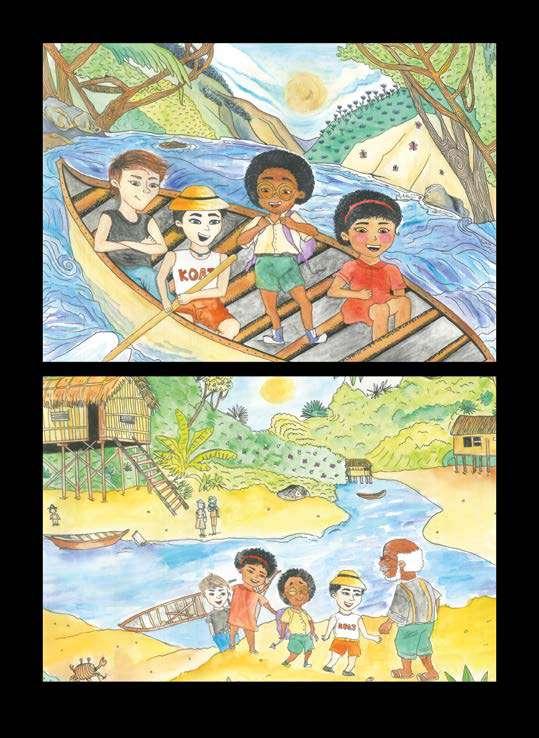
The children reach the riverbank at the community of “San Miguel Negro”, in “Eloy Alfaro”, and walk through the trees toward the village elder, Master Juan.
Look at all the “balsa” trees! Soon we’ll make our ‘marimbas!
Yes! And our ‘marimbas will echo with the river’s
Good morning, my little ones. Are you ready to learn about the “marimba”?
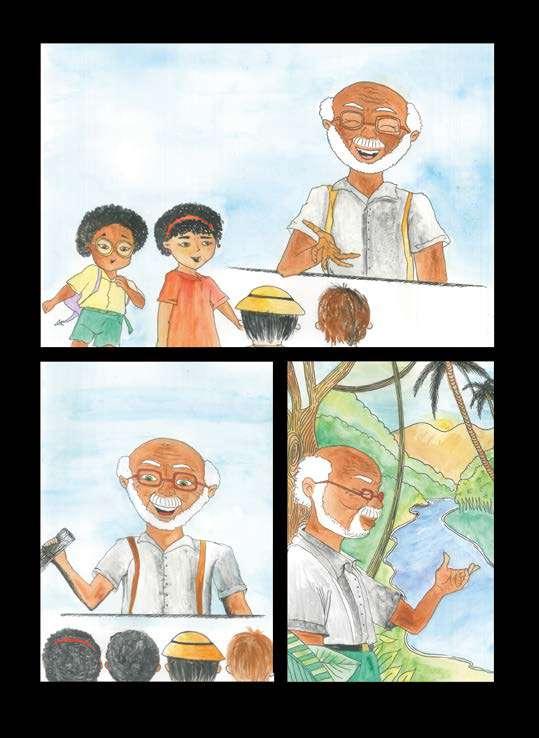
Juan shows the children a “balsa” log.
But there is a mystery…
And also our dreams?
The “marimba” is more than a musical instrument, it’s the heartbeat. With every strike, we celebrate our history.
What mystery, Grandpa Juan? Tell us!
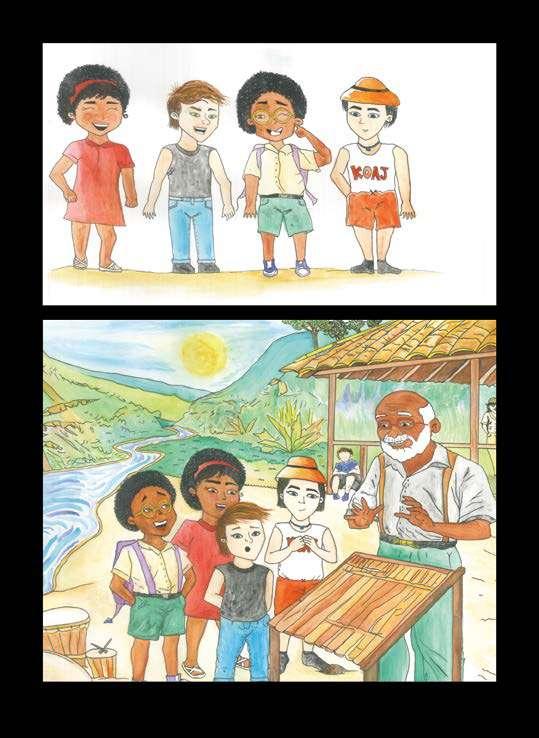
Yes, tell us! !
They say there is an invisible “marimba” that only those with a pure heart can hear. Its music can save the village in times of need.
And how can we find it?
First, we must build our own “marimbas” and learn to play them. The magic starts with us.
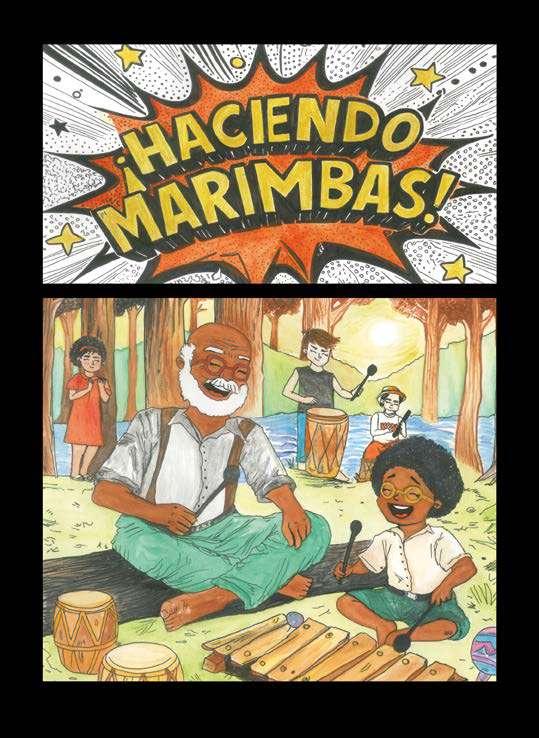
Very well done, little one. Remember that each note you play carries a part of you.
Look what I made, Juan! It sounds beautiful!
Yes!
We’ll be the heart of the celebration.
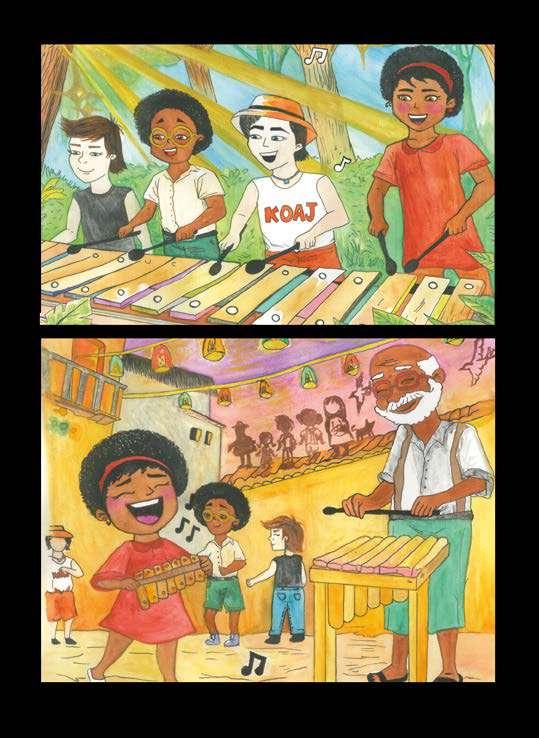
Let’s play at the festival! Our “marimbas” will sound amazing!
The day of the “Marimba’s” Festival is a special moment for the community to celebrate and enjoy its culture.
It’s the time to play these instruments and share our identity.
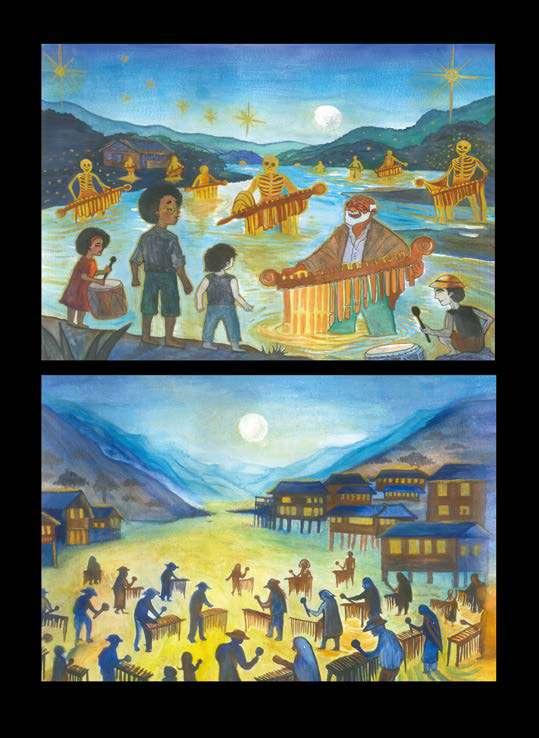
Look at the river! The music is shining on it!
The invisible ‘marimba’… The spirits of our ancestors have heard us.
That night, the river and the village pulsed to the same rhythm.
The invisible “marimba” was not just a myth; it was the true treasure, with the soul of its people beating in every note.
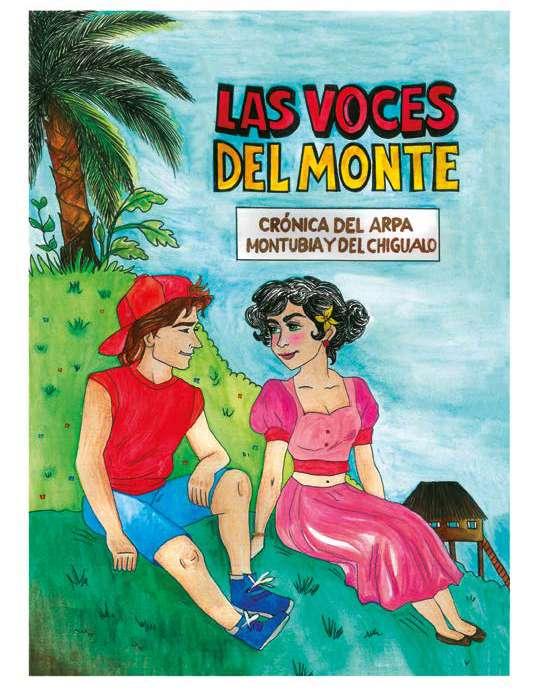
"In the heart of Manabí, two seemingly opposite worlds: the vibrant city of Chone and the vast elds of Montecristi, face o in a musical duel that transcends the ordinary..."
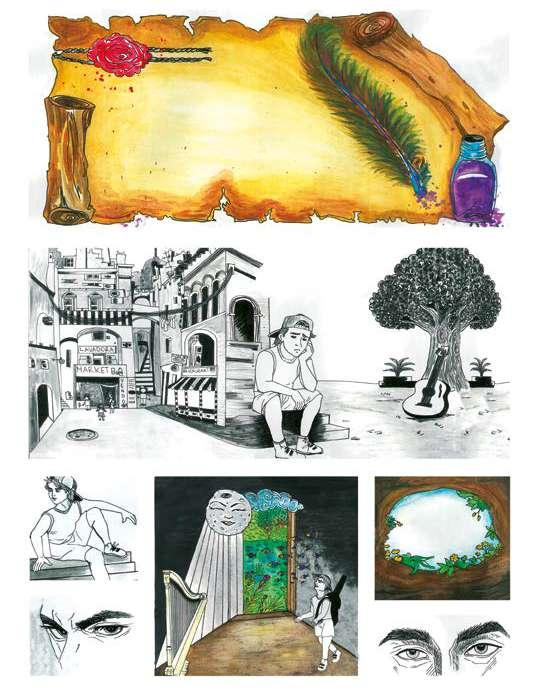
What is that sound?
"Music no longer inspires me... I need something deeper."
A strange voice is calling me...
“Follow the sound of the harp that will guide you.”
"THE FOREST CALLS YOU TO DISCOVER ITS WONDERS."
WELCOME TO THE PARISH
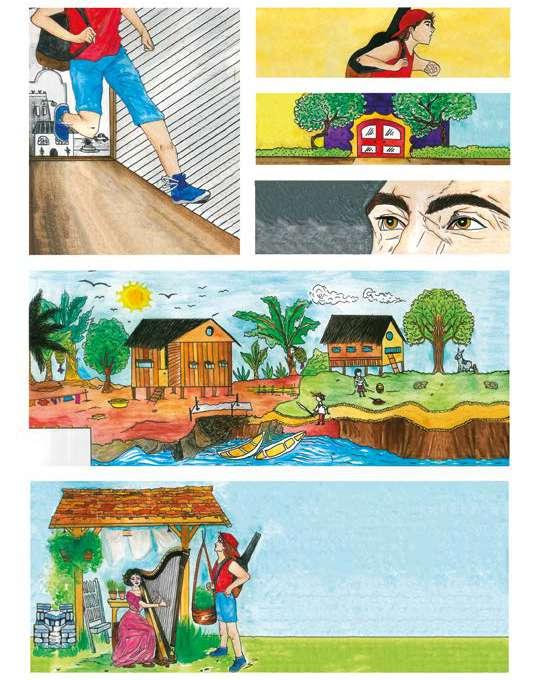
Now I’m in the countryside! But, how?... I’ll explore the place.
Hello, let me introduce myself. I’m Pablo.
Are you the one playing the harp? It sounds beautiful, the sound brought me here.
It’s curious you know, I come from the city of Chone and ended up here because of a voice calling me, it seems magical!
Thank you Pablo, I’m Sara. What a joy and pleasure to meet you. You’re in the community of La Pila, surely the magic of the “Forest” brought you here, crossing boundaries we can hardly imagine.
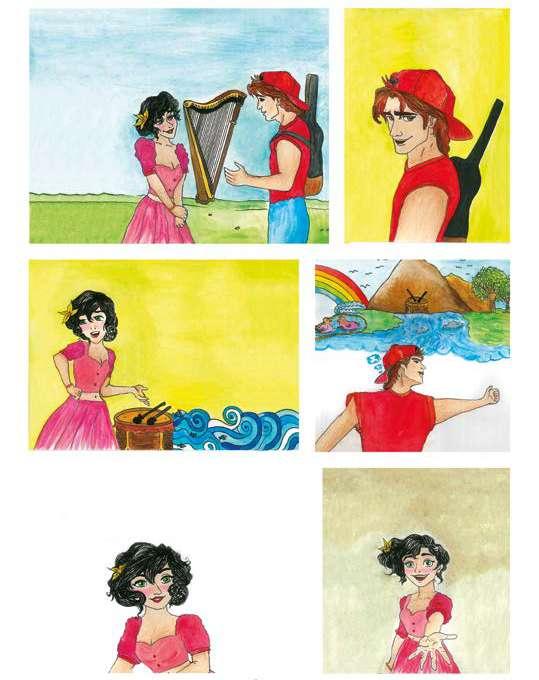
The musical instrument that represents us is a “montubian harp”, made with purpose and tradition. "If you don’t know your people, you’ll get lost even in a car!"
Do you hear the “cholón”-”cholón” of the drum?
The “cholón” is the deep sound of the Manabí drum that accompanies our festivities as “montubio” people. It’s an echo in the mountains, a call to the community.
But it’s also the noise of the river! Both are life vibrating: the “cholón” marks the rhythm of the celebration with the dance, and the river tells our stories.
The “cholón” connects us to our identity and reminds us that together we are stronger.
”cholón”? What does that mean?
I can imagine it... It sounds like each drumbeat and each stream of water tells a story.
Do you dare to blend your music with mine so the “cholón” resounds even louder?
Come, the musical duel begins. The tradition of singing “Chigualos” comes alive on days like this.
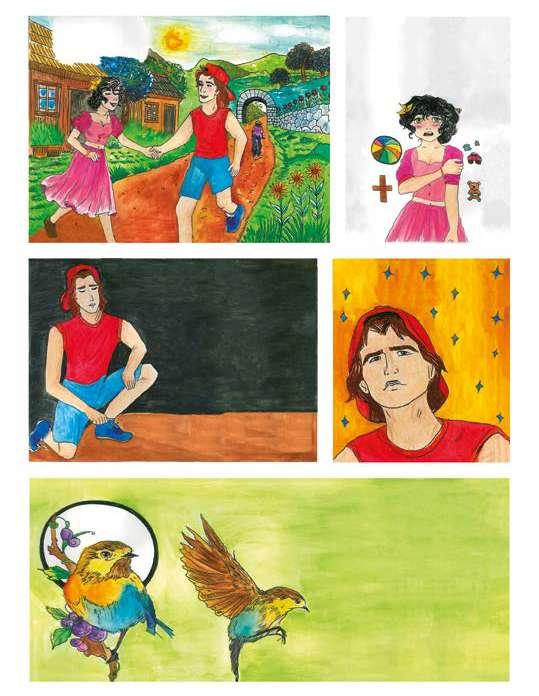
”Chigualo”? What’s that?
I see... Even though darkness and sadness have surrounded us, tonight is the time to honor the memory and resilience of our hearts, remembering every star in the sky so special in our lives!
It’s a song performed to bid farewell to children who leave this world too soon; it’s a tribute to their light...
For every ray of happiness, this is a day worth remembering. Union and melody in the forest and the city!
”CHIGUANGO” (Fly high little angel)
“I am a bird called “Chiguango”; my song resembles coos, similar to the trills of the “Chigualos”.
Sing and join in with the rhythm of the city!
"On this starry night, we remember you, beautiful child..."
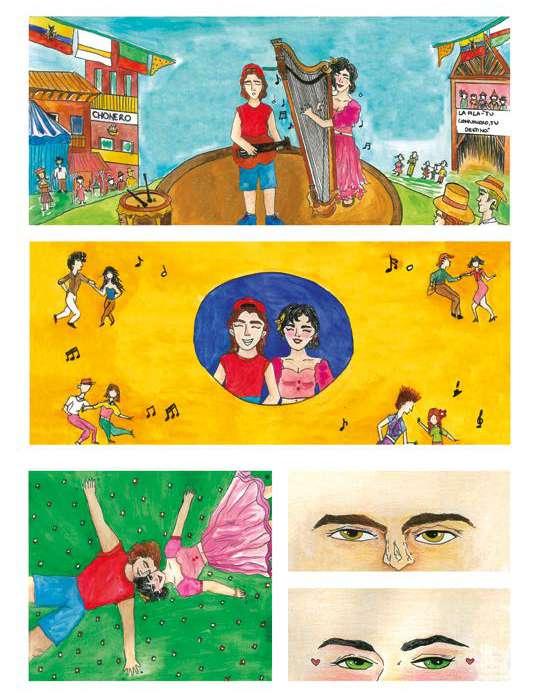
This is more than a contest, it’s a celebration!
"With laughter and melodies, your light remains our joy..."
That’s right. Today we are a community! Listen to the whisper of the harp, it tells stories!
Music unites hearts, also honoring those who have left... A “Chigualo” and a “montubian harp” are gifts to the heart!
Today I learned that music has the power to heal.
And to keep our culture and memories alive. The “Chigualo” is also a celebration of love.
For music, for life, and for the forest!
It was a day at San Vicente Ferrer School.
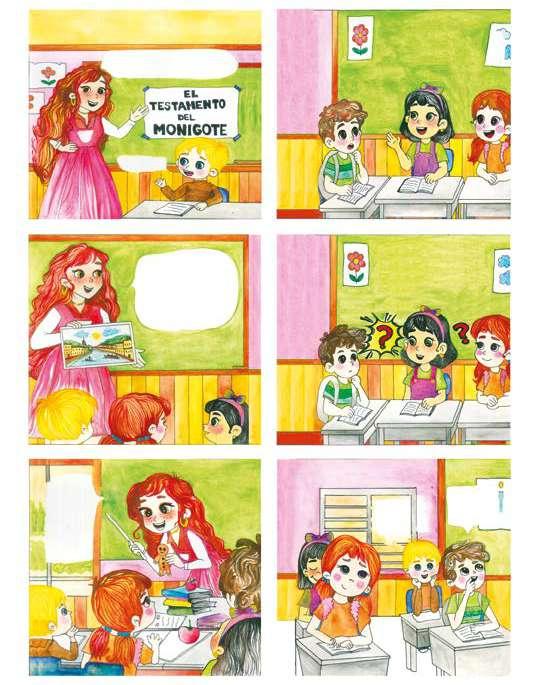
Today we will talk about one of the most creative festivities in Ecuador.
Can we talk about the “Monigotes” and “Años Viejos”?
Every year, in different parts of the country, a giant monigote is made to bid farewell to the old year. Did you know this tradition began more than 100 years ago in Guayaquil… during an epidemic?
At first, they burned clothes and branches to scare away a disease called yellow fever.
This tradition began in coastal cities and in El Oro province, and over time was celebrated throughout Ecuador, even in the highlands in the city of Atuntaqui where they hold parades called “Bando-Bando” celebrating creativity, satire, and respect.
I’ve never heard of that. What is it about?
I love the “monigotes”! What an interesting tradition!
Really? And why did they burn “monigotes”?
The most fun is writing the rhyming testament next to the monigote, which tells the year’s events in a funny way.
Wow! So they burned bad things to start again!
Exactly. Over time, “monigotes” became part of a party to leave the bad behind… and laugh a little too when writing their testament.
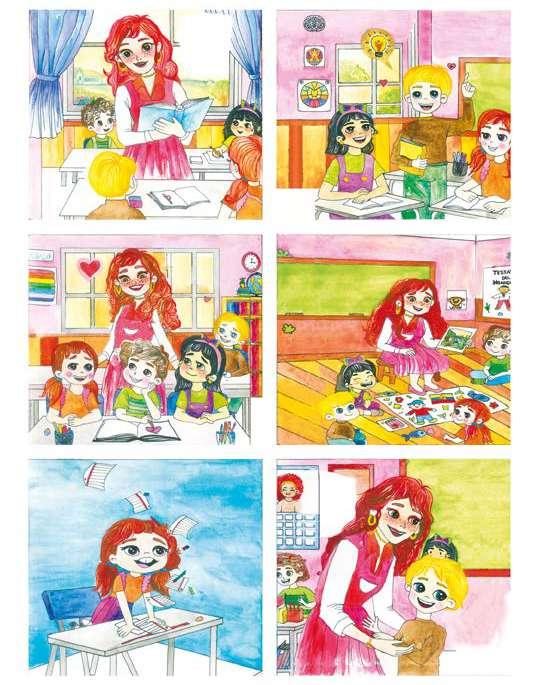
Yes! And we can also make a small parade.
Of course kids, use all your creativity.
Teacher Elena, can we make our own “Año Viejo” monigote?
I’d love to write a funny testament!
I can help write the testament in rhyme.
And we’ll write a testament with our funniest moments from the school year.
We’ll divide the work: making the monigote, the testament, decorating, and music.
Of course! Let’s go to the schoolyard.
I can handle the clothing of the monigote.
I have lots of drawings with ideas for our monigote!
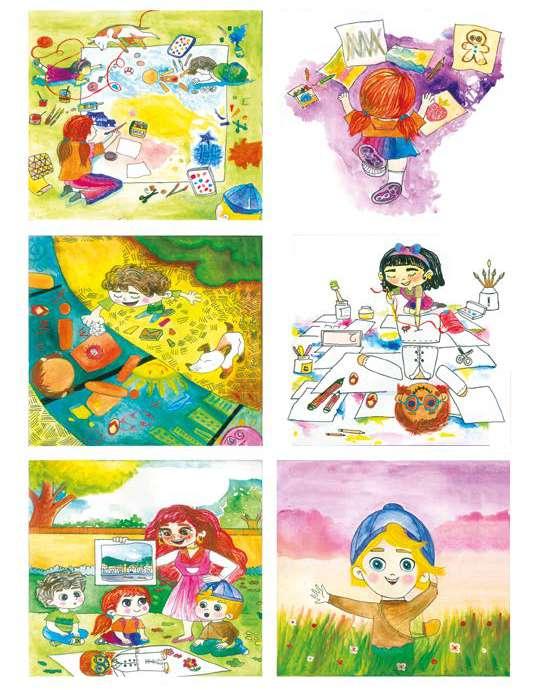
So this year we also burn our mistakes… and say goodbye to difficult homework!
Our monigote will look great!
I’ll sew its clothes and paint a sign with the year we’re saying goodbye to.
Kids, remember this represents the farewell to the year that’s ending.
"This old year leaves us, with laughter, challenges, and friendship."
"It takes away exams, rainy and hot days, and moments of happiness."
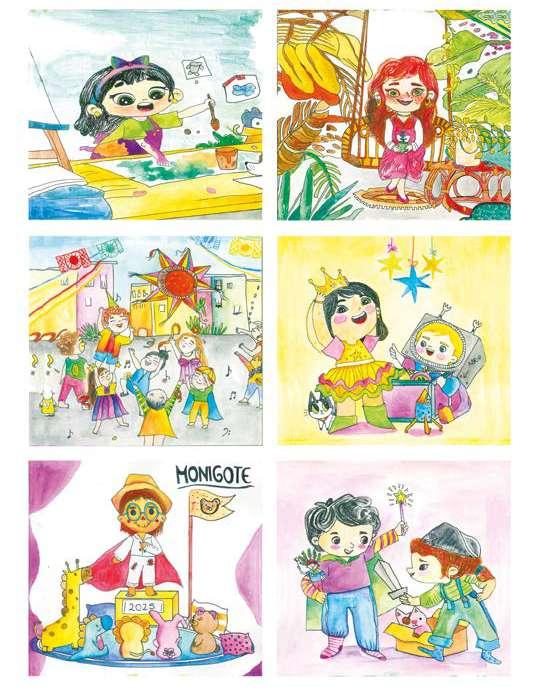
Excellent! You’ve captured the spirit of the tradition. Now let’s play costumes for the parade at the school party.
With this parade, we’ll make this New Year’s farewell unforgettable!
And I’ll be in charge of reading the testament!
What a creative way to remember what we’ve lived!
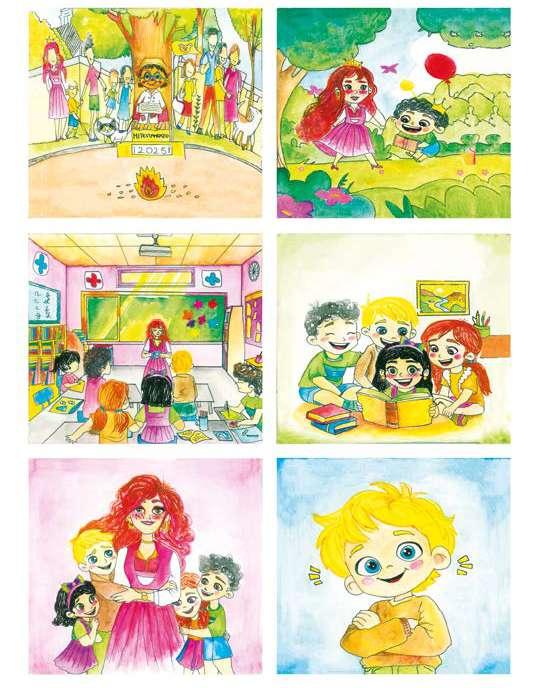
Did you like the New Year’s party and the “monigotes”?
I loved the “monigotes”!
And each culture has its special way of closing cycles.
"The old year leaves us, but its laughter will remain, with every crazy story that happened at school."
I didn’t know “monigotes” were a way to express history and creativity.
We definitely need to keep learning more traditions!
"Cultural diversity teaches us there are many ways to celebrate life and time."
Traditional festivities are not just entertainment, but a way to tell stories and connect generations.
They help us value each people’s diversity and creativity. Let’s celebrate the richness of our cultures!
In the classroom, the kids of second grade "A" were performing skits about Ecuadorian festivals. Now it was the turn of Asiri's group, with the theme of "Yamor".
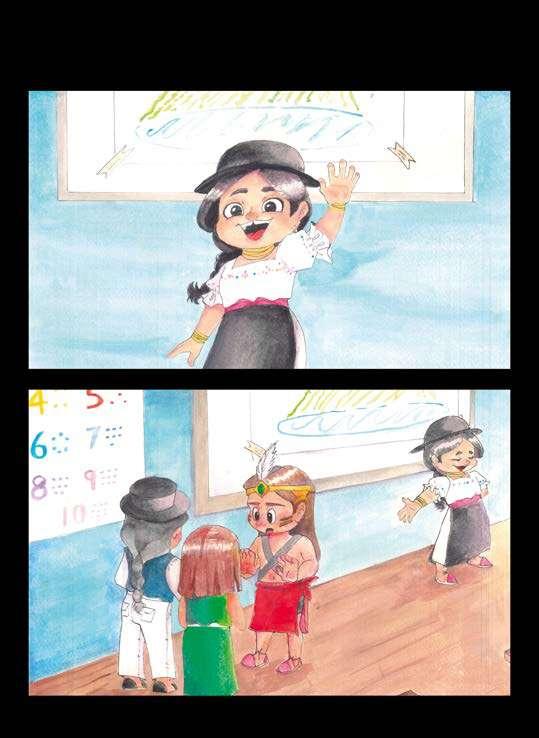
Hi, classmates! I am Asiri. Our teacher asked us to dramatize Yamor, an Otavalo festival held in September to give thanks for the corn harvest and to prepare chicha.
Chief, what do we do? My children are hungry!
This story begins in a village that saw Mount Imbabura as a god and the lagoon as his wife.
The villagers gathered every year for the harvest—but that year there was little rain, so the people were starving.
Stay calm. We’ll harvest what we can to feed our families. Now, everyone must work.
After harvesting, the villagers were exhausted. The chief’s daughter, Saraku, a beautiful girl, brought them water to quench their thirst.
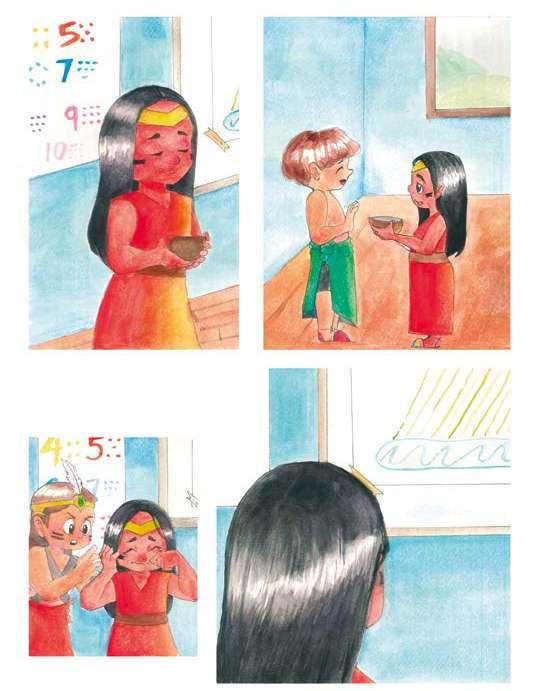
After, she went to her father, who told her to seek advice from Taita Imbabura.
Don’t cry, my girl. Go to Taita Imbabura. He’ll help you.
“Taita”: considered a protective deity or "father" in Kichwa cosmology.
Taita Imbabura is the great volcano that shelters the province of Imbabura, revered as a sacred guardian of the land
All the boys adored her, but when she approached Ayamurku, the one she liked, he rejected her flirting.
Sorry. I’m not interested.
She obeyed. Taita Imbabura said: ‘Pick seven grains from the harvest. Dry them, then boil them with water from the lagoon...
Hello, you look tired. Would you want some water or maybe a wife? Oh, I see.
When the next full moon rises and you see the chicha flower, take the drink in your hands, then, give it to your beloved and it will awaken eternal love in him.
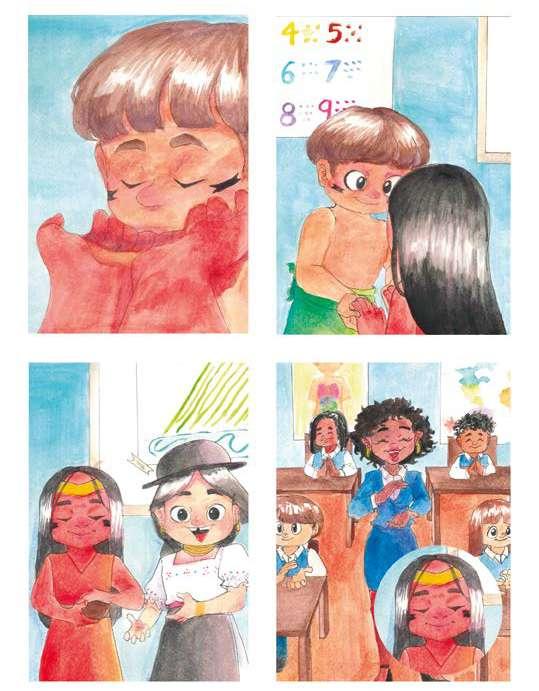
Saraku did as told. She handed water to everyone but for Ayamurku, she poured the sacred brew into his hands and lifted it to his lips.
Saraku named the drink YAMOR, the brew that, when it touches a man’s lips, makes him fall in love with Mother Earth’s purity.
When he drank, he saw Saraku’s radiant eyes, the rosemary scent of her hair and love blossomed.
Will you marry me?
Yes!
Since then, Otavaleños perform a sacred rite: the first sip of Yamor (chicha) communes them with their land, kicking off the annual festival of unity.
Sure, why not? Haha!
Wonderful presentation, kids! It’s fascinating to learn about this beloved Otavalo tradition."
Teacher! We brought chicha, do you want to try some?
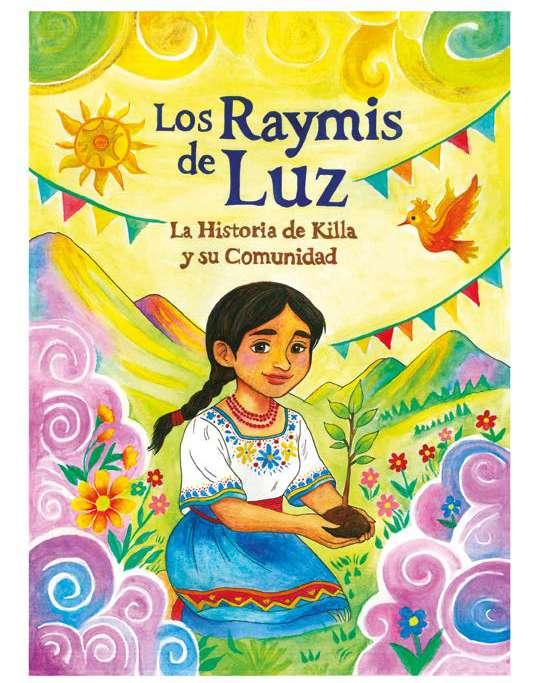
Killa, a teenage girl from Otavalo, is in her modern bedroom. She listens to pop music while staring out the window. Outside, the sounds of drums, laughter, and voices from the market and town square fill the air as preparations for an Andean celebration are underway.
Why should I care about Kichwa culture?
Everything I need is right here, online. Same old parties, boring clothes, old songs... Does any of that really matter today?
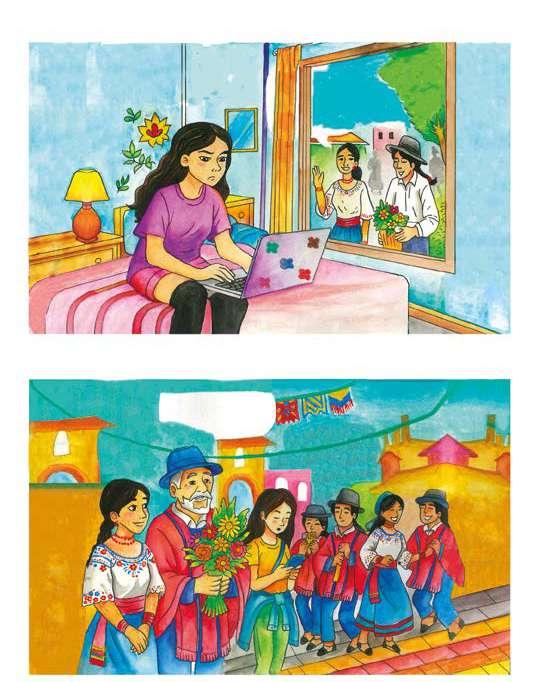
Killa! Come on! Pawkar Raymi is about to start!
We can’t forget the flowers for the celebration. Pachamama deserves the best!
Pachamama: Earth Mother in Andean cosmology, revered as the spirit of nature and life.
In the town square, the community gathers with joy. They decorate with flowers and traditional textiles, preparing offerings with gratitude and happiness.
Everyone, come! Feel the rhythm, the energy… This celebration is life, it’s our roots.
“Pawkar Raymi marks the start of the agricultural cycle. We honor and thank Pachamama for her fertility and for our bond with nature.”
What’s the point of this now? I don’t see why it matters anymore.
Three months later. The community gathers again to celebrate I Inti Raymi, giving thanks to the sun for its light and life. As the songs and dances begin with vigor, Killa stands apart, disconnected from the celebration.
Ana, Lucía, what are you even saying? I don’t understand these songs. They’re awful.
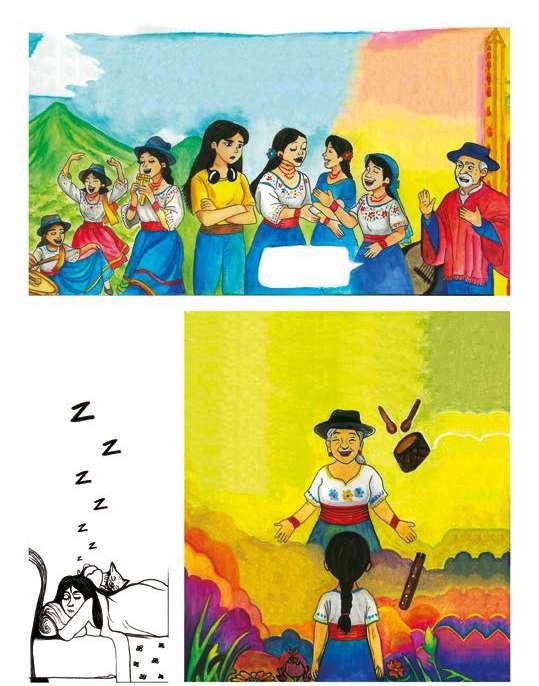
Killa sleeps in her bed. In her dream, her grandmother appears, surrounded by flowers and golden light. She wears an a anaco and walkas made of mullos.
¡Hay que es, que es, que es, guambra mía. Todavía mushuc runa, hay, todavía no me muero!
Don’t say that, Killa. These songs unite us. I remember my first Inti Raymi—pure emotion. Rejoice, because what’s here can’t be found on any screen.
¡Toca toca manavali mi corazón, siendo de poder se sale mi corazón, si no se queda en la casa mi corazón…!
“Killa, my girl, the Raymis are the thread that weaves us together. Don’t forget. Killa pakarina kawsay rikuchin — the rising moon reveals life. Your name means moon, and it lives if you keep it alive.”
“Grandma… I don’t belong here. No one values any of this. Please don’t leave me…”
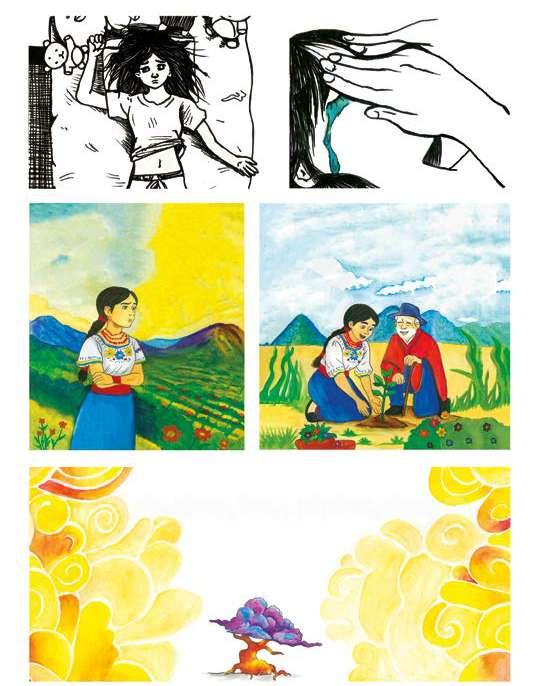
I’ve been so busy looking outside… I didn’t see how much I have right here. My community, the land, my name, my grandma…They all speak of who I am.
This tree is a reminder of what we can build together. Now I understand… Being modern doesn’t mean forgetting who I am. I’m Indigenous, and my roots are my strength!
That’s right. The tree will grow with us—just like you, Killa. I miss you so much, grandma. Everythin g was better with you here.
With each step, Killa discovered that the light of her people also lived within her— like a flame sleeping beneath the earth, like a seed waiting to be nurtured by loving hands.
By listening to the land and honoring the most sacred legacy, your voice will never fade.
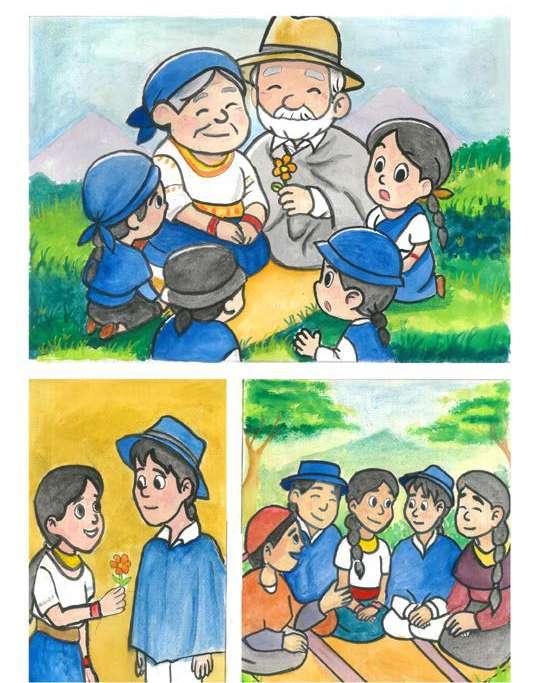
They say true love doesn’t fade with time; it grows deeper, like the stories we weave with thread and heart.
It began when your grandfather gave me a chuquiragua flower… that simple gesture held his respect and his promise
“Ñukaka kikinwan kawsashkani munaypi.” ("I want to live with you in love.")
In our culture, love binds communities. Families meet, share, and give their blessing
If love is strong, work and music will make it eternal
What was your wedding like?
For days, the village became a celebration. Everyone contributed: songs, weavings, bread, colada morada (traditional purple corn and fruit drink)
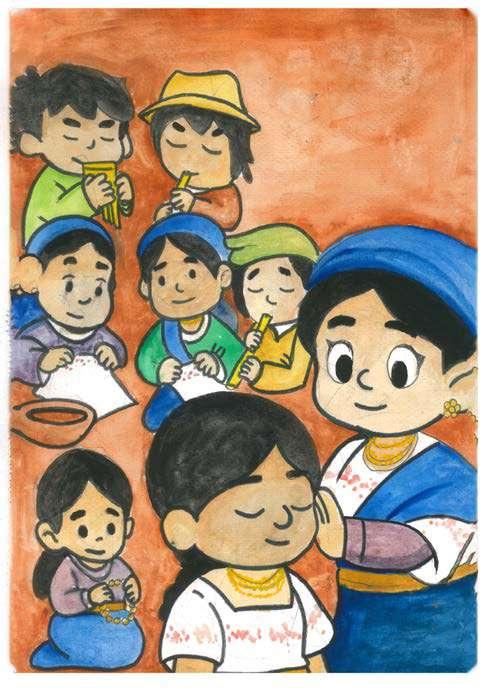
Every flower on your anaco carries a wish for your joy, wambrita (“little dear”)
Our union was guided by Pachamama. We vowed not just love, but to care for the earth together
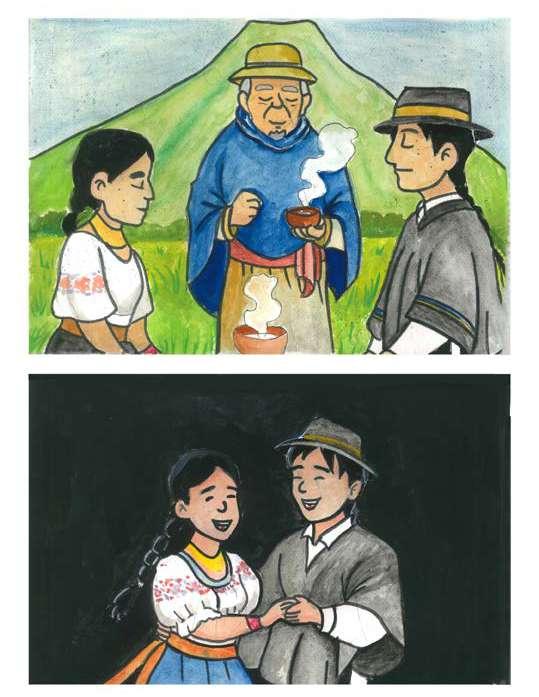
That night, we danced under the moon. We weren’t just two, we were a whole community celebrating love
“Kawsaypak, munaypak, allikawsaypak.” ("For life, love, and living well.")
Every step with you is a song. I never want to stop dancing…
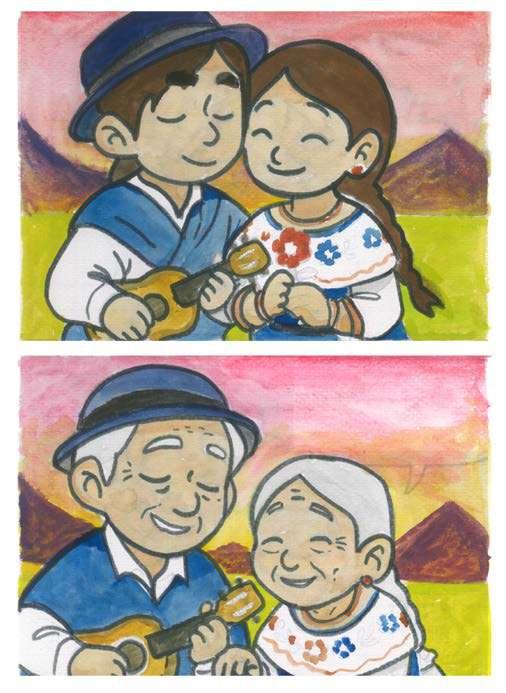
Years wove wrinkles into our faces, but never frayed the thread of our love
And he still sings to me, like that very first day…
True love never dies, it blooms in the generations to come
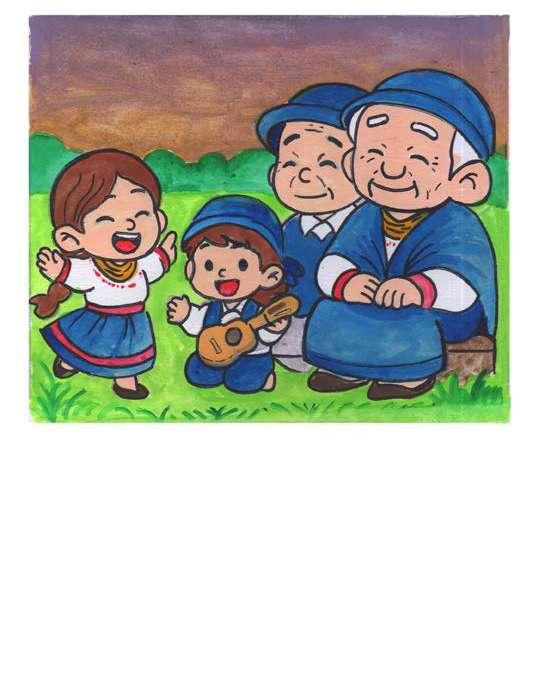
Remember: love is tended, worked for… and celebrated with your whole heart
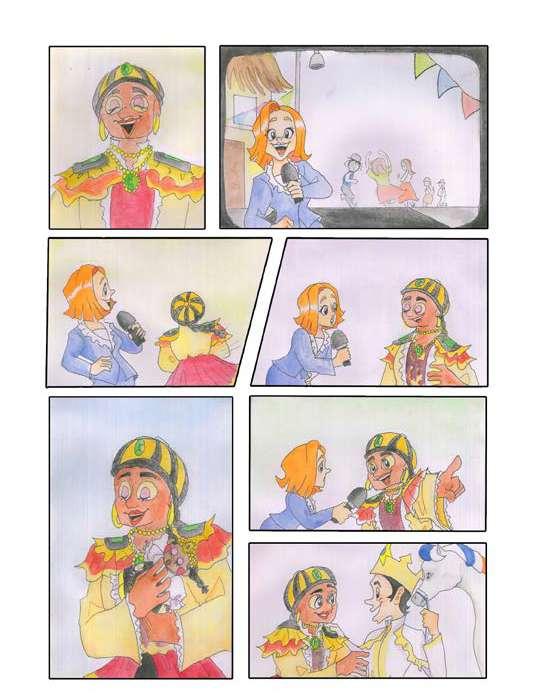
Long live Latacunga!
Oh look! There’s the Mama Negra! Let’s go talk to “her”! Maybe we can learn a bit more!
So, they came up to me and said, “Jorgito, would you like to be the Mama Negra this year?” First, I had to check if I could afford it...
Once I knew I could, my wife and a makeup artist took care of my look, along with the kids who walk with me.
Good morning! Sara here reporting live from Latacunga. Today we’re at the Mama Negra parade, a yearly celebration held in honor of the Virgin of Mercy.
Here we’ll see unique characters like the Mama Negra, who represents the blending of Indigenous, Spanish, and African cultures.
me, could you tell us how you were chosen to play this role, and what it takes to put on the costume?
Of course! The person who plays the Mama Negra is selected by the Council..
Wow!
And where are the other characters? Especially the angel who brings the message of peace...
Oh, they don’t stay with me. They’re scattered throughout the parade. We all meet up at the end, in front of the Virgin, to pay our respects.
Look—right there comes the Angel of the Star!
Finally, Pepito! You were the last one we needed. Now I can start the recitation.
Haha! You were the one missing, Jorgito! I already said my prayers to the Michita
Now, the Mama Negra will recite a prayer to the Virgin of Mercy, in gratitude for protecting the people of
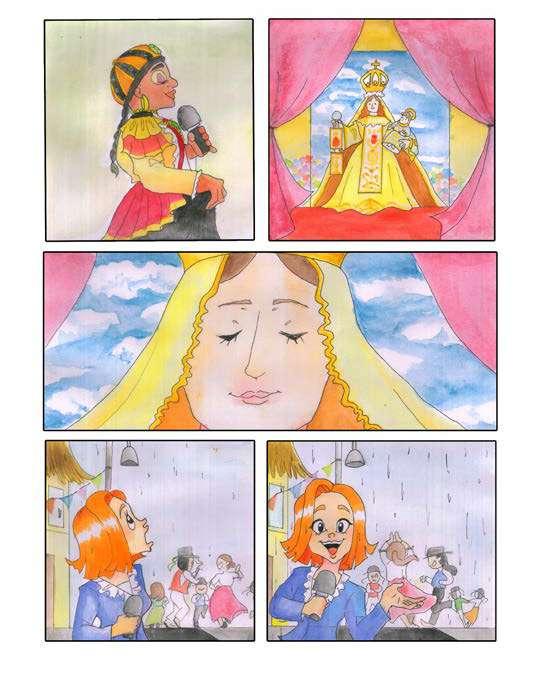
Oh no! It started raining!
Don’t worry!
That’s normal. If it rains when Mama Negra meets the Virgin, it’s a good omen—another year of prosperity and protection!
Let’s celebrate!
Glorious Our Lady of Mercy, Mother of God, Queen of Heaven, You who heard from above the sorrowful cries of the poor captives, suffering without comfort under harsh oppression. Teach us to cherish our Christian faith, grant us the grace to love with merciful charity, and make us bringers of peace.
Well folks, you heard it! The city of Latacunga can look forward to another year of protection from its patron, the Virgin of Mercy. We invite you to come experience the beautiful Mama Negra festival, held every September and November.
Sara out.
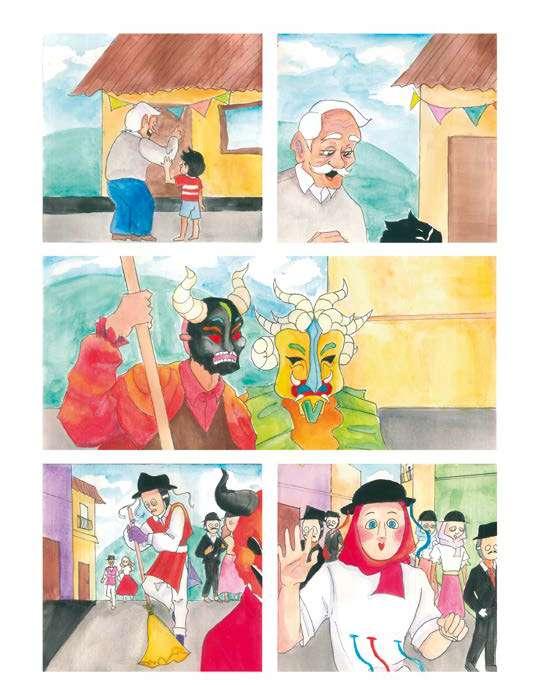
What’s all this? Why are so many people wearing devil masks?
That’s for La Diablada, a traditional celebration from our beautiful town of Píllaro.
La Diablada? What is that?
But why are the masks so scary? They really creep me out!
This festival started back in colonial times. When our ancestors were enslaved, the colonizers only let them visit their families during New Year in January—so they created a celebration with masks to mark the occasion
It is... our people have been through a lot. But festivals like this help us remember how strong we are. That’s awful!
And that person—why isn’t he wearing a devil mask, Grandpa?
That was the point. The scarier the mask, the better it showed their rejection of the colonizers.
Woow, ¡Por eso dan tanto miedo!
And the ones you see now are modern! That’s why they’re so colorful and detailed. The original masks were made of tin and had only one or two colors—paint was expensive back then.
And that one, Grandpa? Who is she?
But... that looks like a man!
Not everyone dresses as a devil. For example, that’s the capariche He leads the parade, sweeping the ground in front of the crowd.
The people in fancy clothes behind him represent the wealthy class from that time.
Oooh, I get it
Ah, that’s the guaricha, the woman who accompanies the devil
That’s because the person under the costume is a man, Jaimito. Hahaha
Grandpa, look!
That one looks even scarier! That’s the diablo Huma, the most important figure in the Diablada
Is he... an actual devil?
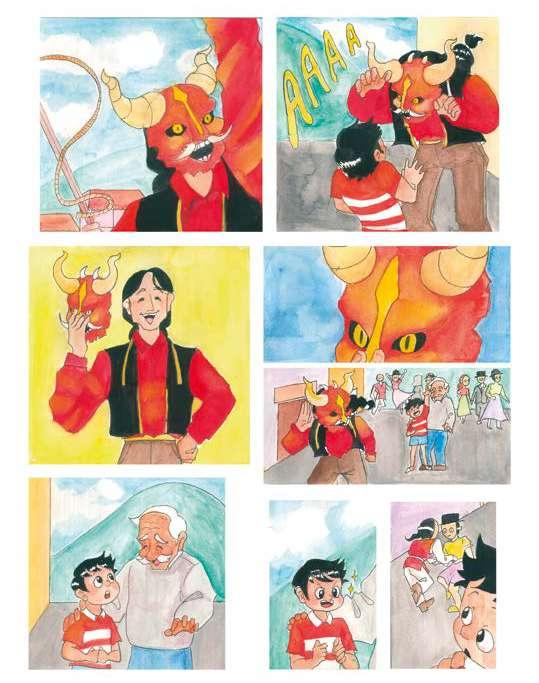
Hahaha! No, Jaimito, don’t worry. Our ancestors dressed as devils as a protest against the Christian traditions imposed by the colonizers
¡Dad! Are you the diablo Huma?
That’s right! This is my third year doing it, four more to go
Why four more?
Grandpa, if it’s a family tradition, does that mean you were a diablo Huma too?
They say it’s bad luck to be the diablo for less than seven years in a row. Besides, it’s a family tradition now
Hey! That’s the mask that hangs on the wall! I’ve always been too scared to ask what it’s for
It’s our family mask. Every diablo Huma in the family has worn it. That’s why it looks so old
And it has only a few colors—just like Grandpa said!
I was! When I was young, I danced in every Diablada. I wore the same mask your father wears now—just like my father did before me
Well, I’ve got to go. The guaricha is waiting for me
Bye, Dad! Go dance like a true diablo Huma!
That’s awesome! When I grow up, I want to be a diablo Huma too!
You will be. Come on, let’s go watch your father dance
Hey Grandpa, why are some people dancing in groups and others alone?
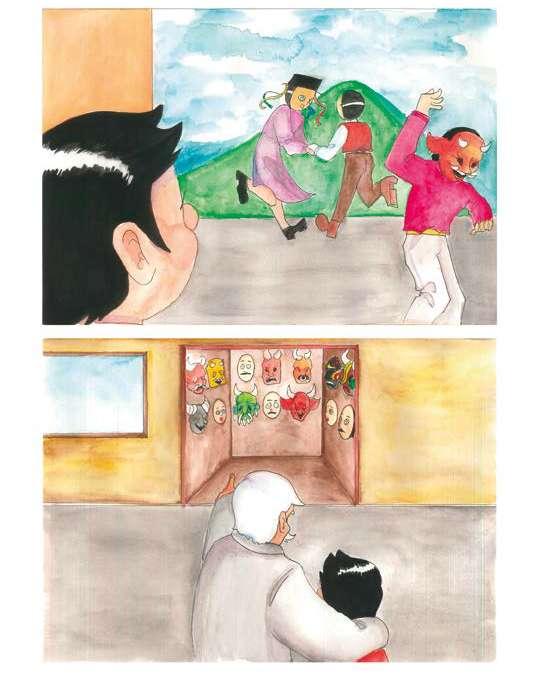
Anyone can! Even kids. Come on, let’s go buy you a mask from the artisans so you can dance too
Those are called partidas—groups of dancers. Each one has its own leader and style. They’re like families within the festival
This is such a beautiful celebration! Why can’t I join?
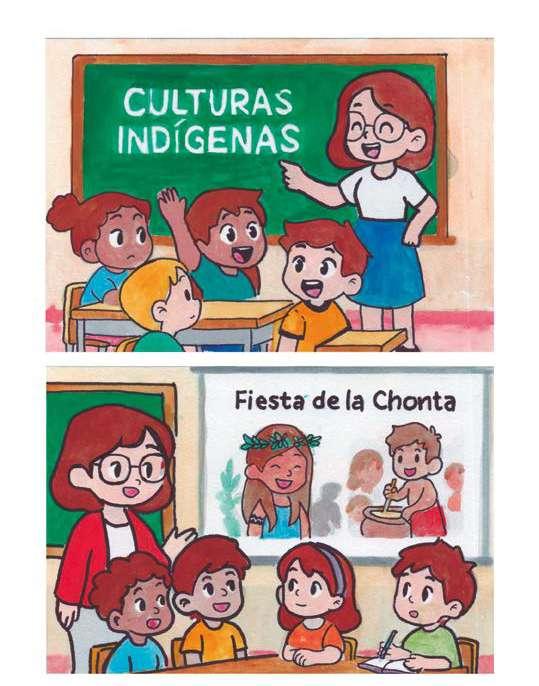
What’s chicha de chonta?
I’ve never heard of it! What’s it about?
The Chonta Festival is a ritual of gratitude to the Pachamama
Can we talk about the Chonta Festival?
Today we’ll learn about one of the most important celebrations of the Shuar people
How can we take part from here?
We could recreate part of the festival here in class
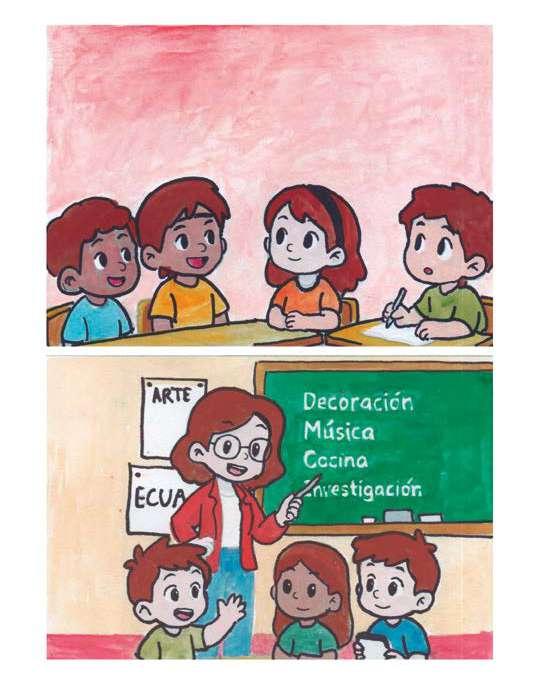
Let’s divide the work: decoration, music, cooking, research... I can research the meaning of Unt wéa
We can also play music and learn the meaning of the dance
And make a version of chicha de chonta using local fruits
I’ll make a poster about the traditional clothing
Here’s the adapted recipe to make non-fermented chicha
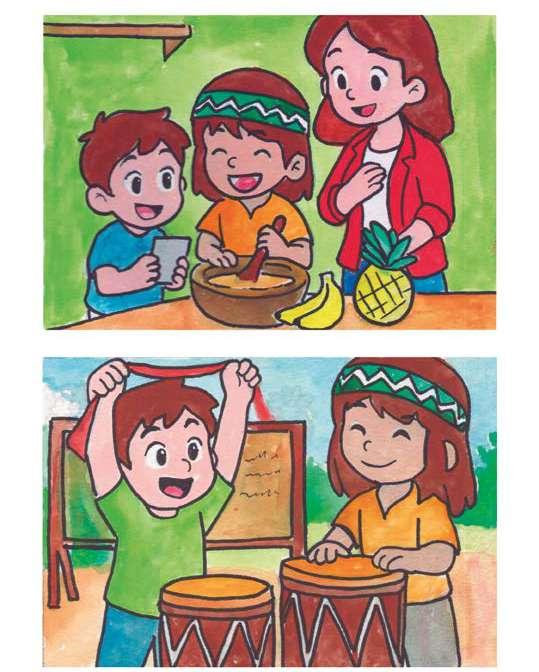
These smells amazing!
Remember, we’re learning about an ancestral tradition
Here are the drums for the dance
There! Now it looks like a real Shuar celebration
Such a unique flavor! Tell us about its meaning
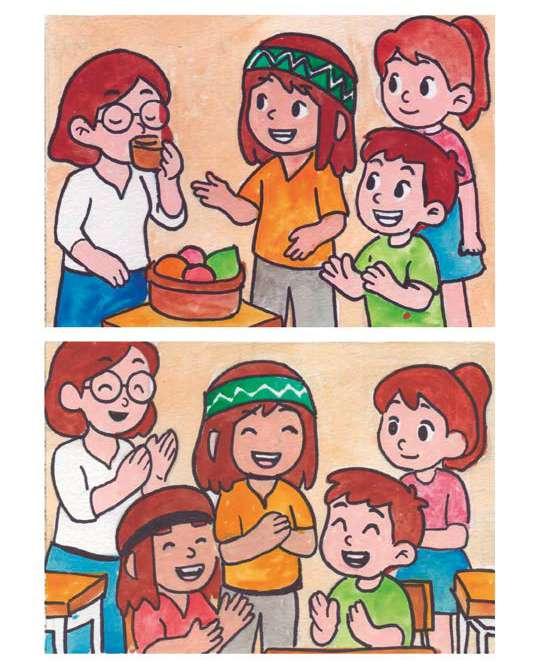
It’s a drink that symbolizes unity and gratitude toward nature
Congratulations! We’ve learned about an ancient culture through experience I loved sharing my culture with you all
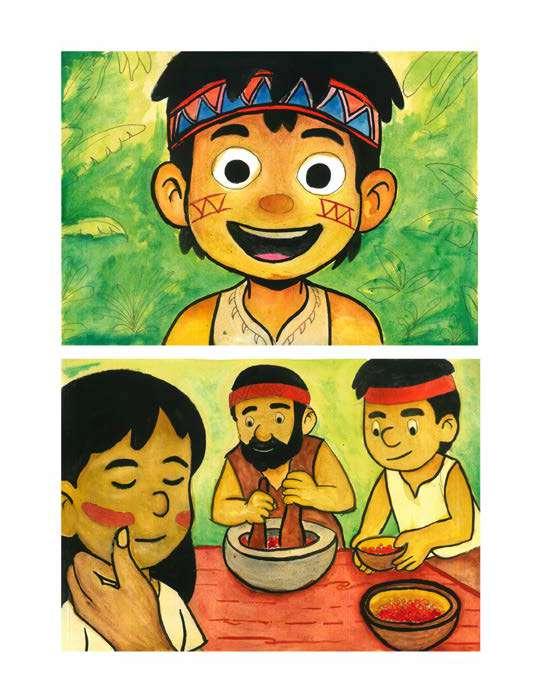
My name is Nantu, and I'm from the Shuar ethnic group. I live deep in the Ecuadorian Amazon.
Today, we’re celebrating one of our most important festivals… but I don’t fully understand why we do it.
Everyone paints themselves with achiote… their faces, arms, chests…
What does it all mean? Why is it so important?
Maybe if I ask my grandpa, he can explain me…
used for coloring and flavoring food)
I hope my grandpa is still at home, being the community’s wise man keeps him busy most of the time.
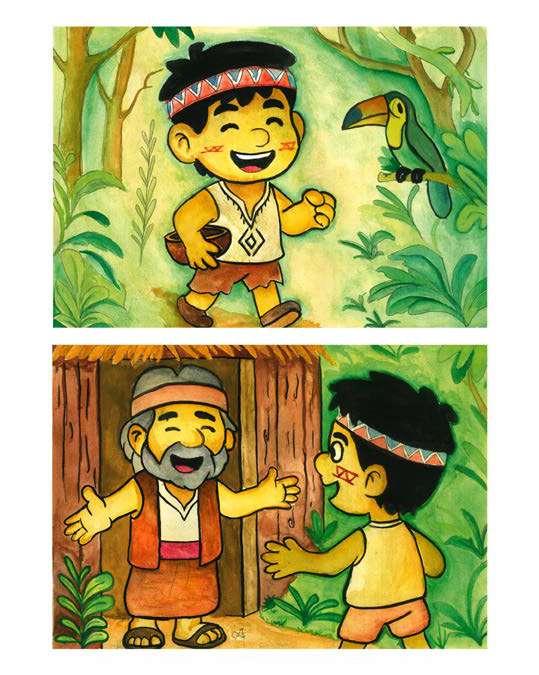
grandfather was the wise healer of his community. Holding such an important role, he knew stories passed down through generations.
My boy, what a surprise! What brings you here?
You’re still at home! I want you to tell me one of your stories?
Grandpa... Can you tell me why we paint ourselves with achiote?
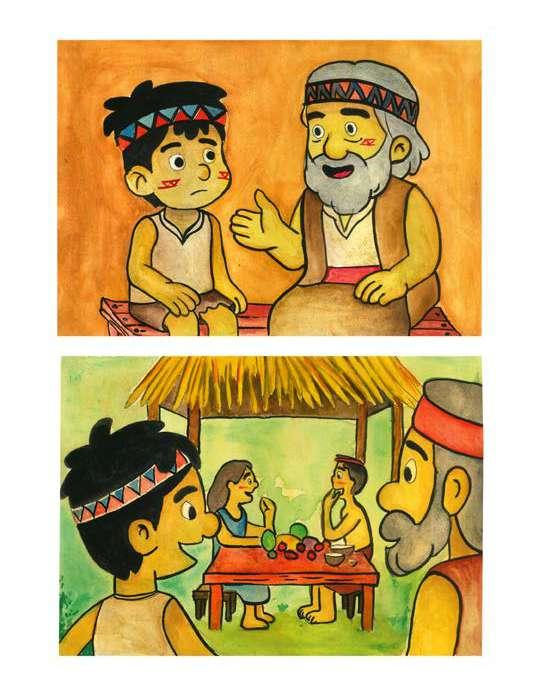
Oh, Nantu… that question fills me with joy. Come, I’ll tell you an ancient story.
Achiote is a gift from the jungle. Our ancestors used it not just for decoration, but for protection and to honor the earth. Every symbol has meaning. Every line is a word without voice.
It was a way of saying: ‘we are present’, ‘we are still here’.
In ancient times, achiote paintings spoke of strength, wisdom, and connection to the forest spirits.
So… painting ourselves isn’t just a tradition. It’s part of who we are!
I want to be part of this… to understand it, to feel it.
Now I get it! Every stroke connects me to my history and my people!
When you paint your body, you also paint your memory, Nantu.
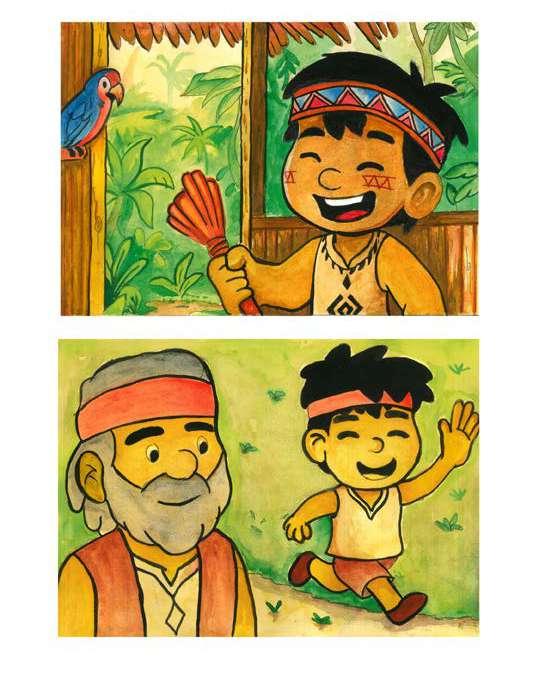
Today, I didn’t just paint myself with achiote… I discovered a part of myself.
And you? Do you know the roots of your origins?
Every culture honors death in its own way… but at heart, all seek the same: to remember with love
Sisa says that in Ecuador, death is celebrated with flavors, songs, and flowers. I have to experience it
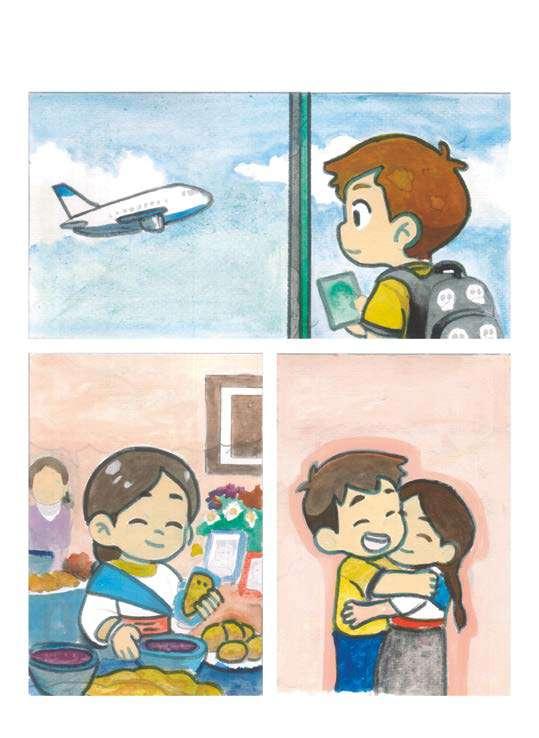
For Sisa, November 2nd is more than tradition… it’s a moment to hug those who have passed away
My grandma used to say: ‘When you drink colada morada, you’re sharing with the spirits… with your own
When cultures meet, something sacred blooms… like a bridge between worlds
I can’t wait! I brought flowers and a song for your grandpa
You arrived just in time! Today, we’re going to the cemetery with my whole family
In Ecuador, death is honored with music, food, and gratitude… walking together, living and dead, toward memory
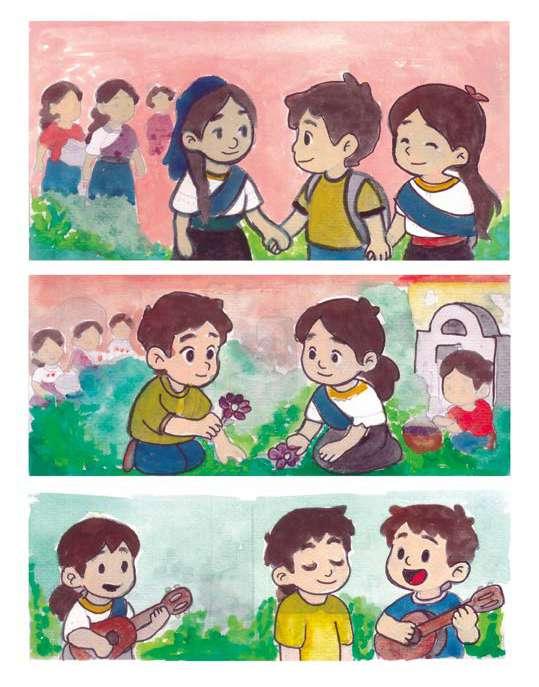
This song is for those we love… wherever they are
Here, we don’t mourn the dead… we walk with them
In every guagua de pan (bread shaped as a child) and every sip of colada morada (purple corn and fruit drink), the presence of those who’ve gone comes alive again.
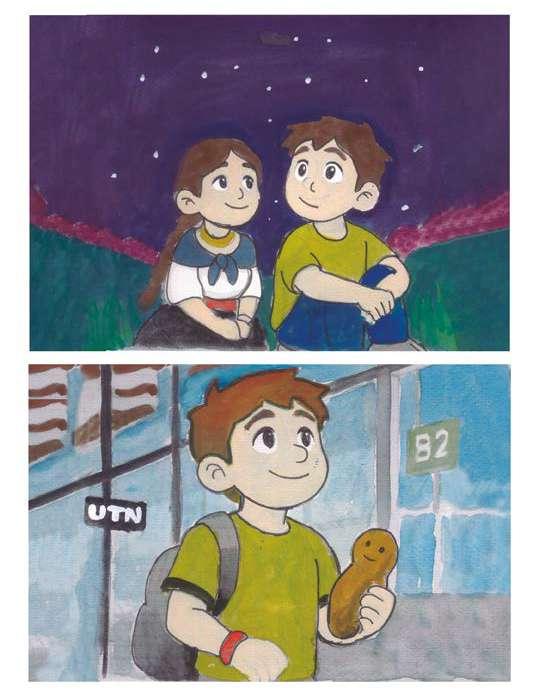
Death isn’t the end. It’s just another way of being
Today I understand... we didn’t come to cry, but to give thanks
Wherever you go, you’ll nd cultures that honor life… even in death
Ecuador taught me that remembering is living… and loving is sharing who we are
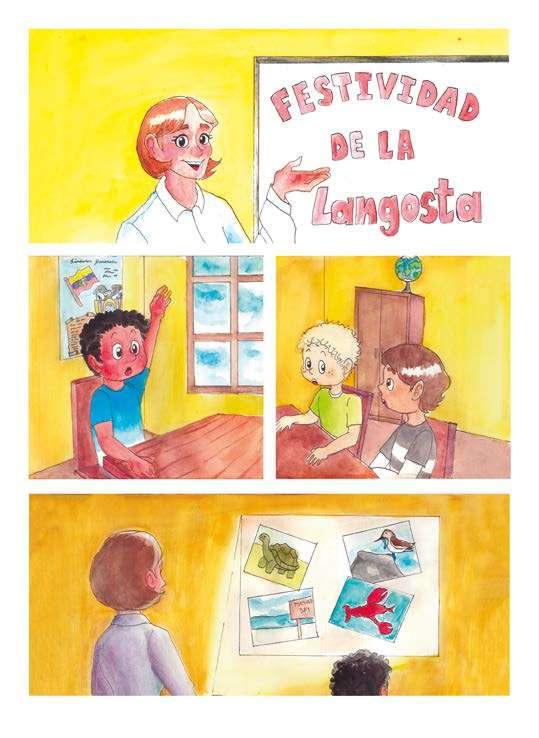
This week, we’ll learn about cultural festivals and their impact on sustainability
Can we talk about the Sustainable Lobster Festival in Santa Cruz?
I’ve never heard of it! What’s it about?
This festival promotes sustainable fishing and responsible lobster consumption
Does it have anything to do with the environment?
Yes, it’s a delicious and eco-friendly celebration! There are contests, fairs, and more!
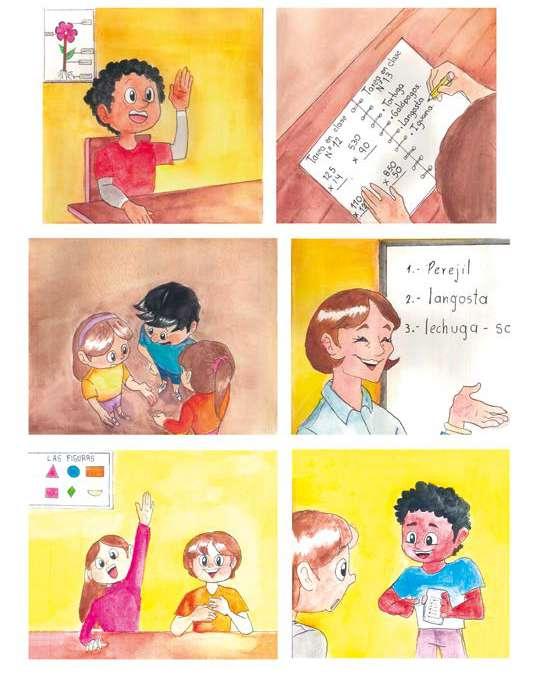
We could hold a food fair with dishes from our cultures
But using local, sustainable ingredients
Just like they do on my island. I love this idea!
That sounds amazing. How can we participate from here?
And I can make a traditional dish from my country
We’ll divide the tasks: decorations, cooking, and sustainability research…
Here’s my grandma’s recipe. Let’s make it together!
I can research the environmental impact of fishing
These smells are amazing!
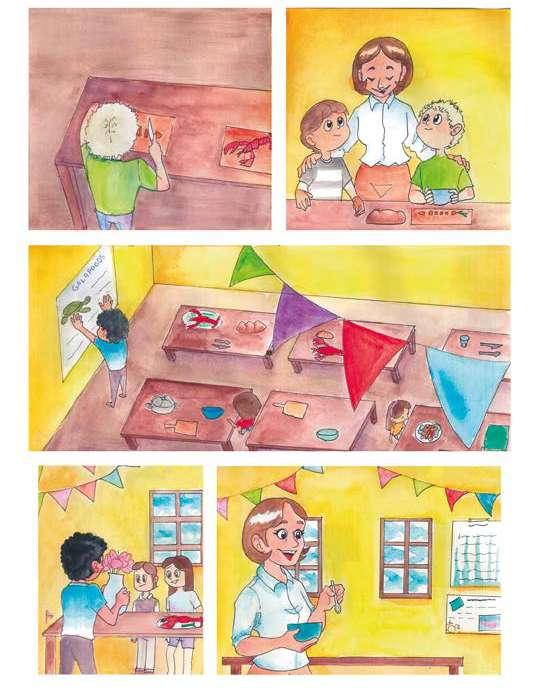
Done! Now it really feels like a food fair
These represent the natural beauty of the Galápagos
Delicious! Tell me about the ingredients
Remember, we’re promoting responsible consumption
We used local ingredients, like at the Galápagos festival
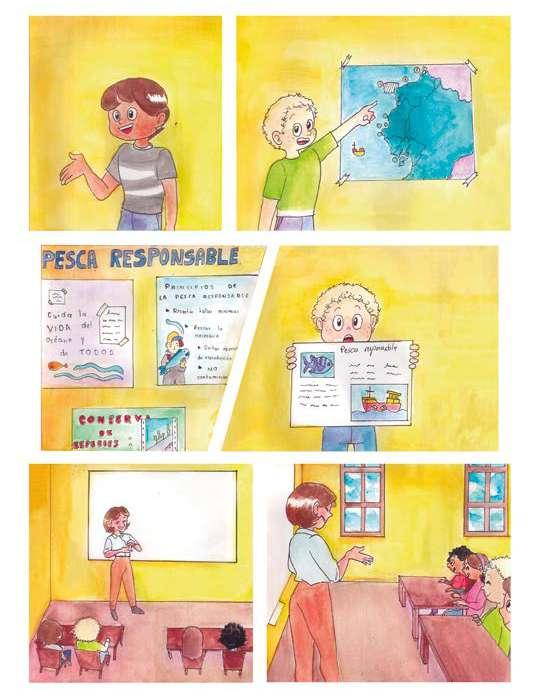
Congratulations! We learned about diversity and sustainability together
Not all species should be caught year-round
The festival promotes fishing in the right seasons to protect the ecosystem
I didn’t know food could teach us so much about sustainability Every culture teaches us something valuable. Let’s keep learning together!
And sharing our traditions brings us closer I loved sharing a piece of my culture with you all
Cultural diversity not only enriches us but also teaches us to value the world we share. Celebrating our differences helps build a more inclusive and sustainable future.
How to cite this book, APA 7th edition
Basantes-Andrade, A., & Orye, A. (2025). Classrooms without borders: Education, inclusion and diversity through comics. Universidad Técnica del Norte. https://doi.org/10.53358/ libfecyt/VCOM7243
To read the following chapters and download the complete work, visit the following link: https://repositorio.utn.edu.ec/handle/123456789/17878
Twenty-first century education is undergoing constant transformation, driven by the challenges of a globalized and technologically advanced society. Traditional pedagogical approaches are gradually giving way to innovative methodologies that foster inclusion, diversity, and responsiveness to digital contexts.
This collection is dedicated to exploring, analyzing, and proposing educational strategies that respond to the current needs of teachers and students. The Pedagogical Collection offers studies, essays, and experiences that address key issues such as intercultural inclusion, the integration of technologies in learning, and the transformation of educational environments. The author, researchers, and professionals in the field of education contribute critical reflections and practical tools to strengthen pedagogical competencies and foster a commitment to quality education. Thus, this collection becomes an essential resource for teacher educators, practitioners, and researchers committed to innovating teaching practices and addressing the challenges of contemporary education.
1
Basantes-Andrade, A., Orye, A., & Naranjo-Toro, M. (2024). Enseñanza culturalmente receptiva: Un enfoque pedagógico para promover la inclusión y la diversidad cultural. Universidad Técnica del Norte. https://repositorio.utn.edu. ec/handle/123456789/16732 2
Basantes-Andrade, A., Orye, A., Naranjo-Toro, M., Pabón Ponce, M. K., Pereira González, L. M., & Benavides Piedra, A. (2025). Diversidad en el aula: Experiencias y estrategias para una educación inclusiva intercultural. Universidad Técnica del Norte. https://repositorio.utn.edu.ec/ handle/123456789/16733
Basantes-Andrade, A., Pereira González, L. M., Guerra Reyes, F., Melo López, V. A., & Hernández Martínez, E. (2025). Tecno-pedagogía: Innovación y aprendizaje en la era digital. Universidad Técnica del Norte. https://repositorio.utn.edu.ec/ handle/123456789/16845
4
Guerra-Massón, J., Naranjo-Toro, M., Basantes-Andrade, A., & Meneses, M. (2025). Ciencia abierta en Ecuador: Caminos hacia la transparencia, inclusión y sostenibilidad. Universidad Técnica del Norte
5
Basantes-Andrade, A., & Orye, A. (2025). Aulas sin fronteras: Educación, inclusión y diversidad a través de cómics. Universidad Técnica del Norte. DOI: 10.53358/libfecyt/RWFF6036
6
Basantes-Andrade, A., & Orye, A. (2025). Classrooms without borders: Education, inclusion and diversity through comics. Universidad Técnica del Norte. https://doi.org/10.53358/libfecyt/VCOM7243
7
Melo-López, V-A., Basantes-Andrade, A., & Gudiño-Mejía C-B. (2025): Gamificación en educación inclusiva. Universidad Técnica del Norte.
This book, Classrooms without borders: Education, inclusion, and diversity through Comics, was finalized and edited at Universidad Técnica del Norte, in the city of Ibarra, Republic of Ecuador, on October 7, 2025.
COORDINADORAS Andrea Basantes-Andrade y Anniek Orye