Prospector Picks: Krista Paegle and Averie Threet make history
Nearly 50 years ago, Apollo 13 set a record for the furthest humans had ever traveled from the Earth. On April 6, the first crewed mission of NASA’s Artemis program broke that record during their ten-day test flight around the moon. A historic feat and one that the University of Texas at El Paso (UTEP)
the crew’s ten-day journey.
On April 1, the Kennedy Space Center launched the second mission of the Artemis program. Inside UTEP’s geology building, members of the Miners Planetary Council hosted their launch day watch party. Students crowded the TVs and tables, some having to stand as they prepared to watch Orion Students like Brenna April, secretary of the Miners Planetary Council and geology major said that being able to watch the broadcasts live had been surreal, especially as she got to follow the mission, take her own notes and learn about the program from her
played a part in. cil party. and as take flight. secretary tary said broadcasts especially mission, learn professors’ experiences.
how future professor.
“A launch has never happened, really, to this scale in our lifetime. Now that it’s actually happening, this is like wow. This is how people must have felt when the Apollo missions were happening,” April said. “Somebody Facetimed Dr. Hurtado right after, and I don’t think I’ve ever seen him with a bigger smile.” Artemis II is the second in a series of test flights for the Artemis program, meant to ensure life support and other necessary systems function aboard the Orion spacecraft during
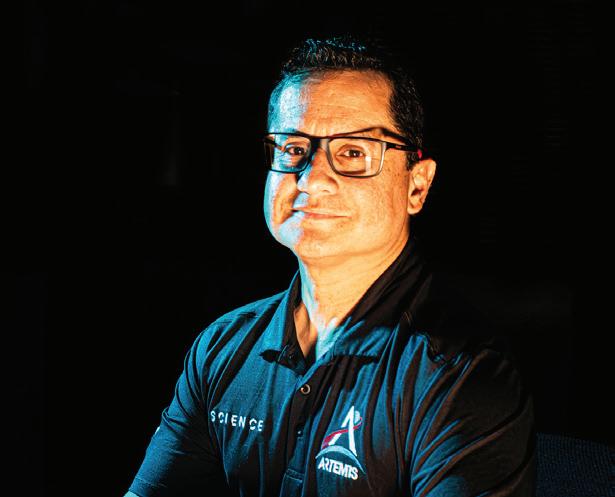
From UTEP’s department of Earth, Environmental and Resource Sciences, Professor Jose Hurtado, Ph.D., joined the Artemis II science team back in 2025 as their Science Evaluation Room communicator. A position that involves acting as the main communicator for both the Science Evaluation room and Science Mission Operations room (SMOR). Collecting and condensing prioritized messages that will eventually be communicated to the crew aboard the spaceship.
Tara Sweeney, Ph.D., a postdoctoral researcher within UTEP’s department of Earth, Environmental and Resource Sciences worked beside Hurtado for the Johnson Space Center’s Science Mission Operations Room as a part of the program’s curation and inaugural geology team. She worked to determine science objectives, and eventually helped to determine and move samples during and after landing on the moon’s surface.
“I get to be the sample recovery coordinator, which means for the first landed mission, once that capsule hits the Pacific Ocean, we go into recovery options,” Sweeney said. “It’s my responsibility to help our Artemis curation’s lead figure out how to protect the rocks and get them safely back to Houston.”
Alongside the technical and scientific roles Sweeney will play on these missions, she added that at its heart, Artemis’ goal was simply to bring humanity back to the moon and reignite the public’s excitement for future lunar missions through the live broadcasts and real time photos sent back by the crew.
“They went for all of us,” Sweeney said.
“Of course, through the benefit of satellites, and other mapping projects that Dr. Hurtado has been a part of have imaged all of the surface of the moon, but human eyes have not seen all of the surfaces of the moon, and there’s a great benefit to having our human eyes describe what they’re seeing in real time.”
Trinity Fushille, a geophysics major, said that UTEP’s involvement in the Artemis program, as well as what they’ve learned from Hurtado and Sweeney, has opened doors to new connections and opportunities that have made space exploration feel more accessible.
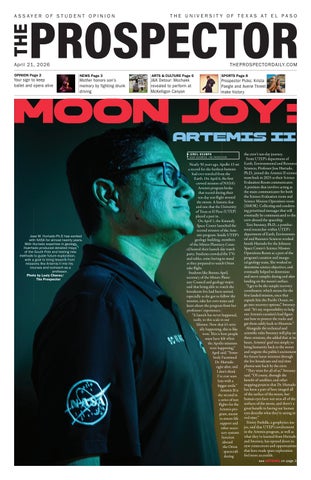
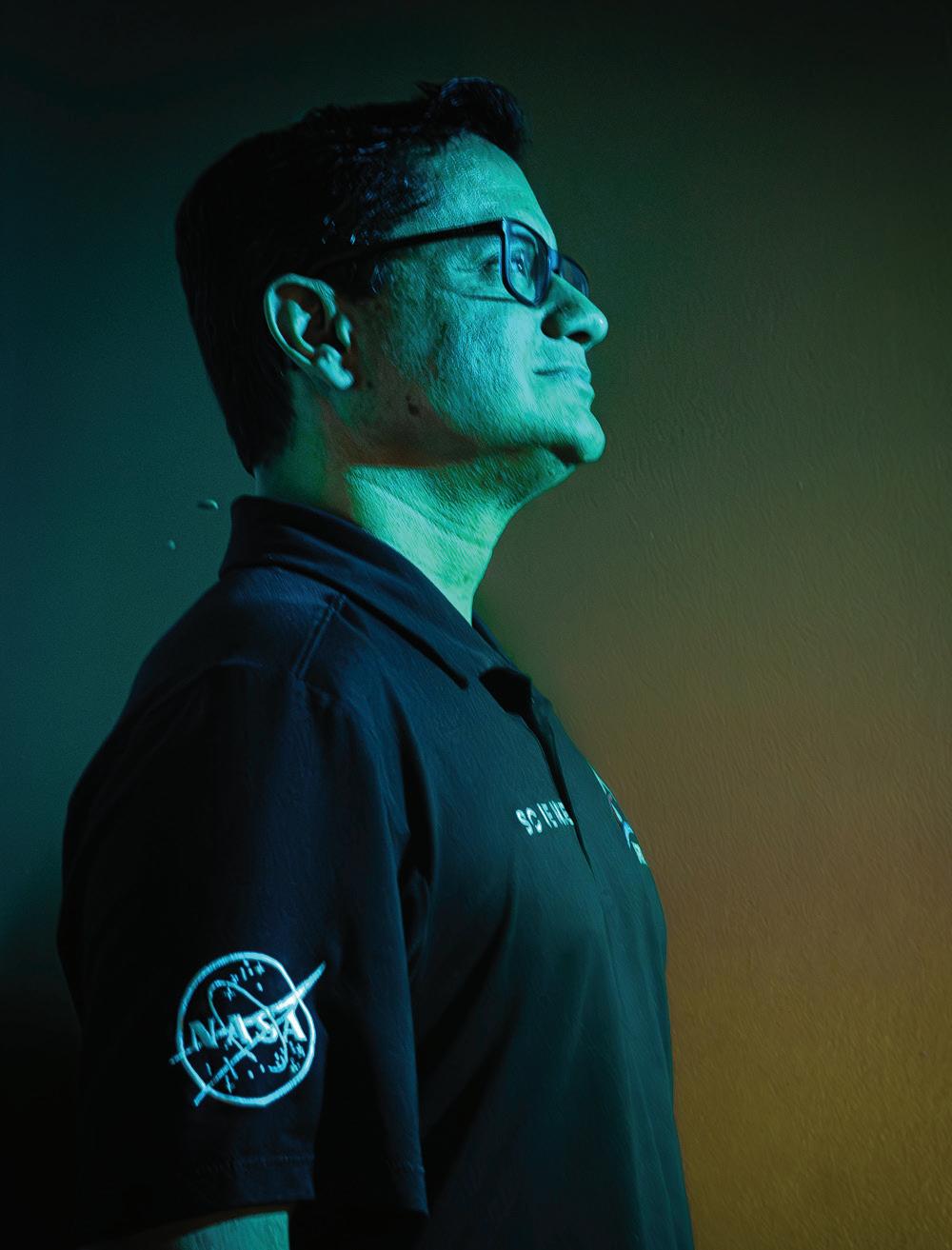
Jose M. Hurtado Ph.D has worked with NASA for almost twenty years. With Hurtado expertise in geology, Huertado produced detailed maps of the South Pole and testing new methods to guide future exploration, with a goal to bring lessons from missions like Artemis II into his courses and outreach as a
Photo by Lesly Chavez/
Opinion
Ximena Cordero, editor-in-chief
Reflectiong on Local News Day
On April 9, the first Local News Day highlighted the importance of local journalism, offering student reporters a moment to reflect on what it means to document the communities they are part of.
At The University of Texas at El Paso (UTEP), local journalism is not something distant or abstract. It is built through lived experience in classrooms, community events and everyday conversations that shape how student journalists understand both El Paso and their responsibility to report on it.
I first understood the weight of journalism during my first semester writing for The Prospector. I was sitting in a community meeting in February, listening to El Paso residents.
The conversation centered on proposed data centers and how much water they could use in a desert city already defined by
scarcity. The discussion was not abstract. It was personal, urgent and grounded in concern for the community’s future.
In that moment, reporting stopped feeling like an assignment. It became a responsibility.
Being a student journalist in the borderland means there is no real separation between the story and the storyteller. The same water being discussed in public meetings is the water the community depends on. The same rising costs residents worry about are the ones students hear about at home. That proximity changes how you listen and how you write.
Not every story carries that same scale, but each one carries its own importance.
Some stories come from conversations with students navigating heartbreak and trying to rebuild their routines. They talk about redirecting their energy into school, friendships and
personal growth.
That kind of story does not focus on policy or infrastructure, but it still reflects something essential about the community. They show how students adapt, recover and move forward.
Other stories come to life in classrooms, where reporting is shaped and challenged.
Much of my understanding of journalism was built under the guidance of Professor Kate Gannon, who consistently pushed students like me to find some clarity and really dig deep with their reporting. Assignments were never just about completing a story. They were about learning how to ask better questions and recognize what is at stake every time you’re out there interviewing people.
That expectation changed how I approach every interview and every draft.
It reinforced the responsibility of writing about real people and
real communities.
Outside the classroom, joining the National Association of Hispanic Journalists (NAHJ) added another layer of meaning to that work. It created a space to connect with other student journalists who understand the importance of representation and storytelling within Hispanic and Borderland communities like El Paso.
It also reinforced a simple idea.
Local journalism is not just about place. It is about people.
As I move through my final semester, that understanding feels sharper. There are still deadlines, revisions and long nights, but there is also a growing awareness of what this work has meant.
Local journalism has shown me that impact is not always measured by scale. Sometimes it is measured by proximity, by how closely a story reflects the lives of the people it represents.
Local News Day brings that
into focus. It’s a reminder that the stories told in classrooms, community meetings and student conversations are not separate from journalism. They are journalism.
Your sign to keep ballet and opera alive
Y I think it’s a good way to express yourself, and a good art form, and I think it’s highly respected.” Espinoza said. Many people also found how Chalamet made fun of ballet improper considering these are
The 2026 Oscar season celebrated many moments in film. However, the theme of the show was a collective response to Timothée Chalamet’s comment saying no one cares about opera and ballet anymore, causing major backlash for the Oscar-nominated actor. Still, the comment also raised an important question about the classical arts and whether the public is still showing interest in these art forms. In an era where entertainment is at your fingertips through social media, are these art forms still relevant?
In communities such as El Paso, not many people dedicate their lives to performing, nonetheless, the arts are part of many people’s childhood memories. Nayeli Espinoza, a psychology student at the University of Texas El Paso (UTEP), grew up practicing ballet.
“I was always in dance when I was a kid and until high school too.
the backbone of many theatrical performances. Daniel Gutierrez, an environmental sciences student, acknowledges that Chalamet’s statement completely disregards the history of ballet and opera.
“I just thought it was, kind of like
an off-handed remark, like when ping pong is already not a major sport, I would say, or something that a lot of people tune in for, compared to how ballet and opera have been a major thing for society for over 200 years,” Guiterrez said.
Ballet is an art form that has been around for about 500 years; it involves hard work, technique, and passion. Timothée Chalamet remarked it was a “dying industry,”sparking controversy among fans. Photo by Sadie Briones/The Prospector
“So, I just think it was, you know, a bit like in bad taste.”
One can conclude that not many people would pick ping pong over a ballet show. Amber Ramey, a computer science student, believes the local El Paso community stands with ballet.
“It’s [Ballet] definitely not a dying art form. I think that everyone still appreciates it. I mean, ‘Swan Lake’ is coming to El Paso, and I know everyone’s talking about it, so definitely not,” Ramey said. “I think if you’re around different people that appreciate art and it’s in every form and aspect that they appreciate ballet, they appreciate opera, and overall, they just have an appreciation for the work that goes into it and are willing to attend those things.”
read MORE at theprospectordaily.com
Fred Kepfield is a contributor writer for The Prospector and may be reached at fckepfield@miners. utep.edu
Photo by Iziah Moreno/The Prospector
Ximena Cordero, editor-in-chief
Mother honors son’s memory by fighting drunk driving
VANESSA OROZCO B Y
CONTRIBUTOR THE PROSPECTOR
Families of drunk driving victims have formed the Sober Streets Movement to raise awareness about alcohol-related incidents and laws surrounding driving while under the influence.
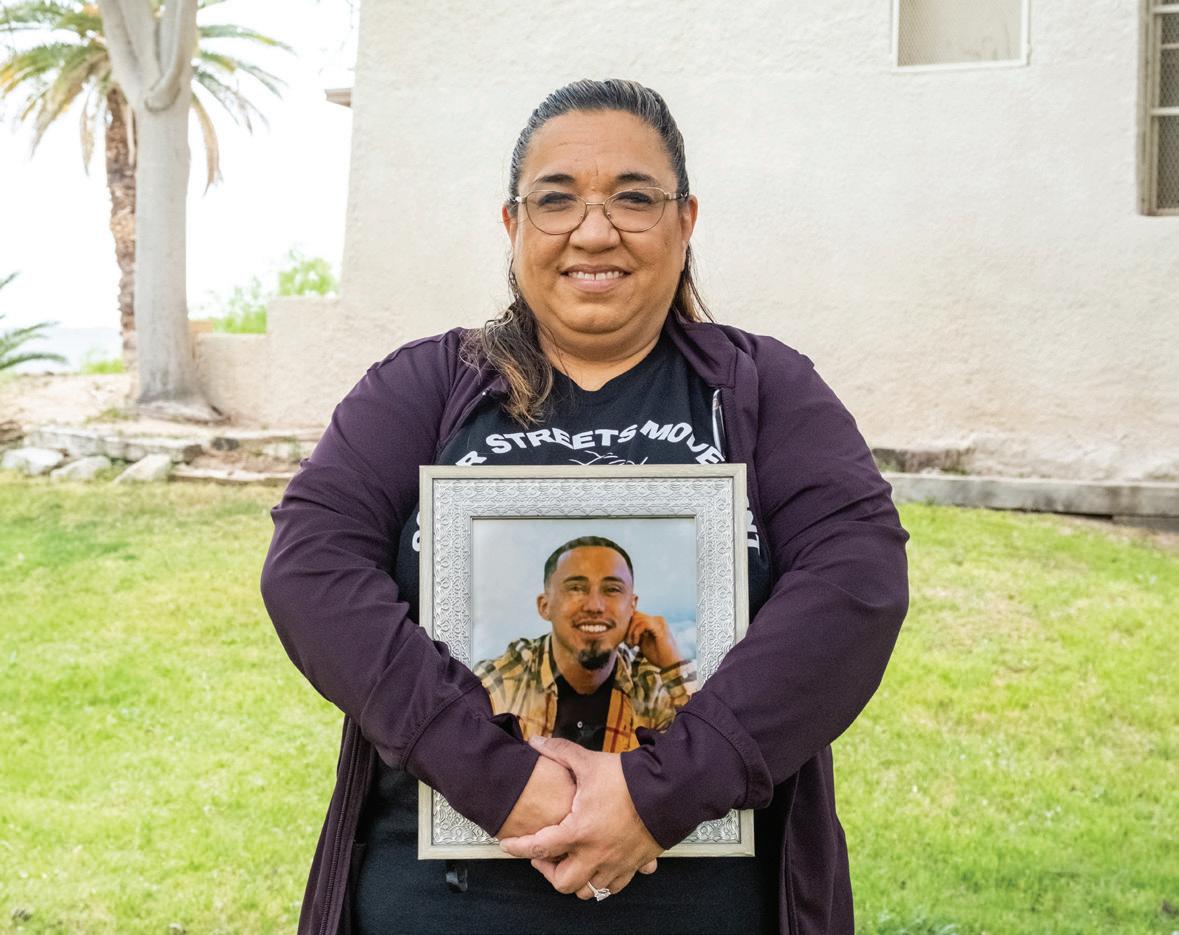
At the center of the movement is Lupe Hernandez Lucero, whose 28-year-old son, Steven Anthony Hernandez, was killed in May 2023 by an intoxicated driver.
Lucero said her son was known for his humor, athleticism and ability to bring joy to others.
“When you were having a bad day, he would be making jokes and he would be making you laugh so much, so much with joy, you would forget at that moment the situation you were going through,” Lucero said. “He was good at football, baseball, basketball, you name it.”
Lucero also said her son had a lasting impact on others through his music and poetry.
“That boy was poetic. He won, as a matter of fact, the state poetic contest in his high school at Americas High School,” Lucero said.
She shared an account from one of her son’s listeners who told her, “Your son told me to prosper and that life was beautiful.”
The driver accused of crashing into the vehicle Hernandez was riding in was released on bond and is currently awaiting trial. Lucero said the incident marked the driver’s third DWI offense, which encouraged her to create the Sober Streets Movement and advocate for harsher penalties and stricter laws.
“We want the checkpoints to
come back. We’re wanting a DWI offender registry, we want no more plea deals,” Lucero said. “We’re wanting a bar ID scanner system to flag repeat DWI offenders.”
Lucero said the movement’s goals also include seeking support from local governments for funding safer transportation options, addressing penalties for drunk driving, and preventing more families from joining the Sober Streets Movement. She also wants increased accountability for bars under the oversight of the Texas Alcoholic Beverage Commission (TABC). The TABC is the state regulatory agency that is responsible for oversseing all phases of the alcoholic beverage industry, including manufacturing, sale, transportation, importation and advertising.
She said her experience with the legal system has motivated her to continue fighting for victims and their families.
“Going to court and the trials, the status here means nothing is being done,” Lucero said. “It was just delayed trials and delayed hearings. It’s very sad to hear the corruption we live in, in our system. It’s a failure system for our community.”
Lucero also raised concerns about what she sees as a lack of transparency in court proceedings, recalling instances where hearing statuses were changed without families being informed.
and the parents of the victims don’t need to be there,” Lucero said. “Status went to bond hearing and told that person, ‘Don’t you think you’ve served enough time in county jail and now show society that you’re a different person?’”
The fine of a first-time DWI offense is up to $2,000 and allows the offender to pay 10% of the total to be released on bond before paying the full amount.
“These fines and bonds need to be raised higher,” Lucero said. “It’s a little bit of everything that needs fixing, and we need our letters to fix them.”
Despite her grief, Lucero said she has received positive support from law enforcement agencies and even former drunk drivers who have thanked her for her efforts to improve city ordinances.
With tears, Lucero shared a message for anyone considering driving after drinking.
“Do not go out. Please do not get behind the wheel. Call a friend, call a taxi, stay where you’re at. It’s not worth it.”
She said her advocacy is rooted in honoring her son’s memory and preventing future tragedies.
“I decided that God could not take me instead, that I would be his [Hernandez’s] voice and that I would speak for him,” Lucero said.
The University of Texas at El Paso (UTEP) Speech and Debate Team returned from Springfield, Missouri with four national championships at the Pi Kappa Delta National Tournament, solidifying the program’s reputation as a powerhouse in competitive forensics.
“Judges will sometimes, behind closed doors and without families aware, change a status hearing,
UTEP Speech and Debate wins four national titles
The Miners’ victories highlighted the team’s talent, camaraderie and commitment to representing El Paso on a national stage.
UTEP senior and mechanical enginnering major, Felix Castañon, said the success felt “great” and emphasized that the team’s achievements.
“I mean, it feels great that we’re putting UTEP on the map,” Castañon said.
Arely Avitia, a junior communication major, who competed in the Spanish-speaking events, said UTEP was one of the few universities from the western U.S. to achieve high honors.
“UTEP swept those events with my National Championships and along with Sebastian PerezNavarro. It was nice that we were able to represent not only UTEP but also El Paso as a community because the borderland is often misrepresented,” Avitia said.
The team’s success stemmed from close-knit teamwork and a culture of mutual support.
“We are all like siblings,” Avitia said. “We hold each other accountable. We always make sure everyone is in a positive mood. We don’t want any negativity because teamwork makes the dream work.”
Castañon said the team’s approach to collaboration allowed them to perform under pressure.
back on the moon.
“Seeing our professors here in El Paso working with NASA makes it feel a lot more attainable. If they can do it from UTEP, it doesn’t feel out of reach for us anymore,”
Fushille said. “I got into an internship with the lunar Planetary Institute slash NASA, and I only heard about that internship because of Tara and Dr. Hurtado.”
Fushille added that this sense of possibility was made even more meaningful by the representation made possible by mission specialist Christina Koch, the first woman to travel to the moon.
“I think it’s exciting that there’s a woman going up there. The last time there was people going to the moon, a woman couldn’t open up a credit card on her own. And now it’s like, ‘Dang, what’s going happen next? What’s the next innovation,’” Fushille said.
After Artemis I and II proved the Orion spacecraft could make the journey around the moon, NASA’s follow-up missions are already evolving. Scheduled for late 2027, Artemis III was originally planned to be the mission that put people
Sweeney said that plan has changed, shifting Artemis III from the first landing mission into another flight test, focused on an earth orbit to test the capsule’s docking system. A follow-up mission, Artemis IV is now in place as the first landing mission.
“The last human stepped off the moon in December of 1972 and I was born two months after that,” Sweeney said. “I’ve waited 53 years for what we’ve been able to see this week, and it’s a special gift knowing we finally sent four humans out there.”
With Artemis II’s crew back on Earth as of April 11, the next chapter is already in motion, and while UTEP’s contributions take place on earth, their impact reaches as far as the moon and as close as the classroom.
Jewel Ocampo is a staff reporter and may be reached at Jnocampo@miners.utep.edu
Vanessa Orozco is a contributor writer at The Prospector and may be reached at vmorozco2@miners. utep.edu
Two posters are displayed with the left having the Sober Streets Movement logo and the right with a photo collage of Steven Anthony Hernandez on April 10, 2026. The organization was formed to raise awareness about alcohol-related incidents and laws surrounding driving while under the influence. Photo by Kristian Hernandez/The Prospector
Lupe Hernandez holds a picture of her son Steven Anthony Hernandez on April 10, 2026. Hernandez was killed in May 2023 by an intoxicated driver at 28 years old, but left a lasting impact on his community. Photo by Kristian Hernandez/The Prospector
ARTEMIS from cover
UTEP Speech and Debate brought home four 2026 national championships in Springfield, Missouri. Photo by Iziah Moreno/The Prospector
Leveling up students’ futures
The University of Texas El Paso (UTEP) hosted “Level Up” a graduate school, fellowship and scholarship showcase designed to inform students of the resources available for them to upgrade their education. The event was brought together by departments such as Student Fellowships and Awards, Scholarships and UTEP’s graduate school.
On April 8 students were able to explore a list of opportunities for their next step, from research and volunteering to career advice and prestigious fellowships. Jennifer Green, assistant dean of UTEP’s graduate school, was excited about putting this event together and
giving students a look into the many possibilities after graduation.
“What we wanted to do was put all the things students want when they’re thinking about their future in one place. So graduate school, means of funding graduate school, whether that be here or elsewhere, amazing activities after they graduate, like the Fulbright student program. So basically, anything that you can use to level things up.” Green said.
Faculty were happy to inform attendees of the many different paths they could take using their degree. Stephen Crites, Ph.D, dean of UTEP’s graduate school, encouraged attendees to take full advantage of the resources offered by the university and use those tools to better understand their
UTEP’s Silent Book Club
CONTRIBUTOR
The Silent Book Club is a student organization at the University of Texas at El Paso (UTEP) that aims to provide students of all personality types and majors the opportunity to rediscover their love for reading in the middle of the often-hectic college environment. It particularly acts as a safe space for introverted and stressed members since there is no obligation to socially interact or study the reading material.
With only classical music playing in the background, the silent sessions are intended to be calming and peaceful, according to junior microbiology major, Mariana Silva, who serves as the vice president
The organization uses an introvert friendly approach to assist those who feel overwhelmed by classes or the high-energy campus scene.
“It’s nice to be somewhere and just read in comfortable silence
around others, kind of enjoying the same thing,” Silva said. “I think the club is really good for introverts who want to have a sense of community without feeling pressured to meet new people and be thrown into icebreakers and things like that. There is also not any pressure to be like, ‘Oh, what is your opinion on this book?’ or
‘Let’s all get in a circle and say what we’re thinking.’”
The organization’s “quiet time” component is also meant to serve as a stress reliever and allow members to escape from the “academic homewor” feeling.
“Our silent sessions are definitely that kind of zen moment for a lot of people, especially for me because I’m super busy with classes,” Silva said. “It’s nice to commit an hour to a very non-chaotic hobby. A lot of joy can be taken away by grades and deadlines, and the club is really just to foster a joy for reading.”
academic pathways.
“Mentors and using the resources here is really important. A lot of students are switching, they’re in one major, and they switch to another one. It’s important to know some of those options, salaries and what you want to do,” Crites said.
“So, it’s really important, I think, in your undergraduate degree, to think about that and know where you might want to go and what skills you’ll need.”
Every booth meant a different possibility. Gabriela Mariscal, a junior studying engineering in materials and metallurgy and undergraduate fellows’ alumni, was excited about learning about study abroad programs and fellowships that align with her academic goals.
“I feel like it’s a dream to study
abroad,” Mariscal said. “I feel like it’s that way for everyone to get to do a master’s or Ph.D. program somewhere else. I feel like these programs help a lot, not only to see people who have done it, but for financial help to actually make it an achievable dream.”
To take those dreams and turn them into objectives, students might need a little mentoring and a lot of confidence to send in their applications. Felipe Martinez, Student Coordinator at the Office of Student Fellowships and Awards, believes encouraging students to get involved on campus is the best way to build that courage.
“It’s kind of figuring out your why. It’s really doing it with a with an intention of knowing that you’re going to get it, and
with that being said, reminding yourself that you belong in that space, that you should own that space,” Martinez said. “You own that Fulbright, Hawkins or Truman space. That’s the message that we want to spread here at UTEP. We want that culture with the students that you should apply to all these fellowships, because you belong and your story matters.”
Life after graduation can generate feelings of uncertainty and doubt for students, but with the right guidance that stress can turn into motivation and excitement about what’s yet to come. It is never too late to level up.
Vivien Noe C, is a Staff Reporter, at The Prospector and
The evolution of AI on campus
JEWEL OCAMPO B Y to offer.
STAFF REPORTER THE PROSPECTOR
Before ChatGPT students flocked to Quizlet, Cengage and a plethora of other websites for help with their homework. However, artificial intelligence (AI) has now became widely used for creating study guides, note taking and the occasional quick completion of an assignment.
AI is becoming an increasingly popular tool in the worlds of art and academia. Sites like ChatGPT and Sora’s video generation app have created mixed feelings towards AI as students begin to rely on it for anything from simple organizational tasks, study guides, outfit planning and hairstyling tips. One writer and sociology major at the University of Texas at El Paso (UTEP) who preferred to stay anonymous, had a less than positive view on AI and found that, at least for her, the technology had little
“I used AI for a process vetted by the university, putting in your paragraph, and having it [AI] edit it or if you’re struggling to reach a word count, having it say, ‘This is how you can make it longer without making it sound clunky,’” She said. “I did it to try to understand the purpose of AI, and in all actuality, if I had an extra 30 minutes, I could have done it myself. It just changed the method in which I did the task.”
Other students like communication major, Joneeah Hudson, say that when used correctly can be quite helpful, often using it to create study guides or satisfy her own curiosity.
“I used to ask personal questions like how to do a curly hair routine, for outfit planning, hygiene products. Random questions like, ‘how far away am I from this mountain?’ It varies, but I’ve used it for a few things, both personal and for school,” Hudson said.
Like with many new technologies, there are concerns about how it’ll be used. Professor and chair of UTEP’s Computer Science Department, Salmah Salmah, Ph.D., said that he was optimistic about the development of AI.
“With every advancement, you can use it for good, you can also use it for bad,” Salmah said. “You always have to have regulations but to me, it’s a problem when somebody says it’s black and white. ‘Don’t use AI.’ I think it needs to be, ‘Here’s how I would like you to use AI.’”
Having often used AI to speed up time-consuming activities like summarizing technical documents and sorting emails, Salmah says that these tasks are where AI shines. However, the risk of dependency and users failing to consider the errors that AI often makes persist.
read MORE at theprospectordaily.com
Paying a visit to the Level Up showcase, UTEP President Heather Wilson and UTEP Mascot Paydirt Pete pose for a photo at one of the booths at the showcase. Photo by Nate Flores/The Prospector
Arts & Culture
Abby Pedroza, editor
Your next watch: The most anticipated movies of 2026
As the year progresses and everyone finds a routine, film has the power to transport people into different worlds, and 2026 has a variety to choose from. From diving into childhood memories with the upcoming film of “Moana 2” to traveling to a darker future with “The Hunger Games: Sunrise on the Reaping.” This year has a wide range of productions that have audiences buzzing with excitement. The semester is wrapping up, and students from The University of Texas El Paso (UTEP) have two things to look forward to-summer and the movies coming out. For many, films provide a muchneeded pause from busy schedules filled with classes, organizations, and exams.
Movies for those who need career motivation:
“Michael”: April 24
“The Devil Wears Prada 2”: May 1
“Dune: Part Three”: Dec. 18
Rachel Cruz, a sophomore studying human resources, said she is especially looking forward
to taking a break and watching “Michael,” a biopic about the legendary singer Michael Jackson.
Created for those who need motivation or just want to groove a little, director Antoine Fuqua promises a “spiritual journey” that will have audiences looking beyond “the man in the mirror,” or in this case, the man on the screen.
Movies for those feeling nostalgic:
“Spider-Man: Brand New Day”: July 31
“Supergirl”: June 26
“The Cat in the Hat” (Animated): Nov. 6
“Michael” is not the only film that will explore the life behind a pop culture icon, even superhero movies such as “Spiderman: Brand New Day” and the “Supergirl” movie will give an insight into the struggles behind the heroes.
Students interested in the film industry are noticing those trends.
Angelica Gutierrez, president of UTEP’s Digital Media Association describes the current cinematic era in one word: human.
“I think they try to approach it
[film] more on the human side of things. We’re all not that perfect. We all don’t have those happy endings all the time, so it’s just coming close to those and so people can also kind of like relate a little more with the story, because it feels more human and more relatable,” Gutierrez said.
Gerardo Sillas, a graduate student majoring in artificial intelligence can’t wait to see their favorite actors on the big screen once again.
“I’m excited to see the new Spiderman movie. I would like to see Tom Holland in the movie theater. I am really excited about superhero movies,” Sillas said.
Movies for those who need an escape:
“Backrooms”: May 29
“The Odyssey”: July 17
“Avengers: Doomsday”: Dec. 18
Now, there really is no better place for enjoying a movie than on the big screen. UTEP’s Warner Bros. ambassador, Jesus Guillermo Reyes, invites students to go enjoy a movie at their local cinema, and to stay on the lookout for Warner events so that they can win free movie tickets.
“It allows you to just relax and keep your mind off your priorities, and just for an hour and a half or two hours, just enjoy a good movie and transport yourself into the world of these characters,” Reyes said.
From nostalgia to new adventures, this year’s films are set to give students something to look forward to long after finals are over. In a world that never stops, cinema represents much more than entertainment, it gives a chance to pause routine and experience different stories.
The story behind the Backrooms originated from a found footage, horror series by Kane Pixels on YouTube. The series showcases an endless, surreal labyrinth of monochromatic rooms representing a liminal space that is accessed by “no-clipping” (video-game term that means being able to phase though walls or solid objects) out of bounds of normal reality. Illustration by Dustin Perez/The Prospector
Vivien Noe C. is a staff reporter at The Prospector and can be reached at vgnoe@miners.utep.edu
The film symbolizes a “Brand New Day” for the wall-crawler, as the film is taking Tom Holland’s character into a direction that no other liver-action Peter Parker has gone through. Photo by Dustin Perez/The Prospector
Is physical media dying or is it having a comeback?
Through vinyl records, CDs, books, VHS tapes or DVDs, physical media has existed for a long time, whether it was but as technology and media developed over time, consumers are now able to access almost every type of media digitally.
Most people depend on streaming services for music and film, such as Spotify, Apple Music, Netflix, Amazon Prime and Disney Plus. With the competitiveness that digital streaming platforms have against physical media, it can lead to companies believing that physical media isn’t necessary anymore.
Just recently, Disney had decided to lay off their entire Home Entertainment team, who helped with the development of physical media for the company, leading concerns with their future for the physical media of their future projects.
For local stores here in El Paso, that could raise questions about the demand for physical media here in the city. At All That Music and Video, a local physical media store located at the Fountains at Farah, dedicates their store to the preservation of physical media,
selling physical copies of music and film.
Staff member and University of Texas at El Paso (UTEP) junior, Kailyn Saenz, finds the preservation of media important, finding younger crowds keeping it alive.
“I’d say it’s definitely an increase with younger crowds,” Saenz said. “But overall, it’s a balance.”
As a staff member at a physical media store, Saenz finds it meaningful to help keep that kind of media alive, so that many people can be influenced to keep it alive, while finding physical media important.
“I always find having a physical copy of music extremely important because it’s real and in your hands than having something digital,” Saenz said. “I think that can limit the connection between a person and the music.”
UTEP senior, Gianna Newbury, finds importance in collecting physical media as a vinyl record collector.
“Having a physical format of music available contributes to the overall enjoyment of music, in my experience at least,” Newbury said. “Streaming services are very popular due to their convenience and quick access, but such ‘ease of use’ makes it almost passive.”
Newbury also believes that there is a higher quality in listening to music on vinyl than digitally.
“Personally, I think that there’s a higher sound quality with records, as opposed to music streamed digitally,” Newbury said. “I enjoy having a tangible format for music available, especially when I want to ‘disconnect.’”
But it isn’t just music and films that are facing the main competition with the digital age, books and video games are too. UTEP senior, Emerie Tercero, explains how she prefers collecting films, books and video
J&K Detour: Mochakk revealed to perform at McKelligon Canyon
ABBY PEDROZA B Y
& CULTURE EDITOR THE PROSPECTOR
ARTS
When you think of concerts in El Paso, you think of the local venues like Lowbrow Palace, the Plaza Theater, the Sun Bowl and the Don Haskins Center, but what if there was a chance to shine a light on other places in El Paso?
Founders Enrique “Kiki” Cervantes and Johnny Escalante did just that as they formed their promotional company, J&K Present, in 2010, with the shared goal of bringing big-named artists to El Paso to “unconventional” event locations.
“We created this new concept ‘J&K Detour,’ to give our community some fresh and something worthy of the creativity and energy [artists] bring here,” Kiki said. “We’ve been local promoters for a while now and we wanted to take that experience learning that energy we got from the city and really try to push the boundaries.”
Their first volume show “Detour: Under the Spaghetti Bowl,” was held on Oct. 5, 2025, featuring artists such as Disclosure and special guests such as Channel Tres, Pete Soul and La Flaquita. The event had positive feedback and encouraged Kiki and Escalante to continue and build their upcoming volume two project.
“With our first Detour [show], we did it at Lincoln Park, and it was somewhere we’ve always envisioned having a show there. It just seemed so unbelievable, so it was something
we always had in mind,” Kiki said. “[We wanted] to see how everything would line up and what it would take to create the experience we were planning on.”
With support from the city, J&K began to lock in dates for their shows and narrowed down which artists would fit the vibe of each location they planned on picking out.
“Taking these places and turning them into a full-on experience is not really about the hardness, but really immersing people into really beautiful landscapes,” Kiki said. “Turning them into an experience we haven’t really had the chance to, is something we’re really trying to build the Detour brand on.”
holds events, but we always wanted to do one of our events there,” Kiki said. “We talked to El Paso Live to see if we were able to have a what we would call a ‘full out mini festival,’ and we got their support and reached out to artists.”
It wasn’t until Feb. 19 that they announced Brazilian DJ Mochakk would be performing on April 24.
read MORE at theprospectordaily.com
games because of how the digital “licensing” works.
“I like having my favorite medias in hand, you know,” Tercero said. “I mean, its biggest competitor is digital stuff. There’s a vast difference. Nowadays, when it comes to games and stuff, you’re buying a license, and you don’t own it. It’s not your property and I just don’t like that.”
According to the Federal Trade Commission (FTC), when you buy a digital product, whether it is an album, book, game or film, you only have access “while you have an active account with the platform
or website that sold it, or only for as long as that platform or website stays in business.”
Can it be a major takeaway for consumers if knowing that what they buy digitally than physically has a different definition of ownership? Could that change their views on consumerism for physical media?
As of now, physical media seems to be having more of a comeback, with vinyl records reaching $1.04 billion in the U.S. in 2025, which was a 9.3% increase from 2024.
El Paso Artist and Farmers Market returns for 15th anniversary season
CONTRIBUTOR THE PROSPECTOR VANESSA OROZCO B Y
The El Paso Artist and Farmers market has returned to downtown El Paso with more vendors than ever, bringing community members to the area.
When announcing their shows, they release the details one by one, starting with the “secret” event locations and later revealing the artist.
Each tier of release allows followers to buy tickets, and on Feb. 13, J&K announced the show’s location to be at McKelligon Canyon in the Franklin Mountains.
“With the Franklin Mountains we’ve been a fan of the area, and it is a beautiful place.
McKelligon Canyon is a place that
that I do these [hand embroidery], so that they can take the classes and add to the workshop,” Rosabril Hoyt, owner of Everyday Honey said. “It allows people to get to know my business.”
Hosted by the City of El Paso’s Museums and Cultural Affairs Department, the market brings together a diverse group of vendors offering products ranging from fresh food and agricultural goods to handmade arts and crafts. In addition to shopping, visitors can enjoy live music and entertainment, much of which is supported by volunteers who help set up and maintain the event each week.
For local vendors, the market serves as an important platform to grow their businesses and connect with the community.
“I do workshops around town, so these markets allow people to know
Founded in 2011, the market expanded its offerings and accessibility in 2013 following a grant from the U.S. Department of Agriculture (USDA). Today, it continues to serve as a hub for local commerce and culture.
The market takes place every Saturday from 9 a.m. to 1 p.m. at Union Plaza through September, giving residents and visitors multiple opportunities to attend.
Even after the market season ends, vendors continue to promote their businesses through social media and hosting events at other local venues.
read MORE at theprospectordaily.com
Brazilian DJ Mochakk debuted in 2012 and is now making an appearance in El Paso. Photo courtesy of J&K Present.
The renewed interest in physical media reflects a broader tension between convenience-driven consumption and the desire for connection and break from screens. Photo by Aylin Montanez/The Prospector
Aziel Ramos is a contributor at The Prospector and may be reached at aramos45@miners.utep.edu
Celebrating its 15th anniversary, the annual El Paso Artist and Farmer’s market returns every Saturday through September. Photo by Nate Flores/The Prospector.
Spring Shots
Iziah Moreno, editor
Photos by Iziah Moreno/The Prospector
Photos by Sadie Briones/The Prospector
Photos by Nate Flores/The Prospector
Photos by Lesly Chavez/The Prospector
Photos by Diego Figueroa/The Prospector
Photos by Aylin Montanez/The Prospector
Photos by Dustin Perez/The Prospector
Photos by Adriana Quinones Melendez/The Prospector
Sports
Kristian Hernandez, editor
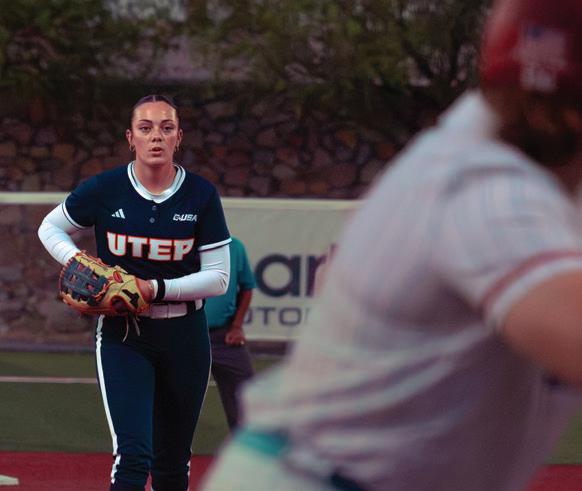
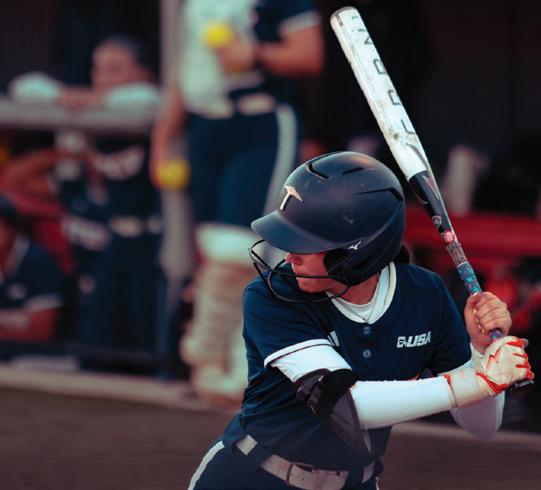
Prospector Picks : Krista Paegle and Averie Threet
In the world of beach volleyball, the sand is constantly shifting, but for University of Texas at El Paso (UTEP) senior Krista Paegle and sophomore Averie Threet, their names are now firmly set in the record books.
The duo was recently named the March 31, Conference USA (C-USA) Pair of the Week, a distinction that carries more weight than a typical weekly accolade. It marks the first time in the history of the UTEP beach volleyball program that a pair has earned a conference honor.
The journey to this milestone began in two very different corners
of the world. Paegle, a native of Riga, Latvia, arrived in El Paso with a prestigious international resume.
A former Latvian National Champion, she has competed on the FIVB Beach Pro Tour and represented her country in the CEV Under-Age European Championships.
Meanwhile, Threet arrived from the small-town atmosphere of Peaster, Texas, bringing a “winning culture” from her high school roots. Despite the distance between their hometowns, the two found common ground the moment they stepped into the sand.
“I think even though we’re from separate places and culturally we are different, when we play volleyball, we don’t really feel those cultural differences. We’re both passionate about the sport, so we just go play.”
Paegle said.
While the sport felt familiar, the environment was a new frontier for Threet. Moving to El Paso was a transformative experience that extended well beyond the court.
“It was a big shock,” Threet said. “Just being around the culture in El Paso and honestly seeing the mountains every day is a huge shock. There’s no place like
El Paso.”
That sense of belonging was bolstered by a shared personal motivation: their mothers.
Both athletes were raised in volleyball households, with Paegle’s mother having played professionally and Threet’s mother serving as her high school coach.
“My mom has impacted my game so much,” Paegle said. “Growing up, seeing [the] high competition and seeing my mom compete professionally has impacted a lot of my game. I’m striving to be like my mom when she used to play.”
Threet mirrors that sentiment,
noting her mother is her biggest supporter.
That foundation of support has allowed them to navigate technical challenges, such as adapting their style to accommodate Threet’s height compared to the average beach volleyball player.
By playing a “cleaner” game and avoiding mistakes, the strategy has paid off.
The pair went 4-0 during the weekend that earned them the honor, including a straight-set victory to secure UTEP’s lone point against nationally ranked No. 19 Arizona.
“I was a little shocked,” Threet said regarding the news. “I was obviously super proud and honored, but we couldn’t have done it without our teammates and our coaches.”
For Paegle, who has seen the program grow from its infancy, the award is the fulfillment of a longterm vision.
“When we started out my freshman year, it was totally different,” Paegle said. “We had high goals and expectations. This was one of my goals and completing that is a huge accomplishment for myself and for this program.” Even as they make history, the two maintain a lighthearted balance off the sand.
While Threet jokingly claims she would have to “keep Krista afloat” if they were stranded in a desert, and their music tastes differ; Their on-court synchronization is undeniable.
As the Miners look toward the C-USA championships, the duo remains focused on the fight ahead.
“Keep supporting us,” Threet said. “We’re still out there fighting, and nothing’s done yet. We still have a good chance in the conference championship.”
With the first conference honor now in the books, the foundation for UTEP beach volleyball has never looked more solid.
Rhinos take out the Warriors in play-in series
The North American Hockey League (NAHL) El Paso Rhinos (2-1-0-0) out lasted their South Division opponent Oklahoma Warriors (1-2-0-0) in the best of three play-in series. Rhinos’ Head Coach Michael Rivera credited a defense that’s able to match Oklahoma’s line.
“We had a line that we matched against them that’s one of our best defensive lines and shut them down,” Rivera said. “The biggest
thing about the game plan was just keeping them in front of us. They really like to get behind us, and they’re really good off the rush.”
Game one witnessed a backand-forth offensive bout with the Rhinos scoring first at 3:54 in the first period. The goal scored by forward Gaige Giblin, who previously played in the Alberta Junior Hockey League with the Olds Grizzlys in the 2023-2024 season. He then made a tender signing to the NAHL Springfield Jr. Blues in June of 2024. After
playing five games at the start of the 2025-2026 season for the Blues, the Rhinos made him part of the team. Both teams accumulated 20 penalty minutes (PIM) with the Rhinos going 2/3 on their power play (PP). While Oklahoma went 0/3 on the PP, their offensive efforts with two goals scored in the second period alone by forwards Dominik Kiss and Jackson Hone. The Warriors scored again in the third from Hone early in the period, making the score 4-2. El Paso forward Connor Makowski
scored a goal with 2:18 left in the third. The Rhinos take out goalie Michael Modelski to bring in an extra attacker but were unsuccessful, leading to their loss in game 1 4-3.
Game 2 was a complete domination of offense along with the rest of the series. Although the Rhinos garnered more penalty minutes with 10 PIM, the Warriors only scored once by forward Keaton Martin in the second period.
The Rhinos took advantage of
their PP chances going 3/5 ending the night 5-1 tying the series 1-1.
Rhinos’ defensemen Alex Gregoire and Jackson Porco gave comments after their game two victory.
“We try to break the puck out really fast so they didn’t have time to create offense on us,” Gregoire said. “Kill plays, good first pass, play hard in the corners.”
Porco gave more insight on the balance between the level of physicality and staying out of
Making history within UTEP’s beach volleyball program, Krista Paegle and Averie Threet have been named the March 31, C-USA Pair of the Week. Photo by Iziah Moreno/The Prospector
penalty box. We wanted to match our physicality and bring it up a notch, but at the same time, stay disciplined.” Porco said. “Not take dumb penalties, stay out of the box and let them make the mistakes.”
Game 3 sealed the deal for the Rhinos with a 4-1 victory ending the series 2-1. El Paso forward Troy Hunka scored two goals alone in the first period, along with an assist on forward Kamden Kaiser’s PP goal. Hunka was named the Rhinos’ all-time scoring leader with 82 points and counting on March 28.
Modelski finished the series playing in all three games with a save percentage of 0.938 and earned NAHL star of the month in March and April. The former Pembroke Lumber Kings from the Central Canada Hockey League played for the team in the 2024-2025 before joining the Rhinos organization. Rivera’s roots in the Rhinos
El Paso Rhinos face Oklahoma at home in a best of three game
Play-In series to advance to division Semifinals. Photo by Diego Figueroa/The Prospector
began in 2010. He played hockey in El Paso up until 2013 where he committed to play hockey for the University of Central Oklahoma Broncos. He also coached the team which is part of the American Collegiate Hockey Association (ACHA).
“It was really just pressure, and if they have possession, we’re going to sit back. We’re going to make them work through all five of us and make sure that they have to earn that 200 feet of the net,” Rivera said.
Rivera was certain about where he would be today as head coach of the Rhinos NAHL team.
“You want me to be honest?” Rivera said. “I did, that was the plan all year. You stand in this rink and you see all those banners. It’s the expectation here. Obviously, we had to rebuild the entire roster. We lost 16 guys last year.”
The Rhinos will go on to play the New Mexico Ice Wolves in the South Division semifinals in the best of five series on April 17.
From Spain to El Paso, Yrizar finds her swing at UTEP
From the beaches of San Sebastian, Spain, to the fairways of El Paso, Texas, freshman Blanca Yrizar is halfway through her first year on the University of Texas at El Paso’s (UTEP), women’s Golf team.
Growing up in an athletic family, Yrizar says that she and her two siblings were always encouraged to stay active. Both her father and uncle coached tennis, while nearly everyone on her mother’s side played golf.
“My parents were both very athletic. They’ve always pushed the three of us to play lots of sports. They need to see us doing something.” Yrizar said.
After spending years practicing sports like tennis and surfing, Yrizar added that constant tension from being coached by family members in tennis would eventually push her towards golf, where she could develop more independently.
“I’ve always surfed during the summers and winters, and then I always played tennis, because my dad played tennis and my uncle is still a coach right now, but I just didn’t like having my dad as a coach,” Yrizar said. “On my mom’s side, everybody plays golf, so I feel like I’ve always been playing golf and tennis.”
By the time she was ready to enter colleg,e Yrizar learned about UTEP through another Spanish player who she played with a year prior and was officially introduced to the program after head coach Steve Sims reached out to her.
“I didn’t know that UTEP existed. That same evening, Coach Sims texted me. The next day, I saw Marta, and I started asking her questions. I wanted to come to UTEP,” Yrizar said.
Since arriving in El Paso, Yrizar said adjusting to life on her own has been one of the biggest challenges.
Living on campus meant learning everyday tasks like cooking, doing her laundry and ensuring she woke up early enough for her 5:30 a.m. workouts.
“I thought it was going to be harder, honestly. Back home, I would always be surrounded by my parents. It’s been very different,” Yrizar said. “With my teammates, I feel like I’m not the only one. Honestly, I didn’t even have time to be homesick, because we were always practicing, traveling and everything.”
On the course, Yrizar has quickly made an impact in her first collegiate season. Competing in nearly every tournament across the 2025-2026, earning consistent spots in the lineup. Her performances included an eighth-place finish at the West Texas Classic and a third-place finish at the Ozarks National Invitational in Missouri where she remained competitive despite difficult decisions.
“I placed third the last tournament, and I was eighth, I think, two tournaments ago. It was very windy, and the last day, it was a bit harder, but I played very good. The field wasn’t the hardest one, but I still did a good job for that way,” Yrizar said.
Another adjustment and highlight for Yrizar has been her playing as part of a team rather than individually.
“Back home we would always practice by ourselves. So, practicing here every single day, with the other girls, I was excited. I was looking forward to that,” Yrizar said.
As the season continues, Yrizar said she’s optimistic and looking forward to their next tournament, in Maricopa, Arizona. And after contributing to a team victory in the BGSU Women’s intercollegiate event earlier in the season.
From competing in almost every tournament in the both spring and fall semesters, to earning a consistent spot on the lineup, Blanca Yrizar makes an impact as a freshman in her first collegiate season. Photo by Nate Flores/The Prospector
STAFF REPORTER THE PROSPECTOR JEWEL OCAMPO B Y
Kristian Hernandez is the sports editor for The Prospector and may be reached at kahernandez16@ miners.utep.edu and social media tags @northeastvideography.
Multimedia
Sebastian Perez-Navarro, editor
COVERING HISTORY THROUGH THE CAMERA LENS
Liberal Arts Bulding deconstructed
After opening in 1963, the Liberal Arts building at the Univerity of Texas at El Paso (UTEP) is getting torn down.
The demolishment of the Liberal Arts building comes after the opening of UTEP’s brand new building Texas Western Hall, which became the new home of the college of Liberal Arts.
Exiting the union, UTEP students can see firsthand the tearing down of the building. Multimedia editor Sebastian Perez-Navarro caught up with members of the student body over their opinions of the historic tear down.
“Personally, it smelled a lot like gas,” said UTEP junior Stephanie Fierro. “It was very hard trying to get in and out... so I think it’s [the demolishment is good.”
Replacing the building is an all new space for students called Arroyo Park. The natural park will be worked on through two phases. The first phase is set to be complete by 2028 and the second phase by 2031.
Learn more about the future of this space by clicking on the picture right above.
ro@miners.utep.edu
Dustin’s corner takes on new life
For the first time in years, The Prospector brought on to their staff a cartoonist under the leadership of then editor-in-chief Evelyn Palma. That cartoonist, was none other than Montwood High School graduate and current freshman at the University of Texas at El Paso (UTEP), Dustin Perez. Perez has brought his cartoons to the student media and publication department at UTEP. Perez has tried every art technique, ranging from water color, digital sketching to fun doodles. His passion is shown through these art forms.
The Spring 2026 semester marks the cartoonist’s second semester at The Prospector. He, and fellow Montwood graduate, Lesly Chavez, brought his cartoons to life in this special multimedia edition of The Prospectors, “Dustin’s Corner”. Perez has a special place in his heart for creativity, a personal trait that Chavez noticed since she was a junior working on Montwood High School’s Yearbook. Chavez interviewed Perez about his art and that was when his “Spider boy” nickname was coined by Lesly. The reason being that Dustin’s favorite superhero is Spider-Man. His love for superheros is a special one that
motivates his art. Perez’s social media accounts have his art on full display and through this video, Perez multitasks getting interviewed while drawing the caped crusader Batman. It’s time to meet the brain behind the The Prospector’s art. Click on the image above to discover the behind the scenes magic of Perez’s cartoons. The video demonstrated the young artist’s motivation, process, and how he continues such a rigorous art form.
Gas Prices Remain High
students
to
to adjust their spending habits to the
in
For the thousands of students who commute to the University of Texas at El Paso (UTEP) daily, the walk from the Sun Bowl parking garage is getting increasingly expensive before they even step onto campus.
As of early April 2026, the average price for a gallon of regular unleaded gasoline in El Paso has reached $4.08. According to AAA Texas, this figure is the highest among the 27 largest metropolitan areas in the state. Since the onset of the U.S.-Israeli conflict with Iran on February 28, local prices have skyrocketed from an average of $3.12 per gallon to a 31% increase in just over a month. The rapid spike is directly tied to the geography of the ongoing war. The Strait of Hormuz, a narrow waterway that handles approximately 20% of the world’s total oil consumption, is currently the center of a global supply disruption. When conflict threatens this primary transit chokepoint, global crude prices surge instantly. International oil prices have climbed significantly since the war began, and these fluctuations trickle down to
local stations in the Borderland faster than in many other Texas regions because El Paso operates as a “energy island
While most of the state is integrated into the Gulf Coast supply network, El Paso relies on the local Marathon Petroleum refinery. Due to the county being at the end of major pipelines and sits close to the Permian Basin, prices are tied directly to “spot price” of crude oil.
When global conflict drives the price for a barrel, the replacement costs hit the refinery books and pumps almost immediately.
The impact isn’t limited to passenger vehicles. The cost of diesel has topped $5.39 per gallon in El Paso.
Because almost all food in the region arrives via longhaul trucking, these increased transportation costs are being passed directly to consumers through rising grocery bills as shipping surcharges are added to produce and household staples.
Click on any of the picutres above to watch Adrian Gonzalez Jr’s video package about the state of gas prices.
Sebastian Perez-Navarro is the multimedia editor at
The Prospector and may be reached at spereznavar-
Many UTEP
who commute
campus have had
increase
gas prices. Due to conflict in Iran, prices have risen to $4.08 in El Paso as of early April 2026.
Photo by Iziah Moreno/The Prospector
According to AAA Texas, El Paso gas prices are the highest among the 27 largest metropolitan areas in Texas. Local prices have increased by 31% from an average of $3.12 per gallon in just over a month. Photo by Iziah Moreno/The Prospector