DO NOT PRINT THIS PAGE
State of Utah School and Institutional Trust Lands Administration
675 East 500 South, Suite 500
Salt Lake City, Utah 84102
801-538-5100 | trustlands.utah.gov

DO NOT PRINT THIS PAGE
State of Utah School and Institutional Trust Lands Administration
675 East 500 South, Suite 500
Salt Lake City, Utah 84102
801-538-5100 | trustlands.utah.gov
State of Utah School and Institutional Trust Lands Administration
Fiscal Year 2017 Annual Report | July 1, 2016 — June 30, 2017
David Ure, Director
Kim Christy, Deputy Director/Surface and External Relations
John Andrews, Associate Director and Chief Legal Counsel
Lisa Schneider, Assistant Director/Finance
Rodger Mitchell, Assistant Director/Planning and Development
LaVonne Garrison, Assistant Director/Oil and Gas
Tom Faddies, Assistant Director/Mining
Mike Brown, ITS Director
Ron Carlson, Audit Manager
Nannette Johnson, Assistant to the Director and Board of Trustees
James M. Lekas, Chair
Thomas W. Bachtell, Vice Chair
Scott O. Ruppe, Member
Lonnie M. Bullard, Member
Roger E. Barrus, Member
Donald G. Foot, Member
Michael Mower, Member - Governor Appointee
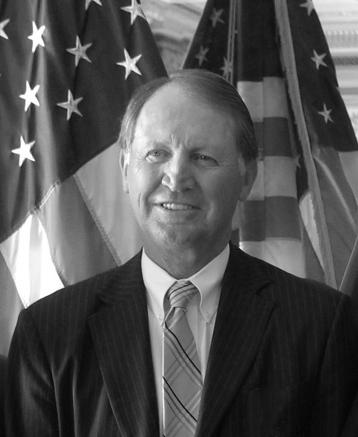
Message from the Director
The hallmark of FY2017 was a renewed focus on collaboration and coordination. Although SITLA has the unique mandate to manage trust lands exclusively for the benefit of its beneficiaries, the agency’s success hinges on the support of educators, legislators, private business, local governments, and other state and federal agencies.
To help fulfill our constitutional mandate of managing trust lands prudently and profitably, we collaborate with other land managers who face similar management challenges, including the Ute and Navajo tribes, the Bureau of Land Management, state agencies, and local governments.
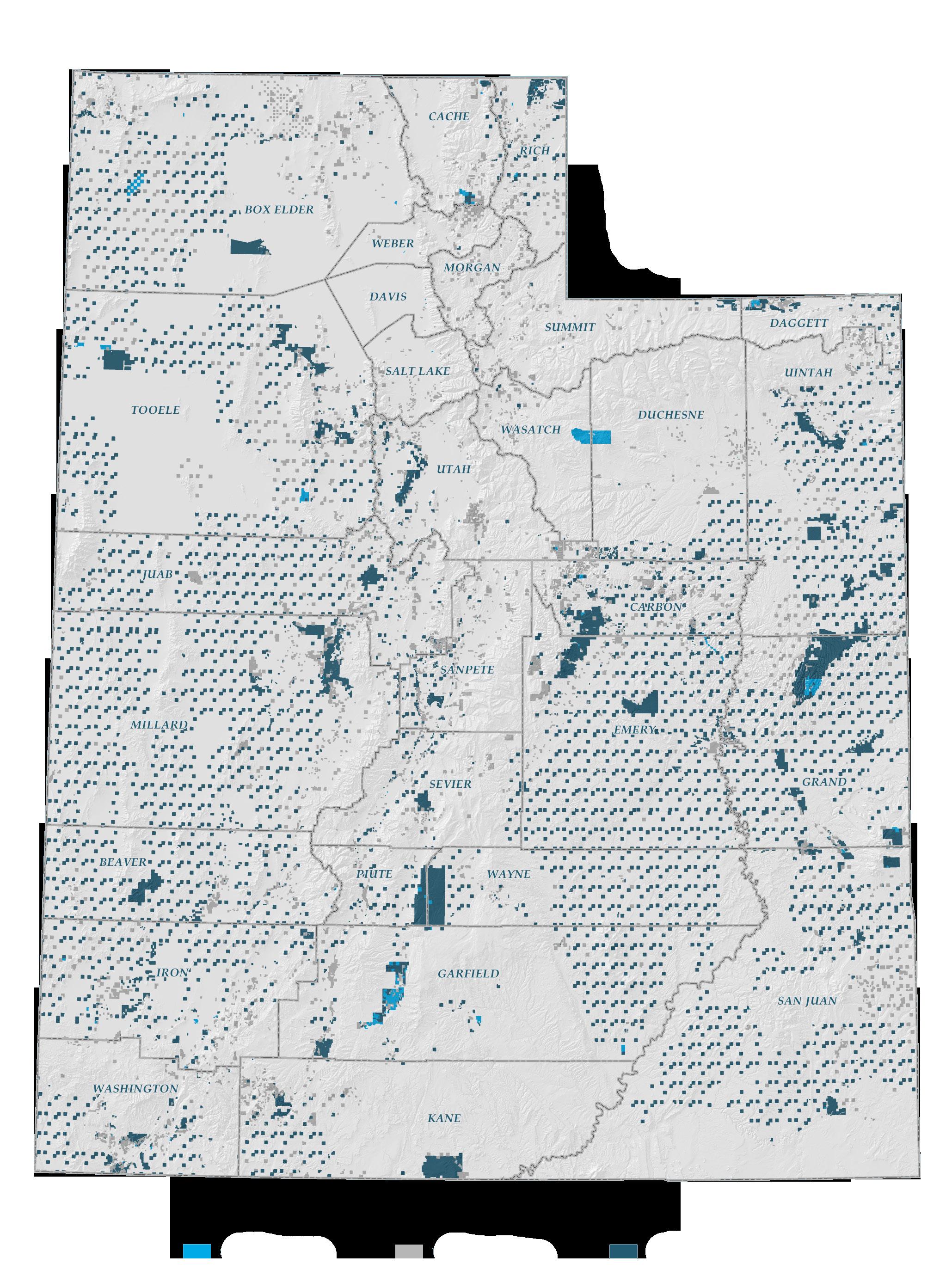
As trustee of 4.4 million acres of surface and mineral estate, we continue our efforts to support current lessees while working to attract new real estate, energy, and other business projects. To further support energy lessees on trust lands, we are working with the Governor’s Office of Energy Development to expand energy education programs.
Jointly with the federal government, our agency completes complex land exchanges, such as the Utah Test and Training Range expansion, which includes the transfer of thousands of acres of surface and mineral estate.
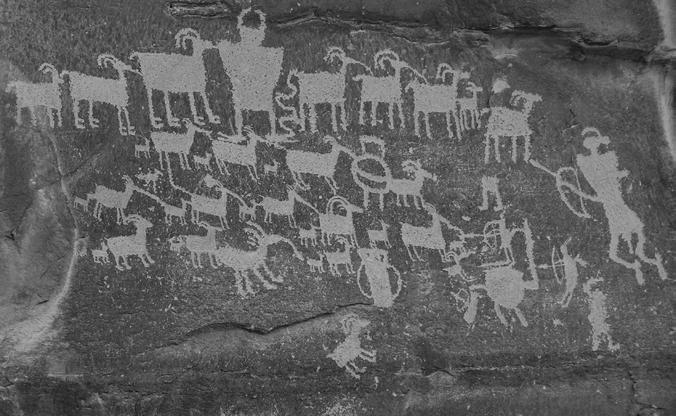
SITLA also works to balance development with stewardship to ensure trust lands for future generations. Coordinating with state agencies, local government, and volunteers from the community, SITLA undertakes stewardship projects that allow Utahns and out-of-state visitors to access irreplaceable cultural sites, such as the Great Hunt Panel located on trust lands in Nine Mile Canyon.
Our continued collaboration with elected leaders and state agencies will help to finalize an agreement to provide continued public hunting access on trust lands. We believe a win-win outcome for public schools and hunters will be realized next fiscal year.
On behalf of our agency and beneficiaries, I thank all of our partners for their support of SITLA’s mission and mandate.
David Ure
Agency-Generated Revenue:
$80.7 million
Non-Land Sales Revenue:
$51.4 million
Agency Expenditures:
Operating Costs - $9.7 million
Capital Costs - $4.5 million
Stewardship Costs - $0.7 million
$34.6 million
Deposited into the Permanent School Fund
$2.9 million
Distributed to the other beneficiaries
$1.5 million of unspent appropriation to be returned to all beneficiaries in FY 2018
Land Sales Revenue: $29.3 million
All sales revenue is deposited directly into the permanent fund of each beneficiary
Total revenue deposited into permanent funds or distributed directly to beneficiaries: $68.3 million
Distributed to Schools Fiscal Year 2007 — 2017
* Includes $39 million for FY2017 and $25.25 million in gains distributed after July 1, 2017. This financial information is unaudited, Final audited information will be available online at trustlands.utah.gov by November 30, 2017.
Total Revenues and Distributions for Each Beneficiary
$7,990,156 $34,744,780 $21,759,291 $15,837,054 $38,100
*Distribution includes return of unspent share of FY 2016 appropriation. Public schools distribution includes $39 million for FY2017 and $25.25 million in gains distributed after July 1, 2017.
$67,129,617
Audit Group
Information Technology (IT) and Geographic Information Systems (GIS) Group
Revenue Compliance: The Audit group conducted lease revenue compliance procedures recovering $506,953 in unpaid rents and royalties. Deficiencies generally fall into three categories: sales stemming from production; values associated with surface and sub-surface activity; and the agency’s interest in those values as described in the various leases. The group follows an audit schedule approved by the director and meets periodically with the Board of Trustees’ audit committee.
Streamlining Services: The Information Technology (IT) team examined and implemented new ways to increase a return for beneficiaries. One solution was automating and merging the Director’s Action workflow into the agency’s business system. This new process improves employee productivity.
Hardware: The IT group also analyzed costs associated with hosting the business system and other network services, and determined significant cost savings could be realized by investing in newer hardware. The project of consolidating existing servers and hosting into the new hardware is nearly complete.
Geographic Information Systems (GIS)
Parcel Fabric: The GIS Team continued its work with the Automated Geographic Reference Center and the Bureau of Land Management (BLM) to migrate the GIS system into a parcel fabric environment that is enabled with the Local Government Information Model. A workflow was established between the three agencies to accomplish this task and 12 counties were successfully migrated into the parcel fabric.
Plat Map Re-Write: The digital plat map was created by the GIS group in 2010 to replace the paper plat map system. Now seven years old, it requires modernization and enhancements to keep up with mapping trends. The GIS group continues work on a second version of this plat map that will include printing functions, a simple interface, and in-house maintenance to allow for quick updates. The printing function was implemented successfully and the remaining tasks are nearly complete.
Business System Subdivision Module: With the help of the IT and Development groups, the subdivision module was cleaned and updated to follow the new subdivision module standard, which will allow for accurate GIS data display on the digital plat map.
Land Exchanges: The Legal group coordinates SITLA’s efforts to exchange lands with the federal government to enhance financial returns from the Trust. The most significant milestone during FY2017 was Congress’ authorization of a large state-federal land exchange in connection with the expansion of the Utah Test and Training Range in Utah’s West Desert. The exchange was authorized as part of the FY2017 National Defense Authorization Act. When the exchange is implemented, SITLA will convey to the United States 70,650 acres of school trust land and 13,886 acres of school trust mineral estate in Box Elder, Juab, and Tooele counties. The school trust will receive 95,532 acres of federal public lands in Beaver, Box Elder, Millard, Juab, and Tooele counties.
SITLA is monitoring developments with the Bears Ears National Monument. The current federal administration is reviewing this designation for potential revision or rescission. The Legal group will coordinate with the agency’s operating groups, Board of Trustees, and beneficiaries in evaluating land exchange options once the legal status of the area is clarified.
Litigation: The Legal group continued to defend the school trust’s interests in various pending lawsuits, by securing water supplies for future mining activities through complex water litigation in Beaver County; defending real estate development entitlements for a significant resort development planned for school trust lands in Moab; and participating in federal endangered species and public lands litigation affecting trust lands.
Real Estate Development: The Legal group provides transactional drafting and legal support for all business activities on trust lands. Highlights in FY2017 included drafting and executing a complex development lease for a 4,000-home, master-planned community in Utah County; and negotiation support and initial drafting for what will be the trust’s largest real estate development, an almost 7,000-acre, mixed-use project on the South Block in St. George.
Coal and Other Solid Fuels: Coal production was stagnant most of the year as production moved from trust lands to private and BLM lands. Production resumed from a coal tract operated by Bowie Energy Company at the Dugout Mine in the Book Cliff field.
Development of a small longwall panel in the SUFCO Coal Mine at Muddy Tract was completed and production is scheduled for the first quarter of FY2018. A coal exploration project located on the Freemont Junction Tract is in the permitting process.
Oil shale, uranium, and bitumen projects remained mostly stagnant due to low fuel prices. U.S. Oil Sands resumed startup of its commercial-scale pilot plant at PR Springs in Uintah County.
Other Minerals: Limestone, sand, and gravel production remained high. Graymont’s operation at Cricket Mountain in Millard County was the leading producer of limestone from trust lands. Sand and gravel permitting and production reached record revenue levels.
Revenue from metalliferous mineral production and leasing increased substantially. Potash production revenue declined slightly due to decreased oil and gas drilling activity, while leasing and development continued at steady rates. Exploration for copper and gold in Utah’s West Deseret continued at increased levels. A gilsonite property on the Natural Buttes Block in Uintah County was leased in early 2017 and has proceeded through the exploration drilling stage and into development.
Revenue: Oil and gas remains the major source of income for trust beneficiaries. The industry struggles to recover from the downturn in prices that began in 2015-2016. However, SITLA approaches the future with confidence that the recovery will continue. During FY2017, oil and gas topped the $31 million benchmark for the first time in two years. Proposals for new hydrocarbon projects on trust lands include: oil and gas wells, helium, and new types of storage at the Magnum energy hub near Delta. SITLA continues to support new projects through the use of its flexible business arrangements and special development terms.
Planning: In FY2017, the Planning and Development group continued to capitalize on sustained planning and investment from prior years. The group is pursuing and progressing on a number of real estate projects that will ensure high annual revenue streams to the Trust for decades to come.
Development: Final negotiations on a 3,300-acre project on the South Block in St. George are underway. Estimated full buildout will add $3.4 billion in taxable value to the area. The Trust expects more than $270 million in gross revenue over the 20 to 30-year life of the project. Ivory Homes began construction on a 1,200-acre masterplanned development at Eagle Mountain in Utah County. The Trust anticipates upward of $100 million in revenue will be produced from this project over the next 20 years. Overall capital expenses for FY2017 were $4.5 million of which $3.2 million was expended specifically for a waterline serving projects on trust lands.
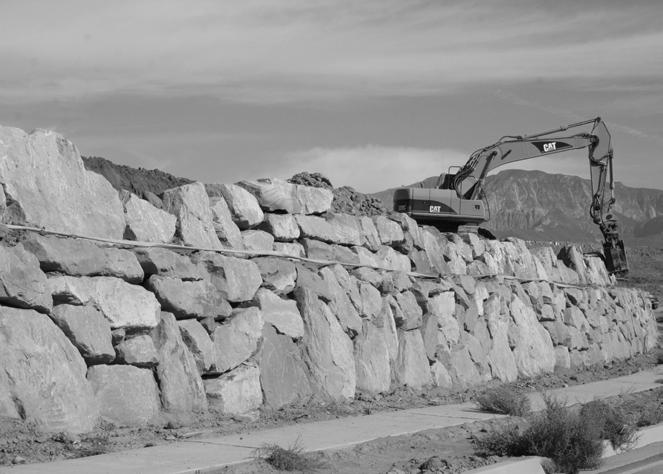
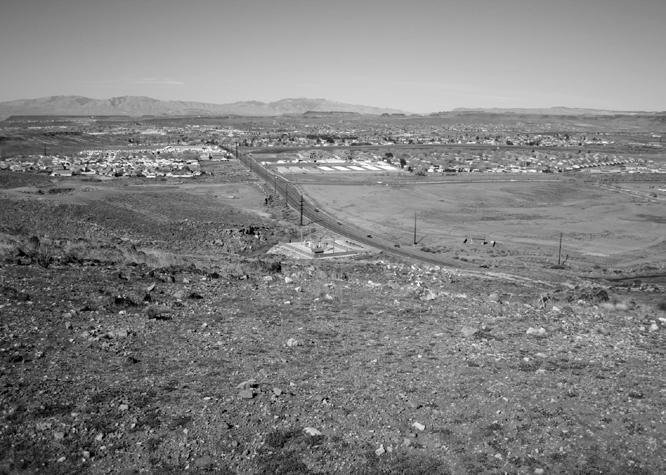
Revenue: Since its inception in 1998, the Planning and Development group has averaged $14.1 million per year in gross revenue. Total development revenues for FY2017 were $21.8 million, with an additional realization of $1.9 million from the closing of a previously defaulted transaction. This revenue mark is a 10 percent increase from FY2016 and is the second highest year for gross revenue since FY2008. The group currently forecasts maintaining this roughly $20 million revenue level over the next few years. Southern Utah again led the Planning and Development group’s portfolio. Coral Canyon, Sienna Hills, Green Springs, SunRiver, and the South Block all generated significant revenues for the Trust.
Revenue: The Surface group manages hundreds of contracts. Of the Trust’s 16 revenue producing programs, 11 are administered by the Surface Group. Most programs administered by the group have experienced significant growth over the past decade, although downturns in the oil, gas, and timber markets have impacted revenues to the industrial leasing, easement, and timber programs. More than $15 million was earned under this group’s watch during FY2017, including over $8.5 million in land sales. This group also engages in many significant non-revenue producing activities necessary for the Trust to conduct business: water rights management; cultural resource compliance; wildfire rehabilitation; public and governmental interface; environmental compliance; and trespass resolution.
Collaborative Land Management: The Surface Group coordinated with Utah County and the Bureau of Land Management to implement a management strategy that addresses problems associated with undisciplined target shooting in certain areas west of Utah Lake. This collaborative effort will improve public safety, and minimize resource degradation, including sensitive cultural resources.
Stewardship: The Cultural Resources team coordinated and partnered with other agencies and volunteers to protect two important sites. Staffers stabilized rock work and improved visitor facilities at the Great Hunt Panel, a spectacular collection of Fremont period petroglyphs, in Carbon County. They also joined Friends of Cedar Mesa to stabilize the historic Shumway cabin in San Juan County.


Public Hunter Access Agreement: With a current 10-year Memorandum of Understanding (MOU) for hunter access about to expire, the agency worked collaboratively with the Governor’s Office, Utah Legislature, Division of Wildlife Resources, and Department of Natural Resources to develop and implement a new agreement. The final MOU will allow SITLA to meet its fiduciary responsibility of receiving fair market value for its beneficiaries while assuring access for public hunting on much of the 3.4 million acres of trust lands administered by the agency.
K-12 Challenge: External Affairs also co-sponsored the #SITLAfunds17 Instagram Challenge with the School Children’s Trust Office at the Utah State Board of Education. SITLA and USBE representatives visited and awarded checks to Washington Elementary in the Salt Lake School District, Cottonwood Elementary in Emery School District, and Mountainville Academy Charter School. The annual Challenge invites all K-12 schools to show how their schools use School LAND Trust Funds.