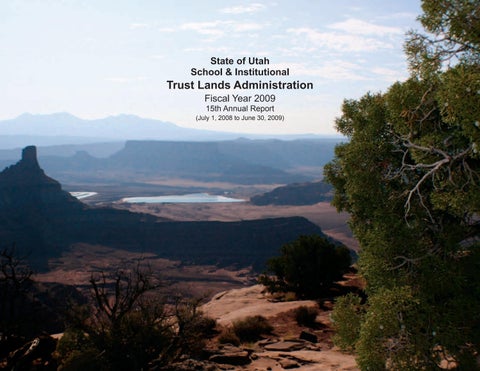
The Trust is an increasingly significant source of funding for Utah’s schools.
Mission
To administer the trust lands prudently and profitably for Utah’s schoolchildren and other Trust beneficiaries.
While FY 2009 was not a record year for Trust revenues, it was still a very good year. Total revenues were $138,258,000. Oil and gas revenues remained the lion’s share of income received at $75,412,000. Notably, income from coal was at a record high at $20,965,000. Articles within this report give more details on oil and gas, coal, and revenue from other Trust assets.
The fiscal year ended with a balance of $972,452,000 in total Trust assets. In spite of problems with the economy, that balance is still very near the record billion-dollar mark reached in fiscal years 2007 and 2008 – before the stock market crash in September of 2008.
The trust land dividend, which is sent annually to each public school, is the interest and dividend income from the investment of Trust assets by our state treasurer. The total of the public school trust land dividend for FY 2009 was more than $24,000,000. It is gratifying to me that the work of this agency makes a significant contribution to Utah’s schoolchildren at no cost to taxpayers.
During the fiscal year, the Trust Lands Board of Trustees saw fit to reappoint me to a new four-year term as Director of the agency. I am appreciative of the confidence they have shown me and my staff in the operations of the Trust Lands Administration. We continue to strive to generate meaningful income from Utah’s trust lands. thereby serving the financial interests of the Trust beneficiaries.
Kevin Carter, Director
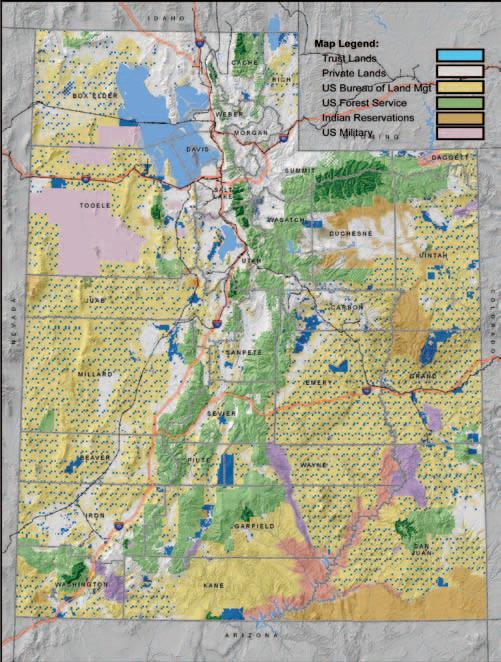
Statewide Ownership Map
Trust lands are mostly scattered in a checkerboard pattern in rural Utah. However, there are several larger blocks of trust land that can also be seen on this map.
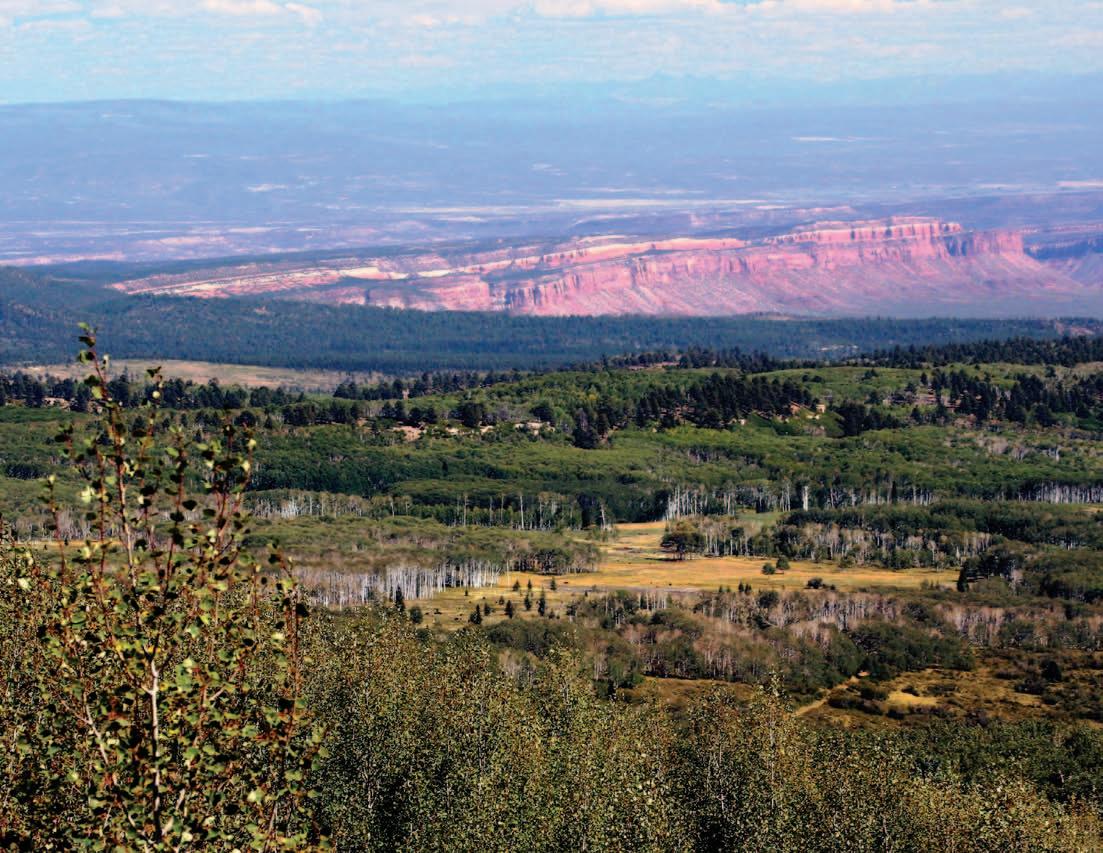
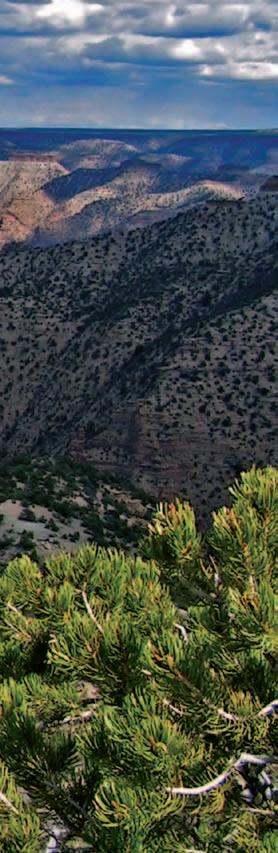
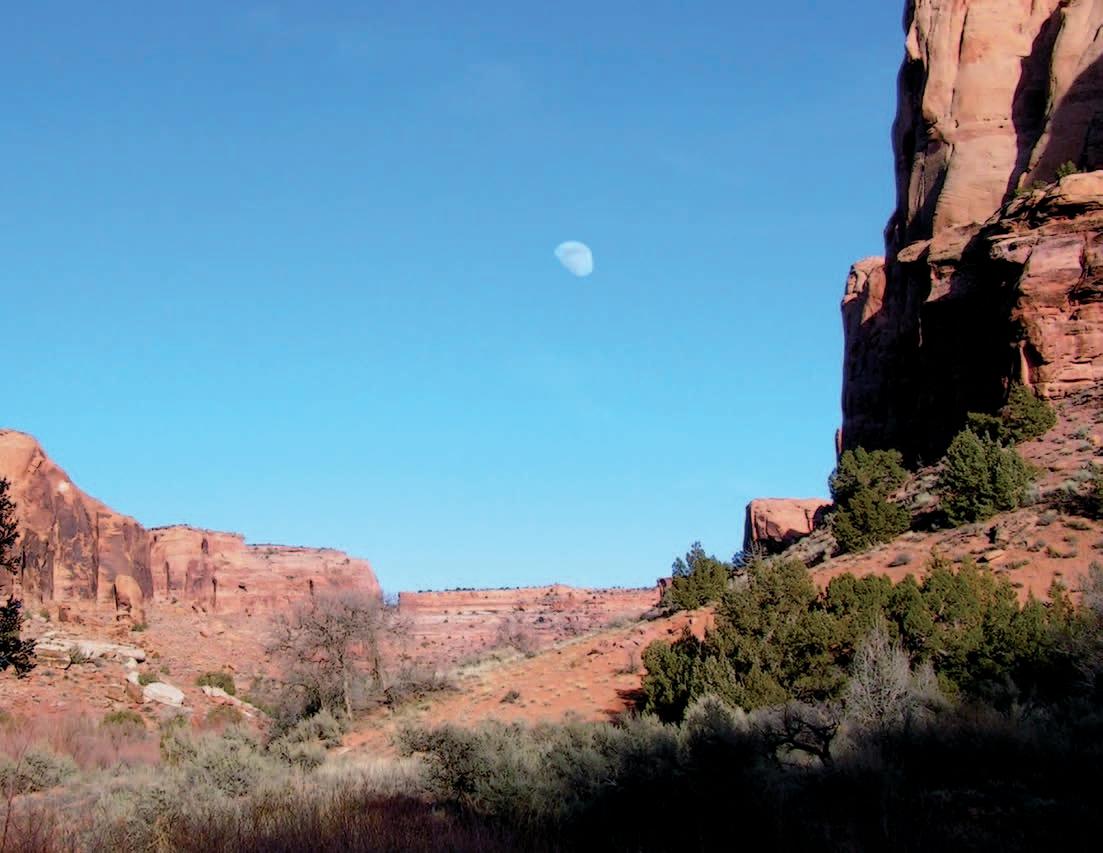
Porcupine RimLaSal Mountains near Moab
Fiscal Year 2009 - Financial Summary
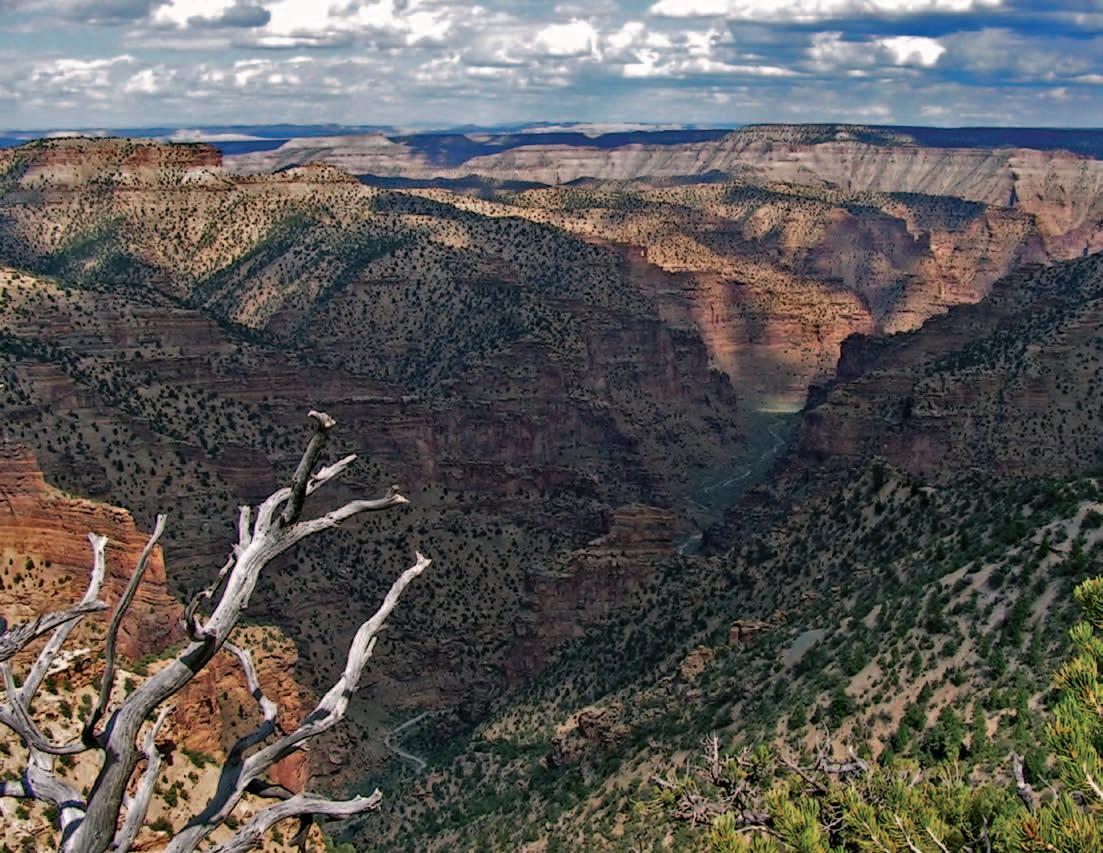
Tavaputs Plateau
FY 2009 Revenues
Total Trust Assets
In spite of poor economic conditions during FY 2009, total trust assets remain near the record set in the prior fiscal year. Total trust assets are the combined assets of all 12 beneficiaries – including their permanent funds. It is worth noting that total trust assets have grown by ten times since the founding of the Trust Lands Administration in FY 1994.
FY 2009 Distributions to Beneficiaries
The “bottom line” results for the beneficiaries are the monies they receive from Trust Lands’ operations. There are one of two types of distributions: (1) money sent directly to the beneficiary and (2) money deposited into their permanent fund. The monies are summarized in the following chart.
Beneficiary Distributed Directly Deposited To To Beneficiary
For additional financial information, visit the Trust Lands website at www.trustlands.com. Follow these links: Homepage > Financial Statements and Statistics > FY 2009 (or any year listed). These financial reports are not audited. For audited financial information, contact the Assistant Director/Finance at 801-538-5100.
Permanent School Fund
The major component of total Trust assets is the State Permanent School Fund of Utah’s public schools. At the end of FY 2009, that fund stood at $875,339,000. That’s a growth of ten times since the Trust Lands Administration started work, just 15 years ago, at the beginning of FY 1995.
Even though the Permanent Fund is never spent, the interest and dividend earnings are distributed to schools every year. Therefore, the amount and rate of growth of the Permanent Fund are of paramount importance, both to the trustees and the beneficiaries of the fund – Utah’s public schools.
A share of investment income from the Permanent Fund is distributed to each public school in the state every year for local academic needs. The distribution is primarily based on the number of students at each school.
Here is the history of distributions to Utah’s schools since the inception of the program in the 2000 – 2001 school year.
Distributed
School Year To Schools
2000 - 2001 $4,950,000
2001
2007 - 2008 25,333,133
2008 - 2009 27,149,617
2009 - 2010 24,445,314
Auditing
Auditing is the examination and verification of an account or a situation. Generally speaking, the Trust Lands Administration performs audits to determine if the Trust is receiving proper revenues from lessees as provided by their contracts with the agency.
During FY 2009, 21 audits were conducted. Audits were performed to verify revenues and expenses in these main areas:
• Oil and gas
• Coal
• Other minerals
• Commercial Surface Lease Agreements
• Vendors
• Internal controls
The amount of revenue collected as a result of auditing in FY 2009 was approximately $1,400,000. The Audit Group consists of three full-time staff and the use of outside consultants as needed.
Year In Review
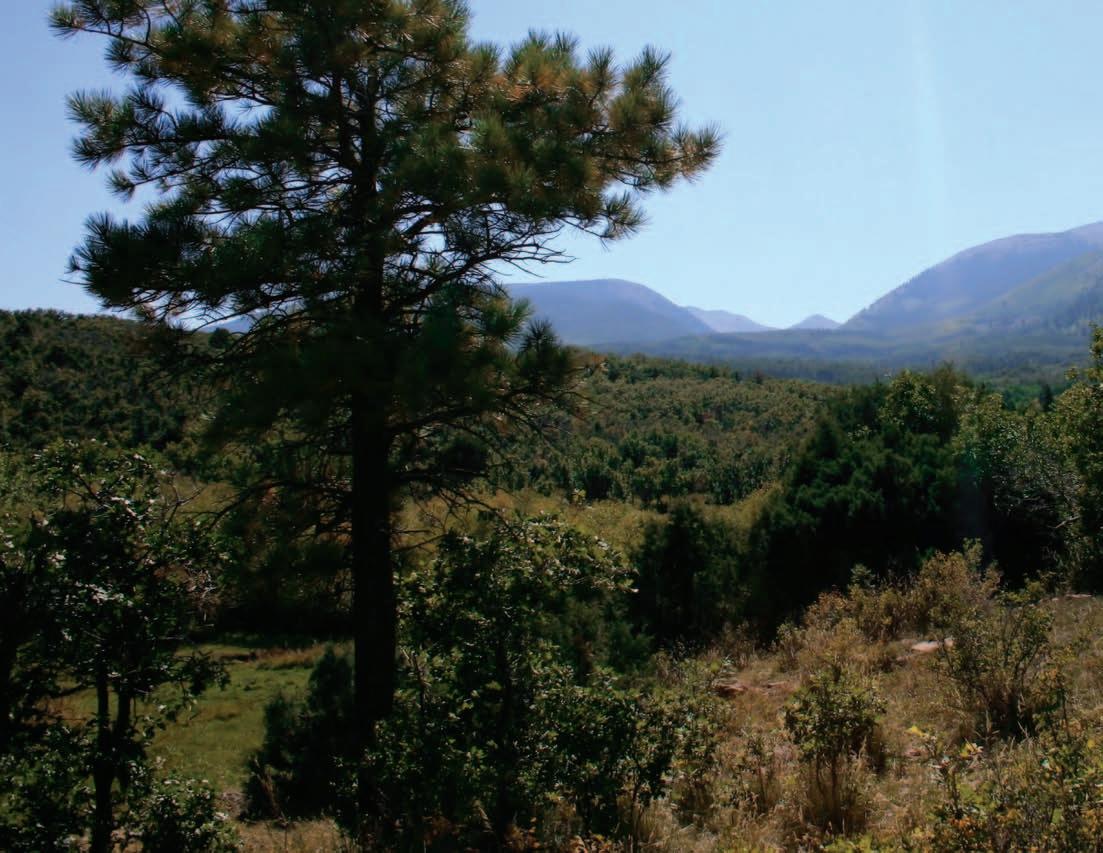
LaSal mountain range near Moab
Grazing Fees
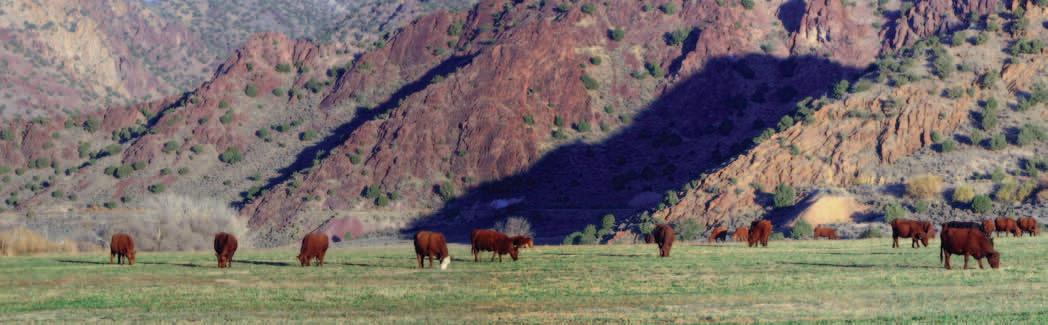
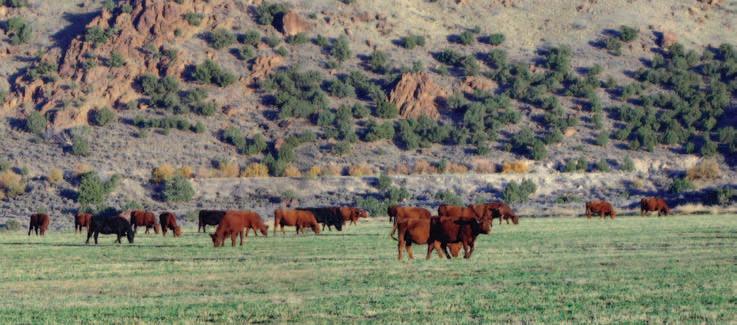
While grazing fees are not considered a major contributor to the agency’s overall annual generation of revenues, more of the 3.4 million surface acres administered by the agency are used for grazing than for any other type of use. Almost 95 percent of all trust lands are contained in a grazing permit, which means that the grazing program is a significant part of the agency’s management portfolio and also important to farmers, ranchers, and local economies in almost all Utah counties.
Given the importance of the grazing program to a significant segment of Utah’s economy and the agency’s legal mandate to receive no less than fair-market value for the use of its lands to support its beneficiaries, in March of 2003, the Board of Trustees directed the agency to evaluate the merits of creating a separate grazing fee structure for selected land blocks and to explore ways of improving the overall grazing program, including stewardship practices.
After two years of extensive analysis, including professional guidance from a renowned agricultural economist and input from industry leaders and other stakeholders, a completely new structure for grazing fees was adopted by the Board of Trustees.
The major questions which were asked in the evaluation process were:
• What were other western trust-land agencies receiving for grazing fees?
• What was the grazing permit term in other western states?
• What were permittees charging to sublease trust land grazing permits?
• What were other Utah land-owning agencies charging for grazing fees?
• What did trust land grazing permits sell for in the open market?
• What did Utah landowners charge for non-irrigated grazing permits on private land?
The new structure implemented by the Board of Trustees included:
1- A two-tiered grazing fee with selected blocks having a higher fee than the standard fee, which applies to the remaining trust land.
2- The standard fee increased from $2.35/AUM to $3.90/AUM over a three-year period.
3- The block fee increased from $2.35/AUM to $7.00/AUM over a five-year period.
4- Amending agency rules to allow for a 50/50 split of revenues derived from subleasing grazing permits.
5- The commitment of up to 10 percent of the agency’s annual grazing proceeds for qualifying capital range improvement projects.
6- Amending agency rules to allow for the extension of a grazing permit term when substantial expenses are assumed by the incumbent permittee for approved rangeimprovement projects.
7- Finally, a grazing fee formula was adopted in FY 2009, which will be applied in setting future annual grazing fees. It was determined that the formula would not apply until incremental increases described in items #2 and #3 were met. Therefore, the formula is currently applicable only to the standard fee; however, in 2011 the formula will also be applicable to the selected land blocks. The formula is intended to keep fees relatively stable into the future, yet sensitive to inflationary or deflationary pressures, depending on what changes occur in private lease rates.
The results of these changes have been positive for both the Trust and livestock users. Annual grazing program revenues have increased from $400,000 in 2003 to $800,000 in 2009. It is expected that, when the higher block fees are fully implemented, annual revenue from the grazing program will reach $900,000. The changes have also resulted in increased security for grazing permittees as well as increased stewardship through the implementation of a wide variety of range-improvement projects around the state.
Grazing fees are based on the amount of forage an animal consumes in a month. The base measurement is called an Animal Unit Month (AUM). An AUM is defined as the amount of forage a cow and her calf (or their combined equivalent) consume in a month.
Protection of Ancient Rock Art on Trust Lands
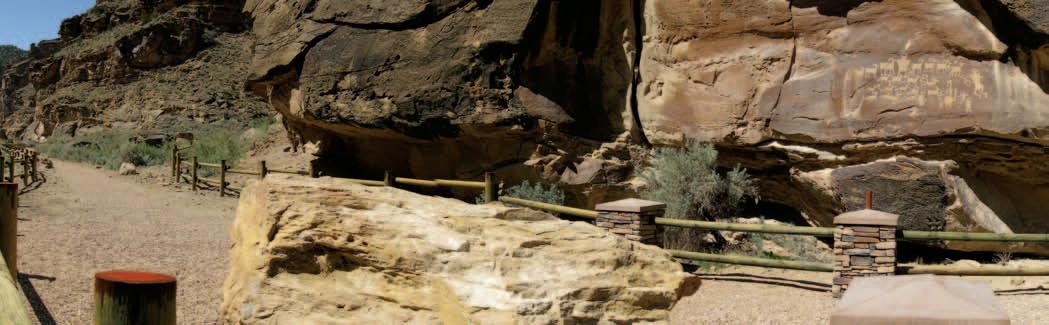
The Trust Lands Administration partnered with several interested parties completing a stewardship project, enhancing the protection and public enjoyment of one of Utah’s most famous ancient rock-art specimens – the Great Hunt Panel.
Located in Nine Mile Canyon, 51 miles northeast of Price, Utah, the Great Hunt Panel is part of one of the largest concentrations of ancient rock art in the world. The famous panel, located on Trust Lands Administration property, is one of the most photographed and most visited panels in the canyon. With increasing traffic in the canyon, it became apparent that measures to protect the panel from damage were necessary.
The first project, undertaken five years ago, was re-routing the road—originally within just a few feet of the panel. This work was done by Bill Barrett Corporation (BBC), a natural gas exploration company with operations in the area.
Since that time, BBC and Trust Lands Administration worked with Carbon County, College of Eastern Utah, Utah State University, the Castle Valley Chapter of the Utah Statewide Archaeological Society, and the Nine Mile Coalition, creating the recently completed improvements.
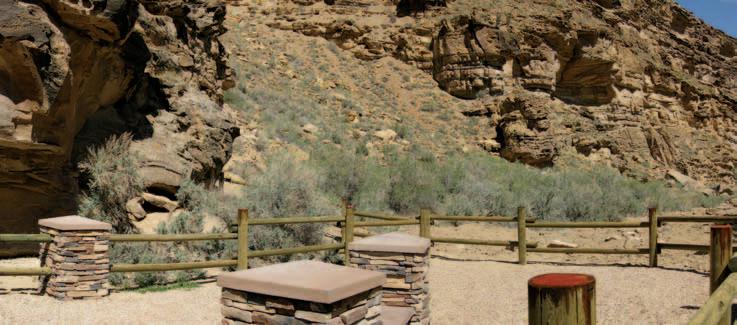
During the first three weeks of April 2009, the Trust Lands Administration provided construction materials and equipment, while agency employees, College of Eastern Utah CEU Sun Center volunteers, and members of the Nine Mile Coalition provided labor for the project. Rustic fences were installed to define the site, an interpretive kiosk was placed in the parking lot, and a graveled walkway from the parking lot to the site was created. A seating bench was built and other improvements made. This site is an exceptional destination for anyone who visits the canyon.
The Trust Lands Administration encourages the public to see this important location and to remember that cultural resources, such as the Great Hunt Panel, are irreplaceable legacy assets reminding us of our commonly shared past.
Improvements made at the Great Hunt Panel in Nine Mile Canyon near Price
Southern Parkway
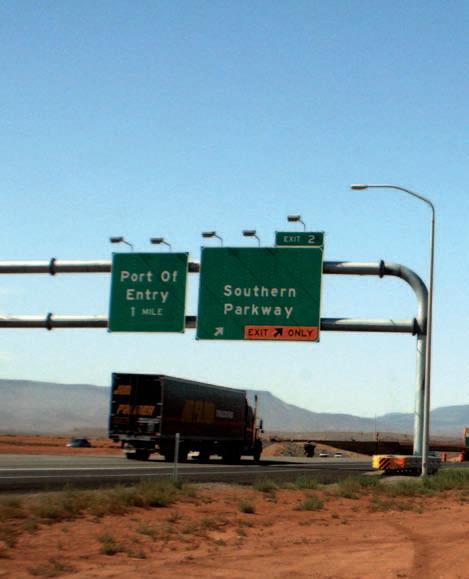
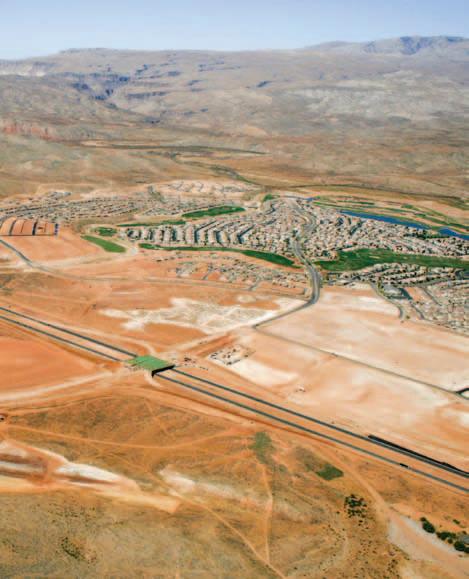
You’ll soon have a four-lane parkway to get you to the new St. George airport. The Trust Lands Administration, the City of St. George, and the Utah Department of Transportation have worked together to create a new exit on Interstate 15 at Milepost 2. St. George and Segment I of the Southern Parkway will eventually connect to the new airport and continue northward to join State Road 9.
The new interchange and Segment I of the Southern Parkway opened in the summer of 2009. The Segment I portion of the road heads eastward for four miles to River Road. Segment II will swing northward to the new airport. The Milepost 2 exit also services the community of Sun River on the west side of I-15.
The new parkway is a four-lane divided highway with limited access and no stoplights except at the Milepost 2 interchange. The road will eventually serve:
• The new St. George airport
• Trust Lands Administration’s South Block - 6,200 acres
- Airport Vicinity Land -1,100 acres
- Warner Valley - 3,800 acres
• The existing Fort Pierce Industrial Park
The price of Segment I was $58.5 million, with the projected total cost for the completed venture being $475 million. Segment II is slated to open early in 2011. Segment III will follow that.
The three agencies cooperated in several important ways to optimize the enterprise including:
• Funding for the project
• Mitigating environmental impacts
• Re-aligning roads and parkway interchanges
• Creating open space and conservation areas
• Re-using water (see next article)
The interchange at Milepost 2 and the Southern Parkway are examples of how government agencies should cooperate – bringing together competing interests and providing good outcomes for all participants.
Water Conservation in Construction of the Southern Parkway
The Trust Lands Administration, the City of St. George, and the Utah Department of Transportation, entered into an arrangement for the re-use and conservation of water for the South Corridor of St. George. The agreement was reached among the three parties allocating the costs for the project among the parties. UDOT paid for the materials, St. George City paid to bury the line, and the Trust Lands Administration paid for engineering and construction management.
Initial planning for the water line was done by UDOT as a way to provide lower-cost water for construction of the Southern Parkway. UDOT planned to place a temporary water line on the surface of the ground carrying re-use water to the construction project and then remove the line once the project was finished.
However, during meetings among UDOT, St. George City, and Trust Lands, it was determined that for very little additional cost the water line could be buried permanently. This new water line services the construction water needs of the Southern Parkway and will supply future commercial and residential developments in the area and their need for secondary or irrigation water. The cost for the re-use water is approximately one-third the cost of culinary water.
The re-use water line was extended from a point north between the Sun River Golf Course and the Virgin River to its current location at River Road and the Southern Parkway (approximately 26,600 feet) in two segments. Plans to extend the line further to the east are underway. The cost to extend the water line to its current location was approximately one million dollars.
Oil and Gas
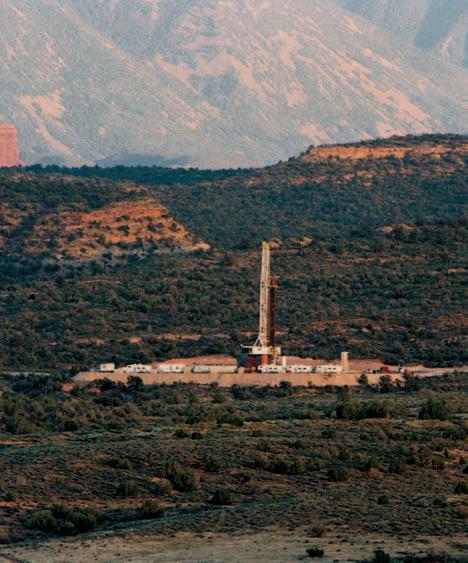
Oil and gas revenues continue to lead all other sources of Trust Lands’ income –accounting for more than 50 percent of total Trust operating income. For FY 2009, oil and gas revenues were approximately $69,230,000.
Higher prices in the first half of the fiscal year generated the largest part of the FY 2009 earnings. Both the price of oil and gas and the amount produced declined throughout the fiscal year.
This trend was seen on a worldwide basis as a result of the current economic downturn. It is anticipated that these conditions will continue through FY 2010. Nevertheless, the next fiscal year is expected to remain profitable for oil and gas.
The Trust Land’s oil and gas group remains very connected to the energy industry. Competitive terms and the simplicity of getting approvals from state agencies make trust lands appealing for oil and gas development. The Trust Lands Administration continues to conduct lease auctions making lands available to the industry.
The agency remains optimistic about the future of petroleum assets and their value to Trust beneficiaries. Through exchanges, the development of new plays, and the continued support of a small staff of well-trained employees (who help keep expenses to a minimum), Trust Lands will continue to have lands available for development, and oil and gas will remain a primary source of beneficiary revenues for decades to come.
Coal
The coal business on trust lands hit a record high in FY 2009. Coal revenues for FY 2009 were $16.8 million, up more than $6 million from the prior year and more than $15 million since FY 2005.
There were two reasons for this improvement:
• Over the past five years, the price of coal has increased from $20 per ton to $30 per ton
• More trust land coal is now in production
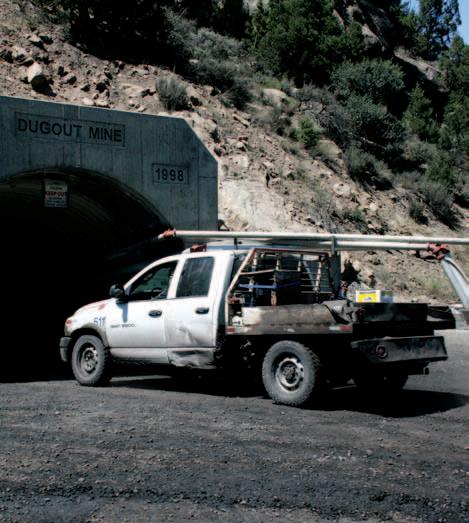
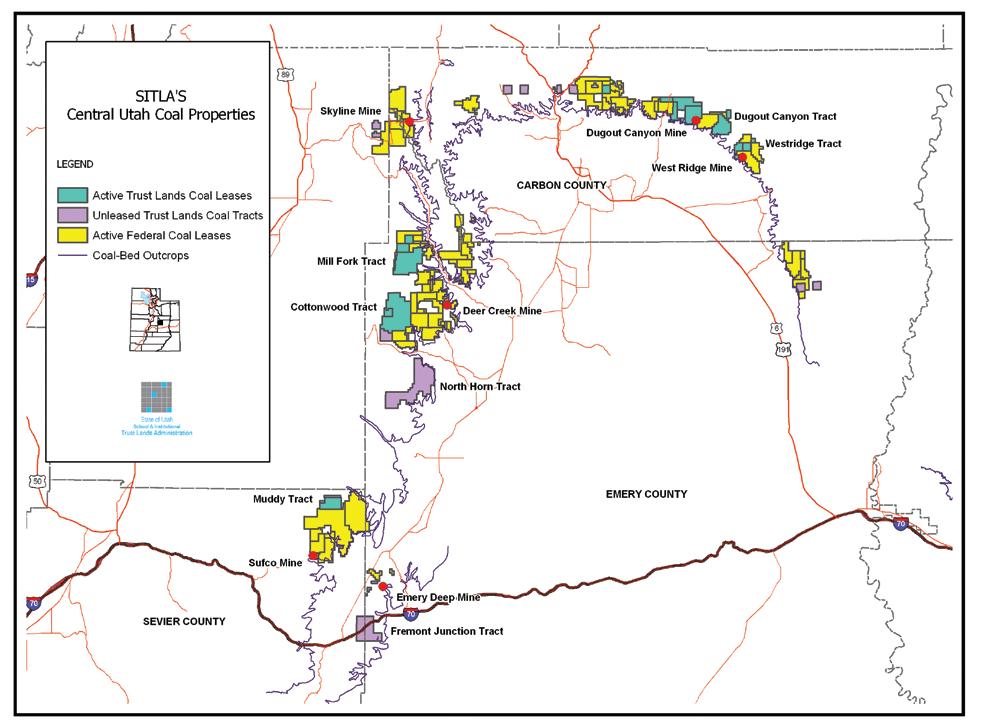
Much of the increased production has come from coal tracts acquired by the Trust Lands Administration through the Grand Staircase – Escalante National Monument Exchange with the United States in 1999. The Trust Lands’ Mining Group has been working to bring those properties into production since that time. Four of the six coal properties acquired in this exchange have come into production: Westridge Tract, Dugout Canyon Tract, Muddy Tract, and Mill Fork Tract.
The Cottonwood Tract, also acquired in the 1999 exchange, was leased in early 2008. The Trust Lands Administration’s position in the tract is a cash account to be paid from the royalty stream generated during production. In 1999 the Trust account balance was $13,006,000. In 2009, the balance had grown to $18,620,000, due to accrued interest.
The Trust Lands Administration will continue to work at getting its existing coal properties leased and into production. It will also continue efforts to acquire new coal properties in the future through land selections or exchanges. Leasing of coal on trust lands is only allowed through competitive lease sales and other business arrangements approved by the Board of Trustees.
Potash
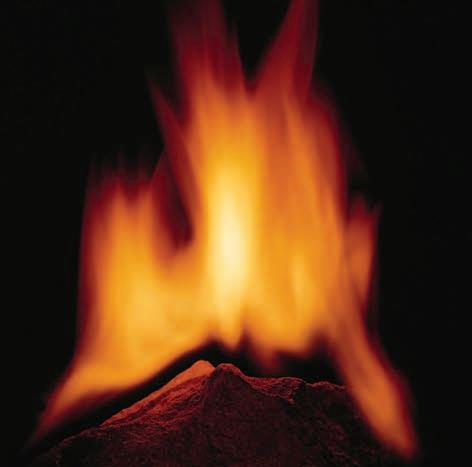
Potash is one of the lesser-known revenue-producing resources on trust lands. It generates royalties for the Trust of about $1,000,000 annually. Potash is the name given to potassium carbonate and various minerals that have water-soluble potassium in their structure.
Printed on bags of agricultural fertilizer are numbers such as 10-10-10. These numbers refer to the percentage of the main fertilizing ingredients in the bag. Those components are nitrogen (N), phosphorous (P), and potassium (K). Approximately 95 percent of all mined potassium is used to make fertilizer. A small percentage of potassium is also used in making glass, soap, and other products.
In Utah, most potash is produced by Intrepid Potash, Inc., in two mines – one near Moab and the other near Wendover. The Moab mine is entirely on trust lands, while the Wendover mine is on both trust lands and lands managed by the U.S. Bureau of Land Management.
The reserves in these two mines are expected to last many years into the future –providing a stable source of revenues for the Trust beneficiaries. You can learn more about potash at the Intrepid web site at www.intrepidpotash.com.
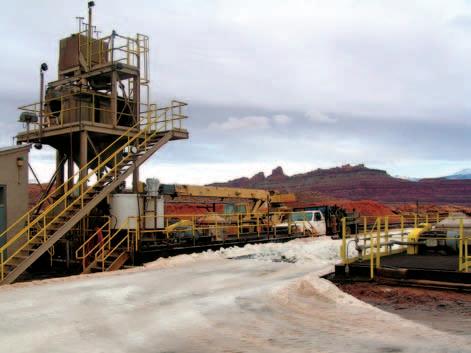
Potash plant near Moab
Geothermal '09
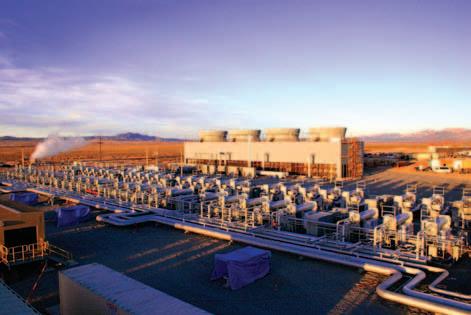
Energy extracted from the interior heat of the earth – geothermal energy – has significant potential for the clean generation of electricity. Historically, one limitation on geothermal power production has been the need to use extremely hot water or dry steam to drive turbines that generate power. There are relatively few places in the United States where underground temperatures have been hot enough to allow direct geothermal power generation. Utah has only one geothermal power plant that uses direct geothermal energy to generate power.
Utilizing new turbine technology developed by UTC Power, a United Technologies company, Raser Technologies of Provo, Utah, has developed a proprietary “binary” power-plant design that allows electricity to be produced using much lowertemperature geothermal resources. Hot geothermal brine is run through a heat exchanger. The exchanger heats a closed-loop system filled with a working fluid with a lower boiling point than water, which vaporizes and drives the generation turbines before being recycled through the system.
Because the system is self-contained, nothing is emitted; and because geothermal hot water is abundant in western Utah, there is significant potential for future clean electric generation on trust lands. Geothermal power also has the advantage of being available 24 hours a day, so it can be used by utilities as reliable “base load” electric capacity.
Raser has a binary geothermal electric generation plant on school trust lands at Thermo Hot Springs near Milford, Utah. The 20-acre power plant is located on a larger 640-acre lease of trust lands that contains a number of geothermal wells. Raser is currently selling electricity to customers in Southern California. Expansion of the new plant is possible, and Raser currently plans to build additional plants on school trust lands in the area during the next several years.
Royalties to the school trust are paid on gross electric sales and direct geothermal energy and are expected to exceed $150,000 per year with contracted increases in the future.
In addition to the 640-acre Thermo site, Raser and its affiliates have leased more than 121,000 additional acres of trust lands with geothermal potential. This acreage is widely spread over much of western Utah.
For more information, you are invited to visit the Raser web site at www.rasertech.com.
Geothermal plant near Milford
Oil Shale
The School and Institutional Trust Lands Administration manages almost 100,000 acres of property with oil shale deposits. Though oil shale leasing programs have been available for several decades, projects to recover value from the resource have not yet materialized.
However, new and pioneering technologies for the extraction of oil from oil shale have emerged. Red Leaf Resources of Salt Lake City is the owner of a proprietary technology, the EcoShale In-Capsule process, which promises to economically release the kerogen from the oil shale through an advanced economic and environmentally innovative process.
During FY 2009, Red Leaf Resources initiated a pilot project – a test facility to be applied to oil shale deposits located on trust lands in the Uinta Basin. The initial phase of the pilot project has been completed, and now Red Leaf is studying the data gained from the test facility.
Red Leaf Resources holds leases on approximately 17,000 acres of Trust Lands Administration properties. If initial trials prove the technology, the result could be thousands of barrels of production with significant royalty revenues to Trust beneficiaries.
To learn more about this new process, visit the EcoShale internet site at www.ecoshale.com.
Trust Lands Fundamentals
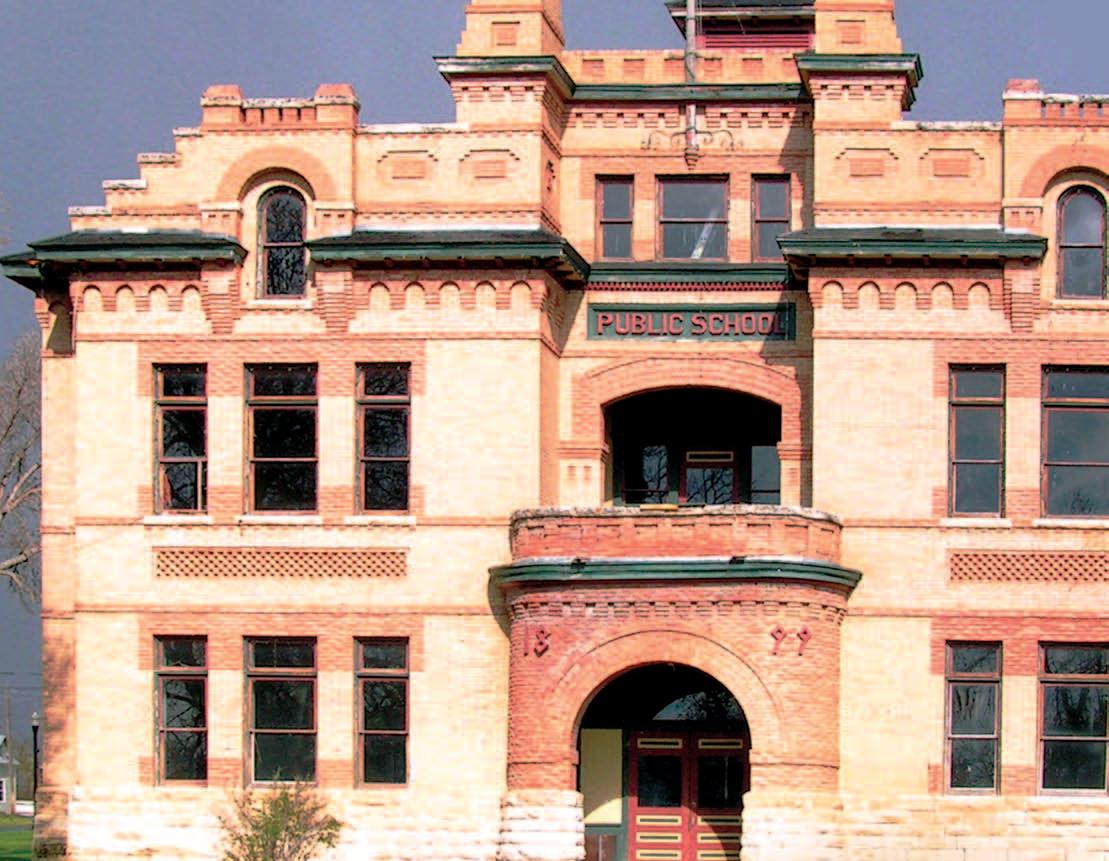
Historic school in Spring City
Who We Are and What We Do
What Is The Trust Lands Administration?
The School and Institutional Trust Lands Administration is an independent agency of state government. It was created in 1994 by the Utah state legislature to manage lands granted to the state of Utah by the United States for the support of public schools and other beneficiary institutions. Prudent and profitable trust lands management has put needed dollars to work in Utah’s schools. As a result, the Trust Lands Administration helps to create a better-educated workforce throughout the state.
What Are Trust Lands?
When Utah was granted statehood on January 4, 1896, the federal government gave the new state parcels of land to be managed in trust in order to provide financial support for public education and 11 other public institutions. The institutions that benefit from these lands are called beneficiaries. The lands are called trust lands and are scattered throughout the state.
From time to time, trust lands are sold. In fact, more than one-half of the original land grant has been sold, much of it during the first 35 years following statehood. Interestingly, about 30 percent of all private lands in Utah were originally trust lands.
Now, more than 100 years since statehood, the trust of each beneficiary consists of two portfolios: (1) the real estate portfolio which is its remaining trust land, managed by the Trust Lands Administration; and (2) the financial portfolio which is the money from the management and sales of that land managed by the State Treasurer.
The objective is to successfully manage both portfolios to provide financial support for the beneficiaries. Successful management of Utah’s trust lands means working as partners with our beneficiaries, the governor and the legislature, other state agencies, local communities, and the public at large.
Where Does the Trust Lands Money Come From?
Money from the management of trust lands comes from a variety of different sources:
• Mineral
Revenues
The largest source of revenues from trust lands is from the leasing of mineral properties and royalties from the production of minerals. Mineral production comes from many sources, including gas and oil, coal, gold, and sand and gravel.
• Leasing Surface Rights
Property owned by the Trust Lands Administration is leased by a wide variety of users. Leased trust lands are currently used as telecommunication sites, commercial sites, industrial sites, recreational cabin sites, farming, timber harvesting and forestry sites, and grazing lands for livestock. It is also used for rights of way and in leases to other government entities.
• Trust
Land Sales
There are times when the best way to make money for the beneficiaries is through the sale of trust lands. Trust land is generally sold in one of two ways: at public auction or through a development project. Public auction sales are generally held twice a year and are becoming more and more popular, as they make more land available for private ownership in Utah.
Development sales occur when it is determined that profits for the beneficiaries could be optimized by adding value to parcels of trust land before selling them. Usually, the Trust Lands Administration participates with experienced private real estate developers to provide land for residential, commercial, and industrial uses to help Utah’s growing communities get where they want to be.
The revenues generated by the Trust Lands Administration have an increasingly significant impact on Utah public education and other Trust beneficiaries while building their permanent funds. The ultimate goal of the Trust Lands Administration is to make the school lands’ trust a major source of public school funding.
It should be noted that the Trust Lands Administration is entirely self-funded. A portion of the money generated from managing trust lands activity is used to operate the Trust Lands Administration. All expenses and capital costs are paid from these revenues. No tax money is required.
Our Mission
Who Benefits From Trust Lands?
At the time of statehood, Congress designated 12 trust land beneficiaries in Utah. By far, the largest percentage of trust lands was granted to public schools for the benefit of Utah schoolchildren.
The other designated beneficiaries include:
• Reservoirs
• Utah State University
• University of Utah
• School of Mines
• Miners Hospital
• Normal School (The current beneficiaries of this trust are teachers’ colleges at state colleges offering teaching degrees.)
• School for the Deaf
• Public Buildings
• State Hospital
• School for the Blind
• Youth Development Center
How Do Trust Lands Benefit Utah’s Schoolchildren?
The Trust Lands Administration works closely with local communities to build value for Utah’s schoolchildren. Cash generated by both trust land operations and trust land sales is transferred to the permanent state school fund. By doing so, the endowment for the public schools grows more and more each year. Investment income (interest and dividends) from the permanent fund is distributed to the schools each year for local academic needs. The distribution is primarily based on the number of students at each school.
Conservation of Trust Lands
As a cautious and far-sighted steward of the land, the Trust Lands Administration recognizes that certain trust lands have unique scenic, recreational, or environmental characteristics. In these situations, the organization works to sell the land for conservation purposes or exchange it for other real estate more suitable for development.
“It is the mission of the School and Institutional Trust Lands Administration to administer trust lands prudently and profitably for Utah’s schoolchildren and the other Trust beneficiaries.”
Board of Trustees - Fiscal Year 2009
Chairman
John Y. Ferry
Vice-President, JY Ferry and Son, Inc.
Background: ranching & farm management
Corinne, Utah
Term: expires 6/30/2010
Vice-chairman
John Scales
President, Flying J Oil & Gas Inc. – retired
Background: oil & gas exploration and development
Sandy, Utah
Term: expires 6/30/2011
Board Member
James B. Lee
Senior Lawyer, Parsons Behle & Latimer
Litigator for more than 40 years in mineral, water, & environmental law
Salt Lake City, Utah
Term: expires 6/30/2009
Board Member
Michael Brown
Vice-President, Graymont Western US Inc.
Background: environmental safety and geology
Kaysville, Utah
Term: expires 6/30/2012
Board Member
Daniel C. Lofgren
President, Cowboy Partners, Cowboy Properties
Background: commercial real estate development
Salt Lake City, Utah
Term: expires 6/30/2013
Board Member
Steven B. Ostler
Chief Executive Officer, The Boyer Company
Background: business operations, asset management, and strategic planning
Salt Lake City, Utah
Term: expires 6/30/2014
Board Member
Gayle F. McKeachnie
Rural Affairs Coordinator of the Governor’s Office
Background: business and natural resources law
Vernal, Utah
Term: served at the pleasure of the Governor, retired from government service in May of 2009
Board Member
Amanda Smith
Legislative Director of the Governor’s Office
Background: Director of Government Relations – The Nature Conservancy, natural resources law
Term: Replaced Mr. McKeachnie – serves at the pleasure of the Governor
Board Member Nominee
David Ure
Vice-president, Ure Ranches, Inc.
Background: Legislative and agriculture
Term: expires 6/30/2015
Senior Staff
Kevin Carter Director
Lynda Belnap Administrative Assistant to the Director
John Andrews Associate Director and Chief Legal Counsel
Tom Faddies Assistant Director/Mining
LaVonne Garrison Assistant Director/Oil and Gas
Kim Christy Assistant Director/Surface
Douglas O. Buchi Assistant Director/Planning & Development
Lisa Schneider Assistant Director/Finance
Jeff Roe ITS Manager
Ron Carlson Audit Manager
Dave Hebertson Public Relations Manager
Kay Burton Block Manager
Moab drill rig on page 21 provided by George Handley of Eclipse Exploration Corporation
Grazing and Great Hunt panel shots, pages 15 & 17, provided by Rick Wilcox of Trust Lands Administration
All other photos by NormaLee McMichael of Trust Lands Administration
Photo Credits
State of Utah School & Institutional Trust Lands Administration
Main Office
675 East 500 South, Suite 500, Salt Lake City, Utah 84102, Phone: 801-538-5100, Fax: 801-355-0922
Central Area
130 North Main, Richfield, Utah 84701, Phone: 435-896-6494, Fax: 435-896-6158
Southwestern Area
2303 North Coral Canyon Boulevard, Suite 100-A, Washington, Utah 84780, Phone: 435-652-2950, Fax: 435-652-2952
Southeastern Area
217 East Center Street, Suite 230, Moab, Utah 84532, Phone: 435-259-7417, Fax: 435-259-7473