State of Utah
School & Institutional TRUST LANDS ADMINISTRATION
2005 Annual Report
(July 1, 2004 to June 30, 2005)
Vision: The Trust is an increasingly significant source of funding for Utah’s schools.
Mission: To administer trust lands prudently and profitably for Utah’s schoolchildren and other trust beneficiaries.
Director’s Message
A wise man once said, “Luck is when preparation meets opportunity.” The results of fiscal year 2005 reflect how the preparations made in prior years by the Trust Lands Administration Board of Trustees and staff worked with the opportunities that knocked during the year.
• The world-wide demand for energy resources was greater than expected
• There was increased interest in uranium and other hard-rock minerals
• Utah’s real estate market brought record prices for land sales
• Almost all lines of Trust Lands’ business maintained or improved in revenues
These added up to record revenues for the agency.
A more subtle type of preparation has also taken place at the Trust Lands Administration – the continuing evolution of the Trust Lands’ staff from a bureaucratic mind set to a business mind set. This has prepared us to know how to create and how to act to use opportunities. It is my privilege to associate with creative, capable people as they work in the interests of Utah’s schoolchildren and the other trust beneficiaries.
Because of preparation and hard work, total assets of the Trust have increased from less than $95 million in FY 1994 (our first year) to more than $600 million at the end of FY 2005 – just 11 years.
Continued planning, hard work, and preparation will be needed to meet the opportunities presenting themselves to the Trust Lands Administration in the new year and beyond.
My thanks to everyone – both inside and outside the agency – who worked to make FY 2005 such a successful year.
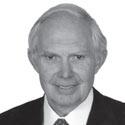
Kevin S. Carter, Director
Fiscal Year 2005 A Banner Year
FY 2005, A Historic Year
Fiscal year 2005 was a record-setting year for the State of Utah School and Institutional Trust Lands Administration. Revenues of almost $94,000,000 exceeded the Trust Lands Administration’s previous best by nearly $33,000,000! This was primarily due to price pressures in the energy market – which increased revenues from current operations and resulted in unanticipated revenues from the leasing of parcels with the potential for oil and gas. Further, the real-estate market also set record prices.
In FY 2005, oil and gas revenues provided 63 percent of the income from trust lands. The agency also makes money from a variety of other activities. The different activities are shown in Fig. 1.
Fig. 1 - Revenues by Type
Trust Lands’ revenues have grown substantially over the past three years. The growth of those revenues by type of revenue is shown in Fig. 2 “Gross Revenues and Expenses.”
Fig. 2 - Gross Revenues and Expenses
Gross Revenues
$49,811,000 $59,781,000 $93,433,100 Operating Expenses
$6,175,411
$6,686,000
$7,665,000
Amount Distributed to Permanent School Fund
$37,692,000 $44,885,000 $70,630,000
Gross Revenues
As can also be seen in Fig. 2, a relatively small amount of gross revenue is used for operating expenses. The Trust Lands Administration uses no tax money. As a result of increasing the revenues and holding the line on expenses, the amount sent to the Permanent School Fund has increased correspondingly.
Since Utah’s schoolchildren and other trust beneficiaries get the interest and dividend earnings from their permanent funds, one of the Trust Lands Administration’s primary objectives is to build those funds. The permanent school fund has increased by almost $213,000,000 since FY 2001. Most of that increase is from the operations of the Trust Lands Administration. See Fig. 3 “Permanent School Fund Balances.”
Fig. 3 - Permanent School Fund Balances
Through investments in the permanent fund, the economic significance of school trust lands continues to grow – year after year
The history of growth in total trust assets is shown in Fig. 4 “Total Trust Assets.” Total assets are the combined assets of all beneficiaries – including their permanent funds. The chart shows total assets growing from $94.5 million in FY 1994 (the first year for the agency) to $638.8 million at the end of FY 2005.
Highlights From Fiscal Year 2005
OIL & GAS
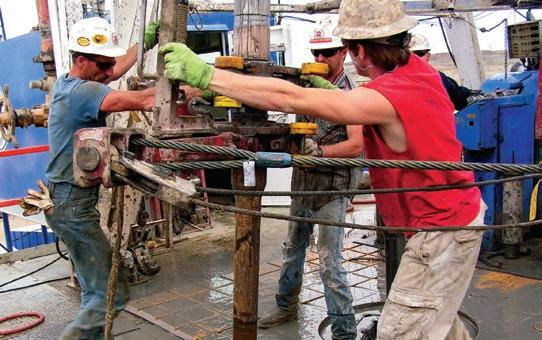
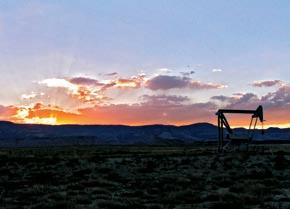
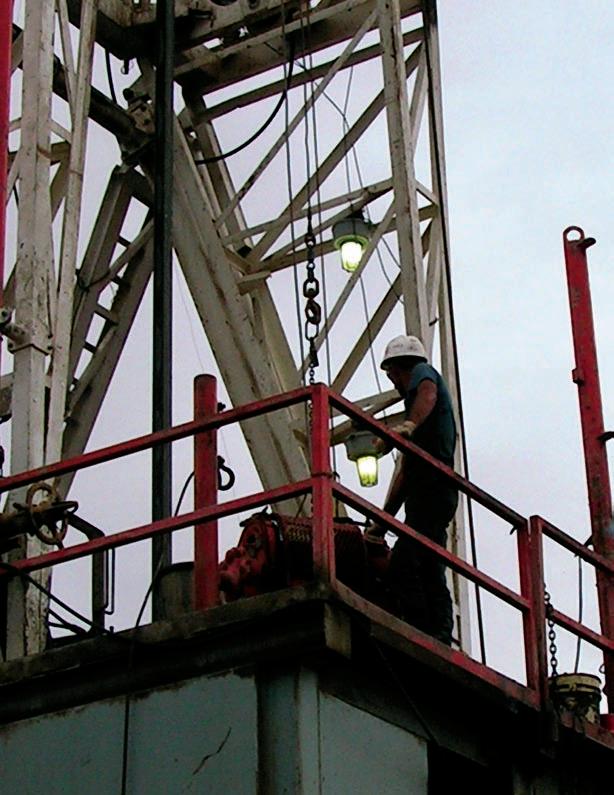
FY 2005 was an exceptional year for oil and gas revenues. The Trust Lands Administration had foreseen price increases for the commodities themselves. However, the agency had not expected the high demand for leased acreage. This demand resulted in large bonus bids received at the FY 2005 quarterly lease auctions.
Trust Lands Administration publishes a list of oil and gas properties in January, April, July, and October which are available for leasing through a sealed-bid process. The bidders on a parcel must offer the amount of the first year’s rental plus additional monetary consideration which is called the “bonus bid” and is the consideration paid by the bidder for the execution of an oil and gas lease by Trust Lands Administration.
Frequently, there is more than one party interested in a lease. The agency awards the oil and gas lease to the highest bidder who submits a proper application under the agency’s oil and gas rules. The lease allows the company a period of time (usually five to 10 years) to explore for oil and gas. If a company discovers the resource during the term of the lease, the lease continues until all wells located on the premises are plugged and abandoned. In FY 2005, bonus bids from the quarterly sales amounted to more than $14,000,000.
The desire for oil companies to lease lands offered by the agency in FY 2005 was driven by several things: 1) higher market prices for oil and gas allowing previously uneconomic reserves to be produced; 2) a positive leasing environment created by the Trust Lands Administration to encourage exploration projects on its lands; 3) the willingness of the agency to move projects along in a timely manner; and 4) promising new oil and gas discoveries in Utah.
Oil and gas generates revenue through leasing lands, royalties on producing properties, and annual rentals on leases which are not yet producing.
URANIUM MINE RE-OPENS
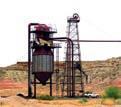
The Tony M. Uranium Mine is located about 22 miles north of Lake Powell’s Bullfrog Marina in Garfield County. The Tony M. Mine was opened and actively mined in the mid-1970’s. The price of uranium was at a peak at that time. However, uranium prices dropped dramatically by the early 1980’s. The mine became unprofitable to operate and was eventually closed.
Nevertheless, in recent years, the price of uranium has increased again. Uranium producers are acquiring mining properties. In December 2004, the Trust Lands Administration was approached by a number of parties interested in leasing the Tony M. Mine. In January, 2005, a new lessee for the mine was successfully found through a competitive bid process.
MUDDY COAL TRACT
In September, 2004, the Trust Lands Administration leased a portion of the Muddy Coal Tract through a competitivebidding process. The Muddy Coal Tract is located seven miles west of the town of Emery, Utah. The tract itself is on the Wasatch Plateau in Sevier County.
Over the next 10 years, the Trust could receive millions of dollars in fees, rents, and royalties connected with the Tony M. Uranium Mine
It is one of six coal tracts in which the Trust received an economic interest from the federal government through the Utah Schools and Land Exchange Act of 1998 – the so-called “Grand Staircase-Escalante National Monument Exchange.” The tract is believed to contain more than 13.5 million tons of recoverable coal.
The successful applicant for the tract was Ark Land Company and Arch Coal, Inc., who jointly submitted a bid to win the lease of the tract. It is anticipated that the tract may yield significant production revenues to the Trust by the end of FY 2008.
BLOCK PLANNING
The Trust Lands Administration is analyzing the resources and creating an asset plan for its Tabby Mountain block. The block straddles the Wasatch and Duchesne county line and contains 28,500 acres of mountain land with forests, meadows, and range land. The eastern border of the block is just west of the towns of Tabiona and Hanna and south of State Road 35 in Duchesne County.
Most of the research for this project has been finished, and the plan should be completed during FY 2006. Tabby Mountain is the fourth in a series of recent block management plans.
The purpose of block planning is to identify the unique resources and opportunities associated with larger blocks of trust land in order to fulfill the duties of the trustee and to protect assets that may be at risk.
Much of the land managed by the Trust Lands Administration is the familiar “checkerboard” pattern of school trust lands scattered throughout the state. These are mostly rectangles of one square mile containing about 640 acres. Parcels such as these usually don’t lend themselves to large-scale block planning. However, there are a number of trust land blocks that are considerably larger.
In the late 1990’s, the agency decided that it needed to have more information about some of these larger blocks so that it could better manage them in the interests of the trust beneficiaries. In 2002, the Trust Lands Administration developed a “block planning” process. There are more than 50 large blocks of trust land – 5,000 acres or larger
The first purpose of the block planning process is to analyze the blocks:
• How and why the block was acquired
• What are its physical characteristics – location, size, topography, resources, etc. – there are more than 60 parameters considered for each block
• What are the market and political dynamics of the block
The second objective of the block planning is to develop strategies for its management:
• Determine highest and best use
• Protect assets at risk
• Create short-term, long-term, and exit strategies
• Implement action plans
Though the sustained effort at block planning is relatively new, it has already brought significant new revenues to the beneficiaries and holds the promise for increased returns through more effective management of large blocks.
The agency is obligated to adhere to certain principles in trust land management:
• Trust law requires that the lands are managed for the financial interests of the designated beneficiaries.
• The Trust Lands Administration cannot give land away or set it aside for public purposes. The law states that “... the beneficiaries do not include other governmental institutions or agencies, the public at large, or the general welfare of the state.” Title 53C-1-102
• The Trust must receive fair compensation for any use of trust lands.
There are only two ways to make money with real estate (1) put it into production or (2) sell it.
The Trust Lands Administration follows this doctrine in planning and managing the large blocks.
TOOELE COUNTY REGIONAL LANDFILL
In November 2002, the Trust Lands Administration began studying its 12,360-acre “I-80 Block” north of Delle in Tooele County. The I-80 Block was one of the first large blocks planned by the agency (see the preceding article about “Block Planning” in this report). The block plan studied the nature of the block and how it might be utilized more effectively for the trust beneficiaries. Among several potential uses identified by the plan was that of a municipal landfill.
At about that same time, the Wasatch Regional Solid Waste Landfill Corporation approached the Trust Lands Administration to find if there might be any suitable parcels of trust land available for a Wasatch Front landfill operation. The agency showed Wasatch Regional three properties that might serve this purpose. One of those parcels was the I-80 block. It seemed ideal for their needs – the block could significantly lower the cost of collecting municipal waste along the Wasatch Front because of excellent highway and rail access only 40 miles from Salt Lake City.
Wasatch Regional secured a lease for a municipal waste landfill of up to 3,200 acres. An environmental assessment was conducted to examine conditions at the site: wind and climate, erosion control, migratory bird impact, potential for storm water and ground water contamination, the possibility of pollution of the Great Salt Lake, and the plan for the eventual closure of the facility.
A transaction was completed between the Trust Lands Administration and Wasatch Regional Solid Waste Management Corporation whereby the trust beneficiaries would receive fair compensation for the land and also benefit from the fees collected by Wasatch Regional.
As the landfill transaction was being finalized, Wasatch Regional was approached by Allied Waste Industries, Inc. – the second largest waste-management company in America – with an offer to purchase the Wasatch Regional project. Wasatch Regional accepted the offer.
As the operator of the landfill, Allied (acting through an Allied subsidiary – Wasatch Regional Landfill, Inc.) will accept municipal and commercial waste from within Utah, mostly from the Wasatch Front area. The new landfill will take some of the pressure off other landfills in the vicinity, thereby extending the useful life of those operations. No waste will be accepted from outside of Utah.
The project is expected to have a life of about 100 years, with significant revenues to Utah’s public schools ranging from $600,000 to $1,000,000 per year.
THE UTAH RECREATIONAL LAND EXCHANGE ACT OF 2005
Legislation to trade scenic school trust lands into the hands of the United States is now in both the United States Senate and the U.S. House of Representatives. Utah Senators Robert Bennett and Orrin Hatch introduced the legislation in the Senate. It was also introduced in the House of Representatives by Reps. Chris Cannon, Jim Matheson, and Rob Bishop.
The proposed exchange would swap up to 40,000 acres of school trust lands - some of the most spectacular in America - for about the same acreage of Bureau of Land Management lands that are more suitable for meeting the needs of the trust beneficiaries.
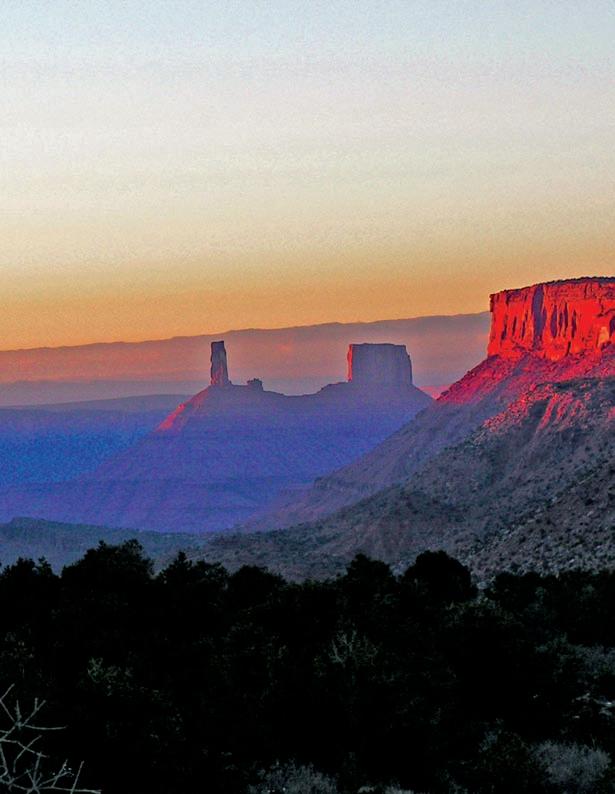
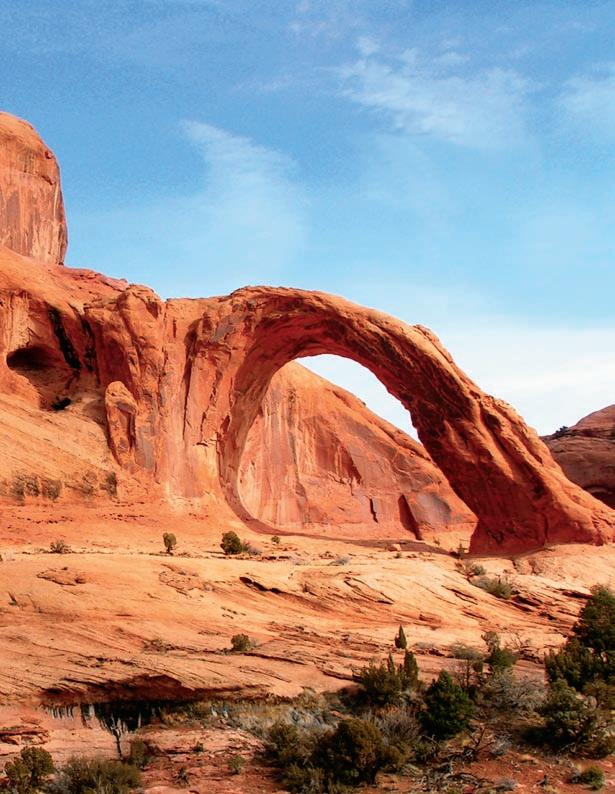
The school trust lands planned for the exchange are located along the Colorado River in Grand County and include portions of the Kokopelli and Slickrock bike trails, the upper portion of Castle Valley, Corona Arch, Morning Glory Arch, and lands near Dinosaur National Monument.
The Trust would receive less-sensitive acreage - in the Uintah Basin and Green River areas - that can be managed for the benefit of Utah’s public schools and for community economic development.
One of the key features of this legislation is the way it provides for a fair, equal-value exchange. The proposal calls for an independent third-party appraiser to provide an estimate of value.
This exchange benefits many people. The people of the United States gain public control of some spectacular natural features; local Utah governments maintain their mineral revenue-sharing funds; and Utah’s schoolchildren get lands that will help build their permanent school fund. The Trust Lands Administration commends the entire Utah congressional delegation for moving this important legislation along.
COUNTY PLANNING PROJECTS
The Trust Lands Administration is cooperating with several counties in Utah currently developing county-wide plans. Since as much as 69 percent of the land in Utah is owned and managed by agencies of the United States, the objective of this planning effort is to provide a vehicle to allow local input into the management and disposal of these federal lands.
In particular, the aim is to develop federal legislation which will designate wilderness and public recreation areas in the county; provide for transportation and utility corridors; allow for growth; and make available future agricultural, commercial, and industrial opportunities. With such federal legislation in place, various stakeholders will have a clearer vision of their responsibility in the overall management of the county.
This type of legislation has been enacted for two counties in Nevada. Legislation for Washington County, Utah, is almost ready for introduction into the U.S. Congress. At this time, county planning activities and the development of accompanying legislation is underway for Iron, Beaver, and Millard Counties in Utah.
The Trust Lands Administration will continue to work with state and county officials to develop and implement fair and effective county plans.
WASHINGTON COUNTY REAL ESTATE MARKET
Washington County, Utah, is one of the nation’s fastest growing counties. County executives claim that 500 to 1,000 people move to Washington County each month. The population is expected to reach a half-million people within the next 40 years.
The attraction of Washington County is fair weather, golf and recreational opportunities, nearby National Parks, proximity to Las Vegas, and scenic vistas. The population boom has precipitated a simultaneous building boom.
With more than 81,000 acres of trust land in Washington County, the trust beneficiaries have been and are situated to participate in the profits of the expanding real-estate market.
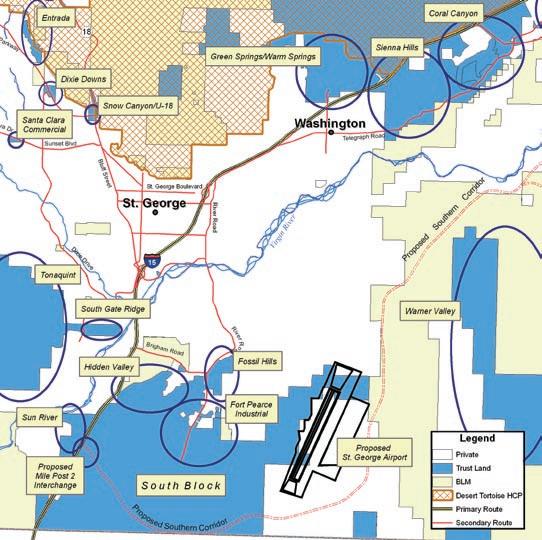
The map – Fig 5 – “St. George Area Real Estate Projects” – shows several of the major project areas the Trust Lands Administration is working on in the St. George area.
The Planning & Development Group has several projects that are already underway or are in various stages of planning.
(Fig.5) St. George Real Estate Projects
CURRENT PROJECTS:
Coral Canyon – This is a planned community of about 2,100 acres. It includes residential neighborhoods, retail businesses, churches, schools, golf, and other recreation. The community is about one-third developed.
Entrada – The agency is participating with the developer in the sale of residential lots within this upscale community.
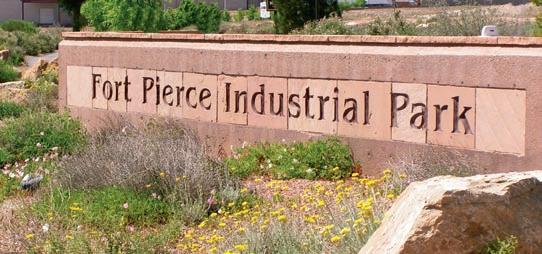
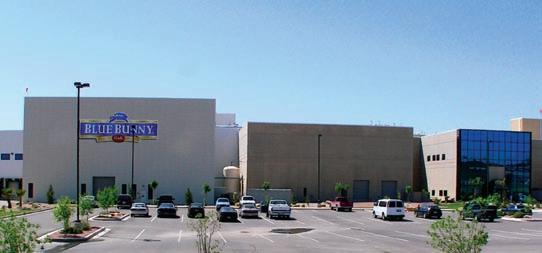
Ft. Pierce Industrial – This is an industrial park of about 800 acres. The park is a joint effort of the Trust Lands Ad-
ministration, a St. George-based developer, the city of St. George, and the local power company. Two hundred acres have been developed so far.
Sienna Hills – This is a mixed residential and commercial community of 700 acres. Construction at Sienna Hills is just beginning. A main thoroughfare has been completed and joined to Interstate 15 at the new milepost 13 exit. The first of the development pads has been sold to local builders.
FUTURE WASHINGTON COUNTY PROJECTS:
Green Springs – 1,100 acres. This will be a development of primarily up-scale residential homes.
The South Block – 6,000 acres. This is located at the south end of St. George near the border with Arizona. Initial plans are for mixed residential use, with considerable open space for recreation, species habitat, and parks.
Milepost 2 – A freeway interchange is proposed on I-15 at milepost two. Commercial property – belonging to the trust – is part of the design. The interchange will also provide more access to the South Block and to the proposed new St. George airport.
Proposed New Airport – The Trust manages about 700 acres in the vicinity of the proposed new airport. It is expected that this will be valuable commercial and industrial property when the new airport is built in the next seven to 10 years.
These Washington County parcels are managed by the Planning & Development Group of the Trust Lands Administration. The Planning and Development Group works diligently with Washington County and local communities to assure the responsible development of trust lands, to meet the needs of the trust beneficiaries, and to satisfy local market forces. The agency usually participates with experienced private developers to provide land for residential, commercial, industrial, and other uses for Utah’s growing population.
ROADS ON TRUST LANDS
Current state law provides for temporary easements or rights of entry for roads that were constructed, maintained, or used on state trust lands prior to January 1, 1992. The temporary status of such easements or rights of entry remains in effect until they are made permanent through an application process formalized by administrative rule.
The Trust Lands Administration has formalized a rule-based process that provides a mechanism for receiving input and bringing finality to various road claims. The process provides notification to counties and other responsible authorities for the Trust Lands Administration to receive input to determine the merits of securing easements or rights of entry for roads that cross trust properties before the property is sold. This process will help sort out the various claims and provide more certainty for prospective buyers of trust land properties. In addition, this process does not affect any valid RS 2477 claims made by the counties.
In FY 2005, the Trust Lands Administration visited with local officials in many counties to clarify this process and to identify other areas of concern relating to roads on trust lands. It is the agency’s goal to work through any potential difficulties before land is sold.
OFF-HIGHWAY VEHICLES FUNDING
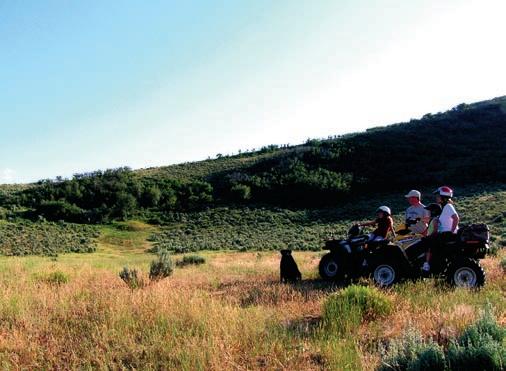
Traditional casual accommodation of unmanaged off-highway vehicle access and use by the public is now inadequate in the face of growing demand for motorized recreation. This additional demand is causing significant degradation of trust assets. Additionally, many federal resource management plans are calling for reduction of OHV use on federal lands – putting even more pressure on neighboring trust lands.
Early in 2004, the Trust Lands Administration was successful in securing a surcharge of $1.50 per OHV registered in Utah and on out-of-state OHV user fees. The legislature established the fee to provide funds to accommodate disciplined use and mitigate impacts associated with OHV activities on trust lands.
The FY 2005 proceeds from the surcharge were approximately $250,000 and helped improve recreational opportunities for OHV users while protecting trust resources. Here is how primary usage of the funds has been allocated so far:
- Perfecting perpetual easements for OHV access in San Juan, Kane, and Iron Counties
- Mitigating resource degradation in Grand and San Juan Counties
- Facilitating OHV access on the Tabby Mountain Block, which straddles Wasatch and Duchesne Counties
- Purchasing signage materials for numerous sites and trails
- Partnering with other land-management agencies to provide OHV user information brochures
GRAZING
The Trust Lands Administration has restructured its grazing program. The new arrangement divides grazing lands into two categories: 1) scattered sections and 2) selected larger blocks of trust land with higher forage capacity. It also provides consideration for good stewardship practices by individual grazing permittees. Here are some major points of the new program:
1. The fee for grazing permits on scattered sections will increase from $2.35 per AUM to $2.85 per AUM for the 2005 grazing season. The fee will increase an additional $0.35 per year for the following three years.
2. The fees for permits on selected blocks will increase from $2.35 per AUM to $5.00 per AUM for the 2005 grazing season. During the following five years, the AUM fee will increase by $0.40 per year.
3. There will be a 50/50 revenue-sharing program for all subleased grazing permits
4. The Trust will expend up to 10 percent of gross annual grazing revenues for qualifying range capital improvements.
5. Amends the Trust grazing rules to allow for term extensions of permits for qualifying range-improvement projects paid by the incumbent permittee.
6. Continue the policy to reimburse incumbent permittees for the un-depreciated value of approved range improvements if the lease is prematurely cancelled beyond the control of the permittee.
7. Work toward adopting a grazing fee formula that objectively reflects the market value of the Trust permits. These changes are a result of a two-year market analysis involving substantial input from livestock permittees, other industry leaders, and stakeholders. These changes provide enhanced security for permittees, improved stewardship practices, and fairer returns to the Trust’s beneficiaries.
Trust Lands Fundamentals
WHAT IS THE TRUST LANDS ADMINISTRATION?
The School and Institutional Trust Lands Administration is an independent agency of state government. It was created in 1994 by the Utah state legislature to manage lands granted to the state of Utah by the United States for the support of public schools and other beneficiary institutions. Prudent and profitable trust lands management has put needed dollars to work in Utah’s schools.
WHAT ARE TRUST LANDS?
When Utah was granted statehood on January 4, 1896, the federal government gave the new state parcels of land to be managed in trust in order to provide financial support for public education and 11 other public institutions. The institutions that benefit from these lands are called beneficiaries. The lands are called trust lands and are scattered throughout the state.
From time to time, trust lands are sold. In fact, more than one-half of the original land grant has been sold, much of it during the first 35 years following statehood. Interestingly, about 30 percent of all private lands in Utah were originally trust lands
Now, more than 100 years since statehood, the trust of each beneficiary consists of two portfolios: (1) the real estate portfolio which is their remaining trust land, managed by the Trust Lands Administration; and (2) the financial portfolio which is the money from the management and sales of that land managed by the State Treasurer.
The objective is to successfully manage both portfolios to provide financial support for the beneficiaries. Successful management of Utah’s trust lands means working as partners with our beneficiaries, the governor and the legislature, other state agencies, local communities, and the public at large.
WHERE DOES THE TRUST LANDS MONEY COME FROM?
Money from the management of trust lands comes from a variety of different sources. At this time, the largest source of trust land revenue is oil and gas. For example, $70,630,000 was added to the permanent school fund during fiscal year 2005. Of that amount, more than 68 percent came from leasing mineral properties and from royalties from the production of minerals. Nearly 11 percent came from surface leasing and sales, another 18 percent came from development activities, and about one percent from grazing and forestry permits.
These revenues move the organization closer to its goal of $1 billion in total assets by the end of fiscal year 2010. With that amount of money in permanent funds, the Trust Lands Administration will continue to have an increasingly significant impact on Utah public education and other Trust beneficiaries while continuing to build the permanent funds. The ultimate goal of the Trust Lands Administration is to make the Trust a major source of public school funding. It should be noted that the Trust Lands Administration is entirely self-funded. A portion of the money generated from managing trust lands’ activity is used to operate the Trust Lands Administration. All expenses and capital costs are paid from these revenues. No tax money is required.
Mineral Revenues
The largest source of revenues from trust lands is from the leasing of minerals properties and royalties from the production of minerals. Mineral production comes from many sources, including gas and oil, coal, gold, and sand and gravel.
Leasing Surface Rights
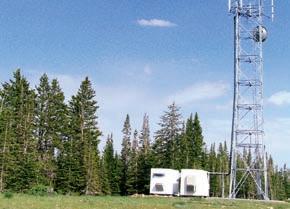
Property owned by the Trust Lands Administration is leased by a wide variety of users. Leased trust lands are currently used as telecommunications sites, commercial sites, industrial sites, recreational cabin sites, farming, timber harvesting and forestry sites and grazing lands for livestock. It is also used for rights of way and in leases to other government entities.
Trust Land Sales
There are times when the best way to make money for the beneficiaries is through the sale of trust lands. Trust land is generally sold in one of two ways: at public auction or through a development project. Public auction sales are held twice a year and are becoming more and more popular, as they make more land available for private ownership in Utah. Development sales occur when it is determined that profits for the beneficiaries could be optimized by adding value to parcels of trust land before selling them. Usually, the Trust Lands Administration participates with experienced private real estate developers to provide land for residential, commercial, and industrial uses to help Utah’s growing communities get where they want to be.
WHAT ORGANIZATIONS BENEFIT FROM TRUST LANDS?
At the time of statehood, Congress designated 12 trust land beneficiaries in Utah. By far, the largest percentage of trust lands was granted to public schools for the benefit of Utah schoolchildren.
The other designated beneficiaries include:
• Reservoirs
• Utah State University
• University of Utah
• School of Mines
• Miners Hospital
• Normal School (The current beneficiaries of this trust are the teachers’ colleges at state colleges that offer teaching degrees.)
• School for the Deaf
• Public Buildings
• State Hospital
• School for the Blind
• Youth Development Center
HOW DO TRUST LANDS BENEFIT UTAH’S SCHOOLCHILDREN?
The Trust Lands Administration works closely with local communities to build value for Utah’s schoolchildren. Cash generated by both trust land operations and trust land sales is transferred to the permanent state school fund. By doing so, the endowment for the public schools grows more and more each year. Investment income (interest and dividends) from the permanent fund is distributed to the schools each year for local academic needs. The distribution is primarily based on the number of students at each school.
CONSERVATION OF TRUST LANDS
As a cautious and far-sighted steward of the land, the Trust Lands Administration recognizes that certain trust lands have unique scenic, recreational, or environmental characteristics. In these situations, the organization works to sell the land for conservation purposes or exchange it for other real estate more suitable for development.
OUR MISSION STATEMENT
It is the mission of the School and Institutional Trust Lands Administration to administer trust lands prudently and profitably for Utah’s schoolchildren and other trust beneficiaries.
People
Chairman
John W. Creer
President, Farm Management Company
Background in agricultural management and law
Farmington, Utah
Term: expires 6/30/2005
Vice-chairman
James B. Lee
Senior Lawyer, Parsons Behle & Latimer
Litigator for more than 40 years in mineral, water, and environmental law
Salt Lake City, Utah
Term: expires 6/30/2009
Board Member
Vernal J. Mortensen
Retired, Senior Vice-president, Coastal Coal, Inc.
Background in coal mining and mineral valuation
Sandy, Utah
Term: expires 6/30/2006
Board Member
Gayle F. McKeachnie
Governor’s Office, Rural Affairs Coordinator
Background in business law, natural resources law, and government
Vernal, Utah
Term: at pleasure of the Governor
Board Member
James J. Eardley
President, Dixie Transport, Inc.
Background in LP gas distribution, county government, and banking
St. George, Utah
Term: expires 6/30/2007
Board Member
Michael P. Morris
Group Head - Managing Director
Real Estate Mezzanine and Investment Group
JP Morgan Chase Bank N.A.
Background in real estate and commercial banking
Alpine, Utah
Term: expires 6/30/2008
Board Member
John Y. Ferry
Vice-president, JY Ferry and Son, Inc.
Background in ranching & farm management
Corinne, Utah
Term: expires 6/30/2010
Board Member Nominee
Ross Matthews
Senior Vice-president, Sinclair Oil Corporation
Background in oil and gas exploration and development
Salt Lake City, Utah
Term: expires 6/30/2011
SENIOR STAFF
Kevin S. Carter Director
Lynda Belnap
John W. Andrews
Tom Faddies
LaVonne J. Garrison
Kim S. Christy
Ric McBrier
Dave Hebertson
Lisa Y. Schneider
Kay Burton
Jeff Roe
Ron Carlson
Administrative Assistant to the Director
Associate Director and Chief Legal Counsel
Assistant Director/Hard Rock and Industrial Minerals
Assistant Director/Oil and Gas
Assistant Director/Surface
Assistant Director/Planning & Development
Public Relations Manager
Finance Director
Block Planner
ITS Manager
Audit Manager
Main Office
675 East 500 South, Suite 500
Salt Lake City, Utah 84102
Phone: 801-538-5100
Fax: 801-355-0922
www.trustlands.com
Contact Information
Central Area
130 North Main
Richfield, Utah 84701
Phone: 435-896-6494
Fax: 435-896-6158
Southwestern Area
2303 North Coral Canyon Boulevard Suite 100-A
Washington, Utah 84780
Phone: 435-652-2950
Fax: 435-652-2952
For more information contact:
Dave Hebertson davehebertson@utah.gov
NormaLee McMichael nlmcmichael@utah.gov
Southeastern Area
217 East Center Street, Suite 230
Moab, Utah 84532
Phone: 435-259-7417
Fax: 435-259-7473