The trust is an increasingly significant source of funding for Utah’s schools.
Mission
To administer the trust lands prudently and profitably for Utah’s schoolchildren.
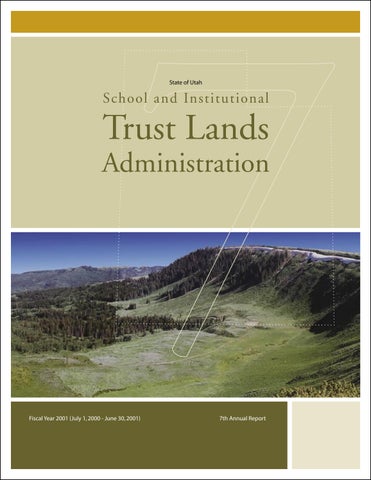
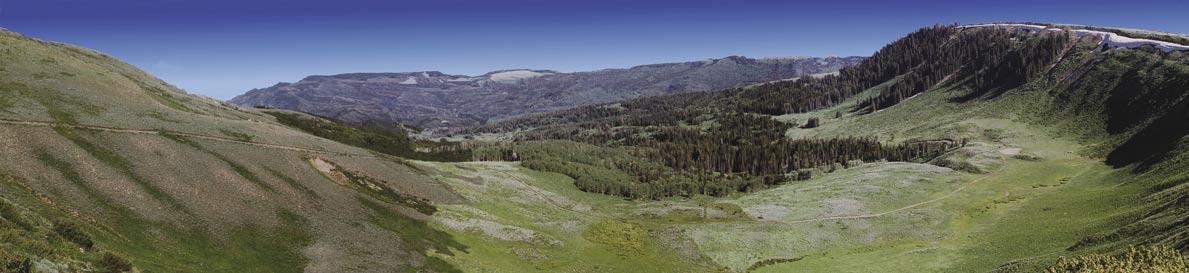
Tabby Mountain is a 27,500-acre block of trust land in Wasatch and Duchesne Counties. The Trust Lands Administration has studied the resources of Tabby Mountain and is now preparing a block management plan for the tract. The plan will present a vision for the future for the block and how to best preserve and improve this asset.
Trust Lands Administration
Purpose
The School and Institutional Trust Lands Administration - an independent agency of state government - is established to manage lands that Congress granted to the state of Utah for the support of common schools and other beneficiary institutions under the Utah Enabling Act.
The state of Utah expressly accepted this grant in the Utah Constitution, thereby creating a compact between the federal and state governments which imposes upon the state a perpetual trust obligation to which standard trust principles are applied.
Title to these trust lands is vested in the state as trustee to be administered for the financial support of the trust beneficiaries.
The trust principles impose fiduciary duties upon the state, including a duty of undivided loyalty to, and strict requirement to administer the trust corpus for the exclusive benefit of, the trust beneficiaries.
As trustee, the School and Institutional Trust Lands Administration must manage the lands in the most prudent and profitable manner possible and not for any purpose inconsistent with the best interest of the trust beneficiaries.
The trustee must be concerned with both income for the current beneficiaries and the preservation of the trust corpus for future beneficiaries, which requires a balancing of short and long-term interests so that long-term benefits are not lost in an effort to maximize short-term gains.
The beneficiaries do not include other governmental institutions or agencies, the public at large, or the general welfare of the state.
Paraphrased from Title 53C, Utah Code
Message From the Acting Director
Dear Friends of Trust Lands:
It has been a year for superlatives: big land exchanges, record natural gas production coupled with sky-high gas prices, momentous success in building bridges with our natural resource partners and dramatic personnel changes. Trust Lands successes were possible because of dedicated and professional agency employees and the insight and knowledge of the Board of Trustees. Together, this team has met every challenge and risen to every opportunity to make this a record income year for our beneficiaries.
The Trust Lands Administration is fortunate at this time to have strong relationships with our federal land management partners, state resource management agencies and local governments. In addition to these partners, the trust land beneficiaries have been unswerving in their support and appreciation.
It has always been a source of pride to know that the work done here results in better educational opportunities for Utah’s schoolchildren, and better lives for the beneficiaries of the other trusts. It is particularly gratifying now that school trust revenues go directly to individual schools and make a positive difference in the lives of individual students. I know I speak for all of the employees at the Trust Lands Administration when I say that we look forward to the future. It’s good to work here.
Thank you,
Kevin S. Carter Acting Director
Financial Highlights
Consolidated Trust Assets
Growth Since 1985
(Market Value in $ Millions)
What Are Trust Lands?
In connection with statehood on January 6, 1896, the United State of America transferred ownership to more than seven million acres of federal land in Utah to the state to be administered by the state as a trust. The federal government specified 12 institutions as beneficiaries of these lands. Each institution received distinct lands for their trust. The 12 beneficiaries are:
• Public Schools
• Reservoirs
• Utah State University
• University of Utah
• School of Mines
• Miners Hospital
• Normal School
• School For The Deaf
• Public Buildings
• State Hospital
• School For The Blind
• Youth Development Center
Managing Utah’s Trust Lands
The state is required to manage these trust lands to provide financial support for the 12 institutions specified as beneficiaries in the Utah Enabling Act (the federal law which allowed Utah to form a constitution, a state government, and be admitted into the Union).
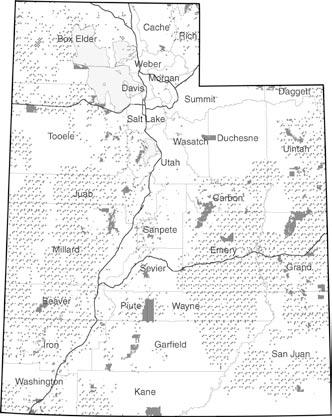
The trust lands are scattered throughout the state as depicted on this map of trust lands.
Trust Lands Are Shown in Black At this time there are almost 3.5 million surface acres - more than 7,500 parcels.
Twelve Beneficiaries
Of all federal lands designated for the trusts, Utah’s public schools received the lion’s share — more than 78 percent of the total. The following chart shows the beneficiaries, their original surface grant, land sold since statehood, and the current surface holdings of each.
Utah Trust Lands
Net Sold & Exchanged Since Statehood
End of Fiscal Year 2001
Public Schools
Reservoir Fund
Utah State University
University of Utah School of Mines
Miners Hospital
Normal School School for the Deaf Public Buildings
State Hospital School for the Blind Youth Development Center TOTAL
7,475,297.00
2,512,937.90
3,465,015.08
More than one-half of the original surface grants have been sold since statehood — most of that before 1930. What happened to that land? Most of it became private land. A little-known fact of Utah geography is that about 30 percent of all private land in the state came from trust lands.
Financial Benefits
The revenues generated from the use and sale of trust lands are either sent directly to the particular beneficiary or put into its permanent fund. State law requires that revenues from the Public Schools trust are handled differently than the other 11 beneficiaries.
Public Schools
In the case of the public schools, all revenues generated from trust lands (both operating revenues and land sales revenues) are transferred to its permanent fund. By depositing all of the income to the permanent fund, the balance in the fund grows and grows every year.
The schools do not get the revenues directly. It is the investment earnings (interest and dividends) from the permanent fund which are distributed to the schools each year for local academic needs. This distribution is called the Trust Land Dividend. The amount for each school is based on the number of students at the school. The Trust Land Dividend is administered by the Utah State Office of Education. For more information, call the Office of Education at 801-538-7573 or visit their trust land web site at http:// www.usoe.k12.ut.us/trustlands/ .
Other Beneficiaries
In the case of the 11 other trust beneficiaries, all operating revenues along with earnings from their permanent funds are distributed directly to them each year. Only money from the sale of their trust lands is added to their permanent funds. As a result, their permanent funds grow more slowly.
Trust Lands Dividends For Public Schools
Trust Lands Dividends are sent to each public school in Utah yearly. The dividends come from the earnings on the money invested in the schools’ permanent fund.
Each school has a committee of parents, teachers and administrators which decides how to spend the money for the school. The majority of schools have been using the money to enhance reading, science and math programs. Here are a few examples:
Upland Terrace (Granite School District) - wall maps and a science lab
Hurricane High (Washington County District) - graphing calculators and overhead projectors for science and math classes
Grant Elementary (Nebo District) - a Summer reading program for readers below level
Monument Valley High (San Juan District) - a mentor program for health, science and math education
Mount Logan Elementary (Logan District) - a literacy action program
Libby Edward (Granite District) - a mobile science lab
More than 500 schools receive Trust Lands Dividends. As the fund continues to grow, the amount of the yearly Trust Land Dividend will also grow.
Where Does The Money Come From?
The Trust Lands Administration is required to manage trust lands for the financial benefit of the various beneficiaries. There are only two ways to generate revenues from real estate:
1. Put it into production.
2. Sell it.
The Trust Lands Administration does both to create wealth for schools and the other beneficiaries. Further, the agency is required by law to receive fair-market value for the use or sale of trust lands — we cannot give land away.
Here are some ways revenues are generated from trust lands:
• Natural Gas Wells
• Grazing
• Hard Rock Minerals:
• Gold
• Copper
• Gilsonite
• Industrial Minerals
• Land Sales to the General Public
• Cell Phone and Telecommunications Sites
• Sand & Gravel Operations
• Residential & Subdivisions
• Coal Mines
• Building Stone Quarries
• Golf Courses
• Land Sales and Leases to Counties and Local Governments:
• Water Tanks
• Open Space
• Land Fills
• Recreation Leases
• Hunting & Fishing Access
• Gemstones and Fossils
• Rock Hounding
• Land Sales and Leases to Businesses:
• Convenience Stores
• Industrial Parks
• Hotels
• Skiing Areas & Facilities
• Forestry
• Farms and Agriculture
How Much Money?
In Fiscal Year 2001, Trust Lands Administration operations posted total revenues of $54.8 million from the various activities on trust lands. These activities are grouped into five categories of trust operations. The following chart shows the contribution of each category to the year’s revenues.
Fiscal Year 2001 Operating Revenues (By Type of Revenue)
No Tax Money
Of course it takes money to manage trust lands and operate the Trust Lands Administration. In FY 2001, operating expenses were about $5,261,000. That money is used for office space, payroll and all other day-to-day costs of running the trust. Typically the operating expenses are about 15 percent of net revenues. However, this year those expenses were less than 10 percent of net revenues — a historic low for the agency. No tax money is used to operate Trust Lands, so where does that money come from?
The Trust Lands Administration is self-funded. A portion of the money generated from managing trust land activity is used to operate the Trust Lands Administration. All expenses and capital costs are paid from these revenues. The annual operating budget is approved by the Board of Trustees, the governor and the legislature.
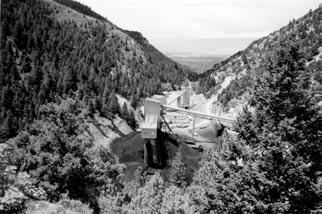
Caption: Courtesy of Canyon Fuel LLC
The surface operations of the Dugout Canyon Mine are in a narrow canyon in the Book Cliffs. Although more than 14,000 underground acres have been leased for the mine, only 22 acres will be disturbed on the surface. When the mine is closed, the equipment will be removed; and the surface will be restored to its natural condition. There will be virtually no evidence that a mine ever existed. The mine is operated by Canyon Fuel LLC, a subsidiary of Arch Coal, Inc.
Highlights of Activities in 2001 Minerals
Income from minerals continues to be the major source of trust land revenues. In FY 2001, mineral revenues were $43,451,000. As can be seen from the preceding chart, mineral revenue accounted for 79.4 percent of Trust operating revenue in FY 2001. Revenues from coal mining and natural gas production were the main types of mineral income for the year.
Coal
Trust land coal income for FY 2001 was more than $6,180,000. One of the newest mines to come into production was the Dugout Canyon Mine in the Book Cliffs region of Carbon County, northeast of Price. The coal reserves on this property were acquired from the federal government by forwardthinking trust managers in 1984 and in 1999. This mine is expected to bring $10,000,000 to the Trust over the next 16 years.
Natural Gas
Oil and natural gas revenue for FY 2001 was $34,000,000. Much of that income was from the production of natural gas (coalbed methane) from trust lands in Carbon and Emery Counties. The natural gas revenues for FY 2001 were 65 percent greater than the previous year! There were two reasons for that:
• More gas was produced during the year. An additional 85 coalbed methane wells were drilled and brought into production, bringing the total number of producing coalbed methane wells to 397 at the end of the fiscal year.
• A dramatic (but temporary) price increase occurred during the Winter of fiscal year 2001, significantly increasing natural gas revenues. The rise in gas prices occurred due to an energy shortage in the western U.S. — primarily in California.
As of the publication of this report, the energy shortage has abated and prices declined almost to previous levels. Nevertheless, there is considerable trust acreage in Carbon and Emery Counties which can still be developed for natural gas production. It is anticipated that many more gas wells will be drilled in the region over the next 20 years. This means that natural gas will continue to be the single largest source of Trust income for the foreseeable future. Furthermore the Trust Lands Administration will continue to seek opportunities to acquire more land with potential for natural gas and other minerals.
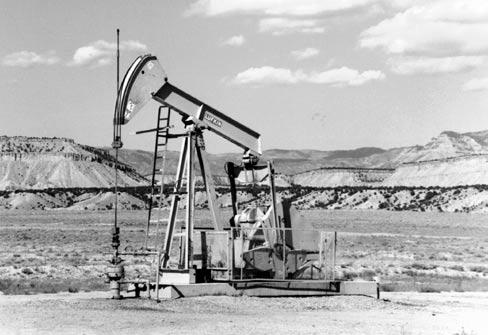
This large oil-field pump, in a trust land natural gas field near Price, Utah, is actually pumping water! Large amounts of water must be lifted off underground coal formations to allow the gas - coalbed methane - to flow freely to the surface. The gas is then collected and distributed by pipeline to homes and businesses all over the western United States. The water is not suitable for irrigation so it is put back deep into the ground.
New Private Land From Trust Lands
Another way the Trust Lands Administration creates wealth for Utah’s schools and other trust beneficiaries is through the sale of trust land. The money which comes from the sale of trust land is never spent, but is put into the permanent fund of the appropriate beneficiary. This builds the asset values of their trusts.
The agency considers a number of factors when deciding to sell a particular property:
• There is strong market interest in the piece.
• It is a small piece surrounded by private property.
• A parcel has little production potential but has good market value.
• There is an unusual market opportunity for the piece (such as the creation of a Cooperative Wildlife Management Unit).
• A parcel may have unusually high administrative costs.
• A parcel may be sold to test the real estate market in a particular area.
The land is most often sold at auction. But sometimes the beneficiaries receive increased value in a parcel through agency planning and development activities on that parcel. Activities might include master planning, zoning, subdivision, infrastructure installation and construction on the parcel.
In Fiscal Year 2001, about 18,000 acres of trust land were sold. Most of that acreage became new private property — property that will be used for homes, businesses, ranches and farms. Some will be used for recreation or for conservation and open space, and some will be used by local governments for local public needs.
At the current rate, there will be trust land available for sale for hundreds of years. Meanwhile, the land which is sold each year greatly improves the value of the permanent funds and generates additional perpetual revenues for the beneficiaries.
Federal Land Sales
An interesting note: Another source of land sales revenue for Utah’s schoolchildren is from the sale of federal land. Utah’s Enabling Act puts five percent of proceeds from federal land sales into the permanent school fund. This is the money from federal sales in recent years:
Money To Permanent School Fund From Federal Land Sales in Utah
Economic Development
Some of the land sold in FY 2001 was sold to firms looking for new business locations in Utah.
The Trust Lands Administration works diligently with local communities to identify properties that can appropriately be developed as industrial parks in support of local economic development. After identifying the parcels and planning the project, the Trust Lands Administration reaches out to the private sector development community and local and state economic development agencies to bring the projects into reality.
Over the past five years, this effort has led to the creation of industrial parks in several Utah communities. These projects contribute to the development of local jobs and tax revenues and bring good returns to the trust beneficiaries through the sale and leasing of industrial sites.
A number of industrial parks are in various stages of development:
• Fort Pierce Business Park in St. George
• Gateway Industrial Park in Hurricane
• Cedar City Industrial Park west of Cedar City
• Ridge Road Industrial Park near Price
• Grantsville Industrial Park in Tooele County
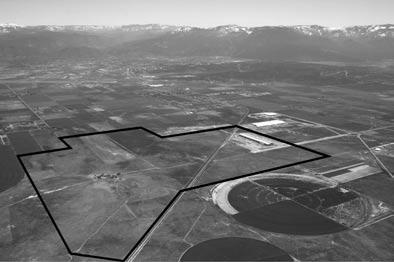
This aerial photo shows the 320-acre Cedar City Industrial Park and the new Cerro Copper facility. Cerro Copper has invested $50,000,000 in buildings and equipment. The plant will foster an estimated 120 jobs for Utahns. It is unlikely Cerro would have brought their operation to Utah if Cedar City, Iron County and the Trust Lands Administration had not joined together to create this opportunity.
In the past five years, more than 1,000 acres of Utah trust land have been dedicated to industrial park use. As of FY 2001, 115 acres have been sold; and millions of dollars have been invested in buildings and improvements in Utah communities. Hundreds of people are currently employed in facilities within these industrial parks. Over time, contributions to the property tax base will be tens of millions of dollars.
The Trust Lands Administration’s policies and practices for planning and development create opportunities for well-managed growth and economic development while building the assets of Utah’s schools and other trust beneficiaries.
West Desert Exchange
Much of Utah’s trust land is in isolated parcels, scattered across unpopulated areas of the state. As such, the economic potential of these parcels may be difficult to secure. The Trust Lands Administration works to exchange these pieces for real estate which has greater economic potential for the beneficiaries.
In Fiscal Year 2001, the state of Utah and the United States Bureau of Land Management exchanged more than 200,000 acres in western Utah. The BLM received more than 175 scattered state-owned school trust lands which have environmental, scenic and recreational values in exchange for 17 consolidated blocks of federal lands which have financial potential for Utah’s public schools.
This trade was the second largest land exchange in the history of Utah (the largest exchange was the Grand Staircase-Escalante National Monument trade which was completed in 1999). The West Desert Exchange was an exceptional transaction for the people of Utah — protecting sensitive lands while obtaining other federal lands that can be used to generate revenue for public schools.
The basic points of the transaction:
• The land exchange removed more than 175 scattered school trust land parcels from Wilderness Study Areas throughout the West Desert and consolidated them into 17 manageable blocks.
• The exchange resulted in no net gain of federal surface acreage in Utah. Utah’s school trust acquired approximately 107,000 acres of surface and mineral lands while giving up about 106,000 acres of surface and mineral lands to the federal government.
• The school trust lands traded to the federal government are, in many cases, special - including lands in the heart of the Deep Creek Mountains, the Notch Peak area, and other scenic western Utah areas. The BLM also received 480 acres of school trust lands for the Red Cliffs Desert Reserve just outside of St. George, protecting desert tortoise habitat and open space.
• School trust administrators selected tracts that can be more intensively managed for the benefit of Utah’s public schools and for local economies. In the few short months since the transaction, the newly acquired lands have generated revenues of more than $400,000. This revenue has come from grazing, the leasing of various minerals and the sale of some of the land to Brush Resources and Graymont Western, Inc. These companies, respectively, produce beryllium and limestone from mines in Juab and Millard Counties which are now in private ownership.
An Update: The Grand Staircase - Escalante Exchange of 1999
Another big land exchange worth revisiting is the Grand StaircaseEscalante National Monument trade. That exchange was finalized early in 1999. At that time, the transaction brought an immediate $50,000,000 cash to the Trust! But that was just the beginning. The ongoing financial benefits are starting to materialize. Since the trade was completed, the lands have produced another $10,000,000 — much of that in the last fiscal year. And, the acquired resources are just beginning to produce revenues. Within the next 24 months, the lands received in the Grand Staircase-Escalante Monument exchange should be producing $10,000,000 per year for the next 20 years, with residual revenues continuing for a century!
Conservation
The Trust Lands Administration cannot give away trust land or simply set it aside for non-trust purposes without compensation. However, some trust lands have unique scenic, recreational or environmental characteristics. In these situations, the Trust Lands Administration has endeavored to sell the land to buyers interested in protecting it for conservation purposes or to exchange the lands for other real estate more suitable for development.
Here is a summary of conservation activities since 1994 when the Trust Lands Administration was established.
• Sales to non-profit conservation groups - 2,480 acres
• Sales to the Utah Division of Wildlife Resources - 2,800 acres
• Conservation exchanges with the federal government :
• The Grand Staircase Exchange - 465,500 acres
• The West Desert Exchange - 106,000 acres
All of these sales and exchanges resulted in the trust beneficiaries (primarily the public schools) receiving at least fair-market value for their lands, while placing the lands in conservation ownership.
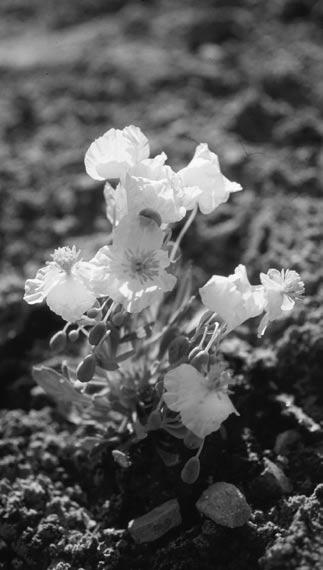
Courtesy: Mark A. Philbrick/BYU
The Dwarf Bearclaw Poppy in the St. George area, is listed as a threatened species under the United States Endangered Species Act. The exchange of trust property containing Bearclaw Poppies is a good example of how environmentally sensitive trust properties can be conserved while trust values are maintained for trust beneficiaries. In 1999, the Trust Lands Administration exchanged 200 acres of high-value poppy habitat to the United State Bureau of Land Management in order to protect and preserve the species. In return, the agency received federal acreage in St. George. The acquired land is now part of the new Hidden Valley master-planned community. Both the Bureau of Land Management and the Trust Lands Administration were successful in their respective obligations.
Photo
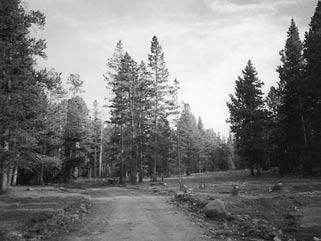
This photo shows a small portion of a pine forest in the 27,500-acre Tabby Mountain block. Managing for the health of this forest is one of many elements of the Tabby Mountain block management plan.
The Trust Lands Administration continues to seek exchanges with the federal government to trade trust lands which are suited for conservation and preservation for federal lands which are less environmentally sensitive — lands which can be used to provide greater financial return for the beneficiaries and to support local economic development in Utah.
Block Management Program
A look at a map of Utah trust lands shows about 7,500 parcels of trust land in the state. Most of those are one-mile square sections, scattered checkerboard-fashion across the state. But there are also 47 larger blocks of trust lands on the map. These range in size from 2,500 acres to more than 100,000 acres.
Because of their larger size, these blocks offer a greater range of management opportunities than most of the scattered parcels. In order to identify the specific prospects associated with each parcel, the agency established a Block Management Program during the past year. Block management planning includes creating a description of the current uses of the block, listing potential uses, determining stewardship needs and creating an implementation strategy.
Planning is now underway for two major blocks of trust land: the Tabby Mountain block which straddles the Wasatch-Duchesne County line in north central Utah, and the South LaSal block in northern San Juan County near the Colorado border. These plans will help the Trust Lands Administration determine the potential of these large blocks and ultimately improve the asset values for the beneficiaries. The agency is also undertaking planning activities on other large blocks.
Senior Staff
Kevin S. Carter
Acting Director
John W. Andrews General Counsel
Richard B. Wilcox
Acting Assistant Director/Surface
Ric McBrier
Assistant Director/Planning & Development
Tom Faddies
Assistant Director/Hard Rock & Industrial Minerals
LaVonne J. Garrison
Assistant Director/Oil & Gas
Lisa Y. Schneider Finance Director
Lynda Belnap
Administrative Assistant to the Director
Ron Carlson Audit Manager
Dave Hebertson Public Relations Manager
Board of Trustees
School and Institutional Trust Lands Administration
The Board of Trustees consists of seven members. One of the members serves at the pleasure of the Governor and remains on the Board for as long as the Governor wants. The other members are appointed for a six-year term each. Every year a new board member is appointed to replace the current board member whose term expires.
Prospective new Board members are selected yearly by a nominating committee. The committee sends the Governor the names of two or three prospective Board members. The Governor then selects one to be the new member.
The nominating committee has 11 members representing education, industry, and other public interests.
Chairman - Ruland J. Gill, Jr
Assistant Vice-President, Government Affairs, Questar Corporation
Legal background in oil and gas exploration and development
Bountiful, Utah
Term: expires 6/30/2004
Vice-Chair - Lonnie M. Bullard
President, Jacobsen Construction
Background in real estate financing and construction
Farmington, Utah
Term: expires 6/30/2003
Board Member - John A. Harja
Sr. Research Analyst, Governor’s Office of Planning and Budget
Background in natural resources law
Salt Lake City, Utah
Term: at pleasure of the Governor
Board Member - Louise Liston County Commission, Garfield County
Background in teaching school, public administration and ranching
Escalante, Utah
Term: expires 6/30/2001
Board Member - Robert P. Morris
President, Robert Morris and Associates
Background in commercial, industrial and municipal real estate development
Park City, Utah
Term: expires 6/30/2002
Board Member - John W. Creer
President, Farm Management Company
Background in agricultural management and law
Farmington, Utah
Term: expires 6/30/2005
Board Member - Vernal J. Mortensen
Retired, Senior Vice-president, Coastal Coal, Inc.
Background in coal mining and mineral valuation
Sandy, Utah
Term: expires 6/30/2006
Board Member Nominee - James J. Eardley
President, Dixie Transport, Inc.
Background in LP gas distribution, county government and banking
St. George, Utah
Term: expires 6/30/2007
Consolidated Balance Sheet
Fiscal Year 2001 (Prepared on a Modified Accrual Basis)
Contact Information
The State of Utah School & Institutional TRUST LANDS ADMINISTRATION
Main Office: 675 East 500 South, Suite 500
Salt Lake City, Utah 84102 801-538-5100, Fax 801-355-0922
Planning & Development Office: 675 East 500 South, Suite 390 Salt Lake City, Utah 84102 801-538-5178, Fax 801-328-9452
Central Area: 130 North Main Richfield, Utah 84701 435-896-6494, Fax 435-896-6158
Southwestern Area: 63 South 300 East, Suite 201 St. George, Utah 84790 435-652-2950, Fax 435-652-2952
Southeastern Area: 1165 South Highway 191, Suite 5 Moab, Utah 84532 435-259-3760, Fax 435-259-3755