

Pocket Gophers
There are two common species of pocket gophers in Utah: Northern pocket gophers (Thomomys talpoides) and the Botta’s pocket gopher (T. bottae). Northern pocket gophers prefer cooler climates and can be found in meadows and forested habitats. Botta’s pocket gophers live in a wider range of habitat, including deserts, grasslands, and agricultural areas. Usually, agricultural producers have conflicts with Botta’s pocket gophers.
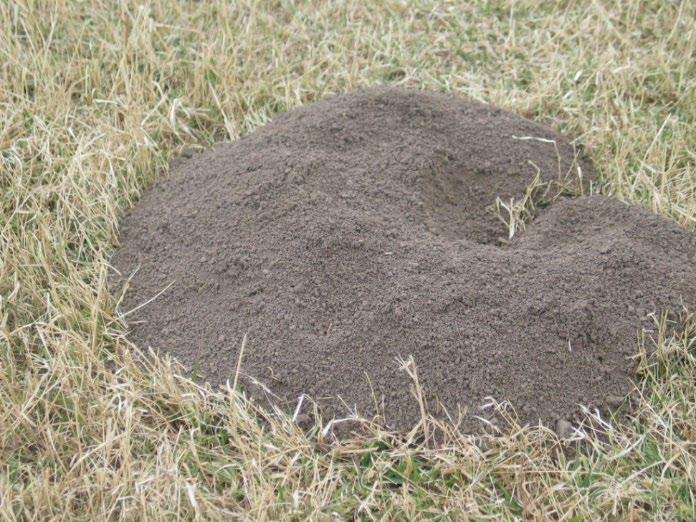
Pocket gophers are 7–10-inch (18–27 cm) fossorial (burrowing) rodents with external fur-lined pouches located on the outside of their mouths (Figure 1) They use their cheek pouches to carry food, hence the name “pocket” gopher. Their tails are approximately 2 inches (5 cm), and they appear to have no ears, because their ears are so small in relation to their body. Unlike ground squirrels, they are solitary animals that are rarely seen aboveground. Pocket gophers are best identified by the soil mounds they push up as evidence of their tunneling or burrowing activities (Figure 2). Mounds are fanshaped, and a soil plug seals the entrance. Gophers create mounds when they move excavated soil to the surface when tunneling.
Because pocket gophers are rarely seen and spend most of their time underground, fresh soil mounds are the best way to identify their presence. Pocket gophers have been responsible for damage to both agriculture and human development infrastructure. In agricultural fields, pocket gophers cause conflicts by directly consuming plants, destroying plants when their soil mounds cover them, and causing premature loss of field stands such as alfalfa, necessitating expensive alfalfa stand replacement. Gopher mounds can damage crop harvesting and mowing equipment (Messmer et al., 1990). Tunnels in irrigated fields can divert water, causing water loss. Pocket gophers can also cause various damage to human infrastructure such as biting

Mark Nelson, Nicki Frey, Ph.D., Earl Creech, Ph.D., Kalen Taylor, Jacob Hadfield, Linden Greenhalgh, Cory Farnsworth, Jody Gale, Melanie Heaton, Justin Clawson, and Steve Price
Figure 1. Pocket Gopher
Figure 2. Pocket Gopher Mound
through electrical, internet, and other utility cables, damaging irrigation pipes, and compromising the integrity of canals and ditch banks. For example, several solar farms in southern Utah have had their whole system shut down because of gopher damage to electrical lines Tunnels in earth banks, such as canal and ditch banks, and pond dams can weaken these structures resulting in water loss due to seepage or complete structural failure (Baldwin et al., 2016). Although pocket gophers can cause significant damage on Utah farms and ranches, they also can cause damage to lawns and gardens in urban areas (Figure 3). Frequently, this damage is greatest in new subdivisions or other areas where undeveloped tracts of land dominated by weeds occur.

Note. Notice holes in the grass, dead grass, and the large hole where a damaged tree was removed.
Biology and Behavior
Pocket gophers reach sexual maturity the following spring after they are born. In Utah, mating occurs in February and March. Males burrow underground to intercept a female burrow and encounter a female to mate. Gestation is typically 18 or 19 days, with 51 days being the maximum reported (Jones & Baxer, 2004) Females generally have only one litter a year, often born from March to June. In warmer climates females may have two or more litters, but this is uncommon in Utah. Each litter may consist of one to 13 young. Juvenile pocket gophers disperse from their maternal burrows in late August–October. During this time, increased pocket gopher activity is noticeable.
Pocket gophers eat only plant materials such as forbs, grasses, shrubs, and trees (herbivores). They eat roots exposed by their tunneling and aboveground vegetation. Alfalfa and dandelions roots are preferred foods for pocket gophers. In fact, research suggests that the density of pocket gophers in alfalfa is 6 times greater than in any other habitat type.
Figure 3. Pocket Gopher Damage in a Residential Backyard
Photo: N. Frey, USU Extension
Pocket gophers use their long powerful claws and teeth for digging their burrows. As with all rodents, their incisors grow continuously and require constant gnawing to wear them down to a manageable length. Soil, rocks, and other items loosened by digging are moved away with their hind feet and then pushed to the surface with their chest and forefeet.
Burrow systems consist of a main tunnel from 4 to 18 inches below the surface with several lateral tunnels branching off from the main tunnel Lateral tunnels end at the surface, creating a soil mound Pocket gophers usually construct one nest and several food cache chambers in deeper tunnels which branch off from the main tunnel. A nest chamber is also lined with vegetation. Nest chambers and food caches have been found as deep as 5 to 6 feet below the surface to avoid cold temperatures in the wintertime. Tunnel widths vary according to the size of the pocket gopher, but most average about 3 inches in diameter. Pocket gophers are active all year long.
A single pocket gopher may construct as many as 300 soil mounds a year while moving over 4 tons of soil. A burrow system is typically multi-branched. During the breeding season, a male’s burrow may be more linear since its sole purpose is to intercept a female’s burrow. Burrows continually change, with old tunnels being sealed off and new ones excavated. A single tunnel system may consist of as much as 200 yards of tunnels. Generally, the poorer the habitat, the longer the tunnels must be to meet food needs. Pocket gophers are highly territorial and will vigorously defend their tunnels from intruders. There is typically one pocket gopher per tunnel system unless the female has a litter, or it is the mating season.
Control
Understanding pocket gopher habits, especially the burrow system, is the key to effective control. Management methods include trapping, hand or mechanical baiting (Figure 4), fumigation, combustion, and cultivation/habitat modification. For the most effective control, use a combination of methods. The timing of management can also influence its success. For example, pocket gophers are most active in spring and autumn, thus lethal control is often the most efficient at this time. In heavy infestations, drag or harrow the field to eliminate mounds of soil and identify active burrows.
Identifying Damage
Because pocket gophers spend most of their time underground, fresh soil mounds are the best way to identify their presence. Pocket gophers have been responsible for damaging underground utility cables and irrigation pipes (Figure 4), destroying plants with their soil mounds, and causing changes in plant species composition when the soil mounds create an opportunity for weed seeds to germinate.

Gophers damage trees when stems are girdled and clipped, and roots are pruned and exposed due to tunneling. Gopher mounds damage mowing equipment. Also, soil brought to the surface is easily eroded. Tunnels in irrigated fields can divert water, causing a loss of irrigation water. Tunnels in earth banks and dams can cause these structures to weaken, resulting in water loss due to seepage or the
Figure 4. Damage to Buried Utility Lines by Pocket Gophers.
Photo: M. Nelson, USU Extension
complete loss of the structure. Badgers’ burrowing activities as they pursue pocket gophers can also increase, causing even more damage if densities are high.
A survey of Utah alfalfa growers concluded that about 83% of alfalfa producers experience pocket gopher damage to their crop. Thus, pocket gophers may have the greatest economic impact on Utah alfalfa producers. Pocket gophers damage alfalfa hay by eating the plant’s tap roots, and then soil mounds will reduce plant vigor as they bury other plants.
Exclusion
Excluding pocket gophers can be very costly and is usually impractical for most farms and ranches where populations are high. However, underground barriers can be used effectively to protect valuable ornamental trees and shrubs around homes, gardens, and nurseries. A mesh (1/4–1/2 inch) fence, buried about 18 inches can effectively protect gardens, flower gardens, and plant nurseries. Zinc galvanized metal mesh will increase exclusion longevity but is not a permanent solution because it will eventually rust away. Plastic cylindrical netting placed underground and around the entire seedling can be used to help reduce damage to newly planted trees and shrubs. Take care to prevent eventual root girdling as the tree roots grow. For example, netting should be biodegradable such that as the tree roots grow, the netting is not a limiting factor in its growth.
Trapping
Trapping can be an extremely effective control method for small areas or light infestations (Figure 5; Nelson & Frey, 2016). It may not be practical or economical for large acreages or heavy infestations. Trapping can be done year-round whenever the gophers are active. Gophers are usually most active in the spring and fall. Trapping is also very effective for homeowners to use around their yards where other control methods would not be appropriate.
Locating the Main Tunnel
For trapping to be the most effective, you must locate the main tunnel of an active burrow system. Find active tunnels by locating a freshly made soil mound. If you cannot determine if the mound is fresh, can flatten all mounds and then return the next day to find any open mounds. These open mounds will be the active mounds. Use a metal probe or long screwdriver to probe the fan-shaped plug side of the mound to locate the main tunnel.
Trapping Steps

1. When the tunnel is found, the probe will easily drop down through the soil.
2. Using a shovel, dig down along the burrow approximately 8 inches from the open mound to expose the tunnel.
3. Once the tunnel is exposed with a shovel, place one trap into each end of the tunnel to catch the gopher coming from either direction.
4. Enhance trapping success by leaving the hole open to let in sunlight, which will attract the gopher to investigate the tunnel disruption. However, some research suggests gently resting a clod of grass over the hole.
Figure 5. Gopher Caught in a Gophinator Trap
Photo: M. Nelson, USU Extension
5. Using directions provided by the manufacturer, “set” (activate) the trap. Place traps in the tunnel with the pincers going in first.
6. Secure traps with wire or chain to reduce the chance of predators taking them away or an improperly trapped pocket gopher pulling them into the tunnel.
7. Place a small flag near the trap site to help relocate the traps.
It isn’t necessary to bait a gopher trap. If the traps have not been visited within a 48-hour period, then move the traps to a new location. After an animal is caught the traps can be removed and reset at another fresh soil mound. Remember: “Trapping is not a science; it is an art.”
The most common type of trap is a two-pronged pincher trap. The trap is triggered when the gopher pushes against a flat, vertical pan. Examples include the Gophinator™ (Figure 6), Macabee™, and Victor™ traps, although many suitable and similar traps are available on the market. One advantage of using a pincher-type trap is they are small and can be inserted into the gopher tunnel without having to dig a big hole in the mound. While we recommend pincher-style traps, the best trap is the one that you are successful using. The most successful trap may simply depend on soil type and pocket gopher body size.
Hand Baiting
Using grain mixed with a rodenticide, commonly called “bait,” has also been found to be a successful way to control pocket gophers lethally. However, care must be taken to use poison as manner outlined in the instructions and registered label. Many commercial grain baits are available on the market, with a wide variety available for sale on online sites. Not all of these are legal for use in the United States; before using any commercially available grain bait, check the label to ensure that it is legal for use in the United States and the state where you live.
To be effective, bait must be placed in the main burrow where gophers are active. Hand-held gopher-baiting equipment, consisting of a probe and a bait reservoir, can be purchased from most farm supply stores (Figure 7)
Baiting Steps


Illustration: M. Langenheim, USU Extension
1. After locating the main gopher tunnel (not the mound; see “Locating the Main Tunnel” in the Trapping section), slightly enlarge the opening by rotating the probe or inserting a rod or stick into the opening.
2. Using an approved measuring device, insert the bait through the opening and into the active burrow. Take care not to spill bait onto the ground because most pocket gopher bait is very
Figure 7. Using a Probe to Apply Bait to the Main Gopher Tunnel
Figure 6. Staked Gophinator Traps Set in a Gopher Mound
lethal to all mammals, including humans; proper application dictates that the bait must be below the ground.
3. Should some bait accidentally spill aboveground, remove all spilled bait immediately
4. Use the gopher bait applicator to probe for the gopher burrow and place a premeasured amount of bait in the burrow by turning or depressing a lever.
5. Do not place the bait at the mound but put it in the main tunnel in two or three locations between two mounds.
6. Gently cover the probe holes with rocks, soil clods, or any other material to exclude light and air. This prevents the gophers from burying the bait as they repair tunnel disturbance.
7. Make sure to prevent dirt from falling on the bait.
Bait application works best when soil is most; in Utah this usually means in the spring and late summer months or in fields that have recently been irrigated.
After placing bait, use a shovel or rake to knock down or level existing gopher mounds. This will make it easier to identify new gopher activity and repeat as necessary. Rodenticide bait rates vary depending on the product type, location of use, and application method. Check the product label for rates and always read, understand, and follow all label instructions.
Bait Options
Strychnine
Strychnine is the most common type of toxic bait used for controlling small gopher infestations in lawns and agricultural fields. It can only be used belowground (Figure 8). Strychnine baits are sold under many trade names and most contain 0.5 percent strychnine. Strychnine is a lethal poison and carries the “Danger” skull and crossbones labeling. It is very effective, but it is imperative to read, understand, and follow all manufacture label directions.
Strychnine is lethal in a single feeding. Strychnine accumulates in body tissues; therefore, if a pet or other animal ingests a gopher poisoned with strychnine, immediate death can result. Pick up and dispose of spilled bait according to label instructions
Zinc Phosphide

Figure 8. Treating Plots With Strychnine Gopher Bait Using a Probe
Photo: M. Nelson, USU Extension
Several zinc phosphide products are commercially available. Check labels to ensure you select a product suitable for your needs. Products that contain zinc phosphide are “restricted use products” and can only be applied by trained licensed applicators. These products are also only labeled for underground applications in rangeland, cropland, forest areas, parks, nurseries, lawns, golf courses, and around homes. Other zinc phosphide products can be used only on lawns, golf courses, and other non-crop areas. Like Strychnine, zinc phosphide products are lethal poisons carrying the “Danger” skull and crossbones labeling. Zinc phosphide is also lethal to all animals, including humans. Zinc phosphide products are very effective, but it is imperative to read, understand, and follow all manufacture label directions.
Anticoagulants
Anticoagulant baits are generally less effective than strychnine baits but are much less toxic, and therefore may be preferable for use in urban and suburban settings. Their lower toxicity makes them a better choice in areas where pets or other domestic animals might uncover the bait through digging. These products are multiple-feed baits, meaning that an animal must ingest the bait several times to consume a lethal dose. Because pocket gophers need to eat more of the bait, the application requires more bait than single-feed baits such as strychnine.
Anticoagulant baits approved for use to control pocket gophers contain diphacinone (e.g., Kaput D™, Gopher Whacker™, and Answer™) or chlorophacinone (e.g., Rozol™). Diphacinone bait products can be used only on lawns, golf courses, rangeland, and other non-crop areas.
Mechanical Control
Burrow Builders
Mechanical burrow “builders” are an effective, time-saving method of baiting in large areas with significant numbers of gophers. Burrow builders can be connected to a three-point tractor hitch (Figure 9) With this system, a tube or “torpedo” and colter cuts the soil and makes artificial burrows, a seeder or granular applicator then dispenses bait labeled for underground use into the artificial burrow at specific intervals, and a packer wheel closes the furrow. Gophers will explore the new burrows, increasing their exposure to and potential for bait consumption.
• Before using a burrow builder, dig around fresh gopher mounds to determine the depth of the main tunnels and the soil conditions in the field. The burrow builder must be set at the same depth and perpendicular to existing burrows.
• Artificial burrows should be installed in a grid fashion 20 to 30 feet apart.
• Soil moisture must be adequate so the soil will hold the burrows and not collapse

• When crossing uninfested areas, raise the shank to avoid making burrows where they are not needed. Gophers, especially juveniles leaving their parent’s burrow networks, will travel across the ground and invade a previously uninfested area to explore artificial burrows.
• When applying bait, check frequently to ensure that tunnels are developing properly and that the bait dispenser is working properly.
Strychnine is the most common type of bait used with burrow builders. Rozol Pocket Gopher BaitBurrow Builder Formula (chlorophacinone) is also approved for use on alfalfa and rangeland, in orchards and groves, and non-crop areas. It is a restricted use pesticide, requiring a pesticide applicator license to purchase and apply. Apply this product when soil conditions allow formation of good artificial burrows. Always read, understand, and follow label instructions when applying any bait. Be sure to pick up spilled bait and dispose of it according to label instructions. Remember:
• Baiting artificial burrows will not prevent gopher infestations.
• Use the machine only where gophers are present.
Figure 9. Burrow Builder Used to Apply Bait Into an Artificial Burrow
• Treat the perimeters of fields to delay reinvasion.
• Using a burrow builder requires significant knowledge. Consult the manufacturer or a knowledgeable person about proper use.
Fumigation
Aluminum Phosphide
Fumigation with lethal gases, such as aluminum phosphide and carbon monoxide, can be a costeffective method of gopher control. Machines are available that make and distribute gases throughout the burrow system. Like strychnine and zinc phosphide baits, aluminum phosphide gas is a lethal poison carrying the “Danger” skull and crossbones labeling. Products that contain aluminum phosphide are restricted use products and can only be purchased and applied by trained, licensed applicators. Aluminum phosphide emits an odor, but it does not seem to alarm gophers. It is very effective, but it is imperative to read, understand, and follow all manufacture label directions. Each of these lethal gases are lethal to all animals, including humans; therefore, fumigation should not be a consideration in areas where any pets, livestock, or people may inhale the gas.
Carbon Monoxide
Carbon monoxide-producing devices do not require a pesticide applicator license to purchase and use. Carbon monoxide is odorless, but the methods used to produce it sometimes give off odors. Nonetheless, these odors do not seem to alert gophers to danger, so they do not attempt to seal holes in the tunnel or try to escape.
Gas Cartridges
Gas cartridges may also be used to suffocate the burrow system. These are smaller, handheld cartridges that are lit and inserted into a pocket gopher burrow. Several types of gas cartridges are commercially available but are often costly and time-consuming to use and give varying results. Because gopher tunnels are extensive, gas may not disperse through the entire system. Additionally, because the gas is not forced into the burrow, but passively moves through the tunnel, pocket gophers may have time to block the burrow to prevent gas from penetrating through the entire system. Because of their higher cost and inconsistent effectiveness, gas cartridges are not recommended.
Gopher General

The Gopher General is a new machine (at the time of this publication) produced in Canada that meters a slow-release fumigant (aluminum phosphide) into an artificial tunnel (Figure 10) The fumigant gas released stays belowground and spreads throughout the tunnel and moves through the soil. As the gopher moves through its tunnel system checking its territory, it succumbs to the fumigant. While we do not endorse any one fumigant product, we present this information for educational purposes, as other similar products may become available.
Figure 10. Gopher General-Used to Apply Aluminum Phosphide Into an Artificial Tunnel
The Gopher General works in the following way.
• The fumigant pellet product is placed into an enclosed hopper at the start of treating a field. The operator must be careful to limit exposure to the fumigant when it is placed into or removed from the hopper.
• It is critical for applicators to wear all personal protective equipment (PPE) per label instructions to reduce exposure.
• While the fumigant is designed to work underground, the fumigant product will continue to release gas if left in the product hopper
• To remove the fumigant at the end of the application, the hopper inverts, emptying the remaining pellets (into a property designated storage bin).
Carbon M onoxide P roducing M achines
Carbon monoxide devices generate carbon monoxide and force the gas through tubes placed into the burrow; these fill the burrow system and asphyxiate the pocket gopher. These devices currently include the Pressurized Exhaust Rodent Controller (PERC) Machine (Figure 11), BurrowRx, and Cheetah Rodent Controller; however, similar devices may enter the market in the future.
Research has shown that the PERC machine can be moderately effective at managing pocket gopher populations. (R. Baldwin, unpublished research). Its efficacy increases in moist soil conditions. Some of these devices are more suited for urban applications and some for larger scale production agriculture.
Combustion
A mixture of propane (or other explosive gas) and oxygen can be effective in controlling pocket gophers. One machine commercially available to control pocket gophers in agricultural settings is the Rodinator™ (Figure 12). Using a special machine, these gases combine and are forced into the burrow system and ignited. The combustion kills the gopher and collapses the burrow. Collapsing the burrow or a portion of the burrow reduces the chance that another gopher will reinhabit the burrow system. The explosive gas is used in a very low concentration relative to the oxygen mix, but gophers do seem to avoid the gas mixture due to the odor. Using combustion for gopher control can be hazardous to the applicator and the burrow network can extend under buildings and other structures. Application must be done with extreme caution.


Figure 11. PERC Machine Used to Apply Carbon Monoxide Into Gopher Tunnel
Figure 12. Rodinator Used to Combust and Collapse Gopher Tunnels
Cultivation and Crop Rotation
Tilling, disking, and plowing can inhibit gopher activity. Cultivation destroys shallow burrows and mounds and may drive gophers to other locations. Gophers protected in deep burrows can quickly build new shallow burrow networks. Rotating alfalfa to small grains is only a partially effective control measure. Small grains have small, fibrous root systems that do not sustain gophers as well as fleshy, tap-rooted vegetation such as alfalfa.
Predators
Predators that feed on gophers include owls (Tytonidae and Strigidae), hawks (Accipitradae), badgers (Taxidea taxus), coyotes (Canis latrans), foxes (Vulpes vulpes, Vulpes macrotis, Urocyon cinereoargenteus), bobcats (Lynx rufus), skunks (Mephitis mephitis), weasels (Neogale frenata), bull snakes (Pituophis catenifer sayi), and rattlesnakes (Crotalus oreganus lutosus). However, these predators do not effectively control large populations. Installing perches and preserving habitat for these respective predators is helpful and a best management practice
Continuing Management
Once you have controlled the pocket gophers, monitor the area regularly for reinfestation. Level all existing mounds after the control program and clean away weeds and debris so you can easily see fresh mounds. It is important to check regularly for reinfestation because pocket gophers can move in from other areas and damage can reoccur in a short time. If your property borders farmland or vacant land, you can expect gophers to reinvade regularly.
Image Credit
All images were provided by authors or as indicated.
References
Baldwin, R. A., Chapman, A., Kofron, C. P., Meinerz, R., Orloff, S. B., &, Quinn, N (2015) Refinement of a trapping method increases its utility for pocket gopher management. Crop Protection, 77, 176–180
Gunn, D., Hirnyck, R., Shewmaker, G., Takatori, S., & Ellis, L. (2011) Meadow voles and pocket gophers: Management in lawns, gardens, and cropland [Fact sheet]. University of Idaho Extension. https://www.lib.uidaho.edu/digital/uiext/items/uiext25858.html.
Jones, C. A., & Baxter, C. N. (2004). Thomomys bottae. Mammalian Species, 742, 1–14. doi:10.1644/742
Knight, J. E. (2000) Guide to pocket gopher control in Montana. Montana Cooperative Extension. https://animalrangeextension.montana.edu/range/wildlife-habitat/guide-pocket-gopher.html
Messmer, T A. 1998 Pocket Gophers. Utah State University Extension, paper 1024. https://digitalcommons.usu.edu/extension_histall/1024
Nelson, R. M., & Frey, S. N. (2016) Comparison of three traps used for pocket gopher (Thomomys bottae) management in alfalfa fields [Fact sheet]. Utah State University Extension. https://digitalcommons.usu.edu/extension_curall/1591/
In its programs and activities, including in admissions and employment, Utah State University does not discriminate or tolerate discrimination, including harassment, based on race, color, religion, sex, national origin, age, genetic information, sexual orientation, gender identity or expression, disability, status as a protected veteran, or any other status protected by University policy, Title IX, or any other federal, state, or local law. Utah State University is an equal opportunity employer and does not discriminate or tolerate discrimination including harassment in employment including in hiring, promotion, transfer, or termination based on race, color, religion, sex, national origin, age, genetic information, sexual orientation, gender identity or expression, disability, status as a protected veteran, or any other status protected by University policy or any other federal, state, or local law. Utah State University does not discriminate in its housing offerings and will treat all persons fairly and equally without regard to race, color, religion, sex, familial status, disability, national origin, source of income, sexual orientation, or gender identity. Additionally, the University endeavors to provide reasonable accommodations when necessary and to ensure equal access to qualified persons with disabilities. The following office has been designated to handle inquiries regarding the application of Title IX and its implementing regulations and/or USU’s non-discrimination policies: The Office of Equity in Distance Education, Room 400, Logan, Utah, titleix@usu.edu, 435-797-1266. For further information regarding non-discrimination, please visit equity.usu.edu, or contact: U.S. Department of Education, Office of Assistant Secretary for Civil Rights, 800-421-3481, ocr@ed.gov or U.S. Department of Education, Denver Regional Office, 303-844-5695 ocr.denver@ed.gov. Issued in furtherance of Cooperative Extension work, acts of May 8 and June 30, 1914, in cooperation with the U.S. Department of Agriculture, Kenneth L. White, Vice President for Extension and Agriculture, Utah State University.
July 2024
Utah State University Extension