
2022 SYMPOSIUM
February 17, 18, & 19
| Sheraton Crown Center | Kansas City, Missouri
For the 40th year, the Midwest Symposium for Leadership in Behavior Disorders will address cuttingedge issues of interest to professionals working with students with emotional/behavioral disorders and autism spectrum disorders.
KEYNOTE
Friday February 18
8:30-10:00 AM
Four Short TED Talk-like Keynote Speeches
Great Educators at Work: What Does it Take to Make the Grade as a Teacher of
with EBD?


Students

• Traits and temperaments successful educators bring to the table
• Educator beliefs and behaviors that set the stage for success
• Educator skill sets that are most important to develop and hone
• Training and experiences that have the power to expand an educator’s repertoire
Four professionals from the field will address these and other topics during this TED Talk-like session. Come learn from professionals who will share insights about supporting students with significant behavioral needs.
BY JANUARY 21 FOR DISCOUNTED REGISTRATION Register early for preferred workshops No Walk-In Registrations

SYMPOSIUM AT-A-GLANCE
Thursday, February 17
7:30 a.m.
Conference Desk Opens
9:00 a.m.-12:00 p.m. Pre-symposium Workshops
11:30 a.m.-5:00 p.m. Exhibits
12:00 p.m.-1:30 p.m. Lunch (on your own)
1:30 p.m.-4:30 p.m. Pre-symposium Workshops
Friday, February 18
7:30 a.m. Conference Desk Opens
8:00 a.m.-5:00 p.m. Exhibits
8:30 a.m.-10:00 a.m. Keynote Session
10:20 a.m.-11:20 a.m. Concurrent Sessions, Set I
11:30 a.m.-12:30 p.m. Concurrent Sessions, Set II
12:30 p.m.-2:00 p.m. Lunch (on your own)
2:00 p.m.-3:00 p.m. Concurrent Sessions, Set III
3:15 p.m.-4:15 p.m. Concurrent Sessions, Set IV
4:15 p.m.-6:00 p.m. Poster Session and Anniversay Celebration Cash Bar and Complimentary Hors d’oeuvres
8:00 p.m.-11:00 p.m. Symposium Party
Saturday, February 19
8:00 a.m. Conference Desk Opens
9:00 a.m.-11:30 a.m. Saturday Concurrent Sessions 11:45 a.m. Adjournment
Dr. Kaye Otten Dr. Kathleen Zimmerman Joe & Dee Valenti Dr. Rikesha L. Fry Brown
Editorial
Reesha M. Adamson
Mary Jo Anderson
Jennifer Bossow
Mary Davis
Scott M. Fluke
Nicolette Grasley-Boy
Deborah E. Griswold
Mike Hymer
Maria L. Manning
Sharon A. Maroney
John W. McKenna
Mike Paget
Reece L. Peterson
Lisa A. Robbins
Carl R. Smith
Ryan C. Speelman
Jim Teagarden
Vanessa Tucker Graphic
Vivian Strand

Rethinking Behavior, ISSN 2578-5397, a magazine for professionals serving children and youth with behavioral needs, is published three times per year, fall, winter, and spring, Copyright ©2022 by the Midwest Symposium for Leadership in Behavior Disorders, P.O. Box 202, Hickman, NE 68372. 402-7923057. www.mslbd.org. Email: rethinkingbehavior@mslbd.org.
Rethinking Behavior welcomes proposal and manuscript submissions; for information visit www.mslbd.org or email rethinkingbehavior@mslbd.org
Our Past, Our Present, Our Future

Introducing Innovators
In this issue, ReThinking Behavior is adding a new column, Innovators. This column will be a “celebration” of individuals acknowledged as innovators in working with students who experience emotional, behavioral, or mental health disorders, or autism. We will try to explain some of the contributions to the field which each of these innovators has made, provide a bit about their careers and some reasons why those of us in the field should know about them. Some have passed away,
but others continue to contribute to our field. As one of the editors of this issue, it gives me great joy to introduce my mentor, the first of our Innovators, Dr. Mary Margaret (Peggy) Wood. She continues to work at the Developmental Therapy Institute in Athens, Georgia.
Wrapping up my undergraduate psychology degree, I had no clear idea of what I wanted to do for the rest of my life, so I decided to sample some possibilities
by volunteering in a couple of social justice-oriented settings in my then hometown of Athens, GA. My strongest instincts were to do something helping someone. Social work? Psychology? Clinical theology?
One of my volunteer opportunities was to be a “big brother” to Joey. This stocky little 12-year-old boy was a student at a very interesting school, the Rutland Center (led by Wood). Joey was easy to hang out with one-on-one as I tried to provide some fun moments and life guidance for him in a big-brother sort of relationship. I wasn’t privy to much information about Joey, but I knew there were challenges in his family, and that he struggled in school, and that the school struggled with him.
I’m not sure what difference I made in Joey’s life but spending time with him set me on the course of my career. Here was a quirky little kid going to a very special school full of quirky students, staffed by a fair number of quirky teachers. I liked what I saw, and more importantly, what I felt in my moments with Joey, his school, and his teachers. “How can I get a job at the Rutland Center?” I asked. My application to grad school in special education was quickly submitted. I set out on the path of getting a M.ED. in the “education of the emotionally disturbed.”
When I became a teacher-therapist at the Rutland Center, I had no idea that I had come into the life-space of one of the true giants in the field of working with children who experienced emotional/ behavioral/mental health disorders. How incredibly fortunate I was to be working under the guidance, instruction, and inspiration of Dr. Mary Margaret “Peggy” Wood!
I learned some essential principles and practices under Wood’s guidance that have shaped my work with students. In the model that she created, Developmental Therapy, I was taught to systematically assess where a student was socially, emotionally, behaviorally, and cognitively. Instead of looking at chronological age, I learned to look at developmental stages of growth. I learned to teach
social, emotional, behavioral, and academic skills through engaging activities. My lesson plans had to be shaped with these skills and goals in mind, so classroom planning was determined by targeting important developmental milestones for each of my students. In addition to classroom activities, I learned about the importance of ensuring a safe predictable relationship with students who had experienced significant relationship disruption in their lives. Part of my clinical relationship work was to provide individual Life Space Crisis Interventions for students who reached crisis moments; they needed careful guidance through periods of crisis, often reflecting a deep interpersonal need for growth.
I learned that my job was not to make students behave. Rather, it was to help them make developmental progress so that their skills would prepare them to manage their own behaviors. And I learned that I needed a respectful working relationship with the students’ parents and families. These are just a few of the guiding principles that I was immersed in while under Wood’s leadership. In addition to all the other influences in my life that have informed my work with students, how fortunate I have been in that every single interaction with students has the inspiration and understanding I’ve gained from Dr. Wood. Thank you, Peggy.
I invite you to enjoy reading about Dr. Wood, pages 4 and 5, and perhaps listening to her MSLBD keynote address (1988) and her JANUS Project interview.
Mike Paget, Issue Editor
Reflect on your mentors and how they have influenced you. Send us your mentor’s names and your comments. In an upcoming issue we may share them.
Mary Margaret Wood Developmental Therapy
Wood began her educational career in the 1950s teaching in inner city Baltimore. After moving to Athens, Georgia where she taught first grade, she was asked to take a position in a new class with just eight middle school students all with severe emotional and behavioral disorders (EBD). She later became a demonstration teacher at the University of Georgia and established the first teacher-training program for EBD in Georgia. The

program required practicum and internships in what was then the largest mental hospital in the world at that time. Along the way she earned master’s and doctorate degrees at the University of Georgia.
With the advent of deinstitutionalization in the 1960s, Wood obtained funding to provide state-wide multidisciplinary efforts to develop individual treatment plans and interventions based on milestones of healthy personality
We introduce our Innovator section with Dr. Mary Margaret (Peggy) Wood, best known for developing Developmental Therapy (DT), a comprehensive psycho-educational program that integrates special education and mental health interventions for children with severe emotional and behavioral disorders. DT includes comprehensive assessment of behavior, communication, social, and cognitive domains to design and individualized interventions to facilitate healthy personality grown. Developmental Therapy Teaching (DTT) is a curriculum that matches intervention objectives and instructional practices with individual children’s developmental status and needs.
development. DT has its roots in those early efforts while drawing on the research and practice of earlier developmentally oriented theorists and practitioners Maria Montessori, Jean Piaget, Anna Freud, Lawrence Kohlberg, Jane Loevinger, and Fritz Redl, among others. Along the way, Wood studied with contemporary pioneer special educators including Nicholas Long at American University and William Morse at the University of Michigan. She drew on their psychoeducational perspectives and approaches (e.g., therapeutic milieu, Life Space Intervention) and included them in DTT.
Wood also established a demonstration center, called the Rutland Academy, and the Developmental Therapy Institute to provide professional development, coaching, and
resources to teachers, therapists, childcare staff, and parents across the US and internationally. Wood continues to be active in her Developmental Therapy Institute which offers training and consultation in assessment, social/emotional/ educational interventions and programming across the U.S. and internationally.
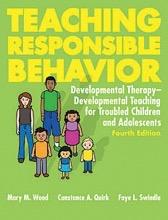
Dr. Wood was the fourth recipient of MSLBD’s Leadership Award in 1989. Her MSLBD 1988 keynote address and
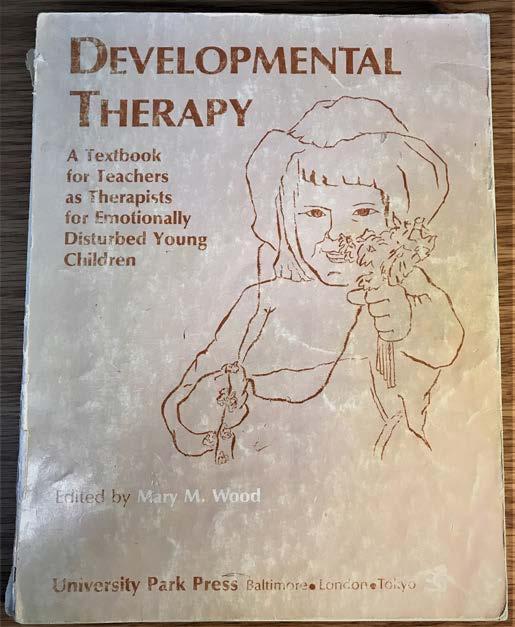
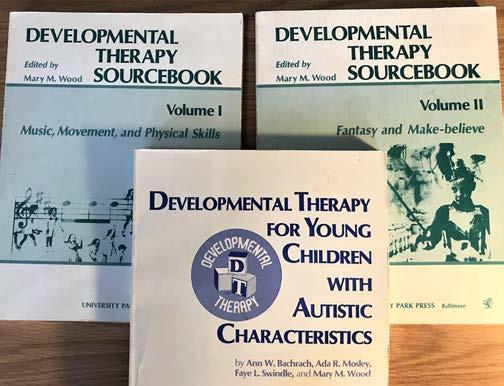
interview with the Janus Oral History Project are available. The transcript of her JANUS interview has also been published: Teagarden, J. M., Kaff, M. S., & Zabel, R. H. (2013). Rediscovering the art of Developmental Therapy: An interview with Mary M. Wood, Intervention in School and Clinic, 48(4), 254-261.
Wood’s Developmental Therapy was the first curriculum I found that presented a developmental approach to teaching social, emotional, and behavioral skills. When I began teaching students with EBD forty years ago, there were very few curriculum resources. Many of us struggled to develop our own behavioral curriculum. Wood’s DT helped me determine which skills to assess and teach my students at different ages. It’s not surprising to me that DT continues a valuable resource for educators today.
– Sharon A. Maroney
CELEBRATING 40 YEARS
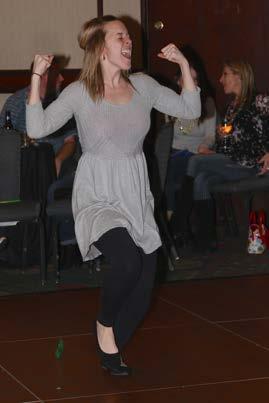
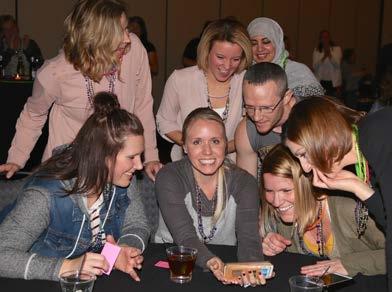
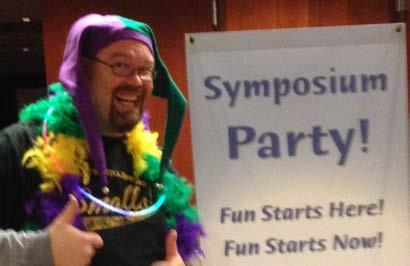
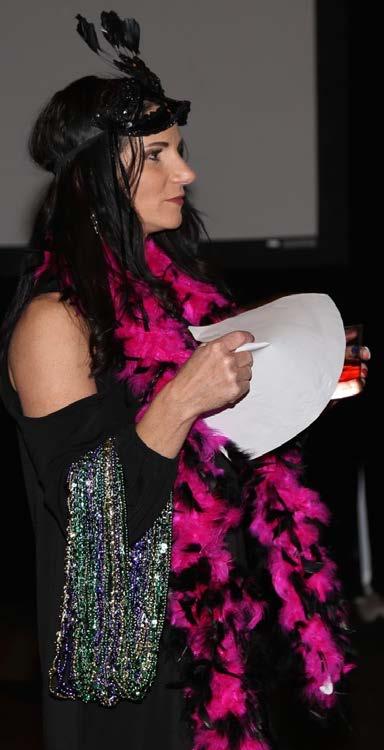
Fun, Parties, Dances, & More!
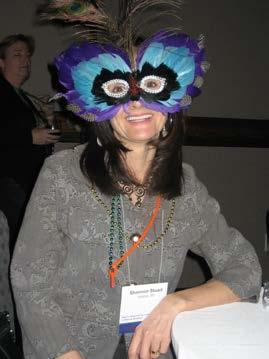
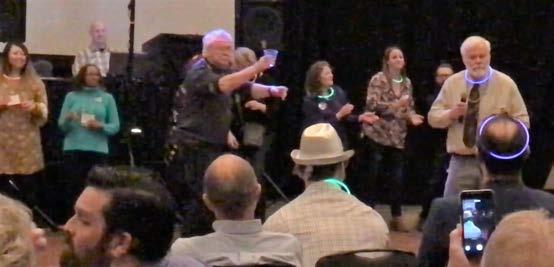
From its beginning, MSLBD has included social events in all of its activities. After all, one of the four primary goals of MSLBD activities is “To build professional contacts and collegiality across roles and disciplines and to permit people to interact and get to know each other, and to develop relationships”!
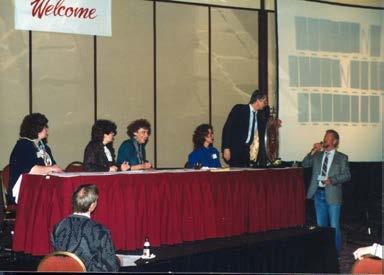
In the first two years, the Planning Committee gathered for dinner at a nearby restaurant, and that morphed in the next few years (1988-1989) to gathering at a Blues bar –Harling’s Upstairs (Westport & Main) for refreshments and Kansas City Blues. Along with that came a Friday afternoon cash bar- often with various “games.” In 1988 it was the “BD Olympics”, in 1989 “Wheel of Misfortune”, in 1990 “Behavioral Feud”, in 1993 “Zen and the Art of Dealing with EBD Stress”; and 1993 “Deviance Draw.”
Bottom line is that MSLBD participants are professionals who know how to take care of themselves, relieve their stress, and have fun!
Midwest Symposium for Leadership in Behavior Disorders

In 1994, Mark Goor and David Bateman (then at Emporia State University, Kansas) and Mary Beth Noll (St. Cloud State University, Minnesota) developed a “Disorder-Gories” game played during the late afternoon cash bar.
Later that night all were invited to a Friday Night Social –spinning favorite disks. In 1995 the theme was “Jeopardy–E/BD Style.” Then later Karaoke and Dancing with Bobby Eddy. According to the program “be there or be square”! Come see your respected colleagues in a “new light”! In 1996 it was listening and dancing with Kansas City’s own Blues band, “Linda Shell and the Blues Thang.”
At the 1997 Friday evening social we had “The Crime Doctors,” a psychedelic blues band comprised primarily of lawyers from the Wichita area. They promised to entertain, keep you dancing – and not to play “Feelings”, “Tie a Yellow Ribbon,” or “the Macarena”!
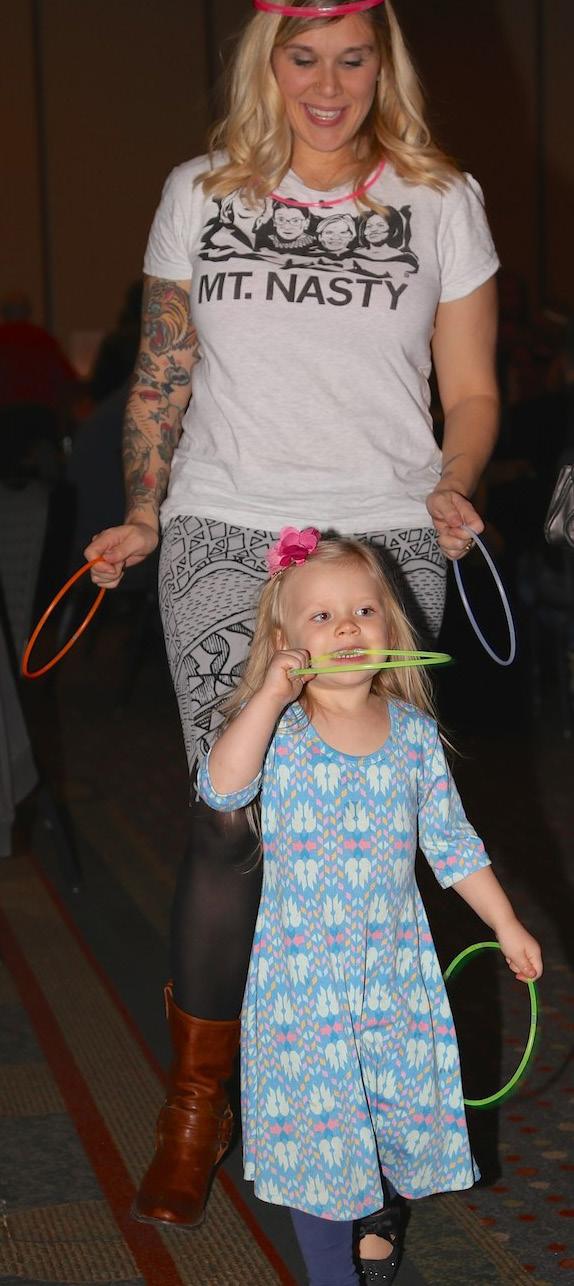
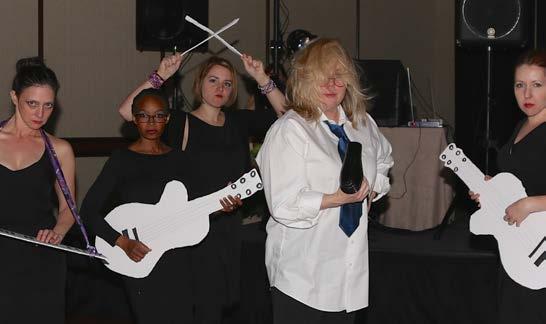
More recently the Friday evening party has had a cash bar, a Disc Jockey, and dancing. Snack food and a complimentary beverage ticket is provided. Typically, there is Karaoke and a talent show with lots of prizes.









Who Are the MSLBD Master Teachers?
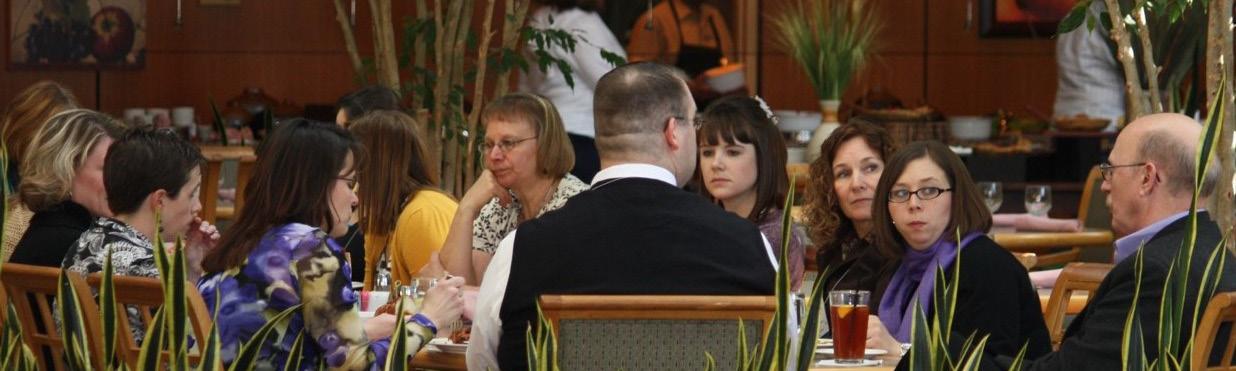
The MSLBD Master Teachers are a group of experienced professional educators committed to bridging the “research to practice gap” by promoting the use of evidence-based practices in their work directly with students who exhibit behavioral challenges in school. Founded in 2006, the Master Teachers work to:
• provide expertise, leadership, and support for improving services for students with and at risk for emotional, social, and behavioral challenges;
• provide support, professional development, and networking opportunities to teachers who often experience high levels of isolation and burnout; and
• provide quality, research grounded information tailored specifically to the needs of teachers who work with at-risk students.
One of the major activities of the Master Teachers has been providing a strand of practical, what-to-do-on-Monday breakout presentations at the annual symposium and contributing tips and tools to help educators in their daily practice. Beyond the strand sessions, members have also submitted other breakout sessions on a variety of topics including: implementing appropriate behavior intervention strategies, repairing harm after a behavior situation has escalated, tracking behavior through basic and advanced data collection, getting students back on track
with behavior modifications, forming relationships with struggling students, and working effectively with paraprofessionals. This group hopes to also create a website with links to resources and provide a social media presence around these topics.
Membership in Master Teachers each year has ranged from around 9 to 18 educators. Over the 15 years of the project, 36 different individuals have participated from 1 to 15 years each with an average of 5 years. Members have been mostly from Iowa, Kansas, Missouri, and Nebraska, although there is no geographical limit, representing roles as specialized classroom teachers, student support specialists, behavior consultants, and behavior analysists, among others. Some members have gone on to complete doctoral degrees and some now teach at the college level. A list and brief bios of the current Master Teachers are available on the MSLBD website. The group typically holds an annual inperson meeting to work on projects, but communicates regularly throughout the year to plan presentations and support each other’s work. Educators interested in becoming a part of the group are invited to apply!
Educational Failure –Who is to Blame?
MSLBD Keynote Presentation 1986
Is it possible for a special education teacher to ignore widely accepted research about effective methods for educating and remediating students with behavioral needs? Is it possible for teachers to intentionally employ harsh punitive practices and other ineffective measures as a part of a classroom for students with emotional disorders, and to have those methods be included in students’ IEPs? Can educators be held accountable for not providing successful treatment? Is there a standard of care in education, equivalent to a standard of care in medicine? If so, would serious violations of those standards constitute educational malpractice with the teacher held accountable?
Symposium for Leadership in Behavior Disorders
heard several witnesses testify (Tim Rawlings parent, special education teacher, principal, etc.). The audience served as the jury. The audience was randomly divided into 12 juries -each “sequestered” in breakout rooms to deliberate on the case and return with their verdicts.
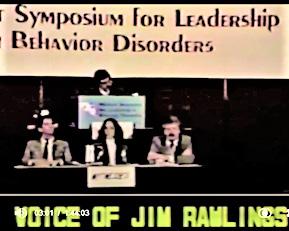
Those questions were to focus of the keynote presentation at the MSLBD Symposium in February 1986: The Case of Tim Rawlings. Parents had sued for $900,000 damages for malpractice. A judge (Carl Smith), prosecuting attorney (Reece Peterson), and defense attorney (Rich Simpson)

This unique format attracted interest across the country. The session was invited to other conferences – the “Adolescents with Behavior Disorders” in Minneapolis (September 1986), the Conference on Children and Adolescents in Conflict, Teachers College Columbia University, New York City (October, 1986), and the Colorado Department of Education Conference on Quality Programming, Denver (March, 1987).
View the video to find out the results of this courtroom drama (While the video is dark, the audio is clear).
If a similar case were held today, what do you think the juries would decide?
Words Matter
By Any Child, Any Teacher, Any Parent in the US
Author anonymous upon request
I’ve learned that people will forget what you said, people will forget what you did, but people will never forget how you made them feel.
- Maya Angelou
Art
As teachers, our words can make or break our students. When I was asked to write this article, I asked myself what I wanted to accomplish. My goal is to educate teachers on why our words matter. I say “our” because I, too, am a teacher. I know how fragile middle schoolers can be, including my 8th grader. In this article, my daughter first shares her story about an incident with a teacher while in middle school that shows how detrimental words can be. Then I share my perspective and reflections on the incident, what I’ve learned, and 11 things that matter.
Note: Pseudonyms are used to protect the privacy of everyone involved.
The Context and Perspective by Kim
African American female, 8th grade,13 years old
It started as a normal day. I woke up to go to my classes. Everything was going fine. Nothing was happening in Advisory and I was pretty tired during science. Math class went along and I thought it was going to be another normal day online. In math, I took the unit practice test and I didn’t do so great on it, but I tried to shake it off and focus on what Ms. Jones was talking about. The day went on like usual, then after history class, it was lunchtime. A couple of minutes after my history class ended, my mom called.
She seemed panicked and anxious, and it kind of startled me a little bit. It started to freak me out and worry me. She said she ran into my math teacher in the hallway, and they started talking. My mom told me that she was thinking about taking me out of Algebra I and putting me back into Pre-Algebra because she didn’t want it to be too much work, or it to be too hard. It freaked me out because I knew I didn’t do so well when I took the practice test, but I still thought I could make it in the class. It also hurt my feelings that my mom didn’t think I could improve in a difficult class and still stay in there. I told her that I could do it, if I just got help from one of my old math tutors I should be fine, and that I didn’t
want to go back to Pre-Algebra. She calmed down and changed her mind by the end of the phone call, but I was still shaken up. She told me to go to the help session Ms. Jones had after school. I said okay and tried not to think about it. I went to the rest of my classes after lunch was over.
After all my classes were over that morning, I just stared at the join meeting button for the math tutoring Google Meet. I was procrastinating because I didn’t want to be at the meeting because I didn’t need help. I understood the lesson she talked about earlier today. I still joined the meeting because my mom told me to. As soon as I got in the meeting, I didn’t want to be there. Ms. Jones mentioned that she and my mom were thinking about switching me back to Pre-Algebra. I didn’t say anything. Nothing was in my head. She continued to say that she thinks I’d do better in Pre-Algebra and that it would be hard for me to make a C or B in her class. As soon as she said that, my stomach dropped. She said something else, but I wasn’t paying attention. My heart started to hurt and it was getting hard to breathe, but I refused to cry in front of my math teacher.
Before I left the tutoring session, I told Ms. Jones that I talked to my mom during lunch and she said she was going to keep me in Algebra I. To me, she seemed shocked and a little bit confused. She paused for a minute and she said she did see an email from my mom that says I’ll stay in Algebra I. She told me that she thinks I will do fine, but it might still be difficult for me. At this point, I couldn’t think about anything. I just wanted to hang up. I felt terrible.
Before my mom called me, I felt like I was doing okay even though I didn’t do great on my last test. I felt like I could get better and improve. Before I started going to this school, I thought I had okay self-esteem, but it took a while to get to that level because I felt like my dyslexia made me insecure, and I wasn’t that confident. When my mom called, my confidence was hurt a little bit, but now, after listening to Ms. Jones, my confidence was shattered.
I ended up just nodding and shaking my head for the rest of the time I was on the Google meeting not fully listening to the teacher and just trying to not cry. The only thing that was repeating in my head was “it will be hard for you to get a C or B in my class.” Her words started to freak me out because I always wanted to succeed and make my parents proud of me, and I always wanted to improve for myself. My mom brought to my attention that I’m an overachiever, which I can agree to. I thought I was doing so well because I didn’t have summer tutoring in reading. I only had tutoring in math. I felt like I was going to pass out.
As soon as I heard the garage open, I stood out of my chair and ran to the bottom of the stairs. My mom walked in the door looking tired from the day of work. I was just standing at the bottom of the stairs with tears in my eyes. I saw the panic in her eyes, and she immediately said, “What’s wrong?”
She dropped her bags and ran to me and asked me what happened again. I let a couple of tears come out, but I didn’t burst into tears because I don’t like to cry in front of people, especially not an ugly cry. I was stuttering and I told her what my math teacher said during the meeting. I have never seen her get that mad so quick.
She said, “You can do anything you put your mind to. You can make it in her class. Don't let her tell you what you can or cannot do.” She kept on repeating, “How dare she tell my daughter that she can't do something.” I could tell it took everything out of her not to call my teacher out of her name and my mom doesn’t say stuff like that. She was so upset she started pacing back and forth and said, “I'll be right back.”
She grabbed her keys and walked out the door. I had no idea where she went. When she came back, I was still sitting on the couch watching TV trying not to think about it. She burst through the garage door not as frustrated as she was earlier but still a little bit upset. She sat down next to me and said, “I marched up to the school to have a couple of words with your teacher, but thank God your teacher had left before I got there because who knows what I would have said to her. I was heated. I was going to go talk to the teacher and give her a piece of my mind, but she left already.”
That kind of made me smile a little because I never saw my mom so angry before and the thought of her fighting someone just didn’t seem realistic. The image was kind of funny.
She continued to say that she thinks I’d do better in Pre-Algebra and that it would be hard for me to make a C or B in her class.
As soon as she said that, my stomach dropped.
I went to class the next day as if nothing happened. After school, we went to my grandma’s house and my aunt, and cousin were there. My mom was still a little bit upset about the day before, and told my cousin, aunt, and grandma what happened. My cousin was furious. She was ready to write a letter to the school, but my mom said don’t because she still works for the school and she didn’t want to have any problems or beef with the teacher when she just started. They were all telling me not to listen to what the teacher said and that I could get an A in her class, but it didn’t mean as much to me because I had to prove to myself that I could get an A in her class.
A couple of days later, my mom told my teacher that she made me feel bad and something else, but I don’t remember exactly what she told the teacher. At this time, we were hybrid [two days in school a week] and Ms. Jones came up to me in the hallway before school. She apologized. I accepted her apology, but it didn’t mean much because it seemed like she wasn’t 100% apologetic. Her words had already shattered my confidence.
In class, Ms. Jones kept on saying to prove her wrong and prove to her that I could get an A in her class. I had already told myself that I was going to prove her wrong. A couple months passed, and I was getting better in class, getting A’s on my homework assignments, B’s on quizzes and tests, and a couple of other A’s here and there. I resumed attending Google Meets for math tutoring even when I didn’t need help. By the end of the first quarter, I had all A’s, except in math, I had a B. I was okay with it because the semester wasn’t over yet. I knew I could get an A and everyone else was telling me, “Just don’t listen to her. You got this.” They encouraged me, but if I’m being 100% honest, I didn’t care about what they were saying. I knew that I could do it and I didn’t need them to tell me that I could do it. I just needed to prove to her and myself I could do it. I needed to prove to myself more than anything that I can succeed.
When it got near the end of the semester, on our last unit test I got a B. I was so close to getting an
A for this semester. In our class, I had an 89%. All I needed was a 90% to get an A for the semester. Ms. Jones told me to retake the test and see if I could bump it up to another grade letter. So, I studied my mistakes and retook the test. I took my time on each question because I wanted to get 100%. I wanted to make sure that I got an A because on the previous test I kept getting 90%, which would not bump it up enough. There were two questions I wasn’t too sure about. By this time, my mom was almost home. I went downstairs to ask her for help. My mom is not the greatest in math, and she had no idea what I was doing so I couldn’t get that much help. So, I went over the test three more times making sure I was sure of my answers. When I got to the submit screen, I was freaking out and panicking. I really started having a panic attack. I was thinking, “What if I get a bad grade on it and I can’t get an A? I need to prove that I can get an A. I need to get an A. I need to get an A.”
My mom said, “Do you want me to submit it for you?” I said, “Yes.”
By this point, I was crying even before I saw my grade. I got 93%. I missed three questions, which was better than the first time when I missed 6, but I was still freaking out because I wasn’t sure it was enough to get an A.
Later that week was the end of the semester. My mom called and said, “Have you seen your grades yet?” I said, “No, I haven’t looked yet, but I’ll look now.”
I slowly opened PowerSchool and waited until the screen loaded. I slowly went down the list and read my grades out loud. Advanced Science A, English A, Advanced History A, Advanced Art A, Technology and Innovation A, and Advance Math A-. I sighed with relief, but it didn’t make me feel any better.
I thought I would feel different when I got out of Ms. Jones’ class. I proved to her and I proved to myself I could get an A in the class, but it still didn’t make me feel any better. I guess my self-esteem was still a little
hurt, even though I didn’t like to admit it. Everyone was telling me congratulations and “I’m not surprised, you’re so smart.” It still didn’t make me feel any better.
My mom posted something about how I got straight A’s on Facebook and people in the comments were saying congratulations. Then, she told me someone asked her to write an article about what happened. I didn’t want to help write the article because I didn’t want to think about how I felt, but here I am. I was never mad at my teacher for saying what she said. I was hurt. Even after hearing all those people say, “Congratulations on your grades, I knew you could do it, and I’m proud of you.” It still didn’t make me feel any better.
My Parent/Teacher Perspective
African American single mom, Special Education Middle School Teacher
School started through 100% virtual learning. Navigating through online learning with middle schoolers had its challenges for students, parents, and teachers. When checking Kim’s grades, I saw she received a 40% on a pretest for Algebra I but did well on the math homework assignments. I was concerned because in 6th and 7th grade she had a pattern of making A’s on math homework but lower scores on tests. Her previous teachers didn’t seem to be too concerned. However, as a special education teacher, I thought it was strange that after two years she still had this pattern.
I decided to talk to the 8th grade math teacher, Ms. Jones, about Kim’s history in math. I wanted to ensure she was aware of Kim’s history. I also wanted to hear Ms. Jones’ input about Kim’s progress. In this first conversation, I learned that my daughter had not been attending all of the online sessions. Ms. Jones wanted students to meet live four days a week, but Kim had only been attending two days, which was the district’s requirement. She was also concerned because the first unit test was coming up and Kim did not attend any office hours for help. I
felt these were legitimate concerns, so I planned on checking in with Kim.
After speaking with Kim and going back and looking at the emails, she missed reading in the email that she was supposed to video conference four days a week. It was one of those beginning of the year lengthy emails and she missed some of the details.
Ok, I thought, no problem, that is an easy fix, and my daughter is a strong student. But, next time, I will make sure I double check emails as well, given her reading disability. At that point, it was fairly early in the school year, and I wasn’t overly concerned. She started immediately to attend four days of math and the help sessions.
It was about a week later, before midterm and after the first unit test, when Ms. Jones stopped me in the hall. She began to share with me that Kim didn’t have to take Algebra I. She informed me that she could take Pre-Algebra instead. While Algebra I is for high school credit, it didn’t count toward a math credit. She said that if she stayed in Algebra I, Kim would have to take another 4 years of math. If she did not want a career in engineering or math, then there really wasn’t a need to take Algebra I now. She went on to say that if making A’s was the goal, she could probably make an A in Pre-Algebra, but would not make more than a C or B in Algebra I.
I remember feeling confused, suddenly anxious, and torn. I mentioned Kim did want a career in engineering. So many thoughts came to my mind, but I said nothing. I was just listening to everything she said. I told her I would consider Pre-Algebra and talk to Kim first. I thought, maybe I should take her out given her history. “Ok, I will take her out, but I need to talk to Kim. I am concerned about her self-esteem,” I then said. She said she understood given she had a child with disabilities as well. I told her I would also talk to the counselor and get back to her.
I had so many thoughts. What just happened? Did Kim fail her unit test? Did something happen since our first conversation? What’s wrong with taking
four years of math, anyway? Did Kim not understand her homework? I didn’t want my daughter to feel pressured to take advanced math. At the same time, I didn’t want to hurt her self-esteem. “Wait a minute,” I thought, “only a C or B in her class? What is that about? How does a teacher determine the outcome of a child’s growth or how well a child will perform for the quarter before midterms? Did I hear her correctly?” I didn’t process the comment thoroughly at that time. I told myself not to worry about what she said. I could handle those words.
Before my next class started, I called and talked to Kim about how she felt about the work in Algebra I and her options. I didn’t want to put her in a position where she wasn’t going to be successful and be overwhelmed. I assumed she wasn’t doing well since the teacher suggested Pre-Algebra. Kim made it clear she could do Algebra I. She said she was understanding everything so far and doing well on her homework. I immediately regretted that I even asked her about class. I could hear her voice deflating. I said, “Yes, you can! You got this!” By the time I got to my room, I had made a final decision. She would not be moved. I was thinking it wasn’t even midterm, she just started attending four days online, and we were about to start hybrid in-person learning after the midterm. She would likely do better face-toface. It was way too much going on and not enough information to determine if she should be moved. I would just wait and see how she does when she is in-person. I also needed to see the score on her unit test. I decided to email the teacher right then to let her know my decision.
I entered my townhome from the garage and walked through the living room toward my kitchen. I immediately saw Kim standing on the stairs. Usually, she was upstairs in her room and I would go check on her. I hated that she was at home all day alone, but that was the nature of things at this point with
Covid-19. I will never forget the look on her face. Watery eyes, doubt and hurt were obvious. I dropped my backpack, my coat still intact, and said, “Kim what happened?” I knew something was wrong. Oh, God, did someone die of Covid! Something was seriously wrong.
She said, “Ms. Jones told me I’m not able to get more than a C or a B in her class. She said you were moving me to Pre-Algebra.”
How will challenges around culture and diversity ever be better if we don’t do something different than what got us in these cultural disconnects in the first place?
Those familiar words pierced my heart. My chest tightened. I couldn’t believe the teacher told her that she could not get more than a C or a B in her class. The conversation was between us. Why did she have that conversation with Kim? Didn’t she know that WORDS MATTER?
We sat on the couch, I embraced my child, my only child, and she cried. I wanted to squeeze the hurt away, but I couldn’t. I got back in the car and drove back to school ready to give the teacher a piece of my mind. I was so angry. I got to the school and she had already left. I knew that was divine intervention because I was too angry, and my head was pounding. This was a nightmare. I just didn’t understand what happened. Why did she tell her that? How did she think that was okay to say and who gave her permission to discuss this with Kim? Why would she tell Kim she would not be able to get more than a C or B in her class? As a White female teacher, I wondered if she was racist or had some type of issue with Black girls. I wondered if she would have said these things to the child of the White principal, or the White superintendent, or even the child of another White colleague in the building, or better yet, her own child?
Most of us, regardless of race or occupation, have deficit thinking and implicit biases. We don’t have to feel shame because of our feelings. The only shame is when we are aware and refuse to do something about it by examining our own behavior.
The next day, I told Ms. Jones that the only thing Kim remembered from the conversation was that she wasn’t able to earn more than a C or a B in her class. I told her how much that hurt her. She immediately apologized and said she thought Kim was leaving her
class. She then went on to say she didn’t know Kim had made a B on her unit test. I didn’t see how Kim leaving her class was justification for her words. I felt she really didn’t understand how this impacted not only my daughter but our family.
Despite the apology, the damage was already done, and the words could not be returned. Now, I had to undo the impact of those words. Even more important, I had to undo how the words and the whole situation made Kim feel. How was I going to help her rebuild her self-esteem after this? I hoped years of progress didn’t just go down the drain. I shared my feelings with my family, friends, and church family, and they all rallied behind us and replaced those deficit words with words of affirmation and positive stories of successful Black women in science. It does take a village!
The semester was stressful and filled with anxiety. Yes, Kim has been a little anxious about school
before, but never to this magnitude. She had nights of crying because she earned a 93% on a math test instead of 100% or an 85% instead of an A. We had nights that we spent hours reviewing answers because she was afraid to submit an assignment. There were so many nights that I said over and over, “Just do your best, Kim. Everything will be ok. You don’t have to prove anything to Ms. Jones or anybody, not even your mom or dad. Whatever grade you get will be just fine. Your family is proud of you no matter what.”
I spent money on math apps and a tutor because I didn’t know how to help her sometimes. I was not confident about the level of support she would get from her teacher. I had lost trust. Nevertheless, she attended every teacher help session even if she didn’t need help.
Near the end of the semester Ms. Jones and I had conversations about why words matter. I expressed how Kim was impacted by her words. I explained deficit thinking and the importance of race in this situation. Throughout the many conversations Ms. Jones expressed several thoughts. She mentioned that Kim really earned a B+ but since she worked so hard, she gave her an A-. I was floored. Who does that? I told her I never want my daughter to know! I felt like it was a guilt offering. Honestly, I couldn’t believe she would give a grade to Kim if she didn’t earn it and why on earth would she tell me? Then she said she was surprised Kim did so well at the end of the quarter since she struggled the most with equations out of all her students. Honestly, I felt like she wanted to intentionally hurt me or discredit my daughter’s ability.
After attending a diversity training, I learned that these ongoing slights, putdowns, invalidations, intended or not, are microaggressions (Sue, 2017) and are an extension of implicit biases (Finley, 2019). Ms. Jones’ microaggressions were often sandwiched between what seemed to be “ah hah” moments and a sense of unity for both of us. Despite these comments, I still wanted to continue discourse because
I was hoping to make a positive difference. In fact, I invited Ms. Jones to share her perspective and “ah hah” moments in this article. I thought having all perspectives would be best. When Ms. Jones declined the opportunity, I realized my vision to unify and make a difference in a suburban educational system filled with similarities, inequity, and exclusion was not meant for this particular moment. Several people asked me why I even asked her to participate and share her perspective. Here is my why.
How will race relations between parent-teacher and student-teacher improve if I only share my perspective? How can I help bridge a cultural gap if both sides don’t come together and learn? How will change come in education if I go to my parent’s corner and the teacher goes to their teacher’s corner and we never make an attempt to understand the diverse lenses through which we see the same situation? How will challenges around culture and diversity ever be better if we don’t do something different than what got us in these cultural disconnects in the first place? Given the United States’ present and historic climate of division, social unrest, and racial tension, how can anything get better if we only speak our truths, but leave out of our daily relationships listening and collaboration?
Lessons Learned
As a parent and educator, I believe deficit thinking and implicit biases were the root of Ms. Jones’ comments. Most of us, regardless of race or occupation, have deficit thinking and implicit biases. We don’t have to feel shame because of our feelings. The only shame is when we are aware and refuse to do something about it by examining our own behavior. Deficit thinking looks at what the child cannot do instead of what the child can do. It makes an assumption that a child cannot achieve or has untrue shortcomings before knowing and understanding what the child is capable of actually doing. For example, when Ms. Jones said Kim could not earn more than a C or B, I believe she was looking at what Kim could not do rather than what she could do. Furthermore, deficit
thinking approaches children from a “you are less than” rather than a “you are more than” perspective. Deficit thinking hinders students because it places low expectations on them. It often leads to deficit words with the child bearing the brunt of it all.
Implicit biases are inappropriate attitudes we have against people because of a prejudice or a belief about that person because of the person’s race, ethnicity, gender, education, class, religion, or disability, to name a few. It is often called unconscious bias or hidden biases because people don’t know they have them or are unaware of their biases until it is brought to their attention. For example, Ms. Jones’ statement that she was surprised Kim did so well suggests to me that she has biases she is unaware of. Having implicit biases does not mean that people with biases are racist. It does mean that people should be honest, self-reflective, and identify whatever is inside of them that is causing biased behaviors. The irony is that teachers expect students to be honest, self-reflect, and identify the cause of their inappropriate behaviors. Shouldn’t teachers do the same?
Our words and actions are driven by what we think and what we think is influenced by our belief systems. If a teacher believes that a child cannot achieve it will likely be shown through that teacher’s words or actions. I know first-hand that students rise to the expectations we set as teachers. I think about how differently things could have gone during that Google Meet if Ms. Jones had changed her words to reflect belief in or high expectations for Kim. What if she had said, “Kim, you got this,” or “Kim, I believe in you,” or “Kim, your mom and I have your back if you need help,” or “Kim, what parts of math are difficult for you,” or simply “Do your best.” My point is this: WORDS MATTER.
I have reflected and learned so much about myself and my daughter. What have I learned that will help me as a parent? First, I realized that by discussing moving to Pre-Algebra, I caused Kim to doubt herself. I could have gathered information about how she felt before telling her what Ms. Jones and I were
considering. She needed me to believe in her at that moment. There is room for improvement. My ACTIONS MATTER.
Secondly, I admire my daughter’s ambition and drive. She succeeded because she had intrinsic motivation. She has always been self-motivated, and she works extremely hard. I was proud that she walked into class everyday with her head up and continued to ask for help even though she didn’t want to ask.
Also, I absolutely hated that my daughter visualized me fighting. I was extremely upset, but I would never fight. There are enough stereotypes of “angry Black women” and I do not want to feed into that. I had every right to be angry, but in hindsight, I would not have gone back to the school while angry. Kim said she knew I would not be violent, but I need her to see the importance of remaining calm when upset in volatile situations.
Did I unknowingly put too much pressure on Kim? I had to ask myself if I pushed her too hard. I do think because of her strong desire to read, years of tutoring, years of practicing reading at home, and receiving IEP services in school, her teachers and I sent an unspoken message of urgency. The urgency I believe was that she felt she must do well at all times in everything else since reading was a challenge. Moving forward, I will be more conscientious of my actions and make sure I provide a healthy balance with all the academic requirements.
Lastly, I learned that it really is ok to wait and think about what the teacher says before making any changes. After Ms. Jones talked to me, I should have given the situation more thought, asked for clarity, gathered more information, and waited before talking to Kim. I think my actions caused my daughter to panic. Furthermore, every concern from the teacher does not have to be an emergency or crisis.
What Matters
Throughout this experience, I have tried to identify what I think really matters to teachers. Here’s my list. I’m wondering what really matters to you?
1. Words Matter. Our words can make or break our students. Teachers should always want to build students up and help them become the best possible version of themselves. Our words can penetrate the very soul of children. If we want to nourish their souls, we have to be mindful of what we say.
2. Self-Awareness Matters. We need to recognize if we have deficit thinking and implicit biases. Taking time to self-reflect and examine our own thought, actions, and behaviors as they relate to teaching diverse students can make us less likely to display biased behaviors.
3. High Expectations Matter. All teachers should have high expectations for students. More importantly, teacher actions and words should show they have high expectations. We must show that we believe in each child regardless of their
educational level, race, gender, socioeconomic status, or geography.
4. Social-Emotional Development Matters. Teachers should consider and be aware of students’ social-emotional state. Just because students don’t outwardly show their emotional concerns does not mean they don’t exist. Teachers should also be aware of their own social-emotional well-being as it relates to diversity. Sometimes the events of the world and on the news can cause strong emotions in us. Sometimes those emotions are not healthy and can hinder our perceptions of others. Social-emotional stability is a necessity for students and teachers.
If we don’t see color, how can we recognize that what we are doing is or is not racist (Gorski, 2021)?
5. Confronting Biases Matters. Biases place limits on a child’s ability to excel. Teachers should not be afraid to confront biases when they see them in others with kindness and with sincerity. Doing so may help a colleague who doesn’t realize they have deficit thinking or biases. Being silent should not be an option. When we are silent, we are aiding and abetting inappropriate behavior even if we don’t mean to. In 1966, Martin Luther King put it this way, “He who passively accepts evil is as much involved in it as he who helps to perpetrate it. He who accepts evil without protesting against it is really cooperating with it.”
6. Race Matters. Ms. Jones told me she doesn’t see color with her students. If we disregard a child’s race, how can we be culturally responsive teachers? If we don’t see race or ethnicity, how can we celebrate cultural differences? If we strive to teach to the whole child, we must see race as an intricate part of the student’s character, belief system, learning style, and culture? If we don’t see color, how can we recognize that what we are doing is or is not racist (Gorski, 2021)?
7. Culture Matters. Culture is more than just race and ethnicity. Culture is language, gender, sexuality, disability, socio-economic status, learning, religion, and age. Both children and teachers bring their cultural experiences and worldviews into the classroom, and sometimes they clash. When they do clash, we shouldn’t push our cultural beliefs and behaviors on our students. Instead, we learn about student and family perspectives so we can best meet the student’s needs. We should respect the differences, without judgement, and choose to celebrate individuality regardless of our own cultural beliefs.
8. Forgiveness Matters. None of us are perfect. It’s important to take responsibility for our mistakes, learn from them, and then forgive ourselves. Also important is forgiving others, teachers and students, regardless of whether they own their mistakes or not. What the other person owns up to or not is not our responsibility.
9. Asking Questions Matters. Not asking questions leaves room for misunderstandings and misperceptions. I have passed up many opportunities to ask for clarity and left conversations confused and angry. We should not be afraid to ask our students and colleagues clarifying questions such as –
• What did you mean by…
• Can you explain when you said…
• What was your intent when…
• Are you saying that (rephrase what you heard)…
There is nothing wrong with getting a better understanding of what someone says, especially if the comment is offensive.
10. Being Uncomfortable Matters. It can really feel uncomfortable to own or admit our biases. It rarely feels good to realize that our way of thinking isn’t as healthy as we thought. Feeling uncomfortable is actually a good thing. It is a signal that something isn’t right and it needs attention. If
challenged, we should not be offended or ignore the challenge. Instead, we should be courageous as we step out of our comfort zone and look in the mirror.
11. Professional Development Matters. Teachers can really grow when schools provide culturally responsive professional development (PD) that truly challenges biases. Teachers need a safe environment where they can begin to look inside themselves to identify deficit thinking and biases. If diversity or culturally responsive teaching PD is not provided, teachers can search for PD on their own. We don’t have to wait until someone brings awareness to us. We can be proactive by searching for PD in areas such as culturally responsive teaching, engaging diverse families, systemic racism, implicit bias, race, culture, LGBTQ, and/or inclusion.
What we say, what we do, and how we make students feel matters. We have the power to make or break our students emotionally with our words and actions. The implications of this article extend beyond one teacher, one child, and one parent. This is about all of us who call ourselves educators. We have to do better. We have to intentionally seek self-awareness so any biases that we do have are revealed and not brought into our classrooms. We have to do those things that matter most.
References
Finley, T. (2019, March). “A Look at Implicit Bias and Microaggressions.” Edutopia.
Gorski, P. (Spring, 2021). Racial Equity 10-Hour Facilitator Training Series (Train the Trainer).
King, M. L., (1966). Watch. (2015). Facebook.com. https://www. facebook.com/WGNTV/videos/10155443360577411/
Sue, D. W. (2013, May 13). Mini Moments with Big Thinkers. Teachers College, Columbia University.

Why Teach Behavior?
By Christine Woods

Teachers can be one of the greatest influences in a child’s life. On average, children spend six to seven hours a day in school with their teachers. Depending on the teacher and what they learned in their preparation program, those 30 to 35 hours a week can impact the trajectory of a child’s life for years to come. So, the responsibility that teacher preparation programs are tasked with is one of great importance and has enormous implications for children in schools.
According to a comprehensive report on the state of teacher preparation in the United States by the American Association of Colleges for Teacher Education, colleges and universities awarded more than 300,000 degrees and certificates in education during the 2015-2016 academic year (King & Hampel, 2018). As a result, an enormous number of students are impacted by new teachers every year. If we consider that some of those teachers are not sufficiently prepared to teach or care for students using effective classroom management strategies,
the number of students potentially impacted is staggering. This paper was inspired by the findings of journalist Emily Hanford, specifically her 2018 article, Why aren’t kids being taught to read?
The prevailing approaches to reading instruction in American schools are inconsistent with basic things scientists have discovered about how children learn to read. Many educators don’t know the science, and in some cases actively resist it. The resistance is the result of beliefs about reading that have been deeply held in the educational establishment for decades, even though those beliefs have been proven wrong by scientists over and over again.
I contend that the same claim can be made about teaching behavior to students. Most educators have heard similar misguided but deeply held beliefs such as “Don’t smile until Christmas,” or “If your lessons are engaging enough, students won’t have any behavior problems.” However,

Teachers who spend less time teaching have students who spend less time learning.
what most educators have not heard, neither in their teacher preparation program nor elsewhere, is that research has shown there are specific strategies for effectively teaching and encouraging desired student behaviors, (Egeberg et al., 2016) just as research has shown that there are effective strategies for teaching students how to read.
In some instances, teachers assume that students come to school already knowing the behaviors that are expected of them. However, children need to be taught what prosocial, school appropriate behaviors are, and they also need to be taught how to perform those behaviors. In many classrooms, teachers don’t spend enough time defining clear expectations for behavior, but instead leave students to guess what they are expected to do throughout the day. Teachers should think about and plan for teaching behavior the same way they do for teaching reading and math. If a student is having trouble reading a word, we don’t shame them, we teach them. When a student doesn’t know how to add two plus two, we don’t send them to the principal’s office, we teach them. When a student doesn’t adhere to our behavior expectations, we should not punish them, we should TEACH them. Unfortunately, the problem is that many educators don’t leave their teacher preparation programs equipped with the skills, knowledge, or willingness to teach behavior to their students.
Teacher Preparation
In 2014, only 28 states required that elementary education programs include research-based classroom management practices in their coursework (Freeman et al.). A limited number of states required instruction of the following specific evidence-based classroom management strategies:
• maximizing structure, required by 15
• posting and teaching three to five positive behavior expectations, required by 3
• actively engaging students, required by 31
• responding to appropriate behavior, required by 3
• responding to inappropriate behavior, required by 4
It is encouraging that a whopping 31 states required elementary education programs to include instruction on how to actively engage students, but without the other classroom management strategies firmly in place, student engagement is likely to be compromised by inefficient instruction.
A survey of 74 teacher preparation program coordinators found that only 62% included courses that focused on behavior or classroom management (Flower et al., 2017). Furthermore, Oliver & Reschly (2010) posited that what many preservice teachers did learn about how to handle student behavior was often reactive and grounded in deficit thinking rather than strategies for preventing student misbehavior or increasing appropriate behaviors. Preservice teachers should learn ways to reduce undesired behaviors, but it would be beneficial for them to spend more time learning preventative strategies like creating classroom rules, establishing a classroom community, explicitly teaching expected behaviors, and allowing time for students to practice behavior expectations with guided support and specific feedback. Again, the same way that effective teachers apply instructional practices to any other subject they teach, behavior needs to be explicitly and systematically taught and modeled and students need to have opportunities for both guided and independent practice.
There is a general lack of oversight during education students’ field experiences, and most education programs fail to identify quality mentor teachers for student placements. Therefore, even when teacher preparation programs do dedicate time during coursework to behavior management strategies, there is little evidence to show that preservice teachers have opportunities to practice these skills. In 2018, the National Council on Teacher Quality (NCTQ) conducted a review to evaluate 537 traditional teacher prep programs, 129 alternative route programs, and 18 residencies on a number of measures. The NCTQ identified two research supported critical components for implementation during aspiring teachers’ fieldwork.
• Education programs should be diligent about placing students with mentor teachers who are qualified to both implement effective instruction and to mentor an adult preservice teacher.
• Education programs should ensure that teacher candidates are observed on a frequent basis and given feedback on their progress throughout the duration of their fieldwork.
After examining the traditional teacher prep programs, the NCTQ reported that only about 6% attempted to identify strong mentor teachers to place students with and included a sufficient number of observations with feedback for their students. This suggests that there are systemic problems with the way preservice teacher training is done. If schools of education don’t assess the instructional skills of mentor teachers and don’t spend enough time observing or providing feedback to teacher candidates, it is likely that teacher candidates spend their valuable fieldwork hours with teachers who also failed to learn successful behavior management strategies during their own teacher preparation. The consequence of this cycle is the negative impact it can have on students’ engagement, academic achievement, and self-discipline.
What Teachers Need to Know
In the introduction, I noted that researchers have identified strategies that can be used to prevent or reduce problematic behavior that interferes with the students’ ability to participate and be fully engaged in instructional activities. The following five strategies have been identified by the What Works Clearinghouse (WWC), a federal center that identified evidence-based practices, as having moderate to strong evidence of effectiveness for teaching and encouraging desired student behavior.
• Teach and reinforce new skills to increase appropriate behavior and preserve a positive classroom climate.
• Modify the classroom learning environment to decrease problem behavior.
• Identify specifics of the problem behavior and the conditions that prompt and reinforce it.
• Draw on relationships with professional colleagues and students’ families for continued guidance and support.
• Assess whether schoolwide behavior problems warrant adopting schoolwide strategies or programs and, if so, implement ones shown to reduce negative and foster positive interactions (Epstein et al., 2008).
WWC determined the first two strategies as having strong evidence of positive results and the latter three strategies with moderate evidence demonstrating positive results. Although these strategies were published over a decade ago, research has consistently identified these and similar classroom management strategies as effective such as: explicitly teaching expectations and classroom routines and reinforcing with behavior specific praise when students are successful, establishing clear procedures early in the school year, and building authentic relationships with students to promote a positive classroom environment.
Teach, modify, identify, draw on relationships, and assess are all actions that teachers have the ability to perform. I think that if teachers understood the benefit and importance of these strategies, they would be willing to enact them. These researchsupported practices do not include any mention of punishing students or denying them instructional opportunities by imposing suspension or expulsion. If aspiring teachers were taught these strategies and were able to see them in practice during their field placements, schools would likely have fewer behavior infractions and students would achieve greater academic growth. Teacher turnover would likely decrease as well since common reasons beginning teachers give for leaving the profession include their inability to deal with student behaviors, inadequate preparation, and lack of support they received as beginning teachers.
Implications for Students
Teachers who do not create classroom communities with clear and consistent behavior expectations early in the year will spend more time trying to stop or redirect students who display undesired behaviors. These teachers may try lecturing, constantly reminding, writing referrals, or any number of other tactics that are ineffective for changing student behavior and which only serve to diminish the amount of time they spend teaching. Teachers who spend less time teaching have students who spend less time learning, which can have a negative impact on their academic success in school. Freiberg (2013) emphasized how important it is for teachers to understand effective classroom and behavior management:
Advances in classroom management can create a significant pathway to student achievement by emphasizing effective and efficient use of instructional time, the building of student selfdiscipline, student engagement in the operations of the classroom, and enabling greater student involvement in more complex academic learning.
When teachers learn how to establish consistency in their classrooms, students are more likely to have greater learning gains.
Teachers who don’t know how to proactively and positively create a classroom with consistent behavior expectations can tend to resort to punishment. It is imperative for teachers to realize that there is a difference between maintaining high expectations for students to demonstrate self-discipline and punishing students. Recently, Milner (2020) suggested that teachers who focus on discipline provide multiple chances for students to excel, build and maintain meaningful relationships with students and families, and model determination, perseverance, and care. Conversely, teachers who focus on punishment exclude, suspend, and dismiss students from their classroom or school; ostracize, criticize, and marginalize families; create distance between themselves and students; and give up on students.
Mismanaged classrooms that lead to punishment are more likely to escalate to the point where students are excluded from school. This phenomenon can impair the learning process in ways other than academic achievement. Suspended students may become less connected to school and less invested in school rules and schoolwork, causing less motivation to strive for academic success. Students who have been suspended or expelled from school have been shown to have worse outcomes in adulthood than students who were never suspended. These outcomes include less likelihood of earning a high school diploma and a greater likelihood of being involved in the criminal justice system (Rosenbaum, 2020).
If a student is having trouble reading a word, we don’t shame them, we teach them.
The aim of this paper is not to criticize teachers who do not know effective classroom management strategies or how they can be implemented. It is to stress my belief that the common practice of overlooking this aspect of teaching begins during educator preparation programs and can have significant long-lasting negative implications for far too many students. Teaching behavior poses just as much of a challenge as does teaching math or reading, but it can and should be done.
References

Egeberg, H. M., McConney, A., & Price, A. (2016). Classroom management and national professional standards for teachers: A review of the literature on theory and practice. Australian Journal of Teacher Education, 41(7).
Epstein, M., Atkins, M., Cullinan, D., Kutash, K., and Weaver, R. (2008). Reducing behavior problems in the elementary school classroom: A practice guide (Report No. 2008-012). Washington, DC: National Center for Education Evaluation and Regional Assistance, Institute of Education Sciences, U.S. Department of Education.
Flower, A., McKenna, J. W., & Haring, C. D., (2017) Behavior and classroom management: Are teacher preparation programs really preparing our teachers?. Preventing School Failure: Alternative Education for Children and Youth, 61(2). 163-169.
Freeman, J., Simonsen, B., Briere, D. E., & MacSuga-Gage, A. S. (2014). Pre-service teacher training in classroom management: A review of state accreditation policy and teacher preparation programs. Teacher Education and Special Education, 37(2), 106120.
Hanford, E. (2018). Why aren’t kids being taught to read? APM reports.
Freiberg, H. J. (2013). Classroom management and student achievement. In J. Hattie & E. M. Anderman (Eds.), International Guide to Student Achievement (pp. 228-230). Routledge.
King, J. E., & Hampel, R. (2018). Colleges of education: A national portrait. American Association of Colleges for Teacher Education.
Milner, H. R. (2020). Fifteenth annual AERA brown lecture in education research: Disrupting punitive practices and policies: Rac(e)ing back to teaching, teacher preparation, and brown. Educational Researcher, 49(3), 147–160.
National Council on Teacher Quality. (2018). 2018 teacher prep review
Oliver, R. M., & Reschly, D. J. (2010). Special education teacher preparation in classroom management: Implications for students with emotional and behavioral disorders. Behavioral Disorders, 35(3), 188-199.
Rosenbaum, J. (2020). Educational and criminal justice outcomes 12 years after school suspension. Youth & Society, 52(4), 515-547.
Christine Woods, Doctoral Student, University of Florida, christine8woods@gmail.com

From Acting Up to Moving Up: Postsecondary Outlooks for Students with EBD
By Delaney Boss
Preparing students for postsecondary opportunities is part of their right to a free and appropriate public education. With the help of the Individuals with Disabilities Education Act and the Every Student Succeeds Act, our public schools have worked to serve students and the heterogeneous needs that they present. Students with varying disabilities have rights to accommodations and services to help them succeed. But many of those accommodations and supports are only available through public K-12 settings and only until the student reaches up to age 21. In fact, many students with disabilities do not access their available services through age 21 due to high drop out and low graduation rates. Nationally, students with disabilities have a significantly lower graduation rate at 65.5% compared to their peers at 84.1% (U.S. Department of Education, 2017). Of students with disabilities, students with an Emotional or
Courtesy of Brooke Cagle on Unsplash
Behavioral Disorder (EBD), also referred to as Emotional Disturbance (ED), have the highest dropout rate. What happens to students with disabilities, particularly those with EBD, after they exit the public education system and their Individualized Education Programs (IEPs) become inactive?
Once a student exits the public school system, protections under IDEA are no longer available. Adults with disabilities are still covered under Section 504 of the Rehabilitation Act of 1973 and the Americans with Disabilities Act of 1990. These policies prohibit discrimination against those with disabilities in many aspects of daily life. However, emerging adults with disabilities do not always have a smooth transition from the supports and services that IDEA offered them in public schools to a postsecondary setting. In Florida, transition services are mandated for students with IEPs at the age of 14, but the adequacy of these services is questionable. According to data from the National Longitudinal Transition Study-2 (NLTS-2) that took place from 2000 to 2010, there were about 7% fewer students with disabilities enrolled in a postsecondary institution compared to students without disabilities. Perhaps more concerning is that among students with high-incidence disabilities (e.g. Learning Disabilities, Speech and Language Disorders), students with EBD were the least likely to ever be enrolled in a postsecondary school. Further, data from the NLTS-2 suggest that less than half (49.6%) of young adults with EBD were employed (Wagner & Newman, 2012) and 60% had been arrested by early adulthood. It is clear that these students have distinct early adult and postsecondary experiences, and may often be unsupported as they transition from public schooling to adulthood. Therefore, the purpose of this article is to gain insight from personnel that work with students with EBD around the time of postsecondary transition in order to shed light on these unique situations. In this article, I describe two interviews about the challenges and opportunities for students with EBD as they transition out of high school, with an emphasis on postsecondary education.
Interview 1 - Sarah, a High School English Teacher at an Alternative School for Students with EBD
First, I interviewed a high school English teacher about her experiences supporting students with EBD transitioning to postsecondary settings. Services in high school are crucial to postsecondary planning (Davis & Cummings, 2019). Sarah works at a secondary alternative school for students excluded from their home school due to behavior. During the 2019-2020 school year, there were around 100 students attending the school. Approximately 85% of the students were Black, 80% received free or reduced lunch, and most received special education services. Some students are court-ordered to attend the school as an alternative to a different program. Their goal is to help every child excel academically, behaviorally, and socially; creating stepping stones for personal success, career readiness, and productive citizenship.
What percentage of the students at this school have an IEP or 504 plan? How many are given services under the EBD label?

Courtesy of Tim Gouw on Unsplash
About 80% of our students have an IEP or 504 plan. The specific EBD label covers around 50% of our students. Most of the students are identified as SLD (Specific Learning Disability). Most of the students with EBD are placed in what we call “self-contained” classes. These classes are integrated with the rest of the school, but the students are taught by certified special education teachers.
What types of accommodations and interventions does the school provide for those students labeled EBD?
Our main behavior intervention plan is a point sheet. Every student, with the help of their homeroom teacher, chooses a replacement behavior for something they are struggling with. They receive points during each class based on their replacement behavior, and their ability to show other positive behaviors. At the end of the week, students with a certain number of points are able to enjoy a choice of fun Friday activities. Every student at our school is given a mentor who they meet with twice a month for lunch or other activities. As I said, many of our ESE students are in the “self-contained” area, which just determines which classes they receive academic instruction from. These class sizes are very small (4-6 students). They also have a class period every day called social/emotional learning where they work on anger management, coping skills, career prep, etc.
Do many students return to their home school?
At the end of each nine weeks, we evaluate every student’s progress to see if they are ready to transition back to their home zoned school. About five to ten students from both middle and high school transition back per semester. We also have some students who have been given the choice to return back, but they have chosen to stay at the school to continue receiving the supports.
Describe the rhetoric at your school regarding graduation? Do many students receive regular diplomas?
A lot of students with disabilities need to work on how they want to communicate about their disability and the way they are going to talk about it. Some students see it as a deficit, and others see it as a strength.
Our students do receive regular diplomas. However, many of our students have a waiver for the FSA (Florida State Assessment), which means they do not have to pass the test in order to graduate. As far as rhetoric, we really treat every student’s graduation the same, but we prep our students who have to pass the FSA in different ways.
Do many of the students plan to or successfully go to a postsecondary institution? Such as a technical school, community college, or 4-year university?
Some of our students plan to attend the local community college after graduation. Some already have jobs (laying concrete, fast food service, etc.), which they plan to continue with after graduation. Others plan to attend fire school or technical school after graduation. We have an incredible job fair twice a year where students are exposed to a plethora of jobs, which has opened doors for several students.
How much does the school support career planning and transitioning into emerging adulthood? What types of things do they/you do?
This is probably the main thing we focus on at our school. All of the students have shared their dreams and goals for the future with their mentor and other faculty and staff, so they are constantly being sup-
ported. Most homeroom classes focus on career prep in some way (it is already worked into the curriculum for our students who receive the social/emotional class). Our school counselor also has interview prep groups and career planning classes, which every student has the choice to be involved in.
Sarah’s school is an excellent example of an alternative school that is planting seeds for students to plan and work toward their futures after graduating or leaving the school by assigning mentors, hosting job fairs, and introducing career planning. Unfortunately, many students at these placements drop out of school or never graduate. Data for the school suggests that only 50% of those eligible do graduate from the school. Despite some stereotypes, this is often due to extenuating circumstances that make attending school a lower priority, such as financial, emotional, and psychological needs combined with an absence of school connectedness.
Interview 2 - Laura, a Learning Specialist at a University Disability Resource Center
Data suggest that just over 50% of students with EBD enroll in a postsecondary school, and a little over half of those students enroll steadily and full-time (Newman et al., 2011). Little is known about the supports these students receive and their experiences. Certainly, their experiences differ widely depending on the type of institution they attend (e.g. community college, 4-year public institution, private college).
I conducted an interview with Laura, a Learning Specialist at the Disability Resource Center (DRC) at a large (> 55,000 students) Public University in the Southeastern region of the United States. Disability Resource Centers are common at postsecondary institutions. They provide assistance and accommodations for students with disabilities in order to aid in their success while attending the institution. Laura has also worked as a school psychologist at a technical high school and has broad experience supporting the transition and postsecondary needs of students with disabilities.
What types of services are provided at the DRC?
For those with disabilities that are enrolled at this postsecondary institution, the DRC offers academic coaching, test preparation, learning style inventories, disability management support, problem-solving groups, and access to accommodations.
Out of the students that use services at the DRC, what disabilities or medical conditions are they typically diagnosed with?
Anxiety and depression are the most common followed by ADHD and specific learning disorders in reading, math, or writing. Those with chronic illnesses, such as Lupus, Irritable Bowel Syndrome, and Crohn’s Disease, make up roughly 10% of the students. To a smaller degree, some students that seek services have been diagnosed with Autism Spectrum Disorder, personality disorders, Schizophrenia, Schizoaffective Disorder, and Bipolar Disorder.
When students seek services at the DRC, what types of documentation do they need? Do many students come to the DRC that previously had an IEP in public school?
Many students seen at the DRC are not familiar if they had an IEP or not in high school. Some students that have a physical disability or medical condition will refer to their previous 504 plan. The DRC accepts various forms of documentation, but they often require an evaluation from an outside provider to de-
Perhaps more concerning is that among students with highincidence disabilities, students with EBD were the least likely to ever be enrolled in a postsecondary school.
termine what types of services the student is eligible for. For some, the evaluation itself is a financial burden. We have a scholarship program that provides the evaluation for these students.
About how many students at this institution are registered with the DRC?
About 5% of the student body is affiliated with the DRC, but it is estimated that about 11-20% of the students are eligible to receive services.
What types of accommodations can students receive through the DRC?
The most popular accommodations provided at this university are extra time on tests, test-taking in a non-distracting environment, note-taking services, and reduced course loads.
What other services on campus do students seek out?
The DRC works closely with programs on campus that offer free services such as counseling, suicide prevention programs, tutoring, a sexual violence response team, and a free pantry for students who experience food insecurity.
Do students often take advantage of their ability to access accommodations?
It is very rare for students to seek accommodations as they enroll at the university. Many students come in after they have already been struggling. Despite what some people may think, many students try not to use accommodations because they are embarrassed.
How do instructors at the university typically respond to students registered at the DRC?
Most instructors provide the accommodations that students are given. The DRC is pushing for greater awareness about universal design (UD), which encourages instructors to create lectures, assignments, and exams that are accessible and accommodat-

ing for all of their students, regardless of having a disability. For example, providing closed captions on a video is something every instructor can do, and it especially helps those that are hard of hearing.
What advice can you offer students with disabilities as they transition out of high school and into a postsecondary institution?
If a student is applying to multiple postsecondary institutions, they should also look at what types of resources those institutions have, and what services are available to help the student succeed. Different institutions have different models for serving those with disabilities, and some institutions serve some disabilities better than others. Incoming students with disabilities should also be prepared to reflect on what kind of learner they are, what learning situations are more difficult for them, and what types of accommodations they would need to succeed at the institution.
One issue in transitioning to a postsecondary institution is the need for self-advocacy. How important do you think this is?
A lot of students with disabilities need to work on how they want to communicate about their disability and the way they are going to talk about it. Some students see it as a deficit, and others see it as a strength. Con-
Courtesy of Muhammad Rizwan on Unsplash
ducting a role-play with someone can help a student speak about their disability more comfortably, and therefore, advocate for what needs they have.
Laura highlighted some of the services and supports that students with EBD can receive at large 4-year public universities with the help of a DRC. She described specific services and accommodations tailored to those who experience internalizing disorders, such as depression or anxiety. DRC services are non-categorical, meaning that IDEA labels no longer matter and are not necessary to receive supports. Instead, services are provided based on an independent medical or psychological evaluation that is shared with the DRC. This is important as students who may not have received IEP services may be eligible for postsecondary services from a university DRC.
The perspectives of these two individuals emphasizes the need for intentional postsecondary conversations and planning for students well before they leave the K-12 system. Considering the variability of postsecondary paths of students with EBD, these discussions should be individualized and scaffolded. The EBD category is broad and encompasses students that have both internalizing (e.g., depression, anxiety) and externalizing (e.g., conduct disorder) disorders. Ultimately, evidence-based practices should be implemented at the individual, parental, school, and community levels to ensure a successful transition into adulthood for students with disabilities, including those with EBD (Davis & Cummings, 2019). I hope that the professional insights included will provide unique perspectives and strengthen discussions well in advance for postsecondary planning, encourage teams to make sure students with EBD have updated testing and self-advocacy skills regarding their disability, and highlight the shift in structure of services between K-12 and postsecondary education. For students that plan to attend a postsecondary institution, they should be encouraged to look at the institution’s Disability Resource Center website to see what services they provide and how to connect with them. As these interviews highlight, this guidance can be provided by the full range of
Despite what some people may think, many students try not to use accommodations because they are embarrassed.
school personnel, including teachers, guidance counselors, and school psychologists. These conversations should occur early, be on-going, include the student’s family, and encourage students to be active participants in their transition planning and beyond. Although the needs of students with EBD can be intense, there are supports for them to be successful in postsecondary settings.
References
Davis, M. T. & Cumming, I. K. (2019). Practical strategies for improving postsecondary outcomes for students with EBD. Preventing School Failure: Alternative Education for Children and Youth, 63(4), 325-333.
Newman, L., Wagner, M., Knokey, A., Marder, C., Nagle, K., Shaver, D., Wei, X., Cameto, R., Contreras, E., Ferguson, K., Greene, S., & Schwarting, M. (2011). The post-high school outcomes of young adults with disabilities up to 8 years after high school: A report from the National Longitudinal Transition Study-2 (NLTS2). Menlo Park, CA: SRI International.
United States Department of Education. (2017). Public high school 4-year adjusted cohort graduation rate (ACGR), by race/ethnicity and selected demographic characteristics for the United States, the 50 states, and the District of Columbia: School year 2015–16 [Data set]. National Center for Education Statistics.
Wagner, M. & Newman, L. (2012). Longitudinal transition outcomes of youth with emotional disturbances. Psychiatric Rehabilitation Journal, 35(3), 199-208.
Delaney Boss, School Psychology Doctoral Candidate, University of Florida, delaneyboss@ufl.edu
Understanding The Conflict and Acting-Out Cycles

By Reece L. Peterson and Ken Parnell
Conflict and aggressive behavior among students can disrupt learning and prevent the development of healthy school environments. When conflict reaches the point that a student’s behavior threatens the safety of other students or adults, it becomes even more of a concern. Conflict may occur with students at any age. It may be between students or between students and adults. Conflicts can escalate from minor disagreements to serious threats in very little time. As a result, educators must be knowledgeable about conflict, how it escalates, how it might be diminished once it occurs, and how it can be prevented.
Conflict in schools occurs for many reasons. Events resulting from miscommunication, misunderstanding, or differing perspectives among youth may trigger conflict. It may arise in the form of retribution, when a student feels insulted, or perceives an injustice has occurred. Students may also have mental health diagnoses for which aggression, defiance, and conflict are part of a pattern of symptoms. Misunderstandings are particularly problematic for youth who are delayed developmentally or who have language or mental health issues.
Unfortunately, when conflict occurs, educators commonly respond by punishing one or both students in the conflict (e.g., loss of privileges, being sent to the office, suspension). However, these consequences for disruptive or aggressive student behavior have proven to be ineffective at preventing future inappropriate behavior and interpersonal conflicts.
Conflict in school settings is not new! Psychologists and educators have tried to understand and learn how conflict occurs and evolves in school situations for those involved. One of the early observations about conflict is that it follows a pattern or a cycle. Although originally identified as the “Stress Cycle,” this is now better known as the “Conflict Cycle.”
Identified more than thirty years ago, the concept of the Conflict Cycle has not changed over time.
A closely related topic is the “Acting-Out Cycle.” This is sometimes called the “Crisis Cycle”, since it identifies stages of a crisis, and how educators should consider when and how to intervene depending on what stage the crisis is in. This cycle was also identified in the early 1990s by Colvin & Scott who did not change the basic ideas of this cycle in their updated book on this topic in 2015 (an excellent resource).
Here we will provide a brief overview of both cycles and some simple suggestions to avoid, prevent, or de-escalate these types of crises. Educators who have received crisis intervention training (often referred to physical restraint training) will recognize that the Conflict Cycle and the Acting-Out Cycle were a substantial part of that training. Most crisis training companies include a substantial section of their training on these topics to de-escalate crises from getting violent and requiring physical restraint.
The Conflict Cycle
Long and Duffner back in 1980 described the Conflict Cycle to explain how an individual’s irrational thoughts and pre-existing beliefs can be triggered by stimuli in the environment, and how that may begin a negative cycle that may lead to aggressive or disruptive behavior. They believed that both students and educators alike have irrational beliefs. When triggered by an event in the environment the Conflict Cycle begins. The possible irrational beliefs a person may hold are limitless, but a common example of an irrational belief among students with emotional and behavioral disorders is that the teacher is persecuting them – “Mr. Smith is always trying to get me in trouble.”
Although Long and Duffner interpreted irrational beliefs as a trigger for the Conflict Cycle, a more modern interpretation might consider the memories of traumatic events which when activated trigger conflict. We understand today that “adverse childhood experiences” (ACES) in a student’s past may be a cause of post-traumatic stress and may trigger behavior which might result in conflict.
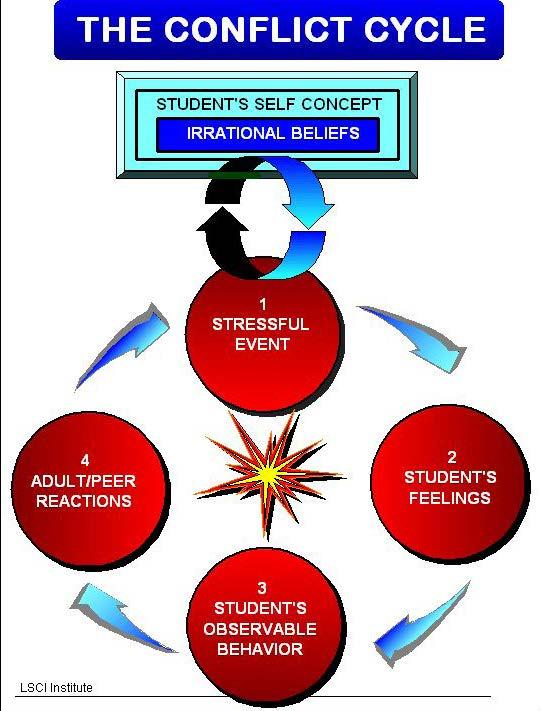
Whether or not we can determine the cause, the conflict cycle is usually defined by four components:
• The stressful event, incident, or memory
• The student’s emotional responses to the event, incident, or memory
• The observable often inappropriate behaviors resulting from emotional responses and
• The resulting teacher (or other student) reactions.
The teacher often does not understand the context of the student’s emotions or behavior, and therefore may deliver a response frequently viewed as punitive by the student. Those perceived punitive responses of the teacher may introduce another stressful event for the student, triggering more powerful emotions, and further spiraling the Conflict Cycle.
In addition, this sequence of events may become a trigger for the teacher’s emotions, and now the Conflict Cycle is escalating for both the student and the teacher. At-risk students, particularly those with
behavioral needs, and multiple ACEs may be more likely to become overwhelmed by their irrational beliefs and associated feelings. These powerful feelings can quickly lead to observable behavior that is deemed inappropriate or disruptive to the classroom. The teacher must then respond to the student’s inappropriate behavior to maintain order or safety in the classroom. The resulting teacher (or other student) reaction then triggers more stress, which in turn intensifies emotional responses, and further behaviors, and additional reactions. This spiraling up, like a tornado, can quickly lead to crisis situations. Unless this cycle is interrupted, it is likely to escalate further and could potentially result in aggressive or violent behavior.
The Acting-Out Cycle
Colvin’s Phases of the Acting-Out Cycle (1994) describe the phases of a behavioral crisis. This is different from, but closely related to the Conflict Cycle. It suggests a pattern to the events of a conflict crisis by identifying seven phases: 1) calm, 2) trigger, 3) agitation, 4) acceleration, 5) peak, 6) deescalation, and 7) recovery.
While in the calm phase a student is generally on task and engaging in appropriate behavior. In this stage teachers can focus their efforts on managing the student’s attention and on providing positive reinforcing feedback. In addition, providing clear and brief expectations is important because when students understand what is expected of them, problem behaviors typically decrease, and students tend to stay in the calm phase (Colvin & Scott, 2015). Finally, instructing students in a way that engages them will also help to prevent problem behaviors in the classroom; establishing an expectation for whole class responding is an example.
In the trigger phase a student is just beginning to react negatively towards a stimulus event, and the student’s agitation level increases. Triggers can occur at school (e.g., peer conflict), and/or outside of school (e.g., inadequate nutrition). In addition, some triggers occur over time (e.g., lack of sleep
or stress), while others take immediate affect (e.g., being physically harmed or threatened). In the trigger phase, a teacher can acknowledge the event and offer possible problem-solving strategies and engage in calm conversation. Teachers could also make a referral to appropriate resources such as counseling services or programs for free school meals. Additionally, teachers can manage triggers that occur in schools with pre-corrective strategies. Colvin and Scott (2015) recommend that teachers identify potential triggers for a student’s problem behavior before they appear if possible, and then adopt strategies to implement before the problem behavior occurs.
In the agitation phase the student’s behavior can go one of two ways; a response demonstrating a decrease in behavior (e.g., putting head on desk) or a response demonstrating an increase in behavior (e.g., tapping pencil quickly). In this stage a teacher could intervene by moving closer to the student to re-engage them or help them find a quiet space to be alone. Another useful strategy is for the teacher to demonstrate empathy for the student by explaining that they understand the student’s point of view (Colvin & Scott, 2015).
During the acceleration phase the student will begin to negatively engage others. They may already be noncompliant or openly defiant. At this point,
a teacher should avoid behaviors such as yelling, arguing, or invading the student’s personal space (the need for which increases with emotional distress). These actions may trigger a fight-or-flight response from a distressed youth and are often referred to as escalating prompts (Colvin & Scott, 2015). When a student is in this stage, it is helpful for educators to have a response ready to say, walk away from the situation to regain composure, and return to talk to the student later. In addition, a teacher could try to re-direct the student by emphasizing student choices, responsibilities, and possible consequences. Helping the student engage in problem-solving strategies is essential for a fightor-flight response from a distressed youth.
The peak phase is the height of the conflict and the student has lost control of their emotions. The primary goal for teachers in this stage shifts from engaging the student to ensuring the safety of the student and others.
After the peak phase, the student will begin to tire and calm down. This marks the beginning of the deescalation phase. Teachers should not try to debrief the student during this phase as it may re-trigger the cycle. Instead, teachers should engage the student by extending simple requests such as cleaning up the mess they made or by returning to their seat.
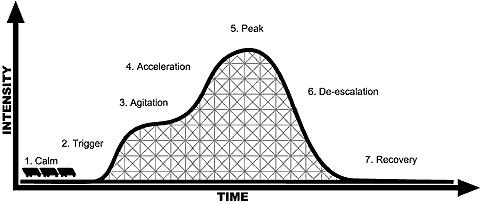
In the recovery phase the student will begin thinking more clearly and demonstrate more willingness to return to the normal classroom structure. At this point a teacher could debrief the student by helping them explore what happened, the student’s thought process during the cycle, the student’s actions and decisions, and alterative behaviors that could have resulted in a more positive outcome. It is important that teachers remember to be reflective listeners and to use the phrase, “What I hear you saying is...Is that right?” The debriefing time during the recovery phase may be an excellent opportunity for learning to take place. During this phase students may be more open and willing to talk and this may be a useful time for counseling (Life Space Crisis Intervention is based on this premise; Wood & Long, 1991).
To respond effectively teachers and school staff should be able to identify what phase a student is in. Misidentifying the stage may serve as another trigger, further escalating the conflict cycle.
Combining the Two
Once teachers understand the Conflict Cycle and how it relates to the Acting-Out Cycle, they can then learn to interrupt a student who is in the beginning stages of this cycle. It is important to understand that students can start at any point in the cycle. For instance, many students may come to school each day already in the agitation stage (e.g., lack of sleep, lack of proper nutrition, etc.).
When a teacher observes that an event has triggered stress for a student, and emotions may be rising, they can engage immediately in a calm conversation with the student to help them explore those feelings, de-escalating that stress. Asking the student to explain what occurred, and how they are feeling can have several positive effects. Importantly, this can validate the student’s feelings. Acknowledging the
student’s feelings and asking them to explain their experience may also serve as a cognitive disconnect, shifting their focus from aggressive to more reflective thoughts, thus interrupting the conflict cycle. And finally, the process of engaging the student may alter the student’s pre-existing irrational belief that “the teacher is out to get me.” The check-in-check-out programs for students with behavioral needs may in part reflect this approach by checking the student’s emotional state and watching for potential triggers as a student enters and exits school.
On the other hand, these same approaches will unlikely be effective if the student is already approaching the peak of the crisis. At that time safety should be a priority. Once the crisis has passed, teachers can follow up with the student to help them understand the difference between angry feelings and aggressive behaviors, reinforcing the concept that the student is entitled to their feelings. However, when behaviors affect the learning or safety of others, negative consequences inevitably follow. Teachers could then teach the student coping strategies for dealing with stress to help them the next time they experience a trigger.
Reducing and Managing Conflict
Some research has suggested that schools could reduce or prevent conflict by training staff and students on how to manage intense emotions and aggressive behaviors. Wood & Long (1991) explained that when teachers are working with students with behavior problems, they are likely to experience many of the same emotions as their students. It is perhaps even more important for teachers to understand their own emotional state and choose their own behavior carefully. Without that selfawareness, it is easy for educators to allow their own emotional state to interfere with effective conflict deescalation and in fact escalate the conflict. Similarly, it can be very helpful to teach students about the Conflict Cycle in their own life and provide them with tools to stop it when it occurs.
As described earlier, there are numerous training vendors across the country which specialize in crisis intervention training for schools (e.g.,
Crisis Prevention Institute, The Mandt System®, Pro-ACT, Safe Crisis Management, etc). While these programs are often known for their training of physical restraint procedures, they all spend a significant portion of training time on de-escalating conflict (Couvillon, et al, 2019). They all explain the conflict cycle, phases of acting-out behavior, and crisis de-escalation strategies and techniques with their own proprietary variations in terminology and procedures. Additionally, most of these programs offer specific subsets of training, allowing school administrators to purchase crisis de-escalation training for all staff members, not just a crisis intervention team. Educators and students alike could be trained on the Conflict Cycle and the Phases of Acting-Out Cycle.
The Crisis Prevention Institute, a crisis intervention program which provides crisis de-escalation training to schools (as well as physical restraint training), recommends a helpful list of suggestions for educators who are attempting to de-escalate a crisis: 1) remain calm, 2) isolate the individual, 3) keep it simple, 4) use neutral body language, 5) be silent-use silence, 6) use reflective questioning, and 7) avoid “para-verbals” (e.g., insure body language or voice inflection is not in contradiction to what is being communicated (Crisis Prevention Institute, 2012).
Although there are many strategies to implement during the Conflict Cycle as described earlier, there are several strategies that teachers and administrators can use to prevent conflict and to prevent problem behaviors from occurring. It is outside the scope of this article to discuss these strategies here. Interested readers are encouraged to study the ten low-intensity strategies to reduce conflict which include active supervision, appropriate use of praise, choice and preferred activities, opportunities to respond among other strategies presented by Lane, et al. (2011).
Positive classroom management techniques and school-wide positive behavior supports will also reduce conflict. Insuring frequent
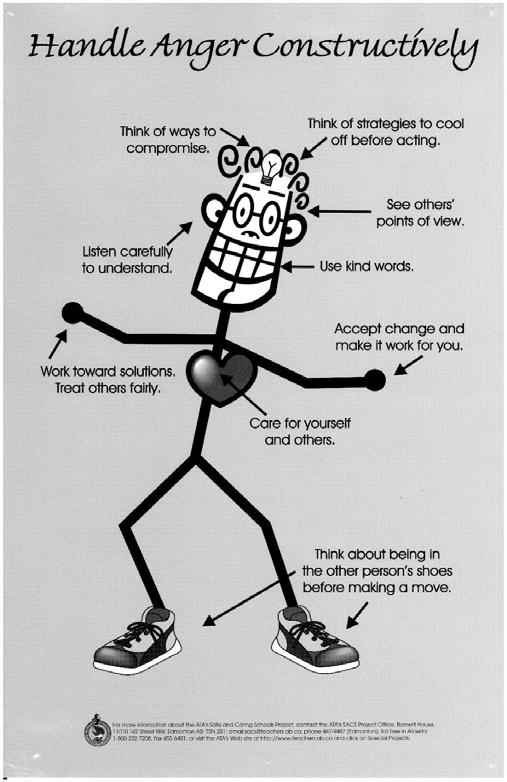
positive reinforcement for appropriate behavior is important. Prevention strategies also include formal teaching of social skills (social emotional learning concepts) to students and helping them identify their own strategies to handle anger and conflict. Several specific Anger Management programs also exist specifically to teach people how to understand and control their own anger (Parnell et al., 2013).
Conclusion
Conflict de-escalation skills are essential for all educators. All students will experience conflict during their education. Students with emotional or behavioral difficulties, communication disorders, and autism may experience more difficulty than other students when managing stress and emotions. Teachers and administrators who also experience conflict, and therefore learn about the Conflict and
Acting-Out Cycles and how to monitor their own emotions can be a valuable resource to students. When teachers become aware of their own triggers and irrational beliefs, they can better help their students to do the same. The strategies of conflict de-escalation, conflict prevention, self-awareness, and stress management presented here can be applied by both students and educators to prevent minor conflicts from becoming dangerous in our schools.
References
Colvin, G. & Scott, T. M. (1994). Managing the cycle of actingout behavior in the classroom. SAGE.
Colvin, G. & Scott, T. M. (2015). Managing the cycle of actingout behavior in the classroom (2nd ed.). SAGE.
Couvillon, M. A., Kane, E. J., Peterson, R. L., Ryan, J. B., Scheuermann, B. (2019). Policy and program considerations for choosing crisis intervention programs. Journal of Disability Policy Studies. 30(1), 353-45. First published August 22, 2018.
Crisis Prevention Institute (2012). Seven principles for effective verbal intervention. Crisis Prevention Institute.
Lane, K. L., Menzies, H. M., Bruhn, A. L., & Crnobori, M. (2011). Managing challenging behaviors in schools: Research-based strategies that work. Guilford Press.
Long, N., & Duffner, B. (1980). The stress cycle or the coping cycle? In N. Long, W. Morse, & R. Newman (Eds.), Conflict in the classroom (4th ed., pp. 218-227). Wadsworth.
Parnell, K., Peterson, R.L., Fluke, S. (2013). Three anger management programs. Student Engagement Project, University of Nebraska-Lincoln.
Wood, M. M., & Long, N. (1991). Life space intervention: Talking with children and youth in crisis. ProEd.
Reece l. Peterson, Professor Emeritus, University of Nebraska, rpeterson1@unl.edu
Ken Parnell, Department of Counseling, University of Northern Colorado, kjparnell@gmail.com
What White Colleagues Need to Understand
By Clarice Brazas and Charlie McGeehan
As educators doing antiracism work, we often focus extensively on the impact that white supremacy has on students. But even though we recognize that white supremacy shapes all of our lives and work, we spend little time talking about its impact on educators.
For the past three years, we’ve worked as colleagues in our Philadelphia high school’s humanities department and with teacher-led racial justice organizations. Clarice is a Black, biracial woman, and Charlie is a white man.
We know we all live in the same society of racism and white supremacy. We know white educators have the privilege to ignore these conditions and often do. And we know our collaboration is the exception, not the rule.
For this article, we interviewed eight educators of color across the country to hear about their work with white colleagues. We found disheartening trends. Educators of color report that they’re expected to take on a disproportionate share of work supporting students and teaching about race and racism. This work, they say, is often made more difficult by the indifference – and sometimes resistance – of white colleagues. While all educators of color carry the burden of white supremacy, Black teachers have even more weight placed on them. To highlight their voices, we included six Black educators among the teachers of color we interviewed.
We know from our own experience that there are ways schools can lessen the burden on educators of color. And we heard from our interviewees about
Photo courtesy of Hannah Yoon
white educators who did their fair share to carry the load. But the first step to addressing inequities is to ensure we’re all aware of them. Here’s what we learned.
What’s Expected From Educators of Color
EDUCATORS OF COLOR ARE EXPECTED TO SUPPORT STUDENTS OF COLOR.
Several educators we spoke to said they feel a moral imperative to do extra work. Marian Dingle, a Black woman in her 21st year of teaching elementary school inthe South, told us about when one of her Black students was called the n-word by another student. As they heard about it, she and her Black colleagues dropped what they were doing to meet with this child throughout the day. Each educator shared the first time they were called the slur, stories they hadn’t even shared with each other.
“I’m counseling a child about something that happened to me and something that happened to my parents and their parents, and their parents, and their parents,” she explains. “That is something I need my white colleagues to understand.”
It isn’t just that many white educators don’t see this emotional labor, interviewees told us. Sometimes they pass their own responsibilities onto colleagues of color. Angela Crawford is a Black woman who has been teaching in Philadelphia for 24 years. At Martin Luther King High School, she’s a teacher, auntie, motivator and disciplinarian.
“A lot of these things I do on my own because I honestly do care about the well-being of my kids,” she says. But because of the relationships she’s built, colleagues often send students to her for support.
And that is a problem, Crawford says. Building these relationships takes work. When they assume educators of color will do this work for them rather than taking it on themselves, white educators increase the workload of their colleagues.
EDUCATORS OF COLOR ARE EXPECTED TO TAKE ON ANTIRACIST WORK IN THEIR CLASSROOMS, SCHOOLS AND DISTRICTS – WHILE MANAGING COLLEAGUES’ WHITE FRAGILITY.
One refrain we heard again and again was that white educators, even those who see themselves as committed to equity, frequently consider antiracist work something outside of their responsibility.
Adam Hosey, a Korean educator in Harrisburg, Pennsylvania, told us of one white colleague who included race and racism in his curriculum but expected educators of color to do the heavy lifting. Once, the teacher planned to ask students of color to defend racial profiling. When Hosey told him, “You can’t really do that,” he asked Hosey to come up with a new lesson for him.
Educators also reported being expected to take on antiracist work beyond the classroom. Isabel* teaches in North Carolina at a school where the majority of students and teachers are Latinx. Until this year, she was the only Latinx person on the leadership team. Isabel often finds herself the one who responds to racist comments about students by white colleagues or administrators. But when she raises concerns, she says, she sees “a lot of white tears. ... It immediately goes to the tears, then deflection, and then everything dies down.”
The expectation that colleagues of color not only take responsibility for calling out racism but also that they comfort and accommodate white people when racism is called out is a common one. Educators we
Racism puts enough burdens on educators of color; white colleagues can’t also expect them to end it.
spoke with stressed the need for white colleagues to own their discomfort, find places to process their growth that don’t rely on educators of color and avoid justifying hurtful comments. They also noted the need for white educators to take on some of this work themselves.
That did happen when Hosey worked with colleagues to start an equity team in his district. Two white colleagues were among the educators who joined him, including doing significant training outside of the school day. But in a district where educators are predominantly white, the equity team has five people of color – and just two white people.
“And that’s not for lack of trying,” Hosey says.
EDUCATORS OF COLOR ARE BEING DRIVEN OUT.
Sometimes, we heard, when educators of color do take responsibility for antiracist work, they pay a price. Marian Dingle told us that when she decided
to teach in amore proactively antiracist way, she noticed a shift with her school’s administrators. She had a stellar record, and she was being considered for a new position mentoring new educators. But suddenly, things changed. Her administrator accused her of not being a team player and questioned her competence.
“The real issue, which was uncovered through layers and layers of questioning,” Dingle says, “was that my administrator was uncomfortable with the way I was teaching.”
Writing last year for Teaching Tolerance, Jamilah Pitts, a Black assistant principal in New York City, cited the lack of support – and outright hostility –many educators of color face as a reason for the lopsided demographics of the teaching force.
White people make up about 60 percent of the general population and just under half of all K–12 students. But roughly 75 percent of school

Photo courtesy of Adobe Stock
administrators and 80 percent of K–12 teachers are white. And until white educators do a better job supporting colleagues of color, those numbers seem unlikely to change.
“We can’t collectively decry the lack of teachers of color,” Pitts wrote, “without addressing the school cultures that silence, demonize and push them out.”
Isabel says she’s thought about leaving the profession. “It’s the awareness of how messed up the entire system is,” she says, “grounded on supremacy, oppression and all these behaviors that most people are not willing to admit.”
How White Colleagues Can Do Better
WHITE EDUCATORS CAN WORK TO MANAGE WHITE FRAGILITY IN THEMSELVES AND AMONG COLLEAGUES.
At her school in Boston, Alice Mitchell is among the educators of color on a majority white staff serving a student body that’s 95 percent children of color. During her first year, Mitchell said, there were “a lot of clashes” between the three Black teachers on her team and their white supervisor. The team organized a meeting and asked their supervisor to consider racial and power dynamics at work. The response they received was very different from what we heard from others.
“She was not defensive,” Mitchell remembers. “She didn’t go to white tears. She just nodded, accepted our feedback and was like, ‘OK, so what do I need to do to fix this?’”
After a rocky start, the supervisor chose to commit to learning, growing and discussing race. She used her role as an administrator to bring this work to the entire school, starting a Building Anti-Racist White Educators group to process the role of race and whiteness in their work.
WHITE COLLEAGUES CAN WORK TO ENSURE THAT LABOR IS EVENLY DISTRIBUTED IN THEIR SCHOOLS.
Mitchell’s example shows how individual support – especially from a leader – can expand into institutional change. Beyond our school, we both further antiracist training and materials for educators. Clarice has worked to develop antiracist training that she and others have facilitated through our school district and at conferences. Charlie is a founding member of Building Anti-Racist White Educators, an organization committed to encouraging white educators to talk to their peers about racism and white supremacy.
White educators should also reflect on and address their own behavior while examining institutional policy to ensure workloads are evenly shared. They can support colleagues of color by taking the time to build trusting and caring relationships with all students. And they can look for ways their school can ease the extra burden on educators of color.
Corey Martin, a Black high school teacher in Georgia, says, “You actually have to make a conscious effort to immerse yourself in what we do.”
At The U School, where we teach, we have an advisory structure that is designed to match each student with a caring adult for all four years of high school. We meet twice a day with this group, and it provides students a home base of sorts. This structure means that the responsibility of supporting our students is shared and ensures that teachers of color are not required to do this work on their own time.
WHITE COLLEAGUES MUST EDUCATE THEMSELVES ABOUT THE ISSUES THAT MATTER.
Finally, white educators can commit to learning and teaching about race and racism. Racism puts enough burdens on educators of color; white colleagues can’t also expect them to end it. In our humanities department, which has two white and two Black educators, we share a commitment to creating a curriculum that is antiracist.
But for white educators who don’t work in departments like ours, there are plenty of curricular resources that can support this work. For example, both of us have worked to help curate the Black Lives Matter at School Week of Action curriculum, a set of texts and activities for students and teachers at every level.
The summer before Clarice began working at the U School, she attended a book group on Lisa Delpit’s Other People’s Children. It was part of an antiracist summer reading series, and Charlie was the cofacilitator. After the book group, we met to discuss antiracist work in Philadelphia and ways Clarice, new to the city, could get plugged in.
Three years later, we continue to facilitate antiracist work around the region. We are friends and colleagues. Most importantly, our relationship is grounded in a shared commitment to antiracist action.
This work isn’t easy, but it is possible for all white educators – and they must engage with colleagues of color by showing solidarity and taking action to resist white supremacy.
Keziah Ridgeway, a Black high school teacher in North Philadelphia, says she knows amazing white educators who do this work. As she puts it, “They actively embody being an antiracist and are making sure that they are putting their actions, money and time where their mouth is.”
Here are a few recommendations for white educators from our interviewees.
1. Read, Read, Read Learn more about racism and white supremacy. Reading (or watching or listening) can answer questions and give you the space to work out your own racial identity.
2. Listen Be present with educators, students and families of color. Actively listen. What concerns do they have? Chances are they see issues inside the school that you don’t. Two interviewees suggested neighborhood walks.
3. Avoid Making Conversations About You If a colleague of color comes to you with a concern, ask yourself, “Am I using my privilege to amplify the concerns of educators of color in my building, or am I drowning them out?”
4. Connect Find or build a group of people for accountability. Focus on generating conversations with white colleagues, and make sure you are staying accountable to people of color. Charlie’s organization, BARWE, has free resources to get started.
5. Use Your Power and Take Action Look for inequities: Are people being left out? Does your administrator treat people unfairly? If you notice something, speak up and take action. Lift some of the burden from your colleagues of color. If you’re an administrator, consider how you are directing school- and district-level professional development and policy.
*Isabel asked that we use a pseudonym and not reference her school or position.
Clarice Brazas is a founding member of the Melanated Educators Collective (MEC) and teaches humanities at The U School in Philadelphia. Charlie McGeehan is a founding member of Building Anti-Racist White Educators (BARWE). Brazas and McGeehan work together with the Caucus of Working Educators Racial Justice.
Reprinted with permission from Learning for Justice. Originally published in Issue 64, Spring 2020. Web Version: https://www.learningforjustice.org/ magazine/spring-2020/what-white-colleagues-needto-understand
Off-Campus Student Expression and the Supreme Court
By Mitchell L. Yell and Charles B. Walters

Students with disabilities, especially those with emotional/behavioral disorders (EBD), are often involved with harassment, either as a victim or a perpetrator. Court rulings have acknowledged that harassment of a student with a disability can be a violation of federal laws such as the Individuals with Disabilities Education Act (IDEA) and Section 504 of the Rehabilitation Act. It is clear that when harassment occurs that school district administrators have a duty to take prompt and effective steps to investigate and end the harassment.
The proliferation of social media platforms (e.g., Snapchat, Instagram, TikTok, Facebook) raises questions about cyber harassment and threats and when such threats or harassment may be a violation of federal law. A recent ruling by the US
Supreme Court in Mahanoy Area School District v. B.L. (2021) addressed this issue. In this paper, we provide background by briefly addressing two US Supreme Court rulings, Tinker v. Des Moines Independent Community School District (1969) and Bethel School District No 403 v. Fraser (1986). Both decisions are important because they are precursors to the Supreme Court’s ruling in Mahanoy and have important implications for administrators and teachers. Next, we examine the ruling in the Mahanoy case. Finally, we speculate on what this decision may mean for administrators and teachers of students with disabilities.
Tinker v. Des Moines Independent Community School District (1969)
In 1965, three students were suspended from
Photo courtesy of Hannah Yoon
school for wearing black armbands protesting the Vietnam War. In a 7-2 majority, the US Supreme Court ruled that the students’ action of wearing these armbands in protest constituted pure speech, a form of expression separate from the actual actions and conduct of the students. The Court held that the students involved did not lose their First Amendment right to freedom of expression by simply entering school grounds. The High Court held that a school must prove that the student expression materially and substantially interfered with the school’s operations in order to limit that expression. In a famous phrase in the majority opinion, the Court noted that neither “students nor teachers shed their Constitutional rights […] at the school house gate.”
Bethel School District v. Fraser (1986)
In 1983, Matthew Fraser, a high school senior in the Bethel School District in Washington, gave a nominating speech for the position of student body vice president. His speech was filled with sexual innuendo and following the speech, he was suspended from school for violating school rules against disruptive behavior and vulgar and offensive speech. Fraser then filed a lawsuit in the US District Court for the Western District of Washington,
alleging violation of his First Amendment right of free speech. The district court ruled that the Bethel School District had violated Fraser’s free speech rights. The school district then appealed to the US Court of Appeals for the Ninth Circuit, which also ruled in Fraser’s favor. The school district then filed an appeal with the US Supreme Court, which agreed to hear the case. The Supreme Court in a 7 to 2 decision overturned the lower courts’ rulings, finding that the school district did not violate Fraser’s free speech rights. The High Court distinguished its 1969 Tinker ruling, which upheld the right of students to express themselves where their words are not disruptive and were not connected with the school function. In the Bethel v. Fraser ruling, the Court limited the scope of the Tinker ruling, by holding that it may be a legitimate school function to prohibit certain types of expression and speech.
These two Supreme Court rulings held that students’ Constitutional rights hold even when they are in school and school districts do have a legitimate duty to enact certain prohibitions against disruptive speech. In Mahanoy, the Supreme Court addressed the issue of a school district’s ability to regulate students’ off-campus speech.

The Facts of the Case
Brandi Levy was a student in the Pennsylvania’s Mahanoy Area School District. (In the decision she was identified only by her initials, B.L. because she was a minor at the time). In her freshman year of high school, B.L. tried out for the cheerleading squad and made the junior varsity squad. Near the end of her freshman year B.L. tried out for a position on her school’s varsity cheerleading squad. She was not selected for the varsity squad and was instead offered a spot on the junior varsity squad. Frustrated
“F[***] school f[***] softball f[***] cheer f[***] everything.”
with the decision in light of knowledge of another freshman student having made the varsity team, B.L. expressed her opinion on social media while visiting a local convenience store.
While in the store, B.L. posted twice to the social media application Snapchat, viewable to her roughly 250 friends. The first Snapchat post featured a photograph of B.L. and a friend holding up their middle fingers and was captioned “F[***] school f[***] softball f[***] cheer f[***] everything.” The second post simply contained the following text: “Love how me and [the name of another student] get told we need a year of jv before we make varsity but tha[t] doesn’t matter to anyone else?”.
B.L.’s friends on Snapchat included current members of the school cheerleading squad and one team member took photos of the Snapchat posts and circulated them to others at the school, which
included a daughter of one of the cheerleading coaches. Both the members of the cheerleading squad and students at large reportedly approached coaches for the cheerleading squad upset by B.L.’s Snapchat posts. When the cheerleading coaches brought the issue to the principal of B.L.’s high school, it was decided that B.L. would be suspended from the junior varsity cheerleading squad for the coming school year.
Subsequent apologies by B.L. for her behavior were not enough to change the opinion of school administration. The superintendent for the school district, the school principal, and the school’s athletic director maintained the decision for B.L. to remain suspended from the cheerleading squad for the year. In response, B.L.’s parents filed suit in US District Court for the Middle District of Pennsylvania, alleging that the Mahanoy school district violated her free speech rights under the First Amendment to the Constitution. The District Court found that B.L.’s First Amendment right to free speech had been violated by the school’s course of action in disciplining her. As a result, the court issued a temporary restraining order and injunction against the district that ordered B.L. be put back on the cheerleading squad. The District Court also ordered that Mahanoy Area School District clear B.L.’s disciplinary record and pay a small sum in damages and attorney’s fees for B.L.’s family.
The Mahanoy school district appealed the ruling to the US Court of Appeals for the Third Circuit. A panel of the Third Circuit Court affirmed the District Court’s ruling that Mahanoy’s disciplinary action of B.L.’s profanity on social media violated the First Amendment. In the case, which at that time was titled B.L. v. Mahanoy Area School District, the court held that off-campus speech enjoyed the full scope of First Amendment protections.
The school district filed an appeal with the US Supreme Court, which agreed to hear the case in
January 2021. The High Court’s ruling was handed down on June 23, 2021. In the opinion, written by Justice Stephen Breyer, the High Court sided with B.L. in an 8 to 1 ruling. Whereas the Breyer majority opinion noted that school districts may have grounds to regulate some forms of student off-campus speech, the facts of the Mahanoy case were not sufficient to overcome B.L.’s rights to free expression.
The majority opinion noted that the third circuit court inappropriately applied Tinker when it asserted that B.L.’s speech was protected chiefly because she was not on school grounds when using Snapchat. Justice Breyer’s opinion offered three points that should be considered when choosing to regulate offcampus behavior of students. First, whereas the US common law doctrine in loco parentis asserts that schools have the obligation to stand in as proxies for the parents or guardians of minor youth during the school day, the primary responsibility for discipline for off-campus behavior should likely fall to parents and guardians. Second, it is important to recognize that a school’s decision to regulate the off-campus expression of students should be a decision made with great discernment considering the breadth of expression students may engage in during any given day. Third, the court held that schools are “nurseries of democracy” and should take a special interest in protecting the unpopular expression of students. Nonetheless, there are circumstances in which schools may need to regulate the off-campus behavior of students, including those involving serious bullying or harassment, harm or threats of harm to students or teachers, and breaches of school security devices.
Implications of the Supreme Court’s Mahanoy Ruling
What are we to make of this ruling and how does it affect us as special educators? It is clear that school officials must exercise care in regulating the offcampus speech of students, however this does not
The
superintendent, the principal, and the athletic director maintained the decision for B.L. to remain suspended from the cheerleading squad. In response, B.L.’s parents filed suit.
mean they should not exercise limits on it. Certainly, when student speech involves innocuous behavior, such as the snapchats of B.L., school district officials would be best advised to heed the lessons of the Supreme Court in Mahanoy. However, when off-campus speech or behavior involves threat, harassment, or bullying, such behaviors or speech should be prohibited and included in a school district behavior or discipline codes. Any such prohibitions should be clearly related to a legitimate school function (e.g., protecting the safety of students or teacher) and should be explicitly stated in the school disciplinary code. Moreover, when such behavior or expression occur, school officials must act to prevent future occurrences of that behavior or expression and address any negative effects on students.
Note: Readers interested in reading the majority, concurring, and dissenting opinions by the justices of the US Supreme Court and the many amici curia and other briefs submitted to the court in Mahanoy v. B.L. can go to SCOTUSblog.com and enter “Mahanoy” in the search function.
Mitchell L. Yell, Chair in Teacher Education, Mitchmyell@sc.edu, and Charles B. Walters, Special Education Ph.D. Student, walterc5@email.sc.edu, University of South Carolina, Columbia.
Podcast Pulse
By Sharon A. Maroney
The Ezra Klein Show
What Does Toxic Stress Do to Children?
(March 9, 2021, 60 mins) https://www.nytimes.com/2021/03/09/opinion/ ezra-klein-podcast-nadine-burke-harris.html
I was first introduced to Ezra Klein in his virtual lecture based on his book, Why We’re Polarized, sponsored by Iowa State University in October 2020. I was very impressed and admittedly had to work to keep up with him – he’s smart, thoughtful, and quick. Klein is an accomplished journalist, political analyst, and co-founder of Vox (news website). When Klein began The Ezra Klein Show for the New York Times this past year, I subscribed.


and informative discussion - I even listened twice. Interested readers can learn more about Burke’s research in her book, The Deepest Well: Healing the Long-Term Effects of Childhood Adversity (2018), and her recent keynote address, Applying Science of Toxic Stress to Transform Outcomes (September 14, 2020). https://www.youtube. com/watch?v=aW3YCLlZ37k
The Kitchen Sisters Present, Episode 143
The McDonogh Three - First Day of School
(June 9, 2020, 20 mins)
http://www.kitchensisters.org/present/ the-mcdonoghthree-first-day-ofschool/

In this episode, What Does Toxic Stress do to Children? - Klein interviews Dr. Nadine Burke Harris, the first Surgeon General of California, known for her pioneering work in the way adverse childhood experiences (ACEs) and childhood trauma shape the rest of our lives. Harris explains how childhood trauma actually changes children physically, affects their cognitive functioning and mental health, and shortens life expectancy. Harris’ discussion of the potential effects of the trauma of COVID-19 on children and youth is especially relevant to educators, parents, and other service providers. I found this to be a very interesting
The Kitchen Sisters Present…Stories from the B-side of History is created and produced by the Kitchen Sisters, Davia Nelson and Nikki Silva. Nelson and Silva have created more than 200 stories on the hidden and often unknown bits of history and the people who have shaped our cultural landscape. The podcast is always lively and informative. Episode 143, The McDonogh ThreeFirst Day of School, tells the story of the first Black students to be integrated in a White-only school in New Orleans. On November 14, 1960, three 6-year-old Black girls were escorted by Federal Marshalls into McDonogh No. 19 Elementary. This story is wonderfully told by the three girls, women now, and the three retired Federal Marshalls.
If you are like me – working to learn about diversity in our world – you’ll like The Kitchen Sisters Presents. A quick scan of their recent podcasts includes the Mushroom Queen of Zimbabwe, Vietnamese nail shops, an Amish pandemic sewing frolic, and Winona LaDuke, the Ojibwe leader.
Nobody Told Me!
Sue
Klebold: How to
React When Someone You Love Says They Are Depressed or Suicidal
(November 29, 2020, 40 mins)
https://www.listennotes.com/podcasts/nobodytold-me/sue-klebold-how-to-react-jZ4_waXdWEb/
Freakonomics Radio, Episode 447 How Much Do We Really Care About Children?
(January 13, 2021, 45 mins) https://freakonomics.com/podcast/car-seats/


Nobody Told Me! is created and produced by mother and daughter, Jan Black and Laura Owens. This podcast features interviews with extraordinary, news-worthy individuals in a relaxed, conversational format. This recommendation, Sue Klebold: How to React When Someone You Love Says They Are Depressed or Suicidal, is an interview with the mother of Dylan Klebold, one of the Columbine shooters. Although Klebold published her memoir, A Mother’s Reckoning, Living in the Aftermath of Tragedy, in 2016, I was not familiar with her story. This interview drew me in as Klebold shared her story of the day of the shooting, how she responds to the question “How could you not know something was wrong?”, and the direction her life is taking now.
Nobody Told Me! includes interviews with a wide variety of individuals in a commercial podcast format. Since I look for research-based information, I do research the background of interviewees before listening to individual episodes.
I am a long-time listener of the Freakonomics Radio podcast featuring journalist, Stephen Dubner, and economist, Steven Levitt, who present a wide range of topics connected to the economy. You may have heard of their bestsellers, Freakonomics (2005) and Superfreak (2009), which presented their unique take on the psychology of money and changed the way many of us thought about economics. I enjoy this podcast because in every episode, Dubner and Levitt use experts, information, and humor to make connections that I often don’t see coming. Take for example, Episode 447 – How Much Do We Really Care About Children? In this podcast Dubner and Levitt interview Melissa Kearney, economics professor at the University of Maryland, Jordan Nickerson, financial economist at MIT, Shy Mindel, Israeli aeronautics engineer, and David Solomon, associate professor at Boston College. The discussion connects child car seats, car seat laws, and car seat research to declining birth and fertility rates, US political policy, and the economy. Listen for yourself – it’s fun. And if you’re interested, there’s always a long list of references and resources included with each podcast.
Sharon A. Maroney, Professor Emeritus, Western Illinois University, sa-maroney1@wiu.edu.
Movies
News of the World
By Scott M. Fluke
News of the World is, perhaps unintentionally, one of the most authentic movies about emotional and behavioral disorders I have seen.
The movie tells the story of ex-Confederate soldier, Captain Kidd, (Tom Hanks) who travels Reconstruction-era Texas reading newspaper articles to the masses - his “News of the World”. Early in his adventures he comes across a young girl, Johanna (Helena Zengel). She is alone and speaks no English. Her first reaction to Captain Kidd is to run. When caught, she bites him.
There are gunfights and survival challenges, but the real story in this movie is the relationship between these two characters. If you’ve worked in schools, you’ll recognize the pattern. A child with complex trauma shows aggressive and challenging behavior when confronted by adults. Those adults respond with threats, frustration, and a clear message: you are broken and you do not belong. The child’s behavior only escalates. It takes a special mentor to see past the behavior to the person beneath; a mentor who understands that the child’s behavior is communicating a basic human need to be safe and to be loved.

In News of the World, Kidd meets Johanna’s anger with compassion. He responds to her aggression by making her feel safe. Again and again, Kidd shows her that he can be trusted and that she can be loved. While others see her as “wild” and “cursed,” he sees her as a person.

As I watched this movie, I reflected on students I have worked with and how others have treated them. I saw their faces in Johanna’s, and I saw their stories in hers. News of the World may not have intentionally been about behavior disorders, yet Helena’s portrayal of Johanna provides a deep and humanizing message about what our students need from all of us.
Scott M. Fluke, PBIS Coordinator, Olathe Public Schools, Kansas, smfluke@gmail.com
Books
The Code Breaker. Jennifer Doudna, Gene Editing, and the Future of the Human Race
By Reece L. Peterson
What if we could prevent or eliminate children developing Attention Deficit Disorders, Dyslexia, Down Syndrome, or Emotional Disturbances such as bipolar disorder, depression, or schizophrenia? Potentially the elimination of these conditions might, of course, lead to a greatly reduced need for special education services in our schools and different perspectives on education generally. Questions such as these are raised in a new book that describes advances in genetic engineering, suggesting that these changes could occur – maybe within our lifetimes!
In my experience a “crisper” was the bottom drawer of the refrigerator where fruits and vegetables were kept. However, in recent years CRISPR has taken on a new meaning as the acronym for “clustered regularly interspaced short palindromic repeats” - genetic engineering techniques for modifying genomes of living organisms.
In the 1950s James Watson and Francis Crick discovered the double helix structure of DNA (deoxyribonucleic acid), although the individual components were not identified. Beginning in October 1990, and completed in April 2003, the Human Genome Project was the effort to map and identify all the genes of human beings. This permitted a clearer understanding of heredity and how genetic instructions are passed on to offspring.
The Code Breaker. Jennifer Doudna, Gene Editing, and the Future of the Human Race is Walter Isaac-

son’s account of the next phase of the DNA story, focusing on discoveries that permit scientists to edit individual genes in living organisms. Walter Isaacson is a former president and CEO of the policy studies organization, the Aspen Institute, as well as CEO of CNN and editor of Time magazine. He has written several biographies of notable people, including Albert Einstein, Benjamin Franklin, Henry Kissinger, and Steven Jobs.
The Code Breaker centers on one scientist, Jennifer Doudna, who, along with Emmanuelle Charpentier, won the 2020 Nobel Prize in chemistry for their discoveries leading to the ability to change the DNA of living organisms, including humans and their offspring.

Isaacson includes biographical information about how Doudna became a biochemist and essentially follows the discoveries and competition between her laboratory and others from roughly 2003 to the present. I found the detailed back and forth of studies, competition between different laboratories, and efforts to patent techniques for genetic engineering a bit tedious.
But then came COVID-19! Isaacson describes how most of these labs were able to quickly pivot to focus on testing and vaccine development for COVID-19 without concern about patents or financial compensation. Both the Moderna and
Pfizer vaccines for COVID-19 were developed using techniques for gene modification developed in these laboratories. The quick development of COVID-19 vaccines – both much more effective than traditional vaccines – was made possible by this work.
However, other potential uses of CRISPR technology were identified. In 2019 an African American woman with sickle-cell disease was treated with genetic material extracted from her, modified using these techniques, and then injected back into her. CRISPR has the potential to treat many inheritable genetic diseases by actually modifying a person’s genes. This means that the edits will be passed along to all future descendants thus literally altering our human species. CRISPR gene editing could make us less vulnerable to pandemics, cancers, certain kinds of blindness or deafness, Alzheimer’s, and other diseases.
While most people might view these applications of CRISPR gene editing as positive, they also lead to worrisome possibilities and ethical questions. For example, Isaacson asks, could these techniques be used by hackers or terrorists to attack other populations by making these diseases or other negative characteristics more common? Could gene editing become a new weapon of mass destruction?
In addition, genetic makeup might predispose or predetermine physical and psychological traits (e.g., height, obesity, attention deficit disorder, depression). At what point do genetic modifications to change such traits cross the line from health treatment to enhancements? Should parents be able to use these techniques to choose characteristics of their children such as height, intelligence, appearance, etc.?
Could these techniques be used to eliminate Attention Deficit Disorders, Dyslexia, Down Syndrome, Emotional Disturbance, or other disabilities served in special education programs?
We don’t know how to do that today, but that capability is on the horizon. Isaacson indicates that “Two decades after the completion of the Human Genome Project, we still have little understanding of how human psychology is influenced by genetic dispositions. But eventually, we may isolate genes that contribute to a predisposition to schizophrenia, bipolar disorder, severe depression, and other mental challenges.” (p. 352).
If that would happen much of the pain and heartache and other costs associated with these disabilities might disappear. And special education could also become obsolete within the time span of a new teacher’s career.
Isaacson discusses the balance between the great contributions made by authors, artists, and other “creators” with these disorders, which might have been lost if their psychological disorders had been eliminated, and he raises questions posed by this technology including “What is the aim or purpose of life?” and “Who should make these kinds of decisions?”
The Code Breaker is very well written and documented and the latter half of the book was especially engaging, interesting, and thought provoking. Whether or not we want to think about these issues, they are likely to affect us and future generations in the not-so-distant future. CRISPR technology will require important and thoughtful decisions for us as individuals and jointly about the future of humankind.
Isaacson, W. (2021). The Code Breaker. Jennifer Doudna, Gene Editing, and the Future of the Human Race. Simon & Shuster.
Reece L. Peterson, Professor Emeritus, University of Nebraska-Lincoln, rpeterson1@unl.edu
Start Piddlin' Around

By Faith Nicole Pearson
“Stop piddlin’ around, and get to work.” I can almost hear my mother saying this as I glance out a library window rather than completing my class readings. Although I am a junior in college, and my wonderful mother is far from campus, I can clearly hear what she would say to me if she were present to witness my distractions. Her powerful diction choice echoes loudly and frequently in my thoughts.
Piddlin’ is not a “one-size-fits-all” word; it conveys a wide range of meanings. In the above scenario, piddlin’ holds a negative connotation. It’s my mother’s favorite way to point out when a person is doing everything in their power to stay off-task. As mentioned, I’m partial to the gazing-blankly-into-space method. Despite what my piddlin’ might suggest, I do find studying enjoyable. I must, however, admit that school can be stressful at times. The switch to online learning due to COVID-19 continues to invite overwhelming feelings of boredom and distraction into my study time. In what seems to be a paradox, my previous “hobby” of learning now generates a need to identify new methods for self-care. I’m in search of the Holy Grail.
A journey seeking creative extracurriculars commences. With my trusty roommate, I temporarily escape the mundane through the self-care ventures of solving puzzles, completing paint-by-numbers, and mastering the art of homemade mac-n-cheese. Ultimately, however, each of my adventures has a set beginning and ending. Fun ceases once the artwork is ready for display, and stress returns quickly on the heels of macaroni-induced, dairy-intoler-
Photo courtesy of Allison Christine on Unsplash
ance symptoms. I can’t help but to feel that no matter what I do, I am simply wasting –or piddlin’–my time away.
“It’s time to give up. It’s time to stop searching.” Such thoughts are swimming in my head as I sink in my studies. While I walk into a local coffee shop to drown the socalled piddlin’ and start studying, the other meaning of my mother’s favorite word strikes me like inspirational light ning. I guarantee that the baristas (wearily staring through a window, might I add) can see a lightbulb floating over my head. “I need to start piddlin’ around more,” I exclaim as I reach for the door. My perfectionist nature was so focused on the term’s negative meaning that I completely forgot about the less harsh way to view the word. Piddlin’ can also be used to define what a person is doing when they are exploring without an agenda. Ask a cute elderly couple where they are driving on a Sunday afternoon and they might respond with, “Oh, we aren’t going anywhere. We are just piddlin’ around town.” Their careful atten tion to each other and their personal joy remind me that freedom from a rigid structure or agenda is sometimes the answer.
On almost a weekly basis, I set aside time to incorporate piddlin’. The purpose of this much-needed self-care time is to explore without an agenda. Since true piddlin’ can be thought of as planned spontaneity, it is perfect for someone that likes to have adventures but does not have the ability to randomly go on them. For me, piddlin’ looks like taking breaks when I need a moment to recollect my thoughts after classes. As a fan of antique shops, music stores, and bookstores, I spend most of my time piddlin’ in locations that sell old road signs or records. Meandering around the various stores serves as an escape from the real world. I safely wander through shops, meeting eclec tic small business owners and sifting through dust-covered pieces of literature. Some of my favorite findings are a Rogers’ Neighborhood calendar, and a vibrant souvenir shirt from Zimbabwe. No tangible treasure tops the run-ins I have with Harry, a bookshop keeper. While names (and sometimes faces) may be a bit difficult for him to remember, Harry nev er forgets to have a good literary discussion with custom ers while rearranging the books on his shelves. This sweet, elderly man enjoys my dropping by so much that he offers
Photo courtesy of Allison Christine on Unsplash
extremely discounted books at almost every visit. It is overwhelmingly refreshing to take a break and peruse his store.
When I am not staring out windows or intentionally piddlin’, I am studying to become a Speech-Language Pathologist. My future career, while intellectually fulfilling and exciting to work towards, demands much focus. I tend to be the type of person that overindulges in my work, causing me to feel burnt out. In my case, short breaks in the form of piddlin’ are necessary for me to be a stronger learner and future professional. An academic mentor of mine once compared this concept to the human eye. Just as the eye’s pupil flexes to help humans see what is nearby, the classroom pupil actively works to closely focus on their studies. On the other hand, the eye’s pupil relaxes to focus on distant objects. The same is true for the classroom pupil since they must sometimes look beyond academics to relax. Both pupils need rest from focusing. Stepping aside from my work and enjoying a change of scenery allows my brain to refocus even more so when I return. With that relaxation, comes a new fervency and zeal to see what is ahead.
The same is true for educators. They must hyper focus on the needs of others; thus, self-care is crucial for success. Like the classic airplane safety announce-

ment declares, to best help others in case of an emergency, personal needs must first be met. To help someone else succeed, self-care is needed. A recent study regarding stress and regulation strategies in educators outlined that a large percentage had chronic stress (Katz et al., 2018). Katz et al. stated that stress can affect sleep, emotions, and overall attitudes towards work. Unfortunately, this hyper focus puts a strain on meeting personal needs. If one is chronically stressed while working with students, an already incredibly difficult undertaking, the student may not receive the best help. Katz et al. suggested using regulation strategies such as taking moments to reflect on work and reframe one’s mindset about serving others. Piddlin’ is a customizable method to do just that since it is a change in location, pace, and time commitment. Just as it works for me as a college student, self-care can work for those that lead students to success. In that sense, carefully integrating self-care leads to better outcomes for everyone.
The ventures of piddlin’ when applied to the lives of those who find themselves straining to be constantly focused are a game-changer. Not only is piddlin’ as affordable, sophisticated, and exhaustive as one wishes to make the endeavors, the pinnacle of piddlin’ can never be reached because there are always more places to explore and things to do. The journey of self-care can continue as long as creativity is at hand. Most importantly, the stepping aside if only for a brief minute makes for a stronger learner and leader. As a leader, what are you waiting for? Stop waiting around, and start piddlin’ around!
Reference
Katz, D. A., Harris, A., Abenavoli, R., Greenberg, M. T., & Jennings, P. A. (2018). Educators’ emotion regulation strategies and their physiological indicators of chronic stress over 1 Year. Stress & Health: Journal of the International Society for the Investigation of Stress, 34(2), 278-285.
Faith Nicole Pearson, Student, Communication Sciences & Disorders, Eastern Kentucky University, faith_pearson1@mymail.eku.edu
Photo courtesy of Jamakassi on Unsplash

Dear Dr. Humor,
My wife and I were at a local restaurant when we overheard this conversation. A mother, father, and young child were seated by the hostess. After the waitress had gotten the parents’ orders she approached the young child who looked to be around five years old and said, “And what can I get for you?”
The boy responded, “I’d like a hot dog, and...”
“No, no,” the mother interrupted, “No hot dogs. He’ll have the hot turkey sandwich, mashed potatoes, no gravy, and skim milk.” But the waitress ignored the mother and asked the boy directly, “Ketchup or mustard on your hot dog?”
“Ketchup and a coke, please,” replied the boy.
The waitress started for the kitchen and said, “Coming up!”
The young boy said to his parent, “Know what? She thinks I’m real.”
Reprinted with permission from Stuart Robertshaw Dear Dr. Humor is available on Amazon.
Celebrate MSLBD’s 40th Anniversary with These Short Stories About MSLBD and its Activities
A Meeting of Minds Keynote
Attendance & Numbers
CCBD (Now DEBH), CEC, and MSLBD
Conference for School Leaders
Culture & Diversity
Education Failure- Who is to Blame?
Eli Bower - Reflections After a Heart Attack
Formal Debates
Fun, Parties, Dances, and More!
Goals of MSLBD and Its Activities
Janus Oral History Project
MSLBD Awards
MSLBD, the Organization
My Most Memorable Student
Origin of MSLBD
Orwell Keynote in 1984
ReThinking Behavior Magazine
Sheraton Atrium Artwork
Sheraton Hyatt Regency Disaster
Simpson Autism Conference
Thanks for the (Unusual) Memories
The First Symposium
Think Tanks & Retreats
Who Are the MSLBD Master Teachers?
Who Created the MSLBD Logo?
2021 Outstanding Educator of Students with Autism Award
The Richard L. Simpson Conference on Autism recognizes Teri Berkgren, as the recipient of the 2021 “Outstanding Educator of Students with Autism Award” for her excellence in service to students diagnosed with Autism Spectrum Disorder in the Northwest Kansas Educational Service Center and with TASN-ATBS.
Teri Berkgren is the Leader and Low Incidence Coordinator for the Assessment, School Support, Interventions, Students, Team Members (ASSIST) of the Northwest Kansas Educational Service Center (NKESC) and a Regional Autism Consultant with TASN-ATBS. The award is presented
“In recognition of her dedication to achieve the best outcomes for her students and for her advocacy on behalf of individuals with autism and their families.”
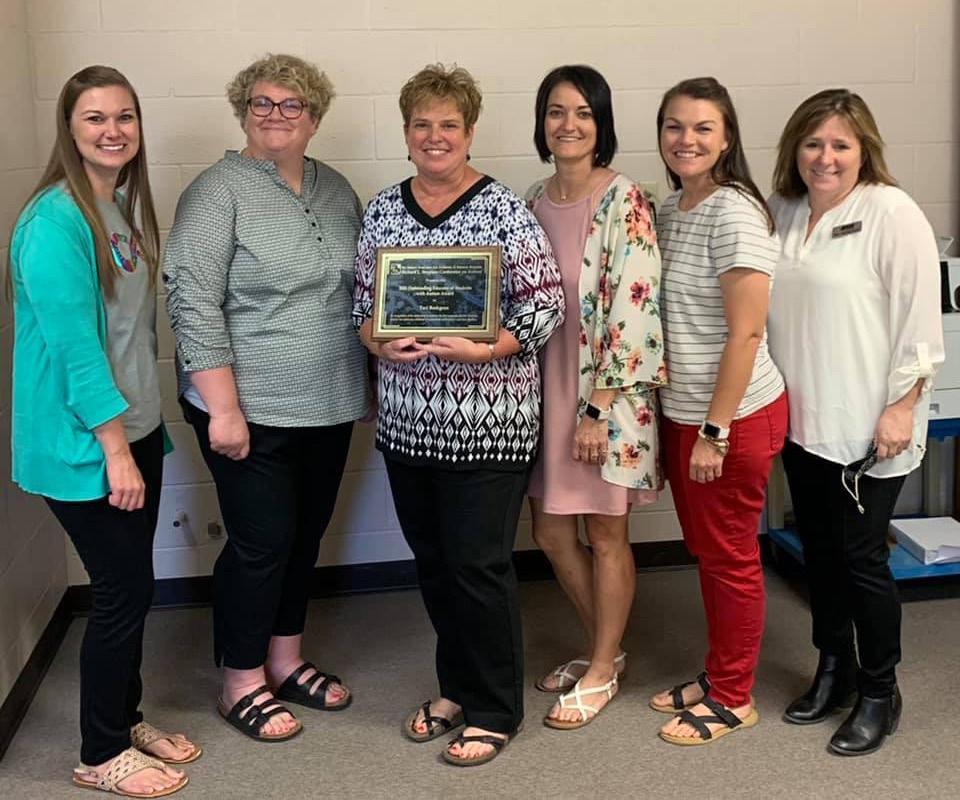
Teri Berkgren with colleagues from Northwest Kansas Educational Service Center and TASN-ATBS (Left to right) Amy Schulte, Amity Ihrig, Teri Berkgren, Tracie Betz, Ryan Walt, Dixie Teeter






RE THINKING Behavior
Conference Dates!
February 17-19, 2022
40th Anniversary Midwest Symposium for Leadership in Behavior Disorders IN PERSON at the Sheraton Crown Center, Kansas City, Missouri
Advance Registration Deadline-January 21 October 2022 2022 Richard L. Simpson Conference on Autism Date & Details Coming Soon
Award Nominations!
Outstanding Advocacy Outstanding Leadership Outstanding Educator Outstanding Building Leadership Building Bridges Program
Stipends- master’s & doctoral students Nominate by November 1, 2022!
Consider Joining the MSLBD Master Teachers Nominate yourself or a colleague See the MSLBD website for details.

Midwest Symposium for Leadership in Behavior Disorders