






February 27, 28, & 29 | Sheraton Crown Center | Kansas City, Missouri
For the 38th year, the Midwest Symposium for Leadership in Behavior Disorders will address cuttingedge issues of interest to professionals working with students with emotional/behavioral disorders and autism spectrum disorders.
Friday February 28
8:30-10:00 AM
Four Short TED Talk-like Keynote Speeches

• What motivates us to work with youth with significant mental, emotional, and behavioral needs?
• What skills are needed to be effective professionals in this field?
• What are the things we need to discover and nurture within ourselves in order to maintain our effectiveness?
• How do we maintain our personal lives without becoming overwhelmed by the challenges of the students we serve?
Four professionals from the field will address these and other topics during this TED Talk-like session. Come learn from professionals who will share insights about supporting students with significant behavioral needs.



Thursday, February 27
7:30 a.m. Conference Desk Opens
9:00 a.m.-12:00 p.m. Pre-symposium Workshops
12:00 p.m.-1:30 p.m. Lunch (on your own)
1:30 p.m.-4:30 p.m. Pre-symposium Workshops
11:30 a.m.-5:00 p.m. Exhibits
Friday, February 28
7:30 a.m. Conference Desk Opens
8:00 a.m.-5:00 p.m. Exhibits
8:30 a.m.-10:00 a.m. Keynote Session
10:20 a.m.-11:20 a.m. Concurrent Sessions, Set I
11:30 a.m.-12:30 p.m. Concurrent Sessions, Set II
12:30 p.m.-2:00 p.m. Lunch (on your own)
2:00 p.m.-3:00 p.m. Concurrent Sessions, Set III
3:15 p.m.-4:15 p.m. Concurrent Sessions, Set IV
4:15 p.m.-6:00 p.m. Poster Session: Cash Bar and Complimentary Hors d’Oeuvres
8:00 p.m.-11:00 p.m. Symposium Party
Saturday, February 29
8:00 a.m. Conference Desk Opens
9:00 a.m.-11:30 a.m. Saturday Concurrent Sessions 11:45 a.m. Adjournment
Editorial Team:
Reesha M. Adamson
Mary Jo Anderson
Marc Benedetto
Scott M. Fluke
Linda Geier
Deborah E. Griswold
Cassandra L. Hunt
Jacqueline HuscroftD’Angelo
Sharon A. Maroney
Jessica Nelson
Mike Paget
Reece L. Peterson
Seth A. Piro
Felicity Post
Lisa A. Robbins
Carl R. Smith
Jim Teagarden
Jason C. Travers
Kathleen N. Zimmerman
Rethinking Behavior, ISSN 2578-5397, a magazine for professionals serving children and youth with behavioral needs, is published three times per year, fall, winter, and spring, Copyright ©2020 by the Midwest Symposium for Leadership in Behavior Disorders, P.O. Box 202, Hickman, NE 68372. 402-7923057. www.mslbd.org. Email: rethinkingbehavior@mslbd.org.
Rethinking Behavior welcomes proposal and manuscript submissions; for information visit www.mslbd.org or email rethinkingbehavior@mslbd.org
For those of us who are blessed with less than 20/20 vision, we are very familiar with the process of the annual eye exam. Typically, the results involve minor refinements in the strength or type of the prescription. Rarely does the exam result in a major change or the “cure” of the vision issue. If only this same process was utilized in education, perhaps the results would be more positive.
This fact was made apparent as one of us was refining a preservice course to include elements of social emotional learning. Many very worthwhile concepts and skills are contained within the SEL framework and the instructor was looking forward to adding these to the preservice teacher’s toolbox. It was humbling to realize that these skills are not new nor is their importance (for all of us, not just students) a recent development. In fact, a diary from Jim’s mother, who taught in Jewel County Kansas in 1936 and 1937, mentioned the citizenship traits she was expected to teach and support in her students. Those traits mirror almost verbatim the recently adopted standards in the same state. Although this focus is critical for the education
of students in 2020, it was just as important to students in 1936.
The problem arises when we begin to believe that a minor change in a prescription or a repackaging of a curriculum is something completely new. Education has long been accused of being driven by fads and market forces and this criticism is not totally undeserved. Much time and many resources have been lost by chasing the “newest” and “latest.” In some ways the childhood story of the tortoise and the hare comes to mind.
We’d encourage each of you to take stock of what interventions and focus you have used with success. A continuous refinement in prescription with a consistent focus will always result in the tortoise winning the race. While the hare, exhausted from trying many different paths, is left behind to nap.

Jim Teagarden and Deborah E. Griswold, Issue Editors, and the Editorial Team
By Linda Geier

“Austin is in one of his moods again,” whispered Sue, one of the paraprofessionals assigned to my EBD self-contained program. We could see him slowly walking toward the classroom, head lowered with an ill-fitting, dirty hunting cap covering even his ears. The scowl on his face made it clear to students and adults that he was in no mood for school that day. We allowed him to stomp past us and plop himself into his desk where he immediately put his head into his arms. As we got the other students busy on their opening work, I watched Austin. He pulled his arms over the top of his head as if to hold tight to the cap despite the fact there was a rule against wearing hats in the school. He was digging in for a challenge.
After giving him a bit of time to cool down, I approached Austin and invited him to go for a walk on the playground with me. It was there, on the merry-go-round, where Austin finally pulled off his cap and showed me his newly shaved head. Through tears he shared that his mom found lice on his head and shaved it before dousing it in gasoline. As he described the experience – how he begged his mom not to shave his head – my heart went out to him. Really? She couldn’t just go to the drug store and buy a bottle of lice shampoo?
Given that the family did not have a phone, I knew I needed to schedule a home visit. This wasn’t the first concern I felt the parents needed to hear. While I was there I would also approach the
by
subject of Austin’s hygiene. Many days he arrived at school cloaked in a sweet, indescribable, and totally disgusting odor that no one could identify. As he walked down the hall, students and teachers stopped to stare and take a few steps back to escape the stench. The odor was so strong and so repelling that the classroom paraprofessionals and I would take turns working with him because the smell was, literally, sickening.
I wasn’t a parent yet, but I knew what good parenting looked like. No parent should be allowed to ignore their basic responsibilities toward their child. A child’s clothes didn’t need to be top quality but they should be clean. No child should be ostracized for a buzz cut that could have been avoided with a simple trip to the drug store. Paying attention to things like this might help Austin become accepted, might even help him make a friend at school. Didn’t they want that for their son?
Being a new teacher, I wasn’t sure how to approach these delicate conversations but I sent a note home with Austin that I would plan on making a home visit on Thursday at 3:45 to meet with his mother about Austin’s progress in school unless she wrote to suggest a different day/time.
Austin lived in an area of town I had never been in before. It was on that drive through his neighborhood that my eyes began to open to the extreme poverty Austin and his family obviously faced. There were no lawns to play on – just dirt covered in patches of weeds. Windows of houses were boarded, sheds were leaning, and trash was everywhere.
As I pulled up to Austin’s home, I mentally rehearsed how I would start the conversation with his mother. I would start by listing Austin’s many strengths and I would talk about the little steps of progress I had watched him make already in my program. And, then, I would describe his challenges to making friends; his appearance and hygiene. Step-by-step we would get through
The scowl on his face made it clear to students and adults that he was in no mood for school that day.
this conversation. I knocked on the door (the doorbell hung by wires and didn’t seem to work) and waited, imaging what this mother might be like. I’m ashamed to admit it but I was steeped in biases and all the negative assumptions that accompanied them. In my mind, this woman was obviously lazy and gruff. She was bound to be uncaring and dismissive. I was hoping a reminder of her son’s strengths would melt her heart enough to get her attention and cooperation.
The door opened. The slight woman who opened the door introduced herself as Beth, Austin’s mother. She was obviously nervous and a bit shy – introverted like her son, I supposed. But she graciously invited me in as she offered a glass of water or tea. As I stepped through the doorway, there was that smell – that sweet and sickening smell! The front room was fairly neat and appeared clean enough; it gave no clues as to where the smell might be coming from. Beth’s clothing was worn and crumpled. She often smoothed back her hair and smoothed her shirt as we talked. It seemed she was self-conscious about her appearance compared to this young teacher in front of her who was dressed professionally. I wished I had stopped to change into more casual jeans before coming. But I forged ahead with my planned conversation.
As I shared the positives about her child, Beth teared up. She thanked me for seeing the good in her son. She had never heard anything positive about her son from school personnel in the past. What? No
one had ever bothered to appreciate and share the good qualities of her son? Never? I reflected on how it must feel as a parent to get nothing but negative calls and messages about one’s child. It would be hard to accept school as something to be valued if the people in it couldn’t find a way to recognize the value of one’s child. Beth added to my comments with stories of her own – mostly of ways Austin helped with his younger brother and sisters. She explained that she had a part-time job and the father held down two. He was often gone so Austin was expected to help around the house more than most kids his age.
We did muddle through the needed conversations and along the way I was able to walk in the shoes of this mother who, in true poverty, had limited options. She was able to put clothes on the backs of her children but they did not own a washer or dryer to clean them nor did they own an iron to press them when they were rumpled. Transportation issues made it difficult for her to not only make it to the laundromat, but also to make it to parent-teacher conferences. The challenge of raising six children, basically alone, made it difficult to help them all, let alone practice reading and good study habits. She was able to feed her children, but sometimes not enough. Did she say all of this directly? I don’t remember. But
I walked away knowing these things to be true, and that Beth loved her children just as much as I would someday love my own. Beginning with that meeting, Beth and I worked closely together to support Austin. We also found ways to support the family so that Austin and his siblings could more easily focus on school.
As a new teacher, I learned much from my work with Austin. I continued to make it a priority to start every tough conversation with parents/ guardians on a positive note. More than once, when I started an IEP meeting by sharing the strengths of the student, their parent/guardian teared up. That’s right! It happened with Beth and it happened with others throughout my career. I do believe always taking the time to focus on a student’s strengths and progress is key to gaining the respect and cooperation of even those parents who were known to be highly challenging.
Austin and his mother taught me another important lesson that made me a better teacher and, frankly, a better person. As educators, we cannot afford to assume. We can’t afford to assume we know what is best for others. We must never make assumptions about what is behind anyone else’s behavior – student or parent. We can’t afford to assume we have the answers parents need because sometimes we don’t always understand just what those needs are. We must, instead, take the time to ask and explore with an open heart and mind. Doing so builds our compassion. Compassion fuels our understanding and commitment. It is through that commitment educators can be ready to work with students and parents/guardians in ways that make the biggest difference.
Linda Geier, Behavior Support Specialist, Tulsa, OK, lgeier98@gmail.com

By Shanon S. Taylor


There is a saying often repeated, “If you want to make God laugh, tell him your plans.” This saying has come to me at many times in my life, both personally and professionally. I began teaching adolescents with emotional/behavioral disorders in a residential psychiatric unit shortly after graduating with my bachelor’s degree; however, that was never my plan through my undergraduate studies. I always imagined myself teaching first grade, most likely in a Catholic school.
That plan was immediately tossed aside during my student teaching in a first-grade classroom when I discovered than I really did not enjoy teaching firstgrade students at all. The director of our education program, in his wisdom, made those of us in the elementary education program split our student teaching time between two grade levels. I found I enjoyed teaching fifth grade slightly more, but still not enough that I sought a teaching job after graduation. Instead, I remember having feelings
of despair, thinking, “what do I do with a teaching degree when I don’t want to teach?” God was laughing.
A few months later, a friend of mine who was working on a psychiatric unit called me up and told me that I needed to come in and interview for a teaching position they had open. The teacher had quit, and they had him – a psychology graduate – filling in as the teacher. I reminded him that I wasn’t interested in teaching and he exclaimed, “well, you’d have to make a better teacher than me!” He convinced me to come down, see the unit, talk to the supervisor, just to think it over. To be honest, I was in dire financial straits, so I decided to keep an open mind. Through the course of the interview, it dawned on me that what I had found most frustrating about my student teaching experience was that the students I wanted to be able to spend more time teaching were the students who challenged me the most; the ones refusing to do work, the ones displaying problem behaviors, the ones who didn’t think my meticulously planned lessons were simply amazing. Maybe it wasn’t that I didn’t like teaching, maybe I was just looking for a different group of students? On top of that, because I would need a special education credential, this job would pay for me to get a master’s degree, and I was always up for a new challenge, so I agreed to take the job. God probably chuckled at me.
Within the first few weeks, I realized I had found “my people.” As we all know, the work was difficult and demanding, but there was so much about it that I enjoyed. I liked having the smaller class sizes, so I really was able to get to know my students. Because I not only taught them, but sometimes led the daily group where we reviewed their behavior, students often opened up to me which allowed me to gain a more in-depth understanding about their behaviors. Since the school within the facility operated as a private school, we teachers were given freedom and independence in planning our lessons and teaching. My class was multi-grade and included all
“What do I do with a teaching degree when I don’t want to teach?”
ability levels, therefore, I loved sitting down with all of the science textbooks, looking at the scope and sequence, identifying overlap in the material, and deciding where I could teach large group lessons and where I would individualize. I was still learning special education methods as I was teaching. I thought I was a planning genius until I got to the section on differentiated instruction in my General Methods class; I was shocked to learn someone had come up with that idea before me!
I probably would have been happy to keep working on the psychiatric unit for many years, but changes in how Tennessee accepted Medicaid payments put the very existence of the hospital where our unit was located in jeopardy. People were laid off in growing numbers, and I began to realize my job might not last much longer when a colleague came to me with an intriguing offer. The psychologists who had originally opened our facility in the 1980s had a contract to open a new facility, this time for male juveniles who were adjudicated by the local juvenile court. Would I be interested in interviewing for a teaching position there? I jumped at the opportunity to be at the opening of a new residential program, and within a year, I was promoted to the director of education for the program. Again, I’m sure God was chuckling.
Professionally, I had even more opportunities in that job than I had before. These students were older, primarily high school aged and for some of them, we worked on preparing them for the GED. I had the opportunity to do new things administratively, qualifying our school for Title I funding, free and reduced lunch funds, and demonstrating accountability through the state high school
proficiency testing program. I had never imagined myself doing those kinds of things ever before. My advisor from my master’s degree began sending undergraduate students who were interested in having a more directed EBD practicum experience to my classroom. Personally, my life had changed as well. I had gotten married and while teaching there, had my first child, a daughter. By then I had been teaching for nearly eight years, and changes in the leadership at our facility made me question what my next steps might be for my career. A conversation with my former advisor made me realize that I could reach only so many students standing in my own classroom; I could potentially impact the lives of so many more if I taught other people to do the same things I was doing. I decided to go back to school for my doctorate, just as I also learned I was pregnant with my second child. I’m not sure if God was laughing at this point; I didn’t know if I should laugh or cry.









My goal was to be finished with my doctorate and have a faculty job by the time my daughter was in kindergarten so that I could be available for school activities. I was close – I had the faculty job, but I was ABD (all but dissertation). I finished up that year, and threw myself into faculty life and the life of an elementary school mom, by going to the awards days, field day, picnic lunches, and volunteering in the school’s uniform office. It became clear early on that school didn’t come easily to my daughter. I didn’t want to jump to any conclusions and look for problems where there weren’t any, but as early as first grade, I was concerned that she was showing signs of a learning disability. However, she was in a Catholic school, so there was no special education system to which to refer her. By the fourth grade, I was almost positive she had a learning disability, and in fifth grade, when she was nearly in tears because of a strained relationship with her teacher, I brought her in to the Educational Psychology department in my own college for testing and discovered that yes, she did indeed have a significant learning disability in both math and written language. Despite taking that report in to the teacher and principal and explaining how they could work with her, I was told that she just “didn’t try hard enough” and if she would just “give more effort” she would be able to succeed. The irony of a special education professor hearing those words made me sure God was laughing at me.
I was frustrated. The teacher had placed my daughter’s desk in a corner, by herself, saying
she would remain there until she caught up on her work because clearly the problem was that she was distracted. Then one day while I was working, I received a call that an ambulance had been called to the school – my daughter was having a seizure that wouldn’t stop. She was rushed to the emergency room and even with multiple doses of sedatives, she kept seizing. Finally, they had stopped the seizures, and after testing and days in the pediatric intensive care unit, the pediatric neurologist informed us that he believed her seizure event had been “psychogenic.” Basically, it was similar to an intense anxiety attack. She was released with a prescription for Ativan, but back at school, the attacks would happen again. Even worse, because of these and her growing academic problems, she became a target for bullies.
This began years of a family roller coaster ride for us. At first, she did not want to leave the small school she’d known since kindergarten. But as the bullying intensified, she refused to go to school and refused to go anywhere else. We actually called police to come to our house and explain to her that she had to go to school, that if she didn’t, we could take her to detention. That spurred her to allow us to enroll her in our local public school to complete middle school. I knew the special education teacher, and we were able to hand-pick teachers for her, many of whom were dual licensed in special education and their content area (as she was now in seventh grade). We were working with a psychologist and local family support services that provided family counseling as well as truancy checks, making sure she attended school regularly. She had only one anxiety attack in that school, and then no more. We felt like we had finally turned the corner and made it out the other side. We should have known better than to plan ahead …
When my daughter first started high school, things went well. Her freshman year was strong and she was making new friends. Her sophomore year was a little bit shakier, and she seemed to withdraw just a little bit more. She was struggling some more
We were working with a psychologist and local family support services that provided family counseling as well as truancy checks
.
academically, and I approached her about the idea of accessing special education services for her learning disability for the first time. She absolutely refused. Shortly after her 16th birthday, she had an evening out at a friend’s house and when she came home the next day, I had a sinking feeling that something bad had happened the evening before. I tried to get her to talk to me, but she wouldn’t. She went into a steep emotional decline in the months following, and in the fall semester of her junior year, it became apparent to us that she was involved in some sort of substance abuse. She began failing classes and I was contacting her school counselor and teachers, asking for help. She also began skipping more and more classes, at some points missing entire days. Finally, I realized she was also cutting herself. I insisted she return back to the psychologist, but she had never had a good rapport with that therapist, and it was even worse now.
Midway through the spring semester of her junior year, I received a call from an administrator at her high school, asking if I knew where my daughter was. She said one of her friends was in the office, showing her texts from my daughter saying she was going to kill herself with pills. I drove home as quickly as possible to see if she was in our house, and she was in her room, surrounded by overthe-counter pill bottles. Luckily, she hadn’t taken any, but I immediately drove her to the therapist, where she insisted she had no immediate plans to take her life. At this point, I began a battle with our
insurance company that would last months. Her therapist recommended inpatient treatment, and as someone who had spent years working with adolescents in inpatient treatment, I felt like I was looking at a child who desperately needed it. I couldn’t believe that after all that time I spent working with other people’s children, I now needed someone else to do that for my child. But what I discovered was that even if her doctor felt like it was needed and I felt like it was needed, our insurance company could tell us no. And while God may have laughed, I sobbed.
The girl my daughter had texted her suicidal ideation to spread the story through their social group; even the girl’s mother sent my own child ugly text messages about being “crazy” and “insane.” Once again, my daughter refused to return to school, so I insisted she be placed on homebound and receive a 504 plan. She began intensive outpatient services and I basically began working from home. We kept all medications locked up; scissors, knives, razors, anything that could cut was also secured. The homebound teacher was unable to teach most high school subjects, so I ended up paying for private tutors; my daughter’s teachers expected her to complete all the exact same assignments all the other students in school were completing, even though she didn’t have the same benefit of a full-time secondary content teacher, so she kept falling behind and became more depressed. When her six-week intensive outpatient treatment was over, we kept up weekly visits with the therapist she had met and liked through the program. That therapist referred her to a psychiatrist for an in-depth evaluation; he and the therapist also recommended in-patient treatment for her. The insurance company only would pre-approve another six weeks of intensive outpatient treatment. By this time, it was time for
her senior year to begin, and she had decided to return to school.
Right away, it was clear things were not going well. Everyone involved in her care was concerned with how wildly she seemed to be spiraling out of control. What none of us knew at the time was that school was where she got all of her drugs. School was the worst place for her to be. I did know that I needed her to be in residential treatment because it was the one place I was absolutely sure that she couldn’t get drugs and she would be safe. I had spent the summer doing research and by then what I had learned was that the mental health parity requirements of the Affordable Care Act had just gone into effect that year. I learned exactly what that meant, and then during one final long and desperate phone call with a customer service agent (who I am sure still has nightmares about me) at my insurance company, I apparently said the magic words, “Under the mental health parity requirements of the Affordable Care Act, this company must treat mental illness on parity with physical illness and since I believe you are denying my daughter appropriate care for her mental illness, I will be filing a complaint with the state insurance commissioner stating your company is violating the ACA.” Suddenly, I was put through to a supervisor, who then decided that my daughter’s file should be forwarded to the medical director. It took a few more weeks, but she was pre-approved for admission to the residential treatment facility. That fact was so unusual that at the time we admitted our daughter to the facility, the admissions counselor doing the paperwork looked at my insurance card and said, “How did you manage this? We’ve never been able to admit anyone from this company before.”
Her time in the unit was not easy on our family. Her younger brother, fifteen at the time, did not want to go visit her at all. Her substance abuse, her anger and outbursts, her extended rages and sobbing had all been difficult on him for years, and he didn’t know what to expect from a residential treatment
center. However, she was in treatment during the holidays, and when Thanksgiving came, she specifically asked for him to come visit. We told him he needed to go. Once he went and saw how much she had changed just in a few weeks, he felt better about the process. She was able to have a day pass for Christmas, and was released just before her final semester of her senior year was to start. We were concerned about her returning to school, but she was adamant about returning and finishing. She continued seeing a therapist for out-patient therapy, and she managed to finish up her school credits and graduate during the summer.
My daughter’s life is not at all how I ever would have imagined it when she was born. None of this was what I had planned. All the time I spent working in residential facilities, never could I have imagined that one day, I would be the parent standing outside the door as their child screamed and cursed them for leaving her. Never could I have imagined the joy of my child hugging me and crying and saying, “thank you so much; you saved my
When my family is together, we are all very happy. Laughter abounds.
life.” We know not to plan. We don’t know what lies ahead. Right now, it’s been just over three years since my daughter walked out of that facility. She lives a sober life, she has a full-time job, and she lives independently with her boyfriend and a best friend. I don’t know if God laughs when he looks down on us, but when my family is together, we are all very happy. Laughter abounds.
Shanon S. Taylor, Associate Professor, University of Nevada, Reno, shanon@unr.edu














By Matthew McNiff
Response to Kauffman, ReThinking Behavior, Spring 2019
When I first went to college many moons ago, my father, perhaps realizing my true talents or perhaps a profound doubt on my employment prospects as a history teacher, encouraged me to go into the field of special education. In the early 1990s, special education was a growing field with a need for good teachers. Leaders in our field were producing exciting research and expanding our knowledge of the field of special education and behavior disorders. I found myself resisting the calling to be a special educator at every turn but life has a funny way of putting you in the place that you fit best and I became a teacher of history at a facility for adjudicated delinquents. I met my wife, another history teacher, at this program and we soon found ourselves immersed in the interesting field of behavior disorders and our journey as special educators began. I have been in the field of special education for almost 25 years working as a counselor, a teacher, a behavior specialist, and an administrator so I have seen my fair share of trends, fads, policy drifts, pendulum swings, and system changes. I have been a student of the field of special education to the tune of 143 graduate hours of book learnin’ and teaching classes at the college level.
In 2007, my wife and I were blessed with our second son Ben. After a month, I turned to my wife and said, “I think that Ben has autism.” Like a doctor who believes that every headache is a stroke, she told me that I was projecting because of my job as a behavior and autism specialist. Within a year though, Ben was receiving special education services and we had a diagnosis of autism.
I bring up the fact that we have a son with autism because even with all of our education, all of our experience, all of our resources at our disposal, my wife and I felt inadequate to take on the role as a parent of a child with a disability. It is an exclusive club that people don’t often choose to be a part of or excited to join. It is a club of uncertainty.
Over the first year of our son’s life, we saw our images of who Ben might become turn foggy and disappear because we didn’t know if Ben was ever going to be able to talk, let alone read, write, have friends, work, date a girl, get married, have a career, produce grandbabies for us, and eventually provide a spacious add-on to his house so that he could take care of us in our senior years. We turned to wondering about the basics and starting from the beginning. We just wanted him to talk. We just wanted him to be able to feed himself. We just wanted him to follow a point, to smile, and to respond to his name. With time these things came but not necessarily because my wife and I were a dynamic duo of behavior analysis but because we found programming for Ben at a specialized preschool.
When Ben was 2 years old, he began attending a specialized preschool. The preschool was not a specialized program for children with autism though. In fact, it was quite the opposite. The preschool was a university training preschool where professors and university staff brought their children so they would be exposed to the newest trends and research into early childhood development and guinea pigs for the future preschool teachers going through their undergrad programs. For 4 years, Ben traveled two hours a day, five days a week, to attend the Ruth Staples Child Development Lab on the campus of the University of Nebraska-Lincoln. It would have been much cheaper to have kept Ben at his daycare where he could have received speech services provided by the public school and Ben would have been perfectly happy spinning balls
and flapping his hands all week long. We chose to have Ben attend the school precisely because it moved Ben into a societal reality and understanding of where he was going to be learning. For four wonderful years, we saw milestone after milestone be left in the dust because of the full inclusion practices that were provided at the Ruth Staples program. Ben learned his alphabet, mastered his numbers to 100, sang songs, and spoke. Friends greeted our son at the door and helped him to learn how to “play.” Our only concern at the time was that the Shangri-La would end at age six and we would have to move him into the regular public school setting; we were wracked with nervous anticipation.
When Ben began attending his public kindergarten class, he was equipped with his very own paraeducator whose job it was to help him navigate the day. With the exception of reading class and the occasional tryst with the speech pathologist and occupational therapist two times a week, Ben was in the regular education classroom. It didn’t take long for the other students to notice that Ben was different. Ben would screech when he didn’t get his way. He would flap his hands when he was excited. He would jump off his chair. Kindergarteners have a natural curiosity about differences and a lack of social filter to keep their questions masked, so the question came to the teacher, “What’s wrong with Ben?” The next one word answer that came from the teacher’s mouth was a pivotal moment in our life and changed my son’s life forever. The answer to the question of “What’s wrong with Ben?” was “Nothing.” The teacher told the kids his class that nothing was wrong with Ben. Since that answer didn’t exactly mesh with the evidence that Ben was providing to their young minds, the teacher elaborated. She told the kindergarteners that Ben had autism. She explained that Ben struggles to figure out the world around him and that he is going to need to have friends that help him understand what
is going on. Since that day, the class undertook the challenge of helping Ben to figure out the confusing day to day operations of a world that often seems inside out to him.
Before I begin, I want to stress that my respect for Dr. Kauffman, the man who literally wrote the book on EBD, is immeasurable. However, that does not mean that I can’t and won’t disagree with him on topics that he addressed in his perspective on changes and progress in the field of special education in ReThinking Behavior Spring 2019. I understand too that my analysis of his perspective could be way off base but I doubt that my ramblings will cause Kauffman to lose too much sleep this weekend. As both a scholar of special education and a parent of a child with special needs, I am afforded the unique position of being both emotionally too close to the situation and objectively distant from the problem at the same time.
For the purposes of the paper, Kauffman was kind enough to break down his arguments for his audience to make the proposition that we have moved too far away from the original intent and promise of special education and that we have marginalized the very aspects of special education that made it special in the first place. II view it a little bit differently as I grew up in a different generation of special education than Kauffman did.
The position that Kauffman considers is that we have seen a great amount of change in the field of special education and that we have incorrectly
The problem is that often times, the “Good Ol’ Days” were not all that good.
viewed change as progress. Unfortunately, in his mind, we have masked the heart of special education with political correctness instead of dealing with the true issues of special education. In short, we have progressed to the point of digression and moved away from the original purpose of special education. In a way, I can see his point. From a global perspective, a person could feel that we have become more concerned with language that we use or the push for inclusion that special education has run amuck and the field has gotten away from the “one child, one program” individualization that was the original intent of PL 94-142. But much of what Kauffman addressed in his paper seems to come from a “Good Ol’ Days” frame of mind that harkens back to when things were supposedly much better and children were learning more in resource rooms and getting all of the supports that they needed. It is very similar to my parent’s recollection of how great things were before kids “had their damn noses glued to their phones.” The problem is that often times, the “Good Ol’ Days” were not all that good. Have we forgotten the issues that forced the evolution of our field in the first place? I want to take each of Kauffman’s arguments and examine them closer so that the perspective of a parent might shed more light on this debate.
Kauffman takes issue with the person-first language and political correctness that has moved us away from labeling students. Language, according to Kauffman, “. . . seems to make little difference in how we treat people or the stigma
that goes with a word once people know what it means.” For instance, instead of using the words “mentally retarded” for identification, our field moved to “a kid with mental retardation,” eventually changing the label to intellectual disability (ID). As a parent, I truly appreciate the person-first language. I can tell you that I cringe when I hear someone say that my child is “an autistic” or that Ben is autistic. If my 9th grade English teacher, Mrs. Effken, were to have me diagram the sentence “Ben is autistic,” the adjective “autistic” is to describe my son and might as well be “autistic Ben.” Yes, Ben has autism. He’s also a little bit chunky (like his father), can be kind of whiny (like his father), and can be incredibly funny and charming (unlike his father). Unfortunately, when we only use the label “autistic” to describe Ben, that label is the first, and often the only, thing that people associate with him. When I tell people that my son has perfect pitch, they are fascinated by that skill. When I tell them that he has autism, the looks on their faces change. It goes from one of fascination of his skill to a look of pity, as if my son has some sort of disease and that I have already lost him. They grieve for me at that moment and that comes from the label of autism. But my son is so much more than his autism and I am always grateful when people are able to see beyond that because then he isn’t “autistic Ben.” He is just Ben.
Ben’s autism isn’t a big deal to members of our field. We are trained to look past the label and to see the child within. That is not the way that it is in the real world though. The reason why “retardation” is
such a taboo word now is that it was given power. Unfortunately, the word was given negative power and “retard” and “that’s retarded” became terms of derision to mock people when they did something that was viewed as “stupid.” It became a word of mockery and the advocates of children with that disability looked to change the label to move away from the hatred and ridicule that came to be associated with their children.
Changes and evolution of our language in our field is not uncommon. Until the 1970s, a now archaic scale of identification for individuals with intellectual disabilities was used. Those who had IQs of between 51 and 70 were labeled “morons”, those with IQs of between 26 and 50 were labeled “imbeciles”, and those individuals with IQs between 0 and 25 were harnessed with the label “idiot.” If a member of our field were to create a psychological report and identified a child as a “moron”, that person would lose their job regardless of the scientific explanation behind it. Our field adapts and evolves to fit the societal expectations. When words are used that hurt and harm, we should find other words to describe the condition so that we can restore dignity to the concerns at hand.
Kauffman tackles the debate of inclusion head on in this paper. I truly understand what he is trying to convey. We should be looking at what the true least restrictive environment is to provide the best educational experience for the child. Kauffman may feel that the idea of total inclusion for all is a naïve pipedream that we are striving for, instead of refocusing our attention on what the child truly needs to be successful. I don’t think that he is wrong in the idea that we should be looking at the least restrictive environment to meet the educational needs of the students that we serve. But if we continue to stay stuck in the idea that we should not push for inclusion, we force back the hands of time and don’t force the evolution of the regular education classroom to be a classroom
When I tell people that my son has perfect pitch, they are fascinated . . . When I tell them that he has autism, the looks on their faces change.
where inclusivity is a reality and all kids can be taught at their level. I am not so naïve as to believe that every kid should be in the regular education setting and that we need to have full inclusion to be successful. However, I believe the mistake that Kauffman makes is his assumption that the field is broken because in some places the idealized versions of inclusion didn’t pan out. But in some places, it did.
I can use my own son as an example of this. If you were to see Ben on the street, you would assume that Ben would be a candidate for a life skills program and a 100% resource setting. My son is in the fifth grade and has very poor language skills. He has poor expressive speech skills. His receptive language skills are mediocre. His IQ hovers around the 70 range. He attends a resource class for reading because he uses a separate curriculum but he reads almost at grade level. Everything else that Ben does is in the regular education classroom. Math, social studies, science, PE, health, music, art, counseling, and
whatever else the school decides to throw at him is all done in the regular education environment. Ben gets a mix of As and Bs. His work is rarely modified except to use schedules or to read aloud the information. He has accommodations such as extra time and quiet locations to take tests. But the inclusion society that the school has created is giving him much more.
Kauffman argues that many children with mild disabilities are barely keeping afloat in the regular education setting and are constantly confronted with their failures because they do not achieve on par with their peers. By learning in the special education classroom, it is presumed, that they can learn in a segregated setting where they can flourish academically. He views the state of inclusion as students being in class and being passed along as long as they don’t create a fuss. He may be right in that a student may do really well in a secluded setting away from their general education peers. However, to presume that all special education teachers will be beacons of pedagogy and will help these children advance quicker may be inaccurate. Unfortunately, as someone who has the opportunity to see all sorts of regular and special education classrooms and teachers, the education is often only as good as the person providing it. Is it better for a child to be in a resource classroom with a mediocre or bad teacher or a regular education classroom with an extraordinary teacher? That goes both ways too. Is it fair to have children in a regular education setting with a poor teacher when an exceptional special education instructor is right down
the hall? As a parent, if I view the special education teacher to be subpar, I may very well want my child in the regular education setting even if they are struggling.
When I last talked about Ben’s journey through school, I left him off in the kindergarten room and the teacher was imploring the students to help Ben understand the world around him. That teacher and the special education teacher created a culture of inclusion and followed the mantra of “presume competence.” This idea is that, until proven differently, we should assume that Ben can do what is asked. If he can’t do it, he is taught. If he struggles to be taught, then we intervene. If he doesn’t respond to intervention, then they look to specialized instruction. What we have consistently found out is that Ben is able to often rise to the challenge.
Ben knows that he is different than his peers but he longs to be part of that group. Further, the teachers created a climate where the students wanted Ben to be in their classroom. Children argued on who was going to sit by Ben at lunch and talk with him. When they weren’t picked to be part of his Circle of Friends group, they would be sad and complain. Children volunteered to stand by Ben at concerts to keep his hands from flapping in front of his face and drawing attention to him. Two months ago, two students came to the regular education and special education teacher with a concern. They said that Ben was pulling his pants down to his knees when he went to the bathroom and they wanted to figure out how to help him because when he goes to junior high school, they were afraid kids will make fun of him. These kids are his advocates and his friends. This is a culture of inclusivity and an example of what can be accomplished. Ben may be able to do his math quicker in a quieter environment but right now he is on grade level and completing all of his work. Without the firm expectations that Ben can be taught in the regular education setting, I have no doubt that Ben would have been content with just
After not knowing what my child’s outcome would be after hearing the diagnosis of autism ..., I now know that he has friends. That is what inclusion has brought to my child.
learning his basic math facts. Instead, he is learning basic algebra concepts.
Had Ben been relegated to the resource room because of his abilities, important parts of his life would be missing. Here is an example: During Ben’s third grade year, several of Ben’s friends came to him and asked him if he was going to be on the football team with them. We have an elementary football program in our rural community that uses full pads and they wanted Ben to be a part of it. I said no. There was no way that my child with autism would ever go out for football because . . . well, he has autism. I told the children that Ben couldn’t do it. They said that he could. I told them to shut up. In the fourth grade, they came back and asked when Ben was going to come out for football and I finally agreed because my son wanted to be a part of the team so badly. I helped to coach the team so that I could help Ben but the children were the ones who helped Ben more than I did. Ben played every game and you know what? He was awful. So bad. He played again this year and will play again next year. And he will most likely not be very good at it. But that is not the purpose of this story. Because of inclusion, my son had friends insisting that he participate with them. They ask to come over and play with Ben during summer vacation. They work to include him in everything that they do and make a point to not keep him out of anything. Honestly, I don’t care if Ben learns another math problem, knows where the capitol of Vermont is (which he does know), or can
pronounce photosynthesis (which he can’t). After not knowing what my child’s outcome would be after hearing the diagnosis of autism and experiencing the fog of what will happen to him when he goes to school, I now know that he has friends. That is what inclusion has brought to my child.
School is about so much more than the three Rs. It is a major part of a child’s development in 21st century America. Had the public school that Ben attended not had a strong program of inclusion, Ben very well could have been relegated to a special education classroom where he would not see the world outside of those four walls. Instead, the school celebrated the need for inclusion for both my child and for the children in regular education in his school. The students in his class care very deeply for Ben. They are growing up understanding the differences in how people grow and mature and the differences in individuals with disabilities. They are learning that they shouldn’t fear or slink away from that which is unknown or different but that they should advocate and support those who struggle outside of the norm. Ben is going to have to navigate the real world with people different from him and it might be hard. That should be a benefit of public school where we have watchful eyes of educators to help guide our children, disabled or not, on how to interact with each other successfully.
Kauffman believes that we have seen great change over the years but that we have not made progress. With all due reverence to the Godfather of EBD, I disagree. We have seen changes for sure. But these changes are an evolution of what once was. The examples of over enthusiastic advocates, political correctness, and dismal inclusion settings that he addressed in his article can just as readily be countered with incredible inclusion practices with diverse and exciting teaching practices. We can point to numerous appropriate uses of least restrictive environment. We can also identify the overuse of inclusion in some systems or
self-contained programs that were extremely misguided and may have done more harm than good. There is a happy medium where we get back to the purpose of special education and that is the promise of the “one child, one program” philosophy. We should be pushing our students to reach their maximum potential in the least restrictive setting that we can possibly create. The presumption that intensive, specialized, and individualized programs cannot and are not being created in the regular education setting is undermining the hard work done by millions of educators to individualize the best possible programming for students all over the United States. I believe that Kauffman undersells the abilities of schools to create inclusive practices and overestimates the training and capabilities of our current slate of overworked special education teachers.
As a field, we must continue to evolve. Where that evolution goes is anyone’s guess. I don’t believe that the “Good Ol’ Days” were always that good but I believe that we can take some of the good practices from then and combine them with the good practices of today. At the very least, Kauffman and I agree on this. We must continue to strive for the best individualized program for every student that we can. We cannot take shortcuts.
There are lives at stake who deserve our very best effort, every single day.
Matthew McNiff, Director of Special Education, Educational Service Unit #5, Beatrice, NE, mattmcniff@yahoo.com
Introduction by Reece Peterson
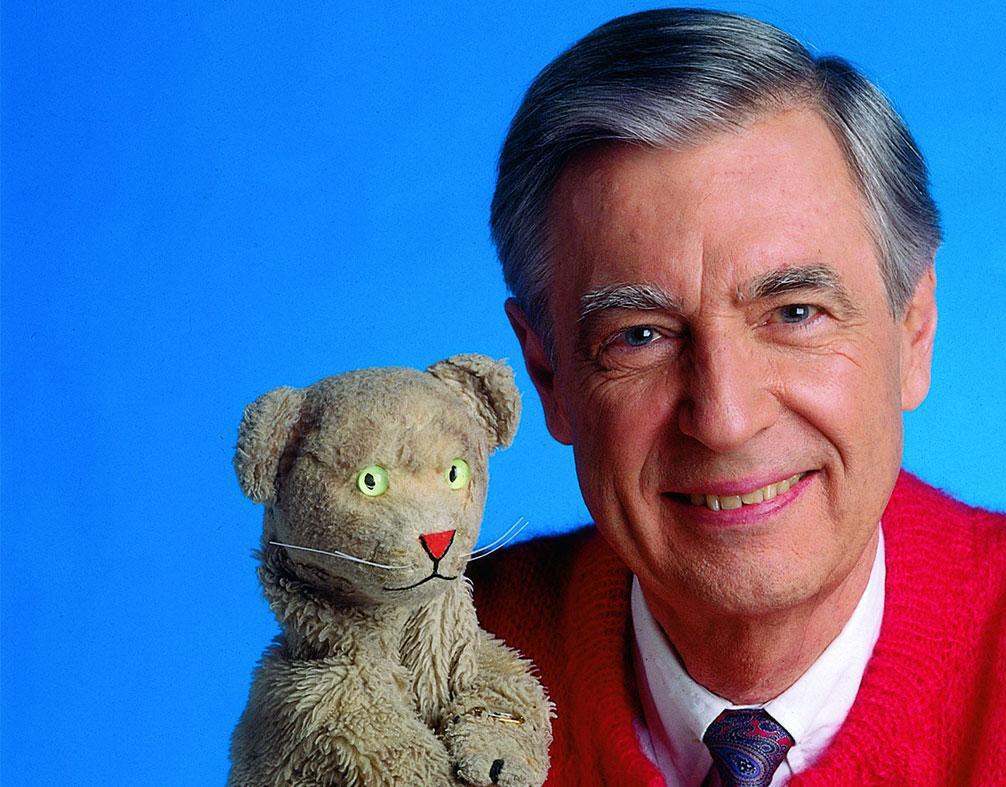
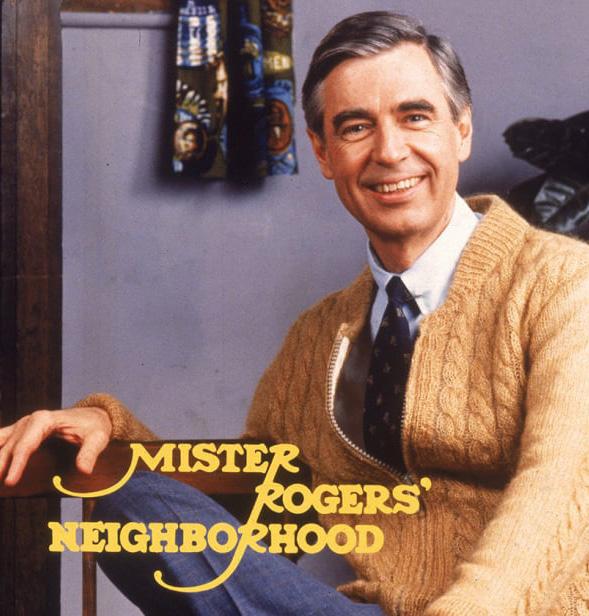
How many of you watched Mr. Rogers’ Neighborhood as a child? Children under 21 probably do not know him, although some will now have watched Daniel Tiger’s Neighborhood, a spinoff of the original. Mr. Rogers’ Neighborhood had its national debut in 1968 and aired until 2001. Fred Rogers passed away in 2003. This show was not simply entertainment for children; it had the clear goal of assisting them in understanding their world and the feelings they experience.
Mr. Rogers was known for his mild manner, cardigan sweaters, and soft speaking voice as he interacted with children and the characters in the program. He was also widely appreciated (and parodied) for the way he communicated the importance of caring, understanding feelings within one’s self and others, and for offering love and kindness to all. He explored issues that were unpopular such as race and counteracting stereotypes. He believed that children’s minds were malleable, and that positive role models would impact them. The program addressed social emotional learning although that terminology is much more recent. Although children of all ages enjoyed the program, its focus was on young children, aged 2-5.
The present-day spin-off program Daniel Tiger’s Neighborhood, is an animated program for preschoolers, attempting to address many of the same themes and values as in Mr. Rogers’ Neighborhood and employing the same components of imagination, creativity, and music. The Daniel Tiger program is aired on many public television stations in the U.S. and Canada.
Is there a lasting impact or collection of lessons to be learned from Mr. Rogers’ Neighborhood? The purpose of this set of three essays is to suggest that - Yes, there are lasting effects on us, and that the strategies it demonstrated to assist young children to understand their emotions are just as important today as in 1968.
The first essay, A Tribute to Mr. Rogers by Laura Erickson, a renowned scientist, bird-watcher, and podcaster, suggests how the program not only helped her children, but also helped adults with children be parents. She uses her knowledge of birds to explain her thoughts.
The second essay by parent and educator Deborah Kris Farmer, points to some of the key concepts emphasized throughout the program. She reflects on Rogers’ impact on herself and her daughter, and gains insight from the creator of Daniel Tiger’s Neighborhood, including the attitudes and practices which they call “Freddish.” These were essentially principles of social and emotional development of children–what we now call social emotional learning (SEL).
The third essay by Maxwell King, the author of a recent biography of Rogers, focuses on Rogers’ valuable techniques for communicating with young children– the Freddish principles. He lists the rules Rogers developed for talking and communicating with children which might be very helpful to both educators and parents working with young children today.
Mutually caring relationships require kindness and patience, tolerance, optimism, joy in the other’s achievements, confidence in oneself and the ability to give without undue thought of gain. We need to accept the fact that it’s not in the power of any human being to provide all these things all the time.
For any of us, mutually caring relationships will also always include some measure of unkindness and impatience, intolerance, pessimism, envy, selfdoubt, and disappointment.
Human relationships are primary in all of living. When the gusty winds blow and shake our lives, if we know that people care about us, we may bend with the wind… but we won’t break.
All of us, at some time or other, need help. Whether we’re giving or receiving help, each one of us has something valuable to bring to this world. That’s one of the things that connects us as neighbors in our own way. Each one of us is a giver and a receiver.
Whether we’re a preschooler or a young teen, a graduating college senior or a retired person, we human beings all want to know that we’re acceptable, that our being alive somehow makes a difference in the lives of others.
Quotes from: Rogers, Fred. (2010). The World According to Mister Rogers. Important Things to Remember. MFJ Books.
By Laura Erickson
Wild bird parents have an easier job than human parents do. It’s virtually impossible for any bird to reach adulthood whose parents didn’t do an appropriate job of raising it. Bird parents provide their young with food and protection, keep their nest tidy or lead the chicks around on the ground, and teach their young the basic life skills they’ll need for survival. Although this takes virtually every waking moment during the time the babies are dependent, bird parents don’t show a speck of impatience or anger, and never hurt their babies.
Somehow, we humans have evolved, or perhaps devolved, so that many of us reach adulthood after being raised in horribly inappropriate ways. Some adults simply cannot nurture, or are overcome by impatience and anger, or in other ways damage their children, yet the children survive to raise children of their own. And whether child-rearing is more a product of nature or nurture, the offspring of parents who raise their children badly are likely to inflict these bad parenting skills on their own children. Many of us who were raised in abusive homes know exactly how we don’t want to raise our own children, and when everything is going well, we can be pretty darned good parents. But at the end of the day, when the spaghetti is boiling over while we’re in the midst of a diaper emergency with the baby and our toddler falls on the hardwood floor while the four-year-old drops a half-gallon glass jug of milk on the kitchen floor, it’s easy to fall back on instinct.
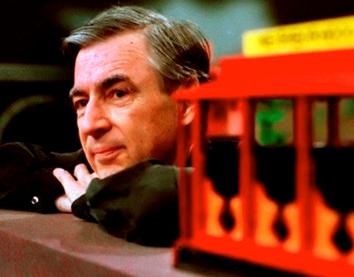
That’s why I was terrified to become a mother. I was confident that my children wouldn’t be covered with welts and bruises as I was, but I also knew that when I got frazzled, I couldn’t trust my instincts. Fortunately, when my first baby was six-monthsold, I discovered Mr. Rogers. Every day Joey and I would snuggle on the sofa and be welcomed into the neighborhood of this gentle, soft spoken man. Joey giggled and smiled at John Costa’s rich and whimsical piano playing and Mr. Rogers’ colorful puppets while I learned by Mr. Rogers’ example how to be a gentle, kind and patient mommy. Joey was an easy baby, so I had plenty of time to absorb Mr. Rogers’ ways before I found myself the mother of three small children and motherhood became more demanding. I wrote him in 1992 to tell him how grateful I was to him for showing me how to be a mother. And he wrote back a lovely personal letter which I’ve always kept on the wall near my desk, a treasure that reminds me who gave me the best part of myself.
I learned by Mr. Rogers’ example how to be a gentle, kind and patient mommy.
Mr. Rogers’s voice was ever soft, gentle, and low, like the call of a Resplendent Quetzal. Like a quetzal, he was a vegetarian. Male quetzals have a brilliant red underside, rather like the bold red sweater Mr. Rogers’ mother knitted for him that he often wore on the program, and like Mr. Rogers in his red sweater, a quetzal manages to quietly blend in with its surroundings, while making its own neighborhood a lovelier place just by being itself. A male quetzal’s flamboyant uppertail coverts are
fancier than anything Mr. Rogers wore, but as he often sang, some are fancy on the outside, some are fancy on the inside. He was authentic, and if he was sweeter than some people could abide, it was authentic sweetness – the kind that can nurture a hummingbird.
In a commencement speech at Dartmouth College in 2002, he said, “Our world hangs like a magnificent jewel in the vastness of space. Every one of us is a part of that jewel. A facet of that jewel. And in the perspective of infinity, our differences are infinitesimal. We are intimately related.”
Mr. Rogers left this planet a better, more neighborly place for all of us by just his being himself. Now it’s time for the adults among us to follow his example and work to make this world a safe, nurturing, and lovely neighborhood for children, animals, and one another. Mr. Rogers closed that commencement speech with these words: “When I say it’s you I like, I’m talking about that part of you that knows that life is far more than anything you can ever see or hear or touch. That deep part of you that allows you to stand for those things without which humankind cannot survive. Love that conquers hate, peace that rises triumphant over war, and justice that proves more powerful than greed.” Whether we are a Resplendent Quetzal or a sparrow, a hummingbird or an eagle, let’s follow his example and keep Mr. Rogers’ spirit alive and our planet neighborhood filled with beautiful days.
By Deborah Kris Farmer
One afternoon when I was little girl, my mom found me hugging the television set during the closing credits of Mr. Rogers’ Neighborhood. “I love you, Mister Rogers,” I whispered.
My own daughter was a toddler when Daniel Tiger’s Neighborhood debuted. As I heard that familiar theme song for the first time in 30 years, my eyes filled with tears. I suddenly remembered how Mister Rogers had made me feel; it was like getting a hug from an old friend.
Angela Santomero, the creator of Daniel Tiger’s Neighborhood and “Fred’s number one fan” told me that she created Daniel Tiger to honor Fred Rogers and share his approach to teaching social-emotional skills with a new generation of parents and children. “There’s a strong need for the ‘Freddish approach’ to life,” said Santomero, including “speaking to kids in an honest, open, genuine, and respectful way.”
Reprinted with permission of the author, Laura Erickson.
Laura Erickson, scientist, teacher, writer, wildlife rehabilitator, professional blogger, public speaker, photographer, 2014 recipient of the American Birding Association’s prestigious Roger Tory Peterson Award, https://www.lauraerickson.com.
Fred Rogers approached the world – and his conversations with kids about the world – with a “fearless authenticity.” He treated children’s concerns with dignity, from the loss of a pet to the fear of going down the drain. For example, when he arrived on set one day and found a dead goldfish in his aquarium, he used this unexpected moment to talk to his young audience about death and to share childhood memories about how he felt when his dog had died.
He possessed an extraordinary understanding of how kids make sense of language.
By Maxwell King
I suddenly remembered how Mister Rogers had made me feel; it was like getting a hug from an old friend.
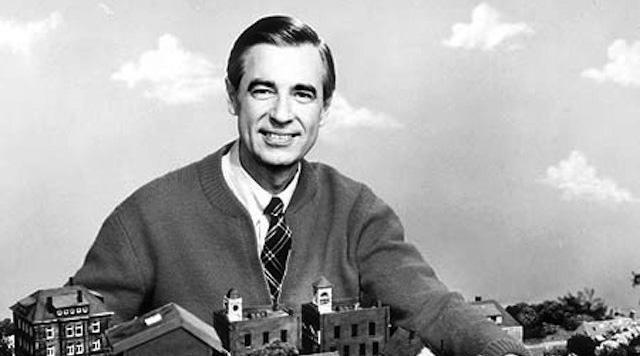
For the millions of adults who grew up watching him on public television, Fred Rogers represents the most important human values: respect, compassion, kindness, integrity, humility. On Mister Rogers’ Neighborhood, the show that he created 50 years ago and starred in, he was the epitome of simple, natural ease.
Rogers’ factual, compassionate responses to children’s questions and worries were rooted in one of his guiding principles: “What is mentionable is manageable.” Or as Santomero put it, “If we can talk about it, we can deal with it.”
To read more of this author’s tribute as it discusses “Big Feelings”, “Strategies to Help Kids Thrive”, and the feelings created when Mr. Rogers says “It’s you I like” click here:
https://www.pbs.org/parents/rogers/the-timelessteachings-of-mister-rogers-neighborhood
But as I write in my book, The Good Neighbor: The Life and Work of Fred Rogers, Rogers’s placidity belied the intense care he took in shaping each episode of his program. He insisted that every word, whether spoken by a person or a puppet, be scrutinized closely, because he knew that children–the preschool-age boys and girls who made up the core of his audience–tend to hear things literally.
As Arthur Greenwald, a former producer of the show, put it to me, “There were no accidents on Mister Rogers’ Neighborhood.” He took great pains not to mislead or confuse children, and his team of writers joked that his on-air manner of speaking amounted to a distinct language they called “Freddish.”
Reprinted with permission of PBS Parents and author Deborah Farmer Kris.
Deborah Farmer, teacher, school leader, parent educator, author, and consultant, parenting columnist, and editor, PBS Parents and MindShift (NPR’s education blog), https://deborahkris.org/about/
Fundamentally, Freddish anticipated the ways its listeners might misinterpret what was being said. For instance, Greenwald mentioned a scene in a hospital in which a nurse inflating a blood-pressure cuff originally said “I’m going to blow this up.” Greenwald recalls: “Fred made us redub the line, saying, ‘I’m going to puff this up with some air,’ because ‘blow it up’ might sound like there’s an explosion, and he didn’t want the kids to cover their ears and miss what would happen next.”
The show’s final cuts reflected many similarly exacting interventions. Once, Rogers provided new lyrics for the “Tomorrow” song that ended each show to ensure that children watching on Friday wouldn’t expect a show on Saturday, when the show didn’t air. And Rogers’s secretary, Elaine Lynch, remembered how, when one script referred to putting a pet “to sleep,” he excised it for fear that children would be worried about the idea of falling asleep themselves.
Rogers was extraordinarily good at imagining where children’s minds might go. For instance, in a scene in which he had an eye doctor using an ophthalmoscope to peer into his eyes, he made a point of having the doctor clarify that he wasn’t able to see Rogers’s thoughts. Rogers also wrote a song called “You Can Never Go Down the Drain” because he knew that drains were something that, to kids, seemed to exist solely to suck things down.
In 1977, about a decade into the show’s run, Arthur Greenwald and another writer named Barry Head cracked open a bottle of scotch while on a break, and coined the term Freddish. They later created an illustrated manual called “Let’s Talk About Freddish,” a loving parody of the demanding process of getting all the words just right for Rogers. “What Fred understood and was very direct and articulate about was that the inner life of children was deadly serious to them,” said Greenwald.
Per the pamphlet, there were nine steps for translating into Freddish:
1. “State the idea you wish to express as clearly as possible, and in terms preschoolers can understand.” Example: It is dangerous to play in the street.
2. “Rephrase in a positive manner,” as in It is good to play where it is safe.
3. “Rephrase the idea, bearing in mind that preschoolers cannot yet make subtle distinctions and need to be redirected to authorities they trust.” As in, “Ask your parents where it is safe to play.”

4. “Rephrase your idea to eliminate all elements that could be considered prescriptive, directive, or instructive.” In the example, that’d mean getting rid of “ask”: Your parents will tell you where it is safe to play.
5.“Rephrase any element that suggests certainty.” That’d be “will”: Your parents can tell you where it is safe to play.
6. “Rephrase your idea to eliminate any element that may not apply to all children.” Not all children know their parents, so: Your favorite grown-ups can tell you where it is safe to play.
7. “Add a simple motivational idea that gives preschoolers a reason to follow your advice.” Perhaps: Your favorite grown-ups can tell you where it is safe to play. It is good to listen to them.
8. “Rephrase your new statement, repeating the first step.” “Good” represents a value judgment,
so: Your favorite grown-ups can tell you where it is safe to play. It is important to try to listen to them.
9. “Rephrase your idea a final time, relating it to some phase of development a preschooler can understand.” Maybe: Your favorite grown-ups can tell you where it is safe to play. It is important to try to listen to them, and listening is an important part of growing.
Rogers brought this level of care and attention not just to granular details and phrasings, but the bigger messages his show would send. Hedda Sharapan, one of the staff members
Rogers learned the highest standards in this emerging academic field, and he applied them to his program for almost half a century.
at Fred Rogers’s production company, Family Communications, Inc., recalls Rogers once halted taping of a show when a cast member told the puppet Henrietta Pussycat not to cry; he interrupted shooting to make it clear that his show would never suggest to children that they not cry.
In working on the show, Rogers interacted extensively with academic researchers. Daniel R. Anderson, a psychologist formerly at the University of Massachusetts who worked as an advisor for the show, remembered a speaking trip to Germany at which some members of an academic audience raised questions about Rogers’s direct approach on television. They were concerned that it could lead to false expectations from children of personal support from a televised figure. Anderson was impressed with the depth of Rogers’s reaction, and with the fact that he went back to production carefully screening scripts for any hint of language that could confuse children in that way.
In fact, Freddish and Rogers’s philosophy of child development is actually derived from some of the leading 20th-century scholars of the subject. In the 1950s, Rogers, already well known for a previous
A new feature length movie about Rogers entitled A Beautiful Day in the Neighborhood, starring Tom Hanks and and Matthew Rhys, was released in November 2019. This is a fictionalized story of the friendship between Rogers and Tom Junod, the journalist at Esquire assigned to write a story about Rogers in 1998. The film is a heartwarming story that depicts the essence of Rogers, the person and television personality. Can You Say . . . Hero? is Junod’s article which provides a more factual account of his experiences with Rogers.
The feature length documentary film, Won’t You Be My Neighbor?, also released in 2018, highlights the message and role of Fred Rogers and his popular and long-running children’s television show, Mr.
children’s TV program, was pursuing a graduate degree at The Pittsburgh Theological Seminary when a teacher there recommended he also study under the child-development expert Margaret McFarland at the University of Pittsburgh. There he was exposed to the theories of legendary faculty, including McFarland, Benjamin Spock, Erik Erikson, and T. Berry Brazelton. Rogers learned the highest standards in this emerging academic field, and he applied them to his program for almost half a century.
This is one of the reasons Rogers was so particular about the writing on his show. “I spent hours talking with Fred and taking notes,” says
Rogers’ Neighborhood. The two official trailers for this documentary can be viewed at these addresses: https://www.focusfeatures.com/wontyou-be-my-neighbor/ and at https://youtu.be/ EAwR54HrVW8
In 2018 a biography of Rogers by Maxwell King was published. This biography, The Good Neighbor, the Life and Work of Fred Rogers, provides a thorough portrait of the man and the story of the television program.
Although there are numerous videos about Rogers, one which shows the extensive impact of Mr. Rogers’ Neighborhood on adults was created by Nightline of CBS News (June 14, 2018). It asks the question – Do we need Mr. Rogers now more than ever? https://www.youtube.com/watch?v=vAJEhRo-TSw.
Greenwald, “then hours talking with Margaret McFarland before I went off and wrote the scripts. Then Fred made them better.” As simple as Mister Rogers’ Neighborhood looked and sounded, every detail in it was the product of a tremendously careful, academically-informed process.
This post originally appeared on The Atlantic June 8, 2018, and is reprinted here with permission. Maxwell King is the CEO of the Pittsburgh Foundation and the former director of the Fred Rogers Center. He is the author of The Good Neighbor: The Life and Work of Fred Rogers.
Top Photo: Depression; Bottom Photo: Obsessive Compulsive Disorder


By Jim Teagarden, Robert Zabel, and Reece Peterson

In describing his most memorable student, Richard Whelan said, “…I had the opportunity to work with the Space Child. He believed he was a general in outer space who commanded countless space ships. He sailed to faraway regions of space, destroyed stars, and invaded numerous solar systems. Space Child was written up in the Bulletin of the Menninger Clinic in 1952. On cold winter nights, this youngster and I would go outside and, using a telescope he built, chart the heavens so he could have new conquests. His knowledge of the stars was accurate. I knew this because I was a lab assistant in a university astronomy class (a good opportunity to meet girls…or young women in 1951). As I have reflected about that star gazing though, I have often wondered aloud which of us needed long-term treatment. However, I was assured by the child’s therapist that folie a deux (a shared or transmitted psychosis) was not a possibility.”
In 1925, Dr. Charles Menninger founded The Menninger Sanitarium (later Menninger Foundation and Clinic) in Topeka, Kansas. Southard School for Children opened the following year and offered an internationally recognized residential treatment program for children and adolescents, including an educational program. In the 1930s, Menninger expanded its programs to train mental health professionals including psychiatrists and psychologists; by the 1940s, Menninger’s School of Psychiatry had become the largest psychiatric training center in the United States.
Charles’ sons, Karl and William Menninger, succeeded him and together they had a huge influence on psychiatric practice, professional training, and public awareness and understanding of mental illness. Karl Menninger was author of several best-selling books, including The Human Mind (1930), Man Against Himself (1938), Love Against Hate (1942), Theory of Psychoanalytic Technique (1958), The Crime of Punishment (1968), and Whatever Became of Sin? (1973). His brother, Will, developed a system of hospital treatment known as “milieu therapy” which involved patients’ total environment in their treatment. Will also led a national effort to reform state sanitariums.

Richard (Dick) Whelan was a gifted educator, mentor, and a pioneer in the education of children with emotional and behavioral disorders (EBD). His earliest professional experiences in the 1950s were at the Children’s Hospital (Southard School) of the Menninger Clinic in Topeka, Kansas where he was a recreational therapist, teacher, and director of education.
In 1962, Dr. Whelan began his career at the University of Kansas (KU), where he had academic appointments in Special Education, Psychiatry, and Pediatrics and was the Ralph L. Smith


In 1951, he appeared on Time Magazine’s cover as “Psychiatry’s U.S. Sales Manager.”
In 2004, the Menninger Foundation programs moved from Topeka to Houston, Texas where it is now affiliated with the Baylor College of Medicine and the Methodist Hospital. The move resulted from several factors: treatment models moving away from longerterm residential treatment to shorter, out-patient approaches; the movement away from intrapsychic to pharmacological and behavioral treatment approaches; and, most notably, health insurance companies’ increasingly restrictive reimbursement practices for mental health treatment. Menninger’s could no longer afford to provide costly residential, milieu therapy interventions.



Distinguished Professor of Child Development. He served as department chair, Dean of the School of Education, and director of interdisciplinary clinical research programs at the KU Medical Center. Whelan also directed several federal projects that supported leadership development in special education. In the mid-1970s – a critical time in the development of special education and before the passage of the Education for All Handicapped Children Act of 1975 – he served in Washington, D.C. as Director of Personnel Preparation in the Bureau of Education of the Handicapped, the precursor to the Office of Special Education Programs. After retiring from KU in 2000, Whelan continued to work as a program consultant, special education compliance investigator, mediator, and due process hearing officer until his death on January 9, 2015. Whelan self-identified as a “humanistic behaviorist” who drew from multiple theoretical perspectives and approaches to educate students with EBD. He was instrumental in the development of special education as we know it today. In 1986, he was honored as the first recipient of MSLBD’s Outstanding Leadership Award.
The following account Dr. Whelan’s “most memorable student” illustrates his ability to draw from multiple conceptual models to understand and design treatments. No doubt his eclectic perspective was influenced by his early experiences at the psychodynamically-oriented Menninger Clinic and his later experiences at KU, where several of his colleagues conducted pioneering research in applied behavior analysis (ABA).
Whelan’s description of Robby recognizes that his aberrant behaviors reflected underlying disturbed emotions (intrapsychic perspective) and that efforts to change Robby’s behavior improved those underlying emotions (behavioral perspective). It’s also apparent that Whelan understood Robby in the context of his interactions with larger ecosystems – the clinical settings of the Menninger Foundation and the public high school (ecological perspective). Dr. Whelan’s story of Bobby follows.1
When I was invited to describe my most memorable student, I found it difficult to select a single case because there were so many who were not only memorable, but who also helped me find solutions to complex problems which confronted me while working in our profession.
I selected Robby. According the 1952 Diagnostic and Statistical Manual (DSM) of the American Psychiatric Association, Robby’s diagnosis was “schizophrenic reaction, hebephrenic type.” In today’s DSM IV, it would be called “disorganized type.” Both labels addressed shallow, inappropriate affect, unpredictable giggling, silly behavior and mannerisms, and delusions. At first impression, Robby was a mechanical boy, but only somewhat comparable to “Joey, a mechanical boy” that Bruno Bettelheim wrote about in the Scientific American in March ,1959.2
I was selected to introduce Robby to the residential setting at the Menninger Foundation. I waited on the front porch of the huge Victorian mansion which served as the residence on the campus known as Southard School. My first impression was of a big, goofy-looking teenage boy with a bed sheet over his head and shoulders. The sheet was tucked into a wide western belt so tightly cinched that flesh overlapped the top and bottom. And he had on a set of oversized aviator sunglasses. He refused my suggestion to see his room. Instead we headed to a big, dark, and dusty basement to locate the electrical and mechanical equipment. You see, Robby believed he derived his power from those objects. And he feared that if he lost control of that power, he would explode. Hence, he used the cinch belt to hold the power in for his use as needed.
After a few weeks at Southard, Robby shed the sheet and sunglasses because the recreational therapists, child care workers in today’s parlance, had helped him learn that he was in a safe place – one that did not punish the outward expression

of the inward pain he was obviously feeling. His belt remained tightly cinched, but we knew that when the belt moved to a new, less restrictive hold he was making progress. That was a clear measure of his increased internal control.
Robby was good natured and giggled often unless frustrated or thwarted by others. His voice was wooden, lacking in affect. He mostly started conversations by saying something like, “Oh yeah, Dick Whelan!” followed by a question or a statement like “What happens when the fuse blows?” I usually replied something like, “You and I will go to the basement and replace the fuse.” This caused gales of giggles – Robby’s, not mine. Robby usually had a big smile on his face, but while looking in a mirror, he would often smile and cry at the same time – a distressing sight for sure.
Robby was intellectually capable in math and science, and I taught him advanced algebra. His computational skills were errorless, but like many students he found word problems difficult. While solving a problem, he shook his body up and down, making noises that mimicked the sound of a Monroe or Friden mechanical statistical calculator. (Those of you old enough to have used those will know what I am talking about.) Robby’s vocabulary
was advanced, but his social skills were terrible. He blurted out words that did not fit the context and then collapsed in fits of giggles because he thought his comments were funny. For example, when discussing a story about President Taft, he said, “Oh yeah, he has a fat butt!”
One clear memory of Robby goes back to a hot day in summer school, and he was sweating profusely while solving a mathematical problem. He said, “Oh yeah, Dick Whelan, I am going to make an air conditioner tonight and bring it to school.” I said, “Robby that is great!” although my private thought was that he was having an episode of grandiosity, a characteristic of his diagnosis. Sure enough, the next day, Robby proved me wrong by showing up with a type of air conditioner – a small
fan with a bowl of ice. It worked for a few minutes, and Robby just beamed because of his invention. However, reality soon set in and we had a great lesson about adding more humidity to the already humid air. Such was the curriculum and teaching approach in a psychoanalytic center!
Robby taught me that no matter the diagnosis or prognosis, each child deserves our best. Robby made great progress, even though the last time I checked many years ago, he was not on the list of NASA astronauts.
My retirement job qualifies me for a cubicle, which is great because it allows me to slide my chair to whatever I need. On my wall I placed a sign with big print saying, “Don’t believe everything you think!” This comes from my time with Robby. I initially believed he would be able to function with general education peers. My colleagues warned me not to have such delusional thoughts, but I decided to explore that idea. After several visits to a local high school and conversations with the
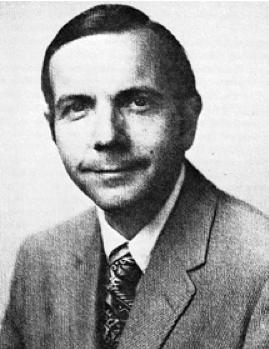
high school staff (there was no special education in those days), Robby’s treatment team finally gave me the green light, so I enrolled Robby in a general class schedule including physics. He had no aide, no IEP, or any supplementary aids and services. He was expected to meet class requirements, homework included. Of course, I checked with Robby’s teachers every few days. He did well, mostly because he held in some of his impulses.
We worked on social behaviors and I tried to teach him that not every thought needs to be expressed. So, he held in those impulses until he returned to the residence where he felt comfortable enough to show symptomatic behaviors associated with his diagnosis. As he recorded multiple successes as a somewhat atypical high school student, the frequency of those behaviors decreased. During school hours Robby presented himself as the good natured, goofy boy that he was. His peers liked him, probably because he was different in ways that did not scare them. And in hindsight, I believe that his peers watched over him.
One report from Robby’s physics teacher that has stuck in my long-term memory concerned a class discussion of absolute zero. The teacher asked Robby to describe absolute zero. Robby, being Robby, said this “Oh Yeah, that is when it’s cold enough to freeze your buns off” (giggle, giggle). So, that’s it. That is my story about Robby.
Whelan was one of the first persons interviewed by MSLBD’s Janus Oral History Project. His interview was wide-ranging, and he addressed many issues we continue to face today. What follows are a few excerpts from that interview.
Janus: How do you visualize the current state of the field in meeting the needs of students who have emotional or behavioral disorders?
Whelan: I don’t think we have enough options in the schools. It’s difficult, given the schedules
of our counselors and school psychologists to plan individual and group counseling which could address the needs of our children. Our teachers, in many instances, have caseloads that preclude planning group sessions to identify and deal with conflict in positive ways such as Nicholas Long’s work at the Rose School. When coping with adolescents who have severe problems, extra group session help is even more important. Adolescents, even those with severe mental disabilities, are not usually dangerous to others because they tend to leave a stressful conflict situation, unless we corner or otherwise challenge them. Those are not very good tactics because the end result could produce injuries.
But the teachers, from my point of view, feel frustrated that they are not able to provide more therapeutic learning experiences. The mental health centers are overwhelmed with family and individual problems. Juvenile justice centers, while helpful, are confronted with similar problems. Historically, the children in our society have not been at the top of the agenda to address mental disorders, for whatever reason. Of course, when that happens, that’s disappointing. Prevention, as we know, does require costly resources but over time that investment is recovered several times over. It’s hard to convince people to put that initial expenditure out there. I’m disappointed that we haven’t gone further into early identification and prevention as Eli Bower wanted us to do from the 1950s. It just didn’t happen, much to the disappointment of many in our field.
The other agenda item we’re still struggling with is the meaning of the least restrictive environment (LRE). When I am asked the LRE question, I may reply: “The fact that we might find a child in a general education classroom all day long with a para-educator teaching the child one-to-one is not the LRE in spirit or fact.”
But I am optimistic about the future, and I hope more and more people enter the field. In
the 1960’s, when P.L. 88-164 passed, our field grew from infancy through adolescence to the maturity – with warts and other ailments of aging professions – it has today. We had many students enter the field because they were very interested in teaching and a career of service to others. Some came to EBD because they had family members struggling with a mental disorder and they wanted to understand and help them and others.
In terms of teacher education for educators of children with EBD, I know that Kansas has been criticized because it requires a general teacher education license prior to an endorsement to teach children with EBD. In my view, that general background is foundational for the knowledge and skills to be successful in our field. I also believe
But I am optimistic about the future, and I hope more and more people enter the field.
that a broad liberal arts education is extremely important for success in our field because it gives us an interdisciplinary perspective so important for life-long learning and doing. When new teachers get several years of experience in a general education setting, they’re going to encounter youngsters with emotional or behavioral disorders, and because of their general education background may adapt their instruction and management plan to meet their needs. On the other hand, the children’s many complex needs may motivate them to enter our field, and that is good news.
My longtime friend and colleague, Pat Gallagher, referred to this phenomenon as “general to specific to general.” This phrase contains few
words, but conveys a wise message. It tells us that it is important to be an effective teacher of general education students before we learn the specific knowledge and skills to understand and teach students with EBD. Only then will we come to know that EBD understandings and effective teaching strategies are equally applicable in the general education setting. Think of the prevention and early intervention strategies that can be used as alternatives to EBD classification and special education placement. If only such a practice were more wide spread!
Janus: What is your advice for practitioners entering the field?
Whelan: There are obviously very resilient teachers just as there are very resilient children. What’s amazing to me is that some children come through aversive experiences and still remain very productive, forgiving, and so on and so forth. As I recall, the one common thing that the resilient youngsters have is a mentor – a significant adult who helps them cope with life’s barriers and hurts;

I believe that’s true with teachers too. If teachers go into our field with the right motivation and knowing that it won’t be grand and glorious every day, they will realize there will be times when they are so angry at the children that they can hardly stand it. But, they will also realize that families, parents, and children, are extremely grateful for their efforts and show that in many ways. I certainly found it to be worth the effort.
Dick Whelan recognized the necessity of both “knowing and doing.” And, he often observed that children are our best teachers. He said, “They will let you know if you are teaching correctly, and if you truly understand the message in their words and other behaviors.”
Jim Teagarden, Associate Professor, Kansas State University, mrt@ksu.edu
Robert H. Zabel, Professor Emeritus, Kansas State University, robertzabel@gmail.com
Reece Peterson, Professor Emeritus, University of Nebraska, rpeterson1@unl.edu
1This is based upon a video recording which Whelan completed as a part of MSLBD’s educator stories of most memorable students (https://archive.org/details/RichardWhelan343), and an edited transcript of a videotaped conversation with Dr. Richard Whelan conducted by MSLBD’s Janus project (https://archive.org/details/RichardWhelansThoughts) which later appeared in Intervention in School and Clinic (Kaff, M. S., Teagarden, J., & Zabel, R., 2011, 46(3), 184-189). Portions of this interview are reprinted with permission.
2“Joey, a Mechanical Boy” was one of several case studies shared by Bruno Bettelheim in the 1950s regarding his work at the Orthogenic School at the University of Chicago. According to Bettelheim, Joey did not communicate directly with others and believed he was a mechanical robot. He drew images of houses, vehicles, and machines and could fall asleep only after connecting himself to imaginary and real “machines” which he believed sustained him. At that time before autism was recognized as a syndrome, Bettelheim, who was trained in Freudian psychotherapy, considered Joey schizophrenic. Today Joey might be diagnosed as autistic. Many years later, Bettelheim became very controversial for his views regarding the possible causes of autism and other issues. The “Joey the Mechanical Boy” case can be found in Bettelheim, B. (1959). Joey: A “mechanical boy,” Scientific American, 200, 116-127. (Republished in Bettelheim, B. (1967). The empty fortress. New York: The Free Press.)
By David Bateman and Jacquelyn Chovanes

Josh, a seventh-grade boy eligible for special education and related services as a student with an emotional disturbance, has had multiple problems while riding the bus to and from school. He has difficulty staying in his seat, has repeatedly thrown items from the window, once hitting a passing car. He has punched another student, and has repeatedly cursed at the bus driver when told to either sit down or stop what he is doing. This has been a consistent behavior all through elementary school. It is happening with greater frequency in middle school, at least once a week. Josh’s bus driver is concerned for her own safety as well as for the safety of everyone on the bus and other drivers on the road.
When students like Josh misbehave on the bus, a common traditional consequence is a suspension from riding the bus, ranging from one to three days. Often when a student has a disability, there is nothing in the student’s Individualized Education Plan (IEP) or Behavior Intervention Plan (BIP) to address the bus behavior or provide instruction on appropriate skills necessary to ride a bus. This is unfortunate, and poses both legal issues and the potential for lost instructional opportunities due to days of school missed while on suspension. According to IDEA, schools must provide supports for students whose behavioral problems impede their learning (IDEA, 2004).
Transportation is not only picking up and dropping off a student with a disability before and after school – it is part the overall special educational program for that student. Each IEP team should determine if a student needs transportation to and from school, if transportation will be included as a related service in the IEP, and what services are needed to ensure a safe and appropriate experience getting to and from school. As stated by the U.S Department of Education, “public agencies should consider whether behavior on the bus is similar to behavior in the classroom that is addressed in an IEP and whether the child’s behavior on the bus should be addressed in the IEP or a behavioral intervention plan for the child.” (U.S. Department of Education, 2009). The specific vehicle is the school district’s discretion, as long as the decision is consistent with industry standards and applicable federal and state law.
If Josh demonstrates similar classroom, lunchroom, and hallway behavior to his bus behavior that behavior would certainly be addressed in his IEP, as required under IDEA (IDEA, 2004). Problematic bus behavior needs to be included too. IEP teams should weigh a number of factors and determine the scope of transportation supports required on an individualized basis. Several critical factors must be considered when planning transportation for students like Josh who exhibit frequent and significant behavior problems on the bus.
An important consideration is whether or not days of bus suspension could also count toward the 10-day “change of placement.” In the commentary to the 2009 IDEA regulations, the U.S. Department of Education commented that whether “a bus suspension would count as a day of suspension would depend on whether the bus transportation is a part of the child’s IEP. If the bus transportation were a part of the child’s IEP, a bus suspension would be treated as a suspension ... unless the public agency provides the bus service in some other way (OSEP, 2009).” The Department went on to note that if the bus transportation is not a part of the student’s IEP, it is not a suspension. “In those cases, the child and the child’s parent have the same obligations to get the child to and from school as a nondisabled child who has been suspended from the bus.” Thus, whether a day of bus suspension is counted toward the 10-day limit would depend upon whether transportation is a related service on the student’s IEP. If it is, to remove that service for disciplinary reasons would count as a “change of placement” day (OSEP, 2009).
IEP teams should consider not only school behavior, but bus behavior as well.
Josh has been suspended over twenty times, six of those during his seventh-grade year alone. Repeated suspensions from the bus with no decrease in problematic behavior shows that the discipline strategy of suspension has not been effective for Josh. Students with disabilities by definition have problems in learning and skill development, behavioral as well as academic. IDEA requires that

students with disabilities are to be provided with appropriate instructional and behavioral supports to benefit from their educational program (IDEA, 2004). In order to improve their behavior on the school bus, students like Josh need the opportunity to learn and practice socially appropriate bus behavior. This opportunity is not provided during suspension,
Josh’s bus behavior is very similar to his overall behavior in school – failing to stay in seat or assigned area, throwing things, arguing with adults, and fighting with peers. Josh’s IEP includes instructional and motivational interventions to address Josh’s school behavior. His IEP team has now decided to include bus behavior in Josh’s IEP, too, especially since Josh’s behavior problems on the bus have been longstanding and are increasing in frequency.
One solution to the problem of student discipline issues on the school bus is to extend effective behavior management strategies used in schools to the school bus. Many schools currently employ a three-tiered behavioral support system known as School-Wide Positive Behavioral Interventions and Supports (SWPBIS). SWPBIS provides a framework for teaching and reinforcing appropriate behavior
across locations within the school and may be expanded to include the bus. This approach gives students like Josh explicit training in expected behaviors. SWPBIS uses rewards to motivate students to engage in appropriate behaviors, thereby decreasing the occurrence of inappropriate behavior. For students whose IEPs address bus behavior, extending SWPBIS to the bus can be effective in reducing the number of disciplinary infractions leading to suspension (Collins & Ryan, 2016; Putnam et al., 2003). Research has also shown SWPBIS to be an effective means of improving student behavior and school climate (Kennedy & King, 2019).
Goals and Structure. SWPBIS systems are meant to be individualized to the specific needs of particular schools. However, certain procedures are common across SWPBIS systems. First, stakeholders, including school staff, administrators, parents, and students identify and define behavioral expectations across locations throughout the school. Students are explicitly taught the expected behaviors. A system of rewards and consequences is created to reward students who meet the behavioral expectations, and to increase appropriate behaviors from students who engage in misbehavior. School staff members are trained to implement the system consistently.
Both students and staff learn the system of rewards used to reinforce students for meeting behavioral expectations and the consequences provided for behavioral infractions.
SWPBIS uses a tiered model of increasingly intensive behavioral supports. Students move upwards through the tiers as needed, and ideally return to lower levels of support when they have demonstrated the ability to meet expectations with less intensive supports. Important components of SWPBIS at Tier 1 include identifying expected behaviors, teaching all students the expected behaviors, consistently rewarding students for engaging in those behaviors, and providing predetermined consequences for misbehavior. At the Tier 2 level, students who continue to engage in misbehavior receive additional supports, including small group instruction in specific behavioral skills,
that more appropriate replacement behaviors can be taught and reinforced.
An important consideration is whether or not days of bus suspension could also count toward the 10-day “change of placement.”
SWPBIS on the Bus. Unfortunately, in some schools, once students leave school and board the school bus, the supports offered by SWPBIS are not available. Bus drivers and aides may not be included in SWPBIS trainings. Therefore, bus staff do not know how to use the SWPBIS system of rewards and consequences to support appropriate behavior on the bus. Students may not be taught behavioral expectations specific to the school bus setting, therefore they may not know what behaviors are expected. Furthermore, the rewards for engaging in expected behaviors that serve to motivate and reinforce desired behaviors in school settings may not be provided to students during transportation, so students do not receive important feedback about which behaviors are appropriate on the bus. Research has shown that extending the supports used in SWPBIS from the school to the bus resulted favorable evaluations of the interventions by bus drivers and school staff (Collins & Ryan, 2016; Putnam et al., 2003).
At Tier 1, students are taught several positively stated behavioral expectations specific to the bus setting. Each expectation is further broken down into specific behaviors that describe exactly what students are expected to do.
and more frequent feedback and reinforcement provided by programs such as Check In–CheckOut, wherein a supportive adult is enlisted to meet with a student at the beginning of the day to provide support in the form of reminders of expectations and setting behavioral goals, and then again at the end of the day to review the student’s performance and to reward the student for having met expectations or to problem solve to encourage higher achievement of behavioral goals. At Tier 3, school staff conducts individualized assessments for particular students to determine why the student engages in specific inappropriate behaviors. The student is then provided with an individualized behavior intervention plan (BIP) so
Students are explicitly taught the expectations, often by watching a video of students executing the behaviors, and then are given the opportunity to practice the behaviors themselves. (See the PBIS Resources Chart for links to examples of bus behavior training videos.) Then, each day as students ride the bus, the driver provides rewards in the form of tokens or paper slips to students who meet the behavioral expectations. The reward tokens may be redeemed for items at the school store, or entered into a lottery wherein the student whose ticket is selected wins a special prize.
For students who need additional support, Check InCheck Out may be used. In this Tier 2 intervention,
1. Be Safe
a. Walk to your seat when entering the bus
b. Stay seated until the driver gives permission to leave
c. Keep head, hands and objects inside the bus
d. Make sure all traffic is stopped
e. Cross IN FRONT of the bus
2. Be Respectful
a. Use an inside voice and appropriate language when talking
b. Engage in positive interactions with other riders and the driver
c. Follow driver’s instructions the first time
d. Leave your area clean and damage-free
3. Be Responsible
a. Keep personal items inside your backpack or pockets
b. Get on and off at your own stops
c. Go directly home after exiting the bus
the student checks in with the driver upon entering the bus. The driver reminds the student of the expectations, and provides verbal encouragement for the student to meet the expectations and earn the rewards. At the end of the bus ride, the driver meets briefly with the student and delivers verbal praise and corrective feedback as needed, as well as distributing any reward tokens that were earned.
Students who are still struggling to meet the behavioral expectations on the bus, even with Tier 1 and 2 interventions, will be provided with intensive, individualized intervention at Tier 3. In this case, a specific behavior support plan will be written for the student, with supports that may include a daily
behavior rating sheet, listing whether the student met each of the expectations, that the student must show to the teacher after the morning ride and the parent after the afternoon ride. Additional rewards may be earned by the student for successfully meeting the expectations, either daily or weekly (e.g., extra time on the computer at school, extra time playing video games at home).
Training and Supporting Bus Staff. In order to implement these supports, bus personnel must be trained and supported throughout the intervention process. Including bus drivers and aides in the SWPBIS trainings conducted in schools would benefit both staff and students. The individuals directly responsible for managing student behavior on the bus should learn effective strategies to define, teach, and reinforce appropriate bus behavior. Furthermore, bus drivers should be trained to write clear and specific incident reports when students engage in serious misbehavior so that parents and school staff know exactly the behavior in which the student engaged.
There are some important differences between the school setting and the bus setting that must be addressed in order to implement positive behavior interventions and supports on the school bus (B-PBIS). First, the bus environment is unstructured, in that there are no planned activities to engage students. Second, most often, the bus driver is the only adult present, and must maintain focus on driving while also managing student behavior. These conditions may lead to high rates of problematic behavior. Therefore, behavioral expectations that are specific to the bus setting must be identified, defined, and taught to students. Bus drivers and aides should communicate directly with teachers, principals, and parents to share their concerns and to establish behavioral expectations specific to the school bus. Teachers should assist bus personnel in teaching students the identified behavioral expectations. This training should include a rationale for the expected behaviors, modeling of the behaviors using examples and non-examples,
and opportunities for the students to practice the expected behaviors using role-playing with feedback from the instructors. Many resources are available to guide planning and implementing appropriate behavior management on the bus, and specifically B-PBIS consistency.
To support bus personnel in effectively reinforcing students for meeting behavioral expectations, school staff should provide information about and, where appropriate, materials (i.e., tokens, ‘caught being good’ slips, etc.) used in the SWPBIS reward system. Alternatively, a reward system specific to the bus setting may be created, with guidance from school staff with respect to determining effective and feasible reinforcers. Parents should be provided with information about their child’s progress in learning and meeting behavioral expectations on the bus, and should be enlisted to review or remind students of the behavioral expectations and to provide additional reinforcement, possibly in the form of praise or earned privileges.
Additionally, teachers should share students’ BIPs with bus staff so that students with more intensive behavioral needs receive consistent behavioral support on the bus as well as in school. Bus personnel should receive direct instruction from teachers in how to use the plans to support students on the bus. This training should include the rationale for the behavioral goals identified in the plan, discussion of any specific supports used in the plan to support the student in meeting the goals, and provision of any reinforcers used to reward the student for meeting expectations.
Furthermore, administrators responsible for determining consequences for inappropriate behavior on the school bus should be educated about the applicability of positive preventative and support strategies to bus behavior, which should lessen their reliance upon punitive consequences. Instead, students engaging in inappropriate bus behavior should progress through a tiered sequence of supports similar to those used in the

Resource
Positive Behavior Interventions and Supports (PBIS) Websitehttps://www.pbis.org/
YouTube Videos https://www.youtube.com/ watch?v=cPsXQw81t6Q and https://www.youtube.com/watch?v=_ wvVuYFFysk
American Federation of Teachers (AFT) and Paraprofessionals and School-Related Personnel (PSRP) https://www.aft.org/sites/default/files/ schoolbusbehavior0907.pdf
Wrightslaw, Special Education Law and Advocacy Organization http://www.wrightslaw.com/ blog/training-in-the-iep-for-school-bus-driversattendants/
Schoolbus Fleet https://www.schoolbusfleet. com/article/730568/behavior-support-programbolsters-bus-environment-relationships
Foss, A. (2019, 4 29). How to create a peaceful school bus. Former principal discusses “peaceful bus” programThe Daily Gazette. Retrieved from: https://dailygazette.com/article/2019/04/29/fosshow-to-create-a-peaceful-school-bus
School Transportation News https://stnonline. com/blogs/special-needs-challenges-handlingaggressive-behavior-on-the-school-bus/
National Association for Pupil Transportation https://www.napt.org/snt
Description
Funded by the U.S. Dept. of Education’s Office of Special Education Programs (OSEP), this site contains information briefs and tools, including training videos, to aid schools in implementing SWPBIS.
Shows examples and non-examples of students following bus expectations.
Instructional video that may be used to teach bus expectations. Also ties appropriate behaviors to rewards.
A brochure delineating positive behavior management strategies for students on the school bus.
Article describes the need for and provides additional training resources for bus personnel who work with students with disabilities.
Online article provides detailed description of the challenges of and solutions for implementing B-PBIS.
Newspaper article that includes a link to the Peaceful School Bus Program website.
Informational article in trade publication for transportation employees.
Website of national school transportation organization detailing certification program for individuals who transport students with disabilities.
school’s SWPBIS system, including the creation of individualized behavior plans when needed. Bus staff should be able to enlist the support of teachers and school administrators in determining and providing specific intensified supports at Tiers 2 and 3.
Not only should transportation staff participate in initial SWPBIS trainings, but also additional training opportunities should be provided throughout the year. Bus personnel could attend staff development trainings offered on teacher in-service days throughout the school year to review and practice skills, as well as to stay informed about any new developments to the SWPBIS system. Alternatively, special training sessions could be arranged for bus staff on an as-needed basis, determined by data collected on the outcomes of the intervention.
Josh has a BIP for use in school. When Josh meets his
One solution to the problem of student discipline issues on the school bus is to extend effective behavior management strategies used in schools to the school bus.
daily behavioral goals of following teacher directions the first time, completing all assigned work, staying in assigned area, keeping hands, feet, and objects where they belong, and using respectful words with staff and peers, Josh earns tokens from his teacher that may be redeemed for homework passes and free time on the computer. In order to support Josh’s behavior on the bus, Josh’s teacher, Mr. Jimenez, contacts Josh’s parents and the bus driver to arrange a meeting at the school. During this meeting, which the bus driver attends after all students have disembarked from the morning ride, Josh’s teacher
reviews Josh’s current BIP with the driver and Josh’s parents. Mr. Jimenez asks the driver and the parents to share their ideas about how a similar plan might be created for use on the bus. The driver offers suggestions for the following individualized goals for Josh:
1) Walk onto the bus without touching other students
2) Go directly to your assigned seat
3) Stay in seat during entire bus ride
4) Keep hands, feet and objects where they belong
5) Wait for the signal before getting up to exit the bus
6) Walk off the bus without touching other students
7) Use respectful words with staff and peers.
Josh’s mother suggests that Josh could earn extra time playing video games after school if he meets all of the bus expectations that day. Josh’s dad offers to contribute $2.00 per week to a fund to buy a new video game if Josh meets the expectations 4 out of 5 days during the week. Additionally, the bus driver agreed that Josh would be allowed to listen to music using his headphones once he was seated, as long as he removed them before exiting the bus.
Mr. Jimenez and Josh’s parents model for the driver how to redirect Josh when he engages in misbehavior by reminding him of the expectations using a calm voice, positive statements and referencing the reward, “Please sit in your seat, Josh, so you can earn your slip for today.” Mr. Jimenez and the driver plan to review and teach Josh the expectations for bus behavior, as well as to inform Josh about the rewards he may earn for meeting the expectations. Josh’s parents agree to remind him of the expectations each morning before he leaves to get on the bus. Mr. Jimenez agrees to make up some behavior recording sheets for the driver to use. The driver notes that she will use them after each ride, so that Josh may give the slips to his teacher and parents in order to receive his rewards. Mr.
Jimenez and Josh’s parents encourage the driver to reach out to them should there be any difficulties in implementing the plan. The group makes plans to meet again in one month to review Josh’s progress.
The school-based team should monitor implementation of B-PBIS to ensure bus staff buyin and measure the effects of the intervention on student behavior. Effects of the intervention can be measured by collecting and tracking data on bus disciplinary referrals, distribution of reinforcement, and through surveys of the drivers. The information gathered should be systematically reviewed to determine any areas in need of further training, for bus personnel and for students. The data may also be used to evaluate the effectiveness of the reinforcers, with low rates of improved behavior possibly indicating the need to change either the type or the dosage of the reinforcer. Furthermore, systematic reviews of the program should take into account any changes to the transportation schedule, route, duration of trip, number of students on each bus, new transportation staff, and any other changes that might require additional training or that may require new procedures that warrant a change
to the behavioral expectations. An example of a data collection sheet that may be used to monitor student outcomes after implementing B-PBIS is provided. The bus driver or aide records data for each student during or after every bus ride. Data are reviewed by the driver at least weekly, with support from school staff as needed, to determine whether the B-PBIS system is working to increase appropriate bus behaviors. The data are analyzed to identify patterns of behavior that may indicate the need to review expectations or reteach specific skills, and/or adjust the type or dosage of reinforcement. Additionally, each student’s performance is examined independently to determine the need for increased individualized supports. Results are shared with teachers and parents weekly to support collaboration between stakeholders.
At the one-month meeting to assess Josh’s progress, the team agreed that the intervention had been successful in reducing Josh’s inappropriate bus behavior. Josh was staying in his seat listening to music or talking quietly with peers on 8 out of 10 bus rides. His inappropriate behavior was less intense when it did occur. Josh was excited to have earned money towards the purchase of a new video game, and he had begun greeting the bus driver in the
Instructions: Mark a check if the student met all expectations. If an expectation was not met, fill in the number and letter that corresponds to the rule infraction. Additionally, mark an “I” if the student’s behavior resulted in an incident report. Also indicate absences.
mornings and afternoons. Mr. Jimenez and Josh’s parents congratulated the driver on her successful implementation of the B-PBIS plan, and all agreed to continue the intervention, with another meeting in three months.
Ongoing training for bus drivers in implementing B-PBIS interventions is critical. Drivers should have training in behavior management, dealing with a crisis, working together with teachers and the administration, and documenting behavioral incidents. Also, all districts with students with behavioral problems need to teach expected behaviors and reward appropriate behavior for students who have to ride the bus. Bus drivers should also be trained to write incident reports so the district knows the specific behavior in which a student has engaged.
Finally, IEP teams should consider not only school behavior, but bus behavior as well. Plans should be outlined in the IEP or BIP for bus behavior as needed. As was noted by OSEP, the school district is responsible for transportation. If a student is not allowed to ride a bus and, for that reason, can’t get to school, that may constitute a suspension, which for some students is the same as denying them an education. B-PBIS interventions are an effective means of improving student bus behavior and reducing lost instructional time due to bus disciplinary issues.
Collins, J. C., & Ryan, J. B. (2016). Extension of positive behavioral interventions and supports from the school to the bus: A case study. The Journal of At-risk Issues, 19(1), 29–33.
Individuals with Disabilities Education Act Regulations, 34 C.F.R. § 300 (2012).
Kennedy, K. J., King, S. A. (2019). All aboard: Using positive behavior supports on the school bus. Beyond Behavior, 28, 21–28.
Putnam, R. F., Handler, M. W., Ramirez-Platt, C. M., & Luiselli, J. K. (2003). Improving student bus-riding behavior through a whole-school intervention. Journal of Applied Behavior Analysis, 36, 583–590. doi:10.1901/jaba.2003.36-583
U.S. Department of Education (2009). Questions and Answers on Serving Children with Disabilities Eligible for Transportation Washington, DC: Author.
David Batemen, DFBate@ship.edu, and Jacquelyn Chovanes, JChovanes@ship.edu, Shippensburg University, Pennsylvania
By Sharon A. Maroney

Ijust goggled differentiated instruction (DI) and got over 30 million hits in 0.54 seconds. WOW! DI must be pretty important. But what exactly is DI and what do teachers do when they differentiate their instruction? Many experts have offered definitions, but to me, DI simply means teaching in different ways to make it easier for students with diverse learning needs to succeed. Most educators know the tried-and-true teaching methods that work for many students; they also know there are other students who need to be taught just a little bit differently. Most educators also know that when they teach a concept through two or three different methods, use different materials, or require different assignments, their students gain a deeper understanding and increased skills and applicability.
In addition to my simple definition of DI, I offer educators a simple way to begin thinking about and applying differentiation. Take the example of Mr. Seth who is just starting to get concerned about his student, Sammie. Sammie is a great student. She pays attention, willingly completes her work, and can be very funny at just the right times. Sammie is well liked by her teachers and classmates. The problem is that she’s just not achieving as well as Mr. Seth believes she could. So, he sits down after the students leave for the day and begins to consider what he can do to make it easier for Sammie to learn in his classroom.
1.Can I make changes to the physical environment?
Decreasing distractions by closing doors and window shades, seating the student close to instruction and away from high traffic areas, and reducing extra noise during instruction can all impact student learning. Classrooms that are too hot or cold, poorly lit or too bright, and/or too noisy or cluttered may also present problems. Is the student sitting too close or too far away from instruction, or too near or too far away from other students? Does the student’s chair and desk fit them? Is there a light that buzzes or a fan that rattles? Visibility and movement are also important considerations. Can the student move around the classroom as needed – to get materials, access the computer, etc.? Does the student have an unobstructed view of instruction and information? Can the teacher easily move to and see all students during instruction? Are there other barriers presented by the physical environment that can be eliminated or reduced?
2. Can I use other instructional methods?
Students respond differently to different forms of instruction. Students who have difficulty gaining information through reading, for example, can be provided the same information through oral presentations, videos, visual representations, hand-on activities, cooperative learning activities, or a combination of different instructional methods. Most students show improved learning when instructional supports such as graphic organizers, vocabulary cards, guided note taking sheets, or time management tools are included in instruction. Scanning the list will provide other instructional options.
3. Can I use different materials?
Differentiating instructional materials can improve completion and achievement for many students. Worksheets with small print, limited space for written responses, and tiny multiplechoice bubbles can present obstacles. Enlarging
• Teacher-Directed Lessons, Visual and Auditory Presentations, Lectures, Demonstrations, Guest Speakers
• Teacher-Led Question/Answer Sessions, Review Activities, Simulation Activities, Open Discussions
• Whole Group, Small Group, Learning Partners, and Independent Activities
• Problem Solving Projects, Hands-on Activity Labs, Discovery Lessons, Learning Centers, Experiments
• Games, Challenges, and Contests, Cooperative Jigsaws, Debates, Interview and Survey Projects
• Student-Led Instruction, Poster Presentations, Service Learning, Community Activities
• Graphic Organizers, Charts, Graphs, Diagrams, Visual Representations
• Creation of Videos, Podcasts, Websites, Slide Shows
• Student Created Materials, Quiz Questions, Assignments, Projects
• Computer and Web-Based Instruction, Internet Assignments
worksheets, providing adequate writing space, and allowing students to highlight correct responses are easy fixes. Reading material can be supported with audio recordings, threedimensional models, and illustrations. Using materials such as erasable pencils, touch screens, sticky notes, and manipulatives make it easy for students to change their responses and correct their errors. Tablets, computers, smartboards, and other devices offer accessibility settings that can be adjusted to make it easier for students to operate and benefit from these tools. Begin by observing your students to determine which materials are easy for students to use and learn with and which materials students need to learn to use, to practice using, or to be provided with assistance when using. Have frequent discussions with students or develop student surveys to gain their perspectives on various instructional materials.
4.Can I incorporate instructional supports in my teaching?
Incorporating instructional supports into your teaching can positively impact student learning. Educators who establish consistent procedures for assignment and collecting homework, checking assignment notebooks, and posting and sharing grades often see increased achievement rates. Both teachers and students benefit when larger assignments are divided into smaller pieces allowing students to reach smaller objectives to reach an overall outcome. Student performance can be checked and corrective feedback provided along the way rather than at the completion of an assignment. Having well-planned and practiced instruction with all materials ready and accessible allows for smooth transition from one concept to another, eliminating waiting time and lost attention.
5. Can I allow the student to demonstrate his/her learning in a different way?
Providing options for students to demonstrate what they have learned can result in more accurate assessment of student achievement while eliminating performance obstacles for some students. Students who have difficulty expressing their thoughts in writing can be allowed to create an outline or semantic map, record an oral explanation or video, or create an illustration or model to demonstrate their learning. Providing students with a few options that still reach the targeted learning objective has been found to improve student achievement. Many educators give all students options in every assignment, changing the options so that students practice different assignment skills. Another method is to use an assignment card similar to BINGO. For example, each time they are assigned a book report, the student selects an option to complete and crosses it off on their card. When assigned another book report, they select a different option, and so on. This method gives students choice and results in every student completing every option over time.
• Use a consistent routine for presenting info, instructions, and assignments
• Post info and assignments in a consistent place
• Provide both oral and written info with graphics when appropriate
• Check student understandng with - “Have I made this clear?” “Is there something I ought to explain once more?” “Can you repeat the directions I have just given?” “Can you show me what I have just asked you to do?”
• Instruct students on the structure to be used to present info and key objectives of each assignment
• Group similar items or content when presenting information
• Limit the number of oral or visual instructions given at the same time
• Offer the students a choice of assignments or of which assignment to complete first
• Divide assignments into a series of smaller assignments, cut apart worksheets, create minilessons
• Break down long or complex assignments into smaller parts and teach students to plan the completion of each part in a timely fashion
• Permit oral presentations, reports, projects, or role play as options for written tasks
• Allow more time for assignment completion or reduce length of assignments if needed
• Assign only “even” number problems or only problems 10 - 24
• Stress accuracy of work completed, not quantity (how many)
• Give students ways to improve their work when correcting assignments
• Use more than one way to teach the content or skill Teach to more than one learning mode- auditory, visual, kinesthetic, social, technical
• Use various methods for grouping students, changing groups throughout the day, week, month
• Use co-teaching, station teaching, parallel teaching, alternative teaching, peer tutors, learning partners, and cooperative learning groups
• Involve students in group assignments, projects, panels, and cooperative learning
• Design examples or lessons around student interests
• Provide computational aids – calculators, time tables, counters, number lines, etc.
• Allow use of calculators to avoid computation errors on more complex problems
• Provide hands-on activities or involve physical activity during the lesson
• Limit the amount of copying required and avoid frequent lengthy reading assignments
• Allow notes or graphics during oral presentations
• Review instructional content every 5 minutes and check student understanding before moving on
• Circulate and assist students as you teach and as they work
• Check student work as soon as possible to avoid permitting students to practice incorrect responses
• Allow students longer “think time” or give an advance signal before calling on students
• Alternate tasks that have a high probability of success with those that have low probability of success
• Use pre-arranged questions and/or prompts, such as standing by the student’s desk to signal upcoming questions
• Model for and teach students to talk-aloud and plan ahead
• Provide time in class to begin homework so you can check that all students begin correctly
• Make sure all student materials are clearly visable
• Enlarge, bold, or highlight text as needed
• Reduce the reading level of assignments - reword, paraphrase, edit, and highlight
• Provide study aids, hints, cue cards, spelling lists, guides, word charts, and word banks
• Highlight directions, starting/stopping points, and keywords on worksheets
• Use color-coded paper: white for in-class work and yellow for homework
• Underline, outline, or highlight major points in the assignment, material, or textbook
• Simplify the format of the instructional material, create fewer paragraphs, problems, or questions
• Incorporate audio recordings or videos
• Provide materials that can be self-checking or use peers to check work
• Establish, present, and post the daily schedule and explain any changes
• Teach, practice, review, and remind students of both academic and behavioral expecations before instruction
• Provide correct completed examples and models of expected student work before they complete their assignments
• Post lists of steps needed to complete tasks or follow classroom procedures
• Teach classroom procedures to all students, such as what to do when you have finished your work, how to enter the classroom and get ready for instruction, and how to ask for assistance
• Provide multiple opportunities for students to correctly practice skills learned

Write 3 paragraphs. Describe one main character; Summarize the book; Explain the conflict and resolution.
Create a theme song for this book if it were made into a movie – write, record, or perform it.
Illustrate two different scenes in this or create a mural of your favorite scene in this book.
Write or record your answer to this question. If you could meet one character in this book which one would you like to meet and why?
Using the T-Chart app on your tablet – create a T-chart comparing two characters in this book.
Pick your own way to answer this question. If the setting of this book were today, how would that change the story?
6. Can I make changes in time, location, and/or structure of instruction?
Some students are best able to face their most challenging subjects or activities early in the morning, after physical activity, or on a full stomach. Try switching your schedule a bit. You can also change the structure of the activity, such as substituting a 30-minute presentation with three 10-minute presentations separated by two 3-minute activities. When students have more than one task to complete, let the students pick which to do first.
7. Can I change the classroom climate?
Instructional climates vary dramatically. They can range from authoritarian to student-driven, inquiry-based to directed instruction, and highly structured to loosely organized. The climate of student interaction can represent a community of learning friends or a collection of separate (sometimes competitive) pairs and groups. Students respond better to classrooms in which student-student and teacher-student relationships are supportive, caring, interested, and achievement oriented. Evaluate what type of climate is most prevalent in your classroom. Ask (in discussions or surveys) your students about
Create a graphic novel or comic book for your favorite scene in this story.
Create a timeline of the main events in the book.
Using the compare-contrast sheet –compare this book with one you’ve read previously.
• Gaining information through reading, listening, watching, and doing
• Completing pencil/paper worksheets, including fill-in-the-blank, true/false, matching, multiple choice, and open ended questions
• Writing sentences using specified vocabulary, punctuation, content, etc.
• Answering questions verbally, in writing, with thumbs up/thumbs down, using a clicker or response app
• Performing experiments, calculating the results
• Writing in a journal or blog
• Drawing or creating illustrations or graphic representations
• Responding to who, what, when, where, why, what if, how come, or then what questions
• Creating an audio or video recording
• Noting and documenting observations or information
• Drawing conclusions and identifying possible causes
• Classifying items/concepts into groups, etc.
the classroom and relationship climates. Are there changes you can make that would be more conducive to student success?
8. Can I engage the students in a different, yet related, activity?
Students with visual or language difficulties, for example, can be involved in hands-on exploration of three-dimensional models, while listening as classmates view a video on whales. Students with limited language skills can complete a vocabularybuilding activity, while classmates write a poem. During an environmental research activity, some students can be asked to locate statistical info online, others can use print publications to find the answers to specific questions, others can locate graphics to represent various concepts, and a fourth group can conduct face-to-face interviews. All students can then combine their findings in a cooperative jigsaw approach. Even if students are doing something slightly different from their peers, they can still actively engage in instruction, gain content and skills, and meet instructional objectives.
After considering these questions Mr. Seth decided to implement two new methods on a classwide basis. For several assignments each week he would give two assignment options. One would involve traditional skills such as reading books, writing on paper, and quiet desk work. The other would involve working in an app on a tablet. Mr. Seth will watch to see which of these options his students select and whether or not completion rates or achievement changes with different options and the addition of student choice. During this process, Mr. Seth recognized that at the beginning of the school year he spent a few minutes each morning talking with his students about the day’s agenda and expectations, listening to their concerns, and answering questions; but he hasn’t done that for almost two months. He decided to reinstate this class discussion and focus on strengthening classroom climate and discussions of instruction and achievement.

As for Sammie, Mr. Seth decided to first talk with her about his concern and ask her what she thinks might help. He will ask Sammie about the physical environment, the different types of instruction used in the classroom, and how she feels she learns best. Since Sammie is a very perceptive student, he believes this will be a helpful discussion. Since Mr. Seth is now aware of several options he can offer her, he feels confident that he and Sammie can develop a plan, try it for two weeks, and sit down again to review the results. Documentation of this, possibly in a student learning profile, will be important to enable Mr. Seth and Sammie determine what worked and what didn’t, help Mr. Seth to design effective instruction for Sammie, and enable Sammie to advocate for her own learning needs and perferences.
I fully recognize that students with complex learning needs often require more detailed and extensive differentiation plans. But I think many educators can begin thinking about and applying differentiation through a simple procedure presented by these eight questions. If you agree, try this out and let me know how it works for you and your students.
Sharon A. Maroney, Professor Emeritus, Western Illinois University, sa-maroney1@wiu.edu
By Marc Benedetto and Erica Calderon
The theme for this column is Podcasts for a Snow Day in which Erika Calderon and I share our favorite educational and personal podcasts. Find a comfortable spot, maybe a warm drink or two, settle in, and listen to some of our favorites.
(10/28/19, 70 minutes)
Reviewed by Marc Benedetto
https://www.iheart.com/podcast/256-yoga-tocope-43056129/episode/zach-tremper-bipolar-iidisorder-adhd-51873791/
Remember Zach Tremper, the author of “When the Ripcord Breaks – Teaching with Bi-Polar II Disorder,”

published in the Fall 2019 issue of ReThinking Behavior? If you read that article, you remember Tremper and his powerful article. Since then, Tremper has been featured on the Yoga to Cope podcast on October 28, 2019. Sit back, listen, and get to know Zach.
Reviewed by Marc Benedetto https://www. cultofpedagogy.com/pod/
Readers of Podcast Pulse already know that one of my favorites is The Cult of Pedagogy by Jennifer Gonzalez. She is a former


teacher, college professor, and editor-in-chief of the website. The podcasts feature a wide spectrum of educational topics and Jennifer is a skilled moderator. Some recent podcasts include Repairing Harm, A Better Alternative to Punishment and How to Spot Dyslexia and What to Do Next.
Reviewed by Marc Benedetto https://atrpodcast.com
Against The Rules, a podcast about fairness and how we enforce it, is hosted by Michael Lewis, New York Times bestselling author of Liar’s Poker, Moneyball, and The Fifth Risk. The premise is that America’s notion of fairness is disappearing. The format is unique, allowing Lewis to delve into his many interests and exploring fairness in finance, news, basketball, law, and several other areas. I’m betting that if you listen to episode, you’ll listen to the entire season of ten.

Runner Powered Podcast
Reviewed by Marc Benedetto https://www.kexp.org/podcasts/musicmatters/2019/5/10/music-matters-vol-668-runcastvol-15/
My second personal favorite combines two of my passions - music and running. If either interest you
please check out KEXP’s Music That Matters Runner Powered Runcast. This famous Seattle radio station currently provides 15 volumes hosted by one of their DJs, John Richards. John, an avid runner, provides a great variety of music, inspirational stories, and quotes to spice up your training runs or races. Listen to find out which song John played 13-straight times while running the New York Marathon Run.

Winston (6/12/19, 124 minutes)
The Behavioral Observations Podcast Series
Reviewed by Erika Calderon
https://behavioralobservations.com/straight-talk-onrestraint-session-87-with-merrill-winston/
I am currently serving as a behavior coach in the Lee Summit district and have been working with individuals with developmental delays and/or emotional disorders for the past 7 years. I have served as a lead clinical therapist, an implementer and a 2nd grade teacher. In my current role, I support teachers in the publicschool setting with students who may fall into the ‘tier 3’ category in terms of their need for behavioral support. Many times, this looks like guiding school staff and administration through the proper and safe
use of restraint or ‘safe room’ procedures.
Procedures that many consider to be ‘restraint’ or ‘seclusion’ are used every day both in and out of the public school setting, and while they are reserved for last resort, it is important that practitioners, school staff, and caregivers get on the same page about how these procedures are used, but more importantly why these interventions are necessary. Host Mark Cicoria is a BCBA that has been practicing in the school and clinic setting for several years, and on this episode, he interviews Merrill Winston, Vice President and Director of Program Development of the Professional Crisis Management Association (PCMA). Winston specializes in the analysis and treatment of severe behavior disorders with special populations. His treatment experience includes a large range of topics that many of us can relate to: self-injurious behavior, severe aggression, and the acquisition of language, and independent living skills. He is also an experienced expert witness, and frequently advocates for individuals effected by significant and sometimes dangerous behavioral challenges.
Winston and Cicoria chat about restraint, seclusion and physical escorts by using conceptual definitions and examples to encourage listeners to look at this topic objectively (impossible, I know) and from all possible angles. Many of us have a difficult time participating in this conversation because of the emotion and ethics involved- whether we have seen these procedures used unethically, have seen the desired behavioral outcome from these procedures, or both. Imagine a world where practitioners, teachers and families could come together to consider these types of interventions without immediately igniting a conversation about cruelty, trauma, or malicious intent. Winston’s no-nonsense presentation of the pros and cons of each intervention will leave you nodding your head in agreement, because he is saying something that no practitioner can disagree with: it depends on the context of each student, and the abilities and willingness of the staff.
https://podcasts.apple.com/us/podcast/myfavorite-murder-karen-kilgariff-georgia-hardstark/ id1074507850
My Favorite Murder is a podcast that I recently found, though it has been around since early 2016 and has recruited a considerable amount of attention from familiar magazines such as Entertainment Weekly and Rolling Stone. Hosts Karen Kilgariff and Georgia Hardstark are longtime comedians that have used their talent to offer a unique spin on murder mystery and true crime ‘based-on-truth’ stories. Many episodes offer a background on the life of the main character of each story, and the witty way in which the stories are told keep the mood light.
You might not get the stories of infamous Ted Bundy or Marilyn Manson, but we all know how these legends start and end. With episodes ranging from 20 minutes to an hour and a half, My Favorite Murder tells stories of small-town serial killers and hitmen;
The Kids We Lose, using dramatic classroom videos and interviews, portrays the negative long-term impact of restraint and seclusion used in schools to control student behavior. The film examines the wide-spread use, history, and poor outcomes associated with such practices while presenting the dilemmas posed to schools by disruptive and
tales that most of us have never heard of. Whenever I need a break, I grab a warm drink and dive into a reallife episode of CSI with these creepy stories.

Marc Benedetto, Special Services Coordinator, Retired, Westside Community Schools, Omaha, NE, mbe62571@gmail.com
Erika Calderon, Behavior Coach, Lee Summit Public Schools, Kansas, erika.calderon.sbx@gmail.com

aggressive student behaviors and expectations established by “zero tolerance” legislation.
The use of restraint and seclusion accelerated at the same time zero tolerance policies were legislated: these policies appear to legitimize the use of restraint and seclusion in schools despite the lack of research support. The Kids We Lose makes it clear that some kids are not getting the intended message. Many children, especially those identified with emotional and behavioral disorders, lack the skills needed to interact effectively with
peers and teachers or learn in regular education classrooms. Their behavior does not improve with the use of restraint or seclusion. These children often experience a repeating cycle of failure, regular redirection, and frequent punishments. They make little educational progress, are placed in more restrictive educational environments, and, ultimately, are incarcerated in youth or adult prisons - the legitimately described “school to prison pipeline”.
The film’s thesis is poignantly supported by interviews with identified students who don’t understand or benefit from being restrained or secluded. They learn to dislike school, learning, and educators. They internalize the message that they are not smart and are “bad”. They take pride in their ability to tolerate punishments or find hidden rewards in almost any punishment, even restraint and seclusion. The documentary underscores this tragic cycle through interviews with parents who share their distress, bewilderment, and sense of betrayal at the way their children, the children they love, are misunderstood and mistreated in school.
The Kids We Lose balances its support for its thesis by documenting the attentional and sometimes extreme behavioral challenges faced by some students. It also records several restraints that seem manifestly necessary and are performed with kindness and respect. The emphasis of the

film is also balanced by depicting classrooms where consistent application of research-based accommodations and modifications help students with significant challenges enjoy and benefit from school. This secondary message of The Kids We Lose is manifestly hopeful!
I forwarded this film to two colleagues who report that schools they work with rely too much on restraint and seclusion. I hope the film will serve to open a discussion and search for effective alternatives to restraint and seclusion such as school-wide positive behavioral supports, opportunity to respond, training in verbal deescalation skills, effective instructional methods for students with special needs, etc.
Mike Hymer, retired, Lawrence Public Schools, KS. mhymer99@gmail.com
The Kids We Lose will be shown at the Midwest Symposium for Leadership in Behavior Disorders, on Thursday, February 27, 2020 at 8:15pm with a discussion following, in the Empire Room, Sheraton KC Hotel Crown Center, 2345 McGee St, Kansas City, MO. Free. No registration required. For more info, see inside back cover.
By Jim Teagarden
In the Fall 2019 issue of ReThinking Behavior you were introduced to my representations of mental health issues using only paper clips. As mentioned in that article, this activity was predicated by a life changing event. At some point in the future, I will explain that event and how paper clips helped me hold it together. But for now, I’d like to present two more pieces of my art. What condition do you think each represents? Check page 27 to see if your interpretations match mine. I hope this will foster a dialogue about the challenges many students, families, colleagues, and friends face on a daily basis. Mental illness impacts us through the individuals in our lives and the isolation and stigma they experience is as great a challenge as the illness itself.
So . . . Let’s talk. Join the discussion on the MSLBD Facebook Page.


By Gabrielle Albertson
Dear
Eating Disorder,
You came into my life when I needed a friend most. I felt all alone, and I needed someone or something to turn to — and that was you.
Little did I know you would take so much from me. I allowed you to take over my mind and body. You began to warp my thoughts from good to bad, and I fell under your spell.
I did everything you told me to, between restricting my food intake, making myself sick and over-exercising. I began to question who I was becoming.
I let you stay, though, because you made me feel good about myself, even if it was just for five minutes. You held me so tight and close for many months. I felt like I couldn’t live without you. Who would I be without you?
I lost myself. And because of that, I will never forgive you. I pushed away the ones I loved the most. I strained my relationships for you. You made me feel like I couldn’t trust anyone in my life, but in reality, I could’ve.
I will never forgive you for the starvation, exhaustion and loneliness. It hurts to realize that part of you will always be inside of me. To this day, every time I look in a mirror, I hear you. When I eat something you don’t approve of, I hear you. If I miss a day of exercising, I hear you. However, I now know how to silence you.
I’ve defeated you because I don’t let you get to me anymore. And guess what — I’m making this public because I want the world to know how much you’ve impacted my life. And not for the good, but for the bad. I want the world to know that living with you was exhausting.
You live in so many other lives, and I want the world to know that they don’t need to be afraid of you. I wouldn’t wish you upon anyone because of what you do.
Eating Disorder, you are evil.
Now that I’m in recovery, I’m happy. I’m living my best life. Without my disorder, I feel like I can breathe and be myself again. Eating Disorder, you may still linger inside of me, but I will never let you take over my life again.
Reprinted with permission from Kansas State Collegian, Kansas State University, Manhattan, KS. Published March 5, 2019. https://www.kstatecollegian.com/2019/03/05/ opinion-a-letter-to-my-eating-disorder/
Gabrielle Albertson is a senior in mass communications.
Art courtesy of vecteezy.com
In October 2019 at the Second Annual Richard L. Simpson Conference on Autism, Carin (Dallas) Paullin received the MSLBD “Outstanding Educator of Students with Autism Award” for her excellence in classroom service to students diagnosed with Autism Spectrum Disorders (ASD).
As a career educator of students with disabilities her dedication and expertise in the implementation of evidence-based practices, family support and training are a testament to her professionalism. She has served as an Autism Coach and now leads her own structured language classroom at Tomahawk Elementary in the Shawnee Mission School District.
Presenting the award and pictured with her is Paul LaCava, Associate Professor of Special Education, Rhode Island College, Providence, RI.
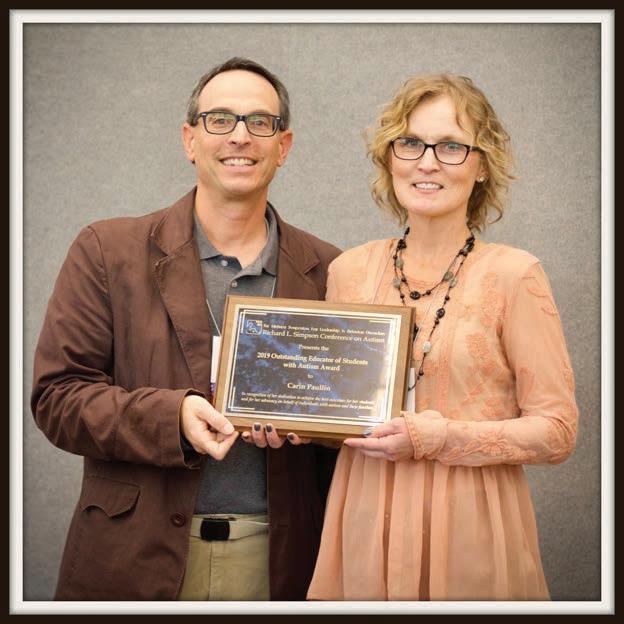


Thursday, February 27, 2020 • 8:15 pm, followed by discussion at 9:45 pm Empire Room, Sheraton KC Hotel at Crown Center, 2345 McGee Street, Kansas City, MO Free-Noregistrationrequired!
“The Kids We Lose is a 90-minute documentary film about the human side of being a child or student with behavioral challenges, and the struggles faced by parents, educators, staff in facilities, mental health clinicians, and judicial and law enforcement professionals in trying to ensure that these kids receive the help they need.”
“The Kids We Lose”, using dramatic classroom videos and interviews, portrays the negative long-term impact of restraint and seclusion in schools to control student behavior.”
“The film’s thesis is poignantly supported by interviews with identified students who don’t understand or benefit from being restrained or secluded. They learn to dislike school, learning, and educators. I hope the film will serve to open a discussion and search for effective alternatives to restraint and seclusion...”
For more information about the video go to: http://www.thekidswelose.com/