
RE THINKING Behavior
UPCOMING EVENTS
Seventh Annual Richard L. Simpson Conference on Autism
October 2 & 3, 2025
Springfield, MO
https://mslbd.org/autism-conference/
Sponsored by the Midwest Symposium for Leadership in Behavior Disorders, The Kansas Technical Assistance System Network, and Project ACCESS– Missouri’s Leader in Autism Education
Highlight of Topics to Be Featured and More!
• Behavioral and Self-regulation Interventions
• Being a BCBA in Schools
• Coaching Teachers and Parents in AAC
• Creating Legally Defensible FBAs & BIPs
• Environmental Communication Teaching
• Free Interactive RBT Training
• Implementing Verbal Behavior Programs
• Improving Transition Services in Rural Communities
• Laughter as Language: Using Jokes in Training
• Managing Interfering Behaviors in Classrooms
• Music and PE for Students with Autism
• Music Mediated Interventions to Boost Engagement
• Practical Strategies for Including AAC Users
• Promoting Opportunities for Work Education
• Self-Determination & Self-Advocacy for H.S.
• Technology and AI with Students with Autism
• Training Paras on Antecedent Intervention

https://mslbd.org/symposium-conference/
Jennifer Bossow
Lisa Bowman-Perrott
Janet Burgess
Jenah Cason
Scott M. Fluke
Nicolette Grasley-Boy
Katherine A. Graves
Deborah E. Griswold
Aimee Hackney
Mike Hymer
Shannon Locke
Maria L. Manning
Sharon A. Maroney
John W. McKenna
Lindsey G. Mirielli
Raschelle Nena Neild
Reece L. Peterson
Sandy Shacklady-White

Rethinking Behavior, ISSN 2578-5397, a magazine for professionals serving children and youth with behavioral needs, is published three times per year, fall, winter, and spring, Copyright ©2025 by the Midwest Symposium for Leadership in Behavior Disorders, P.O. Box 202, Hickman, NE 68372. 402-7923057. www.mslbd.org. Email: rethinkingbehavior@mslbd.org.

Rethinking Behavior welcomes proposal and manuscript submissions; for information visit www.mslbd.org or email rethinkingbehavior@mslbd.org
The Power of Belonging
As teachers of students with behavior disorders, we become adroit at planning for and handling crises for students who exhibit interfering behaviors. Truly, to survive, we have had to learn to understand, plan for, and handle disruptive and, on occasion, dangerous outbursts. Often those solutions involve removals or restrictions for the already struggling students.
But what of the introverts too; those students whose behaviors are not perceived as disruptive. Those who internalize and rarely communicate? They aren’t hard to spot. They are the wall-huggers, usually alone, and quiet, with eyes down-cast and postures withdrawn. They are picked last for teams, ostracized by peers, and often the victims of bullying. They can appear to lack the ability or the desire to make connections with others.
One author explains: As an introvert, I understand the fear and rage that can build during a school day and year. I never fit in, wasn’t able to make friends, and didn’t feel safe, secure, or connected at school. I overcompensated by trying too hard. A feeling of hopelessness and powerlessness stayed with me well into adulthood and adversely affected my ability to thrive.
This feeling of separateness or rejection, the opposite of belonging, can lead to anxiety and depression. If untreated, these disorders can manifest in negative and often dangerous coping behaviors such as self-injury, drug and alcohol addiction, extreme risk-taking, and an
In 2019, 22% of school-aged students between the age 12–18 reported being bullied. 25% were female students and 19% were male students (NCES, 2022). More than 50% of students with disabilities have reported victimization. (Rose et al., 2011)
overwhelming need to control one’s own environment. It seems that every day we hear of students who have died by suicide.
Research consistently highlights the importance of a sense of belonging for academic success as well as mental and physical health (Allen et al., 2018; Goodenow, 1993; Over, 2016). Belonging occurs in the absence of rejection. It is important to recognize the internalized and enacted rejection experienced by students who have stigmatized qualities such as autism or another disability, display stigmatized behaviors such as interfering classroom behaviors, AND students displaying withdrawn classroom behaviors. For example, students with autism experience well-documented autism-specific stigma internalized and from others alike (Arslan, 2019).
In schools, adults have the power to positively impact the social environments their students are subject to and help generate a sense of school belonging for everyone. As educators, we have significant ability to change the course of these students’ school experiences. We must first become aware of these students and acknowledge that they need us. Then, we have to accept that we have the power to be the positive change for them. Lastly, we have to take action to make that positive difference. While programs and curriculums can help, teachers have the capacity to make small impactful changes. Simple strategies and behaviors we adopt can drastically increase the sense of significance of both silent and overtly behaviorally challenged sufferers.
Author Jan Burgess illustrates: When I am on hall duty, I work hard to pay attention, not to my phone or my colleagues and not to the active and louder students and groups. But I actively seek out those students who are alone, hugging the walls, trying so hard to be invisible. I approach them quietly and gently, make eye-contact
The autistic community has experienced clear prevalence of autism-specific stigma and negative treatment.
70% have at least one comorbid mental health issue. Compared to non-autistic peers, they have nine times more instances of suicide ideation and five times more suicide attempts.
(Maenner et al., 2021; Roux, 2017; Hedley et al., 2017)
and smile. I say hello and I ask them questions that are easy to answer. I make sure they know that I SEE them and that they matter to me. I employ the 10x2 strategy. I engage in a 2-minute conversation with a particular student for 10 days in a row. By the 10th day, we have established a relationship, can better communicate, and I know the student well enough to assess their needs.
It is important to meet students where they are. Effective praise and encouragement may look very different for shy and quiet students. A quiet and more private approach is often more appropriate. Random sticky notes on desks rather than public praise may be much more effective. A wink and a smile can go a very long way. Introverts will rarely share their ideas publicly in class but they do have good and thoughtful ideas. Find alternative ways for students to share their ideas in class such as anonymous surveys and online discussions.
A few strong peer advocates may be another effective tool to help students feel more connected. Make space for peer to peer supports, invite them to eat lunch with you, get to know students on a personal level. It helps them to know that they have at least one person (peer or adult) who cares about them and makes it a point to engage with and support them.
A sense of belonging is crucial for student success because it can help students feel supported, connected, and resilient. It can also improve mental and physical health and contribute to a sense of purpose and meaning. Introverted students and their overly boisterous counterparts often struggle to develop a critical sense of school belonging. Connecting with and helping these students isn’t hard. It just takes a bit of time and effort to authentically and obviously SEE them and to ensure
they know they matter to you. So tap into your empathetic self, find the students whose behaviors suggest they need help fitting in, and do your part to make their school environment a safe and welcoming place.
References
Allen, KA., Kern, M., Vella-Brodrick, D., Hattie, J. and Waters, L. (2018). What schools need to know about fostering school belonging: a meta-analysis. Educational Psychology Review, 30, 1–34.
Arslan, G. (2019). School belonging in adolescents: Exploring the associations with school achievement and internalizing and externalizing problems. Educational and Child Psychology, 36(2), 22-34.
Goodenow, C. (1993). The psychological sense of school membership among adolescents: scale development and educational correlates. Psychology in the Schools, 30(1), 79-90.
Hedley, D., Uljarevic, M., Wilmot, M., Richdale, A., and Dissanayake, C. (2017). Brief report: social support, depression and suicidal ideation in adults with autism spectrum disorder. Journal of Autism and Developmental Disorders 47, 3669-3677.
Maenner, M. J., Warren, Z., Robinson Williams, A., et al. (2023). Prevalence and Characteristics of Autism Spectrum Disorder Among Children Aged 8 Years – Autism and Developmental Disabilities Monitoring Network, 11 Sites, United States, 2020. Morbidity and Mortality Weekly Report (MMWR) Surveillance Summaries 2023, 72(2), 1-14.
National Center for Education Statistics. (NCES, 2022). Bullying at school and electronic bullying. Condition of Education. Institute of Education Sciences, U.S. Department of Education.
Over, H. (2016). The origins of belonging: social motivation in infants and young children. Philosophical Transactions of the Royal Society Biological Sciences, 371(1686), 1-8.
Rose, C. A., Monda-Amaya, L. E., & Espelage, D. L. (2011). Bullying perpetration and victimization in special education: A review of the literature. Remedial and Special Education, 32, 114–130.
Roux, A. M., Shattuck, P. T., Rast, J. E., Anderson, K. A. (2017). National Autism Indicators Report: Developmental Disability Services and Outcomes in Adulthood Philadelphia, PA: Life Course Outcomes Research Program, A.J. Drexel Autism Institute, Drexel University.
Woolf, N. (2024, March 18). 2X10 relationship building: How to do it (and why it works!). Panorama Education.
By Shannon Locke and Janet Burgess, Issue Editors. Additional Issue Editor Aimee Hackney
Bruno Bettelheim A Creator of Awareness and Controversy INNOVATORS
Bruno Bettelheim was a complicated and controversial figure in the field of treating children with autism. He was a prolific author who wrote more than 33 books on a variety of topics, many translated and read worldwide. Several of those books, including Love is Not Enough (1950), Truants from Life (1955), and The Empty Fortress: Infantile Autism and the Birth of the Self (1967), became very popular and are credited with calling widespread attention to children with schizophrenia and autism. Autism had only recently been described as a syndrome distinguished from schizophrenia by Leo Kanner in 1943. Through his books, Bettelheim brought widespread public awareness of and interest in these children. He believed that these children were not born with these conditions and could be treated through extended psychoanalytic therapy at a time when institutionalization without any real treatment was commonplace.
However, Bettelheim also generated intense, long-lasting controversy regarding his theories and beliefs that these conditions were a result of inadequate parenting, particularly by their mothers. “Bettelheim believed that autism was caused by a lack of parental warmth and a dysfunctional parent-child relationship. He called this the ‘refrigerator mother’ theory. Bettelheim believed that a lack of early emotional stimulation damaged a child’s developing nervous system, leading to intellectual and personality deficits. He also blamed absent or weak fathers.” (Wikipedia).
This caused intense disagreement with his beliefs among parents and resulted in long-term advocacy for improved understanding and treatments for these conditions, as well as for viewing them as treatable developmental disorders. According to Wikipedia,
Bruno Bettelheim generated widespread interest in children with autism but created intense controversy by theorizing that autism was caused

“The doned. Modern research suggests that autism spec trum disorders have a largely epigenetic etiology.”
Bettelheim’s theories were in line with his training as a Freudian psychologist. He looked for intrapsychic explanations of these children’s symptoms (applied behavioral analysis and most pharmacological treatments were not yet developed). He also applied psychoanalytic principles to social problems, especially in
relation to the upbringing of children. His most popular book, The Uses of Enchantment (1976), argued that fairytales have a strong impact on children and can “restore meaning to their lives.”
Bettelheim was born in a middle-class Jewish community in Vienna in August 1903. After completing a German studies and art history degree, he studied philosophy and psychoanalysis. In 1929, as a part of his training in analysis, he and his wife took in a schizophrenic/autistic child in their own apartment for treatment. Following the German invasion of Austria in 1938 he attempted to escape and was taken by the Austrian SS to the Dachau Concentration Camp. Later, he was taken to the Buchenwald camp. After two years in these camps, he was released and fled to New York. He often wrote about his experiences with concentration camps. One example is his article “Individual and Mass Behavior in Extreme Situations” (Journal of Abnormal and Social Psychology, 1943).
I had the opportunity to take a rare undergraduate course from Dr. Bettelheim in 1969 at the University of Chicago. The course focused on reading and discussing the original works of Sigmund Freud. This was at the height of the Vietnam War. Dr. Bettelheim was known for his support for the war as an effort to end an authoritarian dictatorship in Southeast Asia, and many of the 40 or so students wanted to argue with him about the war in class. He was very irritated by this and tried to focus on his interpretations of Freud’s work in class. He was clearly rooted in his belief in the importance of Freud in understanding and treating emotional disturbance. Indirectly he may have influenced me to later study childhood emotional disturbance.
– Reece Peterson
alities in the camps. At the school, he tried to reverse the process, using a warm, supportive environment to buttress the fragile development of disturbed children. The idea that children benefit from such a ‘therapeutic milieu’ is now one of the basic tenets of treatment.”

After coming to the US, Bettelheim started work in art education at the University of Chicago but quickly became an assistant professor of psychology. In 1944 he was appointed as director of the University’s Sonia Shankman Orthogenic School, a residential laboratory school for children with serious emotional problems. According to the New York Times obituary, “The principles that guided the school were inspired in part by his experience in the concentration camps. In his book, The Informed Heart (1961), he observed that diabolical pressures disintegrated prisoners’ person-
However, there was public concern around his authoritarian therapeutic practices there, and later, a controversy emerged regarding the validity of his academic degrees and training. He served as director for 29 years before retiring to Maryland in 1973. In 1990, at age 86 and after a stroke while in a nursing home, he committed suicide.
References
Buchenwald Memorial. Bruno Bettelheim.
“Goodreads” online lists 30 books available by Bruno Bettelheim.
New York Times Obituary. Bruno Bettelheim Dies at 86; Psychoanalyst of Vast Impact.
Zelan, K. (September 2009). Bruno Bettelheim (1903-1990). International Child and Youth Care Network. CYC Net Online.
Reece L. Peterson, Professor Emeritus, University of Nebraska-Lincoln, rpeterson1@unl.edu
James M. Crowner
Founder of CCBD INNOVATORS
In the 1950s and 1960s educators in Michigan were leaders for services related to maladjusted and delinquent children and youth. John L. Johnson, William Cruickshank, Fritz Redl, William Morse, William Rhodes, and Matthew Trippe among others founded, ran, and/or revitalized residential treatment programs serving disturbed or delinquent youth. Some also undertook research and technical assistance projects. The Michigan Department of Education was among the first to establish guidelines for certifying teachers of students with challenging behaviors during that time.
It was in that context that groups of educators began to meet and to consider developing a professional organization, initially for Michigan, but then more broadly as a national professional organization. James Crowner is credited with leading a small group of educators in Michigan to establish a professional organization for educators serving maladjusted and emotionally disordered children and youth. In 1962 they applied to become a “Division” of the Council for Exceptional Children (CEC). The application was accepted and in 1964 The Council for Children with Behavior Disorders (CCBD) became an official division of CEC. Although records are not entirely clear, Crowner served as the first President of the new CCBD.
Crowner was an educator who earned his master’s degree (1954) and Ph.D. at Michigan State University. As a Ph.D. candidate, he began his university teaching career by teaching a graduate course in the education of the socially maladjusted. He completed his doctorate in teacher education and was appointed chair of the special education curricular area which
James Crowner is credited with leading a small group in founding the Council for Children with Behavior Disorders in 1962. He served as CCBD President when the Division was accepted officially in 1964. CCBD has recently changed its name to the Division of Emotional Behavioral Health (DEBH).

later became the Department of Special Education at Michigan State University. In 1964 he moved to the University of Arizona, and then in 1966 to Southern Illinois University. He stayed there 24 years until he retired in 1988. He died at age 91 in 2015.

William David, President of the precursor organization to CCBD described the state of the field at the time of CCBD’s founding.
“It is interesting to recall the conditions that existed in this country during the late 1950s and early 1960s regarding the education of children and youth identified as having emotional and/ or behavioral problems. As a profession, the movement could only be described as struggling… Few educational programs existed, and those that did were primarily residential…. Where educational programs existed, the exchange of information, ideas, and theories was essentially nonexistent because there were limited avenues of communication. It was as if each operated in a vacuum. Not only was there a need for sharing information, but, of greater importance, there was a need for the development of ideas themselves. … In 1962 only three books targeting the education of youth with emotional and behavioral difficulties could be found: Berkowitz and Rothman, 1960; Haring and Phillips, 1962; and Kornberg, 1955.”
(From Bullock and Menendez,1999)
References
Obituary of James M. Crowner, (2015). Southern Illinois University.
Bullock, L.M.& Mendendez, Anthony L. (1999). Historical chronology of the Council for Children with Behavioral Disorders 1964-1999, Council for Children with Behavioral Disorders, Reston VA.
Reece L. Peterson, Professor Emeritus, University of Nebraska-Lincoln, rpeterson1@unl.edu

Is algebra fruitless endeavor? It seems they’ve been trying forever, To find x, y and z, And it’s quite clear to me: If they’ve not found them yet, then they’ll never.
~ Reader’s Digest
This Girl is Me
By London Marie
When you can’t control your feelings, you tend to moan and groan about how it’s so difficult to keep your composure.
You don’t wanna be labeled as a troubled teen or misunderstood. Normally, you would want security and a safe place.
When you can’t get that you tend to act in a bad way. Life is easy, life is hard, but don’t let it stop your heart from giving and growing.
Fighting hurts. You hurt yourself and the other person, no matter who gets the stitches.
It may feel good for, like, a split second but then there are a lot of emotions.
Now you’re in court facing charges for something that could’ve been or was out of your control.
You’re not in school, people changing up on you, people being rude to you. Now you have your back against the wall.
You have to deal with yourself and your thoughts. It’s a war within you.
“I’m dumb. I’m stupid. What am I doing?” you ask but there’s no answer.
Now you have time to study how you feel and how you felt. Then you start thinking to yourself, “I have to fix me. I have to get it together for the sake of me.”

You go to alternative school, to get your grades up, you tend to keep your head up no matter what.
You go to classes to work on yourself and your future and way more down the line, you have so much to live for.
This girl is me, London Marie. I’ve always had problems with my feelings. Now that I can see clearly, I have a vision for me.
Nobody gonna stop me from becoming all that I can be.
London Marie, Student
Mitigating Overrepresentation of Black Students in Office Disciplinary Referrals
The Potential of Universal FBA Training
By Robai N. Werunga
Since the 1980’s, Black students have consistently been overrepresented in the special education category of Emotional and Behavioral Disorders and have received more office disciplinary referrals, harsher punishment, and more multiple suspensions then White students (Lo, et al, 2021). While Black students make up 15% of public-school enrollment, they account for 42% of all students who have been suspended multiple times and 31% of school-related arrests (Redfield & Nance, 2016)).
These disparities have been attributed to deficit thinking and a cultural mismatch between students, their schools, teachers, and support staff (Fix et al, 2023). Specifically, evidence indicates that many teachers, mainly White teachers, may harbor unconscious biases towards non-White students (Black in this case) due to historical racial stereotypes that stem from theories such as the genetic deficit theory and the cultural deficit theory (Persell, 1981) which depict groups of students (Black students in this case) as genetically inferior and/or blame a student’s performance on their family’s or their own social, cultural, and economic environment.
If not addressed early, the existing gaps in disciplinary referrals perpetuate the school to prison pipeline (Novak 2019), especially considering that the 80% of public-school teachers are White while the demographics of the students they serve is
increasingly diverse. This is because the actions of teachers in those early stages are the genesis of negative student records that tend to follow them throughout the school career. It is important to note that those critical referrals that lead to eventual comprehensive evaluations begin at Tier 1, mostly with general education teachers who may have limited or no understanding of the following principles of applied behavior Analysis (ABA).
Behavior is largely a product of its immediate environment: What this implies is that the classroom environment that teachers create through the rules and expectations is likely to influence how students behave more than other external factors. Thus, if a student displays behaviors that are contrary to rules and expectations, altering the immediate environment in a positive way may help mitigate the student’s behavior.
Behavior is strengthened or weakened by its consequences: When disruptive behavior becomes a pattern, it is important to look at what happens immediately afterwards; most students are motivated by the teacher’s attention. So, for example., if teachers react to disruptive behavior, they may unintentionally reinforce it by giving the student the attention they seek. This attention, even if it is negative, can encourage the student to continue acting out. Over time, the student learns that causing disruptions is an effective way to gain the teacher’s focus. For example, if Ava blurts out an answer and the teacher acknowledges his answer, Ava will probably keep blurting out answers. On the other hand, if Ava blurts out but the teacher acknowledges Sean for raising his hand and lets him respond, Ava will likely start raising his hand in the future to get the teacher’s attention.
Behavior ultimately responds better to positive than to negative consequences: What this means is that positive consequences reinforce desirable behavior by providing rewards or incentives, which increases the likelihood of the behavior being repeated. This approach fosters a more supportive and
A focus on the function of student behavior . . . may help counter preconceived notions and/or biased beliefs regarding the students’ racial and/or cultural background, that may impact decision-making during discipline incidents.
motivating environment, encouraging individuals to strive for success. In contrast, negative consequences can lead to fear, resentment, and decreased motivation.
Whether a behavior has been punished or reinforced is known only by the course of that behavior in the future. This implies that if a person repeats a desirable behavior or action, that behavior has been reinforced. This is also true for undesirable behavior or action. On the other hand, if a person stops engaging in an undesirable behavior, this means that the behavior has been properly disciplined. By this analogy, the only way to know if a response to a behavior is punishing or reinforcing is to watch what happens to the behavior in the future. Critical to this approach is the understanding that what is considered a punishment to one person may reinforce the behavior in another
One potential solution is for all Tier 1 support personnel, specifically general education teachers, to shift their focus from actual student behavior(s) to the specific functions of the behavior(s). This shift in perception of student behaviors can help teachers to anticipate target (undesirable) behavior and proactively reduce the chances of the behavior occurring and identify and teach replacement (desirable) behaviors. To accomplish this, teachers need to
have an understanding that behavior, at any given time, serves either one of two purposes - to gain or escape from something or someone. If all teachers are equipped with tools and knowledge to have this understanding, this could be a game-changer with the potential to curtail problem behaviors at Tier 1, and possibly decrease the likelihood of escalation to levels requiring Tier 2 interventions.
What is FBA?
FBA (functional behavior assessment) refers to the procedures used to determine the reason a student is engaging in a behavior deemed to be undesirable (the function of the behavior) and the factors within the student’s environment that help maintain that behavior. FBA involves the teacher paying attention to activities that happen before the target behavior (triggers/antecedents) and activities that happen after the behavior (consequences).
FBAs are typically completed as part of Tiers 2 and 3 supports. They are considered when the basic classroom behavior interventions are ineffective and the student’s behavior:
• Could cause injury to the student or others
• Is intense or occurs frequently
• Places the student at risk for referral to special education or a more restrictive placement.
In most cases, FBAs are completed by either behavior specialists or school psychologists, and special education teachers in some cases. General education teachers are rarely at the forefront of developing FBAs. For this reason, few general classroom teachers are familiar with the process and content of FBAs. However, considering that assessment is a critical component of an effective MTSS at all tiers, and that FBA is a crucial component of assessing student behavior, it would make sense that all general education teachers, who are major stakeholders at Tier 1, be not only be well-versed with FBAs, but also able to complete them albeit informally. After all, educators are expected to maintain records of their assess-
ment of student performance in content areas. Yet, such expectations are not extended to emotional and behavioral outcomes for their students, particularly at Tier 1. Assessment and documentation of student behavior often takes hold at Tiers 2 and 3.
Why FBA at Tier 1?
While FBA has traditionally been reserved for special education personnel working with students with behavior-related disorders, engaging in frequent and consistent practice of completing simple, informal FBA in an inclusive classroom has the potential of • helping practitioners to recognize the function of most of the mild student (mis)behaviors which when unchecked over time, may become objectionable leading to harsher consequences, and • helping teachers be aware of their own actions and how those actions may be contributing to the occurrence and maintenance of the target (mis)behaviors.
This is particularly crucial in the context of Black students given the existence of vast evidence that indicates that they are more at risk of harsher punitive measures and eventual identification as needing comprehensive behavior support.
Christopher and Deon
Christopher and Deon are students in Mrs. Washington’s second grade class. They both struggle with reading and writing and tend to do poorly on the weekly spelling test. Mrs. Washington administers the spelling test every Friday after lunch. She often reminds the students that they will be taking the spelling test as soon as they get back to class.
Christopher
Two Fridays ago, Christopher volunteered to clean the table after lunch while everyone headed back to class. By the time he got back to class, Mrs. Washington had already completed administering the spelling test. Last Friday, Christopher volunteered to clean the table again, but Mrs. Washington told him that it was someone else’s turn. Back in class,
when the teacher asked everyone to get ready for the spelling test, Christopher asked to sharpen his pencil. He spent 5 minutes at the pencil sharpening station until he was prompted to go back to his seat. But then, Christopher “noticed” that his desk mate’s pencil also needed sharpening and offered to sharpen it for him. He took another 3 minutes and was verbally reminded that he needed to take a seat and get ready for the spelling test. He ended up going back to his seat and participated in the spelling test grudgingly. This Friday, Christopher volunteered to clean the table after lunch, but he was not able to do so. Right before the spelling test, Christopher raised his hand and said he was feeling dizzy and felt like “throwing up”. He asked Mrs. Washington if he could use the bathroom. Mrs. Washington let him go to the bathroom and by the time Christopher came back to the classroom, still “feeling” dizzy and nauseated, the spelling quiz was over.
Deon
Two Fridays ago, as Mrs. Washington’s class was lining up to go back to class, Deon, not the designated line leader, went to the front of the line. The designated line leader asked him to get back to his position in line, but he refused to do so and started arguing with the other student. The other student then pushed Deon out of the line and Deon pushed
back. Mrs. Washington noticed what was going on and ordered both students to go to the principal’s office for “fighting”. Mrs. Washington administered the spelling test while Deon and the other student were in the principal’s office resulting in both missing the test. Last Friday, just before the writing quiz, Deon looked over at his desk mate and shouted, “why did you steal my pencil man?” and walked over to him and snatched the pencil from him. Mrs. Washington asked Deon to give back the pencil, but he insisted that it was his. Mrs. Washington asked Deon to go to the principal’s office for failing
to adhere to her directives. Deon again missed the spelling test. This Friday, halfway through the spelling test, Deon crumpled his paper, threw his pencil on the floor, and shouted, “this is dumb man” and put his head on the desk. Mrs. Washington walked over to Deon and asked him to sit up and resume taking the test. Deon continued to put his head on his desk and totally ignored Mrs. Washington. Mrs. Washington asked him to leave the class and stand in the hallway and she would “deal with his behavior” after his classmates completed the spelling test. Again, Deon misses his test.
Comparing Christopher and Deon through an FBA lens
Friday 1
Antecedent /trigger Getting ready to go to class for spelling test
Behavior Asks to clean the table
Consequence Remains in cafeteria- misses the spelling test
Getting ready to go to class for spelling test
Skips line and gets in an argument with another student
Send to office-misses spelling test
Function of behavior Escape Escape
Friday 2
Antecedent /trigger Getting ready for spelling test
Behavior Asks to sharpen pencil/sharpens another students’ pencil
Consequence Delays taking spelling test
Getting ready for spelling test
Grabs another student’s pencil claiming to be his own
Send to office- misses spelling test
Function of behavior Escape Escape
Friday 3
Antecedent /trigger Getting ready for the spelling test
Behavior Complains about not feeling well and goes to bathroom
Consequence Misses spelling test
Function of behavior
Getting ready for the spelling test
Tears paper, throws pencil on floor, puts head on desk
Send out of class-misses spelling test
On face value, Christopher can be seen as a student who presents characteristics of “good citizenship”; he is always willing to help and often volunteers in class. On the other hand, Deon would easily be labeled as a student who is aggressive and confrontational. For Deon, in a span of three weeks, he has received two Office Discipline Referrals (ODRs), thus already creating a documented pattern of “problem behavior” that forms the premise for referral for Tier 2 supports and beyond.
Yet, a simple analysis of the students’ behaviors (see table) using the antecedent-behavior-consequence (ABC) format will reveal that the common factor in both scenarios is the spelling test and that the function of the behaviors of both Christopher and Deon is avoidance of the spelling test. For both students, the task of participating in the spelling test is so aversive to the extent that it forces them to engage in other behaviors that will help them avoid it. A review of the consequences in both cases shows that Mrs. Washington’s choice of the consequences continues to reinforce the behaviors of both students. Therefore, both have learned that if they engage in similar behaviors, they are more likely to escape participating in the spelling test. The only problem is that Deon’s consequences are
more adverse and set him up to a trajectory that might eventually lead to a referral for behavioral support beyond the classroom setting.
For Mrs. Washington, shifting her focus from behavior to function means that she must complete FBAs and provide interventions to both students. While it is true that Deon is receiving harsher consequences, bottom line, an academic problem exists for both students that should concern the teacher. To get to the root of the problem, Mrs. Washington can follow the steps recommended by the Iris Center (2009).
1. Determine the behavior’s function Function refers to the purpose or reason the person engages in a certain behavior with the premise that all behaviors mainly serve either of two functions: To escape from something or to gain something.
2. Develop and implement a Function-Based Intervention. A strategy that aims to address the underlying reason why a challenging behavior occurs, rather than simply treating the behavior itself.
3. Evaluate the effectiveness of the intervention
Mrs. Washington can document Deon’s behavior using ABC data collection as the show below.
2 Spelling quiz Getting ready for the spelling test Grabs another student’s pencil claiming to be his own
3 Spelling quiz Taking the spelling quiz Tears paper/throws pencil on floor/ puts head on desk
Send to office- misses spelling test
Send out o class-misses spelling test
Using these steps let’s walk through an example of how Mrs. Washington could use FBA to support Deon:
Determining the Function of Deon’s Behavior
Based on the data collected above, Mrs. Washington may generally define Deon’s behavior as confrontational and mainly directed at other students (1 & 2). She will need explicit observable terms to describe this behavior (e.g., skips line, pushes another student, grabs pencil, tears paper, throws pencil off the floor). Judging from the pattern of Deon’s behavior and the consequences that follow, the function of Deon’s behavior is to escape the writing quiz (1, 2, & 3). A statement that defines Deon’s behavior may therefore read this way: “Deon’s confrontational behavior is maintained primarily by avoidance of the spelling quiz”.
Note: Antecedents are not always this clear and definite. Sometimes they are somewhat complex, and it might take multiple observations, and/or an outside observer to be able to help accurately identify the antecedent.
Develop and Implement a Function-based Intervention.
With the information from step 1, Mrs. Washington can now begin to brainstorm an intervention that involves replacement (desired) behavior(s) that would lead to more positive consequences. Mrs. Washington can choose to try either or both of the following:
• Adjust antecedents/triggers to allow the replacement behavior to occur.
In Deon’s case, the triggers are anticipation of the spelling quiz. Mrs. Washington can therefore work out a system where she talks with Deon before the spelling test to lessen the anxiety related to taking the spelling test. She can for instance go over the words earlier on the day with Deon or provide options (in advance) for Deon to only spell 8 out of the 10 words read during the test (if this is appropriate accommodation for him). Practicing the words in advance or knowing in ad-
vance that he does not have to spell all the words might help ease his anxiety and reduce the likelihood that he will engage in the target behavior(s). Another option would be a separate setting for the quiz where he can receive accommodation without disrupting the entire class.
• Modify the consequence.
This can be accomplished in two ways:
Reinforce the replacement behaviors. For Deon, Mrs. Washington would like to see him successively participate in the spelling quiz (replacement behavior). She can reinforce this behavior by rewarding Deon every time he completes the spelling test. The rewards can be verbal praise or tangible and based on Deon’s interests and preferences.
Not-reinforce the problem behavior By Mrs. Washington sending Deon out of class every time he engages in confrontational behaviors, she is reinforcing those behaviors since they are serving the intended function of escaping the spelling quiz. Mrs. Washington can find other ways of addressing Deon’s behavior. In the case of the pencil fiasco, Mrs. Washington could offer Deon another pencil instead of sending him out of the classroom. For the issue of line leader, Mrs. Washington could offer Deon another task/responsibility instead of waiting for the situation between him and the other student to escalate. And lastly, for the situation where he tears his paper and throws it away, instead of immediately sending him out of class, Mrs. Washington could let him put his head on the desk till the quiz is over (given that
he was not disrupting other students after his initial actions), then address it later.
Evaluate the Effectiveness of the Intervention.
The final step will be to monitor the interventions to see if they are working. For this step to be effectively implemented, Mrs. Washington might want to consider these suggestions.
• Implement one intervention at a time. This allows for the process of elimination.
• Be consistent with the intervention. For any intervention to work it must be implemented with consistency.
• Be patient. It takes time to see the results, and, in some cases, the student’s behaviors may get worse before they get better. A six-week time frame is typically recommended to gauge if an intervention is working or not.
As Mrs. Washington’s example has shown, teachers, who are the forefront of the Tiered supports (i.e. Tier 1), think about student behavior has the potential to improve the outcomes of all students at Tier 1. An approach that focuses on “why” rather than “what” the student did would help teachers address the root cause of students’ behavior rather than reacting to the behavior. And when this is done at the onset of the behavior in question, it may potentially contribute to the reduction of office disciplinary referrals that significantly impact Black students and sets them up for harsher consequences later that include more restrictive environments as well as perpetuate the school to prison pipeline. This is because racial and cultural differences between teachers and students may impact teachers’ perceptions and expectations with potential collateral effects of disparate ODRs for the students (Welsh & Little, 2018). A focus on the function of student behavior, rather than behavior itself, may help counter preconceived notions and/ or biased beliefs regarding the students’ racial and/or cultural background, that may impact decision-making during discipline incidents (Gregory & Robert, 2017).
It is therefore critical that in-service teachers are, at the very least, introduced to the basics of Functional behavior assessments in the form of professional development. Additionally, with more students with disabilities, including those with emotional and behavioral disorders, receiving support in inclusive classrooms, it is critical that classroom management that includes basic FBA training be part of any preservice teacher training, regardless of whether the teachers are to directly work with students with EBD or not.
References
Fix, R. L., Schaeffer, C. M., Bohnenkamp, J. H., & Hoover, S. (2023). Understanding Disproportionate Suspension Practices for Black Students in Elementary, Middle, and High Schools. School Psychology Review, 52(4), 395–407.
Gregory, A., & Roberts, G. (2017). Teacher beliefs and the overrepresentation of Black students in classroom discipline. Theory Into Practice, 56(3), 187-194.
Lo, Y. Y., Kourea, L., Werunga, R. N., Owens, T. L., & Collins, B. (2021). Embedding parental input in instruction of SWPBS behavioral expectations for African American students. Preventing School Failure: Alternative Education for Children and Youth, 65(3), 243-254.
Novak, A. (2019). The school-to-prison pipeline: An examination of the association between suspension and justice system involvement. Criminal Justice and Behavior, 46(8), 1165-1180.
Persell, C. H. (1981). Genetic and cultural deficit theories: Two sides of the same racist coin. Journal of Black Studies, 12(1), 19-37.
Redfield, S. E., & Nance, J. P. (2016). American Bar Association: Joint task force on reversing the school-to-prison pipeline. U. Mem. L. Rev., 47, 1.
IRIS Center (2009) Conduct a functional behavioral assessment.
Welsh, R. O., & Little, S. (2018). The school discipline dilemma: A comprehensive review of disparities and alternative approaches. Review of Educational Research, 88(5), 752–794.
Robai N. Werunga, Assistant Professor of Special Education, University of Massachusetts Lowell, Robai_ Werunga@uml.edu
Helping Students Help Themselves
Temporary Alternative Placement
By Janet Burgess
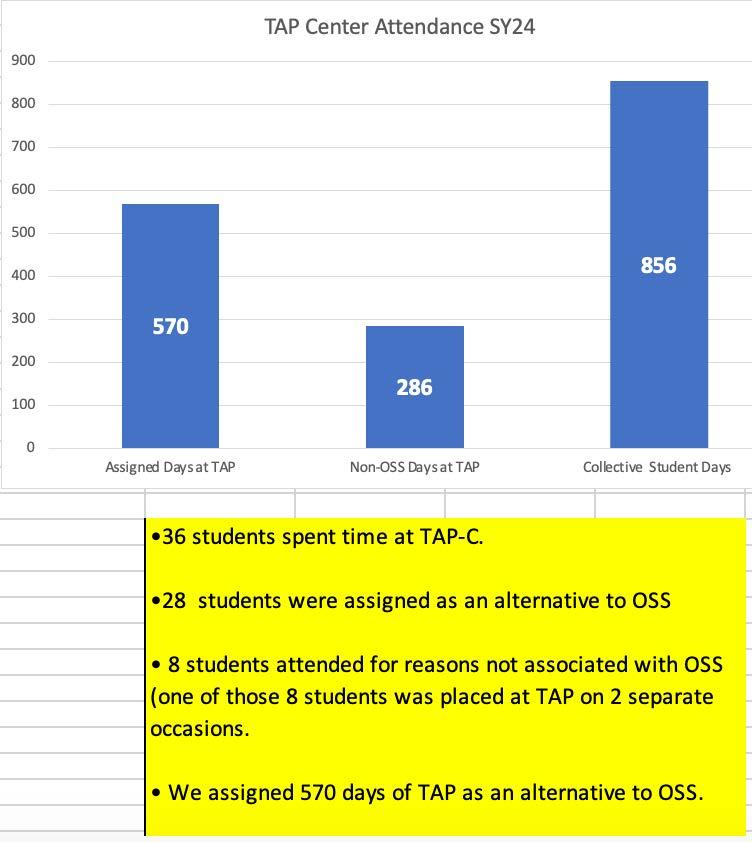
In the first year of our Temporary Alternative Placement Center, we prevented 570 days of out-of-school suspension.
I’m a facilitator in this program and I would like to tell you about it.

Photograph

In today’s educational landscape, ensuring that every student receives a meaningful and uninterrupted learning experience is paramount. However, for long-term suspended students, this can present significant challenges. Temporary alternative placements offer a crucial lifeline, providing these students with a structured environment where they can continue their education and personal/social development. These programs are designed to address the unique needs of suspended students, offering tailored academic support, behavioral interventions, and resiliency training. By creating a supportive and restorative space, temporary alternative placements not only help students stay on track academically but also work to reintegrate them back into the traditional school setting more successfully. North Kansas City School District’s Temporary Placement Center (TAP-C) is one example.
Out-Of-School Suspension Concerns
Many schools use out-of-school suspension in response to zero-tolerance policies and to remove students to maintain a safe school environment. Out-of-school suspension was originally intended to punish students and to alert parents of student misbehavior. The suspension of the misbehaving student also protected school personnel and other students. The assignment of out-of-school suspension as a school consequence is sometimes seen as a very straightforward consequence because the student is simply required to be absent from school for a designated period. Missouri discipline laws and regulations state that “the school board of any district, after notice to parents or others having custodial care and a hearing upon charges preferred, may suspend or expel a pupil for conduct which is prejudicial to good order and discipline in the schools, or which tends to impair the morale or good conduct of the pupils.” In addition, a school board may authorize, by general rule, the immediate removal of a pupil …who poses a threat of harm to such pupil or others, or who has committed a felony criminal violation (NCSSLE, n.d.).
However, out-of-school suspension practices are clear predictors of student dropout rates, lower graduation rates, and poor post-secondary outcomes (Florida’s
Positive Behavior Support Project, 2022). They serve to alienate students from the very supports they need to investigate and correct their behaviors. Most often when students return to school following a suspension, they are placed back into their programming with no instruction or conference, and too often without needed supports. Suspension “does little to reduce future misbehavior for the disciplined students or their peers, nor does it result in improved academic achievement for peers or improve perceptions of positive school environment. Plus, the more severe the exclusionary discipline, the greater its negative effects (are) on a student’s future academic performance, attendance, and behavior” (Álvarez, 2021).
Schools have made progress in developing alternatives to out-of-school suspensions. These alternatives include restorative practices, paying attention and addressing early warning indicators, Positive Behavior Support programs, access to mental health services in schools, mentoring, peer mediation, and parent partnering (Brakebill, 2023).
In-school suspension keeps students in the school building but it is also isolating. This can be an effective strategy for students if it involves teaching students about behavior and alternatives to negative behaviors
to get their needs met. However, many in-school suspension programs are not structured in this manner.
There are times when an out-of-school suspension is warranted and necessary. Behaviors that pose a serious threat to the safety of students and school personnel, result in serious damage to school property, or seriously impair the functioning of the school may need to be addressed outside of the school building. One option many schools provide is an alternative placement, but they, too, isolate and stigmatize students by removing them completely from their home school, familiar peers, and supportive educators.
There must be a better option!
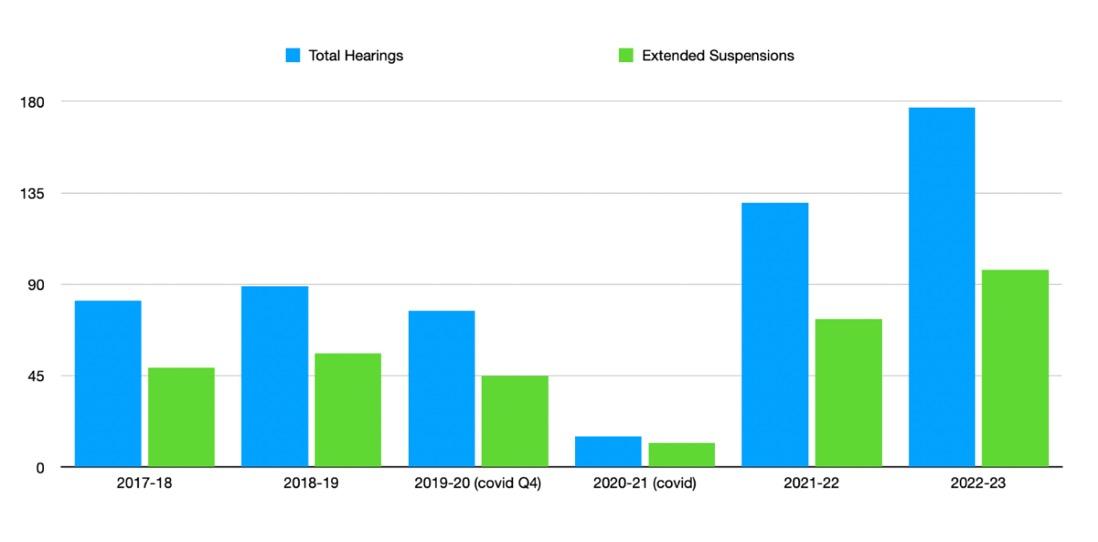
The North Kansas City School District (NKCSD), experienced a dramatic increase in long-term suspension hearings and subsequent extended out-of-school suspensions following the pandemic as indicated by the chart below.
District data revealed that secondary students receiving more than 10 days of suspension were at a higher likelihood of failing at least one course. Students whose suspensions extended beyond 20 days, tended to fail multiple courses.
The Temporary Alternative Placement Center (TAP-C)
In an effort to respond forcefully to aggressive and seriously disruptive behavior but avoid the detrimental impacts of longer suspension, the NKCSD created a Temporary Alternative Placement Center (TAP-C) in the 2023-2024 school year. TAP-C was designed to provide academic, social, and emotional support to students in grades 7-12 if the long-term suspension hearing determined that the suspension period should be extended beyond 10 days. During the hearing, if the student qualified for the program and agreed to participate, the student was offered the option of attending the TAP-C instead of extended out-of-school suspension. If the student either did not qualify or was unwilling to participate, the longterm suspension would proceed.
As a part of the TAP-C Program, NKCSD partnered with The Boys and Girls Club of Greater Kansas City and Synergy Service whose Youth Resiliency Center houses the program. NKCSD hoped to strengthen the socio-emotional supports it provided to students by partnering with Synergy and the Boys and Girls Clubs, two organizations experienced in supporting individual growth and personal development for youth. Funding for the program was provided by NKCSD as part of its annual budget. Synergy Services provided the space for the program at their Youth Resiliency Center during the hours before it was open for the community youth. The Youth Resiliency Center offered more than 10,000 square feet of lively, colorful, youth-focused atmosphere. Students could access the art studio, kitchen, laundry area, recording studio, half-court gym, computer lab, and mental health services available to all youth in the Kansas City metropolitan area.
Two co-facilitators were hired to lead the TAP-C; one a retired certified teacher (that’s me) and a retired instructional assistant. Both of us have extensive experience working with students with behavior disorders and emotional disturbances, are trained in de-escalation strategies, and skilled at helping students
Out-of-school suspension practices are clear predictors of student dropout rates, lower graduation rates, and poor post-secondary outcomes.
deal with challenges with confidence and humor. We work to be vulnerable with students to build trust and relationships and to help them improve their receptive and expressive communication skills.
Requirements and Incentives
After completing a 10-day suspension, students were determined eligible for TAP-C if during their longterm suspension hearing (LTS) the student:
• Processed successfully by acknowledging and reflecting on the harm, wrongdoing, and the impact of their actions on others and/or institutions
• Expressed the desire to find avenues to repair harm
• Participated in and agreed to the development of an initial academic plan and the conditions for returning to school (TAP-C contract)
• Agreed to willingly attend and participate in TAP-C programming
• Processed with parents and district staff on what missing or underdeveloped skills they’d like to work on while at TAP-C
• Was not considered violent or persistently or consistently combative
In addition, the parent/guardian needed to:
• Consent to the student’s participation in TAP-C
• Be able to provide transportation from the center between 2PM and 6PM. This allows families the flexibility to not have to interrupt their workday.
Participation in TAP-C offered several benefits to students:
• A decrease in the number of days away from their comprehensive secondary school
• The ability to return to school after meeting their TAP-C conditions
• Academic support
• Relationships with mentors and the resulting personal growth
• Socio-emotional support provided by licensed professionals
• Additional supports provided, such as laundry, pantry, etc.
• Optional participation in Synergy’s Youth Resiliency Center activities in the afternoon
The Suspension Hearing Officer, student, parent/ guardian, and school administrator develop an Extended Suspension Plan Contract which includes the student’s academic requirements and expectations for program involvement.
Program Components
The three primary components of TAP-C focus on relationship building, academic progress, and behavior instruction. Everything about TAP-C is centered on relationships. The academic plan includes credit recovery and adapted assignments. The behavior plan is restorative, including instruction, reflection, and repair.
Some of our students are quite far behind in academics and work in an online platform for credit recovery. Others remain in their regular courses via the Canvas
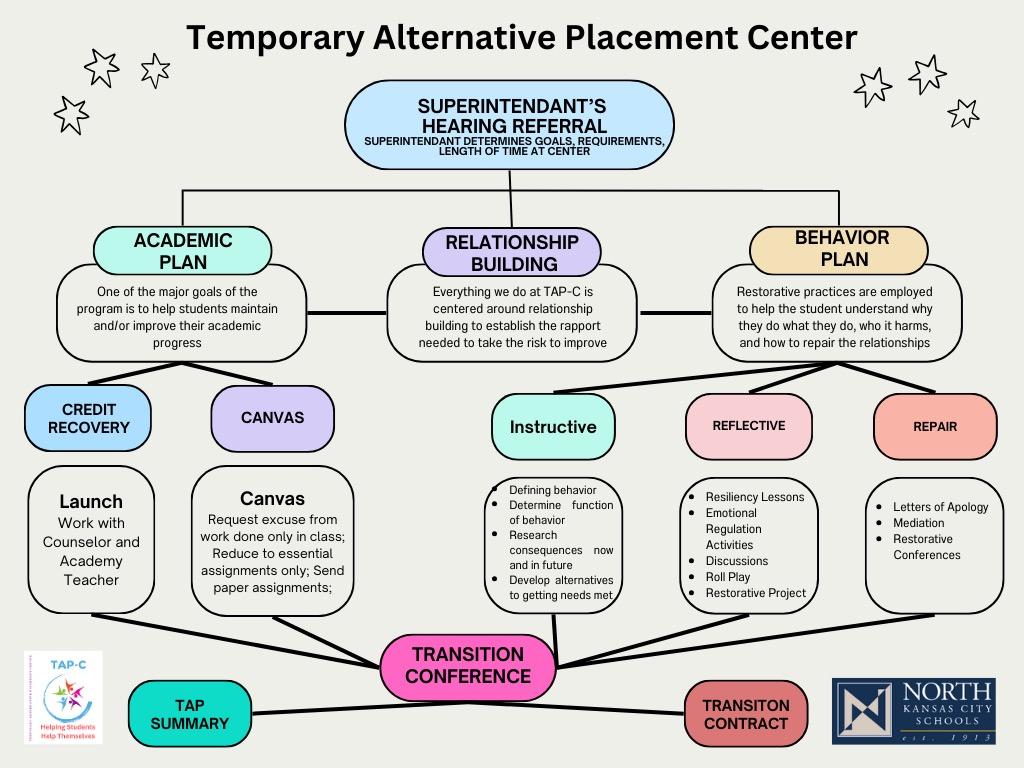
platform. The Synergy and NKCSD staff are on hand to help with assignments and communicate with the home school staff for needed materials and clarification. Special education services are provided for students who qualify through homebound services. The special services teachers schedule their minutes during TAP-C time and meet with the students in our setting. This helps us to provide necessary modifications and accommodations and troubleshoot difficulties that may arise.
Our students arrive with their Extended Suspension Plan Contract which includes their goals for completion of the program and eligibility for return to their home schools. These goals usually include, but are not limited to:
• Bring grades up to passing
• Participate in all TAP-C activities including resiliency lessons
• Weekly check-ins with homeschool contact person
• Therapy recommendation with parent permission
• Emotional regulation skills training
• Communication skills training

As the year progressed, a small sub-group of students in critical need was identified. TAP-C became a place for a limited number of students who needed a temporary alternative placement for reasons other than an extended suspension (sobriety, anxiety, a need for a slower transition from division of youth services, a need for connecting with others). These students were provided with the accommodations and support they needed for as long as they needed them. When the students were ready to move on, we assisted in their transition with whatever supports were needed. This was an effective strategy for most.
Program Activities
A very large part of the TAP-C is the use of restorative practices. We have weekly circles to discuss struggles and strategies. In addition, students work on restoring relationships in a three-step process. The first step is instructional in which students research the behavior for which they were suspended. They learn the legal definition of the offence and the consequences both in school and out, as a juvenile and adult. The second step is reflective in nature. Students learn about the function of their behaviors – what were they trying to gain by the behavior, and what replacement behaviors can help them meet their needs without violating the law and/or school rules. The students also reflect on who was harmed by their actions. They are asked to identify an adult in their home school they feel is vested in their well-being and whom they feel they can talk to. This person is asked to be the student’s advocate upon their return to school. The students then develop a product to show what they have learned. This can be a presentation, poster, paper, artwork, poem, or song. The final step is restorative in which students investigate the harms done and make apologies to those affected. These apologies are done in the form of a letter and sometimes followed up with a mediation or conference.
When students have completed their time and their contract requirements, a transition meeting is scheduled with the home-school administrator. In this meeting we review the student’s academic and behavioral progress. Students share their short-term
and long-term goals. Finally, the TAP-C facilitator, the school administrator, the student, and the student-chosen advocate create a transition contract. This contract includes not just what the student will do upon return to school, but also what supports the student needs and how the school will address those needs. All parties sign this contract.
Another important aspect of the TAP-C Program are the resiliency lessons conducted by the Synergy Services Staff each week. The behaviors that caused the long-term suspensions are usually the result of student social/emotional skills deficits. Lesson topics have included making and keeping connections/ relationships, getting individual needs met without escalation, anger management, impulse control, and dealing with grief. The students have also participated in art therapy sessions. Lessons are tailored to the specific needs of the students who rotate through TAP-C.
On the surface, the program may seem relaxed and flexible, but there is an underlying structure that is needed to provide a safe and supportive environment where the students are willing to take chances. There are very few expectations, but those expectations are applied and reinforced with extreme consistency.
Program Outcomes
The North Kansas City School District implemented TAP-C in the 2023-2024 school year. In that first year, 36 students attended TAP-C instead of out-of-school suspension and a total of 570 days of out-of-school suspension were avoided. An additional 286 days of TAP-C were provided to students who needed temporary special accommodations and support beyond what could be reasonably provided in the school setting.
When surveyed at the end of the school year, the majority of our students responded favorably when asked about the program as they transitioned back to their home schools
• How effective were the restorative activities in helping you understand the effects of your behavior on others? 3.7 on a 5-point scale
• How effective were the restorative activities in helping you repair relationships at school? 4.2 on a 5-point scale
Administrators and school support staff who worked with us were also surveyed as to their opinions of the effectiveness of the TAP-C.
the actual meeting? 5 on a 5-point scale
• Once the student returned to school, did you observe changes in the students’ attitude and behavior? 4.4 on a 5-point scale
• Please rate your overall satisfaction with the TAP-C program for helping students to understand and improve their behavior. 5 on a 5-point scale
Conclusion
The success of the TAP-C program lies in the interactions between the staff and students. Strong supportive relationships are the foundation for the risk-taking involved in students accepting responsibility for their actions and learning alternate, less destructive methods for getting their needs met. We all work hard to practice patience, understanding, and
Student Responses to Open-Ended Questions
Did TAP-C address the issues you were having that caused your suspension? How?
• Helped to teach me how to address the future
• I didn’t understand why it was such a big deal but through talking, I could understand and not do it again
• When I came back, I was looking at things from a different perspective, things aren’t one-sided
• Advice, scenario practice, creating personal space
• Teaching me I don’t have to respond to everything
• Talking a lot about the reasons I fought and dealing with it differently
Do you feel the TAP-C Program effectively prepared you for returning to school?
• Helped me to treat others with respect, how to talk with teachers
• I actually took the time to reflect and realize what I did wrong and I wanted to improve on it
• It gave me time to do better within myself
• Helped me set goals and learn from my mistakes
• Helped me focus on the purpose of school and stay in touch with my teachers
What was the biggest take-away (lesson) you learned at the TAP-C?
• I learned how to be respectful, use manners, and control myself more
• Don’t care about what people say and walk away
• Boundaries, to control my emotions
How have you applied the lessons you learned at TAP-C?
• I asked to meet with the teacher I hit and made an apology in person
• I walk away from situations and mind my own business
What was the best thing about TAP-C?
• The way I was treated, respectful environment, second home
• The teachers
• I was able to get my grades up- I wouldn’t have worked on school at home
• I was able to work at my own pace- no one was rushing me
• Being able to ask for what I needed
• Ms. B. and Ms. S.- they cared about me and I could tell
tolerance with students who come to the Temporary Alternative Placement Center. No matter what they say, these students do not enjoy their circumstances. We have to be willing to be vulnerable with them to build trust that enables change of their natural instincts. Many of these students feel they have not been listened to; this is their reality. We spend the time it takes to listen to them and guide them to a better understanding of the functions of their behaviors and more effectively meet their needs.
References
Álvarez, B. (2021, September 10). School suspensions do more harm than good. NEA Today.
Brakebill, A. (2023, November 17). The consequences of suspension and what schools can do instead. Edmentum.
Florida’s Positive Behavior Support Project (2022, April 12). Effects of Suspension on Student Outcomes Fact Sheet.
National Center on Safe Supportive Learning Environments (NCSSLE). Missouri School Discipline Laws & Regulations: Grounds for Suspension or Expulsion
Janet Burgess, Facilitator, Temporary Alternative Placement Center, North Kansas City School District, burgessjanet@yahoo.com
Children and Antipsychotic Medications
How these powerful medications are used to treat kids with problem behaviors

By Caroline Miller
Note: While this author uses the term "antipsychotics," the accurate term is "antipsychotic medications."
Antipsychotics are medications that were developed to help adults with psychosis, a condition that causes a person to lose touch with reality. Antipsychotics reduce the delusions and hallucinations that are common symptoms of psychosis. But antipsychotic medications have also been proven to be effective at reducing other troubling emotional and behavioral symptoms. And they are being widely prescribed for children as well as adults.
In children and teenagers, antipsychotics are most often used to reduce aggression, irritability, and other disruptive or problem behaviors. They are prescribed for kids with autism spectrum disorder, or with ADHD, other disruptive behavior disorders, or unspecified behavior issues. Antipsychotics are also used to treat kids with OCD and Tourette syndrome when therapy or other medications haven’t been effective. Because they can have serious side effects, including weight gain and hormonal, metabolic and neurological changes, use of antipsychotics in children should be carefully considered and closely monitored by a doctor.
What are “atypical” or “secondgeneration” antipsychotics?
Most of the antipsychotic medications prescribed for children are “atypical” or “second-generation” (SGA)

antipsychotics. Developed in the 1990s, they’re called “atypical” because, as compared to earlearlier antipsychotic drugs, they have fewer side effects that impact motor control and coordination.
All antipsychotic medications work by reducing the level of dopamine — a neurotransmitter that helps regulate mood, behavior, concentration, and movement in the brain. Neurotransmitters are chemicals that activate receptors on the surface of cells in the brain and elsewhere in the nervous system. They work like a key that unlocks the receptor.
Antipsychotic medications are called “dopamine receptor antagonists,” meaning that they block dopamine’s ability to activate certain receptors. This reduction of dopamine activation in the brain has been found to not only reduce symptoms of psychosis, but also inhibit hyperactivity, aggression, impulsivity, and other problematic behaviors. Some atypical antipsychotics can also block or activate receptors for the neurotransmitter serotonin, further affecting mood and behavior. SGAs work within two weeks of starting treatment and reach their full effect in 2-3 months. Atypical antipsychotic medications include:
• Aripiprazole (Abilify, Aristada)
• Asenapine (Secuado, Saphris)
• Brexpiprazole (Rexulti)
• Cariprazine (Vraylar)
• Clozapine (Clozaril, Versacloz)
• Iloperidone (Fanapt)
• Lumateperone (Caplyta)
• Lurasidone (Latuda)
• Olanzapine (Zyprexa, Lybalvi, Symbyax)
• Quetiapine (Seroquel)
• Paliperidone (Invega)
• Pimavanserin (Nuplazid)
• Risperidone (Risperdal)
• Ziprasidone (Geodon)
While these medications all affect neurotransmitters, including dopamine, they each have a unique impact on brain function. That means that if a child doesn’t respond to one antipsychotic, another might work for them. Or if a child experiences troubling side effects on one medication, another might have fewer side effects.
Antipsychotic medications to reduce aggression
The most common use of SGAs in kids is to calm down children whose severe behavior problems are making it difficult for them to function in school and within their families. This includes kids with autism spectrum disorder, especially when they reach early adolescence and their aggression may be a danger to other children, their parents and themselves.
Paul Mitrani, MD, a child and adolescent psychiatrist at the Child Mind Institute, lists three reasons why a child might be prescribed an SGA:
• When the child is experiencing psychotic symptoms, which are very rare in kids
• When there is a crisis acute aggression or irritability or self-harm is causing a risk to the safety of the child or others
• When a child’s behavior is so intense or extreme that they may be unable to go to school or live at home
Risperidone and aripiprazole are the two SGAs that are most often prescribed for children to manage extreme behavior. Both are FDA approved for irritability in children with autism spectrum disorder; for other kids with behavior issues they are used off-label.
Experts agree that in a non-crisis situation, children should have access to behavioral therapy and parent training, which can reduce problem behavior, before putting them on antipsychotic medication. But the reality is that for many kids those therapeutic alternatives are not available. In that case medication may be seen as a quick, effective, affordable alternative.
All antipsychotic medications work by reducing the level of dopamine in the brain.
Antipsychotic use in kids with ADHD
For children with ADHD who are taking stimulant medication, antipsychotics are sometimes used to help with behavioral symptoms that are not adequately covered by stimulants. “While stimulants are very effective for treating ADHD, kids will sometimes ‘crash,’ with a return of symptoms after the stimulant wears off, or struggle in the morning before the stimulant starts working,” explains Dr. Mitrani. “If these problems are really interfering with a child’s ability to function, and other medications, like guanfacine, are not effective, we will consider antipsychotics as a way to help them regulate their behaviors better.”
One advantage is that there are antipsychotics that come in liquid form, Dr. Mitrani explains, which makes them easier for kids who have trouble swallowing pills, and makes it possible to deliver smaller doses. “With kids, we want to start at low doses and see how they respond, and liquid medications allow more flexibility to find the best dose for them.”
Antipsychotic use for kids with OCD or Tourette syndrome
The first-line treatment for children with OCD is a form of cognitive behavioral therapy called exposure with response prevention (ERP), sometimes combined with an antidepressant medication (usually an SSRI). But antipsychotic medications are sometimes added to the mix to help mitigate obsessive thoughts. “An antipsychotic can help improve flexibility,” Dr. Mitrani explains, “when you’re stuck on these negative thoughts, whether they’re hallucinations, in schizophrenia, or obsessions, in OCD. It can reduce the stickiness of those intrusive thoughts.”

The first-line treatment for children with Tourette syndrome syndrome is therapy called comprehensive behavioral intervention for tics (CBIT). But if that doesn’t prove effective, and the tics are causing distress or interfering with the child’s functioning, the use of an SGA may be recommended. Dopamine, which is blocked by antipsychotic medications, has been strongly linked with Tourette syndrome. Both risperidone and aripiprazole have been shown to be effective for reducing tics and are widely used. Aripiprazole has been approved by the FDA for Tourette syndrome. Risperidone is used off-label.
Side effects of antipsychotics
The rates and severity of side effects differ among these medications. And while they may occur at the beginning of treatment, they may also develop after sustained use. “The adult studies have shown,” Dr. Mitrani notes, “that the longer you’re on an antipsychotic and the higher the dose, the more likely that you may have those side effects. But they can also happen at initiation.” Here is a summary of major side effects:
• Weight gain: SGAs often cause significant weight gain. The amount of weight gain varies with different medications. According to the American Association of Child and Adolescent Psychiatry (AACAP), the largest weight gain appears to be with clozapine and olanzapine, and significant weight gain occurs with risperidone and quetiapine. Aripiprazole and ziprasidone appear to have the lowest
propensity for weight gain. Some studies suggest that SGA-associated weight gain may be greater in young people than in adults.
• Metabolism effects: SGAs can cause what are called “metabolic abnormalities,” including high blood sugar (hyperglycemia) and high cholesterol (hyperlipidemia) and a rise in other lipids and triglycerides. These can increase the risk of developing diabetes and heart disease.
• Hormonal effects: Antipsychotics can affect the body’s level of the hormone prolactin. In girls, high prolactin levels (hyperprolactinemia) can affect fertility and cause missed periods and leaky discharge from breasts. In boys, it can cause infertility and breast growth, called gynecomastia, which does not disappear if they stop taking the medication. Of the SGAs, risperidone shows the greatest increase in prolactin levels and aripiprazole the least.
• Neurological effects: Another set of possible side effects includes something called “tardive dyskinesia,” which is characterized by repetitive, involuntary movements, including facial grimaces. The risk of tardive dyskinesia increases with the dose and duration of the treatment, and it can be permanent. The risk of neurological side effects is greatest with risperidone, ziprasidone, and aripiprazole.
• Heart and circulatory problems: Antipsychotic drugs can alter the heart’s rhythm and cause orthostatic hypotension, which is a drop in blood pressure when a person stands or sits up quickly that can make them fall or pass out.
How should a child taking antipsychotics be monitored?
Because these side effects can be serious, AACAP recommends that children going on an antipsychotic should have baseline measures of vital signs, including body mass index, blood pressure, and glucose levels to rule out heart and other health problems that could be exacerbated by the medication. Dr. Mitrani also includes liver and thyroid function tests.
Weight and lab tests should be done at baseline
(before starting medication) and labs should be repeated 3 months after starting, Dr. Mitrani advises. They should be repeated at intervals of at least once a year after that more frequently if any labs come back abnormal and the family wants to continue with the medication, which they may do if they are trying to alleviate them by modifying diet and exercise. “With these side effects, the earlier you catch them the better,” Dr. Mitrani notes. “You can take the child off the medication, try something different, or even start a medication that hopefully mitigates side effects if the medication is helping.”
Dr. Mitrani reports that there are studies showing that some medications such as metformin (a diabetes medication), can help reduce the metabolic side effects of SGAs — weight gain, increased cholesterol, risk of diabetes. “We also emphasize the benefits of healthy diet choices and exercise,” he adds, “and will sometimes refer families to a nutritionist.”
While side effects may occur at the beginning of treatment, they may also develop after sustained use.
How long should a child take antipsychotic medications?
When these medications are used to stabilize a child in crisis, they are typically used for a period of months, Dr. Mitrani explains, so that other interventions can be put into place to address the underlying problems. Otherwise, the risk is high that the problem behavior will recur when the medication is withdrawn. “Three months of stability gives the child, the parents, and the school time to make some changes,” he adds, “so that hopefully when they come off the medicine, the improvement is sustained.”
Some children take SGAs indefinitely, including kids with autism spectrum disorder who might otherwise need residential care. When they are used long-term, they should be monitored at least every 3 months if they’re stable, Dr. Mitrani advises, “but more frequently if symptoms continue or worsen, since we want to avoid hospitalization or needing to be placed outside of the home.”
Discontinuing antipsychotic medications
Atypical antipsychotic medications should not be abruptly discontinued unless a severe and/or dangerous side effect has developed. Taking a child off antipsychotic medication should be gradual, with close monitoring by a doctor.
A child who abruptly stops taking the medication is at risk for something called, “withdrawal dyskinesia,” which causes involuntary movements of the face, arms, and legs, including jerking and grimacing. The movements are worse when the child is stressed or anxious. In most cases withdrawal dyskinesia will subside without treatment in 1–2 months. But if the movements are causing the child distress, a psychiatrist may recommend that the antipsychotic be restarted and tapered gradually over 1–3 months. Since the medication has been effectively reducing problematic symptoms, its abrupt discontinuation can destabilize the child and cause a return of the behavior.

Reprinted with permission from Child Mind Institute. July 24, 2024
Web version available: https://childmind.org/article/children-and-antipsychotic-medications-child-mind-institute/
Caroline Miller, Editorial Director, with Paul Mitrani, as Clinical Expert, Medical Director, Senior Child and Adolescent Psychiatrist, Child Mind Institute, info@ childmind.org.

By
Photo courtesy of AdobeStock.com
Amie Cieminski and Laurie Berdahl
Being a teen is tough these days. Climate change, political division, gun violence, natural disasters, war, family issues, and social injustice are concerns that affect all of us, including young people. Yet, youth may face additional challenges of trying to fit in, being bullied, or succeeding in school. The remote learning and isolation many students experienced during the COVID-19 shutdown of 2020 hurt their academic and social-emotional learning. Educators are still scrambling to provide additional learning opportunities and assistance to students to support healthy youth development. Teaching about self-esteem and ways to boost it as part of a comprehensive approach to social and emotional learning (SEL) may be an effective way to enhance student outcomes (Mertens et al., 2022). This article shares information about self-esteem, strategies to promote it in youth, and the description of PowerUp, a commercially available life skills curriculum created by Youth Empowerment Group (2023).
Benefits of Self-Esteem
Self-esteem is defined as the degree to which the qualities and characteristics of one’s self-concept are perceived to be positive (American Psychological Association, 2023). Self-esteem is subjective as it reflects one’s view of one’s self-image, accomplishments, capabilities, and success. Self-esteem is linked to self-confidence –trust in one’s abilities, judgment, capabilities, and self-assurance. Self-esteem is part of a healthy personal identity, self-efficacy, and self-knowledge of strengths and weaknesses. People with positive self-esteem have “numerous positive consequences, including better social relationships, more success at school and work, improved mental and physical health, and less antisocial behavior” (Orth & Robins, 2022). Concerning success in school, students with higher self-esteem are likely to perform better academically, be more engaged and persistent, adapt more quickly to challenges, and cope with failure better (Orth & Robbins, 2022). Self-esteem is not to be confused with narcissism, which is characterized by superiority and entitlement and can have adverse effects on relationships and mental health.
Social-Emotional Learning and Self-Esteem
The Collaborative for Academic, Social, and Emotional Learning (CASEL), a nonprofit organization that promotes and disseminates research on evidence-based SEL, has identified five core SEL competencies: self-awareness, social awareness, responsible decision-making, self-management, and relationship skills. CASEL contends that SEL is integral to education and human development for students and adults. SEL has positive effects on student outcomes, including improved academic achievement, attendance, school and life success, mental health, and prosocial behaviors, as well as decreased emotional distress, externalizing negative behaviors, anxiety, and depression (Cipriano et al., 2023).
Helping young people feel Prepared, Optimistic, Worthy, Empowered to be Equal, and Resilient Under the Pressures youth face today.
According to CASEL, self-awareness incorporates “the abilities to understand one’s own emotions, thoughts, and values and how they influence behavior across contexts. This includes capacities to recognize one’s strengths and limitations with a well-grounded sense of confidence and purpose” (CASEL, 2020). Skills that contribute to self-awareness include identifying personal, cultural, and linguistic assets, having accurate self-perceptions, recognizing strengths, demonstrating self-confidence, and experiencing self-efficacy, all of which are associated with self-esteem.
Basic Concepts of Self-Esteem
According to Youth Empowerment Group (2023), a nonprofit organization dedicated to promoting positive academic, SEL, and life skills for youth, the basic concepts of self-esteem include the following.
• Other people cannot create or give someone self-esteem. It is something that comes from inside oneself.
• Outside forces and other people can help build or break down self-esteem.
• Recognizing one’s strengths and unique attributes can build self-esteem.
• Having “grace” for oneself and mistakes and practicing self-compassion can support self-esteem.
• Valuing diversity, showing empathy for others, having optimism, and standing up for oneself and others can feed self-esteem.
• Popularity, good looks, and having good-looking bodies may seem to support self-esteem but are unlikely sources of long-lasting self-esteem.
• Being around authentic friends, family, and trusted adults, and participating in enjoyable sports and activities can boost self-worth.
• People who criticize, blame, make fun of people, and bully others are self-esteem busters and tear down feelings of self-worth.
• Entitlement is not the same as self-esteem. People who feel entitled believe that they deserve special privileges even though they haven’t earned them. Entitled persons also believe they don’t have to follow the same rules as others.
Social Media Dangers to Self-Esteem
While technology can be an excellent tool for learning, creativity, and communication, it can also be a tool for bullying and damaging self-esteem for tweens and teens. Comparing oneself to unrealistic images or expectations or to other youth can harm self-esteem and lead to anxiety or depression (Yanus, 2024). Teens may not feel that they are funny, smart, thin, athletic, or pretty enough when they compare themselves to images on TV, in ads, or on social media. Because people tend to post the good and happy parts of their lives on social media, teens may think everyone else is doing just fine and wonder why they themselves have challenges.
Internet and social media use among teens continues to increase, with YouTube, TikTok, Snapchat, and Instagram being the most widely used online platforms among U.S. teens aged 13 to 17 (Anderson et al., 2023). Recent concerns about the dangers of social media, especially on the mental health of young people, have been highlighted through a Facebook whistleblower and, most recently, a lawsuit of over 40 states vs. Meta, which owns Facebook and Instagram. The suit claimed that Meta has harmed children and teens by harnessing the addictive powers of their social media platforms, which plaintiffs have linked with negative outcomes such as depression, anxiety, insomnia, and interference with education and daily life.
Cyberbullying is another danger associated with social media and youth. Victims of cyberbullying may experience negative emotions, lower self-esteem, and isolation. With more youth accessing online platforms and using social media accounts, digital citizenship is a critical topic in youth education. Digital citizenship topics include online safety, privacy, cyberbullying, and media literacy. Students who understand these topics are better equipped to evaluate images and posts they see and read online.
What Teens Are Saying
The leadership team of Youth Empowerment Group recently had the opportunity to ask teenagers nationwide about the issues facing them. Executive Director Laurie Berdahl partnered with Robin Hammond, an award-winning photojournalist, cinematographer, and founder of Witness Change. Hammond filmed, photo-

What US Youth Said About Self-Concept (excerpts from the short film)
I feel like the biggest struggle for kids is focusing on how other people see them instead of how they see themselves.
Am I going to have to deal with other people judging me based on the color of my skin or how I look or how I dress?
There’s gonna be a lot of outside voices. There’s gonna be the haters, even your close loved ones and friends, pressuring you to do something… but just be comfortable with yourself.
Just love yourself. Love who you are. Once you learn how to love yourself, you’ll see why people truly do like you.
If you treat yourself the way you treat others and don’t tell yourself, “You’re fat. You’re ugly,” and you tell yourself, “You are beautiful. You’re smart. You’re strong,” you will start to believe it yourself.
graphed, and was the main interviewer of 48 youths with various backgrounds and identities in Georgia, Colorado, Maryland, Virginia, and Washington, DC. He asked them about self-esteem, pressures that youth face today, equality, mental health, and other topics. These youth acknowledged the challenges of growing up now and that social media, meanness, bias, body image pressures, gender expectations, and prejudice hurt their self-concept or how positively they view themselves. These students encouraged other youth to believe in themselves, find friends and trusted adults who support them and their dreams, and never give up. Time Magazine featured this project and student quotes in a cover story on youth mental health. Embedded in the article is a powerful short film featuring several of the youth interviewed.
Teaching About Self-Esteem
Like many of the concepts taught in school, educators can start with age-appropriate definitions, such as self-esteem is feeling good about yourself for younger students or self-esteem is your overall opinion about yourself and your abilities for older students. Educators can provide examples of activities that build self-esteem and dispel myths that self-esteem comes from winning awards, being popular or smart, owning nice clothes, or having unrealistic, ideal body types. Students can generate examples of
things that build self-esteem and tear down or bust self-esteem. Because self-esteem is personal, one powerful strategy is having students write positive affirmations about themselves and their abilities. Educators can encourage students to look beyond physical appearance or intelligence and think about what they do well and the assets they possess, like having a good friend or a caring relative. Positive thinking can shape behaviors, so revisiting these affirmations also reinforces positive self-image.
Strategies to Promote Self-Esteem
Educators can use several classroom strategies to promote student self-esteem across the academic day in all subjects, for all students (Mather et al., 2015). Teachers can accept differences and talk positively about the uniqueness of students rather than promoting fairness by expecting every student to be the same. Explaining natural differences, meeting individual needs, and embracing students’ individuality can encourage acceptance of diversity, which can feed self-concept for all. Giving students classroom responsibilities that play into their strengths and interests is another strategy to help students see how they can contribute positively to the classroom and their community. Likewise, increasing students’ sense of ownership over classroom decisions can boost their confidence.
Praise and Self-Esteem
Praise can be a powerful tool to encourage students to keep trying and to work on improving their learning or effort. Classroom environments focusing on praise and positive reinforcement encourage better student outcomes and behavior. Teachers who provide authentic, genuine encouragement in the form of small notes, smiles, and behavior-specific and person-specific verbal praise focusing on students’ strengths and accomplishments support self-esteem development. This is especially important for learners who struggle, may have low self-concept, or feel discouraged when they do not experience success as quickly as other students.
Carol Dweck’s (2015) work on grit reminds educators that praise for intellect or talent can cultivate fixed mindsets rather than growth mindsets. Students with growth mindsets work hard, try new strategies, are persistent, and understand that goals are achieved through effort. Teachers can promote a growth mindset by teaching students that making mistakes is a natural part of learning. Educators can respond to mistakes by saying, “That’s incorrect, but OK. Let’s review how to approach this type of problem again.” This approach encourages a growth mindset rather than moving on, only calling on students who are likely to know the correct answer or overusing the phrase ‘good effort’, which Dweck warns may inadvertently send the message to students that the end goal of an activity is trying hard rather than learning, progress, or growth.
Finally, praise is dependent on other people. Teachers, peers, parents, bosses, and coaches give praise. Teachers can help students learn to self-assess and self-evaluate rather than think their work is good because “my teacher said so.” Educators can encourage positive self-talk with sentence starters such as, “I am good at___,” “I like the way that I ____,” or “Every day I learn more about ____.” When students understand what they did well, what they can improve on, and what their next steps are, it can build their confidence and self-concept.
PowerUp
In 2016, a small group of parents who were educators, psychologists, medical doctors, and counselors met to discuss concerns about healthy youth development – including self-esteem, body image, mental and social health, social media, bullying, mindsets, and diversity – especially for young girls. Increased awareness of issues facing young women, catalyzed by the Me Too movement, and escalating youth mental and social health problems and suicide rates, compelled the group to create a program for local 5th and 6th graders called PowerUp for Middle School The initiative was piloted with several groups of girls in Northern Colorado with the purpose of helping young people feel Prepared, Optimistic, Worthy, Empowered to be Equal, and Resilient Under the Pressures youth face growing up today. The Youth Empowerment Group’s vision was to expand into schools and youth organizations. To achieve

these goals, lessons were moved to a video format with printable handouts so that educators and leaders could implement the lessons and activities with minimal SEL expertise or preparation. Although the COVID-19 pandemic hampered the ability to deliver face-to-face sessions, it simultaneously increased the motivation to support students of all genders in all aspects of mental, social, and life skill development.
In 2023, through a grant from The Weld Trust, Youth Empowerment Group completed the video-based programs, PowerUp Girls for Life, designed for tween and teen girls, and a parallel co-ed version named PowerUp These lessons have been designed to be appropriate for fourth grade through high school students.
While PowerUp was originally designed as a preventative, proactive Tier 1 intervention program to teach life skills, educators and counselors asked for resources suitable for small groups. Activities were adjusted so an adult could deliver lessons to whole classes of students, small groups, or in one-on-one settings. Educators reported positive student outcomes in these Tier 2 interventions: small groups needing extra and targeted social skills instruction. Classroom teachers, school counselors, and club leaders in afterschool programs, youth organizations, and summer community programs have used PowerUp lessons aligned with the five CASEL core competencies on various topics, including self-esteem, bullying, social media, and healthy relationships.
PowerUp Lessons
Effective SEL programs incorporate sequenced activities, active forms of learning for practice and mastery of new skills, focused time spent on skill development, and explicit defining and targeting of specific skills, known as the SAFE approach to SEL instruction (Durlak et al., 2011). Following the SAFE approach, each PowerUp lesson provides students with direct instruction, definitions, and examples of concepts, discussion time, and at least one application activity or game. Direct instruction is provided through videos to reduce leader preparation time
There’s gonna be a lot of outside voices. There’s gonna be the haters, even your close loved ones and friends, pressuring you to do something… but just be comfortable with yourself.
and deliver a consistent message to all students. There are term definitions, note-taking prompts, top takeaway messages, and resources on student handouts. Talk Time allows students to express their understanding of the concepts in whole class or small group discussions with adult feedback and guidance. The application activities enable students to practice skills such as self-esteem building, empathy, face-to-face communication, dealing with bullies, or identifying and managing negative emotions through active and engaging games, role plays, and simulations. Educators and counselors reviewed the curriculum to ensure that they are culturally relevant and inclusive. Instructor guides provide information for easy lesson preparation, time markers for the video segments and activities, individual or small group modifications, and tips for successful implementation. Lessons are 25 to 45 minutes long and can be divided into two parts: instruction and application, depending on the time available.
The majority of today’s youth access YouTube, TikTok, Snapchat, or Instagram several times per day via smartphones and computers. They need help mediating the messages they receive and their own self-concept as part of a comprehensive approach to SEL. Teaching youth about self-esteem and how to build and reinforce it can have far-reaching, positive effects on student success and school culture. Educators can begin by teaching what self-esteem is, reinforcing the value of each person, providing authentic praise for effort and accomplishments, and having students practice positive self-affirmations. Support-

ing healthy self-identity and positive self-esteem formation in youth will benefit them from childhood through old age, as well as our society.
References
Anderson, M., Faverio, M., & Gottfried, J. (2023). Teens, social media and technology 2023. [Report]. Pew Research Center.
American Psychological Association. (2023). APA Dictionary of Psychology.
Cipriano, C., Strambler, M.J., Naples, L. H., Ha, C., Kirk, M., Wood, M., Sehgal, K., Zieher, A. K., Eveleigh, A., McCarthy, M., Funaro, M., Ponnock, A., Chow, J. C., & Durlak, J. (2023). The state of evidence for social and emotional learning: A contemporary meta-analysis of universal school-based SEL interventions. Child Development, 94, 1181–1204.
Durlak, J. A., Weissberg, R. P., Dymnicki, A. B., Taylor, R. D. & Schellinger, K. B. (2011). The impact of enhancing students’ social and emotional learning: A meta-analysis of school-based universal interventions. Child Development, 82(1), 405–432.
Dweck, C. (2015, September 22). Carol Dweck revisits “growth mindset.” EdWeek.
Mather, N., Goldstein, S., & Ecklund, K. (2015). Learning disabilities and challenging behaviors: Using the building blocks model to guide intervention and classroom management (3rd ed.). Brookes.
Mertens, E., Deković, M., van Londen, M., Reitz, E. (2022). Parallel changes in positive youth development and self awareness: the role of emotional self regulation, self esteem, and self reflection. Prevention Science, 23, 502-512.
Orth, U., & Robins, R. (2022). Is high self-esteem beneficial? Revisiting a classic question. American Psychologist, 77(1), 5-17.
The Collaborative for Academic, Social, and Emotional Learning. (2020). CASEL’s SEL framework: What are the core competence areas and where are they promoted? CASEL. ht
Yanus, S. (2024). Mental health effects of unrealistic expectations-understanding the connection. iCliniq.
Youth Empowerment Group. (2023). Self-esteem lessons in Co-Ed PowerUp and PowerUp Girls for Life. h
Amie Cieminski, Associate Professor, University of Northern Colorado, Greeley, amie.cieminski@unco.edu
Laurie Berdahl, Executive Director, Youth Empowerment Group, Greeley, laurie@youthempowermentgroup.org
Responding to Developmental Anxieties
By Mary M. Wood and Susan A. White
Classroom behavior is a major player in the educational success or failure of students and teachers. Students expect teachers to understand their needs and teachers expect students to learn. It’s accurate to say that expectations fuel the classroom behavior of both teachers and students, whether in special or general education. When a student’s classroom behavior impedes learning, instructors with the Developmental Therapy Institute have effectively used a Developmental Anxieties framework to set expectations for responding in meaningful ways to students’ behavior problems (Wood et al., 2007).
This approach is built on the premise that classroom behavior reflects anxiety that forms at critical periods of development. These developmentally generated anxieties are not a disability but naturally occurring responses to life experiences, good and bad (US Department of Health and Human Services, 2024). A recent report at Yale University indicated: “Uncomfortable as it is, anxiety is a normal human emotion that serves important functions, including protecting people and motivating them to solve problems. Children are vulnerable to feeling anxious as they don’t know much about the world and rely on adults for security.” (Yale Medicine, 2024)
Such concerns can be overcome as students grow and mature from satisfying interactions with others (Knudson, 2004). By knowing how naturally occurring developmental anxieties emerge for each age group and then typically resolve during sensitive periods of development, you can identify a student’s current social and emotional concerns and focus your instruction to support resolution of the resulting anxiety. If students’ social and emotional needs are being met, you will have individuals more willing to participate with confidence.
In contrast, when these needs are unresolved, you may see negativity, hostility, anger, regressive behavior, or resistance to participating. Such troubling behavior problems may be active expressions of stress and unmet needs. Unresolved, developmental
Classroom behavior reflects anxiety that forms at critical periods of development.
anxieties will continue to be major sources of emotional discomfort, fueling students’ behavioral responses to disturbing social and emotional concerns. Then, as students grow older, unresolved anxieties remain even as new anxieties form. This compounds the challenge, adding new and potentially disruptive behavior problems.
Whether in general or special education, you can guide a student successfully through the challenges of an age-related developmental anxiety. While you provide anxiety-related adaptations for an individual, you can also maintain your established classroom rules and plan group activities These individual adaptations or guidelines, described as interpersonal rules, are informal, implicit, flexible, and generally unspoken guides for teachers working with specific students.
With interpersonal rules, you as a teacher can modify a task/expectation based on what the student needs from you relief from developmental anxiety. For students with severe emotional or behavioral disorders, you can respond to their age-related developmental anxieties as you also implement specific interventions.
Resolution of developmental anxieties is the broad social-emotional goal. Use the following chart compiled by the Developmental Therapy Institute to identify your students’ typical age-related developmental anxieties and the responses needed from you.
It’s easier than it looks!
Start with the age groups in the header at the top of the chart.
Age- Related Social-Emotional Needs
Infants + Toddlers
Stages of Developmental Anxieties Expectations and Potential Resolutions
Preschoolers Early Learners Preteens Teens + Beyond
SELFCONFIDENCE
Students’ Expectations of Adults Take care of my needs. Provide approval. Demonstrate respect. Model social/group expectations. Counsel, advocate, coach.
Positive Results from Needs Met TRUST “Others provide what I need.”
Negative Results from Unresolved Needs Insecurity Crying & “Meet my needs.”
ANXIETIES Developed from Unmet Needs
(Abandoned)
SUCCESS “I can do it (with your help).”
Failure “I Can’t do it.”
RESPECT “They (peers and adults) notice me.”
Ignored “They don’t like me.”
GROUP MEMBERSHIP “I fit in.”
Dependent “I don’t want to but I have to.”
POSITIVE RELATIONS “I am responsible + think of others.”
Confused “Who am I?”
(Over Failures)
CLASSROOM BEHAVIOR PROBLEMS
Copyright © 2024 by the Developmental Therapy Institute, inc., Athens, Georgia, USA Adapted for ReThinking Behavior with permission.
• Row 1 identifies the general social and emotional needs for each age. These are natural concerns typically emerging during that period of development. Watch and listen as students interact with peers and adults. Consider the extent to which those developmental needs are being met, day-to-day.
• Row 2 has key responses needed from you to assure that those age-related social and emo-
tional needs are met. Use that understanding to form expectations for your students and apply interpersonal rules to guide your own role and response. These expectations can become social-emotional and behavioral goals for individuals and for group instruction.
• Row 3 shows positive results when the age-related developmental needs are fulfilled. The statements in quotes reflect students’ own
perceptions about successful outcomes to the developmental challenges of their specific age group.
• Row 4 in red contains negative unresolved social and emotional needs that produce a specific age-related developmental anxiety. Statements from students indicate their concerns.
• Row 5 offers key words to summarize the essence of developmental anxieties for each age group.
If you are unsure that a student’s behavior is generated by an unresolved developmental anxiety, gather more information and insight into the behavior. Look for more details and listen for nuances in the behavioral message. Consider which current feelings or previous unmet needs might be embedded in the student’s responses. Find positive behaviors to emphasize, while you reflect nonjudgmentally on the issue. Then refer to the chart and plan ways to use the information to overcome or minimize the effect of a developmental anxiety on the student’s behavioral choices.
Now, let’s apply the chart with some real-life examples!
Cleo, age 9, is a gifted but restless student. She has achieved basic academic skills in reading and math for third grade and is beginning to work with fourthgrade curriculum materials. However, she constantly makes negative comments that disrupt classroom discussions. She has few friends and gets in trouble by disrespecting others. Cleo seldom finishes what she starts because she becomes sidetracked with what others are doing and tells them different ways to do it. She also likes to chat during work time and talk about her own experiences. When there is a group discussion, she makes positive statements about herself and negative comments to others. She seldom listens to others or recognizes their feelings. When the group is planning something, she wants to be the leader and makes angry comments when someone else is chosen. Cleo knows the classroom rules but tries to avoid participating by criticizing the teacher.
Cleo’s teacher has a challenge. Recognizing Cleo’s academic strengths will be easy but guiding her into age-appropriate classroom behavior requires insight and supportive responses. Referring to Row 5 in the Developmental Anxieties chart, her teacher finds the typical developmental anxiety for Cleo’s age group guilt Cleo is going through a typical age-based challenge. Increasingly aware of their own successes and failures, students this age are beginning to self-judge. They look for ways to avoid taking responsibility for their failures. During this stage, recognition from peers is an increasingly powerful motivator. Perhaps Cleo may be avoiding her own failure to have friends by trying to dominate social interactions in any way she can, even with disrespect. If she continues with her assertive and disruptive behavior, her responses to others will only compound her failures.
Cleo’s teacher then checks the chart again in Rows 1 and 2 to review what is needed for this Early Learner age group recognition and respect. The teacher has been clear about the expectations and hopes that Cleo gets it. However, here is the dilemma. Cleo will soon be 10, and is already experiencing negative issues with peers. Her teacher then looks ahead to
the Preteens age group when an additional developmental anxiety may be emerging for Cleo— an independence/dependence conflict. Row 2 for Preteens indicates that a new developmental anxiety, independence, may require an additional role for Cleo’s teacher to be a model of ways to fit in for Group Membership.
To translate this information about Cleo’s naturally emerging developmental anxiety about herself with peers, the teacher selects a social-emotional goal by combining both age groups in Row 3, respect and peer recognition. The teacher then plans group activities and academic teams that promote positive exchanges among group members. With academic teams, Cleo can contribute to team success. She can also keep score for her team and become its cheerleader. In modified group board games with team competition, Cleo can add to her team winnings. By selectively pairing Cleo with a specific partner in creative group projects, her teacher also lays a foundation for beginning friendships. The teacher is a model of respect and enthusiasm for everyone in the group, even while using positive reflections of Cleo’s contributions to group effort. During this gradual process, as Cleo’s responses to peers gradually change from negative to positive perceptions of herself, and her peers will change, too.
Will is a young student with a big burden. He is a 7-year-old second grader who has not had an easy life. He lives with a grandmother, who was less than thrilled to be raising another child. The world has not been pleasurable and nurturing, so Will has not achieved the first social-emotional goal to trust that the world is a comfortable and caring place. Although he has not had opportunities experienced by most toddlers, preschoolers, and early learners, tests indicate that Will is capable of age expected achievement when provided positive supports.
Reading is Will’s least favorite activity. The teacher gives directions for starting the reading activity, and Will shouts out, “I’m not doing that baby shit!“ What is Will really saying? Maybe it’s: I can’t do what you
expect of me, and you are not going to help me!; You can’t trust teachers. They are mean and don’t care; or I am not good for anything!
The first reaction of a teacher might be to focus on Will’s cursing and breaking the classroom rule by reminding him that You are not following our classroom rule to be kind, or That’s no way to talk to your teacher. Such negative response would reinforce Will’s belief that he’s no good. Instead, Will’s teacher knows he has unfulfilled social-emotional needs for trust and adequacy (Rows 1 and 2 for Infants/ Toddlers and Preschoolers). Several specific teaching responses are identified to help the teaching team support Will’s academic uncertainties and his social and emotional concerns.
• Knowing that reading is going to be an issue for Will, speak to him quietly before the transition to reading begins. “Reading is next and you can do it. Remember yesterday when you read a whole page out loud in the classroom. You did it perfectly!”
• Find strategies that will reduce Will’s anxiety about reading, such as being near him at times, or giving him a special smile.
• Provide opportunities for Will to work on a specific word or reading skill before group work, so he knows what to expect.
• Pair another student with Will for reading, so he would have a positive interaction with a peer.
As Will’s teaching team used strategies like these, he gradually had fewer defensive behaviors and increased his willingness to participate. His positive responses to recognition (Row 1 for Early Learners) indicated that he was also developing into his actual Early Learner age group. Will was growing in social-emotional competencies and with more confidence to approach academic tasks.
Jay is another student with a teacher whose individualized planning successfully addressed the compounding effect of unresolved developmental anxieties within group settings. Jay is a sixth grader, struggling with math and science but has amazing influence with his many friends. They often look to him for ways to respond during group activities. However, during independent academic assignments, Jay gives up quickly, refuses to continue, and looks for diversions. It is typical for Jay to walk away
from unfinished assignments. If pushed to complete his work, he shouts obscenities toward the teacher, throws his supplies across the room, and makes statements such as: There’s no reason for me to do this stupid work, I don’t want to talk about it, and I can do this when I’m not tired. Jay’s bravado easily arouses other students to stand by him, disrupting the entire group. Knowing that Jay had a troubled childhood and a school history of failing grades, his teacher considers unresolved developmental anxieties and lack of basic skills may be keeping Jay from trying to do his academic work. Referring to Row 1 in the developmental anxieties chart again, the teacher considers a possible unresolved developmental anxiety about adequacy in addition to the current developmental anxiety for his preteen age group independence. Suspecting that this earlier unresolved concern may be holding Jay back, the teacher goes to Rows 2 and 3 for keys to positive outcomes for him. To create a comfort level with academics (adequacy, recognition), the teacher plans several ways to involve Jay as a respected assistant with materials during science experiments and again for art activities. His teacher also makes frequent contacts for coaching during academic assignments to assure Jay’s completion of assignments. As he is recognized for new skills related to academics, old feelings and concerns gradually diminish and are replaced with confidence that school is a comfortable place and academic challenges can be overcome.
Responding to individual anxieties within a group can be a challenge.
Classroom rules are clearly conveyed expectations that apply to all group members. You can maintain these rules while using the developmental anxieties chart to identify the specific developmental anxiety and social-emotional goal for your group. Focus your classroom rules and group instruction around the group’s goal. Then use interpersonal rules for individualized support within the group. Creative activities are especially effective ways to help resolve individual developmental anxieties within a group. The Developmental Therapy Institute’s collection
of creative learning activities, We Grow Kids, was designed by teachers to meet students’ individual social-emotional needs in group settings. Suggested activities include play, games, storytelling, role play, creative drama, creative writing, and music with movement.
Finally, students expect you to understand their needs. Imagine for a moment what students might say to you if they could talk about their social-emotional needs and what they expect from you as they grow and develop.
• From an infant or toddler: My need is to respond to the environment with trust and pleasure. What I need from you is to be cared for and feel good. My world needs to bring me comfort. I need you to nurture me. Please stay close and give me safe and stimulating experiences with color, pleasing sounds, and movement. I benefit from uncomplicated, satisfying activities in my daily routines.
• From a preschooler: My need is to respond to the environment with success. I now have a foundation of trust and satisfying experiences. I know the world brings pleasure, so I can freely respond to an inviting environment with success. I need to have frequent physical and verbal time with you. You will need to be a motivator and predictable point of reference to guide my behavior to successful outcomes. Then reflect my success. Please provide activities that build confidence and preschool skills. Cooperative activities that expand my communication skills will allow me to be successful.
• From an early learner: My need is to gain skills for successful group participation. I now have trusted relationships with adults and feel positive about my own skills. I am interested in peers and want to be a group member. I need you to encourage and model group participation, uphold group rules, and clearly explain expectations. Please provide activities that encourage group participation and group success rather than individual competition. To learn skills for successful peer group participation, I need group activities that stimulate coop-
eration, sharing, and beginning friendships. When feelings and behavior become negative, my peers and I need you to maintain the rules, explain new ways of responding, and then reflect our progress.
• From a preteen: My need is to invest in group membership. I have grown and developed into the upper elementary and middle school grades. Now I need new reality-oriented learning experiences. I have more inner controls and can begin to make decisions based on the value system you have been helping me put in place. I am ready to invest in group membership. Our group wants to take leadership and will try to be responsible for our actions. Your role is to support us as individuals and as group members, council us, and reflect reality. Please provide positive feedback when appropriate. With support from you, our group can plan and achieve successful projects. We can benefit from group academics, field trips, and creative activities as individuals and as a group.
• From a teen: My need is to apply individual and group values in new situations. I am all about gaining new individual and group skills in new situations. I am taking steps toward finding an identity. I need you to be a facilitator, counselor, teacher, and cheerleader. Provide positive feedback, recognition, and interpretation in situations I face. Help me consider values to guide my conduct and reflect on events. Provide conversations and learning experiences about real life and managing feelings. I also need support for new problem-solving skills and new responses for unexpected events.
The Takeaway
As you gather more insights into your students’ classroom behavior, look for the presence of developmental anxiety. Remember that developmental anxieties are naturally occurring stresses that emerge during critical phases of every student’s development. These age-related expectations create social and emotional needs and concerns frequently expressed in classroom behavior. To address challenging behavior from developmental anxieties, establish interpersonal rules to individualize your
expectations for your students and corresponding roles or responses for yourself:
• For infants and toddlers - be a care provider, one who meet their needs.
• For preschoolers - be a powerful source for guidance, maintain security.
• For early learners - be a cheerleader and problem solver, enforce rules.
• For preteens - be a group facilitator, arbitrate conflicts and model group membership.
• For teens - be a mentor, counselor, role model, advisor, and offer Insight into realities.
As you adapt your roles to these age-related social and emotional needs, you create individualized interpersonal rules to meet the dual expectations for your students’ behavior and your responses. Interpersonal rules can be fluid, used frequently for positive support of individual effort, and to navigate through a behavior crisis. The secret to successful classroom participation is to recognize the presence of a developmental anxiety in challenging behavior and modify your role and expectations to mitigate or resolve it with motivating, age-appropriate social-emotional learning experiences.
References
Developmental Therapy Institute (2022). We Grow Kids! The essential guide to creative activities for social-emotional learning. Available: www.amazon.com/books.
Knudson, E.I. (2004). Sensitive periods in the development of the brain and behavior. Journal of Cognitive Neuroscience, 16 (8). 1412-1425.
U.S. Department of Health and Human Services (2024). Surgeon General Advisory, Protecting Youth Mental Health Washington, DC: Author. hhs.gov/surgeongeneral/priorities/youth-mentalhealth/index.
Wood, M., Quirk, C., & Swindle, F. (2007). Decoding behavior, Chapter 4, 96-100, and Effectiveness, Chapter 9, 241-262, in Teaching Responsible Behavior, 4th ed., ProEd, Austin, TX.
Wood, M., Quirk, C., & Swindle, F. (2007). Teaching Responsible Behavior, 4th ed., ProEd, Austin, TX. This textbook on developmental teaching for social-emotional learning provides classroom applications on assessment, teacher skills, behavior manage-
ment, developmental anxieties, teaching practices across the age span, and evidence of effectiveness for students and teachers.
Yale Medicine (2024). Childhood stress and anxiety, fact sheets. www.yalemedicine.org/conditions/childhood-stress-and-anxiety.
Resources
Brokenleg, M., Brendtro, L., & Mitchell, M. (2015). Chapters 1-3. In Brendtro, L., & Mitchell, M. Deep Brain Learning, Starr Commonwealth, Albion, MI. These authors take a deep dive into current practices supporting the essential need for a positive learning environment built on teacher-student trust.
Developmental Therapy Institute (2024). Module 3, Decoding students’ classroom behavior and Module 4, Teaching tools for social-emotional learning, DTI online Independent Learning Series www.developmentaltherapyinstitute.org/resourses
Lee, S., Wood, M. Engeran, D. (2024). Video, Anxiety and classroom behavior. Oncourse Education Solutions. www.oncoursesolutions.
Long, N., Wood, M., Fescer, & Whitson, S. (2021). Chapter 8, 131-153, Universal concerns of youth under stress, in Talking with Students in Conflict; Life Space Crisis Intervention, ProEd, Austin, TX. This chapter is an in-depth review of developmental anxieties in students’ social-emotional development, toddlers to teens. It also describes adult roles and strategies needed for successful accomplishment of each stage of development.
Peterson, J. & Densley, J. (2021). Chapter 1, Monsters, 1-16, in The Violence Project: How to Stop a Mass Shooting Epidemic, Abrams Press, New York, NY. This qualitative research report contains results of first-person interviews with 170 mass shooters and their life histories. In this search for greater understanding of how to reach them before a shooting, the authors report several common characteristics.
Pixar Animated Studio (2024). Inside Out 2. Using animated characters to represent typical emotional responses to naturally occurring stresses as young people approach puberty, this popular film explores the the effect of emotions on behavior. Portraying positive resolutions to anxiety, joy, sadness, boredom, embarrassment, fear, disgust, and anger.
Mary M. Wood, marymwood@bellsouth.net, and Susan A. White, susanallanwhite@gmail.com, Developmental Therapy Institute.
Promoting IEP Involvement for Transition-aged Students with Behavior Disorders

By Angela Tuttle Prince and Sihan Wu
At South Dunbar High School, educators are assigned to professional learning communities (PLCs) in heterogeneous groups of five based on a common shared goal. This year, one group was focused on increasing student involvement in individualized education programs (IEPs) for students with behavior disorders (BD). Trish, a work experience coordinator; Mark, the behavior interventionist; Rose, the associate principal; Jennifer, a special education teacher; and Luke, a school counselor, formed this group. South Dunbar High is a Title 1 school in the city center in the Midwest.
The South Dunbar High PLC members have concerns like other high schools around the United States. Students with BD have poor long-term outcomes that are exacerbated by removals from the general education classroom, negatively impacting both their academic and behavioral skills. Without support, these students rarely participate in their IEP meetings. Transition-aged students with IEPs are legally required to be invited to their IEP meetings where transition is being discussed, but there are no requirements about their involvement. Ideally, younger students will participate in their IEP meetings, even with tasks as simple as introducing themselves and other team members and thanking the team for attending the meeting. Student-led IEP meetings are one way for secondary students to practice self-determination (McNaught et al., 2024), but other ways exist to magnify their voice in the process. In a student-led meeting, the transition-aged student leads the meeting instead of the special education teacher/case manager. When a student is involved in age-appropriate transition assessments, evaluating the results of those assessments, or planning the IEP meeting, they also increase their voice in their program (Prince, 2024).
As the administrator of the PLC, Rose presents a proposed schedule of monthly meetings and topics (See Figure 1). She presented this schedule at their professional development meeting before school began in late August, and the group shared their previous experience with student-led meetings. Luke had experience with the process and spoke positively: “In my previous district, we made a shift … where students started leading their IEPs. And I can remember that year specifically. And watching all of them start to run that show, run the PowerPoint presentation to their parents of what their strengths were. They were talking and the teachers didn’t even like say anything. And those meetings stick out in my mind, from my previous district still like 10 years later. They were just really powerful moments.”
Rose affirmed this comment based on her employment at a previous district. The group agreed to meet in September and follow the proposed schedule, making changes as needed.
As the PLC members consider increasing student voice in the transition IEP, they acknowledge that it is a time-intensive process. It takes additional time

Transition-aged students with IEPs are legally required to be invited to their IEP meetings where transition is being discussed, but there are no requirements about their involvement.
to include the student in the assessment, evaluation, and planning process; this additional student involvement can be a barrier. Other barriers include teacher self-efficacy, student ability, student interest, and the age of the student (Scheef et al., 2023). It is best to start small to avoid being overwhelmed by this process. Choose one student with BD you believe would benefit from this process. Because most teachers have multiple students with BD on their caseload, other considerations include summer school attendance, juvenile justice involvement, and teen parenting. These are additional indicators of systemic barriers to school completion, especially for students with BD. Empowering these students to increase their voice in their education may have long-term, positive outcomes.
Within the PLC, Trish, Mark, and Jennifer identified one student with a behavior disorder they believe will benefit from the student-led process. Rose and Luke agreed to act in supporting roles, including acting as IEP team members and keeping their colleagues accountable. Because both have previous experience with student-led meetings in other school districts, their ability to coach in the process is invaluable.
Preparation
As the PLC discusses the skills and tools that each student will need to lead their own IEP meeting, they identify four ways that they can support their
students with BD to become confident in leading their IEP meeting: educate the student about their IEP, teach self-advocacy skills, set clear expectations, and develop a student binder. While trying to avoid creating additional work, the PLC agrees that these activities and projects can be completed as part of the student’s specially designed instruction/special education service time. They agree to spend at least 15 minutes with the student each Tuesday to keep this work consistent and focused. The PLC brainstorms the following activities for each domain:
• Educate student about their IEP:
- Explain the purpose and components of an IEP.
- Discuss the importance of student involvement and how it can benefit them.
• Teach self-advocacy skills:
- Provide lessons on self-awareness, communication, and goal setting.
- Use role-playing activities to practice expressing their needs and preferences.
• Set clear expectations:
- Outline what a student-led IEP meeting entails and their role.
- Ensure students understand the responsibilities and benefits of leading their IEP meetings.
• Develop a student IEP binder:
- Create a binder with sections for student reflections, goals, strengths, accommodations, and progress monitoring.
- Encourage the student to maintain and update their binder regularly.
For each quarter, the PLC develops specific activities to promote student success during and after school. In quarter one, they focus on career exploration and engage in activities, job shadowing, attending a career fair in the community, and inviting a guest speaker who is successfully employed in a related career or trade. In quarter two, they focus on job skills training. Planned activities include mock interviews, a résumé writing workshop, engaging in role-play scenarios, and
Students with behavior disorders have poor long-term outcomes that are exacerbated by removals from the general education classroom, negatively impacting both their academic and behavioral skills.
manager should support the student by showing them how to use presentation mode so the student can see the notes and the slides, but the other team members will only see them on the screen. Practicing this format with the case manager will build the student’s public speaking skills.
volunteering in the community to provide real-world experience in a supportive environment.
In quarter three, they focus on postsecondary education planning by visiting one local college and one vocational school, helping students complete college or training program applications, beginning discussions about financial aid, and focusing on study skills to promote academic success. During the campus visits, they will also visit the disability studies offices to discover how their accommodations can be implemented in postsecondary settings. In the last quarter of the school year, activities focus on adult living skills, including managing a personal budget, planning and preparing healthy meals, using public transportation, and apartment hunting simulations.
Planning
To plan for the student-led meeting, the student will need to be confident in their IEP knowledge and public speaking skills. To help the student build their IEP knowledge, the case manager should review a draft copy of the proposed IEP and each component. This will allow the student to ask questions and clarify details. The case manager and student should work together to create a script or presentation for the meeting. If the student and case manager decide to use a slide presentation software like PowerPoint, the notes section can act as a script. The case
While leading an IEP meeting may not seem like a challenging speaking environment, it can be difficult for students with BD whose school experiences may have been difficult. Practicing asking for accommodations or expressing needs in school settings is a way to practice these skills throughout the school year. Another skill that will increase a student with BD’s likelihood of meeting participation is teaching them how to make informed decisions and to consider consequences.
When working with a student to plan their IEP meeting, the case manager explains the individuals that must be invited – parent/legal guardian, regular education teacher, special education teacher, local education agency representative, someone to interpret recent assessments, the student – and the option of inviting additional school or community personnel who were meaningful for this student’s progress through high school. A student with a behavior disorder often lacks the social capital associated with positive relationships, networks, and social skills (Yeager, 2018). Allowing this student to help plan IEP meeting attendees may reduce the challenges with their involvement in the meeting. Choosing participants and extending a personal invitation to these team members is another way for the student to increase their voice in the IEP, even if they decide not to lead their meeting. IEP team members should be notified that this is a student-led meeting. Doing so will encourage collaboration from all members.
Implementation
The case manager can facilitate a positive environment during the meeting by creating a warm and respectful atmosphere. This will ensure that all participants support and encourage the student’s efforts. If needed, the case manager may sit near the
student to provide prompts or cues. This will allow the student to lead the meeting but will provide immediate support if they become unsure of what they should do or how they should react.
Ideally, student involvement will increase over time. A first-year high school student may participate in age-appropriate transition assessments and invite one or two required participants to their meeting. During their first IEP annual review in high school, their only roles may be to introduce the team members at the beginning of the meeting and thank everyone for coming at the end. A special education case manager can assist the student in increasing their positive involvement over their high school career, with the goal to lead at least one meeting before graduation. This is an example of how a student’s self-determination can increase as they grow and mature.
Feedback and Future Goals
At the end of each student-led meeting, the special education case managers took a few minutes to meet with the parents and legal guardians who attended. This step was critical because most of their students
are Black and Brown, while all the PLC members – and the vast majority of South Dunbar’s faculty and staff – are White. While the school personnel have regular professional development sessions about respecting and empowering families from multicultural backgrounds, they acknowledge that traditional components of transition planning may need to be modified. For example, while independent living is a common expectation for students with IEPs, students from Latine families may prefer to live with their families after high school graduation to honor their collectivist culture. Similarly, emerging research about self-determination in Black students has noted the importance of family in this construct of the student becoming a causal agent in their lives and well-being (Scott et al., 2021). This brief meeting allowed time for the case manager to check the caregiver’s perception of the meeting and to clarify any questions that may not have been addressed during the meeting.
During their May meeting, the PLC reviews their successes and plans for next year. As the notetaker summarized their comments, they developed three overarching benefits and two barriers related to the year’s experiences.

Benefits included:
• Increased IEP team members’ involvement: “Whatever reason, the team truly being present and the student, the student feeling that, yeah. The student knowing that they’re not alone in this journey. That’s really powerful.” – Rose, associate principal
• Enhanced students’ self-advocacy skills: “Kids will get a little anxious about it… when you’re getting ready to be vulnerable when you’re getting ready to do something hard… I honestly would love to see our kids do that more often.” –Trish, work experience coordinator
• Perceived favorably by families: “Having the kid lead kind of lessens everybody’s kind of, you know, shield and all that. And people are more open, especially the families.” – Mark, behavior interventionist
Barriers included:
• Required additional preparation by special education teachers.
• Involved additional support with students to lead meetings.
As the group ended their meetings for the current school year, each member was more confident in their ability to support case managers in implementing student-led meetings for students with behavior disorders in this process. They agreed that next year, they will broaden their influence in the special education department by each person leading a PLC with the same focus.
Author’s note: Names and locations are pseudonyms.
Empowering these students to increase their voice in their education may have long-term, positive outcomes.
References
McNaught, J, Biegun, D., & Swartzentruber, K. (2024). Student-led individualized education programs: A gateway to self-determination. Language, Speech, and Hearing Services in Schools, 55(2), 276-302.
Prince, A. M. T. (2024). Transition tasks promoting individualized education program involvement for students with emotional-behavioral disorders. Intervention in School and Clinic, 59(4), 254–261.
Scheef, A. R., Yeager, K. H., & Deardorff, M. E. (2024). Barriers to implementing student-led IEPs. Career Development and Transition for Exceptional Individuals, 47(3), 184-197.
Scott, L. A., Thoma, C. A., Gokita, T., Bruno, L., Ruiz, A. B., Brendli, K., & Vitullo, V. (2021). “I’m trying to make myself happy”: Black students with intellectual and developmental disabilities and families on promoting self-determination during transition. Inclusion, 9(3), 170-188.
Yeager, K. H. (2018). Social capital considerations in transition for students with emotional and behavioral disabilities. Intervention in School and Clinic, 54(2), 83–88.
Angela Tuttle Prince, Associate Professor of Special Education, aprince@iastate.edu and Sihan Wu, M.A., Doctoral Student in Special Education, Iowa State University, Ames, sihanwu@iastate.edu
Book
New Teacher Mindset: Practical and Innovative Strategies to Be Different from Day One
Review by Sandy Shacklady-White
Upon first reading the title, you may think this book is only for new teachers. Now read the title again. On closer inspection you will see that it is more than a new teacher guide. It is really for any teacher who is seeking to acquire a new mindset about the art and craft of providing effective instruction for all students. New Teacher Mindset: Practical and Innovative Strategies to Be Different from Day One by Trevor Muir and John Spencer (Jossy Bass, 2024) offers a comprehensive guide for educators seeking to adapt their teaching methods to the evolving educational landscape. Based on educational research and the authors’ real-world examples, this book provides practical strategies for creating effective systems and protocols tailored to modern classrooms.
To give you a flavor of the book’s 15-chapter content, here are some of the chapters that stand out. While
Chapter
Chapter 1: Building Relationships from Day One
Chapter 2: Proactive Classroom Management: A Preventative Approach to Behavioral Issues
Chapter 3: Nurturing an Ecosystem Students Actually Want to Learn In
Chapter 4: Classroom Culture and Unifying Your Students
Chapter 5: Classroom Rituals for Self-Directed Students
this book does not necessarily have to be read in order, if you are a teacher of students with learning differences, including those presenting with behavior challenges, start with chapters 1-5.
Topics in the remaining chapters include designing and organizing the physical space and classroom systems, fostering student engagement, making learning relevant, managing the constant changes in educational technology, differentiated instruction, and assessment. In addition, two of the last chapters address educators directly by offering a shift in mindset to help avoid burnout and disillusionment of oneself and the field. And lastly, a chapter is devoted to the public side of teaching; a view that the families and the community are partners with the schools in the education of their youngsters. As an extra perk, many of the chapters include QR codes to free supplemental resources that help with the implementation of the stratgies presented.
In addition to the book, the authors have provided a supplemental resource for free:
Key Learnings
Ten ways to get to know your students as individuals that can be integrated throughout the school year; not just the beginning of the school year.
Five common behavioral challenges and corresponding proactive approaches are described.
Compare the characteristics of positive spaces to toxic positive spaces and learn the four key markers of a genuinely positive classroom climate. Strategies are given to establish a safe learning environment for you and your students.
Tips to identify commonalities and shared values are provided to assist in the development of a unified classroom. A bonus link is given to access a week of lesson plans to build a positive class culture
A shift in thinking from “How do I get studetns to follow the system?” to “How do I adapt the system to fit the students?” Strategies and examples are given to make the focus on empowering youth to be co-creators of class rituals.
New Teacher Toolkit:
Over 30 Resources That Will Change the Way You Teach
The toolkit provides “tested tools and resources to help you with classroom management, staying organized, designing engaging lessons & units, reflecting & growing as a professional and much more.”
Having purpose, knowing your efforts are serving something bigger than yourself, has tremendous power. (Muir & Spencer, 2024)
By combining traditional teaching practices with modern approaches, educators can elevate their classroom experience and teaching style. New Teacher Mindset and its companion supplemental resource serve as a valuable resource for K-12 educators, providing a roadmap for adapting to the constant changes in the educational landscape. It equips teachers with practical tools to refresh their mindset and classroom practices, ensuring they remain effective and engaged in their profession. Through the use of the strategies and supplemental documents, teachers will stretch their skillset amidst the challenges of modern education, making a difference in the lives of each youth being served in our nation’s classrooms. And that’s what it is ultimately all about, the kids – right?!
Podcast
The Inclusion Podcast
Review by Sandy Shacklady-White
“In each 15-minute episode, we dive into the heart of inclusive education, offering expert insights, real-world strategies, and answers to burning questions on how to make every classroom welcoming for all students, PreK-12. From redefining what special education is (and isn’t) to understanding Least Restrictive Environment (LRE) and exploring cutting-edge co-teaching practices, we cover the essential topics that help schools transform.”

Trevor Muir is an educator and author who champions transformative, project-based learning. Through his books, speaking, and online platforms, he advocates for engaging classroom experiences that move beyond traditional teaching methods. Muir focuses on creating memorable, collaborative learning environments that connect students meaningfully with educational content.

John Spencer is an educator and author passionate about transforming schools through creativity and design thinking. A former middle school teacher and current college professor, he empowers educators to unlock students’ creative potential through books, speaking, and multimedia resources that explore innovative learning approaches.
Sandy Shacklady-White, Consultant, Pennsylvania Training and Technical Assistance Network (PaTTAN), Malvern, PA, sshackladywhite@pattankop.net

Imagine transforming your classroom into a welcoming haven for ALL students in just 15 minutes a week! The Inclusion Podcast is a micro podcast that offers expert insights into inclusive practices in 15 minutes. Each episode features Drs. Julie Causton's and Kristie Pretti-Frontczak’s enthusiasm and expertise as they share their perspectives on topics such as understanding LRE (episode 31), supporting challenging behaviors (ep. 32), and communication with families on the benefits of inclusive education (ep. 33). Within each episode, practical, evidence-based recommendations
Topic Key Learning Points
Episode 34
Recognizing and Reducing Stressors: Tools for Teachers and Administrators
Episode 32
How to Communicate the Shift to Inclusive Education to Families
Episode 30
The Recipe for Real Inclusion: 9 Must-Have Ingredients
are given which can be readily implemented in the PreK12 educational environment.
Causton and Pretti-Fronczak are seasoned educators, authors, consultants, and educational advocates. They are the cofounders of their company, Inclusive Schooling, through which they support administrators, educators, and paraprofessionals to create more inclusive schools for every learner. This includes their highly relevant and enjoyable podcast that emanates an atmosphere of humor, joy, and fun with lots of learning for the listeners. Each episode blends personal anecdotes, research, and actionable strategies. Their approach helps listeners connect emotionally with the content while reinforcing the importance of research-based practices that will assist the circle of caring adults in the promotion of effective inclusive practices for all our youth.
First launched in May 2018 and then on hiatus from May 2020 until a re-launch in Fall 2024, The Inclusion Podcast covers key topics concerning inclusive practices. It’s a must-listen for educators looking to enhance student-led classrooms, develop inclusive practices, and create environments where all students can thrive. Episodes are easily accessible on their website, as well as on platforms like Spotify, Podbean, and Apple Podcasts. Each episode includes a timed transcript, show notes that include key takeaways, each host’s favorite highlights, and a downloadable resource. It should be noted that each download typically requires the submission of one’s name and email address to access it. The information is used to share updates of resources with those
• Uncover hidden classroom stressors and learn 10 strategies to combat them.
• Bonus: Downloadable stressor checklist!
• Master the art of explaining inclusive education benefits to parents.
• Get 20 talking points to address common concerns.
• Discover the 9 essential ingredients for a truly inclusive classroom.
• Whip up a learning environment where every student thrives!
purchased or downloaded as part of the marketing efforts. This means the reader will receive weekly newsletters from Inclusive Schooling that announce things like free workshops and podcast episodes. People can unsubscribe at any time. Think of it like signing up for a newsletter.
Here are some examples of episodes that may be of interest to those wishing to start their venture with the podcast. The episodes listed have been especially selected for educators who work with children presenting challenging behavior.
The Inclusion Podcast is a game-changer for educators passionate about creating inclusive environments. Dr. Causton’s and Dr. Pretti-Fronczak’s infectious enthusiasm and practical approach will leave you inspired and equipped to transform your classroom. I highly recommend The Inclusion Podcast to those who wish to be inspired to improve their ability to design and facilitate effective, inclusive learning environments for the benefit of ALL students being served.
Take time to tune in, grab the fabulous downloads, try out the strategies, and tell your colleagues about it!
Available on Inclusive Schooling web site, Spotify, Apple Podcasts, Amazon Music, and Podbean.
Sandy Shacklady-White, Consultant, Pennsylvania Training and Technical Assistance Network (PaTTAN), Malvern, PA, sshackladywhite@pattankop.net

See You Later Alligator! AFTER HOURS
See You Later Alligator!
After while crocodile…
In an hour sunflower…
Maybe two, kangaroo…
Got to go, buffalo…
Adios, hippos…
Chow chow, brown cow…
See you soon, baboon…
Adieu, cockatoo.
Better swish, jellyfish…
Chop chop, lollipop…
Gotta run, skeleton…
Bye bye butterfly…
Better shake, rattlesnake!
See You Later, Alligator is a 1950s rock and roll song written by Louisiana songwriter Robert Charles Guidry and first recorded by him under his professional name "Bobby Charles" in 1955.
Bill Haley and His Comets released their version of the song on Decca on January 2, 1956. Their version climbed to No.6 on all of Billboard's pop surveys, in a 19-week run.
Midwest Symposiumn 2025 Awards
Joining the Master Teacher Group
Kaleigh Pickett, University Instructor and Consultant, Billings, Missouri with Jan Burgess and Anne Baptist Doctoral Stipend

Kassandra Spurlock, Arizona State University, Tempe, with Antonis Katsiyannis
Outstanding Building Leadership Award
James King, Building Administrator and Program Director, East Central Kansas Academy, Garnett, with James Hogan
Outstanding Educator Award
Valerie Broderick, District Behavior
Support Coach, Columbia Public Schools, Columbia, Missouri With Katie Graves
Outstanding Advocacy Award
Stickle, Director, Technical Assistance System Network (TASN), and Tertiary Behavior Supports (ATBS), Lenexa, Kansas with Antonis Katsiyannis

Unsung Hero Award
Kaye Otten, Advanced Behavior Collaborations, Kansas City, Missouri with Reece Peterson
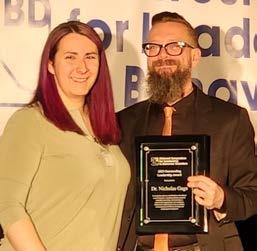
Outstanding Leadership Award
Nicholas Gage, Research Director, Special education Policy and Practice, WestEd, San Francisco, California, with Nicolette Grasley-Boy


RE THINKING Behavior
CONFERENCES
2025 Richard L. Simpson Conference on Autism October 2-3, 2025
Missouri State University Springfield, MO
2026 Midwest Symposium for Leadership in Behavior Disorders March 5-7, 2026
Sheraton Crown Center, Kansas City, Missouri
Call for Breakout & Poster Proposals 2026 Symposium
Submit before June 15, 2025
Call for MSLBD Award Nominations For details see MSLBD website
For the Outstanding Educator –Autism Award
Submit Before August 20, 2025
For the following awards
Submit before November 1, 2025: Outstanding Leadership to the Field Outstanding Educator Outstanding Building Leadership Outstanding Advocacy

Midwest Symposium for Leadership in Behavior Disorders