
Third Annual Richard L. Simpson Conference on Autism! OCTOBER 8 & 9, 2020
KU Edwards Campus Overland Park, KS

Sponsored by the Midwest Symposium for Leadership in Behavior Disorders And The Kansas Technical Assistance System Network
Evidence Based Practices, Issues, and Trends for School-Based Professionals who Serve Learners with Autism, presented by Researchers and Practitioners from the Field
Keynote Sessions

Thursday Noon: Applied Behavior Analysis for Everyone: Scaling Up Lessons in Science and Compassion
Robert Pennington, Ph.D., BCBA-D, Professor, Cato College of Education, University of North Carolina Charlotte
Thursday Half-Day Workshops
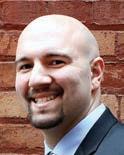
Friday Morning: Relentless: Dreams, Goals, and Aspirations
Anthony Ianni, BS, National Motivational Speaker and Autism Advocate, Michigan Department of Civil Rights
• Functional Communication Training: Understanding, Changing and Improving Behavior in Children with Autism Spectrum Disorder (FullDay)
• Autism After 18: Supporting Young Adults to Achieve the Quality of Life They Desire
• The Intersection of Autism, Trauma, and Problematic Behavior
• Providing Direct Instruction to Children with Autism and Developmental Disabilities in Inclusive Preschool Settings
• Decreasing Barriers to Intervention through Telehealth: AAC Implementation for ASD and Complex Communication Needs
• From Border to Boarder – Can You Build It? Yes, You Can! A Multidisciplinary Approach to Implementing Evidence-Based Strategies Through Collaboration
• Building Social Competence in Early Childhood
• BCBA Collaboration with Special Educators
• Teaching Essential Routines
Friday Breakout Sessions
• Video Performance Feedback for Educators of Children and Adolescents with ASD
• Addressing Sensory Issues in Individuals with Autism Spectrum Disorders
• Preventing Aggression by Teaching Emotional Regulation Using the PaTTAN Card Sort System,
• Supporting Paraprofessionals in Inclusive Environments: Understanding the Need for Consistent Interventions
• What Did You Say? A Collaborative Model to Improve Augmentative and Alternative Communication for Students with Autism
• Other sessions related to: Paraprofessional Training, Sexuality, Toilet Training, PEERS Curriculum, Early Childhood, Serving Students with Severe Aggression, Self-Determination, Practical FBA, Entrepreneurship, Research to Practice Panel, Visual Supports
Discounted registration rate of $175.00 on or before September 16
Regular Registration Rate of $205.00 after September 16
MSLBD Website to register and for the latest program updates: https://mslbd.org/autism-conference/
PD Hours available for teachers
BCBA CEUs available for an additional fee, $5 per credit hour
Reesha M. Adamson
Mary Jo Anderson
Marc Benedetto
Scott M. Fluke
Linda Geier
Deborah E. Griswold
Cassandra L. Hunt
Jacqueline HuscroftD’Angelo
Sharon A. Maroney
Jessica Nelson
Mike Paget
Reece L. Peterson
Seth A. Piro
Felicity Post
Lisa A. Robbins
Carl R. Smith
Jim Teagarden
Jason C. Travers
Kathleen N. Zimmerman
Rethinking Behavior, ISSN 2578-5397, a magazine for professionals serving children and youth with behavioral needs, is published three times per year, fall, winter, and spring, Copyright ©2020 by the Midwest Symposium for Leadership in Behavior Disorders, P.O. Box 202, Hickman, NE 68372. 402-7923057. www.mslbd.org. Email: rethinkingbehavior@mslbd.org.
Rethinking Behavior welcomes proposal and manuscript submissions; for information visit www.mslbd.org or email rethinkingbehavior@mslbd.org
As we publish this issue of ReThinking Behavior, we are acutely aware of the emergency, danger, disruption and anxiety in ourselves and the children we serve. Nevertheless, we agree with this social media post which has been circulating:
“I know this. When this ends – and it will – every game will sell out, every restaurant will be a 2-hour wait, every kid will be glad to be in school, everyone will love their job, the stock market will skyrocket, houses will get TP’d again, people will travel, and we’ll all embrace and shake hands. That’s gonna be a pretty good day.”
The ReThinking Behavior Editorial Team!
The Time Has Come to End Seclusion in School!
Placing a student alone in an environment in which they are prevented from leaving is seclusion. Seclusion is not a treatment. Most professionals and federal guidelines state that seclusion should only be employed when a student poses a threat of imminent harm of significant injury to themselves or others. Often a student must be physically restrained in order to be placed in seclusion. Although both are often employed when a student is in a behavioral crisis, neither physical restraint or seclusion address the reasons for a behavioral crisis. Seclusion does not typically de-escalate a student’s behavior, and many times it escalates the crisis. There is no evidence which shows a benefit of seclusion for the student. It does not teach anything.
There are risks of injury or even death when students are secluded, particularly when there is inadequate supervision or inappropriate, unsafe environments. Students who are placed in seclusion have injured themselves seriously and have died by suicide. Moreover, students placed in seclusion can be traumatized by this action, particularly if they have experienced trauma from abuse or neglect in the past. Unfortunately, many children who have behavioral crises have had a history of previous trauma.
Seclusion can be too easily abused. Students can be left in seclusion too long. Seclusion should only occur until the student is no longer a threat of hurting themselves or someone else - usually a matter of minutes. When a
student calms down enough to be placed in seclusion, the crisis may have already passed. However, students have been made to stay in seclusion until they are “totally calm”, or until they have apologized, or done something to indicate contrition. When these extra expectations are added, the use of seclusion becomes abusive, inappropriate and unethical. There are numerous instances of students being left in seclusion for many hours, and for multiple days.
Students who are in a behavioral crisis can be allowed time and space to calm down without locking them in a seclusion room. It is appropriate for a student in crisis to move with an adult to a more private environment where they are away from the things which triggered the crisis, and where they are less disruptive to other students, and where they have time to regain composure. However, this should always be with an adult who can talk with the student once they have calmed. Instead of employing resources to create and staff seclusion environments, let’s use those resources to provide adult support to diminish, de-escalate, and counsel students to address their mental health needs and overcome crises.
As a profession, let’s come together to stop the use of seclusion!
Reece L. Peterson and Carl R. Smith, Issue Editors
Let Me Help Carry Your Baggage
By Tara Rinehart
Oh, my goodness, Dr. Rinehart! That is a lot of stuff to carry. Let me get the door for you. Let me take some of that off your back.
This is a typical day for me as I walk into any building in my role as Director of Special Services - always carrying too many bags of stuff. Today’s bags are just a sampling of what I often carry. I’ve got many more bags of stuff at home, in my office, and in my car. Some people might call all this my baggage. But what they can’t see and what is much more interesting is my invisible baggage - hidden from view and, quite frankly, weighing me down even more so.
Invisible baggage. We all have it. But, how do we deal with it? Just let it be? Ignore it? Fight against it? Try to hide it? Pretend it’s not there? We often tell each other to “leave your baggage at the door.” But is that really possible? I think not. Which leads to my question - how does our invisible baggage impact us and those we support?
As I sit now, a district administrator, reflecting back and looking forward, I’d like to acknowledge and hopefully lighten the baggage I see teachers and
the scholars they serve carry every day. While I have served many different types of scholars, for the readers of ReThinking Behavior, I’ll focus this discussion on “Those Kids” and “That Kid.” I clearly remember the numerous times I told my colleagues about Those Kids and how difficult my day was because of That Kid. Teachers of Those Kids and That Kid, let me share a letter to you as posted on Lemon Lime Adventures (Download available at lemonlimeadventures.com).
I clearly remember the numerous times I told my colleagues about Those Kids and how difficult my day was because of That Kid.
Dear Teacher,
I see you struggling with That Kid. I see how exhausted you are as you walk out of the building at the end of the day, completely depleted. You wave goodbye to That Kid and let out a sigh of relief and feel a brief moment of peace. It’s okay, let it out, it was a hard day.
I hear your words. I hear you telling the teachers in the break room about how That Kid is going to get the best of you. In fact, last year I heard That Kid’s teacher say the very same thing; I’m sure you remember hearing it too. In some ways, it brings a bit of relief knowing it isn’t just you, right? I want you to know that I know exactly how you feel. I do, I promise. I am not here to judge you or to shame you. My purpose is actually the complete opposite.
I know you are trying to not only carry but also balance all this baggage, but there is just so much! I see it in your face, I see it in your posture. I know you are doing everything you know how to do, but some days it just doesn’t feel like you are doing even close to enough, right? Somedays, That Kid is just too much for you to handle and I can tell it’s wearing you down. Believe me, I understand. I have been where you are.
Now let’s consider our scholars and the backpacks they carry. Backpacks come in all shapes and sizes with increasing numbers of pockets to hold items specifically designed just for them - cell phones, tablets, water bottles, IDs. Unfortunately for many of our scholars there are no backpacks with special pockets designed to hold the amount of anger, pain, anxiety, and adverse childhood experiences they have endured. Our scholars are carrying baggage much more significant than mine. So, I must also ask - Who is getting the doors for them? Who is asking to lighten their loads? Admittedly, years ago as a teacher assigned to scholars with significant challenging behaviors, I too often did not.
On my current journey in district administration, one thing I have never lost sight of is advocating for Those Kids. Moving adults away from wielding power and authority over Those Kids toward listening, building trust, staying curious, and seeing beyond negative behaviors is difficult. I have found that change and momentum aren’t created from the top down but rather through many small conversations - nudging mindset, ensuring that all voices are heard, loud and clear, while focusing on what is truly needed, not what is seen from the outside. And what are Those Kids trying to tell us? If they could, this is what I think they would say (Download available at lemonlimeadventures. com).
As we know, society is much different today than when we were young. Children haven’t changed, childhood has. Scholars are dealing with so much
Teacher,
I need you! I know I am hard to handle, and I take everything you have. I know I push your buttons in all the right ways to make you second guess what you are doing. But I need you. I need you to keep pushing me. I need you to set limits and help me understand them. I know you don’t really know me. If you did, we would get along a lot better. Please, Teacher, I need you to fight to get to know me. I can’t tell you with my words what I need you to know, so I act out instead. Take that as my sign that I need you. You might be all I have.
I know you have 30 other kids in class. I know they need you too. But, teacher, I need you. I need you to find my good qualities because those other kids don’t see them. My teacher last year didn’t see them, and most days, if not all, I don’t even see them myself. I know I throw fits. I know I disrupt your class and your agenda for the day. But Teacher, I need you to believe in me. I need you to believe that my actions are a cry for help, not acts against you. Please don’t take it personally. I need you to believe that I want to fit in, but I just don’t know how.
I know I make it hard, but please, I need you. I need you to not tazo see me. I need you to see beyond that behavior, that meltdown, that action, and I need you to see the kid behind it all. You might be the only one who can get to the real me. It will take time. It will take patience. It might even take learning about something you know nothing about. But, teacher, I need you! I need you to give it your all. I know you went into teaching to make a difference. I am here to tell you, I am that difference. I promise, if you reach me, you will change my life. You will make a difference no test can measure. You might not see the difference today or tomorrow, but I promise, if you see that I need you, you will make a difference. Please!
more due to having access to the internet and social media. Many are consumed with comparing themselves to what they see on social media. Unfortunately, our brains are not created to filter and we can experience information overload. There is a close correlation between the birth of the internet and a tremendous increase in student stress, anxiety, anger, and unfortunately suicide. Why is this the case? Toxic stress is causing our scholars to live in fight, flight, or freeze mode. They struggle to learn, they have short attention spans, and they respond to the world as if they are in constant danger. Their baggage is just too much. Teachers state that scholars don’t seem engaged in their education and don’t trust the adults around them. Scholars share that they are feeling failure, despair, shame, and frustration. I find that teachers struggle to address these challenging student behaviors especially if faced with one or more of these three commonly held misconceptions.
1. Teachers who provide a strong curriculum and effective instruction do not have behavioral problems in their classroom.
2. Student behavior is willful and scholars choose to engage in undesired behavior.
3. Punishment is an effective behavior change intervention.
Why do I believe these statements are misconceptions? As I walk into classrooms in our district, every year I come across the very best teachers with disruptive behaviors occurring in their classrooms, scholars who can’t-not won’t, and traditional punishment that is not effective in extinguishing problematic behaviors. Let’s dive a bit deeper into this thinking. Currently, we have adopted a research-based, guaranteed, and viable curriculum. We implement effective teaching practices based on Hattie’s meta-analysis of the influences on student achievement (Hattie, 2015). Even so, we must stay curious about who Those Kids are who are not engaged in instruction and why? Terrance Scott (Scott, 2017) simplifies behavior, as “Behavior is the result of learning in the environment.” My digestion of my experience and this information is that behavior is not always willful, but often a response to environmental factors. The famous quote from Zen Master Thich Nhat Hanh states this so simply, “When you plant lettuce, if it does not grow well, you don’t blame the lettuce. You look into the reason it is not doing well. It may need fertilizer, or more water, or less sun. You never blame the lettuce.”
How do we create the most probable environment for Those Kids to find success when maybe they never have? We know that almost half of surveyed teachers report that student misbehavior interferes with their teaching based on a survey completed by the US Department of Education in 2005. When misbehavior occurs, a common approach used in schools is a traditional punishment strat-
egy that includes some sort of system involving rewards and consequences. The hope is that if scholars do X, then you will give them Y or if scholars don’t do X, then you will take away Y. This is also observed in many elementary schools through behavior charts and other public shaming methods. There are many actual research-based approaches that nurture positive behaviors that should be utilized in our classrooms as alternatives.
My curiosity is to ask the adults involved how they would respond to that specific punishment if it were used on them? How do they think they would behave if they had the same experiences that their scholars have had? And the most important question that must asked throughout an educator’s career is why did they become an educator and why do they stay?
Our scholars are carrying baggage much more significant than mine.
While scholars with disabilities are only 12% of the total school population, they are 75% of those restrained and secluded in schools. Is it because we don’t have a strong curriculum? Absolutely not. Scholars with disabilities are more included in the general education curriculum now than ever before. Is it because scholars with disabilities do not want to do well? No, they have lagging or lacking skills, requiring us to do what we do best, teach. And lastly, the majority of punishment is provided repeatedly to a small number of scholars, demonstrating that those punishments were ineffective.
If asked, what is the cause? I would point to “dysregulation.” Since we are all dealing with so much stimuli so much of the time, we often experience dysregulation. We are not able to control or regulate our emotional and behavioral responses to stimuli. Have you heard of the marshmallow test? In 1972, Walter Mischel (Mischel, et al., 1989) studied whether young children could wait to taste a treat (one marshmallow) until the researcher returned. If they did, they would then receive additional marshmallows. If they didn’t wait and ate the marshmallow, they would not receive more. Could you pass this test? Self-regulation was tested here.
We must consider that for some scholars and adults it is much harder to control or regulate their emotions. When both adults and scholars are dysregulated, there is a “Clash of the Forces” as presented by Ross Greene (2016). Challenging episodes occur when the demands being placed upon a person outstrip his or her skills and result in “incompatibility episodes.” Greene’s Collaborative & Proactive Solutions has instilled in me that if we handle kids with power and control, that’s what we get back. Conversely, if we collaborate with them in a partnership of problem solving, that’s when the true sustainable magic happens.
As an administrator, I recognize that I can’t eliminate the baggage my teachers carry and I can’t carry it for them, but I can help them be stronger and more resilient. Every morning, in every school, we should announce, “Teachers, Please, put your oxygen masks on first before helping others.” Those masks should remind teachers that if they run out of oxygen, they can’t open the door, carry a bag, or lighten the load of the scholars who need them so desperately. Those masks will also remind teachers of their love for the scholars they serve and the reasons why they became and remain educators.
Educators need our support to serve scholars with the trusting compassion and passion that it takes to reduce the effects of stress. Teachers matter!
References
Greene, R. et al. (2016). Effectiveness of collaborative problem solving in affectively dysregulated children with oppositional defiant disorder. Journal of Consulting and Clinical Psychology, 53.
Hattie, J. (2015). The applicability of visible learning to higher education. Scholarship of Teaching and Learning in Psychology, 1(1), 79-91.
Mischel, W., Shoda, Y., & Rodriguez, M (1989). Delay of gratification in children. Science, 244, 933-938.
Scott, T. (2017) Teaching Behavior: Managing Classrooms through Effective Instruction, Conference Presentation: https://www.youtube.com/watch?v=10zIwUlP7vk
Tara Rinehart, Director of Special Services, Indianapolis, IN, tara.rinehart@wayne.k12.in.us
This article is based on a 15 minute TED talk-like keynote presentation by the author which can be viewed at: https://mslbd.org/what-we-do/videorecordings/.
Give the Kid a Pencil
By Chad Donohue
Irecently taught a university course in Seattle for graduate students seeking master’s degrees in teaching. In one lesson, our focus was on creating a psychologically safe learning environment for students. It was an issue of managing students and supplies. I posed a question:
If a student shows up to class without a pencil, how should the teacher respond?
Small groups collaborated for a few minutes. Ultimately, they came up with plans involving taking something (a shoe?) from the student as collateral to remind the student about the importance of having supplies, notifying parents and even assigning classroom cleanup duty or lunch detention.
“What about you, Prof?” they asked.
“I would give the kid a pencil,” I said.
“You mean the first time?” someone asked.
“Every time,” I said.
This evidently had not occurred to them. There must be some punishment, subtle humiliation or a response that makes the kid pay for the error, right? They were concerned that my action would reinforce and reward poor behavior, possibly even help develop bad habits.
What they failed to see is that the teacher is not the cause of the problem. Likely, the student has been doing this for years. The teacher can respond

We all make mistakes. How teachers respond has everything to do with whether or not their students feel valued as human beings.
by criticizing the child in front of the class, reminding him that pencils are required at school, making her give up something as collateral or inflicting some punishment as a power move.
Or the instructor can simply provide the pencil and say, “There will always be a pencil here for you. Don’t ever worry about asking me for a pencil. I have hundreds of them.”
By eliminating the anxiety that comes when students worry about being called out or humiliated in front of their peers, teachers reduce the chance that students will skip class, give up, become defiant or develop mysterious “illnesses” that cause them to stay home.
Obviously, these students struggle with remembering supplies. This is likely the result of many factors
in their lives, none of which has anything to do with the teacher. Perhaps it is ADHD or a medication side effect, stress or simple forgetfulness or immaturity. (They are, after all, just kids, right?) What good does it do to rub it in their faces every day? And years later, what are they likely to remember about the class or the teacher?
“But what about the student who takes advantage of you?” one of the graduate students asked. “How do you know they aren’t doing it on purpose?”
Of course, there is the chance I will be taken advantage of. I welcome this chance. I resolve to remain a patient advocate for the child even if he is testing me. When I hand him the 50th pencil and remind him there is always one here, what will be his likely impression? Has humiliation worked so far in his educational experience? Has the status quo resolved the issue? Imagine the impact of endless advocacy. We should all be extended such grace.
Also, students who are constantly badgered for forgetting pencils start stealing pencils to avoid being singled out and embarrassed. One could argue that shaming leads to the stealing. A child will go to great lengths to avoid humiliation.
“How do you get all those pencils?” my students asked.
I am a college graduate and a professional. I have no trouble accessing the power structure of our community. How can I complain about finding pencils? In light of what so many others struggle with daily, this problem is minor. Find a way. Pay for them, borrow them, ask companies to donate them, hit up family members for pencils as holiday gifts. Have a pencil drive. Do a car wash for pencils. I don’t know, but figure it out. Life is a cycle of problem solving. You can find the pencils.
Students learn best in a psychologically safe, mistake-friendly environment. We all make mistakes. How teachers respond has everything to do with whether or not their students feel valued as human beings. We are responsible for creating a psychologically safe classroom. In all possible situations, we should seek to uphold the dignity of the student. Even when disciplinary action is necessary, it should be handled in a dignified way.
“Mr. D, can I have a pencil?”
“Of course, anytime.”

Chad Donohue, Middle school English and social studies teacher, Monroe, WA.
Published with permission form Teaching Tolerance. Published May 12, 2014.
Web Version: https://www.tolerance.org/magazine/give-the-kid-a-pencil

Confusion and Misuse of Professional Language
Aprofessional in any discipline needs the right “outfit.” Real cowboys need the right chaps and hats, but they also need to have knowledge and skills about cow punching! They must be able to “talk the talk” and “walk the walk.” Indeed, an understanding and correct use of a specialized language is part of what marks someone as a professional. Like cowboys and other professionals, our special education “outfit” requires that we understand and correctly use our profession’s specialized terminology.
Terms are referents for concepts, so a good deal of a professional’s training involves learning their field’s terminology. This is true for special education and its subspecialties, including emotional/behavioral disorders. The clarity of the terminology we use allows us communicate – verbally and in writing – with our fellow professionals and with those outside our profession.

By Robert H. Zabel
“I can see by your outfit that you are a cowboy… If you get an outfit, you can be a cowboy too.” –
“Streets of
Laredo”
(Smothers Brothers lyrics)
However, even where there is general agreement on meanings, there can sometimes be disagreements, especially on fine points of definition. Some of our special education terminology has been generated within our field, but a lot of it is derived from related professions, especially psychology, psychiatry, medicine, and their sub-specialties.
Recently, a team of psychologists led by Scott Lilienfeld, identified some common psychology terms they say are often “inaccurate, misleading, misused, ambiguous or logically confused.” Lilienfeld’s own research concerns several topics relevant to our field of special education, such as psychopathic and narcissistic personality disorders, and the intersection between cognitive biases and normal and abnormal personality traits.
Lilienfeld and his associates say that scientific thinking necessitates clarity and clarity depends on accurate use of specialized terminology. “The accurate use of terminology is…a prerequisite to clear thinking within psychology and related disciplines” (Lilienfeld, et al., 2015). Their goal in identifying frequently misused terms is to curb terminological misinformation and confusion. In so doing, they hope to promote better thinking, writing, research, and practice.
An understanding and correct use of a specialized language is part of what marks someone as a professional.

In 2015, they identified 50 frequently misused terms, such as genetically determined, chemical imbalance, objective personality test, underlying biological dysfunction, and comorbidity. They provided examples of how these terms are misused, explained why their misuse is problematic, and recommended preferable terminology. Generally, they said, these often misused terms should be avoided.
Two years later Lilienfeld and colleagues identified 50 pairs of psychology terms that are commonly confused with one another, sometimes even by professional experts. These terms come from multiple domains of psychology – learning, memory, emotion, social psychology, personality, psychopathology, research methodology, and psychometrics. They include anti-social vs. asocial, schizophrenia vs. multiple personality disorder, testing vs. assessment, and prevalence vs. incidence. Although the differences between some of these terms may seem subtle, the authors say they can confuse and significantly affect our understanding, communication, and practice.
Especially relevant to special educators is their detailed discussion of an often misused term – autism epidemic. Lilienfeld and colleagues explain how and why it has been misused, and identify serious problems that have resulted from its misuse.
Autism epidemic refers to a supposed massive increase in the incidence of autism, now called autism spectrum disorder (ASD). Although the term is widely (mis)used, there is no evidence that such an epidemic has occurred. It is accurate that many more children are now diagnosed with ASD than 30 years ago. According to Lilienfeld, et al. the increase is a reflection of three factors: heightened societal awareness of the condition; incentives for schools to report autism diagnoses; and changing (lowering) the diagnostic thresholds for autism across successive editions of the Diagnostic and Statistical Manual (DSM), the American Psychiatric Association’s guide to mental health classifications.
The DSM has moved from the much more restrictive definition of “early infantile autism,” which did not include “high functioning autism” (or Asperger Syndrome), to a much broader definition of “autism spectrum disorder.” In reality, if diagnostic criteria for autism had remained constant over the past 30 years, autism rates would have remained fairly constant. In other words, the incidence of autism hasn’t changed, but awareness of the condition and its diagnostic characteristics have changed.
Our acceptance and use of terms has consequences. Had there been an autism epidemic, it would make sense to look for the causal factors that account for the increase and seek ways to mitigate or eliminate those causal factors. In this case, however, an unfounded belief in an autism epidemic
Some Commonly Misused Psychology Terms
Acting out is commonly misused as a synonym for any kind of externalizing or antisocial behavior, including delinquency. However, acting out has a specific psychoanalytic meaning, referring to the behavioral enactment of unconscious drives forbidden by the superego. Acting out behavior should not be used interchangeably with all kinds and causes of disruptive behavior, which may have very different etiologies.
Chemical imbalance is based on the idea that major depression and related disorders are caused by an imbalance of neurotransmitters in the brain, such as serotonin and norepinephrine, and that the imbalance can be alleviated by serotonin reuptake inhibitors (e.g. Prozac and Zoloft). However, there is no known optimal level of neurotransmitters, and at least one serotonin reuptake enhancer, Stablon, is also efficacious for depression.
Empirical data - All psychological data are empirical, which simply means that reported data are based on observation or experience. What the researchers and others seem to mean when they say their data are empirical is that they are “numerical” or “quantified.”
Reliable and Valid - Tests are often referred to as reliable and valid. However, those terms are not the same, and neither of them is a unitary concept. There are three major forms of reliability: test–retest, internal consistency, and inter-rater. There are also multiple forms of validity, including content, criterion-related, and incremental. Both reliability and validity are conditional on the specific samples of subjects who are examined by the test, rather than inherent properties of a test.
Medical (or disease) model can mean very different things to different people. It may refer to a categorical rather than dimensional model of psychopathology; an emphasis on underlying “disease” processes rather than signs and symptoms; the biological etiology of psychopathology; or emphasis on pathology rather than health. To some it may imply that mental disorders are better treated by physiological (e.g. medications) than by environmental (e.g. psychotherapy, behavioral) interventions; that mental disorders are better treated by physicians than by psychologists or educators; or that individuals with mental illness are not fully responsible for their misbehavior.
Biological and environmental influences are often (mis)used to imply that biological refers to genetic influences only and that environmental refers to all influences external to the organism. However, a person’s environment consists of both non-genetic biological influences (e.g. nutrition, accidents, viruses, exposure to lead and other toxins), and psychosocial influences (e.g. parenting, sociocultural experiences) which are often viewed as environmental influences.
led some people to see a causal link between MMR (measles, mumps, rubella) vaccines containing the preservative thimerosol and the onset of autism.
This (mis)interpretation reflects a misunderstanding of two statistical terms, correlation and causation, that are often misused by the popular media and sometimes even by professionals who should understand the difference! Correlation means simply that two or more phenomena co-occur (e.g. children’s chronological age and height). Causation, however, means there is a causal relationship between two
events such that one event causes another (e.g. smoking and rates of lung cancer). It’s important to remember, “Correlation does not imply causation.”
Measles, mumps, and rubella are highly infectious diseases that can result in severe and long-lasting damage and even death. Fortunately, there is overwhelming scientific evidence that the MMR vaccine is effective. Children typically receive the first of two MMR vaccinations between the ages of 12 and 15 months, which, typically, is a period of rapidly developing language. It’s not surprising that it’s also a time when parents, caretakers, and clinicians are
Some Commonly Confused Term Pairs
Race vs. Ethnicity – Especially, in the past, race has been used to refer to a class of people (e.g. Caucasian, African-American, Native American) defined by supposed biological characteristics, such as skin color. Ethnicity (e.g. Italian, Hispanic, Chinese-American) encompasses socio-cultural variables such as country of origin, customs, and language. [Author’s note: There is little validity to the concept of race as a meaningful way to classify human beings. Although race continues to be used in the U.S. Census, it is defined as a person’s self-identification with one or more social groups.]
Repression vs. Suppression – From a psychoanalytic perspective, repression and suppression are forms of “ego defense mechanisms” – strategies to protect one’s ego or sense of self from emotionally harmful or socially unacceptable feelings. They generally operate at an unconscious level to help ward off unpleasant feelings (i.e., anxiety). Repression involves unconscious forgetting of anxiety-producing experiences, thoughts, or feelings. Suppression involves deliberate effort to forget unpleasant experiences, thoughts, or feelings that cause anxiety.
Anxious vs. Fearful – While some people use the terms anxious and fearful interchangeably, they are actually only weakly or moderately correlated with one another. Fear involves negative affect in direct response to “real,” imminent threats to emotional and situational safety. Anxiety, on the other hand, refers to negative affect in response to more ambiguous and potentially avoidable threats. Fears tend to diminish when threats go away; anxiety tends to persist even when there are no apparent direct threats or threats have dissipated. There is evidence of neurological differences in the experience of anxiety and fear. Anxiety activates areas of the brain’s left hemisphere, while fear activates areas of the right hemisphere.
Risk factors vs. Causes – Risk factors are variables associated with increased likelihood that a condition will occur. For example, risk factors for conduct disorders may include biological conditions (e.g. parents with ADHD, depression, schizophrenia); childhood experiences (e.g. abuse, neglect, harsh or inconsistent parenting); and sociocultural conditions (e.g. poverty, neighborhood violence, and peer delinquency). However, not all risk factors are causal factors. Having depressed, neglectful, or poor parents, may place a child at risk for conduct disorders, but they do not necessarily cause conduct disorders.
Classification vs. Diagnosis – In psychology, classification refers to a system of nomenclature that allows scholars and practitioners to place individuals into categories. For example, the DSM (Diagnostic and Statistical Manual), now in its 5th edition, is a classification system for psychiatric diagnoses. Diagnosis involves the assignment of individuals to one or more categories within that classification system.
Study vs. Experiment - Study refers to any kind of psychological investigation. Experiment refers to a specific type of study where participants are randomly assigned to comparison groups and researchers manipulate independent variables to compare their effects on those groups.
paying attention to language development and may notice language delays and idiosyncrasies that may be characteristic of ASD.
Misunderstanding of correlation and causation has led some people, including some “experts,” to fear that MMR vaccines cause autism and to urge parents to not vaccinate their children. Scientists have found no evidence of a causal link between MMR vaccines and ASD. However, even today, some “experts,” policy makers, and parents continue to believe in an autism epidemic caused by vaccines. As a result, some fearful parents (sometimes called “antivaxxers”) refuse to have their children vaccinated for diseases that pose serious threats to the health of their children, their classmates, and others who are not vaccinated. It is no surprise that easily prevented measles outbreaks (“epidemics”?) are now occurring in populations where there are large numbers of unvaccinated children.
Words matter! The terminology we use and their meanings are fundamental to our professional communication, especially when we are studying, treating, and intervening to change behavior. The ability to distinguish between different terms is a prerequisite for accurate scientific knowledge and practice. Without that clarity, confusion and misdirection are inevitable. The misuse of the term, autism epidemic, is a prime example of the serious consequences misuse can produce.
It’s not surprising that instructors in all professional fields, including special education, devote lots of time and energy to ensure that students have an accurate understanding of their field’s terminology. Knowing, understanding, and correctly using our profession’s vocabulary is part of our professional “outfit.” Without it, we might be a bit like the proverbial “cowboy” who has “a big hat, no cattle.”
If you’d like to refresh or enhance your professional literacy, and/or you’d like to monitor and correct some of your colleagues’ misuse of our professional terminology, check out the Lilienfeld,
Our acceptance and use of terms has consequences.
et al. articles. They’re available in Frontiers in Psychology and Frontiers in Education, respectively, which are free, open access journals available online. Who knows, you might even think of other terms that are confused and misused in our special education profession!
References
Lilienfeld, S. O., Sauvigné, K. C., Lynn, S. J., Cautin, R. L., Latzman, R. D., and Waldman, I. D. (2015, August). Fifty psychological and psychiatric terms to avoid: a list of inaccurate, misleading, misused, ambiguous, and logically confused words and phrases. Frontiers in Psychology. 6(11), https://doi. org/10.3389/fpsyg.2015.01100
Lilienfeld, S. O., Pydych, A. L., Lynn, S. J., Latzman, R. D., & Waldman, I.D. (2017, July). 50 differences that make a difference: A compendium of frequently confused term pairs in psychology. Frontiers in Education, 3(37). https://doi. org/10.3389/feduc.2017.00037
Robert H. Zabel is Professor Emeritus of Special Education, Kansas State University, robertzabel@ gmail.com

What is a Board Certified Behavior Analyst?
By Johanna P. Higgins and William J. Higgins
Stephen is a master’s degree resource teacher in a rural town who has worked at the middle-school since his graduation. His classroom is designated for children that engage in challenging behaviors and have an individualized support plan (IEP). Since starting last year, Stephen has felt overwhelmed and frustrated by challenging behaviors. Recently, a student with autism has started spitting at peers and running out into the hallway during class without permission. Attempts to address this have not been successful and appear only to escalate the student’s behavior. The classroom team (Stephen and two paraprofessionals) has found it increasingly difficult to manage this child while maintaining appropriate goals for the other 15 students. Stephen wants to know how to support his team and which strategies to add to his toolbox, so he doesn’t feel so overwhelmed.
Many teams, like Stephen’s, are seeking ways to more effectively manage classrooms. Applied Behavior Analysis (ABA) is a systematic approach based on the principles of behavior change to either increase skills or prevent and decrease maladaptive responses. Most special education teachers are familiar with ABA from their teacher preparation programs and working with Functional Behavior Assessments (FBA) of challenging behaviors. But ABA can also be used as a teaching tool, a preventative tool, and a tool to promote generalization and maintenance of skills already learned. With increasing classroom demands, shrinking resources, and the need for individualized teaching procedures, many educators may seek training in ABA to obtain the Board Certified Behavior Analyst (BCBA) credential. Additionally, school administrators may seek to hire special consultants with the BCBA credential to work with children in schools.
Our purpose is to explain for educators the requirements for the BCBA credential, how it was developed, and how ABA is provided within a tiered service delivery model. We provide an overview of eligibility, coursework, supervision, testing
requirements to achieve the BCBA credential, and the related Registered Behavior Technician (RBT) credential. We also briefly discuss a few of the potential benefits and challenges of teachers obtaining this credential.
Creation of the BCBA and Related Credentials
The Behavior Analysis Certification Board® referred to here as “the Board” (47www.bacb.com/ about), was founded in 1998 to improve consumer protection, and standardize education and training for applied behavior analysts. To do so, the Board created the BCBA® credential with specific training requirements to obtain the credential.
BCBAs are expected by the Board to make important contributions in a variety of fields, including organizational management, environmental sustainability, health and wellness, and education. The Board identified the school as one possible location for ABA services, along with other environments such as home, community, clinic, hospital, and residential settings. This broad scope of ABA is reflected in the required tasks for obtaining this credential.
The Board established guidelines that govern the practice of ABA to ensure the highest standards of practice. The Board implemented a tiered service delivery model, in which behavior analysts with graduate-level training in ABA oversee and guide treatment planning, which may then be carried out by behavioral technicians.
Over the last 20 years, the Board created additional levels of credentials beyond the BCBA, depending on educational degree and amount of training. Under this Tiered model, the BCBA is responsible for conducting an assessment, developing a treatment plan, and supervising the implementation of that plan, which then might be delivered by a Registered Behavior Technician (RBT). The Board has also added a Board Certified Associate Behavior Analyst (BCaBA, a bachelor’s level behavior
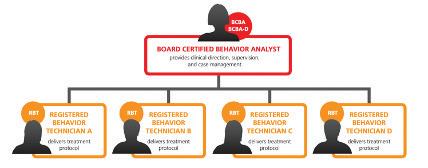
analyst) and a doctoral-level distinction (BCBA-D).
Within schools, the idea was that practitioners with a strong foundation in ABA and the BCBA credential could provide school teams with training, coaching, and supervision on managing challenging behaviors and developing individualized teaching procedures. These individuals may support school teams in conducting assessments and designing instruction for children. They may also train teachers to instruct parents on the use of learning programs in the home; thereby, supporting the generalization of skills across environments.
Requirements
The BCBA is a person with graduate-level training in the principles and applications of behavior analysis. The requirements for the BCBA include 270 hours of training on the principles of behavior analysis including ethical and professional conduct (45 hours), concepts and principles of behavior analysis (45 hours), measurement (25 hours), experimental design (20 hours), identification of the problem and assessment (30 hours), fundamental elements of behavior change and behavior change procedures (45 hours), intervention and behavior change considerations (10 hours), behavior change systems (10 hours), implementation, management, and supervision (10 hours). These requirements include 30 discretionary training hours allowing trainees to develop expertise in specific areas (e.g., organizational behavior management, early intervention) related to behavior analysis. In addition, trainees must complete 1500 fieldwork experience hours under the supervision of a BCBA and pass a comprehensive exam consisting of 150 multiple-choice questions.
Any BCBA, before January 1, 2022, is required to hold a master’s degree in education, psychology, or behavior analysis. After 2022, students can matriculate through any master’s degree sequence as long as the program includes courses approved as a Verified Course Sequence
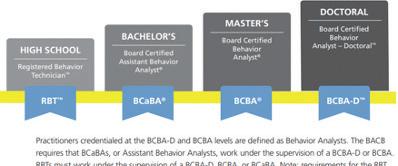
Practitioners credentialed at the BCBA-D and BCBA levels are defined as Behavior Analysts. The BACB requires that BCaBAs, or Assistant Behavior Analysts, work under the supervision of a BCBA-D or BCBA. RBTs must work under the supervision of a BCBA-D, or BCaBA. Note: requirements for the RBT credential are described in Section 5 (Tiered Service-Delivery Models and Behavior Technicians).
(VCS) based on the required task list established by the Board. In some cases, students already have a master’s degree and decide to complete the requirements post-graduation. This alternative path to the BCBA credential would consist of six to seven courses in an approved or VCS that provide them with the coursework to sit for the BCBA examination.
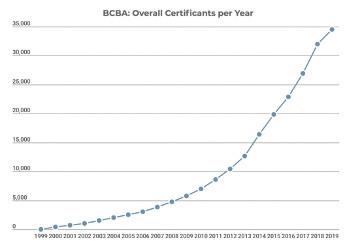
After the year 2022, requirements will increase to 315 hours of coursework and 2000 of supervised experiences. Two other eligibility options meet coursework requirements (approved faculty teaching and research, and/or postdoctoral experiences); however, all applicants are required to take the exam. BCBAs are considered to be independent practitioners who maintain continuing education requirements but do not require supervision. The BCBA is considered to be one of the fastest-growing professions in the United States, with over 34,471 practitioners certified since 2019 (see graph next page).
Registered Behavior Technician
One of the newer credential levels is the Register Behavior Technician (RBT). The person with this level of credential is a direct service provider who practices under the supervision of a certified BCBA, implementing plans designed by a BCBA. This credential was first made available in August 2014. RBTs typically work directly with consumers (e.g., students, patients, clients), must be 18
years of age, and hold a minimum of a high school diploma (or national equivalent). To obtain the RBT credential, they must complete 40 hours of training in behavior analysis based on the most current edition of the BACB task list, a competency assessment, and a 75-question, proctored exam. The competency training is conducted by a BCBA (or higher credential professional such as BCBA-D or BCaBA) and includes live experience or role-play of the tasks such as conducting preference assessments, assisting with functional assessment procedures, implementation of skill acquisition plans, and more. To maintain the credential over time, the RBT is required to receive monthly supervision for a minimum of 5% of the hours spent providing ABA services and annually demonstrate they can implement the tasks listed previously. It is not known how many people with the RBT credential currently work in schools.
How and why are BCBAs used in schools?
Applied behavior analysts are becoming more and more prevalent in school settings. However, divergent laws and regulations have created a disparity in how ABA services are provided in schools. In some cases, BCBAs may be engaged as outside consultants in schools, and in other cases, hired as direct staff in schools.
Requirements for the BCBA credential are different from the didactic and practical experience required
as part of special education teacher training and preparation (Rock et al., 2016). Special education teachers are often expected to manage challenging behavior (e.g., non-compliance, emotional outbursts), but most special education teacher preparation programs include less than two courses in the assessment and management of challenging behavior. As a result, schools often utilize support from BCBAs to provide free appropriate public education (FAPE) to children with Individualized Family Service Plans (IFSPs) and Individualized Education Plans (IEPs) and their families. Additionally, the RBT credential could be a potential source of training for para-educators to work in special education programs in schools.
Special Education Teachers as BCBAs
There are several positive advantages for teachers obtaining the training required for the BCBA. Teachers with BCBA credentials will have demonstrated the ability to apply the principles of behavior analysis. They will be more likely to implement evidence-based strategies and evaluate the effectiveness of the interventions they have designed,
acting as scientists, as described by B.F. Skinner in his text, The Technology of Teaching (1968). “The teacher is a specialist of human behavior, whose assignment it is to bring about extraordinary complex changes in extraordinarily complex material. A scientific analysis helps in two ways: it provides standard materials and practices, and it supplies that understanding of human behavior which is essential in improvising solutions to new problems.” Furthermore, the expertise of a teacher with BCBA credentials can play a crucial role in contributing to teams implementing multitiered systems of support, specifically Tier III, intensive interventions. As a result, these teachers may have an advantage in securing teaching or consulting positions to support students with behavioral needs.
While it is beneficial for a teacher to also be a BCBA, several barriers exist. BCBA training requires a substantial amount of time and expense. Special education teachers have demanding jobs often with large classes of children and limited supporting personnel. Even if they manage to obtain the BCBA credential, it may be challenging for a teacher to design and implement structured ABA programs for several children when they have many other students and duties in the classroom that require their attention. Teachers also lead the scheduled instructional activities of the day making it challenging to find the time to implement individual ABA interventions with fidelity. Further,
Applied behavior analysts are becoming more and more prevalent in school settings.
a teacher’s time may be heavily influenced by federal/state assessment, progress reporting requirements, or the required curriculum, preventing the ability to structure teacher time for the effective use of their BCBA training.
For teachers like Stephen, the BCBA training and credential may be a pathway for understanding how to better support the students and paraprofessionals in his classroom and provide a strong foundation for how to use ABA in the classroom. Although there may be challenges for teachers working to become BCBAs, it is important to recognize how valuable this credential may be and its potential impact on a wide array of challenges related to the management of challenging behaviors. Even if Stephen is not able to seek the BCBA credential himself, he might also request that his administrator hire a consultant with the BCBA credential to assist him in developing and implementing behavior intervention plans in his classroom.
References
Behavior Analysis Certification Board website: https://www. bacb.com/about/
Rock, M.L., Spooner, F., Nagro, S., Vasquez, E., Dunn, C., Leko, M., . . . Jones, J.L. (2016). 21st century change drivers: Considerations for constructing transformative models of special education teacher development. Teacher Education and Special Education, 39(2), 98-120.
Johanna P. Higgins, Assistant Professor, University of Nebraska-Lincoln, johanna.taylor@unl.edu
William J. Higgins, Assistant professor, University of Nebraska-Medical Center, whiggins@unmc.edu
Thoughts and Experiences Regarding the BCBA
The Re-Thinking Behavior editorial team asked several educators, university professors, and directors of special education for their thoughts and experiences regarding the strengths/weaknesses of the BCBA credential for work in school settings with students with behavioral needs. Several indicated that they had no experience with anyone who had the BCBA, but excerpts of others who responded are below.
Educators working in the schools
Marc Benedetto, Special Education Coordinator, Omaha, NE.
I have worked with several BCBA certified staff in a middle school setting. They were assigned to work with several of our Special Education teachers and paraprofessional staff. The students they were working with were the most challenging students in our building. The BCBA’s leadership in developing behavior plans, gathering data, and analyzing the information was instrumental in these students making significant progress throughout the school year.
Ana Damme, BCBA, Psychology Postdoctoral Fellow, Psychologist at Children’s Behavioral Health, Omaha, NE.
As a psychologist, I’m probably considered a “nontraditional” BCBA as I do not currently provide intensive ABA services in my current role. I have in the past. Currently, I mostly use my BCBA in my case conceptualization, assessment, and treatment of childhood concerns. I provide Autism Spectrum Disorder (ASD) assessment and advocate for families to get into Applied Behavior Analysis intensive programs for children recently diagnosed with ASD.
While an undergraduate I participated in the learning/rat class where I spent a semester training a rat, using behavioral principles, so I could complete in a type of “Rat Olympics”. After my undergraduate degree. I knew I
wanted to work with children so I sought out a Psychology/Applied Behavior Analysis program and received my BCBA. Then I went on to get my doctorate and become a licensed psychologist. I think my BCBA provided me an excellent foundation and helped me be successful in my doctorate program. I felt prepared in my doctorate practicum when working with students with behavioral needs. Of course, my BCBA did not teach me how to be a school psychologist in the schools, but it did provide me with excellent knowledge in function-based thinking, creating FBAs, considering appropriate interventions, and appropriately responding/changing interventions based on student/teacher behavior.
Scott Fluke, School Psychologist, Olathe, KS.
I am a licensed psychologist and have extensive behavioral training, but do not have a BCBA. I did strongly consider getting one, but decided not to because it would have required significantly more schooling. I work with several BCBAs in my school district. Some specialize with our students with autism. We recently hired a BCBA specifically to support students with emotional and behavioral needs. This BCBA’s expertise and perspective have been very helpful in building effective plans for some of our more challenging students.
The strengths of this training are the focus on data-based decision-making, ability to quickly conceptualize why a behavior is happening, and a large tool kit of interventions that are effective in creating long term behavior change. A limitation I have seen with some BCBAs I have worked with is some difficulty adapting interventions to providers (such as teachers and paraprofessionals) who do not have much behavior training and often struggle to implement plans that have any amount of complexity. The ability to boil down interventions to their most essential components is a skill that I would value in BCBAs.
Barb Rieken Gross, Behavior Consultant, Southeast NE.
I have considered obtaining the BCBA certification, but have not done so as I feel the majority of what I do already is similar to that of a BCBA. Currently, we have a school psychologist who is a BCBA-D, and we work closely together to collect data, make observations, and develop appropriate plans. I don’t have strong feelings either way about BCBAs in our schools, but generally I think that my background as a special education teacher in the area of behavior lends itself to a unique perspective that the BCBA might not have.
Regina Oliver, BCBA-D, School Psychologist, Southeast NE.
I received my BCBA-D credential while I was a doctoral student at Vanderbilt University. I decided to obtain this credential as part of my doctoral program so that I could become more experienced with behavior analysis. While the training is very helpful to strengthen your behavioral skills, if you do not plan to use the credential for other purposes than to enhance your knowledge, I would not recommend this. There is a lot of work involved to obtain it and the cost for maintaining certification can be expensive.
Kaye Otten, BCBA, Former Special Education Teacher, Independent Behavioral Consultant, KS.
I obtained my BCBA credential in August of 2016. The definite strengths of the BCBA training are a thorough knowledge of behavior change principles, data-based decision making, and a strong focus on ethical practices. The weaknesses in my opinion are that many BCBA programs are 100% online and candidates are in charge of finding their own supervised field experience. The quality and ethical practices of those experiences vary greatly as there is very little oversight. Since “autism treatment insurance” has become available in most states there is a lot of funding behind clinical and home based treatment which is accompanied by the potential for unethical behavior. The BCBA training credential is definitely not sufficient to be
a special education teacher in any capacity. However, in my experience many if not most teachers with a special education credential are also not trained sufficiently. I do not believe that this credential could or should serve as an alternative to a “normal” teacher certification in special education. Ideally, I would love to see special education teachers be dually certified in both special education and behavior analysis.
Higher Education/ Teacher Preparation
Paul LaCava, Associate Professor of Special Education, Rhode Island College, Providence, RI.
I do not have a BCBA or related credential but I have worked with many BCBAs over the years in different settings and not surprisingly have found them to be a diverse group. Their obvious strength is in understanding the theory and principles behind the practice, and creating and implementing interventions to address behavior change. But sometimes they don’t have the bigger picture of understanding of how schools and school districts work (IDEA, state/local policies, curricula, etc.) and how best to collaborate for success. Given the myriad challenges in addressing behavior in schools today, BCBA contributions are essential and increased behavior analysis coursework would be very beneficial to students completing teacher education programs.
Kathleen Lane, BCBA-D, Professor of Special Education, University of Kansas, Lawrence, KS.
The BCBA-D reflects a rigorous set of competencies in the principles of applied behavior analytics. My goal in obtaining and maintaining this distinction is to best serve current and future educational leaders committed to positive, productive, effective practices for meeting students’ multiple needs.
Jim Teagarden, Associate Professor of Special Education, Kansas State University, Manhattan, KS.
I have worked with one individual that has this credential. I have limited experience in this area directly but I can say that depending upon the
setting in which the individual is working and their previous talents and skills, the BCBA can be a valuable tool or a liability. It would seem to me that the strength of the underlying training is to operationalize behavior in such a manner that it can be defined, design interventions, and collect data. A liability may occur when the premise is that the student behavior is the sole or most important issue - leading to a belief that all things can be solved from this model. Although it can be helpful for a person working with students with behavioral needs, it does not provide the pedagogy to provide the key function of providing instruction within the educational environment. In short it fits better within the clinic than the school.
In an ideal world this might be a consideration for all teachers to have this credential. Many of the skills that are contained within the BCBA training are already part of the current preparation of teachers. I grant that the quality and depth of such teacher training is less than it should be. But given the continued demand for teachers, we unfortunately tend to put less and less emphasis on the quality of the training and more on the speed of completion of the program.
Jason Travis, BCBA-D, Associate Professor of Special Education, University of Kansas, Kansas City, KS.
I was teaching in a classroom for elementary school students with autism and found the ABA interventions immensely useful. What’s more, I learned about this systematic, scientific approach to teaching and learning and was fascinated by its explanatory power. This led to additional study during my doctoral program and my obtaining the credential in 2010.
Behavior analysts can be trained in a variety of settings and several applications. Although BCBAs are often thought of as being ABA therapists who only serve individuals with autism, many historical and contemporary behavior analysts
work to address various behavioral health issues including disordered eating, geriatric care, addiction treatment and recovery, and public safety. The strength of behavior analysis is its ability to empower professionals to address a range of socially significant concerns. I do worry, however, that the professionalization of behavior analysis may result in BCBAs who have narrow or somewhat superficial training, and therefore limited understanding of the deeper, foundational concepts that contribute to a scientific worldview.
There are many special education teacher preparation programs that integrate ABA coursework leading to teacher licensure and BCBA status. I think this is an excellent idea. However, I am not convinced that completion of the six-course sequence necessary to become a BCBA is sufficient for becoming a special education teacher. Despite this, I suspect many BCBAs would be excellent specialists, consultants, and support personnel who work full-time for a school district. I think this is the direction most schools are beginning to turn to - hiring BCBAs who have the technical knowledge to support better outcomes for their students by providing guidance and support to special education and related personnel in their district.
Directors of Special Education in Schools
Kami Jessop, Director of Special Education, Omaha Westside Public Schools, NE.
We have two BCBAs employed with our district, functioning in the role of district-wide Behavioral Facilitators, with one more currently in the program. We also have a number of other individuals (paras or special education teachers) who are pursuing their BCBA and/or RBT. These individuals serve as behavioral experts, collaborating with teachers, running FBAs, and developing BIPs in partnership with our teams, supporting administrators, and coordinating with outside agencies when the IEP warrants outside placement.
These individuals have an advanced skill set, tolerance, and reliance on function-based think-
ing and using data to make decisions, above that of a typical special education teacher. Our program’s BCBAs (because their backgrounds are that of special education teachers FIRST) are highly skilled at educational programming and decision making, with a greater FAPE lens....but specialize in meeting the needs of students with challenging behavior.
We have only seen strengths of having BCBAs work in school special education settings, but I attribute that to the fact that our BCBAs served as special educators earlier in their career and also stay very connected to the greater special education program. They have fabulous reputations and relationships with educators and administrators, which they work hard to maintain, given the challenging role. They are highly integrated into the work of the district, collaborate routinely (both partnering and leading) with our school psychologists... they also lend credibility to tough parent situations.
Matt McNiff, Director of Special Education, ESU #5, Beatrice, NE
As a behavior consultant and later, a special education director, I view the BCBAs in terms of a medical mindset. Where teachers of children with behavior disorders are our general practitioners who serve a wide variety of needs and issues that come into their office, while the BCBA is our surgeon. Every general practitioner in the medical field did a surgical round of some sort but it was never their main focus. They may have the skill to repair a knee with enough time, work, and study; it is often simpler and quicker to use the surgeon to repair that knee effectively and quickly with the maintenance of that knee being served by the general practitioner. There are certain cases that are outside the expertise of even some of our very best behavior managers. Infrequent and highly disruptive behaviors may be a time to need BCBAs. But it works both ways as well. I wouldn’t use the BCBA’s time in my building focusing on issues that the general practitioner can focus on effectively. It tends to
be overkill and we can even get some programming that is unnecessary and would not fit into the least restrictive intervention mindset.
Elizabeth Rogers, Assistant Superintendent of Programs and Services, Intermediate District 287, Plymouth, MN.
Our intermediate district provides special education Federal Setting IV (self-contained) services to our 11 member districts by serving their most complex students. Employing BCBAs has been critical to the provision of FAPE for our students. We have employed BCBAs for four years, and have found their contributions to be invaluable in serving our students. Currently we have 4.0 FTE employed and 3 others in the process of obtaining the credential. Our goal is to have 2.0 FTE in each of our four schools.
The BCBAs are integral to team program planning for both individual students’ Positive Behavior Support Plans (PBSP) as well as for program/ school wide implementation of Positive Behavior and Interventions. Our BCBAs’ technical expertise in functional behavioral assessment, observation, ongoing data collection, and utilization, as well systematic intervention program planning, has provided direct support to teams are providing professional learning and development for our teachers, educational assistants, and other related service providers, building overall capacity and improving outcomes for the students we serve.
This credential adds to the training of a psych or masters in behavior disorders. I would say personally, as a special education teacher, we didn’t even touch on severe behavior in my bachelor program. This training is extensive and the hours of experience are invaluable.
Strengths are tenfold. Their input is valuable to working in our schools. As you know, the function of a specific behavior is the foundation to putting together a behavior intervention plan where the intervention is directly matched to the
function. This is critical and isn’t second nature to all teachers with their bachelor degree or without advanced training. One limitation I see is that BCBAs are costly and most don’t wish to work in a school system for a teacher’s salary so we lose them to agencies. Another limitation is that the Department of Education doesn’t currently observe BCBAs with a high enough provider rate to reimburse schools. Third, the Medicaid public school reimbursement is limited for them as well. My opinion is that BCBAs belong in schools!
Tammy Voisin, Special Education Director, Papillion LA Vista Schools, NE.
We have not hired anyone specifically for the sole purpose of being a BCBA. We have, however, included this preferred credential in our school psychologists and also our behavior coaches. We do have one currently credentialed BCBA school psychologist with a few teachers going through the program currently. We have contracted with several BCBAs from metro-area agencies to join an IEP team in working with students with extremely challenging behavior. It has been extremely beneficial to our teams.
The editors would appreciate your comments or discussion. Send to rethinkingbehavior@mslbd.org
By Elizabeth A. Potts and Susan M. Bashinski
Photo courtesy of Adobe.com
Mr. Walters has several learners in his class who demonstrate problem behaviors. He has been told he needs data on Tiffany’s behavior to aid in her evaluation for special education services, reminded that data are necessary to track Amy’s progress towards her behavioral IEP goals, and advised to use data to determine the effectiveness of his classroom management. Mr. Walters is overwhelmed by this and concerned that either his data or his instruction will suffer, but he seeks ways to weave the two together.
Simply google classroom data collection and you’ll see a plethora of information that exists regarding why teachers need data, ways to collect data, methods to analyze data, and the importance of implementing data-based decision making to guide instruction. Yet, like Mr. Walters in the scenario above, many teachers find it hard to determine how to collect data while keeping an appropriate instructional pace and not inadvertently reinforcing behavior (Snell & Brown, 2011). The literature base in special education is clear that systematic, effective instruction can contribute significantly to the reduction of inappropriate behaviors in the classroom (Gargiulo & Bouck, 2018), but good instruction is just the start.
Teachers like Mr. Walters have likely been exposed to data collection tools that involve technology and apps, but this does not mean they should abandon more fundamental methods of data collection. Nearly all teachers have experienced moments when technology failed, maybe because of an Internet outage or simply because it did not work the way it was supposed to. In addition, individuals who develop technology design it to meet teachers’ perceived needs, which may not match their actual needs. And, finally, even if technology always worked and always worked as expected, a teacher’s job often requires making quick “in the moment” decisions that do not allow for the research time required to find technology that will meet an immediate need. This article provides a set of ten teacher-friendly data collec-
Make a behavior management system do double-duty by building in differences for individual behaviors.
tion tools that are simple to use and can collect reliable data during instruction, with a concentration on low-tech “tried and true” strategies.
Most of these data collection systems are appropriate for frequency counts only - tracking how many times a learner engages in a behavior which has a distinct start and end. Though frequency counts do not always provide the whole picture of a learner’s behavior, they are an easy method to use while one is teaching - which is why teachers often rely on them when they cannot dedicate time solely to data collection. Also included here are strategies that can collect behavior duration, rate, or percentage and various types of time sampling data.


Paper Clips and Bracelets
Used for collecting data on one learner’s single behavior, the teacher puts a handful of paper clips into her pocket and moves one clip from one pocket to another each time the behavior occurs. This can be a frequency count of a specific desired or undesired behavior. Moving bracelets, hair bands, or rubber bands from one wrist to another can be used similarly to collect the same data. This method allows the teacher to move around the classroom unencumbered by a clipboard or data sheet. Teachers who do not always have pockets (or are concerned they will put a handful of paper clips through the wash!), can consider using a carpenter’s apron. Another variation is for the teacher to wear a homemade bracelet with a designated

number of beads. The beads can be moved to count occurrences of behavior (https://www. instructables.com/id/Pace-Counter-Bracelet/).
Teachers experienced with this method have been able to use two or even three differently colored clips or tokens to collect data on two or three different behaviors, or different learners’ behaviors, while still not interfering with instruction.
Given the clear verbal direction to come to the carpet, Marco says, “Why’d I wanna do that?” and stays in his chair. Recognizing the target behavior of “not following a verbal direction,” Mrs. Jackson moves one paperclip from her right to her left pocket. At the end of the day, Mrs. Jackson will know how many times Marco did not follow a verbal direction (undesired behavior). Of course, Ms. Jackson could choose to count how many times Marco did follow verbal directions (desired behavior).
a targeted behavior occurs. Teachers can track behavior on more than one learner by writing different characters (a check and a tic mark, or the learner’s first initial), or track more than one behavior by using different types of marks. Be aware that a ballpoint pen does not write well on masking tape, so using a gel pen, roller ball pen, marker, or highlighter, while being alert for smudges, is suggested.
During writer’s workshop, Mr. Sweet has a piece of tape on his left hand and carries his green permanent marker in his right. As he works with individual learners he notes, by writing their initials on the tape, learners whom he has to redirect back on task.
Viewing behaviors through a positive lens, during free play Mrs. Hughes easily notes each time Sookyung, Josh, and Anna willingly share toys with a peer.

Seating Chart. A

Notes on Tape.
Some teachers find it cumbersome to move clips from pocket to pocket and hard to keep track of which behavior is coordinated with each color/object. Instead, they can put some masking tape on their wrists or the back of their hands and make a tally mark every time
way for teachers to collect data on more than one behavior at a time, with multiple learners, or even the entire class, is to carry a clipboard with a seating chart. Then create a key with letters or symbols that represent the behaviors to track (i.e., raising hand = RH, talking out = TO, getting out of seat = S, following directions = FD), and place the symbol in a learner’s “seat” when he exhibits the behavior. Keep this simple by selecting only two or three behaviors to track at a time. Teachers can also calculate the percentage of offered opportunities on which the learner exhibited a behavior (i.e., “rate” data) by drawing a circle for each opportunity and then filling it in, or placing a checkmark in the circle if the learner performed the behavior.
Mrs. Lee carries a class seating chart as she teaches math. When Mrs. Lee tells Julia, “Take out your book and open to page 57,” she puts a circle in Julia’s spot on the seating chart. When Julia follows the direction, Mrs. Lee shades in the
circle. If Julia fails to follow the direction within 5 seconds the circle remains empty. During large group instruction, when learners call out responses without waiting for her signal, Mrs. Lee places a tic mark in each learner’s seat. At the end of the class, Mrs. Lee counts that Julia had 12 opportunities to follow directions and followed the direction 4 times or 33% of opportunities. Tic marks tell her that the learners in the front of the room had a higher rate of calling out than their peers in the back.

Marbles in a Jar. Teachers who are interested in collecting data regarding all learners, as a whole class, should consider some variation of “marbles in a jar.” To use this strategy, place a transparent container on the desk or in a highly visible location in the classroom. When all learners in the class, as a group, demonstrate a targeted positive behavior, such as following a school/class rule or being kind to a peer, marbles are added to the container. This technique can promote a positive sense of community, because when the jar is filled, all learners in the class earn a mutually agreed upon group reward (e.g., extra recess time, a popcorn party, a homework-free night, a free study period). The teacher should record the date on which he began putting marbles in the jar, as well as the date on it was filled to collect data on how many days it took for the class to demonstrate mastery of a targeted behavior. Teachers who track the time in this manner, will be able to determine when it is reasonable to increase behavioral expectations for the class or increase the size of the jar.

Teachers typically begin by targeting one specific behavior, such as being on time. The targeted behavior must be a behavior that all learners have demonstrated at some point. The learners are taught the marbles in a jar program and the targeted behavior before this data process is initiated, and they are reminded daily. Teachers keep track of the number of times the target behavior is requested during the day and how many marbles are earned each day, providing learner performance data and helping the teacher determine which behavior needs additional instruction. If there are concerns that one or two learners will ruin the opportunity for everyone to receive a reward by refusing to participate, the teacher can set those learners up with a system of their own and determine individual guidelines regarding if or how they will be allowed to participate in class rewards.
Keep things manageable by selecting only two or three behaviors on which to collect data at any given time.
Ms. Jimenez adds a marble to her 4th period class’ jar when all 9th graders earn passing grades on the history exam. The learners know that when the jar is full, they all earn a no homework day from Ms. Jimenez.
As a variation, Mr. Brown assists his kindergarten learners to add links to a classroom paper chain when every learner came in from recess the first time they were called. When the paper chain is 10 links long, the class has earned 3 extra minutes of recess.
times each learner performed each behavior. As in the previous methods, keep things manageable by selecting only two or three behaviors on which to collect data at any given time.

Existing Reinforcement Sys-
tems. Make a behavior management system do double-duty by building in differences for individual behaviors. If using a token economy, use differently colored or patterned tokens for different behaviors. Physically put the tokens into a container (recycle a cottage cheese container with a hole cut in the lid) as the learner earns them, then note how many of each token type the learner has earned when recording totals at the end of the day. Be careful not to try to code more than a few behaviors at a time, as it can be hard to capture all instances of the behaviors without impacting instruction and to remember which token means what.
Data can also be collected when using a class-wide reinforcer like “Super Job Slips,” which involves learners earning a slip for specified, positive, desired behaviors, writing the learner’s name on the slip, and submitting it for a drawing for a reward. To track specific behaviors, use differently colored slips of paper to differentiate between behaviors (white for being on time, yellow for raising hand), or include several behaviors on each slip and have learners check the appropriate one when the teacher hands them out. When the teacher collects the slips, it is simple to record how many
When Mr. King looks at all the Super Job Slips earned on Friday, he can see that April earned 3 white slips this week, indicating she was on time for class 3 days, but Terry earned 5 white slips, so was punctual all 5 days. Mr. King can also tell that April independently raised her hand 15 times since she earned 15 green slips by the end of the week.
For a majority of a teacher’s data collection needs, simple, user-friendly approaches re the best recommendation.

Notepad and Pencil.
Sometimes frequency counts simply do not provide enough information and additional information is needed. Keep pencil and paper handy (small index cards are great for this strategy) to make notes about extreme behaviors that occur. At the time, teachers can use their own brand of shorthand to record the basic info, writing up the full observation at the first opportunity they have. Make notes about the date, time, learners involved, sequence of behavior, quotations, preceding events, and consequences (i.e., A-B-C chart) if observed. Many teachers use behavior recording sheets or apps for this purpose. Teachers can consider using an audio-recording app, such as VoiceMemos, on their cell phones if the app can be activated without notice. The data can be saved within the app or transcribed by the teacher at a later time.
Teacher’s shorthand note. 11:1020-T oct/ffly “t is stpd” – peer “u stup” rip book, threw, run “chase me”
Teacher’s full write-up. Tuesday, October 11, 10:20am, Reading. Tyler stumbled over words, misreading “octopus” and “firefly.” Said loudly, “This is stupid.” A peer replied “You’re stupid.” Tyler ripped the page out of the book, threw the book on the floor, crumpled the pages in his fists, and ran around the room saying, “Chase me, chase me!” Principal walked in during this event and removed the learner from the room. Tyler did not return the rest of the day.

Stopwatch
. Many behaviors do not lend themselves well to frequency counting. For example, a learner’s tantrum-like behavior can last a few seconds or an hour. The two are not equal in intensity or duration, as a frequency count would imply. For behaviors that do not begin and end quickly, it is important to record an element of time. One way to do this is to keep a stopwatch handy. Start it when the behavior begins and stop it when the behavior ends. One of the simplest ways to implement this strategy is to use the stopwatch on a cell phone. Depending on the data needed, teachers can record the time and clear the stopwatch for the next instance of the behavior, or keep the time intact and re-start the stopwatch when the behavior occurs again, thus tabulating a total duration of the behavior for a given school period or day.

Jennifer is often out of her seat. Her teacher, Ms. Rivers, starts the stopwatch in her watch whenever Jennifer leaves her seat and stops the timer when she returns to her seat. Ms. Rivers is interested in the total time Jennifer is out of her seat per class period, so she merely starts the stopwatch again each time Jennifer leaves her seat and makes a note of the total time at the end of each class. For data collection of Jennifer’s replacement behavior, Ms. Rivers could use the same method, starting the stopwatch when Jennifer is working on-task and stopping it when she stops working.

Video and Audio Recording.
Some teachers may feel they can’t reliably record data regarding learners’ behaviors and effectively teach at the same time. In this case, they can video or audio record learners’ behaviors and note data after the fact. To allay concerns that learners will behave differently for the camera or recorder, set it up a few days before turning it on to give learners time to acclimate to its presence in the room. Alternately, cameras and recorders exist in many unobtrusive forms today. Set up a tablet, laptop, or phone in a place the learners are not likely to notice. After viewing the video or listening to the recording and taking behavioral data, be sure to destroy the video. [NOTE: It is advisable to alert the principal/administrator about the collection of data via video or audio recording, emphasizing that it is only for the teacher’s use.]
Concerned about the behavior of learners who are supposed to be working independently while she leads guided reading groups, Mrs. Henshaw sets up a laptop to video record independent work tables. At the end of the day, Mrs. Henshaw views the videos, noting challenging and appropriate behaviors on which she can work with learners or for which to praise them.

Self-monitoring.
What is a better time-saver than delegation of the task of data collection? In some instances and with learners of different ages, a teacher can teach learners methods to monitor their own behavior. With younger learners, provide a daily schedule with happy, sad, and neutral faces next to each task, and ask learners to circle the face that corresponds with their behavior as defined for each of them. Teach learners to be accurate by spending time reviewing their marks with them, and guiding their responses. For instance, “If you were out of your seat a few times, or had to be reminded to be on task once or twice, then your behavior is between the happy and sad faces.” Older learners can keep track of
Photo
Self-Monitoring Apps
Research has shown that learners who participate in graphing the results of their academic and behavioral performance demonstrate more consistent progress than those learners who do not. Several webbased applications are available to assist teachers and learners with instant graphing on smart phones and tablets. Two of the most popular apps, supported by research, are I-Connect and Score It. In I-Connect, a question appears on the learner’s tablet, “Am I on task?” The learner taps “yes” or “no;” the app records the data and yields a graph for the teacher and learner to review. Similarly, Score It allows learners to rate their own behavior on a sliding scale when the app delivers a prompt; it, too, yields an instant graph. Technological advances such as these help learners see the power they have over their own choices and behavior and often yield behavioral improvement.
specific behaviors with more complicated scales, given instruction. Learners can also use self-monitoring to self-evaluate their success in following directions on an assignment (use a rubric as a checklist) or correcting completed problems.
The advantage of teaching learners to self-monitor is reduced teacher data collection time, but this strategy does require careful initial set up, learner instruction, and validity checks. Teachers need to spend time teaching learners how to evaluate and code their behaviors, using a lot of specific examples to help learners differentiate between points on a scale. Learners are likely to rate themselves higher or lower than their teachers do, initially, but as the teacher and learner compare scores and have conversations about their ratings, this gap should lessen.
A frequently used self-monitoring strategy is
momentary time sampling during which a timer beeps at random intervals and learners record if they were on task or not.
Sample Self-Monitoring Momentary Time Sampling Record
Name ___________________________
Date _____________
Directions: Every time the classroom timer beeps, write the time in the left-hand column. Evaluate your own behavior. Were you on task when it beeped? Were you actively engaged in the current class activity (e.g., listening to lecture, participating in discussion, reading assigned material)? If so, mark Yes! If you’re not sure, mark Maybe? If you were daydreaming, talking (e.g., not on topic or not when directed to), drawing, or reading unassigned material, mark No.
Time Yes! Maybe? No.
9:02
Samuel is often off-task, but he does not disrupt the class; he daydreams or reads books tucked inside his desk. Mr. Crews teaches Samuel to stop and think about his behavior when a timer on Samuel’s desk buzzes, and then to circle “yes, I was working” or “no, I was not working” on his recording sheet.
Looking to increase Mihaela’s in-class task completion, Mr. Christelle has Mihaela record the number of problems she finished at the conclusion of each math class. Mihaela keeps a list of the number of problems completed each day, graphs her performance, and thus sees her progress toward her goal.

Chart Moves. Chart moves is a frequently used reinforcement tool that can easily serve as a data collection tool, too. In chart moves, learners are reinforced by seeing their progress represented in a dot-to-dot picture. Teachers can draw these, take them from commercially available workbooks, or use images taken from magazines or the Internet. Typically, each time the learner shows a specific behavior he/she adds a line to connect another dot; when all the dots are linked the learner earns a reinforcer. Teachers can easily track the number of dots connected over a specific period of time by adding the date or using differently colored markers on different days. As presented previously, learners can be taught to self-monitor with teacher guidance. Chart moves can be set up for one or more learners in a class, with same or different target behaviors, allowing the teacher to collect several different types of behavioral data simultaneously.
In Mrs. Jones’ class, Jada is working to reduce her interrupting others. When Jada participates in a class discussion without interrupting, she is instructed to connect one more dot on her picture of the class gerbil, which she will get to feed when the image has been completed.
Malik, a 5th grader, is learning to work cooperatively with peers in his general education class. When he completes his dot-to-dot picture of a super-hero, he will earn a privilege of sitting in the teacher’s rolling chair for a class period. For additional motivation to encourage Malik to maintain his progress, he earns a sticker for each yellow dot he reaches.
For a majority of a teacher’s data collection needs, simple, user-friendly approaches are the best recommendation. Since it is true that to meaningfully guide behavioral programming and positively impact instructional time, data must be reliable, many time-saving strategies are available to teachers to help them collect relevant information regarding their learners’ classroom performance. Practical, user-friendly data collection strategies are, in our opinion, dependent primarily on a teacher’s creativity, imagination, and their willingness to try something new.
References
Gargiulo, R. M., & Bouck, E. C. (2018). Special education in contemporary society: An introduction to exceptionality (6th ed.). Los Angeles, CA: Sage.
Snell, M. E., & Brown, F. (2011). Instruction of LEARNERS with severe disabilities. (7th ed.). Upper Saddle River, NJ: Pearson.
Elizabeth A. Potts, Assistant Professor, Missouri Western State University, Missouri, epotts@missouriwestern.edu and Susan M. Bashinski, Professor, Missouri Western State University, Missouri, sbashinski@missouriwestern.edu
Teaching Mindfulness in Schools and Classrooms

By Elisabeth Kane, Nicole Bricko, and Reece Peterson
Photo courtesy of shutterstock.com
Brain-based learning, growth mindset, brain training, teaching mindfulness. These are all trendy strategies that are increasing in popularity among educators. But what do these terms mean? Are these strategies effective in helping children learn better or more quickly? Do they deserve the attention that they generate?
We will focus on one of these hot words, mindfulness, to answer some of these questions. Mindfulness interventions and techniques have become an increasingly popular strategy for promoting wellbeing in schools. But what exactly is mindfulness, and do these strategies actually accomplish what they claim? As we will discuss later, the available research on mindfulness is currently inadequate to fully support most claims regarding effectiveness.
Mindfulness can be traced back to the early days of Buddhism and other eastern philosophies (Ross, 2016). There are spiritual, philosophical, and cultural dimensions to the mindfulness movement (Joaquin, March, 2017). However, it’s recent popularity among educators appears to be more focused on practical issue of helping students to better manage their own behavior, be less impulsive, and benefit from the school experience.
Strategies similar to those that teach mindfulness have been a part of some social skills curricula and programing for students with social/ emotional needs for some time (e.g. Skillstreaming, The Prepare Curriculum, Teaching Children Self Control). For example, some of these curricula and programs teach relaxation skills, body awareness and exercise, understanding and awareness of one’s feelings, self-control strategies, and thinking skills (cognitive behavioral strategies). Although these strategies have not employed the umbrella term mindfulness, and are not necessarily the same as mindfulness, there are some strong similarities in that they focus on self-awareness, controlling emotions, and impulse control.
Common Understanding of Mindfulness
As adults, when we are focused intently on a task, we sometimes are unaware that we have blocked out other things going on around us. On the other hand, we sometimes would like to be able to focus on a task, but are continually distracted or interrupted by things going on around us. In either of these situations, one might say that we have an awareness of these experiences. We also may be aware of our bodies – telling us that we are tired, or that we need an energy boost. Or that we are hungry. Or that we are nervous, excited, or worried. Mindfulness is intentionally developing the skills necessary to develop an awareness of the things going on around us and within us and


It is believed that the development of mindfulness assists individuals in becoming more aware of their thoughts and feelings, which allows them to be more capable of managing them. When individuals pay attention in this way, they can be less impulsive, more perceptive, and more understanding of the interactions with ourselves and others.
What is Mindfulness?
Mindfulness is defined by experts as “a moment-to-moment awareness of one’s experience without judgment” (Davis & Hayes, 2011, p. 198). It is “a mental state achieved by focusing one’s awareness on the present moment, while calmly acknowledging and accepting one’s feelings, thoughts, and bodily sensations” (Oxford Living Dictionary, 2018). Simply put, mindfulness is a way of paying attention. Mindfulness emphasizes the practice of fully experiencing and accepting the temporary and fluid nature (ups and downs) of our mental states (Davis & Hayes, 2011).
Potential Goal
The goal of educators (or anyone) who hopes to assist others to achieve a state of mindfulness is to focus that person’s (student’s) awareness on the present moment, while calmly acknowledging and accepting one’s feelings, thoughts, and bodily sensations.
Mindfulness in Schools
Although mindfulness is a practice that has been utilized by adults for decades, the emergence of explicit mindfulness practices in schools is more recent. According to advocates for mindfulness in schools, it can be a potentially powerful tool that is claimed to have reduced behavioral issues, symptoms of mental illness, and stress. It may also be a potential way for people to deal with trauma and other adverse experiences. The practice has been correlated with a variety of positive changes
A Sample of Mindfulness Curricula and School Applications
Learning to BREATHE (L2B); https://learning2breathe.org/
This website provides a mindfulness-based curriculum created for classroom or group settings. The curriculum is intended to be used with adolescents and adults.
The Inner Kids program; www.susankaisergreenland.com/inner-kids-program
This is a set of free resources which provides information, guided practices, videos, and book excerpts about mindfulness and how to practice it.
Mindful Schools Curriculum; https://www.mindfulschools.org/
This website provides additional links to information about mindfulness and its benefits, as well as information on a specific mindfulness curriculum. This resource gives information on how to sign up for mindfulness training for educators.
MindUP; https://mindup.org
This website includes a 15-lesson mindfulness teaching curriculum and framework for preschool through eighth grade students.
The Mindfulness in Schools Project (MiSP); https://mindfulnessinschools.org/
This resource is a non-profit organization that teaches mindfulness to students, teachers, and parents using specific coursework composed of educational resources enabling the teaching of mindfulness in schools.
Therapist Aid; https://www.therapistaid.com/
This website helps mental health professionals improve their craft by providing free evidence-based education and therapy tools. They have provided a variety of links and resources to better understand mindfulness and include a wide variety of materials, strategies, and information on mindfulness.
One Example of School’s Use of Mindfulness Activities; https://www.apnews. com/322e5ad1423643a28af6519a00d8da42
A school district in Plumstead, PA, has begun to implement mindfulness strategies in to their daily curricula, finding positive outcomes for their students.
relationships (Shapiro, Schwartz, & Bonner, 1998), and can be practiced in a variety of ways within schools. Students and educators can work together to understand mindfulness, engage in mindfulness, and discuss the benefits of mindfulness. Advocates have suggested that instilling the habit of practicing mindfulness early on in the school setting may also increase the likelihood of generalizing mindfulness later outside of the classroom.
Mindfulness may be incorporated in schools through set curricula facilitated by teachers or other trained individuals. However, it may also be incorporated in schools by implementing components of mindfulness in the classroom throughout the school day (i.e. scheduled daily meditation or other mindfulness activities). Mindfulness is a state of mind, and while mindfulness may be promoted by certain practices or activities, it is not equivalent to or synonymous with them (Davis & Hayes, 2011).
There are many mindfulness focused curricula available for educators’ use including but not limited to the Inner Kids Program, Learning to BREATHE, Mindful Schools, MindUP, The Mindful Schools Project, etc.
Many of these curricula share common practices, themes, and goals. These programs aim to facilitate increased attention and focus, improved grades, compassion and gratitude, emotional regulation, mental health, and student engagement. The hope is that these strategies will result in a reduction in student and teacher stress, thus reducing the need for as much time spent on behavior management. While claims are made, there is very little research evidence at this time to support these claims for positive outcomes.
Most of these curricula can be used by teachers, mental health professionals, social workers, or counselors. Some programs are specifically designed for parents. One advantage of mindfulness interventions is that they can be implemented with
It is believed that the development of mindfulness assists individuals in becoming more aware of their thoughts and feelings, which allows them to be more capable of managing them.
limited class time and can be easily integrated into the existing school day schedule. These curricula are also typically adaptable for any classroom and various populations (Metz et al., 2013).
Many of these curricula programs also offer training to adults in the schools who will be administering the programs. Training teachers provides opportunities for teachers to learn mindfulness skills and reap personal benefits as well. Additionally, many mindfulness programs offer support in incorporating their practices in schools through email servers, speakers, online videos, and discussions.

Program Components
Whether teachers are using a set curriculum or incorporating individual components of mindfulness, educators must first describe to students what mindfulness is, and then demonstrate why mindfulness is potentially helpful and important for student learning, and how mindfulness activities would be evaluated. Educators introducing mindfulness strategies should also consider factors such as developmental
age, previous knowledge, and cultural customs. Mindfulness may include components such as (but not limited to) managing breathing, scanning one’s body, mindful attention to one’s senses, movement-based activities, and meditation.
Breathing
Mindfulness of breathing is a common starting activity because breath is accessible at all times to all people. In order to partake in mindful breathing, students may be instructed to slow down their breathing and time their inhales and exhales. For example, one program (mindfulschools.org) suggests students breathe in for 3 seconds, count to 2 holding that breath, then breathe out for 4 seconds. There are many forms of imagery as well that can be used to facilitate breathing exercises with children, blowing out candles on their fingers or smelling yummy food and blowing on it to cool it down.

Body scans
Body scans allows individuals to bring attention to the physical sensations throughout their body. During a body scan, individuals systematically name and notice a part of their body and any tension or sensations associated with it (e.g., warmth, coolness, pressure, pain, a breeze, etc.). During a body scan, students may be instructed to soften those parts of the body when they notice them (like progressive muscle relaxation), however, just noticing and accepting the sensations is the main objective. Body scans provide an easy, structured way to help kids bring awareness and consciousness to different parts of their body. Body scans assist in stabilizing awareness of one’s body and
may serve as a grounding mechanism when facing strong emotions.
Mindful Attention
Another strategy is to focus attention on the environment and utilize one’s senses to notice what they had not noticed before. In the classroom, educators can help ground children in the moment by having them focus on one or all of their five senses and ask them to notice a particular number of things for each sense. Another exercise to incorporate the senses is through a mindful eating exercise. This can involve a student looking a piece of food (e.g., raisin, piece of gum) and trying to notice everything about it that they had not before. Then pick up the food and notice how it feels in their hand, then put in their mouth and slowly notice how it feels and tastes, and then finally slowly chewing the food and noticing how the taste and feel changes. Also notice the sounds they hear as they chew. An exercise with a similar aim is a mindfulness walk, which can also involve all the senses (e.g., feel of your body moving, hear bird chirping, smell fresh grass, see trees blowing in the wind, etc.).
Movement
Movement-based activities, such as yoga or tai chi, are also commonly used mindfulness techniques, especially with children. Movement-based activities help activate important mindfulness skills, such as controlled breathing, focused attention, and relaxation. A randomized control study of a school-based mindfulness and yoga intervention for urban youth demonstrated that incorporating mindfulness in schools was feasible, appealing to schools, and showed promise in reducing problematic response patterns to stress. It might reduce student rumination (which is continuously thinking about the same thoughts which tend to be sad or dark), other intrusive thoughts related to trauma or anger, and emotional arousal.
Unfortunately, there appears to be no one consensus about what mindfulness programs should be like in schools or classrooms, nor what elements are necessary for a mindfulness program.
Meditation
Many mindfulness programs also include activities specific to meditation. Meditation generally can be defined as “self-regulation practices that focus on training attention and awareness in order to bring mental processes under greater voluntary control and thereby foster general mental well-being and development”, and/or to develop specific capacities such as calmness, clarity of thought, and improved concentration (Walsh & Shapiro, 2006, p. 228). There are a wide variety of specific types of meditation based on their origins (Buddism, Hinduism, Sikhism, etc.), and the techniques they employ. The Mindworks Team (2018) identifies six different meditation techniques: Spiritual Meditation; Mindfulness Meditation; Movement Meditation; Focused Meditation; Visualization Meditation, and Chanting Meditation. Often those who advocate meditation make use of one or more of these techniques to create a specific meditation regimen. Five forms of meditation which have received attention due to famous practitioners include Primordial Sound Meditation, Mindfulness-Based Stress Reduction, Zen, Transcendental Meditation, and Kundalini Yoga (Lechner, 2018). It is beyond our scope to examine these variations of meditation, let alone their application to use in schools, but the overall goals may be similar–to develop a sense of calmness and inner harmony to better deal with the stress of everyday life.
The key process of meditation with children is to guide them to sit in a comfortable position, and instruct them to pay attention to the sensation of their breathing. When their mind wanders children are guided to simply notice their thoughts and then turn their attention back to their breath. Regardless of the form, meditation takes practice in order to stay in the moment. The goal in meditation is to have children accept their thoughts as a natural occurrence, but to let them go after they notice them. Holding onto thoughts, or trying to control them can actually make them more salient. Similar to breathing strategies, imagery may also be helpful to children during meditation, such as watching thoughts floating away like leaves or practicing breathing to the sounds of ocean waves. A mantra, a word, or sound repeated to aid concentration in meditation may also be used in this process.
Implementing Mindfulness
Programs implementing mindfulness may have many different interpretations and strategies which are quite different from each other. Unfortunately, there appears to be no one consensus about what mindfulness programs should be like in schools or classrooms, nor what elements are necessary for a mindfulness program. There is also no commonly accepted way to evaluate the occurrences of mindfulness, nor measure outcomes of mindfulness. As a result, the term mindfulness may be applied to various practices in schools, making research and replication of results difficult.
What Do We Know About Mindfulness?
The science surrounding mindfulness in schools is still at a beginning stage. Although mindfulness meditation is well researched for symptoms of de-


pression and anxiety disorders in adults (with moderate effect sizes) there is significantly less research on the effects of mindfulness interventions with youth, let alone youth with emotional or behavioral disorders or other mental health diagnoses. One study found that overall mindfulness interventions have small to moderate positive effects (Zoogman et al., 2015). Other studies of the use of mindfulness interventions in schools demonstrated improved measures of cognitive performance, attention, introspection, and emotional regulation, but the effects were small (Resnick, 2017). There are also confounding factors that need to be ruled out - how much of the positive effect comes directly from mindfulness instruction versus simply giving the children an opportunity to “take a break” during their stressful school day.
Mindfulness training may complement and strengthen other approaches within schools that promote emotion regulation, reduce stress, and increase attention, but this makes it difficult to attribute gains to the mindfulness intervention alone. While mindfulness is sometimes described as a long-awaited panacea for solving difficult school
Additional Reading on Mindfulness
An excellent, very thorough, and readable discussion of the use of mindfulness with kids can be found in an article by Brian Resnick (Oct., 2017) Is mindfulness meditation good for kids? Here’s what the science actually says. The article which is very practitioner friendly, addresses many aspects of this topic, and provides a useful analysis of the strengths and limitations of the research on this topic. The article on the Vox website at: https://www.vox.com/science-andhealth/2017/5/22/13768406/mindfulness-meditation-good-for-kids-evidence
Mindfulness shows some promise, but it should not be viewed as an easy fix for students or educators.
mental health problems, the research on mindfulness with children and in schools is very sparse and where it does exist shows only very limited impact. It is too early to make overall generalizations about its benefits.
Conclusion
As noted already, mindfulness interventions within schools consist of a variety of different possible components. As a result, it is difficult to determine what aspects specifically lead to positive outcomes. We do not know how much instruction children need to get the benefits of mindfulness, nor what it takes to maintain the benefits of mindfulness over time. There is also difficulty agreeing on what outcomes should be measured to evaluate the effectiveness of mindfulness strategies. And, it is also not clear whether mindfulness strategies are more useful for certain subgroups of students (for example students with emotional or behavioral problems of mental health issues), or whether they are equally valuable for all students.
Educators must view mindfulness interventions as still in the initial experimental stage as opposed to being an evidence-based strategy. As a result, if these strategies are to be implemented, educators should clearly define their interventions, and gather their own data to evaluate the effects of these programs carefully. These programs should not displace other programs and practices which have extensive evidence of their effectiveness. Mindfulness shows some promise, but it should not be viewed as an easy fix for students or educators.
References
Davis, D. M., & Hayes, J. A. (2011). What are the benefits of mindfulness? A practice review of psychotherapy-related research. Psychotherapy, 48, 198.
Joaquin. (March 2017). History of Mindfulness: From East to West and From Religion to Science. https://positivepsychologyprogram.com/history-of-mindfulness/.
Lechner, T. (2018). 5 types of mediation decoded. The Choppra Center. Downloaded July 27, 2018 from: https://chopra.com/articles/5-types-of-meditation-decoded
Mendelson, T., Greenberg, M. T., Dariotis, J. K., Gould, L. F., Rhoades, B. L., & Leaf, P. J. (2010). Feasibility and preliminary outcomes of a schoolbased mindfulness intervention for urban youth. Journal of abnormal child psychology, 38, 985-994.
Metz, S. M., Frank, J. L., Reibel, D., Cantrell, T., Sanders, R., & Broderick, P. C. (2013). The effectiveness of the learning to BREATHE program on adolescent emotion regulation. Research in Human Development, 10, 252–272.
Oxford Living Dictionary (2018). https://en.oxforddictionaries.com/definition/mindfulness.
Resnick, B. (Oct., 2017) Is mindfulness meditation good for kids? Here’s what the science actually says. https://www.vox.com/science-andhealth/2017/5/22/13768406/mindfulness-meditation-good-for-kids-evidence.
Ross, A. (March 9, 2016). How meditation went mainstream. Time. Downloaded July 27, 208 from: http://time.com/4246928/meditation-history-buddhism/
Shapiro, S. L., Schwartz, G. E., & Bonner, G. (1998). Effects of mindfulness-based stress reduction on medical and premedical students. Journal of behavioral medicine, 21(6), 581-599.
Walsh, R., & Shapiro, S. L. (2006). The meeting of meditative disciplines and western psychology: A mutually enriching dialogue. American Psychologist, 61, 227–239. doi:10.1037/0003-066X.61.3.227
Zoogman, S., Goldberg, S. B., Hoyt, W. T., & Miller, L. (2015). Mindfulness interventions with youth: A meta-analysis. Mindfulness, 6, 290-302.
Elisabeth Kane, Pediatric Psychology Intern, Munroe-Meyer Institute, Omaha, lissykane@gmail.com; Nicole Bricko, Behavioral Health Intern, Boys Town Residential Outpatient Program, Omaha, Nicole.brico@gmail.com; Reece L. Peterson, Professor Emeritus of Special Education, University of Nebraska -Lincoln, rpeterson1@unl.edu.
Answers for Mental Illness and Paper Clips: Top Photo: ADHD; Bottom Photo: Eating Disorder

Back to Basics of IDEA A Continuum of Programs and Services
By Carl R. Smith
While we often ponder how to keep up with all of the emerging trends in serving students with disabilities, we may forget the need to question whether we have accomplished the initial expectations of our foundational legislation. The purpose of this paper is to do such.
One of the initial promises of Special Education legislation is the assertion that a continuum of programs and services is available for students with disabilities, including those with emotional or behavioral disorders. Despite the claims of some that this continuum can be provided in the general education classroom, the basic description of such a continuum is described in the Code of Federal Regulations as, “. . .instruction in regular classes, special classes, special schools, home instruction, and instruction in hospitals and institutions); and (2) Make provision for supplementary services (such as resource room or itinerant instruction) in conjunction with regular class placement ([Code of Federal Regulations][Title 34, Volume 2][Revised as of July 1, 2018][CITE: 34 CFR300.11 5). This concept of a continuum is based on the earlier work of Reynolds (1962) and Deno

Photo by Sebastian Pichler on Unsplash
(1970) who described this as a cascade of services. In an Office of Special Education Programs Memorandum from 1994 this expectation is further clarified, “IDEA does not require that every student with a disability be placed in the regular classroom regardless of individual abilities and needs. This recognition that regular class placement may not be appropriate for every disabled student is reflected in the requirement that school districts make available a range of placement options, known as a continuum of alternative placements, to meet the unique educational needs of students with disabilities. (OSEP Memorandum 95-9, November 23, 1994, 21 IDELR 1152). It is important to realize that this concept of a continuum is not the same as the three-tiered model used with PBIS. Let’s take a look at recent legal cases that have seemed to support this ongoing expectation.
Pachl v. School Board to Anoka-Hennepin Independent School District (Eighth Circuit, U. S. Court of Appeals, 2006) upheld the lower court and hearing officer’s decisions that LRE was being provided for a student who was being served 30 percent of her time in a segregated classroom. The parents had asserted that this time in a segregated setting was not consistent with LRE. The Court did not accept this assertion confirming the assertion by the District that the benefits afforded by the partial segregated setting outweighed the benefits of full inclusion. This decision confirms that there is a place for more restrictive options for students with disabilities.
Avaras v. Clarkstown Central School District (U.S. District Court, S. Dist. Of N.Y., 2017) focused on the needs of a fifth-grade student who needed assistance in reading and writing. In this case, testimony from the student’s general education teacher indicated that the only option made available was a special education classroom with 15 students. The court determined that other, less restrictive options, were not considered and thus the expectation of a continuum of alternative options was not considered and thus ruled in favor of the parents. This decision affirms the need for options to be considered for students with disabilities.
In M.S. v. Los Angeles Unified School District (U.S. Court of Appeals, Ninth Circuit, 2019) a different scenario was presented. In this case a 16-year-old girl with emotional disturbance had been court ordered into a licensed children’s institution. The Court ruled that just because this student had been placed in such a facility it did not release the District from considering the range of educational placements to meet her special education needs. Thus, even if a student is placed in a more restrictive living situation a range of educational programs must be considered.
This being said, I am skeptical regarding the extent to which all of the districts in our states actually make such a continuum available. While these cases certainly affirm the historical and ongoing expectation of a continuum of programs and services being provided for these students it leads to a second question - Who has responsibility to assure such a continuum is present in our school districts? This question has been answered under the umbrella
Example of Continuum of Services Model
General Education with Consult, Supplementary Aids/Services, and/or Special Ed/ Related Services, as Appropriate
General Education with Special Education and Related Services in Pull-Out Setting for Part of Day
of the “Single Line of Responsibility” which notes that this ultimate responsibility rests with each state department of education. As noted in one 2017 decision (Jackson v. Pine Bluff School District (U.S. District Ct., E. District of Arkansas), “The IDEA and its regulations expressly direct the state agency to ‘monitor’ the local educational agencies’ implementation of the IDEA, and authorize the state agency to use ‘appropriate enforcement mechanisms’ against any local agency that is failing to comply with the statutory requirements . . .” While this expectation is in place, I have not found any examples where a state has been sanctioned for failing to meet such an expectation.
What are the byproducts of a lack of a continuum of services within a district? Examples might include increased classroom and behavior problems in general education classrooms and the increased use of medications to control behavior. Coupled with this is the possibility that we may see an increase in interventions such as restraint and seclusion as a byproduct of such a void of options.
This leads to my final point of “So What”! I would suggest that the unmet mandates of a continuum of programs and services coupled with what may be the failure of many states to intervene leads to the possibility of many districts presenting a “one size fits all” or “take it or leave it” stance with parents. I have recently been in contact with a parent in eastern Iowa who was presented with such a proposal in her attempts to secure options for her son with significant mental health needs. Thus, I return to my initial challenge; how do we continue to monitor and advocate for the basics of serving students with disabilities 45 years after such initial promises were made?
References
Avaras v. Clarkstown Central School District (U.S. District Court, Southern District of New York, July 17, 2017) 70 IDELR 129.
Deno, E. (1970). Special education as developmental capital. Exceptional Children, 37, 229–237.
M.S. v. Los Angeles Unified School District (U.S. Court of Appeals, Ninth Circuit, January 24, 2019) 73 IDELR 195.
Jackson v. Pine Bluff School District (U.S. District Court, Eastern District Court, Eastern District of Arkansas, May 12, 2017) 117 LRP 21533.
Pachl v. School Board of Anoka-Hennepin Independent School District (U.S. Court of Appeals, Eight Circuit, July 14, 2006) 46 IDELR 1.
Reynolds, Maynard (1962). A framework for considering some issues in special education. Exceptional Children, 28 (7), 367370.
Carl R. Smith, Professor Emeritus, Iowa State University, csmith@iastate.edu

This recognition that regular class placement may not be appropriate for every disabled student is reflected in the requirement that school districts make available a range of placement options, known as a continuum of alternative placements. . .
Podcast Pulse
By Erica Calderon

The Cult of Pedagogy: Repairing Harm: A Better Alternative to Punishment (10/10/19)
(https://www.cultofpedagogy.com/repairing-harm/)
In this episode of The Cult of Pedagogy, Jennifer Gonzalez interviews Brad Weinstein and Nathan Maynard, authors of Hacking School Discipline. This book dives into restorative justice practice and repairing harm, a strong alternative to traditional punishment or punitive practices that have little effectiveness in traditional western schools. Gonzalez reminds listeners of a very uncomfortable reality–that many of the children who succeed do so to avoid the consequences involved in the school’s punitive systems and not because they see the value in appropriate behavior. In addition to writing the book, Weinstein and Maynard are the creators of the first restorative practice software– an app that systematically measures the implementation of these practices, tracking student progress and meaningful behavior change.
The three discuss the variety of harmful consequences related to removing a student from class
contingent on problem behavior, including missed instruction, which could lead to the student falling (often times, even further) behind in academics. Often these practices target individuals of low socioeconomic status or diagnosed with learning disabilities. These practices often result in students dropping out of school and/or entering the juvenile system.
This conversation presents very serious questions to educators and administrators in the schools: Why are we suspending students with problem behavior if we have data that states it is ineffective, and when we suspend students for minor in-school offenses, what are they doing (or not doing) during the time in which they are prohibited from coming to school? In my own experience, I have observed students unable to access food and clean water without attending school. In their experience, Weinstein and Maynard have had students wind up in prison.
Restorative Justice, which originated in the criminal justice system, works to address these questions by providing an evidence-based alternative in which students are not just removed from their classrooms, specifically through the strategy of repairing harm. This process involves examining how to repair the damage caused by the student’s behavior in ways that logically match up to the misbehavior. By forming a connection between the experiences and consequences, educators are providing an opportunity for the student to learn from their mistakes and preserve any relationships that might have been damaged in the process.
Weinstein and Maynard bring a variety of expertise to this conversation, with backgrounds in criminal justice, general education, administration and guidance counseling. The truth is that educators have known that punitive practices do not create meaningful and lasting behavior change in students, and it’s time we start implementing systems that are safer and more effective for students.
Behaviorbabe: Bearded Behaviorist on Behavior Analysis
(12/10/19)
(https://anchor.fm/behaviorbabe/episodes/Bearded-Behaviorist-on-Behavior-Analysis-e47k0n)
Dr. Amanda Kelly and Brian Middleton’s conversation about neurodiversity reminded me of the conversation had at the MSLBD Simpson’s Conference on Autism. For those of you who might have missed it, attendees were fortunate enough to hear from a panel of speakers diagnosed with autism, many of whom worked as advocates or practitioners in the field. I learned that many individuals effected by Autism Spectrum Disorder do indeed prefer to be called “autistic”, which is valuable information (I was always taught to use person-first language). Middleton, who also goes by Bearded Behaviorist, likes to be called “an autist.” I thought this was very clever.
psychologist who recommended he reconsider his neurotype. A new diagnosis and a love for special education led Middleton to behavior science. As with many of those passionate about ABA, Middleton became curious of the many misconceptions surrounding the science. In this episode, he refers to an article he wrote about the false information in ABA. He acknowledges the history and progress made in the field and speaks on the controversial past of behavior science, in which aversives were more readily applied. Many suffered from the abusive interventions, and Middleton counts this as one of the reasons some people are unwilling to consider the benefits of behavior science.

Middleton offers the unique perspective of a special education teacher turned behavior analyst. He provides an overview of his life as one of seven children and his incorrect diagnosis of nonverbal learning disorder when he was 15. He credits his big family and exceptional learning abilities to his skills as a practitioner. Middleton’s diagnosis was not corrected to autism until he became an adult special education teacher working with a school
The Bearded Behaviorist also brings up a topic that I genuinely enjoy hearing about: the misconception that ABA is an effort to “cure” individuals diagnosed with autism. How many parents clung to that idea? As the older sister of a teenage ‘autist’ boy (Middleton coins this term as he mentions the pros and cons of person-first language), I know how damaging statements like this can be. I have seen the processing behind closed doors, as parents come to terms with the fact that their child will never be like everyone else. Falsehoods surrounding special education and behavioral services by individuals who do not understand the science (Middleton named them “hyperbolic outragers”), can do a lot of damage to the community. Middleton highlights the importance of advocating for neurodiversity and accommodating the needs of the individuals we serve. In 30 minutes, the listener is able to get a very valuable perspective of someone who stumbled across their own autism and ABA, and used his unique connection to develop a passionate platform to advocate for individuals with special needs.
Erika
Calderon, Behavior Coach, Lee Summit Public Schools, Kansas, erika.calderon.sbx@gmail.com
Websites

What’s Your Favorite Website?
We asked our readers, FB friends, and Master Teachers to share their favorite websites to use in their classrooms. Here’s what they shared.
Janice Motta, Secondary SPED Teacher Google’s Data Gif Maker empowers my students to take responsibility for their positive behavior data collection. We review the data that they’ve collected the previous week each Monday. This way they can see their strengths and areas where they need to improve. Google Earth’s Voyager allows my students to travel to a specific geographic location during specific periods throughout history. Voyager also includes concise bits of information regarding that particular time in history (people, dates, events, etc). datagifmaker.withgoogle.com www.google.com/earth/education/explore-earth


expectations, timer, etc. pbisworld.com screen.com
Becky Quackenbush, Assistant Principal. PBIS World has a great behavior strategy continuum to assist teachers when identifying and supporting all forms of behaviors in the classroom. Zones of Regulation is a great resource to assist teachers in all settings when supporting students with self-regulation. pbisworld.com/ zonesofregulation.com

Megan Rees, Resource Teacher. My two favorites are – PBIS World for general info and sample forms and other resources and Screen.com for sharing classroom

Kristen Ricker, World History Teacher. For quick formative assessments, I like to use kahoot and quizlet live. Both of these platforms allow for material to be reviewed in an interactive manner. In addition, the platforms are user friendly which allows an instructor to create a game within a few minutes. This is perfect when you realize that there are ten minutes left in class and you have to create something quick and effective! www.kahoot.com www.quizlet.com


John Augustine, Graduate Student. I love using easyCBM for students in a classroom. EasyCBM assists teachers to find the instructional level of learners as well as progress made by each student. easycbm.com

Barbara Hardman Gross, Behavior and Autism Consultant. I am going to have to go with PBISWorld. com and Intervention Central because of the sheer volume of information they provide on all sorts of behavior-related topics. This was really hard for me because I have so many resources that I utilize for different things. For example, Jill Kuzma has an excellent site for teaching SEL to students. The resources are fabulous.

have access to manipulatives. The National Library of Virtual Manipulatives provides a variety of manipulatives to use when concrete ones are not accessible or have limitations (like spinning a spinner 100 times or more for probability). This site works for prek-12 students in addition to teacher preparation and graduate courses for teachers. Teachers also need vetted and reliable resources to support the teaching and learning of mathematics. NRICH is a site that has teacher resources, in addition to portals for students (early childhood thru secondary) to have access to games and activities. This makes it a site appropriate for the classroom or for students to access at home. nlvm.usu.edu/en/nav/vlibrary.html nrich.maths.org

For working with students with autism, learning new material, and gathering ideas, I really like the Autism Certification Center’s site and the TASN (Kansas Technical Assistance System Network) resource page and online courses. Lastly, on Facebook I am a member of several groups that provide invaluable information on lots of different topics in real time. One example of this is the Zones of Regulation FB group; they have excellent ideas. I could keep going...lol! I could probably write a book on all the online sources I’ve used. pbisworld.com interventioncentral.org jillkuzma.wordpress.com autismcertificationcenter.org www.ksdetasn.org/search/resources
Stefanie D. Livers, Assistant Professor. In order to teach mathematics effectively, students need to
John William McKenna, Associate Professor. I use the What Works Clearinghouse because I want my pre-service teachers to know where to look for information on research-based practices, and I want them to sign up to receive email updates regarding webinars and the publication of new practice guides. I also like to use the High Leverage Practices in Special Education website because, well, it focuses on high leverage practices. ies.ed.gov/ncee/wwc highleveragepractices.org

If you’d like to share your favorite websites, email us at rethinkingbehavior@mslbd.org.
Holding it Together When Things Don’t Stack Up
By Jim Teagarden
Since the Fall 2019 issue of ReThinking Behavior my artistic representations of mental health disorders in paper clips have been shared. These were a prod uct of a suggestion by an art therapist. Sometimes even for the most verbal of us, words fail to capture the depth and breath of an event. As Mary Kay Zabel mentioned in a conversation with the Janus Project, “The arts provide the mes sage when words cannot.”

This issue presents the two additional pieces from my collection. What condi tions do you think each of these repre sent? Check page 49 to see if your inter pretation matches mine.
It is my hope that these pieces will foster discussions not only about the condi tions they represent but also how each of these conditions impact the daily lives of children and their families. Join the discussion on the MSLBD Facebook page.
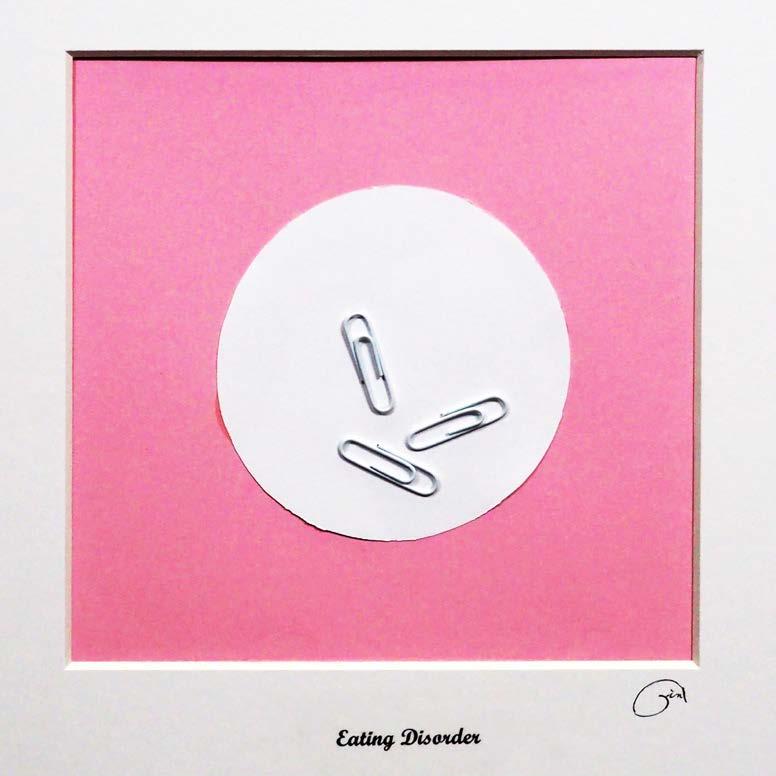
©James Teagarden, 2020
©James Teagarden, 2020
Stopped by a State Trooper
By Barb Peterson

I’m Barb Peterson and was a long-time special education teacher, coordinator, and assistant principal. I have worked at seven different buildings over thirty years and recently retired.
A couple of years ago, I was driving home after giving a presentation in southeast Nebraska on a winter afternoon with light snow flurries. Anxious to get home, I was speeding and was pulled over by the state patrol. I knew I was speeding and expected the worst. The trooper who was tall with dark sun glasses and a broad brimmed trooper hat came up to the car and asked for my license. From my 1998 Honda window, all I could see was his service belt with holster and the top of his pants. After looking at my license, the trooper said, “Mrs. Peterson, did you know you were speeding?” I meekly replied, “Yes, I was speeding.”
Then he paused, and asked, “Do you recognize me?” “No,” I replied, “not from this angle (looking at his belt)!” He said, “I’m John ____.” I quickly recognized his name as a middle school special education (EBD) student I had in class many years ago.
John added, “You always taught us to ‘push the limit’, but I don’t think that the speed limit is what you meant!” There was a long pause -– then he smiled. “I am not giving you a ticket. But, can you wait a minute? I want to show you something!” He reached for his wallet, slowly pulled out an old folded piece of paper, and showed it to me. It read:

John, I know you are a student who has tested limits, and has struggled, but I want you to know that you have always had great ideas, and are a good person and I am proud of what you have accomplished. (Signed) Mrs. Peterson
He had kept the note I had written for him back in middle school, carrying it in his wallet more than fifteen years later!
I had written this type of note for many of my students – not just John. Doing these notes was a small but regular thing I did along with my larger responsibilities.
Unfortunately, we often don’t know the importance or impact of the many “little things” we do!
Barb Peterson, Minnesota, pbwaubun@gmail.com
Photo by Andrea Ferrario on Unsplash.
Midwest Symposium for Leadership in Behavior Disorders 2020 Awards

The Outstanding Leadership Award
For outstanding service and leadership to the field of behavior disorders on a national level.
Sheldon L. Braaten, Ph.D., Executive Director, Behavioral Institute for Children and Adolescents, Little Canada, Minnesota. “In recognition of his commitment to assist professionals, advocacy, mentorship, support, and creative leadership to improve the lives of young individuals with emotional and behavioral challenges.” In the photo Dr. Sheldon Braaten, Executive Director, Behavioral Institute for Children and Adolescents, with his wife Barbara Braaten
Building Leadership Award
For outstanding achievement and excellence as a building or program administrator serving students with behavioral needs.
Karen Hile, Buckner Elementary, Fort Osage R-1 School District, Independence, Missouri. “For creating a school environment where students grow into stronger, kinder, and more respectful individuals.” In the photo Karen Hile at left with Lisa Robins.
Unsung Hero Award
This award recognizes an individual who has contributed significantly to the success of MSLBD but may not have been recognized for these contributions.
James Teagarden, Kansas State University, Manhattan, Kansas. “In recognition of his commitment and service to Midwest Symposium for Leadership in Behavior Disorders, whose mission is to improve the lives of children and youth with emotional and behavioral challenges.” Dr. James Teagarden center, pictured with his daughter and sonin-law Lisa & Ryan Budreau.
Doctoral Stipend, Poster Session Awards, and Master Teacher
In addition, two students received doctoral stipend awards: Simone E. Adams, Clemson University, Clemson South Carolina, and Nicolette M. Grasley-Boy, University of Florida, Gainesville, Florida. Three Outstanding Poster Session Awards went to Simone E. Adams, Nicolette M. Grasley-Boy, and Jenee Vickers Johnson. Anne Baptiste, Educational Service Unit 7, Columbus, Nebraska was recognized as a Master Teacher.
RE THINKING Behavior
After the most successful and most fun Midwest Symposium ever, save the dates and plan to attend the Midwest Symposium on February 25, 26 & 27th, 2021!!
However, please note that the location will change for 2021 Symposium only!
The 2021 Symposium will be held at
The Westin Kansas City at Crown Center, (1 East Pershing Road, Kansas City MO 64108) just a short skywalk from our previous location at the Sheraton Crown Center Hotel.
Additionally, the third annual Simpson Conference on Autism will be held at the KU Edwards Campus in Overland Park, KS on October 8 & 9, 2020
Find all details at: https://mslbd.org

Midwest Symposium for Leadership in Behavior Disorders