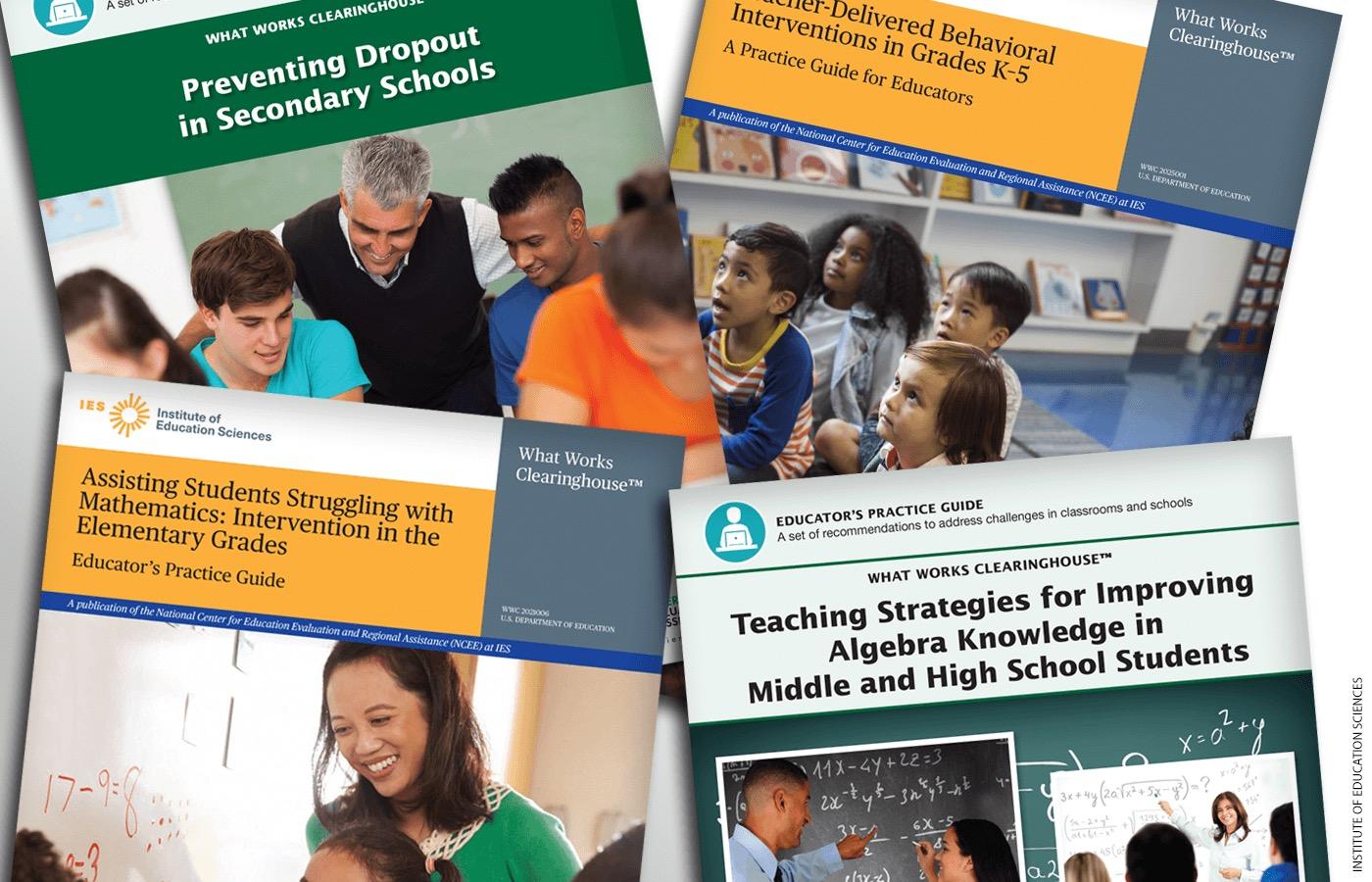
Great Starts for the School Year School-Based Mental Health Best Anxiety Medications Five Things About Youth and Delinquency
Recognizing, Reflecting On, and Addressing Your Bias Bystander Toolkit
Teacher-Delivered Behavioral Interventions
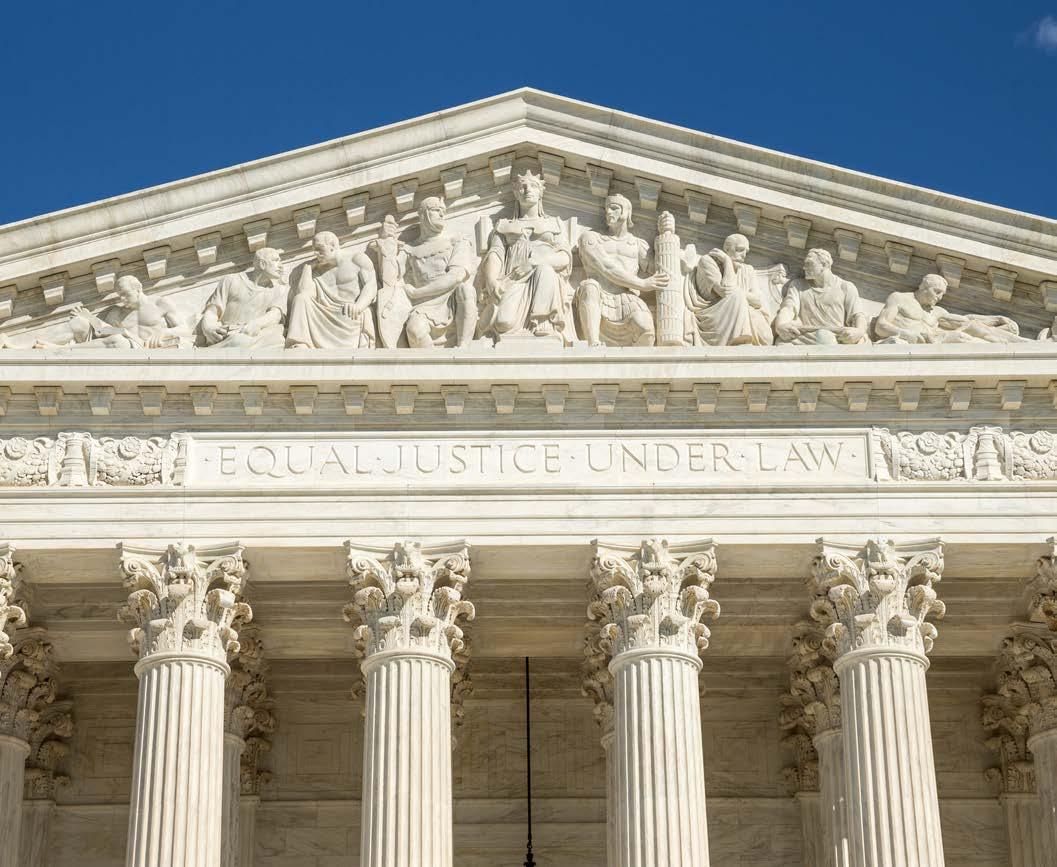
The US Supreme Court and Special Education
Telepathy Tapes, Science or Pseudoscience In the Back Row
UPCOMING EVENTS
7th Annual
Richard L. Simpson Conference on Autism October 1-3, 2025
Plaster Student Union, Missouri State University
Spring eld, Missouri
BCBA CEUs Available | Early Registration Discount
https://mslbd.org/autism-conference/
44th Annual Midwest Symposium for Leadership in Behavior Disorders
March 5-7, 2026
Sheraton Crown Center, Kansas City, MO
For the 44th year, the Midwest Symposium for Leadership in Behavior Disorders will address cutting-edge issues of interest to professionals working with students with emotional/behavioral disorders and autism spectrum disorders. Visit our website, www.mslbd.org, for a full program of events that includes Presymposium Workshops, Keynote Session, 36 Concurrent Breakout Session, Posters, Saturday Workshops, BCBA CEUs available including Ethics Credits.
.Keynote Session
The Knobs and Dials of Behavior: A Spectrum of Clinical and Practical Applications Derived from Behavior Analysis Patrick Friman, PhD, Dir. CBH Emeritus, Boys Town, Boys Town, NE
Workshop Highlights
• What Do I Do If They Don't: Behavioral Strategies and Philosophical Changes That You Can Use on Monday Morning, Matt McNiff, PhD
• An Ounce of Prevention: Antecedent Strategies for Supporting Students with Developmental Disabilities, Keith Radley, PhD. BCBA-D, NCSP
• An Awesome Academic Session at this Behavior Conference, Sarah Powell, PhD & Erica Lembke, PhD
• Supporting Student Behavior with AI: A Hands-On Workshop, James D. Basham, PhD, Yerin Seung, & Teddy Kim
• Supports and Services Around Challenging Behavior in a Shifting Policy Landscape: Whither EBD? Timothy J. Landrum, PhD
• 100 Real World Strategies for Students with Oppositional Defiant Behaviors, Anxiety, ADHD and More, Beverley Johns, MS
• From "Oh Sh*t to "A-Ha!": Core Components of an Effective Behavior Support Program, Carrie Fairbairn, MEd
• What's Your Recipe for MTSS Success? Erika McDowell, EdD
• From Escape to Engagement: Transforming Challenging Behavior, Joel Ringdahl, PhD, BCBA-D
REGISTER BY JANUARY 30 FOR DISCOUNTED REGISTRATION Register early for preferred workshops Visit our website: https://mslbd.org/symposium
Rethinking Behavior welcomes proposal and manuscript submissions; for information visit www.mslbd.org or email rethinkingbehavior@mslbd.org
ReThinking Tier 3
According to a 2023 Education Week Survey, 70% more educators reported increased student misbehavior when compared to the Fall of 2019. This reported increase was not just in the frequency, but also in the intensity of the behavior. This has had a negative impact on both students and teachers, stretching our emotional reserves beyond what is sustainable. As a result, schools are increasingly recognizing the need for stronger support systems to address the needs of students and school staff.
Many programs have been implemented to address the increases in severe and disruptive behaviors. On-site mental health services and multi-tiered intervention supports have come a long way to address the mental health and behavioral needs of students whose behaviors interfere with their learning and the learning of others. Efforts have been made to reduce the number of out of school suspensions by increasing positive, preventative programs and improving in-school solutions.
One of the most effective strategies to address behavior for all students is the Multi-tiered System of Supports (MTSS). MTSS is a framework used to ensure that all students receive appropriate support to meet their individual social, behavioral, and academic needs. MTSS typically involves three tiers of support, with Tier 1 being
core instruction for all students, Tier 2 providing targeted support for some students, and Tier 3 offering intensive support for a few students. It is important to note that students should continue to receive the support of the previous tiers as they move into more intensive levels.
Traditionally, tier three supports have been a path leading to the specialized instruction provided by special education services. It is becoming increasingly evident that there are many students who do not qualify for special education services but need intensive support in order to function adequately in a school setting.
The distinction lies in the students’ ability to learn. The behavior of students who might not qualify for special services does not necessarily negate their ability to learn. Rather, their behavior creates an environment where learning may not occur for anyone due to the severity and disruption it causes. On the other hand, the severity and intensity of the behavior may require the student to be removed from the learning environment to ensure safety for all.
Non-special education Tier 3 behavioral support provides individualized, intensive interventions for students who aren’t responding to Tier 1 and 2 support, addressing the student’s significant behavioral and social-emotional needs. These supports are designed for a small percentage of students (1-5%) and can include a range of strategies such as functional behavioral assessments, behavior intervention plans, and wraparound services.
The key features that drive special education and non-special education Tier 3 interventions are the same. They are data-driven, collaborative, and individualized. Students may need a functional behavioral assessment to determine the function of the behavior, and a behavior intervention plan. All members of the student's support team are involved in the development of this plan and the environment and interventions are geared to meet the student’s specific needs or deficits.
In November 2024, the US Department of Education issued Using Functional Behavior Assessments to Create Supportive Learning Environments. This document emphasized the importance of FBAs for all students when their behavior interferes with learning, regardless of the student’s disability status. This is designed to help reduce suspensions and expulsions, especially among groups of minority students. This guidance is a change from previous practice in which FBAs were conducted only on students eligible for or receiving special education services. This increased use of FBAs paired with targeted Tier 3 interventions may improve the educational outcomes of all children.
Tier 3 supports would include individualized or small group instruction in areas such as social skills, executive functioning skills, basic classroom behavior skills, and self-regulation strategies. These supports can be provided in a variety of settings, depending upon the needs and the severity and/or disruption of the behavior. They can range anywhere on the continuum from a small group weekly to a self-contained alternative setting. The key is to keep the student within the school community as much as can be tolerated.
We must change our thinking from the one size fits all or even the one size fits most and look at all students as individuals. The multi-tiered system, when implemented with fidelity, is the most effective means for addressing the needs of all students.
Janet Burgess, Aimee Hackney, and Brian Sims Issue Editors
Reference
U.S. Department of Education, Office of Special Education and Rehabilitative Services, & Office of Elementary and Secondary Education. (2024, November). Using functional behavioral assessments to create supportive learning environments. U.S. Department of Education.
INNOVATORS
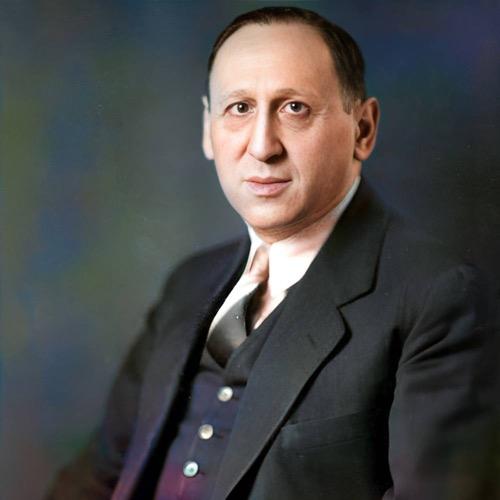
Leo Kanner
America’s First Child Psychiatrist
Robert
Zabel and Reece L. Peterson
Leo Kanner had a profound and enduring impact on the identification, treatment, and education of children with autism. Born in Austro-Hungary (in present-day Ukraine) in 1894, Kanner moved to Berlin as a child and later studied medicine at the University of Berlin. After serving in the Austro-Hungarian army during WW1, he completed medical school and worked as a cardiologist. Due to dire economic conditions in post-war Germany in 1924, Kanner immigrated to the US, where he worked at a state mental hospital in Yankton, South Dakota. While there, he began studying pediatrics and psychiatry and published his first research, an analysis of dental practices in relation to customs and folklore around the world (Wikipedia).
While he was in South Dakota, Kanner attended a psychiatry convention in Minneapolis and interviewed for a fellowship with a children’s clinic at Johns Hopkins University (Silberman, 2015). He was hired, and in 1928 he and his family moved to Baltimore, Maryland. In 1935, he published the first textbook in English focused on child psychiatry, and he is sometimes considered the first American child psychiatrist. By 1938, he was Chief of Psychiatry at Johns Hopkins, a position he held until he retired in 1959. Kanner passed away in 1971.
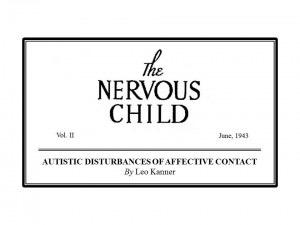
Kanner conducted research and published papers that were innovative and influential at the time and remain classics today. Perhaps his most influential was “Autistic Disturbances of Affective Contact” (1943), where he argued that early infantile autism is different from childhood schizophrenia. He described eight boys and three girls who shared several characteristics that didn’t fit existing psychiatric diagno-
Kanner Syndrome Characteristics
• Early onset; apparent since birth or infancy
• Impaired social development and interactions (e.g. “autistic aloneness”)
• Impaired communication such as echolalia, pronoun reversal, eye contact
• Ritualistic/repetitive behaviors (such as “stereotypic behavior”)
• Restricted interests (such as “insistence on sameness”)
ses. The most prominent characteristic was autistic aloneness, an inability to relate normally to people or situations, and an apparent absence of physical or emotional response to others.
Although most of Kanner’s subjects knew how to speak, they didn’t use language to communicate.
Some displayed echolalia – repeating words and phrases. For example, if asked, “Do you want a cookie?” the child might reply, “Do you want a cookie?” with the same inflections and intonations. Some reversed pronouns (e.g., “You” for “I”). Often, they manifested a desire to maintain sameness in their environments and engage in repetitious actions and verbalizations. Kanner believed these children were endowed with good cognitive potential. They looked intelligent (strikingly intelligent physiognomies), and some had astounding vocabularies. Kanner also noted that their disturbances had been evident from birth.
Kanner’s small sample came from what he characterized as successful “highly intelligent” families; their fathers included psychiatrists, a lawyer, a chemist, several successful businessmen, and academics. Nine of the 11 mothers were college graduates at a time when relatively few women attended college (Rizzo & Zabel, 1988). It’s likely that these highly educated, professional parents had resources to search for explanations and treatments.
Although Kanner’s focus was on describing early infantile autism, he also explored possible etiologies or causes, especially the role of parenting- “unaffectionate” and “mechanical relationships” with children. Of course, it can be challenging to determine the direction of causation. Parenting behavior influences child behavior, but so can a child’s unreciprocated, non-reinforcing behavior affect their parents’ interactions with them.
It’s now more than 80 years since Kanner first described Early Infantile Autism. Over that time, a massive body of attention, speculation, and research has both confirmed and modified some of his descriptions and explanations. About the same time in the 1940s, Hans Asperger (in Vienna, at that time in Austria-Hungary/Germany) independently described a similar, but less pronounced, pattern, which was later called Asperger syndrome, although Asperger’s description was not widely acknowledged until the 1960s. The defining characteristics of Asperger’s “autistic psychology” included “lack of empathy, poor ability to make friends, unidirectional conversation, strong preoccupation with special interests, and awkward movements,” but no impairments of cognitive or language development.
At the time Kanner described early infantile autism in the 1940s, the pattern was considered a sub-type of childhood schizophrenia. Even in the 1968 edition of the Diagnostic and Statistical Manual of Mental Disorders (DSM-II), “autistic, atypical, and withdrawn behavior” was still associated with childhood schizophrenia. It was not until DSM III (1980) that autism was separated from schizophrenia. Additional definitional modifications appeared in later editions, and
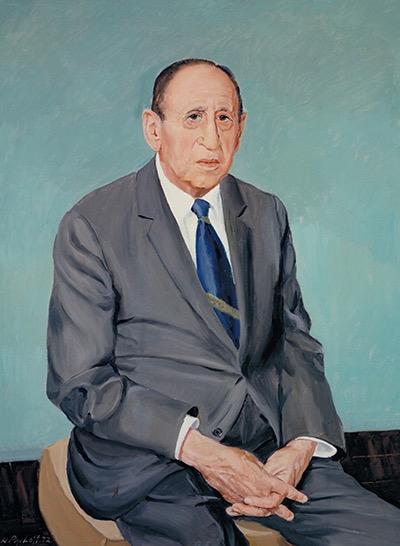
Portrait courtesy, The Alan Mason Chesney Medical Archives, John Hopkins University of Medicine.
and “Kanner syndrome” into a single diagnostic cate gory called Autism Spectrum Disorder (ASD). Autism became a separate category of disability in the Individuals with Disabilities Education Act in 1990, and the definition was further refined in 2017.
Broadening the definition in this way dramatically increased the number of children who qualified for services, improved community awareness and acceptance, and decreased stigma. It was also associated with a decline in children identified as having mental retardation.
At this time, the exact etiology (likely multiple etiologies) is uncertain, although most current research focuses on genetic and/or other physiological contributors. Increasingly, ASD is considered a pattern of neurodiversity.
References
Kanner, L. (1943). Autistic disturbances of affective contact. Nervous Child, 2, 250-271.
Rizzo, J. V., & Zabel, R. H. (1988). Educating children and adolescents with behavioral disorders: An integrative approach. Boston: Allyn & Bacon.
Silberman, S. (2015). Neurotribes: The legacy of autism and the future of neurodiversity. (See also: Zabel, R. H. (2017) Review of Neurotribes, ReThinking Behavior, 1(1), 40-42.
Robert Zabel, Professor Emeritus, Kansas State University, robertzabel@gmail.com and Reece L. Peterson, Professor Emeritus, University of Nebraska-Lincoln, rpeterson1@unl.edu
Knowledge is knowing a tomato is a fruit. Wisdom is knowing not to put it in a fruit salad.
Ole Ivar Lovaas
Innovator in the Treatment of Autism INNOVATORS
Robert Zabel
OIvar Lovaas was a pioneer in the use of applied behavior analysis (ABA) to treat children with autism. Early in his career, autism was generally considered a subtype of childhood schizophrenia or mental retardation. If treated at all, the prevailing treatments were psychoanalytic.
Like several innovators in children’s mental health (e.g., Leo Kanner, Bruno Bettelheim, Fritz Redl), Lovaas emigrated to the US from Europe as a young man. He was born in Norway in 1927 and lived through the Nazi occupation of Norway during WWII. Following the war, he served as a medic in the Norwegian military, where an acquaintance told him about Luther College in Decorah, Iowa. In the early 1950s, he attended Luther College on a violin scholarship. After graduating with a degree in Sociology, he moved to Seattle, where he began his graduate studies in clinical psychology at the University of Washington.
As a graduate student in the 1950s, Lovaas worked as a psychiatric resident for the Pinel Foundation, a private mental health program associated with the Menninger Clinic in Topeka, Kansas. The Pinel Foundation practiced “milieu therapies,” combining psychoanalysis and recreation therapies (Helfgott, 2017). Reflecting on his experience later, Lovaas commented, “I was trained analytically, and I saw all of life through the eyes of a “psychoanalyst“ (Ozerk et al., 2016).
However, Lovaas became disenchanted with the absence of data or testing to demonstrate or document the efficacy of psychoanalytic treatments. He felt that those treatments failed to help people with severe forms of mental illness. He began gravitat-
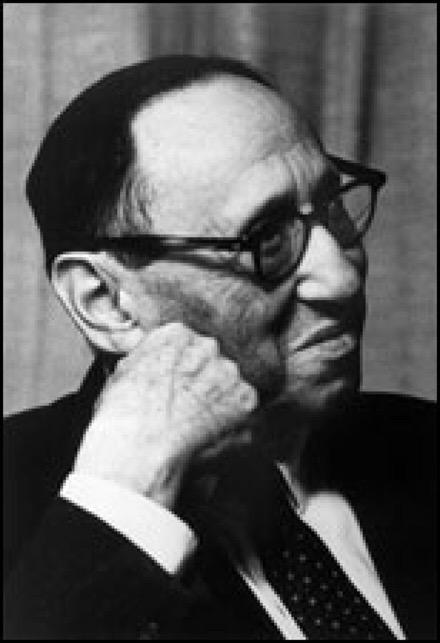
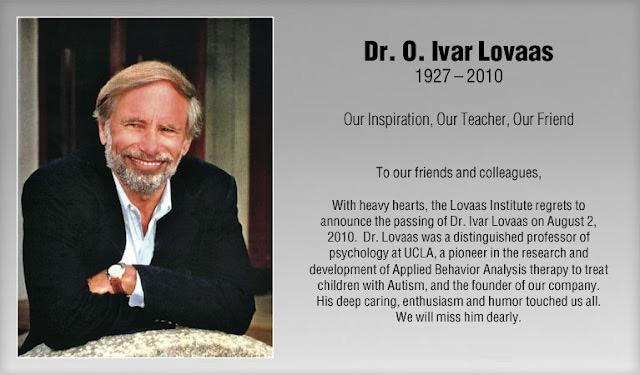
Lovaas was a co-founder of The Autism Society of America and an Innovator in focusing Applied Behavior Analysis (ABA) on treating Autism.
ing toward a radically different approach – applied behavior analysis.
After completing his doctorate, Lovaas joined the Institute for Child Development at the University of Washington, where he conducted research on children’s language development under the guidance of Sidney Bijou, an early proponent of Applied Behavior Analysis (ABA). Bijou’s perspectives and approaches had been influenced by B. F. Skinner’s development of “operant conditioning.”
In 1961, Lovaas joined the University of California-Los Angeles (UCLA) Psychology Department’s Neuropsychiatric Institute, where he spent the rest of his career retiring in 1994.
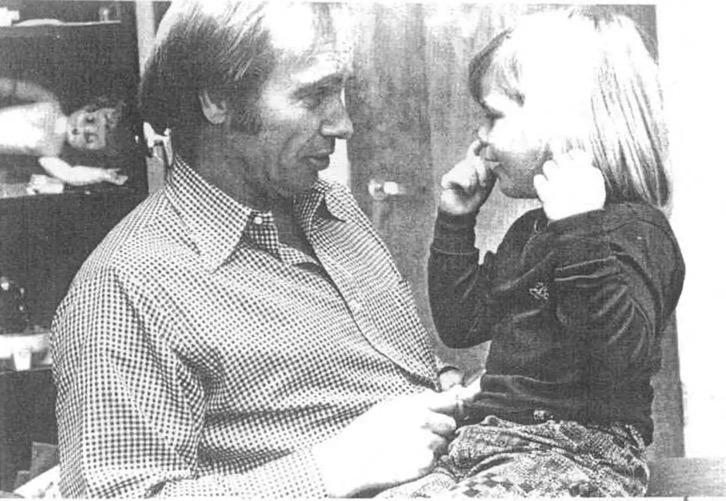
During his early work at UCLA, most individuals with what was then called “early infantile autism” were not considered amenable to treatment, and many were confined to institutions. Lovaas was especially interested in teaching language to non-verbal children and believed they could be taught adaptive behavior using response consequences. He called this “discrete trial training” and used reinforcers and consequences, including aversives, to teach children to respond to questions and commands, make eye contact, and use receptive and expressive language. Based on his research, he advocated early, intensive behavioral interventions – sometimes 35-40 hours per week, preferably in the child’s home with family involvement (Lovaas, 1987).
Lovaas was a strong proponent for education and treatment of children with autism. In 1965, together with Bernard Rimland and Ruth C. Sullivan, he founded the Autism Society of America. He advocated keeping children at home with their families where possible and involving parents in their treatment. He also advocated moving children and adults from large institutions to small group homes. In 1995, he established the Lovaas Institute to offer individualized treatment utilizing ABA for young children with autism. He generally used positive reinforcement to build pro-social, functional, and beneficial behavior.
I met Ivar Lovaas in 1970 while working at a community mental health center which had opened a new residential “family model” home for psychotic and autistic children. We had six children, all nonverbal. Lovaas spent five days with us during the time he was gaining much attention for his work with those types of children including the use of aversive stimulation. What I remember most is how gentle he was in engaging each of the children and his cautions about use of aversives.
– Sheldon Braaten, Executive Director Behavioral Institute for Children and Adolescents
However, Lovaas’ legacy is complicated. Although he always emphasized positive reinforcement above all, he resorted on rare occasions to contingent aversive consequences including low doses of electric shock for self-injury and/or aggression of some institutionalized children with autism. Unable to communicate, these children sometimes resorted to self-harm such as punching themselves hard in the face continuously, chewing off their fingertips, smashing their heads against the sharp objects, or poking their eyes. Those maladaptive behaviors often resulted in social isolation, no intervention, and institutional confinement. Lovaas sought the rapid reduction of injurious behaviors and helped demonstrate that they could be reduced. In the 1970s and 1980s, he employed “slaps on the thigh” for less pronounced, but still devastating, problem behaviors displayed by some children with autism.
Lovaas’ studies showed that the self-destructive behaviors were sensitive to consequences. His studies may have been one of the first efforts to treat these severe self-destructive behaviors, overcoming the conventional wisdom “that these behaviors were untreatable” (Smith & Eikeseth, 2011). His intention was to identify potentially beneficial interventions for these children and he openly recorded and shared his research methods and effectiveness. The use of electric shock and other aversive consequences, such as slapping, were questioned at the time, and professional opinion today is staunchly opposed to their use.
Lovaas also collaborated in one case with a UCLA colleague, George Rekkers to treat “deviant sex-role behavior” of a four-year-old boy for “feminine behavior.” The intervention was punishment (slapping or spanking) by the boy’s father when he exhibited “feminine behavior.” When the study was published in the Journal of Applied Behavioral Analysis in 1974 it was criticized by some, which has increased as sociocultural and ethical perspectives have changed regarding gender identity and autism. Opposition to the use of aversive consequences has evolved both
within the research community and the general public. Forty-six years later, The Society for the Experimental Analysis of Behavior issued an Editor’s Note (2020) expressing strong concerns about the Rekkers and Lovaas study. While not retracting the study entirely (as some had demanded), the editor did severely criticize the study’s targeted behaviors (feminine behaviors) and the use of corporal punishment.
Lovaas passed away in 2010. His groundbreaking research to help change behavior and improve the lives of children with autism through the use of ABA, and leadership in establishing the Autism Society of America are significant. However, changing perspectives on use of physically aversive consequences and choices of intervention targets have tempered the recognition of his contributions.
References
Editor’s Note (2020). Societal changes and expression of concern about Rekkers and Lovaas’ (1974) Behavioral treatment of deviant sex-role behaviors in a male child. Society for the Experimental Analysis of Behavior, https://doi.org/10.1002/jaba.768.
Helfgott, E. A. (2017). Pinel Foundation psychiatric hospital
Little Humans, Big Feelings
By Bridget Dougherty
When it comes to dealing with preschoolers and their behaviors, there are many factors to consider. Most of the time, when preschoolers exhibit challenging behaviors they are experiencing emotions they do not yet know how to express. Preschoolers are developing human beings in the process of learning how to navigate a big world. Our job as caring adults is to help them in their journey. Let me share five strategies that I’ve found helpful in my work with preschoolers.
Talk With Them
Most behaviors in preschoolers can be prevented or resolved through conversation. These conversations should not happen when a child is having an emotional outburst. Sometimes, children act out because they are overwhelmed by emotions they cannot articulate. Talking to them about their feelings can help them identify and understand these emotions. It also equips them with the language they need to
express their feelings healthily. Communication is key. Begin communication with questions such as “How are you feeling today?” or “What did you do last night?”
Create a Feelings Wall
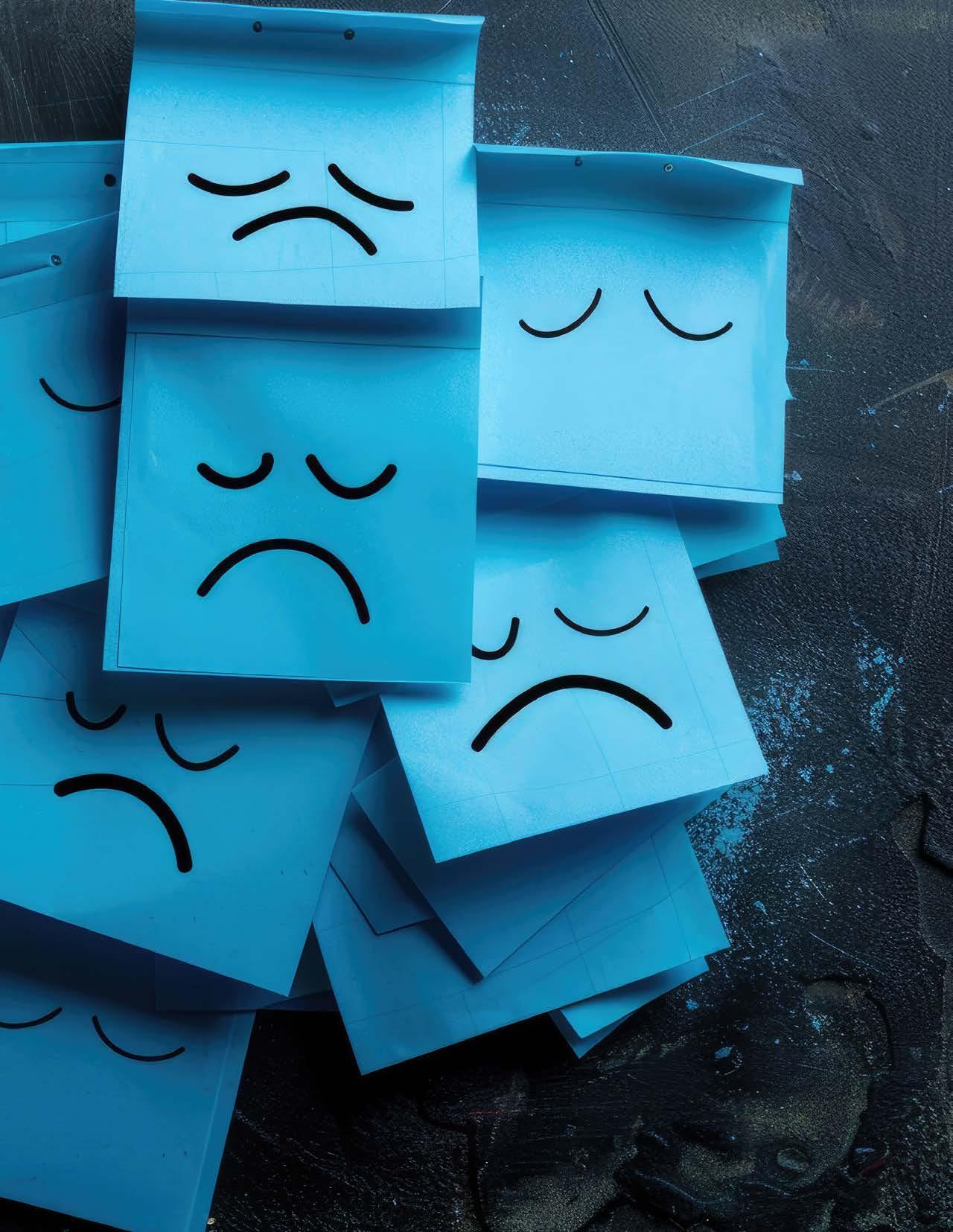
Set up a space in your classroom where pictures of emotions are displayed. When children struggle to verbalize their feelings, visual aids can help them point out the emotion they are experiencing. You can put posters of different emotions and real-life pictures of children’s faces expressing these emotions. You could also add a mirror so that the children can make the faces that match the emotion that they are feeling that day. When the children can match their own faces to the faces on the poster they can learn to link emotions to their feelings. Incorporating a Feelings Wall in the classroom not only facilitates communication but can also be used to teach children how to cope with their emotions in Art courtesy of AdobeStock.com
a constructive way. Communication can begin with, “Why are you feeling sad today?” and “let’s talk about what you can do when you feel sad.”
Read Stories
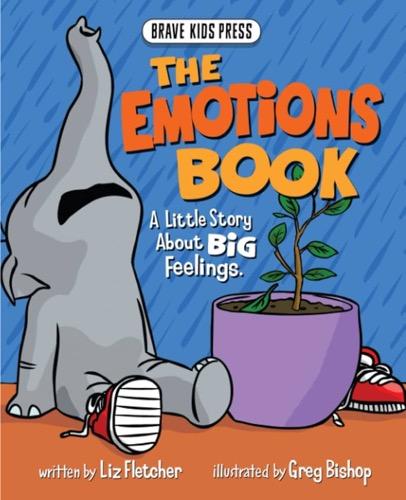
Reading stories exploring emotions can help children identify and understand their feelings. Two excellent books for preschoolers on this topic are “Louie’s Little Lessons: The Emotions Book, A Little Story About Big Feelings” by Liz Fletcher and “The Color Monster: A Story About Emotions” by Anna Llenas. Louie’s Little Lessons helps children identify the emotions of anger, sadness, frustration, and happiness. The Color Monster connects emotions to colors, making it easier for children to visualize and relate to their feelings. Additional emotions presented are calmness, peacefulness, love, and fear. Videos of both stories can be easily found on YouTube.
Offer Choices
Providing choices can be an effective way to address challenging behaviors. For example, offering two options - such as “this or that” or “first, then” - can help a preschooler pause, reflect, and regain control of their emotions. Children often act impulsively when overwhelmed, but being presented with choices encourages them to slow down and make thoughtful decisions. Teaching, modeling, and guided practice will strengthen children’s ability to accept and benefit from the choices being offered.
Use Redirection
Redirection is a valuable tool when dealing with a preschooler exhibiting challenging behavior. By gently guiding the child toward a different activity or perspective, you give them a chance to regroup and try again. This approach teaches children that problems can be solved in multiple ways and encourages them to make better choices. I have used this with students by sitting down and talking about why we are choosing a new center or activity and helping them understand. I have also used this by giving gentle reminders on why we made the choice of redirections.
In conclusion, preschool ers are tiny humans experiencing big emo tions and trying to make sense of them. They may need extra support to understand what they are
feeling, why they are feeling this way, and what to do about it. Keep in mind that these techniques may require trial and error as well as practice and that not every strategy will work for every child. Take the time to get to know your preschoolers. Be patient, use a gentle tone, and approach them with respect, and empathy. By giving children, the tools to identify and manage their emotions early, we set them up for success throughout their lives.
References
Fletcher, L. (2021). Louie’s little lessons: The emotions book, a little story about big feelings, Brave Kids Press, https://www. youtube.com/watch?v=jl8G2jiSNA0
Lienas, A. (2018). The color monster: A story about emotions, Little Brown Books for Young Readers, https://www.youtube. com/watch?v=4QTbwwlgCqE
Bridget Dougherty, Administrator, My Bright Beginnings, Philadelphia PA, bdoc6989@ku.edu
By MSLBD Master Teachers
The one thing I do to ensure a great start to the school year is to establish clear expectations and routines from day one, with a strong emphasis on building a positive classroom community. This means actively teaching classroom expectations through modeling and practice, and consistently reinforcing positive behaviors. Simultaneously, I dedicate time to icebreakers, team-building activities, and individual conversations to help students feel safe, connected, and valued. When students understand what’s expected of them and feel like they belong, the learning environment is set up for success.
the year really teaching and reinforcing these expectations, it makes teaching and learning easier for everyone in the long run.
I light a candle, burn incense, and smudge sage all over the student desks. I whisper to myself that this is the year no one will staple their own hand and remind myself that hope is a renewable resource! Finally, I give every kid a clean slate - even the ones who say they see me in their nightmares.
– Carrie Fairbairn, Special Educator 3-5, LaVista, NE, cfairbairn@esu3.org
I spend a great deal of time working on building relationships with my students. I have found the best way to do this is to play games that challenge all of us so the kids can see me struggle. We do a lot of laughing.
– Janet Burgess, Facilitator, Temporary Alternative Placement Center, North Kansas City School District, MO, burgessjanet@yahoo.com
At the beginning of each school year, I make sure to not get caught up in the hustle of everything that “ought” to be done and focus on what my students and their families need to feel safe and welcome at school. This means proactive and positive parent communication, and what I jokingly refer to as “Ms. Pickett’s Bootcamp” where we buckle down to learn, practice, and reinforce routines and expected behavior in the classroom and school building while we learn about each other and our learning goals for the year! If you spend the time at the beginning of
I make sure I am well-prepared, organized, and have a solid plan. Being unprepared or attempting to “wing it” is a serious stressor for me! I used to love it in college, but as the years pass, I realize how anxious it makes me! I am a reformed procrastinator!
– Barbara J. Gross, ESU 5 Behavior and Autism Consultant, Beatrice, NE, bgross@esu5.org
For parents, I think open communication especially at the beginning of the year is crucial. I like to make sure they have all of my contact information (email, phone number, etc.) and I have all of their contact information. I highly encourage them to attend our Open House so I can touch base with them in person and explain the school and classroom expectations.
For students, it is imperative to teach and re-teach routines and expectations. I spend the first few weeks of school teaching expectations and practicing basic routines. This really helps set the stage for the year.
– Sallye Vanderplas-Lee, K-2 Primary Teacher, La Vista, NE 68128, slee@esu3.org
I start the year with no academics. I like to devote the first several days to relationship building and teaching and reinforcing rules and routines.
– Anne Baptiste, Learning Academy Teacher, Educational Service Unit 7, Columbus, NE, abaptiste@ esu7.org
School-Based Mental Health: What Educators Need to Know
By
Nicholas A. Gage, Natalie Romer, Sarah Emily Wilson, Nicolette Grasley-Boy, Patricia Schetter, and Christina Trentz
Positive mental health is as crucial as physical health for achieving success in most aspects of life. Just as a healthy body can endure the demands of daily activities and challenges, a healthy mind ensures an individual can manage stress, relate positively with others, and make sound decisions. By nurturing mental wellness, people can enhance their resilience, enabling them to bounce back from setbacks and adapt to changes more effectively. This resilience is essential not only in personal life but also in a professional environment, where mental clarity and emotional stability can significantly influence productivity and creativity. Moreover, positive mental health contributes to a person’s overall sense of well-being and satisfaction in life. It empowers individuals to pursue their passions and maintain a positive outlook, even in the face of adversity. The ability to experience joy, maintain fulfilling relationships, and engage in meaningful activities is often linked to one’s mental state. Therefore, investing in mental health care and support not only enhances an individual’s capacity to enjoy life but also equips them to contribute positively to their communities and society at large.
The Centers for Disease Control and Prevention (CDC) define mental health as our emotional, psychological, and social well-being. Mental health affects how we think, feel, and act, and helps determine how we handle stress, relate to others, and make healthy choices. Mental health is important at every stage of life, from childhood through adulthood. According to the World Health Organization (WHO), mental health is “a state of well-being in which an individual realizes his or her own abilities, can cope with the normal stresses of life, can work productively and fruitfully, and is able to make a contribution to his or her community” (2021). Each of these definitions underscore the multidimensional nature of mental health, indicating that it involves a complex interaction between cognitive functions, emotional regulation, and social interactions. Therefore, maintaining mental health is crucial not only for individual well-being but also for the broader societal contributions that individuals
We have witnessed soaring rates of mental health challenges among children, adolescents, and their families over the course of the COVID-19 pandemic. . . impacts likely to affect students for years to come.
can make when they are mentally healthy (Kessler et al., 2005).
In schools, mental health impacts children’s and youths’ ability to successfully function across settings. Targeted interventions for the social, emotional, and behavioral skills that support mental health have been associated with a decrease in conduct problems, emotional distress, and school disengagement, and an increase in academic achievement, academic engagement, and overall well-being among students across demographic categories (i.e., age/ grade, race/ethnicity, socioeconomic status, and geographic location; Cipriano et al., 2023). Conversely, students who experience difficulties with these skills in schools are confronted with a wide array of challenges affecting their self-concept, academic performance, classroom engagement, attendance, school completion, and peer and teacher relationships (Jagers et al., 2019). Before the COVID-19 pandemic, between 13–22% of school-aged youth experienced a mental health need to a degree warranting a formal diagnosis (NCSMHI, 2016). Alarmingly, data suggest that upwards of 80% of those children and youth had unmet treatment needs (Reinert et al., 2021). Unfortunately, the COVID-19 pandemic significantly intensified pre-existing mental health challenges, particularly for children and adolescents, and upwards of 87% of public schools have reported that the pandemic negatively impacted students’ social,
emotional, and behavioral development and mental health during the 2021–22 school year (NCES, 2022).
As schools closed due to the pandemic and social interactions were restricted, many children and youth experienced increased feelings of anxiety, depression, and isolation. A study by Singh et al. (2020) found that the uncertainty and fear related to the pandemic, coupled with prolonged home confinement, significantly affected children’s psychological well-being, leading to increased symptoms of anxiety and depression. The loss of routine, physical inactivity, and reduced social interactions disrupted children’s and youth’s normal developmental processes, highlighting the pandemic’s deep and on-going psychological impacts. As a result, in 2021, the American Academy of Pediatrics, the American Academy of Child and Adolescent Psychiatry, and the Children’s Hospital Association declared a national emergency in child and adolescent mental health. In their declaration, they note that “[a]s health professionals dedicated to the care of children and adolescents, we have witnessed soaring rates of mental health challenges among children, adolescents,
and their families over the course of the COVID-19 pandemic, exacerbating the situation [i.e., too many mental health challenges experienced by children and adolescents] that existed prior to the pandemic.” These impacts are likely to affect students for years to come, underscoring the need for school-based mental health support at scale within schools (US Department of Education, 2021).
Schools and educators, recognizing these challenges, have been at the forefront of addressing these mental health issues. Local, state, and national education agencies have focused policies and practices designed to support students’ emotional and psychological well-being. For instance, many schools have integrated mental health education into their curricula, focusing on resilience training and stress management techniques (Loades et al., 2020). Furthermore, the provision of school-based counseling services has increased, offering direct support to students who are struggling. These interventions, along with many others, aim not only to address the immediate psychological impacts of the pandemic but also to equip students with long-term coping strategies.
All school staff are on the front lines of mitigating the mental health challenges faced by students. There are on-going efforts to train teachers to recognize signs of mental distress and to provide initial support or to refer students to school-based teams that can connect students to mental health professionals and services (Asbury & Toseeb, 2020). This work is crucial in fostering an environment that supports mental health and resilience, thereby helping children navigate the lingering challenges of living in the post COVID-19 pandemic world. These are just some examples of the collective efforts of school-based mental health (SBMH)
support. Below, we define SBMH and describe a series of resources that educators should know of to begin building SBMH systems and supports in their classrooms and schools.
What is School-Based Mental Health (SBMH)?
SBMH support is designed to address the needs of students by focusing on social, emotional, and behavioral components that are essential for their overall well-being and may be provided inside and outside of special education systems. Social support within schools is aimed at helping students develop healthy relationships with peers and adults, which is critical for their emotional and social development. Programs like peer mentoring, social skills training, and group counseling are implemented to foster a supportive community that encourages positive social interactions. These activities help students learn empathy, cooperation, and conflict resolution skills, which are vital in building a foundation for lasting personal and professional relationships.
Schools are increasingly recognizing the importance of providing a safe space for students to express and manage their feelings. Emotional support often involves teaching students about emotional regulation and self-awareness through programs such as universal social-emotional learning (SEL) curricula, cog nitive behavioral therapy, and mindfulness training. These programs aim to equip students with strategies to cope with anxiety, depression, and stress, enabling them to better handle academic pressures and personal challenges. Furthermore, such emo tional supports are linked
with improved academic performance, as students who are emotionally stable are more likely to be able to focus and excel in their studies.
Behaviorally, schools implement various programs and policies to address and modify contextually challenging behaviors, while promoting positive behaviors that contribute to a conducive learning environment. Behavioral supports can include positive behavioral interventions and supports (PBIS), function-based behavior intervention plans, and access to behavioral therapists. These approaches not only help in reducing incidences of bullying, violence, and other disruptive behaviors but also promote inclusivity and respect among students. Through consistent behavioral support, schools aim to create a safe and structured environment that facilitates learning and personal growth for all students.
Research shows that there are significant advantages to schools providing students access to needed mental health supports. Importantly, SBMH supports reach students in their typical, every-day environment and the natural, non-stigmatizing location
offers an early and effective environment for intervention. Indeed, children and youth are six times more likely to complete mental health treatment in schools compared to community settings (Wilk et al., 2022), and mental health services have been shown to be effective when integrated into students’ academic instruction (Sanchez et al., 2018). Embedding mental health supports within schools also supports increased access to services. A study by Wilk et al. (2022) found that SBMH services increased from just over 12% in 2009 to almost 16% in 2019. This increase was even more dramatic for Black students and students living in poverty, suggesting that students who may have had less access outside of school were now able to access mental health services because they became available in their schools.
Integrating SBMH into schools also has a positive impact on student outcomes, particularly when incorporating with multi-tiered systems of support (MTSS), such as Positive Behavioral Interventions and Supports (PBIS). This integrative approach is currently being advocated for by the U.S. Department of Education (ED), many state agencies, and many organizations that intersect trauma and adversity, child development, and education (e.g., National Child Traumatic Stress Network, National Association of School Psychologists, National Association of School Nurses). The Interconnected Systems Framework (ISF) is an integrated approach designed to improve students’ social, emotional, and behavioral outcomes by combining PBIS with school mental health services. This framework promotes collaboration across school-based and community health systems to create a comprehensive, MTSS that addresses behavioral health needs and improves students’ wellbeing. The ISF aims to leverage the strengths of PBIS, notably its systematic and preventive approach, with the targeted, data-driven interventions typical of school mental health services. By doing so, the ISF seeks to provide a seamless continuum of care that is accessible within the school environment, thereby improving student engagement, reducing behavioral problems, and enhancing overall student well-being. Research supports the effectiveness of ISF in
Children and youth are six times more likely to complete mental health treatment in schools compared to community settings.
fostering better educational and behavioral health outcomes, emphasizing the critical role of integrated support systems in schools (Cook et al., 2015). A randomized control trial of ISF found positive and meaningful impacts on reducing office discipline referrals and suspensions (Weist et al., 2022) and increasing perceptions of school climate (Splett et al., 2023).
SBMH Resources for Educators
There are numerous, freely available resources to help educators learn about SBMH and begin implementing SBMH supports. To organize these resources, we use seven recommendations from the US Department of Education, Office of Special Education and Rehabilitative Services (OSERS) in response to widespread concerns about students’ social, emotional, and behavioral health during and after the COVID-19 pandemic. These recommendations aim to create supportive, inclusive, and effective environments for addressing the mental health needs of students within educational settings. Each one focuses on different aspects of system-wide improvement to ensure comprehensive support for all students’ social, emotional, behavioral, and mental health needs. Table 1 provides definitions and describes each recommendation and lists freely available resources for each to increase educator’s ability to actualize them.
There are also several professional organizations that host a wealth of information and resources to support SBMH implementation. Table 2 provide a non-exhaustive list of organizations and their websites that educators can review to continue learning and growing their capacity to implement SBMH support.
Table
Recommendation
1. Prioritize Wellness for Each and Every Child, Student, Educator, and Provider
This recommendation stresses the importance of creating supportive environments that promote the well-being of all individuals within educational settings. It suggests that a focus on wellness will improve overall outcomes for students, educators, and providers by establishing a culture that values mental health.
2. Enhance Mental Health Literacy and Reduce Stigma and Other Barriers to Access
This calls for increasing awareness and understanding of mental health issues among students, educators, and the broader school community. The goal is to reduce stigma and other barriers that prevent individuals from seeking help or accessing necessary mental health services.
3. Implement a Continuum of Evidence-Based Prevention Practices
The implementation of proven preventative practices across different tiers of need is recommended to address the diverse mental health requirements of students. This includes universal strategies for all, targeted interventions for those at risk, and intensive support for those with significant needs.
4. Establish an Integrated Framework of Educational, Social, Emotional, and Behavioral-Health Support for All
Advocates for an integrated approach that combines education with social, emotional, and behavioral health supports. This framework aims to ensure that all students receive holistic support that encompasses their academic and mental health needs.
5. Leverage Policy and Funding
This recommendation focuses on the utilization of policy and funding to strengthen mental health supports in schools. It suggests that strategic use of resources can enhance the sustainability and scope of mental health services.
6. Enhance Workforce Capacity
Emphasizes the need to build the capacity of the educational workforce to address the mental health needs of students effectively. This includes providing training, resources, and support to educators and mental health professionals working in schools..
7. Use Data for Decision Making to Promote Equitable Implementation and Outcomesy
Calls for the use of data-driven decision-making to ensure that mental health supports are implemented equitably and effectively. This involves collecting and analyzing data to monitor progress and make informed adjustments to interventions
Resources
National Center on Safe Supportive Learning Environments
CDC’s Promoting Mental Health and WellBeing in Schools: An Action Guide for School and District Leaders
NIH Transforming the understanding and treatment of mental illnesses
Youth.gov (US government website that helps you create, maintain, and strengthen effective youth programs)
Center for Positive Behavioral Interventions and Supports
Council for Exceptional Children (CEC) IRIS Center
Interconnected Systems Framework (ISF)
National Center for School Mental Health (NCSMH) School Mental Health Quality Guide Funding & Sustainability
California’s Children and Youth Behavioral Health Initiative (CYBHI) Wellness Coach Initiative
National Educators Association (NEA) Mental Health Supports
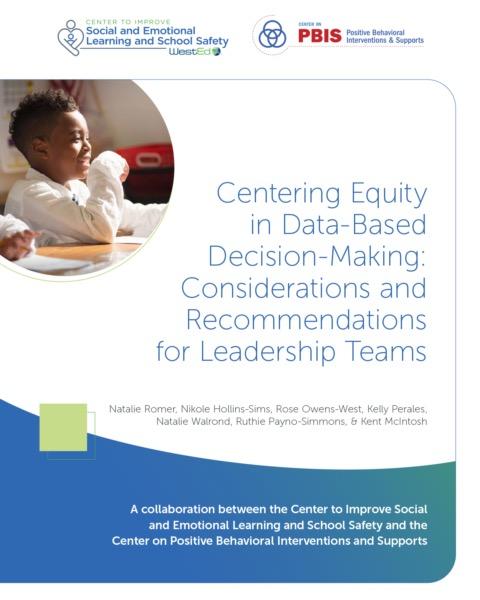
PBIS – Centering Equity in Data-Based Decision-Making: Considerations and Recommendations for Leadership Teams
WestEd – Centering Equity in Data-Based Decision Making
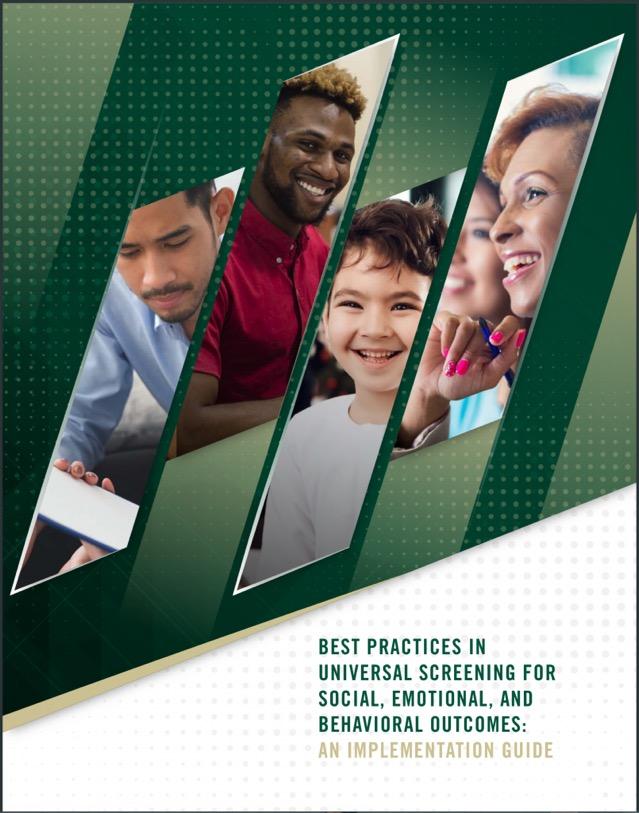
School Mental Health Collaborative’s Best Practices in Universal Screening for Social, Emotional, and Behavioral Outcomes: An Implementation Guide
Table
Organization
National Center for School Mental Health (NCSMH)
National Center for Positive Behavior Intervention and Support (PBIS Center)
University of Washington School Mental Health Assessment, Research, and Training (SMART) Center
Substance Abuse and Mental Health Services Administration (SAMHSA)
Mental Health America (MHA)
National Association of School Psychologists (NASP)
American School Counselor Association (ASCA)
Child Mind Institute
Collaborative for Academic, Social, and Emotional Learning (CASEL)
School Social Work Association of America (SSWAA)
National Child Traumatic Stress Network (NCTSN)
IRIS Center
Comprehensive Center Network (CCNetwork)
Mental Health Technology Transfer Center Network (MHTTC)
National Center for Safe and Supportive Schools (NCS3)
SchoolSafety.gov
Description
The NCSMH at the University of Maryland School of Medicine is a technical assistance and training center focused on advancing research, training, policy, and practice in school mental health.
The PBIS Center, funded since 1998 by the US Dept of Education, develops and releases free resources for educators to co-create affirming, culturally supportive, and productive learning environments. The Center is a leader in the field of education, working together with state and local agencies to improve social, emotional, academic, and behavioral outcomes for all students.
Specializes in offering web-based training and research-based strategies for schools. Their resources are aimed at improving the quality and effectiveness of school mental health interventions.
Offers comprehensive toolkits for implementing mental health and substance abuse programs in schools, including prevention and intervention strategies.
Supplies screening tools for early identification of mental health issues, and educational resources to support mental health awareness and intervention in schools.
Offers a variety of resources including practice guides, toolkits, and professional development materials focused on mental health practices within schools.
Provides professional development, advocacy, and a repository of resources tailored to school counselors promoting student mental health.
Delivers materials that help teachers understand mental health disorders and provide effective support in educational settings.
Specializes in integrating social and emotional learning into school curricula and policies to enhance the overall school climate.
Offers materials that support school social workers in implementing mental health interventions and supports.
Provides resources and guidelines for addressing trauma in school settings and helping educators understand and manage trauma-related issues among students.
Supported by the US Dept of Education’s Office of Special Education Programs and located at Vanderbilt University’s Peabody College, the IRIS Center develops and disseminates free, engaging online resources about evidence-based instructional and behavioral practices to support the education of all students, particularly struggling learners, and those with disabilities.
CCNetwork features 20 federally funded technical assistance Centers–the National Comprehensive Center and 19 Regional Comprehensive Centers. These centers are a collaborative effort to address important topics in education featuring information, resources, and opportunities to gain a deeper understanding nationally and engage in evidence-based practices together.
The MHTTC Network is supports dissemination and implementation of evidence-based practices for mental disorders. Funded by the Substance Abuse and Mental Health Services Administration (SAMHSA), the MHTTC Network includes 10 Regional Centers and a Network Coordinating Office
The NCS3 provide states, districts, and schools with the knowledge and tools to implement culturally responsive, trauma-informed policies and practices that promote equity and well-being.
SchoolSafety.gov is a collaborative, interagency government website providing schools and districts with actionable recommendations to create safe and supportive learning environments for students and educators.
SBMH support is critical for all students across all grade-levels, but particularly for those struggling with social, emotional, and behavioral challenges. SBMH is unique in that the goal is to leverage educators’ professional strengths and capacity, while also partnering with external mental health experts from the community. All schools can and should provide SBMH support, which will improve academic, social, emotional, and behavioral outcomes for all students. We hope this information and these links to free resources will increase educators’ abilities to bring SBMH to their schools.
References
American Academy of Pediatrics. (2021). AAP-AACAP-CHA Declaration of a National Emergency in Child and Adolescent Mental Health.
Asbury, K., & Toseeb, U. (2020). How has COVID-19 affected the mental health of children with Special Educational Needs and Disabilities and their families? Journal of Autism and Developmental Disorders. 51(5), 1772-1780. 51(5), 1772-1780.
Cipriano, C., Strambler, M. J., Naples, L. H., Ha, C., Kirk, M., Wood, M., ... & Durlak, J. (2023). The state of evidence for social and emotional learning: A contemporary meta-analysis of universal school-based SEL interventions. Child Development, 94(5), 1181-1204
Cook, C. R., Frye, M., Slemrod, T., Lyon, A. R., Renshaw, T. L., & Zhang, Y. (2015). An Integrated Approach to Universal Prevention: Independent and Combined Effects of PBIS and SEL on Youths’ Mental Health. School Psychology Quarterly, 30(2), 166-183.
Jagers, R., Rivas-Drake, D., & Williams, B. (2019). Transformative social and emotional learning (SEL): Toward SEL in service of educational equity and excellence. Educational Psychologist, 54(3), 162–84.
Kessler, R. C., Chiu, W. T., Demler, O., Merikangas, K. R., & Walters, E. E. (2005). Prevalence, severity, and comorbidity of twelve-month DSM-IV disorders in the National Comorbidity Survey Replication (NCS-R). Archives of General Psychiatry, 62(6), 617-627.
Loades, M. E., Chatburn, E., Higson-Sweeney, N., Reynolds, S., Shafran, R., Brigden, A., Linney, C., McManus, M. N., Borwick, C., & Crawley, E. (2020). Rapid systematic review: The impact of social isolation and loneliness on the mental health of children and adolescents in the context of COVID-19. Journal of the American Academy of Child and Adolescent Psychiatry.
National Center for Education Statistics (NCES). (2022, July 6). More than 80 percent of U.S. public schools report pandemic has negatively impacted student behavior and socio-emotional development.
North Carolina School Mental Health Initiative (NCSMHI). (2016). Current status of mental health in children and youth.
Reinert, M, Fritze, D. & Nguyen, T. (2021). The state of mental health in America 2022. Mental Health America, Alexandria VA.
Sanchez, A. L., Cornacchio, D., Poznanski, B., Golik, A. M., Chou, T., & Comer, J. S. (2018). The effectiveness of schoolbased mental health services for elementary-aged children: A meta-analysis. Journal of the American Academy of Child & Adolescent Psychiatry, 57(3), 153-165.
Singh, S., Roy, D., Sinha, K., Parveen, S., Sharma, G., & Joshi, G. (2020). Impact of COVID-19 and lockdown on mental health of children and adolescents: A narrative review with recommendations. Psychiatry Research, 293, 113429.
Splett, J. W., Gage, N. A., Perales, K. L., Halliday, C., & Weist, M. D. (November 2023). The Impact of the Interconnected Systems Framework (ISF) on School Climate: Results from a Randomized Controlled Trial. Center on PBIS, University of Oregon.
U.S. Department of Education, Office of Special Education and Rehabilitative Services. (2021). Supporting child and student social, emotional, behavioral, and mental health needs. Washington, DC.
Weist, M. D., Splett, J. W., Halliday, C. A., Gage, N. A., Seaman, M. A., Perkins, K. A., ... & DiStefano, C. (2022). A randomized controlled trial on the interconnected systems framework for school mental health and PBIS: Focus on proximal variables and school discipline. Journal of school psychology, 94, 49-65.
Wilk, A. S., Hu, J. C., Wen, H., & Cummings, J. R. (2022). Recent Trends in School-Based Mental Health Services Among Low-Income and Racial and Ethnic Minority Adolescents. JAMA pediatrics, 176(8), 813–815.
World Health Organization. (2021). Mental health: Strengthening our response.
Nicholas A. Gage, Research Director, ngage@wested. org, Natalie Romer, Senior Associate, nromer@ wested.org, Sarah Emily Wilson, swilson@wested. org, and Nicolette Grasley-Boy, Senior Research Associate, ngrasle@wested.org, at WestEd; Patricia Schetter, Coordinator, PSchetter@placercoe.org, and Christina Trentz, Coordinator, ctrentz@placercoe.org, at Placer County Office of Education.
By Caroline Miller and Paul Mitrani
Photo
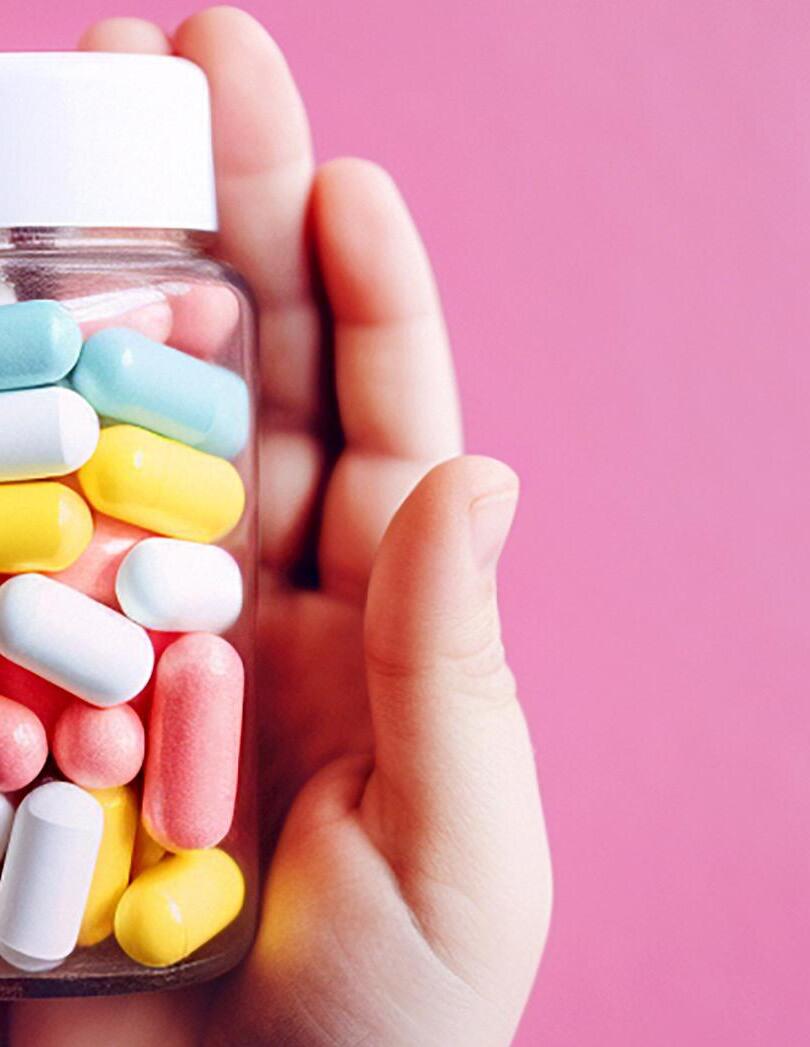
Medications used to treat anxiety in children can be confusing because they include several different kinds of drugs that work in different ways. Some of them were not originally developed to treat anxiety, so their names are misleading. For instance, the most effective medications for anxiety are antidepressants – called that because they were first approved for treating depression.
Some anti-anxiety medications – including the antidepressants – are used to reduce the child’s overall symptoms, with the child taking them every day. Others are used only occasionally, when a child is facing a situation that triggers intense anxiety. Some medications work by reducing the anxiety itself – antidepressants do that by boosting the level of serotonin, the chemical in the brain which most directly regulates mood and anxiety. Other medications work by reducing physical symptoms caused by anxiety. They have an effect on other neurotransmitters and other pathways in the body’s nervous system.
Though there are many different anxiety disorders, anti-anxiety medications tend to work for the symptoms that these diagnoses have in common: worrying, nervousness, obsessing, anxiety.
The Role of Medication in Treatment of Anxiety
Studies show the most effective treatment for anxiety is not medication alone but medication in combination with cognitive behavioral therapy, or CBT. In cognitive behavioral therapy, children and teens are taught skills to overcome their anxiety, rather than giving in to it, and their anxiety diminishes gradually, over a period of weeks. Medication can help kids who are extremely anxious get comfortable enough to participate in the therapy.
Most experts recommend that kids with mild-to-moderate anxiety be treated first withCBT. Medication can be added after the child starts CBT if therapy alone does not seem to be working to
relieve their symptoms. But for more severe anxiety, it’s recommended that kids start on medication along with therapy – or even before therapy starts, to help them get comfortable enough to participate.
While medication is not as effective alone as it is in combination with CBT, it is often prescribed alone if CBT is not available or not feasible for the child’s family.
Medications are also frequently combined to treat severe anxiety. For instance, since antidepressants aren’t fully effective right away, a second medication may be added to relieve anxiety during the initial weeks of taking an antidepressant. A second medication can also be added to a fully active antidepressant if a child needs more relief.
FDA Approval
Some medications widely used to treat anxiety in children and teens are not approved by the Food and Drug Administration (FDA) for that use. But that doesn’t mean they are not safe and effective, or that they haven’t been thoroughly studied. When drug companies develop a new medicine, they are required to prove to the FDA that it is safe and effective for treating a specific problem in a specific group of patients – say, depression in adults. Once the drug is approved, it can also be prescribed “off label,” for a different use and/or a different age group – say, anxiety in children.
The drug company may choose not to seek FDA approval for the drug’s use with these additional disorders or age groups, since the process is expensive. But other scientists may have studied these different uses for the medications extensively, and published their research in credible, peer-reviewed journals. That is the case, for instance, with the use of antidepressants for childhood anxiety. There is a lot of research backing up their safety and effectiveness for kids with anxiety, even though they are not approved by the FDA for this use.
Types of Medication Used for Anxiety
Anxiety medication for children and teens that are commonly prescribed are:
• Anti-depressants called SSRIs (Zoloft, Prozac, Paxil)
• Anti-depressants called SNRIs (Effexor XR, Cymbalta)
• Anti-anxiety medications called benzodiazepines (Ativan or Klonopin)
The clear choice for anxiety medications for children and teens are the serotonin reuptake inhibitors, the antidepressants. Study after study shows those are the medicines that are effective, and they can be extremely effective. With the right assessment, with the right youngster, the use of antidepressants for anxiety can be transformative. And it can happen relatively quickly; in our studies we often see kids better by the first week or two of treatment. They’re not completely well but they’re moving in the right direction, and that kind of response early on generates confidence in the anxiety treatment, makes moms and dads feel a little bit better and makes the kids feel pretty good.
There are several types of antidepressants that have an effect on childhood anxiety. Experts note that if the first antidepressant your child tries isn’t successful in reducing anxiety symptoms – or your child isn’t able to tolerate the side effects – another should be tried. Kids respond to different types and individual formulations in different ways.
SSRIs. Antidepressants called SSRIs (selective serotonin reuptake inhibitors) are the recommended first choice of medication for treating anxiety in children. That’s because they have been shown to
Medications used to treat anxiety in children can be confusing because
they include several different kinds of drugs that work in different ways. Studies show the most effective treatment for anxiety is not medication alone but medication in combination with cognitive behavioral therapy.
be the most effective, and they have relatively mild side effects. They are also the most commonly prescribed. They work by increasing the amount of serotonin – the most important chemical in the brain that regulates mood. SSRIs that are commonly prescribed for anxiety in children and teens include:
• Zoloft (sertraline)
• Prozac (fluoxetine)
• Luvox (fluvoxamine)
• Paxil (paroxetine)
• Celexa (citalopram)
• Lexapro (escitalopram)
SNRIs. Another set of antidepressants that work for anxiety are SNRIs (serotonin-norepinephrine reuptake inhibitors). They work by increasing the level of two neurotransmitters in the brain – both serotonin and norepinephrine. SNRIs that are commonly prescribed for child and adolescent anxiety include:
• Effexor XR (venlafaxine ER)
• Cymbalta (duloxetine)
The SNRIs may be less frequently prescribed for childhood anxiety because they can have a slightly higher rate of side effects, since they work on two different neurotransmitter systems in the brain. Paul Mitrani, MD, Medical Director and Senior Child and Adolescent Psychiatrist at the Child Mind Institute, notes that clinicians usually prescribe an SNRI as a second choice for a child who does not respond to SSRIs, or when there is a parent or sibling who has had a positive response to anmSNRI.
Side Effects of Antidepressants. While side effects vary for individual children, and individual medications, side effects of SSRIs and SNRIs are relatively mild, compared to other medications. They often subside after the first few weeks. Side effects can include:
• Nausea, vomiting or diarrhea
• Stomachaches
• Headache
• Drowsiness
• Dry mouth
• Insomnia
• Nervousness, agitation or restlessness
• Activation – increasing irritability and impulsiveness
• Dizziness
• Reduced sexual desire
• Impact on appetite, leading to weight loss or weight gain
Safety. Since 2004 antidepressants, including SSRIs and SNRIs, have carried what’s called a “black box” warning that they may increase the risk of suicidal thoughts and behavior in young people, especially in the first few weeks of starting on them, or when the dose is changed. But studies have shown that “the warning, contrary to its intention, may have increased young suicides by leaving a number of suicidal young persons without treatment with antidepressants.”
Dr. Mitrani notes that the risk of suicidality is less of a concern when treating anxiety alone as opposed to a child or teen with depression, who may already be having suicidal thoughts. Either way, he adds, it’s crucial for the clinician to monitor for any mood changes when first starting a medication or when increasing the dose, since this side effect will usually occur in the 1 to 2 weeks after the change.
Timing. It takes 2-4 weeks before an antidepressant begins to be effective in reducing symptoms of anxiety, and it continues to become more effective over the first 8 to 12 weeks. The dose is gradually increased until the best dose is reached – maximum reduction of anxiety symptoms without problematic side effects. This dose varies from child to child, so it’s important to always start with a low dose and work up gradually under a doctor’s guidance.
It’s usually recommended that kids continue to take an antidepressant for a year after their symptoms have disappeared (or diminished to a manageable level). This allows the brain to build up the pathways that help manage anxiety, Dr. Mitrani explains, and for the patient to build skills through therapy. “Think of it as a year of practice,” he adds. When antidepressant treatment is stopped, it should be done during periods of low stress, not when the child might be expected to be most anxious. For example, kids shouldn’t stop taking antidepressants at the start of a new school year or when they first leave for college. SSRIs are not addictive, but a child who stops taking them abruptly can experience withdrawal-like symptoms.
BENZODIAZEPINES
Benzodiazepines are another common anxiety medication for children with anxiety disorders. They are short-term, they can be extremely effective in reducing intense anxiety in youngsters who are really suffering and in distress. But the data supporting their long-term usefulness is very thin, even in adults.
There are kids who are so anxious and uncomfortable and are on the verge of school failure or disruption of the home or something like that where you just really need an acute way to bring down everybody’s anxiety, and in those cases the benzodiazepines can be very helpful. But sometimes they’re a little too helpful, because people begin to like how they feel on them and don’t really shift focus from those medicines onto the antidepressants, which really offer long-term, durable anxiety reduction without really any side effects or problems.
With benzodiazepines you can actually develop tolerance to them, so they might work the first month or two, but to keep them working in the long haul you often have to increase the dose. They manage anxiety, they offer anxiety relief, but they don’t really seem to have that kind of almost curative property that the antidepressants seem to have. Benzodiazepines given to children and teens include:
• Ativan (lorazepam)
• Klonopin (clonazepam)
Benzodiazepines can also be used as a “bridge” medication, to help a child with acute anxiety get rapid relief during the initial weeks before an antidepressant medication kicks in. And they are sometimes used as an ongoing supplement to an SSRI when the SSRI is not working well enough to reduce symptoms.
But benzodiazepines are not appropriate for long-term use in children, because some patients develop dependence, and experience withdrawal symptoms when they try to stop. Abuse or addiction are a risk in teens and young adults. Side Effects of Benzodiazepines include:
• Drowsiness, confusion, grogginess,
• Disinhibition (acting out or inappropriate behaviors)
• Oppositional behaviors
• Respiratory depression (especially in overdose/ misuse)
ANTIPSYCHOTICS
Antipsychotics are a class of drugs originally developed to reduce the symptoms of psychosis – delusions and hallucinations – which can occur in people with schizophrenia and bipolar disorder. But they are sometimes used to help kids with intense, persistent anxiety. The antipsychotics most commonly prescribed for anxious children and teens are:
• Risperdal (risperidone)
• Abilify (aripiprazole)
• Seroquel (quetiapine)
Antipsychotics are sometimes paired with an antidepressant, especially in kids with OCD, as they can be helpful in reducing obsessive thoughts. They can be effective in treating rigidity, Dr. Mitrani notes, and helpful for kids with OCD who are stuck with extreme and unrealistic worries and thoughts.
But they should be used carefully as they can have serious side effects, including weight gain and metabolic, neurological and hormonal changes that can be harmful. Side effects increase as the dose is increased, and some medications have more side effects than others. Side Effects of Antipsychotics include:
• Drowsiness
• Dizziness
• Restlessness
• Weight gain
• Metabolic abnormalities, including a rise in blood sugar, lipids and triglycerides that increase the risk of diabetes and heart disease in later life
• A neurological condition called tardive dyskinesia, which is a potentially permanent motor tic
• An increase in a hormone called prolactin, which can cause breast enlargement in girls and breast growth in boys
• Decreased emotional expression
• A cardiovascular event
ALPHA AGONISTS
The medications called alpha agonists were originally developed to lower high blood pressure in adults. But they were also found to reduce symptoms of anxiety by acting on the sympathetic nervous system, which regulates the body’s fight-or-flight response. As Dr. Mitrani puts it, “They can reduce the sensitivity of the body’s alarm system so it does not go off as frequently or as intensely.” The alpha-agonists prescribed for anxiety in children and teens include:
• Catapres, Kapvay (clonidine or guanfacine)
• Tenex, Intuniv (guanfacine)
Some families of children with anxiety choose them over antidepressants, which are more effective in combatting anxiety, because of the black box warning for increased risk of suicidality associated with antidepressants. Side Effects of Alpha Agonists include:
• Sleepiness
• Headache
• Dizziness
• Dry mouth
• Loss of appetite
• Nausea
• Stomach pain
• Vomiting
Blood pressure should be monitored in kids who take clonidine or guanfacine as they can lower blood pressure.
ATYPICAL ANXIOLYTICS
Buspirone (Buspar) is another anti-anxiety medication for children. It works by activating a certain type of receptor in the brain to affect the balance of neurotransmitters. Buspar is not as effective in curbing anxiety as benzodiazepines, but it has significantly fewer side effects and a lower potential for dependence or abuse. That makes it appropriate for longer-term use. Side
With the right assessment, with the right youngster, the use of antidepressants for anxiety can be transformative.
Effects of Atypical Anxiolytics include:
• Sedation
• Spaciness or confusion
• Disinhibition
• Dizziness
• Headaches
• Nausea
• Nervousness
• Lightheadedness
• Excitement
• Trouble sleeping
Buspar takes 1 to 2 weeks to work, and 4 to 6 weeks to get to its full effectiveness.
ANTIHISTAMINES
Antihistamines are medications primarily used to reduce allergic reactions. They do that by blocking the receptors for chemicals called histamines in the central nervous system. But they also block some serotonin receptors, which increases serotonin levels and creates a sedative effect. Some clinicians recommend them to reduce anxiety in children and teens for short periods of time. They work quickly, can help extremely anxious kids calm down, and are non-addictive when taken as directed. Antihistamines used for anxiety include:
• Benadryl (diphenhydramine)
• Atarax, Vistaril (hydroxyzine)
Side Effects of Antihistamines include:
• Drowsiness
• Dizziness
• Fatigue
• Dry mouth
• Urinary retention
• Blurred vision
• Confusion
• Irritability
• Headache
Caroline Miller, Editorial Director, with Paul Mitrani, as Clinical Expert, Medical Director, Senior Child and Adolescent Psychiatrist, Child Mind Institute, info@childmind.org.
Reprinted with permission from Child Mind Institute. July 24, 2024 Web version available: https://childmind.org/ article/best-medications-for-kids-anxiety/
Five Things About Youth and Delinquency
By National Institute of Justice
Research and data on youth and delinquency is critical for identifying opportunities and developing strategies to support positive development through prevention and intervention. Responses to youth misbehavior by youth-serving systems – including education, child welfare, behavioral health, and justice systems – can play an important role in promoting or disrupting youths’ healthy social and emotional development. The five findings below provide insights into the nature, scope, and context of youth and delinquency.
1.
1. Youth risk-taking is part of the normative developmental process – with brain maturation continuing into early adulthood.
The cognitive control capacities needed to inhibit risk taking behaviors develop throughout adolescence – from the onset of puberty through the mid-20s. Exploration and risk taking are part of the natural developmental process during this period.[1] Research suggests environmental factors can affect youths’ development and impact risk trajectories. Exposure to positive factors, such as supportive relationships and positive role models, is associated with positive developmental trajectories. Exposure to negative factors, such as toxic stress caused by abuse and neglect, can reduce youths’ control of their moods
and impulses and put or keep them on at-risk trajectories [2]
3. 2.
2. Engagement in offending tends to increase through adolescence and then decline.
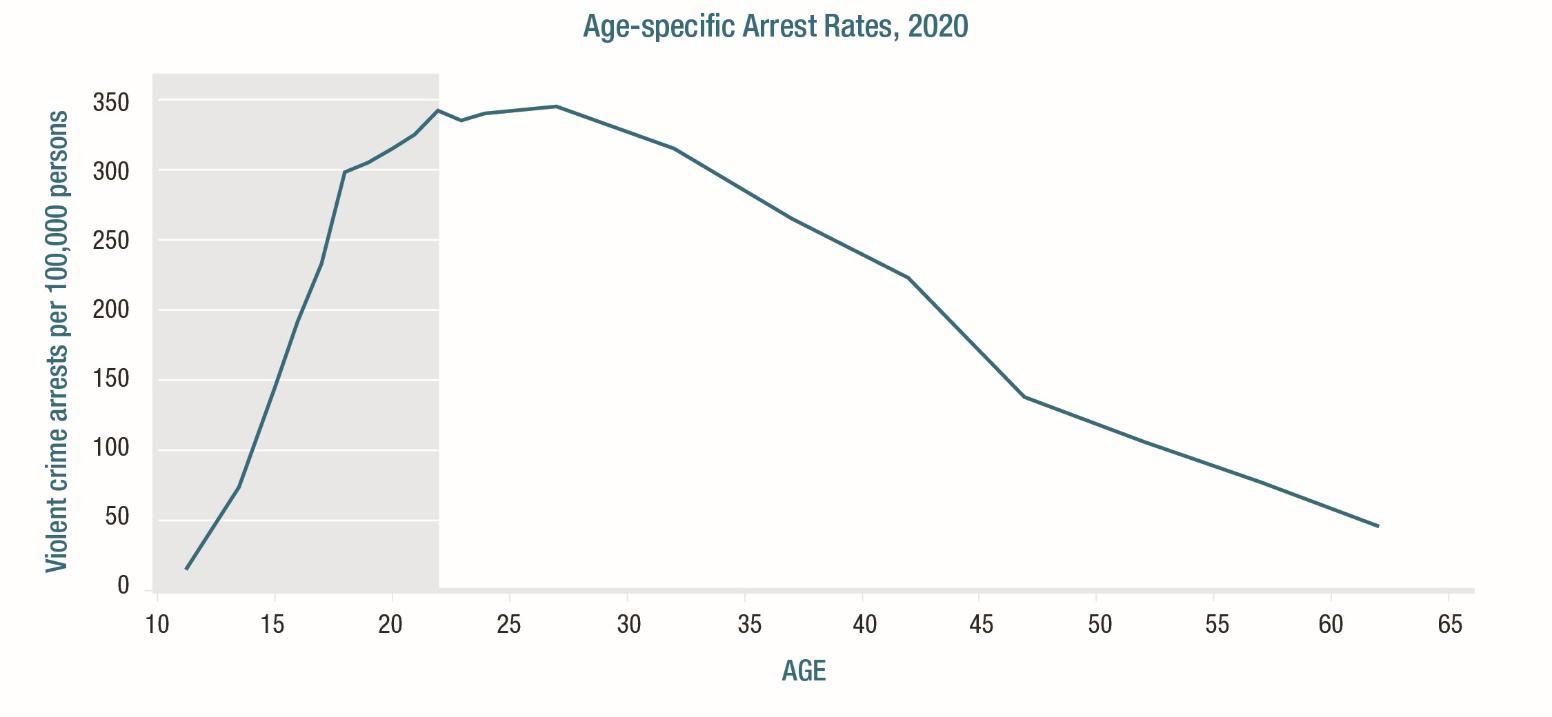
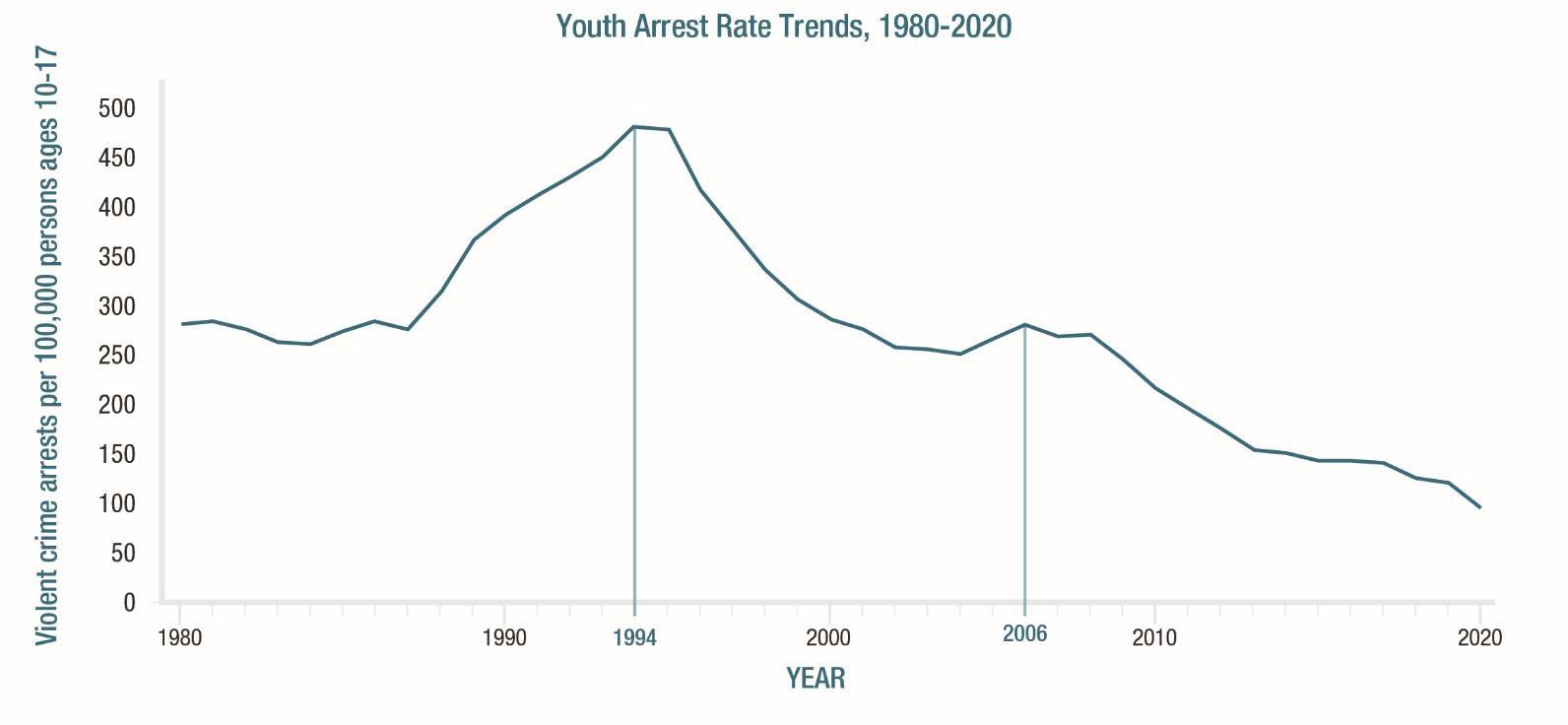
Research has consistently found the prevalence of offending increases during adolescence and subsequently declines, with most people eventually desisting from criminal behavior altogether.[3] For example, as illustrated in Exhibit 1, data from 2020 on age-specific rates shows arrests for violent offenses increased from ages 10 to 22, stabilized from ages 23 to 29, and then declined.[4] Reduced offending behaviors happen for most youths regardless of formal intervention. Research also suggests formal punishments, including incarceration, may disrupt youths’ psychosocial development and increase the risk of reoffending, dropping out of school, and involvement in the criminal justice system.[5]
3. Only a small percentage of youths are arrested for any crime – even fewer for violent crime.
Less than 1% of youths ages 0 to 17 were arrested for any offense in 2022, and less than a half of 1% were arrested for a violent offense.[6] Research has identified protective factors – individual, family, peer, school, and community – that can decrease
Exhibit 2: Youth arrest rate trends, 1980-2020
the likelihood of youth engaging in delinquent behaviors. These factors may protect youth directly – regardless of other factors – or indirectly by reducing the negative effects of adverse experiences. [7] Interventions can increase the presence and influence of protective factors and may prevent the onset or continuation of delinquent behaviors. For example, Early Developmental Prevention Programs for At-Risk Youths – which focus on enhancing child, parent-child, or family well-being – are rated effective by CrimeSolutions at reducing future deviance and criminal justice involvement. For youths who have engaged in delinquent behaviors, justice-system interventions that are based on a therapeutic intervention philosophy (e.g., counseling, skills building), focus on high-risk youths, and have high-quality implementation can be effective at reducing recidivism across all levels of system penetration.[8] For example, Multisystemic Therapy – which is a family- and community based treatment program targeting youths between the ages of 12 and 17 who present with serious antisocial and problem behavior and with serious criminal offenses – was rated effective by CrimeSolutions for reducing the number of rearrests and the number of days youths were incarcerated.
4.
4. Youth arrests for violent offenses have declined from a historic peak in the mid-1990s.
The estimated number of youth arrests for violent crime – which includes murder, robbery, and aggravated assault – declined 67% from 2006 to 2020. [9] By 2020, violent crime arrests involving youths reached a new low: 78% below the 1994 peak. More recent data from the FBI’s National Incident-Based Reporting System (NIBRS) indicate that youth arrests for violent crimes increased 17% between 2021 and 2022.[10] Nevertheless, trends show that both the number and rate of youth arrests for violent crime remain well below levels in the mid-1990s and the most recent uptick in youth arrests in the mid-2000s. The one-year increase in arrests should be viewed in this historical context and caution is warranted when predicting future patterns.[11]
5.
5. The youth contribution to violent crime arrests is less than that from other age groups, including young adults.
The youth proportion of violent crime arrests declined from the mid-1990s (19%)[12] through at least 2020 (7%).[13] Based on data from NIBRS, youths accounted for 9.4% and young adults ages 18 to 24
accounted for 19.9% of all arrests for violent crime in 2022.[14] The youth proportion of arrests and their arrest rates for violent crime varied by offense. For example, young adults were arrested at higher rates for murder and aggravated assault; however, older youths (ages 15 to 17) had higher rates for robbery and carjacking. The National Crime Victimization Survey (NCVS), sponsored by the Bureau of Justice Statistics (BJS), collects victims’ perceptions of the age of individuals who perpetrate offenses. In 2022, 9.3% of violent incidents were perpetrated by individuals perceived to be ages 12 to 17, which did not differ significantly from this age group’s share of the population. Nearly 60% of violent incidents were committed by someone perceived to be age 30 or older and 24% by those ages 18 to 29 – when the age was reported by the victim.[15]
Notes
[1] National Academy of Sciences, Engineering, and Medicine (NAS), The Promise of Adolescence: Realizing Opportunity for All Youth (Washington, DC: The National Academies Press, 2019).
[2] NAS, The Promise of Adolescence, 77-94.
[3] National Institute of Justice, Desistance from Crime: Implications for Research, Policy, and Practice, Washington, DC: U.S. Department of Justice, Office of Justice Programs, National Institute of Justice, November 2021, NCJ 301497.
[4] “Statistical Briefing Book: Law Enforcement & Youth Crime,” Office of Juvenile Justice and Delinquency Prevention, posted July 8, 2022.
[5] Development Services Group, Inc., Alternatives to Detention and Confinement, literature review (Washington, DC: U.S. Department of Justice, Office of Justice Programs, Office of Juvenile Justice and Delinquency Prevention, 2024 (forthcoming)); National Research Council, Reforming Juvenile Justice: A Developmental Approach (Washington, DC: The National Academies Press, 2012).
[6] Based on NIBRS arrest estimates available from the FBI’s Crime Data Explorer website.
[7] Development Services Group, Inc., Protective Factors Against Delinquency, literature review (Washington, DC: Office of Juvenile Justice and Delinquency Prevention, last updated December 2015).
[8] Lipsey, M. W. (2009). The Primary Factors that Characterize Effective Interventions with Juvenile Offenders: A Meta-Analytic Overview. Victims & Offenders, 4(2), 124–147.
[9] Charles Puzzanchera, Trends in Youth Arrests for Violent Crimes, Juvenile Justice Statistics National Report Series Fact Sheet (Washington, DC: U.S. Department of Justice, Office of Justice Programs, Office of Juvenile Justice and Delinquency Prevention, 2022).
[10] Arrest estimates post-2020 are not directly comparable to pre-2020 estimates due to the FBI’s transition from the Summary Reporting System (SRS) to the National Incident-Based Reporting System (NIBRS).
[11] Jeffrey A. Butts and Howard N. Snyder, Too Soon to Tell: Deciphering Recent Trends in Youth Violence, (Chicago, IL: Chapin Hall Center for Children at the University of Chicago, November 2006).
[12] Howard N. Snyder, Juvenile Justice Bulletin: Juvenile Arrests 1995 (Washington, DC: U.S. Department of Justice, Office of Justice Programs, Office of Juvenile Justice and Delinquency Prevention, February 1997), and Howard N. Snyder, Juvenile Justice Bulletin: Juvenile Arrests 1996 (Washington, DC: U.S. Department of Justice, Office of Justice Programs, Office of Juvenile Justice and Delinquency Prevention, November 1997).
[13] Charles Puzzanchera, Trends in Youth Arrests for Violent Crimes.
[14] Based on NIBRS arrest estimates available from the FBI’s Crime Data Explorer website.
[15] Alexandra Thompson and Susannah N. Tapp, Criminal Victimization, 2022 (Washington, DC: U.S. Department of Justice, Office of Justice Programs, Bureau of Justice Statistics, September 2023).
Reprinted with permission from The US Department of Justice, Office of Justice Programs, National Institute of Justice, July 30, 2024. https://nij.ojp.gov/ topics/articles/five-things-about-youth-and-delinquency#1-0
Recognizing, Reflecting On, and Addressing Your Bias
By William Thornburgh, Marie Manning, and Charis Ebikwo
A young student responded aggressively when his teacher asked where his pencil was, resulting in a room clear, and leading to the involvement of a resource officer. Upon closer analysis of the behavior, it became clear that the White female teacher held implicit biases toward students of color and had previously delivered covert verbal attacks known as microaggressions toward the student and his culture. As with anyone forced to endure this behavior from others, he could no longer take the assaults. When asked why the student became aggressive, the teacher had no clue. She was unaware of her implicit biases.
– adapted from Green and Nadelson, 2020
Daily lived experiences shape everyone. We are all influenced by interactions with others, through family, friends, religion, social media, and community cultures. We formulate opinions about people, places, and things we have encountered. Our opinions become personal preferences and biases. Whether positive or negative, teachers are expected to combat their personal biases to eliminate pre-judgment and prejudices that could lead to discrimination and inequity in the classroom. In this article, we will discuss how teachers can tackle biases head-on through recognition, identification, and reflection.
Recognizing Bias
Bias is the intentional or unintentional actions, attitudes, behaviors, or tendencies resulting in prejudice toward or against something or someone (e.g., Department of Education, 2024; Department of Justice, 2021). The most commonly recognized form of bias includes actions that are easy to identify. This form is known as explicit bias which occurs when individuals are consciously aware of their negative “prejudices and attitudes” toward other groups yet still act on them. Unwarranted explicit bias includes treating others differently, as in cases such as gender identity, sexual orientation, race, ability, ethnicity, religion, or socioeconomic status. Examples include the use of stereotypes, offensive jokes, avoidance behaviors, slurs, and/or insults. Teachers exhibiting explicit bias
Many teachers believe they are unbiased because they abstain from any intentional acts of discrimination or
stereotyping.
demonstrate overt behaviors through their words or actions. These comments or actions are blatantly mean-spirited, unfair, and outwardly discriminatory toward students.
Many teachers believe they are unbiased because they abstain from intentional acts of discrimination or stereotyping. However, there is a clear distinction between explicit and implicit bias. While explicit is overt and observable, implicit bias is hidden and exists within everyone. Rydners (2019) explained implicit bias as a way to help organize our day-to-day experiences as we interact with our surroundings. Implicit bias occurs when the brain needs to take a shortcut in the decision-making process by quickly sifting through patterns based on our social and cultural experiences (Cherry & Gans, 2020). Teachers who love math will be inclined to spend more time with students who show a high aptitude for math. Special educators may have a stronger connection with certain age groups or disability categories over other students. These judgments and shortcuts are embedded unconsciously in the brain. People are often not aware that implicit bias exists until something or someone triggers a thought, memory, or outcome (e.g., love or distaste for smells, pleasant or uncomfortable sounds, comments, or reactions from others). Subtle, covert words or actions resulting from this type of bias can be just as impactful. As explained by Green and Nadelson (2020), teachers are often unaware of the impact of biases until it is too late.
Classroom bias and the misrepresentation of minorities continue to be problematic. Just looking at demographics, it is easy to see how unrecognized
bias can influence perspectives. Regarding gender, males are more likely to get into trouble at school than females. Racial differences play a role in how students communicate with teachers (e.g. some cultures avoid eye contact with authority). Girls are less likely to excel at science and mathematics compared to boys. Stereotyping or bias can impact teacher perspectives including student behavior, interaction with others, and academic performance. Recognizing and identifying implicit biases is critical to ensure a more positive learning environment.
Identifying Individual Biases
There are several ways for teachers to identify their individual biases. Though controversial, Harvard University’s Project Implicit (Take a Test, 2011) includes 18 implicit association tests (IATs), which measure levels of implicit association. The tests address topics such as race, age, weight, disability, sexuality, and religion (see Figure 1). These IATs represent a simple starting point to assist teachers in becoming consciously aware of their unconscious associations. Secondly, teachers can seek out peer-reviewed journals or actively participate in book clubs that discuss diversity, equity, and inclusion (DEI) topics. The Journal of Diversity in Higher Education offers free articles and many higher
Religion IAT
Disability IAT
education institutions have resources for becoming more inclusive (e.g. University of Michigan, University of Chicago, University of Southern California). Popular books include topics that address white fragility while building authentic relationships, ideas to recognize, understand, and challenge biases, a historical context on the role of discrimination and privilege in shaping societies, and guiding readers in creating equitable spaces as a result of empathy and active allyship. Attending professional conferences or trainings that discuss topics of DEI is equally important. One way to do this is to connect with organizations that offer online professional development opportunities that promote personal growth. The Equity Literacy Institute (2023) is one organization that offers several modules to address the most subtle biases and inequities designed to improve teacher reflection of their classroom and school climate (see Figure 2). Lastly, and most importantly, teachers can establish connections with people who come from diverse groups and engage in open discussion. DEI topics that address unconscious beliefs can be uncomfortable, but if we fail to be genuine in our interactions with others, we miss out on real learning opportunities. Each of these options introduces new terms, ideas, and perspectives to identify any potential biases.
Religion ('Religions' IAT). In this IAT, you will be asked to categorize images or words culturally associated with Jewish people, Christian people and Muslim people as well as positive and negative words.
Disability ('Physically Disabled – Physically Abled' IAT). In this IAT, you will be asked to categorize figures representing physically disabled people and physically abled people as well as positive and negative words.
Figure 1: Examples of Implicit Association Tests
Chapter 1 Introduction to the Course
Chapter 2 Introducing "Equity Literacy"
Chapter 3 Eleven Dimensions of Equity Literacy
Chapter 4 Five Abilities of Equity Literacy
Chapter 5 Guiding Principles of Equity Literacy
Chapter 6 A Few Recommended Resources
Figure 2: The Equity Literacy Institute Free Professional Development Course
Reflecting on Individual Biases
Once teachers identify implicit biases that were once unnoticed, or not fully accepted, it is time to reflect on the thought processes that impact attitudes and behaviors toward students in the classroom. Devine and colleagues (2012) stated that conscious awareness was paramount in countering implicit bias. Begin by evaluating personal history and past experiences - what occurred that may have shaped opinions and ideas about people and things? Next, seek out opportunities to build relationships. These relationships allow us to gain firsthand knowledge and experiences from others. Realizing that preconceived notions or stereotypes once held are not accurate is an eye-opening experience. Finally, carefully reflect on the classroom. Inquiry questions that address bias include:
• In what ways is the classroom environment welcoming to all students?
• Which instructional strategies will reach all learners?
• How are the formative and summative assessments constructed to ensure they are equitable and free of bias?
• How can classroom management strategies be tailored to ensure the fair and consistent implementation of rules and procedures?
Some practical ideas might include: lighting preferences, classroom organization, and seating config-
uration. Other considerations include visual representations of various family structures, cultures, and languages within the classroom environment and curriculum selection.
Biases consistently govern our decision-making processes and influence judgment calls. Common blind spots occur when teachers believe they are less biased than others. Blind spots caused by implicit bias can negatively impact this process. Is it possible that the teacher mentioned in our introductory scenario had blind spots that developed into microaggressions? When teachers develop expectations for students based on cultural, academic, or behavioral experiences, blind spots can occur. Just because a student only speaks Spanish in an English-speaking classroom, does not mean they will not excel in a creative writing class. Equally, just because a student has a meltdown in response to microaggressions from others, doesn’t mean he has a behavior problem. When teachers can recognize blind spots, they can then reflect on them and recognize how they affect students. Self-reflection is critical for teachers to recognize blind spots. The result will be a safer classroom environment, a teacher who treats individual students fairly, and students who feel valued and accepted. Identifying biases leads to opportunities to address needed changes.
Addressing Individual Bias
It is only after identifying bias we can begin the process of addressing change by using effective bias-reduction strategies. Strategies include:
• creating a classroom space where all students feel welcomed, valued, and safe (e.g. books, colors, posters);
• providing all students with an opportunity to have a voice and find usefulness in their contributions;
• choosing words wisely and thinking about the impact on students;
• evaluating thoughts, beliefs, and actions to identify biases; and
• seeking out professional development and new experiences to rewire thought processes.
Teacher Strategy
Set clear expectations
Model appropriate behavior
Use positive reinforcement
Our Top 10 List of Strategies
How to Implement Impact on Bias
Establish rules and procedures in the first days of school
Demonstrate how to follow rules and procedures
Acknowledge and praise all students when they follow rules and procedures correctly
Establish consequences Clearly communicate consequences for breaking rules and not following classroom procedures and be consistent
Practice fairness and be equitable
Conduct reviews of rules and procedures
Provide individualized support for students in need
Be flexible when needed
Involve parents in classroom happenings
Reflect and adjust strategies throughout the year based on needs or effectiveness
Avoid showing favoritism or bias and ensure that consequences are applied fairly regardless of students’ backgrounds
Periodically remind students to ensure they remember classroom expectations. Check to make sure they still Fit into your class or school culture
Provide guidance, set up a behavior plan that is attainable a d realistic or provide additional resources
Adjust rules or consequences when called for by individual circumstances
Keep parents informed about rules, procedures, behaviors, and progress for reinforcement
Be reflective about the rules, procedures, and how students are doing, plus gather feedback from students or colleagues
Talk to other stakeholders such as students, parents, colleagues, and community members to develop a set of strategies unique to your school culture and diverse needs. Then, create a personal or school-based “Top 10” list of specific strategies to help you and other teachers establish connections, be consistent, reduce bias, and promote equity in the classroom.
When addressing bias, make efforts to reframe negative stereotypes. One effective strategy involved considering counter-stereotypic examples (Devine et al., 2012). Teachers who praise a female student in math and science or recognize a student with a behavior disorder for his/her strong leadership skills
Students will understand expectations for behavior and responsibilities
Students will recognize and emulate appropriate behaviors
Students will be more inclined to do the right thing and feel appreciated
Students will know what to expect and feel that they have been treated fairly
Students will notice fair treatment and respect the teacher and the teacher’s decisions
Reminders will help students remember rules and reduce behavioral issues
Plans will help keep students and teachers on track and exhibit desired behaviors
Students will have appreciation for the flexibility when implementl6 fairly wi5h clear boundary expectations
When students know there is an open line of communication, it is easier to address behaviors when they arise
Students will feel valued when they have a voice in classroom policies
are both examples of counter-stereotypical strategies. This approach facilitates the establishment of positive associations and shifts prevailing mental schemas. Another valuable technique identified is perspective-taking (Galinsky & Moskowitz, 2000), which directly confronts implicit biases. The adage that stresses empathizing with others’ perspectives remains relevant, particularly in addressing bias. Furthermore, fostering and nurturing empathy may effectively reduce implicit biases and lead to positive shifts in how individuals respond to others (Whitford & Emerson, 2019). Promptly interrupting automatic biased thoughts is also effective. For instance, adopting the use of a rubric helps teachers reduce
emotional responses and improve grading practices by keeping their biases in check when behavioral or social factors could influence decision-making. It is important to be mindful and attempt to control implicit bias before acting. Finally, seeking professional and personal continuing education is crucial. This could involve professional development (PD) programs delivered to faculty at schools, attending conferences, or participating in voluntary in-person or virtual PD sessions.
Connecting Teacher Bias and Student Behavior
Implicit biases are especially common for teachers working with students with behavioral issues as they must make quick daily judgment calls. Implicit biases begin percolating from the minute a student is considered for referral in special education, driving placement decisions, and changing the trajectory for student educational outcomes. Rydners (2019) explained how implicit racial bias can lead to different referral outcomes for Black versus White students. Special education placement referrals may be initiated for underrepresented groups whereas the same behavior by White peers may not result in the same outcome. Commonly, Black students are more likely to be blamed for their problematic classroom behaviors. Such behaviors are often attributed to a lack of interest in school and a disrespect for authority. Meanwhile, their White counterparts are often given the benefit of the doubt that they may just be having a bad day while exhibiting the same behaviors (Levitt, 2023).
Teachers may possess implicit biases regarding behavioral issues that affect their students’ educational outcomes. It is not uncommon for teachers to view Attention Deficit Hyperactive Disorder (ADHD) and other behavioral disorders as attention-grabbing tactics, laziness, or a lack of motivation. Teachers may even view the parents of these children with behavior disorders as “bad” parents or incompetent with discipline at home. Cooper (2024) outlined four categories of teacher bias: biases about rewards, biases impacting accommodations, biases concern-
Just because a student has a meltdown in response to microaggressions from others doesn't mean he has a behavior problem.
ing ability levels, and biases that influence beliefs on behavior. These biases lead to actions that negatively impact students. Cooper noted that some teachers are reluctant to provide positive reinforcement to students in special education. Other teachers do not believe that certain students with behavioral issues are truly in need of special assistance and accommodations, and fail to follow steps on individualized education plans. Lastly, some teachers believe that students with behavioral issues will not improve. These teachers may not put in the effort required to nurture students’ growth and learning. Student behaviors may be misinterpreted and mislabeled, which can lead to teachers acting in ways that negatively impact students. Responsible teachers who care about the welfare of students will identify, reflect on, and address any biases.
Conclusion
Knowing that implicit biases are real, that we all have them, and that they can have negative consequences on students, our job is simple - we must work to reduce and eliminate them! This begins with the recognition of bias in action and the identification of biases that we individually possess. For the sake of becoming a better teacher and establishing a more equitable classroom where students can thrive, teachers must work to create a bias-free classroom. We provided our list of strategies as a guide, now it is your turn to develop a Top 10 list that works for you!
While identifying biases that have developed over time as a result of interactions with people and social media, teachers can reflect on their own
words and actions. Engaging in strategies such as learning more about one’s implicit bias, reading more about DEI, taking part in various professional development opportunities, and expanding to more interactions with others from diverse backgrounds is key. Engaging in shared learning experiences with your students both inside and outside the classroom can help overcome such biases. Once teachers are consciously aware of biases, they can implement strategies to address them. This can be accomplished personally, by thinking about prior life experiences and personal relationships. Professionally teachers should reflect on the classroom atmosphere and evaluate whether equitable practices are in use while teaching or assessing students. Through other strategies like reframing, perspective-taking, empathy-building, and interrupting biased thoughts, teachers will experience personal growth and build more positive relationships with students.
Of course, this is important because teacher actions or reactions toward or against certain groups in the classroom have a direct influence on learning outcomes. These practices are especially important for eliminating bias and will result in changes to teachers’ perceptions of behavioral issues in the classroom. There will be a positive impact on the policies and procedures created and how they are applied. Also, teachers will have a renewed outlook on students, referrals for students from underrepresented groups will decrease, and all students will feel more valued.
References
Cherry, K. & Gans, S. (2020). How does implicit bias influence behavior? Explanations and impacts of unconscious bias.
Cooper, T. (2024, April 15). It’s time to address teacher bias against special education students. The Educators Room.
Devine, P. G., Forscher, P. S., Austin, A. J., & Cox, W. T. (2012). Long-term reduction in implicit race bias: A prejudice habit-breaking intervention. Journal of Experimental Social Psychology, 48(6), 1267–1278.
Galinsky, A. D., & Moskowitz, G. B. (2000). Perspective-taking: decreasing stereotype expression, stereotype accessibility, and in-group favoritism. Journal of Personality and Social Psychology, 78(4), 708–724.
Levitt, A. (2023, December 14). Teachers see misbehavior from black students as more blameworthy. Yale Insights.
Rydners, D. (2019). Battling implicit bias in the IDEA to advocate for African American students with disabilities. Touro Law Review, 35(1).
Take a Test. Project Implicit. (2011).
Whitford, D. K., and Emerson, A. M. (2019). Empathy intervention to reduce implicit bias in pre-service teachers. Psychological Reports, 122(2), 670-688.
The Equity Literacy Institute (2023). Home page:
William Thornburgh, Assistant Professor, William. thornburgh@eku.edu, Marie Manning, Associate Professor, marie.manning@eku.edu, and Charis Ebikwo, Student, charis_ebikwo@mymail.eku.edu, Eastern Kentucky University, Richmond.
By Lawrence J. Altman and Katherine A. Graves
The Cybersecurity and Infrastructure Security Agency (CISA) and the United States Secret Service (2023) published a K-12 Bystander Reporting Toolkit designed to help encourage bystanders in grades K through 12 to report their concerns for the wellness and safety of themselves or others to those who have the job of intervening and preventing prospective harm. Reporting programs should be designed to provide students and other community members with a reliable way to seek help and report concerns regarding student wellness or safety. Schools need to foster a safe and nurturing environment where students feel empowered to voice their concerns and be heard. This Toolkit is the latest effort in the CISA and Secret Service’s shared school safety mission. The Toolkit presents a set of steps for district and school teams to begin their school safety journey.
Step One: Establish a Behavioral Threat Assessment Unit (i.e.,
a threat assessment team)
The threat assessment team must prioritize assessment and management of risk as its primary objective rather than criminal prosecution. This requires members of the unit to adopt a prevention mindset requiring all members of the unit to buy into this mindset.
Step Two: Create Operational Protocols and Procedures
This will require administrators to establish standard operating procedures, implement a centralized case administration process, and develop standardized reporting forms.
Step Three: Identify and Process Reports Concerning Behaviors
The team will be responsible for reviewing all reports. This may involve a triage and immediate responses to imminent threats of life. The triage is helpful for all team members to be involved so that they can share all relevant information about the situation or student(s). A decision needs to be made about each report if the situation requires action
by the assessment team. If it is determined that the report requires action, the team should initiate an assessment of the risk.
Step Four: Gather Information to Assess the Risk
Conduct a preliminary inquiry to determine the scope of the risk. At this stage the team should: interview the individual of concern, interview the reporting party or parties, corroborate the information gathered from the interviews, review any documentation available, including but not limited to online activities, and consider and assess all available information to answer one question. Does the individual of concern pose a risk of violence at this time? If the answer is “no” the process ends here.
Step Five: Develop Risk Management Strategies
If the answer is “yes” to the question posed above, then the assessment team should do the following:
• Address the factors of concern expressed by the individual of concern.
• Redirect potential motives for the violence and promote positive factors instead.
• Create a situation less prone to violence.
• Utilize the system the team created for management of risk with the goal to de-escalate the risk and improve safety for the individual and those who might interact with the individual.
The five steps above ensure school or district level teams have the infrastructure to receive, evalu-
ate, and intervene, if necessary, when/if someone makes a school safety report. Below, five more strategies are summarized from the Secret Service Report to strengthen the likelihood of reporting. Too many times a crisis situation occurs, and there is someone, somewhere who had information about it before it occurred.
Five Key Strategies to Strengthen Reporting
1. Encourage bystanders to report concerns for the wellness and safety of themselves or others.
• Bystanders should be encouraged to report threats of school violence and issues that include incidents of bullying, drug use, self-harm, suicidal ideations, and depression.
2. Make reporting accessible and safe for the reporting community.
• Prioritize the privacy of bystanders and those who are subjects of the reports.
• Reduce what is referred to as bystander hesitancy, ensure anonymity, and confidentiality of reporters.
• Offer multiple reporting avenues and remove barriers to reporting.
• Train analysts who receive reports to help bystanders feel more trusting when they make their reports.
3. Follow up on reports and be transparent about the actions taken in response to reported concerns.
• Make timely responses to all reports.
• Use clear communication to reduce uncertainty about the reporting process.
• Promote fairness and appropriate outcomes by assessing reports on observed behaviors rather than traits or profiles of students.
• Share data publicly that shows the impact of the reporting program.
The starting point for any school safety effort that seeks to encourage and facilitate reporting of threatening and other concerning behaviors should be an accurate assessment of the strength of your school or district's reporting culture. Think about the following questions:
Are you concerned that, if a member of the school community became aware of a concerning or threatening behavior, they: would not be aware that they should report that information? would not know how to report the information? would not report the information?
Are you concerned that, if a member of the school community attempted to report information about concerning or threatening behavior, the information would not make it to the appropriate people and agencies required to act rapidly on that information?
3 Does your school culture and relationships that students have with teachers, administrators, and other staff create barriers to reporting concerns to school safety?
4 Has there ever been a safety-rellated incident at your school or district in which it became clear after the incident that students or others had prior knowledge of that indicent, but did not report it?
If you answered "yes" to any of the above questions, there are likely opportunities to strengthen your school or district's approach to reporting in a way that better anticipates and responds to school safety concerns.
Figure 1: Assessing Reporting Culture
STATE PROOGRAM NAME
Colorado Safe2Tell Colorado
Florida FortifyFL
Georgia School Safety Hotline
Idaho See Tell Now!
Illinois Safe2Help Illinois
Iowa Safe + Sound Iowa
STATE PROGRAM NAME
Nebraska Safe2Tell Nebraska
Nevada Safe Voice Nevada
North Carolina Say Something Anonymous Reporting System
Ohio Safer Ohio School Tip Line
Oklahoma Oklahoma School Security Institute Tipline
Oregon SafeOregon
Kansas School Safety Hotline Pennsylvania Safe2Say PA
Kentucky Safety Tipline Online Prevention (STOP) and Kentucky Safe Schools
Tennessee SafeTN
Louisiana Safe Schools Louisiana Texas iWatchTexas School Safety
• Create effective promotional materials throughout the year to remind everyone of the resources available and the importance of reporting.
• Make reporting programs part of the positive school climate.
5. Create a positive climate where reporting is valued and respected.
• Help students view adults in the school, including school-based law enforcement and school resource officers, as trusted individuals.
• The goal for all schools is to create a climate where people of all backgrounds feel secure, important, and valued.
Protecting Bystanders from Retaliation
What was not discussed in the Toolkit was the impact that fear of retaliation has upon those who want to
report but are afraid to do so. The Department of Education (DOE) and Office of Civil Rights (OCR) define retaliation as intimidation, threats, coercion, or other adverse actions that would deter a reasonable person from exercising rights protected under the laws enforced by the OCR. It is illegal to retaliate against any individual, including bystanders, who are involved with violations of all Federal Civil Rights Laws. Additionally, the DOE and the OCR published an updated guide discussing protections from retaliation (DOE & OCR, 2024). To prove a claim of retaliation, the OCR investigates if:
• The complainant engaged in a protected activity.
• The complainant suffered an adverse action contemporaneous with or within a reasonable amount of time after the protected activity.
• The school district was aware of the complainant’s protected activity.
• There is evidence of a causal connection between the protected activity and the adverse action.
The DOE and Department of Justice (DOJ) have opined that the ability to oppose discriminatory practices is critical in ensuring that equal opportunities are made available to all under all Civil Rights Laws. The Secret Service has made clear that bystander reporting is the cornerstone of targeted violence protection; therefore, protecting bystanders from retaliation is vital. The DOE and DOJ have therefore urged schools and employers to make bystanders feel confident they can report safety concerns without fear of retaliation
In its continuing effort to improve school safety, the Secret Service continues to work to publish more information and guidance to help children feel safe while attending school. When school administrators encourage students and staff who “see something, say something,” it helps those in charge take proper prompt action and lessen the danger that may be created if the situation was ignored. Finally, the Secret Service continues to advocate using a Threat Assessment Model which emphasizes encouraging bystanders to report their concerns to school administrators.
References
United States Department of Homeland Security Cybersecurity and Infrastructure Security Agency and the United States Secret Service (2023). K-12 Bystander Reporting Toolkit.
United States Department of Education & Office for Civil Rights (2013). Dear Colleague Letter.
United States Department of Education & Office for Civil Rights (2024). Civil Rights Protections Against Retaliation: A Resource Guide for School Communities
United States Secret Service Podcast (2024). Behavioral Threat Assessment Units: A Guide for State and Local Law Enforcement to Prevent Targeted Violence.
Lawrence J. Altman, Adjunct Professor, Avila University, and Retired Lead Compliance Officer, Special Education, Kansas City Missouri Public Schools. ljalaw@sbcglobal.net
Katherine A. Graves, Assistant Professor, Special Education and Rehabilitation Counseling, Utah State University, Logan, katherine.graves@usu.edu
STRATEGIES
Teacher-Delivered Behavioral Interventions
Practice Guide for K-5 Educators
By Lindsey G. Mirielli and Sandy Shacklady-White
In December 2024, the Institute of Education Science (IES) and the National Center for Education Evaluation and Regional Assistance (NCEE) released a new publication through the What Works Clearinghouse (WWC): Teacher-Delivered Behavioral Interventions in Grades K-5: A Practice Guide for Educators. The guide offers seven low-intensity behavioral recommendations for implementation in
elementary school classrooms that have been rated as either Tier 1 (e.g., delivered to all students) with Strong Evidence or Tier 2 (e.g., small group) with Moderate Evidence. The recommendations are:
1. Co-establish, model, and teach clear expectations for student behavior consistent with schoolwide expectations.
2. Remind students to engage in expected behaviors.
3. Acknowledge students for demonstrating expected behaviors through positive attention, praise, and rewards.
4. Offer instructional choices to students to increase engagement and agency.
5. Provide students frequent and varying opportunities to respond to and engage in activities.
6. Teach students to monitor and reflect on their own behavior.
7. Use behavior ratings to provide feedback to students.
For each the guide provides a detailed overview to support teacher implementation including -
• Recommendation Overview and Guidance –provides implementation steps and guidance, summarizes supporting research, describes connection to student learning
Each Recommendation Overview section offers details and examples to guide the educator along with the research behind the recommendation.
• Potential Obstacles – provides advice for common obstacles experienced with the intervention
• Tools and Resources – provides multiple examples, models, and resources for each implementation step
Each Recommendation Overview section offers details and examples to guide the educator along with the research behind the recommendation. The Potential Obstacles section lists common barriers found in classrooms and provides advice to possibly overcome them.
Links to three documents are posted on the WWC website providing access to guidance information, each having a certain level of depth.
• The Introduction document provides an overview of the seven recommendations.
• The Summary document is 26 pages long and focuses primarily on how to implement strategies/steps pertaining to each recommendation.
• The Full Guide is 166 pages and includes all detailed information on research, implementation procedures, and common obstacles.
To learn about the development of the Practice Guide, the webpage has two tabs: Details and Panel. Additional information available includes who the intended audience is, who was on the panel, the studies on which the recommendations are based, and the protocol used.
Where can I read more?
The Practice Guide, related documents, and more information can be accessed at this link.
Teacher-Delivered Behavioral Interventions in Grades K-5: A Practice Guide for Educators
Who are these agencies?
The Institute for Educational Sciences (IES) is an agency within the U.S. Department of Education that provides research, evaluation, and statistics to help improve educational outcomes.
The National Center for Education Evaluation and Regional Assistance (NCEE) is a center within IES that designs and supports evaluation studies on the effectiveness of education programs and practices.
What Works Clearinghouse (WWC) is within NCEE and IES. WWC is made up of hundreds of reviewers who review the research, determine which studies meet rigorous research standards, and summarize the findings. WWC provides a database of research evidence on educational programs and practices.
What is “strong evidence” and “moderate evidence”?
Strong evidence means research has linked the practice with positive results while ruling out other possible explanations for those results. This indicates the research showed the practice caused positive results.
Moderate evidence means research has linked the practice to positive results, but didn’t rule out other possible explanations. This indicates more research needs to be done for the intervention to gather further evidence.
Lindsey G. Mirielli, Researcher, Juniper Gardens Children’s Project, University of Kansas, lmirielli@ku.edu and Sandy Shacklady-White, Consultant, Pennsylvania Training and Technical Assistance Network (PaTTAN), sshackladywhite@pattankop.net
The US Supreme Court and Special Education, 2023 and 2024
By Mitchell L. Yell
Photograph
The U.S. Supreme Court is the highest court in the land. Rulings from the Supreme Court create precedent throughout the US and its territories (e.g., Guam, Puerto Rico). This means that the Supreme Court’s rulings must be followed by all lower courts (and hearing officers) in the US judicial system. In the 2023 term, the Supreme Court issued a ruling in a special education case: Perez v. Sturgis Public Schools. Although the Supreme Court did not hear a special education case in the 2024 term, it did issue a ruling in a case that could have implications for special education: Loper Bright Enterprises v. Raimondo. In this report, I will briefly examine both cases and the potential effects on special education.
Perez v. Sturgis Public Schools
On March 21, 2023, the US Supreme Court issued its ruling in Perez v. Sturgis Public Schools (hereinafter Perez). In this case, the Supreme Court considered whether families that have settled claims under the Individuals with Disabilities Education Act (IDEA) can pursue lawsuits seeking damages under the Americans with Disabilities Act (ADA) without fully exhausting all administrative proceedings under the IDEA. What is especially important about this case is that it involved parents seeking monetary damages for violations of the IDEA. Prior to this decision, courts had slammed the door shut on monetary damages under the IDEA and also held that, in most circumstances, parents or guardians had to go through the IDEA’s due process hearings (called administrative proceedings), before bringing a lawsuit to the federal courts. This ruling will likely result in changes to both of these precedents.
In this case, the plaintiffs, the family of Miguel Perez, sought monetary damages under the ADA for a violation of the IDEA’s free appropriate public education (FAPE) requirement because the school district failed to provide interpreter services in denial of the student’s right to a FAPE.
Miguel Perez is a deaf student who attended the Sturgis public schools in Michigan. When he was nine years old, he and his family emigrated from Mexico
and moved to Sturgis, Michigan. In the 12 years Miguel was educated in the Sturgis Public Schools, the district failed to provide him with a qualified sign language interpreter. During this time, the family assumed that Miguel was on track to earn a high school diploma because he had received As and Bs in most of his classes and always made the school’s honor roll. A few months before graduation, however, Miguel’s parents were told that he would receive a certificate of completion instead of a regular diploma.
Miguel’s parents filed a due process hearing request with the Michigan Department of Education alleging that the Sturgis public schools had failed to provide Miguel with a FAPE under the IDEA. Before a due process hearing could be held, Miguel’s parents and school district settled the claim. As part of the settlement, the school agreed to pay: for Miguel to attend the Michigan School for the Deaf, for post-secondary compensatory education; for Miguel to receive sign language instruction for Miguel and his family; and the attorney’s fees accrued by the Perez family. The Perez family also agreed to dismiss the case against the Sturgis school district and would not bring another claim under IDEA. The administrative law judge (ALJ) dismissed the case.
The Perez family then filed a lawsuit in the US District Court against the Sturgis Public Schools under the ADA. The parents alleged that Sturgis Public Schools discriminated against Miguel by not providing the resources necessary for him to fully participate in class. As part of the settlement, the Perez family sought monetary damages for the school district’s failure.
The attorneys for the school district argued that before parents could file a claim under the ADA, they had to exhaust their administrative remedies under the IDEA. The district attorneys further asserted that Miguel’s parents had not exhausted the administrative procedures because they settled before the due process hearing was completed, so the lawsuit was barred. The federal district court agreed with the school district and dismissed the ADA claim because
the family had failed to exhaust their administrative procedures. The Perez family appealed the decision arguing that pursuing the administrative remedies would have been futile because the administrative process would not lead to monetary damages. The US Court of Appeals for the 6th Circuit ruled for the school district and denied the Perez family’s ADA claim, ruling that by taking the settlement, Miguel Perez had not fully exhausted his options under IDEA. In other words, the district and appellate courts held that despite the district basically admitted they had failed in Miguel’s special education and had agreed to settle the case before the due process hearing was complete, Miguel’s parents could not prevail in a lawsuit because they didn’t go through the entire due process procedure.
The Perez ruling may lead to more lawsuits in federal courts where parents are seeking monetary damages.
Miguel’s parents filed an appeal with the US Supreme Court arguing that the ruling of the 6th Circuit Court meant that by requiring that plaintiffs go through the entire due process procedure before suing school districts for damages, the lower courts were requiring that students with disabilities had to turn down even full IDEA settlements and forgo the ability of their child to immediately receive a FAPE in order to preserve their non-IDEA claims. The Supreme Court heard oral arguments in the case on January 18 and issued their ruling on March 21, 2023. In a unanimous ruling, the High Court held that lawsuits brought under the ADA seeking damages for the denial of a FAPE may proceed without exhausting the administrative processes of IDEA because the remedy sought, punitive damages, is not a remedy that the IDEA provides. This means
that plaintiffs can go to court for non-IDEA claims for monetary damages on behalf of students who are IDEA-eligible and that parents do not need to exhaust the administrative remedies when they go to court for monetary damages.
The Perez ruling is primarily about special education litigation and will have no direct effect on special education teachers. However, the IEPs that are developed and implemented in schools are often the topic of hearings and lawsuit. This ruling may lead to more lawsuits in federal courts where parents are seeking monetary damages. Nevertheless, the bar for winning monetary damages under the ADA and Section 504 for violations of the IDEA is very high. Additionally, teachers and administrators are very unlikely to be sued and any potential liability will most likely rest with the school district.
Information on the Perez case, including amicus (i.e., friend of the Court) briefs by various parties and the US Solicitor General’s official position on the case, and the briefs by Miquel Perez and the Sturgis Public Schools, and can be found on the excellent SCOTUSblog website at https://www.scotusblog.com/casefiles/cases/perez-v-sturgis-public-schools/. To hear the oral arguments in the Perez case, go to Oyez.com at https://www.oyez.org/cases/2022/21-887.
Lopez Bright Enterprises v. Raimondo (2024)
Occasionally court cases outside of education may have implications for education, especially if the ruling is from the US Supreme Court. This happened with a 2024 Supreme Court ruling in Lopez Bright Enterprises v. Raimondo (hereinafter Loper). The Loper case was decided in a 6 to 3 ruling that overruled a Supreme Court precedent from 1984 called the Chevron doctrine. According to the Chevron doctrine, if a statute (i.e., a law passed by Congress and signed by the President) is not clear or is silent on a particular issue, courts must defer to the regulations written by an administrative agency (e.g., the US Department of Education) if the regulation was based on a reasonable interpretation of the statute.
In Loper, the Supreme Court overturned the Chevron doctrine, writing that whereas courts may certainly consider the expertise of the administrative agency, they do not have to defer to it. Thus, if a statute is silent or not clear, courts are to make independent judgments.
This Supreme Court ruling could curtail the ability of federal agencies to interpret the laws they administer and it empowers the courts to interpret ambiguous statutes. This decision may have effects on areas like environmental regulations and healthcare that have laws that tend to be ambiguous and are more likely to be interpreted by the federal agencies.
In the IDEA, Congress gave the US Department of Education power to write regulations implementing the law, only prohibiting the Department from writing regulations that lessened the law’s protections for students with (20 U.S.C. § 1406[b]). The regulations of the IDEA seldom go beyond the statute, and most components (e.g., FAPE, discipline) have been litigated by the courts. The IDEA, therefore, is not as likely to be affected by the Loper ruling.
Two areas of special education law that may be vulnerable to being challenged under the Loper ruling, however, are state complaints and independent education evaluations (IEEs) at public expense, which
have been primarily created by federal regulation. Additionally, the U.S. Department of Education’s regulations of Section 504 could be vulnerable to a challenge under the Loper ruling. Only time, and further court cases, will tell.
Readers should know that new regulations to Section 504 will likely not be released for public comment anytime soon. The US Office Management and Budget’s Office of Information and Regulatory Affairs issued the Unified Agenda of Regulatory and Deregulatory Activities, which predicted that the Section 504 regulations may be available in November, 2024, though this may be doubtful because this is an election year.
The Loper case, which was heard by the US Supreme Court, did not involve special education. Nonetheless, it may have some effect on special education regulations, but it will not directly affect special education teachers.
Information on the Loper case, including a number of amicus briefs and the US Solicitor General’s official position on the case, and the briefs by Loper Bright Enterprises and Gina Raimondo, are also available on the SCOTUSblog website at https://www.scotusblog. com/case-files/cases/loper-bright-enterprises-v-raimondo/. Oral arguments before the Supreme Court in this case can also be heard at the Oyez.com at https://www.oyez.org/cases/2023/22-451
References
Individuals with Disabilities Education Act (IDEA), 20 U.S.C. § 1400 et seq.
Loper Bright Enterprises v. Raimondo, 603 U.S. __ (2024).
Office of Management and Budget, Spring 2024 Unified Agenda of Regulatory and Deregulatory Actions.
Perez v. Sturgis Public Schools, 598 U.S. __ (2023).
Mitchell L. Yell, Palmetto Chair in Teacher Education, University of South Carolina, Columbia, MYELL@sc.edu
Podcast
The Telepathy Tapes Podcast: Connections that Exist Beyond Words
Review by Janet Burgess
Is Telepathy in Non-Verbal Individuals with Autism Real, Wishful Thinking, or Psudoscience?
The Telepathy Tapes podcast offers a captivating and thought-provoking exploration of telepathy, non-verbal communication, and the untapped potential of human connection. On the other hand, the podcast has been accused of playing on the natural desire for meaningful connection with non-verbal people by propogating unsubstantiated theories which have no scientific evidence or which have been scientifically disproven.
Podcast host, Ky Dickens, joined by a team of inquisitive and compassionate individuals including neuroscientist Dr. Diane Hennacy Powell, delves into the intersection of paranormal phenomena, neurodiversity, and the human mind. One of its most unique aspects is its dedicated focus on non-verbal individuals with autism, and how their experiences may provide insights into alternative forms of communication, including telepathy.
This podcast series merges two distinct areasparanormal communication and neurodivergent experiences. One episode may feature an expert discussing the potential neurological mechanisms behind telepathic communication, while another highlights real-life stories of non-verbal individuals seeming to “telepathically” communicate with their families and caregivers. This combination of personal experiences and scientific inquiry challenges listeners to rethink their perceptions of communications and the mind’s vast potential.
The tone of this podcast series is warm, thought-
ful, and inclusive. The treatment of autism and non-verbal communication is particularly sensitive and respectful. The discussions are not sensationalized and are always framed with a sense of care for the individuals involved. This podcast would appeal to those interested in the paranormal and those seeking a deeper understanding of neurodiversity. The inclusion of non-verbal individuals with autism as a key theme is both timely and essential, as it challenges conventional ideas of communication. The podcast raises intriguing questions:
• Could telepathy be a form of communication that some non-verbal individuals are more attuned to?
• Are certain individuals, perhaps those with autism, more sensitive to forms of non-verbal or telepathic communication?
The Telepathy Tapes Podcast pushes the boundaries of human communication, consciousness, and connection by suggesting that the mind may be capable of more than we typically understand. The podcast combines scientific inquiry, personal stories, and respect for neurodiversity, making it
an interesting listen for anyone interested in the mysteries of the human mind.
The untapped potential of the human brain is an area where skepticism often arises, with many dismissing claims of its vast, unexplored capabilities. The true potential of the brain may be much greater than we can currently imagine. Scientific discovery, at its core is the process of questioning what we know and pushing the boundaries of what is possible. The very nature of the scientific process is to continue to question and explore until the truth can be determined.
The claims made in The Telepathy Tapes appear convincing. It certainly offers hope for individuals who cannot communicate by traditional means. However, there is a sense of the fantastical here. There are many skeptics, and rightly so. The claims made in this podcast certainly inspire hope. Many amazing discoveries have been proven over time. However, many apparent discoveries have been debunked because of further inquiry.
In his article, The Telepathy Tapes: A Dangerous Cornucopia of Pseudoscience, Stuart Vyse describes the popular podcast as promoting pseudoscientific ideas, particularly around autism, psychic phenomena, and communication methods for nonspeaking individuals with autism. Vyse cautions that the host and experts on the podcast are all proponents of paranormal beliefs and have backgrounds that align with promoting these ideas, rather than following rigorous scientific methods.
Vyse warns of the problematic nature of the podcast, especially its endorsement of discredited communication methods like facilitated communication and rapid prompting method. These methods have been shown to involve the communication partner’s influence, rather than the nonspeaking individual’s genuine words, which could lead to harmful consequences. Vyse points out the podcast avoids addressing the scientific skepticism surrounding these methods and instead describes critics as “ableist,” making it difficult for a balanced discussion to occur.
Concern has been expressed that The Telepathy Tapes could perpetuate false beliefs and dangerous practices, which may have real-life negative impacts on individuals with autism, particularly in terms of human rights and autonomy. The lack of scientific validation and evidence behind these claims is concerning.
Vyse makes a convincing argument against the podcast’s approach to both autism communication methods and its broader promotion of paranormal ideas, emphasizing the importance of skepticism, evidence-based practices, and the rights of those with autism to communicate in ways that are scientifically supported.
Who’s to say if The Telepathy Tapes is true science or is pseudoscience? I suppose we will have to wait to find out. Certainly, further research is needed. Any scientist who believes in their research should welcome further study to prove their findings beyond any doubt.
The Telepathy Tapes Podcast is available on apple and spotify.
References:
Vyse, S. (January 6, 2025) The Telepathy Tapes: A Dangerous Cornucopia of Pseudoscience, The Skeptical Inquirer.
Janet Burgess, Facilitator, MSLBD Master Teacher, Temporary Alternative Placement Center, North Kansas City School District, burgessjanet@yahoo.com
AFTER HOURS
IN THE BACK ROW
The awkward and the too tall
The timid and the too small
The outcasts in the bathroom for a smoke
The quiet ones who suffered
Stammered and stuttered
Always on the butt end of a joke
Were we so different
The unsure and the innocent
The rebels and the dissidents
You pretended not to know
We flunked a few back in those days but
We made the grade in other ways
Let’s hear it for the kids
And anyone who sits in The Back Row
We became bus drivers
Soldiers and songwriters
Missionaries helping those in need
We’ve been to the moon and back
Each of us found our own path
Hey not bad for those most likely never to succeed
Were we so different
The unsure and the innocent
The rebels and the dissidents
You pretended not to know
We flunked a few back in those days but We made the grade in other ways
Let’s hear it for the kids
And anyone who sits In The Back Row
No dates, heartbreaks, lost friends, brave face
We all fought our battles
Front or middle wasn’t there a little bit of Back Row in all of us
Were we so different
The unsure and the innocent
The rebels and the dissidents You pretended not to know
We flunked a few back in those days but We made the grade in other ways