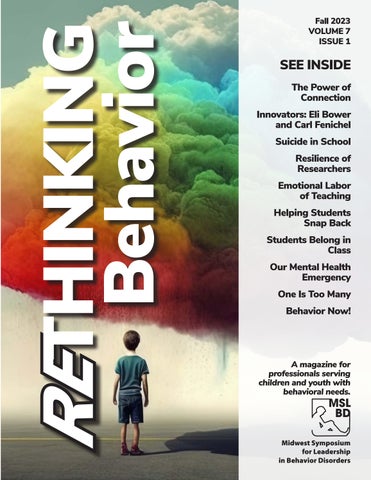

RE THINKING Behavior
UPCOMING EVENTS
Richard L. Simpson Conference on Autism October 5 & 6, 2023
Plaster Student Union at Missouri State University Spring eld, Missouri
BCBA CEUs Available
Early Bird Rate of $175 through September 22 5th Annual
https://mslbd.org/autism-conference/

42nd Annual Midwest Symposium for Leadership in Behavior Disorders
February 29, March 1-2, 2024
Sheraton Crown Center, Kansas City, MO
Keynote Session
Saving the World: Embracing Your Powers and Remembering Why We Teach
Dr. Matthew McNiff, is a special education director and behavior consultant with the Educational Service Unit No. 5 in Beatrice, Nebraska. He is a nationally recognized speaker in the field of behavior management.
Workshops
• Managing Classroom Instruction & Behavior
• Choosing & Implementing Tiered Behavior Support
• Foundations in De-Escalation
• Practical Functional Assessment & Skills Based Treatment
• Advocating Trauma-Informed Care in ABA
• AI & New Tech in Education
• Restorative Justice Practices, Prevention
• Research Based Strategies for Engagement During Math Instruction
• BCBA CEUs available including Ethics Credits
John J. Augustine
Mary Jo Anderson
Anne K. Baptiste
Jennifer Bossow
Jenah Cason
Scott M. Fluke
Nicolette Grasley-Boy
Katherine A. Graves
Deborah E. Griswold
Mike Hymer
Maria L. Manning
Sharon A. Maroney
John W. McKenna
Reece L.
Shacklady-White

Rethinking Behavior, ISSN 2578-5397, a magazine for professionals serving children and youth with behavioral needs, is published three times per year, fall, winter, and spring, Copyright ©2023 by the Midwest Symposium for Leadership in Behavior Disorders, P.O. Box 202, Hickman, NE 68372. 402-7923057. www.mslbd.org. Email: rethinkingbehavior@mslbd.org.
Rethinking Behavior welcomes proposal and manuscript submissions; for information visit www.mslbd.org or email rethinkingbehavior@mslbd.org

The
Power of
Connection: Extending Beyond TeacherStudent Relationships
The beginning of the school year often feels like a fresh start and is accompanied by a flood of emotions. Sadness that summer is ending; excitement for the year to come; and sometimes even nerves because of the unknown. These feelings are shared by students and teachers as they embark on a journey together to create a classroom community that can last the year.
In education, teachers hold the key to shaping the minds and futures of the next generation. The responsibility they shoulder goes beyond simply sharing knowledge; it extends to nurturing a positive and enriching learning environment that fosters growth and development for each and every student. One crucial piece in achieving this goal requires a focus on relationships. New and veteran teachers alike have often heard messages stressing the importance of teacher-student relationships in their classrooms.
It is true – teacher-student relationships are paramount for a successful school year. Yet teacher-student relationships are not the only relationships of importance in a classroom. In addition to cultivating teacher-student relationships, teachers should strive to foster other important connections including a teacher-class relationship, student-student relationships, and student-class relationships.
Teacher-student relationships involve a teacher creating a connection with individual students. These relationships foster trust and comfort as students want to be known on a personal level by their teacher. With successful teacher-student relationships students often become more engaged in activities because teachers can deliver a more personalized learning experience. Some easy activities to foster these relationships are the use of a survey to learn more about each student, having daily conversations
Photo courtesy of AdobeStock.com
with students individually, or even doing a simple check-in as students enter the classroom.
A teacher-class relationship requires teachers to extend beyond connecting with individual students and focus on how the class as a whole perceives and connects with them. A classroom is an everchanging community. It is not uncommon for a teacher to have a class section or two that they struggle with. By spending time focusing on the teacher-class relationship their classroom will flow and be an effective learning environment for everyone. Some activities that work towards building a teacher-class relationship are involving the class in creating norms, asking for feedback from students on activities or lessons, and teachers expressing their feelings (both good and bad) to the class.
Student-student relationships are when two or more students within a classroom form a bond and work to know each other as individuals. By fostering student-student relationships, classrooms become more joyful. With these relationships, students may even become more willing to try new things and take risks without fear of what their classmates will think. To build student-student relationships, teachers should encourage non-academic conversations between students throughout the year. Additionally, teachers could plan activities that may be perceived as silly but require collaboration in teams to encourage the growth of these relationships.
Finally, student-class relationships emphasize each student’s sense of belonging within the classroom community. All students should feel they are part of the larger group. Fostering student-class relationships can increase student engagement and decrease behavioral issues. One easy way to work towards student-class relationships is by facilitating whole class check-ins when all students have the opportunity to express their feelings on the classroom’s current level of functioning. These conversations can help all students feel heard and seen within the community of their peers.
The start of the school year is the perfect time to dedicate moments to cultivating each of these relationships. While it may take up some time at the beginning of the year, time spent on fostering these relationships will be well worth it throughout the school year. As we continue into the 2023-2024 school year, let us remember that at its core, teaching is not just about imparting knowledge but also about forging a variety of profound connections that can change lives for the better.
Katherine
A. Graves and Lindsey G. Mirielli, Issue Editors kgd45@mail.missouri.edu and lgmt37@missouri.edu
Resources from Edutopia
• 23 Ways to Build and Sustain Classroom Relationships (Andrew Boryga, 2023)
• 4 Key Relationships to Nurture in Your Middle or High School Classroom (Natalie Lalagos, 2023)
• Building Relationships with Students Whose Backgrounds Differ from Yours (Jaslynn Laurence, 2023)
• 6 Strategies for Building Better Student Relationships (Cicely Woodard, 2019)
INNOVATORS
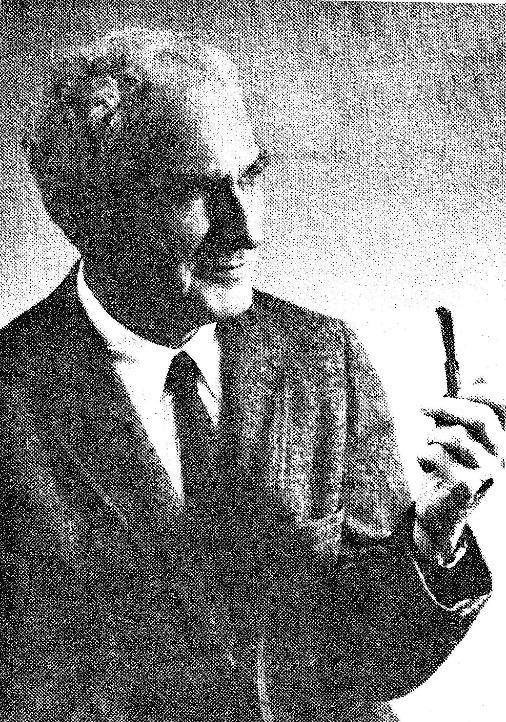
Carl Fenichel Someone to Organize Their World
“Early in 1953, with the financial support of a few friends and a newly formed parent group called the League for Emotionally Disturbed Children, I was able to convert a little Brooklyn brownstone into a threeroom schoolhouse.”
This was the modest beginning of the League School, the first day-school in the country to work exclusively with children with severe emotional disturbance who had been turned down by every school and agency except state mental institutions.
Carl Fenichel (1905-1975), who had training in psychoanalysis and Freudian approaches to mental illness, began the school using a permissive psychoanalytic orientation but soon gave that up in favor of a more directive, psychoeducational approach. In his earlier general education teaching experience in New York City, Fenichel noticed that some of his students had serious emotional or learning problems. Through his experience as a teacher of children with severe emotional disturbance at the psychiatric division of the Kings County Hospital, Fenichel saw the need to maintain children with such disorders in their communities and keep them with their families.
Keeping the school door open and the day-school idea alive wasn’t easy. Like any pioneering program operating without professional acceptance, community support, or government assistance, our school was plagued by debts and deficits. Our only resource was the unwavering determination of a handful of parents, trustees, and friends to break through some of the doom and despair that surrounded childhood mental disorders.
In 1953, Carl Fenichel founded the first private day-school for children with seriously emotionally disturbance in the United States.
“We began to recognize that disturbed children fear their own loss of control and need protection against their own impulses…”
We opened with one teacher and two children. Before a year had passed, the school had reached full capacity and was bursting at the seams with twelve children, including three whose families had uprooted themselves and moved to Brooklyn from other states so that their children could be in a day-school program. The staff at that time consisted of myself, six teachers, a psychiatric consultant, a part-time social worker, and a music therapist (Fenichel, 1974).
We learned that disorganized children need someone to organize their world for them. We began to recognize that disturbed children fear their own loss of control and need protection against their own impulses; that what they needed were teachers who knew how to limit as well as accept them. We learned the need for a highly organized program of education and training that could bring order, stability, and direction to minds that are disorganized, unstable, and unpredictable. (Fenichel, 1966)
Fenichel not only challenged the permissiveness encouraged by psychoanalytic theory but questioned the idea of “symptom substitution” as well – the idea that observable behavior is only a symptom of underlying psychological problems and that removing a symptom is useless, as another will merely take its place.
His wife, Joan, continued operation of his schools after his death, and books continue to use his name to identify his “Fenichel’s Clinical Pediatric Neurology” approach. The League School continues to serve students with behavioral needs in two locations in Brooklyn,New York, and Walpole, Massachusetts.
The Council for Children with Behavior Disorders (CCBD), now The Division for Emotional and Behavioral Health (DEBH), continues to honor a graduate student annually with the Carl Fenichel Award.
James M. Kauffman, Distinguished Professor Emeritus, University of Virginia
References
Fenichel, C. (1966). Psychoeducational approaches for seriously disturbed children in the classroom. In P. Knoblock (Ed.), Intervention approaches in educating emotionally disturbed children (pp. 5–18). Syracuse University Press.
Fenichel, C. (1974). Carl Fenichel. In J. M. Kauffman & C. D. Lewis (Eds.), Teaching children with behavior disorders: Personal perspectives (pp. 50–75). Merrill/Prentice Hall.
Fenichel, C., Freedman, A. M., & Klapper, Z. (1960). A day school for schizophrenic children. American Journal of Orthopsychiatry, 30(1), 130– 143. Doi: 10.1111/j.1939-0025.1960.tb03020.x
From the New York Times obituary by Burton Lindheim, September 26, 1975
Dr. Fenichel was a pioneer in day-treatment for children suffering from severe emotional disturbances. Before he opened his school in 1953, parents of autistic, schizophrenic, and psychotic children generally sent them to a state hospital or brought them up in isolation at home.
Dr. Fenichel was also professor of special education for children at Teachers College, Columbia University and professorial lecturer at the Downstate Medical College in Brooklyn.
He was born in New York on Dec. 30. 1905, and graduated from City College in 1928. He received an M.A. from the New School for Social Research and a Doctor of Education degree from Yeshiva University. He received a certificate from the William Alanson White Institute of Psychiatry in 1953 and was a certified psychologist.
He was teacher and therapist in special education at Kings County Hospital and the psychiatric division of the School for Disturbed Children here from 1948 to 19521. In World War II, Fenichel was a sergeant in the Army.
Eli Bower
The Definition of Emotional Disturbance
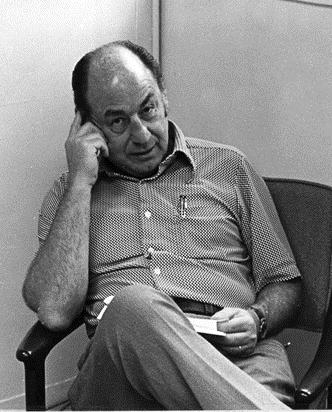
One of Eli (Mike) Bower’s enduring legacies is the official educational definition of “emotional disturbance.” The “Bower definition” was the outcome of a California state-wide task force he led in the late 1950s to determine educationally relevant characteristics of “emotion al handicaps.” His task force asked educators from across the state for their perspectives on problem behavior based on their direct experiences with students.
The resulting definition became a model for other states and was adopted (with some unwelcome additions) in the federal Education of Handicapped Act (EHA) of 1966 and later in Education of All Handicapped Children Act of 1975 (now the Individuals with Disabilities Education Act), which affirmed the right to free, appropriate education for students with disabilities.
“Emotional Disturbance is a condition with one or more of the following over a long period of time and to a marked degree and adversely affects edu cational performance:
a. inability to learn not explained by intellectual, sensory, or health factors.
In the late 1950s, Eli Bower wrote the definition of emotional disturbance which with minor modification has been included in federal legislation ever since.

b. inability to build or maintain satisfactory interpersonal relationships with peers and teachers.
c. inappropriate feelings or behavior under normal circumstances.
d. general, pervasive mood of unhappiness or depression.
e. tendency to develop physical symptoms or fear associated with personal or school problems.”
Federal legislation added to Bower’s definition the word “serious”, and also included a widely controversial exclusion of “socially maladjusted” students. Bower opposed both additions. Congress also added a phrase indicating that students with autism were included. The word “serious” was later dropped, as was the reference to autism. However, the “social maladjustment” clause remains a part of the federal definition. Over the past 60+ years there has been discussion of both the merits and shortcomings of the core of the
Bower definition. Despite minor changes, however, the definition remains essentially the same.
Bower, born in 1917, was a pioneer in the education of children with emotional/behavioral disorders. Originally from New York City, he completed a PhD at Stanford and spent most of his career in California where he was a professor of educational psychology at the University of California-Berkeley and led state-wide studies and initiatives related to the education of children with disabilities. Bower also worked at the National Institute of Mental Health (NIMH) in Washington, DC, conducted research, consulted internationally on special education issues, and wrote numerous articles on these and other topics. He passed away in 1991.
In 1987, Bower was scheduled to give a keynote address at the Midwest Symposium for Leadership in Behavior Disorders. As he flew from San Francisco to Kansas City, he began feeling ill. When he arrived at the Hyatt, he was immediately taken to nearby hospital. He had suffered a major heart attack and remained there for several weeks recov-
ering. The following year, 1988, he returned to visit his hospital care givers, and to deliver his keynote - planned for a year earlier. (See MSLBD’s anniversary story “Eli Bower – Reflections After a Heart Attack”. https://mslbd.org/who-we-are/stories-ofmslbd.html).
In his address, Bower stressed that children’s disturbed emotions and behavior should always be considered in the contexts of their families, peers, schools, also highlighting the distinctions between emotional and behavioral “differences” and “dysfunctions.” He said that children with emotional disturbance are best understood as having difficulties with impulse control, and that healthy functioning is essentially the ability to successfully allocate time.
Bower argued that special education is often mischaracterized as a more “restrictive” environment even though individualized special education places fewer restrictions on children’s learning and development. He encouraged more opportunities for play (“more recess”) in schools…and he urged educators to “start each day with a laugh.” His 1988 MSLBD keynote address (Reflections on the Field of Behavioral Disorders) is on the MSLBD website.
Robert H. Zabel, Professor Emeritus, Kansas State University, robertzabel@gmail.com, and Reece L. Peterson, Professor Emeritus, University of Nebraska-Lincoln, rpeterson1@unl.edu

Before I begin, I want the reader to know the story I will tell is about teenage suicide. As such, I would like to respectfully provide notice to those who might have experienced similar trauma.
Andy’s Story –Suicide in School
By Shannon Eickhoff
The day started off like any other day. It was a holiday and I got up early to prepare my costume. My fellow teacher and I were both dressing up as students. I wore my hoodie and too much makeup. Some of the kids came dressed up as well, so the day at work began with a lot of laughs. My classroom was full and the mood was light. The students were productive and in good spirits. I remember what a beautiful fall morning it was. The sun was shining and there were giant fluffy clouds in the sky. The air was soft but crisp… like it was hanging on to the last vestiges of the warm days of summer. Days like this heading into the winter months were a gift. I wanted to let the day in, so I wandered to the window and opened it up wide so the breeze would blow in. I stood there for a minute or two with my eyes closed, just soaking up the day and counting my blessings. There is a beautiful tree outside my classroom window that is typically home to a bird nest or two. I looked for one that morning, but I didn’t see one. The branches, covered in red and golden leaves, were undulating in the wind and the fresh air blew through the classroom, washing over the students and me, and I was happy.
The first two hours of the day rolled by smoothly. I was having wonderful conversations with my students. Shanice was there. She was an especially close student of mine, and we were laughing with one another. She was wearing pink scrubs with cupcakes on them and her hair was parted down the middle with two adorable Afro-puffs on either side
Photo courtesy of AdobeStock.com
of her head. I remember telling her how beautiful she looked that day, and she told me that I looked ridiculous. She said, “that eyeliner, though!” We laughed for a long time. Nearly every desk in my classroom was full, and the environment was lively. Mrs. James was putting together packets for students and answering students’ questions. Kids were signing in and out, going various places on campus. I was busy, but not distracted. I was focused, but not unaware. I was part of a well-oiled machine, helping students in a rapid-fire fashion. There was a beautiful flow, a groove if you will, to the classroom that day. It was just another really good day to be a teacher. I was happy.
The bell rang for break and the students filed out of my classroom in a rush. For fifteen minutes, there was a bit of quiet. I took this time to attend to the tedious duties of my day… filling out evaluations, taking the attendance I was too busy to at the beginning of the hour, and sending emails. The break flew by and the students filtered back in, taking their places and settling back into their work. Still, there was movement all around me. I could see students out of the corners of my eyes, and in front of me. Mrs. James was at her desk about thirty feet away from me towards the front door of my classroom. Nothing was out of place. There was nothing strange, nothing off, or ominous, or uncomfortable, or even different from the previous hours of the morning. I was sitting at my desk looking at student progress on my computer and chatting with Shanice at the same time. I remember feeling the bandana on my head fit too tightly around my glasses. At that moment, I heard a noise, a quiet crack, and an instant feeling of emptiness to my right where Andy had been sitting. He was gone. Just disappeared. Instantaneously, I knew what had happened, but in that moment, I could not comprehend it. It was not possible. I stared for a single second in the direction of the window, looked at Shanice and said, “Shanice..” And my eyes were open wider than they had ever been before. Shanice nodded her head. I looked at Mrs. James and she had both of her hands clutched over her mouth. Still, I did not believe it.
There was a beautiful flow, a groove if you will, to the classroom that day. It was just another really good day to be a teacher.
Mrs. James walked towards me, towards the window, and I just said “no, no, no… I can’t look.” Mrs. James approached the window, she was as white as a ghost, she leaned over the sill without touching it, sucked in that beautiful breeze I had let in, and gasped behind her clutched hands. She turned to me and nodded. I told her, “Call 9-1-1,” and I ran out of the room not even sure where I was running to. I ran the circle of classrooms, closing all the doors and telling the teachers that they were not to let their students out of their classrooms for any reason whatsoever. I ran to the office of one of the managers and I grabbed her hands and looked into her eyes and said, “Andy just jumped out of my window.” She said, “Shut up,” that’s not funny.” I pulled her with me and ran to my room. It wasn’t long before the police and the ambulance arrived. I don’t remember much after that for at least a few minutes. This was not happening.
Next, I was sitting on an office floor and the secretary was saying to me, “What do you want me to do?” I told her to call my husband and she did. I spoke with him for a minute or two, then I walked out in the hallway towards another classroom and a trade instructor was there. I just froze where I was standing. He was wearing those clear glasses you wear on a construction site. I don’t know why, but I grabbed his hands and fell apart. I just kept saying, “He jumped, he jumped, he was there and then he was gone, he jumped, he jumped, I didn’t
know, I didn’t know!” He held my hands and stared into my eyes in a way that no one had ever done before. He said, “You’re okay, you’re okay, you’re okay, just breathe, just breathe.” I could see the veins in his face and his eyes were full of tears, and all I wanted to do in that moment was to tell him what happened. I’m certain I was in shock.
I was taken to a conference room where all of my students were seated around a giant table. There was no sound. No voices. No crying. It was empty like all the air had been sucked out of the room. It was heavy, ugly, and scary, and now, I was angry. I sat there in silence with the kids for a few minutes. Suddenly, like a terrified mom, I said, so loudly, in a guttural broken voice:
“Do you know how much I love you? Do you know what you mean to me?
Do you know how much I care about each and every one of you? Do you?”
I was crying now from that place in the pit of your stomach where only the most desperate cries come from. It was that place where you can’t escape, where you have no control, where panic lives, where all you want to do is turn back time. It was that place where death sets in and you are left with absolutely nothing. I wasn’t making much noise, just lurching from my guts. I stared at each of them one at a time and as each of our eyes met, they nodded back at me. Some said, “I love you too.” And then I looked at Shanice and she said, “It’s okay Mrs. Eickhoff, it wasn’t your fault.” I watched little tears run down her beautiful, sweet face.
I looked across the conference room through the windows to see a swarm of people walking around campus. These people did not belong here. A moment later, my boss showed up, he hugged me and said, “you’re okay, kid.” There were counselors, ministers, and police officers, all milling about, talking to students and staff. The students were huddled together in small groups outside. The scene was surreal. People came to check on me, hugging me,
and holding my hands. I was taken into a small office where there was a police officer waiting to talk with me. As I walked in, I saw myself in a mirror. All that stupid eyeliner I had put on that morning had run down my face and I looked terrifying. My face was red and swollen, and my eyes looked like they were on fire. I wiped my face with the back of my hoodie sleeve and sat down. I apologized to the officer for looking so awful. He was a kind man who spoke to me very gently. I told him exactly what happened. He asked me to write a statement and he left me in the room alone while I did so. I couldn’t write very well, so it was more like a list of events. The officer came back in and I gave him the statement. I was told I was free to go, but I didn’t know where to go.
Instantaneously, I knew what had happened, but in that moment, I could not comprehend it. It was not possible.
My friends walked me back to my classroom to get my things. I realized that I had class that night and I knew I couldn’t do it, so I went to a storage closet and called Dr. Smith. I was comforted by her voice and given the grace to do what I needed to do. I was supposed to do a book circle that evening on Nel Nodding’s centers of care with my peers. I had worked so hard on it and was looking forward to presenting my lesson. I had found matches from my grandparents that they had collected when they played music for the German Prisoners of War Camp in the 1940s. I was going to show how you could teach using found objects. All good plans are subject to change. I drove home in a daze to find my home empty. Everyone had things to do. So, I sat in the silence for a while and realized that
I had to move, to get out, to get anywhere where I wasn’t alone with my thoughts. So, I washed my face, changed my clothes, and went to class.
I arrived early and met my friends in the classroom. I shared what had happened and they poured out such love and care for me that I was overwhelmed. Dr. Smith arrived, surprised to see me and she gave me a huge hug. I remember thinking that she was so stoic and powerful. I felt this vibe coming off of her that was saying, “You’re okay, Shannon, you are here, now let’s do this lesson.” I don’t know if she remembers, but I recall that she stuck pretty close to me throughout the entire class. After class, it was dark, and my dear friend walked me to my car. He likewise gave me a giant hug before sending me on my way. When I arrived home, I sat in my car for a little while. I didn’t want to talk about this anymore. My kids didn’t know what happened and I wasn’t going to tell them. My husband hadn’t a clue what to say. He poured me a glass of wine, told me there were leftovers in the oven, and sat quietly on the couch. I didn’t want to talk to him, either. I didn’t want to be alone, and I didn’t want to be with anyone else. I just wanted to go to sleep.
The next day, I arrived at work and found that they had set up a make-shift classroom for me in the conference room. I grabbed a laptop from the cart and sat down at the giant table. The air in this space had returned, but it was a foreign place for me to be. The students slowly trickled in and I hugged each one of them much harder than I ever had before. They each took a computer and began the process of getting to work. It was quiet, sad, and lifeless. I was so incredibly unhappy. It took only a second for me to realize that if I didn’t reclaim my space, not just for me, but for my students, that we might never get it back. I told them, “put these computers away, we’re going back to our classroom.” They looked shocked but did what I asked.
Quietly, we walked together up the flight of stairs to our classroom. I opened the door and turned on the lights. The window with the big beautiful tree
But this story was, and is, not about me. I was witness to an act of desperation born of such pain and sadness that I will never be able to comprehend its magnitude.
behind it was closed tight. We all took a collective breath and walked in. I walked to my desk, put my purse in the drawer, and turned on my computer. I looked to my right, and sitting on my printer were Andy’s glasses. I felt myself get dizzy and I could not, for the life of me, remember how they got there. I know it must sound stupid, but I told myself that God or Andy put them there. I told my students, “None of this is okay, but we are okay, and I am here, and I love you. We will get through this together.” And we were okay. We were much worse for the wear, but we had each other, and we were close. There were tiny smiles of acknowledgment for each other’s sadness throughout the day. There were small physical connections, a squeeze of one’s hands, a gentle resting of heads on each other’s shoulders, and reassuring hugs.
I went over what happened in my head a million times a day. Andy had chosen to stand up, push the screen out of the window and jump head first three stories to his death. He fell past two stories of classrooms where students watched him fall. His broken body left a bloody mark on the pavement where he landed. My dear friend and colleague was the first one there to attend to him. She, like me, will never be the same. I remember a long time before this happened, I had been working with Andy and I had reached out and touched his wrist where he had a semicolon tattoo.
He flinched, which is not typical for my students. I asked him if that was in honor of someone, and he said no. I didn’t push. Perhaps I should have. Perhaps then I would have been watching more closely. Maybe I would have checked in more frequently, or made a regular effort to talk with him about what that tattoo meant to him. I could have found a connection if I looked more deeply. What did I miss? I will never know. What I do know for certain, is I will never again miss the opportunity for making a connection with each student, every day.
As the days passed, I wondered when this would hit the news. But, it never did. Looking back and having thought deeply about this event, I have some thoughts that may seem compelling, but, I admit, are purely conjecture. I believe that had this even occurred at a different high school that served different students, dare I say primarily White, affluent students, it would have made the headlines. Perhaps being at the center of this has left me feeling that this event was monumental to our awareness of the precarious emotional stability of our students in America. Unbelievably, could the value we place on young people’s lives be equivalent to the value they represent in terms of affluence and social capital? I do not suggest that the people I work with purposefully hid this event to protect their own interests. Rather, I submit that the lives of the marginalized are viewed as not worth the ink it takes to print their stories. I confess I often wondered what it would be like to be known as the teacher who had a student attempt suicide in their classroom.
Nowadays in my classroom, there is a giant wooden desk that sits in front of the window where Andy jumped. The beautiful tree beyond it still sways back and forth in the breeze like nothing ever happened in its presence. In the spring, it grows beautiful, white, flowering blossoms that bring out the bees. The birds still nest and raise their babies there. On days when it is hot in my classroom, I refuse to open that window. Instead, my fellow teacher will come in and open another
window that is directly behind my desk. I am often asked by students why I refuse to open the window, and I tell them that there is no screen, and it is unsafe. Once in a while, a student will somehow know about the story and they will tell it to their peers. I tell them that the story is true, but that I don’t speak about it. Rather, I only tell them that I love them and they mean the world to me. The divider that holds Andy’s name and work remains in my file cabinet to this day. It serves as a constant reminder of the fragility of life and the importance of the work I do. This job is not to be taken lightly. The relationships I build with my students are not frivolous, they are integral to survival. And while I may be haunted by that day and its events, I am comforted knowing that I have come away knowing the utter importance of caring for my students each day, without reservation, and with an unadulterated belief in the power of our connections. This is what Andy’s story has taught me.
For the past 25 years, I have journaled my experiences as a teacher in my various classrooms. During the time I wrote this entry, I was working, and continue to work in an alternative high school that serves primarily marginalized, impoverished students of color. This journal entry is from my dissertation completed in October, 2022 at Kansas State University. The name of the individual in this story as well as others have been changed to protect the anonymity of all those involved. This story was particularly hard for me to write, and much thought went into its inclusion in my previous work. In the end, I felt the story was too important to leave out as its implications for thoughtful retrospection outweighed the painful revisitation of the day.
This is the story of the worst day of my life as a teacher.
References
Noddings, N. (2005). The challenge to care in schools: An alternative approach to education Second Edition. Teachers College Press.
U.S. Government. (n.d.). Suicide Prevention youth.gov. Retrieved from https://youth.gov/ youth-topics/youth-suicide-prevention
Shannon L. Eickhoff, Special Services Coordinator, Manhattan Alternative High School, Manhattan, KS, slw1@ksu.edu
For anyone reading this article that feels they might know of or be in the presence of someone who is in danger of taking their life, there are resources to help:
The National Suicide Prevention Lifeline is a 24-hour, toll-free, confidential suicide prevention hotline available to anyone in suicidal crisis or emotional distress. When you call 1-800-273-TALK (8255), you are connected to the nearest crisis center in a national network of more than 150 that provide crisis counseling and mental health referrals day and night. The Lifeline also provides informational materials, such as brochures, wallet cards, posters, and booklets. Prestamos servicios en español (1-888-628-9454). Translators speaking approximately 150 languages are available (youth.gov).
The Resilience of Researchers During COVID-19
By Amanda Haedo
In the early months of 2020, fear and uncertainty swept across the globe as the COVID-19 pandemic posed an unprecedented societal challenge. The status quo was shifting at a moment’s notice, even at a local governance level, leaving everyone wondering what was coming next. Researchers and educators alike, they experienced a tremendous shift in their own practices that have had lingering impacts. Across the nation, schools quickly began to
shut down and shift from a traditional face-to-face model to a virtual platform. Where did this leave researchers with ongoing in-person studies? Delayed, defunded, and distressed!
Starting my journey as a PhD student at this unpredictable time, I intimately experienced the challenges of trying to stay productive and positive. Coming from a teaching background of five years, I was excit-
ed to get back into the classroom as a data collector. I wanted to experience the interactions with students and teachers to spark my own ideas for conducting research in hopes of contributing to the field. As the weeks and months of the pandemic began to pile on and the school system remained shut down, this want, turned to hope, which turned to a realization that my immediate path wasn’t going to follow this direction. However, this simultaneously opened new avenues for me to explore and embrace. With no access to in-person data collection, my options for research were redirected in a way that allowed me to dive deep into educational literature and utilize data sets that were already collected. My advisors were attentive and provided as many opportunities as possible to stay connected with fellow peers when many of us felt isolated. I wondered what other doctoral students and principal investigators were doing and feeling during this time. To provide an insight into the landscape of the field, I had the honor of virtually meeting with three educational researchers to discuss how the COVID-19 pandemic affected their labs. Herein, I will share their experiences and highlight some of the innovative measures they took to keep morale high and maintain productivity.
Dr. Justin Garwood, University of Vermont
When Everything Went Out the Window
Dr. Justin Garwood’s interest lies in academic interventions for students with Emotional Behavioral Disorders (EBD) specifically related to reading, social studies, and civics instruction. His area of expertise revolves around using relationship-based behavior management techniques utilizing non-fiction novels to work with this specific population of students.
In the weeks leading up to the nationwide shutdown due to COVID-19, Dr. Garwood had just been awarded an IES grant to conduct an in-person exploratory project to address teacher burnout. His research would examine the relationships between students and teachers and how this relates to
teacher burnout, with the goal of being able to intervene before the burnout occurs. Teachers would be able to use a variety of interventions with their students who have Individualized Education Plans (IEPs) or Behavior Intervention Plans (BIPs).
In his study, he would not implement his own intervention, but rather validate that teachers were appropriately implementing the intervention strategies as they intended. Teachers would self-report what behavioral interventions they were applying, a fidelity checklist would be created, and then in person observations would be done to observe what interventions were being performed in the classroom setting. Focus groups would be held with teachers to discuss any themes that may present themselves after the findings. This would also be the time for teachers to discuss their feelings towards certain situations that they believe could be contributing to their feelings of burnout. This model would drive questions related to fidelity implementation and teacher burnout, and if there was a relationship between the two. If a teacher is feeling burnt out, are they less likely to implement interventions with fidelity?
When the shutdowns began Dr. Garwood stated, “Everything went out the window, we could not get inside schools.” The funding agency gave him two choices, he could either wait it out or make it work with a new plan. No one had any idea how long these shutdowns would last which led Dr. Garwood down the path of brainstorming a novel strategy. Instead of conducting live observations, he envisioned using Swivl recording robots. To make this plan a reality, he wrote another small grant to purchase the Swivl robots. The grant was funded, and his revised plan was approved by the funding agency to continue his study. Online training for the Swivl robots were created, which included how to set them up in classrooms. Consent forms were sent, signed, and returned electronically. Everything for the study was established without having to step inside a school. The sample size for the study was smaller than originally antici-
pated, but nonetheless, the pandemic did not stifle his research and the study is ongoing.
Dr. Garwood oversees one doctoral student and one master’s student. During the shutdowns, he had one doctoral student who was completing a dissertation. The student was fortunate to have had all the necessary data already collected for the proposed study and was able to graduate. Every Friday Dr. Garwood and his students met and shared difficult moments, or things that happened to them throughout the week. The focus of his project described above is burnout and this major theme transfers over to his everyday life as he tries to be as real and open as possible. It was a difficult time for so many people and allowing his students to talk about real problems they were facing in life allowed his students to express themselves and feel connected. They would also discuss the project and share stories from the teachers they were working with and what they had to deal with on a day-to-day basis, which added perspective.
Besides his openness to having difficult conversations with his students, Dr. Garwood was also very flexible about due dates. He trusted his team and didn’t see the need to micromanage them. If a student wasn’t going to make a deadline, he simply
Instead of conducting live observations, Dr. Garwood envisioned using Swivel recording robots.
asked that they let him know ahead of time and tried to help in any way that he could. There was one graduate student who had to be let go last year due to lack of participation but rather than put the extra work on anyone else in his group, he picked up the slack.
It has been over 2 years since the pandemic lockdown began, and schools have started to open their doors to researchers. Though entering schools is now an option, Dr. Garwood intends to maintain the integrity of his study and continue using the Swivl robots. He found that the Swivl robots allow for a more authentic experience between the teachers and their students, without the added layer of having a human observer in the classroom. Focus groups may move to an in-person model as this should not change the dialogue. Dr. Garwood hopes to recruit more teachers for the study if possible. He also intends to offer free virtual professional development in Massachusetts with the hopes of pitching his idea for a grant.
Dr. Shanna E. Hirsch, Clemson University
Personal and Professional Life Intertwine
Having worked in the field of special education for almost 20 years, Dr. Shanna E. Hirsch has many interests associated with student behavior. Her concentration in behavior is centered around how to support students in the classroom through developing intensive interventions, helping prepare teachers, and incorporating technology into her teaching and research.
During the start of the initial shutdown, Dr. Hirsch was involved in multiple studies. There were four in-progress studies where data collection had been ongoing. One study, a randomized controlled trial, had to come to halt as they were in the middle of the intervention phase and were only able to do two of the four planned observations. The other studies were able to pivot or continue. One study involved a mixed reality simulation with pre-service teachers
In this very stressful time, Dr. Hirsch and her colleagues wondered what was happening with kids with behavioral problems? Leading to a nationwide survey sent out on social media.
and was able to move to Zoom from the students’ homes. Another study involved a survey and a plan to conduct intensive observations with teachers. Dr. Hirsch and her team were able to turn this project into remote classroom management and virtual direct observation that included a survey in which teachers would rate themselves.
Dr. Hirsch, a mother of two, had to navigate her professional duties along with assisting her children with this new uncertainty related to their schooling. She and two other professors began talking on a regular basis, and it was quickly realized that the three of them were experiencing different policies from their district public schools. One school offered an optional Zoom meeting, another a mandatory Zoom meeting, and one school was offering no virtual instruction. It was a very stressful time for her and her colleagues, so she wondered what was happening with kids with behavioral problems? This led them to conduct a nationwide survey that was sent out via social media in April, May, and June of 2020. This survey intended to document what was happening to students with disabilities during the initial school closures, what technology were being used, and whether teachers were able to meet the social-emotional learning (SEL) and academic needs of their students. This allowed Dr. Hirsch to refocus her “why” and understand how to support
teachers and students with behavioral disorders during a pandemic. This survey was able to document a moment in time and led to multiple publications.
At this point in time, Dr. Hirsch can return to school in person but is really listening and following the needs of teachers. In her line of work, professional development and in-person data collection are not something that is needed at this time.
Dr. Allison Bruhn, University of Iowa Maintaining Morale and Shifting Perspectives
Dr. Allison Bruhn began her career as a middle school science teacher for students with challenging behavior. She was introduced to a researcher who was at her school collecting data, who later became her advisor. At the time, Dr. Bruhn became interested in positive behavior supports and interventions (PBIS) and tiered interventions. Being very data-driven, she is involved in research related to interventions and assessments for children with challenging behaviors.
Dr. Bruhn oversees doctoral students, with two of them conducting a single-case design dissertation at the start of the pandemic. They were fortunate enough to have already collected the necessary data and were able to complete their dissertations and graduate. Dr. Bruhn attempted to keep morale high during this time of uncertainty by continuing to meet with her team via Zoom. She also made great efforts to make her graduating students feel special by hosting a socially distanced imitation graduation where they were able to dress in their caps and gowns. They all met on campus, where she provided lunch, and still attempted to make her students feel special by hooding them from 6 feet away!
At the time of the initial shutdowns, Dr. Bruhn was in her last year of an IES-funded randomized controlled trial and lacked data on thirteen participants. This, unfortunately, ended the study as there was no more funding, and she and her colleagues only had a year and three-fourths of the study completed. Alternatives to her typical research practices during the pandemic were surveys. Dr. Bruhn was involved with Dr. Hirsch in conducting a nationwide survey to understand how teachers were meeting the needs of students with EBD, moderated by their school’s policies. They were able to receive two publications from this data. Dr. Bruhn has also conducted four survey studies in the last couple of years, ranging from what was happening initially with COVID-19 and currently how teachers handled stress related to policies and other barriers. She has made it a point to expand her knowledge base by reading literature outside her normal expertise.
COVID-19 allowed Dr. Bruhn to shift her role as a researcher and reflect on how and where her research is going in the future. She is now focused more on SEL and mental health issues of both students and teachers, as these need to be considered and managed more in the field.
She is currently back in schools, but she treads lightly due to the demands that teachers and administrators already have on themselves. Her goal is to build relationships with the people she is working with and hopefully be able to provide a service in some way. She feels that developing collaboratively is a great way to drive research and school partnerships, which also might be a response to the last few years due to the pandemic.
Moving Past the Pandemic
COVID-19 allowed Dr. Bruhn to shift her role as a researcher and reflect on how and where her research is going in the future.
This unsettling time made everyone stop and ask, “What are we going to do?” The pressures of completing grant requirements, maintaining morale, not to mention just trying to stay healthy, let the strength of the educational research community shine. The experiences and stories shared by these three researchers helps provide perspective on the challenges, and also the successes our community faced during this unprecedented time. If I were to take one thing from these stories it would be that we all need to place high importance on mental health. As a community we need to listen to the needs of one another and show compassion for the adversities we are all facing. Through listening to the needs of teachers and students, collaborative effort, and the innovation from the bright minds in the field we can not only move past the pandemic, but also excel.
Amanda Haedo, PhD Student, University of Florida, ahaedo6@ufl.edu
The Emotional Labor of Teaching Students with EBD
By Adam D. Weaver
Think about the hardest day you’ve had at work over the past several years. Try to remember how you felt that day and also the circumstances that made that day so challenging. Chances are that what made that day so difficult was not that you had to exert yourself physically more than usual or that there was a greater strain on your cognitive abilities. Most likely, what made that day so hard was the requirement of managing your emotions – what you felt inside as well as what you expressed to others. Educators can experience a great deal of “emotional labor” in their work. Few, however, understand what it is or how to cope with it.
Images in article by Mohamed Hassan from Pixabay
Historically, jobs in our society were placed in one of two categories. “Blue-collar” jobs consisted primary of manual or physical labor (e.g., construction, factory work), and “white-collar” jobs were considered to require more cognitive skills (e.g., business, finance, medical). However, the mid-twentieth century experienced growth in and attention to jobs in the service sector – jobs requiring employees to interact with customers, patients, students, or clients. The emotional labor required in “service” jobs can be just as taxing as physical or mental labor (Grandey & Melloy, 2017; Hochschild, 1983). There is evidence that teachers specifically experience a higher level of emotional exhaustion than others in service jobs. This article explains how emotional labor functions in the workplace and the outcomes are associated with it, and suggests research-based strategies that can help teachers cope with the emotional labor of their jobs.
Understanding Emotional Labor
Service jobs typically involve display rules. These are formal or informal “rules” that govern how the employee is expected to interact with the customer. For instance, in some jobs, “service with a smile” or “the customer is always right” might guide the employee. These display rules are intended to create a positive impression of the business or organization and increase customer satisfaction. However, this expectation may be difficult when the employee is dealing with personal challenges (e.g., car trouble on the way to work or relationship difficulties). And as we know, the customer is not always right. Some customers may be rude and insulting or make unreasonable demands. In these moments, the display of emotions that are called for by the job may run counter to the naturally-occurring emotions experienced by the employee.
Teachers are also governed by display rules, even if they are not always formally stated. These shared attitudes might include, “A good teacher is always excited about learning” or “A good teacher always
One
challenge educators experience that is often not understood is the emotional labor required to express the types of positive emotions that teachers believe are an important part of their jobs. When teachers have to fake
“good teacher” emotions, negative consequences result.
cares about their students.” These expectations can be seen as helping to create a positive impression of the teaching profession, the school, and district, and as good for morale. However, a teacher who is being interrupted or insulted by a student repeatedly may not feel compassion for that student in those moments. In particular, teachers of students with emotional and behavioral disorders (EBD) may deal with frequent verbal disruptions as well as physical aggression. As if that were not challenging enough, parents may occasionally take an adversarial stance toward the teacher or resist school efforts to support the student. A teacher in these circumstances may experience many emotions that do not align with the display rules of the profession.
What display rules do you associate with the profession of teaching? Where do you think these display rules originated? Are they explicitly communicated by your school’s administration? Were they taught in your Teacher Education program? Or were they simply modeled by other teachers you have known in the field? To what extent do these display rules guide
your outward emotional expressions and provide a standard to which you compare yourself? Does this cause you stress?
When an employee experiences emotions that conflict with the display rules of the organization or profession, one of two types of emotional labor is required: deep acting or surface acting (Diefendorff et al., 2011). Deep acting involves trying to make yourself genuinely feel the emotions that are called for. Strategies might include thinking about things that will elicit the appropriate emotion or trying to think of the situation differently (e.g., reminding yourself that the student may have experienced trauma or that the parent may have had very negative interactions with the school when they were young). Deep acting is conceptualized as antecedent-focused because it involves trying to “feel” the emotion before it is expressed. Surface acting, on the other hand, doesn’t involve any attempt to change the emotion that is felt, only what is expressed. For that reason, surface acting is seen as response-focused, in that the effort is put toward suppressing the expression of the naturally-felt emotion and “faking” the expression that is called for (Grandey & Melloy, 2017).
Which of these types of emotional labor – deep acting or surface acting- have you most often engaged in? Have you felt a need to “do the work” of trying to feel the emotions you think you’re supposed to feel as a teacher (i.e., deep acting), or is it easier to just fake those emotions (i.e., surface acting)? What toll might this emotional labor be exacting on you or those around you?
Emotional Labor Outcomes
A great deal of research has consistently shown that emotional labor can have consequences for the employee and for the organization. When emotional labor is required, deep acting is considered the more preferable approach because it is associated with fewer negative outcomes. Surface acting, on the other hand, is linked to employees having higher emotional exhaustion and burnout and lower job satisfaction. Surface acting is also associated with poorer job performance and
turnover, which means that the entire organization is negatively affected by emotional labor.
What might this look like for a teacher? A teacher who is engaging in significant surface acting might feel like they have to fake their positive emotions during the school day and that they can’t be their authentic selves at work. They may question whether they truly belong in the profession because they don’t feel the things that they believe a “good” teacher should feel. This internal conflict can lead to increased stress, emotional exhaustion, and burnout, and can cause the teacher to consider other jobs or professions.
This could be of particular relevance to teachers of students with EBD. We know that for many teachers,
student behavior is cited as a consistent source of stress and a contributing factor to burnout. Teachers who serve students with EBD are more likely to deal with frequent behavioral outbursts and aggression. Conveying positive emotions in this context may require a great deal of surface acting, and there is evidence that teachers of students with EBD report significantly higher surface acting than general education teachers (Weaver, 2015). Without an understanding of emotional labor and the toll that it can take, many teachers may lack the tools to effectively cope with their experience.
If you have never heard of emotional labor before reading this article, what is your reaction to this information? Is it helpful to know that there’s a name for what you may have experienced? Does it make you feel better knowing that emotional labor is a known source of stress and burnout in your field, and that you’re not the only one who has experienced this phenomenon?
Coping with Emotional Labor
While the relationship between emotional labor and various negative outcomes is clear, there is less research on what can be done about it. There is some evidence that simply understanding what emotional labor is can be helpful for teachers, giving them a framework for understanding their experiences (Kerr & Brown, 2016; Weaver et al., 2019). Another recommended strategy is helping employees learn deep acting strategies as opposed to surface acting. The intent is that employees will feel better and more authentic if their positive expressions come from genuinely-felt emotions, even if it takes significant effort to feel those positive emotions. This, however, may be easier for some employees than others.
One research-based approach to helping employees deal with the effects of emotional labor is
providing information about effective coping strategies. My colleagues and I partnered with four school districts in Iowa and Nebraska to provide 60-minute professional development workshops focused on emotional labor and coping strategies (Weaver et al., 2019). Teachers and staff were surveyed several weeks before the workshops about their perception of display rules, their engagement in emotional labor, their feelings of burnout, and the coping strategies they used to deal with stress. The survey was then repeated after the workshop, approximately one year after the first survey. Results showed that as educators increased their effective coping skills, from the pre-workshop survey to the post-workshop survey, the relationship between emotional labor and burnout was weakened.
In our workshop, we discussed 14 commonly used strategies for coping with job-related stress. These coping strategies were based on the Brief COPE Inventory (Carver, 1997). Our workshop included a review of each of the strategies and presented research showing whether the coping strategy was helpful or unhelpful. If there was conflicting research or no research, that strategy was categorized as “It Depends.”
Helpful Coping Strategies
Five of the 14 coping strategies were recommended as helpful.
• Active Coping – Taking concrete steps to improve the stressful situation.
• Planning – Working on a strategy to improve the stressful situation.
• Using Instrumental Support – Getting assistance from others to improve the situation.
• Positive Reframing – Looking for the positive in the situation and how it might lead to positive change.
• Religion and Spirituality – Praying or meditating; finding comfort in spiritual beliefs.
There is evidence that teachers specifically experience a higher level of emotional exhaustion than others in service jobs.
Active Coping, Planning, and Using Instrumental Support, are related in that each of these strategies represents proactive, problem-focused coping. Problem-focused coping consists of responses to address or overcome the challenge or stressor. This approach has been shown to be more effective than emotion-focused coping. For teachers, the Active Coping and Planning strategies would represent independently planning and taking action to resolve the emotionally stressful situation. For instance, if the stressor is a particular student who is frequently engaging in disruptive and disrespectful behavior, these strategies might include revisiting the student’s behavior plan to make sure it is being implemented with fidelity, that adequate communication is happening between team members, and that the schedule of reinforcement is appropriate. If the source of emotional stress is a parent or family who have been resistant to educator efforts, active coping strategies might include setting up an informal meeting or phone call to begin a process of building trust. The Using Instrumental Support strategy might include the teacher asking the school psychologist or behavior facilitator to assist in revisiting the student’s behavior plan or asking the principal for additional support or resources.
There is some evidence that Positive Reframing can be a helpful to a degree. In some ways, this strategy is very similar to deep acting in that the focus is on increasing positive emotions related to the stressor. This can make the situation more bearable and decrease the need for surface acting. Finally, research supports Religion and Spirituality
as a helpful coping strategy for many people. This can serve as a source of emotional support but can also underly active coping strategies.
If you have been dealing with the negative effects of emotional labor, what problem-focused coping strategies could you undertake? While this type of coping has been shown to be the most effective, it can also be daunting. It means facing and addressing the source of stress, and this can require additional work. Do you have the capacity for Planning and Active Coping strategies? Do you know where to start? Are there resources available within your district (Using Instrumental Support) that you could seek out to help address your sources of stress?
Unhelpful Coping Strategies
Six commonly used coping strategies lack empirical support and were described as unhelpful in our workshop.
• Behavioral Disengagement – Giving up any attempts to change the situation.
• Self-Distraction – Turning to other activities to take your mind off the situation.
• Denial – Telling yourself that the situation isn’t real.
• Self-Blame – Criticizing yourself for the situation.
• Emotional Venting – Expressing negative emotions to others.
• Substance Use – Using alcohol or drugs to make yourself feel better.
Behavioral Disengagement, Self-Distraction, and Denial represent various ways to avoid addressing the situation at work. A teacher using these strategies might simply get through the day by focusing
Results showed that as educators increased their effective coping skills, the relationship between emotional labor and burnout was weakened.
on something to enjoy after leaving school, or by “checking out” mentally and emotionally during the school day. While the teacher might think that this is the best way to endure the stresses of the job, these tactics fail to address or improve the situation. This increases the likelihood that the stressors of the job will stay the same or get worse.
In our workshops, Emotional Venting was a topic on which we often received pushback from teachers. Many teachers reported that they frequently used this strategy and that it was very helpful in coping with stress. While this approach can be functional if it allows the teacher to get the negative emotions “out of their system” and move on, what frequently happens is the venting creates a contagion effect. The teacher gets the negative emotions out of their system by dropping those negative emotions on another staff member. Essentially, this approach spreads the negativity around but never addresses it. Finally, many teachers were honest about coping through Substance Use. While an occasional drink may not be harmful, using alcohol or drugs as a way to escape from the stress of work is unhelpful and can create additional problems.
Are there unhelpful coping strategies that you’ve been using? While they may help you get through the day, they don’t lead to long-term positive change in the work environment or in your emotions toward your work. How can you begin to shift from
unhelpful avoidance strategies to active coping strategies?
Other Coping Strategies
We categorized the remaining coping strategies –Acceptance, Humor, and Using Emotional Support – as “It Depends.”
• Acceptance – Learning to live with the stressful situation.
• Humor – Making jokes about the stressful situation.
• Using Emotional Support – Getting comfort and emotional support from others.
These approaches might be helpful if they lead to proactive coping. For instance, a teacher might use Acceptance to gain a realistic view of the stressful situation and to acknowledge the challenge it represents. This can be helpful if it leads to active steps to address the situation but not very helpful if it doesn’t lead to action. Similarly, humor can help lighten the mood and increase positive emotions. However, some forms of humor can be cynical or calloused and can be a sign of disengagement. Finally, Using Emotional Support represents seeking out moral support or sympathy and understanding. It’s obviously important to feel cared for and supported in times of stress. But if the emotional support is not accompanied by problem-solving, it may not lead to changed outcomes.
There are many rewards and challenges that come with being a teacher. One challenge that is often not understood is the emotional labor required to express the types of positive emotions that teachers believe are an important part of their jobs. When teachers have to fake “good teacher” emotions, negative consequences result. Fortunately, there are several coping strategies that can help reduce the link between emotional labor and burnout. The most helpful are proactive and problem-focused approaches.
References
Carver, C. S. (1997). You want to measure coping but your protocol’s too long: Consider the Brief COPE. International Journal of Behavioral Medicine, 4(1), 92-100.
Diefendorff, J. M., Erickson, R. J., Grandey, A. A., & Dahling, J. J. (2011). Emotional display rules as work unit norms: A multilevel analysis of emotional labor among nurses. Journal of Occupational Health Psychology, 16(2), 170-186.
Grandey, A. A. & Melloy, R. C. (2017). The state of the heart: Emotional labor as emotion regulation reviewed and revised. Journal of Occupational Health Psychology, 22(3), 407-422.
Hochschild, A. R. (1983). The Managed Heart: Commercialization of Human Feeling. University of CA Press, Berkely.
Kerr, M. M., & Brown, E. L. (2016). Preventing school failure for teachers, revisited: Special educators explore their emotional labor. Preventing School Failure: Alternative Education for Children and Youth, 60(2), 143-151, DOI: 10.1080/1045988X.2015.1043715
Weaver, A. D. (2015). [Unpublished raw data comparing emotional labor of teachers from four school districts in Nebraska and Iowa with data from teachers at Iowa Association of Alternative Education 2015 conference]. University of Nebraska at Omaha Psychology Department.
Weaver, A. D., Allen, J. A., & Byrne, R. E. (2019). Coping with emotional labor: An intervention study. Management Research Review, 42(9), 1033-1048. https://doi.org/10.1108/ MRR-07-2018-0259.
Adam D. Weaver, Associate Professor, School Psychology training program, University of Nebraska at Omaha, adamweaver@unomaha.edu
Resilience Training Helps Students Snap Back
By Tami Brumbaugh
During a rousing rendition of Hot Cross Buns, one of my fourthgrade students flung her recorder to the floor and buried her face in her arms. “I can’t do it!” she exclaimed.
“It’s okay if you make mistakes, just finish the song,” I replied.
We were in the middle of a Recorder Karate unit, during which students earn different colored “belts” for playing progressively harder songs. This is the time of year when I make sure my door is firmly closed. People meeting next door try to be kind, but when twenty-five novice recorder players are learning finger placement for a “D”, it can be a bit much.
In previous years, the majority of my students worked hard to earn every belt, including the final black belt. By the end of the unit, I was confident my students were well prepared to play more challenging band or string instruments in fifth grade. The process was effective. Last year, however, I found myself revising rubrics, adapting testing procedures, and questioning my instruction.
When sharing my concerns with fellow teachers, I discovered this was not an isolated phenomenon. Many colleagues were

Photo courtesy of AdobeStock.com
alarmed at the lack of student grit. What happened to their resilience? What could we do about it?
The school year finally drew to a close. I was exhausted and depleted. When my school district’s summer conference began, I dutifully took notes, hoping for inspiration, but really, I just wanted to switch off my brain and try to recuperate. My interest was sparked when I noticed two workshops about resilience.
The first was Reconnecting with Your Resilience and the second was Fostering Resilience: What our Students and Staff Need from a Post-Pandemic World. Both workshops were presented by Dr. Scott Fluke. He shared that our society is facing a mental health crisis, which is particularly evident in our schools. Teachers need ways to improve their own mental health and the mental health of their students. We have to acknowledge how the pandemic led to chronic stress - the consistent sense of feeling pressured or overwhelmed for a long period of time - which then led to physical, emotional, behavioral, and cognitive symptoms. Resilience is the antidote to chronic stress.
It is time to rebuild, but we cannot rebuild the same system because it was not going in the right direction. We must rebuild in a way that fosters resilience. Students need to be taught how to adapt to difficult or challenging life experiences. They should be shown how to adopt protective factors to face challenges such as physical activity, emotional support, social activities, skill development, proper nutrition, and adequate sleep. Educators have the important role of teaching cognitive skills with clear expectations and making sure students have positive relationships with adults.
As a teacher, I am striving to implement this new information in the classroom. I am making efforts to improve my own mental health and then give the gift of protective factors, such as providing clear expectations and building positive relationships with the students. As a music teacher, I have
Many colleagues were alarmed at the lack of student grit.
students from kindergarten through fifth grade. I can make an even greater effort to get to know students so they have a constant, reliable person they can talk to during their entire time at school. I aim to know every student’s name, because I know the power of calling them by name. But I hope to now take it a step further and learn their stories. Dr. Fluke mentioned that behavioral health and mental health challenges come from an interaction between the student, their history, and their current environment. If I know student stories, I will have a better understanding about how to help individual students grow.
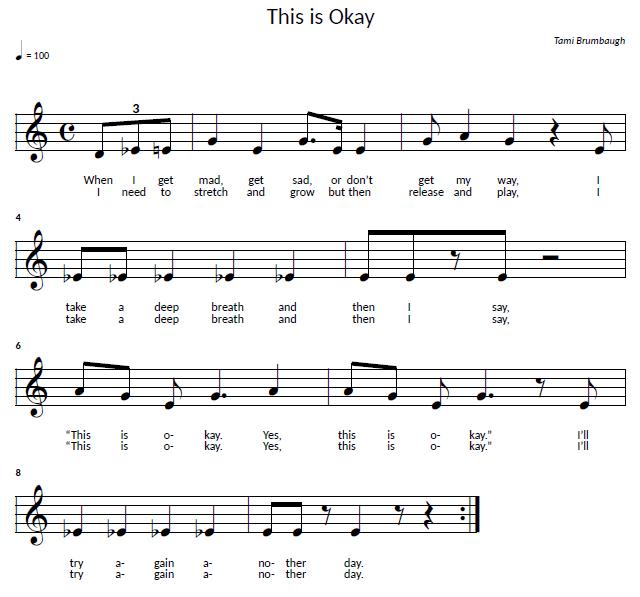
I now also incorporate more songs that address specific components of mental health. Examples of easily accessible songs online include “The Good Day Cha Cha” (by Narwhals & Waterfalls) to focus on having a positive attitude and the “Feelings Song” (based on the Little Spot books by Diane Alber) to validate emotions. My hope is that when we sing these songs on a regular basis they should become ingrained in each student’s mind. When a crisis arises, hopefully positive songs will resurface, giving students skills or encouragement to handle the situation in a healthy way.
In addition, I’m teaching students more responses that will lead to being resilient. I already teach them to say, “Maybe next time,” and “this isn’t hard, it’s just new.” To teach these phrases, I show students the wrong way to respond first. For example, before selecting a student to play an instrument that everyone wants, I say “if we don’t get picked should we throw a fit?” I then throw
a fit. The kids usually laugh or groan and tell me what I’m doing wrong. Then I ask what we can do instead. This leads to a discussion of how we can say, “maybe next time”. Another phrase Fluke mentioned as beneficial is, “This is okay,” when we do not get what we want. Some students fixate on what went wrong or what they did not receive, so this phrase can help them move on.
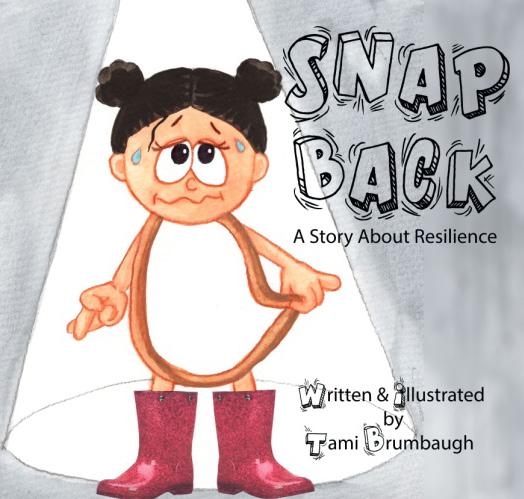
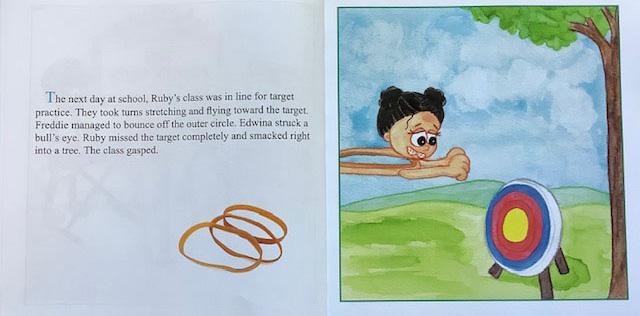
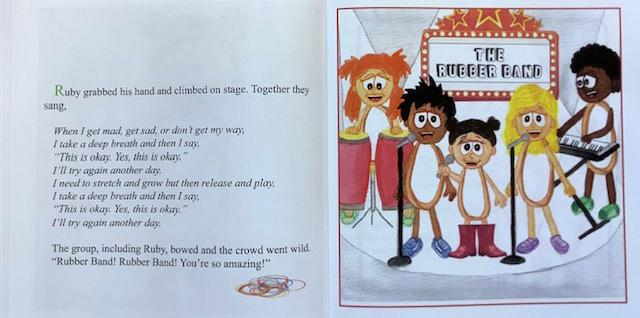
Each year, I write a picture book for my students based on a concept I want to teach. Clearly, the topic needed at this time was resilience. I studied my notes from the resilience workshops, read numerous books on the subject, and then let the ideas percolate. The image of a rubber band being stretched and snapping back got stuck inside my head. Soon, I was painting rubber band characters, complete with heads, arms, and legs. This led to the creation of a book, Snap Back.
In this story, Ruby the rubber band isn’t long and strong enough to twang on the stage at a performance of her favorite musical group, The Rubber Band. She is very disappointed, but she has a song to remind her that “this is okay.” She stumbles through failures and sadness, but soon she discovers that learning from mistakes and snapping back after sadness helps her stretch and grow.
My students learned the song, “This is Okay,” so they could sing it with me every time it occurred in the book, making it interactive. After reading the story to each class, I was excited by the resilience discussions that followed. I planned to sing the song again as the need arose, but otherwise wrap up my project.
Soon, however, I saw another way the book could meet a need. My third-grade students were struggling and their poor behavior was escalating. This particular group had actually excelled as second
graders. Due to budget cuts, they were crammed into two classes instead of three. Both of the classes also had long-term substitute teachers to begin the year. Many students were acting out, trying to get attention. Some students were still trying to make good choices, but they were clearly discouraged. I decided they needed an additional project.
Sometimes, I create recordings of my books and post them on YouTube, so my students can hear the book beyond my classroom without having to spend mon-
ey. I decided to create an instrumental track of “This is Okay” and record my third-grade students singing and doing the motions. I also wanted to encourage some individual students, so I recorded them singing separately in the GarageBand app and used their singing in the book reading. The book reading and video of students demonstrating the motions can be found here.
Did this project magically turn my third-graders around? No, but I have seen improvements. They have been seen and heard, and they are starting to snap back.
It is almost time for my recorder unit this year. Bring it on! Now I have more tools in my toolbelt to deal with students who want to give up. I also plan on reading Snap Back again before the unit to encourage a discussion about resilience. And to the people meeting next to my classroom, bear with us. In addition to learning “Hot Cross Buns,” we are learning to be resilient.
Tami Brumbaugh, Music Specialist/Choral Director, Woodland Elementary School, Olathe, KS, tgbrumbaugh@olatheschools.org
By Rupen Fofaria
to Honor That
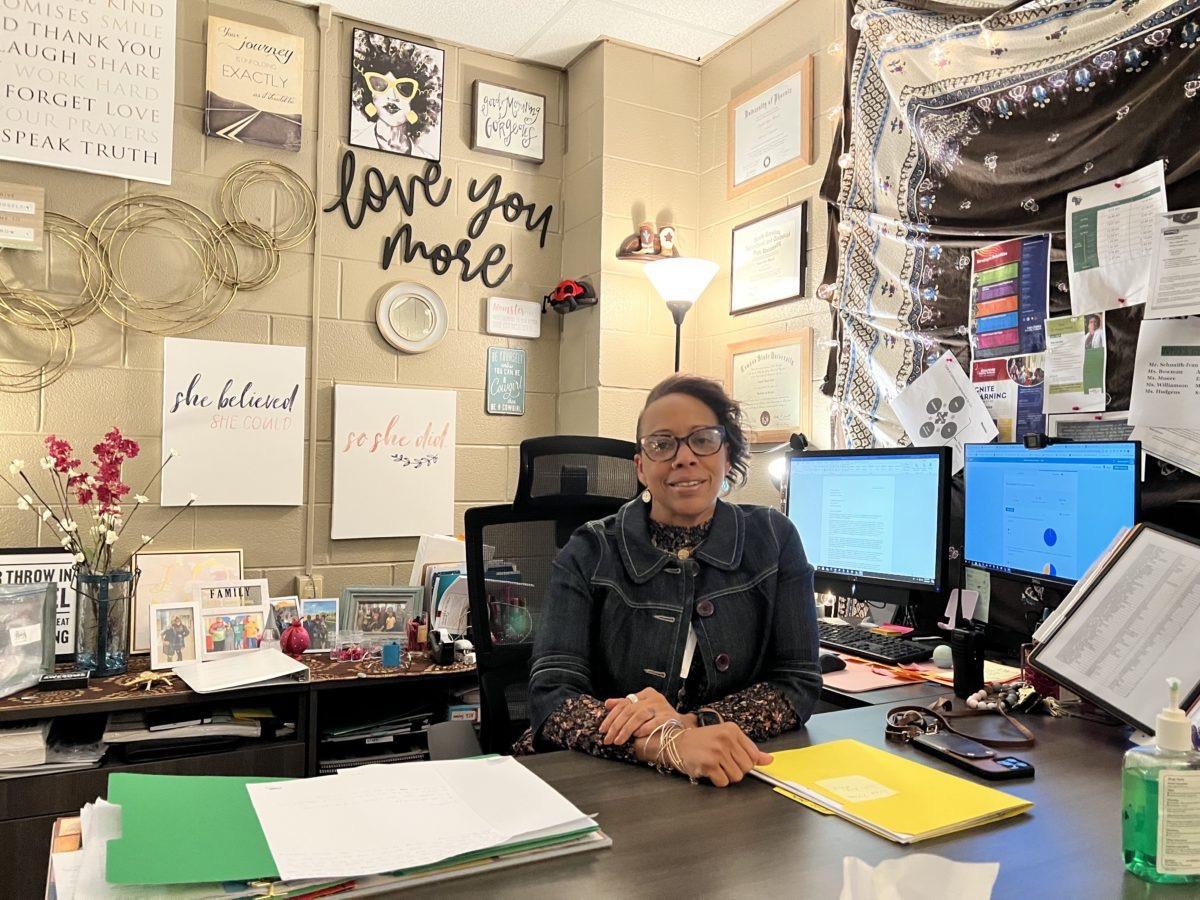
Angela Monell and Southwest Guilford High School are committed to restorative practices as a way to keep kids in class and out of trouble. Rupen Fofaria/EducationNC
Photo
Angela Monell never forgot her first experiences in a classroom. Teaching at a private school for students with learning differences, she was blown away by the school’s approach to discipline. The student population didn’t fit squarely into the education system’s box of what proper behavior looked like. So, instead of using discipline to punish, the school used discipline to educate and support. “And I always remember thinking, if I ever run a school, I would love for that to be a part of my school,” she said.
Monell started running her own school last year when she was named principal at Southwest Guilford High School. But integrating restorative practices there actually began after she was named assistant principal in 2016. Today, the school has seen in-school suspensions reduced, attendance increased, and grades raised.
“We have people who focus solely on our discipline and restorative practices,” Monell said. “We’ve changed, really, how we approach (discipline) and we’re seeing a big difference.”
Keeping kids in class is critical
A lot of research tells us chronic absenteeism has a deeply negative impact on academic performance, graduation rates, and postsecondary outcomes. Often, efforts to combat persistent absences are directed at parents – but what about when the school is keeping kids out of class? What about when schools are so focused on punishing bad behavior that the same kids keep missing class because of suspensions?
“Are we thinking about what’s going to be the best outcome for these kids?” Monell said. “What are we trying to teach them? Are you trying to teach them some skills on how to resolve things, or are we trying to just punish them?”
Those are the questions Southwest Guilford High School confronted and addressed, and as a result, it’s recreating a culture of belonging, improving
Southwest Guilford High School is asking important questions around discipline: "Are we thinking about what's going to be the best outcome for these kids? What are we trying to teach them? Or are we trying to just punish them?"
emotional regulation, and increasing attendance. And how they’re doing it is worth paying attention.
In-school suspension looks a lot different now. Not only is it less utilized, but when it is used, its purpose is to restore students to the classroom with new tools. “I’ve always kind of had my own little justice system in my class and thinking very critically about my classroom management, how my classroom management was responsive to students’ behaviors,” Monell said. “Not always saying, oh, this kid did this so I’m gonna give him this consequence. It’s more, let me think about how I can get creative with my own discipline in my classroom.”
While some districts nationwide are trying to incentivize students to come to class by giving away cars, Southwest Guilford is taking a whole child approach – making critical decisions based on teaching behavior more than punishing it.
Here’s how it’s done
When Monell became assistant principal at Southwest Guilford in 2016, she started having conversations about equity with her principal. In a school with more than 70% white teachers, she wanted to address disciplinary practices that resulted in
mostly Black students being referred to in-school suspension. At that time, the school called inschool suspension “Behavioral Instruction Program.” The students called it “Blacks In Prison.”
“I’m not okay with that,” Monell said. She began by going through the school’s handbook. Many of the terms for disciplining students felt vague – like Rule 6: disrespect. “What’s disrespectful in one household might not be in another,” Monell said. “So, did the students really know what we were expecting?”
Monell and other school leaders committed to redesigning both in-school suspension and all disciplinary practices to focus on educating students on expectations and guiding them to excellence in the classroom.
The first step, she said, was renaming and reframing in-school suspension. They now call it Restoration Station (RS), and its once-punitive purpose of housing students who had misbehaved is now replaced by a series of restorative practices. For one thing, students don’t just sit quietly all day. They transition through a series of lessons every time the school bell rings, including social-emotional learning lessons and something called restorative conferences.
“There’s some movement there, and the kids know what’s happening at each part of the day,” Monell said. Much of that is addressing the incident that got the student in Restoration Station.
“We need to start educating kids on what respect looks like in different places,” Monell said. “If you’re there for non-compliance, all right, how were you non-compliant? And how do you not be noncompliant?”
The restorative model the school uses looks at engagement happening in one of four ways: Are you engaging to in a punitive way, for in a permissive way, not in a neglectful way, or with in a restorative way?
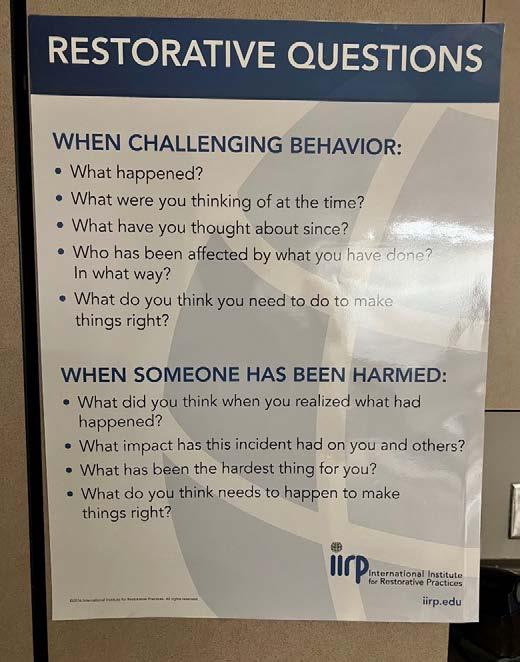
The first school year the school implemented the model was in 2017-18. The next year, in-school suspensions dropped about 31% and out-of-school suspensions dropped about 17%.
It’s primarily for teachers to examine how they are engaging with students, and for students to ask how they’re engaging with each other. But teachers are finding that it helps them in life outside the school building.
“I could be in church and I’ll be like, I’m in my ‘to’ box,” said RS teacher Deidre Farmer. “But it works anywhere. It makes you become one with yourself and ask, okay, what am I feeling? Because I don’t want to make the situation escalate so I need to transition to my ‘with’ box so I can be more restorative.”
Teachers are giving it a shot, and buying in
Amanda Vanscoyk was not excited when she started hearing about some of the changes. “I was not bought in on the SEL/restorative practices. I
thought it was a bunch of nonsense,” the English teacher said. “But Dr. Monell has a passion for it.”
So she signed up for the training, and to her surprise, it didn’t take long for the training to become relevant. The first thing she realized was how much it helped her, emotionally, as she went through her day. It helped her examine her own thoughts and actions.
Then she saw how it worked with students. She remembers one time a student didn’t like the way she delivered instructions. Vanscoyk did a quick restorative conference with her, and was struck by how healing it proved. “So now, instead of just writing them up, I have this process,” she said. A pretty small incident that in the past could have escalated to suspension became an opportunity
for something else. “It’s created this safe space for students,” she said.
Restorative conferences are an opportunity for students who violated the handbook to sit with an educator trained in restorative practices to process the violation and think about how to move forward productively. If the violation involves an incident with another student or teacher, all parties sit through conferences together and talk about how they made each other feel, acknowledge the harm they caused each other, and come to a resolution with one another.
The school calls parents before restorative conferences to explain what’s happened and what the conference looks like. “I’ll say, look, this is what the
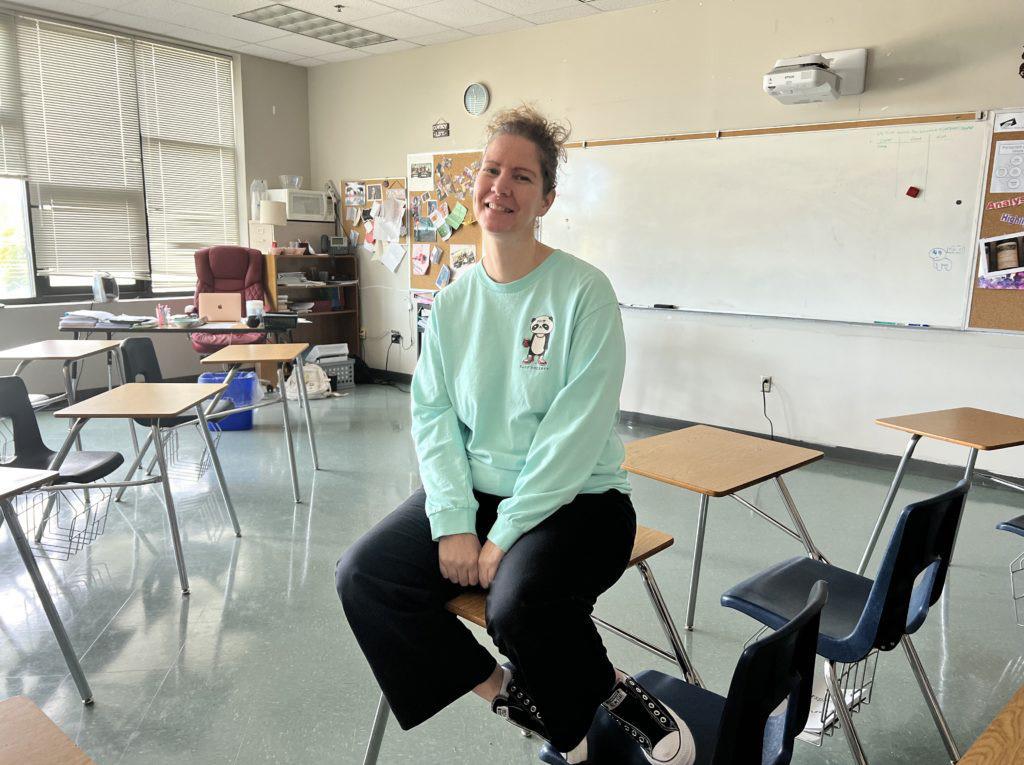
Amanda Vanscoyk, an English teacher at Southwest Guilford High School, was skeptical of restorative practices – until she took the training and tried it. Rupen Fofaria/EducationNC
consequence actually is, but instead I can give you this and your child’s going to go through a sort of conference,” Monell said. “And then when I tell them what it is, they’re like, ‘That’s amazing. Go ahead.’”
Sometimes, if the violation is a minor one, parents are given the choice of having their student participate in a conference instead of missing any days of class for RS. “And it’s really become something parents are receptive to,” Monell said. “They’re seeing how it’s positively impacted the students.”
Pivoting and innovating during COVID
By 2019, the school had trained 40 educators on restorative practices and was seeing disciplinary referrals reduced. Not only that, but the RS team
grew to two people, so while one stayed with students in RS, the other could float to visit the classrooms of kids who just left RS – to help them work on what they’d learned in the usual class setting. “We were on a great roll,” Monell said.
Then, COVID happened. All of a sudden, urgency demanded attention in a lot of other areas. Monell said she was thankful to have a restorative team already in place. That team shifted from running RS to doing some of the COVID tracking.
One of the things they were tracking were school absences. “During COVID, the kids were not motivated,” Monell said. “Kids being out of school, they just weren’t interested in coming back. We ran our
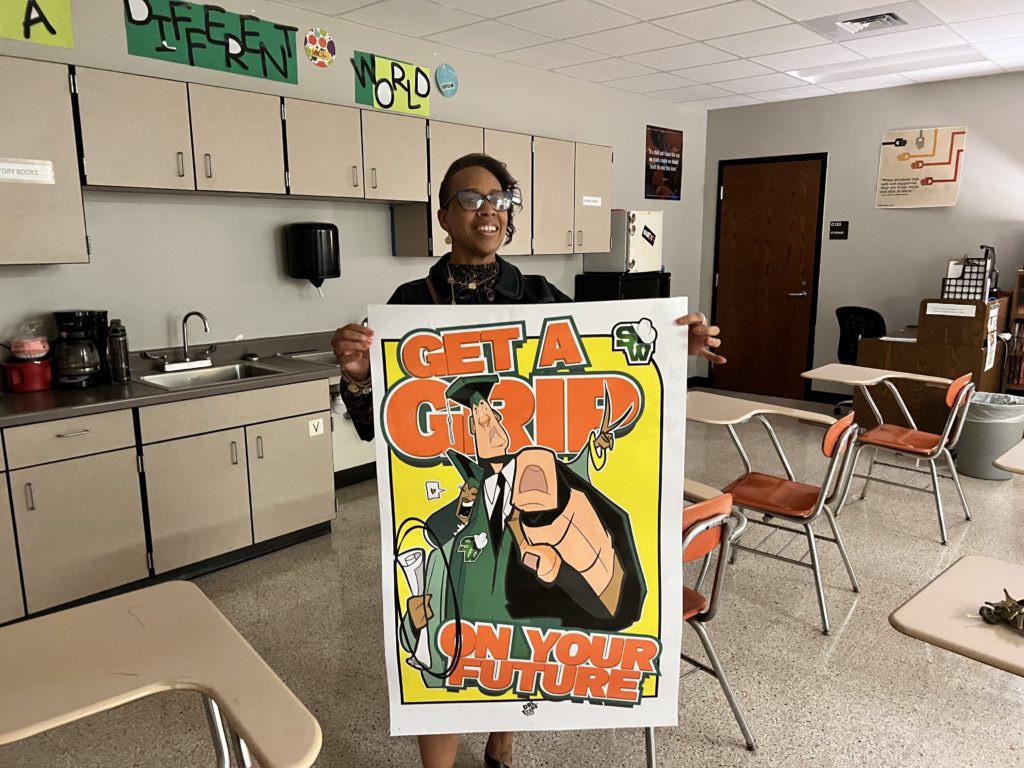
Angela Monell holds up a poster for the school’s Get a GRIP program. Rupen Fofaria/ EducationNC
Restorative conferences are an opportunity for students who violated the handbook to sit with an educator trained in restorative practices to process the violation and think about how to move forward productively.
who were most often referred for disciplinary reasons, it found that the top 40 were all Black males. The restorative practices were helping to change things at school, but to focus on this subgroup, Monell started a barbershop program on Wednesdays. “I have two boys so I know the barbershop is the place you go to talk,” Monell said. “That’s just the place and it’s comfortable.”
attendance numbers and looked at the kids who were not coming to school, who were taking care of little brother or little sister.” To help these kids, Monell designed a program called “Get a GRIP.” GRIP stands for Group Restorative Intervention Practices.
The school put students with attendance issues through a special program where they talked about how important attendance is on things like grades and graduation – as well as the importance of grades and graduation. The program incentivized students by offering rewards for hitting attendance, class participation, and grade goals. At its conclusion, Monell said the school saw a 40% increase in attendance, 60% increase in class participation, 60% increase in the amount of completed assignments, and 80% of students improving their grade point average.
When equitable practices work, they’re worth investing in
The restorative practices have been especially helpful for students with learning differences and students of color. Statewide, these subgroups are disciplined more frequently than their peers, and it was true at Southwest Guilford, too. In fact, when the high school ran its data to identify the students
So Monell partnered with Gene Blackmon, who started Prestige Barber College in Greensboro with the hope of changing his community “one cut at a time.” Blackmon brings chairs into the school so these kids can sit in the “barbershop” and get their haircut during the lunch period. Monell even orders pizza for them. Teachers from the school pop in and the kids talk with their teachers and the barbers – engaging in real conversation.
“We just wanted to know what was going on with them, what they were thinking,” Monell said of the students. “So we said, come have lunch, chat, talk about what’s on your mind, because we’re concerned about y’all. I need you in school and not in in-school suspension. So y’all talk it out.”
Monell received a grant recently that will allow her to train about 40 more teachers in restorative practices. But many of the first 40 who were trained have since left the school, so there’s a need to train even more teachers. She’s also down one RS teacher and facing the same hiring strains reported across the state.
There’re also new projects that Monell believes will help further gains made through these restorative programs. These include holding community meetings and having the school improvement team work on making the school handbook more equitable. It all takes funding, though. More than the school has been able to secure through grants. “And that’s the thing – even when something is working, you still need to find a way to get the money for it,” she said. “This is really changing lives. Its transforming lives. We have to believe it’s worth investing in that.”
Rupen Fofaria, EdNC.org, is the equity and learning differences reporter at EducationNC. He exists to shine light, including by telling stories about under-reported issues, rfofaria@ednc.org
Reprinted with permission from https://www. ednc.org/student-discipline-restorative-justice/ in accord with republish guidelines of Education NC. EdNC is a nonprofit, online, daily, independent newspaper. https://www.ednc.org/
I love this article. That’s the kind of school where students thrive! The focus is solely on the best outcome for the students. This program works WITH students to clearly define expectations; what they look like in different settings and how to alter behavior to match these expectations. This is done through social emotional learning and restorative conferences.
Janet Burgess, MSLBD Master Teacher, burgessjanet@yahoo.com
Restorative practices seem to be one of the most promising alternatives to suspension out there. A school leader acting to implement these practices in response to the disproportionate rate that students of color and with disabilities are suspended is truly inspiring. Educators of students with EBD often find themselves trying to advocate for students within systems that negatively affect the students’ ability to access an equitable education. Leaders working to change those systems will improve education for students with disabilities more rapidly than individual teachers advocating for individual students.
I was surprised that “community meetings” are among the practices to be added in the future. I lead restorative justice training at my school using a model that works within MTSS, as taught by RJ Ed, a restorative justice training organization out of Fort Collins, CO. In a tiered model, school culture and developing a sense of community are the foundation, tier 1, of the model. Restorative practices should focus on repairing relationships and restoring students to their classroom communities. Students have to believe they have a relationship with their teacher and classmates to want to repair it. Classrooms of students that have a strong sense of community will be better prepared to “restore” a classmate to class.
Anne Baptiste, MSLBD Master Teacher, abaptiste@esu7.org
Mobile App for Reporting Student Behaviors Coupled with School Safety Curriculum Shows Promise
By National Institute of Justice
Every student should have the right to feel physically and emotionally safe when they are at school. Yet research indicates that nearly one-fifth of all high school students report being bullied at school or online, and this percentage has remained steady in recent years (Kann et al., 2018). The results of this type of victimization range from absenteeism to suicidal ideation, self-injury, depression, anxiety, substance abuse, and sometimes even violent revenge-driven behavior at school. Peer victimization based on gender, race, and sexual orientation can also be linked to retaliatory violence.
Students often share information about their violent intentions at school with their peers, but their peers can be reluctant to share what they hear about these violent intentions with teachers or school administrators.
Based on this premise, a group of NIJ-funded researchers from Trifoia, the University of North Carolina, and the University of Oregon created a project called SOARS (Student Ownership, Accountability, and Responsibility for School Safety) to address school safety. their goal was to create a student-centered and technology-driven comprehensive
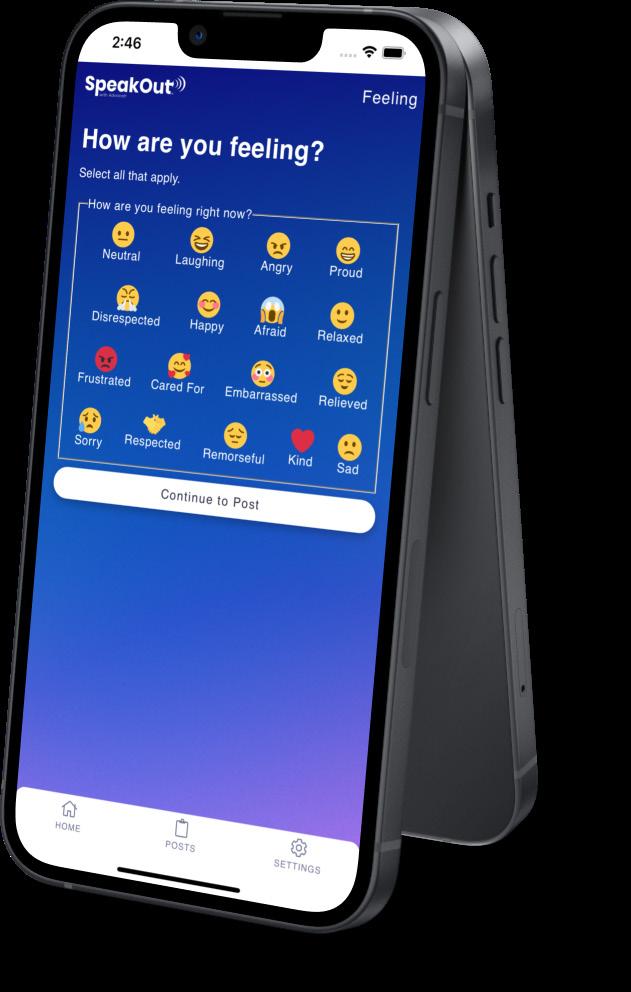
school safety framework to promote students’ ability to communicate violent intentions to the school before they occur, take a non-punitive approach to school discipline, foster active participation of students to resolve conflict, and prevent peer victimization from re-occurring. Given that the project was focused on high school students, the researchers placed a strong emphasis on student agency, beginning at the point of conceptualization.
SOARS Project Framework: App Development and Testing
The SOARS school safety project consisted of four phases of implementation:
• Phase 1: Convening of focus groups consisting of high school students, personnel, and parents to solicit perceptions of success associated with school safety practices, as well as challenges.
• Phase 2: Assessment of prototypes of the SOARS framework components. Based on feedback from phase 1, the researchers developed:
- The Advocatr, a mobile app used to report both positive and negative student behaviors. See “Who Can Use the Advocatr App?”
- A teacher-delivered, nine-week curriculum on school safety.
- Informational briefs for school personnel to aid them in supporting students.
- Guidelines for a student-led, schoolwide safety campaign to raise awareness.
• Phase 3: Feasibility test of the mobile app and accompanying curriculum with the teachers and students in the classroom.
• Phase 4: Pilot test conducted within four high schools (two intervention and two control) to test the effectiveness of the entire framework.
Along with the implementation of the mobile app, schools assigned to the intervention condition launched student-driven campaigns for pro-social
behavior. The students focused on reinforcing and rewarding positive behaviors by recognizing peers for acts of kindness and meeting with school personnel to discuss school climate and how it could be improved.
Between each phase, the researchers revised and adapted the framework based on feedback from the study participants. For instance, in one iteration, the teachers asked for the curriculum to be shortened because the students desired more time to share and discuss information.
Results Indicate Improved Student Perceptions of School Safety
The researchers recruited students, school personnel, and parents from two schools in 2017 and 2018 to participate in the intervention.
Over the course of the study period, the students using the Advocatr app reported statistically significant improvements in students’ perceptions of personal safety and lower levels of disruptive behaviors in their school. In addition, the studentled pro-social behavior reinforcement campaigns were generally well received. The researchers did not expect for
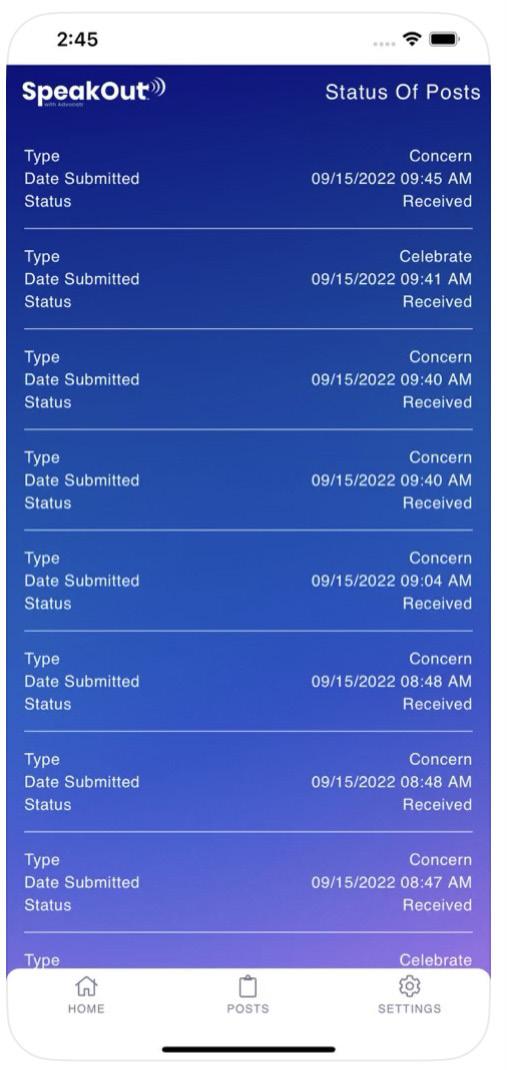
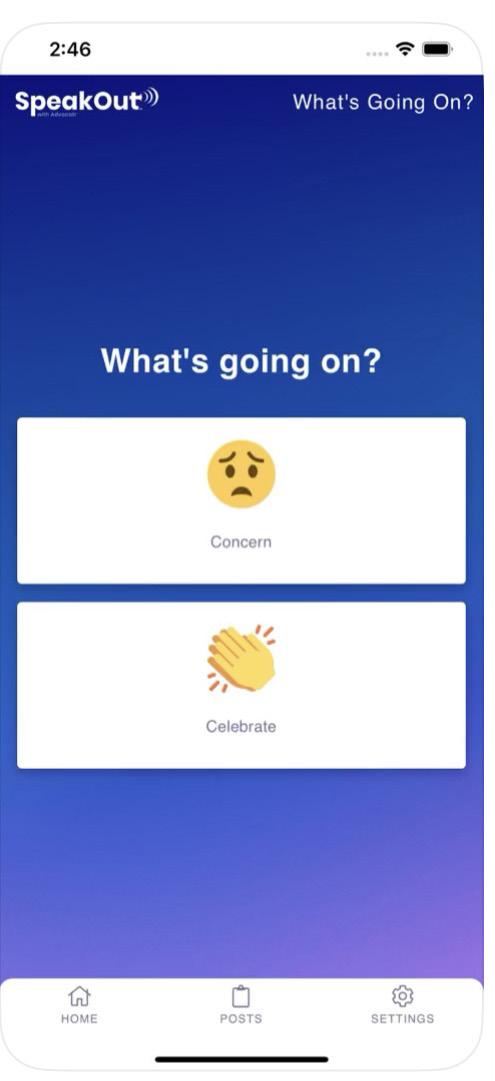
these efforts to be as successful as they were, given that these types of groups are generally more readily accepted by younger students rather than high school students.
However, surveys of teachers at the intervention schools revealed no statistically significant differences in their perceptions of student behavior, nor in levels of delinquency, bullying, and peer victimization compared to the control condition schools.
Covid Pandemic Shuttered Schools
During the pilot testing phase of the project, the 2019-2020 school year was affected by school closures related to the Covid-19 pandemic. All schools in the study (intervention and control) were affected by the closures. Removal of students from the classroom to remote learning increased stress levels and disengaged many students. Therefore, only data from the fall of the 2019 school year were used, which may have influenced the study’s findings.
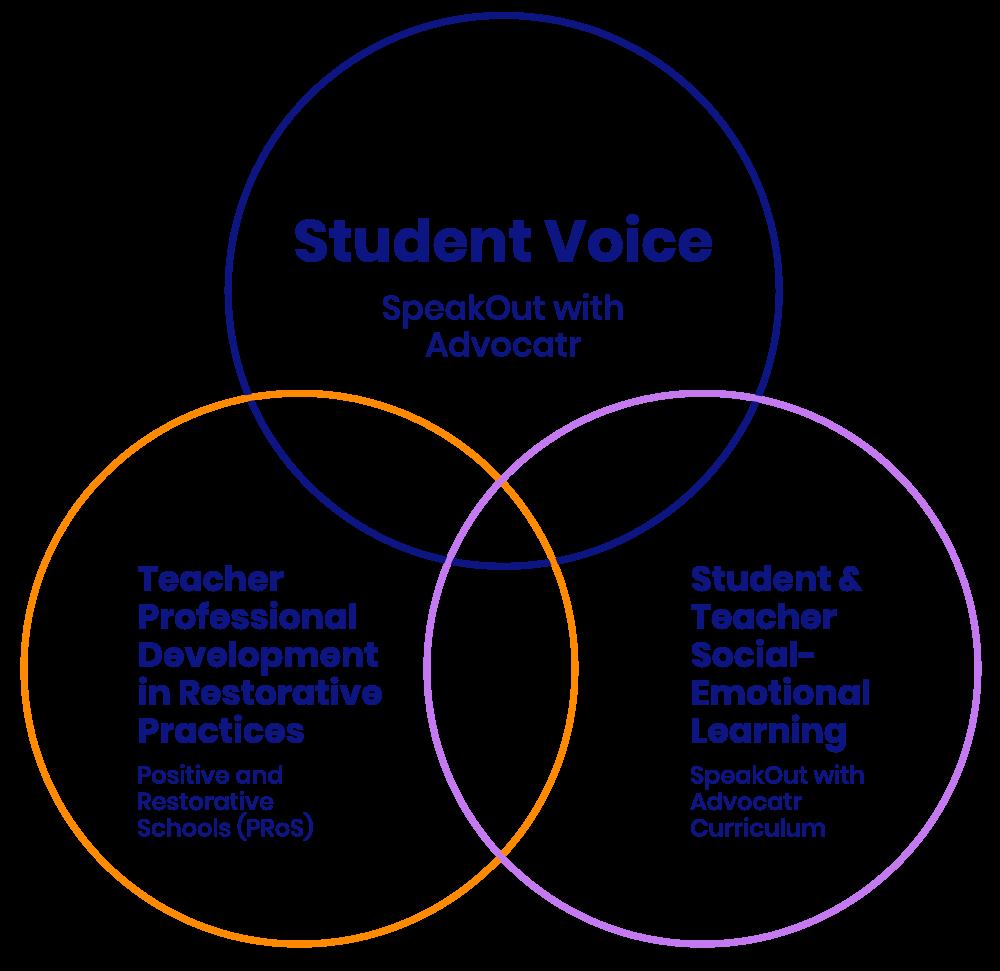
and 2) it improves school climate and puts the emphasis on prosocial behaviors, because students can report both positive and negative behaviors. They encourage future research on “snitching” as a barrier to reporting.
Student Empowerment and Local Engagement Tool
Moving forward, the researchers recommend emphasizing the enablement of students’ voices and use of restorative conflict resolution when designing and implementing a comprehensive school safety framework at the high school level. Their foundational research cautions that the “anti-snitching” culture runs very deep at the high school level and affects students’ willingness to report other students’ actions.
The development of the Advocatr mobile app helps address this culture in two ways: 1) it keeps reports local, where they can be addressed (as opposed to state tip lines that notify authorities)
The SOARS framework provides a reporting tool that is cohesive, coupled with a curriculum that is meant to build relationships by noticing and promoting pro-social behaviors. The authors note, “strong and trusting relationships are fundamental to students’ willingness to share such critical safety information.” The research suggests that the willingness of students to report negative behaviors is highly dependent on the quality of the relationship they have with teachers and on the school personnel’s ability to respond in a non-punitive manner deemed appropriate by students. A two-pronged approach, merging student access to the Advocatr with teacher access to restorative training to promote students’ willingness to report safety concerns, could be a successful solution.
Who Can Use the Advocatr App
The Advocatr mobile app is intended to be used as a component of SOARS, the school-wide safety framework, which also includes an accompanying classroom curriculum, informational videos, and student leadership materials to support student-led safety campaigns. More information on the mobile app and accompanying information may be found at http:// advocatr.org. Development is still underway, so it is not yet available for public use.
About This Article
The work described in this article was supported by NIJ award number 2015-MU-MU-K003, awarded to IRIS Media Inc. This article is based on the grantee report “Project SOARS (Student Ownership, Accountability, and Responsibility for School Safety” (pdf, 49 pages), by Claudia G. Vincent, Ph.D., University of Oregon, Hill Walker, Ph.D., University of Oregon, Dorothy Espelage, Ph.D. , University of North Carolina, Alberto Valido, University of North Carolina, Christopher Murray, Ph.D., University of Oregon, Brion Marquez, University of Oregon, Rita Svanks, University of Oregon, and Jordan Pennefather, Ph.D., Trifoia. These authors published “An Initial Field Test of the SOARS Framework for High Schools”, May, 2022, in the NASSP Bulletin 106(1). DOI: 10.1177/01926365221102378.
Reference
Kann L. et al. (2018). Youth Risk Behavior Surveillance –United States 2017. Morbidity and Mortality Weekly Report, 67 (8), 1-114.
Acknowledgement
MSLBD and ReThinking Behavior gratefully acknowledges the U.S. Department of Justice, Office of Justice Programs, National Institute of Justice, for allowing us to reproduce, this article. The opinions, findings, and conclusions are those of the author and do not necessarily represent the official position or policies of the U.S. Department of Justice. was National Institute of Justice September 6, 2022, nij.ojp.gov.
SOARS and the Advocatr app could be a streamlined way for a school that is just starting to implement programs to improve students› sense of safety. In many cases, though, it would be redundant for PBIS schools as well as schools already implementing evidence-based SEL curriculums. It is also fairly easy for a school to use their own website or app to provide a place for reporting of positive and concerning behaviors.
It is positive that students report an increased sense of safety. It would be interesting to see if school data on bullying and aggression decreased with the implementation of the SOARS framework. There is also more to be learned when “surveys of teachers at the intervention schools revealed no statistically significant differences in their perceptions of student behavior, nor in levels of delinquency, bullying, and peer victimization compared to the control condition schools.”
I am all for convenient student reporting, student-led safety campaigns, teacher-led safety curriculum, and sharing information out to school personnel. SOARS and the Advocatr app aren›t necessary to implement any of the above, but it might make it easier.
Anne K. Baptiste, MSLBD Master Teacher, annekatherinebaptiste@gmail.com
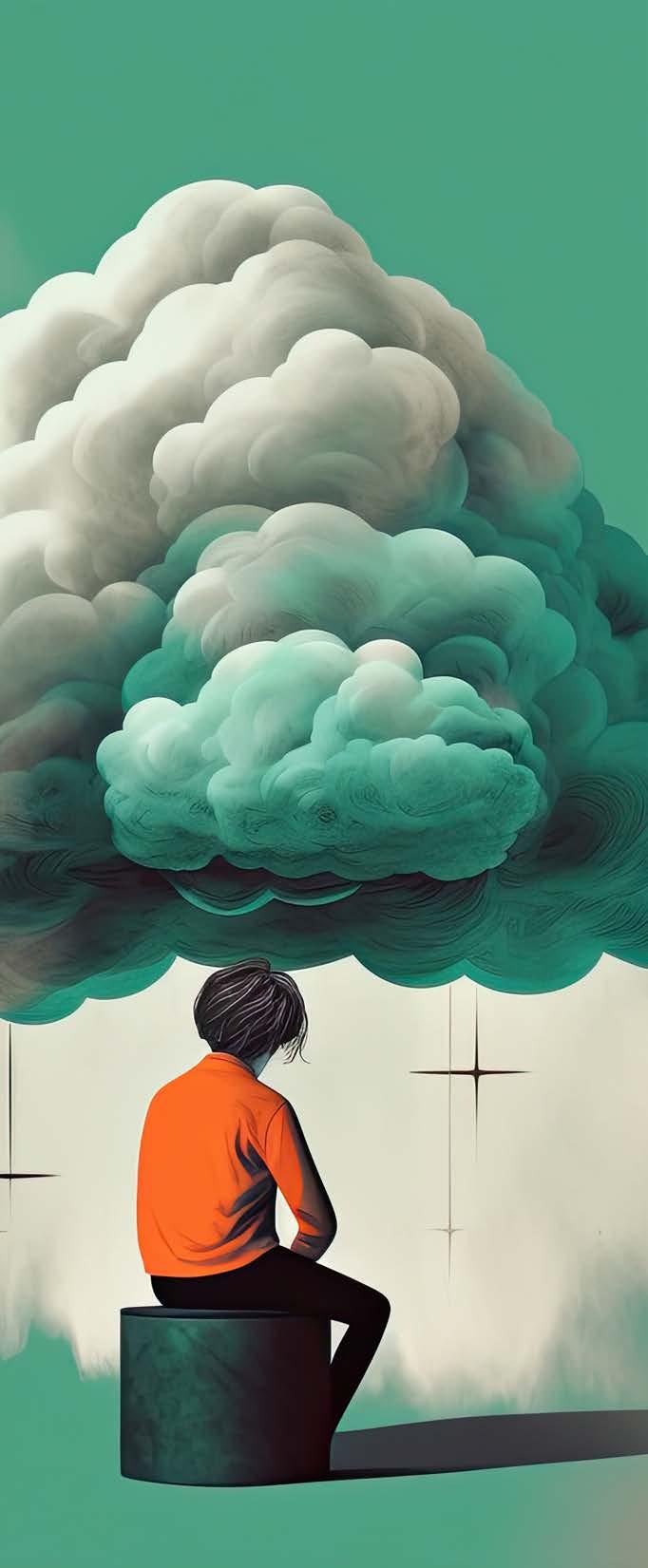
A National Emergency: Children’s Mental Health
By Lawrence Altman
The American Academy of Pediatrics, the Children’s Hospital Association, and the Academy of Child and Adolescent Psychiatry have said that children’s mental health challenges are so severe that it has reached the level of “a national emergency.” These groups opined that the combination of COVID and racial inequality have significantly contributed to mental health issues among children in the United States.
What’s more, on April 1, 2022, the United States Department of Health and Human Services working with the Centers for Disease Control published a document using data collected during the COVID-19 pandemic. This document indicated that one-third of high school students experi-
enced poor mental health during the pandemic. This number is almost three times higher than data published by the CDC in March of 2015 and at least 13% higher than data published in 2019 by the National Center for School Mental Health.
In addition, Dr. Vivek Murthy, Surgeon General of the United States, concluded in a December 7, 2021 Surgeon General’s Advisory, agreeing with the American Academy of Pediatrics, the Children’s Hospital Association, and the Academy of Child and Adolescent Psychiatry that we have a national emergency regarding children’s mental health in the United States. To provide guidance to address the emergency, the Surgeon General published a comprehensive plan to address the crisis.
Data collected prior to the COVID pandemic, in 2019, by the National Center for School Mental Health (NCSMH), supported the need for schools to develop a comprehensive school mental health system. Data collected by the NCSMH indicated that annually 13% to 20% of school-age children in the United States would meet the criteria of a diagnosis for a mental health disorder. The report, when compared to data published by the Centers for Disease Control (CDC) in March of 2015, shows that as a country, matters had not improved for school age children. In 2015, the CDC reported that 12% of all Americans, including children, suffered from clinical depression and that this number has increased. The CDC data also reported that 8% of Americans who do not receive help for their mental illness died by suicide.
The United States Department of Health and Human Services in conjunction with the Center for Disease Control and Prevention April 2022 publication used 2021 data to discuss the impact that the COVID-19 Pandemic had a upon children and adolescents. The CDC opined that data suggested that the COVID-19 pandemic had negatively affected the mental health of many children and adolescents.
• The collected data showed that during the pandemic 37.1% of students experienced poor mental health. In the 30 days prior to the pandemic, the percentage was 31.17%. This is a significant increase from the data collected before the COVID pandemic in 2019 by the NCSMH.
• Indeed, the data showed that during the pandemic emergency room visits for suicides were 50.6% higher for girls and 3.7% higher for boys during February and March of 2021 when compared to those same months in 2019.
To address the national emergency, the report from the Surgeon General included recommendations that school districts can use to help students who have mental health issues. The recommendations include:
• Create positive, safe, and affirming school environments for students.
- Develop and enforce anti-bullying policies. Indeed, the United States Secret Service has advocated the need for schools to adopt a no tolerance anti-bullying policy as a component for improving school safety.
- Be proactive in supporting students and their families to openly discuss mental health issues that should include asking for help and obtaining help so that the stigma of mental illness can be eliminated.
• School staff must learn how to recognize signs of mental and physical health of students.
- This will require training of all school staff.
- Some warning signs that a child might be suffering from a mental health problem: Sudden drop in grades and a known traumatic event that has taken place in a child’s life. In fact, students who have been the victim of bullying, sexual harassment, or sexual assault have been traumatized. This can cause significant mental health problems for a child.
- The United States Secret Service has published a document in 2018 that suggests school create a Threat Assessment Guide. Use and full implementation of the suggestions within the guide can assist school staff in finding students who have mental health issues that can be promptly addressed.
• Use federal, state, and local resources to hire and train additional staff including staff dedicated to working with students who have disabilities.
- This additional staff should include school counselors, nurses, social workers, and school psychologists. To illustrate, Project AWARE provides funds for state, local, and tribal governments to coordinate resources to support schools for treatment and early interventions for students with mental health needs.
• Protect and prioritize students with higher needs and those at risk of mental health challenges.
- Those students include but are not limited to children who are disabled,
- Children who have experienced racism, poverty, personal or family mental health challenges,
- Any traumatic event such as being a victim of bullying, sexual harassment, or sexual violence.
- Children who have been impacted by COVID that could include a parent’s loss of employment, a parent’s infected by COVID, or a parent or loved one dying from COVID.
• Support the mental health needs of all school personnel.
Since 2015 the percentage of students and adolescents in need of mental health treatment has more than doubled. The Surgeon General and the CDC opine that a major contributing cause for this increase is due to the COVID Pandemic. The Surgeon General opined, however, that the mental health issues faced by our youth are treatable and preventable. His goal, in issuing his report, was to provide a road map to show how this can be done. What’s more he stated that as a nation we have a moral obligation to help our youth in getting

the help they need. In closing his introduction to the report, Dr. Murthy said:
“If we seize this moment, step up for our children and their families in their moment of need and lead with inclusion, kindness, and respect we can lay the foundation for a healthier, more resilient, and for fulfilled nation.”
No one could have said it better than Dr. Murthy.
References
Pediatricians Say Children’s Mental Health Is a National Emergency (Nicole Karlis, Salon publication, October 21, 2021
Mental Health Suicidality, and Connectedness Among High School Students During the COVID-19 Pandemic – Adolescent Behavior and Experience Survey, United States January – June 2021 (mmwr/April 1, 2022/Vol 7/ No.3, United States Department of Health and Human Services/Centers for Disease Control and Prevention)
Suicide Trends Among Persons Aged 10-24---United States, 1994-2012, Centers for Disease Control, (March 6, 2015)
Protecting Youth Mental Health, The Surgeon General’s Advisory (December 7, 2021)
Advancing Comprehensive School Mental Health Systems: Guidance from the Field, (NCSMH September, 2019), Pages 14 and 15
Suicide Trends Among Persons Aged 10-24---United States, 1994-2012, Centers for Disease Control, (March 6, 2015)
Mental Health Suicidality, and Connectedness Among High School Students During the COVID-19 Pandemic—Adolescent Behavior and Experience Survey, United States January –June 2021 (mmwr/April 1, 2022/Vol 7/ No.3, United States Department of Health and Human Services/Centers for Disease Control and Prevention)
Protecting Youth Mental Health, The Surgeon General’s Advisory ( December 7, 2021), Page 19
Protecting America’s Schools/ A U.S. Secret Service Analysis of Targeted School Violence (November, 2019, U.S. Department of Homeland Security, United States Secret Service National Threat Assessment Center)
ENHANCING SCHOOL SAFETY USING A THREAT ASSESSMENT MODEL, U.S. Department of Homeland Security, United States Secret Service, National Threat Assessment Center, July 2018
Lawrence Altman, retired Lead Compliance Attorney, Kansas City Public Schools, Kansas City, MO and Adjunct Professor, Avila University, ljalaw@avila.edu

Podcast
Behavior Now!
Podcast Review by Katherine A. Graves
If you haven’t already – you’ll want to tune in to Behavior Now!, a podcast from the Division of Emotional Behavioral Health (DEBH; formerly the Council for Children with Behavior Disorders). Hosts, Brian Barber and Ben Riden, cover relevant topics for researchers, educators, pre-service teachers, and other professionals in the field of emotional behavioral disorders. Behavior Now! is released quarterly with a new episode in Spring 2023.
Dr. Barber, Associate Professor at Kent State University, focuses on effective prevention and intervention strategies for behavior, cognitive behavioral strategies, and setting factors affecting implementation in alternative education settings. Dr. Riden, Assistant Professor at James Maddison University, engages in research using low-intensity interven-
tions to create positive learning environments. Barber and Riden began cohosting Behavior Now! in March 2021 and have produced nine episodes (Figure 1).
Episode: Teacher Shortage Crisis, Guest –LaRon Scott (October 14, 2022)
One episode I found especially interesting was Teacher Shortage Crisis (October 14, 2022). The featured guest on this episode is Dr. LaRon Scott, Associate Professor in Special Education and Associate Dean for Diversity, Equity, and Inclusion at the University of Virginia. Scott’s research includes recruitment, preparation, and retention of historically marginalized teacher educators and post-secondary transition and outcomes for Black youth with intellectual disabilities. He also focuses on the critical implications of implicit bias shaping the conditions for historically marginalized teachers and how historical and contemporary state and local policy shape the treatment of minoritized special educators. His work has been funded by more than six million dollars and Scott has won many awards for his scholarly work.
Educators know that the teacher shortage in the US is DIRE. There is no question about it. Shortages exist in quantity, certification, and diversification. There are not enough certified teachers to fill classrooms and the population of teachers of color has decreased. Special Education has ranked as the #1 shortage area for decades.
Why?
Scott highlighted working conditions as a primary reason for the teacher shortage crisis. Many licensed professionals are not working in the classroom because of the working conditions. Teachers of color are turning over at greater rates because of higher levels of adverse working conditions (i.e., facing microaggressions and racism). Efforts are needed to build positive school culture, improve the school climate, and foster supportive administrators. Scott highlighted the most critical working conditions: ad-
ministrative support, culturally responsive mentoring, collegial support, administrators that understand the context of the job, and the intentional pairing of qualified mentors. Further, teacher-prep programs are not training pre-service teachers to mentor other teachers or manage paraprofessionals. As teachers leave, our newer teachers are being placed in positions designed for teachers with more experience and skills.
“The field of education is under attack.” It’s time to reposition and reelevate the profession employing strategies including:
• Increasing teacher pay
• Showcasing what being a teacher means and the importance of it in the community
• Developing loan forgiveness for teachers
• Funding “grow-your-own” programs
Teachers of Color
Scott shared his views on teachers of color. “Students of color experience higher levels of trauma in the K-12 school system. Then we go to those students and say Hey, you should be a teacher. In order to retain and recruit teachers of color, we must first acknowledge the role that white supremacy has played in policies and systems and therefore inflicted harm on students and communities of color. Only then can we talk about bringing in and retaining teachers of color. Further, we must wipe out the white supremacy in the system. If this doesn’t happen, we are just perpetuating the problem. There is hope and motivation in the new generation.”
Scott and others collaborated in a special issue of Teacher Education Special Education, highlighting the experiences of teachers of color. Currently, in the field, there are 52 studies related to the retention of teachers in special education. Only a few have been disaggregated by race. In color-evasive research, policies and practices are then created that do not reflect everyone. The reasons why
teachers of color come into and leave the profession can look different than for their white counterparts. This special issue served to give teachers of color a voice.
In the final portion of the podcast, the hosts discussed the book, The Mix Tape Volume 1: Culturally Sustaining Practices Within MTSS Featuring The Everlasting Mission of Student Engagement, co-authored by Scott, Jonte Taylor, and William Hunter (Council for Exceptional Children, 2022). This book highlights interventions, strategies, and considerations that can support teachers working with all students academically and behaviorally.
As a third-year doctoral candidate, I thoroughly enjoyed listening to this episode of Behavior Now!. Teacher retention is a hot topic in the field currently. I follow Dr. Scott on Twitter and have always been interested in his research. However, at the end of the podcast, I was left wondering more
Books
Staying on Top and Keeping the Sand Out of Your Pants
Review by Jim Teagarden
The reviewer is tasked at the end of the summer with supervising the preparation of offices for a “new” crop of higher education faculty. This means in many cases removing hundreds if not thousands of books that retiring faculty have left behind for their students. The sad news is most of the time these publications have long since lost the status that once made them desirable. This even applies to those famous “book buyers.” Which means that these oldies but goodies meet their end in a dumpster. This summer this experience yielded an unexpected gem. A small book with an eye-catching title was saved and it has proved to be not only in-
about the retention of teachers of color in education. Being just an hour long, Scott could not fully describe his research career – obviously.
I recommend Behavior Now! to graduate students, scholars in the field, and teachers who engage with students with emotional and behavioral disorders. The episodes feature established scholars in the field. As a graduate student, I know the names and faces but not necessarily their specific contributions to the field. The hosts candidly engage with their guests, while sticking to the research and critical topics. I recommend this podcast because it is informative but also easy and relaxing to listen to. I look forward to listening to the Politics and Bipartisanship Episode next!
Katherine A. Graves, Doctoral Student, Bully Prevention Lab, University of Missouri-Columbia, kgd45@mail.missouri.edu
teresting but informative and possibility transformative.
Staying on Top uses surfing as a metaphor for self-improvement by using surfer slang to illustrate that the good life is available right now. The three authors share a past of surfing as well as a history of working to help individuals and organizations to change and enhance productivity. When coupled with a

talented cartoonist, John Byne, the concepts of the good life are presented in an accessible and humorous fashion by Surf Master Alva. In less than 150 pages the prevailing societal values are viewed through the lens of a surfer offering wisdom on our contemporary search for the “perfect time.”
The Surf Master teaches that the secret to achieving balance and serenity lies in the fact that living life to the fullest requires one to live in the present.
Chapter 5, Dealing with Bad Weather, Poor Surfing Conditions, and Wipeouts, will provide the reader who works with challenging youth a true Line Up (check the Glossary of Surfing Terms pg. 139).
TV Shows
Abbott Elementary Is the Exhale I Need Right Now
Review by Patrick Harris II
The 3 lessons I have learned from the popular sitcom.
Cozying up on the couch to watch Abbott Elementary has been the professional development I did not know I needed. The teachers at the fictional – but oh-so-real – Abbott Elementary School created by writer and showrunner Quinta Brunson always give me a reason to reflect on my own strengths and pitfalls as an educator.
In part, that’s because Abbott Elementary, the sitcom now in its second hit season on ABC, steers clear of teacher tropes like the savior or the villain who hates kids. Instead, the show presents its characters as complicated human beings, and I see myself in them.
I’ve been in the classroom just eight years and I teach middle school, but in some ways, I’m like Bar-
Sprinkled throughout the book are quotations that connect the reader with the surfing metaphor. For example, in the discussion of Wipeouts, a quotation from James Russell Lowell is utilized: “Mishaps are like knives that either serve us or cut us as we grasp them by the blade or the handle.”
This short and engaging work provides a whimsical path to enlightenment. In fact, it could be the best $1.96 you ever spend on Amazon.
Jim Teagarden, Associate Professor, Kansas State University, Manhattan, KS, mrt@ksu.edu
bara, the old-school, veteran kindergarten teacher who decides to prioritize her and her students’ self-care despite the school district’s demands to do otherwise. I see myself in the ever-optimistic Janine, the new teacher brimming with ideas. And as a Black male educator, I share a lot with Gregory, who also came into teaching through a nontraditional route and struggles to determine his purpose. These characters, individually and as a cast, are a protest against teacher stereotypes. That’s revolutionary for our profession.
More good news is that the show is racking up honors, having recently won three Emmys (outstanding casting, outstanding writing, and best supporting actress for a comedy series), plus four additional nominations.
Meanwhile, the show has been teaching me. Here are my top three lessons, presented spoiler-free, from the first half of this season.
Lesson 1: Appreciate What Your School Can Do
When a new charter school opens up near Abbott, the Abbott crew decides to check it out. As they walk through the halls, they note fresh coats of
paint and the abundance of technology. Back at Abbott, they hear students talk enviously about the monthly field trips the charter school students take.
To even things up, Janine tries to get new laptops for the school, but the plan isn’t approved. Will her school ever be able to compete? Then, the self-serving principal, Ava, rents an ice cream truck for the entire school. As students from the charter school walk by, wishing they could have ice cream, Abbott students rave about how much they love their school.
After working in six schools in eight years, I have learned that funding, founders, and location shape the cultures and experiences of schools in ways that make each different. Comparing schools for the purpose of pointing out inequity is important. But comparing schools so that their strengths disappear is a big mistake.
Ask: What parts of your school work? What parts bring you and your students joy? Who are the people in your school you should be celebrating?
Lesson 2: Hold the central office accountable
When the first-floor restrooms at Abbott go out of order, teachers try every option before calling on the district to declare an emergency. They take 1st graders up a flight of stairs to a different restroom. They prevail on their colleague Barbara to allow them to use her kindergartners’ restroom. Not only do both restrooms fail, Barbara winds up unhappy with Janine, who went ahead and used the restroom after Barbara said no.
The episode is a clear reflection of how system errors fall into the laps of teachers. In my second year of teaching, we did not have the supplies needed to implement the district-mandated curriculum or when we were locked out of the curriculum websites, the only option was to send the district an email, and someone would respond within 24 to 48 hours. It was a prescription for frustration and overwork.
While educators can’t stop mishaps in schools, we can hold the central office accountable while minimizing the chaos. Central offices need to hear from
teachers – through liaisons, social media, a district forum, or any other channel that’s open. Often, administrators don’t understand the impact of their processes on the people who have to use them.
Further, we can minimize the chaos by calling on our colleagues. When emergencies happen, knowing and believing in the skills of people in the building comes in very handy.
Lesson 3: What happens outside of school impacts what’s going on inside of school
In season 2, Abbott Elementary takes us outside the school walls to learn more about the main characters. For example, we get a peek into the dating worlds of Greg and Janine, who are going through romantic breakups. Teacher Melissa Schemmenti, the well-connected Philadelphia native juggling two grades in one, finds that she cannot avoid the strained relationship with her sister (who happens to be a principal at the rival charter school). Such personal challenges have repercussions in the life of the school.
I realized how much of my personal life seeped into my professional life only when I started therapy during my fourth year of teaching. As a student, I knew my teachers just in their professional role. That’s the way I thought it should be when I became a teacher. Perhaps, I reasoned, if I could leave out all the difficult parts of living in a world as Black and queer, as a first-generation college student, as someone who has experienced trauma, I’d be the perfect teacher for my students. Now, I believe good teachers are the ones who understand they are imperfect, just like the characters on Abbott.
The more that teachers can be in conversation with themselves or people they trust about their own lives, the better teachers they will be. Whether it is seeing a therapist, developing a self-care routine, or journaling on the day, we owe it to ourselves first to reflect on our own upbringings and the ways our current lives impact our work.
Now, I believe good teachers are the ones who understand they are imperfect.
Abbott Elementary continues to be a bright spot in my teaching journey. Not only is it an exhale in my day, but it also challenges me as a professional. The show is helping me see the good in my current school. I’m evaluating the systems that I teach in and how I can hold them accountable while working alongside my colleagues and my students. And most of all, it is helping to affirm the humanity in myself and my colleagues. This is the power of purposeful media. Abbott Elementary is what teachers need right now.

Patrick Harris II, Middle School Dean of Students and English Teacher, Roeper School, Birmingham, Michigan, and Author of The First Five: A Love Letter to Teachers. itspatrickharris. com, plharrised@ gmail.com.
Published with permission from the author. Education Week, December 16, 2022. Web version available https://www.edweek.org/teaching-learning/ opinion-abbott-elementary-is-the-exhale-i-needright-now/2022/12
AFTER HOURS
Sometimes tragedies occur so often that we become numb to what should be a shock to all of us and a call to action. I have found that shock hitting me viscerally all too often.
ONE IS TOO MANY
By Robert L. Stephens

“Now lies he here, his wild blood scalding the snow.”
I think again of Edna St. Vincent Millay’s line from “The Buck in the Snow” as the television beeps. The scrolling of “Breaking News” . . . again.
Only it’s not a deer. It’s a child. Not yet old enough for blood to be wild. Not yet old enough to vote.
So many times before –Columbine, Sandy Hook, Parkland, Uvalde, Dadeville –and we become numb to the drama, to the shootings, to the blood, to the deaths.
Dammit, it’s not a deer. It’s a kid.
Not ever old enough for blood to be wild. Not ever old enough to vote. A child. One is too many.
So often that we can script it ourselves-News producers in our own mind:
The SWAT team crouching behind vehicles. Helicopters circling to get the best photo op. Terrified parents gathering across the street.
(“Get that lady’s face.” It’ll help the ratings. Tears –
(“Be sure you get the tears.”)
Young kids running away from the building with their hands on their heads.
Teachers lumbering alongside –Hell, they haven’t run in years.
The ambulances. The bodies.
Ten this time.
Dear God, such small bodies on the stretchers.
A reporter enters the names. How do you write an obituary for a five-year-old?
Timmy wore his favorite yellow and blue striped polo shirt. He studied last night for the spelling test he didn’t live to take.
Then –
How in God’s name do you write nine more?
It’s not a deer. It’s a child.
A child who will never vote. Dead at school.
Gunshots. His blood scalding the floor.
Where is the rage?
Where is OUR rage?
We should be SCREAMING!
Robert L. Stephens, Human Resources Consultant, Cascade Management Systems, Inc., cascademgt@ me.com
Escape AFTER
HOURS
Only recently have we begun to recognize the horrible efforts in the US and Canada to eliminate the culture of indigenous people by sending their children to boarding schools. Almost 500 government funded Indian boarding and day schools existed in the US from about 1860 until 1978 when the Indian Child Welfare Act was passed. According to the National Native American Boarding School Healing Coalition – In boarding schools, Indian children were forcibly abducted by government agents, sent to schools hundreds of miles away, and beaten, starved, or otherwise abused when they spoke their native languages.
By Linda LeGarde Grover
TFinish.
here were certain things you could do to leave school.
Once you finished you could leave. Most didn’t finish but some did. Some went on to another boarding school for high school or to learn a trade. Some stayed, because they didn’t know what else to do.
Run away.
Runaways and Indian schools always went together, you hear them mentioned together. A lot of kids tried it; a lot were caught. Runaways were easy to find because they all ran to the same place, home. Some of the schools just let kids run without pursuit for a few days or a week, knowing where to find them. Sometimes when those kids arrived home they were met at the door by somebody from the school, the disciplinarian or even a teacher or the superintendent, who had been waiting for them. This saved everybody a lot of work. Some kids, though only a few, ran home and never went back to school, either because home was too far away to be worth the chase or because they ran so many times that the school got tired of the trouble.
Get sick.

There was sickness at Indian school, that’s for sure, and at every school. Measles, whooping cough, scarlet fever, impetigo all went through the schools and spread. Diphtheria. Influenza. Children sickened, recovered, sickened. The Spanish Flu closed whole schools down in 1919, and everybody was sent home. Trachoma wouldn’t get you home, though you might be transferred to another trachoma school. You’d walk around with sore eyes all red and runny; you couldn’t see straight. It could blind you eventually. TB, tuberculosis, would get you out of school, but instead of going home you could get sent to a sanitarium for your lungs to dry out and scar over. And that’s if you were lucky. If you weren’t, you might go home to give it to your family. To cough and hemorrhage yourselves to death.
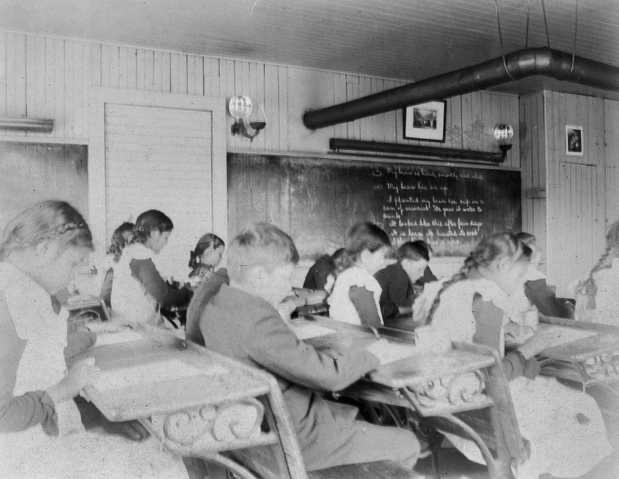
Die.
You could die from getting sick, or you could die from getting hurt. Accidents, sometimes. The teacher did not mean for you to die when she pushed you down the stairs. There were runaways who died from exposure or injuries. So many ways to die. A boy kicked in the side by an angry disciplinarian. Another boy from pneumonia when he wasn’t allowed to sleep inside the dormitory. A little girl with tuberculosis, sent home, her death thus not counted in school reports to the government. A teenage girl giving birth in the infirmary. A boy drowned swimming in the lake. Children who died from broken hearts; they were just too sad and homesick to eat and couldn’t live without their mothers.
No promises were made that death would get you home; instead you might be buried at school, your body cradled in the earth, and your spirit, where is your spirit?
Amanj i dash.
Linda LeGarde Grover, author, Professor Emerita of American Indian Studies at the University of Minnesota Duluth, and member of the Bois Forte Band of Ojibwe.
Reprinted with permission from the book, The Sky Watched, Poems of Ojibwe Lives, by Linda LeGarde Grover, (2022) University of Minnesota Press, Minneapolis. https://www.upress.umn.edu/book-division/ books/the-sky-watched

https://education.missouristate.edu/clse/
To donate go to https://mslbd.org/getinvolved/donate.html.
“Intermediate” students inside a classroom at a Native American boarding school in Beaulieu, Minnesota, c.1900.
RE THINKING Behavior

October 5-6, 2023
2023 Richard L. Simpson Conference on Autism Plaster Student Union
Missouri State University Springfield, Missouri
February 29-March 2, 2024
42nd Annual Midwest Symposium for Leadership in Behavior Disorders
Sheraton Crown Center, Kansas City, Missouri Award
Due November 1! Outstanding Advocacy
Outstanding Leadership
Outstanding Educator
Outstanding Building Leadership
Building Bridges Program
Stipends - Master’s & Doctoral Students
Master Teacher
Commitment to Equity
Pre-Service Student
Midwest Symposium for Leadership in Behavior Disorders