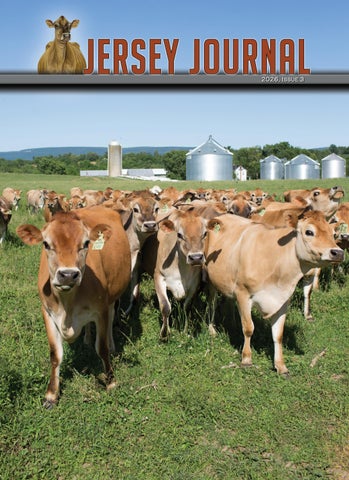
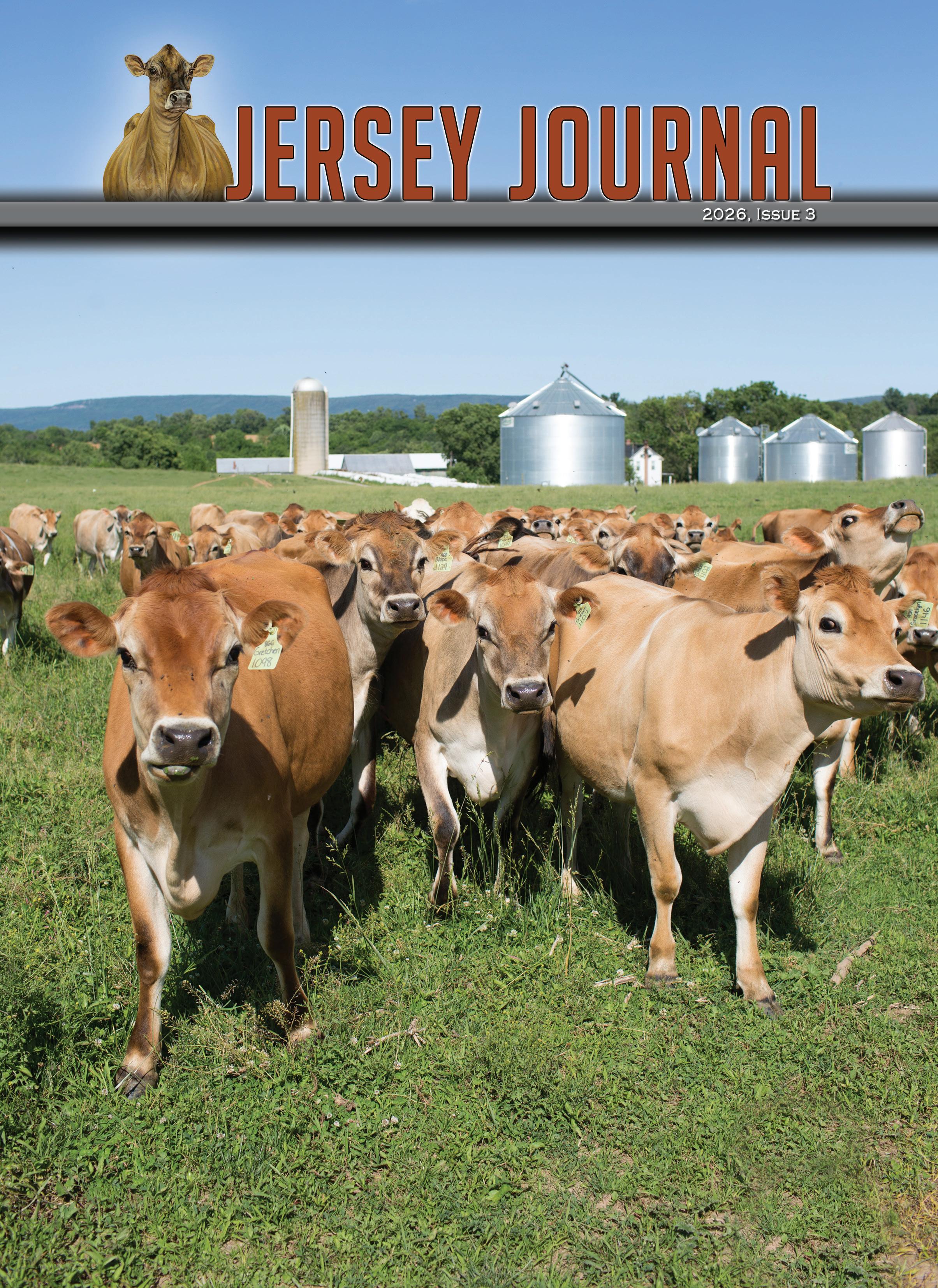
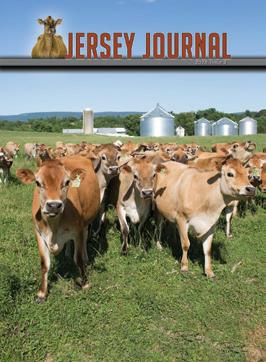
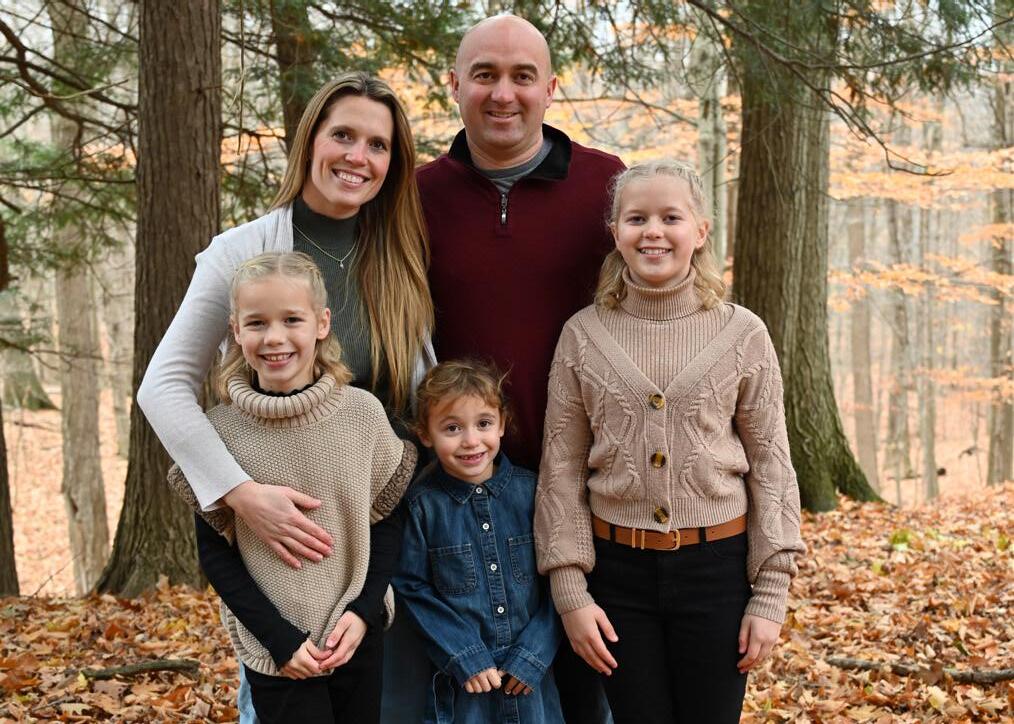
The Shenandoah Jersey herd of Boonsboro, Maryland, graces this month’s cover. Owned by JR and Jessica Stiles Hess and Janet Stiles Fulton, the REAP herd is milked using a DeLaval VMS robotic system and ranks nationally for production. In 2025, the herd achieved an AJCA lactation actual average of 22,674M, 1,053F, and 875P on 45 cows. Jessica was also honored this past year with the AJCA Young Breeder Award. She is a second generation Young Jersey Breeder award winner. Her dad, the late Tracy Stiles, received the award in 1981.
The March issue is the annual Production Issue for the American Jersey Cattle Association. Turn to page 18 to see the top herds in the nation.
Photo by Andrea Haines
Contributing
To improve and promote the Jersey breed of cattle, and to increase the value of and demand for Jersey milk and for Jersey cattle.
Company and Department Heads
Executive Secretary: Neal Smith, 614/322-4455
Treasurer: Vickie White, 614/322-4452
Director of Field Services: Kristin A. Paul, 209/402-5679
Director of Communications: Kimberly A. Billman, 614/322-4451
Information Technology: Philip Cleary, 614/322-4474
Jersey Marketing Service: Neal Smith, 209/988-0601
Herd Services: Lori King, 614/322-4457
Research & Genetic Program Consultant: John Metzger, jmetzger@usjersey.com
National All-Jersey Inc.: Grady Auer, 209/613-2286
AJCA-NAJ Area Representatives
Director of Field Services: Kristin A. Paul, 209/4025679; 614/322-4495 (fax); kpaul@usjersey.com. Illinois and Wisconsin.
District 1 Manager: Scott Holcomb, 614/563-3227; sholcomb@usjersey.com. Connecticut, Delaware, Florida, Georgia, Kentucky, Maine, Maryland, Massachusetts, New Hampshire, New Jersey, New York, North Carolina, Pennsylvania, Rhode Island, South Carolina, Tennessee, Vermont, Virginia and West Virginia.
District 3 Manager: Seth Israelsen, 614/216-9727; sisraelsen@usjersey.com. Arizona, California, Hawaii,
Idaho, Montana, Nevada, New Mexico, Oregon, Utah, Wyoming, and Washington.
Greg Lavan, 614/216-8838; glavan@usjersey.com. Indiana, Michigan, and Ohio.
Benny Rector, 614/313-5818; brector@usjersey.com. Arkansas, Colorado, Kansas, Missouri, Oklahoma and west Texas.
Jason Robinson, 614/216-5862; jrobinson@usjersey. com. Alabama, Louisiana, Mississippi and east Texas. Willow Voegtlen, 614/266-2419; wvoegtlen@usjersey. com. Iowa, Minnesota, Nebraska, North Dakota and South Dakota.
Type Traits Appraisal Team
Kelly Epperly, 614/530-6918; kepperly@usjersey.com
Lee Harris, 614/284-1478; lharris@usjersey.com Dyon Helmuth, 614/264-0140; dhelmuth@usjersey.com
Tyler Boyd, 19784 Patricia Lane, Hilmar, CA 95324. Phone 209/585-7118; tyler.l.boyd@gmail.com. Third District. 2026.
Ted DeMent, 5252 Hallsville Rd., Kenney, IL 61749. Phone 217/725-2432; dementsjerseys@gmail.com. Second District. 2026.
Rebecca Ferry, 193 Lagrange Rd., Johnstown, NY 12095. Phone 518/248-9294; dreamroadjersey@yahoo. com. First District. 2026.
Ralph Frerichs, 3117 St. Hwy. 159., La Grange, TX 78945-4226. Phone 979/249-3012; frerichs@cvctx. com. Second District. 2027.
Garry Hansen, 13025 S. Mulino Rd., Mulino, OR 97042. Phone 503/805-4411; garryajca@gmail.com. Third District. 2026.
Ethan Haywood, 1045 Solomon Rd., Hastings, MI 49058. Phone 269/945-0239; ethanhaywood@gmail. com. Second District. 2029. Jason Johnson, 154 Olde Canterbury Rd., Northwood, NH 03624. Phone 802/356-0908. jasamjohnson@gmail. com. First District. 2027. Cornell Kasbergen, see officers. Third District. 2026. Kevin Lutz, 3514 Highway 182, Lincolnton, NC 28092. Phone 704/472-7448; klutz728@gmail.com. First District. 2027. John Maxwell, 10600 275th St., Donahue, IA 527469705. Phone 563/505-1652; maxwell@tourmyfarm.com. Second District. 2026.
Elaine Noble, 6430 Coryland Rd., Gillett, PA 16925. Phone 570/537-2066; emnoble13@gmail.com. First District. 2029.
Joe Rocha, 510 3rd Street, Tillamook, OR 97141. Phone 503/812-6193; joeandsarahrocha@hotmail.com. Third District. 2029. Joe Vanderfeltz, 898 SR 706, Lawton, PA 18828; Phone 570/934-2406; jvanfel2@gmail.com. First District. 2027.
Vice President: Bradley Taylor, 106 County Road 5300, Booneville, MS 38829-9131. Phone 662/720-3598; taylorjerseyfarm@gmail.com.
Directors
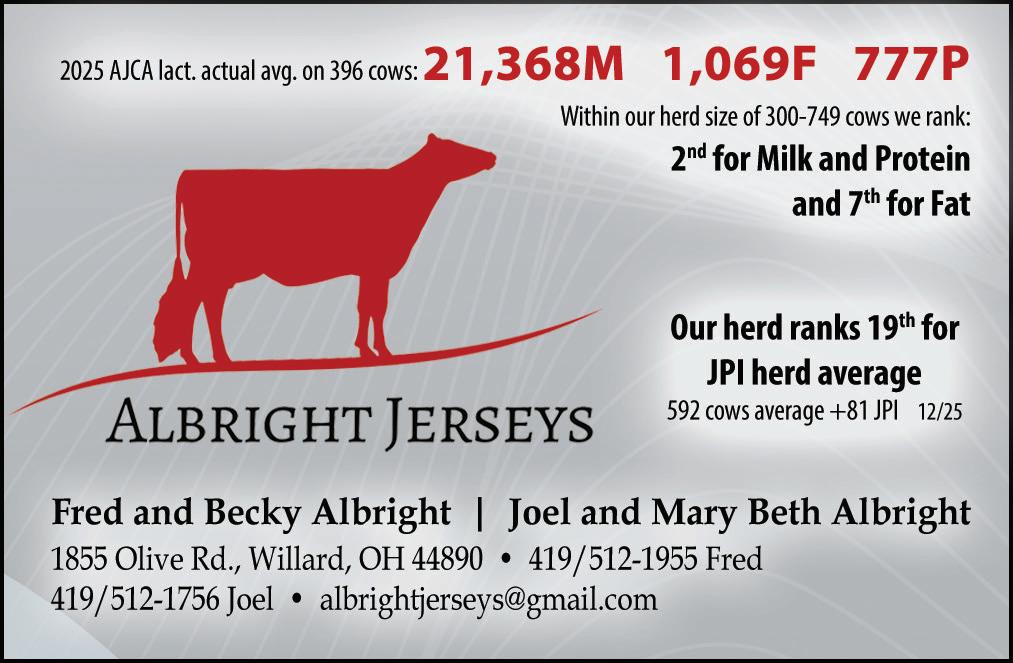
Joel Albright, Joel Albright, 1855 Olive Rd., Willard, OH 44890. Phone 419/512-1756; albrightjerseys@gmail. com. District 3. 2029
Sam Bok, 11310 Krouse Rd., Defiance, OH 43512. Phone 419/782-0012; jawscows@defnet.com. District 7. 2029
Alan Chittenden, ex officio, see AJCA officers. Ralph Frerichs, ex officio, see AJCA. Jonathan Merriam,12136 Riverview Rd., Hickman, CA 95323. Phone 209/324-4983; jbmerriam.964@gmail. com. District 2. 2029.
Cornell Kasbergen, ex officio, see AJCA. John Marcoot, 526 Dudleyville Rd. Greenville, IL. 62246. Phone 618/322-7239; johnemarcoot@gmail. com. District 4. 2026.
Corey Lutz, see officers. District 8. 2026. Tom Seals, 37840 Upper Nestucca River Rd., Beaver, OR 97108. Phone 541/520-0298; jennie.seals@gmail. com. District 1. 2027.
Bradley Taylor, see officers. District 5. 2028.
Official Publication of the American Jersey Cattle Association and National All-Jersey Inc.
6486 E. Main St., Reynoldsburg, OH, 43068–2362 614.861.3636 phone 614.861.8040 fax
Email jerseyjournal@usjersey.com
Website: www.USJerseyJournal.com
Facebook: www.facebook.com/USJerseyJournal
Editor: Kimberly A. Billman
Managing Editor: Tracie Hoying
Feature Writer: Michele Ackerman
Communications Specialist: Kate Poitras
Digital Media: Jolena Gioiello
Contributing Writer: Kaila Tauchen
Subscriber Services
To subscribe, log on to http://jerseyjournal. usjersey.com/Subscriptions.aspx and click on the “Subscriptions” link and enter your mailing and credit card information on the secure website. When completed, click “Submit” to process your subscription.
If you have questions, please call the Jersey Journal at 614/861-3636, or send email to jerseyjournal@usjersey.com.
Jersey Journal Subscription Rates
Effective July 1, 2023 (10 online issues; January and September printed) Domestic International 1 year $45 1 year $60 3 years ........$125 3 years .........
All subscribers to the online Jersey Journal (effective February 1, 2022) will receive a downloadable PDF version of the magazine to the email on file. They will also receive a link to the publication published online.
To make changes to your subscription, call the American Jersey Cattle Association at 614/861-3636. Or email jerseyjournal@usjersey. com. Please email or call with an updated email address if your address changes. Subscribers will receive periodical emails throughout the month. Have your customer number ready for a staff member.
If you do not receive an email with the pdf or link to the published magazine, call 614/8613636 or email jerseyjournal@usjersey.com. We will verify your information and correct what is needed.
How You Will Receive Your Jersey Journal?
First week of each month, you will receive an email that includes:
• link to flip version of the Jersey Journal
• downloadable PDF of the magazine
• links to advertising
• links to updated stories on the website
• access to the archive editions of Jersey Journal back to 2009
Make sure we have your email on file and then sit back and let us deliver the news to you!
This index is provided as an additional service. The Jersey Journal assumes no liability for errors or omissions. The Jersey Journal does not guarantee quality, delivery time, or availability of items ordered from commercial advertisers.
The American Jersey Cattle Association promotes the use of authentic and unaltered photographic images of Jersey animals, and disapproves of the use of any photographic images that alter the body of the Jersey animal. The American Jersey Cattle Association therefore requests that all photographic images of Jersey animals submitted for publication in the Jersey Journal contain no alterations to the body of the animal.
Despite its best efforts to ensure that only unaltered photographs of Jersey animals are used in this publication, the American Jersey Cattle Association cannot guarantee that every photographic image of a Jersey animal is authentic and unaltered.
Every effort is made to keep the calendar listings as accurate as possible. However, dates are sometimes changed or events cancelled without notice. When your association schedules an event, notify the Journal staff at least 60 days in advance by sending email to JerseyJournal@usjersey.com or phoning 614/861-3636.
Type Appraisal Schedule
POLICY: Areas will be appraised in the order listed. If you wish to appraise and do not receive an application 30 days prior to the appraisal, please request one from Appraisal Office Coordinator Lori King by telephone, 614/322-4457, or email lking@usjersey. com. Apply online at http://www.usjersey.com/forms/ appraisalapp.com. Applications can also be printed from the USJersey website at http://www.usjersey. com/forms/ttaapplication.pdf.
APR.—California.
MAY —Virginia, Maryland, West Virginia and Delaware; North Carolina and South Carolina;Kentucky, Tennessee and Northern Georgia; Indiana and Illinois; Arkansas and Missouri.
JUNE—Texas and New Mexico; Wisconsin.
Deadlines
APR. 1—Ownership and transfer date for junior eligibility in spring national shows (California Spring
Show and Northeast National Spring Jersey Show).
APR. 1—Genomic samples must be to lab prior to this date for the May evaluation release.
APR. 24—Deadline for AJCA director petitions to be in the AJCA office.
APR. 28—Deadline for NAJ director petitions to be in the AJCA office.
MAY 1—Genomic samples must be to lab prior to this date for the June evaluation release.
JUNE 1—Genomic samples must be to lab prior to this date for the July evaluation release.
JULY 1—Applications for National Jersey Youth Scholarships due.
JULY 1—Genomic samples must be to lab prior to this date for the August evaluation release.
AUG. 1—Ownership and transfer date for junior eligibility for fall shows (All American, World Dairy Expo, Western National, and Harrisburg ahows).
SEPT 1—Application window opens for Class X of Jersey Youth Academy.
Sales
APR. 1—DILEY & PARTNERS EXPO EDITION ONLINE SALE, www.CowBuyer.com, held in conjunction with the Ohio Spring Dairy Expo.
MAY 12-14— WISCONSIN STATE JERSEY SALE, online via CowBuyer.com. Closeout at 1:30 p.m.(EDT). Jersey Marketing Service, sale mgr.; jms@usjersey.com.
Dead Animals May Be Registered For A Fee of $10.00 Duplicate or Corrected Certificates Will Be Issued For A Fee of $10.00 Rush Service Fee (per piece) $20 — Email or Fax delivery (per piece) $10
Transfer Fees Effective July 1, 2014
Standard processing fee is $14.00 when transfer is received within 60 days of the date of sale of the animal to the new owner, and $17.00 when received after 60 days.
$2.00 discounts from the standard fee will be applied to individual animal transfers processed via infoJersey.com and to group transfers submitted in batch electronic files: Excel spreadsheet, report downloaded from herd management software, or a field-delimited text file. Additional discounts may apply for herds enrolled in REAP, and for intraherd and intra-farm transfers. Refer to “Fees for Programs and Services” (www.usjersey.com/fees.pdf) and call Herd Services for more information.
Mo.; 6:00 p.m. (CDT); Jersey Marketing Service, sale mgr.; jms@usjersey.com.
Meetings and Expositions
APR. 7-9—DAIRY CALF AND HEIFER ASSOCIATION CONFERENCE, Tucson, Ariz.
APR. 11—PENNSYLVANIA JERSEY CATTLE CLUB ANNUAL MEETING , Holiday Inn, Williamsport, Pa.
APR. 13-15—TRI-STATE DAIRY NUTRITION CONFERENCE, Grand Wayne Center, Fort Wayne, Ind.
JUNE 17-20—AJCA-NAJ ANNUAL MEETINGS, Springfield, Mo.
JUNE 21-24—AMERICAN DAIRY SCIENCE ASSOCIATION ANNUAL MEETING, Baird Center, Milwaukee, Wis.
Shows
APR. 1-3—OHIO SPRING DAIRY EXPO, Ohio State Fairgrounds, Columbus, Ohio.
APR. 7-9—SOUTHERN SPRING NATIONAL , Payne Co. Expo Center, Stillwater, Okla.
APR. 23—NORTHEAST NATIONAL JERSEY SHOW , Eastern States Exposition Center, W. Springfield, Mass.; Justin Burdette, Chambersburg, Pa., judge.
APR. 18 —PACIFIC NORTHWEST JERSEY SHOW, Tillamook, Ore.
MAY 27-30—SOONER STATE DAIRY SHOW, Payne County Expo Center, Stillwater, Okla.
JULY 27-30—EASTERN NEW YORK SUMMER JERSEY SHOW, Washington County Fairgrounds, Greenwich, N.Y.; Pierre Boulet, Que., judge.
AUG. 6 OHIO STATE FAIR JUNIOR JERSEY SHOW, Ohio Expo Center, Columbus, Ohio; 9:00 a.m. (EDT).
AUG. 7-8 OHIO STATE FAIR OPEN JERSEY SHOW, Ohio Expo Center, Columbus, Ohio; 9:00 a.m. (EDT); heifers on the 1st, cows on the 2nd; Kelly Barbee, Concord, N.C.; judge.
AUG. 20—ILLINOIS STATE FAIR OPEN JERSEY SHOW, Illinois State Fairgrounds, Springfield, Ill.; 8:00 a.m. (EDT).
SEPT 6—WESTERN NATIONAL JERSEY SHOW, Salem, Ore.; Mandi Bue, Freedom, Wis., judge.
SEPT. 14—MID-ATLANTIC REGIONAL JUNIOR JERSEY SHOW, Harrisburg, Pa.; 7:00 a.m. (EDT); Nate Oleniacz, New Oxford, Pa., judge.
SEPT. 28—INTERNATIONAL JERSEY HEIFER SHOW, Alliant Energy Center, Madison, Wis.; 7:00 a.m. (CDT); Mike Berry, Powell Butte, Ore., judge; Ryan Lancaster, Tillamook, Ore., associate judge.
SEPT. 29—INTERNATIONAL JERSEY COW SHOW, Alliant Energy Center, Madison, Wis.; 7:00 a.m.; Mike Berry, Powell Butte, Ore., judge; Ryan Lancaster, Tillamook, Ore., associate judge.
NOV. 6—ALL AMERICAN JUNIOR JERSEY SHOW, Kentucky Fair and Exposition Center, Louisville, Ky.; 7:30 a.m. (EST).
NOV. 8—ALL AMERICAN JERSEY HEIFER SHOW, Kentucky Fair and Exposition Center,
isville, Ky.; 7:30 a.m. (EST).
NOV. 8—NATIONAL JERSEY JUG FUTURITY, Kentucky Fair and Exposition Center, Louisville, Ky.;
The Association’s Bylaws require the seller to pay the transfer fee. Save by becoming a lifetime member of the American Jersey Cattle Association. (continued to page 36)
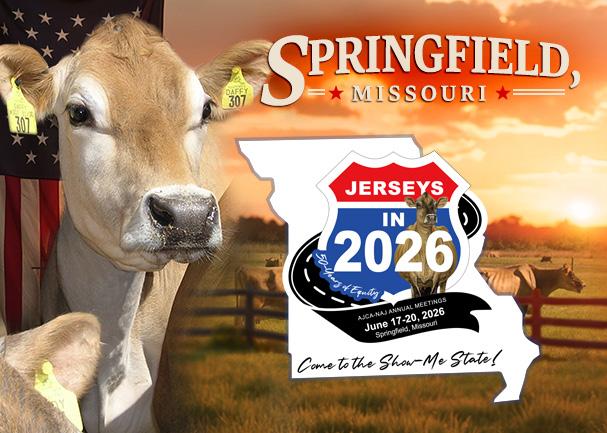
The 2026 Annual Meetings of the American Jersey Cattle Association and National All-Jersey Inc. will be held in Springfield, MO, June 17-20.
Schedule
WEDNESDAY, JUNE 17
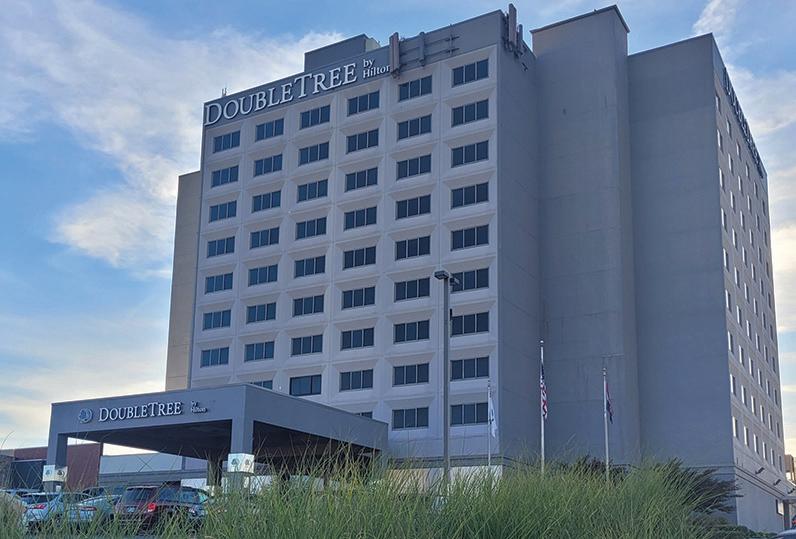
Meeting Headquarters: Doubletree Hotel 2431 N Glenstone Ave, Springfield, MO 65803 Phone: (417) 831-3131
Missouri planning committee: Janice Rector, Stacy Dohle and Karla Deaver
3:00 pm Registration Opens
7:00 pm Welcome Reception-Wine & Cheese Social Celebrating 50 years of Young Jersey Breeders
THURSDAY, JUNE 18
6:30 am Breakfast buffet
8:00 am National All-Jersey Inc. Annual Meeting
9:30 am Queen of Quality Dairy Bar
10:00 am Youth Event: Animal Meet & Greet with Wonders of Wildlife (at hotel)
10:00 am National All-Jersey Inc. Celebration—50 years of Equity
11:30 am On-Farm Processing Breeder Roundtable
1:00 pm Young Jersey Breeder luncheon
2:45 pm Tour of Bass Pro/Wonders of Wildlife Tour
5:30 pm Social and Dinner at Bass Pro-White River Convention Center
7:00 pm AJCC Research Benefit Auction
FRIDAY, JUNE 19
6:00 am Breakfast buffet
7:30 am College of the Ozarks Tour
11:45 am Give Your Best 60 Seconds Public Speaking Contest
12:30 pm Lunch at College of the Ozarks-Keeter Center
5:00 pm Pre-Sale Social
5:30 pm Pre-Sale Dinner
6:30 pm National Heifer Sale
SATURDAY, JUNE 20
6:30 am Breakfast buffet
8:00 am American Jersey Cattle Association Annual Meeting 9:00 am Morning Session: Fantastic Cavern Tour (youth & adult chaperones)
11:00 am Young Jersey Breeder Roundtable
11:30 am Youth event at StarStruck Jerseys
1:00 pm Lunch at StarStruck Jerseys, Dean and Stacy Dohle and family
2:15 pm Afternoon Session: Fantastic Cavern Tour
5:30 pm Youth Event: Pool party and movie night (dinner included)
5:30 pm Cheese Social
6:30 pm Dinner
7:30 pm AJCA Breeders’ Banquet
Online registration is preferred at usjerseyannualmeeting.com (REGISTRATION NOW OPEN)
Or mail form with payment to: Attn: Annual Meeting Registration, American Jersey Cattle Association, 6486 E. Main St., Reynoldsburg, OH 43068-2362
FLY. The nearest airport is Springfield-Branson National Airport (SGF) (18 miles). Other nearby airports include Branson Airport (BKG) (55 miles), Joplin Regional Airport (JLN) (65 miles) and Northwest Arkansas National Airport (XNA) (85 miles)
Hotel
DoubleTree by Hilton Springfield 2431 N Glenstone Ave, Springfield, MO 65803
Make hotel reservations directly by calling 417/831-3131 or online Request “Jersey” block.
Scan code to make online hotel reservation
Ticket Requests
WEDNESDAY, JUNE 17
FARM or COMPANY NAME
STREET ADDRESS
REGISTRATION FEES
Official registration badge is required for entrance at all included events.
Early Bird Registration, received with payment by June 6
Enter number of registrations
Late Registration, received with payment after June 6
No
$200 No charge Enter number of registrations
PAYMENT q Debit Card q Discover q Visa q MasterCard q American Express q Check payable to AJCA. Mail with registration form to address at top left.
Welcome Reception-Wine & Cheese Social
THURSDAY, JUNE 18
Youth Event: Animal Meet & Greet
Youth 8 and under must be accompanied by an adult
Young Jersey Breeders Banquet
Child care for children five and under ___
Bass Pro Tour/Dinner/Research Auction
Plan to ride bus to event
FRIDAY, JUNE 19
College of the Ozarks Tour (lunch included)
Plan to ride bus to event
National Heifer Sale/Socia/Dinner
SATURDAY, JUNE 20
Morning Session: Fantastic Cavern Tour
Youth Event at StarStruck
Youth 8 and under must be accompanied by an adult
Lunch at StarStruck
Plan to ride bus to event Yes No
Afternoon Session: Fantastic Cavern Tour
Youth Event: pool party and movie night
Youth 8 and under must be accompanied by an adult
Breeders' Banquet
Child care for children five and under ___
Corey Lutz, Lincolnton, N.C., president of National All-Jersey Inc., was the featured guest on a recent episode of the Hoard’s Dairyman Podcast, where he discussed the family’s Registered Jersey herd, Piedmont Jerseys, and their on-farm processing plant, Riverbend Creamery.
Lutz explained how the family carefully researched and developed the creamery before opening its doors. The initial groundwork took about 2 ½ years to complete and included a feasibility study that evaluated the viability of a creamery and helped guide the development of a business plan, logo and website.
The family also secured a working capital grant from the U.S. Department of Agriculture USDA) to help fund early packaging needs and non-family labor, among other expenses. Sourcing equipment and constructing the creamery required an additional year and a half.
Riverbend Creamery chose to specialize in premium ice cream. Among the features that set the creamery apart is that the family produces its own ice cream mix rather than purchasing it, and all products are made with A2 milk.
Lutz also discussed the family’s decision to use a pasture-based management system, which dovetails naturally with the creamery’s slogan, “from our grass to your glass.”
“Cherry-PP” Now E-96%
JX Hawarden Shootout Cherry {6}PP is the most recent Registered Jersey to be appraised Excellent-96%. The daughter of JX Kash-In Shootout {5}P-ET is the breed’s first homozygous polled cow to earn the final score. She scored VG-87% for the first time at 2-3, made E-90% at 3-1, and then raised at least a point with the next three appraisals. The appraisal committee gave her the most recent score in late
January 2026 at 9-9.
She is owned by Eric Leonard Silva, Sunset Canyon Jerseys, Beaver, Ore., who purchased her from her breeder, Hawarden Jerseys Inc., Weston, Idaho, in July 2025.
A fourth-generation Excellent, “Cherry-PP” has four records over 20,000 lbs. milk. She has five registered progeny bred by Hawarden Jerseys and is now in the donor dam program at Sunset Canyon.
Championship Cheese, Community Benefits
Cheese makers are not the only ones to benefit from the World Championship Cheese Contest. Since 2018, the contest has partnered with Second Harvest Food Bank of Southern Wisconsin to distribute product entries locally after judging. This year, about 20,000 lbs. of cheese, yogurt, butter and other dairy items were donated. The items are not just generic cheese, but award-winning products that provide a special treat for those in need.
At this year’s contest held in Madison in March, Beemster Royaal Grand Cru, from the open class hard cheese class, was named the overall winner. The cheese is produced by CONO Kaasmakers, a small cooperative of dairy farmers in Westbeemer, Netherlands. A pair of cheeses from Switzerland were named runners-up.
Two U.S. cheeses ranked among the top 20: Flaship Reserve, a naturalrinded cheddar made by Beecher’s Handmade Cheese of Seattle, and Suncatcher, a washed rind hard cheese made by Jasper Hill Creamery in Vermont.
Entries in the contest span 150 classes of dairy products. Overall, American processors won more awards than any other country, earning 96 Best of Class finishes among entries from 25 countries and 34 U.S. states.
Arethusa Farm Dairy won the sour
cream division and placed second in three classes and third in two.
The contest has been held since 1957.
Staff Reductions Hit Key USDA Agencies
Farmers may be feeling the pinch from cuts in the federal workforce under the Trump administration, which has reduced staffing at USDA and key service agencies.
According to a report from USDA’s Office of Inspector General, the department had roughly 110,300 employees in mid-January 2025 and was down to about 90,000 by midJune 2025, meaning more than 20,000 employees left in the first half of the year. Of those exits, 15,114 occurred under the “deferred resignation program,” 1,636 employees were fired, 1,280 retired and 1,196 resigned outside the program. Additional USDA documents show staffing fell further to about 85,900 employees by early October, suggesting a total loss of about 24,000 employees over the year to that point.
The impact varied by agency. The National Agricultural Statistics Service (NASS) lost about 34% of its staff, the Economic Research Service (ERS) about 29%, the Animal Health and Plant Inspection Service about 25%, and the Farm Service Agency about 24%.
The two largest agencies, the Forest Service and the Natural Resources Conservation Service, experienced the largest losses in absolute number of employees even though their percentage reductions were smaller than those for NASS or ERS.
These cuts come as USDA confronts serious animal-health threats, including the highly pathogenic avian influenza and invasive pests such as the New World screwworm, as well as other diseases present or emerging in other countries.
Data Sharing: Securing the Future of the Jersey Breed
In today’s dairy industry, progress is no longer driven by observation alone. It is powered by data. Every milk weight recorded, every appraisal score assigned, every health event logged contributes to something far larger than an individual herd record. Together, these data points form the foundation of genetic improvement, and ultimately, the future of the Jersey breed.
For Jersey breeders, the importance of sharing accurate and complete data cannot be overstated. Production records, type traits, health events, and reproductive data all feed into national genetic evaluations. These evaluations are only as strong as the data behind them. When breeders participate fully in data collection and reporting, they strengthen the reliability of genomic predictions, improve sire proofs, and ensure that selection decisions are based on the most accurate information available.
Why Data Sharing Matters
Genetic progress depends on two key factors: selection intensity and accuracy. While genomic technology has dramatically increased the speed of progress, its accuracy still relies on large, high-quality datasets. The more complete and representative the data, the more confidence breeders can have in the tools they use.
Production records drive evaluations for milk, fat, and protein—traits central to Jersey profitability.
Type traits help maintain the functional soundness and longevity the breed is known for.
Calving, health, and fertility data support traits that directly impact herd efficiency and lifetime performance.
When these records are consistently reported across herds, they create a powerful dataset that benefits every breeder—not just those who contribute.
The Risk of Not Participating
A lack of data sharing doesn’t just slow progress—it can distort it. Incomplete or biased datasets reduce the reliability of genetic evaluations, potentially leading to less effective selection decisions. As fewer herds participate, the industry risks narrowing its genetic base and losing valuable insight into how Jersey cattle perform in real-world conditions.
For a breed built on efficiency, components, and adaptability, that’s a risk we cannot afford to take.
Looking Ahead: The Future of Jerseys
As the industry advances deeper into the
genomic era, the demand for high-quality, comprehensive data will only grow. New traits, such as feed efficiency, health traits, and environmental sustainability, are already being developed. Reliable evaluations for these traits will require even broader participation and more detailed data collection.
For Jersey breeders, this presents an opportunity to lead. By continuing to invest in data sharing, the breed can remain at the forefront of profitability, efficiency, and sustainability in the dairy industry.
A Call to Action
Participation for dairy producers isn’t something new. It’s something we have built and rely heavily on. Many of the tools needed to strengthen genetic progress are already part of AJCA programs and everyday herd management. The opportunity is to use them fully and consistently:
Enroll in and maintain DHIR (milk recording) to ensure your herd’s production data contributes to national evaluations
Participate in AJCA Type Appraisal to strengthen the accuracy of functional and longevity traits
Record and report calving, health, and reproductive events through your herd management system and DRPC
Utilize REAP and performance programs to maintain complete and accurate pedigrees
Work with your parlor or herd management software provider to ensure data is being transmitted and usable for genetic evaluations
Genotype animals through AJCA programs to enhance genomic predictions and accelerate progress
These are not new requirements. They are the building blocks of a strong, relevant Jersey population.
The Jersey breed has long been recognized for its component value, efficiency, and adaptability. Preserving and advancing those strengths depends on a complete and accurate data picture, one that reflects herds of all sizes and management styles.
Data sharing is not just about individual herds. It is about protecting the integrity and progress of the breed as a whole.
Every breeder who participates strengthens the reliability of Jersey genetics and ensures that future selection decisions are built on truth. Not gaps.
The future of Jerseys will be written in data. Through programs like REAP, Type Appraisal, and performance programs, Jersey breeders already hold the pen. The question is: how fully will we use it?
Top Jersey Producers Talk Production
Each dairy farm has its own formula for profitable production. Differences in facilities, herd size, technology and management style mean no two farms operate exactly alike. To compare approaches, the Jersey Journal invited several Jersey breeders from across the country to answer a series of questions about their herds and production strategies.
All participate in REAP, the flagship performance program of the American Jersey Cattle Association (AJCA), and rank among the nation’s top herds for production. While herd sizes and management styles vary, these dairies share a common focus: maximizing the efficiency and profitability of the Jersey cow.
Roundtable Participants
Ben Chamberlain, Wyoming, N.Y. Chamberlain operates Hi-Land Farm with his wife, Emily, and his parents, Greg and Jodi, who received the AJCA Young Jersey Breeder (YJB) award in 1996. The farm has been in the family since 1888. The herd has an m.e. average of 22,785 lbs. milk, 1,246 lbs. fat and 837 lbs. protein. Among herds with 300-749 cows, they rank #2 for milk and protein and #5 for protein. Nationally, they rank #10 overall for fat. The milking herd ranks #24 for JPI with an average index of +79.
Ryan D. Clark, Tyrone, Pa. Clark operates Windy Lane Jerseys with his
wife, Jennifer, their children—Leanne, Kylee, Claire and Connor—and three part-time employees. They farm 440 acres, double-cropping about 250 acres with wheat and forages, and raise their own replacements. The couple received the YJB award in 2014. Their herd has a lactation average of 23,130 lbs. milk, 1,224 lbs. fat and 956 lbs. protein, ranking third nationally for m.e. protein. Among herds with 150-299 cows, they rank first for protein, fourth for milk and second for fat.
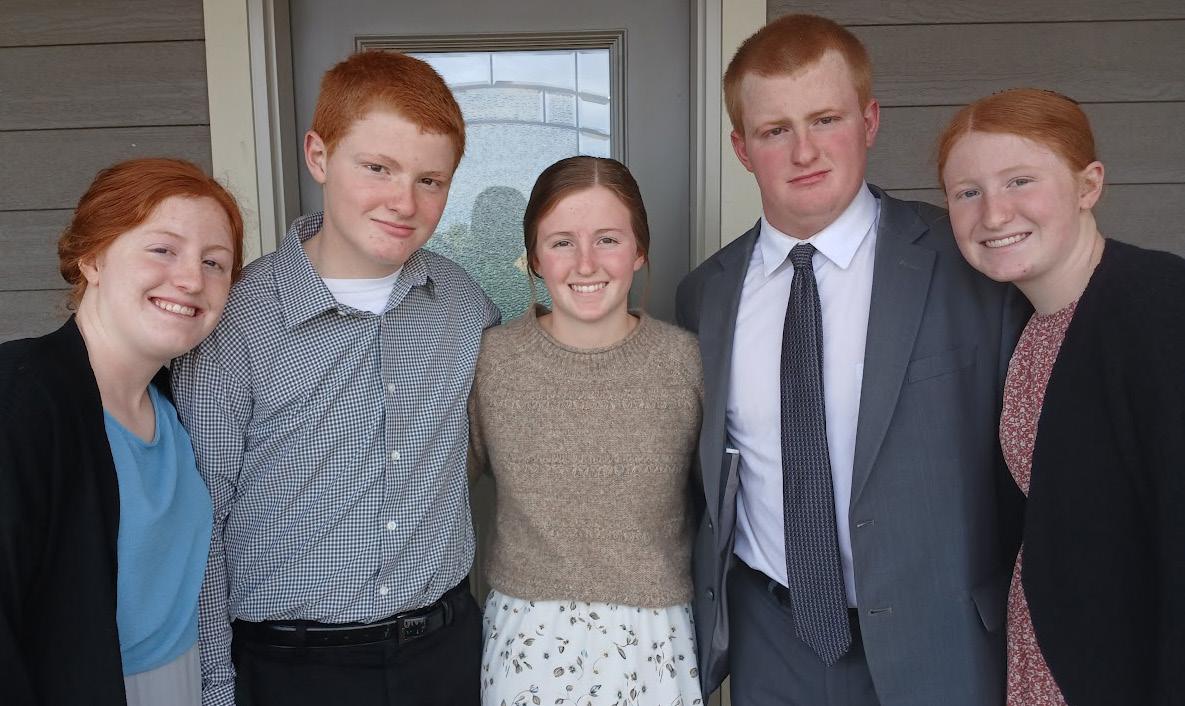
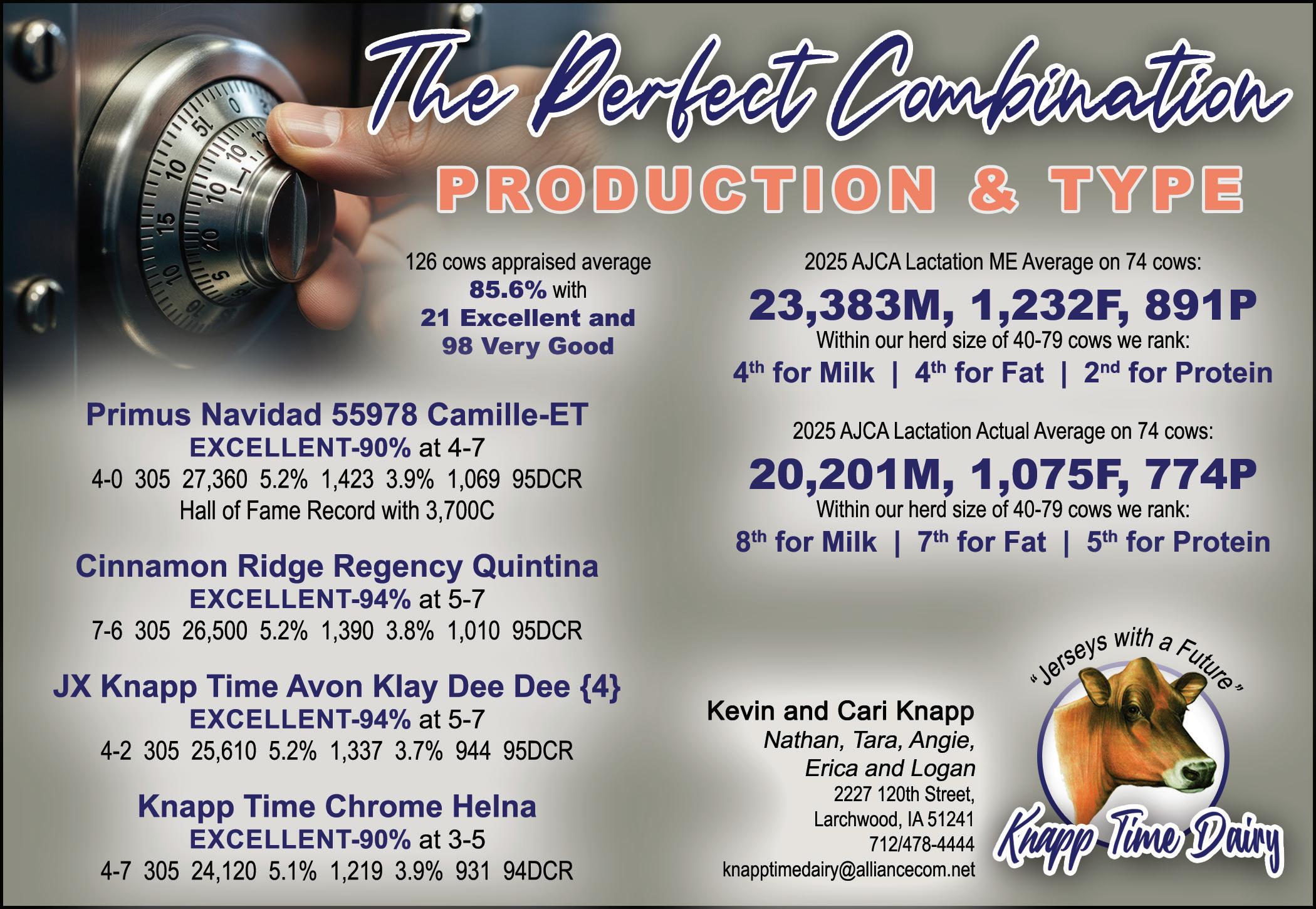
Kevin G. Knapp, Larchwood, Iowa. A first-generation dairy producer, Knapp began with 10 Jersey cows in 1998. Today, he and his wife, Cari, operate Knapp-Time Jerseys with several parttime employees and their children, Nathan, Tara and Angie, who also have jobs off the farm, and Erica and Logan, who are still in school. Their lactation average of 23,383 lbs. milk, 1,232 lbs. fat and 891 lbs. protein ranks #10 for overall m.e. protein production. Among herds with 40-79 cows, they rank fourth for milk and fat and second for protein. Knapp-Time Jerseys has an average final score of 85.6% and includes 21 Excellent and 98 Very Good cows. Kevin and Cari received the YJB award in 2011.
Donna Phillips, Newton, Wis. Phillips and her husband, Dan Stock, own and operate D&D Jerseys. She oversees milking, herd health and matings while he manages fieldwork and feeding. They
get help from a couple of part-time employees and their daughters, Erica and Emalee. The couple received the YJB award in 2005. The herd average of 23,432 lbs. milk, 1,272 lbs. fat and 891 lbs. protein ranks #2 in the nation for components and #3 for milk. The milking herd has an average JPI of +75, which ranks among the top 40 in the country.
Brent Wickstrom, Hilmar, Calif. Wickstrom owns and operates Wickstrom Jersey Farms Inc. with his father, Mike, uncle, Scott, and cousin, Steve, and Pinnacle Dairy with his wife, Caitlin. The family also partners with the Nyman family in Red Top Jerseys, where Daniel Nascimento is the herd manager. All three herds rank among the top 10 large herds (750 or more cows) for actual and m.e. production. Red Top ranks among the top 10 herds for m.e. milk and protein overall. The milking herd at Wickstrom Jersey Farms ranks #8 nationally for genetic merit with an average JPI of +90. Brent received the YJB award in 2019, following in the footsteps of his father and uncle who earned the honor in 1988.
Roundtable Questions
Describe your facilities and herd size. Chamberlain: We milk 900 cows in a Germania double-10 parlor and house them in modern, three-row barns. Clark: We milk 285 cows in a double-10 parabone parlor and house them in
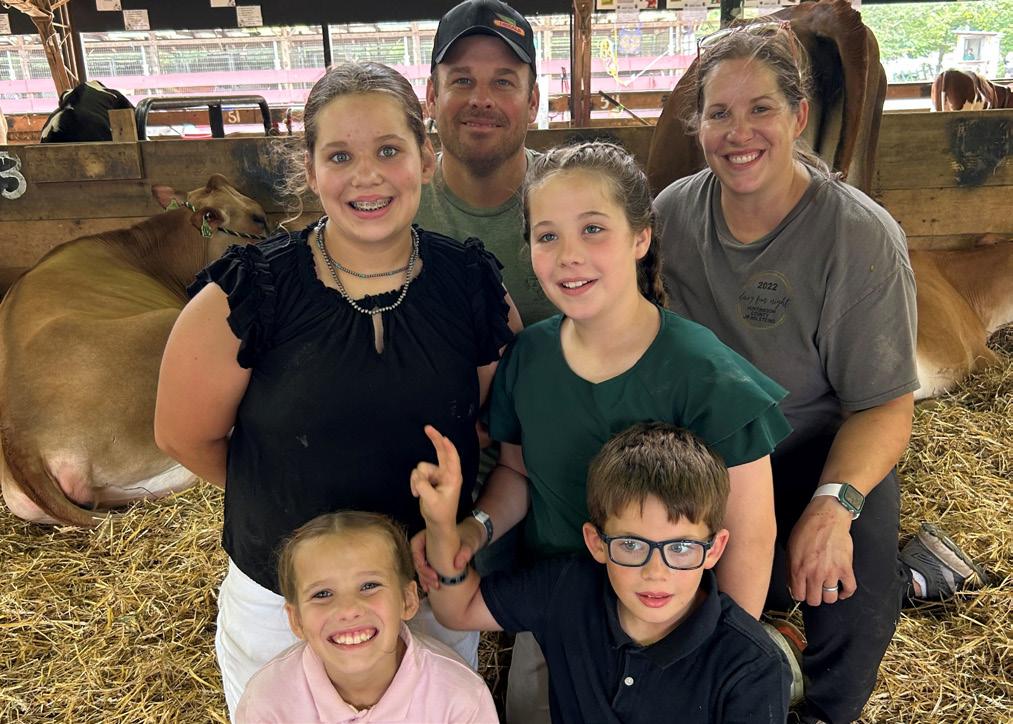
Ben and Emily Chamberlain operate Hi-Land Farms with their children, Alice, Vivienne and Claire, and his parents, Greg and Jodi, in Wyoming, N.Y.
Ryan and Jennifer Clark and their children, Leanne and Kylee, middle row, and Claire and Connor, in the front, operate Windy Lane Jerseys.
freestall barns with sand and deep sawdust bedding.
Knapp: We are currently going through an expansion, growing the herd from 160 to 400 cows. We are transitioning from a tiestall facility to a robotic system with freestalls and mattresses bedded with sawdust and lime. We continue to milk 60 cows in the tie stall barn but will phase it out in the future.
Phillips: We are currently milking about 84 cows in a double-4 herringbone parlor. Cows are housed in a freestall barn that has rubber floors, alley scrapers and stalls with very comfortable mats. We try to maximize cow comfort as much as possible.
Wickstrom: At Wickstrom Jersey Farm, the herd of 2,600 Jersey cows is housed in freestall barns and milked in a 60-stall rotary parlor. At Pinnacle Dairy, 1,250 Jersey cows are housed in freestall barns and milked in a double-16 parallel parlor. Cows at Red Top, a herd of 6,300 Jersey cows, are housed in freestall barns and milked in twin 72-stall rotary parlors.
How often are cows milked?
Chamberlain: We milk twice a day.
Clark: We milk twice a day.
Knapp: We have always milked twice a day in the tiestall barn and continue to do so today. Since January 5, 2026, cows in the robots at the new facility have averaged 3.5 milkings per day.
Phillips: Cows are milked twice a day. Ideally, we would like to milk three times, but labor conflicts have prevented us
from doing so. Plus, I sometimes like to sleep.
Wickstrom: Fresh cows at all facilities are milked four times daily. High and medium groups are milked three times daily and low groups are milked twice a day.
What is the lactation breakdown of your herd? Has this changed in recent years?
Chamberlain: We strive for longevity. While first and second lactation cows are a big part of our herd, we find that by focusing on cow comfort, our third lactation and greater animals can be our most profitable. The recent increased values of replacement animals and beef cross calves have further compounded our effort to make our cows last longer. Clark: Thirty-eight percent of the herd is first-lactation cows, while 22% are
in their second lactation. Cows in their third lactation or greater represent 40% of the herd.
Knapp: More than 75% of the milking herd today is two-year-olds, as we bought open heifers and baby calves over the past two years with expansion in mind. This starkly differs from what we are used to, as our average historically has been over three lactations. Our oldest cow today is in her seventh lactation. Phillips: Right now, we have a lot of first and second-lactation cows. The makeup of the herd changes periodically. Sometimes I sell several heifers and springers, so the makeup is older cows. At other times, I clean house somewhat and keep more of the springers. It depends on the herd and the market conditions.
Wickstrom: Usually, 32-35% of the herd is first-lactation heifers and 25% are in their second lactation. As beef-on-dairy has become a bigger part of our business, we have intentionally bred cows that can last longer and decreased the number of first-lactation
(continued to page 20)
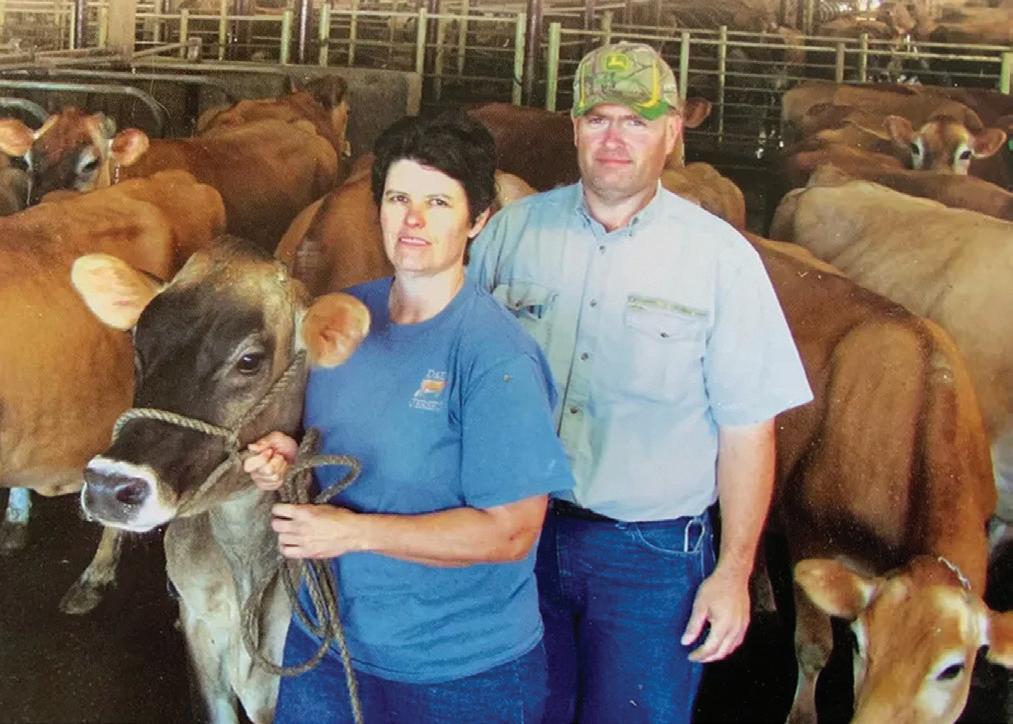
Kevin and Cari Knapp operate Knapp-Time Jerseys with their children, Tara, Logan, Angie, Nathan and Erica, in Larchwood, Iowa. They are transitioning from a tiestall barn to robots and a freestall barn with mattresses and sawdust and lime bedding.
Donna Phllips and Dan Stock own and operate
D&D Jerseys with their daughters, Erica and Emalee, and a couple of part-time employees in Newton, Wis.
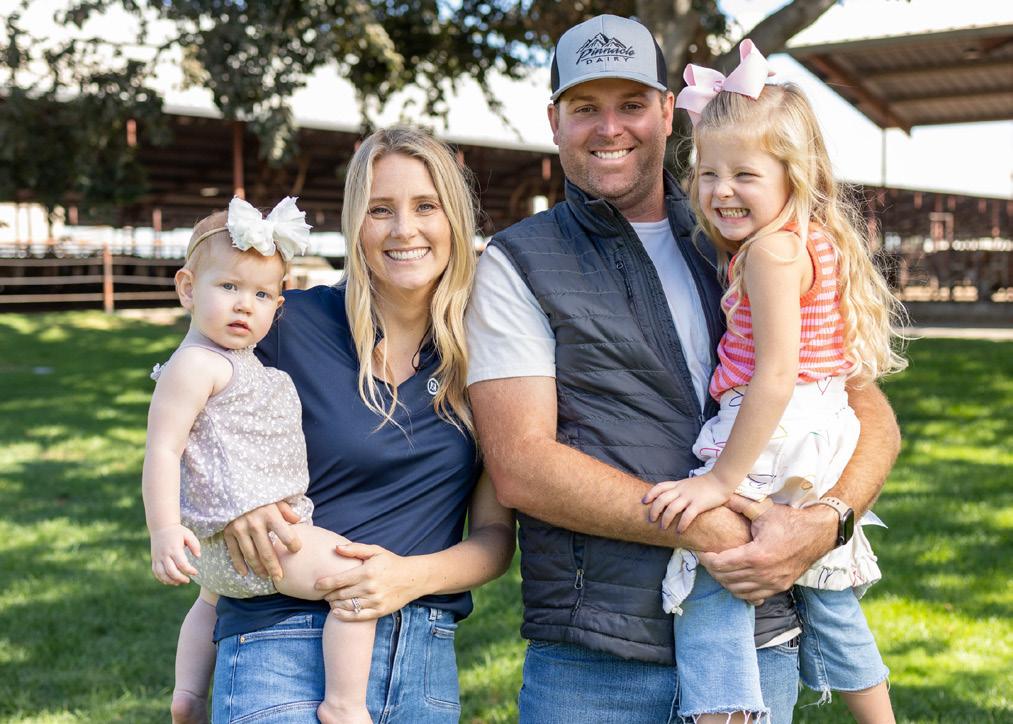
Brent and Caitlin Wickstrom own Pinnacle Dairy in Hilmar, Calif. He owns Wickstrom Jersey Farms Inc. with his father, Mike, uncle, Scott, and cousin, Steve. The family partners with the Nyman family in Red Top Jerseys.
Producer Roundtable
(continued from page 19)
cows in the milking string.
What are your production priorities and why?
Chamberlain: Our priorities change based on milk price and the value of individual components. Even with our older parlor, we have been able to regularly keep our somatic cell count (SCC) below 75,000. Our cooperative offers quality bonuses down to 100,000. If they were to offer an increased bonus for an even lower SCC, I am confident our team could achieve it. Given the current down cycle in milk, we aggressively chase any pricing advantage we can get.
Clark: Our priority is to ship high volumes of high-component milk with a low SCC. Our goal is to average 70 lbs. of milk per cow per day.
Knapp: Our focus has always been on energy-corrected milk (ECM). We sell to a cheese market, so maximizing solids has been a daily focus.
Phillips: I think I am like everyone else. My ideal dream cow milks a lot, has great components, and, of course, she is Excellent. The last few years we have focused on improving components, especially fat, while maintaining or increasing milk production. We have achieved that as we have been pushing a 6.0% fat test and a 4.0% protein test. Now we are starting to push for more milk while maintaining components. Of course, we still must have a high-functioning cow, so type traits must always be in the mix. We need a milkable udder, a body that can produce the milk, and feet and legs to move the cow comfortably to the bunk and parlor.
Wickstrom: Historically, we have bred for flow and components. Recently, though, we have put a larger focus on health traits and Cheese Merit Dollars without sacrificing production.
What three changes have you made in the past five years that have had the greatest impact on production?
Chamberlain: 1.) We started using the SCR (Allflex Livestock Intelligence) system on all our animals about four years ago. The activity monitoring has not only improved our breeding program but also given us advanced insight into cows that may be getting sick or having other issues. This has helped us manage cows not just on an individual level, but also to observe sweeping changes across the herd that may indicate feeding issues or weather-related stress. 2.) We upgraded our forage harvester to a
larger model that allows us to harvest crops in a much timelier fashion. We bought our own combine instead of custom-hiring the work done, so we can harvest our own wheat and corn at the best times, not when it is convenient for the custom harvester. We also bought a large no-till grain drill and a larger corn planter. These pieces of equipment have allowed us to greatly improve forage quality. 3.) We adopted a new strategy for labor during harvest times. Rather than stretching planting and harvest seasons out, our crop crews told us they would rather work many extra hours for fewer days, then have “easy weeks” with extra personal time. So, for example, instead of stretching the alfalfa hay harvest out for two weeks, we push hard for four days. This has increased forage quality and improved morale among our employees. In turn, this has led to higher milk production and decreased feed costs.
Clark: 1.) Installing SenseHub (Allflex Livestock Intelligence) on the cows helped us increase breeding efficiency and improve dry matter intake. 2.) We also started using high oleic soybeans. 3. And we adjusted genetic selection slightly to choose higher component bulls with functional type traits to breed longer-living cows.[Ma2.1] Ryan….see comment.
Knapp: For me, the top three would be: 1.) balancing amino acids, 2.) focusing on sire selection (migrating toward higherprotein bulls), and 3.) increasing focus on calf-through-heifer health.
Phillips: I wouldn’t say we have adopted new things as much as we have adjusted or fine-tuned what we have been doing. 1.) Our nutritionist, who had been with us since the beginning, retired and we started working with a new one. This has been an adjustment. We had gotten used to one way of doing things, so are now pivoting. She is good, though, so it is worth the effort and we are getting comfortable with each other. 2.) We have also focused on improving components while maintaining or increasing production. 3.) And finally, we continue to pay attention to details. Small things, like the frequency of feed being pushed in, can make a big difference. It is those little details that add a pound here and a pound there. That adds up.
Wickstrom: 1.) We have installed sort gates with palpation rails to eliminate lock-up times. That has had a tremendous impact on production. 2.) With this, we also invested in SCR collars to maximize our ability to utilize the system and improve heat detection. 3.) We have incorporated a large percentage of
our matings to beef bulls. We aim to use sexed Jersey bulls for the top 40% of the herd, which greatly improves the genetics and quality of the replacements that will come back into the milking herd. This also creates a new revenue stream from selling the beef cross calves.
What improvement would you like to adopt?
Chamberlain: We would like to upgrade our milking facility to allow us to milk three times a day.
Clark: We plan to add automatic ventilation controls so fans will turn on and off automatically.
Knapp: With the big learning curve we are going through right now, it is hard to say because we are so focused on learning the robots and technology that come with them. I would say applying the technology that is now at our fingertips will be our most promising way to maximize and advance production.
Phillips: We don’t have any big plans right now. The barn is getting a little older, so we are focusing on some maintenance and upkeep.
Wickstrom: We don’t currently have any big, exciting plans but continue to focus on cow comfort and maximizing the investments we have made to continue to drive production and, more importantly, feed efficiency.
Pick an area important to your farm — feed quality, cow comfort, herd health or genetics — and how do you manage it?
Chamberlain: Genetics. We focus strongly on genetics. We are a closed herd and proud of the genetic gains we’ve seen recently. Combining genomics, production records and appraisal scores, we breed the top 42% of our herd using Jersey semen; the rest are bred using beef semen. This has greatly improved the rate of genetic improvement.
Clark: Feed quality. We aim to harvest feed at the proper time for quality. We strive to get feed cut, packed and covered in less than 48 hours.
Knapp: Feed quality. As our industry consolidates and becomes ever more competitive, the one thing that is continually on our minds is, “How can we maximize the tons of highly digestible fiber grown on our acres?” We have always grown brown mid-rib corn silage, and now, with most companies announcing an exit from these hybrids, it becomes more challenging to procure the seed that fits our needs. I strongly feel that our ability to grow highly digestible fiber (continued to page 22)
Producer Roundtable (continued from page 20)
on the farm versus purchasing it will be a key to profitability.
Phillips: Feed quality. Feed quality is extremely important. An old professor of mine used to say, “garbage in equals garbage out.” I must credit my husband for being exceptionally good at feeding. We work closely together, talking frequently about any change I see or that he sees in the total mixed ration. Everything gets sampled and tested. We also have a Koster moisture tester so we can closely monitor the feed for changes ourselves. Just a couple of points one way or the other can greatly affect intakes and, therefore, production. We feed microbials as well to ensure rumen health and a healthier cow.
Wickstrom: Genetics, feed quality and herd health. We implant about 1,5002,000 in vitro fertilization embryos every year to continue to drive genetic improvement of the herd. But we also take feed quality and herd health seriously to let our animals’ genetics truly shine. We don’t want to invest in genetics and then hold them back by cutting corners.
What advantages do Jerseys have over other dairy breeds?
Chamberlain: The Jersey breed’s increased feed efficiency makes them more profitable. Their smaller size also helps with longevity: their bodies last longer because they don’t have as much stress carrying a larger frame and more weight around.
Clark: The Jersey cow has an advantage over other breeds in components and
feed efficiency.
Knapp: My favorite question! Simply put, no other breed of cow is more efficient at converting feedstuffs into high solids milk. Yes, the recent beef market and value of beef-on-dairy calves pose a challenge for Jerseys to be competitive, but this too will moderate in time. I still remind myself that I’m a dairy producer first. I have always said, “Don’t try to change the Jersey cow, only strive to improve her.”
Phillips: One of the biggest assets of the Jersey cow is feed efficiency. She has an incredible ability to produce a high-quality product with much less input than other breeds. That not only affects the farmers’ bottom line but the environment as well.
Wickstrom: I believe Jerseys are elite feed-to-milk converters. We are consis-
tently producing 90-95 lbs. of ECM with a 1.75-1.80 feed efficiency. Especially in our area of California, where we face land competition with permanent crops like almonds, we need to convert every pound of feed we produce into saleable milk.
Do you have a favorite cow that represents your goals for a profitable Jersey?
Chamberlain: Our oldest cow, Kimmie, Excellent-93%, is sired by a bull that we bred, raised and sent to stud. She has many daughters, and we have even more embryos for future use. Her story embodies our philosophy of genetic progress, longevity and use of technology to raise the best cattle possible.
Clark: My all-time favorite cow was Windy Lane Saturn Beth, VG-86%. She was the first Jersey to carry my prefix. She calved 10 times before her 12th birthday—seven times with a heifer— and lived long enough to see me have a farm of my own. We still have a lot of her blood in the herd today, as many descendants trace back to her.
Knapp: I can tell you that I always have a least favorite cow! There will always be one. As far as a favorite, that is hard.
Any cow in the herd that excels in doing the little things right every day and does it without being noticed ranks right up there as my favorite. Each day, cows like these provide for our family today, and hopefully for the next generation that trusts their future to her as well.
Phillips: At any given time, there always seems to be at least one cow in the barn that is a favorite and spoiled. Dodan DES Valentino De-zy-ET, Excellent-91%, whom we call “Dewzy,” comes to mind today. She has probably a dozen descendants milking in the herd right now, several making at or near 30,000 lbs. milk, as did “Dewzy.” Another favorite foundation cow would be Dodan Poms Marvel Pitino {6}, Excellent-91%. These two come to mind because they were very well-rounded. I would have a hard time finding something to change about either of them.
Wickstrom: Dupat Fearless 15549-ET, an E-93% cow we bred. She has numerous sons in A.I. and females have sold well in sales across the country. We have around 60 offspring in the herd today. She is backed by three generations of dams with more than 100,000 lbs. milk lifetime. She displays an amazing com-
bination of type and production and has a totally Herd Register pedigree. We are continuing to make embryos from her, striving to create “crossover” animals that almost every breeder can respect.
pawsatwater@frontiernet.net
srhm@alliancecom.net
https://jerseylearningcenter.usjerseyjournal.com/
bachelorfarms@frontier.com
hdfjersey@gmail.com
judymill@hbci.com
emmaraemessmer@gmail.com
springvalleyjerz@hotmail.com
sunbow@wk.net
cmills1324@gmail.com
spatzcattleco@gmail.com
taylorjerseyfarm@gmail.com
JERSEY PRODUCTION
Jersey Milk Becomes More Nutrient Dense in 2025
The American Jersey Cattle Association (AJCA) reports new records for all measures of actual production for Registered Jerseys in 2025. New records were also reached for standardized fat, protein and cheese yield in 2025. Standardized milk decreased slightly.
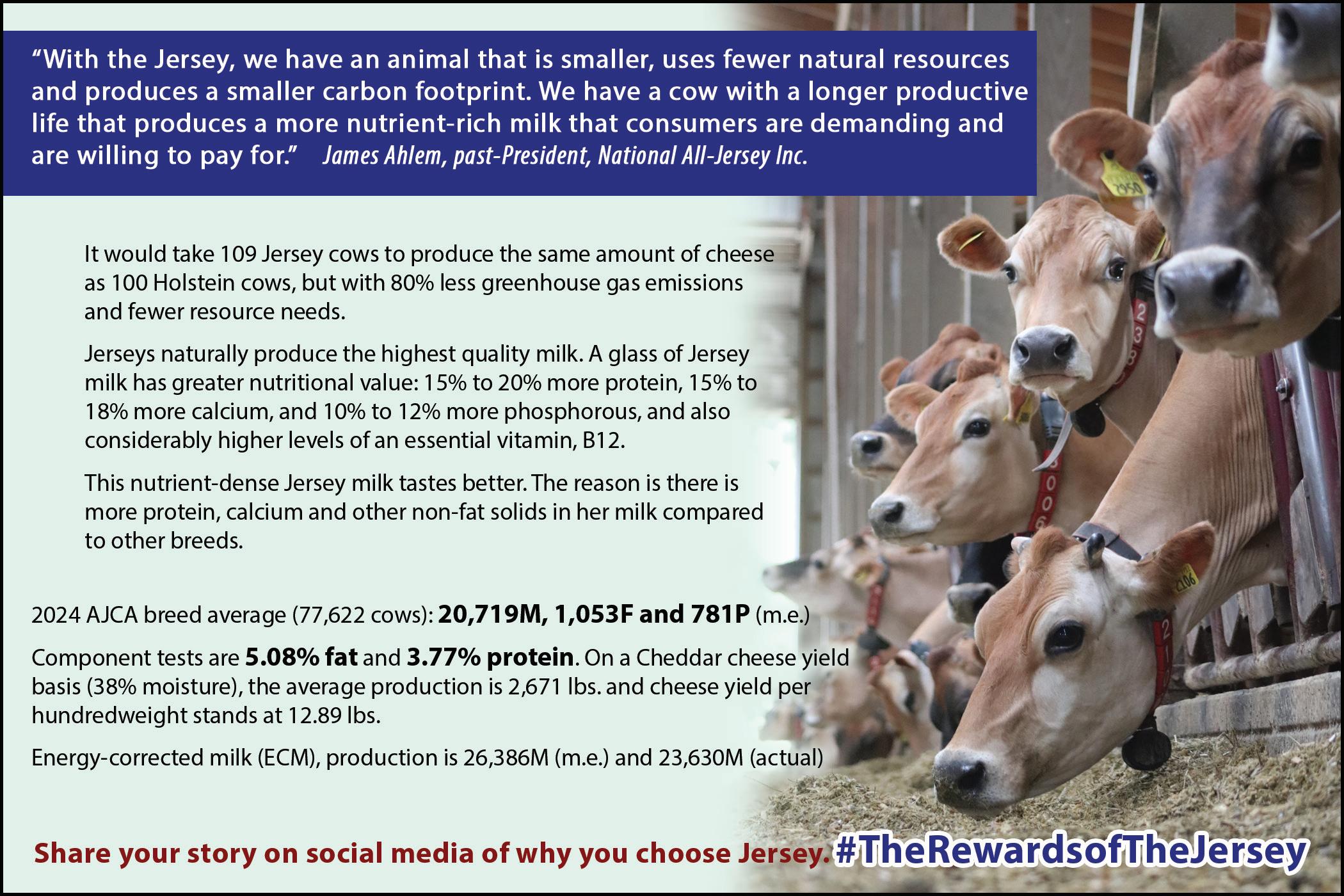
The official lactation average is now 20,711 lbs. milk, 1,059 lbs. fat and 788 lbs. protein on a mature equivalent (m.e.) basis. Components tests are 5.11% fat and 3.80% protein. On a cheddar cheese yield basis (38% moisture), average production is 2,694 lbs. and cheese yield per hundredweight stands at 13.01 lbs. The average is based on 78,288 lactations, up 666 lactations versus 2024.
As compared to 2024, the new breed average equates to a decrease of 8 lbs. milk and an increase of 6 lbs. fat, 7 lbs. protein and 23 lbs. cheese. Component
tests are up 0.03% for fat and 0.03% for protein versus 2024.
Actual production stands at 18,669 lbs. milk, 954 lbs. fat and 707 lbs. protein. Cheese yield is 2,419 lbs. and cheese yield per hundredweight is 12.96 lbs. The marks surpass those of 2024 by 97 lbs. milk, 10 lbs. fat, 10 lbs. protein and 33 lbs. cheese yield.
Expressed as energy-corrected milk (ECM), production is 26,386 lbs. on an m.e. basis and 23,868 lbs. on an actual basis. Versus 2024, respective yields for ECM are up 220 lbs. and 238 lbs.
Based on statistics from the previous 10 years, the breed lactation average is projected to reach 21,725 lbs. milk, 1,125 lbs. fat (5.18%) and 848 lbs. protein (3.90%) by 2035. Cheese yield is projected to be 2,896 lbs. On an actual basis, production is projected to reach 19,849 lbs. milk, 1,029 lbs. fat (5.19%) and 767 lbs. protein (3.87%),
with a cheese yield of 2,627 lbs. ECM is projected to be 27,780 lbs. m.e. and 25,346 lbs. actual. Cheese yield per hundredweight is projected to rise to 13.33 lbs. of product on an m.e. basis and 13.24 lbs. on an actual basis. Lactation numbers are projected to drop to 59,255.
In the annual breed production summary released by the AJCA, production is included from cows enrolled on performance programs (REAP, TPE and Performance Records) with a registry minimum of Generation Count 4. Records included in the average are between 180-305 days in length and have data collection ratings of 85 or higher. Herds identified in the Jersey Journal rankings have a minimum of 10 cows.
Herds are ranked nationally overall for each production measure and by herd size for actual production and m.e. production.
Overall Herd Rankings Nationally Any Herd Size
Top 10 Herds By Protein (M.E.)
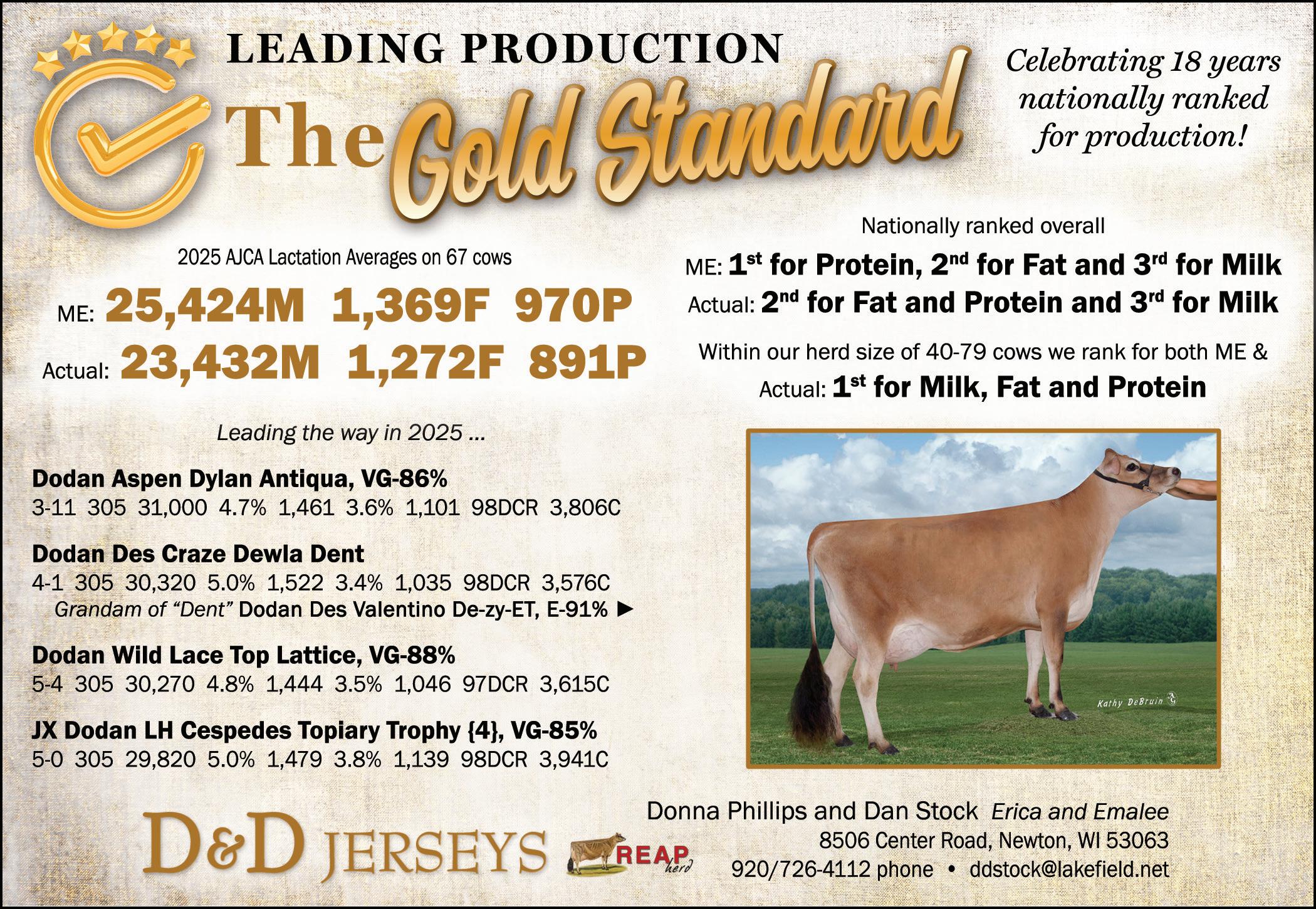
1. D & D Jerseys, Newton, Wis. 67 970 25,424 1,369
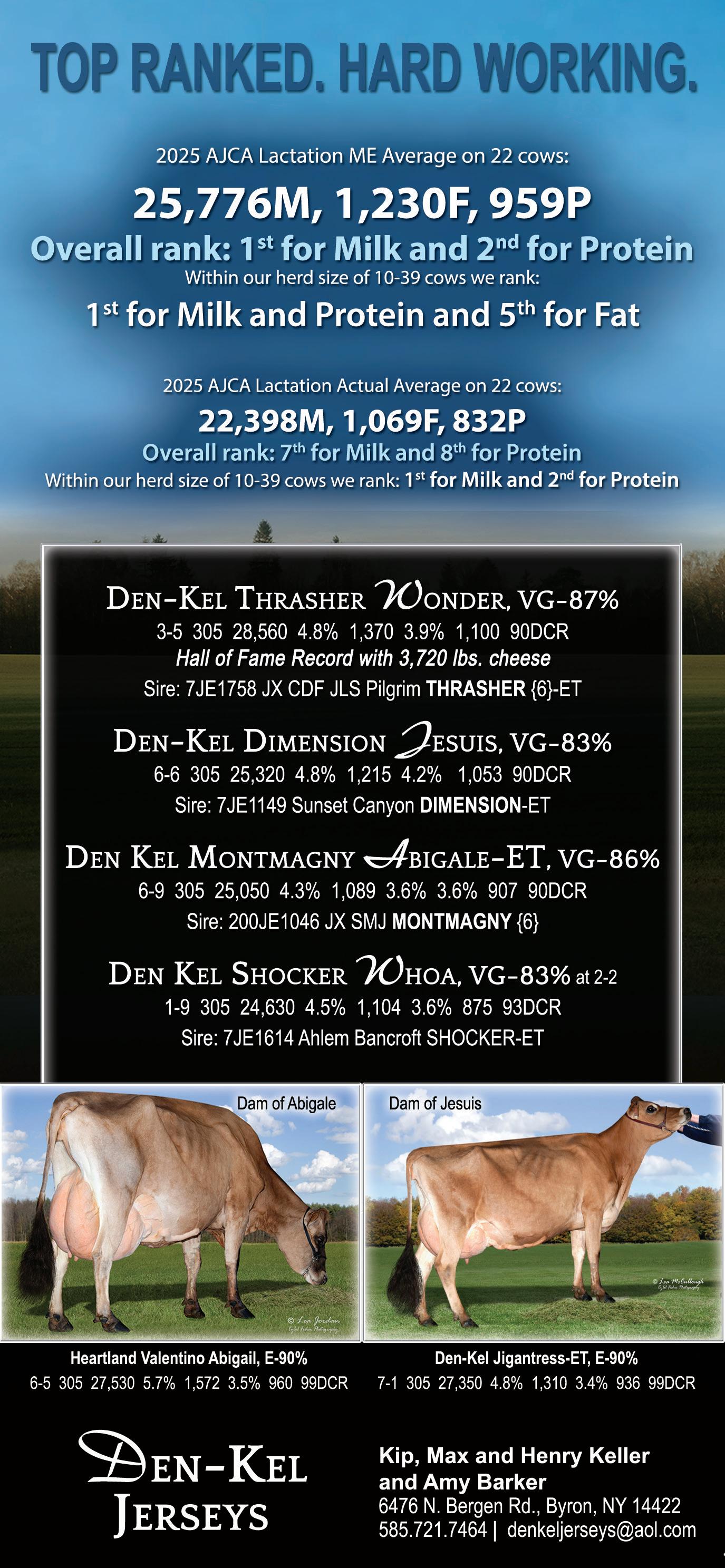
2. Den Kel Jerseys LLC, Byron, N.Y. 22 959 25,776 1,230
3. Clark, Ryan D., Tyrone, Pa. 214 956 23,130 1,224
The American Jersey Cattle Association (AJCA) Board of Directors encourages its members to employ the following management practices to improve herd profitability:
Maximize the genetic potential of the herd by
• Making a minimum of that 50% of the dairy matings in the herd to proven bulls and 50% to young sires. Individual young sires should be used lightly with no more than 2% of the dairy matings in a herd to one young sire. Utilization of proven bulls found to sire the most productive daughters should be used most heavily.
• Breeding heifers A.I. to proven or selected young bulls that are enrolled in progeny test programs; if natural service for heifers is a management necessity, using bulls that qualify for those programs.
• Maintaining accurate identification and breeding records.
• Participating in AJCA performance and functional type appraisal programs that provide the basis for genetic evaluations.
• Making mating assignments that maximize profit and minimize inbreeding.
Challenge the genetic capacity of the herd by
• Feeding ample quantities of properly balanced rations to milking cows.
• Minimizing involuntary culling so that voluntary culling can be maximized.
• Providing for the special nutritional and management needs of dry cows.
• Having cows in proper body condition.
• Providing special attention to calf raising practices to minimize losses and optimize growth.
• Using new technologies that provide economical advantages in your situation.
Exploit Jersey advantages by
• Using tamper-evident ID and registering calves before they are six (6) months of age.
• Freshening heifers under 24 months of age.
• Becoming involved in milk marketing efforts that gain equitable payment for milk components.
• Becoming involved in cattle marketing efforts that supplement herd income.
• Using your herd and farm to project a positive image for the Jersey breed and the dairy industry.
Top Herd Rankings Nationally by Herd Size (Actual basis)
3. Pine Hill Jersey Farm LLC, New Waterford, Ohio 336 1,182 22,227 812 4 Wilsonview Dairy Tillamook Or 726 1,177 20,327 786 5. Gomes Jersey Dairy, LLC, Tillamook, Ore.
9. Trescher, Annette, Cashton, Wis. 18 1,194 22,584 827 Lauber, Londa, Union Grove, Wis. 10 1,194 19,535 771
dreamroadjersey@yahoo.com
bgc33@cornell.edu
shaker bottle, or a trip to a specialty store.
Whey Protein: The Heavy Hitter
A major driver behind rising protein value is the whey market. Refined products like WPC30 and WPC80 (Whey Protein Concentrate with 30% and 80% protein content) are selling at record highs, roughly double their historic prices.
Real Talk from the Next Generation
heavenscentjerseys@gmail.com
timlawton581@gmail.com
silverspf@aol.com
Of course, you don’t have to look at market reports to understand whey’s popularity. Just ask anyone in the gym. One young lifter (who happens to eat five protein-packed meals a day, in my kitchen, and rarely misses a workout) summed it up like this:
“To keep money in the bank, keep protein in your Tank”
While that’s anecdotal, he claims at least 10 of his gym friends agree and if you’ve spent any time around weight rooms, you’ve probably heard
“Whey protein mixes easy, helps build my strength and muscle endurance, and tastes good. The soy stuff tastes like chalk and dirt combined, doesn’t give me an energy boost, and is rough on the digestive tract.”
(continued to page 35)
fjordworks@yahoo.com
toms18438@yahoo.com
sdfarm@fairpoint.net
jsamuelson56@yahoo.com
jkokoski@maplelinefarm.com
The Value of Protein
(continued from page 33)
similar opinions.
The Bottom Line
For Jersey dairy producers, that means real dollars. For consumers, it means real nutrition.
And for anyone still thinking of milk as just a beverage, it might be time to start thinking of it as something more, a powerhouse of components working hard both in the marketplace and in your body.
Eligibility Rules for 2026 All American Junior Show
The All American Junior Jersey Show is scheduled for Friday, November 6, in Louisville, Ky.
The eligibility and ownership rules were approved by the AJCA Board of Directors upon recommendation of the All American Planning Committees. Junior Jersey owners need to take appropriate action now to ensure they are eligible to exhibit in the 2026 show.
Rule 1, Exhibitors. Exhibitors must be no younger than nine (9) and no older than 20 years of age as of January 1, 2026. U.S. residents must be members (junior or lifetime) of the American Jersey Cattle Association.
Rule 2, Entries. Animals are eligible when recorded by the American Jersey Cattle Association in the Herd Register or with Generation Count 4 or greater, or by Jersey Canada with registry status of 93.75% and greater.
The exhibitor must be listed as Recorded Owner on the registration certificate, either (1) as the sole owner or (2) by his/her name in joint ownership. If the joint ownership includes more than one person meeting the eligibility requirements of Rule 1 (above), one of them must be declared as the exhibitor during check-in.
Animals must be registered and/or transferred to meet one of the above ownership requirements on or before August 1, 2026. The date of registration and/or transfer is the Date Recorded printed on the registration certificate.
Rule 3, Participation. Entries must be shown by the exhibitor, except by prior written approval from NAILE. Alternate leadspersons must (1) be associated with the Herd Unit and also eligible to show by age (Rule 1, above), or (2) if not, be the same age or younger than the exhibitor of
the animal being shown. Requests for alternate leadsperson must be submitted for approval by the NAILE dairy show superintendent on forms provided by the AJCA not later than 12:00 noon the day before the show.
No more than two (2) animals may be shown by one exhibitor in any one class. The exhibitor must lead the first entry and the second entry must be led by an NAILE approved alternate leadsperson.
Adults are not allowed to show in any case.
Rule 4, Breeder Status. In order to qualify for Premier Breeder points and Best Bred and Owned awards, the exhibitor declared at check-in must have his/her name recorded as a Breeder on the animal’s registration certificate. These awards will be made only to the individual exhibitor in the case of partnership animals.
For more information, contact the Communications Department at 614/322-4451 or email info@usjersey. com.
albrightjerseys@gmail.com
toddunkefer@yahoo.com
phjfarm@dslextreme.com
jaws@defnet.com
grass4jerseys@yahoo.com
laspahr@bright.net
(continued from page 10)
2:00 p.m. (EST). NOV. 9—ALL AMERICAN JERSEY COW SHOW, Kentucky Fair and Exposition Center, Louisville, Ky.; 7:30 a.m. (EST).
July 1 is Deadline to Apply for National Scholarships and Educational Awards
Wednesday, July 1 is the deadline to apply for scholarship and educational awards administered by the American Jersey Cattle Association (AJCA), Reynoldsburg, Ohio.
This year $47,850 will be awarded to Jersey youth. The funds provide financial support for young Jersey owners pursuing a college or university degree or, in some cases, gaining hands-on experience in the development and management of Registered Jersey™ cattle. Eligible applicants are Junior or Lifetime members of the association with a minimum grade point average of 2.5 (on a 4.0 scale).
The Walter and Joyce Owens Family Scholarship ($5,000) will be awarded to incoming or current undergraduates in any post education institution studying dairy related majors. Applicants must be working towards a 2-year or 4-year degree and demonstrating satisfactory academic performance. Recipients are eligible to receive scholarship up to two (2) times but must reapply to be considered.
The Russell–Malnati Scholarship for Advanced Studies ($5,000) will be awarded to a graduate student in dairy science, animal science (dairy emphasis), large animal veterinary practice, dairy production/manufacturing, or dairy product marketing.
The Lineweaver Scholarship ($5,000) will be awarded to an undergraduate who has completed at least one year of study in a four-year program focused on dairy science, animal science (dairy emphasis) or dairy products.
Students who will begin a program of study at an accredited college or university in the fall of 2026 may ap-
ply for the William A. Russell Memorial Scholarship ($3,000). Students who have completed at least one year of study toward their degree are eligible for the V. L. Peterson Scholarship ($2,500). Also, the Jack C. Nisbet Memorial Scholarship ($2,500) will be awarded to an eligible nominee for the National Jersey Youth Achievement Contest.
The Morris B. Ewing ABS Genetic Performance Scholarship ($3,250) will be awarded to a junior or senior undergraduate student seeking a career in genetics, dairy production, large animal veterinary medicine or milk marketing.
The Robert Bignami Memorial Scholarship ($3,000). This scholarship was established from a generous donation of Bob and Pam Bignami, Orland, Calif., from the sale of BW Graduate-ET in 2020.
Students who are high school graduates and have attended Jersey Youth Academy are eligible to apply if heading to, or already enrolled in an accredited four-year college/university majoring in an agricultural-based degree.
The award is based upon financial need, academic performance, and leadership skills. It may be automatically renewed up to three times or until completion of the undergraduate degree, as long as eligibility requirements are met.
A Cedarcrest Farms Scholarship ($2,000) will be awarded to an undergraduate or graduate student enrolled in a program to earn a degree in large animal veterinary practice, dairy production, dairy manufacturing, or dairy product marketing, and who demonstrates through completed coursework and goal statement, significant progress toward this intended degree and a clear intention for a career in agriculture.
The Paul Jackson Memorial Scholarship ($1,000) is for continuing college students in any degree program area. The AJCA Directors’ Scholarship ($1,500) will be awarded based on academic performance, activities and accomplishments with Jersey cattle and commitment to continued involvement in the Jersey dairy business. The Bob Toole Jersey Youth Award ($2,000) can be used for educational expenses or a well-defined practical experience related to breeding, developing and showing Registered Jerseys.
The recipient of the Anne E. Perchard Challenge Award ($350) will be selected from among applicants for the national achievement contest and/ or scholarship program to recognize abilities and leadership potential and, in turn, challenging the recipient to achieve his/her potential through continuing Jersey activities.
Also, the Reuben R. Cowles Jersey Youth Award will be presented to an eligible resident of Georgia, Florida, North Carolina, South Carolina, Tennessee and Virginia to be used for educational expenses or to travel to the All American Jersey Show and Sale, the AJCA-NAJ Annual Meetings or other Jersey educational activities. Applicants must be at least high school graduates, but not older than 36 years of age as of January 1, 2026. For application forms and instructions, visit the “Scholarships and Internships” page on the USJersey website or use the link, tinyurl.com/ JerseyScholarships. Recipients will be recognized on Saturday, November 7 at the Youth Awards Ceremony held in Louisville, Ky.
For more information, contact the AJCA by email at info@usjersey.com; or visit its web site at USJersey.com.
PERFORMANCE REPORT
Top 25 Records in History and National Class Leader List
The Top 25 Records for Milk, Protein and Fat completed in the history of AJCA production testing programs are listed below.
The National Class Leader List summarizes the 10 highest lactations for milk, protein, fat, and cheese yield in nine age categories. Lactations are 305 days (or less) in length and are official on the AJCA records. These lists include lactations added to the database through January 1, 2026. To qualify for
OSBORN JAMES L & SHARON L, UNION BRIDGE, MD PAGE-CREST COUNCILLER SARA 08 4-04
PAGE, DEREK LEON, MOUNT VERNON, MO COTTONWOOD MERRY VIOLET 03 6-04
GINA, CLOVERDALE, OR
OSBORN JAMES L & SHARON L, UNION BRIDGE, MD
these lists, all test days included in a completed 305- or 365-day lactation record must occur in a herd or herds enrolled in the Production Records Plus, TPE-Plus, REAP Plus programs, or be a Generation Count {4} or higher for registration status. An asterisk in the column after days milked indicates that the animal was milked more than twice daily during part or all of the lactation. A “V” following the record indicates that it has been verified.
HAVS IATOLA TOPAZ
KORTUS, MICHAEL R, LYNDEN, WA
ACTION YVETTE
KORTUS, MICHAEL R, LYNDEN, WA
NORMANDELL KHAN ARIEL
NORSE STAR JERSEYS, WESTBY, WI
RANDY & JANA, LYNDEN, WA
KORTUS RANDY & JANA, LYNDEN, WA
NATHAN A, BEAVER, OR CINNAMON RIDGE NITRO NOBLE-ET
AMY, DONAHUE, IA
BERRETTA ACCENT
MELISSA R, LYNDEN, WA
JOHN & SUBJECT RUSSELL, ELMER, NJ
MICHAEL R, LYNDEN, WA
VALENTINO MISTLE TOE
OELFKE JAMES L & FAMILY, HAMBURG, MN
BERRETTA JOY
KORTUS, MELISSA R, LYNDEN, WA
JACE SHELLY 08
KORTUS RANDY & JANA, LYNDEN, WA MAINSTREAM BOMBER JAZZY-ET
RANDY & JANA, LYNDEN, WA
RAYMOND, KINGSBURG, CA
NORSE STAR HALLMARK BOOTIE
FREMSTAD, JEANA MARIE, WESTBY, WI
RANDY & JANA, LYNDEN, WA
WHISTLING
KORTUS, MELISSA R, LYNDEN, WA
PERFORMANCE REPORT
(continued from page 39)
TOP 25 FAT OVERALL
LYON RENEGADE BARB 19 6-01
COURTNEY LOGAN & AUTUMN, CHOUTEAU, OK
NORSE STAR HALLMARK BOOTIE 07 3-00
FREMSTAD, JEANA MARIE, WESTBY, WI
MAINSTREAM BARKLY JUBILEE 08 4-08
KORTUS RANDY & JANA, LYNDEN, WA
JX COLD RUN TEX DICEON {4} 18 6-04
COLD RUN JERSEYS LLC, SALEM, OH
JEFF-RO COUNTRY ROLLO 14 4-01
KRUEGER ROBIN & KESSENICH JEFF, DE FOREST, WI
GOLDEN MBSB OF TWIN HAVEN-ET 00 4-01
FRANZER, DAVID, COLDWATER, OH
QA/WF HALLMARK DELIRIOUS 06 4-01
OSBORN DEBORAH C & WAVERLY FARMS, KEYMAR, MD
*
PAGE-CREST COUNCILLER SARA 08 4-04
PAGE, DEREK LEON, MOUNT VERNON, MO
MAINSTREAM TBONE STATICE 16 5-02
KORTUS RANDY & JANA, LYNDEN, WA SUNSET CANYON MONTANA MISCHIEF 08
JENSEN, NATHAN A, BEAVER, OR
MAINSTREAM JACE SHELLY 11
KORTUS RANDY & JANA, LYNDEN, WA FRIENDLY VALLEY MECCA STARLIT {6} 08
info@ladylanefarm.com
jbansen@gmail.com
jennie.seals@gmail.com
desijosi@wilsonview.com
PERFORMANCE REPORT
National Class Leader List
The National Class Leader List summarizes the 10 highest lactations for milk, protein, fat, and cheese yield in nine age categories. Lactations are 305 days (or less) in length and are official on the AJCA records. These lists include lactations added to the database through January 1, 2026. To qualify for these lists, all test days included in a completed 305- or 365-day lactation record must occur in a herd or herds
NAME–OWNER
NATIONAL CLASS LEADER LIST—CHEESE YIELD: YEARLING (305
OELFKE JAMES L & FAMILY, HAMBURG, MN
HIGHVIEW MAGNUM 4114 16 1-09
OELFKE JAMES L & FAMILY, HAMBURG, MN
PINE-TREE CHROME NORWAY OF CR
MAXWELL, AMY, DONAHUE, IA
CINNAMON RIDGE PEACOCK PENNE 22 1-10
MAXWELL, AMY, DONAHUE, IA
HIGHVIEW VALENTINO PAULA 14 1-10
OELFKE JAMES L & FAMILY, HAMBURG, MN
CROSSWIND CITATION A 6714 {4}-ET 18 1-09
CROSSWIND JERSEYS, ELKTON, SD
CINNAMON RIDGE FOCUS JEOPARDY 22
MAXWELL, AMY, DONAHUE, IA
AIR-OSA JIVE 24556 {5} 22 1-10
AIROSO DAIRY FARMS / JOSEPH AIROSO, TIPTON, CA
HAVS IATOLA TOPAZ 09 1-10
KORTUS, MICHAEL R, LYNDEN, WA HIGHVIEW PLUS BONNIE {6} 13 1-10
OELFKE JAMES L & FAMILY, HAMBURG, MN
JR 2 YEAR OLD (305 CHEESE YIELD) HIGHVIEW TBONE VODKA {4} 13
OELFKE JAMES L & FAMILY, HAMBURG, MN
BARLASS REGENCY BREANN 3862 21
BARLASS JERSEYS LLC, JANESVILLE, WI
QUEEN-ACRES MILLENIUM SUNFLOWER {6}05 2-05
OSBORN JAMES L & SHARON L, UNION BRIDGE,
FRESON T&K , STANFORD M&S ,BOLLENBACHER
AUER, GRADY, NEW LONDON, WI QUEEN-ACRES DELIVERANCE FIGI
enrolled in the Production Records Plus, TPE-Plus, REAP Plus programs, or be a Generation Count {4} or higher for registration status.
An asterisk in the column after days milked indicates that the animal was milked more than twice daily during part or all of the lactation. A “V” following the record indicates that it has been verified.
MICHAEL R, LYNDEN, WA
DAIRY FARMS, HILMAR, CA
PERFORMANCE REPORT
BRIDON JUNO BANGO 05
TIGHE JOHN & SUBJECT RUSSELL, ELMER, NJ
ARETHUSA HG LIBBY-ET 17 5-03
HERRON JAMES AND RENNER TED, SALEM, OH
MAINSTREAM JACE SHELLY 10 5-04
KORTUS RANDY & JANA, LYNDEN, WA
SLJ COUNTRY MAJERLE 19
CLARK, TREASURE, SENECA, MO
BRIDON JUNO BANGO 04 6-07
TIGHE JOHN & SUBJECT RUSSELL, ELMER, NJ ALL LYNNS LOUIE VENETIA-ET 14
ALLEN, DAVID, REEDSBURG, WI
CINNAMON RIDGE NITRO NOBLE-ET 22
MAXWELL, AMY, DONAHUE, IA
10 YEARS & OVER (305 CHEESE YIELD)
OAKFIELD TBONE VIVIANNE-ET 22 11-10
HERRINGTON KEVIN & ANNETTA, DANSVILLE, NY
LANI OF STAR JERSEY 00 10-06
CREWS, RAYCENE, BOISE, ID
EXELS MEDALIST ABRIL 2595 24 10-06
VANEXEL HANK & CAROLYN, LODI, CA
LADYHOLM-N JEWELS JADE 10
PEASE, HEATHER, SUSQUEHANNA, PA
OAKFIELD TBONE VIVIANNE-ET 20
HERRINGTON KEVIN & ANNETTA, DANSVILLE, NY
TRIPLE S FANCYS BRANDI 02
KIPP THOMAS & ABBY, HAZEL GREEN, WI SELECT LILY OF MAINSTREAM 10
KORTUS RANDY & JANA, LYNDEN, WA
LAGERWEYS 285 SILKY 07 10-07
KORTUS, MELISSA R, LYNDEN, WA
DUPAT PLUS 11313 {6} 24 10-02
WICKSTROM JERSEY FARMS INC, HILMAR, CA
MAINSTREAM JACE SHELLY 16
KORTUS RANDY & JANA, LYNDEN, WA
NATIONAL CLASS LEADER LIST—MILK: YEARLING (305 MILK) HIGHVIEW MAGNUM 4114 16 1-09
OELFKE JAMES L & FAMILY, HAMBURG, MN HIGHVIEW VALENTINO MISTLE
OELFKE JAMES L & FAMILY, HAMBURG, MN
CINNAMON RIDGE PEACOCK PENNE
MAXWELL, AMY, DONAHUE, IA AIR-OSA JIVE 24556 {5} 22