
Dean’s Message
Dear friends of the USC Leonard Davis School of Gerontology,
This year marks an extraordinary milestone: the 50th anniversary of the USC Leonard Davis School of Gerontology. Since 1975, our school has led the way in shaping the field of aging, from pioneering the nation’s first PhD in gerontology and other groundbreaking degree programs to creating a research powerhouse spanning biology, neuroscience, sociology, policy and more.
“Together, as we honor 50 years of achievement, we also build the foundation for the next 50 and beyond.”
As we celebrate this golden anniversary, we reflect on the vision of our namesake, Leonard Davis, and the dedicated leaders, faculty, students and supporters who turned a bold idea into a lasting reality. What began as the first-ever freestanding school of geron tology offering a single master’s program is now a global leader in aging research and education, dedicated to improving the well-being of people at every stage of life. Our alumni share our aging expertise in every arena, in cluding health care, government, academia and industry — demonstrating the profound reach of the school’s impact. Looking ahead, we remain committed to discovery and innovation. We are unlocking the foundational biological mechanisms of aging, developing predictive tools for Alzheimer’s disease and other conditions, and creating interventions to ensure longer, healthier lives. At the same time, our social science and policy experts are tackling the challenges of caregiving, health care poli cy and the needs of rapidly growing older populations.
None of these achievements would be possible without the support of our remarkable community. Your enthusiasm, generosity and partnership fuel our progress, enabling us to prepare the next generation of leaders and to drive breakthroughs that will benefit the world.
Together, as we honor 50 years of achievement, we also build the foundation for the next 50 and beyond — transforming the future of aging for individuals, fami lies and societies everywhere.
With gratitude,
Pinchas Cohen, MD Dean, USC Leonard Davis School of Gerontology
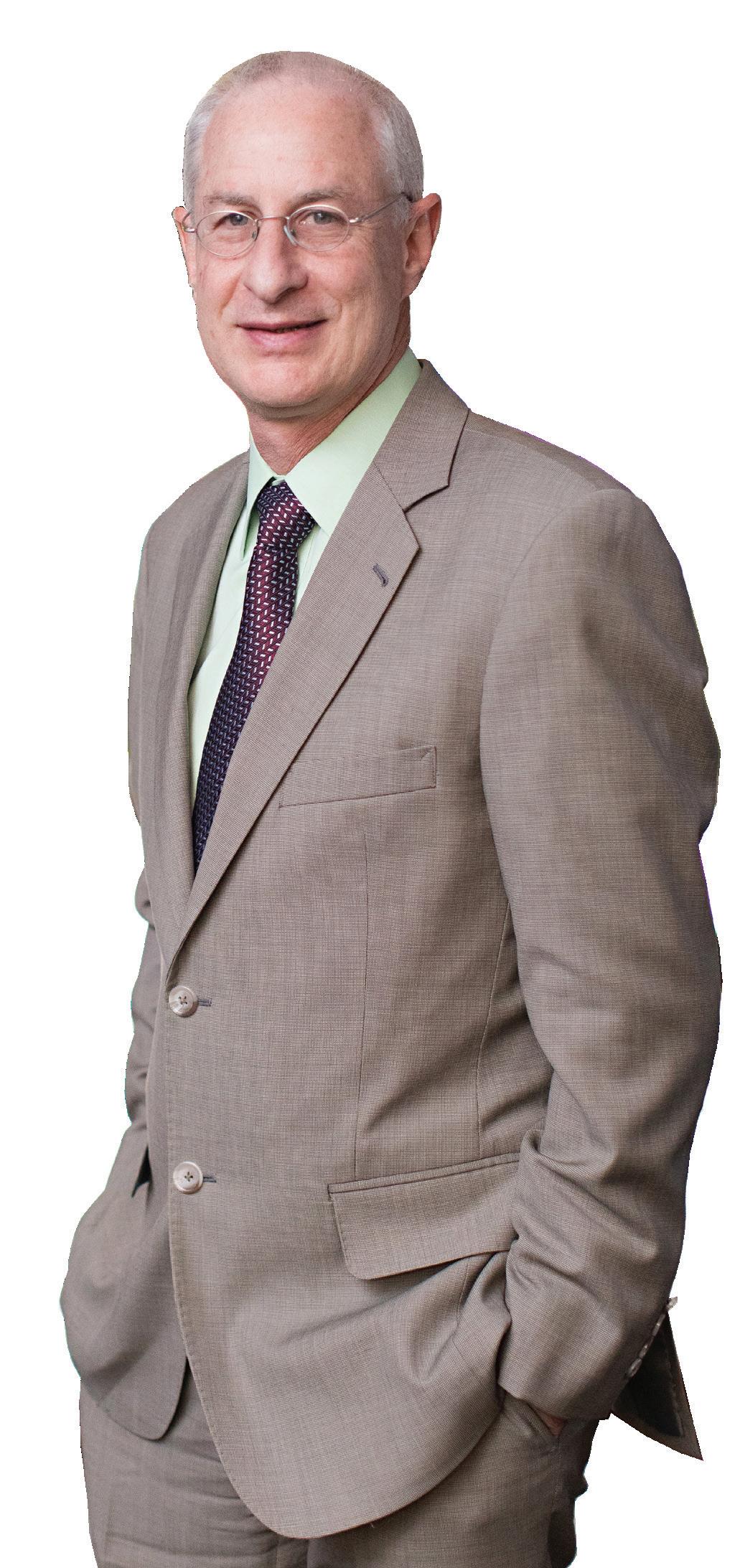
Photo: Stephanie Kleinman
VITALITY MAGAZINE
—
Editor in Chief
Beth Newcomb
Art Director
Natalie Avunjian
Design
Cyan Design Studio
Copy Editor
Elizabeth Slocum
Contributors
Inga Back
Greg Hernandez
Leigh Hopper
Jason Millman
Constance Sommer
Jamie Wetherbe
USC LEONARD DAVIS SCHOOL OF GERONTOLOGY
Dean Pinchas Cohen
Vice Dean
Sean Curran
Senior Associate Dean
Maria L. Henke
Senior Associate Dean for Advancement
David Eshaghpour
Associate Dean of Research, Associate Dean of International Programs and Global Initiatives
Jennifer Ailshire
Associate Dean of Education
John Walsh
Associate Dean for Arts & Healthy Aging
Teal Eich
Assistant Dean of Research
Christian Pike
Assistant Dean of Cultural Affairs
Donna Benton
Assistant Dean of Academic Initiatives
Mireille Jacobson
Senior Business Officer
Lali Acuna
Senior Human Resources
Business Partner
Wendy Snaer
3 Postcard Undergraduate researchers spend summer in the lab
6 Findings Measuring the cost of dementia; AI analyzes brain aging speed
8 New Directions Grant creates the L.A. Pepper Center; new MS in Aging Biology
10 Vital Signs Naloxone knowledge; meditation and attention
48 A Milestone Commencement School’s 50th year sees a record-breaking graduating class
50 Notes Gift creates the Adam Will Prize in Arts and Healthy Aging
FEATURED —
14
COVER: Fifty Years of Vision Faculty, alumni, and supporters share their experiences and show how the USC Leonard Davis School of Gerontology has shaped the aging field.

34 It’s More Than Just Genes Understanding and measuring biological age

24 Innovative Insights Powering a bold vision for the future of Age Tech
38 Embracing the Unexpected Alumni make the most of unusual opportunities
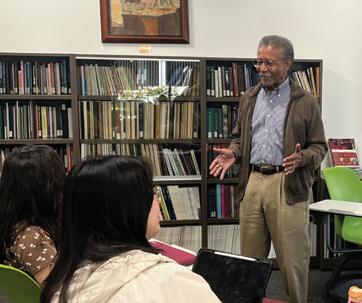
30 Sharing Time, Telling Stories Volunteers provide perspectives on aging for students

44 Creativity and Compassion Davis family support through the decades
SPOTLIGHT
News Bites
AWARDS
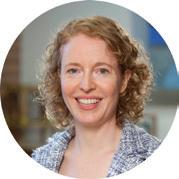
Pinchas Cohen Senior Member, National Academy of Inventors
Mara Mather Distinguished Scientist Award, Association for Applied Psychophysiology and Biofeedback
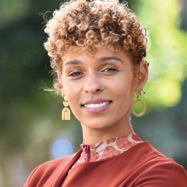
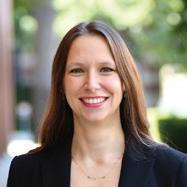
Lauren Brown Hanson-Thorell Family Research Award
Eleanor Hayes-Larson Lilienfeld Postdoctoral Prize Paper Award, Society for Epidemiologic Research
“ What has all this taught me? It has taught me that there is so very much to learn and also that I have so much to learn.”
— James Birren (1918-2016), first dean of the USC Leonard Davis School of Gerontology, in “How Do I Think I Got Here?,” a 2006 article for The LLI Review about his life and career.
The Gerontological Society of America (GSA), the nation’s oldest and largest interdisciplinary organization focused on aging, has recognized two USC Leonard Davis faculty members for extraordinary research and mentorship in aging. Both awards will be presented during GSA’s 2025 Annual Scientific Meeting.
Research Excellence
Pinchas Cohen, dean of the USC Leonard Davis School and USC Distinguished Professor of Gerontology, Medicine and Biological Sciences, has been named this year’s recipient of the Robert W. Kleemeier Award. Established in 1965, the Kleemeier Award honors a GSA Fellow for “outstanding research in the field of gerontology.”
Cohen is an internationally recognized expert on healthy aging and longevity as well as a pioneer in the emerging science of mitochondria-derived peptides. He will deliver the Kleemeier Award Lecture during the 2026 GSA Annual Scientific Meeting.
Mentoring Tomorrow’s Leaders
Sean Curran, vice dean of the USC Leonard Davis School and professor of gerontology, received the Hiram J. Friedsam Mentorship Award. The award is bestowed by the Academy for Gerontology in Higher Education, a membership group within GSA, and honors those who have demonstrated excellence in mentorship to students, faculty and administrators.
Curran’s nominators lauded the exemplary track record of scientific and professional success for his mentees, as well as his leadership roles in the development of the PhD in Geroscience program, the school’s National Institute on Aging T32 Geroscience Training Grant and an NIA K07 Academic Leadership Career Award. Curran will present a lecture on mentorship during the 2025 GSA Annual Scientific Meeting.
Photos: Stephanie Kleinman, John Skalicky, Natalie Avunjian, Stephen
Gee
POSTCARD
Trojan Undergrads Spend Summer Immersed in Life-Changing Research
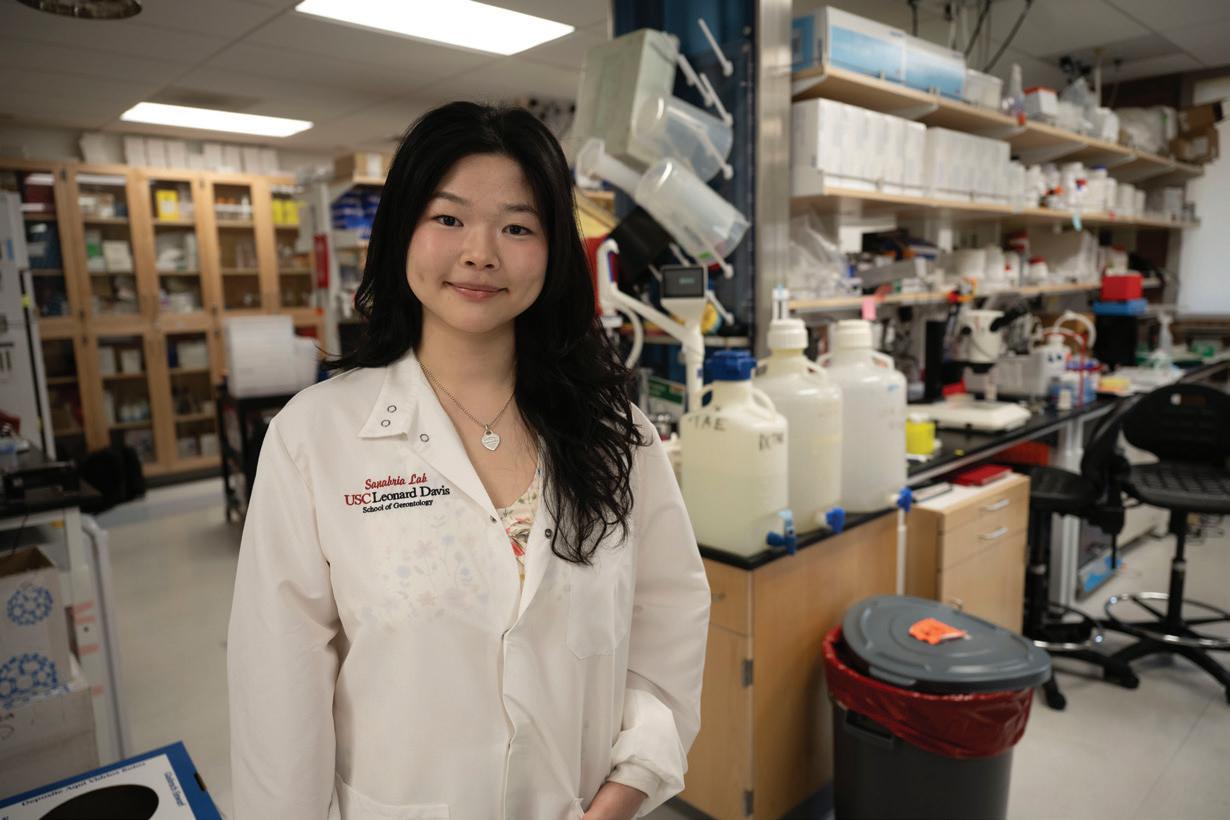
USC Today featured a story and video on several undergraduate students who spent much of summer 2025 conducting research, including Tiffany Wang, a senior majoring in human development and aging at the USC Leonard Davis School.
Wang, who studies the protein actin and its impact on aging under the mentorship of Assistant Professor Ryo Sanabria, said she appreciates spending more time in the lab focusing on research in the summer.
“I have been able to really develop my own research project,” she said. “That ability to critically think and plan has been a really important skill that I’ve honed this summer.”
Wang’s research aims to explore pharmaceutical approaches to aging. Her desire to help older people stems from her close connection to her grandmother, who raised her while her parents worked.
“Most days, I’m behind a microscope checking on the worms, seeing if they’re alive or seeing if they’re moving less,” she said with a laugh. “Sometimes it’s draining if your experiments don’t work out. But it also just shows how much effort goes into our research. It isn’t easy and takes a lot of self-discipline and dedication.”
— G.H.
Read the full story and watch the video: bit.ly/USCSummerResearch
GLOSSARY
—
Gerotherapeutics
Treatments that directly target the aging process to prevent agerelated diseases and increase lifespan.
— National Institutes of Health
Naloxone
A fast-acting medication used to reverse an opioid overdose.
— Centers for Disease Control and Prevention
PhysAge
A new USCdeveloped epigenetic clock to predict health and mortality and measure biological age.
— Arpawong et al, 2025
News Bites
IN THE MEDIA
— Washington Post
The $1 billion wager riding on whether a human will live to 150
“The maximum life expectancy has not risen. ... There is no evidence anyone is going to exceed 120.”
— Dean and Distinguished Professor Pinchas Cohen
New York Times
Why do women live longer than men?
“There’s decent data showing that, at least before menopause, the female immune system tends to be better, more on it and better able to mount responses. … [Males] tend to do much worse in response to infection.”
— Associate Professor Bérénice Benayoun
ABC News
Long periods of extreme heat can accelerate biological age, scientists say “Two people that had identical sociodemographic characteristics and similar lifestyles, just because one is living in a hotter environment, they experience additional biological aging.”
— Postdoctoral Scholar Eunyoung Choi
New York Post
Bolivian community with just 1% dementia and the ‘healthiest hearts in the world’ follow this diet
“This ideal set of conditions for disease prevention prompts us to consider whether our industrialized lifestyles increase our risk of disease.”
— Professor Andrei Irimia
Next Avenue
Unwinding the safety net
“The safety net for the elder justice system is being loosened, and there are not as many resources for people who are being scammed.”
— Research Associate Professor Donna Benton
New York Times
Bad news from the doctor? Here’s how to cope
“[Record doctor appointments regarding serious diagnoses.] Then, you can listen back when you’re not in crisis.”
— Associate Professor Susan Enguídanos
The Times (UK)
‘After taking weight-loss drugs, my life fell apart’
“The literature on GLP-1 receptor agonists and depression is mixed, with some studies suggesting GLP-1 makes things worse, some that it has neutral effects and some that it improves symptoms.”
Professor Valter Longo
AARP
10 microhabits for brain health
“We found that [meditation] actually does … improve your attention.
You’re more focused. The speed of how your brain processes things goes a little faster.”
— Postdoctoral Scholar Andy Jeesu Kim
Oprah Daily
You can transform trauma into strength. Here’s how experts say it’s done
“When your sense of safety, well-being and identity is challenged and you have to rethink who you are and what you want, that’s when growth happens.”
— Research Associate Professor T. Em Arpawong
CNN
Extreme heat is miserable and dangerous. It’s also making us age faster
“[Accelerated epigenetic aging] is not permanent damage; it’s an indicator of the potential for permanent damage. It doesn’t necessarily signify that this damage has been done.”
— Professor Jennifer Ailshire
Wall Street Journal
Is your brain aging faster than you? New science offers clues
An article on brain aging and dementia prevention highlighted research by Associate Professor Andrei Irimia.
Medscape
Patients piling on the pills in middle age: Are they needed?
“Sometimes these discussions [regarding what medications are and aren’t necessary] happen without including patients and their families.”
— Assistant Professor Michelle Keller
HuffPost
How dietary fiber can help your longevity
“I think many people think, ‘What’s going to happen to me is going to happen to me, and I don’t have control.’ … I think people need to know that they can make those changes now, and it potentially can add years to their life.”
— Instructional Professor Cary Kreutzer
New York Times
The surprising health benefits of becoming pope
Professor Mara Mather and Instructional Associate Professor Roberto Vicinanza commented on how working at older ages could provide cognitive benefits but may pose stress-related health risks.
Science
Ancient Romans likely breathed lead pollution
“The conclusion of ‘widespread cognitive decline’ from an estimated three–IQpoint decrease does not match the huge productivity of the Roman Empire when lead production was maximal.”
— University Professor Emeritus Caleb Finch

FEATURED MENTION
Boomers behaving badly: Why the over-60s are the wildest generation
The Telegraph (UK) quoted Professor Jennifer Ailshire in an article about how members of the baby boom cohort are upending stereotypes about aging, including by protesting for political causes and drinking more heavily than younger generations.
“I have often said that baby boomers are going to fundamentally reshape what aging looks like. … We had the stereotype of a grandma knitting or an old fellow gardening because we have associated aging with frailty and ill-health and a lack of ability to be out in social spaces,” Ailshire said.
“Boomers are the first generation in the history of the world to have really benefited from new medical interventions and advice on how to stay fitter for longer, and as a result a great number feel younger and seem younger than those who came before them.”
$781B
Projected total economic burden of Alzheimer’s and dementia in the U.S. for 2025
FINDINGS
Brain Circulation Problems Linked to Mild Cognitive Impairment
A study led by Professor Daniel Nation finds that dysfunction in very small blood vessels in the brain’s temporal lobes — areas central to memory — is linked to mild cognitive impairment in older adults, whether or not they have Alzheimer’s pathology.
In the study, 144 independently living older adults underwent cognitive tests, blood sampling, and MRI scans that measured cerebrovascular reactivity (how well vessels dilate) using brief periods of breath-holding. Those whose temporal lobe vessels failed to dilate properly showed memory problems.
Researchers emphasize that this vascular dysfunction appears early, and that focusing on blood vessel health, such as via managing blood pressure, could be important in preventing or delaying cognitive decline. — L.H.
New AI Model Measures How Fast the Brain Ages
Associate Professor Andrei Irimia and colleagues have developed a novel artificial intelligence tool that tracks the pace of brain aging using MRI scans over time, rather than just comparing a single scan.
The model, a 3D convolutional neural network trained on over 3,000 scans of cognitively normal adults, analyzes baseline and follow-up images to
detect regional brain changes tied to accelerated or slowed aging. It also produces “saliency maps” to show which brain areas contribute most to aging.
When tested on healthy adults and Alzheimer’s patients, faster brain aging as calculated by the model correlated closely with cognitive decline in memory, processing speed, executive function, etc. The system may help identify individuals at risk earlier and distinguish brain aging rates, enabling better prevention, treatment and personalized risk forecasting. — B.N.
How Much of Aging Is a Roll of the Dice?
A review led by Assistant Professor Ryo Sanabria and PhD student Adam Hruby argues that much of how individuals age is driven by “biological stochasticity” — random molecular and cellular events — beyond genes, lifestyle or environment.
Using experiments on Caenorhabditis elegans worms (which are genetically identical and live under controlled conditions), researchers observed notable differences in aging: Some worms remained healthy long; others declined quickly despite identical genetics and surroundings. Examples include variability in protein folding, gene expression and cellular stress responses.
The team introduces the concept of the “stochastome” to capture this layer of randomness. Understanding unpredictable biological fluctuations could improve predictions of aging outcomes and approaches for agerelated diseases such as Alzheimer’s or Parkinson’s. — B.N.
Iron Plays a Major Role in Down SyndromeAssociated Alzheimer’s
Research by University Professor Emeritus Caleb Finch and postdoctoral researcher Max Thorwald reveals a significant link between elevated brain iron levels and cell damage in individuals with both Down syndrome and Alzheimer’s disease (DSAD), potentially explaining why Alzheimer’s often appears earlier and more severely in Down syndrome.
In donated brain tissue, DSAD cases had twice the iron in the prefrontal cortex compared with Alzheimer’s-only or control cases. They also displayed increased oxidative damage to lipid-rich cell membranes and reduced activity of antioxidant enzymes, particularly in structures called lipid rafts, which are important for cell signaling and amyloid precursor protein (APP) processing.
Importantly, DSAD brains showed heightened activity of beta-secretase — the enzyme that helps produce amyloid-beta — in those damaged regions. By contrast, rare mosaic or partial Down syndrome individuals (who have fewer cells carrying the extra chromosome 21) had lower levels of APP, iron and brain damage. The authors suggest therapeutic approaches like iron chelation or strengthening antioxidant defenses might slow progression in DSAD. — B.N.

U.S. Dementia Costs to Exceed $780 Billion This Year
USC-led research estimates that Alzheimer’s disease and related dementias will cost the United States $781 billion in 2025. This includes direct medical and long-term care, unpaid caregiving, lost earnings for patients and caregivers, and declines in quality of life.
The model accounts for 5.6 million Americans with dementia (including 5 million age 65+). Out of the total cost, medical and long-term-care costs are $232 billion, with patients and families paying $52 billion out of pocket. Medicare and Medicaid shoulder most of the rest. Other major components include $302 billion in lost quality of life for patients, $6 billion for caregivers’ quality of life and $233 billion in value of unpaid care.
The U.S. Cost of Dementia Project combines national survey data and administrative claims and uses microsimulation to forecast future economic burden, aiming to inform policy for prevention, treatment, and care. To draw on a wide range of perspectives, the research team includes prominent experts across disciplines at USC, including the USC Schaeffer Center for Health Policy & Economics, the Price School of Public Policy, the Leonard Davis School, the Mann School of Pharmacy and Pharmaceutical Sciences, and the Viterbi School of Engineering. Project team members from the USC Leonard Davis School include University Professor Eileen Crimmins and Professor Mireille Jacobson. — J.M.
NEW DIRECTIONS
USC, UCLA & CedarsSinai to Establish NIA Pepper Center
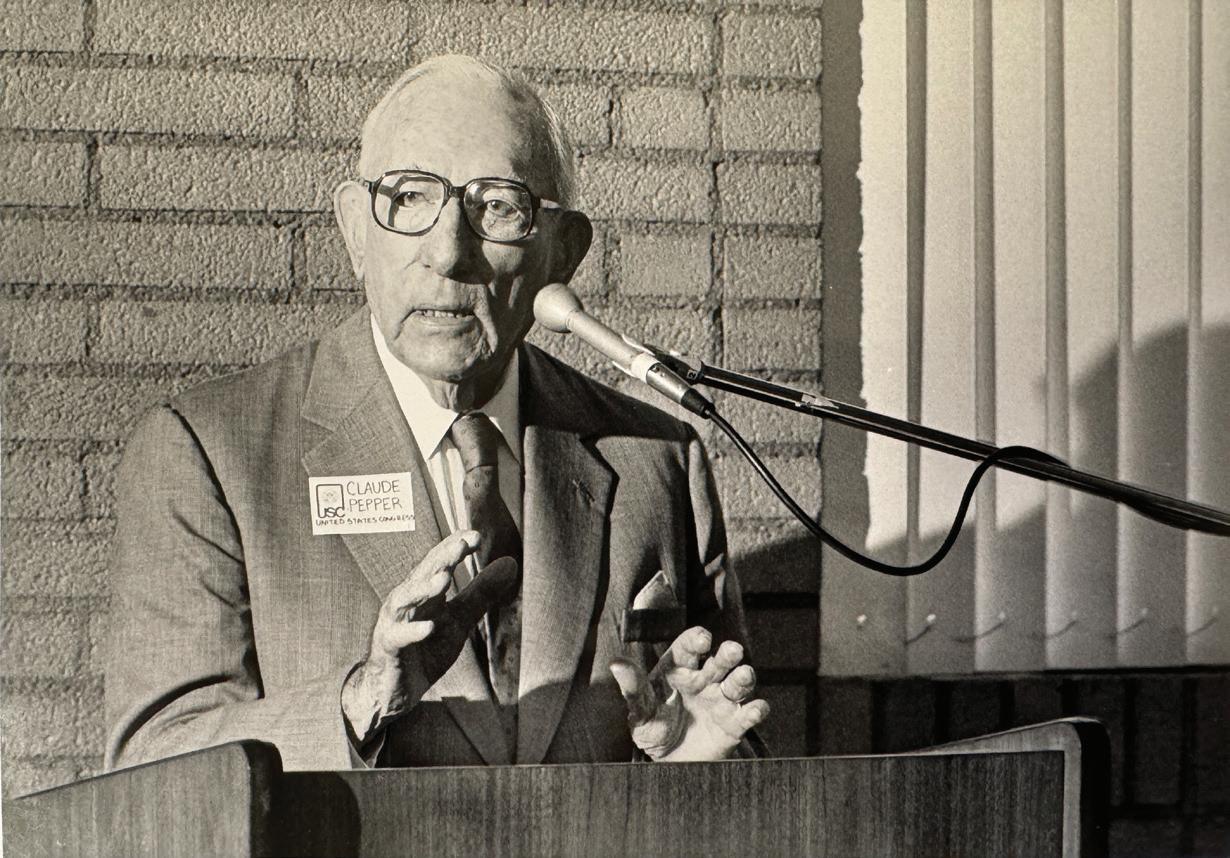
Above: Claude Pepper (1900-1989) was a longtime U.S. congressman and senator from Florida who became a leading national advocate for older Americans. Pepper spoke at the USC Leonard Davis School during the Alliance for Aging Research Symposium on May 29, 1987.
The National Institute on Aging has awarded a $6.5 million, five-year grant to create the Los Angeles Claude D. Pepper Older Americans Independence Center (LA OAIC). The center is a collaboration among Cedars-Sinai, the University of California, Los Angeles, and the University of Southern California and will be part of a national network of only 15 such centers across the country.
The LA OAIC will focus on “translational geroscience,” research that turns discoveries about the biology of aging into practical treatments that prevent disease and extend healthspan, the portion of the lifespan spent in good health. The long-term goal is to help
people live not just longer, but also healthier and more independent lives as they age.
“This center represents a historic moment for Los Angeles,” said Pinchas Cohen, dean of the USC Leonard Davis School of Gerontology and co-director of the new center. “USC has been at the forefront of aging research for decades, and this partnership allows us to accelerate breakthroughs that can directly improve quality of life for older adults.”
The new center is led by principal investigator Sara Espinoza, professor of medicine, director of the Center for Translational Geroscience, and co-director of the Center on Aging and Diabetes at Cedars-Sinai. Along with Cohen, Jonathan Wanagat, clinical professor of medicine at UCLA, is a co-director of the new center.
The center’s primary aims include:
1. Developing advanced gerotherapeutics for extension of human healthspan;
2. Expanding the scope of clinical trials in translational geroscience;
3. Increasing the research workforce in translational geroscience; and
4. Providing leadership, enhancing implementation and promoting dissemination of knowledge about geroscience.
“There is an urgent need for interventions that can reduce the burden of multiple chronic conditions and optimize health and function with aging,” Espinoza said. “By targeting the biology of aging itself, we can discover strategies that change how people experience their later years.”
Photo: USC Leonard Davis
With the launch of the new OAIC, Los Angeles solidifies its status as a major hub of aging research, where experts at USC and their colleagues throughout the region are reshaping what it means to grow older, Cohen said.
“Experts at the Leonard Davis School are proud to contribute their deep expertise in biology, psychology, sociology, policy and services related to aging,” he said. “The school, which was founded 50 years ago as the world’s first school of gerontology, has decades of experience turning research in aging into real-world impact for older adults.” — B.N.
USC Leonard Davis Launches New MS in Aging Biology
This fall marks the debut of a new USC Leonard Davis School of Gerontology graduate program, the Master of Science in Aging Biology (MSAB). The program combines advanced coursework with hands-on laboratory training to prepare graduates for careers shaping the future of health, longevity and biotechnology.
The MSAB program equips students to explore the cellular, molecular and genetic mechanisms underlying aging, as well as big data approaches that can unlock new strategies for preventing and treating age-related diseases. Under the guidance of internationally recognized USC faculty, students will develop the skills and research experience needed to make discoveries that extend healthspan and improve quality of life.
“Our students have access to a vibrant scientific community that is redefining what’s possible for human lifespan and healthspan.”
— Pinchas Cohen, USC Leonard Davis School dean
“This program is ideal for curious and driven students who want to transform how we understand and address human aging,” said Pinchas Cohen, dean of the USC Leonard Davis School. “It offers a direct path into groundbreaking labs and a chance to work alongside pioneers in geroscience.”
The full-time, research-intensive program requires 32 units and is completed over two years on USC’s University Park Campus in Los Angeles. Students will conduct mentored research culminating in a master’s thesis, with opportunities to publish their work.
The MSAB is designed for students with backgrounds in biology, neuroscience, molecular or cellular sciences, biochemistry, or related disciplines. It may be a strong fit for those seeking advanced preparation before a PhD or MD program, or for those aiming to contribute to biotechnology, pharmaceuticals or health care sectors focused on aging and age-related diseases.
“With Los Angeles as a hub for biotechnology and health care, our students have access to a vibrant scientific community that is redefining what’s possible for human lifespan and healthspan,” Cohen said. — B.N.
Number of Pepper Centers funded by the National Institute on Aging
Vital Signs

Naloxone: Who Is Prepared to Save a Life?
In early 2025, a USC-led study provided the first nationwide picture of who knows about, carries and uses naloxone to reverse deadly opioid overdoses in the United States.
80K
Approximate number of U.S. overdose deaths that involved opioids in 2023
Mireille Jacobson, professor of gerontology at the USC Leonard Davis School of Gerontology and a senior fellow at the USC Schaeffer Center for Health Policy & Economics, said the study was conducted to address the lack of comprehensive data on access to the lifesaving medication and, eventually, to support work on how it affects the number of deaths attributed to opioid overdoses.
“There have been many analyses of how new policies, including naloxone becoming available through pharmacy dispensation, correlate with reductions in opioid deaths, but we don’t know exactly how much of the improvement
is directly due to naloxone use versus any of the various other things being done to address this crisis at the same time,” Jacobson said. “We don’t really have any data on who knows what naloxone is for, carries it or administers it in the case of an overdose. We’re trying to fill in a missing link.”
SURVEY ANALYZED KNOWLEDGE, CARRYING AND USE
In the study, Jacobson and co-author David Powell, an associate professor at the University of Pennsylvania, note the critical need to tackle the ongoing opioid crisis, which has had profound effects in the United States, and to understand the impacts of measures intended to address the devastating rate of overdose deaths.
Photo:
Jacobson’s team surveyed two groups: a nationally representative sample of 1,515 U.S. adults who were not living in an institutional setting, and 512 people who reported current or past opioid dependence. Between the two groups, 562 respondents in total said they were experiencing or had previously experienced opioid dependence.
Within the nationally representative respondents:
• 46% had heard of naloxone and knew its purpose
• 10.6% carry the medication
• 8.4% have administered it to someone else
• 6.1% have had someone administer it to them
Among respondents reporting current or past opioid dependence:
• 89% had heard of naloxone and knew its purpose
• 60.5% carry the medication
• 47.5% have administered it to someone else
• 39.3% have had someone administer it to them
The findings suggest that while knowledge is expanding, it is still uncommon for most people to carry naloxone, though it’s more common among those who perceive themselves or someone they know to be at higher risk for an overdose.
ADDRESSING AN EPIDEMIC
Of the more than 100,000 drug overdose deaths that occurred nationwide in 2023, more than 75% of them involved opioids, according to data from the Centers for Disease Control and Prevention (CDC).
While middle-aged adults account for the majority of opioid overdose deaths, the rate of deadly overdoses in adults age 65 and over has risen significantly since 2000 to approximately 15 deaths per 100,000 people. Previous USC Leonard Davis School research has also
shown how opioid overdose deaths have contributed to the widening gap in life expectancy between the United States and other high-income countries. Since 2023, naloxone has been available over the counter at pharmacies and other retail locations, as well as through community outreach efforts, in hopes that wider availability will encourage more people to have the drug at the ready to reverse an overdose. In California, naloxone is available to purchase at a discount through the state’s Department of Public Health at bit.ly/CDPHNaloxone
The CDC especially recommends for individuals to carry naloxone not only if they’re experiencing opioid dependence and/or using illegal opioids but also if they’ve been prescribed high-dose opioid medications or are taking opioids alongside benzodiazepine drugs. Because naloxone can’t be self-administered, people taking opioids and carrying naloxone should let their loved ones know. Those who know someone in the aforementioned groups should consider carrying it as well, along with any individual who simply wants to be prepared to potentially save a life. — B.N.
“ We don’t really have any data on who knows what naloxone is for, carries it or administers
it in the
case of an overdose. We’re trying to fill in a missing link.”
— Professor Mireille Jacobson
Learn more about preventing and treating overdoses, including how to use naloxone: cdc.gov/stop-overdose
Vital Signs Mindfulness Meditation Can Sharpen Attention
A recent study from the USC Leonard Davis School of Gerontology reveals that just 30 days of guided mindfulness meditation can significantly enhance key aspects of attentional control — especially how quickly and accurately people direct their focus — regardless of age.
The study is among the first to use eye tracking, a powerful and objective measure of attention, to test the effects of mindfulness training on young, middle-aged and older adults. The findings demonstrate that even shortterm meditation can lead to measurable cognitive improvements, said USC Leonard Davis School postdoctoral researcher Andy Jeesu Kim, the study’s first author.
can enhance brain areas involved in attention and may increase activity in the LC-NA system. However, this is the first study to examine how mindfulness training affects attention using precise eye-tracking methods and whether the benefits differ across age groups, Kim explained.
MINDFULNESS VS. AUDIOBOOK
The USC study enrolled 69 adults split into three age groups: young (18–30), middle-aged (50–65) and older adults (65–80). Participants were randomly assigned to practice one of two options:
• Mindfulness meditation using the Headspace app, 10–15 minutes per day for 30 days
“We’re excited about the potential of digital mindfulness interventions to help people support their brain health.”
— Postdoctoral Researcher Andy Jeesu Kim
“This study shows that mindfulness isn’t just about feeling more relaxed — it can literally change the way your brain handles attention,” Kim said. “And that’s incredibly important for maintaining cognitive health as we age.”
WHY ATTENTION MATTERS IN AGING
As people age, they often experience slower reaction times and increased difficulty tuning out distractions. These changes are tied to a brain system called the locus coeruleus–noradrenaline (LC-NA) system, which plays a critical role in attention, arousal and memory. Prior research, including work led by USC Leonard Davis Professor and study senior author Mara Mather, links age-related decline in this system to early Alzheimer’s disease changes.
Previous investigation has also shown that mindfulness meditation
• An audiobook control, listening to chapters from a novel for the same duration
All participants completed three in-person lab visits and performed two eye-tracking visual search tasks that measured their speed and accuracy in focusing attention and ignoring distractions.
KEY FINDINGS: FASTER FOCUS, STRONGER CONTROL
After the mindfulness training, participants showed improvements in several core aspects of attention:
• Faster reaction times: Participants were quicker to move their eyes toward target shapes, showing more efficient visual processing.

• Improved goal-directed focus: They made more direct saccades (eye movements) toward relevant targets and were better able to resist being pulled off course by distracting objects.
• Reduced distractibility: In some tasks, participants were less likely to fixate on irrelevant but visually “loud” items.
Interestingly, the benefits were not limited to one age group.
“We expected older adults to benefit the most, but we found that mindfulness improved attention similarly across young, middle-aged and older adults,” Kim said. “This suggests mindfulness can be a useful tool at any stage of life.”
However, these improvements were not reflected in self-reported mindfulness scores from questionnaires, underscoring the value of objective eye-tracking measures.
A POWERFUL TOOL FOR EVERYDAY ATTENTION
Although mindfulness has been widely embraced for stress relief and emotional wellness, this study provides compelling evidence for its
cognitive benefits, too. The improvement was particularly apparent in attention control, a mental ability that is crucial for everything from driving to reading to social interactions.
Importantly, the study also compared the effects of the mindfulness intervention to an audiobook control. While both groups showed some improvement in attention, mindfulness participants improved more quickly and more significantly in certain areas, particularly reaction speed.
WHAT’S NEXT
The researchers note that while the study demonstrates promising short-term benefits, future studies should explore whether longer or more intensive mindfulness training could produce even greater effects, especially for older adults facing age-related cognitive decline.
“We’re excited about the potential of digital mindfulness interventions to help people support their brain health,” Kim said. “It’s simple, low-cost and widely accessible. The key is consistency.” — B.N.
YEARS OF VISION
Faculty, alumni and supporters share how the USC Leonard Davis School of Gerontology shaped the aging field — and continues to lead into the future.
By Beth Newcomb and Constance Sommer
INthe fall of 1975, an inaugural class of 55 students attended a first-of-itskind institution. The new school would bring together scholars from fields as disparate as sociology, law and medicine to launch a formal study of gerontology. Among its program offerings was a brand-new Master of Science in Gerontology. Its innovative curriculum would set the standard by which later gerontology programs across the United States were designed and created.
Today, the USC Leonard Davis School of Gerontology boasts a half-century of leadership, one that has fundamentally reshaped how society looks at and studies aging and older people. The school’s founders and trailblazing students foresaw a need for deeper understanding as the nation’s population aged. Fifty years on, USC Leonard Davis’ scholars and researchers try to anticipate the challenges and opportunities of the coming decades, even during these unpredictable times.
“What sets the USC Leonard Davis School apart is its interdisciplinary focus, and that’s been true since its founding. It brings together experts in sociology, biology, neuroscience and more and asks these researchers to talk to each other and develop partnerships within the school and with other parts of the university,” says USC Interim President Beong-Soo Kim. “This collaboration has truly pushed the frontiers of the science and understanding of aging … and through that collaboration, we’re able to really be at the forefront of gerontology research, education and policy.”
At the USC Leonard Davis School, constant innovation in education, research, outreach and advocacy has meant never resting on its laurels. In celebration of this milestone, students, alumni, faculty and donors paint a picture of the school’s enduring and pervasive positive impact.
Andrus Center Becomes Home to the Davis School
The story begins with Ethel Percy Andrus and Leonard Davis, advocates for older adults who co-founded AARP in 1958. Following Andrus’ passing in 1967, Davis spearheaded what Dean Pinchas Cohen calls “the original crowdfunding experiment,” receiving donations from more than 400,000 AARP members to build the Ethel Percy Andrus Gerontology Center at USC.
“It all started 60 years ago,” Cohen says, “when Ethel Percy Andrus ... recognized a need for an academic discipline in a major university that would address the issues of older people medically, biologically, socially and policywise.”
Formally dedicated in 1973, the Andrus Center became the first major research institution devoted solely to aging. Two years later, Davis endowed a school of gerontology to be headquartered in the center, giving it its name and cementing its mission.
“I was in charge of the three-day conference that dedicated the Leonard Davis School 50 years ago,” says Board of Councilors Chair Shari Thorell ’65, who was the director of development and public relations of the Andrus Center at the time. “We had people come from all over the world. The energy and excitement were amazing.”
At the time, even the field’s name was unfamiliar to many. “Most people didn’t recognize the word ‘gerontology’ or even how to spell it,” Thorell adds. “One of our biggest dreams was that it would finally get on the map of people’s consciousness.”
Board of Councilors member Rick Matros MSG ’77, one of the school’s first students, knew that he and his classmates were part of something new and special. “There was no blueprint for the school. … We were kind of like a lab,” he recalls. “It was really just soaking up everything we could because there was no real prep for anything at that point.”
Following graduation, Matros says his trailblazing credentials captured the attention of employers as he started his career.
“No one could believe that I was applying for [nursing home] jobs with a master’s degree from USC in gerontology,” he says.
“I actually had my pick of positions at the time. That was really super meaningful because nobody had ever seen it before.”
Over the decades that followed, the USC Leonard Davis School didn’t just put gerontology on the map — it drew the map itself.
A Multidisciplinary Aging Hub
In a 2003 Contemporary Gerontology article, James Birren, the Andrus Center’s founding director and the first dean of the USC Leonard Davis School, and then-Associate Professor Phoebe Liebig wrote about the school’s history and its aim to “infect” other academic disciplines with the “aging bug.” That spirit lives on through joint appointments and collaborative research across USC’s schools and departments.
Caleb “Tuck” Finch, now University Professor Emeritus, remembers touring the Andrus Center construction site when it was “literally just a hole in the ground” before joining USC in 1972. “What attracted me to USC and to the gerontology program was the intention to build a multidisciplinary program that would include the sociodemographic components as well as, at that time, the very beginning of neuroscience and studies on Alzheimer’s disease,” he says.
Eileen Crimmins, USC University Professor and AARP Chair in Gerontology, also says the multidisciplinary nature of the school was what drew her to join USC Leonard Davis in 1982. At the time, she was investigating trends in mortality in older adults. She recalls that at many other institutions, she felt the need to explain why it was a significant area to study — but not at USC.
“I didn’t have to make the case for why studying mortality among older people was important. Everybody was interested,” she says.
As her fellow faculty members took interest in her work, Crimmins also learned from and collaborated with her colleagues, including Finch. This environment contributed to Crimmins’ pioneering work in biodemography, the incorporation of biological measurements into large population studies, enabling researchers to study how social and economic factors affect health outcomes.
“I had never studied cognition,” she says. “I didn’t know much about biology … but I learned the things I needed to know from being here. I don’t think that would’ve been possible in any other place.”
Brett Anderson, who completed the dual Master of Science in Gerontology and Master of Social Work program in 2021, found that what she learned
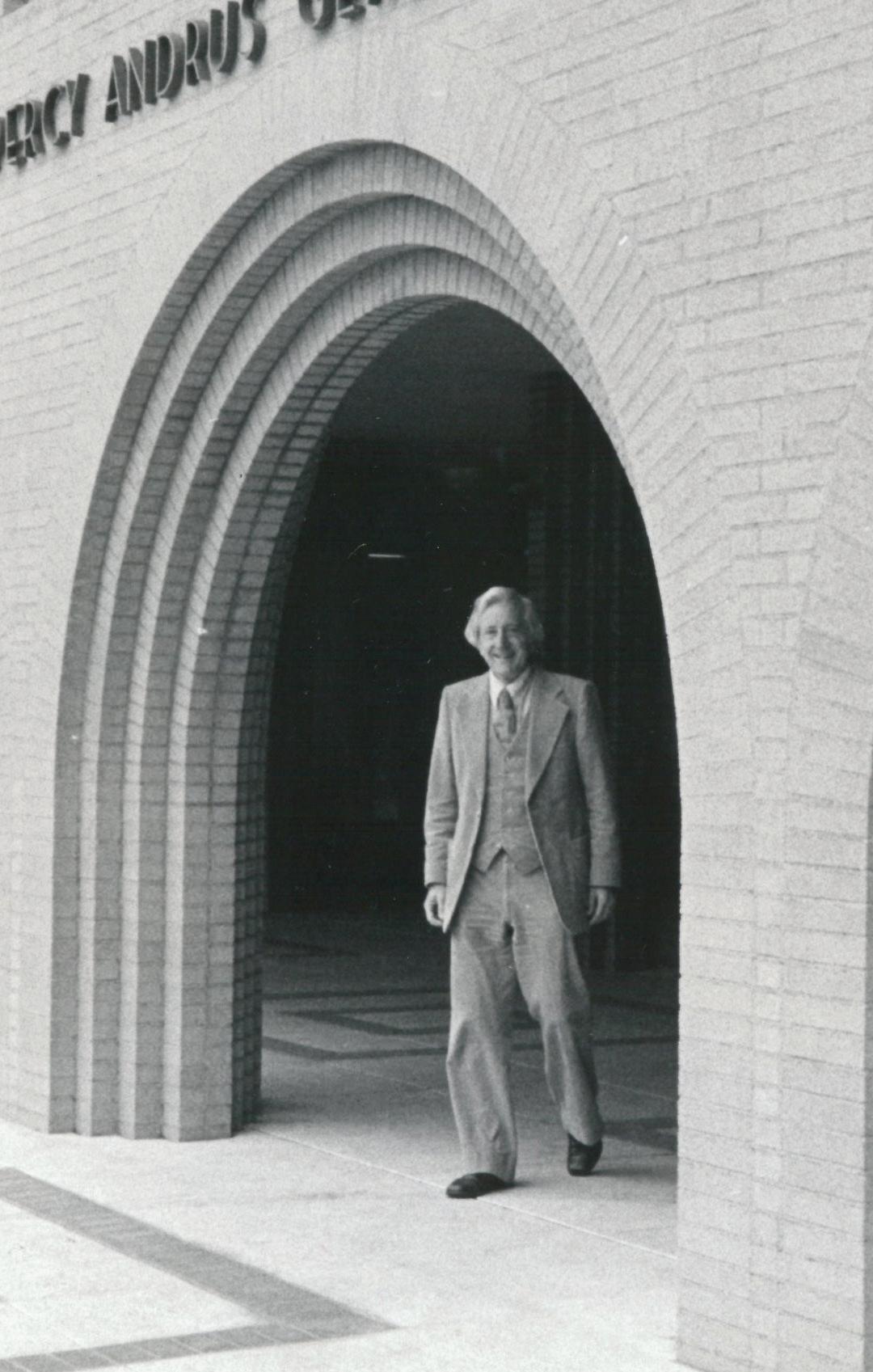
James Birren, founding dean of the USC Leonard Davis School and founding director of the Ethel Percy Andrus Gerontology Center
in school directly applied to her new career as a gerontological social worker. “The way we study gerontology at USC is very interdisciplinary,” she says. “That training helped me work with the hospital’s palliative care team to talk about a patient from all the different facets and then come up with a holistic plan.”
Professor Christian Pike, assistant dean of research, joined USC in 1999 as an Alzheimer’s researcher and didn’t expect to work with others outside his immediate area of study. “The idea of being multidisciplinary and highly collaborative wasn’t really on my radar, and at first, I didn’t always appreciate it,” he recalls. “But now it defines my experience and so many others’ with the school.”
Associate Professor Bérénice Benayoun has a similar appreciation for her colleagues’ wide variety of expertise. “You are working in your office and then suddenly you have an idea and you want to talk to someone. Who better than the person across the hall, right?” she says. “It creates regions of synergy that could never have occurred in any other context.”
The USC Leonard Davis School’s numerous joint appointees also tell the story of how disparate fields come together in the study of aging. One notable example: Professor Victor Regnier, an architect and expert on the design of housing and community settings for older people, holds a joint professorship between the USC School of Architecture and USC Leonard Davis. His is the only joint appointment of its type in the nation.
“Gerontology changed the way I approach and teach architecture. Even though my primary appointment is in architecture and most of my teaching is with young design students, my connection to gerontology can’t help but make me aware of how all people are affected by the design of the physical environment as they age,” he says. “Like many other professors who are tenured in another school, the connection I have with the Andrus Center is really extraordinary because of the people who are here, the work that’s taking place and the level of innovation it pursues. It is simply an amazing place to be around.”
First-of-Its-Kind Degrees
The USC Leonard Davis School has always been a pioneer in education. Within its first decade, it launched joint degrees with business, dentistry and pharmacy; introduced a Bachelor of Science degree; developed faculty training programs for instructors nationwide; and created the first undergraduate health sciences track in gerontology. In 1989, it launched the nation’s first doctoral program in gerontology.
“The faculty proposed a PhD degree,” recalls Edward Schneider, professor of gerontology, medicine and biology and dean of the USC Leonard Davis School from 1986 to 2004. “I wasn’t sure many students would want to enroll. But ultimately, I was willing to try just about anything that would
further the field of gerontology. And it’s been very successful. Many of our PhD graduates now head departments on aging across the country.”
Crimmins says the school’s graduates are its most important contribution to the wider field. She recalls how early USC Leonard Davis graduates brought evidence-based expertise to places where there had previously been very little knowledge about aging. “When we started giving degrees, people would go off to Washington, D.C. … and they’d be shocked at how little people in Washington knew and how much they felt they knew as relatively young students,” she recalls.
In 1993, Valentine Villa graduated with the first-ever PhD in Gerontology. Today, she is a professor of social work and director of the Applied Gerontology Institute at California State University, Los Angeles. “It was that training here at the Leonard Davis School, and particularly the mentorship of Eileen Crimmins, which enabled me to follow my research interest in health disparities,” she says. “I found myself being invited into research teams. … I could hold my own because of the training I received at this school.”
In 1998, a decade after the launch of the PhD in Gerontology, the school offered the first fully online master’s degree in gerontology. The online Master of Arts in Gerontology program was also the first online program to be accredited by the Western Association of Schools and Colleges, years before distance learning became mainstream.
The move to online learning, led by forward-thinking staff members such as Senior Associate Dean Maria Henke, also cemented USC’s reputation as an innovator. “The Leonard Davis School was a great pioneer in online learning,” Schneider says. “We didn’t know anything about internet-based learning when we began.”
For students like Anderson, the flexibility was invaluable. “Being online meant I could study with people across the country and compare how the aging process exists and evolves in our different societies and micro- and macrocultures across the world,” she says.
Today, the USC Leonard Davis School boasts the largest selection of gerontology programs in the nation, the result of being committed to educational innovation. Degrees introduced in recent years include master’s programs in nutrition and dietetics and in technology and aging, as well as new master’s and PhD degrees focusing on the genetic, molecular and cellular mechanisms that underlie aging.
“The secret to this school’s success is to anticipate and predict what are going to be the new disciplines,” Cohen says. “For example, a decade ago, we introduced the Master of Science in Nutrition, Healthspan and Longevity to educate future dietitians who understand the specific nutritional needs of older adults. Similarly, we’ve just started the Master of Science in Applied Technology and Aging because, clearly, the solution
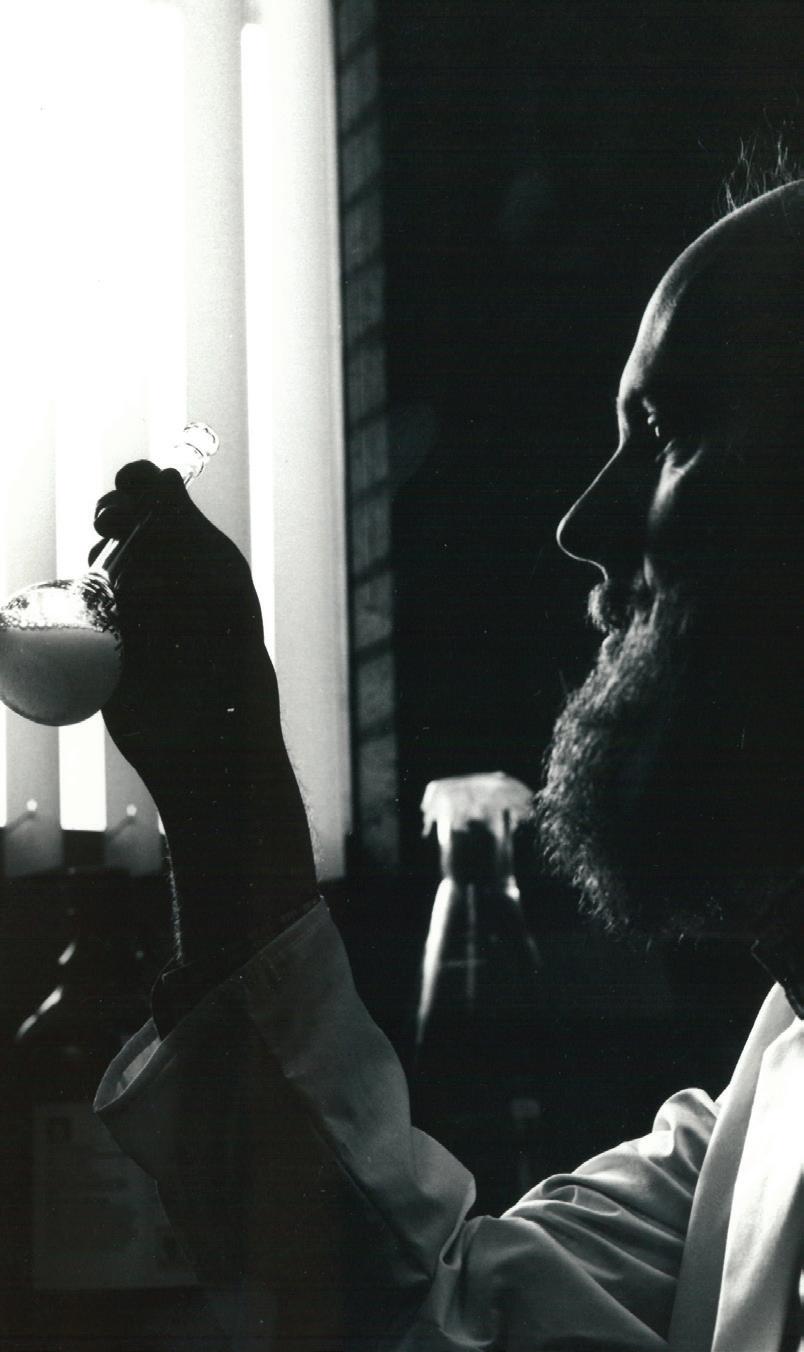
Photo: USC Leonard Davis School archives
University Professor Emeritus Caleb Finch, who joined USC in 1972
for the ever-growing need to take care of older people is going to involve advanced technology, such as AI software, robotics and related approaches.”
Research Redefines Aging Study
Over five decades, the USC Leonard Davis School has built an unmatched record of research excellence, from the study of Alzheimer’s disease and the biology of aging to public policy, psychology and the social dimensions of growing older. Faculty and students alike are immersed in this environment of discovery.
Vice Dean and Professor of Gerontology Sean Curran says a commitment to cutting-edge research and evidence-based approaches is foundational to the school’s work. “All of our educational programs are rooted in scientific research as well as being practical in nature,” he says. “We provide opportunities both to learn from world experts in the classroom, to put that knowledge and education into practice out in the field, and then continually connect with those students as they evolve and become further leaders in the world of gerontology.”
For Joshua Senior, who graduated with a BS in Human Development and Aging in 2025, the research experience was transformative, turning personal experience into inspiration for his scientific career.
“My grandmother is 103 years old, and she is my rock. Once she developed dementia, I wanted to better understand the changes that she was going through, neurocognitively and emotionally,” he says. “I joined the Emotion and Cognition Lab under Professor Mara Mather. Through that work, I was able to better understand how the brain changes over the lifespan.”
Being immersed in this environment not only stokes scientific curiosity but also shapes one’s personal outlook on aging, says Sarah Shemtov, a 2025 Biology of Aging PhD graduate. “The Leonard Davis School has taught me aging is not necessarily about decline and that it’s full of challenges, but it’s also full of growth and resilience.”
The impact of USC Leonard Davis is undeniable, Cohen says. “This school is by far the most significant place in the world doing research and education into aging and longevity fields. The people who’ve worked here over the last 50 years are the trendsetters and the people who created the disciplines within the aging field,” he says. “Most importantly, we’ve educated many, many, many
hundreds of people who are leaders in both government, nonprofit, industry and academia who really defined the agenda for aging. Wherever you see an aging policy, an aging innovation, an aging discovery, chances are they involve somebody who was affiliated with our school.”
Generations of Support for the Mission Philanthropy has sustained and expanded the school’s impact. Gifts to the school support scholarships for students, promising pilot research studies, updates to essential classroom and laboratory infrastructure, and more. For many supporters, giving is deeply personal.
Alan Davis, son of Leonard and Sophie Davis and president of the Leonard and Sophie Davis Fund, says his parents “were fairly innovative philanthropists and either created or supported a number of institutions that really stand out in different ways. And so when I took over managing the Leonard and Sophie Davis Fund, I thought it was really important to maintain that legacy.”
“Now,” he adds, “the goal is to try to take these institutions that were 20th century and provoke them to be engaged in 21st-century concerns and activities, and it’s been an exciting journey.”
Alan’s wife, Mary Lou Dauray, USC Leonard Davis Board of Councilors member and Davis Fund vice president, says she is particularly proud of the USC Leonard Davis School’s leadership in universal design and its work in creativity in aging.
“I’m especially excited for NeuroArts, where they’re studying how the brain can be affected by art and artistic engagement,” says Dauray, an award-winning artist and designer. “This is a growing field that didn’t exist until recently, and I’m confident that USC is going to be the leader in it.” A recent gift from the Davis Fund established a fund to support the school’s new Arts and Healthy Aging Center, which supports the study of artistic engagement and how it relates to health and aging.
Like Alan Davis, giving to the school has been a family affair for Shari Thorell. Both Davis and Thorell are second generation leaders and major donors to the USC Leonard Davis School. “My husband and I feel that of all of our investments, our gifts to the gerontology center have had the biggest impact and the biggest return on our investment,” Thorell says. “It’s knowing that it’s not something frivolous, that what they’re doing here is truly important.”
Her Davis School philanthropy includes support for the annual Hanson-Thorell Family Research Awards, which provide pilot funding for junior faculty members as they explore new avenues of research. The award originated with funding from Shari’s father, former Board of Councilors Chair Al Hanson. Bob and Shari Thorell have built on this multigenerational family commitment to philanthropic support of the Davis School with a new endowment fund dedicated to supporting faculty research at all levels — the Thorell Family Endowed Faculty Award.
In 2018, Board of Councilors member MeiLee Ney established the school’s Ney Center for Healthspan Science with the largest gift in the school’s history. She notes that being involved with the school and learning from its experts has influenced her thoughts on aging and personal transformation. “It’s not the lifespan that matters — it’s the healthspan. I eat better, exercise more and value relationships more,” she says. The Ney Center, led by Dean Cohen, has the potential to help transform the school’s efforts in geroscience research.
For Board member Kathleen Gilmore, the school’s mission resonates with her professional experience. “I wanted to be associated with a place that’s saying the elderly are valuable, they still
have something to give back, and we have something to give them to enhance that last third of life,” she says.
Looking Ahead: The Next 50 Years
For research universities aiming to make the biggest possible impact on human health and well-being, it is critical to predict and respond to the biggest opportunities and challenges presented by a rapidly aging society, Interim USC President Kim says.
“Aging doesn’t just pose tremendous scientific challenges. … I think it’s also a moral responsibility for universities like USC to bring together experts from so many different fields to not just understand how aging works but also understand its societal impacts and how to improve the policies around aging,” he says. “I don’t think any university is better positioned than USC to bring together policy expertise, biological expertise, scientific prowess, AI tools, the arts and more to really address this challenge holistically.”
If the past five decades were about establishing and raising awareness of gerontology, the future will be about personalization, technology and healthy longevity, according to USC Leonard Davis School faculty and supporters.
Professor Mara Mather and Joshua Senior, BS in Human Development and Aging ’25, in the Emotion and Cognition Lab
Photo: Stephanie Kleinman
“Whatever is going to emerge in the gerontology universe, our school is going to be part of it, and our graduates and our scientists are going to be part of the solution.”
— Dean Pinchas Cohen
“Our scientists are thinking, ‘OK, how can we turn back the aging process? How can we keep you healthy for every moment of your life?’” Thorell says. “Our grandkids will have a completely different aging experience, and that’s going to happen right here.”
Issues related to health care, housing and caregiving will especially be in sharp focus. “We are living in a state, a country and a world where there are many more older people,” Regnier says. “We want to be able to care for them, as well as enfranchise them in as many ways as we possibly can.”
Finch predicts a greater focus on how environmental challenges impact the aging process and the development of therapeutics to stave off related illnesses. “In the decades ahead, air pollution will continue to be a major factor in the aging process,” he says. “New medications being developed to delay early stage dementia may also reduce the impact of air pollution on the brain and delay, to some extent at least, the progression that leads to loss of synapses and clinical-grade dementia.”
Curran emphasizes a coming shift in scope. “The last 50 years have focused on universal aspects of aging,” he says. “I think the future of aging is going to be a personalized approach to understand how an individual’s genetics, how their environment,
how their access to resources change that aging trajectory.”
Benayoun agrees, envisioning “precision geroscience” as the next frontier. “Combining all of this together is going to mean that we can lead the charge in research on a precision approach to aging,” she says.
From a hole in the ground in the early 1970s to the global hub of gerontology today, the USC Leonard Davis School has not just chronicled the story of aging but also has shaped it. With visionary leadership, fearless innovation and an unwavering belief in the value of older lives, the school stands as both pioneer and guide.
Fifty years after its founding, it remains a place where disciplines converge, generations connect and the promise of a healthier, longer, more meaningful life continues to inspire.
“The future is confusing and uncertain … but one of the areas we can count on is that there’s going to be more and more older folks who are going to need support, care and solutions. Gerontology and caregiving are going to be areas where opportunities will continue to grow,” Cohen says. “Whatever is going to emerge in the gerontology universe, our school is going to be part of it, and our graduates and our scientists are going to be part of the solution.”
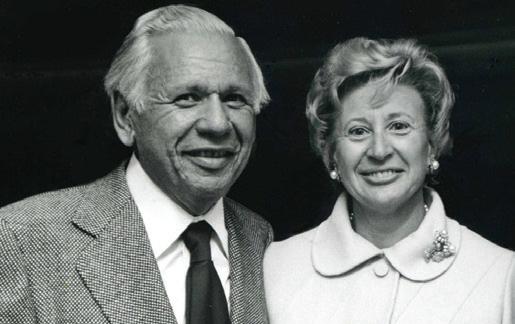
Leonard Davis (pictured above with wife Sophie) donates funds to create and endow the USC Leonard Davis School of Gerontology. James Birren is the school’s inaugural dean. In the fall, the Leonard Davis School welcomes the first group of 55 students to its sole program, the Master of Science in Gerontology.
1989
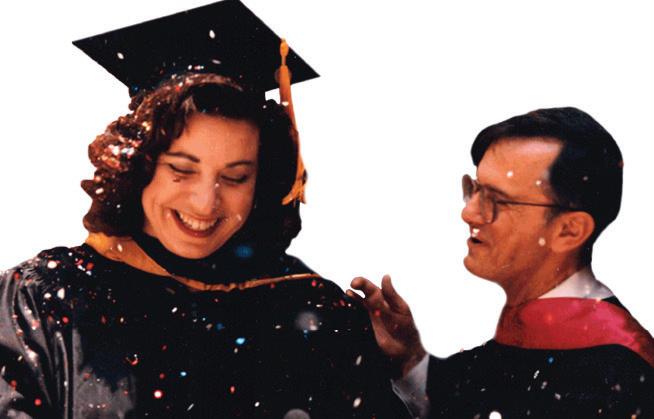
Under Dean Edward Schneider, the school introduces the PhD in Gerontology. In 1993, Valentine Villa (above, with Professor Jon Pynoos) earns the first-ever PhD in Gerontology.
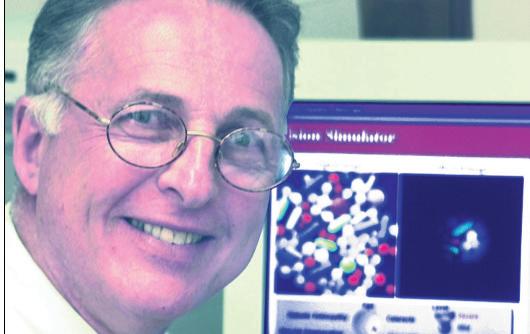
The online Master of Arts in Gerontology becomes the first-ever online graduate program in gerontology as well as the first internet-based program to receive accreditation from the Western Association of Schools and Colleges. The inaugural class of online master’s students graduates in 2002. In the following years, the school remains committed to offering most master’s programs both on-site and online, including the Master of Arts in Long-Term Care Administration (launched in 2003), the Master of Arts in Aging Services Management (launched in 2008) and the Master of Arts in Senior Living Hospitality (launched in 2020).
Educational Innovation Through the Years
From establishing the first freestanding school of gerontology to designing degrees to meet the moment, the USC Leonard Davis School continues to set the standard for gerontology education.
Photos: USC Leonard Davis School archives, Natalie Avunjian, Stephanie Kleinman
2015
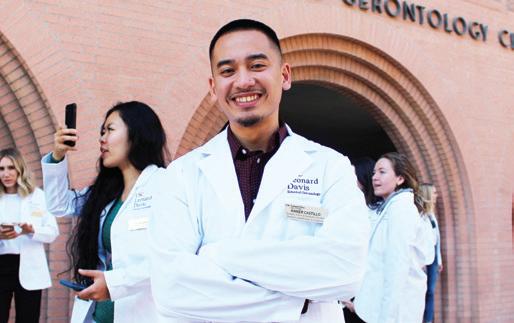
Under Dean Pinchas Cohen, the USC Leonard Davis School launches the Master of Science in Nutrition, Healthspan and Longevity, a coordinated dietetics program. MSNHL graduates are eligible to take the exam that confers the Registered Dietitian Nutritionist (RDN) credential. The first cohort of students graduates in 2017.
2022
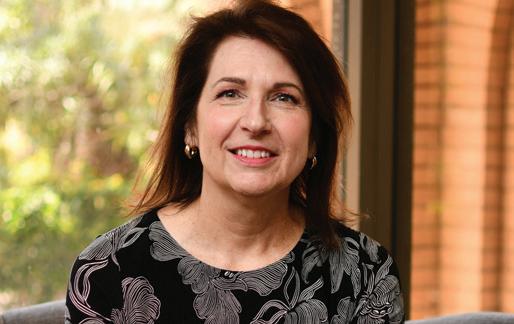
The school launches the Master of Science in Applied Technology and Aging to prepare professionals to best use new scientific innovation and technology to support older adults’ health, independence and safety. Dorice Redman is the program’s first graduate in 2024.
2024
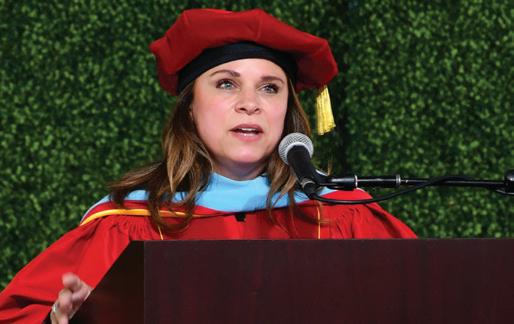
The school debuts the Doctorate of Longevity Arts and Sciences. This program provides high-achieving individuals with a rigorous academic experience that includes a final summative project such as a book, proposal for a nonprofit organization or piece of legislation.
Jacqueline DuPont Carlson MSG ’95, MPA ’96, EdD ’21 is the program’s first graduate in 2025.
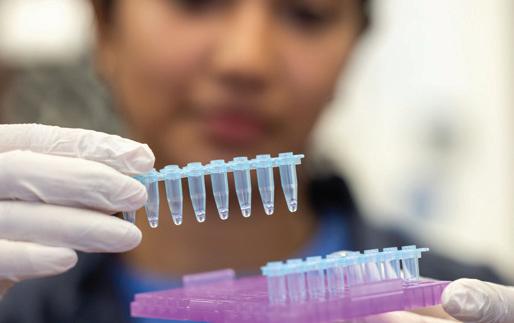
Following the launch of the Geroscience minor in 2021 and the PhD in Geroscience in 2024, the school further expands its biology-centric offerings with the Master of Science in Aging Biology.

INNOVATIVE
INSIGHTS
INSIGHTS INSIGHTS FOR THE FUTURE

The Arnold M. Whitman Aging and Technology Initiative Fund supports the USC Leonard Davis School’s exploration of how tech solutions can improve the lives of older people.
By Beth Newcomb AI Illustration by Midjourney/Natalie Avunjian
The USC Age Tech Symposium, held in March 2025 as part of the school’s yearlong 50th anniversary celebration, was more than a gathering of experts and titans in aging, health care, tech and venture capital. It was a declaration of how USC is positioning itself as the global epicenter for age-tech innovation.
A prominent voice in this movement is Arnold Whitman, a veteran investor whose passion for aging solutions has helped catalyze a new era of interdisciplinary collaboration. Whitman, founder of the Senior Living Transformation Co. (SLTC) and managing partner at Generator Ventures, has spent over four decades investing in senior care.
A member of the USC Leonard Davis School Board of Councilors, he recently created the Arnold M. Whitman Aging and Technology Initiative Fund to support the school’s efforts in this area, which helped make the Age Tech Symposium possible. His pivot toward technology marks a profound shift — not just in his career, but also in how aging itself is being approached.
“Aging sucks,” Whitman said candidly during the symposium. “But it doesn’t have to.”
“There are very few businesses today where you actually create value in both ways. Technology can reduce administrative burden and enable the human element to flourish.”
— Arnold Whitman
A Crisis — and an Opportunity
The demographic imperative is clear. As USC Leonard Davis School of Gerontology Dean Pinchas Cohen noted in his opening remarks, the world’s population pyramid has morphed into a rectangle, with older adults now outnumbering children under 18. This shift has created a caregiving crisis, one that demands technological intervention.
Whitman’s response has been both visionary and pragmatic. He sees aging not as a burden, but as a frontier for innovation — where empathy, data and design converge to create solutions that are both socially and economically valuable.
“There are very few businesses today where you actually create value in both ways,” he said. “Technology can reduce administrative burden and enable the human element to flourish.”
From Real Estate to Revolution
Whitman’s journey began in real estate investment trusts and senior living operations. But after moving to the West Coast over a decade ago, he began exploring how technology could transform the aging experience. That curiosity led him to Aging 2.0, a movement he helped pioneer, and eventually to USC.
His relationship with the USC Leonard Davis School began in 2012, when Cohen identified Whitman as a key figure in bridging gerontology and innovation. Their shared vision — of integrating app development, data science and human-centered design into aging services — has since blossomed into a robust partnership.
“Arnie has been a mentor to me,” Cohen said. “His support for the school is tremendous.”
SLTC: A New Model for Senior Living
At the symposium, Whitman introduced SLTC, a company that embodies his belief that community is health care. SLTC’s flagship project in Nashville, Tenn., integrates assisted living with tech-enabled health care, creating a model that aligns operators, caregivers and residents around shared data and outcomes.
“Socialization is a driver of well-being,” Whitman explained. “And well-being reduces health care costs.”
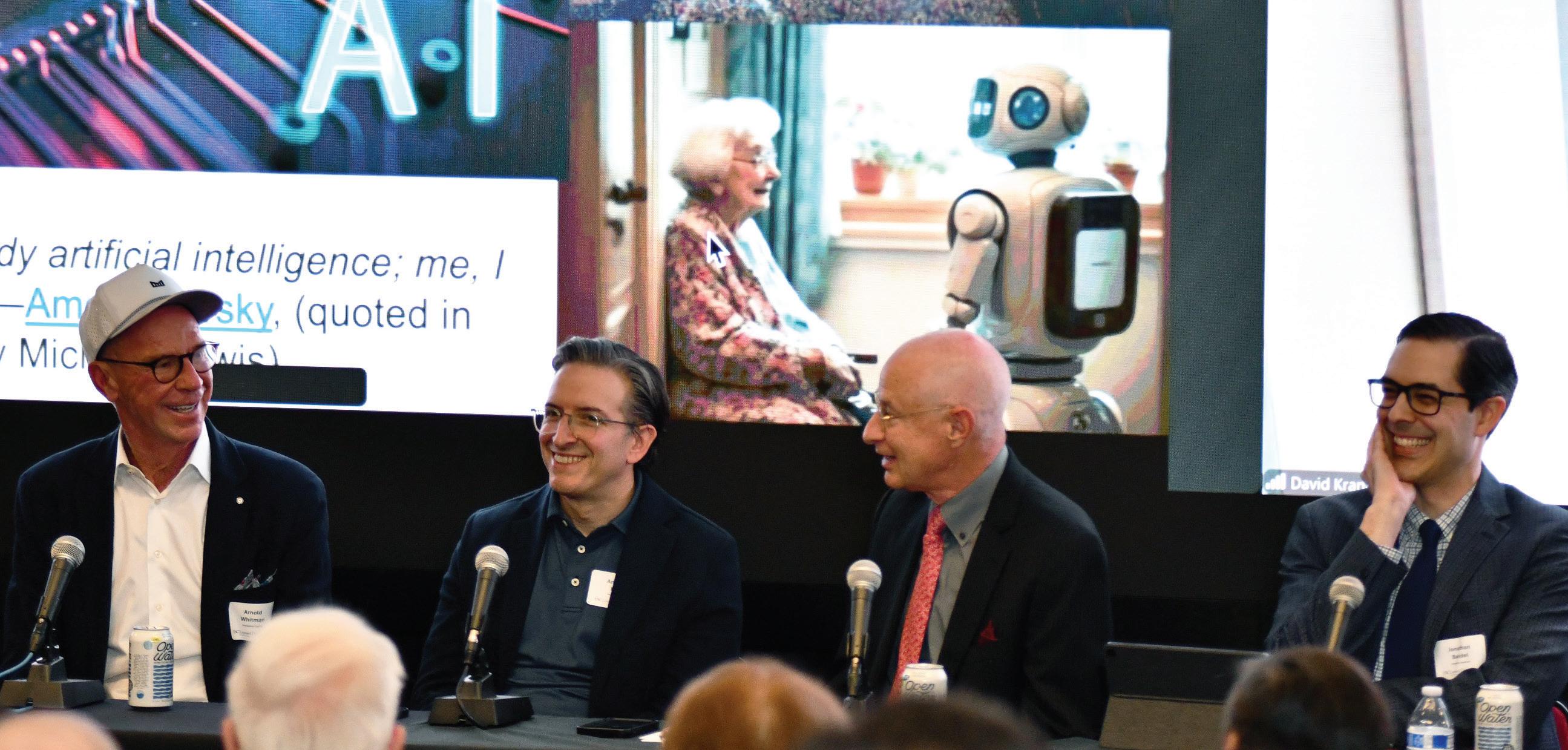
Opposite: (from left) SLTC founder Arnold Whitman, Healthier Capital CEO Amir Dan Rubin, USC Leonard Davis School Dean Pinchas Cohen, Jonathan Bandel of 22Health Ventures and GV CEO David Krane (via Zoom, not pictured) discuss investment in aging and technology during the USC Age Tech Symposium.
SLTC’s interoperability platform, Centered Care, ingests data from residents, caregivers and technologies to create predictive and preventive care models. The goal is to extend length of stay, reduce hospitalizations and transform senior living into a proactive health environment.
“We want to measure observational data and use it to intervene before problems escalate,” Whitman said.
Investing in Empathy
Whitman’s investment philosophy is rooted in empathy. He recounted a recent experience with Ellipsis, a startup using artificial intelligence-powered voice technology to support post-hospital care. The system’s ability to engage an 85-year-old patient with compassion and clarity was, in his words, “unbelievable.”
“If they didn’t tell you it was a bot, you’d think it was a human,” he said. “The empathy was remarkable.”
This kind of technology, Whitman said, can scale care without sacrificing humanity. By automating routine tasks, providers can focus on connection — on being present, rather than buried in paperwork.
The Venture Capital View
David Krane, CEO and managing partner of GV (formerly Google Ventures), brought a venture lens to the conversation. He stressed that age-tech startups must understand how their solutions fit into existing health care systems — and be able to demonstrate return on investment.
“Cool technology isn’t enough,” said Krane, who is the newest member of the USC Leonard Davis School Board of Councilors. “You need deep understanding and measurable impact.”
Krane also highlighted the role of AI in accelerating scientific discovery, particularly in therapeutics for conditions like dementia and
cardiovascular disease. His optimism was echoed by fellow panelist Amir Dan Rubin of Healthier Capital, who described how AI is streamlining workflows and improving access.
“We’re seeing incredible use cases,” Rubin said, “from automating appointment scheduling to predicting health risks based on claims data.”
USC’s Role as a Catalyst
The Age Tech Symposium, offered in partnership with the USC Viterbi School of Engineering, showcased USC’s commitment to interdisciplinary leadership. From biomedical engineering to venture capital, the event brought together voices from across sectors to explore how aging and technology intersect.
Steven Shapiro, USC’s senior vice president for health affairs, emphasized the university’s unique structure, which integrates all health science schools and systems. This allows for team-based care, collaborative research and rapid translation of innovation.
“The future’s bright,” Shapiro said, “and USC wants to be a big part of that future.”
The launch of the Master of Science in Applied Technology and Aging (MSATA) program further cements the USC Leonard Davis School’s role. Designed to train leaders fluent in both aging science and tech application, the program graduated its first student in 2024 and now boasts 18 enrollees.
Photo: Natalie Avunjian
David Krane Shares His Vision of Aging, Health and Tech at Vibrant Living Retreat
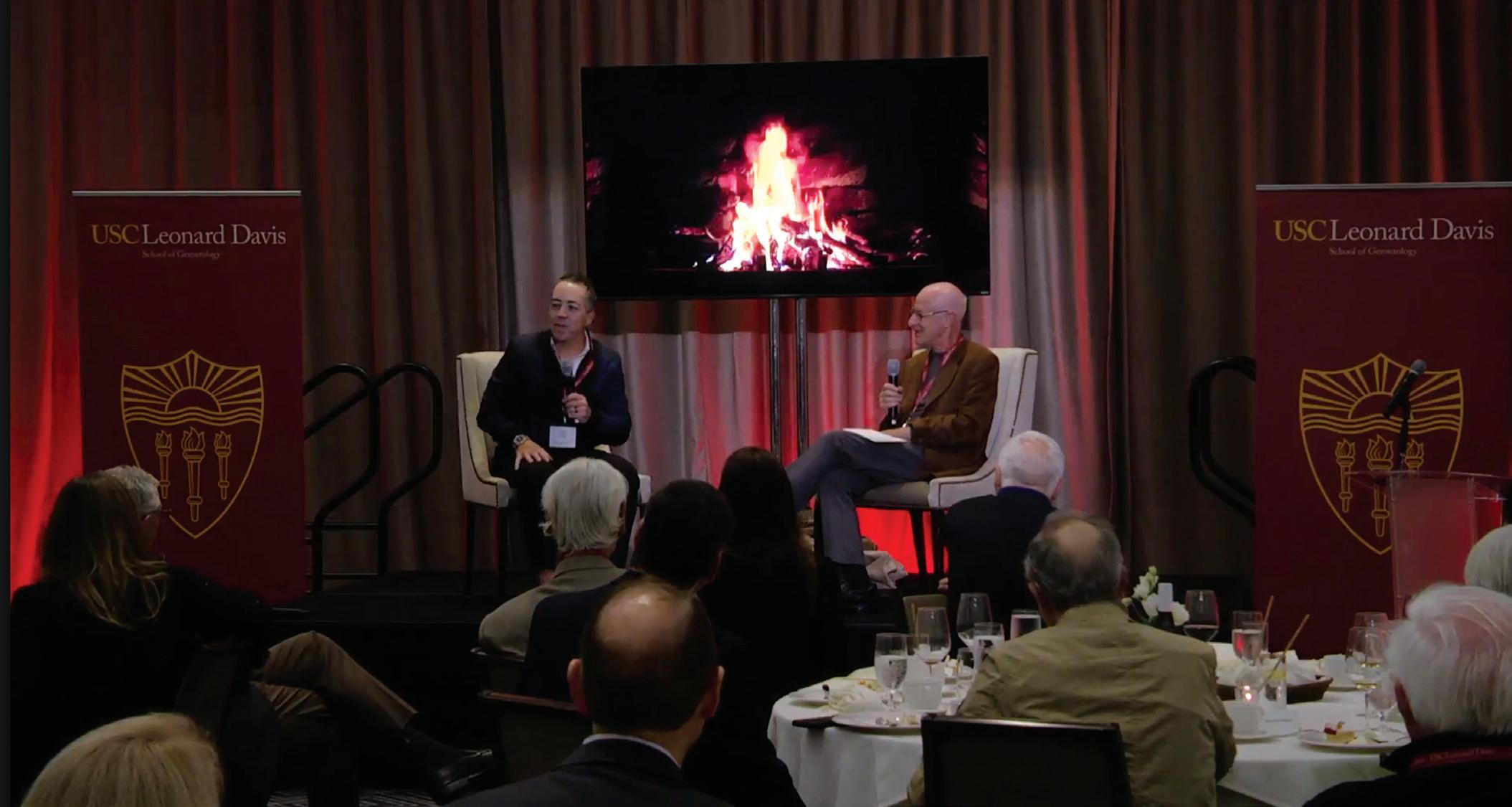
At the USC Leonard Davis School’s 2025 Vibrant Living Retreat, held at the Ojai Valley Inn in February, GV CEO and Managing Partner David Krane joined Dean Pinchas Cohen for a fireside chat that blended personal stories with bold visions for the future of health and technology.
Krane reflected on his path from a liberal arts degree to Silicon Valley leadership, crediting his upbringing in an academic household.
“As an only child, I had no choice except to hang out with adults and hang out with scientists and hang out with people that were endlessly curious about technology, about science and about the future,” he said.
That lifelong curiosity now drives his investment philosophy.
“One of the things that’s alluring to me about this general field is that it’s unseen and it’s neglected by many. And that agitates me and frustrates me,” Krane explained. “I feel like the general field of aging, age tech and the many, many other things that plug into this, they exist today. But I think we would all say if we were asked objectively, there’s a lot of room for improvement.”
He emphasized the need for proactive health care, citing companies developing whole-body imaging and early cancer blood tests.
“The earlier we detect these things, the faster we can respond, and we can make a big difference if we do that,” Krane said.
On investment strategy, Krane described looking for unexpected intersections: “Passion, expertise and, oftentimes, having that Reese’s Pieces moment, the sort of chocolate and peanut butter together — gene editing and heart disease — you come up with something big.”
Krane also acknowledged the personal side of aging.
“I had my first moment literally in life where I said I might be aging. And it happened about 12.2 months ago. … I was given a diagnosis of something called sciatica,” he said with a laugh.
From AI-driven drug discovery to tackling environmental threats like microplastics, Krane urged continued collaboration between academia and industry: “We need to find a new way to bridge new connections to academia, to work together to solve hard problems.”
Photo: Ojai Valley Inn
A Global Perspective
While Whitman’s focus is domestic, the symposium also highlighted global challenges. Jonathan Bandel of 22Health Ventures, based in Singapore, spoke about Asia’s rapidly aging population and the cultural shifts affecting caregiving.
“In Asia, adult children are moving to cities, leaving aging parents behind,” Bandel said. “Technology must fill that gap.”
From wearable devices to AI-driven diagnostics, the potential for age tech to address isolation, access and provider shortages is immense. Bandel emphasized the need for solutions that are culturally sensitive and scalable across diverse populations.
Designing for Inclusion
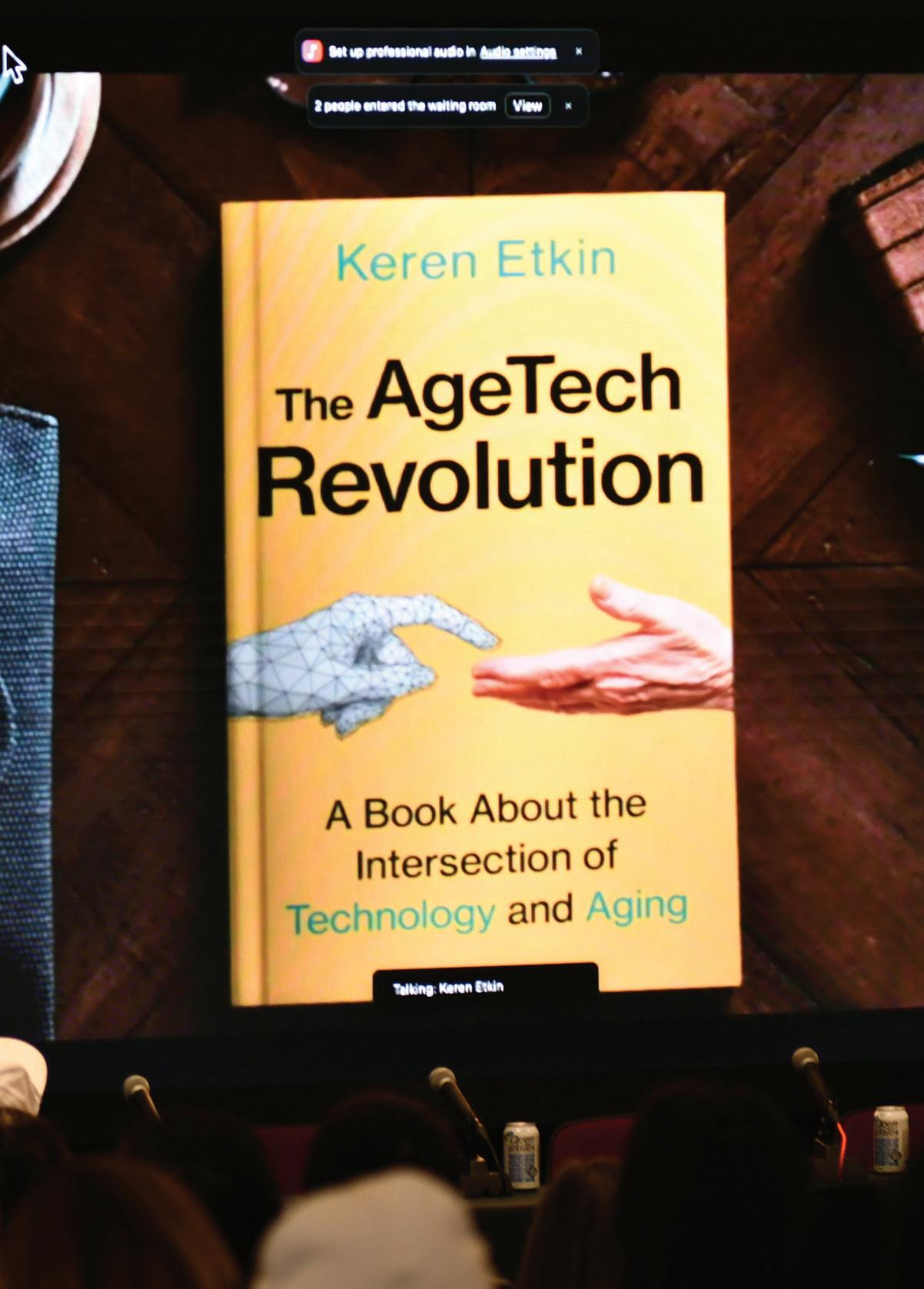
Keynote speaker Keren Etkin, author of The AgeTech Revolution, reminded attendees that technology must be designed with — not just for — older adults. Inclusion, she argued, is essential to creating meaningful solutions.
“Older adults are adopting technology,” Etkin said. “But they need support, and they must be part of the design process.”
Her message resonated with Francesca Falzarano, a USC assistant professor of gerontology whose research focuses on caregiving and mental health and how tech might support caregivers. As a former caregiver herself, Falzarano emphasized the ripple effects of aging on families and systems.
“It’s not just about older adults,” she said. “It’s about how we care for each other.”
Looking Ahead
As the symposium drew to a close, one theme stood out: Aging is not a siloed issue. It touches every facet of society — health care, housing, policy and technology. And it demands collaboration.
“The power of computing and the changing face of science play meaningful roles in giving us hope and optimism that will be able to accelerate discoveries and have a really profound impact on health care,” Krane said.
Whitman’s role in this movement is both foundational and forward-looking. His investments, mentorship and advocacy have helped shape USC’s age-tech vision. But more importantly, his belief in the human element — his insistence that empathy must guide innovation — offers a blueprint for the future.
“We’re at a defining moment,” Whitman said. “And I couldn’t be more excited.”
Photo: Natalie Avunjian
Keynote speaker Keren Etkin, author of The AgeTech Revolution, reminded attendees that technology must be designed with — not just for — older adults.
SHARING THEIR TIME, TELLING THEIR STORIES
For decades, older adults in the Andrus volunteers group have provided USC Leonard Davis School students with first-person perspectives on aging.
By Jamie Wetherbe
Betty Porter, 74, has lived ahead of the curve. She was one of the few women to advance her career in the male-dominated water service department, working alongside engineers to plan the city’s piping. In 1973, at 23 years old and separated from her husband, she purchased her first home through a unique policy initiative at a time when divorced women had little power.
“I’m still fighting stereotypes about what women should be doing,” says Porter. “I’m going to fight it the rest of my life, and I’m having fun doing it.”
Porter has continued to buck convention. After retiring at the “unusually young” age of 47, she traveled extensively through Africa and Europe (sometimes solo), helped raise her granddaughter and advocated for seniors as an ombudsman.
“I’m nontraditional,” she says. “That’s where the boredom comes in: society dictating what you’re supposed to do.”
Recently, Porter signed on as an Andrus volunteer at the USC Leonard Davis School of Gerontology, sharing her unique perspectives on life and aging.
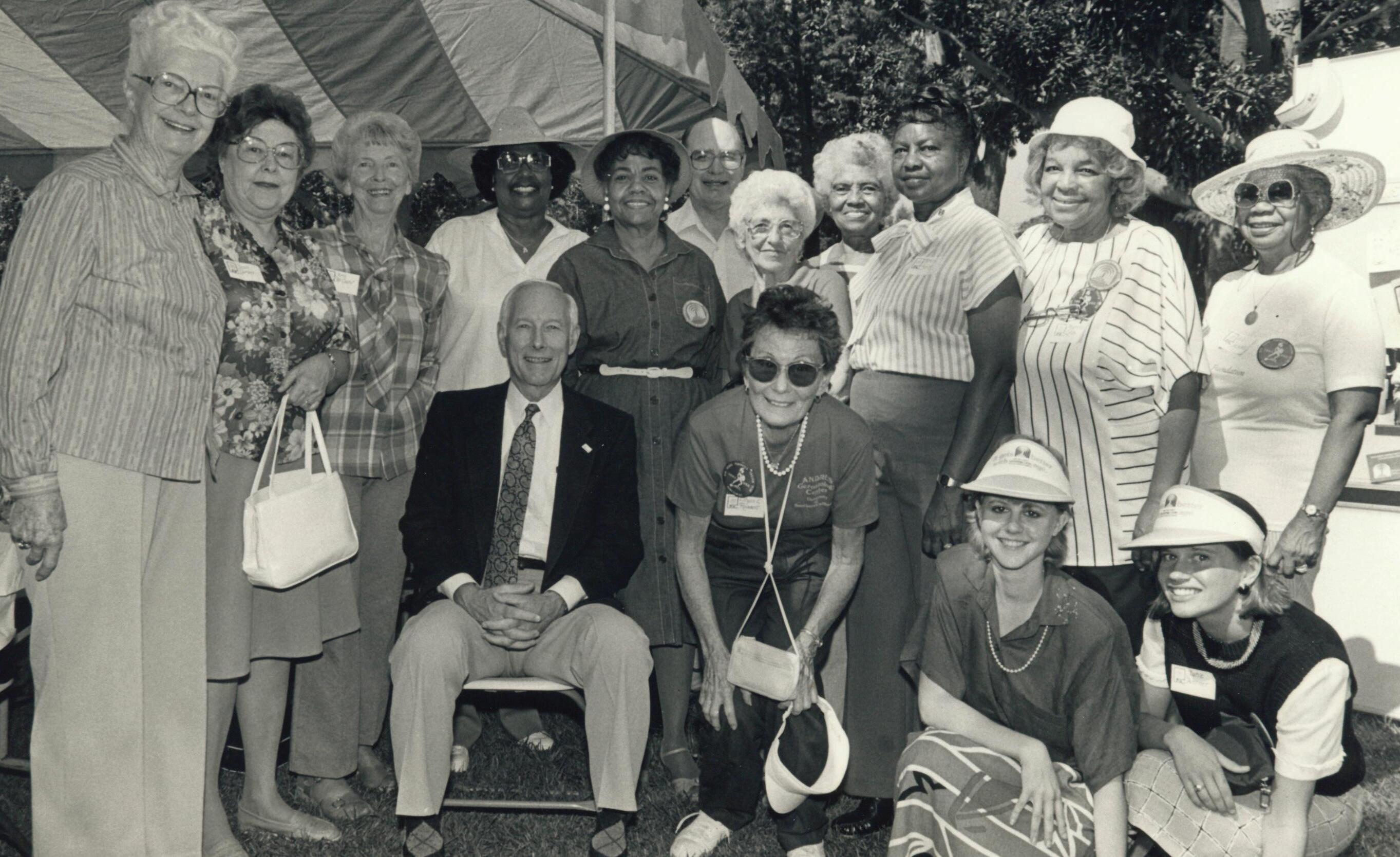
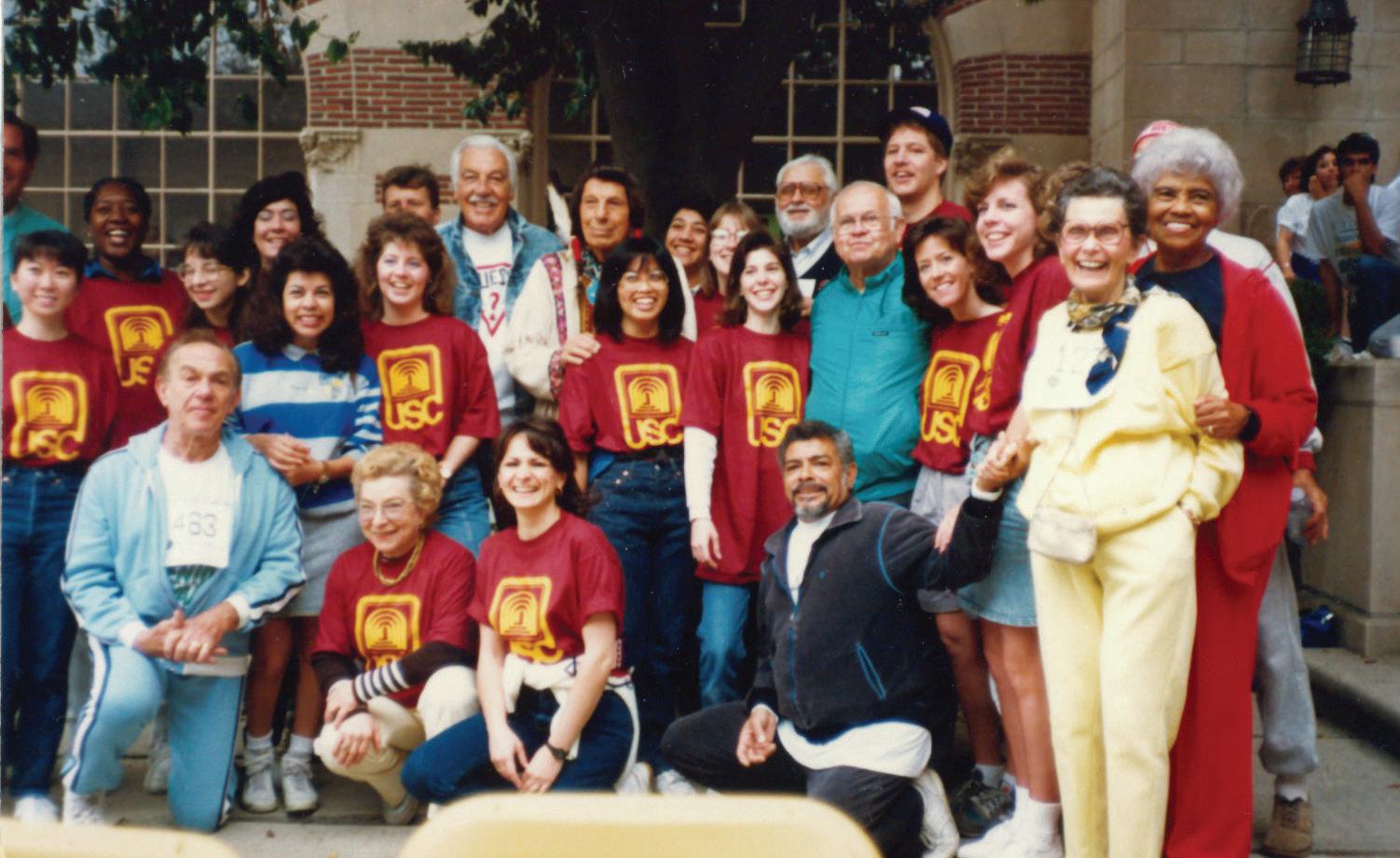
“I get to talk about me, and I’m proud of me,” says Porter. The Andrus volunteers started in 1974 as a program for older adults to learn about the process of aging, connect with peers and assist USC’s Gerontology Department by participating in lectures and research studies.
“It’s a one-of-a-kind program our students have access to,” says Leon Watts, who’s managed the
Andrus program since 2019. “In addition to sharing rich life experiences, the volunteers provide students real-life examples of how no one’s aging trajectory is the same.”
The group has about 20 volunteers, with recent members ranging in age from early 50s to over 100. The members offer students personal accounts of what it means to grow older, from the changes in their biology to their feelings on death and dying.
Andrus participants often act as “first-time patients” for medical students honing their clinical interview skills or serve as speakers in classes on aging.
“They really enjoy talking to students,” says Watts. “The volunteers are very comfortable and open, willing to discuss their histories and any medical issues. It’s also valuable for students to understand the lives and activities of older people as they learn to treat this population.”
There are specific benefits for volunteers as well, including monthly meetings dedicated to relevant topics, from avoiding fraud to best practices preparing for doctor’s appointments. Still, it’s the
connection with students that Andrus volunteers most enjoy.
“I’m a senior myself, so I understand the realities of aging and wanting to volunteer,” says Watts, 74. “Social interaction diminishes as you get older, and this gives seniors a way to get out, come to the university and spend time with students.”
A Lifetime of Learning
To broaden students’ perspectives and challenge preconceptions of older adults, Aaron Hagedorn, instructional associate professor of gerontology, has made it a point to invite Andrus volunteers to speak in his classes.
“Now that the students are about to work in their careers, it’s important for them to relate to older people as co-workers and clients and as normal adults who aren’t that different from them, just with different life experiences,” says Hagedorn. “It was my hope that the Andrus volunteers would seem more like their peers when in the classroom.”
Students echo those sentiments.
“Hearing from the Andrus volunteers gave me a deep appreciation for their role in enriching the Leonard Davis School and the broader USC community,” says Lior Ronen ’28. “Their discussions highlighted how intergenerational engagement can inspire students to take the critical and necessary steps to bridge the gap between themselves and older populations.”
Warren Blakely, 85, a retired dentist with experience in public health, has been an Andrus volunteer for three years and recently spoke in Hagedorn’s class.
“I enjoyed that students came forward and wanted to ask specific things, including my perceptions about dentistry and the profession,” says Blakely.
During his decades in practice, Blakely did everything from expanding oral hygiene and restorative dentistry for inmates to recruiting minority
students at the University of California, San Francisco, at the start of affirmative action.
“He explained things so eloquently and with extraordinary storytelling skills,” says Hagedorn. “The students were fascinated to hear stories of what life was like in the distant past and ask questions that humanize the otherwise abstract understanding they have about what it’s like to be an older person.”
Perhaps the most captivating account wasn’t from Blakely’s professional experience, but from his personal life.
“I was at the Lincoln Memorial and heard Martin Luther King’s ‘I Have a Dream’ speech,” he says. “My roommate convinced me [to attend], and we ended up very close to the podium; it was magic.”
In another class, Karen Shepard-Grimes shared her experience as a full-time caregiver for her mother, who recently passed away.
“You have to advocate for your person, looking out for them physically, emotionally and mentally,” says ShepardGrimes, 61. “It’s all-consuming. In this last year, I find myself with so much time, it’s perplexing.”
She discussed the importance of preserving dignity for seniors and the need for caregivers to receive support and relief. These insights opened the door for students to learn about supportive services and networks for the elderly and caregivers.
“Karen brought the caregiving topic to life with her very deep and emotional story of challenges and stresses of being a caregiver,” says Hagedorn. “She controlled the room from her first sentence until her final comment.”
Shepard-Grimes certainly has expertise in speaking, spending much of her career as a public relations specialist for the Los Angeles Department of Water and Power and, later in her career, creating a cable television show.
“I think the students found that interesting, that you can have this whole life and career in different areas, and what you end up doing isn’t what you started out doing,” she says. “Public speaking is something I’ve always been passionate about, so being able to speak in a classroom pulls at my heartstrings.”
For students, Shepard-Grimes’ energetic and engaging approach, coupled with her unique background, made for quite a memorable class.
“What resonated with me specifically was the way her career evolved and changed dramatically over time, and her message that this kind of change is not only acceptable, but also powerful,” says Hudson Mayfield ’27. “Considering the multitude of possible career paths to explore post-grad, this part of her story gave me a sense of reassurance and excitement about the future.”
Photos: Leon Watts, USC Leonard Davis
School archives
A History of Helping
Over the decades, the focus of the Andrus program has fluctuated. Around its peak, the program consisted of 60 members and earned a volunteer honor from President Ronald Reagan.
“It was really a vibrant group,” says Linda Broder, who managed the program from the late 1990s until she retired in 2019. “They were from all walks of life, spanning different cultures and ethnicities.”
Volunteers also participated in a range of activities, including outings across Los Angeles, visits to city council offices to advocate for the elderly, and co-penning and performing a play with USC’s theater department titled Alive and Kicking.
“Many times, very close bonds would develop between students and volunteers, and remain for years,” says Broder. “When one Andrus participant was ill and couldn’t leave the house, a student helped by doing her shopping.”
Andrus volunteers also connected with students outside USC. The group spearheaded a speakers’ bureau to share stories about aging and broader life experiences at elementary and secondary schools across Los Angeles.
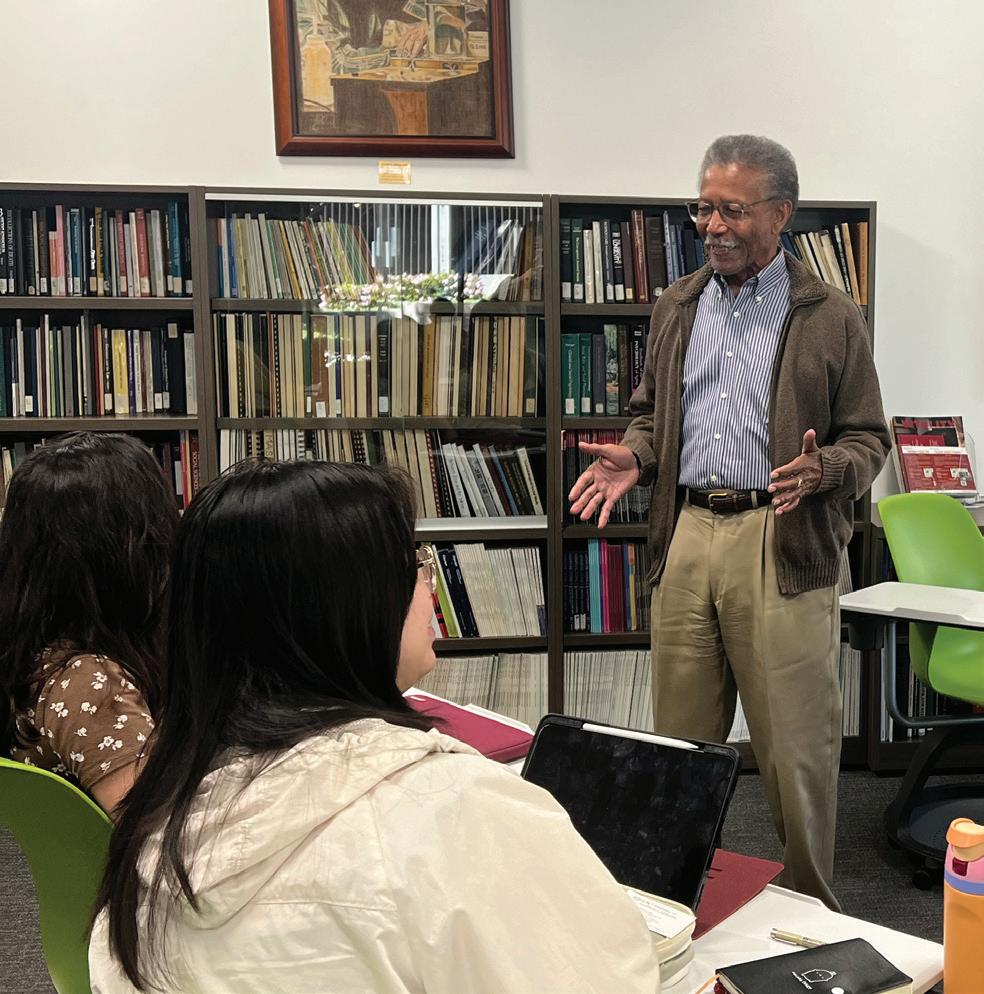
“They have knowledge about huge historical events, from the Depression and World War II to Vietnam and the Civil Rights Movement,” says Broder. “One participant shared his experience as a gay elderly man receiving medical treatment — they were quite often willing to talk about whatever a young person might ask.”
As years passed, funding for the Andrus program declined, causing membership to dip in the 1990s.
“Prioritizing our students became the next logical focus for the group,” says Broder.
While volunteers remained a resource for students at USC, the COVID-19 pandemic halted the program’s momentum. Not only did in-person meetings immediately stop, but since many volunteers didn’t have computers or video conferencing technology, even online gatherings were a challenge.
“We’ve had so many obstacles, and we’re at a pivotal point,” says Watts. “The program might become a very important part of USC’s education — or it could die off.”
Over the past five years, Watts has made it his mission to recruit new members, including through a series of speaking engagements he hosts with seniors.
“I’d like to grow the group to 50 to 100 participants, with an emphasis on diversity — people from different cultures and countries,” he says. “There’s also a need for us to have more volunteers in their 50s and 60s; I’d like to recruit anyone who’s retired.”
Watts would also like to develop an online resource that matches volunteers and their backgrounds with specific needs for student research and projects.
“Everyone wants to see this live and keep going,” says Watts. “It’ll keep going if we stay involved, and it will contin-
Above: Retired dentist and Andrus volunteer Warren Blakely speaks to students about his professional and personal experiences. Previous pages: Andrus volunteers with USC Leonard Davis students over the years.
ue to evolve. Thanks to the volunteers, it’s changed so much since it started.”
For anyone considering becoming an Andrus volunteer, Shepard-Grimes has a piece of advice.
“Do it — you’ll definitely not regret it,” she says. “It takes nothing more than life experience and the ability to share.”
Adds Porter, “It gives you a community of like-minded people who can see into the future by looking through the past.”


By Beth Newcomb AI Illustration by Midjourney/Natalie Avunjian
JUST GENES MORE THAN
USC Leonard Davis researchers detail how social and environmental factors have huge impacts on the speed at which people age biologically and debut a new method to measure biological aging.
How quickly is your body aging, and what factors beyond your own genetics make the most difference in the result?
Recent studies from the USC Leonard Davis School of Gerontology highlight how environmental and social factors, such as heat exposure and education, play a major role in shaping biological aging. At the same time, new advances in measuring biological age, including the development of a novel tool known as Physiological health Age (PhysAge), are giving scientists better ways to understand these effects.
Biological aging refers to how the body is changing over time, including how well organs and systems are working. For example, two people who are both 65 may look very different inside: One may have the biological profile of someone younger, while another may show signs of aging earlier.
“Biological age gives us a clearer picture of health than chronological age. It helps us understand who is likely to stay healthy longer and who may be at higher risk for disease and disability,” says USC University Professor Eileen Crimmins.
Crimmins is a pioneer in the field of biodemography, or the linking of biological measurements to large amounts of population data. Recent research led by Crimmins, her USC Leonard Davis School colleagues and their trainees has shed light on how social factors may be more deeply entwined with human biology and health outcomes than previously thought.
Heat Exposure May Accelerate Aging
A February 2025 study led by USC researchers found that extreme heat may speed up the biological aging process for older adults. The study examined data from more than 3,600 participants in the national Health and Retirement Study. Blood samples taken at various time points during a sixyear period were analyzed for epigenetic changes, or changes in the way individual genes are turned “off” or “on” by a process called DNA methylation.
Researchers discovered that older adults living in U.S. counties with more days of extreme heat had higher biological ages than peers of the same chronological age in cooler areas. This correlation persisted even after controlling for socioeconomic and other demographic differences, as well as lifestyle factors such as physical activity, alcohol consumption and smoking, says first author Eunyoung Choi, a USC Leonard Davis PhD in Gerontology alumna and postdoctoral scholar.
Choi notes that participants living in high-heat areas like Phoenix, where “Extreme Caution” heat days (with temperatures of 90 degrees or above) occur half the year, experienced up to 14 months of additional biological aging compared with those living in areas with fewer than 10 heat days per year.
“Even after controlling for several factors, we found this association,” she says. “Just because you live in an area with more heat days, you’re aging faster biologically.”
The study adds to evidence that climate change could have long-term health consequences beyond immediate risks such as heatstroke. The next steps for the researchers will be to determine what other factors might make someone more vulnerable to heat-related biological aging and how it might connect to clinical outcomes.
In the meantime, the study results could also prompt policymakers, architects and others to keep heat mitigation and age-friendly features in mind as they update cities’ infrastructure, from placing sidewalks and bus stops in shaded areas to planting more trees and increasing urban green space, says Jennifer Ailshire, senior author of the study and professor of gerontology and sociology at the USC Leonard Davis School.
“If everywhere is getting warmer and the population is aging, and these people are vulnerable, then we need to get a lot smarter about these mitigation strategies,” Ailshire says.
Education Linked to Slower Biological Aging
Another USC-led study, published in August 2025, showed that higher levels of education are associated with slower biological aging. Using data from the U.S. Health and Retirement Study, researchers examined how years of schooling were related to DNA methylation-based measures of biological age.
They found that individuals with more education tended to have lower biological ages than peers with less education, even when they were the same chronological age. Importantly, the relationship held even after accounting for differences in income, suggesting that education and its associated life circumstances have a lasting impact on health.
“Education shapes opportunities and risks throughout life,” says Crimmins, who authored the study with former USC Leonard Davis postdoctoral researcher Mateo Farina, now an assistant professor at the University of Texas at Austin, and Jung Ki Kim, a USC Leonard Davis research associate professor. “It’s a powerful social determinant of health, and it is leaving a mark on how fast or slow our bodies age.”
This finding highlights how social and behavioral factors leave marks that can be detected in the biology of aging. Access to education not only affects career and economic outcomes but also appears to extend into the cellular processes that determine longevity and healthspan.
“Education shapes opportunities and risks throughout life. It’s a powerful social determinant of health, and it is leaving a mark on how fast or slow our bodies age.”
— Eileen Crimmins
A New Tool to Measure Biological Aging
Understanding the links between environmental exposures and biological aging requires complex tools. A September 2025 study led by USC Leonard Davis Research Associate Professor Thalida Em Arpawong and colleagues introduces one such tool: Physiological health Age (PhysAge).
PhysAge is a DNA methylation–based measure that combines information from eight biological systems, including immune, cardiovascular, respiratory, renal, metabolic and endocrine functions. Unlike earlier epigenetic clocks, which were trained primarily on mortality data, PhysAge was designed around established clinical biomarkers such as glycated hemoglobin, cholesterol, inflammation and lung function.
In testing, PhysAge was as effective as or better than widely used epigenetic clocks like GrimAge and DunedinPACE in predicting frailty, disability, cognitive decline and mortality. Because it reflects specific systems, it can also indicate which areas of health are most affected.
“Our goal was to create an interpretable clock that not only represents the overall physiological health state but also provides insight into which of its constituent systems may be driving accelerated aging,” Arpawong says. “PhysAge allows us to connect environmental and behavioral exposures to the specific biological systems and inform us about which ones may be at greater risk and require closer clinical monitoring and earlier intervention.”
Together, these studies illustrate how biological aging is shaped by more than just genetics or the passage of time. Environmental stressors such as heat exposure and social factors such as education leave measurable effects on the body’s molecular aging processes.
Tools like PhysAge make it possible to detect these effects and provide more information on health impact. For example, heat stress may accelerate cardiovascular and kidney aging, while education may help preserve metabolic or immune health. By identifying these physiological pathways, researchers can better understand why certain groups are more vulnerable and how interventions might slow biological decline.
Implications for Public Health
The ability to measure biological aging has practical implications for both health care and policy.
If heat exposure is shown to consistently accelerate biological aging, then urban planning measures to address heat risks could become recognized as interventions that not only improve comfort but also protect long-term health, Ailshire notes.
Similarly, education policy can be understood as health policy. Investments in early and lifelong education may contribute to healthier aging across the population. With measures like PhysAge, researchers and policymakers could eventually quantify the benefits in terms of years of biological life preserved.
As climate change accelerates and populations age, the intersection of environment, inequality and biology will become an increasingly urgent area of study. The hope is that with better measurement tools and clearer understanding of risk factors, scientists, clinicians and policymakers can take steps not only to extend lifespan but also to improve healthspan — the years of life lived in good health.
“We’re experiencing increased life expectancy, but this additional time is largely time spent living with disease,” Crimmins says. “To increase healthspan, we have to intervene much earlier in the process of health change. Knowing more about how social factors interact with biology can tell us how to best intervene.”
EMBRACING THE UNEXPECTED
Three graduates share how making the most of unusual opportunities led them to unique careers in aging.
Dorice Redman MSATA ’24
By Inga Back
Photography by Natalie Avunjian
ENROLLING IN a new degree program takes an adventurous spirit and a bit of faith. For Dorice Redman, the history and legacy of the USC Leonard Davis School of Gerontology gave her the confidence to start the journey. Where it ended wasn’t quite where she expected.
“Coming into the program, I thought it would enhance my work in senior living, which I loved,” Redman says. “But it has opened my eyes to so much more. I’m thinking a lot bigger and broader.”
Finding new solutions to the challenges of aging The USC Leonard Davis School established the Master of Science in Applied Technology and Aging (MSATA) degree to train a new generation of leaders fluent in both the science of aging and the application of advanced technology.
The curriculum includes courses in gerontology and how technology supports older adults’ health, independence and safety. Designed for professionals in fields such as senior living, healthcare and engineering, the program blends theory with real-world expertise.
“Professors like Adjunct Lecturer Manuel Acevedo aren’t just academics; they’re pioneers who develop tech companies like HelpfulVillage.com, which helps older adults live longer in their own homes,” Redman says. “I was also impressed with lecturers Jim Biggs and Joshua Johnson MAG ’09 who manage senior living communities across the country.”
Many classes also featured prominent guest speakers, including company executives and state officials, who shared perspectives on the future of aging and technology.
One of the most impactful classes for Redman was GERO 568: “Adaptive Age-Friendly Environments and Injury Prevention,” taught by Professor Emeritus Jon Pynoos. The course emphasized the importance of accessibility and how to evaluate it. “It made me notice design with different eyes, especially in the senior living community I was working in,” she says.
Combining interests in senior living and tech Redman’s path to the MSATA program included a variety of experiences. As a financial planner, she helped older adults manage retirement assets and taught them about Medicare. While later serving as an executive administrative assistant for a
long-term care facility operator, her boss suggested she’d make a good facility leader. She pursued that path, earning a bachelor’s degree in health administration and an administrator’s license.
Although she lacked formal training in computer science, Redman had always been the office go-to for tech issues. “In the early days of the internet, I taught myself to create websites and have kept up with the evolution of technology ever since,” she says.
This blend of interests led her to a role as digital innovation director at a Newport Beach assisted living community, where she provided IT support and developed training programs for staff and residents. She soon became assistant executive director and began considering a master’s degree.
“It had to be USC”
Over her career, Redman met many influential USC Leonard Davis alumni, including Katy Fike MSG ’06, PhD ’09 and Rick Matros MSG ’77. She was also drawn to the school’s robust distance learning program. “I looked around at other gerontology programs and nothing compared,” she says. “I knew that it had to be USC.”
After speaking with an admissions counselor, Redman was encouraged to consider the new MSATA degree. “My nature is to be curious, and I’ve always leaned toward taking the road less traveled. So, that’s the program I chose,” she says.
Redman completed her degree in two years while working full time, attending classes online both live and asynchronously. Her employer supported her by allowing schedule adjustments when needed.
“Meeting other people, building friendships and networks is a huge part of the USC experience,” she says. “When I could, I attended events in person, although I still haven’t made it to a football game.”
Redman graduated from the MSATA program in May 2024 and spent a year as executive director of an assisted living and dementia care community in Irvine. Now, she is looking toward new opportunities that may include teaching, working with a tech startup, or focusing on policy issues.
“There are so many possibilities,” Redman says. “I have a lifetime of practical experience and a degree that gives me credibility in this field. I’m excited and feel prepared to start fresh.”
Rigo Saborio MSG ’94
RIGO SABORIO MSG ’94 has built a long, successful career in aging policy and advocacy. Across his varied experiences, his focus has been on improving services for older adults in low-income, minority and rural communities.
This drive comes from Saborio’s background as an immigrant who has experienced racism and seen ageism. It’s grounded in the principles of diversity, equity and inclusion — principles he continues to champion.
Leading during turbulent times
In January 2025, Saborio became president and CEO of Archstone Foundation, a private organization that provides grants to improve the health of older adults.
“In addition to our day-to-day activities, we quickly realized we needed to meet this moment head-on,” he says. “We hosted an event that featured research perspectives and overviews of the many changes happening in the country. Participants had a much-needed opportunity to exchange ideas in a safe space and discuss how to move forward.”
He has also used his visibility at Archstone to speak out about federal policy changes, publishing three timely articles: “I Know What Fear Feels Like: Standing with My Fellow Immigrant Families in California”; “It’s Not Reform — It’s a Betrayal of Older Adults and Caregivers”; and “Standing Firm in Our Commitment to Justice, Equity, Diversity, and Inclusion.”
Overlapping opportunities lead to promising start
Two pivotal experiences shaped Saborio’s career path after he completed his bachelor’s degree in nutritional sciences with a certificate in aging.
He planned to begin the Master of Science in Gerontology (MSG) program at USC Leonard Davis in fall 1991, but an opportunity arose to work for U.S. Rep. Edward Roybal, chair of the House Select Committee on Aging.
“Of course I took the job,” Saborio says. “My role was to assist staff members with research, but I ended up heading several congressional hearings. We were able to highlight disparities in health and nutrition among minority populations that people didn’t widely recognize at that time.”
While working in Washington, he started the MSG program remotely. Ironically, his first course, on policy in aging, included a trip to D.C.
“In 1992, Congressman Roybal decided to retire,” Saborio says. “He made me promise when he hired me that I’d finish my master’s degree. So, I went back to California to take classes in person.”
Finding support from all angles
From the beginning, Saborio found support at USC Leonard Davis. “The administrators were welcoming and helped me get started when I was in D.C.,” he says. “My professors always had an open door for conversation and guidance. I also found community in fellow students and alumni.”
That network has remained strong. Years later, it includes Laura Trejo ’82, MSG/MPA ’86, now director of the Los Angeles County Aging & Disabilities Department, and longtime mentor and peer Professor Kathleen Wilber.
Growing a career in advocacy and philanthropy Saborio’s career has included high-level roles at leading organizations:
• USC Los Angeles Caregiver Resource Center: Hired by now-retired Professor Bob Knight, Saborio soon became the youngest director of a caregiver resource center in California. “I’m grateful I got to know Bob Knight at the USC Leonard Davis School and that he believed in me,” he says.
• AARP: He helped open the California state office and later served nationally as director of diversity outreach and alliances.
• St. Barnabas Senior Services: As president and CEO, he expanded the organization’s advocacy and technology initiatives and launched the Aging Into the Future Conference.
• SCAN Foundation: In his first role in philanthropy, he raised funds to support vulnerable populations.
At Archstone Foundation, Saborio is leading a strategic refresh that promotes system-level change. “We want to invest in systems that bring older adults and caregivers to the table,” he says. “Their voices are essential to help guide the service providers, advocates and policymakers.”
Looking back, Saborio credits USC Leonard Davis with preparing him to lead. “The program wasn’t just about the issues and populations,” he says. “I learned the underpinnings of managing and leading an organization, which was invaluable.”
Lesley Holmes ’93
LESLEY HOLMES ’93 is a gerontologist, chef and mom. After a winding career path, she opened Indalo Homes, a board-and-care home in Santa Monica.
Board-and-care homes are licensed residential assisted living facilities, typically with six beds. “I often feel like they’re dark and depressing places,” Holmes says. “My vision was to create a positive environment, full of light and laughter.”
Making a vision a reality
The idea for Indalo Homes came by chance. A friend’s wife suffered a stroke at 46 and needed round-the-clock care. With a background in gerontology and assisted living, Holmes understood the financial and caregiving challenges.
“My friend lived in a beautiful home his wife designed,” she says. “With a few modifications, I thought it would make a perfect board-and-care residence for her and five residents. And it would make enough income so he could care for his wife at home long-term.”
Together, they founded Indalo Homes. Holmes oversaw renovations to meet licensing requirements and opened for business in June 2024.
From Lord Byron to gerontology
Holmes’ interest in aging also started by chance. She entered USC in 1991 as an English major but switched after a disagreement with a professor over Lord Byron. She enrolled in “Physiology of Aging” at the USC Leonard Davis School of Gerontology instead.
“My great-grandmother lived with my family until I was 16,” Holmes says. “She helped take care of us, and we took care of her after she broke her hip. The gerontology class helped me understand this experience.”
Inspired, she switched her major to gerontology. With only eight students in her cohort, Holmes worked closely with faculty. “We knew this field would become more relevant with each generation of students. It felt like we were doing something important,” she says.
Two professors stood out:
• Jon Pynoos, who taught about aging environments. “I wondered whether there was something we could have done to prevent my great-grandmother’s hip injury,” Holmes says.
• Gerald Larue, who covered death and dying. “It was the best way to learn about a subject that no one wants to talk about,” she says. “I reflect on those lessons often and incorporate them into my daily life and work.”
Finding purpose in work and family
After graduating, Holmes became an administrator of an assisted living community. But as a new mom, she struggled with the demands. She pivoted to managing her family’s gourmet food store and restaurant.
As she raised her kids, she also directed several nonprofits. Among her projects: producing articles on ageism in media, running an intergenerational book club for older adults and middle schoolers, and providing music therapy to children with chronic conditions.
After her children left for college, Holmes pursued chef certification at the Culinary Institute of America. “At USC Leonard Davis School, I studied how nutrition and healthy eating can help you age successfully,” she says, “but I wanted to know the ‘why’ behind it.”
Her chef training became pivotal at Indalo Homes. She serves a Mediterranean diet, which has reduced residents’ need for antacids and laxatives and boosted their energy.
Creating a special community
Holmes emphasizes that Indalo Homes doesn’t feel like a typical assisted living facility. What makes it different?
• Staff: Indalo has 10 caregivers, many in their 20s. “They are superheroes, bringing youth and vitality to the residents,” she says.
• Activities: The schedule includes daily exercises, mindfulness sessions and events such as a jazz performance by Holmes’ daughter’s duo.
• Families: Relatives are deeply involved in residents’ care and provide another source of positive energy.
• Environment: The home is light and modern. “We installed the ramp in the back, so it’s not the first thing you see when visiting,” Holmes says.
Looking ahead, Holmes may replicate the Indalo Homes model in another location. She also hopes to involve students. “I’d like to serve as an apprentice site,” she says. “Young people can learn from us, but they have fresh ideas and lessons to teach us, too.”
Wherever her path leads, Holmes wants to continue making a difference. “Because of my gerontology education, I can see that I have a lot of life left and joy to give. I also see that in my residents,” she says.
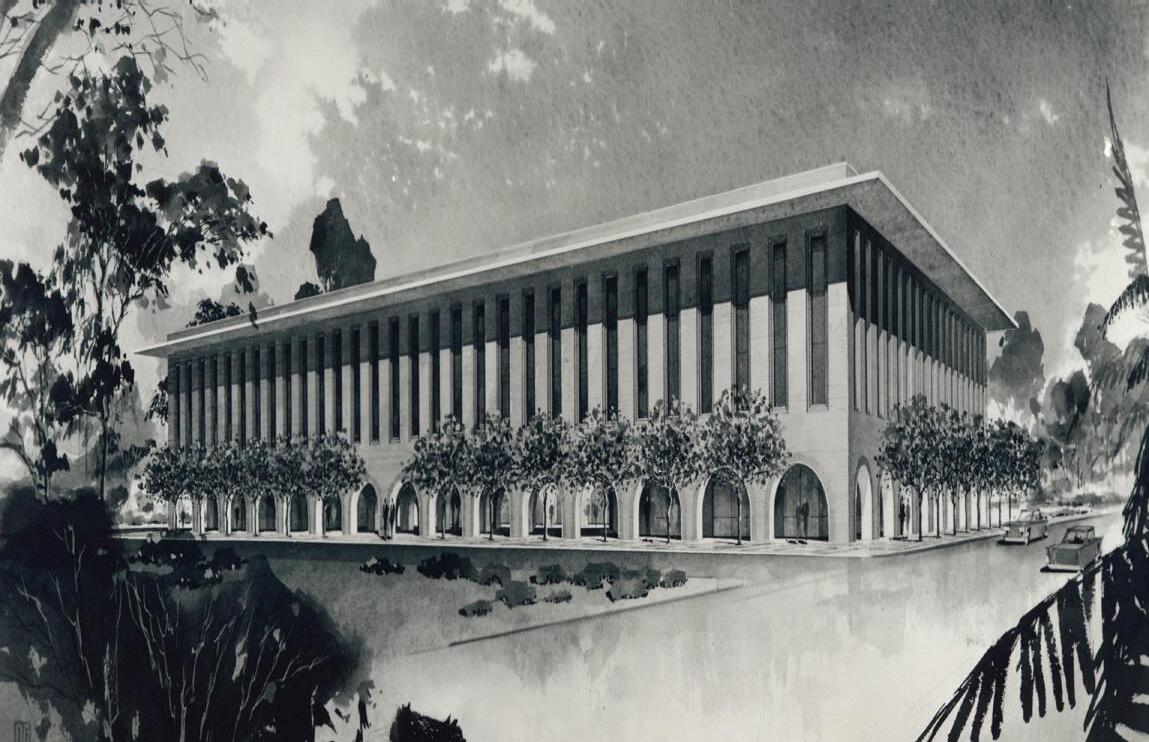
A Creative, Compassionate
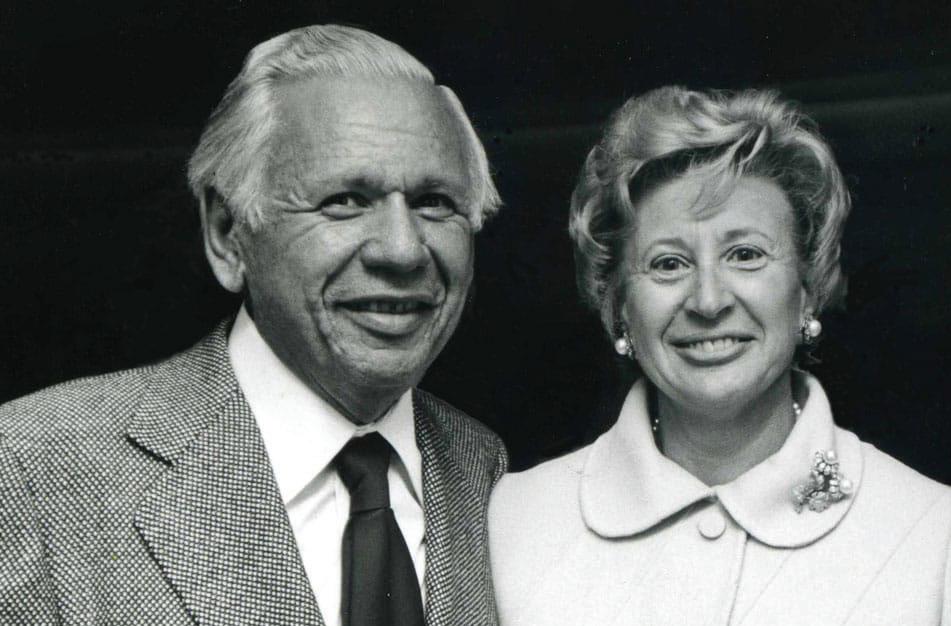
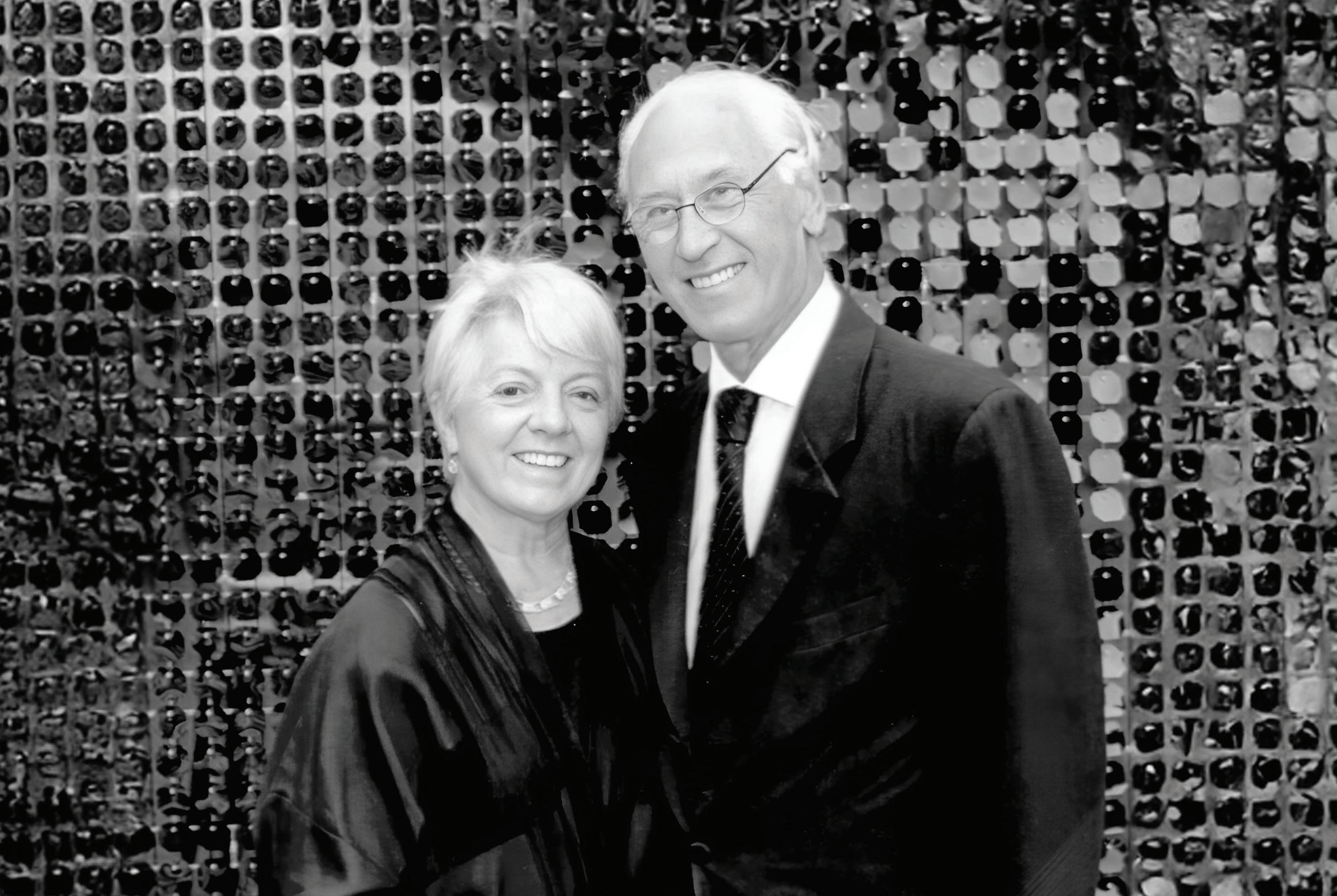
LEGACY
By Beth Newcomb
Within the USC Leonard Davis School of Gerontology and its mission lies a legacy of philanthropy, vision and commitment. It’s one that began with Leonard and Sophie Davis, who foresaw the need for better aging research as well as for ageinformed professionals. It continues today through the Leonard and Sophie Davis Fund, which is led by President Alan Davis, Leonard and Sophie Davis’ son, and Vice President Mary Lou Dauray, Alan’s wife.
The Gift That Changed Aging Education Forever
In 1975, Leonard Davis, founder of Colonial Penn Life Insurance and co-founder of AARP, made a transformative naming gift to USC that established the Leonard Davis School of Gerontology — the first school of its kind in the world. His vision was clear: to create a multidisciplinary hub for the study of aging, one that would combine biology, psychology, sociology and policy to improve the lives of older adults.
“Leonard Davis understood that aging wasn’t just a biological process; it was a societal challenge,” says USC Leonard Davis School Dean Pinchas Cohen. “His gift laid the foundation for a school that would become a global leader in gerontology.”
The school quickly grew into a powerhouse of research and education, attracting top faculty and students dedicated to understanding and improving the aging experience. Today, it remains the largest and most renowned institution of its kind, offering the world’s most comprehensive selection of gerontology degree programs.
Endowing Excellence
The Davis family’s commitment didn’t end with the founding gift. In 2017, the Leonard and Sophie Davis Fund issued a $1.5 million matching-grant challenge to establish the Edward L. Schneider Endowed Chair in Gerontology. Named in honor of the school’s former dean and a nationally recognized expert in healthy aging, the chair was created to advance research in health economics and elder care.
“I see my father’s passion for improving the lives of older adults in Ed Schneider and his tireless teaching and service on behalf of aging Americans,” Alan Davis said when the chair was installed. “The Leonard and Sophie Davis Fund is pleased to be able to recognize Ed’s many contributions with this new chair in his name.”
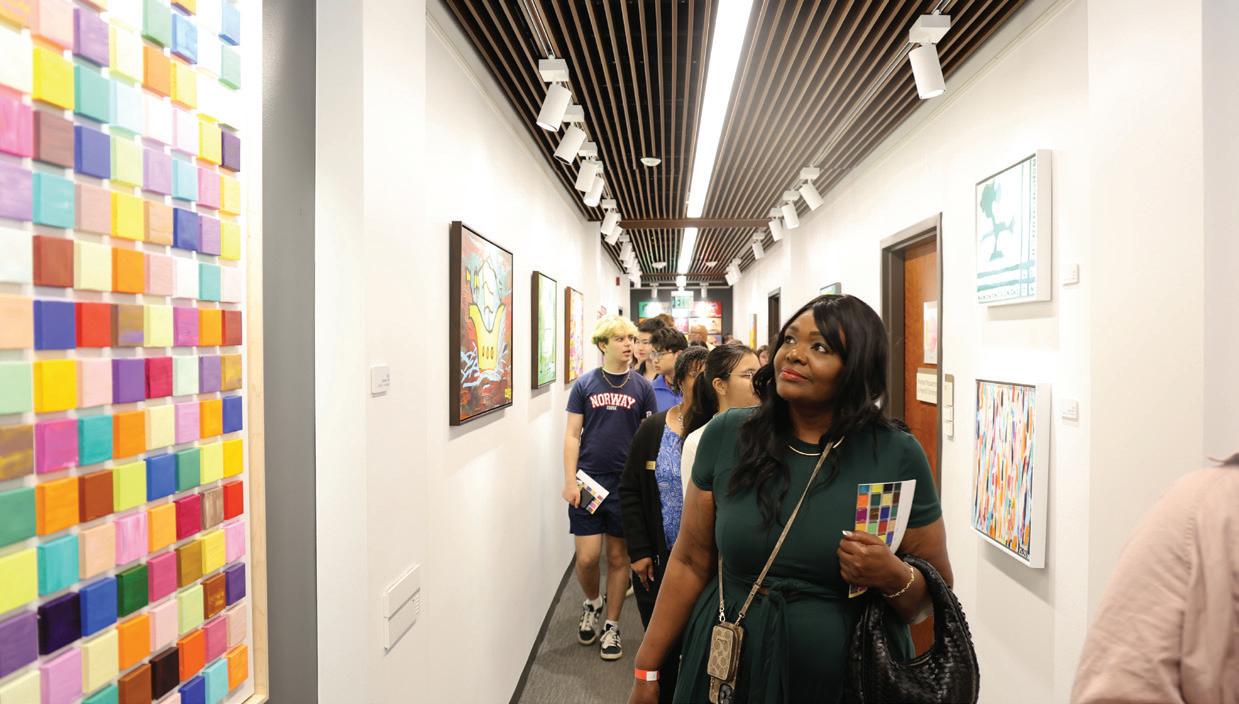
This gift was part of a larger challenge grant that supported multiple projects at the school, including the Leonard and Sophie Davis Endowed Scholarship and a renovation of the student lounge.
Art as Advocacy: The Sophie Davis Gallery
In 2013, a contribution from the Leonard and Sophie Davis Fund enabled the school to establish the Sophie Davis Art Gallery. Located between the school’s lobby and auditorium, the gallery serves as a vibrant space to celebrate older artists and explore aging through the lens of creativity.
The gallery has hosted rotating exhibitions featuring paintings, photography, mixed media and works on paper — all centered on themes of aging, memory and identity. It has become a meditative space for students, faculty and visitors to reflect on the beauty and complexity of growing older.
“Art has the power to humanize aging,” says Dauray, an award-winning artist and designer and the leading force behind the USC Leonard Davis School’s arts initiative. “Through the Sophie Davis Gallery, we’re not just showcasing talent; we’re changing perceptions.”
The Arts and Healthy Aging Center: A New Frontier
In 2024, the school received a $2.5 million gift from the Leonard and Sophie Davis Fund to launch the Arts and Healthy Aging (AHA) Center Fund at USC. The center explores the intersection of artistic engagement and aging, focusing on how creative expression can enhance cognitive function, emotional well-being and social connection among older adults.
Photo: Natalie Avunjian
Visitors tour the Sophie Davis Gallery during the opening reception for the ES23 exhibit in June 2025.
“Alan and Mary Lou are not just donors; they’re partners. Their insights, energy and generosity have helped shape the school’s direction and amplify its impact.”
— USC Leonard
Davis
School Dean Pinchas Cohen
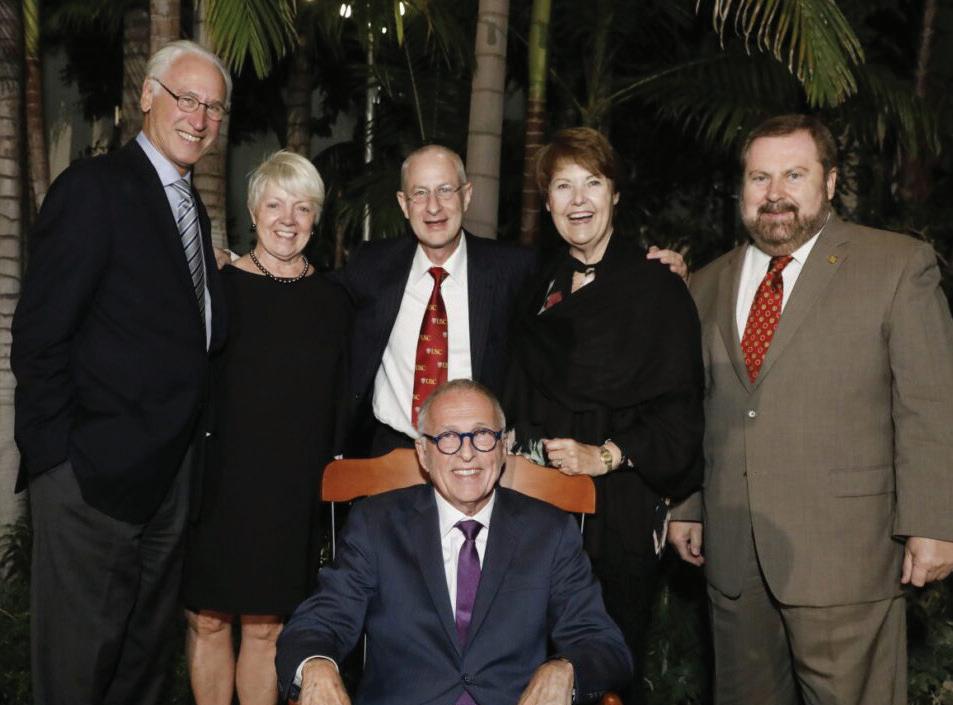
Above: (from left) Alan Davis, Mary Lou Dauray, Dean Pinchas Cohen, Board of Councilors Chair Shari Thorell and Vice Dean Kelvin Davies with Professor and Dean Emeritus Edward Schneider (seated) during the dedication of the Edward L. Schneider Chair in Gerontology in 2017. (USC Photo/Steve Cohn)
Previous pages: (counterclockwise) Rendering of the USC Leonard Davis School; Leonard and Sophie Davis; their son, Alan Davis, and his wife, Mary Lou Dauray. (Photos courtesy of Davis family)
The gift also included a matching challenge of up to $1 million, inviting others to support the center and expand its reach. The AHA Center’s initiatives include competitive research grants, symposia, visiting scholar programs and public events that engage both the USC community and the broader public.
“We’re thrilled to support the AHA Center’s exploration into NeuroArts — the study of how the arts affect the brain, body and behavior,” Dauray says.
Cohen echoes this enthusiasm: “This center represents a bold new chapter in gerontology. Thanks to the Davis family, we’re able to investigate how creativity can be a catalyst for healthy aging.”
A Family Tradition of Advocacy and Innovation
The Davis family’s support for USC spans generations, but it’s rooted in a shared belief: that aging should be studied, understood and embraced, not feared. Leonard Davis’ early work with AARP and his philanthropic investments laid the groundwork for a more compassionate and informed approach to aging. Alan Davis and Mary Lou Dauray have carried that torch forward, expanding the school’s mission into new realms of art, economics and neuroscience.
Their involvement goes beyond financial contributions. Davis is an emeritus board member, and Dauray sits on the Board of Councilors, offering strategic guidance and advocacy for the school’s initiatives.
“Alan and Mary Lou are not just donors; they’re partners,” Cohen says. “Their insights, energy and generosity have helped shape the school’s direction and amplify its impact.”
Looking Ahead: The Next 50 Years
As the USC Leonard Davis School of Gerontology celebrates its 50th anniversary, the Davis family’s legacy is more relevant than ever. With global populations aging rapidly, the need for innovative research, compassionate care and inclusive policy is urgent.
The school’s work — fueled by the support of the Davis Fund — is helping to meet that challenge head-on. From endowed chairs to art galleries, from research initiatives to public programming, the Davis family’s contributions have touched every corner of the school.
“We’re interested in the academic community preparing students, teachers and professionals to meet the challenges that face an aging population today and in the future,” Davis says.
Recordbreaking size of the USC Leonard Davis Class of 2025
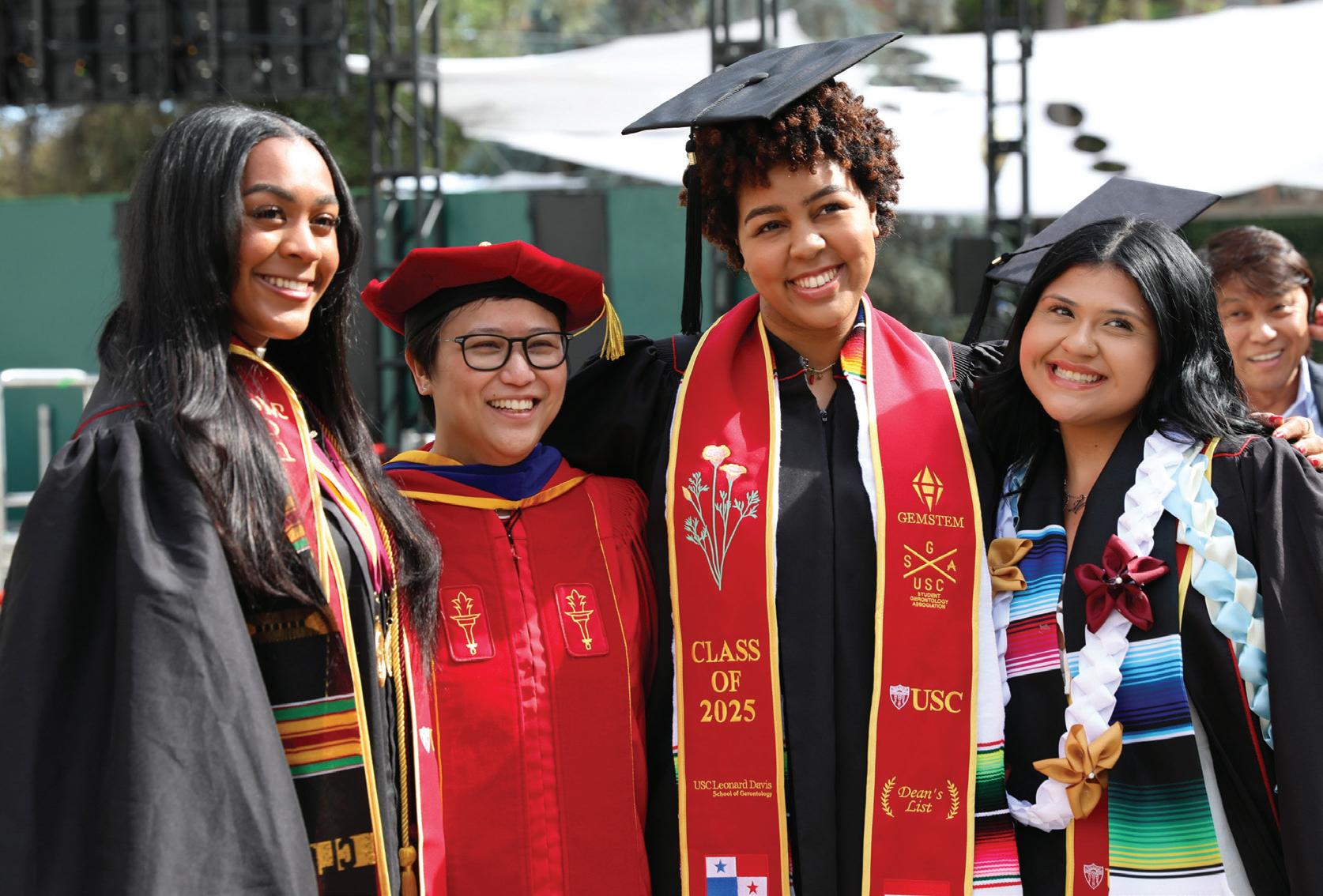
A Milestone Commencement
The USC Leonard Davis School of Gerontology celebrated more than 240 graduates of its undergraduate, master’s and doctoral programs during USC’s 142nd Commencement on May 16, 2025, in Founders Park.
In his welcoming remarks, Dean Pinchas Cohen noted that as the school celebrates its 50th anniversary in 2025, it also celebrates its largest-ever graduating class.
“Your Leonard Davis School education has prepared you to improve the lives of older people, to appreciate — and build upon — the contributions of prior generations and to contribute to better health and wellbeing for everyone,” Cohen said. “I know you will continue our school’s half-century of tradition in service, innovation and success.”
The ceremony’s keynote speaker was Elie Gindi, a member of the USC Leonard Davis Board of Councilors as well as a member of the Master of Arts in Gerontology Class of 2025. He shared that his experience recovering from a stroke, along with his education at the school, allowed him to “truly appreciate the preciousness of time.”
“I learned to count each day, to treasure time, and every day has become all the richer,” Gindi said.
“As graduates of USC Leonard Davis, you have knowledge, you have experience and you have the skills from the best school of gerontology in the world to go out and make sure that the ones you love and the people in your communities live their best life and healthiest life. But now the real work truly begins. May you truly treasure the days bestowed upon you.”
Instructional Assistant Professor Deborah Fui-Yuen Hoe (second from left) with BS in Human Development and Aging graduates Jordyn Roberson, Amor Mathershed and Maria Lopez.
“May you truly treasure the days bestowed upon you.”
— Elie Gindi MAG ’25, USC Leonard Davis Board of Councilors member and 2025 Commencement keynote speaker
Student speaker Natalie Mao, a senior in human development and aging and president of the Student Gerontology Association, spoke to graduates about how studying gerontology promotes understanding and connection with all people, not just older adults.
“Really, we study how to live life fully and help more people go through it with dignity,” she said. “Studying aging also means we’re always learning in and out of school. … We’re students of life, and we gain wisdom from those we serve.” — B.N.
University Honors
Order of the Laurel and the Palm
Anthony Guan
Isaac Ethan Hamid
Elise Noelle Hong
Joshua Senior
Order of Troy
Andrew Bong
Keran Chen
Samuel Chuang
Vandita Gorla
Katelyn Hsu
Evelyn Lee
Jordyn Roberson
Daniella Suh
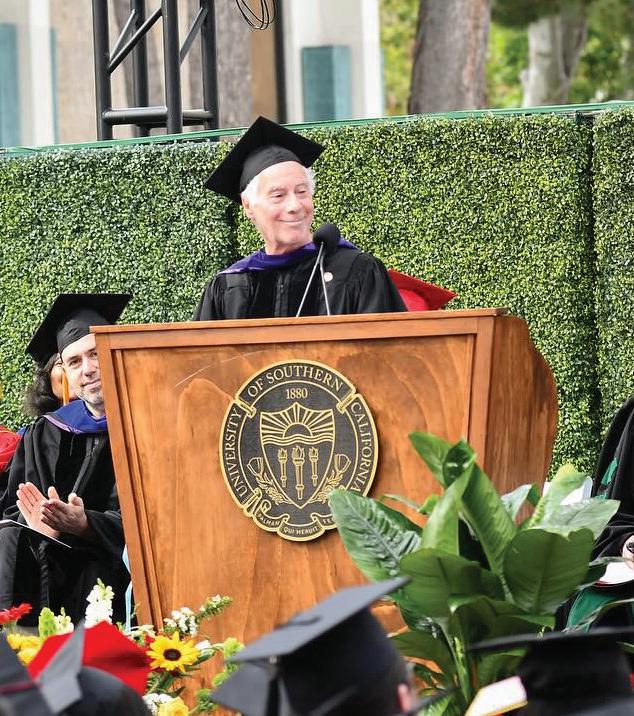
Renaissance Scholar Distinction
Vandita Gorla
Anthony Guan
Discovery Scholar Distinction
Andrew Bong
Keran Chen
Samuel Chuang
Vandita Gorla
Anthony Guan
Isaac Ethan Hamid
Katelyn Hsu
Evelyn Haemin Lee
Jordyn Roberson
Joshua Senior
USC Leonard Davis School Honors
Osterburg Prize
Cassandra Joan McGill
Undergraduate Student Award
Joshua Senior
Master’s Student Award
Brandon Kier Smith
Doctoral Student Award
Sarah Shemtov
Dean’s Affiliated Doctoral Student Award
Carmen Maria Ramos
Teaching Assistant Award
Mengzhao Yan
Faculty Teaching Award
Julia Walsh
Adam Will, son of Belmont Village co-founder and CEO Patricia Will and her husband, Ed Will, and namesake of the Adam Will Prize in Arts and Healthy Aging. (Photo courtesy of Will family)
New Gift Establishes Adam Will Prize in Arts and Healthy Aging
Belmont Village Senior Living has once again made a major investment in the USC Leonard Davis School of Gerontology with a new gift to help establish the Adam Will Prize in Arts and Healthy Aging. The competitive prize was created in memory of Adam Will (1987-2024), the son of Belmont Village co-founder and CEO Patricia Will and her husband, Ed Will.
“The Adam Will Prize is a fitting way to honor Adam, who spent his career at the intersection of the arts and seniors.”
— Patricia Will, Board of Councilors member
“The Adam Will Prize is a fitting way to honor Adam, who spent his career at the intersection of the arts and seniors,” Patricia Will said.
The USC Leonard Davis School recently launched the Arts and Healthy Aging (AHA) Center. The new prize, envisioned to be complementary to the AHA Center and the school’s Arts and Healthy Aging Initiative, will provide financial awards for USC Leonard Davis students who submit winning posters and presentations at the AHA Center’s symposia or public events.
The AHA Center’s research efforts will focus on assessing the advantages associated with active participation in the creation of art by older individuals
and evaluating the benefits derived from engaging with the arts, such as listening to music and attending theater or art exhibitions. The AHA Center also supports activities such as hosting Arts and Healthy Aging Symposia, providing support for Arts and Healthy Aging Visiting Scholars and offering other public programming about the arts and healthy aging that engages students, the public and faculty from other universities.
“We are grateful to Board of Councilors members Patricia Will and Mercedes Kerr and to Belmont Village Senior Living for their continued investment in the success of the Leonard Davis School,” said Pinchas Cohen, dean of the USC Leonard Davis School. “This is a wonderful way to help memorialize Adam and support students and the new AHA Center at the Davis School.”
If you would like to contribute to the new Adam Will Prize Fund, please contact the Development Office at 213-740-1361. — D.E.
2025 Hanson-Thorell Award Supports Study to Improve Dementia Diagnosis for All
A new USC study will harness cutting-edge molecular tools to better predict dementia risk in older adults from historically underrepresented communities, thanks to support from the 2025 Hanson-Thorell Family Research Award.
USC Leonard Davis School of Gerontology Assistant Professor and Edward L. Schneider, MD, Chair in Gerontological Research Lauren Brown received the award for her proposal, “Using Epigenetic Clocks for Earlier Diagnosis in Populations with Elevated Dementia Risk.”
The study will focus on improving the accuracy of “epigenetic clocks” — biological age measures based on DNA methylation, or how genes are activated or inactivated — for Black and Latine older adults. These populations often face higher dementia risk but are more likely to be misdiagnosed or diagnosed late, Brown explained.
“Epigenetic clocks hold enormous promise for forecasting if and when age-related diseases like Alzheimer’s are most likely to develop,” Brown said. “But because these algorithms were trained primarily on European samples, they often underperform in racially and ethnically diverse populations. My project aims to help close that gap.”
Epigenetic clocks estimate biological age by tracking patterns of chemical changes in DNA across tissues. A growing body of evidence shows that accelerated “epigenetic aging” is linked to frailty, cancer, obesity, mortality and, importantly, cognitive decline. However, studies have found inconsistent results when applying the same clock models to different racial and ethnic groups, raising concerns about their generalizability.
Brown’s study will leverage stress, biological and cognitive data from the Health and Retirement Study, a large nationally representative dataset, to retrain and refine these biological age predictors specifically for Black and Latine populations. The project aims to demonstrate that more inclusive models can better capture dementia risk and improve early detection.
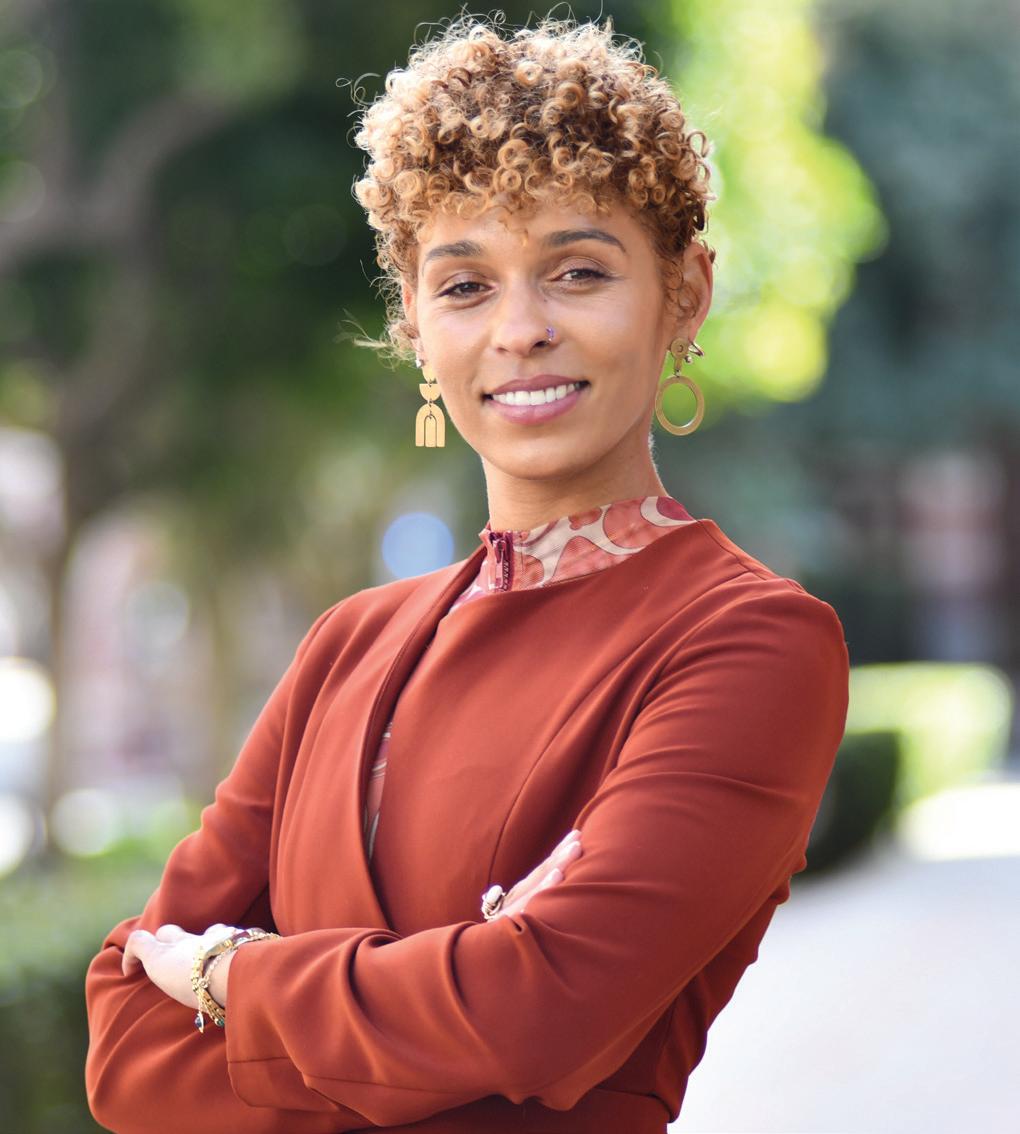
Assistant Professor Lauren Brown
“If we can develop more accurate tools for identifying dementia risk earlier, we can give individuals and families more time to plan and present clinicians with better opportunities to intervene,” Brown said. “That’s especially important in communities that have long faced barriers to diagnosis and care.”
Each year, the Hanson-Thorell Family Research Awards support innovative projects by USC Leonard Davis School junior faculty that advance the science of aging and age-related disease. Brown’s study is designed to lay the groundwork for a future National Institutes of Health R01 grant using longitudinal DNA methylation data to track changes in cognition over time.
“I’m grateful for the support provided by this award,” Brown said. “It provides an important pathway toward research that can transform dementia prediction and prevention for diverse aging populations.”
The Hanson-Thorell awards are supported in part by Board of Councilors Chair Shari Thorell ’65 and her husband, Bob. The awards originated with funding from Shari’s father, former Board of Councilors Chairman Al Hanson. — B.N.
Photo: Natalie Avunjian
Legacy of Leadership
In a 2013 photo, Pinchas Cohen, who was installed as dean of the USC Leonard Davis School of Gerontology in 2012, joins James Birren (1918-2016), the school’s first dean and the founding director of the Ethel Percy Andrus Gerontology Center. Birren joined USC in 1965 to create a new gerontology program and served as dean of the school from 1975 to 1986.
Photo: USC Leonard Davis School archives
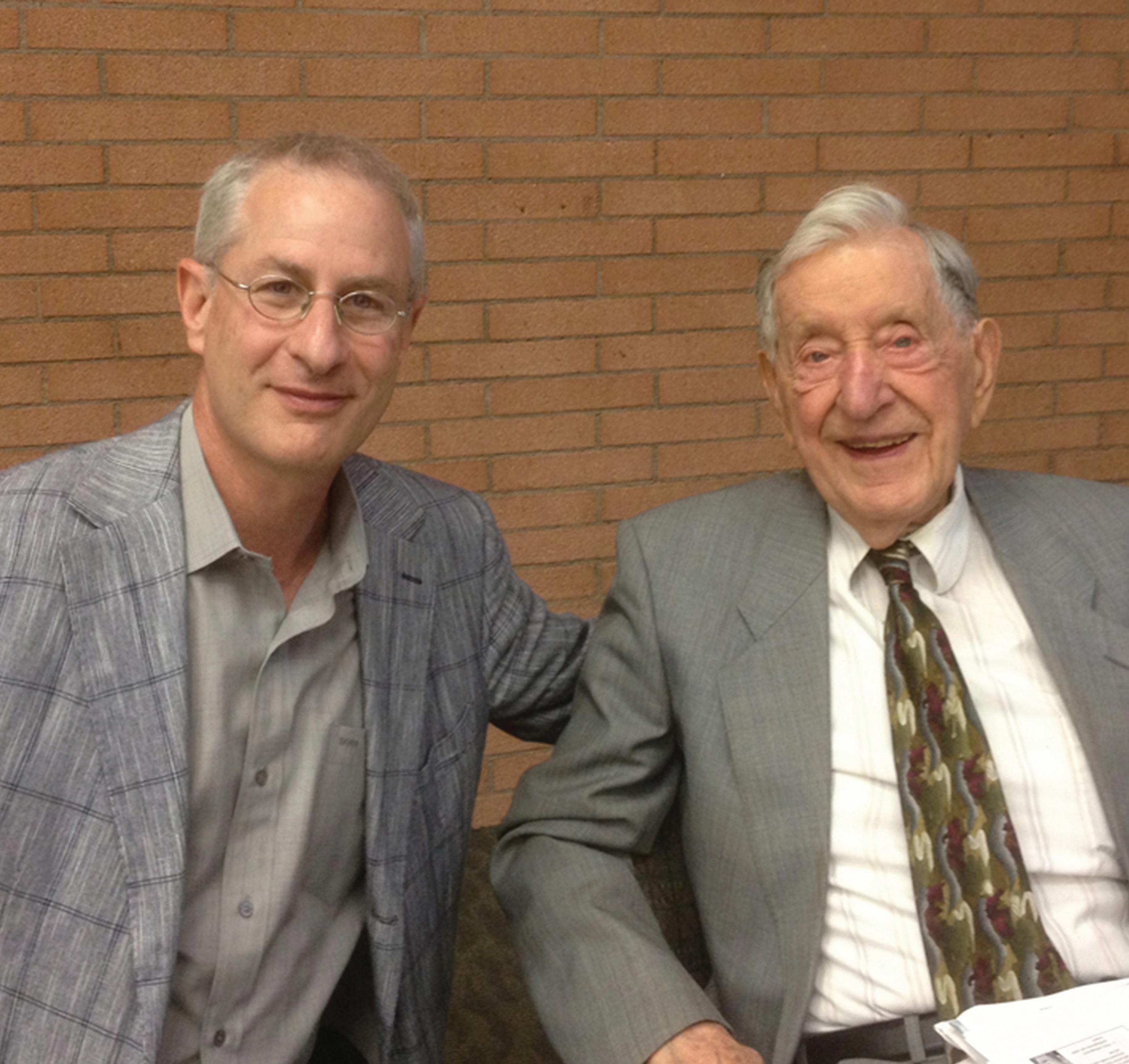
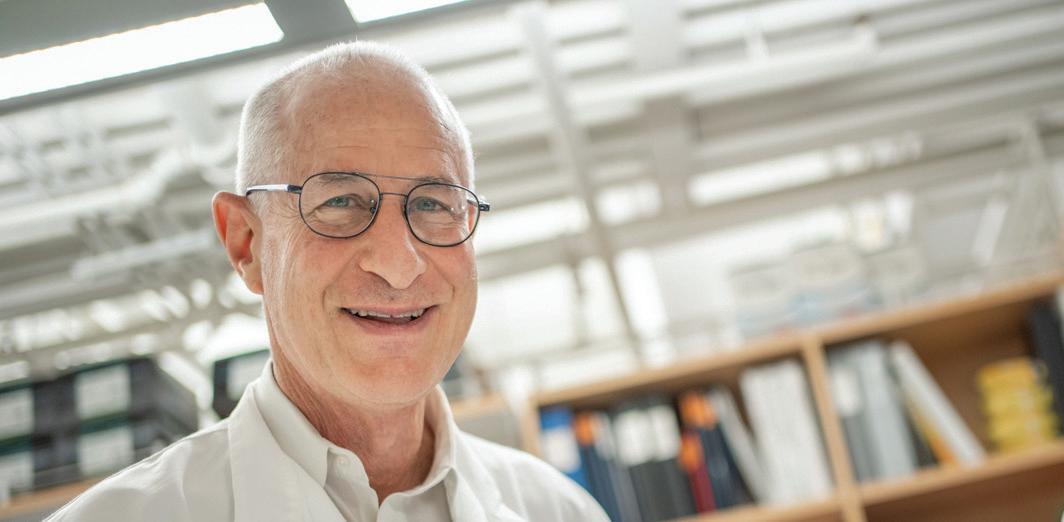
The Dean’s Circle
When you donate to the USC Leonard Davis School, you partner with us in the pursuit of excellence. Your support allows students to explore and engage further in their studies, advances our work to provide outreach and advocacy for older adults, and helps provide faculty scientists with the best resources to conduct groundbreaking research. Please show your commitment to our students and mission by making a gift of $1,000 or more to the USC Leonard Davis School, and join the Dean’s Circle today.
THANK YOU AND FIGHT ON!
Photo: Chris Shinn
3715 McClintock Avenue
Los Angeles, CA 90089
gero.usc.edu
