particles Y.H. Cho’s Vision Spawns Three Research Centers Aviation Research Collaboration Spans Disciplines and Oceans by Angus McColl
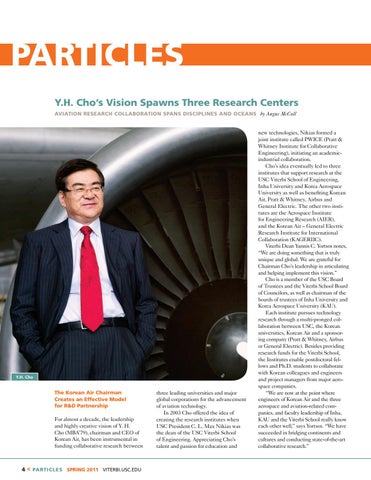
Y.H. Cho
The Korean Air Chairman Creates an Effective Model for R&D Partnership
For almost a decade, the leadership and highly creative vision of Y. H. Cho (MBA’79), chairman and CEO of Korean Air, has been instrumental in funding collaborative research between
4 < Parti c l e s spring 2011 viterbi.usc.edu
three leading universities and major global corporations for the advancement of aviation technology. In 2003 Cho offered the idea of creating the research institutes when USC President C. L. Max Nikias was the dean of the USC Viterbi School of Engineering. Appreciating Cho’s talent and passion for education and
new technologies, Nikias formed a joint institute called PWICE (Pratt & Whitney Institute for Collaborative Engineering), initiating an academicindustrial collaboration. Cho’s idea eventually led to three institutes that support research at the USC Viterbi School of Engineering, Inha University and Korea Aerospace University as well as benefiting Korean Air, Pratt & Whitney, Airbus and General Electric. The other two institutes are the Aerospace Institute for Engineering Research (AIER), and the Korean Air – General Electric Research Institute for International Collaboration (KAGERIIC). Viterbi Dean Yannis C. Yortsos notes, “We are doing something that is truly unique and global. We are grateful for Chairman Cho’s leadership in articulating and helping implement this vision.” Cho is a member of the USC Board of Trustees and the Viterbi School Board of Councilors, as well as chairman of the boards of trustees of Inha University and Korea Aerospace University (KAU). Each institute pursues technology research through a multi-pronged collaboration between USC, the Korean universities, Korean Air and a sponsoring company (Pratt & Whitney, Airbus or General Electric). Besides providing research funds for the Viterbi School, the Institutes enable postdoctoral fellows and Ph.D. students to collaborate with Korean colleagues and engineers and project managers from major aerospace companies. “We are now at the point where engineers of Korean Air and the three aerospace and aviation-related companies, and faculty leadership of Inha, KAU and the Viterbi School really know each other well,” says Yortsos. “We have succeeded in bridging continents and cultures and conducting state-of-the-art collaborative research.”