f
Photo by Brian Morri
RESEARCH
in bioengineering at Columbia University, attended medical school at the University of Chicago, trained in Internal Medicine at UCLA and was selected from over 500 physician applicants for the UCLA Star Fellowship in Cardiology. He earned his Ph.D. at UCLA in 2002, focusing on MEMS, picking up a National Institute of Health (NIH) National Research Service Award. He joined the Viterbi School’s department of biomedical engineering in 2002 and in 2003 he received an NIH Career Award to support his cardiovascular research. He has just received a $2 million NIH grant to examine how biomechanical and biochemical factors initiate atherosclerosis. It is Hsiai’s first NIH RO1 grant as principal investigator, but his two co-principal investigators, Enrique Cadenas, of the USC School of Pharmacy, and Howard Hodis of the Keck School, have had consecutive NIH funding for their work for more than 15 years. “Dr. Hsiai’s engineering and medical backgrounds offer a distinctive approach to heart disease, a tremendous complement to the perspectives offered by Dr. Hodis’ and my groups,” says Cadenas. Hodis heads the Keck School’s atherosclerosis unit, which has been a cohesive interdisciplinary research group for 40 years, and he thinks the timing of the collaboration is particularly good. “This project provides especially unique cardiovascular research as it studies the molecular and signaling processes involved in response to flow dynamics in the arteries,” says Hodis. “We’re moving into in-vivo (whole animal) models, and then into humans. It may take a couple of funding cycles but we hope to develop a mechanism to determine which lesions are ready to rupture and cause a heart attack.” Using photolithography technology, Hsiai’s team has been building MEMS devices that are in the range of 20 by 100 microns. They contain a heated wire doped with phosphorous. When an electric current passes through this element, it measures the shear stress from the fluid surrounding the device as it flows. As the heated wire sensor comes close to the blood vessel wall, the surface begins to affect its sensitivity, but the devices are far more sensitive than any other method of examining blood flow. In addition to building the devices, Hsiai cultures blood vessel cells in his laboratory. Normally, the liver removes cholesterol, which is a lipid, from the blood. But sometimes the lipids oxidize, the liver cannot recognize them and so they stay in the blood. Over time, the oxidized lipids form plaque inside blood vessels and the vessels themselves become stiffer and then brittle. This is classic atherosclerosis. “Plaque tends to form in the coronary arteries (and other areas) where there is complicated geometry such as sharp turns and where blood vessels branch,” says Hsiai. “Blood flow is different and much more complex in these areas. There are many places where it flows more slowly and where you have vortices, or little whirlpools.” Disturbed blood flow modulates the formation of plaque, says Hsiai. “Exercise changes the molecular profile of the surface of the blood vessel wall. With increased blood flow, the walls become less sticky so that lipids are less likely to attach,” he says. The mechanical force of blood flowing past the molecules making up blood vessel walls appears to induce a chemical change as well. The blood vessels begin to produce anti-oxidants, which can possibly eliminate those plaque-forming oxidized lipids. “You can change the profile of the wall through diet, medication, by stopping smoking, and of course, with exercise.” Hodis says that today it is dogma that if patients lower
EATURE
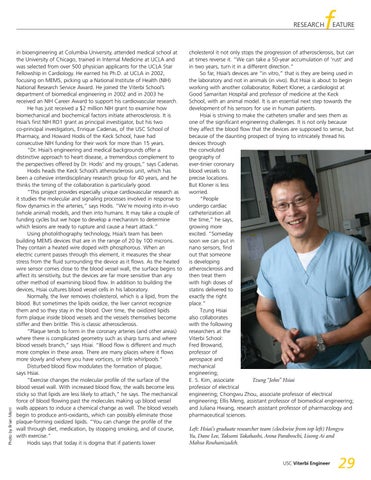
cholesterol it not only stops the progression of atherosclerosis, but can at times reverse it. “We can take a 50-year accumulation of ‘rust’ and in two years, turn it in a different direction.” So far, Hsiai’s devices are “in vitro,” that is they are being used in the laboratory and not in animals (in vivo). But Hsiai is about to begin working with another collaborator, Robert Kloner, a cardiologist at Good Samaritan Hospital and professor of medicine at the Keck School, with an animal model. It is an essential next step towards the development of his sensors for use in human patients. Hsiai is striving to make the catheters smaller and sees them as one of the significant engineering challenges. It is not only because they affect the blood flow that the devices are supposed to sense, but because of the daunting prospect of trying to intricately thread his devices through the convoluted geography of ever-tinier coronary blood vessels to precise locations. But Kloner is less worried. “People undergo cardiac catheterization all the time,” he says, growing more excited. “Someday soon we can put in nano sensors, find out that someone is developing atherosclerosis and then treat them with high doses of statins delivered to exactly the right place.” Tzung Hsiai also collaborates with the following researchers at the Viterbi School: Fred Browand, professor of aerospace and mechanical engineering; E. S. Kim, associate Tzung “John” Hsiai professor of electrical engineering; Chongwu Zhou, associate professor of electrical engineering; Ellis Meng, assistant professor of biomedical engineering; and Juliana Hwang, research assistant professor of pharmacology and pharmaceutical sciences.
Left: Hsiai’s graduate researcher team (clockwise from top left) Hongyu Yu, Dane Lee, Takumi Takahashi, Anna Paraboschi, Lisong Ai and Mahsa Rouhanizadeh.
USC Viterbi Engineer
29