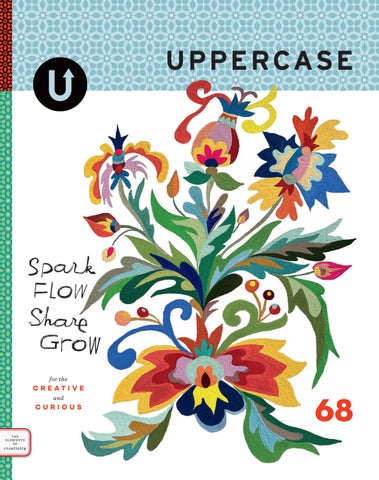
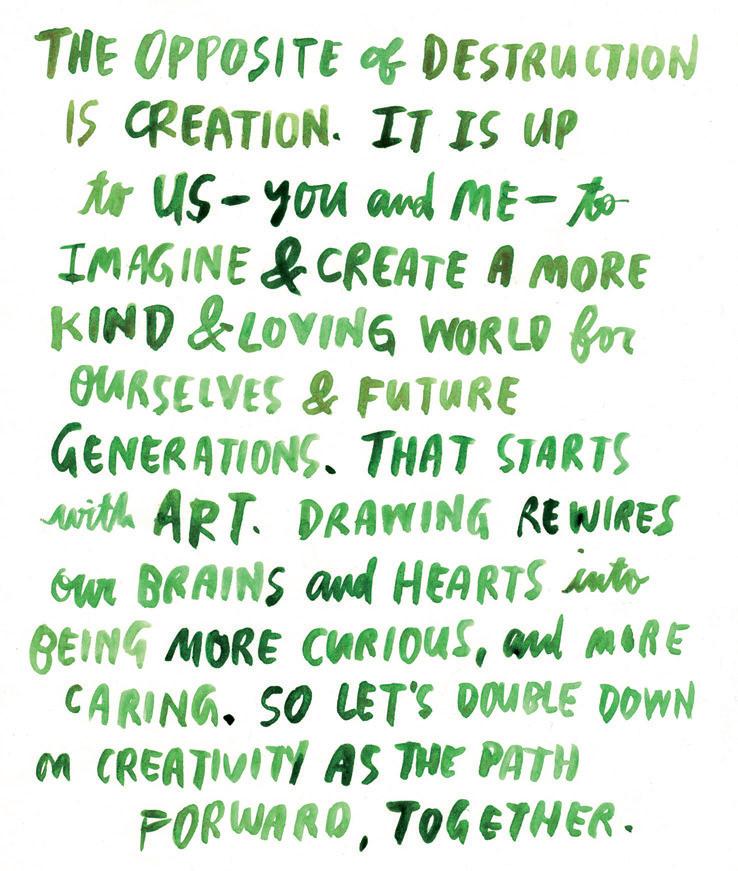
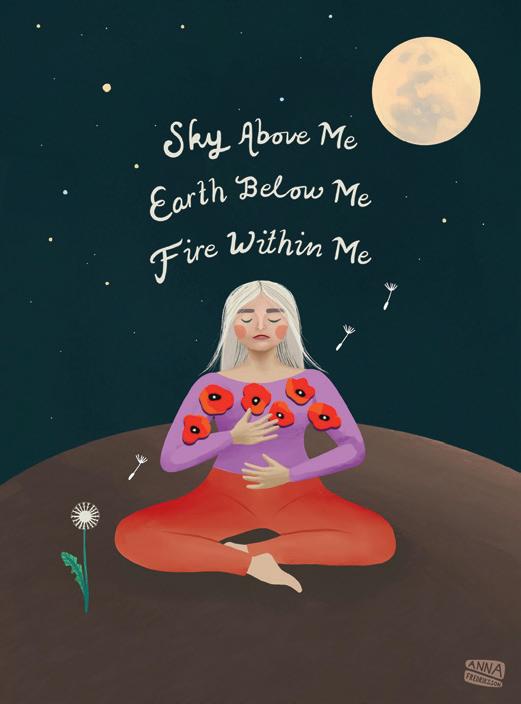
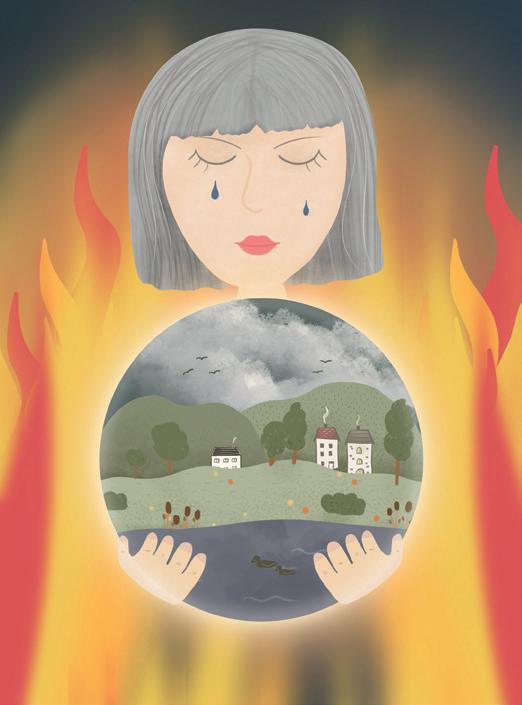
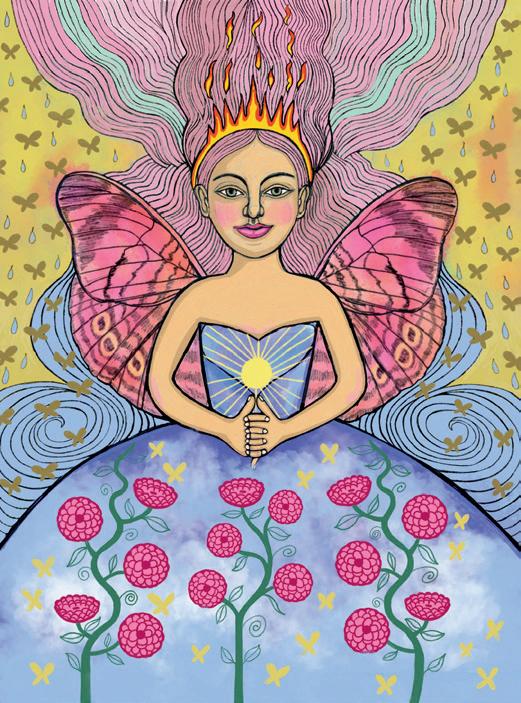
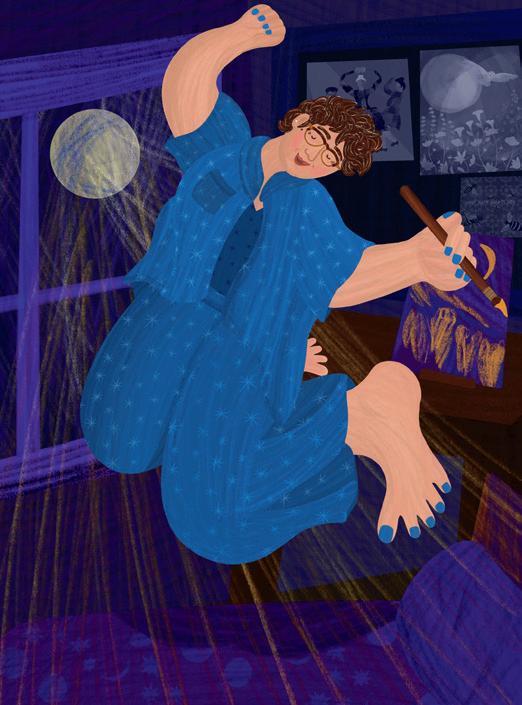
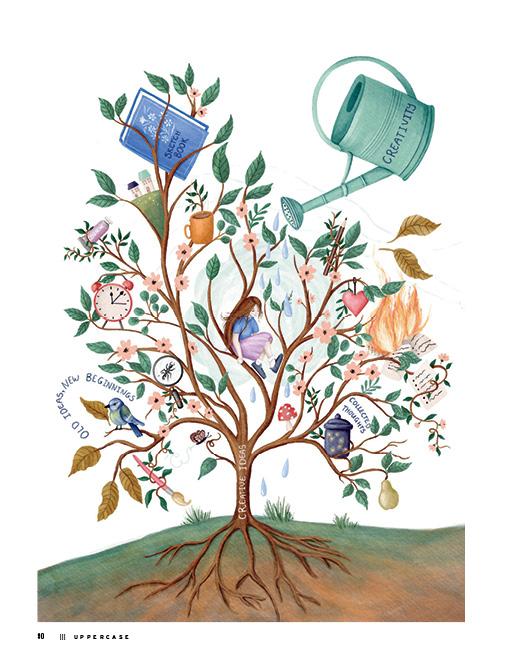
What makes human-made art so wonderful and inimitable? The heart, hand and personality of the person who makes it. And that’s why, as creatives, we are resisting the onslaught of artificial intelligence (AI) in favour of authentic intelligence and artistic intuition. We are not machines! We exist in the natural world, one made of physical elements. The classic four elements—earth, water, air and fire—have long been themes and metaphors in visual art.
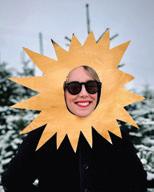
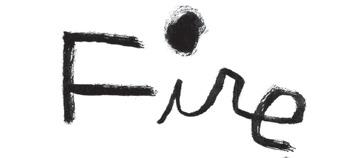
FIRE
Our ideas ignite from a creative spark. Fire symbolizes energy, transformation, confidence and persistence.
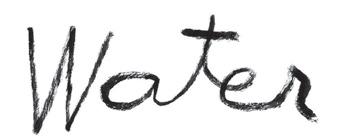
WATER
Creative flow transports us and our ideas; like water, we are fluid and adaptable.
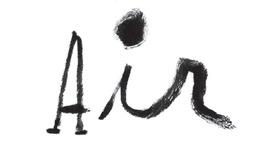
AIR
We share our ideas through words and images. Like air, art is universal, all-encompassing and necessary for life.
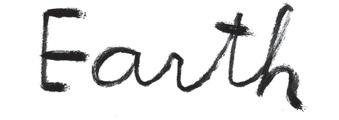
EARTH
Like roots networked in the earth, we are grounded in our shared humanity; we support each other. We grow, together.
These are the elements of creativity.
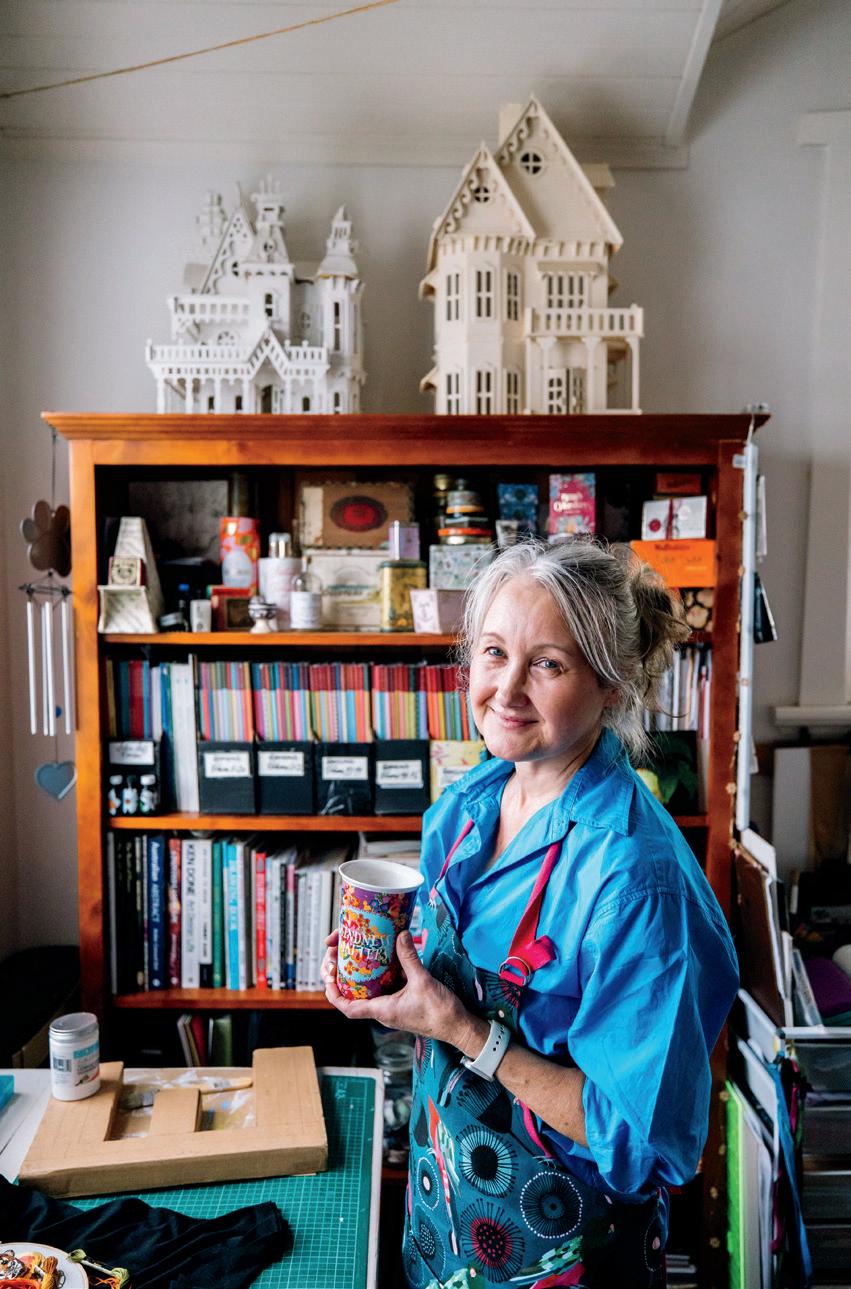
Janine Vangool
PUBLISHER, EDITOR, DESIGNER
Receive my weekly musings, delivered to your inbox!
uppercasemagazine.com/free
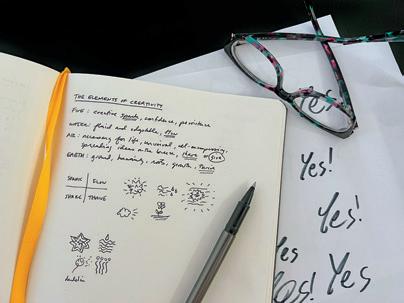
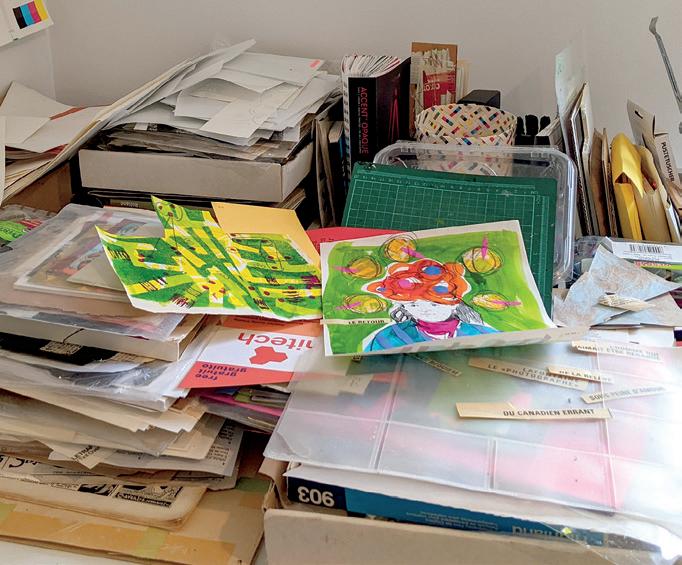
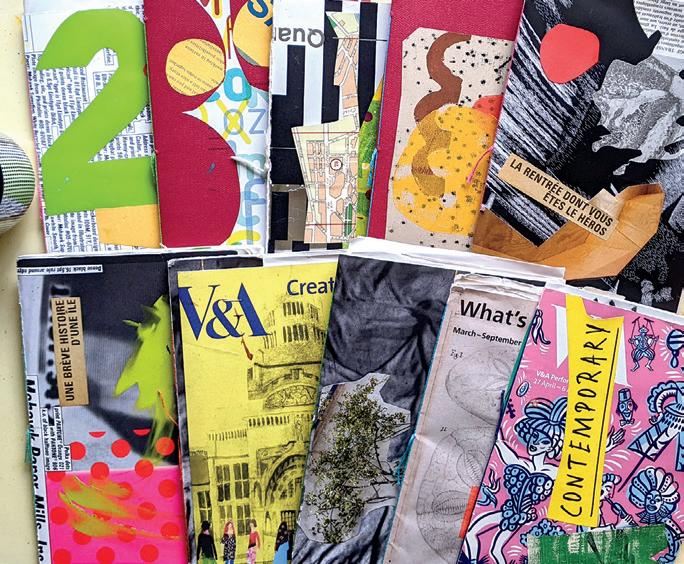
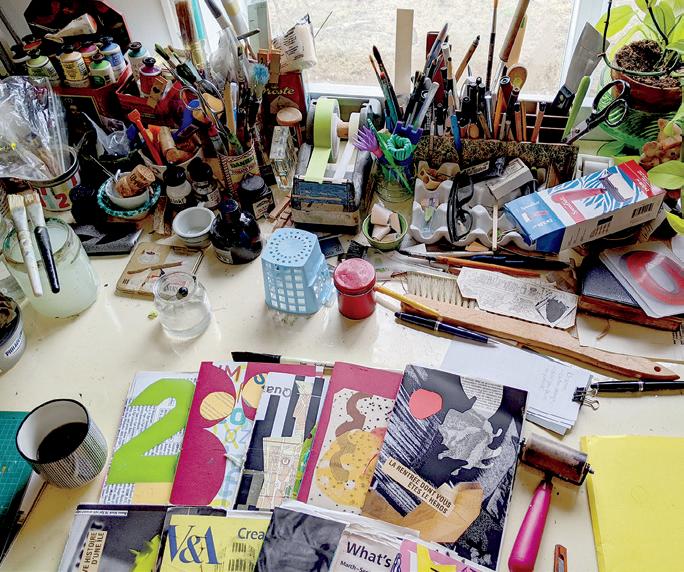
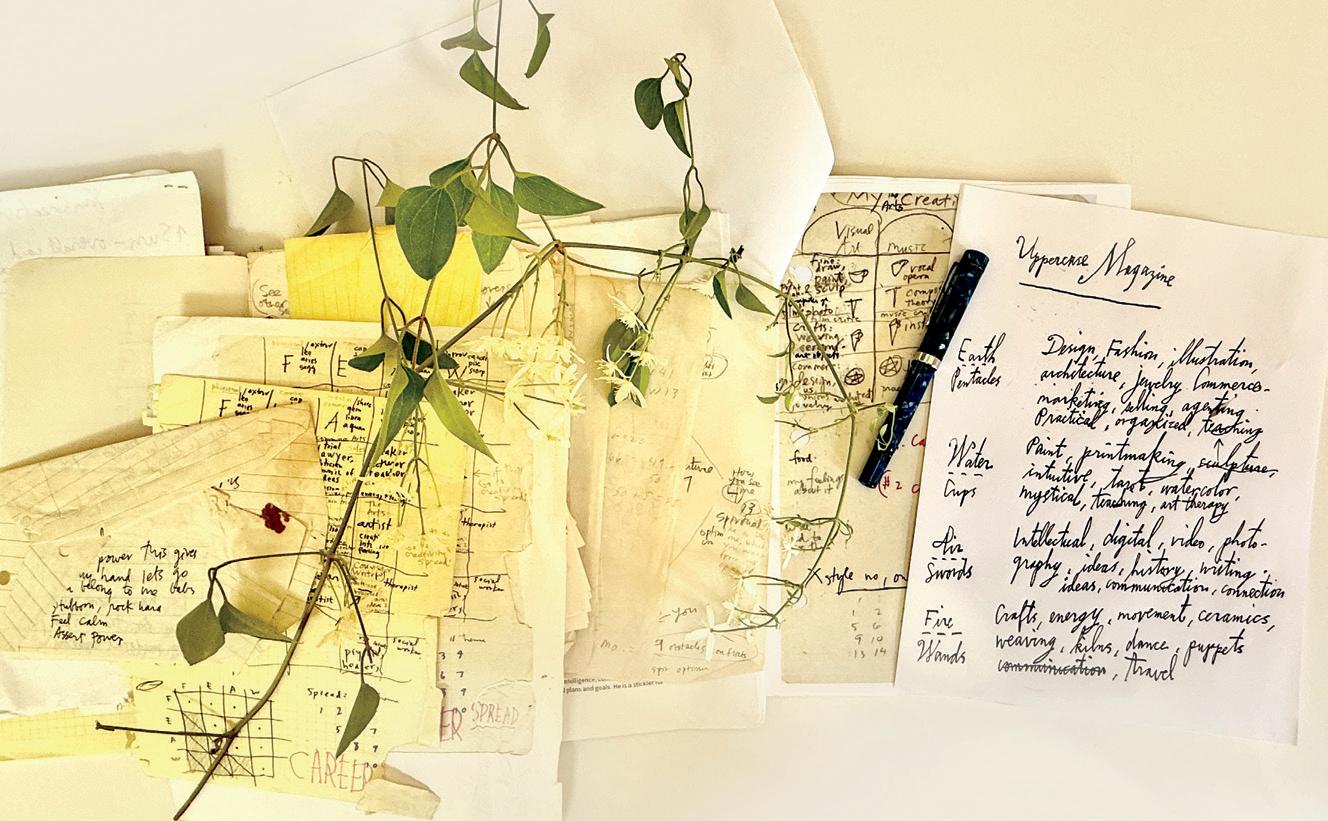
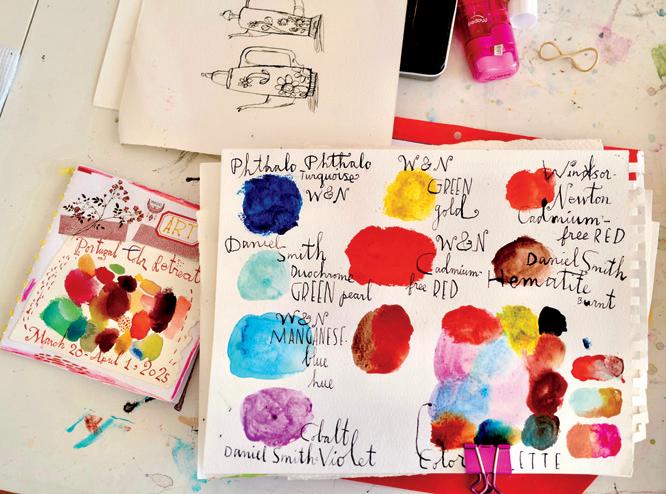
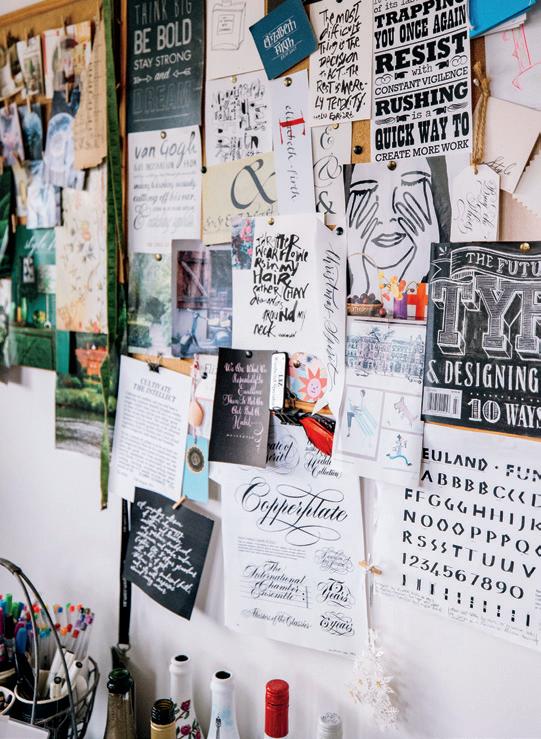
Ideas on paper
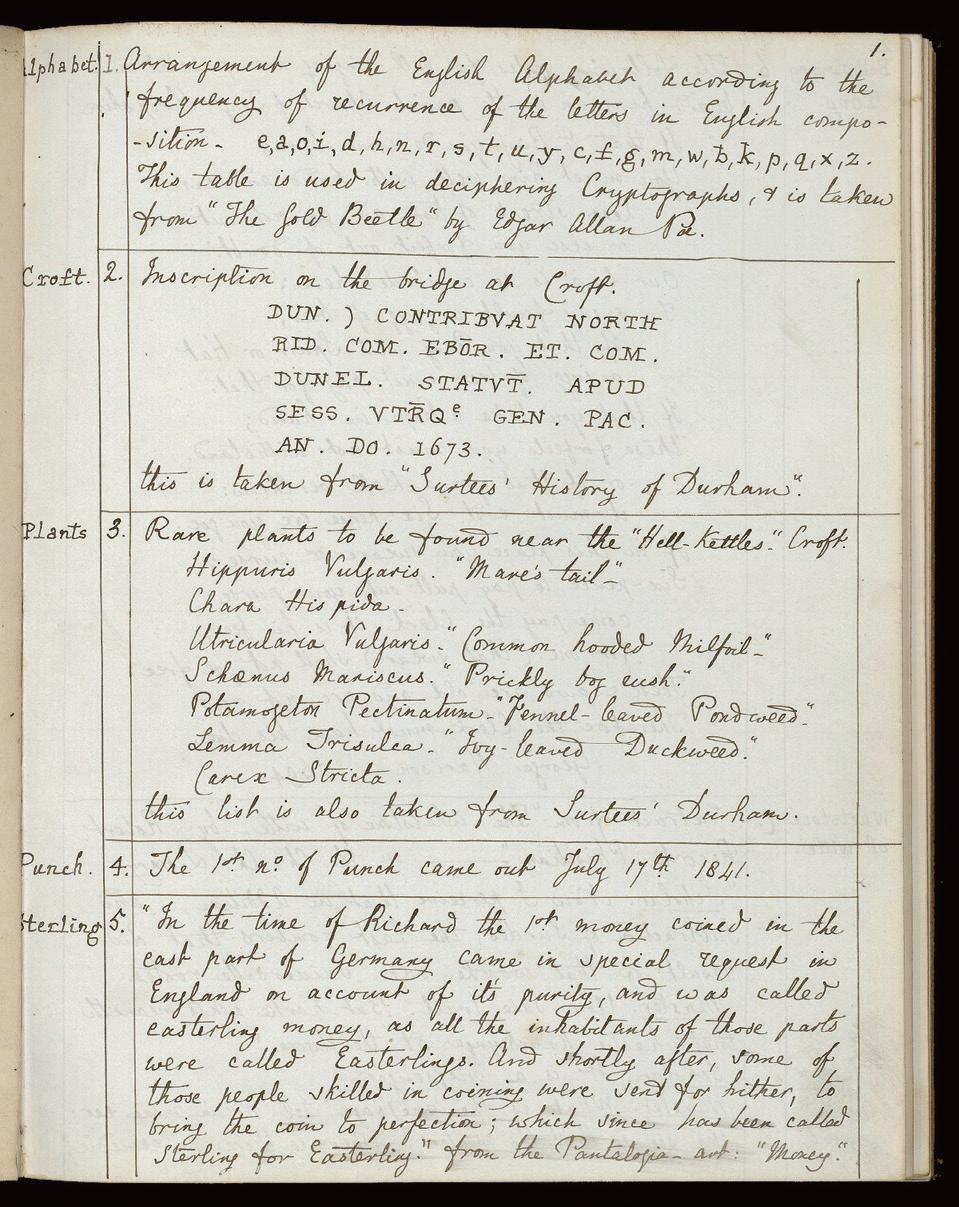
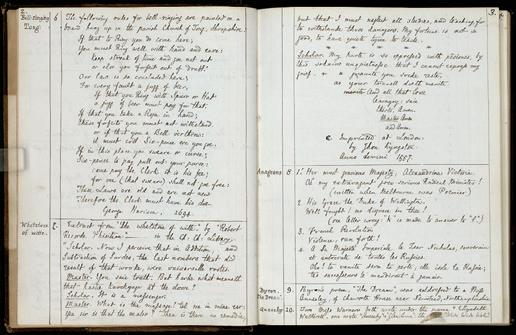
Here are my notes conceptualizing the theme of this issue.
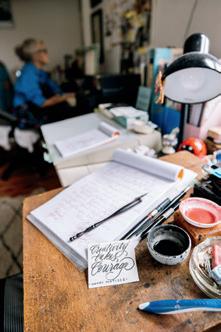
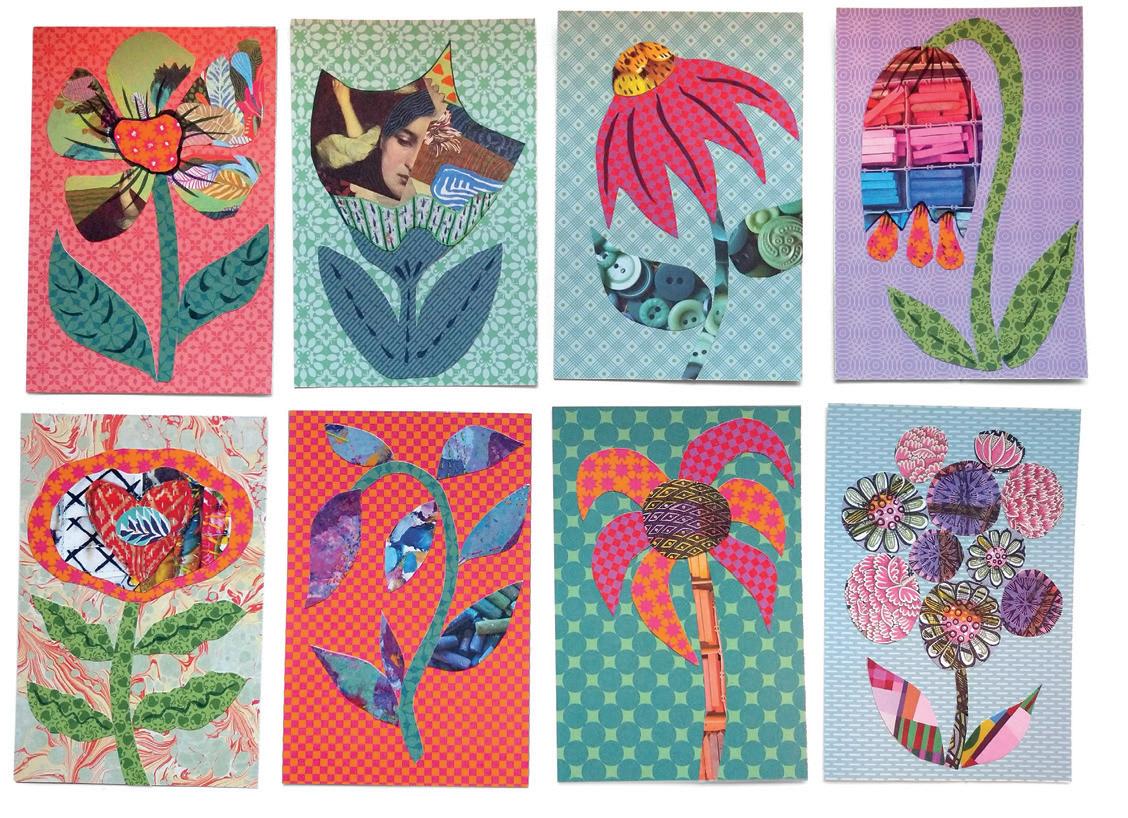
I needed an exuberant “yes!” for the Abecedary, so I asked my teenage son, Finley, to pen some possibilities.
UPPERCASE
1052 Memorial Dr NW Calgary, Alberta, Canada T2N 3E2
Interior pages are printed on 100% post-consumer recycled Rolland Enviro 100.
Sustainability Initiatives
Through the Wren Trailblazer fund, UPPERCASE removes two tons of carbon each month with an additional two tons of carbon offset monthly. Please join fellow readers in the Wren Impact forest.
In the spirit of reconciliation, we acknowledge that we live, work and play on the traditional territories of the Blackfoot Confederacy (Siksika, Kainai, Piikani), the Tsuut’ina, the Îyâxe Nakoda Nations, the Métis Nation (Region 3) and all people who make their homes in the Treaty 7 region of Southern Alberta.
SUBSCRIBE
This independent magazine thrives because of you— its loyal subscribers!
uppercasemagazine.com
SUBSCRIPTIONS
This quarterly magazine is released in January, April, July and October.
$96
$80
INTERNATIONAL
CAD $144
Our shop will do the currency conversion for you.
RENEWALS
You will receive a notice by email when it is time to renew. Renew online anytime to add issues to your current subscription.
GIFTS
Simply enter the recipient’s name and address in the shipping information and your name, email and billing address during checkout.
STOCKISTS
To view our list of stockists or to carry UPPERCASE in your shop:
uppercasemagazine.com/ stockists
Thank you to all of the talented writers, illustrators, creative collaborators and loyal readers who contributed their talents to this issue of UPPERCASE.
QUESTIONS?
Have a question about your subscription or a change of address? Email us: shop@uppercasemagazine.com
NEWSLETTER
Sign up for the UPPERCASE newsletter to receive free content and behind-the-scenes peeks at the making of the magazine— plus a welcome discount on your subscription!
uppercasemagazine.com/free
Thank you to everyone who submitted to the open calls for this issue. Even if you weren’t featured within these printed pages, your effort was noticed and appreciated!
SUBMISSIONS
UPPERCASE welcomes everyone and all identities, ages, talents and abilities. We share an inclusive, positive and community-minded point of view. Everyone is welcome to explore our creative challenges and submit to the magazine. Pitch your own work, propose an article or suggest a topic through the Open Pitch submission form. Be familiar with the magazine and its writing and visual style.
uppercasemagazine.com/participate
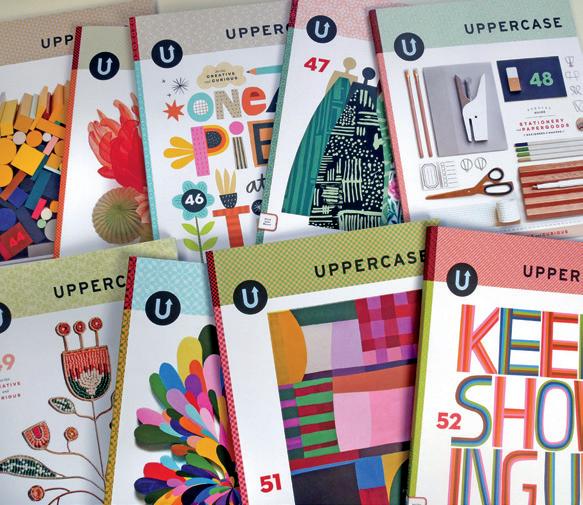
Magazines are not reprinted— get our back issues while you can! Out-of-print issues are available digitally in the Archive.
uppercasearchive.com
Natural Beauties
Molly C. Meng
PORTSMOUTH, NEW HAMPSHIRE, USA
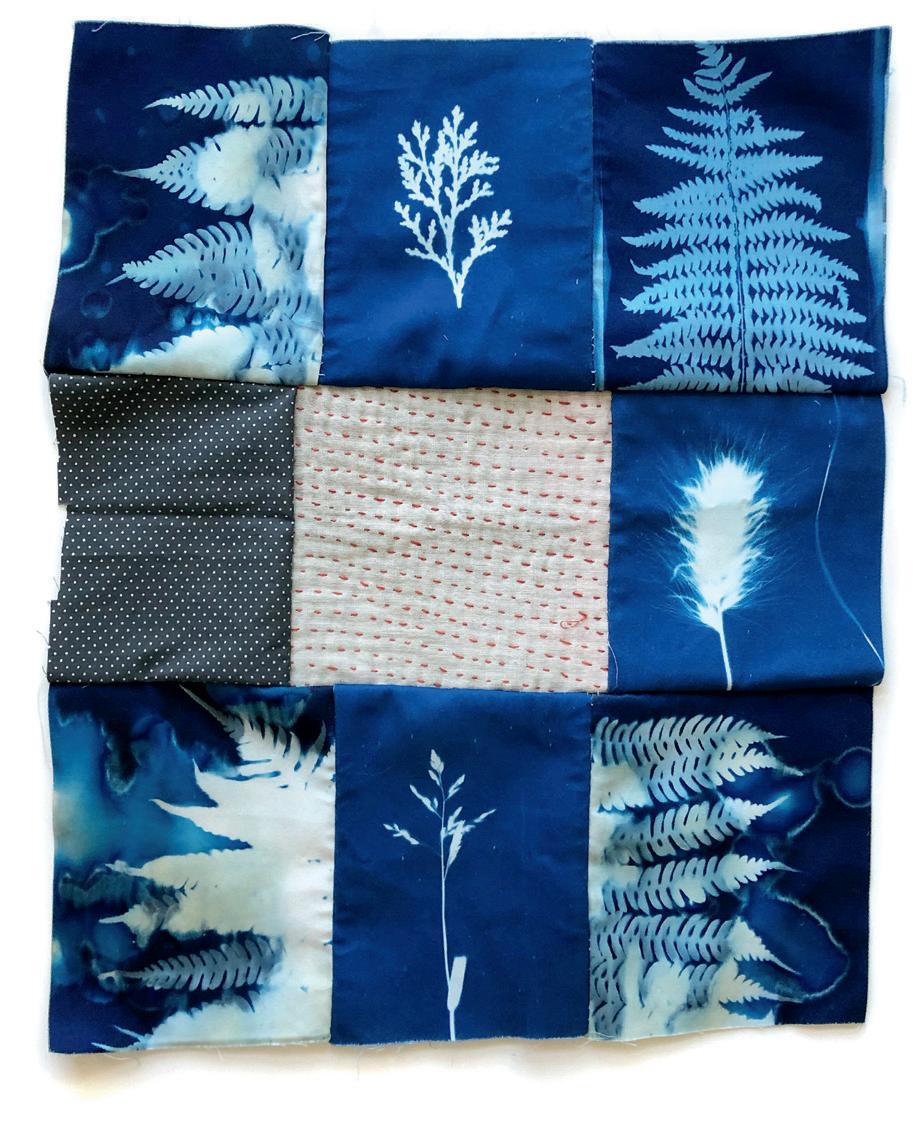
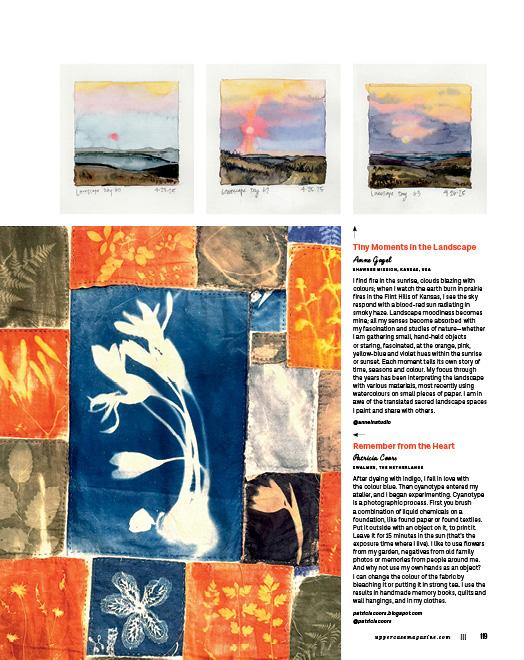
Cyanotype uses the sun to expose, water to develop and air to dry. To me, truly appreciating the art of this craft involves learning to become one with nature: noticing the exquisite common beauty of the natural world— simple flowers, leaves, weeds and roots. Each of these things can produce spectacular prints. Cyanotype printing requires a slowing of movement, of observation and of time itself. Colour, which can often drive the intensity of a craft that uses nature, is, in this case, moot. Only the ultimate cyan-blue of one’s print is the focus here. The object one chooses as a “resist” is, in the final print, white. When leading cyanotype workshops, I ask students to use this time to deeply appreciate the tiny magic moments of the earth.
mollycmeng.com
@molly_c_meng
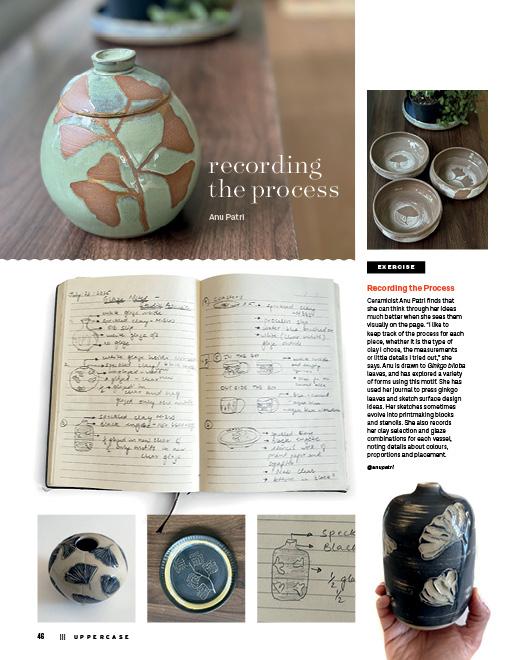
Janien Prummel, Boriana Kantcheva, Guylaine Couture, Anu Patri and Shelly Laslo
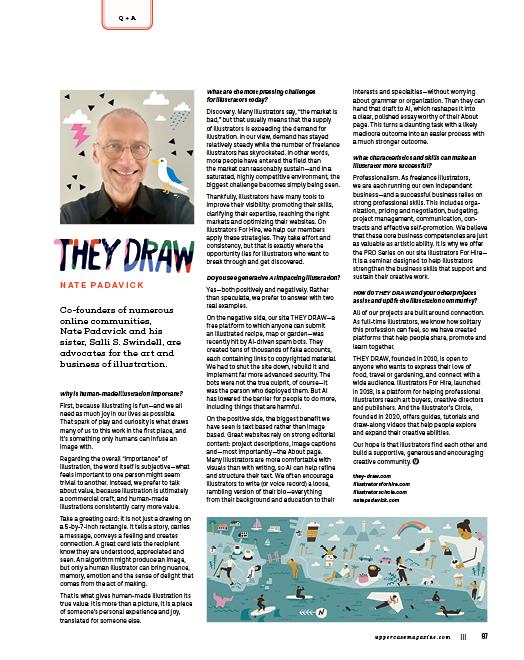
Interview with Nate Padavick of
LILLA
The Four Astrological Elements & Their Creative Forms
AND LETTERING BY LILLA ROGERS
PERSPECTIVES
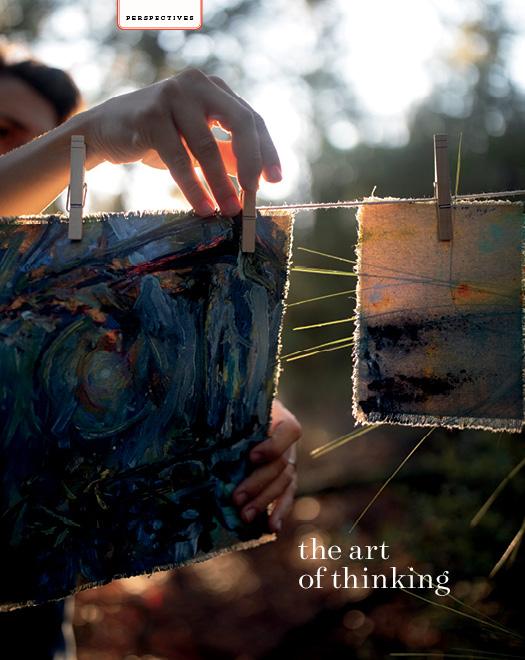
The Art of Thinking Featuring Thomas Flynn II, Amanda Fox and PJ Anderson STORY BY KERRIE MORE
PARTICIPATE
The Elements in Craft SUBMISSIONS BY UPPERCASE READERS
HOBBY Uncommon Thoughts STORY BY BRENDAN HARRISON
Firth
Make Something with UPPERCASE
the
JENKINS
SNIPPETS
PIECING
Apostrophe Puzzles
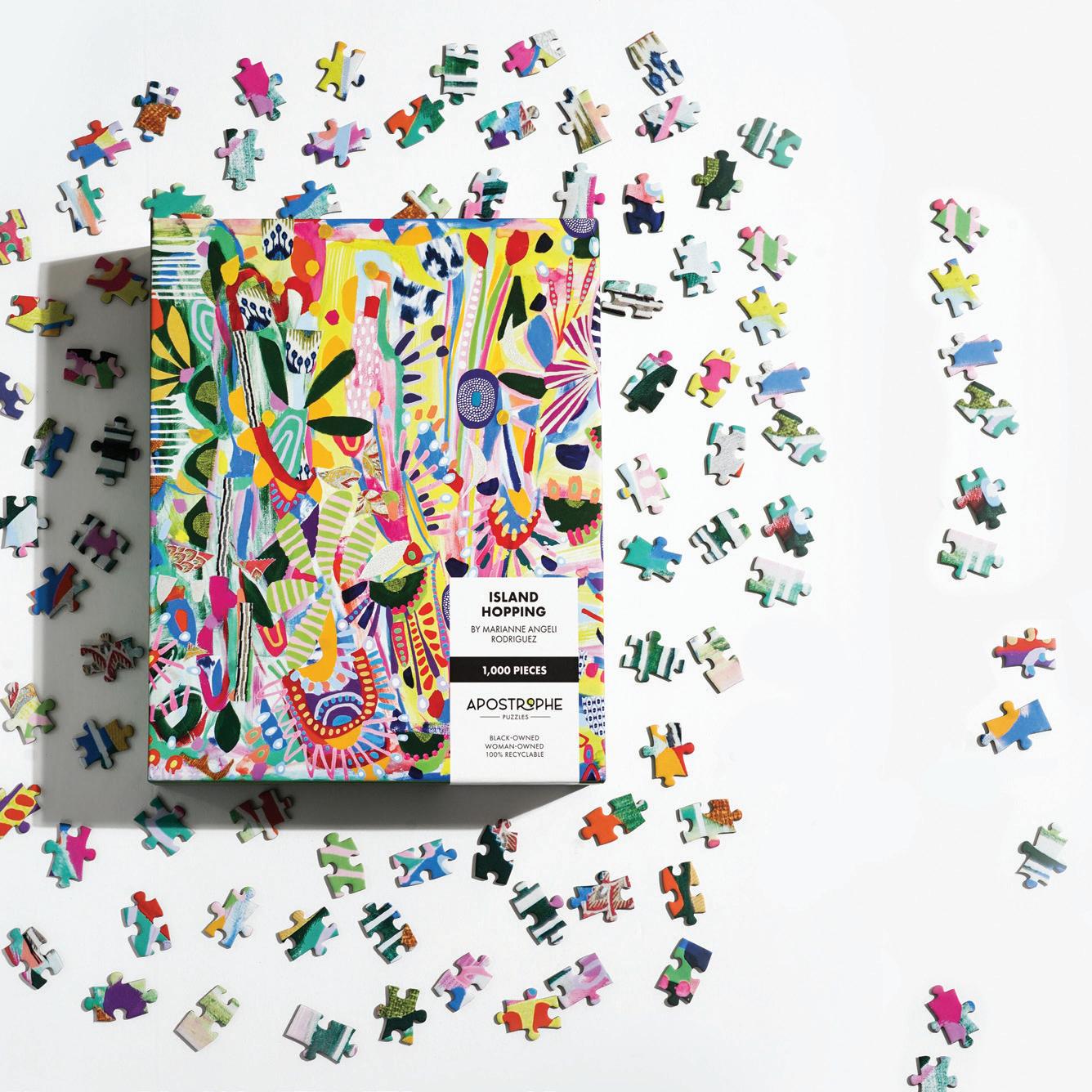
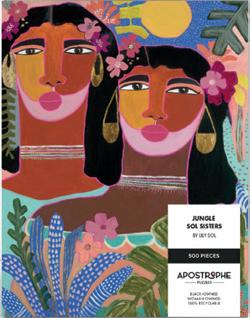
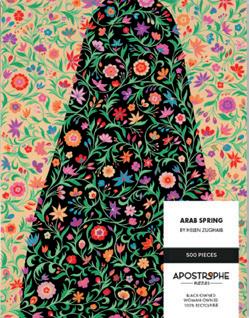
Mandi Masden, founder of Brooklyn-based Apostrophe Puzzles, curates puzzles featuring the work of contemporary artists of colour. “We believe in the importance and necessity of diverse representation in both the puzzle and the art world,” she says. “Puzzles have come a long way from kittens and windmills, but the industry remains painfully lacking in diversity. Even new companies with beautiful, modern images have very few puzzles that feature people of colour—either as artists or as subjects. The art world has a similar issue with representation.”
apostrophepuzzles.com
@apostrophepuzzles
MARIANNE ANGELI RODRIGUEZ
Drawn from the Wild
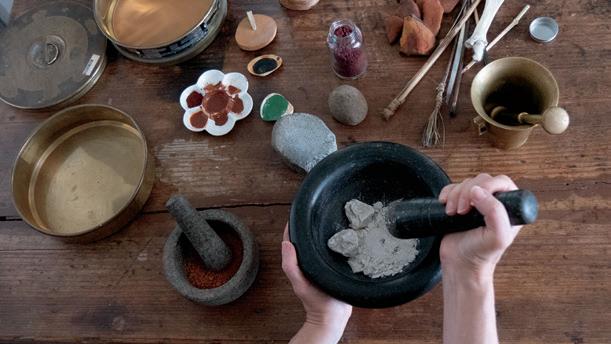
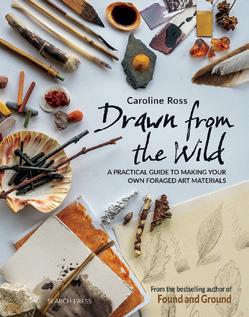
Caroline Ross (featured on page 112) is the author of Drawn from the Wild: A Practical Guide to Making Your Own Foraged Art Materials, published by Search Press. Get out into the elements to scavenge materials for art making. Learn, step by step, how to prepare pigments for soft pastels, burn wooden sticks into artist charcoal, craft a quill pen and make inks from botanical ingredients. foundandground.com @foundandground
Rise & Shine
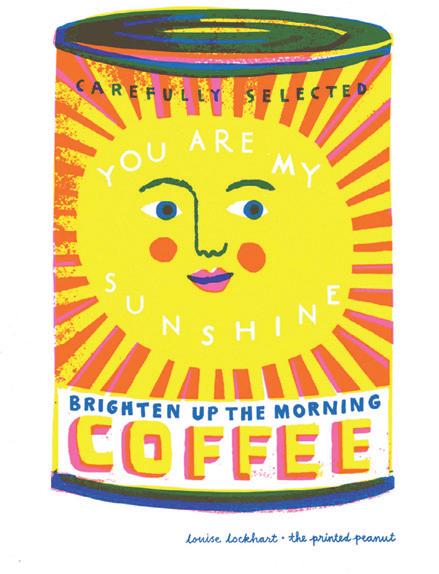
Inspired by printed food label ephemera collected from small supermarkets on her travels, illustrator Louise Lockhart created a series of packaging-themed risograph art prints to brighten your day. theprintedpeanut.co.uk @theprintedpeanut
Stuck on Handmade
Exploring “New Media”
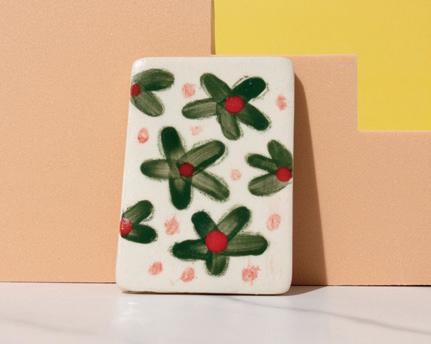
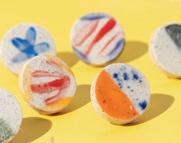
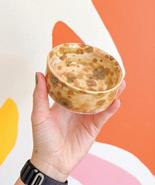
Illustrator Esther Nariyoshi primarily works on paper and screens, so, while looking for something relaxing yet creative that her brain wouldn’t categorize as “work,” she turned to a new medium: pottery—an activity that, for her at least, she deems “play.”
The process is thoroughly hands on and all-encompassing. “It invites many elements we find in nature: earth/clay, water, wind and fire,” she says. “The process starts with quality earth mixed with just the right amount of water, so the material remains malleable. Once the material has been shaped, it requires air so that it can dry. We think of water as gentle, but it is also the usual culprit for cracked pieces. After the first firing comes my favourite part: drawing!”
She decorates her pieces with painterly designs: “Glazes are my friends.” Completing a piece might take several weeks: “Pottery is very different from any allure that modernity promises, but somehow, it never gets old.”
esthernariyoshi.com
@esther.nariyoshi
Deborah Fisher, “curator, docent, ring master and juggler at Fish Museum + Circus,” offers this sticker in her shop, along with sewing patterns and quirky ceramic creatures that double as pincushions and sewing accessory holders. fishmuseumandcircus.com @fishmuseum
POTTERING
more than machine guidance for creative resistance
ARTICLE AND ILLUSTRATION BY MEERA LEE PATEL
It is not an easy time to persist. Democracies are being dismantled, basic freedoms are threatened and fear permeates our communities, eroding trust and respect between neighbours. It can feel fruitless to create—to put pen to paper or to paint a picture—when so many people are fighting for basic needs: access to clean drinking water, a fair education, medical attention or the right to simply exist.
Every act of creation seeds hope in ourselves and in others, and hope is no small thing. Over the past few months, I have turned to the artists who came before me, seeking guidance on how to continue creating through difficult times. This wisdom comes from artists who created art through their own dark days, who fought for justice through their work and who encouraged others, like you, to persist.
Respect Your Own Value
It is easy to criticize your role in society as an artist—to say that your work is less urgent than that of someone who works in medicine or education. It is artists, however, who have sparked changed in every single generation, through the books they have written, the paintings they have created and the music they have played. Writer Ursula K. Le Guin said, “Resistance and change often begin in art, and very often in our art, the art of words.” Many people believe that art is separate from politics, but who you are and what you believe in fortifies what you create. What you create can make someone reconsider their own actions and thoughts, so clarify your values and pour them into your work.
Imagine a New World
Part of your role as an artist is being able to imagine a world that does not already exist—a society that responds differently to the needs of those living within it. If you lose the ability to imagine, you lose the opportunity to create a sense of possibility within your work or ignite it within others. Imagination requires hope, not only the belief that something new is possible—but
that it is worth working towards. As writer and activist Arundhati Roy says, “Another world is not only possible, she is on her way. On a quiet day, I can hear her breathing.”
Chronicle Now
Writer and activist James Baldwin stressed that it is imperative that we record our present-day history through our art. “You think your pain and your heartbreak are unprecedented in the history of the world, but then you read,” he said, pointing out that it is art that connects us with other people—to those who live now, but also to those who came before us and those who will come after. It also feels like a plea to regain perspective, to understand that each generation faces struggle and unforeseen horror, and that turning away from reality—out of fear, apathy or privilege—is not an option. As an artist, your role is to record history for those who otherwise would never know what it was like to live during these years—to help educate them, broaden their perspectives and deepen their empathy for a period of history from which they would otherwise feel disconnected.
Reach Towards Yourself
You will not be able to sustain an art practice—or take care of others—if you neglect yourself. You are not a machine, and you should not expect yourself to persist tirelessly. Audre Lorde so emphatically once said, “Caring for myself is not self-indulgence, it is self-preservation, and that is an act of political warfare.” Are you exercising, eating well, drinking plenty of water? Are you sleeping enough? Are you disciplined about how much time you spend scrolling through social media, about examining the quality of the news sources you ingest? Does your heart remain open? When doom feels all-encompassing, when you feel like there is nothing you can do, reach for yourself. Reach for the earth—for a long walk outside, for plenty of fresh air, for a chance to turn your mind away from everything outside of you, so you can hear yourself again.
Lee Patel
Meera Lee Patel is a self-taught artist, writer and internationally recognized bestselling author who writes books that help people connect with themselves, each other and the world around them. Her work advocates for greater mental health awareness in children and the grown-ups who care for them.
meeralee.com
@meeraleepatel
Meera
UPPERCASE MAGAZINE’S
statement about AI
For more than 16 years, UPPERCASE has uplifted the handmade, the crafted and the heartfelt through this quarterly print magazine. We respect, appreciate and promote original art and thought. With this in mind, UPPERCASE wants to be clear about the use of artificial intelligence in its publications.
We will not publish any artwork that makes use of generative AI in whole or in part. We require that all written and visual commissions and submissions to UPPERCASE be made solely by the writer, artist, illustrator or photographer. This creation includes rough ideation, brainstorming, initial sketches and article outline stages. The use of ChatGPT or any other large language model to generate content or outlines, or any aspect for any UPPERCASE article, illustration or photography assignments will not be accepted.
UPPERCASE magazine is proud to commission its contributors for their unique creative talents; we want to work with talented people, not anything generated or influenced by AI.
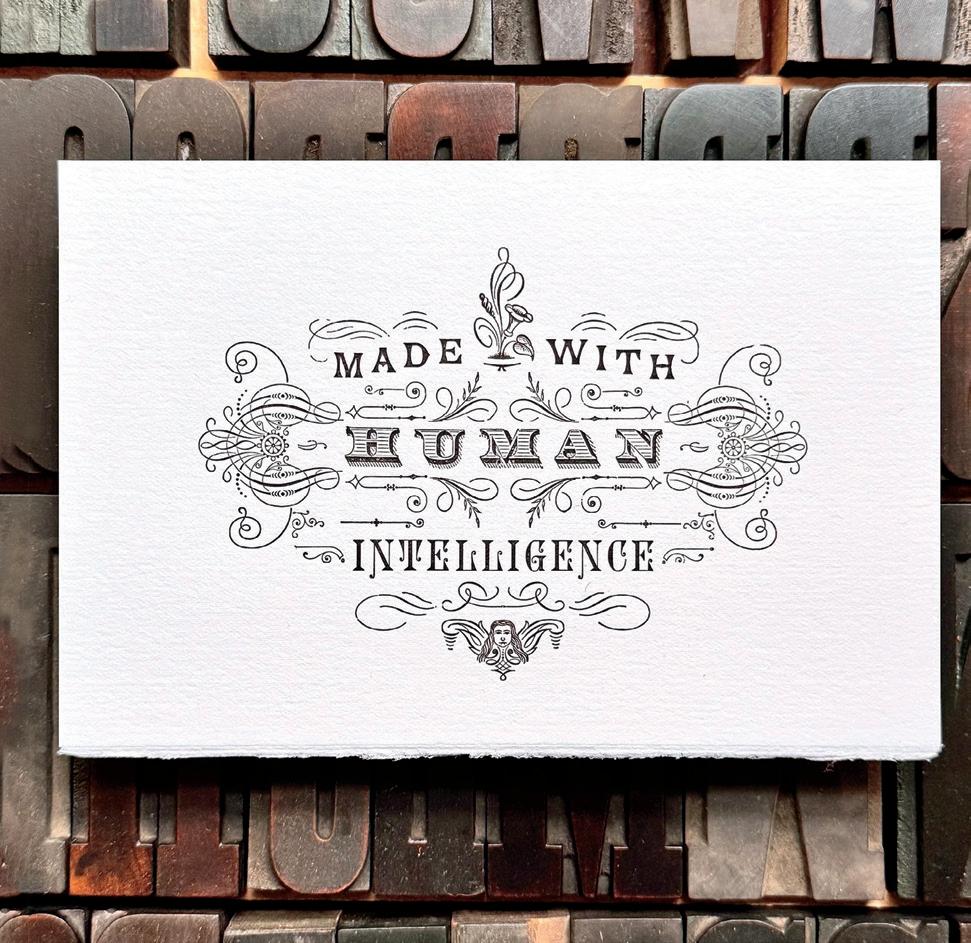
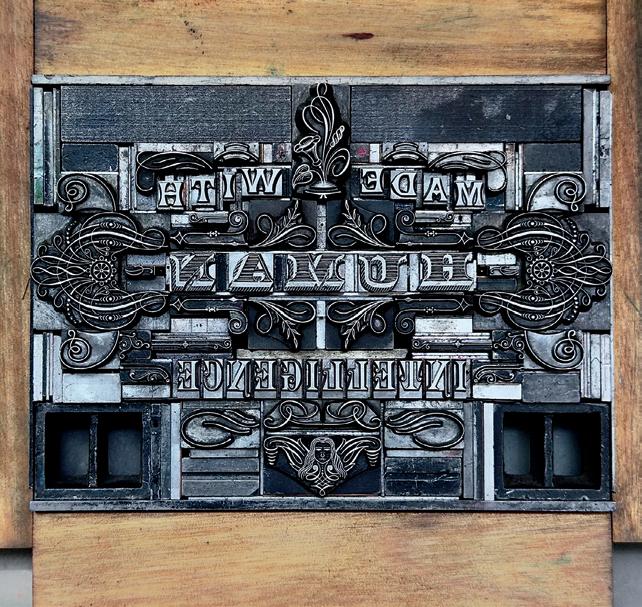
Using 19th-century type to make a 21stcentury statement
Jennifer Farrell
Jennifer Farrell, who is based in Chicago, has been a letterpress printer since 1996: “I’m proud that Starshaped has stayed true to the mission of preserving the tools of letterpress printing while pushing the craft forward and contributing to the vibrant print community.”
Through brilliant use of 19th-century type and ornament, Jennifer has crafted this beautiful print. “It focuses on the beauty of human-made pieces that are 150 years old, and the quirks that come with time. We’re also not fans of AI at Starshaped and what it is stripping from artists— and humanity.”
starshaped.com/small-prints/ humanintelligence
blooming talents
Whether you’re a fresh graduate or mature artist, it is often a dream to be published for the first time! You are welcome to submit your art for consideration.
uppercasemagazine.com/participate
Bhagyashree Lulay
MALDEN, MASSACHUSETTS, USA
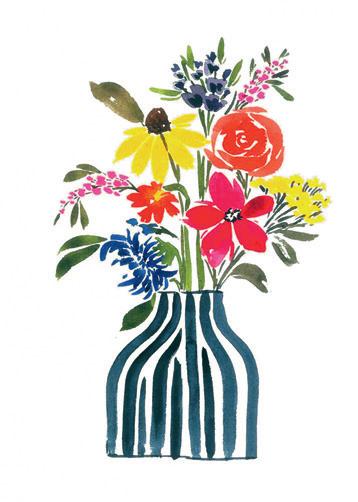
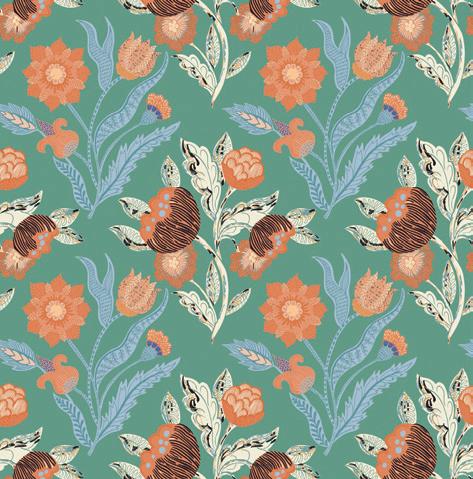
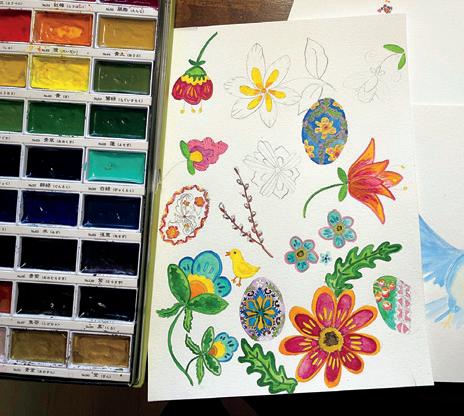
I’m a self-taught artist from India, now blooming in the United States, where I’ve planted new creative roots. With a background in landscape architecture, it’s no surprise that I’m drawn to painting lush florals and leafy botanicals— plants and patterns are my happy place! I love experimenting with a variety of mediums and surfaces, whether it’s watercolour, gouache or my iPad.
Since moving to the United States, I’ve jumped heart-first into the local art community. I’ve taught in-person workshops to over 200 students—ranging from curious five-year-olds to creative seventy-somethings—and recently hosted my very first solo art show (a dream come true!). I also showcase and sell my work at vibrant local art markets.
Lately, I’ve been exploring surface pattern design, learning about licensing and turning my artwork into joyful products that live beyond the page. My goal? To see my designs on greeting cards, stationery and home décor— spreading a little beauty and cheer wherever they go. What makes me “fresh”? I’d say it’s my fearless curiosity. I’m not afraid to start over, try something new or share my work with the world—even in a brand-new country. Every creative leap teaches me something, and I’m just getting started.
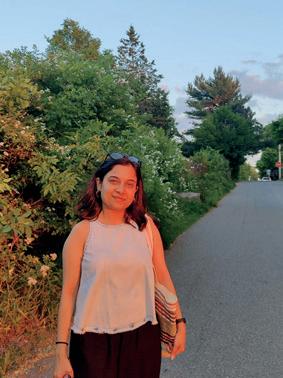
I am a textile designer and a mixed-media artist. I came across UPPERCASE, and I feel it’s a great opportunity to publish my artwork for the first time. I love to create patterns and paint florals, and creating designs inspired by nature. I have been working with pattern designs, colours and varied Indian traditional styles of artworks as well. hetalanjaria.weebly.com @hetalanjaria2022
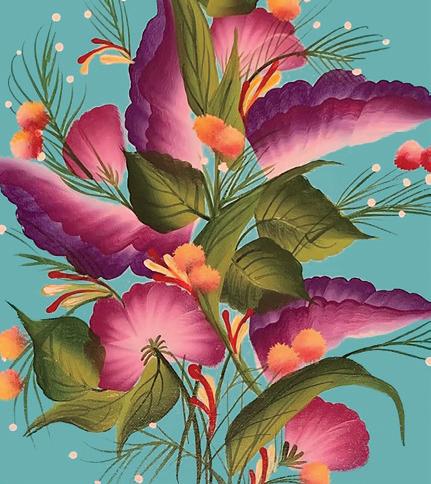
I’m an artist and designer with a lifelong love for history, storytelling and the beauty hidden in everyday life. Through my brand, Lilyanne Design, I create surface patterns and curated collections that blend timeless motifs with a fresh, modern sensibility. My work often draws from historical design movements—like Arts and Crafts, Jacobean florals and 18th-century textiles— reimagined for today’s homes, wardrobes and creative projects.
I believe that the objects we live with should carry meaning, artistry and integrity. That’s why I design with care, using sustainable materials whenever possible, and aim to create pieces that feel enduring rather than fleeting. From wallpaper and fabric to patterned papers and hand-crafted rugs, each collection tells a story— connecting the past to the present in a way that sparks joy and inspires creativity.
My hope for Lilyanne Design is to share this love of beauty and history with others, whether it’s through a roll of wallpaper transforming a room, a bespoke patterned paper inspiring a handmade gift or a textile becoming part of someone’s everyday rituals. I want my work to find its way into homes, shops and studios where craftsmanship and authenticity are valued, and to collaborate with companies and makers who share this vision.
In everything I create, I strive to make art that feels both rooted in tradition and alive with possibility—pieces that aren’t just decorative, but become part of someone’s story.
lilyannedesign.com
@lilyanne_design
Anne Thumann
BEACH LAKE, PENNSYLVANIA, USA
Hetal Anjaria
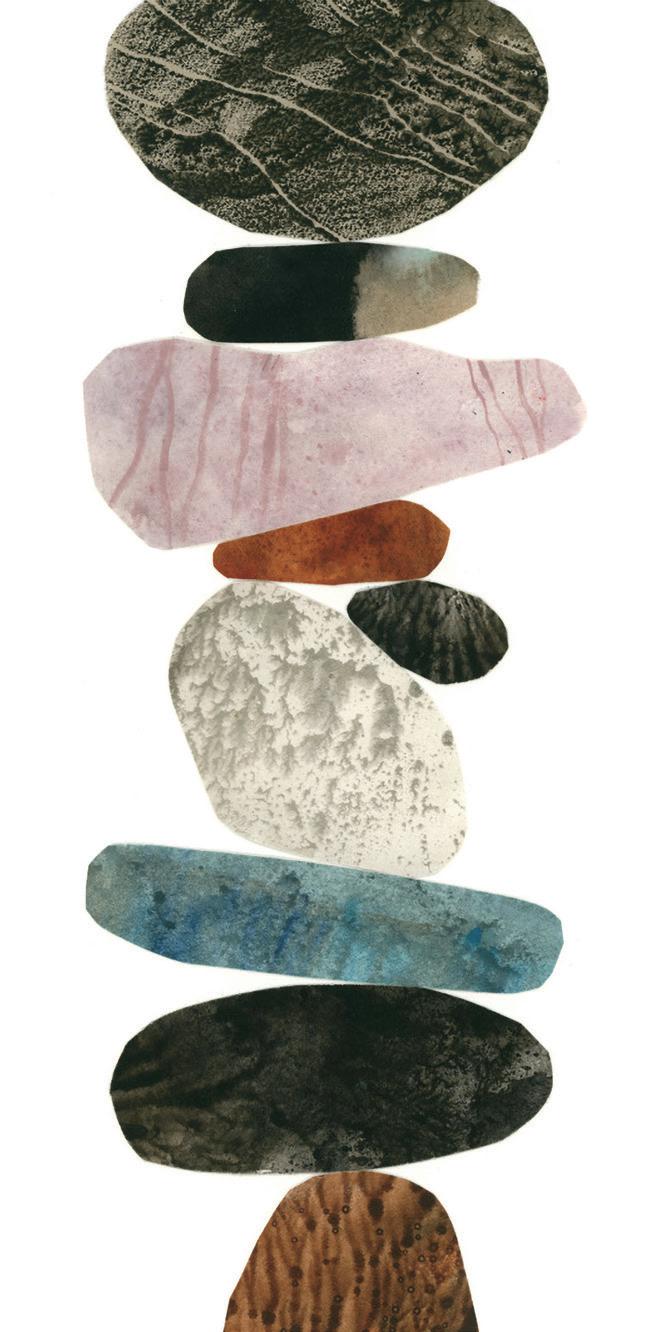
Any rock can be important, even if only you know the reasons.
—MARY LYN RAY
FINE PRINT elements across the genres
RECOMMENDED READING BY JANINE VANGOOL
ILLUSTRATION BY FELICITA SALA
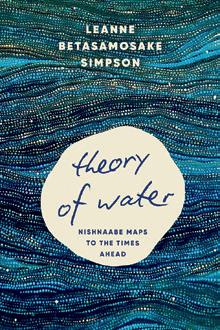
Theory of Water: Nishnaabe Maps to the Times Ahead
BY LEANNE BETASAMOSAKE SIMPSON
“This start in life, in a womb filled with water, gives me a responsibility to remember, to speak out, to speak about waterways and shorelines.”
Michi Saagiig Nishnaabeg writer, musician and academic Leanne Betasamosake Simpson explores how water—Nibi in Anishinaabemowin (Ojibwe)— flows through all beings. Through the storied wisdom and spirituality of her elders, the expression of contemporary Indigenous performance and art, and the foundation of modern science, Theory of Water shows how water transcends borders, boundaries and “states.”
“Water is a network that facilitates communication and relationship between all forms of life,” she writes. Offering an emergent theory of Indigenous internationalism, she shows how we must think beyond ourselves, especially in these times of polycrises and climate concern.
“What does it mean to listen to water?” Simpson asks. “What does it mean to believe in water?” For her people, rushing water is the sound of her ancestors speaking. We should all be listening. leannesimpson.ca
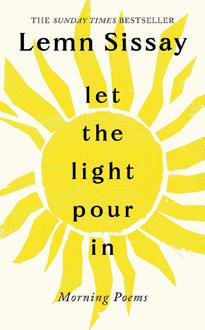
Let the Light Pour In
BY LEMN SISSAY
Day breaks
And a slit-yolk sun
Oozes on a lightly toasted And buttered sky
For thousands of mornings, British Ethiopian poet and playwright Lemn Sissay has composed a short poem at dawn. He describes it as “an experiment in hope.” The act was both a meditation and a personal challenge to find the brightness or truth of each new day, and Lemn shared his daily compositions on social media for a decade.
Each poem is just four lines, describing the specific, universal, thoughtful or playful. “It can take seconds to read a poem but a lifetime to understand it,” he writes in the book’s introduction. This small paperback compiles what he decided were his best quatrains—one poem per page. Read it in the morning light and step into your day with poetry in mind.
With a cautious eye
She heard the cry of morning
So she lifted the lid off the sky
And let the light pour in lemnsissay.com
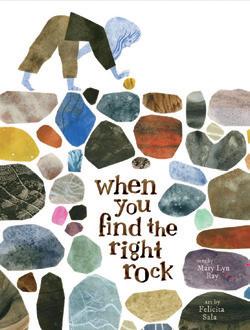
When You Find the Right Rock
BY MARY LYN RAY ILLUSTRATIONS BY FELICITA SALA
“Bigger rocks show you what heavy feels like. But small rocks can, too, if you have too many.”
Wherever it finds you, whether it be tumbled smooth on a beach or simply a pretty pebble on an urban path, pick it up and you will know when you have found “your” rock. When you find the right rock, it will fit into your hand, warming to your person; a talisman of luck and comfort to keep in your pocket.
Mary Lyn Ray’s book is a poetic metaphor of rocks big and small. The book explores the weight of ideas: of our individuality and yet how we are all interconnected. Its text is playful yet contemplative.
This is a children’s book that’s also for everyone, beautifully illustrated with textural shapes by Felicita Sala.
marylynray.com felicitasala.com
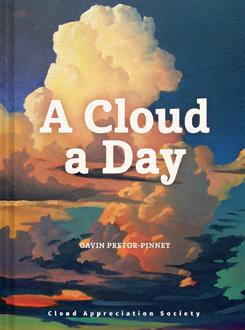
A Cloud a Day
BY GAVIN PRETOR-PINNEY
“Clouds are the embodiment of chaos and complexity. Why do they change so unpredictably? What accounts for their dynamic, ever-shifting forms?”
Cloud Appreciation Society founder Gavin Pretor-Pinney answers this question: “Clouds change appearance so much because of the unique qualities of water. It is the only substance on our planet that is found naturally in the three states of solid, liquid and gas.” Shifting states—vapour, liquid, ice—turn water in our skies from invisible to visible, often with dramatic and beautiful results.
Cumulonimbus, altocumulus stratiformis perlucidus… Learn the nomenclature and science of clouds, one day and one formation at a time. Art, photography and the occasional quote from literature are used to capture and interpret these ephemeral and atmospheric forms. The book includes photographs from Cloud Appreciation Society members, sky and space photographs from science organizations like NASA and paintings from art history (think Vincent van Gogh’s depictions of swirling night skies).
cloudappreciationsociety.org
THIS IS A LOW RES PREVIEW OF A HIGH QUALITY QUARTERLY PRINT MAGAZINE
PLEASE SUBSCRIBE
seeingmyselffor
MARNIE HAWSON
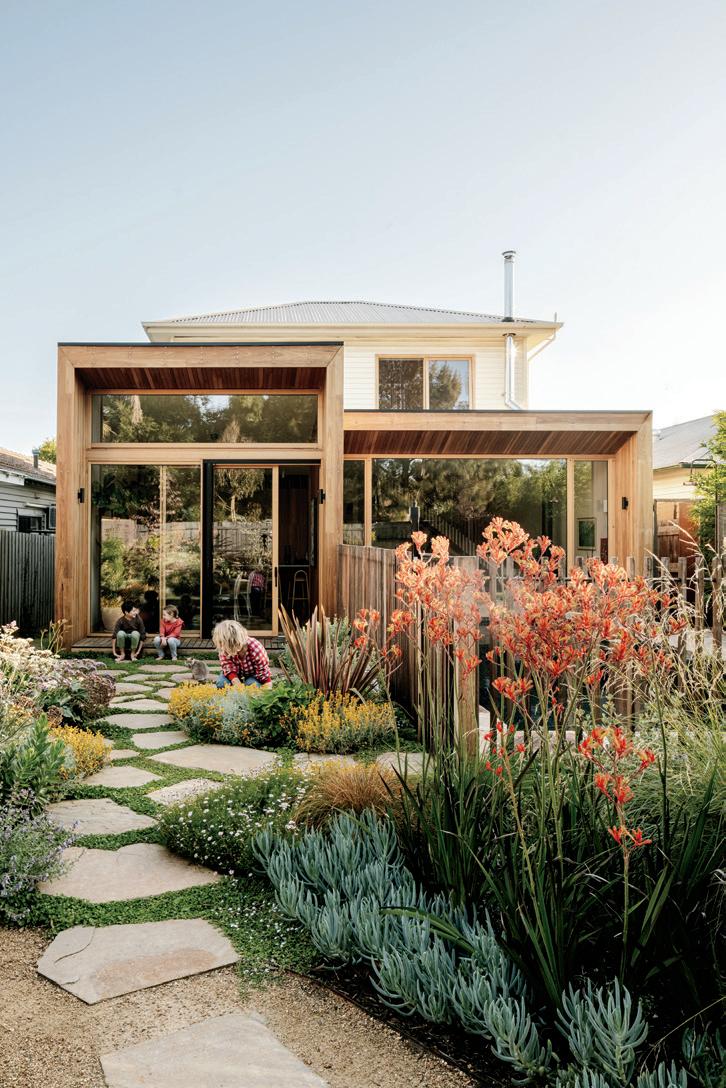
There is a lot of talk right now about artificial intelligence and whether it will replace creative jobs. As a photographer, it would be easy to feel nervous. AI can already conjure a picture of any house you can imagine—real or not. On paper, that sounds like competition.
But the truth is, AI might be able to generate a picture, but it cannot see
Photography is not just showing what a building looks like. It is about paying attention to the light, the textures, the stillness or the energy of a room. It is about noticing the shadows on a wall, or the way timbre fades in colour as it ages. It is about waiting until the light softens, or for the breeze to catch the curtains so that the space feels alive.
That is the difference between a picture and a photograph.
When people tell me they can recognize my images in a magazine without checking the credits, I take that as the highest compliment. What they are noticing is not just style, it is the accumulation of all those choices and observations I make in the moment—the framing, the light, the instinct to capture the mood rather than the obvious shot.
Photography is just as much about what you do not include. Architectural projects are full of detail, but part of my job is knowing what to leave out so that the image feels calm and true to the space. Sometimes that means pulling right back and letting the house sit quietly in the landscape. Other times it is cropping in close to let one material or detail be the hero.
Editing with your eye is every bit as important as pressing the shutter.
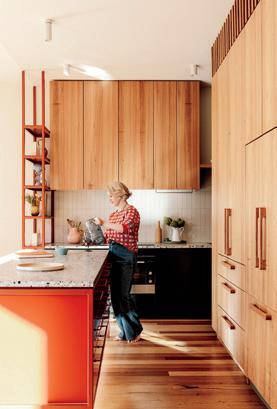
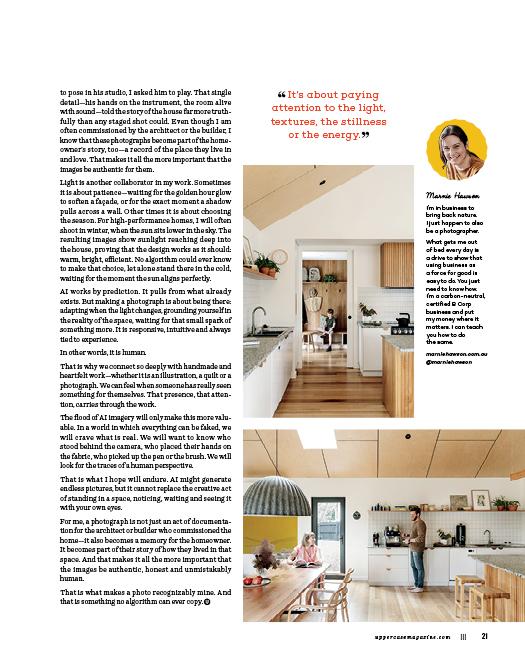
Including people in photographs is the same. A posed homeowner, standing stiffly in the middle of a room, rarely feels authentic. Instead, I will ask questions: Who spends the most time in this kitchen? Who actually cooks here? Who cares for the garden? The answers matter, because those are the people who should appear in the frame. A photograph of someone preparing food in the kitchen they love tells a truer story than a staged portrait ever could. In a garden, I would rather show the person who tends the soil, their hands dirty, than someone placed there for effect. Recently, I photographed a home designed partly around a musician’s studio. Instead of asking him
STORY AND PHOTOS BY
a crosswalk for Pride
Erwin Ong
Using our creativity for good is one of the best ways we can make a difference. Through design, art and craft— and with our hands and hearts—we can effect change. However small it may seem at first, each incremental effort is still significant. Share your Make It Worthwhile projects to be featured in the magazine or the UPPERCASE newsletter.
uppercasemagazine.com/ participate
WHITE PLAINS, NEW YORK, USA
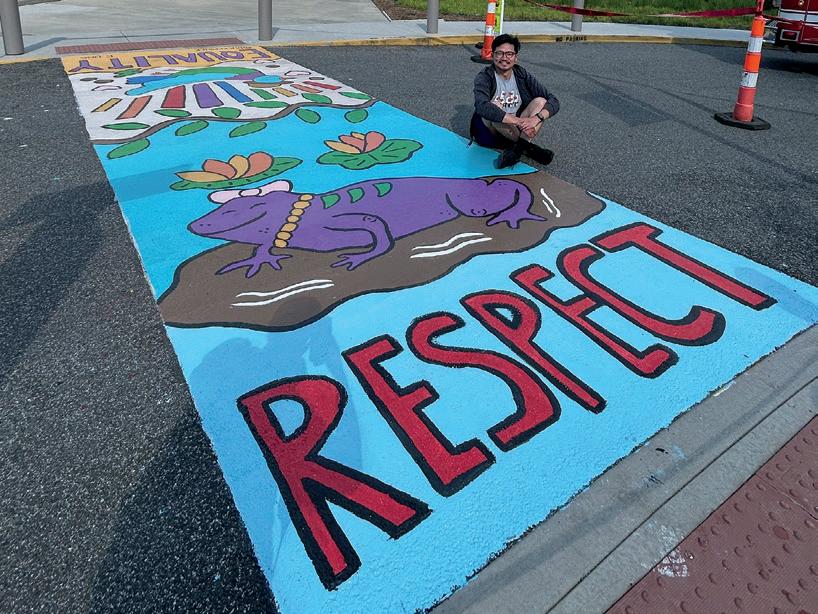
I am an illustrator who makes bright and happy artwork inspired by nature. Earlier this year, I submitted to an open call to design crosswalk murals to celebrate Pride in the town of Wilton, Connecticut. The murals were to be painted by the community.
As a member of the queer community, and an advocate for safer streets, I designed the crosswalks to be a pedestrianfirst experience, with words and illustrations that could be viewed as one walks across the crosswalk in either direction. I want pedestrians to feel empowered
by the positive and uplifting words that are at the heart of the LGBTQIA+ community.
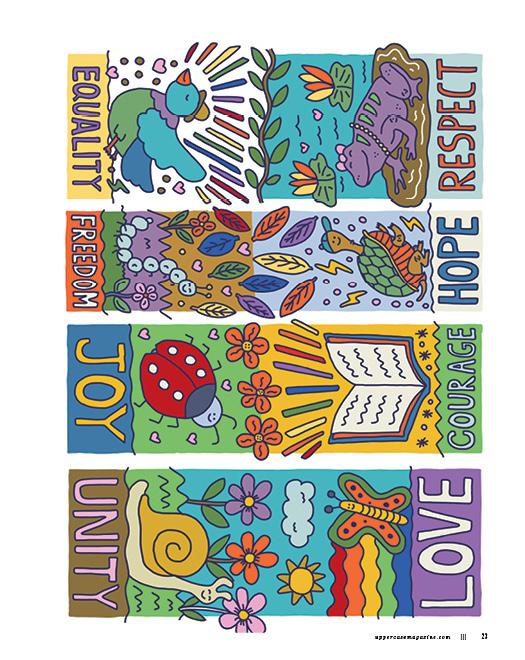
At the outset, I wanted to think beyond the Progressive Pride flag or rainbows for the design. In honour of Pride, I used the flag’s colour palette on illustrations of animals and plants. Through a colourful crosswalk adorned with plants and animals, I wanted to remind the community about our connection to each other as neighbours sharing a public space, as people who deserve equal rights and as humans taking care of the environment.
aduckamuck.com @duckamuck
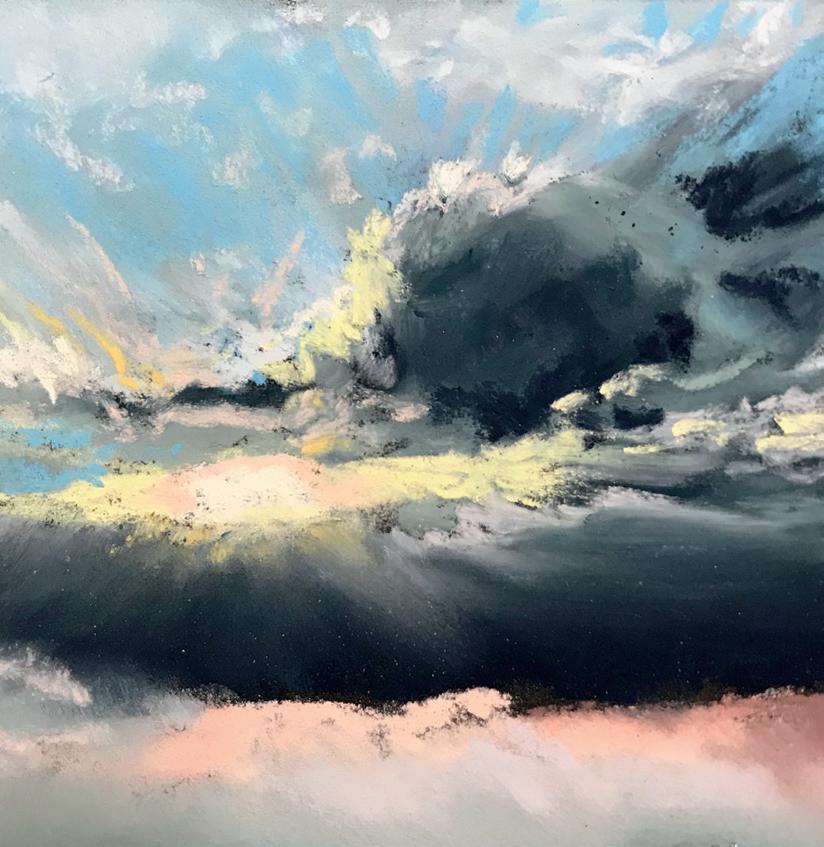
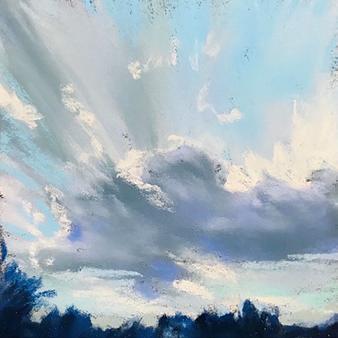
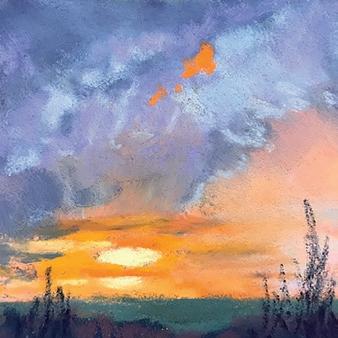
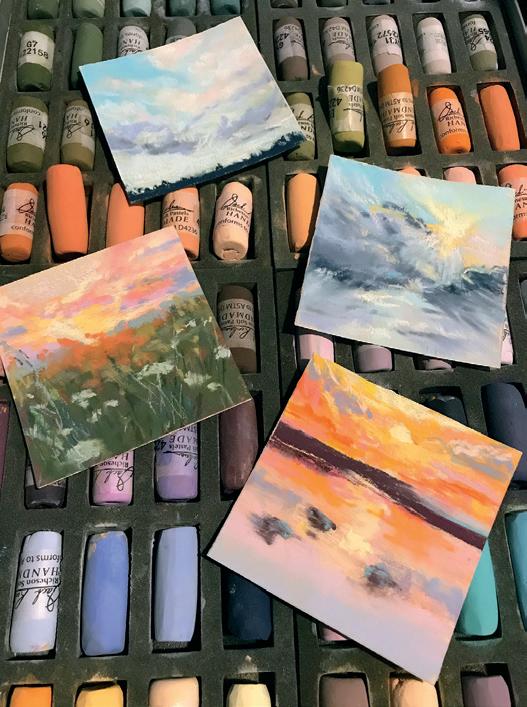
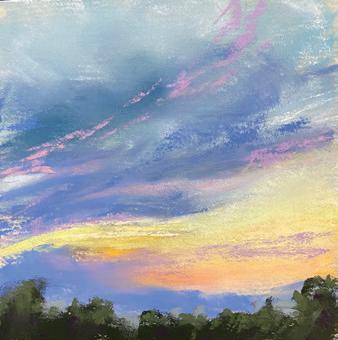
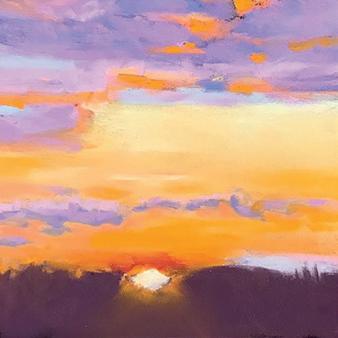
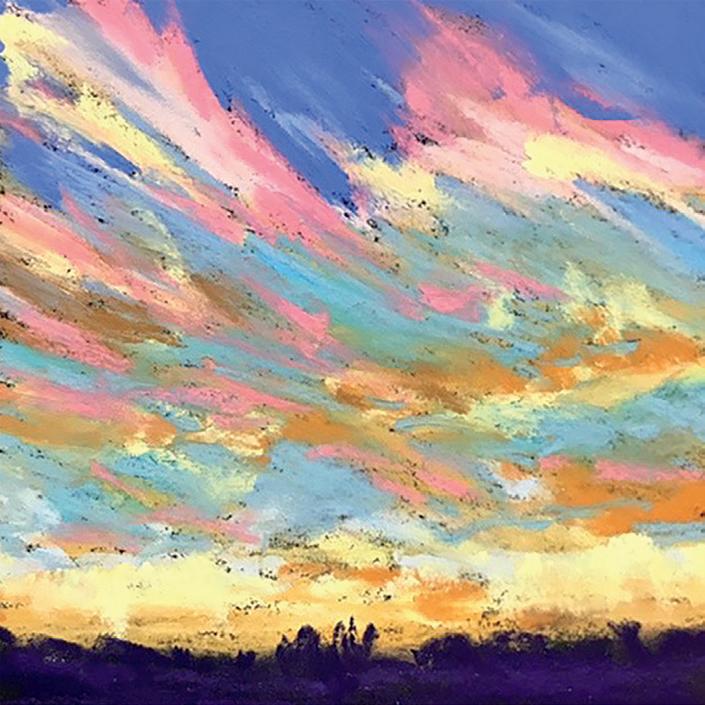
100 days of skies
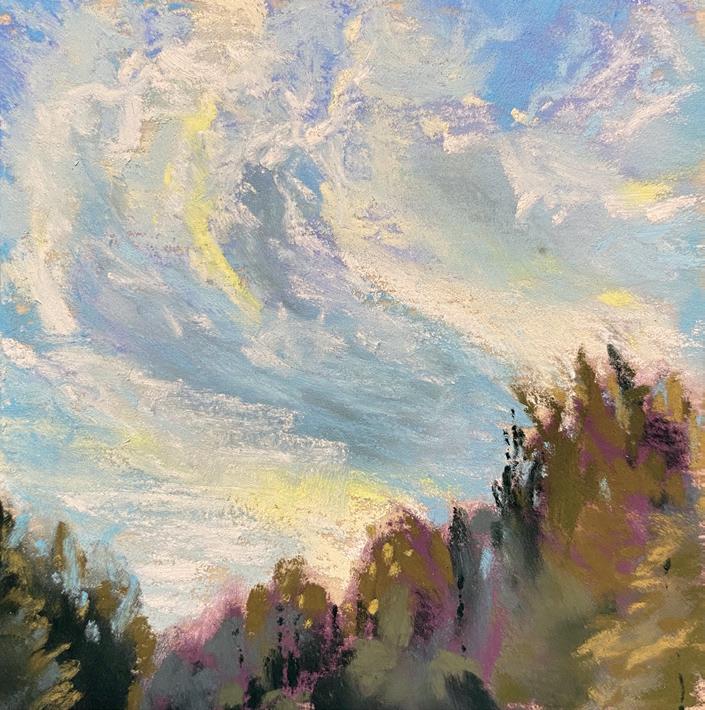
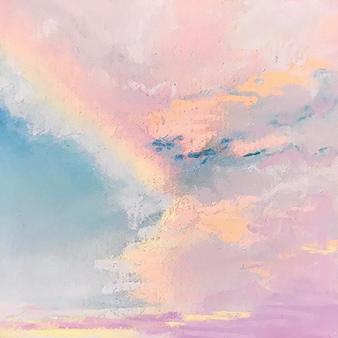
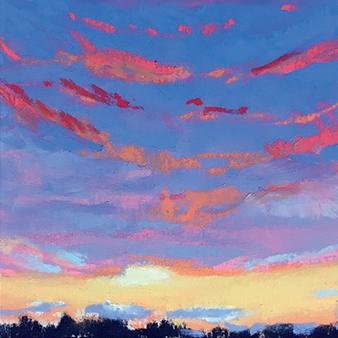
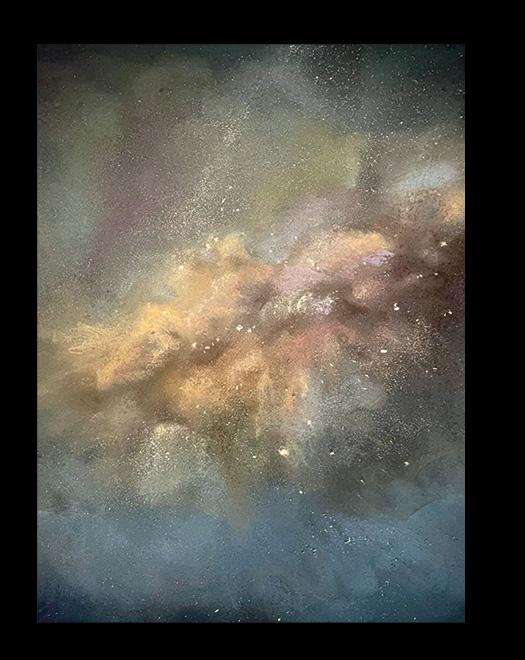
For artist Laura Dechaine of Terryville, Connecticut, the sky was the limit when she began her first 100-day art challenge. “I’ve always been drawn to clouds, especially the colours of sunsets and storm clouds,” she says. With plenty of reference shots already gathered on her phone—and new inspiration to be found by simply looking up— depicting clouds was a natural choice. “I’m a creative person who is constantly inspired by nature— whether it’s the way the sunlight wraps around the side of a tree or the subtlety of colour on the petals of a flower.”
Using a variety of soft pastels, Laura kept the images small at just three-inches square to keep the daily project manageable. “I’m happy to report, I finished all 100 mini paintings.”
She has since participated in four other challenges. “Not all of them were successful in terms of finishing. However, I did learn a lot about myself, the materials and the wonderful Instagram community from the daily repetition.”
Her advice to others wishing to embark on a long-term creative pursuit? “Listen to the song in your heart and just go for it. That desire is there for a reason, so please show up for yourself and share your gift with the world.”
lauradechaine.com
@laura.dechaine
in our elements
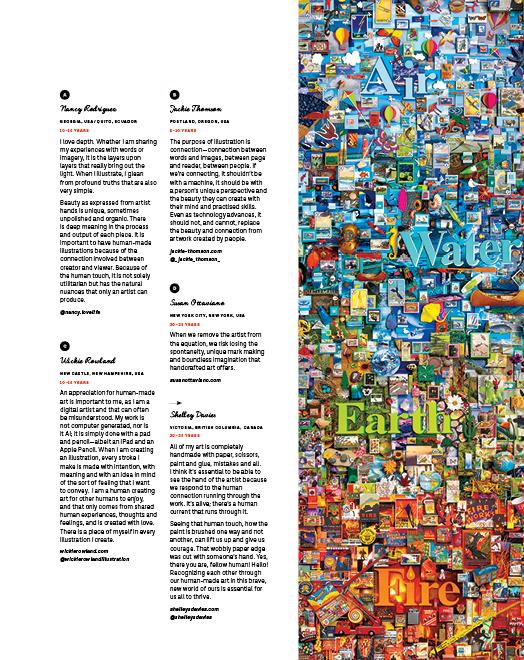
For thousands of years, humans have used their own creative faculties to transform vague visions and fleeting moments of inspiration into tangible realities, extracting art from the ether within and around their corporeal minds. Like the elements themselves, creativity is an unstoppable, untamable force that operates according to its own laws. However, over the last half decade, another force has elbowed its way in, and our lives have become increasingly inundated by the uncontainable rise of artificial intelligence–generated art. For the creative spirit, this invasion seems more of a blow than a boon, delegitimizing the human and organic nature of art itself. AI has slowly descended onto the creative landscape, becoming an all-encompassing and inescapable part of our day-today. With its pervasive nature, this fifth element has seemingly been added to the building blocks that make up our world: air, water, fire, earth—and AI.
ARTICLE BY MELANIE ROLLER
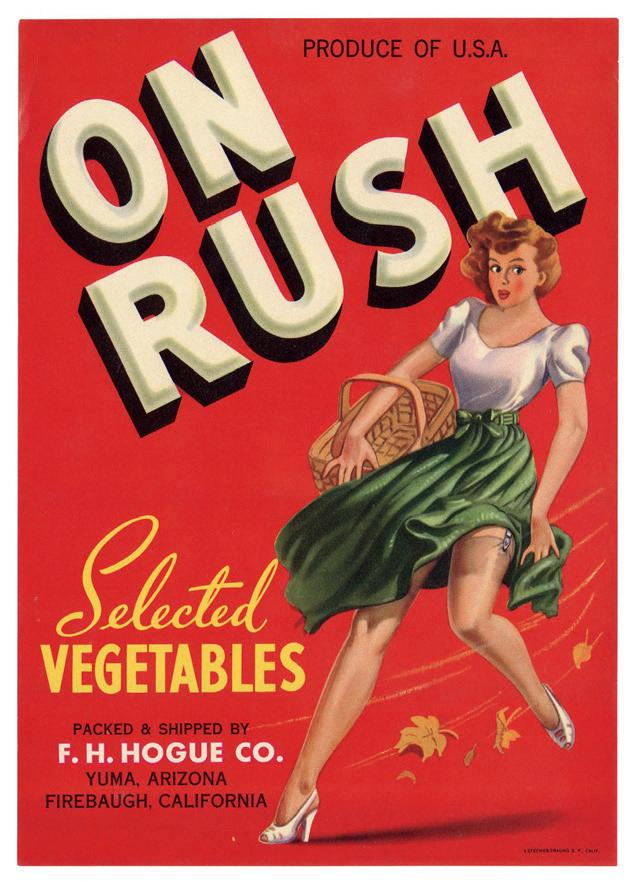
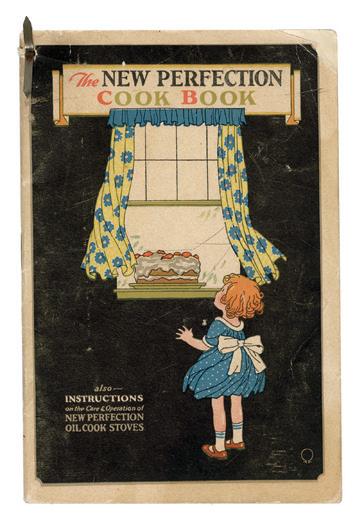
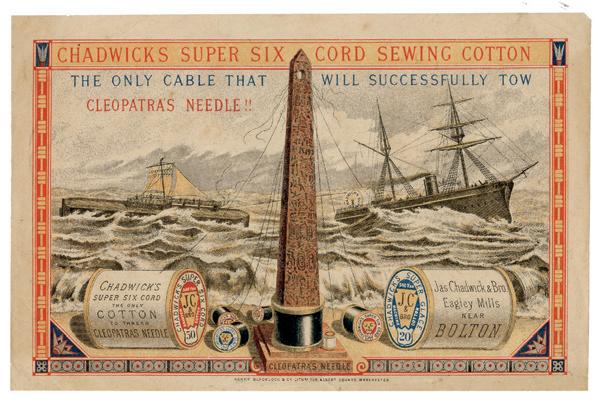
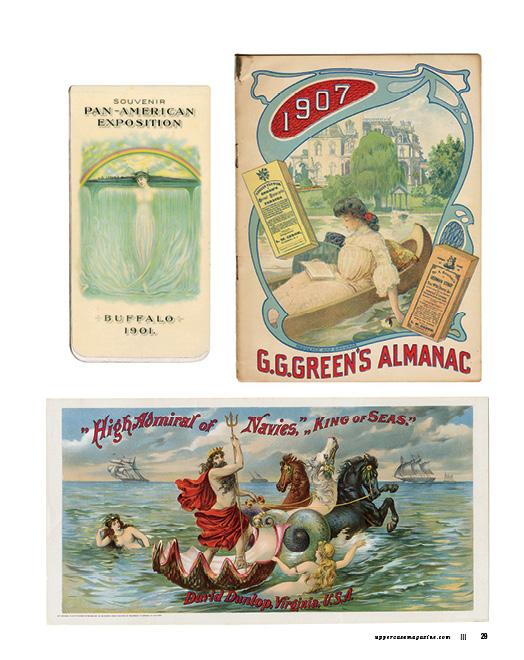
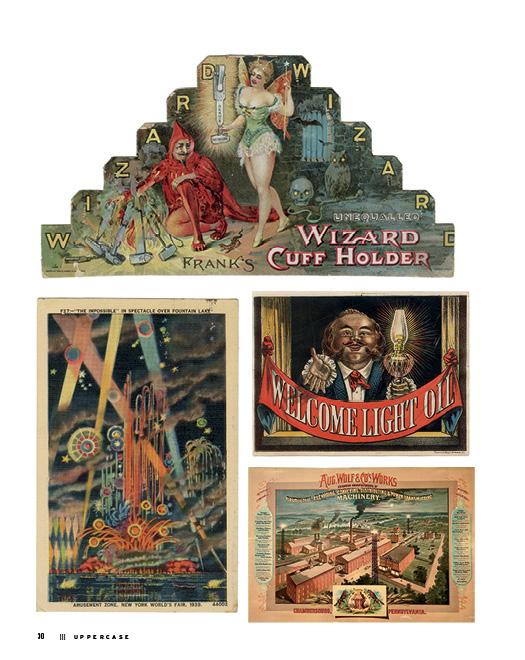
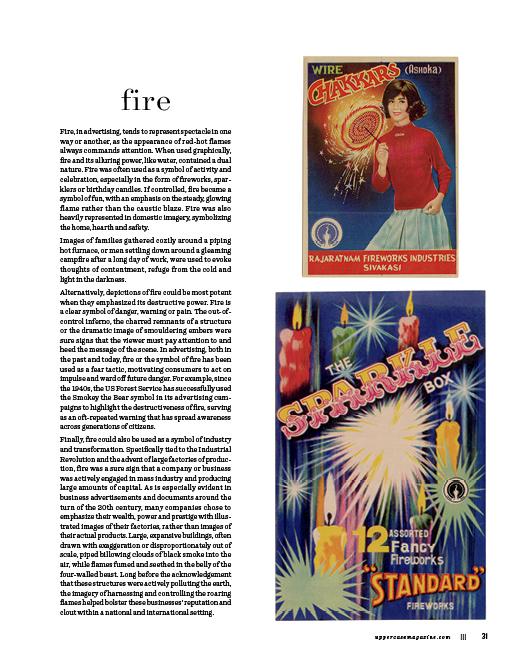
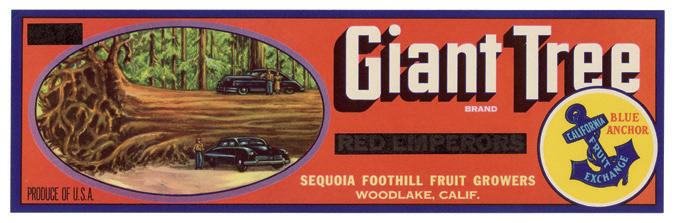
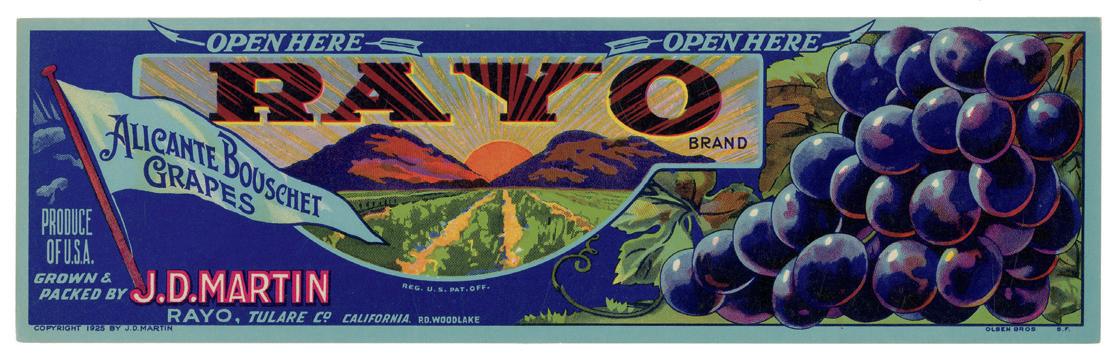
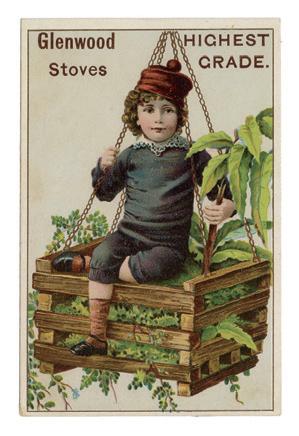
Although ephemera and antique/vintage graphics are not immune to the enervating interference of AI, their tactile existence ensures their survival and, to an extent, the fidelity of their original forms. Guided by the stalwart elements of creativity and design, creators, artists and advertisers of the past drew inspiration from the tangible world around them, often drawing on the aforementioned four original elements to convey their larger messages and describe their world. Like the elements of design, the use of these classical elements created a visual conversation that was accessible to the broad general public, through the most human of tools: eyes, hands and minds— no AI required.
FROM THE COLLECTION OF MARK E. SACKETT
air
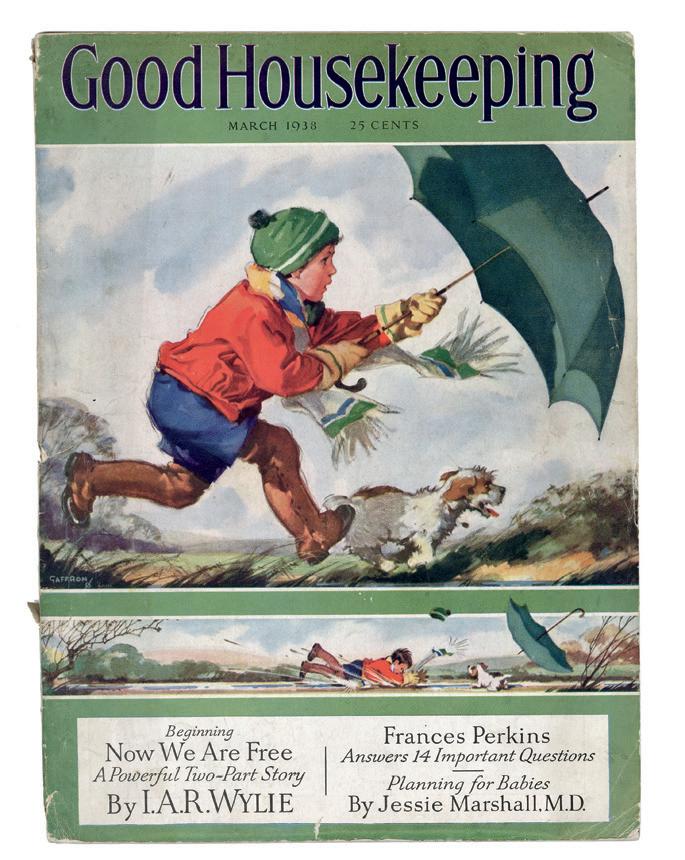
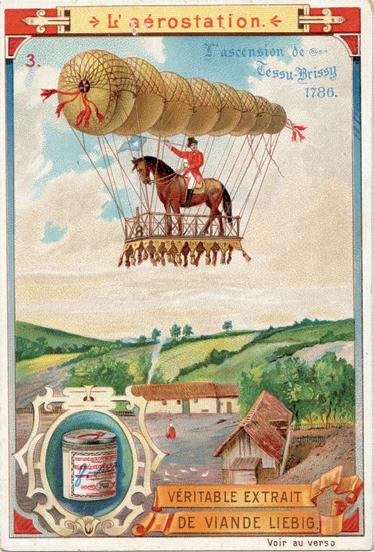
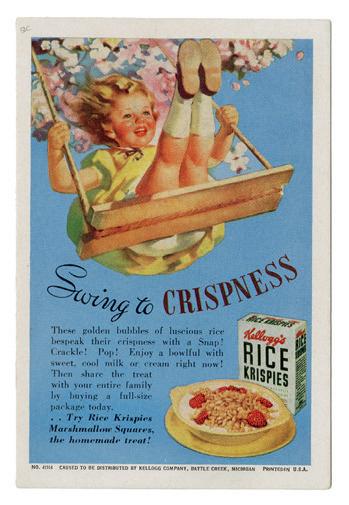
The metaphorical and literal elements of air allowed advertisers to highlight the light, carefree or easybreezy quality of an image or a product that their images portrayed. Often, air came to symbolize freedom and levity in commercial art. For this reason, images of childhood, and children themselves, played a significant role in these graphics. Light-hearted scenes of children accepting colourful, floating balloons, rushing breathlessly through the atmosphere upon a wood-planked swing, or chasing a runaway umbrella down the road emphasized a feeling of carefree abandon and an understanding that life is sometimes simpler than it seems when viewed through the eyes of a child.
Air could also be used to express the circulation of ideas, the impact of intellect and human ingenuity in general. In an association reaching back to the god Hermes (or Mercury), whose winged sandals carried him through the air, heralding the arrival of news and the dissemination of knowledge, the element of air is often associated with quick movement and the efficiency of technology. The early 20th century was particularly fascinated with this symbol in conjunction with the dawn of aviation and the rise of air travel, which would eventually culminate in the development of space travel. Planes, blimps, flying machines and rockets featured heavily in advertising throughout the century, capitalizing on the collective fascination with aviation as a symbol of modernity and as commentary on the staggering speed with which objects, information and news could now travel.
water
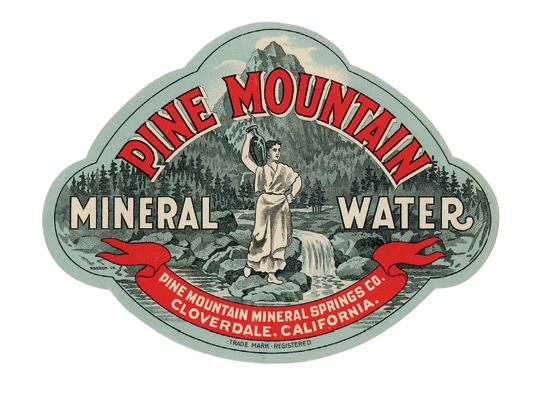
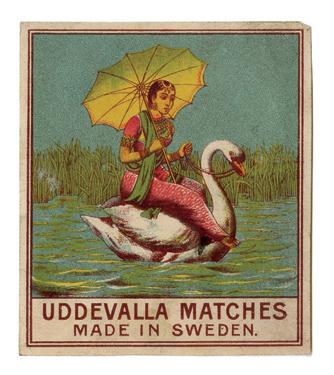
Water, like its sibling element, air, could also be viewed as a symbol of commerce and connection. From ancient times, waterways and the invention of water-traversable crafts opened the world up to new cultures and ideas, effectively stitching together the disparately populated and spread-out world. Even into the 20th century, the imagery of ships, sea travel and naval strength evoked the influence that global powers exerted over humanity through the sea, as well as the vast amount of commerce and transportation made possible through private and commercial fleets.
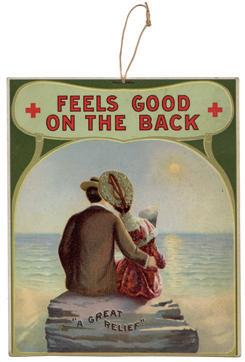
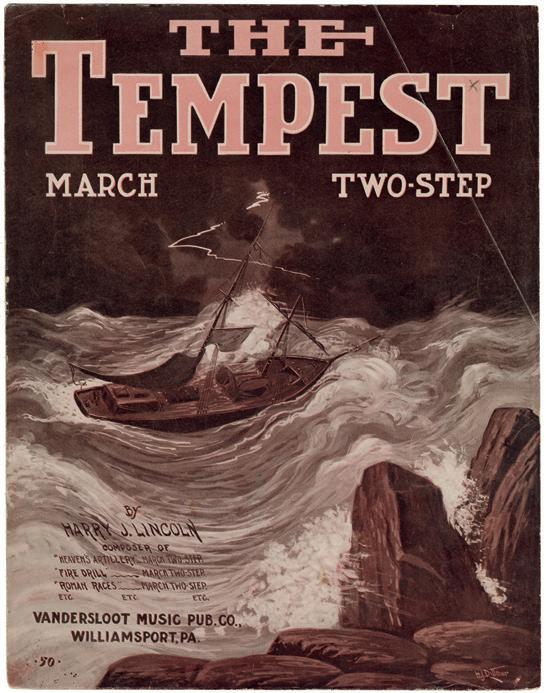
In a more relatable sense, water could also be seen as representing equilibrium and the consistency of—or disruption of—stability, whether mentally or situationally. For this reason, water imagery was often linked to emotional states, and water was used to emphasize the overall atmosphere of a larger image. Advertising depicting stormy seas or rough waters frequently pointed to a problem that the consumer must confront, whether with or without the product offered in the advertisement, in order to navigate into safer waters. On the flip side, water imagery also emphasized smooth sailing and recreation, particularly in relation to healing or health. The peaceful and calming nature of water stressed to the viewer that all was well and would remain so as long as one remained fluid, not fighting against the current of life. Many images featuring a body of water also featured a young couple in the frame, with the adjacent water body representing not only the peace, placidity and general contentedness they seemed to feel in one another’s presence, but also the depths of emotions at play.
earth
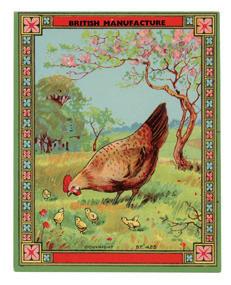
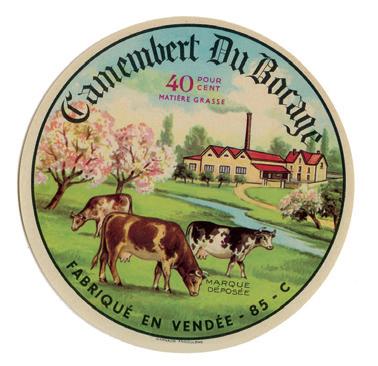
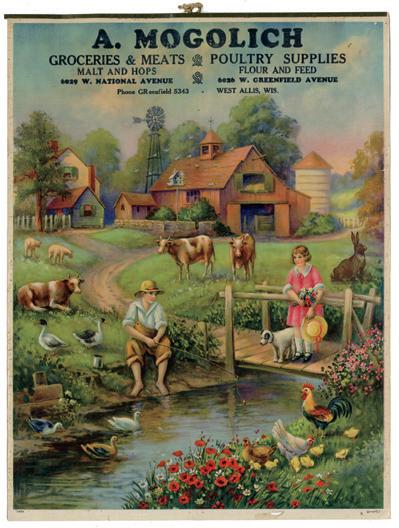
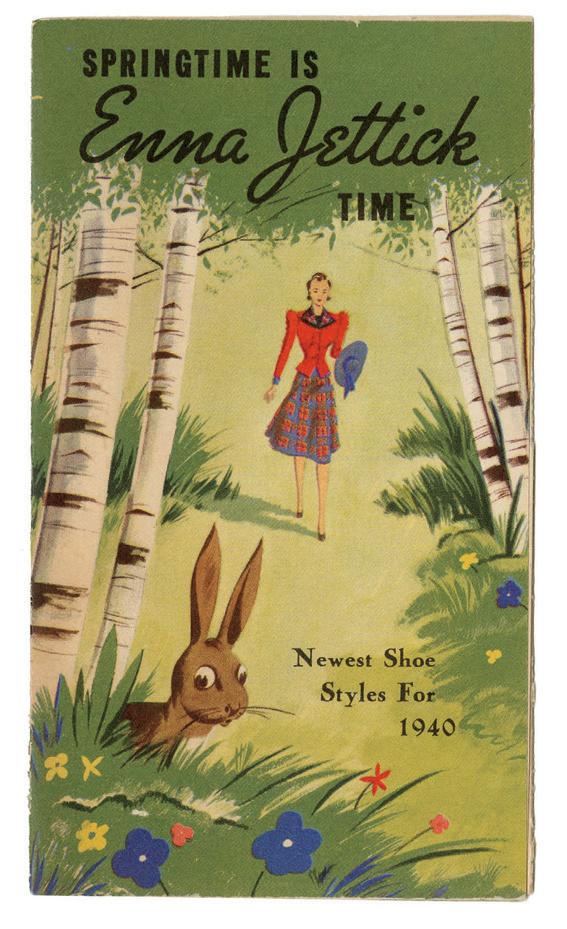
Finally, a conversation on the elements could not be complete without the life-sustaining earth. Within ephemera and antique advertising, earth is tied to stability, remaining grounded and the general feeling of peace associated with pastoral and natural scenery. Imagery of farms, agriculture and gardening played a significant role in advertisements, emphasizing the “natural” and “pure” aspects of a product or service. The fundamental association was that something produced or promoted in a natural setting was itself rooted in the earth and must be not only healthy but also safe.
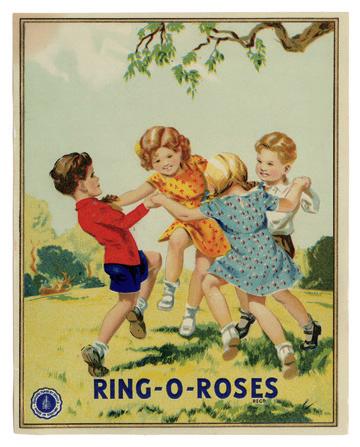
Also significant was the role that youth, rebirth and renewal played in the symbolism. Much imagery that used a natural setting also featured young children, baby animals or emblems of spring. Bucolic surroundings abound, with children dancing breezily in a circle atop a flower-dotted field or lazily fishing while barnyard animals frolic about. This idyllic imagery conveyed the freshness of nature and the bounty of the larger natural world. Likewise, images of motherhood also came into play with this type of advertising, specifically designed to appeal to the female consumer who purchased not only for herself, but for her family.
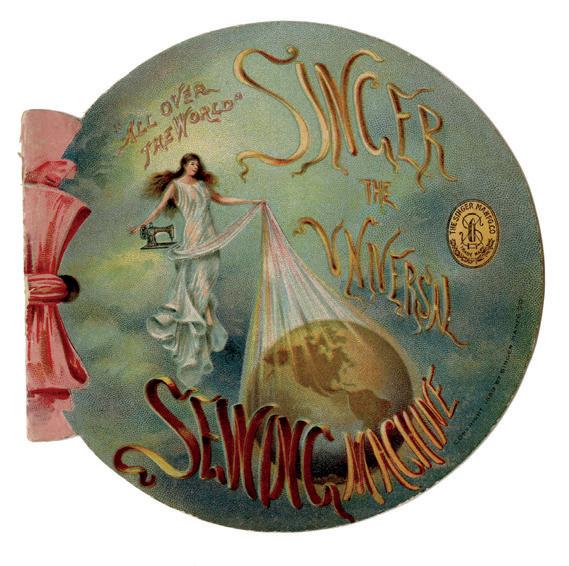
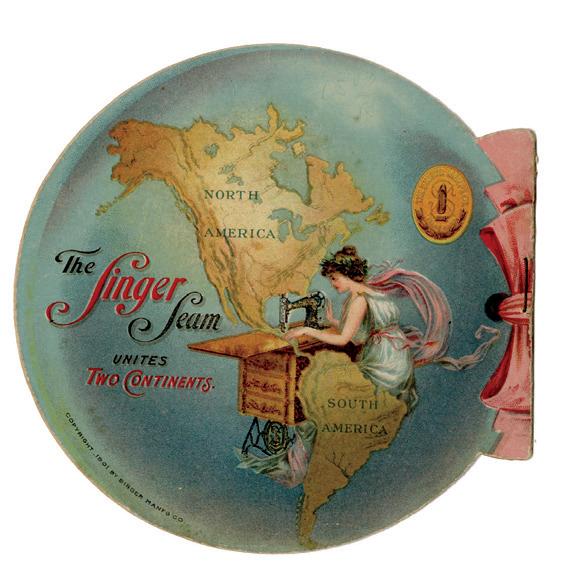
Lastly, the element of earth could be taken quite literally, focusing on the role that the planet itself played in the purchaser’s day-to-day life. As the world became a much smaller place during the 19th and 20th centuries, the interconnectivity and unified nature of the earth as an ecosystem began to be more heavily acknowledged. Although racism, xenophobia and classism still reigned supreme, the idea that all of humanity could now be tied and connected through commerce and travel played more heavily into advertising and its associated imagery.
Only time will tell whether humanity allows AI to claim completely the creative landscape of our collective society or whether strict limits are placed on this relentless invasion. However, the essential elements of creativity, like the natural elements themselves, will always take precedence as the most organic, ethical and pure building blocks of creation, continuing to drive artists and creators to convey messages and produce authentic works born out of our inherent humanity.
theboxsf.com @theboxsfmercantile
ART & DESIGN
artist’s sketchbook:
A Safe Place to Play
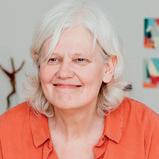
Janien Prummel
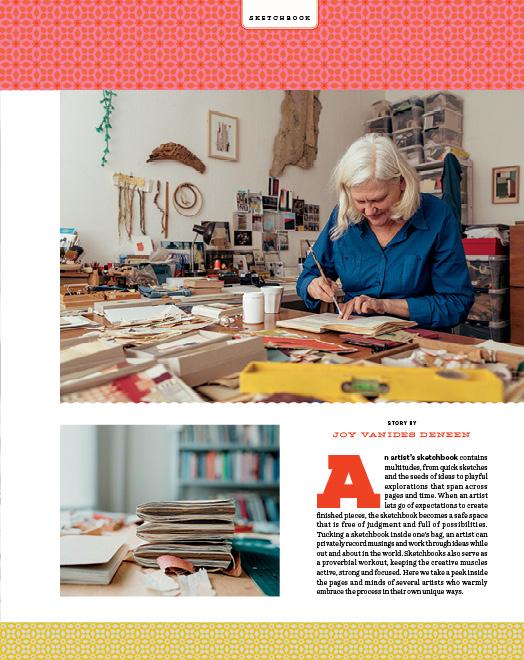
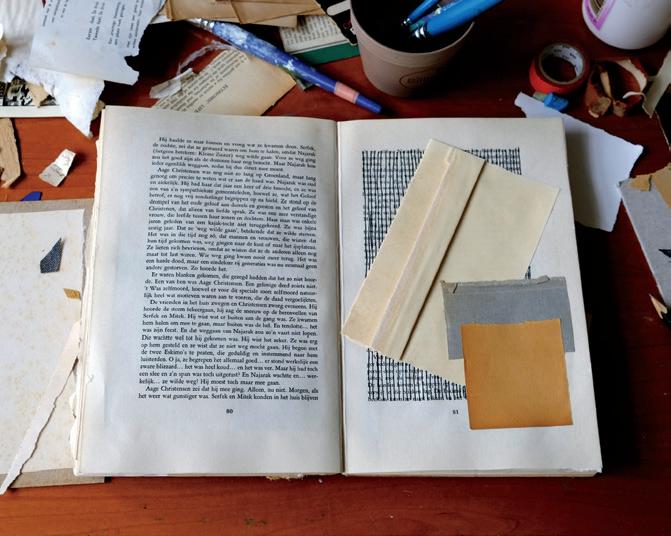
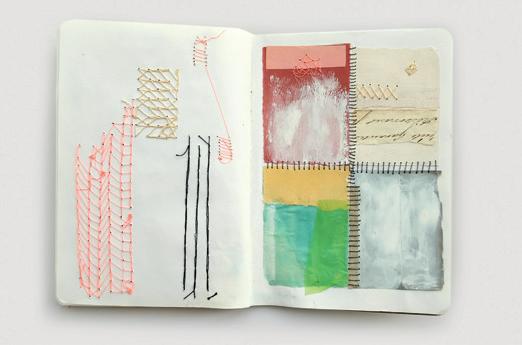
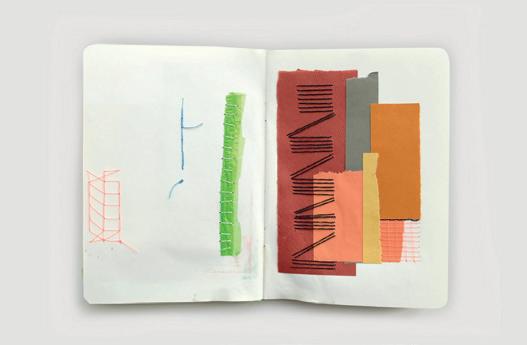
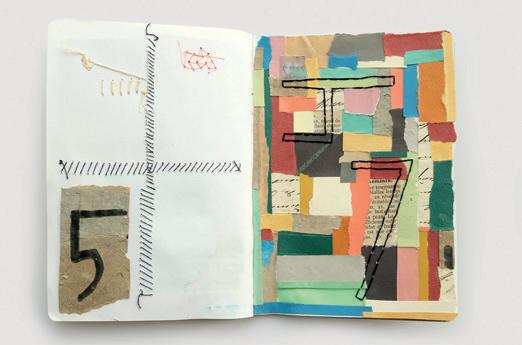
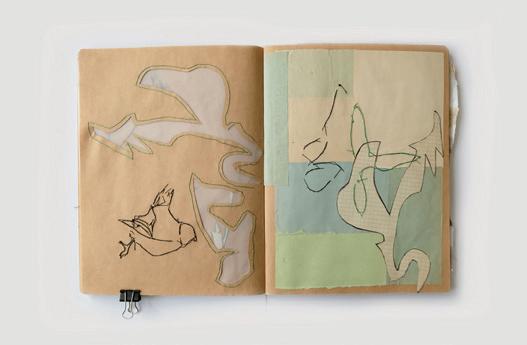
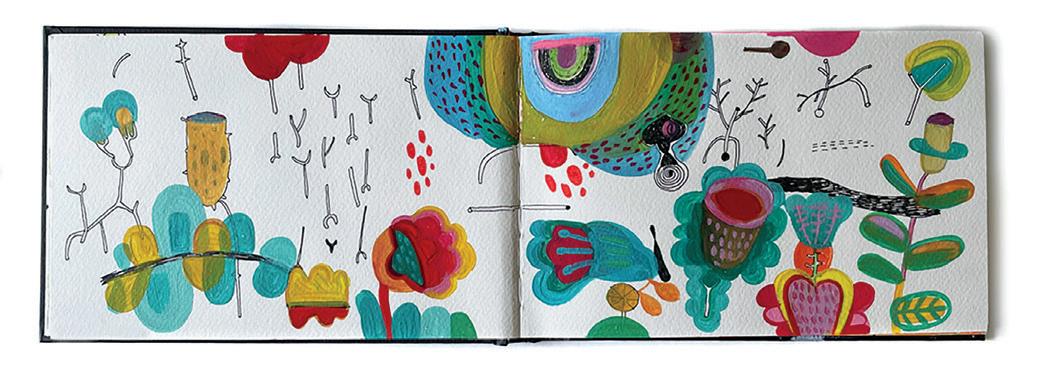
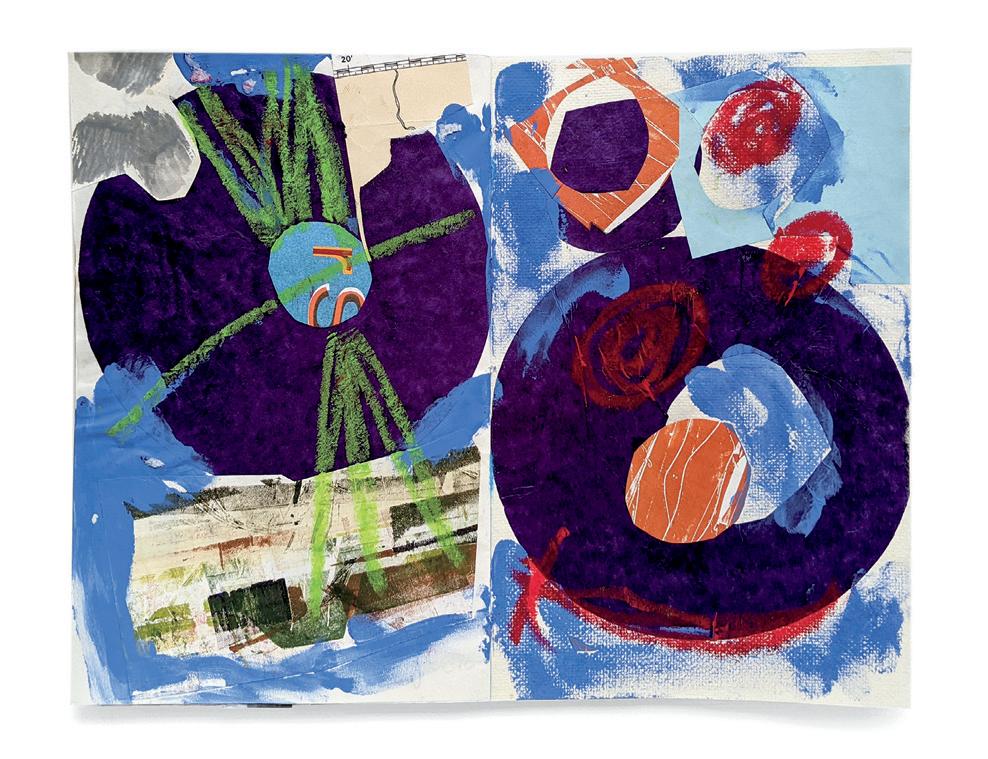
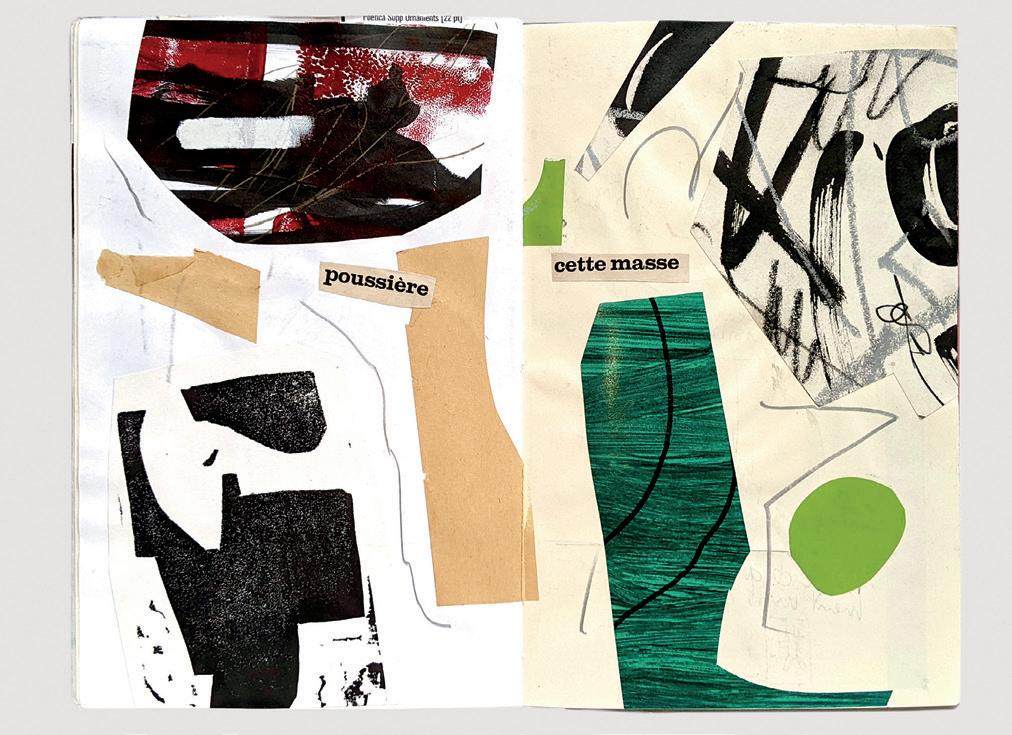
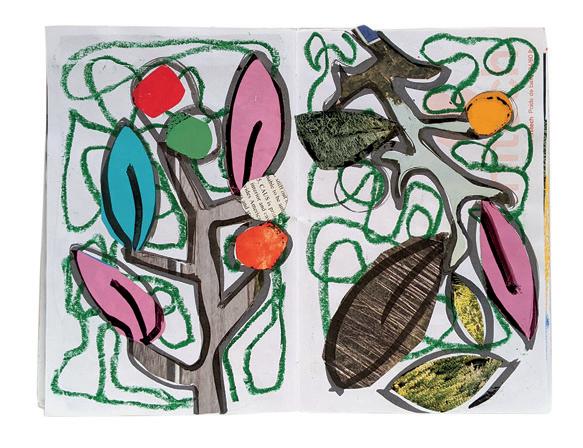
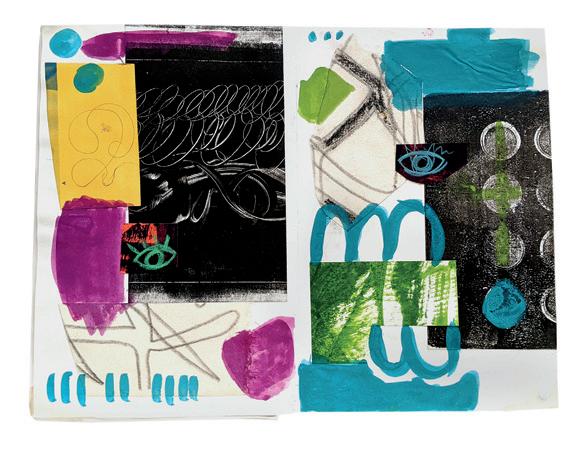
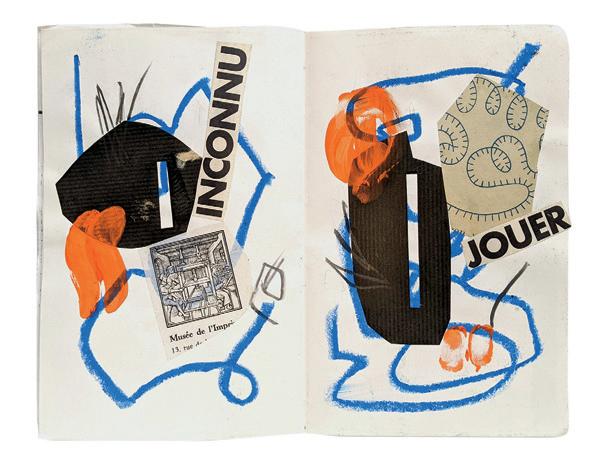
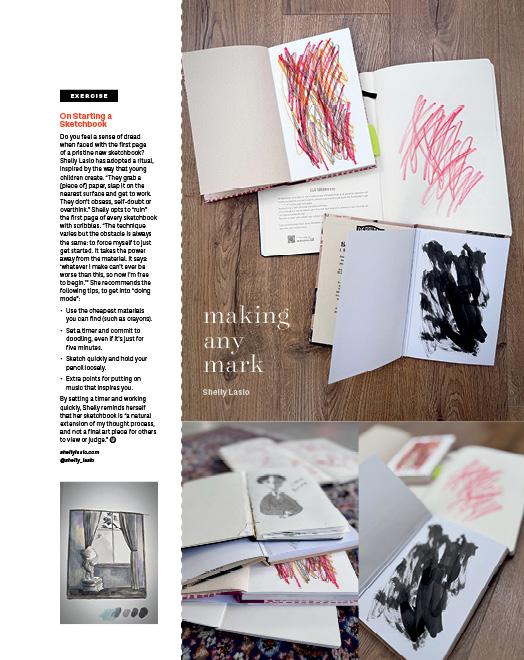
For Dutch mixed-media artist Janien Prummel, sketchbooks are her safe space. After finishing art school, she felt insecure but discovered that when she worked inside a sketchbook, she was less judgmental. “Working in a book is safe,” she says. “A sketch gives freedom because it doesn’t have to be finished. The making itself comes first. A book is wonderful because you turn the page and can start again. I have filled books without anyone seeing [inside]. In that safe, non-public and non-judgmental space, I found my self-confidence and creativity again.”
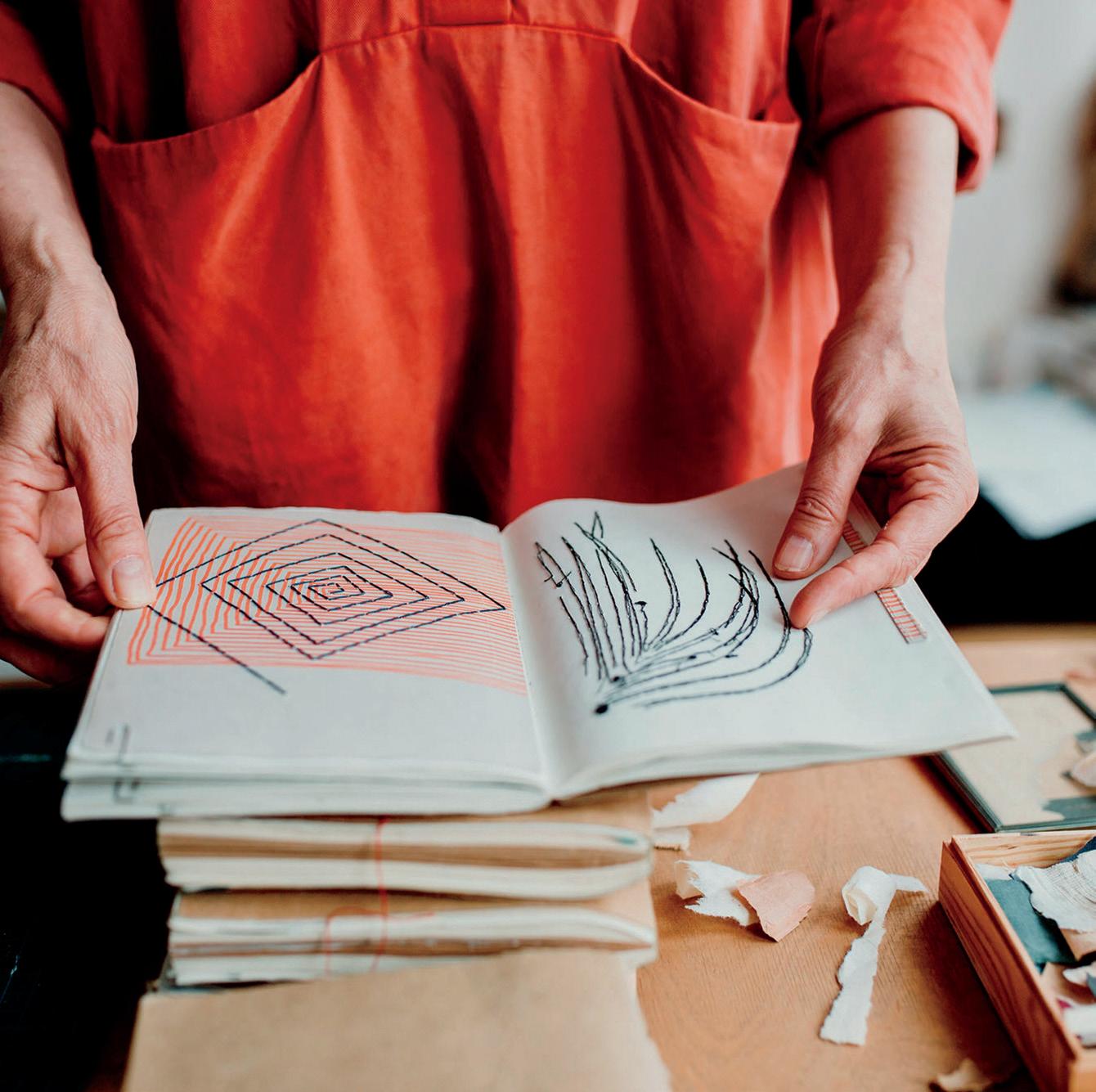
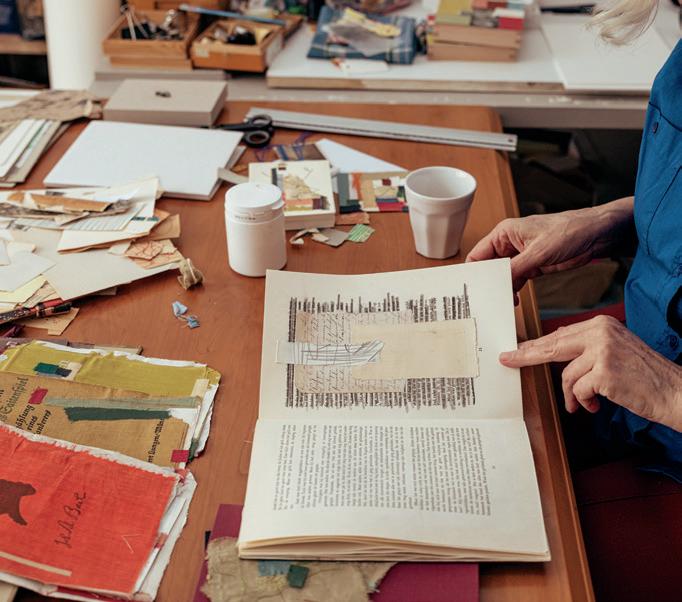
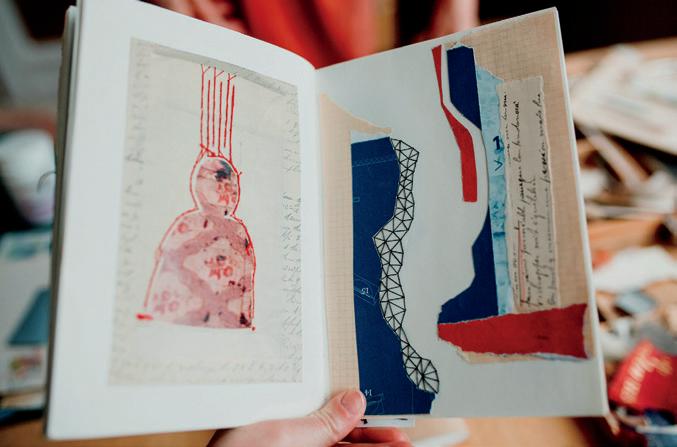
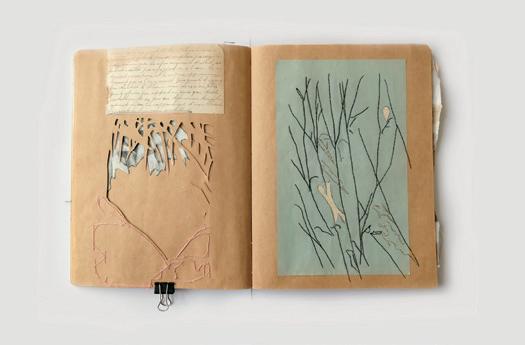
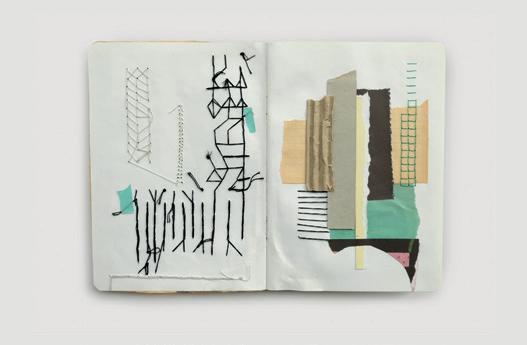
Working in sketchbooks also led Janien to discover her medium of choice: collage. “It works quickly and you can go in so many directions,” she says. Within her sketchbook, she explores narrative and abstract possibilities, using self-made papers, vintage materials and fabric, delighting in frayed edges. “[I shift] all those pieces back and forth until I feel a moment of balance that gives a sense of peace and pleasure. Each collage is an attempt to get a grip on the world, a sense of myself.” She also finds collage to be a form of play, which gives her peace of mind. She notes that sometimes the mood is right, and she feels playful and open. “But mostly you just have to start. Make a cup of coffee and open the book.” Sometimes giving herself restrictions opens her up to playing, like when she tells herself to use just one colour or make a grid. “When I’m in a bad mood, I just give myself permission to make something ugly. And it often turns out great.”
Janien always travels with her sketchbooks and collage materials, working on trains and boats, or inside tents. She doesn’t start with a plan, but rather reaches for the materials around her. “What reoccurs again and again is embroidery. I like to combine a collage with an embroidered element. In a book, embroidery works especially well because you can play with the front and back.” She also enjoys flipping through her sketchbooks, noting how differently she “reads” her work when it is inside a book. “The pages in succession start to work as a story.”
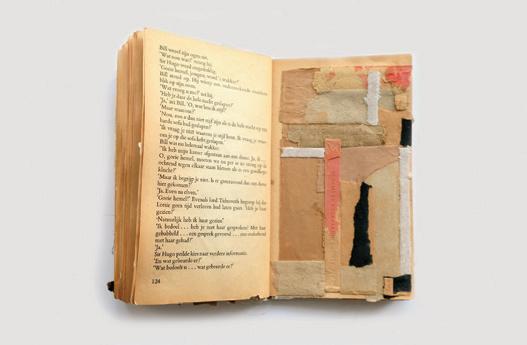
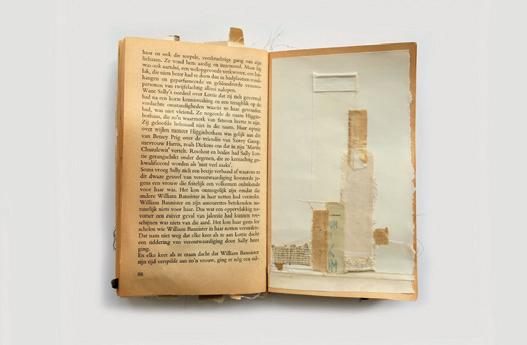
As of late, Janien has been using her sketchbooks “more consciously to explore a particular aspect, such as the relationship between drawing and collage, or the use of space in a composition.” She has also deconstructed old books, using all of the materials to create collages and then transforming the inside back into a sketchbook. “I want to reuse as much of the book as possible. In addition, in making the book, I expose the making process.”
janienprummel.be
@janienprummelart
EXERCISE
Playing with Shapes
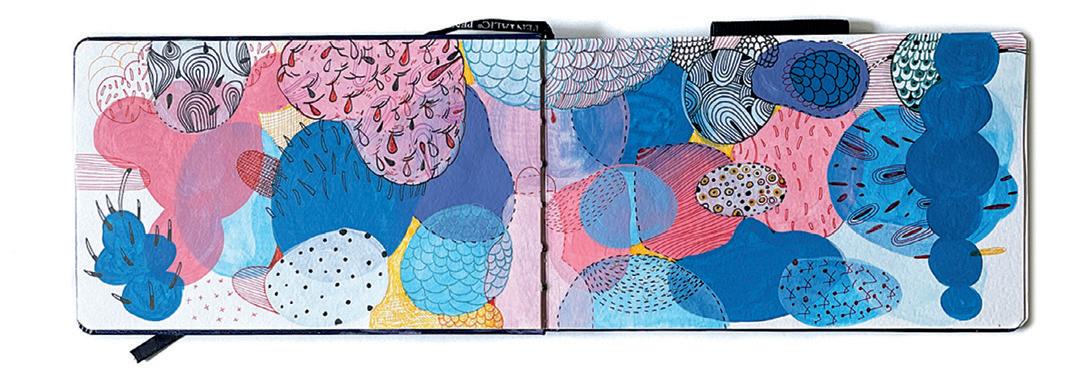
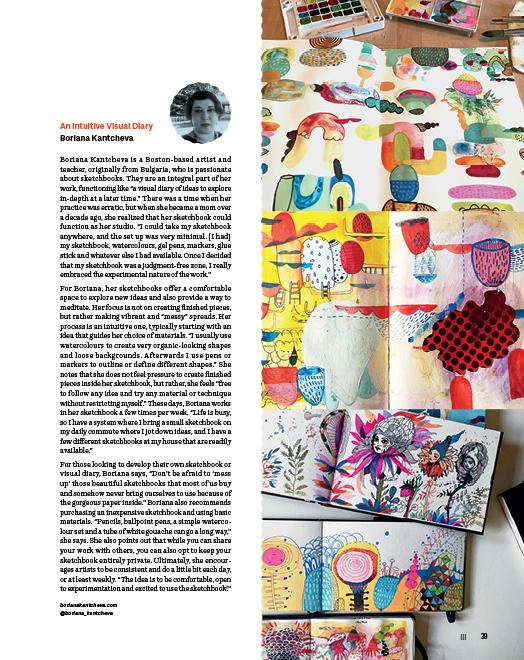
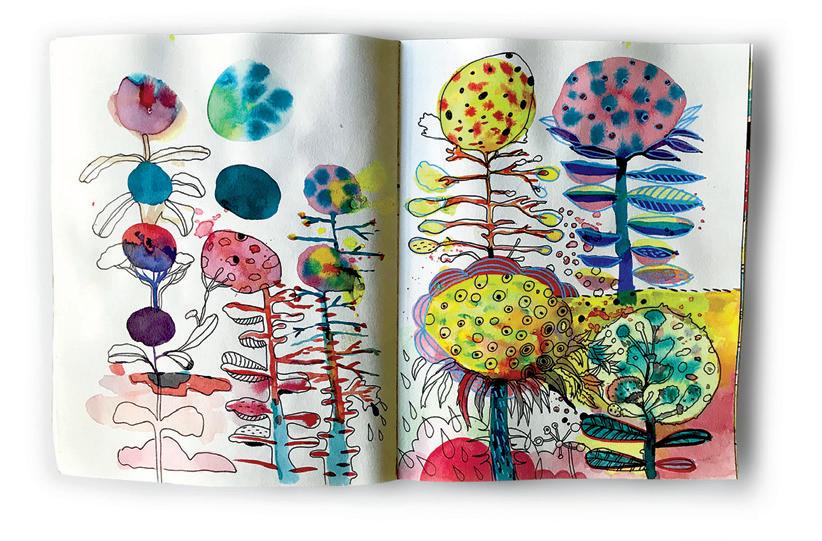
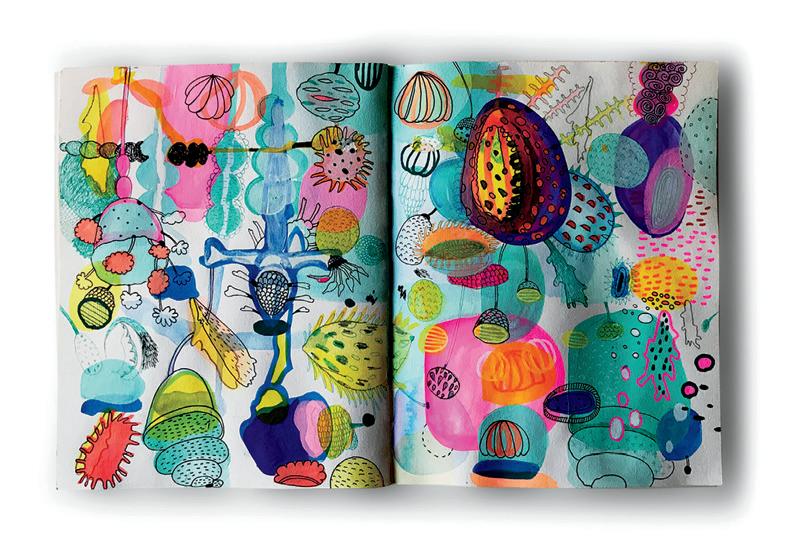
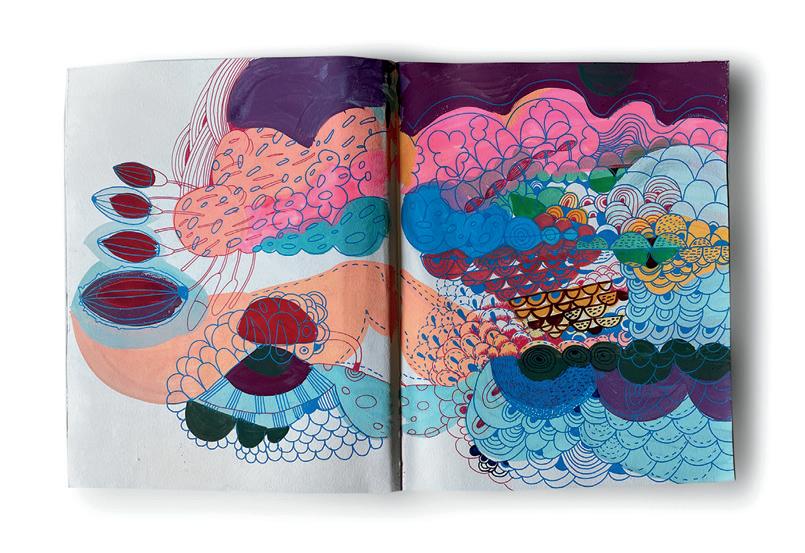
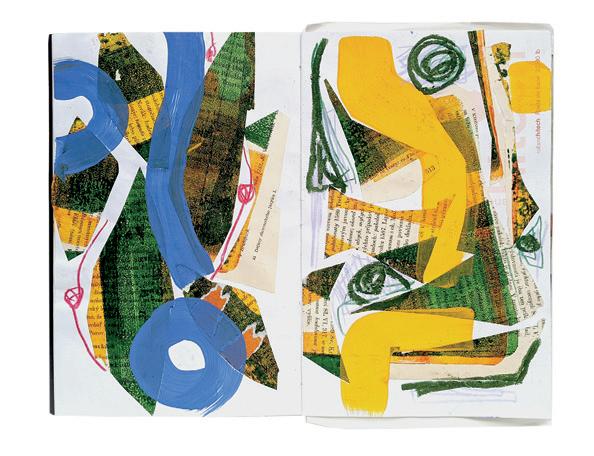
One of Boriana’s favourite sketchbook exercises is playing with shapes like circles and ovals, and forms inspired by nature, such as rocks, acorns or seeds.
Prompt: Use both transparent and opaque colours to create a playful two-page spread in your sketchbook.
Materials: Watercolours (palette or tubes, whatever you have on hand), gouache or acrylic paint (one white and a set of primary colours is sufficient) and a gel pen or a Sharpie marker (colour of your choice)
Step 1: Starting with watercolour, paint simple organic or geometric shapes. Keep the watercolours fluid, with a fair amount of water mixed in. Let the colours mix, using a monochromatic palette (e.g., light and dark blues) or two primary colours.
Step 2: Create rows of shapes over the two-page spread, without any pencil outlines. Let yourself explore the simple mixing of colours.
Step 3: Let the shapes dry, and then use a different watercolour to add a glaze over the dried colour. Don’t cover all of the dry layer; let the colours peek through. Practise layering, noticing how different colours interact and how the layers create new colours and depth.
Step 4: Use gouache or acrylic paint to create opaque shapes, painting them partially on top of the more transparent watercolour shapes. Notice the difference in the shapes painted with gouache, how they are solid, and the colours usually more vibrant. Try adding small details using gouache and a small brush.
Step 5: Use gel pens or Sharpie markers to add additional details like lines or dots, or to outline some of the forms.
Have fun and don’t overthink this exercise!
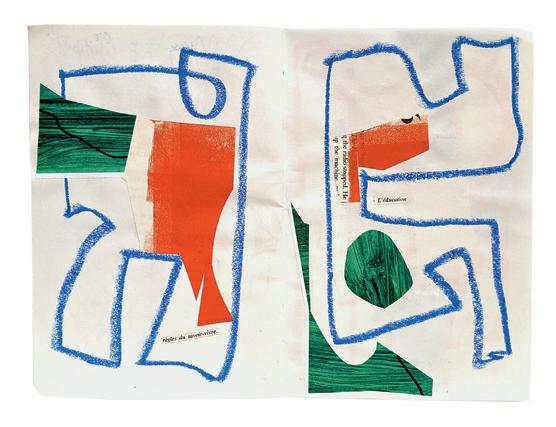
A Creative and Focused Workout Guylaine Couture
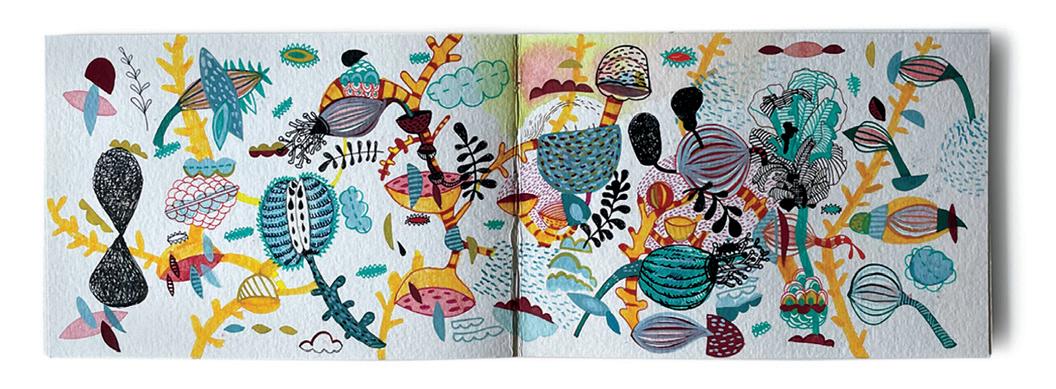
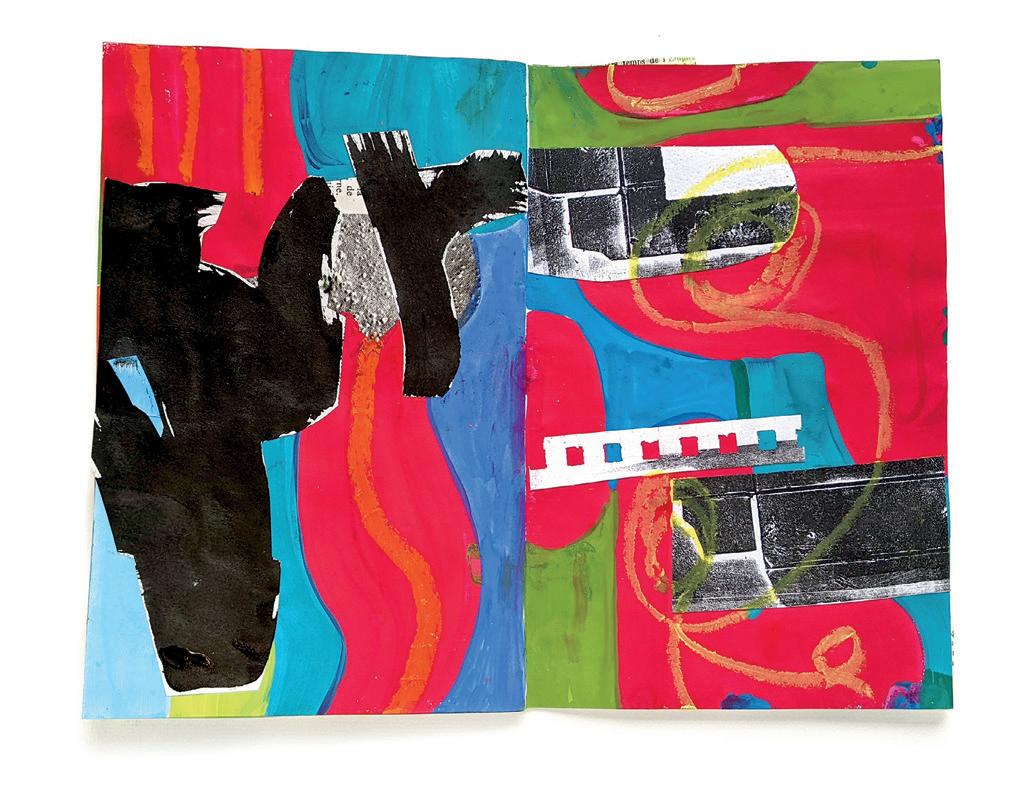
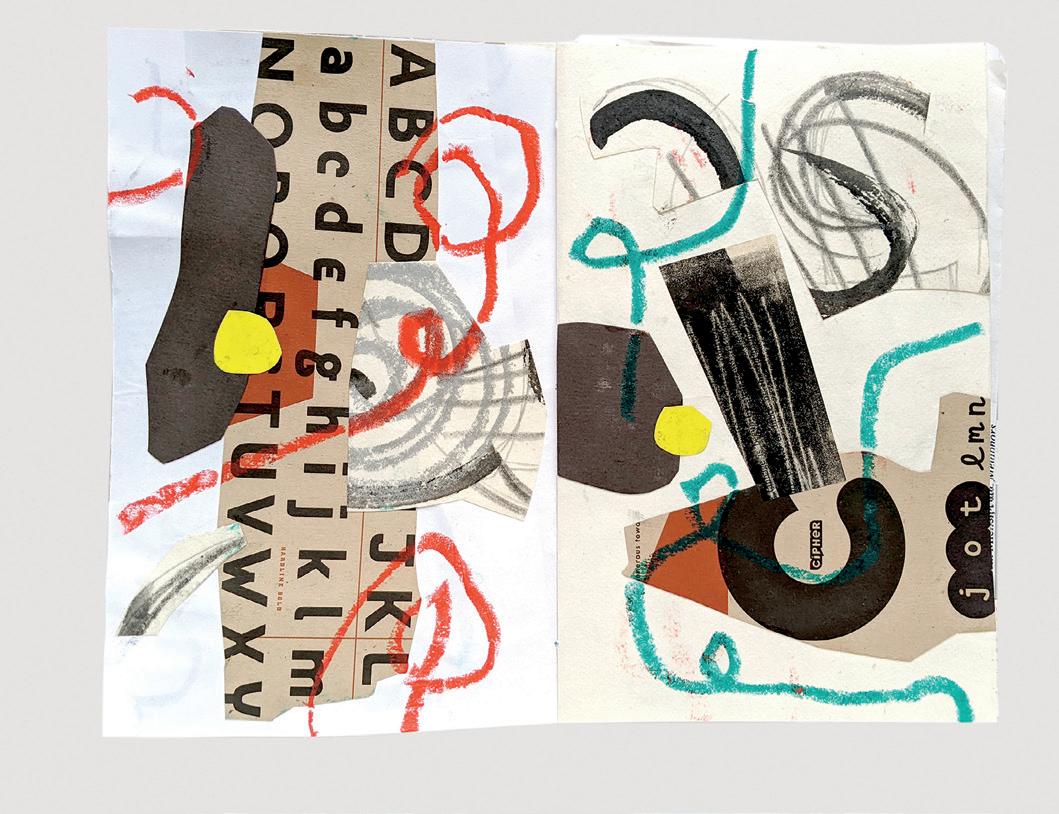
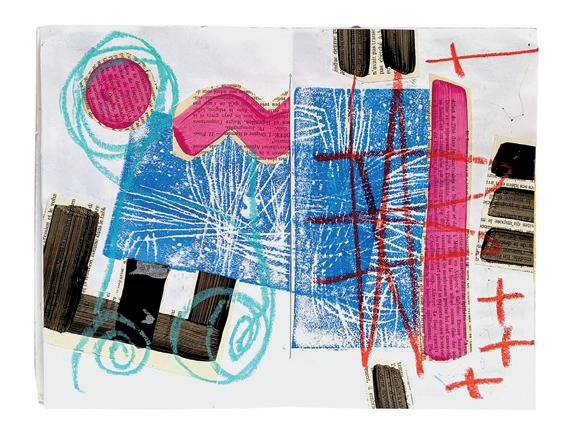
Québecoise book artist Guylaine Couture has worked in livrets (or “booklets”) for over two decades, with 138 volumes and counting. “I like to have light notebooks to carry with me at all times. These notebooks are a kind of creative journal and my collages are my workout to keep me in shape.” Guylaine uses collages as a focus exercise at the beginning of her creative sessions. She leaves her phone outside of the room, in airplane plane mode, and creates in silence, as she likes to “listen to my brain work.”
Over the span of 10 minutes, she fills two to three pages using a box of diverse paper scraps as well as materials around her, such as pencils, acrylic, pastels, watercolour and ink. “These collages are a game,” she explains. “There are no good or bad responses—it’s about the enjoyment and allowing myself to get into an intense mode of concentration for the projects I will work on next. I have zero expectations. Sometimes it’s a failure and sometimes the compositions are more successful. What I like the most is the process itself.” She has also come to realize that if she does not have these periods of deep concentration and flow, her creative work feels less interesting.
For the past five years, she has led a creative challenge each February, with artists from Quebec and Europe. Everyone creates an accordion-style book and creates one page per day, sharing their work online and giving encouraging feedback to other participants. At the end of the month, everyone unfolds their books, in a communal experience that Guylaine describes as “magical.”
If a stretch of time goes by during the year when she has not worked in her sketchbook, Guylaine always feels the pull to return. “It’s like a reassuring need to see that I still have the touch, that I still enjoy it and that there are still beautiful surprises.”
gycouture.com @guylaine_couture
revisiting artist agent Jennifer Nelson
A little over a decade since we featured her fledgling agency, we check back in!
jennifer-nelson-artists.com
@jennifer_nelson_artists
the-smiley-manse.com
@the_smiley_manse
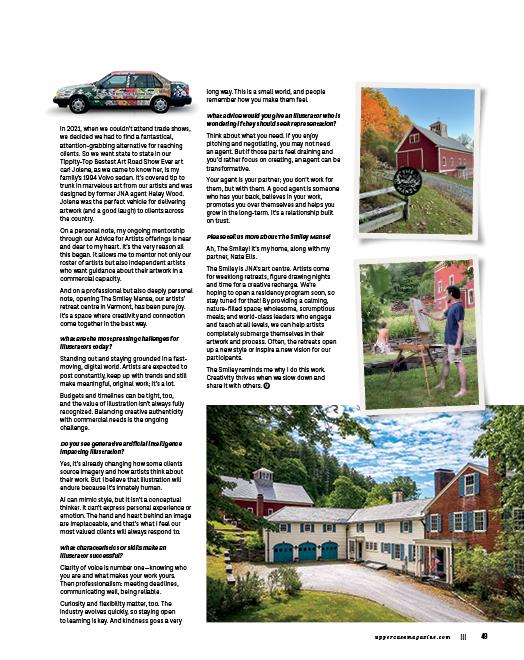
When Jennifer Nelson launched her illustration agency in 2015, she wanted to do more than match artists with clients; she wanted to build a truly artist-centred community. Eleven years later, Jennifer Nelson Artists (JNA) represents artists around the world and has become known for its thoughtful mentorship and creative spirit.
What does an artist agent do?
At its heart, being an artist agent is about connection. Alongside my fellow agents, Shannon McNab and Maria Rose Adams, we match the world’s tippity-top artists with the clients who need their incredible artwork. Our artwork appears in advertising, package design, apparel, gift and novelty, home décor, toys, games and puzzles, and stationery products, as well as in editorial and books.
But it’s more than matchmaking. We negotiate contracts, handle licensing details, make sure our artists are paid fairly and keep them up-to-date with market-timed prompts. Shannon and I also help our artists shape their portfolios and offer art direction upon request. It’s part business, part mentorship and part championing, and I love it.
What makes your job unique and interesting? Why are you drawn to this work?
I’ve always loved art and artists. I’m inspired by creative people and the endless challenge of pairing their work with the right opportunities. There’s a lot of problem solving, which I enjoy; every project is a puzzle (especially the puzzles!). And seeing an artist’s book get published or their artwork on a product never gets old. We get to support artists, build community and make an artistic life sustainable. It’s deeply rewarding work.
What background or education prepared you (or didn’t!) for this career?
I studied art and design, and worked in children’s book publishing for decades before starting the agency. Those experiences taught me both the language of art and the realities of business: budgets, deadlines and collaboration.
Still, most of what we do isn’t taught in school. It’s about intuition, empathy and recognizing potential. I’ve learned by doing, through experience, through mistakes and, importantly, from the artists themselves.
When we first featured you in 2015, JNA was just getting started. A lot can happen in a decade. Is running your company what you imagined it would be?
Not at all, and that’s the wonderful part. I knew I wanted to build an agency that truly supported artists, both as individuals and as small business owners, but I didn’t realize how rich and communal it would become.
Now we represent artists all over the world, and that global creative community has grown to be a powerful resource for our artists, as well as for those outside the agency.
I also hadn’t expected how creative running a business could be: mentoring, planning retreats, building systems. It’s more imaginative work than I ever anticipated.
What have been some milestones or highlights from the past decade?
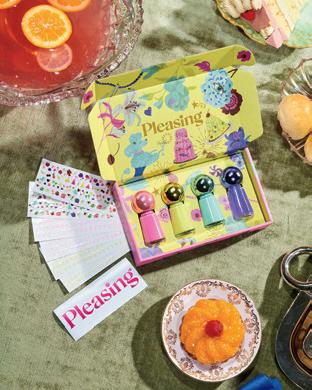
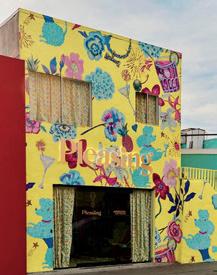
Seeing our artists’ work appear on puzzles, books and products always thrills me. We’ve collaborated with wonderful clients, including Anthropologie, Chronicle Books, Fjällräven, eeBoo, Godiva, Gorman, Kate Spade, Legami and Scholastic, and each project has its own story. One huge project of note was Rachel Grant’s fantastically illustrated work for Harry Styles’s Pleasing brand. Her artwork set the tone for the store exteriors, interiors and furniture, as well as product packaging, nail polish and small trinkets.
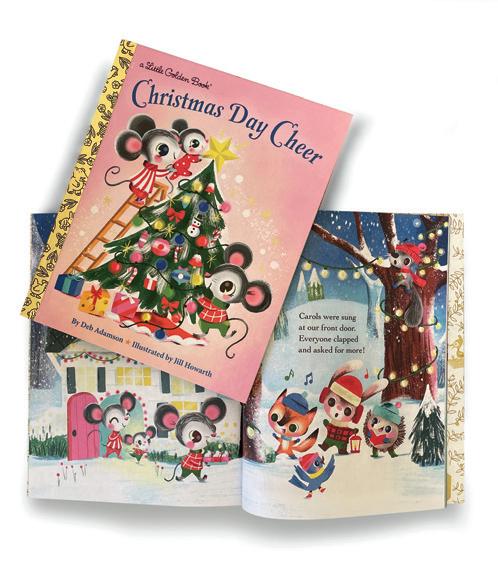
Another epic project was Jill Howarth’s absolute genius Christmas Day Cheer, our first Little Golden Book from Random House Kids.
RACHEL GRANT
JILL HOWARTH
Black Female Musicians
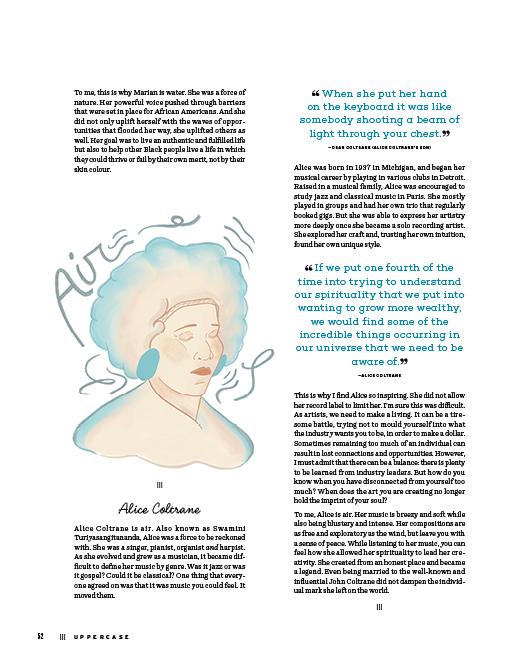
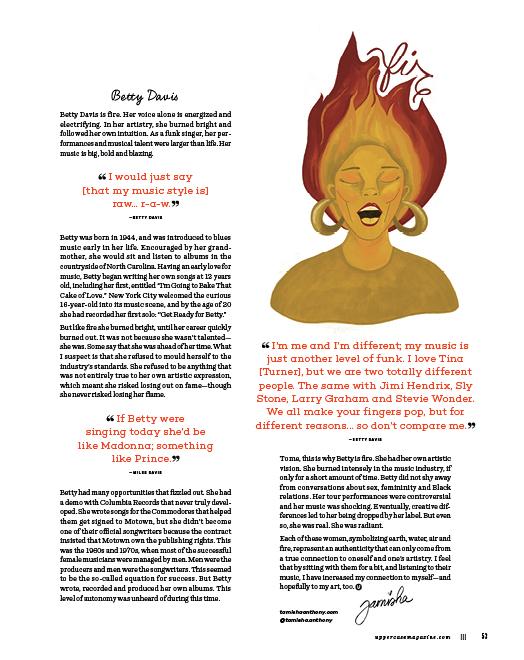
Elemental Women
||| STORY AND ILLUSTRATION BY TAMISHA ANTHONY
Normally when creating this column, I write about having a lovely afternoon tea and conversation with one dynamic artist from the past. But this afternoon, I am going to take a seat on a patch of grass, watch the waters of the lake ripple, feel the breeze on my face and appreciate the warmth of the sun on my cheeks. I am going to engulf myself in the elements of earth, water, air and fire. And during this reconnection with nature, I will contemplate the lives of four incredible Black female musicians who symbolize each of these natural elements. These artists valued authenticity in their craft. These women did not fold to societal pressures to sound like, look like or feel like any other performer. Even when labelled unusual, they continued to be true to their own artistic nature.
Billie Holiday
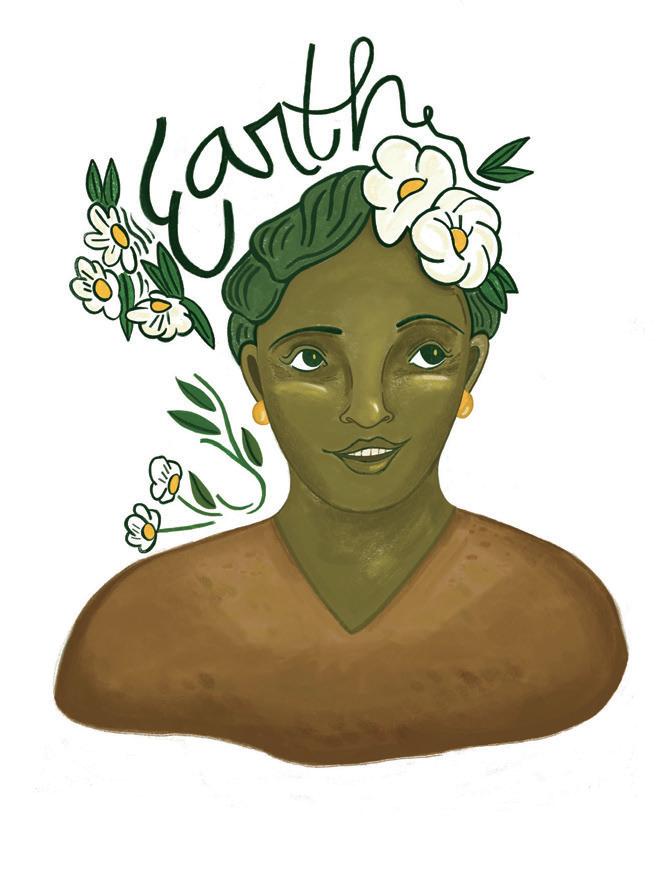
Billie Holiday is earth. She is well-known and admired for her sultry, raw and earthy voice. She was not the greatest singer in terms of technical skill, but she definitely had style. Her singing and expression were very much her own. When listening to her organic voice, I sincerely believe that it grounds your soul in an emotional truth.
If I’m going to sing like someone else, then I don’t need to sing at all.
—BILLIE HOLIDAY
In 1915, Billie was born to Sara Julia Fagan and Clarence Halliday and was named Eleanora Fagan. Billie’s teenage mother was unmarried and was therefore not supported by her parents and tossed out of their household. Abandoned by her grandparents, and eventually by her father: Billie’s life began with many difficulties. Due to her work, Billie’s mother was not around for her daughter’s early years, and Billie found herself in trouble with the law by the age of nine. She dropped out of school at 11 years old, worked long hours in her mother’s restaurant and scrubbed floors in various neighbourhood houses. As a child, she did what she could to make money, including taking a job running errands in a brothel.
Inspired by the albums of Bessie Smith and Louis Armstrong, she began performing in Harlem nightclubs and adopted her stage name, Billie Holiday. At the age of 18 she recorded her first two songs, “Your Mother’s Son-In-Law” and “Riffin’ the Scotch,” which ignited her musical career. She was one of the first female vocalists to sing improv jazz in a captivating and skillful way. Her voice was unique and she sang from her core.
Billie secured a position singing with the celebrated Count Basie Orchestra, but was fired soon after her employment. It is unclear exactly why she was fired. It was said she was unprofessional and had a negative attitude. But another perspective is that Billie was “problematic” because she stood up for herself. She refused to change her style of singing or her song selections. She stayed true to herself. Although acknowledged as a talented singer, Billie was still compared to performers like Ella Fitzgerald, who had more technical skills as a vocalist.
People don’t understand the kind of fight it takes to record what you want to record the way you want to record it.
—BILLIE HOLIDAY
Like earth, Billie used what was inside her to create. Her success was defined by continuing to be herself and exploring the talents she was given. She did not live an easy life. Her adulthood was just as gritty and rocky as her beginnings. Her voice conveyed the emotional and complicated life she led. Although Billie, nicknamed Lady Day, died at the age of 44, her influence and legacy live on. Her artistry is rooted in us. Her life lives on in her music.
Marian Anderson
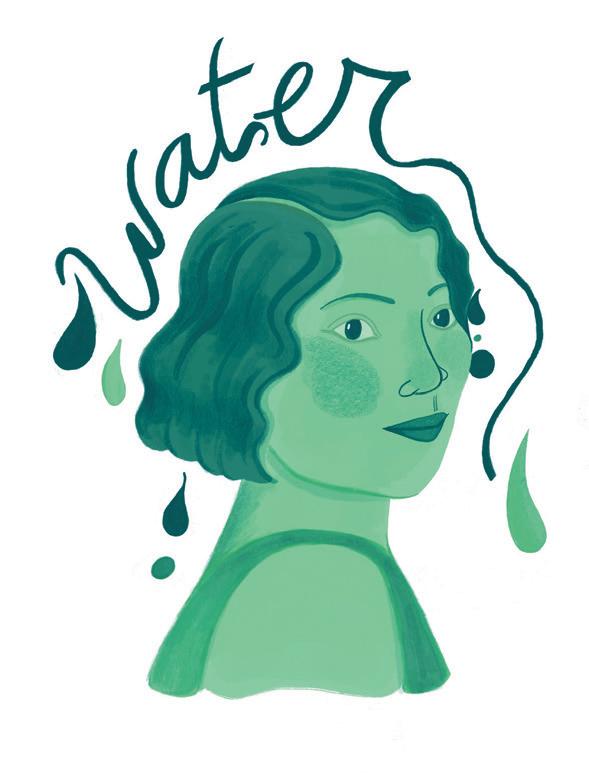
Marian Anderson is water. As an opera singer, she had a voice that was fluid and commanding. She flowed into venues such as the Metropolitan Opera where other people of colour had never been allowed to perform before. But possibly even mightier than her voice was her presence in the civil rights movement. In 1939, when America still accepted segregation and discrimination against Black people, Marian performed on the steps of the Lincoln Memorial to an integrated audience. Thousands of people witnessed this daring undertaking, and millions of others listened to her moving vocals on the radio.
When I sing, I don’t want them to see that my face is black; I don’t want them to see that my face is white— I want them to see my soul. And that is colourless.
—MARIAN ANDERSON
Marian was born before the turn of the century, in 1897. She was born in a time when slavery had been abolished but equality for African Americans was still too far away to grasp. She was raised in South Philadelphia, and attended the Union Baptist Church. The church was the centre of her community, and she began singing in the church choir at the age of six. This led to little Marian singing solos and duets at various music events around the city. Her supportive church community also raised money for her to attend South Philadelphia High School and receive private singing
lessons. Although she had been earning money from singing since she was a child, her first big break came when she won a singing competition sponsored by the New York Philharmonic. From there, her career truly soared. Sometimes when reading about the lives of successful people, we see the golden moments and overlook the intensity of their dedication. Marian was talented, but it was her consistency that allowed her career to flourish. It was her passion to keep feeding her craft that allowed her to fulfill her dreams. And she did not stop there.
I felt a responsibility to use my talent for something greater than myself.
—MARIAN ANDERSON
She used her talent and her notoriety to help other Black artists break beyond the prejudices that were limiting their careers. She became a delegate to the United Nations Human Rights Committee and a goodwill ambassador for the United States Department of State, and was awarded the first Presidential Medal of Freedom in 1963. She was the first Black person to perform at a presidential inauguration (and the only person to perform at multiple presidential inaugurations).
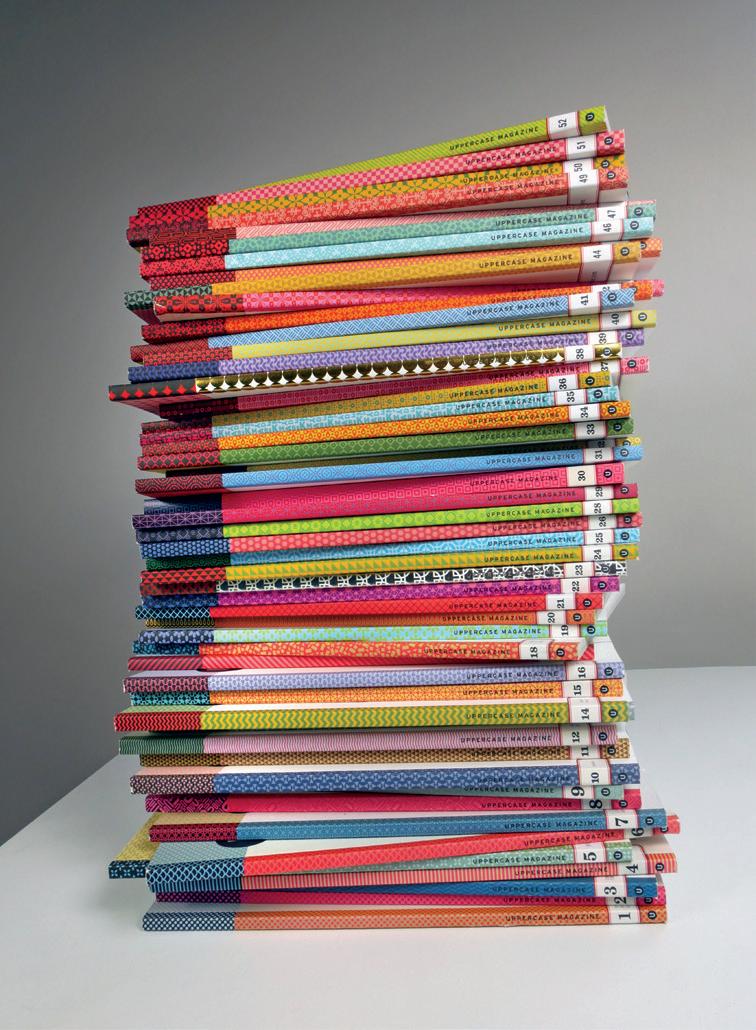
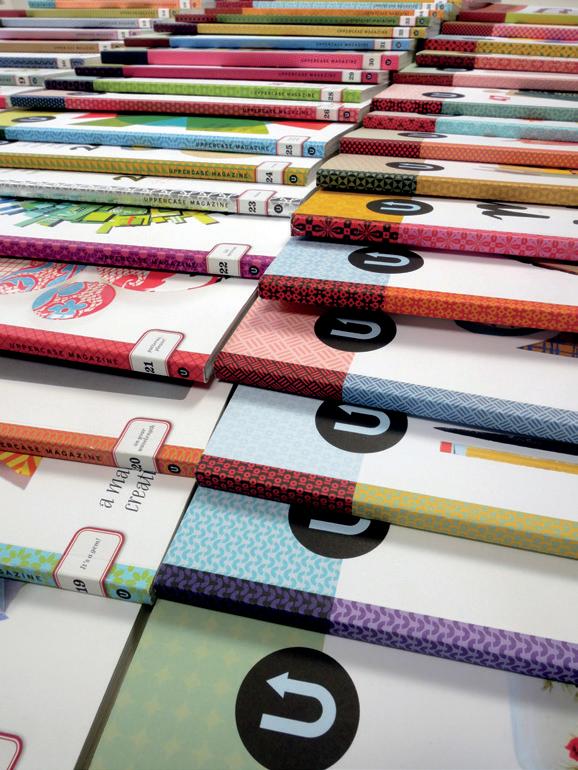
Curious about what’s inside this towering stack of magazines?
Enjoy digital editions of long-out-of-print back issues in the UPPERCASE Archive!
There are over 50 digital back issues available, viewable on a computer or your iPad. It’s an abundance of inspiration from over 16 years of this magazine. UPPERCASE print subscribers can access a three-day free trial of the Archive with their UPPERCASE Circle membership.
uppercasearchive.com
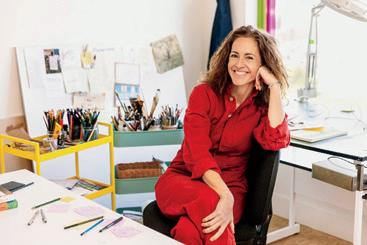
Wendy MacNaughton
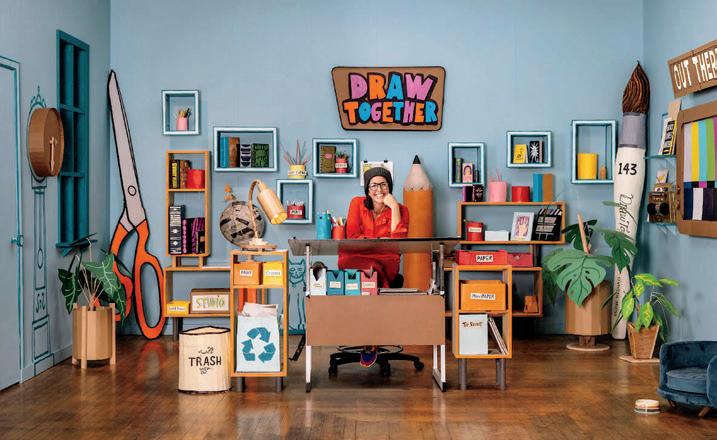
Wendy MacNaughton is a New York Times–bestselling artist, graphic journalist and educator. Her sensitive, journalistic drawings bring sketchbook-style honesty to her subjects. Wendy, who has trained as a social worker, sees drawing as “a vehicle for connection.”
In 2020, during the first few months of the pandemic, Wendy started a weekday drawing broadcast for kids via Instagram. DrawTogether became a beloved show for children and their creative parents.
Over the years, DrawTogether has grown into a large creative community for people who “want to become more curious, connected and confident,” says Wendy. “Every week we gather together and use the simple, joyful act of drawing to slow down, open our eyes and change ourselves (and the world) from the inside out.” Her nonprofit DrawTogether Classrooms offers educators free lessons, curriculum and training to provide more art and social emotional learning.
Paid members get access to the DrawTogether Grown-Ups Table (aka The GUT), where they can enjoy art assignments, guest interviews, field trips and creative musings. It is an inclusive space that encourages joy and care, with simple rules:
How teaching artists the science of their tools brings them closer to their craft
EMILY JOYCE
PAIGE THOMPSON
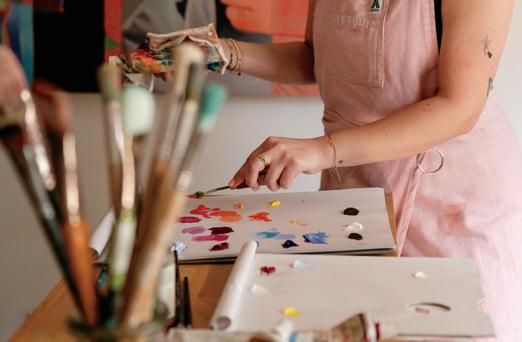
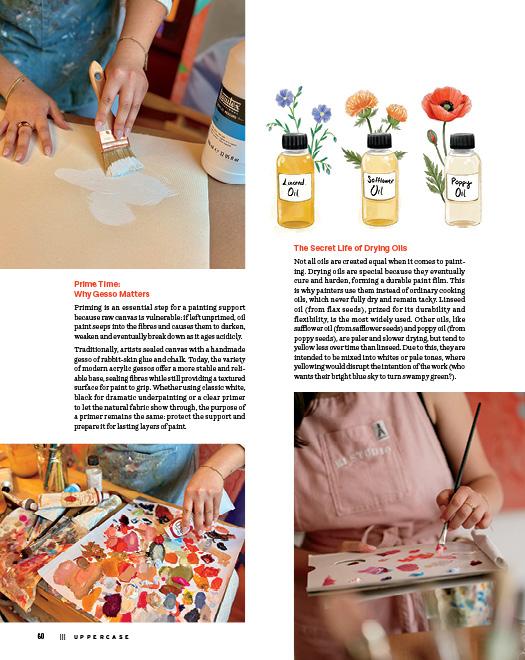
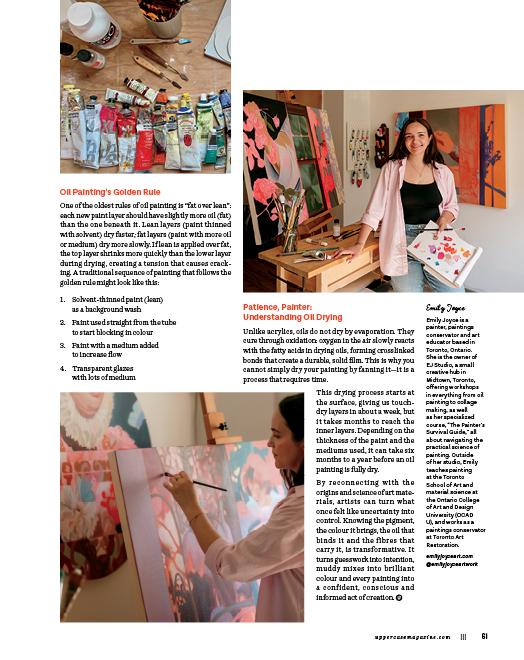
For centuries, artists had an intimate relationship with their materials. Pigments were sourced from earth and minerals, and ground by hand. Canvases were woven, stretched with care and primed with handmade gessoes. Drying oils were pressed from various seeds, and artists modified their thickness or clarity depending on the colour and effect they wanted. And then came the long wait: half of an oil painter’s life was spent watching layers slowly harden, a chemical dance between oil and oxygen.
The 19th century brought about the Industrial Revolution, which forever changed the art world. Society itself was transforming—city streets bustled with new boulevards, factories roared and science advanced at an unprecedented pace. In this new age, art materials entered the era of commercialization. The era in which artists had to make everything from scratch was fading—brushes, paints and pre-stretched canvases were now available for purchase just a hop and a skip away at new local art shops.
The benefits were undeniable: convenience, speed and increased accessibility. Artists suddenly had more time to actually paint (or to procrastinate in front of a blank canvas). But this also marked the beginning of a quiet shift—artists gradually became less connected to their tools. With pre-packaged supplies, the deep knowledge of how materials were made and behaved was no longer essential.
More than 150 years since art materials became widely commercialized, the gap between artists and their materials has only grown. I see the impact play out in the questions students bring to the classroom: Why can’t oil paints be dried with a hair dryer? Do I really have to prime a canvas before painting? Even colleagues of mine who are seasoned artists occasionally scratch their heads in the paint aisle—mysterious pigment codes and the ever-looming risk of muddy colour can turn shopping into a mini existential crisis.
Seeing how much confusion materials can cause, I am a firm believer that teaching artists the science behind their tools—the origins and behaviours of paint, mediums and supports—can enhance an artist’s practice. It can turn those frustrating studio mysteries into “a-ha!” breakthroughs. I am not suggesting that all artisans should return to the days of mulling their own paint— instead, I hope to foster a renewed literacy of materials. The study of material science is a world of fun facts, hidden histories and practical insights that give intention to an artist’s craft—let us uncover some today.
The Science of Pigments
Pigments have long been sourced from the earth: minerals, clays, plants and even insects. Until the 19th century, these natural sources defined the artist’s palette—think ochres and umbers (iron-rich earths that could be fired in a kiln to deepen their tone), lamp black (from soot) or carmine red (from scale insects).
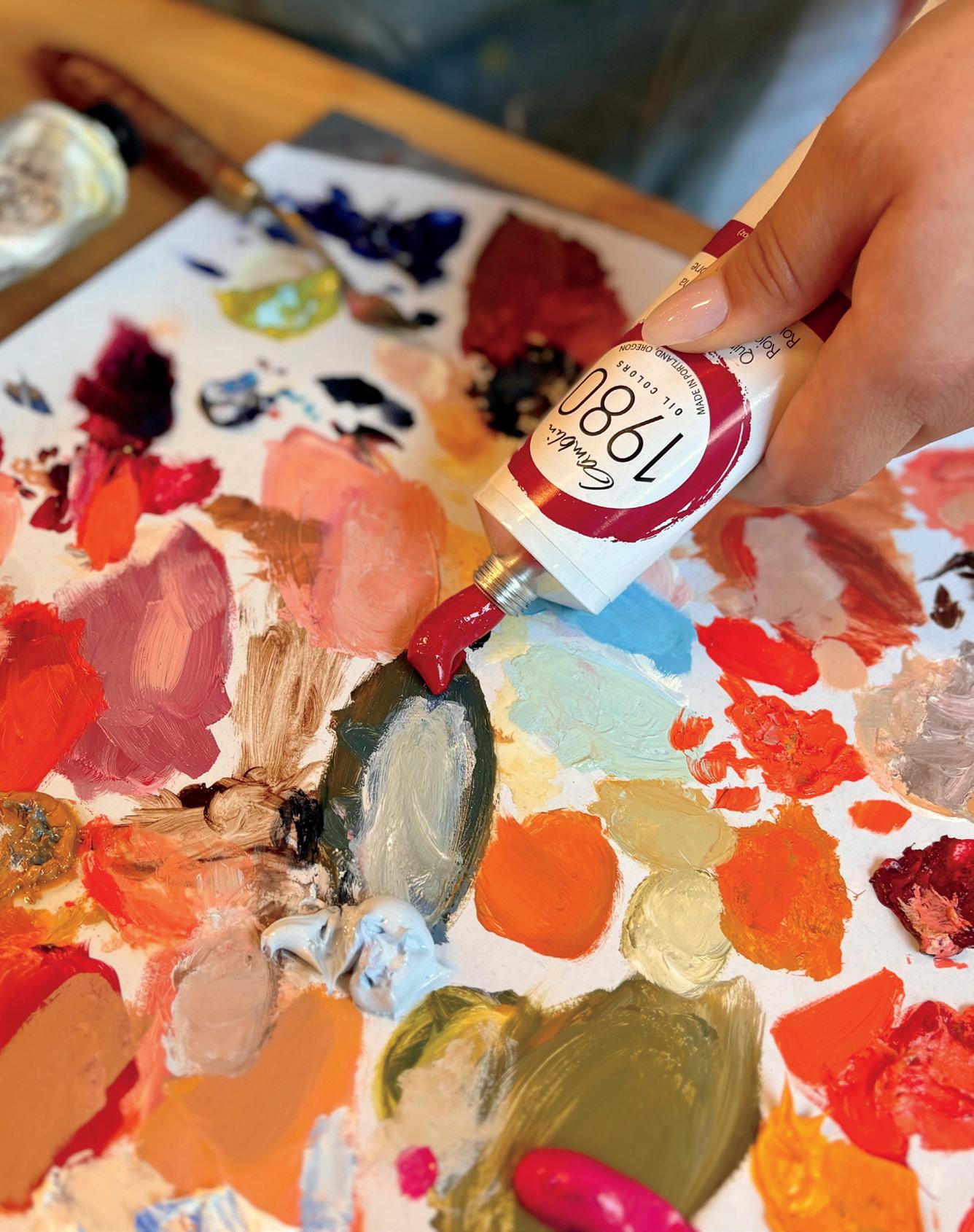
The Industrial Revolution introduced synthetic pigments to the artist’s palette. Suddenly, vivid, affordable colours (often those with tongue twister names) flooded the market: quinacridone violet, phthalo blue and benzimidazolone yellow. Some, like mauveine, were discovered in a lab by accident during the creation of medicines. Others, like French ultramarine, were deliberate inventions, recreating the rare and costly lapis lazuli pigment at a fraction of the cost. Today, most pigments are synthetic, offering artists a balance of brilliance, consistency and colour strength.
Chemically, pigments fall into two broad categories: organic (carbon based) and inorganic (mineral or metal based). Understanding this distinction can help explain many of the qualities artists notice in their paints.
• Inorganic (mineral/metal based): Often opaque, affordable and lightfast (resistant to fading over time). Great for base colours. Examples: cadmiums, ultramarine, cobalt blue, ochres, umbers.
• Organic (carbon based, plant/insect or synthetic): Often transparent, vivid, pricier and less lightfast (more prone to fading). Great for glazing. Examples: alizarin crimson, quinacridones, azos, dioxazine purple, indigo.
The Mystery of Muddy Colour
People often get frustrated when their colour mixes turn into “mud” (unwanted greys and browns). The culprit is often inside the paint tube: Student-grade paints typically contain blends of three or more pigments, designed to imitate costly single-pigment colours. That means that when you mix two student colours together, you could be wrangling six pigments at once. At that point, the paint basically throws up its hands and says, “I don’t know what colour I am supposed to be anymore!”
As a general rule: once you are mixing four or more pigments, muddiness is usually on its way. With that many competing colours, the mixture loses clarity.
This is one of the reasons professional paints are so much more reliable: they usually pack in a higher concentration of pure pigment—often just one per tube. That means stronger, more vibrant colours that mix cleanly. Pro tip: check the pigment codes (like PB29 for Pigment Blue Ultramarine). The fewer codes listed, the brighter and more predictable your mixes will be.
Decoding the Tube: Paint Labels Made Simple
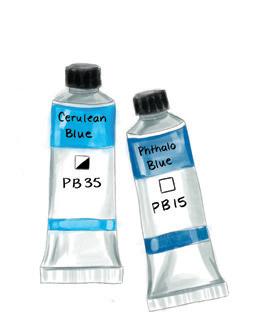
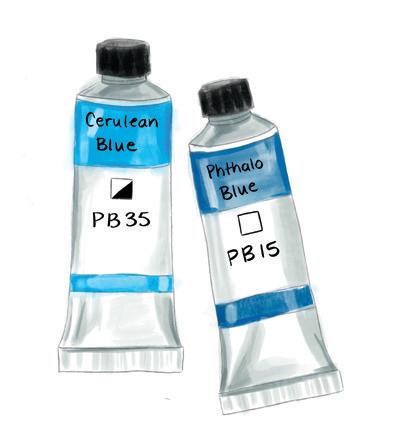
Paint labels tell you much more than the colour name. One key symbol is the coverage square:
• Black square = opaque. Strong coverage, great for underpainting or bold passages.
• Half-coloured square = semi-opaque. Moderate coverage, ideal for layering.
• Empty square = transparent. Lets light pass through, perfect for glazing and layering luminous effects.
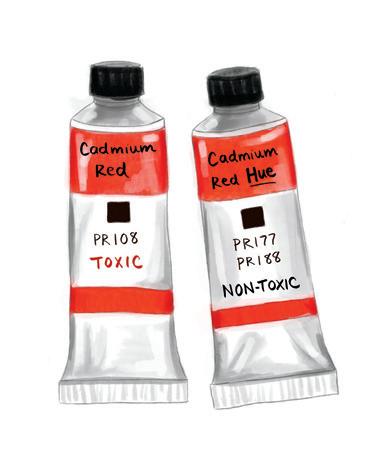
Some paints also include the word “hue.” This indicates that the colour is made to look like a traditional pigment but may use different, often safer or more affordable materials. For example:
• Cadmium red hue mimics cadmium red, but with out the toxic heavy metals.
• Cerulean blue hue gives the appearance of ceru lean but is produced through a less expensive formulation.
Knowing these symbols and terms will help you plan your painting more intentionally.
Unravelling the Canvas
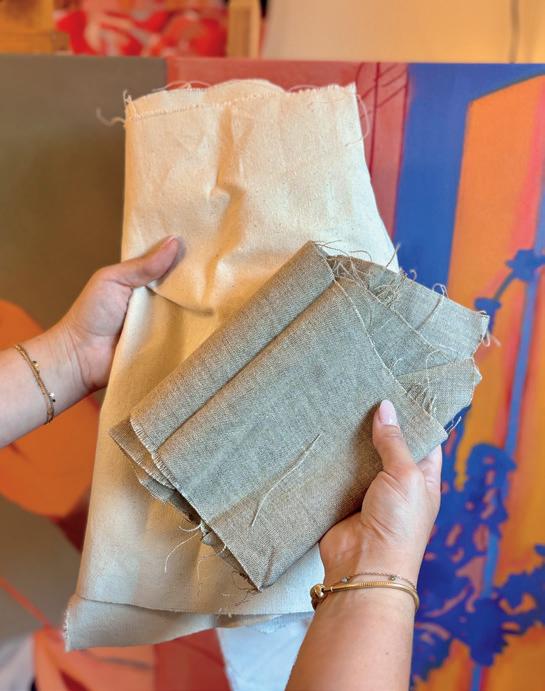
Two of the most popular painting supports lead back to plants! An artist’s choice often comes down to budget, workability in the studio and handling preference.
Linen is made from the long, strong fibres of the stem of a flax plant. Its fibres are bound with natural glues like lignin and pectin, making it incredibly durable, but tougher to stretch. It has a brown colouration, a more hairy, distinct texture and is more expensive. The “champagne” of linen is Belgian Linen, prized for its high quality.
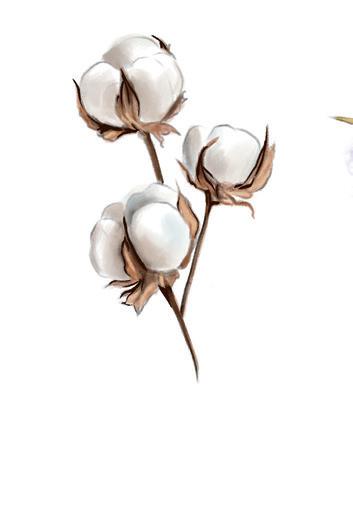
Cotton canvas, made from the short fibres of the fluffy cotton boll, is almost pure cellulose, with little to no plant glues present. This makes it softer, more elastic and easier to stretch. It is usually a bright cream colour, has a more even, consistent weave surface and is generally cheaper. However, its elasticity can result in slackening over time.
Lora Slobodian
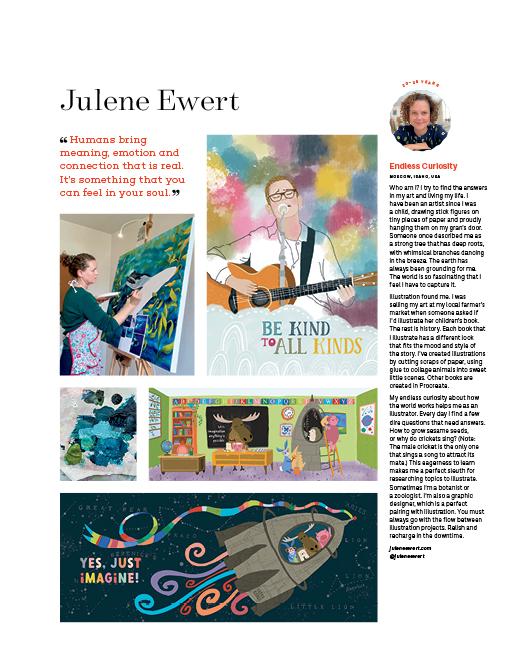
I bring a human touch, understanding and, perhaps most importantly, the human need to explore, play and ask questions that go beyond the surface.
Heart & Heritage
SHERWOOD PARK, ALBERTA, CANADA
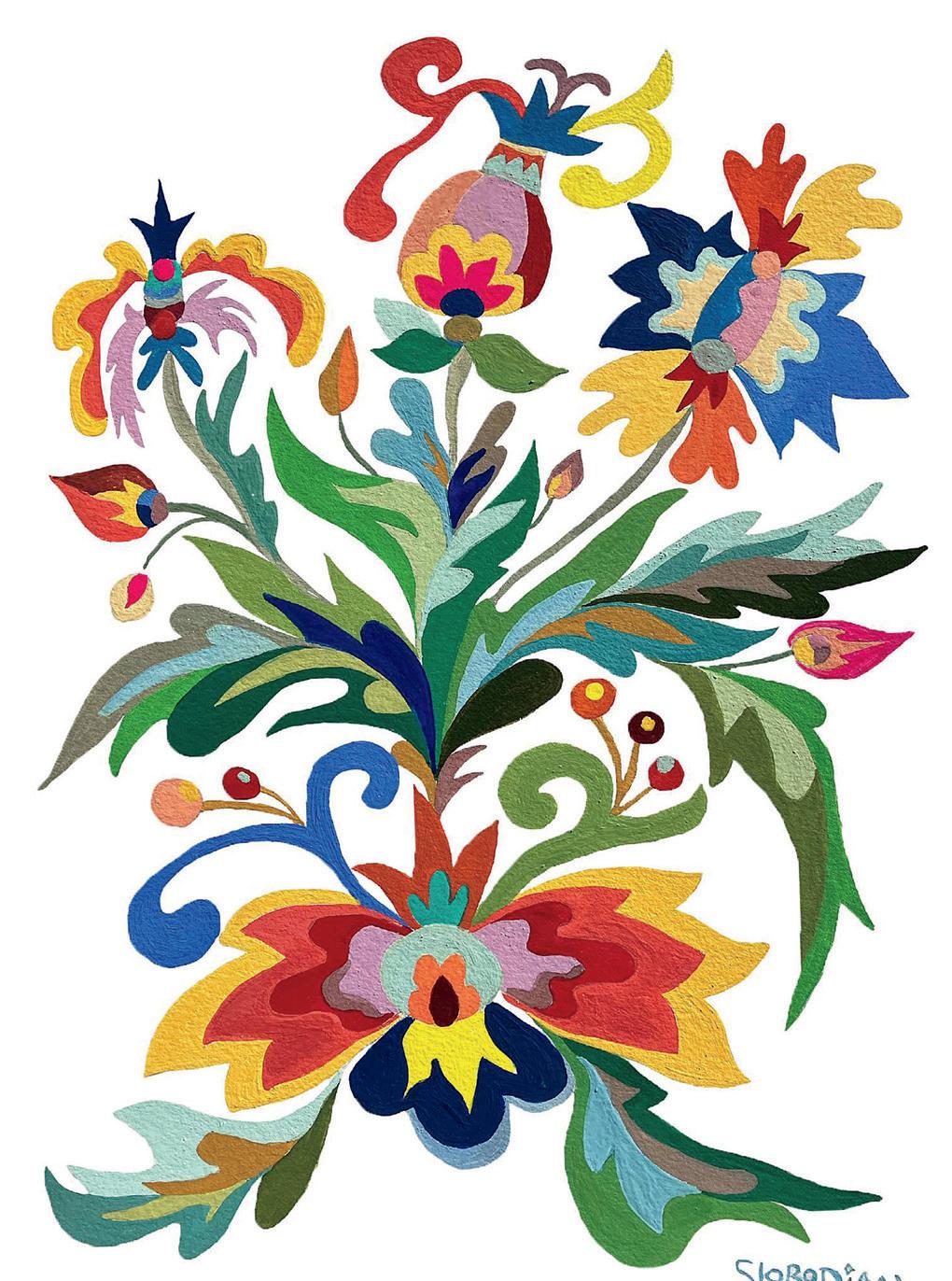
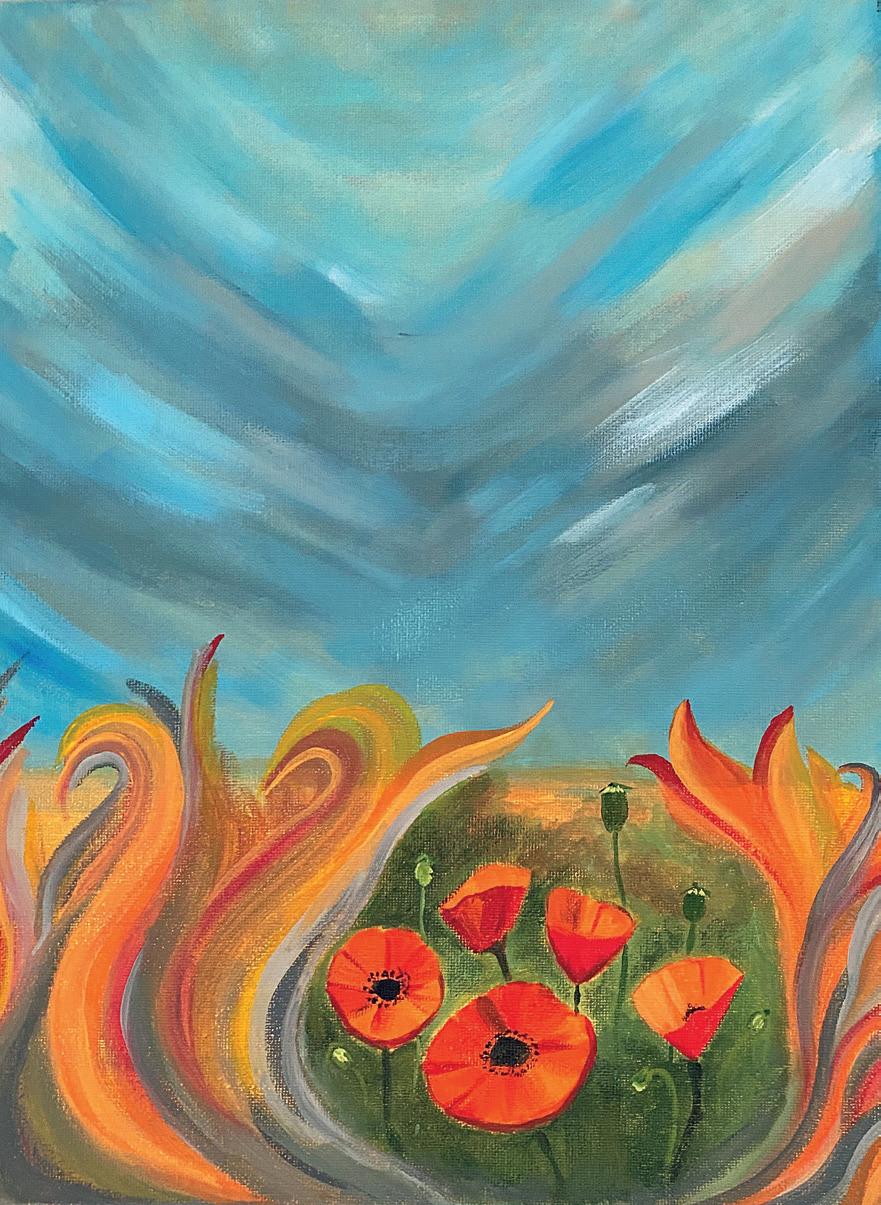
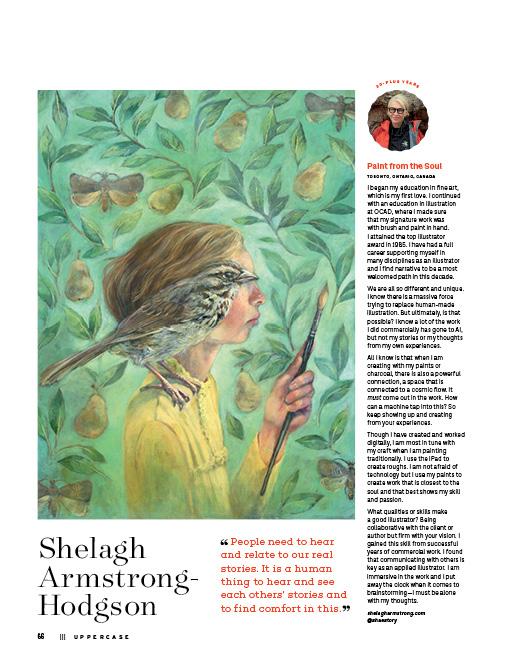
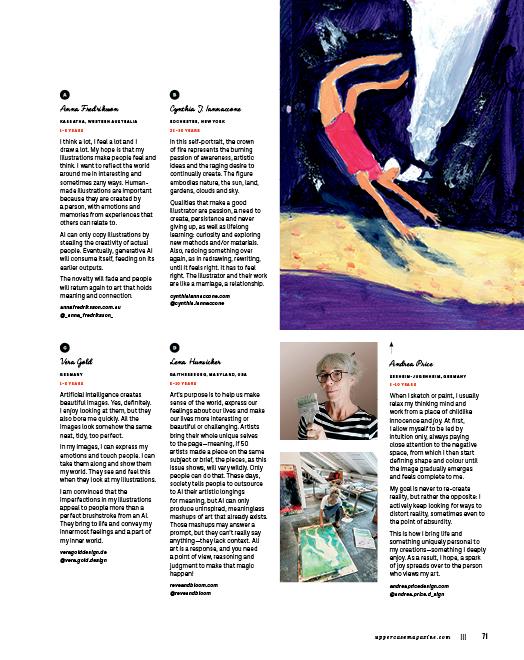
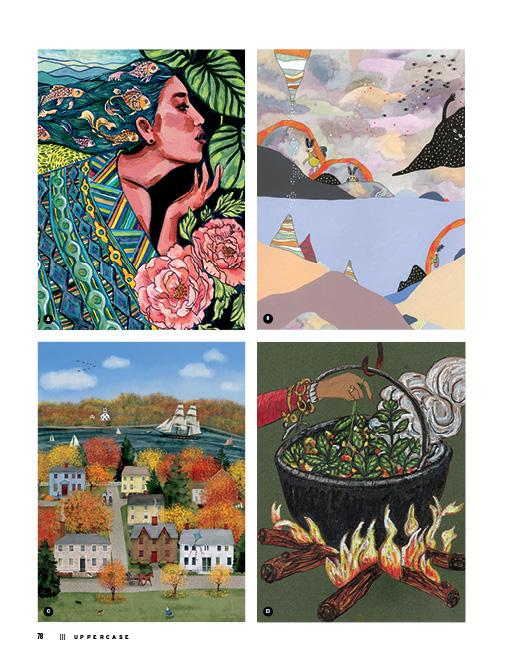
Human-made illustration is brilliant. It requires dedication and skill to succeed. Every human, much like a large language model, pulls from both cultural and personal data, or inspiration and history, but unlike a generative model, a human can take that information and turn it upside down and inside out, and bounce it off of other ideas to create a truly personalized work of art. Beyond the realness and rawness of creativity, human-made art has the ability to express the human condition on multiple levels because humans feel, we reason and we explore where generated images cannot.
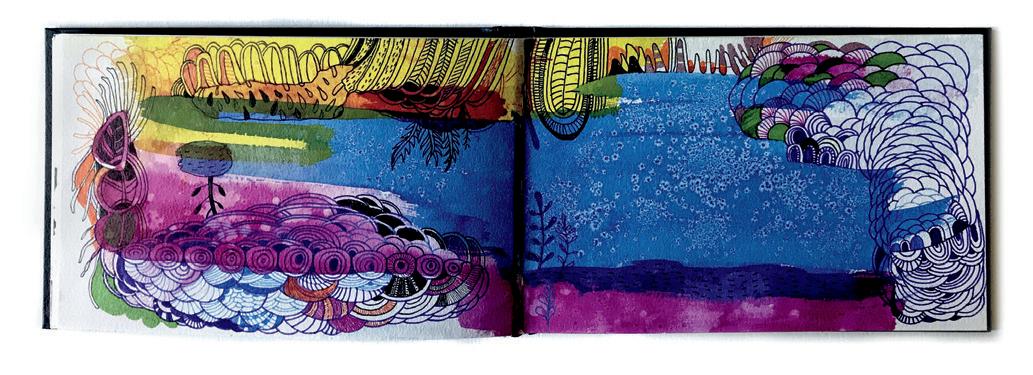
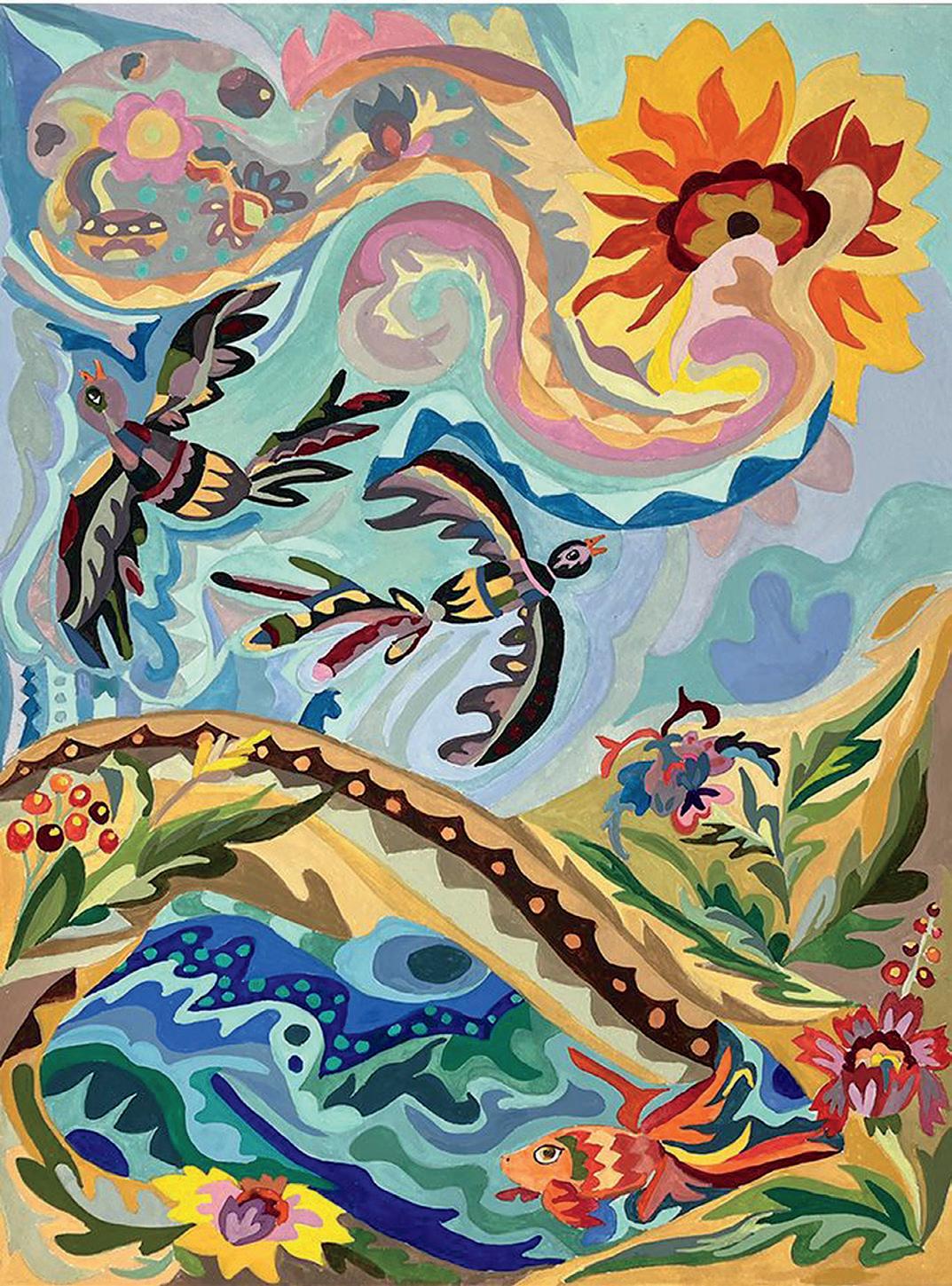
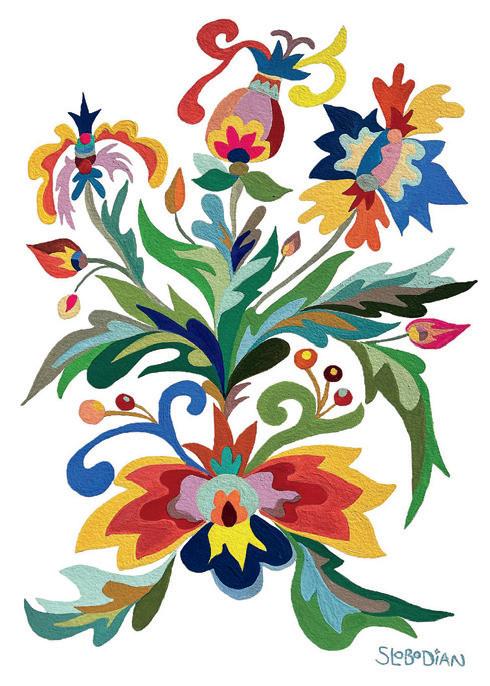
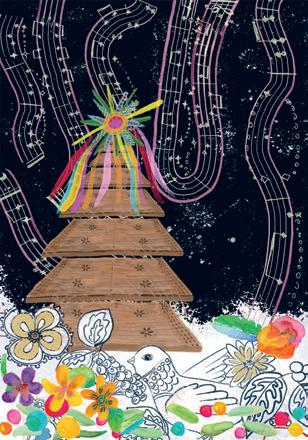
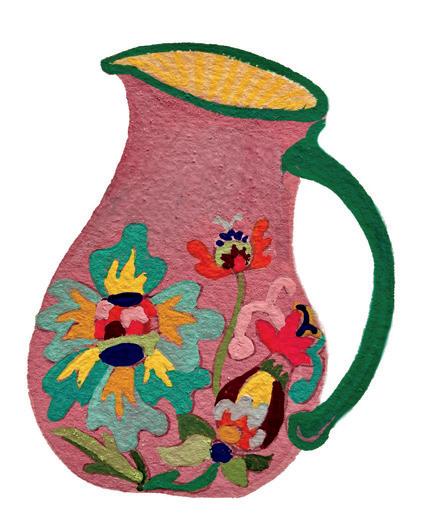
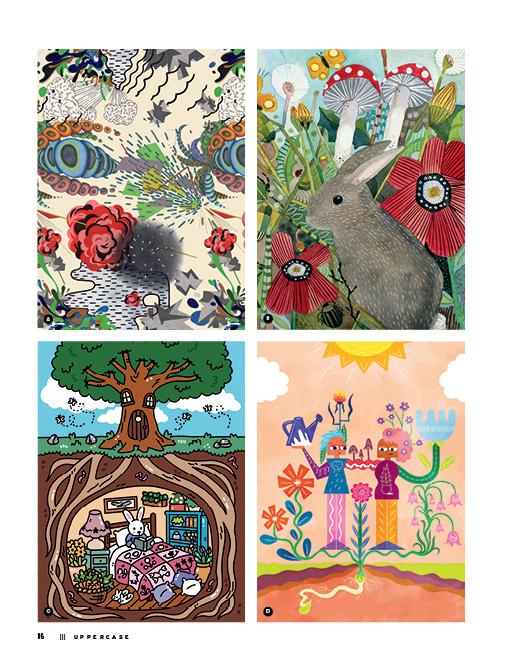
I’m obsessed with colour and exploring my heritage through my illustrations. I am currently learning about and learning how to paint in the Samchykivka folk style from Ukraine, which she used for this brief. Samchykivka makes use of an interplay of round, water-like lines and sharp, fire-like lines that dance off one another. Thus, all four elements are represented in this way in a landscape that whorls and swirls like an illustration’s ideas and process. There is so much richness in playing on themes of home and heritage, and illustrating each piece from a place of freshness and growth.
Determination and constantly playing, along with my research abilities, make me a good illustrator. When presented with a problem to solve, I want to express the solution in way that goes beyond the surface, and will spend time digging into what is desired by a client, and where the illustration can take us.
slobodiandesigns.ca
Tatiana deFigueiredo Gebert
I want to see the built-up skill of handiwork. I want to see creativity born of sweat and tears and blood and toil! AI cannot accomplish that.
Truthful Expression
TUALATIN, OREGON, USA
When I was a small child, my favourite time of day was when I was allowed to draw and paint. This love never faded and eventually I went to college to study art. I use many different mediums, such as watercolour, oils, inks and alternative photo practices. I believe that working in a single medium is restrictive to my artistic process. Each idea manifests in its own individual style. I try to merge the various skills I have into one new form. I enjoy books, sky watching, solitude, a good Pinot noir and being a closet chef and baker. I am also a word nerd, and love thinking of how to make letters look engaging. Illustration brings thought, amazement and joy.
We are getting lost in the world of AI, and truth is slipping away. The amazing things a human hand can do elevate us. Expressing our interpretation of the world around us is what makes us human. If we do not hold strong to these parts of humanity, what will our world become? How do others keep a culture strong, transmit important information, render current events or simply create something beautiful and moving?
I think outside the box, not knowing what I can or cannot do… I just do. I love to create images. I want to work on children’s books as well as portraits. I love book construction and calligraphic work, and have studied with as many experts as possible. I am disciplined and open, a curious explorer. nightowlcreation.com
Lisa Firke
The work of human hands will always be important, both to viewers of art and illustration, and to its creators.
Print & Poetry
PRINCETON, NEW JERSEY, USA
As a mid-century being who lives in the house my architect father designed and built himself, I had a childhood that was in itself an MFA in visual art. Our bookshelves were full of art catalogues and classic picture books.
I’ve always loved printed matter— nothing can replace the look, feel and smell of paper and ink. I founded, edited and produced two literary magazines, and employed my design and illustration muscles creating websites and other collateral for illustrators and authors. A few years back, I stepped away from design work to do a long, deep dive into art making—mainly linocut, collage and dip pen. I’m also besotted with Procreate.
In my family, they call me “the finder.” My memory is not fully eidetic, but it is close: I can remember what I see in great detail and can mentally walk through a physical space and note everything that’s within. When I look at things, I mentally scribe the outlines of forms and note the relationships of colours. This is a huge advantage when it comes to putting what I imagine on paper (or on a tablet).
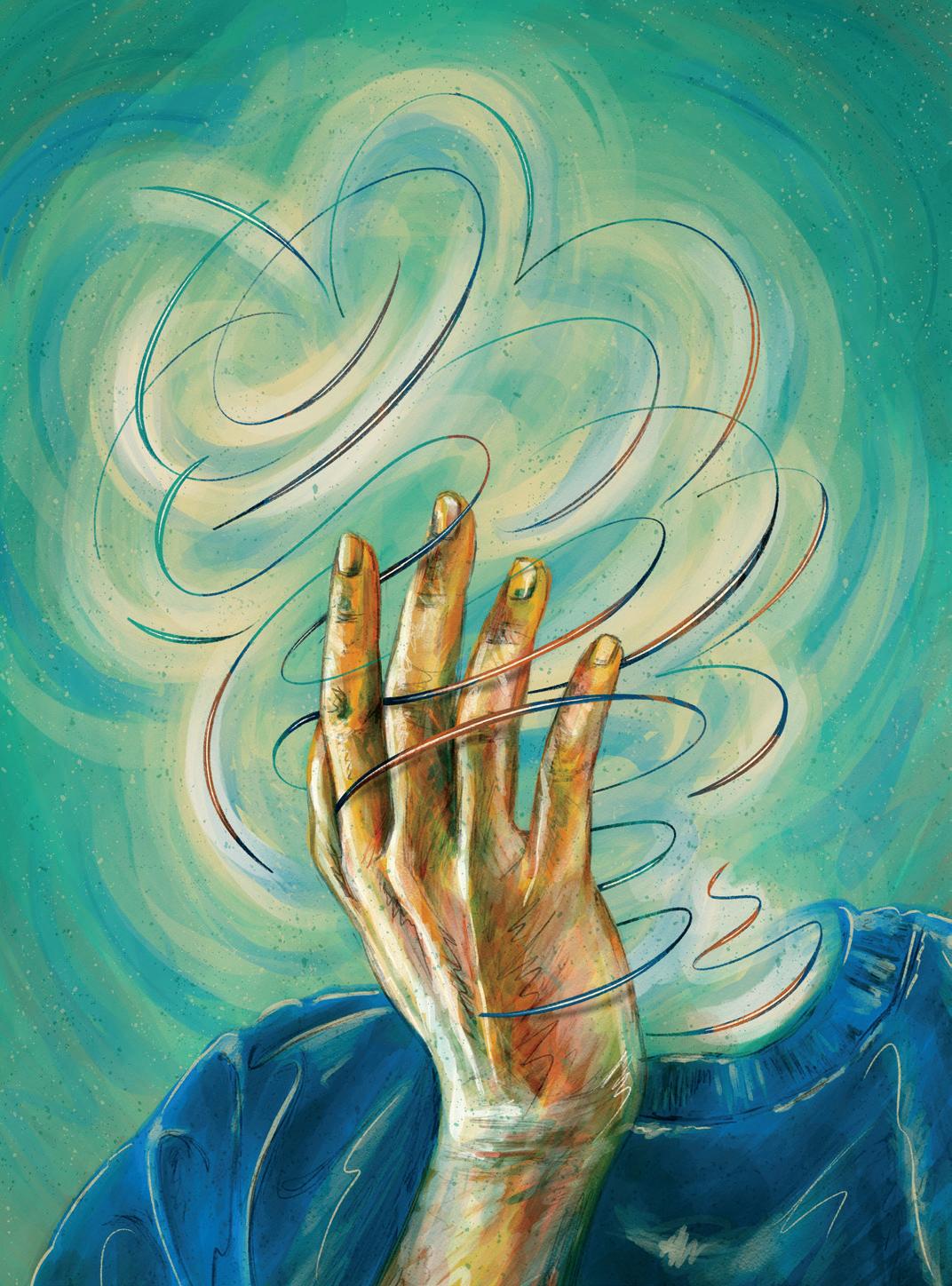
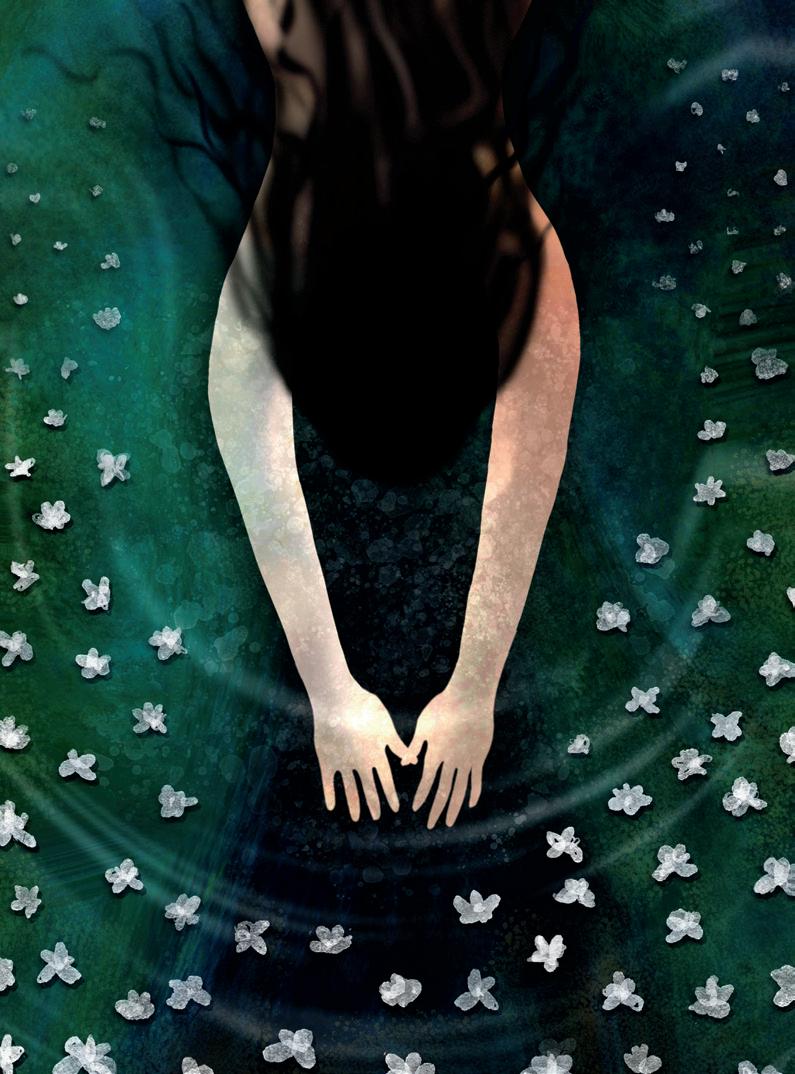
People need to see the personal, the particular, mediated through a human being rather than through a series of prompts. This is one reason I chose hands as the recurring motif of my Elements series.
lisafirke.com @lisafirke
I plunge into a spring lake, needled with flowerets.
…
I know my life fits me like this jacket of green water.
What lures me irresistibly forward is the sight of my own white hands blading the water before my face.
BY TOM FROESE
ROGERS
In 1984, at 29 years old, on Sanchez Street in San Francisco, I had a yard sale of most of my stuff, like my furniture, for cash, then packed my tiny Honda to the gills, including my illustration portfolio and my boyfriend, and drove across country from San Francisco to New York. Yes, I was terrified. I was going to try to be an illustrator—in New York City! My art was weird, and odd, but some cool people who I respected liked it, so that gave me hope. Plus, I had already done a few jobs, including one for New York Magazine, so the odds seemed decent. But still.
Hello, friends. This column is going to be a roundabout, incomplete and personal take on the four astrological elements.
Once settled in New York, pounding the pavements with my portfolio in hand, I began to build an illustration career. That is the short version. But I am setting the stage for you so that I can share what I did in the meantime, which was the following.
I saw a poster for a tarot class on a phone pole. There was no Internet back then, of course, so the way to learn about things like courses was to find them on phone polls. I tore off a number and called it.
Class met weekly in a tiny 10th-floor apartment owned by a teacher/psychic named Jean, along with the requisite cats. She was working on her doctorate in psychology at Columbia University, and was very scholarly and detailed, and I found both her and the tarot and astrological material fascinating.
Some months later, Jean said to me, “Lilla, I think you’re psychic. Let me bring a few of my clients for you to read.”
“Say what, now?”
I did read them and apparently did a good job, so Jean suggested that I interview for the monthly psychic fair that she participated in. She gave me the phone number of a guy. I was to come in and give him a reading, which I did, and apparently I passed, because he said I could be a reader at the fair. So I was. And I read for others, and then taught a “psychic buffet” course in my third-floor walk-up in Brooklyn.
Illustration work got busy, so that became my focus, but I never gave up my love of the intuitive world. In fact, to this day, I occasionally do creative career readings in my courses with my own deck. I love it.
I am a triple Capricorn and all the rest are water signs, which means I like organizing abstract, intuitive ideas, and as a practical Cappy gal, I like making charts of astrological and tarot things.
I pulled out my 40-year-old binder for this column, to share my notes with you on the four elements and how they play a role in a career. I wrote the notes for this column on the right.
You can look up your chart online and then see which element(s) you have the most of. What follows is a non-official list of signs and creativity that I used only as a guide. Certainly, when I read someone, a whole collection of things come into play. But I thought you might enjoy my list. Let me know how it goes for you, at info@ lillarogers.com.
I just want you to have fun with this. It is by no means a be-all and end-all. It is really just to get you thinking.
You know in your gut what you love to make creatively, so go with that.
I am earth and water, so I like to organize my watercolour mediums and label my paint colours.
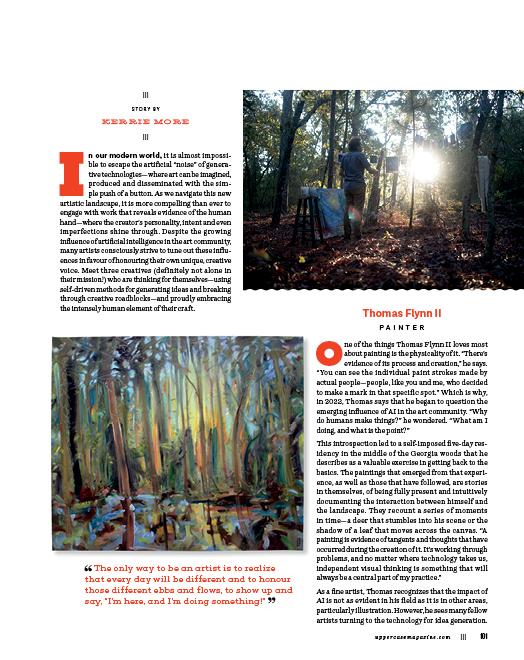
The element that most resonates with me is water. I’m imbuing my paintings with life, and in my mind water is the source of that life. It’s what makes all of the beauty of the landscape possible. And it’s water, when combined with paint, that makes these images.
“Personally, I avoid using AI because I don’t want my artwork to be influenced by outside sources,” he says. “I want to keep the pool of my ideas and inspiration as unpolluted as possible.”
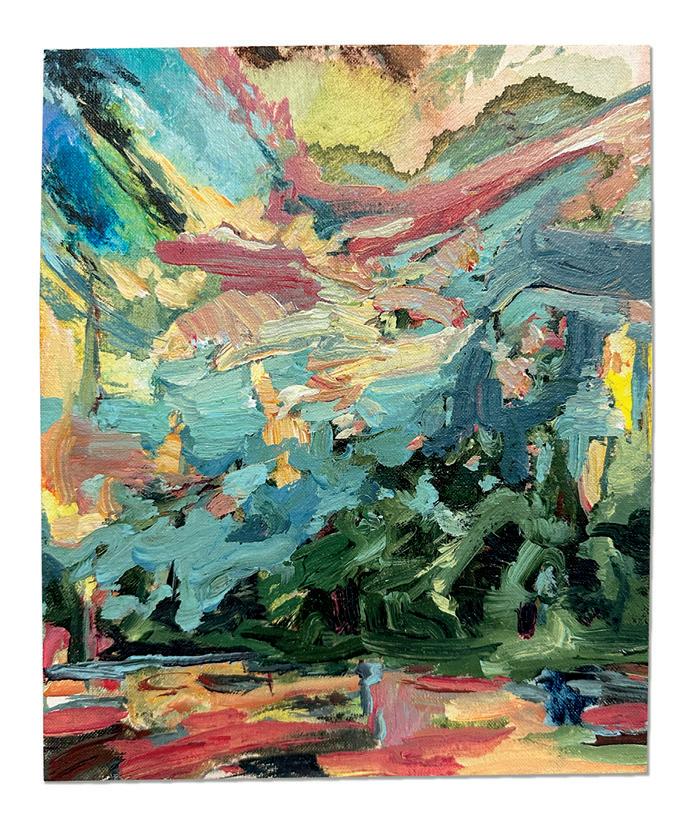
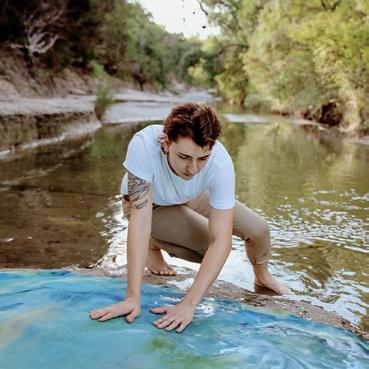
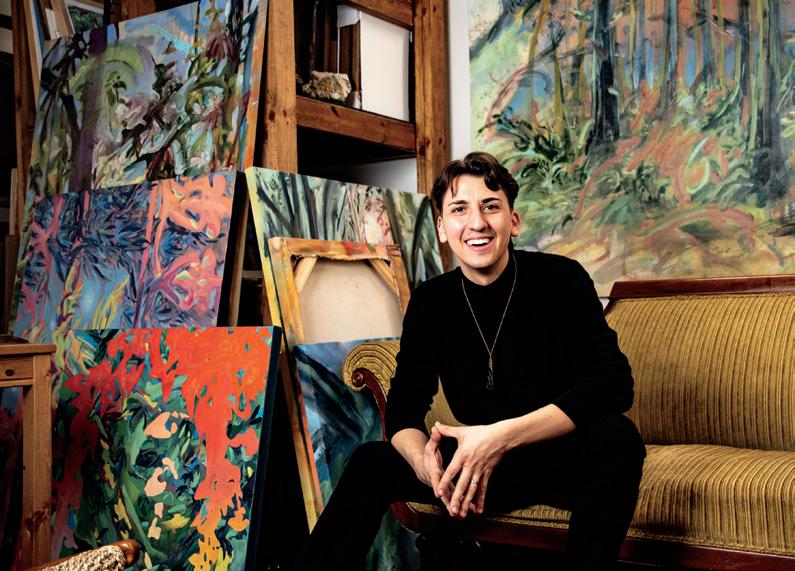
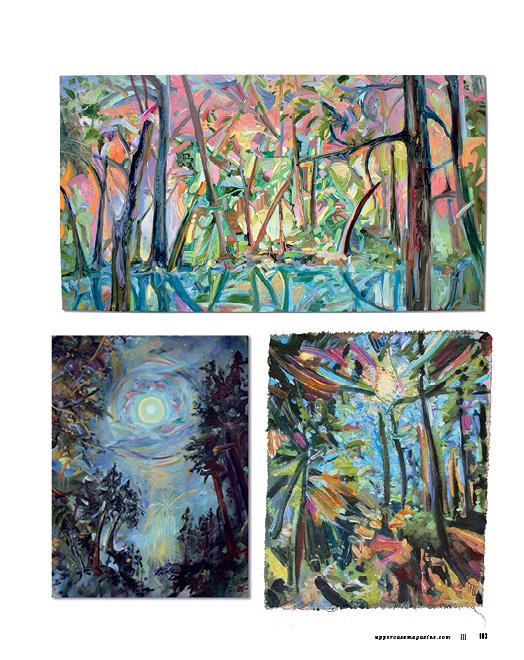
Considering his strategies in brainstorming, Thomas says that his process is naturally self-generating. “While I’m working, I’m being forced to confront new questions that need to be answered in different ways. I’m digging myself into holes and seeing how to get out of them—coming up with different ways to work with the pigments, or imagining subjects in a different scale. So, the seeds of every piece come from the one before. It’s an endless cycle.” In terms of what he does when he gets stuck, Thomas says, “Oh, that’s easy: make a new piece!” In his experience, the answers come through starting something new, which is why he typically has four to six paintings “percolating” in various stages of completion. In his mind, this approach honours the many different moods he might bring to the studio on any given day. Some days he is simply not ready to act on an idea, so his studio walls are covered with Post-it notes, with possible ideas quickly jotted down so he can revisit them later. His advice for those who “freeze” when presented with a blank canvas? “Mess it up. Make a mark. Make it ‘ugly.’ Just cover it with something. Then you can pull it back from the muck and make it beautiful.”
@thomasflynnii thomasflynnii.com
the elements in craft
How do the elements (earth, water, air and fire) inspire, inform or affect your art or craft?
Illustrations by Fire
Susan
Andra Lion
BOULDER, COLORADO, USA
On December 30, 2021, the Marshall Fire and straight-line wind event tore through Boulder County, devouring almost 1,100 homes, several businesses and thousands of acres of land. Of the nine houses on my road, my home and seven of my neighbour’s homes perished in the fire. We live in the grasslands outside of Boulder, Colorado, so there was little between us and the start of the fire to block the flames, and since the wind was gusting to 110 mph, there was little time to escape. We had less than 10 minutes to gather whatever we could grab and get out of the house. I quickly packed up my computer, hard drive and purse, and with a lot of hope, locked the front door on the way out. But as it turned out, I lost everything else— my studio, hundreds of pieces of original art, books, inventory, tools and a lifetime of memories.
I have been an author, illustrator and graphic designer for decades, owning and operating my own freelance business. I have a line of artwork outside of my freelance work that I have expanded to prints, decks of affirmation cards, children’s books and books for adults. Of all the personal things I could have saved, my computer was probably the most important—it had all my digital files of every drawing and every project that I’ve done. But my digital files are a second cousin to the originals, even though they are print ready.
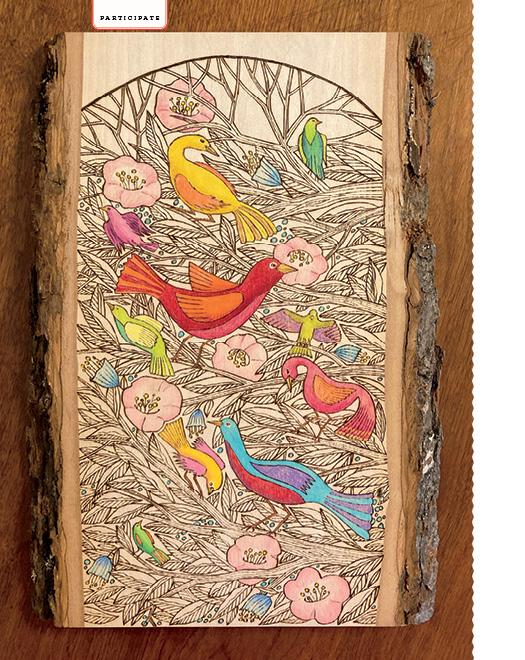
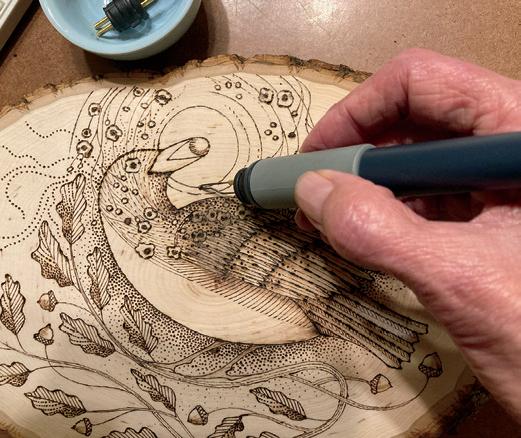
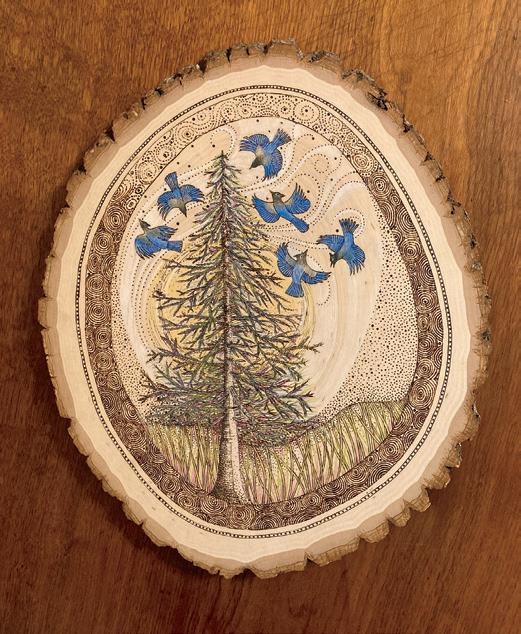
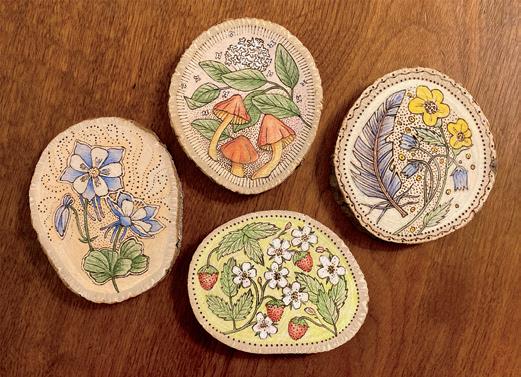
I replaced my coloured pencils, bought a drawing board and “got ready” after the fire, but there seemed to be a big hole that I couldn’t jump over. I had always loved working with wood, and one blustery winter day, it struck me that using woodburning tools instead of drawing pens would be a much-needed change. I hunted down some books, purchased a variety of planks and started. Wood has a comfort to it—sometimes hard, sometimes buttery, but always true to itself. The aroma, especially when the nib burns into the surface, reminds me of many nights around a campfire, singing to the stars, caressed by the wind.
I call my new line Illustrations by Fire. I’m an illustrator, so I haven’t changed my approach to design. I work up my idea on paper, finesse it on tracing paper, then transfer it to the piece of wood. The burning process—pyrography—is slow and deliberate, and can’t be rushed. That’s where the meditative element slips in—slow down, enjoy the moment and be here now I finally moved back home in December 2023 after being a nomad for a couple years. I know I’ll do more illustration on paper again—I’ve been working more in my sketchbook recently. But now I’m thinking of ways to expand my Illustrations by Fire to include texture and paper. There is no limit when it comes to creativity— wood, paper or heart. suelion.com
The Same River Twice
Dick Blau
MILWAUKEE, WISCONSIN, USA
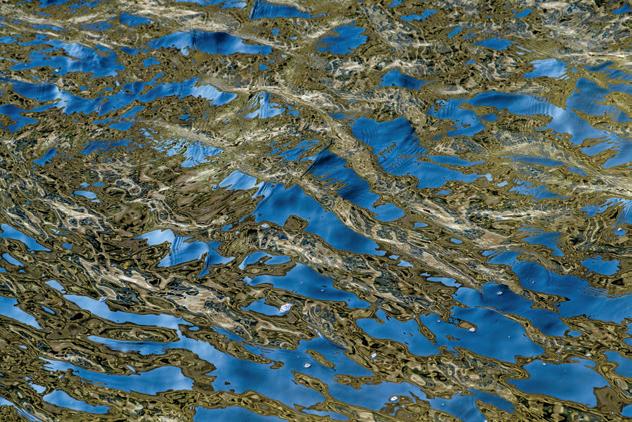
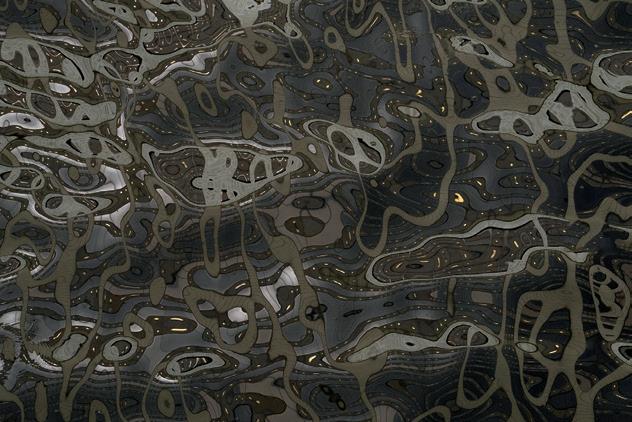
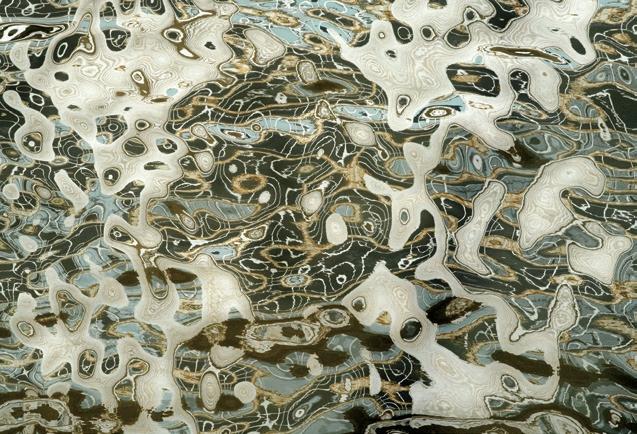
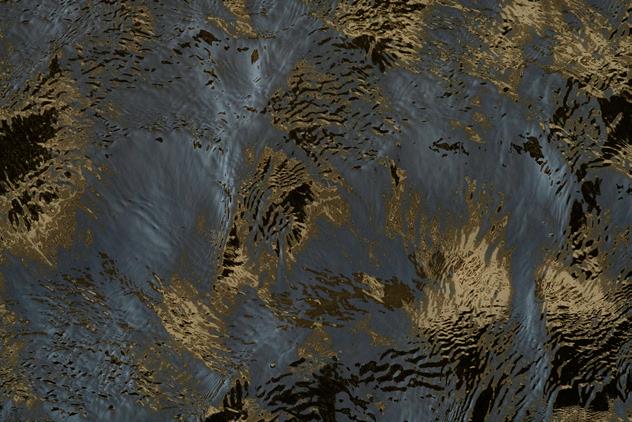
A series of still photographs made at, and of, the Milwaukee River that explores its surface and depths, arresting its flow to consider the ways that sun, sky, clouds, wind, currents and reflections all interact in a particular instant. These pictures are not representational, at least not in any conventional sense. They look at what is there but cannot normally be seen… except through the mind’s eye and the camera’s eye. I show these as single images and also as films, including one that that premiered at the Open Nights Festival in Larissa, Greece, in October 2025.
Capturing the Shape of Water
Cynthia Ryder
HARVEY STATION, NEW BRUNSWICK, CANADA
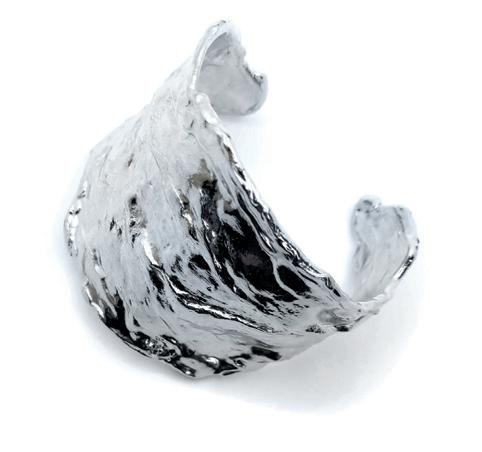
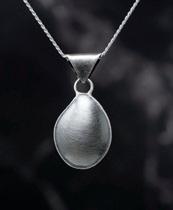
Water-cast pewter embodies the four elements. Pewter, a tin alloy, is of the earth, and needs fire, or heat, to melt and be workable. To cast the pieces, water is the medium that provides the shape, rather than a mould. When casting molten pewter into water, the water rapidly heats and a burst of steam evaporates into the air. The activity can be as dramatic as the results.
The process of water casting pewter creates textures that can capture the shape of a drop of pewter or the movement of the water as the pewter is poured in. The molten pewter solidifies within milliseconds of contact with the water. Each pour, small or large, wide or narrow, in deep or shallow water, creates a unique piece, with its own impression of the water in the surfaces of the pewter.
dickblau.com vimeo.com/1120420791
atlanticpewter.square.site @atlanticpewter
Fire, Water & the Cucurbit
Heather Liverman
ELLICOTT CITY, MARYLAND, USA
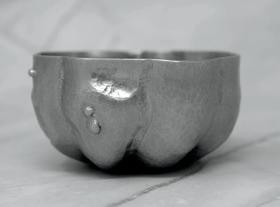
I was drawn to metalworking from a young age. I loved being greeted by the sound of rhythmic hammering from the metalsmith’s shop. These same sounds now fill my studio; angle raising, forging and chasing have become central to my practice. These processes are a conversation between the metal and me. Fire, water and air play a vital role in my process; some metals resist transformation without them. Fire is used to soften the metal, allowing me to move through the next step in the process. Air and water cool the metal. Nature is my other collaborator, specifically through the forms of the cucurbit family (gourds). Their lifecycle is a constant reminder of their importance to our survival. In each piece, I seek to honour the connection between metal, maker and the cucurbit. hmsmetalsmith.com @hms_metals
Co-creating with Nature
Claudia Cappelle
VIRGINIA, USA
CHARLOTTESVILLE,
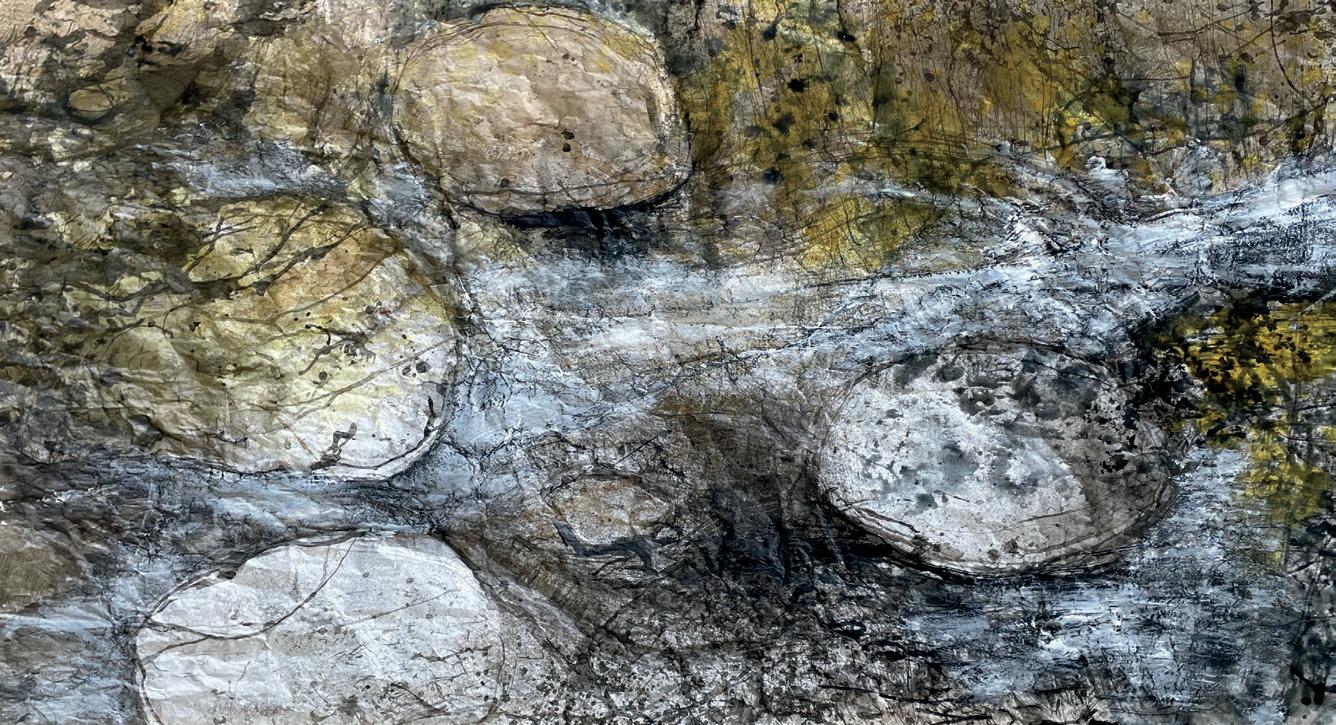
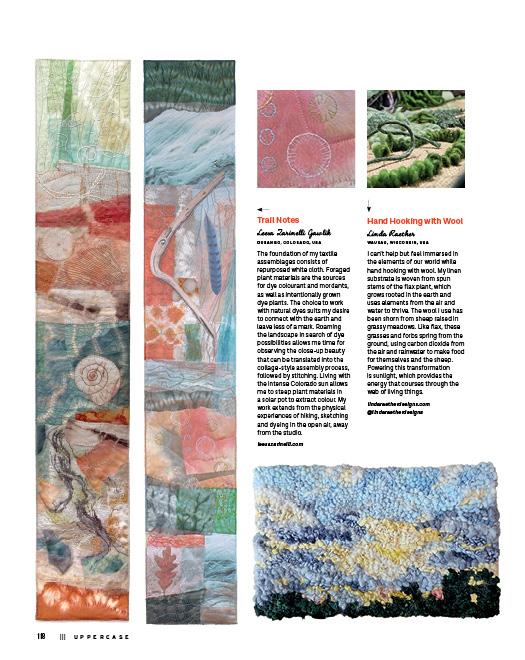
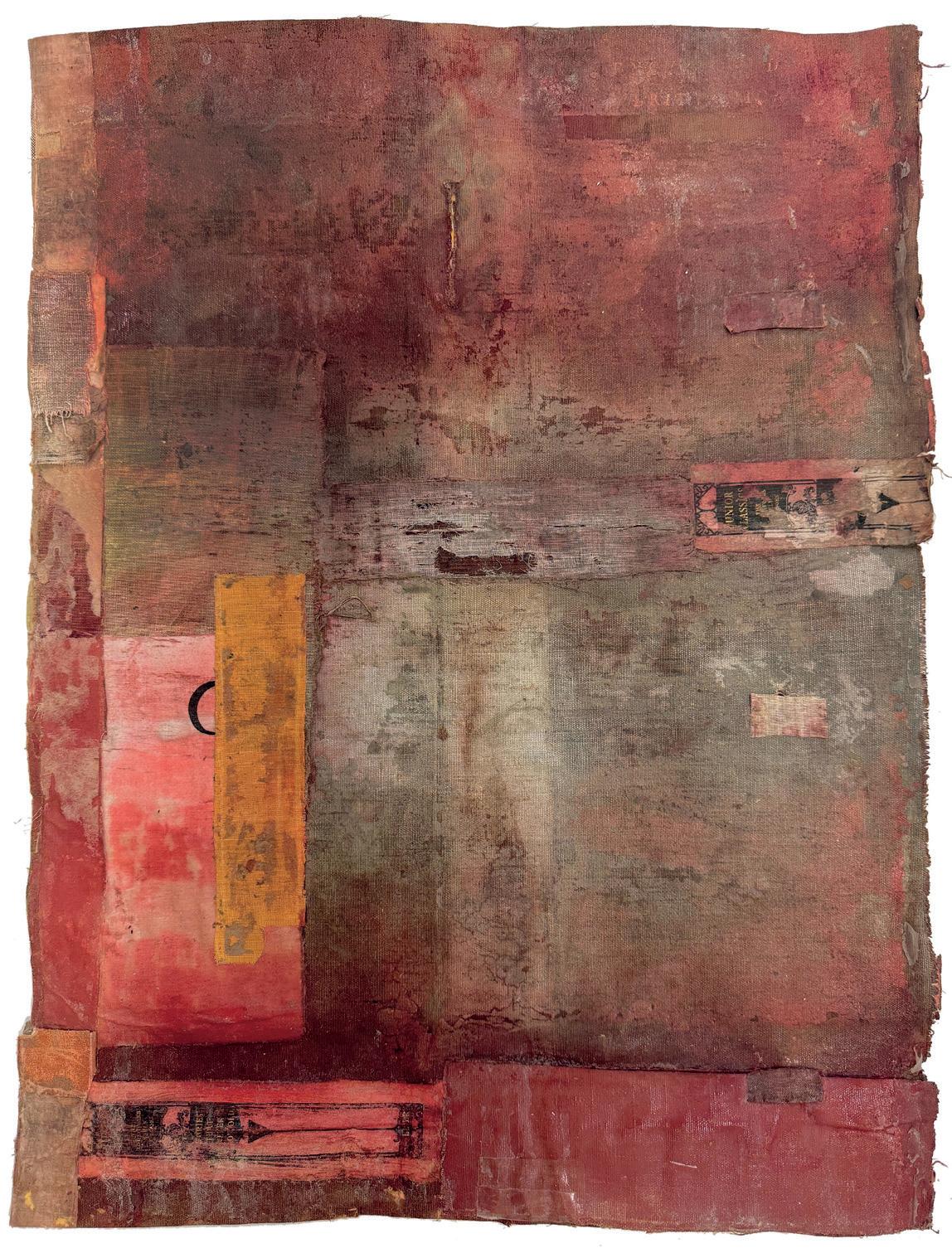
My work explores the connection between nature and spirituality through the lens of impermanence and the passage of time. The creative process begins outdoors, where the elements participate in the work. I use mark-making tools from nature and create natural dyes. Textured pigments pool and dry under the sun, creating weathered surfaces that echo cycles of decay and renewal. I aim for a visceral immediacy in the work, where memories and rhythms of nature gradually reveal themselves. Incorporating elements of the earth is essential to my practice. My goal is to co-create with nature—beyond mere representation. Through this process, I seek to express how nature’s cyclical rhythms not only shape the environment but also mirror the passages and renewal within our own lives.
@claudiacappelleart
Sun Spells Gretchen Thayer
MINNEAPOLIS, MINNESOTA, USA
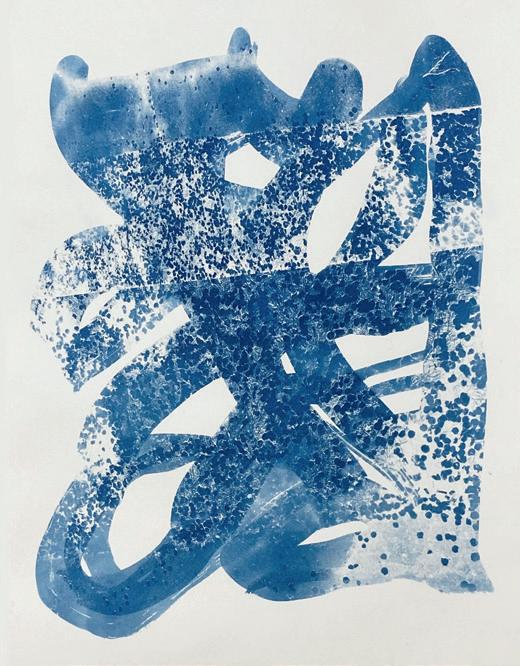
My latest body of work was inspired and informed by sunlight. They are paintings by way of cyanotype. I titled these works Sun Spells, since they are painted with specific intentions, then exposed to light. The sun not only acts as a way to create the print but also charges and sets the spell. A cyanotype is the process of coating paper with lightsensitive chemicals, then using an object to block areas while the paper is exposed to sunlight, making a cyan print that is then washed in water—which I love as an added element, clearing and cleansing the art.
I have also been making stainedglass windows, in which I paint on glass and fire it in a kiln. Fire and sunlight surround both of these works, whether in their creation or upon completion, interacting and changing the viewing experience depending on the luminosity of the sun.
studiopracticeart.com
@_studiopractice
Painting on Water: Fabric Marbling
Kate Hasted
TUNBRIDGE WELLS, KENT, UK
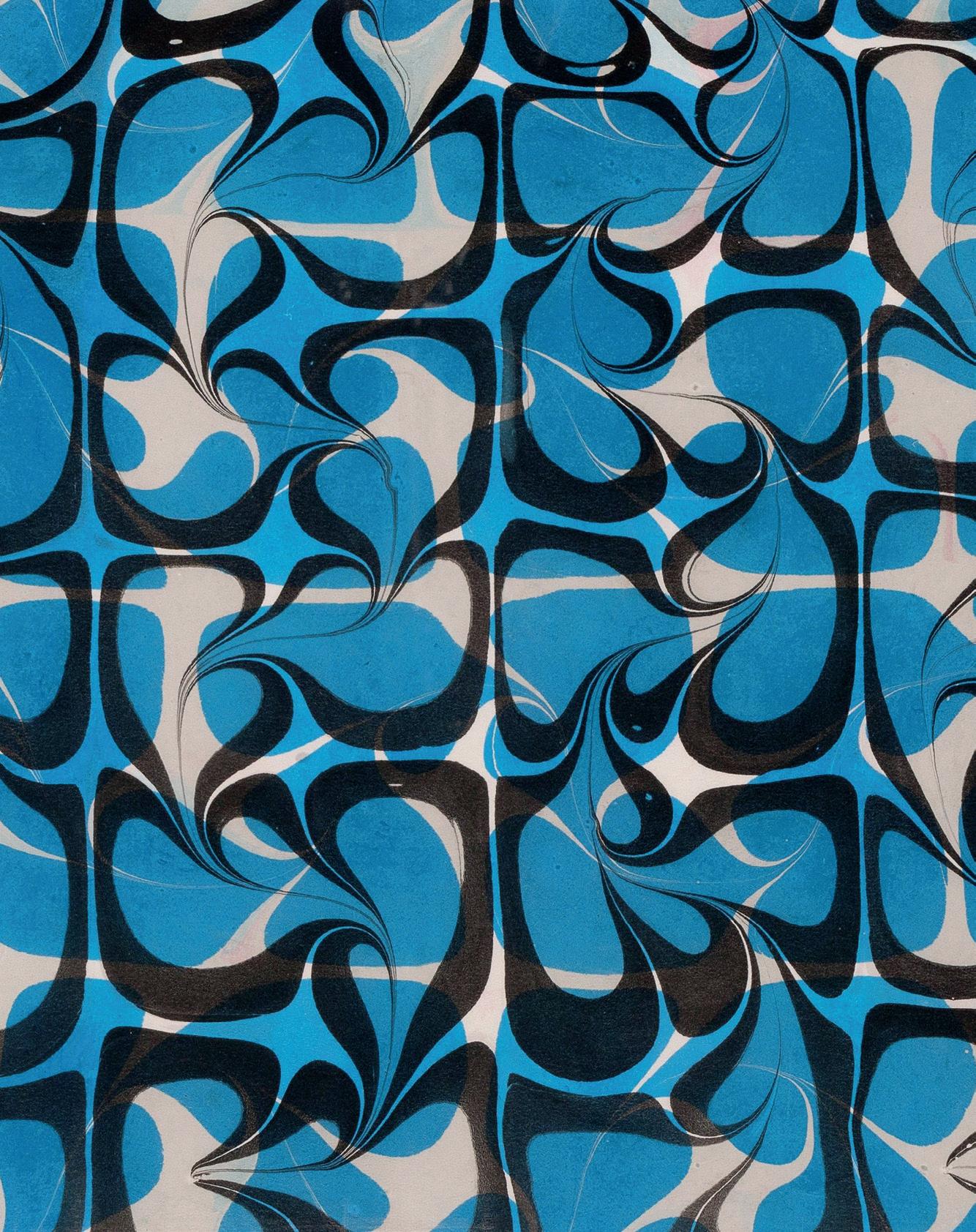
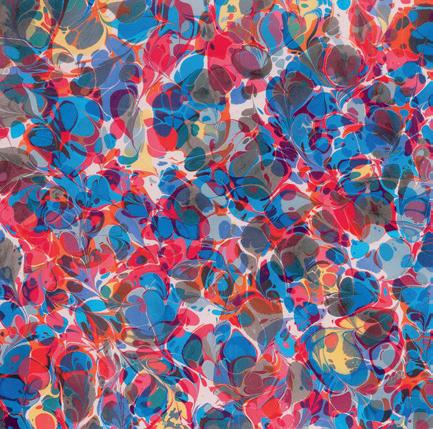
I am a textile artist specializing in marbling techniques. At the heart of my practice is water: I float inks on its surface, carefully manipulating them into patterns and shapes before transferring the image onto fabric. I am inspired by the fluid, unpredictable nature of water and the way colour, form and pattern emerge and evolve in response to it. My work explores this delicate balance—between control and chance, movement and stillness. My primary technique is ebru, a traditional method of marbling that dates back to 16th-century Persia. It involves working on thickened water, known as a size, on which colours are suspended and shaped before printing. My finished designs are rich with abstract, organic forms, and infused with colour, movement and a sense of flow.
katehasted.co.uk @kate.hasted
Glacial Ice in Blue Kelsey Stephenson
EDMONTON, ALBERTA, CANADA
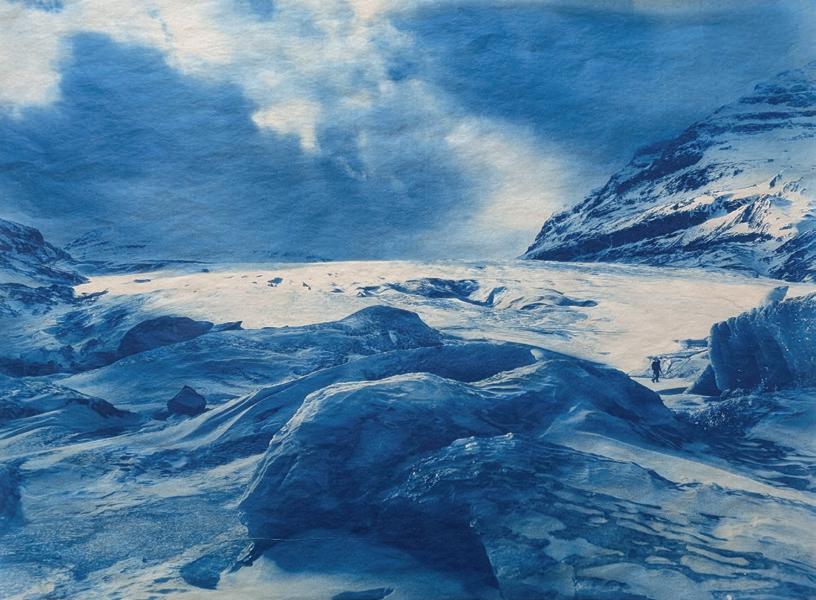
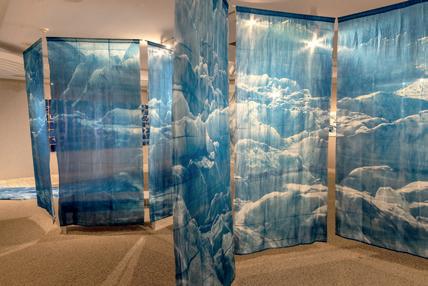
Water informs my work as subject, as process and in the media I use to share glacier ice. Cyanotype is a photographic process using negatives, or as a photogram that is developed with water. It can be exposed with an enlarger, or the sun.
I began using cyanotype with currents. In my recent work I have been exposing silk panels outdoors over the summers, bringing glacier seracs to life. Water becomes the focus, the method and the reason for making the work. As the ice becomes water and melts away, it tells a story of climate change.
My works on paper come from images brought back to the darkroom. I was recently fortunate to participate in the Arctic Circle residency. I made a few on-site photograms of glacial ice being exposed. Glacier ice contains memory; moments of time caught on paper.
kstephenson.ca
Collaborating with Mother Nature
Julia Nelson-Gal
FORESTVILLE, CALIFORNIA, USA
Aftermath is a series of collages made from linen book covers altered from exposure to Mother Nature. I salvaged these parts from my 2022 Burning Man installation, which was exposed to the sun, rain and snow for a year. These pieces are an exploration of deterioration as a creative force. The aging process is celebrated, revealing beauty in the decay, stains and fading. They are both relics and mirrors— reflecting our own impermanence while preserving fragments of human knowledge. The series invites us to consider what we discard, what we preserve and how time transforms meaning.
@julia_nelsongal
Fire Is Required Angela Hansen
LAKE COUNTRY, BRITISH COLUMBIA, CANADA
Both of my choices of sculptural mediums require fire: encaustic and clay. Encaustic is a beeswaxbased medium that requires some sort of heat at most stages, and when cool, cures to a hard surface. My favourite tool is the torch; it is used at all stages of construction and is invaluable to my process, such as fusing, or melting pieces or layers together. In ceramics, the kiln heat transforms greenware clay that is fragile and impermanent into something strong and durable. In both processes, fire is required!
angelahansenart.com @angelahansenart
The Art of Soil: Stories Written in Colour
Karen Vaughan
LARAMIE, WYOMING, USA
The elements—earth, water, air and fire—inform everything we do at the Art of Soil. That’s because they are all soil-forming factors. In soil science, we use an equation that explains that soils are a function of climate, organisms, relief and parent material—all acting together over time.
In my art, I use soil colour to communicate about soils. People are naturally drawn to colour and often surprised by the range of hues that exist naturally in the ground beneath us. It’s truly remarkable. Through my understanding of soil mineralogy and biogeochemistry, I aim to highlight the beautiful, intrinsic value of soils, rather than the extractive value we so often emphasize.
theartofsoil.com
@theartofsoil
STORY BY BRENDAN HARRISON
Before I knew what a commonplace book was, I had already written one.
Growing up in a family devoted to the public library, I inherited my father’s puritanical approach to handling books. He believed any borrowed volume should be returned exactly as it was received. While I never went as far as my dad, who would wrap the books he checked out in kraft paper dust jackets, I shared his disdain for dog-eared pages, underlined passages and handwritten notes.
But as my passion for the written word deepened, I found myself wanting to engage more concretely with the ideas I was reading. Unwilling to mark up these borrowed pages, I started carrying around memo pads to jot down quotes and passages that moved me. What began as a writerly affectation soon became an instinctive habit. Before long, I had filled dozens of notebooks with words I wished I had written myself. And since I often read in concentrated bursts on the same subject, these notepads became like photo albums, each page a snapshot capturing a moment of thought—a souvenir of my travels through literature, history and philosophy.
Once I began my own writing, these beat-up notebooks became something else entirely: a lifeline. Faced with a blank page, I would inevitably reach for a notebook in search of inspiration. If those pages didn’t spark my creativity, I would start transcribing them on my aging typewriter, trying to absorb the rhythm and force of sentences that had inspired me. I can’t say their genius rubbed off on me, but through that simple, mechanical act, something magical happened.
Hammering on the Remington’s sticky keys, typewritten pages soon began to stack up. To tame the mess on my desk, I started organizing them into files by theme: nature, literature, transcendentalism, social justice, the Roman Empire, rock and roll, Canadian history. These manila folders were memorials to my readerly preoccupations, records not just of the books I had borrowed, but also of what had spoken to me from their pages. They showed me how far and wide I had read, and I kept them close at hand—even when I couldn’t fully explain why.
It wasn’t until I stumbled upon the Victorian tradition of the commonplace book that I understood the significance of my habit. In the 19th century, intellectually inclined Victorians maintained handwritten compendiums— scrapbooks of quotations, poems, reflections, recipes, legal formulas and more, all organized by personal interests. Commonplace books became a unique record of their owner’s intellectual and practical concerns. To outsiders, these books might seem like a chaotic jumble: high and low, practical and philosophical. But to the writer they mirrored the complexity of human life—reflecting the many concerns competing for our fractured attention.
Recognizing this parallel reframed my compulsive note-taking and transcription from an unexamined habit into an intellectual craft. By selecting, transcribing and organizing ideas, I was practising an active kind of knowing. The task required patience and judgment— slow, reflective work that sharpened my understanding and helped me make connections between ideas over long stretches of time.
Today, with artificial intelligence promising second brains that can provide instant access to the world’s knowledge, the idea of a commonplace book might seem antiquated and quaint. As a young man, I likely would have been seduced by AI’s promise of instant answers to any questions I had. But while I could have satisfied my curiosity in the moment, doing so would have required me to bypass the slow, reflective reading that shaped my understanding of the world. The shortcut would have made me into a passive consumer of information instead of someone who rolled up their sleeves and explored for themselves. If I had relied on algorithms to recall, organize and explain ideas, I would have missed the mental labour needed to internalize knowledge, and the discipline required to identify insights, build new connections and learn deeply.
Even though they may seem like relics of the past, commonplace books may actually be more necessary than ever—a vital antidote to the creeping brain rot caused by an overreliance on technology. The process of reflecting on ideas, writing them down and purposefully sorting them challenged me to revisit and question concepts and philosophies. It was slow work that taught me to think critically, to make the unfamiliar familiar and to join disparate threads into something new.
A commonplace book is not just a record of thoughts— it is a process. By taking the time to identify meaning, handwrite and organize with care, I developed a depth of understanding that no software could automate. I realize now that my notepads and folders were not just archives—they were evidence of my effort to focus, even as distractions multiplied in the modern age. And while I can now carry the world’s knowledge around in my pocket, I believe that wisdom still requires writing it down—in your own words, on your own terms.
subscriber studios
My Creative Space
Elizabeth Firth
GEORGETOWN, NSW, AUSTRALIA
My studio is located up 21 stairs, nestled among the treetops—a creative, artistic space that I had wished for, for years. It is cobbled together with a blend of secondhand finds and family possessions. My grandfather’s writing desk serves as my computer station, while vintage laboratory drawers, collected by my father, hold ribbons, fabric samples and other miscellaneous items. I salvaged an old door during our renovations; it now rests on A-frames as a bench for calligraphy and a space for cutting and sorting. Below it is a stereo system with a multi-CD player. Three secondhand bookshelves of varying sizes store my inspiration: books, magazines, vintage packaging, old music, tins, wine bottles, toys and a couple of dollhouses I built. On the opposite side, my greatgrandmother’s kitchen table acts as a collage and sewing table. Above it, my wall of inspiration showcases anything I need to remember and brings me joy. Beneath the table are three dog beds for my fur babies: Tycho, Harry and Zoot. My joy is dividing my time between tutoring and mentoring students in clarinet and saxophone in my music studio and pursuing my artistic endeavours, which include calligraphy, lettering, art and design.
lilyandfarron.com
@lilyandfarron
make a “kraft”
Share your pictures and stories of UPPERCASE books and magazines on Instagram and in our community, the UPPERCASE Circle.
Have you made something with the kraft envelope, upcycled the magazine or reused the postcards in an interesting way?
@uppercasemag uppercasecircle.com
Reuse and upcycle your mailer
UPPERCASE subscriptions are mailed in a 100% recycled and recyclable kraft mailer. Give it a second life and make something creative!
VISIT OUR WEBSITE FOR IDEAS AND PROJECT TEMPLATES. uppercasemagazine.com/kraft
Tawnie Duckett BOTHELL, WASHINGTON, USA
These are flower creations made from the UPPERCASE postcards that I have been collecting since issue 50. I thought I would make a couple of them, but kept getting inspired to make more!
Petra Paffenholz
COLOGNE, GERMANY
I’m an artist and love bookbinding. I just love to write my thoughts down. With bookbinding I express my love for writing whenever I prepare a fresh sketchbook. While using up everything that’s already in front of my nose, I avoid buying new things, except blank paper and thread. Well, there’s also UPPERCASE magazine—the beautiful covers are upcycled, as well as anything inside, to create collages.
petra-paffenholz.de
Make connections, nurture your creative spirit and grow your business!
The UPPERCASE Circle is our online home for print subscribers. Membership is included with your print subscription!
Members can also enjoy a free preview of the UPPERCASE Archive to read digital versions of beloved back issues long out of print. (Ongoing Archive access is available via paid plans.)
Connect with kindred spirits in an algorithm-free environment that is kind and uplifting.
uppercasecircle.com uppercasearchive.com
Posts from Janine about all things UPPERCASE. There’s also a Video Library of all past broadcast events and interviews.
Inspiring graphics, articles and shares to keep everyone’s spirits up through creatively challenging times.
Share your UPPERCASEinspired “krafts” using the mailer envelope, postcards and upcycled magazines.
Links to what’s currently inspiring, interesting and informative, shared by Janine and community members, plus monthly meetups.
Hundreds of creative prompts to scroll through—you’ll be sure to find something that ignites your creative spark!
Focused topic areas for posts and discussions, including Surface Pattern, Textiles Love, Make it Worthwhile and more.
Connect with eager customers through the Marketplace—post your wares, courses and other creative offerings.
April-May-June 2026 ISSUE 70
Jul-Aug-Sept 2026 ISSUE 71
Oct-Nov-Dec 2026 ISSUE 72
Jan-Feb-Mar 2027
Calls for Submissions
Sign up for my weekly newsletter for behind-the-scenes updates and the latest on open calls for submissions for UPPERCASE books and magazines. uppercasemagazine.com/free
Pitch your article ideas and suggestions! uppercasemagazine.com/participate
NEW BOOKS
UPPERCASE Encyclopedia of Inspiration
Published in whimsical, nonalphabetical order. Thirteen books in this series have been released since 2016: F, S, B, P, E, V, Q, C, Y, A, R, N and, most recently, G. More ideas are in the works— possibly M and J will be next! Make sure you’re subscribed to the UPPERCASE newsletter to hear about the next volumes and how you can audition to be profiled within them. uppercasemagazine.com/free encyclopediaofinspiration.com
what we lose
The groceries arrived on my doorstep like a magic trick. I brought the brown paper bag inside and examined the contents—the limes and avocados were in near perfect condition and everything else seemed to be in order. Earlier that afternoon, I opened my computer, located an online shop, spent a few minutes scrolling, added items to a virtual cart and hit the order button. An hour later, there they were. As if they had silently dropped from the sky. I marvelled at the miracle of it, wished I could just pop on to a site, enter a particular problem, select a solution from a dropdown menu and push a button. How free I would be, I thought. “Free” was the word I repeated to myself, over and over again.
I have said this here before, but it bears repeating: writing is the most uncomfortable of all my creative processes. Even after decades of experience, it still feels the most like fumbling around in the dark, looking for light. Long before artificial intelligence (and online grocery shopping), I wished for a magic fast-forward button—no struggle, just an instant arrival at the moment at which the work is practically finished.
Instead, like most writers, I continue to trudge through a personal process. I turn ideas over, scribble things down, stumble through research, scribble again, walk away for a while, come back to it, see if I can live with any of it. I beat back a quiet voice that tells me I have no business writing at all. I move sentences around, scrap entire sections, add and subtract until the real bones of it begin to take shape. In other words, I perpetually grapple. I am uncomfortable. This goes on for days until finally I find my way through and I am so relieved I could cry. I can see the edges of the thing and my voice sounds clear. Maybe even a few parts of it sing. And I remind myself: you just have to do the work, Andrea. There is no magic button.
Except now, in 2025, there is. If I wanted to, I could feed AI every piece I have ever written for UPPERCASE, tell it what I want and hit the generate button. Easy as ordering groceries online. As the saying goes, be careful what you wish for—all those years I wished for a magic button, and now, I don’t want it. Because as difficult as the process of writing (or making anything at all) is, as it turns out, struggle is a fiercely vital component. It’s the blood that carries the oxygen to the heart of the thing; it’s what makes the work human. What we really stand to lose with AI is the growth that happens in the midst of those sticky, uncomfortable places in between—when we would rather be doing anything else but fighting to find the right word, the right sound, colour, material or direction, when the process is brittle with uncertainty but we choose to push forward anyway. Like it or not, struggle, endlessly intertwined with the work, is what makes us who we are—not just as artists, but as human beings. Even as I write this, I am struggling. I am uncomfortable. I am desperate to wrap this thing up, to make it nice and tidy, and be done with it. But I also know that’s not the way it works, and stranger still, I am thankful for it. The creative process has always been difficult and messy, but AI turns it on its head, renders struggle virtually obsolete and leaves a much more devastating mess in its wake. I think about the moment those groceries were delivered, how I was so quick to equate ease with freedom. But the truth is that we lose freedom the minute we trade struggle for ease, when we opt for convenience over the very inconvenient act of pouring our own human selves into what we make. We can no longer truly claim it as ours, and reader, there is no magic button in the world worth the cost.