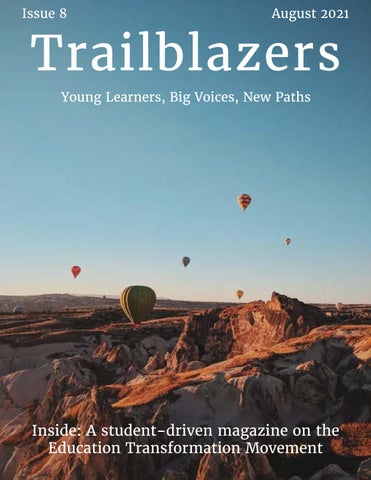
Trailblazers Issue 8 Final edit.

Page 1


Trailblazers

Young Learners, Big Voices, New Paths

A student-driven magazine on the Education Transformation Movement

Spotlight Learners

Pages: 9-13

The Value of Feedback

Audrey Thompson

Audrey Thompson is a rising sophomore at the Mount Vernon School. Audrey runs cross country and track for Mount Vernon and loves to read in her spare time. She is a member of Innovation Diploma and her favorite school subject is French. In the future, she looks forward to sophomore year and doing more projects in Innovation Diploma.

Pages: 22-25

Pages: 14-17

Tips for Productivity and Collaboration

Claire Davis

Claire Davis is a rising sophomore at The Mount Vernon School and is participating in the iDiploma Program. She has dreams of becoming an anesthesiologist and enjoys reading, writing, and photography.

Pages: 26-29

Pages: 18-21

Making a Class to Understand Mine

Kendall Sommers

Kendall Sommers is a rising senior in high school. A major passion of theirs is creating art, films and collages and poems. They want to work in special education when they’re older or teach in some facet. A fun fact about Kendall is that they didn’t try soup until they were 13. They are a runner, a coxswain, help lead the Gender Sexuality Alliance at their school, and help plan the open mic. Kendall is so honored to be writing with Trailblazers and is so excited to have their writing out there.

Self Directed Learning

Jasmine Setchell is a 17-year-old secondary school student in Aotearoa, New Zealand. In school, she is a head girl - a whole school leader. She leads the school’s Red Cross group, environmental group, and participates in many clubs. Outside of school Jasmine is a passionate dancer and hopes to use her leadership capabilities to drive change in environmental conservation.

An Interview with Trey Tiffin

Trey is a newly-grad of Mount Vernon High School in Atlanta, Georgia. He will be attending the Georgia Institute of Technology in the fall. Trey loves to play sports as well as spending time outdoors. He believes his communication and leadership skills have made him successful in the design thinking world.

Trey Tiffin
Jasmine Setchell

It is time for education to be transformed. Schools were first created during the Industrial Revolution with the purpose of preparing students for factory work. However, we are no longer living in that time period - it’s the 21st century where information can be looked up in a matter of seconds, and businesses are looking to hire creative problem solvers.

With the progression of time, there should be a change in the purpose of school. In the transformed education model the purpose of school should be to: make the world a better place by engaging young learners in opportunities to be active change makers in society. Over the past decade there has been a worldwide movement amongst certain educators to redesign the education system. This community has been creating a new “school,” where students get to pursue passions, work with experts in different fields, and create real impact.

We are a few of these educators whose voices aren’t always heard. We are the “students,” though a more appropriate term may be, “young learners,” because we believe everyone is always a learner.

A LETTER FROM THE FOUNDERS

Education is being redesigned, and like any good design challenge, the designers must talk to the users in order to create impact. This magazine, Trailblazers, was founded with the intent of sharing the work and opinions of young learners who are marking new paths in education.

We founded this magazine at Mount Vernon Presbyterian School in Atlanta, GA, in collaboration with the Mount Vernon Institute for Innovation. We are members of the Innovation Diploma, a program that meets 5.5 hours a week to explore various ventures where we work alongside members of the community, business leaders, and entrepreneurs to create innovations. Our primary goals are to build muscle and capacity as innovators, blur the line between “school” and the “real world,” and leave the world better than we found it. Because of our passion to transform all of education, not just our school, we created Trailblazers, a platform for young learners around the world to share their voices.

Hey! It’s been a while. Trailblazers has changed drastically since our last issue. Our team has expanded to accept 9 new dedicated people who have elevated this magazine to greater heights. We have reinvented ourselves, and this issue marks the beginning of a new and improved Trailblazers!

This eighth publication of Trailblazers is a testament to the work of the production team, founders, and supporters in highlighting spotlight learners. We have also partnered with Up for Learning, an organization that works to empower both youth and adults in transforming education. Together, Trailblazers and Up for Learning have a common goal of elevating youth voices.

Our production team spans 8 states, yet we are able to connect online and simulate the feeling of in-person interaction through a set of values: diversity, professionalism, innovation, communication, open-mindedness, initiative, resilience, and collaboration.

This issue features various student’s opinions on everything from late assignments to the importance of receiving feedback. These articles truly reveal that even though millions of teenagers go to school, no two people experience school the same way. Personally,

I enjoyed Claire Davis’s “Tips for Productivity and Collaboration”. We both went through similar experiences, but they impacted her and improved her in a completely different way than how they impacted me. It’s eye-opening to see how other students deal with common problems in different ways! I also appreciated Audrey Thompson’s “The Value of Feedback’’, because her article explored a perspective that I’ve never experienced before. She artfully describes the impact that a biomedical engineering project had on her, all while demonstrating the importance of something that most students overlook. Kendall Sommer’s “Making A Class To Understand Mine” described how they solved a common problem with a unique solution. Trey Tiffin’s interview explores the Innovation Diploma program, from the perspective of a college student. Jasmine Setchell writes about a self directed education experience, delivering a unique perspective on education. Each of these five articles, from five impressive young learners, allows us at Trailblazers to continue our mission, to amplify young learner voices in education.

Mission: To amplify young learner voices in education

Partnering with UP for Learning

Publisher

Abigail graduated as an inaugural member of Innovation Diploma and now studies industrial design at Georgia Institute of Technology. Her favorite pastimes are giving out high-fives and telling puns. Abigail strives to inspire and empower other students to believe that they can make a change now and don’t have to wait until they’re “older” and “wiser” to start.

Amelia Guerin

Communications Associate

Amelia Guerin is a sophomore at Twinfiled Union High School in Plainfield, VT. As a result of her very student-centered education experience thus far, she has an interest in making high school a more inclusive environment where all students can really grow. For her future, she wants to pursue a career where she can help others, In her free time, Amelia enjoys reading, writing, and playing piano.

Anya Smith-Roman

Editor-In-Chief

Anya graduated as an inaugural Innovation Diploma member in 2017 and is now a Business major at Georgia Tech studying to become a social entrepreneur in education. Since high school, Anya has been striving to forward the Education Transformation Movement by networking with thought leaders around the world, speaking and coaching at education conferences, and being a pioneer of innovative learner-centered education practices.

Mantra Burugu

Assistant Editor

Mantra Burugu is a junior at Farmington High School in Farmington, Connecticut, She dreams of crafting a successful career out of her passion for coding by becoming a renowned computer scientist. Because of her interests, she plays a major role in her school’s Robotics team, social justice clubs, and literature clubs. In her free time, she enjoys reading and writing.

Sydni Willams

Managing Editor

Sydni Williams is a writer, actress and learner from Framingham, Massachusetts. She is a strong believer of appreciating the little things in life like sunsets, boxes of chocolate, and ice cream on a hot day. Despite her loyalty to these timeless cliches, Sydni would more accurately describe herself as a realist in love with the literary arts. Sydni spends most of her time reading, writing, and appreciating art in life.

Zayda Kellogg

Graphics Advisor

Zayda Kellogg is a student at Bennington College in southern Vermont studying architecture, physics, and design. She is also an avid bullet journalist and video game enthusiast whose struggle with her health during high school led her to the education transformation movement.

Kate Lewton

Outreach Associate

Kate Lewton is a junior at Stowe High School in Stowe, Vermont. A major passion of Kate’s is youth wellbeing, as she believes it is important for youth to feel accepted and encouraged, She likes to watch movies, listen to music, and go to the beach. In the future, Kate hopes to do something in pediatric medicine.

Eileen Peng

Director of Media

Eileen Peng is currently a rising junior at Farmington High School. She loves history and economics, and she hopes to be able to further explore them in the future, She enjoys reading, crosswords, and, though, admittedly, rather inconsistently, playing viola.

Imaan Alrahani

Outreach Associate

Imaan Alrahani is currently a sophomore attending Farmington High School in Farmington, CT. She is very passionate about social justice and hopes to create change in the world by challenging the status quo. In her free time, she enjoys cooking, creating art, spending time with family and friends, learning new things, and helping others. Because of her interests in skincare and skin in general, she hopes to become a dermatologist; however, as long as she is doing something that involves helping others, she will be very happy!

Sarah Hannan

Lead Graphic Designer

Sarah Hannan is a rising junior at Farmington High School in Farmington, Connecticut. Sarah has developed a passion for music and art and has enjoyed taking many music and art classes in school. In addition, she enjoys participating in advocacy groups both through school and outside of school. She hopes to pursue a career where she can channel her passion for advocacy and creativity.

The Value of Feedback

“Your decisions and choices will define your tomorrow.”
-Claire Davis (page 16)

The image above is a written diagram of Audrey Thompson’s biomedical engineering project where students designed a method to test femur fracture repair.

Audrey Thompson

Often overlooked, feedback is an essential part of student learning. I realized the value of feedback firsthand when I completed a biomedical engineering project. For this project, students worked with a partner to design a method to test a femur fracture repair. At first, the project was daunting as I had never learned about biomedical engineering or femur fractures. Our machines had to be based on the movements of a recovering patient, which only made the project more challenging. However, thanks to the feedback my team received, we were able to successfully create a working device. While this project taught me about biomedical engineering and biology, the most valuable lesson was learning to create multiple drafts of my assignment.

In the first few weeks of the project, we developed a basic understanding of how to create a femur fracture repair testing device. We talked to different professionals to help us understand how the femur is used in the human body. Then, we created a rough sketch of our design and we were given feedback from a professor. Talking to an expert who had a deeper understanding of the material was extremely helpful. With their constructive criticism, we had the ability to revise our plan and continue to push ourselves to build a better machine. The professor noted that our machine was not fully based on the movements of a recovering patient. We utilized this feedback and created a new iteration of our testing device that was much more effective and complete.

Another time I received valuable feedback was when I worked in a group to create a video about healthcare in New Zealand. Our teachers instructed us to start off by creating a trailer for our video. We received responses from our peers and teachers about the trailer and how we could modify it. My team was advised to use a different editing software and change the background music.

Since we received feedback in the middle of the process instead of at the end, we had time to improve our project before presenting. Education needs to be adapted to fit the current world and students need more real-world experiences. The process of receiving feedback and having the opportunity to revise teaches skills that are necessary for the real world. Real businesses create products and use customer criticism to improve their designs.

They constantly have to adapt and change over time. “For top-performing companies ‘continuous improvement’ is not just a showy catchphrase. It’s a true focus based on feedback from across the entire organization – customers, clients, employees, suppliers, vendors, and stakeholders.” (DeFranzo) Students should be prepared for the real world by learning how to receive and implement feedback in their work.

Receiving criticism throughout the process of a project has helped me learn how to make changes to a design and helped me see errors that I did not notice. Creating multiple drafts of my biomedical engineering testing device allowed me to experiment and try many different approaches. The feedback that I received on my healthcare video trailer helped me focus on the audience and make the video quality better. Feedback is an essential part of student learning because it helps students learn how to revise their work and improve upon their current product. When students turn in a project

and receive a grade and criticism at the end, they do not have the opportunity to improve the work. The assignment is completed and forgotten about. Feedback helps students monitor their own learning because it gives them the chance to see where they are at regarding their understanding of the material. Students need to take ownership of their learning and additional feedback will help them know how to improve.

Citations

DeFranzo, Susan E. “5 Reasons Why Feedback is Important.” Feedback Management, Snap Surveys, https://www. snapsurveys.com/blog/5-reasons-feedback-important/. Accessed 21 June 2021.

“Feedback is an essential part of student learning because it helps students learn how to revise their work and improve upon their current product.”

Tips for Productivity and Collaboration

As a student, one of the worst feelings for me is having late assignments. Opening up my computer, after another amazing weekend, and seeing the words “due two days ago”. Then the panic sets in, as you click on the assignment and double check that you didn’t do it. As you hastily start to complete that late assignment, you think, what was I doing on Friday? You internally kick yourself as you finish the assignment and come up with a quick excuse to your teacher. If this is your first rodeo, the teacher will accept your excuse, you can take a deep breath and let that panic subside. But after a few of these assignment panic attacks, the teachers stop accepting your witty excuses and say that “habits have to change”. For me, two assignment panic attacks were enough for me to know that my old ways weren’t

working for me and that I wasn’t spending enough time on my work.

Now, I am a workaholic, always on my computer, always seeking to improve my organization habits, and striving to learn as much as I can. When COVID-19 arrived in the US, I started watching dozens of videos on how to set up your day with online school, how to organize your space, how to stay on task, etc. As the days turned into months, I could see the productiveness, collaboration,

and joy seep out of all schoolwork activities. Everyone became so tired. By learning to work at home, with all the noise and people constantly bothering you, I learned how to work from anywhere.

Tips From Your Local Nerd

I started my COVID-19 learning journey with a disgrace of a desk. It was so dirty, in fact, I finished my 8th grade year online at my kitchen table. Every morning, I would get up and join my classes while my dad made breakfast, and I was honestly just counting the minutes for my classes to end. All the joy of learning was gone and all I wanted to do was get out for summer and not have to sign in to my classes. Day after day, I would log on and hope that I didn’t see a “due yesterday” assignment. This was my routine until summer. Once school started again in August, I had spent enough hours scrolling through productivity videos to know that I needed a real workspace if I was going to succeed in high school. My mindset as I started the school year was “I have to pay attention, these years actually start to count”. Regretfully, this perfect life I stole from others didn’t work for me. After a B in my first module in math, I realized that the habits I adopted weren’t working and I had to learn what really worked for me.

One of the most important things I learned from the productivity videos I watched was trial and error. You need to learn what works for you. Personally, I write to-do lists every day, and I like to do my school work early in the morning. Also, I know you’ve probably heard this one before, make your bed every morning. Yes, every single morning. If it is the first task you do, you will feel more productive going on with your day. When I went back to school in the early autumn, this simple task was the only thing that stayed the same every day. The most important thing when trying to be productive is seeing what others do and adapting certain things to your own needs. But learning how to work in a school setting is completely different than working online at your kitchen table. When my school went fully back to school, I had a tough time adapting my online schedule to my school schedule. It threw me off as I began a new mod. I had to learn how to work on my schoolwork in school and do homework at home, which I haven’t done in a while. Whatever I didn’t finish at school, which was a lot because I was so socially deprived, I had to make up at home. My desk became a place I spent hours at. Studying became my new normal. Learning how to manage my time at school and home was one of the

Claire Davis

most important things I learned in the past year. As soon as I learned how to finish and complete work at school, I spent less and less time at my desk.

So, my golden tip is...silence and music. One of the only ways I could write and finish assignments at school was either earplugs to drown out noise or headphones to provide some nice ambiance. Too many people around stress me out, but when I couldn’t hear them, I could focus. By learning this about myself, I was able to complete more work in a timely manner, which my family appreciated. By learning how you become focused and productive, you can change your schoolwork habits. Of course, my solution might not work for you, but this is how I finished my schoolwork. I learned how I learn best and the habits that work for me.

Collaboration is one thing that drastically changed my school life. Teachers absolutely love groupwork, but I had a personal disdain for it. I had way too much stress, anger, and enough backup schoolwork to bury myself in. By fixing how I finished my individual work, I learned how to use more of my social battery working with others and improving our work together. Productivity and collaboration for me went hand and hand. School has now become one of my favorite places to be, but that could also be because of my personal

mindset. Anyone can have more energy if they learn how to focus and spend their spare hours learning how to improve their current habits. Your decisions and choices will define your tomorrow.

“Anyone can have more energy if they learn how to focus and spend their spare hours learning how to improve their current habits. Your decisions and choices will define your tomorrow.”

An Interview with Trey Tiffin

“Meeting people, talking to people is so important to figure out what you want to do,” Trey Tiffin remarks as he reflects on the opportunities brought upon him and how that helped him realize that the technology and management program at Georgia Institute of Technology in Atlanta, Georgia, was of interest to him.

“That is the most valuable thing that I pulled out of it [Innovation Diploma].” Like any meeting nowadays, Zooming is the way to go. In a very relaxed environment, Trey talks to us about the Innovation Diploma at the Mount Vernon School in Atlanta.

The Innovation Diploma Program is a student-run design firm that partners with different companies and organizations to give them advice and assist them in any way they need. Facilitators give these students

advice to inspire them, but all the work is on these hard-working high schoolers. “My senior year I did a brief all by myself. There was no supervision from my facilitator because I had enough trust. I was able to complete the brief by myself,” he states. He explains that a brief is a project that an organization or company gives you.

For example, when an organization is launching a new project, they would approach these students to ask how they would go about marketing it. For Trey, that company was Delta Airlines.

“I worked on a brief with Delta Airlines that redesigned the whole gate experience in an airport to make it less stressful, more exciting, entertaining, and more efficient. You use design thinking and we have our process of discovery. We use a lot of different tools to get to our point.” He also

worked on another brief with Delta Airlines. “I designed a wheelchair costume for a millennium falcon for a kid with cerebral palsy. We created this product for him, and that for me was very satisfying.”

Like many kids who are in iDiploma, Trey was recruited in the eighth grade and joined freshman year. The iDiploma empowers students to be innovative at the moment. Students build professional relationships and are active in creating positive change in the real world. “It’s really cool especially when you are fourteen, fifteen years old to be introduced to that kind of work that early. From a resume standpoint, it helped me stand out. Compared to other kids who didn’t have this program,” he emphasizes. “Now I have experience in things that college is going to give kids for the first time,” he continues. He learned how to become a better public speaker, more confident in his abilities and ideas, and overall work ethic. “I got really good at giving presentations--it’s amazing to gain confidence. It’s really easy to get nervous and squeaky, but you can’t, you have to stay professional. If I have put in the work and I have spent the time to discover something that my clients don’t know yet, they in their heart, they really do want to hear”. These relationships students build with the companies and organizations

they work with have their perks as well. Trey recalls getting offered a job by one of the companies he worked with. “I already have a lot of connections to different companies and still keep in touch with a lot of them. It’s amazing. I actually ended up getting a job offer from one of them for working in their marketing branch.”

When questioned how the program helped you prepare for the college process, Trey says, “College wise, I would have to say time management. I’ve done projects that have to get done in twelve weeks. You have a whole semester to complete one project. You can’t quite do it at the last moment. You have to slowly work through that. It helps you time manage long projects.” In a world where procrastination is a common human tendency, Trey has figured out how to chunk out his work so he is less stressed when the due date nears and that his best work is put forth. In terms of career choices and interests, briefs have really helped Trey figure his strengths and weaknesses. “I switched on to the Delta brief because that’s what I was interested in. I was interested in designing new experiences for people to lower stress. It was awesome. It helps you find your interests. It helps you find what you’re good at. I personally learned that I was good at marketing. So, that might be a pathway

Trey Tiffin

that leads into a career,” Trey says. Now Trey is off to his next adventure at Georgia Tech. Trey was accepted into a small program, and this cohort of students reminded him of his experience at I.D. “Because I had iDiploma, I was always looking for a separate kind of group within the school that I could be a part of, not only for friendships, but also for that different kind of label. And then Georgia Tech kind of snuck up on me. But now, what that [scholarship] got me into was a program--a smaller group of people. So Georgia Tech got me that uniqueness that I wanted.”

“I worked

on a brief with Delta Airlines that re-

designed the whole gate experience in an airport to make it less stressful, more exciting, entertaining, and more efficient. You use design thinking and we have our process of discovery. We use a lot of different tools to get to our point.”

Making a Class to Understand Mine

Sommers

I took a Statistics Functions and Trigonometry (SFT) class this spring at my high school. I realized quickly that it was unlike any other math course I had taken. Though I don’t see myself as someone unmotivated or not excited to learn, I have a history of struggling with math. I would identify myself as a humanities student through and through. So, when I heard I still had to take math my junior year I was frustrated, especially because in the fall I had not taken my math class because I was at a semester program where I took a different class. Therefore, I was coming into a subject I already struggle with and having to catch up on a full semester of work while keeping up with the current work as well. This was really overwhelming for me and I was worried about whether or not I was

going to understand anything, and how that would be reflected in my 11th grade course scores.

I ended up having a lot of meetings with my teachers and learned that my grades would really not be a concern. As long as I did all the work and showed effort, I would be just fine. This was really comforting for me because that meant I could just focus on trying to catch up and truly understand what I was doing in math and other classes without stressing as much about the pressure of college, test scores, etc. From these meetings with my teacher, I also explored new ways to learn math. In my past education (particularly in middle school), math classes were mostly lecture based and lots of note taking and tests. I really struggle with taking tests, especially timed ones, and

memorizing formulas under pressure. My teacher heard this in past years and had already created projects for the class that accommodated different types of learning styles.

One of these projects was in place of our final at the end of the year. In this project I felt like I could be creative and excited about what I was doing, something that doesn’t often feel like can happen in STEM classes for me. The prompt was to plan 2 math classes to teach 2 separate lessons, including creating homework assignments and practice questions. We had to choose any topic we wanted to from the entire year, and I ended up picking one I felt confident in and one I really struggled with. This is not something I could have seen myself doing in the past, but with the flexibility and confidence my teacher instilled in me I felt really empowered to take ownership of my own learning and challenge myself. I felt safe to challenge myself without feeling pressure or stress, but more so excitement and determination for proving to myself what I can do; a feeling and intention that only comes with passion.

And passion is the main thing I took from this project in SFT and overall course this year. Giving students agency in a classroom and understanding different needs allows for them to feel like they have

ownership and control over their learning and accomplishments. It’s much more rewarding to work for a class I feel passionate about, than one I just feel pressure from.

“Giving students agency in a classroom and understanding different needs allows for them to feel like they have ownership and control over their learning and accomplishments.”

Self Directed Learning

The current education system, in my opinion, is outdated. Students are forced to sit still in class listening to historical information that is generally irrelevant to their future pathways. There is an opportunity for students to become engaged in all schools though. Students need to leave school prepared for the ever-changing world, not only with the qualifications for the workplace or further study. Students also must have 21st-century skills and a drive for personal excellence. It is this focus on personal development of skills that propels students. Current education systems discourage personal excellence however, by forcing us to sit and learn from textbooks. I don’t believe that is the most effective way to learn. Instead, now is the opportunity to redesign the way

children learn so that schooling can be personal and applicable to the real world.

At Hobsonville Point Secondary School in Aotearoa, New Zealand, I have had the opportunity to design my own education, through project

based, self directed, and independent learning. Personally, I am interested in using my leadership capabilities to support positive environmental change and conserving our natural environment. Through this final year of high school, I have directed all of my learning towards environmental justice: In my physics class, I am learning particle and climate physics. My geography topics are focused on how the world is changing. In English, I produce texts educating others about the environment. My learning is completely personalised and teachers circulate classrooms, run tutorials, and lead workshops to offer support. Through passion lead learning and self direction, students are able to develop the skills they will need in a career or further study in their chosen pathway.

I know that self directed learning works too; I am excelling academically and gaining top qualifications, as are a lot of my peers. The education system should focus more on students as individuals, not just a large sum who sit for exams. The education system where students are allowed to pursue individual learning journeys allows students to truly develop passion for their school work and leads them to success.

At my high school, I developed an individual learning journey that was primarily focused on environmental conservation. I was learning

about biodiversity loss, ecosystem, climate change, and New Zealand land, when I reached out to a local organisation called Kauri Rescue and gained an internship with them. Kauri Rescue fights to save a keystone species in New Zealand: Kauri. This important tree species is so significant to the culture of New Zealand and to the biodiversity of our forests, and I realised that I was able to make a difference in the environment while succeeding in academic assessments in school. I help the organisation Kauri Rescue by injecting the trees with phosphite to fight a pathogen killing the trees, this work going towards my passion as well as many of my school subjects.

The education system now has the opportunity to transition its

Jasmine Setchell

learning style to focus on individual passions and interests through project-based, self-directed learning. My interest in the environment has guided me towards the many opportunities Kauri Rescue has opened up for me. Through passion based learning, schools can increase engagement and encourage personal excellence.

“Now is the opportunity to redesign the way children learn so that schooling can be personal and applicable to the real world.”
“The function of education is to teach one to think intensively and to think critically. Intelligence plus characterthat is the goal of true education.” ~ Dr. Martin Luther King, Jr. ~

Trailblazers

Turn static files into dynamic content formats.

Create a flipbook
Issuu converts static files into: digital portfolios, online yearbooks, online catalogs, digital photo albums and more. Sign up and create your flipbook.