Trailblazers_Issue3

Page 1


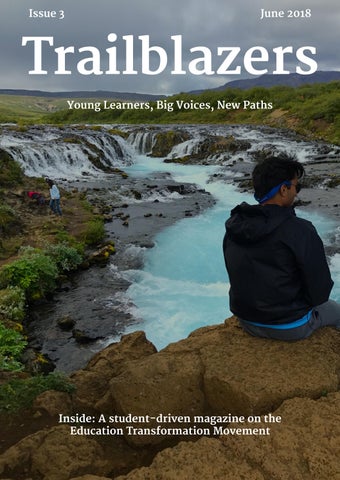
Trailblazers

Youn g Learn ers, Big Voices, New Pat h s

In side: A st uden t - driven m agazin e on t h e Educat ion Tran sf orm at ion M ovem en t

Issue 3 Content:

A Letter From The Founders

It is time for education to be transformed.Schools were first created during the Industrial Revolution with the purpose of preparing students for factory work. However, we are no longer living in that time period - it?s the 21st century where information can be looked up in a matter of seconds, and businesses are looking to hire creative problem solvers rather than mindless factory workers. With the progression of time, there should be a change in the purpose of school.In the transformed education model the purpose of school should be to: make the world a better place by engaging young learners in opportunities to be active change makers in society Over the past decade there has been a worldwide movement amongst certain educators to redesign the education system This community has been creating a new ?school,?where students get to pursue passions, work with experts in different fields, and create real impact.

We are a few of these educators whose voices aren? t always heard We are the ?students,? though a more appropriate term may be,?young learners,?because we believe everyone is always a learner

Education is being redesigned, and like any good design challenge, the designers must talk to the users in order to create impact.This magazine, Trailblazers, was founded with the intent of sharing the work and opinions of young learners who are marking new paths in education We founded this magazine at Mount Vernon Presbyterian School in Atlanta, GA, in collaboration with the Mount Vernon Institute for Innovation.We are members of the Innovation Diploma, a program that meets 5.5 hours a week to explore various ventures where we work alongside members of the community, business leaders,and entrepreneurs to create innovations Our primary goals are to build muscle and capacity as innovators, blur the line between ?school?and the ?real world,?and leave the world better than we found it.Because of our passion to transform all of education, not just our school,we created Trailblazers,a platform for young learners around the world to share their voices.

- Abigail Emerson, Anya Smith Roman, and Kaylyn Winters

We are young learners, with big voices, paving new paths; these are our stories

Meet the Curators

Abigail is a creator looking for new ways to solve problems.She is an Innovation Diploma and Mount Vernon Presbyterian School 2018 graduate.In the fall,she will be starting college at NC State. In the past,she?s worked with clients, such as S.J.Collins Enterprises Developing Company and AT&T Foundry. Always keeping a positive outlook on situations,her favorite pastime is giving out high-fives and telling puns and jokes.Abigail strives to inspire and empower other students to believe that they can make a change now and don? t have to wait until they?re ?older? and ?wiser?to start.

Anna Kate is passionate about many things - reading being one of them.She can usually be found with a book in hand.She also seeks to change the world through Innovation Diploma, loving the challenges and questions it presents to her.Her skills lie in writing and reading,always called upon to write an email or edit a presentation.She is a perfectionist,refusing to present anything but her best work.

Anya Smith-Roman @Pinyabananas

Anya is a recent graduate of the Innovation Diploma and now is attending Georgia Institute for Technology studying to become a social entrepreneur.Since high school, she has been striving to forward the Education Transformation Movement by networking with though leaders around the world, speaking and coaching at education conferences, and being a pioneer of innovative learner-centered education practices.Anya dreams of a future where ?school?consists of students working side-by-side with business leaders to design for pressing issues in the world

Kylie Smith-Wolfe @kyliesmithwolfe

Kylie is a sophomore at Mount Vernon Presbyterian School and currently a member of the Innovation Diploma (iD).Kylie enjoys going to see her school?s theater productions, competing on the winter swim team, and creating new pieces of art in after school art club Outside of her time in school,Kylie coaches competitive gymnastics and volunteers in the baby room at her church on Sundays.In her future, Kylie hopes to go to Med School and become a Pediatric Nurse so that she may continue to help children,and people, in need

SMforSM:An Educational Partnership Bridged by Empathy and Friendship

About the Author:

Sophie Haugen is a senior at St.Mark?s School in Southborough, MA, where she is actively involved with the St Marguerite?s Partnership and international exchange-student programs.She also writes and edits for the school?s online academic journal.She enjoys crew, cross-country,and spending time outdoors.In college and beyond, Sophie is planning to pursue a career in global public health,traveling the world as a policy-maker or medical professional.

Why our partnership with St Marguerite?s is truly a mutual partnership;what can we learn from our sister school?

Prior to beginning high school, I knew very little about Haiti other than the occasional disaster shown on the news.Now, I know that Haiti is so much more than its image portrayed by the media.Over the past four years, I have grown to learn about Haiti?s people, culture and truth.I am lucky enough to be part of a beautiful partnership between my school, St.Mark?s School in Southborough, MA,and École Ste.Marguerite?s in Latournelle,Haiti We help to support the teachers and lunch program at Ste Marguerite?s as well as host events to teach our own school community about Haiti and celebrate its culture.We remain in contact with the school throughout the year.Our partnership is grounded in empathy and human connection through mutual cultural exchange.

This past January, I traveled to Ste Marguerite?s with five other students and four teachers from St Mark?s.Until the moment I arrived, my perceptions of education and life overall in Haiti were very swayed from the reality Education is everywhere in Haiti, in both the expected and unconventional ways. Everybody is a teacher in his or her own way,and everybody is a student to someone else On the mountain,students learn from each other outside of the classroom Kids teach each other how to play games, how to sing songs, how to

?Our partnership is grounded in empathy and human connection through mutual cultural exchange.
w?

carry water jugs from the valley. Parents teach kids how to behave in church and how to live in the community.Many schools are connected with churches;in fact, 90%of schools in Haiti are run by religious organizations, churches, or NGOs - in other words,private schools.Traditional learning happens in schools,but even school teachers learn in their own ways. Priests teach life lessons and Biblical lessons.Every single person seems to be invested in learning something that is relevant to his or her own life. Spending these few days in Haiti and visiting our partner school prompted me to think about my own school and education,as well as what America can learn from countries like Haiti In many ways, we aren? t that different from Haitian students.The kids line up before school according to grade, they raise the flag,they enter the classrooms,and look forward to lunch time when they can eat rice and beans with their friends An eighth grade science class was learning about the process of photosynthesis, and the notes on the chalkboard from the lecture looked no different than our own in our biology class at St Mark?s

Students wear uniforms and spend time in friend groups;they are united as one school but social and age cliques still exist On a very fundamental level, we are all teenagers and young kids gaining an education.

Yet,less than 30%of Haitian students advance to secondary school Most kids walk upwards of two hours each direction to from school in the morning and afternoon, and often times, school cannot be a priority when family and survival have to come first Furthermore,sixth or seventh grade students are commonly eighteen or nineteen years old because they either took time off from school or did not pass to the next grade for multiple consecutive years During my trip,I noticed that Haitians care a lot about their education and getting to school consistently.One of our friends from our partner church, Emmanuel, works at his cousin?s church and affiliated school in the

?Traditional learning happens in schools, but even school teachers learn in their own ways.

countryside but also attends law school in Port-au-Prince multiple times a week - he commutes back and forth,meeting the demands of both commitments Student enrollment in schools in Haiti is not by any means high Ideally, all

children could attend primary and secondary school, and all teachers could consistently teach and meet all needs of the school Haiti is filled with intelligent, motivated, dedicated, and strong people,but the country is limited by extreme poverty Education would solve many of the issues in Haiti and provide children and future generations with the knowledge and experience to understand the importance of a functioning government, of organized businesses, of their role in the world, and more

With that in mind, though, kids who stop going to school and people who never attend school are not failing or unskilled.In fact, going to school is not necessarily needed for survival in Haiti, and things learned in a traditional academic setting are not always the most relevant to daily life.For example, one boy on the plateau, where Ste Marguerite?s is located, did not attend school with the other kids in the community even though he was the same age as some of them He spent most of the day carrying water from the valley up to the plateau and stopped going to school within the last year or two because of his family?s and community?s needs. Though it broke our hearts to see him hold a water jug and watch the other students dress in their blue uniforms, standing in line before the school day, continuing to go to school would not be most important for him.

The other observation that I

made while on this trip was that Haitians do not need to be officially educated in order to have a successful career.When they cannot find a job because they are uneducated,they create their own. Haitians are opportunistic,not in a negative or exploiting way, but in that they know how to make the best of what they have and are intelligent with their work.On the mountain,we brought beads to make arts and crafts with some of the kids After we finished the crafts, the kids disassembled the crafts, systematically divided beads amongst themselves, and found other uses for them Even five year old children are used to fighting for resources and using them to the best of their advantage.These skills are often much more needed than the balanced equation of photosynthesis.

Though this is not always the case in the United States due to the overall higher functionality and development and people cannot always just create a job when there are none available, there is something to be said for seizing opportunities.We can learn something about chasing the ?American dream?or any other dream just as the people I met in Haiti seized any and all opportunities or windows for opportunities presented to them We met a woman named Carmel who is one of the only female Episcopal priests in Haiti;Carmel grew up in Latournelle on the mountain where we visited,but after a few years in school,she left and now has her

own parish and school in the commune of Léogâne.

The other takeaway from my time in Haiti that connects to my own education now pertains to the relevance of our learning.As I said, formal education does not necessarily equate ?success?in Haiti, and non-academic skills are extremely important.In the United States,students including myself always question why we learn what we do in school and how our school subjects will prepare us for our futures.In my opinion,there is far too much focus on testing and standards in the American school system that does not actually prepare students for a career or live outside of institutionalized education.It isn? t uncommon for students to not be excited to learn because school doesn? t always feel like it is an environment for learning. Students are not finding passions in academic subjects or finding connections with school lessons because the focus is on passing the class or a test with irrelevant measures for success.Kids in Haiti have a strong skill-set that I will not have,obviously due to the difference in our lifestyles, but this prompted me to question why not all schools in the American system emphasize real-life learning I am lucky enough to attend a school that has been implementing its ?Strategic Plan 2020?to diversify and personalize students?educational experiences so that they LEARN about everything they can.As a boarding

school,we have Saturday classes that are now Saturday Programs. Each academic year has three Saturday Program terms with seminar courses like ?We Actually Care (about current events),? American Sign Language,Model UN, Contemporary Issues in American Politics, and more.We have Career Day with job shadows in all professional fields,we have Lion Term at the end of the school year

?Kids in Haiti have a strong skill-set that I will not have, obviously due to the difference in our lifestyles, but this prompted me to question why not all schools in the American system emphasize real-life learning.

for independent experiential learning,and we have independent research fellowships in several subjects for students to personalize their own learning.It is through these programs, in conjunction with my core academic subjects,that I have found my passions and interests,not through tests and required ?learning"

future,but it also provoked me to question why we focus on so many unnecessary things in our lives Some of my new friends in Haiti have very little but are extremely generous, thankful, and happy.Our American educational system and school lives for students hear are very overloaded so that kids have trouble meeting requirements and do not find out their passions until years after college, even.Of course, our schools are effective in many ways but there are stigmas about success testing that need to be broken and changed

Traveling to Haiti made me extremely aware of and grateful for my education and the opportunities that I will have in the

?From the poorest of countries to the richest of nations, education is the key to moving forward in any society.
?w?
? Nelson Mandela

Ins?iration

About the Author:

Lucy Conover is 17 and lives in San Diego, California.She attends the Gary and Jerri-Ann Jacobs High Tech High School and in her free time, does jazz, ballet, and contemporary dance.She also likes to sew, eat sushi, and watch movies In the future, she wants to join the STEM field and work in astronomy or zoology.

On the surface, math is just numbers printed on paper, but deep down math creates beautiful waves and curves.It gives us the notes in music, the measurements in cooking,the rotations in ballet and ice skating,a way to predict weather?it is intertwined in our lives. With all these diverse applications, why would the most effective method to teach math be through tests and memorization?A person learning how to cook does not spend all day memorizing recipes without executing them?they make food! I believe math should be taught with real world applications. Unfortunately, in educational settings,math can be interpreted as a game of reciting, where students memorize facts and formulas but do not truly understand their purpose. Ben Orlin,from The Atlantic,states: ?What separates memorization from learning is a sense of meaning When you memorize a fact,it's arbitrary, interchangeable--it makes no difference to you whether sine of ?/ 2 is one, zero, or a million But when you learn a fact,it's bound to others by a web of logic?In the sense of the cooking metaphor, this is like putting a cake in the oven but not understanding that the ingredients are causing a chemical reaction

Memorization prevents students from coming up with their own creative ideas.Ina Rogovin,a teacher from a 1982 article in the New York Timesrecalled:?I remember that as a student when we were told to memorize a poem, we didn't discuss it or use it as a

jumping board to write our own poetry.'' Many schools are teaching math in a more progressive manner and are aiming to teach students knowledge versus shallow facts I am fortunate to attend High Tech High School,which strives to teach math in a project-based and applicable way.

An experience I have had with real world math, in my HTH math class, was during a trigonometry project.The goal of the project was to find a means to measure the height of objects,that with a normal ruler, would be impossible to measure.We measured lampposts and buildings using homemade angle-finding devices to find the angle between our eyes and the top of the object,and then we used trigonometry to find the height.I decided to make a sextant as my angle-finding device.As a result of the planning, construction and creativity involved, I had a deep

?Unfortunately, in educational settings, math can be interpreted as a game of reciting, where students memorize facts and formulas but do not truly understand their purpose.

?

connection to this project.A sextant is a tool sailors and astronomers used before modern navigation technology to find their ways at sea. A sextant can measure the angle between the user and a star, and tell you your location on the globe.I was a bit overwhelmed with the idea of constructing a sextant.We had a real sextant to use as a reference, but it was very detailed and complex I thought, ?what have I gotten myself into??Just when I was ready drop my idea all together, I realized I could laser cut my sextant! This would allow me to customize it using a computer, instead of having to cut the wood by hand (making it less precise) I felt empowered after this realization.My sextant worked by reflecting the image of the measured object onto a mirror in my field of vision The mirrors were made of stick-on reflective paper so I could cut them to a precise size. The bottom of the sextant showed the degrees between my eyeline and the object Though my sextant was a little ?off?in the end, I was able to compensate by subtracting five degrees from every measurement While using my

sextant I realized, wow,thisishow theymust measure skyscrapers!Not only did I dive deep into the trig-world,but I improved my problem solving skills through that project.Plus, I can actually use my sextant when I go camping, which is pretty cool if you ask me.

My love of math has blossomed at High Tech High because we focus on actual applications and hands-on projects instead of only memorization.These types of projects make me feel as if I am completing a fun puzzle or challenge,versus an assignment; the grade at the end is just a small component of,not a driving force in an activity.Most importantly, my teachers view mistakes as positive, learning experiences, which many students do not always get the opportunity to experience.One instance where I made an impactful mistake was when we were making geometric shapes to hold a specific volume of water We had to design a watertight, complex figure, (cubes were prohibited!)and I decided to make a 25-sided 3D figure,out of a

?Most importantly, my teachers view mistakes as positive, learning experiences, which many students do not always get the opportunity to experience.

25-sided 3D figure, out of a plastic flooring material.The idea was too ambitious, and I tried to use hot-glue to assemble the figure, which failed miserably.My teachers fully supported me to make another draft of my design.I used apoxie clay to seal the shape, and scored the figure before building it to make it fold easier My design successfully held the water! If I had not received the opportunity to remake my shape, I would have resorted to a less ambitious design, missing out on the learning opportunity to find the volume of a 25-sided figure. Because my teachers encouraged me, I was able to really challenge myself in geometry Completing a project with a tangible product is much more satisfying than turning in a worksheet.Embracing mistakes gives students the chance to pursue a challenge,it gives people confidence If every time I made a mistake and was prevented from fixing it, I would have no drive in math class.Janet Metcalfe, from the Department of Psychology at Columbia University stated, ?Experimental investigations indicate that errorful learning followed by corrective feedback is beneficial to learning?

I attribute my love of math to my education at the project-based learning schools, The Children?s School and HighTechHighSchool where I developed my love of learning.I believe when math is taught in a real-world context it can cultivate a drive to keep learning in children,and adults! I hope my story

has empowered a student to dive deeper into a project or a teacher to adapt project based learning The way math is taught can impact a child forever

?w? ?Give the pupils something to do, not something to learn; and the doing is of such a nature as to demand thinking; learning naturally results.

? John Dewey

What Learner Centered Education Did For Me

About the Author:

Hannah Bertram is a freshman in college from Cedar Rapids, Iowa majoring in Social Work.In high school, she was a student in the Iowa BIGprogram Hannah is involved with the organization ?Education Reimagined?and attends the University of Northern Iowa.She is also a runner,plays guitar, and volunteers in the Emergency Department at St. Luke?s Hospital in Cedar Rapids

Before you read...

Hi,I?m Hannah! I?m a freshman in college from Cedar Rapids, Iowa. Throughout the last year of my education,I have grown to appreciate my experience with learner-centered education on a new level.My story is winding and continuously developing, and I?m excited to share it with you.

A little background about my experience:In high school, I was a student in the Iowa BIGprogram.Iowa BIGis an innovative,alternative, academic program offered to high school students in Cedar Rapids, Marion,and Mt.Vernon, Iowa.The Iowa BIGmodel is quite different from that of traditional school We don? t have classes;we don? t have bells;and we don? t have tests.At BIG,we see the community as our classroom. Students are encouraged to be makers, designers, storytellers, and social entrepreneurs by working with businesses, nonprofits,and government agencies In a nutshell, we receive the same credit that we would at our traditional high schools,but instead of doing worksheets and unenthusiastic presentations about things that don? t interest us, we work on initiatives/ projects we are passionate about and that make a difference in our communities.This model of education has changed my perceptions of myself and the world around me.

This article is about my experience of going from a learner-centered environment to a traditionally-based education at the University of Iowa.

What Learner Centered Education Did For Me

Everything.

After completing my first few months of college, in which I have just barely scraped the surface of what my college experience will be like, it is clear that coming from a unique environment of learning changed me I think differently than my peers who are coming from more structured environments Now, I am not saying that these students will see less opportunity or success than myself,but rather that my environment made me think different from those around me.It was uniquely tailored to me.That is important to understand moving

forward.Experiencing some of the most transformative years of my life in a learner-centered environment allowed my brain to develop in a way that sees challenges as opportunities,the world as my classroom,and myself as a powerful individual I graduated with a range of skills in my toolbox - I enjoyed public speaking, I loved learning about psychology, and I wanted to use those skills help people. Moving through this semester, I have noticed that learning in the unique environment that learner-centered education provides has gifted me with some nifty tools

1. Full Speed Ahead - But I Was a Speed Racer

My first few days on campus were overwhelming,but exciting I came to college having already figured out many things about myself.I was confident in my majoras my learning environment enabled me to explore it before heading to college- I knew some of my basic interests,and I understood my strengths and weaknesses.Because of my innate knowledge of these facets of myself, navigating the college landscape was instantly easier.I could recognize the type of people I wanted to work with and identify what I wanted to work on.

2 Identifying Myself - Within a Project

My learning environment, Iowa BIGin Cedar Rapids, Iowa, healed me In my first semester of college, I took a Sociology course at the University of Iowa.One of the main things we discussed was how important and natural it is for youth to have an identity projectespecially those experiencing poverty or other forms of social inequality.Upon learning this heavily researched concept, I thought,?Wait a minute,that was exactlywhat I did at BIG!?When I first entered Iowa BIGat age 16,I struggled personally with self-confidence, like many girls my age.Being able to redefine who I was through teams,projects, and initiatives allowed me to recover from many personal struggles. Another thing I have noticed is that the majority of these

learner-centered environments revolve around project-based learning.This isn? t just a coincidence - it is a sociological concept When teens have an identity project, when they are allowed to follow and explore their passions, they will find their path Personally,my identity project guides me, and even when I get lost in life?s great adventure, I always find my way back to it.

3 Finding Home Base

My learning environment allowed me to find myself again.It allowed me to be genuine in my actions and helped me see that the things that I do matter In such big school like the University of Iowa, it is easy to get lost in the flow of things.But because I understand myself and my passions, I am

?Experiencing some of the most transformative years of my life in a learner-centered environment allowed my brain to develop in a way that sees challenges as opportunities, the world as my classroom, and myself as a powerful individual.

consistently able to find a community of peers and adults that I can relate to Because of this strong understanding, I was also able to recognize that I would be more successful in another school and I have decided to transfer to the University of Northern Iowa.

4 Buddies - They're Important!

Finally,my learning environment helped me develop a high value for social capital:AKA the importance of building widespread relationships.Through my projects in high school,I not only found my calling, but I also built a network of professionals to help me seriously tackle my chosen field This support network gives me the feeling that I have endless encouragement from my community to follow my passions.No matter the obstacle,I know that those people will be here to help me push through them

But how does this impact my life now?After all,I am no longer in a learner-centered environment - I am no longer even living in the same city.The truth is, things have changed,but some things remain constant While the physical things

I do everyday may be different, I am still the person I was when I left.My relationship with myself and with others is healthy and strong and I have the confidence to fully explore on life?s incredible journey.I believe every new place is a chance to learn something new and every new face is a chance to grow, a belief developed in my education and embedded in me for the rest of my life.

?

Finally, my learning environment helped me develop a high value for social capital: AKA the importance of building widespread relationships.

?w? ?Through learning we re-create ourselves.Through learning we become able to do something we were never able to do. ? Peter M.Senge

Innovation Diploma Update: SPARK

SPARK is a student-designed recurring event meant to be a playground for creative thinkers of all ages that brings together students and adults in an educational setting Each SPARK features a talk given by a guest speaker from prominent companies, such as Chick-fil-A or Coca-Cola.The speaker highlights important experiences in their work and then shares a problem they need a solution for.This is where the attendees come in.Guests solve for the speaker?s problem by utilizing the design thinking process to learn about it in order to later apply it in their own work place.Facilitators - people who understand how to use the deign thinking process - are on hand to lead and coach guests through it Overall, attendees leave with a better understanding of the design thinking process, a fun team-bonding experience, and they leave the speaker with ideas about how to solve their problem

A Little about Innovation Diploma

?As a joint program between the School and MVIFI,iDiploma students engage with leaders in various industries, to create value through intensive ventures, and to build capacity as young innovators.Rather than merely preparing students for the future, iDiploma empowers young leaders to inspire, innovate, and implement high-impact work now.?-MVIFI

Community Connections

If you want to reach out to others who share similar feelings about education, here are a few outstanding members of our community.

Anya Smith-Roman?s Blog

What started as a 100 day challenge is now where Anya continues to explore student voice and education transformation.

The Life of Pinya

Abigail Emerson?s Blog

Abigail?s covers all sorts of topic from kindness to education, her blog becoming a place where she can reflect as she grows as a learner.

Ideas from a Creator

EdRevision

EdRevision is committed to growing and producing the awareness of learner-centered education environments as they work to ensure that all individual learners have the opportunity to enjoy, flourish, and succeed in school.

EdRevision

Innovation Diploma

As a joint program between the Mount Vernon Presbyterian School and , iDiploma students engage with leaders in various industries to create value through intensive ventures and build capacity as young innovators.

Innovation Diploma

Education Reimagined

Education Reimagined seeks to discover champions for learner-centered education, connect them to one another,and create the space for exploration, collaboration, and innovation

Education Reimagined

Turn static files into dynamic content formats.

Create a flipbook
Issuu converts static files into: digital portfolios, online yearbooks, online catalogs, digital photo albums and more. Sign up and create your flipbook.
Trailblazers_Issue3 by upforlearning - Issuu