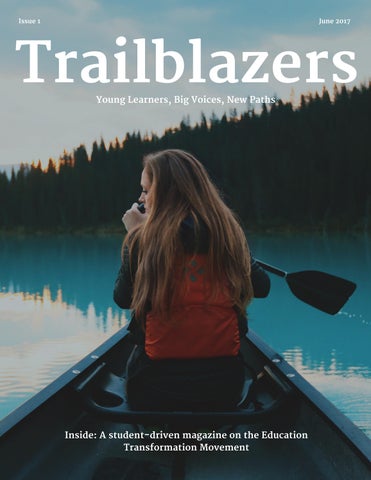
Trailblazers
Young Learners, Big Voices, New Paths

Inside: A student-driven magazine on the Education Transformation Movement
![]()

Inside: A student-driven magazine on the Education Transformation Movement

Anya Smith Roman, Kaylyn Winters, Abigail Emerson
Q&A: Sparkhouse Conference
The learner-centered movement
Neel Pujar
Free Ranged vs. Caged
Meet the Curators Intelligence
Change is a Conversation
Cali Ragland
Creating Something New Brady Vincent Community Connections
Kim Mi Yeoh Resources
Issue 1 - June 17, 2017
It is time for education to be transformed. Schools were first created during the Industrial Revolution with the purpose of preparing students for factory work. However, we are no longer living in that time period - it’s the 21st century where information can be looked up in a matter of seconds, and businesses are looking to hire creative problem solvers rather than mindless factory workers.
With the progression of time, there should be a change in the purpose of school. In the transformed education model the purpose of school should be to: make the world a better place by engaging young learners in opportunities to be active change makers in society. Over the past decade there has been a worldwide movement amongst certain educators to redesign the education system. This community has been creating a new “school,” where students get to pursue passions, work with experts in different fields, and create real impact.
We are a few of these educators whose voices aren’t always heard. We are the “students,” though a more appropriate term may be, “ young learners,” because we believe everyone is a student, a teacher, and a mentor, but we are all always learners. Education is being redesigned, and like any good design challenge, the designers must talk to the users in order to make the greatest impact. The largest population of users for a school are the students. Therefore, this magazine, Trailblazers, was founded with the intent of sharing the work and opinions of young learners who are actively marking new paths in educat

We, Anya Smith-Roman, Abigail Emerson, and Kaylyn Winters, founded this magazine at Mount Vernon Presbyterian School in Atlanta, GA, in collaboration wit the Mount Vernon Institute for Innovation. We are members of the Innovation Diploma, a program that meets 5.5 hours week to explore various ventures whe we work alongside members of the community, busine leaders, and entrepreneurs to create innovations. Our primary goals are to build muscle and capacity as innovators, blur the line between “school” and the “ rea world,” and leave the world better than we found it. Because of our passion to transform all of education, not just our school, we created Trailblazers, a platform for young learners around the world to share their voices.
We are young learners, with big voices, paving new paths; these are our stories.

Anya loves to explore, tinker, design, storytell, wander, and wonder. She serves as the Mount Vernon Institute for Innovation Fellow as well as an inaugural Innovation Diploma member and graduate of the class of 2017. For the past few years Anya’s primary driving question has been, “How might we make student voice at the forefront of education redesign?” This question has lead her into a world of networking with leaders around the world from authors to tech entrepreneurs, speaking and coaching at education conferences, and becoming a pioneer of innovative practices at Mount Vernon Presbyterian School where she strives to “blur the lines between school and the real world.” Anya dreams of a future where “school” consists of students working alongside of community leaders to design for pressing issues in the world.

Kaylyn is an artist in a broad sense of the world, a jack-of-all-trades, with toes in each available pool of water. Mostly grounded in the arts, learning, innovation,
and a firm believer in equality of all kinds. Kaylyn is part of the inaugural cohort of Mount Vernon Presbyterian’s Innovation Diploma, and a graduate of the class of 2017. Kaylyn has spent the last years in innovation diploma exploring the facets of different skills, through work with corporations like S.J. Collins, and the City of Sandy Springs, as well as work on passions like history and art, whether it be through teaching a class or designing characters for a board game.

Abigail is a creator looking for new ways to solve problems. She is an Innovation Diploma inaugural member and a graduate of the class of 2018. In the past, she’s worked with clients, such as S.J. Collins Enterprises Developing Company and AT&T Foundry. Invested in the future of education and learning, Abigail has been working on the independent project of creating a podcast that explores learning that takes place outside of the classroom. Always keeping a positive outlook on situations, her favorite pastime is giving out high-fives and telling puns and jokes. Abigail strives to inspire and empower other students to believe that they can make a change now and don’t have to wait until they’re “older” and “wiser” to start.

Sparkhouse entered the scene as a product of Education
Reimagined’s Pioneer Lab. Consisting of 42 young learners from 12 states and 15 learning environments, in November of 2016, Sparkhouse took place in Washington, D.C., focused around the movement of learner-centered education.
In this Q&A learners Lewis Cha and Bryce Bragdon reflect on their experience at Sparkhouse and the Education Transformation Movement as a whole.
What did you enjoy about Sparkhouse?
I really enjoyed the wide variety of people who come from so many different learning environment because I actually come from a small town in California. -Lewis Cha, CA
I really enjoyed meeting and communicating with people my age that have a passion for learner-centered-education like myself.Bryce Bragdon, ME
What are you most excited about with the learnercentered movement
I think transforming education for the whole country is really important because of how it gives students a chance to dictate what they want to do. A traditional school actually benefits the staff rather than the students, but when students take charge of their own learning, there are so many more possibilities of what can be done. -Lewis Cha, CA
I am most excited to see this type of education sprout and grow to benefit more students. Also I am excited to see how this will develop into an education system that is understood and used by all.
- Bryce Bragdon, ME
How has being in this movement for education changed you?
When I was growing up, I lived in Longbeach, California. I was a grade A student, but I found that I couldn’t go out on my own. The education system changed for me in 2008, and I found that I wasn’t limited any longer. -Lewis Cha, CA
Being in this education movement has changed me to think that this education system has hope. Seeing all of these young people who like this education provides evidence that it does work and works well. It has also made me think that anything is possible with just enough effort and people. -Bryce Bragdon, ME

By Brady Vincent
In my opinion Innovation Diploma’s main goal is to give young high school students the tools to do high level work for big companies in order to prove that high school students are capable of doing great work. While this program is not for everyone, I have been in the Innovation Diploma for two years now, and I continue in the program because I believe in this goal and enjoy the work I’ve been able to accomplish. I have experienced the first year of Onboarding where I learned about what it means to be an innovator and while developing my skills at observing, questioning, associating, experimenting, and networking, and now I get to work as a consultant for organizations on what we call Design Briefs. As a kid who hopes to be an entrepreneur, this program has really given me inspiration and motivation to pursue my dream.
One question everyone asks about the program is how do the students still work without having a grade to motivate them. The answer is quite easy, and it is because we don’t have any grade to immediately judge our performance on regurgitating a topic. Those of us who are working for a company through a Design Brief work tirelessly for our client.

Bra grade o e o Presbyterian School and is very interested about becoming a serial entrepreneur when he grows up. He is passionate about the Innovation Diploma program, and is also driven to make be a maverick by challenging the way things are done.
Those who conduct our own venture are constantly treading water to prove to the facilitators that we are capable and passionate about our project.
I have personally worked on both types of projects in Innovation Diploma. From working with AT&T Foundry on an application to venturing off to my own project, I have done a lot, and that is how this program was designed. Innovation Diploma is customizable in the fact that we can choose and design our own path to learn and create from.
Second semester of this year I have grown exponentially as an innovator, entrepreneur, and leader as I take on my own iVenture. This semester is the time I have been waiting for; where I can pursue the challenging feat of starting my own business. As a maker at heart I really wanted to create a product that was tangible and that I could sell to my friends, family, and public. I started off with the idea of innovating the backpack which pivoted into creating a modular system of interchangeable parts for a backpack. I have partnered with my friend Melina which has many visible and hidden perks. Having a partner pushes me to get a lot more work done and be more efficient with my time. She also serves quietly as a task manager making sure I am doing my work and helping grow the company everyday. This freedom would only be given to me if I proved to my peers and my facilitators that I have the spirit to work hard on projects in the program. This proves to many that this way of teaching is not only personal, exciting, and passion driven, but it is the future of education.
"Innovation Diploma is customizable in the fact that we can choose and design our own path to learn and create from."
Through my time in the Innovation Diploma I have gradually gotten better at maximizing my efficiency in the allotted time at school. As I show this to the facilitators, they tend to give me more freedom as to what I work on and who I work on the project with, and we don’t need a grade to prove our progress. There is physical evidence that my work is improving with each new prototype developed. Innovation Diploma has really nurtured me as a learner, leader, etc., w Which makes me realize how lucky I am to have this program. In a common school environment I would just do my work and then spit it back to the teacher on a test, but Innovation Diploma opens up so many other opportunities that may lead to options I could never imagine. Our grade book is the real world, either our ideas will be accepted or they won’t, and not having to worry about grades gives me the freedom to feel like I can fail and learn from that failure to succeed in even bigger ways than what’s normal for “school.”

"Our grade book is the real world, either our ideas will be accepted or they won’t, and not having to worry about grades gives me the freedom to feel like I can fail and learn from that failure to succeed in even bigger ways than what’s normal for “school.”

By Neel Pujar
As a college learner, my morning walk to class through the center of campus is usually greeted by the zealous student activists lining the brick pathway. The spectacle is impossible to miss the megaphones blaring rallying cries over the sea of songs emanating from each booth. As I walk past the army of students everyday, I cannot help but appreciate their energy and commitment towards their respective causes. They show up every morning, rain or shine, armed with their posters and coordinating t-shirts, standing ready to advocate for whatever cause they are passionate about that day. Yet despite their earnest efforts to attract attention by being the loudest voice in the square, each booth rarely captures an audience of more than three to four people, and even then it's usually more about the free food. As the day goes on, their voices grow louder and louder, drowning out the others—and their audience.
If we lived in a world where everyone thinks like us, change would be easy. If we ever had an idea we wanted to push forward with, we'd simply share it. And, since everyone thinks like us, change would happen in an instant and everything would go our way. The real world, however, is thankfully not so boring.

Neel Pujar is an active believer in learnercentered education and currently serves as Fellow with Education Reimagined. In this role, Neel works to inspire continued action and dialogue at SparkHouse, a team of over forty learners dedicated to advancing change in their own communities and at a national scale. Prior to serving as a Fellow, Neel served as a Board Member representing over 35,000 students to the Poway Unified School District Board of Education.
In our world, everyone we interact with brings different perspectives, experiences, superpowers, and values to the table. While this certainly makes life much more interesting, reconciling with seemingly competing viewpoints has the potential to make accomplishing change a bit more difficult.
A few years ago, I was fortunate to have the opportunity to be a part of the design team for Design39Campus, a revolutionary K-8 learning environment intended to reimagine the way we do school. Operating under the umbrella of a traditional school district, our team was tasked with creating a new educational experience from the ground up. From the beginning, our team felt the resistance from others as we worked to shift the schoolcentered paradigm that was deeply ingrained in our district.
With a system as complex as public education and its many moving parts and diverse stakeholders, change is often difficult because it brings uncertainty along with it. It’s difficult to for those being asked to change to leave the comfort of the status quo and dive into unknown waters. On the flip side, for those championing the change, it’s sometimes just as tempting to push others off the diving board before they are ready. While change would arguably happen if we were to take a forceful approach, it wouldn't leave our stakeholders comfortable or willing to support us moving forward as they flounder in an unknown ocean. Rather, if we want our stakeholders to truly support us in our journey, we have to help them dip their toes in the water, familiarize themselves with the new environment, and let them take the plunge when they are ready.
In addition, Neel has also served on his district's Superintendent's Student Advisory Committee, Technology Planning and Steering Committee, and is a member of Education Reimagined’s Pioneer Lab. Prior to serving at the district level, Neel has served as a member of his high school's School Site Council and served as a founding team member of Design39Campus. Neel currently attends the University of California, San Diego where he is pursuing a degree in Management Science with a minor in Business.
From the beginning of the design process, our team shared a vision about what we thought our new campus could be. But in addition to this, I think our team shared another key belief. Our purpose wasn’t to simply impose our idea of what learning could be on our community— we needed to make them a part of the journey we were taking. We needed to do more than just speaking our minds. We had to start a conversation.
With this in mind, we held numerous community feedback sessions, listened to diverse voices and perspectives, and nurtured collaborative relationships with our district stakeholders. We met with district leaders, teachers, local business leaders, parents, board members, union representatives, and of course, learners. In all of these meetings, it was never our intention to convince others that their mindset was “wrong” or to persuade them to agree with our point of view. Instead, we sought to understand their unique positions and areas of concern, and enrolled them in the process of creating a solution that was mutually beneficial for all of us. In empathizing with and seeking buy-in from our community in this way, we were not only able to help plant the seeds of change, but also gained meaningful partners who were willing to work with us. As a learner experiencing this process first hand, I was amazed by how our team was able to gather diverse voices, truly understand their points of view, and work with them to develop meaningful solutions. Instead of fostering the ‘ us versus them’ mentality, we were able to create change with others instead of working against them. I began to appreciate the value of empathy and recognized that change is a two-way street
"Our purpose wasn’t to simply impose our idea of what learning could be on our community we needed to make them a part of the journey we were taking. We needed to do more than just speaking our minds. We had to start a conversation."
I realized that change doesn’t happen because a small group of people working together a vacuum. Change happens when we listen, understand, seek buy-in, and develop support by connecting with others instead of working against them. In August 2014, we opened Design39Campus for our first learners. As I stood in the Welcome Center on our first day of school, a young learner came up to me with a beaming smile. “I’m excited” he exclaimed gleefully, looking around the brand new school. “Me too!” I replied, “What are you most excited about?” The learner paused as he thought about the question. “I’m excited because I feel like this school was made just for me!” As he joyously skipped to his learning space, I took in what he had said. Seeing the learners so happy in their new environment, experiencing their parents’ excitement, and hearing our district leaders talk about how wonderful the school was going to be, I could not help but think to myself, “We did it.”
The traditional narrative of change almost always begins the same way. As the story goes, a single leader or group of like-minded individuals band together, share their voice, and magically bring about the change they were hoping to see. While it does make for a compelling story, the leader-centered model of change neglects the most important part of the change process empathy. Walking to the end of the brick pathway, I notice a group of people crowded around a small booth. It’s noticeably quieter than the others. Above their table hangs a poster that simply says, “We want to hear from you about . Let’s talk.”
“I’m excited because I feel like this school was made just for me!” As he joyously skipped to his learning space, I took in what he had said. Seeing the learners so happy in their new environment, experiencing their parents’ excitement, and hearing our district leaders talk about how wonderful the school was going to be, I could not help but think to myself, “We did it.”
There’s no megaphone, no loud music, and no free food, and yet, they still have the biggest audience. Successful change doesn't happen when one group of people just work against the beliefs of another group. Looking to history, change has happened when groups of people were able to build a bridge to the other side and transition from “working against” to “working with.” It happens when we take the time to listen with empathy and understand where others are coming from. Influencing change is not about having the loudest voice in the room to drown out the others it’s about starting a conversation so that everyone can swim.

Successful change doesn't happen when one group of people just work against the beliefs of another group. Looking to history, change has happened when groups of people were able to build a bridge to the other side and transition from “working against” to “working with.”

By Kim Mi Yeoh
I used to live on a farm. My family owned two alpacas, four sheep, a flock of ducks and a coop full of chickens. Our chooks roamed free everyday, exploring and enjoying the nature of the countryside. They basked in the sun, relaxed in the field and foraged for treats in our gumtree forest. Each relished their carefree lives of joy and laxity. Then after the day would speed by in a wink, night would fall, alerting each chicken to return to the coop to lay large, healthy eggs in their nests and rest up for yet another glorious day of freedom. It was life worth living.
Unfortunately not all farms are as considerate of the valuable freedom of their animals. Many factory farms act cruelly towards chickens. They don’t care for their lifestyle; only profits. Millions of layer hens are cramped in countless rows of tight, confined wire cages from the moment they are born. Many never even get a single glimpse of the light of day, let alone the touch of fresh, green grass. The sole purpose of their short lives is to produce eggs which will never hatch. These hens have no opportunities, no options, and no choice. As days slowly drag on, all they can do is endure the restricted lifestyle of factory farming and follow the life laid out before them.

K ol N majority of her life. She is currently a year 12 student, senior student who studies at Hobsonville Point Secondary School. Her strong passion for art and design leads her to aspire to be an Architect who hopes to leave a revolutionary mark on the modern world of architecture. As well as her love for art, Kim Mi adores animals, nature, music, the beach, and clouds.
My name is Kim Mi and I am a year 12 student from Hobsonville Point Secondary School (HPSS), Auckland, New Zealand. I have been studying at Hobsonville Point’s newly-built school for the last 3 years. It is known to be the very first school in New Zealand to take on the modern learning environment and structure which is currently being successfully operated in Finland. HPSS is a uniquely modern school with radical learning concepts designed to bring out the best in every child.
The one-story, completely open-spaced building works to support a learning system which gives students the valuable opportunity to have more say in personalising their learning. Inclusive of the ‘ no bell’ system, first name basis relationship with teachers, and subject application to real world situations, Hobsonville Point Secondary School simulates factors of a workplace environment and helps students to adapt and prepare for reality after high school. The teachers are present to guide each pupil towards their ambitions and goals, however other than this, students are very self-directed in their education. Often put in positions where independence and purposefulness is key, kids are able to exercise their sense of responsibility to work effectively.
In terms of classes, learning areas (most commonly known as ‘subjects’ in other schools) are often combined and integrated in interesting ways to create a broader sense of understanding and perspective of different topics. These classes are known as modules. Personally, this is one of the aspects of the school I admire the most as I am able to merge my knowledge from various learning areas to help me interpret ideas in more integrated and practical ways.
She participates in a range of diverse hobbies inclusive of kitesurfing, badminton, acapella, guitar, photography, commercial acting and more. Kim Mi is an organised and hardworking individual who always strives to do her best in everything she does. Her goals are always set ambitiously high as she believes you should “Shoot for the moon. Even if you miss, you’ll land among the stars.”
One of my favourite classes last year was called ARCHITEXT. As shown by the pun within the course name, it applied English into Architectural Design (DVC). I really enjoyed this module as I was able to inform my design ideas based on my favourite novels as well as designers I had researched on. My final design was an Art Gallery which closely symbolised elements of ‘The Selection’ series. I really enjoyed being able to apply two subjects I love together to produce an extraordinary outcome.
In contrast to my previous school; which had a very traditional education set-up, there was a world of difference. Blocks of enclosed classrooms were filled with rows of desks facing the teacher’s whiteboard. Competition, stress and tests were accelerated among all students, regardless of their individual skill levels. Class after class felt as if they dragged on endlessly, each one completely directed by the teacher. Despite every child or student being different and having varying levels of skills, students had no freedom, flexibility or voice in their learning.
I used to be a hen who was blind and stressed. The tight bars imprisoned me in such a way I couldn’t even move. I often dreamt of the feeling of stretching my wings or seeing a little something more than darkness. But every day I woke up yet again to the same lifeless view of nothing. Until one day, a blinding light sent excitement throughout the farm. It was hope. Gentle hands caressed me and I was released into a surreal world with colours and space, freedom and joy. There was no more harsh order or restrictions. I could finally spread my wings and be more than I thought I could ever be.
"But every day I woke up yet again to the same lifeless view of nothing. Until one day a blinding light sent excitement throughout the farm. It was hope. Gentle hands caressed me and I released into a surreal world with colours and space, freedom and joy. There was no more harsh order or restrictions. I could finally spread my wings and be more than I thought I could ever be."
I use to be a layer hen who had the sole purpose to simply produce eggs. Now that I’m free range, i’ve become so much more. I get to explore and engage in incredible things I never knew existed. I can confidently stretch my wings out and know that I am the happiest chook alive. With that, I am proud to lay my eggs knowing that these are ones which will hatch.
It was the best decision I ever made to move to Hobsonville Point Secondary School. HPSS holds the key to the future of education in New Zealand and beyond. After moving here, I would never turn back. I hope all schools will soon follow lead in this education transformation movement to make learning more enjoyable and interactive for students which will result in greater achievements. I know this from experience as I was able to humbly achieve the HPSS Waka Huia, Overall Excellence award of 2016.

" I get to explore and engage in incredible things I never knew existed. I can confidently stretch my wings out and know that I am the happiest chook alive."

By Cali Ragland
Growing up, I simply assumed I was unintelligent. While kids added numbers written neatly on Ms. Woodrow’s notepad, numbers flew through my brain, spinning frantically as I slowly waved my fingers, piecing the numbers together. When Ms. Woodrow gathered us in a circle to share a story, everyone touched each word with index fingers and slowly pronounced letters. Words jumbled in blurs of syllables and trembled against the inside of my throat. I just could not do it; letters and numbers were elusive friends, taunting me anytime I came near their playground.
One day before gathering to read a story, a woman knocked on Ms. Woodrow's door.
Mrs. Bear and I walked to a quiet room towards a grey cubicle. We reviewed the warm sounds of letters and read sentences into the blanketed air. We wrote words onto note cards until the pencil’s graphite shoes stumbled over the word “bed”. Mrs. Bear leaned over. “Do you know how I remember how to spell the word “bed”?”. Her pencil drew the letters in lowercase bubbles. “I think of Cali-” her pencil drew a figure with long hair, it’s head resting on the b, a pillow.

Cali Ragland is an 18 year old student at Perkiomen Valley HS. She is deeply passionate about education, curiosity, and stories. This school year, she created an independent study course with her sister and humanities teacher, Mr. Garreth Heidt (@Ed by design). This course is a design project exploring curiosity’s role in education. You can follow their journey here: Curiosity in Education
Next she drew the figure’s feet propped on the face of the d. “-Sleeping in her bed-” her pencil covered the little figure in a blanket, the graphite warmth falling down over the letters. “-Dreaming at night.” Silver clouds rose from the figure’s sleeping head. My eyes glinted at the transformation before me. My lips fell open at the realization of this word. It had an infectious beauty. Fireworks rose in my brain, the colors and fire falling, streaming through my head and catching my neurons into flames. For the first time, I was engaged and empowered. I too could understand knowledge and had a voice.
That night, I emptied the bag Mrs. Bear gave me on the floor, separating the puzzle of note cards. Arranging the laminated words and piecing together their jagged edges, I formed a sentence. My soul flashed. I had created that sentence. I read it aloud, then mixed it up. I thumbed through each note card, saying the words into the living room’s listening air. I closed my eyes and spelled, the letters’ sounds linking to create a unit of meaning. I read each story carefully. When I finished, I emptied the bag’s contents again and read to my mother, new smiles growing after each word. Like the queen of One Thousand and One Nights, I was Scheherazade, telling word’s stories every night to myself, my sister, and my mother.
A fire lit within me to gather stories. In the elementary school library, I sat among the kindred spirits of the books and their authors, feeling my obsession with words came from the same spark in their souls.A fire lit within me to gather stories. In the elementary school library, I sat among the kindred spirits of the books and their authors, feeling my obsession with words came from the same spark in their souls.
"It had an infectious beauty. Fireworks rose in my brain, the colors and fire falling, streaming through my head and catching my neurons into flames. For the first time, I was engaged and empowered. I too could understand knowledge and had a voice."
This spark of curiosity continued into middle school when “Creative Expressions”, appeared on my schedule. Opening the door, a man with wild hair and a lab coat splattered in paint gleefully yelled welcomes in a German accent. Dr. F, a substitute, discussed the class in a frenzy. The next day our teacher, Mr. Heidt, who suspiciously looked like Dr. F with smoother hair, began class with a free writing prompt, first his exclamation, then a quote by Edward Bulwer-Lytton: “Uh! I got a fevah!; ‘It is a glorious fever this desire to know’”. This was my clicking moment. Creative Expressions ignited my spark of curiosity into a passion for learning. Mr. Heidt taught me everyone has the potential for Genius. I thought that to be a genius required insane intelligence. But, there are twelve qualities of Genius: curiosity, playfulness, imagination, creativity, wonder, wisdom, inventiveness, vitality, sensitivity, flexibility, humor, and joy. I learned to value my own qualities and those qualities in others.
It’s remarkable that school has both been a place that has made me feel hopelessly unintelligent as well as a place that has lit my soul on fire in wanting to know more. While I gained confidence in myself as a learner (mostly in reading and writing) when still very young in elementary school, for much of my elementary school experience, my feelings of being simply unintelligent persisted. I always felt behind or slow as the class was being taught a lesson by the teacher. Until 7th grade Creative Expressions, I never felt so empowered as a learner. These feelings of empowerment came from the idea that I could learn or do anything as long as I was curious. Mr. Heidt gave us a space filled with color and strange odds and ends that peaked our curiosity as well as provide an environment that allowed us to chase our passions and create.
"Mr. Heidt taught me everyone has the potential for Genius. I thought that to be a genius required insane intelligence. But, there are twelve qualities of Genius: curiosity, playfulness, imagination, creativity, wonder, wisdom, inventiveness, vitality, sensitivity, flexibility, humor, and joy."
Realizing that I was not simply unintelligent and that all can learn and create with passionate curiosity was a moment that changed my life personally as a learner as well as highlighted the need for education to shift from teachers as “holders of knowledge” to “facilitators of learning”. Part of facilitating learning is helping to peak learner curiosity and then providing an environment where students feel comfortable chasing that curiosity and creating to solve a problem or explore a subject more deeply.
Another clicking moment occurred for me in a tenth grade geometry class, reminding me of this need for education transformation. In math, I have always felt under confident. Although I appreciated math as a subject that could be fascinating, I never was curious enough or truly believed that I could understand it besides simply memorizing steps to completing seemingly irrelevant problems. This changed during my sophomore year in highschool. My geometry teacher showed the class powerpoints about what fascinated and confused her about geometry, she gave us space to wonder, and we were given time to work through problems and proofs on our own and in groups. For the first time, I had a math teacher speak with me, a student in an average/lower level math course, about math as a critical thinker and curious learner. Although I understand that geometry might afford itself to this type of learning because it is so visual and self reflective (as it often involves proofs), I wonder how my experience with math in school would have been different if my math teachers had always shared with us what excited and confused them in math and had given us space to wonder. How would I have grown as a learner?
"I never was curious enough or truly believed that I could understand it besides simply memorizing steps to completing seemingly irrelevant problems."
hese experiences have shown me that I (and everyone) can learn and do anything with their own curiosity. I just need to be in an environment that doesn’t, as educator George Couros has said, extinguish it.
Albert Einstein once said “I have no special talents, I am only passionately curious”.
There is a poster of Albert Einstein in the library at my high school that says “In school, he was no Einstein”. Einstein wasn’t a genius because of his schooling or any special talents. He was a genius because he chased his passionate curiosity.
If schools can transition from teachers as “holders of knowledge” to “facilitators of learning” and can provide spaces for students to chase their curiosity and passion instead of extinguishing it, students can become geniuses: life long learners and innovators.

"Einstein wasn’t a genius because of his schooling or any special talents. He was a genius because he chased his passionate curiosity."
If you want to reach out to others who share similar feelings about education, here are a few outstanding members of our community.
What started as a 100 day challenge is now where Anya continues to explores student voice and education transformation.
Abigail's blog is a place for her to reflect on kindness and education as she grows as a learner.
The Ideas from a Creator
As a joint program between the School and MVIFI, iDiploma students engage with leaders in various industries, to create value through intensive ventures, and to build capacity as young innovators.
Innovation Diploma
The Mount Vernon Institute for Innovation is a team of maverick leaders and educational designers who are helping schools transform through people-centered design.
MVIFI
Education Reimagined seeks to discover champions for learner-centered education, connect them to one another, and create the space for exploration, collaboration, and innovation.
Education Reimagined

by Jeff Dyer, Hal Gregersen, and Clayton M. Christensen
Through analyzing the best innovators of today, Dyer, Gregersen, and Christensen were able to identify five skills that set apart innovative people: Associating, Questioning, Observing, Networking, and Experimenting. In The Innovator’s DNA, they explore these skills and how to effectively implement them in every-day life.

by Austin Kleon
When asked to speak to college students, Austin Kleon shaped his speech around what he would’ve wanted to know when he was starting out. His speech went viral and he went on to create Steal Like An Artist. In Steal Like An Artist Kleon dives deeper and addresses the truths about creativity.

by Grant Lichtman
Grant Lichtman provides a nine-step model that teaches how to be more creative, strategic, and inventive in our thinking. In The Falconer, Lichtman helps us to leap from a passive learner of previous knowledge to an active creator of new ideas
" Give the pupils something to do, not something to learn; and the doing of such a nature as to demand thinking; learning naturally results. "
- John Dewey


