Issue 9 Final.

Page 1


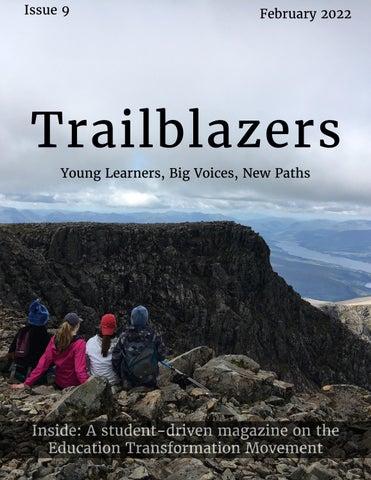
Trailblazers

Young Learners, Big Voices, New Paths

Pages: 8-11

Pages: 12-15

Spotlight Learners

Sharing Stories and Learning Her Own

Interview with Sally Zuk Written by Kate Lewton

Sally is a 17 year old senior at Colchester Highschool. At school she is a part of the Debate team, National Honor Society, the school’s cross country team, and other clubs. She plans to attend a New England or West Coast college to pursue a major in liberal arts and is excited for a change next year.

Pages: 16-19

Project-based Learning and Developing an Innovative Mindset

Interview with Amy Strudwick

Amy Strudwick is an innovation diploma sophomore at Mount Vernon school. She enjoys playing tennis, piano, art, and music. A fun fact about her is that her mom is from Mexico and her dad is from England so she speaks Spanish. She is looking forward to finding her passion and continuing her journey through innovation Diploma.

Cellphone Apps for Self-Improvement

Pranavi is a rising high school senior from Connecticut. She is a self-proclaimed “economics enthusiast” and enjoys learning about all things social studies-related. She is interested in working in public policy or secondary education. In her free time, Pranavi does Taekwondo, plays the piano, and cooks. She is thrilled to have Trailblazers be a platform for her to showcase her ideas.

Pages: 20-23

The Benefits of Experiental Learning

Sarah Rosenhek is currently a grade 11 student at The York School in Toronto. She is an avid participant in her school community, being a member of the Spanish club, eco team and creative writing club. Sarah also enjoys being a writer and editor for her school newspaper, The Stand, which led her to discovering Trailblazers.

Pranavi Rebala
Sarah Rosenhek

It is time for education to be transformed. Schools were first created during the Industrial Revolution with the purpose of preparing students for factory work. However, we are no longer living in that time period - it’s the 21st century where information can be looked up in a matter of seconds, and businesses are looking to hire creative problem solvers rather than mindless factory workers.

With the progression of time, there should be a change in the purpose of school. In the transformed education model the purpose of school should be to: make the world a better place by engaging young learners in opportunities to be active change makers in society. Over the past decade there has been a worldwide movement amongst certain educators to redesign the education system. This community has been creating a new “school,” where students get to pursue passions, work with experts in different fields, and create real impact.

We are a few of these educators whose voices aren’t always heard. We are the “students,” though a more appropriate term may be, “young learners,” because we believe everyone is always a learner.

A LETTER FROM THE FOUNDERS

Education is being redesigned, and like any good design challenge, the designers must talk to the users in order to create impact. This magazine, Trailblazers, was founded with the intent of sharing the work and opinions of young learners who are marking new paths in education.

We founded this magazine at Mount Vernon Presbyterian School in Atlanta, GA, in collaboration with the Mount Vernon Institute for Innovation. We are members of the Innovation Diploma, a program that meets 5.5 hours a week to explore various ventures where we work alongside members of the community, business leaders, and entrepreneurs to create innovations. Our primary goals are to build muscle and capacity as innovators, blur the line between “school” and the “real world,” and leave the world better than we found it. Because of our passion to transform all of education, not just our school, we created Trailblazers, a platform for young learners around the world to share their voices.

- Abigail Emerson, Anya Smith Roman, and Kaylyn Winters

Happy New Year!

It’s been an eventful year, especially for Trailblazers! Not long ago, we released our first issue as a full-fledged team spanning 8 states. At first, it was a little terrifying coordinating everything virtually, but we persevered through! This season’s issue is the perfect demonstration of our amazing team and our continued efforts—we’ll only get better as the year goes on.

In the thick of college applications and midterms, this issue brings some advice to hard-working students. Pranavi Rebala’s research-filled article on productive mobile apps for students is extraordinarily helpful. I’ve personally started using the apps she presents, and they’ve been instrumental in ensuring that I don’t get distracted while studying for my calculus exams! Sally Zuk’s interview gives us insight on how to get the most out of a class, no matter how simple it may be. Sarah Rosenhek’s article really emphasizes the importance of experiential learning and may inspire more students to apply their knowledge to the real world. Our interview with Amy Strudwick illuminates her experience with Innovation Diploma Program and I hope that it’ll encourage more students to accept the challenge and participate

in the program!

Honestly, for this year’s resolution, it took me a while to figure out what exactly I should work on this year. But after reading this issue’s articles, it came to me. My new year’s resolution is to ensure that Trailblazers helps even more students this year! As editor, I will do my best to amplify the voices of students.

Happy reading!

Mantra Burugu and Sydni Williams

Mission: To amplify young learner voices in education

Parterning with UP for Learning

Abigail Emerson

Publisher

Abigail graduated as an inaugural member of Innovation Diploma and now attends Georgia Tech studying industrial design. Her favorite pastimes are giving out high-fives and telling puns. Abigail strives to inspire and empower other students to believe that they can make a change now and don’t have to wait until they’re “older” and “wiser” to start.

Amelia Guerin

Communications Associate

Amelia Guerin is a sophomore at Twinfiled Union High School in Plainfield, VT. As a result of her very student-centered education experience thus far, she has an interest in making high school a more inclusive environment where all students can really grow. For her future, she wants to pursue a career where she can help others, In her free time, Amelia enjoys reading, writing, and playing piano.

Anya Smith-Roman

Editor-In-Chief

Anya graduated as an inaugural Innovation Diploma member in 2017 and is now studying business and psychology at Georgia Tech on the journey to becoming a social entrepreneur in education. Since high school, Anya has been striving to forward the Education Transformation Movement by networking with thought leaders around the world, speaking and coaching at education conferences, and being a pioneer of innovative learner-centered education practices.

Mantra Burugu

Assistant Editor

Mantra Burugu is a junior at Farmington High School in Farmington, Connecticut, She dreams of crafting a successful career out of her passion for coding by becoming a renowned computer scientist. Because of her interests, she plays a major role in her schools Robotics team, social justice clubs, and literature clubs. In her free time, she enjoys reading and writing.

Sydni Willams

Managing Editor

Sydni Williams is a writer, actress and learner from Framingham, Massachusetts. She is a strong believer of appreciating the little things in life like sunsets, boxes of chocolate, and ice cream on a hot day. Despite her loyalty to these timeless, cliches, Sydni would more accurately describe herself as a realist in love with the literary arts. Sydni spends most of her time reading, writing, and appreciating art in life.

Zayda Kellogg

Graphics Advisor

Zayda Kellogg is a student at Bennington College in southern Vermont studying architecture, physics, and design. She is also an avid bullet journalist and video game enthusiast whose struggle with her health durning high school led her to the education transformation movement.

Kate Lewton

Outreach Associate

Kate Lewton is a junior at Stowe High School in Stowe, Vermont. A major passion of Kate/s is youth wellbeing, as she believes it is important for youth to feel accepted and encouraged, She likes to watch movies, listen to music, and go to the beach. In the future, Kate hopes to do something in pediatric medicine.

Eileen Peng

Director of Media

Eileen Peng is currently a junior at Farmington High School. She loves history and economics, and she hopes to be able to further explore them in the future, She enjoys reading, crosswords, and, though, admittedly, rather inconsistently, playing viola.

Imaan Alrahani

Outreach Associate

Imaan Alrahani is currently a sophomore attending Farmington High School in Farmington, CT. She is very passionate about social justice and hopes to create change in the world by challenging the status quo/ In her free time, she enjoys cooking, creating art, spending time with family and friends, learning new things, and helping others. Because of her interests in skincare and skin in general, she hopes to become a Dermatologist; however, as long as she is doing something that involves helping others, she will be very happy!

Sarah Hannan

Lead Graphic Designer

Sarah Hannan is a junior at Farmington High School in Farmington, Connecticut. Sarah has developed a passion for music and art and has enjoyed taking many music and art classes in school. In addition, she enjoys participating in advocacy groups both through school and outside of school. She hopes to pursue a career where she can channel her passion for advocacy and creativity.

Sharing Stories and Learning Her Own

Interveiw with Sally Zuk

Math is helpful for business and accounting, but for an aspiring artist, or science obsessed individual, it might feel less enticing. Schools need more programs that allow student choice, and the indepence to take things head on themselves. Through the What’s The Story Program (WTS), students learn about storytelling, media, world issues, and everything in between. Sally Zuk, a senior at Colchester High School in Vermont is pursuing documentary filmmaking through the program. She advocates that more programs like this should be offered, as they create a space to go beyond the classroom and grow skills for the real world, providing students with the opportunity to pursue what truly interests them.

For some context, What’s The Story is a virtual program that allows students from all around the state to participate in conversations around social justice and world issues through the

lens of filmmaking. Instead of a typical class on United States government, students can explore topics like activism through interviewing people that are actually doing it, and curate their findings into a documentary. When describing how it functions, Sally notes, “It’s run by a few adult figures, but it’s really like students are in charge of it, because you get to decide what you talk about”. In terms of why she joined, Sally, who has a knack for activism and social justice herself, was drawn to the program for this reason of exploration and creativity. She thought of it as a way to be introduced to new topics, people, and outlets she had never explored before. She explained, “I heard great stuff about how it was a bunch of students doing social activist work…and could really just open your life up to new things.”

In terms of school credit, she is receiving it through something called an L3 credit. In explaining the credit,

she shared that students track their progress, and check in with teachers to monitor their work and goals. She notes, “[L]ast year I created a current events class for my school and because I tracked it and had to have meetings with a teacher every few weeks, they checked my progress and it counted as a class.” She feels that programs like this allow students the freedom to design projects that can help them excel not only academically, but gain an understanding of what they enjoy doing and learning about outside of the traditional confines of a classroom.

Sally remarks that WTS feels more like a club or group of fun people she’s involved with, which is one of the reasons why it’s so revolutionary. She thinks of it as a course where adults are initially the leaders, showing everyone what to do, but as time goes on, the

students take charge. This is one of the reasons she likes the program, as it is youth driven and youth informed. More unique courses like this are necessary for this reason, as there is usually very little choice in common curriculum.

Sally says that programs like this help give students, like herself, a new way of thinking and perspective. Not many programs can expose students to so many different subjects, so it is certainly unique in that sense. Programs like this create initiative in students because they show them that they have power and a voice. WTS shares world issues with students, and demonstrates that advocating for these issues can be done through many different routes, such as filmmaking. Speaking of filmmaking, Sally also shares that the program helps students understand the significance of a creative mindset. Creativity is not often incorporated into school curriculum outside of art, but WTS combines artistic vision with practical and real world skills. Importantly, the program is a pass/fail credit, meaning it is more about exploration than grading. It’s a chance to explore, take intellectual risks, and fully dive into something new, as there is not the pressure of academic validation. This freedom encourages initiative that many common courses lack. When speaking to the independence she has gained from the program, she shares, “It’s the whole process of students having to reach out, or having to actually go out and find something”. Clearly, Sally agrees that more programs like this

“...programs

like this allow students the freedom to design projects that can help them excel not only academically, but gain an understanding of what they enjoy doing and learning about outside of thetraditional confines of a classroom.”

are needed to create more initiative in younger generations, as well as spread a rare but precious creativity.

Finally, when talking about how her perspective has changed and how she will apply what she has learned in What’s The Story to her future, Sally emphasizes the importance of a single story. In What’s The Story, students are encouraged to examine world issues through specific narratives, and the personal journeys of others. Sally states that when meeting people, she now becomes curious about their backstory, and what makes them who they are. She adds, “I think having access to those different videos and thinking about it from a story’s point of view is going to let me look at actual people in that way.” She also says that the pro-

gram has given her a renewed hope and inspiration for younger generations. The program’s participants range from younger middle school to high school aged youth, meaning that various perspectives can be heard and considered. Sally says that she is impressed by the motivation that these younger students have, and inspired by their rare determination to create change, observing that “...when I was in middle school I wasn’t really doing it (getting involved), but there’s full middle schoolers doing a student activist film because they’re excited about it. It seems like a whole new generation is ready to take on the action and make a difference.” Sally’s own documentary is about youth activism and involvement, and she hopes to share how essential it is through the film. Overall, What’s The Story has given Sally more motivation to advocate for social change, explore new skills, and introduce a new narrative in her life. By adding programs like What’s The Story to schools, students could try a whole new kind of learning. They would gain initiative, communication skills, creativity, and be able to pursue what interests them. Sally is hearing and sharing the stories of others, and if more programs like WTS existed, more youth could discover their own.

“It seems like a whole new generation is ready to take on the action and make a difference.”

Cellphone Apps for Self-Improvement

In a distraction-filled world, we have the power to use our electronic devices as tools rather than toys. With the rise of the constant buzzes and phone calls and emails from our cell phones also comes the age of digital productivity tools. Here are some great cellphone tools which can help you maximize productivity by instilling routine and reminding you of your daily habits.

1. TICKTICK

This is an app which has the interface of a simple checklist with the capabilities of a task-manager program. If you like sticking to the basics, you can use TickTick to make checklists with tasks and subtasks. For any detail-oriented planners, you can use the additional features to connect all your tasks onto a built-in calendar app, as well as create checklists for different aspects of

2. Alarmy

3. PETUAL

your life, such as a “Schoolwork” list, a “Personal Projects” list, or even a “Vacation Planning” list. The best part is that you can add tasks from any location as long as you have your phone, and the app will save everything since it doesn’t require wifi. This app is a great starter for anyone who wants to shift from using paper planners to technology.

Put simply, Alarmy is an alarm clock app that will guarantee that you don’t oversleep. It’s especially useful for us students in the summer as it can help instill routine, which is much-needed when school is out. Alarmy functions like a normal alarm clock in that it rings at whatever time you set it to. However, to turn it off, you must complete a certain task. This task can be anything from playing a memory game, solving a math equation, or even shaking your phone up and down 50 times. The alarm will only shut off after the task has been completed. There are plenty of different tasks to choose from on the app, and all of them work to stimulate your brain first thing in the morning and make you feel alert.

This is a habit tracker where you simply decide on which habits you want to make-or break. Every day, you check in to the app to keep track of whether you met your goal. If your goal is to limit your screen time to one hour per day, you would check into the app daily and check off the corresponding box. The app motivates users by keeping a streak of how many days in a row they have accomplished their habits. This streak provides you with a small sense of pride to incentivize you to keep sticking with your goals.

Pranavi Rebala

4. FLIPD

Flipd is an app that tracks how much time you spend off your phone. After opening the Flipd app, you can decide on a block of time during which you won’t use your phone. This can be anywhere from 30 minutes to 12 hours. Once you start the timer, the goal is to avoid picking up your phone for as long as possible and to remain on the Flipd app. If you exit the Flipd app and move to another screen, the timer will shut off and you will have to start all over again. This app is great to use if you are studying for long periods of time and want to avoid distractors, or if you just want to take a break from constantly using your phone.

“In a distraction-filled world, we have the power to use our electronic devices as tools rather than toys.”

Project-based Learning and Developing an Innovative Mindset

Interview with Amy Strudwick

Sophomore at the Mount Vernon School in Atlanta, Georgia, Amy Strudwick details the moments she first heard about the Innovation Diploma Program. “When I first heard about it, they told me it’s where we solve real world problems. Before that, I came from public schools where I felt like everything we did I wasn’t going to use in the future. When I heard of iDiploma, I thought it was so cool. I never heard anything like it before…. Now that I’m in it, I don’t know what my high school experience would be like without it.” On a laid-back Saturday evening, Strudwick explains how the Innovation Diploma drastically changed her high school experience, impacted her future, and taught her some lessons.

Originally, Strudwick thought that she wouldn’t benefit from this program because of her struggles with science. Now, she doesn’t know what her high school experience would be like with-

out it. Strudwick is currently taking a social entrepreneurship class; basically, she is creating her own business.

“Right now, specifically, I’m solving procrastination for students, which I never thought I would do. I’m learning marketing and learning how to make a product for a problem.” She now knows how to make a product and start her own business, especially because that is the work she would like to be doing in her future, something that no regular high school class could teach. When asked what specifically she has worked with

during her classes she stated, “Photoshop. I didn’t know anything about Adobe softwares. We use it in every class. I think it would help with future jobs I could possibly have in the future of marketing.”

Coming from a public school background, she didn’t have much experience with projects. Whereas in iDiploma, is it more project-based learning. There is not as much pressure as there is with tests. Struckwick enjoys working with other people because the pressure is not just on one person; it’s a team effort. She explains that because they have to work together, she has become more social and extroverted.

Before this, she was more independent.

“Projects bring out a more creative side of me versus tests where I’m more focused on memorizing, which I’ll forget right after the test. With projects, you’re gaining skills. It’s pretty hard to forget a skill.” While the change from lectures to a project-based class was daunting, it

brought on a change within Strudwick. In many ways, the college process is similar to the process of getting into Mount Vernon. Strudwick learned how to conduct an interview while she was making a magazine about Covid and its effects on countries. She interviewed a doctor from Hong Kong to gain his point of view. Moreover, she feels more prepared because she is able to adapt to changes a lot faster. “In Innovation Diploma, there’s always a problem or obstacle in our way and we have to quickly work our way around it.” The nature of Innovative Diploma calls on students to think up creative solutions to challenging problems. College is not an easy process, but with the skills she developed in Innovation Diploma, Strudwick’s inventiveness definitely eased a lot of stress.

There is no doubt that she has learned a few lessons from being in the Innovation Diploma program. When asked in what ways she has shown growth, she states, “Having the innovation mindset. I see things differently now. There’s a solution for every problem out there. Find a way or make a way, which is something I like to say a lot.”

“Any opportunity I see, I take.” Amy Strudwick has jumped on so many opportunities and stepped out of her comfort zone several times since she has been in the Innovation Diploma program. She is a very independent woman who uses her growth mindset to navigate her way through the challenges life throws at her.

“When asked in what ways she has shown growth, she states, ‘Having the innovation mindset. I see things differently now. There’s a solution for every problem out there. Find a way or make a way, which is something I like to say a lot.’”

The Benefits of Experiental Learning

Every student can bond over the shared experience of being bored out of their minds while reading a textbook. The traditional teaching methods that take place in your typical classroom are only good for memorizing concepts, rather than learning them. However, I find that experiential learning can help students deeply understand a topic and help them become more passionate about learning.

Experiential learning, as defined by the University of Waterloo, is “learning that is based on students being directly involved in a learning experience rather than their being recipients of ready-made content.” In more simple terms, experiential learning is a handson approach in which students engage with what they are studying in class by actually doing it. Personally, I didn’t even know what experiential learning was before attending the York school. I guess this makes sense considering

that York’s motto is experientia docet, experience teaches.

I will always remember my first truly memorable “experience teaches” moment. It was in the middle of the 9th grade and my class had been studying the Canadian North and Indigenous

populations in Nunavut, which is a territory that forms most of the Canadian Arctic Archipelago. While we didn’t make it to Nunavut, the whole grade took a trip to Haliburton, Ontario in the dead of winter. Haliburton is about three hours away from Toronto, but it certainly felt like we were in a whole new world. I was absolutely terrified to see the harsh conditions and to feel the brutally cold weather that we would have to endure for an entire week. Oh right. I must have forgotten to mention that this trip was a winter camping excursion.

In the best of times, I am not a fan of camping. Having to sleep in a tent with barely anything separating you from the hard earth, cooking your food over a fire and surviving without running water or electricity, is not my thing at all. I couldn’t imagine enduring all of this in below freezing temperatures,

i with mountains of snow surrounding me. In addition, I thought that this winter camping trip was utterly useless at first. I was skeptical of how it would be an educational experience or how we could learn any valuable skills. After all, it’s not like I was ever going to go winter camping again. However, as the days passed, I discovered that there were a multitude of benefits to a trip like this, not only in terms of academic development, but also personal growth. The experience forced the whole grade to work together and build lasting connections with each other that would continue throughout the rest of our high school careers. We learned how to be resilient and how to overcome any obstacle or challenge. We learned how people in the Canadian North truly live and

Sarah Rosenhek

The Benefits of Experimental Learning

got to experience the geography of our country first hand. We gained a sense of gratitude for our privilege and appreciation for the many opportunities we had been given in the past and will be given in the future.

With experiential learning, it is clear to see how many benefits students gain on an academic and personal level. Without this experience, or the implementation of experiential learning in my school, I would not have developed such an interest in what we were studying about in the classroom. I would not have the confidence to take either academic or personal risks. I would not have found school to be so engaging, enjoyable, or worthwhile. Finally, I would be stuck in the never ending state of boredom that comes with reading a textbook in class, in an attempt to learn about anything from science to history. After all, Aristotle said “for the things we have to learn before we can do them, we learn by doing them”.

Citations: “Experiential Learning.” Centre for Teaching Excellence, 3 Feb. 2020, uwaterloo.ca/centre-for-teaching-excellence/support/integrative-learning/ experiential-learning.

“We learned how to be resilient and how to overcome any obstacle or challenge. We gained a sense of gratitude for our privilege and appreciation for the many opportunities we had been given in the past and will be given in the future.”
“Learning is creation, not consumption. Knowledge is not something a learner absorbs, but something a learner creates.”
~ George Couros ~

Trailblazers

Turn static files into dynamic content formats.

Create a flipbook
Issuu converts static files into: digital portfolios, online yearbooks, online catalogs, digital photo albums and more. Sign up and create your flipbook.
Issue 9 Final. by upforlearning - Issuu