
CBDNA Program 2026

Page 1


of our students and curriculum. Our faculty are internationally recognized scholars and artists who share their energy and deep commitment to musical excellence with our students every day. We are fortunate to support strong bands, theorists, orchestras, jazz musicians, composers, choirs, historians, operas, small ensembles, and chamber ensembles, and you may have seen our Marching Utes perform recently at the Rose Bowl. Artistry is amplified across the School of Music as our students excel in independent and collaborative research, the practice room, engaged classroom experiences, and on stage.

Under Dr. Jason Missal’s remarkable leadership, the University of Utah’s Wind Ensemble has earned a proud spot among our nation’s leading college bands. Congratulations to everyone who is a part of this year’s conference, and a tremendous thank you to Dr. Missal and our students for the work and dedication that has brought them to today’s performance. We are excited to share our talents with you!

Best,

The University of Utah kim.councill@utah.edu

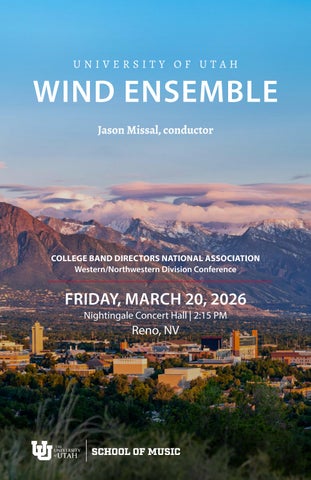
UNIVERSITY OF UTAH WIND ENSEMBLE

Jason Missal, conductor

COLLEGE BAND DIRECTORS NATIONAL ASSOCIATION

Western/Northwestern Division Conference

FRIDAY,

MARCH 20, 2026

Nightingale Concert Hall | 2:15 PM

Reno, NV
PROGRAM

California Counterpoint: The Twittering Machine (1993) Cindy McTee (b. 1953)

Nocturne (2021)

Passacaglia in Primary Colors (2023)

la flor mas linda (2019)

Music for Prague 1968

I. Introduction and Fanfare

II. Aria

III. Interlude

IV. Toccata and Chorale

Zhou Tian (b. 1981)

Michael Daugherty (b. 1954)

Gilda Lyons (b. 1975)

Karel Husa (1921-2016)

PROGRAM NOTES

California Counterpoint: The Twittering Machine | Cindy McTee (1993)

California Counterpoint: The Twittering Machine (1993) was adapted for wind ensemble with a commission from the College Band Directors National Association (Western and Northwestern Divisions), and premièred by Tim Salzman conducting the University of Washington Wind Ensemble in Reno, Nevada, March 19, 1994, at the Regional Conference of the CBDNA's Western and Northwestern Divisions.

California Counterpoint: The Twittering Machine was originally written for orchestra (entitled The Twittering Machine) and later adapted for wind ensemble. The title is intended to recognize California conductor Mitch Fennell for having organized the commission to adapt the piece for winds, and is also meant to express my life-long fascination with the work of painter Paul Klee.

Klee's Twittering Machine is both a drawing and a painting of four birds perched on a crank shaft. The drawn images are whimsical, puppet-like, mechanistic, ironic, and playful, reflected by the faster sections of my composition. These are set against a lyrical field of transparent color, represented by the slower sections of my piece. I was especially drawn to the painting's biting humor; imagine what would happen to the birds if the crank shaft were turned! In my piece, I make attempts at humor through the use of repeated structures and denied expectation–rhythms are displaced, passages are suddenly transposed or textures juxtaposed.

There are elements of danger in Klee's painting: arrows piercing some of the birds, a gaping hole or ditch the birds might fall into, and the presence of an exclamation mark, which is a recurring symbol in Klee's work meant to suggest impending doom. The danger elements in my piece consist of many large silences, or musical holes, which the players risk falling into if they're not attentive.

Most important is my intention that the work, like Klee's Twittering Machine, convey movement -- that it engage the body as well as the mind -- that it "dance"!

Nocturne | Zhou Tian (2021)

Nocturne is a chorale for wind ensemble conceived on a cold, winter night. Lyrical and reflective, the music carries a strong sense of romanticism, and strives to convey a sense of spiritual blessing. The piece was originally written as a middle movement of my first string quartet.

My sincere appreciation goes to David Thornton, who initiated this version for wind ensemble with an excellent transcription. I made further arrangements and composed new materials for the current version.

Passacaglia in Primary Colors | Michael Daugherty (2023)

Passacaglia in Primary Colors for Symphonic Band was commissioned by the University of Michigan in celebration of Michael Haithcock’s twentytwo years as director of bands at the University of Michigan School of Music, Theater and Dance.

The American artist Andy Warhol (1928-1987) often employed repetition of images and vibrant primary colors in his art works. Passacaglia in Primary Colors is structured as a passacaglia, one of the most recognizable structures for musical repetition. The main musical motive consists of 15 pulses or beats, repeated and transformed into unpredictable tonalities and blocks of instrumental color.

la flor mas linda | Gilda Lyona (2019)

In September 2018, as protesters from Nicaragua's Carazo region prepared to march against the increasingly dictatorial Ortega government, my tios (my aunt and uncle) wrote us with pictures of blockades and descriptions of the armed forces that awaited protesters. A world away, I responded by recording and posting a verse of Carlos Mejia Godoy's Nicaragua, Nicaraguita, a song that has become as clear a symbol of the resistance as the blue and white

Nicaraguan flag. It was a cry into the abyss, but, to my surprise, it actually landed with dear ones and their friends in Nicaragua who wrote that they felt our family standing with them. From this urgent sense of reaching across distance through music grew la flor mas linda, written for Glen Adsit, Edward Cumming, and the Foot in the Door Ensemble.

With arms outstretched through sound, sonic images I associate with Nicaragua are slammed together: the basilica bells that toll freely during the Festival of San Sebastián; the pito and chischiles of the dance of the Toro Huaco, for which stand in flute and maracas; the firecrackers that announce celebration; scalar gestures that conjure the strong wind that blows through Diriamba, my mother's home town; fragments from Los Amores de Abraham, a tune my grandfather and his brothers played in their ensemble Marimba Diriangen; and a single gesture from Godoy's Nicaragua, Nicaraguita. Despite an impulse to center on vibrant imagery, celebratory sound mutates into the sinister, and song becomes lament. Estamos con la gente de Nicaragua, siempre. Viva Nicaragua libre.

Music for Prague 1968 | Karel Husa (1921-2016)

In 1968, Czechoslovakia began to experience a relaxing of Communist economic policies and a lifting of restrictions on media, speech and travel. The Soviets denounced this “Prague Spring” and, after several failed attempts at negotiation, sent Eastern Bloc armies to invade the country on the night of Aug. 20. Composer Karel Husa heard about the invasion while on vacation at his summer cottage in upstate New York. The professor of music at Cornell University and Czech expatriate resolved to write a new composition for band that would honor the beauty of his native city, Prague, but also express the tragedy of the occupation. He based his Music for Prague 1968, which has been called one of the most important original compositions for band, entirely on a 15th-century Hussite war song, Ye Warriors of God and His Law, which Husa called “a symbol of resistance and hope for hundreds of years, whenever fate lay heavy on the Czech nation.”

It is the composer’s wish that the following foreword be printed in its entirety in all concert programs of each performance of Music for Prague 1968:

Three main ideas bind the composition together. The first and most important is an old Hussite war song from the 15th century, Ye Warriors of God and His Law, a symbol of resistance and hope for hundreds of years, whenever fate lay heavy on the Czech nation. It has been utilized also by many Czech composers, including Smetana in My Country. The beginning of this religious song is announced very softly in the first movement by the timpani and concludes in a strong unison (Chorale). The song is never used in its entirety.

The second idea is the sound of bells throughout, Prague, named also the City of “Hundreds of Towers,” has used its magnificently sounding church bells as calls of distress as well as of victory. The last idea is a motif of three chords first appearing very softly under the piccolo solo at the beginning of the piece, in flutes, clarinets and horns. Later it reappears at extremely strong dynamic levels, for example, in the middle of the Aria.

Different techniques of composing as well as orchestrating have been used in Music for Prague 1968 and some new sounds explored, such as the percussion section in the Interlude, the ending of the work, etc. Much symbolism also appears: in addition to the distress calls in the first movement (Fanfares), the unbroken hope of the Hussite song, sound of bells, or the tragedy (Aria), there is also the bird call at the beginning (piccolo solo), a symbol of the liberty which the City of Prague has seen only for moments during its thousand years of existence.

UNIVERSITY OF UTAH WIND ENSEMBLE

Jason Missal, conductor

Flute/Piccolo

Nick Anderson, Bluffdale

David Bennett, Stansbury Park#*

Grace Loos, South Jordan

Chloe Richter, Ogden

Oboe/English Horn

Drew Holland, Salt Lake City#

Anna Larson, Portland, OR*

Abby McMullen, Draper

Ian Wagman, Salt Lake City#

Bassoon

Lynnie Clayton, Stansbury Park

Gracy Jane Pugmire, Magna

Braxton Topham, Sandy*

Clarinet/Bass Clarinet

Willa Facy, Colorado Springs, CO

Zane Jensen, Midway

Cole Johnson, Bluffdale

Zoe Kenner, Farmington

Evelyn Newson, West Bountiful

Andrea Rodriguez, Cartagena de Indias, Colombia

Leila Sereki, Columbus, OH#*

Watson Stilwell, Snohomish, WA

Alvin Yeung, Hong Kong, China

Saxophone

Rebecca Ririe, Boise, ID

Hayden Spurgeon, Portland, OR

Jacob Struyk, Sandy

Tommy Wilde, Springville*

Trumpet

Braden Collison, Firestone, CO#*

Braden Eddington, Roosevelt#*

Kris Gilmore, Kannapolis, NC#*

Ann Gray, Erie, PA#*

Jaden Jones, American Fork#*

Sarah Mark, Tokyo, Japan

Morgan Staker, Midvale

Horn

Tanner Chipman, Ogden

Adam Hendrick, Rush City, MN#*

Eleanor Taylor, Holly Springs, NC

Jacob Wheelwright, Blackfoot, ID#

Trombone/Bass Trombone

Eric Curry, Saratoga Springs

Tai Friel, Portland, OR

Jackson Marz, Stansbury Park*

Bjorn Swanson, Chaska, MN*

Euphonium

Benjamin Blodgett, West Jordan*

Henry Judd, Orem

Tuba

Joel Horton, Lorena, TX#*

J. Logan Tolman, Provo

String Bass

Adeline Hiemstra, Fruit Heights*

Piano

Ian Wagman, Salt Lake City#

Celesta

Pearce Nitta, Las Vegas, NV#

Harp

Marienna Smith, North Salt Lake#*

Timpani

Ella Prawitt, Lehi*

Percussion

Zack Anderson, Sandy

Rebekah Hall, Austin, TX

Jake Harker, Idaho Falls, ID

Peter Hill, Myrtle Beach, SC#*

Alexander Kent, Park City

Conner Johnson, Eagle Mountain

Kaitlynn Steff, Las Vegas, NV

Graduate Conducting Assistants

Pearce Nitta, Las Vegas, NV#

Mia Rossmango, Syracuse#

C.J. Russell, Bridgman, MI#

*Principal

#Graduate student

JASON MISSAL is Director of Bands and Assistant Professor of Music at the University of Utah. His duties at Utah include conducting the Wind Ensemble, leading the graduate wind conducting program, and overseeing all aspects of the band program.

Since Dr. Missal’s arrival at Utah, the Wind Ensemble has been selected to perform at the CBDNA Western/Northwestern Division Conference and the International Trumpet Guild Conference and has given the world or regional premieres of works by Omar Thomas, Dennis Llinas, Zhou Tian, Lindsay Bronnenkant, and others. In addition, the group has collaborated with world-renowned soloists such as Sean Jones, Alex Purdy, Floris Onstwedder, and Stephen Proser.

Before his appointment at Utah, Dr. Missal was the Associate Director of Bands at the University of Louisiana at Lafayette, where he conducted the Symphonic Winds, led the Pride of Acadiana Marching Band, and taught undergraduate conducting and courses in music education. While at UL, he led the Louisiana premieres of works by Omar Thomas, Jennifer Jolley, Carlos Simon, Erika Svanoe, Paul Dooley, and Michael Mikulka.

Prior to his work at UL, he taught at Abilene Christian University in Abilene, Texas. At ACU, Dr. Missal led the Big Purple Marching Band, conducted the Concert Band, supervised student teachers, and taught music education classes as well as applied horn. While at ACU, he was twice awarded the Citation for Excellence in Teaching and guest conducted the Wind Ensemble at the 2014 CBDNA Southwest Regional Convention in

Fayetteville, Arkansas. Dr. Missal also collaborated with composers David Maslanka and Carter Pann. A staunch advocate of public school music, he also taught for four years in the public schools of Jenks, Oklahoma.

Dr. Missal has a national presence as a conductor, clinician, and adjudicator. He has conducted and presented clinics throughout the United States, including recent prestigious invitations to conduct the United States Air Force Band, the Utah All-State Symphonic Band, and to present at the Midwest International Band and Orchestra Clinic. Dr. Missal has published articles in The Instrumentalist and School Band & Orchestra magazines. His recording credits include production work on albums by the University of Texas Wind Ensemble and University of Colorado Wind Symphony and an upcoming invitation to produce an album by the Illinois State University Wind Ensemble.

His professional memberships include the College Band Directors National Association, Big XII Band Directors Association (he is the current Vice-President and President-Elect), Texas Music Educators Association, Utah Music Educators Association, Utah Bandmasters Association and an honorary membership in Phi Mu Alpha Sinfonia. He also recently received the Citation of Excellence from the National Band Association for contributions to bands and band music.

Dr. Missal holds a Doctor of Musical Arts in Conducting from the University of Texas at Austin, a Master of Music in Conducting from the University of Colorado at Boulder, and a Bachelor of Music in Instrumental Music Education from Oklahoma State University. His primary conducting teachers have been Jerry Junkin, Allan McMurray, Gary Lewis, and Joseph Missal.

Artistry amplified.

World-class faculty, inclusive, student-focused learning, and state-of-the-art facilities.

WIND AND PERCUSSION FACULTY

Lisa Byrnes, flute

Caitlyn Valovick Moore, flute

Tiffany Sedgley, flute

Robert Stephenson, oboe

Laura Grantier, clarinet

Lori Wike, bassoon

Jeffrey Allardyce, saxophone

Peyden Shelton, trumpet

Nathan Basinger, horn

Stephen Proser, horn

Donn Schaefer, trombone and euphonium

Jim Andrus, tuba

Alex Purdy, tuba

Michael Sammons, percussion

Jason Missal, director of bands

Brian Sproul, director of athletic bands

VIEW FULL DIRECTORY

DEGREES

Bachelor of Arts

Bachelor of Music

Master of Arts (Musicology)

Master of Music

PhD – Composition or Music Education

DMA – Conducting or Performance

PERFORMANCE OPPORTUNITIES

LARGE ENSEMBLES

Jazz Ensemble

Jazz Repertory Ensemble

Marching Band

Pep Band

Percussion Ensemble

Symphonic Band

University Campus Symphony

Utah Philharmonia

Wind Ensemble

SMALL ENSEMBLES

Brass Ensembles

Chamber Music

Clarinet Ensemble

Classical Guitar Ensemble

Early Music Ensemble

Electroacoustic Ensemble

Flute Ensemble

Global Music Ensemble

Harp Ensemble

Jazz Guitar Ensemble

Jazz Small Combos

New Music Ensemble

Saxophone Ensemble

Trumpet Ensemble

Turn static files into dynamic content formats.

Create a flipbook
CBDNA Program 2026 by UofU College of Fine Arts - Issuu