
CONSERVATORY STUDENTS BRING BROADWAY MAGIC TO DARKE HALL
15-YEAR CUSTOM TRAINING PARTNERSHIP CONTINUES TO ADD VALUE
JOURNEY TO EXCELLENCE

CONSERVATORY STUDENTS BRING BROADWAY MAGIC TO DARKE HALL
15-YEAR CUSTOM TRAINING PARTNERSHIP CONTINUES TO ADD VALUE
JOURNEY TO EXCELLENCE
The journey each student takes is as individual as they are.
At the Centre for Continuing Education (CCE), students arrive not only from all corners of the province, but all corners of the world. They arrive at different ages and at different stages of life, each balancing a unique combination of work, life and community connections while aspiring to achieve their educational dreams.
Our job is to ensure each student experience with CCE is the best it can be. That quest, while seemingly simple, is inherently complex. What skills are in demand, what time of day works best for their studies and will they learn remotely, online or in person? And so, to ensure that we meet the high expectations of our students and ourselves, we’ve embarked on the creation of a centralized data warehouse aimed at more fully understanding their needs. While it’s still an evolving project, we are already beginning to find new ways to use our data to support decision making, build capacity and foster an environment that supports student success.
Another new initiative focuses on reaching out to—and welcoming back— former students who left the University before completing their studies. Many are excited at the opportunity to finish what they started and more confident to return when they realize we believe in their ability to do so.
That ability to achieve goals is also driving the growth of CCE’s custom training. By working with employers, such as the City of Regina, we are able to deliver cost-effective training that addresses the specific needs of organizations and helps them and their employees to thrive.
And, as often as we ask ourselves how we can do things better, we are also interested in what success looks like. For some students it’s about earning a credential that will enhance their employability or make their current job easier. For international student and new business owner Md Torikul Islam Bhuiyan, CCE has been the catalyst that led to an entirely new future.
And for others, like the record-breaking number of children who participated in our Summer Conservatory Creative Camps, the sheer joy of learning and performing can be reward enough.
Yes, every student has a story to tell. At CCE, we hope you enjoy reading more about their journey and how we support them in writing their NEXT chapter.

$68.58M
7.63% increase over last year
30%
CREDIT COURSES
Co-offered in partnership with the Faculties
Summer fun hit a high note at the University of Regina’s Conservatory of Performing Arts. Offering a blend of imagination, creativity, learning and play through the arts for children aged 3–14, the Conservatory Summer Creative Camps are a growing community favourite.
Their growing popularity and reputation for unforgettable experiences helped drive registration to an all-time high in 2025 with 636 registrations–a 7.6% increase over summer 2024.
Erika Folnović, Program Coordinator, Conservatory of Performing Arts says that their creative day camps in July and August attracted more kids than ever before this year because they provide something unique. “There are other camps focused on sport or science but not many organizations are doing performing arts-based camps that span such a wide range of ages. We are known as the premiere destination and, as word of mouth spreads, we see a lot of new and returning young learners.”
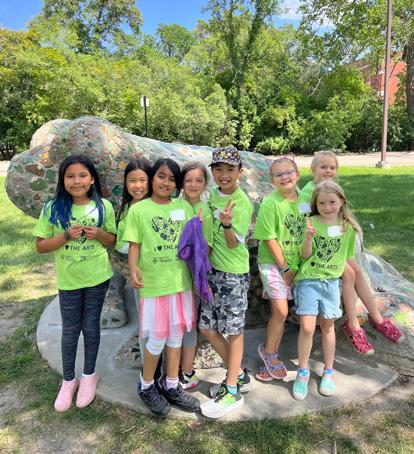
The camps, designed for children to explore a variety of performing arts in a fun, supportive and screen-free environment, focus on many different art forms from dance and drama to music and visual art. “Kids might be working on a theatre performance, a short play or a puppet show. Older kids might explore journalism and podcasts,” says Folnović. “There’s even a comic book camp or camps where kids make props and sets for some of the shows.”
The camps are open to all kids with all experience and skill levels. “If you’ve got a child that’s singing around the house all the time, this is a great way to see if they like performing in a musical,” notes Folnović. “Parents can test it out in this shorter format and they’re sometimes surprised when it sparks a deeper interest in the arts, which inspires them to join our yearlong programs.”
Parents Christien and Brittany Yang enrolled their daughter Scarlett in the Musical Explorer camp because they felt the blend of creativity and structure really set it apart. “The camps provided a unique mix of music, performance and confidence-building in a way that still felt fun and age appropriate,” say the Yangs. “We also felt like this could open the door to new interests and expose Scarlett to things she wouldn’t normally try in a typical summer program.”
With interest and attendance increasing, Folnović says they’re focused on finding ways for even more kids to participate. “In 2025 we expanded enrolment by adding an additional camp every week for eight weeks and people jumped on board. We love to see the kids grow and develop artistic skills and for parents to have the comfort of knowing their kids are having an incredible experience at the same time.”
Every year, students from around the world arrive in Regina with ambitious goals, sometimes with limited English language skills. For many, the English for Academic Purposes (EAP) program at the U of R is their first step toward academic and professional success in Canada.
“ESL is more than language instruction,” says Sunyung Park, ESL Advisor/Counselor at CCE. “Often, it’s an international student’s first time living outside of their home country. So, it’s also a bridge—not just into university studies, but into Canadian culture and daily life.”
The program welcomes students from countries like Vietnam, Korea, Japan, Brazil, Panama and many more. Most work toward meeting English language proficiency requirements to take an undergraduate program at the U of R. Then, once they complete their program, many find a career and build a life in Canada.
One of those students was Md Torikul Islam Bhuiyan, who was studying at university in Bangladesh when he first learned about the University of Regina. “A friend of mine was studying here,” he says. “After talking with my parents, I decided it was a good idea to pursue my education in Canada. The high standard of education attracted me to the U of R.”
=
2024-2025
210
ACADEMIC PROGRAM
TOTAL ENROLMENTS
344
SHORT-TERM PROGRAMS
TOTAL ENROLMENTS
Bhuiyan enrolled in the EAP program and arrived in Regina on a cold December night. “I didn’t know anything about Canada, let alone Regina,” he recalls. “Thankfully, my friend helped me find accommodation, learn how to take the bus, and set up my bank account before I started the program.”
According to Park, Bhuiyan’s experience is far from unique. “For many international students, there’s an adjustment to the culture, values, and everyday life in Canada. With varied life experiences, like different living styles or unfamiliar winter conditions, the transition can be tough at first, but it’s also an important part of their growth,” she says.
When Bhuiyan began the program, he didn’t speak English.
“In my first-year classes, I had to give 200 per cent,” he says. “I couldn’t understand anything at first. I had headaches every few days because I was concentrating so hard.”
While most students find the EAP program challenging at first, they’re given a lot of support and encouragement by the ESL team. Park and the ESL team understand those challenges well. “Sometimes there are nine or ten different countries represented, all speaking different languages,” she says. “It takes courage to move to another country and not speak the language. Our job is to make sure students feel supported, happy and able to achieve their goals. Our staff often become their family.”
Another big support group that helps students succeed is the fellow classmates and other ESL students. For Bhuiyan, those connections made all the difference. “Making friends and interacting with the staff really helped me adjust,” he says. “For me, it was a launchpad into a whole new life.”

After graduating from the EAP program in 2018, Bhuiyan went on to earn the Certificate in Administration – Level 2, an undergraduate certificate offered through CCE. He has since become a permanent resident of Canada and, to Park’s surprise, a local business owner.
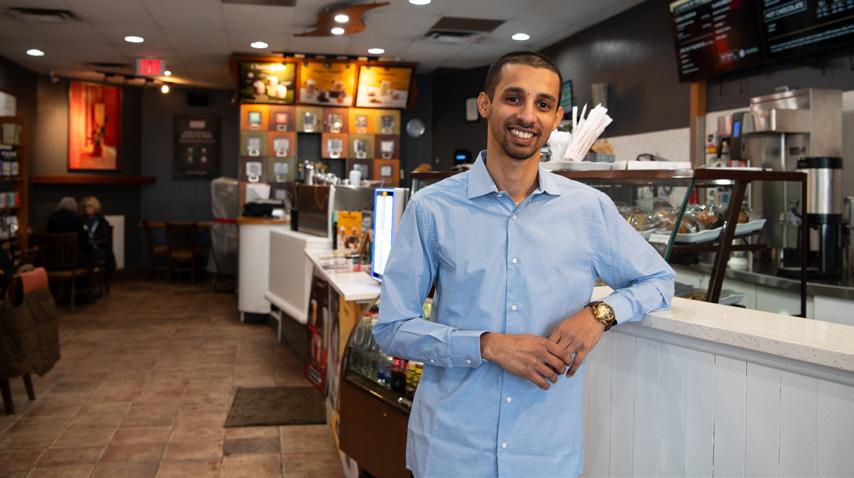
“I walked into a coffee shop one day and realized he was the owner,” Park says. “I hadn’t seen him since he graduated from the EAP program, and it was incredible to see how far he’s come.”
Now in his second year of owning a Second Cup franchise, Bhuiyan continues to learn and grow. He is currently adding to his education by taking the Certificate in Local Government Administration through CCE while managing his business.
“I owe a lot to ESL,” he says. “If I had gone directly to university without it, everything would have been much more difficult. I couldn’t be doing what I do now without that starting point.”
For Park, Bhuiyan’s journey reflects what ESL strives to achieve every day. “When students leave ESL and go on to thrive academically, professionally and personally, that’s the success we love to see in our students.”

Not every student’s journey from admission to graduation is seamless. Some start a program but don’t cross the finish line. Their reasons for stepping away are just as diverse as the motivations that brought them here in the first place.
In an institution of nearly 17,000 students, it could be easy for these early departures to go unnoticed. But Robin Markel, Head, Career & Professional Development, says sending an invitation to explore what’s possible now can be the key to credential completion. “Some students take time away thinking they may come back in the future or pursue a different path altogether. And from our perspective, the goal is to ensure students are supported to successful program completion and have an overall positive experience along the way.”
To encourage those who leave to return and reconnect with their educational goals, CCE launched a pilot project, aptly named Welcome Back. “We started by reviewing academic records from the past seven years and identifying those who were close to completing a program,” says Markel. “The University has also recently introduced a three-year Bachelor Degree in Arts & Sciences which is ideal for adult learners, particularly those who have completed credits already.”
An initial group of 85 students were identified and contacted by email which outlined the number of credits they had earned to date and how many more are needed to complete a certificate, diploma, or degree. Students were invited to contact an academic advisor to discuss program opportunities and next steps. The immediate response surprised even Markel. “We sent the email out on a Thursday and by the following Tuesday we had people booked in with appointments.”
What was not surprising was that no two student stories were alike. “One person had a great career and wanted to complete their degree for a sense of purpose while others wanted to get ahead in their careers by boosting their resume and skills. Another person had poor grades when they were 18 and didn’t know if they were cut out for university. What we realized is that when we reach out to them, we validate that this is possible and give them the confidence they need to reach their goals.”
With students now registering and re-entering university life, there’s a sense of pride as they move forward in completing something they may have started years earlier. And, while the personal gratification is reward enough, Markel believes the effects ripple more broadly. “To have people who are recalibrating their participation in the workforce means they bring more skills into Saskatchewan’s employment landscape. Not only will these students be more employable but the economy ultimately benefits from their expertise.”
“This will not be a one-time project but something we’re going to be building into our regular operations going forward,” says Markel. “We think this will be a really good way to bring the university back into the lives of potential students and help them navigate a new future.”


2,701
449 TOTAL ENROLMENTS
CERTIFICATES ISSUED 16% increase over last year 16.3% increase over last year

As organizations navigate increasingly complex projects, the demand for skilled leaders and project managers continues to rise. Like many large employers, the City of Regina—home to more than 2,800 staff— recognized the need to strengthen its leadership capacity to continue to successfully manage teams and projects.
Morgan Piette-Kuntz, HR Consultant, Organizational Well-being at the City of Regina, was tasked with creating an educational path for employees that would strongly align with the City’s strategic priorities.
Morgan Piette-Kuntz, Manager, Organizational Well-being at the City of Regina, was tasked with creating an educational path for employees that would strongly align with the City’s strategic priorities.
“We wanted to develop a custom program focused on leadership that employees could complete in bite-sized pieces,” says Piette-Kuntz.
Her first call was to Heather Renshaw, Business Development Consultant, Professional Development at CCE, a long-standing partner to the City. “We’ve been delivering custom training to the City for more than 15 years,” says Renshaw. “We collaborate to deliver customized training that aligns with the City’s objectives so it’s highly relevant to their workforce. This has been an incredibly rewarding partnership, one that continues to grow and evolve.”
After an initial consultation, Renshaw proposed offering a customized version of CCE’s High Impact Leadership Microcertificate, a 42-hour program that aligned well with the City’s needs. “The courses that make up the program are Assertive Leadership, Manage Power Dynamics and Navigate Difficult Conversations, which were areas of interest to the City.”
At the same time, Piette-Kuntz asked senior managers to approach mid-level managers to determine their interest in participating. Interest was immediate and has continued to grow. “Since we ran that first cohort in May, we had many staff register for the second cohort this past fall.”
The benefits to the City of Regina are many, says Piette-Kuntz. “Each course takes a deep dive into topics that our staff face regularly so the content is immediately
applicable when they get back to their jobs. We also see this type of professional development as a great way to engage and retain our people.”
Microcertificates, whether offered as a custom program or through CCE’s open enrolment, continue to be a growing trend, notes Renshaw. “Microcertificates empower learners to quickly gain in-demand skills while earning recognized digital credentials that showcase their achievements. These credentials can easily be added to resumes and professional profiles, such as LinkedIn, helping individuals stand out in today’s competitive job market.”
With the Leadership program underway, the City turned its attention to the creation of a new project management microcertificate which launched in spring 2025 and exclusively available for organizations through custom training. “There was an overwhelming response,” says PietteKuntz, “so we expanded the number of seats available and added a second cohort.”
Renshaw says that she loves the collaborative nature of CCE’s relationship with the City of Regina. “It’s exciting to collaborate and innovate, by identifying what the City needs and values, and then bringing those insights together with impactful solutions. The responses we’re receiving from City employees reinforces that we’re hitting the mark.”
Piette-Kuntz agrees. “CCE shares our commitment to building a strong work-ready workforce and this partnership has helped us to create a sustainable model for municipal learning. As times have changed the courses do too, but our focus is always on matching real life needs to expertise and in making the most of the City’s investment in lifelong learning.”
2024-2025
1,828 125 802 $385,424
TOTAL ENROLMENTS
CERTIFICATES
Saskatchewan’s non-profit sector plays a significant part in Canada’s rural and small-town communities, contributing substantially to employment and local economies.
That’s one of the reasons why Luther College, together with CCE, originally created the Non-profit Sector Leadership and Innovation Certificate (NSLI) over 10 years ago. Colleen Strauch, director of Non-profit & Voluntary Sector Studies Network (NVSSN) at Luther College says that while the certificate program was as sought after as ever, it was time for an overhaul.
“Non-profits are an economic driver in Saskatchewan,” says Strauch, “but after the pandemic we began questioning how well the program was meeting the needs of that community and assessing what more we could be doing to prepare them for work in that sector.”
To determine the answers to those and other questions, Strauch and colleagues at the U of R’s Centre for Teaching and Learning (CTL) began the process of curriculum mapping. “This was an essential step in figuring out what the program learning outcomes should be and how each course could contribute to achieving those outcomes.”
As part of the process and to ensure the learning outcomes were as relevant as possible, Strauch began an engagement exercise with the non-profit sector. “Their input was critical in that it helped sharpen our focus and allowed us to hone in on what we wanted the updated content to be. But it also created questions about how best to deliver the content for today’s modern learners.”

Recognizing she would need additional resources to fully transform the program from remote and in-person delivery to fully online, Strauch secured funding from the U of R’s Distance and Distributed Learning Committee (DDLC) and approached the instructional design team at CCE’s Flexible Learning unit to bring her vision to life.
Kieren de la Rue, Instructional Designer, CCE was quick to lend their expertise. “Our job is to ensure courses are effective, engaging and fully aligned with learning objectives. To create the best possible experience online involves knowing what works well and what doesn’t.”
For Strauch, having that expertise was a game-changer. “We’ve all had experiences learning online that were boring or tedious. But today’s students want to access courses in different ways, and we need to ensure students in rural communities enjoy the same quality experience. Kieren and the instructional design team were able to provide that.”
“It’s all about knowing how to present the information in the best way,” says de la Rue. “We look at how to set up assignments, how best to convey information to a variety of learners, and how to make the course as accessible as possible.”
One of the unique elements of the NSLI certificate is the involvement of non-profit partners. “Students work with non-profit organizations throughout the semester to complete an assignment,” says Strauch. “We needed help figuring out how to embed that into an online format.”
43,188 TOTAL ENROLMENTS
Part of the role of an instructional designer is translating what works well in person to what works well online while still achieving the same results. “It’s our job to be familiar with best practices and understand how pedagogy and the online world interact,” says de la Rue. “We’re well aware of the challenges but we have the technical tools and skills needed to create a quality experience for both the student and the instructor.”
That expertise together with those tools were invaluable to Strauch. “It’s really hard to stay up to date on technology and know-how to embed different materials and how to present a course that is clear and has a nice flow. It can be overwhelming, and we needed that support.”
When the new and improved certificate launched, that support did not wane. “We continue to follow and be involved in the course throughout its delivery,” says de la Rue. “The first two times the course ran, they had the support of our full team if they wanted to edit or change things up. Courses should always be getting some level of update, and in this case because the community partners will change each year, we may always be making changes.”
“They are a great team,” says Strauch. “You don’t have to do it all, and Flexible Learning, CTL and DDLC have all enriched this program so much. It really is the perfect example of how to use campus resources to make improvements that positively affect students, instructors and the community. I think that by working together we can always achieve more.”

DATA MANAGEMENT PROJECT PROVIDES ROADMAP FOR SUCCESS

Data is a powerful catalyst for growth and innovation. And behind the scenes it’s shaping some of the most meaningful decisions in continuing education. It drives a greater understanding about learners and their needs, how they succeed and how programs can evolve to better support their goals.
The Centre for Continuing Education is working on a project to take its data-driven decision-making to a new level. By using data to enrich the student journey, CCE is turning insight into impact—strengthening programs today while preparing learners for meaningful futures tomorrow.
Chris Ugbomah, Business Systems Manager and Analyst, Central Business Services, CCE, is one of the team members working to build a centralized data warehouse and a suite of dashboards that will bring together insights from across CCE. The goal? To transform scattered information into fuel that allows CCE to better understand and support student experiences.
“We began this initiative earlier this year and what excites us most is not just the technology itself, but what it enables us to do. It allows us to be more responsive to student needs, identify opportunities for improvement and empower staff with the information they need to make sound decisions on things like program development.”
Ana Aviles, Financial Analyst, Central Business Services, CCE, and another member of the data project team explains, “Each student’s path is unique, and understanding their realities—how they try to balance studies, work, family and personal goals— allows us to see the whole picture. Data helps us to reveal patterns that could make a difference in how we support our students in the future.”
The process involves collecting raw data from a variety of sources going back to 2022. “We started by integrating many resources into a single source of truth,” says Ugbomah. “Within that data we try to find as many characteristics as possible to form a complete picture of our students. Along the way we’re standardizing how data is collected so that it becomes more consistent and complete.”
While this is still a work in progress, CCE is already beginning to see how data can become a valuable tool for capacity building.
“We can see patterns emerging that will allow CCE to make more informed decisions such as identifying the need for new programs or reasons to adjust existing ones,” notes Aviles. “There is so much opportunity because it’s not just about providing data such as total enrolment numbers. It’s about developing a holistic view of students’ goals, challenges and progress.”
Currently the team is setting the foundation and defining processes and improvements. “We began with 50 metrics and have completed 25 so far,” says Ugbomah, “but once we’ve built the foundation, then we start adding bricks on top and that’s where the fun begins. We challenge ourselves with the questions, see what the trends say and explore new avenues that allow us to answer those questions.”
Those questions are many. “How well do we know our students, their aspirations and what their journey at CCE has been like,” queries Aviles. “When we ask those questions, we either can’t find or don’t have the data to answer them. Without this type of information, we are only able to react to situations after the fact. With it, we can be proactive and that will make a world of difference in terms of how successful we can be in supporting not only our students but CCE and the wider community.”
While the project is an ambitious one, CCE believes it is well worth the effort. “At CCE everything is about people, but we also have that entrepreneurial spirit and a focus on continuous improvement,” says Ugbomah. “This is helping to create a culture that is driven by data and will pay dividends for years to come.”
If you love musicals, look no further! Broadway magic is coming to life right here at home, brought to the stage by talented young performers.
The Conservatory’s theatre programs have been transforming iconic productions like Annie and Spamalot on the historic stage at Darke Hall, giving families and the community the joy of seeing kids shine in the spotlight.
“Musical theatre in Regina is really popular and so I’m not surprised that our theatre programs for kids have really exploded after the pandemic,” says Erika Folnović, Program Coordinator, Conservatory of Performing Arts. “Our community loves attending it and performing in it but when the performers are their kids, it’s a must-see production for families.”

No matter what skills or experience children have singing, dancing and acting, everyone can join Glee, the musical theatre program, and Showtime. “There are no barriers to participation,” notes Folnović. “Every child has the opportunity to be onstage without an audition or a need to show up with certain skills. We just want them to come and try and have a fun time.”
In fact, so many kids have been eager to try this year that there were dozens of names on the waitlist. “Our Glee programs are for kids ages 4-18, and our class sizes are 25 students for Senior and Advanced Glee and 15 students in Mini and Junior Glee,” Folnović explains. “When we saw the extent of the waitlist for our Senior Glee program, we hired another instructor and added a third group.”
The classes that run from September to May culminate in a performance at the University’s Darke Hall. “It’s a beautiful, mid-size theatre with 474 seats so it’s a big audience but not too overwhelming. And its magical for children to step onto the stage.”
As younger participants evolve into more seasoned performers, it’s common to see them graduate and move onto the next program. “Kids who are really passionate about theatre stick around for quite a few years. We even have young adults who took our programs when they were a kid— folks who now work for CCE—tell us that performing at Darke Hall was a highlight for them.”
What’s equally encouraging is the feedback Folnović receives from her students’ parents. “They often tell me that their son or daughter has come out of their shell and found a community of like-minded kids. It’s so rewarding to hear that our students have become fast friends with other participants and found a place where they feel like they belong.”

Musical theatre offers kids far more than a moment in the spotlight.
Learning lines, songs and choreography helps strengthen memory, focus, and problem-solving skills, while stepping into different characters encourages perspective-taking. Working together on stage builds empathy, teamwork, and emotional awareness, and the supportive environment of musical theatre helps children grow in confidence, self-expression and a stronger sense of who they are.
Expanding possibilities, strengthening communities.
The mission of the Centre for Continuing Education is to meet lifelong learning needs by offering high quality, accessible, innovative and responsive education and training programs to learners of all ages by building on the strengths and collaborating with the resources of the community and the University.
The University of Regina and its federated colleges are on Treaty 4 and Treaty 6 territories — the homelands of the nêhiyawak, Anihšināpēk, Dakota, Lakota, Nakoda peoples, and Michif/Métis nation.