














WHILE most of Wareham sleeps, Laura McDermid is lacing up her trainers. At 4.30am, when the streets are quiet and the day is just beginning to stir, the local PE teacher can be seen running through the town, training for this year’s London Marathon.
Balancing marathon training with a full-time job and family life is no small feat. Laura works as a PE teacher and is also mum to two young daughters. With busy school days, family commitments and all the usual demands of life, 4.30am has become the only time that truly belongs to her. “Early mornings are the only way I can fit it all in,” she said. “It’s tough, but it’s also empowering. It proves to me that with determination and a bit of creativity, you can make space for your goals.”
Community support has played a huge part in keeping Laura motivated. Friendly

waves from early risers, messages of encouragement and knowing that people are following her journey have made those dark mornings brighter. “Wareham has such a strong sense of community,” she said. “Even when I’m running alone, I don’t feel alone.”
Laura is running the London Marathon in support of WhizzKidz, the UK’s leading wheelchair charity for young people. The charity provides essential mobility equipment and life-changing support to

Our selection of individually tailored coach holiday tours offer a custom made product providing a feeling of luxury and aspiration. Specifically aimed at the more discerning customer.
Convenient & FREE local picking up points throughout the
PE teacher Laura McDermid has been getting up at 4.30am to train for the London Marathon
children and young people, helping them to lead more independent and confident lives.
“As a teacher, I see every day how important confidence and opportunity are for young people,” Laura said. “WhizzKidz does incredible work, and I’m proud to be fundraising for a cause that helps children reach their potential.”
At the heart of Laura’s marathon mission is a powerful message she hopes her daughters and girls everywhere will take to heart. “I want to
4 days - Fri 24th April
Barging Around Brum
Exploring the network of canals in the Midlands with 3 boat trips
5 days - Mon 18th May
The South Wales Valleys
A rich social history and dramatic mountain scenery
7 days - Sun 31st May
The Best of Wales
A unique Celtic experience Includes Giants Causeway & Belfast 83 The Esplanade, Weymouth, Dorset. DT4 7AA
Pack your curiosity for a 2 centre tour of legend, myth and wonder
5 days - Sun 28th June
Yorkshire Dales & Rails
2 famous railway journeys and a historic canal cruise
4 days - Sat 18th July
The Black Country & National Memorial Arboretum
7 days - Sun 26th July
Northern Ireland
show that you can do anything,” she said. “You don’t have to fit a certain mould or wait for the ‘right’ time. With hard work and belief, you can achieve your goals.”
Laura is hoping the people of Wareham and the wider Purbeck community will get behind her. “If you’re able to spare even a small donation or sponsor one of my runs, it would mean so much,” she said. “Every pound raised helps Whizz-Kidz give young wheelchair users the freedom, confidence and opportunities they deserve.”
Knowing the support is there keeps her going on those early mornings and she hopes her London Marathon journey will not only inspire others but also make a lasting difference to the lives of children and families who need it most.
To support Laura, visit www. justgiving.com and search Laura McDermid.
5 days - Mon 3rd August
Snowdonia
Summit to Seaside
A breath-taking environment between mountain and sea
7 days - Sun 9th August
The North of England Multi-Centre Road Trip
A diverse and scenically stunning region of untouched landscapes. Inspirational, historic and culturally distinctive.
5 days - Mon 17th August
Cheshire Waterways
Heritage, attractions, waterside settings, historic boats and more.
5 days - Thurs 27th August
Edinburgh Military Tattoo
5 days - Weds 23rd December Christmas 2026 in NORMANDY, FRANCE
Fine food and traditional drink in a land fashioned by
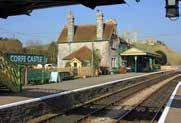
THE 200-year history of rail travel is told in an exhibition train stopping off at Corfe Castle station this week on its tour of Great Britain.
The family-friendly ‘Inspiration’ Railway 200 exhibition train shows how railways transformed the UK and the world.
It also includes a look at railway firsts, hands-on engineering challenges and interesting – and lesser known – careers on the railways.
So far, during its 60-stop year-long tour, the exhibition train has welcomed about 50,000 visitors.
It is made up of five former British Rail Mark Three-type carriages built in Derby during the 1970s and 1980s.
The first passenger train, hauled by George and Robert Stephenson’s Locomotion No. 1 steam engine, ran on the Stockton and Darlington Railway in County Durham on September 27, 1825.
The historic journey enabled the growth of economies,
revolutionised leisure and business travel, enabled mass tourism and sports leagues, and standardised time across the country.
The exhibition train is at Corfe Castle station from Monday to Wednesday, February 16-18, 10am-4pm and is free to visit for anyone with a Swanage Railway ticket.

the Swanage Railway as part of its tour of Britain.
“Railways have played such an important role in shaping communities and connecting people with this exhibition bringing that fascinating story to life in a way that’s fun and accessible for all ages.

“It’s a real privilege for the Swanage Railway to host something so special and historic celebrating our rich heritage and the exciting future of rail travel.
everyone – whether you are a railway enthusiast or just curious about an important British innovation that changed the world.
“We look forward to the Railway 200 exhibition train inspiring Swanage Railway visitors of all ages.”
The exhibition train’s visit comes in the month Swanage Railway celebrates the 50th anniversary of the start of restoration work at the disused and boarded up Swanage station on Saturday, February 14, 1976.
Swanage Railway chief executive Abbie King said:
“We’re absolutely thrilled to be welcoming the ‘Inspiration’ Railway 200 exhibition train to
“A fun, free and fascinating way to learn about the past, present and future of the railways, there will be something of interest for
Anyone interested in finding out more about volunteering at Swanage Railway should email iwanttovolunteer@ swanagerailway.co.uk
More information about volunteering can be found at swanagerailwaytrust.org/ volunteering
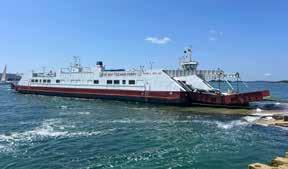
PASSENGERS travelling on the Sandbanks Ferry raised more than £2,500 for the RNLI on Christmas Day, with the ferry operator offering free crossings and inviting travellers to donate their usual toll fare to the lifesaving charity.
The ferry has run a free Christmas Day service since 2019, giving back to the community while supporting its charity partner.
All passengers travelled free, whether they donated or not.
Jason DuToit, managing director of Sandbanks Ferry, said: “Our passengers showed incredible generosity on Christmas Day.
“Raising this amount in just one day demonstrates how
Ferry passengers gave more than £2,500 on Christmas Day to the RNLI
Sandbanks Ferry 2025
much our community values the RNLI’s lifesaving work.
“We connect Sandbanks and Shell Bay all year round, serving the residents,
businesses and visitors who depend on us.
“Offering free travel on Christmas Day is our way of thanking the local community for their support throughout the year.
“We’re honoured to partner with the RNLI for another year, supporting the crews who keep our coastline safe every single day.”
The Sandbanks Ferry operates year-round from 7am to 11.10pm. On Christmas Day, the service runs half-hourly between 8am and 6.10pm.
NEWS that three Best Start Family Hubs will open across Weymouth and Portland to provide local families with support and essential services has been welcomed by Lloyd Hatton, Labour MP for South Dorset.
Best Start Family Hubs will open at Portland Community Hospital and Weymouth Outdoor Education Centre later this year, and a Best Start Family Hub will expand on the existing offer available at Littlemoor Hub.
and had improved health outcomes.
The hubs in Weymouth and Portland will offer a range of services under one roof, including maternity services, oral health services, early language support, nutrition support, health visitors and support for children with SEND.
The aim is to ensure that no parent feels they must navigate the challenges of raising a child alone.
All hubs will have a


campaigning for more services to be delivered at Portland Community Hospital.
“So, I am particularly delighted that a new Best Start Family Hub will now open here – I will continue to champion Portland Community Hospital
He added: “I’ve heard from countless parents that additional



support for children with SEND is needed.
“By placing these





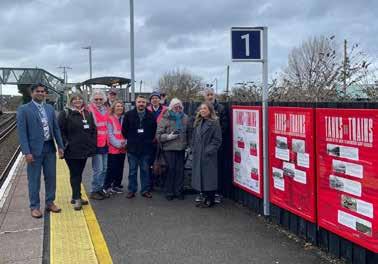
NEW ‘Tanks on Trains’ information posters at Wool station tell the story of how the railway was used to transport armoured vehicles to and from Bovington Camp in the early years of the last century.
The posters were created at the instigation of the Purbeck Community Rail Partnership and the Friends of Wool Station.
They are part of celebrations to mark 200 years since the birth of rail travel with the opening of the Stockton and Darlington Railway in 1825.
The two miles-plus singletrack branch line from Wool to Bovington Camp was constructed during the First World War, when the camp was developing as a training centre for tank drivers.
About 100 men from the Military Works Company of the Royal Engineers built it assisted by German prisoners-of-war from a large camp near Dorchester.
The line lasted just 10 years and was torn up in 1936.
The story is largely forgotten and the posters – designed and produced by the rail partnership and The Tank Museum – aim to make local people and visitors aware of the rail link between Wool station and Bovington Army Camp.
The three posters focus on the why the line was built, the construction and the history of the railway.
Representatives of the Purbeck Community Rail Partnership, Friends of Wool Station, The Tank Museum and South Western Railway attended the posters’ unveiling.
The rail partnership would like to thank South Western Railway for its support in installing the posters and a blue plaque commemorating the tank loader at Wool Station.
The tank loader, behind platform 1, was used to load armoured vehicles onto flat wagons and the mainline railway until the 1990s.
The Friends of Wool Station initiated the project and applied
WELDMAR Hospicecare is seeking individuals willing to spend a day behind bars in its Jail & Bail fundraiser.
The historic courtroom at the Shire Hall museum in Dorchester will see ‘criminals’ from across Dorset face sentencing for light-hearted crimes, ranging from ‘excessive use of emojis’ to ‘never making the tea’.
Participants will then be banished to the cells below for the day, where they can use their phones and social media to raise a minimum of £999 in ‘bail’ money to fund Weldmar’s specialist end of life care.
The charity is aiming to build
for the funding to bring it about, with the project funded by the Community Rail Network.
Lucy McCalister, marketing and communications manager at The Tank Museum, said: “The railway played an important part in the history of armoured warfare, from transporting tanks around the country to here at the home of the tank.
“We were very happy to get involved in Railway 200 and educate the station’s visitors about our history.”
Tony Smale, from Friends of Wool Station, said that links between the station and army camp continue to this day.
He said: “When the Friends group was set up in 2010, the army’s resident handyman constructed a sturdy set of black wooden planters for the station platforms.
“There’s a regular turnover of army personnel coming and going by train, and when there are special events like TankFest at The Tank Museum, our members are on hand to greet people off trains and let them know the shuttle bus is on its way.
“Our striking new ‘Tanks on Trains’ posters will reinforce the link between the army camp and station well into the future.”
on the £15,000 raised at two previous Jail & Bail events, with all proceeds staying in Dorset to fund care for adults with a life limiting illness and support for their loved ones.
Fiona Hansford, fundraising lead at Weldmar Hospicecare, said: “We are thrilled to bring Jail & Bail back to such an iconic local venue.
“It’s a day full of drama and laughs, and provides a fantastic PR opportunity for local businesses, who can also show their charitable side.
“We’re looking for local ‘culprits’ to step forward, and we’ll give them lots of support and advice on how to prepare to

raise the bail on the day.”
Previous ‘inmate’, Claudia Webb, who was charged with ‘never tidying the office’, said:
“I absolutely loved taking part.
“It was a fun, memorable experience and a great way to bring people together to support vital local work. I’d wholeheartedly encourage anyone to get involved. It’s one
of those fundraisers that really stays with you.”
Only a limited number of cells available, so Weldmar is encouraging early applications, with the deadline for entries February 20 and the event on Friday, March 13.
Interested participants can turn themselves in by visiting weldmarhospicecare.org.
by Julie Bradshaw
THE main debate at the council meeting was about the town council precept and will affect everyone in Wareham who pays council tax.
An increase of £52.43 a year on a Band D property making the payment £300 would cover money for the new museum and tourist information building, the Neighbourhood Plan review and all other foreseen operating costs.
The alternative is to take money from the reserve fund to keep the increase to £30.70 a year.
Those in favour of the

PHOTO: Simon Barnes
more likely with the large projects under way, leading to bigger increases next year. Others felt it was too great a percentage increase to put upon people when the cost of living is already making life difficult for many.
An interesting split in the vote reflected neither party lines nor length of service on the council. It came down to the Mayor’s casting vote, which was in favour of the
town council action list with ‘deputy town clerk’ against them.
One was the rebuild of the Howards Lane toilets, which has hit a road block. The contractor chosen did not consult the Dorset Council conservation officer before submitting plans and the officer is demanding major changes. Wareham Town Council is insisting that the contractor pays the extra costs involved but no progress has been seen.
Parking on part of West Walls is causing damage to the walls. Dorset Council, Historic England and Rempstone Estate
to the junction with Cow Lane.
The carnival committee was able to give £7,500 to youth groups and youth organisations from last year’s event and is busy organising again.
A vinyl night on Friday, February 27, in the town hall will raise funds towards Wareham Town Museum.
Music is from the 1960s, 70s and 80s; dancing is optional; you bring your own drink and nibbles, £5 to pay for entry on the door and money for raffle tickets. The fun starts at 7pm.
The next Wareham Town Council meetings are in the council chamber on Tuesdays, February 24, and March 24 starting at either 7pm or 7.30pm depending on whether a planning and transport meeting is held first.
Further information is available on the council’s


THE new year has seen some tumultuous weather sweep across Durlston and the wider westcountry, though the now-infamous storms Goretti and Chandra thankfully left the country park’s Holm Oak woodlands unscathed.
One group of Durlston residents which take both rain and shine in their stride are our herd of 30 Hereford cattle. These handsome red-furred, white-faced cows and their calves do a fine job of ‘conservation grazing’ the more vigorous grasses and scrub plants, making room for Durlston’s nine species of orchid, including the stunning early spider orchid.
Hoist the main sails! The Pirates of Purbeck Trail has dropped anchor at Durlston Country Park. Until Wednesday, February 25, collect your booklet from the Castle reception, follow the map and find the treasure to win a prize. £3.50 per trail pack.
From Saturday, February 14t, the latest free exhibition arrives in the Fine Foundation Gallery, with Durlston and the Sea exploring the wildlife and fascinating history of Durlston hidden beneath the waves.
Open daily 10am-4pm.
If you and your loved ones would like to get outside and help keep Durlston special, join us for one of our popular Family Scrub Bashes, on Monday or Tuesday, February 16-17, the second date in association with Purbeck Goes Wild.
Meet at the Learning Centre for 10am with suitable outdoor

clothing and footwear, and we’ll provide all the tools and guidance you’ll need!
Free, but booking required via Durlston.co.uk or planetpurbeck.org/events
Head to Durlston’s Learning Centre this half-term for a Wild Wednesday!
Drop in between 11am-3pm on Wednesday, February 18, to have a go at painting, crafts and activities. No booking required, and free to attend, although donations – via cash or card – are much appreciated.
Make sure to dress for mess!
On Thursday, February 19, celebrate 25 years of the Jurassic Coast World Heritage Site and learn about Durlston’s ‘roarsome’ prehistoric past through games and activities at our Dinosaur Discovery session in the Learning Centre. 10.30am-11.30am, £3.50 per child, booking required via Durlston.co.uk
Flex your creative muscles with Madelaine Devenay at her art workshop on Saturday, February 2. Learn to sketch seascapes, boats and animals, with ample inspiration from the windows of Durlston’s hilltop Learning Centre.
£20 a ticket, with adults and children – eight-plus –welcome, and all materials provided – book via Durlston. co.uk.
Our popular Stargazing event returns on Saturday, February 21, Feb where – if the weather permits – experts from the Wessex Astronomical Society will guide you in observations of the slim crescent Moon, Jupiter with Io and the winter constellations.
£4 per person, no need to book, though check the Durlston website or call 01929 424443 on the day in case of cancellation.
Durlston’s regular calendar of guided walks continues through February and March.
Clifftops – Wildlife and the Sea on Wednesday, February 25; Pleasure Grounds on Thursday, March 5, and Signs of Spring with Ali Tuckey on Sunday, March 8; all offer expert insights into the country park’s history and nature at £3.50 per person.
Further details on the Durlston.co.uk Events page.
March’s Friends of Durlston (FoD) evening talk at the Learning Centre will offer a fascinating insight into Gilbert White’s seminal The Natural History of Selborne, a book first published in 1789 providing insights into seasonal changes and animal behaviours over a span of 20 years. £3.50 on the night, free to FoD members.
Finally, blow away those cobwebs with a rousing evening of song on Friday, March 6, as the Wareham Whalers descend on Durlston Castle for Shanties and Strange Stories.
In their usual light-hearted way, The Wareham Whalers will explore life aboard sailing ships in the 18th and 19th centuries through readings, songs and shanties, keeping visitors entertained from start to finish.
Tickets £10, booking required via the Durlston.co. uk. Doors and bar open 7pm for a 7.30pm start.
For more information, visit the Durlston website, www. durlston.co.uk, Visit the Seventh Wave café website at www.seventhwaverestaurant. co.uk
ROSS PACKMAN Engagement ranger


20-23 AUGUST 2026

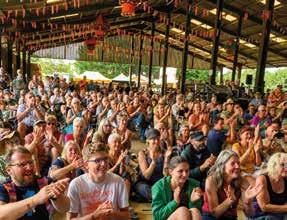
SAM KELLY & THE LOST BOYS
MARTHA TILSTON - FRANKIE ARCHER
UKULELE DEATH SQUAD [AUS]

THE ROVING CROWS - RE:VULVA BONFIRE RADICALS - MISHRA
RACHAEL MCSHANE & THE CARTOGRAPHERS - EABHAL

SOUSOU & MAHER CISSOKO - TAFF RAPIDS - KLEZMER FOYGL
MICHAEL PREWITT - FLATS & SHARPS - TOUKI - TARREN
MARTHA SPENCER & THE WONDERLAND COUNTRY BAND [USA]
NICK PARKER & THE FALSE ALARMS - CHARLOTTE CARRIVICK BAND
HOLLY CLARKE BAND - TOBY SHAER, ARCHIE MOSS & JACK WARNOCK
AROUND ABOUT DUSK - CLAY BOTTOM JUG BUSTERS - DETTA KENZIE
THE BOOT HEEL PLAYBOYS - GRACE HONEYWELL & JERI FOREMAN
MONROE’S REVENGE - DESTAN DÖNEMI - CLEMENTINE LOVELL
LONAN - ROCKING HORSE MONEY - TÓCHAR - THE LOST TRADES PACHANGO - FERAL BERYL - DANGER GOAT + LOADS MORE
CROCHET - POTTERY
TIE-DYE - STONE CARVING
WILLOW WORKSHOPS
BLACKSMITH - ORIGAMI
PRINTING - CYANOTYPE
TRADITIONAL WOOD TURNING PEBBLE PAINTING

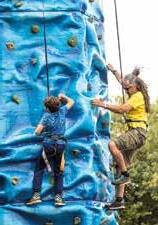
ALL KIDS’ ACTIVITIES INCLUDED IN TICKET PRICE!
CIRCUS SKILLS & SHOWS - STORYTELLING - DINOSAURS - FANCY DRESS
TOY SWAPSHOP - THEATRE & GAMES WORKSHOPS - CLIMBING WALL
BOUNCY CASTLES - ARCHERY - WELLY WANGING - HOOLA-HOOPING
TREASURE HUNT - SPACE HOPPER OBSTACLE COURSE - BUBBLES - CRAFTS
BABIES MADDIE’S MIRACLE BREASTFEEDING SUPPORT - RHYME TIME HAPPY BABY HAPPY ME - SINGING MAMAS - CHANGING TENT
5 STAGES - CEILIDHS - LOADS FOR KIDS
OPEN MIC SESSIONS - COMEDY - CRAFT AREA WORKSHOPS - HEALING AREA - FIRE SHOWS
BEAUTIFUL


ADVERTISING FEATURE
TWO members of Wimborne Rotary have been honoured in recognition of their outstanding contribution to the club’s work.
Placing your main residence into a living trust can provide effective protection against potential future care costs. If you were to require long-term care, the property held within the trust is ring-fenced, ensuring that it is safeguarded and that your intended inheritance is preserved for your loved ones.
Asset Protection
Inheritance Tax Planning: Are you concerned about losing 40% of your already taxed hard earned wealth to the government? Our bespoke legal strategies, meticulously crafted using trusts and wills, ensure your assets stay where they belong – in your family’s hands. Fully compliant with UK law, we shield your estate from the grasp of inheritance taxes, giving you peace of mind and financial security.
Transferring ownership of your home—and potentially other assets—into a living trust can help to shield those assets from a variety of risks. These include potential claims from creditors, the financial ramifications of divorce or remarriage, and claims associated with care costs. By utilising a living trust, you can ensure that your estate remains secure and less exposed to unforeseen claims.
Care Fees Protection: With average care fees hitting £2,000 per week and typical stays ranging from 3 to 7 years, these expenses can quickly deplete most estates. Our custom-tailored solutions offer a lifeline. While many believe protection is impossible, we’ve developed a tailored legal strategy fully compliant with UK law to safeguard your assets, including protection against care fees.
A living trust can also play a central role in estate planning, especially in terms of minimising inheritance tax liabilities. Assets placed within a trust may be excluded from your taxable estate upon your passing, which can reduce the amount of inheritance tax your beneficiaries may be required to pay.
Club president, Brian Dryden, handed the awards to David Sumner and Chris Mogg at a ceremony.
The Paul Harris Fellow Award is one of the highest honours Rotary International bestows and recognises individuals for their


outstanding contribution to the organisation and exemplifying the ideal of ‘service above self’. Brian, presenting David and Chris with commemorative certificates and lapel badges, said: “It gives me great pleasure to present these awards to you and to acknowledge the service you have given through your membership of Wimborne Rotary.”
Upon establishing a living trust, you typically appoint yourself as the trustee. This means you continue to maintain control over your assets, managing and using them as you see fit. Should you decide to move house, the trust remains in place and extends its protection to your new home.
Personalised Advice
Wills: Don’t leave your loved ones squabbling over vague wills! Oakwood Wills specializes in drafting crystal-clear documents that leave no room for ambiguity. No more family feuds. Just smooth, conflictfree asset distribution that honours your final wishes. Lasting Power Of Attorneys: Statistics don’t lie – the chances of incapacity rise with age. With our Lasting Power of Attorneys services, you can appoint trusted individuals to make financial and healthcare decisions on your behalf. No more court approvals, no more uncertainty in times of crises – just peace of mind knowing your interests are in safe hands. For a complimentary consultation, reach out to Oakwood Wills.
04:33 09:52 16:51 22:16 SP
05:12 10:25 17:30 22:49
05:52 10:56 18:11 23:19 7:10 17:35
06:34 11:13 18:54 23:31 7:08 17:37
07:20 11:19 19:41 23:40 7:06 17:39
08:13 11:50 20:37 7:04 17:40
Tel: 07832 331594 or Email: info@oakwoodwills.co.uk
The effectiveness and suitability of a living trust will depend on your personal circumstances. Oakwood Wills offers a complimentary consultation in the comfort of your own home. For further information, you can call 07832 331594 or email info@oakwoodwills.co.uk.


06:08 09:21 18:49 21:54 7:02 17:42 26-Feb 07:11 10:49 20:04 23:29 NP 7:00 17:44 27-Feb 08:12 12:14 21:08 6:58 17:46 28-Feb 00:46 06:25 13:14 19:01 6:56 17:47
A WEYMOUTH and Kingston Maurward College student has been awarded a Cornish Mutual Young Farmer Further Education Bursary, recognising her commitment to a future career in agriculture.
Scarlett Hoskin, who is studying a Level 3 BTEC Diploma in Agriculture, has been awarded a £500 bursary to support her studies and ongoing development.
Having grown up on her family’s beef, sheep and arable farm, Scarlett has been immersed in agriculture from a young age, gaining first-hand experience of both livestock husbandry and the challenges of running a farm business.
These experiences have
shaped her ambition to pursue a career in agriculture, with a particular interest in land agency and agronomy.
“Living on a farm has taught me many things,” said Scarlett.
“You see the challenges and accomplishments. These experiences have made me realise that farming is not just a job, it is a person’s way of life.”
Alongside her studies, Scarlett has completed work experience with rural property specialists Symonds & Sampson, where she attended farm sales and learnt more about the role of a land agent.
Scarlett said her bursary funding will go towards buying a new computer to support her


coursework and studies.
“A new computer would give me the independence I need to complete my assignments successfully,” she said.
“It would allow me to make the most of my time, reduce stress and allow me to get the best qualifications I can to get into my desired university.”
The Cornish Mutual Young Farmer Bursaries support agricultural students across the south west with funding to help develop the skills and

knowledge needed to succeed.
Bursary entries were judged by a panel including Cornish Mutual chief executive Peter Beaumont.
He said: “Supporting young people like Scarlett is vital for the future of agriculture in the south west.
“She has shown real dedication to building a clear career pathway within the industry, alongside a strong understanding of the realities of farming today.”

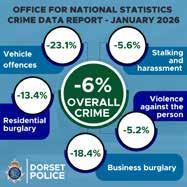
DORSET has seen a further decrease in overall crime and continues to be one of the top 10 safest counties in England, according to the latest crime statistics.
Overall crime fell in Dorset by 6.0% between October 1, 2024, and September 30, 2025, against a national decrease of 1.6%, says the Office for National Statistics.
Victim-based crime fell by 6.1%, alongside a 5.2% reduction in violence against a person and an 11.4% drop in violent offences where someone was injured.
Vehicle crime decreased by 23.1% and theft offences fell by 8.3% – a similar picture seen nationally.
Deputy Chief Constable Rachel Farrell said: “I am encouraged to see that Dorset has experienced yet another decrease in crime and that the county continues to be one of the safest areas to live, work and visit.
“We have seen significant decreases in several acquisitive crime types during this period, including an 18.4% fall in business burglary.
“This reduction demonstrates our ongoing commitment to work with our partners and business communities in a
whole-system approach to try and prevent crime and tackle the root causes.
“Additionally, we have seen a 13.4% reduction in residential burglaries, having increased our arrests and charged more offenders by using new tactics to identify the criminals and ensure they are found, arrested and sent to prison as soon as possible.
“There has been a 23.1% drop in vehicles offences, exceeding the national decrease of 13.3%.
“A contributing factor is how successful we have been with some highly complex investigations into organised criminals.
“Our High Harm Unit was set up in 2024 and sees a dedicated team monitor the highest risk offenders in the county, with an early intervention approach taken to prevent an escalation in offending and provide better protection to victims.
“We have seen a positive outcome rate increase of 2%, demonstrating our focus on the county’s most prolific stalkers, and achieving convictions and desistance.
“We continue to tackle whole crime groups from the street level thieves who are breaking into and stealing cars, onto those who buy the stolen cars and then the organised groups who sell the vehicles in the UK and abroad.
“I am pleased to see a 5.6% reduction in stalking and harassment reports.
“The Force has also seen an increase in some crimes, which mirrors the picture in other parts of the country.
“We have seen a 7.6% increase in shoplifting, just over a national increase of 5.4%.
“This is partly due to a number of ongoing initiatives as we continue to work with businesses to encourage reporting and raise awareness, alongside increasing our patrols and using additional powers to take action against anyone who is seen to be committing crime or anti-social behaviour.”
FAMILIES are invited to step into a world of magic, imagination and adventure at a Wizard of Oz inspired trail at the Museum of East Dorset in Wimborne.
The Yellow Brick Trail, open over the February half-term holidays, includes puzzles, creative challenges and hands on activities, with each stop inspired by a different character from over the rainbow.

Children can get into character at the museum’s dressing up area, with a selection of costumes for budding Lions, Tin Men, Scarecrows and Witches.
The museum will also host story time sessions in partnership with Wimborne Library in the museum’s
Commissioner David Sidwick said: “These latest crime figures show a positive reduction in overall crime, with significant falls in key areas such as violence, vehicle crime and burglary – priorities which really matter to the people of Dorset.
“While there is more to do in some areas such as shoplifting, I know the Force is wholly committed to tackling these offences and with a new digital system making it even easier to report, I want to encourage retailers to make use of this as it’s already delivering positive results.
“Being placed firmly within the top 10 safest areas in the country is a testament to the commitment and professionalism of Dorset Police, our partners and the communities we serve, and I thank everyone for their tireless efforts.
“We know there is still work to do to ensure every resident and visitor feels safe and supported and I remain determined this progress continues in order to reduce crime, prevent harm and support victims, making Dorset an even safer place to live, work and visit.”
the story together.
Follow the Yellow Brick Trail and complete tasks along the way.
Amy Webster, the museum’s event manager, said: “With renewed interest in Oz thanks to the Wicked films, this felt like the perfect moment to celebrate the original story that captured hearts nearly a century ago.
“Our Yellow Brick Trail is all about fun, family time and imagination – and reminding everyone that, just like Dorothy discovered, there’s no place like home, especially when it’s your local museum!”
entrance gallery on Monday and Tuesday, February 16-17, at 10am and 2.15pm.
The sessions offer an opportunity for families to enjoy
The trail is included with standard museum entry, and every ticket comes with an annual pass valid for 12 months, allowing families to return throughout the year.
THE chief executive of Julia’s House has helped raise more than £130,000 for the children’s hospice, based in Corfe Mullen and Devizes, through a 20/20 challenge.
Now Martin Edwards is asking others to take on their own challenge this year for the charity.
Martin did the 20/20 challenge after it was suggested by Diana Lawrence, the sister of a child supported by Julia’s House, as a way of marking his 20th year with the charity.
He braved 20 challenges including ziplining at 100mph, skydiving from 13,000ft and tackling a gruelling 37-mile ultra race in the Lake District.
He also invited business leaders, well known local figures and charity patrons to take part in the 20/20 Challenge, each setting their own personal challenge alongside him.
Among the partners, Vikki Slade MP completed a triathlon via kayak, bike and hike from one end of her Mid Dorset & North Poole constituency to the other.
James McVey, lead guitarist
and singer of The Vamps and Julia’s House patron, had a tattoo designed by a Julia’s House sibling.
And television presenter and Julia’s House supporter James May hosted an evening and auction with Martin Edwards as his auctioneer at the Royal Oak in Salisbury.
Martin scooped a national accolade for the 20/20 Challenge, winning Fundraiser of the Year at the Charity Heroes Awards organised by the Benefact Group.
Several families supported by Julia’s House took part in the challenges, including bereaved parents Lisa and Andy Hover, who joined a section of a 70-mile hospice to hospice walk Martin completed over two days with Poole businessman Warren Munson.
Parents Chris and Emma Jerram, accompanied by their 17-year-old son, Noah, who receives care from Julia’s House, joined the final stage of the Salad creative agency’s 2,020 miles team distance challenge.
And parents Lisa and Julian


Martin Edwards, chief executive of Julia’s House, on a skydive
Cox asked Martin to place a commemorative stone on a mountain during the Lake District ultra in memory of their late son Sacha, aged three.
Martin is hoping the 20/20 Challenge will inspire others to take on their own challenge for Julia’s House this year.
He said: “It’s been exhilarating, exhausting, but extremely worthwhile.
Martin Edwards and Warren Munson on their hospice to hospice walk
“I would like to thank each and every one of the 20/20 Challenge partners in their fantastic team effort to help the children and families in our care.
“With costs rising and only 8% of our ongoing income at Julia’s House coming from government, the support of the local community is vital to help sustain our services.
“Everyone signing up for one of our challenges will be

Martin Edwards and Diana Lawrence take on an abseiling challenge
helping us to keep on caring.” Challenges include an exhilarating sky dive to a trek across The Great Wall of China – for more information about challenge events, visit www. juliashouse.org/events
DORSET residents are continuing to seek the help of Citizens Advice as demand remains high with benefits and debt-related issues.
During 2025, the service helped local residents gain more than £20 million in financial outcomes.
This included welfare benefits gained, debts written off as well as access to other grants and support.
Citizens Advice in Dorset helped 14,300 residents with 79,000 issues in 2025.
Benefits was the top issue, with more than 32,000 benefitrelated enquiries.
Citizens Advice also saw an increase in demand for debt and utility issues.
Residents in the Dorset Council area presented with 20% more fuel debts and 23% more council tax debts than in 2024.
Daniel Cadisch, chief officer, Citizens Advice Central Dorset, said: “Residents had a tough year coping with the high cost of living.
“Our team connected people with the help they needed.
“Supporting people to maximise their income and manage finances allows them to feel more resilient and more confident to cope with rising household bills.”
Daniel added: “People often come to us for help with one issue which then reveals a number of additional issues

putting more pressure on our service.
“Demand for debt advice is also high with nearly 2,000 people seeking debt advice from us in 2025.
“Our message to residents is to approach us for help at the earliest stage, that way we can point you in the right direction and work with you to build resilience in 2026.”
Citizens Advice in Dorset relies on grants and donations to maintain its service for local people.
Daniel added: “We are an independent charity and are hugely grateful to all of our
Citizens Advice dealt with more than 32,000 benefitsrelated enquiries last year
funders and, in particular, Dorset Council for its financial and partnership support enabling us to provide advice for Dorset residents.”
A Dorset resident who recently had help with debt advice said: “I found the debt team all very friendly and very helpful.
“Even when I was at my most stressed, they were always willing and able to help me with my problems and help me sort them.
“I feel a big weight has been lifted since my debt relief order has been approved. Thank you.”
SWANAGE Town Council is inviting residents to attend a public consultation event as part of the development of its draft Corporate Plan for the next four years.
The drop-in session is at the Showbar at The Mowlem on Wednesday, February 18, from 2.30pm-6.30pm.
Residents will have the opportunity to:
n Learn more about the
proposals for the town’s future contained in the Corporate Plan.
n Share views on the town council’s priorities and future direction.
n Speak directly with councillors and officers.
n Contribute to the debate over what actions and services the council should prioritise in coming years.
Swanage Mayor Cllr Mike Bonfield said: “This is an
important moment for our town.
“The corporate plan will guide the decisions we make over the next four years, and it is vital that it reflects the needs, hopes and priorities of the people who live and work here.
“I strongly encourage everyone to get involved, share their views and help shape the future of Swanage.
“Local democracy works best when our whole community
takes part.”
For anyone unable to attend the engagement event, the consultation remains open online – accessible at: https:// www.swanage.gov.uk/newsarticle/draft-corporate-plan2026-2030-consultation
Physical copies are also available from the town hall, information centre and library for those unable to attend the event.
by Chris Slade
retired Dorset rights of way officer
MUCH of the parish is low and level with the River Frome and lots of tributaries flowing through it across marshland. Look out for wildfowl. The southern part of the parish is within the Lulworth Ranges danger area.
Start in Church Lane and head north crossing several bridges. Then you come to a level crossing – look both ways! Just past the crossing is
the church which has been converted into three dwellings. Turn right and walk through the cemetery and enter the A352 at Stokeford.
Turn right and head east along the pavement for half a mile and then turn right and head south down Rushton Lane, crossing the railway again. When you reach the farm, turn left and join a bridleway heading east across a large field to enter a small wood on the far side emerging
onto the B3070 at the historic Holme Bridge where there’s an interesting noticeboard.
Turn left and head north for a short distance to join a footpath on the right which weaves its way eastward and under a railway bridge, then up a steep slope to the A352. Cross the road and enter the Worgret Heath Nature Reserve, which is Access Land on which you can wander without sticking to the paths.
Head uphill through heath
land to the north west parallel to the road and next to what is shown on the OS map as a Battery Bank. I wonder whether the nearby wind generators store electricity there? After about a mile, join the road to bypass a reservoir and then turn left and head south along a road going down through Binnegar Plain to join the A352 again.
Turn right and soon you will be back on track to find your way to your car.


THE annual photo competition run by Poole Harbour Canoe Club and its Wimborne Paddlesport group had some excellent entries.
Members and friends chose the best


pictures from the winners of a monthly competition held on Facebook.
Some of the photos are also used for a calendar to promote the club and its activities.


JANUARY 2026 will be remembered for the relentless parade of storms sweeping across the UK, bringing havoc in their wake. Three named storms – Goretti, Ingrid and Chandra – left their distinctive mark, testing communities and infrastructure across the nation. With such exotic names, it’s tempting to suggest that the collective name for a succession of storms could be a ‘litany’!
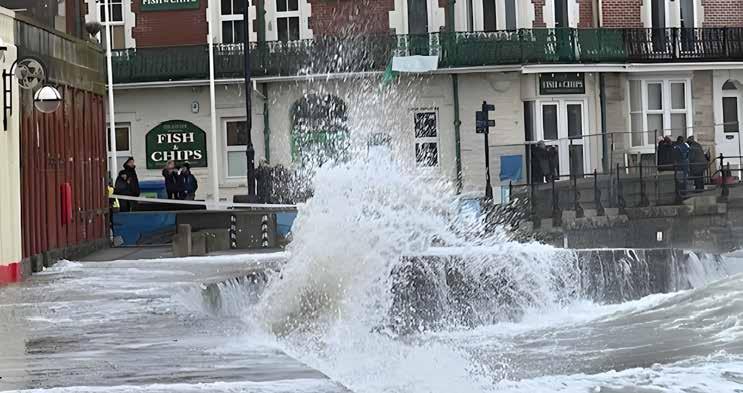
Storm Goretti, the first to strike, saw Cornwall and the Isles of Scilly experience some of the worst impacts, including gale force winds, widespread power outages and substantial landscape changes due to fallen mature trees. The NCI station at Gwennap Head suffered severe damage with its roof ripped off, while the station at St Ives recorded wind speeds nearing 100mph. Dorset was less severely affected, though Portland was temporarily cut off by waves crashing over the causeway, and some snow settled on higher ground in the north of the county.
Storm Ingrid followed closely, bringing persistent rain and strong winds that led to localised flooding and further disruptions to the transport network. While less extensively documented than Goretti, Ingrid – named by the Portuguese weather service – nevertheless contributed to an ongoing pattern of damage and disturbance throughout the month. Unusually for a winter storm, the wind direction was southerly. This meant that huge waves crashed across the Dorset coast from Lyme Regis in the west to Christchurch in the east. At the height of the storm, Lower High Street in Swanage was closed and the two local coastguard rescue teams were tasked with monitoring sea defences and ‘providing safety
by Nick Reed
advice’ to the public.
Storm Chandra – named by the Met Office – arrived in the final days of January, bringing with it widespread flooding, powerful winds and persistent heavy rain. The rainfall, falling on ground already saturated by previous storms, proved to be the most damaging aspect. Rivers burst their banks, causing significant disruption and affecting local communities across the region.
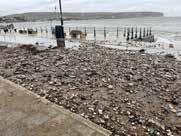

THE dramatic impact of these successive storms has drawn weather enthusiasts and storm chasers to our coast, eager to witness and photograph the turbulent scenes. This influx, however, has posed significant challenges for rescue services, as many individuals have ignored safety warnings and official advice in pursuit of dramatic images. The sheer power of the sea is evident from the large quantities of shingle, stones and debris hurled onto roads, and the waves sweeping across the path between the Stone Quay and the pier. Entering the sea during a storm is hazardous, even if you are an experienced open water swimmer and in a safe bay like Swanage. It looks spectacular, but surges can easily sweep a person off their feet and into trouble. Other coastal users may not be so familiar with local conditions and misconstrue splashing around in the surf as being in trouble. Their 999 call to the Coastguard may well put already stretched services under more strain.
With the ground thoroughly saturated from persistent rainfall there have been several local landslips and cliff falls. Along

the coast, cliff edges have
become unstable and many coastal structures are compromised due to the recent strong winds and rough seas. It is strongly advised to keep well away from cliff edges and sea fronts, as these areas are particularly dangerous.
As the storms continued to hit the coastline, local communities became increasingly cautious. The severe weather and its effects made it clear how important it is to treat the sea with care and pay attention to changing conditions.
In such treacherous conditions, it’s vital for anyone venturing near the coast or rivers to exercise the utmost care. Staying back from the shoreline isn’t merely wise – it’s a necessity. If you find yourself close enough to feel the sting of sea spray, you’re already too close. The sea can lure with its drama and spectacle, but it’s equally capable of sudden, dangerous surges. Always keep a watchful eye on the water, as rogue
waves may appear without warning, and be particularly aware of the tide times, which can quickly alter the risks along the coast. Large waves are notorious for hurling shingle, stones and driftwood ashore, so standing well back is always the safest bet.

Should you spot someone in distress – perhaps swept away by an unexpected wave –never put yourself at risk. Ring 999 and ask for the Coastguard –they have the expertise and equipment to handle emergencies. Rivers, swollen and fast-flowing after heavy rainfall, have made their banks especially treacherous, with slippery edges and increased erosion. Even the briefest lapse in concentration can lead to an accident. While wild weather can create dramatic and memorable scenes, the risks are ever-present. By showing the coast and rivers the respect they command, and by putting safety first, you can ensure your winter adventures end with stories worth telling – rather than cautionary tales.
This is St Alban’s Head and Swanage NCI listening on channel 65, NCI out.
ISEEM to spend a lot of time driving between Swanage and Gerrards Cross, where my family now live. I love being with them, but the journey seems to be getting more and more wearisome simply due to the sheer volume of traffic on our motorways.
I use Google Maps, Waze and other apps, together with a Road Angel speed limit warning device, which over the past 10 years has probably paid for itself 10 times over and which is just about to be updated to the most modern version.
But on Friday afternoon, the three-hour journey turned into a four-hour journey. And no matter what time I leave, the A31 and parts of the M3 are like a car park.
Usually stationery with enough litter to power a medium-sized electricitygenerating station. I have regrettably reached the conclusion that my fellow motorists take no pride in the countryside and have total disregard for litter legislation, which is not enforced anyway.
Along with speed limits. I’m not the only person travelling at 10mph over the limit. Almost everyone else seems to be going a great deal faster than I am!
SOME months it feels as though national politics and local life are running on completely different tracks – and not the good kind of heritage railway track where you get a steam whistle and a scone at the end of it. No, the sort where you’re convinced the train is late because someone misplaced the timetable.
This week, the big local news is the same as last month’s big local news, which was also suspiciously similar to the month before that – the abolition
by David Hollister
of Police and Crime Commissioners in 2028. Apparently £100 million will be saved and ‘redirected to neighbourhood policing’. Lovely idea. If you see any of that cash wandering around Swanage unsupervised, do let me know.
But while Westminster shuffles roles most of us can barely define, Purbeck has been doing what we always do best – keeping things slightly chaotic, very cheerful and oddly charming.
The cultural calendar has been lively – a new Poetry Purbeck group has been launched at Swanage Library to help the town get more ‘lyrical’. Prepare yourself for haiku about heather and limericks about seagulls. And, who knows – I might just resurrect Parker Waterman…
Nature has been busy, too. Purbeck’s wildlife has been feasting on a bonanza of berries and nuts – a proper glut at Arne, Studland and Durlston. Good news for squirrels. Less good for anyone who had berry-stained washing after a windy day.
Purbeck Sounds managed to pack Newton Manor for a fundraising Christmas concert by courtesy of Alan May. Community spirit won over cold weather! There’s something for everyone seven days a week on Purbeck Sounds! And always lots going on at Newton Manor Hall!
NOW, about the litter… While all this seasonal goodwill has been heart-warming, our pavements, beaches and footpaths have not always shared the same glow. Just what are we going to do about the litter problem in this
country? If it remains unchecked, we will all drown in our own rubbish, with the huge fly tip in Oxfordshire representing just the tip of the iceberg. So, who is to call a halt to it? Our elected politicians seem to spend the whole time meddling in international affairs that do not concern them, apologising for mistakes made by other people in years gone by and generally making sure that whatever else they do, they will not lose their seats in the next election
I don’t know what happened between new year’s day and now, but it appears half the nation’s empty coffee cups, sandwich wrappers and vape packets decided to take a short break in Swanage. The bins in Shore Road have been filling up despite council press releases promising ‘enhanced waste management provision’. Walk along the seafront on a windy day and you’ll find takeaway packaging travelling farther than some of the tourists who brought it here.
And then there’s the ‘mystery bag droppers’ – the individuals who believe dog poo becomes environmentally friendly if placed near a bin but not actually in it. A bold strategy but flawed.
The real heroes, of course, are our regular community litter pickers – the quiet, determined souls who turn up with grabbers and bin bags in hand, cleaning up after people who apparently believe fairies handle waste disposal. If the abolition of PCCs really does release £100m, perhaps Swanage could request £12.50 of it to fund a few more bins and a giant sign

reading: IF YOU CAN CARRY IT WHEN IT’S FULL, YOU CAN CARRY IT WHEN IT’S EMPTY.
But that might be too radical a policy for 2026.
WHILE we’re discussing things that don’t work properly, let’s revisit the driving test situation. Backlogs are still ridiculous, scammers are still bulk-booking tests using bots and the DVSA continues to insist everything is under control – in the same tone a parent uses to insist the kids are ‘definitely not fighting’ in the next room. Until only Registered Driving Instructors and genuine learners can book tests, people will continue to pay more for a test slot than for the car they’re learning in.
Across Swanage and Purbeck, the things that do work are powered not by central government but by locals – and that’s local people rather than local government. We have markets that – eventually –happen; poetry groups starting up; concerts filling halls. Our wildlife is thriving; swimmers are raising thousands for charity but, sadly, volunteers are still cleaning up other people’s mess Community isn’t a service you pay for – it’s something you participate in.
So, as February gets underway – with icy mornings, council decisions on the horizon and enough litter to keep everyone guessing – take pride in the fact that Purbeck is still a place where people show up, pitch in and politely glare at anyone dropping a crisp packet. Or anyway, let’s make it so.
Tune in and enjoy your local community radio station. Broadcast for the community, by the community. Listen to David Hollister ‘Telling It Like It Is’ Monday-Thursday 5-6pm.


Across
7 Expensive garment, valuable material producing public indignation (6)
Place 1 to 9 once into every black-bordered 3x3 area as well as each of the 54 rows indicated by the coloured lines. Rows don’t cross the thick black lines.
8 A lamp’s moved for liquid part of blood (6)
9 Thin strand put in window is perfect (4)
10 All quite feasible with energy after end of lecture (8)
11 Teach lawyer to shift and to make progress possible (5,3,3)
14 Intimate role among outsiders in dry social event (6,5)
18 Sudden misfortune finished gets to die down (4,4)
Killer Sudoku Pro
19 Lack of activity? That’s futile (2,2)
Down
1 Build a ground close to superstore within earshot (7)
2 Firm getting ahead is a masterstroke (4)
3 Show atonement about time restricting writer (6)
4 Leaders of Scottish parliament present in circle (6)
5 Young man with joke in yard over a female artiste (4,4)
6 Change approval by duke (5)
12 Waiter’s ordered around front of eatery so speak (2,2,4)
13 Astonish lead performer holding food up (7)
20 Some implicit rich characteristic of some fruit? (6)
21 Society with scope to bar new musical group (6)
Place numbers 1 to 9 once each into every row, column and bold-lined 3x3 box. No digit may be repeated in any dash-lined cage, and all the digits in any cage must add up to the value shown in that cage.
15 Learner showing complete virtue presumably (6)
16 Most excellent artists supported by others
17 Assert cold line on purpose (5)
19 Following garden, extra fencing (4)
Firm getting ahead is a masterstroke (4)
Show atonement about time restricting writer (6)
4 Leaders of Scottish parliament present in circle (6) 5 Young man with joke in yard over a female artiste (4,4)
6 Change approval by duke (5) 12 Waiter’s ordered around front of eatery so to speak (2,2,4) 13 Astonish lead performer holding food up (7)
Learner showing complete virtue presumably (6)
16 Most excellent artists supported by others (6) 17 Assert cold line on purpose (5) 19 Following garden, extra fencing (4)

IN 2024, Wessex Water was responsible for more than 40,000 sewage spills into our rivers and seas. In any other industry, a failure of this size would result in immediate consequences for those at the top. Instead, through the smoke and mirrors of complex corporate restructuring, we have discovered that water bosses are still finding ways to pad their pockets while the environment suffers.
Recently, in the Public Accounts Committee, I challenged Ofwat on a discovery first brought to light by The Guardian. It was revealed that two Wessex Water executives received £50,000 in ‘extra pay’ from a parent company – conveniently sidestepping the very bonus ban meant to hold them to account. To put that in perspective, £50,000 is equivalent to the
annual water bills of 138 individual homes. While families in Purbeck are tightening their belts to pay for a service that fails them tens of thousands of times a year, the people overseeing the pollution are being rewarded.
The Government’s new water regulations, introduced in 2024, were supposed to be a turning point. The rules state that:
“Ofwat will have the power to block the payment of bonuses to water company executives if companies have committed serious criminal breaches or failed to meet performance standards on the environment and customer service.” Specifically, the ban applies to companies that have presided over ‘record levels of sewage dumping’ or ‘significant

financial mismanagement’. Wessex Water fell squarely into this category. Yet, by funnelling payments through ‘Wessex Water Ltd’ – the parent company – rather than ‘Wessex Water Services Ltd’ – two executives received tens of thousands of pounds in ‘emoluments’. They claim these aren’t ‘bonuses’, but to any hardworking taxpayer, that is a distinction without a difference.
How has Ofwat allowed this to happen?
The regulator appears to be playing a game of ‘catch-up’ while water companies play a game of ‘hide the cash’. We only know about this because of reporting of The Guardian, which had to ask repeated questions before the source of the money was finally
revealed. It shouldn’t take a national newspaper to uncover how public service executives are being paid – transparency should be the baseline, not a hard-won concession.
In the Public Accounts Committee, it is our responsibility to keep these independent organisations and regulators accountable. If Ofwat cannot – or will not – close these loopholes, then the committee must demand to know why. We cannot allow a culture where failure is subsidised by the customer. I will continue to fight to ensure that public money, and the bills paid by families in our community, are not used to reward environmental vandalism. The message must be clear – if you pollute our waters, you do not get a payout.
LLOYD
HATTON Labour MP for South Dorset
I WAS delighted to hear British Transport Police (BTP) announce a change to its policy on investigating bike theft. Until now, only bikes left for less than two hours would see any sort of work done to resolve the crime. This essentially meant that anyone whose bike went missing could not expect BTP to act, given that most people using the train are away for the whole day.
This change is welcome –bikes spotted on CCTV, or where a witness provides information, will now be subject to investigation. But surely the best option is to ensure bikes are not stolen in the first place.
This is why I have launched my campaign to ensure secure bike lockers are provided at all stations.
Railways should be the backbone of our transport system, reducing congestion and providing a more
environmentally friendly way to travel. It is no secret that rail travel can be expensive, and even more so when you factor in the high costs of parking at local stations. Cycling to your station and locking up your bike on site makes perfect sense – if you can trust that it will still be there at the end of the day.
With electric bikes making cycling more accessible, the value of these bikes is increasing, making them even more attractive to thieves.
It is not unreasonable to ask railway companies to take simple steps to help their customers protect their property particularly given that in 2024 more than 4,000 bicycles were stolen from UK railway stations with only 22 leading to a criminal charge.
£4,000 and fit into a single car parking space. They can hold around six standard-size bikes and can be accessed for a small fee via a key or code.
Installing them at each station would offer reassurance to passengers and help reduce pressure on car parking, without any loss of revenue. Stations without car parks could place a locker on-platform, and codes could be provided free of charge with season tickets or through employers.

Cycle lockers cost about
Given that South Western Railway (SWR) operates a community fund, I thought it would be straightforward to secure lockers for Dorset stations. I was disappointed when it told me that ‘without an evidenced local campaign’ it would not support the proposal.
I have therefore launched a petition, which you can sign at: https://www. middorsetlibdems.org.uk/ petitions/keep-bikes-safe-attrain-stations#c523058
This will help demonstrate the local support SWR says it needs to act. I have also submitted an amendment to the Railways Bill which, if accepted, would ensure secure cycle storage is available across the country.
It is a small but important step in making railway travel more inclusive. We need to see fares come down, child fares applied up to age 18 and improvements to reliability if more people are to ‘let the train take the strain’. Secure cycle storage should be part of that modern, accessible railway system.
VIKKI SLADE Lib Dem MP for Mid Dorset & North Poole
by Kay Parkinson
PICTURE this. A child holds up a drawing they have made. Bright, joyful and wonderfully messy. Their parent glances at it and says: “What is this meant to be?” You can almost feel the shift. The child’s face drops, their shoulders curl in and their whole body seems to shrink. They do not know the word for it, but their body does. That moment is shame.
Shame often starts in moments just like this. Tiny, everyday ruptures that land in the body before we understand them in the mind. It does not take loud criticism. Sometimes it is simply a tone of voice or a moment when connection seems to slip. For a child, connection equals safety, so even a small break can feel big.
We now know from modern psychology and brain research that shame is not just a feeling. It is a biological reaction. When we feel exposed or not good enough, the body moves


into protection mode. The heart rate changes, breathing becomes tight and the brain
Home visits available
• Nail Cutting
• Athletes Foot
• Corns
• Calluses
• Cracked Heels

• Fungal Nail
• Hard Skin Removal
• Ingrowing Nails
• Thickened Nails
• Verrucas
prepares us to pull back. It is the same system that responds to threat, only the ‘danger’ in this case is social and emotional.
Shame tells us that the problem is not what we did, but who we are. That belief can sit quietly in the nervous system for years. The hopeful part is this. Our brains and bodies are not fixed. They can learn new patterns. The same way we learned to retreat, we can learn to stay grounded and
present. One of the most healing things is being met with steady calmness. When someone listens without judgement, the body receives a message of safety. Muscles soften, breathing steadies and we feel less alone inside ourselves. The story we carry begins to shift.
We can also practise giving that steadiness to ourselves. Self-honour is not about pretending everything is fine. It is about speaking to ourselves in a way that helps the body calm down. When we respond kindly to our own struggles, the nervous system settles and the brain becomes less reactive. Little by little, we learn to stay with ourselves instead of abandoning the moment. This is the heart of honour. Not the public kind linked to awards or achievements, but the quiet kind that meets our vulnerable parts with respect. It says, ‘you do not have to hide here’. Self-honour helps us turn toward the pieces of ourselves we once pushed away. It reminds us that we are allowed to be human and imperfect. Today, maybe we can ask, ‘what part of me is still hiding?’ And then, ‘what might change if I chose to honour it?’ Maybe the first step is this simple reminder: You are not too much. You are not too little. You are enough. n Kay Parkinson is a counsellor specialising in trauma, emotional neglect and the impact of shame on identity and self-worth, based in Bournemouth and working locally and nationally online (www.placetotalktherapies.co. uk).

by Fiona Chapman
I WAS listening to The Rest is Politics this morning and Alastair Campbell was talking about how the media feels the need to keep the population on high alert and constantly scared, which is making a lot of people – like me – say: “I just can’t take the news anymore and don’t listen”.
In the long run, this is not a good thing, because the world is not a happy place at the moment and if you turn off people –particularly the younger generation – by terrifying them, it will become an even unhappier place with no one to engage in making it a better world.
No wonder the mental health problem is so huge. Our bodies and minds – I have said this
before – do not differentiate between a sabre tooth tiger and high stress news.
It has the same effect on the body, putting us into sympathetic mode or fight and flight. If we are constantly in this state, we don’t rest and digest, rejuvenate and heal – instead, we have high levels of cortisol affecting our mood, sleep and so on, and then get adrenal fatigue where we just cannot function properly. This obviously affects our brain and mood and so the circle continues.
Diet, exercise, herbs and limiting social media – unless it is funny clips about dogs – can all help to combat this.
Exercise, I always say, is key to keeping the mind and body in balance. If possible, walking in
LAWYERS in Swanage have issued a plea for divorcing couples to consider mediation before plunging into court proceedings.
The family mediation team at law firm Ellis Jones Solicitors says it offers a more co-operative and less adversarial setting – leading to quicker resolutions, greater control over the outcome and a more affordable approach.
Ellis Jones saw an increase in enquiries about separation and divorce in January, the so-called ‘divorce month’.
Managing partner Nigel Smith said: “Mediation can assist couples navigating divorce or separation by resolving disputes in a more constructive and less confrontational manner.
“It is a flexible process where a qualified, impartial
mediator facilitates discussions between the two parties on issues such as how much time the children should spend with each parent and how the matrimonial finances should be divided.
“The goal is to find solutions that benefit everyone, particularly the children.
“We encourage all clients, when suitable, to consider mediation and or another form of Non-Court Dispute Resolution.
“Court should always be considered a last resort, except in a few exceptional cases.”
Ellis Jones’s family mediation team is led by joint head of family Deborah Leask, partner Katie Taft, associate solicitor Asya Panchalieva and senior associate solicitor Georgina Emerson. All are qualified and experienced

the country and listening to the birds, admiring the trees, grasses and flowers is hugely beneficial.
Diet needs to avoid sugar, processed food and stimulants such as coffee and alcohol –particularly if feeling very stressed. Drinking lots of good water is also vital as it keeps the body and brain hydrated. It is difficult sometimes to remember to drink water in this cold weather, but it helps enormously.
A herb you can get easily is rosemary – you can make a rosemary tea and drink that.
Tinctures of Passiflora incarnata, Scutellaria lateriflora
mediators.
Georgina, a Recommended Lawyer in The Legal 500 guide for 2026, said: “Mediation gives families a chance to be heard fully, respectfully and without the pressure of ‘winning’.
“It focuses on understanding, not blame. In a calm, guided setting, people can speak honestly, protect relationships and shape outcomes that are customised to their situation.




Walking in the country and listening to the birds, admiring the trees, grasses and flowers is hugely beneficial
– skullcap, Avena sativa – oat seed and tops – all help the nervous system, and liquorice or Glycyrrhiza glabra, is excellent for adrenal insufficiency – not to be taken with high blood pressure.
Adaptogens like Eleutherocossus senticosus – Siberian ginseng – strengthen the whole body and help it cope with everyday life. Rhodiola rosea is another strengthening herb and one I am increasingly using is Ganoderma lucidium –Reishi mushroom.
n Fiona Chapman is a naturopathic herbalist (email Pellyfiona@gmail.com)
“Choosing mediation first can save time, money and emotional wear, especially for children, who feel every ripple of conflict.
“Even when agreement feels far away, mediation often restores clarity and dignity to the conversation.”
According to latest figures from the Office for National Statistics, there were 102,678 divorces in 2023 – a return to pre-pandemic levels.








by Susanna Curtin
THE wheels of wintertime are turning rapidly and the last of the season’s grip is upon us as we enter the ‘in-between of winter and spring’. The light is changing, not only by longer days, but also its intensity is becoming sharper as the Earth gradually tilts back towards the sun, and the angle of the sun increases. This means that the sunlight is more direct and has to travel through less of the Earth’s atmosphere, making it brighter and stronger. As daylight increases, there is more energy in the sun’s rays to spark the sleeping plants to life, and the animals and birds begin to think about nesting and mating. Already, in my garden, there is increasing birdsong. It is lovely to hear their returning music. Robins have paired and are defending the territory, blue and great tits are checking out the bird boxes, and an amusing pair of pigeons have built a scruffy nest of twigs in my apple tree. I also love to see how the plumage of my favourite garden birds changes from their dull winter feathers to shiny, vibrant plumes in preparation for the breeding season. Together, all these tiny shifts have lifted me out of my winter inertia. Even though today is wet and windy, I gather my waterproofs to stretch my legs and fill my lungs with oodles of fresh air. You might wonder what there is to see on a wet, windy, February afternoon, but as soon as I get
beyond the town, and its relentless housing developments, I begin to tune in to the countryside before me.
The River Stour has burst its banks and the fields are flooded as far as my eyes can see. The course of the river itself is barely visible beyond a tell-tale, bubbling current. I often wonder what happens to all the fish in these circumstances and recall a moment when my son and I found a young fingerling stranded in a puddle after the water had receded. We returned it to the river but wondered how many others had not been so fortunate. It seems, however, that fish are well adapted to surviving floods, especially in rivers such as the Stour which are relatively slow moving and rise gradually, giving fish and other water species time to take evasive action and find sanctuary either on the river bed or in between the marginal plants. For those who spill outside of the river banks, most seem to find their way home, but small young fish, like the one we found, are certainly more vulnerable.
Making my way along the footpath beyond the flooded fields, a sea of grass catches my eye as the strong wind captures the tips of the fine blades, bending them over in ripples that create rolling waves of dark and light green as the grass catches and releases the light. In the middle of the field, an ancient oak tree has been torn


apart by the last storm that raged this way. Its half trunk and shattered limbs strewn across the ground – huge remnants of the strength and power of the weather systems that squall off the Atlantic Ocean onto our verdant islands. Just beyond these fields, there are small flocks of birds chirping from the hedgerow, mostly the familiar calls of tits and chaffinches, but also the high-pitched, thin, delicate ‘si-si-si’ of goldcrests. Then there are the large gatherings of redwing and fieldfare – our visiting winter thrushes that rise out of one treetop to the next, just to stay ahead of me in a game of chase. I look carefully for the flock of lapwing I saw a week or so ago, but unsurprisingly they have moved on, leaving only the rooks to feed upon the soil-dwelling invertebrates.
Eventually, as I approach my final destination for the day, I notice a new, slightly obscured badger sett entrance, its presence only betrayed by the hundreds of claw prints etched
into the mud as these heavy, nocturnal creatures scramble up the bank to reach their sunken burrows. Just beyond their front door is a swathe of tiny snowdrops that have found their way through the cold winter earth. Their petals quite closed today without the warmth of the winter sun to unfurl them. These, and the crocuses in my garden, fill my heart with joy as they mark the turning of the season and the first promise of the spring flowers to come.
Enthralled by all that I have seen this cold, wet and windy February afternoon, I begin to think of the warm dinner and the cosy evening ahead, and that perhaps I should head for home in time to watch the light diminish and my garden blue-tits head to their roosts. As I brace myself against the increasing wind and rain, I smile at the delightful sound of raindrops on my waterproof hood, a soothing, rhythmic pitter patter to help me on my way. Beneath my feet, enormous puddles have captured fragments of clouds, sky and branches in their deep and darkening reflections. Reacquainted with all that I hold dear, I make haste before the darkness falls.
n Dr Susie Curtin (email curtin. susanna@gmail.com)
by AJ Selby
A WISE owl lived in an oak. The more he saw, the less he spoke. The less he spoke, the more he heard. Why can’t we all be like that wise old bird? – Edward Hershey Richards
LEARNING about the interaction between humans and animals is often a painful and distressing experience for a child. It wasn’t until adulthood that I realised this conundrum, of building you up and knocking you back – and sometimes building you back up again. When I was about 10 years old I was gifted two white doves which we kept in a dovecot my father had made. These were a breeding pair, very tame and great fun to watch. One day I discovered eggs in the nest and, awaiting the emergence of the squabs, I was both horrified and inconsolable when –presumably – a rat had entered the cot and not only eaten the eggs but killed the laying bird.
A few years before I had been in tears at the pictures when Bambi was left an orphan, and equally distressed when again at about 10 or 11 years of age we went to see Gavin Maxwell’s Ring Of Bright Water at the cinema, a film about a man who buys a young otter from a London pet shop and takes it to live with him in a Scottish croft. The film was lovely until near the end when a labourer sees the otter, called Mij, running along a ditch he is cleaning out, and kills him with his spade. The film ends with Mij’s mate returning with her kits.
As if all this confusion of happiness and sadness wasn’t enough, I also went to see Kes at around the same time. A story

of a lad bullied at school by pupils and teachers alike, who finds solace in raising a kestrel chick and trains it to fly for him.
It’s a gritty, Northern drama of a boy with no prospects, no qualifications and no hope who finds redemption in this beautiful bird. Of course, it doesn’t end well, as the boy’s brother, in a row over money, kills the bird. There is no happy conclusion to this one.
I was thinking about all of this recently when I watched not one, not two but three kestrels quartering an arable field in early January, spaced a few hundred yards apart, although I don’t ever recall seeing more than one kestrel at a time as they have their own territory. I watched them floating and occasionally dropping to the stubble, and one rising with a vole as its prize. Such an incongruous event to a news feed later that day when a man had been fined about £1,200 for trapping a buzzard and beating
who I usually surprise on the ground with his catch before he skirts up and away – I don’t know if he or I are the most startled by our encounter. The now far more common buzzard that mews and cries from the high sky and builds his nest in the tallest of trees.
Then there is the peregrine falcon, the fastest bird in a swoop, who I searched for in vain as a young bird-watcher before seeing my first one around, of all places, the spire of Salisbury cathedral. I have seen others since, which is encouraging for their numbers, although I recently read that oil sheikhs are spending fortunes on wild-caught peregrine chicks for their aviaries in the Middle East where falconry is a serious hobby for the wealthy.
the poor thing to death with a stick, all caught on a hidden RSPB camera. Our inhumanity to wildlife is at times incomprehensible to me.
The kestrel was the original silver badge of the youth arm of the RSPB, known as the YOC, the Young Ornithologists Club. I was already learning about birds when my godparents took out a subscription for me when I was around eight or nine, and I have been hooked on birds ever since. There is something to be enjoyed in many types of birds, from the common finches we see in the garden, the thrush songsters, the hirondelles –swallows – that visit us every summer, and the winter waders on the saltmarsh.
There is, however, something exciting about the very words ‘birds of prey’. Hawks, falcons, raptors, eagles, owls. Birds that eat meat! The aforementioned kestrel, motionless but scanning for the slightest movement below him. The sparrowhawk
The reintroduction of the red kite has, for me, been wonderful and I will always stop where I can if these beautiful birds are above me as they cruise the skies looking for carrion, in the main. Their forked tail makes them easy to identify as well as their large size. And what of our owls? The tawny has the ability to scare the bejesus out of a night walker deep in the woods with its piercing screech, and the tiny little owl I almost always see minding his own business on a stump or post, looking at me as if to say ‘yes, how can I help you?’
The beauty of the barn owl, however, trumps them all. To watch this wonderous bird skirting a hedge-line in late afternoon in winter, his ghostly white presence a marked contrast to the gloom enveloping the countryside. I defy anyone to see one of these almost mythical birds and not stop to watch and to feel better for seeing him. And finally, on a personal note, two new grandchildren from two different sons either side of Christmas, Amelia and Cody. I hope one day to be able to teach them the beauty of our countryside.
by Sally Gregson
AT this sun-starved, flowerhungry time of year we gardeners fall prey to a chronic disease. It’s called ‘galanthophilia’, and it’s very contagious. It causes the sufferer to get down on bended knees before that pure white innocent, the snowdrop – Galanthus – the better to admire its exquisite refinements.
Our winter gardens may well be a triumph of green structure and elegantly shaped trees but by February we urgently need a dose of flower power. So, it’s no wonder that when the first snowdrops pierce the bare black soil to reveal their porcelain white flowers, our hearts lurch.
Snowdrops were introduced here later than you might think, during the 16th and 17th centuries from southern Europe, Italy in particular. They settled quickly in the leafy soils of our deciduous woodland, where they emerge, flower and set seed before the leaf canopy closes in late spring.
Now there are a surprising number of different species and named forms in our gardens that have captivated ‘galanthophiles’ for at least a century. The common snowdrop, Galanthus nivalis, has small, slender greyish-green leaves and a green blotch on each inner petal, or segment. It’s the shape and shade of this blotch that seems
by Sally Gregson
IN February every warm day is a sign that winter really is losing its grip, and that it’s time to look to milder days ahead. A small greenhouse or a spare windowsill is a good place to sow a few lettuces thinly in a seed tray.
Lettuces are notoriously difficult to germinate later in summer when hotter days mean the seed becomes ‘heatdormant’. That is, lettuces are reluctant to germinate in high temperatures. Providing it is not too frosty, the seed should come up like the proverbial mustard and cress.
Tip the tray of seedlings out onto the work-bench and separate each using the seed leaves to gently pull them apart.

to bring out galanthophilia in some – and the shade of green, or even yellow that arouses passion in others.
A notorious 19th century galanthophile was James Allen. When Allen was breeding snowdrops there were more than 500 cultivars in cultivation at that time. He is credited with breeding at least 100 of them. He was a very enthusiastic amateur who gave all his time to their selection and wrote lots of notes which are now in the
hands of the Royal Horticultural Society. He is credited with breeding two of the most popular cultivars – G. Merlin and G. Magnet. Merlin boasts solid green inner segments to its flowers, while Magnet has clearly defined, v-shaped markings. Both plants are strong and vigorous and naturalise well by division. The seeds are usually infertile, which means that the clumps are all true to name.
Seed-leaves, cotyledons, are disposable for the plant so if one gets torn it will not matter too much. Plant each seedling in a small 9cm pot of potting compost and water it in well. Ensure you have a selection of different sizes to stagger their maturity. And replace the pots back into a frost-free environment. They will make fat little lettuces in a few weeks. And once they are growing away, use the cooler sunshine to sow another tray to succeed it. There are very many lettuce varieties to choose from – round butterheads with soft leaves, crisp cos-style heads, or ‘cut and come again’ varieties, in tempting shades of red and green.
As the year moves on and

becomes hotter, it would help germination if the remaining seed was kept in its envelopes in a sealed plastic box in the fridge to maintain a steady temperature and humidity. By mid-summer when lettuce germination becomes markedly more difficult, consider an alternative leafy salad such as arugula with its peppery taste, baby spinach leaves, again with
a different taste, or the bitter endives or Asian Pak Choy, which could also be used in stir-fries. By mid-summer any of these could be sown directly into the ground outside. But they will all need protection from slugs and snails, and rabbits. Slug pubs work on lots of other pests too and are an easy way to protect salads from their attentions.
WINTER doesn’t have to mean worrying about your garden. With the season’s unpredictable freezing spells and potential cold snaps still ahead throughout February, British Garden Centres has put together a helpful new guide showing how a few simple steps now can protect gardens from cold weather damage and set them up for a beautiful spring. Here are some tips on how to avoid common winter pitfalls that can affect plants and containers, and what you can do to protect them.
TENDER perennials, exotic species and newly planted varieties require particular attention during cold snaps. Horticultural fleece, cloches and protective wrapping are recommended for vulnerable plants, and potted plants can be moved to sheltered locations or grouped together to provide mutual insulation. For plants that must remain in situ, mulching around the base with organic matter creates an insulating layer that protects roots from penetrating frost or covering with a fleece or cloches to keep roots warm.
Winter container care essentials
CONTAINER gardening presents unique winter challenges, as pots are particularly susceptible to frost damage and waterlogging. Raising containers on pot feet can help to improve drainage and prevent water from freezing around roots. Wrapping terracotta and ceramic pots with bubble wrap or hessian can prevent cracking, while moving valuable containers under eaves or into cold frames offers added protection.
Winter lawn
LAWN care during winter requires a delicate balance. While grass growth slows dramatically, lawns still benefit
from proper maintenance. It is best not to walk on frosted grass, as this can damage the cell structure of grass blades, leading to brown patches that persist into spring. Keep lawns clear of fallen leaves and debris, which can smother grass and encourage fungal diseases in damp winter conditions. A final feed with autumn lawn fertiliser, if not already applied, can strengthen roots for winter dormancy.
Winter soil prep
SOIL maintenance is another crucial element of winter garden care. Winter digging, particularly in heavy clay soils, allows frost to break down large clods into more workable particles through the natural freeze-thaw cycle. Adding well-rotted organic matter such as compost or manure during winter digging enriches soil structure and provides nutrients that will become available to plants as temperatures rise in spring.
WHILE spring flowering shrubs should be left untouched in winter to preserve their flowering, many other plants benefit significantly from winter attention. Apple and pear trees are prime candidates for pruning at this time of year, with the leafless branches allowing gardeners to clearly see the tree’s structure and remove crossing, damaged or diseased wood. Bush and cane fruits, including blackcurrants, gooseberries and summerfruiting raspberries, can be pruned to encourage new growth. Wisteria benefits from its second annual pruning in winter, cutting back summer growth to two or three buds to promote flowering spurs. Roses, particularly hybrid teas and floribundas, should be pruned during late winter when the worst frosts have passed but before new growth begins. Climbing roses benefit from having their sideshoots reduced and any dead or weak growth removed. Deciduous hedges, including beech, hornbeam and hawthorn, can be trimmed back to maintain shape and density.



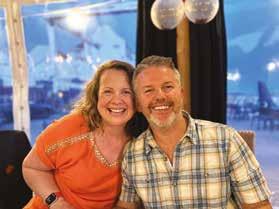

IN 1863, the orthodox Christian Emperor Theodore of the then named Abyssinnia was angered by the lack of response from Great Britain to his requests for support in freeing Jerusalem from Turkish Muslims. One letter seeming to propose marriage to HM Queen Victoria had been ignored and some regarded the Emperor as being insane. In a fit of rage, Theodore made hostage all the Europeans in the country and marched them to the Fortress of Magdala, a flat-topped mountain rising more than 3,000 metres above the Blue Nile valley. Prolonged negotiations failed to secure their release.
So, in 1867, Britain dispatched an expeditionary force under General Sir Robert Napier, a Royal Engineer commanding the Bombay Army. Landing in the north of the country, the 12,000 troops, equipped with the latest weapons and numerous pack animals, including elephants, marched to Magdala.
On Good Friday 1868, Napier’s force, with rocket batteries and the new rapidfiring Snider rifle, inflicted a terrible defeat on Theodore’s army and released the hostages. Three days later they stormed the fortress. The emperor committed suicide with a pistol presented to him by Queen Victoria in happier times.
After his mother died, Theodore’s baby son, Prince Alam Ahiyou, was brought to England and educated at Queen Victoria’s orders. Sadly, he died at Sandhurst and is buried in Saint George’s Chapel, Windsor. German engineers held by Theodore had been forced to make artillery for his Army and these massive guns had been hauled up to the fortress. Most were destroyed by Napier’s men, but a huge mortar, probably weighing 10 tonnes,
by John Blashford-Snell,
British


was left on the battlefield. In 1995 the Ethiopian tourist organisation asked the Scientific Exploration Society to produce a guidebook of the battlefield and investigate the possibility of moving Theodore’s mortar to Addis Ababa.
Travelling to the base of the mountain we used sure-footed mules to ride up the narrow precipitous track leading to the plateau. “Don’t look down, just hold on tight and let the mule pick his way,” our Ethiopian guide advised as we edged along the cliff edge.
Breasting the last rise, we were confronted by a vista of emerald-green mountains rising to meet a brilliant blue sky, while on the plateau
We were on a remote mountain 400 miles from the nearest well-equipped hospital, our walkie-talkie radios had only a range of six miles at most and the lady was in no condition to ride or walk 14 miles back to our vehicles. We needed a helicopter, but the only one was in Addis Ababa with the Mission Aviation Fellowship (MAF). However, as dusk fell, former soldier Graham Kerridge, from Dorset, and one of our Ethiopian police escorts set off at a run for Tenta town, which had a radio that might reach the capital. Using only a head torch, it was a challenging and risky journey. I was not optimistic.
immediately before us was a large, open space fringed by clusters of round thatched huts and neatly hedged fields.
Pointing at a rectangular stone wall enclosure, our guide whispered: “It is here.” Riding forward, I found myself looking straight down the barrel of the colossal mortar. Theodore had had great confidence in his giant gun until that fatal Good Friday when its barrel cracked in the act of firing its one and only shot. Like excited schoolboys, we dismounted, reaching for the cameras and tape measure. It was massive.
Suddenly a voice called. “I have a problem,” said our lady zoologist, leaning over against a stone wall. “I seem to have a hernia.” The poor girl was obviously in considerable pain.
Dr John Davies, from Truro, examined her and turned to me, looking grave. “She’s got a strangulated hernia and I can’t get it back,” he told me in a whisper. “This is life threatening.”
This was extremely serious.
By the light of the full moon, John did his utmost to relieve the patient’s suffering, but her condition was deteriorating. “If there is no helicopter by dawn then we will have to find some other way to get her off the mountain,” he warned. The local villagers had an old iron bedstead they used to stretcher sick people to Tenta. Graham then radioed to say that the MAF helicopter would arrive at 14.00. “We can’t wait that long,” insisted John. So, we had to strap the poor woman onto the bedstead and six bare-footed villagers carried her down the cliff path, with half the bed hanging over the precipice! Accompanying her, John radioed to say he urgently needed more IV fluid. So, Graham again rushed down the rock-strewn track towards Tenta ahead of the stretcher party.
As if to answer our prayers, a small helicopter suddenly appeared over the rim of the plateau and met the stretcher party. Thus, the patient reached the little hospital at the British Embassy in Addis and her life was saved. But it had been a close-run thing. The mortar is still there!
n SIGNED copies of John Blashford-Snell’s recent book, From Utmost East to Utmost West, are available for £20 including UK postage. Contact jenny@ses-explore.org for further details.

by
Amy Brenan, director of Heirlooms Jewellers, 21 South Street, Wareham
I’VE loved brooches ever since I was little and my Grandma showed me her precious collection of the most beautiful designs and sparkling gems.
I was entranced!
In an age of fast fashion and fleeting trends, the antique brooch offers something quietly joyful – character, craftsmanship and a sense of connection with the past.
Originally, the brooch was an essential part of daily dress, worn on cloaks, bodices and lapels for centuries, to fasten clothing and a provide a decoration.
Antique brooches also tell stories.
A Victorian floral spray in gold and gemstones might speak of romance and sentiment, while a Georgian foil-backed diamond brooch reflects candlelit evenings and extraordinary handcraft.
Each piece carries the marks of its time – the materials
SEMLEY Auctioneers’ January sale of Pictures, Books & Prints included three ‘grangerised’ books relating to Napoleon Buonaparte.
‘Grangerising’ is a term used when books are disbound and rebound with the addition of blank pages which are then filled with related material such as letters, prints or drawings.
Two volumes entitled Napoleon in Caricature, and another, Napoleon in Exile, finely bound by Chivers of Bath and each embellished with numerous contemporary prints were for sale.
The two Napoleon in Caricature volumes made just shy of £22,000, while the single volume sold for £13,500.
and journals which had belonged to Anne Clark and her husband Hezekiah.
They were catalogued in four lots, the first of two albums and a set of mica paintings belonging to James Fenn Clark, son of Anne and Hezekiah, who was born in India in 1823, which made £10,000.
A small sketch book by Anne Clark, dedicated to her son James, made another £10,000, while three sketch books containing both Indian and European subjects achieved £7,500.
available, the skills of the maker and the tastes of its original owner.
To wear one is to become part of that story.
Today, brooches are enjoying a fresh moment.
They are no longer saved just for special occasions or worn in traditional ways.
Many people love wearing them on coats, scarves or hats, while others group two or three together for a playful, modern look.
The brooch you can see pictured is a beautiful vintage Kokichi Mikimoto brooch dating from the 1960s, crafted in textured 14k yellow gold and modelled as an elegant leaf spray.
A classic and collectible design from one of the world’s most esteemed pearl makers who was the first to culture a pearl in 1893.
Perhaps the greatest joy of an antique brooch is its ability to transform an outfit instantly, and wearing one is a lovely way of carrying a little piece of history with you.
Watercolours and prints of India in the second quarter of the 19th century by Anne Clark, wife of a surgeon for the East India Company, sold well at Semley Auctioneers in November.
Six framed watercolours made £18,000, a folio of unframed watercolours £25,000 and a folio book of prints £10,000.
The family of the vendor discovered further sketch books
The quartetto ended with a group of seven manuscript journals by Hezekiah Clark covering his voyages to India and China as a surgeon on board ships of the East India Company, which sold for £19,000.
Entries are now being accepted for all Semley Auctioneers’ sales listed on its website, www. semleyauctioneers.com
Enquiries should be directed to Paul Strange or Simon Pearce at the Semley, Shaftesbury, office on 01747 855122 or Kath Barber at the Wimborne office on 01202 842900.

E-SCOOTERS were one of the most popular trends of 2025 –and that is likely to continue to be the case in 2026 – with the devices becoming a common sight on UK streets.
But while some hail them as a way to broaden transport for those who don’t drive or are unable to cycle, others say they are a menace on the roads and walkways.
Now police have issued answers to common questions from owners and road users.
Here are the facts from the police regarding e-scooters: Can private e-scooters be ridden on public roads?
NO – they can only be ridden on private land, with the landowner’s permission. What about on the pavement or cycle lanes?
NO. The law says they can’t be used on public places, including roads, pavements, parks or cycle lanes. If you are caught using a powered transporter – e-scooter – on a public road, pavement or other prohibited space you are committing a criminal offence and could be prosecuted. So why was I allowed to buy one, if I can’t actually use it?
YOU are allowed to buy or sell e-scooters, and you can use them on private land – with permission.
Why aren’t private e-scooters legal to use in public?
E-SCOOTERS are classed as powered transporters and fall within the legal definition of a motor vehicle under the Road Traffic Act 1998. This means the same rules that apply to motor vehicles, apply to e-scooters. This includes but isn’t limited to: driving with a licence; driving/riding with insurance; driving/riding other

than on a road.
It isn’t currently possible to get appropriate insurance for privately owned e-scooters, meaning it is illegal to use them on the road or public spaces. Why don’t you work with retailers so that customers know the law before buying?
WE are working with retailers to explain the law. But, of course, the buying and selling of e-scooters is allowed. Is there any way to ride an e-scooter legally?
YES. Some areas in England are undergoing a government trial where their use is allowed – but regulated – on public land and roads.
All of these trial schemes have terms of use that riders are expected to abide by. A user agreement may be revoked if the rider breaches the terms of use.
Are e-scooters seen as more dangerous than pedal cycles?
E-SCOOTERS and pedal cycles are classified differently under the law. As Mechanically Propelled Vehicles – MPVs – or Personal Low Emission
you could be liable for prosecution for driving without insurance.
What if I’m stopped riding an e-scooter and I do not hold a driving licence?
IF you do not hold a provisional or full licence and are stopped riding an e-scooter, you could be prosecuted for driving other than in accordance than with a licence, as well as having no insurance.
Penalty points can still be issued where a licence isn’t held. These points would take effect when you apply for a driving licence.
Trial e-scooter schemes are only open to UK driving licence holders.
I am a parent – if my child is stopped while riding an e-scooter, would I be prosecuted?
Vehicles – PLEVs – the law says e-scooters can’t be used on the road or any other public place, unless part of a government trial scheme. Why are electric bikes legal to use, but not e-scooters?
ELECTRICALLY assisted bikes are allowed in public places – provided they have pedals to propel them, the electric motor’s power does not exceed a specified limit, electrical assistance cuts out when the vehicle reaches 15.5mph and the rider is not under 14 years old.
All other electric bikes are treated the same way as e-scooters.
What about mobility scooters or powered wheelchairs?
YOU don’t need a licence to drive a mobility scooter or powered wheelchair, but you may have to register it. Only certain types can be driven on the road.
What happens if police stop me when I’m riding an e-scooter on a public road or land?
THE scooter may be seized and
YES. You could be liable to prosecution for allowing a child to ride otherwise than in accordance with a licence or with no insurance. Are e-scooter users breaking any other laws?
NUMEROUS potential offences could potentially be prosecuted, including riding carelessly or dangerously; contravening traffic signals; or for drink/drug-riding. Prosecutions have been made for drink-driving on an e-scooter.
Why can’t police concentrate on more important crimes?
WE have a duty to enforce the law. We also react to community concerns, which do include the nuisance and danger being caused by some e-scooter users. Officers can take specific action where scooters are being used in a way causing a public annoyance.
Isn’t this just an easy way for police to raise some revenue?
POLICE don’t benefit from seizing e-scooters or taking other action against their users. However, it helps keep our roads, pavements and communities safe.
MUCH of the UK housing market achieved modest price growth last year – but for householders in some areas the news was not so good.
Analysis from Springbok Properties showed average house prices across the UK increased by 2.6% between September 2024 and September 2025, climbing from £264,750 to £271,531.
Several regions delivered some growth, including the south west and the south east, where, in both regions, prices grew by 0.9%.
Others showed stronger momentum, with Yorkshire & Humber up 4.5%, Scotland prices up 5.3% and Northern Ireland topping the table with growth of 7.1%.
London was the only region where prices fell (-1.8%) and it is within the capital the most

dramatic declines occurred.
The UK’s five worstperforming housing markets were all in London.
The City of London saw average values collapse by -15%. Westminster was close behind with a -14.4% drop,
WHETHER it’s triskaidekaphobia – fear of the number 13 – or paraskevidekatriaphobia – fear of Friday the 13th – it’s certainly true that fewer people choose to move home on Friday the 13th.
But is it really the unluckiest day of the year?
Armishaws Removals has searched ancient texts, spoken to oracles and danced under a full moon to determine the unluckiest dates for anyone thinking of moving home.
n April 4
IN Chinese, the word for the number four – sì – sounds remarkably like the word for death, so April 4 is their Friday the 13th.
n April 14
TERRIBLE tornadoes, sandstorms, hailstorms, the assassination of Abraham Lincoln and the sinking of the Titanic all occurred on this day.
n April 19
WESTLIFE released their first single, Sweat It Again, a truly dark day in pop music history.
Merthyr Tydfil in Wales (-6.3%) and the City of Aberdeen in Scotland (-6.2%).
Coastal and rural districts such as Ceredigion (-6%), Eastbourne (-5.2%), Torridge (-4.4%), Hastings (-4.4%) and Rother (-4.3%) also saw significant price reductions.
Even traditionally resilient areas like Rutland (-3.6%) in the East Midlands and Tandridge (-3.5%) in the south east did not escape the downturn.
Shepherd Ncube, chief executive of Springbok Properties, said: “At a national level the market has held firm this year, but the headline number masks significant local pain with many homeowners seeing their property value slip dramatically in the space of just 12 months.
followed by Kensington & Chelsea (-11.3%), Tower Hamlets (-8%), and Hammersmith & Fulham (-6.9%).
Outside of London some of the worst performing local housing markets included
n April 24
1971, the play Frank Merriwell opened and closed on Broadway on the same day. The date is now considered unlucky in theatrical circles. It’s also the date the Trojan Horse entered the city of Troy.
n June 28
ON this day in 1914, Franz Ferdinand, Archduke of Austria, was assassinated, sparking the First World War. Golfer Lee Trevino was struck by lightning at a tournament in Illinois in 1975, and in 1925
Arnold Dolmertsch moved to Surrey, where he popularised the teaching of wooden recorders in schools, creating ear-splitting torture for millions of parents.
n August 6
THE world’s oldest tree, known as Prometheus, was cut down by a graduate student studying climate change in 1964. The
“If economic conditions or buyer confidence weaken in the new year, these declines could get even worse.
“For anyone who is planning to sell their home in the coming months, the concern about falling prices is very real.”
tree, located in Great Basin National Park, was estimated to be nearly 5,000 years old.
n August 8
IN India, the number eight represents the Shani, the Hindu god of misfortune, making the 8th of the 8th a date shunned by many.
n August 15
IN Japan, August 15 marks the anniversary of the death of Buddha in 483 BCE making it very bad luck for couples to marry on this day. It was also on this date in 1040 that King Duncan of Scotland died in a battle against his cousin and rival, Macbeth.
n October 31
ALL Hallows Eve – Halloween – carries all kinds of dread and fear – unless you happen to sell sweets or fancy dress costumes. Read more house moving articles online at Armishaws. com/blog
MARKS & Spencer is looking to open a host of new stores in Dorset in the coming years.
The firm, known to many as M&S, has unveiled a wish list of about 500 locations for new Food outlets – including a number in the county.
Spots in Dorset targeted by the chain are: North Dorchester, Ferndown, Blandford Forum and Gillingham.
The firm is keen to hear

from people with suitable sites for stores measuring between 10,000 and 18,000 sq ft, with new-builds or conversions considered.
M&S said 20 stores are
opening before the end of the financial year, creating 800 new jobs, with more planned for the coming years, offering an “extended range of M&S Food, wider aisles for bigger shopping trolleys and larger car parks”.
Alex Freudmann, managing director of M&S Food, said: “The strong performance of our new M&S food stores gives us the confidence to explore even more locations across the
THE Dolphin shopping centre in Poole has launched a new welfare initiative called Package for Milly, which provides free menstrual products to anyone who needs them.
Women who need access to a Package for Milly can ask a member of The Dolphin’s security team or visit the centre management suite – on the centre’s first floor – to receive a discreet envelope containing free sanitary products.
The Dolphin’s retailers currently supporting the scheme – with more stores set to join in
– are: Access Wellbeing, Poole Central Library, The Perfume Shop, The Body Shop, H&M, Claire’s, Starbucks, New Look and Loope.
A package can be collected from all the participating stores, and these are easily identifiable with a Package for Milly sticker displayed in the shop window or with a sign on the counter.
Hayley Harris, community manager of The Dolphin’s sister centre, Jackson Square in Hertfordshire, initially launched the scheme in March 2025.
She said: “Period poverty is
an issue affecting hundreds of thousands of women across the country and in our local communities.
“Latest figures from ActionAid UK reports 10% of girls in the UK have been unable to purchase menstrual products, 15% have struggled to access them and 19% have switched to less appropriate products due to high costs.
“This campaign seeks to remove the stigma often associated with period poverty and ensure that no one in the community has to go without

UK, from Elgin to Exmouth.
“With more than 20 stores opening or modernised before the end of the financial year, we are moving faster.
“Our team want new sitM&S es where we could open a large M&S Food store as we deliver on our strategy to bring the right stores to the right places and offer the best shopping experience, range and availability for our customers.”
essential menstrual products because of financial constraints.
“We are proud to be extending our support to our fellow Legal & General shopping centres, The Dolphin and The Beacon in Eastbourne.
“We hope that by working with our partner centres, we will create a culture where menstruation isn’t a barrier, and asking for help is stigma-free.”
John Grinnell, centre manager of The Dolphin, said: “It is so important to us at The Dolphin that the centre continues to be an inclusive space that supports everyone, including the vulnerable members of our community.
“Hayley has already made a significant difference to her local community since launching Package for Milly, and we are pleased to be working closely with her team to introduce this impactful initiative.”
Package for Milly is named after Millicent Fawcett, a pivotal leader in the British women’s suffrage movement in the 1870s.


MORE space is being created for growing businesses at Dorset Innovation Park, near Wool, as new companies move in and an established tenant secures permission to expand.
Advanced composites manufacturer Norco Composites & GRP has been granted approval to double the size of its facility at the park.
The expansion is expected to increase manufacturing capacity and create additional skilled roles as the company continues to grow across its markets.
Norco managing director Mark Northey said: “We are pleased to be investing further at Dorset Innovation Park in support of our ongoing growth plans.
“The park offers a strong platform for our business, and we look forward to continuing our work here.”
The park has also welcomed Shoreline Surveys, an underwater survey specialist employing nine staff, which has taken a unit on site along with dedicated space within the BattleLab – a NATO-accredited test and evaluation facility operated by Dorset Council and the Ministry of Defence.
Meanwhile, Vaspba Remote
Piloted Systems, which employs six people, has moved into a Quadrant workshop unit.
Director Daniel Spence said the company had already benefited from being based at the site.
He added: “The park’s focus on defence, innovation and advanced engineering aligns closely with our long-term vision of designing and developing advanced drone systems for defence and public service use.
“The inter-company networking and collaboration opportunities, particularly through the BattleLab, have already proved extremely valuable.
“We’re proud to be part of a site that actively supports innovation and skilled employment in the region.”
Dorset Innovation Park is the county’s only Enterprise Zone and is currently home to more than 800 full-time jobs, with ambitions to create a further 300 roles by 2030.
Forshaw said work was under way to strengthen the park’s appeal to investors and industry.
“These include a desire to get

both permanent Higher and Further Education presence on site to drive industry-led R&D via specialist facilities, and to create the necessary skilled workforce via an apprenticeship training centre to fuel growth,” he said.
“The measures set out in our first business plan will create the ideal location, space and infrastructure to support innovation and economic growth in defence, food and energy security.”
To support the park’s long-term development, Dorset Council is purchasing an additional 15 acres of employment land next to the site.
Cllr Richard Biggs, Dorset Council’s cabinet member for Property & Assets and Economic Growth, said: “The purchase will help develop the park’s long-term strategic role as the centre of the defence industry in Dorset, providing opportunities for local people and businesses.”



Dorset Council has recently set up an ‘arm’s length’ company to manage and develop the site.
Dorset Innovation Park Ltd managing director Kevin
n MANOR FARM, HAMPRESTON
Wimborne BH21 7LX
TRADITIONAL farmhouse garden designed and cared for by three generations of the Trehane family for over 100 years. Garden is noted for its herbaceous borders and rose beds within box and yew hedges. Mature shrubbery, water and bog garden. Excellent plants for sale at openings including hellebores in March. The garden is set to be featured in the June edition of The English Garden Magazine.
n Guy and Anne Trehane.
n 2½ miles east of Wimborne, 2½ miles west of Ferndown. From Canford Bottom roundabout on A31, take exit B3073 Ham Lane. ½ mile turn right at Hampreston crossroads. House at bottom of village.
n Saturday, February 28, (10am-1pm), Sunday, March 1 (1pm-4pm).
n Light refreshments.
n Admission £7, children free
n ATHELHAMPTON HOUSE GARDENS
Athelhampton, Dorchester DT2 7LG
THE award-winning gardens at Athelhampton surround the Tudor manor house and date from 1891. The Great Court with 12 giant yew topiary pyramids is overlooked by two terraced pavilions. This glorious Grade I architectural garden is full of vistas with spectacular planting, ponds with fountains and the River Piddle flowing past.
Wheelchair map to guide visitors around the gardens.
THE National Garden Scheme in Dorset, in which gardens open for charity, is set to run for another year
Accessible toilets in the visitor centre. See the accessibility guide on the website.
n Giles Keating, 01305 848363, hello@athelhampton. house, www.athelhampton.co. uk
n Between Poole and Dorchester just off the A35. Five miles east of Dorchester well signed off A35 trunk road at Puddletown. Easily reached from A31 Ringwood, and A354 Blandford Forum.
n For NGS: Friday, March 20, Admission £12.50, children free.
n Light refreshments in the Coach House at Athelhampton.
n Coffee, lunches and afternoon tea. Entry ticket is for the garden only, at a lower price than normal. Tickets for the house sold separately. For other opening times and information, please phone, email or visit garden website.
n MYRTLE COTTAGE
Woolland, Blandford Forum DT11 0ES
A SMALL to medium size segmented cottage garden, sympathetic to wildlife with a wildflower meadow and pond, part flower, part fruit and vegetable, a mix for everyone. Interesting hostas in pots and numerous chilli plant varieties grown from seed in the greenhouse. Snake’s head fritillaries in March.
n Brian and Lynn Baker,

01258 817432, brian.baker15@ btinternet.com.
n Seven miles west of Blandford Forum. Situated at the base of Bulbarrow Hill, pass the church on your left, pass the turning to Ibberton on the right. Myrtle Cottage is on the right after the Elwood Centre.
n Sunday, March 22, (10am-5pm).
n Admission £5, children free.
n Tea, coffee and cake. Visits by arrangement March to September.
1.7-ACRE established garden and wildlife garden, with hundreds of different snowdrops, crocus and many other bulbs and winter flowering shrubs. A stream meanders down to a pond and there are lovely reflections in the swimming pond, the first to be built in Dorset. The wildlife garden has been planted with several unusual trees. Plus a 1.3-acre field
under development but almost completed. Special features including grotto, old Victorian man pushing his lawn mower – which his owner purchased new in 1866. Pond dipping, swing and other children’s attractions.
n Tina Wright, 01747 811744, tina_lon@msn.com.
n 4½ miles south of Shaftesbury, 3½ miles north of Sturminster Newton. On B3091 between 90 degree bend and layby with defibrillator red phone box. Parking is on the opposite corner towards Hartgrove. Car park will be open from about 1pm-1.30pm for opening at 2pm.
n Friday March 13, Sunday March 15.
n Admission £5, children free.
n Home-made teas in garden with lots of places to shelter if it is wet. Visits also by arrangement January 5 to December 20.
n WCakes, including gluten free, and vegans are catered for. Not suitable for wheelchairs if very wet.
AT the museum at 23-29 High Street, Wimborne Minster BH21 1HR.
Friday, September 11 –Knoll Gardens by Neil Lucas, director and owner.
Friday, October 16 –Thomas Hardy’s Gardens in
Dorset by Caps Browning. Friday, November 20 –Holme: The Making of an RHS Partner Garden by Simon Goldsack, owner. All 6pm-8.30pm. Tickets £15 from bit.ly/ museumofeastdorset

ACTOR Alastair Braidwood is set to give live ‘audiobook’ readings of Thomas Hardy’s novel Far from the Madding Crowd in Dorchester.
The readings, over seven weeks, will take place in the Casterbridge Room at the King’s Arms Hotel – a location Hardy featured in The Mayor of Casterbridge.
Each event will include about two hours of reading, with a break in the middle, followed by a flexible book club-style discussion.
Far from the Madding Crowd, a story of love, honour and betrayal, will be told in its entirety and incorporate live music of the period.
Visitors can take along a craft project to work on during the readings if they choose or just enjoy a drink from the bar.
Alastair said: “This will be quite a challenging undertaking, but I’m looking forward to delving into this novel, especially bringing out the humour in the rustic scenes.
“The most difficult thing for me is keeping the different
FLOWERS, hearts and Cupid not your thing?
This Valentine’s season, the Museum of East Dorset is offering a dark alternative – a display of Victorian ‘Vinegar Valentines’ that prove the art of the savage putdown is nothing new.
Long before awkward texts and social media pile-ons, the Victorians perfected passive aggression on paper.
Vinegar Valentines were openly insulting cards sent anonymously to people you didn’t like – mocking their looks, their job, their personality and even their marriage prospects.
Roses are red but vengeance is sweet!
characters’ voices consistent.
“As a knitter myself, I listen to lots of audiobooks, and I hope this communal listening and making will appeal to crafters.
“Otherwise, just listening to the performance might entice those who enjoy Hardy’s works and want to investigate the novel with someone who knows the music mentioned and also a little about the farming way of life.”
The readings take place over seven Tuesdays from February 17 to March 31 and are aimed at anyone interested in literature, gentle evenings out or companionable crafting.
They are being held in association with new Dorchester bookshop Teasel & Skylark in Trinity Street, which is selling tickets at the shop and online at www.teaselandskylark.com/ events Each evening is £7 with a ticket for the whole course £39.
Copies of the book to buy will also be available at some of the evenings, so the audience can read along.
so much about Victorian society.
“The collection is recognised as nationally significant and is believed to be one of the finest of its kind in the UK, with more than 350 cards in the care of the museum.
“We have picked some of the best to put out on display for visitors to enjoy this Valentine season.”
Popular from the 1840s onwards, Vinegar Valentines were cheaply produced and mass-posted –often anonymously – to discourage unwanted admirers or settle scores.

Now, some rare Victorian Valentine cards, including probably some of the most wicked examples ever made, are on display at the museum in Wimborne.
Curator Millie Lake said: “They’re shocking, funny and brutally honest and they tell us
Some were aimed at pushy suitors:
‘My pleasant, pigfaced gentleman, you may persuade me to marry you if you can…!’
Untrustworthy romantic hopefuls were another favourite target – particularly men whose motives were suspect: ‘From a lady to a rake, think not gay deceiver, I’m a fond believer!’
The Valentine card collection is available to view all year round.
THE Bournemouth Performing Arts Competition is officially open for entries as it approaches its 100th year.
The Dance section filled up in under 24 hours but the Music, Speech and Drama, Vocals and Choirs categories are accepting entries.
Performers of every age and ability can take part in the festival and receive written feedback from professional adjudicators.
School and adult choirs, emerging instrumentalists, singers and actors can showcase their skills – and trophies, prizes and certificates are on offer.
Drama groups can take part
in the Drama Club Challenge, while young people preparing for drama or music exams often use the competition as a chance to gain expert insights and performance experience.
The 2026 festival runs in March, May and June at The Freemason’s Hall in Boscombe – hosting speech, drama, instrumental and vocal performances – and Christchurch Priory, welcoming school and adult choirs.
Full details, including dates, venues and how to take part, can be found at www. bournemouthperformingarts. info Entries close on Friday, March 27.
DARK comedy Von Ribbentrop’s Watch, by the writers of hit television shows Birds of a Feather and Goodnight Sweetheart, is set to be staged at The Tivoli in Wimborne.
The play, presented by Wimborne Drama Productions, is by Laurence Marks and Maurice Gran, and is inspired by a real-life incident.
In 1985 Marks was out window shopping when he saw a very elegant Art Deco wristwatch and decided to treat himself.
Two decades later, when the pre-war watch started losing time, he took it to a repairer.
Later, the jeweller called to ask if the watch was a family heirloom and when Marks told him it wasn’t, the jeweller replied: “In that case come to
the shop. I think there’s something you should see.”
Engraved on the inside back of the watch were the initials ‘JVR’ above a neat little swastika.
JVR could only mean Joachim Von Ribbentrop, Hitler’s Foreign Minister.
The prior ownership was confirmed by Sotheby’s and Marks was told it would fetch a great deal at auction.
He was tempted to sell it but his friend Maurice Gran told him that he couldn’t profit from a Nazi watch.
After a long philosophical debate, they decided the only one thing to do was write a play about the dilemma.
Von Ribbentrop’s Watch was the result.
The play is directed by Paul Senitt, by arrangement
WAREHAM Town Museum’s Wednesday afternoon winter lecture series continues this month.
Phil Trim, from Wessex Archaeology, will speak on The Moors at Arne on February 18.

with Stagescripts Ltd, and will be performed at the Tivoli Theatre from Thursday to Saturday, February 19-21, at 7.30pm with a Saturday matinee at 2.30pm.
The cast includes Stuart Glossop, Molly Jackson, Judy
Garrett, Sali Pike, Andy Gill, Michael Mackey and Sam Moulton.
For more information and to book tickets phone the Tivoli box office on 01202 885566 or visit www.tivoliwimborne. co.uk
Diary entries are £6 plus VAT per entry. The deadline for the March 2 issue is NOON on Thursday, February 19. Call us on 01963 400186 or email adverts@blackmorevale.net. Please call prior to attending events listed to ensure they are still on.
SATURDAY
Booking is essential for the talks, which start at 2pm, at www.eventbrite.co.uk/o/ wareham-townmuseum-94862117893
And Dr Derek Pitman, from Bournemouth University, host and archaeologist Career in Ruins, Time Team will give a talk on February 25.
Admission is free but donations are encouraged.
THE Swanage School is back at The Mowlem with a 10th anniversary annual production that is sure to be delicious!
The school has a solid reputation for putting on ambitious sell-out shows that bring the house down and for its 10th show will be bringing a dramatic production of Charlie and The Chocolate Factory to the stage.
Audiences should not expect cute Oompa Loompas – in this show, director Harry Peake is drawing on the darker sides of the story.
After all, at its heart, this is a story about a man who teaches five children a lesson that will last a lifetime.
Mr Peake said: “Directing the school’s annual production is the highlight of my year.
“I am a perfectionist and can be a bit of a diva, but the kids respond so well and every year it is a privilege to see them grow in confidence and watch with pride as they flourish on stage.
“As I like to say: ‘Let’s put on a West End show, not a school show!’”
An extra performance has been added this year, taking the run to four evening shows and a matinee, and with a cast and
crew of more than 100 students, almost a third of this small school is involved in a show that will be bigger than ever.
The school has a long relationship with The Mowlem and students work alongside theatre staff backstage and on lighting and sound too, gaining valuable experience for future careers in the industry.
Mr Peake added: “So many of our former students have got in touch as our 10th show nears, letting me know the positive impact their participation in our productions has had on their lives.
“It’s truly humbling but also shows the power of being involved in the creative arts and how this inspires young people.
“Many of them are now following their dreams with performance-based courses at college and university.”
The show has already sold more than 1,400 seats, so the message from the school is to grab your golden ticket quickly, so you don’t miss out!
Charlie and The Chocolate Factory is at The Mowlem, Swanage, from Wednesday to Saturday, February 25-28 –tickets from The Mowlem box office or www.themowlem.com

50,000 readers could be looking at your advert right now 01963 400186 | adverts@


and carpentry
Deadline to place your advert is the Thursday February 19th