RED MESA REVIEW
Founded in 1992
REPRESENTING THE VARIED VOICES OF THE WEST CENTRAL PLATEAU AND THE FOUR CORNERS REGION
Red Mesa Review 2024 - 2025 Edition
Red Mesa Collective: Yi-Wen Huang
Carmela Lanza
Thomas McLaren
Keri Stevenson Cover Art:
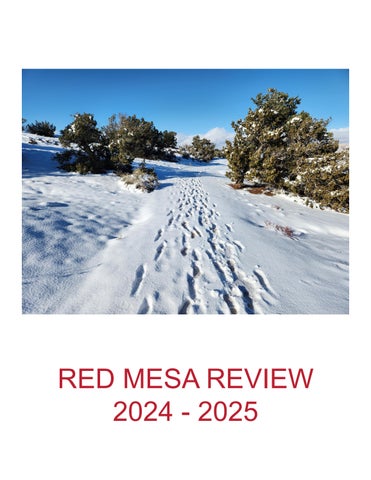
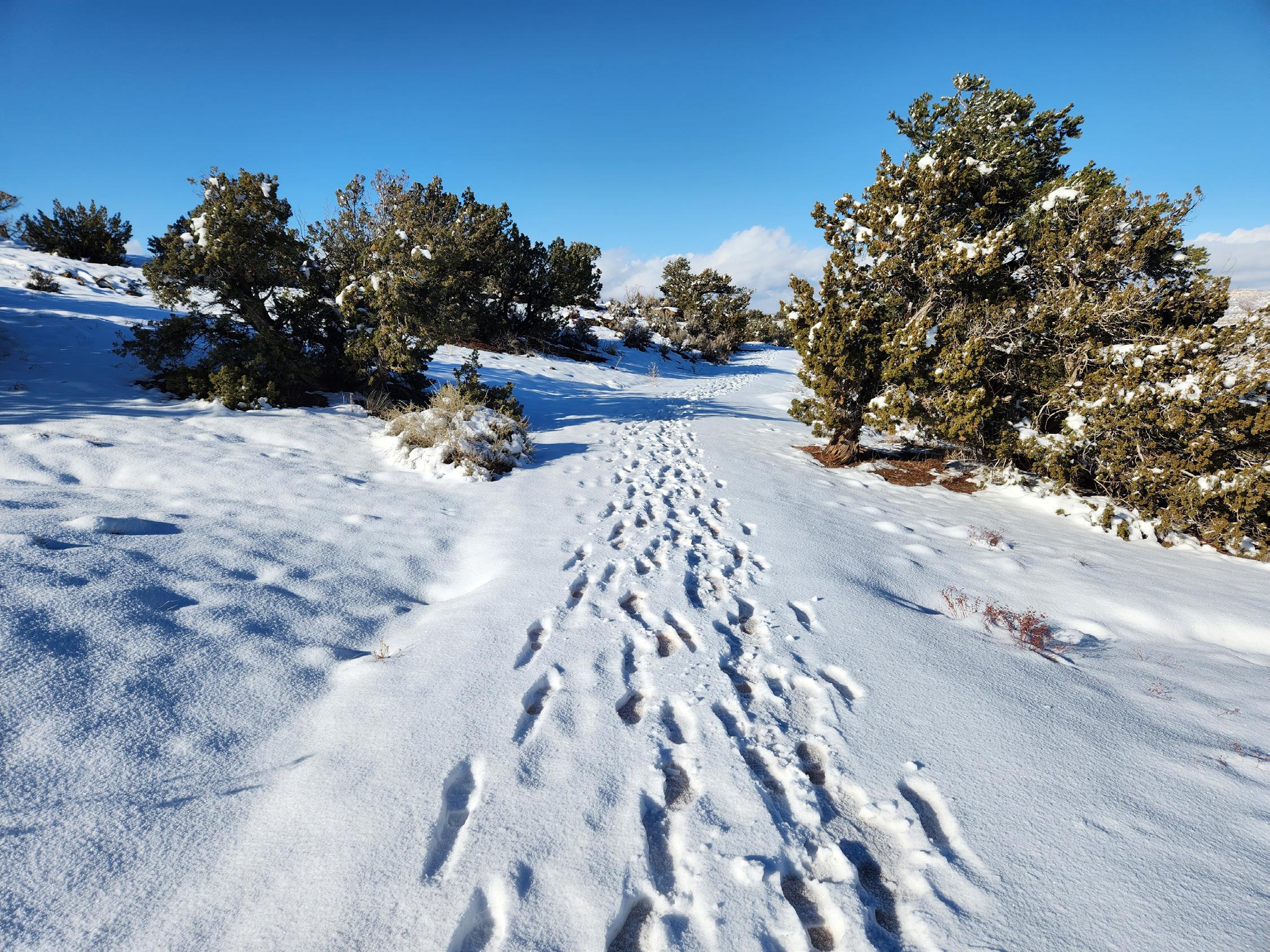
“UNM-G Trail” Photograph
Yi-Wen Huang
Rachael Nicholas-Mark
HALT OF THE RUNNING HAND
I remember the third-grade year in school the most. There are a lot of reasons why, like the fact that my class had to spend most of the school year in the library because the school had run out of rooms. I’m not completely sure, but I think there was one other class that had to share the library with my teacher and her classmates. For many, this would be the memory that would stand out the most. As I recall my third-grade year in school, it is the one that would have the most impact on my life.
I do not proclaim that English Composition is my favorite course from the peaks of the Swiss Alps. It is most certainly NOT my favorite college course. It isn’t because I don’t know how to write. I do! It is the rules. I hate all rules. Period. Like any undergraduate student, I am required to take the course to fulfill my college requirements. Ugh!
There I was. On the registration page. Again! I swirled my mouse on the mousepad, sighing, as I hovered the pointer over the option to Register for Class and clicked on the Submit button. I held my breath as I waited for the page to respond. I hoped that it would and would not accept me. That one moment seemed to have taken ages, but I wound up being accepted to be a student of the class.
It was the Spring of 2023. I half-heartedly scanned over the course’s syllabus with my gaze. All students were required to go to a museum and select an artifact to write about. The only thought that came to mind was, “I hate museums.” I slumped back into my computer chair. I was doomed. There is no sustenance in museums. Or so I thought at the time. But I had rather sign up for bungee jumping since I could accumulate the energy of experience which I could take with me when it was over.
I ran through dozens of internet searches of the community, city, state that I live in. Every option presented was a snoozer to me. There was one point when I thought my search had ended. Instead, I found out that the famous Folsom Prison Museum was temporarily closed. The sight of the announcement on their website bummed me out.
Alas! A decision must be made since I had already wasted days upon days trying to make up my mind. I chose to go visit the Sacramento History Museum. I was there before, but I do not remember walking around to look at the exhibits. I believe I walked in and then back out again. This time, I would give it a chance.
As was suggested by the teacher, I took pictures starting with the outer part of the building. Click. Click. Click. I walked inside. To the right, was the admissions counter and wouldn’t you know it. STUDENT DISCOUNT! That privilege made my brain explode. As the student that I am, I showed off my University of New Mexico student ID to the admissions clerk. If I could have, I would have stamped it on my forehead for the world to see. That was the pepped-up energy that I needed to start my journey through the perusing process of the assignment.
I took pictures of everything. On the bottom floor, I spent a lot of time taking pictures of the history of food in Sacramento. I became tired when I was halfway through looking at the timeline on the wall. I would not have survived the rest of my self-tour if I had finished reading every item there. From that point, I took the elevator to the second floor.
Halfway through, I did not expect to see a painted wall explaining the next exhibit. I’m not one to stand long periods of time reading information. I get tired out easily. The wall was a faded, handwritten letter in cursive writing. On top of the faded letter was the exhibit’s title in bold, red lettering, CALIFORNIA IN PRINT and then the rest of the letters in black, HIGHLIGHTS FROM THE – ELEANOR MCCLATCHY COLLECTION. To the right was an archway with a sign hanging from the ceiling that said, R. BURNETT MILLER GALLERY. The gallery was decorated in a deep red orange color that gave off a warm feeling. The walls were used to provide their own timeline of communication in print form.
Not far from the entryway, I came across a wall with the title GOLD FEVER IN PRINT in gold, while the rest of the script was in white letters in three separate font types and sizes. The presentation was magically put together and prevented me from passing it by. I stood there with my camera, reading it out loud as I videotaped it like a narrator would do. In cursive writing, it said as follows:
“It is a source of gratification to exhibit to our friends abroad its scenes and circumstances which surround us. . . There she is – behold her and judge for yourselves.”
-Edmund L. Barber, George H. Baker, Sacramento Illustrated, 1855
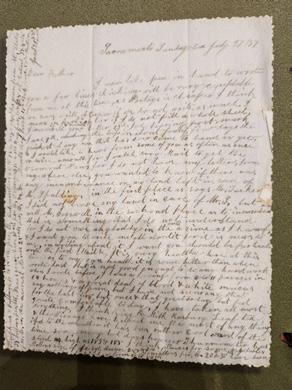
Shortly thereafter, my boyfriend appeared to inform me that he had taken pictures of the Gold Rush letters when we started our self-tour. I didn’t believe him right away. I had not seen them. I vowed to return to look at them and did just that. I held my breath when I saw the intricate penmanship of each letter, melodically swooping up, then down, and connecting one letter to the next. Then, it would lift the point up of the ink pen in the air and back down again to continue the waltz of the hand. One, two, three…two, two, three…three, two, three…repeat. I picked one letter that I was drawn to the most. Above the letter was the following description:
LIFE DURING THE GOLD RUSH WAS DIFFICULT AND UNFORGIVING
People had to deal with the realities of life in brand new cities among strangers, uncomfortable living conditions, and health problems. They often turned to the comfort of writing to friends and family back home.
In front of me were two thick, hard tablets held by two prongs to keep them locked in place. The letter from the son to his father was displayed on the left and a lousy attempt of dictating the letter on the right. The dictation seemed to be only one paragraph of his experience on the West Coast. It started off with “. . . I now take pen in hand to write you a few lines. . .” and ended with “. . . I have taken almost everything, I think: rice and milk, raspberry leaf tea, and the syringe have helped me most of anything.”
It was at this moment that I flipped through my own memory timelines. This excited me, unlike the time I saw the original Declaration of Independence, Constitution of the United States, and the Bill of Rights when I visited Washington, D.C in my earlier years. My mind was not entertained when I saw those historical documents. It was mostly that those pieces of parchment were and are still not private writings. Jacob’s letter was intimate and only meant for one pair of eyes to see. I have never read someone else’s private journal. Thoughts of me physically rushing over to Jacob and snatching the letter away from him to read it out loud forced my heart to race in my chest.
Flipping back through my own personal unwritten memoir, I find myself stopping at the sight and sound of attending Hawthorne Elementary School. My third-grade teacher leads her class to exit the library and down the hallway to another classroom that is twice the size of a regular classroom. My teacher has told us we will be joining two other classes to receive cursive writing lessons that will last several days. The desks in the room are organized side by side in the shape of a square. I am directed by a different teacher to select a seat to sit down. I sit on the west side of the room and look around. On the opposite side, the windows are from the ceiling to almost the bottom of the floor.
I felt like this was another stage of life, of becoming an adult. Looking back on it, I had the feeling that only fancy, upper class people had this privilege of becoming that creative. High up on the wall were the letters of the alphabet, uppercase letters next to their lowercase counterparts. The teacher held a long stick in one hand, raising and pointing to each letter as she taught the lessons.
As memory serves me, the process was long. Her exercises were done with groups of letters, not all at once. Each exercise began with the uppercase then followed by its lowercase letter. The teacher held the class in a suspense cliffhanger episode as she made the announcement that the lesson would continue the following day. My eagerness forced me to create my own lesson when I got home. It was an exciting time of my life. Forwarding to a future time of my life, I hired a nanny to provide childcare for my daughters while I was at work. She turned out to be an annoying person. Aside from her coy quips and quirks,
she was a formidable verbal opponent.
One of the days I returned from work, she complimented me on my penmanship. I was shocked at her antics. “Thank you,” I said.
“That’s the best cursive writing I have seen. I don’t seen writing like that these days,” she continued. “What do you mean by that? Don’t you write in cursive?”
“Nope. The schools don’t teach it anymore.”
I gasped with utter disgust. Surely, cursive writing is considered as a talent of nobility as I thought of A Knight’s Tale movie scene where the character Geoffrey Chaucer, Medieval Herald, falsifies a legal document called the “Patent of Nobility.” I cannot fathom the thought of myself having never learnt the skill.
What could have led to the decision of the removal of cursive writing in today’s curriculum? In the corner of the antagonist opinion, Sue Pimental, a lead writer of the English/Language Arts standards, mentions that teachers have addressed that the study of cursive writing takes a lot of time to teach it to their students. This is not the case for every district in the United States. Tennessee and California are two states that have added cursive to the common-core standards. Louisiana has mandated that students study cursive every year from third and twelfth grades. The additional learning effectiveness is by the current high demand. The world is in the digital and electronic age. To name a few items that are entailed in each group, digital records are digital and video files, Ebooks and PDFs. Electronic records are emails and attachments, spreadsheets, web pages and blogs.
One EEG study by the Norwegian University of Science and Technology confirms that cursive handwriting helps the brain to learn and remember better. Mike Foley, a retired Nevada history teacher, voices his concern that people will be unable to read historical documents that are not written in print form (e.g. Constitution of the United States). Knowing how to read and write in cursive writing will improve the experience of going to historical monuments and museums. From his own experience, he recounts that learning how to write in cursive takes concentration, focus, and dexterity.
Since taking the photo of Jacob Parrish’s letter to his father, I wondered to myself if I could successfully dictate the rest of it. It was only one paragraph which doesn’t tell me a lot about Mr. Parrish. With paper and pen at hand, I wrote down what each word looked like to me (see two images on the following page). The beginning of the dictation was rough. I had to zoom in to 59%. Even at that point, I did not want to give it a go. During the process, I mistook the last name Tucker for Turkey. There is a closeness between the lowercase “c” and lowercase “r” when they are connected from the previous letter to the next. I did notice that my reading adjusted to the curls of the letters the more I read them. It is a lot like focusing in and out of an image through a scope or the optometrist making minor adjustments to figure out what prescription lens strength you require for reading glasses. I didn’t want to stop, but figured I would give my brain a rest after all of that exercising. I would not have been able to read Jacob’s letter if it were not for learning how to write in cursive. Thank you, Jacob, for sharing with me how much you miss the people that you loved during the age of the gold rush in California.
Letter from the Sacramento History Museum
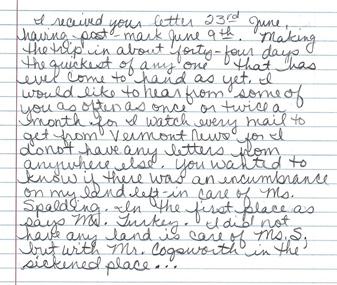
A Portion of the Letter Dictated by Rachael Nicholas-Mark
Rachael Nicholas-Mark
Ripcord of the Cotorie’s Parachute
For inspiration’s sake, I have always been active in various activities. In the beginning, it was not so much a choice of mine. It came from the modeling of others. My mother is a church member. She has been one longer than I can remember. Before her, I can admit that her mother was a churchgoer as well. My grandmother was an inspirational speaker, of sorts, for the same church that my mom was brought up and raised in. I, too, was born and raised in the same. This, I did not carry through onto the next generation. I have been a flexible mother in a variety of beliefs for my children.
For starters, in legal terms a church can have nonprofit status as an organization. From all the memories I can recall, I did not think it would sink itself down into only two words like this. From that standpoint, my parents did continue volunteer work through another nonprofit organization that focused on Native American people. Most importantly, the organization hosted the Miss Indian New Mexico Pageant. It seems that my parents’ modeling was passed onto me without notice. Some years down the line, I was a member of a nonprofit organization called 4-H which has a mission statement of their own. The 4 H’s are “Head, Heart, Hands, and Health.”
What is a nonprofit organization? To keep it simple, “legally, a nonprofit is an entity that is organized for a non-commercial purpose. It exists separately from the individuals who operate it, to a lesser or greater degree depending upon the entity structure chosen.” These organizations could be funded by donations and worked by volunteers. Generally, it can provide resources in assisting a community in its times of need. There are organizations that do have paid board members. It all depends on the infrastructure of the group. The most common reasoning behind nonprofit organizations is that their members want to help other people. That help is often to the community but can expand out to as wide as the world. Being that half of my lifetime was spent as a strong advocate for my daughters’ plants, the pursuit for nonprofit organization knowledge begins.
I could write countless pages of information about the organizations that I have been involved with and the resources that they provide. There would be no fun in doing that. My preference is to learn about programs that I know nothing about. That information could be passed to others. And who knows but that the details of my search could benefit me as well? One of my daughters is heavily involved in a program at her school. One of her teachers is the lead person of the group. I have been in communication with her many times when it came to matters of events and my daughter’s schoolwork. She was the perfect candidate.
I wrote a simple, short letter asking if I may interview her. Within the next twenty-four hours, she responded, “yes” to my request. Don’t get me wrong. I was expecting this answer. What I was not expecting was she gave me two nonprofit organizations for the interview. My heart jumped rapidly in my chest and my head almost exploded from the sheer excitement I was feeling. I had hit the jackpot.
It was on a Monday. I took a nap to make sure that I was refreshed. Instead, I overslept and with a shock of energy rushed over to my desk when I saw that it was roughly fifteen minutes late for the appointment time. This is not the best way to start out with the assignment. I called her by phone. She sounded confused when she picked up the phone. I’m thinking to myself, Did she forget about our scheduled appointment? I asked her if she was ready for our video call. Over the phone, I was able to visualize her jumping out of her chair with her heart jumping up and out of her chest due to the excitement of being late. She repeatedly apologized to me. She let me know that she set a reminder on her phone. When her phone did its job, she kept wondering why it was giving the notification. I laughed out loud and told her that it was perfectly OK because I had fallen asleep and woke up late. We were in the same boat, but in different states, so we managed to reschedule later in the evening.
Those hours rushed by, and I was grateful for our synchronized tardiness. It allowed me to recollect my thoughts and have more time to prepare for the meeting. There was not much for a backdrop on her side of the computer screen to speak of. No pictures. Sherry Lober is a teacher at Del Norte High School, which is an Albuquerque Public School in New Mexico. At the school, she leads the DECA program, which stands for Distributive Education Clubs of America. Their mission is to prepare emerging leaders and entrepreneurs for careers in marketing, finance, hospitality, and management in high schools, and colleges around the globe. On the other hand, she is also on the board of a nonprofit organization by the name Los Ojos de la Familia. Their mission is a grassroots movement to make a difference in the New Mexico community, by providing educational development and quality of life assistance. In a nutshell, their primary goal is to help families that need assistance.
Around this time, the expectations would be the interruptions by my cat, Chess. He usually is crazily nagging me with his meows, pushing his head up against the lower part of my leg, or standing on his hind legs to place his front paws on the upper part of my right leg. When I get busy with something important is when he wants the most attention. This time he was off in his own cat world. The thought passed on by. Again, Sherry is a teacher in a public school and is obviously not in it for the money. She relates to the nonprofit organization by her own parenthood in pursuit of helping other parents. It all began by her being on her own when she was fourteen years old without help. Her mother was a single parent who was doing her best to raise seven children. Her mother did not get food stamps or government assistance. Nothing. She emphasizes further, “You want to talk poor. We were very, very poor.” When she turned fourteen, she disappeared. Back at the time that this occurred, there were no services available, she adds. “I kept my head down. I knew I had to get through school, and I didn’t want anybody to know my situation. Because my impression back in the very early eighties was, they didn’t really have a good foster system. They would put you in the D (detention) home.”
This was a time of silence for Sherry. Without pausing, she continues, “I think there I had key people in my life always helping me. And I always knew going up through the ranks I would pay it forward. And that’s always been in my heart and that’s just what I do. It wasn’t a matter of what encourages me to do for the charity (Los Ojos de la Familia), or the community. That’s just part of life. That’s just who I am.”
This sounds like a hardship, but it was not. It was the constant kindness and love from people that kept her going. One of them was her best friend. With the help of keeping her secret from her best friend’s parents, that friend was the one to keep Sherry going. She had responsibilities. They were to go to school during the day and go to work afterwards. Her best friend was like a mom to her. Other key people in her life were her counselor, gymnastics coach, and DECA teacher. There were a lot of people in her life and at the time it was not clear that they were that essential. This continued throughout college. Her college coach noticed her athletic skills and encouraged her to concentrate on being a good teammate by being supportive. All of these experiences are what has contributed to her ability to be the charitable person that she is today.
As I imagine myself in a dark movie theater auditorium and reading the white letters on the screen ahead of me, she expresses the organization’s genesis. Roughly nine years ago, her ex-partner teacher and his friends from high school were involved with the United Way program. Nonchalantly, she doesn’t brag that there was a falling out with the organization. The drastic spark is what led those individuals to leave and later gather to speak of what had happened. She, herself, was a member of that meeting, expressing how much effort they put in to raise a lot of money which only goes to “pay upper echelon.” The discussion flowed along into further discussion about setting up their own nonprofit organization. A lot of these people had businesses of their own and years of fundraising experience with United Way. Michael Montoya, who is currently the Board of Directors President, encouraged the group that they were more than qualified to spearhead the project. In the process of doing so, Sherry was the “go to person” in providing guidance along the thoroughfare of their quest. Her instruction was that they required a name for the organization, its vision, purpose, and the direction in which the funded money would be distributed. “What do you want to do with your money?” she asked Michael. He replied, “I want it to go to people who need it.” With that verbal gesture, verbal within a reminiscent state, she says to me, “Being in public education, it’s really hard to find money to help kids and families who need it. I mentioned to him, “You know we have kids that want to play basketball but can’t afford to buy the shoes. Or we might have a kid who needs their teeth fixed really bad and they can’t afford it.
Or kids who need glasses.” Wishes upon wishes were already being granted without even knowing that they would come to pass one day. That one inkling of an event was the catalyst for what is now a successful nonprofit organization with many offers to show for it. There is currently a menagerie of charities to choose to give or volunteer for. To name a few are the car show, a poker and golf tournament, and a holiday gift basket giveaway to those who are in need.”
It was at this point she shifted from one reality to the other as I asked her, “Tell me one success story during the time that you have been a member (of Los Ojos de la Familia)?” This was like a rise of a billowing fog as the next scene appears from the dissipating fog. One of her students had called her to announce that his trailer home had burned down. The affected people were himself, his little brother, and two foster children. She emphasizes the words, “And [the trailer home] LITTERALY burned to the ground.” The family had lost everything. And, just like that, she was on the phone with the president of the organization.
This had to be done because “unfortunately” insurance has a lot of red tape that a person must go through to receive the needed money to survive on nothing. She and Michael rushed off to Wal-Mart to get everything that they could possibly get for her student. Gift cards were number one on the list, along with another purchase of the essentials, like pajamas, shoes, underwear, and a couple of outfits for each child. The cherry on the top of the sundae was the money to pay for five nights at a hotel. “We couldn’t have those kids on the street,” she finalized the ordeal.
Within the essence of her realistic tales is how one’s dreams can span off into another one. Her son later leads a sub organization of Los Ojos de la Familia. It is called Los Ojos de los Niños. This group is a mirror image of the other. The Los Ojos de la Familia Board of Directors’ children wanted to be involved due to the age limit of the events that were held annually. Los Ojos de la Familia provided these children with the funds to get it started but reminded them they had to keep their organization going on their own.
This is the stimulus that I needed to hear. The art of giving is a generational venture. The organization was not only modeling it for their local community. It was also aimed at their own children without the use of a target background. As if I had been in an actual restaurant, I envisioned myself raising my index finger to the sky to call the server over to our table, I ask one last time, “Is there anything else you’d like to add?” The lids of her eyes popped wide open. “No, it’s just a great organization. We’re done?” I responded, “That was it. Thank you so much for your time,” as the curtain fell from the sides of the stage as an indication of its end scene.
Quentin Guyonnet
School Sweet Home
“Stop it!” I said to Emilie, hoping she would leave me alone for the next 30 seconds.
“Let’s go, we’re late!” Move, Move!” she kept saying while hanging onto my schoolbag.
“Don’t rip off my panda or I’ll kill you” I answered, trying to protect my panda schoolbag that represented everything to me (at least my favorite thing within my short list of belongings).
We were already out of our 5th floor apartment, and running down the staircase, jumping across several steps at a time. In my best days, I could jump over an entire flight of stairs. In the worst one, I broke my ankle badly. Fortunately, my mother was the school nurse, and her office was at the ground level, along with other administrative offices (and the dean’s office).
At that time, we were living in this incredible place, my 5-story “all concrete made” school. Despite its apparent ugliness, it was a central place in the region as it was the only school of the district. As Renaud said, “sous les paves, c’est la plage” meaning “under the concrete, there is a beach”. Below the obvious ugliness of an all (and old) concrete building, there is a beauty if one knows how to look at it.
The fact that we were living in our school building was somewhat convenient: I could sneak out of class with a friend and swing by my apartment on the 5th floor, play with my toys, gather some food supplies for the rest of the day and watch TV while almost everyone else was in the playground. From my rooftop, I had a dominant view over the whole building and other kids playing outside, and I felt like a king looking down on his subjects. In this perfect harmony between me and the rest of the world, one thing was bothering me: my sister Emilie. Also living with me and my mother, she was always in the middle of everything, wanted to gather the attention, and stealing the show, my show…. But the building was 5 stories tall, with 96 classrooms and 175 stairs and recesses in every corridor. I had plenty of room to hide from her.
The only time we got along was during our stupid game. One or two people stay at the top of the well-hole, and the others at the ground level, at the very bottom of the well hole. You can see (from both perspectives) the law of gravity in a very dynamic way. Spit from saliva was our favorite projectile, until one of the administrative assistants received one on the top of his bald head. I remember hearing the noise of the impact, “ptooey”. After that incident, some friends and I had to mop the five flights of stairs for a week.
I forgot to mention that there is a very real downside to going to school where your mother is a school nurse: any time I was kicked out of class, instead of sending me to the principal’s office, I was sent to my mother’s office. Unlike other kids that were able to hide things from their parents, I was unable to do so. I remember my mother’s face when I arrived in her nursing office while one of my teachers was holding me by the collar.
“Your son is impossible, Ms. Guyonnet, you HAVE to do something,” said my physical education teacher, “he is a little rascal that needs discipline.”
“I don’t know what to say, Mr. Bugeaud. Do you want to take him home for a discipline course?” my mother responded, a little amused.
“Hell, no! I would rather stick my hand into fire!” he answered before slamming the door of my mother ’s office.
My mother told me later in life that it was not by my ability of being kicked out every day that was annoying to her but Mr. Bugeaud’s bad breath when he was shouting about my exploits in her office. For this, I’m sorry, mom.
Fortunately, my mother is the sweetest person on earth. She follows simple principles about child education, and always uses common good sense. She never shouted at us; she knew how to be firm at times but always took time to listen and understand our struggles, as small as they seemed from the adult perspective. My mom did like her work and was always very active in the school life and community, organizing activities around sexual education, emotional workshops (where you learned how to recognize your feelings and manage your fears) and marathons for whatever cause that mattered to her. Nutrition was also important to her, but she always let me and my sister eat the food from the downgraded school cafeteria. More than anything else, she wanted our happiness and the wealth of her community.
Life went by fast during these 5 years, from my seventh birthday to my twelfth. My sister was two grades above me, so she could warn me about the bad teachers and all the tricks to make my life easier. We loved and hated each other, but we were hanging out together a lot, usually until one of us started crying from our fights (physical at times). Each grade was like the one before, except that I felt more familiar with the school building each year. Once I had my handle on it, me and my friends started to sneak into places that were forbidden to the students. One year, we discovered a way to open the elevator doors between two levels and climb to the top of it, into the technical/service area. When I think about it now, it was maybe one of the most dangerous things to do. Another year, we wanted to explore the biology lab, and were on a quest to find the key for it. Once I got hold of it, we sneaked out from our apartment at around midnight and went to the second floor There, we walked to the biology lab door, the third one, a big blue door with massive side hinges. We turned the key and sneaked in. There, it was beyond our wildest expectations: entire shelves of jars containing all kinds of dead animals preserved in the formaldehyde aqueous solution. Then, I took my flashlight and started walking along the specimens. Lizards, rabbits, mice, frogs, fish, all looking like they were resting in suspension, chilling from a long journey after running out in the woods.
After each mischievous adventure, we shared all our discoveries with my friends and my sister and then looked for new areas to explore. That was the best unofficial after-school activity for all of us.
Good times never last forever.
On my twelfth birthday, my mother said she had something special for me. Curious, I was all ready for the big surprise.
“It’s official, I got a job in the south!” said my mother in her most enthusiastic tone of voice. At that point, I didn’t know what to think.
“What!?” I simply answered.
“I thought you guys didn’t like it here. What’s the problem?” My mother reacted.
“Nothing, it’s ok, but can I stay here?” I answered.
“Stop complaining, it’s already decided, you guys will love it there,” she insisted.
“Remember what Didier said about the south, the cicadas and the fruits… ” These were my mother’s last words before we left about 10 days after that.
July 19th. We arrived in Dordogne. Everything was so damn green and forests were everywhere. I remember that I had an assigned reading at that time that was meant for us to appreciate the beauty of mother nature. In my head, mother nature was made of concrete, and she was grey, full of cracks and smelling like an old antique store. I missed my five-story schoolhouse all made of concrete. Here, everyone talked funny and I barely understood the regional accent (it seems that people have a ball of hay in their mouth while talking). I made new friends, yes, but my sister, who was 14 years old, was never home anymore. My mother was always gone for work, a one-hour commute back and forth to the countryside, and I barely saw her. And my school, well, it was just a school: two stories, brand new, everything white, no elevator, no rooftop, no secret places, or crazy lab to explore. My new friends talked a lot about these caves and abandoned houses nearby and planned on visiting them soon. I told them I would think about it but in my head, I knew my decision was already made. I needed to explore more.
That’s what I realized later in life. This huge five-story school was the best thing ever, a central place for me and my friends to experience what was forbidden, but it was also our iron and concrete curtain on the rest of the world. It had everything, but it was suspended in time, not meant to last. In that way, I like to compare it with the Berlin Wall. When I think about it now, and looking back at the pictures, it was such an ugly building. The countryside around it was not inviting, but just acres of concrete and parking lots. But there, I had everyone and everything, and everyone was counting on each other, because we had each other’s backs. My family, my friends, my universe at hand, every day. There, my mother was everything to me: my substitute teacher, my confidant, my psychotherapist, my friend, and my mother. And this place, this school, was my home, my shelter, my playground, my throne on the top of the city. Finally, despite what the news says about suburban neighborhoods and tall concrete schools, it was the safest place around.
Today, I brought my child to preschool, like any other day. But today, it felt different. I thought about my “old concrete made” school. One of these days, I hope she and her friends will have a special place too, a place that has meaning for them. If not, we will make one. I need to explore more…
Colin Schultz Penumbra
The time is 7:04 PM MDT. As usual, I desperately seek answers to a problem that has none. Scrolling through various web forums scrounging for stories I can relate to is not healthy for me, but I never care. I have a desperation that is akin to that of an alcoholic aiming for remission. I know I should not do the things I do, but I do them anyway. I’ll take whatever helps me cope with the shadow that follows me. Medicine, therapy, selftalk, I do it all, but I have yet to find the light. I know that shadow will catch up with me one day, and I question if I am prepared. My shadow loves to wear an award-winning smile and remind me of my mortality. What a sly fellow.
As two hours have passed, it is time for bed. I lay down in my back-aching chair laced with pillows and prop my feet up on my bed. I have been sleeping in this chair for months, and it is not all bad. If it saves me a date with my shadow tomorrow, it is worth it, right? I have always been uncomfortable sleeping on my side, especially on my left. As I lie there, I cannot help but be reminded of my mortality one last time. He stands there, with a piercing grin, in the corner where the moonlight meets the darkness of my room. I count the beats for fifteen seconds and multiply by four. It reminds me I am ok.
My eyelids suddenly feel warm and are eventually flooded with the sunlight surrounding them. I let out a big yawn as I look at the wavy mesas that make up my city. As I squint my eyes, I can see the silhouette of deer roaming the rocky mountainside and pygmy nuthatches playing outside my window. I love the deer so much, even though they are seen as pests by the local city-goers. Where I am from, you seldom see them in the wild due to their skittish nature. I often ponder if I will eventually have the same sentiments; after all, I have only been here six months. As they play, the pygmy nuthatches stare back at me, talking amongst themselves without a care. Nature reminds me that it is possible to be carefree and that my life is not dark but grey.
Groggy, I make my way up the stairs to make myself breakfast. I have never been a breakfast person, so I eat small portions in the morning consisting of sausage links and a banana. As the cast iron pan warms up, I cannot help but remind myself how the links make me feel afterward. My hypervigilance is my downfall because I precisely know the number of milligrams of sodium in each serving. Sometimes, I wish I were more ignorant about my food because I have lost an unhealthy amount of weight since arriving at my new home. Ironically, sometimes I buy something I know is terrible, like pizza, to make myself feel better through quantifiable calorie intake. After some deliberating, I decide to skip the sausage and go about my day.
After breakfast, I decide to sit down and write about the shadow who watches. The more I know about him, the better. He has a name, you know? His name differs from person to person, but mine is named Anxiety. He does not take smoke breaks, is always happy to see me, and loves a good deal. I barter with him daily but know I will eventually stick it to the man. He is persistent, but I am determined to rid my life of him. We have a love-hate relationship because without him, I am not me, and without me, he is not him. Remember, there is no shadow without light and an opaque object to cast it. He thinks the house always wins, but I beg to differ
As I write words in black and white, I question if it is healthy for me to do so. Does Anxiety love attention? Does he feed on the innocent desire to relate? I have never been able to finish writing in one sitting, and there may be a reason. As I stare at my screen, I get taken aback. The words start to shift slowly into the outline of a face. My letters become darker words, and a chill is sent down my spine. He is here.
“Hi, Colin,” he says.
My voice trembles and lets out some soft-spoken words: “What do you want?”
My typed words concave and create the outline of a sinister smile. “What do I want? More like, what do WE want? This is a two-way street, remember? We made a deal.” he says.
My hands start to tremble, and my chest turns against me. I can no longer find safety in my heart’s steady
rhythm. As I speak to the man before me, I cannot help but notice I have not spoken a single word.
“I never made a deal with you,” I say.
He starts to bust out laughing and responds: “You may have never shaken on it, but boy, we barter all the time. It is a nice game of cat and mouse between you and me. You are smart; guess who is the cat, and who is the mouse.”
I immediately slam the lid on my laptop and get up. I start to pace the room with my right hand over my chest. He is right; this is far from over.
My walking turns into running. I quickly rush down the stairs to my room, where I grab a green bottle with the words “Hydroxyzine” plastered on the side. I twist the cap, hear a quick snap, and grab a pill. My vision is blurred at this point, and my heart is racing. As the small white pill slowly moves down my esophagus, I cannot help but pick up the phone. I see the dial button for an attempt at calling 911, but I go to my contacts instead. I call my father, and we start to talk. My father is a better lifeline than any doctor. He always calms me down in a time of distress, and if I call 911, it is because I experience extreme physical symptoms. Sometimes words can hurt, but if you use them correctly, they can heal. My father understands that.
My trips to the doctor always follow a similar pattern. I walk in, get my weight checked, take my pulse, check my blood pressure, consult, hear them tell me I am fine, and walk out. I cannot blame them; on paper, I am incredibly healthy. My anger toward the hospitals reflects the inner turmoil I experience. I want answers about what is happening to me, but I already know them. They are not the problem; I am the problem. I actively decide not to accept that this shadow has controlled me. Can you blame me? Tell a fighter that he just lost because of TKO. Like the fighter, I would spit in your face and tell you that I do not want to lose. There is one more inning; there is one more swing. I never heard a bell.
My breathing starts to slow, and my vision has slowly returned to focus. Sitting on my makeshift bed, talking to my father, I feel exhausted. I began to reflect on my shortcomings and disappointment in myself. How could I be so stupid? I knew Anxiety would come knocking as soon as I wrote my first word. Even writing this right now, I run the risk of an ambush. Is that an excuse to put my life on hold? No, I need to regroup and approach the problem differently.
I will not lie; when my father hangs up the phone, there is always a sense of dread. Questions like: “What if I have a heart attack and no one is there to call 911?” or “Am I slowly dying?” are frequently asked. At this point, my medicine starts to kick in, and I get drained. I give one last glance outside to a haunting image before I pass out. I see crows circling in the air and closely eyeing an animal that just died. Why can nature be so beautiful but cruel?
I take a large gasp of air and jolt into an upward position, still sitting in my chair. What time is it? I peered over to the side to see the clock reads 5:17 MDT. Is it not even the next day? At this point, I know the medication was the cause of my drowsiness. The mountains turn black as the sun starts to hide behind the horizon. I had no lunch, and my fridge is empty, so I decide to make a quick shopping run to the store. I proceed to the door and make sure to grab my keys. My roommates always think I’m ridiculous for locking the door, but I still do it.
As the engine revs and the car inches forward, the night sky can be seen through the tree line. I’ve always enjoyed driving at night more than when the sun is out. The light overloads my senses and makes me nervous. It is the same reason I do not go to the movies, concerts, or sports games. My friends have always hated this, but the noise, flashing lights, and constant movement make me feel like I will lose control of my situation. I can always hear my shadow whistling a tune and patiently waiting for his next big performance. In a time that feels like seconds, I finally arrive at the parking lot of the local grocery store. I get out of my car and start to make my way inside.
Do you like gambling? The rush of rolling the dice, not knowing whether you will go home ecstatic or sad?
That is what it is like to walk into a store for me. The bright lights, smell of produce, and movement of people in an open space have always bothered me. I would rather go to the store at night than at all. Sometimes, I wish I were a horse with blinders so I could only focus on one thing and block out everything else. If I remember this when grabbing groceries, my shopping is over before I know it. It is time to get back in my car and go home. I was lucky this time; I rolled the dice and won the bet. No shadow in sight.
As I arrive home, I exit my car and neatly store my groceries in their respective cabinets. I start to fix up some food. My hands begin to shake, which usually means my blood sugar is low. I decide on chicken that, like the sausage, I am suspicious of due to its nutritional label. I cannot believe I’m considering skipping dinner, but I am. While my chicken is cooking, I decide to sit down. Reflecting on my recent encounter with my friend from the other side, I wonder if I’m predisposed to him or if he is an epidemic that affects everyone. The shame from letting down myself, my friends, and my parents suddenly washes over me. This entity is a threat to my livelihood, my mental health, and my physical health. It is time I face him head-on.
I patiently wait for my subsequent encounter with this so-called bogeyman. As I wait, I hear a faint ding. My chicken has finally finished, so I get up, head to the oven, and pull it out. Reluctantly, I pick up the chicken with my bare hands and swiftly throw it onto the plate. I do that sometimes when I do not have a spatula. I sit down at my roommates’ round coffee table, which I occasionally use as a dinner table, and start chowing down.
While I am firmly grasping a knife and fork in both hands, my vision starts to become distorted. At first, it feels odd, no big deal, but as time progresses, so does the severity of the distortion. I can already tell what is happening; my long-awaited confrontation has begun. Suddenly, I become tunnel-visioned, and our round coffee table has mutated into a long rectangular table stretching for miles. My blood starts to pump, and after every beat, the table’s opposite end gets closer to me. Soon, I can see a figure sitting on the other side of the table with a knife in his right hand and a fork in his left. I soon realize this will be no ordinary dinner; this will be a dinner with a reflection of myself, my shadow.
As every beat pumps blood through my veins, it rattles my body, but it stops. Staring at one another, my shadow and I mimic one another’s movements. He suddenly stops, lets out a bellowing laugh, and says:
“Sorry, I just wanted to remind you that there is not just you; there is us. So, long time no see. How have you been?”
I stare at him intently, firmly gripping my knife with a displeased frown. “Wow, tough crowd this time around,” he says.
“I am tired of this game we have been playing. This ends now,” I respond.
His face looks puzzled as he raises an eyebrow. I can tell his sense of control has started to wane. Instead of letting out a big smile like he usually does, he has a stern and perturbed look. He open the conversation by saying: “Listen, kid, I do not know what you plan to do here, but we cannot just sit here and look pretty for one another. I know you feel confident right now, but this is a fad. I am you. Don’t you get it? I will not be going anywhere just because you decided to show some grit one day.”
I respond by saying: “I know. Yet, there is something you do not understand. This day of grit is the precursor to something bigger. You do not build Rome in a day. Earlier, you made a blunder in the form of a question. I have my answer: I feel like a cat this time around. So, start running.”
A sly smile turns into a face of horror, and Anxiety starts to let out a weeping wail. My shadow knows he is not getting the best of me this time, so he makes the right decision and runs. My vision starts to distort again, and the table begins to rock violently. On one of the cyclical rocks, the table jolts upwards, obscuring my vision, and when it comes slamming down to the ground, he has vanished. The table starts to slow down, and my tunnel vision fades. The room looks normal again. I smile from ear to ear and begin to finish my chicken.
As I finish my last bite, I decide to do some self-reflection. I sit down where it all began, on the couch, and open the lid of my laptop. I know in the future that I will lose some of my encounters with Anxiety, but that is ok. I learned something important this time that I had only learned by watching the nature surrounding me: my life is not dark but grey. The only way for it to be grey is if some of my light is getting through and mixing with my darkness—a penumbra. As my computer turns on and my screen lights up, I see a tab with the forums loaded from yesterday. I click on it, scroll to the top, and click: “Sign up.” I put in the necessary information to create an account and revert the page to the thread with all the unfortunate victims who have their shadows following them. I click the post button and begin to write: “Hi everyone, my name is Colin. Guess who I encountered today?” After some time typing and spell-checking, I click: “Send.”
Hellington Batista Leite
Discovering the best of yourself from the best workplace
The year is 2019. I had been living with my wife for approximately a year and a half in the southwest region of Albuquerque, New Mexico. I remember coming home after a long and stressful workday at New Mexico Transloading, a company also located in Southwest Albuquerque, operating with transloading and transporting commodities like lumber, metals, gas, etc.
It wasn’t the first time, and I knew it wouldn’t be the last time, I felt stressed or unhappy with my position in this company. Since it was a small company with few employees, this was the main reason I believed things were not going very well there, morally speaking: few employees doing a job and too many bosses to give orders. I was the only operator in the company, the only one who held this position. Everyone else was above me: first supervisor, second supervisor, and manager.
I liked to think the company was like a table. All the legs were essential for the perfect balance of the table, but I was the leg that supported most of the weight. If you think about a table, it’s like people decide to place many things on it, but they are all accommodated in one corner, with all the weight falling on just one of the table’s legs. A few weeks had passed, and my dissatisfaction with my job only grew.
“What if that’s true? What if I’m stuck in this company simply because I don’t speak English or can’t express myself? Damn it !!!” I caught myself having this same thought several times, including times when I wasn’t at my workplace. ***
In mid-June 2019, while I was in the kitchen preparing a sandwich, I watched my wife on the phone, talking to someone for a long time. She spoke loudly and laughed, all excited, talking to whoever she wanted. She was having a good day, for sure. That day, I envied her- in a good way, of course. After all, it’s not every day that adults, in general, have these times where everything seems perfect and life sounds wonderful.
“Guess what?!” my wife said with a hopeful tone of voice.
“Guess what, what?” I asked, a little curious.
My happy and optimistic wife told me that some positions were open at the school where she worked. She was talking on the phone with her friend Berta, who told her that her husband was applying for one of the Educational Assistant positions at the school and that there were still more jobs to be filled. My wife saw in my easy expression that I didn’t show as much enthusiasm as she did. I remember she asked me if I wasn’t happy with the possibility of working together in the same workplace, and I remember saying no.
“You remember that I don’t speak English, right?” I asked my wife with a certain air of indignation.
“This is the least important thing. You’ll be fine. You will see. Furthermore, you are intelligent. It will be easy for you,” she said.
After a few seconds of silence, I said: “Alright! Get the interview for me, and we’ll see how things go. What is the name again of the school you work at?”
“Amy Biehl. It’s called Amy Biehl High School.” ***
A few weeks passed as if I had already started working at Amy Biehl High School in the blink of an eye. Among the few things I knew about this school, one was that it had been given a few awards as one of the best places to work. My wife also spoke highly of this place, so my expectations regarding this school were reasonable.
Nervousness took over my entire body. In the first weeks of work, I remember that I couldn’t eat in the mornings. I was happy to work at this school, but simultaneously, I was terrified of any interaction where my English would be tested. My thoughts regarding English were like those described by Seongyeon Heoin in her Ted Talk “Being a Second Language Learner,” where at the beginning, she says, “Imagine a world with no words. Imagine you can’t talk to others and others can’t talk to you. The whole world will be in total silence.” When it came to talking to people in English, I was afraid of being judged because even if I had an opinion about something, I couldn’t express it in words, and people’s facial expressions were noticeable when they looked at me with pity or repudiation.
As fate would have it, I was asked to work one-on-one with an autistic student, who also didn’t talk much. As an introspective student, it would be a good opportunity for me to get used to the new work environment and improve my English. It didn’t take long for this student and me to break the ice and create a good relationship.
As time passed, I noticed that the student was much funnier than the others. I felt like I had created such a safe space for him that he could be who he was, without fear, without worries. We also had an agreement: I would help him thrive academically, and in return, he would help me by giving me feedback on my English.
The weeks went by, and I felt such great contentment because I realized that this work at this school was not only providing me with my subsistence but also letting me see myself as a student willing to learn more every day. I was developing personally and professionally at the same time. Amy Biehl High School, from my point of view, was no longer a place of work but a second home, where I no longer saw work as an obligation but a place where I grew more and more through experiences and where I improved my English every day. That old Hellington who started working on Amy Biehl was no longer the same Hellington as today.
Even though it may sound a bit cliché, I could say when I started working at this charter school, I was just a diamond that needed to be polished, which has been done ever since. This polishing process will continue as long as I am working there. Although I was initially very afraid, I am extremely grateful to my wife for introducing me to this charter school. At this point, I thought I already knew everything I should know about this magnificent school, the students, and the work routines; however, I still didn’t know something about myself.
More than learning English, know yourself.
After a year of working at Amy Biehl High School, I began to reflect more on comments that my wife constantly made when we were home regarding the behaviors of some students who resembled mine.
“You know, today, that student Zeke reminded me of you,” said my wife, smiling. “I told him something today, and he responded exactly how you respond to me sometimes when I say something that could have more than one interpretation, but that I don’t realize until I’m asked to be more specific.”
Zeke was one of the best juniors in the school in every way. Zeke was an autistic teenager, but unlike the other autistic teenager I worked with one-on-one when I started at Amy Biehl, Zeke was more extroverted, and he wasn’t afraid to speak or express his opinions, although always very politely. As it is a charter school with support for special education, a considerable number of autistic students attend it. Little by little, I learned that autism manifested itself differently in each individual.
Now, it wasn’t just my wife’s comments that made me see some similarities between myself and some students. As time passed, I began to notice patterns in some autistic students and see myself in them. “Signs of Autism Spectrum Disorder in Adults,” an article from Additude Magazine, lists some standard signs of autistic adults, which include, among others, a “Tendency to engage in repetitive or routine behaviors, Exhibiting strong, special interests, i.e. You are really good at math, or software coding, but struggle to succeed in other areas.” As an adult, I identified with most of the signs exhibited by autistic adults described in this article. In this sense, I could understand the students. I knew exactly what they felt or how they thought.
A few more months passed, and I did what I felt needed to be done because a doubt was ringing in my head almost daily. I made an appointment with a neurologist from São Paulo through online sessions. I had to make an appointment with a neurologist from Brazil, as it was faster, since in New Mexico, there was an 18-month waiting list for diagnoses of autism in adults in season. It didn’t take long for my diagnosis to come. Grade 1 autism confirmed. Now everything made sense. A movie with several specific scenes started running through my head, and for each of the scenes, autism was the plausible explanation for each of them. It was like my life had been a huge puzzle with a missing piece in the center. With a missing piece in a puzzle, it is still possible to observe the image that gives meaning to it, but only a complete puzzle will make it perfect. This was how I discovered autism—a feeling of relief. Finally, even though it was late, I was able to find the piece that completed me.
Besides being a second home for me, Amy Biehl High School had given me the opportunity to get to know myself and discover who the real Hellington was. I always thought what explained it to me was a difficult childhood marked by poverty, domestic violence, and separation from parents, among other differences. Being diagnosed with autism was like a gift for me. When reading more about the topic, I discovered through The Apple Podcast “Autism, Adult Diagnosis, and Comorbidities” from January 2019 that even the actor Anthony Hopkins, whom I’m a big fan of, revealed the discovery of his autism at the age of 70. Although my case of discovery was a little late as well, I believe that his late discovery also benefited him and me in the sense of not placing or letting them place certain limitations in our lives. Autism could be seen as something not positive for many; it was the opposite in my case. If not for autism, I wouldn’t be who I am today. When I was first asked whether I would tell people about my discovery or hide it, I remember responding that there was no reason not to. It would be a great opportunity for students on the spectrum to look up to me and see that you can be autistic and, at the same time, be communicative, funny, and even popular.
When people ask me how I feel about being an autistic adult, despite it seeming like a not-very-humble example, I usually compare myself to an iPhone. I have many qualities and am considered very good by many, but as not everything is perfect, just like the iPhone charger, I also have my small flaws. Today, I am grateful for who I am, for everything I have experienced and everything I have learned, and above all, how my current place of work was a turning point in my life. Thanks to Amy Biehl High School, today, as an immigrant, I can communicate much better in the “American language,” and I was also able to know in depth who the real Hellington was in terms of potential and a human being diagnosed with autism. Amy Biehl High School showed me that a language barrier is no reason for an individual not to be accepted as part of your staff. More than that, respect for others is inherent to race, color, gender, ethnicity, and spoken language. Today, I see that my former hostile work environment has nothing to do with my current job and that I was never trapped in that company except in my own fears and prejudices. Amy Biehl High School helped me grow and be stronger, just like the music of K’naan “Waving Flag” says: “When I get older, I will be stronger, they’ll call me freedom just like a wavin’ flag, and then it goes back, and then it goes back, and then it goes back.”
Darrel Reuben Watchman
“1…. 2…. 3…. Jump”
With every person that went before me, my heart started beating faster. One at a time, we stepped up to the ledge of the forty-foot tower overlooking the Olympic-sized swimming pool. “Look Left! Look Right! Look Center! On my count, ‘1, 2, 3.’ You will jump! Is that understood?” asked the Marine Swim Instructor.
“Yes, Sir!” we screamed back in acknowledgment of the Marine’s instructions.
Three kids in front of me, I was good. Two kids, I was okay. One kid was left standing in front of me, and I thought to myself, “Maybe I can take a restroom break before I go.” Oh, no! It was my turn! My heart was beating fast and loud. So loud, in fact, it reminded me of the beat of the drum at the powwow I went to a month or two before I found myself standing here on the ledge of this forty-foot tower. My legs, my hands, aw heck, my entire body was trembling with fear as I looked at my surroundings. Again, the Marine gave the instructions to “Look Left! Look Right! Look Center!” And then came the moment I had been dreading, “1. 2. 3. Jump!” he yelled. I froze; my body didn’t want to move. “Jump, Devil Pup!” he said.
“Can you start the count again?” I asked.
“No!” he replied. “Now jump!” he said again. As a 14-year-old boy, I mustered what little courage I had, and stepped off that ledge. I was freefalling for what seemed like an eternity. But in reality, it was only a second or two. I felt excited, free, and so alive in that moment.
There were around ninety of us, all teenagers, at the pool that hot summer day in June of 1998. The oldest of us was 16 years old. I had just turned 14 that April. Camp Pendleton, California, was where the Devil Pups Youth Program for America would offer “a-once-in-a-lifetime experience, aboard an active military base for good boys and girls between the ages of 14 and 17.” The Devil Pups Youth Program for America is a citizenship program for teenagers that is physically and academically challenging. That day each of us, one after the other, leaped off that platform. After I had taken my leap, the other participants followed, except for one or two that were too terrified to follow through with the exercise. I remember a chubby red-headed kid covered in freckles (he reminded me of Hamilton “Ham” Porter from the movie “The Sandlot”) who had stepped off the ledge while looking down. Because of this he ended up doing a forty-foot belly flop into the Olympicsized swimming pool that day. In the back of my mind, I thought, “Why would he do that? They told us, “Do not look down when you step off the ledge.” His now bright red belly was the very reason the Marine instructed us to keep our heads and eyes straight as we stepped off the ledge. After we all jumped, at some point, we all went back to being the kids that we were; that look of terror no longer lingered on any of our faces.
I noticed the others attempted to downplay the fear that we had felt while standing on that platform by sharing their story of bravery with whoever was in earshot. Of course, myself being one of six Navajo boys taking part in the program, I put on a stoic face and lied through my teeth when I said, “It was all right” and that “I would do it again if they would let us.” Little did everyone know, for me, this was the farthest I had ever been away from my homeland, the Navajo reservation, a place the Navajo affectionately call “Dinetah.” It was the longest and farthest away from my family I had ever been. I had no support or encouragement from shimasani (my maternal grandmother) or shima (my mother). I was out there, on my own, in the middle of an active military base. It was a place that I’d only heard my older brother describe when I was younger. He is a Marine too. Except for the other five Navajo boys I flew there with, I had no other connection to my homeland. Overcoming the fear that I felt that day without the help of either shimasani or shima marked the first time I did anything like that on my own.
Later that day during chow (what Marines called breakfast/lunch/dinner time), I sat with one of the other Navajo boys in the program. He asked, “Have you ever seen this many white boys in one place?”
I laughed and said “No.” In a way, I was relieved knowing that I wasn’t the only one experiencing a little culture shock.
After taking a few more bites of his food, he asked “Were you as scared as I was when you jumped today?” Shaking my head in agreement, I replied “The canyons back home were much higher. But! I never had to jump off any of them.”
He laughed, and then shook his head in agreement. We talked about how one boy was so afraid of heights he cried as he started to climb the tower. We talked about how that same boy begged over and over again not to take part in that exercise. We laughed at the idea of our cheii (maternal grandfathers) seeing us act like that. “Yaadila Tsxiilgo!” (Good Grief! Hurry Up!) they would say. Although hearing us laugh about that probably wouldn’t make much sense to a non-Navajo. Even though the program only lasted ten days overall, it allowed me to understand that there was much more to the world that I had yet to experience.
“1… 2… 3… Jump!” is a phrase that replays in my mind whenever I face adversity. It replayed a lot when I was an active-duty Marine. Usually, it had to do with any kind of training that scared me. Nowadays when I am trying to overcome my self-doubt, or the insecurities I might be feeling, I think back to that little 14-year-old boy I once was, standing there shaking in fear, not able to move. I remember the strength, the courage, and the bravery it took for me to take that leap. Mentally, physically, and spiritually, I grew that day. I didn’t know it at the time, but that one experience would help me through so many other challenges throughout my life thus far. Today, the fact that I have decided to go back to school has been one of the most stressful and scary challenges I have had to face. I find it funny when I think about it. I am a Marine, and an Iraq War Veteran. I’ve seen and done things that not many other people have; I’ve lived in conditions I wouldn’t wish upon my worst enemy. The fact remains. Pursuing a degree in higher education scares me, the type of scared that the 14-year-old boy felt all those years ago. But hey “1… 2… 3… Jump!” I got this.
Emily Lupino
My Tree House
I scanned the crowd of third graders for my strawberry-blonde neighbor.
“Scott!” I shouted once I got a glimpse of his freckled face.
I ran at him, grabbing his hand in the process, and yanking him toward the big steel doors at the front of the school. Once we were past the car line and buses, I finally let go of him.
“Why did we run out?” Scott questioned.
Honestly, I really didn’t want to tell him why I wanted to leave so badly, but after he repeatedly asked me, I gave in.
“Derek was making fun of my voice, so I told him to shut up,” I panted out, tired from running. Scott giggled, waiting for me to continue my story.
“He grabbed my backpack and said he was going to glue my mouth shut.” I winced at the thought.
Scott has been my best friend ever since we were in diapers. I am two years older than he is, but we never saw it until I started to tower over him. Our houses were side by side, separated by a small chain link fence. He lived with his parents and younger sister Megan. Derek, on the other hand, was a boy from my class who made my life in elementary school feel more hellish than it already did.
“Let’s cut through the woods!” Scott excitedly said, running to the tree line.
I just followed, knowing it was the fastest way home. All I could think about was how I never wanted to go back to school. Derek and his friends spent most of their free time targeting me, especially during lunch and recess. We finally made it to my backyard; I quickly jumped over the fence and took a deep breath of relief.
I was heavily bullied throughout elementary and middle school. In elementary school, it was mostly just mean words and being left out. But middle school was much worse; I was a complete outcast with maybe two friends who were in the same situation. For me, one of my final straws was when I got pushed down the school stairs. I can still feel the boy’s hand on my back as he pushes me down the second half the of stairs. I ended up breaking two bones in my wrist, causing me to detach myself from my emotions and the world around me.
The consistent bullying slowly broke me down and I felt unsafe at school. I did not want to go to school or see any of my friends anymore. During this time, I spent a lot of time outside in my tree house. I started to feel anxiety when I was around big groups of people and had some of my first depressive thoughts. That’s when my backyard became the place where I felt safe and truly happy.
I look back at those times, and I am happy that I had a place I could find myself in. I spent so many afternoons and weekends playing, laughing, crying, and hiding in my backyard. Bittersweet is the best word to describe how I feel about my yard. My whole childhood could be summed up in just that one word. I grew up the youngest of three siblings, with a brother and a sister. My siblings are several years older than me and closer in age to each other, so having a close relationship growing up was hard. My mother was a housewife, and my father worked many hours, taking the train to and back from work every day.
The first memory I have of my backyard would be when my parents decided to get it completely redone. I remember sitting looking through my window in my upstairs bedroom and watching the big machinery driving up and moving the massive borders. It was a pile of dirt and rocks that were covered in vines of poison ivy. It started as nothing special but was turned into a place I miss every day.
After the heavy machinery was done and the grass began to grow, our backyard was transformed into a lush green paradise with giant oak trees that lined the property. During the fall months, the trees would turn an array of beautiful reds, yellows, and oranges. When it snowed, it looked like a winter wonderland right out of a Christmas movie. The yard was big, with three layers of grass flats with rocks of all different sizes forming a rock wall that led to the second and third levels. It was like a lop-sided layer cake with a slope running from top to bottom on the right side.
On the first layer was where my house sat along with the concrete deck that was attached to the left side of our red brick-faced home. The deck had an old wooden railing that went around it and tall bushes that lined the two sides facing the yard. Right off the deck on the left side only a few yards away was a vegetable garden. On the other side was a giant magnolia tree that bloomed with hundreds of beautiful flowers every spring.
The middle layer was the smallest and was shaped like a circle that connected with the slope that ran down the side. In the stone wall, there were stones that were placed to look like and act as steps connecting the bottom with the middle. This area was the flattest part of the yard. My siblings and I would set up a tent in the summer. My older brother would set up an extension cord and a little old box TV that had a built-in VCR player so we would be able to watch movies. Those are some of the fondest memories I have with my siblings.
The top was where most of the fun parts of my backyard were. At the top right corner, there was a dog run with a little brown doghouse; my parents added it for our golden retriever Bear. Right in the middle against the back fence was my dad’s shed. It almost looked like a tiny house because of the window grids and flower box that sat below it. Directly across from the dog run in the left corner was my swing set, which I dubbed my tree house.
My tree house was the center of my world when I was an adolescent. It had a ladder that led to a little covered deck area where the first door was. My favorite part was the fact it had a waterproof roof so I could play in any weather. There was a green slide that ended by the swings that were attached to the side of the playhouse. Scott and I used to compete to see who would swing the highest and who could jump the farthest off the swings. I wish I had never had to leave it behind.
Shortly after my parents got a divorce, something that was not a surprise to my siblings and I, we moved. I had to leave my favorite place forever. I felt like I lost control of my surroundings more than ever before. My home life seemed to improve a lot and both my stepparents came into my life. I finally saw the light at the end of the tunnel when I started a new high school. That was the only good thing that came from the move. It was a place where I didn’t have to fear being made fun of or getting hurt, and I met some of my favorite people.
Even though I now felt happiness during school, it felt like all the issues I had dealt with for so long were over. I wanted to just be happy, so I compressed all my emotions to the back of my mind to be dealt with later. My first year out of high school and moving to a different state is what broke the dam I spent years building and patching any leaks in.
The feelings I was running from forever finally caught up with me. I felt myself start to become paralyzed with fear at the thought of leaving my house or meeting new people. I developed panic attacks and lost interest in living. I did not know why I felt this way, but I desperately wanted it to stop. I wasted a lot of my early twenties because of how bad I felt all the time. However, once I was older and more able to reflect on my emotions, I came to realize that a lot of what I felt was the backlash from my years of being bullied.
The impact and effects of being bullied throughout my life have stuck with me all the way into my adulthood. I have struggled with my mental health all my adult life because of it. I am learning to cope with it and get a handle on my mind. I learned that I was not alone in my struggles and there are a lot of others who feel the same way. Victims of childhood bullying are more likely to experience depression, anxiety, difficulty trusting, and self-esteem problems in their adult years.
One of the biggest steps I took was forgiving and forgetting what I went through. It was hard for me, but it was necessary for me to finally feel stable and move on with my life. My prime bully Derek tragically passed away when we were in 8th grade, and I was never able to know why he picked me to hurt. My childhood friend Scott graduated from the University of Colorado in 2022 and still lives in the house he grew up in. I know from him that my tree house is still standing tall, and my old backyard is as beautiful as ever.
Anna Flores
Rebirth…A story about a second chance at life
Friday, July 27, 2012, had been a typical workday for me. It had been busy all morning, and I had no time to rest. The previous day, I had gone to the clinic. My mom had mentioned many times that I wasn’t looking too good. It was about 10:30 am and I got a call from the clinic at work. The nurse I spoke to told me that I had to get to the hospital right away and that I was in a very critical condition. I can still remember the conversation because I told her, “Do I have to leave right now, or can I go when I am done with my shift?”
She got upset and said, “Anna, you have almost no blood in your system. I suggest you go as soon as we hang up!”
I did as I was told and let my manager know I was ordered to go to the hospital by my doctor. I was terrified by the clinics and especially the hospital. I remember calling my sister. I let her know I was going to pick her up so she could go with me. When I picked her up, she mentioned that an officer had been to our house to escort us to the hospital because I was supposed to be weak or passed out based on my blood tests.
Once I got there, they rushed me back, connected me to the monitors, and began asking questions. They did so many tests, cultures, and vials of blood work until finally, the doctor had one last idea, which was to check my kidney levels. As I mentioned, I was scared of any medical place because I was terrified of injections, so when the nurse put in my IV port, I think I went out of my body because I felt nothing. I was numb. This was the day my old life died.
October 27, 2017, five and a half years after my life had changed. I was still at the same job, with the same hours, except I now had a robot, my dialysis machine. Noon came around and I was so excited because I had two hours left until I got to go home and rest. I had a call come into my work. It was my dad. He was very excited to tell me that Roberta, my transplant coordinator, had called and said I was first in line for a kidney. I had no words but, “Ok, I will be home soon to pack.” Again, I had to let my boss know I was leaving because I finally had a kidney waiting for me. I had 6 hours to get to Albuquerque and get prepped for surgery.
Once my parents and I arrived at UNM Hospital, everything moved so quickly. I got checked in, and had blood drawn (17 tubes to be exact). I got my room, checked my insurance, said goodnight to my parents, had my last dialysis drain, and finally lay down around 11 pm. Boy, it was a hectic day. As I lay there thinking about the last five and half years and everything I had done to get there, I couldn’t help but feel it was a bittersweet moment. As I waited for my new life to begin, a family was seeing the end of their loved one. I realized that I had to be thankful for a beautiful gift my donor and their family had decided to give me.
It was five in the morning, and the nurse came in to wake me up. She said, “Shower time, Anna, it’s the big day. We will return at six to take you to the pre-op room.” Getting ready and getting to the pre-op room seemed to go so fast, yet it all seemed like it was in slow motion. Once in the pre-op room, my IV port was placed, I saw my parents (kind of), my glasses were taken, and I lay there waiting for a new life.
I woke up at nine pm in my room with a bunch of noise and too many people talking. My dad asked me how I felt, and I rudely said, “How do you think I feel?” The next day was a blur, and I wasn’t fully awake until about the third day after surgery. For the next few weeks, I had to take about fifteen different medications two times a day. I was poked so many times that I had a bruise on my arm, and I had to walk through the pain of a beautiful new scar. On week three of my new kidney, which I named Fanny Pack, I had so much energy I wanted to run around. I remember I couldn’t stop talking and I had conversations with everyone I saw. I felt like the world was mine to conquer.
November 29, 2023, six years and a month after I got a second chance at life, I am working full-time, traveling as much as possible, and feeling as healthy as I can. Thinking of everything that I have gone through in the past eleven years, I have learned to cherish my life and the people who are in it. I still go two to three times a year to my local kidney doctor for checkups. I have gone back to school and hope to pursue a career in
Nutrition. I want to live my life like there is no tomorrow and be thankful for the life I continue to live.
Don Cox
The Race is On
It seemed like the entire population of Hidalgo County showed up for the fast-moving drunken brawl the citizens of Remington, New Mexico, called a horse race. The spectators lined Main Street and the riders sat in the saddle leaning out over their horses’ heads, frozen with excitement and anticipation. The heavy breathing and restless snorting of the horses were the only sounds in town. Standing amongst the respectable folks in the grandstand, Tom Eden had his pistol raised. A quick pull of his trigger, and twenty horses bolted from the starting line. Cheers of excitement and the thunderous pounding of hooves drowned out the echoes of the gunfire. The sprinting horses created a cloud of dust that covered buildings and people alike. The only things visible were the horses in the lead and the backends of the horses already falling behind.
People, five rows deep, packed the board sidewalk, but swarmed into the street as the horses passed. Running after them and filled with excitement, the children chased them out of town. The cheering kept up until the last horse passed the town limits, turned left, and followed the pack to McKenna’s Canyon. The first victim of the race was Patrick West, who made a right instead of a left. But Pat was too drunk to care. With the racers out of sight and the dust settling, the spectators brushed off their clothes and spit the dirt from their mouths. The women migrated over to uncover the picnic tables loaded down with the food they’d brought for the afterrace potluck. The men had other priorities and headed straight for the beer wagon, figuring they could finish off two glasses before the racers wound their way through the canyon, across Calico Creek, through a couple dry arroyos, across Devil’s Prairie, a flat stretch of land bordering the south end of town infested with sagebrush, and racing back down Main Street, finishing where they started.
Tom Eden excused himself from Mayor Thorton, tipped his hat to Miss Abagail Jack, the Hildalgo County Cactus Queen, and skedaddled down the grandstand stairs. He was the first in line at the beer wagon, surprising no one, and filled his glass. Then with surprising dexterity, he promptly shinnied up the steep roof of the church to look out for the returning riders. Holding the church’s iron cross in one hand, Tom took turns from drinking his beer to looking for riders coming in from the south.
It wasn’t long before Tom tipped his glass back to slurp out the last of his beer, and through the dripping bottom of his glass saw a dust ball roaring out of the last arroyo a mile south of town. With a big smile on his face, he pulled his pistol, aimed blindly into the graveyard next to the church, and let her rip. Instead of a boom, he heard nothing but a dry click. Cussing under his breath, no major swears since he was using the church as a lookout tower, he cocked his pistol and tried again.
This time there was a very satisfying bang. The blast caused Ethel Green to drop blueberry pie on her new dress, and Herman Baca’s mule screamed and kicked out with her right hind leg, which caught Mayor Thorton in the shin just as he was tipping back his third beer. The beer doused his starched shirt and ran through his chin whiskers. The bullet hit Lester Moore’s headstone and ricocheted out of the graveyard and hit Ted Dunbar’s prize bull, Drago, right in the butt. The two-ton bull bellowed in pain and anger and immediately charged through Dunbar’s fence.
Once he had everyone’s attention, Tom pointed to the south and yelled, “They’re comin’ in.”
At the sound of Tom’s cry, the women and children mingling in the street sought safe refuge on the boarded sidewalks of Remington. The men finished off their beers in long gulps and abandoned the beer wagon, rushing to find their own place to watch. A hush fell over the crowd, and they all stared toward the south end of town. Half a mile away, the ball of dust was getting bigger. As it entered the Devil’s Prairie, the horses and riders fought and struggled against the bramble. The bad brush slowed the horses from a sprint to a gallop, and the dust cloud shrank.
As the dust settled, individual riders came into focus. Excitement raced through the crowd as they tried to identify the leader. “I think it’s Sheriff Kidman,” Paulie Pratt said. Her good friend Lena disagreed, “No it’s not, it’s that mean old Mr. Pepper.” “It’s got to be Lars,” another guessed. Everyone had a different opinion and threw out their guesses, but no one was sure until Mabel Wallace hollered in triumph.
“It’s Charlie Donovan.”
Sure enough, his gangly figure emerged, clearly in the lead. Being the first to name the leader, Mabel won ten cents worth of candy at Craig’s mercantile store. Patty Schumacher, who had always been jealous of Mabel and had guessed right the last two years, stuck up her nose and told anyone who would listen, that Mabel only got his name so quickly because she was sweet on Charlie.
Long Legged Charlie might have been the lead rider, but the others were hot on his tail. Substantial prizes were waiting for the winner including a twenty-dollar gold piece, an insignificant trophy filled with significant twenty-dollar bills, put in by the racers from each rider, and a kiss on the cheek from Hidalgo County’s Cactus Queen: winner took all.
Charlie’s legs were long enough to step over any sagebrush in his way, but he was riding a borrowed horse that had a wide chest and short legs and stumbled trying to jump a sagebrush. The stumble didn’t put Charlie out of the race, but the riders behind him took advantage. Red Pepper and his fiery mustache were riding hell bent for leather in second place, and Remington’s own sheriff, Sam Kidman, riding the tallest horse in town, was in third place. Red Pepper and the sheriff spurred their horses, getting every bit of speed out of them. Behind the front runners in fourth and fifth place were Bill York and Ole’ Moses. Bill rode his wife’s horse, Sweet Sandy, and rumor had it that if he put the spurs to her horse, Mrs. York would put the spurs to Bill. The frustration showed on his face. He knew that with a little steel encouragement, he and Sweet Sandy would be winning the race outright. Moses’s horse was as green as he was old and kept shying away from the other horses, refusing to run in a straight line.
Behind them rode an unintelligible gaggle of riders, weaving their way through the maze of brush, no one taking the same route. The last to reach the Devil’s Prairie was Lars Nelson, who probably weighed more than his poor swayback horse, and Xavier French, the town’s only barber, who was just as bad at riding as he was barbering.
With another fifty yards of sagebrush to negotiate, poor Charlie was losing ground fast. He spat out a heap of swears as Red Pepper passed him on his left and added several more as Sheriff Kidman passed on his right. They stormed out of the tangle of sagebrush with Red Pepper and the sheriff in the lead, Long Legged Charlie slightly behind and sandwiched between them. Both men tried to cut Charlie off at the same time and their horses collided. Charlie took evasive action, maneuvering his horse around Red Pepper’s. The small collision resulted in the horses running in a dead heat as they entered town and charged for home.
To their surprise, an unexpected obstacle charged into their path. Drago the bull, still raging mad from the injury to his butt, stampeded out into the middle of Main Street. When he heard the racers coming right at him, he stared them down and let out a ferocious bellow. The sudden appearance of two thousand pounds of pissed-off bull scared the three riders half to death. At the last possible second, Charlie veered to the left while the sheriff went right. Poor Red Pepper had nowhere to go. Out of desperation, Red Pepper ’s horse made the single greatest jump the town had ever seen. He cleared the bull by at least a foot and landed smoothly on the other side.
The problem was that Pepper didn’t make the jump with him. He slipped off the back of his horse and landed in the dust. He rolled over and came face to face with the giant bull. The tips of Drago’s long sharp horns glinted menacingly in the afternoon sun. Red Pepper, aware of how red his hair was, jumped up and ran- straight at the dozen racers exiting the brush. Seeing Sweet Sandy and Moses’s horse Buster barreling down on him with the rest right behind them, Pepper dropped to his knees, closed his eyes, and pulled his hat down low. His first prayer in decades rushed forth, promising God a sinless life from that point forward if he lived.
Pepper kept his eyes tightly closed as the sound of the thundering horses made his ears ring. It was like being inside a tornado. The gale force winds ripped his hat off, but not a single hoof touched him. As the raucous noise dissipated, Pepper squinted through one eyelid. The only riders left, as though on a Sunday trot, were Xavier and Lars. The latter, now running dead last and no friend of Red Pepper’s, tipped his hat as he passed.
“Where’s your horse, Pepper?” Lars called, laughing at the frightened cowboy.
Ignoring Lars and checking his body for blood and broken bones, Red Pepper stood up without a scratch on him, and pointed a shaky finger Heavenward. Then he walked straight out of town. No one in Remington knew what happened to him until five years later when Mayor Thornton saw him preaching the good word on the streets of Silver City.
Drago caused a lot of trouble for the riders. Filled with insolence and anger, he charged multiple horses. The horses bolted in the only directions they could go, right into the sidewalks. Men, women, children, and stray dogs ran for their lives.
Roy Craven, riding through the crowded sidewalk, jerked his reins to the left, missing Anita Lopez and her boy Manny by a hair. Roy crashed through the giant window of the mercantile store. Roy didn’t like to quit, so he just spurred his horse and crashed through the store’s other window. Sister Mary Louise Consuela from the St. Christopher mission watched Roy crash through the first window and then come back through the second, leap off the sidewalk, and rejoin the race unscathed. This impressed and scared the nun so much she crossed herself three times.
Some of the boys riding down the walkway were not as lucky. Low hanging crossbeams clotheslined two cowboys as their horses jumped back into the street. Salty John’s horse Pokey saved the widow Johnson’s life when he stopped in his tracks, throwing Salty into the nearest horse trough, and two thrown horseshoes did half the damage when they hit the same man. Billy Webb caught both in the head and they knocked him out cold.
Long Legged Charlie and Sheriff Kidman were charging for the finish line, first Charlie in the lead and then the sheriff. Any spectators not dodging wayward horses roared with delight, cheering on their favorites. Mabel Wallace, in her high pitched but sweet voice, let loose vulgar exclamations of encouragement aimed for Long Legged Charlie. Mayor Thorton cheered on Bill York, yelling in his booming voice. With her dirty face pressed against the bars of the jail, Netty Bransom, with a grin as pretty as a busted picket fence, screamed herself hoarse in support of Sheriff Kidman. She had two dollars riding on her jailer and would appreciate the extra funds for another night of drinking and fighting.
Just behind the leaders, the reformed pack of riders split into two separate gaggles of chaos. Lars’s horse Chuck bolted between them like he was shot from a cannon. Chuck sprinted up the street with the fat Lars holding on for dear life. He passed Ole Moses and Bill York, then caught up to Long Legged Charlie and Sheriff Kidman. Lars barely had time to cry for help before he passed them.
It appeared Lars would steal the glory out from under both Charlie and the sheriff. Unfortunately for Lars, Chuck was well trained. With twenty-five yards to go, Chuck turned ninety degrees to the right and dashed off in the wrong direction like his tail was on fire. He raced right up to the Lazy J Saloon, digging in his hooves and leaving gouges in the street twenty feet long that led right to his favorite hitching post. Chuck flung poor Lars right over his head, who crashed through the saloon’s swinging doors and slid halfway across the bar floor face first. When he woke up, Dan the barman handed him a beer. As consolation prizes went, it wasn’t half bad.
Inspired by Lars, Ole Moses and Bill York caught up to Charlie and Sheriff Kidman. Once Lars exited the race in such dramatic fashion, there was a four-way tie for first place. In the heat of the moment, Charlie kicked Bill York in the knee. Ole Moses cut Sheriff Kidman’s reins as the sheriff tossed his hat over the eyes of Moses’s horse. In retaliation and with a masterful aim, Bill York spat a stream of brown tobacco juice into Charlie’s eye. From that point, the fight was on. From atop the church, Tom
Eden watched the four leading racers merge into a screaming, whinnying, punching, and biting tangle of spurs, fists, and horse hide. With the finish line so close, the four desperate men did everything they could to win. Later at the Lazy J, Tom claimed, it looked like the four horsemen of the apocalypse.
The crowd bellowed and cheered its excitement. People pushed and shoved to see the end of the race. In the back rows fights broke out over benches, barrels, and trees to climb up or stand on. In the grandstand, a tall thin man dressed in a black frock coat watched from above, concentrating on the finish line and ready to announce the winner. Doc Taylor was the county’s only sawbones and mortician, and because he never bet on the races, he was considered an honest man. Plus, he was the only one sober enough to get it right.
With no reins, Sheriff Kidman’s horse veered off course and crashed into Ole Moses. Bill York, screaming in pain and frustration, dug his spurs into his wife’s horse. Sweet Sandy reacted with a ferocious buck and promptly threw Bill out of his saddle. Bill crashed into the ground a foot away from victory and right in front of Long-Legged Charlie’s horse, which stopped in its tracks. Charlie flew like a rocket over his horse’s head and crashed painfully in the street.
In the next few seconds, riders and horses charged, limped, or crossed the finish line backwards. Just to say he finished, Bill York rolled across the finish line, spitting out a mouthful of dirt in the process. The excitement of spectators exploded in a scream of applause as they rushed into the street as the last horse crossed the finish line. Arguments broke out immediately. Multiple riders declared themselves the winner while others threw out vicious accusations about cheating. As they argued, the crowd shifted towards the grandstand to hear the official results. Long Legged Charlie was left in the dust, flat on his back, holding one broken rein. Mabel Wallace pushed through the crowd and knelt by poor Charlie. Mayor Thorton walked from argument to argument, doing his best to calm people down.
Doc Taylor hollered to get everyone’s attention, but they were too busy screaming at each other to pay him any mind. Irritated, Doc Taylor slipped the Cactus Queen’s pistol out of her holster and fired two quick shots. Down the street a cat screamed, and Herman Baca’s mule brayed insults and kicked Patty Schumacher in the butt. Everyone else shut up and turned towards the grandstand. The doc cleared his throat.
“As the duly appointed judge of this fiasco you call a race, the winner is…Charlie Donovon!”
Before Charlie’s full name came out of his mouth, there was an explosion of cheers. The people forgot their arguments and stopped fighting. Men with missing teeth or black eyes pushed passed Mabel Wallace and hoisted Charlie out of the dirt and carried him up to the grandstand. People were clapping, yelling, and shouting Charlie’s name.
Still half dazed, Charlie nearly fell off the stairs when the boys set him down. Laughing at him, they pushed him forward, sending him stumbling to the top where the mayor was waiting for him. The mayor slapped him on the back in congratulations, and a heavy puff of dust erupted from his shirt. Waving away the cloud, the mayor shook Charlie’s hand and then handed him the trophy stuffed with money, stuck the gold coin in his shirt pocket, and stepped aside. Miss Abigail Jack stepped up beside Charlie and kissed him right on the mouth. The crowd cheered its approval, except Mabel, who walked off in a huff. The kiss left Charlie more dazed than ever.
“Drinks are on me,” he shouted, and he stumbled back down the stairs.
No further invitation was needed. Half the town marched off to the Lazy J whooping and hollering. They tossed Charlie up for another victory ride, and he rode the crowd like a dusty stick on the Rio Grande. The other half of the crowd glared at Charlie and the men stampeding off to the saloon, knowing their carefully prepared afterrace picnic was hopelessly forgotten.
The good nature amongst the racers and the other men lasted through the second round. Bill York threw the first punch in the saloon, but Charlie ducked the wild haymaker, and the sheriff was laid out cold. Charlie’s retaliatory kick was just as ill aimed, and he kicked Salty John in the knee. Salty John’s fist crashed into Charlie’s face and sent him tumbling over the bar. After that, it was a free-for-all. Men threw chairs at unsuspecting rivals, broken teeth bounced off the sawdust-covered floor, and multiple shots were fired. Thankfully, the only casualty was a toe.
When Sheriff Kidman recovered, he brought order to the madness. He only arrested three men that night: Bill York for an assault on a town official, Xavier French for biting off Roy Craven’s ear, and Tom Eden for accidentally shooting off Herman Baca’s big toe. Doc Taylor was able to save the ear, although he sewed it on a little crooked, but the toe was a lost cause. As the drunks stumbled out of the Lazy J just as the sun peeked over the horizon, they were already talking about next year’s race.
Zaina Naru
In the chaos of today’s world, solitude becomes a quiet haven—an underrated escape to discover yourself, embrace creativity, and savor life’s little details. Join me on a journey into the magic of solitude through personal stories and shared experiences, revealing its transformative power in those precious moments of being alone.
Getting used to enjoying your own company? It’s this slow dance with time and patching up the soul. Picture this: I grew up in this big, lively family. Laughter, talks, just life buzzing around all the time—it was cozy, you know? But it also made the idea of being alone kind of scary. As life did its thing, I realized my jitters about solitude were all tangled up with always having my fam close by. Being alone felt like stepping into this big unknown. It got under my skin, making those quiet moments without the usual family buzz feel awkward. But life’s got this way of nudging you to grow. So, I kicked off this journey of finding myself and patching up. It meant looking inside, facing the awkwardness, and slowly turning it into something good. Turns out, being alone isn’t about feeling lonely. It’s a chance to dive into your thoughts, dreams, and what really makes you tick without all the usual noise. Healing meant embracing those quiet times, letting myself just be without needing a constant distraction. It was about finding peace in the silence and realizing that solitude isn’t something to worry about but a chance to grow.
That first night away from my family, right after making the move to Albuquerque for college, is stuck in my memory like a vivid snapshot. The lengthy journey from Pakistan to the United States wasn’t just a physical relocation—it turned out to be a deep dive into the art of living independently and uncovering layers of my own self. On that marathon flight, cruising through the skies, I found myself in a state of contemplation. It wasn’t just a journey across borders; it felt like a voyage into the uncharted territories of self-discovery. The miles I covered weren’t just geographical; they were also traversing the landscapes of patience and the nuances of going solo. Touching down in Albuquerque, I quickly realized I wasn’t merely stepping onto American soil; I was stepping into a chapter of my life dedicated to understanding who I was becoming. That night, my first night in a new city, became a canvas for self-reflection. It was more than just unpacking suitcases—it was about unpacking aspects of myself. In that solitude, there was a unique kind of growth. It was about learning to rely on myself, tapping into a well of patience I didn’t know I had. From that night forward, every experience—big or small—was a chapter in the book of self-discovery.
In the realm of solitude, creativity isn’t a mere guest; it’s the host of the grand soiree. It’s in these moments, alone with my thoughts, that ideas bloom like wildflowers. There’s a certain freedom in the absence of external noise—a freedom to explore the corridors of your mind without interruption. It’s a canvas where your thoughts can paint the most intricate murals, where the seeds of creativity find the perfect soil to flourish. The embrace of solitude has been an intimate companion to countless renowned artists that has allowed their art to flourish.
Diving into the pockets of solitude between my classes became a playground for my creative side. One day, I picked up my trusty ukulele, and its strings started to sing, filling my compact living space with a melody that resonated with my humming. It was a familiar tune for me, having spent years playing for friends and family. Yet, in this new chapter of life, I realized something profound – I needed to learn to play music just for myself. The realization hit me – “Just for myself? Can we really do things solely for us?” It seemed like a foreign concept. Growing up, much of what I did had an audience, be it friends or family. But as I strummed away in my solitary haven, I began to understand the beauty of doing things for oneself. It wasn’t about performing or showcasing; it was about creating something purely for the joy it brought me. The strings of the ukulele became a means of self-expression, a personal conversation with the instrument that echoed through the quietude of my personal space.
In the midst of college demands and the constant hustle, solitude became a retreat where I learned to prioritize myself. It was a lesson in making time for personal joys and discovering the satisfaction that comes from doing things just for the sheer delight they bring to one’s own soul.
Solitude, with its calming embrace, becomes the backdrop for a melody of self-discovery, offering the profound lesson that amid life’s symphony, it’s crucial to occasionally create a solo composition that speaks directly to our hearts. In essence, taking yourself out for dinner becomes a ritual of self-discovery and selfcompassion. It’s a reminder that being alone doesn’t equate to loneliness; rather, it is an opportunity to cultivate a meaningful relationship with oneself. By becoming your own companion, you unlock the door to a deeper understanding of who you are, fostering a sense of contentment and resilience that extends beyond the confines of external validation.
Wenona Walley Expectations
Growing up as Native women, we are expected to have memorized our traditions, especially our native language. I am thirty-two years old and yet, I only know a few words of my Navajo language. I work in an industry where I deal with customers daily. Although there are many times my customers speak in Navajo and I understand it well, I am not able to respond in Navajo. I occasionally get that look, the cold shoulder or even the “Weren’t you ever taught when you were little?” When I first started this job, that attitude would get under my skin, and I would want to say what was really on my mind. Nevertheless, I was taught to respect my elders.
I grew up in Steamboat, Arizona, with my uncle, my mother’s oldest brother, and his family. Growing up in a small community, everyone knew one another, either by your parents or grandparents. Going to school in this small community, the school required Navajo language instruction. I took this class from pre-school to high school. In elementary school, we learned to recognize our colors, to count numbers, and to name the months in the year. In middle school, we learned to introduce ourselves. That is a way to identify ourselves as native men and women. The skill I found the most difficult was to learn the alphabet. In high school, I counted money and wrote in Navajo. Our native parents would always make us join the Christmas program where we would sing songs in Navajo in front of the entire school.
In many different families, we as young children are told stories of how we came about as Dine people. My grandparents were married for over fifty years, and they would tell us stories of when they were young and what they went through. They were healers, also known as either a medicine man or women. At a young age, their elders taught them to find different herbs and roots that would help someone in pain or who was ill. Their stories were always narrated in Navajo because they hardly spoke a word of English. Being healers, they were known by everyone in the community. As children or grandchildren, the community expected you to be at their side, so you too would learn their teachings.
We were always spoken to in Navajo, and eventually we picked up a few words. When one did something wrong, one automatically knew what certain words meant. My siblings and I loved to follow our grandparents around, especially when they would go on their nature walk to find medicinal plants. They would find medicine from different plants, flowers, and roots. We loved to go, because they would always teach us something new and we would become so excited to tell our parents. My grandmother passed away when I was nine years old, and a lot of her teaching left with her. My grandfather lived a long life; and passed at the age of ninety-five. Nevertheless, his teaching was passed down to my aunty and my second oldest uncle. To this day, they make medicine and help the sick by holding a healing ceremony for the patient. Sadly, there are not many medicine men or women left to carry these teachings on to the next generation.
I work at the Fire Rock Casino where most of my co-workers are Native. In this industry, 98% of our customers are Navajo. I work in the restaurant, so customer service is one hundred percent of my employer’s expectations. There are numerous times I am asked by older people if I speak or understand Navajo, I always respond in English that I can understand the spoken language, but unfortunately, I cannot speak it. Most understand, but others love to criticize and observe, “Well. you’re not Navajo then.”
I try my best to communicate with older people, but I believe I need more help in conversing. I need to say the right things and not say something to insult or offend them. I asked my co-workers that are fluent in Navajo if I am saying this right, or how would you say this. From what I know, and was taught, there is always a certain way you respond to a question; it just depends on how the person is asking the question.
Even with everything I learned, I hope that with the right guidance and more education in Navajo, that I will be able to teach my two children. I teach them the basics of what I know even if it’s only how to say hello (Yá’át’ééh), thank you (Ahéhee’), good morning (Yá’át’ééh abíní), and many more. It feels great knowing I can do something right. Both of my children are taking Navajo language class. I also love that they teach me something new every day. For example, my daughter taught us how to say (‘ayóó anííníshní’) which means “I love you.” My goal is to speak my native language and communicate with my elders with confidence.
I may not have my grandparents or my uncle to help me teach my children, but I know that they would be proud of me for trying.
David Sanchez Hidden Beats
As I walked into the unfamiliar halls of Waldwick High School, I remember feeling nervous about the beginning of the school year. Waldwick High is surrounded by oak trees in a quaint two-mile-wide town in New Jersey. Its blue and white exterior stood before me, welcoming yet imposing in its unfamiliarity. As I navigated through the crowded hallways, the corridors bustled with chatter and youthful energy, I commenced my first day as a freshman. It was the start of my journey on a bumpy road laden with unseen challenges.
It was at this point I met my Algebra teacher, Mrs. Heller. Math morphed into an abstract mix of letters and graphs, disconnecting from the real world with each passing day. During lengthy lectures, my focus would drift away, and her cadence faded into the background. I found myself looking out the panoramic windows of the classroom. Like a live canvas, I watched cars pass by one by one on Franklin Turnpike, while Canada Geese grazed on the freshly mowed lawn nearby.
One such day, Mrs. Heller, perhaps noticing my distraction, sharply questioned, “David, what’s our next step?” “Um...I’m not sure,” I mumbled, I was caught.
This scenario became a common routine, but I eventually became better at hiding my daydreaming. I feigned diligence by scribbling nonsensical notes while my mind roamed freely. Of course, I was not learning this way. I didn’t know at the time, but ADHD, or attention deficit disorder, was the culprit. My mind was a wanderer, always astray amidst the wilderness of distractions.
Being a high school student meant more was expected of me. Independence was not just encouraged but deemed necessary, no more handholding. The barrage of deadlines and increased workload meant there were more things to keep track of. The task of managing these new responsibilities was akin to catching smoke with bare hands. In my internal narrative, I was a lazy and unmotivated student. This tag seemed to stick and became a self-fulfilling prophecy.
For my first biology report, I procrastinated until the night before. Even though I was given ample time to do the lab report, I had trouble finishing what I started.
That day, I walked into Mr. Torrento’s classroom with a half-baked lab report. As other students were collecting and organizing their work, I had to come clean. As I faced the teacher, his expression was stoic. He must have already known something was wrong with the ashamed look on my face and incomplete report in hand.
“Where is your project?” he inquired.
“I..I couldn’t organize my lab report...I lost track of time,” I stammered, my voice barely above a whisper.
“This shows me that you do not care about doing well in this class,” he retorted.
As the bell rang, marking the end of my ordeal, it also ushered in a recurring narrative that I did not care about doing well.
The truth was that I did care and wanted to complete my assignments. It didn’t look like it, though. To my teachers, the only explanation of my inability to follow through on assignments could only be explained by my lack of care. “What have you been doing in class the past few days?” The truth is I had been doing nothing, my effort amounting to nothing and my mind wandering in different directions.
Later in the school year, my daydreaming and poor study habits weren’t getting any better. My poor grades didn’t go unnoticed, and a meeting was set up. One day in class, I heard my name called up at the main office. With my counselor, I walked into the room and was surprised to see my teachers Mrs. Heller and Mr. Torrento and a psychologist, most surprisingly my own mother. I felt like I was being judged at the tribunal and I deserved it. “Why aren’t you doing your work?” I was asked. The room seemed to close in on me as I muttered, “I think I’m just lazy,” I replied. Problem solved.
Much later, I found out this was a meeting meant to find out if there were any root causes to my performance, but my response offered no help. Perhaps if I had been more self-aware, the outcome of the meeting would have been different. In an alternate timeline, I may have been diagnosed earlier
Alice, a blogger, shared her academic struggles on The Mini ADHD Coach website, recounting “During my student years, I often struggled with different school matters. There were plenty of times when my teacher scolded me because I was busy daydreaming.” “Whenever homework or assignments were given to us, all I did was read them and leave them hanging until the day before they were due.” This label of laziness affected Alice in a way I can relate to. For me, it ended up being a label that I internalized. By my accepting this label, it was the only understandable explanation for why I was such a lousy student. I just did not try as hard as everyone else. The alternative was that I was plain stupid, and it was harder to accept that label.
Another example from therapist and clinical scientist, Kendra Cherry, explains that people who have ADHD can struggle with staying focused and completing tasks, and others often incorrectly label the behavior as laziness. Unfortunately, people with this condition sometimes internalize these labels as well, particularly if they have not been accurately diagnosed.
My freshman year at Waldwick High School was the most stressful academic experience I have been through. Luckily, there was a singular class that year that not only captured my interest but also showcased my ability when I couldn’t elsewhere.
Amidst the turmoil, there was a sanctuary- Jazz Band. Bright and early beginning at 7:15, there was zero period class. The class was held in the band room, which sat in its own nook at the end of the cafeteria hall. It was one of the bigger classrooms with an old grey carpet that covered the floor. Right in the middle was a big black piano with chairs and music stands circling it. I had the fortune of meeting Mr. Kalimanis, dubbed Mr. K by everyone in the band. His voice had a booming resonance, which filled the band room and captured my admiration. His classes were a breath of fresh air, and his enthusiasm was infectious. Playing my Yamaha Baritone Sax, class time flew by, and under Mr. K’s guidance, I began to grow as a musician.
Our sessions would kick off with practicing scales, which Mr. K always emphasized as the “building blocks of music.” They demanded a finesse I had yet to master as a freshman. Mr. K expected me to know them by memory and there were many. I learned to “sight read” and delved deeper into music theory. In his class, I never dozed off. His classes bounced between scales and lecture practice. I loved the variety
I was fine with waking up early and coming to the band. I did my assignments and stayed on task. So, what made the band different compared to my other classes?
Royce Flippins, in his article on ADDitude, explains “Like distractibility, hyperfocus is thought to result from abnormally low levels of dopamine, a neurotransmitter that is particularly active in the brain, particularly frontal lobes. This dopamine deficiency makes it hard to “shift gears” to take up boring-but-necessary tasks.” “If they’re doing something they enjoy or find psychologically rewarding, they’ll tend to persist in this behavior after others would normally move on to other things. The brains of people with ADHD are drawn to activities that give instant feedback.”
Tapping my foot to the beat and precisely anticipating notes on the down beat scratched an itch. When it came to Jazz band, I didn’t have trouble doing my assignments.
In a TED talk, James Fell explains how he was failing classes at his university and struggling until he found a subject that was engaging and interesting to him. For him, the subject was history, and he ended up getting a master’s degree. Fell explains that ADHD is a reward deficiency and that some people may go a bit overboard. Despite struggling in other classes James found a niche where he had success.
Mr. K rewarded my efforts by giving me a solo on the song “Fly Me to the Moon” by Frank Sinatra for the spring concert at school. It was a chance to showcase the work I put in at home. The performance went smoothly, and the hours of practice paid off. Compliments from friends and family were a good enough reward for me.
Freshman year in jazz, I found a domain where I could channel my focus and energy, which in turn significantly boosted my confidence. This mirrors the insights of Dr. Rosenthal, who underscores the potential of hyperfocus in individuals with ADHD: “If you can hook his attention to something he’s interested in and channel it in a positive direction, he can do outstanding things.”
In jazz band, I was able to build skills that in retrospect were not too different from the study habits I could have implemented in other classes. Mr. K’s emphasis on scales meant I could deliberately focus on something that was difficult and outside my comfort zone. The concert was an application of the things I learned just like a test in a class would be.
Understanding what I gained from Mr. K and Jazz now gives me an entirely different perspective. I was lucky Waldwick High offered jazz band where I could challenge myself even if it was non-academic. The boost in confidence was everything to me when it couldn’t be found elsewhere.
In an ironic twist with writing this essay, I’ve grappled with distraction, with doubt, with the nagging fear of inadequacy- the exact struggles that once loomed over me in Waldwick High. The difference now lies in my awareness of the way my mind works and the tools I’ve acquired over time to become a stronger student.
Caitlyn Platero
A Blessing In Disguise
The abandoned basketball goal, as far as I knew, was the place to spend your evenings, I really loved it there. The people really enjoyed it, and the environment was competitive and great. It is a place between a house which was owned by my great grandma who left the house for her son. The other house is owned by a lady who lives alone. This place is more of a playing ground for grown people, teens who didn’t do their homework that just stayed out late and complained about it later the bus ride to school.
At first, I thought hanging out in this place would be like a drug central if I’m being honest. My imagination would run wild at the young age of 10, so I’d picture teens high on whatever, and them with their torn-up pants, shirts, and beanies or caps that would look like they hadn’t showered in months. My mom was the one who put these images in my head. She would say this when I asked to go hang out at this place. “Caitlyn, you can’t play there because you will end up doing drugs or god knows what. So stay here and play with your older brother.” At the time, my brother was 3 years older than me, and he would just spend time with his x-box rather than even attempt to play with me.
When I went to hang out at this goal because my dad wanted to play basketball, I went with him and let me tell you, the first word that came into my head was park. It was not what mother had said it would be like. It was better; the people were friendly, there were a lot of moms watching their children and a lot of teens doing skateboarding, volleyball, and the environment was very comfortable. My dad told me to play while he talked to his friends or ‘Grown up talk.’ I looked around and I saw that there are 2 courtyards, one with the basketball marks, and another that is just plain concrete. The second courtyard is where skaters go to do tricks or practice on them without breaking anything.
Back to the reason why I thought of park: it has so many trees, the air breeze is magnificent, and the people have all the possessions of one. I would say the real reason I was drawn to this place is the amount of people that go there or talk about it. It was all the rave; many people around us would go there to hang out all the time when they came over to visit our family. The thought of even going was exciting, the anticipation was through the roof, and now I understand why my mom wouldn’t let me go. The thought of her children going to a place that is mainly overpopulated by some strangers, I’m pretty sure was tough for her, but at the time I didn’t really want to listen to her because of the exciting thought of going to hang out with my cousins and schoolmates who got off the bus with me.
Now, the thoughts of playing there were all around my head, I saw my best friend there, but she was with her parents watching the people play basketball. The energy I was feeling was over the limit. The amount of people was like 65 or a little more. Then every night I came to this place. There was this one night which I would always remember when the place was empty, not a single person. There were people outside but not anywhere near the park. I got back in from the saddest time of my life, after my grandpa had passed away. I just needed to be out in the open and be alone. This night I let it all out, I let everything go, I thought of my whole life here, I thought of all the times, all the memories.
Right then I knew this is the place where I can go to clear my head or rant about my stuff to myself. So, there I went, going mainly every night even though it was packed. It still felt great, so the basketball goal is where I sat under when most nights it was empty or had much less people. Sitting under the goal was a relief, and it felt like I was the only person in the world, with the quietness. But you could still hear the town noise like cars, insects, and the light breeze. With the view from the hill, you could see the town. It’s a little far, but I could see the lights, the buildings, and trees as far as my eyes could reach. I can still hear it. The thought of going back is very tempting and lovely.
Then one day, it all changed. The people started moving out, and then new people started moving in as well. The less people came, the more abandoned the park looked, because of the lack of people going out who would rather be on the phone or just be inside to do nothing. I would personally say that the most fun is outside. Sure, you can have fun on the phone or inside, but outside you feel the feeling of life and the nature of it all. At the time, this was the place to be. The air is just right some seasons, but it didn’t stop anyone from enjoying it or coming out; it really was so fun. The thought of the park being abandoned was an absolute horror of mine because it’s really a great place to be and to essentially have some time for oneself.
There it was, an empty park. Before I knew it, the emptiness set in. I was in gone for a week on vacation to visit my dad in Utah because his job took him out there. We had just come back, and I really wanted to come back and enjoy all the fun time I’d have with the people, but no one was there, all the lights were off, and the place was just dead silent. At first, I thought that maybe it was a surprise (you know when someone’s gone for so long that they throw a surprise party), but no. Everyone was there, but no one was playing or hanging around in the park. Then I asked my mom when it all set in. “Why does it look so dead outside? Has anyone called or told you anything on our trip?”
My mom told me “Nope, actually I got nothing, just from your grandma, who asked how the trip was. Other than that, nothing.”
The feeling was honestly weird at the time, having to come back to such a lively place to suddenly having no one outside. I went outside and realized that maybe everyone was busy and tomorrow it would go back to normal, which it didn’t. I asked the friend I met there what had happened and she didn’t want to talk about it, which I had a reason to know. No one would give the reason to me, but that just made me more curious. Then the next night is when I saw like 6 teenagers that just walked around one time and left in a car to go to the movies. For the past days it went on like this, no one other than the occasional people walking by.
Once I left to move to Albuquerque, I didn’t hear anything about the park until I went last week and it’s doing so much better; it’s back to being in a lively state. This made me feel so much better, so I thought of all the quietness was just due to the decrease of outdoor activities and spending too much time on the phone or even just having lives. Now they took away the goal which did help me with hard times, I’m not at the basketball goal playing. I lie under it and just look up at the strs at night and think or cry about it. The place means so much to me because it’s a place that made me feel at peace and that made me change and mature.
The place is what I like to call my core memory; it has my childhood and preteen years there. It’s the reason why sometimes expressing emotions is difficult for me, because I always delt with them alone. This place is also the reason why I met the friends who are here with me today, but they still live in Gallup, and I live somewhere else now. It made me really value the importance of nature and the surroundings around you. Most of all, during the time I was fortunate to not have a phone even though people nowadays would go nuts, but I see it as a great thing and it’s something I’m thankful for.
Overall, my mom told me when I told her about the memories, “It’s a blessing in disguise.” Now I really see it, and I hope the place can help someone they way it helped me on so many levels.
Alaia Baker Lake Effect
Taking an adventure out of the city to have meaningful bonding time helped me connect with my family. At this point in my life, I had completely isolated myself from everyone I knew. I did not leave my room, or the only time I did leave was when I went to school. I fell into a depression, and this affected my daily interactions with my family. Last year, my family of eight including myself took a camping trip to Wheatfields, Arizona. Being there at Wheatfields Lake gave me the opportunity to get out of my room and spend quality time with them.
Beforehand, I was contemplating whether I should go on this family trip or stay home inside my room. “I don’t even like eating fish anyway, I have to clean my room and do my laundry, and I don’t know what I’m going to do there!” I thought to myself. I sat there thinking of an excuse to get me out of going, but my parents talked me into it by reassuring me it was going to be fun. After I decided that I was going, I packed my sunscreen, headphones, and bucket hat. I helped everyone gather the equipment we needed into the bed of my dad’s pickup truck.
The AZCampGuide was created by a family from Phoenix, Arizona and the author of Wheatfields Lake Camping Area. They spent hundreds of hours researching camping locations in the state of Arizona for families to find. Wheatfields Lake Camping Area was designed to provide information for families who want to camp in Arizona. We chose Wheatfields Lake especially because it was closest to home. Wheatfields Lake is located on the Navajo Reservation near the east side of Canyon de Chelly. The nearest town to it is Chinle, Arizona. The lake is open year-round and people like ice fishing during the winter. The elevation of the lake is 7,300 feet in the Chuska Mountains.
Surrounding the lake is a mountain full of pine trees that sway back and forth from left to right in the windy atmosphere. The nice cool breeze from the mountain brushes softly against my face and skin. Dark green, yellow, and orange, rich colors, saturate my vision against the clear turquoise sky. Plants and rocks cluster on the entire shoreline of the lake. Light green slimy seaweed floats against the shore of the water. A school of baby hatchlings swim around near the shore; they swim away as you walk nearby or when your fishing line hits the water. During the day, the trout and rainbow trout do multiple somersaults in the air, creating ripples. Livestock manure, fish, algae, and delicious smells from the grill fill the air. The highway divides the lake and campground area, but people often camp beside the lake. Campfires, tents, gazebos, picnic tables, and RVs fill up the camping area, creating a fun family outing.
When my family all agreed on a spot to set up, we unpacked our equipment from the truck. We grabbed our camping chairs, fishing rods, tackle box, gazebo, and umbrellas out from the back of the truck. While my siblings set up the chairs, I set up everyone’s fishing rod. As we worked together putting up the gazebo, I could see the sweat drip down on everyone’s forehead. We were about done setting up, so I handed out sunscreen and mosquito spray to prevent painful sunburns and mosquito bites. My brother and I set up the volleyball net to play while the rest of my family was fishing. After some time of not catching anything, we all decided to play volleyball with four of us on each side. I enjoyed the laughter and screaming that was happening when we kept the ball in the air for a long time.
My dad set up a hammock for me between two trees that were about six feet apart from one another. Lying there felt different compared to lying inside my room. I could see all the birds and butterflies flying around as if I was in a dream. The wind rocked me side to side, creating a comfortable feeling that took me back to when I was a little girl on my mother’s lap. As I lay there, I started to smell the mouthwatering food that my dad was preparing. I could hear the bratwurst sausage and hot dogs popping, steak and hamburger meat sizzling, and the green chili roasting as they cooked on the firepit. Children were yelling and screaming while playing at the shore of the lake, while others were canoeing. At this point, there was nothing to worry about. I did not have to think about school or any of my problems.
As the food was almost done, I helped set up the picnic table we were about to eat at. I put on the picnic table cover and brought all the food to the table. We all sat and talked about how wonderful the weather was because it was not hot or cold, it was just right. The sun was hidden behind the cloudy sky, so it wasn’t too sunny. It was the perfect time to sit and fish all together as a family. I remember we caught thirty-six that evening. There was this inside joke that came about when someone was rolling in their line, pulling their rod backward in a forceful manner. We all gathered around the person who was about to catch something while my dad kept saying “Get the net, get the net!” He said that phrase every single time he thought one of us was about to catch something.
Around this time, the sun was setting, so we set up our blue ten-person family tent. The noisy electrical pump aired up the mattress while we all gathered our fishing equipment into a pile beside our tent. I was in an environment I couldn’t control. There were crickets chirping, coyotes howling, owls cooing, and stray dogs barking at livestock which made it difficult to fall asleep. I didn’t mind because in the city all you can hear is the train horn, nonstop traffic, sirens from police cars, and my neighbor ’s loud footsteps and music.
My brother, Dahani, and I went outside to look at the stars. I sat inside the hammock while he sat in a camping chair. The warm weather during the night and the starlit sky brought me to a relaxation. It was the most beautiful thing to see, the stars perfectly reflecting off the water. The moonlight shone on the peaceful still water, there were ongoing campfires from other people’s camping spots, and people were flashing their flashlights into the dark sky. The scene was so glorious that I decided to wake up my family because in the city we usually don’t get the opportunity to stargaze. Our surroundings made it peaceful and being there with my family made me feel loved and comfortable. I haven’t felt that feeling in such a long time since I began to isolate myself.
Since we were all up, my dad suggested, “Why don’t we roast marshmallows and make s’mores. Alaia, go get the marshmallows, Hershey’s chocolate candy bars, and graham crackers! Son, help me find some little wood chips to start the fire!”
I said, “Shall I wake up mom and the girls?”
“Okay, dad, I saw a big pile over there, Let’s go!” shouted Dahani.
My mom yelled, “What are you guys going on about?”
I replied, “We should all make s’mores and make hot chocolate!”
“That sounds like a great idea! Let me heat up some water!” said my mom.
We were all laughing and having fun roasting our marshmallows while we were talking about all the funny moments we experienced earlier that day. My brother was playing around and being goofy, so he accidentally burned his marshmallow as it eventually caught on fire. We all laughed at him because he was bragging about how good he is at roasting marshmallows. It was good to laugh and be a part of the funny moments we all shared with one another.
The feeling of being alone and separated from the world is horrible. Feeling isolated can take over your life and get in the way of your daily activities, causing you to act and function differently than you normally would. During my childhood, I was someone with a bubbly personality. The biggest impact that isolation had on me was ruining the relationship I had with my family. Taking this trip to Wheatfields Lake was something I didn’t know I needed, and I am glad I decided to go because it brought back that bubbly personality I once had as a little girl. Spending time with my family was a memorable experience I will never forget since it made me realize that being isolated in my room was not beneficial to my happiness. Going out with family and friends every once in a while can reduce your stress and improve one’s mental health.
Sebastian Soto
Lone Star Library
Ever since I could remember, public libraries were a common excursion throughout my childhood. Even now, I find myself going to my local library on the weekends. Recently, this assignment made me self-reflect and remember why I still go to libraries now. To go back, I found myself constantly thinking about one place: the Lone star Library in Houston, Texas. Starting from my earliest memories as a small child, to a young adult before leaving Houston, this library followed me in my development as a reader.
This library in Northwest Houston is an integral part of a local community college. What sets it apart for me is its “Kids Corner” where I spent most of my time as a wee lad. It was a space filled with vibrant shelves of children’s books and a variety of engaging toys, making it a treat for kids like me. I must admit, as a child, the library did not initially capture my interest. The poetry books my mother made me read did not quite resonate with me. However, my curiosity led me to explore the library’s collection of sports and geography books. There, amidst the facts and stories about distant places and thrilling athletic achievements, I discovered my own way to embrace the library.
Interestingly, I was in Houston over the summer to visit friends. Driving through where I grew up, I passed by the library many times. Every time I saw it, I thought about all the memories and nostalgia that I associated with this place. Obviously at the time, I had no idea I would be spending this much time reflecting on this place. In the process of this assignment, I paid numerous visits to the library’s website.
Just like when I would go there, they were still hosting neat events for children and young adults. For example, from lonestar-cyfair.libcal.com, “Sensory Storytime,” an inclusive story time with activities for all children to be involved. I remember my mother taking me to events like this in my oldest of memories. These events not only provided me with an activity to engage my mind, but to interact with others. Obviously, interaction with others at an early age is not only necessary but can be a privilege. Libraries provide children with the muchneeded community to develop social skills in a safe and supportive environment. Along with a wide range of educational and recreational programs, libraries can create a keen sense of community for children, promote literacy, and contribute to their overall development. From storytelling, book clubs, summer reading programs, and children’s spaces, libraries are an amazing breeding ground for early relationships and interactions.
Now at my later age, I recognize the developmental advantages of going to the library. Libraries provide an ideal atmosphere for learning and independence. The article, “The Benefits of Local Libraries for Child Development” from readtothem.org aligns with these ideas. This article corroborates the fundamental beliefs I hold regarding the impact libraries have on children, such as providing an ideal learning environment, introducing responsibility, and ensuring safety and independent self-discovery. Thinking back on my own childhood experiences of discovering various genres of books, I recognize the lasting impact reading can have on a young mind.
As mentioned in the article, libraries offer plentiful resources, making them the ideal place for children. Along with that, borrowing books introduces responsibility, leaving a lasting impact on a child’s life. It is evident that the expectation to return books punctually and in good condition imparts essential lessons in accountability. For me, it taught me the value of respecting others and public resources. Libraries also provide a safe space for children; it certainly gave me confidence while I roamed around the aisles in search of my next read. Personally, I recall the excitement of selecting books, along with the awareness that it would be up to me to take care of them and that I was responsible for them.
Independent exploration is another topic that the article focuses on. I believe libraries empower children to choose their own books, find their interests, and satisfy their curiosity through reading. It was one of my first experiences of autonomy and encouraged my self-directed learning, triggering my lifelong interest in reading and knowledge.
On the contrary, I distinctly recall my reluctance to visit the library in my younger years, wishing I could be spending my time with friends instead. It wasn’t until later in life that I came to appreciate the profound impact the library had on my early intellectual development. Similarly, my research led me to the article, “How Libraries for Children and Young Adults Are Supporting Development by Providing Access to Information” from ifla.org. The article goes into depth about the organization, Libraries for Children and Young Adults, purpose and involvement. I was really drawn to this article because it not only shared my ideals on development for children, but I was also intrigued on how they impact many communities.
I believe the article’s insightful commentary on the lasting influence of libraries for children was very well conveyed. It emphasized how libraries serve as mediums for lifelong learning and the cultivation of essential literacy skills. Along with that, the article highlighted the crucial importance of exposing children to information in this digital age. As previously mentioned, I am a huge advocate for this, as I personally strive to have an open mindset to allow me to optimize what I learn today. In an era characterized by the constant addition of information, the ability to effectively pursue new knowledge is a valuable asset.
I would also like to comment on the organization responsible for this source, Libraries for Children and Young Adults. Upon reading the article, I found myself taken aback by just the sheer impact this organization is responsible for in bringing information to children around the world. They believe in the right to free and accessible information whether it be digital or physical. For example, they’re responsible for the “Friends of African Village Libraries,” a community of libraries in rural Burkina Faso. To see this effort made by Libraries for Children and Young Adults brought joy to me. I believe every child should have the same opportunity I had, the access to free and digital and physical information.
Continuing on, my last source is “The Benefits of Comic Books for Children: A Comprehensive Study” taken from child-to-child.org. I was drawn towards this article because it resonated deeply with my individual experiences. As mentioned, the library I grew up frequenting played a pivotal role in my early literary adventures by introducing me to the captivating tales of iconic characters like Spider-Man, Deadpool, and the X-men, among others.
I believe the article I found on child-to-child.org explores the numerous advantages that comic books offer to children, and it reinforced my nostalgic connection to this genre. A key takeaway from the article was the significant promotion in reading skills that children can attain through the engagement with comic books. At least for me, the visual nature of comics, combined with text and illustrations, naturally encouraged me to decode words, comprehend context and develop fluency in reading. Along with that, the article highlights the role comic books play in enriching critical thinking skills in young readers. Reflecting on this, I pondered over my own early struggles with reading, which were eradicated with the aid of the captivating stories comic books provided me with.
Now as an eighteen-year-old, and in a new stage in life, I have a newfound appreciation for going to the library so often as a child. Not only do I recognize the effort made by my parents to give me a great educational base early on, but it’s something that has resonated with me today. I strongly believe reading is the best medium to obtain information; and for me, the incentive to want to learn more is invaluable.
For me, the library is a place that I still find myself going back to. It is not just a repository of books, but a breeding ground for knowledge. A space that allows me to collect my thoughts even as I have grown. As I have spent so much time thinking about what this library meant to me, I’ve concluded that it was not just a gateway to stories but also to growth and lifelong learning. The library’s comfortable atmosphere provides a nice contrast to a busy life. It symbolizes somewhere I can go to find adventure and explore the world while sitting down. Even now, I still look forward to a good comic book along with my regular reading material.
Autiaunna Aragon
Morality Within a Can of Peaches
I remember the dry yet fresh heat of the summer days that I spent as a child living in the Land of Enchantment. My home was at the base of the Chuska Mountains in a small indigenous community, Naschitti, located on the Navajo Reservation. My house sat down a long pothole-studded dirt road far from the luxury of running water or electricity. The large expanse of land consisted of a variety of native plants growing wild, scattering themselves across the tall red, black and brown sculptures of the earth made from erosion. My mind wandered as I looked across the beauty of the landscape trying to picture the past of the land itself and its inhabitants. The National Museum of the American Indian provides an informational PowerPoint titled The Long Walk, Navajo Treaties that details the horrific conditions experienced by my tribe, the Navajo, at the hands of the United States government in the goal of assimilation for expansion. I see my people cling to their homeland in defiance of the historical trauma imposed by the attempt at ethnic cleansing of our homeland. Through the many times spent considering the past, I consistently conclude with one reoccurring private thought: it is a challenge to forget and forgive. Our landscape changes with time, but since the scorched earth policy and our forced march to Bosque Redondo, neither the land nor the people belonging to it have been restored to their prior health. Despite the adversities, we are resilient surviving savages.
On Saturday mornings, my mother and I would travel seventy-five miles to our nearest fresh produce grocery store. This was common practice for my community because we all struggled together surviving in a food desert. The first task of the day was to load the vehicle with diaper bags and snacks. Next, I would get ready with mom: we would brush our teeth outside of the house in the cold blue of the morning, passing a bottle of water between each other to rinse our mouths. Then we would say a prayer to the rising sun in the East, offering corn pollen in hopes that we would have his protection and good fortune on our journey. Once our hygiene routines were complete, mom would wake, dress and feed my little sister and brother. Lastly, we would transition to the car where I received my reward of sitting in the passenger seat, slowly sipping mom’s coffee every chance that there was not a pothole on the road while we cautiously drove to the nearest grocery store.
The Census Data Report for the community of Naschitti offers statistical information on the socioeconomic status and disparities faced by members of the community. The information presented was shocking: my community listed with a low employment rate at about 30% of members being employed, those who are employed average $28,000 a year, and members with a bachelor’s degree amount to around 11%. As a child, I knew I was poor. I just did not understand the extent or the systematic conditions of my tribe. Like many other families in my community, our socioeconomic status was impoverished; however, there are levels of poverty. My family happened to be on the higher income end of the poverty scale. This meant we were able to afford a shared membership to a chain grocery store that offered discounted bulk products in Farmington, a small town outside of the Navajo Nation. This was a survival tool of my mother’s because she would strategically plan our meals for the week and sometimes even the month if there was a good enough sale.
This time I noticed Mom buying more goods than normal, in fact so much more that I started to get suspicious, my child brain began thinking, Did Mom lose her job? Is she stocking up because we won’t have money for food? She instructed me to lift and place a variety of canned goods like beans, chicken and peaches into our oversized shopping cart. At the sight of those peaches, my mouth began to water. They were my favorite because of how rarely I would get the privilege of a small bowl along with dinner. The syrup would glisten, coating every surface of the peach in its sweet juice, I would slurp one up into my mouth and squish it between my teeth. They were so tender and delicious that my tongue would splat them apart while I held the bite inside of my mouth, taking in the full flavor experience. I was snapped out of my excitement when mom asked me to move another food box that felt like it weighed 60 pounds. The boxes were not that heavy, but they felt it, for I was much smaller physically and mentally.
That evening, we arrived at our local chapter house, a community governance center located about 5 miles west of our home. Upon arrival, I felt confused, partly because I awoke from a peaceful quiet nap that I had
taken on the drive and because the destination usually would be my house. I could sense that my mom was stressed because my sister and brother were crying. They were simultaneously tired and restless from a full day of travel. Mom instructed me to start unloading the inventory we had just acquired. It was strenuous work for my 10-year-old body, moving box after box onto a wagon. By the end of it I was tired, hungry and restless myself. Two men came out of the chapter house and pulled the wagon full of goods away. They took my peaches. I waited, dumbfounded, I thought to myself, They had to have paid Mom. My mom honked her car horn, signaling to me that it was time to leave.
In the car, Mom asked, “What do you want for dinner?”
I said, “Mom, you just gave all our food away and I wanted those peaches. Why did you do that and who were those men?”
Mom examined me pouting in the front seat and then she said, “Autiaunna, don’t say that. We have plenty of food at home, and I didn’t buy it for us or those men. They work at the chapter house.”
I was even more confused by her response and became upset by my own selfish motives. Conveying my emotional youth in my response, I said, “But mom, you spent so much money on the peaches! I don’t get peaches that often and I really wanted them.”
Mom looked at me tenderly and said, “Honey, I am sorry. I did not know you wanted them so badly. We can get some next week as a treat, and Auti… you do not need to worry about money. I know what I can afford. Besides, we did a great thing today, sweetheart.” She paused and then softly continued, “We donated food to the Chapter House because our community is going through hardship.”
“What does that mean, hardship?” I asked after considering my mom’s words carefully.
Mom said, “Well, hardship means when people go through bad things or hard times.”
I thought about it for a while and asked, “Like the homeless people we see all the time?”
Mom said, “Yes, that is an extreme hardship, but we are also helping lots of different people like the elderly who are abandoned, people who can’t afford to make a living for themselves, or people like auntie who are single mothers. They have a lot on their plate and just need some help, Auti, their lives are very hard, and we need to be thankful for every blessing we do have because there are people out there a lot less fortunate than we are.”
I sat there in silence, trying to understand my feelings, Mom had not spoken to me so honestly before, and I remember trying hard to understand so that I could have more grown-up conversations with Mom.
Mom continued, stating, “We can’t fix everything in the world, baby, but we can do simple things like this. Although people have a million other things going on that they must deal with, at least they will not have to worry about whether or not they’re eating dinner.”
Now at 24 years old, I attend the University of New Mexico to pursue my Bachelor of Nursing Sciences Degree. I am a non-traditional student because I spent 4 years post high school graduation in my professional career of veterinary nursing. Simultaneously, I learned how to survive in what my grandmother describes as the “White Man’s world.” A place far away from the comfort of the four sacred mountains, the warmth of the healing fireplace-our natural altar, the traditional herbal medicine and grandma’s incredible hot stew. I made a successful life for myself; I became financially independent and paid for every bit of food which I used to nourish my body until my career change. I quit my job to return to school, and the change is immense. There is almost no money in my bank account and if I am completely honest, I have negative money now because of student loans. The only security I have is the dream of an education which is my ladder to a better future. I will be a nurse, making an impact on many lives through my knowledge of health and technical skills, additionally
helping my tribe restore our health and environment through knowledge of proper nourishment.
I have developed into a healer like my mother before me and her mother before her, generations having the strong facial structure of a warrior displayed though our native pronounced high cheekbones. Many of my classes center on human health and I have found the most useful is the nutrition course. No longer in deep thought, I enter the UNM Food Pantry and walk around the small square room with shelves on all three walls. I look at my food options and I see brown rice, watermelon and canned vegetables. All of these can be healthy food options for food pantry donators and beneficiaries. I know these options are low-cost foods with great nutritional value, having recently read the book The Science of Nutrition. A section of the book entitled Does It Cost More To Eat Right? covers the topics of low-cost healthy foods, healthful purchase strategies as a consumer and the benefit of cooking meals at home. Examples of low-cost healthy foods listed in the reading were legumes, in season fruit/vegetables, canned tuna in water, whole-grain bread and plain unsalted frozen/ canned vegetables. Some of the advice given concerning purchase strategies is to buy items with a long shelf life (pasta, brown rice, oatmeal) in bulk and if fresh vegetables are unavailable, then frozen will work because they typically are cheaper, last longer and require less cooking preparation. The benefit of cooking meals at home includes being able to choose healthy ingredients and the ability to produce more servings that can be stored for future meals. As I look at the sodium content on a can of green beans, I remember that instead of intaking extra sodium, I can drain and rinse the content before cooking. I continue to the next white shelf and see there is peanut butter, a delicious healthy fat packed with protein that has a high shelf life like that of brown rice.
As I take in the scenery, a yellow can catches my eye. I step closer with excitement; it is a beautiful sight and suddenly my memories of the sweet peaches are brought to the front of my thoughts. My chest fills with emotion; I feel the hope inside my heart. I was once an ignorant little girl so selfish for my peaches, yet my mother gave me perspective and gave me deeper understanding of empathy. Every donation made provides nourishment to a hungry individual in need, and for a donator there are many healthy options that are low-cost with a long shelf life. Caught in the positive emotion, I think critically to myself about an ongoing income-based program for Navajo tribal members in need. The program provides a health voucher that must be received from their primary physician that will give the individual an allowance to spend at a grocery store, and it is allotted for only fresh fruits and vegetables. A few days ago, I felt depressed and hopeless from learning about nutritional disparities; however, I came across a Partners in Health article entitled, “Eating Well: Grocery Program Takes Off in the Navajo Nation.” The part that elicited a positive emotional response for me was regarding the children of the community. Their curiosity and positive response to education about healthy food choices made my entire heart happy. Some children on the Navajo Reservation had never eaten broccoli before due to the ongoing food desert. But with the availability of fresh produce, they responded positively and said they liked it. Education and accessibility on the Navajo Nation are our ways to survival and rejuvenation. There is goodness in the world, and it can be found inside a can of peaches.
Yoselin Zubia
My Cynophobia
Everyone has fears and looks for a way to overcome them. There I was one cloudy Sunday afternoon enjoying the breath of cold air, sitting on an antiquated bench as it had been around years before even my existence, although it was rather comfortable. I sat there and was reading my favorite book, “hush hush” by Becca Fitzpatrick, when I heard my mother’s voice calling from inside our house, “Yosi, could you please run down to the store and get us some potatoes?” she said gently. I nodded, grabbed my coat, and headed straight out the front door, I placed my headphones over my ears and played my favorite song as I headed towards my rather short journey. I went walking because the grocery store was just a few blocks away and I loved walking in cloudy weather since it made me relax.
As I observed the dark grey sky filled with mysterious clouds who seemed as if they were soon to cry, I was distracted by this wonderful weather and could hardly hear the roar of the cars passing by because my music was at full blast. I could never have imagined what was going to happen next. A large giant white and brown furball ran towards me. It was my worst nightmare come true. I was paralyzed in fear, my body was trembling, and I was trying to form the word “Help!” but it just didn’t come out. When I felt the dog reach me and jump on me, tears ran down my face. I struggled to let out a sound until finally my screams were released. I screamed and squirmed, trying to get the dog off of me, I felt its tongue lick my face, which frightened me even more. I screamed for what seemed to be a lifetime when in reality it was just two minutes. I was too afraid to get the dog off my so I lay there suffering. Why was nobody saving me? I made a scene so loud everyone in the neighborhood was coming out of their houses to see what was happening. When I felt as if all was lost, a familiar voice from the crowd caught my attention. It was my older sister Evelyn, she was my savior. Evelyn walked towards me and helped get the dog away from me. I was crying at this point, not being able to move from such a traumatizing scene. I observed as the dog attacked my sister with “kisses” that are what people say is a dog’s way of demonstrating “affection.” The dog was wagging his tail uncontrollably and my sister let out laughs. How could she laugh in such a situation like this one?
When the dog’s owner arrived, I was finally able to move. After everything was over, I glanced around and noticed the neighbors and those around who had witnessed such a terrible scene seemed to enjoy my agony. They were laughing and giggling while staring at me. I felt my cheeks flush with anger, and my body was still trembling. I was indeed angry, but at the same time I felt embarrassed. Why did they find my cynophobia to be so amusing? I thought about this all the way home while my sister talked about something I was too in distress to even pay attention to. I just wanted to get home, shower, and sleep. The next morning, my parents obviously had already heard everything about yesterday’s situation and like everyone else they too found it to be entertaining. Evelyn, on the other hand, seemed to understand me. She did not think my fear was funny or amusing. She actually tried everything to help overcome my cynophobia. So, I decided to accept her help. It was time for me to overcome my fear and face it.
Evelyn and I headed towards the McKinley County humane society shelter; this was the first step of many I would have to take in order to overcome my fear of dogs. When we arrived, it took me a moment to go inside. When I finally did, I heard barking. I ran back outside trembling, but my sister was patient, held my hand, and told me to take deep breaths, so I did. When I finally gathered the courage, we went back inside. Inside, I felt my body trembling, I’m sure my sister noticed, so she squeezed my hand tighter and gave me a smile. I wanted to be brave, if not for me, at least for her. At the first sight of a dog, I wanted to run back outside, my voice cracked, and I felt myself sweating. I felt like I was going to have a panic attack. My sister spoke to me and reassured me everything was fine; in a way, this helped me calm down a little. My sister grabbed my arm when we were in the puppy section, and she petted a white pup first, then led my hand towards that direction. I shivered and tried holding back, but she spoke until I felt a small tongue lick the palm of my hand. Then I felt the soft warm texture of fur. After a few seconds, which had seemed like an eternity to me, I opened my eyes as gentle tears ran down my face. I finally pulled my hand back and rushed outside to get some fresh air. I knew it was going to be a long process, but I had to overcome my fear. I was determined to.
I heard my sister got a dog, so at first, I was hesitant to visit her. But as always, she ended up convincing me. After visiting the humane society shelter a few times a week, I gathered enough courage to visit Eve. When I arrived, I was outside taking in deep breaths. I then walked up to her door wondering if I should knock or just leave and come up with any excuse as to why I could not make it. It was as if my sister had been waiting for me. Before I could even turn around, the front door swung wide open. I slowly stepped inside, glancing around everywhere, expecting to see something run up towards me. My sister noticed I was nervous, so she led me into a room. In the corner of the room was a small white furball curled up sleeping; it seemed so harmless. We walked up together towards the pup. My sister wanted me to pet her. I, on the other hand, was taking no chances whatsoever. After a while, we were in the living room when I heard a loud bark and little feet hitting the floor. I saw Sky, the puppy, running towards me. I jumped on the couch, afraid, trying to stay away as much as possible. My sister laughed and said it was fine. She picked up her puppy and put it into her arms and I felt somewhat relieved. After a while I was calm and left her house.
The process was rough. Throughout it, I felt like I was never going to accomplish my dream of overcoming my fear. Eventually, over time, it became more and more manageable, to the point where I kept visiting the shelter. After a while, I did it. I overcame my cynophobia. Well, in a way I did. I adopted a chihuahua, his name is Max, and he now follows me and accompanies me everywhere I go. He became my best friend, and he has helped me with my cynophobia. I do still most of the time fear dogs, especially the big ones, but I feel really proud of myself, and I am thankful to my sister Evelyn for never giving up on me. Anyone can overcome their fear, no matter what it is, as long as you continue trying no matter how hard the obstacles get.
Nikona Morgan
Not Everyone Loves Change
I didn’t love growing up in a small town. I absolutely adored growing up in a bigger town or even city. I got to see so much, the lights, the noises, the people. But you’re not allowed to have much of a choice when you’re only seven years old. This was a huge change. I went from a big town where I was in private schooling and a home for just me and my mom, to a small town off the highway in public school with my new little brother and my mom’s husband. Everything was so strange and something I had grown to hate. Yes, I am grateful for my little brother and the friends I made at my new school, but it wasn’t easy to learn how to adapt to this new lifestyle.
I was only in fourth grade when I moved. At first, I was excited to meet everyone and see new faces at my new school, not to mention I wouldn’t be in uniform anymore. I got to wear what I wanted and fix my hair how I thought looked best, I had also never been on a big yellow school bus, so I was curious for that trip. As soon as I walked on the bus, I had seen how everyone acted. They didn’t want anyone near them and they weren’t dressed like me, in bright color and neatly put together. I felt singled out, but I left it alone and sat near the front by a cold frosted window. I remember my bus driver had told me not to forget my bus number and she had written it down on one of the tissue boxes I had brought for my class. “1301” is what I had read. She had grey curls and a sweet smile but a loud voice. I walked into the cafeteria and was overstimulated by the screaming kids and new environment. Just sitting there alone made me tired. After what felt like hours, we finally got into a line and headed to class. The halls were off-white with cracks and rough edges, and the tile floors were light brown with little dots all over.
We reached the class, and the walls were bright blue with hints of brown, with crayon marks and scrapes all over. Everyone was interacting with one another and not paying much attention. I felt like I didn’t belong, and I should not even be in the room. The teacher finally spoke to the room, introducing herself and where she came from. She started passing around a little toy so we could introduce ourselves. It was made of dark wood wrapped in different colored embroidery. It was finally my turn after three people had passed. I stood up, stated my name, where I had moved from, and a few things I enjoyed, I sat back down and passed the little toy. I only remember that one game, and thinking about how everyone was talking about me. I heard them whispering and staring at me while I simply sat there. I just wanted the day to end, since I felt as if I was uninvited and that I was barging into their lives.
I had finally gotten home, and my mom was thrilled and wanted to hear all about my day. I just said it was ok and explained that I just wanted to sleep and go back to my old home. I just wanted to go home; I wanted it to be me and my mom again along with all my friends. Every day I got bullied and teased, I even had gotten into a fight, so I cried one day in class. The teacher came up to me and told me I was doing great, and that I shouldn’t feel bad for crying or expressing how I felt. She pointed out one of the girls that was throwing her desk and swearing, and she told me how no one would know I was crying because they were focusing on her. I giggled and wiped my face and just went through the rest of the day. I really thought I was going to do better the next few days, but sadly it didn’t go that way. I ended up missing a lot of school days going in and out of the state, with this constant traveling and moving. I did end up changing my physical appearance. My long dark brown hair got cut so short they nearly needed clippers for the back. I spoke less and ended up in jackets and a pair of jeans. I ate so much less and lost a lot of weight. I was a completely different person after this. I would remember crying and sobbing myself to sleep.
After a few years, I slowly began to adapt the way my peers would act, talk, dress, and overall would live. I continued to do this and slowly made a few friends, but just as I thought I was going to do better, lockdown happened and shut me out again. This time I did manage to keep in contact with the few friends I had and was able to feel better. I just had a constant thought that I would never fully stick with people. I began to cry and eat less again. I never left the house in those three years. I locked myself in my bedroom, I never paid attention in my classes, I never even took care of myself. Going through so many changes over the few years of my life really helped me see and grow. But growth never just means it’s good. I feel after being taken out of loud, social, busy areas, I now get overstimulated much faster, and I have bad habits like chewing on my jacket strings, pinching my fingers, and even chewing up my skin on my fingers. I can’t even go to the store by myself without freaking out and having a panic attack.
I had a hard time accepting and taking in change, even if I’m getting better at taking care of myself and I even began socializing more. Although I talked about the first awful change in my life and how it built up, I’m really glad it happened. I wouldn’t change a thing at all. I made more friends, tried new sports, accepted the changes had to happen and grew more and more, in a positive way now. I’m grateful for this growing experience and I now know it helped me so much more. I do still hate change, but I know from now on I can accept it.
Noel A. Villalobos
Cigar
Shadows
It had been 14 years since you last saw him, cigar in mouth blowing clouds out the driver’s side window, creating ghostly silhouettes on the night sky’s canvas. You slept in the backseat, blanket wrapped around you like a freshly delivered baby getting handed to their parents. You don’t get to see him often, since he’s always working, or the latest spat he had with mom left him sleeping under another roof. You cherished these latenight drives, as they were the only time you managed to get some sleep back when the night terrors still had a hold of you.
He never played music, but you didn’t mind that since the car provided its own entertainment. You liked the hum of the engine and the drone from the heater. It helped make you feel safe. You drove around aimlessly but therapeutically. Something about these drives helped calm you. Maybe it was getting away from the trouble at home for a while, or feeling like you were your father’s son for once. You never understood why these drives made you calm until much later. By then it was too late. Now you found yourself driving alone, heading to a destination you never thought you’d go.
When you arrived, you felt your heart jump like that time you tipped your chair a little too far back and just managed to catch yourself. There he was. You noted that he looked peaceful and calm, similar to how his face looked in the rearview mirror all those years ago. Only this time there were no cigar clouds, and there wouldn’t be a drive back home where you would creep back into your bed sleepily. You now understood the threshold of life and death. You didn’t feel melancholic, but only as if a page was ripped out of your story. You were now the only holder of these memories. The late-night drives served a purpose in your life, and you relish the small time you were able to spend with him.
It was now your turn to pay your respects. You walked towards him and studied how he lay. The shiny silver coffin would now serve as his permanent home. No more cigar smoke. No more midnight cruises. A man of few words had no more to say and you recalled the last time you spoke. The small speaker in the phone let you hear his raspy voice once more. “Happy birthday, Son.” Your eyes began to well, but the memories replaying in your head give you the courage you needed to say goodbye. You held his hand, still adorned with his class ring. You took one last look at him, and you told yourself that wasn’t how you would remember him.
You found your way back to your seat, stumbling over each step and cutting through the congregation of mourners. You sat at the pew and closed your eyes. In your head you traveled to the back seat of that truck once more. You smelled the cigar. You saw his face stoic and peaceful in the rearview mirror. You cherished that memory and decided that was how you wanted to remember him. Not when things got bad, not when he left for good, but how he was on those late-night drives. You would miss how well you slept afterwards; you would miss the feeling of being your father’s son. You told yourself that you would get to see him again one day. Maybe not in this world but in another.
Your mind began to wander, and you thought of what lay ahead. Maybe that moment wasn’t gone forever. Maybe you could take all of these memories and emotions and put them into something new. You thought of your future. You thought of your son. Maybe you could do what he did for you, but better. Maybe he was setting the bar so that you could surmount it. You felt at peace inside, knowing that these memories will live on with you.
Samatha Sage Canuto
Juan: Peaches
The oldest story passed down to me about my Paternal Great Grandfather, circa 1910.
The Indian Agent assigned to the Shiprock, NM area, the Original Nataani Nez, was facing growing anger and retaliation. School age children were being forcibly taken from homes and sent to far off government boarding schools for an unspecified amount of time, angering families. Nataani Nez requested military assistance from the state office in Sante Fe, NM. Soldiers were dispatched on horseback for several days’ journey west. No doubt of Hispanic descent, the soldiers carried swords, bugles, and food in metal cans.
Teenage Juan and a group of young men around his age had heard a group of soldiers were passing through their area of West of Cuba, NM, to present day Counselor, NM, and decided to find them. They heard the soldiers were staying in an open area nearby where a small pond had once existed. During the search for the soldiers, daylight was beginning to fade when in the distance dark figures were seen, and horse noises and clinking metal were heard. Juan and his group watched from afar as the men ate, slept, and left the next morning. Once the area was clear of soldiers, Juan and his group descended on the campsite, curious about anything left behind. They saw metal cans opened with food inside. Juan helped himself to canned peaches in syrup, loving the taste. They also found uneaten apples, a rare treat. It was said the soldiers were diverted south to Fort Wingate, NM, and never reached Shiprock as the Indian Agent was able to quell the angry parents.
The soldiers were no doubt ‘escorted’ out of Navajo Country under the gaze of other curious young Navajos.
Samatha Sage Canuto
Andy: Marbles
Part of an interview with my Paternal Grandfather from 2001.
My grandfather was born on a cold January day in his parents’ Hogan. He has two birthdates-January 8th, 1921 (according to his military enlistment papers) and January 2nd, 1913 (according to his medical chart). Either way he was not born a citizen of the United States even though he was born in northwestern New Mexico. He was two years old when the United States passed the Indian Citizenship Act, giving United States citizenship to all Native Americans.
His Mother was Mary Thomas and his father a man known as Hataalii Neez (Tall Singer). He doesn’t remember what he was called as a child, but it could very well have just been ashkii (boy). He does not know much about his father because asdzaa hoot’aash (to go from lady to lady) had never called him son. His only memory of his father was his deep voice and tall presence. There was a falling out with his mother early into his life because of the scandalous lifestyle that she led. It had been rumored that she had nine children by three or four different men that she would occasionally have as drinking companions. That would explain why he wouldn’t speak of his brothers or sisters. Mary was as a woman of small stature with a great personality. Always wearing her lace-up black leather boots, she had a unique presence in a crowd. Her Navajo was direct and descriptive. She also spoke Spanish if necessary.
The traders and peddlers who would drive teams of horse-drawn covered wagons around the area during the summer are among his good memories. The traders would travel for a day or two from Cuba and Bernalillo, NM, to sell wine, flour, coffee, potatoes, onions, apples, hay, watermelons, and, on special occasions, furniture. In exchange, the peddlers and traders (mostly Mexican, Jemez Pueblo, or white as in the case of James Counselor) would take goats and sheep. One major purchase made was a wood-burning stove his family used for a very long time, “It was small and black, but worked really well.” He also remembers Coca-Cola bottles filled with pop, “They were in those narrowed glass bottles that no one uses now. My mother would buy me a bottle when I came home from school because she was happy to see me.”
A majority of the families that lived in the area surrounding my grandfather’s home preferred the Jemez Pueblo traders to the usually intoxicated Mexican traders. James Counselor was a fur trapper originally from Tennessee who set up a trading post with his wife, Anne. They were more than traders, for Anne helped many times by being a nurse and treating many Navajos in the area. T’aa biniik’eh (a strong-willed man), James helped his Navajo friends many times. He owned a Model T that he initially traded out of before his trading post was constructed, and he even learned to speak Navajo somewhat fluently, something few traders bothered to do. He built the first trading post in the area next to a state road so as to attract travelers once he was able to earn enough money. My nali smiles as he explains that in his school documents, officials decided that his hometown is Jim Counselor’s, NM, or Counselor, NM, and wrote that on his enrollment documents. This denotation continues to this day as the area is named for the traders in English (Counselor, NM) and Navajo (Bilagana Neez).
He was ten years old herding sheep with his uncle, James Thomas, when they saw the dust trail of a Model T approaching, “He grabbed me and we ran for a ditch to hide in. We watched the Model T go by when he looked at me and sternly said, ‘That is a white man in there; he is looking for children...Do not let him see you!’” This white man was a surveyor whom they encountered again. The surveyor was off in the distance speaking to another man. They heard the men speaking a language they did not understand and continued hiding. “White men drove around and threw children into their vehicles. I didn’t know it then but a silao (policeman) that rode around on horseback would send me to school in Ignacio, Colorado.” He never did say what his parents’ reactions to the order might have been. There could be a number of reasons, including being paid, coerced into giving children up, or made to feel guilty that they weren’t doing their part in bettering the Navajo people.
He rode doubled up on horseback with the man to the government buildings at Gini Bit’ohi (Falcon’s Crest). Sometimes he would be taken by relatives. They would pack a meal to eat along the way with plenty of water.
If it got dark before they got there, they would spend the night under the stars. At the building, he was loaded into an ayoo diits’a’ (noisy) Model T and driven to the school along with several other children who had suffered the same fate. They would stay until all the expected students arrived, and then be driven to Navajo Methodist Mission School in Farmington, NM, for another overnight stay. The last leg of the journey was from Farmington to the Southern Ute Boarding School in Ignacio, CO, finishing a three-day journey.
The school was nothing more than a converted military post. It had a small river flowing nearby and various types of fruit trees. The students were made to wear blue military uniforms, black boots, and cotton long johns. Any clothing they wore from home was thrown out. The next step in destroying students individually was to cut their hair short, even bald. “They made me bald! Some of the guys were embarrassed and others would tease each other by saying that their head was ripe (like a cantaloupe or watermelon).” The instructors assigned English names when they arrived; “Andy” was given to my grandfather. In the earliest documents with my grandfather’s name, his last name is ‘Atencio’ after his father. But that would soon change as his bi-annual visits to Gini Bit’ohi gave the trader time to interact with him and suggest a new name.
The students learned to march military style and make formations. They marched to school, to the cafeteria, to church, and to every activity. The students were then forced to learn how to read and speak English. They also had to learn to respond to their new names. “The teacher would say our name and then point to us. My name sounded weird when she first started doing that to me.” If they were caught speaking Navajo, they were severely punished. Having to carry wooden logs or sand filled gunnysacks full of sand for hours in front of the headmaster’s window was not something Andy minded. He said he was punished more times that he can remember and has no regrets. The manner in which he spoke of his punishments was almost cynical in that he described them with a half-smile.
Along with learning the English language, there were subjects including math, geography, history, and art. There was also time allotted for recitation, breathing exercises, and industrial work. My grandfather never mentioned any type of work he was taught, but he knew a great deal about farming.
Enrolled at the school were not only Navajo children, but Ute as well. This caused many fights in the dining hall once girls enrolled in the school. “They fought a lot, pulling hair. We just watched and laughed. We did not know why they fought.” School activities other than marching included sports. I always knew my grandfather was athletic, in fact I remember he played volleyball and baseball with my cousins and me on a number of occasions. In school he attempted tennis and was fair at baseball, but “I was not a good hitter.” His favorite game was marbles, though; he was the school champion.
He also fondly remembers watching silent movies on special occasions that were few and far between. He specifically remembers the meals they were served, on the other hand. “We had to eat scrambled eggs or half boiled ones. Sometimes the yoke was not full cooked, we had to slurp it down.” As he began imitating the slurping sound, then he began to laugh at the memory. There was never a choice in food; what the kitchen had was what you ate. My grandfather and a number of his classmates would often escape to the river nearby and fish for extra food.
He was only allowed to go home for summer vacations; Christmas was spent marching to and from church, singing hymns, then the dining hall. Family visitors were allowed, but Ute children had the most consistent visitors due to the proximity of their Colorado reservation to the school. “Some of us never had visitors.” I can only imagine the homesickness he suffered in the early days of his schooling. No wonder my grandfather looked forward to returning home, even though it meant another grueling three-day journey. My grandfather never knew exactly who would be waiting for him at Gini Bit’ohi, but someone always picked him up.
After a number of years at Ignacio, he entered the Albuquerque Indian school in the ninth grade but stayed only one year. He was needed at home to herd sheep. So ended his western education.
Next he enlisted in the U. S. Marine Corps to become a Radio Operator/Navajo Codetalker in WWII.
This was narrated by Father in 2023.
We moved around a lot when I was small, during the later 1950s, from a hogan to a sheep camp based on the season and the sheep lambing schedule. I didn’t have a lot of things, like toys or extra clothes. When it was time to move, we packed up our green wagon quickly. From where the family house is now (built in the late 1960s) to the big open field, we used to fit our 1000 sheep in a corral. It was my job to herd sheep and care for 7 sheep dogs. The dogs would live with the sheep, and when I would check on them, they would come up to me, lick my hands and go back. We used to have lots of chickens and one cat we traveled with in the wagon.
I started school when I was six years old. I didn’t speak English. I didn’t know how to write my name. We used to play a game with a ball to practice our English. We were told to stand in a circle, where one kid had the ball and bounced it across from you as you said, “I bounce the ball to you.” I ran away from school a few times. Each time my Dad or Cheii (Grandpa) would haul me back, mad at me. So I stopped.
During the fourth grade, I got really sick. I felt horrible and was taken to the Brother in Christ Mission hospital. Then I was sent to a bigger hospital in Shiprock, NM, for a few weeks. Then I was sent to a bigger hospital in Alburquerque, NM, to the old Methodist hospital for more weeks, more tests, and more medicine. They gave me giant white pills for medicine. My Dad came to see me in Albuquerque. He had to wear a white medical gown, white face mask and hat to visit me. I had been diagnosed with Tuberculosis.
Talking about it years later with my Mom, we think I was infected by my Mom’s younger sister’s family. They would visit regularly, and they are the only other family that got Tuberculosis. None of my siblings, parents, or grandparents were infected. Only me.
Not long after my Dad’s visit, a nurse came to get pack me to pick up. We drove to the Albuquerque airport and got into a twin-engine silver airplane. I had seen planes in pictures at school, but not in real life. My first plane ride was to Boulder, CO, to their Children’s Tuberculosis Sanitorium.
At the Sanitorium, I stayed in a large room with other kids. We were all sick, all ages from toddlers to teenagers. No parents were there. If we were well enough, we were sent to a room with a teacher to do school work. There were medical school students that would come visit us, examine us, and stare at us as they wrote on clipboards. More white pills every day.
A few times, we went on a camping trip to the nearby forest. We were always told not to run or to be too excited. I don’t know why. My older brother came to see me twice since he was in school in Denver. No one else came to visit me. I only remember one picture taken of me there, when I was ten years old. Then one day I was packed up, back on a plane to New Mexico. I don’t remember being told I was cured. After I visited my parents, I was sent to Navajo Mission School in Farmington, NM, for sixth grade. Eighteen months had passed.
My next plane ride wasn’t until I left New Mexico for Alabama for Army Basic Training
Samatha Sage Canuto
Bear Paws
These are the stories my son was told when he asked his Grandfather about Navajo witches
In the late 1800s, Chief Manuelito ordered a roundup of Navajo witches, male and female, that were on the reservation. There was a lady from the Ojo Encino, NM, area that was a suspected witch. Her name was Asdzaan Tsin (Bone Lady). She was a very thin woman that had a condition that left her partially paralyzed, yet still able to ride horseback.
During the round up, she was caught by several men that roped her neck and arms, tying them around her back. She released a blood-curdling animalistic scream, freed herself and galloped away on her horse. She was never seen again.
It is said her descendants still live in the area and keep to themselves.
Events had occurred in the Sage family that necessitated the intervention of a medicine man. One night in 1974, Samuel, 2 sisters, their parents, and an uncle and aunt were in a hogan with a blanketed door and wood burning stove awaiting the arrival of the medicine man from the Pueblo of Cochiti, NM. He arrived toting his leather bag, as used by doctors, and began getting down to the business at hand.
He instructed a strong fire be built in the stove. Once the fire was sufficient, he opened his bag and removed two fur bear paws, foot pads and black claws still attached. He pulled the bear paws over his hands and forearms, like elbow-length gloves. Then he stuck his arms into the fire, turning them over and over. Hair was not singed; no smell was emitted from the cleansing of the gloves.
He pushed the blanket door aside and placed a whistle made of bone between his teeth. He blew into it, and a loud, shrill, high-pitched whistle was emitted. Blowing multiple times, he circled the ring of the hogan. Late night animal noises ceased and the occupants of the hogan sat in silence, looks of unease abounding.
Suddenly the blanket door opened again. “I need my pistol!” He dug into his bag, placed it into his beltloop and went back outside. More whistling was heard, then a very loud POP POP, followed by the sound of a big creature hitting the ground. Next, the creature was being dragged in the direction of the blanket door when he commanded the door be opened. The medicine man had a creature in the bear paws’ grip, thrashing around, releasing bloodcurdling animalistic screams. He backed into the hogan, struggling to bring the creature inside.
The struggle went on until one last ear-piercing scream was released. The medicine man lost his grip of the creature. The sound of it galloping into the night was heard as the medicine man gained his footing. All at once, late night animal sounds resumed and the hogan occupants released the breath they had been collectively holding.
The medicine man was called back once more at a later date, but wasn’t able to subdue the creature.
Jameson Ferguson
A Foolish Man’s Dream
In a world of pain, he stood there solemnly. After the world turned him away, he welcomed them with arms of grace. With every hurtful slur he took it in stride. With stride he took it. To become the man, they would need. For only he knew, if he became the greatest, they would take him with glee. But for not this was only a dream To become the man. The man they need.
Love Lost
We were only kids trying to be adults. We thought we knew what we wanted but this was not. We loved too hard but that it was broke us. So, now we walk with separate hearts. The day we thought that would never come. For when two hearts were together as one. They will never recover, they will never be the same.
Betrayal
Your heart is whole that must be filled. With love and kindness forever until. You thought you knew what someone was giving. But it turned into love unforgiving. You try to break the spell they had over your heart. But you are lost and are forever torn apart. This is the story of all who have loved. To see someone break your heart.
Yi-Wen Huang
Going Snorkeling
Your sleep apnea cpap machine makes you look like you are going snorkeling
In the Korean movie Decision to Leave the female character hypnotizes the main male character who suffered from insomnia to sleep
Like you go into the ocean: no eyes and no nose, turn into a water mushroom, jellyfish
Carmela Lanza
Mother-Song: A Glosa
“They took away our Eyes— They thwarted Us with Guns— ‘I see Thee’ each responded straight Through Telegraphic Signs”
#474, Emily Dickinson
The morning of the solar eclipse where my world turned slowly to a light I am circling toward, a shadow of you stands in the yard, no mouth, no calling out to me, they took away our Eyes—
Growing dark over the aging shed, burying all our stories in the compost, the pigeons gone now, every bird disappeared, This is the moment of silence, This is the mother’s sorrow, they thwarted Us with Guns—
Standing in this spot, blinded with what-was and what-will-be, the air rising up or sinking down, a cold wall surrounding, I remember you before the drowning, almost like the light, here and not: ‘I see Thee’ each responded straight.
Some hope is always there, this morning like every morning the taste of early light on my tongue, the tears fossilized years ago before the rotting, the light almost the same, you might walk down that small hallway, meet me in the kitchen, through Telegraphic signs.
Andrew V. McFeaters
The Disappeared
We erode under the wind-cut sky, its haunting virga splayed gray and gelid, as we, the eroding, the eroded, buckle like strata of blood-crusted rock, reaching for one more hour of sunshine until the sun drips like pits of plum into the hard, unyielding earth.
Life unfurls at the pace of a hummingbird's wings; a field of cactus flowers once opened will gasp; but in a river of mixed tenses, moving forward is looking back, and dreams idle still as owls perched over arid vats.
Arroyos swallow coyotes whole in juniper darkness, and chollas drift into moribund sleep; while we, desert somnambulists-creeping hoodoos less human every day--petrify like wood, with eyes fixed on sands that slip between our stony fingers, ages lost.
Benjamin Wiggins
Distanced from the crackling cry of the fire’s command, He sits folded. Shadowed, lost in space and mind.
Godless and meek. Soul transparent. In the uneven symphony of popping and snapping, the embers call to him. The Spirit’s unrest drums within his chest. He moves close.
The thick black tendrils of smoke choke the air and beat upon the Spirit.
Within, he skates and weaves about like an aimless phantom.
Lost in the abstract depths of his own design. Through the haze of uncertainty, he clambers for anything of tangibility. The drumming crescendos.
Frantically climbing through the chasms of the brain’s wrinkled jungle, A fragment of being is rediscovered. In the dance of flame and shadow, Choking on life, He at last finds solace.
Withdrawing, he emerges beaming.
Tom McLaren
The American Chin Woo: My Grandfather’s Jujutsu
Roll Call: Bow to the founding fathers of the Kodenkan!
The founder of Judo: Jigaro Kano
The founder of Aikido: Morihei Ueshiba, O Sensei
The founder of Karate: Gunchin Funakoshi
Danzan Ryu: Professor Henry S. Okazaki, Professor Wally Jay
Professor John Chowhoon
Professor William Chow
Professor Sig Kuferath
Professor Bing-Fai Lau
Professor Joe Holk
Professor James Muro
Professor Scott Muro
Professor Willy Cahill
Professor Kimo Hatchie
Professor Kimo Ferreira
(These are the kind of Professors I actually admire!)
Bruce Lee
Jimmy Lee
Sifu David Hinkle
I fake the Kajukenbo prayer!
Almighty and eternal god, protector of all who put their trust in thee, accept the humble homage of our faith and love in thee, the one true God.
Bless our efforts to preserve the integrity of the United States of America, a nation founded on Christian principles, enlighten our roles, guide our law makers and protect the sanctity of our homes. Bless our efforts in these exercises, whose sole purpose is developing our body to keep others mindful of thy commandments.
Give us perseverance in our actions, so we may use this as a means to keep closer to you the one true God. In the name of thy beloved son, Jesus Christ, our lord. Amen.
Brazilian Jujutsu began after WWII when Japanese War Criminals Fleeing Prosecution for Atrocities Committed during their Colonization of the Pacific and has Morphed from a Battlefield Art of the Samurai into a Peacock with Too Many Feathers or Stags with Horns Too Big to Move.
Try a Double-Leg on a Samurai, and he will Take Your Head with his Katana!
Danzan Ryu, the Sandalwood Mountain School, came about when Chinese, Japanese, Korean, Filipinos, Malaysians, Indonesians, and Hawaiians and other Polynesians Practiced in the Evening Together after Long Days of Picking Pineapples on the Dole Plantation.
It’s All and More Written in the Moves, right alongside Ed Parker’s Kempo.
Danzan Ryu is the Original American Mixed Martial Art. My Grandfather learned it as part of Basic Training and it seems like the Whole City of Carnegie went to Oahu.
Tom McLaren
You Started Out. The Opening Takes my Breath Away.
At one point you took off. You Eased into Dead Can Dance, but it wasn’t really Lisa Gerrard. I think I Recognized it from your set. Back to Luxe Nora. (As opposed to the sultry Spring Embers Nora.) Your Berlin School had me seeing flashing lights.
Then after, the announcement for your Monday night show. Your Berlin School was so Robust, yet I’ve NEVER heard it that Tonally Clean. It Sounded like the Vintage French Electronica Band, Air.
You got Experimental during the Pure Discovery. What you did over Vocal House!
Then to the Goa Psy.
Whatever the Female Voice said, I heard Spice Extends Life. You went to Dark Places I’ve Tried for Years to Leave Behind.
You Continued to Emote/Arpeggiate through Dark, Dark Territory, and it was Gripping.
The Bells at the End—Loren Norell, Robert Rich.
But you Set the Soundscapes Up So Quickly, Each in Minutes.
Your Trip into those Genres was like a Scandinavian Municipal Ferry. A Lifeguard taking you Out Over Your Head at Each Stop and Bringing you Safely Back to the Point of Origin— and, It was All Beautiful!
Tom Mclaren
The Floating World is a Dream! Burn with Abandon!
I went back to 21 Jump Street, pushing 50
I burnt ancestor money & peacock feathers in order to cultivate a Northern Vibe I practice in class

I lived in a surrealist castle in the sky eating Dali eggs & Mexican funeral bread drinking sweet gossamer cappuccino all throughout the day
I met black beauty with a 5 foot ‘fro a Nubian goddess who should’ve been speaking French from a Vogue cover
Once upon a mid-May I tore out my own heart
Gave myself a core wound
Turo asking me if I’m OK
I’m Great, man. I’m great Satie, Debussy & Ravel transport me to the neighborhood of make believe to hear Nora En Pure play Spring Embers
Then the music was over—turn out the lights
Dabrielle Yazzie
Poems
A Kiss from the Wind
Although we may be far apart
I know what today is
Today is the day you turn sixteen I know what I did
And that is inexcusable
There are no words nor pleas I can say
That will ever make up for this brokenness I have laid upon you
It has been a year since we spoke
Little sister as you grow another year older
Please know… Please know…
I have whispered “happy birthday,” and “I love you” into the wind
And with her delicate hands holding these words for you
I hope you feel a soft breeze upon your cheek
Like a kiss from me to you
Although we may be far apart
Just know I’m cheering you on
In all you do
Mama
Mama, please know that I am sorry
Sorry for the way I was
Sorry for the way I could not be
Sorry for how many things I have said that now mean nothing
Mama, please know that I am doing better
Better at living
Better at being a good person
Better at being alone
Mama, please know that I will never forget
Never forget your hugs
Never forget your sweet perfume that always lingers after you leave the room
Never forget that I was the first person you went to for all the good and bad things
Mama, please know that I love you
I love you
I love you
I love you
Strength in Those Words
Those words I hear every day
The words that I will never forget
The words of hatred and anger and resentment
My ears remember, my eyes remember, my body remembers
Every time I am reminded my body quivers
Quivers at those hateful hurtful words
My blood pressure rises, and I try to erase those words from my memory
But like ink permanent in a tattoo
My memory has framed these words and nailed them into the walls
Your words I will never forget
I will try and I will move on regardless
Regardless of these monstrous words
I will move on
I have to
Gabriel Abe
The Perfect Sunday Guest
I notice dead moths in the corner, perched as if they could speak. Had they only believed enough, they would have been loved enough, they would have been saved.
The table was ready, awaiting its guests. Fork and knife on the left, spoon on the right, I tried to line them up perfectly No matter what I do, I can’t space them equally.
I wait with my palms raised. An eternity passes, nobody is there
I stood and moved to the bench by the window, looking out at the rosebushes, my hand brushed the edge of the window sill. I was loved, but not enough to be saved.
I can’t be the perfect Sunday guest.
Gabriel Abe Nulo
La niña se arrodilló sobre el lecho de lirios
Llevaba un vestido rosa, forrado de satén blanco
Sus zapatos color perla se clavaron en la tierra mientras recogía flores. Una columna de humo infernal se alzó en el horizonte
Corrió tan rápido como sus zapatos le permitieron
Estuvo de pie, rodeada por sus arbustos de fresas chamuscados
Su padre, encorvado, con el encendedor en la mano, Las brasas flotaron lentamente hacia la tierra ennegrecida
El vestido se pintó en varios tonos de negro y marrón
Sus manos examinaron lentamente los restos profanados no quedó ni una sola fresa.
The Midnight Sun
Underneath the midnight sun
Underneath my smile
Underneath me heart
Above my head
Above my smile
Above the midnight sun
Somewhere in between the midnight sun and me
Somewhere in between my smile and my feelings
Somewhere in between my head and my heart
Somewhere in between my head and my heart
The feelings got lost
It just became something......it wasn’t a wonderful Thing anymore
Somewhere in between us got lost
Maybe it’s underneath our hearts
Maybe it’s above our heads
Maybe it’s in the midnight sun
WISHING FOR DREAMS
Wishing for dreams to come true
As you look into the dark blue sky
When you’ve not found a heart that’s true
Even the man in the moon is crying
There’s no chance for a love that’s dying
Until one has found a heart that’s true
FEAR
Fear is a part of life
That you can’t get rid of No matter what you do
Fear will stick with you
All through your career
When your career is over Fear will say Goodbye Body ... Forever.
Tom McLaren
Berlin School is a Dada Cut-Up
Chuck Van Zyl Astral Projecting into Flavortown and taking a photo of the Rocky statue
John Diliberto left the building for the mainstream
Jeff Towne showed up with a pizza
Sakuraba is Arthur Craven
Robert Rich cites writes Taoist poetry, and channels dragons during his sets
Steve Roach Roach climbs Escher’s stairs
Nora en Pure, a beautiful arpeggiating pointillist, hidden in plain sight, eyes wide shut, only pretends to be a dj. She’s actually a surrealist sound sculptor who drops her works into the lushest and deepest melodic house sets which burst like cordial cherries--flavor, texture
Coren Cavini did an homage
I called out to Gino Wong at that point in Phaedra which he inserted into the starsend.org intro the first time I played it on the air
I personally undertook multiple surrealist pilgrimages to Barcelona to visit the world of Dali and Gaudi
Tanya Kimble
A Silent Call
Have you ever cared for a person you have never met? Think about a time when you actually truly cared for a stranger. Or perhaps cared for many different strangers. In this world we live in today, we are all so busy with our own lives. We never seem to have any time to stop and look at others in need of help around us. We each have our own stories of how we all ended up where we are today. The ones who have family to lean on are truly blessed and live life the best they can. But what about the others with no one? Will someone ever come and save them? Perhaps a man or woman of this world with just the kindness in their hearts is enough.
Coming off 1-40 and RT 12 about 10 miles north of Lupton AZ sits a small community called Oak Springs, AZ. In the summertime after you come down the hill and hit the flat area, all you see is a sea of sunflowers. It is the most beautiful sight you can ever see after a long day of work. The golden hour hitting that little valley at that moment, nothing but oranges and yellows. To the left and right of you houses are scattered here and there from each other. The little grandma who herds her sheep every day is walking with her cane, shushing her sheep as her little rez puppies are herding them along right beside her. Down a dirt road which we call Old Oak Springs Road sits our local well. The water for our crops and animals comes from this well. Some families still use this well for drinking water. Behind it another dirt road opens up to Oak Springs mountain where we get our wood for the winter. Living in upper North AZ, winters are cold and with no help can be very hard for some. Corrals are scattered all over this area with different livestock. Awee bitsees are buried all over this area. This is the place I call home.
I grew up with 2 brothers and 2 sisters in a Hogan from the age of two to nine. Our Hogan was six-sided and circular with the door facing the East. We had dirt for a floor and a wood stove sat right in the middle. The painted picture by James King named “Family Holiday Evening” reminds me so much of our Hogan home life as a young girl. My sisters and I would sleep on a twin-size bed on the left side of the Hogan. On the right side of the Hogan was the kitchen and a small pan we would use to wash hands in sat by the door. My parents had divorced. So, my mother was alone with five kids to take care of. My older brother Kyle took care of us most of the time. Kyle was husky with glasses, about 5’5’ tall, a rounded face, brown eyes. Since he was two years older, I saw him as always being our protector. But everyone always said he was so tall and mature for his age. Two things I always remember from my childhood are being hungry and being cold in the winter. Some nights we would have to wear our “Tribee cloths” to bed to keep warm. That black trash bag of clothes from school was an early Christmas present. We would all line up and receive one bag. We were so happy and thankful. This one time when my mom was away for the day, my older brother Kyle had been outside trying to gather any wood he could for us that night. Evening came. My mom came home and was surprised the Hogan was warm. She asked my brother, “Where did you get the wood from?”, to which he replied, “The boards by the shed.” Come to find out, those boards were my aunt’s boards she bought to build her extension to her house. She still doesn’t know about it to this day.
Sometimes I think, “Why didn’t my own family, my mom’s brothers and sisters, ever help us or anyone in the community?” I mean, they knew what kind of situation my mother was in and they just never helped. Perhaps they didn’t have time or the resources to help. Or they were just busy with their own families and my mom did not want to burden them with our lives. “Turning a blind eye”; that is what my younger brother always says about my family regarding this topic. My aunts and uncles have wood stoves and are elderly now with sons and in-laws who do not gather wood for the winter for them. They asked my younger brother once if he could perhaps give them some of the wood he collected for my mom, since now she has more than she could ever need. My younger brother simply replied, “Ask your kids.” Feeling empathy for my aunts and uncles as I have been there myself is sometimes tough. But at the same time, I think, did they have empathy when we were all huddled up in a circle around the wood stove in the Hogan with our jackets on? According to the Ted Talk “Forgiveness in an Age of Anger,” I found this to be good anger. Through forgiveness, I’m able to help my aunt with some dinner once a week or by simply starting a fire for her to keep warm.
I visited Lancaster County in Pennsylvania once when I was about 26 years old. I could not believe how beautiful it was there, the fields of green, the pretty flowers planted in a row along houses, beautiful farmhouses lit with kerosene lamps in the kitchen. There were Bibles on the table sitting with beautiful crocheted cloths underneath them and the sweet aroma of apple pie in the air in almost every shop I walked into. I noticed the simple life and the plain colors the women wore. They all had their hair in little buns and were in the kitchen cooking. Men were outside in the field attending crops in the hot sun with long sleeves and beards. After listening to our tour guide talk about the faith and community the Amish put first, I thought to myself “Man, I wish people and I had the same heart like these people do in my family and community.” From the documentary Living Plain, Mike talked about “Being a help to other people and just not helping ourselves.” Listening to this as an outside person makes me think hard about the change I need to make when I see others in need.
As I sat there waiting for my screen to adjust, an image appeared of a man who looked exactly like Kyle but with older features. For a second there, I had to do a double take. Strands of black hair around his face were tucked under an orange beanie. He had a small black goatee on his chin and brown eyes, and a round face looked back at me. All I could see was my older brother. It was as if my older brother had come back from heaven and was sitting in front of me. “First off, my name is Shawn Johnson,” he said. “I’m Din’e born for the Tabaaha and Tachiinii people originally from a small community called Dennehots,o AZ. I’m a husband and father.” I heard about Shawn and the work he does through my parents. Shawn aids the community anyway that he can, mainly with providing wood for the community elders in need. Some days he is a welder, carpenter, mechanic and maintenance worker. I have heard a lot from my parents on the work he does for the community. But, I wanted to hear the backstory of what drives this man to be such a caring person. Shawn reflected on his past of being a young boy.
“My nali grandma raised me. I was not raised by my parents. My nali was sick and dying in a hospital in Phoenix, AZ, back in 2018. Before she passed one thing she told me was “baa hojooba shyiazhi.” I don’t speak Navajo fluently, but when he said those words I could feel my own nali grandma saying these exact words to me as a young girl. When asked, “What time or day do you designate to do these duties?”, he responded “Usually on my days off or after work mostly the weekends. In the winter my family knows that our weekends are dedicated to hauling wood for others.” Thinking about how big the Navajo Reservation actually is, I wondered how can this one person help so many> I asked him how far does he travel? Who helps him do all this work? Shawn, looking back at me, replied “My wife and two girls, I also have lots of helpers from the community other organizations like Chizz for Cheii or TikTok star Zoel Zhonnie and his crew. My aunts and uncles and friends anyone willing to help others.”
Everyone nowadays needs help, especially with the cost of things. How does this man know who truly needs the help and who doesn’t? As he took off his beanie and itched his cheek, he said, “Well, I help anyone who needs the help, who doesn’t have anyone to help them. Usually that is the elders in the community. Anytime I help the elderly it seems to always be the same. No one to help them. The kids are gone, grandkids gone. Living their lives elsewhere or sometimes they just have no one. To me it’s like they’re forgotten. Their family has forgotten them.” Do you charge them any type of fee? I replied. If not, what have they given youin return? Shawn, still looking at me intensely, stated, “You know, a lot of them have no idea we’re coming. The grandpas and grandmas usually have tears of happiness. We have had some people cook for us and make sandwiches with what they have.” Living on the rez as a family, my mom told us we all have to help pitch in to get wood for the home, even the little ones. So, we finally got a truck one year and so every summer it was wood hauling season. Becoming older meant helping with getting wood on the weekends. Packing a lunch and eating on the great Oak Springs mountain with my brothers and sisters is one of the fondest memories I have as a teenager. My mom would pack all of us one watermelon, bologna and cheese sandwiches, chips and a Shasta cola to wash it all down with. We would sit quietly on the back tailgate of the truck as my mom would yell at us, “Look at your hands, it has jah all over it.” We would think to ourselves, “Well, we don’t have gloves.” I then asked, “Tell me Shawn what is your favorite lunch to take with you when you go into the mountains?” He replied “My six-year-old packed me two cans of Vienna sausage, applesauce, orange juice, some boiled eggs and ramen noodles. Maybe she thought I can build a fire up there and heat up the noodles. It made me laugh.”
Tell me about a story of when you helped someone that you will always remember? I said. He looked down and when his face came back up, I could tell this was going to be a good story. Shawn replied, “Out there in Coal Mine, AZ, there was an old 97-year-old grandma who lived out there. Have you ever been there?” I replied with “Yes, it’s very remote, not too many people live there.” “That’s right,” he replied “They told me she lived out there and was in desperate need of wood. So, my helper that day and I managed to find her house, It was an octagon shaped Hogan. This grandma in her Navajo skirt was putting up black trash bags in the windows to keep the cold out. She had ply boards for the windows that were just slid in. The grandma had small sticks leaned up against her wood stove. I mean, it was nothing that was going to keep anyone warm. The woman who worked for the chapter house told us that she comes and grinds up her food in a processor so that the old woman can eat. As I was sitting with this grandma, she noticed her horses were back and she got up and said, ‘I got to go out and feed them.’ We kept trying to tell her, ‘Sit down, you eat, then we can go out and help you.” This old woman refused, pushed her cup away and told us, ‘No they need to eat first.’ So, we helped her feed them and built a fire for her and talked with her a little bit before we left.” Listening to Shawn tell this story, I felt a lump in my throat beginning to form. I thought, how did this poor little grandma get this way? Who could leave her like this? While Shawn and I chatted, all you could hear was this dog in the backyard of his house barking, and he said, “Can you shush it? Sorry about that.”
One of the things I wanted to ask him was, why help? Shawn replied with “Why not? There are so many elders, grandmas and grandpas that need help. Lots of people need help. They’re low on funds and cannot afford to buy wood from these wood sellers. A truckload of good wood is about 150 bucks. It will be gone in two weeks.” We spoke about what rewards this work has brought him. Shawn looked at me and said, “Spending time with my family. Going to deliver wood to these grandmas and grandpas, seeing them have tears of joy. I can tell they are so thankful and sincere. It’s very heartfelt.” We said our goodbyes and I thanked him for his time. Shawn replied, “I hope your paper goes well, Tanya. Take care. Now, back to work.” Before he logged out, he put his orange beanie back on and opened the truck door to the cold air.
I thought to myself, how can I become a better caring human? Not towards just the family I love, but others I don’t know? Where do I even begin? Hearing the Amish putting faith and community first has given me a brighter picture of what my community could be. Interviewing Shawn, I seem to have forgotten where I came from, the silent cry for help from others. I remembered my childhood and thought to myself, “I wish I had someone in my community to help us as Shawn and his team help people.” I need to be able to come back down from this high horse I put myself on these days, to remember others in need. If we stop and take a second to just look around us during our day, we can always find that one person silently calling for help.
Tom McLaren
GATEway Experience
I’m a wartime psyop, so ru The uniquity
Remember, gate was the CIA Literally psychological torture But through warrior spirit we morphed You ever consider that might’ve been the purpose, as the spiritual people say?
We’re a special non-conforming branch, like the yippies! It can end up John Lennon, Charles Manson, either, neither, or in-between! Player’s choice, until it isn’t
You ever hear the theory that peace & love was becoming so hip that the government hired a conman murderer to play the part of a hippy and put a stop to things?
We used to go to gate conventions. They’d give us a box of items and say make a game. Record the results. While we were having a contest, they were literally using our brains as computers because at the time computers were the size of whole rooms and were programmed by feeding paper cards.
Imagine the brainpower of a group of elementary school kids playing d&d. Then they hone it into engineers, military officers, arts, letters—even electronic avant-gardists.
Di’Zhon Chase Memoir
“I’m scared that I’ll get comfortable and never get out of here.”
This is something that I said to a friend over a long phone call as we talked about our futures now that we’d graduated college. She was in her hometown. I was in Gallup. Even though I said I was scared of not getting out, of getting stuck– I realized something. Gallup is the homeland for me.
My childhood epistemology was western, but perhaps the more important epistemology in my life is the one I create on my own— as an adult, I shape my world. I shape myself. And this is my home. I grew up here, but I always resented it. I resented these special, spiritual parts of myself because that’s what I learned— through the micro and macro spheres of meaning, through small infinitesimal moments and larger events. But, ironically, I went to college far away from home and made sense of it once I was gone.
While I was away, I never stopped missing my family, I just became so radically accustomed to living without them. And then, when they would visit, it would be like opening my eyes to the life I wanted– I wanted to be surrounded by people I loved, by my family and my home.
I feel it here, in Gallup. So much love and warmth for my Indigeneity. And this is where I belong. This is my home. I grew up here. I know this place. This place knows me. A sky where I can actually see the stars.
When I wrote my college applications, I said that I wanted to help my community, not abandon it. I want to help my community, right here, the one right in front of me, not an idealized or romanticized version far-off in my imagination. And still, I’ve become more aware of how harsh reality can be.
Coming home isn’t just comfort and warmth. It’s also about confronting the past. Pain and happiness coexisting, tangled and mixed up. Is healing ever a clean thing? Can it be messy and imperfect— or is that not healing at all?
Tied to all my ideals and optimism is something concrete and sour– bitter– pain. Things can be much harder in reality. When I got back to Gallup, the problems in my community were real again, calling me foolish for my hopeful dreams of a utopia.
And there’s no real answer I’ve got. All I know is that there are problems everywhere, and everyone does their own part. My part is here.
In my senior year of college, I had a difficult spring semester. Once it was finally over and I was on the plane back to Albuquerque, I kept asking myself: “Where is the light at the end of the tunnel?”
Because in my last months, as I struggled to meet the graduation day that was hurtling toward me faster than I could keep up, I kept reassuring myself that it would all be worth it, because eventually I would see the light at the end of the tunnel. But my graduation didn’t live up to what I thought it would be. Where was the light at the end of the tunnel?
As we were leaving the city, I understood. The light was sitting next to me on the plane, not somewhere “out there.” The light wasn’t the handshake I gave to the dean of the college. It wasn’t having my name called and walking across a stage. It wasn’t even receiving my diploma, bent, in the mail. The light was sitting next to me on the plane. The light was my mom as she gave me medicine after I got sick. It was there when I got coffee with my sister, and when my brother and I were playing Pokemon on the switch. It was with me when I was alone, taking an aimless walk. I could make the light, even.
All of that, to understand what I was looking for I already had. The light was next to me on the plane. To be clear, my sister was on the plane next to me and had made a joke about how I couldn’t drive not even five
minutes before I had this heartfelt epiphany. Even so, I still love her, and the heartfelt epiphany still feels true, even if she did test me in that moment (I can drive, by the way).
So I’ve decided. I’m not giving up my ambitions. I’m staying true to them.
Gallup is my home. This is where my family is, my oldest friends, and also my language, my relatives, my ancestors looked at the same horizon, my people tread the same roads and stores and trails, the rocks remember me, the wind greets me hello— this is my home. In every sense of the word. We have our own name for the sky and the clouds— for the sheep and the plants and the dirt. We make this place special. And it’s our home.
This doesn’t mean I’ll never leave again, it just means that I’ll always come back.
Maybe you’d disagree, and that’s okay, but what if I told you that right now the sunset in Gallup gives the same feeling as seeing Times Square— but actually, a thousand times better?
John Vincent Catargo
Last Winter
Fleeting like the falling snow Is the secret that nobody else knows In the trailer house by the meadows flowers bloomed between two mellows Both longed for an intimate connection a touch that heals all tensions and as they lie on those musky sections dissipate the thirsts of attention As cold as the season is was as warm as both frictions kissed their emotions pushed and pull to the beat they both can’t resist One was loud, red, and infatuated the other was quiet stoic and inebriated along with the fast pace they initiated soon broke the boundaries and hearts were elated like the first snow that falls on winter a forbidden rendezvous so sweet and bitter feelings so intense yet when it’s over a memory of that blooming meadow quickly melts in a blur
Unrequited Blossoms
Petals floating on the wide blue sky and snowmelts draining to riverside a whiff of your cold and distant mind with notes of daffodils and sunlight Fragrant florals like your kind demeanor That smile so sweet made me a dreamer Had vines that reached this lonely seeker tendrils wrapped and disturbed my leisure Peaceful nights felt like an eternity as these pollen-filled thoughts made my love bloom uncontrollably and by the time I awoke from that restless dream this infatuation had become real And just like that Our fleeting rendezvous became shorter and the beating of my heart became louder it screamed for your name every minute, every hour But it’s hard to call out a dew-filled flower As my daffodils bloomed for you and as yours for someone else left my petals wilting and dying by the fence
Unrequited both warm and cold like the impermanent floral display that the spring season holds left my heart with growing thorns from wanting to hold that ethereal blue rose
Familiar Autumn
As the chills from my lonely summer fade comes the warmth of the fallen autumn leaves and as my unrequited love to rest I laid is another romance born from grief
Just like the crisp and dry southwestern air your presence engulfed my arid forests
The early frost that froze away my despair
Has stained my leafy tendrils
Yellow red and orange
And just like that I found myself
In places I have never been Singing songs with you beyond twelve
And mending wounds from each other’s skin
The next day I woke up from the sound of thumping
It was my heart racing and beating profoundly
Uncontrollable and wild but a beautiful rhythm
I think I’m in love, I exclaimed ever so loudly I swore to myself that this time it is different
From those down turned hazelnut eyes
And that dazzling hormone-inducing smile ever so potent I’m falling, like the autumn leaves I’m falling Harder than I ever have
And for this fact I’m scared of wanting
For everything that I ever want
Are all the things I could never have
Despite the fears of the unknown
You said in a familiar tone I’ll stay with you till the dawn
Defrosting my ice-cold heart of stone
So I believed and jumped unto a pile of leaves
Without knowing how deep and complex it truly is The love that I’ve yearned for an eternity
Has shown me all the infinities
And even so as endless as the infinity is The infinity itself still has its own limits
An unreachable peak no promises can reach Reminds me of that familiar feeling I once kissed
As all the hues completely die and fade
So as the colors of the love that you once gave I already saw it wilting from a mile away
With a smile that’s bittersweet and in pain
So long to my autumn rendezvous
Au revoir to the love I once had for you
The flurries are now slowly blurring my view
As I succumbed to this seasonal slumber
Dreaming of someone I once knew
In the darkest light appears, radiating of copper and saffron Creating warmth to the skin noise of cracking and snapping, as if it’s raining during monsoon Keep the door close for constant hearth Or else sit there quivering During April the wind blows
The pipes scream down to the core Sprinkle juniper, as it fumes to the ceiling
Bless and protect ashes to tarnish off evil glowing under the door showing strength eliminate when all is good
Feed and show fire
Keep us warm
Andrew V McFeaters
Fordlandia
An immaculate, green lawn stretched into the distance, dividing the Cape Cod homes from a geometry of sidewalks. Foursomes lazed on the fairways as the Brazilian sun oozed downward. Couples laughed in the turquoise pool, and kids played stickball by Model As. While the sun dipped and shadows spread, they ate mango and roasted pig, and then watched Charlie Chaplin shuffle with a cane in the theater. Finally, after cigars and talk under moonlit rubber trees, they tucked themselves into American dreams.
Beyond Vila Americana the Tapajos River woke the rain and the jungle's dark samba. Yacare caiman rose from riverbanks and the kinkajou stirred from sleep. Poison dart frogs, in dappled paints, chirped from drooping, green leaves while Jesus lizards dined on flowers. A man, lanky and restless, skirted the perimeter of the slumbrous town, and birdlike gazed into the jungle wall, thinking about all that he had created, unaware that ten feet above him, waiting in the cleft of a tree, a jaguar watched an anaconda slithering by his shifting feet.
Bryce W. Miller
Little Missy
Slowly creeping above the countless trees, the morning sun began to rise and greet the new day. The bright sun made the sky burned with its fiery colors. Its warmth blessed the people who awoke before its awakening. Its significance in time told everything and everybody that the morning had just begun. It told Charlie that he was still alive.
The morning of a new day was bad news for Charlie today. Charlie didn’t want to wake up today. He wanted to be in endless state of sleep in which no feelings of regret or sorrow dwelled. A place of complete darkness with no sound to abrupt its peace. But, he would think often, would he even be able to feel peace in being nothing? As a little lad, he roared to his parents that he’d be a spaceman who flew all the way to the moon. He’d prove that the moon wasn’t something made in a movie set. He wanted to prove he had purpose. He wanted to be useful in proving a hoax wrong. Charlie wanted to be important. He was starving for purpose on a sidewalk of a town that had yet to be populated. Populated with people and their shining futures. Futures Charlie dearly wanted. Charlie knew who he was, though. He was nothing but an example. An example of how one small trip on an uneven floorboard can lead to stairs piercing the face. Charlie was sad that he had live one more day as a depressing example of a man with no purpose.
Well, I guess God didn’t want me to leave yet, Charlie thought. Charlie picked himself up from the cold cement ground. He sat straight up, breathed in all the air in the area, and then he released it all back with a pinch of his musty breath.
Around noon, Charlie’s sidewalk was booming with popularity. Everywhere there was to look, Charlie would see a new face. The crowds in front of him were switching with new people every minute. With all the new faces came eyes to look. Eyes to glance at Charlie. Eyes that stared at Charlie and took pity on him. They gave him money to help him buy his brunch. Or dinner. Or midnight snack. It never really mattered to Charlie. He just wanted one meal a day. Or at least one snack. One apple would be nice. Better than nothing, Charlie always told himself.
Despite this packed sidewalk, no one even dared to rest their eyes on him for long. Not even once. They all passed by and ignored the dirty example Charlie was. Clearly, he was not going to get a meal today, nor a speck of a crumb. Disappointed in his depressing realization, Charlie sat back and gave up on his can-shaking mannerisms. Charlie’s stomach grumbled. It spoke to his brain, and his brain gave the message to his mind. Feed me or else we’re going to die, the stomach’s message read. Charlie patted his stomach. It was what he had been waiting for. The first stage was the message. The second stage was the ripples in the mouth. The third stage was the aches and groaning. The final stage was something Charlie hadn’t experienced before. He waited so he could dive into this one in a lifetime moment. Death.
“Hey, mister!” came a squeak from the crowd.
Little Missy
Charlie’s eyes refused for their glue to be taken off the ground. “Mister! Helloooooo!” said the squeaker again. It was a hot day. On the East Coast, there was a high chance of humidity. Glue hated the moisture. Charlie’s eyes finally took a gander at this funny voice.
“Hey mister! I want to ask you something,” said the little girl named Katie, standing in front of Charlie’s depleting body.
Charlie was flabbergasted. Out of all the people in the world, why would a little girl give a sad sack like him a chance? Kids were supposed to stay away from individuals like him. Obviously because he was a stranger, but also a hopeless bum laying on cement instead of a luxurious bed.
Katie dug in her bag. Oh! her face expressed. She gripped something. In the midst of this moment, Charlie was sitting patiently. He would give this girl the time to find her nice trinket she made. A bracelet, a necklace, or a nice diamond ring from mom’s jewelry box. Whatever it was, he knew this girl was only trying to be kind. At least she was giving something of more meaning then a cold, empty stare. After what felt like forever, Kate finally took out a loop of paper rolled together by a rubber band.
“Here you go, mister! Take this money and buy ya some food!” Katie announced.
Charlie thought she would be grabbed by her parents and be scolded as they walked away. Charlie thought this girl was the dumbest human being alive and had given him Monopoly money. Charlie thought of a lot of things. The last thing he even considered was that this girl had a roll of money, ready to be given to purposeless, hopeless, and futureless Charlie.
“C’mon, mister! Take it. I don’t want any bastard to swipe this money from my hand!” Katie pestered.
Charlie dragged his arm in the air. Reaching for the roll, his fingers clung to the money. His fingernails felt the money first. Then his fingers. Then his palm. He crunched the whole thing in his hand. He felt the clean paper of hundred-dollar bills. This roll was the real deal.
“...Little missy,” Charlie muttered.
The little girl titled her head slightly sideways. She tucked her bag into her shoulder. She lifted her heels off the ground to then drop them back down.
“Yeah?” Katie replied.
“Is this real money?”
The girl looked around and sucked in her cheeks. She rocked back and forth trying to think of a comparison. She looked away from Charlie to think for an odd second, then with a snap of her head abruptly looked back at him.
“It’s as real... as me!” she funnily yelled.
Charlie looked at this roll of cash dwindling in the sun. He tried a chuckle at it. He released his grip and pinched it with his other hand to give it back to Katie.
“Give this back to your parents, Little Missy,” said Charlie. “Huh?” said Katie, with a stupefied expression.
“Now. Don’t waste good money like this.”
“Why would I waste it, mister? I’m good with my money.”
“Then why are you giving it to me?”
“Because you need it more than me. More than anyone else. So, take it mister,” Katie declared.
Charlie still pinched the money in his fingertips high in the air. He rocked the money a few times at the girl. She shook her head in opposition and begun to back away from him, as if he were a monster from outer space. Charlie’s patience caved away. Slowly, but surely, it began to crumble on itself.
“Little missy, please take the money back. I don’t want to be held accountable for your behavior. I already have enough on my plate,” Charlie announced.
The little girl glanced at Charlie. She then shifted her eyes to the cracked sidewalk. Every now and then people glanced at the situation. They never cared to intervene. If their greed took the best of them, the roll of nice dollar bills would’ve been gone a long time ago. With the thought of some greedy bastard snatching her parents’ money rather than a poor soul, the little girl grabbed the roll of paper and threw it back at Charlie. She then sat right beside Charlie on the ruined sidewalk.
“I’m going to sit here and wait with you until I see you buy a good meal!” the girl declared. She shifted her butt into the sidewalk as if she were digging it into the ground and looked at Charlie with a smile ear to ear. Katie believed this was her grand plan and she would wait here until those dollar bills rested inside of a cashier with the profit of food in Charlie’s hands. Charlie looked back at her with eyebrows scrunched into each other showing the countless lines on his forehead.
“Are we really doing this right now, Little Missy?” Charlie said, “You’re pushing my buttons to their damn limit. Go back to your parents and take their money with ya! I know damn well this isn’t your money!”
Charlie yelled in front of everybody in the crowd. The stink of his aching teeth and rotting breath flew all around Katie. She pulled her head back in repulsion, but even with the horrid smell, she never made a face of disgust out of respect.
“Golly, mister! How many things have died in that mouth of yours!” Katie said, in the hopes of fixing the mood with a poorly timed joke.
Charlie stared at her. His head was tilted forward with his forehead leading the way. It was like a rhino getting ready to charge at its prey with its huge horns coming before it. He stared at her with his dark, empty eyes. This little girl kept pestering him about some roll of bills he’d never wanted. He’d wanted to die the night before and so now the world had decided his purpose was to be handed to him by some stupid little girl.
How ridiculous is that? Charlie thought. Some little turd handing me money and believing she’ll be redeemed from her sins just because she did one good act? I’ve done good acts all my life and this is where I am. Now some privileged little girl is taking pity on me, taking pity on my life! I’ll have to give her a lesson for her stupid ideas and show her what it means to truly survive rather than live some rich fairy tale. I oughta hit her right now for her dumbass choice of actions—
Charlie stopped himself in thought. The car that was driving home these horrible thoughts scratched the road with its sudden brake. Charlie avoided the oncoming truck that was ready to send him all the way in jail where he would be more miserable. No freedom nor purpose.
He leaned back to his side of pavement and threw his arm away from Katie. He was like a little kid facing away from their problems. It reminded him about how he would lie in bed, facing towards the wall away from his mother. While she blabbered on about how she was sorry they weren’t living in the best conditions, he would look at the wall plastered with the moonlight. Charlie felt like a child again, an ignorant one at best. He felt that in his thoughts towards Katie, he was projecting. So, he sucked it up and swung his face back to Katie, who was still smiling.
“I’ll use this money to buy me sandwich from the deli,” Charlie said. “Is that fine witchya?”
Katie energetically nodded up and down, her ponytail swinging along.
“Well, let’s go. I assume you want to see for your own eyes, right?” said Charlie.
“Yup! I don’t want you to use your money on stacks of cigarettes!” Katie happily confirmed.
Charlie chuckled. He remembered how oddly joyful it was to have a child’s presence around. Their innocent perspective on life brought a sense of happiness.
A deli on the East Coast is treasure to modern pirates. They sell food that hits the right spot once it processes in the acids of the stomach, and luckily for Charlie and Katie, it was at cheap prices. The bell on top of the deli’s glass door jingled with joy as Charlie and Katie walked in. Katie was holding Charlie’s hand with a tight grip even though his hand has been in the dirtiest places—like his own butt—but it was a sign of affection. It was also telling the server at the deli that a homeless man hadn’t kidnapped a twelve-year-old girl like they usually did.
“Hiya mister!” Katie said as she waved at the deli server. The server glanced at her for a moment but stared at Charlie forever. The total contrast of looks from Charlie and Katie were enough to put anybody in immediate suspicion, especially when Charlie stank like a skunk and Katie’s perfume soothed the air. “Here’s my...” stuttered Katie, “...my grandfather— I mean my uncle who’ve I barely seen—”.
“Kid, do you trust this guy?” the server said, pointing at Charlie with full rudeness.
“With my life, sir,” said Katie.
“Then go on with your business,” the server finished. He walked away from the deli’s cashier to get refills from the backroom where the food was stored. Charlie had his eyes locked on him all the way until he disappeared into the doorway; he was still offended from the server’s assumption. Katie didn’t notice Charlie’s hostility because she was examining all the meats and condiments you could put on one sandwich. She wondered if she could stack a sandwich with a bunch of junk to at least be as tall as she was. She then snapped out of her brainstorming and looked up at Charlie who was looking at the food too. The light that was keeping the meat cold reflected on Charlie’s face as he smiled at her. Katie blushed a little at Charlie’s cute smile. She smiled not because it was good-looking—it would be horrific to a normal kid—but she smiled because it was cute how much he tried. Katie loved the effort.
The cracked sidewalk seemed it a bit livelier than before. Both Charlie and Katie were in better moods with their meat-packed sandwiches that they would eventually never finish. They rested on the sidewalk with lesser people walking by and looking at the museum exhibit Katie and Charlie were. Katie didn’t really care that much, not even if her parents were to pop out of thin air to take her home. On the other side of the situation, Charlie was in his own world enjoying the flavors of the food munching in his mouth, ricocheting off each other to create a delicious taste on his tongue. They were both enjoying the moment and barely acknowledging the fleeting time of the day.
Charlie had his eyes closed to imagine the flavors of the sandwich playfully dancing around one another. He gulped down the food which smoothly traveled down his throat. Finally opening his eyes, Charlie noticed the day was beginning to end. The people that populated this street had been reduced by a lot and only a few workers were leaving their jobs to go home.
Charlie swung his head to see if Katie was still sitting right beside him, enjoying her sandwich too. She was still there.
“Kid, do you have a place to be?” Charlie asked. “Like are your parents calling you or do you have a time to meet up anywhere?”
“Nope, not at all” Katie responded.
“Little Missy, it’s gonna get dark. I can tell you this, it’s not a pretty sight. Especially when worse hobos than me come out.”
“Don’t worry, mister. I can make my way eventually.”
“Little Missy, please. I can walk you back to where you belong—”
Charlie stopped. Below her beautiful blue eyes, tears were beginning to grow. Her lip was curled up and her noise twitching. Her eyebrows scrunched angrily together for the first time today.
“Mister! Just enjoy the moment while it lasts!” Katie croaked.
Charlie leaned away. He was bewildered by her sudden change of emotions. Throughout the whole day, she had been smiling and responding to Charlie’s bitterness in a positive manner. Now, she was crying for a reason Charlie had yet to know.
“I’m sorry, mister,” Katie mumbled. “I just... I just wish I could’ve experienced this more sooner.”
Charlie opened his mouth, then closed it. Confused out of his mind, he asked a question that was so vague that it could be answered with anything..
“What’s the matter, Little Missy?” Charlie asked.
Katie wiped at her face with her palms. The mayonnaise from the sandwich was riding on some of her fingers.
“I’m sorry again, mister, it’s just that... I know that I have places to be at. My parents are probably looking for me. They’ve been looking for me. I- I- I ran away from home that’s why I’m all... messy,” Katie answered.
“You ran away from home?” Charlie said.
“I ran away for a reason, so please don’t judge.”
“No, kid. It’s alright I’m not judging, I’m here to listen,” Charlie said with a newfound comfort he never knew he could give.
“Well... I ran away because I was tired of just staying inside. Just... rotting away. Doing nothing but sitting in my bed waiting to be taken to the hospital for all those scary machines to
She crunched her legs inward and begin hugging them while barely lifting her face from her self-made shell.
“Mister... I have... I have cancer,” she said.
Charlie’s soul was stabbed at its inner core. Every breath he took felt like it hurt him. All the air that came out of his mouth was the last life of his soul. He would give the life of his soul to save this girl who had problems no one should ever have on their back.
“I just wanted to do something before I had to go. Moping around my house wasn’t gonna do the world any good. I wanted to give something back to the people that helped me and maybe while I did that, I’d give what I have to people who don’t have it at all. I wanted to be kind enough to at least make it to heaven, mister,” Katie muttered.
“So, you chose to give money to me,” Charlie said.
Katie nodded slightly. Her mood had changed immensely. She was mellow, but not even an ounce of joy was in her face anymore.
“I’m sorry I had to drop that onto you, mister,” Katie said. “But at least we had a good time, right?”
“We did. Best time I’ve ever had in how many years?” said Charlie.
Katie grinned a little behind her shell. She was relieved that she could do all she could.
“Mister, please take that money and do some good with it.”
“I’ll do as you say.”
“You promise, mister? I don’t want you buying beer with all that money!”
“I promise, Little Missy.”
Katie grinned again. She lifted her head from her shell and shifted her hand in front of Charlie with her pinky finger pointed right at him.
“Pinky promise?” Katie asked.
Charlie curled his pinky finger around Katie’s.
“I pinky promise,” said Charlie.
Both of their pinkies hugged. As they pinky promised, he looked at Katie’s eyes. Her beautiful blue eyes had become darker and colorless. Yet, Charlie felt his body feel better than it ever has before. He felt that Katie had transferred her hope of a better future to Charlie. He felt the life from Katie, slowly, drain away.
“Well, that settles that,” Katie said, “Do good, mister. Think about what the little girl did for you when you doubt yourself.”
Katie uncurled her finger from around Charlie’s pinky. She picked up her sandwich and stuffed it back into her brown paper bag. Charlie still sat on the sidewalk looking up at her. After dusting off her jeans, she walked pass Charlie, looking back at him.
“Don’t worry about me, mister,” Katie said. “I’m going to make my way to the police station!”
“Do you know where it—”
“I know where it is, mister! Don’t worry! Now take care!” Katie reassured him.
She continued to walk down the street, slowly fading from Charlie’s life and life itself. Charlie started groping in his jacket pockets, trying to feel for that roll of cash. He felt it. He pulled it out of his pocket and raised it in front of himself. The resting sun shined its fiery colors on the money, and cast Katie’s shadow before Charlie.
Charlie looked at Katie walking away. He scrunched the money. Just like Katie, tears grew below his eyes. His tears dropped on his dirty glove, one by one. They soaked little spots on his glove. Charlie’s hand started to tremble, so hard he had to grip his arm with his other hand. A little girl had given him the money for him to get off this sidewalk and find a better future. She had given him purpose. To keep fighting on, for it was her dying wish. Charlie had found his purpose. Charlie became an example that there was still hope to be found in dire times.
He looked up one last time to see Katie again. She was gone. The only thing left was the resting sun, peeking over the East Coast’s profoundly tall trees.
Daniel Reuben Watchman
Rewind It Please!
Riding our bikes as fast as possible down the dirt trails only to launch ourselves as high and as far as we could off a makeshift ramp; whether we stuck the landing or “crashed and burned,” it didn’t matter much to us. Once upon a time we were kids doing what kids do best: looking for some trouble to get into. But we both know that (being kids) did not last long. Looking back now, who knows where it took a turn for us? We were young and our innocence was gone before we knew it. I replay the laughs, the high fives, and the “That Was Awesome” moments that we shared back then.
All the good in our world would come crashing down like clockwork every two weeks. Come payday, all we ever saw were the same greasy faces and glazed-over bloodshot eyes. “Mom and Gene (our stepfather) are back! Hide!!!!” I know now that that is not a normal response to kids seeing their parents coming home. Saturday mornings, we would be at the jailhouse in Window Rock to pick up Gene. He would walk out of there smiling, kissing my mom, and promising he would never do it again. Even as a child, I could see that was bullshit, and it was because of this that my mom was so bitter later in life. “Hell hath no fury like a woman scorned!” These are words that I know to be true when it comes to the woman who raised me.
New Year’s Day 2017, a new beginning for most, but the end of a journey for my oldest brother, Nathaniel Dusty Watchman. R.I.P brother, gone but not forgotten. Rewind it please…. Rewind it to the days when we would sit there and play Mortal Kombat, rewind it to the day I saw you graduate from boot camp in San Diego, California. I remember looking at you that day with pride and telling myself, “I’m going to be a Marine when I graduate from high school.” Rewind it to the days you played football, and you were in the “boys of fall” club. Rewind it so that I have you to talk to when life gets too much, when I was the little brother seeking the advice of my hero. Rewind it, please. Now all I can say is rest in peace.
July 2nd, 2020, three short years after saying goodbye to our older brother, I sat there and shed more tears. Dennison Lyle Watchman, Corporal, USMC. Another Marine has gone and taken his place amongst our fallen brothers. Rewind it, please….. Rewind it to the days we traveled to Phoenix, Arizona. Everyone knew there was fun to be had when we showed up together. Rewind it to the days I would use your military I.D. to get into clubs because I was still 19 years old. Rest in peace.
Rewind the times, just for me please. Rewind it to the days that I never knew the pain, heartache, and sorrow that this older version of me knows. For now, I want to say rest in peace to both of you. My heart carries you both, and my heart knows both the joys and the sorrows of your memories. “Beach Boys for Life” was our motto. Even now, I cannot help but smile when I say it aloud. Tábąąhá - The Water’s Edge Clan (aka Beach Boys). We ran through the hills behind Cheii and Grandma’s house. In “God’s Treehouse,” we were all kings. Each of us in our own worlds, we made up the rules as we went. Rewind it to the innocence we once shared. Just rewind it, please.
2022 rolled around and shoot, wouldn’t you know it… Another Watchman down. I went to the family gatherings and stood there, representing us. It was so surreal standing up and speaking. In my mind I was thinking, “This is not how it’s supposed to be,” but I stood tall and spoke in a way that I think would have made you proud. I shared what stories I had about our cousin sister, and I spoke of how she was strong-headed and made sure that she was heard and that she was not ignored. I spoke of how she always gave me a tough time for not being able to speak Navajo as well as she could, and that she said when I spoke, I reminded her of a white man when he speaks. She told me I fit in more with the white man than I did on the reservation. Again, rewind it please…. Rewind it to the days when we were at Nali’s (paternal grandmother) playing basketball, when all I had to worry about was not being picked to take my shirt off because we always played “shirts vs. skins.” Rewind it to the days we stayed up playing kick the can beneath that old streetlight in front of dad’s old camper. Rest in peace sister, gone but not forgotten.
Budgeo, Danny, Denna, Mary, Daniel, Francis, Nathaniel, Dennison, Victoria, rest in peace to the Watchman side of the family. It’s hard to believe that Luthor, Vincent, Dionna, Jenelle and I are the only ones left. Marvin, Tubbie, Calvin, rest in peace to all the uncles on the Shirley side of the family. Alcohol has taken so much. Rewind it to the days of my innocence, please. Rewind the heartache. Rewind the pain. Rewind the sorrow. Rewind it please. And to those who have come and gone in our family, Rest in Peace.
Ken Willey
The Floor Used to be Lava
I must’ve been about six years old. I was in the backseat of the whisper blue 1979 family Volkswagen Beetle, kicking my feet back and forth off the edge of the bench seat. As we turned east on Mountain Rd., I saw them--Spike and Alberta--two giant bronze dinosaur statues poised in front of the New Mexico Museum of Natural History. I was convinced that Alberta, the fifteen-foot, bipedal Albertosaurus, was following me with her eyes as I peered out the tiny triangle window of the VW Bug back at her. As we parked, Mom said, “Are you ready to see some dinosaurs?”
Hell no, I wasn’t! I was a pretty timid kid growing up. I was an only child, in my formative years, and mom and dad were young parents often too busy trying to make ends meet to give me the attention that I wanted and even needed. I was often left to my own devices and imagination, which could be quite grand at times. I was my own best friend in those years and, as I can remember, I was ok with that.
After getting out of the car, Mom hinged her seat forward and reached back to unbuckle me. It was 1987 and kids weren’t in car seats at the age of six, or so my parents tell me now. As I stepped out of the car, dressed in brown corduroys and one of those 80s stripey turtlenecks, I could see the immense structure of the museum in full view for the first time. It was big! Or, at least big for a six-year-old boy’s blue eyes, framed by the perfect home barber bowl cut. As mom and dad walked me up to the east atrium of the museum, Spike and Alberta caught me in their lizard-brained eyes for the first time. I began to slow my pace to a crawl and mom took my hand to hurry me along. I dug in as much as my blue Keds would allow. Dad saw I was struggling with the concept of whether these things were real or not and exactly how pleasing of a snack I could become for Alberta. Dad knelt by my side and, in his gruff style, told me, “Just don’t look into their eyes and they won’t eat you.” Dad loved to take those little moments to fuck with me in a tough love sort of way. I think he thought humor and fear should go hand-in-hand in those most sensitive child-rearing years. He was raised on tough love; why shouldn’t I be?
Mom successfully coaxed me between Spike, the Triceratops, and Alberta and we walked through the bronze fossil-handled glass double doors. As we entered the main atrium, the first thing I can remember seeing was a giant Seismosaurus (picture a Brontosaurus on steroids) fossil skeleton, suspended in an upright posture with a network of metal rods. What the hell was this place? Where had my out-of-their-mind parents brought their only tiny child for this day o’ family fun? What on God’s green earth could be around the next corner of this labyrinth of giant predators, obviously brought back from the dead in some sorcerous plot to get Kenny (that’s me) eaten? Oh, trust me, it got even better.
For most of the rest of the self-guided museum tour, I was able to keep it together. I insisted on touching anything that I figured could not or would not eat me. Mom tried to correct me, but she had an incredible soft touch for her baby boy. Dad tried to play the smart, man of the world role for me, trying to tell me about dinosaurs and the formation and transformations of the world, but, in six-year-old fashion, it went in one ear and out the other. I can recall an exhibit in which visitors were encouraged to peer through a binocular-type viewing apparatus that simulated the vision of a flying insect. Picture those things that you drop a quarter into at the Grand Canyon or atop the Empire State Building. However, this particular “bug vision” viewing apparatus was molded into the shape of a giant bumblebee. There’s no way in hell I’m going anywhere near that thing! Just the year prior, I had been stung in the thigh by a bumble bee whilst minding my own business. Quickly after the sting, mom and dad realized that I was likely allergic to bee stings and pumped me full of Benadryl. That trauma ran deep for a while. 44- year-old me still fights the overwhelming urge to flail about when a beelike insect gets a little too close. After much coaxing, mom was able to get me to look through the giant-lensed contraption. As I recall, the view was actually pretty neat. The binos swiveled on a pedestal that overlooked a Cretaceous period swampy jungle scene. The Parasaurolophus at the center, and her rainforest surroundings, were broken up and duplicated across a hundred small hexagons. It was dizzying, but also incredible to realize that this was how flying insects saw the world around them. Much of the rest of the museum tour that day is a blur. With almost 40 years of retrospect, I can recall certain things with laser-like precision, and others like I’m looking out the passenger side of a car at 75 mph. One particular event near the end of the tour both terrified
and amazed my six-year-old brain and would build the groundwork for how I overcome trauma and navigate nostalgia to this day.
I can recall this experience with such clarity, and the memory elicits a palpable mix of fear, anxiety, anticipation, and curiosity. We rounded a corner, near the end of the museum showcase, and came across a rock-like cavernous opening that appeared to jut out of the wall like the museum had somehow been built around it. With it came an eerie, low pulsating sound like something out of a sci-fi horror movie (which my parents watched entirely too many of, in my presence, for a child of those years, but I digress). The cavern opening was enormous and its dark depths, for all I knew, held the most terrifying creatures in this or any other world. As we stood before the opening, one of my hands in each of mom’s and dad’s, I was frozen. To this day, I can feel the fight, flight, or freeze response kick in, and then a tiny smile forms as I know now that the only way out is through. Mom, as she would throughout my life, provided much-needed encouragement, so I was able to traverse the first few yards inside Pluto’s Gate, the entrance to the underworld of Greek mythology.
The inside of the New Mexico Museum of Natural History & Science’s Land of Volcanoes exhibit opened in 1986. It was made of concrete and mesh construction and featured a number of small hollows, stalactites and stalagmites. The smell of sulfur emanated from small vents, or in my mind as the association between what I was supposed to be smelling and what I actually smelled played out in real time. Every few seconds, the walls along the volcano puffed with some sort of smoke. Step by small step and breath by small breath, I was caught between a world of fascination and apprehension. As we continued into the exhibit, the crevices dimly lit by an unsettling red-orange glow, and the air ripe with sulfur, and rounded the first corner inside the gate of hell, it happened. The floor was lava! It appeared to flow with such violence and intensity that I could swear it was shaking my entire body, and I could feel the intense heat of the Earth’s lifeblood from several feet away. This all, of course, was courtesy of an elaborate sound, electric heater, and sulfurinfused fog systems with a floor embossed with neon lights occluded by hazy plexiglass that was relatively revolutionary in exhibit design for the mid-80s. This was the real deal. One step closer would ensure my untimely demise and I would be swept away in a blazing torrent of liquid rock, stripping me from mom’s loving grasp and burning me into a vapor of flesh and corduroy. Again, I froze. Tears began to stream this time. I tried to escape back through the opening, but when I turned, it was just more darkness and the realization that I’d have to leave mom’s and dad’s side. It’s incredible how in mere seconds, hundreds of thoughts and questions can stream unhindered--What was I going to do? How was I going to get out of this mess? I can feel heat, is that the magma coming through? Will it burn me? Is that smell other people burning?
Suddenly, dad walked out onto the lava like some sort of magma Jesus. Dad turned back to me, chuckled, and said, “See, it’s not real.” But it was real! There was no convincing me otherwise. There was no doubt in my mind that my Keds were already melting to the surface of the rock floor inside hell itself. Then mom stepped out onto the lava floor. Not mom, too! Was I the only member of the family that didn’t possess the miracle ability of treading upon hot liquid magma?
As I stood there, both petrified and amazed, I could feel other museum visitors brush by me and giggle in passing. It seemed that every adult could simply walk across lava, like it was no big whoop, except for young Kenny. It must have been minutes before I mustered the courage to place one toe upon the lava floor with the gentlest pressure, but it felt like hours. Still, I couldn’t do it. Desperate to keep up with my parents, I shimmied along the edges of the lava flow like a tiny Spiderman with a bowl-cut. The smell of sulfur seemed to burn my nostrils by this point and I was sweating profusely. I continued through the volcanic labyrinth in this fashion, trying desperately to keep up with mom and dad, until by a profound miracle, we escaped! As we exited the exhibit, dad turned to me and said, “See, that wasn’t so bad, was it?” I could say nothing as I caught my breath. The only way out was through.
There would be many more visits to the New Mexico Museum of Natural History & Science for me, in both my youth and adulthood, but this was the most memorable for me in many ways. Later in life, as a child of eight or nine years, I can remember running with my friends through the catacombs of the museum’s volcano exhibit like madmen, jumping up and down on its plexiglass floor and trying to climb atop whatever outcroppings we could find.
It was a slow burn, but eventually I would lose that childhood wonder, amazement, and terror that I first experienced as a six-year-old inside that volcano. As an adult, I would later look back and wonder how I had lost that wonder. I feel that, as we age, we lose those child-like feelings and yet we, as adults, insist on reminiscing about them. When I reminisce, even about quasi-traumatic events, it is almost always a positive emotion.
I’m often told that I love nostalgia, and I suppose it’s true. I often recall the best parts of my memories and bottle up the worst. Over the years, this coping mechanism has supported a mostly positive mental outlook on life, but unbeknownst to me, I was suffering from depression without being keenly aware of it. It wasn’t until my late 30s, after not one but two failed marriages, that I was convinced into giving therapy a shot, wherein I would realize how long I had suffered from depression and to what extent. In “The Psychology of Nostalgia,” Dr. David Ludden describes ways in which psychologists research the reasons for and the effects of nostalgia. Nostalgia is described as the psyche’s immunization against depressive moods. By reminiscing about good times, our minds can escape the bad times of today, if only for a brief moment. The effects of nostalgia are by no means curative, but they can put a temporary Band- Aid on a period of low mood. For years, I would think the best of past experiences, even the traumatic ones, in an unconscious attempt to get by on my depression symptoms before I had learned the tools to manage them head-on. When I think back on my experiences at the New Mexico Natural History Museum, and the nostalgia I feel for them, I would later in life learn that I’m not alone. When I stumbled upon a Reddit blog about the lava floor, I would realize that there are scores of locals that have visited the museum and couldn’t wait to share similar experiences to mine.
Somewhere in the 2010s, as an adult and single father of a fantastic six-year-old little girl, I can recall taking my daughter to the natural history museum for her first time. As we approached the front of the building, hand in hand, I could see her giving Spike and Alberta the same side-eye I once had. I could see her look up in amazement at the immense skeleton of the Seismosaurus inside the museum’s atrium and gaze through the bee eyes with an open mouth of wonder. And, when we finally got to the museum’s volcano exhibit, I watched as she shimmied along the edges of the lava floor like a little pig-tailed Spiderwoman. In those moments, I couldn’t help but for a moment share that child-like wonder with her, however fleeting and faint it may have been. Quickly, those feelings turned to nostalgia-yearning jealousy. I wanted to once again feel what she was feeling. The floor USED to be lava for me, too! When and where had I lost my imagination and wonder for the world around me? It would be many more years before I would realize that it had been covered by layers of depression.
I am now on my third marriage, and a couple of years ago, with my teenage daughter, six-yearold bonus daughter, and amazingly supportive and self-aware wife, I found my family and me enjoying the Netflix TV series “Floor is Lava.” We all crowded onto the sofa to watch episode after episode of average Joe participants competing in head-to-head teams to traverse a larger-than-life bedroom of an obstacle course. Participants in the game show are tasked with getting through the obstacle course, as quickly as possible and as a team, without falling into the red-dyed foamy liquid “lava” below. As we watched, the nostalgia in me surged. I took a moment to look around at the other three members of my beautiful family and I could see the wonder in my bonus daughter’s eyes, and the nostalgia in the eyes of the other two girls. I was in good company. But for me, this time, the nostalgia wasn’t born out of depression. I had been working on that in therapy for a while at this point. This was happiness--contentment even. Even though the floor used to be lava for me, and it likely never would be again, it was at one point, and it still could be for my little bonus daughter. I’ve learned, also, that the only way out of depression is through.
Soon after burning through all of those “Floor is Lava” episodes, we took my bonus daughter to the Museum of Natural History & Science. My wife and I had the opportunity to leach a little of the childhood wonder out of her and enjoy it for ourselves. When we got to the volcano exhibit, I thought, This is it! This was an opportunity to see how my bonus daughter would react to the lava floors of the volcano exhibit. But, as we made our way through the entrance, there was no sulfur smell, no fog, and the audio rumbles of simulated flowing magma were crackly and barely audible. Most tragically, though, the floor wasn’t lava anymore. The red- orange lights were no more and all that remained was a blackened plastic surface. I thought to myself, What a missed opportunity. This six-year-old little girl wasn’t going to experience the same level of wonder
and amazement over the floor being lava as I did, and my daughter had. I couldn’t help but feel saddened over it. I would learn later that museum had temporarily disabled the floor lights in the volcano exhibit so that they could replace the failing neon tube lights with more modern and realistic LED lighting. This was, of course, a great improvement to the exhibit that would benefit many more visitors in the years to come, but for me it represented a sad, missed opportunity. Of course, my bonus daughter would find many more things to be amazed about and have wonder for, but not the floor being lava.

Contributor Bios
Gabriel Abe is currently studying Political Science and Spanish at the University of New Mexico. He moved to Albuquerque from Denver, Colorado. His hobbies consist of writing, swimming, and the occasional rave. His favorite writers are Sylvia Plath, Rosario Castellanos, and Natalia Lafourcade.
Autiaunna Aragon is currently attending the University of New Mexico at the Albuquerque location. She has a passion for health and is pursuing her Bachelor of Science in Nursing degree as well as participating in the Honors College. Her career goals are to make healthcare accessible to individuals with lower socioeconomic status and improve nutrition on the Navajo Nation through use of education.
Alaia Baker was encouraged to write this essay as an incoming freshman. Ms. Baker is an ambitious student and part of the health science career pathway. She was inspired to pursue a career in nursing due to her passion in helping others in need. She graduated from Gallup High School in May of 2023. One of her accomplishments includes winning “Student of the Year” through the Gallup Rotary Club.
Susan Buffalohead works as a pharmacy technician and is currently enrolled with UNM-Gallup. Her goal is to become a pharmacist working in the Navajo Nation and spread health awareness to her Dine people. Her hobbies are to strive better on my photography and making jewelry. She wrote her poem in reference to my wood stove. She sits at the dining room table doing her homework and hears and feels the wood stove. The sound of crackling reminds her of sitting in the hogan while the shaman stops chanting and takes a sip of water and continues. In the break, you can hear the crackle of the wood splitting.
Samatha Sage Canuto was born an Army brat in the Mexican border town of El Paso, TX. Sage is Navajo of the Waters Edge clan, born for the Bitterwater clan. Raised on and near the Navajo Reservation in Chinle, Arizona and Farmington, NM, Sage graduated from Navajo Preparatory School in Farmington, NM. Then she earned a BA in English from Georgetown University in Washington, DC in 2002. Sage became interested in writing after a college Professor assigned students to interview a family member about how the events of WWII affected their lives. Sage interviewed her Paternal Grandfather about his time in the Marines as a Navajo Codetalker. Currently Sage is a mother to a 11-year-old Hoop Dancer son and a 21-year-old Siamese cat named Ruby, residing in Phoenix, AZ.
John Vincent Catargo has recently completed his sophomore year at UNM-Gallup. He has always been fascinated by the beauty of words and literature itself, particularly poems and music writing. He personally thinks words can describe the beautiful world in ways eyes cannot. Because of this, Catargo decided to seize the opportunity to submit unspoken feelings for Red Mesa Review. Catargo was born and raised in the Philippines for 17 years before moving to the USA 6 years ago. Despite his undying passion for the arts, he is currently working to get into the UNM-Gallup Nursing Program.
Di’Zhon Chase is a Gallup local and graduated from Miyamura High School. She received her bachelor’s degree in Race and Ethnicity Studies from Columbia University.
Don Cox grew up in Ramah, NM, and after he retired from the Marine Corps, he moved back and earned his Associate’s degree from UNM Gallup.
Jameson Ferguson is in the 12th grade and goes to McKinley Academy. He is going to be graduating this year with his Associate’s degree. From there he will be going to ENMU, and will finish his Bachelor’s Degree and go for social work. After that, he plans to get his master’s for this as well.
Anna Flores is a first-generation Mexican American. She is going to school to be a nutritionist. She was born and raised in Gallup. She has two dogs, a girl named Shae and a boy named Pepe. She has five siblings, three brothers, and two sisters. She wants to be able to help people learn how to stay healthy.
Verdell Foutz-Wilson has been with UNM for 2 years, earning her associate’s in education. She is now pursuing a bachelor’s degree in education. She currently teaches at Hozho Academy Literacy and Reading Group Interventions.
Quentin Guyonnet is a nursing student in his 3rd semester at UNM Gallup. He is a French citizen and describes himself as “an alien still trying to acclimate to American customs and way of living.” He always felt that his French village was too small for him and decided to work for Doctors Without Borders around the globe for 5 years. After that, New Mexico became his home and he has not left since 2020. In his free time, he loves playing drums and guitar, always recording new songs inspired by the wilderness of the native American country.
Dr. Yi-Wen Huang is from Taiwan and a Professor of English and Linguistics at UNM-Gallup. She lived and attended universities in New York and Pennsylvania. Her research focuses on language and affect. Her hobbies include zumba, winter hiking, thrift shopping, K-pop, and traveling as a foodie and tea aficionado.
Tanya Kimble is originally from Oak Springs, AZ. She made the choice to return to school after 23 years of working and being a mom. Her plan is to become a registered nurse and to serve the veterans of this great county. By sharing this short essay and little bits from her childhood growing up, perhaps others can see a little of the humor in it and relate.
Dr. Carmela Lanza’s poetry has appeared in numerous journals and anthologies. Her first chapbook of poetry, Long Island Girl, was published by Malafemmina Press. Her second chapbook of poetry, So Rough a Messenger, was published by Finishing Line Press. Her forthcoming book of poetry, Atterrando, will be published by Epigraph Publishing. Dr. Lanza was raised on Long Island in a working-class Italian immigrant family (her first language was Napolitana). After completing her undergraduate work at Emmanuel College in Boston, MA, she worked at Columbia University Press, in New York City. Eventually she crossed the country to New Mexico where she made the desert her home. As a graduate student at the University of New Mexico, she studied with writers Joy Harjo, Sandra Cisneros, and Gene Frumkin. She currently teaches writing and literature at the University of New Mexico-Gallup.
Emily Lupino is a 25-year-old originally from Bergan County, New Jersey. She moved here in 2022 to join her family after her stepfather did travel nursing and ultimately chose to work permanently in Gallup. She slowly fell in love with the area and eventually got her boyfriend to move to Gallup. She is attending UNM and hopes one day to become a kindergarten teacher working with underprivileged children.
Andrew V. McFeaters is an assistant professor at University of New Mexico-Gallup. He conducts research in the areas of Irish literature and modernism. He is coeditor for the Cold Hard Type series, anthologies that celebrate the value of typewriters for writing fiction and poetry. If he isn’t in his office, he is mountain-biking in beautiful New Mexico.
Tom McLaren is a member of KUNM’s sonic collective Fresh. He has created a unique format, high-amplitude electronica, which serves to introduce world DJs to the electronic avant-garde and electronic avant-gardists to contemporary dance.
Bryce Wade Miller is a 16-year-old student of UNM Gallup and McKinley Academy. Miller is a writer, artist, and filmmaker.
Nikona Morgan is a young woman who is planning on going to college for engineering. She loves grim and religious stories that have strong backgrounds and hidden meanings behind it all. She wishes to also continue to read and improve her mindset and grow as an open and willing person.
Zaina Naru is an international student at UNM and through this essay she tried to capture that experience.
Rachael Nicholas-Mark is a senior at UNM majoring in Psychology with a minor in Human Services. She is enrolled in a Federally Recognized Tribe. She is originally from New Mexico and is currently residing in Sacramento, California. She has worked for federal agencies for 20+ years which focus on providing services to Native American people. She has been a student at Fort Lewis College in Durango, Colorado, where she was majoring in Music Education and the Southwestern Indian Polytechnic Institute in Albuquerque, New Mexico, majoring in Liberal Arts. Her high school alma mater is Los Lunas High School in Los Lunas, New Mexico.
Caitlyn Platero wrote her creative essay as an assignment for her English class to write about a special place. The place was a park that had a mysterious and special meaning. In this essay is a very detailed explanation of the place that holds many memories, thus making it special.
Sebastian Soto was born in New Orleans and moved right before Hurricane Katrina to Houston. Sebastian spent his childhood playing sports like baseball, soccer and swimming. When he was 14, he moved to New Mexico where he lives today. During quarantine, he took up cycling and trains every day for that sport. Sebastian found an interest for mechanical engineering through the math and sciences classes he took in high school. He currently works at a vacuum chamber company as an intern under engineers.
David Sanchez is a freshman majoring in Computer Science at UNM Gallup. He is interested in artificial intelligence and software development and will pursue his bachelor’s degree on the main campus in the Fall of 2024. Recently, David relocated from New Jersey to Gallup and is enjoying New Mexico’s unique landscapes.
Colin Schultz, a 23-year-old who works for the Los Alamos National Laboratory, is an avid writer eager to develop his style. He believes writing should provoke discomfort, compelling readers to think critically and explore seldom-discussed ideas. He aims to foster a space for contemplation and growth through this approach.
Noel Alejandro Villalobos is a senior at NMHU who is majoring in Special Education and minoring in English Writing. He enjoys hiking, sports, and spending time with his family. He is currently student-teaching in Albuquerque with the goal of being an English teacher at the secondary level.
Wenona Walley is a student at the University of New Mexico Gallup-branch. She resides here in Gallup, New Mexico. She is working towards her Associate’s degree as a Medical Laboratory Technician. She is a full-time student, a mother to two children, and works full-time at the Fire Rock Casino.
Darrel Watchman is a non-traditional college student, meaning that he did not start his educational journey until he was 39 years old. He is currently enrolled with the University of New Mexico - Gallup campus, and will be graduating in May of 2025 with his Associate’s degree in Social Work. He is a proud Marine, and an Operation Iraqi Freedom Veteran who has served two tours in Iraq. Most of his writing stems from his personal life and experiences.
Benjamin Wiggins is an aspiring future attorney currently double majoring in Communication and Psychology. He enjoys journeying to new places and consuming art of all mediums.
Dabrielle Yazzie is a part of the Diné Nation and is currently finishing her general studies degree. She quit college six years ago and never thought she’d come back. A huge shift in her personal life pushed her to want to finish her degree. She is submitting these poems as another push into something she has not yet ventured into. As literature is something she is very interested in, this will also push her to be confident in things she wants to write.
Yoselin Zubia is a current student at UNM Gallup who is aiming to get an Associate’s degree in early childhood education. She is hoping to become an important child educator to be able to help children reach their full potential. She would like to further her education to obtain many opportunities.
Ken Willey is a non-traditional senior in UNM’s Liberal Arts and Integrated Studies undergraduate program. He is also a local (soon to be retired) law enforcement professional who has aspirations of attending a graduate program in history in 2025. His goal is to continue to develop his skills as a historian and a writer and to become both a post-secondary adjunct history instructor and a historical fiction and nonfiction writer