
![]()


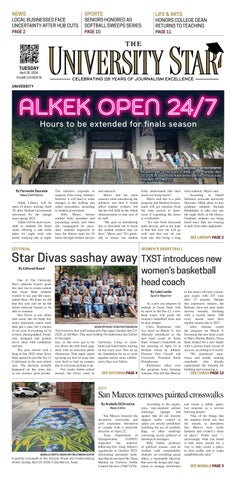
Alkek Library will be open 24 hours, starting April 29, after Student Government advocated for the change since spring 2025.
Alkek will be more accessible to students for finals week, offering a safe study place for night owls who prefer studying late at night.
The initiative responds to requests from many students, however it will lead to some changes in the staffing and safety procedures, according to student government.
Abby Myers, former student body president and psychology senior, said when she campaigned for president, students requested to have the library open for 24 hours through student surveys
and outreach.
Myers said her main concern when introducing the initiative was how it would affect student workers, but she has full faith in the Alkek administration to take care of its staff.
“My goal in introducing this is obviously not to harm the student workers that we have,” Myers said. “It’s generally to ensure our student
One of The University Star’s editorial board’s goals this year was to create content that Texas State students wanted to see and felt represented them. We hope we did that this year and set up the future editorial boards to be able to continue.
Star Divas is our editor chat name, but we think this name represents much more than just a chat, but a mantra of our year. Everything we’ve written, photographed, broadcast, designed and posted, we’ve done with confidence and tact.

body understands that their needs are being heard.” Myers said this is a pilot program and Student Government will get statistics from the time period to determine if expanding the hours is worthwhile.
“It’s also been discussed quite heavily, and so my hope is that this trial run will go well, and that way we can look into this being a long
term solution” Myers said. According to Darell Schmick, associate university librarian, Alkek plans to hire graduate students through Handshake to take over any the night shifts at the library. Graduate students are being hired since they are wanting to pull from older applicants.
By Luke Landa Sports Reporter
As a new era prepares to embark at Texas State with its move to the Pac-12, a new head coach will guide the women’s basketball team into its next chapter.
as the team’s all-time winningest coach with 225 wins after 15 seasons. Despite this impressive statistic, the Bobcats, have not seen much success recently, finishing with a record below .500 every season since their regular season title in 2023.
The year started with a bang in July 2025, when Texas State agreed to join the Pac-12 Conference in the next school year. The decision actually happened on the same day as our summer print production, so the news got to be our above-the-fold front page story with an awesome photo illustration. That paper ended up being our first of many that were hard to find on campus due to everyone picking it up.
University Camp to teambuild and bond before starting on the crazy year. This set up the foundation for us to work together and be more collaborative than ever before.
Two weeks before school started, the Divas went to

Chris Kielsmeier, who was hired on March 31, was officially introduced as the new head coach of Texas State women’s basketball on the morning of April 24 at Strahan Arena by Athletic Director Don Coryell and University President Kelly Damphousse.
Kielsmeier takes over the program from Zenarae Antoine, who left San Marcos
After Antoine exited the program on March 9, becoming the new head coach at Mary-Hardin Baylor, Texas State looked for a new leader with a proven track record of success, according to Coryell.
“We prioritized experience and results, seeking somebody who already understands the formula for building and sustaining a
PAGE 10
By Arabella DiChristina News Editor
San Marcos removed the decorative crosswalks and curb extensions downtown to comply with a statewide directive on April 22.
Texas Department of Transportation (TxDOT) requested the removal, following Gov. Greg Abbott’s regulations in October 2025, eliminating pavement markings that do not meet the Texas Manual on Uniform Traffic Control Devices (TMUTCD).
According to the regulations, non-standard surface markings, signage and signals that do not directly support traffic control or safety are strictly prohibited, including the use of symbols, flags, or other markings conveying social, political or ideological messages. Billy Fields, professor of political science, said he worked with sustainability students on extending green alleys, a sustainable alleyway that uses the design and vegetation to manage stormwater
and create a public space, last semester as a service learning project.
“One of the things that the students found was that the murals in downtown San Marcos were really fantastic and created a sense of place,” Fields said. “... increasingly what you found is that street murals are a way to help create a place, to slow traffic and to make neighborhoods safer.”
By Charlsie Daniels News Reporter
San Marcos businesses face uncertainty after Texas Comptroller Kelly Hancock stripped Historically Underutilized Business (HUB) certifications from minority and women-owned businesses.
The changes to the HUB program began on Dec. 2, 2025, when a decision by the Texas Comptroller’s Office to remove HUB certifications from women and minority owned businesses took place statewide. This was decided to align with Gov. Greg Abbott’s ban on Diversity, Equity and Inclusion initiatives (DEI).
Hancock stated in a Feb. 26 press release that the Comptroller’s Office used emergency powers to act, arguing the HUB program was in favor of diversity, equity and inclusion (DEI) initiatives over merit based contracting.
The change eliminated eligibility for a program designed to expand state contracting opportunities for disadvantaged businesses. In San Marcos, there are 16 HUB certified businesses affected by ongoing changes.
“Texas has ended DEI-based preferences in state contracting and replaced them with a program that is fair, focused and constitutional,” Hancock stated in the Feb. 26 press release. “We eliminated race and sex-based classifications, reduced layers of bureaucracy and placed responsibility for certification within one accountable office. Most importantly, we made service-disabled veterans the focus of this program.”
The HUB program was signed into Texas law in 1999 to address discrimination in state procurement by increasing business opportunities for women, minorities and service-disabled veterans determined by the Veterans Affairs to have a service-connected injury or medical condition that limits their ability to function in daily life.
According to the Office of the Attorney General, state agencies are not required to contract HUB certified businesses, but must determine if subcontracting opportunities exist and require bidders to submit a HUB Subcontracting Plan
FROM FRONT LIBRARY
“The position on Handshake is for graduate students, and the hours that are advertised [are] from 1 a.m. to 7:30 a.m.,” Schmick said.
Once the graduate student hours conclude after 7:30 a.m., regular staffing is expected to resume. Undergraduate student workers hours aren’t expected to change at all. During the 24-hour access, all floors of Alkek will be available to students. Services such as checking out books will also be available using the selfcheckout machines.
“We have self-checkout machines, and then one is also available at the entrance of the second floor, the main entrance ... So students can check out books using self checkout machines during that time,” Schmick said.
The self-checkout machines will require students to scan their Texas State ID, as well as the book they plan to borrow and then follow the instructions on the screen. Starting at 11 p.m., students are required to scan in to the building at the front doors on the second floor with their student ID to ensure only Texas State students enter.
According to Cat Hoyt, alternative program coordinator for UPD, Alkek will be fully staffed with security presence, extending their hours to around-the-clock access to ensure the safety of students during the late hours.
“We will have staffing in the

History: The University

when the contract is expected to exceed more than $100,000.
The Comptroller’s Office rebranded the program to VetHUB, and changed the program guidelines so that only veterans disabled with at least 20% or higher to be eligible for the program.
Cheryl Halla, owner of San Marcos Interpreting, LLC, said she first learned about the removal of her HUB certification while attempting to renew it online.
“I didn’t even get an email that I was decertified,” Halla said. “I went online to renew my certificate because it was that time of year, and next thing I know I’m getting messages that I no longer qualify for the program.”
Halla’s company provides sign language interpreting services across Central Texas. She said the sudden change left her unsure on how the decision would affect competition for contracts.
The sign language interpreting industry is very niche and mostly includes women and minority owned firms, according to Halla.
library 24/7. It will be comprised of public safety officers, student public safety officers, and even police officers,” Hoyt said.
Student public safety officers are student employees trained by UPD to increase security on campus.
Bobcat Safe Rides will also be extending its hours to address the 24-hour access to Alkek. Bobcat Safe Rides will transition to strictly on-campus locations and Alkek only and will be operating Mondays to Wednesdays from 2 a.m. to 7 a.m., Thursdays to Saturdays from 3 a.m. to 7 a.m. and Sundays from midnight to 7 a.m.
Veronika Holmes, a desk assistant at The STUDY at Alkek, the tutoring component of SLAC and sociology sophomore, started working at Alkek last year.
Holmes said she enjoys working there because her schedule is lenient and not stressful to her schoolwork and The STUDY will not be open during late hours and her schedule is not expected to change during the 24 hour time period.
“I feel like my day-to-day is pretty chill as a student worker, I like my position ... it’s a lot of social interaction with people,” Holmes said.
Jerry Rodriguez, microbiology junior, avidly uses the library and is excited about the extended hours Alkek hours.
“I study better at night ... I feel
Editorial Staff
Editor-in-Chief: Blake Leschber stareditor@txstate.edu
Managing Editor: Rhian Davis starmanagingeditor@txstate.edu
News Editor: Arabella DiChristina starnews@txstate.edu
and
distributed on campus and throughout San Marcos at 8 a.m. on publication days with a distribution of 3,000. Printing is by the New Braunfels Herald-Zeitung.

Check
Life & Arts Editor: Carlene Ottah starlifeandarts@txstate.edu
Halla said she believes contracts should be awarded based on quality and experience, but she’s concerned that removing HUB certifications could put some businesses at a disadvantage when competing with larger firms.
“I would certainly hope that someone looking for a contract doesn’t discount my experience and tenure just because I’m a woman owned or previous HUB pesticide business,” Halla said.
Travis County district judge Amy Meachum temporarily reinstated HUB program rules and restored eligibility for previously certified businesses on March 2, 2026, but the uncertainty surrounding the program’s future remains.
Suzanne Holman, owner of SSSULIVAN PUBLICATIONS , focuses on graphic design with an eye for readability and accessibility. The company specializes in forms, documents, reports, infographic design and web/social media graphics. Holman said the uncertainty surrounding the decision has created challenges for business owners trying to plan for the future.
“The uncertainty is definitely an issue, especially for businesses that have built their models around access to state contracts,” Holman wrote in an email to The Star. “Since I haven’t yet started building my client base, I’m much less affected and can still easily revise my business plan.”
Holman said the decision to change the HUB program reflects broader political dynamics in Texas, calling the change an example of state leaders bypassing the legislative process.
“This is an example of leaders so confident in their power that they’re willing to make sweeping changes by decree when they can’t get them through legislature,” Holman said.
Businesses in Houston, Sugarland and Burleson have filed lawsuit against the Comptroller’s Office, arguing that the agency acted without holding a public hearing or consulting state lawmakers before making sweeping changes to a long-standing law, according to a San Antonio Hispanic Chamber of Commerce press release from April 14.
Nov. 9, 2026 is the final trial date Judge Meachum set to determine the legality of the Comptroller’s Office changes to the HUB program.
like those late hours would be really useful,” Rodriguez said. According to Rodriguez the requirement to scan student IDs eliminates any safety concerns he has and feels like it provides adequate safety measures.
The library will return to regular hours on May 13. Alkek’s summer hours are Mondays to Thursdays 7:30 a.m. to 11 p.m., Fridays 7:30 a.m. to 6 p.m. and Saturdays to Sundays from noon to 6 p.m.
Alkek open 24 hours a day April 29 to May 13.

Starting at 11 p.m., students will be required to badge in at the second floor doors to enter the building.
Alkek is hiring graduate students to work from 1 to 7:30 a.m.
The library will return to normal hours after May 13.
Multimedia Editor: Meg Boles starmultimedia@txstate.edu
Engagement Editor: Tatum Pou starengagement@txstate.edu
PIR Director: Keely Florez starpr@txstate.edu
Web Editor: Alejandra Sosa-Lopez starweb@txstate.edu
Publication Info
Copyright: Copyright Tuesday, April 28, 2026. All copy, photographs and graphics appearing in The University Star are the exclusive property of The University Star and may not be reproduced without the expressed written consent of the editor-in-chief.


Opinions Editor: Andrew Bencivengo staropinion@txstate.edu
Design Editor: Carson Rodgers stardesign@txstate.edu
Sports Editor: Adrian Ramirez starsports@txstate.edu
Creative Service Director: Sophia Gerke starcreative@txstate.edu
TV News Director: Maci Gambrell startvnews@txstate.edu
Director: Laura Krantz, laurakrantz@txstate.edu
Corrections Policy: Errors appearing in the pages of The University Star and brought to our attention will be corrected as soon as possible.
Contact at: 512-245-3487 advertising@universitystar.com
By Jakob Salsgiver News Reporter
Texas State will lead the Texas State University System (TSUS) West Texas region of the Texas Rural Hospital Officer’s Academy, a new statewide effort to improve the finances and operations of rural hospitals.
Established by House Bill 18 in 2025, the Texas Rural Hospital Officer’s Academy is a program to assist with professional development and education coursework to leaders in rural hospitals, counties with a population of 68,750 or less or hospitals deemed as “critical access,” which are rural hospitals that have 25 or less acute care inpatient beds. The bill states the academy will contact two to four higher education institutions to provide a minimum of 100 hours of coursework.
Scheduled for approval by March 2027, the academy has delegates in each of the four academic regions in Texas. Melinda Villagran, executive director of Texas State’s Translational Health Center, will be the delegate for the TSUS region.
“We have to create a program that gets approved by the state to support the development, refinement and delivery of programs to improve the financial stability of rural hospitals and rural healthcare systems in Texas,” Villagran said.
Training will include topics such as statewide regulation, programs to assist finances and certain business administration tactics such as maximizing revenue, according to Texas Health and Human Services (THRC).
Villagran said the academy will utilize student workers to gather information about educational needs for training. In addition, students
The city requested an exception request to TxDOT for the downtown painted crosswalk and curb extensions in November 2025, however, TxDOT denied the request in April. Failure to comply would result in state or federal funding that supports local projects to be pulled, or agreements between TxDOT and the City be suspended.
The San Antonio Street locations were painted as part of Stelos’ Paint the Path project in May 2025, which partnered with the City, students and the community painting an armadillo named “Dilly,” bluebonnets and bees, one named “Bumbledoor,” turtles named “Claudius” Crush” and “Cutie,” a monarch butterfly, fountain darters and dragonflies.
Four locations were subject to removal: Curb Extensions at CM Allen Parkway between Hopkins Street and University Drive, Curb Extensions at San Antonio Street at Comanche Street, Painted Crosswalk at San Antonio Street at Feltner Alley and Painted Crosswalk at San Antonio Street at Fredericksburg Street.
Madi Roberts, geography urban and regional planning junior, was in the Paint the Path project that helped design the murals and painting. She said there were six murals, four being crosswalks and two bulb out, widened sidewalks, with Michelle Wilson, a local artist designing all of them.
Roberts said she’s upset about the removal because it won awards for the best downtown partner and while she was painting the murals, people would walk by and tell them how amazing it was.
“Obviously the first feeling is it’s really upsetting and defeating because it feels so out of our control,” Roberts said. “Like on every level, because the community was for this. They were happy about it [and] they appreciated it.”
Roberts said it’s been proven in multiple studies that street can make traffic calmer and the street safer for pedestrians and cyclists.
In an attempt to figure out how to
will be involved in the planning of the academy after the curriculum is approved.
According to Villagran, the program intends to use students in classes that focus on survey data, AI and computer science, as well as hiring students who are enrolled in classes that focus on information delivery to help promote the program.
Students will be hired to assist with the program through THRC’s Student Scholars program.
Villagran said students are the future healthcare leaders, wellpositioned to help deliver the program and enrolled in courses that focus on the delivery of information. The Rural Hospital Officers Academy would not just be for nursing students, but those across different majors.
Christian Lieneck, director of the school of health administration, said rural hospitals are the most hit financially. Lieneck said the healthcare system is based on volume, meaning more patients translates to more billing and more revenue.
“There’s less people that live out there, and so [rural hospitals] don’t have a lot of patients coming through their doors that they can bill out for, whether it’s private insurance, Medicare, Medicaid, they just don’t see that kind of volume,” Lieneck said.
According to Lieneck, due to these lower volumes and billing issues, hospitals either break even or lose money on average.
Lieneck said that in his opinion, what is occurring between federal and state policy regarding rural hospitals is good. He said it created a redesign of the rural hospital system rather than preserving the current system.
“Texas is coming out saying ‘A: We’re going to stabilize [rural hospitals] financially, and cover the losses, fix the problem, and B:
prevent the removal, Roberts said she called Rep. Erin Zwiener (D-Driftwood) four times, but the removal happened too quickly to act on.
“It just means so much that collaboration is really at the heart of the project and it’s what brings so many people joy,” Roberts said.
Fields said the student project found that the street murals were a real asset to the city and might be something to think about extending.
“Maybe there’s an opportunity to rethink the murals and add actual green infrastructure, but the green infrastructure’s more expensive and the murals just kind of told that story in a nice, straightforward and easy way,” Fields said.
According to Fields, the small curb bulb-outs on CM Allen Parkway were done as part of a green infrastructure project, and told a story about water and streets that was really valuable to him. The mural sat in front of a water runoff area, where water would be filtered out pollutants through the rocks.
Fields said the murals were moments of joy for him, and taking them away feels like something society shouldn’t be doing.
“Taking them away is resulting from maybe not as deep a look at the literature as it is out there. The literature shows that these are safe and effective,” Fields said. “The ruling seems to not look at that literature in a direct way.”
William Moore, geography urban and regional planning senior, was part of the Paint the Path project and said it was his idea for the fountain darter mural.
“It was really disappointing [seeing them removed]. Both for me and I also felt really upset for the artist, and I also feel like it’s kind of indicative of something larger happening where our government isn’t really focused on the issues that everyday people face,” Moore said.
Moore said the removal is also disheartening, that it’s as if the people in San Marcos aren’t really

we’re not just going to band-aid it by throwing money at [rural hospitals], we’re going to service redesign, so we’re not going to try and preserve the rural hospital exactly the way it is, they’re going to need to change,’” Lieneck said. “And that’s where a lot of this education is coming in, along with the grant, what Melinda Villagran is doing, and other things.”
Cale Nedrow, a nursing junior, wrote in an email to The Star, that he thinks the academy is on the right track, but he believes that the bill is too heavily focused on finances.
“I think finances are important, but I am not sure what they are
cared about or listened to as people of Texas.
The city plans on meeting with the people involved in the Paint the
doing to treat some of the underlying problems in rural communities,” Nedrow wrote. “Transit time in an ambulance can be detrimental to if someone lives. Having enhanced training for rural hospitals based on communal needs would improve effectiveness of treatment in [rural] communities.”
While the program has not been completed, Villagran has made steps such as appointing Sul Ross University to serve as the Local Logistics Lead. The academy will be developed in 2026 and approved along with the other three Texas academies in 2027.
Path project to discuss alternative expressive outlets that may be available.


April 28, 2026
Andrew Bencivengo
Opinions in The University Star are not necessarily those of our entire publication, Texas State University’s administration, Board of Regents, School of Journalism and Mass Communication or Student Publications Board.
By
Cancer affects many people, not only in our community but also worldwide. Therefore, joining the fight against cancer and raising awareness, especially during Cancer Prevention and Early Detection Month, is beneficial not only for those currently battling cancer, but also for advocacy efforts that remind the San Marcos community and beyond of the importance of routine cancer screenings.
Bobcats Against Cancer, also known as BAC, was established earlier this year. The group focuses on building a community that actively hosts awareness events, volunteer opportunities and fundraisers for cancer advocacy. The organization seeks to support cancerrelated causes, promote awareness and prevention and build a community dedicated to making a positive impact on local health care within the campus and community. BAC also actively collaborates with other student organizations, local businesses, local government and Greek life to spread cancer awareness and
FRONT EDITORIAL
support advocacy efforts.
Having a space where those affected by cancer, cancer survivors and cancer researchers feel supported is greatly beneficial, as it connects the San Marcos community and Texas State students, faculty and staff. When students are given the tools to advocate for cancer awareness, the community comes together to fight cancer. It promotes cancer research to be able to combat it better.
BAC hosts a variety of events that underscore the importance of cancer advocacy and access to resources. Some events focus on community support by volunteering across various community organizations, especially those related to cancer. Students learn about the importance of servicelearning through activities that raise awareness about cancer, enrich their communication, presentation and advocacy skills and champion a larger cause. For those pursuing careers in medical fields, access to this kind of guidance on cancer advocacy can help students better understand it and feel more confident in their professional path. Additionally, connecting

with other students, faculty and staff who have been affected by cancer provides a sense of community and belonging, allowing you to connect with others who have similar experiences.
As one of the only cancerfocused organizations on campus, BAC often organizes activities focused on cancer advocacy and community engagement. Whether that is collaborating with other organizations, such as the
Knitting and Crochet club to make beanies for cancer patients, or organizing donation drives for off-campus centers, BAC encourages students to stay involved in our San Marcos community. These activities highlight cancer patients and survivors by highlighting their stories and the impact that cancer has had on their lives. Supporting the cause against cancer is about advocating for cancer
patients, survivors and loved ones who have been deeply affected. Organizations like BAC provide one example of how one can make a large impact on a cause in an academic setting. Their work shows that everyone can join the fight against cancer and make a large impact on someone’s life.

We started with a 16-page paper, our longest paper of the year. Usually, the Back-to-School Issue goes all night, sometimes until 1 or 2 a.m., but we finished this paper by 8 p.m. This was through efficient time management and decisions, a theme that continued for the remainder of the school year.
Just a few weeks later, our biggest saga of stories began. Former associate history professor Thomas Alter was fired after speaking at an online socialism convention. It required more than just a simple news brief, but weeks and months of following in-depth coverage.
Not only did it raise concerns of free speech among faculty, but it also brought the university to the national
spotlight. While that put a lot of pressure on us to write hard-hitting and strong pieces, we knew our focus had to be on our community and how our coverage would be useful to them.
Texas State was again at the forefront of free speech conversations when freshman Devion Canty Jr. was forced to withdraw after a video of him “mocking” Charlie Kirk’s death went viral on X. Gov. Greg Abbott reposted the video on X, asking President Kelly Damphousse to expel him from campus. The next day, Canty was gone.
One of our most heart-warming moments came while Black students on campus protested against the racism and threats they faced after the Canty video went viral. At the
protest, members picked up our print paper that week and started reading quotes and information from it about these situations. To us, that proved our words hold power, but also made it clear that our community looks toward us to represent them.
Our coverage within free speech issues didn’t stop there, though. We discussed how faculty felt about the changes, student protests and more.
Another large story we had to cover was the Halloweekend shooting on The Square that left one person dead and two others injured. We were there on scene talking to people and getting all the details. We even saw some of our highest engagement on
The University Star welcomes letters from our readers. Letters must be 300 words or fewer to be considered for publication. Writers must include their full name, mailing address, major and academic year designation (for students), phone number and e-mail address when submitting a letter. Submissions that do not include this information cannot be published. This information is seen only by the editors and is used to verify the identify of the letter writer. It is not used for any commercial purpose.
our coverage. Our community cared, so we kept pushing and reporting.
All of these stories taught us so much, not about just journalism, but about the community around us and what really matters to them.
This year may be over and some of us may be leaving, but our mission still stays the same: We are here for you and the community as a whole. Thank you to everyone who interacts with us and holds us accountable when we slip up.
We will continue to uphold the first amendment, and we hope to see you keep reading.
Letters become the property of The Star and may be republished in any format. The letter may be edited for length and clarity. An editor will contact the letter writer if their letter is a candidate for publication. The Star will not run letters that are potentially libelous, discriminatory, obscene, threatening or promotional in nature.
Letters can be submitted to staropinion@txstate.edu or by mail to Attn: Opinion Editor, The University Star, 601 University Drive, San Marcos, TX, 78666.


By Caroline Trang Star Illustrator
I’ll be honest, I never thought I would have the chance to illustrate for The University Star!
I have always and will always appreciate the arts; however, as I have gotten older, I have felt myself distancing from drawing in my free time. I’ve taken art classes and did my best filling out sketchbooks, but after getting into community college, I felt I had to focus on academics to transfer out.
Once I joined Texas State’s Communication Design program at the School of Art and Design, the kind of art I was making was mostly digital work that felt disconnected from my usual style. Nothing against making logos and cool typographic books, but it didn’t scratch my drawing satisfaction. After joining the team
as an illustrator, I felt reconnected with making and drawing art! Having to create an illustration in a week’s time gave me no room to procrastinate; I was motivated to get it done!
Although I’ll be focusing my career on working more on web design, specifically user interface/user experience (UI/UX), I’m grateful to have gained the experience of working alongside a publication team. I loved completing the visual requests and giving them life, even when I had to crunch for my portfolio!
I am so glad that I have been given the opportunity to work as an illustrator for The University Star! My time here may have been short, but much appreciated; I’ve really enjoyed working alongside Jen Nguyen, Sophia Gerke and Carson Rodgers.

By Jack Lysaght Sports Reporter
American poet Walt Whitman once wrote, “Be curious, not judgmental.” This year, I’ve come to learn that this idea is the heart and soul of journalism.
My name is Jack Lysaght, I’m a sports reporter for The University Star, and I’m about to become a 37-year-old college graduate on May 16.
My college journey has been anything but typical. I graduated from high school in 2007, possibly before some of you dear readers were born. I failed out of not one but two colleges, then found myself working as many jobs as I could that didn’t require a degree.
Somewhere along the way, I let my failures fester into fear of trying again at an education. My journey allowed me to end up in Waco around the end of 2020, where my future wife and I met. She promised me that we would figure out a way to finish what I started more than a decade prior.
Now, I invite you all at this point to take Whitman’s wisdom to heart. You could judge my story and draw any conclusions you want. Or you could look at my story through the lens of curiosity.
What I’ve learned is that curiosity leads you to ask questions, to learn, to listen. Curiosity would reveal to you that I was diagnosed with severe

ADHD and Dyscalculia at age 33, adding not excuses but context to past failures in school. It would tell you that my marriage that same year provided the first stable, healthy learning environment in my life.
Curiosity would also tell you
that while chasing down this degree, I would maintain a daily, 4-hour commute from Round Rock, I’d lose one aunt to ovarian cancer, then care for my mother, who contracted breast cancer and lymphoma last semester.
As reporters, journalists and
By Jack Van Arsdale PR Specialist
I’m not a journalist.
I have never considered myself a journalist. Not in the sense that I am one but choose not to describe myself that way. I simply am not a journalist. If you had told me years ago that I would join the newspaper, I wouldn’t have believed you.
To be honest, I was recruited as a broadcast anchor after a friend commented on The University Star’s Instagram, asking when I was going to become one. The social media team reached out, and before I knew it, I was anchoring the broadcast team.
I enjoyed every moment in the TV studio. Being on camera and working behind the scenes were the aspects that excited me. It was the actual journalism that I never fully engaged with. After realizing it wasn’t the right fit, I transitioned into the Public Relations section, where I was assigned to create a promotional video.
Through that process, I attended many Star events and gained an in-depth look at how passionate the students behind this
organization truly are. From my fly-on-thewall perspective, I saw how thorough and well-informed the editors and reporters are, and how seriously they take their work.
Although I am not a journalist and have little desire to become one, I have a great deal of respect for those who are committed to it. Freedom of speech is a fundamental right, and here at The University Star students are actively working to protect it.
As the university continues to grow, I hope to see more students get involved with The Star. Even those with little interest in journalism. There is a place for everyone here.
editors, we have a choice. We can choose to listen to our preconceived notions and judge what we don’t understand. Or we can get to work and get curious. We can ask questions, whether convenient or inconvenient. We can learn to apologize rather than ask for permission. We can reach out to people and listen to them; hear their journey and make the burdens they carry visible. Or readable, as it were. We can let the thirst for truth lead us to where it will, not what comforts our own opinions or feelings.
Big thanks go to Laura Krantz, whose news writing and reporting class ignited my long-forgotten love of truth-seeking, fact-checking, and sharing what we learn. Getting hired here wasn’t a guarantee for a non-traditional student, so a special thanks to Adrian Ramirez for taking a chance on me and helping me grow as a writer and reporter.
Thanks to Crystal Creek, Cash Arenas, Juan Pereira Casanoba and all the members of the Sports Desk for some of my best memories at Texas State, especially at our Friday staff meetings. Also, thanks to Jonathan Adame, Maddy Stancios and Mia Ocanas, my fellow “star” classmates.
Lastly, to my beautiful bride, Laura Lysaght, who has been my cornerstone and strongest supporter in my Texas State career. You’re my real “MVP.”

It
By Linae Lewter Life & Arts Reporter
“Sometimes I’ll start a sentence and I don’t even know where it’s going. I just hope I find it along the way.” - Michael Scott, The Office
My time with The University Star was more rewarding than I could have imagined. When I joined the Life & Arts section in fall 2025, I knew I could put my creative writing skills to good use. What I didn’t anticipate was what this experience would grant me.
I’ve been a hairstylist for 12 years, which has its perks, but one of them is not professional decorum. Hairstylists are a rowdy, fickle bunch, and our mouths get ahead of our thoughts constantly. Communicating with clients is always about what’s next, tell them a story, keep them entertained, make them like you, how can I provide, be energetic, be happy, be present but don’t mess up, just keep going, just keep going. Expending all that energy every day made my active listening skills abysmal over the years.
As a feature writer, I had to slow down and listen. A good story can’t be found through press releases and website home pages — you have to

talk to people. And I love talking, but I learned this year that I have a habit of trying too hard to please in
Joining late, but leaving grateful
By Alex Rippy Broadcast Reporter
Throughout my four years at Texas State University, a core theme of my time here was the search for belonging. I am so thankful for the friends that I have made here, and for the wisdom that I will cherish from some of the best teachers that I have gotten to work with. However, it took me until my very last semester here to truly find a community in The University Star
Even though the next journey in my life was about to start, I was welcomed with open arms and new challenges. The transition was not easy, but I would not have acquired new skills and lifelong memories without being pushed out of my comfort zone and I will always be thankful for my peers in the broadcasting branch for allowing me to grow and learn alongside them.
I will always remember the very first package that my director, Maci Gambrell, had assigned to me. We were in our meeting room and she said that she needed someone to take up a story about the honey bee population here in San Marcos. Still being a little new to the branch, I was not very quick to volunteer myself. In fact, I remember
a conversation. That doesn’t really work for interviewing sources. I came to understand that
feeling tremendous anxiety in knowing that this story was almost certainly going to be my responsibility. However, Maci must have seen something in me that I did not. The confidence and excitement on her face while she assigned it to me was contagious. This one push has given me more confidence in myself and my abilities than three and a half years at this university.
Truth be told, the world of journalism and broadcasting was not something that I foresaw myself being a part of until very recently. However, there is nothing that I would change about my journey to get here. And for my search for belonging, I found it in The University Star, but I also found something just as valuable: confidence.
Now, after spending a semester with these amazing people, my only regret in joining The Star was that I did not join it sooner.

when someone has something they want to talk to you about, it’s sometimes enough to simply lend an ear. Only after I implemented that did I get the best interviews, the most honest responses, the most rewarding conversations. That’s straightforward enough on paper, but in action, it took a little practice. And since practice makes perfect, I’m happy to pull this new skill out going forward in all conversations, not just for interviews.
Before pursuing a minor in journalism, I only ever put my English degree to use through essays and fiction, never creative nonfiction. I found a lot of similarities between the skills necessary for non-fiction and the kind I want to do, penning and publishing novels. I am not certain I will continue with feature writing or journalism, but I’ve seen and cherished the value of it. I can say I did it and be proud. This experience put me in a place to really grow. I’m thankful to Jessica James for inspiring me to apply for The University Star, to Carlene Ottah for being super patient with me and a for being great editor and to Laura Krantz for pushing me in my last semester.
Catch you on the flippity-flip.

By Sydney Stribling PR Specialist
When I think about my time at The University Star, it’s hard to believe I’ve only been part of it for about a year. In so many ways, it feels like I’ve been here all four.
From the moment I joined, I found more than just a place to grow professionally. I found a family. Being part of the public relations section has been one of the most meaningful parts of my college experience. The people I’ve worked with have supported me, challenged me and helped me become more confident in myself and my abilities.
Before this experience, I wasn’t entirely sure what I wanted to do after college. Being part of The Star helped me find that clarity. It showed me how much I love drafting emails, planning social media content, creating
graphics and being part of our weekly meetings.
I’m so grateful for the past year and everything it has given me. Even though my time here felt short, the impact it has on me will last much longer. To my PR family, I will miss every single one of you more than I can put into words. Rhian
By Blake Leschber Editor-in-Chief
When I stepped onto campus in fall 2022, I was a timid and lost young adult just trying to find my place.
If you had told 18-year-old me that I was going to be leading a whole media organization and write over 100 bylines, he would have looked at you like you were crazy. However, that’s exactly what I ended up doing, and I wouldn’t ask for my college experience to be anything different.
I joined The University Star in September 2022 because I had no friends and honestly needed something to do. I hesitated to join until I visited the student organization fair and saw who would soon be my future editor: Nichaela Shaheen. She talked with such charm and excitement that I applied immediately after.
I applied for every writing position that existed, not being able to decide what exactly I wanted to do. Quickly, I got an email from Shaheen asking to do an interview. Just a week later, I was hired and getting trained to be a reporter.
When she told me I had to interview at least three sources for every story, I almost quit on the spot. I wanted to write, but I was way too socially anxious to actually talk to people, especially strangers and those in powerful positions. However, a voice inside me told me to stay, and I knew quitting couldn’t be an option.
So, I stayed, and I started by writing a story on the dining halls’ response to the increased student population. I talked with students, dining hall workers and even one of the leaders of dining on campus. That story made the front page, and I got to see my name in print for the first time. That made me hungry for more and more.
I continued to write, and when Shaheen asked me to be her assistant,

I was terrified, but I knew I needed to do it. That position allowed me to take over as news editor in May 2023.
As news editor, I gained experience in talking to strangers and leading a team of students who were mostly older than me. It was a tough but fun role I got to serve in, but once again, I was hungry for more.
When Marisa Nuñez approached me to be her managing editor, I said yes immediately. I actually wanted to be editor-in-chief at that time, but I settled for managing. That ended up being the best decision for my career.
Under her wing, I learned so much about how to lead and methodically make decisions.
That leads me to this school year, where I took the grueling role of Editor-in-Chief. I knew it was going to be tough, but everything I had done up to that point led to EIC, and I knew I needed it.
This year was for sure my toughest, not just with having an elevated role but also having the most complex coverage we’ve done in my time. I couldn’t have done it, however, without my right-hand woman, Rhian Davis, who has stuck with me
at The Star for all four years. Through thick and thin, and complex stories, I have now made it out in one piece. I had moments of regret, hardship and sadness. I had times where I wanted to give up and leave, but that voice would always tell me to stay. Now, I do not regret it at all. If I were transported back to freshman year, I would still choose this organization to be my college experience.
This was my home for four years. While I don’t even know where I’m going to be in a month, I will look back on this with fondness and continue to keep up with this place after (make me proud, new e-board).
To Nichaela and Marisa, thank you for giving me the chance to grow in The Star and thrive. Without y’all, I would not be where I am today.
Rhian, thank you for being with me this year. I couldn’t have asked for a better person to navigate this crazy year with.
I couldn’t write this without talking about Krantz. Thank you so much for not just being my director but my support system and even a parental figure at times. I appreciate you allowing me to cry in your office and telling me to go home and take a break. I needed that so much, especially this year. I will miss you and our weekly meetings.
To my family, thanks for always supporting me and hearing my crazy stories. Thank you for telling me to stay even when I didn’t want to.
If any student reading this wonders if they have a place in journalism or elsewhere, you do, and stepping out of your comfort zone can sometimes open doors that you wouldn’t expect.
I never thought I would be here, but now, I can’t imagine my life if I weren’t. Thank you, University Star, for being the best four years of my life.
By Rhian Davis Managing Editor
I remember exactly where I was when I applied to the opinion section of The University Star
It was the weekend of my 18th birthday party, and I was sitting on my grandma’s couch with my finger hovering over the “submit application” button. My family and friends were right next to me, begging me to just press it already.
A few months later, I walked into my interview with a resume and samples of my high school work in hand. I got a funny look from the opinion editor, because apparently, that wasn’t common practice.
My interview lasted nine minutes, and I got an offer email almost as soon as I walked out the door. I immediately started crying.
I was a timid 18-year-old who struggled to step out of her comfort zone. I didn’t know if I would be able to find my place at Texas State, or if I would make the lasting college friendships you always hear so much about.
The Star gave me all of that and more.
I spent one semester as an opinion columnist before being promoted to assistant opinion editor. Once my ed-
itor graduated at the end of my freshman year, I officially held the title of opinion editor (I had my own desk and everything!)
I never considered being an editor, especially not that fast. I wanted to focus on my classes and maybe write a column here and there. When I look back now, I wouldn’t have it any other way.
After two years of being the opinion editor, I needed a change. For a while, I thought the best decision would be to quit – I felt like I had served my time. However, I knew deep down that I wasn’t ready to leave The Star
When Blake Leschber, one of my best friends and the one person who has been by my side through it all, was announced as editor-in-chief for the 2025-26 school year, I approached him about becoming his managing editor. He must have seen a glimmer in my eye because here we are, one year later. The end of our reign as Editor-in-Chief and managing. Working on The Star’s editorial board taught me so much about myself, and I was presented with opportunities I wouldn’t have had otherwise. Now, I’ve written stories for every section, photographed a few events, won some awards and made memories I’ll
never forget with people I really love.
I wouldn’t be half the woman I am today without The University Star I was a small part of four editorial boards, but I can confidently say this year’s was my absolute favorite. To my Star Divas, you are all incredible, and I am simply in awe of you every single day. You have put in an unimaginable amount of work this year, and I was so proud to see the true impact you had on this campus.
To Blake, thanks for having faith in me to work as your managing editor. I am so grateful for the year we’ve had. I can’t wait to watch you dominate the news industry. To Krantz, thank you for believing in me even when I didn’t believe in myself. I don’t think I would’ve survived my time at The Star without your encouragement.
To my family and very best friends, I love you guys so much. Thank you for listening to many rants about stories, interviews and newsroom lore. Thank you for supporting me in every decision, big or small. Thank you for loving me as much as you do.
The Star was my home for four years. I’m not sure what my life is going to look like outside of the hallowed

By Adrian Ramirez Sports Editor
150+ sports stories to my name and here it is, the final one. So let’s get into it.
Sometime before what was supposed to be my junior year, I elected to change my major from exercise & sports science to journalism. Truth be told, I probably couldn’t tell you exactly why either.
All I knew about journalism was that it might give me a chance to talk about sports. But I was fully uncertain of how I was going to make it happen.
One night out, a good friend of mine mentioned that he joined The Star and that I should look into it. So, James, I feel thanks are in order for the suggestion.
That night, a new idea was born. Shortly after, I applied to the sports section. Zero hesitation, zero expectations, just a kid trying to figure out the correct path to take.
I don’t remember much about my interview, but I do remember that I was hired on the spot. Just like that, my foot was in the door.
I got straight to work, writing recap after recap and story after story. Eventually, it came time to apply for an editor position.
I was passed over. Twice. And I won’t lie, it sucked.
The second time I was passed over, I seriously considered quitting, because after 100 stories, I felt there
was nothing left for me. I’d done everything I needed to with the reporter title.
But, a voice said, “stay.” So I listened.
Now, here’s where my “victory lap” comes into play. Somewhere in my college career, I fell behind on credits, meaning it was going to take me a fifth year to get the job done. I wasn’t happy about it; I felt like I was lagging behind.
But, lo and behold, as my fifth and final year approached, I had the opportunity to apply for editor again, something that wasn’t supposed to happen. But, by a fateful coincidence, did.
On my third attempt, I was hired. It finally felt like I was where I was supposed to be. If it wasn’t for my fifth year, I never would’ve become sports editor.
On this victory lap of mine, I’ve learned that I truly love sports journalism and that it was silly of me to ever consider giving it up. I’ve made new friends, built a community that I was missing for so long as a commuter student and fully immersed myself in what I believe I want to do for the rest of my life.
To Ayden, I’m certain that you are going to do great things as the next sports editor. Thank you for your hard work as my assistant. Always remain confident in your ability to lead the section.
To Belle, words cannot describe how fortunate I am to have found you
By Carlene Ottah Life and Arts Editor
I could not imagine the journey my younger self would take when I first settled into San Marcos almost five years ago.
Coming from Mesquite to San Marcos, I had never toured campus or knew what it looked like outside of online images and orientation modules. It was my first time being so far from my family and for a few years. I was mainly interested in visual effects but chose to pursue electronic media on a gamble, opening my path to journalism.
I joined The University Star in fall 2022, with the goal of getting personal and professional experience and wanting to make a difference in my life and those I could reach in the future. In terms of prior experience, I had only worked on my high school’s broadcast news team. Despite this, Marisa Nuñez, the Life and Arts Editor at the time, hired me.
Seeing my story printed for the first time and on the front page, I knew I had to improve from that point on. Being a journalist introduced me to San Marcos through its community and culture, covering events, people, clubs, fine arts and more. I also got more familiar with photography, having joined Multimedia and occasionally taking photos for stories I wrote. I saw every story come together each time I worked.
I planned to end my Texas State journey with my bachelor’s but would continue with my master’s, opening the door to become Life and Arts Editor when Nuñez became the editor-in-chief. I was not sure about taking on that responsibility, but after asking around, I decided to apply and got the position. It was expectedly and unexpectedly different from what I was used to, however I enjoyed

at this point in my life. I will forever be grateful to The Star for bringing us together.
To my mom and dad, thank y’all for supporting this journey of mine through college and being my biggest fans during my time with The Star. I would never be where I am without y’all.
To The Star, thanks for giving me some of the coolest experiences of my life so far. From covering bowl games to a weekend spent working at Minute Maid Park, I loved every
second. As I approach the finish line, I’ll leave with this. Everything will work out in God’s timing. I never considered journalism; I never considered it would take me an extra year to get through college. But I ended up in the exact position I was supposed to be; the sports editor at The Star
guiding my section and watching reporters grow.
Every time I trained new people for my section, I started with an icebreaker where we introduced ourselves. This included our names, majors, classifications, a piece of media we recommended and an aspect we liked about either Texas State or San Marcos or both. No matter how much my answers changed, the last one would remain the same: I liked how the people here were so willing to help one another. I saw this time and time again through the connections I made and the people I reencountered. It was always nice to see a familiar name with any new story I worked on.
To Blake Leschber, Rhian Davis and the e-boards I was a part of: you are what made each Monday unique, and I doubt there will be another e-board like these ones. To Cady Clements, who will take over my position, and the Life and Arts section: I know the section will reach new heights, as Clements already has the passion and drive for it. To Laura Krantz and the other advisors and professors I spoke to about journalism: thank you for lending an ear to my many questions and hypotheticals.
As I make final preparations for my classes and then my graduation, I look back at what I could accomplish and what I did not quite get to do. Even writing this means I will have to acknowledge the end of my Texas State journey, but I know I can only move forward from here.


By Ayden Oredson Assistant Sports Editor
In their final homestand as a member of the Sun Belt Conference, the Texas State Bobcats continued their scorching hot month as they completed a sweep against the Coastal Carolina Chanticleers this past weekend at Bobcat Softball Stadium.
Offensive consistency played a key role in the Bobcats (34-18, 14-7 SBC) successful senior weekend alongside dominant pitching starts from both junior Madison Azua and senior Emma Strood. The Chanticleers (22-29, 6-15 SBC) were no match, having dropped their last 10-straight games.
“I think our biggest thing right now is just playing the game one pitch at a time, one game at a time, one inning at a time,” Texas State head coach Ricci Woodard said.
Friday, April 24 W, 5-4

The first game of the weekend series was the closest action between the two squads. Coastal Carolina jumped to an early 2-0 lead in the top of the first.
The Bobcats evened it in the third.
However, the Chanticleers countered with another two-run inning of their own in the fourth.
The Bobcats would not go down without a fight, as senior shortstop Sami Hood delivered a two-out home run to, once again, knot it all up at four a
piece.
The go-ahead run scored the following inning via a passed ball that allowed freshman left fielder Harley Vestal to score. Azua, who started the game, kept them at bay for the remaining three innings as she pitched a complete game that featured nine strikeouts while relenting two earned runs.
Saturday, April 25: W, 5-0

The Bobcats earned their fourth straight weekend series victory thanks to a dominating completegame shutout from Strood, who relinquished just two hits and walks while striking out five to earn her seventh win of the season.
The offense, while a bit quieter than the previous night, still did enough to score runs when it mattered. In the top of the second, Texas State scored two runs off a sacrifice fly from the bat of Hood.
In the fourth, they doubled their lead after senior right fielder Keely Williams forced a bases-loaded walk and a fielder’s choice from senior designated player Karmyn Bass scored another. In the following inning, senior catcher Megan Kelnar added on one final run off an RBI single to cap off the scoring and give Texas State a much-needed win.
Sunday, April 26: W, 6-2
Déjà vu hit as the finale started quite similarly to Friday night’s game, as Coastal Carolina struck first with two runs in the top of the first. The Bobcats cut the deficit in half in the bottom half as Vestal delivered a two-out, RBI single to make it 2-1.
Azua and Chanticleer junior starting pitcher Abby Henderson dueled going into the fourth, as Hood evened the game at two-all with the Bobcats’ second RBI single of the game.
In the bottom of the sixth, senior first basemen Aiyana Coleman delivered her 15th of the season
and final home run in San Marcos with a grand slam that would ultimately seal the deal. Fellow senior Analisa Soliz took over from Azua at the top of the seventh and closed as the seniors successfully finished the job on their home turf for the final time.
What’s next?
Texas State, winners of 12 of their last 15 games, have everything clicking for them as the offense has found a groove, while the best pitching staff in the SBC, posting a conference-leading 2.32 ERA, continues to silence opposing bats.
The Bobcats still have a chance to win the regular season SBC title, albeit a long shot, as they stand two games behind Marshall (36-14, 16-5 SBC) and Louisiana-Monroe (34-19, 16-5 SBC), respectively, at third place entering the final weekend.
Texas State also sits on the verge of returning to the NCAA Tournament possessing an strong resume, with a Rating Percentage Index (RPI) of 30, a formulaic ranking system used by the NCAA Tournament Selection Committee to help determine postseason bids.
As the regular season winds down, the Bobcats hope to keep the momentum strong on the road as they prepare to take on the Appalachian State Mountaineers (28-19, 7-11 SBC) from April 30-May 2, beginning with a 5 p.m. showdown this Thursday at Sywassink/Lloyd Stadium in Boone, N.C. The series will be available to stream on ESPN+.
FROM FRONT COACH
winning program,” Coryell said at the press conference. “That’s all Coach [Kielsmeier] does: he just wins.”
Kielsmeier does have a history of winning. In the collegiate level, he has a career record of 594-196 and has led teams to the postseason 15 times, including NCAA Tournament appearances across the Division I, II and III levels. Most notably, he has a national championship under his belt thanks to an undefeated run with DIII Brownsville, Texas-based Howard Payne in 2008.
Most recently, he coached the DI Cleveland State Vikings of the Horizon League, finishing his time there with a 178-80 record over eight seasons, which included a dominating 77-8 home record, six 20-win seasons and an NCAA Tournament appearance in 2023. He departed from the program after a WNIT Great Eight loss to Arkansas State.
These feats made him a coveted choice among the college basketball landscape over the past several years; still, nothing fit the way Texas State did, especially as the university continues to invest in its athletic programs.
“Texas State is a sleeping giant, this place is different,” Kielsmeier said. “We know what we got here, and we can’t wait to show it.”
Damphousse spoke about the new era the Bobcats will be stepping into as they enter the Pac-12 Conference, a move that called for a leader with a clear vision to steer women’s basketball in the right direction.
“Coach Kielsmeier joins Texas State at a pivotal moment for our university as we prepare to transition to the Pac-12,” Damphousse said. “This hire
signals our belief in the women’s basketball program and our determination to compete at the highest level.”
The impact of Kielsmeier’s hire has already paid some dividends, as the Bobcats were able to retain key impact players. The squad’s two top scoring players will be returning for the 2026-27 season: sophomores Saniya Burks and Kyra Anderson.
Kielsmeier plans to bring the same mentality that has netted him success everywhere that he’s coached. He said women’s basketball is most fun to watch when it’s played at a high tempo with a level of physicality.
“We went to work on day one, and right away I was able to highlight some things that made a couple of our players faces light up,” Kielsmeier said. a different mindset that we’re gonna instill into our players.”

The standard will matter more than ever for Texas State as they prepare to enter the Pac-12. When pitching themselves to the conference, the Bobcats set lofty goals including reaching the NCAA tournament a combined seven times over the next decade between the men’s and women’s basketball programs. Coach Kielsmeier understands the challenge laid out in front of him, yet he’s intent on raising the bar even higher.

By Anaiya Brannon Life and Arts Contributor
Lights lowered and symphonies rang out at the Performing Arts Center as music education seniors played heartfelt melodies during their senior recitals, signifying the end of their time at Texas State.
From March 7 to May 8, students are pushing the limits of the knowledge they gained from their time at the university to perform unique musical arrangements. These final projects, which are required for their degree, range from an original percussion performance seamlessly flowing between songs to a historically significant viola performance centering on female composers.
Abigail “Abby” Quinterro
Abby Quinterro, music education senior, played four different viola pieces for her senior recital. Each work she played represented a different era of music, ranging from the classical period to the contemporary period.
Quinterro said she wanted to highlight female composers’ works, so she included “Passacaglia on an Old English Time” by classical composer Rebecca Clarke and “In Manus Tuas” by contemporary composer Caroline Shaw in her performance.
“I prioritized incorporating female composers into my program because a lot of times in music, you don’t often see female composers,” Quinterro said. “They were always there, but they weren’t always given the spotlight as opposed to men.”
Quinterro first started playing the viola in fifth grade. Since then, she worked toward getting her music education degree in hopes of becoming a high school orchestra director. She aspires to have her own private studio of students to teach so she can keep regularly playing her instrument.
“I often will hear stories of music education majors who once they start teaching, they don’t play their instrument as much, and that’s just something I don’t want to happen to me,” Quinterro said. “I can’t imagine my life not performing in an ensemble of some kind.”
Collin Winters
Collin Winters, music education senior, performed six percussion pieces for his senior recital titled “Anthem,” playing marimba, snare drums, a drum set and vibraphone. His performance consists of mostly original pieces, with the exception of “Blue

Smoke” by Michael Burt. This is because recital rules required him to play at least one existing song.
The dystopian fiction novella “Anthem” by Ayn Rand was a strong inspiration for his performance and is where the recital got its name. It takes place in a future where all forms of individuality are completely erased.
While senior recitals are normally split into separate portions for performer to take breaks, Winters decided to seamlessly flow each piece into the next, removing any long moments of silence in between songs.
“If you’re in the audience, it always felt pretty awkward like, ‘Are we supposed to talk?’ Or like, ‘What are we supposed to do while we wait for the performer?’” Winters said, “So I think a couple years ago, I had the idea of just writing a nonstop recital.”
Winters began playing the drums in third grade
and cemented his love for music at Texas State. While he is passionate about music education, he still wants to set aside time to continue writing new pieces.
“If I want to go straight into teaching, I would continue kind of doing what I did for my recital, like writing new pieces and playing and stuff like that on the side, because I really enjoy that too,” Winters said.
Chris Patureau
Chris Patureau, music education senior, played five trumpet covers for his senior recital titled “Sounds from the San Marcos River.” A portion of his recital was also done with Bobcat Country, Texas State’s country ensemble formed in 2022, where he provided vocals and trumpet. Patureau joined the group in 2023 as a trumpet player and singer and has been performing music with it ever since.
“They were a big part of my life these past few years, so it was wonderful to include them in my performance,” Patureau said.
For his program, Patureau played songs such as “Suite in D Major” by G. F. Handel, “Lied” by Eugene Bozza and “Sounds from the Hudson” by Herbert L. Clarke. Like Quinterro, he started playing the trumpet in the fifth grade. Though it wasn’t his first choice of instrument, he stuck with it after finding it suited him well.
Patureau said he pursued music education to become a band director or a part of a musical composition.
“[My university journey’s] definitely been a rocky road, and it was without a doubt the most rewarding part to just display everything for my family and my friends and some of my professors who attended,” Patureau said. “It was beautiful.”
Performances can be attended in person. They are livestreamed on YouTube at TexasStatePresentsCh1, Texas StatePresentsCh2 and TexasStatePresentsCh3 and are available to view until May 8.

Scan the QR code to view the senior recital schedule.
By Rae Knight Life and Arts Contributor
After 20 years of founding programs and shaping future generations through the Texas State Honors College, Dean Heather Galloway plans to return to her roots and to teach new students in the department of physics.
The Honors College offers exclusive classes and opportunities in a smaller setting for its students. It will close a chapter with its first dean at the end of the spring 2026 semester. Galloway became the Dean of the Honors College in 2012 when it transitioned from program to college. As the head of honors was previously called the program director, she held both titles.
Galloway has been in charge of the Honors College for 20 years, first as the Director of the University Honors Program from 2007-2011, then as the dean.
“I think I’ve always known that I wanted to end my career as a faculty member,” Galloway said. “I just think it’s the real reason I got a PhD. I wanted the end of my career to be really about just doing a good job, teaching students and doing research.”
Galloway is a native Texan. She graduated with her bachelor’s degree from the University of Texas at Austin and earned her doctorate from the University
I just think she’s a legend. I really appreciate her directness and her go-get-’em attitude. I think those are things that really have made honors the success that it is today.”
Peter Tschirhart, associate dean and associate professor of instruction
of California, Berkeley. She began teaching at Texas State in 1996 as a professor of physics, which is the same role she will return to.
“I’m having plenty of career opportunities without leaving,” Galloway said. “When I moved here, I had 13-month-old twins. That was 30 years ago, but my desire to pick my family up and move out of Texas to find a new job was really never there.”
In her time as the Dean of the Honors College, Galloway said she focused on the students. She was one of the many directors who were part of the journey to take honors from a filing cabinet and three classes to a college. One of her partners over the last few years was Peter Tschirhart, associate dean and associate professor of instruction.
“I just think she’s a legend,” Tschirhart said. “I really appreciate her directness and her go-get-’em attitude. I think those are things that really have made honors the success that it is today.”
Tschirhart said he and Galloway met when he became associate dean in 2018. In the years they have worked together, Tschirhart said Galloway accomplished a lot for the college, and he just helped her realize her vision.
“[Her vision] has been expanding opportunity for students who want a challenge and who are seeking something more from their education and making those opportunities available to as many students as we can,” Tschirhart said.
Galloway continued teaching honors courses while she was dean. Olivia Cabral, international studies senior and honors student coordinator, took one of Galloway’s classes called “Building a Greener Future: One Home at a Time,” where she evaluated energy consumption programs and how public policy affected them.
“I loved her as a professor,” Cabral said. “She’s really knowledgeable, that is the first thing that you can tell about her. I felt like I learned a lot, even though it was a science core that I needed to take.”
In her pursuit to make honors the best it can be, Galloway opened several doors for students. She established two honors societies at Texas State: Phi Kappa Phi in 2013 and Phi Beta Kappa in 2025. She also helped create the IDEA Center for student opportunities in undergraduate research and creative expression, honors scholarships and helped students

apply for undergraduate research grants.
“As a dean, I have a lot of power to advocate for what’s right for students, so I think the dean is a position where you can look out and say, this is not working and students are being harmed by it and you can fix it,” Galloway said.
The process for hiring a new dean was a community process. Students and faculty were invited to attend on-campus interviews between April 1-8. The four finalists were Chris Kukk, Diana Polley, Kathy Cooke and Jessica Hower. The new dean has not been announced as of April 28.
The University Star held a photo contest asking Texas State students to submit their best photos from the 2025-26 academic school year relating to the prompt “through the eyes of our audience.” Contest details were shared on social media and emailed to professors. Winners were decided by the editorial staff and multimedia team.

1.

2.

4.

3.

5.