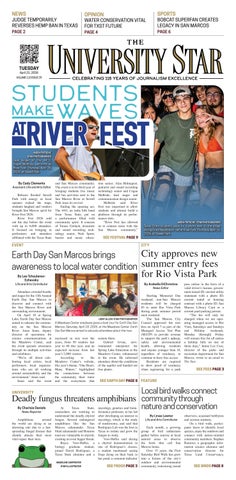
4-21-2026

Page 1


SPORTS BOBCAT SUPERFAN CREATES LEGACY IN SAN MARCOS PAGE 6

Bobcats flooded Sewell Park with energy as local openers rocked the stage, students laughed and vendors brought San Marcos spirit for River Fest 2026.

River Fest 2026 sold out the day before the event with up to 6,000 attendees. It focused on bringing in performers and attendees affiliated with the Texas State

and San Marcos community. The event is in its third year of bringing students live music and fun activities

since its

Ending the opening act, The 4411, an indie folk band from Texas State, put on a performance filled with community spirit. It consists of Tomas Gerlach, drummer and sound recording technology senior, Nick Speer, bassist and music educa-

tion senior, Alan Holmquist, guitarist and sound recording technology senior and Cogan McBride, lead singer and communication design senior.

McBride said River Fest was important to allow students and alumni build a platform through its performance slots.

“River Fest has allowed us to connect more with the San Marcos community,”

SEE FESTIVAL PAGE 9

Earth Day San Marcos brings awareness to local water condition

Attendees crowded booths and stages for the 13th Annual Earth Day San Marcos to discover and connect with the San Marcos River and surrounding environment.

On April 18 at Spring Lake, Earth Day San Marcos aimed to educate the community on the San Marcos River. Anna Jones, deputy director of operations for science communications at the Meadows Center, said the event spreads awareness through its multiple activities and exhibitors.

“We’re all about celebrating local artists, local performers, local organizations who are all working around sustainability and the environment,” Jones said.

Jones said the event

Day San

increased in size over the years, from 50 vendors last year to 60 this year, and an expected increase from last year’s 2,000 visitors.

According to the Meadows Center’s website, this year’s theme, “One Heart, Many Waters,” highlighted the connections between the community, their water and the ecosystems that

sustain them.

Gabriel Irvine, environmental interpreter for Spring Lake Education at the Meadows Center, volunteered at the event. He informed attendees about the conditions of the aquifer and handed out free plants.

Deadly fungus threatens amphibians

Amphibians around the world are dying at an alarming rate due to a fastspreading fungal disease that silently attacks their most vital organ: their skin.

At Texas State, researchers are working to understand the deadly chytrid fungus. Several endangered amphibians like the San Marcos salamander, Texas blind salamander and Houston toad are vulnerable to chytrid, creating an even bigger threat.

Royce Voss-Heflin, a biology graduate student, joined David Rodriguez, a Texas State alumnus and a

City approves new summer entry fees for Rio Vista Park

Starting Memorial Day weekend, non-San Marcos residents will be charged $5 to enter Rio Vista Park during peak summer period each weekend.

The San Marcos City Council approved the new fees on April 7 as part of the Managed Access Test Plan (MATP) to provide revenue to support the park’s upkeep, safety and environmental health, allowing residents and anyone younger than 18, regardless of residency, to continue to have free access.

Residents are required to show proof of residency when registering for a park

pass online in the form of a valid driver’s license, government-issued ID, current utility statement with a photo ID, current rental or housing contract with a photo ID, San Marcos Library Card or a current paid parking permit.

“The fee will only be charged when we are operating managed access to Rio Vista, Saturdays and Sundays and Holiday weekends. Monday [through] Friday will remain free for all unless a holiday falls on one of those days,” Jamie Lee Case, director of the parks and recreation department for San Marcos, wrote in an email to The Star.

Local bird walks connect community through nature and conservation

mycology, genetics and bioinformatics professor, in his lab after developing an interest in mycology, which is the study of mushrooms, and said that Rodriguez Lab was the first in Texas to isolate and grow the fungus to study.

Voss-Heflin said during a chytrid demonstration in one of Rodriguez’s classes, a student mentioned seeing frogs dying on their back in her pond, a common indicator

Each month, a growing group of bird enthusiasts gather before sunrise at local natural areas to observe the birds that call San Marcos home.

Over 15 years, the First Saturday Bird Walk has grew into a fixture of the city’s outdoor and environmental community, welcoming casual

observers, seasoned hobbyists and curious students.

On a bird walk, participants learn to identify local species, enjoy the outdoors and connect with nature-minded community members. Stephen Ramirez, a geographic information science alumnus and conservation director for Texas Land Conservancy,

A Meadows Center employee gives a boat tour for Earth Day San Marcos, Saturday, April 18, 2026, at the Meadows Center. Earth
Marcos aimed to educate attendees about the river.
next to the San Marcos River at Sewell Park
revival.
Assistant Life and Arts Editor
By Linae Lewter Life and Arts Contributer
News Editor
LIBBY ALLEN | STAR PHOTOGRAPHER
Texas State students pose for a photo next to the stage during Good Neighbours’ set at River Fest, Thursday, April 16, 2026, at Sewell Park.
Lead singer of The 4411, Cogan McBride, performs at River Fest, Thursday, April 16, 2026, at Sewell Park.
AIDEN FRITSCHE | STAR PHOTOGRAPHER
AIDEN FRITSCHE STAR PHOTOGRAPHER

Judge temporarily reverses ban on hemp products in Texas

A Travis County judge temporarily blocked the statewide ban on the sale of natural hemp products, until at least April 23.

The ban, which originally went into effect on March 31, issued a new set of regulations on consumable hemp-derived tetrahydrocannabinol (THC) products. The regulations include child-resistant packaging, a significant increase in licensing fees and new labeling, testing and bookkeeping requirements. Under the regulations, Texans will no longer be able to buy smokable hemp products.

In early April, Judge Maya Guerra Gamble granted the Texas Hemp Business Council and several Texasbased dispensaries and manufacturers a temporary restraining order against the new testing requirements.

Under previous legislation, hemp products were deemed legal if they contained less than 0.3% delta-9 THC. Delta-9 is the primary psychoactive cannabinoid found in the cannabis plant, responsible for creating the “high.”

The ban decreases the THC concentration to a mandatory 0.3%, eliminating all smokable hemp products, such as rolled joints, Cannabidiol (CBD) vapes and hemp cigarettes.

The new regulations include a “total THC” testing standard that includes THCA, a compound that converts into THC when heated. However, most smokable hemp naturally contains higher levels of THCA, effectively banning a large share of inventory.

In response to the ban, the Texas Hemp Business Council and Hemp

Industry & Farmers of America filed a lawsuit, alleging regulators overstepped their authority that agencies cannot rewrite the definition of hemp without legislative approval.

The plaintiffs state that the ban challenges the 2018 farmers bill that defined what constitutes hemp, even though they support the regulation of THC.

“This lawsuit challenges certain administrative rules adopted by [Texas Health and Human Services Commission] HHSC and [Texas Department of State Health Services] DSHS effective March 31, 2026, that conflict with this legislative framework and exceed the agencies’ delegated authority,” the lawsuit stated. “However, Plaintiffs do not challenge the new rules enacting age-verification requirements and related consumer protections.”

Guerra Gamble agreed state regulators exceeded their powers and granted the injunction.

State officials, such as Lt. Governor Dan Patrick, have pushed for tighter regulations, citing safety concerns.

Even with safety at the forefront of legislation, Rose Marie, an employee at Exotic Puff and Stuff in San Marcos, said the ban will likely make it more dangerous for those looking to consume smokable hemp products.

“I’ve already seen articles online describing a new drug stronger than fentanyl that is killing kids because it is being laced in weed sold on the streets,” Marie said. “As a mom, I don’t want my child to [be exposed] to that, and as a partaker, I don’t want to [take that risk].”

The ban directly impacts employees and businesses selling hemp products, as they usually take

up the majority of a store’s inventory, according to Marie.

“We lost out on a lot of business,” Marie said. “[At] our shop, personally, we get bonuses on our sales, but because of the ban, we don’t get those bonuses anymore. As a team, we’re an all-girls smoke shop. A lot of us are moms, we’re just trying to make it.”

Marie said most people who come to the shop are simply seeking relief, and taking the products away will do more harm than good.

“There are a lot of people that come in [to the shop] hurting and in pain, needing the THC-delta mix to help them,” Marie said.

While there are medically proven benefits to substance use, Kelly Clary, associate professor in the school of social work, said understanding there are two sides to the same coin is important.

“There are medical reasons that have been proven to be effective through clinical trials,” Clary

said. “We’re still understanding as researchers how different substances impact humans. The understanding of medical reasons is still evolving, and we truly do need more research to understand how it can help people positively.”

Clary said conversations about substance use need to continue, regardless of how people view the topic.

“Talking about these things is truly important,” Clary said. “I want the youth to have the information and the education to make informed decisions ... I think bringing awareness is important and empowering for everybody in society.”

An April 23 hearing will determine whether or not smokable hemp will remain legal in Texas. Over 13,000 stores registered to sell hemp products await the verdict.

TXST changes food providers, nearly 200 jobs affected

Texas State is switching its campus dining food provider from Chartwells, which could affect nearly 200 jobs.

According to a Workers Adjustment and Retraining Notification (WARN) listing, Compass Group USA, which oversees Chartwells Higher Education, issued a notice to the state of Texas, citing 183 layoffs at Texas State would take effect on May 31. According to the Texas State Dining website, Chartwells employs a large number of student workers.

Jayme Blaschke, director of communications and public relations for Texas State wrote an email to The Star that the change will require approval from the Texas State University System (TSUS) Board of Regents. While a possible vendor was selected after a national search, the university is finalizing and negotiating contracts. Blaschke wrote that Texas State will try to help those employed by Chartwells.

“We recognize the impact any transition may have on Chartwells’ employees and will work to support opportunities for those affected,” Blaschke wrote.

Chartwells began providing food services at Texas State in February 1998. The company is responsible for running campus food courts, dining halls, Paws-N-Go and J.C. Kellam’s snack bar, among other regular food services, according Blaschke.

Blaschke wrote the change in vendors was part of Texas State’s commitment to provide a dining program that enhanced the student experience,

Trinity Building 203 Pleasant St. San Marcos, TX 78666 (512) 245 - 3487

History: The University Star is the student newspaper of Texas State University and is published every Tuesday of the spring and fall and once a month in the summer semesters. It is distributed on campus and throughout San Marcos at 8 a.m. on publication days with a distribution of 3,000. Printing is by the New Braunfels Herald-Zeitung.

Health science sophomore and employee at Wing It Soniya Shrestha prepares a student’s order, Monday, April 20, 2026, at Jones Dining Center.

including choices, improved services and new dining environments.

While Blaschke did not name the potential vendor, Calvin Staples, a supervisor for Compass Group USA, named Aramark as the possible new supplier.

“[We] might be having new services around

Editorial Staff

Editor-in-Chief: Blake Leschber stareditor@txstate.edu

Managing Editor: Rhian Davis starmanagingeditor@txstate.edu

News Editor: Arabella DiChristina starnews@txstate.edu

Life & Arts Editor: Carlene Ottah starlifeandarts@txstate.edu

Opinions Editor: Andrew Bencivengo staropinion@txstate.edu

Design Editor: Carson Rodgers stardesign@txstate.edu

Sports Editor: Adrian Ramirez starsports@txstate.edu

Harris Dining Hall, depending on what Aramark goes ahead and decides to bring in, but most things should relatively remain the same to the best of my knowledge,” Staples said.

As of April 20, Aramark has 17 job applications available on their website in San Marcos that mention Texas State Dining.

Aramark serves more than 275 college and universities, providing a community with culinary experience and dining solutions.

Staples said it is unclear on whether or not employees from Chartwells will transfer over to the new supplier, as it has not been officially selected, yet a large amount of students will stay employed.

“I’m not sure everything Aramark is going to be doing, so it’s really up to them to kind of tell us, as we transfer over, what they’re going to be changing,” Staples said.

Landon Cervantes, an accounting junior, said he believes Texas State’s current food quality under Chartwells is better than that of other universities.

“I feel like the food quality is good enough. I wouldn’t say it’s top-tier food obviously, but I think [the food], for a college campus, especially is pretty good compared to other [campuses],” Cervantes said.

Aramark and Chartwells did not reply to a request for comment.

Blaschke wrote that Texas State appreciates the long and positive relationship with Chartwells. Blaschke did not provide a date as to when the new vendor will be confirmed by the TSUS Board of Regents.

Publication Info

Multimedia Editor: Meg Boles starmultimedia@txstate.edu

Engagement Editor: Tatum Pou starengagement@txstate.edu

PIR Director: Keely Florez starpr@txstate.edu

Web Editor: Alejandra Sosa-Lopez starweb@txstate.edu

Creative Service Director: Sophia Gerke starcreative@txstate.edu

TV News Director: Maci Gambrell startvnews@txstate.edu

Copyright: Copyright Tuesday, April 21, 2026. All copy, photographs and graphics appearing in The University Star are the exclusive property of The University Star and may not be reproduced without the expressed written consent of the editor-in-chief.

Corrections Policy: Errors appearing in the pages of The University Star and brought to our attention will be corrected as soon as possible.

Advertising

Contact at: 512-245-3487 advertising@universitystar.com

ISABELLE CANTU | ASSISTANT MULTIMEDIA EDITOR
ARABELLA DICHRISTINA | NEWS EDITOR
Exotic Puff And Stuff Smoke Shop, a location affected by the ban, sits at 369 S LBJ Dr., Sunday, April 19, 2026, in San Marcos.

FROM FRONT FROGS

of chytrid infection. Rodriguez’s team investigated, collected samples and successfully grew the fungus in his lab.

“But chytrid isn’t just in that one pond or river,” Voss-Heflin said. “Where there are amphibians, there is also chytrid.”

Rodriguez said chytrid fungus is often referred to as the “amphibian killing fungus,” and is unlike common fungi.

“A lot of people think of fungus as mushrooms that don’t move,” Rodriguez said. “But chytrid has a flagellum, a tail-like structure, that allows it to swim through water.”

Frogs and salamanders rely on their permeable skin to breathe and absorb water, making them vulnerable to diseases, according to Rodriguez. Chytrid spores penetrate the animals skin and grow inside their bodies.

Rodriguez said all amphibians can carry chytrid, though its fatality rate is still getting studied.

Rodriguez believes the global spread of chytrid fungus is driven by human activity, specifically the movement of plants, soil and the international bullfrog trade. The bullfrog trade involves the farming and transport of bullfrogs for food, pets and research. Rodriguez said bullfrogs are strangely resistant to the disease, which allows them to carry large amounts of the fungus without dying.

Rodriguez Lab has identified the cricket frog, native to San Marcos, to

also be resistant to chytrid. Much like the bullfrog, the cricket frog is able to carry high amounts of the pathogen on its skin without dying, and transports the fungus everywhere the frog goes. However, even though the cricket frog is resistant to the disease it is not immune, according to Rodriguez.

Rodriguez said other factors like drought, predation and the recent emergence of chytrid, make it difficult to provide clear statistics and contain the disease.

“Chytrid causes frogs to lose the ability to regulate ions, which causes heart attacks,” Rodriguez said. “The disease also makes them lose control of their muscles, making them easy targets for predators.”

The disease hits tropical regions the hardest, where the majority of amphibian declines and extinctions have occurred. While Texas is not

seeing any amphibian extinctions caused specifically by the fungus, Rodriguez said chytrid is still present in the state and largely understudied.

“There are very few people studying Texan amphibians and chytrid. There’s a lot more work to be done to see if our native species are actually affected,” Rodriguez said.

Voss-Heflin said one of the more puzzling discoveries, and a major breakthrough in his research, is a hybrid strain of the fungus, which suggests genetic mating despite chytrid reproducing asexually. This is just one of the many questions scientists like Heflin and Rodriguez are trying to solve through research.

According to Voss-Heflin, conservation is the primary motivation behind the research of amphibian diseases.

“Amphibians play a huge role in

controlling insect populations, more than most people think about. If you hate mosquitoes, you love frogs,” Voss-Heflin said.

Globally, organizations like the Amphibian and Reptile Conservancy (ARC) are working to protect vulnerable species by preserving habitats, funding research and spreading awareness about emerging threats like chytrid fungus.

“We don’t pay attention to our ecosystem until it’s too late and [the amphibians] are lost forever. We not only lose an incredibly fascinating group of animals, we lose the glue that holds healthy ecosystems together,” the ARC stated on its website.

The ARC also emphasized the need for stronger monitoring and biosecurity measures to limit the spread of wildlife diseases. Still, local conservation efforts in Texas remain limited.

Rodriguez said prevention is one of the most effective tools available to the public.

“Simple things like rinsing off your shoes and using a disinfectant spray after hiking can also prevent spreading the fungus between ecosystems,” Rodriguez said. “The best thing you can do is leave animals where you find them, and don’t dump plants or animals into the environment.”

The fees will apply to 36 days this summer, between its start on Memorial Day and Labor Day weekend.

The city defines any local area participant, or resident, as someone who resides within the territorial limits of the city of San Marcos, within the boundaries of the zip code 78666 or within the area of the San Marcos Consolidated Independent School District.

The entry fees will support staff operations such as park ambassadors, seasonal park maintenance staff and ongoing park maintenance, Case wrote.

“Implementing the managed access fee will create a dedicated revenue source to offset those costs and ensure that out-of-town visitors contribute to the upkeep and maintenance required to manage the high seasonal impact on the park,” Case wrote.

During peak season for Rio Vista in 2025, the city spent more than $508,568, around 18% of the overall parks maintenance budget, to operate the park, with $11,179 for the fencing rental, $19,800 for in-stream litter removal contracts and $37,557 for police officers and fire marshals overtime.

The temporary fence around Rio Vista will also return this summer as a part of the MATP, according to Case.

The fence was introduced in 2025 to mitigate issues such as litter and safety

concerns and park violations like the possession of alcohol, charcoal grills, tents and the single-use container ban.

“We do not know if the fee will specifically impact a reduction in violations, but the implantation of managed access without a fee did lead to a reduction in violations of park rules,” Case wrote.

Steven Hughes, incoming graduate student and San Marcos resident, said the tourists should help keep San Marcos’ parks beautiful.

“I rely on city parks to relax, get fitness and enjoy nature, but at any of these parks you will just see a fair amount of trash [and] see a lot of people there,” Hughes said.

Jennifer Sawyer, a San Marcos resident, said about 90% of the time she and her kids go to the river, they are picking up trash like diapers. She said on a weekly basis, she doesn’t see many college students littering or harassing people; it’s normally locals.

“An exorbitant amount of trash is being left [at the river], and I really feel like the river [isn’t] being respected that much,” Sawyer said. “There are groups that go out every Sunday and Monday that just clean up trash, but they are filling trash bags, we’re talking 10, 20 trash bags after one weekend of visitors.”

One of Sawyer’s biggest reasons for living in San Marcos is the river, not only for it’s natural beauty but the relationship she has with it and her kids.

“It’s just a place where my kids have grown up ever since I was pregnant, you know, getting in there while they were in my belly and then as soon as they were born and could get in the water, six weeks old, they were in the river,” Sawyer said. “It’s kind of our place to go, and we feel pride over it. It’s part of something much bigger than us and something that we want to help.”

Residents have the option to get a free pass to the park in the form of a wristband issued at no cost the first time, with a maximum of five people per household. Residents can get the Rio Vista pass at San Marcos Parks and Recreation’s website.

FROM FRONT FEES
Graduate student Royce Heflin shows off two separate bacteria samples collected from local frogs to examine if any chytrid spores are on the frogs, Wednesday, April 16, 2026, at Rodriguez Lab in San Marcos.
CHARLSIE DANIELS | NEWS REPORTER
MEG BOLES | MULTIMEDIA EDITOR
A sign informs river goers on litter removal, Sunday, April 19, 2026, at Rio Vista Park in San Marcos.
The San Marcos River flows through Rio Vista Park, Sunday, April 19, 2026 in San Marcos. Rio Vista will require entry fees during busy periods from Memorial Day to Labor Day weekend.
MEG BOLES | MULTIMEDIA EDITOR
CARMEN KEEN | STAR ILLUSTRATOR

April 21, 2026

Opinions in The University Star are not necessarily those of our entire publication, Texas State University’s administration, Board of Regents, School of Journalism and Mass Communication or Student Publications Board.

Saving water today protects SMTX tomorrow

Water levels in the Edwards Aquifer are nearing their lowest in history, but community actions can still prevent a future of water scarcity in San Marcos.

The Edwards Aquifer, a massive underground reservoir of water that stretches across multiple counties, is under threat due to recent drought conditions. While many in San Marcos focus their attention on the river, its source is being overlooked.

As the state and city begin drawing plans to prevent damage, like creating the Texas Water Fund and citywide water restrictions, community members can do the same. The community can begin evaluating their consumption, putting pressure on industries using large amounts of water and preparing for a future that may be uncertain.

The Edwards Aquifer serves as a source of drinking water for San Marcos, and a major source for 1.7 million people in Central Texas. In recent years, the aquifer’s levels have steadily declined. In 2025, the J-17 well index, a key monitoring well in Bexar County used for measuring Edwards Aquifer levels, was at 624 feet, only 12 feet shy of the lowest level ever recorded in 1956, putting the San Marcos River at risk.

Declining aquifer levels have already started to affect life in San Marcos. The ongoing drought

pushed city officials to place restrictions on water usage in the city, which is currently under stage 3 drought restrictions.

Robert Mace, researcher and executive director at the Meadows Center, said the conditions placed strict restrictions on the university and surrounding city.

“It is the supply for the university too,” Mace said. “The [Edwards Aquifer] Authority requires a reduction in how much water is produced from the aquifer. So, both the university and the city of San Marcos have been subject to forced reductions.”

Subtle changes like San Marcos not allowing residents to fill new swimming pools, wash their own cars at home and hand-water or irrigate with sprinklers or drip systems more

than once a week between the hours of 10 a.m. and 8 p.m, are among some of the restrictions implemented due to drought. These may inconvenience residents now, but ignoring these could cause permanent water reductions in the future.

San Marcos’ water supply is not the only thing at risk. The Edwards Aquifer is the source of the headwaters for the San Marcos Springs, which supply the flow of the San Marcos River. As the “Mermaid Capital of Texas,” San Marcos’ culture and economy are linked to its natural waterways, meaning any change in the river’s flow can cause downstream effects on its people.

Protecting the Edwards Aquifer during the drought is not only a responsibility of the city and conservationists, but also of San

Marcos residents. Small drips of water certainly build up over time. The decisions you make today affect the environment tomorrow.

According to the U.S. Environmental Protection Agency, it’s estimated that each American uses an average of 82 gallons of water per day. That’s 2,460 a month and 29,520 a year, per person. Americans consume a lot of water daily, and much of it is wasted.

“Every gallon of water you use is a gallon that’s not coming out of the springs and a gallon that’s not flowing down the river,” Mace said. “So, being as efficient with water use on campus as you can be … the biggest thing for folks that live on campus is shortening showers. Teenagers are famous for taking extremely long showers. Maybe consider doing a navy shower…and greatly reduce your water footprint.”

Beyond simple individual changes, community members can also apply necessary pressure to protect its water. Industry and agriculture account for large amounts of water usage. Introducing developments like data centers, which demand large amounts of water, can cause serious harm to the community. The San Marcos community, after protesting a data center development, proved it can protect its water, but it takes a unified effort.

Community action, whether through reducing showers or placing pressure on city council, can help the city’s future, but it must be acted on now. The heart of San Marcos is its water, and it must be protected.

-Syghlas Morales is a wildlife biology freshman

TXST’s values do not align with rocket testing

Rocket testing above the Edwards Aquifer recharge zone raises concerns over its environmental impact, with some doubting the measures Texas State has taken to mitigate risks.

In November 2024, Texas State announced a collaborative research project with X-Bow, a company that produces solid rocket motors. The company made a deal for the static testing of solid rocket motors on Texas State’s Freeman Ranch, a roughly 5,000 acre closed research facility located at 2101 Freeman Ranch Rd.

While the goal is to create a space for hands-on research opportunities, the site’s location raised concerns over its impact on the environment.

Texas State has, according to university policy, a “strong commitment to environmental preservation.” Projects that give students opportunities

are acceptable, but they must be done with an abundance of caution, especially if done near a critical water source.

X-Bows planned testing consists of Static Fire Testing, a process where trials are done on the engine of a static rocket, in order to collect data on what a launch would look like. However, organizations like the San Marcos River Foundation SMRF) cite concerns on the impact these tests may have on water quality.

The Edwards Aquifer supplies water to an estimated 1.7 million people across Central Texas, according to the Texas Commission on Environmental Quality (TCEQ). If necessary precautions are not taken, or accidents happen, there is real concern that there could be contamination to a major water source, like if fuel pellets were thrown and swept into the discharge zone.

Chemicals commonly found in rocket fuel, such as ammonium perchlorate, are classified as toxic substances, according to the Agency for Toxic Substances and Disease Registry. Any testing that results in contamination above safe levels could impact the local population.

According to documents obtained by The Star, Texas State University applied for and received an exception to the Water Pollution Abatement Plan (WPAP), a plan required to protect water quality when a regulated activity is proposed in the Edwards Aquifer Recharge Zone. Texas State claimed that X-Bow has taken all necessary steps in compliance with TCEQ, but an exception to the WPAP does raise questions from the community.

Virginia Parker, executive director of the SMRF, said the community is united in its concern for Texas State’s choice of location for its research partnership.

“Over 7,500 people have signed our petition to ask Texas State to move this [rocket motor testing] off of the aquifer,” Parker said. “It should not be sitting over the aquifer at all.”

According to the letter sent by TCEQ, “The measures represented in the application demonstrate equivalent water quality protection for the Edwards Aquifer.

Therefore, the application for the construction of the proposed project and methods to protect the Edwards Aquifer are approved, subject to applicable state rules

Letters to the Editor Policy

partnership

and the conditions.” The document further claims that “No wastewater will be generated by this project.”

Assessments over emissions and potential risks appear to have been taken by Texas State and X-Bow to protect the environment, however some groups are not convinced.

The SMRF, for example, is concerned that while the emission calculations may fall within state and federal limits, environmental factors like rain are unaccounted for.

For its part, TCEQ appears convinced that the project does not call for concern, but accidents do happen, and the aquifer

The University Star welcomes letters from our readers. Letters must be 300 words or fewer to be considered for publication. Writers must include their full name, mailing address, major and academic year designation (for students), phone number and e-mail address when submitting a letter. Submissions that do not include this information cannot be published. This information is seen only by the editors and is used to verify the identify of the letter writer. It is not used for any commercial purpose.

recharge zone cannot bear them. Fuel is in solid pellet form, but if a launch doesn’t go well these pellets can be thrown from the test site, and cause environmental damage. Further risks, like weather, make impacts hard to properly estimate.

Texas State is taking steps mandated by the law, but risks raised do beg the question on if a collaborative project is really worth the environmental risk.

Letters become the property of The Star and may be republished in any format. The letter may be edited for length and clarity. An editor will contact the letter writer if their letter is a candidate for publication. The Star will not run letters that are potentially libelous, discriminatory, obscene, threatening or promotional in nature.

Letters can be submitted to staropinion@txstate.edu or by mail to Attn: Opinion Editor, The University Star, 601 University Drive, San Marcos, TX, 78666.

ELLA MADIS | STAR ILLUSTRATOR
JEN NGYUEN | ASSISTANT DESIGN EDITOR

Wrecked Tech: ‘Cats claw their way to highest-ranked win in program history

In a game that wasn’t originally on Texas State’s opening day schedule, the Bobcats (31-17) went to battle with the No. 3 Texas Tech Red Raiders (42-4) and came out on top 3-0 on April 15, in front of a sold-out Bobcat Softball Stadium crowd

Coming into the contest, Texas Tech run-ruled 69% of its opponents this season and outscored its opponents 449-82. Unfortunately for Tech, those numbers didn’t matter. The only did was junior pitcher

allowing five hits on the night en route to her 20th win of the season.

“Azua, I can’t say enough great things about the game she just threw,” Texas State head coach Ricci Woodard said. “She’s been fun to watch all year. I would match her up against anyone in the country.”

Countering Azua was Nijaree Canady. Seen by many as the best pitcher in the country, Canady racked up award after award in 2025, winning the Big 12 and D1 Softball Pitcher of the Year. She was also a top three finalist for the USA Softball Collegiate Player of the Year.

Maddy Azua in the circle for the

stymied the Red Raider throwing a

AIDEN FRITSCHE | STAR PHOTOGRAPHER

Canady came into the game against Texas State with a 17-2 record, an ERA of 1.35 and 151 strikeouts in 104 innings of work. She also holds one of the largest NIL contracts in all of college softball, as she signed multiple million-dollar-plus deals.

Canady looked worth the investment in the first three innings of gameplay, as she mowed down the Bobcat order. That all changed when the reigning Sun Belt Player of the Year, senior Aiyana Coleman, came to the plate in the fourth. Coleman took a Canady fastball and sent it deep over the centerfield wall to give Texas State a 1-0 lead.

Texas State junior pitcher Madison Azua (22) celebrates her victory against No. 3

Texas Tech, Wednesday, April 5, 2026, at Bobcat Softball Stadium.

The next inning, senior catcher Megan Kelnar added an insurance run with an RBI single. The Bobcats scratched one more run in the fifth on a fake steal of second base. A bobble on the throw down by Tech allowed sophomore Mel

Reeves to scamper home on the deke, giving Texas State a 3-0 lead after five.

The Bobcat bats beat the reigning Pitcher of the Year, an accomplishment that not many teams in the country can claim.

“It was one of those [situations] where we have nothing to lose,” Coleman said. “It’s exciting to face a phenomenal pitcher like [Canady] and have the opportunity to be on the same field as her.”

From there, Azua finished off the last six outs, giving the Bobcats their third top-25 win of the season and handing Tech its fourth loss.

“[Winning] this game is a great feeling,” Kelnar said. “This really shows the work we have put in at practice and how we have been able to simplify the game; we all bought in.”

Texas State will look to build off the momentum created from this win when Baylor (26-20) rolls into town for a midweek matchup. First pitch between the Bobcats and Bears is set for 6:30 p.m. on Wednesday, April 22, at Bobcat Softball Stadium. The game will be streaming on ESPN+

Texas State softball celebrates with senior first basemen Aiyana Coleman (17) after her home run against No. 3 Texas Tech, Wednesday, April 15, 2026, at Bobcat Softball Complex. The Bobcats won 3-0.
AYDEN OREDSON | ASSISTANT SPORTS EDITOR

Bobcat superfan creates legacy in San Marcos

It’s easy to root for the favorites, the programs that consistently achieve excellence and have the trophies to back it up. It’s harder to believe in the underdog who has something to prove.

Tom Madden, a 1980 Texas State alumnus, holds season tickets to every Bobcat sport that offers them. From football and basketball to baseball and softball, fans can usually catch him in the stands,

“You always hear people go, ‘my parents were Aggies, or my parents were Longhorns, even though they went to Southwest Texas,’” Madden said. “No, I’m sorry. You dance with the person you came to the dance with. I went to Southwest Texas, and that’s my school and it’s always going to be my school.” Madden attended previously-named Southwest Texas State, studying biology with a minor in chemistry, which included vigorous coursework while also juggling a job at Grins Restaurant. Though he focused on both, he was keen on paying attention to Bobcat athletics.

At the time, Southwest Texas State competed in the National Association of Intercollegiate Athletics (NAIA) with the Lone Star Conference before making the jump to the NCAA’s Division II. Bobcat football played at the now long-gone C.E. Evans Field and Strahan Arena would not be opened until 1982.

“If you want to see some-

BASKETBALL

thing really interesting, all you’ve got to do is fall back 20 years ago [to] where our athletics facilities were and where they are now,” Madden said. “[Our] stadium facilities were, I guess, for modern times nowadays, [smaller] than high school 5A facilities.”

Over 45 years after Madden’s graduation, the university that many once described as a sleeping giant in athletics has woken up from its slumber.

The football program is experiencing its most successful stretch since the Jim Wacker era in the 1980s. Baseball and softball are competing among the best in the nation and soccer, track & field, tennis and other sports are feeling the high of recent successes.

Texas State is preparing itself to enter its most ambitious experiment yet as it is set to join the rebuilt Pac-12 and in conjunction with improvements outside of athletics, Madden believes the university is at an inflection point.

“Every year, there’s more and more people that are seeing and recognizing our potential and where we can be in the future as far as athletics ... It’s a huge deal,” Madden said. “When you listen to our fight song [that says] ‘until the whole world knows our name,’ let me tell you, [that is] not only [there] because of who we have as alumni, but [it’s there] because [of] what we’ve been doing successfully in sports and that success brings recognition to the university as a whole.”

With the university

making strides on all fronts, Madden has made sure to contribute what he can to the cause.

“My main focus is coming back to Texas State, supporting these student athletes, because in my mind, it’s a win-win for me,” Madden said. “It was being able to support 350 different students at the same time and treat them equally through my contribution to the Bobcat Club. On top of that, I wanted to go ahead and buy season tickets for every sport that was available.”

Madden’s dedication to the school has not gone unnoticed by fellow Bobcat fans or Texas State administration. While a prominent figure online, he is known throughout the Texas State community.

“We are extremely grateful for members of the Bobcat family like Tom Madden,” Don Coryell, Texas State Athletic Director, said.

“While we cannot overstate our appreciation for his role as a donor, he brings so much more to our teams through his contagious energy and unwavering support on social media. His passion is what we hope to see in all Bobcat fans.”

Trent Burk, a Texas State Alumni Association board member, met Madden in 2014 at watch parties Burk used to host in Georgetown.

“The events were very small, usually five to 10 people,” Burk said. “We became friends after that and have shared our stories of our love for the university. There

is no other person I know that has as much passion for Texas State as Madden.”

Madden, after years of supporting a program that failed to fulfill its potential, now has his long-term loyalty rewarded with significant investments to sports and success on the national stage.

Once he picked Texas State as his university of choice all those decades ago, he dedicated himself to the Bobcats, through the good times and bad, and to the student-athletes that he now supports financially.

Even if it means he has to drive an hour down to San Marcos each time he wants to attend a game, he’ll do it, not only for himself, but for the athletes who also chose to dance with Texas State.

DJ Hall establishes presence as future star

Freshman forward DJ Hall is no stranger to winning and his first season at Texas State was more of the same.

The 6’7 forward concludes his first season in college after winning Sun Belt Freshman of the Year in the teams last Sun Belt season.

Hall is used to having his name associated with awards and a winning team. The forward helped lead Plano East, his high school team, to a 40-0 perfect season in 2024, where he took home the tournament MVP. Now, Hall is the first and only Bobcat player to win the Sun Belt freshman award.

Winning Sun Belt Freshman of the Year wasn’t just a personal accomplishment, but a mark on Bobcat history as he became only the second Bobcat to win a conference Freshman of the Year award since 1993.

“To me, that [accomplishment] means everything because I was injured my freshman year. I didn’t play my sophomore year. Then junior year, that’s when I started getting publicity, but I never really got offers, “ Hall said. “So from now to then I never thought I would be in this position right now, just all the work and me being stood down for my faith in God, [but] the sky’s the limit from here.”

Hall didn’t initially think this award was in the cards, as he wasn’t in the starting lineup on day one.

“I didn’t start my first game this season, so just after that, [it] was just playing with confidence, and coach TJ [Terrence Johnson] had confidence in me the whole year, “ Hall said. “I felt like I had to do my job, do my part and lead the team to just an extent.”

Hall averaged almost 16 points and eight rebounds this year while shooting 54 percent from the field,

which placed him in the top 75 in the country. The game he remembers as his “welcome to college” moment was against Lehigh in November.

Despite the overtime loss, Hall finished the game with 23 points, 12 rebounds and shot 81% from the field. After that, he thought he could “make something out of this” and even “go high level.”

Head Coach Terrence Johnson said he is “blessed” to be able to coach Hall and thought he did do his part throughout the season to contribute to the teams season success.

“He’s a great young man, and I appreciate he and his family just trusting us and believing in us,” Johnson said. “I thought he did a really good job. He wasn’t Superman every game, but he was pretty darn good, and he has a knack for scoring a basketball.”

Johnson values what Hall brings, and Hall values his coach the same. Sometimes, however, it’s not always soley about the wins, but overcoming challenges that stand in the way.

Johnson stresses adversity to his team, including Hall, and he understands that disappointments will happen. Overcoming adversity is something Hall had to face entering his freshman year.

“I think one of the most challenging aspects [is] when you’re dealing with young people that had some success, remember DJ played on a team that went 40-0, “ Johnson said. “It’s resets, it is being able to deal with your shortcomings and your setbacks, and how he is able to bounce back from that.”

However, players like fifth year forward Kyndall Davis, almost expected Hall to win the award.

Davis, who played in the Sun Belt before this year with Louisiana, knows

the conference inside and out and noticed things that stood out about Hall long before the season started.

“Playing in this conference last year and seeing how advanced he was as a freshman and how hard to guard he was in practice, I kind of knew [and] told DJ, ‘yeah, you’re going to be Freshman of the Year,’” Davis said.

For Hall, the road doesn’t stop here, and he looks to continue to improve his game as he moves into his sophomore season.

Hall said he models his game after Paolo Banchero of the Orlando Magic. He hopes one day to make it to the league and understands the steps he must take to get to that position.

“I feel like it’s just getting started, a lot of people make history and get a lot of accolades and stuff and then stop working,” Hall said. “[But] for me, I got to work way harder than I did last year to get even better for the Pac-12 and eventually to the pros.”

Texas State alumnus, donor and superfan Tom Madden poses with Boko with his “State’s Up” hand sign at Strahan Arena.
PHOTO COURTESY OF TOM MADDEN
Texas State freshman forward DJ Hall (0) dunks against Texas Lutheran, Monday, Nov. 24, 2025, at Strahan Arena. Texas State won 93-41.

Irvine said the Edwards Aquifer is one of the main sources of water for the San Marcos community. He said recent drought conditions put numerous species at risk and affected the nearby human population.

“Right now, we are in drought stage four [in San Marcos] because we do get our water from the Edwards Aquifer,” Irvine said. “By 2047, San Marcos is supposed to be water scarce; it could be even sooner than that.”

Irvine said the depleted rainfall in the area and major water consumption are reasons for the lowered water level.

“Another big part is just because we use a lot of water here in Central Texas,” Irvine said. “All of Texas uses about 100 gallons more water per person on average.”

Jones said it was important for the vendors to have a sustainability focus and for their items to be eco-friendly.

Jennifer Ramos, founder of JenMRamosHandmade, centered her booth around selling clothes she sewed together from assorted scraps of cloth friends and family gave her.

“It’s the idea of repurposing and making use of things that exist instead of just buying new fabric off the bolt,” Ramos said.

It was Ramos’ second year attending the event. She said she enjoyed being surrounded by like-minded

and eco-friendly people.

Ramos said sometimes people opt not to take the clothes they purchase in a bag to prioritize the environment.

The Watershed Association was also a vendor at Earth Day San Marcos, focusing on awareness and sharing information. Amber Smith, communications manager for the Watershed Association, said it actively worked to watch over water usage through land conservation, policy advocacy and education. Its Art4Water program advocates for environmental protections through the art lens.

While the event focused on San Marcos, Smith said

started the group in 2011 with hopes to share knowledge of the city’s aviary life. He picks a new meeting location each month so participants can spot different species.

“We’re at the dividing line between two eco regions,” Ramirez said. “The Edwards Plateau or the Balcones Canyon lands. On the east side of I-35, you have the black land prairie eco region … the vegetation communities that occur in those drastically different areas, they serve habitats for different types of birds.”

San Marcos’ commitment to preserving natural spaces helped the bird walks thrive, and vice versa. The city received an official designation as a Bird City Texas community on Jan. 16, 2025. The designation recognizes its efforts in conservation, habitat enhancement and educating residents about wildlife.

Ramirez served on an advisory committee for San Marcos’ designation and said the city’s existing conservation work, including the bird walks, contributed to the achievement.

the Edwards Aquifer’s lower levels also affects nearby places, such as Jacob’s Well in Wimberley.

“It’s been around for thousands of years, but over the last three or four consecutive years, the well has not been flowing due to a combination of a few different threats,” Smith said. “[Some of them are] overdevelopment of critical recharge zones, overpumping of the aquifer by a local water utility company and the severe drought,”

Three eco sessions explored the Edwards Aquifer, Meadows Center and Spring Lake. Gwendolyn Hustvedt, professor at the School of

Family & Consumer Sciences, hosted “Exploring Aquifers through Art.” She discussed her development of an art exhibit titled “Groundwork: Art Honoring the Aquifers” that featured 15 colorful silk banners depicting imagery featuring animals, aquifers and fossils.

that looking at science from the perspective of ‘how did it make the world beautiful’ means that science becomes relevant to them in the way that it hadn’t felt before,” Hustvedt said.

Earth Day San Marcos also featured several live music events, like The Sophia Johnson Trio, a western swing band. It features Sophia Johnson, vocalist, Jason Rathman, bassist, and Rebecca Patek, fiddler. Johnson said it was the band’s third time playing at the event.

While Johnson is originally from England, she said she resonates with Texas and its environment, calling it her “second home.”

“I’m glad to be here and … do my bit for supporting any environmental cause for beautiful Texas, which I love,” Johnson said.

Earth Day San Marcos brought people from many backgrounds to learn about the environment. Outside of the event, Irvine said there are actions individuals can take to combat the lowering water levels.

“If you’re swimming

“The most significant thing to me is to see the city’s buy-in to prioritizing birds,” Ramirez said. “There were a lot of things the city was already doing to support wildlife and birds, but I think going through this process added a few more layers that were positive.”

Jamie Lee Case, director of San Marcos’ Parks and Recreation, said community-led programs like the First Saturday Bird Walks help introduce residents to bird conservation and local species while supporting the city’s broader environmental goals.

“With our Bird City designation, it was established through a collaborative effort of not only city staff but partners like Ramirez,” Case said. “I think his bird walks in particular do help people that maybe don’t know much about bird conservation and the importance of making sure that various species are protected.”

Derek Richardson, professor emeritus of astronomy at the University of Maryland, joined the San Marcos Bird Walk group last year when he moved to Texas. As a seasoned birder, he now co-leads with Ramirez and implemented “advanced” third Saturday walks for more experienced birders.

“[Ramirez] said, ‘Hey, how about helping me out?’ and so I agreed,” Richardson said. “Then we did a survey … that revealed that there were people interested in more than just once a month. And those people were interested in something a little more challenging.”

The walks on the first Saturday are beginnerfriendly excursions, while the third Saturday hosts more challenging treks. During advanced walks, participants try to spot rare or migratory species. Richardson said he recalled a challenging advanced walk aimed at finding the elusive black-throated sparrow.

“For many of the people there, it’s the first time they’d ever seen a black-throated sparrow,” Richardson said. “And that is what I’m shooting for as a leader. I want to give people an experience.”

Antonio Lozano, accounting senior and member of San Marcos Bird Walks, said he enjoys the first and third Saturday Bird Walks. He began birding in 2024 after noticing birds on campus, such as the cave swallows in the Alkek Garage or the yellow crested night herons in the ponds surrounding the

sudden, [the Alkek] Garage started getting populated with hundreds of birds,” Lozano said. “I just wanted to learn as much as I could, as fast as I could.”

Lozano said he “collects” bird sightings in an app called eBird, a place for the birding community to track bird sightings for science and conservation, creating what birders call a Life List. He said he thinks birding is a great hobby to practice in his youth because of how many species there are to collect.

“A lot of people get into it in their fifties and sixties,” Lozano said. “It feels great to catch it early on so that when I do keep a life list, it’ll actually be a full Life List.”

Ramirez said he believes consistent opportunities for residents to engage with the natural world encourage environmental stewardship. He said he hopes the San Marcos Bird Walk group will continue to grow and invite new people in.

“It’s become a reliable and consistent fixture of anyone who wants to gather with other people who are interested in birds or birding,” Ramirez said. “At any point, people know the bird walk is happening every month. And if they want to be around those people and experience that together, they know it’s there.”

First Saturday Bird Walks occur every first Saturday of the month, and the Advanced Bird Walks occur every third Saturday, rain or shine. For more information about the San Marcos Bird Walk, visit its Facebook page called ‘San Marcos Bird Walk’

FROM FRONT BIRDS
MEG BOLES | MULTIMEDIA EDITOR
Discovery Center Specialist Niki Lake looks for birds during the “Bitty Bird Lover’s Hike,” Friday, Feb. 14, 2025, at the Wildlife Annex Park. The event was hosted by the San Marcos Discovery Center as apart of the Great Backyard Bird Count.
Texas state students help man a key chain-making booth for an Earth Day event, Saturday, April 18, 2026 at the Meadows Center.
LAUREN TOURISH | STAR PHOTOGRAPHER
FROM FRONT EARTH DAY
PHOTO COURTESY OF DEREK RICHARDSON Red-winged blackbird, Wednesday, April 8, 2026, at eBird’s “San Marcos Springs” hotspot in The Meadows Center for Water and the Environment.
PHOTO COURTESY OF DEREK RICHARDSON Black-bellied whistling duck, Wednesday April 8, 2026, at eBird’s “San Marcos Springs” hotspot in The Meadows Center for Water and the Environment.

LIFE & ARTS

McBride said. “River Fest is just such an iconic thing for Texas State students, and I think getting to be in front of our demographic at that level is always fun and opens doors to making new fans.”

The 4411 was not the only opener from Texas State. Bo Moore, HNDRX and Mia Youngblood AKA Miss Thing are all Texas State students, alumni or San Marcos locals.

Sophia Ruiz, an exercise sports science freshman and River Fest attendee, said the community memorialized her first time at River Fest more than the performers.

“Just for me, it’s mostly about the community,” Ruiz said. “If the community’s pretty hype, it’s a really fun experience.”

Ruiz said she arrived at River Fest in the evening when electronic duo Snakehips performed. She said she was mainly there for the music and headliners and was not disappointed by the experience.

“I like the mixes that they played to get hype before Tommy Richman, and they played some nice hits,” Ruiz said. “I really hadn’t had so much fun with my friends [before River Fest].”

Vendors lined the park’s upper trail, ranging from student organizations to local businesses. Ruiz said she enjoyed getting the free items, especially from vendors who brought items like aloe vera and sunscreen that aided attendees’ experience.

“I liked how they were giving the opportunity to give out free things to students in need,” Ruiz said. “They gave out aloe vera in case we got sunburned … sun protection as well.”

Samantha Castillo, owner of Sammy Snacks, sold Mexican-style fruits and candies. She said she received an invitation to be a vendor at the festival since her business has attended River Fest since its revival, and she

said she loves going to college events and being a part of the unmatched community.

“We love being a part of River Fest. Student Involvement is very welcoming to us,” Castillo said. “We feel like part of a family when doing events like this, we love the school and the music.”

Angie Olmos, Bobcat Connection team member and mass communication sophomore, said she helped keep the community safe with water and River Fest organizers by setting up lights and tables for the artists throughout the festival. She said River Fest’s main goal is to bring together a community and showcase all that Texas State and San Marcos have to offer.

“[River Fest] is mainly targeted for local artists and local vendors while also providing a good environment and a fun time for students,” Olmos said.

Ruiz said the community’s hype contributed to what she called a really fun experience.

“I say the artist is the second [factor] I care about because honestly, it feels like we’re going to a music festival without knowing any of the songs that are being played,” Ruiz said. “But for me, mostly, it’s the community because they bring the energy.”

Marisa Lara Bermea, Student Development Specialist III for Student Involvement & Engagement, said future plans for next year’s River Fest will build on what the team learned this year based on what she called strong student attendance and engagement before and during the event.

“Feedback from students, campus partners and staff will play a key role in shaping future decisions so that River Fest continues to evolve in a way that reflects student interests and campus values,” Lara Bermea said.

We feel like part of a family when doing events like this, we love the school and the music.”

Scan QR to view video coverage.

AIDEN FRITSCHE, MEG BOLES & JEN NGUYEN | PHOTO ILLUSTRATION
2026 River Fest Performers: lead singer of The 4411, Cogan McBride (left), Good Neighbors
musician Oli Fox (center) and Tommy Richman (left) in front of a crowd,

Scan QR code to view full gallery online.

San Marcos locals interact with vendors during the Earth Day San Marcos Festival, Saturday, April 18, 2026, at the Meadows Center for Water and the Environment.
Texas State psychology junior Elsie Keizer (left) and education sophomore Nemi Elizondo (right) dance to a live music performance during the Earth Day San Marcos Festival, Saturday, April 18, 2026, at the Meadows Center for Water and the Environment.
LIBBY ALLEN | STAR PHOTOGRAPHER
Texas State freshman Jackson Cotton (44) walks back to the dugout, Tuesday, April 14, 2026, at Irvine-Rasmussen Ballpark. The Bobcats beat the Houston Christian Huskies 4-3.
ISABELLE CANTU | MULTIMEDIA ASSISTANT
A Texas State student walks across a tightrope during River Fest, Thursday, April, 16, 2026, at Sewell Park. River Fest is an annual Texas State tradition that was started in 2003 and revived in 2024.
AIDEN FRITSCHE | STAR PHOTOGRAPHER
Lead singer of The Sophia Johnson Trio Sophia Johnson performs
LIBBY ALLEN | STAR PHOTOGRAPHER

Turn static files into dynamic content formats.

Create a flipbook
4-21-2026 by The University Star - Issuu