
![]()


By Blake Leschber Editor-in-Chief
When Chase Mora first visited Texas State via FaceTime, he knew he had found his family. Now, five years later, he’s Texas State’s all-time home run leader.
On April 3, the senior infielder hit his 37th career home run, surpassing future MLB Hall of Famer and Bobcat alumnus Paul Goldschmidt’s record set in 2009.
“It’s pretty cool; I mean, anytime you’re in a sentence
with Paul Goldschmidt, you’re doing something right, and that’s a future Hall of Famer, so I couldn’t be more excited,” Mora said.
Mora started his baseball career at just three years old, playing T-ball and Little League. At seven, he started playing travel ball, and his dad, a former college baseball player, coached him.
“My dad being my coach growing up, he pushed me to go give it my best every day,” Mora said. “So I think a lot of [the love] came from him
By Arabella DiChristina News Editor
The Vanilla Bean Market temporarily closed after the Hays County Judge’s Office notified the owners that the Hays County Historic Courthouse would no longer accommodate them.
Hays County Judge Ruben Becerra sent a notice to Vanilla Bean Market’s owners on March 31 stating the Judge’s Office is reassessing how events are structured and taking a step back from hosting on courthouse grounds based on the overall impact to the courthouse environment.
Co-owners of the Vanilla Bean Market for six years, Cooper Philpot, Texas State alumnus, and David Ixtabalan, civil engineering
senior, said the notice was a long time coming due some negative feedback from local businesses and communication issues with the Judge’s Office.
“We used to be able to have a yearly contract with the courthouse, and that’s changed over the past year,” Philpot said. “It’s kind of on a month-to-month basis and the communication has been kind of thinned out for sure.”
For the past year, Vanilla Bean has heard negative feedback from small and local businesses stating that the market is harming their sales, according to Philpot.
“Some of these businesses don’t take us very seriously because we don’t have a brick and mortar and we want them

and his love for the game and passing it down.”
Family is a crucial part of Mora’s baseball career so far. The dream began with his family, and it came full circle when they were in the stands watching him make program history.
“That’s what you dream. You want to do it in front of your family, the people that believed in you at first and the people that got you there,” Mora said. “Just being able to
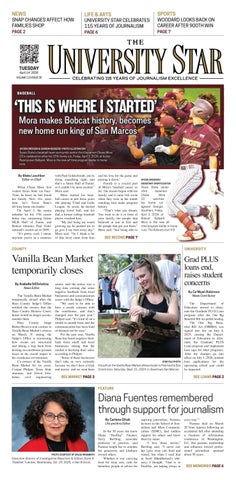
Texas State senior third basemen Chase Mora (2) watches his home run against Georgia Southern, Friday, April 3, 2026, at Bobcat Ballpark. Mora is the new alltime program leader in home runs. The Bobcats lost 9-8.


By Ca’Myah Robinson News Contributor
The Department of Education moved to eliminate the Graduate PLUS Loan program after the One Big Beautiful Bill Act pulled funding.
The One Big Beautiful Bill Act (OBBBA) was signed into law on July 4, 2025, causing the Department of Education to eliminate the Graduate PLUS Loan program and implement loan caps for other programs. After the changes go into effect on July 1, 2026, student loan applications for the upcoming school year could be impacted.
By Carlene Ottah Life and Arts Editor
In the 30 years she knew Diana “DeeDee” Fuentes, Terry Bertling, associate professor of practice, said Fuentes taught her to emulate her generosity and kindness toward others.
Whether it was carrying food for stray cats, cash for homeless people or advice for
aspiring journalists, Fuentes, lecturer in the School of Journalism and Mass Communication (SJMC), had endless support for others and knew them by name.
“I love those stories,” Bertling said. “I never saw her [give stray cats food and water], but when I read that in Scott [Huddleston]’s obituary, I thought, ‘That is so DeeDee, just helping always in
every way.’” Fuentes died on March 20 from injuries following an accidental fall after attending a freedom of information conference in Washington, D.C. Her passion, mentorship and influence toward professional journalism spanned about 50 years.
By Charlsie Daniels News Contributor
Supplemental Nutrition Assistance Program (SNAP) users in San Marcos are rethinking their grocery budgets after Texas banned the purchase of candy and sugary drinks.
As of April 1, Texas SNAP recipients can no longer use their Lone Star Cards to purchase certain candies and beverages with more than five grams of added sugar, following the new restrictions under Senate Bill 379.
Gov. Greg Abbott said a press release on August 2025, the bill law targets “taxpayer-funded junk food,” by prohibiting items such as candy bars, gum, taffy, candied nuts and fruit, chocolate and yogurt, caramel coated snacks, sodas, sports drinks and other beverages.
“By restricting unhealthy foods from being purchased with SNAP benefits, Texas can help ensure the health and well-being of Texans,” Abbott stated in the press release.
According to Texas Health and Human Services, more than 3.5 million Texans rely on SNAP benefits as of 2025. Under the new restrictions, households can no longer use SNAP to purchase items like candy and sugary drinks, meaning families must either pay out of pocket for those products or adjust grocery lists to stay within their monthly budgets.
Jasmine Rivera, psychology sophomore, said her family has depended on SNAP for years. Her mother is fully disabled and unable to work, and she relies on government assistance for both food and housing.
Rivera said because she lives on campus, her mother often helps provide groceries by purchasing essentials like bread, milk, cereal, fruits, vegetables and meat with her SNAP card.
“My mom has a disability, so she’s not allowed to work and relies on a check that’s only about $1,000,” Rivera said. “That money helps us purchase food, drinks and snacks, because she’s very limited on money and still has other bills like rent.”
Although sweets are not part of their regular shopping trips, Rivera’s family occasionally uses SNAP to buy sodas, which are now restricted.
”It’s tough when my mom is on a limited income,” Rivera said. “Now we have to pay out of pocket just to enjoy something small once in
The Graduate PLUS Loan, also known as Direct PLUS, was a 20-year program created by the Higher Education Reconciliation Act of 2005 to financially assist graduates and professional students. According to the Education Data Initiative, as of 2025, 42.7 million students have student loans, with 1.8 million of them being Grad PLUS loan borrowers.
The Department of Education has not yet finalized the changes, meaning more could still be made, according to Dede Gonzalez, assistant vice president for Financial Aid and Scholarships.
“We have information as we currently understand it on our website regarding all OBBBA changes and will update the information once final rules are established, which we’re hoping should be no later than June 1,” Gonzalez wrote in an email to The Star.
The Department of Education issued an electronic announcement on March 9 detailing the changes to the National Student Loan Database System (NSLDS), eliminating eligibility for graduate students to receive the Direct PLUS loan and implementing new loan limits to the Direct PLUS loan for parent borrowers.
Roughly 100 students per year at Texas State rely on Grad PLUS,

History: The University Star is the student newspaper of Texas State University and is published every Tuesday of the spring and fall and once a month in the summer semesters. It is distributed on campus and throughout San Marcos at 8 a.m. on publication days with a distribution of 3,300. Printing is by the New Braunfels Herald-Zeitung.

a while.”
Rivera said rising grocery costs make it harder for families like hers to get by, especially when living with a disability. She said people shouldn’t judge others for getting assistance from the government.
According to Rivera, the SNAP changes have not drastically altered her family’s overall shopping habits, but she questions whether the policy was necessary in the first place.
Food and health experts like Celia Cole, CEO of Feeding Texas, also question whether the policy will actually change eating behavior or simply shift how families spend their limited cash.
“It’s important to consider how changes to eligibility or benefits may impact access to food for millions of Texans who turn to the program to help bridge gaps in their household food budget,” Cole said in a press release in March.

Lou Ruiz, biology senior, said she began receiving SNAP benefits last May, and they are now essential to her daily life. In Ruiz’s experience, balancing school, teaching a lab and volunteering makes it a struggle to afford rent, gas and groceries.
”We aren’t poor people,” Ruiz said. “Sometimes everyone just needs a little help and that’s okay.”
While Ruiz said she supports encouraging healthier eating, especially for children, she admitted the new restrictions have had some personal downsides.
“I used to get Monsters and Celsius, but now I can’t,” Ruiz said. “I can’t even get the zero-sugar options … Sometimes I need the caffeine to get me through the day.”
Ruiz said access to SNAP has been lifechanging for her. Before enrolling in the program, she often ate one meal a day or less while trying to cover basic expenses.
“I was able to keep my grades up, but I didn’t feel good just eating once a day,” Ruiz said. “No one should have to go through that or feel that way.”
Ruiz said she was arrested last year for stealing cat food, before she knew about SNAP benefits, because she was so desperate for food for herself and her cat.
“I learned instantly that I can’t steal, I don’t want to steal. I paid my dues, did my community service and also learned about SNAP,” Ruiz said. “Now I don’t have to steal just to eat, and my cat and I are doing great.”
Texans who need help affording food can call 2-1-1 or visit 211texas.org for free, confidential help connecting to local food banks, meal programs and other resources across Texas.
Texas State University students looking for food assistance can also access Bobcat Bounty from 4:30 to 6:30 p.m. on Mon days in the Family Consumer Sciences building, in room 187.

according to Gonzalez.
Logan Stone, physical therapy alumnus and two-year borrower of the Grad PLUS loan, said the program helped relieve the financial burden of paying for school.
“The $20,500 I pulled out was supposed to last [through] fall, spring and summer, [which] didn’t stretch far enough,” Stone said. “I found
Editorial Staff
Editor-in-Chief: Blake Leschber stareditor@txstate.edu
Managing Editor: Rhian Davis starmanagingeditor@txstate.edu
News Editor: Arabella DiChristina starnews@txstate.edu
Life & Arts Editor: Carlene Ottah starlifeandarts@txstate.edu
Opinions Editor: Andrew Bencivengo staropinion@txstate.edu
out about the Grad PLUS loan ... it’s easy, I [didn’t] have to do a lot on the back end.”
Stone said the elimination of the program could increase stress for students from non-traditional backgrounds when figuring out how to pay for school.
“I hope there’s more education on the front end when applying for
Multimedia Editor: Meg Boles starmultimedia@txstate.edu
Engagement Editor: Tatum Pou starengagement@txstate.edu
PIR Director: Keely Florez starpr@txstate.edu
grad school,” Stone said. “If there’s not a system in place I feel as though it’s going to limit opportunities for people who come from lower socioeconomic backgrounds.”
Texas State is reaching out to all students to inform them of the changes under the OBBBA, Gonzalez wrote.
As for graduate students, Gonzales wrote the school provides different aid opportunities through assistantships, fellowships, scholarships and standard federal, state, private financial aid like loans work-study and some grants.
There aren’t any new programs in place of the Grad PLUS loan amidst the OBBBA changes, according to Gonzalez.
“My understanding of Congress’s intent in passing the loan provisions within the OBBBA was to help curb tuition growth and prevent borrowers from getting into an overborrowing situation where they have more debt than they would ever be able to successfully repay,” Gonzalez wrote. Gonzalez recommends students look for loans in the future start the application process early to get the most benefits.
“Students should always strive to file the FAFSA by the priority deadline of January 15th to maximize any available grant aid,” Gonzalez wrote. “Fill federal limits first, then compare private options.”
Publication Info
Copyright: Copyright Tuesday, April 14, 2026. All copy, photographs and graphics appearing in The University Star are the exclusive property of The University Star and may not be reproduced without the expressed written consent of the editor-in-chief.

Design Editor: Carson Rodgers stardesign@txstate.edu
Sports Editor: Adrian Ramirez starsports@txstate.edu
Web Editor: Alejandra Sosa-Lopez starweb@txstate.edu
Creative Service Director: Sophia Gerke starcreative@txstate.edu
TV News Director: Maci Gambrell startvnews@txstate.edu Trinity Building 203 Pleasant St. San Marcos, TX 78666 (512) 245 - 3487
Corrections Policy: Errors appearing in the pages of The University Star and brought to our attention will be corrected as soon as possible.
Contact at: 512-245-3487 advertising@universitystar.com
By Peyton Till News Reporter
The SAVE Act is awaiting a Senate vote, leading Texas State students to demonstrate against the bill, urging it not to pass.
The Safeguard American Voter Eligibility Act (SAVE Act) is a federal bill that aims to ensure only U.S. citizens vote in federal elections. The act will prohibit online registration and mail-in ballots and require voters to provide proof of citizenship when registering to vote.
The approved forms of citizenship include a U.S. passport, a birth certificate paired with a photo ID, a naturalization certificate or a Consular Report of Birth Abroad, according to Congress and The White House.
Texas State’s National Association for the Advancement of Colored People’s (NAACP) student chapter organized an demonstration on March 26 against the SAVE Act.
“It’s an act that doesn’t do anything; it’s called the SAVE Act, but who is it saving?” Felicia Jones, public administration senior and the political action chair of Texas State’s NAACP Collegiate Chapter 6875-B, said.
Non-citizens are prohibited to vote under the Illegal Immigration Reform and Immigrant Responsibility Act of 1996, however if The SAVE Act is passed will amend the National Voter Registration Act of 1993, which created registration requirements for federal elections.
Currently, voters are allowed to present a driver’s license as a valid form of identification, according to VoteTexas.org.
A 2023 survey found that 21.3 million eligible voters could be disenfranchised by the SAVE Act,
to know, we got to pay rent too, you know, we have bills,” Philpot said. “I think the fact some of them have been saying that [Vanilla Bean] affects their sales and stuff but I mean we’re a business too. We’re a legal business and we don’t think it’s fair.”
Becerra wrote in a statement to The Star, the county is taking a step back due to concerns regarding the impact to county property, licensing requirements and applicable tax compliances.
“This reassessment is intended to ensure that future use of county property is administered fairly, consistently and in alignment with public benefits and applicable legal requirements,” Becerra wrote.
Philpot said while this is a bump in the road for Vanilla Bean, pride themselves on consistency and building relationships with other businesses. He said he appreciates the market is something people look forward to.
“This is not the end of Vanilla Bean, it is a bump. We are definitely trying to make something bigger and look at it in the long run,” Ixtabalan said.
Vanilla Bean is a creative market and space for vendors and customers to shop for vintage art, jewelry, food, drinks and everything small business.
“We started the market because we didn’t feel like there was really a space that was dedicated to small businesses as Vanilla Bean is,” Ixtabalan said.
The market is typically held on the second or third Saturday each month at the courthouse, with 85 different rotating vendors.
Ixtabalan said the ongoing pushback and lack of proper communication don’t just affect Vanilla Bean Market, but also the 300 vendors that rely on the market each month.
“It’s been affecting our vendors very dearly. Some of these vendors, this is their only source of income, and these markets are their only opportunities [to showcase their products],” Ixtabalan said.
Andrew “AJ” Rangel Jr., owner

as they do not have access to the documents required to register and vote, according to the Center for Democracy and Civic Engagement.
“You need to prove you are who you were at birth, and a lot of people don’t have access to those documents; that’s essentially a poll tax,” Jones said.
Linda Calvert, the vice president of advocacy for the Hays County League of Women Voters, said if the SAVE Act passes the Senate, disabled people, individuals in the military, people in rural areas and elderly individuals who use mail-in voting will be affected.
“In order to actually register, people would have to go to the elections office, and people that don’t have transportation or have jobs and can’t get there in working hours would simply be disenfranchised,”
of Freeborderpalace, has sold vintage band t-shirts, records, cassettes, VHS and other media for eight years. He said the temporary closure of Vanilla Bean was a gut punch.
“Vanilla Bean has brought a lot of good income into my life. It’s made it to where I can afford rent in one day,” Rangel said. “Thankfully, I have a job, like a full-time job, but I do look forward to Vanilla being every month because it gives me confirmation that even on a bad day, I’ll be able to make my rent.”
Rangel said not only has his business grown from Vanilla Bean, but he also met his girlfriend because of the market.
Natalie Radmall, owner of Current Goods, sells her artwork in the form of stickers, shirts and other goods. She said other markets don’t have the same foot traffic Vanilla Bean has.
“[Philpot and Ixtabalan] were both really encouraging, and they were like ‘yes, come be a part of Vanilla Bean,’ and so a few months after I had started selling on Etsy, I decided to start with the market,” Radmall said. “That really has been the bulk of my business through the market.”
Radmall said the market brings a sense of community and third spaces, where locals can participate in events, local art, music and food that doesn’t have to cost much.
Philpot said they encourage vendors and customers to go to local businesses before or after the market.
“We have heard that [local businesses] book a little bit more employees for that day and that weekend, they get extra inventory for that weekend, and that’s just proof that it is benefiting small businesses around here and local businesses here as well,” Ixtabalan said.
After the county completes its review, the program will be reintroduced. However, Philpot and Ixtabalan said they are also thinking about talking to Texas State about future events.
Calvert said.
Calvert also said she found it interesting that President Trump, a proponent of the bill, used mail-in voting in Florida’s House District 87 special election in March 2020.
“In my own opinion, this is certainly an attempt to disenfranchise people who don’t vote ‘correctly,’” Calvert said. “The intention is to suppress the vote, and the people who are most likely to be affected are low-income people and people of color.”
The SAVE Act would also impact married women who changed their last names, requiring them to present a marriage certificate, and transgender individuals, according to Calvert.
A 2025 study from the American Civil Liberties Union on federal data regarding voter verification found that non-citizen voting occurred at a rate
of .04%, which contradicts the claim President Trump made during the State of The Union Address that voter fraud is rampant.
“What this bill is purporting to do is to fix a problem that we do not have; there is no problem with illegal voting,” Calvert said.
The SAVE Act would also mandate that individuals who do not meet the requirements to vote be purged from the voter registration system, with voter roll purges occurring every 30 days, according to the Brennan Center for Justice.
The SAVE Act, which passed the House on Feb. 11 by a vote of 218-213, is currently blocked in the Senate due to an ongoing filibuster, which is a prolonged debate or delay intended to prevent a vote on a bill. However, multiple states have introduced bills like the SAVE Act to pass similar legislation at the state level, according to Calvert.
Hyun J. Yun, a political science professor at Texas State, said that while the bill could provide some benefits regarding election integrity, the burden of proof should not be on the individual voter.
“There’s already a low voter turnout and hurdles for registering, and then when you add more steps that people have to complete, it leads to not only voter suppression but voter depression as well,” Yun said. “Regardless of party line, this act will affect every American voter.”
If the SAVE Act passes the Senate, it would apply to all federal elections, including the presidential election in 2028.
“If this were to pass, it would show that we are rapidly losing our democracy, our voice and our representation,” Jones said.


Tuesday, April 14, 2026
Opinions in The University Star are not necessarily those of our entire publication, Texas State University’s administration, Board of Regents, School of Journalism and Mass Communication or Student Publications Board.
By Andrew Bencivengo & Regina Orozco Lopez Forment Opinion Editor & Assistant Opinion Editor
For a policy meant to improve the health of Texans, the state’s Supplemental Nutrition Assistance Program (SNAP) changes might just make some San Marcos residents less healthy.
In a community already threatened by food insecurity, Texas’ SNAP restrictions stand to leave some residents hungry, and others sick. The restrictive nature of the bill walls off products without considering medical circumstance or food accessibility.
As of April 1, Texas SNAP recipients are no longer able to purchase candy and drinks containing five grams of sugar or more with their Lone Star Card. The Governor’s website framed it as part of the “Make America Healthy Again” (MAHA) initiative, with MAHA’s very own HHS Secretary Robert F. Kennedy Jr. alongside Gov. Greg Abbott at the bill’s signing ceremony.
A bill that aims to straddle fiscal responsibility with public health struggles to implement positive changes in less than 300 words, because of how wholly complex the issues are. For San Marcos residents, it introduces a web of challenges to an already struggling community.
San Marcos, as of 2024, has a 15.9% food insecurity rate, according to the Central Texas Food Bank. Additionally, 16,472 of residents are

eligible for SNAP benefits, according to Texas Health and Human Services latest report, in August 2025. Taking food, that is often cheaper and more accessible, off of SNAP creates further restrictions on a group already constricted in their needs.
Mya Cashiola, interior design junior, who was formerly on SNAP benefits, said the government changing eligibility for food and beverages is unnecessary.
“At the end of the day, the goal is to be fed. Who cares what the food
is?” Cashiola said.
Although the bill may have passed with the intention of forcing healthier habits and consumption, it simultaneously neglected to acknowledge all Texans and their medical needs.
Like most legislation, specifics were not considered such as medical cases. What the legislator misses, though, are those who rely on sugary food and drinks as a matter of survival, not as a sweet treat.
Members in the San Marcos
community with chronic health issues like diabetes and hypoglycemia rely on fast-acting carbs and sugars, and sometimes a sugary beverage might be the closest thing in reach. A SNAP recipient undergoing a medical emergency won’t be able to rely on a federal program designed to protect their health, introducing a dichotomy between the bill’s intent and its outcomes.
Abbott, however, seems convinced it protects those with chronic conditions.
“These bills that I am signing today put Texas on that pathway. Taxpayer dollars will no longer be used to fund chronic health problems in our state,” Abbott is quoted as saying on his website at the bill’s signing ceremony.
While medical circumstances may be specific, community members in San Marcos are affected by them, and the state risks overlooking medical needs for policy.
“Putting restrictions on [sweets] puts people into a bind. If they cannot afford insulin, and you take away their alternative, which in some cases can be candy, how do they regulate their sugar?” Cashiola said.
-Andrew Bencivengo is a business management junior and Regina Orozco Lopez Forment is a English junior
By Arab Culture Club
When people ask me where I’m from, the easiest answer to give is Texas. I’m a senior here at Texas State University. I have spent the majority of my time here in the state, I’ve grown up here. I was born in New York, lived in New Mexico, and will now live in Texas for the majority of my life. However, it is deeper than that. I’m the daughter of two people that immigrated here from Baghdad, Iraq. It’s a city that they still speak about with so much love and many fond memories. They explain this to me through stories, through memories, and the ways that they have kept our culture alive in our home. So through my culture and identity, Baghdad to me has never been just a place on a map.
When my parents moved to the U.S., they didn’t leave behind who they were there. They brought everything with them: their values, their work ethic, their culture, their pride and their identity. The life that they built here reflects all of it, and me and my siblings honor it. My dad now is an established OB/GYN, and my mom is a laboratory manager for hospitals in New Mexico. They’ve always taught me to never take the easy way out, and that shows

evidently through all of their sacrifices. My parents, to me, are more than just their careers. They are the reason that I understand what dedication looks like, and they are the reason that I know what it means to work toward something bigger than yourself. Growing up, I never saw their journey or story as something extraordinary. It was just my normal. It’s normal to hear Arabic at home, to eat the food that they grew up with and to listen to all the stories that connected us to a place that I never really lived and would always just visit every once in a while. However, despite this, I always felt tied to it. It was normal to see how
much they valued education, discipline, and family. My parents weren’t just building careers, but they were building a life that held onto where they came from while creating opportunities for my siblings and me for where we are now. To me, being Arab American has always been about that balance. It’s about carrying two worlds at once without feeling like I have to choose between them. It all comes down to knowing that my identity is not split, it’s layered equally.
Of course, I think a common theme that comes across all cultures, regardless if they are Arab American, is having moments where you grow up feeling different. There are moments where
I had to explain my name, my background, what I was eating, my traditions, or where my parents are from. However, I knew that there was a story behind me, and even then I never felt disconnected from who I was. I knew that my identity came from a place rich in history, culture and resilience. I know that my parents’ journey wasn’t about leaving something behind, it was just about expanding their lives while holding on to everything that mattered. Arab American Heritage Month is all about honoring that. It’s a time to recognize the beauty of our culture and where we come from and strengthen it as we carry it forward. This month is a time
The University Star welcomes letters from our readers. Letters must be 300 words or fewer to be considered for publication. Writers must include their full name, mailing address, major and academic year designation (for students), phone number and e-mail address when submitting a letter. Submissions that do not include this information cannot be published. This information is seen only by the editors and is used to verify the identify of the letter writer. It is not used for any commercial purpose.
about celebrating all of the families who built their lives across borders without losing themselves in the process. As I get closer to graduating, I think all the time about what my parents have given me to be here. This isn’t just about the opportunities, but also the perspective. They showed me that I can grow, succeed and adapt without ever letting go of my roots.
This is what I carry. I carry Baghdad in the stories that I’ve been told, the language that I grew up hearing and the pride that I feel every time I say where my family is from, or even just simply correcting someone on how to say my name.
Letters become the property of The Star and may be republished in any format. The letter may be edited for length and clarity. An editor will contact the letter writer if their letter is a candidate for publication. The Star will not run letters that are potentially libelous, discriminatory, obscene, threatening or promotional in nature.
Letters can be submitted to staropinion@txstate.edu or by mail to Attn: Opinion Editor, The University Star, 601 University Drive, San Marcos, TX, 78666.


By Cady Clements Assistant Life and Arts Editor
The University Star showcases its legacy in an Alkek Library exhibit honoring those who shaped the organization. It is on display through fall 2026.
Fred W. Adams established The University Star in 1911. He proposed the idea to the college president and said he would pay any printing costs not covered by advertising. In exchange, the president allowed him to keep the profits.
The first issue of the then-called Normal Star was published on April 11, 1911, marking the start of what would become one of Texas’ longest-running student publications.
Kristin Van Diest, head of Special Collections and Archives, worked on the display with her team alongside The Star’s PR team and director. They curated the display to show the different eras of the newspaper, from The Normal Star to The College Star to today’s University Star
“We had the idea to make sure that we were featuring the different mastheads, changes of the name and the font and the layout, and so that was really important to us to showcase as we moved through the decades,” Van Diest said.
Van Diest worked alongside Jason Crouch, Special Collections librarian,

and Emma Gomez, graduate research assistant. Van Diest and Crouch said the more pieces they found, the more individual stories emerged.
Crouch said one of his favorite pieces in the exhibit is the original editor-inchief plaque, which lists the names of notable individuals who began their careers at The Star, including former President Lyndon B. Johnson.
“I think [the plaque] is just cool because it is history encapsulated,” Crouch said.
“You’ve got LBJ on there and lots of folks who went into long careers in journalism, I’m sure.”
Fuentes reported and edited for more than 35 years. She started at the Laredo News during the late 1970s and worked in many different newsrooms, such as the Beaumont Enterprise and the San Antonio Light.
Nora Lopez, executive editor at the San Antonio Express-News, met Fuentes after Fuentes’ transfer to the Express-News in the late 1980s. She said Fuentes was an amazing reporter who knew how to maintain sources because of her genuine interest in people.
“She was just so smart, and she just showed so much empathy whenever you talked to her,” Lopez said. “She was always in that moment with you, so you really felt seen, you felt understood, you felt validated when you were talking to her. That was one of her best qualities.”
While they worked at the Express-News, Bertling said she recalled a time when Fuentes was the night metro editor and Kym Fox, professor of practice, was the day metro editor. Fox died of cancer last July. She and Fuentes would nurture many of the younger journalists, who referred to them as the “newsroom moms” of different shifts.
“I think she remembered being a young journalist trying to get a break in the business, too, and wanted to help pull people up the way others helped pull her up to help her get her start,” Bertling said.
Fuentes also reached those outside the newsroom. Dino Chiecchi, associate professor of practice, said she always tried to be helpful. She was part of several organizations, including the National Association of Hispanic Journalists, the Texas Managing Editors, the San Antonio Association of Hispanic Journalists and Investigative Reporters & Editors Inc.
[Fuentes] was just so smart, and she just showed so much empathy whenever you talked to her.”
Nora Lopez, Executive editor at the San Antonio Express-News
Edmond “Ed” Komandosky, former editor-in-chief in the 1960s and an adviser to The Star in the 1970s, is one of many individuals who helped shape the newspaper’s identity.
Komandosky said one of his proudest moments with The Star came when he ran a last-minute national story about former premier Nikita Khrushchev’s removal from the Soviet Union’s leadership in October 1964, expanding the reach of a previously campus-focused newspaper.
“We didn’t normally run national or international news in The Star, but that was an important thing,”
Komandosky said. The Star does not exist without the people who trust it to tell their stories.
Kathleen “Kathy” Fite, former professor and elementary education alumna, shared one of her students’ stories, Awad Abdelgadir, with The Star to remember the life he lived. She said seeing the story about him published meant a lot to her.
“The University Star did a wonderful article on him,” Fite said. “He’s recently passed, but for years, we went to different schools, and I would introduce him ... and he talked about his homeland,
Chiecchi said leaders within these organizations aimed to make them better and stronger, and Fuentes contributed in every way.
“She was especially involved in freedom of information issues,” Chiecchi said. “She cared deeply about the craft and access to information that the government had and access to public officials. She worked in making sure that newsroom representation was equal to the communities [that] newsrooms were serving.”
Chiecchi said he agreed with Lopez calling Fuentes “born to serve.” Lopez said she believed Fuentes was involved with many journalism groups due to her deep commitment to the field and to mentoring the next generation.
“I think all of these groups have mechanisms in place to raise money for students wanting to pursue a career in journalism,” Lopez said. “I feel like that’s why she was a member of all these groups, because it furthered her core belief in freedom of the press.”
Even after Fuentes retired from the ExpressNews in 2021 and pursued a master’s degree while teaching at Texas State the following year, she would keep in contact with those she knew.
Lopez said they became even better friends as they served on the SPJ San Antonio Pro Chapter’s board and helped produce its annual Gridiron show. Bertling said Fuentes would drive from San Antonio just for SJMC’s monthly faculty meetings in Old Main, even when she was not teaching. Chiecchi said people regarded her highly, which may have led her to continue teaching at Texas State.
Fuentes’ influence also reaches those she taught. Kobe Arriaga, journalism alumnus, transferred to Texas State in August 2022. Fuentes was one of his first professors, and he said he easily grasped journalism basics in her media writing class due to how she simplified it.
One day in 2023, Arriaga’s bus was delayed, and he considered walking home when Fuentes offered to give him a ride. They had a deeper conversation in that 15-minute car ride, and he found out she was from the same town as him and had other similarities.
Arriaga said from that point on, he and Fuentes would always keep in touch. After Fuentes’ passing, Arriaga said thinking of her inspires him to continue his work in journalism.
“It’s shocking, it’s heartbreaking, it’s like something that you could have never imagined,” Arriaga said. “But at the same time, I know that I’m still going to carry her presence with me and her legacy. And I’m just going to try to help make her as proud as I can. I think that’s the best thing that I could do.”
and we talked to just hundreds of young children in the schools.”
According to Alkek Library, the exhibit highlights “design changes, content coverage, campus evolution and ever-evolving student life and tradition.” It shows the people who built The Star and shaped 115 years of coverage, from student editors to advisers to community members. Van Diest said one of her favorite parts of shaping the exhibit was including authentic pieces from an individual’s personal archives, including a camera from the 1980s.
“I think that’s really cool, just to have that kind of authentic artifact that was actually used to photograph images for The University Star in there,” Van Diest said.
Scan the QR code to learn more about the history of The Star.


Executive editor of the San Antonio Express-News Nora Lopez (left) and executive director of Investigative Reporters & Editors Diana R. “DeeDee” Fuentes (right) perform during the Society of Professional Journalists San Antonio Pro Chapter Gridiron show, Saturday, Sept. 27, 2025, in San Antonio. The Gridiron is a satire fundraiser that supports college scholarships for aspiring journalists.
The School of Journalism and Mass Communication established the Diana “DeeDee” Fuentes Endowed Scholarship to provide funding for students pursuing a degree within the school.
Scan the QR code to learn more about the Diana “DeeDee” Fuentes Endowed Scholarship.

By Adrian Ramirez Sports Editor
In 2001, Ricci Woodard left the University of Oregon for the city of San Marcos and Texas State University.
25 years later, the Bobcat softball head coach created a program built on pride, grit and playing the game the right way. Tally everything together, and it adds up to 900 career wins for Woodard, a mark that places her in the top 20 amongst all active Division One coaches.
On March 31, Woodard secured her 900th career win against I-35 rival, UTSA. With the win, Woodard joined former Bobcat volleyball head coach Karen Chisum as the only coaches in Texas State history to win 900 games.
Despite the milestone victory, Woodard said the wins are only a part of what has made her career in San Marcos what it is today.
“The journey hasn’t been about wins and losses; this one is just a number and a credit to all the people I have been able to do the journey with,” Woodard said. “I think about all the recruits, players and coaches … that’s what the journey has been about for me.”
Woodard’s message to the team about wins and losses was a similar one, according to senior catcher Karmyn Bass, but she said getting Woodard to 900 was important to them.
“Whenever we were playing [against UTSA], coach told us she doesn’t want us to care about 900 wins,” Bass said. “But obviously, it is a thought in the back of our head when our coach is about to win 900, we wanted it for her, for us and for Texas State. 900 is a big deal.”
Along the way to 900 wins, Woodard instilled core values within her program that she believes are the reason for her successes at the helm of Bobcat softball.
“Pride is the first thing. We tuck our shirts in if it says Texas State softball on it, we carry ourselves in a way that people know who we are,” Woodard said. “The standard is the standard for me. I expect people to show up and get after it every day.”
do that in front of them was truly unbelievable, and I’m proud I could do it at home.”
Mora built another family in San Marcos, too. Head Coach Steven Trout said the homegrown talent from Mora is commendable, especially as the transfer portal continues to heat up in collegiate athletics.
“Now, with the portal era, program records don’t get broken as much

Bass said Woodard not only holds her players to a certain standard, but herself as well, making it easy for the team to buy into what she is trying to accomplish.
“She sets the standard for us, coming in and giving her all every single day,” Bass said. “The least we can do is give it back to her.”
Over nearly 26 seasons, Woodard learned and polished her coaching style exactly the way she wants it, but said she still has work to do.
“I think I’ve gotten a little bit smarter about the way I go about it. But if you watch some days, it’s probably still not smart, I’m still pretty animated,” Woodard said. “I’ve tried to control that a little more over the last 900 wins, but the biggest thing is I’ve gotten smarter about how I handle young women now.”
As Woodard surpasses another milestone, she said the best part of it all is seeing the impact she has made on others.
“The greatest thing about the 900 is I get to hear from a whole lot of people, and they’re people that helped
that for four years, and now they set the record, and hopefully he leaves it broken even more over the next 30, 40 games.”
Mora said when he looked into colleges, he chose Texas State due to the familial connection he felt to the program. Trout said this pushes him every day to make both himself and his team better.

“He loves Texas State. He loves San Marcos. He loves this program,” Trout said.
“He’s putting his mark on it in different aspects … These are his brothers and his family, so he wants to do something special with this group.”
Senior outfielder Rashawn Galloway came to Texas State in 2023, the same year Mora arrived in San Marcos. He said he’s witnessed Mora’s immense growth, and he’s earned the accolade.
“Knowing [Mora] for years now, I think it was really cool. I think the kid’s earned it,” Galloway said.
“He’s trusted the process … And I think there’s nobody better in the program to do it. Every homer he’s hit, he’s earned; it was never given to him.”
Even throughout the transfer portal era, Mora has stayed loyal to Texas State.
He credits that to his family values and the closeness he
me get to this spot,” Woodard said. “That’s the fun part for me, knowing the small impact I made on people’s lives along the way … that’s what this has been about, way more than the wins and losses.”
Even though her life centers around softball, Woodard still understands that it is just a game, and if she could go back to the beginning, she would make sure to tell herself that.
“At the end of the day, it’s a game that imitates life, so there’s a way we go about our business, but when the game’s over, the game’s over,” Woodard said. “Life is going to go on whether we won or lost, so it’s more about how we went about it for me.”
Even after 900 wins, 25 years and over 1,400 games, Woodard still loves getting to do her job and the opportunity to show up to Bobcat Softball Stadium every day. As she makes the next push of her career toward the milestone of 1,000 wins, Woodard said it’s important to understand why she continues doing it.
“I think I still enjoy coming to work every day and that’s what keeps

me going,” Woodard said. “I love this team, I love the group of young ladies; just to see the difference of how they’ve grown up into young women that can go out and conquer the world is what still keeps me motivated.”

feels toward the program.
“This is the place I wanted to be; this is where I started,” Mora said. “That’s something my dad and grandpa have always preached: ‘If you’re going to start something, finish it and do it the right way.”’
The home run record was on the team’s mind at the start of the season. Baseball is a very superstitious sport and Trout said no one on the team really talked about the chance that Mora could break the record.
Once Mora did, though, he said he felt a large sense of relief, and he continues to push the team throughout the season.
“I felt all the weight on my shoulders go away; I was free,” Mora said. “When I was
running the bases, I was just thinking about my grandpa and my mom and my dad and everything they’ve done to get me to this point.”
Baseball is just as much a mental game as a physical game. Trout said that as players go through ups and downs, like Mora, it is important for the team to keep them fresh and looking forward to the next game.
“[Mora’s] a freshman All-American, everything’s going right, then he goes through different periods as every great player does,” Trout said. “Then the next year, it’s not as good a year, and we didn’t have as good of a year as a team. So you start battling how to handle success, then you battle how
to handle failure.”
Texas State looks to continue the momentum of the season, especially because the Bobcats have postseason aspirations.
“It feels awesome,” Mora said. “Pressure’s off our shoulders. I can just go play, go be free, and obviously, with the way this season’s going, we could be playing until June.”
Mora will have his next chance to add more home runs to his record number at 6 p.m., Tuesday, April 14, 2026, at Irvine-Rasmussen Ballpark in San Marcos when the ‘Cats take on Houston Christian University. The game is available to stream on ESPN+.

Texas State computer
science
junior Andrew Lee makes matcha for Monke Milo, Thursday, April 9, 2026, on the LBJ Mall. The stand was part of Bobcat Bazaar, a popup market hosted by the Texas State CIE.


Texas State junior center fielder Bennett Fryman (9) jumps for a hacky sack, Wednesday, April 8, 2026, at Irvine-Rasmussen Ballpark. The Bobcats run ruled the Stephen F. Austin Lumberjacks 10-0.


Scan QR to view the full gallery online.
Texas State junior left fielder Jaquae Stewart (24) prays prior to first pitch against No.18 Texas A&M, Tuesday, April 7, 2026, at IrvineRasmussen Ballpark. The Bobcats beat the Aggies 9-8.
A patron at the Bobcat Pause event pays respect to Kairy Espino’s memorial, Monday, April 13, 2026 at the LBJ Ballroom. Bobcat Pause is annual even to honor members of the Texas State Community who passed.
Texas State senior catcher Megan Kelner (0) and sophomore pitcher Abigail Jennings (27) celebrate pregame, Tuesday, April 7, 2026, at Bobcat Softball Field. The Bobcats beat UTSA 3-0.
