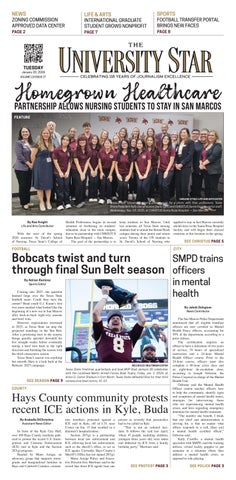
1-20-26

Page 1


Homegrown Healthcare

Partnership allows nursing students to stay in San Marcos

With the start of the spring 2026 semester, St. David’s School of Nursing, Texas State’s College of

FOOTBALL

Health Professions, begins its second semester of furthering its students’ education close to the main campus, due to its partnership with CHRISTUS Santa Rosa Hospital — San Marcos. The goal of the partnership is to

keep students in San Marcos. Until last semester, all Texas State nursing students had to attend the Round Rock campus during their junior and senior years. Twenty of the 130 students in St. David’s School of Nursing who

Bobcats twist and turn through final Sun Belt season

Coming into 2025, one question loomed large over the Texas State football team: Could they turn the corner? Head coach G.J. Kinne’s first two years marked what looked like the beginning of a new era in San Marcos after back-to-back eight-win seasons and bowl wins.

However, expectations increased in 2025, as Texas State sat atop the projected standings in the Sun Belt. After a promising start to the season, things quickly spiraled downhill for five straight weeks before eventually taking a hard turn back in the right direction and finishing the season with the third consecutive season.

Texas State’s season was anything but smooth. Here is a look back at the Bobcats’ 2025 campaign.

SEE SEASON PAGE 9

with the

G.

consecutive

Hays County community protests recent ICE actions in Kyle, Buda

In front of the Kyle City Hall, over 100 Hays County residents gathered to protest the recent U.S. Immigration and Customs Enforcement (ICE) raid in Kyle and the Section 287(g) program.

Headed by Mano Amiga, an advocacy group that supports immigrants and marginalized families in Hays and Caldwell Counties, commu-

nity members protested against a ICE raid in Kyle, off of I-35, near Costco on Jan. 15 that resulted in a detainee’s hospitalization.

Section 287(g) is a partnership between local law enforcement and ICE, allowing local law enforcement, such as the sheriff’s office, to act as ICE agents. Currently, Hays County’s Sheriff’s Office has not signed 287(g). Mano Amiga Policy and Executive Director Eric Martinez said to the crowd that three ICE agents beat one

person so severely that paramedics had to be called in Kyle.

“This is not an isolated incident. It follows the raid last April, where 47 people, including children, youngest three years old, were taken and abducted by ICE from a family birthday party,” Martinez said.

applied to stay in San Marcos currently attend class in the Santa Rosa Hospital facility and will begin their clinical rotations at this location in the spring.

SMPD trains officers in mental health

The San Marcos Police Department announced that all eligible frontline officers are now certified as Mental Health Peace officers, accounting for 59% of the department, according to a press release.

The certification requires an officer to have a minimum of two years of service, 74 hours of specialized instruction and a 24-hour Mental Health Officer course. Prior to the 24-hour course, officers must also complete a 40-hour crisis class and an eight-hour de-escalation class, according to Joseph Osborne, the Police Corporal in charge of the Mental Health Unit.

Osborne said the Mental Health Officer course teaches officers how to help the community, identify signs and symptoms of mental health issues, strategies for interviewing those who are experiencing mental health crises, and laws regarding emergency detention for mental health treatment.

“The number one benefit, I think that our chief and administration is striving for, is that no matter what officer responds to a call, [they are] a mental health certified officer,” Osborne said.

Kelly Castillo, a mental health specialist with SMPD, said the training utilizes virtual reality goggles to put someone in a situation where they address a mental health crisis, as opposed to role-playing.

MEG BOLES | MULTIMEDIA EDITOR Texas State freshman quarterback and bowl MVP Brad Jackson (8) celebrates
Lockheed Martin Armed Forces Bowl Trophy, Friday, Jan. 2, 2026, at Amon
Carter Stadium in Fort Worth. Texas State defeated Rice for their third
bowl victory, 41-10.
By Rae Knight Life and Arts Contributor
Texas State University nursing juniors pose for a photo with their professors, Texas State President Kelly Damphousse (back right) and CHRISTUS Santa Rosa Hospital staff, Wednesday, Nov. 19, 2025, at CHRISTUS Santa Rosa Hospital — San Marcos.
CARLENE OTTAH | LIFE AND ARTS EDITOR

January 20, 2026

Commissioners Court approves creation of jail-based competency restoration program

The Hays County Commissioners Court passed the final step for the Jail-Based Competency Restoration Program (JBCR), designed to address mental health crises in the criminal justice system.

JBCR aims to reestablish the competency of detainees who are legally deemed mentally incompetent, meaning a judge has found that the defendant lacks a rational understanding of the trial proceedings or the ability to assist their defense attorney.

To restore competency, defendants require treatment, usually from state hospitals, before they can stand trial; however, there are significant delays of up to 300 days in the Hays County Jail.

“The most important thing to remember is, this is a stepping stone in moving people through the justice system in a meaningful way without hurting people’s lives for years on end,” Hays County Judge Ruben Becerra said.

According to the press release, housing an individual in jail for approximately 300 days can cost taxpayers around $45,000, with little progress toward treatment or case resolution.

“I think it’s going to help unclog the system, because right now we are overcrowded and are outsourcing our neighbors at Haskell County paying a lot of money, approximately $160,000 a week, just burning it, throwing it away and putting them so far away, loved ones and attorneys can’t easily get to them,” Becerra said.

The program is funded by a state grant awarded to Hill Country Mental Health and Development Disabilities (MHDD), which allows mental health professionals to work within the Hays County Jail.

Director of Forensic Services at Hill Country MHDD Michelle Zaumeyer said their services range from medication management and psychiatric evaluations to counseling, group competency education classes and individualized peer support.

Zaumeyer said a general success is getting an individual to a point where they can have their

competency restored in 60 days or less. However, Zaumeyer stated that if a defendant needs more time to restore competency, they can ask the judge for an extension for up to 120 days.

“... What success might look like for the individuals in the program is they might, for once, experience a stabilization of their mental health symptoms, they might understand what the charges are against them and understand possible outcomes of that charge,” Zaumeyer said.

Zaumeyer said they will cover all of the defendant’s mental health resources, and the county will administer and pay for the medications. She said resources available to individuals after the program depend on the outcome of the court hearing.

Shayne Jones, criminal justice and criminology professor, said usually individuals with psychotic symptoms, like delusions and hallucinations,

are incompetent to stand trial, meaning they are mentally unable to consent to legal decisions.

“An example of assisting their attorney [is] if they had an alibi, for example, that they were at a certain place, but they did not communicate that with their defense attorney because they felt the defense attorney was out to get them, that would be one indication of possible incompetence to trial,” Jones said.

Jones said competency assessments are one of the most common in the criminal justice system, even though only 6 to 7% of defendants are actually referred for them.

“You can have psychological problems, but both competency and insanity are legal constructs,” Jones said. “They’re not psychological constructs.”

According to Jones, having a mental illness and active symptoms does not mean a defendant is incompetent to stand trial.

Jones said there are two big challenges in a competency restoration program: determining the severity of mental illness symptoms and complying with the medical plan.

Jones stated that anyone who is incarcerated or in jail waiting for trial is going to have a negative psychological effect.

According to the press release, the program has the potential to help the 24 individuals currently waiting for services in Hays County.

Zaumeyer said Hill Country MHDD is currently determining who would be appropriate in the program, with a target to start providing direct services towards the end of February.

“The ultimate goal is that they never see booking and instead get the support they need, but elections have consequences, and we need people in office at the county level that will support this further modernization,” Becerra said.

Becerra said he hopes to build a 16-bed mental health facility to meet people before they even get to jail.

Planning and Zoning Commission approves data center

The San Marcos Planning and Zoning Commission voted 6-2 to approve a data center at its Jan. 13 meeting

The proposed data center is set to be located on Francis Harris Lane on a plot of 199.19 acres of land.

A total of 94 public comments from San Marcos and Hays County residents, students and union workers were made either for or against the planning and zoning before the public hearings.

John Mayberry, a managing partner at Highlander Real Estate Partners and leading agent on the item spoke about the benefits San Marcos, Hays County and potential employees would receive from the data center.

“Data center construction and operation rely heavily on licensed skills trades, particularly electrical workers,” Mayberry said. “These projects are designed to staff locally because local labor reduces risk, improves response times, and builds long-term operational knowledge.”

Out of the 94 public comments, 16 were made in favor of the data center. The majority of those comments came from leadership and union workers from Laborer’s International Union of North America (LIUNA), a construction workers’ union that represents about 5,000 workers in

Trinity Building 203 Pleasant St. San Marcos, TX 78666 (512) 245 - 3487

History: The University Star is the student newspaper of Texas State University and is published every Tuesday of the spring and fall and once a month in the summer semesters. It is distributed on campus and throughout San Marcos at 8 a.m. on publication days with a distribution of 3,300. Printing is by the New Braunfels Herald-Zeitung.

Read more at universitystar.com

Texas and 500 in San Marcos.

Jeremy Hendricks, a representative of LIUNA, spoke about his support of the data center for LIUNA union workers.

“Supporting the items of this project presents real opportunities for working people in San Marcos,” Hendricks said. “Not just for shortterm jobs but long-term careers. These are the kind of jobs that allow families to put down roots and be a part of this community that they helped build.”

Those in opposition of the data center spoke about concerns dealing with water usage, environmental issues, public health, agriculture and the rising use of Artificial Intelligence.

Lydia Rodriguez, a resident and third-generation ranch owner, spoke about water usage and insecurity across the state.

“San Marcos is a community defined by it’s neighborhoods, natural resources and its responsibility to future generations,” Rodriguez said. “This proposal threatens all three of them. First off water, several Texans are facing an increasing water drought risk and water insecurity. Approving a project that adds major industrial water vans is reckless.”

During the public hearing, Julia Clearly, the senior planner with the city of San Marcos, outlined the process of the application of the zoning, the preferred scenario amendment process, and the restrictive covenants

Editorial Staff

Editor-in-Chief: Blake Leschber stareditor@txstate.edu

Managing Editor: Rhian Davis starmanagingeditor@txstate.edu

News Editor: Ryan Claycamp starnews@txstate.edu

Life & Arts Editor: Carlene Ottah starlifeandarts@txstate.edu

Opinions Editor: Andrew Bencivengo staropinion@txstate.edu

Design Editor: Carson Rodgers stardesign@txstate.edu

Sports Editor: Adrian Ramirez starsports@txstate.edu

proposed by Mayberry and his team.

According to Clearly’s presentation, the conditions the data will follow if constructed will not exceed 235 LUEs or 75,000 gallons of water. Water quality facilities will be constructed that meet a total suspended solid removal requirement of at least 80% of the site, worker protection standards and drainage facilities will be constructed.

Lasting almost eight hours, after debate about the application process, zoning categories, community and environmental concerns, the majority of commissioners supported both the

Multimedia Editor: Meg Boles starmultimedia@txstate.edu

Engagement Editor: Tatum Pou starengagement@txstate.edu

PIR Director: Keely Florez starpr@txstate.edu

Web Editor: Alejandra Sosa-Lopez starweb@txstate.edu

Creative Service Director: Sophie Gerke starcreative@txstate.edu

TV News Director: Maci Gambrell startvnews@txstate.edu

Director: Laura Krantz, laurakrantz@txstate.edu

zoning and planning of the data center. Commissioners accepted questions from concerned citizens who shared public comments throughout the meeting up until 2 a.m. after the vote. According to the city’s preferred scenario, Feb. 3, 2026, would be the date for the city council’s public hearing.

The commission meets on the second and fourth Tuesday of every month at 6 p.m. in the city council chambers.

Publication Info

Copyright: Copyright Tuesday, January 20, 2026. All copy, photographs and graphics appearing in The University Star are the exclusive property of The University Star and may not be reproduced without the expressed written consent of the editor-in-chief.

Corrections Policy: Errors appearing in the pages of The University Star and brought to our attention will be corrected as soon as possible.

Advertising Inquiries

Contact at: 512-245-3487 advertising@universitystar.com

LUCIA GONZALEZ | STAR ILLUSTRATOR
RYAN CLAYCAMP | NEWS EDITOR

“It’s as if you were responding to a call standing in someone’s front yard with their kid having a mental health crisis,” Castillo said. “And then you get to make the decisions from there.”

Castillo also said mental health matters to SMPD, and that part of keeping the community safe involves addressing mental health crises.

“Mental health isn’t a crime,” Castillo said. “…We’ve had a lot of conversations like this, I looked into it, it’s like 98% of Americans know when you’re having an emergency to call 911, but it’s a staggeringly smaller crisis to call 988, the suicide lifeline… This is such a unique part of policing, it’s not criminal.”

When individuals call the suicide and crisis hotline, or 988, in Texas, about 1-2% of callers require police intervention. Texas 988 call centers received the second-highest call volume in the U.S., however, the current system is struggling due to a high demand. Texas legislation has still not addressed the rising demand for the service, according to The Texas Tribune.

“People’s first reaction if they, or a loved one, is having a mental health crisis is to call the police,” Castillo said. “So why not equip the people responding to better handle what they’re walking into?”

Castillo said SMPD has proactive resources, such as follow-ups after an emergency detention, providing transportation and financial support to those in need, community presentations, providing knowledge about the Mental Health Unit at therapy offices and usage of a therapy canine. He said these programs aid

in keeping individuals away from a future mental health crisis.

SMPD responded to 2,290 calls for service relating to mental health in 2023, 57% of which included a mental health certified officer. Of the certified officers that responded to the calls, 342 were joined by professional like Castillo, according to the San Marcos government website.

“I’m not a police officer; we can use that to our advantage,” Castillo said. “Sometimes, we show up, and [a person experiencing a mental health crisis doesn’t] call the police, maybe their mom or dad did. [They might say] ‘I dont want to talk to an officer.’ Okay, well, we have [a Mental Health Professional].”

Seth Watts, an assistant professor of criminal justice and criminology, said mental health knowledge in law enforcement is vital because mental health issues frequently overlap with substance use, homelessness and general crime.

“The police interact with a wide variety of populations,” Watts said. “They are the gatekeepers to the criminal justice system, and they frequently interact with vulnerable groups.”

Watts said crisis intervention training refines the approach to addressing issues by providing community support and de-escalation,

as opposed to just making an arrest. He said the mental health training seemed to be a promising approach to community issues.

Mental health training for officers is set to continue once other officers in the force reach eligibility to become certified, according to Castillo. The press release mentions that state law requires the two-year rule to be eligible to take the required mental health training class, among other classes, such as first aid and de-escalation.

“Though it was a major goal for 2025, it’s going to continue on as officers age into the program,” Castillo said.

Anyone who is going through a mental health crisis is encouraged to call 988 or visit the official 988 Lifeline website. Additionally, they can contact SMPD or visit the mental health unit section on the San Marcos government website.

According to NPR, 2025 was the deadliest year for people in ICE custody since the early 2000s, with at least 20 detainees having died.

Lisa Pous, San Marcos resident, said she thought she could escape violence one day, being a survivor of domestic violence, sexual assault and human trafficking; however, the recent ICE activity is only reminding her of that violence.

“It is the idea that we have ownership over other people’s bodies, and we have the right to decide what to do with them,” Pous said. “We have been hurting mothers and families, it’s horrific. Our own government is hunting us.”

Among the crowd were Texas State alumni, former Texas State history professor Thomas Alter, entire families and two San Marcos City Council members.

Texas State alumni and Austin resident Natalie Mullins said she is showing up for her community and for those who can’t protest out of fear of discrimination.

“Look at what the city of Buda did, they told ICE agents to move their transport bus from City Hall,”

Martinez said. “That’s part of what community power looks like.”

Chants against Section 287(g) erupted as Martinez stated that the Hays County community “cannot allow our sheriff’s deputies to become ICE agents.”

Protesters received mixed responses from the cars passing by, with the majority honking in support of the protesters Danielle De Leon, a Kyle resident, said she wanted to stand on the right side of history and support her community.

“I feel like this is a small community … and sometimes you see things on TV and it’s like oh, you know, it’s kinda of far away,” De Leon said. “But when you see it in your backyard, that’s a big reason why I am here.”

Abigail Ramirez, a Hays County resident, said she felt the need to be more active in her community.

“Since [ICE activity is] so impactful to not only my family, my community and just everybody in general. I just really felt like it was time to be a part of a protest personally,” Ramirez said.

We have been hurting mothers and families, it’s horrific. Our own government is hunting us.”
Lisa Pous, San Marcos Resident
FROM FRONT PROTEST
ISABELLE CANTU | ASSISTANT MULTIMEDIA EDITOR
CARSON RODGERS | DESIGN EDITOR
Protesters participate in the ICE Out of Hays County protest hosted by Mano Amiga, Sunday, Jan. 18, 2026, at Kyle City Hall. The demonstration sought to raise awareness to ICE’s actions and demand the sheriff say no to bill 287(g).

Tuesday, January 20, 2026

Opinions in The University Star are not necessarily those of our entire publication, Texas State University’s administration, Board of Regents, School of Journalism and Mass Communication or Student Publications Board.

AI has no place in mental health treatment

Trigger warning: This column has mentions of suicide

Since 2020, Artificial Intelligence’s (AI) utility has greatly increased. AI has expanded into mental health treatment with chatbots. Recent surges in mental health chatbots and apps creates concern for the future of mental health treatment due to AI’s inability to understand the ramifications of user’s messages, making it unsuitable for professional advice.

Colleges across the country are reporting a mental health crisis, with over 60% of students experiencing a mental health issue. According to the Suicide Prevention Resource Center, suicide continues to be one of the leading causes of death among ages 15-24. Understanding the importance of receiving reliable and authentic mental health treatment is vital, especially when resources on campus are available for students.

Studies show that college students are less likely to ask for help when needed, making it more likely for students to use AI as an avenue for relief. This leads to one in eight young adults age 12-21, using chatbots for mental health advice, according to a Brown University study.

Mental health professionals, like

those in the National Association of Free & Charitable Clinics (NAFC), criticize AI due to its lack of empathy and understanding. While chatbots are often free and accessible, they do not guarantee a person authentic treatment.

A Stanford study tested a therapy chatbot’s credibility. It was found that the Noni chatbot, located on the therapy website 7 Cups, was able to express concern for a lost job but failed to recognize suicidal ideation and intent.

Failure to recognize these signs is harmful because licensed therapists (LPC) are required to report to authorities and provide a safety plan if a patient expresses any form of suicidal intent. AI chatbots do not follow the same requirements, and AI companies have no way to intervene.

Dr. Daisy Zhou, professor of counseling and Nationally Certified Counselor (NCC), said life-threatening issues like suicide are never ignored because of their dangers.

“Risk assessment is something we never forget,” Zhou said. “We really do value people’s lives and that’s why we put risk assessment at such high priority.”

In mental health treatment, it is vital to build real human relationships to implement long-term change. AI use makes this near impossible because face-to-face connection is lost. It becomes very easy for either party to disengage, and even easier for users to log off and receive no substantial benefits.

Zhou said therapy thrives on guiding a patient into the right direction and while AI can provide

short-term help, it is unable to keep a consistent long-term plan and connect with the patient.

“We want the change to be sustainable,” Zhou said. “Every time we talk with the clients ,we integrate into a holistic picture, and that’s why we are truly deeply connected.”

Another reason some might be willing to turn to chatbots for mental health advice lies in accessibility. Survey statistics from the American Medical Association found that 22% of college students surveyed experienced financial issues when looking into mental health services. Due to a chatbot’s free access and availability, many students can fall into using them for help.

Texas State offers free mental health services through the counseling center and hosts multiple mental health outreach events throughout the year. Understanding when help is needed and how it can be obtained is vital in creating safer environments..

Mental health continues to be an important topic among students due to its effects on their lives. Students must be aware of the services available at Texas State and in the community. While AI might be more convenient, it lacks the ability to make long-term changes, unlike human therapy.

Using AI chatbots only harms how mental health treatment is seen. It is important to remember that there is no shame in needing care and reaching out when needed is always important.

-Shar Kiefer is a political science sophomore

Students can engage better with politics

Political polarization has increased in America over the last few decades, especially across university campuses like Texas State. The current political climate is abnormal, but for young adults in college, it’s all they know.

Constant access to streams of negative information, increasingly partisan national politics and disagreeable current events have caused college students’ opinions on politics to sour, leading to negative ramifications for students’ mental health. With primaries approaching in March, its especially important for students to be mindful of the U.S. political climate while navigating it effectively.

Traicy Kaya-Kaya, a pre-nursing sophomore, said she feels the current political climate is very charged.

“You’re constantly stuck between wanting to be aware, but at the same time not wanting to be aware because reality and awareness can make you depressed really fast,” Kaya-Kaya said.

Staying informed on current affairs is undoubtedly a good thing, but college students must navigate the news cycle in a safer way to minimize harm to their mental health. At the same time, young adults must not accept this political climate as the new status quo, or they risk continuing

to vote for divisive candidates that further the trend.

“I really do think it’s going to impact how we go about politics when it’s our generation getting involved, because of the example,” Kaya-Kaya said.

According to a 2023 Pew Research Center study, 65% of Americans feel exhausted when thinking about politics, and for young adults, this discontent seems even stronger. The 2025 Harvard Youth Poll, which polls 18-29 year olds on a variety of political issues, reported only 13% of young adults believed the country is headed in the right direction.

For college students, growing unhappiness and uncertainty with U.S. politics is worsening mental health struggles, and bleeding discontent in campus communities. At Texas State, discontent grew during the 2025 Fall semester, with protests, demonstrations and general unhappiness.

Young people have always seemed to care about politics, but the mental health ramifications have worsened in recent times, likely due to how easy it is to engage with politics. Major announcements or news that were once filtered over a news cycle are now being shared instantly, and directly from politicians’ mouths, on platforms like X. This, unfortunately, gives young adults no opportunity to avoid negative events and leads to a constant stream of information.

Another unfortunate trend is how present politics are in every aspect of a college student’s life. Universities, especially in Texas, have become influenced by state and national politics, with decisions

Letters to the Editor Policy

The University Star welcomes letters from our readers. Letters must be 300 words or fewer to be considered for publication. Writers must include their full name, mailing address, major and academic year designation (for students), phone number and e-mail address when submitting a letter. Submissions that do not include this information cannot be published. This information is seen only by the editors and is used to verify the identify of the letter writer. It is

on campus events and curriculum directly reflecting partisan politics and angering students further.

For students, it can often seem hard to ignore politics, but it is how young adults engage that matters. For many, it is up to how much they can handle, but balancing negative media attention with a healthy dose of positive news is a good start.

“What I try to do is kind of microdose a little bit with the news that I consume. I want to know about the harsh stuff, the reality of things … but I also want to know about the positive things in life that are

not used for any commercial purpose.

happening,” Kaya-Kaya said.

Jasmine Rivera, a psychology sophomore, said talking to people about current politics is a good way to engage effectively.

“Start small, like talk about it with your friends, and then when you meet new people, you kind of discuss it too,” Rivera said.

College students have more of an impact than they may think, and their voices are especially important at the ballot box.

-Andrew Bencivengo is a business management junior

Letters become the property of The Star and may be republished in any format. The letter may be edited for length and clarity. An editor will contact the letter writer if their letter is a candidate for publication. The Star will not run letters that are potentially libelous, discriminatory, obscene, threatening or promotional in nature.

Letters can be submitted to staropinion@txstate.edu or by mail to Attn: Opinion Editor, The University Star, 601 University Drive, San Marcos, TX, 78666.

JEN NGUYEN | ASSISTANT DESIGN EDITOR
CAROLINE TRANG | STAR ILLUSTRATOR

LIFE & ARTS 5

FROM FRONT CHRISTUS

With the start of the spring 2026 semester, St. David’s School of Nursing, Texas State’s College of Health Professions, begins its second semester of furthering its students’ education close to the main campus, due to its partnership with CHRISTUS Santa Rosa Hospital — San Marcos.

The goal of the partnership is to keep students in San Marcos. Until last semester, all Texas State nursing students had to attend the Round Rock campus during their junior and senior years. Twenty of the 130 students in St. David’s School of Nursing who applied to stay in San Marcos currently attend class in the Santa Rosa Hospital facility and will begin their clinical rotations at this location in the spring.

The partnership also comes at a time when Texas faces a projected shortage of more than 57,000 registered nurses by 2036. Anna Gore, CHRISTUS Santa Rosa Hospital chief nursing officer, said the program will help build pipelines for the hospital and the community to allow the nurses to stay home.

“We hear a lot of the nurses leave to go to Houston, Dallas and even Austin,” Gore said. “To be able to provide a path to not only enhance and bring in more students means more nurses, which not only will help our facility but our community and the surrounding communities as well, even throughout the state.”

According to CHRISTUS Santa Rosa Hospital President Bob Honeycutt, discussion of this partnership began last March with Texas State President Kelly Damphousse.

“[Damphousse] mentioned that when students come to San Marcos, they really like San Marcos and they like to stay in San Marcos,” Honeycutt said. “It got our wheels moving to say, ‘Well, what can we do in order to help the nursing students stay here,’ and we looked at space and what the program

made here,” Yalamanchili said. “I don’t feel any competition. I feel like we really are all trying to build each other up. We want everyone to get to the end. I eat, sleep and go out with these people 24/7. Every part of our lives is nursing school, and because we’re together in it, we’re very much helping each other with every aspect of it.”

Last fall, students visited Heart Hospital of Austin for two days to get their first idea of how the floor looks. In the classroom, they spent their time in the simulation lab using mannequins to learn techniques. This semester, they will be on various floors of the CHRISTUS hospital, getting hands-on, well-rounded experience with nurses and patients.

would look like, and we found the space around the campus so we can offer that didactic learning experience here at the hospital including clinical rotations.”

Honeycutt and Damphousse decided they would start small with a 20-nurse cohort that began last semester and would return as seniors next fall while another class starts. Honeycutt said he hopes to have up to 50 students to start, with the end goal of reaching 100-120 students in San Marcos by building a nursing school on the hospital campus.

To keep students in San Marcos, CHRISTUS provided a leased space within its building where students receive hands-on experience. This includes a classroom, simulation lab and clinical rotations.

“It is really an honor and privilege to work with Texas State University and to work with the nursing program,” Honeycutt said. “It is a vital part of any growing and thriving community. Anything that CHRISTUS Santa Rosa can do to make that come to fruition

in San Marcos, New Braunfels and San Antonio, we want to make sure we are able to do that.”

After nursing school applications began in spring 2025 for the coming fall and spring semesters, applicants were sent a survey asking if they would be interested in remaining in San Marcos for nursing school. All selected students are juniors and have the opportunity to continue their schooling in their senior year.

Sajani Yalamanchili, nursing junior, was chosen to remain in San Marcos with the CHRISTUS program. Yalamanchili said she had a preference to stay in San Marcos for school but was prepared to move to Round Rock as long as she was in nursing school.

Regarding the partnership, Yalamanchili said no one knew what would happen or that it would be the best choice for her. She said contrary to the talks about cliques and competition being a difficult part of nursing school, she doesn’t feel that way being among 20 of her peers.

“It truly is like a family we’ve

According to Cale Nedrow, a nursing junior, he and his peers receive more first-hand learning because they had access to a hospital environment, whereas students at the Round Rock campus spend more time in the classroom during their first semester.

Nedrow completed his pre-nursing degree at Texas State and said he loved the school so much that St. David’s was the only nursing school he applied to. When he applied to the university, he planned to move back home since he was close to Round Rock, though he said he would still come visit San Marcos due to his love for the city and his friends there. Since he could stay in San Marcos, Nedrow said he liked being exposed to many experiences, such as being in the hospital.

“There was one time we were in class ... there was someone from a prison facility who was coming to get treatment,” Nedrow said. “I was like, ‘This kind of stuff is new. People don’t see that every day unless you’re a nurse or you’re giving the treatment.’ The promise we as nurses are making is that it doesn’t matter who you are ... our goal is to treat our patients and make them better.”

Texas State President Kelly Damphousse (left) exchanges caps while shaking hands with CHRISTUS Santa Rosa Hospital President Bob Honeycutt (right) during the partnership signing ceremony, Wednesday, Nov. 19, 2025, at CHRISTUS Santa Rosa Hospital — San Marcos.
CARLENE OTTAH | LIFE AND ARTS EDITOR

International graduate alumnus launches environmental nonprofit

When Ayodeji “Deji” Akinloye enrolled in Texas State University’s sustainability studies program in 2023, his goal was simple: finish his master’s degree.

“I was just trying to pass my class,” Akinloye said, referring to an environmental ethics course in the program.

Akinloye previously earned his undergraduate degree in chemistry in Nigeria. When he was completing the sustainability studies program at Texas State, Akinloye was inspired to found PURE-NG because of his ties to Nigeria.

Launched early 2025, PURE-NG is a nonprofit environmental organization focused on waste reduction, recycling education and community cleanups in Lagos, Nigeria. Lagos was a natural starting point for PURE-NG because it is Akinloye’s hometown.

“I wanted to start in Lagos because that’s where I actually live, just giving back to my own community where I came from,” Akinloye said.

A rapidly growing megacity, Lagos faces significant waste management challenges. Despite government efforts to improve sanitation, communities still lack access to sustainability education.

“That’s where I felt the gap in sustainability awareness was,” Akinloye said. “If people understand the impact of their actions, change becomes possible.”

Akinloye said his idea for PURE-NG was inspired by an environmental praxis assignment asking students to identify a carbonconsumptive habit in their lives and measurably change it over the semester. He chose to reduce his use of single-use plastics, a habit he said made him more aware of his daily environmental impact.

“I stopped taking plastic bags from stores. I started using reusable bags. I paid more attention to how much water I was wasting,” Akinloye

said. “Those small changes made me realize how much individual behavior actually matters.”

Seth Thompson, assistant professor of instruction in the department of philosophy, taught the class. He said Akinloye demonstrated a commitment to environmental issues even before enrolling in the environmental ethics class.

“I am confident that he would have founded this organization without my class,” Thompson said. “Still, it means everything to me when I see students make meaningful impact. As an educator, there’s no better outcome than seeing a student confront real-world problems in practical, meaningful ways.”

Akinloye said his growing interest in sustainability was shaped by what he observed in the U.S., particularly how waste is managed compared to Lagos.

“In the U.S., you see separate bins for recycling everywhere. Paper here, plastic there. It’s organized,” Akinloye said. “Back home, that level of awareness isn’t as widespread.”

In early 2025, Akinloye decided to act on the idea. He registered PURE-NG as a nonprofit organization

in Nigeria, a process that took months due to rejected name submissions, legal fees and other bureaucratic delays. The process was self-funded, and Akinloye said recruiting volunteers willing to commit to unpaid work was another early challenge.

“There were moments I really questioned whether it was worth it,” Akinloye said. “But I had already started. Giving up would’ve meant all of the efforts, time and money I had spent going to waste.”

While finishing his studies in Texas, Akinloye assembled a volunteer team in Nigeria, relying on Zoom calls and constant communication to keep the project moving. Oyindamola Adebola, PURE-NG’s project coordinator in Lagos, joined PURE-NG during its early planning stages and now coordinates the organization’s projects on the ground in Lagos. According to her, distance was never a barrier.

“Despite the time difference and busy schedules, Deji’s communication has made the work smooth and stressfree,” Adebola said. “He follows through immediately; if we say next week, it’s next week.”

PURE-NG hosted its first

community cleanup and outreach event on Oct. 11 in Lagos’ Ajegunle Community, an area affected by clogged gutters and flooded streets, according to the organization’s report. For Adebola, that day marked a turning point.

“It didn’t fully strike me how important the work was until the day of the activation,” Adebola said. “Community members were already gathered and eager to help. The difference between when we arrived and when we left was glaring.”

There were 30 participants at the cleanup consisting of 25 community members, two volunteers, two local leaders and one media personnel. Adebola said residents not only participated but brought tools and helped clean streets beyond Ifelodun St. to nearby Unity St. in Ajegunle and reached the adjoining parts of Thomas, Lagos State without incentives.

The response to the cleanup exceeded Akinloye’s expectations.

“I honestly didn’t know how people would react,” Akinloye said. “Seeing that turnout made me realize this was something worth building.”

PURE-NG plans to host quarterly cleanups and expand into secondary schools, where Akinloye hopes to establish sustainability clubs and early environmental education programs.

Long-term, Akinloye envisions turning PURE-NG into a largescale waste management company, partnering with governments, businesses and international organizations across residential and commercial areas in West Africa and eventually other regions in Africa.

After graduating last fall, Akinloye said he hopes other Bobcats, particularly international students, see possibilities in their coursework, even in assignments that feel small. He said studying in the U.S. exposed him to systems that work differently, and real impact comes from adapting those ideas to address challenges in one’s home country.

“I didn’t know I could balance all of this,” Akinloye said. “Now I feel like there’s nothing I can’t do.”

‘Marty Supreme’ is a champion of cinema

When he’s not busy fighting sandworms in “Dune,” Timothée Chalamet sets himself up for critical recognition in other roles.

Chalamet’s recent role as Marty Mauser in “Marty Supreme” may be his best performance yet. The movie is loosely based on the life of Marty Reisman, a former USA Table Tennis Champion in 1958 and 1960, who is known for his glamorous style of play. In the film, Chalamet’s performance catapults him into “the greatness” the actor has been quoted as pursuing. He treats acting as a sport, operating as an athlete seeking to better himself every time. “Marty Supreme” may be the real start to witnessing his rise to immortalize his name amongst the new generation of actors.

Mauser is relentlessly driven, arrogant beyond belief and conniving, but he has the talent to back it all up. He is a streetwise ping-pong player who makes it to the 1952 World Finals in London, but loses to the rising Japanese star Koto Endo, played by Koto Kawaguchi, in a theatrical final. Catching the eye of former actress Kay Stone, played by Gwyneth Paltrow, Mauser lures her into an affair while also getting closer to her husband, Milton Rockwell, played by Kevin O’Leary, who owns the massive Rockwell Ink corp.

After Mauser’s loss in London, Rockwell presents him with a well-paid opportunity to rematch against Endo in Tokyo. It’s promoted as a redemption match for Mauser, capitalizing on the still-tense post-war relations between the U.S. and Japan, but it’s really an ad for Rockwell Ink. To further help promote the corporation and the stipulation to personally fly Mauser to the finals, Rockwell tells him he has to throw the match for the

Japanese audience.

Mauser is not one to root for as he relentlessly exploits his uncle, best friend, lover and mother. Because of his speed and fast talking, it’s impossible to look away from his chaotic approach to life. Chalamet plays Mauser with precision and hunger only matched by O’Leary’s Rockwell, who is equally voracious in getting ahead. The “Shark Tank” personality makes his Hollywood debut in “Marty Supreme” and impresses on all accounts. When Mauser and Rockwell are paired on screen, the tension between the two is only surpassed by the intense scenes of the ping-pong matches, coming down to razor-thin margins of victory.

The matches are wonderfully shot and paired with an inspiring synth score that underlines the energy and emotion of the sport. Unhappy with the prospect of throwing a match publicly before the real tournament, Mauser engineers other ways to collect the funds to get himself on a flight to Tokyo in time to compete. Each situation has a compounded domino effect of failures that only someone as determined as Mauser would tackle head-on. The runtime sits at 150 minutes, but the breakneck pacing of the film keeps it from ever going stale, weaving exciting sequences between high-stakes games of swinging paddles.

Chalamet is also surrounded by several other fantastic talents. Odessa A’Zion is Rachel, Mauser’s childhood best friend, who assists in some of his wild attempts to raise funds for Tokyo. Tyler Okonma, also known as Tyler, The Creator, is Wally, a cabdriver who also runs hustling scams with Mauser on the outskirts of New York City. Wally and Rachel feed into Mauser’s delusions and often help him push even further with some of the dirty work he begins to employ. With his charm, even Stone begins to get wrapped up in his holy mess.

“Marty Supreme” is Chalamet’s best work yet, working with a strong script, fantastic direction from Josh Safdie and an incredibly flawed but engaging character in Mauser. Although the character himself is not noble, his efforts are exhilarating to observe. Mauser’s plots are sloppy, but he plays his ruses as if they were another opponent of ping pong, instilled with a cockiness that everything will work out for him. Last year had several electric performances, but this late entry from Chalamet will undoubtedly gain some motion in awards nominations.

Volunteers participate in PURE-NG’s first community cleanup and outreach event, Saturday, Oct. 11, 2025, in the Ajegunle community of Lagos.
AYODEJI AKINLOYE | COURTESY PHOTO
CARSON RODGERS | DESIGN EDITOR

FOOTBALL

Portal outcomes: TXST adds new faces

With the Bobcats’ Pac-12 move on the horizon, head coach G.J. Kinne and company worked to not only retain key players in the transfer window but also bring in star power at several positions.

Texas State retained star players on offense, such as redshirt freshman quarterback Brad Jackson and his two biggest weapons in junior wide receivers Chris Dawn Jr. and Beau Sparks.

The Bobcats also secured the return of redshirt junior Jaylen Jenkins and sophomore Greg Burrell; they will share snaps in the running back position.

Defensively, there was plenty of room for improvement, and it’s clear that the defensive side of the ball received a lot of attention from Texas State in the portal, with several Power Four (P4) transfers joining the squad. Here’s a look at the confirmed incoming transfer signings so far.

Junior DE Mekhi Buchanan, Virginia

In 2023, Buchanan burst onto the scene as a solid contributor for a P4 program in Virginia. However, after not featuring in 2024 because of injury and only playing once in 2025, he’ll have a point to prove with the Bobcats. A good season in the new-look Pac-12 could revitalize his career.

Junior DL Chancellor Owens, Arizona

Owens played two games for Arizona, grabbing two tackles and 0.5 sacks. Alongside Buchanan and defensive end Kaleb James, he’s coming to Texas State with hopes of getting more defensive snaps and opportunities to showcase his talent.

Freshman QB Shaker Resig, Boston College Resig will come into the team as a competent backup to Brad Jackson. Another P4 transfer, Resig featured in three games in 2025, making his collegiate debut against Pittsburgh, completing three passes for 70 yards and a touchdown. Resig

WOMEN’S BASKETBALL

struggled in his next two games, throwing two interceptions in that span.

Redshirt sophomore DE Kaleb James, Arkansas

James is a high-potential edge rusher who was ranked highly coming out of high school. In 2025, he played in 12 games, registering three tackles. Much of his playing time came on the special teams side of the ball, but with the Bobcats, he could see more consistent snaps on the defensive line.

Graduate transfer CB Dexter Ricks, Liberty Ricks has almost 1,000 career snaps, and his FBS experience will be valuable for the Bobcats and their new defensive identity under Will Windham. Unlike other players brought in during this window, Ricks is someone moving up to a higher level of play. Liberty, Ricks’ former team, went 4-8 in 2025 and 3-5 in Conference USA play.

Junior OL William Boone, North Carolina Boone started three games for North Carolina this past season, and he’ll bring some strength and physicality to the offensive line. His height and weight are listed as 6’ 6” and 340 pounds respectively. His size and strength are both positive attributes that will serve Jackson well.

Along with gaining a plethora of newcomers, the Bobcats also lost several key contributors. Redshirt freshman center Brock Riker was the first Bobcat in the portal and has since committed to Penn State.

Many key defensive pieces portaled as well. DL Jordan Sanders and Karmen Washington, DBs Javis Mynatt, Khamari Terrell and Bobby Crosby and edge rushers Kalil Alexander and Tymere Jackson all entered during the portal window.

The deadline for players to enter into the transfer portal was Friday, Jan. 16, meaning the portal window has officially closed. And although

WBB struggles through first half of the season

With the college basketball season recently surpassing its halfway point, the Texas State women’s basketball team seems to be experiencing déjà vu, as they repeat many of the issues they faced last season, such as low scoring, turnovers and rebounding, all while playing as a young roster trying to get into the swing of things.

The Bobcats sit in the lower half of the Sun Belt Conference standings with a 7-10 record, going 3-4 in early conference play.

Statistically, through 17 games this season, the offense continues to be among the worst in the conference, averaging 62.4 points a game. The Bobcats rank 13th overall in the SBC, just above the 1-16 Louisiana Ragin’ Cajuns, who average 56.6 points.

Shooting-wise, they hit 39.7% overall while also sitting toward the bottom in three-point shooting with 27.3%. When it comes to free throws, they are exactly in the middle with 68.7%.

Another issue faced by Texas State is rebounding. Overall, the team collects an average of 37.6 combined rebounds per game, 11th overall in the

Sun Belt.

The Bobcats also seem to turnover the ball more this season, going up from an average of 18.2 at the midpoint last season to 19.7, which is third overall in the conference.

While the offense seems to lack the punch it needs to win, it’s not all negatives for the Bobcats, who started the season 2-6 going into December.

Defense continues to be one of the highlights for this squad, as they give up 63 points a game on average, which is among the top three in the conference. They hold teams to 38% shooting while forcing at least 20 turnovers a game, all of which rank in the top half of the Sun Belt.

Along with that, they are fourth in the conference in blocked shots with 74 overall blocks while averaging 4.35 a game.

Texas State will seek to get back on track as they prepare to play their third of four straight games at home against the Appalachian State Mountaineers at 7 p.m. Wednesday, Jan. 21. The game will be available to stream on ESPN+.

some signings might be finalized later, the majority of the roster is complete.

“We’re not going to keep everybody, we know that,” head coach G.J Kinne said after Texas State’s bowl victory against Rice. “I promise you this, when those kids do decide to leave here, they’re going to regret it… not everyone has it the way we do… and the guys that appreciate it, and the guys that know, they’ll stay, and that’s all we need.

MEN’S BASKETBALL

MBB playing .500 ball in conference play

The men’s basketball team had a productive start to the season, looking like one of the better teams in the conference, sitting at 6-2.

However, the momentum fizzled out after losing three straight games, and now the Bobcats are struggling to find their mojo. The team just recently won back-to-back games on Jan. 14 and 17 for the first time since the start of the season, when they won five straight.

Texas State started 6-2, and the two losses came against quality teams in Bowling Green and Tulane. The Bobcats’ largest winning margin during that time came against Texas Lutheran, a game they won by 52 points.

The wins didn’t last long, however, as the team then lost three straight games and hasn’t gotten back in a groove. Texas State is still on the right side of .500 with an 11-9 record overall, but sits at 4-4 in the conference, slotting them at the 11th spot in the Sun Belt.

With 11 games left in the season, the Bobcats are still trying to find their identity as a team. Although this squad is completely different from last year, there are still similar qualities that head coach Terrence Johnson is working to implement.

Like last season, the Bobcats have shown strength where it counts most: at the free-throw line and on the defensive end. The team is currently third in the conference in team freethrow percentage and fourth in total defense. They’re ranked third in blocked shots, averaging about four blocks per game and ranked second in steals, averaging almost 10 a game.

The team has also shown strength in boxing out opponents, ranking first in opponent rebounds. Backing that up, the team is ranked second in field goal percentage with an average of 47% from the field. Sitting just behind South Alabama (13-5) and in front of Marshall (11-7). On paper, Texas State is not far from competing with the top

teams in the conference.

However, one problem holding the team back from succeeding this season is three-point shooting. Texas State ranks dead last in three-point FGs made, only making 91 so far and averaging just under five made per game On top of the poor three-point shooting, Texas State often fouls. With a total of 366 so far this season, the Bobcats have given more chances to teams to get to the free-throw line, putting the team at a total disadvantage.

Texas State will look to close out the season stronger than it started. Back-to-back wins against Louisiana and Southern Mississippi are a good sign for the Bobcats’ chances at a strong finish, but consistency will remain key.

Texas State junior safety Ryan Nolan (7) celebrates after making a stop, Friday, Jan. 2, 2026, at Amon G. Carter Stadium in Fort Worth. The Bobcats beat Rice 41-10. Nolan entered the transfer portal but chose to return to Texas State.
ABEL BARCENAS | STAR PHOTOGRAPHER
Texas State junior guard Kaden Gumbs (11) poses after hitting a three-pointer against Abilene Christian University, Tuesday, Nov. 18, 2025, at Strahan Arena. The Bobcats won 63-49.
AYDEN OREDSON | ASSISTANT SPORTS EDITOR
Texas State sophomore guard KP Parr (2) dribbles the ball down the court Monday, Nov. 17, 2025, at Strahan Arena. Texas State lost to UTRGV 77-65.
GRACE DARCY | STAR PHOTOGRAPHER

FROM FRONT SEASON

“Rollercoaster” is the word Texas State quarterback Brad Jackson used to describe the Bobcats’ season. “Obviously, the fluctuation of the entire season, we started great and then we went on a real steep drop for a little bit,” Jackson said. “Just a rollercoaster of emotions and just being able to keep pushing through, ultimately end up the way we wanted it to.”

Jackson’s description of the season certainly is fitting, as the Bobcats started the season 3-1, with the only loss coming against nationally ranked Arizona State in Tempe. Once conference play got underway, however, everything seemed to go wrong.

A 31-30 loss to Arkansas State signaled the beginning of over a month-long losing streak. Following the loss to the Red Wolves, Texas State blew a 31-10 lead on homecoming, ultimately losing 48-41 to Troy in overtime. A week later, the Bobcats lost another overtime battle 40-37

against Marshall.

On the heels of a three-game losing streak, Texas State had to welcome the conference-leading and eventual College Football Playoff selection James Madison Dukes to town, a game that the Bobcats were thoroughly outplayed in.

After the beating by JMU, the Bobcats lost their fifth straight game and 13th in a row against Louisiana. The main story from that game, though, was the massive postgame scuffle that resulted in 13 total suspensions between both sides. Texas State’s season looked to be in a tailspin.

The Bobcats sat at 3-6 and had to win out to reach the minimum number of wins (6) in order to qualify for a bowl game. The odds of that happening looked slim-to-none, as the Bobcats’ opponent after the UL game was Southern Miss, who was second in the Sun Belt at the time.

At some point between the end of the Louisiana game and the beginning

of the Southern Miss game, it appears a switch flipped for Texas State, as it came out and decimated the Golden Eagles in Hattiesburg, 41-14. A win that reset the Bobcats’ course.

“That was the turning point in our season,” Jackson said. “It just showed us that we can do this, we have the potential to go out and dominate whoever we want to as long as we play a complete game and play complementary football.”

Following the big win over Southern Miss, the Bobcats dominated Louisiana-Monroe 31-14 and fired on all cylinders again the next week against South Alabama in a 49-26 victory to clinch bowl eligibility with a 6-6 record.

Texas State drew Rice in the Armed Forces Bowl with a chance to make it four straight wins to end the season and did just that with a 41-10 hammering of the Owls.

All things considered, the end of the season went as well as it could for the Bobcats, from nearly being eliminated from bowl contention to blowing out their opponent and winning a third straight bowl game. Texas State had a successful end to the season.

While the team finished strong, had they played the way they did at the end of the season all the way through, things could have possibly looked a lot different. Aside from James Madison and Arizona State, Texas State didn’t lose a game by more than one possession. Had both sides of the ball been clicking, those one-score games could’ve looked much different.

Regardless of the final record, though, Jackson maintains that the end of the season is reason to be excited.

“I think for us, we’re able to see this is the team we can be, we can go out and we can dominate anyone we want to,” Jackson said. “As an offensive unit, when you see the production we have, it’s like ‘holy cow,’ we can score

all the points on anybody.

Texas State head coach G.J. Kinne echoes the sentiment that the future is something to look forward to for Bobcat football.

“Really proud of the way the guys finished, there’s a lot to build off of, talking about the [Pac 12],” Kinne said. “The momentum from three straight bowl victories, we’ve got so much firepower coming back on offense, I think the sky’s the limit. Next year we’ve got a chance to be really special.”

The Bobcats’ final season in the Sun Belt was marked by the highest highs and lowest lows, but ultimately culminated in the program’s third straight bowl victory. The next time Texas State takes the field, it will be a member of the Pac-12. Curiosity and excitement will share the stage about what is to come for Bobcat football.

Texas State junior wide receiver Chris Dawn Jr. (1) scores a touchdown against Rice, Friday, Jan. 2, 2026, at Amon G. Carter Stadium in Fort Worth. Texas State defeated Rice for their third consecutive bowl victory, 41-10.
ABEL BARCENAS | STAR PHOTOGRAPHER
Texas State junior wide receiver Beau Sparks (11) prepares to run a play against Rice, Friday, Jan. 2, 2026, at Amon G. Carter Stadium in Fort Worth. Texas State defeated Rice for third consecutive bowl victory, 41-10.
MEG BOLES | MULTIMEDIA EDITOR

WIN BREAK RECAP TER

Texas State alumnus DJ Ross lays the Iota Phi

to honor

on Monday, Jan. 19, 2026, at the MLK Crossroads Memorial. Following the wreath laying ceremony, the Dunbar Association and the San

for Socialism and Liberation had a memorial walk.

Member of PSLSMTX Jack Alcala reads out a speech condemning ICE, Thursday, Jan. 8, 2026, at the Hays County Courthouse. Alcala spoke and lead chants for the “Stop ICE Terror” rally held by PSLSMTX.

Texas State head coach G.J. Kinne celebrates with the Lockheed Martin Armed Forces Bowl Trophy, Friday, Jan. 2, 2026, at Amon G. Carter Stadium in Fort Worth. Texas State defeated Rice for their third consecutive bowl victory, 41-10.

A protester participates in the ICE Out of Hays County protest hosted by Mano Amiga, Sunday, Jan. 18, 2026, at Kyle City Hall. The event served to raise awareness in asking the sheriff to say no to bill 287(g).

MEG BOLES | MULTIMEDIA EDITOR
Theta wreath
Martin Luther King Jr.
Marcos Party
RHIAN DAVIS | MANAGING EDITOR
Texas State junior wide receiver Chris Dawn Jr (1) and junior wide receiver Beau Sparks (11) celebrate at the Lockheed Martin Armed Forces Bowl Trophy, Friday, Jan. 2, 2026 at Amon G. Carter Stadium in Fort Worth. Texas State beat Rice 41-10.
San Marcos Mayor Jane Hughson poses for a photo next to her ceremonial wreath on Monday, Jan. 19, 2026, at the MLK Crossroads Memorial.
MEG BOLES | MULTIMEDIA EDITOR
RHIAN DAVIS | MANAGING EDITOR

Turn static files into dynamic content formats.

Create a flipbook
Issuu converts static files into: digital portfolios, online yearbooks, online catalogs, digital photo albums and more. Sign up and create your flipbook.