borgar høgetveit berg • ola ø. nisja
Borgar Høgetveit Berg and Ola Ø. Nisja
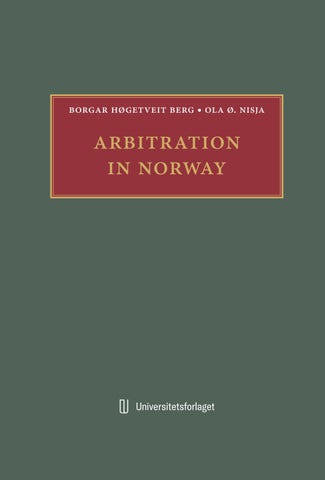
Borgar Høgetveit Berg and Ola Ø. Nisja
universitetsforlaget
© Aschehoug AS by Universitetsforlaget 2026
ISBN 9788215075075 Printed edition
ISBN 9788215075099 EPUB
ISBN 9788215075082 Juridika
This material is protected by the Norwegian Copyright Act. Copying and/or distributing this material is not permitted without the consent of the copyright holders, an agreement with Kopinor (www.kopinor.no) or authorization from another administrative or legal authority. The prohibition also applies to training and other uses of the material in artificial intelligence and includes an express reservation against text and data mining pursuant to Article 4 of the Directive on Copyright in the Digital Single Market.
Inquiries regarding this publication can be directed to:
Universitetsforlaget
P.O. Box 508 Sentrum
NO-0105 Oslo
Norway
www.universitetsforlaget.no
Cover design: ottaBOK
Prepress: ottaBOK
Typeset: Sabon LT Std 10/14
Paper: 100 g Amber Graphic 1,25
Binding: Livonia Print, Latvia
Printed by: Livonia Print, Latvia
EPUB conversion: PHi Business Solutions Ltd.
9.6
Arbitration is an agreed dispute resolution process. Parties that have agreed to submit a dispute to arbitration can agree that a tribunal appointed by themselves shall decide upon a potential or existing legal dispute with binding effect. This form of private dispute resolution is a natural consequence of the fundamental principle of freedom of contract. Norwegian legislation ensures that such agreements are effective, in that the decisions issued in arbitration can be enforced using the public enforcement system. Arbitration is central to everyday legal life, and Norway is an attractive venue for arbitration. Due to a lack of a literature concerning arbitration in Norway in English, we decided to write this book. It is based on some of our prior works in Norwegian, and it was practical to do in parallel with the revision of our book Voldgift i et nøtteskall (Gyldendal 2025) (“Arbitration in a nutshell”).
Several colleagues deserve gratitude for their input. Mentioning some but not others does not feel right. You know who you are, and you have received our personal gratitude. One however deserves a special thanks, and that is associate Lina Malone at Wikborg Rein, who kindly read through the full script in its final stage.
Oslo, January 2026
Borgar
Høgetveit Berg and Ola Ø. Nisja
Arbitration is a private form of dispute resolution in legal disputes. It is an agreed process. In arbitration, parties entrust one or more independent persons with deciding a legal dispute. In principle, an arbitral award has the same legal effects as a final judgement from the ordinary courts. In Norway, arbitration is regulated by the Arbitration Act, which came into force on 1 January 2005.
Arbitration is a natural consequence of freedom of contract. As parties can regulate their legal relationships by voluntary agreements, they must also be given the opportunity to choose how disputes between them are to be resolved. Arbitration will therefore in practice require an agreement between the parties. In principle, arbitration can be agreed in respect of all disputes arising out of a particular legal relationship. We will return to this in more detail in chapters 6 and 7.
Arbitration is an alternative to ordinary court proceedings and is thus an alternative form of dispute resolution (ADR). However, unlike other forms of dispute resolution, such as traditional mediation and court-annexed mediation, the primary purpose of arbitration is not to resolve the dispute amicably. Instead, the dispute is to be resolved by the handing down of an arbitral award. In an arbitral award, the dispute is resolved on the basis of the applicable law, with binding effect and with very limited opportunities to challenge the decision. This does not, of course, prevent the parties themselves from finding an amicable solution during the arbitration process. Rather, it is quite practical.
As a form of dispute resolution, arbitration is probably older than the public court process. Modern arbitration has developed from a tradition based on a desire for experts from the relevant field of life to settle disputes. The need for expertise still largely exists. In many commercial areas, therefore, arbitration maintains long traditions. Arbitration clauses
constitute the practical go-to in several types of commercial contracts. This applies, for example, to corporate transactions. Arbitration clauses can be found in a large number of widely used standard contracts, both in Norway and abroad.
Arbitration proceedings can be conducted either by the parties utilising an institution—i.e. an arbitration institute—or by the parties appointing the arbitral tribunal on their own, known as ad hoc arbitration. Ad hoc arbitration has always been most common in Norway, although it should be said that there is an ongoing shift towards more use of institutional arbitration.
The written and oral procedure in Norwegian arbitration cases will often be fairly similar to those required by the ordinary courts, although there are also some differences. We will return to this in chapter 10, where provisions regarding the proceedings in an arbitration case under the Arbitration Act are discussed in more detail.
Arbitration has a number of advantages which outweigh those of ordinary court proceedings. Firstly, the parties can largely determine the composition of an arbitral tribunal themselves, and may appoint arbitrators based on their preference or agreement. In this way, the parties can have greater confidence in the decision, having had the opportunity to ensure that the arbitrators have special expertise and experience in the commercial and legal area(s) to which the dispute relates. The use of arbitration also usually results in a quicker resolution of the dispute than ordinary court proceedings. This is the case even though Norwegian courts today are very effective compared to many other jurisdictions. Commercial parties may often want to avoid waiting for a legally binding decision from the courts.
Arbitration has its drawbacks, however. In practice, and as an established starting point, there is no opportunity to appeal an arbitral award, subject to certain exceptions. The fact that arbitration decisions can only be challenged on very limited grounds is a central and characteristic feature of arbitration—this is also said by many to be an advantage of arbitration. Furthermore, arbitration can prove more costly than ordinary court proceedings, especially because the parties must also compensate the arbitrators. However, compared to ordinary two-instance proceedings in the ordinary courts of Norway, arbitration will generally be cheaper and more time-efficient.
Arbitration can be compared to bringing a claim in the court of first instance and the Supreme Court at the same time. Everything must be presented, preferably with the right angle, as the parties will normally only get one chance. This means that case preparation is often more thorough and extensive than what is usual for the ordinary courts in Norway. Furthermore, it can be challenging to examine reluctant witnesses, as the arbitral tribunal cannot subpoena them. In such cases, the witnesses must be questioned at an evidentiary hearing before the ordinary courts.
In chapter 5, we will return to important factors when deciding whether arbitration should be used.
There are many similarities between ordinary court proceedings and arbitration in Norway. In both cases, the role of the judge (or tribunal) is central—the impartial and independent third party who decides the dispute between the parties. In fact, one of the objections to arbitration has been that this form of dispute resolution may become too similar to ordinary court proceedings.
However, arbitration as a form of dispute resolution differs from the ordinary courts in that arbitration is not part of the state. Therefore, it is often said that a dispute is exempt from court proceedings when the parties choose arbitration. If the parties agree to arbitration, they are cut off from the right to utilise the ordinary court system that is otherwise available. The consequences are regulated by law: If arbitration is validly agreed, the case shall, as a general rule, be dismissed from the ordinary courts, see sections 6 and 7 of the Arbitration Act.
In some cases, a statute stipulates that a dispute must be settled by arbitration, see for example section 33(5) third sentence of the Pollution Control Act. This is sometimes referred to as compulsory arbitration, as opposed to voluntary arbitration, which follows from an agreement between the parties. Such compulsory arbitration is not particularly practical.
An arbitral award has legal force, which means that it is final. Therefore, a court presented with a claim after that claim has been decided by arbitration must reject it. The fact that an arbitral award is final follows from the Arbitration Act precisely because the courts must reject cases that are subject to
arbitration, see sections 6 and 7 of the Arbitration Act, see also section 37(1) which refers to the final arbitral award. It can also be said that the effects of res judicata follow from sections 45 and 46 of the Arbitration Act, which concern recognition of an award. As arbitral awards are enforceable (and as such can be enforced by the authorities) parties are not required to bring a separate action for enforcement. A settlement reached before the arbitral tribunal will also have the same effect as a final judgement.
Contrary to what some believe or would like to believe, the rules for setting aside arbitral awards are no more lenient than for final judgements from the ordinary courts. If it were too easy to set aside an arbitral award, arbitration would lose its importance.
Arbitration is, by and large, a form of dispute resolution that in practice is reserved for professional parties. Although the Arbitration Act contains rules as to consumers, there are very few arbitration cases to which consumers are parties. Dispute resolution bodies in consumer cases can, however, be quite similar to arbitration, but without the characteristic of immediate finality as with an arbitration award.
The subject of this book is arbitration in Norway, with the Arbitration Act as the starting point. However, there are at any given point several international arbitrations ongoing which can be characterised as “Norwegian”, including where the Arbitration Act applies. International Arbitration is growing in Norway, and as we will revert to in chapter 3, Norway is by many seen as an attractive venue for international arbitration.
International arbitration usually refers to arbitration where the parties have a connection to two or more countries, or more generally arbitration that has a relevant connection to more than one jurisdiction. Contracts entered into between parties from different countries will usually contain an arbitration clause. The fact that the parties are from different countries means that the contract can be characterised as international. But this type of multi-jurisdictional aspect is not a necessity. Other factors can also make the contract “international”. For example, two companies from the same country can co-operate on development of oil wells in Iraq. The fact
that the work is to be carried out in another country gives the contract an international character. The same can also be said if two parties from the same country enter into an agreement to import, export or transport goods abroad. With such a broad definition, a lot may be classified as “international”; this is the case in practice today.
Where (Norwegian) international arbitration is meant as something separate from traditional Norwegian arbitration, reference is often made to cases where one or more specific institutions or institutes are used, such as the International Chamber of Commerce (ICC), the Stockholm Chamber of Commerce (SCC) or the London Court of International Arbitration (LCIA), see chapter 1.4 below.
Several questions naturally and regularly arise in international arbitration cases. Choice of law is certainly important. The law applicable to the arbitration (lex arbitri) is not necessarily the same as the law applicable to the contract in dispute (lex causae) or the law applicable where the arbitration is held (lex fori). We do not address these issues in detail here. In general, it is highly advisable to agree on the choice of law and place of arbitration in the arbitration clause.
Ad hoc arbitration means that the parties establish an arbitral tribunal themselves, and that the arbitration is not administered by an arbitration institution. Thus, the term ad hoc is used. Institutional arbitration refers to arbitral proceedings brought by parties using a local, national or international arbitration institution. Institutional arbitration will regularly entail a more formalistic process than an ad hoc arbitration as the arbitration institution will normally prescribe detailed rules for parties to adhere to.
An arbitration institution provides certain services in connection with arbitration proceedings, including offering a more or less complete procedural system of rules. They usually also offer other forms of alternative dispute resolution. A practical advantage of institutional arbitration is that the parties are less dependent on the other party to constitute an arbitral tribunal than in ad hoc arbitration. Institutional arbitration also provides the parties with expertise and established systems, in addition
to avoiding potential procedural disputes on issues such as appointment and procedural steps.
It is a common misconception that the use of an international arbitration institute will make dispute resolution more expensive. Indeed, most leading arbitration institutes take significant measures to keep the costs of arbitration down.
In order to use an arbitration institution, the parties must agree to do so. Such an agreement can be concluded both before and after the dispute has arisen. It is not uncommon for such an agreement to be set out in the arbitration clause in the underlying contract. Where that is the case, the solution chosen must be well thought through. If an arbitration clause is copied from one contract to another without thought, the parties may end up with poorly adapted rules.
The Oslo Chamber of Commerce’s (OCC) Institute for Arbitration and Alternative Dispute Resolution is the only true arbitration institute in Norway. At the time of writing, the institute is in the process of revising its rules from 2017.
In addition, arbitration at the Stockholm Chamber of Commerce (SCC) is often the agreed institution when Norwegian companies enter into contracts with foreign companies. Sweden used to largely have a central position in arbitration cases between parties from Eastern and Western Europe but has gradually expanded beyond these regions, and established itself more generally as a popular seat for international commercial arbitration cases.
The International Chamber of Commerce (ICC) in Paris and the London Court of International Arbitration (LCIA) are examples of widely used international arbitration institutions. In Germany, the Deutsche Institution für Schiedsgerichtsbarkeit (DIS, German Institution of Arbitration) is a common choice, and in Denmark, the Danish Institute of Arbitration (DIA) is frequently used. The China International Economic and Trade Arbitration Commission (CIETAC) and the Singapore International Arbitration Centre (SIAC) should also be mentioned. Institutional arbitration is offered in most jurisdictions.
Internationally, there are also a number of specialised arbitration institutions. For example, the World Intellectual Property Organisation (WIPO) in Geneva assists in disputes concerning domain names on the Internet and other IP-related disputes. In maritime law cases, institutions such as
the London Maritime Arbitrators Association (LMAA) and the Society of Maritime Arbitrators (SMA) in New York offer specialised expertise.
Finally, the Nordic Offshore & Maritime Arbitration Association (NOMA) must be mentioned. NOMA has a well-developed set of rules and is used in the shipping and offshore sectors. It is debatable whether NOMA is an arbitration institute as there is no sitting administration. However, there are many common features and the rules and guidelines regularly receive praise.
Arbitration has a strong history in Norway. As a way of resolving disputes, arbitration is probably older than the public court process. It has its roots from the time before the establishment of state or other public courts. Arbitration was a recognised dispute resolution mechanism in both Roman and ancient Norse law. In the earliest days, when Norway was an ethnic community, disputes between families were resolved by blood vengeance. Fortunately, blood vengeance was gradually replaced by more peaceful forms of dispute resolution, i.e. through certain assemblies (“ting”). However, if the parties did not reach agreement, the dispute had to be resolved by combat. According to Old Norse thinking, there was no fundamental distinction between private and criminal cases; both types of case were subject to purely private trials.
Arbitration has always been more common in certain fields than others. The popularity of this form of dispute resolution is largely due to the desire—and ability—to bring in experts from different walks of life to settle cases. What is clear, however, is that at some point the legal profession became involved in—or hijacked—the process. Today, arbitration in Norway is rarely conducted without involvement of lawyers or other legal professionals. This is generally, but not always, seen as an advantage.
According to King Christian V’s Norwegian Law 1-6-1 from 1687, the courts were obliged to dismiss a case if there was an arbitration agreement. In principle, the arbitration award had the same effect as a final judgement handed down by the ordinary courts. However, it was not enforceable. In the same way as today, the parties could challenge the award as invalid if, among other things, the arbitral tribunal had exceeded its mandate, there were procedural errors, or the decision was incompatible with the Norwegian legal order. A comparison of these principles with the brief
wording of the Norwegian Act 1-6-1 demonstrates that much regulation followed from non-statutory law.
Until the beginning of the 20th century, there were some fragmentary statutory provisions on arbitration, but there was no complete regulation. At this time, arbitration was not particularly widespread as a form of dispute resolution in Norway. The main reason for this was probably that an arbitration decision was not directly enforceable, making it necessary to bring an enforcement action before the courts after the decision.
At the same time, several arbitral institutions had emerged at the end of the 19th century. During the drafting of the Dispute Act of 1915 at the beginning of the 20th century, a desire was expressed for greater use of arbitration, with the caveat that arbitration could not replace the activities of the ordinary courts to any great extent. The main reason given in favour of arbitration was that an arbitration decision could be issued more quickly. With the then new Chapter 32 of the Dispute Act, the legislator wanted to facilitate arbitration and lay down a more complete regulation than the law from 1687 had. The legislator largely achieved their objective.
From the time the Civil Procedure Act came into force in 1927 until the new Arbitration Act was adopted in 2004, there were few changes to the rules on arbitration in Norway. However, in the 1960s, in connection with Norway’s ratification of the New York Convention, the Civil Procedure Act was amended so that foreign arbitral awards covered by the convention also had binding effect in Norway. A few years later, then Supreme Court Justice E.F. Eckhoff prepared a report on arbitration in Norway on behalf of the Ministry of Justice. Eckhoff concluded that there was no need for a general revision of the arbitration chapter in the Civil Procedure Act, and that the rules were satisfactory. The Ministry of Justice concurred with this opinion. The result was three minor amendments to Chapter 32 of the Civil Procedure Act in 1980.
In 1999, the legislature decided that the time had come to revise the Norwegian rules for the resolution of civil matters. The Dispute Resolution Committee was appointed, chaired by Supreme Court Justice Tore Schei, who later became Chief Justice of the Supreme Court. The committee’s mandate also included a review and revision of the arbitration rules. The committee proposed a separate law on arbitration, and this work culmi-
nated in a draft statute included in NOU 2001: 33 Voldgift (Arbitration). The Dispute Resolution Committee’s assessments and legislative proposals were largely followed up by the Ministry of Justice and adopted as the Arbitration Act of 14 May 2004 No. 25 (the Arbitration Act).
As a result, from 1 January 2005, Norway got a relatively comprehensive and, not least, pedagogically and technically superior regulation of this traditional form of dispute resolution, largely drafted in accordance with the UNCITRAL’s Model Law.
While there are no good statistics on the number of arbitration cases in Norway, it is widely believed that arbitration has become more common since the adoption of the Arbitration Act. Furthermore, awareness of the use of institutional arbitration as an alternative to ad hoc arbitration has increased. There is much to suggest that this trend will continue in the coming years.
3.1 Norway as an arbitration venue
Norway is an attractive jurisdiction for dispute resolution, including arbitration, particularly due to factors such as the country’s political stability, modern and stable legal framework, reliable infrastructure, integrity in its governance and unbiased and independent courts.
Norway’s political system is characterised by transparency and a low level of corruption, ensuring a stable environment for arbitration. The legal system, although building on several civil law concepts, is a hybrid between civil law and common law; Norwegian courts will often hand down important precedent on the basis of oral hearings and a modern written legislative system. The Arbitration Act 2004 is derived from the UNCITRAL Model Law on International Commercial Arbitration, reinforcing its alignment with international legal standards.
By way of infrastructure such as transport connectivity, venues for hearings and other facilities, Norway provides the same as any other leading arbitration country.
The Norwegian commercial legal profession is skilled and there is good capacity in international law and arbitration. Norway also has a pool of seasoned arbitrators who are familiar with international disputes and well acquainted with the requirements of impartiality, independence (neutrality) and due process. These lawyers, as well as the general Norwegian legal community, regularly have a solid proficiency in English.
While Norwegian courts generally do not interfere in arbitration processes, they provide necessary support such as enforcing arbitral awards and appointing arbitrators when needed. Furthermore, since Norway is a signatory to the New York Convention on the Recognition and Enforcement of Foreign Arbitral Awards (New York Convention), arbitral awards are recognised and enforceable in accordance with the convention.
Most arbitrations in Norway continues to be ad hoc. There is limited statistical data available as to the subject matter and/or the type of arbitrations ongoing. There is however no doubt that Norway has a high level of arbitration activity. The Arbitration Act stipulates that the arbitral tribunal must send copies of awards to the local district court for safekeeping. How this requirement plays out in practice varies considerably, and fulfilment of the duty does not make the award public.
Arbitration plays a key role as a dispute resolution mechanism in certain areas, such as shipbuilding, transactions, manufacturing for industry, construction and oil and gas activities. Further, arbitration clauses are of great importance in commercial agreements. Many of the most commonly used standard commercial contracts in Norway provide for arbitration as the dispute resolution mechanism; however, they usually specify ad hoc arbitration, rather than an institution.
NS 8405, NF 15, NTK 15, NTK 15 Mod and Norwegian Standard Form Shipbuilding Contract 2000 all contain arbitration clauses, to name a few examples. However, arbitration as an agreed dispute resolution mechanism occurs less and less frequently on its own. A feature of modern standard form contracts is that such contracts contain more sophisticated solutions, where arbitration is for instance combined with other forms of dispute resolution, such as mediation, negotiation, and expert determination.
There is reason to believe that the use of arbitration in Norway, based on the number of arbitration decisions handed down, is increasing, although this may vary from area to area. Internationally, the trend seems to be the same. Added to this is the attention that alternative dispute resolution has also received in Norway. With a better developed regulatory framework for arbitration, commercial players will often be favoured by parties agreeing to arbitration, where the latter might previously have chosen the ordinary courts. At the same time, more efficient courts, brought about by the Dispute Act, mean that several objections that were previously raised against the ordinary courts can no longer reasonably be asserted. Increased internationalisation and Norway’s geographical, political and cultural position may progressively make Norway a relevant alternative as
a seat of arbitration for international disputes—perhaps especially within the energy sector.
A lawyer versed in international arbitration will recognise many important features when experiencing an arbitration in Norway. Great weight is regularly given to fundamental principles such as equality of arms and due process. Arbitrators will regularly fulfil the requirements of impartiality and independence and take pride in doing so when being appointed. The parties will be given good opportunity to present their respective cases. However, there are also differences.
Using an arbitration institute still remains the exception, not the main rule. Many members of the arbitral community in Norway have trouble explaining why this is the case. The two best reasons are probably that ad hoc arbitration has worked very well for a very long period and the re-use of simple and straightforward arbitration clauses. Also, the fact that arbitration in Norway still resembles the Norwegian court system (except of course, for the potential for appeal) can probably be explained by the popularity of the courts as a form of dispute resolution in commercial cases. There is also a tradition for having rather long hearings. Whereas a complex case resolved internationally may have a hearing lasting 3–5 days, it would not come as a surprise for a Norwegian practitioner if the same case were to take 2–3 weeks if conducted in Norway. This is not to say that arbitration in Norway is inefficient; it is more a question of where evidence is taken and a very strong tradition and belief in the principles of orality and immediacy. There is, however, some shift here. For instance, many practitioners and arbitrators promote front loading and more weight on the written preparation. Some also advocate increased use of written witness statements. However, it is unlikely that we will see a shift overnight. Finally, it should be mentioned that the Norwegian Arbitration Association was established in 2025 aiming to promote awareness and knowledge of arbitration.
The Norwegian Act relating to arbitration, 14 May 2004 no. 25—or the Arbitration Act—applies irrespective of whether the parties are Norwegian or foreign, see section 1(1) first sentence. The Arbitration Act is geographically limited in the sense that it generally only applies to arbitrations in Norway, see section 1(1) second sentence.
When drafting the Arbitration Act, the legislator emphasised three considerations. Firstly, preparatory works to the act refer to the need for efficient arbitration, i.e. making arbitration in Norway an appropriate method of dispute resolution to avoid parties in dispute choosing arbitration in other countries to the extent possible. This consideration was weighed against the second: the safeguarding of public interests in a satisfactory procedure, meaning that arbitration to a certain extent should be subject to control and prescriptive regulation. Finally, preparatory works emphasise that the rules should be internationally adapted, and in particular in line with the UNCITRAL Model Law.
Based on these fundamental considerations, the Arbitration Act is divided into the following 11 chapters, which collectively contain 50 sections.
Chapter 1 (sections 1 to 5) is entitled General provisions and regulates the scope, the partly declaratory nature of the Arbitration Act, the relationship to confidentiality and publicity and other more general issues.
Chapter 2 (sections 6 to 8) concerns the relationship with the ordinary courts. This chapter inter alia codifies the main rule that the ordinary courts shall reject cases that belong to arbitration.
Chapter 3 (sections 9 to 11) deals with the rules for arbitration agreements, including the main rule in section 10 that arbitration agreements do not need to be concluded in writing, with special regulations for consumers in section 11.
Chapter 4 (sections 12 to 17) contains rules on the arbitral tribunal and its composition, including the procedures for raising objections against arbitrators.
Chapter 5 (sections 18 and 19) is entitled The arbitral tribunal’s jurisdiction. It sets out the rules on competencecompetence (confirming that the arbitral tribunal decides in the first instance whether it has jurisdiction to hear a case) and separability (i.e. that the invalidity of an agreement does not necessarily mean its arbitration clause is invalid) as well as rules on interim measures.
Chapter 6 (sections 20 to 30) sets out procedural rules, such as equal treatment of the parties, language, written case preparation, evidence and rules on experts appearing before the arbitral tribunal.
Chapter 7 (sections 31 to 38) concerns the outcome of the arbitration—arbitral award or settlement, with largely declaratory provisions on, among other things, the application of the law and the assessment of evidence.
Chapter 8 (sections 39 to 41) contains rules on the arbitral tribunal’s costs, apportionment of the parties’ legal costs and the provision of security.
Chapter 9 (sections 42 to 44) sets out the various grounds for invalidity and the procedures for invalidity proceedings.
Chapter 10 (sections 45 to 47) concerns the recognition and enforcement of Norwegian and foreign arbitral awards.
Finally, chapter 11 (sections 48 to 50) contains rules on entry into force, transitional arrangements and amendments to other laws.
The parties’ right to deviate from the Arbitration Act is regulated in the individual provisions of the act. This is in line with the system in the UNCITRAL Model Law, see chapter 4.5 below. Since the Arbitration Act applies to both national and international disputes, it deviates from the Model Law on a number of points, but also has more detailed regulations than the Model Law.
The Arbitration Act seeks to provide a comprehensive regulation of arbitration. It is a relatively widespread misconception that the otherwise applicable procedural rules of ordinary courts supplement the Arbitration Act. If the Arbitration Act fails to resolve a question, it cannot be estab-
lished as a general rule that it must be supplemented by ordinary courts’ procedural rules. Instead, a declaratory rule follows from section 21 of the Arbitration Act—the principle of appropriateness—setting out that the tribunal should administer the case at its discretion, in a manner it deems appropriate, see chapter 10.5 below. The Arbitration Act’s preparatory works state that the Dispute Act can also serve as a model for arbitral tribunals where the Arbitration Act does not contain detailed regulations. Further, they state that the arbitral tribunal must in any event act based on the fundamental principles of general dispute resolution beyond the regulation that follows from the Arbitration Act.
A Dispute Resolution Committee was appointed in 1999 to undertake a broad review of civil procedure in Norway. In addition to proposing a new Dispute Act, see NOU 2001: 32 Rett på sak, the committee proposed a separate Arbitration Act, see NOU 2001: 33 Voldgift (Arbitration). The proposal was largely based on the UNCITRAL Model Law on International Commercial Arbitration. The Ministry of Justice’s proposal in its Proposition to the Odelsting No. 27 (2003–2004) was again largely based on the Dispute Resolution Committee’s proposal.
The Arbitration Act of 14 May 2004 no. 25 was unanimously adopted by both chambers of Parliament, and with one exception—section 26(4) of the Arbitration Act—follows the Ministry’s proposal. The preparatory works are relatively comprehensive and address several issues that are not directly resolved by the wording of the Arbitration Act. The Arbitration Act came into force on 1 January 2005. Chapter 32 of the Civil Procedure Act was repealed from the same date.
Because the Arbitration Act is largely a continuation of older law, the preparatory works for the former Civil Procedure Act, Chapter 32, may still be of interest. The most important documents are the Civil Procedure Law Commission’s draft from 1907 (printed in 1908), Ot.prp. nr. 1 (1910), Ot.prp. nr. 10 (1913) and Indst. O. XV (1912). Chapter 32 of the Civil Procedure Act (sections 452 to 473) on arbitration came into force in 1927. Prior to this, as mentioned, there was fragmentary regulation of arbitration in Norwegian Law 1687 1–6–1.
When Norway ratified the New York Convention in 1961, the Civil Procedure Act was amended so that foreign arbitration awards covered by the Convention also had binding effect here, see sections 167 and 168 of the Civil Procedure Act. This is continued in section 19-16 of the Dispute Act.
As mentioned in chapter 2 above, the question of a general revision of Chapter 32 of the Civil Procedure Act was considered by Supreme Court Justice E.F. Eckhoff in 1977. He concluded that Chapter 32 was satisfactory and that there was no basis for a general revision. The Ministry of Justice endorsed this in Ot.prp. nr. 29 (1979–1980)—the report is attached as an appendix to the Proposition to the Odelsting. Only three minor amendments were proposed and implemented by Act no. 12 of 23 May 1980.
The rules in Chapter 32 of the Civil Procedure Act were relatively brief, and several important issues were not regulated. Where Chapter 32 did not resolve an issue, there were no grounds to establish a general rule that the provisions should be supplemented with the procedural rules that applied to disputes before the ordinary courts. This principle is continued in the Arbitration Act, see chapter 2 above.
The rules in Chapter 32 of the Civil Procedure Act are accorded the same weight as a source of law as other historical acts. Some rules are explicitly waived, while others are continued. If the Arbitration Act does not resolve a question, or the content of the Arbitration Act offers several possible interpretations, guidance can be sought in the older provisions of Chapter 32 of the Civil Procedure Act. Many provisions have been explicitly continued in the new Act, albeit in a new guise. Here, practice of and doctrine in the older rules can still be relevant to help set out the content of corresponding rules in the Arbitration Act. That relevance decreases in parallel with the constantly increasing use of the Arbitration Act in practice, as well as significant development of thorough legal doctrine regarding the Arbitration Act, see chapter 4.4 below.
Although the Arbitration Act has been in force for almost two decades, there is still rather limited case law directly related to the interpretation of its provisions.
The Supreme Court has issued a handful of decisions: Rt-20081623 ICA, Rt-2010-748 Gløtta, Rt-2010-769 NorBygg, Rt-2011-986 Vamsæter, Rt-2012-299 Aasegården, Rt-2012-769 M&M, HR-20171932-A MAN Diesel & Turbo, HR-2023-573-A Vik Ørsta, HR-20232055-A ByWe and HR-2025-921-A Mo Industripark.
The courts of appeal have issued a good number of decisions, but only a few of these concern matters of principle.
Case law relating to Chapter 32 of the Civil Procedure Act is still relevant, provided that the provision in the Civil Procedure Act to which the case law relates is also included in the Arbitration Act.
When dealing with a dispute under the Arbitration Act, the arbitral tribunal must make a number of decisions of a procedural nature. For example, it is the arbitral tribunal that first decides on its own jurisdiction, see section 18(1) of the Arbitration Act. Jurisdictional decisions can be fully reviewed by the ordinary courts, and may therefore become public. On the other hand, we have not seen examples of unreviewed procedural decisions made by arbitral tribunals finding their way to Norway’s digital case law system, Lovdata. However, as with substantive arbitration proceedings, procedural arbitration proceedings may, under certain circumstances, be given weight when interpreting provisions of the Arbitration Act. This is particularly true where procedurally experienced arbitrators are involved, the decision is unanimous and the grounds for the decision are generally developed and well supported. If it is possible to establish a well-founded and established precedence as to procedural issues, this should carry weight if a similar issue arises again.
Finally, the rules of various arbitration institutes can also supplement procedural arbitration practice. Institutional rules will in many cases provide inspiration for sensible solutions where, for instance, the arbitral tribunal must supplement the arbitration agreement in circumstances where the Arbitration Act does not assist.
The most comprehensive presentation of Norwegian arbitration is given in Geir Woxholth, Voldgift (2013). There are also two commentary editions to the Arbitration Act: Borgar Høgetveit Berg, ed., Voldgiftsloven med kom
mentarer (2006), and Helge Jakob Kolrud, Kristin Bjella, Giuditta Cordero Moss and Anders Ryssdal, Voldgiftsloven – kommentarutgave (2007).
Per M. Ristvedt and Ola Ø. Nisja, Alternativ tvisteløsning (2008), should also be mentioned, where a significant part is devoted to arbitration, as well as Borgar Høgetveit Berg and Ola Ø. Nisja, eds., Avtalt prosess (2015), which contains a collection of articles from a total of 27 practitioners.
Finally, there is still relevant literature in relation to the now repealed rules in Chapter 32 of the Civil Procedure Act. Of particular interest are Tore Schei, Tvistemålsloven (1998) and Henry John Mæland, Voldgift (1988).
All written works listed above are in Norwegian.
Reference is also made to the bibliography at the back of this book, which contains a great deal of works published on arbitration in Norway. In addition, the list includes works that may be of particular relevance to the Norwegian context.
The United Nations Commission on International Trade Law (UNCITRAL) was established in 1966 with the purpose of promoting the harmonisation of the commercial laws of various states. The UNCITRAL Arbitration Rules (UNCITRAL Rules) were drafted in 1976 and were recommended as a supplementary set of rules for arbitration. The UNCITRAL Rules have been widely accepted internationally and have influenced similar sets of rules in various arbitral institutions. The UNCITRAL Rules are regularly revised and are available on the UNCITRAL website.
In 1978, UNCITRAL began work on a model law for international arbitration. The purpose was to contribute to uniform arbitration legislation in various countries in order to strengthen and facilitate international trade. A working group was formed in 1982 with representatives from a number of states, including Norway. In 1985, the UNCITRAL Model Law on International Commercial Arbitration (Model Law) was finalised. There are extensive preparatory works to it. The Model Law is intended as a model for national legislation on international arbitration. It has undergone a number of revisions and is available on UNCITRAL’s website.
In order to achieve as much uniformity as possible, the UN General Assembly adopted a resolution on 11 December 1985 (A/RES/40/72) recommending that states take the Model Law into account when drafting national legislation on international arbitration. Since then, the Model Law has greatly influenced the arbitration rules in a large number of countries. It represents a significant breakthrough in the endeavour for legal unity in the field of international arbitration. The Model Law does not stipulate how the model provision is to be implemented or whether it is to be supplemented with detailed rules. In practice, however, certain minimum requirements have been set for the Model Law to be considered implemented.
To achieve the status of “Model Law country”, the relevant national law must have used the Model Law as a basis, included the majority of the provisions of the Model Law, and excluded provisions incompatible with modern international arbitration practice. Since 1985, 93 countries (with 126 jurisdictions) have implemented the Model Law in their national legislation in such a way that they are included in the unofficial UNCITRAL list. In addition to the states that have fully adopted the Model Law, a number of countries have, when revising their arbitration legislation, given significant weight to the Model Law in the drafting of their national legislation.
The international background of the Arbitration Act indicates, in addition to the promotion of a uniform understanding of the Model Law, that significant emphasis is placed on non-Norwegian legal sources. This relates in particular to the text of the Model Law and the international sources on which the Model Law is based, including first and foremost the preparatory work from UNCITRAL’s preparatory sessions and the commentary that UNCITRAL’s secretariat has prepared on this basis.
Furthermore, case law from other Model Law countries, as well as international legal doctrine, may be relevant when interpreting the Norwegian Arbitration Act. The UNCITRAL secretariat publishes international case law and arbitration practice related to the Model Law in the CLOUT database. Where the Arbitration Act does not expressly deviate from the Model Law, arguments and guidance may be drawn from such international legal source material.
However, it is unclear to what extent Norwegian courts will feel bound by these sources. One example is the Supreme Court’s Appeals Committee’s decision in Rt-2008-1623 ICA, where the Model Law was referred to as a “draft model law” and the committee then stated that “when interpreting the Arbitration Act, emphasis must be placed on non-Norwegian legal sources”, but that in parallel “the interpretation of the Arbitration Act must nevertheless be based on the Norwegian legal system”. The Appeals Committee did not refer to the origin and preparatory works of the relevant provision in the Model Law—or the many foreign decisions that unambiguously supported the challenge. The reason for this is probably that procedural law is the “home turf” of the ordinary courts, and generally considered positive law in character.
For one particular issue—the impartiality of arbitrators—there is a recognised international source of law: the International Bar Association’s Guidelines on Conflicts of Interest in International Arbitration. These guidelines appear to be gaining more and more authoritative importance, both internationally and nationally. See further details in chapter 9.7 below.
Article 6 of the European Convention on Human Rights of 1950 (ECHR) on “fair trial”, which was generally incorporated into Norwegian law by the Act on the Strengthening of the Position of Human Rights in Norwegian Law (Human Rights Act) of 21 May 1999 No. 30, does not in principle apply to arbitration. It is nevertheless conceivable that the provision may be of significance, for example because the practice relating to Article 6 of the ECHR may provide guidance as to what constitutes fundamental principles for ordinary dispute resolution, see chapter 4.1 above. For more detail, see ECHR-KS Key Theme – Article 6 Arbitration: https://ks.echr.coe.int/documents/d/echr-ks/arbitration.
Here, HR-2017-1932-A MAN Diesel & Turbo is worth mentioning. Among other points, the case raised the question of whether lawsuits in Norway had to be dismissed due to agreements to arbitrate in China and Denmark, respectively, see section 7 of the Arbitration Act. In this regard, the Supreme Court stated in paragraph 72 of the judgement that it cannot be ruled out that section 95 of the Constitution of Norway and Article 6 of the ECHR may lead to Norwegian courts having to promote lawsuits
despite the fact that the case is subject to arbitration, if the arbitration proceedings will not satisfy the requirements for a fair trial that follow from these provisions. The Supreme Court added that this is in any event not very practical, as it cannot be argued on a general basis that arbitration is an inferior form of proceedings.
The considerable similarity between the rules in the Norwegian Arbitration Act and the Swedish and Danish Arbitration Acts and in the rules of the various Nordic arbitration institutes also makes it natural to seek guidance in Swedish and Danish law where the solution under Norwegian law is unclear.
4.6 Arbitration practice as a legal source for substantive law
So far we have looked at case law and arbitration practice as sources of law for the rules on arbitration, i.e. in procedural matters. Here in chapter 4.6, we will look at the significance of arbitration practice as a source of law on substantive issues.
As a clear main rule, arbitration awards handed down in Norway are not published. They are therefore not generally available to anyone other than the parties and the judges in the case. This is partly because arbitral awards are often subject to confidentiality agreements. But even where confidentiality has not been agreed, it is unusual to publish arbitral awards. Arbitration is to a greater extent than ordinary litigation a private affair the parties do not want others to have access to. A desire for a non-public process is commonly one of the reasons for choosing arbitration.
Arbitration proceedings will often address current legal issues, particularly within commercial contract law. The discussion of such issues is of course of interest beyond the narrower circle of involved parties and arbitrator or tribunal. Several published arbitration awards are often referred to in doctrine. Examples include RG-1972-53 Sulfite Cellulose on the “doctrine of interest” for a seller’s right of separation in a buyer’s bankruptcy estate, RG-1976-650 Esso on irregular economic development, RG-1985-400 The Drammen Robbery on vindication of money, RG-1987-312 Sjøvik on banks’ right of set-off, RG-1990-299 Bygg & Bo on cancellation of factoring pledges and inventory pledges and RG-1995-
1224 Restaurantdrift on legal protection for operating accessory pledges. Of more curious interest, we may also mention RG-1997-37 Bjørnebye concerning a football club’s share of the transfer fee for Stig Inge Bjørnebye from Rosenborg Ballklubb to Liverpool FC, where a supplementary agreement was declared invalid. A small number of arbitration judgements were published in Norsk Retstidende (Rt.) around 1950. Most famous is Rt-1951-371 Vedbolag on the doctrine of unfavourable conditions and irregular developments in ongoing contractual relationships.
Within maritime law and related areas of law, a number of arbitration decisions are published in Nordic Judgements in Maritime Matters (ND). Key cases include ND-1975-298 Aker/Reksten on damages for unauthorised termination in the event of alleged anticipatory breach, ND-1979231 Wingull on the limits of the real debtor’s right to remedy defects, ND-1983-309 Arica on the interpretation of foreign contract forms and ND-1985-234 Mascot, ND-1990-204 Ula and ND-2000-240 Troll—all on section 36 of the Contracts Act in professional relationships. Internationally, the trend is for arbitration practice to be published and publicised to a greater extent than previously. With the increased rate of publication of international arbitration decisions, arbitration practice will probably be invoked to a greater extent as a source of law in international cases.
In legal doctrine, there are different views on the weight of arbitration practice as a source of law, i.e. what normative force the judgement has outside the specific case.
A number of standard contracts refer to arbitration as the primary form of dispute resolution. This means that it will often be possible to develop an arbitration practice regarding the provisions of such contracts. Such practice can—and should—be of central importance. In certain areas of law, there is hardly any other practice to refer to. In such cases, arbitration practice must obviously be of greater importance than otherwise.
If an arbitral award is only to be given as much weight as the arguments in the award indicate, the decision is not, strictly speaking, used as a source of law. Among those who want to give weight to arbitration practice, it is therefore emphasised that the weight of the source of law depends on the composition of the arbitral tribunal and the persuasiveness of the decision. Many believe that an arbitral award that illustrates or takes a stance on
legal issues of interest, and that is rendered by qualified arbitrators, should be given the same weight as district court and court of appeal judgements. Sceptics tend to point out that it is a prerequisite that arbitral awards are available for them to be sources of law at all, that there is a greater “risk of error” in arbitral awards and that arbitral tribunals do not have the same responsibility for setting precedents.
In Norway, the Supreme Court also leads the way when it comes to how to use legal sources. It is therefore sufficient to refer to the fact that the Supreme Court itself expressly gives great weight to arbitration as a source of law, see for example Rt-1978-1157 Brevik, Rt-1987-1369 Dolsøy, Rt-1988-276 Røstad, Rt-1994-626 Andersen & Mørck, Rt-1996-1463
Labogas, Rt-1997-811 Moberg, Rt-1999-922 Salhus Bridge, Rt-2005-788
SRG, and HR-2025-977-A Nye Jordal Amfi.
As mentioned, the point is that a well-reasoned arbitration award, often handed down by renowned and skilled lawyers, has persuasive power in other cases. In areas of law where an arbitration is virtually the only source of law, it is obvious that such proceedings are of significant importance for the determination of the legal issue(s) de lege lata.
At the same time, this indicates that it cannot be a relevant requirement that the arbitral award is published—and that it is of subordinate importance whether the arbitral award is published separately or is reproduced indirectly through a legal scholarly work, see for example Rt-1978-1157 Brevik and Rt-1999-922 Salhus Bridge.
It has been suggested that there is a greater “risk of error” in arbitration than in judgements from the ordinary courts—and that arbitral awards for this reason cannot be given weight. We believe that such an assertion would necessarily not stand up to empirical scrutiny. Since arbitration is a “one shot” affair, both preparations and oral proceedings tend to be more thorough than in the ordinary courts. The arbitrators are often experts in the relevant field. There is also cause to point out that the district courts and the courts of appeal do not primarily write for the public, but for the parties. The Supreme Court is responsible for the development of the law. It is a fact, however, that relatively few civil disputes—especially of a commercial nature—are heard by the Supreme Court. In our view, the alleged and/or possible “risk of error” cannot in any case deprive arbitration practice of its due weight as a source of law.
Arbitration in Norway is recognised as an effective dispute resolution process and is widely used in commercial contracts, both for domestic and international disputes.
This book is the first full presentation of arbitration in Norway in English. The aim has been to provide an updated and practical introduction to how Norwegian arbitrations are conducted. It covers an arbitration process from start to finish and discusses other key issues such as advantages and disadvantages of arbitration and what can be regarded as best practice today. It also presents the rules relevant to arbitration in Norway and includes a translation of the Norwegian Arbitration Act 2004.
borgar høgetveit berg is a Justice in the Supreme Court of Norway. Prior to his appointment, he was a partner with Thommessen, judge in the Hålogaland Court of Appeal and attorney with the Office of the Attorney General in Norway. Berg regularly sits as arbitrator in domestic and international arbitrations.
ola ø. nisja is an attorney admitted to the Supreme Court of Norway and Head of Disputes at Wikborg Rein. He has inter alia been chair of the Oslo Chamber of Commerce and Norway’s representative to the ICC Court of International Arbitration, in addition to having been an attorney with the Office of the Attorney General in Norway. Nisja regularly sits as arbitrator in domestic and international arbitrations.
ISBN 978-82-15-07507-5
9 788215 075075