Alex Bulley - Year 8/9 abulley@unitycollege.sa.edu.au
Emily Rowe - Year 6/7 erowe@unitycollege.sa.edu.au
Middle School at Unity College
The Middle School years are an important time for building genuine and affirming relationships with peers and adults as young people seek to define their identity, beliefs and place in the community.
Unity College Middle School caters for students in Year 6-9 with innovative, challenging and rewarding learning experiences.
The Unity College way seeks to place students first to enhance the intellectual, spiritual, physical, social and emotional growth of each person within a Christ-centred and supportive environment. The community commits itself to the task of equipping each individual for a fulfilling and meaningful life.
Our aims for Middle Schooling include:
+ Encourage spiritual growth and Christian faith development through effective pastoral care.
+ Provide a safe and structured environment while allowing students to be adventurous in developing their learning and knowledge.
+ Develop independent and collaborative learning skills in all students.
+ Encourage all students to succeed – whether in the classroom, in extra-curricular activities or within the broader community and workplace.
+ Provide for an increasing diversity of subject areas and specialist teaching within the framework of a broad liberal education.
+ Provide authentic interdisciplinary learning experiences.
+ Provide a variety of pedagogical methodologies to suit the developmental needs of students.
+ Use a variety of assessment tools to assess student learning.
+ Respond to students’ differing needs, aspirations and backgrounds, including those of Indigenous students.
+ Provide support for students who have academic, social, spiritual or emotional needs.
+ Encourage students to extend their knowledge, explore attitudes and values, and develop ethics of caring for themselves, others and our world.
+ Ensure that clear and coherent behaviour management strategies, which retain a degree of flexibility and which reflect God’s forgiving love, are used.
+ Encourage students to continue to develop their leadership skills and provide opportunity for meaningful student leadership.
The Middle School team looks forward to empowering and providing a supportive, safe, Christ centered environment to continue your child’s life-long learning journey.
Christian Neumann Head of Middle School
IB Middle Years Program at Unity College
The International Baccalaureate provides an internationally recognised continuum of education from age 3 to 19, centered around a teaching and learning philosophy that places students and their development at the core of education.
The attributes of the IB Learner Profile describe a life-long learner with healthy relationships, ethical responsibility and a positive attitude towards personal challenge and growth. These attributes are:
+ Inquirers
+ Knowledgeable
+ Thinkers
+ Communicators
+ Principled
+ Open-Minded
+ Caring
+ Risk-Takers
+ Balanced and
+ Reflective.
The IB supports meaningful and rigorous inquiry teaching and learning and adds global contexts to the Australian Curriculum content we deliver at Unity College.
Unity College is currently accredited as an IB World School in the Junior School (R-5) and Middle School (6-9).
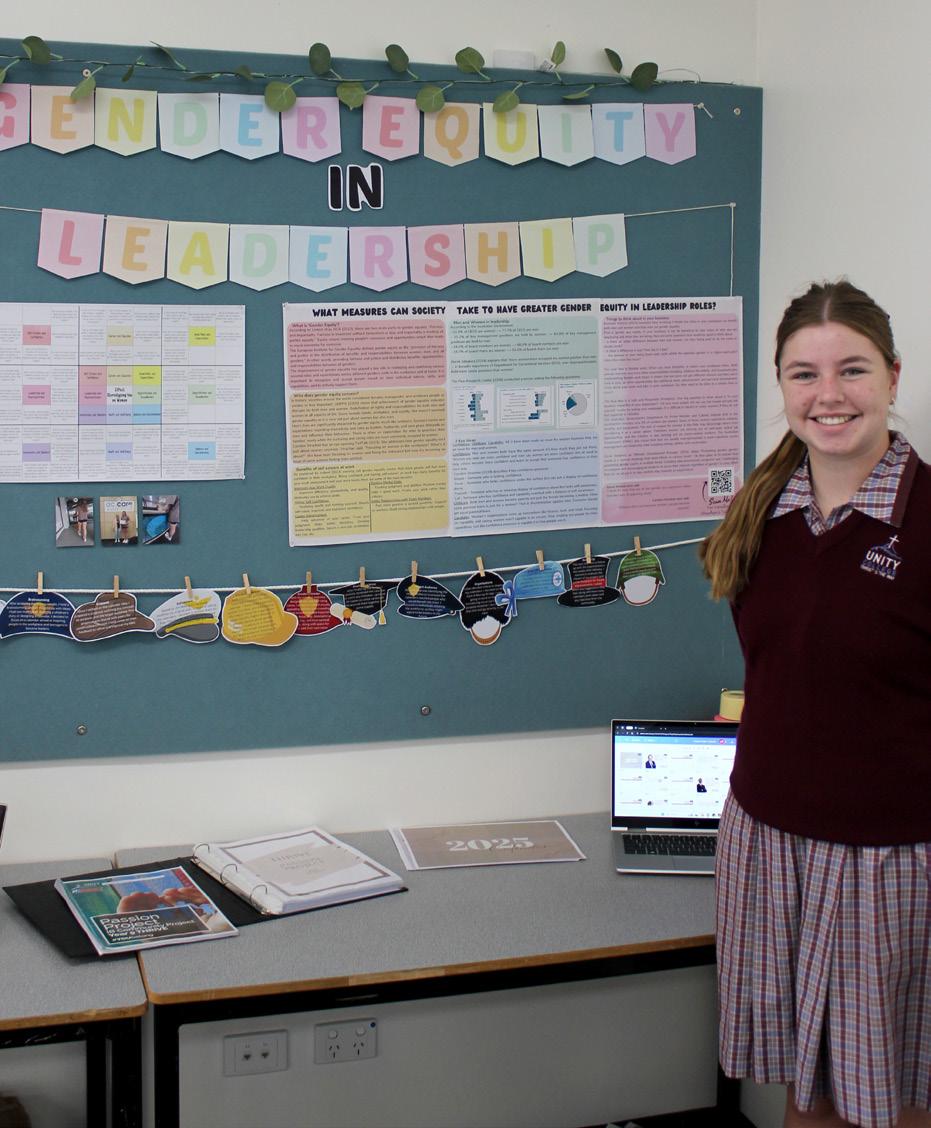
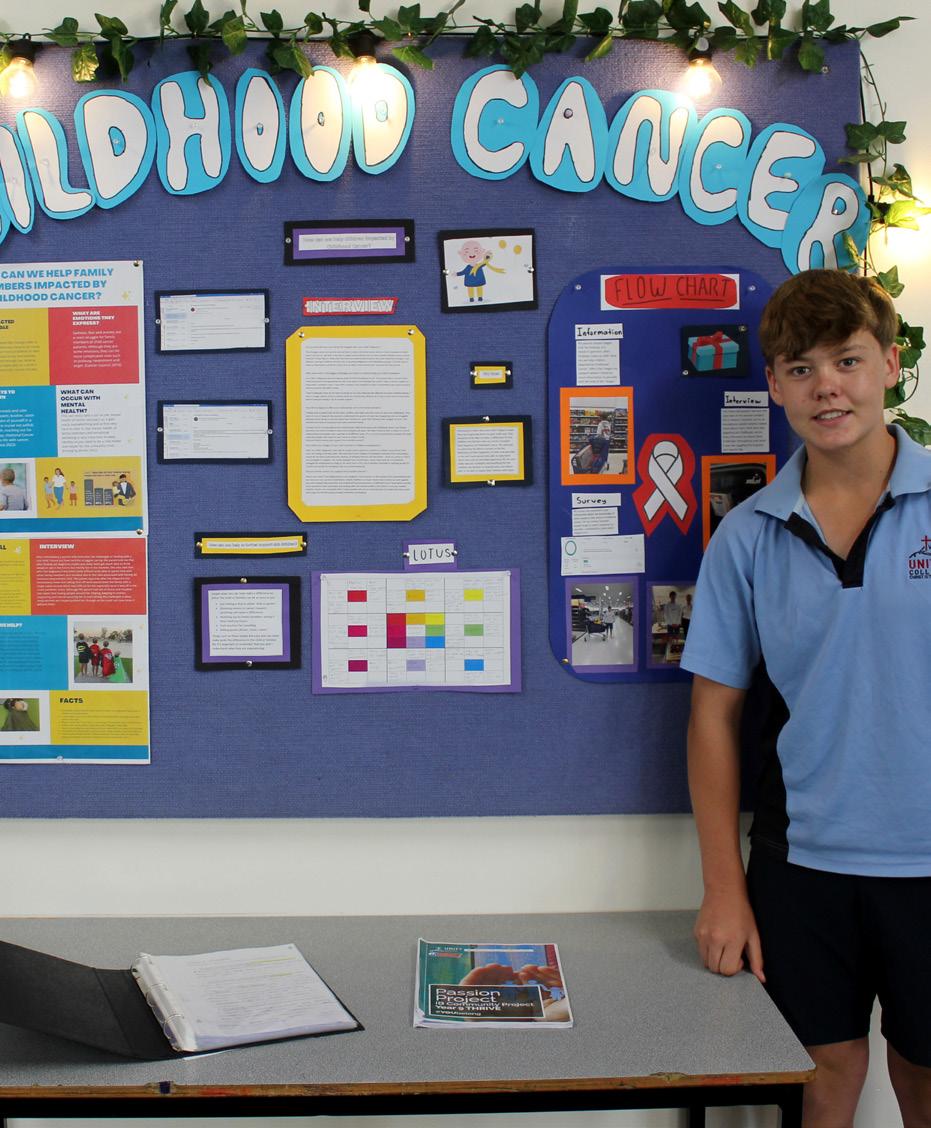
The Passion Project in the Thrive Christian Studies program at Year 9 level is the culmination event for students in their IB journey at Unity College, where they demonstrate their passion for our world, our community, and the impact they have through their actions. The outcomes of genuine service learning and student voice, choice and ownership are achieved to a high standard in this project.
Middle School Course Overview
Middle Schooling at Unity College is based on the unique physical, emotional, intellectual, social and spiritual needs of young adolescent students. The curriculum is broad to enable students to experience a wide range of subjects. This model gives students at Year 6 and 7 a taste of all subject areas. Students receive some choices at Year 9 through elective subjects to prepare for Senior School pathways.
MIDDLE SCHOOL YEAR 6
FULL YEAR
+ Christian Studies
+ English
+ Health & Physical Education
+ Humanities & Social Science
+ Languages (Japanese & German)
+ Maths
+ Science
ONE (1) SEMESTER
+ Art
+ Drama
+ Music
+ Agriculture
+ Woodwork & Digital Technology
+ Food Studies
FULL YEAR
+ Christian Studies
+ English
+ Health & Physical Education
+ Humanities & Social Science
+ Languages (Japanese OR German)
+ Maths
+ Science
ONE (1) SEMESTER
+ Art
+ Drama
+ Music
+ Agriculture
+ Woodwork & Digital Technology
+ Food Studies
COMPULSORY Full Year Subjects
COMPULSORY One (1) Semester Subjects
ELECTIVE One (1) Semester Subjects
MIDDLE SCHOOL YEAR 8
FULL YEAR
+ Christian Studies
+ English
+ Health & Physical Education
+ Humanities & Social Science
+ Languages (Japanese OR German)
+ Maths
+ Science
ONE (1) SEMESTER
+ Art
+ Drama
+ Music
+ Agriculture
+ Woodwork & Digital Technology
+ Food Studies
MIDDLE SCHOOL YEAR 9
FULL YEAR
+ Christian StudiesTHRIVE (Gender specific)
+ English
+ Health & Physical Education
+ Humanities & Social Science
+ Maths
+ Science
ONE (1) SEMESTER
+ Languages (Japanese OR German)
ELECTIVE ONE (1) SEMESTER
+ Accelerate (STEM) (Invitation Only)
+ Agriculture A & B
+ Digital Technologies
+ Drama
+ Food Technology
+ German (Sem 2)
+ Industry & Entrepreneurial Solutions
+ Japanese (Sem 2)
+ Music
+ Netball and Football Academy (Selection via application, interview & trial process)
+ Visual & Media Arts
+ Woodwork
Year 9 Semester Elective Subjects
ACCELERATE (STEM)
YEAR LEVEL 9
LEARNING AREA Science
COURSE LENGTH 1 Semester
STAFF CONTACT
Christa Oosthuizen | Alex Fiegert
COURSE CONTENT
This invitation-only course introduces students to aerodynamic engineering principles through the hands-on design, development, and testing of CO2-powered model dragsters. Emphasising inquirybased learning, students will engage in practical activities to experiment with and draw conclusions about aerodynamic concepts.
REQUIREMENTS
This course is an extension program for students who have demonstrated commitment and aptitude for Science, Technology and Mathematics. Students who have demonstrated these aptitudes will be invited to participate in this course by their Year 8 teachers of these subjects. There will also be special considerations for students involved in related extracurricular activities and outside of school activities i.e. Pedal Prix, go-karting, engineering and other motorsports.
KEY TOPICS
+ Aerodynamics Fundamentals: Exploring the principles of aerodynamics and their application in CO2 dragster design.
+ Inquiry-Based Learning: Encouraging independent exploration and experimentation to understand aerodynamic engineering principles.
+ Engineering Design Project: Developing an aerodynamic Formula-1 style CO2-powered model dragster. This project includes:
+ Design: Using CAD software to create dragster designs.
+ Development: Building dragster components and bodies using 3D printing, wind tunnel testing, and other manufacturing technologies.
+ Testing: Conducting aerodynamic simulations and real-world tests to refine and validate designs.
+ Technologies and Tools: Utilizing a range of technologies and tools, including:
+ CAD software for design and manufacturing
+ Wind tunnels for aerodynamic testing
+ 3D printers for component creation
+ Simulation programs for aerodynamic analysis
+ Workshop tools and equipment for dragster construction
+ Experimentation and Analysis: Conducting experiments to analyze design decisions and validate performance.
+ Engineering Report: Documenting the design process and analyzing results in a comprehensive engineering report, emphasizing the "explore before explain" model of independent learning.
ASSESSMENT
The project will be assessed in three stages, using the technology assessment criteria:
+ Product inquiry
+ Product development
+ Product solution
PATHWAYS
This subject extends students wishing to study Science, Technology and Mathematics at a high level.
Students research, select and establish their own vegetable garden. In groups students collaboratively work together through the ‘paddock to plate’ process and plant/grow their vegetables/fruits (leafy/roots/ legumes). They learn how to manage and manipulate the environment to improve productivity, such as: cultivation, irrigation, fertilisation (N,P,K), trellising and pest control. They identify soil types (sand/silt/clay), plant growth and risk factors when planting vegetables and the design elements required when creating a sustainable environment. The students complete a profit and loss statement and marketing assignment for their enterprise, reflecting on the links between the production systems and consumers.
PATHWAYS
For students wishing to study Agriculture at Year 10, it is an advantage to have studied Agriculture at Year 9.
Students explore the Australian sheep industry looking at sheep breeds, digestion (rumination), reproduction (breeding) and global markets (imports and exports). Students explore the differences between meat and wool production systems (meat, fleece, dual purpose) and different farming systems (feedlot, pasture, organic), reflecting on how systems impact on sustainable production outcomes, including profit, biosecurity, welfare and consumer perception. Students are involved in sheep husbandry practicals and learn sheep handling, management tasks and show livestock preparation, selecting suitable equipment and strategies to support safe and effective operation. Where possible the students attend workshops with sheep breeders where they learn from industry experts.
PATHWAYS
For students wishing to study Agriculture at Year 10, it is an advantage to have studied Agriculture at Year 9.
DIGITAL TECHNOLOGIES
YEAR LEVEL 9
LEARNING AREA Design, Technology & Engineering
COURSE LENGTH 1 Semester
STAFF CONTACT
Benjamin Gallasch | Alex Fiegert
COURSE CONTENT
Introduction to game development in Unity (Game Engine). Students learn basic C# coding and use this to create a basic game. We also explore AI, AR, VR and how it is shaping the future of technology.
PATHWAYS
Year 10 digital Technologies.
DRAMA
YEAR LEVEL 9
LEARNING AREA The Arts
COURSE LENGTH 1 Semester
STAFF CONTACT
Benjamin Gallasch | Amy Daniell
COURSE CONTENT
This course focuses on genres in performance. Students explore a detailed range of aspects of Drama that contribute to storytelling. Students learn how to use technical elements of drama such as projection and lighting in innovative ways, special effects make up, and genre specific performance elements to build depth and detail into their storytelling and as an artist. Students also respond to their own work and that of others through critical reflection and investigation and begin to explore the elements of Design in the theatre for set, costume and make up.
Topics include:
+ Technical Drama
+ Stage Craft / Design (Set & Costume)
+ Special Effects Make-Up
+ Innovation in Storytelling
+ Scripted Theatre
+ Children’s Theatre
+ Physical Theatre
+ Melodrama
Topics are based on student interest, choice and talents.
**Year 9 Drama includes a Performance to peers and/or younger students.
PATHWAYS
For students wishing to study Drama at Year 10, the completion of one semester of Drama at Year 9 (or through negotiation with the Dramatic Arts Coordinator) is recommended.
Year 9 Semester Elective Subjects
FOOD TECHNOLOGY
YEAR LEVEL 9
LEARNING AREA Design, Technology & Engineering
COURSE LENGTH 1 Semester
STAFF CONTACT
Benjamin Gallasch | Christine Wiencke
COURSE CONTENT
This course covers Multicultural Food and features methods of cookery from each culture. Students will explore multicultural foods from around the world, investigating a different culture each week. Tasks involve theoretical and practical aspects. Students will extend their basic cooking skills and develop an understanding of the appropriate standards of presentation of food, including table settings.
Topics include:
+ Food Safety and Awareness
+ Origins of Pasta
+ Multicultural Food
+ Traditional Indigenous Food
+ Herbs and Spices
PATHWAYS
For students wishing to study Food Technology at Year 10, Year 9 Food Technology is recommended.
GERMAN
This course requires the corresponding compulsory Year 9 Semester 1 language course to be selected.
YEAR LEVEL 9
LEARNING AREA Languages
COURSE LENGTH
Full Year
Semester 1 COMPULSORY
Semester 2 Elective
STAFF CONTACT
Sophie Cox | Graeme Watkins
COURSE CONTENT
Students continue to build their vocabulary and knowledge of German language and culture. They also work on resource material taken from international educational sources and are increasingly exposed to authentic materials. They are encouraged to use German as a means of communication to talk about their life and opinions and interact in German. Students learn about the lives of teenagers in a German state and use a range of everyday life topics to help students develop their ability to think, write and speak in German.
Topics include:
+ Descriptions
+ At Home
+ Pocket Money
+ Weekends and Holidays
+ Past Tense
+ Berlin
PATHWAYS
Students wishing to study German in Semester 2 Year 9 are required to complete 1 full semester with a satisfactory achievement (C+ minimum) at Year 9.
EXTERNAL EXCHANGE
There is an opportunity for students studying German in Years 11 and 12 to participate in an external exchange to Germany. See the course contact for more information.
INDUSTRY AND ENTREPRENEURIAL SOLUTIONS
YEAR LEVEL 9
LEARNING AREA Design, Technology & Engineering
COURSE LENGTH 1 Semester
STAFF CONTACT
Benjamin Gallasch | Alex Fiegert
COURSE CONTENT
This course introduces students to the world of design and digital manufacturing using industrystandard tools. Students develop technical and creative skills as they design, model, and manufacture physical products using CAD software and CAM technologies through 3D printing. The course promotes problem-solving, precision, and innovation through hands-on learning.
Topics include:
+ Introduction to Fusion 360
+ 3D printing Jibbitz, nametags and small skill based projects
+ 3D printed Bluetooth speaker.
PATHWAYS
For students wishing to study Design & Technology: Industry and Entrepreneurial Solutions at Year 10, Year 9 Industry and Entrepreneurial Solutions is preferred but not essential.
Year 9 Semester Elective Subjects
JAPANESE
This course requires the corresponding compulsory Year 9 Semester 1 language course to be selected.
YEAR LEVEL 9
LEARNING AREA Languages
COURSE LENGTH
Full Year
Semester 1 COMPULSORY
Semester 2 Elective
STAFF CONTACT Graeme Watkins
COURSE CONTENT
Students build on their knowledge of all scripts and are increasingly exposed to Kanji (Chinese Characters). They learn about Japanese sentence structure and the use of particles and learn to create sentences more independently. Students in Year 9 revise grammatical concepts previously learnt and focus on verbs and adjective use, including past tense. They make links to our Tokyo sister school, Chuo Suginami High School, and excitement builds for the future possibilities of the Japanese Trip program in Senior School.
Topics include:
+ Club Activities
+ Free Time
+ Popular Culture
+ Festivals
PATHWAYS
Students wishing to study Japanese at Year 10 are required to complete 2 full semesters with a satisfactory achievement (C+ minimum) at Year 9.
UNITY COLLEGE EXCHANGE
There is an opportunity for students studying Japanese in Years 10 and 11 to participate in the Unity College School Exchange to Japan. See the course contact for more information.
NETBALL & FOOTBALL ACADEMY
This program is designed to elevate the skills and performance of our netball and football athletes. Through targeted training sessions, advanced coaching, and sportspecific development, students will build on their existing abilities and gain insights into high-performance sport. The program also focuses on teamwork, leadership, and personal growth, ensuring participants thrive both on and off the court or field.
YEAR LEVEL 9
LEARNING AREA Health & Physical Education
COURSE LENGTH 1 Semester
STAFF CONTACT Demcey Mentink
REQUIRED BACKGROUND
Application, Interview and Trials
COURSE CONTENT
Coaching Lesson: Students work with their specialist coach for their chosen sport of either netball or football. In these lessons students receive high level coaching in small groups working on both basic and higher-level areas of the game. Students will also access strength and conditioning lessons and coaching to ensure adequate preparation and injury prevention.
Theory Lesson: Students will study topics such as goal setting, performance monitoring, exercise physiology, biomechanics, leadership, ethical behaviour/ sportsmanship, nutrition, wellbeing and umpiring. These topics help students develop their sporting ability and give them skills which are valuable as an athlete both on and off the court or field. Students in the netball program will complete their netball umpire exam and foundation umpire course. Students in the football program will complete their foundation umpire course. Please be aware that the football umpire courses can earn 10 SACE Credits.
ASSESSMENT
Students' complete assignments within this subject which are specifically related to their sport. These assignments help them gain extra knowledge about their sport and physiologically what is required to be successful within their sport. Students are assessed on both practical and theoretical components of the course.
COSTS ASSOCIATED
External assessments including umpire qualifications may attract additional costs (Approx $100).
Year 9 Semester Elective Subjects continued
MUSIC
YEAR LEVEL 9
LEARNING AREA The Arts
COURSE LENGTH Full Year
(Preferred) or Semester 1 (by negotiation - assuming a full year of instrumental lessons)
STAFF CONTACT Benjamin Gallasch
COURSE CONTENT
Learn to play music in a band. This course is built on creating music and learning skills on a chosen instrument. The focus is on developing performance and related theory skills, culminating in a range of performance opportunities. Student’s participate in class band rehearsals, developing an awareness for the universal routines and practices of music ensembles. They also prepare solo performances exploring their own creativity and musical voice.
Students are required to begin/ continue with instrumental lessons which are offered in groups or as an individual. For further information about instrumental lessons please contact the Music Office.
Topics include:
+ Rehearsal of ensemble and solo performance
+ Theory skills – AMEB grade 2
+ Listening/aural skills
+ Music styles and history
PATHWAYS
For students wishing to study music at Year 10, a satisfactory completion of Year 9 music (or through negotiation) is recommended.
VISUAL & MEDIA ARTS
YEAR LEVEL 9
LEARNING AREA The Arts
COURSE LENGTH 1 Semester
STAFF CONTACT
Benjamin Gallasch | Jennifer Stewart
COURSE CONTENT
This course introduces students to design. They examine techniques and work independently and collaboratively on arts projects. They consider function versus aesthetics, and engage with a range of materials and digital applications as a means to generate original designs. Students explore various mediums, which may include painting, print making, digital tools and sculpture to express ideas. Students respond to a range of artworks, analysing skills and media use to introduce them to each topic. Students are introduced to art folio work, and how to use annotations, self-evaluation and a practitioner’s statement.
Topics include:
+ Design: Illustrator
+ Watercolour Painting
+ Printmaking
+ Mixed Media
+ Public Art
+ Careers in Art & Design
PATHWAYS
Students may study Visual Arts: Art and/or Design at Year 10 level without having studied Year 9 Visual & Media Arts.
WOODWORK
YEAR LEVEL 9
LEARNING AREA Design, Technology & Engineering
COURSE LENGTH 1 Semester
STAFF CONTACT
Benjamin Gallasch | Scott Crouch
COURSE CONTENT
In Woodwork, students develop their understanding of the design process of brainstorming, research, concepts, final design, construction, and evaluation. Students reflect on their own designs and create accurate scale technical drawings. Accurate use of hand and power tools is expanded and students develop their skills to create a bar stool.
Topics include:
+ Product Design & Development
+ Skills Tasks
+ CAD - Computer Assisted Design
+ Resource Study
PATHWAYS
For students wishing to study Design & Technology: Woodwork at Year 10, Year 9 Woodwork is preferred but not essential.