
ACKNOWLEDGEMENTS


EDITOR IN CHIEF:
Oscar Yin
AUTHORS:
Shaurya Saini
FeiFei Gao
DESIGNERS:
Vanessa Nguyen
Andris Dang
Vincent Bui
Software: Canva
© University Network of Investing & Trading 2026
CAREERS GUIDE
NUMBEERS
SECTION
SECTION
SECTION
SECTION
Welcome to UNIT’s Flagship Careers Guide for 2026!

In this publication you will find insights of the programs available from UNIT's sponsor companies, a description of diverse career paths in finance, tips for internship applications, interview and assessment centre preparation, subject selection help, and much more!
For those starting their university journey, we encourage you all to make the most of your university experience and take advantage of any opportunities that come your way. It is never too early to start thinking about your professional development and we hope that this guide will help alleviate any stresses or dilemmas you may face along the way
One way to be introduced to the world of finance, and to prepare yourself is to learn and begin to understand the bigger picture and the state of the economy.
From the global economy to stock markets and some of the world’s most well-known equities, 2025 was undoubtedly another turbulent year. It brought significant change and challenge, but also new opportunities, alongside the emergence of fresh innovations and developments
At the start of 2025, the global economic environment was marked by cautious optimism, as investors focused on the prospect of eventual US monetary easing and sustained enthusiasm surrounding artificial intelligence. While expectations of rapid interest rate cuts moderated early in the year, confidence in corporate earnings, particularly among technology and AI-exposed firms, remained supportive of market sentiment
Equity markets experienced volatility in the first quarter with corrections in major indices, but optimism around medium-term growth drivers persisted beneath the surface
As 2025 progressed, expectations of aggressive monetary easing were steadily pared back Persistent services inflation in the United States, which remained above 3%, alongside a resilient labour market with unemployment hovering around 4–4 5%, reinforced the Federal Reserve’s data-dependent stance Although policy easing began earlier than markets initially expected, the pace of rate cuts proved more gradual, entrenching a “higher for longer” interest rate environment. This repricing contributed to periods of heightened volatility across both equity and bond markets as investors adjusted to a slower normalisation path.


In Australia, monetary policy also remained cautious throughout 2025, reflecting ongoing concerns around underlying inflation pressures While the Reserve Bank of Australia began easing from a cash rate peak of 4 35% through a series of measured cuts, policymakers remained attentive to sticky inflation in services and housing As the year progressed, inflation showed clearer signs of moderation, with trimmed mean inflation easing toward the upper end of the RBA’s 2–3% target band and headline inflation trending closer to 3% This improved outlook gradually lifted confidence that further easing could occur over the year ahead
Geopolitical tensions continued to define the global landscape in 2025, with the Russia–Ukraine war entering its fourth year and conflict in the Middle East remaining elevated, at times disrupting regional stability and key trade routes. These dynamics sustained uncertainty across energy, defence and shipping markets Despite this backdrop, commodity markets proved relatively resilient Global energy supply adjusted to ongoing disruptions, supported in part by record-high US oil production exceeding 13 million barrels per day, helping to temper price volatility compared with earlier years
Among frontier technologies, artificial intelligence remained one of the most transformative forces in 2025, reshaping how firms operate, create content and allocate capital The rapid integration of generative AI tools across workplaces, education and media was accompanied by growing scrutiny around data privacy, misinformation and the proliferation of deepfakes, keeping AI at the centre of public and regulatory debate Technology and growth stocks were among the strongest performers globally, supported by sustained demand for advanced semiconductors, data-centre infrastructure and AIrelated hardware. Companies such as Nvidia, Microsoft and Alphabet played a central role, with the tech-heavy Nasdaq recording strong double-digit gains over the year, driven largely by the “Magnificent Seven”
Despite easing fears of an imminent global recession, the outlook remains highly uncertain Geopolitical risks are expected to continue influencing global economic conditions and investor sentiment, alongside trade fragmentation and political uncertainty At the same time, while enthusiasm for technology-led growth remains strong, concerns are growing that the pace of innovation is outstripping the capacity of regulators and governments to respond effectively. This widening regulatory gap has heightened questions around market concentration, data governance and systemic risk, reinforcing the need for cautious optimism as financial markets move into the next phase of the cycle


THE INDUSTRY
Overview of the finance industry

What are financial services?
Financial services refer to the services provided by the financial industry and organisations involved in the management of capital. Such organisations may include banks, investment banks, insurance companies, asset management firms, and stock brokerages Its clients include individuals, businesses, non-profit organisations, and government agencies.
The financial services industry offers a broad range of career opportunities that cater to different skills and interests As such, employers will have different expectations in regards to your personal and professional qualities as they assess your compatibility for the role

Investment Banking & Corporate Advisory
Investment banks are institutions driving the growth of public and private companies, acting as the intermediaries which fuel these companies with capital - the monetary means of growth.
The investment banking industry can be split into three tiers:

The Bulge Bracket makes up the world’s largest investment banks, whose clients are usually large corporations, institutions and government entities. As a catchall term for this class of large global investment bank, "bulge bracket" commonly refers to Bank of America Merrill Lynch, Goldman Sachs, Barclays Capital, Credit Suisse, Deutsche Bank, JPMorgan Chase, Citigroup, Morgan Stanley, and UBS
While on a smaller scale to the US market, Australia has several notable home-grown investment banks, led by Macquarie Bank and more recently, Barrenjoey and Jarden On another level, Australia has some well-regarded boutique investment firms including Luminis Partners, Allier Capital and Azure Capital, and its Big 4 Banks investment banking divisions (i e institutional banking)
Breaking Down the Divisions

Product Groups
Mergers and Acquisition (M&A)
Equity Capital Markets (EQM)
Debt Capital Markets (DCM)
Leveraged Finance Level (LevFin)
Corporate Restructuring (RX)
Structured Finance
The industry coverage groups are exposed to deals across all product categories, but only within a specific industry.
Industry Groups
Technology, Media and Telecom (TMT)
Healthcare and Life Sciences
Financial Institutions Group (FIG)
Oil and Gas (O&G)
Consumer Goods and Retail
Financial Sponsors Group (FSG)
M&A will be responsible for working on both sell-side and buy-side M&A transactions across all of the bank’s different industry groups. M&A provides buyers looking to achieve strategic goals via inorganic growth strategies as an alternative to organic growth, while giving sellers the opportunity to cash out or share in the risk and reward of a newly formed business The M&A group is widely perceived as the most modelling-intensive and technical product group relative to other groups.
Debt Capital Markets (DCM) teams provide advice on raising funds through the trade of debt securities, including corporate bonds, government bonds, credit default swaps etc.
DCM teams are typically exposed to a wide range of clients as debt can be raised for corporations, agencies and sovereign entities
Clients are looking to access a global pool of investors looking for opportunities in acquisitions, and facilitate the refinancing or restructuring of existing debt
Equity Capital Markets (ECM) teams are focused on raising equity for clients through the capital markets - meaning that a company sells a certain amount of ownership in the company in exchange for cash. When working for ECM, deals can involve initial public offering (IPO), executing follow-on offerings for public companies wanting to raise additional equity capital, as well as secondary offerings, of selling existing shares to other investors
02

Investment Management
Investment management refers to the selection, monitoring and allocation of a client’s assets in order to meet specific mandated investment performance objectives. Investment managers are entrusted with a client’s cash and have a fiduciary duty to invest that cash according to predetermined investment philosophy and process
Investable assets may lie in both the public (shares, fixed income, derivatives, commodities and currencies) and private markets (venture capital, infrastructure and real estate) In investing large sums of cash, firms in the field of investment management are described as being on the buy-side of corporate finance
Clients can range from institutions - such as insurance companies, corporations, charities and university endowment funds, to private high net worth individuals
Investment due diligence refers to the research, monitoring and assessment of potential investment opportunities. An investment manager ’ s performance is often compared to an index benchmark such as the S&P 500 or ASX200 Some other commonly used benchmarks include MSCI and Bloomberg indexes which show performance across many international countries and regions. Bond benchmarks, or inflation, can also be used to great effect in certain instances
As such, any deviations in the constituents and weighting of a fund’s portfolio are expected to generate above-benchmark returns (i.e. alpha). Beyond consistent client communication regarding performance and any changes to asset allocation, these interactions become especially important during periods of market downturns when risk of fund withdrawal is highest
Sub-Sections of Investment Management
Pension Funds
Employers in Australia are required to pay a percentage of employee earnings into a super account, which are managed by selected funds
The money provided through these super contributions does not sit idly until it is withdrawn at retirement, the fund is responsible for managing and investing the money in a variety of asset classes depending upon the superannuation product chosen
A super fund is generally more conservative due to the nature of its client base, opting for diversification across a range of asset classes to offset idiosyncratic risk Furthermore, due to the more community oriented nature of such investment, they also possess a proactive stance towards sustainable and ethical investing and are subject to high regulations from APRA.
Hedge Funds
Hedge funds and other managed funds serve largely the same function of generating a return on investors’ wealth through a managed portfolio, but there are large differences in methodologies and investment approaches Hedge funds are not restricted by many of the regulatory requirements enforced on super and mutual funds, nor are they required to disclose strategies and abide by mandates Moreover, hedge funds are mostly targeted at high-net-worth individuals, with greater investment flexibility including using strategies such as hedging.

Private equity (PE) funds invest in the private markets and provide financing to unlisted businesses PE funds pursue growth and seek to invest in businesses where there is an opportunity to eventually sell at a higher multiple, with the aim of recovering the investment by selling the organisation or taking it public later. The holding period is often 3-5 years and usually involves private equity owners taking an active management approach The key skill required to work in private equity is the ability to source opportunities and investigate their viability. Overall, private equity would be attractive for those interested in not just investing in businesses, but also playing an active ownership role in devising and executing a growth strategy
Venture Capital
Similar to private equity funds, venture capital invests in high-growth potential companies, primarily startups and early-stage businesses which have high long-term growth potential Venture capital generally provides financing in exchange for equity and this allows venture capitalists to have oversight over management decisions Many funds also provide strategic advice, access to existing customer networks and industry expertise in addition to financing Dealsourcing is the key skill required to work in venture capital and the majority of time will be spent meeting with entrepreneurs and networking Unlike private equity, valuation and financial modelling play a more limited role given the pre-revenue status of many potential investments
03
Sales and Trading
The world’s global markets run 24 hours a day with markets operating across time zones in different areas of the globe. They involve everything financial from equities, fixed income, derivatives, currencies, and a growing range of alternative assets such as cryptocurrency
‘Sales’ and ‘trading’ are two distinct but complementary operations The function of a sales and trading division within an organisation is to ensure both the accurate structuring and orderly sale of financial products to institutional investors and other clients. Note that agency trading is client-focused, and should not be confused with proprietary trading which focuses on investing the company ’ s own money
The sales team effectively works to sell financial products to clients - generally financial institutions and high-net-worth individuals looking to buy equities, fixed income products, or any other financial instruments to meet their specific needs. Once the sales team has confirmed an order with a client the traders are responsible for completing the order in the market

On the trading floor
Unlike the chaotic ‘trading pits’ depicted in iconic Wall Street movies, trading floors in large investment banks today operate in a much more orderly manner On a trading floor today, you will find a large open room filled with long desks with multiple monitors sectioned off per person and grouped according to the fields of trade. The large amount of data displayed on the screens are essential in providing the traders with live data, blue-chip price swings, and other headline variables Traders are required to multi-task continuously, constantly assessing risk, calculating the best timing to execute trades, and keeping up to date with client requests
Bloomberg is a key financial information service that all banks and traders have access to - it is more or less the all-in-one portal to relevant news and public financial data
To trade, industry experts generally use in-house trading platforms to execute their orders. Popular platforms include FlexTrade, Fidessa, and Goldman’s REDIPlus platform. Typically, a firm that offers sales and trading will have other divisions that complement this function
Sales and trading are inextricably linked to the work of financial analysts, who design and formulate bespoke financial products catering to the requirements of particular clients These financial products may be as obscure as collateralised mortgage obligations or asset-backed securities or as simple as futures contracts Additionally, the research division, which produces reports on financial markets, works with sales and trading to provide research to clients in the hope of being mandated to execute their trades

Stockbroking
A stockbroker is an entity or individual that trades (buys and sells stock) on someone else’s behalf and charges a commission for it It is one of the first professions to have taken root in the finance industry; as long as there have been markets, there have been stock brokers. Historically, the functions of investment advice and order execution were deemed as inseparable facets of stockbroking Nowadays, discount brokers which charge moderate commissions and provide no investment advice, have turned the industry on its head
What do they do?
Stockbrokers, whether they are actual brokerage firms or individual broker-dealers, are often registered investment advisors and have the necessary certification by the regulators of exchange to execute trades – something which ordinary retail investors are not allowed to do In other words, if you need to buy a stock at a certain price, you tell your stockbroker and they do it for you, taking a slice of the pie along the way of course
Proprietary Trading
Proprietary trading can be viewed as an additional or peripheral function in an organisation The company is utilising a portion of its capital to trade in order to generate extra profits, boosting the overall financial position of the company instead of earning commissions by trading on behalf of its clients. It constitutes an additional stream of income separate from the company ’ s primary business. Proprietary trading is popular, particularly amongst brokerages, as they feel that they have a competitive advantage over other players in the markets
Proprietary trading is very similar to managing endowments at elite charitable institutions and universities around the world, whereby a professional investment team makes use of dormant money to generate surplus income An ideal example would be that of a proprietary trading desk at a brokerage firm, where the broker is making profit in two ways: one, by earning commission by trading on behalf of other people, and, secondly, by directly trading in the markets

Benefits of working in trading
One of the major benefits of working in trading, as compared to many other finance jobs, is that once the stock market closes (around 4-5pm) your responsibilities wind down, since you ’ re not able to buy or sell stocks after that time As such, the work-life balance could be outstanding You’re also given the opportunity to build a strong client network
What does it take to be a trader?
If you have ever come across a live price chart feed on a trading terminal or have simply looked at live tickers on the market floor, you can deduce immediately that numbers have a huge role to play in trading and stockbroking. Therefore, a natural affinity for numbers, percentages and ratios is highly desirable.
Quantitative proprietary trading firms will usually require extensive mathematical, statistical, or computer science knowledge over a finance background Other discretionary trading firms may not require any specific skills as they’ll have training programs to teach you the technical trading methods.
Finally, other prop trading firms may require fundamental valuation knowledge which is most suited to the typical finance skillset Boosting your presentation and soft skills can provide you with an edge over other applicants in this client focused industry
Professional Services 04
Overview
Professional services encompass a broad range of various occupations, but ultimately a career in professional services involves providing support and specialist advice to clients These clients are also diverse and can include small-medium enterprises, multinational corporations, governments to not-forprofit organisations.
Professional services offer a diverse working experience, with much of the work will be project-style and client-based rather than performing a set of daily tasks - providing an exciting opportunity for existing skills to be applied in various different scenarios. The teams and people you work with will also be diverse in both experience, background and personality. As you work on each project, you will be constantly liaising with the client, developing fruitful relationships which may prove invaluable in the future
The Big 4 firms – KPMG, Deloitte, EY and PWC– are the four largest professional service networks in the world, offering services in various business areas, most prominent among which are: auditing and accounting; advisory and consulting; tax, risk and legal advice




Transactions and Corporate Finance
As part of a Transactions/Corporate Finance team, your role is to advise clients on how to best allocate and acquire capital This may involve developing financial models, identifying M&A opportunities, compiling data on past transactions and preparing due diligence presentation materials
Auditing/Accounting
In Auditing/Assurance, you will be responsible for assessing the legitimacy of financial reports and providing confidence for the external stakeholders of businesses like investors, suppliers and regulators. This may involve helping clients adjust to new accounting standards and liaising with clients to obtain information to fulfil regulatory requirements

Advisory/Consulting
Advisory/consulting offers the most varied work experience. You can expect to spend time researching current regulatory developments, constructing financial models, reviewing client business practices and contributing to strategy recommendations. Some consulting services may include Strategy analytics, human capital, core business operations, enterprise technology, and more
Tax
A typical day in the Tax team may involve identifying and implementing strategies to minimise tax liabilities, maximise tax incentives and researching and evaluating the impact of upcoming tax issues.
Management Consulting 05
Overview
Management consulting is working with businesses to identify solutions to problems to maximise business performance, improve business processes, and increase revenue. Management consultants are professional experts who provide solutions and strategies to improve the financial and operational health of an organisation The recommendations made by management consultants are backed by large amounts of research and data
Clients hire management consultants primarily as objective third-party analysers of an organisation, including businesses, government institutions, nonprofits, and more Working with management, strategy consultants help to define goals, assess the current situation, build actionable strategies that consider timelines, resources, and potential obstacles
Other times, these organisations simply come across problems they’ve never experienced before. Management consulting firms who have worked on similar projects for other clients are able to provide their industry expertise and advice A strategy consultant helps organisations stay competitive in their respective industries and fields by providing tailored advice and guidance on strategy development
3 main areas of focus:
Management consultants offer their expertise to businesses in several domains These may be general or very specialised and include: Business strategy, restructuring, Strategic management, Risk management, M&A, Digital transformation, Business processes
Management consultants perform in-depth analysis and research relating to the areas they are working on within an organisation You'll need to remain objective and unbiased to provide a clear perspective of the problems that need solving
Management consultants are hands-on when it comes to implementing the solutions they identify You'll work with teams to deliver and monitor solutions, working directly with senior management.
The top 3 management consulting firms - or colloquially known as MBB - refers to McKinsey & Co (McKinsey), Bain & Company (Bain) & Boston Consulting Group (BCG) While they are not the largest firms, they are the most prestigious in the industry with a focus on pure strategy Clients trust them to provide exceptional quality work and they have earned their reputation as a result Part of this reputation is derived from their diverse clientele which includes multitudes of Fortune 500 companies that rely on MBB consultants for complex and large-scale restructuring initiatives
The rest of the market comprises mid-tier / boutiques as well as the Big 4 (KPMG, EY, Deloitte & PwC) previously mentioned - who do have strategy consulting arms that compete with MBB firms, the bulk of their business remains related to accounting.
MCKINSEY & COMPANY, BCG, BAIN

NOUS GROUP, ALTMAN SOLON, ACCENTURE STRATEGY
Why work in Management Consulting?
Management consulting is one of the most sought-after fields in the business world, boasting the potential for lots of air travel, working on complex business problems, and exposure to top level management. While all these truly are great components of management consulting, the reality is that the industry is not for everyone.
PROS
Fantastic learning opportunities
Management consulting firms offer an amazing learning opportunity for consultants at all levels
This is due to a few reasons:
Work with the largest companies in the world
Exposure to top level management
Learn from and work with intelligent and driven colleagues
Skills development & expertise
Flexibility and variety
Management consulting firms offer a unique opportunity to learn from a broad range of people, problems, and industries
Different locations and teams
Exposure to a wide range of objectives across multiple projects
Projects across various different industries
These experiences also offer an amazing chance to develop skills that are attractive to employers in various other fields, including private equity, start-ups, and corporate strategy roles, offering a diverse set of exit opportunities.

Fastclientturnover&lackoftangible results
While the variety and pace can be stimulating, management consultants rarely get to see the results of all their hard work because as soon as a project is over, they need to move onto the next one
Stress and expectations
Working with some of the largest companies in the world means the stakes are usually quite high Time can often be consumed with client and team meetings, interviews, workshops, problem solving, focused group discussions, and client communication The industry is extremely fast paced and there are constant deadlines that result in long hours
Overview
Retail banking - or consumer banking - refers to the mass-market banking in which individual customers (like you and me) use local branches of larger commercial banks Generally, this service aims to encompass all the financial services that may be required by an individual retail client Retail bank’s representatives cater for individuals and small businesses by providing an entire suite of services including; savings, checking accounts, mortgages, personal loans, internet finance, and certificates of deposits.
The ‘Big Four’ banks of Australia - Australia and New Zealand Banking Group (ANZ), Commonwealth Bank of Australia (CBA), National Australia Bank (NAB) and Westpac Banking Corporation (Westpac) - are the main competitors in the Australian retail banking sector and are all ranked among the world’s 50 safest banks
The retail banking industry in Australia has always aligned itself to the ever-changing consumer demands, by fine-tuning its services and customising its products As a one-stop shop for all retail financial services, retail banks have a diverse range of services for which employees can specialise in and transfer between
Retail bankers play a vital role in the financial industry by helping individuals manage their finances and achieve their goals. This is a rewarding position that offers plenty of opportunities for career advancement within the retail network and other areas of the firm.
Given below are some of the functionalities provided by banks, as on date, which give customers the ability to carry out a growing range of financial tasks on-the-go.
Mobile payments - This is facility provided by Commonweatlh Bank to make Mastercard PayPass puchases This allows payments to be made by tapping the phone at a merchant’s terminal, where such payments are accepted (on smartphones where this app is not supported, a device called PayTag allows customers to use this facility).
Cardless Cash - This app allows the cutomer to withdraw from accounts without using a card. The app also has a feature where the customer can even allow someone else to collet the money by nominating them through the app

P2P payments - Payments can be made to a registered Australian mobile number (limited to Australian bank accounts
Other services include setting a limit on daily transactions, BPay for bill payments, checking transaction history, checking balance, and making transactions between accounts of the same or different banks
Finance Support Roles
Overview
Financial support roles comprise mostly of middle & back office roles – which include human resources, investor relations, compliance, accounting, IT support and many more While these roles tend to be non-revenue producing, they are nonetheless an essential part of financial services –ensuring that the front-office is able to run smoothly, that operations and accounts are all in check, and risk is being effectively managed In general, the work in financial support roles tend to be less pressured as they are non-revenue generating, and they aren’t communicating with clients as often
Risk-Management
Evaluating the riskiness of front office activities and ensuring that deals are being effectively processed
Responsible for the objective review and challenge, oversight, monitoring and reporting of a firm’s internal material risks
- both financial and non-financial.
Credit, Market Risk
Regulatory Affairs and Aggregate
Risk
Financial Crime Risk
Compliance
Operational Risk
Behavioural Risk
Enterprise Support
Internal Audit

Financial Management
Financial management is all about monitoring, controlling, protecting, and reporting on a company ' s financial resources Companies have accountants or finance teams responsible for managing their finances, including all bank transactions, loans, debts, investments, and other sources of funding
Treasury : managing the funding, capital and liquidity position, helping to manage balance sheet risk
Finance : provide financial management and control advice, management reporting and forecasting, regulatory and tax reporting and business advisory services
Tax : provide advisory services and technical support to ensure the business meets tax compliance obligations
Operations
Drives the operational effectiveness of the business and brings together specialist support services in a variety of fields
Digital Transformation & Data
Human Resources
Business Services - Corporate real estate & procurement
Business Improvement & Strategy
These roles have decent upside potential without some of the stress or pressure you may hear of careers in the ‘front’ office and offer a stronger work-life balance
Working in these supporting roles will allow the individual to specialise in a particular area of expertise, such as accounting, IT, or strategic management
This is more suited to an individual who wants a linear career path in a specialised area, as opposed to the diverse work a consultant may have
Furthermore, it is possible to specialise in areas that don’t use the typical finance skill set and employers are increasingly focusing on transferable soft skills over technical hard skills, and seek students who are well-rounded and interdisciplinary - which offers great opportunities for students who do not study a finance or related major.
FinTech
Overview
Currently, one of the hottest sectors is the fintech industry, which encompasses a broad range of businesses and roles As the name suggests, fintech refers to the intersection between “finance” and “technology” and a career in this industry involves devising technology based solutions to collaborate with or disrupt the financial services industry Working in fintech provides the opportunity to help drive products and services that can have a real and significant impact on people’s lives.
The COVID-19 pandemic has played a key role in FinTech’s growth in Australia and there are plenty of established organisations engaged in fintech, notably the big banks Lockdowns changed how customers and companies engaged in business, and those changes are expected to have a lasting impact
As a career path, it’s attractive to those who are looking to work with and be part of the latest technological innovations, while still being part of the world of finance.

What do they do?
Fintech is a diverse sector, and a characteristic of the entire fintech industry is the sheer number of roles that are available, and will continue to expand as businesses continue to migrate into the digital ecosystem:

Product Manager
For less technology-focused individuals, a suitable role is product manager Their responsibility is to forge strategic partnerships with financial institutions and merchants to create solutions with a large number of use cases and understand client needs to develop an innovative solution. Like other industries, they work with various departments throughout the product life cycle to conceptualise the product and bring it to market
Compliance
Compliance within the fintech sector involves several responsibilities associated with ensuring that all relevant governmental regulations are recognised and followed Examples include privacy policies, EULAs (end-user licence agreements), corporate governance, and storage of proprietary data Knowledge of relevant legal requirements and concepts such as ESG (environmental, social and governance) principles is a must
UX/UI
Much of the success of fintech products depends on consumers ' enjoyment of using the product UX/UI (user experience and user interface design) roles are also being increasingly coveted as banks and fintech companies seek to make their applications user-friendly and intuitivemaximising the functionality and the overall ‘look’ of the app
Web App Development
The demand is strongest for app and site developers, especially iOS, Android, SRE and full-stack developers
This group forms the crux of fintech companies and are responsible for translating business ideas into tangible innovations.

Blockchain Developer Data Scientist
LinkedIn kicked off 2020 with the news that blockchain is the most indemand skill in developed markets Blockchain developers have high level technical skills, starting with front and back-end web development, with a deep understanding of data structures, cryptography and smart contracts
Data science is important in fintech as it enables companies to make datadriven decisions through identifying trends, making predictions, and optimise their operations to deliver better financial services to their customers A fintech data scientist primarily focuses upon the analysis of hard data such as fraud detection, client acquisition and algorithm-driven financial planning

SECTION 2 APPLICATIONS
JOB SEARCH TIPS
Get Organised
Develop a system with a checklist of processes to make your time hunting for a job shorter and less anxiety-inducing This system should include:
Identifying your target industry and universe of organisations
Allocating a realistic amount of time per week to research employers
Setting attainable, quantifiable goals (the number of job applications/coffee chats/ interviews a week)
Keeping on track the progress of each application
Tap Into a Range of Avenues
Like in any venture in finance, diversification is key and try to go beyond just applying for advertised jobs in your search Try your hand at cold-emailing, reaching out to mutual contacts and university alumni in the industry or leveraging university careers centres and job boards.
Make sure to conduct thorough background research and tailor your communication accordingly as to not approach with a lack of passion and interest.

Active LinkedIn Presence
Having a LinkedIn is a good start, but there is much more you can achieve through your profile Consider your profile from a prospective employer’s perspective and use your social media presence as a selling point. This can mean showcasing your projects and achievements such as case competitions, writing blog articles or opinion pieces and attending university society events
You can also boost your presence by following and liking posts from prominent organisations in your target industry
Be Self-Aware
Knowing yourself is key to communicating with prospective employers and this means being able to identify your key traits:
Goals
Strengths
Weaknesses
Communication style
Key experiences
Ultimately you want to be able to confidently sell yourself as a potential employee and clearly articulate what sets you apart from everyone else. The best way to do this is develop a succinct, interesting and memorable ‘Elevator Pitch’
Most importantly... remain persistent! Even when incorporating all of the above into your job search, the market will always be competitive for students and it is imperative that you keep your chin up despite any roadblocks or rejections that you may face
RESUME TIPS
SPECIFICITY
Focus on what you did in the job and use action verbs to start each point
Avoid using the generic descriptions of the jobs you originally applied for or held
Quantify and be specific about your accomplishments BREVITY
Prioritise detail about your current or recent jobs
It is ok to mention past roles even if unrelated to the role you want to pursue nowjust make it brief
Keep it under two pages

FORMAT & DESIGN
Use a logical format and wide margins and clear headings
Selectively apply bold or italic typeface to guide the reader’s eye
Use bullets to call attention to important points
Avoid cluttered and complicated layouts and tables
RESUME TIPS

EXAMPLE CV TEMPLATE

Keep it short and simple
First impressions matter! There is no going past this reality Do this by keeping your cover letter visually appealing and easy on the eye Now, by ‘visually appealing’ we don’t mean colour coding the document- you could if you like - but just make sure that you divide the points that you ’ re making into individual paragraphs For instance, in the first paragraph start off with introducing yourself, in the second paragraph highlight your prior experiences, the third could be on why you ’ re applying for the role, and in the last one you can convey how much you really want it. All in all, keep it nice, tidy and visually simple.
Show you've done your research
This is extremely important We can’t stress it enough Do some research about the company and the role that you ’ re applying for Look for unique characteristics and be sure to mention them in the cover letter to demonstrate that you ’ re genuinely interested in working in the company For instance, a particular company might have generous study leave programs for employees Mentioning things like these not only demonstrate your passion but also set you apart from the crowd and under a page

DO YOUR RESEARCH
INTERVIEW TIPS
Make sure you have a good understanding of the company and what you are signing up for! Ensure that you have read up on some of the skills that the job requires, and that you are up to date with current affairs and business news and trends.
Remember, you are always selling yourself in an interview! Make it a point to tell and show your interviewer why it is they that should be hiring you. Do you think you have great communication skills and the ability to perform in team situations?
Ensure you prepare some anecdotal examples of where you have excelled in such situations Better yet, show your interviewer evidence of your skills!
That being said, you will not be expected to know the answers to every single question. It is okay to say “I don’t know,” but it is always advisable to show your interviewer that you are willing to learn and even speculate as to what the correct answer may be BE MARKETABLE STRIKE A BALANCE
Being nervous is normal! Anyone would be if placed in such a high-stress situation, with so much at stake However, try not to let it get in the way of the interview. Fidgeting and constantly shifting eyes are a dead giveaway of someone who is both extremely nervous and lacking in confidence Plant your hands somewhere firmly, and do your best to maintain eye contact throughout 02 03 04
Whilst it is important to sell your good qualities, it is important not to give off an arrogant or overconfident image either Moreover, employers want to see you recognise your own weaknesses, as well as develop a plan of action to improve upon them Not all people are perfect, and a degree of humility and honest self-reflection is an important demonstrator of someone who is willing to accept their shortcomings and constantly seek growth and development
TAKE YOUR TIME
INTERVIEW TIPS
In tandem with tip number 4, make sure to take your time during the interview. This can help with the nervousness and reduce the amount of stuttering and ‘ um ’-ing. If you are asked a question which you are unable to answer off the bat, it is perfectly fine to ask for the interviewers to give you a moment to think Again, moderation is key! You shouldn’t be doing this after every single question, nor should you remain silent while pondering Awkward silences are not fun for either party!
SMILE AND LAUGH 06 STAY ENGAGED
Smiling and laughing is a great way to dispel the often exaggerated tension and formality in an interview. Your interviewers are human too and a lighthearted comment may lead you to a lengthy conversation
This is also a great opportunity to show off your sense of humour, personality, and ability to communicate with others
Finally, make sure you remain engaged throughout the interview. Wandering eyes and asking interviewers to repeat questions are all signs that you are not interested in the job you have applied for, and is understandably a huge red flag against you! A great way to show your engagement is to ask the interviewers questions about the job you have applied for. What other technical skills will you need? Where does your division fit into the greater company structure? Asking questions shows a keenness to learn, and genuine interest in the firm

ESSMENT CENTRES
tre is a huge achievement! me screening, numerous e or video interviews to be s is a testament to your to succeed in the position you ’ ve been invited to the you All that’s left for you to by companies to gain a are, your teamwork and
centre, it is vital that you
and the role you have portant thing to prepare ack of dedication and enefits you as well - how he job if you don’t know both individual
y,
ntre will differ in some y 10-20 other candidates revolve around group ase studies, role-playing mes or presentations. In complete some solo terviews economic news, or modelling) are not always neral awareness of the reciated and will often es
NETWORKING
Get Started
Often the hardest part of networking for university students is getting started, especially when they do not know anyone working in the industry. To start, join societies and look out for networking events held throughout the semester These events tend to be educational and an easy-going environment that makes it ideal to meet other professionals with many attendees being well connected with alumni working in a variety of different roles
Quick Fix to Nervousness
A simple greeting may be all it takes to start a conversation after that, you can let your curiosity drive it. More often than not, the directors or alumni you ’ re speaking with have been in your position before and fully understand your nervousness Make sure you try to relax, and make the most of the opportunity
Dress Well
It's important to ensure that you dress in a way that represents you and gives off the right perception Networking events can range in formality but usually can be categorised as the following - commonly indicated in event details
Business formal: this calls for the complete formal business attire, including a full-suit with a buttondown shirt, slacks/skirt, blazer, a tie for men and often heels for ladies This will usually be the appropriate dress code for cocktail networking events and networking with professionals from the banking industry Business casual: also known as smart casual attire, gives a bit more flexibility and depending on the setting or type of networking event, jeans and sneakers may be acceptable. Just remember that you are still at a work-related event and will need to balance your attire with professionalism
When in doubt, nothing brings together a professional outfit quite like a blazer dress it up or down to meet your needs.
Remember that confidence is often the best accessory, which can be very helpful when dealing with the nervousness of trying to connect with industry professionals.

Engage
Remember that you are having a conversation with them, so to a certain extent, let them figure out what makes you brilliant rather than spewing your fiercely memorised facts about recent market conditions or numbers from recent deals of each firm.
If you are truly interested in the industry, then you will no doubt have questions about it Company representatives will feel appreciated when they can enlighten you, so don’t be afraid to ask Equally as important as asking is sharing, whether that be an appropriately funny story or some concern for the state of financeopen up to them, and they might just open their doors for you.
Follow Up
IIf you made one good connection out of the hundred you spoke to at an event, try and follow up with them Ask them to catch up for a coffee in the future, connect with them on LinkedIn if it’s appropriate, and if you ’ re applying for a job at their firm ask them for some more information on the position A one-on-one personal connection is worth a lot more than vaguely knowing ten people you met once Plus, it gives you the opportunity to ask questions that you might not be able to ask at a large event.
Additional note: If someone does meet with you for coffee, make sure to send them a thank you email/message afterwards
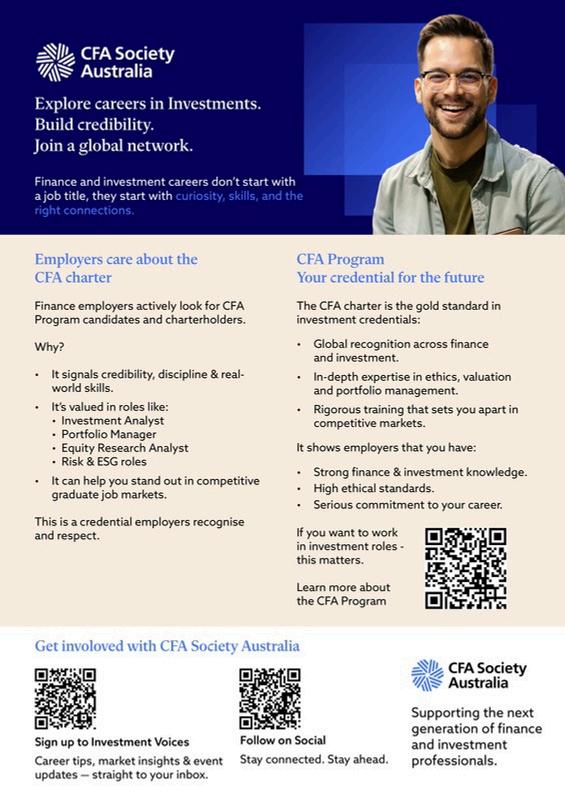
CFA
The Chartered Financial Analysts (CFA) Program is a 3-staged education curriculum (Level I, Level II and Level III), involving three corresponding exams that tests the fundamentals of investment tools, valuing assets, portfolio management, and wealth planning
The CFA Program is typically completed by those with backgrounds in finance, accounting, economics, or business

CFA Program Benefits
Demonstrating Your Expansive Knowledge and Skills
The CFA Program provides a strong foundation in advanced investment analysis and real-world portfolio management skills Ongoing input from industry experts ensures that the curriculum remains relevant and prepares charterholders to enter today’s market.
Relevant in a Variety of Career Paths
CFA charterholders occupy a range of investment decision-making roles, typically as a research analyst or portfolio manager CFA charterholders go on to enjoy lifelong careers in asset and wealth management, investment banking, commercial banking, and consulting, alongside a diverse range of career paths in and outside the industry.
As a globally recognised credential in the investment management profession, the CFA® designation is a mark of distinction, and investment firms know it represents a higher standard Value in an Evolving Industry
To become a regular Charterholder, you must acquire four years of professional work experience in investment decision making before, during or after completion of the Program.
CFA® CHARTER VS. MBA VS. CPA VS. CFP
Requirements
3 exams & one of the following: Bachelor’s degree Be within 23 months of graduation from the date you sit for the Level I exam
Combination of 4,000 hours of full-time work experience and university education accrued over min 36 months
Master’s Degree (23 years)
4 exams, bachelor’s degree, & 150 schooling hours
1 exam, bachelor’s degree with coursework in financial planning, and 4,000–6,000 hours of work experience
Recognition
UNIVERSITY OF SYDNEY CAREERS & EMPLOYABILITY OFFICE
The Careers and Employability Office (CEO) is the University of Sydney’s Business School’s tailored careers service for students seeking advice on careers paths, job applications and general employability.
Location
B1 level of Abercrombie Business School
Building Hours
Every teaching weekday, 1-4pm for drop in for a chat
Services
Drop-in
Student careers leaders who can offer you advice on your resumé and the job application process
Book a Private Meeting
Experienced career consultants who can help you plan your career and make the best of your university experience
Online Resume Reviews (after week 5)
Interviews Feedback (throughout the semester)
Workshops and Activities Series
Mock interviews and mock assessment centres
Employer Networking Events

Make sure to keep an eye out on your university email for the CEO Newsletter and event updates to ensure you don’t miss any of these events
For first years, look out for events specific to first years and pre-penultimate years in the events calendar, which often outline how to ensure that you are prepared for internship and graduate applications in the future
WOMEN IN FINANCE
“Very often as a little girl, then as a young woman, I have suffered my lot of discrimination. I was brought up with brothers; I grew up in a boys’ world You have to elbow your way in Every day, you have to prove yourself and convince - move forward and challenge yourself And doubt all the time It’s a question of not so much pushing the boys out of the picture, but making the whole frame bigger so that both men and women access the labour market, contribute to the economy, generate growth, have jobs, and so on. ”
- Christine Lagarde, Managing Director of the IMF
A Change in Environment
Recently, the finance industry has been swept with tides of change, as businesses and financial institutions recognise the importance of gender diversity. Women bring unique skills, and are more likely to possess traits such as empathy, trust-building and listening to others - essential skills in the finance industry
Impressive statistics paint images of progress, with Top 20 ASX boards reach 40% women representation (as of August 2023). Female representation is improving: The latest AICD Gender Diversity Report noted similar findings, with 35 6% of ASX 300 board seats being held by women and 67% of ASX 300 boards having more than 30% female representation There are now no boards in the ASX 200 without women
Though, many reports begin to put a spotlight on the stubbornly low number of women in csuite executive director roles, highlighting that the change has been in the appointment of women to non-executive director roles

“don’t let boys have all the fun and miss out on what could be very exciting careers”
Macquarie Group CEO Shemara Wikramanayake :,

SECTION 3 OUR SPONSORS
SPONSORSHIP OVERVIEW
































Key Application Dates:
2026 Winter Development Program
Commencing: July 2026
Opens: 3 February 2026
Close: 10 March 2026
Eligibility: STEM students or women from any discipline in their penultimate year of study
2026 Summer Internship Program
Commencing: December 2026
Opens: 5 May 2026
Close: 21 July 2026
(Melbourne and Perth); 4 August 2026 (Sydney and Brisbane)
Eligibility: Students in their penultimate year of study
2027 Graduate Program
Commencing: February 2027
Opens: 3 March 2026
Close: 14 April 2026
Eligibliity: Students in their final year of study or who have completed their studies within 12 months of applying (12 months from your last subject or unit)
Application Process:
Application opening and closing dates are listed on our Macquariecom/graduates for more details and to apply




Graduate Program
Our Graduate Program commences in February and runs for 12-24 months Our graduates make a unique contribution, while growing their skills and network through on-the-job training, access to senior leaders and a comprehensive range of learning opportunities.
Students studying all degrees in their final year of study, or those who have completed their studies within 12 months are invited to apply

Summer Internship Program
Our Summer Internship Program commences in November and runs for 10-12 weeks. On the Program, you will gain valuable practical experience that sets you up for a successful career once you complete your studies. Interns are eligible to be fast tracked for our Graduate Program
Students studying all degrees in their penultimate year of study are invited to apply
Winter Development Program
Our Winter Development Program commences in July and runs for three weeks. It is an opportunity for STEM students or women from any degree background to immerse themselves in the finance sector and see how they can create real value for Macquarie

At the forefront of QUANTITATIVE TRADING

Susquehanna is a global quantitative trading firm founded by a group of friends who share a passion for game theory and probabilistic thinking. Our rigorous and analytical approach to decision making has led Susquehanna to become one of the largest and most successful proprietary trading firms in the world. In offices around the globe, our employees are relentless problem solvers who collaborate to make optimal decisions
Susquehanna fosters a culture where ideas can come from anyone, regardless of experience or tenure Employees are encouraged to challenge the norm and offer new ideas that help the firm grow. Through mentorship, collaboration, and work experience, employees will continue to learn throughout their careers, while helping to develop newer team members along the way.
WE LOOK FOR STUDENTS STUDYING IN A VARIETY OF FIELDS INCLUDING
• Computer Science
• Maths
• Finance
• Actuarial Science
• Engineering
• Information Technology
PERKS AND BENEFITS
GAMING AT SUSQUEHANNA
Visit Susquehanna’s Raise Your Game Blog to learn more about game theory and decision science, with posts written by our expert gamers at raiseyourgame.com.
• Located in the heart of Barangaroo, our top floor office gives you some of the best views of Sydney
• Fully-stocked kitchens with free breakfast, lunch, and snacks provided everyday
• A relaxed dress code where jeans and sneakers are the norm, with shorts all summer long
• Get to know your coworkers with events like our office poker tournament, game nights, Friday night drinks, and family summer day out
• Relocation benefits available for candidates outside of New South Wales and housing provided for all interns

OPPORTUNITIES AT SUSQUEHANNA
INTERNSHIP PROGRAM
Our 10-week program runs from late November to early February
The trading internship provides an in-depth exploration of option theory and decision making by using strategy games like poker. Interns collaborate closely with traders and researchers on real-world projects that impact the trading business.
The technology internship places interns directly into teams that develop powerful trading systems, including large-scale computations, real-time systems, high-performance computing, and big data This hands-on experience helps all interns gain a deep understanding of the business and build relationships with full-time employees
GRADUATE PROGRAMS
We hire new graduates in trading, technology, quantitative research, operations, and equity research in our Sydney office. We are looking for candidates with exceptional quantitative, analytical, and technical skills who want to use their skills to solve real-world problems. Successful candidates will be data-driven and details-oriented and love solving challenging puzzles and problems.
DISCOVERY DAY
Susquehanna hosts Discovery Day each year to give pre-penultimate year students an opportunity to learn more about what a day in the life of a trader or researcher at Susquehanna looks like. Susquehanna is renowned for its industry-leading education program, and our Discovery Day will provide you with insight into our internship and graduate programs.
APPLICATION PROCESS
APPLICATION DETAILS
Applications open at the start of the year and positions are filled on a rolling basis If you are interested in applying to our internships or graduate roles for next year, our Expression of Interest postings are currently listed on sig com/careers

APPLICATION TIPS
Trading and quant applicants will need to focus on learning probability, combinatorics, and single variable calculus Software Development applicants will be asked to demonstrate their knowledge of object-oriented programming in C#, Java, Python, or C++
INTERNATIONAL STUDENTS
Many of our roles accept international students who are attending university in Australia, as well as permanent residents of New Zealand

Global
Critical
Global Markets: D&S Execution Services, Risk, Trading, Fixed Income, Distribution
Key Application Dates:
Graduate Trainee Program
Opens: 9 March 2026
Close: 7 April 2026
Tomorrow’s Talent & GB Insight Program [Melbourne Office] *Now Open*
Close: 27 February 12:00pm
Program dates: 5 March / 6 March 2026 [Melbourne Office]
Women’s Insight Program [Sydney Office] *Now Open*
Close: 4 March 12:00pm
Program dates: 10 March / 11 March 2026 [Sydney Office]
Note: Candidates should apply to the area that aligns with their interests, whether it be Global Markets or Global Banking at UBS
Women’s Insight Program [Melbourne Office]
Opens: 2 March 2026
Close: 23 March 2026
Program dates: 26 March / 27 March 2026 [Melbourne Office]
Investment Banking Development Challenge
Opens: 1 April 2026 [TBC]
Close: 1 May 2026 [TBC]
Summer Internship application closing deadlines
Sydney: 28 July 2026 [TBC] Melbourne / Perth: 14 July 2026 [TBC]
Application Process:
The application process typically involves submission of your CV, academic transcripts and a cover letter detailing your interest in the Investment Banking sector
Internship Program
Successful candidates will be invited to compete psychometric testing and a pre-recorded video interview
The final stage will consist of in person interviews before successful candidates are offered a role
Graduate Program


Our applications will open on the Barrenjoey website Apply with your resume and transcript
Barrenjoey

Internship Program
Graduate Program

- Rotational, Technology - Specialist, Transformation Financial Markets & Treasury, HR
Key Application Dates: Application for the Westpac Institutional Bank – 03rd March – 01st April 2025 Applications for all other programs including Internships – Mid July – Mud August 2025 wwwwestpaccomau
Application Process:
1 Online Application – This only takes approximately 10 minutes to complete and submit online
2 Online Assessments - You'll be invited to complete a series of online assessments - in some cases this may only be 48 hours So, make sure you keep an eye out on your emails and remember to check your junk/spam folders
3 Video Interview – You’ll then be invited to complete a short, prerecorded video interview – this is where we will get to know more about you and your ‘Uncommon Mind’
Program Eligibility
4 Assessment Centre – Final stage of the application will involve a behavioural interview, a business-related case study and a group activity Maximise this experience by asking questions and find out if this is the right fit for you – it’s time to grill us too!
5 When will you hear from us? What happens now - The hard part is over so don’t stress if you haven’t heard back from us, we are reviewing your application carefully and giving it a lot of consideration Once your application has been reviewed we will reach out to you as soon as possible
We have created a Student Application Guide that shares some helpful tips to help YOU succeed!
Finance & Accounting,
Transaction Services, Group Treasury Procurement Property, Protective Services, Technology - Rotational, Technology - Specialist Transformation, Financial Markets & Treasury, HR
Career Progression
Key Application Dates: Application for the Westpac Institutional Bank – 03rd March – 01st April 2025 Applications for all other programs including Internships – Mid July – Mud August 2025 wwwwestpaccomau
Application Process:
1 Online Application – This only takes approximately 10 minutes to complete and submit online
2 Online Assessments - Youll be invited to complete a series of online assessments - in some cases this may only be 48 hours So, make sure you keep an eye out on your emails and remember to check your junk/spam folders
3 Video Interview – You’ll then be invited to complete a short, prerecorded video interview – this is where we will get to know more about you and your ‘Uncommon Mind’
4 Assessment Centre – Final stage of the application will involve a behavioural interview, a business-related case study and a group activity Maximise this experience by asking questions and find out if this is the right fit for you – it’s time to grill us too!
5 When will you hear from us? What happens now - The hard part is over so don’t stress if you haven’t heard back from us, we are reviewing your application carefully and giving it a lot of consideration Once your application has been reviewed we will reach out to you as soon as possible
We have created a Student Application Guide that shares some helpful tips to help YOU succeed!
Program Details
Internships and program progression
Program Support
Program Details
typically opened in September each year
Application Process:
Fidelity Investments
1 Apply directly on Fidelity’s career site – this should take only a few minutes to complete and you only need to submit a resume and complete a short write-up https://jobsfidelitycom/e n/
2 Recruiter Assessment – If selected to interview, you will meet with a member of our recruitment team for a behavioural-based interview
3 Investment Professional Meetings – Remaining interviews include both 1on-1 and panel style assessments, where you will meet with a variety Analysts and Portfolio Managers on the Fidelity team, focused on your technical and analytical skillset

typically opened in September each year
Application Process:
Fidelity Investments
1 Apply directly on Fidelity’s career site – this should take only a few minutes to complete and you only need to submit a resume and complete a short write-up https://jobsfidelitycom/e n/
2 Recruiter Assessment – If selected to interview, you will meet with a member of our recruitment team for a behavioural-based interview
Program Details
3 Investment Professional Meetings – Remaining interviews include both 1on-1 and panel style assessments, where you will meet with a variety Analysts and Portfolio Managers on the Fidelity team, focused on your technical and analytical skillset
Generating enduring success
Soul Patts is the second oldest company listed on the ASX (ASX:SOL) and has a market capitalisation close to $15bn. With origins in owning and operating Australian pharmacies, Soul Patts has evolved into an investment house managing a multi‐asset portfolio diversified across a range of industries and asset classes, including listed equities, private companies, credit, and real assets.
Soul Patts is unique in the Australian market, offering our shareholders exposure to a range of investments that perform throughout the cycle, delivering above market returns. We take a long‐term, value‐driven and disciplined approach to investing, using an unconstrained investment mandate to support our investee companies and deliver for our shareholders over the long term. We are the only company on the ASX that has grown its dividend each year since 1998.
A diversified investment house www.soulpatts.com.au




SECTION 4
SUBJECT SELECTION
SUBJECT SELECTION GUIDE
THE UNIVERSITY OF SYDNEY
SUBJECT SELECTION GUIDE

BANK3011: Bank Financial Management
In BANK3011, students are taught about the various risks faced by commercial banks and the strategies they employ to mitigate and safeguard against these risks
This subject is compulsory for students studying a Banking Major
This subject is most relevant for students wishing to pursue a career in Commercial/Retail Banking
To note, the main assignment of this course requires you to develop a unique research question and produce the initial sections of an academic journal article. This includes writing the abstract, introduction, literature review, hypothesis, and methodology. If this assignment does not interest you, I would advise against selecting this subject as the bulk of the course is geared toward it.
FINC3011: International Financial Management
FINC3012: Derivative Securities
FINC3013: Mergers and Acquisitions
In FINC3011, students are taught foreign currency valuation, how to capitalise on arbitrage opportunities, and how to hedge against foreign exchange risk
This subject is most suitable for students wishing to pursue a career in Markets
In FINC3012, students are provided with an introduction to derivate securities (e g options, futures and swaps) without requiring too high a level of mathematical sophistication
This subject is most suitable for students wishing to pursue a career in Markets
In FINC3013, students will study the economic and strategic drivers of corporate restructuring activity, evaluate the outcomes from restructuring transactions, and learn to identify and value synergies in a restructuring transaction using several valuation methods.
This subject is most suitable for students wishing to pursue a career in Investment Banking or Private Equity.
FINC3014: Trading and Dealing in Security Markets
In Finc3014, students are taught (1) how the international markets for foreign exchange, swaps, bonds and equities are organised, (2) how trading is conducted in these markets and how these transactions are cleared, and (3) how the markets are regulated, if they are supervised and what risks different counterparties face in these markets
This subject is most suitable for students wishing to pursue a career in Markets
FINC3015: Financial Valuation: Case Study Approach
FINC3019: Fixed Income Securities
FINC3020: Financial Risk Management
FINC3026: Entrepreneurial Finance
FINC3027: Digital and Sustainable Finance
In FINC3015, students are taught various methods to value companies The subject aims to reach a level of practical application that allows students to understand both the theoretical frameworks and institutional conventions of real-world corporate valuations
This subject is most suitable for students wishing to pursue a career in Investment Banking or Private Equity.
To note, this subject is only offered in Semester 1 of each year.
In FINC3019, students are provided with a thorough grounding in fixed income securities, bond portfolio analysis and the use of closely related financial instruments in risk management.
This subject is most suitable for students wishing to pursue a career in Investment Management or Markets.
In FINC3020, students are taught to model, measure and manage financial risks within the regulatory framework The course relies heavily on practically based computer laboratory exercises with emphasis on simulations, real life examples and case studies
In FINC3026, students are provided with an understanding of the latest developments in identifying, valuing, and financing start-ups The unit also covers the process of venture capital funding, growth and exit strategies employed by entrepreneurial ventures, and later stage financing
In FINC3027, students are provided with an understanding of digital and sustainable assets, two of the fastest growing securities classes The unit will introduce students to blockchain technology and sustainable finance assets such as green/social impact securities and socially responsible funds.

FINC3031 & FINC3302: Applied Portfolio Management A & B
FINC3400: Industry and Community Project
Applied Portfolio Management is a two-semester program where students manage a real-money portfolio of Australian equities through the University of Sydney Student Managed Fund Working in industry teams, students conduct research, evaluate investments, and present investment theses to an investment committee of industry professionals and other analysts
This subject is most suitable for students wishing to pursue a career in Investment Management
To note, this program is limited to 20 students each year and to be eligible students must have (1) achieved at least a distinction in FINC2011 or FINC2012 and (2) be enrolled in FINC3015 in Semester 1
Industry and Community Project Units (ICPU) provide students with the opportunity to work on authentic problems and issues set out by industry, community and government organisations In this unit students will collaborate with (1) an industry partner, (2) an academic lead, and (3) with other students from a range of disciplinary backgrounds to present solutions to real world problems
For more information on ICPUs see: https://www sydney edu au/students/industry-and-community-projects html
FURTHER TIPS
Tip 1: Get involved at Uni
Uni is so much more than just lectures and exams Join clubs, societies, or sports teams that interest you Whether it’s a consulting club, a run club, or even UNIT (Applications are currently *Assumption for when this is released* open for 2025 subcomm recruitment), getting involved is sure to help you make friends, build skills, and create memories. Plus, you never know when those connections might help you down the line (see page x for tips on networking).
Tip 2: Stay on top of your studies
It's easy to fall behind when deadlines pile up Use a planner or a digital calendar to track assignments and exams Break big tasks into smaller chunks, and don’t be afraid to ask for help - from classmates, tutors, or university support services Consistency beats last-minute cramming
Tip 3: Establish and Balanced Routine
Uni life is a marathon, not a sprint, so don’t burn yourself out trying to do it all at once Block out time for study, sure, but also for exercise, hobbies, friends, and those much-needed Netflix nights Taking breaks and finding ways to rechargeeven a quick walk or a catch-up coffee - will keep you sharper, happier, and far less stressed when the deadlines pile up Balance is the name of the game
Tip 4: Prioritise Personal Wellbeing
You can’t pour from an empty cup, so make your health a priority Sleep enough to keep your brain functioning, eat food that fuels you (yes, beyond instant noodles), and find ways to blow off steam whether it’s through exercise, meditation, or simply hanging out with friends If you ’ re struggling, don’t tough it out alone; campus health services and support networks exist for a reason Take care of yourself first everything else will follow
Tip 5: Take Advantage of University Resources
Sydney University is packed with resources designed to help you succeed - so use them! From libraries, academic skills workshops, and career centers to student mentors and industry networking events, there’s something for everyone Don’t overlook guest lectures, alumni panels, and online resources either These tools can provide unique insights, broaden your perspective, and give you a competitive edge both academically and professionally
UNSW SUBJECT SELECTION GUIDE
At UNSW, students studying a Bachelor of Commerce degree can opt to major in Finance which consists of 48 units of credit Meanwhile, a minor in Finance consists of 30 units of credits There are four compulsory courses and various elective courses focused on various topics including Banking, Corporate Finance, Funds Management and International Finance These guide explores some of the most popular courses
Compulsory
FINS1612
Capital Markets and Institutions provides an overview of the functions of financial institutions and financial markets as well as an understanding about key financial terminology
FINS1613
Business Finance Introduction to quantitative areas in finance such as financial mathematics, investment valuations, capital budgeting and costs of capital
FINS2624
Portfolio Mgmt Introduction to investment theories and will teach students how to price different assets
FINS3616
International Business Finance focuses on adopting a global mindset while managing risk and exploiting exchange rates
Investment Banking & Advisory
FINS3625 Applied Corporate Finance builds on FINS1613 and provides a more in-depth understanding of corporate finance
FINS3630 Banking Financial Management focuses on the theory of banking from a financial management perspective
FINS3623 Venture Capital introduces the characteristics of venture capital and private equity investments
Basics
UniMelb only offers ~8 different degrees so most people (interested in investing/trading) will do BCom, but you could also do the other degrees and take some Commerce breadth subjects. They’re all three years long, four subjects per sem, so 24 subjects total. You can do Honours at the end of your degree as well
Finance
In third year, students must take Investments and Derivative Securities They also have the choice of one finance elective
General recommendations have been for:
Entrepreneurial Finance - really in-depth valuation experience, exposure to CFA Equity Research Challenge
Algorithmic Trading - great for those people inclined towards trading or quantitative analysis.
International Finance - learn forex trading, currency options, swaps and international portfolio management Particularly valuable if you are interested in a career in investment management
Economics
You get to pick all three of your third year subjects now (and there are a lot to pick from).
There is no general consensus or strong recommendations in Economics aside from Economics of Financial Markets
For those looking to get into quantitative trading, Econometrics 2 is recommended Bachelor of Commerce Structure
Commerce has a range of compulsory subjects plus you choose up to two majors (if you ’ re doing Actuarial you can only do one).
Major options: Actuarial Science, Management, Marketing, Economics, Finance, Accounting
Most people would choose Finance + one other (unless you ’ re doing Actuarial in which case you can only do that) Accounting/Economics seem similarly popular as second majors (I wouldn’t recommend Management/Marketing to anyone interested in investing/trading)
But, for each major you have to do three third year subjects to complete it so you don't get much choice. U N I M E L B S U B J E C T S E L E C T I O N G U I D E
Subjects in the third year are widely considered the most practical, but it is important to lay a strong foundation in your first and second years to excel in your third year subjects.
MONASH SUBJECT SELECTION GUIDE
Basics
A finance major at Monash involves 4 compulsory units and 4 elective units:
Compulsory units:
BFC2140 Corporate Finance 1
Evaluate investment options and value of equity and debt instruments
Analyse cost of capital, asset pricing and issues of risk and return
BFC2751 Derivatives 1
Discuss derivatives markets
Pricing options, futures and other derivatives
Implement trading strategies
BFC3241 Equities and investment analysis
Manage asset classes and returns
Analyse and select equities
Fund management skills
ETC2410 Introductory econometrics
Understand regression modelling
Understand issues around data modelling
Elective units
ACX3150 Financial analysis and valuation
Extract information from financial reports
Calculation and use of financial ratios
Apply different valuation methods
BFC2340 Debt markets and fixed income securities
Overview of debt markets and different debt instruments
Factors affecting bond prices, yields and volatility
Apply quantitative skills for pricing and risk management
BTC3200 Finance law
Understand legal and regulatory requirements of the banking and finance sector
Understand legal rights and obligations of those involved in banking and finance
BFC3140 Corporate finance 2
Extension of BFC2140 including equity financing and asset pricing
Evaluate investment and financing decisions including risk management
Critical evaluation of finance theories, concepts and arguments
BFC3170 Management of financial intermediaries
Understand various risks to banking and regulation intended to manage these risks
Evaluate mathematical models and techniques available to manage risk Distinguish sources of retail and commercial debt
BFC3240 International finance
Analyse exchange rate system Examine theories of exchange rate determination
Management of foreign exchange rate risk
BFC3340 Derivatives 2
Understand concepts underpinning options pricing Analyse interest rate derivative Quantifying risk and risk management using options
BFC3440 Pension and financial planning
Overview of financial planning and superannuation
Financial planning regulations
Understand investment environments
BFC3540 Modelling in finance
Development and application of financial spreadsheets
Implementation of robust financial models including asset allocation and portfolio analysis
BFX3355 Property investment
Analyse property valuations and investment characteristics
Evaluate property investment vehicles and property management and development
BFX3871 International study program in banking and finance
Overseas visitation program
Compare structure of international banking and finance markets
Understand financial techniques used by multinationals
ETC3460 Financial econometrics
Application of asset pricing models
Describe statistical characteristics of financial data

MACQUARIE SUBJECT SELECTION GUIDE
Basics
A finance structure at Macquarie University involves 8 core level 100 units followed by, 2 level 200 units, and 4 level 300 units :
Compulsory units
1st year core Commerce subjects:

1st year core Applied Finance subjects:
Core
Subjects required for completion of Finance major in standalone Commerce degree:
Subjects that best suit sub-industries in finance:
STEM Subjects in Finance

You’ve probably heard the media condemn the lack of STEM skills in recent graduates, and there’s certainly good reason for it The hard skills accrued in STEM are demanded by employers, and can be a differentiator when entering intership of graduate applications Some of the advantages of learning STEM include:
CODING
MATHEMATICAL SKILLS
ANALYTICAL SKILLS
The capacity to code would be helpful for any financial job – for example, you may know VBA and how to automate mundane daily tasks. Furthermore, understanding coding languages such as R & Python may be used by investment managers for analysing data, as these coding languages are more efficient at handling large data-sets
Finance often involves analysing the relationships between variables, such as mining stocks and iron ore prices, or how the US stock market influences Australia’s returns Studying STEM gives you the skills, beyond basic regressions, to adequately analyse these relationships Understanding time-series modelling, non- linear modelling and how to handle large data sets leads to insights that individuals with less quantitative skills may miss
While relevant to many financial jobs, understanding probability, calculus & optimisation is needed for many quantitative financial and risk jobs For example, many hedge-funds will have complicated strategies, such as those focused on arbitrage and volatility that require the knowledge gathered in a maths major. Another example would be of a quant researcher in the sales and trading division who would build a model to assist a trader understand the price or risk associated with a new financial product
With the rise of big data, STEM skills aren’t only demanded by quant traders and in risk divisions Knowing STEM skills gives you a framework to derive insights other graduates may miss, or simply not know how to do. Understanding coding languages may allow an investment analyst to more accurately visualise and collect data to derive alpha-generating insights or allow an analyst to sort data in minutes that might take hours