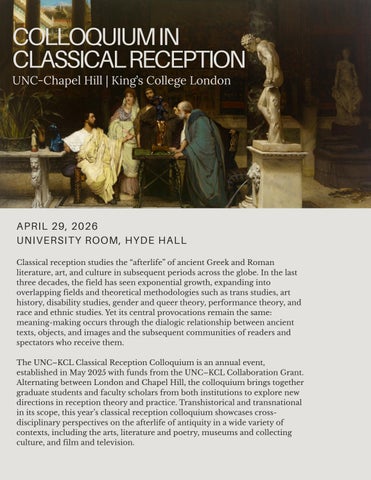
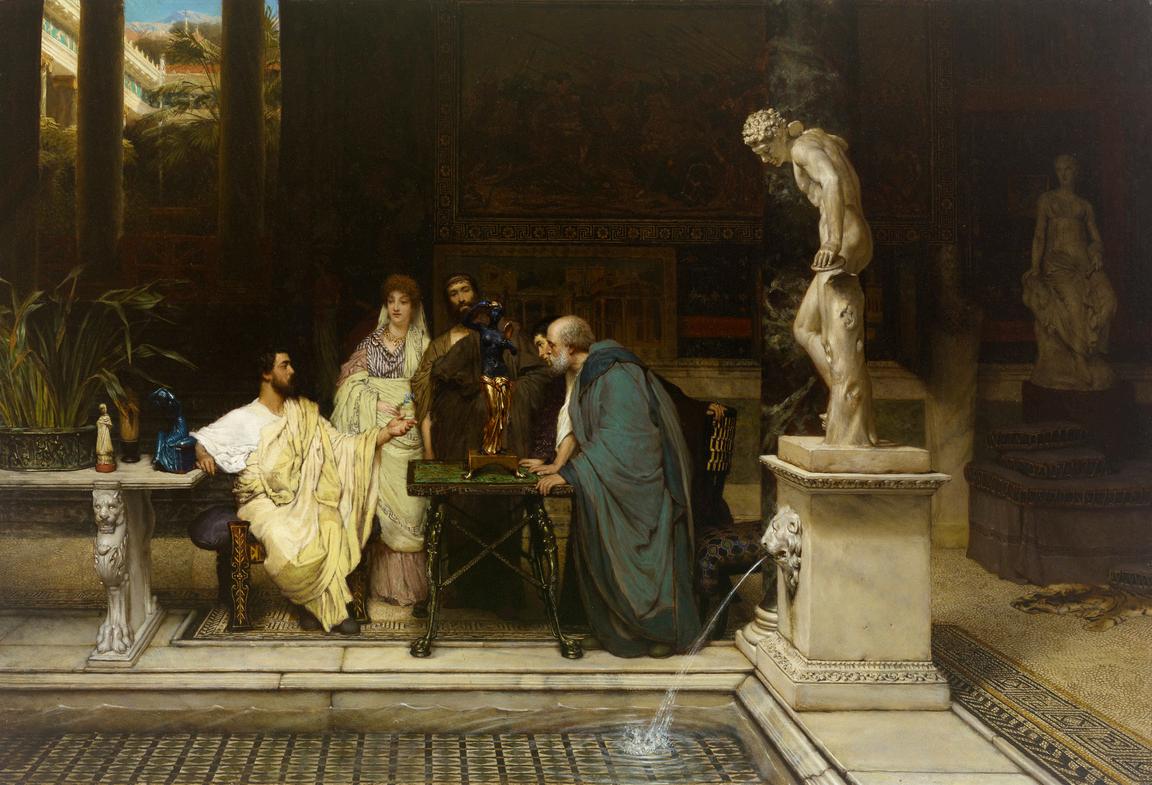
Classical reception studies the “afterlife” of ancient Greek and Roman literature, art, and culture in subsequent periods across the globe. In the last three decades, the field has seen exponential growth, expanding into overlapping fields and theoretical methodologies such as trans studies, art history, disability studies, gender and queer theory, performance theory, and race and ethnic studies. Yet its central provocations remain the same: meaning-making occurs through the dialogic relationship between ancient texts, objects, and images and the subsequent communities of readers and spectators who receive them.
The UNC–KCL Classical Reception Colloquium is an annual event, established in May 2025 with funds from the UNC–KCL Collaboration Grant. Alternating between London and Chapel Hill, the colloquium brings together graduate students and faculty scholars from both institutions to explore new directions in reception theory and practice. Transhistorical and transnational in its scope, this year ’ s classical reception colloquium showcases crossdisciplinary perspectives on the afterlife of antiquity in a wide variety of contexts, including the arts, literature and poetry, museums and collecting culture, and film and television.
EVENTSCHEDULE
WELCOME & BREAKFAST
10.00–10.15 AM
PANEL I: CLASSICAL AFTERLIVES IN THE ROMANTIC IMAGINATION
10.15–11.45 AM
Christopher Catanese (UNC), “Contradiction and Modernity: Digression, Dialectic, and the Georgic Ends of British Neoclassicism”
Kathryn Spears (UNC), “Re-presenting Catastrophe: The Anachronic Temporality of Mount Vesuvius in Eighteenth Century Grand Tour Art”
Lucinda Menaul (KCL), “The ‘thauma’ of Thomas Carlyle – classical myth, vernacular culture, and the imagery of enchantment in Carlylean politics”
PANEL II: SPACE, MEMORY, AND RECEPTION
11.45 AM–1.15 PM
Elena Svettini Remme (KCL), “Receiving Agrigento: Private Collections as Laboratories of Classical Reception in Architecture and Psychoanalysis”
Silvia Nencetti (UNC), “Petrarch and Pliny’s four labyrinths”
Emily Singeisen (UNC), “Sapphic Text(ile)s and Lesbian Ornamentalism”
LUNCH
1.15–2.15 PM
PANEL III: WOMEN AND POWER: ADAPTING THE CLASSICAL TRADITION
2.15–3.45 PM
Kaitlin Smith (UNC), “Antigone in the 21st Century: A Comparative Analysis of Antigone Figures in Contemporary Literature”
SkylarWittenborn (UNC), “The Rehabilitations of Livia, Agrippa, and Maecenas in DOMINA”
Scarlett Kiaras-Attari (KCL), “The Thecla Tradition and its Afterlife: Reimagining the Role of Family Religious Devotion”
“CONTRADICTION AND MODERNITY: DIGRESSION, DIALECTIC, AND THE GEORGIC ENDS OF BRITISH NEOCLASSICISM”
Christopher Catanese (PhD Candidate, UNC English)
My paper revisits a classic problem of anglophone literary history: why was a period of such epochal (economical, cultural, philosophical) transition in mid-eighteenth-century Britain characterized by an anomalous and short-lived efflorescence of ambitious formal georgic poems? British georgic poets understood their project as a speculative, collective quest for national renovation and Baconian scientific-economic “improvement,” a self-conscious break from the ancien regime and a providential natural order into an age of “ progress. ” In this paper I address what Fredric Jameson would call the georgic’s “ideology of form” and demonstrate that the affordances of the genre most attractive to eighteenth-century poets were in fact precisely those non-narrative features permitting the dialectical interplay (or tactical elision) of contradictory tendencies. In readings of the genre ’ s so-called “middle Stile” and “pertinent Digressions,” I examine the georgic’s uneven contributions to a “modern,” non-teleological concept of progress that develops through contradiction and the antagonism of internally opposed elements.
“RE-PRESENTING CATASTROPHE: THE ANACHRONIC TEMPORALITY OF MOUNT VESUVIUS IN EIGHTEENTH CENTURY GRAND TOUR ART”
Kathryn Spears (Master’s Student, UNC Art History & Library Science)
Pierre-Jacques Volaire’s The Eruption of Mt. Vesuvius (1777, North Carolina Museum of Art, Raleigh), presents a chaotic, fiery scene of the Neapolitan volcano in the midst of a destructive explosion. However, historical records indicate that while Vesuvius was particularly active in the eighteenth century, it was not experiencing a major eruption during the year of the painting's commission. This paper investigates this temporal discrepancy by analyzing Volaire’s work through the theoretical lens of anachronic time a concept describing how certain artistic motifs or subjects "linger" and persist through history, effectively blurring the lines between past and present. By interweaving eyewitness accounts of Vesuvian eruptions from ancient and early modern writers, the analysis reveals that many of Volaire’s visual choices mirror these trans-temporal literary descriptions, merging the eighteenth century eruptions with the famed destruction of 79 CE.
PAPERABSTRACTS
“THE ‘THAUMA’ OF THOMAS CARLYLE – CLASSICAL MYTH, VERNACULAR CULTURE, AND THE IMAGERY OF ENCHANTMENT IN CARLYLEAN POLITICS”
Lucinda
Menaul (PhD Candidate, KCL Classics & English Literature)
This paper explores how Thomas Carlyle conceptualised the classical and the vernacular and how his views on these subjects were expressed through the imagery of magic and enchantment. Examining Carlyle’s writings on classical and vernacular literature focusing on the intersections between classical epic, medieval ballad, and folklore-fairytales I explore the tensions between radical and conservative views running through his corpus I illustrate how Carlylean politics, drawing on analogies from classical myth and vernacular culture, is often presented through the imagery of enchantment, which for Carlyle was a double-sided concept suggestive of both stultification and inspiration. This, I argue, reflects the classical notion of ‘thauma’ which had a dual meaning in antiquity, being paradoxically both deceptive and revivifying. Culminating in a reinterpretation of Carlyle’s reading of the Midas myth in Past & Present (1843), I suggest that returning to the original Latin story in Ovid’s Metamorphoses shows the lengths Carlyle went to present the economical folly of laissez-faire politics. Using classical and medieval examples from literature, Carlyle rejects the ruling elite in a radical gesture, while simultaneously proposing a regression to feudal society.
“RECEIVING
AGRIGENTO: PRIVATE COLLECTIONS AS LABORATORIES OF CLASSICAL RECEPTION IN ARCHITECTURE AND PSYCHOANALYSIS”
Elena Svettini Remme (PhD Research Student, KCL Classics)
This paper examines two London sites of reception the Sir John Soane Museum and the Freud Museum to trace how images, drawings, casts and coroplastic artefacts associated with Agrigento circulated beyond antiquarian display to shape architectural pedagogy and psychoanalytic theory. At Soane’s house museum, an eclectic ensemble of casts, architectural models and pictorial records including Luigi Mayer’s views of the Agrigento temples, meticulous ink drawings of plans and elevations, and a scaled rendering of the Phaedra sarcophagus—constituted a pedagogical surrogate for the Grand Tour. In Freud’s consulting room, a heterogeneous assemblage of antiquities— grown through acquisitions and gifts furnished material prompts for theoretical elaboration. By situating Agrigentine antiquities within these two collections, the paper argues that private connoisseurship operated as an epistemic bridge whereby classical material was re encoded into disciplinary procedures. Classical reception, in this account, is less a matter of influence than of infrastructural translation where object, image and myth become method.
In Petrarch’s writings, the labyrinth is what Marco Santagata would call an “emblema”, that is, a term not semantically specific: it embraces centuries of values and associations of older labyrinths. This paper focuses on the four ancient labyrinths that open the verses of Epystola III, 22 (Heracleopolis in Egypt; Cnossos; Lemnos; Chiusi). My interpretation of the ancient four labyrinths favors the theme of literary glory over the various others available for the emblema labyrinthus My thesis is that this case study of classical reception is functional in expressing the mixture of bewilderment and pride that characterized the intellectual life of Petrarch, one of the first Italian writers to conceive of literary activity as a freestanding profession. I will discuss my thesis through the material evidence of a few folios from the manuscript Parisinus Latinus 6802, Petrarch’s personal copy of the Naturalis Historia, and through visual evidence drawn from labyrinths illuminated in other manuscripts and rendered in mosaic in French and Italian churches. Lastly, with a brief final foray into the Canzoniere (RVF 211 and 224), I will hypothesize an unexpectedly positive, even liberating, value for the ruin to which the ancient labyrinths have been consigned.
Across Sappho’s poems are strewn precious objects, beautiful adornments, and other lavish “things.” Amongst French and British writers around the turn of the twentieth century, the reception of Sappho’s material poetics inheres in the racialized logic of western imperialism, as Sappho is figured as the “Oriental woman ” and imagined alongside and as the luxury commodities flowing from the East into continental Europe and the British Isles. Focusing on the writings of British-born Francophile Renée Vivien and her American partner Natalie Clifford Barney, I examine how queer women writers of this period, in particular, marshal these dense entanglements of gender, sexuality, and race in their receptions of Sappho’s material imaginary to rearticulate their own experiences of sexual difference through forms of otherness that are themselves profoundly racialized.
PAPERABSTRACTS
“ANTIGONE IN THE 21ST-CENTURY: A COMPARATIVE ANALYSIS OF ANTIGONE
FIGURES IN CONTEMPORARY LITERATURE”
Kaitlin Smith (PhD Student, UNC English)
Andrés Fabián Henao Castro’s Antigone in the Americas: Democracy, Sexuality, and Death in the Settler Colonial Present suggests that Sophocles’ Antigone can be read as a “decolonial rumination” on the oppression of democratic power structures, particularly in the Global South (2021). Antigone’ s duration throughout time and literature offers a dialogue about classics’ relationship to contemporary literature, democracy, and women ’ s political engagements By conducting a comparative analysis, I present what I entitle the “Antigone Figure”—a feminine archetype in literature characterized by a struggle with the political-personal dichotomy experienced by a female-identifying character. Using Castro’s framework, I analyze receptions of Antigone in contemporary novels to argue that the reinvention of Antigone indicates a continual relevance of the political-personal dichotomy in contemporary global literature as it reflects current sociopolitical climates.
“THE REHABILITATIONS OF LIVIA, AGRIPPA, AND MAECENAS IN DOMINA”
Skylar
Wittenborn (PhD Student, UNC Classics)
This paper analyzes the depictions of Livia, Agrippa, and Maecenas in the show DOMINA (2021-2023) as being rehabilitations of former portrayals of them. Through more positive and developed views of these figures, DOMINA takes a more complex look at those in Augustus’ circle than previous pieces of media have done. Livia receives the largest share of the rehabilitation Famously vilified and portrayed as a scheming wife in I, Claudius and Rome, Livia is instead centered as the heroine in DOMINA, with her cleverness oriented toward eventually restoring the Republic (Aldrete and Sumner 2023, 125; McCullough 2015, 133). Both positively displayed, Agrippa is also much more developed in DOMINA, pointing to his historical importance as a member of Augustus’ circle (Tan 2019, 191). Maecenas’ character also receives a more positive depiction, an improvement from his slimy portrayal in Rome, but his character disappears after only a few episodes, the result of the absence of any references to Augustan literature. Livia, Agrippa, and Maecenas are rehabilitated by their depictions in DOMINA, where, for the most part, their characterizations are expanded beyond their former negative and reductive portrayals. This revised look at them allows DOMINA to complicate Augustus’ circle by humanizing them, providing a quite refreshing look at these historical figures.
PAPERABSTRACTS
“THE
THECLA TRADITION AND ITS AFTERLIFE: RE-IMAGINING THE ROLE OF FAMILY RELIGIOUS DEVOTION”
In 1836, Casimir Delavigne premiered 'The Family in the Time of Luther: A Tragedy in One Act,' a drama centred on a mother, Thecla, whose fervent commitment to Lutheranism drives her to convert her family. The play opens with a stark revelation: Paul has been absent from the household for fifteen years because of his refusal to abandon Catholicism, while his younger brother Luigi is preparing to abjure at their mother’s command. Paul’s return initiates the central conflict, which culminates in Luigi’s death and leaves Thecla childless, her religious devotion exposed as profoundly destructive to the family unit. This paper explores the relationship between Delavigne’s play and the Thecla tradition, arguing that the nineteenth-century drama reworks key elements of the ancient narrative to markedly different ends. In Delavigne’s version, Thecla embodies the destructive consequences of religious zeal within the family, with maternal authority and devotion shown to fracture rather than transform kinship bonds. By contrast, in the Acts of Paul and Thecla, the central tension lies in negotiating the place of family within emerging Christian structures, where spiritual allegiance competes with but does not simply negate kinship. By reading these texts together, this paper demonstrates how Thecla and her afterlives are continually used to highlight a resilient character, and interrogate the role of family in religion, albeit to different conclusions.
PRESENTERBIOS
CHRISTOPHER CATANESE
Christopher Catanese is a doctoral candidate working on eighteenth-century British poetry, with particular interests in political economy, genre studies, and classical reception. His 2017 article “Refinement and Romantic Genre” was awarded the Ralph Cohen Prize and published in New Literary History, and more recent work has been supported by awards and research fellowships from the MLA, the UCLA Clark Memorial Library, and Yale’s Beinecke Library.
KATHRYN SPEARS
Kathryn Spears is a dual-degree master’s student in art history and library science at UNC-Chapel Hill. With a background in classical art and archaeology, her interdisciplinary research interests broadly include ancient Roman bronze sculpture, modern artistic receptions of classical antiquity, and the historic collection of art in museum or library settings. She has previously held positions at the Frick Art Research Library, North Carolina Museum of Art, and the Ackland Art Museum, working in provenance research, digital asset management, and museum education
LUCINDA MENAUL
Lucinda Menaul is a PhD candidate in Classics and English Literature at King’s College London. Her AHRC-funded project explores the ‘re-enchantment’ of antiquity at the fin-de-siècle in British literature. Working at the intersection of classical reception and literary criticism, her research focuses on the interactions between classical, medieval and folkloric traditions in 19th and 20th century literature.
PRESENTERBIOS
ELENA SVETTINI REMME
Elena Svettini Remme is a doctoral candidate whose research examines domestic decoration in the Greek–Roman world, focusing on Hellenistic mosaics and wall painting in Agrigento. She investigates how visual and material features shaped spatial experience and social identity, and how households reinterpreted classical imagery in everyday settings. She holds an MA from King’s College London, a BA from the Università di Palermo, and training in decorative art and design from Sotheby’s Institute of Art, London, broadening her expertise.
SILVIA NENCETTI
Building on her MA in Classical Archaeology, Silvia is now interested in reading Italian writers to look for references to Etruscan and Roman material culture and archaeological landscape, in order to detect how those visible memories of the past are portrayed, and to what extent their massive presence in Central Italy influenced authors’ poetics. She also looks for contributions Italian Literature may have given to the public discourse in terms of conservation and valorization of the cultural heritage in the seasons of development of Italian heritage laws.
EMILY WALLER SINGEISEN
EmilyWaller Singeisen is a PhD student and teaching fellow at the University of North Carolina at Chapel Hill. Her work has been published in Classical Receptions Journal, Cusp: Late Nineteenth and Early Twentieth Century Cultures, and differences: A Journal of Feminist Cultural Studies. Her current research examines receptions of ancient Greco-Roman texts in illustrated books, attending particularly to the ways in which Freudian psychoanalysis reshaped visual representations of antiquity from the turn of the century to the interwar period.
PRESENTERBIOS
KAITLIN SMITH
Kaitlin Smith is a first-year Ph.D. student in the Department of English and Comparative Literature at the University of North Carolina at Chapel Hill. Her current research investigates women ' s classical receptions in the nineteenth century. Her broader research interests include classical reception in literature, portrayals of women in antiquity, Greek tragedy, and Global Romanticisms.
SKYLAR WITTENBORN
Skylar Wittenborn is a first-year PhD student in the Department of Classics at the University of North Carolina at Chapel Hill. She works on Latin prose literature and Roman historiography, particularly focusing on civil war narratives and the figure of Octavian/Augustus. In addition, she also works on the reception of Octavian/Augustus in film and television.
SCARLETT KIARAS-ATTARI
Scarlett Kiaras-Attari is a PhD candidate at King’s College London. Her research explores the reception history of early Christianity with a particular focus on the intersections of gender, sexuality, and religious narratives. Her work critically examines how these narratives are reinterpreted and understood in contemporary contexts, offering a nuanced perspective on the complexities underlying modern conceptions of gender. Scarlett also holds degrees from the University of Edinburgh and the University of Oxford.