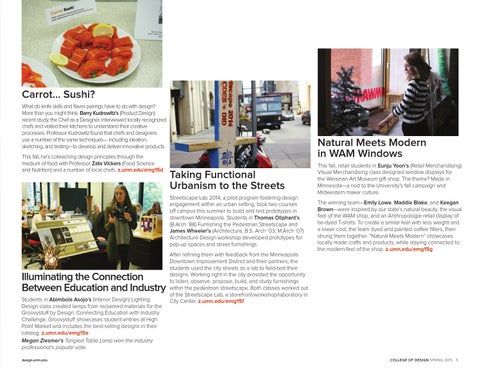
Carrot… Sushi? What do knife skills and flavor pairings have to do with design? More than you might think. Barry Kudrowitz’s (Product Design) recent study, the Chef as a Designer, interviewed locally recognized chefs and visited their kitchens to understand their creative processes. Professor Kudrowitz found that chefs and designers use a number of the same techniques— including ideation, sketching, and testing—to develop and deliver innovative products. This fall, he’s coteaching design principles through the medium of food with Professor Zata Vickers (Food Science and Nutrition) and a number of local chefs. z.umn.edu/emg15d
A community-research collaboration led by Elizabeth Bye (D.H.A. department head, Apparel, Ph.D ’90), Nicole LaVoi (Tucker Center for Research on Girls and Women in Sport), Chelsey Thul (Pediatrics), and Fatimah and Salma Hussein (Girls Initiative in Recreation and Leisurely Sport) is creating
4 EMERGING FALL 2014
culturally appropriate active wear for middle school athletes. Last fall, apparel design undergraduates led small groups of East African girls in developing the design criteria–long sleeves, covered heads, torsos covered to the knees, and plenty of pink. This fall, Kira Erickson (B.S. ’14 Apparel) and Mee Jekal (Apparel) sewed the garments in wicking fabrics with high stretch and recovery. The girls modeled the first round of designs for their parents. Erickson reported positive feedback and noted that in addition to looking great, the
Taking Functional Urbanism to the Streets Streetscape Lab 2014, a pilot program fostering design engagement within an urban setting, took two courses off campus this summer to build and test prototypes in downtown Minneapolis. Students in Thomas Oliphant’s (B.Arch ’88) Furnishing the Pedestrian Streetscape and James Wheeler’s (Architecture, B.S. Arch ’03, M.Arch ’07) Architecture Design workshop developed prototypes for pop-up spaces and street furnishings.
Culturally Appropriate Active Wear Only one-third of adolescents meet the surgeon general’s exercise recommendations. And ethnic minority girls, including those in the Twin Cities East African community, are the least physically active adolescents. One design solution? Striped pink tights.
Natural Meets Modern in WAM Windows
garments provide freedom of movement. “The women keep pulling up their skirts, saying ‘‘we don’t have to do this anymore’!”
Illuminating the Connection Between Education and Industry
The Tucker Center determined the girls’ baseline activity level, and will survey them after they’ve received their outfits to see how it affects the type and frequency of their exercise. Their long-term goal is to design a uniform approved by the Minnesota State High School League, so the girls can play for their high school teams.
Students in Abimbola Asojo’s (Interior Design) Lighting Design class created lamps from reclaimed materials for the Groovystuff by Design: Connecting Education with Industry Challenge. Groovystuff showcases student entries at High Point Market and includes the best-selling designs in their catalog. z.umn.edu/emg15e Megan Ziesmer’s Tangled Table Lamp won the industry professional’s popular vote.
FOX 9 interviewed the girls and their coach. Watch the story at z.umn.edu/emg15c. facebook.com/uofmdesign
@uofmdesign
instagram/umndesign
design.umn.edu
After refining them with feedback from the Minneapolis Downtown Improvement District and their partners, the students used the city streets as a lab to field-test their designs. Working right in the city provided the opportunity to listen, observe, propose, build, and study furnishings within the pedestrian streetscape. Both classes worked out of the Streetscape Lab, a storefront/workshop/laboratory in City Center. z.umn.edu/emg15f
This fall, retail students in Eunju Yoon’s (Retail Merchandising) Visual Merchandising class designed window displays for the Weisman Art Museum gift shop. The theme? Made in Minnesota—a nod to the University’s fall campaign and Midwestern maker culture. The winning team—Emily Lowe, Maddie Blake, and Keegan Brown—were inspired by our state’s natural beauty, the visual feel of the WAM shop, and an Anthropologie retail display of tie-dyed T-shirts. To create a similar feel with less weight and a lower cost, the team dyed and painted coffee filters, then strung them together. “Natural Meets Modern” showcases locally made crafts and products, while staying connected to the modern feel of the shop. z.umn.edu/emg15g
COLLEGE OF DESIGN SPRING 2015 5