The STAA: A year of influence growth and standing up for the sector
P4
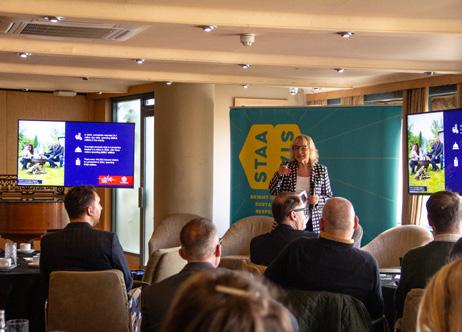
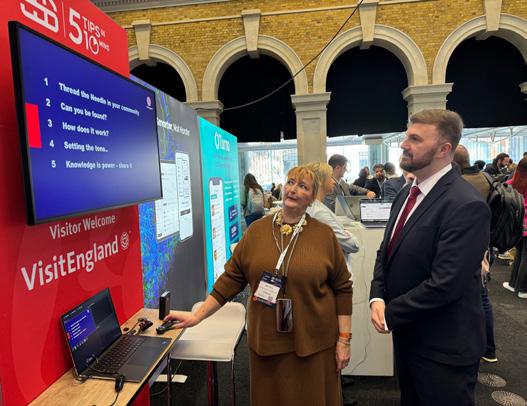
Patricia Yates, CEO, VisitEngland, VisitBritain joined us at the Coastal Communities Roadshow, Blackpool P16
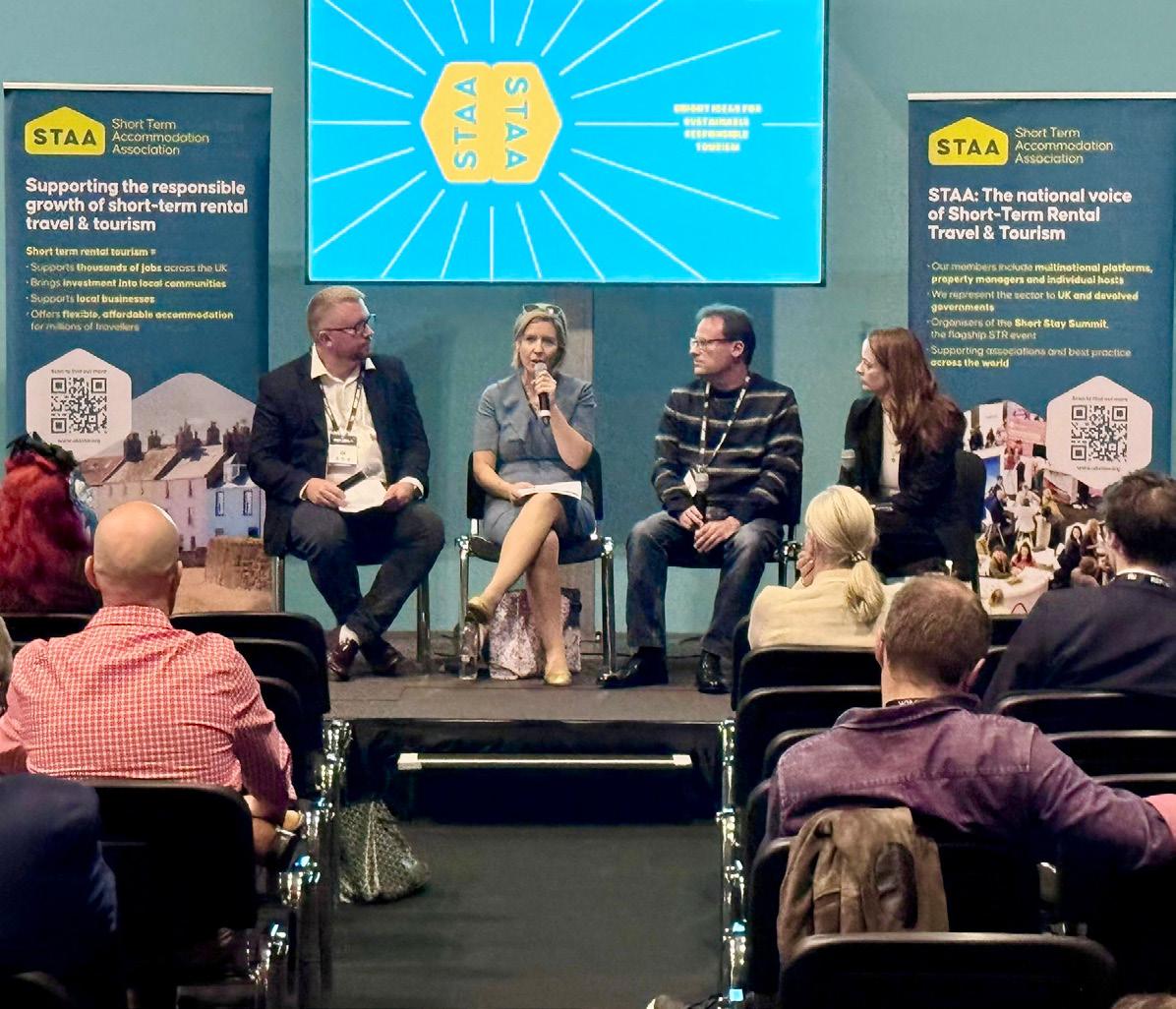
STAA at the Political Conferences. From L to R: Andy Fenner, CEO, STAA, Dame Andrea Jenkyns, Mayor of Lincolnshire, Carl Thomson, Public Policy Manager, Airbnb and Anna Mikhailova, Political Editor, Times Radio
THE AIRBNB HOSTING COMMUNITY –CONNECTING WITH THE SECTORS FRONTLINE
MEMBERS’ SPOTLIGHT NICK TAYLOR ON SASTRA’S AMBITIONS FOR THE SOUTH AFRICAN STR MARKET
MEET DAN WHITING, STAA BOARD MEMBER SHORT STAY SUMMIT 2026 UPDATE
WELCOME TO THE FINAL ASSOCIATE OF 2025
Dear STAA Members,
As we reach the end of 2025, I want to reflect on a year that has tested our sector but also proved the strength of what we’re building together at the STAA, a strong unified voice for our sector, a voice that is being heard and respected by those who shape policy.
The last few months have had some highlights for the association. The political conference season being one. The STAA hosted events and engaged directly with decision-makers, we demonstrated the professionalism of our association and the economic reality of what you deliver: jobs, investment and opportunity in communities across the country.
Another highlight was our Blackpool event on coastal communities. To have speakers of the calibre of Patricia Yates, CEO of VisitBritain, Chris Webb MP, Chair of the All-Party Parliamentary Group for Tourism, and the Leader of Blackpool Council and others taking part reflects the strength and credibility we’ve earned and are bringing to the sector. We can and are driving change that will benefit all your businesses.
Throughout the period, we’ve maintained ongoing engagement with MPs and Councillors and worked closely with DCMS and the devolved administrations. These relationships are delivering results. Policymakers are listening..
The association team has also been going full steam with preparations for the Short Stay Summit on April 22nd, 2026. This Summit is going to be bigger and
better than ever before, an opportunity for you to learn, collaborate, share experiences and a real showcase of what’s best in our businesses. We have a fantastic line-up taking shape, and I’m particularly excited about a new edition to the lineup for 2026, the STAA icebreaker party on April 21st at East Side Records. You can read more about the party, Summit plans and how to make sure you will be there from Diane later in this edition.
2025 has had its ups and downs,. regulatory uncertainty, economic headwinds and the usual challenges of running tourism businesses have tested many of you. But as we look to 2026, we do so in a far more positive frame of mind than we did this time last year. The connections the STAA has built are working. Policy makers are listening. The narrative is shifting. And that’s because of you, your professionalism, your resilience and your willingness to engage constructively even when the going gets tough. Thank you for everything you do.
Please enjoy this festive edition of The Associate and from me and from everyone at the STAA, a very Merry Christmas, Happy Hanukkah and a wonderful New Year.
I look forward to working with you all in 2026 and making it a successful year for everyone.
ANDY FENNER, Chief Executive, STAA
STAA ANNUAL REVIEW 2025
A YEAR OF INFLUENCE GROWTH AND STANDING UP FOR THE SECTOR
2025 has been one of the most active and outward facing in the STAA’s history. Throughout the year the association has worked to strengthen the voice of the short term accommodation sector, champion tourism and shape a fair and balanced environment for all our members.
2025 ROUND UP OF THE HIGHLIGHTS.
Q1: SETTING THE PACE FOR A GLOBAL YEAR
· Q1 started with a major international moment as CEO Andy Fenner represented UK tourism and the short term rental sector at the LEAP Conference in Riyadh. Leap, attended by over 180,000 tech industry leaders, is the world’s biggest technology event. Andy was on stage showcasing the innovation and economic value of the STR sector to global partners and new markets.
WRITTEN BY: THE STAA TEAM
• The STAA gave evidence to the Competition and Markets Authority on drip pricing ensuring regulators understood the realities of the sector and the need for rules that protect guests while keeping compliance fair and workable.
• The association also strengthened its role in rural policy through its work with the CLA’s Rural Tourism Partnership. The STAA contributed directly to the Rural Business Manifesto published later in the year with the STAA ensuring short term accommodation tourism was properly represented.
• Q1 also included sponsorship of the English Tourism Week Parliamentary Reception and continued engagement with DCMS through the new VEAC group shaping early thinking on future visitor accommodation policy.
Q2: SUMMIT SEASON AND NEW LEADERSHIP
• Q2 centred around the Short Stay Summit now firmly established as the flagship gathering for the sector. With an exceptional line up and almost every exhibition stand sold the Summit continued to raise the profile of UK short term accommodation tourism.
• The STAA’s international work continued with Andy Fenner on stage at World Travel Market Africa in Cape Town opening new markets and raising the profile of UK hosts and operators.
• In Wales the association worked closely with Cardiff Council and the Welsh Revenue Authority on short term accommodation policy and took part in English Tourism week ensuring devolved engagement remained strong.
• Q2 ended with the appointment of Graham Donoghue as the new STAA Chair bringing deep industry experience and strategic direction for the year ahead.
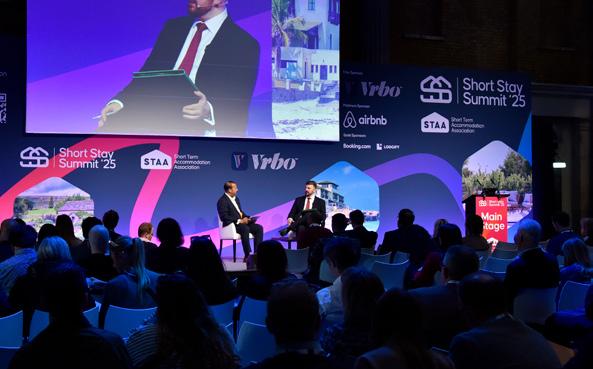
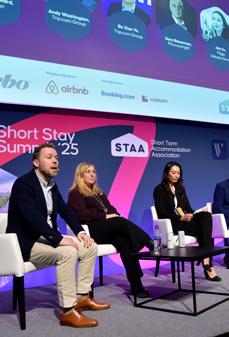
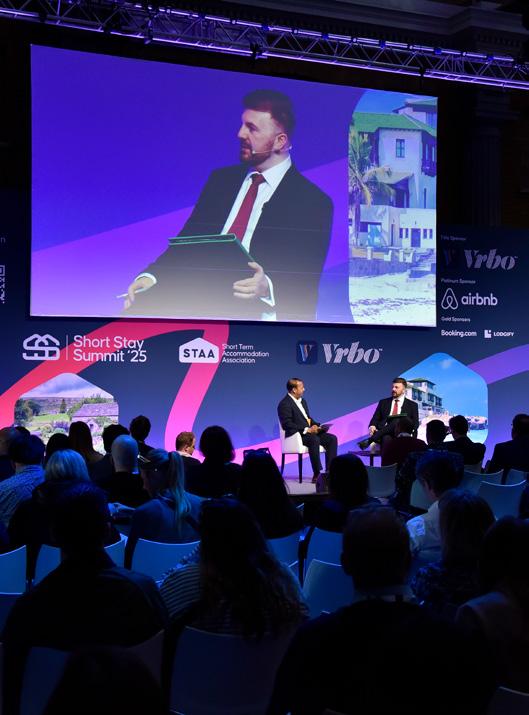
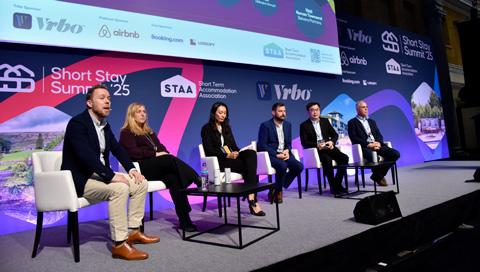
Shomik Panda, Director General, STAA & CEO Inline Policy and Chris Webb MP, Hospitality and Tourism APPG talk at the Short Stay Summit ‘25
Andy Fenner, CEO, STAA at the World Travel Market Africa in Cape Town
Graham Donoghue, Group Chief Executive Officer, Forge Holiday Group and CEO, Sykes Cottages and Tourism is appointment the UK STAA Chair
Q3: STRENGTHENING NATIONAL PARTNERSHIPS
• Q3 was defined by deeper engagement with MP’s working actively with MPs in key tourism areas, making sure the sector’s priorities were reflected in debates around housing planning and the visitor economy.
• The association also expanded its work with the Ministry of Defence on new schemes to help tourism and hospitality employers benefit from the skills and experience reservists bring into the sector.
• The CEO represented the STAA at the Welsh Labour conference continuing to build strong links in Cardiff Bay and ensuring that the voice of tourism and short term accommodation featured in early policy thinking for the next Senedd term.
Q4: CONFERENCE SEASON INFLUENCE AND A SEAT AT THE TOP TABLE
• Q4 brought the busiest political season yet with the STAA present at every major UK party conference including Liberal Democrat, Conservative, Labour, SNP and Reform. Engagement with MP’s Ministers councillors and advisers was constant ensuring short term accommodation tourism stayed at the centre of policy conversations.
• A major milestone came as the STAA became formally affiliated to the CBI cementing our place at the top table of UK business representation. This affiliation strengthens our influence and ensures the needs of the short term accommodation sector are included in national economic and tourism strategy.
• Engagement with policymakers continued beyond conference halls with the STAA working alongside VisitEngland on coastal regeneration projects helping shape thinking on how tourism and short stays can support the revival of seaside towns.
• The quarter also included a standout event in Blackpool bringing together industry leaders and local representatives to explore the future of visitor accommodation in coastal communities.
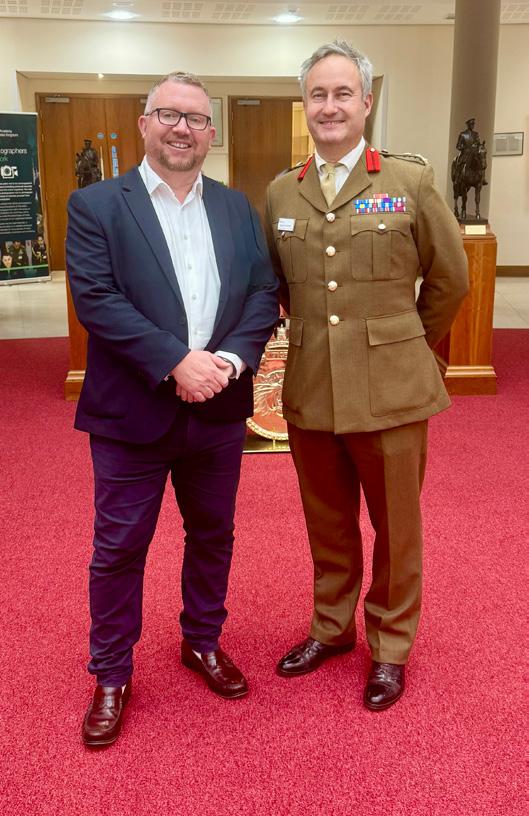
Andy Fenner, CEO UK STAA meeting Brigadier Christopher Palmer OB (the Head of the Army Reserve & Cadet Forces)
Janet Uttley, Head of Industry Development, VisitEngland and Chris Webb MP, Hospitality and Tourism APPG
A YEAR OF PROGRESS A SECTOR WITH MOMENTUM
Across all four quarters the STAA delivered strong advocacy practical policy work global engagement and sector leadership. Whether in Parliament in Cardiff Bay on the international stage or at the heart of the UK’s political conferences the association has remained focused on championing a thriving responsible and innovative short term accommodation sector.
2025 has been a year of real momentum and with committed leadership and an active membership the STAA is well positioned for everything the coming year will bring.
The STAA in Parliament for English Tourism week
SPEAKING UP FOR THE SECTOR AND SHAPING POLICY: LOOKING BACK ON 2025 POLICY UPDATES
Throughout this year, we have worked through our Policy Group, led by our co-Chairs, Carl Thomson and Charlie Reith, to represent the STAA’s views and influence policy from Westminster to Cardiff and to consolidate the STAA’s position as a trusted and reliable stakeholder. . 2025 was our most politically active year to date and we can look back proudly at the impact which we have made.
Policy development
Discussions that take place in the regular Policy Group meetings form the basis of each submission. The diverse membership of the group, from global platforms to local property managers and hosts, guarantees that final policy positions reflect the concerns of the whole industry.
In Wales, 2025 kicked off with our response to the (now passed) Bill introducing a visitor levy and registration scheme. Our association always supported a low-cost, nationally administered registration scheme and this was, by and large, achieved. The Welsh government has since sought to introduce a licensing scheme for short-term lets, a far less welcome development for our members. The STAA has stepped up to report members’ concerns back to the Welsh government. In parallel to this, the STAA has continued to lobby for a lowering of the 182-day threshold for business rates.
In England, the government has been progressing work on a registration scheme for short-term lets, now in its beta stage. The STAA has built a very strong working relationship with DCMS officials over many years and we are thankful to have been consulted through all stages of the scheme’s development. We continue to engage with officials to ensure that the scheme captures all necessary information and is introduced in the most efficient and low-cost manner. Finally, the STAA responded to two government consultations on proposals to bring short-term lets into scope of EPC requirements.
At the UK level, the STAA took part in the consultation on changes to package travel legislation, supporting proposals to relax requirements for domestic packages. We also submitted responses to two consultations by the Competition and Markets
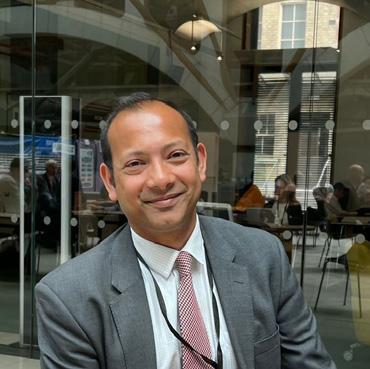
Shomik Panda, Director General, STAA & CEO Inline Policy gives us an annual review
Authority (CMA) on its price transparency guidance where we called for clarification as to how tourism taxes must be displayed to remain compliant with regulation.
Thought leadership
The STAA’s high-profile policy work has been instrumental in entrenching its position as a leading representative of the industry across the UK.
Providing feedback on the visitor levy and register Bill and engaging with officials led to the STAA being contacted as a key stakeholder ahead of publication of the new licensing Welsh Bill and invited to provide evidence to the Senedd. Similarly, our efforts to build working relationships with officials across government departments in England meant that the STAA was contacted regularly to discuss the development of the registration scheme.
Political engagement
Another objective of the association was to share with politicians and the public short-term lets’ contribution to UK tourism and create champions for our sector.
To do so, the STAA was present at all major UK Party Conferences in 2025, ensuring the association’s visibility to policymakers and forging helpful relationships. STAA representatives continued attending fundraising dinners and other events such as Wales Tourism Week to solidify relationships. The STAA has also been meeting regularly with MPs interested in the sector and from tourismreliant areas,as well as strengthening its presence
in Wales. This year we have met with and built relationships with well over 50 MPs, MSs and other Parliamentarians across the Home Nations.
The STAA has also sought to establish and develop connections with government officials, such as the Department of Culture, Media and Sport (DCMS) and the Ministry of Housing, and enforcement bodies, such as the CMA and the Welsh Revenue Authority (WRA).
We also sat down with local councils across the UK, such as Brighton and Cardiff, to discuss short-term lets in their areas, contributions made by the sector and existing challenges.
Events
Events have been a critical part of promoting the industry’s message. The highlight was the Short Stay Summit in April, headlined by the Chair of the APPG for Hospitality and Tourism , Chris Webb MP. 2025 also saw the first stop of the STAA roadshow to showcase tourism in coastal and rural communities in Blackpool.
I would like to thank all members of the Policy Working Group for helping the Secretariat to plan and execute all of our policy work this year. We have set a strong standard from which to build further in 2026 - a year in which we expect considerable regulatory change in England and Wales to start being implemented.
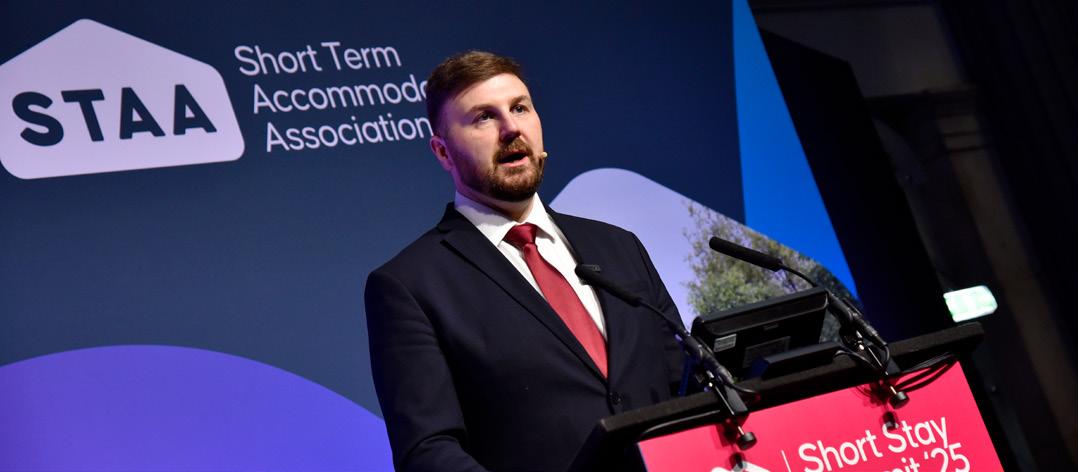
Chris Webb MP, Hospitality and Tourism APPG speaking at the Short Stay Summit ‘25
BUDGET
ON 26 NOVEMBER, CHANCELLOR OF THE EXCHEQUER RACHEL REEVES MP DELIVERED THE 2025 BUDGET.
HERE IS WHAT IT MEANS FOR THE SECTOR:
Tourism
Mayors will be given the power to introduce a visitor levy for overnight stays in their area. The government is currently consulting on the design of the levy. The introduction of a visitor levy is a negative development for the sector but the STAA will be engaging on the design of the levy to ensure our members’ concerns are represented.
The government also announced a one year freeze on regulated train fares.
Housing
Tax rates for property income will be increased. From April 2027, the property basic rate will be 22%, the property higher rate will be 42%, and the property additional rate will be 47%.
The budget also introduced a mansion tax, i.e. a council tax surcharge on properties worth over £2m.
Devolved housing funds were announced for local authorities as well as additional government investment to build new homes across the country. £1.3 billion of the new National Housing Delivery Fund will be devolved to local leaders in strategic sites.
Listing relief
Transfers of a company’s securities will be subject to relief from the 0.5% Stamp Duty Reserve Tax charge for three years from the point the company lists on a UK regulated market.
Business rates
There will be reduced business rates for the hospitality sector more broadly, as well as a commitment from the government to explore further planning reforms to make it easier for hospitality businesses to expand and grow.
Retail, hospitality and leisure (RHL) multipliers will be 5p below their national equivalents. A support package worth £4.3 billion over the next three years was announced, including additional support for Transitional Relief and Supporting Small Businesses, to help sectors’ post-Covid recovery. Still, higher business rates will be charged for properties worth over £500,000.
Taxation
Main rate writing-down allowances for Corporation Tax and Income Tax will be reduced from 18% to 14% and a new 40% First Year Allowance for main rate expenditure was announced. Capital gains tax relief on disposals to employee ownership trusts will be reduced from 100% of gains to 50%. Earnings from dividends are to be taxed by an additional 2% for ordinary and upper rates of tax.
A freeze on income tax thresholds was announced for a further three years until 2031-2032. The Budget set out tax changes to encourage businesses to start, scale and stay in the UK, including investment. This includes increasing the limits for the Enterprise Management Incentives scheme and reducing the upfront Income Tax relief for Venture Capital Trusts.
Employment
Minimum wages will increase by 4.1% for over 21s from April 2026. 16-17 year olds will receive a 6% increase and 18-20 year olds will receive a 8.5% increase. The national living wage will rise from £12.21 to £12.71 an hour from April 2026 for over21s. Employer national insurance contribution (NIC) thresholds to be extended to 2031.
WRITTEN BY: SHOMIK PANDA, DIRECTOR GENERAL, STAA & CEO INLINE POLICY
ENGLAND TO FOLLOW SCOTLAND AND WALES WITH TOURISM TAX
Christmas is not normally a time to tighten budgets, but late November is clearly too early for festive cheer in HM Treasury.
The Budget attempted to walk a fine line between offering popular policies to the Labour movement, while not provoking the ire of taxpayers or the bond markets. How gracefully the Government managed that has already been the subject of acres of newsprint.
For our sector, the most eye-catching announcement is the consultation on tourism taxes in England – proposing levies to be introduced at the discretion of Mayors, and potentially other types of local authority. The STAA was part of the early push back against the policy, which risks heaping more administration and cost onto tourism and hospitality businesses large and small.
While it’s true these taxes are common in other markets, in the English context – with high VAT levels, an unfavourable exchange rate, and a raft of other regulatory changes currently being managed – it risks being very disruptive. The policy decision appears to have been made behind closed doors and the consultation disappointingly only asks feedback on the design.
We are urging the Government to proceed with extreme caution. Once they devolve the power to create these taxes to English Mayors they risk unleashing a nightmarish patchwork of different tax rules. If they must proceed with the policy in some form then they will not get a second chance to set robust guardrails.
Business rates reform was the second major Budget development affecting tourism, confirming permanently lower multipliers for retail, hospitality and leisure properties from April 2026. Many small and mid-sized businesses will benefit from this but the changes coincide with a revaluation that has
significantly increased rateable values for many properties, particularly in the accommodation sector.
The Government has introduced a transitional relief package to soften the impact over the next three years, but the longer-term picture will depend on each property’s valuation and classification.
And finally – although less prominent in the public commentary, there is a planned 2 percentage point rise in income tax on property income from April 2027, which will likely affect many self-catering operators, especially those already absorbing higher operating costs.
Looking ahead, the Government still needs to introduce and pass the secondary legislation required to implement the registration scheme for self-catering properties in England. We anticipate this soon and in the last fortnight DCMS has been working on the final impact assessment to accompany the regulations.
Hopefully, some members will have had the opportunity to test the registration scheme in private beta mode and provide feedback. With a smorgasbord (to borrow another Budget phrase) of other interventions to digest, our sector must hold the Government to its promise that the scheme will be as simple and light-touch as possible.
SCOTLAND: CHANGES TO THE VISITOR LEVY
This month the Scottish Government announced that it will make changes to the visitor levy legislation.
Currently, hosts in Edinburgh need to charge guests a 5% tourist tax on the cost of the accommodation element of any trip, on bookings that were made on or after 1st October for stays which take place on or after 24th July 2026. Other councils are due to follow, with Glasgow bringing in a similar 5% tax next year, and Aberdeen expected to charge 7%.
The rules around the visitor levy are set out in Scottish legislation. However, following conversations with the sector, the Scottish Government has now said that it plans to give councils more flexibility in terms of the design of the tax.
Rather than requiring that councils calculate their visitor levy as a percentage of the cost of accommodation, local authorities will have the option of instead charging either a flat fee, or a “per person, per night” charge. Councils will also be able to only apply the levy to specific areas within their boundary, or to only require the levy be paid at certain times of the year.
Legislation to bring these changes will be introduced in January, and is likely to come into effect in October.
WRITTEN BY: CARL THOMSON, STAA DIRECTOR
WALES: A NEW LICENSING SCHEME FOR SHORT-TERM LETS
In November, the Welsh Government introduced the Development of Tourism and Regulation of Visitor Accommodation Bill, which will create a licensing regime for short-term lets.
If passed, the new scheme is likely to come into effect in 2028. Under the proposals, hosts will have to upload health and safety documents, such as gas safety certificates, electrical safety certificates, and a fire safety risk assessment. Hosts will also have to pay a fee and renew their license annually. This comes on top of, and should not be confused with, the new statutory register of overnight accommodation in Wales, which is expected to launch in October 2026.
The bill is currently going through its “stage one” proceedings in the Welsh Parliament, where the relevant committee scrutinises the legislation and invites outside witnesses to give expert testimony. The STAA has been heavily involved in these discussions, with three of our directors being invited to appear before the committee. We also submitted a powerful response to the call for written evidence on the bill, highlighting concerns about aspects of the proposals.
The STAA recognises that in comparison to licensing for self-catering accommodation and short-term lets in other jurisdictions, there are some positive aspects of the Welsh Government’s proposals. Unlike in Scotland, where local authorities were able to add on additional requirements to obtain a licence and charge very high fees, the Welsh system is envisaged as a single set of national rules, with a flat fee and hosts only needing to demonstrate that they meet existing health and safety obligations.
However, we have serious concerns about other aspects of the bill. One of the most important is the change in policy from 2023, when the Welsh Government outlined its ambition for an “apply and go” form of licensing, under which applicants would upload their documentation and get instant approval to continue operating. Under this bill, all applications for a licence will need to be manually reviewed before they are granted, a system that has been called “apply and wait”, and something that Welsh Government officials have suggested could take as long as 80 days.
Coupled with a requirement for licenses to be renewed every year, this creates a lot of uncertainty and adds a lot of bureaucratic paperwork for hosts who have already had to deal with a large number of new regulatory interventions in recent years.
Equally concerning is the potential that this has to make accommodation in Wales more expensive, damaging its competitiveness as a visitor destination and harming the wider economy. Airbnb has estimated that the introduction of a licensing scheme in Wales could cost hosts in Wales anywhere between £4.5 million and £15 million each year.
We have called on the Welsh Government to pause consideration of this bill until the overnight accommodation register is fully operational. The registration system will give local authorities in Wales data about the number, type and concentration of short-term lets in their area. It will support operators by signposting them to official information about their health and safety obligations, while information from the register can be used by councils when investigating complaints. All this can be achieved without the bureaucracy that licensing entails.
The STAA will continue to engage with the Welsh Government as we seek to shape this legislation, and will be in Cardiff on behalf of our members in January as the bill moves to its next stage of consideration.
WRITTEN BY:
CARL THOMSON, STAA DIRECTOR
“YOU’RE NOT THE PROBLEM” – IRISH MINISTER URGES RETHINK ON STR LEGISLATION
WRITTEN BY:
THE IRISH SELF CATERING FEDERATION (ISCF)
Speaking at the annual Irish SelfCatering Federation [ISCF] Annual Conference [Conference and Awards 2025 - Irish Self-Catering Federation] in Clare, Ireland, in November, Michael Healy-Rae, Minister of State at the Department of Agriculture, Food and the Marine, urged the country’s government to rethink proposed legislative changes that could decimate rural and coastal tourism, while acknowledging the value of the selfcatering sector to local communities and the tourism economy.
“We have a housing crisis, but you are not the problem – and neither are you the solution,” the Minister said, adding that the self-catering industry is “under-valued by politicians and the general public” and that there remains “a serious lack of awareness within government about the importance of this issue.”
The Short-Term Letting Register in Ireland is due to go live on 20 May 2026, when all STR operators will be required to register and receive a unique STR number before advertising on booking platforms. Registration will require operators to declare compliance with planning regulations, but there are concerns about the feasibility of meeting the 2026 deadline due to current timeframes and costs of making applications.
Charlie Reith, STAA board member, and public policy lead for Expedia Ireland and the UK, proposed:
“Run the Register for one to two years without an obligation for planning. In that time, collect data, assess the impact, and then refine the planning rules to include appropriate exemptions for existing operators.”
The ISCF (www.iscf.ie), the national representative body for owners and managers of self-catering properties in Ireland, reiterated its calls for government action:
• Exempt existing self-catering operators from new planning requirements – known as a Grandfather Rule
• Ensure the Fáilte Ireland Register is implemented fairly and with clear, achievable guidelines
• Raise the threshold from 10,000 to 30,000 for rent pressure zones [RPZs]
• Introduce a two-year “planning amnesty” period for the new STR Register, allowing it to operate and collect data before linking registration to planning compliance.
STAA AT THE POLITICAL CONFERENCES: CHAMPIONING TOURISM AND YOUR BUSINESS
This year’s political conference season saw the STAA front and centre across the UK, from Bournemouth to Birmingham, from Aberdeen to Liverpool , the team was present at every major conference. It was a chance to highlight the importance of tourism and the contribution our sector makes to local economies and communities.
The season opened in Wales where our CEO Andy Fenner, attended the Welsh Labour Conference in Llandudno. Andy was representing Welsh business and setting out how short term accommodation supports jobs visitor spending and a stronger year round tourism offer. It was a reminder that decisions made in Cardiff Bay, Westminster and the devolved nations have real impact on the future of our businesses and local economies.
From there the STAA ensured a visible presence at all the conferences including Liberal Democrat, Conservative, SNP, Labour and Reform UK. At the Reform Conference the STAA was the only tourism
industry body there to fight for the sector. We hosted a panel discussion with Dame Andrea Jenkyns, the Mayor of Lincolnshire, which focused on the role tourism can play in reviving high streets and supporting the renewal of coastal communities. The message was clear. With the right support tourism can be a powerful driver of regeneration.
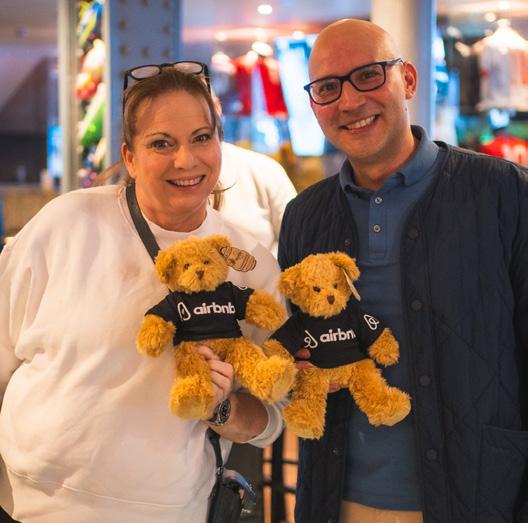
Labour Conference brought another key moment. STAA member Airbnb sponsored one of the conference key events, the MPs reception. This provided an excellent platform to underline the importance of responsible hosting and fair regulation. At the reception the STAA joined Airbnb’s Director of Policy Velma Cocoran in meeting MPs and Ministers to discuss a balanced approach to policy that supports local housing needs while safeguarding the essential role visitor accommodation plays across the UK.
Across every party one theme stood out. Tourism matters. Thanks to active engagement throughout conference season the STAA ensured that policymakers heard directly how our sector can help deliver growth jobs and opportunity in every part of the country.
From L to R: Andy Fenner, CEO, STAA, Dame Andrea Jenkyns, Mayor of Lincolnshire, Carl Thomson, Public Policy Manager, Airbnb and Anna Mikhailova, Political Editor, Times Radio
In October, the STAA took its Coastal Communities Roadshow to Blackpool as tourism leaders, policymakers and innovators came together to discuss the regeneration of coastal communities through sustainable tourism.
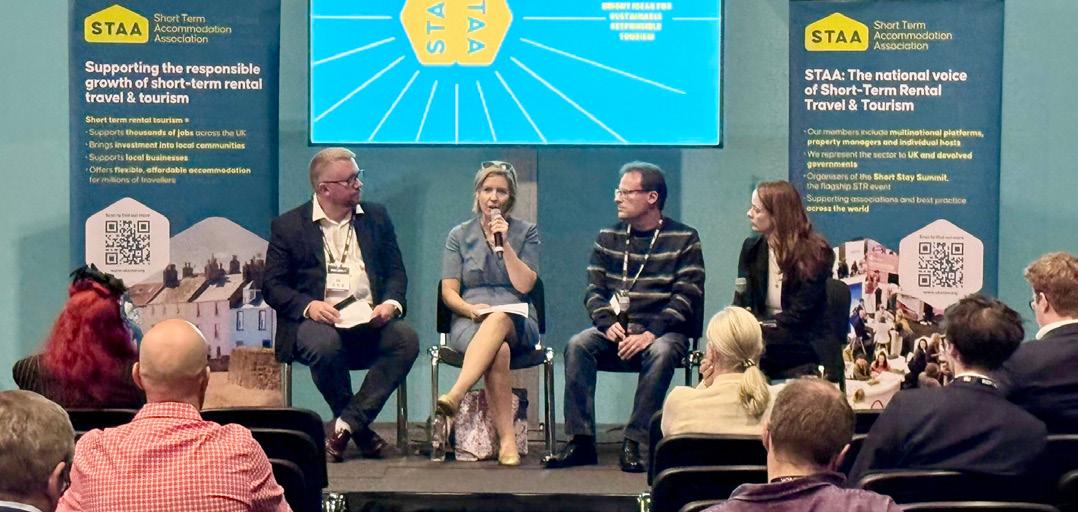
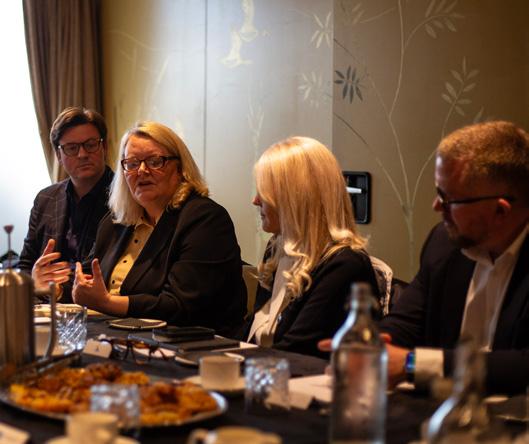
From L to R: Charlie Reith, Government Affairs at Expedia Group, UK, Ireland and the Nordics, Councillor Lynn Williams MBE, Leader of Blackpool Council, Kate Shane MBE, CEO, Blackpool Tourism and Andy Fenner, CEO, UK STAA
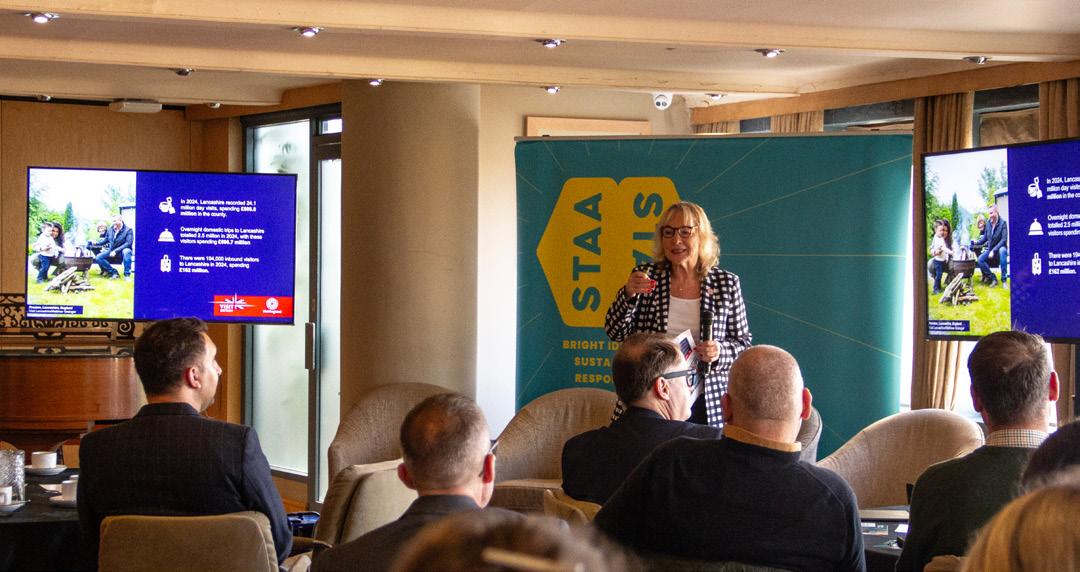
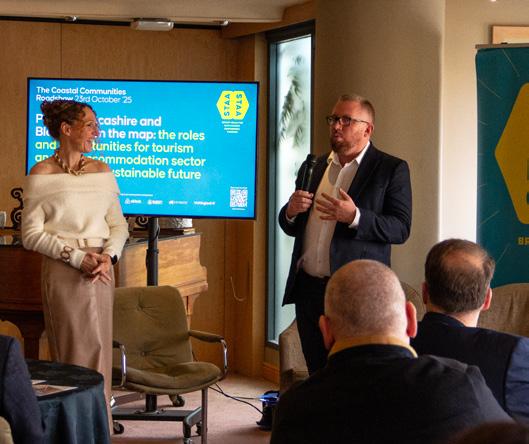
Patricia Yates, CEO, VisitEngland, VisitBritain starting off the session Putting Lancashire and Blackpool on the map: the roles and opportunities for tourism and the accommodation sector in building a sustainable future
From L to R: Sally Henry, VP of Business Development, Key Data and Andy Fenner, CEO, UK STAA
The landmark event, held at The Tower Restaurant at Blackpool Pleasure Beach, featured a series of keynotes, panels and round tables led by influential decision makers, with the aim to discuss how tourism and STRs are revitalising local economies, from creating jobs and attracting investment to supporting small businesses.
After an opening private, invite-only round table, the main conference opened with a welcome address from Chris Webb MP, Blackpool South, and Chair, APPG for Hospitality and Tourism, and STAA CEO Andy Fenner, in which they highlighted their commitment to strengthening Lancashire’s tourism sector, as well as outlining why tourism is local to the county’s economy, culture and communities.
Attendees were also treated to a panel session covering the roles and opportunities for tourism and the accommodation sector in building a sustainable future, featuring a national overview from VisitBritain / VisitEngland CEO Patricia Yates, as well as insights from Webb, STAA chair Graham Donoghue, and Blackpool Tourism Ltd managing director Kate Shane MBE.
In addition, Key Data’s Sally Henry led a keynote that unpacked the latest data trends on both a local and national scale, and Host Planet’s James Varley hosted a panel on how to win and keep business in the Lancashire hospitality sector. The day’s agenda concluded with round table sessions focusing on key individual industry topics, from navigating regulations and licensing, to building partnerships, and advocacy for the sector before a networking lunch.
The event cements the STAA’s mission to be the national voice for STR travel and tourism, representing the sector to UK and devolved governments and supporting associations and best practice across the world.
With thanks to our event partners and sponsors: Airbnb; Blackpool Tourism; Eureka Capital Allowances; Key Data; TrustedStays; and VisitEngland.
WRITTEN
BY: THE STAA TEAM
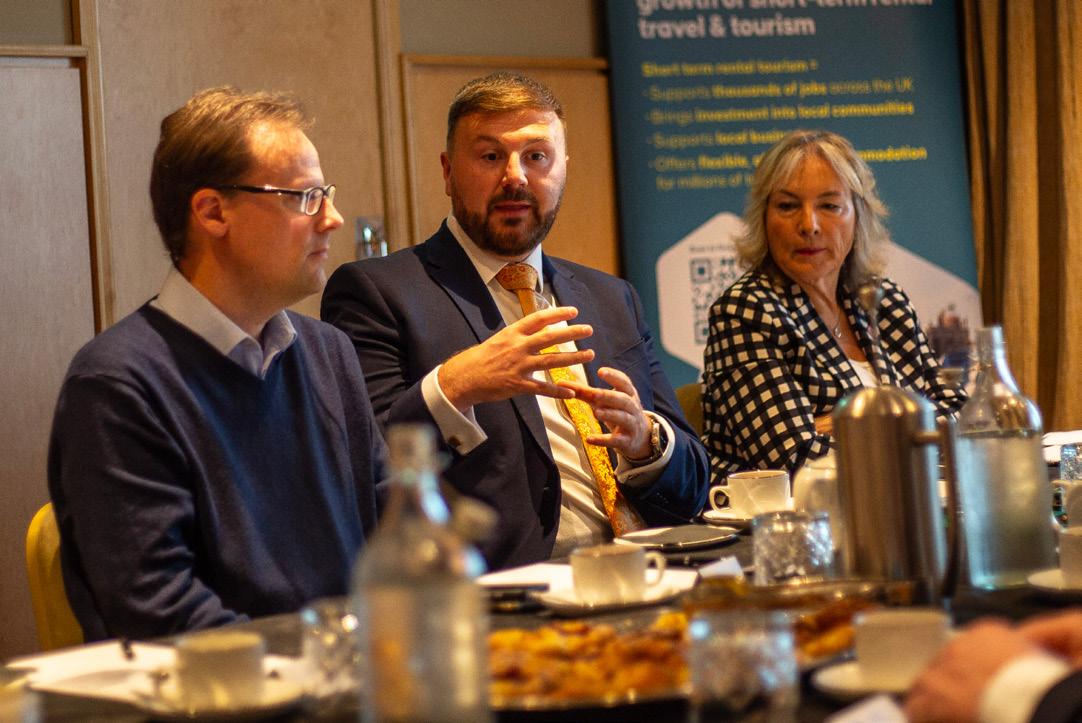
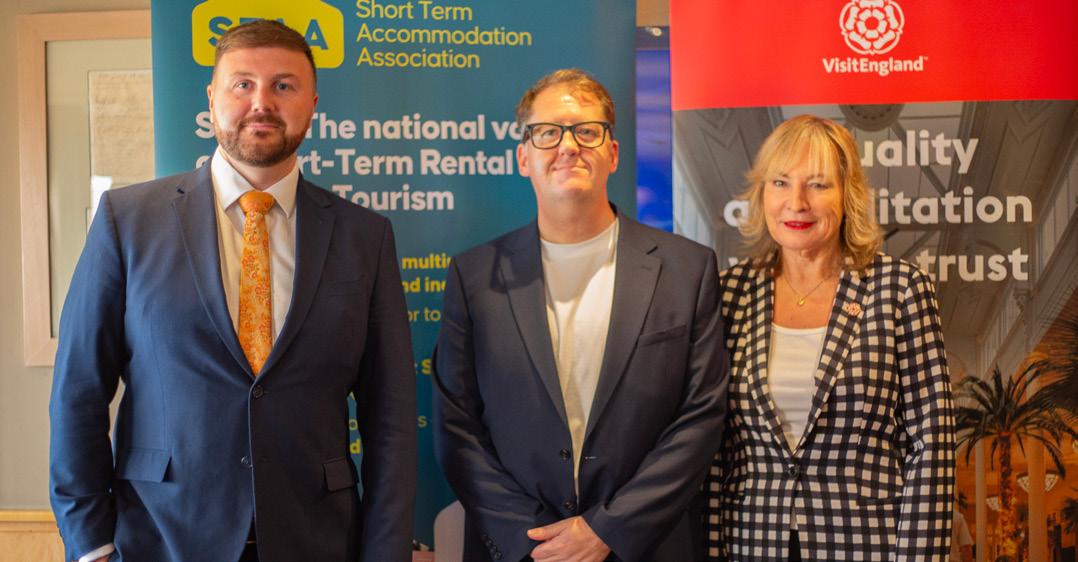
From L to R: Carl Thomson, Public Policy Manager, Airbnb, Chris Webb MP, Tourism & Hospitality APPG and Patricia Yates, CEO, VisitEngland, VisitBritain
At the end of the Coastal Communities Roadshow, the STAA had some brief interviews with Chris Webb MP, Patricia Yates and Graham Donoghue. This is what they said...
WebbChrisMP APPGforHospitality
andTourism
WHY WAS IT IMPORTANT FOR YOU TO BE PART OF THE COASTAL COMMUNITIES ROADSHOW?
“It’s about bringing industry leaders to Blackpool. While we are the premier seaside resort in the country, we’re often forgotten about because we’re so far up north and away on the M55. It’s about bringing people here firsthand to see what a fantastic seaside resort we’ve got, but also some of the new initiatives we’re bringing to the town.
WHAT ROLE DO SHORT-TERM RENTALS AND TOURISM PLAY FROM AN ECONOMIC, CULTURAL AND COMMUNITY PERSPECTIVE IN BLACKPOOL?
“This [short-term rental tourism] is the heart of our town, it’s the backbone of our economy. Many of us started our career paths in tourism, on the seafront, working alongside local residents facilitating tourists. We know that it’s really important here and it will give many young people their first step on the job ladder. It also provides a career like it does for many including my wife and family. It’s a career where you can start from a bar and be a manager in a hotel in a couple of years when you get that fast track in training.
HOW DO YOU ENSURE THAT THE REGION IS WELL REPRESENTED AT A LOCAL AND A NATIONAL LEVEL?
“This is about sharing our stories and best practices here in Blackpool, but also shouting loudly what we do here and why we’re unique. It’s also about working with partners across the region to improve that connectivity, so if someone does go to Manchester to Old Trafford, they’re going to Blackpool the next day for the seaside.
HOW DO YOU THINK BLACKPOOL CAN ENSURE IT REMAINS A LEADER IN HOSPITALITY AND INNOVATION?
“We’ve got to make sure we’re always delivering a top product and bringing the best aspects of the town together. We need to make sure we’re following best practice from abroad and we’re offering a single package so that people can come here and go do something at the click of a button. It’s about making it as accessible as possible but also using new technology and new media to showcase the best of Blackpool and why people should choose this as their tourism destination.
From L to R: Chris Webb MP, Hospitality and Tourism APPG, Graham Donoghue, Group Chief Executive Officer, Forge Holiday Group and CEO, Sykes Cottages and Tourism and Patricia Yates, CEO, VisitEngland, VisitBritain
Patricia Yates CEO, VisitEngland, VisitBritain
WHAT MADE YOU WANT TO ATTEND THE COASTAL COMMUNITIES ROADSHOW?
“We at VisitEngland are really interested in coastal communities and what we can do to support them with economic growth. We can see that day visits are about 10 per cent down, and there’s a shift in consumer behaviour so we’re going to the seaside, we’re going to our cities, and our coastal communities really depend on tourism. If you don’t have tourism thriving, you don’t have vibrant places for residents to live in.
WHAT HAVE BEEN SOME OF YOUR KEY TAKEAWAYS FROM THE EVENT?
“The discussion around the opportunities and the passion for people’s local places have been my key takeaways. Another thing is how we’re going to work together and partnerships are really the most important aspect because tourism is all small businesses. Another takeaway has been some of the challenges around connectivity and how do we make that more affordable and actually running at the weekend. How do we build the season? Blackpool was a trendsetter in having the illuminations running through the winter. How do we make it bookable for consumers so that we’re packaging products? Here in Blackpool, we were talking about a path to have multiple attractions. And also, how do we persuade the domestic visitors like us not to go overseas but to spend their money in Britain? If 10 per cent of that money that we spent overseas was spent in Britain, we’d have an £8 billion boost to the economy and create 145,000 jobs. I think that’s a shared ambition for us.
HOW DO YOU VIEW THE ROLE OF SHORT-TERM RENTALS IN TERMS OF IMPORTANCE TO COASTAL COMMUNITIES?
“I think short-term rentals are absolutely part of the mix. You can have your four-star hotels or your very small B&Bs but more and more people, particularly families, want to go to self-catering properties for relaxation purposes and for flexibility. I think it’s our biggest improved sector of accommodation, really we are world class in our short-term self-catering sector.
HOW DO VISITBRITAIN / VISITENGLAND HARNESS THE ROLE OF STRS FROM A MARKETING APPROACH WHILE STILL MAINTAINING THE COMMUNITY ASPECT FOR LOCALS?
“We want to drive economic growth across the nations and regions of Britain, but we want to make sure growth benefits local communities. VisitEngland has been setting up local visitor economy partnerships that bring together local businesses, public and private sector, to create local growth plans that we will then lean in to support. Internationally, we have our ‘Starring GREAT Britain’ campaign where Britain is the real star of the show. Destinations can think about the stories they want to tell about themselves, the times people see them on screen, whether that’s TV, cinema or books. Come to us and tell your stories.
HOW ARE YOU TRYING TO RAISE OR ELEVATE THE QUALITY OF SUPPLY IN MARKETS IN COASTAL COMMUNITIES?
“We do a lot of work at VisitEngland on quality and accreditation and there’s a free baseline service that we would encourage people to take part in. We have our VisitEngland Awards which showcase those at the top of their game. We want to encourage the growth of more and more types of accommodation that suit what modern customers are looking for, so bookable, flexible and able to cater to families.
WHAT ARE YOUR NEXT GOALS OR AMBITIONS FOR TOURISM IN THIS COUNTRY?
“Internationally, we have a clear target from our minister for 50 million visits by 2030. We’re harnessing our ‘Starring GREAT Britain’ campaign and running key markets internationally, including the USA, Germany, France, Australia and the GCC, where we see the biggest returns. We’re looking domestically, how can we drive domestic tourism and perhaps looking at coastal communities and how we can revitalise them.
WHAT HAVE BEEN YOUR IMPRESSIONS OF THE COASTAL COMMUNITIES ROADSHOW?
Graham Donoghue GroupChiefExecutive Officer,ForgeHolidayGroup andCEO,SykesCottages andTourism
“We’ve had a fantastic time in Blackpool – I love it here and I had many childhood memories from here. The biggest thing is just how many things are going on in Blackpool that I had no idea about and just how committed everyone is here to making Blackpool a success. It’s hopefully the start of a really good conversation about how we can educate people, make them understand more about Blackpool, and hopefully bring more visitors to the area who can spend more money with local businesses and support the community.
WHAT HAVE BEEN YOUR MAIN TAKEAWAYS FROM THE EVENT?
“The key things I’ve heard today are really around deep history, nostalgia, the location always pivoting and innovating, and the industry constantly reinventing itself. There have been some honest conversations about Blackpool and the stigma around it. I’m glad to see that people are not denying that those impressions exist, but we have to recognise that there are some things we need support on, although these outweigh the negatives. It’s been an incredible event with a lovely community spirit. The word that has been used most today is fun – and it has been a lot of fun.
HOW CAN ACCOMMODATION PROVIDERS PLAY A LEADING ROLE IN SHAPING THE VISITOR EXPERIENCE BEYOND JUST SIMPLY A STAY?
“Our purpose [at Sykes] is to champion UK staycations and we might not have thousands of properties in Blackpool itself, but we do have tens of thousands of properties within a one- to four-hour drive from here. So can we help our guests understand what a day trip to Blackpool might look like? Can we get incentives for local attractions and local amenities, can we educate people about this? Education and awareness are the key things that I’ve taken away that we can do a better job on in our sector and helping people understand what they can do. It all comes back to the principles of planning, booking and enjoying trips.
HOW ARE YOU EDUCATING PROPERTY MANAGERS ABOUT SUSTAINABLE TOURISM?
“We’re a BCorp business which basically means that we have to balance profit and purpose. We spend a lot of time with our property owners helping them to understand how they can be more responsible. It’s not necessarily about the big things [e.g. installing solar panels or ground sourcing] but there are small little things you can do like supporting communities with local welcome packs. All these little things add up and make a difference. Genuinely, customers do value property owners who are being responsible and we’re looking at how we can showcase them better.
ARE WE GOOD ENOUGH AS AN INDUSTRY WHEN IT COMES TO SHOUTING ABOUT OUR SUCCESSES?
“I don’t think we are as good as we probably should be when it comes to talking about our successes in certain areas. Equally, I think there’s so much more we can do and I’m always looking at how we can be better. We probably need to do more collaboration and spread awareness and park our competitiveness at the door. I’m a huge fan of AI and as the chair of STAA, I feel a responsibility to educate property managers and the industry about what it is coming. We’re in a situation now where people have to learn how this is going to create a huge paradigm shift in how we search, plan and book holidays and we need to be ready and aware for this.
HOW DO YOU THINK AGENTIC AI CAN HELP COASTAL COMMUNITIES IN THE FUTURE?
“A lot of the things I think we can do with AI are to go back to this more agentic way of having conversations and using AI to plan, book and enjoy holidays. I do believe that we will have agentic processes in the future and we are not that far away from it. It will just keep evolving. AI will play a big part in the future and especially for certain demographics.”
THE AIRBNB HOSTING COMMUNITY –CONNECTING WITH THE SECTORS FRONTLINE
The Airbnb Hosting Community brings hosts together at local events across the country to provide support share practical tips and build stronger connections between the people who welcome guests into their homes. These sessions help new and experienced hosts alike learn from one another and ensure that the hosting experience remains safe positive and community minded.
The Liverpool Airbnb host community recently came together to discuss all things short term rentals and community leaders, Julian Delgado and Margaret Murphy asked our CEO, Andy Fenner, to join them. The event brought hosts from across the area into the same room to share experiences, insights and ideas about hosting in one of the UK’s most exciting tourism cities.
Andy heard directly from hosts about life on the frontline of short term accommodation. Covering everything from guest expectations and neighbourhood impacts to the wider contribution that hosting makes to Liverpool’s visitor economy.
Andy said it was “great to connect with hosts and hear directly from the people on the frontline” and stressed the importance of maintaining open conversations with the individuals who make the sector thrive.
Airbnb Policy Manager Carl Thomson also attended helping facilitate a detailed and informative session that reflected the strength and warmth of Liverpool’s hosting community.
For the STAA these moments of direct engagement are essential. They ensure that advocacy remains grounded in the real experiences of hosts and that their voices shape how the sector continues to develop across the UK.
If you’d like the STAA to join an event in your area email us on info@ukstaa.org
Airbnb Policy Manager, Carl Thomson facilitating sessions
Julian Delgado and Margaret Murphy, Liverpool area Community Host leaders
NICK TAYLOR ON SASTRA’S AMBITIONS FOR THE SOUTH AFRICAN STR MARKET
1. PLEASE INTRODUCE YOURSELF AND THE SOUTH AFRICAN SHORT TERM RENTAL ASSOCIATION [SASTRA].
I’m Nick Taylor, MD of Nox Cape Town and a founding board member of SASTRA. After I ran a professional villa / apartment portfolio for 15 years, we formed SASTRA after the first Scale Show in Cape Town in 2023 which attracted industry players from across the country. We represent professional hosts, managers, platforms and service partners, with a simple mission: establish clear standards, advocate for fair, evidence-based regulation, and position STRs as a legitimate, valuable part of South Africa’s tourism economy.
2. AS A RELATIVELY NEW ASSOCIATION, HOW HAVE YOU GROWN SINCE LAUNCHING?
Since launching in 2024, we’ve focused on substance over size, bringing together large professional operators alongside an expanding group of independent hosts and ecosystem partners. To build credibility early on, we have built a formal membership structure, rolled out events, conferences and updates through webinars, and established ourselves as a trusted partner for government and city officials. The momentum has been strong and engagement is up, our community is active, and we now have representation across most major metros.
3. WHAT REGULATIONS HAVE BEEN ADOPTED IN SOUTH AFRICA AND WHY?
South Africa lacks a dedicated national STR framework, so regulation sits within existing planning, zoning, tourism and property legislation. There is, however, a government white paper which aims to “level the playing field” and professionalise the industry. Cape Town is the most advanced example, introducing by-law amendments in 2019 that set out when and how short-term letting is permitted in residential dwellings, and allowing for a taxation on STRs in their most recent budget. Elsewhere, the picture is mixed with municipalities and councils interpreting rules differently and bodies implementing their own set of rules for the sectional title property owners. Government has hinted at national reforms, but progress has been slow. SASTRA is in discussions with various authorities, and we hope to have clarity on the regulatory environment by the April 2026 deadline. Currently, it does not appear there will be broad caps nor thresholds, but rather policies regarding best practices and guidelines.
4. WHAT HAS WORKED SO FAR?
Where cities have clarified their planning rules, operators welcome the certainty. Cape Town’s by-law changes may not be perfect, but they give managers / owners a legal pathway. The rise of a unified industry voice with SASTRA means policymakers now have a single counterpart representing the professional end of the sector, and our engagements with government are leading to alignment and cooperation. On the ground, compliance standards are being tabled, and we hope to be the voice behind the industry collectively.
5. WHAT HASN’T?
The biggest weakness is the lack of a national definition of an STR. Without it, everything gets squeezed into frameworks and various legislation that were never designed for the sector, leaving room for interpretation, inconsistent enforcement, and frustration. Data is another blind spot. With no centralised, shared data source, public debate is often shaped by anecdotes, not facts. And like many young associations, SASTRA is still building the resourcing needed to match the wellfunded voices across tourism, hospitality, and housing.
6. WHAT ARE THE NEXT STEPS FOR YOU AT SASTRA?
Our priority is a national, fit-for-purpose regulatory framework that brings clarity to policymakers, operators, platforms, and communities. That means defining STRs in law, shaping a sensible registration system, and aligning zoning, safety and tax requirements under one coherent structure. In parallel, we’re developing best-practice standards and plan to expand our education and events programme nationwide. Better data partnerships are also key: South Africa needs a shared evidence base to inform policy, rather than relying on assumptions or pressure-group narratives.
7. WHAT LESSONS CAN THE UK MARKET LEARN FROM SOUTH AFRICA?
South Africa is a good reminder of what happens when regulation doesn’t keep pace with industry growth. Cities like Cape Town saw explosive STR expansion long before policymakers engaged meaningfully, which created uncertainty, friction, and public debate fuelled by incomplete data. The UK, thanks in part to the STAA’s proactive approach, is further ahead, but the pressures around housing affordability, neighbourhood change and platform accountability are universal. Our experience suggests one big takeaway: don’t leave a vacuum. Act early, define the sector clearly, and make structured collaboration between government, platforms and professional operators the norm, not the exception.
The STAA Interviews
EXPEDIA GROUP RELEASES UNPACK ’26: THE TRENDS IN TRAVEL
Expedia Group has released its annual global trends report, Unpack ’26, which highlights shifts in traveller behaviour and the destinations set to dominate itineraries in the year ahead.
Each trend, which offers a look at the future of travel, is backed by first-party data and insights from 24,000 global travellers in 18 countries.
Focusing on the UK, the Cotswolds was ranked eighth in Expedia’s Destinations of the Year list, after seeing a 39 per cent increase in flight and accommodation searches on Expedia between January and December this year compared to 2024.
As we approach a huge year for international sports, Expedia’s Fan Voyage trend reveals a surge in uniquely regional sporting experiences, with caber tossing in Scotland being one specific sport that will benefit from this growing global interest.
According to Vrbo, 91 per cent of travellers are seeking getaways focused on reading, relaxation and quality time with loved ones. As #BookTok continues to dominate social media, Pinterest searches for “book club retreat ideas” have shot up by 265 per cent and Vrbo’s reading-related terms in guest reviews have almost tripled.
Equally, the slow travel movement is gaining ground, with 84 per cent of travellers expressing interest in staying on or near a farm, showing a renewed desire to unplug and reconnect with nature. Activities such as hiking trails, birdwatching and gardening are piquing the interest of travellers, with Moorhall Farm in Worcester highlighted as one UK-based farm that is seeing an uptick in travel searches.
And once again, Expedia Group is spotlighting its ‘set-jetting’ forecast, first coined in 2022, as a trend of travelling to destinations inspired by TV shows and films. According to the group’s data, 81 per cent of Gen Z and millennial travellers now plan getaways based on what they have seen on screen.
In the UK, Yorkshire is turning binge-worthy moments into bucket-list adventures, from its appearance in Wuthering Heights to that in Downton Abbey: The Grand Finale in 2025. As a result, set-jetting destinations are attracting more visitors from right across the world.
Expedia Group CEO Ariane Gorin said: “Some of my most unforgettable travel moments come from immersing myself in local cultures, supporting local economies, and exploring less-travelled destinations. With one billion average monthly travel searches, Expedia Group isn’t just a travel marketplace – we’re a catalyst for positive change.
“We have a responsibility to shape the future of travel: one that’s smarter, more sustainable, and deeply respectful of the places we go,” she added.
Also highlighted in Expedia Group’s Unpack ’26 report are ‘Hotel Hop’ [multi-stay trips within one destination] and ‘Salvaged Stays’ [upcycled, heritage-rich accommodations]. To see the full list of the major travel trends in 2026, read Expedia Group’s Unpack ’26 report here. [Unpack ’26: Expedia, Hotels.com, and Vrbo reveal how travellers will explore the world in 2026 –Expedia Newsroom UK]
Members’ Spotlight
Ariane Gorin, CEO, Expedia Group
SHORT STAY SUMMIT 2026: THREE DAYS OF IDEAS ENERGY, CONNECTIONS & LEARNING
An update from Diane Lloyd, Summit Director The countdown is on and I am thrilled to share a fresh update on Short Stay Summit 2026. Working with Andy and Andrea has been a lot of fun and together we are building what might be our best programme yet. We have an exciting lineup of speakers with great topics that really get to the heart of the sector. We’ve got a fantastic sponsor line up, and a packed room of exhibitors, so packed that stands that are almost completely snapped up, if you want one contact me quickly. Tickets are about to go on sale and yes STAA members get a discount so keep an eye out.
The Summit has grown into much more than a single day. It is now a three day festival of everything short term accommodation tourism.
DON’T MISS OUT, BOOK NOW!
GAN 2026! 9.30am – 2.30pm. Email events@ukstaa.org to book your place.
THE STAA & TRUVI PADEL CHAMPIONSHIP hello@truvi.com to book your place.
SHORT STAY SUMMIT ICE BREAKER 6pm - 10pm. Email events@ukstaa.org to book your place.
SHORT STAY SUMMIT ‘26 8.30am - 6pm. Email events@ukstaa.org to book your place.
HOST PLANET ROADSHOW
https://www.hostplanet. club/host-planet-roadshow to book your place.
HOSTCHELLA
https://www.hostchella.com/ london-2026/ to book your place.
DAY 1: 21ST APRIL 2026
GLOBAL ASSOCIATION NETWORK (GAN)
MEETING – HOUSE OF LORDS
We open in style. Our annual meeting for association leaders and policy teams is taking place in the House of Lords, a sign of how strong and well supported the global network has become. We will hear from sector leaders and from Chris Webb MP, Chair of Parliament’s Tourism Committee who will bring a dose of Westminster insight to kick us off.
THE STAA & TRUVI PADEL CHAMPIONSHIP
The STAA Padel Championship organised by the brilliant crew from Truvi is set to be competitive and lively. The only winner will be the industry as every penny raised goes straight to the STAA Advocacy Fund to support the work they do lobbying for your business. Come for the fun, win for the industry.
SHORT STAY SUMMIT ICE BREAKER –EASTCHEAP RECORDS, LONDON BRIDGE
The Pre Summit Ice Breaker Party takes over the legendary Eastcheap Records venue. Welcoming Property Owners and Managers to break the ice, with room 101 interviews, STR book signings and a bingo session. It is the perfect chance to meet fellow property owners and managers.
SHORTYZ
Short Term Rentalz will host their annual ‘Shortyz’ Short Term Rental Awards Celebrating the Industry.
DAY 2: 22ND APRIL 2026
THE SHORT STAY SUMMIT
The main event brings together leaders from across tourism and the short stay sector for a full day of inspiration and debate. Expect big conversations on hosting regulation innovation and the future of visitor accommodation. If you care about where the sector is heading this is the room to be in.
DAY 3: 23RD APRIL 2026
HOST PLANET ROADSHOW
Just when you think it is all over the Host Planet roadshow rolls into town. In partnership with the STAA, it’s the ideal follow on for any hosts who want to keep exploring fresh ideas.
HOSTCHELLA
23rd & 24th April. Hostaway will be bringing their user conference to London for the 1st time, we are looking forward to festival vibes at their two day Hostchella event to finish off the week.
This year’s Summit is shaping up to be the biggest yet. Being a not for profit event, EVERY penny of profit is reinvested by the STAA to fight for our sector and your business. I’m looking forward to welcoming you as our guest.
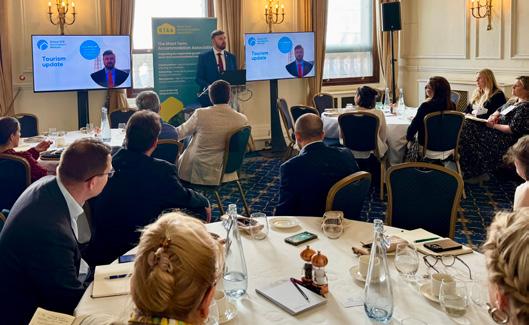
Chris Webb MP, Hospitality and Tourism APPG, provides a tourism update at GAN ‘25
Eastcheap Records venue for the Short Stay Summit Ice Breaker party
A NEW HOME FOR THE STAA COMMUNITY
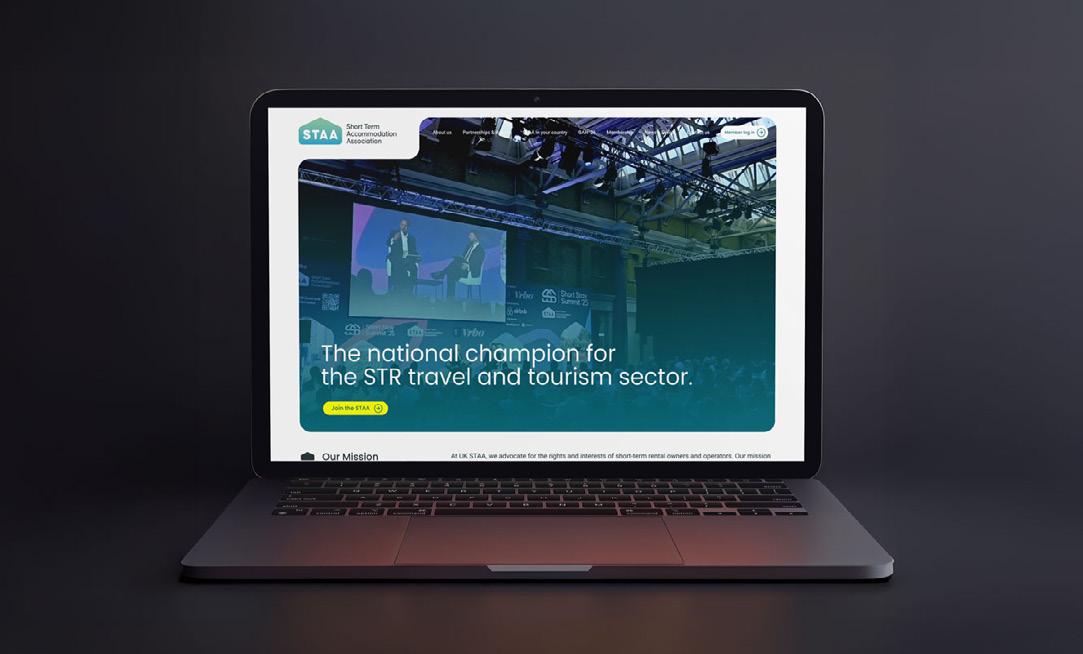
A refreshed UK STAA website is been crafted to give the STAA community a fresh, confident and inspiring digital home. Designed with clarity and purpose, it supports existing members while opening the door for potential new ones, helping them understand the value of joining the UK’s leading association for the sector.
From the moment visitors arrive, the site aims to feel open, engaging and easy to navigate. Every page is shaped to communicate simply and effectively whether that’s explaining member benefits, sharing success stories or guiding existing members toward key resources. The structure is intuitive, ensuring that both seasoned operators and newcomers can find what they need without friction.
One of the new site’s important roles is to keep the industry informed. With an evolving regulatory landscape, members depend on trusted, up-todate information. The website brings policy updates, STAA news and industry insights together in one place. It becomes a living space for timely guidance, helping businesses stay ahead of change.
Ultimately, the new STAA website does more than communicate; it connects. It brings the industry together, reflects the professionalism of the association and invites visitors to become part of a collaborative, forward-thinking network shaping the future of the STAA. So watch this space for the launch early in the new year!
WRITTEN BY: REECE VICKERSTAFF, STAA DESIGN DIRECTOR AND DIRECTOR, MY DESIGN STUDIO
KEY DATA’S DEC 2025 UPDATE
Sally Henry, vice president of business development, EMEA, at business intelligence platform
Key Data delves into the latest booking trends for this data
Guest occupancy and rates
Overall, guest occupancy is pacing marginally up on 2024 levels, albeit occupancy performance across all UK countries in the latter months of the year have been flat. At the same time, rates have been pacing a little higher than a year ago and continue to look positive into Q4, with Scotland seeing the highest rate increases. As a result, RevPAR has also been positive compared to 2024, especially in Wales despite the softer market.
Changing traveller behaviour
Average length of stay is pacing shorter as we move through the year, with Scotland seeing the largest reduction in nights booked from 5.3 in 2024 to 5.0 in 2025. Meanwhile, booking windows are pacing shorter by almost a week compared to 2024, with Scotland again seeing the biggest reduction but still the longest lead time in the UK.
The impact of emptier calendars and a later market means that there is pressure on rates as we get closer to departure. Property managers are having to sell more breaks [with a shorter length of stay] to reach their standard guest occupancy, although there is a growing segment for bookings made to depart in 14 days.
OTAs gaining market share
In terms of channel shifts, major online travel agencies [OTAs] such as Booking.com and Airbnb are gaining market share at the expense of direct booking channels. Key Data is therefore advising property managers to have a strategy for their channels and ensure they work well for them.
Data advice
Be rate agile and rate disciplined. Use data to navigate and communicate with owners. Optimise on all channels so you have levers to pull. Have a gap night strategy and optimise prices for short breaks. Work on a direct strategy to help with earlier bookers to get those calendars filled up.
WRITTEN BY: SALLY
HENRY, VICE PRESIDENT OF BUSINESS DEVELOPMENT,
EMEA, AT BUSINESS INTELLIGENCE PLATFORM, KEY DATA
AIRBNB
PARTNERS WITH THE MAYOR OF LONDON & WOMEN’S AID TO SUPPORT SURVIVORS OF DOMESTIC ABUSE
A significant development in how short-term accommodation can support community safety
A new partnership between Airbnb, the Mayor of London, and the Women’s Aid Federation of England has been announced, establishing a programme to provide emergency accommodation for survivors of domestic abuse across the capital.
The initiative reflects a broader recognition of the role the short-term accommodation sector can play in supporting those in crisis. By mobilising trusted homes and hosts, the programme aims to provide immediate, safe options for people escaping dangerous situations.
Airbnb’s Director of Policy & Strategy, Velma Corcoran, summarised the purpose of the partnership:
“Survivors of domestic abuse deserve a safe place to stay when they need it most. We’re honoured to work with Women’s Aid and the Mayor of London to help ensure no one is left without support at a moment of crisis.”
Sector responsibilities and safeguarding
In the summer edition of The Associate, the STAA examined the role that shortterm accommodation providers can play in tackling violence against women and girls. Contributors emphasised that signs of exploitation or abuse are often subtle and can occur “behind closed doors, hidden from sight but right at the heart of many communities,” as Police Scotland noted in their interview.
This new London partnership demonstrates how coordinated action between platforms, government bodies and specialist charities can create practical pathways to safety for those who need it most.
Implications for operators
For accommodation operators, the programme underlines the importance of awareness, training and clear reporting routes where safeguarding concerns arise. It also illustrates how infrastructure already embedded within the sector can be adapted to support frontline services in situations where time and access to safe accommodation are critical.
Support for STAA Members
Members seeking guidance on safeguarding practices or wishing to understand how similar collaborations operate are encouraged to contact: enquiries@ukstaa.org
Members’ Spotlight
WE MEET DAN WHITING, STAA
BOARD MEMBER, CO-OWNER, THE BATH HOLIDAY COMPANY AND OWNER, STAY GREEN
Each year, the STAA members elect a board to lead on the overall strategic direction of the association. Drawn from a wide range of backgrounds and businesses and each bringing their unique perspective to the role, STAA board members provide strategic vision and expert guidance to help the association meet its goals.
In this edition of The Associate, we sit down with Dan Whiting, STAA board member, co-owner of The Bath Holiday Company and owner, Stay Green, to talk sustainability, Cornwall, and industry standards.
1. About Me
I run my family-owned STR management company in Bath. Alongside this, I founded Stay Green (www. stay-green.org), an environmental initiative that helps travellers and accommodation providers understand, reduce, and rebalance the impact of travel. We aim to show STRs can be run responsibly and thoughtfully, offering exceptional experiences while supporting the environment and the local economy.
2. What does your role on the STAA board entail? My role is to represent the operational realities that property managers face and the growing importance of sustainability in the sector. I am lucky to work with passionate, knowledgeable, and influential fellow board members who advocate for the industry. Together, we’re working to build a professional, trusted, and forward-thinking STR sector for the UK.
3. What is your Room 101 for the STR industry? It would be cutting corners — whether that’s poor operational standards or superficial “green” claims with nothing behind them. Low-quality management and greenwashing undermine trust, damage community relationships, and hold the whole industry back.
4. What is something that people often misunderstand about your job?
It is the wider misunderstanding of the STR industry. There’s a perception we’re a drain on communities, whereas I believe we are the “shop local” of accommodation — independent, localrooted businesses that directly support cleaners, tradespeople, small suppliers, local attractions, and the wider visitor economy. Rather than harming communities, we sustain them.
5. Who do you collaborate with most often?
I work closely with homeowners and investors, cleaning and maintenance teams, other property managers, tech partners, and environmental organisations. I also collaborate with OTAs, which ensure visibility and guest reach, and with our local DMO, Visit Bath, which supports responsible tourism and promotes the region.
6. What is the most fun or unique part of your job? The best part is the variety. One day I’m fine-tuning guest experiences, the next I’m trying to build partnerships to promote Stay Green’s environmental tools. I love turning challenges into opportunities and seeing guests choose to stay with us due to our sustainable ethos.
7. What is your favourite destination in the UK for a staycation?
It has to be Cornwall — specifically the hidden gem of Prussia Cove. It’s one of those places where the landscape, rugged coastline, and stillness all come together, reminding you just how special the UK can be when you slow down and really take it in.
8. What is your main ambition for the STR industry from an STAA perspective?
I want the STR sector to be recognised as a professional, trusted and sustainable pillar of the UK tourism economy. That means fair and consistent regulation, higher standards, stronger environmental awareness, and better collaboration between operators, communities and government. I’d like to see sustainability become standard practice across the industry, and for STRs to be viewed as an asset that supports livelihoods, tourism, and local economies.
Industry News
STAA JOINS THE CBI
The STAA is proud to announce that it has joined the CBI (Confederation of British Industry), strengthening its role as the national champion for STR travel and tourism.
The CBI works to ensure that business has a strong and influential voice at the heart of policymaking, and the STAA’s membership will ensure that STR tourism and the visitor economy are represented at the highest level.
STAA CEO Andy Fenner says: “Joining the CBI reinforces our commitment to sector leadership, ensuring that the UK’s short-term accommodation industry is recognised as an essential part of the wider tourism and business ecosystem. It’s vital that our sector’s voice is heard in shaping the future of the UK economy.”
HARRIS BOKHARI OBE APPOINTED CHAIR OF VISITBRITAIN
Harris Bokhari OBE has been appointed Chair of the British Tourist Authority.
His appointment comes at a crucial time as the UK focuses on tourism recovery, sustainable growth and regional development. Bokhari’s experience in government advisory work positions him to strengthen collaboration across the visitor economy, offering new opportunities as VisitBritain seeks to boost both domestic and international demand.
Booking.com’s LGBTQ+ inclusion initiative, Travel Proud, has passed a major milestone, with more than 100,000 properties worldwide now completing its inclusive-hospitality training. The programme helps accommodation providers offer more welcoming experiences for LGBTQ+ travellers and display the Travel Proud badge on their listings. As demand for inclusive stays grows, Booking.com’s expansion highlights a wider industry shift towards diversity, guest safety and stronger year-round engagement with underrepresented traveller communities.
Paul’s Pulse
WELCOME TO THE FINAL PAUL’S PULSE
IN THIS EDITION OF THE ASSOCIATE.
As we approach the end of 2025 and the start of a new year, thoughts naturally turn to trends and predictions for what the next 12 months could hold in the short-term rental industry. As ever, it can be something of a futile exercise given the times we’re living in and the uncertainty given the economy, so instead of offering predictions, I’ve decided to explore the key questions that the segment will need to address in 2026 – and beyond – to thrive.
How will the regulatory landscape play out? Regulation is always a question on everyone’s lips and it will be no different in 2026. In England, we may see the introduction of new planning permission requirements and a mandatory registration scheme, while further plans have been outlined to license rentals in Wales and Scotland. The wider landscape in Europe and across the world will also be worth observing, as it could influence future policy here in the UK.
How will AI and tech continue to transform the industry?
The recent advances in AI search, voice technology, chatbots and more have undoubtedly enhanced the guest experience and management operations, but there are still big questions to answer. How can AI address the labour shortage, how can we balance tech-driven efficiency with the need for genuine human connection, and how can we create even more personalised offerings?
How can we retain and attract talent in a competitive labour market?
With increased labour costs likely leading to price hikes and job losses, unemployment is reaching record levels in the UK, and plenty of skilled, talented workers are on the lookout for their next role. But how can we both retain the existing talent and attract new people to the hospitality sector amidst the current economic climate?
How will consumer spending shift?
As budgets get tighter, will travellers still book holidays abroad on a regular basis or will they prioritise domestic travel / staycations? Equally, how can hosts, owners and property managers prepare for peak and shoulder seasons, and is there another Taylor Swift / Oasis-like event phenomenon that could drive a surge in demand?
Those questions may not get an answer in 2026, but we will learn a lot about the direction of travel and what the long-term future could hold for tech-enabled hospitality.
Wishing all of our readers a very Merry Christmas and a happy 2026 ahead.