
FYP News Spring 2026

Page 1


News

The Foundation Year Program: in itself and for itself.

CONTENTS

1. King’s Library , Annie Dinnick

1. Freedom and the Muse , Dave Peddle

2. untitled , Stephen Scannell

2. Courses by Tutors this coming year

3. I am Inspired , Ian Seckler

3. A Love Letter to FYP, Amal Al-Noman

4. For Foundation, Anonymous

4. Dear Cugoano, Miqaela Olatundun

5. A Luta Continua: The Spirit of Revolutions, Dáminí Awóyígà

5. Souls , Kate Barber

6. Perspective, Vivi Brodin

6. Citizen of the World , AZMA

7. The Fun FYP Midterm of 2026, Amal Al-Noman

8. Prodigal Son, Elliot Shupe

8. FYP Journalism & Football, Matéo Pérusse-Shortte

9. The Ultimate FYP Musical Journey , Katie Antle

9. Wild Geese, Mary Oliver

10. WHICH FYP Thinker Are You Based on Your FYP Habits??, Robin Visser

11. A Parent’s Responsibility , AZMA

11. Where art thou, Muse, that thou forget’st so long (Sonnet 100), William Shakespeare

11. An Ode to The Essay, Griffin Estabrooks

12. Illiad, trans Latimer

12. FYP Thinker Answer Key

13. Memes, Pretentious FYPPER

14. Getting to Know Tim Clarke, Mya Tatem

Director’s Note

NEIL ROBERTSON (FYP 1981–82)

“Sing goddess…” Homer wrote in the opening line of The Iliad calling upon Calliope, the Muse of Epic Poetry. The Odyssey begins “Sing in me, Muse, and through me tell the story”. In each canticle of The Divine Comedy Dante invokes the Muses, but let us just recall his words in “Inferno”: “O Muses, o high genius, help me now; /o memory that set down what I saw, /here shall your excellence reveal itself!” Greek mythology tells us that the Muses are the nine daughters of Zeus and Mnemosyne (Memory). The Foundation Year Program is really a year-long invocation of these daughters. They draw forth for us out of the depth of memory, out of the past, in their diversity and many-sidedness, the wisdom and insight of Zeus who rules gods and mortals. FYP is all about living in the present but gifted by the work of these daugh -

15. Vita Nuova

15. Cources by Lecturers and Colleagues

15–20. Cartoon Strip, Gray Omeasoo

16. Ἀρχή

18. Infinite Jest and the life of the Mind, Kathryn Lawson, PhD, Faculty Fellow, Foundation Year Program

18. Spleen “The Good Dogs” (1869), Charles Baudelaire

19. Halifax Humanities Assistant 2026, Arthur Kary

20. Section VII: The Digital Age , Charlie Marshall

21. Intro to Choral Chapel Service, Isaac Shore McNab

22. Interview with President Lahey, Amal Al-Noman

24. Equine Adventures, Maxime Lavergne

25. FYP Babes

26. Section VI: The Contemporary World , Tim Clarke

26. Deck of cards, James Elaine

27. In a large soup pot over high heat, Ewan Crawley

27. On Nietzsche, McCarthy, and Dubai, Hamza Karam-Ally

28. Section V: The Age of Revolutions, Susan Dodd

28. “As the snow falls”, Stephen Scannell

28. A Plan the Muses Entertained , Goethe

28. Reporting Power: Journalism courses for this coming year

29. Dry hands , James Elaine

29. Muse , Anna Akhmatova

29. The Tempest 3ii , Shakespeare

30. Section IV: The Age of Reason, Daniel Brandes

31. NightFYP: An Evening with Mozart’s Don Giovanni

32. Section III: The Renaissance and Reformation , Catherine Fullarton

The Odyssey

Editors: Susan Dodd (FYP 1983–84)

Maria Euchner (FYP 1995–96)

Student Editor: Amal Al-Noman (FYP 2025–26)

Nous praktikos: Elisabeth Stones (FYP 2005–06)

Design: Co. & Co.

32. Ecce Cappella: The Jewel of the King’s Crown , Dan Shasky, FYP ’25–‘26

33. Night FYP: Choral Music of the Renaissance , Gabriel O’Brien

34. Section II: The Middle Ages , Neil Robertson

35. Songs for a Restless Heart: New Music for Augustine’s Confessions, Matthew Joel Vanderkwaak

36. Section I: The Ancient World, Kyle Fraser

37. FYP Photos

38. Common Rooms, Fallon O’Grady Berry

40. I Went Down (katabe-n) Yesterday to the Squash Courts with My Friends, Blaise Reed

41. With All I Got, Bo Wexler

41. The “Thursday Problem”, Isla Shaykewich

41. The Great Debate

42. A Journey of Dutch Through FYP, Aidyn Wright

42. Princess Koda, Robin Visser

42. Pet Rock, Nico Cozens

43. FYP Drinks , Levi D’Isep

44. What’s Next?

45. King’s Culture Clash Trivia Night

Sing in me, Muse, and through me tell the story of that man skilled in all ways of contending, the wanderer, harried for years on end, after he plundered the stronghold on the proud height of Troy […] Of these adventures, Muse, daughter of Zeus, tell us in our time, lift the great song again.

(Fitzgerald translation)

ters of memory. There is something wonderful in thinking of The Foundation Year Program in this way, but then who in FYP are those who sing this song or perhaps many songs? Who are poets and rhapsodes? Surely it is all of us who have been attending and attending to this year’s FYP. For each year of the Foundation Year Program is a new invocation with its own beauty and connections and content. I have been so deeply moved and impressed by this year’s song. The student voice, or really many voices sharing in and sustaining a conversation or perhaps better a symphony of sounds that can clash and produce discords but also brings to light deeper resources of harmony explored in each movement or section of that FYP symphony.

This edition of FYP News is a wonderful act of memorialization to recall this year in future years, but it is also a wonderful and present display of the playful seriousness of this year’s FYP. With the DFA strike at the beginning of the year and snow days, the student strike, bouts of illness, concerns

(not yet resolved at the time of this writing) of a possible FYP Fellows strike all might seem to suggest that this has been a difficult year. But, that is not my sense of it at all. Challenges certainly, but the shear steady desire to grow in knowing, in thinking, in speaking and in hearing one another and the voices of the past that the Muses of FYP have invoked for us have woven these challenges as parts of a beautiful tapestry - and maybe we should think of those FYP Fellows as our Muses. I have been delighted by the thoughtfulness of the tutorials and general tutorials I have been able to share in or the fine and thoughtful essays I have read or the compelling oral exams I have observed, the joy and delight of the Night FYP events, the conversations in the quad or in the dining hall - in all of this it is hard not see the Muses at work inspiring it all as a song for the gods to delight in. I think this FYP News is a wonderful way of holding in memory the work of her daughters this year: may it bring you joy! ❧

Front cover: “Dreaming Horse,” Franz Marc, 1913, Watercolor, gouache, ink, and graphite on paper. 18.2 X 15.5, Solomon R. Guggenheim Museum, New York. Back cover: “Sunrise on the Miramichi,” Bill Lahey, photo.

From left, Editors Susan Dodd, Maria Euchner, and Student Editor Amal Al-Noman

Freedom and the Muse

What a rich and wonderful opportunity to give the Angus Johnston Memorial Lecture at this fine institution. As a teaching fellow at Kings (1998-200), I would sit in on Angus’ tutorials just to see his masterful approach to pedagogy. What struck me most was the way he would patiently wait for students to answer his questions always striving to see what was in them, not how he could mold them into sculptures of his own creation. The creativity in his teaching was in waiting and listening. He had a startling confidence that the answer would come.

Freedom

The central philosophical concern throughout my adult life has been understanding the dialectical relation of opposites found in the self-differentiated unity conceived in the Trinity. When the selfhood of God and humanity is conceived as a unity of self and other or, if you will, subject and object, it becomes possible to conceive both reason and freedom in a more holistic manner better reflecting the activity of thought and will.

The Muse

When I retired from my career as a philosophy professor and academic administrator at Memorial University’s Grenfell Campus, in my hometown of Corner Brook, NL, I found myself drawn to return to a musical practice, I had put aside to pursue philosophy. I founded a band called Rev Dave and the Sin Eaters. Our first album Dark Water, released in 2020 was devoted to criticism of the Trumpian and right-wing perversion of Christianity from a gospel of love into a gospel of hate. Our other studio albums, Beams of Love (2022) and Clouds Like Buffalo (2025) are less political but equally draw from a philosophical and theological base, without, I hope, being didactic.

For me, just as Augustinian grace provides the content necessary for a free relation to God, and Hegelian ethical life provides for a free relation to community, the Muse provides a content for creative freedom.

The key structure of each form of freedom involves both an activity of self and a receptivity to what cannot be identified

simply with the self, that is, to what is given or revealed. Just as it is central to Augustine’s account of grace that God does not simply come from the outside but exists within the soul (understood in relation to the Incarnation) and to the Hegelian account that God is within ethical life and its proper telos, in my experience the Muse brings inspiration that is both indwelling and other. The experience of inspiration is an experience of moving beyond a division in myself. Artistically, the division is between my reason (craft) and my imagination, and between my imagination and the music implicit in the world, in the universe, in the tradition, in my heart. The Muse heals this division, and the resultant state is a creative flow.

Listen to the Muse

The first act of humility, of listening, is towards the Muse, the divine paraclete, the Holy Spirit. It is always about the song, and the song comes to you, it is more faith than works, though it is both.

[Continued next page]

“King’s Library,” Annie Dinnick

Listen to the Tradition

For Hegel both Art and History are expressive of the human community: “Works of art are not isolated products of individual genius, but belong to their age, their nation, and their whole culture.”

This cultural expression is captured in musical traditions think of the reflections on slavery and freedom in gospel music, in blues and folk music, the interest in human inwardness characteristic of good country music and pop music.

Listen to the instrument

The second act of humility is towards the instrument you are playing. And this entails an absence of whinging and whining and envy. There are always people who play better and worse than you. It is easier if one gives oneself over to the instrument, to be concerned not with whether you can play or not, but with playing, and by playing, I mean practicing. If you practice every day, you will develop your craft. The best practice at a certain point is to play in public. But if you are caught up in what you can or can’t do, that is ego talking. As Yoda says, “Do. Or do not. There is no try.”

Listen to the Band

The third act of humility is to the people with whom you play, to the band. Each member brings the Muse with them filtered through their own labour, their own humility, their own musicality, and skill.

Creativity and leading a band, for example, is not simply about being heard, you must let others be heard and to do that you must listen. It is one thing for 2 or more people to know the same song, it is another to actually listen to each other play. It is that act of listening that creates what is called the pocket. The pocket is a sense of groove, it comprises being in sync rhythmically, in an intuitive way that is opened up through tight rhythm, a rhythm that creates a path on which other instruments and voices can dance. In my experience the pocket is mostly about what you don’t play, and not-playing is a form of openness to others and to the song itself. ❧

Dr Dave Peddle (FYP Fellow 1998–2000) left his position as a Philosophy professor at Sir William Grenfell campus of Memorial University to create music with Rev Dave and the Sin Eaters. Dr. Angus Johnston, after whom this annual lecture is named, would have loved this philosophical-musical evening as much as we did.

untitled

In these halls, in these walls, I watch the snow fall.

As flakes descend, reminiscing of a future unsaid, Thoughts unthought, my words remain lead. To the wind I shout, flashpaper dreams burn, They answer, unresolved it seems, lack of concern. Fleeting glances, our eyes are one, Red glowing thread we meet, cut forevermore, It is done. Regret left unsubstantiated, fear of nothing, By my own hand, my heart bleeds, dreams left gushing. I regret it all, As the snow falls

WE WOULD LOVE TO SEE YOU IN OUR CLASSES NEXT YEAR!

Courses by Tutors this coming year:

Mike Bennett, Science and Culture I: The Discourses of Modernity ; Science and Culture II: Resetting the Modern; The Thought of Ludwig Wittgenstein

Daniel Brandes, Kant and Radical Evil and Heidegger: Science, Poetry, Thought

Tim Clarke, Reflections of Death

Susan Dodd, Apocalypse: The Revolutionary Transformation of Politics and Culture

Catherine Fullarton, Pain

Hamza Karam Ally, Society, Politics and Literature ; Culture, Politics and the Post-Colonial Condition; Topic: Problems in Contemporary Nationalisms and Internationalisms

Clare Sully-Stendahl, The Pictorial Turn in Recent Thought, Art and Theory

Rev Dave and the Sin Eaters

I am Inspired

The biggest movies of today employ incredibly expensive and high-tech cameras, microphones, wraparound LED green screens, and other pieces of priceless equipment, in an elaborate process of shooting, production, post-production, screening, and ultimately, grossing money, breaking even, and parting with the riches.

It can be easy, as a person interested in filmmaking, to get lost in this process. Having the best camera, the best actors, receiving widespread attention for your work; these are desires which we can’t help but wish for. Here at King’s, however, my attention has been wrested away from these ideals, each month I spend here bringing me closer and closer to something I consider more important than any of that.

That something is inspiration . Without inspiration, I believe that a film cannot exist. All the technology in the world cannot contribute anything impactful without it. Inspiration sparks creativity and ideas, creating stories, which, in turn, generate films.

A LOVE LETTER TO FYP

Dearest

FYP,

I should begin with the truth: when I first met you, I did not want you at all.

I applied to journalism almost on a whim, and you simply came with it. People kept telling me the same thing before the year began. “You’re going to love FYP”. I nodded politely, but I didn’t believe them. Your reading list looked intimidating. Your essays sounded relentless. And your oral

When I wander through the King’s quad between classes, gazing at the bays, and when I recline in my wooden chair during lecture, learning about Don Giovanni’s escapades, I feel inspired. No, I don’t feel inspired to become an architect of the Georgian aesthetic, and I certainly don’t feel inspired to be as diabolical as the Don. My inspiration isn’t pointed in one direction; it originates from all.

This, to me, is because inspiration is rooted in humanity. Human ideas, human morals, human experiences, making up human history. Here at King’s, we are surrounded by humanity. We learn about humanity in the story of Don Giovanni, and we view it every day in the historical stonework of our campus. And we practice it when we talk to each other, and learn more about the stories and perspectives of people who also go here, who are inspired, just like me, by this place.

We are surrounded by inspiration on all sides; we cannot escape it; and for me,

exams absolutely terrified me. I thought you would be something I had to survive.

But somewhere along the way you began to matter to me. It didn’t happen all at once. It happened slowly, quietly. Lectures in Alumni Hall where I found myself leaning forward instead of counting the minutes. A moment in my tutorial when someone said something so thoughtful that the whole room went still. Long nights wrestling with essays that refused to make sense until suddenly, they did.

Little by little, you changed me.

You humbled me in ways I didn’t expect. You showed me how easy it is to think you understand something, and how beautiful it can be to realize that you don’t. You forced me to sit with confusion and let it teach me something instead of rushing past it. And strangely, instead of pushing me away, that only pulled me closer.

You gave me books that unsettled me and stayed with me long after I closed them. Frankenstein made me think about responsibility and loneliness in ways I never had before. The Underground Man frustrated me, fascinated me, and forced me to confront parts of human nature I would rather ignore. A Red Girl’s Reasoning was so impactful that I wanted to start it again the moment it ended. But the truth is, it wasn’t just the books.

It was the people you gathered around them. Tutors who somehow see the potential in a messy paragraph and patiently guide it

this has brought a new focus to my interest in filmmaking. I now no longer feel the weight of the process, I feel the liberation, the lightness, of inspiration, and the urge to take those inspirations and just put a story out there into the world. The editing, the colour grading, the reception of whether the film that is produced in good or bad, is all additional; at the core, is inspiration. At the core, is King’s. ❧

toward clarity. Classmates who challenged me, surprised me, and sometimes changed my mind entirely. Conversations that began in the tutorial room and followed me home. You taught me that confusion is not failure. That being humbled by an idea is not weakness. That the most important questions rarely come with easy answers.

You made me a better writer. But more than that, you made me a braver thinker. Braver in my writing, braver in my ideas, braver in speaking even when I am not entirely sure I am right. And somewhere between the lectures, the essays, and the quiet moments when an idea finally made sense: I realized I didn’t want it to end.

You are difficult, demanding, and exhausting. But that is not separate from what makes you worth it.

And now, as you come to an end, I find myself feeling something strange. I feel full of everything you have given me, and yet empty knowing our time together is nearly over.

It is a strange feeling, to feel both whole and unfinished at the same time. But maybe that is exactly what you were meant to leave me with.

So thank you, FYP. For changing the way I think, and for making me want to keep thinking.

Lots of love, Amal Al-Noman

Photo: Rosa Storch
Photo: Ian Seckler
“Revolutions are not isolated events. They are part of an ongoing struggle for justice and equity led by living, breathing people who choose to stand up and speak up for what they believe in.”

For Foundation

ANONYMOUS

To King’s I came.

For Foundation.

It was a kind of plunge that takes a while to hit you. You jump in September,

In the beginning of the Fall the world seems young, It’s hard to believe that there’s ocean in every direction, And Philosophy all the way down

Then winter

We made the Chapel Green.

I found Plato’s cave stays full even in frozen Hell.

Abandon Every Hope, Who Enter Academia

In January you gasp,

Did you ever feel the cold this deep?

February you just want to etc. etc. etc. ( I am a sick man)

March I had to ask myself if they ever regretted making us read Marx and Gandhi.

March, with a red square, we march!

April is the cruelest month because

That’s where they put the exams

P.S. Idiot

The wasted time is coming back to haunt me

It hurts but it seems that I will be who I will be

And it would be a mistake

To seek contradictions

DEAR CUGOANO,

I hope you know that your story has changed lives, and that it is far from being forgotten. I hope you know how impactful your words have become, and that your struggles remain a message of justice and truth. I hope you know that your people are doing better, and that the black man is far from being the slave you once knew. “Let the groans and cries of the murdered, and the cruel slavery of the Africans tell” said you, and so you told the stories of the voiceless, many of those who were lost to the deep blue. You also showed the world that the black are deserving of love too, and that the “leopard spots” they wear are a gift that cannot be refused. A new ship has sailed and a horizon shimmers in our view, and this is truly and most graciously all thanks to you. Meda wo ase [I thank you]

With Gratitude,

Miqaela Olatundun ❧

A LUTA CONTINUA: THE SPIRIT OF REVOLUTIONS

“A luta continua” - the struggle continues.

This phrase reminds us that the fight for justice, equality, and freedom is not confined to a single moment in history. Instead, it is an ongoing process carried forward by people and young people who refuse to remain silent in the face of injustice.

One of the most powerful examples of this continued struggle was the Haitian Revolution. It was the first successful slave revolt in history, where the people of Saint-Domingue liberated themselves from the colonial control of the French monarchy, government, and people. This revolution occurred at a time when European thinkers were proclaiming universal rights, liberty, and equality. Yet European colonial powers, including France, continued to maintain slavery in their colonies.

Within this contradiction, the enslaved people of SaintDomingue redefined what freedom truly meant.

In July 1801, Toussaint Louverture drafted a constitution declaring that “There can exist no slaves in this territory, where servitude is forever abolished, and all men are born, live, and die free and French.” This language asserted the permanent abolition of slavery. At the same time, by identifying the people of Saint-Domingue as “French,” it revealed a tension between freedom and colonial identity.

That tension was ultimately resolved in 1804, when the people of Saint-Domingue declared independence and created Haiti, the first Black republic and the first nation founded by formerly enslaved people. In doing so, they completely rejected French colonial rule and redefined what freedom and identity could look like.

A revolution is a radical change that disrupts the natural order. It arrives unexpectedly, pushing societies to confront injustice and imagine new possibilities. Revolutions push for change without asking permission.

Throughout history, revolutions have taken many forms, from the French Revolution to the Civil Rights Movement, and more recent social movements like Black Lives Matter and the Me Too movement. These movements demonstrate that revolutions are not isolated events. They are part of an ongoing struggle for justice and equity, led by living, breathing people who choose to stand up and speak up for what they believe in.

In our King’s Foundation Year Program, we have read many texts that explore revolutions, uprisings, and societal and cultural shifts, helping us understand both their complexities and their significance. Through literature, historical documents, and political writings, we have seen how individuals and communities throughout history have used their voices and pens.

These readings remind us that revolutions often begin with voices, voices that challenge authority, question inequality, think critically and imagine a different future.

The Haitian Revolution shows us that freedom can evolve. What began as a struggle for dignity within a colonial system eventually became a complete rejection of that system. It demonstrates how powerful people can be when they refuse to accept injustice and instead demand transformation.

The struggle for justice does not end with one revolution, one piece of text, or one generation. It continues through the voices and the writings of people who speak up, challenge injustice, and work toward a more equitable world.

Revolutions are not only moments in history. They are ongoing acts of courage. ❧

The Sorrow Songs Score created with the free version of Flat - https://flat.io

Composed / Written by: W.E.B.

Arranged by: Kate

Du Bois
Barber

Citizen of the World

I am a citizen of the world but I think my home will only be in one place for my sentimental heart but I do see my home in everywhere I go in the trees and the wind in the ocean on a stormy day in Italian restaurants and bookstores in movie theatres and small-town farms in a mother and daughter at a nail salon I see it everywhere because love is everywhere in a father and child listening to music on a drive in siblings playing in the snow in a familiar face at the grocery store There are no strangers where I’m from

“Perspective,” Vivi Brodin

Amal Al-Noman

Prodigal Son

ELLIOT SHUPE

Your hollow eyes lay bore in my soul “Once gone and forever no more”. The shadow cast in my deep set despair, As I now stand alone a sign to beware. Fear me they say, rejoice when I die, For I was cast out by the man in the sky.

He tells you, worry not, his mind full of peace Then why does he wish for my existence to cease? I did nothing wrong but love to hard, Wish too much, Think more than enough, Now my hands are cut stone, jagged and rough.

Do I dare plead forgiveness for what you deem sin? As it festers and bleeds in beneath my skin. I’m but a jester, a fool of the court, Deep in his game, So humour me once for comfort And twice for disdain.

Why must I suffer Harder than any other?

Why must I take the blame?

Of course the answer is, for your Holy name. I must sit, and stew, and watch from below, Taking all the waste, to which you throw.

What have I done but refuse your power? Refuse to stand idle under you and cower. You label me nothing but a bother, So please, forgive me father, Look to me in agony and run, For I am the feared and restless, prodigal son.

FYP JOURNALISM & FOOTBALL

MATÉO PÉRUSSE-SHORTTE

When I started the Foundation Year Program at King’s, I thought I had a pretty good handle on balancing school and sports. In high school, I played basketball and rugby while keeping my grades high, especially in English class, where I was consistently at the top of my class. I assumed the transition to university would be a tougher version of the same routine. It didn’t take long to realize that the shift to being a university student - athlete is a completely different world.

This year, I became one of the first King’s students to play football for Dalhousie University while enrolled in FYP. The football season runs from August to November, which means the busiest stretch of FYP. Those dense early readings, the first essays, the adjustment to lectures and tutorials all lined up perfectly with training camp, practices, travel, and games. I won’t pretend I handled it all effortlessly.

There were weeks when the readings stacked faster than I could get through them, and I found myself relying heavily on lectures and tutorials to stay grounded in the material. But I don’t see that as a failure. If anything, it taught me how to adapt. FYP isn’t about perfection, it’s about engaging with ideas, asking questions, and showing up ready to think, even when you’re tired from practice the night before.

Being a Journalism Honours student added another layer to the year. Between reporting assignments, interviews, and learning the fundamentals of the craft, my schedule filled up quickly. I was learning how to manage everything at once: the intellectual intensity of FYP, the physical demands of football, and the expectations of the journalism program. It wasn’t always smooth, but it pushed me to grow in ways I didn’t expect.

I didn’t do it alone. My tutors were incredibly patient, encouraging, and always willing to help me make sense of the readings when my schedule got chaotic. Writing

A Plan the Muses Entertained

GOETHE

A plan the Muses entertained Methodically to impart To Psyche the poetic art; Prosaic-pure her soul remained, No wondrous sounds escaped her lyre E’en in the fairest summer night; But Amor came with glance of fire,— The lesson soon was learned aright.

(Trans Edgar Alfred Bowring, Allpoetry.com)

tutor Molly Rockwood played a huge role in helping me strengthen my essays and stay confident in my writing, even when I felt stretched thin. And Lis Stones, who oversees FYP, was a steady source of support and understanding throughout the year. Their guidance is a big part of why I’ve been able to push through the toughest moments.

Receiving the Dr. Gordon Earle Scholarship before the year began was another source of motivation. Learning about his legacy and what the scholarship represents reminded me that I’m part of a larger community. One that values leadership, resilience, and commitment.

Although I am nearing the end of this journey. I’m still figuring out how to balance football practices with FYP essays, and journalism deadlines with everything else. But I’m learning that being “the first” at something doesn’t mean doing it perfectly. It means carving out a path, adjusting as you go, and trusting that the challenge is shaping you into someone stronger, more disciplined, and more aware of what you can handle.

And in that sense, FYP has been exactly the right place to begin. ❧

left to right: Moashella Shortte, Matéo PérusseShortte, Siena Pérusse-Shortte. Provided by Matéo Pérusse-Shortte
Rodin, “Thought”, 1901. Model: Camille Claudel. Philadelphia Museum of Art.

THE ULTIMATE FYP MUSICAL JOURNEY

When I was approached about writing something concerning music for FYP News, I, as a self-proclaimed music expert and enthusiast, was over the moon!

Throughout the year there have been many instances where music has been able to ease the overall pressure of being a student in the Foundation Year Program. Whether that music be the beautiful instrumental movie scores for your boatloads of readings, or intense and upbeat dance funk to propel you through that conclusion paragraph of your essay at 11:52pm the night its due; music of all kinds can create the soundtrack to your life, and bring the content you are working with to life yet again.

This playlist, like FYP, is in chronological order of the texts we read; beginning with Section I in the ancient world all the way to Section VI in the contemporary world… SO it is paramount that for the full listening experience you DO NOT shuffle this playlist!

The songs serve to represent certain texts we have worked with through FYP, some are obvious like “Sappho” by Frankie Cosmos, but others take a little more effort to figure out like “My Sweet Lord” by George Harrison.

The mix of music is all over the place, bouncing from genre to genre, and through the years too. This playlist is undoubtedly intended to make you laugh, but also to reflect on the wonderful year of learning we have been afforded!

I hope that throughout your listening journey there are songs that speak to every one of you, and who knows, maybe you’ll even find your new favourite song!

So untangle those earbuds, grab a great book, and enjoy “The Ultimate Fyp Musical Journey”. ❧

Halifax Humanities Society is a civic education program aimed at overcoming barriers to access, and that is modelled on FYP and taught by professors from across Halifax. Many FYP tutors and lecturers are active in all kinds of ways in the Halifax Humanities, including publishing the books Each Book a Drum and Each Life a Poem. (Titles drawn from George Elliott Clarke's poem on the sculpture outside the North Branch Memorial Library on Gottingen Street).

Wild Geese

You do not have to be good. You do not have to walk on your knees For a hundred miles through the desert, repenting.

You only have to let the soft animal of your body love what it loves.

Tell me about despair, yours, and I will tell you mine.

Meanwhile the world goes on. Meanwhile the sun and the clear pebbles of the rain are moving across the landscapes, over the prairies and the deep trees, the mountains and the rivers. Meanwhile the wild geese, high in the clean blue air, are heading home again. Whoever you are, no matter how lonely, the world offers itself to your imagination, calls to you like the wild geese, harsh and exciting -over and over announcing your place in the family of things.

allpoetry.com

John Hartman, “Birds Heading Inland,” 2019. Oil on linen, 60 in X 66 in. Metvier Gallery, Toronto.
The

WHICH FYP THINKER ARE YOU BASED ON YOUR FYP HABITS??

1. What option best describes your Tutorial conduct in regard to readings?

a. I haven’t read the readings, and I’m going to make sure everyone’s aware of my shortcomings. My shame is too dark a stain to bear alone.

b. I haven’t read the readings, but you best believe you will be hearing me speak time and again throughout Tutorial. Wrong or right, I’ll be heard.

c. I’ve read the readings every time, but I never speak up in Tutorial unless I’m cold-called by my Tutor.

d. I haven’t read any of the readings, and I won’t speak once in Tutorial, whether I’m called upon or not.

e. I’ve read a bit of the readings, and I think I know enough to pipe up from time to time. I’ll play it by ear, and hope I don’t make my lack of knowledge too obvious.

f. I’ve read every text, and not a tutorial goes by where I won’t speak.

2. How do you feel about King’s SEC Project?

a. The SEC is a sinful and putrid blight upon the architectural masterpiece that is this university.

b. I’m a HUGE fan. King’s needs some modernism!

c. I could not care less, we have bigger fish to fry, and must begin to fry them.

d. I don’t know what that is, and I don’t particularly wish to. My life does not revolve around this school, it revolves around myself.

e. I think it’s a bit ugly, and that’s enough for me to hate it, without looking into it further.

f. Assets or not, it is FAR too complicated for me. We should keep King’s as it always has been, rather than worshipping blindly at the altar of modernism.

3. What are your plans post-FYP?

a. I’m moving away from University altogether. The traditional cultural motion of post-secondary schooling is rife with sin, and I will garner more learning from the world around me than in classrooms.

b. I’m heading out for a gap year spent traveling the world. Now that I’ve studied human literature, it’s time to round out my education with some practical experience.

c. I’m switching to Dalhousie, and furthering my degree there.

d. I will be intentionally enrolling in as many Kings classes as I possibly can, in hopes of prolonging the rupturing of my cozy Kings bubble.

e. I’ll stay a King’s student, but my classes will be so predominantly at Dal that you’d never know it.

f. Gap year, but not for frivolities like travel. I’ll get to know myself better by working for a year to buffer my savings.

4. What is your FYP lecture powerpoint preference?

a. Pictures with captions at most. The lecturer’s words are the ladder I must climb to enlightenment, and I don’t want finnicky lines of script to distract me. If I get sidetracked, I’ll spiral endlessly and miss the entire lecture.

b. IF I bother to pay attention, the slides better have copious quantities of pictures, colour, and fancy scripts. Any transitions or complicated powerpoint maneuvers only add to my experience- the more ornate, the better.

c. My preference is for slides with headings, to help me structure my notes. There doesn’t need to be much written besides the topic the lecturer is currently on.

d. Whatever the slides look like, I will find a way to take offense. I will likely be sleeping through the lecture anyways.

e. Ideally, the slides will have as much information as humanly possible. Discerning the meaning of the lecturer’s words on my own is a hardship I do not want to face, but I will if I must. I only fear the true learning such an endeavour might inspire.

f. The best lectures are the ones with no slides at all. We need to sever ourselves from the fanciful crutch of visual technological aids in order to find true learning.

5. What is your essay writing strategy?

a. I never meet the essay deadline. Tim Clarke is well acquainted with my pleading essay extension requests, if I’m not too ashamed to email.

b. I’ve all-but given up on essay writing at this point. There is simply too much fun to be had, and I’m at least two essays behind.

c. I have at least four drafts done by the time the questions are even released. I may stress, but my essays consistently score higher than my peers. My toil on the battlefield of academic success clearly bears fruit.

d. I start writing once the sun has set on Sunday, and emerge blinking and red-eyed Monday morning, like a bat from a cave

e. I start working mid-week, so I can turn in my writing early Sunday afternoon and spend the rest of the day on my readings. If I’m lucky, I’ll have a bit of free time before bed.

f. I’ve never missed an opportunity to attend my tutors’ office hours, and my essays come into existence in the form of absolute perfection, because I have laboured for them to be so.

6. What is your dorm room like?

a. I don’t live in the dorm. My room is a careful curation of multiple years of my living in it. Everything is perfectly aligned just the way I like it. Even better, I don’t have to wear shoes in my shower.

b. My room is absolutely drenched in decoration. If there’s a patch of paint visible through my posters and wall hangings, I haven’t seen it.

c. My dorm has a few posters, some knick-knacks, a picture or two, nothing special. It’s just the place where my journey to significance springs from. One day I shall be the epitome of greatness, and I shan’t forget my humble origins.

d. My room was surely once beautiful, but those days are hazy. My feeble attempts at decoration were no match for the clutter I’ve accumulated since September. I hunker down day after day, scarcely venturing out for food and lectures.

e. FYPropaganda everywhere you look. Any decoration is centered around philosophy, history, or literature, but my true decorations are my proudly shelved FYP books. This isn’t just a dorm room, it’s a receptacle of enlightenment, and any who enter must be immediately aware of this fact.

f. My room has no decor, no personalization. You guys are lucky I even bothered to buy sheets.

7. What section is your favourite?

a. Section I

b. Section II

c. Section III

d. Section IV

e. Section V

e. Section VI

[See next page for answer key]

A Parent’s Responsibility

You’re so ugly, you’re making her Frankenstein

Just like you

Stop the creation, her evolution

To be just like you I wish I could stop you and your harm

But you don’t care unless They’re just like

Named after the saint that lets you into heaven I have to laugh

Where art thou, Muse, that thou forget'st so long (Sonnet 100)

WILLIAM SHAKESPEARE

Where art thou, Muse, that thou forget’st so long

To speak of that which gives thee all thy might?

Spend’st thou thy fury on some worthless song, Darkening thy power to lend base subjects light?

Return, forgetful Muse, and straight redeem

In gentle numbers time so idly spent;

Sing to the ear that doth thy lays esteem

And gives thy pen both skill and argument.

Rise, resty Muse, my love’s sweet face survey, If Time have any wrinkle graven there; If any, be a satire to decay,

And make Time’s spoils despised every where.

Give my love fame faster than Time wastes life; So thou prevent’st his scythe and crooked knife.

An Ode to The Essay

An Ode to The Essay

Twice a month in bed I sit pouring over the thoughts put to page vague connection and poor analysis all of which mistakes made before

a scroll written in devotion of literature a tradition practiced before and after the lives of many only a B- is in the future of most deserved or not their fate there lies vague boundaries and poor definition the grand arbiter wrote himself eight hours a week and more spent reading the dull conciliation, the culmination of the academic process cultivated over the course of a year a B+ on a research paper

Rembrandt, “Aristotle Contemplates a Bust of Homer,” 1653. 56.5 in X 53.7 in, oil on canvas, Metropolitan Museum of Art, New York.

The Iliad

Sing, goddess, the anger of Peleus’ son Achilleus and its devastation, which puts pains thousandfold upon the Achaians, hurled in their multitudes to the house of Hades strong souls of heroes, but gave their bodies to be the delicate feasting of dogs, of all birds, and the will of Zeus was accomplished since that time when first there stood in division of conflict Atreus’ son the lord of men and brilliant Achilleus.

(Trans Latimer)

WHICH FYP THINKER ARE YOU BASED ON YOUR FYP HABITS?? KEY:

Mostly A’s - Augustine. You may commit FYP misdeeds, but you’re at least ashamed of your actions, and willing (perhaps too willing) to own up to them.

Mostly B’s - Mozart/Da Ponte. You’re FYPing it like a true libertarian, in every sense of the word. Mostly C’s - Homer. Your focus is on authenticity and drive. You’re on a mission, and your

FYP journey reflects this. You know your fate, and you’re sticking to it.

Mostly D’s - Dostoevsky. You are too steeped in your own misery to truly absorb the weight of FYP. You may think you are on a journey of enlightenment, but in truth the only wisdom you accept is the thoughts you cook up for yourself.

Mostly E’s - Austen. You are susceptible to your

flaws and frivolities, but your heart is in the right place, and your FYP strategies reflect this. You will secure your FYP-py ending, and stay at Hartfield to boot.

Mostly F’s - Luther. You revere simplicity, cutting straight to the bare bones of FYP in all aspects. Hey, if it works for you, we have no complaints!

All memes by: Pretentious FYPPER

Getting to Know Tim Clarke

Tim Clarke has always fascinated me terribly. There is much to wonder about: his unbelievable mastery of English adjectives, but even more, his eerily fast email replies, even more, his posture, etc. Finally, I decided, rather than risk continuing to speculate “erroneously and fallaciously” on the subject, I might go personally to the world’s leading expert.

A Few Things I Learned About Tim Clarke:

• He admires style icons such as Paul Newman, Robert Redford, Cary Grant, and Bruce Boyer. He admits he “spends too much time thinking about this.”

• He does not believe in God but is compelled by Spinoza’s pantheistic view that “[he] is part of God, [I] am part of God, the table is part of God, everything is part of God.”

• He is mystified by stage magic. He does not think he could do it, though he agrees he seems like he could.

• When he was really young, he imagined he might be a poet, and later, a musician.

• His older brother is large and muscular and fishes for a living. A Few Questions of Mine, And Tim Clarke’s Answers:

Mya: Are you British at all?

Tim: No, not remotely. Not even a little bit.

M: What kind of a child were you?

T: Insufferable. […] My feelings were just so easily hurt, I was a glass-feelinged child. But I was rambunctious, and energetic, and kind of demanding, but also just painfully shy at the same time. So… a life of contradiction.

M: Do you have any deep regrets regarding responding to an email ten minutes too late?

T: Yes. Too many, too many. I’m a furious neurotic about email communication. So, to my own detriment. It’s ridiculous. [...] If, like, it’s been fifteen minutes since I noticed the email, I think, “Oh, I’ve let that go for so long. I really need to get on that.”

M: Do you have a favourite joke?

T: No. I don’t like jokes.

M: You famously said, “T. S. Eliot looks like a banker.” What occupation do you think you look like?

T: A King’s prof, I guess would be the cheating answer. I don’t know, a student? I’m always mistaken for being like 25, so… probably not especially employed.

M: Have you ever had the notion or paranoia that you would be spontaneously photographed for Forbes magazine?

T: For Forbes magazine?

M: Yes.

T: No, I’ve never had that paranoia. I could not conceive of a world where I would possibly be the kind of person who winds up in Forbes. […] I mean, I’ve never thought about it as something to be paranoid about, but now that I think about it, it is a little terrifying. [After he said his habit of constantly eating sweets at night might explain his being always awake.]

M: Hm. Do you have trouble sleeping?

T: No! I sleep so soundly when I actually go to sleep. I just don’t go to sleep. I stay awake.

M: By choice?

T: Yeah. It’s much better being awake than being asleep.

M: Oh! Do you have someone haunting you in your sleep or something?

T: No, I have no real excuse for not sleeping. It’s just that I find it boring. It’s boring to be asleep. […] It always feels like a waste of time to me. Not like I’m spending the time on anything good, anyway. I just wanna be there for it, you know? I wanna be on.

Tim Clarke once said in a Frankenstein tutorial that, contrary to Victor, he “could very happily disappear into the mists of time.” I kind of think that would be a shame. ❧

Constantin Branscusi, “Sleeping Muse,” 1910. Metropolitan Museum of Art, New York.

VITA

NUOVA, DANTE (DANTE SEES BEATRICE FOR THE FIRST TIME WHEN THEY’RE BOTH 9 YEARS OLD).

In the book of my memory—the part of it before which not much is legible—there is the heading Incipit vita nova. […] She appeared, dressed in a very stately color, a subdued and dignified crimson, girdled and adorned in a manner that was fitting for her young age.

At that time, truly, I say, the vital spirit, which dwells in the innermost chamber of the heart, started to tremble so powerfully that its disturbance reached all the way to the slightest of my pulses. And trembling it spoke these words: “Ecce deus fortior me, qui veniens dominabitur michi.”* At that time the animal spirit, which dwells in the high chamber to which all the spirits of sensation carry their perceptions, began to marvel, and speaking especially to the spirits of vision it said: “Apparuit iam beatitudo vestra.”† At that time the natural spirit, which dwells where our food is digested, started to cry, and crying it spoke these words: “Heu miser, quia frequenter impeditus ero deinceps!”‡

From then on, I swear that Love dominated my soul, which was wedded to him so early, and began to rule me with such confidence and power, by means of the force my imagination lent him, there was no choice but for me to do whatever he wanted. Time after time he ordered me to search for where I might glimpse this youthful angel…

* “Here is a god stronger than I, who comes to rule me.”

† “Your beatitude [or bliss] has now appeared.”

‡ “What misery, since from now on I will often be blocked [in my digestion]!”

Frisardi Translation

FYP STUDENTS ARE GREAT. WE WOULD LOVE TO SEE YOU IN OUR CLASSES NEXT YEAR!

Cources by Lecturers and Colleagues

Stephen Boos, The Question of the Animal ; Critical Theory and Society

Mark Burke, Imagining Artificial Intelligence and Robotics; History of Brewing

Sarah Carson, Science of Disaster; The History of Prediction

Sarah Clift, Modern Social and Political Thought: Politics of Recognition; Modern Social and Political Thought: Challenging Recognition; Modernity in Ruins

Melanie Frappier, Human Experiments; Plagues, Pandemics, and People: A Global History of Epidemics; Women in Medicine: A History of Healing, Experience, and Knowledge, and Science and Nature in the Modern Period

Kyle Fraser, Magic, Science and the Occult: from Antiquity to Postmodernity ; In Search of the Philosopher’s Stone: The History of European Alchemy; Beginnings of Wisdom: Science in the Pre-modern World; Magic, Science and the Occult: from Antiquity to Postmodernity; Drugs in Antiquity; Oracles, Omens and Astrology in the Ancient World

Dorota Glowacka, Genocide: Comparative Perspectives; Rewriting Gender; The Deconstruction of the Tradition: Language and Dispossession; The Deconstruction of the Tradition: Precarities

Hilary Ilkay, The Republic of Women: Early Modern Lovers of Wisdom Summer, on-line

Ken Kierans, The Ideal World of Enlightenment: Desire and Freedom; The Real World of Enlightenment: Time and History; The Politics of Hope: From Romanticism to Anarchism and Beyond; Humanism and Antihumanism: The Dramatic Story of What Makes Us Known

Simon Kow, The Pirate and Piracy and Ideas of the Sea and Seafaring: Intercultural Perspectives , Conceptions of State, Society, and Revolution in the Early Modern Period I and II, Ideas of the Sea and Seafaring: Intercultural Perspectives

Kathryn Morris, The Vampire: Modernity and the Undead ; Witchcraft in Early Modern Europe ; The Origins of Science Fiction in Early Modern Europe; Humanity, Nature and the Environment in the Early Modern Period I and II

Laura Penny, Spinozisms: From Early Modernity to the Contemporary World; Gender, Sexuality, and Society in Early Modern European Thought; Mass and Digital Media Culture; Feminisms: The First Three Waves; Home and Homelessness; Girls and Girlhood

Stephen Snobelen, Science and Religion: Historical Perspectives; Science in the Media; Science Fiction in Film; The Scientific Revolution; Science in the Enlightenment

Justina Spencer, Early Modern Art, Literature, and Politics in Florence, Italy Study Abroad (May 4-May 29, 2026); Representations of the Self in Early Modern Art ; Violence and Wonder: Baroque Art ; Women Artists in Early Modern Europe; Art, Optics, and Technologies of Illusion; and Love, Lust and Desire in Italian Renaissance Art

Ian Stewart, Medieval and Natural Philosophy: from the Roman Empire to the Age of Dante; Engineering the Planet: the Anthropocene Era, from Prehistory to Today’s Global Crisis; Body and Embodiment in Greco Roman Medicine: The Biosphere: Global perspectives in Science and Philosophy

Aaron Wright, Anti-Colonial Science

Painting by Catherine Campbell—one of the “girls next door” from Alexandra Hall—quoting Sue when she became a FYP Tutor.
Gray Omeasoo

SAM: WE’RE ALL STEWARDS OF WONDER!

TIM: I’M NOT.

Gray Omeasoo

Infinite Jest and the life of the Mind: Two Years in the Foundation Year Program

As I come to the end of my time at King’s, it is difficult to articulate my feelings. This summer, I will be leaving Halifax to begin a position in the philosophy department at the University of Winnipeg. A permanent job in an excellent department at a Canadian institution is, of course, an exciting feat and the nature of being an academic in our contemporary economy is to pick up and go where there is work. And yet, to use a turn of phrase from Sappho, there is something incredibly “sweet bitter” about leaving the Foundation Year Program

My own undergraduate studies were in a similar “great works” style program at a small liberal arts college connected to a

larger university. It was there that I discovered other people, professors and students, who were also filled with wonder and curiosity, who were eager to engage deeply in the life of the mind together with critical rigor but also with great generosity of mind and spirit. This intellectual community buoyed me through my graduate and post-graduate work, much of which moved into circles driven by competition rather than wonder. The danger of mixing what one loves passionately with the material necessity of paying the bills and the dominating power of prestige can lead to losing that spark of passion. Moving on from my undergraduate degree, much of my energy has gone into maintaining that spark of Socratic wonder in my life and work.

I found King’s as many students find it, by meeting someone who had attended King’s Foundation Year program for her own undergraduate first year. A fellow PhD candidate, she was quirky and strange like me. She not only enjoyed philosophy, but literature, film, music, history, the whole array of avenues through which one can explore the human condition. In a predominately analytic philosophy department, she was the only one to first support my work on Simone Weil and environmentalism. She saw the connection that I saw when no one else did.

SPLEEN “THE GOOD DOGS” (1869)

CHARLES BAUDELAIRE

Behind me, muse of Academe!

I care not for the old prude.

I invoke the common muse, the city-dweller, the living one, to help me sing of the good dog, the poor dog, the muddy dog, the one that all dismiss as plague-ridden, louse-ridden, except he who is its companion, and the poet who looks on it with a fraternal eye.

When I began applying for jobs at the end of my PhD, she suggested King’s faculty fellowships. We have a way of finding each other, us strange lovers of wisdom. My time at King’s has been an embarrassment of riches in meeting wonderful people who see the world in its aesthetic beauty and joy alongside its deep epistemic, ontological inequities and injustices. It has been marked by incredible conversations with mystics, magicians, vitalists, musicians, Platonists, poets, social political theorists, medieval historians, and all manner of infinite jest. King’s has felt like home.

In his book, The Four Loves , CS Lewis notes: “Friendship is unnecessary, like philosophy, like art, like the universe itself (for God did not need to create). It has no survival value; rather it is one of those things which give value to survival.” I find this particularly apropos because King’s offers its students (and faculty) all of these things: friendship, philosophy, art, and the tools to answer or at least consider the why of our existence. It has been my absolute joy to explore these ideas with all of you over the past two years. You have left an indelible mark on my own intellectual journey and to paraphrase Eliot’s Wasteland , the fragments of my time here will forever shore my ruins.

Above all, beware of these four-legged serpents, shivering and idle, that we call greyhounds, and which have too feeble a sense of smell in their pointed snouts to follow the trail of a friend, nor enough intelligence in their flattened heads to play at dominoes!

To the doghouse, with all those wearisome parasites!

Let them return to their silk-lined, padded niches!

Dogs from left: Finnigan (Fr Ingalls)
Lil’ Buddy (Sue Dodd)
Reuben (Kate Lawson)
Lil’ Buddy with Lauren Konok

HALIFAX HUMANITIES

ASSISTANT 2026

How does access to humanities education shape us?

The most beautiful thing about reading Homer is the pride you feel that you read Homer. I came to FYP this year as a mature student. Born in 1992, I started this year at King’s older than some of my FYP tutors.

In March of 2011 I toured campus, looked at residence, and put in my room deposit with the hopes of becoming a King’s student in September. I never made it. Fifteen years later in Kingston, my husband had finished his PhD, for the first time in years, we had a chance to relocate.

To King’s I came.

How lucky am I, to see people’s faces light up when I tell that story?

“That’s amazing!” say the old people, sometimes with a touch of wistfulness.

“What a crazy move to make Arthur!” say the young people, laughing.

“You should never stop learning!” say my classmates’ parents, enthusiastically, in the quad on orientation day.

But for a while there, I did, and it’s practically a miracle that I made it here at all (and as of writing this, I haven’t finished my most recent FYP paper, so cross your fingers for another miracle, classmates).

Halifax Humanities 101 is a free course, modelled after the curriculum of the Foundation Year Program and made available to adults who face financial hardship or other barriers to traditional education. As an adult who has faced barriers to traditional university education, I was obviously enthusiastic about their mission. This year marks the 20th anniversary of Halifax Humanities, and this year’s class is their largest to date. Most Halifax Humanities classes are taught by King’s and Dal professors and FYP fellows, who volunteer their time to lecture at the North Memorial library, with two classes a week from October to June. HalHum students read basically the same texts we do, and their lecture schedule parallels ours. Halifax Humanities runs fundraising events throughout the year to support their programming, and I had the opportunity to meet current students and alumni this year at the annual Weldon literary moot put on by law students at Dalhousie. Unfamiliar with the concept of the literary moot, which was described to me as “a bit of fun legal theatre”, I approached the law building for Frankenstein v. The Monster, with my most recent FYP paper (a kind of trial in itself) in the back of my mind.

As the assistant, I checked people’s tickets, sold tickets at the door, and handed out free Halifax Humanities tote bags (featuring a design I helped make!) to current and past students. Everyone I met that night was

I sing of the muddy dog, the poor dog, the homeless dog, the stray dog, the acrobatic dog, the dog whose instinct, like that of the poor, the bohemian and the itinerant actor, is spurred on wondrously by necessity, so good a mother, so true a patroness of intelligence!

I sing of the tragic dogs, whether those who wander, solitary, in the winding ravines of immense cities, or those who say to the abandoned man, with flickering and spiritual eyes:

so excited to be there.

The great thing about access to humanities education is how it lets all kinds of different people, people who might never come together in their daily lives, connect through stories and ideas that excite their minds. How lucky am I, to see people’s faces light up when they tell their story?

It’s amazing.

It’s crazy.

Never stop learning.

I saw the pride that we had conquered Homer. We had some laughs over our travels through the Inferno, how we lost the plot a bit in Purgatory, and finally it all became clear in Paradise (Special Thanks to Neil Robertson).

How does access to humanities education shape us?

It lights people up.

It makes us feel lucky. ❧

‘Take me with you, and from our two miseries we will perhaps achieve some kind of happiness!’

(A. S. Kline trans)

Lauren Konok
Gray Omeasoo

Section VII: The Digital Age

Despite FYP’s claim that it provides its students a comprehensive history of western thought, it lacks essential context for how the world truly emerged into what it is now. It misses crucial elements of modern human life, the new big texts, the snippets of everyday life that historians may someday marvel at. We have them now, why aren’t we marveling? Presented here is a structure for Section 7: The Digital Age, which will fill in those gaps and bring FYP to the present day.

With the dawn of the internet came the dawn of a new world, a world possibly more complex and difficult to navigate than ever before. Still, we must try to.

We will start our attempt to navigate this world with a delve into meme culture. From the early days of youtube to skibbity-toilet, there is much to be explored. We will look at how whole generations grow inside jokes, how the vast array of people who gather on social media can all come together around one punch line.

Moving on from there, we will dip our toes into the generational politics that said memes and group experiences create. We will focus in especially on what it means to be a millennial. How the divisions of personality, sense of humor, and age all blur together around this group of individuals.

Next will be an examination of modern literary culture, as we read and discuss various fan fictions and AITA reddit stories. We will spend some time especially exploring the work SINNER TO SAINT: a slow burn enemies to lovers’ romance written by an anonymous author, and the way that it ties together history and state of the art thought. More generally, we will be observing the rise of interest in mlm works, and the various levels of length, explicitness, and quality of these works. Next will be a lecture on celebrity drama, with a specific focus of the film adaptation of It Ends With Us (2024) and the royal family. Followed by a close look into the famous show Heated Rivalry (2025).

SINNER TO SAINT: a slow burn enemies to lovers’ romance. Augustine sits in the garden, a supple smell wafting around him. On the lush grass he reads a book of psalms and prays, thanking God for his salvation, his life.

“How could I ever repay you?”

He is crying now, his tears flowing down to water the greenery and blooms surrounding him, barely squeezing out a soft ‘Amen.’ Drained from his worship, Augustine lies down on the grass, closes his eyes, and dreams.

When he awakens next, he does not open his eyes right away. He squints them shut for a while, before slowly letting them relax open. As they do, searing light fills his view and he flinches away, squinting his once more.

“No, relax. It is safe.”

A booming voice bellows nearby, and he obeys. His eyes slowly fluttered open once more, adjusting to the light. He stares out into the light and somewhere in there sees them, sees God. Inexplicably drawn towards this being, he runs, out of the garden and into the beings essence, getting as close as he is able.

“Slow down.”

And he slows. Allowing the being to instead come to him.

“You can repay me quite easily, Augustine.”

“How?”

The being leans in for a kiss.

New Yorker Illustration by Ohni Lisle

INTRO TO CHORAL CHAPEL SERVICE

In September, I auditioned to be a part of the King’s Chapel Choir. I was simply looking for a chance to sing and maybe a way to keep up my musical skills. What I found in joining was more influential than I could ever have expected. The community of the King’s Chapel, the musical range and talent of its members, and its deep involvement in studying Christian thought throughout history have made singing with the Chapel Choir an invaluable experience to me, complementing my Foundation Year nicely.

To get it out of the way, I’m a queer, Jamaican, Jewish atheist. Pick a struggle, I know. Needless to say, I have a complicated past with and outlook on organized religion, especially traditional Christianity. I was initially deeply nervous to navigate the High-Anglican environment of the King’s Chapel, complete with weekly Evensong and Eucharist services, collective chants, and swinging incense. However, the commu -

nity that resides in and takes care of the chapel immediately welcomed me, warmly and nonjudgementally. Through rehearsals, events, and sherry hours (minus the sherry for me), I became a part of an understanding and deeply sympathetic group of people, wardens, choristers, and congregants alike.

I’ve also had conversations with Rev. Dr. Ranall Ingalls, our chaplain, who, with his compassion and love for what he does, has undermined and helped to mend my previously held biases about traditional Christian worship.

Before September, I had no experience with Christian choral music. The closest I can think of is when I had to sing a 19th century motet (Locus Iste, check it out) for my vocals class in twelfth grade. Upon joining the Chapel Choir, my world was opened up to a historical range of stunning religious choral pieces, from early Catholic chants to Renaissance polyphony to contemporary artistic antiphons. While, as mentioned, I’m not always moved by the theological contents of the music, the masterful composition of the pieces, especially our anthems and motets, as well as the beautiful imagery of the lyrics of many hymns, make everything a treat to sing. Under the guidance of Gabriel O’Brien, our Director of Music, I have gained an unbelievably wider scope of musical culture as we work through some of the most vocally demanding composers in music history. I’ve also curated a playlist of

all of my personal favourite pieces.

Along with the trip through musical history, I have gained a greater understanding of the history of Christianity through singing in the Chapel Choir, which I have found very applicable to my FYP experience. Through lessons and sermons, given by Father Ingalls, community members, and visitors alike, Christianity is traced from the Jewish theology of the Old Testament (Jews repreSENT), through the life of Jesus, the spread of his teachings, medieval Catholicism, and the reformation, landing in the old Anglican tradition represented in our chapel. Studying the Western tradition in FYP, I found that the knowledge I had gained passively in chapel services gave an entirely new dimension to the evolution of thought that I was observing over the sections. In knowing Christian thought and theology more deeply, my FYP experience was enriched.

The Chapel Choir, though intense in time commitment, has planted me firmly and lovingly in my community at King’s, allowing me to explore my love for music and its history as well as my appreciation for theological thought. Working in conjunction with the Foundation Year Program, the chapel has helped me to grow in ways I had never expected, and made my first year of university completely unforgettable. ❧

Gray Omeasoo

Interview with President Lahey

April and Endings

April has always carried a particular feeling at King’s. T.S. Eliot once called it “the cruellest month,” the moment when winter gives way to new beginnings. This year, that feeling is especially present as the academic year draws to a close and the community prepares to say goodbye to President William Lahey after nearly a decade of leadership. As we move between Alumni Hall and the Quad, the routines of the semester continue as they always have and always will, but there is also this quiet awareness that something is ending.

of you than behind you,” he said. “That’s what makes it bittersweet.”

The Moments That Stay

Looking back over ten years, the memories that surface most often are the ones that centre on students. Each year President Lahey presents essay prizes to Foundation Year Program students in Alumni Hall, and what he remembers most clearly is the reaction in the room. “People clap and cheer like they’re at a sporting event,” he said, smiling. The same sense of pride appears in other corners of campus life. He recalls

“FYP doesn’t bring students here to be educated,” President Lahey said. “It gathers students together to be part of each other’s education.”

The Bittersweetness of “Last Times”

When President Lahey reflects on this final stretch of the year, he does not describe a dramatic change in feeling. Instead, he speaks about a growing awareness of “last times.” “I’ve been aware all year that I’m doing some things for the last time,” he said. Over the past decade, the academic year has developed its own rhythm for him: gatherings at the President’s Lodge, ceremonies in Alumni Hall, and the familiar cycle of campus traditions. Now those moments carry a different weight. “You become conscious that there are fewer events ahead

the year four King’s athletic teams won regional championships, with the women’s basketball team securing the final victory despite not being expected to win. “I was unbelievably happy for them,” he said. Some of the moments he treasures most are more subtle ones. At a recent formal meal, when students were invited to gather for a photograph with him, he was struck by how many came forward. “Everyone was just so happy. It’s a memory I’ll treasure.”

Stewardship

When President Lahey arrived at King’s

in 2016, he didn’t come with the goal of dramatically reshaping the university. Instead, he saw his role in simpler terms. “I came with the idea of being a steward for King’s,” he said. His hope was to leave the university stronger than he found it. Over the years, he believes the community has taken meaningful steps toward becoming more inclusive and towards building stronger support systems for students. At a time when many students face growing pressures both academically and personally, those supports are essential. “These are not easy times to be a university student,” President Lahey said. “King’s is a place with high academic rigour, and that’s wonderful, but it can also create challenges. Ensuring students feel supported has always been an important part of the community.”

What King’s Teaches

President Lahey has spent years guiding the university, but he says King’s has shaped him as well. Before arriving here, he doesn’t think he would have imagined giving speeches centred on themes like hope, courage, or love. Over the years, the spirit of the community has encouraged him to speak more openly about those values. “I think King’s has given me more confidence to express my most personal views,” he said. He describes King’s as a contemplative place, one where ideas are not simply tools but something worth dwelling on. When asked what word best captures the Foundation Year Program, his answer comes quickly: conversation. “FYP doesn’t bring students here to be educated,” President Lahey said. “It

President Bill and Students from Formal Meal
“One of the things I find exceptional about King’s alumni,” he said, “is that the centerpiece of their love for the university is often their first year.”

gathers students together to be part of each other’s education.”

The Final Lecture

Soon, President Lahey will stand in Alumni Hall to give his final lecture in the Foundation Year Program. The theme he’s considering is that of a journey. For many of us, FYP marks the beginning of our time at King’s, a year spent asking large questions about the world and our place within it. For President Lahey, however, the lecture will mark the closing of his own chapter at the university. We are only at the beginning of our time at King’s, still learning how to navigate the conversations that make the program. Meanwhile, President Lahey is reflecting on nearly a decade leading the university. In many ways, the moment feels symbolic. One journey is beginning just as another is reaching its end. Over the years, President Lahey has come to see how lasting the Foundation Year Program can be. “One of the things I find exceptional about King’s alumni,” he said, “is that the centerpiece of their love for the university is often their first year.” When he stands in Alumni Hall for the final lecture, we’ll be listening at the beginning of our

journeys, while he reflects on the road that brought him there.

What Comes Forward

When asked what he hopes students carry with them from their time at King’s, President Lahey returns to an idea he has spoken about often: hope. In a world that can feel unstable or uncertain, he believes hope is not naïve but completely necessary. “Hopefulness is essential to building humane communities,” he said. Yet the lesson he returns to most often is even simpler. Reflecting on his years at King’s and on the students who pass through Alumni Hall each year, he says the most important thing he has come to believe is something almost disarmingly straightforward. “The foundational calling we all have,” President Lahey said, “is to love each other.” ❧

Photo: Aurora Allen, “Winter Night in the Quad”

EQUINE ADVENTURES

As any first year moving across the country for university, change was expected and imminent. Life changes academically, socially, and recreationally, often pushing hobbies into the past. I spent the greater part of my childhood in the horse industry. Taking casual lessons led to competing, which led to a more prominent place in the industry. Unfortunately, in order to have a place in such an field, you need to learn all of the ins and outs, from rudimentary knowledge of the horses themselves, to

the politics which ultimately dictate your place in the industry. Naturally, this leads to the dark side of the industry, welfare suits, financial crimes, and an ugly side of such a futile sport. Like, jumping farm animals over sticks? Really?

So, I quit the show industry. I was tired of the politics, and everything they entailed. Continuing with riding wasn’t something I expected upon my Halifax arrival. It isn’t a varsity sport, neither is it one accessible to a broke university student with no car.

That is, until I stumbled across the Dalhousie equestrian instagram.

I attended tryouts, tentatively went to my first lesson, and was driven to my first horse show towards the end of September.

I arrived at the show frankly petrified, undoubtably expecting the cold competi -

tiveness that I had grown used to.

You can imagine my surprise when that couldn’t be further from the truth.

There was overwhelming support, not just from my team, but from other schools in the league. I got to experience first-hand how competitiveness could be friendly, and left the show that day with a smile for the first time in years.

The moral of this pretty long-winded story is annoyingly a cliche, which is to try new things, especially when newness is prevalent. Sometimes the opportunity will surprise you, even if you think it no longer can. ❧

Photo provided by Maxime Lavergne
“Horsewoman on Red Horse,” Marc Chagall, 1966. Oil on canvass, 100 cm X 120 cm. Private Collection.

FYP Babes

Ambrose and Matthew
Felix and Phoebe
Taken by the Faeries
Catherine and Robert
Ludo. Photo: Sarah Carson
Kate and Reuben
Roger and Veronica

Section VI: The Contemporary World

While previous sections of FYP operate around some conventional periodization or event in the intellectual culture of the West, section VI does not have this luxury. In a certain sense, this is a structural feature: we can have only limited historical purchase on a moment currently unfolding before our eyes. In another sense, this lack of a centre is thematically appropriate to a period whose most striking intellectual developments have, time and again, called into question the received truths of the preceding era.

As the section unfolds, it is this decentering process that will most demand our attention, and we will observe it across countless domains, from literature and the visual arts to science and politics. Though an infinitude of differences separate the likes of Sigmund Freud, Primo Levi, Aimé Césaire, Simone de Beauvoir, Malcolm X, Angela Davis, and the writers of the Truth and Reconciliation Commission report, they have at least this in common: each has participated in a vast calling into question of a prior vision of the world and proposed in its place dramati -

Deck of cards

In hands so quick one’s luck can change To ends unknown, one plays the game. If life’s a gamble go all in And leave decisions to the gin.

By living life a world apart, So safe is one’s imprisoned heart. The blood is red upon your sleeve And tells the story of your leave.

In games with friends on keeps no chips, Why fear the outcome, take the hit. You play the game for your whole life, Don’t die with chips for fear of strife.

cally new orientations and commitments. As we proceed with the intimidating work of making sense of what may seem to some a hopeless confusion, this theme of reorien -

tation will be our north star. By following it, we will become well acquainted with both the promise and the peril of this uncertain moment. ❧

Jane

IN A LARGE SOUP POT OVER HIGH HEAT

In a large soup pot over high heat, heat some oil or butter. Mince the garlic and chop the onion, and add these to the hot oil or butter, stirring occasionally. While the onion heats until it becomes clear, cut the leeks lengthwise in four, and rinse thoroughly. Then chop the leeks in 3 to 5 cm pieces. When the onion is cooked, add the leeks, reduce the heat to medium and cover the pot. While the leeks are cooking, peel the potatoes, rinse them and then cut them into cubes (about 2-3cm on each side). Don’t forget to stir the leeks from time to time. When the leeks have “fallen” (they become soft and a darker green), add all of the potatoes and enough cold water to just cover the tops of the potatoes. Salt and pepper to taste (as you know, I like a lot of salt at this stage). Bring the heat back up to high and cover the pot again. The water must come to a boil, then cook the whole thing for about 20 minutes, or until the potatoes are soft. When the potatoes are done, remove from the heat. You can let the soup cool for a few minutes before you blend it. Use a hand-held mixer or other device to puree the soup until there are no lumps. Enjoy with nice fresh bread.

ON NIETZSCHE, MCCARTHY, AND DUBAI

It was on or around New Year’s Eve in 2023 and I was standing on the boardwalk of the Burj Khalifa lake, in the wash of the nightly light shows and the twisting fountains. Behind colored mist the colossal tower hovered, less an antenna to impale the heavens as much as a delicately manicured fingernail. The great experimenter with himself...still unvanquished, eternally directed toward the future, whose own restless energies never leave him in peace, so that his future digs like a spur into the flesh of every present...

I was not especially mesmerized by the gleaming vision. But, unlike past visits, I still found it difficult to leave Unreal Dubai and return home. Not for the boardwalks or arcades but strangely, because of a voice coming across the sky. Every morning for weeks, in the sudden pales of dawn, I lay awake listening to the sound of the adhan , the call to prayer. It was only the neighborhood minaret, only the break of day. But I had not heard it in my vicinity for nearly 20

Being a man scares me.

Sometimes it feels as if an ooze coats my body, and seeps down into my soul. It is an identity strongly associated with violence and supremacy.

Labels which seem so inescapable; They perpetually weigh on me.

Regardless of my actions I cannot shake the feeling, that I’m on my way to becoming everything I fear: transforming into arrogance and cruelty.

My entire life rests on the edge of a murky whirlpool. With violent tenancies so widespread, I can’t help but wonder if some started out exactly like me.

Similarly disturbed by their potential to cause suffering.

It feels like an inescapable prophecy, foretelling my fate.

No matter how my life is lead, at my core I will always be another violent man.

Whenever anger swells inside me, I can not help but wonder, Is this finally the moment I lose myself?

years. And as those few days in the middle east dwindled, there grew in my mind the thought: but what have I done with my life? It all seemed so far away, confused decades receding like a cloud burning away in the rising sun. La ilaha illallah. Somehow, through all those mornings, I could not once stand up to pray. I had only a muted complaint with which to answer the empyreal call— I did not ask to be unchained. And usually, the last thought before sleep folded over me was more fanciful than bitter: perhaps, after all, it is time to turn back.

These days, around midwinter, I look over the podium and try to evoke the Madman’s frenzied condition. He looks to one jeering face after another—has God got lost? They are tickled. Did he lose his way like a child? Or is he hiding? Is he afraid of us? Has he gone on a voyage? Emigrated? With each taunt the ‘madman’ clutches his lantern tighter, against the supernatural darkness of the morning. I shall return again, or perhaps another of my order. We who have grasped that this requiem aeternam deo must henceforth be only the first verse of our valorous song.

And yet. All that vertigo, for me, gives way to nausea; now, to stand at a podium in a time of war, and earnestly reprise the values of righteous exaltation in strength,

over the bilious protest of the ravaged! So I part from your way, Mr. N. I will not overcome, and I shall forget you forever on the road that leads back.

I spent my last evenings in Dubai strolling down the palmed promenades along with Cormac McCarthy’s strange goodbye novel The Passenger. To the book’s ruined, life-denying protagonist Bobby, McCarthy gifts a single, ultimately doomed and yet always jovial friend, John. It was perhaps an hour before twilight and the coming azaan that I read John’s parting letter, with advice for his friend about quietly kneeling too long before fate without ever raising one’s eyes: “Be of good cheer, Squire. This was the ongoing adjuration of the early Christians and in this at least they were right. You know that I’ve always thought your history unnecessarily embittered. Suffering is a part of the human condition and must be borne. But misery is a choice. Thank you for your friendship. In twenty years I don’t recall a word of criticism and for this alone deep blessings be upon you.” Unnecessarily embittered...by choice? Is that you Mr. N., waving a lantern over my shoulder and whispering: alright, carry your own ashes to the mountains if you wish, but even in retreat, there is so much that is festive! ❧

Section V: The Age of Revolutions

“Know Thyself” becomes active in the 19th century… ambitiously, and sometimes monstrously.

I’m grateful for the chance to focus on Saint Domingue while preparing to lecture on the Parisian uprisings of 1789 and the beginnings of the Haitian Revolution, the Transatlantic trade in enslaved Africans, and the kind of capitalism that grew along with the liberal, bureaucratic nation-state. Mary Shelley’s Frankenstein was back this year, to popular acclaim, opening great discussions of our responsibilities to fellow creatures (whether we make them from pilfered body parts or not). The snow irrupted in a Romantic pathetic fallacy to throw Victor and his Creature together with Don Giovanni in an unexpectedly brilliant way. Things get so real, and personal, in this “Age of Revolutions.” The Hegel, Marx, Mill, E.P. Johnson, Darwin, Nietzsche sequence never fails to amaze and perplex…Thankfully, we have painters like Caspar David Friedrich, Van

Gogh and Schiele to lighten things up (?!), and Dostoevsky to send love to find us, even under the floorboards. We read all of this, then end with W.E.B. DuBois and the “Sorrow Songs.” So much! And still only the tip of the icebergs around Walton’s ship. If only we had more time! We could read more poets (Goethe, Wordsworth, Coleridge, Christina Rossetti, Emily Dickinson…), novelists (George Eliot—aka Mary Ann Evans, Dickens, Conrad, Stendhal, Tolstoy…), classical sociologists and anthropologists (Durkheim, Weber, Boas, Malinowski…). You are off to a good start, but there is so much more, and it will find you when the time is right. ❧

REPORTING POWER JOURNALISM COURSES FOR THIS COMING YEAR

Foundations of Journalism

Introduction to Reporting Ethics and Law for Journalists

Indigenous Peoples and Media Introduction to Podcasting

Creative Nonfiction

Great Journalists News: Verification Tech

Sportscasting 101 Photojournalism.

Humanities students are welcome in Journalism classes. There is also the option to make a Journalism minor part of your BA or BSc.

“As the snow falls”

In so many ways, in all the cracks and creaks of my soul, You remain steadfast through the storm. Like the Wings on a bee, you are breathless, yet are indescribable and unexplainable. You are my nemesis, you are what I am not. An aspect I cannot know, the weight of what I cannot change nor shake.

There is a decernbable yet indecernable part of you that is enchanting, You are a crypt I cannot crack, a cypher indecipherable. In days I know, in nights we knew

A glimmer across my mind floats across in ecstasy

As two planets collide, How sweet it is to embrace endlessly

In all that I am, is yours.

My tripartite self, my body, mind, and soul

In these eyes, such boundless sea’s, I see the music in your face that your words cannot explain,

Despite, I know of it, I know it.

Same as it ever was, and as it will be,

Edouard Manet, “Lady with a Fan.” Model, Jeanne Duval.
“The Death of Marat,” Jacques-Louis David, 1793. Oil on canvas 64 in X 50 in, royal Museums of Fine Arts of Belgium

Dry hands

The cold has snapped at all that moves To make the cracks that force the glove.

One’s digits tremble, numb and red, While robins same, must leave their nests.

Both travel south, while hand in hand To make up nest in better land.

So, palm and bird will both make do, To escape grey for homes of blue.

For hands in pocket, out of sight But switching forth, both left and right.

The bird is smarter, she makes waves With beating wings for better days.

When winter turns, and shows its glint Of orb that shines, to make you squint.

One finds that all from that they’ve run Will melt so softly under sun.

When, in the night, I wait for her, impatient, Life seems to me, as hanging by a thread. What just means liberty, or youth, or approbation, When compared with the gentle piper’s tread?

And she came in, threw out the mantle’s edges, Declined to me with a sincere heed. I say to her, “Did you dictate the Pages Of Hell to Dante?” She answers, “Yes, I did.”

(Trans Yevgeny Bonver, Allpoetry.com)

Caliban: Be not afeard. The isle is full of noises, Sounds and sweet airs that give delight and hurt not. Sometimes a thousand twangling instruments Will hum about mine ears, and sometimes voices That, if I then had waked after long sleep, Will make me sleep again; and then, in dreaming, The clouds methought would open, and show riches Ready to drop upon me, that when I waked I cried to dream again.

(Shakespeare, The Tempest 3ii)

Baudelaire’s Muse Jeanne Duval photographed by Félix Nadar (c. 1862)
Photo: Lokwing Wong, Chapel Retreat at Thanksgiving

Section IV: The Age of Reason

In my second year as the coordinator of Section 4, I resolved to learn from my experience as a debutante of last year. For example, the FYP graduates of 2025 expressed a desire for a sleeker, more streamlined Descartes. Thus, while Descartes is a staple of the section (the Meditations has been admired by devotees and reviled by critics in the FYP student body for as long as I’ve been here), I asked Professor Kathryn Morris if she could cover the text in two – rather than the traditional three – lectures, and I think she brought it off brilliantly. However enlivening students may have found the subtleties of formal and objective reality, they were happy to bid adieu to the begowned Meditator by Week 2 of the Section. This second week is famously daunting – Hobbes, Leibniz, and Newton is a murderer’s row of heavy-hitters – but the load was leavened by Moliere and Caravaggio, and I was quite pleased by

the balance we achieved between theoretical and literary or plastic works, between weighty philosophers and vibrant artists. But let’s not fool ourselves, the real challenge confronting me this year was one that seems to confront the Section 4 coordinator every year: gales of wind, mountains of snow. I don’t know why it should be consecutive Mondays every year – but for three years running, the January storm days have hit hardest at the beginning of the week. Anyway, I’d hoped to spice up the already bodice-ripping third week (Locke! Rousseau!! Cugoano!!!) with a new lecture devoted to modern Jewish thought. Alas, it was not to be, and Moses Mendelssohn will have to wait another year for his FYP debut. Once again, at the start of our fourth and final week, the best laid plans were undone by a (frankly, premature, I thought) cancellation. I judged that Kant and Austen were

both indispensable. But the last thing any self-respecting coordinator wants to do is to contemplate bumping the splendid Professor Roberta Barker (and the equally splendid Mozart). Very, very heavy lay the crown that snowy evening... Of course, Roberta was as gracious in taking the news as one could hope; and the day was saved when Professor Sue Dodd scooped up the Mozart lecture for Section 5, heroically condensing her own revolution lectures into one. This is the kind of nimble program-enriching pivot that you love to see! On the whole, I frankly think we nailed it. I’m grateful to everyone – students and faculty alike - who made the experience more enjoyable (or less harrowing) than it might have been, and I look forward to facing up to mother nature one last time, in the rubber match, next January. ❧

Mozart! Night FYP in the President’s Lodge

Singers clockwise from bottom left:

Commendatore: Neil Robertson

Donna Elvira: Karina Matys (BMus’25)

Handshake of Damnation

Accompanist: Tara Scott

Donna Anna: Elisabeth Stones (BA Hons ’09)

Leporello: Shay Burkhart (BA ’99)

MC and Talk: Roberta Barker

Don Giovanni: J-P Decosse

Photos: Isaac Shore McNab

Section III: The Renaissance and Reformation

The Akan people of Ghana have a word, sankofa , “to retrieve,” that is frequently symbolized by the figure of a bird whose feet face forward while its head turns back. This word and this symbol,  sankofa , are commonly understood in association with the proverb: “it is not wrong to retrieve that which you have forgotten.” This symbol of a return within forward orientation–sankofa as permission to correct the present with retrieved wisdom, as recollection of a vital resource for the future–is a different way of thinking about the past’s relation to the future than, say, the Janus head that marks the liminal present where past and future transit without interweaving. Where the Janus head presents past and future as two opposed sides of the same coin, sankofa presents past and future as fluid compresence. The future always remains reachably present to our grasp.

As I drafted my priorities for the coordination of Section III, I reflected on my

ECCE CAPPELLA: THE JEWEL OF THE KING’S CROWN

If you think about it, the King’s campus is a very unique, eclectic place: you may find within just a minute’s walk a library, housing for students (some of which becomes a summer hotel!), a full service gymnasium, and all within one connected “building” (NAB/A&A/Link/etc..) the university’s academic offices and classrooms, fully equipped news and radio facilities, a café/lounge which becomes a campus-exclusive bar come nighttime, a black-box theatre (The Pit), and…..a church?

But the King’s College Chapel is not an ordinary church, by any means. Sure, the Sacraments are administered and the Word preached, but that may be all the Chapel has in common with the other Anglican churches in the city. It is also a microcosm of the High Anglican tradition that is also the busiest Anglican church in the city, averaging four services on any given day in comparison with the usual 1-2 on Sundays, and an exposition of the sacred arts, especially traditional Western ritual and English sacred music.

past four years of teaching in FYP and the many resources for rethinking our historical formation those four different reading lists and lecture schedules had drawn together. Although it was impossible to include them all, I hoped to include many of the texts and lectures that I have come to regard as among the “greatest hits” of recent iterations of the Section. I chose readings that would feature diverse voices of authority (regents, republicans, rhetoricians, religious leaders, and reverend figures) and evidence of exchanges – if not quite dialogues – between different cultural and ethical perspectives. I wanted to feature reformers, renegades, radicals, and (relatively) regular figures, as well as some of the artists whose expert merging of skilled technique with deep theoretical understanding has given us the phrase “Renaissance (wo)man” as a mark of expansive excellence. I also wanted the Section to introduce students to the wide range of faculty we have, at King’s and Dalhousie, with expertise in

The Chapel is best not described in words, but experienced at services, especially Choral

Evensong, a one-hour long service centered around sung recitation of the Psalms in Anglican Chant, readings of the Lessons of the Day, and breathtakingly beautiful musical settings of “canticles”, short poetic excerpts taken from the Gospels.

The service of Evensong is a sung format of Evening Prayer from the Book of Common Prayer (BCP), the main prayer book in the Anglican tradition. When Archbishop Thomas Cranmer wanted to make the long and complex Latin monastic prayers accessible to the laity, he combined, edited, and translated the ancient “offices” (services) of Compline and Vespers to create Evening Prayer, which to this day remains largely unedited.

But – the best part is that you don’t have to be a seasoned Anglican, or even a religious person at all, to take something valuable from it. Matter of fact, many of the choristers are not even religious themselves! This reveals another beautiful fact about Evensong and the other services: that while in essence they may be Christian worship, they are so much more than that: they are also a communal celebration of that which is beautiful.

If you plan to visit the chapel, and I strongly recommend all do, no matter what spirituality you may practice or not; might I recommend one thing: don’t worry about “getting it right”. What matters to us is not if

the early modern period, to give students a taste of how much they have to look forward to in their future studies.

Maybe the only way in which I deviated from paths carved out by previous Section III coordinators whose reading lists I admired was in my choice to book-end the Section with philosophical reflections from West Asia and Northern Africa (Ibn Khaldun and Zara Yaqob). FYP students know that these parts of the world have always been in dialogue with the Latin West, and I wanted to ensure that those lines of intellectual history, as well as significant junctures in the history of Chinese and Mesoamerican empires, were sustained and developed from previous sections. I hope that the section has left students with a sense of the myriad resources that these 13th-16th century meditations on authority, artistry, agency, and aspiration remain for our reflections, today.

you know exactly when to stand or kneel, nor if you arrive with a perfect heart (because many of us often don’t, and that’s OK), but that you come with an open mind.

Though Evensong may begin with an exhortation to confession, that is not all it is about. The Chapel is not an exhortation; it is an invitation. An invitation to come receive that which has been handed down to us from generations past and preserved through the forge of time. As the late Pope Benedict XVI wonderfully put it: “What earlier generations held as sacred, remains sacred and great for us too.”

Come, experience that which we hold sacred, and learn what we’re all about.

Evensong is at Wednesdays at 5:00 p.m. in the King’s Chapel.

If you cannot make a Wednesday, please do consider Choral High Mass on Thursdays at the same time. ❧

Dan Shasky Photo Kate Flemming
Photo: Kate Flemming

NIGHT FYP: CHORAL MUSIC OF THE RENAISSANCE

I think that choral music of the Renaissance is not only some of the most beautiful music ever composed, but some of the most extraordinary art that humans have ever created. This hyperbolic pronouncement is how I began the Night FYP talk on choral music of the Renaissance after briefly defining Renaissance polyphony—a compositional style in which overlapping independent melodic lines create a textured harmony. While I was fully aware of the absurdity of such a statement, I meant it, and I wanted every one of the 100 or so people in the King’s Chapel to leave understanding why I was so passionate about this music. Thankfully, the Chapel Choir was on hand to provide musical examples.

When I was asked to deliver this talk, I was delighted because it meant that I had the opportunity to introduce Renaissance polyphony to FYP students and to spend yet more time working on this extraordinary music with the Chapel Choir. Renaissance polyphony almost always features in the Chapel Choir’s weekly Chapel service repertoire, but that’s never enough for me.

Over the course of the evening, I spoke about the power of choral music. Performing or listening to any live music is a powerful experience, but I argued specifically that singing with other people, or listening to other people sing together is an experience unlike any other. When people sing together, everyone contributes to create music that no individual could achieve on their own. Choral music is compelling because it is created entirely with the human voice— the most intimate of instruments. That

collective effect of choral music is especially concentrated in polyphony—specifically because its textured harmony is created by individual bodies singing together. Renaissance polyphony is a testament to the power of humans working together to create meaning and art.

While I could have spent hours attempting to explain why Renaissance polyphony is so remarkable, the best way to convey what I was trying to describe was to have the Chapel Choir perform. While I moved chronologically from medieval chant up to the music of the early 17th century, the Chapel Choir sang eight pieces from the English, French, Italian, and Spanish schools. The choir’s dedication and artistry beautifully conveyed—in a way that my words could not—the power of experiencing this music live.

The majority of Renaissance polyphony was composed to be performed in vast cathedrals and abbeys—a far cry from the intimate setting of the King’s Chapel. But I have always felt that the Chapel’s intimacy provides us with a different way to experience music—both as performers and listeners. As a student in the Chapel Choir, I remember getting chills while singing in that comparatively small space, filled with members of the King’s community. During my time working as a musician in England, despite being surrounded by a rich and thriving choral tradition, I was searching for that experience I had had as a chorister at King’s. Since my return as Director of Music last summer, I have found it again.

Renaissance polyphony, in its essence, is the coming together of unique, individual parts to create something completely new. This, I think, is a beautiful metaphor for the human experience—and for the experience of FYP students at King’s. ❧

Rosa Storch

Section II: The Middle Ages

Section 2, the Middle Ages, as the name suggests, is the crucial connecting section of the Foundation Year Program, tying the ancient to the modern world. FYP begins in the ancient or classical world, settled around the Mediterranean and largely polytheistic in its religion, though pointing in its philosophical development to the monotheism that will dominate and define the medieval world. The paganism of ancient Greece and Rome gives way to the Abrahamic religions of Judaism, Christianity and Islam. These are monotheisms, but also religions of the book, of revelation. This points to a sense that the human to be fully human needs to connect to a principle that can only be known from outside what is merely human and merely natural. But more than this, as the Middle Ages, that this expansion of human possibility in the. Middle Ages is also integral to the birth of the modern world from out of this Middle Age.

The culminating work of Section 2 is the Divine Comedy and there this sense of expanded human possibility is the express argument of the poem. To enter Paradise,

the pilgrim Dante must become “transhumanized,” (trasumanar) finding it’s self beyond nature and the possibilities of nature in a humanity only made available through grace, through being taken into the divine life. Virgil, the poet of Rome, must give way to Beatrice and her illuminating beauty. In one sense transhumanization can be seen as a glorious affirmation of our humanity and its possibilities, but it is also a kind of insane demand for perfection and fulfillment within and through our humanity. Here we can think of Augustine and his deeply personal reflection upon his sin and alienation and need to be whole, inwardly and personally whole, in a way and at a level the Roman Empire could not meet. Section 2 explores the transforming possibilities of revealed monotheism, but then also the demand and discipline and self-discipline inherent in this radical sense of the divine. The Millennium that is the Middle Ages is the religious formation of human beings into this transhumanization humanity. What is remarkable is not simply the variety of forms that revealed monotheism can take

or the variety of interactions of Jewish, Christian and Islamic forms sometimes mutually supportive, sometimes in violent conflict relating through structures of domination. But perhaps more remarkable is the result of this age of religion - secular modernity that seeks to dominate and claim for itself the whole world and to affirm humanity as free in that world.

Most “great books” programs largely skip from the ancient to the modern world, treating the Middle Ages as a gap or decline from the high cultural accomplishments on either side of it. What FYP offers in Section 2 is the possibility of questioning this narrative and discovering even in the breaks in that history a deeper and more fundamental continuity, knowledge of which is crucial in grasping our own age and something of the deeper sources at work within it. In this sense, we can see revealed monotheism everywhere in that secularity - perhaps above all in those moments and places where secular modernity rejects its religious presuppositions can we find the Middle Ages fully alive. ❧

Poached Pears Levi D’Isep

SONGS FOR A RESTLESS HEART: NEW MUSIC FOR AUGUSTINE’S CONFESSIONS

I’m pretty sure all modern songwriting only is what it is thanks to Augustine’s Confessions. What I mean is that the modern song is confessional. It almost always speaks about the experience of a person. The curious thing, though, is that to write personal music, you don’t necessarily need to be writing about yourself or your own experiences. We, the listeners, only require that the songs feel true. And that’s the trick. If a song was truly and merely personal (I mean exclusively about me), it wouldn’t connect with anyone. The most moving songs somehow manage to be both personal and universal.

But how is that possible? Aren’t personal and universal in opposition to one another? In fact, they are not, and that is why we need to look to Augustine to understand the mystic meaning of the modern song.

The Confessions begins with 9 books of what appears to be autobiography. I say “appears” because that claim is anachronistic There was no such thing as autobiography when Augustine wrote the Confessions. He invented it. For some, this makes Augustine the arch-egoist. I don’t think so. In the Confessions, Augustine gives us himself, but doing so, he also gives ourselves to ourselves.

The problem is, most people who pick up the Confessions only ever get to read the first 9 books, and this is only the first two thirds of the text. The are 4 more books, and these 4 books are where the magic happens. After presenting his confessional account of his

own conversion, Augustine turns to a much higher matter: the conversion of all things (and even, ultimately, the conversion of the divine principle to itself).

Augustine draws out the pattern of procession and return that his own life traces (that journey of the love away from and back towards Origin and End which alone satisfies the heart), but then our attention turns to the interior life of the soul (Book X), to the relationship between time and eternity (Book XI), to the metaphysical structure of the cosmos (Book XII), and finally, to the divine principle which gives all things to itself (Book XIII). The point is to show that what happens in the individual’s conversion belongs, ultimately, to the conversion of all things. The personal is contained in the universal. The universal expresses itself through a Person.

So this is why I’ve decided to write a song for every book of Augustine’s  Confessions . I want to take the most ubiquitous and resonant confessional medium of our moment—the modern song—and turn it back to its beginning in Augustine’s text. In modern music, we attempt to pull off the same thing as Augustine, but we do it in a way that collapses the biographical and cosmic together. A pop song doesn’t need to include a cosmological postscript making the argument that Love binds all in all because, thanks to Augustine, we already feel this on our nerve endings. I get it when Dolly Parton sings “I will always love you.” This is personal and it is universal. It is who I am because it’s who we all are.

Back in the Fall our wonderful FYP director, Neil Robertson, gave me a chance to debut the first songs I wrote for this project at a FYP night event. A group of about 60 or 70 of us got together in the KTS red room and I played a series of 4 songs for each of the last 4 books of the Confessions

I wanted to see if the using the confessional mode that Augustine inspired might be a helpful way back into Augustine’s own book. I was amazed to find that it worked. The room was electric. Between each song, FYP tutor, Kate Lawson beautifully read passages from the primary text, and then I shared a new song written in response to

those themes. I was amazed and humbled by how well the night was received, but I think now that maybe I shouldn’t have been surprised. There’s always something special that happens when a creative medium returns to its well spring. That’s what I think happened here. The modern song is designed to set a heart on fire, and at that FYP night event, it was like we all caught a glimpse of the thing Augustine has been saying all along: Love is eternal and in its very self, it possesses all things.

Later this year, Matthew will begin sharing his songs for Augustine’s Confessions over on his Substack. Check it out and follow along at matthewjoel.substack.com. ❧

Section I: The Ancient World

The guiding theme of the Ancient Section is “Know Thyself”—the oracular maxim of the god Apollo inscribed over his sanctuary at Delphi. For the ancients, self-knowledge entailed a knowledge of one’s place within family, within society, and more broadly within the universe. It demanded a reconciliation of our human particularity with the ruling principles of those intersecting orders—even when their demands appeared absurd. This reconciliation was frequently allegorized as a katabasis , a descent into Hades—Gilgamesh and Aeneas both undergo this journey and return (it seems) with a fuller understanding of their roles within the inexorable skein of Fate. Plato’s philosopher kings undergo a parallel journey—not downwards, but upwards , into the realm of the Forms. But despite Plato’s transcendental reorientation of the traditional myth cycle, the enlightenment of the philosopher kings leads to the same conclusion: the ‘good’ after which we are striving can only be found by subordinating the desires of our natural personhood to a higher, divine wisdom. The idea is not limited to the ancient Mediterranean either: Krishna allays Arjuna’s concerns about slaying his own kin by explaining how duty (dharma) performed without attachment fulfills cosmic destiny. These optimistic visions of the merging of our human particularity with the impersonal directives of Fate are punctuated in Section 1 by moments of dissent and satirical critique. In the eyes of Antigone, the rational

directives of civic justice are an affront to the deeper bonds of blood and kinship, ruled by gods that predate the Olympians. For some readers at least, Aeneas’ embrace of Jupiter’s Fatum is equally a betrayal of Dido— an unforgivable betrayal, as she herself sees it. We are led to wonder how Virgil truly feels about Rome’s self-representation as the political instrument of Fatum on earth. The satires of Juvenal speak likewise to the oppressive realities underlying the façade of Roman civilization. In the end, Plotinus brings us back full circle to the Delphic maxim, but the journey to self-knowledge has now been recast in terms that are more emphatically otherworldly than Plato’s ascent up the Line. By the third century CE, the triumphalist rhetoric of empire had lost its lustre. The reconciliation of the alienated self with the cosmos and its ruling gods could no longer be mediated by the political order. Whereas Socrates and Plato (six hundred years earlier) held that to know oneself was to understand one’s commitments to the city, Plotinus exhorts us to transcend all finite commitments, even those of the political order, declaring them all unreal in comparison with the ultimate Good. It would fall to the medieval Islamic, Jewish, and Christian cultures to reassert the reality of the world and its secular and sacred institutions by integrating not only the cosmic order but all of human history into a wider conception of divine providence. But this story awaits in Section 2. ❧

From top left: Eli Diamon introduces “Sappho’s Garden”; Nicole Harris as Sappho; Cast: Classics in the Quad

He seems to me equal to the gods that man whoever he is who opposite you sits and listens close to your sweet speaking and lovely laughing — oh it puts the heart in my chest on wings for when I look at you, even a moment, no speaking is left in me no: tongue breaks and thin fire is racing under skin and in eyes no sight and drumming fills ears and cold sweat holds me and shaking grips me all, greener than grass I am and dead — or almost I seem to me.

Sappho Fragment 31, Anne Carson trans

THE BEST FRIEND IS HE THAT, WHEN HE WISHES A PERSON’S GOOD, WISHES IT FOR THAT PERSON’S OWN SAKE.

—ARISTOTLE, BOOK IX, 1168B.1, NICOMACHEAN ETHICS

Sappho, the 10th Muse

Common Rooms

King’s College is chock-full of spaces to run into people; We live together, eat together, party together. It’s almost an academic summer camp. While the constant social interaction might make you want to run screaming back to your dorm room, what happens when the walls start closing in on you? When all you want to do is sit and chat with your laptop open under the guise of working on your essay rather than actually writing it. There’s always the bustling Wardroom, with its leather couches and the clack of the pool table chiming happily in the background. Or the library where whispered chatting is surveyed by the ever present librarian doing their rounds. But what happens when night falls upon King’s campus and you’re craving a more casual atmosphere. Lucky for your typical fyp-er, the common rooms exist.

King’s has three main common rooms: the Manning Room in Alex Hall, Middle Bay and of course the affectionately named Cochran Bay Dungeon. Each of these serve a very different purpose but they are all a guaranteed location for finding friends and facilitating plans; they are the muster points of the FYP student.

Alex Hall Common Room can always be counted on to have something going on; at any time of day you’re sure to stumble across somebody working on an essay, catching up on their readings or, having hauled a monitor into the room, playing video games. The atmosphere is typically loud, chatty and fun. But you’d be bold if you think you’re going to get any work done. While during dinnertime the room may possess a study-appropriate lull, the second everyone comes back home you’re better off tossing your book on the couch, abandoning your studies to engage in some fyp-centered banter. Camping out in the Alex Hall Common room promises a rotating cast of characters throughout the night (I’m looking at you Harmonica guy), the possibility of an impromptu trip to jubilee (no one wants to cook in that kitchen anyway) and constant energy that’s easy to get swept up in until you find yourself crawling back home, praying you won’t sleep through lecture the next day.

Middle Bay, with its kitchen, is another hotspot for the evening crowd. Sit back and observe whatever meal the regulars are cooking up that night or pop some popcorn in the microwave and settle in for whatever film is featured that night. It’s typically calmer than the Alex Hall common room and doesn’t have the same rotating cast of characters but if a speaker is on and the cards have come out, you’ll be there for ages, ideally settling into a late night chat. Just be careful not to doze off on those couches lest you cause a bit of surprise for an unsuspecting Middle

Bay resident just trying to get their morning coffee.

Now, the Dungeon of Cochran Bay. Appropriately named for its basement location, fluorescent lighting and one prison-esque window. Is a bit of an underdog in the common room game. As a resident of Cochran bay I want to remain loyal, but I don’t know what curse has been cast upon that common room, perhaps I should take it up with one of the ghosts, but time seem to pass differently in there. Sitting down for a quick chat at midnight will find you peeking out the window and realizing with a start that it’s seven in the morning? The culprit of this liminal state of time? One can only suppose its the relatively miniscule rotation of students that dare to venture down there. There lies an exception, of course, on FYP Mondays and the weekend when the Cochran Dungeon sheds its sleepy persona and becomes the belle of the ball. A bit of tape on the automatic light sensors and a flashy multicolored light transforms the space into a dance floor (DJ not included, unless he decides to trek out from New Brunswick; thanks DJ Folder). Cochran on the weekends is a whole different beast: easy to get to, and far away from the sensitive ears of patrol.

The Common Rooms are the beating heart of King’s College, the agora for our own little Socrates’ to declare their ideas into an unsuspecting crowd. ❧

I WENT DOWN (KATABE-N)

YESTERDAY TO THE SQUASH COURTS WITH MY FRIENDS

Stuck in the thrawls of Epicurius, The Bhagavad Gita, and Catulus’s so-called “love” poetry, a friend and I turned to something new to find peace and much needed exercise after long days of sitting reading Nicomachean Ethics. This something was Squash, not the versatile root vegetable, but the exhilarating racket sport.

After booking one of the six empty courts, we headed off to the Dalplex with a dream of something great. With the first strike of the Double Yellow Dot Squash Ball off the back wall, all of our stress washed away. We began to dream of the perfect back wall boast, the sound of the tin rattling, and deep lob serves. The Squash court quickly became one of our favorite places on

campus, not only to find a break, but to have fun. We soon began to encourage our friends to come down to the caves of the Daplex. With excitement we began teaching our friends the game. After watching them swing the racket for the first time we quickly noticed the same ataraxia that accompanied our first time. Squash mania had arrived quicker than Savonarola in Florence, but unlike the religious leader, the sport was here to stay.

But I couldn’t figure out why? Why was I so obsessed with Squash? Why were all my friends obsessed with it too? Why did squash make us so fulfilled? It wasn’t until months later did I realize…

Think back to Caravaggio. His famous murder of Ranuccio Tomassoni. Where did Caravaggio murder Tomassoni? On a Real Tennis Court. What is “Real Tennis” you may ask? Known as “the sport of King’s” (coincidence? I think not). Tennis uses the same rules as modern Tennis,

except one key difference, the sport is played on an indoor court using the walls of the courts as a part of the game. Sounds a lot like squash… well because… as Real Tennis declined in popularity in the 18th and 19th centuries, a new sport emerged out of it, Squash. Now, remember the French Revolution, specifically The Tennis Court Oath. But was it on an actual modern day Tennis court? Of course not. It was on a Real Tennis Court, the mother of Squash and The Sport of King’s!

As FYP students squash is in our DNA! We love squash because squash has been subconsciously woven into the fabric of our being after months of study at King’s!

Sure, it brings us closer to each other, our university, our program, but ultimately it brings us closer to the Western Cannon. Allowing us to not only study the canon in the classroom, but actually contribute and be a part of it on the court. ❧

Caption: The “Real” Tennis Court Oath
Caption: A Real Tennis Court
Aidyn Wright
Blaise Reed

With All I Got

Oh I, need a minute, I’m caught up in it

Because of you, babe, I’m done with sinning

A lot of guys that wanna hit that

But you came to me and never looked back, no

Pressing like a thumbtack, every time I come back

But I can’t push you from my mind, no

Man I love that you’re mine

Twelve years, or maybe I was thirteen

When I knew that I just wanna make the world sing

But they don’t wanna see me put a verse in

Nineteen I’m still tryna get it working, ok

If I want it then I gotta put the work in, ok

Tell my story and don’t care about the versions, ok

I know who I really am and they’re just learning, ok

Building my s--- up like LEGOs

She love me, I guess so

No dollar, no peso, no euro, no shekel

She by my side cause she knows I’m the best though

“Go get that bread for our future together”

She wanna ride like it’s metro, no boomin

See how the firelight can highlight the movement

Don’t try, I just do it

Hold tight, I’m gonna hold on to that mic for the music

It’s high time I use it

It’s high time I use it

Love me, she love me not

Love me, she love me not

Love her with all I got

Love her with all I got

Love me, she love me not

Love me, she love me not

Love her with all I got

Love her with all I got

I got a love hate relationship with rap

Cause well, I’m attached

I listen to East side flows

They excell and they snap over hats

And I wanna level with that

But the level I’m at’s

Feeling like a cell and I’m trapped

If I’m intelligent, I can put myself on the map

Can make intelligible rhymes

That hit you well on the clap

Without having to cap

Am I able in that?

To take a mic cable and rap

Like I’m Jay Z or Mac?

They told me, “stick to singing, Leave the game in the trash”

Nah, f— that, I keep the gloves strapped

On my f—ing hands and I’m back

And when I land on a track

I’ll give it all that I got

I’ll give it all that I got

THE “THURSDAY PROBLEM”

Tutors and coordinators of the Foundation Year Program face a challenge in structuring the schedule every year: what readings should be placed on Thursdays? Thursday, of course, is the day of the week when science students do not attend FYP. At the first semester’s diversity forum, several of my peers raised the point that there is significance in what readings get placed on Thursdays; placing a reading on a Thursday indicates it is somewhat more skippable for a science student than one placed on a Monday, Wednesday, or Friday.

I’d like to focus on one seeming paradox in what the Thursday readings say about what science students should get out of FYP. Nearly all art and drama lectures are placed on Thursdays, with the exceptions of Ancient Greek art, The Tragedy of King Christophe , and Contemporary Art. I can only speculate that the logic behind this is that these genres of media will likely be less relevant than other FYP genres to the rest of a science student’s degree. Yet this is difficult to reconcile with the fact that one of our very few natural science-related readings, Charles Darwin’s The Descent of Man , is also placed on a Thursday. To me, Darwin seems to be the most likely FYP author to crop up again in a science degree, perhaps apart from Isaac Newton.

So, here lies the apparent conflict. Should FYP science students be exposed

THE GREAT DEBATE

Photos: Graham O’Brien

primarily to texts most applicable to their upper years, leaving art and theatre by the wayside, or should they be spared the readings that are covered sufficiently by the sciences, like Darwin?

I think there are flaws in how I’ve speculated the Thursday readings are chosen in the first place. The Kings website says that FYP’s goal is to “help you understand our contemporary world more deeply.” Perhaps the texts prioritized for Thursdays are more concerned with achieving this goal than with aligning with a science degree. Regardless, I’d like to draw a conclusion which may be unsatisfying for some. I think there is no right answer to the question of what readings should be placed on Thursdays, and in fact, there are only wrong ones. There hasn’t been a single reading in FYP that didn’t deepen my understanding of the world, or that felt skippable. From my perspective, it is unavoidable that science students miss essential things by missing Thursdays. Honestly, it seems like a fruitless endeavor to search for a perfect arrangement, because any reading placed on a Thursday is a loss to those who don’t read it.

I also think that science students can learn as much from what they felt was missing from their FYP experience as they can from what they loved being exposed to. Feeling the absence of something from your first year is good; now you know what to put your elective slots towards in the coming years.

In short: the “Thursday problem” is unsolvable, but perhaps it’s also less of a problem than it seems. FYP is a foundation , and recognizing where there are gaps in it is just as important as building something strong on top of it. ❧

A JOURNEY OF DUTCH THROUGH FYP

In my second semester of FYP, a distinct pattern stood out to me during various lectures. Often there would be ‘easter eggs’, references to the Netherlands through the mention of paintings or notable buildings. This sparked some curiosity in me: what’s up with this pattern?

My first observation of this was in Dr. Maria Euchner’s lecture on Baroque Art in January. I could not believe my eyes when I saw an image of the interior of the ‘Grote Kerk’ (meaning “Great Church”) from the city of Haarlem. Living in Haarlem throughout my childhood years, I would bike by this miraculous piece of architecture on my way to school every day. To say my jaw dropped at the surprise of seeing this is an understatement. I assumed this easter egg would be a blip, that it would only appear once. Little did I know what I would soon encounter. After a brief hiatus, the Dutch references came back with a bang. This time in Hamza Karam Ally’s lecture on Nietzsche with an inclusion of the Dutch painter Reyer Jacobsz van Blommendael. He resided for lots of his life in the town of Bloemendaal,

which is adjacent to Haarlem. At this point I was beginning to question these repeated occurrences. Haarlem and its surroundings do hold cultural significance in the fine arts. Painters such as Frans Hals and Laurens Janszoon Coster are believed to have invented the printing press even before Gutenberg. I then saw another reference, this time a nod to MC Escher, a prominent Dutch painter. Contrary to what you might think, he is not from Haarlem. However, he is a painter who I had studied in my Dutch courses throughout high school. Surely this pattern throughout FYP is not just a coincidence? Is there a spirit of the Netherlands behind FYP, nudging its way into lectures?

Seeing my beloved city referenced throughout these FYP lectures has been a comforting experience. Seeing my city that I hold deeply in my heart be referenced throughout these FYP lectures is a truly comforting feeling. Plus, it helps with my homesickness! And now I leave this question to you: did the FYP lecturers band up to include these secret ‘easter eggs’ or is are merely a hopeless coincidence? ❧

PRINCESS KODA

This is my dog Princess Koda! She is almost one year old, and lives in Calgary, Alberta. We have an intense psychic bond and astral project into each other’s dreams every night. She loves to bite things and bark at other things, but she is truly the pinnacle of etiquette and is universally beloved. If she could retain a job, Koda has always wanted to become a traditional blacksmith, and longs to craft historically accurate medieval swords. ❧

PET ROCK

Hi, my name is Nico, and this is my pet rock Mr. Rock. We have been together for six years, ever since the day I found him in my closet behind my shoe rack. Mr. Rock enjoys walks, true crime documentaries, and experimental macramé. Together, we like to complete diamond paintings and discuss FYP philosophy. Mr. Rock lives in middle bay, and qualifies as an ESR (emotional support rock), due to his professional capacity in soothing my proclivity for sleep-talking. ❧

Photo: Aidyn Wright
Photo: Rosa Storch

Thomas McCallum (FYP ’09 and Veronica Curran’s hubby!)

Just released! A new album!

Rose Ravine

Website: thomasmccallum.com

Bandcamp: homasmccallum1.bandcamp.com

Tutor Style

What Next?

FOLLOW THE FYP THREADS AND WEAVE THEM INTO STORIES…

Understand how we got here.

Early Modern Studies

Many of the fundamental ideas about our world today were shaped centuries ago. Between the 16th and early 19th centuries, thinkers and artists built some of the intellectual and cultural foundations of the modern world.

Interpret today.

Contemporary Studies

Engage with the ideas, thinkers and movements that have contributed to new understandings of the world, community, self and other.

Simon Kow, Director
Hamza Karam Ally, Director

KING’S CULTURE CLASH TRIVIA NIGHT

The “King’s Culture Clash Trivia Night” in the Wardroom pitted Students from Journalism, Early Modern Studies, Contemporary Studies, and the History of Science and Technology against their program Directors (Fred Vallance-Jones, Simon Kow, Hamza Karam-Ally, and Melanie Frappier), and the FYP Tutors (Neil Robertson, Daniel Brandes, Sam Gillis-Hogan, Clare Sully-Stendahl) in a high stakes battle of wits. Everyone displayed remarkable knowledge of the most current popular culture from the 1755 Lisbon Earthquake to Zendaya’s hat. The Directors blew their points on a last-minute bid overreach (ending with a score of -295). In a nail-biting sudden death overtime against the Journalism students, the Early Modern Studies Students won the night by answering a winning question on Oscar nominations, director, actor of Sinners ❧

Neil, Sam and Daniel share trivia with Journalism’s Fred Vallance-Jones and Lyndsie Bourgon
Melanie Frappier, Director
Fred Vallance-Jones, Director
Local news by King’s students at: signalhfx.ca

“From Miramichi to the Quad and Beyond: a Story of Memory, Love and Belonging.”

President William Lahey, Final FYP Lecture, 2026.

Turn static files into dynamic content formats.
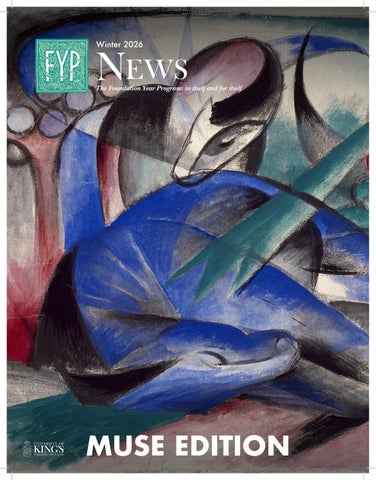
Create a flipbook
FYP News Spring 2026 by University of King's College - Issuu