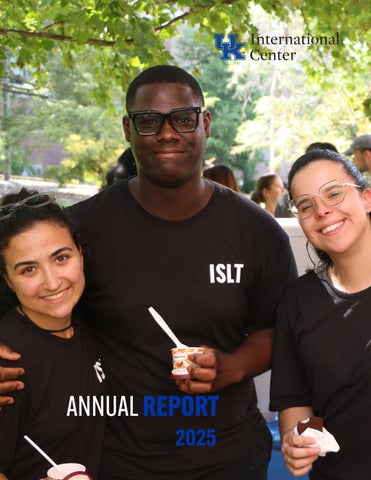
2025 Annual Report

Page 1


“As this was my first time in the United Kingdom, I have to say it was one of the best educational and cultural experiences of my life. It has opened my eyes to the world in ways that I cannot explain. Being able to immerse myself in the city has been very rewarding. I would recommend this program to anyone that wants to expand their global mindset.”

Pokharel, Explore First 2025 Participant

FROM THE ASSOCIATE PROVOST FOR INTERNATIONALIZATION

COLLABORATIVE ONLINE INTERNATIONAL LEARNING

GETTING INVLOVED

MAKING CONNECTIONS

LEARNING DISTILLED

OPENING DOORS

DRIVING GROWTH

GLOBAL MINDSET, LOCAL IMPACT

INTEGRATING ONE HEALTH

INSPIRING INGENUITY

GLOBAL UK

FROM THE ASSOCIATE PROVOST FOR INTERNATIONALIZATION

Colleagues and Friends,

International education has seen its fair share of challenges this past year. Tackling these challenges has required collaboration, dedication and focus – a focus on why we do what we do.

Our mission of “cultivating and advancing global learning, understanding, and connection by leading, supporting, and inspiring global engagement” is more vital than ever in guiding us as we navigate the current landscape. Our focus on this mission has led to some truly remarkable outcomes this past year, outcomes we’re proud to share with you in this year’s Annual Report.

I am pleased to confirm an increase this fall in both first-time first year undergraduate international enrollment and total international enrollment at the University of Kentucky. We understand the value of a UK education. These new students will gain the skills necessary to tackle the world’s biggest problems and will go on to lead lives of purpose and meaning.

This year, we also reported an overall increase in education abroad participation. International experiences prove hugely impactful for our students, in helping them succeed academically here at UK and in their future careers. But we also see the confidence gained through these experiences. We see previously reserved students come back and become campus and community leaders. We witness students apply for elite internships or fellowships because of their education abroad experience.

A key element in our vision and our mission is the work we do to support faculty. We have recently launched resources for faculty to create and facilitate Collaborative Online International Learning (COIL) modules in their courses. COIL modules link together students and classrooms in different countries, bridging the physical distance between students through technology. COIL is an exciting opportunity because it allows students to have an international experience and practice real world teamwork without leaving home.

These wonderful developments would not be possible without the hard work of our staff here in the International Center and the collaboration and support of our colleagues across campus and around the globe.

We know the work of internationalizing the University of Kentucky is advancing our Commonwealth. Global engagement leads to international graduate students assisting in critical breakthroughs in healthcare or to education abroad alumni using their experience to start a business which creates jobs for their fellow Kentuckians. This is why the work is so vital. This is why, as we enter 2026, this work continues even amidst the challenges.

Thank you for your support this past calendar year. I look forward to continuing our work together this year and in the years to come.

COLLABORATIVE ONLINE INTERNATIONAL LEARNING

Collaborative Online International Learning - or COIL - provides students with affordable opportunities to gain global competencies within their coursework wherever they are. It links together students and classrooms around the world through co-taught transnational online course work, bridging the physical distance between students through technological means.

The term “Collaborative Online International Learning” was initially coined by the State University of New York (SUNY), who subsequently established the SUNY Coil Center as part of SUNY’s Office of Global Affairs. Since that time, interest in COIL has grown in large part due to continued improvements in educational technologies and a growing interest in providing accessible global experiences to students.

“Global experiences build prepared students,” said Sue Roberts, associate provost for internationalization. “By making a global experience this accessible, we are helping faculty prepare their students for that next step.”

Partnering with the Center for the Enhancement of Teaching and Learning, the UK International Center has launched a COIL Community Learning Group. The UK COIL Learning Community will provide participants with support as they learn about COIL, identify international collaborators, co-design COIL modules for their courses, and plan for evaluation. COIL Learning Community participants will benefit from structured support through:

• An introductory two-day COIL Basics Workshop during Winter Break

• Learning Community Program - a series of seven intensive Learning Community sessions during the Spring 2026 semester

• The UK COIL teaching and learning symposium

“Participants in the COIL learning community will engage in creative and cross-disciplinary work with dedicated support for the design and implementation of global learning experiences in a wide range of courses,” said Trey Conatser, assistant provost for teaching and learning and director of the Center for the Enhancement of Teaching and Learning. “We’ll explore unique aspects such as identifying and working with international colleagues, preparing students to engage with global peers, and leveraging technology effectively for partnered courses. Because COIL is flexible to the needs of different curricula, there are many possibilities for faculty who are interested in participating.”

“One of our core goals is to prepare students for the world ahead,” said Roberts. “COIL presents a fantastic opportunity to do just that.”

Professor of Anthropology Ann Kingsolver has successfully integrated COIL modules into her courses. She finds COIL an excellent way to provide access to global experiences to all students, which she had been doing using other methods for two decades.

“For me, COIL is all about equity and accessibility,” she said. “It is a way to open up the world for students who may not have the ability to travel overseas or have the resources to take advantage of other opportunities. COIL emphasizes using free platforms that students in both countries have access to and decision-making about the short COIL course modules is equal between instructors in different countries and serves student needs and interests in both courses.”

Once she began using COIL in her courses, Kingsolver also noticed the small ways students began to understand cultural differences, placing their own experiences into a greater global context.

“Students from institutions in other countries and students at UK bring their own unique experiences into the module. For instance, in the icebreaker for a COIL unit last year on environmental justice between students in the US and Brazil, the students were excited about hearing about each other’s favorite music and regional dishes and what daily life was like at each other’s universities.”

According to Kingsolver, COIL has become more possible due to technological advancements.

“Not only have there been significant advancements in online communication technologies necessary for COIL modules, but we’re all a bit more used to these technologies, especially after the COVID-19 pandemic. These tools are widely used in many people’s daily life now. The barriers and challenges that were there are being addressed through the transnational COIL community, so it’s a fantastic time to start thinking about how to incorporate COIL modules into your courses.”

GETTING INVOLVED

Anna Bollis’ journey to the University of Kentucky began with a bit of good fortune.

Originally from Brazil, her father and brother had just visited the United States and explored Kentucky when she began searching for international schools to apply to.

“They told me, you have to consider the University of Kentucky,” she said. “It’s perfect. And it kind of was”

After applying to several schools, Bollis received several scholarships to attend UK and decided to make the leap to Lexington, leaving her home in Brazil.

For Bollis, the transition was tough, but she started to find her way thanks to support from faculty and staff. “That first semester was hard,” she said. “I was away from home, and my language skills were not as high as they are now. It was hard at first. But I found that when I reached out and when I sought out support through some of the resources offer on campus, people came through for me. It just got better from there.”

Bollis is a mechanical engineering major in UK’s Stanley and Karen Pigman College of Engineering. She initially discovered her passion for the field in high school in Brazil but fully realized that potential at UK.

“I discovered my love for engineering while in Brazil,” she said. “High school is a bit different there than in the United States. There are aspects that are like technical schools here, and thanks to that unique curriculum I discovered my love and talent for engineering. Once I started taking classes, and I took my first course in mechanical engineering, I knew I had found my passion.”

During her time at UK, she has grasped opportunities to lead on campus.

As a member of the International Student Leadership Team, Bollis works to help other international students feel welcomed on campus and create a community that encourages and pushes its members toward success.

“I remember that feeling when I got here,” said Bollis. “It was tough to be in a new place, away

from family and friends and adjusting to school. I was able to eventually find that community, and I love being part of helping new students connect and feel at home.”

In addition to serving on the International Student Leadership Team, she also co-founded UK’s first handball club. Handball is a fast growing sport in Bollis’s home nation of Brazil, with the men’s and women’s national teams both traditionally one of the strongest teams around the globe.

“I could sense early on in my time here that I couldn’t just forget about the importance of being physically well. I don’t love just going to the gym. That was the basis of forming the club. We’ve been able to grow since starting the club, and we’ve been able to introduce this sport that is not as well known in the United States to many students.”

Bollis has also found ways to strengthen her skills by taking internship and job opportunities both on and off campus.

She has served as a student systems technician in Facilities Management at the University of Kentucky and, most recently, this fall has taken on an internship as a design mechanical engineer with CMTA in Lexington, Kentucky after connecting with them at a spring 2025 career fair. CMTA is part of Legence, a leading provider of engineering, consulting, installation, and maintenance services for mission-critical systems in buildings. They specialize in designing, fabricating, and installing complex HVAC, process piping, and other mechanical, electrical, and plumbing (MEP) systems— enhancing energy efficiency, reliability, and sustainability in new and existing facilities. For Bollis, the opportunity has opened her eyes to a different side of mechanical engineering and has helped her refine her passions. “Before my internship, I had no idea about this part of mechanical engineering,” she said. “This opportunity gives me another interesting option after I graduate. It gives me the skills needed to succeed and has really just reinvigorated my love of this field and makes me excited about my career.”

Bollis isn’t sure specifically what the future holds for her, but she knows she’ll be ready. “I’m open to the possibilities,” she said. “I know, though, that whatever comes my way, I am prepared because of my time here at UK.”

“I was able to eventually find that community, and I love being part of helping new students connect and feel at home.”
-Anna Bollis
Anna Bollis pictured with UK Handball Team

INTERNATIONAL STUDENT AND SCHOLAR SERVICES

1,399

INTERNATIONAL STUDENTS ENROLLED IN FALL 2025

101

274

NEW INTERNATIONAL STUDENTS ENROLLED IN FALL 2025

316 ALUMNI WORKING IN U.S. ON OPTIONAL PRACTICAL TRAINING from COUNTRIES AROUND THE WORLD

INTERNATIONAL HEALTH, SAFETY AND SECURITY

MAKING CONNECTIONS

This fall, The UK International Center hosted a group of higher education administrators from colleges and universities across Germany as part of a Fulbright program comparing student support services at U.S. institutions to those in Germany.

As part of the program, UKIC partnered with Bluegrass Community and Technical College to give participants a unique perspective on internationalization.

“Throughout the program, participants spent time with University of Kentucky administrators getting an inside look at how we support

students, which can be quite different from how European universities do things” said Jason Hope, director of global risk and strategic operations.

“Global learning and internationalization happen at all levels across higher education,” said Hope. “The BCTC visit was the perfect opportunity for participants to see the practical impacts of internationalization on our community. Institutions of all sizes focus on it not only for internal growth but also to create globally prepared citizens ready to make a difference in Kentucky and around the world.”

“All students gain key skills through global learning experiences,” said Erin Howard, associate dean for global learning at BCTC. “We have students from a wide array of disciplines study abroad or have some form of global experience, and they come away better collaborators, problem-solvers and communicators. These are skills employers want from those entering the workforce, so these experiences can give students a head start.”

Throughout the visit to BCTC, participants noted the difference in student support at American higher education institutions. “The cultural differences you encounter on these types of exchanges are always fascinating,” said Hope. “We’re always learning from each other. I think this year our German counterparts really leaned into the student support side.

Their experience of student support is a bit narrower than ours here in the U.S. I think our focus here on supporting the whole student, not just academics, really resonated.”

The program and the visit to BCTC also kicked off conversations about ways to partner in the future. “We recently had one of the participants reach out about a potential partnership opportunity,” said Howard. “That’s why these kinds of exchanges are so exciting. Connecting with international colleagues can often lead to programs that enrich the lives of our students.”

“The more we can learn from each other, the better we can support students here at home,” said Hope. “We hope to continue these kinds of exchange programs because we always walk away with so much. This year was no different.”

Group of German higher education administrators visit BCTC Advanced Manufacturing Technology campus in Georgetown, Ky.

EDUCATION ABROAD AND EXCHANGES

Learning DISTILLED

How far would you go to better understand one of the key industries in Kentucky?

Students in the education abroad program “Interdisciplinary Projects in Distilling” travel across the Atlantic Ocean, to Edinburgh, Scotland in order to compare and contrast the historical, economic and social facets of the distilling industries in Scotland and Kentucky.

Led by Assistant Dean for Student Engagement and Director of the Center for Personal Development in the Lewis Honors College, Sally Foster, and Associate Director of the James B. Beam Institute, Ilka Balk, the program serves as the perfect opportunity for students to gain the benefits of studying abroad while completing team projects for organizations in the Scotch Whisky industry and making crucial connections to a key industry in the Commonwealth.

“My education abroad focus is providing students layered opportunities to learn not only about different cultures but to gain knowledge and experience in the global world of work said Foster. “Students gain a tremendous level of confidence in their abilities and clarity with their career goals during these experiences. As I was looking to develop a new program that provided experience in global work settings, I chose to focus on a specific industry. I approached the James Beam Institute to begin discussions about partnerships they had in Scotland. From there, the program really came to fruition.”

The partnership with the James Beam Institute allowed the program to take off and offered students the chance to gain key careerreadiness skills and real-world experience in one of Kentucky’s premier industries.

“The partnership with the Beam Institute has been crucial to the success of this program,” said Foster. “The Beam Institute’s research partners in Scotland provided four projects that our student teams worked on which included topics like sustainability, systems thinking,

market research and branding. Students gain so much insight and real-world skills thanks to the partnerships. They’ll be using the knowledge and skills gained in the course in the workforce each and every day.”

Established through a generous, $5 million gift from Suntory Global Spirits in 2019, the James B. Beam Institute for Kentucky Spirits at the University of Kentucky is the bourbon industry’s research and development vehicle. The Beam Institute offers multidisciplinary research strengths to ensure sustained competitiveness of Kentucky’s spirits industry and its supply chain. A further commitment is to develop the state’s workforce and provide opportunities for economic growth via process efficiency and outreach. In creating exceptional teaching, research and outreach programs, the Beam Institute is a leader for Kentucky’s spirits industry from farm to product.

“The program fits perfectly within the mission of the James Beam Institute,” said Ilka Balk, associate director of the James Beam Institute. “Part of leading the global advancement of the American whiskey industry is in preparing the next generation. This program is equipping that next generation to understand this industry on a global level, so they can continue to grow it.”

Students also gain real-world experience through the interdisciplinary aspect of the course, which fosters collaboration across different disciplines. They are carefully placed on project teams with students from a variety of majors and career goals so they can experience the stages of team development and appreciate the different viewpoints that culminate in the final project.

“The interdisciplinary nature of the course truly prepares students for what’s next,” said Foster. “Whatever job they have or career they go into, they will be solving problems as part of an crossfunctional team at some point. This program fosters that creativity, collaboration and communication they need to succeed.”

While on the program, students have the unique opportunity to experience distilling at all levels, from larger, multinational companies to smaller, independent distilleries, all while exploring Scotland.

“Students really get a chance to see all sides of distilling,” said Balk. “I think there’s a tendency to glamourize being a master distiller, and on the program students get to really see what that entails, all the hard work and expertise it requires. If they want to get into the distilling industry, the program also works to help them better understand which aspects of distilling they are passionate about or what kind of company they may want to work for in the future. Some students leave the program liking the resources available at a larger distiller, whereas others really appreciate the startup mentality of some of the more independent ones.”

As for the future of the program, Balk and Foster are always looking for new places and new ways to help students grow.

“We are planning on taking students to Scotland again in the summer of 2026,” said Foster.

“The wonderful thing about distilling is that it is truly a global industry,” said Balk. “There are always new places to explore in this industry.”

Opening DOORS

As part of an ongoing effort to support faculty interested in leading education abroad programs, the office of Education Abroad and Exchanges is excited to announce the Faculty-Directed Emerging Leaders program.

The program is designed for UK faculty or staff who are approved for teaching and are interested in directing an education abroad program in the future but who may have limited or no prior experience with education abroad program design or leadership.

“The Emerging Leader Program is a fantastic opportunity for those interested in leading an education abroad program who have not done so before,” said Ellie Holliday, Lecturer and Director of Undergraduate Global Learning Initiatives. “Developing, running and assessing an education abroad program can sometimes come with a steep learning curve, and it requires additional skills and knowledge beyond what is typically expected for teaching a course on campus. We have incredible instructors at UK with significant depth of knowledge in their fields. Allowing them the opportunity to gain hands-on experience observing and working with an established program director will enable them to see firsthand how they can deliver their own instruction in an international setting while preparing themselves for the types of challenges, and rewards, that are encountered along the way. As a former education abroad program co-director myself, I know that an opportunity like this would have greatly benefitted me and the students I led abroad.”

Up to five Emerging Leaders will be selected to participate in the mentorship program with an experienced UK colleague who has been a successful education abroad program director.

Emerging Leaders will receive insights into all the stages of faculty-directed education abroad programming, from building on an idea, designing a high-quality curriculum, recruiting

students, to traveling abroad and assessing outcomes.

Emerging Leaders will each have an opportunity to spend a week on-site with their mentor as they direct an education abroad program in Summer 2026, to experience the program firsthand.

“The emerging leader program opens the door for faculty to be an even bigger part of preparing our students for success in an increasingly interconnected world,” said Associate Professor of Human Health Sciences Christy Brady. “It will help demystify the process of successfully running an education abroad program, creating invaluable opportunities for our students to grow, and also serving as a fantastic professional development opportunity for faculty.”

2025-2026 EMERGING LEADERS COHORT

EMERGING LEADERS MENTORS

Heather Campbell-Speltz

Gregory Erhardt

Jan Ainger

Matthew Kim

Jennifer Smith

John David Stephenson

Liz Combs

Darshak Patel

Lynda Sharret

Sarah Geegan

Sally Foster

Ilka Balk

Jason Swanson

Driving

GROWTH

For the fourth consecutive year, enrollment in education abroad programs at the University of Kentucky has grown. Since the pandemicinterrupted year of 2020-2021, education abroad enrollment has steadily grown, with 1,170 students studying abroad in 2024-2025.

“Students want that international experience,” said Niamh Larson, executive director of education abroad and exchanges. “They understand the impact these experiences not only have on their academic career here at UK but on their employability and future career success.”

Larson also cites the Education Abroad Peer Ambassador Program as key to that enrollment growth. The program employs student workers who share their own education abroad experience and serve as a guide for fellow students interested in studying abroad.

“EAPAs are often the first voice students hear when it comes to studying abroad,” said Larson. “We know students listen to their fellow students, so having these outstanding student representatives talking about their experiences, the impact it had on them, is really crucial.” EAPAs also help answer students’ most pressing questions and concerns when considering studying abroad.

“One of the first things we make sure students understand is that studying abroad is possible,” said Larson. “There are often misconceptions that it will be out of reach financially or will interrupt their degree path. Our EAPAs do an amazing job using their own experience to help students understand the financial aspect and the fact that most students who study abroad actually end up more on track to graduate on time.”

Larson also cites faculty involvement as key to the increase in enrollment. The 2024-2025 academic year saw an increase in both faculty-directed student participants and the number of statements of intent that were approved.

“Faculty-directed programs are really the lifeblood of our education abroad program enrollment,” said Kate Meyer, who oversees faculty-directed programs as assistant director of education abroad and exchanges. “Our faculty partners develop fascinating programs that students want to go on. They also serve as key partners in recruiting students and working with us to ensure they are prepared for their time abroad. They go above and beyond for students to have the best possible experience abroad.”

Education Abroad and Exchanges has also generated creative ways to increase accessibility to education abroad, including a partnership with Podium Education to provide students access to the Global Career Accelerator, a for-credit, online program that equips college students with in-demand skills, real-world experience, and a pathway to a

successful career. Students gain hands-on experience with prominent industry tools while completing projects for brand partners like Charity: Water, Publicis Sapient, Intel, and The Grammys. The program integrates career preparation with soft skill development in communication, collaboration, and industry-leading intercultural competency training.

“Our partnership with Podium allows students to get that real-world experience and some of those skills that come with studying abroad right here at home,” said Larson. “We understand the impact these experiences can have on students, so we are dedicated to making them more accessible. Creating opportunities for students to have a highimpact experience without leaving home benefits all students.”

Education Abroad and Exchanges is also preparing for the fourth summer of Explore First: Careers, Cultures and Connections, a unique career-readiness education abroad program designed exclusively for FirstGeneration students at UK that takes them on visits with global employers in London and Dublin.

“Explore First is helping make study abroad not only more accessible but also more exciting for our students,” said Larson. “The program allows students room to fully prepare for their time abroad and to form close connections with fellow students on the program. The most exciting thing is seeing the impact of this program when students return to campus.

“We see this program’s impact,” said Larson. “Our team is dedicated to continuing to grow our education abroad enrollment because we understand that impact. It’s truly life changing.”

Education Abroad and Exchanges staff assist students at education abroad fall fair

EDUCATION ABROAD AND EXCHANGES

1,170 EDUCATION ABROAD PARTICIPANTS

AY 2024-2025 10% INCREASE FROM AY 2023-2024

55 TOTAL COUNTRIES VISITED

EDUCATION ABROAD FALL FAIR ATTENDANCE

Global MINDSET

For many students, experiential learning opportunities give them clarity, a clear idea of their passions, their skills, a clear vision of their future.

It’s exactly what happened for Katelyn McNamara, now a pediatric physical therapist with Norton Children’s in Louisville, Kentucky, when she traveled to Ecuador on the Shoulder to Shoulder Global program as an undergraduate student.

“I had considered going more into the research side,” said McNamara. “Shoulder to Shoulder really solidified, though, my passion for working

with patients. It made me want to have more of that human interaction and to experience that impact.”

Her specific passion for pediatric care blossomed during a subsequent journey to Ecuador, as a student on an Alternative Service Break trip. “As part of the service program, we helped with a pediatric clinic connected to Shoulder to Shoulder Global,” she said. “I was introduced to pediatric physical therapy at that clinic, and that was it. I knew this was what I was going to do for the rest of my life.”

Shoulder to Shoulder Global (STSG) is a UK Global Health Initiatives organization that integrates academic and community partners both at home and abroad to improve the health and well-being of underserved communities in Ecuador and outside of Nairobi, Kenya while simultaneously improving the clinical skills of current and future practitioners.

STSG was founded in 2002, when Dr. Tom Young, Professor of Pediatrics, College of Medicine, led the first medical brigade to Ecuador with a small group of six committed participants who wanted to make a difference.

Just four years later, the group had expanded to over 30 participants.

In 2006, a planning team composed of UK faculty, staff and students and community partners began planning for a comprehensive community development project in Santo Domingo de los Colorados, Ecuador. The first phase was the development of a primary care health center in the community of Carlos Ruiz Burneo (CRB), a very poor community on the outskirts of Santo Domingo. In April of 2007 the health center was opened, called Centro Medico Hombro a Hombro (CMHH) (Shoulder to Shoulder Health Center).

“It’s a bit different from here in the US because of the availability of care,” said McNamara. “Patients really have to receive every bit of care and information that day they visit the clinic, so we can hopefully set them up with what they need and give them the tools to be successful when they leave.”

Now, as the health center approaches twenty years of existence, the program is still not only changing lives in Ecuador but also helping future healthcare practitioners give better care to Kentuckians.

Local IMPACT

“Shoulder to Shoulder really forces you to think about and care for the whole person or the whole family,” she said. “Due to the nature of how we deliver care on the program, you have to consider what resources are available and how am I leaving this family. Because they may not have access to certain things after I leave. So you figure out how to care for the individual even if you aren’t there after you leave Ecuador. Today, as I focus on early intervention, it can be very similar. The knowledge and tools gained while on Shoulder to Shoulder really allow me to focus on the whole child, the whole family, and ensure I am leaving them with the tools needed to get better.”

On a typical day in the program, students work with professionals from UK and Ecuador to provide medical care to the local community for whom this kind of specialized care is not easily available. By the end of the day, patients at the clinic have received holistic care from a range of specialties.

As a global experience, the program also gave McNamara a better understanding of how to work better locally.

“Building a global health lens helps take the focus off yourself,” said McNamara. “It allows you to see the whole, and how you can help, in some small way, improve the lives of those around you. It puts it all in perspective and allows me to deliver care with the right mindset.”

ONE HEALTH GLOBAL

HEALTH INITIATIVES

Integrating

How do we solve the world’s biggest health challenges?

It seems daunting. It seems impossible. But it’s precisely the question students are asked to answer as part of the Global Health Case Competition.

This year’s competition focused on the One Health initiative. Student participants were asked to present a proposal focusing on how Mexico potentially hosting the 2036 Olympic Games would catalyze sustainable, measurable One Health initiatives.

One Health is an integrated, unifying approach that aims to sustainably balance and optimize the health of people, animals and ecosystems. It recognizes the health of humans, domestic and wild animals, plants and the wider environment (including ecosystems) are intricately linked and interdependent.

The One Health approach mobilizes multiple sectors, disciplines and communities at varying levels of society to work together to foster well-being and tackle threats to health and ecosystems while addressing the collective need for clean water, energy and air, safe and nutritious food, taking action on climate change and contributing to sustainable development.

“What really makes this event so special each year is the transdisciplinary nature of the competition,” said Assistant Provost for Global Health Initiatives Melody Ryan. “Students build teams with a variety of disciplines in mind. Often, the more diverse the collection of majors and skillsets, the more successful the team.”

This year’s winning team of five students represented five different colleges at UK, highlighting the collaborative nature of the work. “That collaboration and those different areas of expertise proved vital, especially in such a fast-moving competition where you had to change course very quickly,” said Callista Vandegriff, a PhD candidate in Entomology.

After the top three teams are selected by the judges, the final part of the competition involves students presenting again, this time with a particular constraint put in place. This year, the constraint was a severe reduction in budget.

“We want students thinking quickly and working collaboratively to solve these problems,” said Ryan. “This is often what work looks like in a career, especially in solving the world’s biggest problems. There can be sudden constraints or challenges that need to be worked around. But, this is really where students shine. The creativity we see in those final teams is always astounding.”

This year, participants were also in for a special surprise, as the competition was named the Dr. James F. Roark, Jr. Global Health Case Competition, in honor of Dr. Roark, who has supported the competition since its inception and whose personal connection to healthcare in Mexico coincided with this year’s case.

The Winning Team

Ivy Addo

Lirisha Tuladhar

Layla Unseld

Callista Vandegriff

Nicholas Walls

College of Public Health

College of Social Work

College of Arts and Sciences

Martin-Gatton College of Agriculture, Food and Environment

Stanley and Karen Pigman College of Engineering

Global Health Case Competition participants work on final presentation to judges.

“Dr. Roark has been a key supporter of the competition for many years,” said Ryan. “We are so proud to be able to name the competition in his honor.”

The winners of the Global Health Case Competition next get to compete against teams from around the globe at Emory University’s International Case Competition.

“I feel like I grew so much and learned so much through the competition that will stay with me in the years to come,” said Lirisha Tuladhar, an international graduate student in the College of Social Work. “I’m excited to challenge myself again at the international competition.”

ABOUT JAMES F. ROARK

Always fiercely passionate about global health, James F. Roark studied medicine at Universidad Autonoma de Guadalajara and the University of Southern California. Inspired by health inequities around him, he sought to practice medicine with an eye on different populations and with a global lens. Dr. Roark lived and practiced medicine in Seattle, Washington, while also frequently traveling to Mexico to deliver care. Now a retired psychiatrist, he has been a supporter of global health at UK and of the Global Health Case Competition since its inception in 2015.

SHOULDER TO SHOULDER GLOBAL GLOBAL HEALTH INITIATIVES

122 PARTICIPANTS IN 2025

2,060 MEDICAL CONSULTATIONS

PROVIDED

INTERNATIONAL PARTNERSHIPS AND RESEARCH

This year, the UK International Center and the Office of the Vice President for Research were proud to announce the third cohort of UKinSPIRE fellows.

UKinSPIRE is an internal funding opportunity for UK faculty, jointly funded by the OVPR and UKIC, intended to stimulate high-impact research projects in any discipline linking UK faculty and international collaborators and to establish collaborations with new international partner institutions or add greater depth to existing institutional partnerships.

This year’s call for proposals yielded 39 innovative proposals from a wide range of academic disciplines and research fields. Nine projects from faculty across six different UK colleges were selected for funding in 2025-2026.

One of those proposals from Associate Professor in the College of Pharmacy and Director of the Institute for Pharmaceutical Outcomes and Policy, Chris Delcher, focuses on comparing opioid prescription data for epidemiology research.

“There is an increased interest in improving global prescription drug monitoring, especially for opioid medications,” said Delcher. “The U.S. opioid epidemic emerged from the over prescribing of opioids until the advent of state-level prescription drug monitoring programs (PDMPs) that allowed for prescribers and dispensers to avoid inappropriate prescribing. Apart from their clinical use, these large

INSPIRING INGENUITY

databases have been critical for epidemiologic and public health policy research around controlled substances.”

Delcher’s proposal focuses on operationalizing the national PDMP data in Mexico alongside existing data from the Texas PDMP to examine opioid prescribing in Texas counties and Mexican equivalent areas along that section of the U.S.-Mexico border.

The research project will place special emphasis on opioid prescribing along the U.S.-Mexico Border. In Mexico, opioid prescribing is generally higher along the border due to higher socioeconomics and the geographic concentration of medical facilities.

“One of our goals is to understand how these drugs are prescribed in Mexico versus the United States in areas near the border.. By sharing our expertise in PDMPs with our Mexican counterparts, we can help governmental agencies in Mexico to detect and intervene in local populations with emerging substance abuse risks which has implications for the US. Understanding the correlations between prescribing patterns on both sides of the border would help identify impending problems for both countries.” help identify impending problems for both countries.”

Congratulating the cohort of UKinSPIRE fellows 3rd

• “Fostering Collaborations with Hispanic Populations to better study Population-specific Susceptibility factors for Periodontal Disease,” Oelisoa Mireille Andriankaja (College of Dentistry)

• “The Role of Pain, Parafunctional Habits, and Stress on Masticatory Muscle Activity,” Ian Boggero (College of Dentistry)

• “Building Opioid Prescription Data for Epidemiology Research (BORxDER),” Chris Delcher (College of Pharmacy)

• “Arts and Cultural Heritage in Protected Areas: Management Strategies, Sustainable Tourism, and Crisis Impacts,” Leah Hamilton (College of Fine Arts)

• “Exploring the Past to Power the Future: A New UK-Hungarian Partnership for Critical Mineral Research in Alkaline-Carbonatite Systems,” Georgina Lukoczki (Kentucky Geological Survey)

• “Sexual Harassment and Abuse, Digital and AI Technology, and Resistance: The United States and Italy,” Natalie Nenadic (College of Arts and Sciences)

• “Scaling up research tools on citizen engagement in large-scale energy and natural resource projects,” Karen Rignall (Martin-Gatton College of Agriculture, Food and Environment)

• “Developing a blueprint for complex tissue regeneration in mammals,” Ashley Seifert (College of Arts and Sciences)

• “Nutrition and health assessment of plant-based meat alternatives: a bilateral research partnership between University of Kentucky (USA) and University of Extremadura (Spain),” Youling Xiong (Martin-Gatton College of Agriculture, Food and Environment)

INTERNATIONAL PARTNERSHIPS AND RESEARCH

Celebrating 2025 GLOBAL IMPACT AWARD WINNERS

Dr. W Brent Seales

Dr. Christy Brady

Dr. Keiko Tanaka

Lexington Sister Cities Commission

John R. Bell

Katherine Hale LEARN MORE

196 PARTNERSHIPS 70 COUNTRIES

GLOBAL UK

As we enter 2026, our current strategic plan, Global UK, is coming to its conclusion. Developed in the midst of a global pandemic, the plan set an ambitious path forward. Over the last five years of the plan, many goals have been achieved, with the hard work of our dedicated staff and often with the collaboration of our campus partners.

Now, though, our eyes look forward. As we finish the work set forth by Global UK, we are preparing for the next strategic plan, one which will be developed in a very different world to the one of Global UK.

Like Global UK, our future endeavors will be guided by our mission to “cultivate and advance global learning, understanding, and connection by leading, supporting, and inspiring global engagement.”

LEARN MORE ABOUT GLOBAL UK

We envision a University of Kentucky where a global mindset is integral to our teaching, research, service, and operations; where diverse cultural perspectives are included and valued; and where global learning is broadly accessible.

MISSION

Through our collective expertise and shared advocacy, the UK International Center cultivates and advances global learning, understanding, and connection by leading, supporting, and inspiring global engagement.

Turn static files into dynamic content formats.
Create a flipbook
Issuu converts static files into: digital portfolios, online yearbooks, online catalogs, digital photo albums and more. Sign up and create your flipbook.